EP1717296A1 - Additive für schwefelarme Mineralöldestillate, umfassend Aromaten, welche eine Hydroxygruppe, eine Methoxygruppe und eine Säurefunktion tragen - Google Patents
Additive für schwefelarme Mineralöldestillate, umfassend Aromaten, welche eine Hydroxygruppe, eine Methoxygruppe und eine Säurefunktion tragen Download PDFInfo
- Publication number
- EP1717296A1 EP1717296A1 EP06008073A EP06008073A EP1717296A1 EP 1717296 A1 EP1717296 A1 EP 1717296A1 EP 06008073 A EP06008073 A EP 06008073A EP 06008073 A EP06008073 A EP 06008073A EP 1717296 A1 EP1717296 A1 EP 1717296A1
- Authority
- EP
- European Patent Office
- Prior art keywords
- alkyl
- oil
- additive
- formula
- ethylene
- Prior art date
- Legal status (The legal status is an assumption and is not a legal conclusion. Google has not performed a legal analysis and makes no representation as to the accuracy of the status listed.)
- Withdrawn
Links
Classifications
-
- C—CHEMISTRY; METALLURGY
- C10—PETROLEUM, GAS OR COKE INDUSTRIES; TECHNICAL GASES CONTAINING CARBON MONOXIDE; FUELS; LUBRICANTS; PEAT
- C10L—FUELS NOT OTHERWISE PROVIDED FOR; NATURAL GAS; SYNTHETIC NATURAL GAS OBTAINED BY PROCESSES NOT COVERED BY SUBCLASSES C10G OR C10K; LIQUIFIED PETROLEUM GAS; USE OF ADDITIVES TO FUELS OR FIRES; FIRE-LIGHTERS
- C10L1/00—Liquid carbonaceous fuels
- C10L1/10—Liquid carbonaceous fuels containing additives
- C10L1/14—Organic compounds
- C10L1/18—Organic compounds containing oxygen
- C10L1/182—Organic compounds containing oxygen containing hydroxy groups; Salts thereof
- C10L1/183—Organic compounds containing oxygen containing hydroxy groups; Salts thereof at least one hydroxy group bound to an aromatic carbon atom
-
- C—CHEMISTRY; METALLURGY
- C10—PETROLEUM, GAS OR COKE INDUSTRIES; TECHNICAL GASES CONTAINING CARBON MONOXIDE; FUELS; LUBRICANTS; PEAT
- C10L—FUELS NOT OTHERWISE PROVIDED FOR; NATURAL GAS; SYNTHETIC NATURAL GAS OBTAINED BY PROCESSES NOT COVERED BY SUBCLASSES C10G OR C10K; LIQUIFIED PETROLEUM GAS; USE OF ADDITIVES TO FUELS OR FIRES; FIRE-LIGHTERS
- C10L1/00—Liquid carbonaceous fuels
- C10L1/02—Liquid carbonaceous fuels essentially based on components consisting of carbon, hydrogen, and oxygen only
-
- C—CHEMISTRY; METALLURGY
- C10—PETROLEUM, GAS OR COKE INDUSTRIES; TECHNICAL GASES CONTAINING CARBON MONOXIDE; FUELS; LUBRICANTS; PEAT
- C10L—FUELS NOT OTHERWISE PROVIDED FOR; NATURAL GAS; SYNTHETIC NATURAL GAS OBTAINED BY PROCESSES NOT COVERED BY SUBCLASSES C10G OR C10K; LIQUIFIED PETROLEUM GAS; USE OF ADDITIVES TO FUELS OR FIRES; FIRE-LIGHTERS
- C10L1/00—Liquid carbonaceous fuels
- C10L1/10—Liquid carbonaceous fuels containing additives
- C10L1/14—Organic compounds
- C10L1/143—Organic compounds mixtures of organic macromolecular compounds with organic non-macromolecular compounds
-
- C—CHEMISTRY; METALLURGY
- C10—PETROLEUM, GAS OR COKE INDUSTRIES; TECHNICAL GASES CONTAINING CARBON MONOXIDE; FUELS; LUBRICANTS; PEAT
- C10L—FUELS NOT OTHERWISE PROVIDED FOR; NATURAL GAS; SYNTHETIC NATURAL GAS OBTAINED BY PROCESSES NOT COVERED BY SUBCLASSES C10G OR C10K; LIQUIFIED PETROLEUM GAS; USE OF ADDITIVES TO FUELS OR FIRES; FIRE-LIGHTERS
- C10L1/00—Liquid carbonaceous fuels
- C10L1/10—Liquid carbonaceous fuels containing additives
- C10L1/14—Organic compounds
- C10L1/18—Organic compounds containing oxygen
- C10L1/188—Carboxylic acids; metal salts thereof
- C10L1/189—Carboxylic acids; metal salts thereof having at least one carboxyl group bound to an aromatic carbon atom
-
- C—CHEMISTRY; METALLURGY
- C10—PETROLEUM, GAS OR COKE INDUSTRIES; TECHNICAL GASES CONTAINING CARBON MONOXIDE; FUELS; LUBRICANTS; PEAT
- C10L—FUELS NOT OTHERWISE PROVIDED FOR; NATURAL GAS; SYNTHETIC NATURAL GAS OBTAINED BY PROCESSES NOT COVERED BY SUBCLASSES C10G OR C10K; LIQUIFIED PETROLEUM GAS; USE OF ADDITIVES TO FUELS OR FIRES; FIRE-LIGHTERS
- C10L1/00—Liquid carbonaceous fuels
- C10L1/10—Liquid carbonaceous fuels containing additives
- C10L1/14—Organic compounds
- C10L1/22—Organic compounds containing nitrogen
-
- C—CHEMISTRY; METALLURGY
- C10—PETROLEUM, GAS OR COKE INDUSTRIES; TECHNICAL GASES CONTAINING CARBON MONOXIDE; FUELS; LUBRICANTS; PEAT
- C10L—FUELS NOT OTHERWISE PROVIDED FOR; NATURAL GAS; SYNTHETIC NATURAL GAS OBTAINED BY PROCESSES NOT COVERED BY SUBCLASSES C10G OR C10K; LIQUIFIED PETROLEUM GAS; USE OF ADDITIVES TO FUELS OR FIRES; FIRE-LIGHTERS
- C10L1/00—Liquid carbonaceous fuels
- C10L1/10—Liquid carbonaceous fuels containing additives
- C10L1/14—Organic compounds
- C10L1/18—Organic compounds containing oxygen
- C10L1/188—Carboxylic acids; metal salts thereof
- C10L1/1881—Carboxylic acids; metal salts thereof carboxylic group attached to an aliphatic carbon atom
-
- C—CHEMISTRY; METALLURGY
- C10—PETROLEUM, GAS OR COKE INDUSTRIES; TECHNICAL GASES CONTAINING CARBON MONOXIDE; FUELS; LUBRICANTS; PEAT
- C10L—FUELS NOT OTHERWISE PROVIDED FOR; NATURAL GAS; SYNTHETIC NATURAL GAS OBTAINED BY PROCESSES NOT COVERED BY SUBCLASSES C10G OR C10K; LIQUIFIED PETROLEUM GAS; USE OF ADDITIVES TO FUELS OR FIRES; FIRE-LIGHTERS
- C10L1/00—Liquid carbonaceous fuels
- C10L1/10—Liquid carbonaceous fuels containing additives
- C10L1/14—Organic compounds
- C10L1/18—Organic compounds containing oxygen
- C10L1/19—Esters ester radical containing compounds; ester ethers; carbonic acid esters
-
- C—CHEMISTRY; METALLURGY
- C10—PETROLEUM, GAS OR COKE INDUSTRIES; TECHNICAL GASES CONTAINING CARBON MONOXIDE; FUELS; LUBRICANTS; PEAT
- C10L—FUELS NOT OTHERWISE PROVIDED FOR; NATURAL GAS; SYNTHETIC NATURAL GAS OBTAINED BY PROCESSES NOT COVERED BY SUBCLASSES C10G OR C10K; LIQUIFIED PETROLEUM GAS; USE OF ADDITIVES TO FUELS OR FIRES; FIRE-LIGHTERS
- C10L1/00—Liquid carbonaceous fuels
- C10L1/10—Liquid carbonaceous fuels containing additives
- C10L1/14—Organic compounds
- C10L1/18—Organic compounds containing oxygen
- C10L1/192—Macromolecular compounds
- C10L1/195—Macromolecular compounds obtained by reactions involving only carbon-to-carbon unsaturated bonds
- C10L1/196—Macromolecular compounds obtained by reactions involving only carbon-to-carbon unsaturated bonds derived from monomers containing a carbon-to-carbon unsaturated bond and a carboxyl group or salts, anhydrides or esters thereof homo- or copolymers of compounds having one or more unsaturated aliphatic radicals each having one carbon bond to carbon double bond, and at least one being terminated by a carboxyl radical or of salts, anhydrides or esters thereof
- C10L1/1963—Macromolecular compounds obtained by reactions involving only carbon-to-carbon unsaturated bonds derived from monomers containing a carbon-to-carbon unsaturated bond and a carboxyl group or salts, anhydrides or esters thereof homo- or copolymers of compounds having one or more unsaturated aliphatic radicals each having one carbon bond to carbon double bond, and at least one being terminated by a carboxyl radical or of salts, anhydrides or esters thereof mono-carboxylic
-
- C—CHEMISTRY; METALLURGY
- C10—PETROLEUM, GAS OR COKE INDUSTRIES; TECHNICAL GASES CONTAINING CARBON MONOXIDE; FUELS; LUBRICANTS; PEAT
- C10L—FUELS NOT OTHERWISE PROVIDED FOR; NATURAL GAS; SYNTHETIC NATURAL GAS OBTAINED BY PROCESSES NOT COVERED BY SUBCLASSES C10G OR C10K; LIQUIFIED PETROLEUM GAS; USE OF ADDITIVES TO FUELS OR FIRES; FIRE-LIGHTERS
- C10L1/00—Liquid carbonaceous fuels
- C10L1/10—Liquid carbonaceous fuels containing additives
- C10L1/14—Organic compounds
- C10L1/18—Organic compounds containing oxygen
- C10L1/192—Macromolecular compounds
- C10L1/195—Macromolecular compounds obtained by reactions involving only carbon-to-carbon unsaturated bonds
- C10L1/197—Macromolecular compounds obtained by reactions involving only carbon-to-carbon unsaturated bonds derived from monomers containing a carbon-to-carbon unsaturated bond and an acyloxy group of a saturated carboxylic or carbonic acid
- C10L1/1973—Macromolecular compounds obtained by reactions involving only carbon-to-carbon unsaturated bonds derived from monomers containing a carbon-to-carbon unsaturated bond and an acyloxy group of a saturated carboxylic or carbonic acid mono-carboxylic
-
- C—CHEMISTRY; METALLURGY
- C10—PETROLEUM, GAS OR COKE INDUSTRIES; TECHNICAL GASES CONTAINING CARBON MONOXIDE; FUELS; LUBRICANTS; PEAT
- C10L—FUELS NOT OTHERWISE PROVIDED FOR; NATURAL GAS; SYNTHETIC NATURAL GAS OBTAINED BY PROCESSES NOT COVERED BY SUBCLASSES C10G OR C10K; LIQUIFIED PETROLEUM GAS; USE OF ADDITIVES TO FUELS OR FIRES; FIRE-LIGHTERS
- C10L1/00—Liquid carbonaceous fuels
- C10L1/10—Liquid carbonaceous fuels containing additives
- C10L1/14—Organic compounds
- C10L1/22—Organic compounds containing nitrogen
- C10L1/222—Organic compounds containing nitrogen containing at least one carbon-to-nitrogen single bond
-
- C—CHEMISTRY; METALLURGY
- C10—PETROLEUM, GAS OR COKE INDUSTRIES; TECHNICAL GASES CONTAINING CARBON MONOXIDE; FUELS; LUBRICANTS; PEAT
- C10L—FUELS NOT OTHERWISE PROVIDED FOR; NATURAL GAS; SYNTHETIC NATURAL GAS OBTAINED BY PROCESSES NOT COVERED BY SUBCLASSES C10G OR C10K; LIQUIFIED PETROLEUM GAS; USE OF ADDITIVES TO FUELS OR FIRES; FIRE-LIGHTERS
- C10L1/00—Liquid carbonaceous fuels
- C10L1/10—Liquid carbonaceous fuels containing additives
- C10L1/14—Organic compounds
- C10L1/22—Organic compounds containing nitrogen
- C10L1/234—Macromolecular compounds
- C10L1/236—Macromolecular compounds obtained by reactions involving only carbon-to-carbon unsaturated bonds derivatives thereof
- C10L1/2364—Macromolecular compounds obtained by reactions involving only carbon-to-carbon unsaturated bonds derivatives thereof homo- or copolymers derived from unsaturated compounds containing amide and/or imide groups
-
- Y—GENERAL TAGGING OF NEW TECHNOLOGICAL DEVELOPMENTS; GENERAL TAGGING OF CROSS-SECTIONAL TECHNOLOGIES SPANNING OVER SEVERAL SECTIONS OF THE IPC; TECHNICAL SUBJECTS COVERED BY FORMER USPC CROSS-REFERENCE ART COLLECTIONS [XRACs] AND DIGESTS
- Y02—TECHNOLOGIES OR APPLICATIONS FOR MITIGATION OR ADAPTATION AGAINST CLIMATE CHANGE
- Y02P—CLIMATE CHANGE MITIGATION TECHNOLOGIES IN THE PRODUCTION OR PROCESSING OF GOODS
- Y02P30/00—Technologies relating to oil refining and petrochemical industry
- Y02P30/20—Technologies relating to oil refining and petrochemical industry using bio-feedstock
Definitions
- the invention relates to additives for low sulfur mineral oil distillates having improved cold flowability and paraffin dispersion, comprising an additive based on hydroxy-methoxyphenylcarboxylic acid, fuel oils additive therewith, and the use of the additive.
- crude oils and middle distillates obtained by distillation of crude oils such as gas oil, diesel oil or fuel oil
- crude oils and middle distillates obtained by distillation of crude oils contain different amounts of n-paraffins, which crystallize out as platelet-shaped crystals when the temperature is lowered and partly agglomerate with the inclusion of oil.
- the flow properties of the oils or distillates deteriorate, which can lead to disruptions in the extraction, transport, storage and / or use of the mineral oils and mineral oil distillates.
- the crystallization phenomenon especially in winter, can lead to deposits on the pipe walls, in individual cases, for example when a pipeline is at a standstill, even to its complete blockage.
- Typical flow improvers for crude oils and middle distillates are copolymers and terpolymers of ethylene with carboxylic acid esters of vinyl alcohol.
- Another object of flow improvers is to disperse the wax crystals, i. the delay or prevention of the sedimentation of paraffin crystals and thus the formation of a paraffin-rich layer at the bottom of storage containers.
- EP-A-0 061 895 discloses cold flow improvers for mineral oil distillates containing esters, ethers or mixtures thereof.
- the esters / ethers contain two linear saturated C 10 to C 30 alkyl groups and one polyoxyalkylene group at 200 to 5000 g / mol.
- EP-0 973 848 and EP-0 973 850 disclose mixtures of esters of alkoxylated alcohols having more than 10 C atoms and fatty acids having 10 to 40 C atoms in combination with ethylene copolymers as flow improvers.
- EP-A-0 935 645 discloses alkylphenol-aldehyde resins as a lubricant-improving additive in low-sulfur middle distillates.
- EP-A-0857776 and EP-A-1 088 045 disclose processes for improving the flowability of paraffin-containing mineral oils and mineral oil distillates by adding ethylene copolymers and alkylphenol-aldehyde resins and optionally further, nitrogen-containing paraffin dispersants.
- WO-99/62973 discloses the use of copolymers of dialkyl phenyl fumarate and a comonomer selected from vinyl acetate, styrene, C 3 to C 30 ⁇ -olefins, ethylene and carbon monoxide as a cold additive for oils.
- aromatic compounds which contain hydroxyl, methoxy and carboxyl groups in mineral oils and distillates are well suited for paraffin dispersion.
- the invention thus relates to an additive for fuel oils containing at least one copolymer of ethylene and an unsaturated ester, at least one oil-soluble polar nitrogen compound which is a reaction product of amines of the formula NR 6 R 7 R 8 , wherein R 6 , R 7 and R 8 may be the same or different and at least one of these groups is C 8 -C 36 -alkyl, C 6 -C 36 -cycloalkyl, C 8 -C 36 -alkenyl, in particular C 12 -C 24 -alkyl, C 12 -C 24 Alkenyl or cyclohexyl, and the remaining groups are either hydrogen, C 1 -C 36 alkyl, C 2 -C 36 alkenyl, cyclohexyl, or a group of the formulas - (AO) x -E or - (CH 2 ) n -NYZ, where A is an ethyl or propyl group, x is a number from 1 to
- Another object of the invention is the use of the additives of the invention in amounts of from 5 to 10,000 ppm as paraffin dispersant in fuel oils, preferably in middle distillates.
- Another object of the invention is a method for improving the cold flow properties of fuel oils comprising adding from 5 to 10,000 ppm of the additives of the invention to the fuel oil.
- aromatic additives Particularly preferred are 4-hydroxy-3-methoxyphenyl-propionic acid or 4-hydroxy-3-methoxycinnamic acid.
- the aromatic additives are added to middle distillates, regardless of their content of copolymers of ethylene and an unsaturated ester, preferably in amounts of 10 to 1000, in particular 20 to 500 ppm.
- additive for fuel oils is referred to below as additive according to the invention.
- the additives according to the invention also contain one or more copolymers of ethylene and unsaturated esters and optionally further olefinically unsaturated compounds.
- Suitable ethylene copolymers are, in particular, those which, apart from ethylene, contain 6 to 21 mol%, in particular 10 to 18 mol%, of unsaturated esters.
- these copolymers have melt viscosities at 140 ° C from 20 to 10,000 mPas, in particular from 30 to 5,000 mPas, especially from 50 to 2,000 mPas.
- the unsaturated esters are preferably vinyl esters, acrylic esters, and / or methacrylic esters.
- the other olefinically unsaturated compounds are preferably alkyl vinyl ethers and / or alkenes, which may be substituted by hydroxyl groups.
- one or more comonomers may be present in the copolymer.
- said alkyl groups may be substituted with one or more hydroxyl groups.
- R 1 is a branched alkyl radical or a neoalkyl radical having 7 to 11 carbon atoms, in particular having 8, 9 or 10 carbon atoms.
- Particularly preferred vinyl esters are derived from secondary and especially tertiary carboxylic acids whose branching is in the alpha position to the carbonyl group.
- Suitable vinyl esters include vinyl acetate, vinyl propionate, vinyl butyrate, vinyl isobutyrate, vinyl hexanoate, vinyl heptanoate, vinyl octanoate, vinyl pivalate, vinyl 2-ethylhexanoate, vinyl laurate, vinyl stearate and versatic acid esters such as vinyl neononanoate, vinyl neodecanoate, vinyl neoundecanoate.
- these ethylene copolymers contain vinyl acetate and at least one further vinyl ester of the formula 4 in which R 1 is C 4 to C 30 -alkyl, preferably C 4 to C 16 -alkyl, especially C 6 - to C 12 -alkyl ,
- Suitable acrylic esters include, for example, methyl (meth) acrylate, ethyl (meth) acrylate, propyl (meth) acrylate, n- and isobutyl (meth) acrylate, hexyl, octyl, 2-ethylhexyl, decyl, dodecyl, tetradecyl , Hexadecyl, octadecyl (meth) acrylate and mixtures of these comonomers.
- said alkyl groups may be substituted with one or more hydroxyl groups.
- An example of such an acrylic ester is hydroxyethyl methacrylate.
- the alkenes are preferably simple unsaturated hydrocarbons having 3 to 30 carbon atoms, especially 4 to 16 carbon atoms and especially 5 to 12 carbon atoms.
- Suitable alkenes include propene, butene, isobutylene, pentene, hexene, 4-methylpentene, octene, diisobutylene and norbornene and its derivatives such as methylnorbornene and vinylnorbornene.
- said alkyl groups may be substituted with one or more hydroxyl groups.
- Particularly preferred terpolymers contain except ethylene 0.1 to 12 mol%, in particular 0.2 to 5 mol% Neononanklavinylester or vinyl neodecanoate and 3.5 to 20 mol%, in particular 8 to 15 mol% vinyl acetate, wherein the total Comonomer content between 6 and 21 mol%, preferably between 12 and 18 mol%.
- copolymers contain, in addition to ethylene and 8 to 18 mol% of vinyl esters, 0.5 to 15 mol% of alkenes as described above.
- the polymers underlying the mixtures differ in at least one feature.
- they may contain different comonomers, or have different comonomer contents, molecular weights and / or degrees of branching.
- the mixing ratio between the aromatic additives, the Ethylene copolymers and the oil-soluble polar nitrogen compounds may vary widely depending on the application, with the ethylene copolymers and the oil-soluble polar nitrogen compounds often being the major component.
- the additives according to the invention preferably contain from 2 to 70% by weight, preferably from 5 to 50% by weight of the aromatic additive, and from 30 to 98% by weight, preferably from 50 to 95% by weight, of ethylene copolymers and the oil-soluble polar nitrogen compounds.
- concentrations are 0.1 to 100, preferably 1 to 50, in particular 5 to 50 ppm of aromatic additive, 20 to 500, preferably 50 to 400, in particular 75 to 350 ppm of ethylene copolymer and 20 to 500, preferably 50 to 400, in particular 75 to 350 ppm of oil-soluble polar nitrogen compounds.
- the suitable oil-soluble polar nitrogen compounds are reaction products of fatty amines with compounds containing an acyl group.
- the alkyl and alkenyl radicals can be linear or branched and contain up to two double bonds. They are preferably linear and substantially saturated, ie they have iodine numbers of less than 75 gl 2 / g, preferably less than 60 gl 2 / g and in particular between 1 and 10 gl 2 / g. Particularly preferred are secondary fatty amines in which two of the groups R 6 , R 7 and R 8 are C 8 -C 36 -alkyl, C 6 -C 36 -cycloalkyl, C 8 -C 36 -alkenyl, in particular C 12 -C 24 alkyl, C 12 -C 24 alkenyl or cyclohexyl.
- Suitable fatty amines are, for example, octylamine, decylamine, dodecylamine, tetradecylamine, hexadecylamine, octadecylamine, eicosylamine, behenylamine, didecylamine, didodecylamine, ditetradecylamine, dihexadecylamine, dioctadecylamine, dieicosylamine, dibehenylamine and mixtures thereof.
- the amines contain chain cuts based on natural raw materials such as coconut fatty amine, tallow fatty amine, hydrogenated tallow fatty amine, dicocosfettamine, ditallow fatty amine and di (hydrogenated tallow fatty amine).
- Particularly preferred amine derivatives are amine salts, imides and / or amides such as, for example, amide ammonium salts of secondary fatty amines, in particular dicocosfettamine, ditallow fatty amine and distearylamine.
- Suitable carbonyl compounds for the reaction with amines are both low molecular weight and polymeric compounds having one or more carboxyl groups.
- those with 2, 3 or 4 carbonyl groups are preferred. They can also contain heteroatoms such as oxygen, sulfur and nitrogen.
- carboxylic acids examples include maleic, fumaric, crotonic, itaconic, succinic, C 1 -C 40 alkenyl succinic, adipic, glutaric, sebacic, and malonic acids and benzoic, phthalic, trimellitic and pyromellitic acid, nitrilotriacetic acid , Ethylenediaminetetraacetic acid and their reactive derivatives such as esters, anhydrides and acid halides.
- Copolymers of ethylenically unsaturated acids such as, for example, acrylic acid, methacrylic acid, maleic acid, fumaric acid and itaconic acid, have proven particularly suitable as polymeric carbonyl compounds, particular preference is given to copolymers of maleic anhydride.
- Suitable comonomers are those which impart oil solubility to the copolymer. Oil-soluble means here that the copolymer dissolves without residue in the middle distillate to be additive after reaction with the fatty amine in practice-relevant metering rates.
- Suitable comonomers are, for example, olefins, alkyl esters of acrylic acid and methacrylic acid, alkyl vinyl esters, alkyl vinyl ethers having 2 to 75, preferably 4 to 40 and in particular 8 to 20 carbon atoms in the alkyl radical.
- the alkyl radical bound to the double bond is equivalent here.
- the molecular weights of the polymeric carbonyl compounds are preferably between 400 and 20,000, more preferably between 500 and 10,000, for example between 1,000 and 5,000.
- Oil-soluble polar nitrogen compounds which have proved to be particularly suitable Reaction of aliphatic or aromatic amines, preferably long-chain aliphatic amines, with aliphatic or aromatic mono-, di-, tri- or tetracarboxylic acids or their anhydrides are obtained (see. US 4 211 534 ).
- amides and ammonium salts of aminoalkylene polycarboxylic acids such as nitrilotriacetic acid or ethylenediaminetetraacetic acid with secondary amines are suitable as oil-soluble polar nitrogen compounds (cf. EP 0 398 101 ).
- oil-soluble polar nitrogen compounds are copolymers of maleic anhydride and ⁇ , ⁇ -unsaturated compounds, which may optionally be reacted with primary monoalkylamines and / or aliphatic alcohols (cf. EP-A-0 154 177 . EP 0 777 712 ), the reaction products of Alkenylspirobislactonen with amines (see. EP-A-0 413 279 B1) and after EP-A-0 606 055 A2 reaction products of terpolymers based on ⁇ , ⁇ -unsaturated dicarboxylic acid anhydrides, ⁇ , ⁇ -unsaturated compounds and polyoxyalkylene ethers of lower unsaturated alcohols.
- the mixing ratio between the additives according to the invention and the oil-soluble polar nitrogen compounds as constituent II may vary depending on the application.
- such additive mixtures contain 5 to 95 wt .-%, preferably 10 to 90 wt .-% of the additive according to the invention and 5 to 95 wt .-%, preferably 10 to 90 wt .-% oil-soluble polar nitrogen compounds.
- olefin copolymers can be used as a co-additive.
- Suitable olefin copolymers as co-additive for the additive according to the invention can be derived directly from monoethylenically unsaturated monomers or can be prepared indirectly by hydrogenation of polymers derived from polyunsaturated monomers such as isoprene or butadiene.
- Preferred copolymers contain, in addition to ethylene structural units derived from ⁇ -olefins having 3 to 24 carbon atoms and molecular weights of up to 120,000 g / mol.
- Preferred ⁇ -olefins are propylene, butene, isobutene, n-hexene, isohexene, n-octene, isooctene, n-decene, isodecene.
- the comonomer content of olefins is preferably between 15 and 50 mol%, more preferably between 20 and 35 mol% and especially between 30 and 45 mol%. These copolymers may also contain minor amounts, eg, up to 10 mol% of other comonomers such as non-terminal olefins or non-conjugated olefins.
- Preferred are ethylene-propylene copolymers.
- the olefin copolymers can be prepared by known methods, for example by Ziegler or metallocene catalysts.
- olefin copolymers are block copolymers containing blocks of olefinically unsaturated aromatic monomers A and blocks of hydrogenated polyolefins B.
- Particularly suitable are block copolymers of the structure (AB) n A and (AB) m , where n is a number between 1 and 10 and m is a number between 2 and 10.
- the mixing ratio between the additive according to the invention and the constituent III is generally in each case between 1:20 and 20: 1, preferably in each case between 1:10 and 10: 1 by weight.
- comb polymers can furthermore be used as co-additive.
- alkylphenol-aldehyde resins are used as further constituents in the additives according to the invention.
- Alkylphenol-aldehyde resins are known in principle and, for example in the Rompp Chemie Lexikon, 9th edition, Thieme Verlag 1988-92, Volume 4, p 3351 et seq. described.
- Particularly suitable according to the invention are those alkylphenol-aldehyde resins which are derived from alkylphenols having one or two alkyl radicals in ortho and / or para position to the OH group.
- alkylphenols which carry at least two hydrogen atoms capable of condensation with aldehydes on the aromatic and in particular monoalkylated phenols whose alkyl radical is in the para position.
- the alkyl radicals (which are generally understood to mean hydrocarbon radicals as defined below for the constituent V) may be identical or different in the alkylphenol-aldehyde resins which can be used in the process according to the invention, they may be saturated or unsaturated and have 1 to 200, preferably 1 to 20, in particular 4 - 12 carbon atoms; it is preferably n-, iso- and tert-butyl, n- and iso-pentyl, n- and iso-hexyl, n- and isoOctyl-, n- and iso-nonyl-, n- and iso-decyl, n- and iso-dodecyl, tetradecyl, hexadecyl,
- Suitable aldehydes for the alkylphenol-aldehyde resins are those having 1 to 12 carbon atoms and preferably those having 1 to 4 carbon atoms such as formaldehyde, acetaldehyde, propionaldehyde, butyraldehyde, 2-ethylhexanal, benzaldehyde, glyoxylic acid and their reactive equivalents such as paraformaldehyde and trioxane.
- the molecular weight of the alkylphenol-aldehyde resins is 400-20,000, preferably 400-5000 g / mol.
- the prerequisite here is that the alkylphenol-aldehyde resins, at least in application-relevant concentrations of 0.001 to 1 wt .-% are oil-soluble.
- these are alkylphenol-formaldehyde resins, the oligo- or polymers having a repetitive structural unit of the formula 3 wherein R 5 is C 1 -C 200 alkyl or alkenyl and n is a number from 2 to 100.
- R 5 is preferably C 4 -C 20 -alkyl or -alkenyl and in particular C 6 -C 16 -alkyl or -alkenyl.
- n is a number from 2 to 50 and especially a number from 3 to 25, such as a number from 5 to 15.
- alkylphenol-aldehyde resins with C 2 -C 40 -alkyl radicals of the alkylphenol, preferably with C 4 -C 20 -alkyl radicals such as, for example, C 6 -C 12 -alkyl radicals.
- the alkyl radicals can be linear or branched, preferably they are linear.
- Particularly suitable alkylphenol-aldehyde resins are derived from linear alkyl radicals having 8 and 9 C atoms.
- the average molecular weight determined by GPC is preferably between 700 and 20,000, in particular between 800 and 10,000, for example between 1,000 and 2,500 g / mol.
- alkylphenol-aldehyde resins are accessible by known methods, for example by condensation of the corresponding alkylphenols with formaldehyde, ie with 0.5 to 1.5 moles, preferably 0.8 to 1.2 moles of formaldehyde per mole of alkylphenol.
- the condensation can be carried out solvent-free, but preferably it is carried out in the presence of an inert or only partially water-miscible inert organic solvent such as mineral oils, alcohols, ethers and the like. Particularly preferred are solvents which can form azeotropes with water.
- solvents in particular aromatics such as toluene, xylene diethylbenzene and higher-boiling commercial solvent mixtures such as ® Shellsol AB, and solvent naphtha are used.
- the condensation is preferably carried out between 70 and 200 ° C such as between 90 and 160 ° C. It is usually catalyzed by 0.05 to 5 wt .-% bases or acids.
- the condensation catalyzed by amines, preferably tertiary amines such as triethylamine, with subsequent neutralization by means of organic sulfonic acid leads to the suitable products.
- Catalysis is preferred by organic sulfonic acids, which after completion of the condensation with amines are converted to the oil-soluble sulfonic acid ammonium salts.
- the mixing ratio of the alkylphenol-aldehyde resins as co-additive to the additive according to the invention is generally between 20: 1 and 1:20, preferably between 1:10 and 10: 1.
- polyoxyalkylene compounds can be used as coadditives.
- Suitable polyoxyalkylene compounds as co-additive for the additive according to the invention are, for example, esters, ethers and ethers / esters which carry at least one alkyl radical having 12 to 30 carbon atoms.
- the alkyl groups are derived from an acid, the remainder is derived from a polyhydric alcohol; If the alkyl radicals come from a fatty alcohol, the remainder of the compound is derived from a polyacid.
- Suitable polyols are polyethylene glycols, polypropylene glycols, polybutylene glycols and their copolymers having a molecular weight of about 100 to about 5000, preferably 200 to 2000 g / mol.
- alkoxylates of polyols such as, for example, glycerol, trimethylolpropane, pentaerythritol, neopentyl glycol, and the oligomers having from 2 to 10 monomer units obtainable therefrom by condensation, e.g. Polyglycerol.
- Preferred alkoxylates are those having from 1 to 100, in particular from 5 to 50, mol of ethylene oxide, propylene oxide and / or butylene oxide per mole of polyol. Esters are especially preferred.
- Fatty acids containing 12 to 26 carbon atoms are preferred for reaction with the polyols to form the ester additives, more preferably C 18 to C 24 fatty acids, especially stearic and behenic acid.
- the esters can also be prepared by esterification of polyoxyalkylated alcohols. Preference is given to completely esterified polyoxyalkylated polyols having molecular weights of from 150 to 2,000, preferably from 200 to 600. Particularly suitable are PEG-600 dibehenate and glycerol-ethylene glycol tribehenate.
- the mixing ratio between the additive according to the invention and the further constituent VI is generally between 1:10 and 10: 1, preferably between 1: 5 and 5: 1.
- the additive according to the invention can be used alone or in admixture with one or more of the constituents II, III, IV, V or VI.
- the additives according to the invention can be used alone or together with other additives, for example with other pour point depressants or dewaxing aids, with antioxidants, flow improvers, cetane number improvers, dehazers, demulsifiers, detergents, lubricity additives, dispersants, defoamers, dyes, corrosion inhibitors, sludge inhibitors, odorants and / or additions to the cloud point.
- the other additives may be added directly into the fuel oil mixture or by mixing various fuel oil components which have already been individually additized with one or more of the additives mentioned, are introduced into the mixture.
- the additives according to the invention are suitable for improving the cold flow properties of fuel oils of animal, vegetable or mineral origin.
- they disperse the paraffins that precipitate below the cloud point in middle distillates.
- the middle distillate is in particular those mineral oils which are obtained by distillation of crude oil and boil in the range of 120 to 450 ° C, for example kerosene, jet fuel, diesel and fuel oil.
- aromatic compounds is meant the sum of mono-, di- and polycyclic aromatic compounds as determinable by HPLC according to DIN EN 12916 (2001 edition).
- the additives according to the invention are particularly advantageous in middle distillates which contain less than 350 ppm of sulfur, more preferably less than 100 ppm of sulfur, in particular less than 50 ppm of sulfur and, in special cases, less than 10 ppm of sulfur. These are generally those middle distillates which have been subjected to a hydrogenating refining, and therefore contain only small amounts of polyaromatic and polar compounds. These are preferably middle distillates which have 90% distillation points below 360 ° C., in particular 350 ° C. and in special cases below 340 ° C.
- Oils obtained from animal or vegetable material are mainly metabolites comprising triglycerides of monocarboxylic acids, eg acids having 10 to 25 carbon atoms, and the formula in which R is an aliphatic radical of 10 to 25 carbon atoms, which may be saturated or unsaturated.
- oils contain glycerides from a variety of acids, the number and variety of which varies with the source of the oil, and may additionally contain phosphoglycerides.
- Such oils can be obtained by methods known in the art.
- the biofuel oil which is often referred to as “biodiesel” or “biofuel”
- fatty acid alkyl esters of fatty acids having 12 to 24 carbon atoms and alcohols having 1 to 4 carbon atoms usually, a major part of the fatty acids contains one, two or three double bonds. It is particularly preferred to e.g. methyl rapeseed oil and especially mixtures containing rapeseed, sunflower, palm, old fat and / or soybean oil fatty acid methyl esters.
- oils derived from animal or vegetable material examples include rapeseed oil, coriander oil, soybean oil, cottonseed oil, sunflower oil, castor oil, olive oil, peanut oil, corn oil, almond oil, palm kernel oil, coconut oil, mustard seed oil, beef tallow, bone oil and fish oils.
- oils derived from wheat, jute, sesame, shea nut, arachis oil, and linseed oil and may be derived therefrom by methods known in the art.
- oils can be used, which were obtained from used waste oils, such as cooking oil.
- Rapeseed oil which is a mixture of glycerol partially esterified fatty acids, is preferred because it is available in large quantities and is readily available by squeezing rapeseed. Furthermore, the also widespread oils of sunflower and soybeans and their mixtures with rapeseed oil are preferred.
- lower alkyl esters of fatty acids the following are suitable, for example as commercial mixtures: The ethyl, propyl, butyl and especially methyl esters of fatty acids having 12 to 22 carbon atoms, for example of lauric acid, myristic acid, palmitic acid, palmitoleic acid, stearic acid, oleic acid, Elaidic acid, petroselinic acid, ricinoleic acid, elaeostearic acid, linoleic acid, linolenic acid, eicosanoic acid, gadoleic acid, docosanoic acid or erucic acid, which preferably have an iodine value of 50 to 150, in particular 90 to 125.
- Mixtures with particularly advantageous properties are those which are mainly, i. at least 50 wt .-%, contain methyl esters of fatty acids having 16 to 22 carbon atoms and 1, 2 or 3 double bonds.
- the preferred lower alkyl esters of fatty acids are the methyl esters of oleic, linoleic, linolenic and erucic acids.
- mixtures of synthetic fuels such as those described e.g. from the Fischer-Tropsch process, and a middle distillate of mineral origin A and / or a biofuel B are used as a fuel oil composition.
- Test oils were current oils from European refineries.
- the CFPP value is determined in accordance with EN 116 and the determination of the cloud point in accordance with ISO 3015.
- the determination of the aromatic hydrocarbon groups is carried out in accordance with DIN EN 12916 (November 2001 edition) Test oil 1
- Test oil 2 Test oil 3
- Test oil 4 Test oil 5 distillation IBP [° C] 166.3 ° C 173.8 ° C 240.7 173.8 166.6 90% - 20% cut [° C] 147 ° C 117 ° C 64,4345,7 116.6 102.5
- FBP [° C] 377.9 ° C 345.7 ° C 352.6 359.4
- Cloud point [° C] -8.0 -6.7 -8.2 -6.9 -3.9
- CFPP [° C] -11.0 -8.0 -11 -9 -7 sulfur [Ppm] 308 210 1450 320 2.7 Density @ 15 ° C [g / cm 3 ] 0.826 0.831 0.841 0.827
- the ethylene copolymers used are commercial products with the properties given in Table 2. The products were used as 65% and 50% settings in kerosene.
- Viscosity was determined according to ISO 3219 / B using a rotary viscometer (Haake RV20) with a plate-and-cone measuring system at 140 ° C.
- Table 2 Characterization of the ethylene copolymers used example Comonomer (s) V 140 A1 13.6 mole% vinyl acetate 130 mPas A2 12.5 mol% of vinyl acetate and 1.2 mol% of vinyl neodecanoate 150 mPas A3 9.8 mole percent vinyl acetate and 0.6 mole percent vinyl neodecanoate 170 mPas
- a polar polymeric nitrogen compound consisting of a comb polymer prepared from 1.3 mol% 1-tetradecene, 1.3 mol% hexadecene, 2.6 mol% maleic anhydride and 0.2 mol% allylmethyl polyglycol ether.
- the resulting polymer has a K value of 15 and is reacted with 2.6 mol% distearylamine and dicocosfettamine to form the amide ammonium salt.
- the titratable base nitrogen content of the 50% polymer solution is 0.69%.
- the lower 20 vol.% are isolated and the cloud point determined according to ISP 3015. Only a small deviation of the cloud point of the lower phase (CP KS ) from the blank value of the oil shows a good paraffin dispersion.
- the specified aromatic additives are used in an amount of 50-150 ppm.
- the use of a dispersant is usually in the presence of a cold flow improver.
- corresponding cold flow improvers were therefore also used.
- the CFPP activity and dispersing power of the additives of the invention were determined in a composition of (by weight) 50 ppm of the aromatic additive with 100 ppm B1 and 400 ppm A2.
- the CFPP activity and dispersing power of the additives of the invention were determined in a composition of (by weight) 100 ppm of the aromatic additive with 150 ppm B1 and 300 ppm A2.
- the CFPP activity and dispersing power of the additives of the invention were determined in a composition of (by weight) 50 ppm of the aromatic additive with 100 ppm B1 and 200 ppm A3.
- the CFPP activity and dispersing power of the additives of the invention were determined in a composition of (by weight) 50 ppm of the aromatic additive with 200 ppm B1 and 300 ppm A3.
- the CFPP activity and dispersing power of the additives of the invention were determined in a composition of (by weight) 100 ppm of the aromatic additive with 200 ppm B1 and 300 ppm A1.
Landscapes
- Chemical & Material Sciences (AREA)
- Oil, Petroleum & Natural Gas (AREA)
- Engineering & Computer Science (AREA)
- Chemical Kinetics & Catalysis (AREA)
- General Chemical & Material Sciences (AREA)
- Organic Chemistry (AREA)
- Health & Medical Sciences (AREA)
- Emergency Medicine (AREA)
- Liquid Carbonaceous Fuels (AREA)
Abstract
Description
- Die Erfindung betrifft Additive für schwefelarme Mineralöldestillate mit verbesserter Kaltfließfähigkeit und Paraffindispergierung, umfassend ein Additiv basierend auf Hydroxy-Methoxyphenyl-carbonsäure, damit additivierte Brennstofföle und die Verwendung des Additivs.
- Im Zuge der abnehmenden Erdölreserven werden bei ständig steigendem Energiebedarf immer problematischere Rohöle gefördert und verarbeitet. Darüber hinaus werden die Anforderungen an die daraus hergestellten Brennstofföle wie Diesel und Heizöl nicht zuletzt durch legislative Vorgaben immer anspruchsvoller. Beispiele dafür sind die Absenkung des Schwefelgehaltes, die Begrenzung des Siedeendes sowie des Aromatengehaltes von Mitteldestillaten, die die Raffinerien zu ständiger Anpassung der Verarbeitungstechnologie zwingen. Dies führt in Mitteldestillaten in vielen Fällen zu einem erhöhten Anteil an Paraffinen speziell im Kettenlängenbereich von C18 bis C24, was wiederum einen negativen Einfluss auf die Kaltfließeigenschaften dieser Brennstofföle hat.
- Rohöle und durch Destillation von Rohölen gewonnene Mitteldestillate wie Gasöl, Dieselöl oder Heizöl enthalten je nach Herkunft der Rohöle unterschiedliche Mengen an n-Paraffinen, die bei Erniedrigung der Temperatur als plättchenförmige Kristalle auskristallisieren und teilweise unter Einschluss von Öl agglomerieren. Durch diese Kristallisation und Agglomeration kommt es zu einer Verschlechterung der Fließeigenschaften der Öle bzw. Destillate, wodurch bei Gewinnung, Transport, Lagerung und/oder Einsatz der Mineralöle und Mineralöldestillate Störungen auftreten können. Beim Transport von Mineralölen durch Rohrleitungen kann das Kristallisationsphänomen vor allem im Winter zu Ablagerungen an den Rohrwänden, in Einzelfällen, z.B. bei Stillstand einer Pipeline, sogar zu deren völliger Verstopfung führen. Bei der Lagerung und Weiterverarbeitung der Mineralöle kann es ferner im Winter erforderlich sein, die Mineralöle in beheizten Tanks zu lagern. Bei Mineralöldestillaten kommt es als Folge der Kristallisation gegebenenfalls zu Verstopfungen der Filter in Dieselmotoren und Feuerungsanlagen, wodurch eine sichere Dosierung der Brennstoffe verhindert wird und unter Umständen eine völlige Unterbrechung der Kraftstoff- bzw. Heizmittelzufuhr eintritt.
- Neben den klassischen Methoden zur Beseitigung der auskristallisierten Paraffine (thermisch, mechanisch oder mit Lösungsmitteln), die sich lediglich auf die Entfernung der bereits gebildeten Ausfällungen beziehen, wurden in den letzten Jahren chemische Additive (so genannte Fließverbesserer) entwickelt. Diese bewirken durch physikalisches Zusammenwirken mit den ausfallenden Paraffinkristallen, dass deren Form, Größe und Adhäsionseigenschaften modifiziert werden. Die Additive wirken dabei als zusätzliche Kristallkeime und kristallisieren teilweise mit den Paraffinen aus, wodurch eine größere Anzahl kleinerer Paraffinkristalle mit veränderter Kristallform entsteht. Die modifizierten Paraffinkristalle neigen weniger zur Agglomeration, so dass sich die mit diesen Additiven versetzten Öle noch bei Temperaturen pumpen bzw. verarbeiten lassen, die oft mehr als 20°C tiefer liegen als bei nicht additivierten Ölen.
- Typische Fließverbesserer für Rohöle und Mitteldestillate sind Co- und Terpolymere des Ethylens mit Carbonsäureestern des Vinylalkohols.
- Eine weitere Aufgabe von Fließverbesserern ist die Dispergierung der Paraffinkristalle, d.h. die Verzögerung bzw. Verhinderung der Sedimentation der Paraffinkristalle und damit der Bildung einer paraffinreichen Schicht am Boden von Lagerbehältern.
-
EP-A-0 061 895 offenbart Kaltfließverbesserer für Mineralöldestillate, welche Ester, Ether oder deren Mischungen enthalten. Die Ester/Ether enthalten zwei lineare gesättigte C10- bis C30-Alkylgruppen und eine Polyoxyalkylengruppe mit 200 bis 5000 g/mol. -
EP-0 973 848 undEP-0 973 850 offenbaren Mischungen aus Estern alkoxilierter Alkohole mit mehr als 10 C-Atomen und Fettsäuren mit 10 - 40 C-Atomen in Kombination mit Ethylen-Copolymeren als Fließverbesserer. -
EP-A-0 935 645 offenbart Alkylphenol-Aldehydharze als schmierverbessernden Zusatz in schwefelarmen Mitteldestillaten. -
EP-A-0857776 undEP-A-1 088 045 offenbaren Verfahren zur Verbesserung der Fliessfähigkeit von paraffinhaltigen Mineralölen und Mineralöldestillaten durch Zugabe von Ethylen-Copolymeren und Alkylphenol-Aldehyd-Harzen sowie gegebenenfalls weiteren, stickstoffhaltigen Paraffindispergatoren. -
WO-99/62973 - Es bestand daher die Aufgabe, die Fließfähigkeit und insbesondere die Paraffindispergierung in der Kälte bei Mineralölen bzw. Mineralöldestillaten durch den Zusatz geeigneter Kälteadditive zu verbessern.
- Überraschend wurde nun gefunden, dass aromatische Verbindungen, welche in Mineralölen und ―destillaten Hydroxyl-, Methoxy- und Carboxylgruppen enthalten, gut zur Paraffindispergierung geeignet sind.
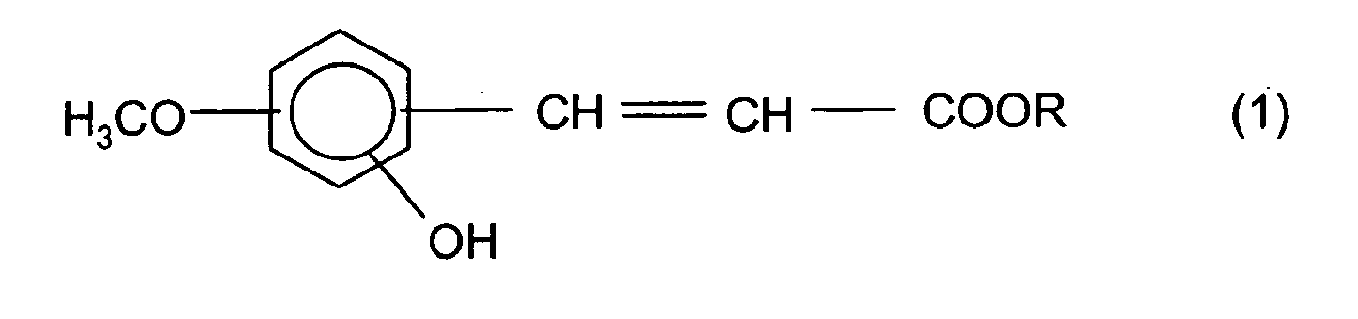
- Gegenstand der Erfindung ist somit ein Additiv für Brennstofföle, enthaltend mindestens ein Copolymer aus Ethylen und einem ungesättigten Ester, mindestens eine öllösliche polare Stickstoffverbindung, welche ein Umsetzungsprodukt von Aminen der Formel NR6R7R8, worin R6, R7 und R8 gleich oder verschieden sein können, und wenigstens eine dieser Gruppen für C8-C36-Alkyl, C6-C36-Cycloalkyl, C8-C36-Alkenyl, insbesondere C12-C24-Alkyl, C12-C24-Alkenyl oder Cyclohexyl steht, und die übrigen Gruppen entweder Wasserstoff, C1-C36-Alkyl, C2-C36-Alkenyl, Cyclohexyl, oder eine Gruppe der Formeln -(A-O)x-E oder -(CH2)n-NYZ bedeuten, worin A für eine Ethyl- oder Propylgruppe steht, x eine Zahl von 1 bis 50, E = H, C1-C30-Alkyl, C5-C12-Cycloalkyl oder C6-C30-Aryl, und n = 2, 3 oder 4 bedeuten, und Y und Z unabhängig voneinander H, C1-C30-Alkyl oder -(A-O)x bedeuten, mit Verbindungen, die mindestens eine Acylgruppe enthalten, ist, und mindestens eine aromatische Verbindung der Formel 1,

- Ein weiterer Gegenstand der Erfindung sind Brennstofföle, enthaltend mindestens ein Copolymer aus Ethylen und einem ungesättigten Ester, mindestens eine öllösliche polare Stickstoffverbindung, welche ein Umsetzungsprodukt von Aminen der Formel NR6R7R8, worin R6, R7 und R8 gleich oder verschieden sein können, und wenigstens eine dieser Gruppen für C8-C36-Alkyl, C6-C36-Cycloalkyl, C8-C36-Alkenyl, insbesondere C12-C24-Alkyl, C12-C24-Alkenyl oder Cyclohexyl steht, und die übrigen Gruppen entweder Wasserstoff, C1-C36-Alkyl, C2-C36-Alkenyl, Cyclohexyl, oder eine Gruppe der Formeln ―(A-O)x-E oder -(CH2)n-NYZ bedeuten, worin A für eine Ethyl-oder Propylgruppe steht, x eine Zahl von 1 bis 50, E = H, C1-C30-Alkyl, C5-C12-Cycloalkyl oder C6-C30-Aryl, und n = 2, 3 oder 4 bedeuten, und Y und Z unabhängig voneinander H, C1-C30-Alkyl oder ―(A-O)x bedeuten, mit Verbindungen, die mindestens eine Acylgruppe enthalten, ist, und mindestens eine aromatische Verbindung der Formel 1,

- Ein weiterer Gegenstand der Erfindung ist die Verwendung der erfindungsgemäßen Additive in Mengen von 5 bis 10.000 ppm als Paraffindispergator in Brennstoffölen, vorzugsweise in Mitteldestillaten.
- Ein weiterer Gegenstand der Erfindung ist ein Verfahren zur Verbesserung der Kaltfließeigenschaften von Brennstoffölen, umfassend die Zugabe von 5 bis 10.000 ppm der erfindungsgemäßen Additive zu dem Brennstofföl.
- Die oben angegebenen aromatischen Verbindungen der Formel 1 werden im Folgenden als aromatische Additive bezeichnet. Besonders bevorzugt sind 4-Hydroxy-3-Methoxyphenyl-Propionsäure oder 4-Hydroxy-3-methoxyzimtsäure.
- Die aromatischen Additive werden Mitteldestillaten, unabhängig von deren Gehalt an Copolymeren aus Ethylen und einem ungesättigten Ester, vorzugsweise in Mengen von 10 bis 1000, insbesondere 20 bis 500 ppm zugesetzt.
- Das Additiv für Brennstofföle wird im Folgenden als erfindungsgemäßes Additiv bezeichnet.
- Die erfindungsgemäßen Additive enthalten neben dem aromatischen Additiv noch ein oder mehrere Copolymere aus Ethylen und ungesättigten Estern und gegebenenfalls weiteren olefinisch ungesättigten Verbindungen. Als Ethylencopolymere eignen sich insbesondere solche, die neben Ethylen 6 bis 21 Mol-%, insbesondere 10 bis 18 Mol-% ungesättigte Ester enthalten. Vorzugsweise haben diese Copolymere Schmelzviskositäten bei 140°C von 20 bis 10.000 mPas, insbesondere von 30 bis 5.000 mPas, speziell von 50 bis 2.000 mPas.
- Die ungesättigten Ester sind vorzugsweise Vinylester, Acrylester, und/oder Methacrylester.
- Bei den weiteren olefinisch ungesättigten Verbindungen handelt es sich vorzugsweise um Alkylvinylether und/oder Alkene, wobei diese mit Hydroxylgruppen substituiert sein können.
- Es können neben Ethylen ein oder mehrere Comonomere im Copolymer enthalten sein.
- Bei den Vinylestern handelt es sich vorzugsweise um solche der Formel 2
CH2=CH-OCOR1 (2)
worin R1 C1 bis C30-Alkyl, vorzugsweise C4 bis C16-Alkyl, speziell C6- bis C12-Alkyl bedeutet. In einer weiteren Ausführungsform können die genannten Alkylgruppen mit einer oder mehreren Hydroxylgruppen substituiert sein. - In einer weiteren bevorzugten Ausführungsform steht R1 für einen verzweigten Alkylrest oder einen Neoalkylrest mit 7 bis 11 Kohlenstoffatomen, insbesondere mit 8, 9 oder 10 Kohlenstoffatomen. Besonders bevorzugte Vinylester leiten sich von sekundären und insbesondere tertiären Carbonsäuren ab, deren Verzweigung sich in alpha-Position zur Carbonylgruppe befindet. Geeignete Vinylester umfassen Vinylacetat, Vinylpropionat, Vinylbutyrat, Vinylisobutyrat, Vinylhexanoat, Vinylheptanoat, Vinyloctanoat, Pivalinsäurevinylester, 2-Ethylhexansäurevinylester, Vinyllaurat, Vinylstearat sowie Versaticsäureester wie Neononansäurevinylester, Neodecansäurevinylester, Neoundecansäurevinylester.
- In einer weiteren bevorzugten Ausführungsform enthalten diese Ethylen-Copolymere Vinylacetat und mindestens einen weiteren Vinylester der Formel 4 worin R1 für C4 bis C30-Alkyl, vorzugsweise C4 bis C16-Alkyl, speziell C6- bis C12-Alkyl steht.
- Bei den (Meth)Acrylestern handelt es sich vorzugsweise um solche der Formel 3
CH2=CR2-COOR3 (3)
worin R2 Wasserstoff oder Methyl und R3 C1- bis C30-Alkyl, vorzugsweise C4- bis C16-Alkyl, speziell C6- bis C12-Alkyl bedeutet. Geeignete Acrylester umfassen z.B. Methyl(meth)acrylat, Ethyl(meth)acrylat, Propyl(meth)acrylat, n- und isoButyl(meth)acrylat, Hexyl-, Octyl-, 2-Ethylhexyl-, Decyl-, Dodecyl-, Tetradecyl-, Hexadecyl-, Octadecyl(meth)acrylat sowie Mischungen dieser Comonomere. In einer weiteren Ausführungsform können die genannten Alkylgruppen mit einer oder mehreren Hydroxylgruppen substituiert sein. Ein Beispiel für einen solchen Acrylester ist Hydroxyethylmethacrylat. - Bei den Alkylvinylethern handelt es sich vorzugsweise um Verbindungen der Formel 4
CH2=CH-OR4 (4)
worin R4 C1- bis C30-Alkyl, vorzugsweise C4- bis C16-Alkyl, speziell C6- bis C12-Alkyl bedeutet. Beispielsweise seien genannt Methylvinylether, Ethylvinylether, isoButylvinylether. In einer weiteren Ausführungsform können die genannten Alkylgruppen mit einer oder mehreren Hydroxylgruppen substituiert sein. - Bei den Alkenen handelt es sich vorzugsweise um einfache ungesättigte Kohlenwasserstoffe mit 3 bis 30 Kohlenstoffatomen, insbesondere 4 bis 16 Kohlenstoffatomen und speziell 5 bis 12 Kohlenstoffatomen. Geeignete Alkene umfassen Propen, Buten, Isobutylen, Penten, Hexen, 4-Methylpenten, Octen, Diisobutylen sowie Norbornen und seine Derivate wie Methylnorbornen und Vinylnorbornen. In einer weiteren Ausführungsform können die genannten Alkylgruppen mit einer oder mehreren Hydroxylgruppen substituiert sein.
- Besonders bevorzugte Terpolymerisate enthalten außer Ethylen 0,1 bis 12 Mol-%, insbesondere 0,2 bis 5 Mol-% Neononansäurevinylester bzw. Neodecansäurevinylester und 3,5 bis 20 Mol-%, insbesondere 8 bis 15 Mol-% Vinylacetat, wobei der gesamte Comonomergehalt zwischen 6 und 21 Mol-%, bevorzugt zwischen 12 und 18 Mol-% liegt.
- Weitere besonders bevorzugte Copolymere enthalten neben Ethylen und 8 bis 18 Mol-% Vinylestern noch 0,5 bis 15 Mol-% Alkene wie oben beschrieben.
- Bevorzugt werden Mischungen aus zwei oder mehr der oben genannten Ethylencopolymere eingesetzt. Besonders bevorzugt unterscheiden sich die den Mischungen zu Grunde liegenden Polymere in mindestens einem Merkmal.
- Beispielsweise können sie unterschiedliche Comonomere enthalten, oder unterschiedliche Comonomergehalte, Molekulargewichte und/oder Verzweigungsgrade aufweisen.
- Das Mischungsverhältnis zwischen den aromatischen Additiven, den Ethylencopolymeren und den öllöslichen polaren Stickstoffverbindungen kann je nach Anwendungsfall in weiten Grenzen variieren, wobei die Ethylencopolymere und die öllöslichen polaren Stickstoffverbindungen oftmals den größeren Anteil darstellen. Bevorzugt enthalten die erfindungsgemäßen Additive 2 bis 70 Gew.-%, bevorzugt 5 bis 50 Gew.-% des aromatischen Additivs, sowie 30 bis 98 Gew.-%, bevorzugt 50 bis 95 Gew.-% Ethylencopolymere sowie der öllöslichen polaren Stickstoffverbindungen. Beispielhafte Konzentrationen sind 0,1 bis 100, vorzugsweise 1 bis 50, insbesondere 5 bis 50 ppm an aromatischem Additiv, 20 bis 500, vorzugsweise 50 bis 400, insbesondere 75 bis 350 ppm an Ethylencopolymer und 20 bis 500, vorzugsweise 50 bis 400, insbesondere 75 bis 350 ppm an öllöslichen polaren Stickstoffverbindungen.
- Bei den geeigneten öllöslichen polaren Stickstoffverbindungen (Bestandteil II) handelt es sich um Umsetzungsprodukte von Fettaminen mit Verbindungen, die eine Acylgruppe enthalten. Bei den Aminen handelt es sich um Verbindungen der Formel NR6R7R8, worin R6, R7 und R8 gleich oder verschieden sein können, und wenigstens eine dieser Gruppen für C8-C36-Alkyl, C6-C36-Cycloalkyl, C8-C36-Alkenyl, insbesondere C12-C24-Alkyl, C12-C24-Alkenyl oder Cyclohexyl steht, und die übrigen Gruppen entweder Wasserstoff, C1-C36-Alkyl, C2-C36-Alkenyl, Cyclohexyl, oder eine Gruppe der Formeln ―(A-O)x-E oder -(CH2)n-NYZ bedeuten, worin A für eine Ethyl-oder Propylgruppe steht, x eine Zahl von 1 bis 50, E = H, C1-C30-Alkyl, C5-C12-Cycloalkyl oder C6-C30-Aryl, und n = 2, 3 oder 4 bedeuten, und Y und Z unabhängig voneinander H, C1-C30-Alkyl oder ―(A-O)x bedeuten. Die Alkyl- und Alkenylreste können linear oder verzweigt sein und bis zu zwei Doppelbindungen enthalten. Bevorzugt sind sie linear und weitgehend gesättigt, das heißt sie haben Jodzahlen von weniger als 75 gl2/g, bevorzugt weniger als 60 gl2/g und insbesondere zwischen 1 und 10 gl2/g. Besonders bevorzugt sind sekundäre Fettamine, in denen zwei der Gruppen R6, R7 und R8 für C8-C36-Alkyl, C6-C36-Cycloalkyl, C8-C36-Alkenyl, insbesondere für C12-C24-Alkyl, C12-C24-Alkenyl oder Cyclohexyl stehen. Geeignete Fettamine sind beispielsweise Octylamin, Decylamin, Dodecylamin, Tetradecylamin, Hexadecylamin, Octadecylamin, Eicosylamin, Behenylamin, Didecylamin, Didodecylamin, Ditetradecylamin, Dihexadecylamin, Dioctadecylamin, Dieicosylamin, Dibehenylamin sowie deren Mischungen. Speziell enthalten die Amine Kettenschnitte auf Basis natürlicher Rohstoffe wie z.B. Cocosfettamin, Talgfettamin, hydriertes Talgfettamin, Dicocosfettamin, Ditalgfettamin und Di(hydriertes Talgfettamin). Besonders bevorzugte Aminderivate sind Aminsalze, Imide und/oder Amide wie beispielsweise Amid-Ammoniumsalze sekundärer Fettamine, insbesondere von Dicocosfettamin, Ditalgfettamin und Distearylamin.
- Unter Acylgruppe wird hier eine funktionelle Gruppe folgender Formel verstanden:
> C = O
- Für die Umsetzung mit Aminen geeignete Carbonylverbindungen sind sowohl niedermolekulare wie auch polymere Verbindungen mit einer oder mehreren Carboxylgruppen. Bei den niedermolekularen Carbonylverbindungen werden solche mit 2, 3 oder 4 Carbonylgruppen bevorzugt. Sie können auch Heteroatome wie Sauerstoff, Schwefel und Stickstoff enthalten. Geeignete Carbonsäuren sind beispielsweise Malein-, Fumar-, Croton-, Itacon-, Bernsteinsäure, C1-C40-Alkenylbernsteinsäure, Adipin-, Glutar-, Sebacin-, und Malonsäure sowie Benzoe-, Phthal-, Trimellit- und Pyromellitsäure, Nitrilotriessigsäure, Ethylendiamintetraessigsäure und deren reaktive Derivate wie beispielsweise Ester, Anhydride und Säurehalogenide. Als polymere Carbonylverbindungen haben sich insbesondere Copolymere ethylenisch ungesättigter Säuren wie beispielsweise Acrylsäure, Methacrylsäure, Maleinsäure, Fumarsäure und Itaconsäure erwiesen, besonders bevorzugt sind Copolymere des Maleinsäureanhydrids. Als Comonomere sind solche geeignet, die dem Copolymer Öllöslichkeit verleihen. Unter öllöslich wird hier verstanden, dass sich das Copolymer nach Umsetzung mit dem Fettamin in praxisrelevanten Dosierraten rückstandsfrei im zu additivierenden Mitteldestillat löst. Geeignete Comonomere sind beispielsweise Olefine, Alkylester der Acrylsäure und Methacrylsäure, Alkylvinylester, Alkylvinylether mit 2 bis 75, bevorzugt 4 bis 40 und insbesondere 8 bis 20 Kohlenstoffatomen im Alkylrest. Bei Olefinen ist hier der an die Doppelbindung gebundene Alkylrest equivalent. Die Molekulargewichte der polymeren Carbonylverbindungen liegen bevorzugt zwischen 400 und 20.000, besonders bevorzugt zwischen 500 und 10.000 wie beispielsweise zwischen 1.000 und 5.000.
- Besonders bewährt haben sich öllösliche polare Stickstoffverbindungen, die durch Reaktion aliphatischer oder aromatischer Amine, vorzugsweise langkettiger aliphatischer Amine, mit aliphatischen oder aromatischen Mono-, Di-, Tri- oder Tetracarbonsäuren oder deren Anhydriden erhalten werden (vgl.
US 4 211 534 ). Des gleichen sind Amide und Ammoniumsalze von Aminoalkylenpolycarbonsäuren wie Nitrilotriessigsäure oder Ethylendiamintetraessigsäure mit sekundären Aminen als öllöslichen polaren Stickstoffverbindungen geeignet (vgl.EP 0 398 101 ). Andere öllöslichen polaren Stickstoffverbindungen sind Copolymere des Maleinsäureanhydrids und α,β-ungesättigter Verbindungen, die gegebenenfalls mit primären Monoalkylaminen und/oder aliphatischen Alkoholen umgesetzt werden können (vgl.EP-A-0 154 177 ,EP 0 777 712 ), die Umsetzungsprodukte von Alkenylspirobislactonen mit Aminen (vgl.EP-A-0 413 279 B1) und nachEP-A-0 606 055 A2 Umsetzungsprodukte von Terpolymeren auf Basis α,β-ungesättigter Dicarbonsäureanhydride, α,β-ungesättigter Verbindungen und Polyoxyalkylenethern niederer ungesättigter Alkohole. - Das Mischungsverhältnis zwischen den erfindungsgemäßen Additiven und den öllöslichen polaren Stickstoffverbindungen als Bestandteil II kann je nach Anwendungsfall variieren. Bevorzugt enthalten derartige Additivmischungen 5 bis 95 Gew.-%, bevorzugt 10 bis 90 Gew.-% des erfindungsgemäßen Additivs sowie 5 bis 95 Gew.-%, bevorzugt 10 bis 90 Gew.-% öllösliche polare Stickstoffverbindungen.
- Neben den aromatischen Additiven, den Ethylencopolymeren und den öllöslichen polaren Stickstoffverbindungen können weitere Bestandteile als Co-Additive in den Brennstoffölen oder im erfindungsgemäßen Additiv enthalten sein. So können in den erfindungsgemäßen Additiven Olefincopolymere als Co-Additiv verwendet werden.
- Geeignete Olefincopolymere als Co-Additiv für das erfindungsgemäße Additiv (Bestandteil III) können sich direkt von monoethylenisch ungesättigten Monomeren ableiten oder indirekt durch Hydrierung von Polymeren, die sich von mehrfach ungesättigten Monomeren wie Isopren oder Butadien ableiten, hergestellt werden. Bevorzugte Copolymere enthalten neben Ethylen Struktureinheiten, die sich von α-Olefinen mit 3 bis 24 C-Atomen ableiten und Molekulargewichte von bis zu 120.000 g/mol aufweisen. Bevorzugte α-Olefine sind Propylen, Buten, Isobuten, n-Hexen, Isohexen, n-Octen, Isoocten, n-Decen, Isodecen. Der Comonomergehalt an Olefinen liegt bevorzugt zwischen 15 und 50 Mol-%, besonders bevorzugt zwischen 20 und 35 Mol-% und speziell zwischen 30 und 45 Mol-%. Diese Copolymeren können auch geringe Mengen, z.B. bis zu 10 Mol-% weiterer Comonomere wie z.B. nicht endständige Olefine oder nicht konjugierte Olefine enthalten. Bevorzugt sind Ethylen-Propylen-Copolymere. Die Olefincopolymere können nach bekannten Methoden hergestellt werden, z.B. mittels Ziegler- oder Metallocen-Katalysatoren.
- Weitere geeignete Olefincopolymere sind Blockcopolymere, die Blöcke aus olefinisch ungesättigten, aromatischen Monomeren A und Blöcke aus hydrierten Polyolefinen B enthalten. Besonders geeignet sind Blockcopolymere der Struktur (AB)nA und (AB)m, wobei n eine Zahl zwischen 1 und 10 und m eine Zahl zwischen 2 und 10 ist.
- Das Mischungsverhältnis zwischen dem erfindungsgemäßen Additiv sowie dem Bestandteil III liegt im allgemeinen jeweils zwischen 1:20 und 20:1, bevorzugt jeweils zwischen 1: 10 und 10:1 nach Gewicht.
- In dem erfindungsgemäßen Additiv können weiterhin Kammpolymere als Co-Additiv verwendet werden.
- Geeignete Kammpolymere als Co-Additiv für das erfindungsgemäße Additiv (Bestandteil IV) können beispielsweise durch die Formel 5

- A
- R', COOR', OCOR', R"-COOR', OR';
- D
- H, CH3, A oder R";
- E
- H, A;
- G
- H, R", R"-COOR', einen Arylrest oder einen heterocyclischen Rest;
- M
- H, COOR", OCOR", OR", COOH;
- N
- H, R", COOR", OCOR", einen Arylrest;
- R'
- eine Kohlenwasserstoffkette mit 8 bis 50 Kohlenstoffatomen;
- R"
- eine Kohlenwasserstoffkette mit 1 bis 10 Kohlenstoffatomen;
- m
- eine Zahl zwischen 0,4 und 1,0; und
- n
- eine Zahl zwischen 0 und 0,6.
- In einer bevorzugten Ausführungsform werden in den erfindungsgemäßen Additiven als weitere Bestandteile Alkylphenol-Aldehydharze (Bestandteil V) verwendet. Alkylphenol-Aldehyd-Harze sind prinzipiell bekannt und beispielsweise im Römpp Chemie Lexikon, 9. Auflage, Thieme Verlag 1988-92, Band 4, S. 3351 ff. beschrieben. Erfindungsgemäß geeignet sind insbesondere solche Alkylphenol-Aldehydharze, die sich von Alkylphenolen mit ein oder zwei Alkylresten in ortho-und/oder para-Position zur OH-Gruppe ableiten. Besonders bevorzugt als Ausgangsmaterialien sind Alkylphenole, die am Aromaten mindestens zwei zur Kondensation mit Aldehyden befähigte Wasserstoffatome tragen und insbesondere monoalkylierte Phenole, deren Alkylrest sich in der para-Stellung befindet. Die Alkylreste (darunter werden für den Bestandteil V generell Kohlenwasserstoffreste gemäß nachstehender Definition verstanden) können bei den im erfindungsgemäßen Verfahren einsetzbaren Alkylphenol-Aldehyd-Harzen gleich oder verschieden sein, sie können gesättigt oder ungesättigt sein und besitzen 1 - 200, vorzugsweise 1 - 20, insbesondere 4 - 12 Kohlenstoffatome; bevorzugt handelt es sich um n-, iso- und tert.-Butyl-, n- und iso-Pentyl-, n- und iso-Hexyl-, n- und isoOctyl-, n- und iso-Nonyl-, n- und iso-Decyl-, n- und iso-Dodecyl-, Tetradecyl-, Hexadecyl-, Octadecyl-, Tripropenyl-, Tetrapropenyl-, Poly(propenyl)- und Poly(isobutenyl)reste.
- Geeignete Aldehyde für die Alkylphenol-Aldehydharze sind solche mit 1 bis 12 Kohlenstoffatomen und vorzugsweise solche mit 1 bis 4 Kohlenstoffatomen wie beispielsweise Formaldehyd, Acetaldehyd, Propionaldehyd, Butyraldehyd, 2-Ethylhexanal, Benzaldehyd, Glyoxalsäure sowie deren reaktive Equivalente wie Paraformaldehyd und Trioxan. Besonders bevorzugt ist Formaldehyd in Form von Paraformaldehyd und insbesondere Formalin.
- Molekulargewichte im Rahmen der vorliegenden Patentanmeldung werden stets mittels Gelpermeationschromatographie (GPC) gegen Polystyrolstandards in THF gemessen.
- Das Molekulargewicht der Alkylphenol-Aldehyd-Harze beträgt 400 - 20.000, bevorzugt 400 - 5000 g/mol. Voraussetzung ist hierbei, dass die Alkylphenol-Aldehydharze zumindest in anwendungsrelevanten Konzentrationen von 0,001 bis 1 Gew.-% öllöslich sind.
- In einer bevorzugten Ausführungsform der Erfindung handelt es sich dabei um Alkylphenol-Formaldehydharze, die Oligo- oder Polymere mit einer repetitiven Struktureinheit der Formel 3

- Für den Einsatz in Mitteldestillaten wie Diesel und Heizöl besonders bevorzugt sind Alkylphenol-Aldehydharze mit C2-C40-Alkylresten des Alkylphenols, bevorzugt mit C4-C20-Alkylresten wie beispielsweise C6-C12-Alkylresten. Die Alkylreste können linear oder verzweigt sein, bevorzugt sind sie linear. Besonders geeignete Alkylphenol-Aldehydharze leiten sich von linearen Alkylresten mit 8 und 9 C-Atomen ab. Das mittels GPC bestimmte mittlere Molekulargewicht liegt bevorzugt zwischen 700 und 20.000, insbesondere zwischen 800 und 10.000 wie beispielsweise zwischen 1.000 und 2.500 g/Mol.
- Diese Alkylphenol-Aldehydharze sind nach bekannten Verfahren zugänglich, z.B. durch Kondensation der entsprechenden Alkylphenole mit Formaldehyd, d.h. mit 0,5 bis 1,5 Mol, bevorzugt 0,8 bis 1,2 Mol Formaldehyd pro Mol Alkylphenol. Die Kondensation kann lösemittelfrei erfolgen, bevorzugt erfolgt sie jedoch in Gegenwart eines nicht oder nur teilweise wassermischbaren inerten organischen Lösemittels wie Mineralöle, Alkohole, Ether und ähnliches. Besonders bevorzugt sind Lösemittel, die mit Wasser Azeotrope bilden können. Als derartige Lösemittel werden insbesondere Aromaten wie Toluol, Xylol Diethylbenzol und höher siedende kommerzielle Lösemittelgemische wie ®Shellsol AB, und Solvent Naphtha eingesetzt. Die Kondensation erfolgt bevorzugt zwischen 70 und 200°C wie beispielsweise zwischen 90 und 160°C. Sie wird üblicherweise durch 0,05 bis 5 Gew.-% Basen oder Säuren katalysiert. So führt beispielsweise die durch Amine, bevorzugt tertiäre Amine wie beispielsweise Triethylamin katalysierte Kondensation mit nachfolgender Neutralisation mittels organischer Sulfonsäure zu den geeigneten Produkten. Bevorzugt wird die Katalyse durch organische Sulfonsäuren, die nach Abschluss der Kondensation mit Aminen zu den öllöslichen Sulfonsäure-Ammoniumsalzen umgesetzt werden.
- Das Mischungsverhältnis der Alkylphenol-Aldehydharze als Co-Additiv zu dem erfindungsgemäßen Additiv liegt im Allgemeinen zwischen 20:1 und 1:20, vorzugsweise zwischen 1:10 und 10:1.
- In dem erfindungsgemäßen Additiv können weiterhin Polyoxyalkylenverbindungen als Co-Additive verwendet werden.
- Geeignete Polyoxyalkylenverbindungen als Co-Additiv für das erfindungsgemäße Additiv (Bestandteil VI) sind beispielsweise Ester, Ether und Ether/Ester, die mindestens einen Alkylrest mit 12 bis 30 C-Atomen tragen. Wenn die Alkylgruppen von einer Säure stammen, stammt der Rest von einem mehrwertigen Alkohol; kommen die Alkylreste von einem Fettalkohol, so stammt der Rest der Verbindung von einer Polysäure.
- Geeignete Polyole sind Polyethylenglykole, Polypropylenglykole, Polybutylenglykole und deren Mischpolymerisate mit einem Molekulargewicht von ca. 100 bis ca. 5000, vorzugsweise 200 bis 2000 g/mol. Weiterhin geeignet sind Alkoxylate von Polyolen, wie beispielsweise von Glycerin, Trimethylolpropan, Pentaerythrit, Neopentylglykol, sowie die daraus durch Kondensation zugänglichen Oligomere mit 2 bis 10 Monomereinheiten, wie z.B. Polyglycerin. Bevorzugte Alkoxylate sind solche mit 1 bis 100, insbesondere 5 bis 50 mol Ethylenoxid, Propylenoxid und/oder Butylenoxid pro mol Polyol. Ester sind besonders bevorzugt.
- Fettsäuren mit 12 bis 26 C-Atomen sind zur Umsetzung mit den Polyolen zur Bildung der Esteradditive bevorzugt, wobei besonders bevorzugt C18- bis C24-Fettsäuren verwendet werden, speziell Stearin- und Behensäure. Die Ester können auch durch Veresterung von polyoxyalkylierten Alkoholen hergestellt werden. Bevorzugt sind vollständig veresterte polyoxyalkylierte Poylole mit Molekulargewichten von 150 bis 2000, bevorzugt 200 bis 600. Besonders geeignet sind PEG-600-Dibehenat und Glycerin-Ethylenglykol-Tribehenat.
- Das Mischungsverhältnis zwischen dem erfindungsgemäßen Additiv, sowie dem weiteren Bestandteil VI liegt im allgemeinen zwischen 1:10 und 10:1, bevorzugt jeweils zwischen 1 : 5 und 5:1.
- Das erfindungsgemäße Additiv kann allein oder in Mischung mit einem oder mehreren der Bestandteile II, III, IV, V oder VI zur Anwendung kommen.
- Die erfindungsgemäßen Additive können allein oder auch zusammen mit anderen Additiven verwendet werden, z.B. mit anderen Stockpunkterniedrigern oder Entwachsungshilfsmitteln, mit Antioxidantien, Fließverbesserern, Cetanzahlverbesserern, Dehazern, Demulgatoren, Detergenzien, Lubricity-Additiven, Dispergatoren, Entschäumern, Farbstoffen, Korrosionsinhibitoren, Schlamminhibitoren, Odorantien und/oder Zusätzen zur Erniedrigung des Cloud-Points. Die anderen Additive können direkt in die Brennstoffölmischung zugegeben werden oder durch Mischung verschiedener Brennstoffölkomponenten, welche bereits einzeln mit einem oder mehreren der genannten Additive additiviert wurden, in die Mischung eingebracht werden.
- Die erfindungsgemäßen Additive sind geeignet, die Kaltfließeigenschaften von Brennstoffölen tierischen, pflanzlichen oder mineralischen Ursprungs zu verbessern. Darüber hinaus dispergieren sie in Mitteldestillaten die unterhalb des Cloud Points ausfallenden Paraffine. Insbesondere sind sie in problematischen Ölen mit niedrigem Aromatengehalt von weniger als 25 Gew.-%, insbesondere weniger als 22 Gew.-% wie beispielsweise weniger als 20 Gew.-% Aromaten und damit geringer Löslichkeit für n-Paraffine den Additiven des Standes der Technik überlegen. Als Mitteldestillat bezeichnet man insbesondere solche Mineralöle, die durch Destillation von Rohöl gewonnen werden und im Bereich von 120 bis 450°C sieden, beispielsweise Kerosin, Jet-Fuel, Diesel und Heizöl. Unter aromatischen Verbindungen wird die Summe aus mono-, di- und polyzyklischen aromatischen Verbindungen verstanden, wie sie mittels HPLC gemäß DIN EN 12916 (Ausgabe 2001) bestimmbar ist. Besonders vorteilhaft sind die erfindungsgemäßen Additive in solchen Mitteldestillaten, die weniger als 350 ppm Schwefel, besonders bevorzugt weniger als 100 ppm Schwefel insbesondere weniger als 50 ppm Schwefel und in speziellen Fällen weniger als 10 ppm Schwefel enthalten. Es handelt sich dabei im Allgemeinen um solche Mitteldestillate, die einer hydrierenden Raffination unterworfen wurden, und die daher nur geringe Anteile an polyaromatischen und polaren Verbindungen enthalten. Vorzugsweise handelt es sich um solche Mitteldestillate, die 90 %-Destillationspunkte unter 360°C, insbesondere 350°C und in Spezialfällen unter 340°C aufweisen.
- Im Zuge abnehmender Welterdölreserven und der Diskussion um die Umwelt beeinträchtigenden Konsequenzen des Verbrauchs fossiler und mineralischer Brennstoffe steigt das Interesse an alternativen, auf nachwachsenden Rohstoffen basierenden Energiequellen. Dazu gehören insbesondere native Öle und Fette pflanzlichen oder tierischen Ursprungs. Dies sind in der Regel Triglyceride von Fettsäuren mit 10 bis 24 C-Atomen, die einen den herkömmlichen Brennstoffen vergleichbaren Heizwert haben, aber gleichzeitig als biologisch abbaubar und umweltverträglich eingestuft werden.
- Aus tierischem oder pflanzlichem Material erhaltene Öle sind hauptsächlich Stoffwechselprodukte, die Triglyceride von Monocarbonsäuren umfassen, z.B. Säuren mit 10 bis 25 Kohlenstoffatomen, und der Formel

- Im Allgemeinen enthalten solche Öle Glyceride von einer Reihe von Säuren, deren Anzahl und Sorte mit der Quelle des Öls variiert, und sie können zusätzlich Phosphorglyceride enthalten. Solche Öle können nach im Stand der Technik bekannten Verfahren erhalten werden.
- Auf Grund der teilweise unbefriedigenden physikalischen Eigenschaften der Triglyceride ist die Technik dazu übergegangen, die natürlich vorkommenden Triglyceride in Fettsäureester niederer Alkohole wie Methanol oder Ethanol zu überführen. Zum Stand der Technik gehören auch Mischungen aus Mitteldestillaten mit Ölen pflanzlicher oder tierischer Herkunft (im Folgenden auch "Biobrennstofföle" genannt).
- In einer bevorzugten Ausführungsform handelt es sich bei dem Biobrennstofföl, das häufig auch als "Biodiesel" oder "Biokraftstoff" bezeichnet wird, um Fettsäurealkylester aus Fettsäuren mit 12 bis 24 C-Atomen und Alkoholen mit 1 bis 4 C-Atomen. Gewöhnlich enthält ein größerer Teil der Fettsäuren ein, zwei oder drei Doppelbindungen. Besonders bevorzugt handelt es sich z.B. um Rapsölsäuremethylester und speziell um Mischungen, die Raps-, Sonnenblumen-, Palm-, Altfett- und/oder Sojaölfettsäuremethylester enthalten.
- Beispiele für Öle, die sich von tierischem oder pflanzlichem Material ableiten, und die in den erfindungsgemäßen Brennstoffölen verwendet werden können, sind Rapsöl, Korianderöl, Sojaöl, Baumwollsamenöl, Sonnenblumenöl, Ricinusöl, Olivenöl, Erdnussöl, Maisöl, Mandelöl, Palmkernöl, Kokosnussöl, Senfsamenöl, Rindertalg, Knochenöl und Fischöle. Weitere Beispiele schließen Öle ein, die sich von Weizen, Jute, Sesam, Scheabaumnuß, Arachisöl und Leinöl ableiten und können aus diesen nach im Stand der Technik bekannten Verfahren abgeleitet werden. Außerdem können Öle verwendet werden, welche aus gebrauchten Altölen, wie Frittieröl gewonnen wurden. Rapsöl, das eine Mischung von mit Glycerin partiell veresterten Fettsäuren ist, ist bevorzugt, da es in großen Mengen erhältlich ist und in einfacher Weise durch Auspressen von Rapssamen erhältlich ist. Des Weiteren sind die ebenfalls weit verbreiteten Öle von Sonnenblumen und Soja sowie deren Mischungen mit Rapsöl bevorzugt.
- Als niedrigere Alkylester von Fettsäuren kommen die folgenden in Betracht, beispielsweise als handelsübliche Mischungen: Die Ethyl-, Propyl-, Butyl- und insbesondere Methylester von Fettsäuren mit 12 bis 22 Kohlenstoffatomen, beispielsweise von Laurinsäure, Myristinsäure, Palmitinsäure, Palmitolsäure, Stearinsäure, Ölsäure, Elaidinsäure, Petroselinsäure, Ricinolsäure, Elaeostearinsäure, Linolsäure, Linolensäure, Eicosansäure, Gadoleinsäure, Docosansäure oder Erucasäure, die bevorzugt eine Iodzahl von 50 bis 150, insbesondere 90 bis 125 haben. Mischungen mit besonders vorteilhaften Eigenschaften sind solche, die hauptsächlich, d.h. zu mindestens 50 Gew.-%, Methylester von Fettsäuren mit 16 bis 22 Kohlenstoffatomen und 1, 2 oder 3 Doppelbindungen enthalten. Die bevorzugten niedrigeren Alkylester von Fettsäuren sind die Methylester von Ölsäure, Linolsäure, Linolensäure und Erucasäure.
- Handelsübliche Mischungen der genannten Art werden beispielsweise durch Spaltung und Veresterung von tierischen und pflanzlichen Fetten und Ölen durch ihre Umesterung mit niedrigeren aliphatischen Alkoholen erhalten. Zur Herstellung von niedrigeren Alkylestern von Fettsäuren ist es vorteilhaft, von Fetten und Ölen mit hoher Iodzahl auszugehen, wie beispielsweise Sonnenblumenöl, Rapsöl, Korianderöl, Castoröl (Ricinusöl), Sojaöl, Baumwollsamenöl, Erdnussöl oder Rindertalg. Niedrigere Alkylester von Fettsäuren auf Basis einer neuen Rapsölsorte, deren Fettsäurekomponente zu mehr als 80 Gew.-% von ungesättigten Fettsäuren mit 18 Kohlenstoffatomen abgeleitet ist, sind bevorzugt.
- Werden Mischungen aus Mitteldestillat mineralischer Herkunft (A) und Biobrennstoffölen (B) verwendet, kann das Mischungsverhältnis A : B der Bestandteile beliebig variieren. Es liegt vorzugsweise zwischen A:B = 99,9:0,1 und 0,1:99,9, insbesondere 99:1 bis 1:99, speziell 95:5 bis 5:95, beispielhaft 85:15 bis 15:85 oder 80:20 bis 20:80.
- Weiterhin können Mischungen aus synthetischen Treibstoffen, wie sie z.B. aus dem Fischer-Tropsch Verfahren zugänglich sind, und einem Mitteldestillat mineralischer Herkunft A und/oder einem Biobrennstofföl B als Brennstoffölzusammensetzung verwendet werden.
-
Tabelle 1: Charakterisierung der Testöle: Als Testöle wurden aktuelle Öle aus europäischen Raffinerien herangezogen. Die Bestimmung des CFPP-Werts erfolgt gemäß EN 116 und die Bestimmung des Cloud Points gemäß ISO 3015. Die Bestimmung der aromatischen Kohlenwasserstoffgruppen erfolgt gemäß DIN EN 12916 (Ausgabe November 2001) Testöl 1 Testöl 2 Testöl 3 Testöl 4 Testöl 5 Destillation IBP [°C] 166,3°C 173,8°C 240,7 173,8 166,6 90% - 20% Schnitt [°C] 147°C 117°C 64,4345,7 116,6 102,5 FBP [°C] 377,9°C 345,7°C 352,6 359,4 Cloud Point [°C] -8,0 -6,7 -8,2 -6,9 -3,9 CFPP [°C] -11,0 -8,0 -11 -9 -7 Schwefel [ppm] 308 210 1450 320 2,7 Dichte @15°C [g/cm3] 0,826 0,831 0,841 0,827 0,845 Aromatengehalt [Gew.-%] 18,73 27,50 24,16 27,96 26,63 davon mono [Gew.-%] 14,31 22,22 15,76 22,58 23,89 di [Gew.-%] 3,93 4,83 7,93 4,91 2,54 poly [Gew.-%] 0,49 0,46 0,47 0,48 0,19 - Bei den eingesetzten Ethylen-Copolymeren handelt es sich um kommerzielle Produkte mit den in Tabelle 2 angegebenen Eigenschaften. Die Produkte wurden als 65 %ige bzw. 50 %ige Einstellungen in Kerosin eingesetzt.
- Die Bestimmung der Viskosität erfolgte gemäß ISO 3219/B mit einem Rotationsviskosimeter (Haake RV20) mit Platte-Kegel-Messsystem bei 140°C.
Tabelle 2: Charakterisierung der eingesetzten Ethylen-Copolymere Beispiel Comonomer(e) V140 A1 13,6 Mol-% Vinylacetat 130 mPas A2 12,5 Mol-% Vinylacetat und 1,2 Mol-% Neodecansäurevinylester 150 mPas A3 9,8 Mol-% Vinylacetat und 0,6 Mol-% Neodecansäurevinylester 170 mPas - B1 ) Polare polymere Stickstoffverbindung bestehend aus einem Kammpolymer hergestellt aus 1,3 mol% 1-Tetradecen, 1,3 mol% Hexadecen, 2,6 mol% Maleinsäureanhydrid und 0,2 Mol% Allylmethylpolyglykolether. Das resultierende Polymer hat einen K-Wert von 15 und wird umgesetzt mit je 2,6 mol% Distearylamin und Dicocosfettamin zum Amid-Ammoniumsalz. Der titrierbare Basenstickstoffgehalt der 50%igen Polymerlösung beträgt 0,69%.
-
- 1) 4-Hydroxy-3-Methoxyphenyl-Propionsäure
- 2) 4-Hydroxy-3-methoxyzimtsäure
- 3) 3-Hydroxy-4-methoxy-benzaldehyd (Vergleich)
- Zur Beurteilung des Effekts der erfindungsgemäßen Additive auf die Kaltfließeigenschaften von Mitteldestillaten wurden die erfindungsgemäßen Additive in Mitteldestillaten wie folgt im Kurzsedimenttest geprüft:
- 150 ml der mit den in der Tabelle angegebenen Additivkomponenten versetzten Mitteldestillate wurden in 200 ml-Messzylindern in einem Kälteschrank mit -2°C/Stunde auf -13°C abgekühlt und 16 Stunden bei dieser Temperatur gelagert. Anschließend werden visuell Volumen und Aussehen sowohl der sedimentierten Paraffinphase wie auch der darüber stehenden Ölphase bestimmt und beurteilt. Eine geringe Sedimentmenge und eine trübe Ölphase zeigen eine gute Paraffindispergierung.
- Zusätzlich werden die unteren 20 Vol.-% isoliert und der Cloud Point gemäß ISP 3015 bestimmt. Eine nur geringe Abweichung des Cloud Points der unteren Phase (CPKS) vom Blindwert des Öls zeigt eine gute Paraffindispergierung.
- Die angegebenen aromatischen Additive werden in einer Menge von 50 - 150 ppm verwendet. Die Verwendung eines Dispergators erfolgt in der Regel in der Gegenwart eines Kaltfließverbesserers. Neben den erfindungsgemäßen Additiven wurden daher noch entsprechende Kaltfließverbesserer eingesetzt.
- Die CFPP-Wirksamkeit und Dispergierwirkung der erfindungsgemäßen Additive (Bestandteil I) wurden in einer Zusammensetzung von (nach Gewichtsteilen) 50 ppm des aromatischen Additivs mit 100 ppm B1 und 400 ppm A2 bestimmt.
Beispiel Aromatisches Additiv CFPP [°C] CPKS [°C] Optische Beurteilung 1 1 -26 -7,6 Homogen trüb, kein Sediment 2 2 -27 -7,9 Homogen trüb, kein Sediment 3(V) 3 (V) -22 -5,2 5 ml Sediment, homogen trüb - Die CFPP-Wirksamkeit und Dispergierwirkung der erfindungsgemäßen Additive (Bestandteil I) wurden in einer Zusammensetzung von (nach Gewichtsteilen) 100 ppm des aromatischen Additivs mit 150 ppm B1 und 300 ppm A2 bestimmt.
Beispiel Aromatisches Additiv CFPP [°C] CPKS [°C] Optische Beurteilung 4 1 -27 -6,1 Homogen trüb, kein Sediment 5 2 -28 -6,5 Homogen trüb, kein Sediment 6 (V) 3 (V) -21 -4,7 8 ml Sediment - Die CFPP-Wirksamkeit und Dispergierwirkung der erfindungsgemäßen Additive (Bestandteil I) wurden in einer Zusammensetzung von (nach Gewichtsteilen) 50 ppm des aromatischen Additivs mit 100 ppm B1 und 200 ppm A3 bestimmt.
Beispiel Aromatisches Additiv CFPP [°C] CPKS [°C] Optische Beurteilung 7 1 -23 -7,9 1 ml Sediment, homogen trübe 8 2 -24 -8,1 Homogen trüb, kein Sediment 9 (V) 3 (V) -19 -6,8 12 ml Sediment, homogen trübe - Die CFPP-Wirksamkeit und Dispergierwirkung der erfindungsgemäßen Additive (Bestandteil I) wurden in einer Zusammensetzung von (nach Gewichtsteilen) 50 ppm des aromatischen Additivs mit 200 ppm B1 und 300 ppm A3 bestimmt.
Beispiel Aromatisches Additiv CFPP [°C] CPKS [°C] Optische Beurteilung 10 1 -29 -3,2 Homogen trübe, kein Sediment 11 2 -28 -3,5 Homogen trübe, kein Sediment 12 (V) 3 (V) -23 -1,2 11 ml Sediment, homogen trübe - Die CFPP-Wirksamkeit und Dispergierwirkung der erfindungsgemäßen Additive (Bestandteil I) wurden in einer Zusammensetzung von (nach Gewichtsteilen) 100 ppm des aromatischen Additivs mit 200 ppm B1 und 300 ppm A1 bestimmt.
Beispiel Aromatisches Additiv CFPP [°C] CPKS [°C] Optische Beurteilung 13 1 -25 -7,5 Homogen trübe, kein Sediment 14 2 -27 -7,1 Homogen trübe, kein Sediment 15 (V) 3 (V) -22 -4,9 15 ml Sediment, homogen trübe
Claims (14)
- Additiv für Brennstofföle, enthaltend mindestens ein Copolymer aus Ethylen und einem ungesättigten Ester, mindestens eine öllösliche polare Stickstoffverbindung, welche ein Umsetzungsprodukt von Aminen der Formel NR6R7R8, worin R6, R7 und R8 gleich oder verschieden sein können, und wenigstens eine dieser Gruppen für C8-C36-Alkyl, C6-C36-Cycloalkyl, C8-C36-Alkenyl, insbesondere C12-C24-Alkyl, C12-C24-Alkenyl oder Cyclohexyl steht, und die übrigen Gruppen entweder Wasserstoff, C1-C36-Alkyl, C2-C36-Alkenyl, Cyclohexyl, oder eine Gruppe der Formeln -(A-O)x-E oder -(CH2)n-NYZ bedeuten, worin A für eine Ethyl-oder Propylgruppe steht, x eine Zahl von 1 bis 50, E = H, C1-C30-Alkyl, C5-C12-Cycloalkyl oder C6-C30-Aryl, und n = 2, 3 oder 4 bedeuten, und Y und Z unabhängig voneinander H, C1-C30-Alkyl oder -(A-O)x bedeuten, mit Verbindungen, die mindestens eine Acylgruppe enthalten, ist, und mindestens eine aromatische Verbindung der Formel 1,

- Additiv nach Anspruch 1, worin die aromatische Verbindung der Formel 1 4-Hydroxy-3-Methoxyphenyl-Propionsäure oder 4-Hydroxy-3-methoxyzimtsäure ist.
- Additiv nach Anspruch 1 und/oder 2, worin das Ethylencopolymer neben Ethylen 6 bis 21 Mol-% ungesättigte Ester enthält.
- Additiv nach einem oder mehreren der Ansprüche 1 bis 3, worin die ungesättigten Ester Vinylester, Acrylester und/oder Methacrylester sind.
- Additiv nach einem oder mehreren der Ansprüche 1 bis 4, worin neben Ethylen zwei oder mehr Comonomere im Copolymer enthalten sind.
- Additiv nach einem oder mehreren der Ansprüche 1 bis 5, worin die Ethylencopolymere als Comonomere Alkene mit 3 bis 30 Kohlenstoffatomen enthalten.
- Additiv nach einem oder mehreren der Ansprüche 1 bis 6, welches Alkylphenol-Aldehydharze, die sich von Alkylphenolen mit ein oder zwei Alkylresten mit 1 -200 Kohlenstoffatomen in ortho- und/oder para-Position zur OH-Gruppe und Aldehyden mit 1 bis 12 Kohlenstoffatomen ableiten, enthält.
- Additiv nach Anspruch 7, enthaltend Alkylphenol-Formaldehydharze mit einer repetitiven Einheit der Formel 3

- Additiv nach einem oder mehreren der Ansprüche 1 bis 8, welches Kammpolymere der Formel 5
 A R', COOR', OCOR', R"-COOR', OR';D H, CH3, A oder R";E H, A;G H, R", R"-COOR', einen Arylrest oder einen heterocyclischen Rest;M H, COOR", OCOR", OR", COOH;N H, R", COOR", OCOR", einen Arylrest;R' eine Kohlenwasserstoffkette mit 8 bis 50 Kohlenstoffatomen;R" eine Kohlenwasserstoffkette mit 1 bis 10 Kohlenstoffatomen;m eine Zahl zwischen 0,4 und 1,0; undn eine Zahl zwischen 0 und 0,6bedeuten.
 - Additiv nach einem oder mehreren der Ansprüche 1 bis 9, welches Polyoxyalkylenverbindungen enthält, die Ester, Ether und Ether/Ester mit mindestens einem Alkylrest mit 12 bis 30 C-Atomen sind.
- Brennstofföl, enthaltend ein Öl tierischen, pflanzlichen und/oder mineralischen Ursprungs, mindestens ein Copolymer aus Ethylen und einem ungesättigten Ester, mindestens eine öllösliche polare Stickstoffverbindung, welche ein Umsetzungsprodukt von Aminen der Formel NR6R7R8, worin R6, R7 und R8 gleich oder verschieden sein können, und wenigstens eine dieser Gruppen für C8-C36-Alkyl, C6-C36-Cycloalkyl, C8-C36-Alkenyl, insbesondere C12-C24-Alkyl, C12-C24-Alkenyl oder Cyclohexyl steht, und die übrigen Gruppen entweder Wasserstoff, C1-C36-Alkyl, C2-C36-Alkenyl, Cyclohexyl, oder eine Gruppe der Formeln ―(A-O)x-E oder -(CH2)n-NYZ bedeuten, worin A für eine Ethyl- oder Propylgruppe steht, x eine Zahl von 1 bis 50, E = H, C1-C30-Alkyl, C5-C12-Cycloalkyl oder C6-C30-Aryl, und n = 2, 3 oder 4 bedeuten, und Y und Z unabhängig voneinander H, C1-C30-Alkyl oder ―(A-O)x bedeuten, mit Verbindungen, die mindestens eine Acylgruppe enthalten, ist, und mindestens eine aromatische Verbindung der Formel 1,

- Brennstofföl nach Anspruch 11, welches eine Mischung aus synthetischen Treibstoffen, einem Mitteldestillat mineralischer Herkunft und/oder einem Biobrennstofföl ist.
- Brennstofföl nach Anspruch 12, welches eine Mischung aus einem Mitteldestillat mineralischer Herkunft und einem Biobrennstofföl ist, wobei das Mischungsverhältnis der Bestandteile zwischen 99:1 und 1:99 liegt.
- Verwendung der Additive gemäß einem oder mehreren der Ansprüche 1 bis 10 in Mengen von 5 bis 10.000 ppm als Paraffindispergator in Brennstoffölen.
Applications Claiming Priority (1)
| Application Number | Priority Date | Filing Date | Title |
|---|---|---|---|
| DE102005020264A DE102005020264B4 (de) | 2005-04-30 | 2005-04-30 | Additive für schwefelarme Mineralöldestillate, umfassend Aromaten, welche eine Hydroxygruppe, eine Methoxygruppe und eine Säurefunktion tragen |
Publications (1)
| Publication Number | Publication Date |
|---|---|
| EP1717296A1 true EP1717296A1 (de) | 2006-11-02 |
Family
ID=36940359
Family Applications (1)
| Application Number | Title | Priority Date | Filing Date |
|---|---|---|---|
| EP06008073A Withdrawn EP1717296A1 (de) | 2005-04-30 | 2006-04-19 | Additive für schwefelarme Mineralöldestillate, umfassend Aromaten, welche eine Hydroxygruppe, eine Methoxygruppe und eine Säurefunktion tragen |
Country Status (6)
| Country | Link |
|---|---|
| US (1) | US20060242892A1 (de) |
| EP (1) | EP1717296A1 (de) |
| JP (1) | JP2006307222A (de) |
| KR (1) | KR20060113553A (de) |
| CA (1) | CA2545345A1 (de) |
| DE (1) | DE102005020264B4 (de) |
Cited By (1)
| Publication number | Priority date | Publication date | Assignee | Title |
|---|---|---|---|---|
| WO2014096234A1 (en) * | 2012-12-21 | 2014-06-26 | Shell Internationale Research Maatschappij B.V. | Liquid diesel fuel compositions containing organic sunscreen compounds |
Families Citing this family (2)
| Publication number | Priority date | Publication date | Assignee | Title |
|---|---|---|---|---|
| US8236069B2 (en) * | 2007-06-11 | 2012-08-07 | Arkema Inc. | Acrylic polymer low temperature flow modifiers in bio-derived fuels |
| JPWO2009075249A1 (ja) | 2007-12-12 | 2011-04-28 | 本田技研工業株式会社 | ディーゼル燃料組成物 |
Citations (16)
| Publication number | Priority date | Publication date | Assignee | Title |
|---|---|---|---|---|
| GB633084A (en) * | 1944-07-17 | 1949-12-12 | Severoceske Tukove Zd Y Drive | Stabilising fats, fatty acids and fatty acid esters |
| US4211534A (en) | 1978-05-25 | 1980-07-08 | Exxon Research & Engineering Co. | Combination of ethylene polymer, polymer having alkyl side chains, and nitrogen containing compound to improve cold flow properties of distillate fuel oils |
| EP0061895A2 (de) | 1981-03-31 | 1982-10-06 | Exxon Research And Engineering Company | Zusatz zur Verbesserung des Fliessverhaltens von Destillat-Treibstoffen und Konzentrate daraus |
| EP0154177A2 (de) | 1984-02-17 | 1985-09-11 | Bayer Ag | Copolymere auf Basis von Maleinsäureanhydrid und alpha, beta-ungesättigten Verbindungen, ein Verfahren zu ihrer Herstellung und ihre Verwendung als Paraffininhibitoren |
| EP0398101A1 (de) | 1989-05-19 | 1990-11-22 | BASF Aktiengesellschaft | Neue Umsetzungsprodukte von Aminoalkylenpolycarbonsäuren mit sekundären Aminen und Erdölmitteldestillatzusammensetzungen, die diese enthalten |
| EP0413279A1 (de) | 1989-08-16 | 1991-02-20 | Hoechst Aktiengesellschaft | Verwendung von Umsetzungsprodukten von Alkenylspirobislactonen und Aminen als Paraffindispergatoren |
| EP0606055A2 (de) | 1993-01-06 | 1994-07-13 | Hoechst Aktiengesellschaft | Terpolymere auf Basis von alpha,beta-ungesättigten Dicarbonsäureanhydriden, alpha,beta-ungesättigten Verbindungen und Polyoxyalkylenethern von niederen, ungesättigten Alkoholen |
| EP0777712A1 (de) | 1994-08-26 | 1997-06-11 | Basf Aktiengesellschaft | Polymermischungen und ihre verwendung als zusatz für erdölmitteldestillate |
| EP0857776A1 (de) | 1997-01-07 | 1998-08-12 | Clariant GmbH | Verbesserung der Fliessfähigkeit von Mineralölen und Mineralöldestillaten unter Verwendung von Alkylphenol-Aldehydharzen |
| EP0935645A1 (de) | 1996-10-11 | 1999-08-18 | Infineum USA L.P. | Schmierzusatz enthaltende brennstoffzusammensetzung |
| WO1999062973A1 (en) | 1998-05-29 | 1999-12-09 | Infineum Usa L.P. | Wax crystal modifiers formed from dialkyl phenyl fumarate |
| EP0973848A1 (de) | 1997-04-11 | 2000-01-26 | Infineum USA L.P. | Verbesserte ölzusammensetzungen |
| EP0973850A1 (de) | 1997-04-11 | 2000-01-26 | Infineum USA L.P. | Verbesserte ölzusammensetzungen |
| EP0997517A1 (de) * | 1998-10-27 | 2000-05-03 | Clariant GmbH | Polymermischungen zur Verbesserung der Schmierwirkung von Mitteldestillaten |
| EP1088045A1 (de) | 1998-05-22 | 2001-04-04 | Infineum USA L.P. | Zusätze und ölzusammensetzungen |
| EP1526167A2 (de) * | 2003-10-25 | 2005-04-27 | Clariant GmbH | Kaltfliessverbesserer für Brennstofföle pflanzlichen oder tierischen Ursprungs |
Family Cites Families (5)
| Publication number | Priority date | Publication date | Assignee | Title |
|---|---|---|---|---|
| DE505219C (de) * | 1925-11-21 | 1930-08-15 | Andre Laurent | Verfahren zur Verbesserung von Motortreibmitteln |
| JPS5796094U (de) * | 1980-12-03 | 1982-06-12 | ||
| IL107927A0 (en) * | 1992-12-17 | 1994-04-12 | Exxon Chemical Patents Inc | Oil soluble ethylene/1-butene copolymers and lubricating oils containing the same |
| US5833721A (en) * | 1993-08-03 | 1998-11-10 | Exxon Chemical Patents Inc | Additive for hydrocarbon oils |
| DE10012946B4 (de) * | 2000-03-16 | 2006-02-02 | Clariant Gmbh | Verwendung von öllöslichen Amphiphilen als Lösemittel für hydroxyfunktionelle Copolymere |
-
2005
- 2005-04-30 DE DE102005020264A patent/DE102005020264B4/de not_active Expired - Fee Related
-
2006
- 2006-04-19 EP EP06008073A patent/EP1717296A1/de not_active Withdrawn
- 2006-04-27 US US11/412,395 patent/US20060242892A1/en not_active Abandoned
- 2006-04-28 JP JP2006124572A patent/JP2006307222A/ja not_active Withdrawn
- 2006-04-28 CA CA002545345A patent/CA2545345A1/en not_active Abandoned
- 2006-04-28 KR KR1020060038922A patent/KR20060113553A/ko not_active Withdrawn
Patent Citations (16)
| Publication number | Priority date | Publication date | Assignee | Title |
|---|---|---|---|---|
| GB633084A (en) * | 1944-07-17 | 1949-12-12 | Severoceske Tukove Zd Y Drive | Stabilising fats, fatty acids and fatty acid esters |
| US4211534A (en) | 1978-05-25 | 1980-07-08 | Exxon Research & Engineering Co. | Combination of ethylene polymer, polymer having alkyl side chains, and nitrogen containing compound to improve cold flow properties of distillate fuel oils |
| EP0061895A2 (de) | 1981-03-31 | 1982-10-06 | Exxon Research And Engineering Company | Zusatz zur Verbesserung des Fliessverhaltens von Destillat-Treibstoffen und Konzentrate daraus |
| EP0154177A2 (de) | 1984-02-17 | 1985-09-11 | Bayer Ag | Copolymere auf Basis von Maleinsäureanhydrid und alpha, beta-ungesättigten Verbindungen, ein Verfahren zu ihrer Herstellung und ihre Verwendung als Paraffininhibitoren |
| EP0398101A1 (de) | 1989-05-19 | 1990-11-22 | BASF Aktiengesellschaft | Neue Umsetzungsprodukte von Aminoalkylenpolycarbonsäuren mit sekundären Aminen und Erdölmitteldestillatzusammensetzungen, die diese enthalten |
| EP0413279A1 (de) | 1989-08-16 | 1991-02-20 | Hoechst Aktiengesellschaft | Verwendung von Umsetzungsprodukten von Alkenylspirobislactonen und Aminen als Paraffindispergatoren |
| EP0606055A2 (de) | 1993-01-06 | 1994-07-13 | Hoechst Aktiengesellschaft | Terpolymere auf Basis von alpha,beta-ungesättigten Dicarbonsäureanhydriden, alpha,beta-ungesättigten Verbindungen und Polyoxyalkylenethern von niederen, ungesättigten Alkoholen |
| EP0777712A1 (de) | 1994-08-26 | 1997-06-11 | Basf Aktiengesellschaft | Polymermischungen und ihre verwendung als zusatz für erdölmitteldestillate |
| EP0935645A1 (de) | 1996-10-11 | 1999-08-18 | Infineum USA L.P. | Schmierzusatz enthaltende brennstoffzusammensetzung |
| EP0857776A1 (de) | 1997-01-07 | 1998-08-12 | Clariant GmbH | Verbesserung der Fliessfähigkeit von Mineralölen und Mineralöldestillaten unter Verwendung von Alkylphenol-Aldehydharzen |
| EP0973848A1 (de) | 1997-04-11 | 2000-01-26 | Infineum USA L.P. | Verbesserte ölzusammensetzungen |
| EP0973850A1 (de) | 1997-04-11 | 2000-01-26 | Infineum USA L.P. | Verbesserte ölzusammensetzungen |
| EP1088045A1 (de) | 1998-05-22 | 2001-04-04 | Infineum USA L.P. | Zusätze und ölzusammensetzungen |
| WO1999062973A1 (en) | 1998-05-29 | 1999-12-09 | Infineum Usa L.P. | Wax crystal modifiers formed from dialkyl phenyl fumarate |
| EP0997517A1 (de) * | 1998-10-27 | 2000-05-03 | Clariant GmbH | Polymermischungen zur Verbesserung der Schmierwirkung von Mitteldestillaten |
| EP1526167A2 (de) * | 2003-10-25 | 2005-04-27 | Clariant GmbH | Kaltfliessverbesserer für Brennstofföle pflanzlichen oder tierischen Ursprungs |
Non-Patent Citations (1)
| Title |
|---|
| "RöMPP CHEMIE LEXIKON", vol. 4, 1988, THIEME VERLAG, pages: 3351 FF |
Cited By (2)
| Publication number | Priority date | Publication date | Assignee | Title |
|---|---|---|---|---|
| WO2014096234A1 (en) * | 2012-12-21 | 2014-06-26 | Shell Internationale Research Maatschappij B.V. | Liquid diesel fuel compositions containing organic sunscreen compounds |
| US9222047B2 (en) | 2012-12-21 | 2015-12-29 | Shell Oil Company | Liquid fuel compositions |
Also Published As
| Publication number | Publication date |
|---|---|
| JP2006307222A (ja) | 2006-11-09 |
| CA2545345A1 (en) | 2006-10-30 |
| DE102005020264A1 (de) | 2006-11-09 |
| US20060242892A1 (en) | 2006-11-02 |
| DE102005020264B4 (de) | 2008-07-31 |
| KR20060113553A (ko) | 2006-11-02 |
Similar Documents
| Publication | Publication Date | Title |
|---|---|---|
| EP1541663B1 (de) | Brennstofföle aus Mitteldestillaten und Ölen pflanzlichen oder tierischen Ursprungs mit verbesserten Kälteeigenschaften | |
| EP1541664B1 (de) | Brennstofföle aus Mitteldestillaten und Ölen pflanzlichen oder tierischen Ursprungs mit verbesserten Kälteeigenschaften | |
| EP1526167B2 (de) | Kaltfliessverbesserer für Brennstofföle pflanzlichen oder tierischen Ursprungs | |
| EP2516605B1 (de) | Multifunktionelle kälteadditive für mitteldestillate mit verbesserter fliessfähigkeit | |
| EP1881054B1 (de) | Additive zur Verbesserung der Kälteeigenschaften von Brennstoffölen | |
| EP1541662B1 (de) | Brennstofföle aus Mitteldestillaten und Ölen pflanzlichen oder tierischen Ursprungs mit verbesserten Kälteeigenschaften | |
| EP1881053B1 (de) | Additive zur Verbesserung der Kälteeigenschaften von Brennstoffölen | |
| EP1801187B2 (de) | Detergenzadditive enthaltende Mineralöle mit verbesserter Kältefliessfähigkeit | |
| EP1808449B1 (de) | Additive für schwefelarme Mineralöldestillate, umfassend Pfropfcopolymere auf Basis von Ethylen-Vinylester-Copolymeren | |
| EP1674554A1 (de) | Additive für schwefelarme Mineralöldestillate, umfassend Pfropfcopolymer auf Basis von Ethylen-Vinylacetat-Copolymeren | |
| EP1808450A1 (de) | Additive für schwefelarme Mineralöldestillate, umfassend Pfropfcopolymere auf Basis von Ethylen-Vinylester-Copolymeren | |
| DE102005035277B4 (de) | Mineralöle mit verbesserter Leitfähigkeit und Kältefließfähigkeit | |
| EP1749874B1 (de) | Verwendung von alkylphenol-aldehydharzen zur herstellung von mineralölen mit verbesserter leitfähigkeit und kältefliessfähikeit | |
| EP1621600B1 (de) | Mineralöle mit verbesserter Leitfähigkeit und Kältefliessfähigkeit | |
| EP4127106B1 (de) | Zusammensetzungen und verfahren zur dispergierung von paraffinen in schwefelarmen brennstoffölen | |
| EP1752513B1 (de) | Mineralöle mit verbesserter Leitfähigkeit und Kältefliessfähigkeit | |
| EP1767610B1 (de) | Additive zur Verbesserung der Kältefliessfähigkeit und Schmierfähigkeit von Brennstoffölen | |
| DE102005020264B4 (de) | Additive für schwefelarme Mineralöldestillate, umfassend Aromaten, welche eine Hydroxygruppe, eine Methoxygruppe und eine Säurefunktion tragen | |
| EP1881055B1 (de) | Additive zur verbesserung der Kälteeigenschaften von Brennstoffölen | |
| DE102005061465B4 (de) | Detergenzadditive enthaltende Mineralöle mit verbesserter Kältefließfähigkeit |
Legal Events
| Date | Code | Title | Description |
|---|---|---|---|
| PUAI | Public reference made under article 153(3) epc to a published international application that has entered the european phase |
Free format text: ORIGINAL CODE: 0009012 |
|
| AK | Designated contracting states |
Kind code of ref document: A1 Designated state(s): AT BE BG CH CY CZ DE DK EE ES FI FR GB GR HU IE IS IT LI LT LU LV MC NL PL PT RO SE SI SK TR |
|
| AX | Request for extension of the european patent |
Extension state: AL BA HR MK YU |
|
| 17P | Request for examination filed |
Effective date: 20070502 |
|
| AKX | Designation fees paid |
Designated state(s): AT BE BG CH CY CZ DE DK EE ES FI FR GB GR HU IE IS IT LI LT LU LV MC NL PL PT RO SE SI SK TR |
|
| 17Q | First examination report despatched |
Effective date: 20070704 |
|
| STAA | Information on the status of an ep patent application or granted ep patent |
Free format text: STATUS: THE APPLICATION HAS BEEN WITHDRAWN |
|
| 18W | Application withdrawn |
Effective date: 20090702 |