EP1716836A1 - Oberflächenmodifizierte Füllstoffe - Google Patents
Oberflächenmodifizierte Füllstoffe Download PDFInfo
- Publication number
- EP1716836A1 EP1716836A1 EP06008008A EP06008008A EP1716836A1 EP 1716836 A1 EP1716836 A1 EP 1716836A1 EP 06008008 A EP06008008 A EP 06008008A EP 06008008 A EP06008008 A EP 06008008A EP 1716836 A1 EP1716836 A1 EP 1716836A1
- Authority
- EP
- European Patent Office
- Prior art keywords
- group
- alkyl
- formula
- filler
- radical
- Prior art date
- Legal status (The legal status is an assumption and is not a legal conclusion. Google has not performed a legal analysis and makes no representation as to the accuracy of the status listed.)
- Granted
Links
- 239000000945 filler Substances 0.000 title claims abstract description 101
- -1 silane compound Chemical class 0.000 claims abstract description 39
- 239000003795 chemical substances by application Substances 0.000 claims abstract description 23
- 229910052717 sulfur Inorganic materials 0.000 claims abstract description 15
- 229910052760 oxygen Inorganic materials 0.000 claims abstract description 13
- 125000001997 phenyl group Chemical group [H]C1=C([H])C([H])=C(*)C([H])=C1[H] 0.000 claims abstract description 13
- 125000000391 vinyl group Chemical group [H]C([*])=C([H])[H] 0.000 claims abstract description 11
- UQRONKZLYKUEMO-UHFFFAOYSA-N 4-methyl-1-(2,4,6-trimethylphenyl)pent-4-en-2-one Chemical group CC(=C)CC(=O)Cc1c(C)cc(C)cc1C UQRONKZLYKUEMO-UHFFFAOYSA-N 0.000 claims abstract description 9
- 125000004980 cyclopropylene group Chemical group 0.000 claims abstract description 8
- OKTJSMMVPCPJKN-UHFFFAOYSA-N Carbon Chemical group [C] OKTJSMMVPCPJKN-UHFFFAOYSA-N 0.000 claims abstract description 5
- 125000001931 aliphatic group Chemical group 0.000 claims abstract description 5
- 125000003118 aryl group Chemical group 0.000 claims abstract description 5
- CYRMSUTZVYGINF-UHFFFAOYSA-N trichlorofluoromethane Chemical compound FC(Cl)(Cl)Cl CYRMSUTZVYGINF-UHFFFAOYSA-N 0.000 claims abstract description 5
- 125000000623 heterocyclic group Chemical group 0.000 claims abstract description 4
- 239000000178 monomer Substances 0.000 claims description 28
- 150000001875 compounds Chemical class 0.000 claims description 22
- 150000003254 radicals Chemical class 0.000 claims description 20
- 239000005548 dental material Substances 0.000 claims description 19
- ZAMOUSCENKQFHK-UHFFFAOYSA-N Chlorine atom Chemical compound [Cl] ZAMOUSCENKQFHK-UHFFFAOYSA-N 0.000 claims description 17
- VYPSYNLAJGMNEJ-UHFFFAOYSA-N Silicium dioxide Chemical compound O=[Si]=O VYPSYNLAJGMNEJ-UHFFFAOYSA-N 0.000 claims description 14
- 239000000853 adhesive Substances 0.000 claims description 14
- 239000000460 chlorine Substances 0.000 claims description 14
- 229910052801 chlorine Inorganic materials 0.000 claims description 14
- 230000001070 adhesive effect Effects 0.000 claims description 13
- 239000002245 particle Substances 0.000 claims description 13
- 230000002378 acidificating effect Effects 0.000 claims description 12
- 239000002904 solvent Substances 0.000 claims description 12
- 239000000463 material Substances 0.000 claims description 11
- 229910004298 SiO 2 Inorganic materials 0.000 claims description 9
- 125000006273 (C1-C3) alkyl group Chemical group 0.000 claims description 8
- 229910052799 carbon Inorganic materials 0.000 claims description 8
- 125000003178 carboxy group Chemical group [H]OC(*)=O 0.000 claims description 7
- 229910052739 hydrogen Inorganic materials 0.000 claims description 7
- 239000003999 initiator Substances 0.000 claims description 7
- 125000001570 methylene group Chemical group [H]C([H])([*:1])[*:2] 0.000 claims description 7
- 239000011521 glass Substances 0.000 claims description 6
- 239000000843 powder Substances 0.000 claims description 6
- GAWIXWVDTYZWAW-UHFFFAOYSA-N C[CH]O Chemical group C[CH]O GAWIXWVDTYZWAW-UHFFFAOYSA-N 0.000 claims description 5
- 229910010413 TiO 2 Inorganic materials 0.000 claims description 5
- 239000002131 composite material Substances 0.000 claims description 5
- 238000010526 radical polymerization reaction Methods 0.000 claims description 5
- 125000004209 (C1-C8) alkyl group Chemical group 0.000 claims description 4
- NIXOWILDQLNWCW-UHFFFAOYSA-N acrylic acid group Chemical group C(C=C)(=O)O NIXOWILDQLNWCW-UHFFFAOYSA-N 0.000 claims description 4
- 238000000576 coating method Methods 0.000 claims description 4
- 238000011049 filling Methods 0.000 claims description 4
- 238000002360 preparation method Methods 0.000 claims description 4
- 239000000377 silicon dioxide Substances 0.000 claims description 4
- OLRJXMHANKMLTD-UHFFFAOYSA-N silyl Chemical compound [SiH3] OLRJXMHANKMLTD-UHFFFAOYSA-N 0.000 claims description 4
- 125000006699 (C1-C3) hydroxyalkyl group Chemical group 0.000 claims description 3
- 125000004169 (C1-C6) alkyl group Chemical group 0.000 claims description 3
- 229910018072 Al 2 O 3 Inorganic materials 0.000 claims description 3
- 239000004568 cement Substances 0.000 claims description 3
- 239000011248 coating agent Substances 0.000 claims description 3
- 229910021485 fumed silica Inorganic materials 0.000 claims description 3
- 125000004029 hydroxymethyl group Chemical group [H]OC([H])([H])* 0.000 claims description 3
- YGSDEFSMJLZEOE-UHFFFAOYSA-N salicylic acid Chemical group OC(=O)C1=CC=CC=C1O YGSDEFSMJLZEOE-UHFFFAOYSA-N 0.000 claims description 3
- XASAPYQVQBKMIN-UHFFFAOYSA-K ytterbium(iii) fluoride Chemical compound F[Yb](F)F XASAPYQVQBKMIN-UHFFFAOYSA-K 0.000 claims description 3
- 125000006832 (C1-C10) alkylene group Chemical group 0.000 claims description 2
- 125000003903 2-propenyl group Chemical group [H]C([*])([H])C([H])=C([H])[H] 0.000 claims description 2
- DHMQDGOQFOQNFH-UHFFFAOYSA-M Aminoacetate Chemical compound NCC([O-])=O DHMQDGOQFOQNFH-UHFFFAOYSA-M 0.000 claims description 2
- ROFVEXUMMXZLPA-UHFFFAOYSA-N Bipyridyl Chemical group N1=CC=CC=C1C1=CC=CC=N1 ROFVEXUMMXZLPA-UHFFFAOYSA-N 0.000 claims description 2
- RPNUMPOLZDHAAY-UHFFFAOYSA-N Diethylenetriamine Chemical compound NCCNCCN RPNUMPOLZDHAAY-UHFFFAOYSA-N 0.000 claims description 2
- KCXVZYZYPLLWCC-UHFFFAOYSA-N EDTA Chemical compound OC(=O)CN(CC(O)=O)CCN(CC(O)=O)CC(O)=O KCXVZYZYPLLWCC-UHFFFAOYSA-N 0.000 claims description 2
- PIICEJLVQHRZGT-UHFFFAOYSA-N Ethylenediamine Chemical compound NCCN PIICEJLVQHRZGT-UHFFFAOYSA-N 0.000 claims description 2
- DGEZNRSVGBDHLK-UHFFFAOYSA-N [1,10]phenanthroline Chemical compound C1=CN=C2C3=NC=CC=C3C=CC2=C1 DGEZNRSVGBDHLK-UHFFFAOYSA-N 0.000 claims description 2
- 229910001593 boehmite Inorganic materials 0.000 claims description 2
- 229940071106 ethylenediaminetetraacetate Drugs 0.000 claims description 2
- 239000002241 glass-ceramic Substances 0.000 claims description 2
- FAHBNUUHRFUEAI-UHFFFAOYSA-M hydroxidooxidoaluminium Chemical compound O[Al]=O FAHBNUUHRFUEAI-UHFFFAOYSA-M 0.000 claims description 2
- NBZBKCUXIYYUSX-UHFFFAOYSA-N iminodiacetic acid Chemical compound OC(=O)CNCC(O)=O NBZBKCUXIYYUSX-UHFFFAOYSA-N 0.000 claims description 2
- 150000002736 metal compounds Chemical class 0.000 claims description 2
- 229910044991 metal oxide Inorganic materials 0.000 claims description 2
- 150000004706 metal oxides Chemical class 0.000 claims description 2
- 239000010453 quartz Substances 0.000 claims description 2
- SMQUZDBALVYZAC-UHFFFAOYSA-N salicylaldehyde Chemical group OC1=CC=CC=C1C=O SMQUZDBALVYZAC-UHFFFAOYSA-N 0.000 claims description 2
- 125000005504 styryl group Chemical group 0.000 claims description 2
- MBYLVOKEDDQJDY-UHFFFAOYSA-N tris(2-aminoethyl)amine Chemical compound NCCN(CCN)CCN MBYLVOKEDDQJDY-UHFFFAOYSA-N 0.000 claims description 2
- 238000004381 surface treatment Methods 0.000 claims 1
- 229910052727 yttrium Inorganic materials 0.000 claims 1
- 229910000077 silane Inorganic materials 0.000 abstract description 6
- 125000003808 silyl group Chemical group [H][Si]([H])([H])[*] 0.000 abstract description 2
- 125000000217 alkyl group Chemical group 0.000 abstract 7
- 239000013543 active substance Substances 0.000 abstract 1
- 125000002768 hydroxyalkyl group Chemical group 0.000 abstract 1
- 125000000896 monocarboxylic acid group Chemical group 0.000 abstract 1
- 229910019142 PO4 Inorganic materials 0.000 description 14
- 239000002253 acid Substances 0.000 description 14
- 239000010452 phosphate Substances 0.000 description 14
- 235000021317 phosphate Nutrition 0.000 description 14
- 239000011230 binding agent Substances 0.000 description 13
- 239000002318 adhesion promoter Substances 0.000 description 11
- 230000004048 modification Effects 0.000 description 11
- 238000012986 modification Methods 0.000 description 11
- XLYOFNOQVPJJNP-UHFFFAOYSA-N water Substances O XLYOFNOQVPJJNP-UHFFFAOYSA-N 0.000 description 10
- 230000007062 hydrolysis Effects 0.000 description 9
- 238000006460 hydrolysis reaction Methods 0.000 description 9
- XDLMVUHYZWKMMD-UHFFFAOYSA-N 3-trimethoxysilylpropyl 2-methylprop-2-enoate Chemical compound CO[Si](OC)(OC)CCCOC(=O)C(C)=C XDLMVUHYZWKMMD-UHFFFAOYSA-N 0.000 description 8
- 150000007513 acids Chemical class 0.000 description 7
- 239000003446 ligand Substances 0.000 description 7
- 239000007788 liquid Substances 0.000 description 7
- YMWUJEATGCHHMB-UHFFFAOYSA-N Dichloromethane Chemical compound ClCCl YMWUJEATGCHHMB-UHFFFAOYSA-N 0.000 description 6
- LFQSCWFLJHTTHZ-UHFFFAOYSA-N Ethanol Chemical compound CCO LFQSCWFLJHTTHZ-UHFFFAOYSA-N 0.000 description 6
- RTZKZFJDLAIYFH-UHFFFAOYSA-N ether Substances CCOCC RTZKZFJDLAIYFH-UHFFFAOYSA-N 0.000 description 6
- TVOGLPNKMOAOQY-UHFFFAOYSA-N 2-methyl-n-(3-trimethoxysilylpropyl)prop-2-enamide Chemical compound CO[Si](OC)(OC)CCCNC(=O)C(C)=C TVOGLPNKMOAOQY-UHFFFAOYSA-N 0.000 description 5
- IAZDPXIOMUYVGZ-UHFFFAOYSA-N Dimethylsulphoxide Chemical compound CS(C)=O IAZDPXIOMUYVGZ-UHFFFAOYSA-N 0.000 description 5
- BPQQTUXANYXVAA-UHFFFAOYSA-N Orthosilicate Chemical compound [O-][Si]([O-])([O-])[O-] BPQQTUXANYXVAA-UHFFFAOYSA-N 0.000 description 5
- NBIIXXVUZAFLBC-UHFFFAOYSA-N Phosphoric acid Chemical group OP(O)(O)=O NBIIXXVUZAFLBC-UHFFFAOYSA-N 0.000 description 5
- BLRPTPMANUNPDV-UHFFFAOYSA-N Silane Chemical compound [SiH4] BLRPTPMANUNPDV-UHFFFAOYSA-N 0.000 description 5
- 238000006243 chemical reaction Methods 0.000 description 5
- 238000005530 etching Methods 0.000 description 5
- 125000002496 methyl group Chemical group [H]C([H])([H])* 0.000 description 5
- 239000000047 product Substances 0.000 description 5
- 150000004756 silanes Chemical class 0.000 description 5
- 238000002444 silanisation Methods 0.000 description 5
- 239000005368 silicate glass Substances 0.000 description 5
- CSCPPACGZOOCGX-UHFFFAOYSA-N Acetone Chemical compound CC(C)=O CSCPPACGZOOCGX-UHFFFAOYSA-N 0.000 description 4
- 0 C*CCCNC(C(C)(C)C)=O Chemical compound C*CCCNC(C(C)(C)C)=O 0.000 description 4
- 239000000126 substance Substances 0.000 description 4
- NEEZVPNWXQAKHD-UHFFFAOYSA-N 1,3-bis(2-methylprop-2-enoylamino)propan-2-yl dihydrogen phosphate Chemical compound CC(=C)C(=O)NCC(OP(O)(O)=O)CNC(=O)C(C)=C NEEZVPNWXQAKHD-UHFFFAOYSA-N 0.000 description 3
- DSKSBCRFWUAWJV-UHFFFAOYSA-N 1,3-bis(prop-2-enoylamino)propan-2-yl dihydrogen phosphate Chemical compound C=CC(=O)NCC(OP(O)(=O)O)CNC(=O)C=C DSKSBCRFWUAWJV-UHFFFAOYSA-N 0.000 description 3
- XNRWLWYNGROTLU-UHFFFAOYSA-N 2-(2-ethoxycarbonylprop-2-enoxy)ethylphosphonic acid Chemical compound CCOC(=O)C(=C)COCCP(O)(O)=O XNRWLWYNGROTLU-UHFFFAOYSA-N 0.000 description 3
- XXEYEDZRUQKMLI-UHFFFAOYSA-N 2-(2-phosphonoethoxymethyl)prop-2-enoic acid Chemical compound OC(=O)C(=C)COCCP(O)(O)=O XXEYEDZRUQKMLI-UHFFFAOYSA-N 0.000 description 3
- 239000004971 Cross linker Substances 0.000 description 3
- XDTMQSROBMDMFD-UHFFFAOYSA-N Cyclohexane Chemical compound C1CCCCC1 XDTMQSROBMDMFD-UHFFFAOYSA-N 0.000 description 3
- CERQOIWHTDAKMF-UHFFFAOYSA-N Methacrylic acid Chemical compound CC(=C)C(O)=O CERQOIWHTDAKMF-UHFFFAOYSA-N 0.000 description 3
- 239000006087 Silane Coupling Agent Substances 0.000 description 3
- ZMANZCXQSJIPKH-UHFFFAOYSA-N Triethylamine Chemical compound CCN(CC)CC ZMANZCXQSJIPKH-UHFFFAOYSA-N 0.000 description 3
- 125000004429 atom Chemical group 0.000 description 3
- 230000015572 biosynthetic process Effects 0.000 description 3
- 238000009833 condensation Methods 0.000 description 3
- 230000005494 condensation Effects 0.000 description 3
- 239000007822 coupling agent Substances 0.000 description 3
- 238000004132 cross linking Methods 0.000 description 3
- 210000003298 dental enamel Anatomy 0.000 description 3
- 210000004268 dentin Anatomy 0.000 description 3
- 239000003085 diluting agent Substances 0.000 description 3
- 125000002887 hydroxy group Chemical group [H]O* 0.000 description 3
- 229920000554 ionomer Polymers 0.000 description 3
- 239000000203 mixture Substances 0.000 description 3
- 229910052757 nitrogen Inorganic materials 0.000 description 3
- RVTZCBVAJQQJTK-UHFFFAOYSA-N oxygen(2-);zirconium(4+) Chemical compound [O-2].[O-2].[Zr+4] RVTZCBVAJQQJTK-UHFFFAOYSA-N 0.000 description 3
- ABLZXFCXXLZCGV-UHFFFAOYSA-N phosphonic acid group Chemical group P(O)(O)=O ABLZXFCXXLZCGV-UHFFFAOYSA-N 0.000 description 3
- 239000000243 solution Substances 0.000 description 3
- 238000003786 synthesis reaction Methods 0.000 description 3
- 239000003039 volatile agent Substances 0.000 description 3
- 229910001928 zirconium oxide Inorganic materials 0.000 description 3
- FSXOPWMMLGHLOA-UHFFFAOYSA-N (2-amino-2-methylpropyl)phosphonic acid;2-methylprop-2-enoic acid Chemical compound CC(=C)C(O)=O.CC(C)(N)CP(O)(O)=O FSXOPWMMLGHLOA-UHFFFAOYSA-N 0.000 description 2
- SJECZPVISLOESU-UHFFFAOYSA-N 3-trimethoxysilylpropan-1-amine Chemical compound CO[Si](OC)(OC)CCCN SJECZPVISLOESU-UHFFFAOYSA-N 0.000 description 2
- NIXOWILDQLNWCW-UHFFFAOYSA-M Acrylate Chemical compound [O-]C(=O)C=C NIXOWILDQLNWCW-UHFFFAOYSA-M 0.000 description 2
- XKRFYHLGVUSROY-UHFFFAOYSA-N Argon Chemical compound [Ar] XKRFYHLGVUSROY-UHFFFAOYSA-N 0.000 description 2
- CIWBSHSKHKDKBQ-JLAZNSOCSA-N Ascorbic acid Chemical compound OC[C@H](O)[C@H]1OC(=O)C(O)=C1O CIWBSHSKHKDKBQ-JLAZNSOCSA-N 0.000 description 2
- XLYOFNOQVPJJNP-ZSJDYOACSA-N Heavy water Chemical compound [2H]O[2H] XLYOFNOQVPJJNP-ZSJDYOACSA-N 0.000 description 2
- VEXZGXHMUGYJMC-UHFFFAOYSA-N Hydrochloric acid Chemical compound Cl VEXZGXHMUGYJMC-UHFFFAOYSA-N 0.000 description 2
- KFZMGEQAYNKOFK-UHFFFAOYSA-N Isopropanol Chemical compound CC(C)O KFZMGEQAYNKOFK-UHFFFAOYSA-N 0.000 description 2
- 238000005481 NMR spectroscopy Methods 0.000 description 2
- NZGIJELOZQARJR-UHFFFAOYSA-N P(O)(O)=O.P(O)(O)=O.C(=O)(C=C)NC Chemical class P(O)(O)=O.P(O)(O)=O.C(=O)(C=C)NC NZGIJELOZQARJR-UHFFFAOYSA-N 0.000 description 2
- XUIMIQQOPSSXEZ-UHFFFAOYSA-N Silicon Chemical compound [Si] XUIMIQQOPSSXEZ-UHFFFAOYSA-N 0.000 description 2
- WYURNTSHIVDZCO-UHFFFAOYSA-N Tetrahydrofuran Chemical compound C1CCOC1 WYURNTSHIVDZCO-UHFFFAOYSA-N 0.000 description 2
- MCMNRKCIXSYSNV-UHFFFAOYSA-N Zirconium dioxide Chemical compound O=[Zr]=O MCMNRKCIXSYSNV-UHFFFAOYSA-N 0.000 description 2
- JFBZPFYRPYOZCQ-UHFFFAOYSA-N [Li].[Al] Chemical compound [Li].[Al] JFBZPFYRPYOZCQ-UHFFFAOYSA-N 0.000 description 2
- 239000000654 additive Substances 0.000 description 2
- ISAOCJYIOMOJEB-UHFFFAOYSA-N benzoin Chemical compound C=1C=CC=CC=1C(O)C(=O)C1=CC=CC=C1 ISAOCJYIOMOJEB-UHFFFAOYSA-N 0.000 description 2
- 238000009835 boiling Methods 0.000 description 2
- 150000001732 carboxylic acid derivatives Chemical class 0.000 description 2
- 239000003638 chemical reducing agent Substances 0.000 description 2
- 230000000052 comparative effect Effects 0.000 description 2
- 239000012043 crude product Substances 0.000 description 2
- 238000001035 drying Methods 0.000 description 2
- 239000005337 ground glass Substances 0.000 description 2
- 239000011256 inorganic filler Substances 0.000 description 2
- 229910003475 inorganic filler Inorganic materials 0.000 description 2
- WNBWUMULCMJZPG-UHFFFAOYSA-N n,2-dimethyl-n-(3-trimethoxysilylpropyl)prop-2-enamide Chemical compound CO[Si](OC)(OC)CCCN(C)C(=O)C(C)=C WNBWUMULCMJZPG-UHFFFAOYSA-N 0.000 description 2
- 150000003009 phosphonic acids Chemical class 0.000 description 2
- 229920000642 polymer Polymers 0.000 description 2
- WGYKZJWCGVVSQN-UHFFFAOYSA-N propylamine Chemical compound CCCN WGYKZJWCGVVSQN-UHFFFAOYSA-N 0.000 description 2
- 230000003014 reinforcing effect Effects 0.000 description 2
- 125000005372 silanol group Chemical group 0.000 description 2
- 235000012239 silicon dioxide Nutrition 0.000 description 2
- 229910052814 silicon oxide Inorganic materials 0.000 description 2
- 239000007787 solid Substances 0.000 description 2
- 239000007858 starting material Substances 0.000 description 2
- 239000000725 suspension Substances 0.000 description 2
- FRZHTSSCDYUVEY-UHFFFAOYSA-N (2,4,6-trimethylphenyl) 2-(2-phosphonooxyethoxymethyl)prop-2-enoate Chemical compound CC1=CC(C)=C(OC(=O)C(=C)COCCOP(O)(O)=O)C(C)=C1 FRZHTSSCDYUVEY-UHFFFAOYSA-N 0.000 description 1
- JZNDTNIMGJMICF-UHFFFAOYSA-N (2,4,6-trimethylphenyl) 2-methylprop-2-enoate Chemical compound CC(=C)C(=O)OC1=C(C)C=C(C)C=C1C JZNDTNIMGJMICF-UHFFFAOYSA-N 0.000 description 1
- MWSYWFHHWNYIQH-UHFFFAOYSA-N (2-amino-2-methylpropyl)phosphonic acid;prop-2-enoic acid Chemical compound OC(=O)C=C.CC(C)(N)CP(O)(O)=O MWSYWFHHWNYIQH-UHFFFAOYSA-N 0.000 description 1
- IJAOUFAMBRPHSJ-UHFFFAOYSA-N (4-ethenylphenyl)methylphosphonic acid Chemical compound OP(O)(=O)CC1=CC=C(C=C)C=C1 IJAOUFAMBRPHSJ-UHFFFAOYSA-N 0.000 description 1
- 125000000008 (C1-C10) alkyl group Chemical group 0.000 description 1
- IDBYOOVGQKXNQK-UHFFFAOYSA-N 1,3-bis[ethyl(prop-2-enoyl)amino]propan-2-yl dihydrogen phosphate Chemical compound C=CC(=O)N(CC)CC(OP(O)(O)=O)CN(CC)C(=O)C=C IDBYOOVGQKXNQK-UHFFFAOYSA-N 0.000 description 1
- NFPBPRSGFOKLDC-UHFFFAOYSA-N 1,3-bis[methyl(prop-2-enoyl)amino]propan-2-yl dihydrogen phosphate Chemical compound C=CC(=O)N(C)CC(OP(O)(O)=O)CN(C)C(=O)C=C NFPBPRSGFOKLDC-UHFFFAOYSA-N 0.000 description 1
- RYHBNJHYFVUHQT-UHFFFAOYSA-N 1,4-Dioxane Chemical compound C1COCCO1 RYHBNJHYFVUHQT-UHFFFAOYSA-N 0.000 description 1
- VNQXSTWCDUXYEZ-UHFFFAOYSA-N 1,7,7-trimethylbicyclo[2.2.1]heptane-2,3-dione Chemical compound C1CC2(C)C(=O)C(=O)C1C2(C)C VNQXSTWCDUXYEZ-UHFFFAOYSA-N 0.000 description 1
- YZTDRUCJEUCHIC-UHFFFAOYSA-N 1-(4,4-dichlorocyclohexa-1,5-dien-1-yl)-2-phenylethane-1,2-dione Chemical compound C1=CC(Cl)(Cl)CC=C1C(=O)C(=O)C1=CC=CC=C1 YZTDRUCJEUCHIC-UHFFFAOYSA-N 0.000 description 1
- VARQWIBMHPMEGN-UHFFFAOYSA-N 1-(4-ethenylphenyl)butane-1,3-dione Chemical compound CC(=O)CC(=O)C1=CC=C(C=C)C=C1 VARQWIBMHPMEGN-UHFFFAOYSA-N 0.000 description 1
- NLPBRTBBFUOESW-UHFFFAOYSA-N 1-trimethoxysilylpropyl 2-methylprop-2-enoate Chemical compound CO[Si](OC)(OC)C(CC)OC(=O)C(C)=C NLPBRTBBFUOESW-UHFFFAOYSA-N 0.000 description 1
- 238000005160 1H NMR spectroscopy Methods 0.000 description 1
- KWVGIHKZDCUPEU-UHFFFAOYSA-N 2,2-dimethoxy-2-phenylacetophenone Chemical compound C=1C=CC=CC=1C(OC)(OC)C(=O)C1=CC=CC=C1 KWVGIHKZDCUPEU-UHFFFAOYSA-N 0.000 description 1
- 125000004098 2,6-dichlorobenzoyl group Chemical group O=C([*])C1=C(Cl)C([H])=C([H])C([H])=C1Cl 0.000 description 1
- ZKGUWCCTULEFIC-UHFFFAOYSA-N 2-(2-phosphonooxyethoxymethyl)prop-2-enoic acid Chemical compound OC(=O)C(=C)COCCOP(O)(O)=O ZKGUWCCTULEFIC-UHFFFAOYSA-N 0.000 description 1
- JKNCOURZONDCGV-UHFFFAOYSA-N 2-(dimethylamino)ethyl 2-methylprop-2-enoate Chemical compound CN(C)CCOC(=O)C(C)=C JKNCOURZONDCGV-UHFFFAOYSA-N 0.000 description 1
- AAMTXHVZOHPPQR-UHFFFAOYSA-N 2-(hydroxymethyl)prop-2-enoic acid Chemical compound OCC(=C)C(O)=O AAMTXHVZOHPPQR-UHFFFAOYSA-N 0.000 description 1
- XHZPRMZZQOIPDS-UHFFFAOYSA-N 2-Methyl-2-[(1-oxo-2-propenyl)amino]-1-propanesulfonic acid Chemical compound OS(=O)(=O)CC(C)(C)NC(=O)C=C XHZPRMZZQOIPDS-UHFFFAOYSA-N 0.000 description 1
- XQLIXIMAPOYOBV-UHFFFAOYSA-N 2-[2-(2,4,6-trimethylphenoxy)carbonylprop-2-enoxy]ethylphosphonic acid Chemical compound CC1=CC(C)=C(OC(=O)C(=C)COCCP(O)(O)=O)C(C)=C1 XQLIXIMAPOYOBV-UHFFFAOYSA-N 0.000 description 1
- JYLCVRHQTJPCTN-UHFFFAOYSA-N 2-hydroxy-4-(2-methylprop-2-enoylamino)benzoic acid Chemical compound CC(=C)C(=O)NC1=CC=C(C(O)=O)C(O)=C1 JYLCVRHQTJPCTN-UHFFFAOYSA-N 0.000 description 1
- VJISAEASWJKEQR-UHFFFAOYSA-N 2-methyl-n-(3-triethoxysilylpropyl)prop-2-enamide Chemical compound CCO[Si](OCC)(OCC)CCCNC(=O)C(C)=C VJISAEASWJKEQR-UHFFFAOYSA-N 0.000 description 1
- CDIYIEKBGHJSDO-UHFFFAOYSA-N 2-methyl-n-[3-(2-methylprop-2-enoylamino)propyl]prop-2-enamide Chemical compound CC(=C)C(=O)NCCCNC(=O)C(C)=C CDIYIEKBGHJSDO-UHFFFAOYSA-N 0.000 description 1
- LRBAGBSJVWOHDF-UHFFFAOYSA-N 2-methyl-n-[4-(2-methylprop-2-enoylamino)butyl]prop-2-enamide Chemical compound CC(=C)C(=O)NCCCCNC(=O)C(C)=C LRBAGBSJVWOHDF-UHFFFAOYSA-N 0.000 description 1
- LTMXLMUNEFWJAX-UHFFFAOYSA-N 3-(2-methylprop-2-enoylamino)propanoic acid Chemical compound CC(=C)C(=O)NCCC(O)=O LTMXLMUNEFWJAX-UHFFFAOYSA-N 0.000 description 1
- YBKLOXBVTGWXQK-UHFFFAOYSA-N 3-(dichloromethoxysilyl)propyl 2-methylprop-2-enoate Chemical compound C(C(=C)C)(=O)OCCC[SiH2]OC(Cl)Cl YBKLOXBVTGWXQK-UHFFFAOYSA-N 0.000 description 1
- YVAQHFNMILVVNE-UHFFFAOYSA-N 3-(prop-2-enoylamino)propanoic acid Chemical compound OC(=O)CCNC(=O)C=C YVAQHFNMILVVNE-UHFFFAOYSA-N 0.000 description 1
- OUWRBYYVQZNEFE-UHFFFAOYSA-N 3-[chloro(dimethoxy)silyl]propyl 2-methylprop-2-enoate Chemical compound CO[Si](Cl)(OC)CCCOC(=O)C(C)=C OUWRBYYVQZNEFE-UHFFFAOYSA-N 0.000 description 1
- DSWAQZBIVDRGLP-UHFFFAOYSA-N 3-ethenyl-1-[6-(3-ethenyl-2-oxopyrrolidin-1-yl)hexyl]pyrrolidin-2-one Chemical compound O=C1C(C=C)CCN1CCCCCCN1C(=O)C(C=C)CC1 DSWAQZBIVDRGLP-UHFFFAOYSA-N 0.000 description 1
- KAVKUZZRBQNSGV-UHFFFAOYSA-N 4-(2-methylprop-2-enoylamino)benzoic acid Chemical compound CC(=C)C(=O)NC1=CC=C(C(O)=O)C=C1 KAVKUZZRBQNSGV-UHFFFAOYSA-N 0.000 description 1
- YDIYEOMDOWUDTJ-UHFFFAOYSA-N 4-(dimethylamino)benzoic acid Chemical class CN(C)C1=CC=C(C(O)=O)C=C1 YDIYEOMDOWUDTJ-UHFFFAOYSA-N 0.000 description 1
- MNIDYHCRWJBKLX-UHFFFAOYSA-N 4-(prop-2-enoylamino)benzoic acid Chemical compound OC(=O)C1=CC=C(NC(=O)C=C)C=C1 MNIDYHCRWJBKLX-UHFFFAOYSA-N 0.000 description 1
- MAGFQRLKWCCTQJ-UHFFFAOYSA-N 4-ethenylbenzenesulfonic acid Chemical compound OS(=O)(=O)C1=CC=C(C=C)C=C1 MAGFQRLKWCCTQJ-UHFFFAOYSA-N 0.000 description 1
- RKAZWPVRTYSEED-UHFFFAOYSA-N 5-methylhex-5-ene-2,4-dione Chemical compound CC(=O)CC(=O)C(C)=C RKAZWPVRTYSEED-UHFFFAOYSA-N 0.000 description 1
- FSFFIYOYBDBDMQ-UHFFFAOYSA-N 6-(2-methylprop-2-enoylamino)hexanoic acid Chemical compound CC(=C)C(=O)NCCCCCC(O)=O FSFFIYOYBDBDMQ-UHFFFAOYSA-N 0.000 description 1
- WBAPDMYWRDSTQA-UHFFFAOYSA-N 8-(2-methylprop-2-enoylamino)octanoic acid Chemical compound CC(=C)C(=O)NCCCCCCCC(O)=O WBAPDMYWRDSTQA-UHFFFAOYSA-N 0.000 description 1
- YYVYAPXYZVYDHN-UHFFFAOYSA-N 9,10-phenanthroquinone Chemical compound C1=CC=C2C(=O)C(=O)C3=CC=CC=C3C2=C1 YYVYAPXYZVYDHN-UHFFFAOYSA-N 0.000 description 1
- 239000004342 Benzoyl peroxide Substances 0.000 description 1
- OMPJBNCRMGITSC-UHFFFAOYSA-N Benzoylperoxide Chemical compound C=1C=CC=CC=1C(=O)OOC(=O)C1=CC=CC=C1 OMPJBNCRMGITSC-UHFFFAOYSA-N 0.000 description 1
- LSNNMFCWUKXFEE-UHFFFAOYSA-M Bisulfite Chemical compound OS([O-])=O LSNNMFCWUKXFEE-UHFFFAOYSA-M 0.000 description 1
- NLZUEZXRPGMBCV-UHFFFAOYSA-N Butylhydroxytoluene Chemical compound CC1=CC(C(C)(C)C)=C(O)C(C(C)(C)C)=C1 NLZUEZXRPGMBCV-UHFFFAOYSA-N 0.000 description 1
- WMTJFASKKZDQNN-UHFFFAOYSA-N CCN(CC(CN(CC)C(C=C)=O)=O)C(C=C)=O Chemical compound CCN(CC(CN(CC)C(C=C)=O)=O)C(C=C)=O WMTJFASKKZDQNN-UHFFFAOYSA-N 0.000 description 1
- VEXZGXHMUGYJMC-DYCDLGHISA-N Deuterium chloride Chemical compound [2H]Cl VEXZGXHMUGYJMC-DYCDLGHISA-N 0.000 description 1
- QSJXEFYPDANLFS-UHFFFAOYSA-N Diacetyl Chemical group CC(=O)C(C)=O QSJXEFYPDANLFS-UHFFFAOYSA-N 0.000 description 1
- WHNWPMSKXPGLAX-UHFFFAOYSA-N N-Vinyl-2-pyrrolidone Chemical compound C=CN1CCCC1=O WHNWPMSKXPGLAX-UHFFFAOYSA-N 0.000 description 1
- ISWSIDIOOBJBQZ-UHFFFAOYSA-N Phenol Chemical compound OC1=CC=CC=C1 ISWSIDIOOBJBQZ-UHFFFAOYSA-N 0.000 description 1
- 229910008051 Si-OH Inorganic materials 0.000 description 1
- 229910006358 Si—OH Inorganic materials 0.000 description 1
- 229920002125 Sokalan® Polymers 0.000 description 1
- 244000028419 Styrax benzoin Species 0.000 description 1
- 235000000126 Styrax benzoin Nutrition 0.000 description 1
- NINIDFKCEFEMDL-UHFFFAOYSA-N Sulfur Chemical compound [S] NINIDFKCEFEMDL-UHFFFAOYSA-N 0.000 description 1
- 235000008411 Sumatra benzointree Nutrition 0.000 description 1
- GSEJCLTVZPLZKY-UHFFFAOYSA-N Triethanolamine Chemical compound OCCN(CCO)CCO GSEJCLTVZPLZKY-UHFFFAOYSA-N 0.000 description 1
- WEKNAHUISFNUFM-UHFFFAOYSA-N [2-methyl-2-(2-methylprop-2-enoylamino)propyl]phosphonic acid Chemical compound CC(=C)C(=O)NC(C)(C)CP(O)(O)=O WEKNAHUISFNUFM-UHFFFAOYSA-N 0.000 description 1
- 125000005595 acetylacetonate group Chemical group 0.000 description 1
- 150000003926 acrylamides Chemical class 0.000 description 1
- 150000001252 acrylic acid derivatives Chemical class 0.000 description 1
- 125000005370 alkoxysilyl group Chemical group 0.000 description 1
- 229910052782 aluminium Inorganic materials 0.000 description 1
- XAGFODPZIPBFFR-UHFFFAOYSA-N aluminium Chemical compound [Al] XAGFODPZIPBFFR-UHFFFAOYSA-N 0.000 description 1
- OZBPUVCTFOCOKX-UHFFFAOYSA-N aluminum fluoro(trioxido)silane Chemical compound [Al+3].[O-][Si]([O-])([O-])F OZBPUVCTFOCOKX-UHFFFAOYSA-N 0.000 description 1
- 150000001412 amines Chemical class 0.000 description 1
- 239000011260 aqueous acid Substances 0.000 description 1
- 229910052786 argon Inorganic materials 0.000 description 1
- 238000000149 argon plasma sintering Methods 0.000 description 1
- 235000010323 ascorbic acid Nutrition 0.000 description 1
- 229960005070 ascorbic acid Drugs 0.000 description 1
- 239000011668 ascorbic acid Substances 0.000 description 1
- QVGXLLKOCUKJST-UHFFFAOYSA-N atomic oxygen Chemical compound [O] QVGXLLKOCUKJST-UHFFFAOYSA-N 0.000 description 1
- 229940125717 barbiturate Drugs 0.000 description 1
- 150000001552 barium Chemical class 0.000 description 1
- 229910052788 barium Inorganic materials 0.000 description 1
- DSAJWYNOEDNPEQ-UHFFFAOYSA-N barium atom Chemical compound [Ba] DSAJWYNOEDNPEQ-UHFFFAOYSA-N 0.000 description 1
- 229910052916 barium silicate Inorganic materials 0.000 description 1
- HMOQPOVBDRFNIU-UHFFFAOYSA-N barium(2+);dioxido(oxo)silane Chemical compound [Ba+2].[O-][Si]([O-])=O HMOQPOVBDRFNIU-UHFFFAOYSA-N 0.000 description 1
- 229960002130 benzoin Drugs 0.000 description 1
- RWCCWEUUXYIKHB-UHFFFAOYSA-N benzophenone Chemical compound C=1C=CC=CC=1C(=O)C1=CC=CC=C1 RWCCWEUUXYIKHB-UHFFFAOYSA-N 0.000 description 1
- 239000012965 benzophenone Substances 0.000 description 1
- 235000019400 benzoyl peroxide Nutrition 0.000 description 1
- 229930006711 bornane-2,3-dione Natural products 0.000 description 1
- 150000001721 carbon Chemical group 0.000 description 1
- 125000004432 carbon atom Chemical group C* 0.000 description 1
- 150000001735 carboxylic acids Chemical class 0.000 description 1
- 239000003054 catalyst Substances 0.000 description 1
- 238000005119 centrifugation Methods 0.000 description 1
- 125000001309 chloro group Chemical group Cl* 0.000 description 1
- 239000002521 compomer Substances 0.000 description 1
- 239000007859 condensation product Substances 0.000 description 1
- 239000002872 contrast media Substances 0.000 description 1
- 238000007334 copolymerization reaction Methods 0.000 description 1
- 125000002993 cycloalkylene group Chemical group 0.000 description 1
- 230000006735 deficit Effects 0.000 description 1
- 150000004985 diamines Chemical class 0.000 description 1
- LIKFHECYJZWXFJ-UHFFFAOYSA-N dimethyldichlorosilane Chemical compound C[Si](C)(Cl)Cl LIKFHECYJZWXFJ-UHFFFAOYSA-N 0.000 description 1
- KPUWHANPEXNPJT-UHFFFAOYSA-N disiloxane Chemical class [SiH3]O[SiH3] KPUWHANPEXNPJT-UHFFFAOYSA-N 0.000 description 1
- IQIJRJNHZYUQSD-UHFFFAOYSA-N ethenyl(phenyl)diazene Chemical compound C=CN=NC1=CC=CC=C1 IQIJRJNHZYUQSD-UHFFFAOYSA-N 0.000 description 1
- FWDBOZPQNFPOLF-UHFFFAOYSA-N ethenyl(triethoxy)silane Chemical compound CCO[Si](OCC)(OCC)C=C FWDBOZPQNFPOLF-UHFFFAOYSA-N 0.000 description 1
- NKSJNEHGWDZZQF-UHFFFAOYSA-N ethenyl(trimethoxy)silane Chemical compound CO[Si](OC)(OC)C=C NKSJNEHGWDZZQF-UHFFFAOYSA-N 0.000 description 1
- JEWCZPTVOYXPGG-UHFFFAOYSA-N ethenyl-ethoxy-dimethylsilane Chemical compound CCO[Si](C)(C)C=C JEWCZPTVOYXPGG-UHFFFAOYSA-N 0.000 description 1
- 238000001704 evaporation Methods 0.000 description 1
- 230000008020 evaporation Effects 0.000 description 1
- 239000000706 filtrate Substances 0.000 description 1
- 239000003955 fissure sealant Substances 0.000 description 1
- 239000003178 glass ionomer cement Substances 0.000 description 1
- 239000011491 glass wool Substances 0.000 description 1
- 235000019382 gum benzoic Nutrition 0.000 description 1
- 238000010438 heat treatment Methods 0.000 description 1
- 230000003301 hydrolyzing effect Effects 0.000 description 1
- 239000012535 impurity Substances 0.000 description 1
- 238000010348 incorporation Methods 0.000 description 1
- 150000002500 ions Chemical class 0.000 description 1
- 238000004519 manufacturing process Methods 0.000 description 1
- 239000011159 matrix material Substances 0.000 description 1
- 229910021645 metal ion Inorganic materials 0.000 description 1
- 125000005395 methacrylic acid group Chemical group 0.000 description 1
- VHRYZQNGTZXDNX-UHFFFAOYSA-N methacryloyl chloride Chemical compound CC(=C)C(Cl)=O VHRYZQNGTZXDNX-UHFFFAOYSA-N 0.000 description 1
- 238000000034 method Methods 0.000 description 1
- TZXOTGYKOTVEAK-UHFFFAOYSA-N n,2-dimethyl-n-(3-trichlorosilylpropyl)prop-2-enamide Chemical compound CC(=C)C(=O)N(C)CCC[Si](Cl)(Cl)Cl TZXOTGYKOTVEAK-UHFFFAOYSA-N 0.000 description 1
- GYVGXEWAOAAJEU-UHFFFAOYSA-N n,n,4-trimethylaniline Chemical compound CN(C)C1=CC=C(C)C=C1 GYVGXEWAOAAJEU-UHFFFAOYSA-N 0.000 description 1
- BSCJIBOZTKGXQP-UHFFFAOYSA-N n-(2-hydroxyethyl)-2-methylprop-2-enamide Chemical compound CC(=C)C(=O)NCCO BSCJIBOZTKGXQP-UHFFFAOYSA-N 0.000 description 1
- VYHUMZYFJVMWRC-UHFFFAOYSA-N n-(2-hydroxyethyl)-n-methylprop-2-enamide Chemical compound OCCN(C)C(=O)C=C VYHUMZYFJVMWRC-UHFFFAOYSA-N 0.000 description 1
- UUORTJUPDJJXST-UHFFFAOYSA-N n-(2-hydroxyethyl)prop-2-enamide Chemical compound OCCNC(=O)C=C UUORTJUPDJJXST-UHFFFAOYSA-N 0.000 description 1
- XGHNWFFWGDCAHZ-UHFFFAOYSA-N n-(3-trimethoxysilylpropyl)prop-2-enamide Chemical compound CO[Si](OC)(OC)CCCNC(=O)C=C XGHNWFFWGDCAHZ-UHFFFAOYSA-N 0.000 description 1
- RNGWXWWIRLMMLJ-UHFFFAOYSA-N n-[3-[dimethoxy(methyl)silyl]propyl]-2-methylprop-2-enamide Chemical compound CO[Si](C)(OC)CCCNC(=O)C(C)=C RNGWXWWIRLMMLJ-UHFFFAOYSA-N 0.000 description 1
- NZULBXZZLBSEDK-UHFFFAOYSA-N n-[3-[dimethoxy(methyl)silyl]propyl]-n-ethyl-2-methylprop-2-enamide Chemical compound CC(=C)C(=O)N(CC)CCC[Si](C)(OC)OC NZULBXZZLBSEDK-UHFFFAOYSA-N 0.000 description 1
- PJQVILXCEIJQHQ-UHFFFAOYSA-N n-[3-[dimethoxy(methyl)silyl]propyl]-n-ethylprop-2-enamide Chemical compound C=CC(=O)N(CC)CCC[Si](C)(OC)OC PJQVILXCEIJQHQ-UHFFFAOYSA-N 0.000 description 1
- GUNSHNXZPCSGAU-UHFFFAOYSA-N n-[3-[dimethoxy(methyl)silyl]propyl]prop-2-enamide Chemical compound CO[Si](C)(OC)CCCNC(=O)C=C GUNSHNXZPCSGAU-UHFFFAOYSA-N 0.000 description 1
- BIKGHSMMSHKVOM-UHFFFAOYSA-N n-[3-[dimethoxy(phenyl)silyl]propyl]-2-methylprop-2-enamide Chemical compound CC(=C)C(=O)NCCC[Si](OC)(OC)C1=CC=CC=C1 BIKGHSMMSHKVOM-UHFFFAOYSA-N 0.000 description 1
- FONFYEJBRZLLIX-UHFFFAOYSA-N n-[3-[dimethoxy(phenyl)silyl]propyl]prop-2-enamide Chemical compound C=CC(=O)NCCC[Si](OC)(OC)C1=CC=CC=C1 FONFYEJBRZLLIX-UHFFFAOYSA-N 0.000 description 1
- JKGFLKYTUYKLQL-UHFFFAOYSA-N n-[4-(prop-2-enoylamino)butyl]prop-2-enamide Chemical compound C=CC(=O)NCCCCNC(=O)C=C JKGFLKYTUYKLQL-UHFFFAOYSA-N 0.000 description 1
- PCVUEJRFAZITTL-UHFFFAOYSA-N n-[4-(prop-2-enoylamino)piperazin-1-yl]prop-2-enamide Chemical compound C=CC(=O)NN1CCN(NC(=O)C=C)CC1 PCVUEJRFAZITTL-UHFFFAOYSA-N 0.000 description 1
- XISHAXCGZRNAGN-UHFFFAOYSA-N n-ethyl-2-methyl-n-(3-trimethoxysilylpropyl)prop-2-enamide Chemical compound CC(=C)C(=O)N(CC)CCC[Si](OC)(OC)OC XISHAXCGZRNAGN-UHFFFAOYSA-N 0.000 description 1
- ZIWDVJPPVMGJGR-UHFFFAOYSA-N n-ethyl-2-methylprop-2-enamide Chemical compound CCNC(=O)C(C)=C ZIWDVJPPVMGJGR-UHFFFAOYSA-N 0.000 description 1
- IOVTYHGFXRSBPU-UHFFFAOYSA-N n-ethyl-n-(3-trimethoxysilylpropyl)prop-2-enamide Chemical compound C=CC(=O)N(CC)CCC[Si](OC)(OC)OC IOVTYHGFXRSBPU-UHFFFAOYSA-N 0.000 description 1
- NCOOVOHQKQGDSY-UHFFFAOYSA-N n-ethyl-n-[3-[ethyl(prop-2-enoyl)amino]propyl]prop-2-enamide Chemical compound C=CC(=O)N(CC)CCCN(CC)C(=O)C=C NCOOVOHQKQGDSY-UHFFFAOYSA-N 0.000 description 1
- SWPMNMYLORDLJE-UHFFFAOYSA-N n-ethylprop-2-enamide Chemical compound CCNC(=O)C=C SWPMNMYLORDLJE-UHFFFAOYSA-N 0.000 description 1
- DVYVMJLSUSGYMH-UHFFFAOYSA-N n-methyl-3-trimethoxysilylpropan-1-amine Chemical compound CNCCC[Si](OC)(OC)OC DVYVMJLSUSGYMH-UHFFFAOYSA-N 0.000 description 1
- QVZGEDIXUGUMCG-UHFFFAOYSA-N n-methyl-n-(3-trichlorosilylpropyl)prop-2-enamide Chemical compound C=CC(=O)N(C)CCC[Si](Cl)(Cl)Cl QVZGEDIXUGUMCG-UHFFFAOYSA-N 0.000 description 1
- KEHPXLZVVHSDLW-UHFFFAOYSA-N n-methyl-n-(3-trimethoxysilylpropyl)prop-2-enamide Chemical compound CO[Si](OC)(OC)CCCN(C)C(=O)C=C KEHPXLZVVHSDLW-UHFFFAOYSA-N 0.000 description 1
- 239000002105 nanoparticle Substances 0.000 description 1
- 239000012454 non-polar solvent Substances 0.000 description 1
- 239000003605 opacifier Substances 0.000 description 1
- 239000012766 organic filler Substances 0.000 description 1
- SIWVEOZUMHYXCS-UHFFFAOYSA-N oxo(oxoyttriooxy)yttrium Chemical compound O=[Y]O[Y]=O SIWVEOZUMHYXCS-UHFFFAOYSA-N 0.000 description 1
- 239000001301 oxygen Substances 0.000 description 1
- SOQBVABWOPYFQZ-UHFFFAOYSA-N oxygen(2-);titanium(4+) Chemical class [O-2].[O-2].[Ti+4] SOQBVABWOPYFQZ-UHFFFAOYSA-N 0.000 description 1
- NWVVVBRKAWDGAB-UHFFFAOYSA-N p-methoxyphenol Chemical compound COC1=CC=C(O)C=C1 NWVVVBRKAWDGAB-UHFFFAOYSA-N 0.000 description 1
- 230000000737 periodic effect Effects 0.000 description 1
- 150000002978 peroxides Chemical class 0.000 description 1
- 125000001476 phosphono group Chemical group [H]OP(*)(=O)O[H] 0.000 description 1
- BKEYITLTDUTTMB-UHFFFAOYSA-N phosphoric acid;prop-2-enoyl prop-2-enoate Chemical class OP(O)(O)=O.C=CC(=O)OC(=O)C=C BKEYITLTDUTTMB-UHFFFAOYSA-N 0.000 description 1
- 229920001444 polymaleic acid Polymers 0.000 description 1
- 239000003505 polymerization initiator Substances 0.000 description 1
- 238000006116 polymerization reaction Methods 0.000 description 1
- 239000002244 precipitate Substances 0.000 description 1
- 238000001556 precipitation Methods 0.000 description 1
- SSOLNOMRVKKSON-UHFFFAOYSA-N proguanil Chemical compound CC(C)\N=C(/N)N=C(N)NC1=CC=C(Cl)C=C1 SSOLNOMRVKKSON-UHFFFAOYSA-N 0.000 description 1
- 150000004040 pyrrolidinones Chemical class 0.000 description 1
- 230000035484 reaction time Effects 0.000 description 1
- 239000012966 redox initiator Substances 0.000 description 1
- 230000009467 reduction Effects 0.000 description 1
- SCPYDCQAZCOKTP-UHFFFAOYSA-N silanol Chemical compound [SiH3]O SCPYDCQAZCOKTP-UHFFFAOYSA-N 0.000 description 1
- 125000005624 silicic acid group Chemical class 0.000 description 1
- 229910052710 silicon Inorganic materials 0.000 description 1
- 239000010703 silicon Substances 0.000 description 1
- 239000011877 solvent mixture Substances 0.000 description 1
- 238000001179 sorption measurement Methods 0.000 description 1
- 241000894007 species Species 0.000 description 1
- 238000004611 spectroscopical analysis Methods 0.000 description 1
- 239000012798 spherical particle Substances 0.000 description 1
- 238000013112 stability test Methods 0.000 description 1
- 238000003756 stirring Methods 0.000 description 1
- 229910052917 strontium silicate Inorganic materials 0.000 description 1
- QSQXISIULMTHLV-UHFFFAOYSA-N strontium;dioxido(oxo)silane Chemical compound [Sr+2].[O-][Si]([O-])=O QSQXISIULMTHLV-UHFFFAOYSA-N 0.000 description 1
- 125000001424 substituent group Chemical group 0.000 description 1
- 150000003455 sulfinic acids Chemical class 0.000 description 1
- 125000000542 sulfonic acid group Chemical group 0.000 description 1
- 150000003460 sulfonic acids Chemical class 0.000 description 1
- 239000011593 sulfur Substances 0.000 description 1
- OGIDPMRJRNCKJF-UHFFFAOYSA-N titanium oxide Inorganic materials [Ti]=O OGIDPMRJRNCKJF-UHFFFAOYSA-N 0.000 description 1
- 150000003623 transition metal compounds Chemical class 0.000 description 1
- 238000009827 uniform distribution Methods 0.000 description 1
- ZTWTYVWXUKTLCP-UHFFFAOYSA-N vinylphosphonic acid Chemical compound OP(O)(=O)C=C ZTWTYVWXUKTLCP-UHFFFAOYSA-N 0.000 description 1
- NLVXSWCKKBEXTG-UHFFFAOYSA-N vinylsulfonic acid Chemical compound OS(=O)(=O)C=C NLVXSWCKKBEXTG-UHFFFAOYSA-N 0.000 description 1
- 238000005406 washing Methods 0.000 description 1
- 238000009736 wetting Methods 0.000 description 1
- 239000010457 zeolite Substances 0.000 description 1
Images
Classifications
-
- A—HUMAN NECESSITIES
- A61—MEDICAL OR VETERINARY SCIENCE; HYGIENE
- A61K—PREPARATIONS FOR MEDICAL, DENTAL OR TOILETRY PURPOSES
- A61K6/00—Preparations for dentistry
- A61K6/70—Preparations for dentistry comprising inorganic additives
- A61K6/71—Fillers
-
- A—HUMAN NECESSITIES
- A61—MEDICAL OR VETERINARY SCIENCE; HYGIENE
- A61K—PREPARATIONS FOR MEDICAL, DENTAL OR TOILETRY PURPOSES
- A61K6/00—Preparations for dentistry
- A61K6/20—Protective coatings for natural or artificial teeth, e.g. sealings, dye coatings or varnish
-
- A—HUMAN NECESSITIES
- A61—MEDICAL OR VETERINARY SCIENCE; HYGIENE
- A61K—PREPARATIONS FOR MEDICAL, DENTAL OR TOILETRY PURPOSES
- A61K6/00—Preparations for dentistry
- A61K6/30—Compositions for temporarily or permanently fixing teeth or palates, e.g. primers for dental adhesives
-
- A—HUMAN NECESSITIES
- A61—MEDICAL OR VETERINARY SCIENCE; HYGIENE
- A61K—PREPARATIONS FOR MEDICAL, DENTAL OR TOILETRY PURPOSES
- A61K6/00—Preparations for dentistry
- A61K6/80—Preparations for artificial teeth, for filling teeth or for capping teeth
- A61K6/884—Preparations for artificial teeth, for filling teeth or for capping teeth comprising natural or synthetic resins
- A61K6/887—Compounds obtained by reactions only involving carbon-to-carbon unsaturated bonds
-
- A—HUMAN NECESSITIES
- A61—MEDICAL OR VETERINARY SCIENCE; HYGIENE
- A61K—PREPARATIONS FOR MEDICAL, DENTAL OR TOILETRY PURPOSES
- A61K6/00—Preparations for dentistry
- A61K6/80—Preparations for artificial teeth, for filling teeth or for capping teeth
- A61K6/884—Preparations for artificial teeth, for filling teeth or for capping teeth comprising natural or synthetic resins
- A61K6/891—Compounds obtained otherwise than by reactions only involving carbon-to-carbon unsaturated bonds
- A61K6/896—Polyorganosilicon compounds
-
- Y—GENERAL TAGGING OF NEW TECHNOLOGICAL DEVELOPMENTS; GENERAL TAGGING OF CROSS-SECTIONAL TECHNOLOGIES SPANNING OVER SEVERAL SECTIONS OF THE IPC; TECHNICAL SUBJECTS COVERED BY FORMER USPC CROSS-REFERENCE ART COLLECTIONS [XRACs] AND DIGESTS
- Y10—TECHNICAL SUBJECTS COVERED BY FORMER USPC
- Y10T—TECHNICAL SUBJECTS COVERED BY FORMER US CLASSIFICATION
- Y10T428/00—Stock material or miscellaneous articles
- Y10T428/29—Coated or structually defined flake, particle, cell, strand, strand portion, rod, filament, macroscopic fiber or mass thereof
Definitions
- the present invention relates to surface-modified fillers which are particularly suitable for use in dental materials, for the preparation of adhesives, coatings and composites.
- Filled materials based on (meth) acrylate monomers are used in restorative dentistry as filling and fixing materials, fissure sealants, cements for orthodontics, as coating materials and as adhesives.
- the fillers used here can be divided into organic and inorganic fillers, inorganic fillers being mostly used. These can in turn be divided into oxidic and nonoxidic fillers. The oxidic fillers classified then again in silicate and non-silicate fillers.
- the siliceous fillers include, for example, ground glasses, such as barium silicate glasses ( US 4,220,582 ), Strontium silicate glasses ( DE 43 23 143 ) and X-ray opaque aluminum fluoro-silicate glasses, which are mainly used in (meth) acrylate-reinforced glass ionomers ( US 5,367,002 . US 5,871,360 ).
- ground glasses such as barium silicate glasses ( US 4,220,582 ), Strontium silicate glasses ( DE 43 23 143 ) and X-ray opaque aluminum fluoro-silicate glasses, which are mainly used in (meth) acrylate-reinforced glass ionomers ( US 5,367,002 . US 5,871,360 ).
- silanization ie a surface modification with prehydrolyzed (meth) acryloyloxyalkyltrialkoxysilanes, such as, for example, 3-methacryloxypropyltrimethoxysilane, is usually carried out.
- silanization the silanol formed reacts with free Si-OH groups of the filler surface (cf. EP Plueddemann, "Silane Coupling Agents", Plenary Press, 2nd ed., New York and London, 1991 ).
- the GB 1 488 403 discloses lithium aluminum silicate glasses modified with trimethoxy- (3-methacryloyloxypropyl) silane.
- the DE 40 29 230 discloses filling and fixing materials based on mixed oxides, eg of zirconium oxide and silica, which may be silanated with ⁇ -methacryloxypropyltrimethoxysilane.
- fissure sealer From the US 2002/0072551 are known fissure sealer, the different fillers; such as milled barium or lithium aluminum silicate glass containing silanes such as ⁇ -methacryloxypropyltrimethoxysilane, Dimethyldichlorosilane or hexamethylenedisilazane is surface-treated.
- silanes such as ⁇ -methacryloxypropyltrimethoxysilane, Dimethyldichlorosilane or hexamethylenedisilazane is surface-treated.
- silanes such as 3-methacryloxypropyltrimethoxysilane, 3-methacryloxypropyldimethoxymonochlorosilane, and 3-methacryloxypropyldichloromethoxysilane, etc., for silanizing nanoparticles based on ground glass, silicic acids, zeolites, etc.
- glass ionomer fillers modified with a silane containing a polyalkoxyethylene group are known.
- the DE 24 05 578 A1 discloses dental materials containing amorphous silica with a maximum particle size of 0.07 ⁇ m as a filler.
- the filler is treated with trimethoxy- (3-methacryloyloxypropyl) silane.
- the DE 195 08 586 A1 discloses polymerizable dental materials containing as fillers spherical particles based on SiO 2 and oxides of elements of Groups I, II, III and IV of the Periodic Table.
- the filler particles may be coated with a layer of a polymerizable organic binder.
- the particles are treated, for example, with trimethoxy- or triethoxyvinylsilane.
- Such mixed oxides are used in addition to the reinforcing effect to increase the radiopacity, to adjust the transparency and to adjust the refractive index.
- non-silicate zirconia based fillers are surface modified with organofunctional coupling agents such as hydrolyzable methacryloyloxyzirconates or methacryloyloxyaluminozirconates.
- the coupling agents may be bound to the particle surface via phosphonate bonds.
- silanes such as dimethylethoxyvinylsilane is possible.
- WO 98/13008 From the WO 98/13008 is surface - modified tantalum oxide and from DE 100 18 405 Yttrium oxide is known. These fillers are particularly suitable as X-ray contrast agents. In contrast, aluminum and titanium oxides often serve as opacifiers because of their high refractive index.
- Non-silicate fillers such as zirconium oxide can be prepared according to US 6,387,981 also be surface-conditioned by methacrylate-modified polyethercarboxylic acids.
- Self-etching dentin / enamel adhesives are usually designed to be an acidic adhesive monomer, one or more non-acidic Comonomers, water or water-containing solvent mixtures, a polymerization initiator and optionally further additives.
- the US 6,214,101 discloses self-etching methacrylate-reinforced glass ionomers present as a paste / paste system.
- One of the pastes is a water-based mixture containing a polyacid, such as polyacrylic or polymaleic acid, and silane-modified barium glass powder.
- the object of the invention is to provide fillers with free-radically polymerizable groups which are resistant to hydrolysis with respect to aqueous acids.
- a radical can be interrupted by foreign atoms or groups, such as oxygen or sulfur, is understood to mean that one or more of the foreign atoms or one or more of the groups are integrated into a carbon chain. It follows that the impurities or groups can not be terminal, i. a connection to neighboring groups is always via a carbon atom, and that the number of foreign atoms and groups must necessarily be smaller than the number of carbon atoms.
- Formula (I) extends only to those compounds that are compatible with the chemical valeric teaching.
- the substituents optionally present in the radical SP are preferably selected from C 1 -C 5 -alkyl, Cl, Br and / or OH.
- Preferred chelating groups are bidentate, tetradentate and hexadentate ligands.
- Particularly preferred bidentate ligands are the acetylacetonate group and the salicylic acid group:
- Preferred tridentate ligands are diethylenetriamine and iminodiacetate:
- Preferred tetradentate ligands are tris (2-aminoethyl) amine and aminotriacetate:
- a preferred hexadentate ligand is ethylenediaminetetraacetate:
- Acide groups and silane groups are preferred as adhesive groups.
- Preferred compounds of the formula (I) in which AG is a carboxyl group are ⁇ -hydroxymethylacrylic acid, ⁇ , ⁇ - (meth) acrylamidoalkylenecarboxylic acids, (meth) acrylamidoarylenecarboxylic acids, such as, for example, 3- (methacryloylamino) -propionic acid, 3 (Acryloylamino) propionic acid, 6- (methacryloylamino) -caproic acid, 8- (methacryloylamino) -caprylic acid, 4- (methacryloylamino) -benzoic acid or 4- (acryloylamino) -benzoic acid:
- (meth) acrylamidoalkylenephosphonic acids and bisphosphonic acids in particular 2-acrylamido and 2-methacrylamido-2-methylpropanephosphonic acid ( DE 32 10 775 ), in the DE 33 13 819 .
- JP PS 62 63,314 and Chem. Abstr. 107 (1987), 41318f disclosed phosphonic acid compounds, in particular methacrylic acid (2-phosphono-1,1-dimethylethylamine) and the in DD 273 846 A1 N-acrylaminomethane bisphosphonic acids described:
- Preferred compounds of the formula (I) in which AG is a sulfonic acid group -SO 2 OH are vinylsulfonic acid, 4-vinylphenylsulfonic acid and 2-acryloylamino-2-methylpropanesulfonic acid:
- Preferred compounds of the formula (I) in which AG is a silyl group -SiR 3 R 4 X (silanes) are (meth) acrylamidoalkyltrialkoxysilanes, in particular 3- (N-methacryloylamino) -propyltrimethoxysilane, 3- (N-acryloylamino) -propyltrimethoxysilane , 3- (N-Methacryloylamino) -propyltriethoxysilane, 3- (N-methacrylic-N-ethyl-amino) -propyltrimethoxysilane, 3- (N-methacryl-N-ethylamino) -propyltrimethoxysilane, 3- (N-Acryl-N- ethylamino) -propyltrimethoxysilane, 3- (N-methacryl-N-methylamino) -propyltrimethoxy
- (meth) acrylamidoalkyl-alkyl and -aryldialkoxysilanes or (meth) acrylamidoalkyltrichlorosilanes in particular 3- (N-methacryloylamino) -propylmethyldimethoxysilane, 3- (N-acryloylamino) -propylmethyldimethoxysilane, 3- (N-methacryloylamino) -propylphenyldimethoxysilane, 3- (N-Acryloylamino) -propylphenyldimethoxysilane, 3- (N-Methacryl-N-ethylamino) -propyl-methyldimethoxysilane, 3- (N-Acryl-N-ethylamino) -propyl-methyldimethoxysilane, 3- (N-Methacryl-N -methyl-amino) -propyltrichloro
- Preferred compounds of the formula (I) in which AG is a chelating group are methacryloylacetone (cf. P. Teyssie, G. Smets, Makromol. Chem. 26 (1958) 245 ), 4-vinylbenzoylacetone ( A. Mansri, PF Casals, A. Oulmidi, K. Guemra, D. Reyx, Eur. Polym. J. 32 (1996) 269 ) or 4-methacryloylaminosalicylic acid:
- the surface modification of the fillers with the adhesion promoters of the formula (I) according to the invention can be carried out in different ways.
- Liquid adhesion promoters are preferably mixed directly with the fillers, then the fillers are dried to remove condensation products.
- the filler surface In order to achieve better wetting of the filler surface, it is advantageous, especially with very finely divided fillers having a specific surface area of more than 20 or 40 m 2 / g, to disperse the filler in a solution of the adhesion promoter in a suitable solvent.
- the adsorption of the adhesion promoter by the filler surface can be influenced by the polarity of the solvent.
- Preferred solvents are cyclohexane, THF, dioxane, ethanol and water.
- the degree of surface modification depends, inter alia, on the amount of filler and the specific Surface of the filler, the amount of the coupling agent, the reaction time, the temperature and the filler pretreatment, such as a pre-drying.
- the hydrolyzable groups may also react directly with the silanol groups of the particle surface to form a siloxane bond. In the latter case, the addition of water is not required. Often, the residual water on the filler surface is sufficient. Preferably, the reaction is then carried out in non-polar solvents.
- the pH affects the hydrolysis and the condensation. Therefore, an acidic or basic catalyst is usually added. However, the acidic or basic group may also already be present as an organic radical in the silane or be released during the hydrolysis.
- the suspension can be heated. By subsequent evaporation of the solvent and drying of the filler, the condensation can be further forced.
- non-surface bound siloxane species can be washed off the filler in a subsequent washing process.
- acids and chelates for surface modification, these are preferably in a suitable solvent, in which the acid or the chelating ligand are soluble, stirred together with the dispersed filler for several hours at room temperature or elevated temperature. Subsequently, the solvent is evaporated and the filler dried. Alternatively, the filler can be separated directly, washed and then dried.
- the adhesion groups of the adhesion promoter for example the acidic or chelating groups with suitable reactive centers of the filler surface, such as OH groups in oxidic fillers, such as TiO 2 or Al 2 O 3 , or metal ions of corresponding transition metal compounds, eg Zr 4 + -
- suitable reactive centers of the filler surface such as OH groups in oxidic fillers, such as TiO 2 or Al 2 O 3 , or metal ions of corresponding transition metal compounds, eg Zr 4 + -
- ZrO 2 or Yb 3+ ions in the case of ytterbium fluoride
- the filler After completion of the reaction between filler and adhesion promoter, the filler is separated, optionally washed with the same or a different solvent, subjected to an optional heat treatment, optionally washed again and then dried. In the case of fillers which tend to agglomerate, it may be necessary to grind or otherwise comminute this after the surface modification.
- Preferred fillers according to the invention are those based on inorganic, particulate fillers having an average particle size of from 0.01 to 5 ⁇ m. These are obtained by treating untreated inorganic particulate fillers with one or more compounds of formula (I) in the manner described above. Untreated fillers are understood as meaning fillers which have not yet been modified with compounds of the formula (I). These are also referred to below as starting materials or starting fillers.
- Preferred starting materials for the preparation of the fillers according to the invention are amorphous filler based on one or more metal oxides and / or silicon oxide, more preferably untreated fillers based on ZrO 2 , Ta 2 O 5 , TiO 2 , mixed oxides of SiO 2 , ZrO 2 and / or TiO 2 , Yb 2 O 3 , Y 2 O 3 , YbF 3 , Al 2 O 3 and AlO (OH), boehmite, fumed silica or precipitated silica.
- quartz, glass ceramic or glass powder preferably having an average particle size of 0.01 to 5 microns, and X-ray opaque metal compounds such as ytterbium trifluoride are preferred as starting fillers.
- the average particle size is always the weight average, which is preferably determined by light scattering.
- the starting fillers preferably have a specific surface area of more than 20 m 2 / g and in particular more than 40 m 2 / g, with fillers having a maximum specific surface area of 300 m 2 / g being particularly preferred.
- Fillers without or with only a low SiO 2 content are preferably treated with compounds of the formula (I) in which AG is -PP (OO) (OH) 2 or -OP (OO) (OH) 2 .
- a low SiO 2 content is understood as meaning an SiO 2 content of less than 25% by weight and in particular less than 10% by weight, based on the mass of the respective filler, with uniform distribution of the SiO 2 in the filler. With an enrichment of the SiO 2 in the surface region of the filler, the indicated concentrations decrease correspondingly.
- the fillers modified according to the invention with a compound of the formula (I) are particularly suitable for the production of dental materials.
- the fillers modified with compounds of the formula (I) are mixed with a free-radically polymerizable binder and optionally an initiator for the free-radical polymerization.
- Preferred binders are hydrolysis-stable diluent monomers, such as hydrolysis-stable mono (meth) acrylates, e.g. Mesityl methacrylate, N-mono- or N, N-disubstituted acrylamides, e.g. N-ethylacrylamide, N, N-dimethacrylamide, N- (2-hydroxyethyl) acrylamide and N-methyl-N- (2-hydroxyethyl) acrylamide, N-monosubstituted methacrylamides, e.g. N-ethylmethacrylamide and N- (2-hydroxyethyl) methacrylamide, as well as N-vinylpyrrolidone.
- hydrolysis-stable mono (meth) acrylates e.g. Mesityl methacrylate, N-mono- or N, N-disubstituted acrylamides, e.g. N-ethylacrylamide, N, N-
- diluent monomers are understood as meaning those liquid monomers having one or more polymerizable groups which are distinguished by a viscosity ⁇ of less than 100 mPa ⁇ s (measured at 20 ° C.).
- those monomers are referred to which are stable in water or in mixtures of water and water-miscible solvents at a concentration of about 20% by weight and a pH of about 2.0 at 37 ° C. for at least 6 weeks ie hydrolyze to less than 5%.
- crosslinker monomers are understood to mean monomers having two or more, preferably from 2 to 4, radically polymerizable groups.
- Preferred crosslinker monomers are crosslinking pyrrolidones, such as, for example, 1,6-bis (3-vinyl-2-pyrrolidonyl) hexane, or commercially available bisacrylamides, such as methylene or ethylenebisacrylamide, bis (meth) acrylamides, such as, for example, N, N'-diethyl-1,3-bis (acrylamido) -propane, 1,3-bis (methacrylamido) -propane, 1,4-bis ( methacrylamido) butane, 1,4-bis (acrylamido) butane and 1,4-bis (acrylamido) piperazine, which can be synthesized by reaction from the corresponding diamines with (meth) acrylic acid chloride.
- the binder comprises at least one acidic monomer, hereinafter also referred to as adhesive monomer.
- adhesive monomer monomers which contain at least one acid group, particularly preferably 1 to 4 acid groups.
- Preferred acid groups are carboxylic acid, sulfonic acid, phosphonic acid and / or phosphoric acid groups.
- Compounds which contain carboxylic acid, phosphonic acid and / or phosphoric acid groups as the acidic group are particularly preferred.
- Compounds with more than one acid group may contain different acid groups or preferably identical acid groups.
- hydrolysis-stable, polymerizable acrylate ether such as. 2- [4- (Dihydroxyphosphoryl) -2-oxa-butyl] -acrylic acid ethyl ester, 2- [4- (dihydroxyphosphoryl) -2-oxa-butyl] -acrylic acid and 2- [4- (dihydroxyphosphoryl) -2-oxa-butyl ] -acrylic acid 2,4,6-trimethylphenyl, (meth) acrylamidoalkylenphosphonklaren or bisphosphonic acids such as Acrylic acid (2-phosphono-1,1-dimethylethylamine) or methacrylic acid (2-phosphono-1,1-dimethylethylamine) or N-acrylaminomethane bisphosphonic acid.
- hydrolysis-stable, polymerizable dihydrogen phosphates such as (meth) acrylamidoalkylene, cycloalkylene or aryl dihydrogen phosphates, eg 2- (N-acryloylamino) ethyl dihydrogen phosphate, 2- (N-methacryloylamino) ethyl dihydrogen phosphate, 6- (N-acryloylamino) hexyl dihydrogen phosphate, 6- (N-methacryloylamino) hexyl dihydrogen phosphate, 4- (N-acryloylamino ) phenyl dihydrogen phosphate, 4- (N-methacryloylamino) phenyl dihydrogen phosphate, 1,3-bis (N-acryloylamino) -propan-2-yl dihydrogen phosphate, 1,3-bis (N-methacryloylamino) -propan
- Particularly useful adhesive monomers are especially 2- [4- (dihydroxyphosphoryl) -2-oxa-butyl] -acrylic acid ethyl ester, 2- [4- (dihydroxyphosphoryl) -2-oxa-butyl] -acrylic acid, 2- [4- (dihydroxyphosphoryl) -2-oxa-butyl] -acrylic acid 2,4,6-trimethylphenyl ester, 6- (N-acryloylamino) hexyl dihydrogen phosphate, 6- (N-methacryloylamino) hexyl dihydrogen phosphate, 1,3-bis (N-acryloylamino) -propane 2-yl dihydrogen phosphate, 1,3-bis (N-methacryloylamino) -propan-2-yl dihydrogen phosphate.
- the acidic monomers are part of the binder and can move freely in contrast to the substances used for surface modification of the fillers.
- the bound to the filler surface compounds no longer have adhesion-promoting properties.
- the binder contains at least one crosslinking monomer; Binders containing exclusively crosslinking monomers are particularly preferred. According to a particularly preferred embodiment, the binder contains at least one acidic monomer.
- Filler and binder are mixed alone or with the addition of one or more solvents, with acetone, isopropanol and ethanol being the preferred solvents. Subsequently, if appropriate, the initiator and further additives are added.
- the dental materials according to the invention can be cured by free-radical polymerization.
- initiator curing can be done by photochemical or redox-induced radical polymerization.
- photoinitiators examples include benzophenone, benzoin and their derivatives or ⁇ -diketones or their derivatives such as 9,10-phenanthrenequinone, diacetyl or 4,4-dichlorobenzil.
- Particularly preferred are camphorquinone and 2,2-dimethoxy-2-phenyl-acetophenone and more preferably ⁇ -diketones in combination with amines as reducing agents, e.g. 4- (N, N-dimethylamino) -benzoic acid esters, N, N-dimethylaminoethyl methacrylate, N, N-dimethyl-sym.-xylidine or triethanolamine used.
- acylphosphines e.g. 2,4,6-Trimethylbenzoyldiphenyl- or bis (2,6-dichlorobenzoyl) -4-N-propylphenylphosphine oxide particularly suitable.
- Redox initiator combinations preferably combinations of benzoyl peroxide with N, N-dimethylsym.-xylidine or N, N-dimethyl-p-toluidine, are used as initiators for a polymerization carried out at room temperature.
- redox systems consisting of peroxides and such reducing agents as e.g. Ascorbic acid, barbiturates or sulfinic acids, particularly suitable.
- the dental material may contain one or more fillers modified with a compound of formula (I). However, it is preferred that all filler components of the dental material are modified in the manner indicated.
- Acide monomers are preferably used in an amount of 0 to 70 wt .-%, particularly preferably 0 to 50 wt .-% and most preferably 3 to 30 wt .-%, based on the total mass of the material.
- the dental materials are particularly suitable as adhesives, filling composites, fixing cements, Fissurenverêtler or coating materials.
- the precipitation of the hydrochloride was completed by addition of 150 ml of diethyl ether, the precipitate was filtered off and the filtrate concentrated under dry air at 40 ° C on a rotary evaporator.
- the brownish liquid was freed of residual volatiles at 4x10 -2 mbar, and the crude product (104.2 g) was distilled at a pressure of 6x10 -4 mbar.
- the product had a boiling point of 123-125 ° C. There were obtained 76.4 g of product as a yellowish, clear liquid.
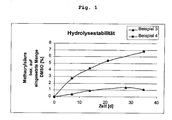
- Example 3 0.5 g of the silanized OX50 (from Example 3 or Comparative Example 4) were suspended in 2 g of 1 N deuterium chloride solution in deuterium oxide, and 0.019 g of dimethyl sulfoxide were added as a reference in each case.
- 5 samples were prepared in separate vials. The suspensions were stirred vigorously for about 1 h and then stored well closed until the NMR analysis at 42 ° C. The samples were filtered over glass wool prior to spectroscopic analysis. The clear solutions were each examined by means of 1 H NMR spectroscopy.
- the first sample was examined after 2 h, the 2nd sample after 1 week, the 3rd sample after 3 weeks, the 4th sample after 4 weeks and the 5th sample after 6 weeks.
- the increase in the integral of the proton of the methacrylic acid group was observed at 5.3 ppm based on the integral of the protons of phenol (MEHQ) at 6.1-6.0 ppm. From this the concentration increase of methacrylic acid, the hydrolysis product of the silane, could be estimated.
- the results are summarized in Table 1 and shown graphically in FIG.
- the filler treated in accordance with the invention has a markedly better hydrolytic stability under acidic conditions (pH ⁇ 2).
Landscapes
- Health & Medical Sciences (AREA)
- Oral & Maxillofacial Surgery (AREA)
- Epidemiology (AREA)
- Life Sciences & Earth Sciences (AREA)
- Animal Behavior & Ethology (AREA)
- General Health & Medical Sciences (AREA)
- Public Health (AREA)
- Veterinary Medicine (AREA)
- Plastic & Reconstructive Surgery (AREA)
- Chemical & Material Sciences (AREA)
- Inorganic Chemistry (AREA)
- Dental Preparations (AREA)
- Polymerisation Methods In General (AREA)
- Adhesives Or Adhesive Processes (AREA)
- Pigments, Carbon Blacks, Or Wood Stains (AREA)
- Sealing Material Composition (AREA)
- Paints Or Removers (AREA)
- Graft Or Block Polymers (AREA)
Abstract
Description
- Die vorliegende Erfindung betrifft oberflächenmodifizierte Füllstoffe, die sich besonders zur Verwendung in Dentalmaterialien, zur Herstellung von Adhäsiven, Beschichtungen und Kompositen eignen.
- Gefüllte Materialien auf der Basis von (Meth)acrylatmonomeren werden in der restaurativen Zahnheilkunde als Füllungs- und Befestigungsmaterialien, Fissurenversiegler, Zemente für die Kieferorthopädie, als Beschichtungsmaterialien und als Adhäsive eingesetzt. Die hierbei verwendeten Füllstoffe lassen sich in organische und anorganische Füllstoffe einteilen, wobei meistens anorganische Füllstoffe zum Einsatz kommen. Diese können wiederum in oxidische und nicht oxidische Füllstoffe unterteilt werden. Die oxidischen Füllstoffe klassifiziert man dann nochmals in silikatische und nichtsilikatische Füllstoffe.
- Zu den silikatischen Füllstoffen gehören beispielsweise gemahlene Gläser, wie z.B. Barium-Silikatgläser (
US 4,220,582 ), Strontium-Silikatgläser (DE 43 23 143 ) und röntgenopaque Aluminium-Fluoro-Silikatgläser, die vor allem in (meth)acrylatverstärkten Glasionomeren Verwendung finden (US 5,367,002 ,US 5,871,360 ). - Zur Verbesserung der mechanischen Eigenschaften werden die Oberflächen der Füllstoffe in der Regel so modifiziert, daß diese bei der Aushärtung des Materials durch Copolymerisation kovalent in die Polymermatrix eingebunden werden. Bei anorganischen, silikatischen Füllstoffen wird meist eine Silanisierung, d.h. eine Oberflächenmodifizierung mit vorhydrolysierten (Meth)acryloxyalkyltrialkoxysilanen, wie z.B. 3-Methacryloxypropyltrimethoxysilan, durchgeführt. Bei der Silanisierung reagiert das gebildete Silanol mit freien Si-OH-Gruppen der Füllstoffoberfläche (vgl. E. P. Plueddemann, "Silane Coupling Agents", Plenum Press, 2nd Ed., New York und London, 1991).
- Die
GB 1 488 403 - Die
DE 40 29 230 offenbart Füllungs- und Befestigungsmaterialien auf der Basis von Mischoxiden z.B. von Zirkonoxid und Siliciumdioxid, die mit α-Methacryloxypropyltrimethoxysilan silanisiert sein können. - Aus der
US 2002/0072551 sind Fissurenversiegler bekannt, die unterschiedliche Füllstoffe; wie z.B. gemahlenes Barium- oder Lithiumaluminiumsilikatglas enthalten, das mit Silanen wie γ-Methacryloxypropyltrimethoxysilan, Dimethyldichlorsilan oder Hexamethylendisilazan oberflächenbehandelt ist. - Die
US 2002/0065337 schlägt Silane wie 3-Methacryloxypropyltrimethoxysilan, 3-Methacryloxypropyldimethoxymonochlorsilan und 3-Methacryloxypropyldichlormonomethoxysilan etc. zur Silanisierung von Nanopartikeln auf der Basis von gemahlenem Glas, Kieselsäuren, Zeolithen usw. vor. - Aus der
US 2004/0010055 sind Glasionomerfüllstoffe bekannt, die mit einem Silan modifiziert sind, das eine Polyalkoxyethylengruppe enthält. - Die
DE 24 05 578 A1 offenbart Dentalmaterialien, die amorphe Kieselsäure mit einer maximalen Teilchengröße von 0,07 µm als Füllstoff enthalten. Der Füllstoff wird mit Trimethoxy-(3-methacryloyloxypropyl)silan behandelt. - Aus der
DE 32 47 800 A1 sind amorphe, kugelförmige Mischoxide auf Basis von Silicium- und Zirkonoxid bekannt, die mit γ-Methacryloxypropyltrimethoxysilan behandelt werden und sich als Füllstoff für Zahnersatzmaterial eignen sollen. - Die
DE 195 08 586 A1 offenbart polymerisierbare Dentalwerkstoffe, die als Füllstoffe kugelförmige Partikel auf der Basis von SiO2 und Oxiden von Elementen der Gruppen I, II, III und IV des Periodensystems enthalten. Die Füllstoffpartikel können mit einer Schicht aus einem polymerisierbaren organischen Bindemittel überzogen sein. Zur Oberflächenmodifizierung werden die Partikel beispielsweise mit Trimethoxy- oder Triethoxyvinylsilan behandelt. Derartige Mischoxide werden neben der verstärkenden Wirkung zur Erhöhung der Röntgenopazität, zur Einstellung der Transparenz und zur Anpassung des Brechungsindex eingesetzt. - Aus der
WO 00/69392 - Aus der
WO 98/13008 DE 100 18 405 Yttriumoxid bekannt. Diese Füllstoffe eignen sich besonders als Röntgenkontrastmittel. Aluminium- und Titanoxid dienen demgegenüber wegen ihres hohen Brechungsindex häufig als Trübungsmittel. - Nichtsilikatische Füllstoffe wie Zirkonoxid können gemäß
US 6,387,981 auch durch methacrylatmodifizierte Polyethercarbonsäuren oberflächenkonditioniert werden. - Außerdem ist aus der
US 6,417,244 die Oberflächenmodifizierung von nichtsilikatischen Füllstoffen mit Methacryloyloxyphosphaten bekannt. - Gemeinsam an den oben beschriebenen Füllstoffen ist, daß zur Oberflächenmodifizierung meist Haftvermittler verwendet werden, die unter sauren Bedingungen nicht stabil sind. In der Zahnheilkunde kommen jedoch immer häufiger selbstätzende, selbstkonditionierende Restaurationsmaterialien zur Anwendung, die sich dadurch auszeichnen, daß keine Präkonditionierung der Zahnhartsubstanz notwendig ist. Dazu zählen die selbstätzenden Dentin/Schmelz-Adhäsive, methacrylatverstärkte Glasionomere, selbsthaftende Komposite oder auch Compomere.
- Selbstätzende Dentin/Schmelz-Adhäsive sind meist so aufgebaut, daß sie ein acides Haftmonomer, ein oder mehrere nicht saure Comonomere, Wasser oder wasserhaltige Lösungsmittelgemische, einen Polymerisationsinitiator und gegebenenfalls weitere Additive enthalten.
- Die
US 6,214,101 offenbart selbstätzende methacrylatverstärkte Glasionomere, die als Paste/Paste-System vorliegen. Eine der Pasten ist eine auf Wasser basierende Mischung, die eine Polysäure, wie z.B. Polyacryl- oder Polymaleinsäure, und silanmodifiziertes Bariumglaspulver enthält. - Werden in derartige selbstätzende Systeme oberflächenmodifizierte Füllstoffe der oben beschriebenen Art eingearbeitet, besteht das Problem, daß die polymerisierbaren Gruppen der Haftvermittler durch Hydrolyse abgespalten werden, so daß eine kovalente Einbindung des Füllstoffs in das Polymernetzwerk nicht mehr möglich ist. Dadurch kommt es zu einer Beeinträchtigung der verstärkenden Wirkung des Füllstoffs, und es tritt eine deutliche Reduktion der mechanischen Eigenschaften des ausgehärteten Dentalmaterials bei Wasserlagerung auf. Durch die Hydrolyse verliert der Dentalwerkstoff mit der Zeit seine klinische Tauglichkeit.
- Der Erfindung liegt die Aufgabe zugrunde, Füllstoffe mit radikalisch polymerisierbaren Gruppen bereitzustellen, die gegenüber wäßrigen Säuren hydrolysestabil sind.
- Die Aufgabe wird erfindungsgemäß durch Füllstoff gelöst, der oberflächlich mit einer Verbindung der Formel (I) modifiziert ist,
[(PG)-R1-Z]n-SP-[Y-R2-(AG)]m (I)
in der - AG
- -P(=O)(OH)2, -O-P(=O)(OH)2, vorzugsweise -COOH, -SO2OH, -SiR3R4X, oder eine chelatisierende Gruppe ist,
- R1
- eine C1-C3-Alkylengruppe oder Cyclopropylengruppe ist oder entfällt,
- R2
- eine C1-C10-Alkylengruppe ist oder entfällt,
- R3
- eine C1-C8-Alkylgruppe, Chlor oder OR5 ist,
- R4
- eine C1-C8-Alkylgruppe, Phenyl, Chlor oder OR5 ist,
- R5
- eine C1-C6-Alkylgruppe ist,
- X
- OR5 oder Chlor ist,
- Y
- O, S, CO-NH, O-CO-NH, NH-CO-NH ist oder entfällt, wobei Y entfällt wenn R2 entfällt,
- Z
- O, S, CO-NR6, O-CO-NH, NH-CO-NH ist oder entfällt, wobei R6 H oder C1-C6-Alkyl ist,
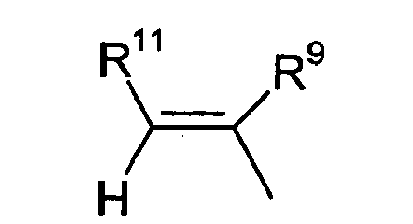
- PG
- eine radikalisch polymerisierbare Gruppe der Formel

- R9
- H, C1-C3-Alkyl, C1-C3-Hydroxyalkyl oder COOR10 ist,
- R10
- H, C1-C10-Alkyl, 1,6-Dimethylphenyl oder Mesityl ist,
- R11
- H oder Phenyl ist,
- m
- 1 oder 2 ist,
- n
- 1, 2, 3 oder 4 ist,
- SP
- entfällt oder ein (n+m)-wertiger linearer oder verzweigter aliphatischer C1-C30-Rest, bei dem die Kohlenstoffkette durch O, S, CO-NH, O-CO-NH oder NH-CO-NH unterbrochen sein kann, ein (n+m)-wertiger aromatischer C6-C18-Rest, ein (n+m)-wertiger cycloaliphatischer C3-C18-Rest oder ein (n+m)-wertiger heterocyclischer C3-C18-Rest, wobei die Reste substituiert oder unsubstituiert sein können,
- Die Angabe, daß ein Rest durch Fremdatome oder Gruppen, wie Sauerstoff oder Schwefel, unterbrochen sein kann, ist so zu verstehen, daß eines oder mehrere der Fremdatome oder eine oder mehrere der Gruppen in eine Kohlenstoffkette integriert sind. Daraus folgt, daß die Fremdatome oder Gruppen nicht endständig sein können, d.h. eine Anbindung an Nachbargruppen immer über ein Kohlenstoffatom erfolgt, und daß die Zahl der Fremdatome und Gruppen zwangsläufig kleiner als die Zahl der Kohlenstoffatome sein muß.
- Formel (I) erstreckt sich nur auf solche Verbindungen, die mit der chemischen Valerizlehre vereinbar sind.
- Die bei dem Rest SP gegebenenfalls vorhandenen Substituenten sind vorzugsweise aus C1-C5-Alkyl, Cl, Br und/oder OH ausgewählt.
- Bevorzugte chelatisierende Gruppen sind zweizähnige, vierzähnige und sechszähnige Liganden. Bevorzugte zweizähnige Liganden sind β-Diketogruppen der Formel -R7-C(=O)-CH2-C(=O)-R8, in der R7 C1-C3-Alkylen und R8 C1-C3-Alkyl ist, Salicylsäuregruppen und Salicylaldehydgruppen, Glycinat, Phenanthrolin, Bipyridyl und Ethylendiamin. Besonders bevorzugte zweizähnige Liganden sind die Acetylacetonatgruppe und die Salicylsäuregruppe:


- Bevorzugte dreizähnige Liganden sind Diethylentriamin und Iminodiacetat:

- Bevorzugte vierzähnige Liganden sind Tris(2-aminoethyl)amin und Aminotriacetat:

- Ein bevorzugter sechszähniger Ligand ist Ethylendiamintetraacetat:

- Acide Gruppen und Silangruppen sind als Haftgruppen bevorzugt.
- PG ist vorzugsweise eine radikalisch polymerisierbare Gruppe der Formel

- R9
- H, CH3, C2H5, Hydroxmethyl, Hydroxyethyl oder COOR10,
- R10
- H, C1-C3-Alkyl, 1,6-Dimethylphenyl oder Mesityl,
- R11
- H oder Phenyl ist.
- Bevorzugte polymerisationsfähige Gruppen PG sind Vinylgruppen der Formel H2C=C(-R9)-, Acrylsäuregruppen der Formel H2C=C(-COOR10)-, Allyl, Styryl und/oder Vinylcyclopropyl.

- Bevorzugte Definitionen der obigen Variablen, die unabhängig voneinander gewählt werden können, sind:
- AG =
- -P(=O)(OH)2, -O-P(=O)(OH)2 und insbesondere -COOH oder -SiR3R4X,
- R1 =
- eine Methylengruppe, Cyclopropylengruppe oder entfällt,
- R2 =
- eine C1-C3-Alkylengruppe oder entfällt,
- R3 =
- eine C1-C3-Alkylgruppe, Chlor, insbesondere OR5,
- R4 =
- eine C1-C3-Alkylgruppe, Phenyl, Chlor, insbesondere OR5,
- R5 =
- eine C1-C2-Alkylgruppe,
- R6 =
- H, eine C1-C3-Alkylgruppe, insbesondere Methyl,
- X =
- Chlor, insbesondere OR5,
- Z =
- CO-NR6 oder entfällt,
- Y =
- entfällt,
- PG = für
- Z = entfällt: eine Vinylgruppe H2C=C(-R9)-, in der R9 H, CH3, C2H5, Hydroxmethyl oder Hydroxyethyl ist, oder eine Acrylsäuregruppe H2C=C(-COOR10)-, in der R10 H, C1-C3-Alkyl, 1,6-Dimethylphenyl oder Mesityl ist, für Z = CO-NR6: eine Vinylgruppe H2C=C(-R9)-, in der R9 H oder CH3 ist,
- m =
- 1 oder 2,
- n =
- 1 oder 2,
- SP =
- entfällt oder ein (n+m)-wertiger linearer oder verzweigter aliphatischer C1-C6-Rest, ein (n+m)-wertiger aromatischer C6-C10-Rest, ein (n+m)-wertiger cycloaliphatischer C3-C10-Rest oder ein (n+m)-wertiger heterocyclischer C3-C10-Rest, wobei die Reste substituiert oder unsubstituiert sein können,
- Ganz besonders bevorzugt sind Verbindungen, bei mindestens zwei und insbesondere alle Variablen eine der bevorzugten Bedeutungen haben.
- Die erfindungsgemäß als Haftvermittler eingesetzten Verbindungen der allgemeinen Formel (I) sind teilweise bekannt und zum Teil sogar kommerziell erhältlich.
- Bevorzugte Verbindungen der Formel (I), bei denen AG eine Carboxylgruppe ist (Carbonsäuren), sind α-Hydroxymethylacrylsäure, α,ω-(Meth)acrylamidoalkylencarbonsäuren, (Meth)-acrylamidoarylencarbonsäuren, wie z.B. 3-(Methacryloylamino)-propionsäure, 3-(Acryloylamino)-propionsäure, 6-(Methacryloylamino)-capronsäure, 8-(Methacryloylamino)-caprylsäure, 4-(Methacryloylamino)-benzoesäure oder 4-(Acryloylamino)-benzoesäure:


- Bevorzugte Verbindungen der Formel (I), bei denen AG eine Phosphonsäuregruppe -P(=O)(OH)2 ist (Phosphonsäuren), sind Vinylphosphonsäure, 4-Vinylbenzylphosphonsäure, und die in
EP 909 761 B1 DE 102 34 326 B3 offenbarten Acrylatetherphosphonsäuren, insbesondere 2-[4-(Dihydroxyphosphoryl)-2-oxa-butyl]-acrylsäureethylester, 2-[4-(Dihydroxyphosphoryl)-2-oxa-butyl]-acrylsäure und 2-[4-(Dihydroxyphosphoryl)-2-oxa-butyl]-acrylsäure-2,4,6-trimethylphenylester. Weiter bevorzugt sind (Meth)acrylamidoalkylenphosphonsäuren und -bisphosphonsäuren, insbesondere 2-Acrylamido- und 2-Methacrylamido-2-methylpropanphosphonsäure (DE 32 10 775 ), die inDE 33 13 819 ,JP PS 62 63,314 DD 273 846 A1 


- Bevorzugte Verbindungen der Formel (I), bei denen AG eine Phosphorsäuregruppe -O-P(=O)(OH)2 ist (Dihydrogenphosphate), sind Acryletherphosphate, insbesondere 2-[4-(Dihydroxyphosphoryloxy)-2-oxa-butyl]-acrylsäure und 2-[4-(Dihydroxyphosphoryloxy)-2-oxa-butyl]-acrylsäure-2,4,6-trimethylphenylester, (Meth)acrylamidoalkylen-, -cycloalkylen- und -arylendihydrogenphosphate, insbesondere 2-(N-Acryloylamino)ethyldihydrogenphosphat, 2-(N-Methacryloylamino)ethyldihydrogenphosphat, 6-(N-Acryloylamino)hexyldihydrogenphosphat, 6-(N-Methacryloylamino)hexyldihydrogenphosphat, 4-(N-Acryloylamino)phenyldihydrogenphosphat, 4-(N-Methacryloylamino)phenyldihydrogenphosphat, 1,3-Bis-(N-acryloylamino)-propan-2-yl-dihydrogenphosphat, 1,3-Bis-(N-methacryloylamino)-propan-2-yl-dihydrogenphosphat, 1,3-Bis-(N-acryloyl-N-methyl-amino)-propan-2-yl-dihydrogenphosphat und 1,3-Bis-(N-acryloyl-N-ethyl-amino)-propan-2-yl-dihydrogenphosphat:


- Bevorzugte Verbindungen der Formel (I), bei denen AG eine Sulfonsäuregruppe -SO2OH ist (Sulfonsäuren), sind Vinylsulfonsäure, 4-Vinylphenylsulfonsäure und 2-Acryloylamino-2-methylpropansulfonsäure:

- Bevorzugte Verbindungen der Formel (I), bei denen AG eine Silylgruppe -SiR3R4X ist (Silane), sind (Meth)acrylamidoalkyltrialkoxysilane, insbesondere 3-(N-Methacryloylamino)-propyltrimethoxysilan, 3-(N-Acryloylamino)-propyltrimethoxysilan, 3-(N-Methacryloylamino)-propyltriethoxysilan, 3-(N-Methacryl-N-ethyl-amino)-propyltrimethoxysilan, 3-(N-Methacryl-N-ethylamino)-propyltrimethoxysilan, 3-(N-Acryl-N-ethylamino)-propyltrimethoxysilan, 3-(N-Methacryl-N-methyl-amino)-propyltrimethoxysilan, 3-(N-Acryl-N-methylamino)-propyltrimethoxysilan:


- Weiter bevorzugt sind (Meth)acrylamidoalkyl-alkyl- und -aryldialkoxysilane oder (Meth)acrylamidoalkyltrichlorsilane, insbesondere 3-(N-Methacryloylamino)-propylmethyldimethoxysilan, 3-(N-Acryloylamino)-propylmethyldimethoxysilan, 3-(N-Methacryloylamino)-propylphenyldimethoxysilan, 3-(N-Acryloylamino)-propylphenyldimethoxysilan, 3-(N-Methacryl-N-ethylamino)-propyl-methyldimethoxysilan, 3-(N-Acryl-N-ethylamino)-propyl-methyldimethoxysilan, 3-(N-Methacryl-N-methyl-amino)-propyltrichlorsilan und 3-(N-Acryl-N-methylamino)-propyltrichlorsilan:


- Bevorzugte Verbindungen der Formel (I), bei denen AG eine chelatisierende Gruppe ist, sind Methacryloylaceton (vgl. P. Teyssie, G. Smets, Makromol. Chem. 26 (1958) 245), 4-Vinylbenzoylaceton (A. Mansri, P.F. Casals, A. Oulmidi, K. Guemra, D. Reyx, Eur. Polym. J. 32 (1996) 269) oder 4-Methacryloylaminosalicylsäure:

- Die Oberflächenmodifizierung der Füllstoffe mit den erfindungsgemäßen Haftvermittlern der Formel (I) kann auf unterschiedlichen Wegen erfolgen.
- Flüssige Haftvermittler werden vorzugsweise direkt mit den Füllstoffen vermischt, anschließend werden die Füllstoffe zur Abtrennung von Kondensationsprodukten getrocknet.
- Um eine bessere Benetzung der Füllstoffoberfläche zu erreichen, ist es vor allem bei sehr feinteiligen Füllstoffen mit einer spezifischen Oberfläche von mehr als 20 oder 40 m2/g vorteilhaft, den Füllstoff in einer Lösung des Haftvermittlers in einem geeigneten Lösungsmittel zu dispergieren. Dabei läßt sich die Adsorption des Haftvermittlers durch die Füllstoffoberfläche durch die Polarität des Lösungsmittels beeinflussen. Bevorzugte Lösungsmittel sind Cyclohexan, THF, Dioxan, Ethanol und Wasser. Der Grad der Oberflächenmodifizierung hängt dabei unter anderem ab von der Füllstoffmenge und der spezifischen Oberfläche des Füllstoffs, von der Menge des Haftvermittlers, der Reaktionszeit, der Temperatur und von der Füllstoffvorbehandlung, wie z.B. von einer Vortrocknung.
- Die verschiedenen Einflußfaktoren sind vor allem bei der Silanisierung von Füllstoffen sehr gut untersucht (vgl. E. P. Plueddemann, "Silane Coupling Agents", Plenum Press, 2nd Ed., New York und London, 1991; A. Guillet, Macromol. Symp. 194 (2003) 63). Bei Silanen erfolgt die Oberflächenmodifizierung durch Hydrolyse der hydrolysierbaren Gruppen am Siliciumatom durch Zugabe von Wasser und einer anschließenden Kondensation z.B. mit Hydroxylgruppen auf der Oberfläche des Füllstoffs. Im Falle von SiO2 oder silikatischen Füllstoffen bilden sich zwischen Silanol-Gruppen der Füllstoffpartikel und Alkoxysilylgruppen der Silanhaftvermittler Siloxanbindungen aus. Die hydrolysierbaren Gruppen können auch direkt mit den Silanol-Gruppen der Partikeloberfläche unter Bildung einer Siloxanbindung reagieren. Im letzten Fall ist die Zugabe von Wasser nicht erforderlich. Oft reicht auch das Restwasser an der Füllstoffoberfläche aus. Bevorzugt wird dann die Reaktion in unpolareren Lösungsmitteln durchgeführt. Der pH-Wert beeinflußt die Hydrolyse und die Kondensation. Daher wird in der Regel ein saurer oder basischer Katalysator zugegeben. Die saure oder basische Gruppe kann aber auch schon als organischer Rest im Silan enthalten sein oder während der Hydrolyse freigesetzt werden. Um die Reaktion mit der Oberfläche zu beschleunigen kann die Suspension erwärmt werden. Durch anschließendes Verdampfen des Lösungsmittels und Trocknung des Füllstoffs kann die Kondensation weiter forciert werden. Gegebenenfalls können nicht an die Oberfläche gebundene Siloxanspezies in einem anschließenden Waschprozeß vom Füllstoff abgewaschen werden.
- Bei Verwendung von Säuren und Chelaten zur Oberflächenmodifizierung werden diese vorzugsweise in einem geeigneten Lösungsmittel, in dem die Säure bzw. der Chelatligand löslich sind, zusammen mit dem dispergierten Füllstoff mehrere Stunden bei Raumtemperatur oder erhöhter Temperatur gerührt. Anschließend wird das Lösungsmittel verdampft und der Füllstoff getrocknet. Alternativ kann der Füllstoff direkt abgetrennt, gewaschen und dann getrocknet werden.
- Durch chemische Reaktion der Haftgruppen des Haftvermittlers, z.B. der aciden oder chelatisierenden Gruppen mit geeigneten reaktiven Zentren der Füllstoffoberfläche, wie z.B. OH-Gruppen bei oxidischen Füllstoffen, wie TiO2 oder Al2O3, oder Metallionen von entsprechenden Übergangsmetallverbindungen, z.B. Zr4+-Ionen bei ZrO2 oder Yb3+-Ionen im Falle von Ytterbiumfluorid, erfolgt eine feste kovalente, ionische oder koordinationschemische Anbindung des Haftvermittlers an die Füllstoffoberfläche.
- Nach Abschluß der Reaktion zwischen Füllstoff und Haftvermittler wird der Füllstoff abgetrennt, gegebenenfalls mit demselben oder einem anderen Lösungsmittel gewaschen, einer optionalen Wärmebehandlung unterzogen, gegebenenfalls nochmals gewaschen und dann getrocknet. Dabei kann es bei Füllstoffen, die zur Agglomeratbildung neigen, notwendig sein, diesen nach der Oberflächenmodifizierung zu mahlen oder auf andere Weise zu zerkleinern.
- Bevorzugte erfindungsgemäße Füllstoffe sind solche, die auf anorganischen, partikelförmigen Füllstoffen mit einer mittleren Partikelgröße vom 0,01 bis 5 µm basieren. Diese werden erhalten, indem unbehandelte anorganische, partikelförmige Füllstoffe mit einer oder mehreren Verbindungen der Formel (I) auf die oben beschriebene Weise behandelt werden. Unter unbehandelten Füllstoffen werden Füllstoffe verstanden, die noch nicht mit Verbindungen der Formel (I) modifiziert wurden. Diese werden im folgenden auch als Ausgangsmaterialien oder Ausgangsfüllstoffe bezeichnet.
- Bevorzugte Ausgangsmaterialien zur Herstellung der erfindungsgemäßen Füllstoffe sind amorpher Füllstoff auf der Basis von einem oder mehreren Metalloxiden und/oder Siliciumoxid, besonders bevorzugt unbehandelte Füllstoffe auf der Basis von ZrO2, Ta2O5, TiO2, Mischoxiden von SiO2, ZrO2 und/oder TiO2, Yb2O3, Y2O3, YbF3, Al2O3 und AlO(OH), Böhmit, pyrogener Kieselsäure oder Fällungskieselsäure.
- Weiterhin sind Quarz-, Glaskeramik- oder Glaspulver, vorzugsweise mit einer mittleren Partikelgröße von 0,01 bis 5 µm, und röntgenopake Metallverbindungen wie Ytterbiumtrifluorid als Ausgangsfüllstoffe bevorzugt. Wenn nicht anders angegeben handelt es sich bei der mittleren Partikelgröße immer um das Gewichtsmittel, das vorzugsweise durch Lichtstreuung ermittelt wird.
- Die Ausgangsfüllstoffe weisen vorzugsweise eine spezifische Oberfläche von mehr als 20 m2/g und insbesondere mehr als 40 m2/g auf, wobei Füllstoffe mit einer maximalen spezifischen Oberfläche von 300 m2/g besonders bevorzugt sind.
- Füllstoffe ohne oder mit nur einem geringem SiO2-Anteil werden vorzugsweise mit solchen Verbindungen der Formel (I) behandelt, bei denen AG -P(=O)(OH)2 oder -O-P(=O)(OH)2 ist. Unter einem geringem SiO2-Anteil wird ein SiO2-Gehalt von weniger als 25 Gew.-% und insbesondere weniger als 10 Gew.-% bezogen auf die Masse des jeweiligen Füllstoffs bei gleichmäßiger Verteilung des SiO2 im Füllstoff verstanden. Bei einer Anreicherung des SiO2 im Oberflächenbereich des Füllstoffs erniedrigen sich die angegebenen Konzentrationen entsprechend.
- Die erfindungsgemäß mit einer Verbindung der Formel (I) modifizierten Füllstoffe eignen sich besonders zur Herstellung von Dentalwerkstoffen. Zur Herstellung von Dentalmaterialien werden die mit Verbindungen der Formel (I) modifizierten Füllstoffe mit einem radikalisch polymerisierbarem Bindemittel und ggf. einem Initiator für die radikalische Polymerisation gemischt.
- Bevorzugte Bindemittel sind hydrolysestabile Verdünnermonomere, wie hydrolysestabilen Mono(meth)acrylaten, z.B. Mesitylmethacrylat, N-mono- oder N,N-disubstitiuierten Acrylamide, wie z.B. N-Ethylacrylamid, N,N-Dimethacrylamid, N-(2-Hydroxyethyl)acrylamid und N-Methyl-N-(2-hydroxyethyl)acrylamid, N-monosubstituierte Methacrylamide, wie z.B. N-Ethylmethacrylamid und N-(2-Hydroxyethyl)methacrylamid, sowie N-Vinylpyrrolidon.
- Im Zusammenhang mit der vorliegenden Erfindung werden' unter Verdünnermonomeren solche flüssigen Monomeren mit einer oder mehreren polymerisationsfähigen Gruppen verstanden, die sich durch eine Viskosität η von kleiner 100 mPa·s (gemessen bei 20 °C) auszeichnen.
- Als hydrolysestabil werden solche Monomere bezeichnet, die in Wasser oder in Mischungen von Wasser und wassermischbaren Lösungsmitteln bei einer Konzentration von ca. 20 Gew.-% und einem pH-Wert von ca. 2,0 bei 37 °C für mindestens 6 Wochen stabil sind, d.h. zu weniger als 5 % hydrolysieren.
- Darüber hinaus sind hydrolysestabile Vernetzermonomere als Bindemittel bevorzugt. Unter Vernetzermonomeren werden Monomere mit zwei oder mehr, vorzugsweise 2 bis 4 radikalisch polymerisierbaren Gruppen verstanden. Bevorzugte Vernetzermonomere sind vernetzende Pyrrolidone, wie z.B. 1,6-Bis(3-vinyl-2-pyrrolidonyl)-hexan, oder kommerziell zugängliche Bisacrylamide, wie Methylen- oder Ethylenbisacrylamid, Bis(meth)-acrylamide, wie z.B. N,N'-Diethyl-1,3-bis(acrylamido)-propan, 1,3-Bis(methacrylamido)-propan, 1,4-Bis(methacrylamido)-butan, 1,4-Bis(acrylamido)-butan und 1,4-Bis(acrylamido)-piperazin, die durch Umsetzung aus den entsprechenden Diaminen mit (Meth)acrylsäurechorid synthetisiert werden können. Die Vernetzermonomere können allein oder zusammen mit einem oder mehreren Verdünnermonomeren als Bindemittel eingesetzt werden.
- Gemäß einer besonders bevorzugten Ausführungsform enthält das Bindemittel mindestens ein acides Monomer, im folgenden auch als Adhäsivmonomer bezeichnet. Hierbei handelt es sich um Monomere, die mindestens eine Säuregruppe, besonders bevorzugt 1 bis 4 Säuregruppen enthalten. Bevorzugte Säuregruppen sind Carbonsäure-, Sulfonsäure-, Phosphonsäure- und/oder Phosphorsäuregruppen. Verbindungen, die als acide Gruppe Carbonsäure-, Phosphonsäure- und/oder Phosphorsäuregruppen enthalten, sind besonders bevorzugt. Verbindungen mit mehr als einer Säuregruppen können unterschiedliche Säuregruppen oder vorzugsweise identischen Säuregruppen enthalten.
- Für Schmelz/Dentin-Adhäsive bzw. selbsthaftende Komposite eignen sich als Adhäsivmonomere, besonders die oben beschriebenen, hydrolysestabilen, polymerisationsfähigen Acrylatetherphosphonsäuren, wie z.B. 2-[4-(Dihydroxyphosphoryl)-2-oxa-butyl]-acrylsäureethylester, 2-[4-(Dihydroxyphosphoryl)-2-oxa-butyl]-acrylsäure und 2-[4-(Dihydroxyphosphoryl)-2-oxa-butyl]-acrylsäure-2,4,6-trimethylphenylester, (Meth)acrylamidoalkylenphosphonsäuren oder -bisphosphonsäuren wie z.B. Acrylsäure-(2-phosphono-1,1-dimethylethylamin) oder Methacrylsäure-(2-phosphono-1,1-dimethylethylamin) oder N-Acrylaminomethanbisphosphonsäure.
- Weiterhin sind als Adhäsivmonomere besonders auch hydrolysestabile, polymerisationsfähige Dihydrogenphosphate wie (Meth)-acrylamidoalkylen-, -cycloalkylen- oder -arylendihydrogenphosphate, z.B. 2-(N-Acryloylamino)ethyldihydrogenphosphat, 2-(N-Methacryloylamino)ethyldihydrogenphosphat, 6-(N-Acryloylamino)hexyldihydrogenphosphat, 6-(N-Methacryloylamino)hexyldihydrogenphosphat, 4-(N-Acryloylamino)phenyldihydrogenphosphat, 4-(N-Methacryloylamino)phenyldihydrogenphosphat, 1,3-Bis-(N-acryloylamino)-propan-2-yl-dihydrogenphosphat, 1,3-Bis-(N-methacryloylamino)-propan-2-yl-dihydrogenphosphat, 1,3-Bis-(N-acryloyl-N-methyl-amino)-propan-2-yl-dihydrogenphosphat oder 1,3-Bis-(N-acryloyl-N-ethyl-amino)-propan-2-yldihydrogenphosphat besonders gut geeignet.
- Besonders brauchbare Adhäsivmonomere sind vor allem 2-[4-(Dihydroxyphosphoryl)-2-oxa-butyl]-acrylsäureethylester, 2-[4-(Dihydroxyphosphoryl)-2-oxa-butyl]-acrylsäure, 2-[4-(Dihydroxyphosphoryl)-2-oxa-butyl]-acrylsäure-2,4,6-trimethylphenylester, 6-(N-Acryloylamino)hexyldihydrogenphosphat, 6-(N-Methacryloylamino)hexyldihydrogenphosphat, 1,3-Bis-(N-acryloylamino)-propan-2-yl-dihydrogenphosphat, 1,3-Bis-(N-methacryloylamino)-propan-2-yl-dihydrogenphosphat.
- Die aciden Monomere sind Bestandteil des Bindemittels und können sich darin im Gegensatz zu den zur Oberflächenmodifizierung der Füllstoffe eingesetzten Substanzen frei bewegen. Die an die Füllstoffoberfläche gebundenen Verbindungen weisen keine haftungsvermittelnden Eigenschaften mehr auf.
- Als Bindemittel können einzelne Monomere oder Mischungen von zwei oder mehr Monomeren eingesetzt werden. Vorzugsweise enthält das Bindemittel mindestens ein Vernetzermonomer; Bindemittel, die ausschließlich vernetzende Monomere enthalten, sind besonders bevorzugt. Gemäß einer besonders bevorzugten Ausführungsform enthält das Bindemittel mindestens ein acides Monomer.
- Füllstoff und Bindemittel werden allein oder unter Zugabe von einem oder mehreren Lösungsmitteln miteinander gemischt, wobei Aceton, Isopropanol und Ethanol als Lösungsmittel bevorzugt sind. Anschließend werden gegebenenfalls der Initiator und weitere Additive zugegeben.
- Die erfindungsgemäßen Dentalmaterialien lassen sich durch radikalische Polymerisation aushärten. Je nach Wahl des Initiators kann die Härtung durch photochemische oder redoxinduzierte radikalische Polymerisation erfolgen.
- Beispiele für bevorzugte Photoinitiatoren sind Benzophenon, Benzoin sowie deren Derivate oder α-Diketone öder deren Derivate wie 9,10-Phenanthrenchinon, Diacetyl oder 4,4-Dichlorbenzil. Besonders bevorzugt werden Campherchinon und 2,2-Dimethoxy-2-phenyl-acetophenon und besonders bevorzugt α-Diketone in Kombination mit Aminen als Reduktionsmittel, wie z.B. 4-(N,N-Dimethylamino)-benzoesäureester, N,N-Dimethylaminoethylmethacrylat, N,N-Dimethyl-sym.-xylidin oder Triethanolamin, eingesetzt. Darüber hinaus sind auch Acylphosphine, wie z.B. 2,4,6-Trimethylbenzoyldiphenyl- oder Bis(2,6-dichlorbenzoyl)-4-N-propylphenylphosphinoxid besonders geeignet.
- Als Initiatoren für eine bei Raumtemperatur durchgeführte Polymerisation werden Redox-Initiatorkombinationen, vorzugsweise Kombinationen von Benzoylperoxid mit N,N-Dimethylsym.-xylidin oder N,N-Dimethyl-p-toluidin, verwendet. Darüber hinaus sind auch Redoxsysteme bestehend aus Peroxiden und solchen Reduktionsmittel, wie z.B. Ascorbinsäure, Barbiturate oder Sulfinsäuren, besonders geeignet.
- Besonders bevorzugt sind Dentalwerkstoffe, welche die folgenden Komponenten enthalten:
- (a) 5 bis 90 Gew.-%, insbesondere 5 bis 50 Gew.-% Füllstoff, der mit Haftvermittler der Formel (I) oberflächenmodifiziert ist;
- (b) 9,9 bis 90 Gew.-%, insbesondere 0 bis 40 Gew.-%, radikalisch polymerisierbares Monomer (Bindemittel);
- (c) 0,1 bis 5,0 Gew.-%, insbesondere 0,2 bis 2,0 Gew.-%, Initiator für die radikalische Polymerisation, und/oder
- (d) 0 bis 70 Gew.-%, insbesondere 0 bis 50 Gew.-%, Lösungsmittel.
- Alle Prozentangaben beziehen sich, wenn nicht anders angegeben, auf die Gesamtmasse des Dentalwerkstoffs.
- Der Dentalwerkstoff kann einen oder mehrere Füllstoffe enthalten, die mit einer Verbindung der Formel (I) modifiziert sind. Es ist jedoch bevorzugt, daß alle Füllstoffkomponenten des Dentalwerkstoffs in der angegebenen Weise modifiziert sind.
- Acide Monomere werden vorzugsweise in einer Menge von 0 bis 70 Gew.-%, besonders bevorzugt 0 bis 50 Gew.-% und ganz besonders bevorzugt 3 bis 30 Gew.-% eingesetzt, bezogen auf die Gesamtmasse des Werkstoffs.
- Die Dentalwerkstoffe eignen sich besonders als Adhäsive, Füllungskomposite, Befestigungszemente, Fissurenversiegler oder Beschichtungsmaterialien.
- Die Erfindung wird im Folgenden anhand von Beispielen näher erläutert.
- Unter Argon wurden 77.4 g 3-(Amino)propyltrimethoxysilan, 43.7 g Triethylamin und 25 mg Di-tert.-butyl-p-kresol in 500 ml Dichlormethan gelöst. Bei -5 °C wurden 45.1 g Methacryloylchlorid langsam innerhalb 1 h zugetropft, anschließend wurde für 1 h bei 0 °C gerührt. Das ausgefallene Hydrochlorid wurde abfiltriert und mit Dichlormethan gewaschen. Die flüchtigen Bestandteile wurden bei 40 °C unter vermindertem Druck am Rotationsverdampfer entfernt. Zurück blieb eine gelbe Flüssigkeit mit abgeschiedenem Feststoff (Hydrochlorid). Die Fällung des Hydrochlorids wurde durch Zugabe von 150 ml Diethylether vervollständigt, der Niederschlag wurde abfiltriert und das Filtrat unter Einleitung trockener Luft bei 40 °C am Rotationsverdampfer eingeengt. Die bräunliche Flüssigkeit wurde bei 4x10⁻² mbar von restlichen flüchtigen Bestandteilen befreit, und das Rohprodukt (104.2 g) wurde bei einem Druck von 6x10⁻⁴ mbar destilliert. Das Produkt hatte dabei einen Siedepunkt von 123-125 °C. Es wurden 76.4 g Produkt als gelbliche, klare Flüssigkeit erhalten.
- Die Synthese erfolge analog zu Beispiel 1. Statt 3-(Amino)propyltrimethoxysilan wurden 83.4 g 3-((N-Methyl)amino)propyltrimethoxysilan verwendet. Das Rohprodukt, 102.2 g einer gelben klaren Flüssigkeit, wurde bei einem Druck von 6x10⁻⁴ mbar mit einem Siedepunkt von 118 °C destilliert. Es wurden 87.8 g Produkt als farblose, klare Flüssigkeit erhalten.
- 30 g pyrogene Kieselsäure mit einer Teilchengröße von 50 nm (OX 50, Fa. Degussa) wurden in 300 g Cyclohexan suspendiert. Nach Zugabe von 3.86 g 3-(Methacrylamido)propyltrimethoxysilan und 1.38 g Propylamin wurde 30 h auf 70 °C erwärmt. Die flüchtigen Bestandteile wurden am Rotationsverdampfer entfernt und das Produkt wurde für 3 d bei 50 °C getrocknet. Überschüssiges Silan/Kondensat, das nicht auf der Partikeloberfläche gebunden war, wurde durch mehrmaliges Dispergieren und anschließendes Zentrifugieren in Aceton, Ethanol und dann Cyclohexan herausgewaschen. Das silanisierte Pulver wurde am Rotationsverdampfer getrocknet. Man erhielt ein weißes Pulver.
- Das Verfahren war dasselbe wie in Beispiel 3. Statt 3.86 g 3-(Methacrylamido)propyl-trimethoxysilan wurden 3.87 g 3-(Methacryloxy)propyltrimethoxysilan eingesetzt. Man erhielt ein weißes Pulver.
- Es wurden jeweils 0.5 g des silaniserten OX50 (aus Beispiel 3 bzw. Vergleichsbeispiel 4) in 2 g 1 N Deuteriumchloridlösung in Deuteriumoxid suspendiert, als Referenz wurden jeweils 0.019 g Dimethylsulfoxid zugegeben. Für jedes Material wurden 5 Proben in separaten Gläschen vorbereitet. Die Suspensionen wurde ca. 1 h intensiv gerührt und anschließend gut verschlossen bis zur NMR-Analyse bei 42 °C gelagert. Die Proben wurden vor der spektroskopischen Untersuchung über Glaswolle filtriert. Die klaren Lösungen wurden jeweils mittels 1H-NMR-Spektroskopie untersucht.
- Die erste Probe wurde nach 2 h untersucht, die 2. Probe nach 1 Woche, die 3. Probe nach 3 Wochen, die 4. Probe nach 4 Wochen und die 5. Probe nach 6 Wochen. Hierzu wurde die Zunahme des Integrals des Protons der Methacrylsäuregruppe bei 5.3 ppm bezogen auf die Integral der Protonen des Phenols (MEHQ) bei 6.1-6.0 ppm beobachtet. Hieraus ließ sich die Konzentrationszunahme an Methacrylsäure, dem Hydrolyseprodukt des Silans abschätzen. Die Ergebnisse sind in Tabelle 1 zusammengefaßt und in Fig. 1 graphisch dargestellt. Der erfindungsgemäß behandelte Füllstoff weist erkennbar eine deutlich bessere Hydrolysestabilität unter sauren Bedingungen (pH < 2) auf.
Tabelle 1: Hydroylsestabilität von silanisierten Kieselsäuren Probe Zeit NMR (mol% Methacrylsäure bezogen auf eingesetzte Menge DMSO) Beispiel 4 (Vergleich) 0 d 0 % 7 d 2,7 % 14 d 4,2 % 21 d 5,4 % 35 d 6,8 % Beispiel 3 0 d 0 % 7 d 0,4 % 14 d 0,9 % 28 d 1,4 % 35 d 1,1 %
Claims (18)
- Füllstoff, dadurch gekennzeichnet, daß er oberflächlich mit einer Verbindung der Formel (I) modifiziert ist,
[(PG)-R1-Z]n-SP-[Y-R2-(AG)]m (I)
in derAG -COOH, -P(=O) (OH)2, -O-P(=O)(OH)2, -SO2OH, -SiR3R4X, oder eine chelatisierende Gruppe ist,R1 eine C1-C3-Alkylengruppe oder Cyclopropylengruppe ist oder entfällt,R2 eine C1-C10-Alkylengruppe ist oder entfällt,R3 eine C1-C8-Alkylgruppe, Chlor oder OR5 ist,R4 eine C1-C8-Alkylgruppe, Phenyl, Chlor oder OR5 ist,R5 eine C1-C6-Alkylgruppe ist,X OR5 oder Chlor ist,Y O, S, CO-NH, O-CO-NH, NH-CO-NH ist oder entfällt, wobei Y entfällt wenn R2 entfällt,Z O, S, CO-NR6, O-CO-NH, NH-CO-NH ist oder entfällt, wobei R6 H oder C1-C6-Alkyl ist,PG eine radikalisch polymerisierbare Gruppe der Formel R9 H, C1-C3-Alkyl, C1-C3-Hydroxyalkyl oder COOR10 ist,R10 H, C1-C10-Alkyl, 1,6-Dimethylphenyl oder Mesityl ist,R11 H oder Phenyl ist,m 1 oder 2 ist,n 1, 2, 3 oder 4 ist,SP entfällt oder ein (n+m)-wertiger linearer oder verzweigter aliphatischer C1-C30-Rest, bei dem die Kohlenstoffkette durch O, S, CO-NH, O-CO-NH oder NH-CO-NH unterbrochen sein kann, ein (n+m)-wertiger aromatischer C6-C18-Rest, ein (n+m)-wertiger cycloaliphatischer C3-C18-Rest oder ein (n+m)-wertiger heterocyclischer C3-C18-Rest, wobei die Reste substituiert oder unsubstituiert sein können,wobei dann, wenn AG ein Silyrest der Formel -SiR3R4X und PG eine Vinylgruppe der Formel H2C=CH- ist, R1 und Z nicht gleichzeitig entfallen.
 - Füllstoff nach Anspruch 1, bei dem die chelatisierende Gruppe eine β-Diketogruppe -R7-C(=O)-CH2-C(=O)-R8, in der R7 C1-C3-Alkylen und R8 C1-C3-Alkyl ist, eine Salicylsäuregruppe, eine Salicylaldehydgruppe, Glycinat, Phenanthrolin, Bipyridyl, Ethylendiamin, Diethylentriamin, Iminodiacetat, Tris(2-aminoethyl)amin und Aminotriacetat oder Ethylendiamintetraacetat ist.
- Füllstoff nach einem der vorhergehenden Ansprüche, bei dem PG eine Vinylgruppe der Formel H2C=C(-R9)-, eine Acrylsäuregruppe der Formel H2C=C(-COOR10)-, Allyl, Styryl und/oder Vinylcyclopropyl ist.
- Füllstoff nach einem der vorhergehenden Ansprüche, bei dem mindestens eine der Variablen eine der folgenden Bedeutungen hat:AG = -P(=O)(OH)2, -O-P(=O)(OH)2, -COOH oder -SiR3R4X,R1 = eine Methylengruppe, Cyclopropylengruppe oder entfällt,R2 = eine C1-C3-Alkylengruppe oder entfällt,R3 = eine C1-C3-Alkylgruppe, Chlor oder OR5,R4 = eine C1-C3-Alkylgruppe, Phenyl, Chlor oder OR5,R5 = eine C1-C2-Alkylgruppe,X = OR5 oder Chlor,Z = CO-NR6 oder entfällt,Y = entfällt,PG = für Z = entfällt: eine Vinylgruppe H2C=C(-R9)-, in der R9 H, CH3, C2H5, Hydroxmethyl oder Hydroxyethyl ist, oder eine Acrylsäuregruppe H2C=C(-COOR10)-, in der R10 H, C1-C3-Alkyl, 1,6-Dimethylphenyl oder Mesityl ist,
für Z = CO-NR6: eine Vinylgruppe H2C=C(-R9)-, in der R9 H oder CH3 ist,m = 1 oder 2,n = 1 oder 2,SP = entfällt oder ein (n+m)-wertiger linearer oder verzweigter aliphatischer C1-C6-Rest, ein (n+m)-wertiger aromatischer C6-C10-Rest, ein (n+m)-wertiger cycloaliphatischer C3-C10-Rest oder ein (n+m)-wertiger heterocyclischer C3-C10-Rest, wobei die Reste substituiert oder unsubstituiert sein können,wobei dann, wenn AG ein Silylrest der Formel -SiR3R4X und PG eine Vinylgruppe der Formel H2C=CH- ist, R1 eine Methylengruppe oder Cyclopropylengruppe und/oder Z CO-NR6 ist. - Füllstoff nach einem der vorhergehenden Ansprüche, bei dem SP durch C1-C5-Alkyl, Cl, Br und/oder OH substituiert ist.
- Füllstoff nach einem der vorhergehenden Ansprüche, der auf anorganischem, partikelförmigem Füllstoff mit einer Partikelgröße vom 0,01 bis 5 µm basiert.
- Füllstoff nach Anspruch 6, der ein amorpher Füllstoff auf der Basis von einem oder mehreren Metalloxiden und/oder Siliciumoxid ist.
- Füllstoff nach Anspruch 7, der auf ZrO2, Ta2O3, TiO2, einem Mischoxid von SiO2, ZrO2 und/oder TiO2, Yb2O3, Y2O3, YbF3, Al2O3 und AlO(OH) Böhmit,pyrogener Kieselsäure oder Fällungskieselsäure basiert.
- Füllstoff nach Anspruch 6, der auf Quarz-, Glaskeramik- oder Glaspulver basiert.
- Füllstoff nach Anspruch 6, der auf einer röntgenopaken Metallverbindung wie Ytterbiumtrifluorid basiert.
- Füllstoff nach einem der vorhergehenden Ansprüche, der auf einem anorganischem, partikelförmigen Füllstoff mit einer spezifischen Oberfläche von mehr als 20 m2/g oder mehr als 40 m2/g basiert.
- Füllstoff nach einem der vorhergehenden Ansprüche, der dadurch erhältlich ist, daß ein anorganischer partikelförmiger Füllstoff mit einer Verbindung der Formel (I) chemisch umsetzt.
- Dentalwerkstoff, dadurch gekennzeichnet, daß er einen Füllstoff gemäß einem der vorhergehenden Ansprüche enthält.
- Dentalwerkstoff nach Anspruch 13, der(a) 5 bis 90 Gew.-% Füllstoff nach einem der Ansprüche 1 bis 12,(b) 9,9 bis 90 Gew.% radikalisch polymerisierbares Monomer,(c) 0,1 bis 5,0 Gew.-% Initiator für die radikalische Polymerisation, und(d) 0 bis 70 Gew.-% Lösungsmittel,enthält, jeweils bezogen auf die Gesamtmasse des Dentalwerkstoffs.
- Dentalwerkstoff nach Anspruch 14, der mindestens ein acides Monomer enthält.
- Verwendung einer Verbindung gemäß der Formel (I) zur Oberflächenbehandlung von Füllstoffen.
- Verwendung eines Füllstoffes gemäß einem der Ansprüche 1 bis 12 zur Herstellung eines Dentalwerkstoffs.
- Verwendung nach Anspruch 17, wobei der Dentalwerkstoff ein Adhäsiv, Füllungskomposit, Befestigungszement, Fissurenversiegler oder Beschichtungsmaterial ist.
Priority Applications (1)
| Application Number | Priority Date | Filing Date | Title |
|---|---|---|---|
| EP10189804.7A EP2277496B1 (de) | 2005-04-27 | 2006-04-18 | Dentalwerkstoff enthaltend oberflächenmodifizierte Füllstoffe |
Applications Claiming Priority (1)
| Application Number | Priority Date | Filing Date | Title |
|---|---|---|---|
| DE102005019600A DE102005019600A1 (de) | 2005-04-27 | 2005-04-27 | Oberflächenmodifizierte Füllstoffe |
Related Child Applications (2)
| Application Number | Title | Priority Date | Filing Date |
|---|---|---|---|
| EP10189804.7A Division EP2277496B1 (de) | 2005-04-27 | 2006-04-18 | Dentalwerkstoff enthaltend oberflächenmodifizierte Füllstoffe |
| EP10189804.7 Division-Into | 2010-11-03 |
Publications (2)
| Publication Number | Publication Date |
|---|---|
| EP1716836A1 true EP1716836A1 (de) | 2006-11-02 |
| EP1716836B1 EP1716836B1 (de) | 2011-01-19 |
Family
ID=36703576
Family Applications (2)
| Application Number | Title | Priority Date | Filing Date |
|---|---|---|---|
| EP10189804.7A Expired - Lifetime EP2277496B1 (de) | 2005-04-27 | 2006-04-18 | Dentalwerkstoff enthaltend oberflächenmodifizierte Füllstoffe |
| EP06008008A Expired - Lifetime EP1716836B1 (de) | 2005-04-27 | 2006-04-18 | Oberflächenmodifizierte Füllstoffe |
Family Applications Before (1)
| Application Number | Title | Priority Date | Filing Date |
|---|---|---|---|
| EP10189804.7A Expired - Lifetime EP2277496B1 (de) | 2005-04-27 | 2006-04-18 | Dentalwerkstoff enthaltend oberflächenmodifizierte Füllstoffe |
Country Status (5)
| Country | Link |
|---|---|
| US (1) | US8367748B2 (de) |
| EP (2) | EP2277496B1 (de) |
| JP (2) | JP4914635B2 (de) |
| AT (1) | ATE495726T1 (de) |
| DE (2) | DE102005019600A1 (de) |
Cited By (3)
| Publication number | Priority date | Publication date | Assignee | Title |
|---|---|---|---|---|
| EP2151214A1 (de) * | 2008-07-30 | 2010-02-10 | Ivoclar Vivadent AG | Lichthärtende Schlicker für die stereolithographische Herstellung von Dentalkeramiken |
| CN111253781A (zh) * | 2020-03-13 | 2020-06-09 | 广东工业大学 | 一种复合改性钛白粉及其制备方法和应用 |
| EP4717251A3 (de) * | 2024-09-28 | 2026-04-29 | Shofu Inc. | Dentale härtbare zusammensetzung mit hoher mechanischer festigkeit |
Families Citing this family (16)
| Publication number | Priority date | Publication date | Assignee | Title |
|---|---|---|---|---|
| KR101164302B1 (ko) * | 2006-09-27 | 2012-07-09 | 미쓰이 가가쿠 가부시키가이샤 | 인산에스테르 화합물 및 그 금속염, 치과용 재료 및 치과용 조성물 |
| ATE524154T1 (de) * | 2008-01-18 | 2011-09-15 | Ivoclar Vivadent Ag | Dentalmaterialien mit oberflächenfunktionalisierten füllstoffen |
| JP5736534B2 (ja) * | 2008-09-29 | 2015-06-17 | パナソニックIpマネジメント株式会社 | 固体電解コンデンサ |
| US8053490B2 (en) | 2009-05-18 | 2011-11-08 | Pentron Clinical Technologies, Llc | Pre-treated acid-reactive fillers and their use in dental applications |
| DE202010003032U1 (de) * | 2010-02-17 | 2011-08-12 | Ernst Mühlbauer Gmbh & Co. Kg | Infiltrationslösung zur Behandlung einer Zahnschmelzläsion |
| EP2593069B1 (de) * | 2010-07-14 | 2018-05-30 | Quarzwerke GmbH | Füllstoffe für dentalkomposite |
| DE102012206508A1 (de) * | 2012-04-20 | 2013-10-24 | Evonik Industries Ag | Neue, einfach herstellbare, VOC reduzierte, umweltfreundliche (Meth)acrylamido-funktionelle Siloxan-Systeme Verfahren zu ihrer Herstellung sowie Verwendung |
| DE102012206510A1 (de) * | 2012-04-20 | 2013-10-24 | Evonik Industries Ag | Neue, einfach synthetisierbare, spontan wasserlösliche, im Wesentlichen VOC freie, umweltfreundliche (Meth)acrylamido-funktionelle Siloxanolsysteme, Verfahren zu ihrer Herstellung sowie Verwendung |
| DE102012206509A1 (de) * | 2012-04-20 | 2013-10-24 | Evonik Industries Ag | Umweltfreundliches Verfahren zur Herstellung von (Meth)acrylamido-funktionellen Silanen |
| US9334353B2 (en) | 2012-05-14 | 2016-05-10 | Jsr Corporation | Method for producing polymer particles, polymer particles, filler for chromatography column, and chromatography column |
| JP6220496B2 (ja) * | 2012-05-14 | 2017-10-25 | Jsr株式会社 | ポリマー粒子の製造方法、ポリマー粒子、クロマトグラフィーカラム用充填剤、及びクロマトグラフィーカラム |
| DE102016214389B4 (de) * | 2016-08-03 | 2024-12-05 | Ivoclar Vivadent Ag | Dentalmaterialien auf der Basis von monofunktionellen Vinylcyclopropan-Derivaten |
| JP6865898B2 (ja) * | 2017-12-21 | 2021-04-28 | スリーエム イノベイティブ プロパティズ カンパニー | シラン処理された表面を有する歯科用無機充填剤 |
| DE102018119835A1 (de) | 2018-08-15 | 2020-02-20 | Chemische Fabrik Budenheim Kg | Polymerzusammensetzung mit Phosphonatflammschutzmittel |
| EP3906006B1 (de) * | 2019-01-02 | 2025-09-17 | Kerr Corporation | Füllstoffe für dentale restaurationsmaterialien |
| US10898415B2 (en) | 2019-01-02 | 2021-01-26 | Kerr Corporation | Fillers for dental restorative materials |
Citations (2)
| Publication number | Priority date | Publication date | Assignee | Title |
|---|---|---|---|---|
| EP0333503A2 (de) * | 1988-03-17 | 1989-09-20 | Kuraray Co., Ltd. | Härtbare Harzzusammensetzung |
| WO2004035649A1 (de) * | 2002-10-10 | 2004-04-29 | Basf Coatings Ag | Nanopartikel, verfahren zur modifizierung ihrer oberfläche, dispersion der nanopartikel, verfahren zu ihrer herstellung und ihre verwendung |
Family Cites Families (46)
| Publication number | Priority date | Publication date | Assignee | Title |
|---|---|---|---|---|
| US3249461A (en) * | 1962-01-24 | 1966-05-03 | Grotenhuis Theodore A Te | Article having reinforcing coupled to matrix and reinforcing for same |
| US4148637A (en) * | 1973-09-04 | 1979-04-10 | Ricoh Co., Ltd. | Silane coupling agent in protective layer of photoconductive element |
| FR2272638B1 (de) | 1974-01-23 | 1982-06-25 | Perdent Gmbh | |
| DE2405578C3 (de) | 1974-02-06 | 1988-07-28 | Kulzer & Co Gmbh, 6380 Bad Homburg | Polymerisierbares Bindemittel enthaltender Dentalwerkstoff und seine Verwendung für Zähne und Zahnersatzteile |
| US4220582A (en) * | 1979-01-03 | 1980-09-02 | Lee Pharmaceuticals | Dental restorative compositions of improved X-ray opacity |
| US4349388A (en) * | 1980-03-24 | 1982-09-14 | Owens-Corning Fiberglas Corporation | Asphalt compositions modified with organo silane compounds |
| JPS5715231A (en) * | 1980-07-03 | 1982-01-26 | Sony Corp | Magnetic recording medium |
| JPS58110414A (ja) | 1981-12-23 | 1983-07-01 | Tokuyama Soda Co Ltd | 無機酸化物及びその製造方法 |
| DE3313819A1 (de) | 1983-04-16 | 1984-10-18 | Hoechst Ag, 6230 Frankfurt | 2-methacrylamido-2-methyl-propanphosphonsaeure und ihre salze, verfahren zu deren herstellung und ihre verwendung zur herstellung von copolymeren |
| DE3210775A1 (de) | 1982-03-24 | 1983-09-29 | Hoechst Ag, 6230 Frankfurt | 2-acrylamido-2-methyl-propanphosphonsaeure und ihre salze, verfahren zu deren herstellung und ihre verwendung zur herstellung von copolymeren |
| DD273846A1 (de) | 1987-11-16 | 1989-11-29 | Akad Wissenschaften Ddr | Phosphorhaltiger haftvermittler |
| JP2925155B2 (ja) | 1988-03-17 | 1999-07-28 | 株式会社クラレ | 硬化性樹脂組成物 |
| DE4029230C2 (de) | 1990-09-14 | 1995-03-23 | Ivoclar Ag | Polymerisierbarer Dentalwerkstoff |
| JP2876348B2 (ja) | 1991-01-16 | 1999-03-31 | コニカ株式会社 | フロートガラス支持体を有するハロゲン化銀写真感光材料 |
| US5367002A (en) * | 1992-02-06 | 1994-11-22 | Dentsply Research & Development Corp. | Dental composition and method |
| JPH05295294A (ja) | 1992-04-21 | 1993-11-09 | Nippon Shokubai Co Ltd | 無機素材の表面改質方法 |
| IT1256423B (it) | 1992-11-18 | 1995-12-05 | Enichem Polimeri | Composizione poliolefinica termoplastica rinforzata |
| US5257778A (en) | 1993-03-08 | 1993-11-02 | Gradco (Japan) Ltd. | Sorter with molded tray shifting cam construction and method of making the cam |
| US6417244B1 (en) * | 1993-04-13 | 2002-07-09 | Southwest Research Institute | Metal oxide compositions and methods |
| DE4323143C1 (de) | 1993-07-10 | 1994-12-01 | Schott Glaswerke | Verwendung eines Glases als bariumfreies Dentalglas mit guter Röntgenabsorption |
| DE19508586C2 (de) | 1995-03-13 | 1997-07-10 | Degussa | Polymerisierbarer Dentalwerkstoff |
| WO1998013008A1 (en) * | 1996-09-27 | 1998-04-02 | Southwest Research Institute | Metal oxide compositions and methods |
| US5871360A (en) * | 1996-12-31 | 1999-02-16 | Gc Corporation | Method for restoration of a cavity of a tooth using a resin reinforced type glass ionomer cement |
| US6693143B2 (en) * | 1997-10-03 | 2004-02-17 | Dentsply Detrey Gmbh | Dental materials having a nanoscale filler |
| DE19746708C2 (de) | 1997-10-16 | 2000-02-17 | Ivoclar Ag Schaan | Hydrolysestabile und polymerisierbare Acrylphosphonsäuren |
| JPH11209214A (ja) * | 1998-01-16 | 1999-08-03 | Gc Corp | 歯科用修復材 |
| ATE210951T1 (de) * | 1998-01-22 | 2002-01-15 | Kettenbach Gmbh & Co Kg | Unterfütterung für prothesen und verfahren zur herstellung |
| JPH11228327A (ja) * | 1998-02-18 | 1999-08-24 | Gc Corp | 歯科用ペースト系グラスアイオノマーセメント組成物 |
| US6689823B1 (en) * | 1999-03-31 | 2004-02-10 | The Brigham And Women's Hospital, Inc. | Nanocomposite surgical materials and method of producing them |
| US6194481B1 (en) | 1999-05-19 | 2001-02-27 | Board Of Regents Of The University Of Texas System | Mechanically strong and transparent or translucent composites made using zirconium oxide nanoparticles |
| CA2322345A1 (en) * | 1999-10-14 | 2001-04-14 | Rohm And Haas Company | Method for preparing ultraviolet radiation-absorbing compositions |
| US6387981B1 (en) * | 1999-10-28 | 2002-05-14 | 3M Innovative Properties Company | Radiopaque dental materials with nano-sized particles |
| DE10018405B4 (de) | 2000-04-13 | 2004-07-08 | Fraunhofer-Gesellschaft zur Förderung der angewandten Forschung e.V. | Sphärische oxidische Partikel und deren Verwendung |
| US6660784B2 (en) * | 2000-09-26 | 2003-12-09 | Tokuyama Corporation | Dental catalyst for chemical polymerization and use thereof |
| KR100367567B1 (ko) * | 2000-10-25 | 2003-01-10 | 주식회사 덴키스트 | 충치예방용 광중합형 치면열구전색재 조성물 |
| US7101942B2 (en) * | 2001-01-19 | 2006-09-05 | Ivoclar Vivadent Ag | Dental materials based on metal oxide clusters |
| DE10108261B4 (de) * | 2001-02-21 | 2006-07-20 | Ivoclar Vivadent Ag | Polymerisierbare Zusammensetzung mit Füllstoff auf der Basis von partikulärem Komposit |
| DE10206451A1 (de) | 2002-02-15 | 2003-08-28 | Dentsply Detrey Gmbh | Dentalkleber-Zusammensetzung |
| US7531234B2 (en) * | 2002-05-01 | 2009-05-12 | Fujifilm Corporation | High refraction film, high refraction film-forming coating composition, anti-reflection film, protective film for polarizing plate, polarizing plate and image display device |
| DE10234326B3 (de) | 2002-07-26 | 2004-02-05 | Ivoclar Vivadent Ag | Dentalmaterialien auf der Basis von Acrylesterphosphonsäuren |
| US7091259B2 (en) * | 2002-07-03 | 2006-08-15 | 3M Innovative Properties Company | Dental fillers, pastes, and compositions prepared therefrom |
| DE10393599T5 (de) * | 2002-10-30 | 2005-10-27 | Waters Investments Ltd., New Castle | Poröse anorganische/organische Homogene copolymerische Hybridmaterialien für chromatographische Auftrennungen und Verfahren für deren Herstellung |
| EP1641425A1 (de) * | 2003-07-04 | 2006-04-05 | Nanon A/S | Verfahren zur herstellung eines silanisierten verbundfüllstoffs und verfahren zur herstellung eines verbundstoffs |
| EP1502570A1 (de) * | 2003-08-01 | 2005-02-02 | Nanosolutions GmbH | Röntgenopakes Dentalmaterial mit oberflächenmodifizierten Nanopartikeln |
| DE102004061925A1 (de) * | 2004-12-22 | 2006-07-13 | Ivoclar Vivadent Ag | Selbstätzende Dentalmaterialien auf Basis von (Meth)acrylamidphosphaten |
| ATE524154T1 (de) * | 2008-01-18 | 2011-09-15 | Ivoclar Vivadent Ag | Dentalmaterialien mit oberflächenfunktionalisierten füllstoffen |
-
2005
- 2005-04-27 DE DE102005019600A patent/DE102005019600A1/de not_active Ceased
- 2005-12-02 US US11/292,578 patent/US8367748B2/en not_active Expired - Fee Related
-
2006
- 2006-04-18 AT AT06008008T patent/ATE495726T1/de active
- 2006-04-18 DE DE502006008749T patent/DE502006008749D1/de not_active Expired - Lifetime
- 2006-04-18 EP EP10189804.7A patent/EP2277496B1/de not_active Expired - Lifetime
- 2006-04-18 EP EP06008008A patent/EP1716836B1/de not_active Expired - Lifetime
- 2006-04-19 JP JP2006116190A patent/JP4914635B2/ja not_active Expired - Fee Related
-
2011
- 2011-09-05 JP JP2011193356A patent/JP2012062313A/ja not_active Withdrawn
Patent Citations (2)
| Publication number | Priority date | Publication date | Assignee | Title |
|---|---|---|---|---|
| EP0333503A2 (de) * | 1988-03-17 | 1989-09-20 | Kuraray Co., Ltd. | Härtbare Harzzusammensetzung |
| WO2004035649A1 (de) * | 2002-10-10 | 2004-04-29 | Basf Coatings Ag | Nanopartikel, verfahren zur modifizierung ihrer oberfläche, dispersion der nanopartikel, verfahren zu ihrer herstellung und ihre verwendung |
Non-Patent Citations (1)
| Title |
|---|
| PAPE P G ET AL: "IMPROVEMENTS IN SILANE COUPLING AGENTS FOR MORE DURABLE BONDING AT THE POLYMER-REINFORCEMENT INTERFACE", ENGINEERING PLASTICS, RAPRA TECHNOLOGY, SHAWBURY, SHREWSBURY, SHROPSHIRE, GB, vol. 6, no. 3, January 1993 (1993-01-01), pages 196 - 207, XP000382226, ISSN: 0952-6900 * |
Cited By (4)
| Publication number | Priority date | Publication date | Assignee | Title |
|---|---|---|---|---|
| EP2151214A1 (de) * | 2008-07-30 | 2010-02-10 | Ivoclar Vivadent AG | Lichthärtende Schlicker für die stereolithographische Herstellung von Dentalkeramiken |
| CN111253781A (zh) * | 2020-03-13 | 2020-06-09 | 广东工业大学 | 一种复合改性钛白粉及其制备方法和应用 |
| CN111253781B (zh) * | 2020-03-13 | 2021-08-24 | 广东工业大学 | 一种复合改性钛白粉及其制备方法和应用 |
| EP4717251A3 (de) * | 2024-09-28 | 2026-04-29 | Shofu Inc. | Dentale härtbare zusammensetzung mit hoher mechanischer festigkeit |
Also Published As
| Publication number | Publication date |
|---|---|
| US20060247329A1 (en) | 2006-11-02 |
| JP2006306871A (ja) | 2006-11-09 |
| JP2012062313A (ja) | 2012-03-29 |
| EP1716836B1 (de) | 2011-01-19 |
| US8367748B2 (en) | 2013-02-05 |
| DE502006008749D1 (de) | 2011-03-03 |
| EP2277496B1 (de) | 2016-03-30 |
| ATE495726T1 (de) | 2011-02-15 |
| JP4914635B2 (ja) | 2012-04-11 |
| DE102005019600A1 (de) | 2006-11-09 |
| EP2277496A1 (de) | 2011-01-26 |
Similar Documents
| Publication | Publication Date | Title |
|---|---|---|
| EP1716836B1 (de) | Oberflächenmodifizierte Füllstoffe | |
| EP2081541B1 (de) | Mikroverkapselte photoinitiatoren und deren verwendung für dentalmaterialien | |
| EP3166569B1 (de) | Komposite mit gesteuerter netzwerkstruktur | |
| EP2229930B1 (de) | Dentale universelle Haftvermittlerzusammensetzung | |
| EP1674066B1 (de) | Selbstätzende Dentalmaterialien auf Basis von (Meth)acrylamidophosphaten | |
| EP2823801B1 (de) | Dentalmaterialien auf der Basis von harnstoffgruppenhaltigen Monomeren | |
| EP2103296A1 (de) | Polymerbeschichteter Glasfüllstoff zur Verwendung in Dentalwerkstoffen | |
| EP3659575A1 (de) | Photopolymerisierbare dentale komposite mit schneller aushärtung und geringer schrumpfspannung | |
| EP1732499B1 (de) | Härtbare dentalmaterialien mit einer einstellbaren transluzenz | |
| EP3868767B1 (de) | Langwellig absorbierende photoinitiatoren | |
| EP4039220A1 (de) | Dentalmaterialien auf der basis von polymerisationsfähigen thioharnstoff-derivaten | |
| EP2233123B1 (de) | Selbsthaftender mehrkomponentiger Dentalwerkstoff | |
| EP1568347B1 (de) | Dispersionen nanoskaliger, nicht-agglomerierter Teilchen zum Einsatz in Dentalmaterialien | |
| EP3064192B1 (de) | Dentalmaterialien auf der Basis von Hybridmonomeren | |
| EP2065363B1 (de) | Dentalmaterialien auf der Basis von Alkylendiamin-N,N,N',N'-tetraessigsäure-(meth)acrylamiden | |
| EP2816049A1 (de) | ß-Ketophosphonsäuren und Dentalmateriallen auf deren Basis | |
| EP1281383B1 (de) | Polymerisierbares Dentalmaterial auf der Basis chromophorer Xerogele | |
| EP2289483A1 (de) | Verwendung von polymerisierbaren makrocyclischen Polyethern und makrocyclischen heteroanalogen Polyethern in Dentalmaterialien | |
| DE102006045628A1 (de) | Röntgenopaques Dentaladhäsiv | |
| DE10234326B3 (de) | Dentalmaterialien auf der Basis von Acrylesterphosphonsäuren | |
| EP1148071B1 (de) | Hydrolysestabile und polymerisierbare Acrylphosphonsäuremonoester | |
| EP3184096A1 (de) | Dentalmaterialien mit lichtinduzierter reversibler farbgebung | |
| WO2015139811A1 (de) | Monomermischung zur herstellung von dentalwerkstoffen | |
| EP4356893A1 (de) | Lagerstabile selbsthaftende kompositzemente mit guter transparenz und guter röntgenopazität | |
| EP4488243A1 (de) | Säurestabile glasfüllstoffe und diese enthaltende selbsthaftende dentale kompositzemente mit guter transparenz |
Legal Events
| Date | Code | Title | Description |
|---|---|---|---|
| PUAI | Public reference made under article 153(3) epc to a published international application that has entered the european phase |
Free format text: ORIGINAL CODE: 0009012 |
|
| AK | Designated contracting states |
Kind code of ref document: A1 Designated state(s): AT BE BG CH CY CZ DE DK EE ES FI FR GB GR HU IE IS IT LI LT LU LV MC NL PL PT RO SE SI SK TR |
|
| AX | Request for extension of the european patent |
Extension state: AL BA HR MK YU |
|
| 17P | Request for examination filed |
Effective date: 20070419 |
|
| AKX | Designation fees paid |
Designated state(s): AT BE BG CH CY CZ DE DK EE ES FI FR GB GR HU IE IS IT LI LT LU LV MC NL PL PT RO SE SI SK TR |
|
| 17Q | First examination report despatched |
Effective date: 20090224 |
|
| GRAP | Despatch of communication of intention to grant a patent |
Free format text: ORIGINAL CODE: EPIDOSNIGR1 |
|
| GRAS | Grant fee paid |
Free format text: ORIGINAL CODE: EPIDOSNIGR3 |
|
| GRAA | (expected) grant |
Free format text: ORIGINAL CODE: 0009210 |
|
| RIN1 | Information on inventor provided before grant (corrected) |
Inventor name: MOSZNER, NORBERT Inventor name: KLAPDOHR, SIMONE Inventor name: SALZ, ULRICH Inventor name: ZIMMERMANN, JOERG Inventor name: RHEINBERGER, VOLKER M. |
|
| AK | Designated contracting states |
Kind code of ref document: B1 Designated state(s): AT BE BG CH CY CZ DE DK EE ES FI FR GB GR HU IE IS IT LI LT LU LV MC NL PL PT RO SE SI SK TR |
|
| REG | Reference to a national code |
Ref country code: GB Ref legal event code: FG4D Free format text: NOT ENGLISH |
|
| REG | Reference to a national code |
Ref country code: CH Ref legal event code: NV Representative=s name: KELLER & PARTNER PATENTANWAELTE AG Ref country code: CH Ref legal event code: EP |
|
| REG | Reference to a national code |
Ref country code: IE Ref legal event code: FG4D Free format text: LANGUAGE OF EP DOCUMENT: GERMAN |
|
| REF | Corresponds to: |
Ref document number: 502006008749 Country of ref document: DE Date of ref document: 20110303 Kind code of ref document: P |
|
| REG | Reference to a national code |
Ref country code: DE Ref legal event code: R096 Ref document number: 502006008749 Country of ref document: DE Effective date: 20110303 |
|
| REG | Reference to a national code |
Ref country code: SE Ref legal event code: TRGR |
|
| REG | Reference to a national code |
Ref country code: NL Ref legal event code: VDEP Effective date: 20110119 |
|
| LTIE | Lt: invalidation of european patent or patent extension |
Effective date: 20110119 |
|
| PG25 | Lapsed in a contracting state [announced via postgrant information from national office to epo] |
Ref country code: LT Free format text: LAPSE BECAUSE OF FAILURE TO SUBMIT A TRANSLATION OF THE DESCRIPTION OR TO PAY THE FEE WITHIN THE PRESCRIBED TIME-LIMIT Effective date: 20110119 Ref country code: ES Free format text: LAPSE BECAUSE OF FAILURE TO SUBMIT A TRANSLATION OF THE DESCRIPTION OR TO PAY THE FEE WITHIN THE PRESCRIBED TIME-LIMIT Effective date: 20110430 Ref country code: GR Free format text: LAPSE BECAUSE OF FAILURE TO SUBMIT A TRANSLATION OF THE DESCRIPTION OR TO PAY THE FEE WITHIN THE PRESCRIBED TIME-LIMIT Effective date: 20110420 Ref country code: LV Free format text: LAPSE BECAUSE OF FAILURE TO SUBMIT A TRANSLATION OF THE DESCRIPTION OR TO PAY THE FEE WITHIN THE PRESCRIBED TIME-LIMIT Effective date: 20110119 Ref country code: IS Free format text: LAPSE BECAUSE OF FAILURE TO SUBMIT A TRANSLATION OF THE DESCRIPTION OR TO PAY THE FEE WITHIN THE PRESCRIBED TIME-LIMIT Effective date: 20110519 Ref country code: PT Free format text: LAPSE BECAUSE OF FAILURE TO SUBMIT A TRANSLATION OF THE DESCRIPTION OR TO PAY THE FEE WITHIN THE PRESCRIBED TIME-LIMIT Effective date: 20110519 |
|
| REG | Reference to a national code |
Ref country code: IE Ref legal event code: FD4D |
|
| PG25 | Lapsed in a contracting state [announced via postgrant information from national office to epo] |
Ref country code: BG Free format text: LAPSE BECAUSE OF FAILURE TO SUBMIT A TRANSLATION OF THE DESCRIPTION OR TO PAY THE FEE WITHIN THE PRESCRIBED TIME-LIMIT Effective date: 20110419 Ref country code: CY Free format text: LAPSE BECAUSE OF FAILURE TO SUBMIT A TRANSLATION OF THE DESCRIPTION OR TO PAY THE FEE WITHIN THE PRESCRIBED TIME-LIMIT Effective date: 20110119 Ref country code: PL Free format text: LAPSE BECAUSE OF FAILURE TO SUBMIT A TRANSLATION OF THE DESCRIPTION OR TO PAY THE FEE WITHIN THE PRESCRIBED TIME-LIMIT Effective date: 20110119 Ref country code: SI Free format text: LAPSE BECAUSE OF FAILURE TO SUBMIT A TRANSLATION OF THE DESCRIPTION OR TO PAY THE FEE WITHIN THE PRESCRIBED TIME-LIMIT Effective date: 20110119 Ref country code: NL Free format text: LAPSE BECAUSE OF FAILURE TO SUBMIT A TRANSLATION OF THE DESCRIPTION OR TO PAY THE FEE WITHIN THE PRESCRIBED TIME-LIMIT Effective date: 20110119 Ref country code: FI Free format text: LAPSE BECAUSE OF FAILURE TO SUBMIT A TRANSLATION OF THE DESCRIPTION OR TO PAY THE FEE WITHIN THE PRESCRIBED TIME-LIMIT Effective date: 20110119 |
|
| BERE | Be: lapsed |
Owner name: IVOCLAR VIVADENT AG Effective date: 20110430 |
|
| PG25 | Lapsed in a contracting state [announced via postgrant information from national office to epo] |
Ref country code: DK Free format text: LAPSE BECAUSE OF FAILURE TO SUBMIT A TRANSLATION OF THE DESCRIPTION OR TO PAY THE FEE WITHIN THE PRESCRIBED TIME-LIMIT Effective date: 20110119 Ref country code: IE Free format text: LAPSE BECAUSE OF FAILURE TO SUBMIT A TRANSLATION OF THE DESCRIPTION OR TO PAY THE FEE WITHIN THE PRESCRIBED TIME-LIMIT Effective date: 20110119 Ref country code: EE Free format text: LAPSE BECAUSE OF FAILURE TO SUBMIT A TRANSLATION OF THE DESCRIPTION OR TO PAY THE FEE WITHIN THE PRESCRIBED TIME-LIMIT Effective date: 20110119 |
|
| PLBE | No opposition filed within time limit |
Free format text: ORIGINAL CODE: 0009261 |
|
| STAA | Information on the status of an ep patent application or granted ep patent |
Free format text: STATUS: NO OPPOSITION FILED WITHIN TIME LIMIT |
|
| PG25 | Lapsed in a contracting state [announced via postgrant information from national office to epo] |
Ref country code: MC Free format text: LAPSE BECAUSE OF NON-PAYMENT OF DUE FEES Effective date: 20110430 Ref country code: SK Free format text: LAPSE BECAUSE OF FAILURE TO SUBMIT A TRANSLATION OF THE DESCRIPTION OR TO PAY THE FEE WITHIN THE PRESCRIBED TIME-LIMIT Effective date: 20110119 Ref country code: CZ Free format text: LAPSE BECAUSE OF FAILURE TO SUBMIT A TRANSLATION OF THE DESCRIPTION OR TO PAY THE FEE WITHIN THE PRESCRIBED TIME-LIMIT Effective date: 20110119 Ref country code: RO Free format text: LAPSE BECAUSE OF FAILURE TO SUBMIT A TRANSLATION OF THE DESCRIPTION OR TO PAY THE FEE WITHIN THE PRESCRIBED TIME-LIMIT Effective date: 20110119 |
|
| 26N | No opposition filed |
Effective date: 20111020 |
|
| PG25 | Lapsed in a contracting state [announced via postgrant information from national office to epo] |
Ref country code: BE Free format text: LAPSE BECAUSE OF NON-PAYMENT OF DUE FEES Effective date: 20110430 |
|
| REG | Reference to a national code |
Ref country code: DE Ref legal event code: R097 Ref document number: 502006008749 Country of ref document: DE Effective date: 20111020 |
|
| REG | Reference to a national code |
Ref country code: AT Ref legal event code: MM01 Ref document number: 495726 Country of ref document: AT Kind code of ref document: T Effective date: 20110418 |
|
| PG25 | Lapsed in a contracting state [announced via postgrant information from national office to epo] |
Ref country code: AT Free format text: LAPSE BECAUSE OF NON-PAYMENT OF DUE FEES Effective date: 20110418 |
|
| PG25 | Lapsed in a contracting state [announced via postgrant information from national office to epo] |
Ref country code: LU Free format text: LAPSE BECAUSE OF NON-PAYMENT OF DUE FEES Effective date: 20110418 |
|
| PG25 | Lapsed in a contracting state [announced via postgrant information from national office to epo] |
Ref country code: TR Free format text: LAPSE BECAUSE OF FAILURE TO SUBMIT A TRANSLATION OF THE DESCRIPTION OR TO PAY THE FEE WITHIN THE PRESCRIBED TIME-LIMIT Effective date: 20110119 |
|
| PG25 | Lapsed in a contracting state [announced via postgrant information from national office to epo] |
Ref country code: HU Free format text: LAPSE BECAUSE OF FAILURE TO SUBMIT A TRANSLATION OF THE DESCRIPTION OR TO PAY THE FEE WITHIN THE PRESCRIBED TIME-LIMIT Effective date: 20110119 |
|
| REG | Reference to a national code |
Ref country code: CH Ref legal event code: PCAR Free format text: NEW ADDRESS: EIGERSTRASSE 2 POSTFACH, 3000 BERN 14 (CH) |
|
| REG | Reference to a national code |
Ref country code: FR Ref legal event code: PLFP Year of fee payment: 11 |
|
| REG | Reference to a national code |
Ref country code: FR Ref legal event code: PLFP Year of fee payment: 12 |
|
| REG | Reference to a national code |
Ref country code: FR Ref legal event code: PLFP Year of fee payment: 13 |
|
| REG | Reference to a national code |
Ref country code: DE Ref legal event code: R079 Ref document number: 502006008749 Country of ref document: DE Free format text: PREVIOUS MAIN CLASS: A61K0006083000 Ipc: A61K0006887000 |
|
| REG | Reference to a national code |
Ref country code: CH Ref legal event code: PFA Owner name: IVOCLAR VIVADENT AG, LI Free format text: FORMER OWNER: IVOCLAR VIVADENT AG, LI |
|
| PGFP | Annual fee paid to national office [announced via postgrant information from national office to epo] |
Ref country code: GB Payment date: 20220329 Year of fee payment: 17 Ref country code: CH Payment date: 20220310 Year of fee payment: 17 |
|
| PGFP | Annual fee paid to national office [announced via postgrant information from national office to epo] |
Ref country code: SE Payment date: 20220325 Year of fee payment: 17 Ref country code: IT Payment date: 20220317 Year of fee payment: 17 Ref country code: FR Payment date: 20220324 Year of fee payment: 17 |
|
| PGFP | Annual fee paid to national office [announced via postgrant information from national office to epo] |
Ref country code: DE Payment date: 20220307 Year of fee payment: 17 |
|
| REG | Reference to a national code |
Ref country code: DE Ref legal event code: R119 Ref document number: 502006008749 Country of ref document: DE |
|
| REG | Reference to a national code |
Ref country code: SE Ref legal event code: EUG |
|
| REG | Reference to a national code |
Ref country code: CH Ref legal event code: PL |
|
| GBPC | Gb: european patent ceased through non-payment of renewal fee |
Effective date: 20230418 |
|
| PG25 | Lapsed in a contracting state [announced via postgrant information from national office to epo] |
Ref country code: GB Free format text: LAPSE BECAUSE OF NON-PAYMENT OF DUE FEES Effective date: 20230418 |
|
| PG25 | Lapsed in a contracting state [announced via postgrant information from national office to epo] |
Ref country code: SE Free format text: LAPSE BECAUSE OF NON-PAYMENT OF DUE FEES Effective date: 20230419 Ref country code: LI Free format text: LAPSE BECAUSE OF NON-PAYMENT OF DUE FEES Effective date: 20230430 Ref country code: GB Free format text: LAPSE BECAUSE OF NON-PAYMENT OF DUE FEES Effective date: 20230418 Ref country code: FR Free format text: LAPSE BECAUSE OF NON-PAYMENT OF DUE FEES Effective date: 20230430 Ref country code: DE Free format text: LAPSE BECAUSE OF NON-PAYMENT OF DUE FEES Effective date: 20231103 Ref country code: CH Free format text: LAPSE BECAUSE OF NON-PAYMENT OF DUE FEES Effective date: 20230430 |
|
| PG25 | Lapsed in a contracting state [announced via postgrant information from national office to epo] |
Ref country code: IT Free format text: LAPSE BECAUSE OF NON-PAYMENT OF DUE FEES Effective date: 20230418 |