EP1705276A1 - Revêtement notamment de décoration pour une pièce d'habillage avantageusement d'un véhicule automobile et pièce d'habillage revêtue d'un tel revêtement - Google Patents
Revêtement notamment de décoration pour une pièce d'habillage avantageusement d'un véhicule automobile et pièce d'habillage revêtue d'un tel revêtement Download PDFInfo
- Publication number
- EP1705276A1 EP1705276A1 EP06290459A EP06290459A EP1705276A1 EP 1705276 A1 EP1705276 A1 EP 1705276A1 EP 06290459 A EP06290459 A EP 06290459A EP 06290459 A EP06290459 A EP 06290459A EP 1705276 A1 EP1705276 A1 EP 1705276A1
- Authority
- EP
- European Patent Office
- Prior art keywords
- fibers
- layer
- coating according
- coating
- support
- Prior art date
- Legal status (The legal status is an assumption and is not a legal conclusion. Google has not performed a legal analysis and makes no representation as to the accuracy of the status listed.)
- Withdrawn
Links
- 239000000463 material Substances 0.000 title claims description 7
- 239000000835 fiber Substances 0.000 claims abstract description 33
- 239000000853 adhesive Substances 0.000 claims abstract description 15
- 230000001070 adhesive effect Effects 0.000 claims abstract description 15
- 239000000203 mixture Substances 0.000 claims abstract description 6
- 239000003054 catalyst Substances 0.000 claims abstract description 5
- 239000000126 substance Substances 0.000 claims abstract description 4
- XLYOFNOQVPJJNP-UHFFFAOYSA-N water Substances O XLYOFNOQVPJJNP-UHFFFAOYSA-N 0.000 claims abstract description 4
- 230000005855 radiation Effects 0.000 claims abstract description 3
- 230000006698 induction Effects 0.000 claims abstract 3
- 238000010521 absorption reaction Methods 0.000 claims abstract 2
- 230000016571 aggressive behavior Effects 0.000 claims abstract 2
- 238000009472 formulation Methods 0.000 claims abstract 2
- 239000011248 coating agent Substances 0.000 claims description 37
- 238000000576 coating method Methods 0.000 claims description 37
- 229920000728 polyester Polymers 0.000 claims description 12
- 239000007767 bonding agent Substances 0.000 claims description 11
- 238000000034 method Methods 0.000 claims description 11
- 229920000098 polyolefin Polymers 0.000 claims description 11
- 239000004743 Polypropylene Substances 0.000 claims description 10
- 239000004033 plastic Substances 0.000 claims description 10
- 229920003023 plastic Polymers 0.000 claims description 10
- -1 polypropylene Polymers 0.000 claims description 10
- 229920002994 synthetic fiber Polymers 0.000 claims description 9
- 239000002131 composite material Substances 0.000 claims description 8
- 238000004519 manufacturing process Methods 0.000 claims description 8
- 229920001155 polypropylene Polymers 0.000 claims description 8
- 238000007906 compression Methods 0.000 claims description 6
- 230000006835 compression Effects 0.000 claims description 6
- 238000011065 in-situ storage Methods 0.000 claims description 6
- 238000002347 injection Methods 0.000 claims description 6
- 239000007924 injection Substances 0.000 claims description 6
- 239000012209 synthetic fiber Substances 0.000 claims description 6
- 238000005253 cladding Methods 0.000 claims description 4
- 229920001778 nylon Polymers 0.000 claims description 4
- 230000008569 process Effects 0.000 claims description 4
- 239000004677 Nylon Substances 0.000 claims description 3
- 229920000297 Rayon Polymers 0.000 claims description 3
- 239000011230 binding agent Substances 0.000 claims description 3
- 238000005034 decoration Methods 0.000 claims description 3
- 230000009466 transformation Effects 0.000 claims description 3
- 230000005012 migration Effects 0.000 claims description 2
- 238000013508 migration Methods 0.000 claims description 2
- 230000003014 reinforcing effect Effects 0.000 claims 2
- 238000012856 packing Methods 0.000 claims 1
- 238000004513 sizing Methods 0.000 claims 1
- 239000010410 layer Substances 0.000 abstract description 42
- 239000006260 foam Substances 0.000 abstract description 5
- 239000010985 leather Substances 0.000 abstract description 3
- 239000002562 thickening agent Substances 0.000 abstract 3
- 206010001488 Aggression Diseases 0.000 abstract 1
- 239000002344 surface layer Substances 0.000 abstract 1
- 239000012855 volatile organic compound Substances 0.000 description 4
- 239000004698 Polyethylene Substances 0.000 description 3
- 238000005299 abrasion Methods 0.000 description 3
- 229920002635 polyurethane Polymers 0.000 description 3
- 239000004814 polyurethane Substances 0.000 description 3
- 230000000007 visual effect Effects 0.000 description 3
- 244000144992 flock Species 0.000 description 2
- 238000009940 knitting Methods 0.000 description 2
- 229920000573 polyethylene Polymers 0.000 description 2
- 230000035807 sensation Effects 0.000 description 2
- 238000004381 surface treatment Methods 0.000 description 2
- 239000004753 textile Substances 0.000 description 2
- 239000004604 Blowing Agent Substances 0.000 description 1
- 239000004952 Polyamide Substances 0.000 description 1
- 206010037867 Rash macular Diseases 0.000 description 1
- 238000004026 adhesive bonding Methods 0.000 description 1
- 230000004888 barrier function Effects 0.000 description 1
- 230000008859 change Effects 0.000 description 1
- 239000012459 cleaning agent Substances 0.000 description 1
- 239000011247 coating layer Substances 0.000 description 1
- 238000010276 construction Methods 0.000 description 1
- 230000007547 defect Effects 0.000 description 1
- 230000008021 deposition Effects 0.000 description 1
- 230000000694 effects Effects 0.000 description 1
- 229920001971 elastomer Polymers 0.000 description 1
- 239000004744 fabric Substances 0.000 description 1
- 239000011888 foil Substances 0.000 description 1
- 239000011521 glass Substances 0.000 description 1
- 239000000155 melt Substances 0.000 description 1
- 239000002985 plastic film Substances 0.000 description 1
- 229920006255 plastic film Polymers 0.000 description 1
- 229920002647 polyamide Polymers 0.000 description 1
- 229920006149 polyester-amide block copolymer Polymers 0.000 description 1
- 229920000642 polymer Polymers 0.000 description 1
- 239000005060 rubber Substances 0.000 description 1
- 238000006748 scratching Methods 0.000 description 1
- 230000002393 scratching effect Effects 0.000 description 1
- 230000035939 shock Effects 0.000 description 1
- 239000007787 solid Substances 0.000 description 1
- 229920001169 thermoplastic Polymers 0.000 description 1
- 229920001187 thermosetting polymer Polymers 0.000 description 1
- 239000004416 thermosoftening plastic Substances 0.000 description 1
- 238000009941 weaving Methods 0.000 description 1
- 230000036642 wellbeing Effects 0.000 description 1
Images

Classifications
-
- B—PERFORMING OPERATIONS; TRANSPORTING
- B32—LAYERED PRODUCTS
- B32B—LAYERED PRODUCTS, i.e. PRODUCTS BUILT-UP OF STRATA OF FLAT OR NON-FLAT, e.g. CELLULAR OR HONEYCOMB, FORM
- B32B7/00—Layered products characterised by the relation between layers; Layered products characterised by the relative orientation of features between layers, or by the relative values of a measurable parameter between layers, i.e. products comprising layers having different physical, chemical or physicochemical properties; Layered products characterised by the interconnection of layers
- B32B7/04—Interconnection of layers
- B32B7/12—Interconnection of layers using interposed adhesives or interposed materials with bonding properties
-
- B—PERFORMING OPERATIONS; TRANSPORTING
- B32—LAYERED PRODUCTS
- B32B—LAYERED PRODUCTS, i.e. PRODUCTS BUILT-UP OF STRATA OF FLAT OR NON-FLAT, e.g. CELLULAR OR HONEYCOMB, FORM
- B32B27/00—Layered products comprising a layer of synthetic resin
- B32B27/06—Layered products comprising a layer of synthetic resin as the main or only constituent of a layer, which is next to another layer of the same or of a different material
- B32B27/065—Layered products comprising a layer of synthetic resin as the main or only constituent of a layer, which is next to another layer of the same or of a different material of foam
-
- B—PERFORMING OPERATIONS; TRANSPORTING
- B32—LAYERED PRODUCTS
- B32B—LAYERED PRODUCTS, i.e. PRODUCTS BUILT-UP OF STRATA OF FLAT OR NON-FLAT, e.g. CELLULAR OR HONEYCOMB, FORM
- B32B27/00—Layered products comprising a layer of synthetic resin
- B32B27/12—Layered products comprising a layer of synthetic resin next to a fibrous or filamentary layer
-
- B—PERFORMING OPERATIONS; TRANSPORTING
- B32—LAYERED PRODUCTS
- B32B—LAYERED PRODUCTS, i.e. PRODUCTS BUILT-UP OF STRATA OF FLAT OR NON-FLAT, e.g. CELLULAR OR HONEYCOMB, FORM
- B32B5/00—Layered products characterised by the non- homogeneity or physical structure, i.e. comprising a fibrous, filamentary, particulate or foam layer; Layered products characterised by having a layer differing constitutionally or physically in different parts
- B32B5/02—Layered products characterised by the non- homogeneity or physical structure, i.e. comprising a fibrous, filamentary, particulate or foam layer; Layered products characterised by having a layer differing constitutionally or physically in different parts characterised by structural features of a fibrous or filamentary layer
- B32B5/022—Non-woven fabric
-
- B—PERFORMING OPERATIONS; TRANSPORTING
- B32—LAYERED PRODUCTS
- B32B—LAYERED PRODUCTS, i.e. PRODUCTS BUILT-UP OF STRATA OF FLAT OR NON-FLAT, e.g. CELLULAR OR HONEYCOMB, FORM
- B32B5/00—Layered products characterised by the non- homogeneity or physical structure, i.e. comprising a fibrous, filamentary, particulate or foam layer; Layered products characterised by having a layer differing constitutionally or physically in different parts
- B32B5/22—Layered products characterised by the non- homogeneity or physical structure, i.e. comprising a fibrous, filamentary, particulate or foam layer; Layered products characterised by having a layer differing constitutionally or physically in different parts characterised by the presence of two or more layers which are next to each other and are fibrous, filamentary, formed of particles or foamed
- B32B5/24—Layered products characterised by the non- homogeneity or physical structure, i.e. comprising a fibrous, filamentary, particulate or foam layer; Layered products characterised by having a layer differing constitutionally or physically in different parts characterised by the presence of two or more layers which are next to each other and are fibrous, filamentary, formed of particles or foamed one layer being a fibrous or filamentary layer
- B32B5/245—Layered products characterised by the non- homogeneity or physical structure, i.e. comprising a fibrous, filamentary, particulate or foam layer; Layered products characterised by having a layer differing constitutionally or physically in different parts characterised by the presence of two or more layers which are next to each other and are fibrous, filamentary, formed of particles or foamed one layer being a fibrous or filamentary layer another layer next to it being a foam layer
-
- D—TEXTILES; PAPER
- D04—BRAIDING; LACE-MAKING; KNITTING; TRIMMINGS; NON-WOVEN FABRICS
- D04H—MAKING TEXTILE FABRICS, e.g. FROM FIBRES OR FILAMENTARY MATERIAL; FABRICS MADE BY SUCH PROCESSES OR APPARATUS, e.g. FELTS, NON-WOVEN FABRICS; COTTON-WOOL; WADDING ; NON-WOVEN FABRICS FROM STAPLE FIBRES, FILAMENTS OR YARNS, BONDED WITH AT LEAST ONE WEB-LIKE MATERIAL DURING THEIR CONSOLIDATION
- D04H11/00—Non-woven pile fabrics
-
- D—TEXTILES; PAPER
- D04—BRAIDING; LACE-MAKING; KNITTING; TRIMMINGS; NON-WOVEN FABRICS
- D04H—MAKING TEXTILE FABRICS, e.g. FROM FIBRES OR FILAMENTARY MATERIAL; FABRICS MADE BY SUCH PROCESSES OR APPARATUS, e.g. FELTS, NON-WOVEN FABRICS; COTTON-WOOL; WADDING ; NON-WOVEN FABRICS FROM STAPLE FIBRES, FILAMENTS OR YARNS, BONDED WITH AT LEAST ONE WEB-LIKE MATERIAL DURING THEIR CONSOLIDATION
- D04H13/00—Other non-woven fabrics
-
- B—PERFORMING OPERATIONS; TRANSPORTING
- B32—LAYERED PRODUCTS
- B32B—LAYERED PRODUCTS, i.e. PRODUCTS BUILT-UP OF STRATA OF FLAT OR NON-FLAT, e.g. CELLULAR OR HONEYCOMB, FORM
- B32B2262/00—Composition or structural features of fibres which form a fibrous or filamentary layer or are present as additives
- B32B2262/02—Synthetic macromolecular fibres
- B32B2262/0253—Polyolefin fibres
-
- B—PERFORMING OPERATIONS; TRANSPORTING
- B32—LAYERED PRODUCTS
- B32B—LAYERED PRODUCTS, i.e. PRODUCTS BUILT-UP OF STRATA OF FLAT OR NON-FLAT, e.g. CELLULAR OR HONEYCOMB, FORM
- B32B2262/00—Composition or structural features of fibres which form a fibrous or filamentary layer or are present as additives
- B32B2262/02—Synthetic macromolecular fibres
- B32B2262/0261—Polyamide fibres
-
- B—PERFORMING OPERATIONS; TRANSPORTING
- B32—LAYERED PRODUCTS
- B32B—LAYERED PRODUCTS, i.e. PRODUCTS BUILT-UP OF STRATA OF FLAT OR NON-FLAT, e.g. CELLULAR OR HONEYCOMB, FORM
- B32B2262/00—Composition or structural features of fibres which form a fibrous or filamentary layer or are present as additives
- B32B2262/02—Synthetic macromolecular fibres
- B32B2262/0276—Polyester fibres
-
- B—PERFORMING OPERATIONS; TRANSPORTING
- B32—LAYERED PRODUCTS
- B32B—LAYERED PRODUCTS, i.e. PRODUCTS BUILT-UP OF STRATA OF FLAT OR NON-FLAT, e.g. CELLULAR OR HONEYCOMB, FORM
- B32B2274/00—Thermoplastic elastomer material
-
- B—PERFORMING OPERATIONS; TRANSPORTING
- B32—LAYERED PRODUCTS
- B32B—LAYERED PRODUCTS, i.e. PRODUCTS BUILT-UP OF STRATA OF FLAT OR NON-FLAT, e.g. CELLULAR OR HONEYCOMB, FORM
- B32B2307/00—Properties of the layers or laminate
- B32B2307/30—Properties of the layers or laminate having particular thermal properties
- B32B2307/306—Resistant to heat
-
- B—PERFORMING OPERATIONS; TRANSPORTING
- B32—LAYERED PRODUCTS
- B32B—LAYERED PRODUCTS, i.e. PRODUCTS BUILT-UP OF STRATA OF FLAT OR NON-FLAT, e.g. CELLULAR OR HONEYCOMB, FORM
- B32B2307/00—Properties of the layers or laminate
- B32B2307/50—Properties of the layers or laminate having particular mechanical properties
- B32B2307/554—Wear resistance
-
- B—PERFORMING OPERATIONS; TRANSPORTING
- B32—LAYERED PRODUCTS
- B32B—LAYERED PRODUCTS, i.e. PRODUCTS BUILT-UP OF STRATA OF FLAT OR NON-FLAT, e.g. CELLULAR OR HONEYCOMB, FORM
- B32B2307/00—Properties of the layers or laminate
- B32B2307/70—Other properties
- B32B2307/71—Resistive to light or to UV
-
- B—PERFORMING OPERATIONS; TRANSPORTING
- B32—LAYERED PRODUCTS
- B32B—LAYERED PRODUCTS, i.e. PRODUCTS BUILT-UP OF STRATA OF FLAT OR NON-FLAT, e.g. CELLULAR OR HONEYCOMB, FORM
- B32B2451/00—Decorative or ornamental articles
-
- B—PERFORMING OPERATIONS; TRANSPORTING
- B32—LAYERED PRODUCTS
- B32B—LAYERED PRODUCTS, i.e. PRODUCTS BUILT-UP OF STRATA OF FLAT OR NON-FLAT, e.g. CELLULAR OR HONEYCOMB, FORM
- B32B2605/00—Vehicles
- B32B2605/003—Interior finishings
-
- B—PERFORMING OPERATIONS; TRANSPORTING
- B60—VEHICLES IN GENERAL
- B60R—VEHICLES, VEHICLE FITTINGS, OR VEHICLE PARTS, NOT OTHERWISE PROVIDED FOR
- B60R13/00—Elements for body-finishing, identifying, or decorating; Arrangements or adaptations for advertising purposes
- B60R13/02—Internal Trim mouldings ; Internal Ledges; Wall liners for passenger compartments; Roof liners
Definitions
- the invention relates to a coating including decoration for a trim part including a passenger compartment of a motor vehicle, of the type comprising an outer layer applied using a bonding agent on a support layer and a dressing part coated with such a coating.
- trim pieces which are known, comprise, as an outer layer, a textile obtained by weaving or knitting or a leather or a synthetic coating imitating leather or a carpet obtained by knitting or needling, which does not does not give a visual and tactile comfort quite satisfactory.
- the object of the invention is to propose a covering and a covering part as defined above, which make it possible to overcome these disadvantages.
- the coating according to the invention is characterized in that the outer layer is a flocked layer, made from fibers of synthetic material.
- the support layer is a layer made of a nonwoven comprising fibers advantageously connected by jets of water.
- the fibers of the support layer are synthetic fibers such as polyester, polypropylene or viscose fibers.
- the support layer comprises fibers of a single type such as polyester fibers or a mixture of several types of fibers, such as polyester and polypropylene fibers.
- the support layer is a polyolefin film.
- the forming fibers of the outer layer are of a synthetic material such as polyester or nylon.
- the dressing part according to the invention of the type comprising a aforementioned coating and a stiffening carrier base made of a plastic and / or composite material, is characterized in that the stiffening carrier base made of a plastic and / or composite material is applied to the support layer of the coating according to in situ injection and / or compression techniques as known in the automotive field.
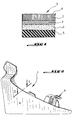
- the covering part referenced generally by the numeral 1, comprises an outer layer 2 made from fibers also called plastic flocks, a support layer 4 formed by a nonwoven or a polyolefin film, a layer 3 providing the connection between the outer layer 2 and the support layer 4, and a stiffening layer 5 made of plastic and / or composite, overmolded on the free face of the support layer 4.
- the stiffening of the assembly formed by the outer layer 2, the bonding agent 3 and the support layer 4 was made in situ by injection and / or compression, according to known techniques used in the automotive field.
- the injected film and polymer must be chemically compatible.
- the support could also be a knitted textile called mesh.
- the mesh for example a rectilinear mesh, is made of synthetic fiber polyester or polyamide or a mixture of both.
- nonwoven it could be of the type of nonwoven made by the melt process known as "melt blown".
- the assembly formed by the outer layer 2, the bonding agent 3 and its support layer 4 is made in the form of a very flexible strip and therefore of a small appropriate thickness so that this tape can be applied intimately to injection mold faces and / or compression overmolding even very complicated, which allows the manufacture of complex trim parts such as the part shown in Figure 2 and which is intended to be arranged between the rear window and the door trunk of a motor vehicle, the face designated by the reference 6 being visible while the complex shape part 7 is hidden after assembly on the body.
- the tape is applied according to known methods for gluing lining on a pre-made part (called insert) in any plastic material. or not.
- the ribbon after having been thermoformed is applied according to the usual techniques known in the automotive field.
- the support layer 4 is therefore formed by an elastic nonwoven material.
- the layer is impermeable to the injected material. It is advantageous to make a nonwoven from synthetic fibers bound by jets of water to obtain a product commonly referred to as "spunlace” or "hydroentrangled non-woven". This type of nonwoven makes it possible, with respect to a mechanically needle-punched nonwoven, also to be able to obtain a smooth and homogeneous surface appearance.
- nonwoven made of synthetic fibers including polyester, polypropylene or viscose.
- the nonwoven could be composed of a single type of fiber, for example 100% polyester fibers or a mixture of several types of fibers, for example polyester in proportions of between 0 and 50% and polypropylene in the same proportions.
- the outer layer is advantageously made from polyester or nylon fibers or flocks, preferably nylon with a titer between 0.5 and 3.3 dtex and more preferably with a titer between 0.9 and 1.7 dtex. for a fiber length between 0.3 mm and 1 and preferably between 0.4 and 0.8 mm, the term "title" being the unit of mass per unit length.
- the fibers may or may not be of the same color without affecting the properties of implementation and the final properties.
- connection system between the outer layer and the support layer is developed on the one hand, so as to satisfy the antithetic / antinomic compromise elasticity (necessary to the needs of known manufacturing processes and used in the automotive field) / permanent appearance (resistance to abrasion, friction resistance) required the motor specifications.
- it is developed so as not to create migration phenomena during processing and / or application to the room according to the same manufacturing processes mentioned above. above.
- it is developed so as not to generate defects, for example fogging, emission of Volatile Organic Compounds (VOCs), going against the specifications described in the same automotive specifications for interior cladding.
- the bonding system may be composed of an adhesive alone or an adhesive enriched with a primer, if the support requires it.
- this primer is deposited, in a manner known per se, firstly on a support which is too porous or has a too “blotchy” effect, which makes it possible to retain its elasticity properties and consequently those of the flocked coating.
- the adhesive for its part, may, for example, be formulated from a 100% solid polyurethane in a manner known per se, added, for the purposes of the invention, with a catalyst ensuring the good adhesion of the fibers and therefore good resistance to abrasion and friction. This catalyst will be added in proportions of between 0.1 and 10 phr (per hundred rubber parts per 100 parts) and preferably between 2 and 5 parts.
- a layer of a binding agent 3 is applied to the nonwoven or polyolefin support 4 and project on the glued face the fibers as described above. Then the assembly is passed through an oven, in a manner known per se.
- the assembly thus obtained for example in the form of a ribbon or a sheet, is placed in an injection mold or compression mold, with the outer layer 2 applied against the inner face (called mold cavity or die) of the mold .
- the thermoplastic and / or thermosetting and / or stiffening composite material which is to form layer 5 is then injected.
- the invention thus makes it possible to produce trim parts of any complex shape, such as roof and / or cabinet trim, ensuring a visual comfort likely to evoke in the occupants of the vehicle a sensation of well-being and giving sensations pleasant to the touch and, if necessary, of depth.
- the decoration (flocked) coating has an excellent resistance to UV radiation, that is to say a solidity of the hue to light and heat, a good resistance to different appearance permanence tests, for example to friction and cleaning agents, good resistance to abrasion and / or scratching and disgorging.
- the invention makes it possible to meet the stringent requirements for restricting the concentration of volatile organic compounds (VOCs) and deposition of volatile products on glass or fogging.
- the part made using the coating described according to the invention meets the same criteria mentioned above and defined in the automotive specifications for interior parts.
- the nature of the fibers used and stated above also makes it possible to envisage treatment of the flocked surface before it is used, such as a chemical surface treatment offering better resistance to stains and soiling, a mechanical surface treatment such as a graining to change its visual appearance and feel from the same flocked materials and incidentally reinforce its resistance to accidental marking eg scratches, shocks etc.
- FIG. 3 shows another embodiment of a coating according to the invention which differs from that of FIG. 1 by the addition between the layer of bonding agent 2 and the woven support layer 4 or polyolefin or mesh 3 a layer of a foamed primer noted 8.
- This primer foamed with a blowing agent added in proportions ranging from 0.5 to 40 and, preferably, from 10 to 25, allows the support 4 to not absorbed the adhesive 3 and give elasticity to the complete coating, elasticity which is necessary for the in situ transformation processes according to the principle known under the terms "one shot" (i.e. a step).
- the adhesive can thus slide on the support and adapt to the shape of the part.
- the primer is suitable for all polyurethane adhesives.
- FIG. 4 shows yet another embodiment of a covering part 1, which comprises between the bonding agent layer 3 and the woven or polyolefin support 4 or mesh 4 a foamed coating layer 9 and a primer standard 10.
- the unfoamed primer 10 allows the carrier to not absorb the adhesive.
- the foamed coating 9 makes it possible to give the necessary elasticity for the in situ transformation processes in the case where the coating needs to be thermoformed.
- the adhesive can thus slide on the support and adapt to the shape of the part.
- the foamed primer and coating is suitable for all polyurethane adhesives.
- the adhesive could be a solvent-free adhesive.
- thermoformable support which may be for example a polyolefin foam such as polypropylene or polyethylene so that we obtain the construction shown in Figure 3 that is to say comprising an outer flocked layer 2, a flocking adhesive 3, a foamed finish 8, a polyolefin support 4 nonwoven or knitted mesh, and, additionally a layer of foam, for example polypropylene PP or polyethylene PE between the support 4 and the injected plastic 5.
- the support 4 could also be a thermoformable plastic film type PS, ABS, PC, PP for example. In this case where the film is a barrier for the adhesive there is no need for foam and therefore against-bonding.
- the structure could correspond to that shown in Figure 4, with however removal of the primer.
Landscapes
- Engineering & Computer Science (AREA)
- Textile Engineering (AREA)
- Laminated Bodies (AREA)
- Vehicle Interior And Exterior Ornaments, Soundproofing, And Insulation (AREA)
Abstract
Description
- L'invention concerne un revêtement notamment de décoration pour une pièce d'habillage notamment pour un habitacle de véhicule automobile, du type comprenant une couche extérieure appliquée à l'aide d'un agent de liaison sur une couche support et une pièce d'habillage revêtue d'un tel revêtement.
- Les pièces d'habillage de ce type, qui sont connues, comportent, à titre de couche extérieure, un textile obtenu par tissage ou tricotage ou un cuir ou un revêtement synthétique imitant le cuir ou une moquette obtenue par tricotage ou aiguilletage, ce qui ne donne pas un confort visuel et tactile tout à fait satisfaisant.
- L'invention a pour but de proposer un revêtement et une pièce d'habillage tels que définis ci-dessus, qui permettent de pallier ces inconvénients.
- Pour atteindre ce but, le revêtement selon l'invention est caractérisé en ce que la couche extérieure est une couche floquée, réalisée à partir de fibres en matière synthétique.
- Selon une caractéristique de l'invention, la couche support est une couche réalisée en un non-tissé comportant des fibres avantageusement liées par jets d'eau.
- Selon une autre caractéristique de l'invention, les fibres de la couche support sont des fibres synthétiques telles que des fibres de polyester, de polypropylène ou de viscose.
- Selon encore une autre caractéristique de l'invention, la couche support comporte des fibres d'un seul type tel que des fibres en polyester ou un mélange de plusieurs types de fibres, tel que des fibres polyester et de polypropylène.
- Selon encore une autre caractéristique de l'invention, la couche support est un film polyoléfine.
- Selon encore une autre caractéristique de l'invention, les fibres de formation de la couche extérieure sont en un matériau synthétique tel que du polyester ou du nylon.
- La pièce d'habillage selon l'invention, du type comprenant un revêtement précité et une base porteuse de rigidification en un matériau plastique et/ou composite, est caractérisée en ce que la base porteuse de rigidification en un matériau plastique et/ou composite est appliquée sur la couche support du revêtement selon des techniques in situ d'injection et/ou de compression telles que connues dans le domaine automobile.
- L'invention sera mieux comprise, et d'autres buts, caractéristiques, détails et avantages de celles-ci apparaîtront plus clairement au cours de la description explicative qui va suivre faite en référence au dessin schématique unique annexé et donné uniquement à titre d'exemple illustrant un mode de réalisation de l'invention et dans lesquels :
- la figure 1 est une vue en coupe schématique selon la ligne I-I de la figure 2 et montre la structure composite multicouche de la paroi d'une pièce d'habillage réalisée grâce au revêtement selon l'invention, cette pièce étant destinée à être disposée à l'intérieur de l'habitacle d'un véhicule automobile, et
- la figure 2 est une vue en perspective d'une pièce d'habillage réalisée grâce au revêtement selon l'invention ; et
- les figures 3 et 4 sont des vues en coupe schématiques de deux autres modes de réalisation d'une structure multicouche d'une pièce d'habillage selon l'invention.
- La pièce d'habillage, référencée de façon générale par le chiffre 1, comporte une couche extérieure 2 réalisée à partir de fibres également appelées flocks en matière plastique, une couche de support 4 formée par un non-tissé ou un film polyoléfine, une couche 3 assurant la liaison entre la couche extérieure 2 et la couche support 4, et une couche de rigidification 5 en matière plastique et/ou composite, surmoulée sur la face libre de la couche de support 4. La rigidification de l'ensemble formé par la couche extérieure 2, l'agent de liaison 3 et la couche de support 4 a été réalisée in situ par injection et/ou de compression, selon des techniques connues utilisées dans le domaine automobile. Concernant le polyoléfine, le film et le polymère injectés doivent être compatibles chimiquement.
- Le support pourrait aussi être un textile tricoté dénommé maille. Concernant le textile tricoté, la maille, par exemple une maille rectiligne, est composée de fibre synthétique en polyester ou polyamide ou un mélange des deux.
- En ce qui concerne le non tissé, il pourrait être du type de non tissé fabriqué selon les procédés par voie fondue appelé "melt blown".
- L'ensemble formé par la couche extérieure 2 , l'agent de liaison 3 et sa couche support 4 est réalisé sous forme d'une bande très souple et donc d'une faible épaisseur appropriée de façon que ce ruban puisse s'appliquer intimement à des faces de moule d'injection et/ou compression surmoulage même très compliqué, ce qui permet la fabrication de pièces d'habillage complexes telles que la pièce représentée sur la figure 2 et qui est destinée à être disposée entre la vitre arrière et la porte de coffre d'un véhicule automobile, la face désignée par la référence 6 étant visible tandis que la partie de forme complexe 7 est cachée après montage sur la carrosserie.
- Selon un autre exemple de fabrication d'une pièce d'habillage grâce au revêtement réalisé selon l'invention, le ruban est appliqué selon des méthodes connues de garnissage par encollage sur une pièce fabriquée au préalable (dénommé insert) dans un matériau quelconque en plastique ou non.
- Selon encore un autre exemple de fabrication d'une pièce plastique grâce au revêtement réalisé selon l'invention et pour lequel la couche support est un film polyoléfine, le ruban après avoir été thermoformé est appliqué selon les techniques habituelles connues dans le domaine automobile.
- La couche support 4 est par conséquent formée par un matériau non tissé élastique. La couche est imperméable à la matière injectée. Il est avantageux de réaliser un non-tissé à partir de fibres synthétiques liées par jets d'eau pour obtenir un produit désigné communément par des termes anglais "spunlace" ou "hydroentrangled non-woven". Ce type de non-tissé permet, par rapport à un non-tissé aiguilleté mécaniquement, également envisageable, d'obtenir un aspect de surface régulier et homogène.
- Il est avantageux dans le cadre de l'invention d'utiliser un non-tissé composé de fibres synthétiques notamment de polyester, polypropylène ou viscose. Le non-tissé pourrait être composé d'un seul type de fibres par exemple des fibres 100% polyester ou d'un mélange de plusieurs types de fibres par exemple en polyester dans des proportions comprises entre 0 et 50% et en polypropylène dans les mêmes proportions.
- La couche extérieure est réalisée avantageusement à partir de fibres ou flocks en polyester ou en nylon, préférablement en nylon avec un titre compris entre 0,5 et 3,3 dtex et plus préférablement avec un titre compris entre 0,9 et 1,7 dtex pour une longueur de fibres comprise entre 0,3 mm et 1 et préférablement comprise entre 0,4 et 0,8 mm, le terme "titre" étant l'unité de masse par unité de longueur. Les fibres pourraient être ou non du même coloris sans que cela influence les propriétés de mise en oeuvre et les propriétés finales.
- Le système de liaison entre la couche extérieure et la couche support est développé d'une part, de sorte à satisfaire le compromis antithétique/antinomique élasticité (nécessaire aux besoins des procédés de fabrication connus et utilisés dans le domaine automobile) /permanence d'aspect (résistance à l'abrasion, tenue aux frottements) requis les cahiers des charges automobiles. D'autre part il est développé de sorte à ne pas créer de phénomènes de migration lors de la transformation et/ou de l'application sur pièce selon les mêmes procédés de fabrication cités ci dessus. Enfin, il est développé de façon à ne pas générer de défauts, par exemple fogging, émission de Composés Organiques Volatiles (COV), allant à l'encontre des spécifications décrites dans les mêmes cahiers des charges automobiles pour habillages intérieurs. A titre d'exemples, le système de liaison peut être composé d'un adhésif seul ou d'un adhésif enrichi d'un apprêt, si le support le nécessite. En effet, cet apprêt est déposé, de façon connue en soi, en premier sur un support trop poreux ou présentant un effet trop «buvard», ce qui permet de conserver ses propriétés d'élasticité et par suite celles du revêtement floqué. L'adhésif , quant à lui peut, par exemple, être formulé à partir d'un polyuréthane 100 %solide de façon connue en soi, additionné, pour les besoins de l'invention, d'un catalyseur assurant le bon accrochage des fibres et donc une bonne résistance à l'abrasion et au frottement. Ce catalyseur sera additionné dans des proportions comprises entre 0.1 et 10 phR (per Hundred Rubber ; parties pour 100 parts) et préférentiellement entre 2 et 5 parts.
- Pour la fabrication d'une pièce d'habillage grâce au revêtement réalisé selon l'invention, par exemple la pièce représentée sur la figure 2, on applique sur le support non-tissé ou polyoléfine 4 une couche d'un agent de liaison 3 et projette sur la face encollée les fibres telles que décrites plus haut. Puis l'ensemble est amené à passer par un four, de façon connue en soi. L'ensemble ainsi obtenu, par exemple en forme d'un ruban ou d'une feuille est placé dans un moule d'injection ou de compression surmoulage, avec la couche extérieure 2 appliquée contre la face interne (dénommée empreinte ou matrice) du moule. Après avoir ainsi tapissé la face interne du moule par le ruban ou la feuille, de forme appropriée, on procède à l'injection de la matière thermoplastique et/ou thermodurcissable et/ou composite de rigidification devant constituer la couche 5.
- L'invention permet de réaliser ainsi des pièces d'habillage de n'importe quelle forme complexe, telle que des garnitures de pavillon et/ou d'ébénisterie, assurant un confort visuel susceptible d'évoquer chez les occupants du véhicule une sensation de bien-être et donnant des sensations agréables au toucher et, le cas échéant, de profondeur. Le revêtement (floqué) de décoration présente une excellente tenue au rayonnement UV, c'est-à-dire une solidité de la teinte à la lumière et à la chaleur, une bonne tenue aux différents tests de permanence d'aspect, par exemple au frottement et aux agents de nettoyage, une bonne résistance à l'abrasion et/ou au grattage et aux dégorgements. L'invention permet de satisfaire aux exigences sévères de restriction de concentration en composants organiques volatils (COV) et de dépôt de produits volatils sur vitre ou d'embuage. La pièce réalisée à l'aide du revêtement décrit selon l'invention satisfait les mêmes critères cités ci-dessus et définis dans les cahiers des charges automobiles pour pièces intérieures.
- La nature des fibres utilisée et énoncée plus haut permet aussi d'envisager des traitements de la surface floquée avant sa mise en oeuvre, telle qu'un traitement de surface chimique offrant une meilleure résistance aux tâches et salissures, un traitement de surface mécanique tel qu'un grainage pour changer son aspect visuel et son toucher à partir des mêmes matériaux floqués et renforcer de manière incidente sa résistance au marquage accidentel par exemple rayures, chocs etc.
- La figure 3 présente un autre mode de réalisation d'un revêtement selon l'invention qui se distingue de celui de la figure 1 par l'ajout entre la couche d'agent de liaison 2 et la couche de support 4 tissé ou polyoléfine ou maille 3 une couche d'un apprêt moussé noté 8. Cet apprêt moussé à l'aide d'un agent gonflant ajouté dans des proportions allant de 0,5 à 40 et, de préférence, de 10 à 25, permet au support 4 de ne pas absorbé l'adhésif 3 et donner une élasticité au revêtement complet, élasticité qui est nécessaire pour les procédés de transformation in situ selon le principe connu sous les termes "one shot" (c'est-à-dire une étape). L'adhésif peut ainsi glisser sur le support et s'adapter à la forme de la pièce. L'apprêt s'adapte à tous les adhésifs polyuréthane.
- La figure 4 montre encore un autre mode de réalisation d'une pièce d'habillage 1, qui comporte entre la couche d'agent de liaison 3 et le support 4 tissé ou polyoléfine ou maille 4 une couche d'enduction moussée 9 et un apprêt standard 10. L'apprêt non moussé 10 permet au support de ne pas absorber l'adhésif. L'enduction moussée 9 permet de donner une élasticité nécessaire pour les procédés de transformation in situ dans le cas où le revêtement nécessite d'être thermoformé. L'adhésif peut ainsi glisser sur le support et s'adapter à la forme de la pièce. L'apprêt et l'enduction moussés s'adaptent à tous les adhésifs polyuréthane. L'adhésif pourrait être un adhésif sans solvant.
- Dans le cas où le support est un film polyoléfine, il est contre-collé par flammage sur un support thermoformable qui peut être par exemple une mousse de polyoléfine telle que du polypropylène ou polyéthylène de façon qu'on obtienne la construction représentée à la figure 3, c'est-à-dire comprenant une couche floquée extérieure 2, un adhésif de floquage 3, un apprêt moussé 8, un support polyoléfine 4 non tissé ou tricot maille, et, supplémentairement une couche de mousse par exemple polypropylène PP ou polyéthylène PE entre le support 4 et le plastique injecté 5. Le support 4 pourrait aussi être un film plastique thermoformable de type PS, ABS, PC, PP par exemple. Dans ce cas où le film constitue une barrière pour l'adhésif il n'y a pas besoin de mousse et donc de contre-collage. La structure pourrait correspondre à celle représentée à la figure 4, avec cependant suppression de la couche d'apprêt.
Claims (16)
- Revêtement notamment de décoration pour pièce d'habillage, avantageusement d'un habitacle de véhicule automobile, comprenant un ensemble formé par une couche extérieure appliquée à l'aide d'un agent de liaison sur une couche support, caractérisé en ce que la couche extérieure (2) est une couche floquée réalisée à partir des fibres en matière synthétique.
- Revêtement selon la revendication 1, caractérisé en ce que la couche support (4) est une couche réalisée en un non-tissé comportant des fibres avantageusement liées par jets d'eau.
- Revêtement selon la revendication 2, caractérisé en ce que les fibres de la couche support (4) sont des fibres synthétiques telles que des fibres de polyester, de polypropylène ou de viscose.
- Revêtement selon l'une des revendications 2 ou 3, caractérisé en ce que la couche support (4) comporte des fibres d'un seul type tel que des fibres en polyester ou un mélange de plusieurs types de fibres, telles que des fibres de polyester ou de polypropylène.
- Revêtement selon la revendication 1, caractérisé en ce que la couche support (4) est un film en matière polyoléfine.
- Revêtement selon l'une des revendications 1 à 5, caractérisé en ce que les fibres de formation de la couche extérieure (2) sont en un matériau synthétique tel que du polyester ou du nylon.
- Revêtement selon la revendication 6, caractérisé en ce que les fibres de la couche extérieure sont choisies de façon à obtenir une surface extérieure (6) veloutée et donnant une sensation de profondeur.
- Revêtement selon la revendication 1 caractérisé en ce que la formulation de l'adhésif comprenne un catalyseur assurant un bon accrochage des fibres.
- Revêtement selon les revendication 8 caractérisé en ce que le catalyseur soit présent dans des proportions comprises entre 0.1 et 10 phR et préférentiellement entre 2 et 5 phR.
- Revêtement selon les revendications 8 et 9
caractérisé en ce que l'agent de liaison soit développé de telle sorte à ne, d'une part, ni pénaliser les caractéristiques d'élasticité du revêtement fini, d'autre part, ni générer de phénomènes de migration au cours du processus de fabrication de la pièce d'habillage, processus conforme aux techniques in situ de transformation connues et utilisées dans l'automobile. - Revêtement selon l'une des revendications 1 à 10, caractérisé en ce que les fibres de la couche extérieure (2) et l'agent de liaison (3) sont choisis de façon que les fibres puissent être résistantes à la lumière, notamment au rayonnement UV, à la chaleur et aux agressions chimiques et mécaniques ; et que l'agent de liaison puisse être résistant à la lumière, à la chaleur et aux agressions chimiques.
- Revêtement selon l'une des revendications 1 à 10, caractérisé en ce qu'une couche d'apprêt moussé (8) est interposée entre l'agent de liaison (3) et la couche support (4) pour éviter que le support absorbe l'agent de liaison et donne une élasticité au revêtement.
- Revêtement selon l'une des revendications 1 à 10, caractérisé en ce qu'il comprend une couche d'induction moussée (9) et une couche d'apprêt (10) entre l'agent de liaison (3) et la couche de support (4), l'apprêt évitant l'absorption de l'agent de liaison par le support et l'induction donnant une élasticité.
- Pièce d'habillage, notamment pour un habitacle de véhicule automobile, du type comprenant un revêtement selon l'une des revendications 1 à 13 et une base porteuse de rigidification en un matériau plastique et/ou composite, caractérisée en ce que la base porteuse de rigidification en un matériau plastique et/ou composite est appliquée sur la couche support du revêtement selon des techniques in situ d'injection et/ou de compression telles que connues dans le domaine automobile.
- Pièce d'habillage, notamment pour un habitacle de véhicule automobile, du type comprenant un revêtement selon l'une des revendications 1 à 14 et un insert porteur de rigidification, caractérisée en ce que l'insert porteur de rigidification est fabriqué au préalable en un matériau plastique ou non et en ce que le revêtement selon les revendications 1 à 11 est appliqué sur l'insert préalablement fabriqué selon des méthodes de garnissage par encollage telles que connues dans le domaine automobile.
- Revêtement selon la revendication 5, caractérisé en ce qu'il puisse être thermoformé ou non avant d'être appliqué selon quelconque procédé de fabrication d'injection et/ou de compression et/ou de garnissage tel que connu dans l'automobile sur la base ou l'insert porteur de rigidication.
Applications Claiming Priority (1)
| Application Number | Priority Date | Filing Date | Title |
|---|---|---|---|
| FR0502876A FR2883577A1 (fr) | 2005-03-23 | 2005-03-23 | Revetement notamment de decoration pour une piece d'habillage avantageusement d'un vehicule automobile et piece d'habillage revetue d'un tel revetement |
Publications (1)
| Publication Number | Publication Date |
|---|---|
| EP1705276A1 true EP1705276A1 (fr) | 2006-09-27 |
Family
ID=35169716
Family Applications (1)
| Application Number | Title | Priority Date | Filing Date |
|---|---|---|---|
| EP06290459A Withdrawn EP1705276A1 (fr) | 2005-03-23 | 2006-03-22 | Revêtement notamment de décoration pour une pièce d'habillage avantageusement d'un véhicule automobile et pièce d'habillage revêtue d'un tel revêtement |
Country Status (2)
| Country | Link |
|---|---|
| EP (1) | EP1705276A1 (fr) |
| FR (1) | FR2883577A1 (fr) |
Cited By (2)
| Publication number | Priority date | Publication date | Assignee | Title |
|---|---|---|---|---|
| FR2999456A1 (fr) * | 2012-12-17 | 2014-06-20 | Rene Massard | Brevet flocage electrostatique |
| FR3010958A1 (fr) * | 2013-09-26 | 2015-03-27 | Cera | Ecran de protection acoustique pour vehicule automobile |
Families Citing this family (1)
| Publication number | Priority date | Publication date | Assignee | Title |
|---|---|---|---|---|
| FR3139521A1 (fr) * | 2022-09-13 | 2024-03-15 | Smrc Automotive Holdings Netherlands B.V. | Pièce de panneaux de garniture pour habitacle de véhicule |
Citations (11)
| Publication number | Priority date | Publication date | Assignee | Title |
|---|---|---|---|---|
| GB1180081A (en) * | 1966-02-02 | 1970-02-04 | Scott Paper Co | Heat Deformable Laminate and Method of Making Same. |
| US3772131A (en) * | 1971-10-01 | 1973-11-13 | Burlington Industries Inc | Flocked spunlaced blanket |
| US4587149A (en) * | 1984-03-13 | 1986-05-06 | Toyoda Gosei Co., Ltd. | Electrostatic flocking products with polyurethane adhesive |
| US4721642A (en) * | 1985-11-30 | 1988-01-26 | Toyoda Gosei Co., Ltd. | Article having adhered, velvety polyurethane resin foam-coated pile as a surface decoration |
| EP0280296A2 (fr) * | 1987-02-27 | 1988-08-31 | Chisso Corporation | Procédé pour la production d'article moulé comportant une etoffe electroconductive en surface |
| US4816313A (en) * | 1986-09-19 | 1989-03-28 | Toyoda Gosei Co., Ltd. | Resin product with main resin body and soft resin covering part |
| US4895748A (en) * | 1989-04-03 | 1990-01-23 | Squires William J | Flocked foam fabric with flattened fibers which are color printed |
| US5320890A (en) * | 1993-06-23 | 1994-06-14 | E. I. Du Pont De Nemours And Company | Fire resistant fabrics with a flocked nylon surface |
| EP1072712A1 (fr) * | 1999-07-26 | 2001-01-31 | Apeiron S.r.l. | Matériau floque et son procédé de préparation |
| JP3149572B2 (ja) * | 1992-10-22 | 2001-03-26 | 東レ株式会社 | 耐光性に優れた植毛加工品 |
| US20030207072A1 (en) * | 2000-07-24 | 2003-11-06 | Abrams Louis Brown | Co-molded direct flock and flock transfer and methods of making same |
-
2005
- 2005-03-23 FR FR0502876A patent/FR2883577A1/fr active Pending
-
2006
- 2006-03-22 EP EP06290459A patent/EP1705276A1/fr not_active Withdrawn
Patent Citations (11)
| Publication number | Priority date | Publication date | Assignee | Title |
|---|---|---|---|---|
| GB1180081A (en) * | 1966-02-02 | 1970-02-04 | Scott Paper Co | Heat Deformable Laminate and Method of Making Same. |
| US3772131A (en) * | 1971-10-01 | 1973-11-13 | Burlington Industries Inc | Flocked spunlaced blanket |
| US4587149A (en) * | 1984-03-13 | 1986-05-06 | Toyoda Gosei Co., Ltd. | Electrostatic flocking products with polyurethane adhesive |
| US4721642A (en) * | 1985-11-30 | 1988-01-26 | Toyoda Gosei Co., Ltd. | Article having adhered, velvety polyurethane resin foam-coated pile as a surface decoration |
| US4816313A (en) * | 1986-09-19 | 1989-03-28 | Toyoda Gosei Co., Ltd. | Resin product with main resin body and soft resin covering part |
| EP0280296A2 (fr) * | 1987-02-27 | 1988-08-31 | Chisso Corporation | Procédé pour la production d'article moulé comportant une etoffe electroconductive en surface |
| US4895748A (en) * | 1989-04-03 | 1990-01-23 | Squires William J | Flocked foam fabric with flattened fibers which are color printed |
| JP3149572B2 (ja) * | 1992-10-22 | 2001-03-26 | 東レ株式会社 | 耐光性に優れた植毛加工品 |
| US5320890A (en) * | 1993-06-23 | 1994-06-14 | E. I. Du Pont De Nemours And Company | Fire resistant fabrics with a flocked nylon surface |
| EP1072712A1 (fr) * | 1999-07-26 | 2001-01-31 | Apeiron S.r.l. | Matériau floque et son procédé de préparation |
| US20030207072A1 (en) * | 2000-07-24 | 2003-11-06 | Abrams Louis Brown | Co-molded direct flock and flock transfer and methods of making same |
Non-Patent Citations (1)
| Title |
|---|
| DATABASE WPI Section Ch Week 200126, Derwent World Patents Index; Class A81, AN 1994-196668, XP002352886 * |
Cited By (2)
| Publication number | Priority date | Publication date | Assignee | Title |
|---|---|---|---|---|
| FR2999456A1 (fr) * | 2012-12-17 | 2014-06-20 | Rene Massard | Brevet flocage electrostatique |
| FR3010958A1 (fr) * | 2013-09-26 | 2015-03-27 | Cera | Ecran de protection acoustique pour vehicule automobile |
Also Published As
| Publication number | Publication date |
|---|---|
| FR2883577A1 (fr) | 2006-09-29 |
Similar Documents
| Publication | Publication Date | Title |
|---|---|---|
| EP2674274B1 (fr) | Elément de garnissage et procédé de fabrication associé | |
| US12005680B2 (en) | Interior paneling component for a motor vehicle | |
| EP2707191A1 (fr) | Profile moule par multi-injection formant un joint d'etancheite ou un enjoliveur pour carrosserie de vehicule automobile, et son procede de fabrication | |
| CN101547812A (zh) | 包括装饰元件的模制件及连接装饰元件到车辆组件的方法 | |
| FR2980446A1 (fr) | Habillage de vehicule comprenant une armature et un garnissage | |
| WO2020233979A1 (fr) | Procédé d'habillage de pièces intérieures de véhicules, pièces habillées et véhicules associés | |
| EP1022116B1 (fr) | Procédé pour fabriquer une pièce moulée en matière plastique partiellement peinte et pièces ainsi obtenues | |
| KR101935515B1 (ko) | 자동차용 내장재 및 이의 제조방법 | |
| EP4338945A1 (fr) | Pièce de panneaux de garniture pour habitacle de véhicule | |
| EP1705276A1 (fr) | Revêtement notamment de décoration pour une pièce d'habillage avantageusement d'un véhicule automobile et pièce d'habillage revêtue d'un tel revêtement | |
| EP2674270A2 (fr) | Elément de garnissage présentant une face d'aspect formée en partie par un matériau ligneux | |
| FR2881149A1 (fr) | Piece en materiau floque, en particulier pour vehicule automobiles, et procede pour sa fabrication | |
| FR2670710A1 (fr) | Fibres tissees dans une matrice transparente de finition pour interieurs d'automobiles. | |
| KR102338784B1 (ko) | 리얼우드 필름과 그 제조방법 및 차량용 내장재 제조방법 | |
| FR3070899B1 (fr) | Panneau de garnissage interieur de vehicule automobile | |
| FR2868733A1 (fr) | Materiau composite en feuille thermoformable pour garniture interieure de vehicule automobile dote d'une feuille de bois decoratif, element de garniture de vehicule comprenant un tel materiau, et procedes de fabrication associes | |
| EP0623491B1 (fr) | Produit stratifié destiné notamment à réaliser des éléments d'habillage intérieur de carroserie | |
| EP1837241A1 (fr) | Panneau de garnissage de véhicule automobile à absorption accoustique et à résistance à l'enfoncement améliorées | |
| FR2774322A1 (fr) | Procede de fabrication d'un pare-soleil | |
| WO2021156279A1 (fr) | Procédé de fabrication d'habillages de véhicule | |
| FR3037887A1 (fr) | Element de garnissage comprenant une couche d'aspect en textile presentant un effet mouille | |
| WO2007138196A1 (fr) | Structure composite multicouche utilisee pour la realisation de pieces obtenues par un procede moulage par injection et/ou infusion sous vide | |
| FR3037888A1 (fr) | Element de garnissage comprenant une couche d'aspect et un revetement contenant des elements de decor ponctuels | |
| FR3069805A1 (fr) | Procede de revetement d'un support courbe avec un materiau rigide et panneau d'habillage obtenu par ce procede | |
| WO2001039972A1 (fr) | Feuille decorative et procede de fabrication de celle-ci |
Legal Events
| Date | Code | Title | Description |
|---|---|---|---|
| PUAI | Public reference made under article 153(3) epc to a published international application that has entered the european phase |
Free format text: ORIGINAL CODE: 0009012 |
|
| AK | Designated contracting states |
Kind code of ref document: A1 Designated state(s): AT BE BG CH CY CZ DE DK EE ES FI FR GB GR HU IE IS IT LI LT LU LV MC NL PL PT RO SE SI SK TR |
|
| AX | Request for extension of the european patent |
Extension state: AL BA HR MK YU |
|
| 17P | Request for examination filed |
Effective date: 20070327 |
|
| AKX | Designation fees paid |
Designated state(s): AT BE BG CH CY CZ DE DK EE ES FI FR GB GR HU IE IS IT LI LT LU LV MC NL PL PT RO SE SI SK TR |
|
| 17Q | First examination report despatched |
Effective date: 20070504 |
|
| STAA | Information on the status of an ep patent application or granted ep patent |
Free format text: STATUS: THE APPLICATION IS DEEMED TO BE WITHDRAWN |
|
| 18D | Application deemed to be withdrawn |
Effective date: 20071115 |