EP1702182B1 - Im wärmetauscher eines ventilators verwendetes funktionales papier - Google Patents
Im wärmetauscher eines ventilators verwendetes funktionales papier Download PDFInfo
- Publication number
- EP1702182B1 EP1702182B1 EP03776053A EP03776053A EP1702182B1 EP 1702182 B1 EP1702182 B1 EP 1702182B1 EP 03776053 A EP03776053 A EP 03776053A EP 03776053 A EP03776053 A EP 03776053A EP 1702182 B1 EP1702182 B1 EP 1702182B1
- Authority
- EP
- European Patent Office
- Prior art keywords
- paper
- functional paper
- air
- csf
- chemical pulp
- Prior art date
- Legal status (The legal status is an assumption and is not a legal conclusion. Google has not performed a legal analysis and makes no representation as to the accuracy of the status listed.)
- Expired - Lifetime
Links
Images




Classifications
-
- D—TEXTILES; PAPER
- D21—PAPER-MAKING; PRODUCTION OF CELLULOSE
- D21H—PULP COMPOSITIONS; PREPARATION THEREOF NOT COVERED BY SUBCLASSES D21C OR D21D; IMPREGNATING OR COATING OF PAPER; TREATMENT OF FINISHED PAPER NOT COVERED BY CLASS B31 OR SUBCLASS D21G; PAPER NOT OTHERWISE PROVIDED FOR
- D21H5/00—Special paper or cardboard not otherwise provided for
- D21H5/12—Special paper or cardboard not otherwise provided for characterised by the use of special fibrous materials
- D21H5/1272—Special paper or cardboard not otherwise provided for characterised by the use of special fibrous materials of fibres which can be physically or chemically modified during or after web formation
- D21H5/1281—Special paper or cardboard not otherwise provided for characterised by the use of special fibrous materials of fibres which can be physically or chemically modified during or after web formation by chemical treatment
-
- F—MECHANICAL ENGINEERING; LIGHTING; HEATING; WEAPONS; BLASTING
- F24—HEATING; RANGES; VENTILATING
- F24F—AIR-CONDITIONING; AIR-HUMIDIFICATION; VENTILATION; USE OF AIR CURRENTS FOR SCREENING
- F24F12/00—Use of energy recovery systems in air conditioning, ventilation or screening
- F24F12/001—Use of energy recovery systems in air conditioning, ventilation or screening with heat-exchange between supplied and exhausted air
- F24F12/006—Use of energy recovery systems in air conditioning, ventilation or screening with heat-exchange between supplied and exhausted air using an air-to-air heat exchanger
-
- B—PERFORMING OPERATIONS; TRANSPORTING
- B60—VEHICLES IN GENERAL
- B60H—ARRANGEMENTS OF HEATING, COOLING, VENTILATING OR OTHER AIR-TREATING DEVICES SPECIALLY ADAPTED FOR PASSENGER OR GOODS SPACES OF VEHICLES
- B60H1/00—Heating, cooling or ventilating devices
- B60H1/02—Heating, cooling or ventilating devices the heat being derived from the propulsion plant
- B60H1/03—Heating, cooling or ventilating devices the heat being derived from the propulsion plant and from a source other than the propulsion plant
- B60H1/039—Heating, cooling or ventilating devices the heat being derived from the propulsion plant and from a source other than the propulsion plant from air leaving the interior of the vehicle, i.e. heat recovery
-
- F—MECHANICAL ENGINEERING; LIGHTING; HEATING; WEAPONS; BLASTING
- F24—HEATING; RANGES; VENTILATING
- F24F—AIR-CONDITIONING; AIR-HUMIDIFICATION; VENTILATION; USE OF AIR CURRENTS FOR SCREENING
- F24F13/00—Details common to, or for air-conditioning, air-humidification, ventilation or use of air currents for screening
- F24F13/30—Arrangement or mounting of heat-exchangers
-
- F—MECHANICAL ENGINEERING; LIGHTING; HEATING; WEAPONS; BLASTING
- F28—HEAT EXCHANGE IN GENERAL
- F28D—HEAT-EXCHANGE APPARATUS, NOT PROVIDED FOR IN ANOTHER SUBCLASS, IN WHICH THE HEAT-EXCHANGE MEDIA DO NOT COME INTO DIRECT CONTACT
- F28D21/00—Heat-exchange apparatus not covered by any of the groups F28D1/00 - F28D20/00
- F28D21/0015—Heat and mass exchangers, e.g. with permeable walls
-
- F—MECHANICAL ENGINEERING; LIGHTING; HEATING; WEAPONS; BLASTING
- F28—HEAT EXCHANGE IN GENERAL
- F28D—HEAT-EXCHANGE APPARATUS, NOT PROVIDED FOR IN ANOTHER SUBCLASS, IN WHICH THE HEAT-EXCHANGE MEDIA DO NOT COME INTO DIRECT CONTACT
- F28D9/00—Heat-exchange apparatus having stationary plate-like or laminated conduit assemblies for both heat-exchange media, the media being in contact with different sides of a conduit wall
- F28D9/0062—Heat-exchange apparatus having stationary plate-like or laminated conduit assemblies for both heat-exchange media, the media being in contact with different sides of a conduit wall the conduits for one heat-exchange medium being formed by spaced plates with inserted elements
-
- Y—GENERAL TAGGING OF NEW TECHNOLOGICAL DEVELOPMENTS; GENERAL TAGGING OF CROSS-SECTIONAL TECHNOLOGIES SPANNING OVER SEVERAL SECTIONS OF THE IPC; TECHNICAL SUBJECTS COVERED BY FORMER USPC CROSS-REFERENCE ART COLLECTIONS [XRACs] AND DIGESTS
- Y02—TECHNOLOGIES OR APPLICATIONS FOR MITIGATION OR ADAPTATION AGAINST CLIMATE CHANGE
- Y02B—CLIMATE CHANGE MITIGATION TECHNOLOGIES RELATED TO BUILDINGS, e.g. HOUSING, HOUSE APPLIANCES OR RELATED END-USER APPLICATIONS
- Y02B30/00—Energy efficient heating, ventilation or air conditioning [HVAC]
- Y02B30/56—Heat recovery units
Definitions
- the present invention relates to functional paper for a heat exchanger built in a ventilator for externally discharging indoor air and internally sucking outdoor air, for concurrently performing sensible heat and latent heat exchange operations between indoor air and outdoor air, and a heat exchanger of a ventilator using the same.
- a ventilator is used to exchange contaminated indoor air for fresh outdoor air especially in a narrow space where a number of people stay such as an office or vehicle.
- the ventilator includes an air blower for forcibly blowing indoor air and outdoor air, and repeats a process of externally discharging contaminated indoor air and internally sucking fresh outdoor air.
- the ventilator further includes a heat exchanger for exchanging heat between indoor air and outdoor air.
- a general ventilator includes a casing 2 composing the outer appearance, a heat exchanger 10 installed in the casing 2, for separately flowing indoor air and outdoor air, and exchanging heat between indoor air and outdoor air, an outdoor air suction hole 4a and an outdoor air discharge hole 4b formed on the facing surfaces of the casing 2, for sucking and discharging outdoor air, respectively, an indoor air suction hole 6a and an indoor air discharge hole 6b formed on one sides of the outdoor air suction hole 4a and the outdoor air discharge hole 4b, for sucking and discharging indoor air, respectively, an air supply fan 8 installed inside the outdoor air discharge hole 4b, for internally sucking outdoor air, an air exhaust fan 9 installed inside the indoor air discharge hole 6b, for externally discharging indoor air, and a pre-filter (not shown) installed inside the outdoor air suction hole 4a, for filtering alien substances such as dust from outdoor air.
- an outdoor air passage guide 5 is formed between the outdoor air suction hole 4a and the outdoor air discharge hole 4b, so that outdoor air sucked from the outdoor air suction hole 4a can be discharged to the outdoor air discharge hole 4b through the heat exchanger 10
- an indoor air passage guide 7 is formed between the indoor air suction hole 6a and the indoor air discharge hole 6b so that indoor air sucked from the indoor air suction hole 6a can be discharged to the indoor air discharge hole 6b through the heat exchanger 10.
- the outdoor air suction hole 4a and the indoor air discharge hole 6b are coupled to outdoor ducts (not shown) linked to the outdoor side, and the outdoor air discharge hole 4b and the indoor air suction hole 6a are coupled to indoor ducts (not shown) linked to the indoor side.
- the heat exchanger 10 is formed by alternately stacking a plurality of heat exchange units to separately flow indoor air and outdoor air, thereby exchanging heat between indoor air and outdoor air through heat transfer plates 20. As illustrated in Figs. 4 and 5 , first pleat sheets 22 are adhered on the heat transfer plates 20 in one direction to form first air paths 26 which outdoor air passes through, and second pleat sheets 24 are adhered on the heat transfer plates 20 in another direction (for example, vertical direction to the one direction) to form second air paths 28 which indoor air passes through.
- the plurality of heat transfer plates 20 are formed in a flat plate shape, for exchanging heat between outdoor air flowing through the first air paths 26 and indoor air flowing through the second air paths 28.
- the plurality of first pleat sheets 22 and the plurality of second pleat sheets 24 are generally made of the same material as the heat transfer plates 20, and curved a few times in a triangular waveform shape, to provide passing spaces for indoor air and outdoor air.
- the rectangular parallelepiped heat exchanger 10 is formed by sequentially stacking the first pleat sheets 22, the heat transfer plates 20 and the second pleat sheets 24 in the vertical directions to each other.
- outdoor air and indoor air pass through the first and second air paths 26 and 28 formed by the first pleat sheets 22 and the second pleat sheets 24, crossing each other, thereby exchanging heat through the heat transfer plates 20.
- the heat transfer plates 20, the first pleat sheets 22 and the second pleat sheets 24 are made of aluminum, which efficiency transfers heat but does not normally exchange moisture between indoor air and outdoor air. Accordingly, when the ventilator is used, indoor humidity is varied.
- An object of the present invention is to provide functional paper having excellent air resistance, water vapor transmission efficiency and heat transfer efficiency, which can be used as a material of heat transfer plates and/or pleat sheets for a heat exchanger of a ventilator.
- Another object of the present invention is to provide functional paper having antibacterial performance.
- functional paper for a heat exchanger of a ventilator prepared by putting an inner sheet made of 10 to 40% of bleached wood chemical pulp having freeness of 200 to 300mL CSF and 60 to 90% of bleached wood chemical pulp fine powder having freeness below 100mL CSF between outer sheets made of mulberry fibers.
- the freeness of the bleached wood chemical pulp ranges from 200 to 250mL CSF.
- the inner sheet contains 25 to 35% of bleached wood chemical pulp.
- the freeness of the bleached wood chemical pulp fine powder ranges from 15 to 50mL CSF. More preferably, the freeness of the bleached wood chemical pulp fine powder ranges from 15 to 25mL CSF.
- the inner sheet contains 65 to 75% of bleached wood chemical pulp fine powder.
- the pulp is bleached hardwood kraft pulp.
- the inner and outer sheets further contain 0.02 to 0.04% of known retention aids to facilitate fixation of fine fibers or powder.
- the outer sheets further include an antibacterial agent so that the functional paper can have antibacterial properties.
- the outer sheets contain 10 to 15% of ocher, 3 to 9% of antibacterial agent made of grapefruit seed extracts, or both.
- the inner sheet further includes 0.3 to 0.8% of Alkyl Ketene Dimer to facilitate transmission of moisture by making the surfaces of the fibers of the inner sheet hydrophobic.
- a heat exchanger of a ventilator includes: heat transfer plates, first air paths which externally-discharged indoor air passes through and second air paths which internally-sucked outdoor air passes through being stacked on the heat transfer plates at predetermined intervals; first pleat sheets adhered to the first air paths, for obtaining passing spaces of outdoor air; and second pleat sheets adhered to the second air paths, for obtaining passing spaces of indoor air, wherein at least one of the heat transfer plates, the first pleat sheets and the second pleat sheets is functional paper prepared by putting an inner sheet made of 20 to 40% of bleached wood chemical pulp having freeness of 200 to 300mL CSF and 60 to 80% of bleached wood chemical pulp fine powder having freeness below 100mL CSF between outer sheets made of mulberry fibers.
- Paper was prepared under TAPPI Standard Method T 200 and T 218.
- Hardwood kraft pulp was beaten in valley beaters for laboratory to have freeness of 240mL CSF and 20mL CSF, respectively.
- the hardwood kraft pulp composing an inner sheet of functional paper was intended to improve air resistance of the functional paper.
- the hardwood kraft pulp fine powder beaten to 20mL CSF and other additives were added to the hardwood kraft pulp beaten to 240mL CSF according to the composition of Table 1, and the resulting substance was made into paper with a basis weight of 40g/m 2 .
- Table 1 Mixing Rates of Composition of Inner Sheet (unit: %) Hw-BKP (240mL CSF) Hw-BKP (20mL CSF) AKD Ca-PAM No. 1 30.60 69.08 0.3 0.02 No. 2 16.79 82.98 0.3 0.02 Note: The unit, %, is based on the oven-dried weight (g) of mulberry fibers.
- Mulberry fibers made in China were cut in about 2cm lengths and evenly disintegrated by a standard disintegrator, ocher and other additives were evenly mixed therewith as shown in Table 2, and the resulting substance was made into paper with a basis weight of 15g/m 2 , thereby preparing outer sheets 1 and 2 of the functional paper.
- the papermaking materials of the No. 1 and No. 2 conditions had the same composition rate.
- GFSE-X grapefruit seed extracts-X
- Table 2 Mixing Rates of Composition of Outer Sheet (unit: %) Mulberry Ocher AKD Ca-PAM GFSE-X No. 1 83.48 15 0.5 0.02 1 No. 2 Note: The unit, %, is based on the oven-dried weight (g) of mulberry fibers.
- a paper material was prepared in a rectangular aquatic papermaker as shown in Tables 1 and 2, paper material suspension was poured into the rectangular aquatic papermaker, the resulting substance was evenly mixed in a baffler, and a web was formed by pumping out water. An excessive amount of water was removed from the web through a papermaking press, and the web was completely dried through a drum dryer.
- the second outer sheet containing mulberry fibers and ocher was made under the papermaking conditions No. 1 and No. 2, the inner sheet containing hardwood kraft pulp and fine powder was made and put on the second outer sheet, and the first outer sheet containing mulberry fibers and ocher was made and put on the inner sheet.
- the three sheets of paper were put on the papermaking press, pressed for 5 minutes under the pressure of 3.5kgf/cm 2 , and completely dried in the drum dryer at a temperature of 105 ⁇ 2°C.
- Table 3 shows the measurement results of the physical properties of the functional paper made of mulberry fibers, hardwood kraft pulp and ocher. In comparison with the physical properties of the paper of the invention, physical properties of paper of Kumhwang P aper a nd paper (L-1 and F-1) of M itsubishi Paper in Japan are listed as control groups. Table 3.
- the paper of the invention had more excellent tensile strength, tear strength and burst strength than the paper of Kumhwang Paper and the paper of Mitsubishi Paper. It seemed that the hardwood kraft pulp and fine powder of the inner sheet facilitated inter-fiber hydrogen coupling and finally contributed to improvements of the physical properties of the paper.
- the paper of the invention had larger thickness than that of Mitsubishi Paper.
- the thickness of the paper was increased because the paper was prepared in the laboratory scale under the weaker papermaking conditions than the real field conditions.
- the paper of Kumhwang Paper had a basis weight of about 78g/m 2
- the paper of the invention had a basis weight of 61 to 64g/m 2 .
- the paper of Kumhwang Paper had a thickness of 108 ⁇ m
- No. 1 and No. 2 had a thickness of about 120 ⁇ m. That is, the paper of the invention had a smaller basis weight but a larger thickness, which might result from differences in dehydrating pressure and pressing pressure during the papermaking process. Used materials might cause such differences.
- the present invention used hardwood kraft pulp as the inner sheet, which would be advantageous in reduction of thickness. It was because the hardwood kraft pulp was much smaller in bulk than the mulberry fibers. Therefore, it was expected to produce much thinner paper in the real process by using the paper material composition mixing rate of the invention.
- the optimum ranges of the physical strength of the functional paper were 450 to 800N ⁇ m/g of tensile strength, 990 to 1115mN ⁇ m 2 /g of tear strength, and 2.5 to 6.0kPa ⁇ m 2 /g of burst strength. Such optimum ranges were determined by selecting the highest and lowest values of the physical properties of each paper specimen in consideration of anisotropic properties of the paper.
- Air resistance was measured under TAPPI Standard T 460 by using a Messmer PPS air resistance measuring apparatus.
- the air resistance measuring apparatus aspirated 100mL of air into paper pressed under a pressure of 0.5kgf/cm 2 , and obtained the time (sec) of air completely passing through the paper.
- Dense paper had high air resistance and loose paper had very low air resistance. That is, when an air resistance value increased, it took a long time for a certain amount of air to pass through the paper in the z-direction of the paper, and when the air resistance value decreased, the certain amount of air easily passed through the paper in the z-direction of the paper.
- Table 4 shows the measurement results of the air resistance and WVTR of the functional paper of the invention, the paper of Mitsubishi Paper and the paper of Kumhwang Paper. Table 4. Air Resistance and WVTR of Functional Paper WVTR (g/m 2 Day) Air Resistance (sec) Anhydrous CaCl 2 As a desiccant 3,100 N/A No.1 624 1030 No.2 608 1186 Kumhwang Paper 456 820 L-1(Japan) 408 3538 F-1(Japan) 816 1284
- Anhydrous CaCl 2 used as a desiccant of a WVTR measuring apparatus had been widely used in daily life.
- the WVTR of anhydrous CaCl 2 was about 3100g/m 2 ⁇ D.
- the WVTR of paper No. 1 and No. 2 produced in the aforementioned experimental conditions was 600g/m 2 ⁇ D, which was lower than that of anhydrous CaCl 2 by five times. Nevertheless, paper No. 1 and No. 2 showed preferable air resistance and WVTR. It was easily recognized that existence or absence of a barrier film for preventing transmission of moisture on anhydrous CaCl 2 had large effects on water vapor transmission efficiency.
- the flow of air passing through the paper film was known as being considerably influenced by a number of voids formed by a paper network. Accordingly, when a large number of voids existed, air easily flowed in the z-direction of the paper and moisture was rapidly transmitted. That is, when air permeability increased, the WVTR also increased. For example, L-1 having high air resistance among the specimens of Table 4 showed air resistance of about 3500 seconds, but a very low WVTR of 408g/m 2 ⁇ D.
- the present invention improves the water vapor transmission efficiency by putting the first and second outer sheets made of mulberry fibers and ocher on both surfaces of the inner sheet made of chemical pulp (kraft pulp).
- the Korean paper made of mulberry fibers have been used as window paper and currently as wall paper because of excellent ventilation and hygroscopicity. Such effects of the mulberry fibers are applied to the present invention to improve the water vapor transmission efficiency.
- the fine fibers (20mL CSF) were used for the inner sheet over about 70% to improve the air resistance, so that large specific surfaces of the fine fibers might interrupt transmission of moisture passing through the paper film.
- the fine fibers made of natural pulp fibers were comprised of cellulose having a plurality of hydrophile hydroxyl groups (-OH), and thus easily coupled to moisture passing through the paper film.
- the surfaces of the fibers needed to be hydrophobic.
- Alkyl Ketene Dimer (AKD) was used for this purpose.
- the WVTR of the AKD-processed functional paper was more improved than that of the non-processed functional paper by about 5.6%.
- a contact angle formed on the surface of the functional paper was 98.9. It implied that the surfaces of the paper fibers were sufficiently hydrophobic to have very low affinity to peripheral moisture.
- the paper No. 1 and No. 2 of the invention satisfied both the WVTR and air resistance differently from the paper of Kumhwang Paper and the paper (L-1) of Mitsubishi Paper.
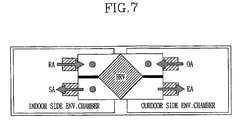
- FIG. 7 shows a heat transfer efficiency measuring apparatus.
- the measurement principle was divided into an indoor side environment chamber and an outdoor side environment chamber from a heat exchanger HRV of a ventilator.
- air flowing from the indoor side environment chamber to the ventilator was defined as return air RA
- air flowing from the ventilator to the indoor side environment chamber was defined as supply air SA
- air flowing from the ventilator to the outdoor side environment chamber was defined as exhaust air EA
- air flowing from the outdoor side environment chamber to the ventilator was defined as outdoor air OA, respectively.
- Table 5 shows the test conditions of the JIS B 8628. Table 5. Test Conditions (°C) Indoor side Outdoor side Dry bulb temperature Wet bulb temperature Dry bulb temperature Wet bulb temperature Cooling 27 ⁇ 1 20 ⁇ 2 35 ⁇ 1 29 ⁇ 2 (64%/23g/kg') (52.7%11.7g/kg') Heating 20 ⁇ 1 14 ⁇ 2 (51.6%/7.5g/kg') 5 ⁇ 1 2 ⁇ 2 (58.5%/3.15g/kg')
- the antibacterial property of the functional paper to microorganisms was measured according to a paper disc plate method. That is, suspension was evenly inoculated into a germ culture flat plate medium, and a paper disc of the sterilized functional paper specimen (8mm i.d., heated for 1 hour in 100 dry oven) was adhered to the surface of the flat plate medium. It was cultivated in 30°C incubator for 24 to 48 hours. Growth of germs in control groups was confirmed, and a diameter (mm) of a clear zone around the paper disc was measured, to compare antibacterial effects.
- Known clusters used for the antibacterial test were Staphylococcus aureus and E . coli.
- GFSE-X made of grapefruit seed extracts was added as an antibacterial agent in production of the functional paper.
- Figs. 8A and 8B illustrate the antibacterial test results of the GFSE-X processed functional paper. Each drawing shows 1 (control), 2(3%), 3(6%), 4(9%), 5(12%) and 6(15%).
- E . coli was added over 6 % of oven-dried weight of pulp fibers
- inhibitory circles were formed around the paper specimens ( Fig. 8A )
- Staphylococcus aureus was added over 3%
- inhibitory circles were formed around the paper specimens ( Fig. 8B ).
- the more the antibacterial agent was added the more the antibacterial performance of the paper was improved.
- Ocher can be used as the antibacterial agent, or other known antibacterial agents harmless to human bodies can also be used.
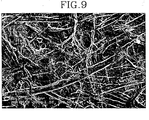
- FE-SEM of JEOL Ltd. was used to photograph the surface structure of the functional paper. Magnifications were X200 and X1000.
- Fig. 9 is an SEM photograph of the inner sheet of the functional paper. As shown in Fig. 9 , when a large amount of fine powder beaten to 20mL CSF was mixed with the hardwood kraft pulp fibers beaten to 240mL CSF, large voids formed between the fibers almost disappeared. It might be a primary factor for improving the air resistance of the functional paper.
- Figs. 10A and 10B are SEM photographs of the surface of the outer sheet of the functional paper.
- Fig. 10A shows large voids formed on the surface of the outer sheet of the functional paper
- Fig. 10B shows a retention state of the ocher and GFSE-X powder added to the fiber network as antibacterial agent elements. It seemed that the particles were settled on the fiber network due to the operation of the chain polymer retention aids such as Ca-PAM rather than held due to the natural filtering operation during the web forming process. The settled antibacterial agent elements and ocher elements contributed to manifestation of the antibacterial performance of the functional paper.
- the present invention provides the functional paper having excellent air resistance, water vapor transmission efficiency and heat transfer efficiency, which can be used as a material of heat transfer plates and/or pleat sheets for the heat exchanger of the ventilator.
- the functional paper can be provided with the antibacterial performance.
Landscapes
- Engineering & Computer Science (AREA)
- Chemical & Material Sciences (AREA)
- Mechanical Engineering (AREA)
- Combustion & Propulsion (AREA)
- General Engineering & Computer Science (AREA)
- Thermal Sciences (AREA)
- Physics & Mathematics (AREA)
- Chemical Kinetics & Catalysis (AREA)
- General Chemical & Material Sciences (AREA)
- Paper (AREA)
- Heat-Exchange Devices With Radiators And Conduit Assemblies (AREA)
- Laminated Bodies (AREA)
- Walking Sticks, Umbrellas, And Fans (AREA)
- Structures Of Non-Positive Displacement Pumps (AREA)
Claims (13)
- Funktionelles Papier für einen Wärmetauscher eines Ventilators, hergestellt durch Anordnen eines Innenblatts, das zu 10 bis 40% aus gebleichtem Holzzellstoff mit einem Mahlgrad von 200 bis 300 mL CSF (Canadian Standard Freeness) und zu 60 bis 90% aus einem Feinpulver aus gebleichtem Holzzellstoff mit einem Mahlgrad unter 100 mL CSF besteht, zwischen Außenblättern, die aus Maulbeerbaumfasern bestehen
- Funktionelles Papier nach Anspruch 1, wobei der Mahlgrad des gebleichten Holzzellstoffs von 200 bis 250 mL CSF reicht
- Funktionelles Papier nach Anspruch 2, wobei das Innenblatt zu 25 bis 35% gebleichten Holzzellstoff enthält
- Funktionelles Papier nach Anspruch 1, wobei der Mahlgrad des Feinpulvers aus gebleichtem Holzzellstoff von 15 bis 50 mL CSF reicht
- Funktionelles Papier nach Anspruch 4, wobei der Mahlgrad des Feinpulvers aus gebleichtem Holzzellstoff von 15 bis 25 mL CSF reicht.
- Funktionelles Papier nach Anspruch 5, wobei das Innenblatt zu 65 bis 75% Feinpulver aus gebleichtem Holzzellstoff enthält
- Funktionelles Papier nach irgendeinem der Ansprüche 1 bis 6, wobei der Zellstoff gebleichter Hartholz-Kraftzellstoff ist
- Funktionelles Papier nach Anspruch 7, wobei die Innen- und Außenblätter ferner zu 0,02 bis 0,04% bekannte Retentionshilfsmittel umfassen.
- Funktionelles Papier nach Anspruch 8, wobei die Außenblätter ferner ein antibakterielles Mittel umfassen
- Funktionelles Papier nach Anspruch 9, wobei das antibakterielle Mittel aus Ocker besteht und im Bereich von 10 bis 15% zugesetzt ist
- Funktionelles Papier nach Anspruch 9, wobei das antibakterielle Mittel aus Extrakten von Pampelmusensamen besteht und im Bereich von 3 bis 9% zugesetzt ist.
- Funktionelles Papier nach Anspruch 7, wobei das Innenblatt ferner zu 0,3 bis 0,8% Alkylketendimer umfasst.
- Wärmetauscher eines Ventilators, Folgendes umfassend Wärmeübertragungsplatten, erste Luftpfade, durch welche nach außen ausgelassene Innenraumluft strömt, und zweite Luftpfade, durch welche von innen angesaugte Außenluft strömt, wobei die Luftpfade in vorbestimmten Abständen auf den Wärmeübertragungsplatten gestapelt sind;
erste gefaltete Blätter, die den ersten Luftpfaden zugeordnet sind, um Durchlassräume für die Außenluft zu erhalten; und
zweite gefaltete Blätter, die den zweiten Luftpfaden zugeordnet sind, um Durchlassräume für die Innenluft zu erhalten,
wobei mindestens eine bzw eines der Wärmeübertragungsplatten, der ersten gefalteten Blätter und der zweiten gefalteten Blätter ein funktionelles Papier nach Anspruch 1 ist, wobei das Papier hergestellt ist durch Anordnen eines Innenblatts, das zu 20 bis 40% aus gebleichtem Holzzellstoff mit einem Mahlgrad von 200 bis 300 mL CSF und zu 60 bis 80% aus einem Feinpulver aus gebleichtem Holzzellstoff mit einem Mahlgrad unter 100 mL CSF besteht, zwischen Außenblättern, die aus Maulbeerbaumfasern bestehen.
Applications Claiming Priority (2)
| Application Number | Priority Date | Filing Date | Title |
|---|---|---|---|
| KR1020030083546A KR100579373B1 (ko) | 2003-11-24 | 2003-11-24 | 환기장치의 열교환기에 사용되는 기능성 종이 |
| PCT/KR2003/002649 WO2005050099A1 (en) | 2003-11-24 | 2003-12-04 | Functiional paper used in heat exchanger of ventilator |
Publications (2)
| Publication Number | Publication Date |
|---|---|
| EP1702182A1 EP1702182A1 (de) | 2006-09-20 |
| EP1702182B1 true EP1702182B1 (de) | 2010-05-12 |
Family
ID=36809348
Family Applications (1)
| Application Number | Title | Priority Date | Filing Date |
|---|---|---|---|
| EP03776053A Expired - Lifetime EP1702182B1 (de) | 2003-11-24 | 2003-12-04 | Im wärmetauscher eines ventilators verwendetes funktionales papier |
Country Status (7)
| Country | Link |
|---|---|
| EP (1) | EP1702182B1 (de) |
| KR (1) | KR100579373B1 (de) |
| AT (1) | ATE467803T1 (de) |
| AU (1) | AU2003284709A1 (de) |
| DE (1) | DE60332560D1 (de) |
| ES (1) | ES2345384T3 (de) |
| WO (1) | WO2005050099A1 (de) |
Cited By (1)
| Publication number | Priority date | Publication date | Assignee | Title |
|---|---|---|---|---|
| EP4328503A4 (de) * | 2021-04-18 | 2024-10-23 | Daikin Industries, Ltd. | Luftbehandlungsvorrichtung |
Families Citing this family (7)
| Publication number | Priority date | Publication date | Assignee | Title |
|---|---|---|---|---|
| KR100872482B1 (ko) * | 2007-04-13 | 2008-12-05 | (주)아이씨티이엔지 | 전열 교환이 우수한 열교환지 |
| DE202010012838U1 (de) * | 2010-09-18 | 2010-12-02 | Zehnder Verkaufs- Und Verwaltungs Ag | System zur Raumbelüftung |
| US20160237620A1 (en) * | 2013-10-02 | 2016-08-18 | Toray Industries, Inc. | Base paper for heat exchanger, and total heat exchange element using same |
| US20160252269A1 (en) * | 2013-10-02 | 2016-09-01 | Toray Industries, Inc. | Heat exchange element and heat exchanger |
| CN105220557A (zh) * | 2015-09-11 | 2016-01-06 | 姚志宏 | 一种强度高的粉煤灰超细纤维复合原纸及其制作方法 |
| CN105155337A (zh) * | 2015-09-11 | 2015-12-16 | 姚志宏 | 一种透气性佳的纳米活性炭复合原纸及其制作方法 |
| CN105155335A (zh) * | 2015-09-11 | 2015-12-16 | 姚志宏 | 一种杀菌环保自清洁复合原纸及其制作方法 |
Family Cites Families (5)
| Publication number | Priority date | Publication date | Assignee | Title |
|---|---|---|---|---|
| JPS59107198A (ja) * | 1982-12-09 | 1984-06-21 | Matsushita Electric Ind Co Ltd | 全熱交換器 |
| JPH1054691A (ja) * | 1996-08-08 | 1998-02-24 | Mitsubishi Electric Corp | 熱交換器の間隔板及び熱交換器用部材及び熱交換器並びにその製造方法 |
| JP3791726B2 (ja) * | 1997-12-19 | 2006-06-28 | 特種製紙株式会社 | 全熱交換器用紙及びそれを使用した全熱交換器用エレメント |
| US6145588A (en) * | 1998-08-03 | 2000-11-14 | Xetex, Inc. | Air-to-air heat and moisture exchanger incorporating a composite material for separating moisture from air technical field |
| JP3969064B2 (ja) * | 2001-11-16 | 2007-08-29 | 三菱電機株式会社 | 熱交換器及び熱交換換気装置 |
-
2003
- 2003-11-24 KR KR1020030083546A patent/KR100579373B1/ko not_active Expired - Fee Related
- 2003-12-04 EP EP03776053A patent/EP1702182B1/de not_active Expired - Lifetime
- 2003-12-04 AT AT03776053T patent/ATE467803T1/de not_active IP Right Cessation
- 2003-12-04 AU AU2003284709A patent/AU2003284709A1/en not_active Abandoned
- 2003-12-04 WO PCT/KR2003/002649 patent/WO2005050099A1/en not_active Ceased
- 2003-12-04 DE DE60332560T patent/DE60332560D1/de not_active Expired - Lifetime
- 2003-12-04 ES ES03776053T patent/ES2345384T3/es not_active Expired - Lifetime
Cited By (1)
| Publication number | Priority date | Publication date | Assignee | Title |
|---|---|---|---|---|
| EP4328503A4 (de) * | 2021-04-18 | 2024-10-23 | Daikin Industries, Ltd. | Luftbehandlungsvorrichtung |
Also Published As
| Publication number | Publication date |
|---|---|
| EP1702182A1 (de) | 2006-09-20 |
| AU2003284709A1 (en) | 2005-06-08 |
| KR100579373B1 (ko) | 2006-05-12 |
| KR20050049806A (ko) | 2005-05-27 |
| WO2005050099A1 (en) | 2005-06-02 |
| DE60332560D1 (de) | 2010-06-24 |
| ES2345384T3 (es) | 2010-09-22 |
| ATE467803T1 (de) | 2010-05-15 |
Similar Documents
| Publication | Publication Date | Title |
|---|---|---|
| JP3791726B2 (ja) | 全熱交換器用紙及びそれを使用した全熱交換器用エレメント | |
| CN1217149C (zh) | 热交换器及热交换换气装置 | |
| EP1403430B1 (de) | Papier für wärmeaustausch | |
| US7188666B2 (en) | Heat exchanger of ventilating system | |
| CN108468251B (zh) | 一种抗菌湿帘纸及其制备方法 | |
| EP1702182A1 (de) | Im wärmetauscher eines ventilators verwendetes funktionales papier | |
| CN202702694U (zh) | 一种改性湿帘纸、空气净化组件以及空调 | |
| CN111989534A (zh) | 全热交换元件用纸及全热交换元件 | |
| JP2017150802A (ja) | 全熱交換素子用紙及び全熱交換素子 | |
| JPH0425476B2 (de) | ||
| JP3223172U (ja) | 全熱交換素子用紙及び全熱交換素子 | |
| KR101322049B1 (ko) | 전열교환소자용 용지, 이의 제조방법 및 이를 포함하는 전열교환소자 | |
| KR100938917B1 (ko) | 전열교환 소자 | |
| JPH0124529B2 (de) | ||
| KR20080039855A (ko) | 단위열교환판용 시트 | |
| JP2008070070A (ja) | 全熱交換器 | |
| JP2020085336A (ja) | 全熱交換素子用スペーサー及び全熱交換素子 | |
| WO2025009600A1 (ja) | 全熱交換素子用仕切部材、それを用いた全熱交換素子、及び全熱交換素子用仕切部材の製造方法 | |
| JPH10153399A (ja) | 全熱交換体用紙及びその製造方法 | |
| JP2025010102A (ja) | 全熱交換素子用仕切部材、それを用いた全熱交換素子、及び全熱交換素子用仕切部材の製造方法 | |
| KR20050087799A (ko) | 환기 장치용 열교환기 | |
| JP6937258B2 (ja) | 全熱交換素子用シート、全熱交換素子、及び全熱交換器 | |
| CN112325417B (zh) | 盲道泄压墙阀 | |
| JP2025010103A (ja) | 全熱交換素子用仕切部材、それを用いた全熱交換素子、及び全熱交換素子用仕切部材の製造方法 | |
| JP2025181743A (ja) | 全熱交換素子用仕切部材、及び全熱交換素子 |
Legal Events
| Date | Code | Title | Description |
|---|---|---|---|
| PUAI | Public reference made under article 153(3) epc to a published international application that has entered the european phase |
Free format text: ORIGINAL CODE: 0009012 |
|
| 17P | Request for examination filed |
Effective date: 20060612 |
|
| AK | Designated contracting states |
Kind code of ref document: A1 Designated state(s): AT BE BG CH CY CZ DE DK EE ES FI FR GB GR HU IE IT LI LU MC NL PT RO SE SI SK TR |
|
| DAX | Request for extension of the european patent (deleted) | ||
| RIN1 | Information on inventor provided before grant (corrected) |
Inventor name: SHIN, SOO-YEON,BOOYOUNG APT. 1202-902,WOLSANMAEUL Inventor name: KIM, CHUL-HWAN Inventor name: LEE, SEONGHWANC Inventor name: CHO, MIN-CHUL |
|
| GRAP | Despatch of communication of intention to grant a patent |
Free format text: ORIGINAL CODE: EPIDOSNIGR1 |
|
| GRAC | Information related to communication of intention to grant a patent modified |
Free format text: ORIGINAL CODE: EPIDOSCIGR1 |
|
| RIC1 | Information provided on ipc code assigned before grant |
Ipc: D21H 27/00 20060101ALI20090715BHEP Ipc: F28F 21/00 20060101ALI20090715BHEP Ipc: F28F 3/00 20060101ALI20090715BHEP Ipc: F24F 12/00 20060101AFI20090715BHEP Ipc: F28D 9/02 20060101ALI20090715BHEP |
|
| GRAS | Grant fee paid |
Free format text: ORIGINAL CODE: EPIDOSNIGR3 |
|
| GRAA | (expected) grant |
Free format text: ORIGINAL CODE: 0009210 |
|
| AK | Designated contracting states |
Kind code of ref document: B1 Designated state(s): AT BE BG CH CY CZ DE DK EE ES FI FR GB GR HU IE IT LI LU MC NL PT RO SE SI SK TR |
|
| REG | Reference to a national code |
Ref country code: GB Ref legal event code: FG4D |
|
| REG | Reference to a national code |
Ref country code: CH Ref legal event code: EP |
|
| REG | Reference to a national code |
Ref country code: IE Ref legal event code: FG4D |
|
| REF | Corresponds to: |
Ref document number: 60332560 Country of ref document: DE Date of ref document: 20100624 Kind code of ref document: P |
|
| REG | Reference to a national code |
Ref country code: NL Ref legal event code: VDEP Effective date: 20100512 |
|
| REG | Reference to a national code |
Ref country code: ES Ref legal event code: FG2A Ref document number: 2345384 Country of ref document: ES Kind code of ref document: T3 |
|
| PG25 | Lapsed in a contracting state [announced via postgrant information from national office to epo] |
Ref country code: SE Free format text: LAPSE BECAUSE OF FAILURE TO SUBMIT A TRANSLATION OF THE DESCRIPTION OR TO PAY THE FEE WITHIN THE PRESCRIBED TIME-LIMIT Effective date: 20100512 Ref country code: NL Free format text: LAPSE BECAUSE OF FAILURE TO SUBMIT A TRANSLATION OF THE DESCRIPTION OR TO PAY THE FEE WITHIN THE PRESCRIBED TIME-LIMIT Effective date: 20100512 |
|
| PG25 | Lapsed in a contracting state [announced via postgrant information from national office to epo] |
Ref country code: SI Free format text: LAPSE BECAUSE OF FAILURE TO SUBMIT A TRANSLATION OF THE DESCRIPTION OR TO PAY THE FEE WITHIN THE PRESCRIBED TIME-LIMIT Effective date: 20100512 Ref country code: AT Free format text: LAPSE BECAUSE OF FAILURE TO SUBMIT A TRANSLATION OF THE DESCRIPTION OR TO PAY THE FEE WITHIN THE PRESCRIBED TIME-LIMIT Effective date: 20100512 Ref country code: FI Free format text: LAPSE BECAUSE OF FAILURE TO SUBMIT A TRANSLATION OF THE DESCRIPTION OR TO PAY THE FEE WITHIN THE PRESCRIBED TIME-LIMIT Effective date: 20100512 |
|
| PG25 | Lapsed in a contracting state [announced via postgrant information from national office to epo] |
Ref country code: CY Free format text: LAPSE BECAUSE OF FAILURE TO SUBMIT A TRANSLATION OF THE DESCRIPTION OR TO PAY THE FEE WITHIN THE PRESCRIBED TIME-LIMIT Effective date: 20100512 Ref country code: GR Free format text: LAPSE BECAUSE OF FAILURE TO SUBMIT A TRANSLATION OF THE DESCRIPTION OR TO PAY THE FEE WITHIN THE PRESCRIBED TIME-LIMIT Effective date: 20100813 |
|
| PG25 | Lapsed in a contracting state [announced via postgrant information from national office to epo] |
Ref country code: PT Free format text: LAPSE BECAUSE OF FAILURE TO SUBMIT A TRANSLATION OF THE DESCRIPTION OR TO PAY THE FEE WITHIN THE PRESCRIBED TIME-LIMIT Effective date: 20100913 Ref country code: EE Free format text: LAPSE BECAUSE OF FAILURE TO SUBMIT A TRANSLATION OF THE DESCRIPTION OR TO PAY THE FEE WITHIN THE PRESCRIBED TIME-LIMIT Effective date: 20100512 Ref country code: DK Free format text: LAPSE BECAUSE OF FAILURE TO SUBMIT A TRANSLATION OF THE DESCRIPTION OR TO PAY THE FEE WITHIN THE PRESCRIBED TIME-LIMIT Effective date: 20100512 |
|
| PG25 | Lapsed in a contracting state [announced via postgrant information from national office to epo] |
Ref country code: SK Free format text: LAPSE BECAUSE OF FAILURE TO SUBMIT A TRANSLATION OF THE DESCRIPTION OR TO PAY THE FEE WITHIN THE PRESCRIBED TIME-LIMIT Effective date: 20100512 Ref country code: RO Free format text: LAPSE BECAUSE OF FAILURE TO SUBMIT A TRANSLATION OF THE DESCRIPTION OR TO PAY THE FEE WITHIN THE PRESCRIBED TIME-LIMIT Effective date: 20100512 Ref country code: CZ Free format text: LAPSE BECAUSE OF FAILURE TO SUBMIT A TRANSLATION OF THE DESCRIPTION OR TO PAY THE FEE WITHIN THE PRESCRIBED TIME-LIMIT Effective date: 20100512 Ref country code: BE Free format text: LAPSE BECAUSE OF FAILURE TO SUBMIT A TRANSLATION OF THE DESCRIPTION OR TO PAY THE FEE WITHIN THE PRESCRIBED TIME-LIMIT Effective date: 20100512 |
|
| PLBE | No opposition filed within time limit |
Free format text: ORIGINAL CODE: 0009261 |
|
| STAA | Information on the status of an ep patent application or granted ep patent |
Free format text: STATUS: NO OPPOSITION FILED WITHIN TIME LIMIT |
|
| 26N | No opposition filed |
Effective date: 20110215 |
|
| REG | Reference to a national code |
Ref country code: DE Ref legal event code: R097 Ref document number: 60332560 Country of ref document: DE Effective date: 20110214 |
|
| PG25 | Lapsed in a contracting state [announced via postgrant information from national office to epo] |
Ref country code: MC Free format text: LAPSE BECAUSE OF NON-PAYMENT OF DUE FEES Effective date: 20101231 |
|
| REG | Reference to a national code |
Ref country code: CH Ref legal event code: PL |
|
| GBPC | Gb: european patent ceased through non-payment of renewal fee |
Effective date: 20101204 |
|
| REG | Reference to a national code |
Ref country code: FR Ref legal event code: ST Effective date: 20110831 |
|
| PG25 | Lapsed in a contracting state [announced via postgrant information from national office to epo] |
Ref country code: IE Free format text: LAPSE BECAUSE OF NON-PAYMENT OF DUE FEES Effective date: 20101204 Ref country code: FR Free format text: LAPSE BECAUSE OF NON-PAYMENT OF DUE FEES Effective date: 20110103 Ref country code: CH Free format text: LAPSE BECAUSE OF NON-PAYMENT OF DUE FEES Effective date: 20101231 Ref country code: LI Free format text: LAPSE BECAUSE OF NON-PAYMENT OF DUE FEES Effective date: 20101231 |
|
| REG | Reference to a national code |
Ref country code: DE Ref legal event code: R119 Ref document number: 60332560 Country of ref document: DE Effective date: 20110701 |
|
| PG25 | Lapsed in a contracting state [announced via postgrant information from national office to epo] |
Ref country code: DE Free format text: LAPSE BECAUSE OF NON-PAYMENT OF DUE FEES Effective date: 20110701 Ref country code: GB Free format text: LAPSE BECAUSE OF NON-PAYMENT OF DUE FEES Effective date: 20101204 |
|
| PG25 | Lapsed in a contracting state [announced via postgrant information from national office to epo] |
Ref country code: LU Free format text: LAPSE BECAUSE OF NON-PAYMENT OF DUE FEES Effective date: 20101204 Ref country code: BG Free format text: LAPSE BECAUSE OF FAILURE TO SUBMIT A TRANSLATION OF THE DESCRIPTION OR TO PAY THE FEE WITHIN THE PRESCRIBED TIME-LIMIT Effective date: 20100512 Ref country code: HU Free format text: LAPSE BECAUSE OF FAILURE TO SUBMIT A TRANSLATION OF THE DESCRIPTION OR TO PAY THE FEE WITHIN THE PRESCRIBED TIME-LIMIT Effective date: 20101113 |
|
| PG25 | Lapsed in a contracting state [announced via postgrant information from national office to epo] |
Ref country code: TR Free format text: LAPSE BECAUSE OF FAILURE TO SUBMIT A TRANSLATION OF THE DESCRIPTION OR TO PAY THE FEE WITHIN THE PRESCRIBED TIME-LIMIT Effective date: 20100512 |
|
| PG25 | Lapsed in a contracting state [announced via postgrant information from national office to epo] |
Ref country code: BG Free format text: LAPSE BECAUSE OF FAILURE TO SUBMIT A TRANSLATION OF THE DESCRIPTION OR TO PAY THE FEE WITHIN THE PRESCRIBED TIME-LIMIT Effective date: 20100812 |
|
| PGFP | Annual fee paid to national office [announced via postgrant information from national office to epo] |
Ref country code: IT Payment date: 20191216 Year of fee payment: 17 |
|
| PGFP | Annual fee paid to national office [announced via postgrant information from national office to epo] |
Ref country code: ES Payment date: 20200113 Year of fee payment: 17 |
|
| PG25 | Lapsed in a contracting state [announced via postgrant information from national office to epo] |
Ref country code: IT Free format text: LAPSE BECAUSE OF NON-PAYMENT OF DUE FEES Effective date: 20201204 |
|
| REG | Reference to a national code |
Ref country code: ES Ref legal event code: FD2A Effective date: 20220207 |
|
| PG25 | Lapsed in a contracting state [announced via postgrant information from national office to epo] |
Ref country code: ES Free format text: LAPSE BECAUSE OF NON-PAYMENT OF DUE FEES Effective date: 20201205 |