EP1695481B1 - System and method for communicating on a virtual ring in an internet protocol network - Google Patents
System and method for communicating on a virtual ring in an internet protocol network Download PDFInfo
- Publication number
- EP1695481B1 EP1695481B1 EP04804621A EP04804621A EP1695481B1 EP 1695481 B1 EP1695481 B1 EP 1695481B1 EP 04804621 A EP04804621 A EP 04804621A EP 04804621 A EP04804621 A EP 04804621A EP 1695481 B1 EP1695481 B1 EP 1695481B1
- Authority
- EP
- European Patent Office
- Prior art keywords
- node
- virtual ring
- address
- neighbor
- token
- Prior art date
- Legal status (The legal status is an assumption and is not a legal conclusion. Google has not performed a legal analysis and makes no representation as to the accuracy of the status listed.)
- Expired - Lifetime
Links
- 238000000034 method Methods 0.000 title claims description 50
- 238000003780 insertion Methods 0.000 claims description 66
- 230000037431 insertion Effects 0.000 claims description 66
- 238000011144 upstream manufacturing Methods 0.000 claims description 65
- 238000012790 confirmation Methods 0.000 claims description 39
- 230000008859 change Effects 0.000 claims description 37
- 238000011084 recovery Methods 0.000 claims description 9
- 230000005540 biological transmission Effects 0.000 claims description 7
- 238000012545 processing Methods 0.000 claims description 6
- 238000004590 computer program Methods 0.000 claims description 3
- 238000012546 transfer Methods 0.000 claims description 2
- 230000008569 process Effects 0.000 description 19
- 230000008901 benefit Effects 0.000 description 4
- 238000004891 communication Methods 0.000 description 4
- 230000006870 function Effects 0.000 description 4
- 230000009467 reduction Effects 0.000 description 4
- 230000009977 dual effect Effects 0.000 description 3
- 230000004044 response Effects 0.000 description 3
- 238000005538 encapsulation Methods 0.000 description 2
- 238000012423 maintenance Methods 0.000 description 2
- 238000006424 Flood reaction Methods 0.000 description 1
- 230000002457 bidirectional effect Effects 0.000 description 1
- 230000001419 dependent effect Effects 0.000 description 1
- 238000005516 engineering process Methods 0.000 description 1
- 230000007246 mechanism Effects 0.000 description 1
- 230000000737 periodic effect Effects 0.000 description 1
- 230000001360 synchronised effect Effects 0.000 description 1
- 238000012360 testing method Methods 0.000 description 1
Images








Classifications
-
- H—ELECTRICITY
- H04—ELECTRIC COMMUNICATION TECHNIQUE
- H04L—TRANSMISSION OF DIGITAL INFORMATION, e.g. TELEGRAPHIC COMMUNICATION
- H04L12/00—Data switching networks
- H04L12/02—Details
- H04L12/16—Arrangements for providing special services to substations
- H04L12/18—Arrangements for providing special services to substations for broadcast or conference, e.g. multicast
- H04L12/1854—Arrangements for providing special services to substations for broadcast or conference, e.g. multicast with non-centralised forwarding system, e.g. chaincast
-
- H—ELECTRICITY
- H04—ELECTRIC COMMUNICATION TECHNIQUE
- H04L—TRANSMISSION OF DIGITAL INFORMATION, e.g. TELEGRAPHIC COMMUNICATION
- H04L12/00—Data switching networks
- H04L12/28—Data switching networks characterised by path configuration, e.g. LAN [Local Area Networks] or WAN [Wide Area Networks]
- H04L12/46—Interconnection of networks
- H04L12/4641—Virtual LANs, VLANs, e.g. virtual private networks [VPN]
Definitions
- the present invention relates to communication on digital networks, and more particularly to a system and a method for creating a virtual ring between nodes in a an Internet Protocol (IP) network and for multicasting datagrams to nodes part of this virtual ring.
- IP Internet Protocol
- network designates an ordinary network, based on the Internet Protocol (IP) technology.
- IP Internet Protocol
- This network can be a Local Area Network (LAN), but also an Enterprise (private) Intranet or even the (public) internet.
- Node designates the computer systems in the network routing the communications, such as routers, and, also, the computer systems exchanging information on the network, such as workstations and servers.
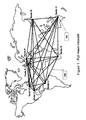
- nodes In a network, nodes must be able to exchange information with other nodes of a same group. For instance, the broadcast of a same information to multiple nodes located in different locations is called "Multicast". In a group of N nodes called a Multicast group as illustrated in Figure 1 , each node (101) needs to communicate with the (N-1) other nodes. To do this, each node establishes a session with each other node (100).
- TCP Transmission Control Protocol
- UDP User Datagram Protocol
- Nx(N-1)/2 TCP sessions are required. It is important to note that since a TCP session is bidirectional, the required number of sessions is Nx(N-1)/2 and not Nx(N-1).
- the number of sessions can be considerable in a network comprising hundreds or thousands of nodes. It can results an important overhead with a significant impact in term of bandwidth consumption in the network and resource (data processing and memory) utilisation in each node.
- the establishment the TCP sessions requires data processing resources and the maintenance of these TCP sessions requires memory in particular to store the context of the TCP sessions (TCP Control Block).
- the nodes can exchange the same piece of information on all the TCP sessions at the same time (communication any to any). This is bandwidth consuming at the network level and resource consuming at the level of each node.
- An example of this scenario is the exchange of routing information between routers. Each router broadcast routing information to the other routers either periodically or when a change occurs, depending on the routing protocol used in the network.
- Another example is the synchronisation of multiple servers in a distributed database.
- a solution illustrated in Figure 2 is to select a "Rendezvous Point", or a central node, to which all other nodes are connected.
- the central node (200) is responsible for distributing the information to all the other nodes in the network.
- This configuration called “Star network” reduces the number of connections (N-1 sessions) but the main drawback is due to the fact that the central node is the weakest point of the network.
- the central node is duplicated by means of a backup central node (201).
- This configuration called “Dual star network” requires (N - 1) + (N -2) connections.
- the central node (200) is connected to all other nodes including the backup central node (201). The result is the establishment of N-1 TCP sessions.
- the addition of a second star configuration based on the backup central node (201) requires another N-1 TCP sessions. However, since a TCP session already exists between central node (200) and backup central node (201), this session does not need to be duplicated.
- EP A 0561381 discloses a data communications network in which multiple host processors are linked in a ring network by respective network interface processors or nodes includes circuitry in each of the nodes which aids in the implementation of a distributed resource locking scheme and a reliable multicasting system.
- the present invention is directed to a method, node and computer program as defined in independent claims, within a network comprising a transport layer protocol providing end to end data transfer, for multicasting datagrams on a virtual ring, each node on the virtual ring being logically connected according to the network transport layer protocol to two and only two neighbor nodes through virtual connections, an upstream neighbor node and a downstream neighbor node.
- the present invention discloses a network topology based on a virtual ring.
- the N nodes of the network that need to communicate together are logically/virtually connected according to a virtual ring, each node communicating with two and only two neighbor nodes: an upstream neighbor node and a downstream neighbor node.
- this invention applies to any types of nodes, this invention is particularly interesting when several nodes need to exchange a same piece of information between them.
- Each virtual ring can be implemented on a same physical network, each virtual ring allowing a subset of nodes to communicate together.
- a same node can participate to several virtual rings at the same time.
- Each virtual ring is identified by a unique identifier (named Virtual Ring Id).
- the Virtual Ring identifier is statically configured in all the nodes participating in the virtual ring. The way the virtual ring is initiated and managed will be described hereafter.
- the current invention is implemented on top of the TCP layer of the TCP/IP protocol, which is today the protocol the most largely used in the world.
- the invention only uses the transport function of TCP.
- IPX Internetwork Packet Exchange
- IP Internet Protocol
- TCP Transmission Control Protocol
- TCP has been chosen because it allows a sending of packets without risk of loss.
- TCP also informs of the loss of the remote node by maintaining a connection.
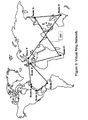
- IP and IP allows to extend the virtual ring to any part of an IP network including the Internet itself. It is possible to imagine nodes in different parts of the world, communicating together with such a virtual ring.
- the User Datagram Protocol can also be used in the current invention for instance to exchange Ring Insertion and Ring Removal messages between a specific node and the Virtual Ring Manager. Since these messages are exchanged only during the insertion or removal process, there is no need to use the TCP protocol and to establish a TCP session.
- the present invention requires a new specific piece of code in each node part of the ring network.
- This code uses a specific TCP port and a specific UDP port reserved for the invention. This code is used to establish, maintain and tear down the virtual ring topology
- token referring to the "Token Ring” architecture developed by IBM (IBM is a trademark of International Business Machines Corporation) these last decades.
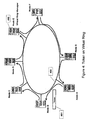
- Figure 4 describes a token (401) circulating between node A and node B on a virtual ring (400).
- the token is used as a periodic keepalive message to validate the ring topology.
- the token is periodically generated by the Virtual Ring Manager (402) and forwarded by each node to its downstream neighbor node.
- the receipt by the Virtual Ring Manager of the token indicates that the ring topology is valid and the loop is not broken. If the ring is broken for some reason (loss of one node, loss of connectivity between 2 neighbor nodes), the loss of the token will indicate that there is a problem on the ring.
- Each node monitors the reception of the token. If the token has not been received after a certain amount of time, each node will trigger the Ring Recovery process detailed here after.
- the token is forwarded from node to node, just like any other piece of information. This means that the Token uses the TCP sessions established between the nodes.
- the Sequence Number field is used to identify the current copy of the token.
- IP Header (20 bytes) TCP Header Source/Dest Port (20 bytes) Virtual Ring Header Message Code 0x0000 Virtual Ring Identifier (2 bytes) Sender IP address (4 bytes)
- Datagrams exchanged on the virtual ring have the following encapsulation: IP Header (20 bytes) TCP Header Source/Dest Port (20 bytes) Virtual Ring Header Message Code 0x0000 Virtual Ring Identifier (2 bytes) Sender IP address (4 bytes) Data
- the encapsulation of the Data inside a TCP datagram has the following advantage : the datagram is transmitted along the Virtual Ring using the reliable TCP protocol.
- the Virtual Ring Header comprises the following fields:
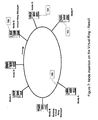
- the virtual ring is a list of nodes connected to form a ring. No node has the complete view of the ring. This list of nodes participating in the ring is stored nowhere in the network. Each node comprises the following information (Node Ring Record) : Virtual Ring Identifier (2 bytes) (configured) Usptream Neighbor IP address (4 bytes) Dowstream Neighbor IP address (4 bytes) Virtual Ring Manager IP address (configured) (4 bytes) Backup Virtual Ring Manager IP address (configured) (4 bytes)
- the Virtual Ring Manager is responsible for maintaining the topology of the virtual ring, more particularly the Virtual Ring Manager is responsible for the insertion and removal of the nodes.
- the Virtual Ring Manager IP address is statically configured in each node of the virtual ring. Since the Virtual Ring Manager constitutes a single point of failure, a Backup Virtual Ring Manager is generally used. The IP address of the Backup Virtual Ring Manager is also statically configured in each node. When a node wants to be inserted into the virtual ring and does not receive any response from the Virtual Ring Manager, this node will contact the Backup Virtual Ring Manager.
- Figure 6 describes the insertion of a new node G (601) into a virtual ring (600) comprising nodes A, B, C, D, E, F.
- Node G (701) is now inserted on the virtual ring (700), between the Virtual Ring Manager (702) and Node F (703).
- the solicited node removal scenario described in the present section correspond to the case where a node wants to be removed from the Virtual Ring because it does not want to participate any more in the group.
- Another node removal scenario corresponds to the case where a node has a failure and the virtual ring is broken. This unsolicited removal scenario will be described in another section.
- Figure 8 describes the Node Solicited removal process.
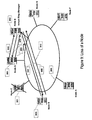
- the loss of a node in the virtual ring network is detected by its neighbor nodes with the loss the TCP connections.
- a node is removed from the virtual ring without informing the Virtual Ring Manager by means of a "Virtual Ring Removal Request" message (which should be the case when a node failure occurs)
- the 2 neighbor nodes (upstream and downstream) lose their TCP connection with this node a given period of time (after a TCP timeout).
- a TCP timeout As described in Figure 9 ; the following scenario occurs:
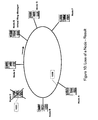
- Figure 10 shows the result of the virtual ring (1000) reconfiguration after the loss of Node C (1001).
- the Backup Virtual Ring Manager executes the same processes as the Virtual Ring Manager.
- the Backup Virtual Ring Manager receives Insertion, Removal and Recovery messages from the nodes in absence of response from the Virtual Ring Manager, and processes these messages like the Virtual Ring Manager.
- All the nodes including the Virtual Ring Manager use a timer to detect the loss of the token. When the token is lost, the ring needs to be rebuilt. The value of this timer must be larger than the TCP session timer to allow the process described in section entitled “Loss of a node” to take place before the reconfiguration of the ring.
- a node detects the loss of the token, it sends a "Virtual Ring Removal Request” message to the Virtual Ring Manager and waits for the confirmation as described in Figure 8 (refer to section entitled “Solicited Node Removal”). After a given period of time, the node will send a "Virtual Ring Insertion Request” message to the Virtual Ring Manager to participate again in the ring as described in Figure 6 (section entitled “Insertion of a Node”).
- UDP User Datagram Protocol
- the value of the Virtual Ring Identifier field is used to identify the current virtual ring.
- the Virtual Ring Identifier is statically configured in each participating node.
- Neighbor IP Message Code Virtual ring Upstream Downstream Node IP 0x0008 Identifier Neighbor IP Neighbor IP address (2 bytes) address address (4 bytes) (4 bytes) (4 bytes)
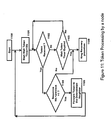
- Figure 11 describes the algorithm executed by a node when this node receives the Token.
- Figure 12 describes the algorithm executed in the Virtual Ring Manager at receipt of the Token.
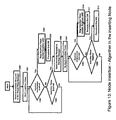
- Figure 13 describes the algorithm executed in a node in view of inserting this node into the virtual ring.
- Figure 14 describes the algorithm executed in a node in view of removing this node from the virtual ring.
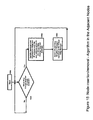
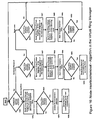
- Figure 15 illustrates the algorithm executed in a node when a neighbor node has been inserted or removed.
- Figure 16 illustrates the algorithm executed in the Virtual Ring Manager when a node is inserted or removed from the virtual ring.
- FIG. 17 illustrates the Node Insertion process.
- FIG. 18 illustrates the Solicited Node Removal process.
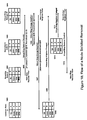
- FIG. 19 illustrates the unsolicited Node Removal process.
- a session is a virtual connection between two nodes, enabling the exchange of data between these nodes and taking care of transmission problems like flow control and retransmission.
- a TCP session is an example of session between two nodes supporting the TCP/IP protocol.
- the current invention is implemented on top of the TCP (Transmission Control Protocol) layer of the TCP/IP protocol stack, and can be used by any node supported the TCP/IP protocol, which is the protocol the most widely used in the world.
- TCP Transmission Control Protocol
- each node has to establish a TCP session with each of the N-1 other nodes. This means the establishment of Nx(N-1)/2 TCP sessions.
- each node has to establish a TCP session with only 2 other nodes: the upstream neighbor node and the downstream neighbor node. This means a total of N sessions in a virtual ring of N nodes.
- the saving resulting from the present invention can be calculated as follows:
- each node receives one and only one copy of a same message, the present invention avoids multiple and unnecessary copies.
- each node communicates with all the other nodes. If each node needs to send the same piece of information to the other nodes, each node will forward this piece of information to all its neighbor nodes, and this will duplicate the number of messages exchanged in the network. This is typically the case when the nodes are routers exchanging routing information using a routing protocol like RIP (routing Information Protocol). Periodically, each router communicates, or floods, its routing table to the other routers in the network. Another example is when a distributed database needs to be synchronised, and when the servers participating in the distributed database need to exchange a same record.
- RIP routing Information Protocol
- the broadcast of information is managed by the application layer, which must take care of the way the information is distributed between the nodes.
- the present invention enable the exchange of a same piece of information between all the nodes so that each node receives one and only one copy of the information. Because nodes are virtually connected to a virtual ring, and because the information circulates along that ring and is seen by each node connected to the ring, the network is not flooded by multiple copies of messages exchanged between nodes.
- Establishing and Maintaining a TCP session requires computer resources to manage the flow control, the retransmission, and to generate acknowledgements and keepalives.
- the present invention reduces the number of TCP sessions required for nodes to communicate, and therefore reduces the utilization of data processing resources in nodes.
- the maintenance of TCP sessions requires to keep the context of these session, with information such as the sequence number of the last segment sent, or the sequence number of the next acknowledgement to send.
- the storage of this information consumes memory. Reducing the number of TCP sessions has for result to reduce the memory consumption in the nodes.
Landscapes
- Engineering & Computer Science (AREA)
- Computer Networks & Wireless Communication (AREA)
- Signal Processing (AREA)
- Computer Security & Cryptography (AREA)
- Small-Scale Networks (AREA)
- Data Exchanges In Wide-Area Networks (AREA)
- Communication Control (AREA)
Priority Applications (1)
| Application Number | Priority Date | Filing Date | Title |
|---|---|---|---|
| EP04804621A EP1695481B1 (en) | 2003-12-19 | 2004-11-30 | System and method for communicating on a virtual ring in an internet protocol network |
Applications Claiming Priority (3)
| Application Number | Priority Date | Filing Date | Title |
|---|---|---|---|
| EP03368121 | 2003-12-19 | ||
| EP04804621A EP1695481B1 (en) | 2003-12-19 | 2004-11-30 | System and method for communicating on a virtual ring in an internet protocol network |
| PCT/EP2004/053185 WO2005060156A1 (en) | 2003-12-19 | 2004-11-30 | System and method for communicating on a virtual ring in an internet protocol network |
Publications (2)
| Publication Number | Publication Date |
|---|---|
| EP1695481A1 EP1695481A1 (en) | 2006-08-30 |
| EP1695481B1 true EP1695481B1 (en) | 2011-01-12 |
Family
ID=34684636
Family Applications (1)
| Application Number | Title | Priority Date | Filing Date |
|---|---|---|---|
| EP04804621A Expired - Lifetime EP1695481B1 (en) | 2003-12-19 | 2004-11-30 | System and method for communicating on a virtual ring in an internet protocol network |
Country Status (8)
| Country | Link |
|---|---|
| US (1) | US7733810B2 (enExample) |
| EP (1) | EP1695481B1 (enExample) |
| JP (1) | JP4678878B2 (enExample) |
| CN (1) | CN1894890B (enExample) |
| AT (1) | ATE495603T1 (enExample) |
| DE (1) | DE602004031048D1 (enExample) |
| TW (1) | TWI351852B (enExample) |
| WO (1) | WO2005060156A1 (enExample) |
Families Citing this family (26)
| Publication number | Priority date | Publication date | Assignee | Title |
|---|---|---|---|---|
| TWI351852B (en) * | 2003-12-19 | 2011-11-01 | Ibm | System and method for communicating on a virtual r |
| US7606199B2 (en) * | 2005-07-14 | 2009-10-20 | Sharp Laboratories Of America, Inc. | Central coordinator selection, handover, backup and failure recovery |
| US7715330B2 (en) * | 2005-10-06 | 2010-05-11 | International Business Machines Corporation | System and method for optimizing the topology of a virtual ring based upon a TCP/IP network |
| US7483440B2 (en) | 2005-11-01 | 2009-01-27 | Ericsson Ab | Ring LSP topology for supporting VPNs over MPLS-based networks |
| US8570857B2 (en) * | 2006-04-07 | 2013-10-29 | At&T Intellectual Property I, Lp | Resilient IP ring protocol and architecture |
| EP1909436A1 (en) * | 2006-10-03 | 2008-04-09 | International Business Machines Corporation | System and method of integrating a node into a virtual ring |
| US8090256B2 (en) * | 2006-10-04 | 2012-01-03 | Arizona Board Of Regents, A Body Corporate Of The State Of Arizona, Acting For And On Behalf Of Arizona State University | Optical network architectures and optical communication schemes |
| US8295700B2 (en) * | 2007-05-14 | 2012-10-23 | Intune Technologies | Distributed packet switch for use in a network |
| US8345576B2 (en) * | 2007-06-19 | 2013-01-01 | Red Hat, Inc. | Methods and systems for dynamic subring definition within a multi-ring |
| CN102265560B (zh) | 2008-12-25 | 2014-07-09 | 三菱电机株式会社 | 通信管理装置、通信装置以及通信方法 |
| CN102265562B (zh) * | 2008-12-25 | 2014-11-26 | 三菱电机株式会社 | 通信管理装置、通信系统以及数据通信方法 |
| CN102594592B (zh) * | 2008-12-25 | 2015-03-25 | 三菱电机株式会社 | 通信管理装置、通信节点、通信系统以及数据通信方法 |
| GB0900667D0 (en) * | 2009-01-16 | 2009-02-25 | Univ Reading The | Processors |
| US8630837B2 (en) * | 2010-06-17 | 2014-01-14 | The Aerospace Corporation | Multicast emulation |
| JP5376066B2 (ja) * | 2010-09-29 | 2013-12-25 | 富士通株式会社 | リングネットワークを構築する方法 |
| EP2652915B1 (en) * | 2010-12-17 | 2015-02-18 | Telefonaktiebolaget L M Ericsson (PUBL) | Ethernet ring node with improved recovery time after a link failure |
| US8509061B2 (en) * | 2011-03-23 | 2013-08-13 | Ciena Corporation | Systems and methods for scaling performance of Ethernet ring protection protocol |
| EP2783486B1 (en) | 2011-11-21 | 2015-11-18 | Telefonaktiebolaget LM Ericsson (Publ) | Ring protection state aware bandwidth adaptation |
| US9515944B2 (en) * | 2011-12-12 | 2016-12-06 | Mitsubishi Electric Corporation | Train information management apparatus and train information management method |
| US9559894B2 (en) * | 2012-08-22 | 2017-01-31 | Oracle International Corporation | System and method for supporting high available (HA) network communication in a middleware machine environment |
| US9350629B2 (en) | 2012-08-22 | 2016-05-24 | Oracle International Corporation | System and method for ensuring internet protocol (IP) address and node name consistency in a middleware machine environment |
| CN107276774B (zh) * | 2016-04-08 | 2020-07-24 | 华为技术有限公司 | 一种组播报文传输方法以及转发设备 |
| US10608840B2 (en) * | 2016-09-19 | 2020-03-31 | Simmonds Precision Products, Inc. | Automatic addressing of networked nodes |
| US11483209B2 (en) * | 2019-11-19 | 2022-10-25 | Advanced Micro Devices, Inc. | Forward progress mechanisms for a communications network having multiple nodes |
| US11463326B2 (en) * | 2021-02-24 | 2022-10-04 | Cisco Technology, Inc. | Lightweight ring manager with distributed policies |
| US11695772B1 (en) * | 2022-05-03 | 2023-07-04 | Capital One Services, Llc | System and method for enabling multiple auxiliary use of an access token of a user by another entity to facilitate an action of the user |
Family Cites Families (43)
| Publication number | Priority date | Publication date | Assignee | Title |
|---|---|---|---|---|
| US4538147A (en) * | 1982-03-05 | 1985-08-27 | Burroughs Corp. | Bandwidth allocation in a token controlled loop communications network |
| US4590468A (en) * | 1983-03-10 | 1986-05-20 | Western Digital Corporation | Token access controller protocol and architecture |
| EP0192795B1 (en) * | 1985-02-28 | 1989-08-02 | International Business Machines Corporation | Communication system comprising overlayed multiple-access transmission networks |
| US5107490A (en) * | 1985-04-24 | 1992-04-21 | Artel Communications Corporation | Ring-type communication network |
| GB2175774B (en) * | 1985-05-24 | 1988-09-01 | Stc Plc | Intelligence transmission system of the local area network type |
| US4780871A (en) * | 1985-07-09 | 1988-10-25 | Canon Kabushiki Kaisha | Data Transmission system |
| US4736368A (en) * | 1985-12-16 | 1988-04-05 | Texas Instruments Incorporated | Priority token protocol circuit for a token ring local area network adaptor |
| JPS62284538A (ja) * | 1986-06-03 | 1987-12-10 | Yaskawa Electric Mfg Co Ltd | 伝送方式 |
| US4766530A (en) * | 1986-11-24 | 1988-08-23 | Westinghouse Electric Corp. | Token passing scheme for a predetermined configuration local area network |
| US4860284A (en) * | 1988-04-20 | 1989-08-22 | American Telephone And Telegraph Company, At&T Bell Laboratories | Method and apparatus for identifying location of a lost token signal in a data communication network |
| JP2650961B2 (ja) * | 1988-04-28 | 1997-09-10 | 株式会社日立製作所 | 分散制御ネットワークの制御方法 |
| US5053946A (en) * | 1988-05-26 | 1991-10-01 | Digital Equipment Corporation | Token ring network having token request mechanism |
| US5253252A (en) * | 1989-01-10 | 1993-10-12 | The Foxboro Company | Token device for distributed time scheduling in a data processing system |
| US5243596A (en) | 1992-03-18 | 1993-09-07 | Fischer & Porter Company | Network architecture suitable for multicasting and resource locking |
| US5289390A (en) * | 1992-05-22 | 1994-02-22 | Hewlett-Packard Company | Method for determining the electrical cable length of an active ring of a token ring local area network |
| US5383186A (en) * | 1993-05-04 | 1995-01-17 | The Regents Of The University Of Michigan | Apparatus and method for synchronous traffic bandwidth on a token ring network |
| GB2278258A (en) * | 1993-05-17 | 1994-11-23 | Ibm | Token ring network |
| US5490145A (en) * | 1993-05-25 | 1996-02-06 | Matsushita Electric Industrial Company, Ltd. | Communication system for a ring-type network |
| EP0719009B1 (de) * | 1994-12-23 | 1999-06-30 | Hewlett-Packard GmbH | Datennetzwerk und Verfahren zur zeitrichtigen Übertragung von Datenpaketen in einem Datennetzwerk |
| US5710883A (en) * | 1995-03-10 | 1998-01-20 | Stanford University | Hypertext document transport mechanism for firewall-compatible distributed world-wide web publishing |
| US5886992A (en) * | 1995-04-14 | 1999-03-23 | Valtion Teknillinen Tutkimuskeskus | Frame synchronized ring system and method |
| US5604742A (en) * | 1995-05-31 | 1997-02-18 | International Business Machines Corporation | Communications system and method for efficient management of bandwidth in a FDDI station |
| US5802056A (en) * | 1995-07-12 | 1998-09-01 | Bay Networks, Inc. | Configuration of virtual rings in a token ring local area network |
| US5752003A (en) * | 1995-07-14 | 1998-05-12 | 3 Com Corporation | Architecture for managing traffic in a virtual LAN environment |
| EP0802655A3 (en) * | 1996-04-17 | 1999-11-24 | Matsushita Electric Industrial Co., Ltd. | Communication network |
| US6108713A (en) * | 1997-02-11 | 2000-08-22 | Xaqti Corporation | Media access control architectures and network management systems |
| US6154462A (en) * | 1997-08-21 | 2000-11-28 | Adc Telecommunications, Inc. | Circuits and methods for a ring network |
| TW419917B (en) * | 1998-03-30 | 2001-01-21 | Toshiba Corp | Communication network system |
| US6366556B1 (en) * | 1998-06-22 | 2002-04-02 | Lucent Technologies Inc. | Self-healing networks using virtual rings |
| US6563833B1 (en) * | 1999-01-05 | 2003-05-13 | Lucent Technologies Inc. | Combinatorial design method and apparatus for multi-ring networks with combined routing and flow control |
| US6460101B1 (en) * | 1999-11-09 | 2002-10-01 | International Business Machines Corporation | Token manager for execution of global operations utilizing multiple tokens |
| US6880017B1 (en) * | 2000-03-20 | 2005-04-12 | International Business Machines Corporation | System and method for providing an adaptive streaming flow control mechanism between the TCP and IP layers of the TCP/IP suite of protocols |
| JP2002009800A (ja) * | 2000-06-19 | 2002-01-11 | Fujitsu Ltd | リング型ネットワークシステムのブロードキャスト方法及びそのノード装置 |
| US7047319B2 (en) * | 2001-02-15 | 2006-05-16 | International Business Machines Corporation | System and method for enabling a collision-free protocol over ethernet |
| US7106695B2 (en) * | 2001-05-29 | 2006-09-12 | International Business Machines Corporation | Method of allocating bandwidth to the stations of a local area network |
| US7181547B1 (en) * | 2001-06-28 | 2007-02-20 | Fortinet, Inc. | Identifying nodes in a ring network |
| US7130927B2 (en) * | 2001-07-05 | 2006-10-31 | International Business Machines Corporation | Method of bandwidth management between the stations of a local area network |
| US7248601B2 (en) * | 2001-08-09 | 2007-07-24 | International Business Machines Corporation | Method of allocating bandwidth on request to the stations of a local area network |
| US20030154285A1 (en) * | 2002-02-13 | 2003-08-14 | International Business Machines Corporation | Method and system for assigning network addreses |
| US7287170B2 (en) * | 2002-05-14 | 2007-10-23 | Ati Technologies Inc. | Method and apparatus for power management using system and request tokens |
| US7269731B2 (en) * | 2003-01-29 | 2007-09-11 | Hewlett-Packard Development Company, L.P. | Message authorization system and method |
| US7366109B2 (en) * | 2003-10-29 | 2008-04-29 | Nortel Networks Limited | Virtual private networks within a packet network having a mesh topology |
| TWI351852B (en) * | 2003-12-19 | 2011-11-01 | Ibm | System and method for communicating on a virtual r |
-
2004
- 2004-11-12 TW TW093134678A patent/TWI351852B/zh not_active IP Right Cessation
- 2004-11-30 AT AT04804621T patent/ATE495603T1/de not_active IP Right Cessation
- 2004-11-30 CN CN2004800374343A patent/CN1894890B/zh not_active Expired - Fee Related
- 2004-11-30 WO PCT/EP2004/053185 patent/WO2005060156A1/en not_active Ceased
- 2004-11-30 JP JP2006544412A patent/JP4678878B2/ja not_active Expired - Fee Related
- 2004-11-30 US US10/596,641 patent/US7733810B2/en not_active Expired - Fee Related
- 2004-11-30 DE DE602004031048T patent/DE602004031048D1/de not_active Expired - Lifetime
- 2004-11-30 EP EP04804621A patent/EP1695481B1/en not_active Expired - Lifetime
Also Published As
| Publication number | Publication date |
|---|---|
| DE602004031048D1 (de) | 2011-02-24 |
| CN1894890B (zh) | 2011-06-22 |
| ATE495603T1 (de) | 2011-01-15 |
| TWI351852B (en) | 2011-11-01 |
| EP1695481A1 (en) | 2006-08-30 |
| US7733810B2 (en) | 2010-06-08 |
| TW200527856A (en) | 2005-08-16 |
| WO2005060156A1 (en) | 2005-06-30 |
| CN1894890A (zh) | 2007-01-10 |
| US20070268913A1 (en) | 2007-11-22 |
| JP2007515117A (ja) | 2007-06-07 |
| JP4678878B2 (ja) | 2011-04-27 |
Similar Documents
| Publication | Publication Date | Title |
|---|---|---|
| EP1695481B1 (en) | System and method for communicating on a virtual ring in an internet protocol network | |
| US7065059B1 (en) | Technique for restoring adjacencies in OSPF in a non-stop forwarding intermediate node of a computer network | |
| EP1742430A1 (en) | Router redundancy in data communication networks | |
| US7796539B2 (en) | System, computer program product and method in a node for optimizing the topology of a virtual ring based upon a TCP/IP network | |
| US6445710B1 (en) | Method and apparatus for transparently bridging traffic across wide area networks | |
| US7248579B1 (en) | System and method for providing a link state database (LSDB) snapshot for neighbor synchronization | |
| CN1969491B (zh) | 在路由器中的控制故障期间保护多播数据转发的设备和方法 | |
| CN105763359B (zh) | 用于交织结构交换机集群的分布式双向转发检测协议(d-bfd) | |
| CN100407688C (zh) | 内部bgp下载器 | |
| US6298061B1 (en) | Port aggregation protocol | |
| US7801857B2 (en) | Implicit routing in content based networks | |
| US6950427B1 (en) | Technique for resynchronizing LSDB in OSPF after a software reload in a non-stop forwarding intermediate node of a computer network | |
| US7801135B2 (en) | Transport protocol connection synchronization | |
| US20030123457A1 (en) | Apparatus and method for distributed software implementation of OSPF protocol | |
| US20060050643A1 (en) | Router for multicast redundant routing and system for multicast redundancy | |
| US8442046B2 (en) | Sending routing protocol data on a multi-access network segment | |
| JP2007515117A5 (enExample) | ||
| EP1804423A2 (en) | Method for rapidly recovering multicast service and network device | |
| US10439929B2 (en) | Graceful recovery of a multicast-enabled switch | |
| Ballardie et al. | Core Based Tree (CBT) Multicast | |
| WO1999048246A1 (en) | Method, apparatus, and medium for minimal time multicast graft/join restoration | |
| JP3003570B2 (ja) | パケット分配ハブ | |
| WO2012103724A1 (zh) | 一种进程组和进程组中的异常组成员离开的方法 | |
| CN117459566A (zh) | 数据传输的方法和设备 | |
| Moy | RFC1793: Extending OSPF to Support Demand Circuits |
Legal Events
| Date | Code | Title | Description |
|---|---|---|---|
| PUAI | Public reference made under article 153(3) epc to a published international application that has entered the european phase |
Free format text: ORIGINAL CODE: 0009012 |
|
| 17P | Request for examination filed |
Effective date: 20060323 |
|
| AK | Designated contracting states |
Kind code of ref document: A1 Designated state(s): AT BE BG CH CY CZ DE DK EE ES FI FR GB GR HU IE IS IT LI LU MC NL PL PT RO SE SI SK TR |
|
| DAX | Request for extension of the european patent (deleted) | ||
| 17Q | First examination report despatched |
Effective date: 20070716 |
|
| RAP1 | Party data changed (applicant data changed or rights of an application transferred) |
Owner name: INTERNATIONAL BUSINESS MACHINES CORPORATION |
|
| GRAP | Despatch of communication of intention to grant a patent |
Free format text: ORIGINAL CODE: EPIDOSNIGR1 |
|
| GRAS | Grant fee paid |
Free format text: ORIGINAL CODE: EPIDOSNIGR3 |
|
| GRAA | (expected) grant |
Free format text: ORIGINAL CODE: 0009210 |
|
| AK | Designated contracting states |
Kind code of ref document: B1 Designated state(s): AT BE BG CH CY CZ DE DK EE ES FI FR GB GR HU IE IS IT LI LU MC NL PL PT RO SE SI SK TR |
|
| REG | Reference to a national code |
Ref country code: GB Ref legal event code: FG4D |
|
| REG | Reference to a national code |
Ref country code: CH Ref legal event code: EP |
|
| REG | Reference to a national code |
Ref country code: DE Ref legal event code: R084 Ref document number: 602004031048 Country of ref document: DE |
|
| REG | Reference to a national code |
Ref country code: IE Ref legal event code: FG4D |
|
| REF | Corresponds to: |
Ref document number: 602004031048 Country of ref document: DE Date of ref document: 20110224 Kind code of ref document: P |
|
| REG | Reference to a national code |
Ref country code: DE Ref legal event code: R096 Ref document number: 602004031048 Country of ref document: DE Effective date: 20110224 |
|
| REG | Reference to a national code |
Ref country code: GB Ref legal event code: 746 Effective date: 20110221 |
|
| REG | Reference to a national code |
Ref country code: NL Ref legal event code: VDEP Effective date: 20110112 |
|
| PG25 | Lapsed in a contracting state [announced via postgrant information from national office to epo] |
Ref country code: ES Free format text: LAPSE BECAUSE OF FAILURE TO SUBMIT A TRANSLATION OF THE DESCRIPTION OR TO PAY THE FEE WITHIN THE PRESCRIBED TIME-LIMIT Effective date: 20110423 Ref country code: SE Free format text: LAPSE BECAUSE OF FAILURE TO SUBMIT A TRANSLATION OF THE DESCRIPTION OR TO PAY THE FEE WITHIN THE PRESCRIBED TIME-LIMIT Effective date: 20110112 Ref country code: IS Free format text: LAPSE BECAUSE OF FAILURE TO SUBMIT A TRANSLATION OF THE DESCRIPTION OR TO PAY THE FEE WITHIN THE PRESCRIBED TIME-LIMIT Effective date: 20110512 Ref country code: GR Free format text: LAPSE BECAUSE OF FAILURE TO SUBMIT A TRANSLATION OF THE DESCRIPTION OR TO PAY THE FEE WITHIN THE PRESCRIBED TIME-LIMIT Effective date: 20110413 Ref country code: PT Free format text: LAPSE BECAUSE OF FAILURE TO SUBMIT A TRANSLATION OF THE DESCRIPTION OR TO PAY THE FEE WITHIN THE PRESCRIBED TIME-LIMIT Effective date: 20110512 |
|
| PG25 | Lapsed in a contracting state [announced via postgrant information from national office to epo] |
Ref country code: NL Free format text: LAPSE BECAUSE OF FAILURE TO SUBMIT A TRANSLATION OF THE DESCRIPTION OR TO PAY THE FEE WITHIN THE PRESCRIBED TIME-LIMIT Effective date: 20110112 Ref country code: CY Free format text: LAPSE BECAUSE OF FAILURE TO SUBMIT A TRANSLATION OF THE DESCRIPTION OR TO PAY THE FEE WITHIN THE PRESCRIBED TIME-LIMIT Effective date: 20110112 Ref country code: AT Free format text: LAPSE BECAUSE OF FAILURE TO SUBMIT A TRANSLATION OF THE DESCRIPTION OR TO PAY THE FEE WITHIN THE PRESCRIBED TIME-LIMIT Effective date: 20110112 Ref country code: PL Free format text: LAPSE BECAUSE OF FAILURE TO SUBMIT A TRANSLATION OF THE DESCRIPTION OR TO PAY THE FEE WITHIN THE PRESCRIBED TIME-LIMIT Effective date: 20110112 Ref country code: BG Free format text: LAPSE BECAUSE OF FAILURE TO SUBMIT A TRANSLATION OF THE DESCRIPTION OR TO PAY THE FEE WITHIN THE PRESCRIBED TIME-LIMIT Effective date: 20110412 Ref country code: BE Free format text: LAPSE BECAUSE OF FAILURE TO SUBMIT A TRANSLATION OF THE DESCRIPTION OR TO PAY THE FEE WITHIN THE PRESCRIBED TIME-LIMIT Effective date: 20110112 Ref country code: FI Free format text: LAPSE BECAUSE OF FAILURE TO SUBMIT A TRANSLATION OF THE DESCRIPTION OR TO PAY THE FEE WITHIN THE PRESCRIBED TIME-LIMIT Effective date: 20110112 Ref country code: SI Free format text: LAPSE BECAUSE OF FAILURE TO SUBMIT A TRANSLATION OF THE DESCRIPTION OR TO PAY THE FEE WITHIN THE PRESCRIBED TIME-LIMIT Effective date: 20110112 |
|
| PG25 | Lapsed in a contracting state [announced via postgrant information from national office to epo] |
Ref country code: DK Free format text: LAPSE BECAUSE OF FAILURE TO SUBMIT A TRANSLATION OF THE DESCRIPTION OR TO PAY THE FEE WITHIN THE PRESCRIBED TIME-LIMIT Effective date: 20110112 Ref country code: EE Free format text: LAPSE BECAUSE OF FAILURE TO SUBMIT A TRANSLATION OF THE DESCRIPTION OR TO PAY THE FEE WITHIN THE PRESCRIBED TIME-LIMIT Effective date: 20110112 |
|
| PLBE | No opposition filed within time limit |
Free format text: ORIGINAL CODE: 0009261 |
|
| STAA | Information on the status of an ep patent application or granted ep patent |
Free format text: STATUS: NO OPPOSITION FILED WITHIN TIME LIMIT |
|
| PG25 | Lapsed in a contracting state [announced via postgrant information from national office to epo] |
Ref country code: SK Free format text: LAPSE BECAUSE OF FAILURE TO SUBMIT A TRANSLATION OF THE DESCRIPTION OR TO PAY THE FEE WITHIN THE PRESCRIBED TIME-LIMIT Effective date: 20110112 Ref country code: CZ Free format text: LAPSE BECAUSE OF FAILURE TO SUBMIT A TRANSLATION OF THE DESCRIPTION OR TO PAY THE FEE WITHIN THE PRESCRIBED TIME-LIMIT Effective date: 20110112 Ref country code: RO Free format text: LAPSE BECAUSE OF FAILURE TO SUBMIT A TRANSLATION OF THE DESCRIPTION OR TO PAY THE FEE WITHIN THE PRESCRIBED TIME-LIMIT Effective date: 20110112 |
|
| 26N | No opposition filed |
Effective date: 20111013 |
|
| PG25 | Lapsed in a contracting state [announced via postgrant information from national office to epo] |
Ref country code: IT Free format text: LAPSE BECAUSE OF FAILURE TO SUBMIT A TRANSLATION OF THE DESCRIPTION OR TO PAY THE FEE WITHIN THE PRESCRIBED TIME-LIMIT Effective date: 20110112 |
|
| REG | Reference to a national code |
Ref country code: DE Ref legal event code: R097 Ref document number: 602004031048 Country of ref document: DE Effective date: 20111013 |
|
| PG25 | Lapsed in a contracting state [announced via postgrant information from national office to epo] |
Ref country code: MC Free format text: LAPSE BECAUSE OF NON-PAYMENT OF DUE FEES Effective date: 20111130 |
|
| REG | Reference to a national code |
Ref country code: CH Ref legal event code: PL |
|
| PG25 | Lapsed in a contracting state [announced via postgrant information from national office to epo] |
Ref country code: CH Free format text: LAPSE BECAUSE OF NON-PAYMENT OF DUE FEES Effective date: 20111130 Ref country code: LI Free format text: LAPSE BECAUSE OF NON-PAYMENT OF DUE FEES Effective date: 20111130 |
|
| REG | Reference to a national code |
Ref country code: IE Ref legal event code: MM4A |
|
| PG25 | Lapsed in a contracting state [announced via postgrant information from national office to epo] |
Ref country code: IE Free format text: LAPSE BECAUSE OF NON-PAYMENT OF DUE FEES Effective date: 20111130 |
|
| PGFP | Annual fee paid to national office [announced via postgrant information from national office to epo] |
Ref country code: FR Payment date: 20121206 Year of fee payment: 9 |
|
| PG25 | Lapsed in a contracting state [announced via postgrant information from national office to epo] |
Ref country code: LU Free format text: LAPSE BECAUSE OF NON-PAYMENT OF DUE FEES Effective date: 20111130 |
|
| PG25 | Lapsed in a contracting state [announced via postgrant information from national office to epo] |
Ref country code: TR Free format text: LAPSE BECAUSE OF FAILURE TO SUBMIT A TRANSLATION OF THE DESCRIPTION OR TO PAY THE FEE WITHIN THE PRESCRIBED TIME-LIMIT Effective date: 20110112 |
|
| PG25 | Lapsed in a contracting state [announced via postgrant information from national office to epo] |
Ref country code: HU Free format text: LAPSE BECAUSE OF FAILURE TO SUBMIT A TRANSLATION OF THE DESCRIPTION OR TO PAY THE FEE WITHIN THE PRESCRIBED TIME-LIMIT Effective date: 20110112 |
|
| REG | Reference to a national code |
Ref country code: FR Ref legal event code: ST Effective date: 20140731 |
|
| PG25 | Lapsed in a contracting state [announced via postgrant information from national office to epo] |
Ref country code: FR Free format text: LAPSE BECAUSE OF NON-PAYMENT OF DUE FEES Effective date: 20131202 |
|
| PGFP | Annual fee paid to national office [announced via postgrant information from national office to epo] |
Ref country code: DE Payment date: 20181031 Year of fee payment: 15 |
|
| PGFP | Annual fee paid to national office [announced via postgrant information from national office to epo] |
Ref country code: GB Payment date: 20181203 Year of fee payment: 15 |
|
| REG | Reference to a national code |
Ref country code: DE Ref legal event code: R119 Ref document number: 602004031048 Country of ref document: DE |
|
| GBPC | Gb: european patent ceased through non-payment of renewal fee |
Effective date: 20191130 |
|
| PG25 | Lapsed in a contracting state [announced via postgrant information from national office to epo] |
Ref country code: DE Free format text: LAPSE BECAUSE OF NON-PAYMENT OF DUE FEES Effective date: 20200603 Ref country code: GB Free format text: LAPSE BECAUSE OF NON-PAYMENT OF DUE FEES Effective date: 20191130 |