EP1679671B1 - Warnsystem, das ein mobiles Endgerät und einen Warnserver umfasst - Google Patents
Warnsystem, das ein mobiles Endgerät und einen Warnserver umfasst Download PDFInfo
- Publication number
- EP1679671B1 EP1679671B1 EP05112717A EP05112717A EP1679671B1 EP 1679671 B1 EP1679671 B1 EP 1679671B1 EP 05112717 A EP05112717 A EP 05112717A EP 05112717 A EP05112717 A EP 05112717A EP 1679671 B1 EP1679671 B1 EP 1679671B1
- Authority
- EP
- European Patent Office
- Prior art keywords
- mobile terminal
- user
- alarm
- server
- alarm message
- Prior art date
- Legal status (The legal status is an assumption and is not a legal conclusion. Google has not performed a legal analysis and makes no representation as to the accuracy of the status listed.)
- Expired - Lifetime
Links
Images
Classifications
-
- G—PHYSICS
- G08—SIGNALLING
- G08B—SIGNALLING SYSTEMS, e.g. PERSONAL CALLING SYSTEMS; ORDER TELEGRAPHS; ALARM SYSTEMS
- G08B13/00—Burglar, theft or intruder alarms
- G08B13/18—Actuation by interference with heat, light, or radiation of shorter wavelength; Actuation by intruding sources of heat, light, or radiation of shorter wavelength
- G08B13/189—Actuation by interference with heat, light, or radiation of shorter wavelength; Actuation by intruding sources of heat, light, or radiation of shorter wavelength using passive radiation detection systems
- G08B13/194—Actuation by interference with heat, light, or radiation of shorter wavelength; Actuation by intruding sources of heat, light, or radiation of shorter wavelength using passive radiation detection systems using image scanning and comparing systems
- G08B13/196—Actuation by interference with heat, light, or radiation of shorter wavelength; Actuation by intruding sources of heat, light, or radiation of shorter wavelength using passive radiation detection systems using image scanning and comparing systems using television cameras
- G08B13/19602—Image analysis to detect motion of the intruder, e.g. by frame subtraction
- G08B13/1961—Movement detection not involving frame subtraction, e.g. motion detection on the basis of luminance changes in the image
-
- G—PHYSICS
- G08—SIGNALLING
- G08B—SIGNALLING SYSTEMS, e.g. PERSONAL CALLING SYSTEMS; ORDER TELEGRAPHS; ALARM SYSTEMS
- G08B13/00—Burglar, theft or intruder alarms
- G08B13/18—Actuation by interference with heat, light, or radiation of shorter wavelength; Actuation by intruding sources of heat, light, or radiation of shorter wavelength
- G08B13/189—Actuation by interference with heat, light, or radiation of shorter wavelength; Actuation by intruding sources of heat, light, or radiation of shorter wavelength using passive radiation detection systems
- G08B13/194—Actuation by interference with heat, light, or radiation of shorter wavelength; Actuation by intruding sources of heat, light, or radiation of shorter wavelength using passive radiation detection systems using image scanning and comparing systems
- G08B13/196—Actuation by interference with heat, light, or radiation of shorter wavelength; Actuation by intruding sources of heat, light, or radiation of shorter wavelength using passive radiation detection systems using image scanning and comparing systems using television cameras
- G08B13/19617—Surveillance camera constructional details
- G08B13/19621—Portable camera
-
- G—PHYSICS
- G08—SIGNALLING
- G08B—SIGNALLING SYSTEMS, e.g. PERSONAL CALLING SYSTEMS; ORDER TELEGRAPHS; ALARM SYSTEMS
- G08B13/00—Burglar, theft or intruder alarms
- G08B13/18—Actuation by interference with heat, light, or radiation of shorter wavelength; Actuation by intruding sources of heat, light, or radiation of shorter wavelength
- G08B13/189—Actuation by interference with heat, light, or radiation of shorter wavelength; Actuation by intruding sources of heat, light, or radiation of shorter wavelength using passive radiation detection systems
- G08B13/194—Actuation by interference with heat, light, or radiation of shorter wavelength; Actuation by intruding sources of heat, light, or radiation of shorter wavelength using passive radiation detection systems using image scanning and comparing systems
- G08B13/196—Actuation by interference with heat, light, or radiation of shorter wavelength; Actuation by intruding sources of heat, light, or radiation of shorter wavelength using passive radiation detection systems using image scanning and comparing systems using television cameras
- G08B13/19654—Details concerning communication with a camera
- G08B13/19656—Network used to communicate with a camera, e.g. WAN, LAN, Internet
-
- G—PHYSICS
- G08—SIGNALLING
- G08B—SIGNALLING SYSTEMS, e.g. PERSONAL CALLING SYSTEMS; ORDER TELEGRAPHS; ALARM SYSTEMS
- G08B15/00—Identifying, scaring or incapacitating burglars, thieves or intruders, e.g. by explosives
- G08B15/004—Identifying, scaring or incapacitating burglars, thieves or intruders, e.g. by explosives using portable personal devices
-
- G—PHYSICS
- G08—SIGNALLING
- G08B—SIGNALLING SYSTEMS, e.g. PERSONAL CALLING SYSTEMS; ORDER TELEGRAPHS; ALARM SYSTEMS
- G08B21/00—Alarms responsive to a single specified undesired or abnormal condition and not otherwise provided for
- G08B21/02—Alarms for ensuring the safety of persons
- G08B21/0297—Robbery alarms, e.g. hold-up alarms, bag snatching alarms
Definitions
- the invention relates to the field of warning systems, and more particularly the warning systems with sending warning message integrating at least one image.
- an alert system the user of a mobile terminal uses his mobile terminal to send an alert message to a security agency via a server belonging to a telecommunications network.
- a mobile terminal is preferably a mobile phone, it can also be another device that can send alert messages to a server.
- the user takes at least one image of the situation of danger or problem using a camera integrated in his mobile terminal, incorporates it into a message of alert that it sends via its mobile terminal to a server which the needle to an appropriate security agency, that is to say likely to treat or manage the incident source of danger or problem, for example, it will be the security agency specialized in dealing with the type of incident concerned and locally the closest to the alleged location of the incident.
- the alert message sending procedure is fast and efficient enough to allow the security agency chosen by the server to process or handle the incident in a sufficiently short time to substantially improve the processing or incident management in case no alert message was sent.
- an alert message incorporating at least one image is fundamental because it allows to convey in an instant to a security agency an important set of information that a security agency can assimilate quickly, while it would have taken a long time for a user to inform a security agency in an equivalent manner via a simple voice message for example, long time that the user often does not have when confronted with a situation danger or problem.
- This type of alert system can help to greatly improve user safety or at least the feeling of security of users.
- the reality shows that the situations of danger or of problem are often at first only situations of danger or of only potential problem and only then do they become situations of danger or of actual problem requiring to be treated or managed by a security agency.
- the user will find himself confronted with the following dilemma. Or the user decides to send his warning message at first, when the incident he finds is only a potential danger or problem not yet materialized, and in this case, when the danger or the problem remain potential and do not materialize, sending the alert message by the user will be the source of a false alarm consisting of an alert from a security agency and a treatment by the security agency. an ultimately benign incident that does not need to be treated or managed.
- the invention proposes a mobile terminal according to claim 1, a server according to claim 2 and an alert system according to claim 3.
- the invention proposes an alert system offering the user of the mobile terminal capable of sending an alert message including an image the possibility of a more comfortable situation which will be intermediate between either alerting a security agency or nothing to make arrangements to be in a favorable position to alert the security agency when the time comes in the event of actual and proven necessity.
- the security system offers the user the possibility of storing his warning message in a buffer zone without sending it directly to the security agency, which can then be done almost instantaneously, at the request of the user for example.
- the user can save an alert message whose content can be very rich since integrates at least one image, before it is too late to perform this backup.
- This buffer zone is located outside the mobile terminal, that is to say outside the mobile terminal, which secures the backup, reducing the effectiveness of malicious manipulations intended to erase the backup, for example destruction of the device. mobile terminal.
- the invention relates to an alert system as well as the mobile terminal and the server which belong to the warning system and which are specially adapted to allow the alert system to function properly, or which are particularly adapted so as to allow a system to be activated. even more advantageous, although optional, operation of the warning system.
- an alert system comprising: a mobile terminal comprising a camera capable of taking at least one image and a server interface capable of sending at least one alert message including at least one picture ; at least one security agency capable of handling an alert message; a server capable of transmitting an alert message to a security agency; characterized in that the system also comprises a buffer memory area located outside the mobile terminal and adapted to store an alert message, and in that the mobile terminal also comprises a user interface allowing the user of the mobile terminal to indicate to the server that an alert message must be stored in the buffer zone without being previously or simultaneously transmitted for processing to a security agency.
- the warning message could be sent to a part of a security agency whose only function is to store it and not to treat it; thus, this storage would not trigger an alert from the security agency and would not trigger processing by the part of the security agency responsible for handling the alert messages by appropriate reactions, the said reactions involving most often the active participation of at least some of the staff of the security agency.
- an alert system comprising: a mobile terminal comprising, a camera capable of taking at least one image, a server interface capable of sending at least one alert message including at least one image taken by the camera; at least one security agency capable of processing the alert message; a server capable of transmitting the alert message to the security agency or to one of the security agencies; characterized in that the system also comprises a buffer zone located outside the mobile terminal and able to store the alert message or at least one of the alert messages; and in that the mobile terminal also comprises a user interface allowing the user of the mobile terminal to indicate to the server that an alert message must be stored in the buffer zone without being previously or simultaneously transmitted to the security agency or to one of the security agencies so that the user can trigger or prevent the processing, by the security agency or by one of the security agencies, of a alert message stored in the buffer area.
- a mobile alert terminal comprising: a camera capable of taking at least one image; a server interface capable of sending to a server at least one alert message including at least one image taken by the camera; characterized in that the mobile terminal also comprises a user interface allowing the user of the mobile terminal to indicate to a server that the alert message must be stored in a buffer zone located outside the mobile terminal without being previously or simultaneously transmitted to a security agency so that the user can trigger or prevent the processing, by a security agency, of an alert message stored in the buffer zone.
- an alert server capable of transmitting to a security agency an alert message, coming from a mobile terminal, including at least one image, characterized in that the server also comprises : a buffer memory zone capable of storing the warning message; a processing device capable of storing, on request of a mobile terminal user, in the buffer memory zone an alert message from a mobile terminal, without transmitting it for processing previously or simultaneously to a security agency.
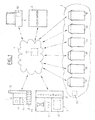
- the figure 1 schematically represents an embodiment of the warning system according to the invention.
- the alert system comprises a mobile terminal 1, a server 2, a network 3 of security agencies, a personal computer 5, a call location device 6 in the telecommunications network 4, all these elements communicating between them through the telecommunications network 4.
- the mobile terminal 1 comprises a camera 11, a server interface 12, a user interface 13, an electronic signature module 14.
- the server interface 12 will for example be an antenna.
- the user interface 13 will for example be a keyboard and or a microphone.
- the server 2 comprises a processing device 21, a timing module 22, an encryption module 23.
- the network 3 of security agencies comprises several security agencies, here for example two police stations 31 and 32 and two stations 33 and 34 as well as two hospitals 35 and 36.
- the buffer zone which is external to the mobile terminal may be located in different places indicated by dashed lines, it could even be located at several of these places at once. It can be located in the server 2, it is then the buffer zone 20. It could even be located in the network 3 of security agencies, it would then be the buffer memory area 30; however, simply storing in the buffer zone 30 would not involve alerting the security agencies 31 to 36, which would not process the contents of the buffer zone 30 unless another event makes the message effective. alert which would then be processed by at least one of the security agencies 31 to 36. It can be located in the fixed personal computer 5 of the user of the mobile terminal, it is then the buffer zone 50 which has the advantage of being for the less expensive user depending on the storage time, since located at the user. It can also be located elsewhere in the telecommunications network 4, it is then the buffer memory area 40.
- a preferred example of operation of the warning system according to the invention may be the following.
- the user of the mobile terminal 1 takes a picture or a video with the device of shooting 11 integrated in the mobile terminal 1.
- the user requests that the photo or video is included in an alert message with its electronic signature provided by the module of electronic signature 14 and to be stored in the buffer zone, for example here the buffer zone 20 located in the server 2.
- the server interface 12 sends the alert message to the server 2.
- the processing device 21 receives and recognizes the alert message.
- alert messages for example not intended to be stored in the buffer zone but intended to be sent directly to the security agency because the real and effective nature of the danger is undoubted for the user, are transmitted directly to the security agency by the server 2 without being processed by the server 2, or even be completely transparent to the server 2, and are not even noticed by the server 2.
- the message d The alert is encrypted by the encryption module 23.
- the encrypted warning message is stored in the buffer memory zone 20.
- a timer module 22 triggers a countdown as soon as the encrypted warning message is stored in the memory zone. buffer 20.
- the processing device 21 sends said warning message either to the network 3 of security agencies which will refer it to one of the security agencies 31 to 36, or preferably directly to one of the security agencies 31 at 36 of the 3 network of security agencies.
- the processing device 21 of the server 2 chooses to send it to one of the fire stations 33 or 34, the choice between these two fire stations 33 and 34 being performed on the basis of a criterion of geographical proximity to the place of sending of the alert message corresponding generally to the place of the incident at the source of the alert message.
- the location of the place of sending of the alert message is provided to the server 2 via a localization device 6. Then, the security agency, once alerted, for example here the fire station 33, processes or manages the incident at the source of the alert message; to do this, the fire station 33 may be brought to telecommunication with its intervention teams, or even with other security agencies, for example with a hospital 35 or 36 in the case of wounded burned in a fire for example.
- the security system proposes a buffer zone which is secured to the extent that it is outside the mobile terminal, which is a minimum degree of security.
- this minimum degree of security may not be optimal, and therefore others degree of security of the buffer zone may be preferred.
- the alert message or messages stored in the buffer memory area can only be erased or modified from the mobile terminal by means of a secret code held by the user of the mobile terminal.
- the degree of security is increased, but not yet optimal because a malicious individual can extort the secret code to the user.
- the alert message (s) stored in the buffer memory area can not be erased from the mobile terminal.
- the malevolent individual who has acquired by constraint and or threat of control of the mobile terminal and its user can no longer erase the alert message which is then out of the harmful attack of the malevolent individual.
- the alert message (s) stored in the buffer memory area can not even be modified from the mobile terminal.
- said messages could even, under certain conditions, be used as proof of events, an event then being understood because such a photo has been sent by such mobile terminal of such place at such a time.
- an alert message stored in the buffer memory zone is automatically erased in the case where it is actually transmitted to an agency. security that can treat him or manage it.
- the alert system can offer the user at least two ways to manage the alert messages stored in the buffer zone, which are not exclusive of each other.
- an alert message stored in the buffer area is not forwarded to a security agency unless the user orders otherwise.
- the user can request the immediate dispatch of the stored alert message to a security agency, for processing by this security agency.
- the user interface of the mobile terminal allows the user of the mobile terminal to indicate to the server that an alert message stored in the buffer zone must be transmitted to a security agency.
- an alert message stored in the buffer zone is sent automatically after a delay period to a security agency, unless the user orders otherwise, the user can also advantageously cause the alert message to be sent to a security agency in advance, that is to say before the end of the delay period.
- the user can request the deletion of the alert message stored in the buffer zone since it has now become irrelevant, without the said warning message was sent to a security agency, which would otherwise cause a false alarm.
- the system comprises a timer at the end of which the message or messages stored in the buffer zone are sent to a security agency unless otherwise ordered by the user, and the user interface of the mobile terminal allows mobile terminal user to indicate to the server that an alert message stored in the buffer area should not be forwarded to a security agency.
- the time delay is between 6 hours and 48 hours, it is for example 12 hours or 24 hours, so as to allow time for the user to erase the alert message before sending a message. security agency, even if the user does not can no longer access it from the mobile terminal. A delay with send confirmation request at the end of the delay period is also possible.
- an alert message stored in the buffer area may be erased or modified from a telecommunication network element that is distinct from the user's mobile terminal. and to which the user of the mobile terminal has access.
- an alert message stored in the buffer area may be cleared by the user but not modified by the user. Only the server could modify the alert message stored in the buffer zone, which could make it possible to use the server as an authority certifying the authenticity of the stored alert message, that is to say that such alert message with such content was sent by such mobile terminal from such place at such time.
- the alert message intended to be stored in the buffer zone, which includes at least one image, with or without a soundtrack accompanying the image or images, may be of different types, have different formats. It is also not prohibited for the user to use his mobile terminal in degraded mode, that is to say without taking advantage of the extremely rich content of an image included in an alert message. In this case, for example during the robbery of a bank in the middle of which the user is, the user can activate his mobile terminal very discreetly from his pocket and send an alert message to a security agency, the warning message is reduced to a soundtrack, the photo or the video entirely black being unusable.
- the mobile terminal can also offer the user a mode of sending a soundtrack only, which is however much more limited interest than the mode of use of the terminal in which the alert message includes at least one image.
- measurements are taken on the side of the mobile terminal and or on the server side.
- an alert message stored in the buffer memory zone comprises an electronic signature of the user of the mobile terminal.
- an alert message stored in the buffer zone is encrypted by the server.
- an alert message stored in the buffer memory zone comprises at least one image, an identifier of the mobile terminal having sent the alert message, the place from which the mobile terminal has sent the message d. alert, the moment at which the mobile terminal sent the alert message. All these elements are advantageously arranged in the alert message so as to allow the security agency to perform the most effective and fastest processing of said alert message.
- the alert message includes one or more photos, with or without its accompanying the one or more photos.
- This embodiment has the advantage of a high image sharpness allowing precise identifications and some objects or individuals.
- the alert message includes a video, with or without the accompanying soundtrack. This realization has the advantage of being able to better specify the context of a situation or the unfolding of an event through the succession of several images, even of relatively poorer definition than for a photo, for example to show violent behavior or threatening or showing the behavior of an injured person in order to allow a more detailed assessment of the severity of his state of health.
- the alert system automatically locates the mobile terminal having sent an alert message and associates said location with said alert message.
- the activation of certain mobile device alert features is accessible to the server and / or security agencies but not to the user of the mobile terminal. For example, it is in the trace mode described later.
- the deactivation of all the mobile terminal alerting features is accessible to the user of the mobile terminal, so that the user can always deactivate a function even if it is authorized by the user. regulation of the country in which the alert system is used. For example, it is in the trace mode described later.
- the alert system provides the possibility for the mobile terminal to operate in trace mode, that is to say periodically sending alert messages to the server for the server to store said messages. alert in the buffer area.
- the buffer area can be viewed by other people in the user's environment. For example, at times, a senior will put his mobile terminal in trace mode so that one of his children can quickly alert a hospital in case of discomfort for example. It is therefore conceivable, in certain particular modes of operation, that the alert message stored in the buffer zone by a user is then sent to a security agency by another user, the first user having given his implicit agreement in providing for example an access code to the buffer zone to the second user. By cons, preferably, an alert message stored by a user in the buffer memory area can not be erased by another user.
- the server is able to put in a telephone connection the security agency with the mobile terminal.
- the server is able to warn users that the situation is under control when sending multiple alert messages about the same situation, preferably at the request of a security agency that has received an alert message from a mobile terminal, the server is able to warn the mobile terminal of certain users that the security agency is already processing the alert message.
- the security agency will be an official security agency.
- the security agency or agencies there is at least one police station and / or at least one fire station and / or at least one hospital.
- One or more security agencies could also be an unofficial security agency, such as a private detective agency, a nurse, a personal physician.
- the choice of the security agency to which an alert message will be sent can be made in different ways, as to the type of security agency, for example police station or fire station or hospital, or as to the location of the security agency, police station of the fourteenth or fifteenth obviously for example.
- the security agency to which the alert message is transmitted is the security agency closest to the location of sending the alert message by the mobile terminal.
- the choice of a type of security agency to which the alert message can be transmitted can be made by the user of the mobile terminal, which has the advantage of allowing faster processing of the message alert but may result in a transmission to an unsuitable security agency which could in turn forward the alert message to another security agency better suited to process the alert message.
- the choice of a type of security agency to which the alert message can be transmitted can be made or corrected by the server, which has the advantage of being simpler for the user , even if the server is then more complex because it integrates this functionality of choice, unless Even though it is the network of security agencies that realizes it, the functionality of the choice of the security agency is then transferred to the level of the network of security agencies.
- the possibility of correction could consist, in case of obvious error on the part of the user, either to redirect the alert message or to duplicate it to another security agency while directing it to the security agency requested by the user.
- the choice of a particular security agency within a given type of security agency, particular security agency to which the alert message can be transmitted is made by the server, for example on a geographical proximity criterion.
Landscapes
- Physics & Mathematics (AREA)
- General Physics & Mathematics (AREA)
- Business, Economics & Management (AREA)
- Emergency Management (AREA)
- Engineering & Computer Science (AREA)
- Computer Vision & Pattern Recognition (AREA)
- Alarm Systems (AREA)
- Telephonic Communication Services (AREA)
- Mobile Radio Communication Systems (AREA)
Claims (21)
- Mobiles Notrufendgerät, umfassend:- ein Bildaufnahmegerät (11), welches fähig ist, mindestens ein Bild aufzunehmen;- eine Server-Schnittstelle (12), welche fähig ist, mindestens eine Notrufnachricht mit mindestens einem von dem Bildaufnahmegerät aufgenommenen Bild an einen Server zu senden;dadurch gekennzeichnet, dass das mobile, Endgerät ebenfalls eine Benutzerschnittsteile (13), über welche der Benutzer des mobilen Endgerätes einem Server mitteilen kann, dass die Notrufnachricht in einer Pufferzone gespeichert werden soll, welche sich außerhalb des mobilen Endgeräts befindet, ohne vorher oder gleichzeitig an einen Sicherheitsdienst übertragen zu werden, so dass der Benutzer anschließend die Behandlung einer in der Pufferzone gespeicherten Notrufnachricht durch einen Sicherheitsdienst auslösen oder verhindern kann.
- Notrufserver, der fähig ist, eine von einem mobilen Endgerät empfangene Notrufnachricht, welche mindestens ein Bild mitführt, an einen Sicherheitsdienst zu übertragen, dadurch gekennzeichnet, dass der Server ebenfalls umfasst:- eine Pufferzone (20), welche fähig ist, die Notrufnachricht zu speichern;- eine Behandlungsvorrichtung (21), welche fähig ist, auf Befehl eines Benutzers des mobilen Endgeräts eine von dem mobilen Endgerät gesendete Notrufnachricht in der Pufferzone zu speichern, ohne diese vorher oder gleichzeitig zur Behandlung an einen Sicherheitsdienst zu übermitteln, und welche ebenfalls fähig ist, bei Bedarf, auf Befehl des Benutzers des mobilen Endgeräts, oder nach Ablauf einer Verzögerungszeit, einen Sicherheitsdienst zu benachrichtigen.
- Notrufsystem, umfassend:- ein mobiles Endgerät (1), welches ein Bildaufnahmegerät (11), welches fähig ist, mindestens ein Bild aufzunehmen, und eine Server-Schnittstelle (12), welche fähig ist, mindestens eine Notrufnachricht, die mindestens ein Bild mitführt, zu senden, umfasst;- mindestens einen Sicherheitsdienst (31 bis 36), welcher fähig ist, eine Notrufnachricht zu verarbeiten;- einen Server (2) nach Anspruch 2;- eine Pufferzone (20, 30, 40, 50), welche sich außerhalb des mobilen Endgeräts befindet und fähig ist, eine Notrufnachricht zu speichern,wobei das mobile Endgerät ebenfalls eine Benutzerschnittstelle (13) umfasst, über welche der Benutzer des mobilen Endgerätes dem Server mitteilen kann, dass eine Notrufnachricht in der Pufferzone gespeichert werden soll, ohne vorher oder gleichzeitig zur Behandlung an einen Sicherheitsdienst gesendet zu werden, so dass der Sicherheitsdienst anschließend in einem Notfall und auf Befehl des Benutzers oder nach einer Verzögerungszeit benachrichtigt werden kann.
- Notrufsystem nach Anspruch 1, dadurch gekennzeichnet, dass die in der Pufferzone gespeicherte(n) Notrufnachricht(en) nicht vom Endgerät aus gelöscht oder geändert werden kann/können.
- Notrufsystem nach Anspruch 1, dadurch gekennzeichnet, dass die in der Pufferzone gespeicherter(n) Notrufnachricht(en) nur anhand eines vom Benutzer des mobilen Endgeräts gehaltenen Geheimcodes vom Endgerät aus gelöscht oder geändert werden kann/können.
- Notrufsystem nach einem beliebigen der vorstehenden Ansprüche, dadurch gekennzeichnet, dass der Benutzer des mobilen Endgeräts über die Benutzerschnittstelle des mobilen Endgeräts dem Server mitteilen kann, dass eine in der Pufferzone gespeicherte Notrufnachricht an einen Sicherheitsdienst übermittelt werden soll.
- Notrufsystem nach einem beliebigen der vorstehenden Ansprüche, dadurch gekennzeichnet, dass das System eine Verzögerung (22) enthält, nach deren Ablauf die in der Pufferzone gespeicherte(n) Nachricht(en), außer Gegenbefehl vom Benutzer, an einen Sicherheitsdienst gesendet wird/werden, und dadurch, dass der Benutzer des mobilen Endgeräts über die Benutzerschnittstelle des mobilen Endgeräts dem Server mitteilen kann, dass eine in der Pufferzone gespeicherte Notrufnachricht nicht an den Sicherheitsdienst übermittelt werden soll.
- Notrufsystem nach einem beliebigen der vorstehenden Ansprüche, dadurch gekennzeichnet, dass eine in der Pufferzone gespeicherte Notrufnachricht von einem Telekommunikationsnetzelement (5), welches sich von dem mobilen Endgerät des Benutzers unterscheidet und zu welchem der Benutzer des mobilen. Endgeräts Zugang hat, aus gelöscht oder geändert werden kann.
- Notrufsystem nach einem beliebigen der vorstehenden Ansprüche, dadurch gekennzeichnet, dass eine in der Pufferzone gespeicherte Notrufnachricht vom Benutzer gelöscht, jedoch nicht geändert werden kann.
- Notrufsystem nach einem beliebigen der vorstehenden Ansprüche, dadurch gekennzeichnet, dass eine in der Pufferzone gespeicherte Notrufnachricht eine elektronische Unterschrift des Benutzers des mobilen Endgeräts enthält.
- Notrufsystem nach einem beliebigen der vorstehenden Ansprüche, dadurch gekennzeichnet, dass eine in der Pufferzone gespeicherte Notrufnachricht mindestens ein Bild, eine Kennung des mobilen Endgeräts, welches die Notrufnachricht gesendet hat, den Ort, von welchem das mobile Endgerät die Notrufnachricht gesendet hat, sowie den Zeitpunkt, an welchem das mobile Endgerät die Notrufnachricht gesendet hat, enthält.
- Notrufsystem nach einem beliebigen der vorstehenden Ansprüche, dadurch gekennzeichnet, dass das Notrufsystem das mobile Endgerät, welches eine Notrufnachricht gesendet hat, automatisch ortet und die besagte Ortung der besagten Notrufnachricht zuordnet.
- Notrufsystem nach einem beliebigen der vorstehenden Ansprüche, dadurch gekennzeichnet, dass die Aktivierung bestimmter Notruffunktionen des mobilen Endgeräts für den Server und / oder die Sicherheitsdienste, jedoch nicht für den Benutzer des mobilen Endgeräts Zugänglich sind.
- Notrufsystem nach einem beliebigen der vorstehenden Ansprüche, dadurch gekennzeichnet, dass die Deaktivierung aller Notruffunktionen des mobilen Endgerätes für den Benutzer des mobilen Endgeräts zugänglich sind.
- Notrufsystem nach einem beliebigen der vorstehenden Ansprüche, dadurch gekennzeichnet, dass das Notrufsystem dem mobilen Endgerät die Möglichkeit gewährleistet, im Trace-Modus zu arbeiten, d.h. periodisch Notrufnachrichten an den Server zu senden, damit der Server die besagten Notrufnachrichten in der Pufferzone speichert.
- Notrufsystem nach einem beliebigen der vorstehenden Ansprüche, dadurch gekennzeichnet, dass der Server auf Befehl eines Sicherheitsdienstes, welcher von dem mobilen Endgerät eine Notrufnachricht erhalten hat, fähig ist, eine Telefonverbindung zwischen dem Sicherheitsdienst und dem mobilen Endgerät herzustellen.
- Notrufsystem nach einem beliebigen der vorstehenden Ansprüche, dadurch gekennzeichnet, dass der Server auf Befehl eines Sicherheitsdienstes, welcher von dem mobilen Endgerät eine Notrufnachricht erhalten hat, fähig ist, das mobile Endgerät darüber zu benachrichtigen, dass der Sicherheitsdienst die Notrufnachricht bearbeitet.
- Notrufsystem nach einem beliebigen der vorstehenden Ansprüche, dadurch gekennzeichnet, dass der Sicherheitsdienst, an welchen die Notrufnachricht übermittelt wird, der dem Absendeort der Notrufnachricht durch das mobile Endgerät am nächsten liegende Sicherheitsdienst ist.
- Notrufsystem nach einem beliebigen der vorstehenden Ansprüche, dadurch gekennzeichnet dass die Wahl eines Typs eines Stcherheitsdienstes, an welchen die Notrufnachricht gesendet werden kann, vom Benutzer des mobilen Endgeräts getroffen werden kann.
- Notrufsystem nach einem beliebigen der vorstehenden Ansprüche, dadurch gekennzeichnet, dass die Wahl eines Typs eines Sicherheitsdienstes, an weichen die Notrufnachricht gesendet werden kann, vom Server getroffen oder korrigiert werden kann.
- Notrufsystem nach einem beliebigen der vorstehenden Ansprüche, dadurch gekennzeichnet, dass die Wahl eines Typs eines bestimmten Sicherheitsdienstes im Rahmen eines gegebenen Typs von Sicherheitsdiensten, an welche die Notrufnachricht gesendet worden kann, vom Server getroffen wird.
Applications Claiming Priority (1)
| Application Number | Priority Date | Filing Date | Title |
|---|---|---|---|
| FR0453279A FR2880458B1 (fr) | 2004-12-31 | 2004-12-31 | Systeme d'alerte comprenant un terminal mobile d'alerte et un serveur d'alerte |
Publications (2)
| Publication Number | Publication Date |
|---|---|
| EP1679671A1 EP1679671A1 (de) | 2006-07-12 |
| EP1679671B1 true EP1679671B1 (de) | 2009-02-25 |
Family
ID=34952995
Family Applications (1)
| Application Number | Title | Priority Date | Filing Date |
|---|---|---|---|
| EP05112717A Expired - Lifetime EP1679671B1 (de) | 2004-12-31 | 2005-12-22 | Warnsystem, das ein mobiles Endgerät und einen Warnserver umfasst |
Country Status (9)
| Country | Link |
|---|---|
| US (1) | US20060145841A1 (de) |
| EP (1) | EP1679671B1 (de) |
| JP (1) | JP4874266B2 (de) |
| CN (1) | CN1801232B (de) |
| AT (1) | ATE424015T1 (de) |
| DE (1) | DE602005012925D1 (de) |
| ES (1) | ES2322959T3 (de) |
| FR (1) | FR2880458B1 (de) |
| WO (1) | WO2006072726A1 (de) |
Cited By (1)
| Publication number | Priority date | Publication date | Assignee | Title |
|---|---|---|---|---|
| US12317163B2 (en) | 2022-06-14 | 2025-05-27 | T-Mobile Usa, Inc. | Providing additional information for emergency alerts via wireless networks |
Families Citing this family (20)
| Publication number | Priority date | Publication date | Assignee | Title |
|---|---|---|---|---|
| US7170415B2 (en) * | 2004-12-01 | 2007-01-30 | Avery Dennison Corporation | RFID tags with modifiable operating parameters |
| NL2000153C2 (nl) * | 2006-07-21 | 2008-01-22 | Mobile Observation Systems B V | Systeem voor het verwerken van mobiel verzamelde informatie en werkwijze voor het houden van toezicht. |
| US10070294B2 (en) | 2007-09-07 | 2018-09-04 | West Corporation | Processing and reporting situational information to emergency service providers |
| US8115636B2 (en) * | 2008-01-22 | 2012-02-14 | Avery Dennison Corporation | RFID tag with a reduced read range |
| US9000925B2 (en) * | 2008-02-19 | 2015-04-07 | Avery Dennison Corporation | RFID tag with a releasable coupler |
| US8364117B2 (en) * | 2008-02-21 | 2013-01-29 | Centurylink Intellectual Property Llc | System and method for updating location information of voice-over-internet protocol based devices for E911 service |
| US8428548B2 (en) | 2008-07-03 | 2013-04-23 | Centurylink Intellectual Property Llc | Emergency message menu |
| CN101877821A (zh) * | 2009-04-29 | 2010-11-03 | 深圳富泰宏精密工业有限公司 | 应用于通讯装置的地震现场定位系统及方法 |
| CN101751456B (zh) * | 2009-12-22 | 2016-04-13 | 深圳市同洲电子股份有限公司 | 一种多媒体信息处理方法、系统及多媒体终端 |
| JP5301031B2 (ja) * | 2010-03-29 | 2013-09-25 | 京セラ株式会社 | 携帯通信端末装置 |
| US20140297802A1 (en) * | 2011-11-22 | 2014-10-02 | Schneider Electric Building, LLC | Method and system for location-based delivery of notices of alarms and events |
| CN103259821A (zh) * | 2012-02-20 | 2013-08-21 | 中兴通讯股份有限公司 | 一种紧急通信业务处理方法及装置、系统 |
| CN103516799A (zh) * | 2013-09-30 | 2014-01-15 | 济南智安科技发展有限公司 | 同步报警、接警、处警系统及同步报警、接警、处警方法 |
| CN104008632B (zh) * | 2014-05-23 | 2017-08-08 | 湖南威士盾科技发展有限公司 | 一种应急报警系统 |
| WO2017049503A1 (zh) * | 2015-09-23 | 2017-03-30 | 深圳还是威健康科技有限公司 | 一种水中报警的方法及智能手环 |
| CN105430210A (zh) * | 2015-12-03 | 2016-03-23 | 上海与德通讯技术有限公司 | 一种移动终端的紧急报警方法及模块 |
| CN107564250B (zh) * | 2017-08-07 | 2019-07-09 | 厦门市美亚柏科信息股份有限公司 | 一种报警方法及系统 |
| CN107682665B (zh) * | 2017-09-13 | 2021-04-16 | 维沃移动通信有限公司 | 一种监控方法及移动终端 |
| US11568095B2 (en) | 2020-05-11 | 2023-01-31 | Micron Technology, Inc. | Device deactivation based on behavior patterns |
| CN114495399B (zh) * | 2022-04-01 | 2022-07-22 | 武汉中科通达高新技术股份有限公司 | 国标相机报警信息的处理系统、方法、计算机设备及介质 |
Family Cites Families (10)
| Publication number | Priority date | Publication date | Assignee | Title |
|---|---|---|---|---|
| US4884132A (en) * | 1986-11-25 | 1989-11-28 | Morris James A | Personal security system |
| JP2896930B2 (ja) * | 1989-01-16 | 1999-05-31 | コールズ,クリストファー・フランシス | 写真保安システム |
| JP2002237908A (ja) * | 2001-02-13 | 2002-08-23 | Future Amenity Line Co Ltd | インターネット等の双方向通信を利用した警備システム |
| JP2003087436A (ja) * | 2001-09-12 | 2003-03-20 | Nec Corp | 緊急通報システム及び緊急通報装置 |
| JP2003134255A (ja) * | 2001-10-23 | 2003-05-09 | Matsushita Electric Ind Co Ltd | 画像伝送機能付き電話の制御システム及びこれに用いる電話装置 |
| JP2003219062A (ja) * | 2002-01-21 | 2003-07-31 | Nec Corp | 防犯機能付き携帯電話機及び携帯電話機用防犯アダプタ |
| KR100611706B1 (ko) * | 2002-02-18 | 2006-08-11 | 후지쯔 가부시끼가이샤 | 시큐리티 제공 방법 |
| US7058409B2 (en) * | 2002-03-18 | 2006-06-06 | Nokia Corporation | Personal safety net |
| WO2005050849A2 (en) * | 2003-10-01 | 2005-06-02 | Laird Mark D | Wireless virtual campus escort system |
| US7433672B2 (en) * | 2004-06-29 | 2008-10-07 | Nokia Corporation | Apparatus and system for emergency recording and notification and associated method |
-
2004
- 2004-12-31 FR FR0453279A patent/FR2880458B1/fr not_active Expired - Fee Related
-
2005
- 2005-12-22 WO PCT/FR2005/051129 patent/WO2006072726A1/fr not_active Ceased
- 2005-12-22 ES ES05112717T patent/ES2322959T3/es not_active Expired - Lifetime
- 2005-12-22 EP EP05112717A patent/EP1679671B1/de not_active Expired - Lifetime
- 2005-12-22 JP JP2007548880A patent/JP4874266B2/ja not_active Expired - Fee Related
- 2005-12-22 AT AT05112717T patent/ATE424015T1/de not_active IP Right Cessation
- 2005-12-22 DE DE602005012925T patent/DE602005012925D1/de not_active Expired - Lifetime
- 2005-12-29 US US11/319,505 patent/US20060145841A1/en not_active Abandoned
- 2005-12-30 CN CN2005101339979A patent/CN1801232B/zh not_active Expired - Fee Related
Cited By (1)
| Publication number | Priority date | Publication date | Assignee | Title |
|---|---|---|---|---|
| US12317163B2 (en) | 2022-06-14 | 2025-05-27 | T-Mobile Usa, Inc. | Providing additional information for emergency alerts via wireless networks |
Also Published As
| Publication number | Publication date |
|---|---|
| JP4874266B2 (ja) | 2012-02-15 |
| WO2006072726A1 (fr) | 2006-07-13 |
| DE602005012925D1 (de) | 2009-04-09 |
| FR2880458B1 (fr) | 2007-04-20 |
| EP1679671A1 (de) | 2006-07-12 |
| ES2322959T3 (es) | 2009-07-02 |
| FR2880458A1 (fr) | 2006-07-07 |
| JP2008527481A (ja) | 2008-07-24 |
| US20060145841A1 (en) | 2006-07-06 |
| CN1801232B (zh) | 2010-08-25 |
| CN1801232A (zh) | 2006-07-12 |
| ATE424015T1 (de) | 2009-03-15 |
Similar Documents
| Publication | Publication Date | Title |
|---|---|---|
| EP1679671B1 (de) | Warnsystem, das ein mobiles Endgerät und einen Warnserver umfasst | |
| US11388546B2 (en) | Systems and methods for monitoring for and lowering the risk of addiction-related or restriction violation-related behavior(s) | |
| US10853897B2 (en) | Systems and methods for developing, monitoring, and enforcing agreements, understandings, and/or contracts | |
| Beauregard et al. | No body, no crime? The role of forensic awareness in avoiding police detection in cases of sexual homicide | |
| US20200105113A1 (en) | Systems and methods for monitoring for and preempting pre-identified restriction violation-related behavior(s) of persons under restriction | |
| US9922537B2 (en) | Wearable multi-sensory personal safety and tracking device | |
| Siegel | False alarm: The truth about the epidemic of fear | |
| JP2019511021A (ja) | バイオメトリクスによるウェアラブルデバイスのユーザ認証又は登録方法 | |
| US12342240B2 (en) | Systems and methods for monitoring for and lowering the risk of addiction-related or restriction violation-related behavior(s) | |
| Sanderson | Introduction to counselling survivors of interpersonal trauma | |
| CN111899465A (zh) | 一种儿童安全预警的系统和方法 | |
| Stevens | Opioids in Europe: preparing for a third wave | |
| Baker et al. | Emerging technologies and the criminal law | |
| Sakure et al. | Women safety app | |
| Knowles | Gambling, drugs, and sex: new drug trends and addictions in Honolulu, Hawaii, 1998 | |
| FR3115628A1 (fr) | Système de protection d’une personne victime de violences conjugales | |
| Eleanora et al. | Online Gender-Based Violence Study: Analysis Of Violence Against Woman | |
| Francis | The Michael Stone Inquiry-A Reflection | |
| US12289563B2 (en) | Mobilarm | |
| EP4500498A2 (de) | Anti-abstürz-telefongehäuse | |
| BE1032291A1 (fr) | Modèle de configuration centralisé pour le support d’applications de services securitaires | |
| Zerr | Holiday Chaos to Corporate Crisis: A Lesson from Christmas Vacation in Executive Protection | |
| Udechukwu et al. | KIDNAPPING FOR RANSOM | |
| Pedrayes | The Mom Friend Guide to Everyday Safety and Security: Tips from the Practical One in Your Squad | |
| Green et al. | The'Hollywood'treatment of paedophilia: comparing some cinematic and Australian press constructions of paedophilia between 2003 and 2006 |
Legal Events
| Date | Code | Title | Description |
|---|---|---|---|
| PUAI | Public reference made under article 153(3) epc to a published international application that has entered the european phase |
Free format text: ORIGINAL CODE: 0009012 |
|
| AK | Designated contracting states |
Kind code of ref document: A1 Designated state(s): AT BE BG CH CY CZ DE DK EE ES FI FR GB GR HU IE IS IT LI LT LU LV MC NL PL PT RO SE SI SK TR |
|
| AX | Request for extension of the european patent |
Extension state: AL BA HR MK YU |
|
| 17P | Request for examination filed |
Effective date: 20061229 |
|
| AKX | Designation fees paid |
Designated state(s): AT BE BG CH CY CZ DE DK EE ES FI FR GB GR HU IE IS IT LI LT LU LV MC NL PL PT RO SE SI SK TR |
|
| RAP1 | Party data changed (applicant data changed or rights of an application transferred) |
Owner name: ALCATEL LUCENT |
|
| 17Q | First examination report despatched |
Effective date: 20070521 |
|
| GRAP | Despatch of communication of intention to grant a patent |
Free format text: ORIGINAL CODE: EPIDOSNIGR1 |
|
| GRAS | Grant fee paid |
Free format text: ORIGINAL CODE: EPIDOSNIGR3 |
|
| GRAA | (expected) grant |
Free format text: ORIGINAL CODE: 0009210 |
|
| AK | Designated contracting states |
Kind code of ref document: B1 Designated state(s): AT BE BG CH CY CZ DE DK EE ES FI FR GB GR HU IE IS IT LI LT LU LV MC NL PL PT RO SE SI SK TR |
|
| REG | Reference to a national code |
Ref country code: GB Ref legal event code: FG4D Free format text: NOT ENGLISH |
|
| REG | Reference to a national code |
Ref country code: CH Ref legal event code: EP |
|
| REG | Reference to a national code |
Ref country code: IE Ref legal event code: FG4D Free format text: LANGUAGE OF EP DOCUMENT: FRENCH |
|
| REF | Corresponds to: |
Ref document number: 602005012925 Country of ref document: DE Date of ref document: 20090409 Kind code of ref document: P |
|
| REG | Reference to a national code |
Ref country code: ES Ref legal event code: FG2A Ref document number: 2322959 Country of ref document: ES Kind code of ref document: T3 |
|
| PG25 | Lapsed in a contracting state [announced via postgrant information from national office to epo] |
Ref country code: LT Free format text: LAPSE BECAUSE OF FAILURE TO SUBMIT A TRANSLATION OF THE DESCRIPTION OR TO PAY THE FEE WITHIN THE PRESCRIBED TIME-LIMIT Effective date: 20090225 Ref country code: NL Free format text: LAPSE BECAUSE OF FAILURE TO SUBMIT A TRANSLATION OF THE DESCRIPTION OR TO PAY THE FEE WITHIN THE PRESCRIBED TIME-LIMIT Effective date: 20090225 Ref country code: SI Free format text: LAPSE BECAUSE OF FAILURE TO SUBMIT A TRANSLATION OF THE DESCRIPTION OR TO PAY THE FEE WITHIN THE PRESCRIBED TIME-LIMIT Effective date: 20090225 Ref country code: FI Free format text: LAPSE BECAUSE OF FAILURE TO SUBMIT A TRANSLATION OF THE DESCRIPTION OR TO PAY THE FEE WITHIN THE PRESCRIBED TIME-LIMIT Effective date: 20090225 |
|
| NLV1 | Nl: lapsed or annulled due to failure to fulfill the requirements of art. 29p and 29m of the patents act | ||
| PG25 | Lapsed in a contracting state [announced via postgrant information from national office to epo] |
Ref country code: LV Free format text: LAPSE BECAUSE OF FAILURE TO SUBMIT A TRANSLATION OF THE DESCRIPTION OR TO PAY THE FEE WITHIN THE PRESCRIBED TIME-LIMIT Effective date: 20090225 Ref country code: PL Free format text: LAPSE BECAUSE OF FAILURE TO SUBMIT A TRANSLATION OF THE DESCRIPTION OR TO PAY THE FEE WITHIN THE PRESCRIBED TIME-LIMIT Effective date: 20090225 Ref country code: IS Free format text: LAPSE BECAUSE OF FAILURE TO SUBMIT A TRANSLATION OF THE DESCRIPTION OR TO PAY THE FEE WITHIN THE PRESCRIBED TIME-LIMIT Effective date: 20090625 Ref country code: AT Free format text: LAPSE BECAUSE OF FAILURE TO SUBMIT A TRANSLATION OF THE DESCRIPTION OR TO PAY THE FEE WITHIN THE PRESCRIBED TIME-LIMIT Effective date: 20090225 Ref country code: SE Free format text: LAPSE BECAUSE OF FAILURE TO SUBMIT A TRANSLATION OF THE DESCRIPTION OR TO PAY THE FEE WITHIN THE PRESCRIBED TIME-LIMIT Effective date: 20090525 |
|
| REG | Reference to a national code |
Ref country code: IE Ref legal event code: FD4D |
|
| PG25 | Lapsed in a contracting state [announced via postgrant information from national office to epo] |
Ref country code: DK Free format text: LAPSE BECAUSE OF FAILURE TO SUBMIT A TRANSLATION OF THE DESCRIPTION OR TO PAY THE FEE WITHIN THE PRESCRIBED TIME-LIMIT Effective date: 20090225 Ref country code: CZ Free format text: LAPSE BECAUSE OF FAILURE TO SUBMIT A TRANSLATION OF THE DESCRIPTION OR TO PAY THE FEE WITHIN THE PRESCRIBED TIME-LIMIT Effective date: 20090225 Ref country code: EE Free format text: LAPSE BECAUSE OF FAILURE TO SUBMIT A TRANSLATION OF THE DESCRIPTION OR TO PAY THE FEE WITHIN THE PRESCRIBED TIME-LIMIT Effective date: 20090225 Ref country code: PT Free format text: LAPSE BECAUSE OF FAILURE TO SUBMIT A TRANSLATION OF THE DESCRIPTION OR TO PAY THE FEE WITHIN THE PRESCRIBED TIME-LIMIT Effective date: 20090812 Ref country code: IE Free format text: LAPSE BECAUSE OF FAILURE TO SUBMIT A TRANSLATION OF THE DESCRIPTION OR TO PAY THE FEE WITHIN THE PRESCRIBED TIME-LIMIT Effective date: 20090225 |
|
| PG25 | Lapsed in a contracting state [announced via postgrant information from national office to epo] |
Ref country code: RO Free format text: LAPSE BECAUSE OF FAILURE TO SUBMIT A TRANSLATION OF THE DESCRIPTION OR TO PAY THE FEE WITHIN THE PRESCRIBED TIME-LIMIT Effective date: 20090225 Ref country code: SK Free format text: LAPSE BECAUSE OF FAILURE TO SUBMIT A TRANSLATION OF THE DESCRIPTION OR TO PAY THE FEE WITHIN THE PRESCRIBED TIME-LIMIT Effective date: 20090225 |
|
| PLBE | No opposition filed within time limit |
Free format text: ORIGINAL CODE: 0009261 |
|
| STAA | Information on the status of an ep patent application or granted ep patent |
Free format text: STATUS: NO OPPOSITION FILED WITHIN TIME LIMIT |
|
| PG25 | Lapsed in a contracting state [announced via postgrant information from national office to epo] |
Ref country code: BG Free format text: LAPSE BECAUSE OF FAILURE TO SUBMIT A TRANSLATION OF THE DESCRIPTION OR TO PAY THE FEE WITHIN THE PRESCRIBED TIME-LIMIT Effective date: 20090525 |
|
| 26N | No opposition filed |
Effective date: 20091126 |
|
| BERE | Be: lapsed |
Owner name: ALCATEL LUCENT Effective date: 20091231 |
|
| PG25 | Lapsed in a contracting state [announced via postgrant information from national office to epo] |
Ref country code: MC Free format text: LAPSE BECAUSE OF NON-PAYMENT OF DUE FEES Effective date: 20100701 |
|
| REG | Reference to a national code |
Ref country code: CH Ref legal event code: PL |
|
| PG25 | Lapsed in a contracting state [announced via postgrant information from national office to epo] |
Ref country code: GR Free format text: LAPSE BECAUSE OF FAILURE TO SUBMIT A TRANSLATION OF THE DESCRIPTION OR TO PAY THE FEE WITHIN THE PRESCRIBED TIME-LIMIT Effective date: 20090526 Ref country code: BE Free format text: LAPSE BECAUSE OF NON-PAYMENT OF DUE FEES Effective date: 20091231 Ref country code: LI Free format text: LAPSE BECAUSE OF NON-PAYMENT OF DUE FEES Effective date: 20091231 Ref country code: CH Free format text: LAPSE BECAUSE OF NON-PAYMENT OF DUE FEES Effective date: 20091231 |
|
| PG25 | Lapsed in a contracting state [announced via postgrant information from national office to epo] |
Ref country code: LU Free format text: LAPSE BECAUSE OF NON-PAYMENT OF DUE FEES Effective date: 20091222 |
|
| PG25 | Lapsed in a contracting state [announced via postgrant information from national office to epo] |
Ref country code: HU Free format text: LAPSE BECAUSE OF FAILURE TO SUBMIT A TRANSLATION OF THE DESCRIPTION OR TO PAY THE FEE WITHIN THE PRESCRIBED TIME-LIMIT Effective date: 20090826 |
|
| PG25 | Lapsed in a contracting state [announced via postgrant information from national office to epo] |
Ref country code: TR Free format text: LAPSE BECAUSE OF FAILURE TO SUBMIT A TRANSLATION OF THE DESCRIPTION OR TO PAY THE FEE WITHIN THE PRESCRIBED TIME-LIMIT Effective date: 20090225 |
|
| PG25 | Lapsed in a contracting state [announced via postgrant information from national office to epo] |
Ref country code: CY Free format text: LAPSE BECAUSE OF FAILURE TO SUBMIT A TRANSLATION OF THE DESCRIPTION OR TO PAY THE FEE WITHIN THE PRESCRIBED TIME-LIMIT Effective date: 20090225 |
|
| REG | Reference to a national code |
Ref country code: GB Ref legal event code: 732E Free format text: REGISTERED BETWEEN 20130926 AND 20131002 |
|
| REG | Reference to a national code |
Ref country code: FR Ref legal event code: GC Effective date: 20131018 |
|
| REG | Reference to a national code |
Ref country code: FR Ref legal event code: RG Effective date: 20141016 |
|
| REG | Reference to a national code |
Ref country code: FR Ref legal event code: CA Effective date: 20150521 |
|
| REG | Reference to a national code |
Ref country code: FR Ref legal event code: CA Effective date: 20150521 |
|
| REG | Reference to a national code |
Ref country code: FR Ref legal event code: PLFP Year of fee payment: 11 |
|
| REG | Reference to a national code |
Ref country code: FR Ref legal event code: PLFP Year of fee payment: 12 |
|
| REG | Reference to a national code |
Ref country code: FR Ref legal event code: PLFP Year of fee payment: 13 |
|
| PGFP | Annual fee paid to national office [announced via postgrant information from national office to epo] |
Ref country code: DE Payment date: 20181211 Year of fee payment: 14 |
|
| PGFP | Annual fee paid to national office [announced via postgrant information from national office to epo] |
Ref country code: GB Payment date: 20181219 Year of fee payment: 14 |
|
| PGFP | Annual fee paid to national office [announced via postgrant information from national office to epo] |
Ref country code: IT Payment date: 20181220 Year of fee payment: 14 Ref country code: ES Payment date: 20190102 Year of fee payment: 14 |
|
| PGFP | Annual fee paid to national office [announced via postgrant information from national office to epo] |
Ref country code: FR Payment date: 20191114 Year of fee payment: 15 |
|
| REG | Reference to a national code |
Ref country code: DE Ref legal event code: R119 Ref document number: 602005012925 Country of ref document: DE |
|
| GBPC | Gb: european patent ceased through non-payment of renewal fee |
Effective date: 20191222 |
|
| PG25 | Lapsed in a contracting state [announced via postgrant information from national office to epo] |
Ref country code: GB Free format text: LAPSE BECAUSE OF NON-PAYMENT OF DUE FEES Effective date: 20191222 Ref country code: DE Free format text: LAPSE BECAUSE OF NON-PAYMENT OF DUE FEES Effective date: 20200701 Ref country code: IT Free format text: LAPSE BECAUSE OF NON-PAYMENT OF DUE FEES Effective date: 20191222 |
|
| PG25 | Lapsed in a contracting state [announced via postgrant information from national office to epo] |
Ref country code: ES Free format text: LAPSE BECAUSE OF NON-PAYMENT OF DUE FEES Effective date: 20191223 |
|
| PG25 | Lapsed in a contracting state [announced via postgrant information from national office to epo] |
Ref country code: FR Free format text: LAPSE BECAUSE OF NON-PAYMENT OF DUE FEES Effective date: 20201231 |