EP1672038B1 - Farbstarke, reduktions- und oxidationsstabile Eisenoxidschwarzpigmente zur Einfärbung von Kunst- und Baustoffen - Google Patents
Farbstarke, reduktions- und oxidationsstabile Eisenoxidschwarzpigmente zur Einfärbung von Kunst- und Baustoffen Download PDFInfo
- Publication number
- EP1672038B1 EP1672038B1 EP05026194.0A EP05026194A EP1672038B1 EP 1672038 B1 EP1672038 B1 EP 1672038B1 EP 05026194 A EP05026194 A EP 05026194A EP 1672038 B1 EP1672038 B1 EP 1672038B1
- Authority
- EP
- European Patent Office
- Prior art keywords
- iron oxide
- din
- oxide black
- oxidation
- gas
- Prior art date
- Legal status (The legal status is an assumption and is not a legal conclusion. Google has not performed a legal analysis and makes no representation as to the accuracy of the status listed.)
- Expired - Lifetime
Links
Images
Classifications
-
- C—CHEMISTRY; METALLURGY
- C09—DYES; PAINTS; POLISHES; NATURAL RESINS; ADHESIVES; COMPOSITIONS NOT OTHERWISE PROVIDED FOR; APPLICATIONS OF MATERIALS NOT OTHERWISE PROVIDED FOR
- C09C—TREATMENT OF INORGANIC MATERIALS, OTHER THAN FIBROUS FILLERS, TO ENHANCE THEIR PIGMENTING OR FILLING PROPERTIES ; PREPARATION OF CARBON BLACK ; PREPARATION OF INORGANIC MATERIALS WHICH ARE NO SINGLE CHEMICAL COMPOUNDS AND WHICH ARE MAINLY USED AS PIGMENTS OR FILLERS
- C09C1/00—Treatment of specific inorganic materials other than fibrous fillers; Preparation of carbon black
- C09C1/22—Compounds of iron
- C09C1/24—Oxides of iron
-
- C—CHEMISTRY; METALLURGY
- C01—INORGANIC CHEMISTRY
- C01P—INDEXING SCHEME RELATING TO STRUCTURAL AND PHYSICAL ASPECTS OF SOLID INORGANIC COMPOUNDS
- C01P2004/00—Particle morphology
- C01P2004/50—Agglomerated particles
-
- C—CHEMISTRY; METALLURGY
- C01—INORGANIC CHEMISTRY
- C01P—INDEXING SCHEME RELATING TO STRUCTURAL AND PHYSICAL ASPECTS OF SOLID INORGANIC COMPOUNDS
- C01P2004/00—Particle morphology
- C01P2004/51—Particles with a specific particle size distribution
-
- C—CHEMISTRY; METALLURGY
- C01—INORGANIC CHEMISTRY
- C01P—INDEXING SCHEME RELATING TO STRUCTURAL AND PHYSICAL ASPECTS OF SOLID INORGANIC COMPOUNDS
- C01P2004/00—Particle morphology
- C01P2004/60—Particles characterised by their size
- C01P2004/61—Micrometer sized, i.e. from 1-100 micrometer
-
- C—CHEMISTRY; METALLURGY
- C01—INORGANIC CHEMISTRY
- C01P—INDEXING SCHEME RELATING TO STRUCTURAL AND PHYSICAL ASPECTS OF SOLID INORGANIC COMPOUNDS
- C01P2004/00—Particle morphology
- C01P2004/60—Particles characterised by their size
- C01P2004/62—Submicrometer sized, i.e. from 0.1-1 micrometer
-
- C—CHEMISTRY; METALLURGY
- C01—INORGANIC CHEMISTRY
- C01P—INDEXING SCHEME RELATING TO STRUCTURAL AND PHYSICAL ASPECTS OF SOLID INORGANIC COMPOUNDS
- C01P2006/00—Physical properties of inorganic compounds
- C01P2006/10—Solid density
-
- C—CHEMISTRY; METALLURGY
- C01—INORGANIC CHEMISTRY
- C01P—INDEXING SCHEME RELATING TO STRUCTURAL AND PHYSICAL ASPECTS OF SOLID INORGANIC COMPOUNDS
- C01P2006/00—Physical properties of inorganic compounds
- C01P2006/11—Powder tap density
-
- C—CHEMISTRY; METALLURGY
- C01—INORGANIC CHEMISTRY
- C01P—INDEXING SCHEME RELATING TO STRUCTURAL AND PHYSICAL ASPECTS OF SOLID INORGANIC COMPOUNDS
- C01P2006/00—Physical properties of inorganic compounds
- C01P2006/12—Surface area
-
- C—CHEMISTRY; METALLURGY
- C01—INORGANIC CHEMISTRY
- C01P—INDEXING SCHEME RELATING TO STRUCTURAL AND PHYSICAL ASPECTS OF SOLID INORGANIC COMPOUNDS
- C01P2006/00—Physical properties of inorganic compounds
- C01P2006/19—Oil-absorption capacity, e.g. DBP values
-
- C—CHEMISTRY; METALLURGY
- C01—INORGANIC CHEMISTRY
- C01P—INDEXING SCHEME RELATING TO STRUCTURAL AND PHYSICAL ASPECTS OF SOLID INORGANIC COMPOUNDS
- C01P2006/00—Physical properties of inorganic compounds
- C01P2006/60—Optical properties, e.g. expressed in CIELAB-values
-
- C—CHEMISTRY; METALLURGY
- C01—INORGANIC CHEMISTRY
- C01P—INDEXING SCHEME RELATING TO STRUCTURAL AND PHYSICAL ASPECTS OF SOLID INORGANIC COMPOUNDS
- C01P2006/00—Physical properties of inorganic compounds
- C01P2006/60—Optical properties, e.g. expressed in CIELAB-values
- C01P2006/62—L* (lightness axis)
-
- C—CHEMISTRY; METALLURGY
- C01—INORGANIC CHEMISTRY
- C01P—INDEXING SCHEME RELATING TO STRUCTURAL AND PHYSICAL ASPECTS OF SOLID INORGANIC COMPOUNDS
- C01P2006/00—Physical properties of inorganic compounds
- C01P2006/60—Optical properties, e.g. expressed in CIELAB-values
- C01P2006/63—Optical properties, e.g. expressed in CIELAB-values a* (red-green axis)
-
- C—CHEMISTRY; METALLURGY
- C01—INORGANIC CHEMISTRY
- C01P—INDEXING SCHEME RELATING TO STRUCTURAL AND PHYSICAL ASPECTS OF SOLID INORGANIC COMPOUNDS
- C01P2006/00—Physical properties of inorganic compounds
- C01P2006/60—Optical properties, e.g. expressed in CIELAB-values
- C01P2006/64—Optical properties, e.g. expressed in CIELAB-values b* (yellow-blue axis)
Definitions
- the present invention relates to strong, reduction and oxidation stable black iron oxide pigments, and their use.
- Iron oxide black pigments consist of oxides of divalent and trivalent iron with magnetite structure. They are prepared either by the one- or two-stage precipitation process from iron (II) salt solutions, such as in DE 2 618058 A1 , Example 1, or by the Laux method by reduction of nitrobenzene with metallic iron ( Ullmann's Encyclopedia of Industrial Chemistry, 4th ed., Volume 18, page 603, Verlag Chemie, Weinheim 1979 and DE 518 929 C1 ). Also in DE 3 518 093 A1 described aqueous treatment of essentially consisting of iron and oxygen pastes from the waste water of the washing, filtration, solid / liquid separation and also failed batches, etc. (hereinafter referred to as wastewater pastes) leads to iron oxide black pigments. The black pigments thus obtained generally have an undesirable brownish hue.
- the stabilization of powdery iron oxide black against oxidation can be achieved by a chemical aftertreatment, as described in US Pat DE 2 625 106 A1 is described, done. This stabilizes the pigment, but the color properties were rather worsened and the ecology of the pigment was not positively affected. Therefore, a procedure as in DE 3 620 333 A1 described, developed for the thermal treatment of black pigments in the rotary kiln under inert conditions. A further improvement of this process, wherein the heat treatment is not inert, but is carried out under slightly oxidizing conditions, is in DE 3 910 783 A1 described.
- iron oxide black pigments which are prepared by the nitrobenzene reduction process and subjected to a temperature treatment at 200 to 800 ° C under a non-oxidizing atmosphere.
- iron oxide black pigments with high color strength can be obtained.
- improves the color quality in the desired manner by reducing the brown tone with increase in the blue cast.
- the bluish hue characterized by a negative small b * value, is of particular interest to users as it produces the desired deep black color impression.
- Black pigments with a positive large b * value have an undesirable brownish effect, especially in the application of purton.
- the method for measuring the b * value is given in the examples.
- iron oxide black pigments are obtained by this process, which are not fully satisfactory in the oxidation stability.
- iron oxide black pigments obtained by the nitrobenzene reduction method be tempered at temperatures of 400 to 800 ° C, preferably 600 to 700 ° C in a weakly oxidizing atmosphere and optionally ground.
- the oxidizing atmosphere can most advantageously be adjusted with atmospheric oxygen in the amount of 0.1 to 3% by volume, preferably 0.3 to 1.0% by volume, of oxygen.
- iron oxide black pigments having the desired color properties and good oxidation stability can be obtained.
- the iron oxide black pigment When incorporated into HDPE, the iron oxide black pigment usually exhibits a color shift ⁇ E * according to DIN 53772 and DIN 6174 at 300 ° C. of ⁇ 1.5, preferably of ⁇ 1.2.
- the iron oxide black pigment usually has a specific surface area (BET) of 5 to 20 m 2 / g, preferably 7 to 15 m 2 / g.
- BET specific surface area
- the iron oxide black pigment usually has a bulk density of 0.4 to 2.4 g / cm 3 , preferably 0.6 to 1.4 g / cm 3 .
- the method for measuring the bulk density is given in the examples.
- the iron oxide black pigment usually has a tamped density of 0.5 to 3.0 g / cm 3 , preferably from 0.8 to 1.6 g / cm 3 .
- the method for measuring the tamped density is given in the examples.
- the iron oxide black pigment usually has an average particle size based on a volume distribution of 1.0 to 4 ⁇ m, especially 2 to 3 ⁇ m.
- the method for measuring the mean particle size based on a volume distribution is given in the examples.
- the iron oxide black pigment usually has an average particle size based on a surface distribution of 0.5 to 5.0 ⁇ m, especially 1.0 to 2.0.
- the method for measuring the average particle size based on a surface distribution is given in the examples.
- the iron oxide black pigment usually has a Fe (III) / Fe (II) ratio of 2.0 to 3.6, preferably 2.4 to 3.0.
- the method for measuring the Fe (III) / Fe (II) ratio is given in the examples.
- the iron oxide black pigment usually has an oil value of 10 to 30 g of oil / 100 g of iron oxide black pigment.
- the method for measuring the oil number is given in the examples.
- the iron oxide black pigment measured in lightening in L64, preferably has at least 15% higher color strength than Bayferrox® 318.
- the iron oxide black pigments have a blend ratio for the color depth parameter B 1/9 according to DIN 53235 parts 1 and 2 of> 1.9.
- the preparation of the iron oxide black pigment according to the invention is, for example, characterized in that an iron oxide black pigment precursor is produced, agglomerated and subsequently thermally treated in a heated system.
- iron oxide black pigment precursor examples include all iron oxide or hydroxide modifications such as, for example, goethite, hematite, magnetite, lepidocrocite and iron hydroxide phases which can not be further characterized - for example from wastewater treatment - of different oxidation states and mixtures thereof.
- the iron oxide black pigment precursor is preferably agglomerated to an average particle size of 0.05 to 10 mm.
- the agglomeration is preferably carried out using binders such as water, P, Si or lignosulfonate-containing binders or a combination of these binders.
- binders such as water, P, Si or lignosulfonate-containing binders or a combination of these binders.
- the thermal treatment is preferably carried out at temperatures of 300 to 1000 ° C, in particular from 600 to 850 ° C.
- the average residence time of the pigment in the heated system is preferably from 3 minutes to 60 minutes, especially from 4 minutes to 40 minutes.
- the thermal treatment is preferably carried out in a slightly reducing, inert or slightly oxidizing atmosphere, depending on the chemical composition and physical properties of the iron oxide black pigment precursor.
- the thermal treatment is carried out under slightly oxidizing conditions.
- Easily oxidizing conditions in the sense of the invention mean an oxygen content of 0.5-3.5%, preferably 1.5-2.5% with a carbon monoxide content of 0.0-0.5%, preferably 0.1-0.3 % based on dry process gas.
- the oxidation is preferably carried out with oxygen-containing gases as the oxidizing agent.
- the heated system preferably includes a first apparatus in which the precursor is fluidized by a bottom-up gas mixture to form a flow of a gas-solid mixture flowing from bottom to top through the first apparatus and thereafter, optionally in a second downstream apparatus, the gas and solid components are separated from each other. Continuous monitoring of the process gas ensures that the system is switched off before a potentially explosive gas mixture can form.
- the amount of oxygen in the exhaust gas of the heated system is preferably between 0.0001 and 0.026 moles of oxygen per mole of iron passed through.
- a portion of the gas-solid mixture is preferably withdrawn as the iron oxide black pigment product at the bottom of the first apparatus.
- the gas-solid ratio in the first apparatus is preferably 100 to 1,300 Nm 3 / t iron oxide black pigment.
- the empty-tube gas velocity in the first apparatus is preferably between 0.5 and 6 m / s.
- the first apparatus is preferably a circulating fluidized bed reactor.
- the downstream apparatus is preferably a cyclone.
- a cyclone within the meaning of the invention is a device for the separation of dust or liquid droplets with the aid of centrifugal and gravitational force (centrifugal separator).
- centrifugal separator a device for the separation of dust or liquid droplets with the aid of centrifugal and gravitational force.
- cyclones consist of a cylindrical vessel with a conically tapered bottom into which the scrubbing air inlet pipe tangentially projects at the top and the clean air outlet pipe vertically. The tangentially entering gas / dust stream induces a swirling flow, the coarser dust particles being thrown against the wall of the cylinder by the centrifugal force and from there by gravity sink to the ground from where they can be discharged.
- the properties described in the claims can be adjusted specifically.
- the Fe (III) / Fe (II) ratio decreases as a result of a higher CO content in the gas atmosphere, resulting in more bluish black iron oxide pigments.
- the BET surface area can be lowered by increasing the reaction temperature. Accordingly, there is an increase in the average particle size.
- a temperature of 636 ° C sets in this case.
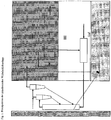
- the iron oxide microgranules in the reactor (A) are accelerated by the process gas at a superficial velocity of 2.5 m / s and reach the pre-separation cyclone (B1).
- the solid is separated from the hot gas in the pre-separation cyclone (B1) and returned to the reactor (A) by flaps.
- the hot gas passes from the pre-separation cyclone (B1) to the preheating stage (B2), where the pigment to be tempered is added at 3.5 t / h.
- the solid is heated by the hot gas, it then enters the recycle cyclone (B3).
- the recycle cyclone (B3) the solid is separated from the exhaust gas.
- the solid returns from the recycle cyclone (B3) back to the reactor (A).
- From the reactor (A) is continuously discharged solid, cooled in a product cooler (I) such as a rotary tube cooler to ambient temperature and then discharged (3) and stored in a silo.
- a product cooler such as a rotary tube cooler
- the process gas is preferably generated by the combustion of natural gas with air, wherein a portion of the exhaust gas from the recirculation cyclone (B3) after dedusting in the dust collector (C) and preheating by heat exchanger in the exhaust gas combustion (D) back to the gas burner (H) is supplied.
- the exhaust gas itself is washed in the scrubber (F) and passed through a chimney (G).
- a carbon monoxide content of 0.30 vol.% Is set in the process gas.
- An air lance in the riser tube sets the oxygen content required for the slightly oxidizing tempering of 1.3% by volume.
- the reaction preferably takes place at a temperature of between 300 and 1000 ° C., with a residence time of at least 4 minutes.
- the iron oxide black pigment for later use may be subjected to milling, micronization, compaction, granulation or other fabrication steps known to those skilled in the art.
- the pigment surface can be modified by an organic or inorganic aftertreatment.
- the invention also relates to the use of iron oxide pigments for coloring inorganic or organic dispersions, plastics or building materials.
- the treatment in no way restricts the use, for example, in food colors, catalysts, wastewater treatment, toners and other applications known to those skilled in the art for iron oxide black pigments.
- the iron oxide black pigments are suitable, for example, for coloring inorganic or organic dispersions and for coloring products of the paints and coatings, coatings, building materials, plastics and paper industries, in foodstuffs and in products of the pharmaceutical industry, for example in tablets.
- the pigment was prepared with the Muller in a non-drying test binder.
- the test binder (“L64 paste”) consists of two components:
- SACOLYD ® L640 (Krems Chemie AG, AU, alkyd resin binder based on linseed oil and phthalic anhydride) (formerly Alkydal® ® L64 (Bayer AG, DE)). It meets the specifications specified in the standards DIN EN ISO 787-24 (October 1995), ISO 787-25: 1993 and DIN 55983 (December 1983) as requirements for a test binder for color pigments.
- LUVOTHIX ® HT (Lehmann & Voss & Co., DE, powdered, modified, hydrogenated castor oil) as a rheological additive which is added for thickening the paste. It was used in a concentration of 5.0% by weight, based on component 1.
- Component 2 was dissolved in component 1 at 75-95 ° C.
- the cooled, puncture-resistant mass was once passed through a three-roll mill. This completes the L64 paste.
- a Teller-Farbausreibmaschine Muller
- An ENGELSMANN JEL 25/53 Muller with an effective plate diameter of 24 cm was used.
- the speed of the lower plate was about 75 min-1.
- the squeegee belonging to the pasty plate is pulled over the depression of the plate filled with the pigment-paste mixture, so that a smooth surface results.
- the doctor blade is moved in one direction at a speed of about 3 - 7 cm / s.
- the smooth surface is measured within a few minutes.
- a spectrophotometer with the measurement geometry d / 8 without gloss trap was used. This measuring geometry is described in ISO 7724 / 2-1984 (E), point 4.1.1, in DIN 5033 part 7 (July 1983), point 3.2.4 and in DIN 53236 (January 1983), point 7.1.1.
- a DATAFLASH ® 2000 measuring instrument (Datacolor International Corp., USA) was used.
- the colorimeter was calibrated against a white, ceramic working standard as described in ISO 7724 / 2-1984 (E) item 8.3.
- the reflection data of the working standard against an ideal matt white body are stored in the colorimeter, so that after calibration with the white working standard all color measurements are based on the ideal matt white body.
- the black point calibration was carried out with a black hollow body of the colorimeter manufacturer.
- the result of the color measurement is a reflection spectrum.
- colorimetric quantities it does not matter in which type of light the measurement was made (except for fluorescent samples). From the reflection spectrum any colorimetric variable can be calculated.
- the colorimetric quantities used in this case are calculated according to DIN 6174 (CIELAB values). Among other things, the color value "b *" is calculated according to DIN 6174. For the color impression applies: the more negative b * is, the more bluish is the color pigment.
- the temperature of colorimeter and sample was about 25 ° C ⁇ 5 ° C.
- the color values are given according to the measurement described above according to DIN 6174 (CIELAB values).
- the measurement in the brightening also results in the relative color strength of the measured color pigment against a comparison pigment (in the given case: Bayferrox® 318, see Table 1).
- the so-called "waste ratio" calculated.
- the blend ratio was determined in accordance with DIN standard 53235 part 1 and part 2 from 1974 for the color depth characteristic B 1/9.
- the ratio of a coloring substance to a mixing component in the given case: TiO 2
- a high cut ratio means that the same depth of coloration can be achieved with less pigment. Such a pigment is therefore stronger in color in practical use.
- a blend ratio for the color depth characteristic B 1/9 according to DIN 53235 parts 1 and 2 of greater than 1.9 corresponds to at least 15% higher color strength than Bayferrox® 318.
- HDPE is a short name (derived from DIN 7728, part 1, 01/1988 of the English term "high density polyethylene”) for low-density polyethylene produced under low pressure.
- the abbreviation PE-HD is increasingly used today.
- high molecular weight HMW-HDPE (4 ⁇ 10 4 ⁇ M R ⁇ 3 ⁇ 10 5 )
- extra high molecular weight (5 ⁇ 10 5 ⁇ M R ⁇ 1.5 ⁇ 10 6 ) u.
- UHMW-PE (M R > 3.1 ⁇ 10 6 ) (“ultra-high molecular weight") Römpp Lexikon Chemie - Version 2.0, Stuttgart / New York: Georg Thieme Verlag 1999 ).
- Reduction stability in the sense of the application means that the color shift ⁇ E * of the HDPE test specimen is, when the incorporation temperature is increased from 200 ° C. to 300 ° C., not more than 0.7 units.
- Oxidation stability in the sense of the application means that the product must have a temperature resistance of at least 140 ° C. in the IMCO test.
- the Intergovernmental Maritime Consultative Organization also known as IMCO and renamed International Maritime Organization ("IMO") from 1982, is an International Marine Organization established in 1948 with the aim of facilitating technical cooperation in ship affairs between governments, mainly to ensure safe and efficient navigation and control of marine pollution from ships.
- IMCO test To test the oxidation stability according to the so-called IMCO test, 1 liter of product is placed in an air-permeable wire mesh cube of phosphor bronze gauze 18,000 mesh per cm 2 (350 X 350 mesh) with 10 cm side length; The cube is placed in the middle of a laboratory oven with internal air circulation, heated to a test temperature of 140 ° C and held for 24 h at this temperature. If the temperature inside the sample exceeds 200 ° C, the sample is not stable after the IMCO test.
- a laboratory furnace is provided with an internal air circulation and the control option to achieve indoor temperatures of 140 ° C +/- 2 ° C used.
- a suitable system is used to measure and record the temperature in the furnace and in the center of the cube.
- a chrome-aluminum thermocouple made of 0.27 mm diameter wire was used.
- the bulk density is determined on the finished product without further treatment of the product by the ratio of mass and volume.
- the tamped density is determined by ISO 787 Part 11 (1995).
- D [4,3] is the mean of the particle size in relation to the volume distribution ("Herdan diameter").
- D [3,2] is the mean of the particle size in terms of the surface distribution ("Sauter diameter").
- the Fe (III) / Fe (II) ratio is determined by potentiometric titration after acid digestion of the samples.
- oil number is meant the amount of lake oil that is absorbed under specified conditions by a pigment or filler sample.
- the oil number is a common measure for characterizing the oil requirement of pigments and fillers and is given as the unit mg / 100g or g / 100g. The oil number is determined according to ISO 787 Part 5 (1983).
- wastewater pastes a substantially consisting of iron and oxygen paste from the waste water of washing, filtration, solid / liquid separation and also failed batches
- wastewater pastes a substantially consisting of iron and oxygen paste from the waste water of washing, filtration, solid / liquid separation and also failed batches
- wastewater pastes with a density of 1.25 g / cm 3 and 10 m 3 of a wastewater paste having a density of 1.4 g / cm 3
- 4000 1 32% sodium hydroxide solution By blowing in direct steam, the reaction mixture was heated to 90 ° C.
- 20 m 3 of iron sulfate sludge which is obtained in the clarification of ferrous sulfate solution in other operating ranges, was stirred for 90 min, the approach was gassed with 100 m 3 / h of air.
- the paste was dried over a disc spray dryer with a hot gas inlet temperature of 600 ° C to a residual moisture content of 2%.
- wastewater pastes a substantially consisting of iron and oxygen paste from the waste water of washing, filtration, solid / liquid separation and also failed batches, etc.
- wastewater pastes with a density of 1.33 g / cm 3 and 30 m 3 of a wastewater paste having a density of 1.2 g / cm 3 was placed in a stirred tank and mixed with 4500 1 32% sodium hydroxide solution.
- the reaction mixture was heated to 90 ° C.
- 20 m 3 of iron sulfate sludge which is obtained in the clarification of ferrous sulfate solution in other operating ranges, was stirred for 90 min, the approach was gassed with 100 m 3 / h of air.
- the mixture was then stirred for a further 90 min. This gives 27 t of an iron oxide black pigment.
- After dilution with water to a density of 1.03 g / cm 3 coarse fractions were removed in a hydrocyclone unit.
- the paste was dried over a disc spray dryer with a hot gas inlet temperature of 475 ° C to a residual moisture content of 2.5%.
- Comparative pigment is commercially available Bayferrox ® 318, Bayferrox ® 318M, undBayferrox ® 306 from Lanxess Germany GmbH, and two other comparative examples. The first one was after EP 187434 Example 1, the second is a common precipitated black pigment, which has been prepared by a precipitation process. Such pigments can be detected, for example DE 2 618058 A1 Example 5 produce.
Landscapes
- Chemical & Material Sciences (AREA)
- Organic Chemistry (AREA)
- Compounds Of Iron (AREA)
- Pigments, Carbon Blacks, Or Wood Stains (AREA)
- Paints Or Removers (AREA)
Applications Claiming Priority (1)
| Application Number | Priority Date | Filing Date | Title |
|---|---|---|---|
| DE102004060044A DE102004060044A1 (de) | 2004-12-14 | 2004-12-14 | Farbstarke, reduktions- und oxidationsstabile Eisenoxidschwarzpigmente zur Einfärbung von Kunst- und Baustoffen |
Publications (2)
| Publication Number | Publication Date |
|---|---|
| EP1672038A1 EP1672038A1 (de) | 2006-06-21 |
| EP1672038B1 true EP1672038B1 (de) | 2017-04-12 |
Family
ID=36035957
Family Applications (1)
| Application Number | Title | Priority Date | Filing Date |
|---|---|---|---|
| EP05026194.0A Expired - Lifetime EP1672038B1 (de) | 2004-12-14 | 2005-12-01 | Farbstarke, reduktions- und oxidationsstabile Eisenoxidschwarzpigmente zur Einfärbung von Kunst- und Baustoffen |
Country Status (12)
| Country | Link |
|---|---|
| US (1) | US7235127B2 (enExample) |
| EP (1) | EP1672038B1 (enExample) |
| JP (1) | JP5388404B2 (enExample) |
| CN (1) | CN1789341B (enExample) |
| AU (1) | AU2005239673B9 (enExample) |
| BR (1) | BRPI0505516B1 (enExample) |
| CA (1) | CA2529778C (enExample) |
| DE (1) | DE102004060044A1 (enExample) |
| DK (1) | DK1672038T3 (enExample) |
| ES (1) | ES2628708T3 (enExample) |
| PL (1) | PL1672038T3 (enExample) |
| ZA (1) | ZA200510171B (enExample) |
Families Citing this family (7)
| Publication number | Priority date | Publication date | Assignee | Title |
|---|---|---|---|---|
| US7850775B2 (en) * | 2006-11-09 | 2010-12-14 | Sun Chemical Corporation | Multi-colored lustrous pearlescent pigments |
| US8211224B2 (en) * | 2006-11-09 | 2012-07-03 | Sun Chemical Corp. | Multi-colored lustrous pearlescent pigments and process for making |
| US8349067B2 (en) * | 2006-11-09 | 2013-01-08 | Sun Chemical Corp. | Multi-colored lustrous pearlescent pigments |
| US8906154B2 (en) * | 2006-11-09 | 2014-12-09 | Sun Chemical Corporation | Coating, ink, or article comprising multi-colored lustrous pearlescent pigments |
| US8323396B2 (en) * | 2006-11-09 | 2012-12-04 | Sun Chemical Corp. | Orange pearlescent pigments |
| US8221536B2 (en) * | 2006-11-09 | 2012-07-17 | Sun Chemical Corp. | Cosmetic comprising multi-colored lustrous pearlescent pigments |
| US20090185992A1 (en) * | 2008-01-18 | 2009-07-23 | Christelle Conan | Process for producing iron oxide coated pearlescent pigments |
Family Cites Families (17)
| Publication number | Priority date | Publication date | Assignee | Title |
|---|---|---|---|---|
| US1535889A (en) * | 1922-08-08 | 1925-04-28 | Oliver Chilled Plow Works | Wheeled cultivator |
| DE518929C (de) | 1927-02-16 | 1931-02-21 | I G Farbenindustrie Akt Ges | Verfahren zur Herstellung aromatischer Amine |
| AT326236B (de) * | 1973-09-24 | 1975-11-25 | Ruthner Industrieanlagen Ag | Verfahren zur herstellung von insbesondere als schwarzpigment dienendem pulverformigem eisen-(ii,iii)-oxid vorbestimmter teilchengrosse |
| DE2618058A1 (de) | 1976-04-24 | 1977-11-10 | Bayer Ag | Verfahren zur kontinuierlichen herstellung von eisenoxidschwarzpigmenten |
| DE2625106C2 (de) * | 1976-06-04 | 1982-03-11 | Bayer Ag, 5090 Leverkusen | Eisenoxidschwarz-Pigmente mit verbesserter Oxidationsbeständigkeit und Verfahren zu ihrer Herstellung |
| US4453260A (en) * | 1982-06-15 | 1984-06-05 | Tokyo Shibaura Denki Kabushiki Kaisha | Synchronizing circuit for detecting and interpolating sync signals contained in digital signal |
| DE3518093A1 (de) * | 1985-05-21 | 1986-11-27 | Bayer Ag, 5090 Leverkusen | Verfahren zur herstellung von schwarzpigmenten auf eisenbasis |
| DE3620333A1 (de) * | 1986-06-18 | 1987-12-23 | Bayer Ag | Farbstarke im nitrobenzolreduktionsverfahren erhaltene eisenoxidschwarzpigmente sowie verfahren zu deren herstellung |
| DE3734342C1 (de) * | 1987-10-10 | 1989-03-30 | Bayer Ag | Feinteilige Eisenoxidschwarzpigmente,Verfahren zu ihrer Herstellung sowie deren Verwendung |
| DE3803940A1 (de) * | 1988-02-10 | 1989-08-24 | Bayer Ag | Neue oxidationsstabile hitzebestaendige eisenoxidschwarzpigmente, verfahren zu ihrer herstellung sowie deren verwendung |
| DE3821341A1 (de) * | 1988-06-24 | 1989-12-28 | Bayer Ag | Neue hitzestabile eisenoxidschwarz-pigmente, verfahren zu ihrer herstellung sowie deren verwendung |
| DE3910779A1 (de) * | 1989-04-04 | 1990-10-11 | Bayer Ag | Eisenoxidschwarzpigmentgranulate, verfahren zu ihrer herstellung sowie deren verwendung |
| DE3910783A1 (de) * | 1989-04-04 | 1990-10-11 | Bayer Ag | Verbesserte eisenoxidschwarzpigmente, verfahren zu ihrer herstellung sowie deren verwendung |
| US5837051A (en) * | 1994-12-27 | 1998-11-17 | Bayer Ag | Process for the thermal treatment of iron oxides in a circulating fluidized bed |
| DE19548418B4 (de) * | 1995-12-22 | 2006-02-23 | Lanxess Deutschland Gmbh | Herstellung von Eisenoxidschwarzpigmentgranulaten und deren Verwendung |
| GB2333518A (en) * | 1998-01-26 | 1999-07-28 | Laporte Industries Ltd | Process for making black iron oxide pigment |
| DE19812260A1 (de) * | 1998-03-20 | 1999-09-23 | Bayer Ag | Verfahren zur Herstellung von Eisenoxid-Pigmenten aus Dünnsäure aus der TiO¶2¶-Herstellung |
-
2004
- 2004-12-14 DE DE102004060044A patent/DE102004060044A1/de not_active Ceased
-
2005
- 2005-11-30 AU AU2005239673A patent/AU2005239673B9/en not_active Ceased
- 2005-12-01 EP EP05026194.0A patent/EP1672038B1/de not_active Expired - Lifetime
- 2005-12-01 PL PL05026194T patent/PL1672038T3/pl unknown
- 2005-12-01 DK DK05026194.0T patent/DK1672038T3/en active
- 2005-12-01 ES ES05026194.0T patent/ES2628708T3/es not_active Expired - Lifetime
- 2005-12-13 CA CA2529778A patent/CA2529778C/en not_active Expired - Lifetime
- 2005-12-13 US US11/301,682 patent/US7235127B2/en not_active Expired - Fee Related
- 2005-12-13 JP JP2005359403A patent/JP5388404B2/ja not_active Expired - Fee Related
- 2005-12-14 BR BRPI0505516A patent/BRPI0505516B1/pt not_active IP Right Cessation
- 2005-12-14 ZA ZA200510171A patent/ZA200510171B/xx unknown
- 2005-12-14 CN CN2005101316676A patent/CN1789341B/zh not_active Expired - Fee Related
Non-Patent Citations (1)
| Title |
|---|
| None * |
Also Published As
| Publication number | Publication date |
|---|---|
| ZA200510171B (en) | 2007-03-28 |
| DK1672038T3 (en) | 2017-08-07 |
| EP1672038A1 (de) | 2006-06-21 |
| US20060133991A1 (en) | 2006-06-22 |
| AU2005239673A1 (en) | 2006-06-29 |
| US7235127B2 (en) | 2007-06-26 |
| ES2628708T3 (es) | 2017-08-03 |
| CA2529778A1 (en) | 2006-06-14 |
| AU2005239673B2 (en) | 2012-02-02 |
| JP5388404B2 (ja) | 2014-01-15 |
| PL1672038T3 (pl) | 2017-09-29 |
| DE102004060044A1 (de) | 2006-06-29 |
| CA2529778C (en) | 2014-03-18 |
| CN1789341A (zh) | 2006-06-21 |
| BRPI0505516A (pt) | 2006-09-12 |
| AU2005239673B9 (en) | 2012-03-08 |
| BRPI0505516B1 (pt) | 2016-10-04 |
| CN1789341B (zh) | 2012-02-22 |
| JP2006169100A (ja) | 2006-06-29 |
Similar Documents
| Publication | Publication Date | Title |
|---|---|---|
| EP0857764B2 (de) | Anorganische Pigmentgranulate zum Einfärben von Kunststoffen, Lacken und Baustoffen und ein Verfahren zu deren Herstellung | |
| DE10204304A1 (de) | Pigmentgranulate | |
| DE60034296T2 (de) | Eisenoxidhydroxid Kompositteilchen, Pigment, Farbe und Harzzusammensetzung | |
| EP0609533A1 (de) | Eisenoxidhaltiges Titandioxidpulver | |
| EP2007832B1 (de) | Schwarzpigment-hilfsmittel-kombination mit einer verbesserten farbstärke | |
| EP0029137B1 (de) | Titandioxyd-Pigmente mit guter Dispergierbarkeit, Verfahren zu ihrer Herstellung und ihre Verwendung | |
| EP0249843A1 (de) | Verfahren zur Herstellung von farbstarken, im Nitrobenzolreduktionsverfahren erhaltenen Eisenoxidschwarzpigmente | |
| DE69916552T2 (de) | Feine rote Eisenoxidpigmente und diese enthaltende Farb- oder Harzzusammensetzungen | |
| EP1672038A1 (de) | Farbstarke, reduktions- und oxidationsstabile Eisenoxidschwarzpigmente zur Einfärbung von Kunst- und Baustoffen | |
| DE1467442A1 (de) | Leicht dispergierbare anorganische Pigmente | |
| DE19548418B4 (de) | Herstellung von Eisenoxidschwarzpigmentgranulaten und deren Verwendung | |
| EP0704500B1 (de) | Hochtransparente, gelbe Eisenoxidpigmente, Verfahren zu ihrer Herstellung sowie deren Verwendung | |
| EP0719731B1 (de) | Verfahren zur thermischen Behandlung von Eisenoxiden in einer zirkulierenden Wirbelschicht | |
| DE10044986A1 (de) | Nanokristallines Metalloxidpulver, Verfahren zu seiner Herstellung und Verwendung | |
| EP0918075A2 (de) | Hitzestabile Eisenoxidgelb-Pigmente | |
| DE19751141A1 (de) | Nicht-silkende Eisenoxidgelb-Pigmente mit hoher Buntheit | |
| DE2344196C2 (de) | Lasierendes gelbes Eisenoxid-Pigment | |
| JP4438925B2 (ja) | 改質カーボンブラック粒子粉末及びその製造法、当該改質カーボンブラック粒子粉末を含有する塗料及び樹脂組成物 | |
| DE1467443A1 (de) | Leicht dispergierbare Pigmente | |
| JP2003327867A (ja) | 改質カーボンブラック粒子粉末及びその製造法、当該改質カーボンブラック粒子粉末を含有する塗料及び樹脂組成物 | |
| DE1467442C (de) | Leicht dispergierbare anorganische Pigmente | |
| DE102006022449A1 (de) | Verbesserte Eisenoxidgelbpigmente | |
| MXPA05013230A (es) | Pigmentos negros de oxido de hierro estables a la reduccion y a la oxidacion que tienen alta intensidad de color para colorear plasticos y materiales de construccion | |
| DE1467442B (enExample) | ||
| EP4453101A1 (de) | Verfahren zur herstellung von eisenoxidpigmenten |
Legal Events
| Date | Code | Title | Description |
|---|---|---|---|
| PUAI | Public reference made under article 153(3) epc to a published international application that has entered the european phase |
Free format text: ORIGINAL CODE: 0009012 |
|
| AK | Designated contracting states |
Kind code of ref document: A1 Designated state(s): AT BE BG CH CY CZ DE DK EE ES FI FR GB GR HU IE IS IT LI LT LU LV MC NL PL PT RO SE SI SK TR |
|
| AX | Request for extension of the european patent |
Extension state: AL BA HR MK YU |
|
| 17P | Request for examination filed |
Effective date: 20061221 |
|
| AKX | Designation fees paid |
Designated state(s): AT BE BG CH CY CZ DE DK EE ES FI FR GB GR HU IE IS IT LI LT LU LV MC NL PL PT RO SE SI SK TR |
|
| 17Q | First examination report despatched |
Effective date: 20070212 |
|
| RAP1 | Party data changed (applicant data changed or rights of an application transferred) |
Owner name: LANXESS DEUTSCHLAND GMBH |
|
| GRAP | Despatch of communication of intention to grant a patent |
Free format text: ORIGINAL CODE: EPIDOSNIGR1 |
|
| INTG | Intention to grant announced |
Effective date: 20161216 |
|
| GRAS | Grant fee paid |
Free format text: ORIGINAL CODE: EPIDOSNIGR3 |
|
| GRAA | (expected) grant |
Free format text: ORIGINAL CODE: 0009210 |
|
| AK | Designated contracting states |
Kind code of ref document: B1 Designated state(s): AT BE BG CH CY CZ DE DK EE ES FI FR GB GR HU IE IS IT LI LT LU LV MC NL PL PT RO SE SI SK TR |
|
| REG | Reference to a national code |
Ref country code: GB Ref legal event code: FG4D Free format text: NOT ENGLISH |
|
| REG | Reference to a national code |
Ref country code: CH Ref legal event code: EP |
|
| REG | Reference to a national code |
Ref country code: IE Ref legal event code: FG4D Free format text: LANGUAGE OF EP DOCUMENT: GERMAN |
|
| REG | Reference to a national code |
Ref country code: AT Ref legal event code: REF Ref document number: 883834 Country of ref document: AT Kind code of ref document: T Effective date: 20170515 |
|
| REG | Reference to a national code |
Ref country code: DE Ref legal event code: R096 Ref document number: 502005015555 Country of ref document: DE |
|
| REG | Reference to a national code |
Ref country code: NL Ref legal event code: FP |
|
| REG | Reference to a national code |
Ref country code: ES Ref legal event code: FG2A Ref document number: 2628708 Country of ref document: ES Kind code of ref document: T3 Effective date: 20170803 |
|
| REG | Reference to a national code |
Ref country code: DK Ref legal event code: T3 Effective date: 20170801 |
|
| REG | Reference to a national code |
Ref country code: LT Ref legal event code: MG4D |
|
| REG | Reference to a national code |
Ref country code: FR Ref legal event code: PLFP Year of fee payment: 13 |
|
| PG25 | Lapsed in a contracting state [announced via postgrant information from national office to epo] |
Ref country code: FI Free format text: LAPSE BECAUSE OF FAILURE TO SUBMIT A TRANSLATION OF THE DESCRIPTION OR TO PAY THE FEE WITHIN THE PRESCRIBED TIME-LIMIT Effective date: 20170412 Ref country code: GR Free format text: LAPSE BECAUSE OF FAILURE TO SUBMIT A TRANSLATION OF THE DESCRIPTION OR TO PAY THE FEE WITHIN THE PRESCRIBED TIME-LIMIT Effective date: 20170713 Ref country code: LT Free format text: LAPSE BECAUSE OF FAILURE TO SUBMIT A TRANSLATION OF THE DESCRIPTION OR TO PAY THE FEE WITHIN THE PRESCRIBED TIME-LIMIT Effective date: 20170412 |
|
| PG25 | Lapsed in a contracting state [announced via postgrant information from national office to epo] |
Ref country code: BG Free format text: LAPSE BECAUSE OF FAILURE TO SUBMIT A TRANSLATION OF THE DESCRIPTION OR TO PAY THE FEE WITHIN THE PRESCRIBED TIME-LIMIT Effective date: 20170712 Ref country code: LV Free format text: LAPSE BECAUSE OF FAILURE TO SUBMIT A TRANSLATION OF THE DESCRIPTION OR TO PAY THE FEE WITHIN THE PRESCRIBED TIME-LIMIT Effective date: 20170412 Ref country code: SE Free format text: LAPSE BECAUSE OF FAILURE TO SUBMIT A TRANSLATION OF THE DESCRIPTION OR TO PAY THE FEE WITHIN THE PRESCRIBED TIME-LIMIT Effective date: 20170412 Ref country code: IS Free format text: LAPSE BECAUSE OF FAILURE TO SUBMIT A TRANSLATION OF THE DESCRIPTION OR TO PAY THE FEE WITHIN THE PRESCRIBED TIME-LIMIT Effective date: 20170812 |
|
| REG | Reference to a national code |
Ref country code: DE Ref legal event code: R097 Ref document number: 502005015555 Country of ref document: DE |
|
| PG25 | Lapsed in a contracting state [announced via postgrant information from national office to epo] |
Ref country code: SK Free format text: LAPSE BECAUSE OF FAILURE TO SUBMIT A TRANSLATION OF THE DESCRIPTION OR TO PAY THE FEE WITHIN THE PRESCRIBED TIME-LIMIT Effective date: 20170412 Ref country code: RO Free format text: LAPSE BECAUSE OF FAILURE TO SUBMIT A TRANSLATION OF THE DESCRIPTION OR TO PAY THE FEE WITHIN THE PRESCRIBED TIME-LIMIT Effective date: 20170412 Ref country code: CZ Free format text: LAPSE BECAUSE OF FAILURE TO SUBMIT A TRANSLATION OF THE DESCRIPTION OR TO PAY THE FEE WITHIN THE PRESCRIBED TIME-LIMIT Effective date: 20170412 Ref country code: EE Free format text: LAPSE BECAUSE OF FAILURE TO SUBMIT A TRANSLATION OF THE DESCRIPTION OR TO PAY THE FEE WITHIN THE PRESCRIBED TIME-LIMIT Effective date: 20170412 |
|
| PLBE | No opposition filed within time limit |
Free format text: ORIGINAL CODE: 0009261 |
|
| STAA | Information on the status of an ep patent application or granted ep patent |
Free format text: STATUS: NO OPPOSITION FILED WITHIN TIME LIMIT |
|
| 26N | No opposition filed |
Effective date: 20180115 |
|
| PG25 | Lapsed in a contracting state [announced via postgrant information from national office to epo] |
Ref country code: SI Free format text: LAPSE BECAUSE OF FAILURE TO SUBMIT A TRANSLATION OF THE DESCRIPTION OR TO PAY THE FEE WITHIN THE PRESCRIBED TIME-LIMIT Effective date: 20170412 |
|
| REG | Reference to a national code |
Ref country code: CH Ref legal event code: PL |
|
| REG | Reference to a national code |
Ref country code: IE Ref legal event code: MM4A |
|
| PG25 | Lapsed in a contracting state [announced via postgrant information from national office to epo] |
Ref country code: LU Free format text: LAPSE BECAUSE OF NON-PAYMENT OF DUE FEES Effective date: 20171201 |
|
| REG | Reference to a national code |
Ref country code: FR Ref legal event code: PLFP Year of fee payment: 14 |
|
| REG | Reference to a national code |
Ref country code: BE Ref legal event code: MM Effective date: 20171231 |
|
| PG25 | Lapsed in a contracting state [announced via postgrant information from national office to epo] |
Ref country code: IE Free format text: LAPSE BECAUSE OF NON-PAYMENT OF DUE FEES Effective date: 20171201 |
|
| PG25 | Lapsed in a contracting state [announced via postgrant information from national office to epo] |
Ref country code: CH Free format text: LAPSE BECAUSE OF NON-PAYMENT OF DUE FEES Effective date: 20171231 Ref country code: LI Free format text: LAPSE BECAUSE OF NON-PAYMENT OF DUE FEES Effective date: 20171231 Ref country code: BE Free format text: LAPSE BECAUSE OF NON-PAYMENT OF DUE FEES Effective date: 20171231 |
|
| REG | Reference to a national code |
Ref country code: AT Ref legal event code: MM01 Ref document number: 883834 Country of ref document: AT Kind code of ref document: T Effective date: 20171201 |
|
| PG25 | Lapsed in a contracting state [announced via postgrant information from national office to epo] |
Ref country code: AT Free format text: LAPSE BECAUSE OF NON-PAYMENT OF DUE FEES Effective date: 20171201 |
|
| PG25 | Lapsed in a contracting state [announced via postgrant information from national office to epo] |
Ref country code: HU Free format text: LAPSE BECAUSE OF FAILURE TO SUBMIT A TRANSLATION OF THE DESCRIPTION OR TO PAY THE FEE WITHIN THE PRESCRIBED TIME-LIMIT; INVALID AB INITIO Effective date: 20051201 Ref country code: MC Free format text: LAPSE BECAUSE OF FAILURE TO SUBMIT A TRANSLATION OF THE DESCRIPTION OR TO PAY THE FEE WITHIN THE PRESCRIBED TIME-LIMIT Effective date: 20170412 |
|
| PG25 | Lapsed in a contracting state [announced via postgrant information from national office to epo] |
Ref country code: CY Free format text: LAPSE BECAUSE OF NON-PAYMENT OF DUE FEES Effective date: 20170412 |
|
| PG25 | Lapsed in a contracting state [announced via postgrant information from national office to epo] |
Ref country code: PT Free format text: LAPSE BECAUSE OF FAILURE TO SUBMIT A TRANSLATION OF THE DESCRIPTION OR TO PAY THE FEE WITHIN THE PRESCRIBED TIME-LIMIT Effective date: 20170412 |
|
| P01 | Opt-out of the competence of the unified patent court (upc) registered |
Effective date: 20230714 |
|
| PGFP | Annual fee paid to national office [announced via postgrant information from national office to epo] |
Ref country code: PL Payment date: 20240916 Year of fee payment: 20 |
|
| PGFP | Annual fee paid to national office [announced via postgrant information from national office to epo] |
Ref country code: NL Payment date: 20241004 Year of fee payment: 20 |
|
| PGFP | Annual fee paid to national office [announced via postgrant information from national office to epo] |
Ref country code: DE Payment date: 20241001 Year of fee payment: 20 |
|
| PGFP | Annual fee paid to national office [announced via postgrant information from national office to epo] |
Ref country code: DK Payment date: 20241212 Year of fee payment: 20 |
|
| PGFP | Annual fee paid to national office [announced via postgrant information from national office to epo] |
Ref country code: GB Payment date: 20241001 Year of fee payment: 20 |
|
| PGFP | Annual fee paid to national office [announced via postgrant information from national office to epo] |
Ref country code: FR Payment date: 20241001 Year of fee payment: 20 |
|
| PGFP | Annual fee paid to national office [announced via postgrant information from national office to epo] |
Ref country code: IT Payment date: 20241112 Year of fee payment: 20 |
|
| PGFP | Annual fee paid to national office [announced via postgrant information from national office to epo] |
Ref country code: TR Payment date: 20241126 Year of fee payment: 20 |
|
| PGFP | Annual fee paid to national office [announced via postgrant information from national office to epo] |
Ref country code: ES Payment date: 20250121 Year of fee payment: 20 |
|
| REG | Reference to a national code |
Ref country code: DE Ref legal event code: R071 Ref document number: 502005015555 Country of ref document: DE |
|
| REG | Reference to a national code |
Ref country code: NL Ref legal event code: MK Effective date: 20251130 |
|
| REG | Reference to a national code |
Ref country code: DK Ref legal event code: EUP Expiry date: 20251201 |
|
| REG | Reference to a national code |
Ref country code: GB Ref legal event code: PE20 Expiry date: 20251130 |
|
| REG | Reference to a national code |
Ref country code: ES Ref legal event code: FD2A Effective date: 20251230 |
|
| PG25 | Lapsed in a contracting state [announced via postgrant information from national office to epo] |
Ref country code: ES Free format text: LAPSE BECAUSE OF EXPIRATION OF PROTECTION Effective date: 20251202 |