EP1664050B1 - Composes neuroprotecteurs bicycliques et procedes d'utilisation correspondants - Google Patents
Composes neuroprotecteurs bicycliques et procedes d'utilisation correspondants Download PDFInfo
- Publication number
- EP1664050B1 EP1664050B1 EP04782733.2A EP04782733A EP1664050B1 EP 1664050 B1 EP1664050 B1 EP 1664050B1 EP 04782733 A EP04782733 A EP 04782733A EP 1664050 B1 EP1664050 B1 EP 1664050B1
- Authority
- EP
- European Patent Office
- Prior art keywords
- substituted
- alkynyl
- alkenyl
- aryl
- heteroalkyl
- Prior art date
- Legal status (The legal status is an assumption and is not a legal conclusion. Google has not performed a legal analysis and makes no representation as to the accuracy of the status listed.)
- Expired - Lifetime
Links
- 0 *CC(C*C1(*)P)(C1C([C@](*)(*1)C2CC2)=*)C1=O Chemical compound *CC(C*C1(*)P)(C1C([C@](*)(*1)C2CC2)=*)C1=O 0.000 description 1
Images


Classifications
-
- C—CHEMISTRY; METALLURGY
- C07—ORGANIC CHEMISTRY
- C07D—HETEROCYCLIC COMPOUNDS
- C07D487/00—Heterocyclic compounds containing nitrogen atoms as the only ring hetero atoms in the condensed system, not provided for by groups C07D451/00 - C07D477/00
- C07D487/02—Heterocyclic compounds containing nitrogen atoms as the only ring hetero atoms in the condensed system, not provided for by groups C07D451/00 - C07D477/00 in which the condensed system contains two hetero rings
- C07D487/04—Ortho-condensed systems
-
- A—HUMAN NECESSITIES
- A61—MEDICAL OR VETERINARY SCIENCE; HYGIENE
- A61K—PREPARATIONS FOR MEDICAL, DENTAL OR TOILETRY PURPOSES
- A61K31/00—Medicinal preparations containing organic active ingredients
- A61K31/33—Heterocyclic compounds
- A61K31/395—Heterocyclic compounds having nitrogen as a ring hetero atom, e.g. guanethidine or rifamycins
- A61K31/495—Heterocyclic compounds having nitrogen as a ring hetero atom, e.g. guanethidine or rifamycins having six-membered rings with two or more nitrogen atoms as the only ring heteroatoms, e.g. piperazine or tetrazines
- A61K31/498—Pyrazines or piperazines ortho- and peri-condensed with carbocyclic ring systems, e.g. quinoxaline, phenazine
-
- A—HUMAN NECESSITIES
- A61—MEDICAL OR VETERINARY SCIENCE; HYGIENE
- A61P—SPECIFIC THERAPEUTIC ACTIVITY OF CHEMICAL COMPOUNDS OR MEDICINAL PREPARATIONS
- A61P11/00—Drugs for disorders of the respiratory system
-
- A—HUMAN NECESSITIES
- A61—MEDICAL OR VETERINARY SCIENCE; HYGIENE
- A61P—SPECIFIC THERAPEUTIC ACTIVITY OF CHEMICAL COMPOUNDS OR MEDICINAL PREPARATIONS
- A61P21/00—Drugs for disorders of the muscular or neuromuscular system
-
- A—HUMAN NECESSITIES
- A61—MEDICAL OR VETERINARY SCIENCE; HYGIENE
- A61P—SPECIFIC THERAPEUTIC ACTIVITY OF CHEMICAL COMPOUNDS OR MEDICINAL PREPARATIONS
- A61P25/00—Drugs for disorders of the nervous system
-
- A—HUMAN NECESSITIES
- A61—MEDICAL OR VETERINARY SCIENCE; HYGIENE
- A61P—SPECIFIC THERAPEUTIC ACTIVITY OF CHEMICAL COMPOUNDS OR MEDICINAL PREPARATIONS
- A61P25/00—Drugs for disorders of the nervous system
- A61P25/08—Antiepileptics; Anticonvulsants
-
- A—HUMAN NECESSITIES
- A61—MEDICAL OR VETERINARY SCIENCE; HYGIENE
- A61P—SPECIFIC THERAPEUTIC ACTIVITY OF CHEMICAL COMPOUNDS OR MEDICINAL PREPARATIONS
- A61P25/00—Drugs for disorders of the nervous system
- A61P25/14—Drugs for disorders of the nervous system for treating abnormal movements, e.g. chorea, dyskinesia
-
- A—HUMAN NECESSITIES
- A61—MEDICAL OR VETERINARY SCIENCE; HYGIENE
- A61P—SPECIFIC THERAPEUTIC ACTIVITY OF CHEMICAL COMPOUNDS OR MEDICINAL PREPARATIONS
- A61P25/00—Drugs for disorders of the nervous system
- A61P25/14—Drugs for disorders of the nervous system for treating abnormal movements, e.g. chorea, dyskinesia
- A61P25/16—Anti-Parkinson drugs
-
- A—HUMAN NECESSITIES
- A61—MEDICAL OR VETERINARY SCIENCE; HYGIENE
- A61P—SPECIFIC THERAPEUTIC ACTIVITY OF CHEMICAL COMPOUNDS OR MEDICINAL PREPARATIONS
- A61P25/00—Drugs for disorders of the nervous system
- A61P25/24—Antidepressants
-
- A—HUMAN NECESSITIES
- A61—MEDICAL OR VETERINARY SCIENCE; HYGIENE
- A61P—SPECIFIC THERAPEUTIC ACTIVITY OF CHEMICAL COMPOUNDS OR MEDICINAL PREPARATIONS
- A61P25/00—Drugs for disorders of the nervous system
- A61P25/28—Drugs for disorders of the nervous system for treating neurodegenerative disorders of the central nervous system, e.g. nootropic agents, cognition enhancers, drugs for treating Alzheimer's disease or other forms of dementia
-
- A—HUMAN NECESSITIES
- A61—MEDICAL OR VETERINARY SCIENCE; HYGIENE
- A61P—SPECIFIC THERAPEUTIC ACTIVITY OF CHEMICAL COMPOUNDS OR MEDICINAL PREPARATIONS
- A61P29/00—Non-central analgesic, antipyretic or antiinflammatory agents, e.g. antirheumatic agents; Non-steroidal antiinflammatory drugs [NSAID]
-
- A—HUMAN NECESSITIES
- A61—MEDICAL OR VETERINARY SCIENCE; HYGIENE
- A61P—SPECIFIC THERAPEUTIC ACTIVITY OF CHEMICAL COMPOUNDS OR MEDICINAL PREPARATIONS
- A61P35/00—Antineoplastic agents
-
- A—HUMAN NECESSITIES
- A61—MEDICAL OR VETERINARY SCIENCE; HYGIENE
- A61P—SPECIFIC THERAPEUTIC ACTIVITY OF CHEMICAL COMPOUNDS OR MEDICINAL PREPARATIONS
- A61P43/00—Drugs for specific purposes, not provided for in groups A61P1/00-A61P41/00
-
- A—HUMAN NECESSITIES
- A61—MEDICAL OR VETERINARY SCIENCE; HYGIENE
- A61P—SPECIFIC THERAPEUTIC ACTIVITY OF CHEMICAL COMPOUNDS OR MEDICINAL PREPARATIONS
- A61P9/00—Drugs for disorders of the cardiovascular system
-
- A—HUMAN NECESSITIES
- A61—MEDICAL OR VETERINARY SCIENCE; HYGIENE
- A61P—SPECIFIC THERAPEUTIC ACTIVITY OF CHEMICAL COMPOUNDS OR MEDICINAL PREPARATIONS
- A61P9/00—Drugs for disorders of the cardiovascular system
- A61P9/10—Drugs for disorders of the cardiovascular system for treating ischaemic or atherosclerotic diseases, e.g. antianginal drugs, coronary vasodilators, drugs for myocardial infarction, retinopathy, cerebrovascula insufficiency, renal arteriosclerosis
-
- C—CHEMISTRY; METALLURGY
- C07—ORGANIC CHEMISTRY
- C07D—HETEROCYCLIC COMPOUNDS
- C07D487/00—Heterocyclic compounds containing nitrogen atoms as the only ring hetero atoms in the condensed system, not provided for by groups C07D451/00 - C07D477/00
- C07D487/02—Heterocyclic compounds containing nitrogen atoms as the only ring hetero atoms in the condensed system, not provided for by groups C07D451/00 - C07D477/00 in which the condensed system contains two hetero rings
- C07D487/10—Spiro-condensed systems
Definitions
- the present invention relates to novel bicyclic compounds structurally related to diketopiperazines. More particularly, this invention relates to these compounds and pharmaceutical compositions thereof for use in the treatment of diseases and conditions characterised by neuronal degeneration and/or death.
- Degeneration and/or death of cells in the nervous system are major factors in many diseases and medical conditions. Such diseases and conditions include traumatic brain and spinal cord injuries, stroke, neural perfusion secondary to cardiac arterial bypass graft surgery (CABG), Parkinson's disease, Alzheimer's disease, multiple sclerosis, amyotrophic lateral sclerosis and other neurodegenerative diseases. It is of interest to prevent or decrease such cell death and degeneration.
- diseases and conditions include traumatic brain and spinal cord injuries, stroke, neural perfusion secondary to cardiac arterial bypass graft surgery (CABG), Parkinson's disease, Alzheimer's disease, multiple sclerosis, amyotrophic lateral sclerosis and other neurodegenerative diseases. It is of interest to prevent or decrease such cell death and degeneration.
- CABG cardiac arterial bypass graft surgery
- IGF-1 insulin-like growth factor 1
- GPE Gly-Pro-Glu
- cPG cyclic Pro-Gly
- TRH thyrotropin-releasing hormone
- Embodiments of this invention include novel diketopiperazines that are structurally related to cPG.
- One aspect of this invention provides novel cyclic compounds having the structural formulas and substituents described below.
- compounds of Formula 1 include substituents where:
- this invention provides pharmaceutical compositions comprising a pharmaceutically acceptable excipient and a therapeutically effective amount of at least one compound of this invention. These compositions find use as anti-apoptotic and anti-necrotic agents and for other conditions involving neural degeneration or injury.
- this invention provides the compounds for use in methods of treating an animal having a disease or injury capable of treatment by administration of a suitable compound of Formula 1, comprising administration to that animal of at least one compound of this invention to decrease neurodegeneration caused by an injury or disease.
- this disclosure includes methods for treating an animal with a diketopiperazine of any of Formula 1 in conjunction with at least one other conventional therapeutic agent for the disease being treated.
- the animal to be treated is a human.
- This disclosure provides methods of synthesizing, formulating and preparing pharmaceutical preparations comprising compounds of Formula 1 of this invention.
- alkenyl refers to an unsaturated branched, straight chain or cyclic hydrocarbon radical having at least one carbon-carbon double bond. The radical may be in either the cis or trans conformation about the double bond(s).
- alkenyl groups include allyl, ethenyl, propenyl, isopropenyl, butenyl, isobutenyl, cyclopentenyl and the like. In some embodiments the alkenyl groups are (C 2 -C 6 ) alkenyl, and in other embodiments, allyl can be particularly useful.
- Alkyl refers to a saturated branched, straight chain or cyclic hydrocarbon radical.
- exemplary alkyl groups include methyl, ethyl, isopropyl, cyclopropyl, tert- butyl, cyclopropylmethyl, hexyl and the like.
- the alkyl groups are (C 1 -C 6 ) alkyl.
- Alkynyl refers to an unsaturated branched, straight chain or cyclic hydrocarbon radical having at least one carbon-carbon triple bond.
- exemplary alkynyl groups include ethynyl, propynyl, butynyl, isobutynyl and the like.
- the alkynyl group is (C 2 -C 6 ) alkynyl.
- Aryl refers to an unsaturated cyclic hydrocarbon radical with a conjugated ⁇ electron system.
- exemplary aryl groups include phenyl, naphthyl and the like. In some embodiments the aryl group is (C 5 -C 20 ) aryl.
- Arylalkyl refers to a straight chain alkyl, alkenyl or alkynyl group wherein one of the hydrogen atoms bound to the terminal carbon is replaced with an aryl group.
- exemplary arylalkyl groups include benzyl, naphthylmethyl, benzylidene and the like.
- Crowth factor refers to an extracellularly active polypeptide that stimulates a cell to grow or proliferate by interacting with a receptor on the cell.
- Heteroalkyl refers to an alkyl moiety wherein one or more carbon atoms are replaced with another atom such as N, P, O, S etc.
- exemplary heteroalkyl groups include pyrrolidine, morpholine, piperidine, piperazine, imidazolidine, pyrazolidine, tetrahydrofuran, (C 1 -C 10 ) substituted amines, (C 2 -C 6 ) thioethers and the like.
- Heteroaryl refers to an aryl moiety wherein one or more carbon atoms are replaced with another atom such as N, P, O, S etc.
- exemplary heteroaryl groups include carbazole, furan, imidazole, indazole, indole, isoquinoline, purine, pyrazine, pyrazole, pyridazine, pyridine, pyrrole, thiazole, thiophene, triazole and the like.
- “Injury” includes any acute or chronic damage of an animal that results in degeneration or death of cells in the nervous system. Such cells include neuronal cells and non-neuronal cells.
- Injury includes stroke, non-hemorrhagic stroke, traumatic brain injury, perinatal asphyxia associated with fetal distress such as following abruption, cord occlusion or associated with intrauterine growth retardation, perinatal asphyxia associated with failure of adequate resuscitation or respiration, severe CNS insults associated with near miss drowning, near miss cot death, carbon monoxide inhalation, ammonia or other gaseous intoxication, cardiac arrest, coma, meningitis, hypoglycemia and status epilepticus, episodes of cerebral asphyxia associated with coronary bypass surgery, hypotensive episodes and hypertensive crises, and cerebral trauma. It is to be understood that the above examples are by way of illustration only.
- a "pharmaceutically acceptable excipient” refers to an excipient that is useful in preparing a pharmaceutical composition that is generally safe, non-toxic, and desirable, and includes excipients that are acceptable for veterinary use as well as for human pharmaceutical use. Such excipients may be solid, liquid, semisolid, or, in the case of an aerosol composition, gaseous.
- a “pharmaceutically acceptable salt” refers to a salt that is pharmaceutically acceptable and has the desired pharmacological properties.
- Such salts include salts that may be formed where acidic protons present in the compounds are capable of reacting with inorganic or organic bases.
- Suitable inorganic salts include those formed with the alkali metals, e.g. sodium and potassium, magnesium, calcium, and aluminium.
- Suitable organic salts include those formed with organic bases such as the amine bases e.g. ethanolamine, diethanolamine, triethanolamine, tromethamine, N-methylglucamine, and the like.
- Such salts also include acid addition salts formed with inorganic acids (e.g. hydrochloric and hydrobromic acids) and organic acids (e.g.
- a pharmaceutically acceptable salt may be a mono-acid mono-salt or a di-acid salt; and similarly where there are more than two acidic groups present, some or all of such groups can be present as salts.
- a "protecting group” has the meaning conventionally associated with it in organic synthesis, i.e. a group that selectively blocks one or more reactive sites in a multifunctional compound such that a chemical reaction can be carried out selectively on another unprotected reactive site and such that the group can readily be removed after the selective reaction is complete.
- Substituted refers to where one or more of the hydrogen atoms on an alkyl, heteroalkyl, alkenyl, alkynyl, aryl, heteroaryl or arylalkyl radical are independently replaced with another substituent.
- Substituents include -R', -OR', -SR', NR'R', -NO 2 , -CN, -C(O)R', -C(O)OR', -C(O)NR'R', -C(NR')NR'R', -NR'-C(NR')-OR', -NR'-C(NR')-SR', NR'-C(NR')-NR'R', trihalomethyl and halogen where each R' is independently -H, alkyl, heteroalkyl, alkenyl, alkynyl, aryl, arylalkyl, heteroaryl or heteroarylalkyl.
- a “therapeutically effective amount” means the amount that, when administered to an animal for treating a disease, is sufficient to effect treatment for a disease or an injury.
- a “therapeutically effective amount” means an amount that decreases adverse symptoms or findings, promotes desirable symptoms or findings, and/or treats an underlying disorder, and/or is curative.
- Treating" or “treatment” of a disease includes preventing the disease from occurring in an animal that may be predisposed to the disease but does not yet experience or exhibit symptoms of the disease (prophylactic treatment), inhibiting the disease (slowing or arresting its development), providing relief from the symptoms or side-effects of the disease (including palliative treatment), and relieving the disease (causing regression of the disease).
- Implicit hydrogen atoms (such as the hydrogens on the pyrrole ring, etc.) are omitted from the formulae for clarity, but should be understood to be present.
- Certain embodiments of this invention include novel derivatives of cPG having structures as described below for Formulas 1-7.
- compounds of Formula 1 include substituents where:
- compounds of Formula 1 include substituents where:
- compositions of the invention include the use of compounds of the invention for use in treatment or prevention of cell damage, degeneration and/or death in mammals in response to injury or disease.
- Some embodiments of the disclosure comprise delivering a composition containing a compound of the invention to an animal suffering from neural degeneration, and in some cases, conditions involving apoptotic and necrotic cell death.
- compositions are desirable to treat an injury or disease of the CNS affecting or liable to affect brain cells.
- Compositions are provided that can also include one or more other agents that promote neural regeneration, decrease cell degeneration or death, or are neuroprotective.
- Such other agents may be selected from the group consisting of for example, growth factors and associated derivatives, e.g., insulin-like growth factor-I [IGF-I], insulin-like growth factor-II [IGF-II], the tripeptide GPE, transforming growth factor-ß1, activin, growth hormone, nerve growth factor, growth hormone binding protein, and/or IGF-binding proteins.
- growth factors and associated derivatives e.g., insulin-like growth factor-I [IGF-I], insulin-like growth factor-II [IGF-II], the tripeptide GPE, transforming growth factor-ß1, activin, growth hormone, nerve growth factor, growth hormone binding protein, and/or IGF-binding proteins.
- compositions and methods of promoting fasiculation of axons By promoting formation of nerve bundles, compounds of the invention may be useful in treating conditions in which nerve processes (axons and/or dendrites) have become severed, such as in sharp force injuries, local areas of necrosis or disease, or other localized injuries to nerve processes.
- compositions and methods to treat or prevent cell damage and death in response to injury and disease comprise administration of a therapeutic amount of a compound of the invention alone or in combination with other agents, after the insult.
- compounds of the invention can be used either alone or in combination with other agents to prevent adverse effects of planned brain injury.
- Such conditions include CABG or other planned surgeries such as brain surgery, vascular surgery or other interventions that may lead to decreased perfusion of the nervous system.
- adverse neurological effects can be ameliorated.
- the present invention is broadly based upon the applicant's finding that compounds of the invention can protect cells, particularly nerve cells, against damage, loss of neurites, and/or apoptotic or necrotic cell death.
- compounds of the invention can be used as an effective therapy for a variety of neurological diseases, including hypoxia, ischemia and neurotoxin-induced nerve damage.
- compounds of the invention can be used in the absence of any particular neurological deficit to promote neurite outgrowth and fasiculation of nerves.
- administration of compounds of the invention may be an effective way of promoting neurite regeneration.
- compositions of the invention find use in the treatment of animals, such as human patients, suffering from neural injury or disease. Still more generally, the compositions of the invention find use in the treatment of mammals, such as human patients, suffering from nerve damage or potential apoptotic and/or necrotic cell death, due to injuries and diseases.
- Specific conditions and diseases characterised by neuronal degeneration, apoptosis and/or necrosis include Alzheimer's disease, Parkinson's disease, multiple sclerosis, amyotrophic lateral sclerosis, spinal muscular atrophy, peripheral neuropathy, Creutzfeldt-Jakob disease, AIDS dementia, progressive supranuclear palsy, myelinopathia centralis diffusa (vanishing white matter disease), chronic neurodegenerative disease, Huntington's disease, stroke, ischemic injury, hypoxic injury, reperfusion injury, head injury, CNS trauma, epilepsy, cerebral ischemia, glaucoma, retinal disorders, optic neuropathy, optic neuritis, Down's syndrome, encephalomyelitis, meningitis, panencephalitis, neuroblastoma, schizophrenia and depression.
- Each of the above conditions exhibits pathophysiological findings and symptoms that are mimicked by neurotoxicity associated with glutamate toxicity.
- the compounds of the invention have application in the induction of nerve bundle formation following insult in the form of trauma, toxin exposure, asphyxia or hypoxia-ischemia. Additionally, the compounds of the invention have application in the treatment or prevention of apoptosis in response to injury or disease in the form of cancers, viral infections, autoimmune diseases, neurological diseases and injuries and cardiovascular diseases.
- Treatment may be given before an injury, for example, before elective surgery.
- relevant elective procedures include neural surgery, in which retraction of lobes of the brain may lead to cerebral oedema, or heart operations, such as valve replacement, in which inevitable small emboli are said to lead to detectable impairment of brain function in some 75% of cases.
- the anti-apoptotic and anti-necrotic activity of compounds of the invention on cellular death can be measured in vivo using cell counts by methods known to those skilled in the art including the methods of Klempt et al ( Klempt et al, 1992, Molecular Brain Research: 13: 93-101 ), microscopic examinations of morphology, cell counts of surviving and dead neurons stained with thionin/fuchsin and the like.
- Compounds of the invention can also be measured in vitro using mass spectroscopy, immunological, or chromatographic methods known in the art.
- CNS damage may for example be measured clinically by the degree of permanent neurological deficit cognitive function, and/or propensity to seizure disorders.
- histological techniques suitable for measuring effects in vivo.
- the therapeutic ratio of a compound is understood to be the ratio of (1) the mean dose that causes adverse side effect over (2) the mean dose that causes a desirable therapeutic effect. Thus, for compounds for which have therapeutic effects at relatively low doses and undesirable side effects at high doses, the therapeutic ratio is >1. Therapeutic ratio can be determined, for example, by comparing the dose that produces significant weight loss (or other observable side-effect) divided by the dose that produces anti-apoptotic and anti-necrotic activity in a suitable in vivo animal species such as the rat or mouse.
- Suitable animal systems useful for determining therapeutic effects of compounds of this invention include hypoxic-ischemic injury ( Sirimanne et al, 1994 Journal of Neuroscience Methods: 55: 7-14 ), experimental immune encephalomyelitis ( Mendel et al., 1995 Eur. J. Immunol.: 25: 1951-1959 ) and glutamate toxicity.
- Compounds of the invention can be administered as part of a medicament or pharmaceutical preparation. This can involve combining a compound of the invention with any pharmaceutically appropriate carrier, adjuvant or excipient. The selection of the carrier, adjuvant or excipient will of course usually be dependent upon the route of administration to be employed.
- compounds of this invention can be administered in therapeutically effective amounts by any of the usual modes known in the art, either singly or in combination with other conventional therapeutic agents for the disease being treated.
- a therapeutically effective amount may vary widely depending on the disease or injury, its severity, the age and relative health of the animal being treated, the potency of the compound(s), and other factors.
- therapeutically effective amounts of compounds of this invention may range from 0.001 to 100 milligrams per kilogram mass of the animal, with lower doses such as 0.001 to 0.1 mg/kg being appropriate for administration through the cerebrospinal fluid, such as by intracerebroventricular administration, and higher doses such as 1 to 100 mg/kg being appropriate for administration by methods such as oral, systemic (e.g. transdermal), or parenteral (e.g. intravenous) administration.
- a person of ordinary skill in the art will be able without undue experimentation, having regard to that skill and this disclosure, to determine a therapeutically effective amount of a compound of this invention for a given disease or injury.
- Compounds of the invention may be administered peripherally via any peripheral route known in the art. These can include parenteral routes for example injection into the peripheral circulation, subcutaneous, intraorbital, ophthalmic, intraspinal, intracistermal, topical, infusion (using e.g. slow release devices or minipumps such as osmotic pumps or skin patches), implant, aerosol, inhalation, scarification, intraperitoneal, intracapsular, intramuscular, intranasal, oral, buccal, transdermal, pulmonary, rectal or vaginal.
- the compositions can be formulated for parenteral administration to humans or other mammals in therapeutically effective amounts (e.g. amounts which eliminate or reduce the patient's pathological condition) to provide therapy for the neurological diseases described above.
- compounds of this invention when administered as anti-apoptotic and anti-necrotic agents, compounds of this invention will be administered orally.
- the amount of a compound of this invention in the composition may vary widely depending on the type of composition, size of a unit dosage, kind of excipients, and other factors well known to those of ordinary skill in the art.
- the final composition may comprise from 0.0001 percent by weight (% w) to 10% w of the compound of this invention, preferably 0.001% w to 1% w, with the remainder being the excipient or excipients.
- Other convenient administration routes include subcutaneous injection (e.g. dissolved in a physiologically compatible carrier such as 0.9% sodium chloride) or direct administration to the CNS.
- a compound may be injected directly into a site of neural damage.
- routes of administration may be especially desired in situations in which perfusion of that location is compromised either by decreased vascular perfusion or by decreased cerebral spinal fluid (CSF) flow to that area. Examples include administration by lateral cerebroventricular injection or through a surgically inserted shunt into the lateral cerebroventricle of the brain of the patient, intraveneously, direct injection into the desired location or other routes.
- the effective amount of compound in the CNS may be increased by administration of a pro-drug form of a compound which comprises a compound of the invention and a carrier, where the carrier is joined to a compound of the invention by a linkage which is susceptible to cleavage or digestion within the patient. Any suitable linkage can be employed which will be cleaved or digested following administration.
- restoring nerve function in an animal can comprise administering a therapeutic amount of a compound of the invention in combination with another neuroprotective agent, selected from, for example, growth factors and associated derivatives (insulin-like growth factor-I [IGF-I], insulin-like growth factor-II [IGF-II], transforming growth factor- ⁇ 1, activin, growth hormone, nerve growth factor, growth hormone binding protein, IGF-binding proteins [especially IGFBP-3], basic fibroblast growth factor, acidic fibroblast growth factor, the hst/Kfgk gene product, FGF-3, FGF-4, FGF-6, keratinocyte growth factor, androgen-induced growth factor.
- growth factors and associated derivatives selected from, for example, growth factors and associated derivatives (insulin-like growth factor-I [IGF-I], insulin-like growth factor-II [IGF-II], transforming growth factor- ⁇ 1, activin, growth hormone, nerve growth factor, growth hormone binding protein, IGF-binding proteins [especially IGFBP-3], basic fibro
- Additional members of the FGF family include, for example, int-2, fibroblast growth factor homologous factor-1 (FHF-1), FHF-2, FHF-3 and FHF-4, karatinocyte growth factor 2, glial-activating factor, FGF-10 and FGF-16, ciliary neurotrophic factor, brain derived growth factor, neurotrophin 3, neurotrophin 4, bone morphogenetic protein 2 [BMP-2], glial-cell line derived neurotrophic factor, activity-dependant neurotrophic factor, cytokine leukaemia inhibiting factor, oncostatin M, interleukin), ⁇ -, ⁇ -, ⁇ -, or consensus interferon, and TNF- ⁇ .
- FHF-1 fibroblast growth factor homologous factor-1
- FHF-2 fibroblast growth factor homologous factor-1
- FHF-2 fibroblast growth factor homologous factor-1
- FHF-3 and FHF-4 karatinocyte growth factor 2
- FGF-10 and FGF-16 ciliary neurotrophic factor
- neuroprotective therapeutic agents include, for example, clomethiazole; kynurenic acid, Semax, tacrolimus, L-threo-1-phenyl-2-decanoylamino-3-morpholino-1-propanol, andrenocorticotropin-(4-9) analogue [ORG 2766] and dizolcipine [MK-801], selegiline; glutamate antagonists such as, NPS1506, GV1505260, MK-801, GV150526; AMPA antagonists such as 2,3-dihydroxy-6-nitro-7-sulfamoylbenzo(f)quinoxaline (NBQX), LY303070 and LY300164; antiinflammatory agents directed against the addressin MAdCAM-1 and/or its integrin ⁇ 4 receptors ( ⁇ 4 ⁇ 1 and ⁇ 4 ⁇ 7), such as anti-MAdCAM-lmAb MECA-367 (ATCC accession no. HB-9478).
- clomethiazole kynurenic
- sustained-release compositions include semi-permeable polymer matrices in the form of shaped articles, e.g., films, or microcapsules.
- Sustained-release matrices include polylactides ( U.S. Pat. No. 3,773,919 ; EP 58,481 ), copolymers of L-glutamic acid and gamma-ethyl-L-glutamate ( Sidman et al., 1983, Biopolymers: 22: 547-56 ), poly(2-hydroxyethyl methacrylate) ( Langer et al., 1981, J. Biomed. Mater.
- Sustained-release compositions also include a liposomally entrapped compound.
- Liposomes containing the compound are prepared by methods known per se: DE 3,218,121 , EP 52,322 , EP 36,676 , EP 88,046 , EP 143,949 , EP 142,641 , Japanese Pat. Appln. 83-118008 , U.S. Pat. Nos. 4,485,045 and 4,544,545 , and EP 102,324 .
- the liposomes are of the small (from or about 200 to 800 Angstroms) unilamellar type in which the lipid content is greater than about 30 mol percent cholesterol, the selected proportion being adjusted for the most efficacious therapy.
- the compound is formulated generally by mixing each at the desired degree of purity, in a unit dosage injectable form (solution, suspension, or emulsion), with a pharmaceutically, or parenterally, acceptable carrier, i.e., one that is non-toxic to recipients at the dosages and concentrations employed and is compatible with other ingredients of the formulation.
- a pharmaceutically, or parenterally, acceptable carrier i.e., one that is non-toxic to recipients at the dosages and concentrations employed and is compatible with other ingredients of the formulation.
- the formulations are prepared by contacting the compound uniformly and intimately with liquid carriers or finely divided solid carriers or both. Then, if necessary, the product is shaped into the desired formulation.
- the carrier is a parenteral carrier, more preferably a solution that is isotonic with the blood of the recipient. Examples of such carrier vehicles include water, saline, Ringer's solution, a buffered solution, and dextrose solution. Non-aqueous vehicles such as fixed oils and ethyl oleate are also useful herein.
- a carrier suitably contains minor amounts of additives such as substances that enhance isotonicity and chemical stability.
- Such materials are non-toxic to recipients at the dosages and concentrations employed, and include buffers such as phosphate, citrate, succinate, acetic acid, and other organic acids or their salts; antioxidants such as ascorbic acid; low molecular weight (less than about ten residues) polypeptides, e.g., polyarginine or tripeptides; proteins, such as serum albumin, gelatin, or immunoglobulins; hydrophilic polymers such as polyvinylpyrrolidone; glycine; amino acids such as glutamic acid, aspartic acid, histidine, or arginine; monosaccharides, disaccharides, and other carbohydrates including cellulose or its derivatives, glucose, mannose, trehalose, or dextrins; chelating agents such as EDTA; sugar alcohols such as mannitol or sorbitol; counter-ions such as sodium;
- a compound is typically formulated in such vehicles at a pH of from or about 4.5 to 8. It will be understood that use of certain of the foregoing excipients, carriers, or stabilizers will result in the formation of salts of the compound.
- the final preparation may be a stable liquid or lyophilized solid.
- Formulations of the compound in pharmaceutical compositions can also include adjuvants.
- Typical adjuvants which may be incorporated into tablets, capsules, and the like are a binder such as acacia, corn starch, or gelatin; an excipient such as microcrystalline cellulose; a disintegrating agent like corn starch or alginic acid; a lubricant such as magnesium stearate; a sweetening agent such as sucrose or lactose; a flavouring agent such as peppermint, wintergreen, or cherry.
- a binder such as acacia, corn starch, or gelatin
- an excipient such as microcrystalline cellulose
- a disintegrating agent like corn starch or alginic acid
- a lubricant such as magnesium stearate
- a sweetening agent such as sucrose or lactose
- a flavouring agent such as peppermint, wintergreen, or cherry.
- the dosage form is a capsule, in addition to the above materials, it may also contain
- a syrup or elixir may contain the active compound, a sweetener such as sucrose, preservatives like propyl paraben, a colouring agent, and a flavouring agent such as cherry.
- a sweetener such as sucrose
- preservatives like propyl paraben a colouring agent
- a flavouring agent such as cherry.
- Sterile compositions for injection can be formulated according to conventional pharmaceutical practice. For example, dissolution or suspension of the active compound in a vehicle such as water or naturally occurring vegetable oil like sesame, peanut, or cottonseed oil or a synthetic fatty vehicle like ethyl oleate or the like may be desired. Buffers, preservatives, antioxidants, and the like can be incorporated according to accepted pharmaceutical practice.
- the compounds used For injection, intraventricular administration, and other invasive routes of administration, the compounds used must be sterile. Sterility may be accomplished by any method known in the art, for example filtration through sterile filtration membranes (e.g., 0.2 micron membranes). Therapeutic compositions generally are placed into a container having a sterile access port, for example, an intravenous solution bag or vial having a stopper able to be pierced by a hypodermic injection needle.
- a sterile access port for example, an intravenous solution bag or vial having a stopper able to be pierced by a hypodermic injection needle.
- a pharmaceutical formulation ordinarily will be stored in unit or multi-dose containers, for example, in sealed ampoules or vials, as an aqueous solution or as a lyophilized formulation for reconstitution.
- a lyophilized formulation 10 mL vials are filled with 5 mL of sterile-filtered 1% (w/v) aqueous solution of compound, and the resulting mixture is lyophilized.
- the infusion solution is prepared by reconstituting the lyophilized compound using bacteriostatic Water-for-Injection. It can be readily appreciated that other dosage forms and types of preparations can be used, and all are considered to be part of this disclosure.
- Starting materials, intermediates, and compounds of this invention may be isolated and purified using conventional techniques, including filtration, distillation, crystallization, chromatography, and the like. They may be characterized using conventional methods, including physical constants and spectral data.
- Compounds of this invention are generally cyclic dipeptides (bicyclic 2,5-diketopiperazines) or analogues thereof.
- they may be prepared by methods such as are already well-known to persons of ordinary skill in the art of peptide and modified peptide synthesis, following the reaction schemes set forth in the Figures following this specification, or by following other methods well-known to those of ordinary skill in the art of the synthesis of peptides and analogues. See for example, Bodanzsky: Principles of Peptide Synthesis, Berlin, New York: Springer-Verlag 1993 .
- Synthesis of the diketopiperazine compounds of this invention may be by solution-phase synthesis as discussed in the Examples or via the solid-phase synthesis method exemplified by Merrifield et al. 1963 J. Amer. Chem. Soc.: 85, 2149-2156 .
- Solid phase synthesis may be performed using commercial peptide synthesizers, such as the Applied Biosystems Model 430A, using the protocols established for the instrument.
- protecting groups for the method chosen solid-phase or solution-phase
- suitable substrates if solid-phase synthesis is used will be within the skill of a person of ordinary skill in the art.
- Appropriate protecting groups for peptide synthesis include t -butyloxycarbonyl (Boc), fluorenylmethyloxycarbonyl (Fmoc), Benzyl (Bzl), t -amyloxycarbonyl (Aoc), tosyl (Tos), benzyloxycarbonyl (Z or Cbz), o -bromo-benzyloxycarbonyl (BrZ) and the like. Additional protecting groups are identified in Merrifield, cited above, as well as in McOmie JFW: Protective Groups in Organic Chemistry, Plenum Press, New York, 1973 .
- Suitable coupling agents include DCC (N, N'-Dicyclohexylcarbodiimide), Bop (Benzotriazole-1-yl-oxy-tris-(dimethylamino)-phosphonium hexafluorophosphate), PyBop (Benzotriazol-1-yl-oxytripyrrolidinophosphonium hexafluorophosphate), BopCl (bis(2-oxo-3-oxazolidinyl)phosphinic chloride), 2-Chloro-1,3-dimethylimidazolidinium hexafluorophosphate (CIP) and the like.
- DCC N, N'-Dicyclohexylcarbodiimide
- Bop Benzotriazole-1-yl-oxy-tris-(dimethylamino)-phosphonium hexafluorophosphate
- PyBop Benzotriazol-1-yl-oxytripyrrolidinophosphon
- Oxazolidinone 8 can be synthesized by reaction of chloral with proline. This oxazolidinone can then reduced using lithium diisopropylamide (LDA), followed by addition of a methyl group using iodomethane to produce oxazolidinone 9.
- LDA lithium diisopropylamide
- Thionyl chloride or acetyl chloride can be used to produce the methyl ester of 2-methyl proline as in Scheme 1 above.
- the iodomethane can be replaced with a suitable halogen compound to produce various analogues modified at the carbon 2 position. For example, use of iodoethane will produce 2-ethyl proline; use of allylbromide will produce 2-allyl proline and use of benzylbromide will produce 2-benzyl proline.
- the proline protected at the C-terminus can then be coupled to an amino acid protected at the N-terminal with a suitable protecting group such as Cbz, Boc or Fmoc.
- a suitable protecting group such as Cbz, Boc or Fmoc.
- Suitable coupling reagents for this procedure will be apparent to those skilled in the art and include such reagents as bis(2-oxo-3-oxazolidinyl)phosphinic chloride (BoPCl), dicyclohexylcarbodiimide (DCC), 2-Chloro-1,3-dimethylimidazolidinium hexafluorophosphate (CIP) ( Babu and Ananda, 2001, Indian J. Chem. Sect.
- the dipeptide thus formed can then be selectively de-protected at the N-terminus, using for example, hydrogenation to remove Cbz groups and trifluoroacetic acid (TFA) to remove Boc groups.
- TFA trifluoroacetic acid
- the molecule then cyclises with elimination of the methoxy group of the methyl ester to give the diketopiperazine.
- 1-Aminocyclohexanecarboxylic acid 13 (Fluka) can be protected at the N-terminus using a protecting group such as Cbz.
- This compound can then be coupled to a proline derivative suitably protected at the C-terminus using a suitable coupling agent such as 2-Chloro-1,3-dimethylimidazolidinium hexafluorophosphate (CIP) as in Scheme 2.
- CIP 2-Chloro-1,3-dimethylimidazolidinium hexafluorophosphate
- the dipeptide thus formed can then be selectively de-protected at the N-terminus via hydrogenation for example, and the resultant elimination of the methoxy group of the methyl ester produces the diketopiperazine.
- Flash chromatography was performed using Scharlau 60 (40-60 ⁇ m mesh) silica gel. Analytical thin layer chromatography was carried out on 0.20 mm precoated silica gel plates (ALUGRAM ® SIL G/UV 254 ) and compounds visualized using UV fluorescence, or heating of plates dipped in potassium permanganate in alkaline solution.
- Optical rotations were measured at 20 °C on a Perkin Elmer 341 polarimeter using 10 cm path length cells and are given in units of 10 -1 degcm 2 g -1 .
- Samples were prepared in the solvent indicated at the concentration specified (measured in g/100 cm 3 ).
- IR spectra were recorded on a Perkin Elmer Spectrum One FT-IR spectrometer. The samples were prepared as thin films on sodium chloride discs or as solids in potassium bromide discs. A broad signal indicated by br. The frequencies (u) as absorption maxima are given in wavenumbers (cm -1 ).
- NMR spectra were recorded on a Bruker AVANCE DRX400 ( 1 H, 400 MHz; 13 C, 100 MHz) or a Bruker AVANCE 300 ( 1 H, 300 MHz; 13 C, 75 MHz) spectrometer at ambient temperatures.
- n-BuLi (1.31 M, 4.68 cm 3 , 6.14 mmol) was added dropwise to a stirred solution of diisopropylamine (0.86 cm 3 , 6.14 mmol) in dry tetrahydrofuran (10 cm 3 ) at -78 °C under an atmosphere of nitrogen. The solution was stirred for 5 min, warmed to 0 °C and stirred for 15 min.
- Oxazolidinone 9 (0.60 g, 2.33 mmol) was dissolved in dry methanol (15 cm 3 ) under an atmosphere of nitrogen and acetyl chloride (0.33 cm 3 , 4.66 mmol) was added dropwise to the ice-cooled solution.
- Amide 12 was shown to exist as a 98:2 trans:cis mixture of conformers by 13 C NMR analysis (the ratio was estimated from the relative intensities of the resonances at ⁇ 20.8 and 23.5 assigned to the Proy-C atoms of the minor and major conformers, respectively): [ ⁇ ] D -33.0 (c 1.0 in MeOH); ⁇ max (film)/cm -1 3406, 2952, 1732, 1651, 1521, 1434, 1373, 1329, 1310, 1284, 1257, 1220, 1195, 1172, 1135, 1107, 1082, 1052, 1029, 986, 965, 907, 876, 829, 775, 738 and 699; ⁇ H (300 MHz, CDCl 3 ) 1.49 (3H, s, CH 3 ), 1.77-2.11 (4H, m, Pro ⁇ -H 2 and Pro ⁇ -H 2 ), 3.43-3.48 (2H, m, Pro ⁇ -H 2 ), 3.61 (3H,
- dipeptide 12 (0.167 g, 0.51 mmol) in methanol (8.0 cm 3 ) was added 10% Pd on activated charcoal (8.1 mg, 0.076 mmol) and the vessel flushed with hydrogen gas. The resulting suspension was stirred vigorously under an atmosphere of hydrogen for 15 h.
- Amide 15 was shown to exist as a 11:1 trans:cis mixture of conformers by 13 C NMR analysis (the ratio was estimated from the relative intensities of the resonances at ⁇ 41.3 and 48.2 assigned to the Pro ⁇ -C atoms of the minor and major conformers, respectively): mp 219-222 °C; [ ⁇ ] D -44.9 ( c 1.31 in CH 2 Cl 2 ); ⁇ max (film)/cm -1 3239, 2927, 1736, 1707, 1617, 1530, 1450, 1403, 1371, 1281, 1241, 1208, 1194, 1165, 1150, 1132, 1089, 1071, 1028, 984, 912, 796, 749, 739 and 699; ⁇ H (400 MHz, CDCl 3 ) 1.24-2.10 (17H, m, Pro ⁇ -CH 3 , Pro ⁇ -H 2 , Pro ⁇ -H 2 and 5 x cyclohexyl-H 2 ), 3.25-3.48 (1H, br
- n-BuLi (1.31 M, 9.93 cm 3 , 13.0 mmol) was added dropwise to a stirred solution of diisopropylamine (1.82 cm 3 , 13.0 mmol) in dry tetrahydrofuran (20 cm 3 ) at -78 °C under an atmosphere of nitrogen.
- Carbamate 21 was shown to be a 70:30 mixture of conformers by 1 H NMR analysis (the ratio was estimated from the integration of the resonances at ⁇ 5.31 and 7.29-7.40, assigned to the N-H protons of the major and minor conformers, respectively): mp 70-80 °C (lit.
- Amide 22 was shown to exist as a 3:1 trans: cis mixture of carbamate conformers by 13 C NMR analysis (the ratio was estimated from the relative intensities of the resonances at ⁇ 154.1 and 155.7 assigned to the carbamate carbonyl-C atoms of the major and minor conformers, respectively): mp 200-203 °C; [ ⁇ ] D -54.5 (c 1.52 in CH 2 Cl 2 ); v max (film)/cm -1 3432, 3239, 3042, 2953, 1736, 1712, 1627, 1540, 1455, 1417, 1439, 1374, 1282, 1256, 1216, 1194, 1171, 1156, 1136, 1100, 1081, 1042, 1020, 107, 953, 917, 876, 756 and 701; ⁇ H (400 MHz, CDCl 3 ) 1.33-1.53 (3H, br m, Pro ⁇ -CH 3 ), 1.62-2.20 (11H, m, Pro ⁇ -H 2 , Pro ⁇
- glutamate is a neurotransmitter in the CNS of mammals, including humans.
- glutamate is neurotoxic, resulting in neuronal cell death. Because glutamate is a naturally occurring neurotransmitter in the CNS of mammals, including humans, and because glutamate neurotoxicity is recognized in the art as reflective of neurotoxicity in general, and including cell death and degeneration, it is a valuable tool useful for identifying and characterizing agents effective in treatment of neurodegeneration and neural cell death.
- Cover slips were placed into a large Petri dish and washed in 70% alcohol for 5 minutes, then washed with Millipore H 2 O. The cover slips were air dried, and coated with Poly-D-Lysine (1 mg/ml stock solution in PBS, 90-100 ⁇ l) for 2 hours at 34°C.
- the tissue was sieved through (125 ⁇ m pore size gauze) and centrifuged (2 minutes at 60g) twice to exchange the medium into serum-free BSA-supplemented START V medium (Biochrom, Germany). The second centrifugation step was done with 1ml of START V medium.
- the microexplants were reconstituted into 500 ⁇ l of START V medium and put on ice.
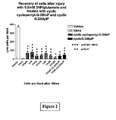
- FIG.1 The results of the study are shown in FIG.1 .
- Glutamate treatment (1 mM; filled bar) resulted in about an 85% loss of cerebellar neurons having neurites compared to vehicle-treated controls (open bar).
- cG-2AllylP significantly increased the numbers of cells having neurites in a dose-dependent manner when administered simultaneously with glutamate (shaded bars).
- Treatment with low doses of cG-2AllylP 100 pm to 10 nm showed a significant decrease in glutamate-induced neurotoxicity.
- Cyclic cyclopentyl-G-2MeP significantly increased the number of cells having neurites when simultaneously administered with glutamate (light shaded bars). Treatment with low doses of cyclic cyclopentyl-G-2MeP showed a significant decrease in glutamate-induced neurotoxicity.
- Both cG-2AllylP and cyclic cyclopentyl-G-2MeP independently decreased or prevented glutamate-induced neurotoxicity, indicating that both drugs are neuroprotective and can be used to inhibit neuronal degeneration or cell death.
- CABG cardiac arterial bypass graft surgery
- HI hypoxic-ischemic injury
- Rats in each group were simultaneously infused with cG-2AllylP or its vehicle under light anaesthesia (1.5% halothane) 2 hours after the insult.
- a total volume of 20 ⁇ l was infused (icv) over 20 minutes by a micro-infusion pump.
- Histological examination was performed on rats 5 days after the hypoxic-ischemic injury.
- the rats were killed with an overdose of sodium pentobarbital and were perfused transcardially with normal saline followed by 10% formalin.
- the brains were kept in the same fixative for a minimum of 2 days before being processed using a standard paraffin imbedding procedure.
- Coronal sections 8 ⁇ m in thickness were cut from the striatum, cerebral cortex and hippocampus and were stained with thionin and acid fuchsin. The histological outcome was assessed at three levels: (1) the mid level of the striatum, (2) where the completed hippocampus first appeared and (3) the level where the ventral horn of the hippocampus just appears.
- the severity of tissue damage was scored in the striatum, cortex and the CA1-2, CA3, CA4 and dentate gyrus of the hippocampus. Tissue damage was identified as neuronal loss (acidophilic (red) cytoplasm and contracted nuclei), pan-necrosis and cellular reactions. Tissue damage was scored using the following scoring system: 0: tissue showed no tissue damage, 1: ⁇ 5% tissue was damaged, 2: ⁇ 50% tissue was damaged, 3: >50% tissue was damaged and 4: >95% tissue was damaged.
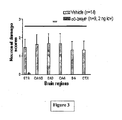
- FIG.3 shows that hypoxic-ischemic injury (left bars of each set) resulted in significant damage scores in each of the areas of the brain studied.
- FIG.3 also shows that central administration of a relatively low dose of cG-2AllylP (right bars of each set; 2 ng) significantly reduced the tissue damage in each brain region examined compared to the vehicle treated group (p ⁇ 0.001).
- cG-2AllylP can be neuroprotective against neural damage caused by hypoxic-ischemic injury, even when administered after hypoxic-ischemic injury. This surprising finding indicates that cG-2AllylP is a useful agent to treat a variety of conditions characterized by neural degeneration or cell death.
- FIG. 4 shows hypoxia alone (vehicle) produces neuronal damage scores in all areas of the brain studied.
- hypoxia had less effect, even though the agent was administered after the hypoxic/ischemic injury.
- the neuroprotective effect was observed for all doses of cG-2allylP, except for the highest dose (100 ng) administered to the striatum.
- cG-2allylP lessened the neural damage effects of hypoxia/ischemia.
- cG-2allylP had an increased efficacy in brain regions that experienced progressive injury associated with delayed cell death, such as that associated with apoptosis.
- cG-2allylP can be beneficial in treatment of chronic neurological disorders.
Landscapes
- Health & Medical Sciences (AREA)
- Chemical & Material Sciences (AREA)
- Organic Chemistry (AREA)
- General Health & Medical Sciences (AREA)
- Public Health (AREA)
- Veterinary Medicine (AREA)
- Medicinal Chemistry (AREA)
- Animal Behavior & Ethology (AREA)
- Life Sciences & Earth Sciences (AREA)
- Pharmacology & Pharmacy (AREA)
- Bioinformatics & Cheminformatics (AREA)
- Engineering & Computer Science (AREA)
- Nuclear Medicine, Radiotherapy & Molecular Imaging (AREA)
- Chemical Kinetics & Catalysis (AREA)
- General Chemical & Material Sciences (AREA)
- Neurology (AREA)
- Biomedical Technology (AREA)
- Neurosurgery (AREA)
- Pain & Pain Management (AREA)
- Psychology (AREA)
- Epidemiology (AREA)
- Heart & Thoracic Surgery (AREA)
- Cardiology (AREA)
- Psychiatry (AREA)
- Rheumatology (AREA)
- Urology & Nephrology (AREA)
- Hospice & Palliative Care (AREA)
- Pulmonology (AREA)
- Orthopedic Medicine & Surgery (AREA)
- Physical Education & Sports Medicine (AREA)
- Vascular Medicine (AREA)
- Pharmaceuticals Containing Other Organic And Inorganic Compounds (AREA)
- Medicines That Contain Protein Lipid Enzymes And Other Medicines (AREA)
- Nitrogen Condensed Heterocyclic Rings (AREA)
Claims (8)
- Composé de formule :

formule dans laquelleX1 est choisi dans le groupe constitué par NR', O et S ;X2 est choisi dans le groupe constitué par CH2, NR', O et S ;R1 est choisi dans le groupe constitué par -OR',-SR', -NR'R', -NO2, -CN, -C(O)R', -C(O)OR',-C(O)NR'R', -C(NR')NR'R', les halogènes, et les radicaux trihalogénométhyle, alkyle, alkyle substitué, hétéroalkyle, hétéroalkyle substitué, alcényle, alcényle substitué, alcynyle, alcynyle substitué, aryle, aryle substitué, hétéroaryle, hétéroaryle substitué, arylalkyle, arylalkyle substitué, hétéroarylalkyle et hétéroarylalkyle substitué ; chaque R' est indépendamment choisi dans le groupe constitué par -H et les radicaux alkyle, hétéroalkyle, alcényle, alcynyle, aryle, arylalkyle, hétéroaryle et hétéroarylalkyle ;R2, R3, R4 et R5 sont indépendamment choisis dans le groupe constitué par -H, -OR', -SR', -NR'R', -NO2, -CN, - C(O)R', -C(O)OR', -C(O)NR'R', -C(NR')NR'R', les halogènes, et les radicaux trihalogénométhyle, alkyle, alkyle substitué, hétéroalkyle, hétéroalkyle substitué, alcényle, alcényle substitué, alcynyle, alcynyle substitué, aryle, aryle substitué, hétéroaryle, hétéroaryle substitué, arylalkyle, arylalkyle substitué, hétéroarylalkyle et hétéroarylalkyle substitué ; chaque R' est indépendamment choisi dans le groupe constitué par -H et les radicaux alkyle, hétéroalkyle, alcényle, alcynyle, aryle, arylalkyle, hétéroaryle et hétéroarylalkyle ;ou bien R4 et R5, pris ensemble, forment -CH2-(CH2)n-CH2- où n est un entier de 0 à 6 ;ou bien R2 et R3, pris ensemble, forment -CH2-(CH2)n-CH2- où n est un entier de 0 à 6 ;sous réserve que, lorsque R1 = méthyle et R2 = R3 = R4 = H, alors R5 ≠ benzyle ;où l'alkyle substitué, hétéroalkyle substitué, alcényle substitué, alcynyle substitué, aryle substitué, hétéroaryle substitué ou arylalkyle substitué est un radical alkyle, hétéroalkyle, alcényle, alcynyle, aryle, hétéroaryle ou arylalkyle dont un ou plusieurs atomes d'hydrogène sont indépendamment remplacés par un autre substituants comprenant -R', -OR', -SR', -NR'R',-NO2, -CN, -C(O)R', -C(O)OR', -C(O)NR'R',-C(NR')NR'R', -NR'-C(NR')-OR', -NR'-C(NR')-SR', -NR'-C(NR')-NR'R', les halogènes et les radicaux trihalogénométhyle, où chaque R' est indépendamment -H ou un radical alkyle, hétéroalkyle, alcényle, alcynyle, aryle, arylalkyle, hétéroaryle et hétéroarylalkyle. - Composé selon la revendication 1, dans lequel R1 = méthyle ou allyle.
- Composé selon la revendication 1, dans lequel R2 =R3 = méthyle et X2 = S.
- Composé selon la revendication 1,
dans lequel R1 = allyle, R2 = R3 = R4 = R5 = H, X1 = NH et X2 = CH2 (G-2AllylP cyclique), ou
dans lequel R1 = méthyle, R2 = R3 = H, R4 et R5 pris ensemble forment -CH2-(CH2)3-CH2-, X1 = NH et X2 = CH2 (cyclohexyl-G2MeP cyclique) ; ou
dans lequel R1 = méthyle, R2 = R3 = H, R4 et R5 pris ensemble forment -CH2-(CH2)2-CH2-, X1 = NH et X2 = CH2 (cyclopentyl-G2MeP cyclique). - Composition pharmaceutique comprenant un composé tel que défini dans l'une quelconque des revendications précédentes et un excipient pharmaceutiquement acceptable.
- Un ou plusieurs composés tels que définis dans l'une quelconque des revendications 1 à 4 pour utilisation dans la protection de neurones sinon destinés à dégénérer ou à mourir en résultat d'une lésion ou d'une maladie.
- Le ou les composés pour utilisation selon la revendication 6, dans lesquels la maladie est caractérisée par une mort neuronale apoptotique, une mort de cellules neuronales nécrotique, une dégénérescence de cellules neuronales, ou dans lesquels la lésion a pour résultat une mort de cellules neuronales nécrotique, une mort de cellules neuronales apoptotique, ou une dégénérescence de cellules neuronales.
- Le ou les composés pour utilisation selon la revendication 6, dans lesquels ledit composé est choisi parmi le G-2AllylP cyclique, cyclohexyl-G-2MeP cyclique et le cyclopentyl-G2MeP cyclique.
Priority Applications (3)
| Application Number | Priority Date | Filing Date | Title |
|---|---|---|---|
| SI200432303T SI1664050T1 (sl) | 2003-09-03 | 2004-08-31 | Nevroprotektične biciklične spojine in farmacevtski sestavki, vsebujoči le-te |
| PL04782733T PL1664050T3 (pl) | 2003-09-03 | 2004-08-31 | Neuroprotekcyjne związki bicykliczne i zawierające je kompozycje farmaceutyczne |
| CY20161100157T CY1117211T1 (el) | 2003-09-03 | 2016-02-25 | Νευροπροστατευτικες δικυκλικες ενωσεις και φαρμακευτικες συνθεσεις που τις περιεχουν |
Applications Claiming Priority (2)
| Application Number | Priority Date | Filing Date | Title |
|---|---|---|---|
| US49995603P | 2003-09-03 | 2003-09-03 | |
| PCT/US2004/028308 WO2005023815A2 (fr) | 2003-09-03 | 2004-08-31 | Composes neuroprotecteurs bicycliques et procedes d'utilisation correspondants |
Publications (2)
| Publication Number | Publication Date |
|---|---|
| EP1664050A2 EP1664050A2 (fr) | 2006-06-07 |
| EP1664050B1 true EP1664050B1 (fr) | 2015-12-09 |
Family
ID=34272894
Family Applications (1)
| Application Number | Title | Priority Date | Filing Date |
|---|---|---|---|
| EP04782733.2A Expired - Lifetime EP1664050B1 (fr) | 2003-09-03 | 2004-08-31 | Composes neuroprotecteurs bicycliques et procedes d'utilisation correspondants |
Country Status (9)
| Country | Link |
|---|---|
| US (2) | US8067425B2 (fr) |
| EP (1) | EP1664050B1 (fr) |
| JP (1) | JP4842817B2 (fr) |
| DK (1) | DK1664050T3 (fr) |
| ES (1) | ES2564803T3 (fr) |
| HU (1) | HUE028528T2 (fr) |
| PL (1) | PL1664050T3 (fr) |
| SI (1) | SI1664050T1 (fr) |
| WO (1) | WO2005023815A2 (fr) |
Families Citing this family (27)
| Publication number | Priority date | Publication date | Assignee | Title |
|---|---|---|---|---|
| JP5048201B2 (ja) | 2000-08-04 | 2012-10-17 | ディーエムアイ バイオサイエンシズ インコーポレイテッド | ジケトピペラジン類の使用方法とジケトピペラジン類を含む組成物 |
| US7485630B2 (en) * | 2003-03-20 | 2009-02-03 | Neuren Pharmaceuticals Limited | Neuroprotective macrocyclic compounds and methods for their use |
| CN102210852B (zh) | 2003-05-15 | 2016-10-19 | 安皮奥制药股份有限公司 | T-细胞介导的疾病的治疗 |
| WO2008063311A2 (fr) * | 2006-10-11 | 2008-05-29 | Neuren Pharmaceuticals Limited | La proline glycyle-2-allyle cyclique améliore la performance cognitive chez les animaux déficients |
| US8519127B2 (en) * | 2003-09-03 | 2013-08-27 | Mike John Bickerdike | Cyclic glycyl-2-allyl proline and its use in treatment of peripheral neuropathy |
| US8791117B2 (en) | 2003-09-03 | 2014-07-29 | Neuren Pharmaceuticals Limited | Cyclic glycyl-2-allyl proline improves cognitive performance in impaired animals |
| JP5856843B2 (ja) * | 2008-05-27 | 2016-02-10 | アンピオ ファーマシューティカルズ,インコーポレイテッド | ジケトピペラジンを用いた医薬組成物 |
| US9891219B2 (en) * | 2008-10-10 | 2018-02-13 | Mayo Foundation For Medical Education And Research | Methods for treating neuromyelitis optica (NMO) by administration of eculizumab to an individual that is aquaporin-4 (AQP4)-IgG autoantibody positive |
| US7928233B2 (en) * | 2009-02-10 | 2011-04-19 | Hoffmann-La Roche Inc. | Spiroindolinone pyridine derivatives |
| EP2613786A4 (fr) | 2010-09-07 | 2013-10-23 | Dmi Acquisition Corp | Traitement de maladies |
| JP2014530063A (ja) | 2011-10-10 | 2014-11-17 | アンピオ ファーマシューティカルズ,インコーポレイテッド | 免疫寛容が高められた埋込み型医療用デバイス、ならびに製造方法および埋込み方法 |
| PH12014500685B1 (en) | 2011-10-10 | 2018-10-03 | Ampio Pharmaceuticals Inc | Treatment of degenerative joint disease |
| HK1198812A1 (en) | 2011-10-28 | 2015-06-12 | Ampio Pharmaceuticals, Inc. | Treatment of rhinitis |
| WO2014066435A1 (fr) * | 2012-10-22 | 2014-05-01 | City Of Hope | Dérivés d'étoposide |
| CA2906864A1 (fr) | 2013-03-15 | 2014-09-18 | Ampio Pharmaceuticals, Inc. | Compositions pour la mobilisation, l'ecotropisme, l'expansion et la differenciation de cellules souches et leurs methodes d'utilisation |
| SI3024463T1 (sl) | 2013-07-25 | 2020-08-31 | Neuren Pharmaceuticals Limited | Nevroprotektivne biciklične spojine in postopki za njihovo uporabo pri zdravljenju motenj avtističnega spektra in nevrorazvojnih motenj |
| EP4066836A1 (fr) | 2014-08-18 | 2022-10-05 | Ampio Pharmaceuticals, Inc. | Traitement de maladies articulaires |
| EP3310375A4 (fr) | 2015-06-22 | 2019-02-20 | Ampio Pharmaceuticals, Inc. | Utilisation de fractions d'albumine de sérum humain de bas poids moléculaire pour traiter les maladies |
| SG10201912843YA (en) | 2016-05-26 | 2020-02-27 | Amino Up Chemical Co Ltd | Sleep improving agent |
| CN109952104B (zh) | 2016-09-15 | 2023-03-28 | 希望之城 | 二硫etp衍生物 |
| CN119112885A (zh) | 2018-03-16 | 2024-12-13 | 脑科学香料株式会社 | 缺氧障碍、缺血再灌注障碍或炎症的预防或治疗剂,移植用细胞保护剂,及生物体防腐剂 |
| MA53500A (fr) | 2018-05-15 | 2021-08-18 | Lloyd Hung Loi Tran | Composition d'agent thérapeutique et procédé d'utilisation, pour le traitement d'un trouble cognitif léger, de la dépression et de troubles psychologiques |
| US12472177B2 (en) | 2019-10-22 | 2025-11-18 | Neuren Pharmaceuticals Limited | Bicyclic compounds and methods for their use in treating Pitt Hopkins syndrome |
| IL305132A (en) * | 2021-02-12 | 2023-10-01 | Neuren Pharmaceuticals Ltd | Preparations for the treatment of the Prader-Willi phenomenon |
| GEAP202416522A (en) * | 2021-10-22 | 2024-08-26 | Neuren Pharmaceuticals Ltd | Process for preparing bicyclic glycine-proline compounds and monocyclic glycine-proline intermediates thereof |
| JP2024545685A (ja) * | 2021-12-17 | 2024-12-10 | ザ シージーピー ラボ リミテッド | Cgpの動物、真菌及び海洋供給源、並びに疾患管理のための、並びに非神経学的及び/又は神経学的状態の治療のための増大したcgp濃度 |
| WO2025088052A1 (fr) * | 2023-10-26 | 2025-05-01 | Rousselot Bv | Analogue cyclique de glycine-proline destiné à être utilisé dans la prévention et/ou le traitement d'une fibrose associée à un implant médical |
Citations (1)
| Publication number | Priority date | Publication date | Assignee | Title |
|---|---|---|---|---|
| DE1620386A1 (de) * | 1965-07-07 | 1970-08-20 | Sandoz Ag | Neue heterocyclische Verbindungen und Verfahren zu deren Herstellung |
Family Cites Families (6)
| Publication number | Priority date | Publication date | Assignee | Title |
|---|---|---|---|---|
| FI941826L (fi) * | 1993-04-21 | 1994-10-22 | Takeda Chemical Industries Ltd | Menetelmät ja koostumukset elimen hypofunktion ennaltaehkäisemiseksi ja/tai terapeuttiseksi hoitamiseksi |
| US7202279B1 (en) | 1998-02-11 | 2007-04-10 | Georgetown University | Cyclic dipeptides and azetidinone compounds and their use in treating CNS injury and neurodegenerative disorders |
| AU2002340465A1 (en) * | 2001-11-09 | 2003-05-19 | Neuronz Biosciences, Inc. | Cyclo(prolyl-glycine) and methods of use to treat neural disorders |
| CA2466701C (fr) | 2001-11-13 | 2013-11-12 | Loi Tran | Utilisation de la prolyl-glycine cyclique a des fins de neuroprotection |
| US7232798B2 (en) * | 2001-11-13 | 2007-06-19 | Tran Loi H | Neuroprotection and neuroegenisis by administering cyclic prolyl glycine |
| US7485630B2 (en) * | 2003-03-20 | 2009-02-03 | Neuren Pharmaceuticals Limited | Neuroprotective macrocyclic compounds and methods for their use |
-
2004
- 2004-08-31 EP EP04782733.2A patent/EP1664050B1/fr not_active Expired - Lifetime
- 2004-08-31 HU HUE04782733A patent/HUE028528T2/en unknown
- 2004-08-31 US US10/570,395 patent/US8067425B2/en not_active Expired - Lifetime
- 2004-08-31 DK DK04782733.2T patent/DK1664050T3/en active
- 2004-08-31 JP JP2006525396A patent/JP4842817B2/ja not_active Expired - Lifetime
- 2004-08-31 WO PCT/US2004/028308 patent/WO2005023815A2/fr not_active Ceased
- 2004-08-31 ES ES04782733.2T patent/ES2564803T3/es not_active Expired - Lifetime
- 2004-08-31 SI SI200432303T patent/SI1664050T1/sl unknown
- 2004-08-31 PL PL04782733T patent/PL1664050T3/pl unknown
-
2006
- 2006-04-07 US US11/399,974 patent/US7776876B2/en active Active
Patent Citations (1)
| Publication number | Priority date | Publication date | Assignee | Title |
|---|---|---|---|---|
| DE1620386A1 (de) * | 1965-07-07 | 1970-08-20 | Sandoz Ag | Neue heterocyclische Verbindungen und Verfahren zu deren Herstellung |
Also Published As
| Publication number | Publication date |
|---|---|
| US8067425B2 (en) | 2011-11-29 |
| SI1664050T1 (sl) | 2016-04-29 |
| US20060258663A1 (en) | 2006-11-16 |
| WO2005023815A3 (fr) | 2005-07-21 |
| JP4842817B2 (ja) | 2011-12-21 |
| DK1664050T3 (en) | 2016-03-07 |
| ES2564803T3 (es) | 2016-03-29 |
| PL1664050T3 (pl) | 2016-08-31 |
| EP1664050A2 (fr) | 2006-06-07 |
| US7776876B2 (en) | 2010-08-17 |
| WO2005023815A2 (fr) | 2005-03-17 |
| US20070197511A1 (en) | 2007-08-23 |
| JP2007504235A (ja) | 2007-03-01 |
| HUE028528T2 (en) | 2016-12-28 |
Similar Documents
| Publication | Publication Date | Title |
|---|---|---|
| US8067425B2 (en) | Neuroprotective bicyclic compounds and methods for their use | |
| US8013170B2 (en) | Substituted pyrrolo[1,2-d][1,4]-diazonines and treatment of brain damage | |
| AU774681B2 (en) | Cyclic dipeptides and azetidinone compounds and their use in treating CNS injury and neurodegenerative disorders | |
| CN102159578B (zh) | 四氢咪唑并[1,5-a]吡嗪衍生物的盐,其制备方法及其在医药上的应用 | |
| US9119851B2 (en) | Cyclic Glycyl-2-Allyl Proline improves cognitive performance in impaired animals | |
| US7863304B2 (en) | Analogs of glycyl-prolyl-glutamate | |
| US8519127B2 (en) | Cyclic glycyl-2-allyl proline and its use in treatment of peripheral neuropathy | |
| EP1888618A2 (fr) | Analogues de glycyl-prolyl-glutamate | |
| WO2010102212A2 (fr) | Mimétiques de neurotrophine et leurs utilisations | |
| WO2008063311A2 (fr) | La proline glycyle-2-allyle cyclique améliore la performance cognitive chez les animaux déficients | |
| AU2020369431B2 (en) | Bicyclic compounds and methods for their use in treating Pitt Hopkins Syndrome | |
| US6747042B2 (en) | N-heterocyclic derivatives |
Legal Events
| Date | Code | Title | Description |
|---|---|---|---|
| PUAI | Public reference made under article 153(3) epc to a published international application that has entered the european phase |
Free format text: ORIGINAL CODE: 0009012 |
|
| 17P | Request for examination filed |
Effective date: 20060330 |
|
| AK | Designated contracting states |
Kind code of ref document: A2 Designated state(s): AT BE BG CH CY CZ DE DK EE ES FI FR GB GR HU IE IT LI LU MC NL PL PT RO SE SI SK TR |
|
| DAX | Request for extension of the european patent (deleted) | ||
| RAP1 | Party data changed (applicant data changed or rights of an application transferred) |
Owner name: NEUREN PHARMACEUTICALS LIMITED |
|
| 17Q | First examination report despatched |
Effective date: 20120217 |
|
| RAP1 | Party data changed (applicant data changed or rights of an application transferred) |
Owner name: NEUREN PHARMACEUTICALS LIMITED |
|
| RAP1 | Party data changed (applicant data changed or rights of an application transferred) |
Owner name: NEUREN PHARMACEUTICALS LIMITED |
|
| RAP1 | Party data changed (applicant data changed or rights of an application transferred) |
Owner name: NEUREN PHARMACEUTICALS LIMITED |
|
| GRAP | Despatch of communication of intention to grant a patent |
Free format text: ORIGINAL CODE: EPIDOSNIGR1 |
|
| INTG | Intention to grant announced |
Effective date: 20150721 |
|
| GRAS | Grant fee paid |
Free format text: ORIGINAL CODE: EPIDOSNIGR3 |
|
| GRAA | (expected) grant |
Free format text: ORIGINAL CODE: 0009210 |
|
| AK | Designated contracting states |
Kind code of ref document: B1 Designated state(s): AT BE BG CH CY CZ DE DK EE ES FI FR GB GR HU IE IT LI LU MC NL PL PT RO SE SI SK TR |
|
| REG | Reference to a national code |
Ref country code: GB Ref legal event code: FG4D |
|
| REG | Reference to a national code |
Ref country code: AT Ref legal event code: REF Ref document number: 764526 Country of ref document: AT Kind code of ref document: T Effective date: 20151215 Ref country code: CH Ref legal event code: EP |
|
| REG | Reference to a national code |
Ref country code: IE Ref legal event code: FG4D |
|
| REG | Reference to a national code |
Ref country code: DE Ref legal event code: R096 Ref document number: 602004048352 Country of ref document: DE |
|
| REG | Reference to a national code |
Ref country code: CH Ref legal event code: NV Representative=s name: MODIANO AND PARTNERS SA, CH |
|
| REG | Reference to a national code |
Ref country code: SE Ref legal event code: TRGR |
|
| REG | Reference to a national code |
Ref country code: NL Ref legal event code: FP |
|
| REG | Reference to a national code |
Ref country code: DK Ref legal event code: T3 Effective date: 20160304 |
|
| REG | Reference to a national code |
Ref country code: RO Ref legal event code: EPE |
|
| RAP2 | Party data changed (patent owner data changed or rights of a patent transferred) |
Owner name: NEUREN PHARMACEUTICALS LIMITED |
|
| REG | Reference to a national code |
Ref country code: ES Ref legal event code: FG2A Ref document number: 2564803 Country of ref document: ES Kind code of ref document: T3 Effective date: 20160329 |
|
| REG | Reference to a national code |
Ref country code: PT Ref legal event code: SC4A Free format text: AVAILABILITY OF NATIONAL TRANSLATION Effective date: 20160218 |
|
| REG | Reference to a national code |
Ref country code: EE Ref legal event code: FG4A Ref document number: E011636 Country of ref document: EE Effective date: 20160307 |
|
| REG | Reference to a national code |
Ref country code: CH Ref legal event code: PCOW Free format text: NEW ADDRESS: LOWNDES JORDAN, LEVEL 15 PWC TOWER 188 QUAY STREET, AUCKLAND 1141 (NZ) |
|
| REG | Reference to a national code |
Ref country code: GR Ref legal event code: EP Ref document number: 20160400368 Country of ref document: GR Effective date: 20160505 |
|
| REG | Reference to a national code |
Ref country code: SK Ref legal event code: T3 Ref document number: E 20625 Country of ref document: SK |
|
| REG | Reference to a national code |
Ref country code: FR Ref legal event code: PLFP Year of fee payment: 13 |
|
| REG | Reference to a national code |
Ref country code: DE Ref legal event code: R097 Ref document number: 602004048352 Country of ref document: DE |
|
| PLBE | No opposition filed within time limit |
Free format text: ORIGINAL CODE: 0009261 |
|
| STAA | Information on the status of an ep patent application or granted ep patent |
Free format text: STATUS: NO OPPOSITION FILED WITHIN TIME LIMIT |
|
| 26N | No opposition filed |
Effective date: 20160912 |
|
| REG | Reference to a national code |
Ref country code: HU Ref legal event code: AG4A Ref document number: E028528 Country of ref document: HU |
|
| REG | Reference to a national code |
Ref country code: FR Ref legal event code: PLFP Year of fee payment: 14 |
|
| REG | Reference to a national code |
Ref country code: SI Ref legal event code: SP73 Owner name: NEUREN PHARMACEUTICALS LIMITED; NZ Effective date: 20170925 |
|
| PG25 | Lapsed in a contracting state [announced via postgrant information from national office to epo] |
Ref country code: TR Free format text: LAPSE BECAUSE OF FAILURE TO SUBMIT A TRANSLATION OF THE DESCRIPTION OR TO PAY THE FEE WITHIN THE PRESCRIBED TIME-LIMIT Effective date: 20151209 |
|
| REG | Reference to a national code |
Ref country code: CH Ref legal event code: PCAR Free format text: NEW ADDRESS: VIA E. BOSSI 1, 6900 LUGANO (CH) |
|
| REG | Reference to a national code |
Ref country code: AT Ref legal event code: UEP Ref document number: 764526 Country of ref document: AT Kind code of ref document: T Effective date: 20151209 |
|
| REG | Reference to a national code |
Ref country code: FR Ref legal event code: PLFP Year of fee payment: 15 |
|
| REG | Reference to a national code |
Ref country code: DE Ref legal event code: R082 Ref document number: 602004048352 Country of ref document: DE Representative=s name: SCHIEBER - FARAGO PATENTANWAELTE, DE Ref country code: DE Ref legal event code: R082 Ref document number: 602004048352 Country of ref document: DE Representative=s name: FARAGO PATENTANWALTSGESELLSCHAFT MBH, DE |
|
| REG | Reference to a national code |
Ref country code: DE Ref legal event code: R082 Ref document number: 602004048352 Country of ref document: DE Representative=s name: SCHIEBER - FARAGO PATENTANWAELTE, DE |
|
| P01 | Opt-out of the competence of the unified patent court (upc) registered |
Effective date: 20230527 |
|
| PGFP | Annual fee paid to national office [announced via postgrant information from national office to epo] |
Ref country code: NL Payment date: 20230821 Year of fee payment: 20 Ref country code: LU Payment date: 20230821 Year of fee payment: 20 |
|
| PGFP | Annual fee paid to national office [announced via postgrant information from national office to epo] |
Ref country code: RO Payment date: 20230822 Year of fee payment: 20 Ref country code: MC Payment date: 20230823 Year of fee payment: 20 Ref country code: IT Payment date: 20230825 Year of fee payment: 20 Ref country code: IE Payment date: 20230822 Year of fee payment: 20 Ref country code: GB Payment date: 20230822 Year of fee payment: 20 Ref country code: FI Payment date: 20230821 Year of fee payment: 20 Ref country code: EE Payment date: 20230814 Year of fee payment: 20 Ref country code: CZ Payment date: 20230821 Year of fee payment: 20 Ref country code: CH Payment date: 20230902 Year of fee payment: 20 Ref country code: BG Payment date: 20230823 Year of fee payment: 20 Ref country code: AT Payment date: 20230822 Year of fee payment: 20 |
|
| PGFP | Annual fee paid to national office [announced via postgrant information from national office to epo] |
Ref country code: SK Payment date: 20230821 Year of fee payment: 20 Ref country code: SI Payment date: 20230817 Year of fee payment: 20 Ref country code: SE Payment date: 20230821 Year of fee payment: 20 Ref country code: PT Payment date: 20230817 Year of fee payment: 20 Ref country code: PL Payment date: 20230817 Year of fee payment: 20 Ref country code: HU Payment date: 20230823 Year of fee payment: 20 Ref country code: GR Payment date: 20230822 Year of fee payment: 20 Ref country code: FR Payment date: 20230822 Year of fee payment: 20 Ref country code: DK Payment date: 20230823 Year of fee payment: 20 Ref country code: DE Payment date: 20230821 Year of fee payment: 20 Ref country code: BE Payment date: 20230821 Year of fee payment: 20 |
|
| PGFP | Annual fee paid to national office [announced via postgrant information from national office to epo] |
Ref country code: ES Payment date: 20231027 Year of fee payment: 20 |
|
| PGFP | Annual fee paid to national office [announced via postgrant information from national office to epo] |
Ref country code: CY Payment date: 20230830 Year of fee payment: 20 |
|
| REG | Reference to a national code |
Ref country code: CH Ref legal event code: PL |
|
| REG | Reference to a national code |
Ref country code: DE Ref legal event code: R071 Ref document number: 602004048352 Country of ref document: DE |
|
| REG | Reference to a national code |
Ref country code: BE Ref legal event code: MK Effective date: 20240831 Ref country code: DK Ref legal event code: EUP Expiry date: 20240831 |
|
| REG | Reference to a national code |
Ref country code: NL Ref legal event code: MK Effective date: 20240830 |
|
| REG | Reference to a national code |
Ref country code: SK Ref legal event code: MK4A Ref document number: E 20625 Country of ref document: SK Expiry date: 20240831 |
|
| REG | Reference to a national code |
Ref country code: IE Ref legal event code: MK9A Ref country code: GB Ref legal event code: PE20 Expiry date: 20240830 |
|
| REG | Reference to a national code |
Ref country code: SE Ref legal event code: EUG |
|
| PG25 | Lapsed in a contracting state [announced via postgrant information from national office to epo] |
Ref country code: IE Free format text: LAPSE BECAUSE OF EXPIRATION OF PROTECTION Effective date: 20240831 |
|
| PG25 | Lapsed in a contracting state [announced via postgrant information from national office to epo] |
Ref country code: GB Free format text: LAPSE BECAUSE OF EXPIRATION OF PROTECTION Effective date: 20240830 Ref country code: PT Free format text: LAPSE BECAUSE OF EXPIRATION OF PROTECTION Effective date: 20240911 |
|
| REG | Reference to a national code |
Ref country code: AT Ref legal event code: MK07 Ref document number: 764526 Country of ref document: AT Kind code of ref document: T Effective date: 20240831 |
|
| PG25 | Lapsed in a contracting state [announced via postgrant information from national office to epo] |
Ref country code: CZ Free format text: LAPSE BECAUSE OF EXPIRATION OF PROTECTION Effective date: 20240831 |
|
| PG25 | Lapsed in a contracting state [announced via postgrant information from national office to epo] |
Ref country code: SI Free format text: LAPSE BECAUSE OF EXPIRATION OF PROTECTION Effective date: 20240901 Ref country code: SK Free format text: LAPSE BECAUSE OF EXPIRATION OF PROTECTION Effective date: 20240831 |
|
| PG25 | Lapsed in a contracting state [announced via postgrant information from national office to epo] |
Ref country code: SK Free format text: LAPSE BECAUSE OF EXPIRATION OF PROTECTION Effective date: 20240831 Ref country code: SI Free format text: LAPSE BECAUSE OF EXPIRATION OF PROTECTION Effective date: 20240901 Ref country code: PT Free format text: LAPSE BECAUSE OF EXPIRATION OF PROTECTION Effective date: 20240911 Ref country code: IE Free format text: LAPSE BECAUSE OF EXPIRATION OF PROTECTION Effective date: 20240831 Ref country code: GB Free format text: LAPSE BECAUSE OF EXPIRATION OF PROTECTION Effective date: 20240830 Ref country code: CZ Free format text: LAPSE BECAUSE OF EXPIRATION OF PROTECTION Effective date: 20240831 |
|
| REG | Reference to a national code |
Ref country code: ES Ref legal event code: FD2A Effective date: 20241205 |
|
| PG25 | Lapsed in a contracting state [announced via postgrant information from national office to epo] |
Ref country code: ES Free format text: LAPSE BECAUSE OF EXPIRATION OF PROTECTION Effective date: 20240901 |
|
| PG25 | Lapsed in a contracting state [announced via postgrant information from national office to epo] |
Ref country code: ES Free format text: LAPSE BECAUSE OF EXPIRATION OF PROTECTION Effective date: 20240901 |