EP1661880A1 - Verfahren zur herstellung von deuteriertem methacrylsäuremethylester - Google Patents
Verfahren zur herstellung von deuteriertem methacrylsäuremethylester Download PDFInfo
- Publication number
- EP1661880A1 EP1661880A1 EP04772872A EP04772872A EP1661880A1 EP 1661880 A1 EP1661880 A1 EP 1661880A1 EP 04772872 A EP04772872 A EP 04772872A EP 04772872 A EP04772872 A EP 04772872A EP 1661880 A1 EP1661880 A1 EP 1661880A1
- Authority
- EP
- European Patent Office
- Prior art keywords
- methanol
- deuterated
- mma
- prepare
- acid
- Prior art date
- Legal status (The legal status is an assumption and is not a legal conclusion. Google has not performed a legal analysis and makes no representation as to the accuracy of the status listed.)
- Withdrawn
Links
Images

Classifications
-
- C—CHEMISTRY; METALLURGY
- C07—ORGANIC CHEMISTRY
- C07B—GENERAL METHODS OF ORGANIC CHEMISTRY; APPARATUS THEREFOR
- C07B59/00—Introduction of isotopes of elements into organic compounds ; Labelled organic compounds per se
- C07B59/001—Acyclic or carbocyclic compounds
-
- C—CHEMISTRY; METALLURGY
- C07—ORGANIC CHEMISTRY
- C07C—ACYCLIC OR CARBOCYCLIC COMPOUNDS
- C07C67/00—Preparation of carboxylic acid esters
- C07C67/18—Preparation of carboxylic acid esters by conversion of a group containing nitrogen into an ester group
- C07C67/20—Preparation of carboxylic acid esters by conversion of a group containing nitrogen into an ester group from amides or lactams
-
- C—CHEMISTRY; METALLURGY
- C07—ORGANIC CHEMISTRY
- C07B—GENERAL METHODS OF ORGANIC CHEMISTRY; APPARATUS THEREFOR
- C07B2200/00—Indexing scheme relating to specific properties of organic compounds
- C07B2200/05—Isotopically modified compounds, e.g. labelled
Definitions
- MMA-d 8 is a long-awaited compound as a raw material for plastic optical fibers and optical waveguide materials having low transmission loss.
- MMA-d 8 which is a raw material of deuterated PMMA, may be prepared by applying the acetone cyanohydrin method (ACH method), generally.
- ACH method acetone cyanohydrin method
- methylmethacrylate-d 8 is prepared by synthesizing deuterated acetone cyanohydrin from acetone-d 6 and hydrocyanic acid or deuterated hydrocyanic acid, reacting with sulfuric acid or deuterated sulfuric acid, and esterifying of methanol-d 4 or methanol-d 3 , hereinafter referred to as CD 3 OH, the methyl group of which is fully deuterated (see documents 1 and 2).
- Acetone-d 6 as a raw material is prepared by reacting acetone and deuterated water under the presence of potassium carbonate or reacting acetone and deuterated water under the presence of sulfuric acid.
- deuterated methanol and methanol-d 4 are prepared by reacting deuterium and carbon monoxide in the same way methanol method is normally synthesized.
- CD 3 OH is produced by bringing methanol-d 4 into contact with a large quantity of water is nor, for example, refer documents 3 and 4.
- a purpose of the present invention is to provide an industrially available manufacturing method for producing highly-pure MMA-d 8 with good efficiency using acetone-d 6 and methanol-d 4 both which are fully deuterated of hydrogens in molecules and are economic and easy-obtainable as a synthetic raw material while recovering and using a compound including expensive deuterium atoms being by-produced in a reaction process while keeping both a chemical purity and a deuteration rate which is useful as a plastic raw material for plastic optical fibers, though using a recovered compound.
- the present inventors keenly examined a method for producing MMA-d 8 while effectively circulating expensive deuterium atoms to solve the above problems and found a method for producing MMA-d 8 from acetone-d 6 and methanol-d 4 as starting materials, preparing CD 3 OH from methanol-d 4 , preparing MMA-d 8 from acetone cyanohydrin-d 6 produced by the obtained CD 3 OH and acetone-d 6 while reutilizing a deuterium-containing compound which are recovered in producing CD 3 OH from methanol-d 3 as a part of raw materials for producing methanol-d 4 or acetone-d 6 , thus completing the present invention.
- the present method relates to the excellent use efficiency of deuterium atoms method for producing MMA-d 8 showing from following (1) to (10).
- MMA-d 8 as a raw material for plastic optical fibers and optical waveguide materials having low transmission loss from acetone-d 6 and methanol-d 4 as starting materials while circulating expensive deuterium atoms being by-produced in a reaction process and this have great significance industrially.
- methanol-d 4 is made to be CD 3 OH. This process is shown as formula (v) in Fig. 1. As this process, the methods from following (1) to (3) are exemplified. Meanwhile, methanol-d 4 which is produced from carbon monoxide and deuterium atom generally, as shown in formula (i) in Fig.1 and which is deuterated at 99.8% or more deuteration ratio is easily available.
- CD 3 OH is prepared from methanol-d 4 and water.
- Water including deuterium atom is recovered since it is by-produced at that time.
- the recovered water including deuterium atom can be provided as a raw material for producing deuterated water.
- Acetone-d 6 can be prepared by reflux with the obtained deuterated water with acetone under a basic condition.
- methanol-d 4 can be produced by deuterium as a raw material which is prepared by electrolysis of deuterated water.
- CD 3 OH when preparing CD 3 OH from water and methanol-d 4 , a large quantity of water is needed since deuterium concentration depends on the equilibrium of H-D in the system and the concentration of deuterium atom in water becomes low, however, CD 3 OH can be recovered with the original isotope enrichment.
- methyl-d 3 -ester and deuterated water is prepared by reacting the acid compound and methanol-d 4 .
- gas phase reaction which has advantage on the equilibrium for ester formation especially, it makes possible to increase the deuterium concentration in water.
- CD 3 OH and the acid are prepared from obtained methyl-d 3 -ester and normal water and the recovered acid is reacted with methanol-d 4 again, thereby CD 3 OH is prepared effectively from water and methanol-d 4 catalyzed by the acid.
- the acid in this method normal organic carboxylic acids such as formic acid, acetic acid, propionic acid, isobutyric acid, and butyric acid; phosphoric acid and sulfuric acid or the like may be used.
- the reaction is operated under reflux condition; however, it may be operated under pressurized condition to promote the esterification reaction by increasing the reflux temperature.
- water as the reaction accelerator may be used. 0.0001-3 times mol of the water supplementation amount to deuterated sulfuric acid salt of methacrylic acid amide is preferable.
- acetone cyanohydrin-d 6 is synthesized from acetone-d 6 and normal non-deuterated hydrocyanic acid. This reaction is shown as formula (ii) in Fig.
- reaction is equilibrium reaction adding hydrocyanic acid to carbonyl group described in Kirk-Othmer, Encyclopedia of Chemical Technology Third Edition, vol.7, P385-P396.
- Lower reaction temperature is preferable since the equilibrium is lean to cyanohydrin side at low temperature and the isotope exchange is prevented.
- the reaction temperature is preferable from -20 to 30 °C. In case that the reaction temperature is lower than -20 °C, reaction rate would not be sufficient and hydrocyanic acid could solidify then such temperature is not preferable. In case that the reaction temperature is 30°C or more, the reaction would have disadvantage in the view of equilibration and it could be easy to color due to the polymerization of hydrocyanic acid then such temperature is not preferable.
- hydrocyanic acid is supplied gradually into acetone-d 6 added by catalyst in advance. From this operation, increase of the hydrocyanic acid concentration in the reaction mixture can be suppressed, thereby it is possible to suppress the isotope exchange occurred during the reaction.
- This method is preferable since the reaction temperature can be kept stable and the isotope exchange or the polymerization of hydrocyanic acid can be suppressed due to the control of the drastic exothermic heat.
- the reaction pressure may be any one of reduced pressure, ordinary pressure, and increased pressure.
- the catalyst may be generally, ammonia, amines such as trimethylamine, triethylamine, diethylamine; alkali metal compounds such as sodium hydroxide, potassium hydroxide, sodium cyanide, potassium cyanide, sodium carbonate, potassium carbonate; alkali earth metal compounds such as calcium hydroxide, basic ion-exchange resins, and basic compounds such as zeolite. Amines and alkali metal compounds are preferable in terms of easy handling and reaction rate. Minimum catalyst supplementation amount which progress the reaction is preferable and 0.00001-1 weight % is preferable.
- the generated acetone cyanohydrin-d 6 is unstable and stabilized by adding the acid such as sulfuric acid.
- sulfuric acid for example, inexpensive normal non-deuterated sulfuric acid may be used.
- Unreacted constituent may or may not be distilled off, however, the following reactions after this has advantage by distilling off.
- the unreacted constituent is distilled off, it is preferable to distill at 40 °C or less under reduced pressure in order to suppress the degradation of cyanohydrin.
- CD 3 OH, or CD 3 OH including water is supplied to the obtained deuterated sulfuric acid salt of methacrylic acid amide thereby MMA-d 8 is obtained.
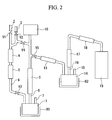
- This device comprises: a catalyst column synthesizing CD 3 OD; each feed pipe introducing CO and D 2 into this catalyst column; a reactor (I) which have a inlet for metal and water and synthesize CD 3 OH from CD 3 OD; a CD 3 OD feed pipe introducing CD 3 OD synthesized in the above catalyst column into the above reactor (I); a reservoir storing the D 2 generated from the above reactor (I); a channel sending D 2 generated from the reactor (I) to the reservoir; a D 2 circulation pipe sending D 2 of the reservoir to the above catalyst column; a MMA-d 8 reactor having a inlet of methacrylic acid amide or the synthetic raw material thereof; a CD 3 OH transport pipe sending CD 3 OH generated in the reactor (I) to a reactor (II).
- the above reactor (I) preferably includes a heater. From this, the generated liquid CD 3 OH would vaporize and be sent to the reactor (II).
- the above reactor (II) preferably includes a heater. From this, the generated liquid MMA-d 8 would be sent outside of the reactor (II), for example, to a MMA-d 8 product tank.
- the above CD 3 OD feed pipe preferably includes a cooling system along the path. From this, liquid CD 3 OD would be introduced into the reactor (I).
- the CD 3 OH transport pipe sending CD 3 OH generated in the above reactor (I) to the reactor (II) preferably includes a rectification device (II) along the path. From this, CD 3 OH of high purity would be sent to the reactor (II).
- the above rectification device (I) and (II) may be united partially. In that case, the device becomes simple and cost-effective.
- the CD 3 OH transport pipe sending CD 3 OH generated in the above reactor (I) to the reactor (II) preferably includes a cooling system along the path. From this, CD 3 OH would be condensed and introduced into the reactor (II).
- sulfuric acid salt of methacrylic acid amide might be synthesized.
- the inlet of the above sulfuric acid salt of methacrylic acid amide may be the inlet of the synthetic raw materials thereof, for example, sulfuric acid, acetone cyanohydrin-d 6 or the like.
- FIG. 1 represents a CD 3 OH synthetic reactor (I); 2 represents a CO introduction pipe introducing CO to a catalyst column; 3 represents a D 2 introduction pipe introducing D 2 to a catalyst column; 4 represents a catalyst column filled with catalyst which synthesize CD 3 OD from CO and D 2 ; 5 represents a cooling system of gas CD 3 OD coming over the catalyst column; 6 represents a CD 3 OD introduction pipe introducing the above CD 3 OD to the reactor (I); 7 represents a feed port of metal and water feeding metal and water into the reactor (I) in order to transform from CD 3 OD to CD 3 OH in this reactor; 8 represents a rectification column refining D 2 and CD 3 OH generated in the reactor (I); 10 represents a D 2 reservoir; 11 represents a circulation pipe sending D 2 from the D 2 reservoir to the catalyst column; 12 represents a CD 3 OH transport pipe; 13 represents a CD 3 OH condenser tube; 14 represents a MMA
- the deuteration rate is measured by the 1H-NMR internal reference method and the definition follows as shown below.
- ( 1 ) Deuteration rate ( % ) [ 1 - ⁇ ( the number of hydrogen atoms in generated deuterated methylmethacrylate ) / ( the number of hydrogen atoms in generated deuterated methylmethacrylate + the number of deuterium atoms ) ⁇ ] ⁇ 100
Landscapes
- Chemical & Material Sciences (AREA)
- Organic Chemistry (AREA)
- Organic Low-Molecular-Weight Compounds And Preparation Thereof (AREA)
- Low-Molecular Organic Synthesis Reactions Using Catalysts (AREA)
Applications Claiming Priority (2)
| Application Number | Priority Date | Filing Date | Title |
|---|---|---|---|
| JP2003312743A JP2005082487A (ja) | 2003-09-04 | 2003-09-04 | 重水素化メタクリル酸メチルの製造方法 |
| PCT/JP2004/013000 WO2005023748A1 (ja) | 2003-09-04 | 2004-09-01 | 重水素化メタクリル酸メチルの製造方法 |
Publications (2)
| Publication Number | Publication Date |
|---|---|
| EP1661880A1 true EP1661880A1 (de) | 2006-05-31 |
| EP1661880A4 EP1661880A4 (de) | 2006-12-13 |
Family
ID=34269748
Family Applications (1)
| Application Number | Title | Priority Date | Filing Date |
|---|---|---|---|
| EP04772872A Withdrawn EP1661880A4 (de) | 2003-09-04 | 2004-09-01 | Verfahren zur herstellung von deuteriertem methacrylsäuremethylester |
Country Status (4)
| Country | Link |
|---|---|
| US (1) | US7375247B2 (de) |
| EP (1) | EP1661880A4 (de) |
| JP (1) | JP2005082487A (de) |
| WO (1) | WO2005023748A1 (de) |
Cited By (2)
| Publication number | Priority date | Publication date | Assignee | Title |
|---|---|---|---|---|
| WO2008011033A3 (en) * | 2006-07-11 | 2008-06-26 | Spectra Gases Inc | Synthesis of isotopically labeled alpha-keto acids and esters |
| CN106542982A (zh) * | 2016-10-31 | 2017-03-29 | 上海化工研究院 | 一种稳定同位素氘标记丙酮的制备方法 |
Families Citing this family (2)
| Publication number | Priority date | Publication date | Assignee | Title |
|---|---|---|---|---|
| KR101306150B1 (ko) * | 2005-10-24 | 2013-09-10 | 삼성전자주식회사 | 탑 코팅 막용 고분자, 탑 코팅 용액 조성물 및 이를 이용한 이머젼 리소그라피 공정 |
| CN115010566A (zh) * | 2022-07-05 | 2022-09-06 | 宁波萃英化学技术有限公司 | 一种利用塔设备生产氘代化合物的方法 |
Family Cites Families (6)
| Publication number | Priority date | Publication date | Assignee | Title |
|---|---|---|---|---|
| US4138194A (en) * | 1977-10-14 | 1979-02-06 | E. I. Du Pont De Nemours And Company | Low attenuation optical fiber of deuterated polymer |
| US4421865A (en) * | 1981-06-08 | 1983-12-20 | Standard Oil Company (Sohio) | Selective hydrogen-deuterium interchange using ion exchange resins |
| JPS6117592A (ja) | 1984-04-14 | 1986-01-25 | メルク・パテント・ゲゼルシヤフト・ミツト・ベシユレンクテル・ハフツング | 過ジユウテリウム化されたメタアクリレ−トの製造方法 |
| JP4246447B2 (ja) * | 2002-06-11 | 2009-04-02 | 三菱瓦斯化学株式会社 | 重水素化メタクリル酸メチルの製造方法 |
| JP4184714B2 (ja) * | 2002-06-11 | 2008-11-19 | 三菱瓦斯化学株式会社 | 重水素化メタクリル酸メチルの製造方法 |
| JP2004010593A (ja) * | 2002-06-11 | 2004-01-15 | Mitsubishi Gas Chem Co Inc | 重水素化アセトンシアンヒドリンの製造方法及び重水素化メタクリル酸メチルの製造方法 |
-
2003
- 2003-09-04 JP JP2003312743A patent/JP2005082487A/ja active Pending
-
2004
- 2004-09-01 WO PCT/JP2004/013000 patent/WO2005023748A1/ja not_active Ceased
- 2004-09-01 EP EP04772872A patent/EP1661880A4/de not_active Withdrawn
- 2004-09-01 US US10/569,643 patent/US7375247B2/en not_active Expired - Fee Related
Non-Patent Citations (4)
| Title |
|---|
| AIDA, TAKUZO ET AL: "Living polymerization of methacrylic esters with aluminum porphyrin initiators. Axial ligand exchange activities of alkyl- and enolate-aluminum porphyrins in relation to the polymerization mechanism" JOURNAL OF PHYSICAL ORGANIC CHEMISTRY , 8(4), 249-57 CODEN: JPOCEE; ISSN: 0894-3230, 1995, XP008070281 * |
| BEERSMANS, J. ET AL: "Synthesis and study of the deuteromethanols" BULLETIN DES SOCIETES CHIMIQUES BELGES , 56, 72-91 CODEN: BSCBAG; ISSN: 0037-9646, 1947, XP002404931 * |
| NAGAI, HIROSHI ET AL: "Infrared spectra of deuterated poly(methyl methacrylates)" JOURNAL OF POLYMER SCIENCE , 62(174), S95-S98 CODEN: JPSCAU; ISSN: 0022-3832, 1962, XP008070279 * |
| See also references of WO2005023748A1 * |
Cited By (3)
| Publication number | Priority date | Publication date | Assignee | Title |
|---|---|---|---|---|
| WO2008011033A3 (en) * | 2006-07-11 | 2008-06-26 | Spectra Gases Inc | Synthesis of isotopically labeled alpha-keto acids and esters |
| US7754913B2 (en) | 2006-07-11 | 2010-07-13 | Cambridge Isotope Laboratories, Inc. | Synthesis of isotopically labeled alpha-keto acids and esters |
| CN106542982A (zh) * | 2016-10-31 | 2017-03-29 | 上海化工研究院 | 一种稳定同位素氘标记丙酮的制备方法 |
Also Published As
| Publication number | Publication date |
|---|---|
| US20070043242A1 (en) | 2007-02-22 |
| JP2005082487A (ja) | 2005-03-31 |
| EP1661880A4 (de) | 2006-12-13 |
| WO2005023748A1 (ja) | 2005-03-17 |
| US7375247B2 (en) | 2008-05-20 |
Similar Documents
| Publication | Publication Date | Title |
|---|---|---|
| US6967258B2 (en) | Production of quaternary ammonium salt of hydroxycarboxylic acid and quaternary ammonium salt of inorganic acid | |
| CN109678692A (zh) | 甲基丙烯酸的制备方法 | |
| CN103553953A (zh) | α β不饱和羧酸-N,N二取代酰胺以及3-烷氧基羧酸-N,N二取代酰胺的制造方法 | |
| US7375247B2 (en) | Method for producing deuterated methyl methacrylate | |
| CN106946704B (zh) | 一种多取代稠合芳烃类衍生物及其制备方法 | |
| US5221768A (en) | Process for the production of deuterated acid or deuterated methacrylic acid | |
| JPH06298701A (ja) | 蟻酸メチルの製法 | |
| JPH0952864A (ja) | アクリル酸第三級アルキルエステルの製造方法 | |
| JP2005200363A (ja) | 重水素化ノルボルネオール及び/又は重水素化ジノルボルニルエーテルの製造方法及び重水素化不飽和カルボン酸ノルボルニルの製造方法。 | |
| JPH0920719A (ja) | イソボルニル(メタ)アクリレートの合成方法 | |
| CN114105796B (zh) | 一种稳定性同位素氘标记异亮氨酸的合成方法 | |
| JP2926375B2 (ja) | ヒドロキシカルボン酸エステルの製造法 | |
| JP2007055953A (ja) | 重水素化シアノヒドリン化合物の製造方法 | |
| JPH08157447A (ja) | 2−ヒドロキシメチルメルカプト酪酸の製造方法 | |
| JP4184714B2 (ja) | 重水素化メタクリル酸メチルの製造方法 | |
| JP4246447B2 (ja) | 重水素化メタクリル酸メチルの製造方法 | |
| JPH01139559A (ja) | 4−クロロ−3−ヒドロキシブチロニトリルの製造方法 | |
| JP2709650B2 (ja) | β―メルカプトプロピオン酸の製造法 | |
| JPH09263576A (ja) | β−メルカプトプロピオン酸の製造方法 | |
| JP2004010593A (ja) | 重水素化アセトンシアンヒドリンの製造方法及び重水素化メタクリル酸メチルの製造方法 | |
| JP3624478B2 (ja) | ポリフルオロアルキルエステル化合物の製造方法 | |
| CN107417531B (zh) | 一种2-羟甲基丙烯酸甲酯及类似物的放大合成工艺 | |
| JPH02172969A (ja) | ジチオールジ(メタ)アクリレートの製造法 | |
| JPS6348257B2 (de) | ||
| JPH0940633A (ja) | p−2−ハロエチルベンゼンスルホン酸の製造方法 |
Legal Events
| Date | Code | Title | Description |
|---|---|---|---|
| PUAI | Public reference made under article 153(3) epc to a published international application that has entered the european phase |
Free format text: ORIGINAL CODE: 0009012 |
|
| 17P | Request for examination filed |
Effective date: 20060308 |
|
| AK | Designated contracting states |
Kind code of ref document: A1 Designated state(s): DE FR GB |
|
| RIN1 | Information on inventor provided before grant (corrected) |
Inventor name: ABE, TAKAFUMIC/O MITSUBISHI GAS CHEMICAL CO., Inventor name: ABE, TOSHIFUMIC/O TAIYO NIPPON SANSO CORPORATION Inventor name: SUGANO, YUICHIC/O MITSUBISHI GAS CHEMICAL CO., |
|
| A4 | Supplementary search report drawn up and despatched |
Effective date: 20061114 |
|
| DAX | Request for extension of the european patent (deleted) | ||
| RBV | Designated contracting states (corrected) |
Designated state(s): DE FR GB |
|
| STAA | Information on the status of an ep patent application or granted ep patent |
Free format text: STATUS: THE APPLICATION HAS BEEN WITHDRAWN |
|
| 18W | Application withdrawn |
Effective date: 20100708 |