EP1655734A2 - Informationsspeichermedium, Aufzeichungs- und Wiedergabegerät, Aufzeichungs- und Wiedergabeverfahren, und Host zu dessen Verwendung - Google Patents
Informationsspeichermedium, Aufzeichungs- und Wiedergabegerät, Aufzeichungs- und Wiedergabeverfahren, und Host zu dessen Verwendung Download PDFInfo
- Publication number
- EP1655734A2 EP1655734A2 EP05256706A EP05256706A EP1655734A2 EP 1655734 A2 EP1655734 A2 EP 1655734A2 EP 05256706 A EP05256706 A EP 05256706A EP 05256706 A EP05256706 A EP 05256706A EP 1655734 A2 EP1655734 A2 EP 1655734A2
- Authority
- EP
- European Patent Office
- Prior art keywords
- zone
- data
- information
- command
- priority
- Prior art date
- Legal status (The legal status is an assumption and is not a legal conclusion. Google has not performed a legal analysis and makes no representation as to the accuracy of the status listed.)
- Withdrawn
Links
Images





Classifications
-
- G—PHYSICS
- G11—INFORMATION STORAGE
- G11B—INFORMATION STORAGE BASED ON RELATIVE MOVEMENT BETWEEN RECORD CARRIER AND TRANSDUCER
- G11B7/00—Recording or reproducing by optical means, e.g. recording using a thermal beam of optical radiation by modifying optical properties or the physical structure, reproducing using an optical beam at lower power by sensing optical properties; Record carriers therefor
- G11B7/007—Arrangement of the information on the record carrier, e.g. form of tracks, actual track shape, e.g. wobbled, or cross-section, e.g. v-shaped; Sequential information structures, e.g. sectoring or header formats within a track
-
- G—PHYSICS
- G11—INFORMATION STORAGE
- G11B—INFORMATION STORAGE BASED ON RELATIVE MOVEMENT BETWEEN RECORD CARRIER AND TRANSDUCER
- G11B20/00—Signal processing not specific to the method of recording or reproducing; Circuits therefor
- G11B20/10—Digital recording or reproducing
- G11B20/18—Error detection or correction; Testing, e.g. of drop-outs
- G11B20/1883—Methods for assignment of alternate areas for defective areas
-
- G—PHYSICS
- G11—INFORMATION STORAGE
- G11B—INFORMATION STORAGE BASED ON RELATIVE MOVEMENT BETWEEN RECORD CARRIER AND TRANSDUCER
- G11B20/00—Signal processing not specific to the method of recording or reproducing; Circuits therefor
- G11B20/10—Digital recording or reproducing
- G11B2020/10898—Overwriting or replacing recorded data
- G11B2020/10907—Overwriting or replacing recorded data using pseudo-overwriting, i.e. virtually or logically overwriting data on WORM media by remapping recorded blocks to alternate areas
-
- G—PHYSICS
- G11—INFORMATION STORAGE
- G11B—INFORMATION STORAGE BASED ON RELATIVE MOVEMENT BETWEEN RECORD CARRIER AND TRANSDUCER
- G11B20/00—Signal processing not specific to the method of recording or reproducing; Circuits therefor
- G11B20/10—Digital recording or reproducing
- G11B20/18—Error detection or correction; Testing, e.g. of drop-outs
- G11B2020/1873—Temporary defect structures for write-once discs, e.g. TDDS, TDMA or TDFL
-
- G—PHYSICS
- G11—INFORMATION STORAGE
- G11B—INFORMATION STORAGE BASED ON RELATIVE MOVEMENT BETWEEN RECORD CARRIER AND TRANSDUCER
- G11B2220/00—Record carriers by type
- G11B2220/20—Disc-shaped record carriers
Definitions
- the present invention relates in general to an information storage medium for supporting defect management of a user data area, a recording/reproducing apparatus using the same, a recording/reproducing method using the same, and a host using the same.
- a spare area is in general prepared in a portion of a data area.
- a defect is detected while user data is being recorded in a user data area (an area obtained by excluding the spare area from the data area) or while data recorded in the user data area is being reproduced, replacement data for replacing the defect data is recorded in the spare area.
- LOW is a method by which write-once information storage media can be used similarly to the rewritable information storage media. That is, to update data already recorded in a user data area, data for replacing recorded data is recorded in a spare area by considering the recorded data to be defect data. This makes data management easy since a host refers to only the logical address when accessing data and data in the user data area is overwritten at the same location by fixing a logical address of the data recorded in the user data area and assigning a physical address corresponding to the logical address to data recorded in the spare area.
- a sequential recording mode in which the user data area is divided into one or a plurality of areas such as R-zones in a DVD or tracks in a CD and continuously used, data is recorded in each divided area by a command from the host.
- This host can efficiently manage the user data area of the disc by dividing the user data area into a plurality of small areas and discriminating some small areas for recording file system data from the other small areas for recording general user data.
- a drive system can record data for replacement in each of the small areas too.
- the drive system cannot recognize whether data recorded in each small area is general user data or file system data for managing the general user data, the drive system can perform data replacement in an unrecorded area of the recordable small areas of the user data area of the disc.
- arrangement of data recorded in a logical volume space managed by the host is somewhat different from data arrangement of a physical volume space recorded on the disc, it is difficult to manage the user data area of the disc according to the host command, thereby decreasing data recording/reproducing efficiency.
- a file system records important information such as a specific application or metadata in a specific area.
- the metadata is comprised of a metadata file, a metadata mirror file, and a metadata bitmap file.
- the metadata mirror file is a file in which contents of the metadata file are duplicatedly recorded to guarantee reliability of data included in the metadata file. It is required that the metadata file and the metadata mirror file be physically deployed as far as possible from each other. By doing this, even if a portion of the metadata is damaged by a defect, the metadata can be recovered using the metadata mirror file.
- the small areas of the user data area are R-zones similar to the R-zones in a DVD or to the tracks in a CD.
- the file system reserves the last area of an information storage medium as an area of the metadata mirror file, records the metadata file whenever the contents of the metadata are modified, and records the metadata mirror file.
- the file system reserves an R-zone and assigns 0 to a space bitmap to indicate that the R-zone is allocated. However, since the R-zone is physically not recorded yet, information on recording of each block is stored in the metadata bitmap file.
- One bit of the metadata bitmap file indicates whether one block of the metadata is used, 1 indicating an available space and 0 indicating an already occupied space.
- the metadata file and the metadata mirror file are stored in the file system as if they are recorded. However, before the metadata file is recorded, though its logical space is reserved, its physical space remains in an unrecorded state in the R-zone.
- Figure 1 is a disc area arrangement plan for illustrating a method of using a disc by dividing an area of the disc into a plurality of R-zones according to the prior art.
- the disc includes an R-zone #1 to record general data and R-zones #0 and #2 to record specific data of a host.
- a bitmap indicates whether data is recorded in predetermined unit blocks belonging to each R-zone. If data is recorded in each unit block, its bitmap is set to "1," and if data is not recorded in each unit block, its bitmap is set to "0.” In this manner, if recording of the R-zone #0 is finished as shown in Figure 1, the R-zone #0 is in a closed state.
- a command used to reserve an R-zone is a reservation track command and a command used to obtain information on a state of an R-zone is a read track information command.
- the reservation track command uses the size of an R-zone to be reserved as an input parameter. With this command, a plurality of R-zones can be reserved, and the host can record data in those R-zones as desired. However, if already recorded data is updated without changing its logical address as in the case of a rewritable information storage medium, there is no method by which both the host and the drive system can guarantee which R-zone the updated data is recorded in.
- LOW logical overwrite
- an information storage medium in which replacement information is managed for data replacement due to a defect of recorded data or data replacement by logical overwrite (LOW) due to updating of data, a data area of the medium is constructed of more than one R-zone, and a priority attribute is granted to each R-zone so that data to be recorded in the medium can be recorded in each R-zone based on a priority of the data.
- LOW logical overwrite
- a new R-zone may be allocated to the medium according to the priority attribute granted to each R-zone.
- the priority attribute of each R-zone may be granted by a host command of reserving an R-zone, the command including priority flag information.
- a recording/reproducing apparatus including a write/read unit recording/reading data on/from an information storage medium in which replacement information is managed for data replacement due to a defect of recorded data or data replacement by logical overwrite (LOW) due to updating of data; and a controller assigning a data area of the medium with more than one R-zone and granting a priority attribute to each R-zone so that data to be recorded in the medium can be recorded in each R-zone based on a priority of the data.
- LOW logical overwrite
- the controller may allocate a new R-zone to the medium according to the priority attribute granted to each R-zone.
- the controller may grant the priority attribute to each R-zone according to an instruction of a host command for reserving an R-zone, the command including priority flag information.
- the controller may provide requested R-zone state information and priority attribute information of the R-zone to the host in response to a command from the host requesting information on the R-zone.
- a host including a controller granting a priority attribute to each of a plurality of R-zones forming a data area on an information storage medium in which replacement information is managed for data replacement due to a defect of recorded data or data replacement by logical overwrite (LOW) due to updating of data so that data to be recorded in the medium can be recorded in each R-zone based on a priority of the data.
- LOW logical overwrite
- the controller may transmit a command requesting a reservation of an R-zone, the command including priority flag information, to a recording/reproducing apparatus using the medium.
- the controller may transmit a command requesting information of an R-zone to the recording/reproducing apparatus using the medium and receive the requested R-zone state information and priority attribute information of the R-zone from the recording/reproducing apparatus.
- a recording/reproducing method including recording/reading data on/from an information storage medium in which replacement information is managed for data replacement due to a defect of recorded data or data replacement by logical overwrite (LOW) due to updating of data; and forming a data area on the medium with more than one R-zone and granting a priority attribute to each R-zone so that data to be recorded in the medium can be recorded in each R-zone based on a priority of the data.
- LOW logical overwrite
- a recording/reproducing method including granting a priority attribute to each of a plurality of R-zones forming a data area of an information storage medium in which replacement information is managed for data replacement due to a defect of recorded data or data replacement by logical overwrite (LOW) due to updating of data so that data to be recorded in the medium can be recorded in each R-zone based on a priority of the data.
- LOW logical overwrite
- a computer readable medium having recorded thereon a reservation R-zone command, which is a command requesting a reservation of an R-zone, the command including priority flag information, to grant a priority attribute to each of a plurality of R-zones forming a data area of an information storage medium in which replacement information is managed for data replacement due to a defect of recorded data or data replacement by logical overwrite (LOW) due to updating of data.
- a reservation R-zone command which is a command requesting a reservation of an R-zone, the command including priority flag information, to grant a priority attribute to each of a plurality of R-zones forming a data area of an information storage medium in which replacement information is managed for data replacement due to a defect of recorded data or data replacement by logical overwrite (LOW) due to updating of data.
- LOW logical overwrite
- a computer readable medium having recorded thereon an R-zone information block provided in response to a command of requesting information on an R-zone, wherein the R-zone information block includes the requested R-zone state information and priority attribute information of the R-zone.
- a method of discriminating between R-zones by granting a flag including priority information to a command for reserving an R-zone as a reservation track command That is, in an embodiment of the present invention, there is provided a method of indicating a priority of an R-zone by adding priority information to a reserved R-zone as an input parameter to a reserved area through a command, in addition to size information of the reserved R-zone.
- Figure 3 is a disc area arrangement plan for illustrating a method of performing an LOW in a disc in which an area of the disc is divided into a plurality of R-zones according to an embodiment of the present invention.
- an updated data block A' can be recorded in an R-zone #2 having a priority 0, the same as that of an R-zone #0. Accordingly, in terms of a drive system and a host, data recorded in an R-zone can be recorded and managed using a priority of the data according to a command of the host.
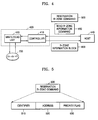
- Figure 4 is a schematic block diagram of a recording/reproducing system according to an embodiment of the present invention.
- the recording/reproducing system includes a recording/reproducing apparatus 400 and a host 440.
- the host 440 transmits a recording command to the recording/reproducing apparatus 400 to record data on a disc 700, transmits a reproduction command to the recording/reproducing apparatus 400 to reproduce data from the disc 700 and receives the reproduced data from the recording/reproducing apparatus 400, and transmits a plurality of control commands to the recording/reproducing apparatus 400 to manage the disc 700 according to a command of the host 440.
- the host 440 transmits a reservation R-zone command 500 including a priority information flag to the recording/reproducing apparatus 400 to construct a data area of the disc 700 with a plurality of R-zones and grant a priority attribute to each R-zone.
- the host 440 transmits a read R-zone information command 550 to the recording/reproducing apparatus 400 to obtain information on an R-zone constructed on the disc 700.
- the host 440 knows a priority of each R-zone by receiving an R-zone information block 600 in which priority information of the requested R-zone is included.
- the recording/reproducing apparatus 400 includes a controller 410 and a write/read unit 420.
- the write/read unit 420 records data on the disc 700, which is an information storage medium according to the present embodiment, and reads data to reproduce the recorded data.
- the controller 410 controls the write/read unit 420 to record data by a predetermined recording unit block according to an embodiment of the present invention or obtains valid data by processing data read by the write/read unit 420.
- the controller 410 controls the write/read unit 420 to record data by performing a logical overwrite (LOW) according to a command of the host 440 or a control of a drive system. If a defect is detected during data recording or by a verify-after-write process, the controller 410 controls the write/read unit 420 to record a replacement block to replace a defect block in a spare area.
- LOW logical overwrite
- LOW data recorded in a user data area of a write-once recording medium is updated, i.e., replacement data is recorded in an unrecorded area of the spare area or user data area, and address information of the original data and the replacement data is managed so that a logical address used by the host 440 is not changed.
- the controller 410 performs LOW replacement and defect replacement.
- the controller 410 If the controller 410 receives the reservation R-zone command 500 from the host 440, the controller 410 reserves an R-zone on the disc 700 and grants the priority attribute to the reserved R-zone in response to the command 500. If the controller 410 receives the read R-zone information command 550 from the host 440, the controller 410 transmits the R-zone information block 600 including the requested R-zone state information and priority information granted to the R-zone to the host in response to the command 550.
- Figure 5 is a structural diagram of the reservation R-zone command 500 illustrated in Figure 4.
- the reservation R-zone command 500 includes an identifier 510 indicating that it is a reservation R-zone command, an address 520 indicating a location and a length of an R-zone to be reserved, and a priority flag 530 indicating a priority of the R-zone to be reserved. Since the priority flag 530 uses a reservation field, which is not used by the conventional reservation R-zone command or reservation track command, a file system or drive system according to the present embodiment can recognize the priority flag 530. Since a file system or drive system in which the present embodiment is not implemented cannot recognize only the priority flag 530, the reservation R-zone command 500 works without any problem in the conventional file system or drive system.
- the drive system according to the present embodiment reserves an R-zone based on the priority flag 530 included in the reservation R-zone command 500, data can be updated according to a command of the host 440. Since the conventional drive system does not refer only to the priority flag 530, the file system according to the present embodiment can perform a conventional operation without an error, i.e., can reserve a simple R-zone to which a priority is not granted.
- Both the conventional file system and the file system according to the present embodiment can reserve an R-zone as a space for storing data in both the drive system according to the present embodiment and the drive system in which the present embodiment is not implemented.
- the file system according to the present embodiment i.e., a file system recognizing a function of granting priorities to R-zones
- Figure 6 is a structural diagram of the R-zone information block 600 illustrated in Figure 4.
- the R-zone information block 600 includes R-zone state information 610 indicating a state of an R-zone and priority information 620 indicating a priority granted to the R-zone.
- the host 440 recognizes a priority of an R-zone through a flag including the priority information 620 added to the R-zone state information 610 in response to a command for reading state information of the R-zone such as the read track information command.
- the priority information 620 is provided using a reservation field of the R-zone information block 600, which is not used in a conventional drive system, a conventional operation can be performed without an error between a file system according to the present embodiment and a drive system in which the present embodiment is not implemented.
- a drive system according to the present embodiment transmits the R-zone information block 600 including the priority information 620 to the host 440, the host 440 can perform a data rearrangement and a data update according to a recording instruction of a previous host.
- the host D can perform a data rearrangement and a data update on the information storage medium C according to an original instruction of the host A.
- the priority information 620 is included in the R-zone information block 600 in response to the read R-zone information command. In this case, a value corresponding to a low priority is set to the priority information 620.
- the priority information 620 is not included in the R-zone information block 600 in response to the read R-zone information command.
- the value corresponding to the low priority is set to the priority information 620.
- Figure 7 is a structural diagram of the disc 700 according to an embodiment of the present invention.
- the disc 700 which is a write-once information storage medium, includes a lead-in area 710, a data area 720, and a lead-out area 730.
- the lead-in area 710 includes a second disc management area 711, a temporary disc management area (TDMA) 712, and a first disc management area 713.
- TDMA temporary disc management area
- the TDMA 712 is an area for recording information of temporary defect management and temporary disc management for managing the write-once information storage medium 700.
- the TDMA 712 includes a temporary defect list (TDFL) 714, recording management data (RMD) 800 and a temporary disc definition structure (TDDS) 716.
- TDFL temporary defect list
- RMD recording management data
- TDDS temporary disc definition structure
- the TDFL 714 indicates information of a replacement state of defect replacement or LOW replacement and includes location information of defect data and location information of replacement data replacing the defect data.
- the RMD 800 is an area indicating a data recording state using entry information in case the user data area 722 is used in a sequential recording mode.
- priority information of each R-zone can be managed using the RMD 800 based on a priority flag set in a reservation R-zone command.
- the TDDS 716 includes location pointers of the TDFL 714 and further includes location and size information of spare areas 721 and 723 assigned in an initializing operation, write protection information, location and size information of a temporary defect management area assigned in the data area 720, information of the user data area 722, information of a replaceable location in each spare area, and last recorded address information of the user data area 722.
- a first disc management area 713, a second disc management area 711, a third disc management area 731 and a fourth disc management area 732 are areas to store final temporary disc management information when the write-once information storage medium 700 is finalized.
- the data area 720 sequentially includes a first spare area 721, the user data area 722 and a second spare area 723.
- the first and second spare areas 721 and 723 are areas to record therein replacement data replacing data recorded in the user data area 722. Data due to defect replacement or LOW replacement can be recorded in the spare areas 721 and 723.
- the user data area 722 is an area for recording user data, and replacement data replacing the user data due to LOW.
- the replacement data is recorded not only in the spare areas 721 and 723 but also in the user data area 722.
- the user data area 722 is divided into more than one R-zone, and a priority is granted to each divided R-zone according to a command from a host. This priority information, for example, can be recorded in the RMD 800.
- a data format of the RMD 800 will now be described.
- Two priorities can be granted to a plurality of R-zones forming the user data area 722 on the disc 700. That is, after file system data comprised of a volume structure and a file structure for managing general user data recorded on the disc 700 is recorded, a high priority for replacement recording of the file system data by a drive system when a LOW is performed is granted, and after general user data is recorded, a low priority for replacement recording of the general user data by the drive system when a LOW is performed is granted.
- FIG 8 is a detailed structural diagram of the RMD 800 illustrated in Figure 7.
- the RMD 800 includes an RMD header 810 including information of a group used in the user data area 722 and an R-zone entry list 820 indicating information of R-zones prepared in the user data area 722.
- the R-zone entry list 820 includes a 1 st R-zone entry 821, a 2 nd R-zone entry 822, a 3 rd R-zone entry 823, a 4 th R-zone entry 824, ..., and i th R-zone entry 825.
- Each R-zone entry indicates information on each R-zone.
- the i th R-zone entry 825 includes priority information 826 granted to an i th R-zone, an i th R-zone beginning address 827, and an i th R-zone ending address 828.
- the i th R-zone beginning address 827 and the i th R-zone ending address 828 indicate an area allocated to the i th R-zone on the disc 700.
- the priority information 826 granted to the i th R-zone is recorded based on a priority flag value provided by a reservation R-zone command received from a host, and if R-zone state information is requested by the host, the priority information 826 can be included in an R-zone information block and transmitted to the host.
- R-zones whose priorities are low are all in a closed state since data is recorded in the R-zones, and if an available space to be reserved does not remain in an information storage medium, data also can be updated in an area whose priority is high since only one kind of priority exists for recordable R-zones.
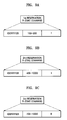
- the host transmits a 1 st reservation R-zone command to a drive system to reserve an R-zone whose beginning address is 100, ending address is 200, and priority flag is set to "1," i.e., the high priority.
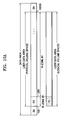
- the drive system reserves an R-zone #1 located between the address 100 and the address 200 of a user data area of a disc as shown in Figure 10A.
- the high priority is granted to the R-zone #1 to record file system data
- the low priority is granted to an R-zone #2 to record general user data
- the R-zone #1 is closed since data cannot be added any more in the R-zone #1.
- the host transmits a 2 nd reservation R-zone command as shown in 9B to the drive system to allocate an R-zone to an area from an address 400 to an address 10000 and grant the high priority to the allocated R-zone.
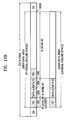
- the drive system allocates an R-zone #3 to the area from the address 400 to the address 10000 and grants the high priority to the R-zone #3 as shown in Figure 10B. Accordingly, the R-zone #2 is allocated to the area from the address 200 to the address 400, and the low priority is granted to the allocated R-zone #2. Then, the drive system records data A and data B in the R-zone #2, closes the R-zone #2 since data cannot be recorded any more in the R-zone #2, and records updated file system data FS' in the R-zone #3 since an update of the file system data FS is requested due to the data addition.
- the host transmits a 3 rd reservation R-zone command of allocating an R-zone having the low priority to an area from an address 700 to the address 10000 as shown in Figure 9C to the drive system in order to reserve the R-zone in which data A' and data B' will be recorded by the drive system for replacement of the data A and data B.
- the drive system In response to the 3 rd reservation R-zone command, the drive system allocates an R-zone #4 and grants the low priority to the allocated R-zone #4.
- the drive system To update the data A and data B recorded in the R-zone #2, if the host transmits a command of recording the updated data A' and data B' in the same logical addresses as the data A and data B to the drive system, the drive system records the updated data A' and data B' in the R-zone #4 as replacement by recognizing that data has been already recorded in physical addresses corresponding to the logical addresses by the host write command and recognizing that an R-zone having the same priority as an R-zone corresponding to the physical addresses is the R-zone #4.
- the drive system since an update of the file system data FS' is requested, if the host transmits a command of recording updated file system data FS" in the same logical addresses as the file system data FS recorded in the R-zone #1 to the drive system by a LOW, the drive system records the updated file system data FS" in the R-zone #3 as replacement by recognizing that data has been already recorded in physical addresses corresponding to the logical addresses by the host write command and recognizing that an R-zone having the same priority as an R-zone corresponding to the physical addresses is the R-zone #3.
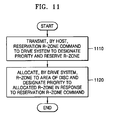
- Figure 11 is a flowchart illustrating a method of allocating an R-zone to a disc according to an embodiment of the present invention.
- a host transmits a reservation R-zone command to a drive system to designate a priority and reserve an R-zone in operation 1110.
- the drive system allocates an R-zone to an area of the disc and designates a priority to the allocated R-zone in response to the received reservation R-zone command in operation 1120.
- Figure 12 is a flowchart illustrating a method of seeking information on an R-zone allocated to a disc according to an embodiment of the present invention.
- a host transmits a read R-zone information command to a drive system in operation 1210.
- the drive system reads requested R-zone state information and priority information of the R-zone in response to the received read R-zone information command in operation 1220.
- the drive system transmits an R-zone information block including the R-zone state information and priority information to the host in operation 1230.
- the embodiments of the present invention can be written as computer programs and can be implemented in general-use digital computers that execute the programs using a computer readable recording medium.
- Examples of the computer readable recording medium include magnetic storage media (e.g., ROM, floppy discs, hard discs, etc.), optical recording media (e.g., CD-ROMs, DVDs, etc.), and storage media such as carrier waves (e.g., transmission through the internet).
- the computer readable recording medium can also be distributed over network coupled computer systems so that the computer readable code is stored and executed in a distributed fashion. And the functional programs, codes and code segments for embodying the present invention may be easily deducted by programmers in the art which the present invention belongs to.
- the user data area of the medium can be used according to an instruction of a host, thereby improving medium usage efficiency.
Landscapes
- Engineering & Computer Science (AREA)
- Signal Processing (AREA)
- Signal Processing For Digital Recording And Reproducing (AREA)
Applications Claiming Priority (1)
| Application Number | Priority Date | Filing Date | Title |
|---|---|---|---|
| KR1020040090160A KR20060040525A (ko) | 2004-11-06 | 2004-11-06 | 정보 저장 매체, 기록/재생 장치 및 기록/재생 방법 |
Publications (2)
| Publication Number | Publication Date |
|---|---|
| EP1655734A2 true EP1655734A2 (de) | 2006-05-10 |
| EP1655734A3 EP1655734A3 (de) | 2008-01-23 |
Family
ID=35695492
Family Applications (1)
| Application Number | Title | Priority Date | Filing Date |
|---|---|---|---|
| EP05256706A Withdrawn EP1655734A3 (de) | 2004-11-06 | 2005-10-28 | Informationsspeichermedium, Aufzeichungs- und Wiedergabegerät, Aufzeichungs- und Wiedergabeverfahren, und Host zu dessen Verwendung |
Country Status (6)
| Country | Link |
|---|---|
| US (1) | US20060098560A1 (de) |
| EP (1) | EP1655734A3 (de) |
| JP (1) | JP2006134565A (de) |
| KR (1) | KR20060040525A (de) |
| CN (1) | CN100452221C (de) |
| TW (1) | TWI306249B (de) |
Families Citing this family (3)
| Publication number | Priority date | Publication date | Assignee | Title |
|---|---|---|---|---|
| KR101453296B1 (ko) * | 2008-01-10 | 2014-10-21 | 삼성전자주식회사 | 정보 저장 매체, 기록/재생 장치 및 기록/재생 방법 |
| CN102388358B (zh) * | 2011-09-30 | 2014-07-09 | 华为技术有限公司 | 在混合存储环境下配置存储设备的方法和系统 |
| US9880926B1 (en) * | 2013-08-20 | 2018-01-30 | Seagate Technology Llc | Log structured reserved zone for a data storage device |
Citations (3)
| Publication number | Priority date | Publication date | Assignee | Title |
|---|---|---|---|---|
| WO2004029942A1 (en) | 2002-09-30 | 2004-04-08 | Lg Electronics Inc. | Write-once type optical disc, and method and apparatus for managing defective areas on write-once type optical disc using tdma information |
| WO2004053874A1 (en) | 2002-12-11 | 2004-06-24 | Lg Electronics Inc. | Method of managing overwrite and method of recording management information on an optical disc write once |
| US20040174785A1 (en) | 2000-03-08 | 2004-09-09 | Hiroshi Ueda | Information recording medium, information recording method and information reproduction method |
Family Cites Families (19)
| Publication number | Priority date | Publication date | Assignee | Title |
|---|---|---|---|---|
| JP3822942B2 (ja) * | 1996-02-23 | 2006-09-20 | 松下電器産業株式会社 | 追記型記録媒体記録再生装置 |
| JP2848809B2 (ja) * | 1996-03-25 | 1999-01-20 | 株式会社東芝 | 交替処理方法 |
| JP3707222B2 (ja) * | 1997-12-18 | 2005-10-19 | 三菱電機株式会社 | 光ディスク、光ディスク処理装置および光ディスク処理方法 |
| KR100667729B1 (ko) * | 1998-11-10 | 2007-01-11 | 삼성전자주식회사 | 결함 관리를 위한 여유 공간과 그 관리 정보를 갖는 디스크, 여유 공간 할당 방법과 결함 관리 방법 |
| MY118342A (en) * | 1999-02-01 | 2004-10-30 | Matsushita Electric Industrial Co Ltd | Information recording medium, information recording method and information recording/reproducing system |
| JP2002352522A (ja) * | 2001-03-22 | 2002-12-06 | Matsushita Electric Ind Co Ltd | 記録方法、再生方法、記録装置、再生装置および情報記録媒体 |
| JP3832432B2 (ja) * | 2002-05-09 | 2006-10-11 | ソニー株式会社 | 光ディスク記録方法、光ディスク記録装置及び情報記録媒体 |
| JP2004014088A (ja) * | 2002-06-11 | 2004-01-15 | Sony Corp | ディスク記録媒体、記録方法、ディスクドライブ装置 |
| KR20040015425A (ko) * | 2002-08-12 | 2004-02-19 | 삼성전자주식회사 | 결함 관리를 적용한 1회 기록용 고밀도 기록 매체, 결함관리 방법 및 그 장치 |
| US7532551B2 (en) * | 2002-09-26 | 2009-05-12 | Lg Electronics Inc. | Method for managing defective area on write-once optical recording medium, and optical recording medium using the same |
| EP1579443A1 (de) * | 2002-12-11 | 2005-09-28 | LG Electronics Inc. | Verfahren und vorrichtung zur überschreibung einer einmalig beschreibbaren optischen diskette |
| JP4015544B2 (ja) * | 2002-12-24 | 2007-11-28 | 株式会社リコー | 情報処理装置 |
| JP4026517B2 (ja) * | 2003-03-12 | 2007-12-26 | ソニー株式会社 | 記録媒体、記録装置、記録方法 |
| JP4127519B2 (ja) * | 2003-04-07 | 2008-07-30 | 株式会社リコー | 節電方法及びドライブ装置 |
| MXPA05012044A (es) * | 2003-05-09 | 2006-02-03 | Lg Electronics Inc | Disco optico de una sola escritura, metodo y aparato par recuperacion de informacion de administracion de disco del disco optico de una sola escritura. |
| JP4846566B2 (ja) * | 2003-05-09 | 2011-12-28 | エルジー エレクトロニクス インコーポレイティド | 1回だけ記録可能な光ディスク及び1回だけ記録可能な光ディスクからの管理情報の復元方法並びに装置 |
| JP2005339622A (ja) * | 2004-05-25 | 2005-12-08 | Nec Corp | 記録管理情報記録方法および情報記録装置および情報記録媒体 |
| KR20060019383A (ko) * | 2004-08-27 | 2006-03-03 | 삼성전자주식회사 | 정보 저장 매체, 기록/재생 장치 및 기록/재생 방법 |
| JP4077437B2 (ja) * | 2004-09-16 | 2008-04-16 | Tdk株式会社 | 情報記録媒体および記録再生装置 |
-
2004
- 2004-11-06 KR KR1020040090160A patent/KR20060040525A/ko not_active Withdrawn
-
2005
- 2005-09-27 US US11/235,296 patent/US20060098560A1/en not_active Abandoned
- 2005-10-05 TW TW094134760A patent/TWI306249B/zh not_active IP Right Cessation
- 2005-10-28 CN CNB2005101170161A patent/CN100452221C/zh not_active Expired - Fee Related
- 2005-10-28 EP EP05256706A patent/EP1655734A3/de not_active Withdrawn
- 2005-11-02 JP JP2005320025A patent/JP2006134565A/ja active Pending
Patent Citations (3)
| Publication number | Priority date | Publication date | Assignee | Title |
|---|---|---|---|---|
| US20040174785A1 (en) | 2000-03-08 | 2004-09-09 | Hiroshi Ueda | Information recording medium, information recording method and information reproduction method |
| WO2004029942A1 (en) | 2002-09-30 | 2004-04-08 | Lg Electronics Inc. | Write-once type optical disc, and method and apparatus for managing defective areas on write-once type optical disc using tdma information |
| WO2004053874A1 (en) | 2002-12-11 | 2004-06-24 | Lg Electronics Inc. | Method of managing overwrite and method of recording management information on an optical disc write once |
Also Published As
| Publication number | Publication date |
|---|---|
| KR20060040525A (ko) | 2006-05-10 |
| US20060098560A1 (en) | 2006-05-11 |
| JP2006134565A (ja) | 2006-05-25 |
| TW200615923A (en) | 2006-05-16 |
| EP1655734A3 (de) | 2008-01-23 |
| CN1783316A (zh) | 2006-06-07 |
| CN100452221C (zh) | 2009-01-14 |
| TWI306249B (en) | 2009-02-11 |
Similar Documents
| Publication | Publication Date | Title |
|---|---|---|
| US7898918B2 (en) | Write-once optical disc, and method and apparatus for recording/reproducing management information on/from optical disc | |
| CN100458933C (zh) | 一次写入光盘以及用于在其上记录管理信息的方法和装置 | |
| EP1579447B1 (de) | Überschreibverfahren und informationsaufzeichnungsverfahren für eine einmalig beschreibbare optische diskette | |
| US7545710B2 (en) | Method of overwriting data in write-once information storage medium and data recording and/or reproducing apparatus for write-once information storage medium | |
| RU2377667C2 (ru) | Носитель записи, имеющий структуру данных для управления, по крайней мере, областью данных носителя записи, и способы и устройства записи и воспроизведения | |
| CN102113055B (zh) | 信息记录介质、信息记录方法、信息记录装置、信息再现方法及信息再现装置 | |
| WO2004086379A1 (en) | Method of overwriting data in write-once medium and data recording and/or reproducing apparatus therefor | |
| US20060077872A1 (en) | Information recording medium, recording/reproducing apparatus, and recording/reproducing method | |
| US20050162989A1 (en) | Method and apparatus for recording and/or reproducing data and write-once information storage medium | |
| US7502288B2 (en) | Method and apparatus for overwriting data on recording-medium and the recording medium | |
| EP1655734A2 (de) | Informationsspeichermedium, Aufzeichungs- und Wiedergabegerät, Aufzeichungs- und Wiedergabeverfahren, und Host zu dessen Verwendung | |
| EP2240932B1 (de) | Aufzeichnungs-/wiedergabevorrichtung und aufzeichnungs-/wiedergabeverfahren | |
| CN1941143B (zh) | 在一次写入介质中覆写数据的方法及其记录再现的设备 | |
| US20050162988A1 (en) | Method and apparatus for recording and/or reproducing data and write-once information storage medium | |
| CN1961356B (zh) | 在记录介质上盖写数据的方法和设备 | |
| JP2008517412A (ja) | 記録媒体、ならびに同時にデータを上書きする方法および装置 |
Legal Events
| Date | Code | Title | Description |
|---|---|---|---|
| PUAI | Public reference made under article 153(3) epc to a published international application that has entered the european phase |
Free format text: ORIGINAL CODE: 0009012 |
|
| 17P | Request for examination filed |
Effective date: 20051107 |
|
| AK | Designated contracting states |
Kind code of ref document: A2 Designated state(s): AT BE BG CH CY CZ DE DK EE ES FI FR GB GR HU IE IS IT LI LT LU LV MC NL PL PT RO SE SI SK TR |
|
| AX | Request for extension of the european patent |
Extension state: AL BA HR MK YU |
|
| PUAL | Search report despatched |
Free format text: ORIGINAL CODE: 0009013 |
|
| AK | Designated contracting states |
Kind code of ref document: A3 Designated state(s): AT BE BG CH CY CZ DE DK EE ES FI FR GB GR HU IE IS IT LI LT LU LV MC NL PL PT RO SE SI SK TR |
|
| AX | Request for extension of the european patent |
Extension state: AL BA HR MK YU |
|
| 17Q | First examination report despatched |
Effective date: 20080303 |
|
| AKX | Designation fees paid |
Designated state(s): AT BE BG CH CY CZ DE DK EE ES FI FR GB GR HU IE IS IT LI LT LU LV MC NL PL PT RO SE SI SK TR |
|
| STAA | Information on the status of an ep patent application or granted ep patent |
Free format text: STATUS: THE APPLICATION IS DEEMED TO BE WITHDRAWN |
|
| 18D | Application deemed to be withdrawn |
Effective date: 20100501 |