EP1649073B1 - Procede de fabrication d'un produit plat en alliage de zirconium, produit plat ainsi obtenu et element d'un assemblage combustible pour reacteur de centrale nucleaire realise a partir de ce produit plat - Google Patents
Procede de fabrication d'un produit plat en alliage de zirconium, produit plat ainsi obtenu et element d'un assemblage combustible pour reacteur de centrale nucleaire realise a partir de ce produit plat Download PDFInfo
- Publication number
- EP1649073B1 EP1649073B1 EP04767740.6A EP04767740A EP1649073B1 EP 1649073 B1 EP1649073 B1 EP 1649073B1 EP 04767740 A EP04767740 A EP 04767740A EP 1649073 B1 EP1649073 B1 EP 1649073B1
- Authority
- EP
- European Patent Office
- Prior art keywords
- quenching
- flat product
- flat
- product
- nuclear power
- Prior art date
- Legal status (The legal status is an assumption and is not a legal conclusion. Google has not performed a legal analysis and makes no representation as to the accuracy of the status listed.)
- Expired - Lifetime
Links
- 229910001093 Zr alloy Inorganic materials 0.000 title claims description 25
- 238000000034 method Methods 0.000 title claims description 22
- 239000000446 fuel Substances 0.000 title claims description 12
- 238000000137 annealing Methods 0.000 claims description 46
- 238000010791 quenching Methods 0.000 claims description 46
- 230000000171 quenching effect Effects 0.000 claims description 32
- XLYOFNOQVPJJNP-UHFFFAOYSA-N water Substances O XLYOFNOQVPJJNP-UHFFFAOYSA-N 0.000 claims description 21
- 238000005096 rolling process Methods 0.000 claims description 17
- 229910045601 alloy Inorganic materials 0.000 claims description 16
- 239000000956 alloy Substances 0.000 claims description 16
- 238000001816 cooling Methods 0.000 claims description 16
- 238000004519 manufacturing process Methods 0.000 claims description 11
- 238000009835 boiling Methods 0.000 claims description 9
- 239000012535 impurity Substances 0.000 claims description 9
- QCWXUUIWCKQGHC-UHFFFAOYSA-N Zirconium Chemical compound [Zr] QCWXUUIWCKQGHC-UHFFFAOYSA-N 0.000 claims description 8
- 238000011282 treatment Methods 0.000 claims description 8
- 229910052726 zirconium Inorganic materials 0.000 claims description 8
- 238000005275 alloying Methods 0.000 claims description 7
- 238000007493 shaping process Methods 0.000 claims description 5
- 238000005266 casting Methods 0.000 claims 1
- 238000005097 cold rolling Methods 0.000 description 36
- 239000000523 sample Substances 0.000 description 20
- XKRFYHLGVUSROY-UHFFFAOYSA-N Argon Chemical compound [Ar] XKRFYHLGVUSROY-UHFFFAOYSA-N 0.000 description 12
- 239000000203 mixture Substances 0.000 description 12
- 238000010438 heat treatment Methods 0.000 description 9
- PXHVJJICTQNCMI-UHFFFAOYSA-N nickel Substances [Ni] PXHVJJICTQNCMI-UHFFFAOYSA-N 0.000 description 9
- 239000000463 material Substances 0.000 description 7
- 229910052786 argon Inorganic materials 0.000 description 6
- 229910052742 iron Inorganic materials 0.000 description 5
- 238000010583 slow cooling Methods 0.000 description 5
- 229910052804 chromium Inorganic materials 0.000 description 4
- 238000005260 corrosion Methods 0.000 description 4
- 230000007797 corrosion Effects 0.000 description 4
- 239000013074 reference sample Substances 0.000 description 4
- 229910052718 tin Inorganic materials 0.000 description 4
- 230000000712 assembly Effects 0.000 description 3
- 238000000429 assembly Methods 0.000 description 3
- 238000005098 hot rolling Methods 0.000 description 3
- 229910052759 nickel Inorganic materials 0.000 description 3
- 229910052758 niobium Inorganic materials 0.000 description 3
- 238000001953 recrystallisation Methods 0.000 description 3
- 230000003068 static effect Effects 0.000 description 3
- 230000008034 disappearance Effects 0.000 description 2
- 238000005242 forging Methods 0.000 description 2
- 239000011159 matrix material Substances 0.000 description 2
- 229910052751 metal Inorganic materials 0.000 description 2
- 239000002184 metal Substances 0.000 description 2
- 150000003839 salts Chemical class 0.000 description 2
- 238000005496 tempering Methods 0.000 description 2
- 238000003723 Smelting Methods 0.000 description 1
- 238000010521 absorption reaction Methods 0.000 description 1
- 238000005452 bending Methods 0.000 description 1
- 238000012512 characterization method Methods 0.000 description 1
- 238000002485 combustion reaction Methods 0.000 description 1
- 230000008094 contradictory effect Effects 0.000 description 1
- 239000013078 crystal Substances 0.000 description 1
- 230000000593 degrading effect Effects 0.000 description 1
- 230000000694 effects Effects 0.000 description 1
- 230000002349 favourable effect Effects 0.000 description 1
- 238000004845 hydriding Methods 0.000 description 1
- 238000012423 maintenance Methods 0.000 description 1
- 238000001000 micrograph Methods 0.000 description 1
- 230000008092 positive effect Effects 0.000 description 1
- 238000002360 preparation method Methods 0.000 description 1
- 238000005070 sampling Methods 0.000 description 1
- 238000004804 winding Methods 0.000 description 1
- 150000003754 zirconium Chemical class 0.000 description 1
Images



Classifications
-
- C—CHEMISTRY; METALLURGY
- C22—METALLURGY; FERROUS OR NON-FERROUS ALLOYS; TREATMENT OF ALLOYS OR NON-FERROUS METALS
- C22C—ALLOYS
- C22C16/00—Alloys based on zirconium
-
- B—PERFORMING OPERATIONS; TRANSPORTING
- B21—MECHANICAL METAL-WORKING WITHOUT ESSENTIALLY REMOVING MATERIAL; PUNCHING METAL
- B21B—ROLLING OF METAL
- B21B3/00—Rolling materials of special alloys so far as the composition of the alloy requires or permits special rolling methods or sequences ; Rolling of aluminium, copper, zinc or other non-ferrous metals
-
- C—CHEMISTRY; METALLURGY
- C22—METALLURGY; FERROUS OR NON-FERROUS ALLOYS; TREATMENT OF ALLOYS OR NON-FERROUS METALS
- C22F—CHANGING THE PHYSICAL STRUCTURE OF NON-FERROUS METALS AND NON-FERROUS ALLOYS
- C22F1/00—Changing the physical structure of non-ferrous metals or alloys by heat treatment or by hot or cold working
- C22F1/16—Changing the physical structure of non-ferrous metals or alloys by heat treatment or by hot or cold working of other metals or alloys based thereon
- C22F1/18—High-melting or refractory metals or alloys based thereon
- C22F1/186—High-melting or refractory metals or alloys based thereon of zirconium or alloys based thereon
-
- G—PHYSICS
- G21—NUCLEAR PHYSICS; NUCLEAR ENGINEERING
- G21C—NUCLEAR REACTORS
- G21C21/00—Apparatus or processes specially adapted to the manufacture of reactors or parts thereof
-
- Y—GENERAL TAGGING OF NEW TECHNOLOGICAL DEVELOPMENTS; GENERAL TAGGING OF CROSS-SECTIONAL TECHNOLOGIES SPANNING OVER SEVERAL SECTIONS OF THE IPC; TECHNICAL SUBJECTS COVERED BY FORMER USPC CROSS-REFERENCE ART COLLECTIONS [XRACs] AND DIGESTS
- Y02—TECHNOLOGIES OR APPLICATIONS FOR MITIGATION OR ADAPTATION AGAINST CLIMATE CHANGE
- Y02E—REDUCTION OF GREENHOUSE GAS [GHG] EMISSIONS, RELATED TO ENERGY GENERATION, TRANSMISSION OR DISTRIBUTION
- Y02E30/00—Energy generation of nuclear origin
- Y02E30/30—Nuclear fission reactors
Definitions
- the invention relates to the manufacture of flat products of zirconium alloy, from which are manufactured in particular parts used in fuel assemblies for reactors of light water nuclear power plants.
- Zircaloy 4 contains the same elements with the exception of nickel, and the Fe content can range from 0.18% to 0.24%.
- Other classes of Zircaloy 2 type alloys with higher Fe and / or Cr and / or Ni contents, or other alloys containing 0.5 to 2% of Sn, 0.5 to 2% of Nb and 0.1 to 0.5% Fe, or 0.5 to 2% Sn, 0.1 to 1% Fe and 0.1 to 1.2% Cr, or 1.5 to 3.5 % Nb and 0.5 to 2% Sn can be used.
- These alloys may also contain other addition elements, in addition to the usual impurities.
- a particularly important part of the reactor which is made with such alloys is the housing in which the tubes containing the fuel are installed.
- This housing must have excellent resistance to corrosion, and also a high dimensional stability under irradiation.
- the alloys used most commonly to form the sheets constituting these boxes have growth properties under irradiation which prevent increasing the combustion rate of the reactor as much as would be desirable. This growth under irradiation is directly related to the usually strongly anisotropic texture of the flat products from which the housings are made.
- the flat products (sheets or strips) from which these parts are made must also have mechanical properties assuring them a good ability to be shaped.
- EP-A-0 835 330 proposes to prepare the sheet from a zirconium alloy containing strictly controlled contents in certain volatile impurities, namely between 0.5 and 10 ppm of Cl, from 5 to 20 ppm of at least one element selected from Mg, Ca, Na and K, from 100 to 270ppm of C, from 50 to 120ppm of Si and from 1 to 30ppm of P.
- a quenching ⁇ when the sheet is at its final or quasi-final thickness
- it is practiced after quenching ⁇ annealing heat treatment between 600 and 800 ° C in a static oven or between 700 and 800 ° C in a continuous furnace.
- EP-A-0 795 618 discloses low growth zirconium alloy sheets under irradiation, containing not more than 5% of Sn and / or not more than 5% of Nb and not less than 90% of Zr, having a crystalline orientation ⁇ 0001> in long direction FL of 0.2 to 0.35, and having a difference ⁇ FL of the values of FL between the medium in the width direction and the end in the width direction of the sheet less than or equal to 0.025.
- These sheets are obtained as a result of a quenching ⁇ , during which the differences in temperature between the faces of the sheet during the heating phase of the quenching ⁇ are minimized as much as possible. These sheets therefore have particular isotropic crystalline orientations producing reduced growth effects under irradiation.
- JP09257988 describes a Zr alloy type for reactor core structure materials according to which is hardened by quenching ⁇ , laminated and annealed an alloy whose composition is Zr, 0.8-1.2% Sn, 0.17-0 , 28% Fe, 0.05-0.15% Cr, 0.04-0.1% Ni, 0.01-0.09% Nb, 1000-1500 ppm O, Si ⁇ 120 ppm.
- the structural material having good resistance to hydriding and good resistance to corrosion.
- these methods do not allow to achieve flat products with excellent deformability properties, from the point of view of folding and stamping. These properties are however essential for the easy obtaining of housings in optimal conditions.
- the object of the invention is to propose a process for manufacturing zirconium alloy flat products having both good mechanical properties and low growth under irradiation, so that these flat products can be used optimally in particular, but not exclusively, for the manufacture of boiling water nuclear reactor housings.
- the rolling according to the ⁇ quench is preferably carried out with a reduction ratio of 5 to 16%, preferably 5 to 10%.
- the cooling of the ⁇ quench is carried out at a speed of at least 1 ° C./s.
- the invention also relates to a flat product of zirconium alloy, characterized in that it is obtained by the above method.
- the invention also relates to an element of a fuel assembly for light water nuclear power plant reactor, characterized in that it is obtained by shaping a flat product of the above type.
- It may consist of a boiling water nuclear reactor housing.
- It may consist of a boiling water reactor grate.
- It may consist of a pressurized water reactor grid.
- It can consist of a central tube delimiting the water circulation paths.
- the invention consists in a method for manufacturing a flat product made of zirconium alloy suitable for obtaining a partially recrystallized mixed, equiaxed and acicular intermediate structure, having a cold rolling step (or moderately high temperature), placed between a quenching ⁇ and an annealing performed in the ⁇ -domain or the ⁇ + ⁇ -domain.
- the ⁇ quenched raw structure is generally a coarse-grained ex- ⁇ structure of 50 to 500 ⁇ m. They are slightly oriented, their texture is very marked, with peaks of very high pole figures, a good isotropy of properties, and preferred crystalline orientations. It appears that it is this microstructure in large grains ex- ⁇ with very marked texture which is at the origin of the difficulties of shaping the sheets. Annealing ⁇ or ⁇ + ⁇ has no influence on this microstructure.
- the inventors have imagined that a more random and less marked arrangement of the crystals could lead to a comparable isotropy of the mechanical properties, thus maintaining good properties in terms of growth under irradiation, while proving advantageous with regard to the mechanical properties.
- the cold rolling takes place between room temperature and 200 ° C. It is carried out with a reduction rate of 2 to 20% (preferably between 5 and 15%, better still between 5 and 10%).
- This reduction rate can be obtained in one or more rolling passes, but necessarily in a single rolling sequence, that is to say without intermediate annealing between the different passes.
- Intermediate annealing (s) would hinder or prevent recrystallization during annealing ⁇ or ⁇ + ⁇ .
- the annealing carried out after the cold rolling according to the invention is carried out at a temperature of 500 to 800 ° C., that is to say either in the ⁇ -domain or in the ⁇ + ⁇ -domain of the alloy.
- the lowest temperatures in this range are particularly suitable for alloys with high Nb content (greater than about 0.3%).
- the annealing time depends on the degree of deformation experienced by the product during rolling and the type of annealing equipment (which may be continuous or static).
- the invention begins by developing a flat product of zirconium alloy by conventional ingot smelting steps, generally forging the ingot, hot rolling, optionally in several passes optionally separated by treatments thermal, generally rolling (s) cold and annealing (s), and finally quenching ⁇ of the material obtained; then according to the invention is carried out a cold rolling and annealing.
- the alloy composition may correspond, for its main elements, to all kinds of classes of zirconium alloys usually used to manufacture fuel assembly elements for nuclear reactors, in particular boiling water reactor housings. Examples of such classes have been defined in the preamble of the description.
- the invention is applicable to zirconium alloys containing at least 95% zirconium. Below 95%, there is a high risk of not obtaining the desired structures and properties.
- the ⁇ quench results in obtaining an acicular structure.
- this structure may have a wicker character more or less marked. But such a character is not particularly sought after in the process according to the invention, since in any case the cold rolling that follows considerably modifies the structure by breaking the acicular structure.
- conventional shaping treatments forging at 100mm thickness, hot rolling at 5mm thickness, annealing and several cold rolling cycles- annealing, which gave it a thickness of 2.50mm, as well as a ⁇ quenching performed by infra-red heating at a maximum temperature of 1110 ° C, maintenance in
- this microstructure is typical of a state following a ⁇ quench, with a mixture of parallel platelets and basketry.
- twins there are also many twins, but this may come from the sample preparation process, or the winding that followed the quenching ⁇ .
- the figure 2 shows the sample of the same quenched metal ⁇ after it has undergone cold rolling according to the invention carried out at room temperature and with a reduction rate of 12% in one pass. This cold rolling allowed to break the needles of the initial structure and increased the number of twins.
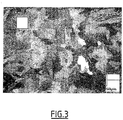
- the figure 3 shows a sample of this same hardened metal ⁇ , 12% cold rolled and annealed at 700 ° C for 1h ( ⁇ annealing). There has been partial recrystallization and an increase in the number of equiaxed grains (an increase which is even stronger when the reduction rate is high), as well as a disappearance of twins.
- Table 1 shows the Kearns factors FR, FT and FL measured following analyzes of the textures of the different samples in the state following the ⁇ quench, following the cold rolling (LAF) and following the annealing ⁇ : Table 1 Metallurgical state Reduction rate in LAF (%) EN FT FL after quenching ⁇ 0 0319 0335 0346 After LAF 5 0367 0317 0316 8 0415 0315 0.27 12 0475 0293 0232 16 0471 0322 0207 After LAF and annealing ⁇ 5 0444 0297 0259 8 0424 0314 0262 12 0478 0332 0.19 16 0499 0317 0184
- the pole figures of these samples show some charged poles, two of which in the normal-transverse plane at about 30 ° from the direction that do not disappear regardless of the reduction rate of cold rolling and the annealing conditions.
- the figure 4 shows such pole figures, obtained on the samples in the state following the ⁇ quench ( figure 4a ) and in the cold rolled state with a reduction rate of 16% and annealing ( figure 4b ).
- the structure of the samples according to the invention has more random orientations than in the prior art.
- the invention has also allowed a reduction of half the roughness of the sample.
- a reduction rate of more than 20% is likely to give rise to superficial cracks if cooling of the ⁇ quench has been slow.
- the structures obtained are, for the two modes considered cooling during quenching ⁇ , all the more heterogeneous that the reduction rate of cold rolling is high.
- the rapidly cooled samples had larger recrystallized grains than the slower cooled samples.
- the FL factor evolves similarly, namely that it reflects a progressively degrading isotropy as the rate of reduction in cold rolling increases. Beyond 20%, it is considered that it is no longer satisfactory, and it is preferable, in order to ensure in all cases a correct isotropy, not to exceed 16%, or even better 10%.
- the FR and FT factors evolve randomly.
- the nodular corrosion resistance at 500 ° C of the samples was not influenced by the reduction rate of cold rolling. On the other hand, it is significantly influenced by the cooling mode practiced during the ⁇ quench.
- the samples having undergone a high rate of cooling have a mass gain of the order of 50mg / dm 2, against about 175 mg / dm 2 for samples that have been slow cooling (with the argon). From this point of view, rapid cooling is therefore advantageous.
- a sheet of composition identical to that of samples A and B previously cited hot-rolled and then cold to a thickness of 2.56 mm was ⁇ quenched by heating at 1100 ° C in 93s and cooled to a speed of 3, 6 ° C / s with argon. Then a reference sample underwent a first cold rolling at a reduction rate of 8%, an intermediate anneal of 1 hour at 700 ° C, a second cold rolling at a reduction rate of 4% and a final annealing at 700 ° C for 1h.
- a sample of this same sheet has, according to the invention, undergone a single cold rolling at a reduction rate of 12%, to result in a single sequence to a product of thickness almost identical to the reference product. This product was then also annealed at 700 ° C. for 1 hour.
- the reference product after final annealing, has a less flatness than the product produced according to the invention. From this point of view, the rolling pass with a low reduction rate (less than 5%) was damaging. In general, in the context of the invention it may be preferable, to obtain a good flatness, that the first cold rolling pass is performed with a reduction rate of at least 5%.
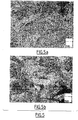
- the figure 5a shows a polarized light micrograph of the reference sample after final annealing. Its structure is still acicular with few areas sufficiently deformed to recrystallize, and there remain large ranges of parallel plates.
- the figure 5b shows under the same conditions the sample according to the invention after final annealing. There are recrystallized zones, and no parallel platelet beaches. This treatment without intermediate annealing according to the invention was therefore more able to break the acicular structure obtained after quenching ⁇ .
- the figure 6 shows calculated pole figures 002 and 100 after final annealing for the reference sample ( figure 6a ) and the sample according to the invention ( figure 6b ).
- the textures of these samples are intermediate between a quenched state and a conventional recrystallized state, with one or two very fine and very intense poles in the normal-transverse plane at about 30 ° from the normal direction. There are also poles near the transverse direction and in the longitudinal-transverse plane.
- the reference sample has a strong asymmetry, and textures much more intense than the sample according to the invention. These characteristics are unfavorable to the isotropy and the drawability of the material.
- the refinement of the desired structure can thus be obtained, at equal reduction rate, either by a single cold rolling which will immediately break a relatively large number of needles, or by a succession of cold rolling without intermediate annealing. which will break the needles more or less precociously according to their orientations.
- a preferred application of the invention is the production of housings for boiling water reactors.
- Grids and central tubes may also advantageously be obtained from flat products produced by the process according to the invention.
Landscapes
- Engineering & Computer Science (AREA)
- Chemical & Material Sciences (AREA)
- Physics & Mathematics (AREA)
- Mechanical Engineering (AREA)
- Organic Chemistry (AREA)
- Materials Engineering (AREA)
- Metallurgy (AREA)
- Crystallography & Structural Chemistry (AREA)
- Thermal Sciences (AREA)
- Manufacturing & Machinery (AREA)
- Plasma & Fusion (AREA)
- General Engineering & Computer Science (AREA)
- High Energy & Nuclear Physics (AREA)
- Heat Treatment Of Sheet Steel (AREA)
- Metal Rolling (AREA)
- Heat Treatment Of Steel (AREA)
- Monitoring And Testing Of Nuclear Reactors (AREA)
Applications Claiming Priority (2)
| Application Number | Priority Date | Filing Date | Title |
|---|---|---|---|
| FR0309474A FR2858332B1 (fr) | 2003-07-31 | 2003-07-31 | Procede de fabrication d'un produit plat en alliage de zirconium, produit plat ainsi obtenu et element d'un assemblage combustible pour reacteur de centrale nucleaire realise a partir de ce produit plat |
| PCT/FR2004/001923 WO2005021818A1 (fr) | 2003-07-31 | 2004-07-20 | Procede de fabrication d'un produit plat en alliage de zirconium, produit plat ainsi obtenu et element d'un assemblage combustible pour reacteur de centrale nucleaire realise a partir de ce produit plat |
Publications (2)
| Publication Number | Publication Date |
|---|---|
| EP1649073A1 EP1649073A1 (fr) | 2006-04-26 |
| EP1649073B1 true EP1649073B1 (fr) | 2018-08-08 |
Family
ID=34043714
Family Applications (1)
| Application Number | Title | Priority Date | Filing Date |
|---|---|---|---|
| EP04767740.6A Expired - Lifetime EP1649073B1 (fr) | 2003-07-31 | 2004-07-20 | Procede de fabrication d'un produit plat en alliage de zirconium, produit plat ainsi obtenu et element d'un assemblage combustible pour reacteur de centrale nucleaire realise a partir de ce produit plat |
Country Status (9)
| Country | Link |
|---|---|
| US (1) | US7630470B2 (enExample) |
| EP (1) | EP1649073B1 (enExample) |
| JP (1) | JP5646800B2 (enExample) |
| KR (1) | KR20060052939A (enExample) |
| CN (1) | CN100451159C (enExample) |
| CA (1) | CA2533172C (enExample) |
| FR (1) | FR2858332B1 (enExample) |
| RU (1) | RU2350684C2 (enExample) |
| WO (1) | WO2005021818A1 (enExample) |
Families Citing this family (10)
| Publication number | Priority date | Publication date | Assignee | Title |
|---|---|---|---|---|
| FR2849865B1 (fr) * | 2003-01-13 | 2006-01-21 | Cezus Co Europ Zirconium | Procede de fabrication d'un demi-produit en alliage de zirconium pour l'elaboration d'un produit plat et utilisation |
| US10221475B2 (en) | 2004-03-23 | 2019-03-05 | Westinghouse Electric Company Llc | Zirconium alloys with improved corrosion/creep resistance |
| US9284629B2 (en) | 2004-03-23 | 2016-03-15 | Westinghouse Electric Company Llc | Zirconium alloys with improved corrosion/creep resistance due to final heat treatments |
| SE530783C2 (sv) * | 2007-01-16 | 2008-09-09 | Westinghouse Electric Sweden | Spridargaller för positinering av bränslestavar |
| KR101088111B1 (ko) | 2009-02-17 | 2011-12-02 | 한국원자력연구원 | 부식저항성과 크립저항성이 우수한 지르코늄 합금 조성물 |
| CN109801727B (zh) * | 2019-02-01 | 2019-12-24 | 中国原子能科学研究院 | 燃料板及其制备方法 |
| EP3962679A1 (en) * | 2019-04-30 | 2022-03-09 | Westinghouse Electric Company Llc | Improved corrosion resistance of additively-manufactured zirconium alloys |
| CN110284027B (zh) * | 2019-08-06 | 2020-04-21 | 中国核动力研究设计院 | 一种耐碱性水质腐蚀的锆基合金 |
| CN110904359A (zh) * | 2019-12-18 | 2020-03-24 | 佛山科学技术学院 | 一种耐蚀锆合金 |
| CN115233001B (zh) * | 2022-07-28 | 2022-12-27 | 西安稀有金属材料研究院有限公司 | 一种高性能锆钆合金的制备方法 |
Family Cites Families (34)
| Publication number | Priority date | Publication date | Assignee | Title |
|---|---|---|---|---|
| US3776508A (en) * | 1961-05-26 | 1973-12-04 | Atomic Energy Commission | Process for massively hydriding zirconium-uranium fuel elements |
| US3336201A (en) * | 1965-02-16 | 1967-08-15 | Gen Electric Canada | Dual fuel cycle for nuclear reactors |
| US3865635A (en) * | 1972-09-05 | 1975-02-11 | Sandvik Ab | Method of making tubes and similar products of a zirconium alloy |
| US4017368A (en) | 1974-11-11 | 1977-04-12 | General Electric Company | Process for electroplating zirconium alloys |
| NL7602275A (nl) * | 1975-03-14 | 1976-09-16 | Asea Atom Ab | Werkwijze voor een corrosiewerende behandeling van zirkoonlegering. |
| JPS607027B2 (ja) * | 1980-04-14 | 1985-02-21 | 住友金属工業株式会社 | 温間加工用チタニウムまたはジルコニウム冷延板の製法 |
| US4383853A (en) | 1981-02-18 | 1983-05-17 | William J. McCollough | Corrosion-resistant Fe-Cr-uranium238 pellet and method for making the same |
| US4450016A (en) * | 1981-07-10 | 1984-05-22 | Santrade Ltd. | Method of manufacturing cladding tubes of a zirconium-based alloy for fuel rods for nuclear reactors |
| US4584030A (en) * | 1982-01-29 | 1986-04-22 | Westinghouse Electric Corp. | Zirconium alloy products and fabrication processes |
| SE434679B (sv) * | 1982-07-01 | 1984-08-06 | Asea Ab | Anordning vid hermetiskt slutna lastceller for eliminering av inverkan pa metverdet av en skillnad mellan trycket i ett givarrum och atmosferstrycket |
| US4595413A (en) | 1982-11-08 | 1986-06-17 | Occidental Research Corporation | Group IVb transition metal based metal and processes for the production thereof |
| US4604148A (en) | 1983-11-22 | 1986-08-05 | The United States Of America As Represented By The United States Department Of Energy | Method of increasing the phase stability and the compressive yield strength of uranium-1 to 3 wt. % zirconium alloy |
| FR2584097B1 (fr) * | 1985-06-27 | 1987-12-11 | Cezus Co Europ Zirconium | Procede de fabrication d'une ebauche de tube de gainage corroyee a froid en alliage de zirconium |
| EP0296972B1 (fr) * | 1987-06-23 | 1992-08-12 | Framatome | Procédé de fabrication d'un tube en alliage à base de zirconium pour réacteur nucléaire et applications |
| US5242515A (en) * | 1990-03-16 | 1993-09-07 | Westinghouse Electric Corp. | Zircaloy-4 alloy having uniform and nodular corrosion resistance |
| EP0689209A1 (en) * | 1990-11-28 | 1995-12-27 | Hitachi, Ltd. | Method of operating a nuclear reactor containing a plurality of nuclear fuel channel boxes and manufacturing said boxes |
| FR2673198B1 (fr) * | 1991-02-22 | 1993-12-31 | Cezus Cie Europ Zirconium | Procede de fabrication d'une bande ou tole en zircaloy 2 ou 4 et produit obtenu. |
| JP2560571B2 (ja) * | 1991-07-15 | 1996-12-04 | 株式会社日立製作所 | 燃料チャンネルボックスの製造方法及び燃料チャンネルボックス |
| JP2638351B2 (ja) * | 1991-09-20 | 1997-08-06 | 株式会社日立製作所 | 燃料集合体 |
| US5310431A (en) | 1992-10-07 | 1994-05-10 | Robert F. Buck | Creep resistant, precipitation-dispersion-strengthened, martensitic stainless steel and method thereof |
| US5437747A (en) * | 1993-04-23 | 1995-08-01 | General Electric Company | Method of fabricating zircalloy tubing having high resistance to crack propagation |
| US5319431A (en) * | 1993-06-30 | 1994-06-07 | Xerox Corporation | Apparatus for increased toner storage capacity |
| FR2711147B1 (fr) * | 1993-10-11 | 1995-11-17 | Cezus Co Europ Zirconium | Procédé de fabrication d'un produit plat en alliage de zirconium comprenant un réchauffage dans le domaine béta par infrarouges. |
| FR2713009B1 (fr) * | 1993-11-25 | 1996-01-26 | Framatome Sa | Procédé de fabrication d'un tube de gainage pour crayon de combustible nucléaire et tubes conformes à ceux ainsi obtenus. |
| FR2716897B1 (fr) * | 1994-03-02 | 1996-04-05 | Cezus Co Europ Zirconium | Procédé de fabrication d'un produit plat en alliage de zirconium ou en alliage de hafnium comprenant une poursuite du laminage à chaud après rechauffage par infrarouges et ses utilisations . |
| SE513488C2 (sv) * | 1994-06-22 | 2000-09-18 | Sandvik Ab | Sätt att tillverka rör av zirkoniumbaslegering för kärnreaktorer och användning av sättet vid tillverkning av sådana rör |
| US5618502A (en) | 1995-07-17 | 1997-04-08 | Westinghouse Electric Corporation | Zirconium and hafnium separation in sulfate solutions using continuous ion exchange chromatography |
| JPH09257988A (ja) * | 1996-01-19 | 1997-10-03 | Nuclear Fuel Ind Ltd | 耐食性、特に耐一様腐食性と耐水素吸収性に優れたジルコニウム合金系原子炉炉心内構造材の製造方法 |
| JPH09249927A (ja) * | 1996-03-13 | 1997-09-22 | Hitachi Ltd | 低照射成長ジルコニウム基合金板とその製造法及び用途 |
| SE9601594D0 (sv) * | 1996-04-26 | 1996-04-26 | Asea Atom Ab | Fuel boxes and a method for manufacturing fuel boxes |
| RU2110600C1 (ru) * | 1996-09-10 | 1998-05-10 | Открытое акционерное общество "Чепецкий механический завод" | Способ получения изделий из циркониевых сплавов |
| JP3692075B2 (ja) | 1999-06-15 | 2005-09-07 | ハンヤン ハク ウォン カンパニー,リミテッド | Cf4/o2/n2プラズマ中におけるアクチニド酸化物およびその混合酸化物の効果的なドライエッチング法 |
| RU2184795C2 (ru) * | 1999-07-29 | 2002-07-10 | Открытое акционерное общество "Чепецкий механический завод" | Способ изготовления плоского профиля из циркониевых сплавов |
| US6554179B2 (en) | 2001-07-06 | 2003-04-29 | General Atomics | Reaction brazing of tungsten or molybdenum body to carbonaceous support |
-
2003
- 2003-07-31 FR FR0309474A patent/FR2858332B1/fr not_active Expired - Lifetime
-
2004
- 2004-07-20 EP EP04767740.6A patent/EP1649073B1/fr not_active Expired - Lifetime
- 2004-07-20 RU RU2006106222/02A patent/RU2350684C2/ru active
- 2004-07-20 KR KR1020067002054A patent/KR20060052939A/ko not_active Ceased
- 2004-07-20 WO PCT/FR2004/001923 patent/WO2005021818A1/fr not_active Ceased
- 2004-07-20 JP JP2006521611A patent/JP5646800B2/ja not_active Expired - Fee Related
- 2004-07-20 CA CA2533172A patent/CA2533172C/fr not_active Expired - Fee Related
- 2004-07-20 CN CNB2004800217357A patent/CN100451159C/zh not_active Expired - Fee Related
- 2004-07-20 US US10/565,481 patent/US7630470B2/en not_active Expired - Fee Related
Non-Patent Citations (1)
| Title |
|---|
| None * |
Also Published As
| Publication number | Publication date |
|---|---|
| US7630470B2 (en) | 2009-12-08 |
| KR20060052939A (ko) | 2006-05-19 |
| WO2005021818A1 (fr) | 2005-03-10 |
| CA2533172C (fr) | 2011-04-12 |
| US20060215806A1 (en) | 2006-09-28 |
| RU2350684C2 (ru) | 2009-03-27 |
| CN1829815A (zh) | 2006-09-06 |
| JP2007500788A (ja) | 2007-01-18 |
| FR2858332A1 (fr) | 2005-02-04 |
| RU2006106222A (ru) | 2006-07-10 |
| CA2533172A1 (fr) | 2005-03-10 |
| EP1649073A1 (fr) | 2006-04-26 |
| JP5646800B2 (ja) | 2014-12-24 |
| CN100451159C (zh) | 2009-01-14 |
| FR2858332B1 (fr) | 2005-10-28 |
Similar Documents
| Publication | Publication Date | Title |
|---|---|---|
| EP0802264B1 (fr) | Alliage à base de zirconium résistant au fluage et à la corrosion par l'eau et la vapeur, procédé de fabrication, et utilisation dans un réacteur nucléaire | |
| EP1649073B1 (fr) | Procede de fabrication d'un produit plat en alliage de zirconium, produit plat ainsi obtenu et element d'un assemblage combustible pour reacteur de centrale nucleaire realise a partir de ce produit plat | |
| FR2703608A1 (fr) | Procédé de fabrication de pièces forgées recristallisées de grande taille. | |
| EP1670963B1 (fr) | Procede d' elaboration d'un produit plat en alliage de zirconium, produit plat ainsi obtenu et grille de reacteur de centrale nucleaire realisee a partir de ce produit plat | |
| EP0296972A1 (fr) | Procédé de fabrication d'un tube en alliage à base de zirconium pour réacteur nucléaire et applications | |
| EP0720177A1 (fr) | Procédé de fabrication d'un tube pour assemblage combustible nucléaire et tubes ainsi obtenus | |
| US20100108204A1 (en) | Zirconium alloy composition for nuclear fuel cladding tube forming protective oxide film, zirconium alloy nuclear fuel cladding tube manufactured using the composition, and method of manufacturing the zirconium alloy nuclear fuel cladding tube | |
| EP0192499B1 (fr) | Procédé de fabrication de plaquettes en alliage de zirconium | |
| EP0246986B1 (fr) | Procédé de fabrication d'un feuillard en zircaloy 2 ou zircaloy 4 partiellement recristallisé et feuillard obtenu | |
| EP1153396B1 (fr) | Procede de fabrication d'elements minces en alliage a base de zirconium et plaquettes ainsi realisees | |
| EP1232291B1 (fr) | Alliage a base de zirconium a forte resistance a la corrosion et a l'hydruration par l'eau et la vapeur d'eau et procede de transformation thermomecanique de l'alliage | |
| EP0724270A1 (fr) | Tube en alliage à base de zirconium pour assemblage combustible nucléaire et procédé de fabrication d'un tel tube | |
| EP3284836A1 (en) | Zirconium alloy having excellent corrosion resistance and creep resistance, and method for manufacturing same | |
| FR2585593A1 (fr) | Procede de fabrication d'un tube metallique et tube ainsi obtenu, notamment le traitement des gaines pour combustible nucleaire | |
| EP0655745B1 (fr) | Procédé de fabrication d'un tube de gainage pour crayon de combustible nucléaire et tubes conformes à ceux ainsi obtenus | |
| FR2563843A1 (fr) | Procede de fabrication de plaques en alliage de titane | |
| WO2025012095A1 (fr) | Procédé de fabrication d'un composant de réacteur nucléaire et composant de réacteur nucléaire ainsi obtenu | |
| KR102049430B1 (ko) | 핵연료피복관 및 그의 제조 방법 | |
| KR20050090456A (ko) | 평판 제품 제조용 지르코늄 합금으로 제조된 반가공 제품의제조방법 및 이의 용도 | |
| FR2675816A1 (fr) | Procede pour la fabrication de toles d'aluminium. | |
| CH420636A (fr) | Procédé de préparation d'un alliage fer-aluminium, alliage obtenu selon ce procédé et utilisation de cet alliage | |
| FR2791804A1 (fr) | Procede de fabrication d'elements minces en alliage a base de zirconium et plaquettes ainsi realisees |
Legal Events
| Date | Code | Title | Description |
|---|---|---|---|
| PUAI | Public reference made under article 153(3) epc to a published international application that has entered the european phase |
Free format text: ORIGINAL CODE: 0009012 |
|
| 17P | Request for examination filed |
Effective date: 20060109 |
|
| AK | Designated contracting states |
Kind code of ref document: A1 Designated state(s): DE ES FR GB SE |
|
| DAX | Request for extension of the european patent (deleted) | ||
| RBV | Designated contracting states (corrected) |
Designated state(s): DE ES FR GB SE |
|
| RIN1 | Information on inventor provided before grant (corrected) |
Inventor name: SIMONOT, CLAUDE Inventor name: BARBERIS, PIERRE |
|
| 17Q | First examination report despatched |
Effective date: 20110728 |
|
| RAP1 | Party data changed (applicant data changed or rights of an application transferred) |
Owner name: AREVA NP |
|
| GRAP | Despatch of communication of intention to grant a patent |
Free format text: ORIGINAL CODE: EPIDOSNIGR1 |
|
| RIC1 | Information provided on ipc code assigned before grant |
Ipc: G21C 21/00 20060101ALI20180206BHEP Ipc: C22F 1/18 20060101AFI20180206BHEP Ipc: C22C 16/00 20060101ALI20180206BHEP |
|
| INTG | Intention to grant announced |
Effective date: 20180221 |
|
| RAP1 | Party data changed (applicant data changed or rights of an application transferred) |
Owner name: FRAMATOME |
|
| GRAS | Grant fee paid |
Free format text: ORIGINAL CODE: EPIDOSNIGR3 |
|
| GRAA | (expected) grant |
Free format text: ORIGINAL CODE: 0009210 |
|
| AK | Designated contracting states |
Kind code of ref document: B1 Designated state(s): DE ES FR GB SE |
|
| REG | Reference to a national code |
Ref country code: GB Ref legal event code: FG4D Free format text: NOT ENGLISH |
|
| RIN1 | Information on inventor provided before grant (corrected) |
Inventor name: SIMONOT, CLAUDE Inventor name: BARBERIS, PIERRE |
|
| REG | Reference to a national code |
Ref country code: DE Ref legal event code: R096 Ref document number: 602004053027 Country of ref document: DE |
|
| REG | Reference to a national code |
Ref country code: SE Ref legal event code: TRGR |
|
| PG25 | Lapsed in a contracting state [announced via postgrant information from national office to epo] |
Ref country code: ES Free format text: LAPSE BECAUSE OF FAILURE TO SUBMIT A TRANSLATION OF THE DESCRIPTION OR TO PAY THE FEE WITHIN THE PRESCRIBED TIME-LIMIT Effective date: 20180808 |
|
| REG | Reference to a national code |
Ref country code: DE Ref legal event code: R097 Ref document number: 602004053027 Country of ref document: DE |
|
| PLBE | No opposition filed within time limit |
Free format text: ORIGINAL CODE: 0009261 |
|
| STAA | Information on the status of an ep patent application or granted ep patent |
Free format text: STATUS: NO OPPOSITION FILED WITHIN TIME LIMIT |
|
| 26N | No opposition filed |
Effective date: 20190509 |
|
| REG | Reference to a national code |
Ref country code: DE Ref legal event code: R119 Ref document number: 602004053027 Country of ref document: DE |
|
| GBPC | Gb: european patent ceased through non-payment of renewal fee |
Effective date: 20190720 |
|
| PG25 | Lapsed in a contracting state [announced via postgrant information from national office to epo] |
Ref country code: DE Free format text: LAPSE BECAUSE OF NON-PAYMENT OF DUE FEES Effective date: 20200201 Ref country code: GB Free format text: LAPSE BECAUSE OF NON-PAYMENT OF DUE FEES Effective date: 20190720 |
|
| PG25 | Lapsed in a contracting state [announced via postgrant information from national office to epo] |
Ref country code: FR Free format text: LAPSE BECAUSE OF NON-PAYMENT OF DUE FEES Effective date: 20190731 |
|
| PGFP | Annual fee paid to national office [announced via postgrant information from national office to epo] |
Ref country code: SE Payment date: 20200720 Year of fee payment: 17 |
|
| PG25 | Lapsed in a contracting state [announced via postgrant information from national office to epo] |
Ref country code: SE Free format text: LAPSE BECAUSE OF NON-PAYMENT OF DUE FEES Effective date: 20210721 |