EP1645142B1 - Schnelle weiterreichung durch proaktive registration - Google Patents
Schnelle weiterreichung durch proaktive registration Download PDFInfo
- Publication number
- EP1645142B1 EP1645142B1 EP04755284A EP04755284A EP1645142B1 EP 1645142 B1 EP1645142 B1 EP 1645142B1 EP 04755284 A EP04755284 A EP 04755284A EP 04755284 A EP04755284 A EP 04755284A EP 1645142 B1 EP1645142 B1 EP 1645142B1
- Authority
- EP
- European Patent Office
- Prior art keywords
- wireless communications
- communications network
- network
- detecting
- communications unit
- Prior art date
- Legal status (The legal status is an assumption and is not a legal conclusion. Google has not performed a legal analysis and makes no representation as to the accuracy of the status listed.)
- Expired - Lifetime
Links
Images


Classifications
-
- H—ELECTRICITY
- H04—ELECTRIC COMMUNICATION TECHNIQUE
- H04W—WIRELESS COMMUNICATION NETWORKS
- H04W36/00—Hand-off or reselection arrangements
- H04W36/14—Reselecting a network or an air interface
- H04W36/144—Reselecting a network or an air interface over a different radio air interface technology
- H04W36/1446—Reselecting a network or an air interface over a different radio air interface technology wherein at least one of the networks is unlicensed
-
- H—ELECTRICITY
- H04—ELECTRIC COMMUNICATION TECHNIQUE
- H04B—TRANSMISSION
- H04B7/00—Radio transmission systems, i.e. using radiation field
- H04B7/24—Radio transmission systems, i.e. using radiation field for communication between two or more posts
- H04B7/26—Radio transmission systems, i.e. using radiation field for communication between two or more posts at least one of which is mobile
- H04B7/2603—Arrangements for wireless physical layer control
- H04B7/2606—Arrangements for base station coverage control, e.g. by using relays in tunnels
-
- H—ELECTRICITY
- H04—ELECTRIC COMMUNICATION TECHNIQUE
- H04B—TRANSMISSION
- H04B7/00—Radio transmission systems, i.e. using radiation field
- H04B7/24—Radio transmission systems, i.e. using radiation field for communication between two or more posts
- H04B7/26—Radio transmission systems, i.e. using radiation field for communication between two or more posts at least one of which is mobile
- H04B7/2628—Radio transmission systems, i.e. using radiation field for communication between two or more posts at least one of which is mobile using code-division multiple access [CDMA] or spread spectrum multiple access [SSMA]
-
- H—ELECTRICITY
- H04—ELECTRIC COMMUNICATION TECHNIQUE
- H04W—WIRELESS COMMUNICATION NETWORKS
- H04W60/00—Affiliation to network, e.g. registration; Terminating affiliation with the network, e.g. de-registration
- H04W60/06—De-registration or detaching
Definitions
- the present invention relates in general to wireless communications units and wireless networks, and more specifically to a method and apparatus for providing a fast handover of such wireless communications units between wireless networks through proactive registration.
- WLAN Loosely coupled Wireless Local Area Networks
- WLAN servers such as enterprise servers provide a user with such amenities as high-speed wireless Internet access and an inexpensive alternative for telephony services as well as other real-time applications.
- the user can carry a wireless communications unit (referred to as a communications unit) with dual-use capability so that the communications unit can provide voice communication over an enterprise server when the communications unit is in a WLAN and over a cellular wireless area network (WAN or cellular network) such as 3G when the communications unit is outside of the WLAN.
- WAN cellular wireless area network
- the communications unit When the communications unit has a link to a first network (i.e., is on a call or is communicating over the first network) and is moving to a second network such as, for example, from a WLAN to a cellular network, it is desirable that the first network handover the link to the second network, preferably with minimal undesirable effects on the communications unit service. Since it may take a relatively long time (10s) to bring up the software and hardware necessary to operate in and register with a system, the user can experience unsatisfactory service or worse a dropped call or link. Conversely, registration with multiple systems at all times will seriously reduce battery life, so it is impractical to maintain registration with more than one network when it is not necessary.
- US 2002/085516 A1 discloses an arrangement in which a Mobile Station (MS) is able to vertically roam in either direction between two different network, i.e. WWAN and WLAN.
- the MS is equipped with a dual mode Radio for WWAN and WLAN transmissions.
- the WLAN Radio is linked to a WLAN Enterprise Gateway Controller (EGC) via a first air link and the WWAN Radio is linked to a WWAN Base Transceiver Station (BTS) via a second air link.
- the EGC is connected to a Mobile Switching Center (MSC) which is in turn connected to the BTS.
- An outgoing VoIP call from the WLAN Radio to a remote party on the WWAN will transition or seamlessly switch over to a WWAN connection when the MS detects packet error rates, frequent scale back or consistent signal degradation.
- the WLAN Radio requests the EGC to request an Explicit Call Transfer via the MSC to the MS integrated WWAN Radio portion which automatically accepts the call based on referenced information stored in the user's subscriber identification module (SIM).
- SIM subscriber identification module
- the WLAN Radio drops the WLAN connection.
- An incoming call between the MS and a remote user via the WWAN will transition to the WLAN Radio when the MS enters WLAN coverage.
- the MS issues an ECT to the WLAN.
- the WWAN Radio connection is dropped and the call is now established between the WLAN Radio and the remote party on the WWAN.
- US 2003/104814 A1 discloses an arrangement in which a tunnel is set up between two mobility serving nodes, source and target nodes.
- the tunnel is used for communication between a mobile node and the source node after the mobile node completes an L2 handoff from the source node to the target node but before completing the standard Mobile IP L3 registration process or undergoing IP routing update with the target node.
- the tunnel may be set up either before or after the mobile node completes the L2 handoff from the source node to the target node.
- the tunnel may be set up by a trigger that is generated either externally or internally of the mobile node.
- the present disclosure concerns wireless communications devices or units, often referred to as communications units, such as cellular phone or two-way radios and the like that have dual operating mode capability and communications systems that provide services such as voice and data communications services to communications units. More particularly various inventive concepts and principles are embodied in systems, communications units, and methods therein for providing the communications unit that is registered with a first network with proactive registration with a second network to facilitate a seamless handoff or handover of a communications link.
- communications unit may be used interchangeably herein with wireless subscriber device or unit and each of these terms denotes a device ordinarily associated with a user and typically a wireless mobile device that may be used with a public network in accordance with a service agreement or within a private network. Examples of such units include personal digital assistants, personal assignment pads, and personal computers equipped for wireless operation, a cellular handset or device, or equivalents thereof provided such units are arranged and constructed for operation in different networks.
- the communication systems and communications units that are of particular interest are those that may provide or facilitate voice communications services or data or messaging services over cellular wide area networks (WANs), such as conventional two way systems and devices, various cellular phone systems including analog and digital cellular, CDMA (code division multiple access) and variants thereof, GSM, GPRS (General Packet Radio System), 2.5G and 3G systems such as UMTS (Universal Mobile Telecommunication Service) systems, integrated digital enhanced networks and variants or evolutions thereof.
- WANs wide area networks
- CDMA code division multiple access
- GSM Global System
- GPRS General Packet Radio System
- 2.5G and 3G systems such as UMTS (Universal Mobile Telecommunication Service) systems, integrated digital enhanced networks and variants or evolutions thereof.
- UMTS Universal Mobile Telecommunication Service
- wireless communications units or devices of interest have short range wireless communications capability normally referred to as WLAN capabilities, such as IEEE 802.11, Bluetooth, or Hiper-Lan and the like that preferably utilize CDMA, frequency hopping, OFDM or TDMA access technologies and one or more of various networking protocols, such as TCP/IP (Transmission Control Protocol/Internet Protocol), UDP/IP (Universal Datagram Protocol/IP), IPX/SPX (Inter-Packet Exchange/Sequential Packet Exchange), Net BIOS (Network Basic Input Output System) or other protocol structures.
- TCP/IP Transmission Control Protocol/Internet Protocol
- UDP/IP Universal Datagram Protocol/IP
- IPX/SPX Inter-Packet Exchange/Sequential Packet Exchange
- Net BIOS Network Basic Input Output System
- inventive principles and combinations thereof are advantageously employed to facilitate a handover of a communications link from a first wireless communications network (first network) to a second wireless communications network (second network) by providing for proactive registration with the second network when, for example communication over the first network is initiated.
- first network first wireless communications network
- second network second wireless communications network
- the battery life of a communications unit utilizing the methods and apparatus of the present invention can be noticeably extended versus the battery life of a communications unit that maintains registration with both the first network and the second network at all times and at the same time the time delay and resultant service problems are resolved.
- the system 100 generally shows a communications unit 102 that is movable between service from a first wireless communications network (first network) 106 and service from a second wireless communications network (second network) 120.
- first network first wireless communications network
- second network second wireless communications network
- the first network 106 is a wireless local area network (WLAN) provided by an enterprise server 104 through a plurality of Access Points (APs) 108
- the second network 120 is preferably a cellular packet data network or other cellular or cellular like network otherwise referred to as a cellular wide area network (cellular WAN) provided by the communications unit's local cellular base transmitter site(s) (BTS) 116.
- cellular WAN cellular wide area network
- BTS base transmitter site
- a coverage area of the second network overlaps a coverage area of the first network.
- the local cellular BTS 116 provides cellular WAN coverage that overlaps the WLAN. It is understood that in general more than one local cellular BTS may provide such coverage. For brevity, only one such BTS 116 is shown in the figures and referred to below.
- the enterprise server 104 has a connection 130 to the PSTN and may serve a single enterprise location or may serve multiple enterprise sites, possibly located in different cities. Despite its name the enterprise server 104 may serve a WLAN hotspot, or multiple WLAN hotspots. It may also serve one or more WLAN coverage areas in private homes that may be connected to the enterprise server 104 by such means as an IP broadband connection.
- the communications unit 102 may be in contact with, for example, communications unit 112 via an Internet Protocol (IP) connection 110, communications unit 122 via the public switched telephone network (PSTN) 114, wireless communications unit 126 via another BTS 124 or cellular WAN, or a communications unit 128 via the WLAN.
- IP Internet Protocol
- PSTN public switched telephone network
- the cellular WAN connects the IP connection 110 to the cellular BTS 116 for data traffic and a voice network 118, specifically voice network of a cellular system, connects the BTS 116 to the PSTN 114 for voice traffic and for the signaling required to conduct legacy voice calls.
- the communications unit 102 may also be in contact with a wireless communications unit 126 via the same or another cellular WAN that connects the communication unit 126 to a cellular BTS 124 for data traffic.
- a voice network 132 specifically voice network of a cellular system, connects the BTS 124 to the PSTN 114 for voice traffic and for the signaling required to conduct legacy voice calls. Note that while there are in fact many cellular operators, each operating a cellular WAN system, the composite of each of these cellular WANs could comprise or be viewed as the cellular WAN system with constituent elements, such as switching centers, base transmitter controllers, base transmitters, visitor and home location registers, billing systems, etc.
- the communications units are mobile and can move around within the WLAN or the WAN and routinely move out of range of the WLAN, e.g. into the WAN and vice versa.
- a handover or handover of the ongoing communication from one system to the other is required.
- a registration, etc. on the system the communication is being handed to is required. This registration can take more time than is available and result in dropped calls or unsatisfactory service.
- the communications unit 102 includes an antenna 201 that operates to absorb and radiate radio frequency signals that are received from the first network 106.
- radio signals that are transmitted from the WLAN are absorbed by the antenna 201 and coupled to a first receiver 203, which, in this exemplary embodiment is also referred to as a WLAN receiver.
- the radio signals that are transmitted from the WLAN thus received by the first receiver 203, may include a beacon signal to be discussed later in connection with FIGs 3 - 5 .
- Signals that are amplified by and coupled from a first transmitter 205 (in this example WLAN transmitter), to the antenna 201 are radiated or transmitted or sent to the access point and thus the enterprise server 104 according to known WLAN technologies, such as 302.11 and others earlier mentioned.
- the first receiver and transmitter 203, 205 are inter coupled as depicted and interactively operate with and are controlled by a controller 207 to provide to, or accept or receive from the controller 207, voice traffic or data messages or signals corresponding thereto as is also known.
- the communications unit 102 also includes an antenna 235 that may be physically separate from or included with the antenna 201 and operates to absorb and radiate radio frequency signals that are received from a second network 120.
- the communications unit 102 also includes a second receiver 231, in this exemplary embodiment referred to as a WAN receiver, to which the absorbed signals from the cellular BTS 116 are coupled.
- the communications unit 102 also includes a second transmitter 233 referred to as a WAN transmitter in this example, that amplifies and provides the signals for transmission or radiation by the antenna 235 to a cellular network such as the local cellular BTS 116 as is known.
- the second receiver and transmitter 231, 233 are inter coupled as depicted and interactively operate with and are controlled by the controller 207 to provide to, or accept or receive from the controller 207, voice traffic or data messages or signals corresponding thereto in a similar manner as the first receiver and transmitter 203, 205.
- the first receiver and transmitter 203, 205 and the second receiver and transmitter 231, 233 as controlled by and in cooperation with the controller 207 and functions thereof provide the communications unit 102 with dual operating mode capability.
- the communications unit 102 is capable of registering with and obtaining service from a cellular network or WAN provided by, for example, the local cellular system, e.g. corresponding BTS 116 as well as a WLAN as provided by the enterprise server 104 coupled to the plurality of access points 108.
- the communications unit 102 can optionally have only one receiver and one transmitter that are adaptable and configurable to interface with both the first and second networks 106, 120 and that are coupled to and controlled by the controller 107.
- the receiving device has the capabilities of both the first and second receivers 203, 231 and therefore receives signals from the first and the second networks 106, 120, and the transmitting device has the capabilities of both the first and second transmitters 205, 233.
- the controller 207 is coupled to and generally operates in a known manner, except for the modifications required according to the principles and concepts discussed here, together with a user interface 209 that includes, for example, audio transducers, such as an earphone or speaker and microphone, a display and a keypad.
- the transmitting device, receiving device and user interface 209 are each inter coupled, as depicted to the controller 207 and the controller 207 provides overall operational command and control for the communications unit 102.
- the controller 207 is coupled to and operates together with the display and keyboard or set of keys to effect a portion of a user interface experience that may depend on the particular device and its features and to facilitate generation and consumption of messages or other information.
- the keyboard can be a known physical keyboard or virtual keyboard that is part of the display and the display is also known and may be a liquid crystal display or the like. If the keys are part of a virtual keyboard the display will need to be touch sensitive or the like in order to convey information to the controller. Similarly the earphone, speaker and microphone are known and widely available.
- the controller 207 is essentially a general-purpose processor and, preferably, includes a processor 211 and an associated memory source or memory 215.
- the processor 211 is, preferably, a known processor based element with functionality that will depend on the specifics of the air interface with the first network 106 and the second network 120 as well as various network protocols for voice and data traffic.
- the processor 211 will operate to encode and decode voice and data messages to provide signals suitable for a transducer or further processing by the controller 207.
- the processor 211 may include one or more microprocessors, digital signal processors, and other integrated circuits depending on the responsibilities of the controller 207 with respect to signal processing duties that are not here relevant.
- the controller 207 also includes the memory source or memory 215 that may be, for example, a combination of known RAM (Random Access Memory), ROM (Read-Only Memory), EEPROM (Electrically Erasable Programmable ROM) or magnetic memory.
- the memory source 215 is used to store among various other items or programs etc., an operating system or software, data, and variables 217 for the processor 211. This operating software 217 when executed by the processor 211 will result in the processor 211 performing the requisite functions of the communications unit 102 such as interfacing with the user interface 209 and transceivers or transmitting device and receiving device.
- the memory 215 further includes call processing routines not specifically shown for supporting voice and data calls that will be appreciated by one of ordinary skill and that will vary depending on air interface, call processing, and service provider or network specifics.
- the memory 215 further includes space for a condition definition and detection routine or function 219 that is for detecting a condition indicative of, for example, initiating communication, also referred to as an action preparatory to initiating a call, over the first network 106.
- This condition may be, for example, at least one of accessing a communications unit phone book, dialing a number, opening a hinged cover of the communications unit 102, and entering a key for access to the communications unit 102, or any other condition that could potentially or likely lead to the initiation of communication over the first network 106.
- These conditions may be communication unit specific and in any event can be experimentally determined and modified as experience dictates.
- the transmitting device, receiving device and controller 207 operate cooperatively for facilitating a communication over the first network 106 and for facilitating registration with the second network 120 when the controller 207 detects a condition indicative of initiating communication. More specifically, when the condition detection program 219 detects a condition indicative of initiating communication over the WLAN, such as, for example, the accessing of a communications unit phone book, the transmitting device, receiving device and controller 207 access the software and hardware corresponding to the cellular WAN, also referred to as calling up a stack corresponding to the WAN, and begin registering with the WAN.
- the condition detection program 219 will be discussed in further detail with respect to FIG. 3 .
- various functions, circumstances or second conditions such as conditions regarding the first network 106 and the second network 120 and the operational and physical status of the communications unit 102 are also important and advantageously impact the operation of the communications unit.
- These second conditions are detected or found using software algorithms or routines that are also included in the memory 215.
- the controller 207 uses a beacon detection function 221 to detect if a beacon signal indicative of a location of the communications unit is received by the receiving device.
- a coverage quality determination function 223 determines coverage quality by, for example assessing signal strength, bit or frame error rates and the like, corresponding to at least one of the first network 106 and the second network 120 or available links from the communications unit to these networks.
- the communications unit 102 may also need at least one of a location detecting device (not shown) that is, for example, a known Global Positioning System (GPS) device or any other device capable of detecting a physical location of the communications unit and a motion detector 229, which can be, for example, an accelerometer, a GPS system, or any other means for detecting a physical movement of the communications unit and that is in communication with the controller 207.
- a location detecting device is, for example, a known Global Positioning System (GPS) device or any other device capable of detecting a physical location of the communications unit
- GPS Global Positioning System
- a motion detector 229 which can be, for example, an accelerometer, a GPS system, or any other means for detecting a physical movement of the communications unit and that is in communication with the controller 207.
- One or more of the functions 221, 223, 225, 227 and 237 as well as additional not listed functions 239 can be used in combination with the condition detection function 219 to determine if and when the communications unit 102 registers with the second network 120.
- the functions 221, 223, 225, 227 and 237 and impact on the operation of the communication unit will be discussed in further detail with respect to FIGs. 3 and 4 .
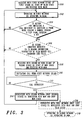
- FIG. 3 a diagram of a preferred method embodiment of providing a handover of a communications link between two wireless communications networks will be reviewed and discussed. Some of this discussion will be in the nature of a review and summary of portions of the discussions above.
- the method may be implemented with and will be explained in conjunction with and reference to the communications unit of FIG. 2 operating in the environment of FIG. 1 .
- the method begins at 300 with the registration of the communications unit 102 with the first network 106, for example the WLAN, and starting up of a first stack (initializing and launching various requisite software routines and establishing present parameters corresponding to network and unit circumstances) corresponding to the first network, for example a WLAN stack.
- a first stack initializing and launching various requisite software routines and establishing present parameters corresponding to network and unit circumstances
- starting a stack can include registration of the communications unit 102 with the WLAN including association with one of the APs 108 and this may involve contacting an AAA server for authentication, authorization and accounting of the communications unit's WLAN access, At 302 as depicted, the communications unit 102 operates exclusively on the first network 106.
- This call or communication can be, for example, one of a telephony voice call, a dispatch call, or a multimedia call. If the action is not detected, the communications unit 102 continues to operate in the first network 106 and check or test for the condition at 302, 304.
- the communications unit 102 Upon detection of the action or condition and ignoring the preferred but optional process at 306 for the moment, at 308 the communications unit 102 proceeds to register or facilitate registration with the second network 120 and start up a second stack corresponding to the second network 120. For example, if at 304 the controller 207 of the communications unit 102 operating in the WLAN detects the dialing of a number, accessing a phone book, entering a key or PIN, etc, the communications unit 102 proceeds to start up the cellular WAN stack and register with the cellular WAN.
- Starting the WAN stack is known and include registration where registration with the various known legacy cellular systems depend on the specifics of the cellular protocol being used at the BTS 116 and may involve use of information stored on a Subscriber Interface Module (SIM) card in the communications unit and access of a Home Location Register (HLR) and an Authentication Center (AuC) for location tracking and authentication.
- SIM Subscriber Interface Module
- HLR Home Location Register
- AuC Authentication Center
- the call is initiated using the first network 106 and a link or connection is made with the first network 106.
- the communications unit is ready to rapidly execute a handover of the ongoing call from the first to the second system, if the need for such a handover arises.
- the specifics of deciding whether a handover is required are beyond the scope of this disclosure but would include determining that ongoing service with the present network is not feasible, not practical, or no longer appropriate for some reasons.
- the controller 102 determines if the call is completed using the end-call detection function 237.
- the controller 207 detects a condition indicative of a completion of the communication over the first network 106 or a completion of a communication over the second network, e.g. a hang-up or activation of a call ending button, using the end-call detection function 237, the communications unit 102 deregisters with at least one of the first and second networks 106,120 at 314, 316. Note that preferably the communications unit remains registered for a short duration, for example 10 sec, to account for users that place a call soon after another one ends.
- the communications unit will de-register with the second network. For example, suppose the phone book is accessed, which is often but not always a precursor to placing a call. If no call is initiated the communications unit, in the interest of battery life, will deregister at some point. After a predetermined duration the communications units acts as though it had determined that the call is completed.
- the communications unit 102 deregisters with the second network 120, drops the second stack since this hardware and software are no longer needed, and continues to operate in the first network 106.
- the communications unit 102 does handover to the second system during the call, at 316 the communications unit 102 deregisters with the first network 106, drops the first stack, and at 318 operates in the second network 120.
- the communications unit deregisters with the cellular WAN and drops the cellular WAN stack at 314 or deregisters with the WLAN and drops the WLAN stack at 316 and operates in the cellular WAN at 318.
- the registration of the second network at 308 may also be dependent upon whether a second condition is met.
- the controller 207 determines if the second condition is detected before the communications unit 102 proceeds to registration with the second network at 308. For example, the controller 207 determines whether a beacon signal, e.g. beacon information, is detected in addition to the action before proceeding to registration with the second network at 308. This will be discussed in further detail in connection with FIG. 4 .
- a beacon signal e.g. beacon information
- the initiating of the call using the first network at 310 can take place before the registering with the second network at 308, after the registering with the second network at 308, or, and typically, both proceed in parallel.
- This method as discussed above will significantly improve the standby battery life of a communications unit that usually remains inside coverage of the first network. If the communications unit never initiates calls, there is little need for the communications unit to ever bring up the stack for the second network or to register with it. However, this method may not provide improvement in talk time for compulsive callers that are on phone calls for a large fraction of the time (such as some service or sales personnel). In that case, both stacks may frequently be running at the same time and a large number of registrations and de-registrations may be done with the second network. To address this problem, the preferred embodiment applies a second condition at 306
- FIG. 4 lists some exemplary second conditions, of which one or more may occur to satisfy the detection of the second condition at 306 before proceeding to 308.
- the controller 207 determines if beacon information that was transmitted by the first network 106 is being received and observed (detected) using the beacon detection function 221.
- WLAN beacon information is typically transmitted by an Access Point at regular intervals.
- the communications unit can also obtain the beacon signal, specifically beacon information, by sending a probe to the WLAN and getting a response back from the access point.
- the beacon information is preferably indicative of a location of the communications unit, for example an access point identity, or a special border or egress point indication in the beacon frame information, and may be observed near a border of a coverage area of the first network 106.
- the communications device 102 registers or facilitates registration with the second network 120.
- the controller 207 detects a coverage quality, signal strength, signal to interference ratio, etc., corresponding to the first network 106 using the coverage quality determination function 223. In addition, the controller 207 may determine if the coverage quality satisfies a predetermined threshold, e.g. is less than a predetermined signal to interference ratio. Upon the detection of the action preparatory to making a call and at least one of the detection of the coverage quality and the satisfying of the threshold, the communications unit 102 registers with the second network 120.
- a predetermined threshold e.g. is less than a predetermined signal to interference ratio
- the controller 207 detects coverage quality corresponding to the second network 120 using the coverage quality determination function 223.
- the controller 207 may further determine if the coverage quality satisfies a predetermined threshold.
- the communications unit 102 registers or facilitates registration with the second network 120. Note that these threshold can be experimentally determined by one of ordinary skill and can represent a tradeoff between battery life and possible call or link drops.
- the controller 207 detects a location of the communications unit and may determine if the location is within a first predetermined range (first range) of a WAN BTS using the location detection function 225, by measuring the received signal strength, or from the timing advance value (corresponds to path length thus likely attenuation) that the communications unit is being instructed to use.
- the communications unit 102 registers with the second network.
- the controller 207 uses the location detection function 225 to determine whether the location of the communications device 102 has changed from the first range to a second predetermined range (second range) within a predetermined time period.
- the communications unit 102 Upon the determination that the location has changed from within the first range to within the second range within the time period and the detection of the action preparatory to making a call, the communications unit 102 registers or facilitates registration with the second network. In yet another alternative, the communications unit determines the range by comparing geographic location information from the location detection 225 with preprogrammed geographic location information on the location of the WLAN 106, thereby detecting the condition that the communications unit is within the range of the WLAN.
- the controller 207 in cooperative operation with the motion detector 229 and using the motion detection function 227, detects a motion of the communications unit.
- the communications unit 102 facilitates registration and registers with the second network.
- the controller 207 can determine if the motion exceeds a predetermined motion threshold and the communications unit 102 may register or facilitate registration with the second network upon the determination that the motion exceeds a predetermined motion threshold and the detection of the action or first condition.
- the motion can also be integrated over a predetermined time interval to obtain a displacement. This integrated motion can then be compared with a threshold to detect a significant displacement.
- the communications unit 102 may register or facilitate registration with the second network upon the determination that the integrated motion exceeds a predetermined motion threshold and the detection of the action or first condition.
- the various thresholds or predetermined thresholds noted above can be experimentally determined by one of ordinary skill and may require adjustment with experience. A user may find it advantageous to be able to selectively enable the various conditions or modify the predetermined thresholds.
- the communication unit 102 as depicted in FIG. 5 is operating exclusively on the WLAN in which access points 108 are producing WLAN access cells 500 and therefore links to the WLAN 106 during calls or communications.
- the controller 207 detects a condition indicative that a user is about to initiate a call, for example, searching through the communications unit phone book, the communications unit 102 registers with and brings up the stack for the cellular WAN 506 that covers the periphery of and likely overlaps with the WLAN service area.
- the access points produce WLAN border cells 504.
- the access points for the border cells 504 emit a beacon signal that includes beacon information, which informs the communications unit 102 that it is near the border of the WLAN service area.
- the controller 207 detects a condition indicating that a user is about to initiate a call, for example searching through the communications unit phone book, and the receiver and controller receive and detect, respectively, the beacon signal, specifically beacon information from a border cell, the communications unit 102 brings up the stack and then registers with the cellular WAN 506 located on the periphery of the WLAN service area.
- the communications unit 102 registers with and brings up the stack for the cellular WAN 506. Therefore, when it is likely that a user of a communications unit will move outside the WLAN service area, the communication unit is already connected to the cellular WAN 506.
- proactive registration or registering with the second network concurrently with or before a call is initiated provides for increased battery life because the communication units are not always linked to both the first and the second networks.
- proactive registration reduces the likelihood of dropping a call or communication or experiencing poor network service when a communications unit is handed over from a first network to a second network by initiating registration with the second network before it is required.
- the methods and apparatus described above for proactive registration may be implemented in reverse or with different communications networks than those discussed above.
- the first wireless communications network may be the cellular WAN and the second network may be the WLAN.
- the communications unit then operates in WAN and when the communications device detects an action preparatory to making a call over the cellular WAN, registers with and brings up the stack for the WLAN.
Landscapes
- Engineering & Computer Science (AREA)
- Computer Networks & Wireless Communication (AREA)
- Signal Processing (AREA)
- Mobile Radio Communication Systems (AREA)
- Inorganic Insulating Materials (AREA)
Claims (25)
- Kommunikationseinheit (102), umfassend:eine Empfangseinrichtung (203, 231) zum Empfangen von Signalen von einem ersten und einem zweiten Drahtloskommunikationsnetz (106, 120);eine Steuereinheit (207), welche an die Empfangseinrichtung gekoppelt ist und diese steuert, um eine Bedingung festzustellen, die anzeigt, dass eine Übermittlung über das erste Drahtloskommunikationsnetz eingeleitet wird; undeine Sendeeinrichtung (205, 233), welche an die Steuereinheit gekoppelt ist und diese steuert, und welche zusammen mit der Empfangseinrichtung und der Steuereinheit kooperiert, um die Übermittlung über das erste Drahtloskommunikationsnetz zu ermöglichen und um die Registrierung bei dem zweiten Drahtloskommunikationsnetz zu ermöglichen, wenn die Steuereinheit die Bedingung feststellt.
- Kommunikationseinheit (102) nach Anspruch 1, wobei die Empfangseinrichtung (203, 231) ferner dazu da ist, ein Beacon-Signal zu empfangen;wobei die Steuereinheit (207) ferner dazu da ist, eine Beacon-Information, die in dem Beacon-Signal eingeschlossen ist, festzustellen, wobei die Beacon-Information einen Standort der Kommunikationseinheit anzeigt; undwobei die Registrierung bei dem zweiten Drahtloskommunikationsnetz (120) ermöglicht wird, wenn die Steuereinheit sowohl die Bedingung als auch die Beacon-Information feststellt.
- Kommunikationseinheit (102) nach Anspruch 1, wobei die Steuereinheit (207) ferner dazu eingerichtet ist, eine Versorgungsqualität zu bestimmen, die dem ersten Drahtloskommunikationsnetz entspricht, und wobei die Registrierung bei dem zweiten Drahtloskommunikationsnetz (120) ermöglicht wird, wenn die Steuereinheit die Bedingung feststellt und wenn die Steuereinheit bestimmt, dass die Versorgungsqualität einen vorher festgelegten Schwellenwert erfüllt.
- Kommunikationseinheit (102) nach Anspruch 1, wobei die Steuereinheit (207) ferner dazu eingerichtet ist, eine Versorgungsqualität zu bestimmen, die dem zweiten Drahtloskommunikationsnetz (120) entspricht, und wobei die Registrierung bei dem zweiten Drahtloskommunikationsnetz ermöglicht wird, wenn die Steuereinheit die Bedingung feststellt und wenn die Steuereinheit bestimmt, dass die Versorgungsqualität einen vorher festgelegten Schwellenwert erfüllt.
- Kommunikationseinheit (102) nach Anspruch 1, wobei die Steuereinheit (207) ferner dazu eingerichtet ist, eine weitere Bedingung festzustellen, die entweder eine Beendigung der Übermittlung über das erste Drahtloskommunikationsnetz (106) anzeigt oder eine Beendigung einer Übermittlung über das zweite Drahtloskommunikationsnetz (120) anzeigt oder anzeigt, wenn die Übermittlung nie eingeleitet wurde, und wobei die Steuereinheit zusammen mit der Sendeeinrichtung (205, 233) und der Empfangseinrichtung (203, 231) die Abmeldung von zumindest einem von dem ersten Drahtloskommunikationsnetz und dem zweiten Drahtloskommunikationsnetz ermöglicht, wenn die Steuereinheit die andere Bedingung, welche die Beendigung der Übermittlung anzeigt, feststellt.
- Kommunikationseinheit (102) nach Anspruch 1, wobei die Steuereinheit (207) ferner dazu eingerichtet ist, einen Standort der Kommunikationseinheit (102) festzustellen, und wobei die Registrierung bei dem zweiten Drahtloskommunikationsnetz (120) ermöglicht wird, wenn die Steuereinheit die Bedingung feststellt und feststellt, dass der Standort der Kommunikationseinheit innerhalb eines ersten vorher bestimmten Bereichs liegt.
- Kommunikationseinheit (102) nach Anspruch 6, wobei die Steuereinheit (207) ferner dazu eingerichtet ist, festzustellen, ob der Standort der Kommunikationseinheit innerhalb eines zweiten vorher bestimmten Bereichs liegt, und wobei die Registrierung bei dem zweiten Drahtloskommunikationsnetz (120) ermöglicht wird, wenn die Steuereinheit die Bedingung feststellt und feststellt, dass der Standort der Kommunikationseinheit sich von dem ersten vorher bestimmten Bereich zu dem zweiten vorher bestimmten Bereich innerhalb eines vorher bestimmten Zeitraums geändert hat.
- Kommunikationseinheit (102) nach Anspruch 1, ferner umfassend einen Bewegungsdetektor (227) in Kommunikationsverbindung mit der Steuereinheit (207) zum Feststellen einer Bewegung der Kommunikationseinheit, und wobei die Registrierung bei dem zweiten Drahtloskommunikationsnetz (120) ermöglicht wird, wenn die Steuereinheit (207) die Bedingung feststellt und feststellt, dass die Bewegung der Kommunikationseinheit einen vorher bestimmten Bewegungsschwellenwert überschreitet.
- Kommunikationseinheit nach Anspruch 1, wobei die Bedingung zumindest eines von dem Folgenden umfasst:Zugreifen auf ein Telefonbuch der Kommunikationseinheit; Wählen einer Nummer; Öffnen eines Klappdeckels der Kommunikationseinheit; und Eingabe einer Taste für den Zugriff auf die Kommunikationseinheit.
- Kommunikationseinheit nach Anspruch 1, wobei das erste Drahtloskommunikationsnetz (106) ein erstes von entweder einem drahtlosen lokalen Netz (WLAN, Wireless Local Area Network) oder einem drahtlosen Weitverkehrsnetz (WAN, Wireless Wide Area Network) umfasst und wobei das zweite Drahtloskommunikationsnetz ein zweites von entweder WLAN oder WAN umfasst.
- Softwareprogramm zum Ermöglichen einer schnellen Weiterreichung (Handover) einer Verbindung mit einer Kommunikationseinheit zwischen einem ersten und einem zweiten Drahtloskommunikationsnetz, wobei das Softwareprogramm, wenn es auf einer Steuereinheit der Kommunikationseinheit installiert und ausgeführt wird, dazu führt, dass die Kommunikationseinheit Folgendes vornimmt:Registrieren bei dem ersten Drahtloskommunikationsnetz;Feststellen einer Bedingung, die das Einleiten einer Übermittlung über das erste Drahtloskommunikationsnetz anzeigt; undRegistrieren bei dem zweiten Drahtloskommunikationsnetz nach dem Feststellen der Bedingung.
- Softwareprogramm nach Anspruch 11, ferner umfassend:Mittel zum Feststellen eines Beacon-Signals, das einen Standort des Kommunikationseinheit anzeigt; undMittel zum Registrieren bei dem zweiten Drahtloskommunikationsnetz nach dem Feststellen der Bedingung und dem Feststellen des Beacon-Signals.
- Softwareprogramm nach Anspruch 11, ferner umfassend:Mittel zum Bestimmen einer Versorgungsqualität, die zumindest einem von dem ersten und dem zweiten Drahtloskommunikationsnetz entspricht; undMittel zum Registrieren bei dem zweiten Drahtloskommunikationsnetz nach dem Feststellen der Bedingung und dem Feststellen der Versorgungsqualität.
- Softwareprogramm nach Anspruch 11, ferner umfassend:Mittel zum Einleiten der Übermittlung über das erste Drahtloskommunikationsnetz.
- Softwareprogramm nach Anspruch 14, ferner umfassend:Mittel zum Beenden der Übermittlung über das erste Drahtloskommunikationsnetz; undMittel zum Abmelden bei zumindest einem von dem ersten und dem zweiten Drahtloskommunikationsnetz nach dem Beenden der Übermittlung.
- Verfahren zum Ermöglichen einer Weiterreichung (Handover) einer Verbindung mit einer Kommunikationseinheit zwischen Drahtloskommunikationsnetzen, die verschiedene Techniken einsetzen, wobei das Verfahren Folgendes umfasst:Betreiben ausschließlich auf einem ersten Drahtloskommunikationsnetz;Feststellen einer vorbereitenden Aktion zum Einleiten eines Anrufs;Einleiten des Anrufs unter Verwendung des ersten Drahtloskommunikationsnetzes; undnach dem Feststellen der Aktion Registrieren bei einem zweiten Drahtloskommunikationsnetz.
- Verfahren nach Anspruch 16, ferner umfassend:Beobachten der Beacon-Information, die von dem ersten Drahtloskommunikationsnetz nahe einer Grenze eines Versorgungsbereichs des ersten Drahtloskommunikationsnetzes gesendet wird;Registrieren bei dem zweiten Drahtloskommunikationsnetz nach dem Feststellen der Aktion und dem Beobachten der Beacon-Information, die von dem ersten Drahtloskommunikationsnetz gesendet wird.
- Verfahren nach Anspruch 16, ferner umfassend:Feststellen der Versorgungsqualität, die dem ersten Drahtloskommunikationsnetz entspricht; undRegistrieren bei dem zweiten Drahtloskommunikationsnetz nach dem Feststellen der Aktion und dem Feststellen der Versorgungsqualität.
- Verfahren nach Anspruch 16, ferner umfassend:Feststellen der Versorgungsqualität, die dem zweiten Drahtloskommunikationsnetz entspricht; undRegistrieren bei dem zweiten Drahtloskommunikationsnetz nach dem Feststellen der Aktion und dem Feststellen der Versorgungsqualität.
- Verfahren nach Anspruch 16, ferner umfassend:Beendigen des Anrufs über das erste Drahtloskommunikationsnetz; undAbmelden bei zumindest einem von dem ersten und dem zweiten Drahtloskommunikationsnetz nach dem Beendigen des Anrufs.
- Verfahren nach Anspruch 20, wobei das Betreiben ausschließlich auf dem ersten Drahtloskommunikationsnetz ferner das Aufnehmen eines ersten Stapels, der dem ersten Drahtloskommunikationsnetz entspricht, umfasst;wobei das Registrieren bei dem zweiten Drahtloskommunikationsnetz ferner das Aufnehmen eines zweiten Stapels, der dem zweiten Drahtloskommunikationsnetz entspricht, umfasst; undwobei das Abmelden bei dem zumindest einen von dem ersten und dem zweiten Drahtloskommunikationsnetz das Verwerfen von zumindest einem von dem ersten und dem zweiten Stapel umfasst.
- Verfahren nach Anspruch 16, ferner umfassend:Feststellen eines Standortes der Kommunikationseinheit;Bestimmen, ob der Standort der Kommunikationseinheit innerhalb eines ersten vorher bestimmten Bereiches liegt; undRegistrieren bei dem zweiten Drahtloskommunikationsnetz nach dem Feststellen der Aktion und dem Bestimmen, ob der Standort der Kommunikationseinheit innerhalb des ersten vorher bestimmten Bereiches liegt.
- Verfahren nach Anspruch 22, ferner umfassend:Bestimmen, ob der Standort der Kommunikationseinheit sich von dem ersten vorher bestimmten Bereich zu einem zweiten vorher bestimmten Bereich innerhalb eines vorher bestimmten Zeitraums verändert; undRegistrieren bei dem zweiten Drahtloskommunikationsnetz nach dem Feststellen der Aktion und dem Bestimmen, ob der Standort der Kommunikationseinheit sich von dem ersten vorher bestimmten Bereich zu dem zweiten vorher bestimmten Bereich innerhalb des vorher bestimmten Zeitraums verändert.
- Verfahren nach Anspruch 16, ferner umfassend:Feststellen einer Bewegung der Kommunikationseinheit; undRegistrieren bei dem zweiten Drahtloskommunikationsnetz nach dem Feststellen der Aktion und dem Feststellen der Bewegung der Kommunikationseinheit.
- Verfahren nach Anspruch 16, wobei das erste Drahtloskommunikationsnetz als erstes eines von einem drahtlosen lokalen Netz (WLAN, Wireless Local Area Network) und einem drahtlosen Weitverkehrsnetz (WAN, Wireless Wide Area Network) umfasst, und wobei das zweite Drahtloskommunikationsnetz als zweites eines von dem WLAN und dem WAN umfasst.
Applications Claiming Priority (2)
| Application Number | Priority Date | Filing Date | Title |
|---|---|---|---|
| US10/610,500 US7266101B2 (en) | 2003-06-30 | 2003-06-30 | Fast handover through proactive registration |
| PCT/US2004/019007 WO2005006571A2 (en) | 2003-06-30 | 2004-06-16 | Fast handover through proactive registration |
Publications (3)
| Publication Number | Publication Date |
|---|---|
| EP1645142A2 EP1645142A2 (de) | 2006-04-12 |
| EP1645142A4 EP1645142A4 (de) | 2008-12-17 |
| EP1645142B1 true EP1645142B1 (de) | 2010-02-10 |
Family
ID=33541165
Family Applications (1)
| Application Number | Title | Priority Date | Filing Date |
|---|---|---|---|
| EP04755284A Expired - Lifetime EP1645142B1 (de) | 2003-06-30 | 2004-06-16 | Schnelle weiterreichung durch proaktive registration |
Country Status (9)
| Country | Link |
|---|---|
| US (1) | US7266101B2 (de) |
| EP (1) | EP1645142B1 (de) |
| JP (1) | JP4455589B2 (de) |
| KR (1) | KR100755198B1 (de) |
| AT (1) | ATE457612T1 (de) |
| CA (1) | CA2529557C (de) |
| DE (1) | DE602004025470D1 (de) |
| ES (1) | ES2336568T3 (de) |
| WO (1) | WO2005006571A2 (de) |
Families Citing this family (70)
| Publication number | Priority date | Publication date | Assignee | Title |
|---|---|---|---|---|
| US7047036B2 (en) | 2002-07-02 | 2006-05-16 | Interdigital Technology Corporation | Method and apparatus for handoff between a wireless local area network (WLAN) and a universal mobile telecommunication system (UMTS) |
| US8514692B2 (en) | 2003-02-24 | 2013-08-20 | Qualcomm Incorporated | Methods and apparatus for determining, communicating and using information which can be used for interference control purposes |
| US9661519B2 (en) | 2003-02-24 | 2017-05-23 | Qualcomm Incorporated | Efficient reporting of information in a wireless communication system |
| US8811348B2 (en) | 2003-02-24 | 2014-08-19 | Qualcomm Incorporated | Methods and apparatus for generating, communicating, and/or using information relating to self-noise |
| US7218948B2 (en) | 2003-02-24 | 2007-05-15 | Qualcomm Incorporated | Method of transmitting pilot tones in a multi-sector cell, including null pilot tones, for generating channel quality indicators |
| US20040165563A1 (en) * | 2003-02-24 | 2004-08-26 | Hsu Raymond T. | Wireless local access network system detection and selection |
| US7590708B2 (en) * | 2003-02-24 | 2009-09-15 | Qualcomm, Incorporated | Wireless local access network system detection and selection |
| US7146130B2 (en) * | 2003-02-24 | 2006-12-05 | Qualcomm Incorporated | Wireless local access network system detection and selection |
| US9544860B2 (en) | 2003-02-24 | 2017-01-10 | Qualcomm Incorporated | Pilot signals for use in multi-sector cells |
| US7535878B2 (en) | 2003-03-28 | 2009-05-19 | Intel Corporation | Method, apparatus and system for ensuring reliable access to a roaming mobile node |
| US7200397B1 (en) * | 2003-07-29 | 2007-04-03 | Sprint Spectrum L.P. | Method and system for determining availability of a radio network |
| US20050090256A1 (en) | 2003-09-23 | 2005-04-28 | Santanu Dutta | Systems and methods for mobility management in overlaid mobile communications systems |
| US7580396B2 (en) | 2003-11-05 | 2009-08-25 | Intel Corporation | Method, apparatus and system for obtaining and retaining a mobile node home address |
| TWI441532B (zh) | 2003-11-13 | 2014-06-11 | 內數位科技公司 | 有利於系統間交接之方法及系統 |
| US20050111380A1 (en) * | 2003-11-25 | 2005-05-26 | Farid Adrangi | Method, apparatus and system for mobile nodes to dynamically discover configuration information |
| US20050113109A1 (en) * | 2003-11-25 | 2005-05-26 | Farid Adrangi | Method, apparatus and system for context-based registrations based on intelligent location detection |
| US20050111454A1 (en) * | 2003-11-25 | 2005-05-26 | Narjala Ranjit S. | Method, apparatus and system for intelligently and dynamically routing mobile internet protocol packets |
| US20050136924A1 (en) * | 2003-12-04 | 2005-06-23 | Farid Adrangi | Method, apparatus and system for enabling roaming mobile nodes to utilize private home IP addresses |
| CA2559268A1 (en) | 2004-03-12 | 2005-09-29 | Interdigital Technology Corporation | Method and system for switching a radio access technology between wireless communicaiton systems with a multi-mode wireless transmit/receive unit |
| US8249106B2 (en) * | 2004-08-23 | 2012-08-21 | Alcatel Lucent | Extended cellular telephony protocol |
| US10009814B1 (en) | 2004-09-03 | 2018-06-26 | Sprint Spectrum L.P. | Multi-mode mobile station and method of changing its network connectivity using a network acknowledgement |
| US8503938B2 (en) | 2004-10-14 | 2013-08-06 | Qualcomm Incorporated | Methods and apparatus for determining, communicating and using information including loading factors which can be used for interference control purposes |
| US7254405B2 (en) * | 2004-11-22 | 2007-08-07 | Motorola, Inc. | System and method for providing location information to applications |
| CN100461936C (zh) * | 2005-01-14 | 2009-02-11 | 华为技术有限公司 | 一种无线局域网及其移动台的切换控制方法 |
| US20060184795A1 (en) * | 2005-02-11 | 2006-08-17 | Sbc Knowledge Ventures, L.P. | System and method of reducing session transfer time from a cellular network to a Wi-Fi network |
| US7664495B1 (en) * | 2005-04-21 | 2010-02-16 | At&T Mobility Ii Llc | Voice call redirection for enterprise hosted dual mode service |
| US20060276190A1 (en) * | 2005-05-19 | 2006-12-07 | Interdigital Technology Corporation | Method and apparatus for implementing a handoff between radio access networks deployed under different radio access technologies |
| US9191840B2 (en) | 2005-10-14 | 2015-11-17 | Qualcomm Incorporated | Methods and apparatus for determining, communicating and using information which can be used for interference control |
| US8694042B2 (en) | 2005-10-14 | 2014-04-08 | Qualcomm Incorporated | Method and apparatus for determining a base station's transmission power budget |
| US8248965B2 (en) * | 2005-11-03 | 2012-08-21 | Motorola Solutions, Inc. | Method and apparatus regarding use of a service convergence fabric |
| JP4694356B2 (ja) * | 2005-11-22 | 2011-06-08 | 株式会社日立製作所 | 無線電話機能とip電話機能を有する無線端末および公衆無線回線と無線lan間のローミング方法 |
| US9451491B2 (en) | 2005-12-22 | 2016-09-20 | Qualcomm Incorporated | Methods and apparatus relating to generating and transmitting initial and additional control information report sets in a wireless system |
| US9125093B2 (en) | 2005-12-22 | 2015-09-01 | Qualcomm Incorporated | Methods and apparatus related to custom control channel reporting formats |
| US9119220B2 (en) | 2005-12-22 | 2015-08-25 | Qualcomm Incorporated | Methods and apparatus for communicating backlog related information |
| US8437251B2 (en) | 2005-12-22 | 2013-05-07 | Qualcomm Incorporated | Methods and apparatus for communicating transmission backlog information |
| US9148795B2 (en) | 2005-12-22 | 2015-09-29 | Qualcomm Incorporated | Methods and apparatus for flexible reporting of control information |
| US9572179B2 (en) | 2005-12-22 | 2017-02-14 | Qualcomm Incorporated | Methods and apparatus for communicating transmission backlog information |
| US20070149132A1 (en) | 2005-12-22 | 2007-06-28 | Junyl Li | Methods and apparatus related to selecting control channel reporting formats |
| US9473265B2 (en) | 2005-12-22 | 2016-10-18 | Qualcomm Incorporated | Methods and apparatus for communicating information utilizing a plurality of dictionaries |
| US9125092B2 (en) | 2005-12-22 | 2015-09-01 | Qualcomm Incorporated | Methods and apparatus for reporting and/or using control information |
| US20070249287A1 (en) | 2005-12-22 | 2007-10-25 | Arnab Das | Methods and apparatus for selecting between a plurality of dictionaries |
| US9338767B2 (en) | 2005-12-22 | 2016-05-10 | Qualcomm Incorporated | Methods and apparatus of implementing and/or using a dedicated control channel |
| US8514771B2 (en) | 2005-12-22 | 2013-08-20 | Qualcomm Incorporated | Methods and apparatus for communicating and/or using transmission power information |
| US9137072B2 (en) | 2005-12-22 | 2015-09-15 | Qualcomm Incorporated | Methods and apparatus for communicating control information |
| US20070243882A1 (en) * | 2006-04-12 | 2007-10-18 | Qualcomm Incorporated | Method and apparatus for locating a wireless local area network associated with a wireless wide area network |
| US8140079B2 (en) * | 2006-07-31 | 2012-03-20 | Shoretel, Inc. | System and method to facilitate handover |
| US8923852B2 (en) * | 2006-11-01 | 2014-12-30 | Seven Networks, Inc. | System, method, and computer-readable medium for user equipment decision-making criteria for connectivity and handover |
| US8126461B2 (en) * | 2006-11-01 | 2012-02-28 | Snrlabs Corporation | System, method, and computer-readable medium for user equipment managing multiple radio networks for handover and low-power operations |
| US8059582B2 (en) * | 2006-12-29 | 2011-11-15 | Nokia Corporation | Pico cell system access using cellular communications network |
| US20080159139A1 (en) * | 2006-12-29 | 2008-07-03 | Motorola, Inc. | Method and system for a context manager for a converged services framework |
| JP5033433B2 (ja) * | 2007-01-30 | 2012-09-26 | 京セラ株式会社 | 無線通信装置及び無線通信方法 |
| US9042401B1 (en) * | 2007-07-18 | 2015-05-26 | Marvell International Ltd. | Application-layer mechanism to enable power enhancements in multi-access scenarios |
| BRPI0722101A2 (pt) | 2007-10-02 | 2014-04-08 | Ericsson Telefon Ab L M | Métodos para obter retroalimentação de estado de canal a partir de um equipamento de usuário em uma estação base e para fornecer retroalimentação de estado de canal a partir de um equipamento de usuário para uma estação base, estação base, e, equipamento de usuário |
| US8270369B1 (en) * | 2007-11-16 | 2012-09-18 | Marvell International Ltd. | Service data unit discard system for radio access networks |
| US8547887B2 (en) * | 2007-12-31 | 2013-10-01 | Shoretel, Inc. | Wireless interface control to reduce power consumption |
| US20090180440A1 (en) * | 2008-01-16 | 2009-07-16 | Snrlabs Corporation | Client-Based Multimode Handover in Communication Systems |
| JP5015813B2 (ja) * | 2008-01-31 | 2012-08-29 | 京セラ株式会社 | 無線通信装置及び無線通信方法 |
| US8160508B2 (en) * | 2008-08-14 | 2012-04-17 | At&T Mobility Ii Llc | System and method for operational parameter selection to avoid interference in a wireless communication system |
| RU2683493C2 (ru) * | 2009-03-16 | 2019-03-28 | МАЙКРОСОФТ ТЕКНОЛОДЖИ ЛАЙСЕНСИНГ, ЭлЭлСи | Способ перемещения экстренного вызова с коммутацией пакетов между сетями беспроводного доступа первого и второго типов и используемый в нем узел связи |
| US20100329206A1 (en) * | 2009-06-30 | 2010-12-30 | Thome Timothy A | Dual idle-traffic state of wireless communication device |
| TWI513337B (zh) * | 2009-07-06 | 2015-12-11 | Intel Corp | 用於蜂巢式無線電通訊之改良式交接技術 |
| US8275378B2 (en) * | 2009-07-06 | 2012-09-25 | Intel Corporation | Handover for cellular radio communications |
| ES2674582T3 (es) * | 2009-08-26 | 2018-07-02 | Continental Automotive Gmbh | Sistemas y procedimientos para el registro de emergencia de un dispositivo de acceso a red |
| JP5343803B2 (ja) * | 2009-10-01 | 2013-11-13 | 富士通株式会社 | 移動端末 |
| EP2464153A1 (de) | 2010-12-10 | 2012-06-13 | ST-Ericsson SA | Schalten der aktiven Teilnehmeridentität einer Kommunikation |
| EP2490492B1 (de) * | 2011-02-19 | 2016-04-20 | ST-Ericsson SA | Teilnehmerkennungs-Switch eines Kommunikationsendgeräts |
| US8923864B2 (en) * | 2011-05-26 | 2014-12-30 | Sigram Schindler Beteiligungsgesellschaft Mbh | Handover proactive association provisioning support method and system |
| EP2839716A4 (de) | 2012-03-02 | 2015-12-23 | Seven Networks Llc | Bereitstellung von über eine mobile vorrichtung zugänglichen daten an eine mobile anwendung über verschiedene netzwerkverbindungen ohne unterbrechung sowie mobile vorrichtungen zur weiterleitung einer konnektivität von einer netzwerkverbindung an eine andere netzwerkverbindung ohne unterbrechung in einem anwendungsdatenstrom und verfahren dafür |
| WO2018164612A1 (en) * | 2017-03-08 | 2018-09-13 | Telefonaktiebolaget Lm Ericsson (Publ) | Communication device, network nodes and methods performed therein for handling communication in a communication network |
| KR20210038352A (ko) * | 2019-09-30 | 2021-04-07 | 삼성전자주식회사 | Ue의 이동성 절차 처리 방법 및 ue |
Family Cites Families (18)
| Publication number | Priority date | Publication date | Assignee | Title |
|---|---|---|---|---|
| NL9301492A (nl) * | 1993-08-31 | 1995-03-16 | Nederland Ptt | Stelsel voor mobiele communicatie bij overlappende communicatiedomeinen. |
| US5918172A (en) * | 1996-09-27 | 1999-06-29 | Highwaymaster Communications, Inc. | Multiple number assignment module communication |
| US6466556B1 (en) * | 1999-07-23 | 2002-10-15 | Nortel Networks Limited | Method of accomplishing handover of packet data flows in a wireless telecommunications system |
| US6320855B1 (en) * | 1999-09-09 | 2001-11-20 | Qualcom Incorporated | Method and system for initiating idle handoff in a wireless communications system |
| US7024222B2 (en) * | 1999-09-21 | 2006-04-04 | Ipr Licensing, Inc. | Dual mode unit for short range, high rate and long range, lower rate data communications |
| US6526034B1 (en) * | 1999-09-21 | 2003-02-25 | Tantivy Communications, Inc. | Dual mode subscriber unit for short range, high rate and long range, lower rate data communications |
| KR100334558B1 (ko) * | 2000-05-24 | 2002-05-03 | 윤종용 | 유.무선 복합구내 통신 방법 및 시스템 |
| US6970719B1 (en) * | 2000-06-15 | 2005-11-29 | Sprint Spectrum L.P. | Private wireless network integrated with public wireless network |
| US7039027B2 (en) * | 2000-12-28 | 2006-05-02 | Symbol Technologies, Inc. | Automatic and seamless vertical roaming between wireless local area network (WLAN) and wireless wide area network (WWAN) while maintaining an active voice or streaming data connection: systems, methods and program products |
| US8019335B2 (en) * | 2001-01-29 | 2011-09-13 | Nokia Corporation | Identifying neighboring cells in telecommunication network |
| JP4425502B2 (ja) * | 2001-09-05 | 2010-03-03 | 三菱電機株式会社 | ネットワークシステム |
| US20030104814A1 (en) | 2001-11-30 | 2003-06-05 | Docomo Communications Laboratories Usa | Low latency mobile initiated tunneling handoff |
| US7257105B2 (en) * | 2002-10-03 | 2007-08-14 | Cisco Technology, Inc. | L2 method for a wireless station to locate and associate with a wireless network in communication with a Mobile IP agent |
| US7006481B2 (en) * | 2002-10-10 | 2006-02-28 | Interdigital Technology Corporation | System and method for integrating WLAN and 3G |
| EP2334127A3 (de) * | 2002-10-18 | 2012-07-11 | Kineto Wireless, Inc. | Verfahren und Vorrichtungen fuer die Registrierung und den Funkruf eines Telekommunikations-Geraetes |
| US7280505B2 (en) * | 2002-11-13 | 2007-10-09 | Nokia Corporation | Method and apparatus for performing inter-technology handoff from WLAN to cellular network |
| US20040165563A1 (en) * | 2003-02-24 | 2004-08-26 | Hsu Raymond T. | Wireless local access network system detection and selection |
| US7356015B2 (en) * | 2003-05-02 | 2008-04-08 | Steven Blumenthal | Data handoff method between wireless local area network and wireless wide area network |
-
2003
- 2003-06-30 US US10/610,500 patent/US7266101B2/en not_active Expired - Lifetime
-
2004
- 2004-06-16 DE DE602004025470T patent/DE602004025470D1/de not_active Expired - Lifetime
- 2004-06-16 ES ES04755284T patent/ES2336568T3/es not_active Expired - Lifetime
- 2004-06-16 WO PCT/US2004/019007 patent/WO2005006571A2/en not_active Ceased
- 2004-06-16 CA CA2529557A patent/CA2529557C/en not_active Expired - Fee Related
- 2004-06-16 EP EP04755284A patent/EP1645142B1/de not_active Expired - Lifetime
- 2004-06-16 JP JP2006518647A patent/JP4455589B2/ja not_active Expired - Lifetime
- 2004-06-16 AT AT04755284T patent/ATE457612T1/de not_active IP Right Cessation
- 2004-06-16 KR KR1020057025447A patent/KR100755198B1/ko not_active Expired - Lifetime
Also Published As
| Publication number | Publication date |
|---|---|
| KR100755198B1 (ko) | 2007-09-05 |
| EP1645142A2 (de) | 2006-04-12 |
| US20040264414A1 (en) | 2004-12-30 |
| WO2005006571A3 (en) | 2005-12-01 |
| DE602004025470D1 (de) | 2010-03-25 |
| JP2007527645A (ja) | 2007-09-27 |
| CA2529557C (en) | 2011-01-25 |
| EP1645142A4 (de) | 2008-12-17 |
| US7266101B2 (en) | 2007-09-04 |
| JP4455589B2 (ja) | 2010-04-21 |
| ES2336568T3 (es) | 2010-04-14 |
| KR20060026909A (ko) | 2006-03-24 |
| CA2529557A1 (en) | 2005-01-20 |
| WO2005006571A2 (en) | 2005-01-20 |
| ATE457612T1 (de) | 2010-02-15 |
Similar Documents
| Publication | Publication Date | Title |
|---|---|---|
| US7266101B2 (en) | Fast handover through proactive registration | |
| US7835751B2 (en) | Method of seamless roaming between wireless local area networks and cellular carrier networks | |
| US7162236B2 (en) | Fast call set-up for multi-mode communication | |
| US7565144B2 (en) | Method, system and mobile station for handing off communications from a cellular radio access network to an unlicensed mobile access network | |
| CA2534976C (en) | Passive probing for handover in a local area network | |
| US7706796B2 (en) | User terminal-initiated hard handoff from a wireless local area network to a cellular network | |
| US7920520B2 (en) | Handoff between a SIP network and a cellular communication system | |
| KR20060025206A (ko) | 핸드오프를 갖는 통신 유닛 | |
| JP2007504710A (ja) | ワイヤレス通信システムにおいてハンドオフを容易にする方法および装置 | |
| EP1346597A2 (de) | Automatisches und übergangsloses vertikales roaming zwischen lokalen funknetzen und weitverkehrs-funknetzen | |
| EP1642472B1 (de) | Verfahren zur bereitstellung eines hand-in für ein drahtloses lokales netzwerk | |
| KR20130036861A (ko) | 단말 및 그 단말에서 핸드오프 수행 방법 | |
| EP2060145A2 (de) | Mobilitätsverwaltung verschiedener kommunikationstechnologien | |
| US20090253441A1 (en) | Accessing core network services | |
| US20110038366A1 (en) | Switching data streams between core networks | |
| KR20060026741A (ko) | 패킷 제어기 경계에서의 패킷 데이터 전송 방법 및 시스템 |
Legal Events
| Date | Code | Title | Description |
|---|---|---|---|
| PUAI | Public reference made under article 153(3) epc to a published international application that has entered the european phase |
Free format text: ORIGINAL CODE: 0009012 |
|
| AK | Designated contracting states |
Kind code of ref document: A2 Designated state(s): AT BE BG CH CY CZ DE DK EE ES FI FR GB GR HU IE IT LI LU MC NL PL PT RO SE SI SK TR |
|
| AX | Request for extension of the european patent |
Extension state: AL HR LT LV MK |
|
| 17P | Request for examination filed |
Effective date: 20060601 |
|
| RBV | Designated contracting states (corrected) |
Designated state(s): AT BE BG CH CY CZ DE DK EE ES FI FR GB GR HU IE IT LI LU MC NL PL PT RO SE SI SK TR |
|
| DAX | Request for extension of the european patent (deleted) | ||
| A4 | Supplementary search report drawn up and despatched |
Effective date: 20081114 |
|
| RIC1 | Information provided on ipc code assigned before grant |
Ipc: H04Q 7/38 20060101ALI20081110BHEP Ipc: H04Q 7/00 20060101AFI20051208BHEP |
|
| 17Q | First examination report despatched |
Effective date: 20090112 |
|
| GRAP | Despatch of communication of intention to grant a patent |
Free format text: ORIGINAL CODE: EPIDOSNIGR1 |
|
| RIC1 | Information provided on ipc code assigned before grant |
Ipc: H04W 36/14 20090101AFI20090929BHEP |
|
| GRAS | Grant fee paid |
Free format text: ORIGINAL CODE: EPIDOSNIGR3 |
|
| GRAA | (expected) grant |
Free format text: ORIGINAL CODE: 0009210 |
|
| AK | Designated contracting states |
Kind code of ref document: B1 Designated state(s): AT BE BG CH CY CZ DE DK EE ES FI FR GB GR HU IE IT LI LU MC NL PL PT RO SE SI SK TR |
|
| REG | Reference to a national code |
Ref country code: GB Ref legal event code: FG4D |
|
| REG | Reference to a national code |
Ref country code: CH Ref legal event code: EP |
|
| REG | Reference to a national code |
Ref country code: IE Ref legal event code: FG4D |
|
| REF | Corresponds to: |
Ref document number: 602004025470 Country of ref document: DE Date of ref document: 20100325 Kind code of ref document: P |
|
| REG | Reference to a national code |
Ref country code: ES Ref legal event code: FG2A Ref document number: 2336568 Country of ref document: ES Kind code of ref document: T3 |
|
| REG | Reference to a national code |
Ref country code: NL Ref legal event code: VDEP Effective date: 20100210 |
|
| PG25 | Lapsed in a contracting state [announced via postgrant information from national office to epo] |
Ref country code: PT Free format text: LAPSE BECAUSE OF FAILURE TO SUBMIT A TRANSLATION OF THE DESCRIPTION OR TO PAY THE FEE WITHIN THE PRESCRIBED TIME-LIMIT Effective date: 20100611 |
|
| PG25 | Lapsed in a contracting state [announced via postgrant information from national office to epo] |
Ref country code: AT Free format text: LAPSE BECAUSE OF FAILURE TO SUBMIT A TRANSLATION OF THE DESCRIPTION OR TO PAY THE FEE WITHIN THE PRESCRIBED TIME-LIMIT Effective date: 20100210 Ref country code: PL Free format text: LAPSE BECAUSE OF FAILURE TO SUBMIT A TRANSLATION OF THE DESCRIPTION OR TO PAY THE FEE WITHIN THE PRESCRIBED TIME-LIMIT Effective date: 20100210 Ref country code: SI Free format text: LAPSE BECAUSE OF FAILURE TO SUBMIT A TRANSLATION OF THE DESCRIPTION OR TO PAY THE FEE WITHIN THE PRESCRIBED TIME-LIMIT Effective date: 20100210 Ref country code: FI Free format text: LAPSE BECAUSE OF FAILURE TO SUBMIT A TRANSLATION OF THE DESCRIPTION OR TO PAY THE FEE WITHIN THE PRESCRIBED TIME-LIMIT Effective date: 20100210 |
|
| PG25 | Lapsed in a contracting state [announced via postgrant information from national office to epo] |
Ref country code: SE Free format text: LAPSE BECAUSE OF FAILURE TO SUBMIT A TRANSLATION OF THE DESCRIPTION OR TO PAY THE FEE WITHIN THE PRESCRIBED TIME-LIMIT Effective date: 20100210 Ref country code: RO Free format text: LAPSE BECAUSE OF FAILURE TO SUBMIT A TRANSLATION OF THE DESCRIPTION OR TO PAY THE FEE WITHIN THE PRESCRIBED TIME-LIMIT Effective date: 20100210 Ref country code: NL Free format text: LAPSE BECAUSE OF FAILURE TO SUBMIT A TRANSLATION OF THE DESCRIPTION OR TO PAY THE FEE WITHIN THE PRESCRIBED TIME-LIMIT Effective date: 20100210 Ref country code: EE Free format text: LAPSE BECAUSE OF FAILURE TO SUBMIT A TRANSLATION OF THE DESCRIPTION OR TO PAY THE FEE WITHIN THE PRESCRIBED TIME-LIMIT Effective date: 20100210 Ref country code: CY Free format text: LAPSE BECAUSE OF FAILURE TO SUBMIT A TRANSLATION OF THE DESCRIPTION OR TO PAY THE FEE WITHIN THE PRESCRIBED TIME-LIMIT Effective date: 20100210 Ref country code: GR Free format text: LAPSE BECAUSE OF FAILURE TO SUBMIT A TRANSLATION OF THE DESCRIPTION OR TO PAY THE FEE WITHIN THE PRESCRIBED TIME-LIMIT Effective date: 20100511 Ref country code: BE Free format text: LAPSE BECAUSE OF FAILURE TO SUBMIT A TRANSLATION OF THE DESCRIPTION OR TO PAY THE FEE WITHIN THE PRESCRIBED TIME-LIMIT Effective date: 20100210 |
|
| PG25 | Lapsed in a contracting state [announced via postgrant information from national office to epo] |
Ref country code: BG Free format text: LAPSE BECAUSE OF FAILURE TO SUBMIT A TRANSLATION OF THE DESCRIPTION OR TO PAY THE FEE WITHIN THE PRESCRIBED TIME-LIMIT Effective date: 20100510 Ref country code: CZ Free format text: LAPSE BECAUSE OF FAILURE TO SUBMIT A TRANSLATION OF THE DESCRIPTION OR TO PAY THE FEE WITHIN THE PRESCRIBED TIME-LIMIT Effective date: 20100210 Ref country code: SK Free format text: LAPSE BECAUSE OF FAILURE TO SUBMIT A TRANSLATION OF THE DESCRIPTION OR TO PAY THE FEE WITHIN THE PRESCRIBED TIME-LIMIT Effective date: 20100210 |
|
| PLBE | No opposition filed within time limit |
Free format text: ORIGINAL CODE: 0009261 |
|
| STAA | Information on the status of an ep patent application or granted ep patent |
Free format text: STATUS: NO OPPOSITION FILED WITHIN TIME LIMIT |
|
| 26N | No opposition filed |
Effective date: 20101111 |
|
| PG25 | Lapsed in a contracting state [announced via postgrant information from national office to epo] |
Ref country code: DK Free format text: LAPSE BECAUSE OF FAILURE TO SUBMIT A TRANSLATION OF THE DESCRIPTION OR TO PAY THE FEE WITHIN THE PRESCRIBED TIME-LIMIT Effective date: 20100210 Ref country code: MC Free format text: LAPSE BECAUSE OF NON-PAYMENT OF DUE FEES Effective date: 20100630 |
|
| REG | Reference to a national code |
Ref country code: CH Ref legal event code: PL |
|
| REG | Reference to a national code |
Ref country code: GB Ref legal event code: 732E Free format text: REGISTERED BETWEEN 20110127 AND 20110202 |
|
| REG | Reference to a national code |
Ref country code: FR Ref legal event code: ST Effective date: 20110228 |
|
| PG25 | Lapsed in a contracting state [announced via postgrant information from national office to epo] |
Ref country code: IT Free format text: LAPSE BECAUSE OF FAILURE TO SUBMIT A TRANSLATION OF THE DESCRIPTION OR TO PAY THE FEE WITHIN THE PRESCRIBED TIME-LIMIT Effective date: 20100210 |
|
| PG25 | Lapsed in a contracting state [announced via postgrant information from national office to epo] |
Ref country code: LI Free format text: LAPSE BECAUSE OF NON-PAYMENT OF DUE FEES Effective date: 20100630 Ref country code: CH Free format text: LAPSE BECAUSE OF NON-PAYMENT OF DUE FEES Effective date: 20100630 Ref country code: IE Free format text: LAPSE BECAUSE OF NON-PAYMENT OF DUE FEES Effective date: 20100616 |
|
| REG | Reference to a national code |
Ref country code: DE Ref legal event code: R081 Ref document number: 602004025470 Country of ref document: DE Owner name: MOTOROLA MOBILITY, INC. ( N.D. GES. D. STAATES, US Free format text: FORMER OWNER: MOTOROLA, INC., SCHAUMBURG, ILL., US Effective date: 20110324 Ref country code: DE Ref legal event code: R081 Ref document number: 602004025470 Country of ref document: DE Owner name: GOOGLE TECHNOLOGY HOLDINGS LLC, MOUNTAIN VIEW, US Free format text: FORMER OWNER: MOTOROLA, INC., SCHAUMBURG, ILL., US Effective date: 20110324 |
|
| PG25 | Lapsed in a contracting state [announced via postgrant information from national office to epo] |
Ref country code: FR Free format text: LAPSE BECAUSE OF NON-PAYMENT OF DUE FEES Effective date: 20100630 |
|
| REG | Reference to a national code |
Ref country code: ES Ref legal event code: PC2A Owner name: MOTOROLA MOBILITY, INC. Effective date: 20120305 |
|
| PG25 | Lapsed in a contracting state [announced via postgrant information from national office to epo] |
Ref country code: HU Free format text: LAPSE BECAUSE OF FAILURE TO SUBMIT A TRANSLATION OF THE DESCRIPTION OR TO PAY THE FEE WITHIN THE PRESCRIBED TIME-LIMIT Effective date: 20100811 Ref country code: LU Free format text: LAPSE BECAUSE OF NON-PAYMENT OF DUE FEES Effective date: 20100616 |
|
| PG25 | Lapsed in a contracting state [announced via postgrant information from national office to epo] |
Ref country code: TR Free format text: LAPSE BECAUSE OF FAILURE TO SUBMIT A TRANSLATION OF THE DESCRIPTION OR TO PAY THE FEE WITHIN THE PRESCRIBED TIME-LIMIT Effective date: 20100210 |
|
| REG | Reference to a national code |
Ref country code: DE Ref legal event code: R082 Ref document number: 602004025470 Country of ref document: DE Representative=s name: KASTEL PATENTANWAELTE, DE Ref country code: DE Ref legal event code: R082 Ref document number: 602004025470 Country of ref document: DE Representative=s name: BETTEN & RESCH PATENT- UND RECHTSANWAELTE PART, DE |
|
| REG | Reference to a national code |
Ref country code: GB Ref legal event code: 732E Free format text: REGISTERED BETWEEN 20170831 AND 20170906 |
|
| REG | Reference to a national code |
Ref country code: ES Ref legal event code: PC2A Owner name: GOOGLE TECHNOLOGY HOLDING LLC Effective date: 20171121 |
|
| REG | Reference to a national code |
Ref country code: DE Ref legal event code: R082 Ref document number: 602004025470 Country of ref document: DE Representative=s name: BETTEN & RESCH PATENT- UND RECHTSANWAELTE PART, DE Ref country code: DE Ref legal event code: R081 Ref document number: 602004025470 Country of ref document: DE Owner name: GOOGLE TECHNOLOGY HOLDINGS LLC, MOUNTAIN VIEW, US Free format text: FORMER OWNER: MOTOROLA MOBILITY, INC. ( N.D. GES. D. STAATES DELAWARE ), LIBERTYVILLE, LLL., US |
|
| REG | Reference to a national code |
Ref country code: ES Ref legal event code: FD2A Effective date: 20211103 |
|
| PG25 | Lapsed in a contracting state [announced via postgrant information from national office to epo] |
Ref country code: ES Free format text: LAPSE BECAUSE OF NON-PAYMENT OF DUE FEES Effective date: 20200617 |
|
| P01 | Opt-out of the competence of the unified patent court (upc) registered |
Effective date: 20230511 |
|
| PGFP | Annual fee paid to national office [announced via postgrant information from national office to epo] |
Ref country code: DE Payment date: 20230626 Year of fee payment: 20 |
|
| PGFP | Annual fee paid to national office [announced via postgrant information from national office to epo] |
Ref country code: GB Payment date: 20230627 Year of fee payment: 20 |
|
| REG | Reference to a national code |
Ref country code: DE Ref legal event code: R071 Ref document number: 602004025470 Country of ref document: DE |
|
| PG25 | Lapsed in a contracting state [announced via postgrant information from national office to epo] |
Ref country code: GB Free format text: LAPSE BECAUSE OF EXPIRATION OF PROTECTION Effective date: 20240615 |
|
| PG25 | Lapsed in a contracting state [announced via postgrant information from national office to epo] |
Ref country code: GB Free format text: LAPSE BECAUSE OF EXPIRATION OF PROTECTION Effective date: 20240615 |