EP1643577B1 - Brennstoffzellenzusammenbau und Verfahren zur Herstellung eines Verbunds zwischen einem Separator und einer zugehörigen Elektrolytschicht - Google Patents
Brennstoffzellenzusammenbau und Verfahren zur Herstellung eines Verbunds zwischen einem Separator und einer zugehörigen Elektrolytschicht Download PDFInfo
- Publication number
- EP1643577B1 EP1643577B1 EP05013990A EP05013990A EP1643577B1 EP 1643577 B1 EP1643577 B1 EP 1643577B1 EP 05013990 A EP05013990 A EP 05013990A EP 05013990 A EP05013990 A EP 05013990A EP 1643577 B1 EP1643577 B1 EP 1643577B1
- Authority
- EP
- European Patent Office
- Prior art keywords
- openings
- diffusion layer
- separator
- electroconductive film
- fuel cell
- Prior art date
- Legal status (The legal status is an assumption and is not a legal conclusion. Google has not performed a legal analysis and makes no representation as to the accuracy of the status listed.)
- Expired - Lifetime
Links
- 238000009792 diffusion process Methods 0.000 title claims description 137
- 239000000446 fuel Substances 0.000 title claims description 69
- 238000004519 manufacturing process Methods 0.000 title claims description 26
- 239000012789 electroconductive film Substances 0.000 claims description 96
- 239000012530 fluid Substances 0.000 claims description 90
- 239000000758 substrate Substances 0.000 claims description 48
- 239000003054 catalyst Substances 0.000 claims description 32
- 238000000034 method Methods 0.000 claims description 28
- 230000002787 reinforcement Effects 0.000 claims description 21
- 239000003792 electrolyte Substances 0.000 claims description 19
- 230000008569 process Effects 0.000 claims description 15
- 230000001590 oxidative effect Effects 0.000 claims description 12
- 238000005240 physical vapour deposition Methods 0.000 claims description 9
- 238000005229 chemical vapour deposition Methods 0.000 claims description 8
- 229910010272 inorganic material Inorganic materials 0.000 claims description 5
- 239000011147 inorganic material Substances 0.000 claims description 5
- 238000004528 spin coating Methods 0.000 claims description 5
- 238000004544 sputter deposition Methods 0.000 claims description 4
- 238000007650 screen-printing Methods 0.000 claims description 3
- 238000005530 etching Methods 0.000 description 23
- 239000010408 film Substances 0.000 description 21
- 229910052581 Si3N4 Inorganic materials 0.000 description 17
- HQVNEWCFYHHQES-UHFFFAOYSA-N silicon nitride Chemical compound N12[Si]34N5[Si]62N3[Si]51N64 HQVNEWCFYHHQES-UHFFFAOYSA-N 0.000 description 17
- XUIMIQQOPSSXEZ-UHFFFAOYSA-N Silicon Chemical compound [Si] XUIMIQQOPSSXEZ-UHFFFAOYSA-N 0.000 description 16
- 229910052710 silicon Inorganic materials 0.000 description 16
- 239000010703 silicon Substances 0.000 description 16
- 238000004891 communication Methods 0.000 description 7
- 239000010931 gold Substances 0.000 description 7
- 230000003746 surface roughness Effects 0.000 description 7
- 239000010936 titanium Substances 0.000 description 7
- PXHVJJICTQNCMI-UHFFFAOYSA-N Nickel Chemical compound [Ni] PXHVJJICTQNCMI-UHFFFAOYSA-N 0.000 description 6
- RTAQQCXQSZGOHL-UHFFFAOYSA-N Titanium Chemical compound [Ti] RTAQQCXQSZGOHL-UHFFFAOYSA-N 0.000 description 6
- 238000000429 assembly Methods 0.000 description 6
- 230000000712 assembly Effects 0.000 description 6
- PCHJSUWPFVWCPO-UHFFFAOYSA-N gold Chemical compound [Au] PCHJSUWPFVWCPO-UHFFFAOYSA-N 0.000 description 6
- 229910052737 gold Inorganic materials 0.000 description 6
- 239000000463 material Substances 0.000 description 6
- 239000004065 semiconductor Substances 0.000 description 6
- 229910052719 titanium Inorganic materials 0.000 description 6
- OKTJSMMVPCPJKN-UHFFFAOYSA-N Carbon Chemical compound [C] OKTJSMMVPCPJKN-UHFFFAOYSA-N 0.000 description 5
- 229910052799 carbon Inorganic materials 0.000 description 5
- VYPSYNLAJGMNEJ-UHFFFAOYSA-N Silicium dioxide Chemical compound O=[Si]=O VYPSYNLAJGMNEJ-UHFFFAOYSA-N 0.000 description 4
- 239000011521 glass Substances 0.000 description 4
- 229910052814 silicon oxide Inorganic materials 0.000 description 4
- 239000004744 fabric Substances 0.000 description 3
- 229910052751 metal Inorganic materials 0.000 description 3
- 239000002184 metal Substances 0.000 description 3
- 239000007769 metal material Substances 0.000 description 3
- BASFCYQUMIYNBI-UHFFFAOYSA-N platinum Chemical compound [Pt] BASFCYQUMIYNBI-UHFFFAOYSA-N 0.000 description 3
- 238000001039 wet etching Methods 0.000 description 3
- UFHFLCQGNIYNRP-UHFFFAOYSA-N Hydrogen Chemical compound [H][H] UFHFLCQGNIYNRP-UHFFFAOYSA-N 0.000 description 2
- QAOWNCQODCNURD-UHFFFAOYSA-N Sulfuric acid Chemical compound OS(O)(=O)=O QAOWNCQODCNURD-UHFFFAOYSA-N 0.000 description 2
- 239000003513 alkali Substances 0.000 description 2
- 229910045601 alloy Inorganic materials 0.000 description 2
- 239000000956 alloy Substances 0.000 description 2
- QVGXLLKOCUKJST-UHFFFAOYSA-N atomic oxygen Chemical compound [O] QVGXLLKOCUKJST-UHFFFAOYSA-N 0.000 description 2
- 230000008859 change Effects 0.000 description 2
- 239000011651 chromium Substances 0.000 description 2
- 239000010949 copper Substances 0.000 description 2
- 239000013078 crystal Substances 0.000 description 2
- 238000001312 dry etching Methods 0.000 description 2
- 230000002349 favourable effect Effects 0.000 description 2
- 239000001257 hydrogen Substances 0.000 description 2
- 229910052739 hydrogen Inorganic materials 0.000 description 2
- 229910021421 monocrystalline silicon Inorganic materials 0.000 description 2
- 229910052759 nickel Inorganic materials 0.000 description 2
- 239000001301 oxygen Substances 0.000 description 2
- 229910052760 oxygen Inorganic materials 0.000 description 2
- 238000000059 patterning Methods 0.000 description 2
- 238000001020 plasma etching Methods 0.000 description 2
- 238000007740 vapor deposition Methods 0.000 description 2
- XLYOFNOQVPJJNP-UHFFFAOYSA-N water Substances O XLYOFNOQVPJJNP-UHFFFAOYSA-N 0.000 description 2
- VYZAMTAEIAYCRO-UHFFFAOYSA-N Chromium Chemical compound [Cr] VYZAMTAEIAYCRO-UHFFFAOYSA-N 0.000 description 1
- RYGMFSIKBFXOCR-UHFFFAOYSA-N Copper Chemical compound [Cu] RYGMFSIKBFXOCR-UHFFFAOYSA-N 0.000 description 1
- MYMOFIZGZYHOMD-UHFFFAOYSA-N Dioxygen Chemical compound O=O MYMOFIZGZYHOMD-UHFFFAOYSA-N 0.000 description 1
- LFQSCWFLJHTTHZ-UHFFFAOYSA-N Ethanol Chemical compound CCO LFQSCWFLJHTTHZ-UHFFFAOYSA-N 0.000 description 1
- XEEYBQQBJWHFJM-UHFFFAOYSA-N Iron Chemical compound [Fe] XEEYBQQBJWHFJM-UHFFFAOYSA-N 0.000 description 1
- ZOKXTWBITQBERF-UHFFFAOYSA-N Molybdenum Chemical compound [Mo] ZOKXTWBITQBERF-UHFFFAOYSA-N 0.000 description 1
- 230000004075 alteration Effects 0.000 description 1
- 229910052782 aluminium Inorganic materials 0.000 description 1
- XAGFODPZIPBFFR-UHFFFAOYSA-N aluminium Chemical group [Al] XAGFODPZIPBFFR-UHFFFAOYSA-N 0.000 description 1
- 229910052804 chromium Inorganic materials 0.000 description 1
- 229910052802 copper Inorganic materials 0.000 description 1
- 230000003247 decreasing effect Effects 0.000 description 1
- 238000000151 deposition Methods 0.000 description 1
- 230000008021 deposition Effects 0.000 description 1
- 238000010586 diagram Methods 0.000 description 1
- 229910001882 dioxygen Inorganic materials 0.000 description 1
- 238000009826 distribution Methods 0.000 description 1
- 230000005611 electricity Effects 0.000 description 1
- 238000003487 electrochemical reaction Methods 0.000 description 1
- 150000002431 hydrogen Chemical class 0.000 description 1
- 150000002500 ions Chemical class 0.000 description 1
- 238000003754 machining Methods 0.000 description 1
- 239000012528 membrane Substances 0.000 description 1
- 230000004048 modification Effects 0.000 description 1
- 238000012986 modification Methods 0.000 description 1
- 229910052750 molybdenum Inorganic materials 0.000 description 1
- 239000011733 molybdenum Substances 0.000 description 1
- 238000000206 photolithography Methods 0.000 description 1
- 229910052697 platinum Inorganic materials 0.000 description 1
- 229910021420 polycrystalline silicon Inorganic materials 0.000 description 1
- 239000005518 polymer electrolyte Substances 0.000 description 1
- 229920005591 polysilicon Polymers 0.000 description 1
- 239000011148 porous material Substances 0.000 description 1
- 230000009467 reduction Effects 0.000 description 1
- 239000007787 solid Substances 0.000 description 1
- WFKWXMTUELFFGS-UHFFFAOYSA-N tungsten Chemical compound [W] WFKWXMTUELFFGS-UHFFFAOYSA-N 0.000 description 1
- 229910052721 tungsten Inorganic materials 0.000 description 1
- 239000010937 tungsten Substances 0.000 description 1
Images




Classifications
-
- H—ELECTRICITY
- H01—ELECTRIC ELEMENTS
- H01M—PROCESSES OR MEANS, e.g. BATTERIES, FOR THE DIRECT CONVERSION OF CHEMICAL ENERGY INTO ELECTRICAL ENERGY
- H01M8/00—Fuel cells; Manufacture thereof
- H01M8/02—Details
- H01M8/0202—Collectors; Separators, e.g. bipolar separators; Interconnectors
- H01M8/023—Porous and characterised by the material
- H01M8/0241—Composites
- H01M8/0245—Composites in the form of layered or coated products
-
- H—ELECTRICITY
- H01—ELECTRIC ELEMENTS
- H01M—PROCESSES OR MEANS, e.g. BATTERIES, FOR THE DIRECT CONVERSION OF CHEMICAL ENERGY INTO ELECTRICAL ENERGY
- H01M8/00—Fuel cells; Manufacture thereof
- H01M8/10—Fuel cells with solid electrolytes
- H01M8/1007—Fuel cells with solid electrolytes with both reactants being gaseous or vaporised
-
- Y—GENERAL TAGGING OF NEW TECHNOLOGICAL DEVELOPMENTS; GENERAL TAGGING OF CROSS-SECTIONAL TECHNOLOGIES SPANNING OVER SEVERAL SECTIONS OF THE IPC; TECHNICAL SUBJECTS COVERED BY FORMER USPC CROSS-REFERENCE ART COLLECTIONS [XRACs] AND DIGESTS
- Y02—TECHNOLOGIES OR APPLICATIONS FOR MITIGATION OR ADAPTATION AGAINST CLIMATE CHANGE
- Y02E—REDUCTION OF GREENHOUSE GAS [GHG] EMISSIONS, RELATED TO ENERGY GENERATION, TRANSMISSION OR DISTRIBUTION
- Y02E60/00—Enabling technologies; Technologies with a potential or indirect contribution to GHG emissions mitigation
- Y02E60/30—Hydrogen technology
- Y02E60/50—Fuel cells
-
- Y—GENERAL TAGGING OF NEW TECHNOLOGICAL DEVELOPMENTS; GENERAL TAGGING OF CROSS-SECTIONAL TECHNOLOGIES SPANNING OVER SEVERAL SECTIONS OF THE IPC; TECHNICAL SUBJECTS COVERED BY FORMER USPC CROSS-REFERENCE ART COLLECTIONS [XRACs] AND DIGESTS
- Y02—TECHNOLOGIES OR APPLICATIONS FOR MITIGATION OR ADAPTATION AGAINST CLIMATE CHANGE
- Y02P—CLIMATE CHANGE MITIGATION TECHNOLOGIES IN THE PRODUCTION OR PROCESSING OF GOODS
- Y02P70/00—Climate change mitigation technologies in the production process for final industrial or consumer products
- Y02P70/50—Manufacturing or production processes characterised by the final manufactured product
Definitions
- the present invention relates to a fuel cell assembly.
- the present invention relates to a compact fuel cell assembly that can be used in place of a battery or the like, a separator-diffusion layer assembly for such a fuel cell assembly and a manufacturing method therefor.
- a fuel cell comprises an electrolyte layer and a pair of catalyst carrying electrodes (referred to as catalyst electrode layers) placed on either side of the electrolyte layer, and generates electricity through an electrochemical reaction between fuel fluid such as hydrogen or alcohol and oxidizing fluid such as oxygen or air, which are supplied to the corresponding catalyst electrode layers, with the aid of the catalyst.
- fuel fluid such as hydrogen or alcohol
- oxidizing fluid such as oxygen or air
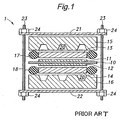
- FIG. 1 shows a conventional embodiment of a fuel cell assembly.
- this fuel cell assembly 1 comprises an electrolyte layer 10, a pair of catalyst electrode layers 11, 12 disposed on either side of the electrolyte layer 10, a pair of diffusion layers 13, 14 disposed on either outer side of the catalyst electrode layers 11, 12, and a pair of separators (or flow distribution plates) 15, 16 disposed on either outer side of the diffusion layers 13, 14.
- the separators 15, 16 can be formed by etching a silicon substrate, for example, and formed with channels (or recesses) 20 for defining a flow passage for a fuel fluid (e.g., hydrogen gas) or an oxidizing fluid (e.g., oxygen gas) in their surface facing the diffusion layers 13, 14.
- a fuel fluid e.g., hydrogen gas
- an oxidizing fluid e.g., oxygen gas
- the diffusion layers 13,14 are provided to diffuse the fluids evenly over the electrolyte layer 10 as well as to contact the catalyst electrode layers 11,12 to thereby transmit electric potential of the electrode layers 11, 12 to outside, and typically formed of an electroconductive porous material such as a carbon paper or a carbon cloth.
- the separators 15, 16 are made of an electroconductive material or an insulating or high-resistance material covered with an electroconductive film, external electrodes may be attached to the separators 15, 16.
- seal members 17, 18 are disposed between the electrolyte layer 10 and the separators 15, 16 so as to surround the diffusion layers 13, 14.
- the fuel cell assembly 1 is formed by stacking these component parts and applying a tightening force on them in the stacking direction so that the adjacent component parts are closely pressed to each other.
- a pair of backing plates 21, 22 are provided on either outer side of the separators 15, 16, a plurality of rods 23 extend through the backing plates 21, 22, and nuts 24 are engaged with threaded ends of the rods 23 so that the rotation of the nuts 24 can produce the pressure in the stacking direction.
- a required tightening pressure can be varied for different combinations of component parts to be pressed together.
- the diffusion layers 13, 14 made of a carbon paper/cloth or the like have a rough surface, a particularly large contact pressure is needed between the diffusion layers 13, 14 and the separators 15,16 in order to prevent the fluids from leaking as they pass through the diffusion layers 13, 14.
- the separators 15,16 are formed of an electroconductive material such as a metal or the surface of the separators 15, 16 is covered with an electroconductive film to thereby allow the voltage of the diffusion layers 13, 14 to be transmitted to outside through the separators 15, 16, it is required to make the diffusion layers 13, 14 and the separators 15, 16 contact each other with a large pressure in order to reduce the contact resistance therebetween.
- the diffusion layers 13, 14 and the separators 15, 16 in order for the diffusion layers 13, 14 and the separators 15, 16 to stand the large pressure, they need to have a high mechanical strength, which could lead to a larger component size and/or higher manufacturing cost.
- the tightening force applied to the separators 15, 16 and the diffusion layers 13, 14 is also imposed on other component parts which may not require such a large tightening pressure, and therefore these component parts also need to have a high mechanical strength.
- the large tightening force also tends to necessitate a bulky tightening structure (i.e., backing plates 21, rods 23 and nuts 24). These factors can undesirably increase the weight, volume and manufacturing cost of the fuel cell assembly 1.
- the electrolyte of the electrolyte layer 10 may consist of a solid polymer electrolyte (SPE).
- SPE solid polymer electrolyte
- the SPE can function as an ion conducting membrane only when impregnated with water, and the SPE when impregnated with water significantly increases its volume.
- the volume of the SPE can also change depending on the temperature.
- Such volume increase of the SPE can generate stress inside the fuel cell assembly 1. Therefore, when the externally applied tightening force is large, the pressure applied to the component parts may become excessively high, which can cause a problem such as breaking the seal members 17, 18. Controlling the pressure at a constant level would result in an undesirably complicated operation.
- the diffusion layers 13, 14 have high electric conductivity to effectively conduct the potential of the catalyst electrode layers 11, 12 to outside. Also, a smaller surface roughness of the diffusion layers 13, 14 is preferred to lower the contact resistance between them and the adjoining component parts (e.g., catalyst electrode layers 11,12 or separators 15, 16). Further, so long as a favorable diffusion capacity is achieved, thinner diffusion layers 13, 14 are preferred to achieve a smaller (thinner) fuel cell assembly 1.
- the conventional diffusion layers 13,14 made of a carbon paper or carbon cloth there has been a limit to the increase in the conductivity as well as reduction in the thickness and surface roughness.
- an object of at least the preferred embodiments of the present invention is to provide a fuel cell assembly that can eliminate the need for applying a large tightening pressure to the separators and the diffusion layers in the assembled state.
- a second object of at least the preferred embodiments of the present invention is to provide a fuel cell assembly comprising a diffusion layer having a reduced surface roughness to thereby decrease the contact resistance between the diffusion layer and its adjoining component part.
- a third object of at least the preferred embodiments of the present invention is to provide a fuel cell assembly comprising a diffusion layer having an increased conductivity.
- a fourth object of at least the preferred embodiments of the present invention is to provide a fuel cell assembly comprising a diffusion layer having a substantially smaller thickness than the conventional diffusion layer while maintaining a favorable diffusing function.
- a fifth object of at least the preferred embodiments of the present invention is to provide a separator-diffusion layer assembly suitable for use in such a fuel cell assembly and to provide a method for manufacturing such a separator-diffusion layer assembly.
- a method for manufacturing a separator-diffusion layer assembly of a fuel cell assembly comprising the steps of: forming a diffusion layer on a surface of a substrate consisting of an inorganic material, wherein said diffusion layer is for diffusing a fluid evenly over an electrolyte layer and for contacting a catalyst electrode layer to transmit an electrode potential of said catalyst electrode layer to outside, wherein the diffusion layer has an electroconductive film formed integrally with the substrate and is provided with a plurality of fluid paths extending through the diffusion layer in a direction of its thickness; and bringing an etchant into contact with the surface of the substrate through the fluid paths of the diffusion layer to form a recess in the surface of the substrate for allowing a fuel fluid or an oxidizing fluid to flow therethrough and thereby make a separator.
- the step of forming a diffusion layer comprises a step of forming the electroconductive film on the surface of the substrate by a process comprising physical vapor deposition (PVD), chemical vapor deposition (CVD), spin coating, sputtering or screen printing.
- PVD physical vapor deposition
- CVD chemical vapor deposition
- spin coating spin coating
- sputtering screen printing
- the electroconductive film of the diffusion layer By using such a film forming process used in a semiconductor or micromachine manufacture in forming the electroconductive film of the diffusion layer, it is possible to form a very thin electroconductive film, which contributes to minimizing the dimension (thickness) of the resulting fuel cell assembly.
- the reduced thickness of the fuel cell assembly is preferred particularly when a plurality of such fuel cell assemblies are stacked together to form a series connection because the thickness of the resulting fuel cell stack can be also minimized.
- the diffusion layers can have a high electric conductivity when the electroconductive film thereof is made of a highly electroconductive material such as a metal or an alloy.
- the step of forming a diffusion layer may comprise the step of forming a plurality of openings in the electroconductive film, wherein the fluid paths of the diffusion layer comprise the plurality of openings formed in the electroconductive film, and the plurality of openings of the electroconductive film are arranged to form one or more lines of openings in such a manner that adjacent openings in each line of openings partially overlap each other in a direction of extension of the line of openings.
- the step of forming a diffusion layer may comprise the steps of: forming a structure reinforcement member between the substrate and the electroconductive film; and forming a plurality of openings in the structure reinforcement member, wherein the fluid paths of the diffusion layer comprise the plurality of openings formed in the structure reinforcement member, and the plurality of openings of the structure reinforcement member are arranged to form one or more lines of openings in such a manner that adjacent openings in each line of openings partially overlap each other in a direction of extension of the line of openings. In this way, it is possible to form a recess(s) extending along the line(s) of openings of the electroconductive film or of the structure reinforcement member can be readily formed in the substrate by etching.
- the method of the invention may be utilised in the manufacture of a fuel cell assembly, comprising: an electrolyte layer; a pair of catalyst electrode layers interposing the electrolyte layer therebetween; a pair of separators each having a first surface facing the electrolyte layer and a second surface opposite to the first surface, the first surface of each separator being provided with a recess through which a fuel fluid or an oxidizing fluid flows to contact an associated one of the catalyst electrode layers; and a pair of diffusion layers each being disposed between the first surface of an associated one of the separators and an associated one of the catalyst electrode layers, wherein each of the diffusion layers comprises an electroconductive film formed integrally with the associated separator so as to form a separator-diffusion layer assembly in cooperation with the associated separator, and wherein each diffusion layer is formed with a plurality of fluid paths extending therethrough in a direction of its thickness so as to be in flow communication with the recess of the associated separator and thereby diffuse the fluid flowing in the recess over a
- the diffusion layer on the separator by integrally forming the diffusion layer on the separator to constitute a separator-diffusion layer assembly, it is possible to eliminate the need for applying a large pressure on the diffusion layer and the separator to achieve close contact therebetween, and therefore, the tightening pressure externally applied to the fuel cell assembly can be considerably reduced. This can reduce the mechanical strength required to the component parts of the fuel cell assembly to thereby decrease the manufacturing cost thereof. Further, the influence of the stress that may be caused by expansion of the electrolyte layer in operation can be moderated, which eliminates the need for controlling the tightening pressure and thus can simplify the operation.
- the integrated diffusion layer and the separator also result in a smaller number of component parts and assembly steps.
- Each separator preferably comprises a silicon substrate or a glass substrate.
- the silicon substrate or glass substrate for use in semiconductor manufacture or the like has a very low surface roughness, and the diffusion layer formed thereon can readily assume a very low surface roughness in its surface facing the catalyst electrode layer. This not only can reduce the contact resistance between the diffusion layer and the catalyst electrode layer, but also can maintain the contact resistance substantially constant irrespective of the tightening pressure.
- each diffusion layer may comprise a plurality of openings formed in the electroconductive film of the diffusion layer over the recess of the associated separator.
- each diffusion layer may comprise a plurality of electroconductive films wherein each of the plurality of electroconductive films is formed with a plurality of openings in such a manner that the openings of each electroconductive film are in flow communication with the openings of its adjacent electroconductive film(s) to form the plurality of fluid paths of the diffusion layer.
- the recess of each separator extends in a prescribed direction
- the plurality of openings of the electroconductive film associated with each separator are arranged in a direction of extension of the recess to form a line of openings in such a manner that adjacent openings in the line of openings partially overlap each other in a direction of extension of the line of openings.
- the recess extending along the direction of arrangement of the openings can be obtained without a complicated process by just etching a substrate made of an inorganic material such as silicon using the openings as etching windows.
- each diffusion layer may preferably comprise a structure reinforcement member disposed between the electroconductive film and the associated separator.
- the structure reinforcement member can consist of a silicon nitride layer or a silicon oxide layer.
- the plurality of fluid paths of each diffusion layer may comprise a plurality of openings formed in the structure reinforcement member of the diffusion layer. In other words, the openings in the structure reinforcement members can contribute to evenly diffusing the fuel fluid and oxidizing fluid over the surfaces of the catalyst electrode layers.
- the recess of each separator extends in a prescribed direction
- the plurality of openings of the structure reinforcement member associated with each separator are arranged in a direction of extension of the recess to form a line of openings in such a manner that adjacent openings in the line of openings partially overlap each other in a direction of extension of the line of openings.
- the recess extending along the direction of arrangement of the openings can be obtained without a complicated process by just etching a substrate made of an inorganic material such as silicon using the openings as etching windows.
- the method of the invention may also be utilised to produce a separator-diffusion layer assembly for a fuel cell assembly, comprising: a separator having a first surface formed with a recess through which a fuel fluid or an oxidizing fluid flows and a second surface opposite to the first surface, and a diffusion layer provided on the first surface of the separator, wherein the diffusion layer comprises an electroconductive film formed integrally with the separator and is formed with a plurality of fluid paths extending through the diffusion layer in a direction of its thickness so as to be in flow communication with the recess of the separator and thereby diffuse the fluid in the recess on a side of a surface of the diffusion layer facing away from the first surface of the separator.
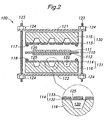
- FIG. 2 is a schematic cross-sectional view showing a preferred embodiment of a fuel cell assembly according to the present invention.
- this fuel cell assembly 100 comprises a centrally disposed electrolyte layer 110, a pair of catalyst electrode layers 111, 112 disposed on either side of the electrolyte layer 110, a pair of separators 115, 116 made of an inorganic material such as silicon or glass and defining fluid passages (recesses) 120 for a fuel fluid or oxidizing fluid in a surface facing the catalyst electrode layers 111, 112, seal members 117, 118 disposed between the electrolyte layer 110 and the separators 115, 116, and backing plates 121, 122, rods 123 and nuts 124 for providing a tightening pressure when assembling together the component parts.
- the fluid passages 120 are each provided with a fluid port(s) in its bottom for allowing entrance and discharge of the fluid into and out of the fluid passage 120.
- This fuel cell assembly 100 differs from the conventional fuel cell assembly 1 of Figure 1 in a sense that a pair of diffusion layers 113, 114 for diffusing the fluids evenly over the electrolyte layer 110 as well as contacting the catalyst electrode layers 111, 112 to transmit the electric potential of these catalyst electrode layers 111, 112 to outside are formed integrally with the associated separators 115, 116 to thereby constitute separator-diffusion layer assemblies 130, 131, respectively.
- the diffusion layers 113, 114 are formed with a plurality of small openings 125 extending in a direction of thickness thereof so as to be in flow communication with the fluid passages 120 of the associated separators 115, 116 and thus diffusing the fluids in the fluid passages 120 over the surface of the associated catalyst electrode layers 111,112.
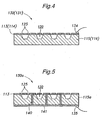
- each diffusion layer 113, 114 preferably comprises a structure reinforcement member 132 formed on the associated separator 115, 116 and an electroconductive film 133 formed on the structure reinforcement member 132.
- the structure reinforcement member 132 can consist of a silicon nitride film or silicon oxide film deposited on the surface of the separators 115, 116.
- the electroconductive film 133 can be formed by a film forming process used in a semiconductor manufacturing or micromachine manufacturing processes such as physical vapor deposition (PVD), chemical vapor deposition (CVD), spin coating, etc.
- the small openings 125 can be formed by patterning the structure reinforcement member 132 and electroconductive film 133 by etching, for example.
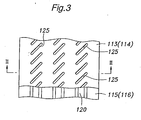
- FIG. 3 is a partial plan view showing a surface (first surface) of the separator-diffusion layer assembly 130 (131) that is formed with the diffusion layer 113 (114).
- the diffusion layer 113 (114) is shown with a part thereof broken away to show the fluid passages 120 in the separators 115 (116).
- the openings 125 formed in the diffusion layer 113 (114) are arranged along the extension of the fluid passages 120 of the separator 115 (116).
- Each opening 125 has an elongated shape and is inclined with respect to the direction of extension of the fluid passages 120 so that the openings 125 adjoining in the direction of extension of the fluid passages 120 partially overlap each other.
- Figure 2 shows a cross-section along the lines II-II in Figure 3 , and thus shows two partially overlapping openings 125 over each fluid passage 120.
- the number and position of the openings 125 shown in the drawing may change depending on the position at which the cross-section is taken.
- the openings 125 provided in the diffusion layer 113 (114) can be preferably used as etching windows when forming the fluid passages 120 in the separator 115 (116) by etching.
- the fuel cell assembly 100 shown in Figure 2 is formed by rotating the nuts 124 to thereby cause the adjoining component parts to closely contact with each other.
- the diffusion layers 113, 114 and the separators 115, 116 are unified to constitute the separator-diffusion layer assemblies 130, 131 as described above, there is no need to impart a large pressure for achieving close contact between the diffusion layers 113,114 and the separators 115, 116. Therefore, the tightening pressure externally applied to the fuel cell assembly 100 can be substantially reduced. This can reduce the mechanical strength required to the component parts of the fuel cell assembly 100 to thereby decrease the manufacturing cost thereof.
- the influence of the stress that may be caused by expansion of the electrolyte layer 10 in operation can be moderated, which eliminates the need for controlling the tightening pressure and thus can simplify the operation.
- the integrated diffusion layers 113,114 and the separators 115,116 also result in a smaller number of component parts and assembly steps.
- the electroconductive film 133 and the structure reinforcement member 132 can be formed by a film forming process used in semiconductor or micromachine manufacture, and therefore can be given a very small thickness, which in turn contributes to minimizing the size (thickness) of the fuel cell assembly 100.
- the reduced thickness of the fuel cell assembly 100 is preferred particularly when a plurality of such fuel cell assemblies 100 are stacked together to form a series connection because the thickness of the resulting fuel cell stack can be also minimized.
- the electroconductive film 133 of the diffusion layers 113, 114 can have a high electric conductivity when it is made of a highly electroconductive material such as a metal or an alloy.
- the diffusion layers 113,114 formed thereon can also have a very low surface roughness in their surface facing the catalyst electrode layers 111, 112. This not only can reduce the contact resistance between the diffusion layers 113, 114 and the catalyst electrode layers 111, 112, but also can maintain the contact resistance substantially constant irrespective of the tightening pressure.
- the electric polarity of the fuel cell assembly 100 is determined by the fluids supplied to the fluid passages 120.
- the catalyst electrode layer 111, 112 (and the diffusion layer 113,114 contacting it) contacting the fuel fluid such as hydrogen (H 2 ) constitutes an anode while catalyst electrode layer 111, 112 (and the diffusion layer 113, 114 contacting it) contacting the oxidizing fluid such as oxygen (O 2 ) constitutes a cathode.
- external electrodes 134 may be attached to the diffusion layers 113, 114 directly.
- FIG. 5 is a schematic cross-sectional view showing another embodiment of the separator-diffusion layer assembly according to the present invention.
- a separator 115a comprises electroconductive paths 140 passing therethrough, and an electroconductive film 141 is formed on a surface (outer or second surface) of the separator 115a opposite to the surface (first surface) on that the diffusion layer 113 is formed.
- the diffusion layer 113 (more specifically, its electroconductive film 133) and the electroconductive film 141 are connected to each other via the feedthrough conductive paths 140 whereby the electric potential of the diffusion layer 113 is transmitted to the electroconductive film 141 on the outer surface of the separator 115a.
- This can allow the external electrode 134 to be attached to the electroconductive film 141 on the outer surface of the separator 115a.
- the mechanically and electrically unified diffusion layer 113 and separator 115a can remove concern about the contact resistance therebetween and can make the resistance constant irrespective of the degree of the tightening pressure. Further, the feedthrough conductive paths 140 each provides a shortest path connecting the diffusion layer 113 to the electroconductive film 141 on the outer surface of the separator 115a, to thereby contribute to minimizing the internal resistance of the fuel cell assembly.
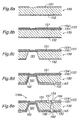
- a substrate 150 consisting of single crystal silicon and having a thickness of about 400 ⁇ m, for instance, is washed by using sulfuric acid or the like, and then, as shown in Figure 6b , silicon nitride films 151, 152 of about 0.2 ⁇ m thickness, for example, are formed on top and under surfaces of the substrate 150 by sputtering.
- an electroconductive film 153 of about 2 ⁇ m thickness is formed on top of the substrate 150 by physical vapor deposition (PVD), for example.
- the electroconductive film 153 can preferably have a two-layered structure comprising a titanium (Ti) layer 155 having a thickness of about 0.1 ⁇ m and a gold (Au) layer 154 of about 2 ⁇ m formed thereon. Titanium improves the contact between the silicon nitride and gold, and may be substituted by aluminum (Al), nickel (Ni) or chromium (Cr).
- Gold may be substituted by other electroconductive material such as nickel (Ni), copper (Cu), platinum (Pt), iron (Fe), tungsten (W), molybdenum (Mo), doped silicon or polysilicon.
- film forming processes other than the physical vapor deposition such as chemical vapor deposition (CVD), spin coating, sputtering or screen printing may be used.
- etching is performed on the electroconductive film 153 to form a plurality of openings 156.
- the openings 156 are arranged along a direction of extension of each fluid passage 159 (a direction vertical to the sheet of Figure 6d ) to form lines of openings 156.
- the openings 156 each have an elongated shape and are inclined with respect to the direction of arrangement of thereof so that in each line of openings 156, adjoining openings 156 overlap each other in the direction of arrangement.
- two openings 156 overlapping each other in the direction of arrangement are shown in a similar fashion as in Figure 2 .
- RIE reactive ion etching
- CF 4 CF 4
- the openings 157 can serve as etching windows for forming the fluid passages 159 ( Figure 7c ).
- the openings 157 each have an elongated shape and are inclined with respect to the direction of arrangement thereof so that in each line of openings 157, the ends of the adjoining openings 157 overlap each other in the direction of arrangement.
- the substrate 150 is wet etched using an alkali solution such as KOH solution to whereby form the fluid passages 159 and fluid ports 160. Since this process is anisotropic etching, the side wall of each fluid passage 159 and fluid port 160 inclines at an angle reflecting the crystal orientation of the silicon. It should be noted that because the openings 157 of the silicon nitride film 151 on the top surface of the substrate 150 are arranged in a direction of extension of the fluid passages 159 and the openings 157 adjoining in the direction of arrangement partly overlap each other, a continuous fluid passage 159 can be preferably formed under each line of openings 157. Thus, the separator-diffusion layer assembly 130 (131) as shown in Figures 2-4 is obtained. As will be understood, the openings 156, 157 in Figure 7c correspond to the openings 125 in Figures 2-4 . Also, the upper silicon nitride film 151 functions as the structure reinforcement member 132 shown in the enlarged view in Figure 2 .
- etching is conducted with a mask (not shown) to remove portions of the silicon nitride film 151 on top of the substrate 150 where feedthrough conductive paths 162 ( Figure 8d ) are to be formed, as shown in Figure 8a .
- the electroconductive film 153 is formed on top of the substrate 150 by vapor deposition, spin coating or the like.
- the electroconductive film 153 preferably has a two-layered structure comprising the gold layer 154 and the titanium layer 155.
- wet etching is performed with an alkali solution such as KOH solution to form through holes 161 reaching the electroconductive film 153 covering the top surface of the silicon substrate 150. Since this process is also anisotropic etching, the side wall of each through-hole 161 inclines at an angle reflecting the crystal orientation of the silicon such that the cross-section of each through-hole 161 diverges from the top to under surface of the substrate 150 (or from the first to second surface of the separator 115a).
- metallic material is deposited from underside the substrate by vapor deposition or the like to form electroconductive films 162, 163, each of which preferably have a two-layered structure comprising a titanium layer adjoining the substrate 150 and a gold layer adjoining the titanium layer, on the side wall of the through-holes 161 and on the under surface of the substrate 150, respectively.
- the metallic material is also deposited on the underside of the electroconductive film 153 covering the upper opening of the through-holes 161, and thus the electroconductive film 153 and the electroconductive film 162 on the side wall of the through-holes 161 are connected to each other.
- each through-hole 161 is inclined as described above, the deposition of the metallic material thereon is facilitated so that the sufficiently thick and uniform electroconductive film 162 on the side wall can be preferably achieved.
- dry etching or other process may be used instead of wet etching to form the through-holes 161 having a vertical side wall. In such a case, however, forming the electroconductive film 162 uniformly on the side wall could become more difficult than in the case where the through-holes 161 are formed by wet etching.
- the electroconductive film 162 on the side wall of each through-hole 161 connects the electroconductive film 153 on top of the substrate 150 and the electroconductive film 163 on the underside of the same.
- the electroconductive film 162 on the side wall of each through-hole 161 functions as the feedthrough conductive path 140 shown in Figure 5 .
- the steps shown in Figures 6d-7c are carried out similarly, whereby the fluid passages 159, fluid ports 160, etc. are formed as shown in Figure 8e , providing the separator-diffusion layer assembly 130a having the feedthrough conductive path 140 (electroconductive film 162) as shown in Figure 5 .
- the diffusion layer 113 (114) has only a single electroconductive film 133 (153) formed with the openings 125 (156).
- Figures 9a-9c show an example of patterning of the electroconductive films 133, 133a and 133b.
- Figure 9a is substantially the same as Figure 3 and shows the shape and arrangement of the openings 125 of the electroconductive film 133 together with the fluid passages 120 of the separator 115 (116).
- the second electroconductive film 133a comprises openings 125a of which inclination angle with respect to the direction of extension of the fluid passage 120 is different from that of the openings 125 of the first electroconductive film 133
- the third electroconductive film 133b is formed with openings 125b in the same shape and arrangement as the openings 125 of the first electroconductive film 133.
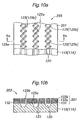
- Figure 10a is a plan view showing the electroconductive films 133, 133a and 133b stacked together, while Figure 10b shows a cross-sectional view taken along the line Xb-Xb in Figure 10a .
- the openings 125 of the first electroconductive film 133 are in flow communication with the openings 125b of the third electroconductive film 133b via the openings 125a of the second electroconductive film 133a to whereby form fluid paths extending through the thickness of the diffusion layer 201.
- Each opening 125a of the second electroconductive film 133a is in flow communication with a plurality of openings 125 of the first electroconductive film 133 and with a plurality of openings 125b of the third electroconductive film 133b so that the fluid paths assume a complicated labyrinth structure, and thus the fuel fluid or oxidizing fluid in the recess 120 of the separator 115 (116) is favorably diffused over the catalyst electrode layer 111 (112) through the fluid paths.
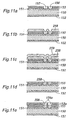
- the silicon nitride films 151, 152 are formed on either side of the silicon substrate 150, the electroconductive film (first electroconductive film) 153 containing the gold layer 154 and titanium layer 155 is formed on top thereof, and the first electroconductive film 153 and the silicon nitride film 151 are patterned by etching or the like to form a plurality of openings 156, 157, respectively, as shown in Figure 11a .
- a sacrifice layer 258 consisting of silicon oxide (SiO 2 ), for example, is formed to fill in the openings 157 of the upper silicon nitride film 151 and the openings 156 of the first electroconductive film 153 with the sacrifice layer 258.
- the resist 259 and the sacrifice layer 258 are etched by dry etching until the top surface of the first electroconductive film 153 is exposed, to thereby flatten the top surface.
- a second electroconductive film 153a is formed on the flattened top surface, and patterned to form a plurality of openings 156a, as shown in Figure 11e . Further, by the steps similar to those shown in Figures 11b-11d , the openings 156a of the second electroconductive film 153a is filled with a sacrifice layer 258a, a resist (not shown) is formed thereon, and etching is conducted to flatten the top surface ( Figure 12a ).
- etching is performed to remove the sacrifice layer 258 filling in the openings 157 of the silicon nitride film 151 and the openings 156 of the first electroconductive film 153 as well as the sacrifice layer 258a filling in the openings 156a of the second electroconductive film 153a, as shown in Figure 12b .
- the silicon substrate 150 is wet etched by using a KOH solution to form the fluid passages 159 and fluid ports 160, to thereby obtain the unitary separator-diffusion layer assembly 203.
- the etchant can reach the surface of the silicon substrate 150 through the openings 156, 156a, 156b of the electroconductive films 153, 153a, 153b as well as the openings 157 of the silicon nitride film 151 that form the fluid paths extending through the diffusion layer 201.
- the etching of the substrate 150 can be favorably carried out even with the unitarily formed diffusion layer 201.
- the present invention has been described in terms of preferred embodiments thereof, it is obvious to a person skilled in the art that various alterations and modifications are possible without departing from the scope of the present invention which is set forth in the appended claims.
- the deposited electroconductive film is patterned by etching
- an electroconductive film having a predetermined pattern can be also obtained by photolithography, lift-off, etc.
- the electroconductive film and the structure reinforcement member of the diffusion layer formed integrally with the separator are provided with a plurality of openings arranged along each fluid passage (recess) of the separator such that the opening each have an elongated shape and are inclined with respect to the direction of arrangement thereof.
- the shape of the opening can vary in a variety of ways, and may have a V-shape or W-shape, for example. In such cases also, it is preferred that the openings adjoining in the direction of arrangement partially overlap each other because fluid passages extending along the direction of arrangement of the openings can be readily obtained by etching the separator using such openings as etching windows.
- the diffusion layer of the fuel cell assembly comprises an electroconductive film integrally formed with the separator so that the separator and the diffusion layer constitute a unitary separator-diffusion layer assembly.
- This can eliminate the need for applying a large external pressure for making the separator and the diffusion layer closely contact with each other. This also reduces the pressure applied on other component parts in the fuel cell assembly, decreasing the required mechanical strength and the manufacturing cost.
- the integrated diffusion layer and the separator also reduce the number of component parts and manufacturing steps. Further, by forming the electroconductive film using a film forming process used in a semiconductor or micromachine manufacture, it is possible to achieve a very thin diffusion layer comprising the electroconductive film, which contributes to minimizing the dimension (thickness) of the resulting fuel cell assembly.
Landscapes
- Chemical & Material Sciences (AREA)
- Life Sciences & Earth Sciences (AREA)
- Engineering & Computer Science (AREA)
- Manufacturing & Machinery (AREA)
- Sustainable Development (AREA)
- Sustainable Energy (AREA)
- Chemical Kinetics & Catalysis (AREA)
- Electrochemistry (AREA)
- General Chemical & Material Sciences (AREA)
- Composite Materials (AREA)
- Fuel Cell (AREA)
Claims (4)
- Verfahren zur Herstellung einer Separator-Diffusionsschicht-Anordnung für eine Brennstoffzellenanordnung, umfassend die Schritte:- Bilden einer Diffusionsschicht (113, 114, 201) auf einer Oberfläche eines Substrates (150), bestehend aus einem anorganischen Material, wobei die Diffusionsschicht zum gleichmäßigen Diffundieren eines Fluids über eine Elektrolytschicht (110) und zum Kontaktieren einer Katalysator-Elektroden-Schicht (111, 112) dient, um ein Elektrodenpotential der Katalysator-Elektroden-Schicht nach außen zu übertragen, wobei die Diffusionsschicht einen elektrisch leitenden Film (133, 133a, 133b) aufweist, der integral mit dem Substrat gebildet ist, und mit einer Mehrzahl von Fluidwegen (125, 125a, 125b) bereitgestellt ist, die sich durch die Diffusionsschicht in eine Richtung ihrer Dicke erstrecken; und- in-Kontakt-bringen eines Ätzmittels mit der Oberfläche des Substrates durch die Fluidwege der Diffusionsschicht, um eine Vertiefung (120) in der Oberfläche des Substrates zu bilden, um es einem Brennstofffluid oder einem Oxidationsfluid zu ermöglichen, dort hindurch zu strömen und dabei einen Separator (115, 116, 115a) zu bilden.
- Verfahren nach Anspruch 1, wobei der Schritt des Bildens einer Diffusionsschicht (113, 114, 201) einen Schritt umfasst des Bildens des elektrisch leitenden Films (133, 133a, 133b) auf der Oberfläche des Substrates (150) durch einen Prozess, der physikalisches Abscheidung aus der Gasphase (PVD), chemisches Abschelden aus der Gasphase (CVD), Rotationsbeschichtung, Sputtern oder Siebdruck umfasst.
- Verfahren nach Anspruch 1 oder 2, wobei der Schritt des Bildens einer Diffusionsschicht (113, 114, 201) den Schritt eines Bildens einer Mehrzahl von Öffnungen (125) in den elektrisch leitenden Film (133, 133a, 133b) umfasst, wobei die Fluidwege der Diffusionsschicht eine Mehrzahl von Öffnungen umfassen, die in dem elektrisch leitenden Film gebildet sand, und wobei die Mehrzahl der Öffnungen des elektrisch leitenden Films so angeordnet sind, dass sie eine oder mehr Reihen von Öffnungen auf eine solche Weise bilden, dass benachbarte Öffnungen in jeder Reihe von Öffnungen sich teilweise gegenseitig in einer Erstreckungsrichtung der Reihe von Öffnungen überlappen.
- Verfahren nach Anspruch 1, 2 oder 3, wobei der Schritt eines Bildens einer Diffusionsschicht (113, 114, 2D1) die Schritt umfasst:- Bilden eines Struktur-Verstärkungs-Elements (132) zwischen dem Substrat (150) und dem elektrisch leitenden Film (133, 133a, 133b); und- Bilden einer Mehrzahl von Öffnungen in dem Struktur-Verstärkungs-Element,wobei die Fluidwege der Diffusionsschicht eine Mehrzahl von Öffnungen umfassen, die in dem Struktur-Verstärkungs-Element gebildet sind, und wobei die Mehrzahl der Öffnungen des Struktur-Verstärkungs-Elements so angeordnet sind, dass sie eine oder mehrere Reihen von Öffnungen auf eine solche Weise bilden, dass benachbarte Öffnungen in jeder Reihe von Öffnungen sich teilweise gegenseitig in einer Erstreckungsrichtung der Reihe von Öffnungen überlappen.
Applications Claiming Priority (2)
| Application Number | Priority Date | Filing Date | Title |
|---|---|---|---|
| US37952402P | 2002-05-09 | 2002-05-09 | |
| EP03728026A EP1525638A2 (de) | 2002-05-09 | 2003-05-02 | Brennstoffzellenzusammenbau und verfahren zur herstellung eines verbunds zwischen einem separator und einer zugehörigen elektrolytschicht |
Related Parent Applications (1)
| Application Number | Title | Priority Date | Filing Date |
|---|---|---|---|
| EP03728026A Division EP1525638A2 (de) | 2002-05-09 | 2003-05-02 | Brennstoffzellenzusammenbau und verfahren zur herstellung eines verbunds zwischen einem separator und einer zugehörigen elektrolytschicht |
Publications (2)
| Publication Number | Publication Date |
|---|---|
| EP1643577A1 EP1643577A1 (de) | 2006-04-05 |
| EP1643577B1 true EP1643577B1 (de) | 2008-10-22 |
Family
ID=35986127
Family Applications (1)
| Application Number | Title | Priority Date | Filing Date |
|---|---|---|---|
| EP05013990A Expired - Lifetime EP1643577B1 (de) | 2002-05-09 | 2003-05-02 | Brennstoffzellenzusammenbau und Verfahren zur Herstellung eines Verbunds zwischen einem Separator und einer zugehörigen Elektrolytschicht |
Country Status (1)
| Country | Link |
|---|---|
| EP (1) | EP1643577B1 (de) |
Families Citing this family (1)
| Publication number | Priority date | Publication date | Assignee | Title |
|---|---|---|---|---|
| WO2009113240A1 (ja) * | 2008-03-11 | 2009-09-17 | パナソニック株式会社 | 膜電極接合体 |
Family Cites Families (3)
| Publication number | Priority date | Publication date | Assignee | Title |
|---|---|---|---|---|
| JP3904696B2 (ja) * | 1997-11-11 | 2007-04-11 | 日新製鋼株式会社 | 低温型燃料電池用セパレータ及びその製造方法 |
| US6924058B2 (en) * | 1999-11-17 | 2005-08-02 | Leroy J. Ohlsen | Hydrodynamic transport and flow channel passageways associated with fuel cell electrode structures and fuel cell electrode stack assemblies |
| AU3263001A (en) * | 1999-11-17 | 2001-05-30 | Neah Power Systems, Inc. | Fuel cells having silicon substrates and/or sol-gel derived support structures |
-
2003
- 2003-05-02 EP EP05013990A patent/EP1643577B1/de not_active Expired - Lifetime
Also Published As
| Publication number | Publication date |
|---|---|
| EP1643577A1 (de) | 2006-04-05 |
Similar Documents
| Publication | Publication Date | Title |
|---|---|---|
| CA2484294C (en) | Fuel cell assembly, separator-diffusion layer assembly for fuel cell assembly and manufacturing method therefor | |
| CA2408592C (en) | Fuel cell assembly and method for making the same | |
| US20040115507A1 (en) | Monolithic fuel cell and method of manufacture | |
| US20020006539A1 (en) | Fuel cell assembly | |
| Min et al. | Fabrication of novel MEMS-based polymer electrolyte fuel cell architectures with catalytic electrodes supported on porous SiO2 | |
| JP2005517273A (ja) | ミクロ構造コンポーネントを用いた高電力密度燃料電池層装置 | |
| US8003275B2 (en) | Monopolar membrane-electrode assembly | |
| JP2002141084A (ja) | 燃料電池 | |
| EP1643577B1 (de) | Brennstoffzellenzusammenbau und Verfahren zur Herstellung eines Verbunds zwischen einem Separator und einer zugehörigen Elektrolytschicht | |
| US7235323B2 (en) | Fuel cell assembly and method for making the same | |
| JP4214674B2 (ja) | 燃料電池用セパレータ | |
| JP2003282089A (ja) | マイクロ燃料電池 | |
| CN100463265C (zh) | 单极的膜电极组件 | |
| WO2021090424A1 (ja) | 燃料電池セル、燃料電池セル製造方法 | |
| JP5826841B2 (ja) | 直列に接続された複数の基本セルを備える燃料電池及びその製造方法 | |
| JP2004207155A (ja) | 燃料電池およびその製造方法 | |
| JP2002329506A (ja) | 燃料電池用セル板、その製造方法および燃料電池スタック | |
| JP2024018349A (ja) | 流路部材、電気化学セルおよび電気化学セル装置 | |
| JP2001035504A (ja) | 固体高分子型燃料電池と同燃料電池用セパレータの製造方法 | |
| US20070241459A1 (en) | Devices having a cavity structure and related methods | |
| JP2009518796A (ja) | 固体電解質と一体化した集電極を有する燃料電池及び燃料電池の製造方法 |
Legal Events
| Date | Code | Title | Description |
|---|---|---|---|
| PUAI | Public reference made under article 153(3) epc to a published international application that has entered the european phase |
Free format text: ORIGINAL CODE: 0009012 |
|
| AC | Divisional application: reference to earlier application |
Ref document number: 1525638 Country of ref document: EP Kind code of ref document: P |
|
| AK | Designated contracting states |
Kind code of ref document: A1 Designated state(s): DE FR GB IT |
|
| RTI1 | Title (correction) |
Free format text: FUEL CELL ASSEMBLY, SEPARATOR-DIFFUSION LAYER ASSEMBLY FOR FUEL CELL ASSEMBLY AND MANUFACTURING METHOD THEREFOR |
|
| 17P | Request for examination filed |
Effective date: 20060531 |
|
| 17Q | First examination report despatched |
Effective date: 20060724 |
|
| AKX | Designation fees paid |
Designated state(s): DE FR GB IT |
|
| GRAP | Despatch of communication of intention to grant a patent |
Free format text: ORIGINAL CODE: EPIDOSNIGR1 |
|
| GRAS | Grant fee paid |
Free format text: ORIGINAL CODE: EPIDOSNIGR3 |
|
| GRAA | (expected) grant |
Free format text: ORIGINAL CODE: 0009210 |
|
| AC | Divisional application: reference to earlier application |
Ref document number: 1525638 Country of ref document: EP Kind code of ref document: P |
|
| AK | Designated contracting states |
Kind code of ref document: B1 Designated state(s): DE FR GB IT |
|
| REG | Reference to a national code |
Ref country code: GB Ref legal event code: FG4D |
|
| REF | Corresponds to: |
Ref document number: 60324336 Country of ref document: DE Date of ref document: 20081204 Kind code of ref document: P |
|
| PLBE | No opposition filed within time limit |
Free format text: ORIGINAL CODE: 0009261 |
|
| STAA | Information on the status of an ep patent application or granted ep patent |
Free format text: STATUS: NO OPPOSITION FILED WITHIN TIME LIMIT |
|
| PG25 | Lapsed in a contracting state [announced via postgrant information from national office to epo] |
Ref country code: IT Free format text: LAPSE BECAUSE OF FAILURE TO SUBMIT A TRANSLATION OF THE DESCRIPTION OR TO PAY THE FEE WITHIN THE PRESCRIBED TIME-LIMIT Effective date: 20081022 |
|
| PGFP | Annual fee paid to national office [announced via postgrant information from national office to epo] |
Ref country code: DE Payment date: 20090520 Year of fee payment: 7 Ref country code: FR Payment date: 20090523 Year of fee payment: 7 |
|
| 26N | No opposition filed |
Effective date: 20090723 |
|
| PGFP | Annual fee paid to national office [announced via postgrant information from national office to epo] |
Ref country code: GB Payment date: 20090422 Year of fee payment: 7 |
|
| GBPC | Gb: european patent ceased through non-payment of renewal fee |
Effective date: 20100502 |
|
| REG | Reference to a national code |
Ref country code: FR Ref legal event code: ST Effective date: 20110131 |
|
| PG25 | Lapsed in a contracting state [announced via postgrant information from national office to epo] |
Ref country code: DE Free format text: LAPSE BECAUSE OF NON-PAYMENT OF DUE FEES Effective date: 20101201 |
|
| PG25 | Lapsed in a contracting state [announced via postgrant information from national office to epo] |
Ref country code: FR Free format text: LAPSE BECAUSE OF NON-PAYMENT OF DUE FEES Effective date: 20100531 |
|
| PG25 | Lapsed in a contracting state [announced via postgrant information from national office to epo] |
Ref country code: GB Free format text: LAPSE BECAUSE OF NON-PAYMENT OF DUE FEES Effective date: 20100502 |