EP1642499A2 - Fungizide Mischungen auf der Basis von Prothioconazole und einem Strobilurinderivat - Google Patents
Fungizide Mischungen auf der Basis von Prothioconazole und einem Strobilurinderivat Download PDFInfo
- Publication number
- EP1642499A2 EP1642499A2 EP05026582A EP05026582A EP1642499A2 EP 1642499 A2 EP1642499 A2 EP 1642499A2 EP 05026582 A EP05026582 A EP 05026582A EP 05026582 A EP05026582 A EP 05026582A EP 1642499 A2 EP1642499 A2 EP 1642499A2
- Authority
- EP
- European Patent Office
- Prior art keywords
- formula
- compound
- prothioconazole
- iii
- fungicidal mixture
- Prior art date
- Legal status (The legal status is an assumption and is not a legal conclusion. Google has not performed a legal analysis and makes no representation as to the accuracy of the status listed.)
- Granted
Links
- 0 C*C([C@@]1C=CC=CC1COc1cc(C)ccc1C)=NOC Chemical compound C*C([C@@]1C=CC=CC1COc1cc(C)ccc1C)=NOC 0.000 description 1
Classifications
-
- A—HUMAN NECESSITIES
- A01—AGRICULTURE; FORESTRY; ANIMAL HUSBANDRY; HUNTING; TRAPPING; FISHING
- A01N—PRESERVATION OF BODIES OF HUMANS OR ANIMALS OR PLANTS OR PARTS THEREOF; BIOCIDES, e.g. AS DISINFECTANTS, AS PESTICIDES OR AS HERBICIDES; PEST REPELLANTS OR ATTRACTANTS; PLANT GROWTH REGULATORS
- A01N43/00—Biocides, pest repellants or attractants, or plant growth regulators containing heterocyclic compounds
- A01N43/64—Biocides, pest repellants or attractants, or plant growth regulators containing heterocyclic compounds having rings with three nitrogen atoms as the only ring hetero atoms
- A01N43/647—Triazoles; Hydrogenated triazoles
- A01N43/653—1,2,4-Triazoles; Hydrogenated 1,2,4-triazoles
-
- A—HUMAN NECESSITIES
- A01—AGRICULTURE; FORESTRY; ANIMAL HUSBANDRY; HUNTING; TRAPPING; FISHING
- A01N—PRESERVATION OF BODIES OF HUMANS OR ANIMALS OR PLANTS OR PARTS THEREOF; BIOCIDES, e.g. AS DISINFECTANTS, AS PESTICIDES OR AS HERBICIDES; PEST REPELLANTS OR ATTRACTANTS; PLANT GROWTH REGULATORS
- A01N37/00—Biocides, pest repellants or attractants, or plant growth regulators containing organic compounds containing a carbon atom having three bonds to hetero atoms with at the most two bonds to halogen, e.g. carboxylic acids
- A01N37/18—Biocides, pest repellants or attractants, or plant growth regulators containing organic compounds containing a carbon atom having three bonds to hetero atoms with at the most two bonds to halogen, e.g. carboxylic acids containing the group —CO—N<, e.g. carboxylic acid amides or imides; Thio analogues thereof
-
- A—HUMAN NECESSITIES
- A01—AGRICULTURE; FORESTRY; ANIMAL HUSBANDRY; HUNTING; TRAPPING; FISHING
- A01N—PRESERVATION OF BODIES OF HUMANS OR ANIMALS OR PLANTS OR PARTS THEREOF; BIOCIDES, e.g. AS DISINFECTANTS, AS PESTICIDES OR AS HERBICIDES; PEST REPELLANTS OR ATTRACTANTS; PLANT GROWTH REGULATORS
- A01N37/00—Biocides, pest repellants or attractants, or plant growth regulators containing organic compounds containing a carbon atom having three bonds to hetero atoms with at the most two bonds to halogen, e.g. carboxylic acids
- A01N37/44—Biocides, pest repellants or attractants, or plant growth regulators containing organic compounds containing a carbon atom having three bonds to hetero atoms with at the most two bonds to halogen, e.g. carboxylic acids containing at least one carboxylic group or a thio analogue, or a derivative thereof, and a nitrogen atom attached to the same carbon skeleton by a single or double bond, this nitrogen atom not being a member of a derivative or of a thio analogue of a carboxylic group, e.g. amino-carboxylic acids
- A01N37/50—Biocides, pest repellants or attractants, or plant growth regulators containing organic compounds containing a carbon atom having three bonds to hetero atoms with at the most two bonds to halogen, e.g. carboxylic acids containing at least one carboxylic group or a thio analogue, or a derivative thereof, and a nitrogen atom attached to the same carbon skeleton by a single or double bond, this nitrogen atom not being a member of a derivative or of a thio analogue of a carboxylic group, e.g. amino-carboxylic acids the nitrogen atom being doubly bound to the carbon skeleton
-
- A—HUMAN NECESSITIES
- A01—AGRICULTURE; FORESTRY; ANIMAL HUSBANDRY; HUNTING; TRAPPING; FISHING
- A01N—PRESERVATION OF BODIES OF HUMANS OR ANIMALS OR PLANTS OR PARTS THEREOF; BIOCIDES, e.g. AS DISINFECTANTS, AS PESTICIDES OR AS HERBICIDES; PEST REPELLANTS OR ATTRACTANTS; PLANT GROWTH REGULATORS
- A01N43/00—Biocides, pest repellants or attractants, or plant growth regulators containing heterocyclic compounds
- A01N43/34—Biocides, pest repellants or attractants, or plant growth regulators containing heterocyclic compounds having rings with one nitrogen atom as the only ring hetero atom
- A01N43/40—Biocides, pest repellants or attractants, or plant growth regulators containing heterocyclic compounds having rings with one nitrogen atom as the only ring hetero atom six-membered rings
-
- A—HUMAN NECESSITIES
- A01—AGRICULTURE; FORESTRY; ANIMAL HUSBANDRY; HUNTING; TRAPPING; FISHING
- A01N—PRESERVATION OF BODIES OF HUMANS OR ANIMALS OR PLANTS OR PARTS THEREOF; BIOCIDES, e.g. AS DISINFECTANTS, AS PESTICIDES OR AS HERBICIDES; PEST REPELLANTS OR ATTRACTANTS; PLANT GROWTH REGULATORS
- A01N43/00—Biocides, pest repellants or attractants, or plant growth regulators containing heterocyclic compounds
- A01N43/48—Biocides, pest repellants or attractants, or plant growth regulators containing heterocyclic compounds having rings with two nitrogen atoms as the only ring hetero atoms
- A01N43/56—1,2-Diazoles; Hydrogenated 1,2-diazoles
-
- A—HUMAN NECESSITIES
- A01—AGRICULTURE; FORESTRY; ANIMAL HUSBANDRY; HUNTING; TRAPPING; FISHING
- A01N—PRESERVATION OF BODIES OF HUMANS OR ANIMALS OR PLANTS OR PARTS THEREOF; BIOCIDES, e.g. AS DISINFECTANTS, AS PESTICIDES OR AS HERBICIDES; PEST REPELLANTS OR ATTRACTANTS; PLANT GROWTH REGULATORS
- A01N47/00—Biocides, pest repellants or attractants, or plant growth regulators containing organic compounds containing a carbon atom not being member of a ring and having no bond to a carbon or hydrogen atom, e.g. derivatives of carbonic acid
- A01N47/08—Biocides, pest repellants or attractants, or plant growth regulators containing organic compounds containing a carbon atom not being member of a ring and having no bond to a carbon or hydrogen atom, e.g. derivatives of carbonic acid the carbon atom having one or more single bonds to nitrogen atoms
- A01N47/10—Carbamic acid derivatives, i.e. containing the group —O—CO—N<; Thio analogues thereof
- A01N47/24—Carbamic acid derivatives, i.e. containing the group —O—CO—N<; Thio analogues thereof containing the groups, or; Thio analogues thereof
-
- C—CHEMISTRY; METALLURGY
- C07—ORGANIC CHEMISTRY
- C07D—HETEROCYCLIC COMPOUNDS
- C07D249/00—Heterocyclic compounds containing five-membered rings having three nitrogen atoms as the only ring hetero atoms
- C07D249/02—Heterocyclic compounds containing five-membered rings having three nitrogen atoms as the only ring hetero atoms not condensed with other rings
- C07D249/08—1,2,4-Triazoles; Hydrogenated 1,2,4-triazoles
- C07D249/10—1,2,4-Triazoles; Hydrogenated 1,2,4-triazoles with hetero atoms or with carbon atoms having three bonds to hetero atoms with at the most one bond to halogen, e.g. ester or nitrile radicals, directly attached to ring carbon atoms
- C07D249/12—Oxygen or sulfur atoms
Definitions
- the invention relates to a method for controlling harmful fungi with mixtures of the compounds I with at least one of the compounds II, III, IV, V or VI and the use of the compounds I, II, III, IV, V and VI for the preparation of such mixtures and Means containing these mixtures.
- the picoxystrobin is known from EP-A-0 326 330.
- the strobilurin derivative of the formula IV is also known and described in EP-A-0 804 421.
- the strobilurin derivative of the formula V is known from EP-A-0 477 631.
- the present invention was based on mixtures which have an improved action against harmful fungi with a reduced total amount of active ingredients applied (synergistic mixtures).
- the initially defined mixture of prothioconazole with at least one strobilurin derivative was found. It has also been found that the simultaneous, or common or separate application of the compound I and at least one of the compounds II, III, IV, V or VI or the compound I and at least one of the compounds II, III, IV, V or One after the other, it is easier to combat harmful fungi than with the individual compounds alone.
- the 2- [2- (1-chlorocyclopropyl) -3- (2-chlorophenyl) -2-hydroxypropyl] -2,4-dihydro- [1,2,4] triazole-3-thione of the formula I is known from the WO 96-16048 known.
- the compound may be in the "thiono” form of the formula or in the tautomeric "mercapto" form of the formula available. For the sake of simplicity, only the "thiono" shape will be listed.
- the trifloxystrobin of the formula II is known from EP-A 0 460 572.
- Picoxystrobin of the formula III is known from EP-A-0 326 330.
- Pyraclostrobin of formula IV is known from EP-A 0 804 421.
- Dimoxystrobin of the formula V is known from EP-A 0 477 631.
- the strobilurin derivative of the formula VI is known from EP-A 0 876 332.
- the compounds I to VI are able to form salts or adducts with inorganic or organic acids or with metal ions because of the basic character of the Stlckstoffstome contained in them.
- inorganic acids examples include hydrogen halides such as hydrogen fluoride, hydrogen chloride, hydrogen bromide and hydrogen iodide, sulfuric acid, phosphoric acid and nitric acid.
- organic acids for example, formic acid.
- Carbonic acid and alkanoic acids such as acetic acid, trifluoroacetic acid, trichloroacetic acid and propionic acid and glycolic acid, thiocyanic acid, lactic acid, succinic acid, citric acid, benzoic acid, cinnamic acid, oxalic acid, alkylsulfonic acids (sulfonic acids with straight-chain or branched alkyl radicals having 1 to 20 carbon atoms), arylsulfonic acids or -dlsulfonklaren (aromatic radicals such as phenyl and naphthyl which carry one or two sulfonic acid groups), alkylphosphonic acids (phosphonic acids with straight-chain or branched alkyl radicals having 1 to 20 carbon atoms), arylphosphonic acids or diphosphonic acids (aromatic radicals such as phenyl and naphthyl which carry one or two phosphoric acid radicals), the al
- the metal ions are in particular the ions of the elements of the second main group, in particular calcium and magnesium, the third and fourth main group, in particular aluminum, tin and lead, and the first to eighth subgroup, in particular chromium.
- Particularly preferred are the metal ions of the elements of the subgroups of the fourth period.
- the metals can be present in the various valences that belong to them. Preference is given to mixtures of prothioconazole with trifloxystrobin of the formula II.
- the pure active ingredients I, II, III, IV, V and VI are preferably used, to which further active compounds can be added against harmful fungi or against other pests such as insects, spider animals or nematodes or else herbicidal or growth-regulating active substances or fertilizers ,
- the mixtures of the compound I with at least one of the compounds II, III, IV, V or VI or the compound I with at least one of the compounds II, III, IV. V or VI applied simultaneously, together or separately, are characterized by a excellent activity against a broad spectrum of phytopathogenic fungi, in particular from the class of Ascomycetes, Basidiomycetes, Phycomycetes and Deuteromycetes. You are currently systemically effective and can therefore also be used as foliar and soil fungicides.
- fungi are suitable for controlling the following phytopathogenic fungi: Blumeria graminis (powdery mildew) on cereals, Erysiphe cichoracearum and Sphaerotheca fuliginea on cucurbits, Podosphaera leucotrlcha on apples, Uncinula necator on vines, Puccinla species on cereals, Rhizoctonia species on cotton, Rice and grass, Ustilago species on cereals and sugar cane, Venturia inaequalls (scab) on apples, Helminthospörium species on cereals, Septoria nodorum on wheat, Botrytis cinera (gray mold) on strawberries, vegetables.
- the compound I with at least one of the compounds II, III, IV, V and VI can be applied simultaneously, namely jointly or separately, or in succession, the sequence in a separate application generally has no effect on the control success.
- the compounds I and II are usually used in a weight ratio of 20: 1 to 1:20, in particular 10: 1 to 1:10, preferably 5: 1 to 1: 5 applied.
- the compounds I and III are usually used in a weight ratio of 20: 1 to 1:20, in particular 10: 1 to 1:10, preferably 5: 1 to 1: 5 applied.
- the compounds I and IV are usually used in a weight ratio of 20: 1 to 1:20, in particular 10: 1 to 1:10, preferably 5: 1 to 1: 5 applied.
- the compounds I and V are usually used in a weight ratio of 20: 1 to 1:20, in particular 10: 1 to 1:10, preferably 5: 1 to 1: 5 applied.
- the compounds I and VI are usually used in a weight ratio of 20: 1 to 1:20, in particular 10: 1 to 1:10, preferably 5: 1 to 1: 5 applied.
- the application rates of the mixtures according to the invention, especially in agricultural crops, depending on the nature of the desired effect at 0.01 to B kg / ha, preferably 0.1 to 5 kg / ha, in particular 0.1 to 3.0 kg / ha ,
- the application rates for the compound I are 0.01 to 1 kg / ha, preferably 0.05 to 0.5 kg / ha, in particular 0.05 to 0.3 kg / ha.
- the application rates for compound II are correspondingly 0.01 to 1 kg / ha, preferably 0.02 to 0.5 kg / ha, in particular 0.05 to 0.3 kg / ha.
- the application rates for compound III are correspondingly 0.01 to 1 kg / ha, preferably 0.02 to 0.5 kg / ha, in particular 0.05 to 0.3 kg / ha.
- the application rates for the compound IV are correspondingly 0.01 to 1 kg / ha, preferably 0.02 to 0.5 kg / ha, in particular 0.05 to 0.3 kg / ha.
- the application rates for the compound V are correspondingly 0.01 to 1 kg / ha, preferably 0.02 to 0.5 kg / ha, in particular 0.05 to 0.3 kg / ha.
- the application rates for the compound VI are correspondingly 0.01 to 1 kg / ha, preferably 0.02 to 0.5 kg / ha, in particular 0.05 to 0.3 kg / ha.
- application rates of mixture of 0.001 to 250 g / kg of seed preferably 0.01 to 100 g / kg, in particular 0.01 to 50 g / kg are generally used.
- the compound or compound I is applied separately with at least one of the compounds II, III, IV, V and VI or the mixtures of the compound I with at least one of the compounds II, III, IV, V or VI by spraying or dusting the seeds, plants or soils before or after sowing the plants or before or after emergence of the plants,
- the fungicidal synergistic mixtures according to the invention or the compound I and at least one of the compounds II, III, IV, V and VI can be used, for example, in the form of directly sprayable solutions, powders and suspensions or in the form of high-percentage aqueous, oily or other suspensions, dispersions, Emulsions, oil dispersions, pastes, dust, dusting agents or granules prepared and applied by spraying, atomizing, dusting, scattering or pouring.
- the application form depends on the intended use; It should in any case ensure the finest possible and uniform distribution of the mixture according to the invention.
- the formulations are prepared in a manner known per se, e.g. by adding solvents and / or carriers.
- the formulations are usually mixed with inert additives such as emulsifiers or dispersants.
- the alkali, alkaline earth, ammonium salts of aromatic sulfonic acids e.g. Lignin, phenol, naphthalene and dibutylnaphthalenesulfonic acid, as well as fatty acids, alkyl and alkylarylsulfonates, alkyl, lauryl ether and fatty alcohol sulfates, and salts of sulfated hexa-, hepta- and octadecanols or fatty alcohol glycol ethers, condensation products of sulfonated naphthalene and its derivatives with formaldehyde , Condensation products of naphthalene or naphthalene sulfonic acids with phenol and formaldehyde, polyoxyethylene octyl phenol ethers, ethoxylated isooctyl, octyl or nonyl phenol, alkylphenol or tribu
- Powders and dusting agents can be prepared by mixing or co-grinding the compound I and at least one of the compounds II, III, IV, V and VI or the mixture of the compounds I with at least one compound II, III, IV, V or VI with a solid carrier.
- Granules e.g., coated, impregnated or homogeneous granules
- a solid carrier usually prepared by binding the active ingredient or agents to a solid carrier.
- fillers or solid carriers are, for example, mineral earths such as silica gel, silicas, silica gels, silicates, talc, kaolin, limestone, lime, chalk, bolus, loess, clay, dolomite, diatomaceous earth, calcium and magnesium sulfate, magnesium oxide, ground plastics, and fertilizers such as ammonium sulfate, ammonium phosphate, ammonium nitrate, ureas and vegetable products such as cereal flour, tree bark, Wood and nutshell flour, cellulose powder or other solid carriers.
- mineral earths such as silica gel, silicas, silica gels, silicates, talc, kaolin, limestone, lime, chalk, bolus, loess, clay, dolomite, diatomaceous earth, calcium and magnesium sulfate, magnesium oxide, ground plastics, and fertilizers such as ammonium sulfate, ammonium phosphate, ammonium nitrate, ure
- the formulations generally contain from 0.1 to 95% by weight, preferably from 0.5 to 90% by weight, of the compound I and at least one of the compounds II, III, IV, V or VI or of the mixture of the compound I. with at least one compound II, III, IV, V or VI.
- the active compounds are used in a purity of 90% to 100%, preferably 95% to 100% (by NMR or HPLC spectrum).
- the use of the compound I and at least one of the compounds II, III, IV, V and VI or the mixtures or the corresponding formulations is such that the harmful fungi, their habitat or the plants to be kept free from them, seeds, soils, surfaces, materials or rooms with a fungicidally effective amount of the mixture, or, the compound I and at least one of the compounds II, III, IV, V or VI with separate application treated.
- the application can be made before or after the attack by the harmful fungi.
- the infestation of the treated plants corresponds to that of the untreated control plants; at an efficiency of 100, the treated plants had no infestation.
- aqueous active ingredient preparation which was prepared from a stock solution consisting of 10% active ingredient, 85% cyclohexanone and 5% emulsifier and 24 hours after the spray coating with spores of the wheat powdery mildew ( Erysiphe [syn. Blumeria] graminis form a specialis triticl) .
- the test plants were then placed in a greenhouse at temperatures between 20 and 24 ° C and 60 to 90% relative humidity. After 7 days, the extent of mildew development was determined visually in% infestation of the entire leaf area.
Landscapes
- Life Sciences & Earth Sciences (AREA)
- Zoology (AREA)
- Health & Medical Sciences (AREA)
- Engineering & Computer Science (AREA)
- Dentistry (AREA)
- General Health & Medical Sciences (AREA)
- Wood Science & Technology (AREA)
- Environmental Sciences (AREA)
- Pest Control & Pesticides (AREA)
- Plant Pathology (AREA)
- Agronomy & Crop Science (AREA)
- Chemical & Material Sciences (AREA)
- Organic Chemistry (AREA)
- Agricultural Chemicals And Associated Chemicals (AREA)
Abstract
2-[2-(1-Chlorcyclopropyl)-3-(2-chlorphenyl)-2-hydroxypropyl]-2,4-dihydro-[1,2,4]-triazol-3-thion der Formel I oder dessen Salze oder Addukte
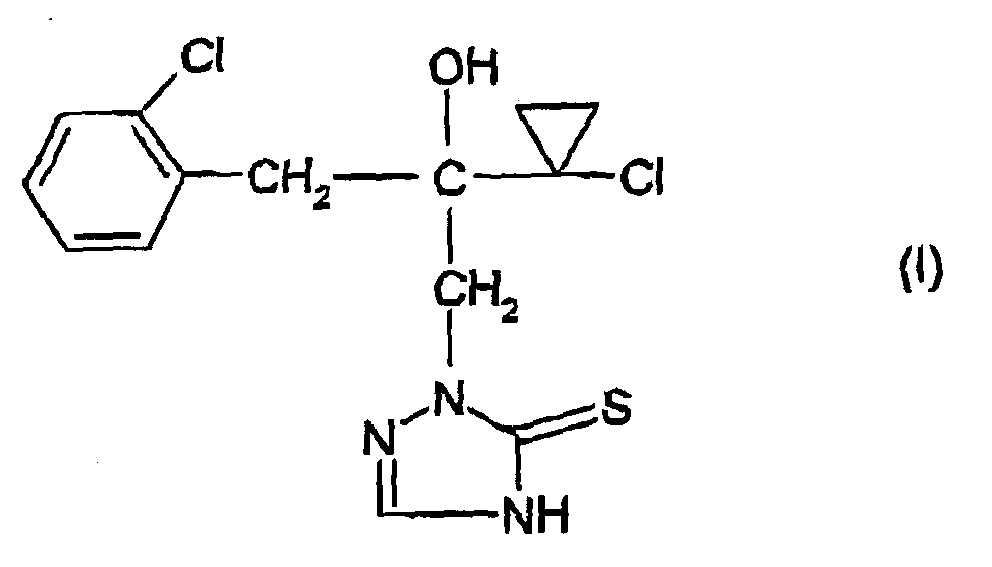
mindestens einer weiteren fungiziden Verbindung oder deren Salze oder Addukte, ausgewählt aus einer Liste von 4 Strobilurin-Derivaten in einer synergistisch wirksamen Menge.
Description
- Fungizide Mischung, enthaltend
- (1) 2-[2-(1-Chlorcyclopropyl)-3-(2-chlorphenyl)-2-hydroxypropyl]-2,4-dihydro-[1,2,4]-triazol-3-thion (Prothioconazole) der Formel I oder dessen Salze oder Addukte

- (2) Trifloxystrobin der Formel II

- (3) Picoxystrobin der Formel III

- (4) Pyraclostrobin der Formel IV

- (5) Dimoxystrobin der Formel V

- (6) einem Strobilurin-Derivat der Formel VI

- Außerdem betrifft die Erfindung ein Verfahren zur Bekämpfung von Schadpilzen mit Mischungen der Verbindungen I mit mindestens einer der Verbindungen II, III, IV, V oder VI und die Verwendung der Verbindungen I, II, III, IV, V und VI zur Herstellung derartiger Mischungen sowie Mittel, die diese Mischungen enthalten.
- Die Verbindung der Formel I, das 2-[2-(1-Chlorcyclopropyl)-3-(2-chlorphenyl)-2-hydroxypropyl]-2,4-dihydro-[1,2,4]-triazol-3-thion (Prothioconazol) ist bereits aus der WO 96/16048 bekannt.
- Aus der WO 98/47367 ist eine Reihe von Wirkstoffkombinationen von Prothiaconazol mit einer Vielzahl anderer fungizider Verbindungen bekannt,
- Das Trifloxystrobin der Formel II und seine Verwendung als Pflanzenschutzmittel ist in der EP-A-0 460 575 beschrieben.
- Das Picoxystrobin ist aus der EP-A-0 326 330 bekannt.
- Auch das Strobilurin-Derivat der Formel IV ist bereits bekannt und in der EP-A-0 804 421 beschrieben.
- Das Strobilurin-Derivat der Formel V ist aus der EP-A-0 477 631 bekannt.
- Schließlich ist auch das Strobilurin-Derivat der Formel VI bekannt und in der EP-A-0 676 332 beschrieben.
- Im Hinblick auf eine Senkung der Aufwandmengen und eine Verbesserung des Wirkungsspektrums der bekannten Verbindungen I, II, III, IV, V und VI lagen der vorliegenden Erfindung Mischungen als Aufgabe zugrunde, die bei verringerter Gesamtmenge an ausgebrachten Wirkstoffen eine verbesserte Wirkung gegen Schadpilze aufweisen (synergistische Mischungen).
- Demgemäß wurde die eingangs definierte Mischung von Prothioconazol mit mindestens einem Strobilurin-Derivat gefunden. Es wurde außerdem gefunden, daß sich bei gleichzeitiger, und zwar gemeinsamer oder getrennter Anwendung der Verbindung I und mindestens einer der Verbindungen II, III, IV, V oder VI oder der Verbindung I und mindestens einer der Verbindungen II, III, IV, V oder VI nacheinander Schadpilze besser bekämpfen lassen, als mit den Einzelverbindungen allein.
- Das 2-[2-(1-Chlorcyclopropyl)-3-(2-chlorphenyl)-2-hydroxypropyl]-2,4-dihydro-[1,2,4]-triazol-3-thion der Formel I ist aus der WO 96-16 048 bekannt. Die Verbindung kann In der "Thiono"-Form der Formel


- Das Trifloxystrobin der Formel II

- Picoxystrobin der Formel III

- Pyraclostrobin der Formel IV

- Dimoxystrobin der Formel V

- Das Strobilurin-Derivat der Formel VI

- Die Verbindungen I bis VI sind wegen des basischen Charakters der in ihnen enthaltenen Stlckstoffstome in der Lage, mit anorganischen oder organischen Säuren oder mit Metallionen Salze oder Addukte zu bilden.
- Beispiele für anorganische Säuren sind Halogenwasserstoffsäuren wie Fluorwasser stoff, Chlorwasserstoff, Bromwasserstoff und Jodwasserstoff, Schwefelsäure, Phosphorsäure und Salpetersäure.
- Als organischen Säuren kommen beispielsweise Ameisensäure. Kohlensäure und Alkansäuren wie Essigsäure, Trifluoressigsäure, Trichloressigsäure und Propionsäure sowie Glycolsäure, Thiocyansäure, Milchsäure, Bemsteinsäure, Zitronensäure, Benzoesäure, Zimtsäure, Oxalsäure, Alkylsulfonsäuren (Sulfonsäuren mit geradkettigen oder verzweigten Alkylresten mit 1 bis 20 Kohlenstoffatomen), Arylsulfonsäuren oder - dlsulfonsäuren (aromatische Reste wie Phenyl und Naphthyl welche eine oder zwei Sulfonsäuregruppen tragen), Alkylphosphonsäuren (Phosphonsäuren mit geradkettigen oder verzweigten Alkylresten mit 1 bis 20 Kohlenstoffatomen), Arylphosphonsäuren oder -diphosphonsäuren (aromatische Reste wie Phenyl und Naphthyl welche eine oder zwei Phosphorsäurereste tragen), wobei die Alkyl- bzw. Arylreste weitere Substituenten tragen können, z.B. p-Toluolsulfonsäure, Salizylsäure, p-Aminosalizylsäure, 2-Phenoxybenzoesäure. 2-Acetoxybenzoesäure etc.
- Als Metallionen kommen insbesondere die lonen der Elemente der zweiten Hauptgruppe, Insbesondere Calzium und Magnesium, der dritten und vierten Hauptgruppe, insbesondere Aluminium, Zinn und Blei, sowie der ersten bis achten Nebengruppe, insbesondere Chrom. Mangan, Eisen, Kobalt, Nickel, Kupfer, Zink und andere in Betracht. Besonders bevorzugt sind die Metallionen der Elemente der Nebengruppen der vierten Periode. Die Metalle können dabei in den verschiedenen ihnen zukommenden Wertigkeiten vorliegen.
Bevorzugt sind Mischungen von Prothioconazol mit Trifloxystrobin der Formel II. - Bevorzugt sind auch Mischungen von Prothioconazol mit Picoxystrobin der Formel III.
- Bevorzugt sind Mischungen von Prothioconazole mit Pyraclostrobin der Formel IV.
- Weiterhin bevorzugt sind auch Mischungen von Prothioconazole mit Dimoxystrobin der Formel V.
- Bevorzugt sind auch Mischungen von Prothioconazole mit dem Strobilurin-Derivat der Formel VI.
- Bevorzugt sind auch Dreiermischungen von Prothioconazol mit zwei der obengenannten Strobilurin-Derivaten.
- Bevorzugt setzt man bei der Bereitstellung der Mischungen die reinen Wirkstoffe I, II, III, IV, V und VI ein, denen man weitere Wirkstoffe gegen Schadpilze oder gegen andere Schädlinge wie Insekten, Spinntiere oder Nematoden oder auch herbizide oder wachstumsregulierende Wirkstoffe oder Düngemittel beimischen kann.
- Die Mischungen aus der Verbindung I mit mindestens einer der Verbindungen II, III, IV, V oder VI bzw. die Verbindung I mit mindestens einer der Verbindungen II, III, IV. V oder VI gleichzeitig, gemeinsam oder getrennt angewandt, zeichnen sich durch eine hervorragende Wirkung gegen ein breites Spektrum von pflanzenpathogenen Pilzen, Insbesondere aus der Klasse der Ascomyceten, Basidiomyceten, Phycomyceten und Deuteromyceten aus. Sie sind z.T. systemisch wirksam und können daher auch als Blatt- und Bodenfungizide eingesetzt werden.
- Besondere Bedeutung haben sie für die Bekämpfung einer Vielzahl von Pilzen an verschiedenen Kulturpflanzen wie Baumwolle, Gemüsepflanzen (z.B. Gurken. Bohnen, Tomaten, Kartoffeln und Kürbisgewächse), Gerste, Gras, Hafer, Bananen, Kaffee, Mais, Obstpflanzen, Reis, Roggen, Soja, Wein, Weizen, Zierpflanzen, Zuckerrohr sowie an einer Vielzahl von Samen.
- Insbesondere eignen sie sich zur Bekämpfung der folgenden pflanzenpathogenen Pilze: Blumeria graminis (echter Mehltau) an Getreide, Erysiphe cichoracearum und Sphaerotheca fuliginea an Kürbisgewächsen, Podosphaera leucotrlcha an Äpfeln, Uncinula necator an Reben, Puccinla-Arten an Getreide, Rhizoctonia-Arten an Baumwolle, Reis und Rasen, Ustilago-Arten an Getreide und Zuckerrohr, Venturia inaequalls (Schorf) an Äpfeln, Helminthospörium-Arten an Getreide, Septoria nodorum an Weizen, Botrytis cinera (Grauschimmel) an Erdbeeren, Gemüse. Zierpflanzen und Reben, Cercospora arachidicola an Erdnüssen, Pseudocercosporella herpotrichoides an Weizen und Gerste, Pyricularia oryzae an Reis, Phytophthora infestans an Kartoffeln und Tomaten, Plasmopara viticola an Reben, Pseudoperonospora-Arten in Hopfen und Gurken, Alterneria-Arten an Gemüse und Obst, Mycosphaereila-Arten in Bananen sowie Fusarlum- und Verticillium-Arten.
- Sie sind außerdem im Materialschutz (z.B. Holzschutz) anwendbar, beispielsweise gegen Paecilomyces variotII.
- Die Verbindung I mit mindestens einer der Verbindungen II, III, IV, V und VI können gleichzeitig, und zwar gemeinsam oder getrennt, oder nacheinander aufgebracht werden, wobei die Reihenfolge bei getrennter Applikation im allgemeinen keine Auswirkung auf den Bekämpfungsarfolg hat.
- Die Verbindungen I und II werden üblicherweise in einem Gewichtsverhältnis von 20:1 bis 1:20, insbesondere 10:1 bis 1:10, vorzugsweise 5:1 bis 1:5 angewendet.
- Die Verbindungen I und III werden üblicherweise in einem Gewichtsverhältnis von 20:1 bis 1:20, Insbesondere 10:1 bis 1:10, vorzugsweise 5:1 bis 1:5 angewendet.
- Die Verbindungen I und IV werden üblicherweise in einem Gewichtsverhältnis von 20:1 bis 1:20, insbesondere 10:1 bis 1:10, vorzugsweise 5:1 bis 1:5 angewendet.
- Die Verbindungen I und V werden üblicherweise in einem Gewichtsverhältnis von 20:1 bis 1:20, Insbesondere 10:1 bis 1:10, vorzugsweise 5:1 bis 1:5 angewendet.
- Die Verbindungen I und VI werden üblicherweise in einem Gewichtsverhältnis von 20:1 bis 1:20, insbesondere 10:1 bis 1:10, vorzugsweise 5:1 bis 1:5 angewendet.
- Die Aufwandmengen der erfindungsgemäßen Mischungen liegen, vor allem bei landwirtschaftlichen Kulturflächen, je nach Art des gewünschten Effekts bei 0,01 bis B kg/ha, vorzugsweise 0,1 bis 5 kg/ha, insbesondere 0,1 bis 3,0 kg/ha.
- Die Aufwandmengen liegen dabei für die Verbindung I bei 0,01 bis 1 kg/ha, vorzugsweise 0,05 bis 0,5 kg/ha, insbesondere 0,05 bis 0,3 kg/ha.
- Die Aufwandmengen für die Verbindung II liegen entsprechend bei 0,01 bis 1 kg/ha, vorzugsweise 0,02 bis 0,5 kg/ha, insbesondere 0,05 bis 0,3 kg/ha.
- Die Aufwandmengen für die Verbindung III liegen entsprechend bei 0,01 bis 1 kg/ha, vorzugsweise 0,02 bis 0,5 kg/ha, insbesondere 0.05 bis 0,3 kg/ha.
- Die Aufwandmengen für die Verbindung IV liegen entsprechend bei 0,01 bis 1 kg/ha, vorzugsweise 0,02 bis 0,5 kg/ha, insbesondere 0,05 bis 0,3 kg/ha.
- Die Aufwandmengen für die Verbindung V liegen entsprechend bei 0,01 bis 1 kg/ha, vorzugsweise 0,02 bis 0,5 kg/ha, insbesondere 0,05 bis 0,3 kg/ha.
- Die Aufwandmengen für die Verbindung VI liegen entsprechend bei 0,01 bis 1 kg/ha, vorzugsweise 0,02 bis 0,5 kg/ha, insbesondere 0,05 bis 0,3 kg/ha.
- Bei der Saatgutbehandlung werden im allgemeinen Aufwandmengen an Mischung von 0,001 bis 250 g/kg Saatgut, vorzugsweise 0,01 bis 100 g/kg, insbesondere 0,01 bis 50 g/kg verwendet.
- Sofern für Pflanzen pathogene Schadpilze zu bekämpfen sind, erfolgt die getrennte oder gemeinsame Applikation der Verbindung I mit mindestens einer der Verbindungen II, III, IV, V und VI oder der Mischungen aus der Verbindung I mit mindestens einer der Verbindungen II, III, IV, V oder VI durch Besprühen oder Bestäuben der Samen, der Pflanzen oder der Böden vor oder nach der Aussaat der Pflanzen oder vor oder nach dem Auflaufen der Pflanzen,
- Die erfindungsgemäßen fungiziden synergistischen Mischungen bzw. die Verbindung I und mindestens eine der Verbindungen II, III, IV, V und VI können beispielsweise in Form von direkt versprühbaren Lösungen, Pulver und Suspensionen oder in Form von hochprozentigen wäßrigen, öligen oder sonstigen Suspensionen, Dispersionen, Emulslonen, Öldispersionen, Pasten, Stäubemittein, Streumitteln oder Granulaten aufbereitet und durch Versprühen, Vernebeln, Verstäuben, Verstreuen oder Gießen angewendet werden. Die Anwendungsform ist abhängig vom Verwendungszweck; sie soll in jedem Fall eine möglichst feine und gleichmäßige Verteilung der erfindungsgemäßen Mischung gewährleisten.
- Die Formulierungen werden in an sich bekannter Weise hergestellt, z.B. durch Zugabe von Lösungsmitteln und/oder Trägerstoffen. Den Formulierungen werden üblicherweise Inerte Zusatzstoffe wie Emulgiermittel oder Dispergiermittel beigemischt.
- Als oberflächenaktive Stoffe kommen die Alkali-, Erdalkali-, Ammoniumsalze von aromatischen Sulfonsäuren, z.B. Lignin-, Phenol-, Naphthalin- und Dibutylnaphthalinsulfonsäure, sowie von Fettsäuren, Alkyl- und Alkylarylsulfonaten, Alkyl-, Laurylether- und Fettalkoholsulfaten, sowie Salze sulfatierter Hexa-, Hepta- und Octadecanole oder Fettalkoholglycolethern, Kondensationsprodukte von sulfoniertem Naphthalin und seinen Derivaten mit Formaldehyd, Kondensationsprodukte des Naphthalins bzw. der Naphthalinsulfonsäuren mit Phenol und Formaldehyd, Polyoxyethylenoctylphenolether, ethoxyliertes Isooctyl-, Octyl- oder Nonylphenol, Alkylphenol- oder Tributylphenylpolyglycolether, Alkylarylpolyetheralkohole, Isotridecylalkohol, Fettalkoholethylenoxid-Kondensate, ethoxyliertes Rizinusöl, Polyoxyethylenalkylether oder Polyoxypropylen, Laurylalkoholpolyglycoletheracetat, Sorbitester, Lignin-Sulfitablaugen oder Methylcellulose in Betracht.
- Pulver Streu- und Stäubemittel können durch Mischen oder gemeinsames Vermahlen der Verbindung I und mindestens einer der Verbindungen II, III, IV, V und VI oder der Mischung aus den Verbindungen I mit mindestens einer Verbindung II, III, IV, V oder VI mit einem festen Trägerstoff hergestellt werden.
- Granulate (z.B. Umhüllungs-, Imprägnierungs- oder Homogengranulate) werden üblicherweise durch Bindung des Wirkstoffs oder der Wirkstoffe an einen festen Trägerstoff hergestellt.
- Als Füllstoffe bzw. feste Trägerstoffe dienen beispielsweise Mineralerden wie Silicagel, Kieselsäuren, Kieselgele, Silikate, Talkum, Kaolin, Kalkstein, Kalk, Kreide, Bolus, Löß, Ton, Dolomit, Diatomeenerde, Calcium- und Magnesiumsulfat, Magnesiumoxid, gemahlene Kunststoffe, sowie Düngemittel wie Ammoniumsulfat, Ammoniumphosphat, Ammoniumnitrat, Harnstoffe und pflanzliche Produkte wie Getreidemehl, Baumrinden-, Holz- und Nußschalenmehl, Cellulosepulver oder andere feste Trägerstoffe.
- Die Formulierungen enthalten im allgemeinen 0,1 bis 95 Gew.-%, vorzugsweise 0,5 bis 90 Gew.-% der Verbindung I und mindestens einer der Verbindungen II, III, IV, V oder VI bzw. der Mischung aus der Verbindung I mit mindestens einer Verbindung II, III, IV, V oder VI. Die Wirkstoffe werden dabei in einer Reinheit von 90% bis 100%, vorzugsweise 95% bis 100% (nach NMR- oder HPLC-Spektrum) eingesetzt.
- Die Anwendung der Verbindung I und mindestens einer der Verbindungen II, III, IV, V und VI oder der Mischungen oder der entsprechenden Formulierungen erfolgt so, daß man die Schadpilze, deren Lebensraum oder die von ihnen freizuhaltenden Pflanzen, Samen, Böden, Flächen, Materialien oder Räume mit einer fungizid wirksamen Menge der Mischung, bzw, der Verbindung I und mindestens einer der Verbindungen II, III, IV, V oder VI bei getrennter Ausbringung, behandelt.
- Die Anwendung kann vor oder nach dem Befall durch die Schadpilze erfolgen.
- Die synergistische Wirkung der erfindungsgemäßen Mischungen ließ sich durch die folgenden Versuche zeigen:
- Die Wirkstoffe wurden getrennt oder gemeinsam als 10%ige Emulsion in einem Gemisch aus 63 Gew.-% Cyclohexanon und 27 Gew.-% Emulgator aufbereitet und entsprechend der gewünschten Konzentration mit Wasser verdünnt.
- Die Auswertung erfolgte durch Feststellung der befallenen Blattflächen in Prozent. Diese Prozent-Werte wurden in Wirkungsgrade umgerechnet. Der Wirkungsgrad (W) wurde nach der Formel von Abbot wie folgt bestimmt:

- α
- entspricht dem Pilzbefall der behandelten Pflanzen in % und
- β
- entspricht dem Pilzbefall der unbehandelten (Kontroll-) Pflanzen in %
- Bei einem Wirkungsgrad von 0 entspricht der Befall der behandelten Pflanzen demjenigen der unbehandelten Kontrollpflanzen; bei einem Wirkungsgrad von 100 wiesen die behandelten Pflanzen keinen Befall auf.
- Die zu erwartenden Wirkungsgrade der Wirkstoffmischungen wurden nach der Colby Formel [R.S. Colby, Weeds 15, 20-22 (1967)] ermittelt und mit den beobachteten Wirkungsgraden verglichen.

- E
- zu erwartender Wirkungsgrad, ausgedrückt in % der unbehandelten Kontrolle, beim Einsatz der Mischung aus den Wirkstoffen A und B in den Konzentrationen a und b
- x
- der Wirkungsgrad, ausgedrückt in % der unbehandelten Kontrolle, beim Einsatz des Wirkstoffs A in der Konzentration a
- y
- der Wirkungsgrad, ausgedrückt in % der unbehandelten Kontrolle, beim Einsatz des Wirkstoffs B in der Konzentration b
- Anwendungsbeispiel 1: Wirksamkeit gegen Weizenmehltau verursacht durch Erysiphe [syn. Blumeria] graminis forma specialis. tritici
- Blätter von in Töpfen gewachsenen Weizenkeimilngen der Sorte "Kanzler" wurden mit wäßriger Wirkstoffaufbereitung, die aus einer Stammlösung bestehend aus 10 % Wirkstoff, 85 % Cyclohexanon und 5 % Emulgiermittel angesetzt wurde, bis zur Tropfnässe besprüht und 24 Stunden nach dem Antrocknen des Spritzbelages mit Sporen des Weizenmehltaus (Erysiphe [syn. Blumeria] graminis form a specialis. triticl) bestäubt. Die Versuchspflanzen wurden anschließend im Gewächshaus bei Temperaturen zwischen 20 und 24°C und 60 bis 90 % relativer Luftfeuchtigkeit aufgestellt. Nach 7 Tagen wurde das Ausmaß der Mehltauentwicklung visuell in % Befall der gesamten Blattfläche ermittelt.
- Die visuell ermittelten Werte für den Prozentanteil befallener Blattflächen wurden in Wirkungsgrade als % der unbehandelten Kontrolle umgerechnet. Wirkungsgrad 0 ist gleicher Befall wie In der unbehandelten Kontrolle, Wirkungsgrad 100 ist 0 % Befall. Die zu erwartenden Wirkungsgrade für Wirkstoffkombinationen wurden nach der obengenannten Colby-Formel ermittelt und mit den beobachteten Wirkungsgraden verglichen.
Tabelle 1 Wirkstoff Wirkstoffkonzentration in der Spritzbrühe in ppm Wirkungsgrad in % der unbehandelten Kontrolle Kontrolle (unbehandelt) (90 % Befall) 0 Verbindung I = Prothioconazol 4 22 1 0 0.25 0 0,06 0 0,015 0 Verbindung II = Trifloxystrobin 4 83 1 44 0.25 22 0,06 0 Verbindung III = Picoxystrobin 0.25 11 Verbindung IV = Pyraclostrobin 1 0 0.25 0 Tabelle 2 Erfindungsgemäße Kombinationen Beobachteter Wirkungsgrad Berechneter Wirkungsgrad*) Verbindung I = Prothioconazol + Verbindung II = Trifloxystrobin 0,015+0,25 ppm 33 22 Mischung 1 : 16 Verbindung I = Prothioconazol + Verbindung II = Trifloxystrobin 1 : 4 ppm 94 83 Mischung 1 : 4 Verbindung I = Prothioconazol + Verbindung II = Trifloxystrobin 0,25 + 1 ppm 56 44 Mischung 1 : 4 Verbindung I = Prothioconazol + Verbindung II = Trifloxystrobin 0.25+0,06 ppm 22 0 Mischung 4 : 1 Verbindung I = Prothioconazol + Verbindung II = Trifloxystrobin 4 + 0,25 ppm 55 40 Mischung 16: 1 Verbindung I = Prothioconazol + Verbindung III = Picoxystrobin 0,06+0,25 ppm 33 11 Mischung 1 : 4 Verbindung 1 = Prothioconazol + Verbindung III = Picoxystrobin 1+0,25 ppm 22 11 Mischung 4 : 1 Verbindung I = Prothioconazol + Verbindung IV = Pyraclostrobin 0,06+1 ppm 33 0 Mischung 1 : 16 Verbindung I = Prothloconazol + Verbindung IV = Pyraclostrobin 0,015+0,25 ppm 33 0 Mischung 1 : 16 Verbindung 1 = Prothioconazol + Verbindung IV = 33 0 Pyraclostrobin 0,25 + 1 ppm Mischung 1:4 Verbindung I = Prothioconazol + Ver bindung IV = 22 0 Pyraclostrobin 0;06 + 0,25 ppm Mischung 1 : 4 Verbindung I = Prothioco-nazol + Verbindung IV = 33 22 Pyradostrobin 4 + 1 ppm Mischung 4 : 1 *) berechnet nach der Colby-Formel - Aus den Ergebnissen des Versuches geht hervor, daß der beobachteter Wirkungsgrad In allen Mischungsverhältnissen höher ist, als nach der Colby-Formel vorausberechnete Wirkungsgrad (aus Synerg 171. XLS).
- Anwendungsbeispiel 2: Kurative Wirksamkeit gegen Weizenbraunrost verursacht durch Puccinia recondita
- Blätter von in Töpfen gewachsenen Weizensämlingen der Sorte "Kanzler" wurden mit Sporen des Braunrostes (Puccinia recondita) bestäubt. Danach wurden die Töpfe für 24 Stunden in eine Kammer mit hoher Luftfeuchtigkeit (90 bis 95 %) und 20 bis 22_C gestellt. Während dieser Zeit keimten die Sporen aus und die Keimschläuche drangen in das Blattgewebe ein. Die infizierten Pflanzen wurden am nächsten Tag mit einer wäßrigen Wirkstoffaufbereitung, die aus einer Stammlösung bestehend aus 10 % Wirkstoff, 85 % Cyclohexanon und 5 % Emulgiermittel angesetzt wurde, tropfnaß besprüht. Nach dem Antrocknen des Spritzbelages wurden die Versuchspflanzen im Gewächshaus bei Temperaturen zwischen 20 und 22_ C und 65 bis 70 % relativer Luftfeuchte für 7 Tage kultiviert. Dann wurde das Ausmaß der Rostpilzentwickiung auf den Blättern ermittelt.
- Die visuell ermittelten Werte für den Prozentanteil befallener Blattflächen wurden in Wirkungsgrade als % der unbehandelten Kontrolle umgerechnet. Wirkungsgrad 0 ist gleicher Befall wie in der unbehandelten Kontrolle, Wirkungsgrad 100 ist 0 % Befall. Die zu erwartenden Wirkungsgrade für Wirkstoffkombinationen wurden nach der obengenannten Colby-Formel ermittelt und mit den beobachteten Wirkungsgraden verglichen.
Tabelle 3 Wirkstoff Wirkstoffkonzentration in der Spritzbrühe in ppm Wirkungsgrad in % der unbehandelten Kontrolle Kontrolle (unbehandelt) (90 % Befall) 0 Verbindung I= Prothioconazol 1 0 0.25 0 0,015 0 0,006 0 Verbindung IITrifloxystrobin 0.25 0 0,06 0 Verbindung III = Picoxystrobin 1 33 0.25 0 0,06 0 Verbindung IV = Pyraclostrobin 0.25 0 0,06 0 Tabelle 4 Erfindungsgemäße Kombinationen Beobachteter Wirkungsgrad Berechneter Wirkungsgrad*) Verbindung I = Prothioconazol + Verbindung II = Trifloxystrobin 0,015+0,25 ppm Mischung 1:16 22 0 Verbindung I = Prothioconazol + Verbindung II = Trifloxystrobin 0,06 : 0,25 ppm 22 0 Mischung 1 : 4 Verbindung I = Prothioconazol + Verbindung II = Trifloxystrobin 1 + 0,25 ppm 67 0 Mischung 4 : 1 Verbindung I = Prothioconazol + Verbindung II = Trifloxystrobin 0,25 + 0,06 ppm 67 0 Mischung 4 : 1 Verbindung I = Prothioconazol + Verbindung II= Trifloxystrobin 1 + 0,06 ppm Mischung 16: 1 11 0 Verbindung I = Prothioconazol + Verbindung III = Picoxystrobin 0,06 + 1 ppm 44 33 Mischung 1:16 Verbindung I = Prothioconazol + Verbindung III = Picoxystrobin 0.06+0,25 ppm 11 0 Mischung 1 : 4 Verbindung I = Prothioconazol + Verbindung III = Picoxystrobin 1+ 0,25 ppm 78 0 Mischung 4 : 1 Verbindung I = Prothioconazol + Verbindung III = Picoxystrobin 0,25+0,06 ppm 78 0 Mischung 4 : 1 Verbindung I = Prothioconazol + Verbindung III = Picoxystrobin 1 + 0,06 ppm 44 0 Mischung 16 : 1 Verbindung I = Prothioconazol + Verbindung IV = Pyradostrobin 0,015+0,25 ppm 94 0 Mischung 1 : 16 Verbindung I = Prothioconazol + Verbindung IV = 89 0 Pyraclostrobin 0,06+0.25 ppm Mischung 1 ; 4 Verbindung I = Prothioconazol + Verbindung IV = 22 0 Pyraclostrobin 1 + 0,25 ppm Mischung 4 : 1 Verbindung I = Prothioconazol + Verbindung IV = 22 0 Pyraclostrobin 0,25+0,06 ppm Mischung 4:1 Verbindung I = Prothioconazol + Verbindung IV = 89 0 Pyraclostrobin 1 + 0,06 ppm Mischung 16: 1 *) berechnet nach der Colby-Formel - Aus den Ergebnissen des Versuches geht hervor, daß der beobachteter Wirkungsgrad in allen Mischungsverhältnissen höher ist, als nach der Colby-Formel vorausberechnete Wirkungsgrad (aus Synerg 171. XLS).
Claims (10)
- Fungizide Mischung, enthaltend(1) 2-[2-(1-Chlorcyclopropyl)-3-(2-chlorphenyl)-2-hydroxypropyl]-2,4-dihydro-[1,2,4]-triazol-3-thion (Prothioconazole) der Formel I oder dessen Salze oder Addukte

und mindestens einer weiteren fungiziden Verbindung oder deren Salze oder Addukte, ausgewählt aus(3) Picoxystrobin der Formel III (4) Pyraclostrobin der Formel IV
 (5) Dimoxystrobin der Formel V
 (6) einem Strobitunn-Derivat der Formel VI
- Fungizide Mischung nach Anspruch 1, enthaltend Prothioconazol der Formel I und Picoxystrobin der Formel lll.
- Fungizide Mischung nach Anspruch 1, enthaltend Prothioconazol der Formel I und Pyraclostrobin der Formel IV.
- Fungizide Mischung nach Anspruch 1, enthaltend Prothioconazole der Formel I und Dimoxystrobin der Formel V.
- Fungizide Mischung nach Anspruch 1, enthaltend Prothioconazol der Formel I und das Strobilurin-Derivat der Formel VI,
- Fungizide Mischung nach Anspruch 1, dadurch gekennzeichnet, daß das Gewichtsverhältnis von Prothiconazole der Formel I zu- Picoxystrobin der Formel III 20:1 bis 1:20 beträgt,- Pyraclostrobin der Formel IV 20:1 bis 1:20 beträgt,- Dimoxystrobin der Formel V 20:1 bis 1:20 beträgt, und zu- dem Strobilurin-Derivat der Formel VI 20:1 bis 1:20 beträgt
- Verfahren zur Bekämpfung von Schadpilzen, dadurch gekennzeichnet, daß man die Schadpllze, deren Lebensraum oder die von ihnen freizuhaltenden Pflanzen, Samen, Böden, Flächen, Materialien oder Räume mit der fungiziden Mischung gemäß Anspruch 1 behandelt.
- Verfahren nach Anspruch 7, dadurch gekennzeichnet, daß man die Verbindung der Formel gemäß Anspruch 1 und mindestens eine Verbindung der Formel III, IV, V oder VI gemäß Anspruch 1 gleichzeitig, und zwar gemeinsam oder getrennt, oder nacheinander ausbringt.
- Verfahren nach Anspruch 7 oder 8, dadurch gekennzeichnet, daß man die fungizide Mischung oder die Verbindung der Formel I mit mindestens einer Verbindung der Formel III, IV, V oder VI gemäß Anspruch 1 in einer Menge von 0,01 bis 8 kg/ha aufwendet.
- Fungizide Mittel, enthaltend die fungizide Mischung gemäß Anspruch 1 sowie einen festen oder flüssigen Träger.
Priority Applications (2)
| Application Number | Priority Date | Filing Date | Title |
|---|---|---|---|
| EP08153111.3A EP1929868B1 (de) | 2002-03-01 | 2003-02-26 | Fungizide Mischungen auf der Basis von Prothioconazole und einem Strobilurinderivat |
| SI200331274T SI1642499T1 (sl) | 2002-03-01 | 2003-02-26 | Fungicidne meĺ anice na osnovi protiokonazola in pikoksistrobina |
Applications Claiming Priority (2)
| Application Number | Priority Date | Filing Date | Title |
|---|---|---|---|
| DE10208838 | 2002-03-01 | ||
| EP03743328A EP1482798B1 (de) | 2002-03-01 | 2003-02-26 | Fungizide mischung auf der basis von prothioconazole und trifloxystrobin |
Related Parent Applications (1)
| Application Number | Title | Priority Date | Filing Date |
|---|---|---|---|
| EP03743328A Division EP1482798B1 (de) | 2002-03-01 | 2003-02-26 | Fungizide mischung auf der basis von prothioconazole und trifloxystrobin |
Related Child Applications (1)
| Application Number | Title | Priority Date | Filing Date |
|---|---|---|---|
| EP08153111.3A Division EP1929868B1 (de) | 2002-03-01 | 2003-02-26 | Fungizide Mischungen auf der Basis von Prothioconazole und einem Strobilurinderivat |
Publications (3)
| Publication Number | Publication Date |
|---|---|
| EP1642499A2 true EP1642499A2 (de) | 2006-04-05 |
| EP1642499A3 EP1642499A3 (de) | 2006-08-09 |
| EP1642499B1 EP1642499B1 (de) | 2008-06-11 |
Family
ID=27770913
Family Applications (3)
| Application Number | Title | Priority Date | Filing Date |
|---|---|---|---|
| EP08153111.3A Expired - Lifetime EP1929868B1 (de) | 2002-03-01 | 2003-02-26 | Fungizide Mischungen auf der Basis von Prothioconazole und einem Strobilurinderivat |
| EP03743328A Expired - Lifetime EP1482798B1 (de) | 2002-03-01 | 2003-02-26 | Fungizide mischung auf der basis von prothioconazole und trifloxystrobin |
| EP05026582A Expired - Lifetime EP1642499B1 (de) | 2002-03-01 | 2003-02-26 | Fungizide Mischungen auf der Basis von Prothioconazole und Picoxystrobin |
Family Applications Before (2)
| Application Number | Title | Priority Date | Filing Date |
|---|---|---|---|
| EP08153111.3A Expired - Lifetime EP1929868B1 (de) | 2002-03-01 | 2003-02-26 | Fungizide Mischungen auf der Basis von Prothioconazole und einem Strobilurinderivat |
| EP03743328A Expired - Lifetime EP1482798B1 (de) | 2002-03-01 | 2003-02-26 | Fungizide mischung auf der basis von prothioconazole und trifloxystrobin |
Country Status (25)
| Country | Link |
|---|---|
| US (3) | US20050101639A1 (de) |
| EP (3) | EP1929868B1 (de) |
| JP (1) | JP4477358B2 (de) |
| KR (1) | KR100951210B1 (de) |
| CN (1) | CN1328956C (de) |
| AR (1) | AR038706A1 (de) |
| AT (2) | ATE397860T1 (de) |
| AU (3) | AU2003210354B9 (de) |
| BR (1) | BR0307729B1 (de) |
| CA (4) | CA2477000C (de) |
| CL (1) | CL2010000658A1 (de) |
| CO (1) | CO5611068A2 (de) |
| DE (2) | DE50303474D1 (de) |
| DK (2) | DK1482798T3 (de) |
| EA (4) | EA014804B1 (de) |
| ES (3) | ES2264768T3 (de) |
| IL (1) | IL163309A (de) |
| MX (1) | MXPA04007477A (de) |
| NZ (3) | NZ534781A (de) |
| PL (4) | PL210584B1 (de) |
| PT (2) | PT1642499E (de) |
| SI (2) | SI1642499T1 (de) |
| UA (1) | UA78550C2 (de) |
| WO (1) | WO2003073852A2 (de) |
| ZA (1) | ZA200407893B (de) |
Cited By (1)
| Publication number | Priority date | Publication date | Assignee | Title |
|---|---|---|---|---|
| EP3073826B1 (de) | 2013-11-26 | 2019-10-30 | UPL Limited | Verfahren zur sojabohnenrostbekämpfung |
Families Citing this family (71)
| Publication number | Priority date | Publication date | Assignee | Title |
|---|---|---|---|---|
| DE19716257A1 (de) | 1997-04-18 | 1998-10-22 | Bayer Ag | Fungizide Wirkstoffkombination |
| UA70327C2 (uk) * | 1998-06-08 | 2004-10-15 | Баєр Акціенгезельшафт | Спосіб боротьби з фітопатогенними хворобами сільськогосподарських рослин та фунгіцидна композиція |
| HU230539B1 (hu) | 1998-06-10 | 2016-11-28 | Bayer Intellectual Property Gmbh | Növényvédőszer-készítmény |
| DE10140108A1 (de) | 2001-08-16 | 2003-03-06 | Bayer Cropscience Ag | Fungizide Wirkstoffkombinationen |
| DE10228104A1 (de) * | 2002-06-24 | 2004-01-15 | Bayer Cropscience Ag | Fungizide Wirkstoffkombination |
| DE10228103A1 (de) * | 2002-06-24 | 2004-01-15 | Bayer Cropscience Ag | Fungizide Wirkstoffkombinationen |
| DE10228102A1 (de) * | 2002-06-24 | 2004-01-15 | Bayer Cropscience Ag | Fungizide Wirkstoffkombinationen |
| DE10335183A1 (de) * | 2003-07-30 | 2005-02-24 | Bayer Cropscience Ag | Fungizide Wirkstoffkombinationen |
| DE10341945A1 (de) * | 2003-09-11 | 2005-04-21 | Bayer Cropscience Ag | Verwendung von fungiziden Mitteln zur Beizung von Saatgut |
| DE10347090A1 (de) * | 2003-10-10 | 2005-05-04 | Bayer Cropscience Ag | Synergistische fungizide Wirkstoffkombinationen |
| DE10347440A1 (de) * | 2003-10-13 | 2005-05-04 | Bayer Cropscience Ag | Synergistische insektizide Mischungen |
| DE10351004A1 (de) * | 2003-10-30 | 2005-05-25 | Basf Ag | Nanopartikuläre Wirkstoffformulierungen |
| KR100870174B1 (ko) * | 2003-12-04 | 2008-11-24 | 바이엘 크롭사이언스 아게 | 살충 및 살비성을 가지는 활성 물질 배합물 |
| EP1691611A1 (de) * | 2003-12-04 | 2006-08-23 | Bayer CropScience Aktiengesellschaft | Wirkstoffkombinationen mit insektiziden eigenschaften |
| KR100838542B1 (ko) * | 2004-02-12 | 2008-06-17 | 바이엘 크롭사이언스 소시에떼아노님 | 피리딜에틸벤즈아미드 유도체 및 식물병원성 진균 유기체내 호흡 사슬의 전자 운반을 억제할 수 있는 화합물을포함하는 살진균성 조성물 |
| EP1563731A1 (de) | 2004-02-12 | 2005-08-17 | Bayer CropScience S.A. | Pyridylethylbenzamid und Ergosterol-Biosynthesehemmer enthaltende fungizide Zusammensetzung |
| DE102004020840A1 (de) * | 2004-04-27 | 2005-11-24 | Bayer Cropscience Ag | Verwendung von Alkylcarbonsäureamiden als Penetrationsförderer |
| DE102004049041A1 (de) | 2004-10-08 | 2006-04-13 | Bayer Cropscience Ag | Fungizide Wirkstoffkombinationen |
| DE102004049761A1 (de) * | 2004-10-12 | 2006-04-13 | Bayer Cropscience Ag | Fungizide Wirkstoffkombinationen |
| MX2007006474A (es) * | 2004-12-20 | 2007-06-22 | Basf Ag | Procedimiento para combatir enfermedades fungicas en leguminosas. |
| AU2005321567A1 (en) * | 2004-12-23 | 2006-07-06 | Basf Aktiengesellschaft | Fungicidal mixtures containing enestroburin and at least one active substance from the group of azoles |
| AU2006211239B2 (en) * | 2005-02-04 | 2011-04-07 | Mitsui Chemicals, Inc. | Composition for preventing plant diseases and method for preventing the diseases |
| DE102005015677A1 (de) * | 2005-04-06 | 2006-10-12 | Bayer Cropscience Ag | Synergistische fungizide Wirkstoffkombinationen |
| GB0508993D0 (en) * | 2005-05-03 | 2005-06-08 | Syngenta Participations Ag | Pesticidal compositions |
| DE102005023835A1 (de) * | 2005-05-24 | 2006-12-07 | Bayer Cropscience Ag | Fungizide Wirkstoffkombination |
| MX2008003071A (es) * | 2005-09-09 | 2008-03-19 | Bayer Cropscience Ag | Formulacion solida de mezclas fungicidas. |
| WO2007048534A1 (en) * | 2005-10-26 | 2007-05-03 | Syngenta Participations Ag | Fungicidal compositions |
| DE102006031976A1 (de) * | 2006-07-11 | 2008-01-17 | Bayer Cropscience Ag | Wirkstoffkombinationen mit insektiziden und akariziden Eigenschaften |
| DE102006031978A1 (de) * | 2006-07-11 | 2008-01-17 | Bayer Cropscience Ag | Wirkstoffkombinationen mit insektiziden und akariziden Eigenschaften |
| US20090281157A1 (en) * | 2006-07-11 | 2009-11-12 | Bayer Cropscience Ag | Active Ingredient Combinations With Insecticidal and Acaricidal Properties |
| PT2124557E (pt) * | 2007-02-02 | 2015-02-27 | Plant Health Care Inc | Composições fungicidas sinérgicas compreendendo formononetina |
| EP2224810A2 (de) * | 2007-11-05 | 2010-09-08 | Basf Se | Verfahren, anwendung und mittel zum schutz einer pflanze gegen phakopsora |
| EP2064952A1 (de) * | 2007-11-29 | 2009-06-03 | Bayer CropScience AG | Verfahren zur Reduzierung der Mycotoxin-Kontaminierung von Mais |
| US8683346B2 (en) * | 2008-11-17 | 2014-03-25 | Sap Portals Israel Ltd. | Client integration of information from a supplemental server into a portal |
| JP5365158B2 (ja) * | 2008-11-25 | 2013-12-11 | 住友化学株式会社 | 植物病害防除用組成物及び植物病害の防除方法 |
| WO2010146029A2 (de) * | 2009-06-16 | 2010-12-23 | Basf Se | Fungizide mischungen |
| RU2562527C9 (ru) | 2009-12-16 | 2016-07-10 | Байер Интеллектуэль Проперти Гмбх | Комбинации активных веществ, содержащие проквиназид, биксафен и/или протиоконазол |
| BR112012015154B1 (pt) | 2009-12-21 | 2017-05-09 | Bayer Cropscience Ag | combinação de compostos ativos, mistura, formulação ou composição agroquímica, uso da mistura e método de utilização de protioconazol e metominostrobin para controlar fungos e/ou microrganismos fitopatogênicos de plantas e plantações |
| EP2533633B1 (de) * | 2010-02-02 | 2017-02-01 | LANXESS Distribution GmbH | Fungizide mischungen |
| PL2547209T3 (pl) * | 2010-03-18 | 2021-11-22 | Basf Se | Kompozycje grzybobójcze zawierające drobnoustrój rozpuszczający fosforan i grzybobójczo czynny związek |
| EP2377397A1 (de) | 2010-04-14 | 2011-10-19 | Bayer CropScience AG | Verwendung fungizider Wirkstoffe zur Kontrolle von Mykosen an Palmengewächsen |
| CA2808333C (en) * | 2010-08-11 | 2016-02-16 | Randy Allen Myers | Method of improving plant growth by reducing fungal infections |
| EP2462807A1 (de) * | 2010-12-08 | 2012-06-13 | Basf Se | Pestizidgemische enthaltend Pyraclostrobin |
| AR085588A1 (es) * | 2011-04-13 | 2013-10-09 | Bayer Cropscience Ag | Combinaciones de compuestos activos |
| CN103371153B (zh) * | 2012-04-28 | 2016-12-14 | 陕西韦尔奇作物保护有限公司 | 含噻呋酰胺与甲氧基丙烯酸酯类的杀菌组合物 |
| CN103563945A (zh) * | 2012-08-05 | 2014-02-12 | 南京华洲药业有限公司 | 一种含吡唑醚菌酯和丙硫菌唑的杀菌组合物及其应用 |
| CN105211082B (zh) * | 2012-09-18 | 2018-08-03 | 东阳市天齐科技有限公司 | 一种含醚菌胺的农药组合物 |
| WO2014082950A1 (en) | 2012-11-30 | 2014-06-05 | Bayer Cropscience Ag | Ternary fungicidal mixtures |
| CN102972420A (zh) * | 2012-12-18 | 2013-03-20 | 广西农喜作物科学有限公司 | 一种含丙硫菌唑的杀菌组合物 |
| CN102972410B (zh) * | 2012-12-18 | 2014-06-18 | 广西农喜作物科学有限公司 | 一种含丙硫菌唑和甲氧基丙烯酸酯类杀菌剂的农药组合物 |
| BR102013027977A2 (pt) | 2013-10-30 | 2015-09-15 | Rotam Agrochem Int Co Ltd | método de aumentar rendimento por tratamento com composições fungicidas |
| CN104621155B (zh) * | 2013-11-15 | 2016-08-17 | 南京华洲药业有限公司 | 一种含丙硫菌唑和多氧霉素的杀菌组合物及其应用 |
| CN104621125A (zh) * | 2013-11-15 | 2015-05-20 | 南京华洲药业有限公司 | 一种含丙硫菌唑和肟菌酯的杀菌组合物及其应用 |
| KR20160145640A (ko) | 2014-04-15 | 2016-12-20 | 다우 아그로사이언시즈 엘엘씨 | 살진균제로서의 금속효소 억제제 화합물 |
| CN106231901A (zh) | 2014-04-15 | 2016-12-14 | 美国陶氏益农公司 | 作为杀真菌剂的金属酶抑制剂化合物 |
| CN104068025B (zh) * | 2014-05-26 | 2016-09-07 | 浙江大学 | 杀菌组合物在防治农作物赤霉病及赤霉病菌毒素污染中的应用 |
| WO2015189113A1 (en) | 2014-06-11 | 2015-12-17 | Bayer Cropscience Aktiengesellschaft | Active compound combinations comprising proquinazid and spiroxamine and optionally prothioconazole |
| AR102987A1 (es) * | 2014-12-16 | 2017-04-05 | Bayer Cropscience Ag | Combinaciones de compuestos activos que comprenden un derivado de (tio)carboxamida y compuesto(s) fungicida(s) |
| BR112018076864A2 (pt) * | 2016-06-22 | 2019-04-02 | Bayer Cropscience Ag | combinações de composto ativo |
| CN107771817A (zh) * | 2016-08-29 | 2018-03-09 | 南京华洲药业有限公司 | 一种含啶氧菌酯和丙硫菌唑的杀菌组合物及其应用 |
| CN106719620A (zh) * | 2016-12-30 | 2017-05-31 | 江苏扬农化工股份有限公司 | 一种吡唑醚菌酯和丙硫菌唑复配悬浮剂及其用途 |
| EA202191023A3 (ru) | 2017-03-07 | 2021-10-29 | Юпл Лтд | Фунгицидные комбинации |
| UA124557C2 (uk) * | 2017-05-18 | 2021-10-05 | Юпл Лтд | Стабільна рідка композиція протіоконазолу |
| CN107372528B (zh) * | 2017-09-15 | 2020-04-03 | 芮城华农生物化学有限公司 | 一种含丙硫菌唑和乙蒜素的杀菌组合物及其应用 |
| WO2019064283A1 (en) | 2017-09-29 | 2019-04-04 | 0903608 B.C. Ltd. | SYNERGISTIC PESTICIDAL COMPOSITIONS AND METHODS OF DELIVERY OF ACTIVE AGENTS |
| CA3114046C (en) | 2018-09-27 | 2022-07-19 | 0903608 B.C. Ltd. | Synergistic pesticidal compositions and methods for delivery of insecticidal active ingredients |
| RU2691567C1 (ru) * | 2018-11-06 | 2019-06-14 | Государственное бюджетное учреждение Республики Башкортостан "Научно-исследовательский технологический институт гербицидов и регуляторов роста растений с опытно-экспериментальным производством Академии наук Республики Башкортостан" | Фунгицидное средство |
| CA3139524A1 (en) | 2019-05-10 | 2020-11-19 | Bayer Cropscience Lp | Active compound combinations |
| CN110476999A (zh) * | 2019-08-23 | 2019-11-22 | 安徽省农业科学院植物保护与农产品质量安全研究所 | 吡唑醚菌酯、丙硫菌唑悬浮剂和悬浮种衣剂的研制 |
| JPWO2021153758A1 (de) * | 2020-01-31 | 2021-08-05 | ||
| BR102020018053A2 (pt) * | 2020-09-03 | 2022-03-15 | Ouro Fino Química S.A. | Composição fungicida concentrada de protioconazol e picoxistrobina |
Family Cites Families (20)
| Publication number | Priority date | Publication date | Assignee | Title |
|---|---|---|---|---|
| US173529A (en) * | 1876-02-15 | Improvement in portable fences | ||
| EP0278595B2 (de) * | 1987-02-09 | 2000-01-12 | Zeneca Limited | Fungizide |
| IL89029A (en) * | 1988-01-29 | 1993-01-31 | Lilly Co Eli | Fungicidal quinoline and cinnoline derivatives, compositions containing them, and fungicidal methods of using them |
| PH11991042549B1 (de) * | 1990-06-05 | 2000-12-04 | ||
| FR2663084B1 (fr) | 1990-06-07 | 1992-07-31 | Semt Pielstick | Dispositif d'injection pour moteur a combustion interne. |
| DE4030038A1 (de) * | 1990-09-22 | 1992-03-26 | Basf Ag | Ortho-substituierte phenylessigsaeureamide |
| DE4423612A1 (de) * | 1994-07-06 | 1996-01-11 | Basf Ag | 2-[(Dihydro)pyrazolyl-3'-oxymethylen]-anilide, Verfahren zu ihrer Herstelung und ihre Verwendung |
| DE19528046A1 (de) * | 1994-11-21 | 1996-05-23 | Bayer Ag | Triazolyl-Derivate |
| MY115814A (en) | 1995-06-16 | 2003-09-30 | Bayer Ip Gmbh | Crop protection compositions |
| DE19539324A1 (de) * | 1995-10-23 | 1997-04-24 | Basf Ag | Phenylessigsäurederivate, Verfahren und Zwischenprodukte zu ihrer Herstellung und sie enthaltende Mittel |
| IL126231A (en) * | 1996-04-26 | 2000-12-06 | Basf Ag | Fungicidal mixture and a method of controlling harmful fungi thereby |
| DE19716257A1 (de) * | 1997-04-18 | 1998-10-22 | Bayer Ag | Fungizide Wirkstoffkombination |
| US6096769A (en) * | 1998-04-20 | 2000-08-01 | American Cyanamid Company | Fungicidal co-formulation |
| US6090806A (en) * | 1998-08-31 | 2000-07-18 | American Cyanamid Company | Fungicidal mixtures |
| FR2789551B1 (fr) * | 1999-02-12 | 2002-06-21 | Aventis Cropscience Sa | Compositions fongicides pour la protection des fruits |
| DE19917617A1 (de) * | 1999-04-19 | 2000-10-26 | Bayer Ag | -(-)Enantiomeres des 2-[2-(1-Chlor-cyclopropyl)-3-(2-chlorphenyl) 2-hydroxy-propyl]-2,4-dihydro-[1,2,4]-triazol-3-thions |
| DE10019758A1 (de) * | 2000-04-20 | 2001-10-25 | Bayer Ag | Fungizide Wirkstoffkombinationen |
| GB0011944D0 (en) * | 2000-05-17 | 2000-07-05 | Novartis Ag | Organic compounds |
| CN1241475C (zh) * | 2001-01-18 | 2006-02-15 | 巴斯福股份公司 | 杀真菌混合物 |
| DE10228102A1 (de) | 2002-06-24 | 2004-01-15 | Bayer Cropscience Ag | Fungizide Wirkstoffkombinationen |
-
2003
- 2003-02-26 AT AT05026582T patent/ATE397860T1/de active
- 2003-02-26 MX MXPA04007477A patent/MXPA04007477A/es active IP Right Grant
- 2003-02-26 EA EA200701899A patent/EA014804B1/ru not_active IP Right Cessation
- 2003-02-26 PL PL372340A patent/PL210584B1/pl unknown
- 2003-02-26 ES ES03743328T patent/ES2264768T3/es not_active Expired - Lifetime
- 2003-02-26 CA CA2477000A patent/CA2477000C/en not_active Expired - Lifetime
- 2003-02-26 DK DK03743328T patent/DK1482798T3/da active
- 2003-02-26 EA EA200401133A patent/EA011235B1/ru unknown
- 2003-02-26 DK DK05026582T patent/DK1642499T3/da active
- 2003-02-26 ES ES05026582T patent/ES2304657T3/es not_active Expired - Lifetime
- 2003-02-26 ES ES08153111.3T patent/ES2623443T3/es not_active Expired - Lifetime
- 2003-02-26 NZ NZ534781A patent/NZ534781A/en not_active IP Right Cessation
- 2003-02-26 EP EP08153111.3A patent/EP1929868B1/de not_active Expired - Lifetime
- 2003-02-26 DE DE50303474T patent/DE50303474D1/de not_active Expired - Lifetime
- 2003-02-26 SI SI200331274T patent/SI1642499T1/sl unknown
- 2003-02-26 EP EP03743328A patent/EP1482798B1/de not_active Expired - Lifetime
- 2003-02-26 CN CNB038050560A patent/CN1328956C/zh not_active Expired - Lifetime
- 2003-02-26 BR BRPI0307729-2B1A patent/BR0307729B1/pt active IP Right Grant
- 2003-02-26 AT AT03743328T patent/ATE326844T1/de active
- 2003-02-26 PT PT05026582T patent/PT1642499E/pt unknown
- 2003-02-26 DE DE50309988T patent/DE50309988D1/de not_active Expired - Lifetime
- 2003-02-26 US US10/505,440 patent/US20050101639A1/en not_active Abandoned
- 2003-02-26 PL PL404554A patent/PL219750B1/pl unknown
- 2003-02-26 EA EA201001208A patent/EA017870B1/ru not_active IP Right Cessation
- 2003-02-26 PL PL398430A patent/PL219127B1/pl unknown
- 2003-02-26 EA EA200701900A patent/EA013641B1/ru not_active IP Right Cessation
- 2003-02-26 PT PT03743328T patent/PT1482798E/pt unknown
- 2003-02-26 AU AU2003210354A patent/AU2003210354B9/en not_active Expired
- 2003-02-26 CA CA2858118A patent/CA2858118C/en not_active Expired - Lifetime
- 2003-02-26 CA CA2812887A patent/CA2812887C/en not_active Expired - Lifetime
- 2003-02-26 SI SI200330378T patent/SI1482798T1/sl unknown
- 2003-02-26 PL PL394171A patent/PL213742B1/pl unknown
- 2003-02-26 NZ NZ567833A patent/NZ567833A/en not_active IP Right Cessation
- 2003-02-26 UA UA20040907816A patent/UA78550C2/uk unknown
- 2003-02-26 KR KR1020047013546A patent/KR100951210B1/ko not_active Expired - Lifetime
- 2003-02-26 NZ NZ555498A patent/NZ555498A/en not_active IP Right Cessation
- 2003-02-26 JP JP2003572386A patent/JP4477358B2/ja not_active Expired - Lifetime
- 2003-02-26 CA CA2743460A patent/CA2743460C/en not_active Expired - Lifetime
- 2003-02-26 EP EP05026582A patent/EP1642499B1/de not_active Expired - Lifetime
- 2003-02-26 WO PCT/EP2003/001929 patent/WO2003073852A2/de not_active Ceased
- 2003-02-28 AR ARP030100679A patent/AR038706A1/es active IP Right Grant
-
2004
- 2004-08-02 IL IL163309A patent/IL163309A/en unknown
- 2004-09-23 CO CO04094998A patent/CO5611068A2/es active IP Right Grant
- 2004-09-30 ZA ZA200407893A patent/ZA200407893B/xx unknown
-
2008
- 2008-10-09 AU AU2008229854A patent/AU2008229854B2/en not_active Ceased
- 2008-10-09 AU AU2008229851A patent/AU2008229851B2/en not_active Expired
-
2010
- 2010-06-18 CL CL2010000658A patent/CL2010000658A1/es unknown
-
2015
- 2015-07-15 US US14/799,692 patent/US10645930B2/en not_active Expired - Lifetime
- 2015-07-15 US US14/799,671 patent/US20150313226A1/en not_active Abandoned
Cited By (4)
| Publication number | Priority date | Publication date | Assignee | Title |
|---|---|---|---|---|
| EP3073826B1 (de) | 2013-11-26 | 2019-10-30 | UPL Limited | Verfahren zur sojabohnenrostbekämpfung |
| EP4014738A1 (de) * | 2013-11-26 | 2022-06-22 | UPL Ltd | Verfahren zur rostbekämpfung |
| EP4014741B1 (de) | 2013-11-26 | 2024-10-30 | UPL Ltd | Verfahren zur rostbekämpfung |
| EP4014738B1 (de) | 2013-11-26 | 2024-10-30 | UPL Ltd | Verfahren zur rostbekämpfung |
Also Published As
Similar Documents
| Publication | Publication Date | Title |
|---|---|---|
| EP1482798B1 (de) | Fungizide mischung auf der basis von prothioconazole und trifloxystrobin | |
| EP2080433B1 (de) | Fungizide Mischungen | |
| EP1484975B1 (de) | Fungizide mischungen auf der basis von triazolen | |
| EP1484972B1 (de) | Fungizide mischungen auf der basis von prothioconazol mit einem insektizid | |
| EP1482797B1 (de) | Fungizide mischungen auf der basis von prothioconazol | |
| EP0984689B1 (de) | Fungizide mischung | |
| EP0912088A1 (de) | Fungizide mischungen | |
| EP0984690B1 (de) | Fungizide mischung | |
| EP0984697A2 (de) | Fungizide mischungen | |
| WO1998053685A1 (de) | Fungizide mischungen |
Legal Events
| Date | Code | Title | Description |
|---|---|---|---|
| PUAI | Public reference made under article 153(3) epc to a published international application that has entered the european phase |
Free format text: ORIGINAL CODE: 0009012 |
|
| AC | Divisional application: reference to earlier application |
Ref document number: 1482798 Country of ref document: EP Kind code of ref document: P |
|
| AK | Designated contracting states |
Kind code of ref document: A2 Designated state(s): AT BE BG CH CY CZ DE DK EE ES FI FR GB GR HU IE IT LI LU MC NL PT SE SI SK TR |
|
| AX | Request for extension of the european patent |
Extension state: LT LV RO |
|
| PUAL | Search report despatched |
Free format text: ORIGINAL CODE: 0009013 |
|
| AK | Designated contracting states |
Kind code of ref document: A3 Designated state(s): AT BE BG CH CY CZ DE DK EE ES FI FR GB GR HU IE IT LI LU MC NL PT SE SI SK TR |
|
| AX | Request for extension of the european patent |
Extension state: LT LV RO |
|
| 17P | Request for examination filed |
Effective date: 20070209 |
|
| 17Q | First examination report despatched |
Effective date: 20070308 |
|
| AKX | Designation fees paid |
Designated state(s): AT BE BG CH CY CZ DE DK EE ES FI FR GB GR HU IE IT LI LU MC NL PT SE SI SK TR |
|
| AXX | Extension fees paid |
Extension state: RO Payment date: 20070209 Extension state: LT Payment date: 20070209 Extension state: LV Payment date: 20070209 |
|
| GRAP | Despatch of communication of intention to grant a patent |
Free format text: ORIGINAL CODE: EPIDOSNIGR1 |
|
| RIC1 | Information provided on ipc code assigned before grant |
Ipc: A01N 43/40 20060101ALI20080110BHEP Ipc: A01N 43/653 20060101AFI20080110BHEP |
|
| RTI1 | Title (correction) |
Free format text: FUNGICIDAL MIXTURES BASED ON PROTHIOCONAZOLE AND PICOXYSTROBIN |
|
| RAP1 | Party data changed (applicant data changed or rights of an application transferred) |
Owner name: BASF SE |
|
| GRAS | Grant fee paid |
Free format text: ORIGINAL CODE: EPIDOSNIGR3 |
|
| GRAA | (expected) grant |
Free format text: ORIGINAL CODE: 0009210 |
|
| AC | Divisional application: reference to earlier application |
Ref document number: 1482798 Country of ref document: EP Kind code of ref document: P |
|
| AK | Designated contracting states |
Kind code of ref document: B1 Designated state(s): AT BE BG CH CY CZ DE DK EE ES FI FR GB GR HU IE IT LI LU MC NL PT SE SI SK TR |
|
| AX | Request for extension of the european patent |
Extension state: LT LV RO |
|
| REG | Reference to a national code |
Ref country code: GB Ref legal event code: FG4D Free format text: NOT ENGLISH |
|
| REG | Reference to a national code |
Ref country code: CH Ref legal event code: EP |
|
| REG | Reference to a national code |
Ref country code: PT Ref legal event code: SC4A Free format text: AVAILABILITY OF NATIONAL TRANSLATION Effective date: 20080627 |
|
| REF | Corresponds to: |
Ref document number: 50309988 Country of ref document: DE Date of ref document: 20080724 Kind code of ref document: P |
|
| REG | Reference to a national code |
Ref country code: IE Ref legal event code: FG4D Free format text: LANGUAGE OF EP DOCUMENT: GERMAN |
|
| REG | Reference to a national code |
Ref country code: GR Ref legal event code: EP Ref document number: 20080401738 Country of ref document: GR |
|
| PLBI | Opposition filed |
Free format text: ORIGINAL CODE: 0009260 |
|
| REG | Reference to a national code |
Ref country code: SE Ref legal event code: TRGR |
|
| REG | Reference to a national code |
Ref country code: ES Ref legal event code: FG2A Ref document number: 2304657 Country of ref document: ES Kind code of ref document: T3 |
|
| 26 | Opposition filed |
Opponent name: E.I. DU PONT DE NEMOURS AND COMPANY Effective date: 20080910 |
|
| REG | Reference to a national code |
Ref country code: EE Ref legal event code: FG4A Ref document number: E002388 Country of ref document: EE Effective date: 20080910 |
|
| REG | Reference to a national code |
Ref country code: HU Ref legal event code: AG4A Ref document number: E003914 Country of ref document: HU |
|
| NLR1 | Nl: opposition has been filed with the epo |
Opponent name: E.I. DU PONT DE NEMOURS AND COMPANY |
|
| PLAX | Notice of opposition and request to file observation + time limit sent |
Free format text: ORIGINAL CODE: EPIDOSNOBS2 |
|
| PLBB | Reply of patent proprietor to notice(s) of opposition received |
Free format text: ORIGINAL CODE: EPIDOSNOBS3 |
|
| PG25 | Lapsed in a contracting state [announced via postgrant information from national office to epo] |
Ref country code: MC Free format text: LAPSE BECAUSE OF NON-PAYMENT OF DUE FEES Effective date: 20090228 |
|
| RDAF | Communication despatched that patent is revoked |
Free format text: ORIGINAL CODE: EPIDOSNREV1 |
|
| APBM | Appeal reference recorded |
Free format text: ORIGINAL CODE: EPIDOSNREFNO |
|
| APBP | Date of receipt of notice of appeal recorded |
Free format text: ORIGINAL CODE: EPIDOSNNOA2O |
|
| APAH | Appeal reference modified |
Free format text: ORIGINAL CODE: EPIDOSCREFNO |
|
| PG25 | Lapsed in a contracting state [announced via postgrant information from national office to epo] |
Ref country code: CY Free format text: LAPSE BECAUSE OF FAILURE TO SUBMIT A TRANSLATION OF THE DESCRIPTION OR TO PAY THE FEE WITHIN THE PRESCRIBED TIME-LIMIT Effective date: 20080611 |
|
| APBQ | Date of receipt of statement of grounds of appeal recorded |
Free format text: ORIGINAL CODE: EPIDOSNNOA3O |
|
| APBU | Appeal procedure closed |
Free format text: ORIGINAL CODE: EPIDOSNNOA9O |
|
| PLCK | Communication despatched that opposition was rejected |
Free format text: ORIGINAL CODE: EPIDOSNREJ1 |
|
| PLBN | Opposition rejected |
Free format text: ORIGINAL CODE: 0009273 |
|
| STAA | Information on the status of an ep patent application or granted ep patent |
Free format text: STATUS: OPPOSITION REJECTED |
|
| 27O | Opposition rejected |
Effective date: 20130206 |
|
| REG | Reference to a national code |
Ref country code: DE Ref legal event code: R100 Ref document number: 50309988 Country of ref document: DE Effective date: 20130206 |
|
| REG | Reference to a national code |
Ref country code: FR Ref legal event code: PLFP Year of fee payment: 14 |
|
| PG25 | Lapsed in a contracting state [announced via postgrant information from national office to epo] |
Ref country code: BE Free format text: LAPSE BECAUSE OF NON-PAYMENT OF DUE FEES Effective date: 20160229 |
|
| PGRI | Patent reinstated in contracting state [announced from national office to epo] |
Ref country code: BE Effective date: 20160625 |
|
| REG | Reference to a national code |
Ref country code: FR Ref legal event code: PLFP Year of fee payment: 15 |
|
| REG | Reference to a national code |
Ref country code: FR Ref legal event code: PLFP Year of fee payment: 16 |
|
| PGFP | Annual fee paid to national office [announced via postgrant information from national office to epo] |
Ref country code: IE Payment date: 20220216 Year of fee payment: 20 Ref country code: HU Payment date: 20220209 Year of fee payment: 20 Ref country code: GB Payment date: 20220222 Year of fee payment: 20 Ref country code: FI Payment date: 20220216 Year of fee payment: 20 Ref country code: DK Payment date: 20220218 Year of fee payment: 20 Ref country code: DE Payment date: 20220225 Year of fee payment: 20 Ref country code: CH Payment date: 20220218 Year of fee payment: 20 Ref country code: BG Payment date: 20220217 Year of fee payment: 20 Ref country code: AT Payment date: 20220216 Year of fee payment: 20 |
|
| PGFP | Annual fee paid to national office [announced via postgrant information from national office to epo] |
Ref country code: TR Payment date: 20220208 Year of fee payment: 20 Ref country code: SK Payment date: 20220208 Year of fee payment: 20 Ref country code: SE Payment date: 20220218 Year of fee payment: 20 Ref country code: PT Payment date: 20220207 Year of fee payment: 20 Ref country code: NL Payment date: 20220224 Year of fee payment: 20 Ref country code: LU Payment date: 20220224 Year of fee payment: 20 Ref country code: IT Payment date: 20220221 Year of fee payment: 20 Ref country code: GR Payment date: 20220216 Year of fee payment: 20 Ref country code: FR Payment date: 20220224 Year of fee payment: 20 Ref country code: ES Payment date: 20220311 Year of fee payment: 20 Ref country code: EE Payment date: 20220221 Year of fee payment: 20 Ref country code: CZ Payment date: 20220228 Year of fee payment: 20 Ref country code: BE Payment date: 20220224 Year of fee payment: 20 |
|
| PGFP | Annual fee paid to national office [announced via postgrant information from national office to epo] |
Ref country code: SI Payment date: 20220207 Year of fee payment: 20 |
|
| REG | Reference to a national code |
Ref country code: DE Ref legal event code: R071 Ref document number: 50309988 Country of ref document: DE |
|
| REG | Reference to a national code |
Ref country code: DK Ref legal event code: EUP Expiry date: 20230226 |
|
| REG | Reference to a national code |
Ref country code: CH Ref legal event code: PL |
|
| REG | Reference to a national code |
Ref country code: NL Ref legal event code: MK Effective date: 20230225 |
|
| REG | Reference to a national code |
Ref country code: BE Ref legal event code: MK Effective date: 20230226 |
|
| REG | Reference to a national code |
Ref country code: LT Ref legal event code: MM9A Effective date: 20230226 |
|
| REG | Reference to a national code |
Ref country code: GB Ref legal event code: PE20 Expiry date: 20230225 |
|
| REG | Reference to a national code |
Ref country code: SE Ref legal event code: EUG |
|
| REG | Reference to a national code |
Ref country code: IE Ref legal event code: MK9A Ref country code: SK Ref legal event code: MK4A Ref document number: E 3731 Country of ref document: SK Expiry date: 20230226 |
|
| REG | Reference to a national code |
Ref country code: AT Ref legal event code: MK07 Ref document number: 397860 Country of ref document: AT Kind code of ref document: T Effective date: 20230226 |
|
| PG25 | Lapsed in a contracting state [announced via postgrant information from national office to epo] |
Ref country code: PT Free format text: LAPSE BECAUSE OF EXPIRATION OF PROTECTION Effective date: 20230308 Ref country code: IE Free format text: LAPSE BECAUSE OF EXPIRATION OF PROTECTION Effective date: 20230226 Ref country code: CZ Free format text: LAPSE BECAUSE OF EXPIRATION OF PROTECTION Effective date: 20230226 |
|
| REG | Reference to a national code |
Ref country code: ES Ref legal event code: FD2A Effective date: 20230428 |
|
| PG25 | Lapsed in a contracting state [announced via postgrant information from national office to epo] |
Ref country code: SK Free format text: LAPSE BECAUSE OF EXPIRATION OF PROTECTION Effective date: 20230226 Ref country code: SI Free format text: LAPSE BECAUSE OF EXPIRATION OF PROTECTION Effective date: 20230227 Ref country code: GB Free format text: LAPSE BECAUSE OF EXPIRATION OF PROTECTION Effective date: 20230225 |
|
| P01 | Opt-out of the competence of the unified patent court (upc) registered |
Effective date: 20230404 |
|
| PG25 | Lapsed in a contracting state [announced via postgrant information from national office to epo] |
Ref country code: ES Free format text: LAPSE BECAUSE OF EXPIRATION OF PROTECTION Effective date: 20230227 |