EP1634556B1 - Absorbierender Artikel mit erhöhter Aufnahmegeschwindigkeit - Google Patents
Absorbierender Artikel mit erhöhter Aufnahmegeschwindigkeit Download PDFInfo
- Publication number
- EP1634556B1 EP1634556B1 EP04021673.1A EP04021673A EP1634556B1 EP 1634556 B1 EP1634556 B1 EP 1634556B1 EP 04021673 A EP04021673 A EP 04021673A EP 1634556 B1 EP1634556 B1 EP 1634556B1
- Authority
- EP
- European Patent Office
- Prior art keywords
- absorbent
- product
- embossing
- absorbent core
- topsheet
- Prior art date
- Legal status (The legal status is an assumption and is not a legal conclusion. Google has not performed a legal analysis and makes no representation as to the accuracy of the status listed.)
- Expired - Lifetime
Links
Images

Classifications
-
- A—HUMAN NECESSITIES
- A61—MEDICAL OR VETERINARY SCIENCE; HYGIENE
- A61F—FILTERS IMPLANTABLE INTO BLOOD VESSELS; PROSTHESES; DEVICES PROVIDING PATENCY TO, OR PREVENTING COLLAPSING OF, TUBULAR STRUCTURES OF THE BODY, e.g. STENTS; ORTHOPAEDIC, NURSING OR CONTRACEPTIVE DEVICES; FOMENTATION; TREATMENT OR PROTECTION OF EYES OR EARS; BANDAGES, DRESSINGS OR ABSORBENT PADS; FIRST-AID KITS
- A61F13/00—Bandages or dressings; Absorbent pads
- A61F13/15—Absorbent pads, e.g. sanitary towels, swabs or tampons for external or internal application to the body; Supporting or fastening means therefor; Tampon applicators
- A61F13/45—Absorbent pads, e.g. sanitary towels, swabs or tampons for external or internal application to the body; Supporting or fastening means therefor; Tampon applicators characterised by the shape
- A61F13/47—Sanitary towels, incontinence pads or napkins
- A61F13/475—Sanitary towels, incontinence pads or napkins characterised by edge leakage prevention means
- A61F13/4751—Sanitary towels, incontinence pads or napkins characterised by edge leakage prevention means the means preventing fluid flow in a transversal direction
- A61F13/4756—Sanitary towels, incontinence pads or napkins characterised by edge leakage prevention means the means preventing fluid flow in a transversal direction the means consisting of grooves, e.g. channels, depressions or embossments, resulting in a heterogeneous surface level
-
- A—HUMAN NECESSITIES
- A61—MEDICAL OR VETERINARY SCIENCE; HYGIENE
- A61F—FILTERS IMPLANTABLE INTO BLOOD VESSELS; PROSTHESES; DEVICES PROVIDING PATENCY TO, OR PREVENTING COLLAPSING OF, TUBULAR STRUCTURES OF THE BODY, e.g. STENTS; ORTHOPAEDIC, NURSING OR CONTRACEPTIVE DEVICES; FOMENTATION; TREATMENT OR PROTECTION OF EYES OR EARS; BANDAGES, DRESSINGS OR ABSORBENT PADS; FIRST-AID KITS
- A61F13/00—Bandages or dressings; Absorbent pads
- A61F13/15—Absorbent pads, e.g. sanitary towels, swabs or tampons for external or internal application to the body; Supporting or fastening means therefor; Tampon applicators
- A61F13/53—Absorbent pads, e.g. sanitary towels, swabs or tampons for external or internal application to the body; Supporting or fastening means therefor; Tampon applicators characterised by the absorbing medium
- A61F13/531—Absorbent pads, e.g. sanitary towels, swabs or tampons for external or internal application to the body; Supporting or fastening means therefor; Tampon applicators characterised by the absorbing medium having a homogeneous composition through the thickness of the pad
- A61F13/532—Absorbent pads, e.g. sanitary towels, swabs or tampons for external or internal application to the body; Supporting or fastening means therefor; Tampon applicators characterised by the absorbing medium having a homogeneous composition through the thickness of the pad inhomogeneous in the plane of the pad
- A61F13/533—Absorbent pads, e.g. sanitary towels, swabs or tampons for external or internal application to the body; Supporting or fastening means therefor; Tampon applicators characterised by the absorbing medium having a homogeneous composition through the thickness of the pad inhomogeneous in the plane of the pad having discontinuous areas of compression
-
- A—HUMAN NECESSITIES
- A61—MEDICAL OR VETERINARY SCIENCE; HYGIENE
- A61F—FILTERS IMPLANTABLE INTO BLOOD VESSELS; PROSTHESES; DEVICES PROVIDING PATENCY TO, OR PREVENTING COLLAPSING OF, TUBULAR STRUCTURES OF THE BODY, e.g. STENTS; ORTHOPAEDIC, NURSING OR CONTRACEPTIVE DEVICES; FOMENTATION; TREATMENT OR PROTECTION OF EYES OR EARS; BANDAGES, DRESSINGS OR ABSORBENT PADS; FIRST-AID KITS
- A61F13/00—Bandages or dressings; Absorbent pads
- A61F13/15—Absorbent pads, e.g. sanitary towels, swabs or tampons for external or internal application to the body; Supporting or fastening means therefor; Tampon applicators
- A61F13/53—Absorbent pads, e.g. sanitary towels, swabs or tampons for external or internal application to the body; Supporting or fastening means therefor; Tampon applicators characterised by the absorbing medium
- A61F13/534—Absorbent pads, e.g. sanitary towels, swabs or tampons for external or internal application to the body; Supporting or fastening means therefor; Tampon applicators characterised by the absorbing medium having an inhomogeneous composition through the thickness of the pad
- A61F13/535—Absorbent pads, e.g. sanitary towels, swabs or tampons for external or internal application to the body; Supporting or fastening means therefor; Tampon applicators characterised by the absorbing medium having an inhomogeneous composition through the thickness of the pad inhomogeneous in the plane of the pad, e.g. core absorbent layers being of different sizes
- A61F13/536—Absorbent pads, e.g. sanitary towels, swabs or tampons for external or internal application to the body; Supporting or fastening means therefor; Tampon applicators characterised by the absorbing medium having an inhomogeneous composition through the thickness of the pad inhomogeneous in the plane of the pad, e.g. core absorbent layers being of different sizes having discontinuous areas of compression
-
- A—HUMAN NECESSITIES
- A61—MEDICAL OR VETERINARY SCIENCE; HYGIENE
- A61F—FILTERS IMPLANTABLE INTO BLOOD VESSELS; PROSTHESES; DEVICES PROVIDING PATENCY TO, OR PREVENTING COLLAPSING OF, TUBULAR STRUCTURES OF THE BODY, e.g. STENTS; ORTHOPAEDIC, NURSING OR CONTRACEPTIVE DEVICES; FOMENTATION; TREATMENT OR PROTECTION OF EYES OR EARS; BANDAGES, DRESSINGS OR ABSORBENT PADS; FIRST-AID KITS
- A61F13/00—Bandages or dressings; Absorbent pads
- A61F13/15—Absorbent pads, e.g. sanitary towels, swabs or tampons for external or internal application to the body; Supporting or fastening means therefor; Tampon applicators
- A61F13/53—Absorbent pads, e.g. sanitary towels, swabs or tampons for external or internal application to the body; Supporting or fastening means therefor; Tampon applicators characterised by the absorbing medium
- A61F13/534—Absorbent pads, e.g. sanitary towels, swabs or tampons for external or internal application to the body; Supporting or fastening means therefor; Tampon applicators characterised by the absorbing medium having an inhomogeneous composition through the thickness of the pad
- A61F13/537—Absorbent pads, e.g. sanitary towels, swabs or tampons for external or internal application to the body; Supporting or fastening means therefor; Tampon applicators characterised by the absorbing medium having an inhomogeneous composition through the thickness of the pad characterised by a layer facilitating or inhibiting flow in one direction or plane, e.g. a wicking layer
- A61F13/53743—Absorbent pads, e.g. sanitary towels, swabs or tampons for external or internal application to the body; Supporting or fastening means therefor; Tampon applicators characterised by the absorbing medium having an inhomogeneous composition through the thickness of the pad characterised by a layer facilitating or inhibiting flow in one direction or plane, e.g. a wicking layer characterised by the position of the layer relative to the other layers
- A61F13/53747—Absorbent pads, e.g. sanitary towels, swabs or tampons for external or internal application to the body; Supporting or fastening means therefor; Tampon applicators characterised by the absorbing medium having an inhomogeneous composition through the thickness of the pad characterised by a layer facilitating or inhibiting flow in one direction or plane, e.g. a wicking layer characterised by the position of the layer relative to the other layers the layer is facing the topsheet
-
- A—HUMAN NECESSITIES
- A61—MEDICAL OR VETERINARY SCIENCE; HYGIENE
- A61F—FILTERS IMPLANTABLE INTO BLOOD VESSELS; PROSTHESES; DEVICES PROVIDING PATENCY TO, OR PREVENTING COLLAPSING OF, TUBULAR STRUCTURES OF THE BODY, e.g. STENTS; ORTHOPAEDIC, NURSING OR CONTRACEPTIVE DEVICES; FOMENTATION; TREATMENT OR PROTECTION OF EYES OR EARS; BANDAGES, DRESSINGS OR ABSORBENT PADS; FIRST-AID KITS
- A61F13/00—Bandages or dressings; Absorbent pads
- A61F13/15—Absorbent pads, e.g. sanitary towels, swabs or tampons for external or internal application to the body; Supporting or fastening means therefor; Tampon applicators
- A61F13/53—Absorbent pads, e.g. sanitary towels, swabs or tampons for external or internal application to the body; Supporting or fastening means therefor; Tampon applicators characterised by the absorbing medium
- A61F13/534—Absorbent pads, e.g. sanitary towels, swabs or tampons for external or internal application to the body; Supporting or fastening means therefor; Tampon applicators characterised by the absorbing medium having an inhomogeneous composition through the thickness of the pad
- A61F13/537—Absorbent pads, e.g. sanitary towels, swabs or tampons for external or internal application to the body; Supporting or fastening means therefor; Tampon applicators characterised by the absorbing medium having an inhomogeneous composition through the thickness of the pad characterised by a layer facilitating or inhibiting flow in one direction or plane, e.g. a wicking layer
- A61F2013/53765—Absorbent pads, e.g. sanitary towels, swabs or tampons for external or internal application to the body; Supporting or fastening means therefor; Tampon applicators characterised by the absorbing medium having an inhomogeneous composition through the thickness of the pad characterised by a layer facilitating or inhibiting flow in one direction or plane, e.g. a wicking layer characterized by its geometry
- A61F2013/53778—Absorbent pads, e.g. sanitary towels, swabs or tampons for external or internal application to the body; Supporting or fastening means therefor; Tampon applicators characterised by the absorbing medium having an inhomogeneous composition through the thickness of the pad characterised by a layer facilitating or inhibiting flow in one direction or plane, e.g. a wicking layer characterized by its geometry with grooves
-
- A—HUMAN NECESSITIES
- A61—MEDICAL OR VETERINARY SCIENCE; HYGIENE
- A61F—FILTERS IMPLANTABLE INTO BLOOD VESSELS; PROSTHESES; DEVICES PROVIDING PATENCY TO, OR PREVENTING COLLAPSING OF, TUBULAR STRUCTURES OF THE BODY, e.g. STENTS; ORTHOPAEDIC, NURSING OR CONTRACEPTIVE DEVICES; FOMENTATION; TREATMENT OR PROTECTION OF EYES OR EARS; BANDAGES, DRESSINGS OR ABSORBENT PADS; FIRST-AID KITS
- A61F13/00—Bandages or dressings; Absorbent pads
- A61F13/15—Absorbent pads, e.g. sanitary towels, swabs or tampons for external or internal application to the body; Supporting or fastening means therefor; Tampon applicators
- A61F13/53—Absorbent pads, e.g. sanitary towels, swabs or tampons for external or internal application to the body; Supporting or fastening means therefor; Tampon applicators characterised by the absorbing medium
- A61F13/534—Absorbent pads, e.g. sanitary towels, swabs or tampons for external or internal application to the body; Supporting or fastening means therefor; Tampon applicators characterised by the absorbing medium having an inhomogeneous composition through the thickness of the pad
- A61F13/537—Absorbent pads, e.g. sanitary towels, swabs or tampons for external or internal application to the body; Supporting or fastening means therefor; Tampon applicators characterised by the absorbing medium having an inhomogeneous composition through the thickness of the pad characterised by a layer facilitating or inhibiting flow in one direction or plane, e.g. a wicking layer
- A61F2013/53791—Absorbent pads, e.g. sanitary towels, swabs or tampons for external or internal application to the body; Supporting or fastening means therefor; Tampon applicators characterised by the absorbing medium having an inhomogeneous composition through the thickness of the pad characterised by a layer facilitating or inhibiting flow in one direction or plane, e.g. a wicking layer being resilient or elastic
-
- Y—GENERAL TAGGING OF NEW TECHNOLOGICAL DEVELOPMENTS; GENERAL TAGGING OF CROSS-SECTIONAL TECHNOLOGIES SPANNING OVER SEVERAL SECTIONS OF THE IPC; TECHNICAL SUBJECTS COVERED BY FORMER USPC CROSS-REFERENCE ART COLLECTIONS [XRACs] AND DIGESTS
- Y10—TECHNICAL SUBJECTS COVERED BY FORMER USPC
- Y10T—TECHNICAL SUBJECTS COVERED BY FORMER US CLASSIFICATION
- Y10T29/00—Metal working
- Y10T29/49—Method of mechanical manufacture
- Y10T29/49826—Assembling or joining
Definitions
- the present invention relates to disposable absorbent articles (oftentimes referred to as absorbent aids) such as diapers, adult incontinence pads, sanitary napkins, and the like.
- Methods to increase absorption capacity include increasing the amount of absorbent materials (e.g., cellulose) and/or incorporating superabsorbent substances such as absorbent gelling materials to the fibrous absorbent material.
- absorbent materials e.g., cellulose
- superabsorbent substances such as absorbent gelling materials to the fibrous absorbent material.
- EP Pat. 0512010 B1 is exemplary of absorbent structures using cellulosic fibers and superabsorbent material.
- Absorbent gelling materials are especially useful in enhancing absorption capacity and particularly the specific absorption capacity.
- Water-insoluble, water-swellable, hydrogel-forming absorbent polymers are capable of absorbing large quantities of liquids such as body fluids (e.g., urine, blood, menstrual fluid) and are further capable of retaining such absorbed liquids under moderate pressures. These absorption characteristics of such polymer materials make them especially useful for incorporation into absorbent articles such as disposable diapers, adult incontinence pads and briefs, and catamenial products such as sanitary napkins, and the like.
- Absorbent gelling materials are also suitable to improve dryness, since these materials have high retention capacity under pressure. However, the amount of superabsorbent materials that can be incorporated to an absorbent article is limited by a number of factors.
- the permeability or flow conductivity of the gel layer formed by swelling in the presence of body fluids is extremely important when these absorbent polymers are used in absorbent cores or members at a high concentration in localized or throughout regions thereof. It should be noted that lack of liquid permeability or flow conductivity of absorbent polymers may directly impact on the ability of resultant gel layers to acquire and distribute body fluids.
- Absorbent gelling materials may in fact be affected by "gel blocking". That has strong negative impact on the effectiveness of the absorbing aids in acquiring/diffusing the liquid.
- Gel blocking occurs when particles of the hydrogel-forming absorbent polymer are wetted and the particles swell so as to inhibit fluid transmission to other regions of the absorbent structure. Wetting of these other regions of the absorbent member therefore takes place via a very slow diffusion process. In practical terms, this means that acquisition of fluids by the absorbent structure is much slower than the rate at which fluids are discharged, especially in gush situations.
- Leakage from the absorbent article can take place well before the particles of hydrogel-forming absorbent polymer in the absorbent member are fully saturated or before the fluid can diffuse or wick past the "blocking" particles into the rest of the absorbent member.
- Gel blocking can be a particularly acute problem if the particles of hydrogel-forming absorbent polymer do not have adequate gel strength and deform or spread under stress once the particles swell with absorbed fluid.
- This gel blocking phenomenon has typically necessitated the use of a fibrous matrix in which are dispersed the particles of hydrogel-forming absorbent polymer.
- This fibrous matrix keeps the particles of hydrogel-forming absorbent polymer separated from one another.
- This fibrous matrix also provides a capillary structure that allows fluid to reach the hydrogel-forming absorbent polymer located in regions remote from the initial fluid discharge point. See U.S. Pat. No. 4,834,735 .
- hydrogel-forming absorbent polymer dispersing the hydrogel-forming absorbent polymer in a fibrous matrix at relatively low concentrations in order to minimize or avoid gel blocking can lower the overall fluid storage capacity of thinner absorbent structures.
- Using lower concentrations of these hydrogel-forming absorbent polymers limits somewhat the real advantage of these materials, namely their ability to absorb and retain large quantities of body fluids per given volume.
- hydrogel-forming absorbent polymers Besides increasing gel strength, other physical and chemical characteristics of these hydrogel-forming absorbent polymers have been manipulated to decrease gel blocking.
- One characteristic is the particle size, and especially the particle size distribution, of the hydrogel-forming absorbent polymer used in the fibrous matrix.
- particles of hydrogel-forming absorbent polymer having a particle size distribution such that the particles have a mass median particle size greater than or equal to about 400 microns have been mixed with hydrophilic fibrous materials to minimize gel blocking and to help maintain an open capillary structure within the absorbent structure so as to enhance planar transport of fluids away from the area of initial discharge to the rest of the absorbent structure.
- the particle size distribution of the hydrogel-forming absorbent polymer can be controlled to improve absorbent capacity and efficiency of the particles employed in the absorbent structure. See U.S. Pat. No. 5,047,023 .
- Another characteristic that has been looked at in order to minimize gel blocking is to improve the capillary capability of these hydrogel-forming absorbent polymers.
- particles of these hydrogel-forming absorbent polymers be formed into interparticle crosslinked aggregate macrostructures, typically in the form of sheets or strips. See U.S. Pat. No. 5,102,597 ; U.S. Pat. No. 5,124,188 ; and U.S. Pat. No. 5,149,344 .
- these macrostructures provide pores between adjacent particles that are interconnected such that the macrostructure is fluid permeable (i.e., has capillary transport channels). Due to the interparticle crosslink bonds formed between the particles, the resultant macrostructures also have improved structural integrity, increased fluid acquisition and distribution rates, and minimal gel blocking.
- porosity is the fractional volume (also referred to as void volume) that is not occupied by the hydrogel, or other solid components (e.g., fibers).
- void volume fractional volume
- fibers solid components
- a good example of a material having a very-high degree openness is an air-laid web of wood-pulp fibers.
- An alternative/additional method to increase acquisition speed is to create void space or reservoir near the surface of the article: see U.S. Pat. No. 3,364,931 ; U.S. Pat. No. 4,029,101 ; and U.S. Pat. No. 4,501,586 .
- the void space or the reservoir - taken per se - is not able to retain the liquid, making the articles incapable to provide dryness.
- U.S. Pat. No. 5,827,254 discloses an absorbent article having a pair of spaced apart resilient region, an acquisition component and core. This article is able to rapidly accept and contain a large body fluid without leakage (gasketing effect).
- an absorbent composite including one or more fibrous bands in a fibrous base. This arrangement acquires and distributes liquid on successive liquid insults (thus essentially avoiding gel blocking).
- Canadian Patent Application 2,306,605 discloses an air-laid absorbent sheet with a functional embossing pattern that is operative to preferentially convey the body liquids along the sinuate compressed regions formed thereby.
- US 6,573,424B1 discloses an absorbent article, in particular a sanitary towel, having the following structure: a lower layer which faces the body when the absorbent article is in use and is impermeable to fluid; a primary accumulation layer which is disposed above the fluid-impermeable layer; a secondary accumulation layer disposed above the primary accumulation layer; a compensation layer disposed above the secondary accumulation layer; a cover layer which is disposed above the compensation layer and has a central opening; and a fluid-permeable upper layer which faces the body when the absorbent article is in use.
- US5,030,229 discloses disposable urinary pad comprising a liquid-impermeable backing, an absorbent core and a liquid permeable facing adhered to the shell so as to entrap the absorbent core therebetween
- the absorbent core is pleated, as in an M-configuration to form therein a center lengthwise channel.
- US2002/0052587A1 discloses an absorbent product with an absorption core comprising a first and a second absorption layer, with the first absorption layer being arranged behind a liquid-permeable outer layer and the second absorption layer being arranged between the first absorption layer and a liquid-impermeable backing layer, with the first absorption layer having two longitudinal channels.
- the two longitudinal channels extend through the whole of the thickness of the first absorption layer, and a compressed area is arranged between the longitudinal sides of the absorbent product, wherein the distance between the side edges of the compressed area is smaller than or equal to the distance between the outer side edges (20) of the longitudinal channels.
- US2002/040211A1 discloses an absorbent article (10) such as a sanitary napkin, which includes an elongate absorbent core, with first spacers arranged between the absorbent core leakage barriers, and the first spacers are arranged at a distance from each other along the length of the leakage barriers and defines fluid conducting first channels, that extends generally perpendicularly to the longitudinal edge portions, between the leakage barriers and the absorbent core.
- US5,925,026 discloses absorbent pads, and methods for fabricating absorbent pads, having improved fluid intake and preferential wicking in the longitudinal direction.
- the absorbent pads have patterns of apertures which encourage the preferential wicking.
- the apertures are characterized by size, spacing from each other, and depth of penetration into the absorbent pad, such that fluid intake rate is increased and distribution of fluid in the longitudinal direction is improved.
- a basic object of the present invention is to provide thoroughly satisfactory responses to the needs outlined in the foregoing. According to the present invention that object is achieved by means of a disposable absorbent product having the features set forth in the claims that follow, these claims being in all respects an integral part of the present disclosure. The invention also relates to a corresponding method of manufacture.
- the disposable absorbent product of thje invention includes a liquid pervious topsheet, a liquid impervious backsheet, and an absorbent core positioned between the topsheet and the backsheet.
- the absorbent core has a liquid receiving surface directed towards the topsheet and the absorbent core is provided with at least one embossing forming a channel for liquid drainage at the receiving surface, the channel having longitudinal sides.
- An acquisition layer is provided between the topsheet and the absorbent core, and a resilient absorbent member is provided having a region of higher liquid permeability in correspondence with the embossing.
- the discontinuity is also created by providing the resilient absorbent member is in the form of stripes arranged longitudinally spaced along the longitudinal sides of the channel formed by the embossing. The discontinuity (i.e. the spacing) between the stripes defines the region of higher liquid permeability in correspondence with the embossing.
- the absorbent core contains a rather high amount of absorbent gelling material.
- the at least one embossing extends into the absorbent core for a substantial amount of the total thickness of the absorbent core.
- the acquisition layer extends into the at least one embossing to form an internal lining thereof, and possibly over the upper faces of the absorbent members.
- the resilient member is located over the absorbent core, while the acquisition layer is preferably located right under the topsheet.
- the resilient member is preferably comprised of a material that maintains its shape when wet such as, e.g., fibrous cross-linked cellulosic fibers.
- the resilient member may contain absorbent gelling material.
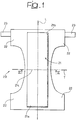
- FIG. 1 A preferred embodiment of a disposable absorbent product 20 of the present invention is shown in FIG. 1 .
- the product 20 is in the form of e.g. a baby diaper or an adult incontinence pad.
- the product is shown in Figure 1 in an extended condition, e.g. in preparation for being worn by a wearer. It will be appreciated, however, that the same basic principles of the invention described herein are however adapted to be easily applied to other types of disposable absorbent products such as e.g., sanitary napkins.
- the product 20 typically comprises an absorbent means (or "main body portion") 21, and four flaps 22 adding up to a general "hourglass" shape.
- the product 20 is thus adapted to be worn in a well known manner by placing the main body portion 21 under and around the "crotch” portion of the wearer.
- the flaps 22 are then extended and connected (via fasteners such as e.g. adhesive tabs 23) at their mutual opposed distal portions at both sides of the wearer to close the product around the waist line of the wearer.
- the absorbent product 20 has two surfaces, a body-facing surface or "body surface” 20A and an outer surface 20B.
- the absorbent product 20 is shown in FIG. 1 as viewed from its body surface 20A.
- the body surface 20A is intended to be worn adjacent to the wearer's body.
- the absorbent product 20 has two centerlines, a principal longitudinal centerline L and a principal transverse centerline T.
- transverse or “lateral” used herein, are interchangeable, and refer to a line, axis or direction which lies within the plane of the absorbent product 20 that is generally perpendicular to the longitudinal direction.
- Figure 1 shows that the main body portion 21 of the absorbent product 20 comprises the portion of the absorbent product without the flaps 23.
- the main body portion 21 has two spaced apart longitudinal edges, two spaced apart transverse or end edges (or “ends"), which together form the periphery of the main body portion 21.
- the main body portion 21 also has two end regions, which are designated first end region 21a and second end region 21b.
- a central region 21c is disposed between the end regions 21a and 21b.
- the main body portion 21 of the absorbent product 20 can be of any thickness, including relatively thick, intermediate thickness, relatively thin, or even very thin (or "ultra thin”).
- the main body portion 21 of the absorbent product 20 may also be relatively flexible, so that it is comfortable for the wearer.
- FIG. 2 shows the individual components of the main body portion 21 of the absorbent product 20 of the present invention.
- the main body portion 21 of the absorbent product preferably comprises a number of primary components. These include a liquid pervious topsheet 24, a liquid impervious backsheet 26, and an absorbent core 28 positioned between the topsheet 24 and the backsheet 26.
- the absorbent core 28 being indicated as "positioned" between the topsheet 24 and the backsheet 26 does in no way imply the necessity of direct contact between the absorbent core 28 and either of the topsheet 24 and the backsheet 26.
- the absorbent core 28 has a liquid receiving surface directed towards the topsheet 24 (i.e. upwardly, with reference to Figure 2 ).
- the absorbent core 28 may contain a large amount absorbent gelling materials.
- the absorbent article shown herein has in the central region a high void volume thanks to a deep embossing 50, preferably extending into the absorbent core 28 to a large extent of the total thickness (i.e. the vertical dimension, with reference to the view of Figure 2 ) the absorbent core 28.
- Preferred embodiments of the arrangements described herein provide for the embossing 50 having a depth that is at least 30% of the total thickness of the absorbent core 28. Particularly preferred values are in the range 40% - 95%, and still more preferred values lie in the ranges 50% - 90% and 60% - 80% of the total thickness of the absorbent core 28.
- Preferred embodiments of the arrangements described herein provide for the embossing 50 having a length that is at least 3%, preferably at least 20%, more preferably at least 30% of the length of said absorbent core 28. A value of about 40% the core length is at present the absolutely preferred one.
- the embossing(s) 50 is/are preferably axially located with respect to the absorbent core 28 in correspondence of the so-called “deposition zone", i.e. the zone where bodily fluids are expected to be discharged.
- Preferred embodiments of the arrangements described herein provide for the embossing 50 having a width that is at least 1mm. Particularly preferred values are in the range 2-40mm, and still more preferred values lie in the ranges 4-20mm and 6-10mm. A value of about 8mm is at present the absolutely preferred one.
- a resilient absorbent member is also provided that, in the exemplary embodiment shown, is comprised of two stripes 30 arranged longitudinally spaced along the upper the sides of the embossing 50. In alternative embodiments, the resilient member 30 or at least a part of the resilient member 30 extends down into the embossing 50.
- An acquisition component 40 is preferably present and extends over the absorbent member(s) 30 and down into the embossing 50 to form an internal lining thereof.
- the special combination of the channel or channels provided by the embossing 50 with the resilient absorbent member 30 and the preferably present acquisition component 40 was found to create and maintain a high void volume even under pressure and successive liquid insults.
- channel or channels is intended to highlight that, while in certain embodiments the “composite” comprised of the core 28, the absorbent member 30, and the acquisition component 40 will include one channel, i.e. one embossing 50, in other embodiments, the composite will include two or more channels, i.e. one or more embossed formations 50.
- the channel patterns may be of various kinds (e.g.: linear, curved, diamond-shaped, and so on). While longitudinal is preferred, the embossing pattern/acquisition-diffusion channel(s) 50 can have any orientation.
- the resilient member 30 preferably comprises two stripes as shown in Figure 2 .
- the resilient member is preferably made of stripe members with a certain length, thickness and distance. Preferred ranges for the length, width and thickness of the stripes in the case of an absorbent article for adult incontinence use are 200-400mm, 20-50mm, and 2-10mm, respectively. Still more preferably each stripe is about 300mm long, and about 30mm wide with a thickness of about 3-5mm.
- the resilient member 30 can be a single patch of any shape (for instance circular, rectangular, etc.) with particular thickness and basis weight distribution e.g. lower or no thickness and basis weight in correspondence of the channel or channels, thus forming a region of higher liquid permeability in correspondence with such channel or channels.
- the stripes 30 have a length in the range of 80% to 20% of the core length, preferred ranges being 60% to 25% of the core length, and 50% to 30% of the core length.
- the stripes 30 have a width in the range of 45% to 5% of the narrower crotch width, a preferred range being 30% to 10% of narrower crotch width and a particularly preferred value being about 20% of the narrower crotch width.
- the stripes 30 have a thickness in the range of 1 mm to 10 mm, preferred ranges being 2 mm to 7 mm and 3 to 5 mm.
- the resilient member 30 is preferably located onto the absorbent core 28 as shown in Figure 2 , it can be also located at different positions (e.g. above - and not under - the acquisition layer 40).
- the acquisition component 40 can thus be located at various positions (e.g. right under the topsheet 24, under the resilient member 30).
- the acquisition component 40 may either be a separate component positioned e.g. between the topsheet 24 and the resilient member 30/absorbent core 28, or it may comprise part of a composite topsheet or part of the resilient member 30/absorbent core 28.
- the resilient member is preferably made of fibrous cross-linked cellulosic fibers, while the acquisition component 40 may be comprised of several different materials including nonwovens of synthetic fibers, natural fibers, and so on.
- the basis weight of the acquisition component 40 is typically within the range of from about 20g/sqm to about 200g/sqm, preferably from about 30g/sqm to about 120g/sqm, and still more preferably from about 40g/sqm to about 90g/sqm.
- the thickness of the acquisition component 40 is preferably in the range of from about 0.2mm to 8mm, still more preferably in the range of from about 0.5mm to 4.5mm.
- the absorbent core 28 preferably contains absorbent gelling material and cellulosic fibers.
- the percentage of absorbent gelling material is typically at least 20 % and preferably higher than 30% of the total core weight. Particularly preferred ranges are 25%-95%; 30%-80%; 35%-70% by weight of absorbent gelling material over the total core weight.
- the core 28 may also be free of (i.e. exempt from) cellulosic fibers.
- the components of the absorbent product 20 may be comprised of any suitable materials that are capable of being bonded in the manner described herein.
- the topsheet 24 is a liquid pervious component that permits liquids (e.g., urine and/or menses) to readily penetrate through its thickness.
- the topsheet 24 is preferably as compliant, soft feeling, and non-irritating to the wearer's skin as possible.
- a suitable topsheet 24 may be manufactured from a wide range of materials such as woven and nonwoven materials; polymeric materials such as apertured formed thermoplastic films, apertured plastic films, and hydroformed thermoplastic films; porous foams; reticulated foams; reticulated thermoplastic films; and thermoplastic scrims.
- Suitable woven and nonwoven materials can be comprised at least partially of natural fibers (e.g., wood or cotton fibers), synthetic fibers (e.g., polymeric fibers such as polyester, polypropylene, or polyethylene fibers) or from a combination of natural and synthetic fibers.
- natural fibers e.g., wood or cotton fibers
- synthetic fibers e.g., polymeric fibers such as polyester, polypropylene, or polyethylene fibers
- the body surface of the topsheet 24 is hydrophilic so that liquids will be transferred through the topsheet more readily. This diminishes the likelihood that body fluids will flow off the topsheet rather than flowing into and being absorbed by the absorbent core.
- the body surface of the topsheet 24 can he made hydrophilic by treating it with a surfactant.
- the acquisition component (or “acquisition layer”) 40 lies beneath the topsheet 24.
- layer or “web”, as used herein, include but are not limited to single unfolded sheets, folded sheets, strips of material, loose or bonded fibers, multiple layers or laminates of material, or other combinations of such materials. These two terms are thus, not limited to single unfolded layers or sheets of material.
- the acquisition component 40 may provide void volume beneath the topsheet 24 to increase the ability of the absorbent product to draw liquids through the topsheet 24.
- the acquisition component 40 preferably provides resiliency to lateral compressive forces so that the absorbent product 20 has improved resistance to bunching.
- the acquisition component 40 may have an effective average pore size that is equal to that of the topsheet 24, or less than that of the topsheet 24.
- the acquisition component 40 should be liquid permeable.
- the acquisition component 40 is also preferably compliant, soft feeling, and non-irritating to the user's skin.
- the acquisition component 44 has a body-facing face (or side), and may be of any suitable size and shape. In the exemplary embodiment shown herein, the acquisition component 40 essentially mirrors the shape of the channel formed by the embossing 50 with the resilient member 30 arranged at the open mouth portion of the embossing 50.
- the dimensions of the acquisition component 40 are preferably not as large as those of the topsheet 24.
- the acquisition component 40 can be made from any materials suitable for the above purposes, including, but not limited to those materials that are capable of having the topsheet 24 fused to them.
- the acquisition component 40 may, for example, be comprised of woven or nonwoven materials.
- the fibers or other components of these materials may be synthetic, or partially synthetic and partially natural.
- Suitable synthetic fibers include polyester, polypropylene, polyethylene, nylon, viscose rayon, or cellulose acetate fibers.
- Suitable natural fibers include cotton, cellulose, or other natural fibers.
- the acquisition component 40 may also be at least partially comprised of cross-linked cellulose fibers.
- the acquisition component 40, if nonwoven, can be made by a number of different processes.
- thermally bonded wet laid nonwoven webs are described in U.S. Pat. No. 5,549,589 .
- the acquisition component 40 may comprise a laminate of two materials.
- the two layers are preferably laminated together by depositing the multi-bonded air laid material on the spunbonded polypropylene nonwoven material.
- the spunbonded material is used as a process aid or carrier web in the process of forming this laminate.
- the acquisition component 40 is preferably hydrophilic.
- the acquisition component 40 may be either less or more hydrophilic than the absorbent core 28, or it can have the same hydrophilicity as the absorbent core.
- the acquisition component 40 can be treated with a surface active agent to provide make it more hydrophilic. Preferably, it has the same hydrophilicity as the absorbent core.
- the topsheet 24 may be fused to the acquisition component 40.
- the topsheet 24 and the acquisition component 40 are preferably bonded at a plurality of discrete bonded areas (or “bonds"), continuous or discrete.
- the discrete bonded areas preferably comprise fusion bonds.
- the fusion can be accomplished by heat and/or pressure bonds, ultrasonic bonds, dynamic mechanical bonds, and the like. Pressure can be applied in any suitable manner, such as by moving the components to be bonded between counter-rotating rolls, placing the material; on an anvil and forcing a platen down on the materials, applying vacuum pressure, and the like.
- Suitable means that can be adapted for use in fusing the topsheet 24 to the acquisition component 40 are described in at least some of the following patents: U.S. Pat. 4,430,148 ; U.S. Pat. No. 4,515,595 ; U.S. Pat. No. 4,531,999 ; U.S. Pat. No. 4,710,189 ; U.S. Pat.
- the resilient member 30 is preferably made of material that maintains its shape even when wet, thus rendering the product 20 able to acquire sub sequential gushes. To that effect, the resilient member 30 is preferably made of fibrous cross-linked cellulosic fibers. Alternatively, other types of resilient materials that may be used for the resilient member 30 include, but are not limited to, nonwoven highlofts, synthetic fiber batts, scrims (oriented, plastic netting which can be made with varying flexibility).
- the absorbent core 28 may be any absorbent means that is capable of absorbing or retaining liquids (e.g., urine and/or menses).
- the absorbent core 28 may be manufactured in a wide variety of sizes and shapes (e.g., rectangular, oval, hourglass, dog bone, asymmetric, etc.) depending on the type and nature of the disposable absorbent product considered.
- the absorbent core 28 is rectangular and is of a size that is at least slightly larger than the periphery of the acquisition component 40.
- the absorbent core 28 can be manufactured from a wide variety of liquid-absorbent materials commonly used in absorbent products and other absorbent articles.
- suitable absorbent materials include comminuted wood pulp which is generally referred to as airfelt; creped cellulose wadding; meltdown polymers including coform; chemically stiffened, modified or cross-linked cellulosic fibers; synthetic fibers such as crimped polyester fibers; peat moss; tissue including tissue wraps and tissue laminates: absorbent foams; absorbent sponges; superabsorbent polymers; absorbent gelling materials; or any equivalent material or combinations of materials, or mixtures of these.
- the configuration and construction of the absorbent core may also be varied (e.g., the absorbent core may have varying caliper zones (e.g., profiled so as to be thicker in the center), hydrophilic gradients, superabsorbent gradient, or lower density and lower average basis weight acquisition zones; or may comprise one or more layers or structures).
- the total absorbent capacity of the absorbent core should, however, be compatible with the design loading and the intended use of the absorbent product.
- the size and absorbent capacity of the absorbent core may be varied to accommodate different uses such as incontinence pads, pantyliners, regular absorbent products, or overnight absorbent products.
- the absorbent core 28 may comprise a multi-bonded air laid material.
- the fibers can be blended together to form a single web.
- the multi-bonded air laid material used for the absorbent core can be bonded using some material other than latex (such as starch or PVA, for example).
- the absorbent core 28 can be formed as a laminate that preferably also has a basis weight of about 150 g/mand comprises two (or more) layers of multi-bonded air laid nonwoven material with the particles of absorbent gelling material therebetween.
- Suitable laminate absorbent core structures are described generally in U.S. Pat. No. 4,950,264 ; U.S. Pat. No. 5,009,653 ; and U.S. Pat. No. 5,460,623 .
- Another suitable absorbent core is described in PCT Publication No. WO 95/07674 .
- the absorbent core 28 is preferably comprised of airfelt. Suitable absorbent cores for thicker absorbent products are described in U.S. Pat. No. 5,234,422 .
- the absorbent core 28 can be provided with a feature to further improve its flexibility.
- a feature could include, but is not limited to one or more slits, perforations, embossments, or score lines in the absorbent core 28 or acquisition component 40. This type of feature is preferably arranged to improve flexibility about the principal longitudinal centerline of the absorbent product.
- the slits, perforations, embossments, or score lines can be in any suitable configuration. Suitable configurations include, but are not limited to straight or curved lines, slits, dots, V-shaped patterns, W-shaped patterns, or the like.
- the slits, perforations, embossments, or score line, or any combination thereof can be provided in any of the layers of the laminate absorbent cores described above.
- the embossing 50 shown in Figure 2 which runs along the principal longitudinal centerline L of the absorbent product, is exemplary of such a feature that will improve the flexibility of the absorbent core 28.
- such embossing is of such an extent (i.e. depth and width) that together with the resilient member 30 and the acquisition component 40 the embossing 50 provides a high void space, thereby allowing rapid acquisition.
- the embossing pattern 50 (possibly in the form of a plurality of channels) drains the liquid throughout the product reducing the transversal diffusion and the consequent side leakage. Moreover, it also reduces the risk of gel blocking by rapidly spreading the liquid on a wider area.
- the embossing 50 involves the absorbent core 28 and the acquisition component 40 and preferably does not involve the topsheet 24. Arrangements wherein the embossing 50 also involves the topsheet 24 are however within the scope of the invention.
- the backsheet 26 prevents the exudates absorbed and contained in the absorbent core 28 from undesirably exiting the product 20 thus possibly wetting articles which contact the absorbent product 20 such as pants, pijamas and undergarments.
- the backsheet 26 is preferably resistant to the flow of liquids, and more preferably is impervious to liquids (e.g., urine and/or menses).
- the backsheet 26 is preferably manufactured from a flexible material.
- the term "flexible” refers to materials which are compliant and will readily conform to the general shape and contours of the human body.
- the backsheet 26 may comprise a woven or nonwoven material, polymeric films such as thermoplastic films of polyethylene or polypropylene, or composite materials such as a film-coated nonwoven material, Preferably, the backsheet 26 is a polyethylene film having a thickness of from about 0.012 mm (0.5 mil) to about 0.051 mm (2.0 mils).
- the backsheet 26 may be embossed and/or matte finished to provide a more cloth like appearance. Further, the backsheet 26 may permit vapours to escape from the absorbent core 28 (i.e., breathable) while still preventing exudates from passing through the backsheet 26.
- a suitable backsheet material is obtained as product No. 18-1401 from the Clopay Corporation of Cincinnati, Ohio.
- a suitable breathable backsheet material is a laminate of an apertured film such as that described in U.S. Pat. 3,929,135 , which is inverted so that the smaller openings of the tapered capillaries face the absorbent core 42 which is adhesively laminated to a microporous film such as that described in U.S. Pat. No.4,777,073 .
- topsheet 24, the acquisition component 40, the resilient member 30, the absorbent core 28, and the backsheet 26 may be assembled in a variety of configurations known in the art (including layered or "sandwich” configurations and wrapped or “tube” configurations).
- the acquisition component 40 is joined to the absorbent core 28 within the embossing 50. If these components are joined, they can be joined in any of the manners described herein for joining the topsheet 24 to the acquisition component 40.
- the topsheet 24 and the backsheet 26 have length and width dimensions generally larger than those of the absorbent core 21, and at the opposite ends of the product 20 the topsheet 24 and the backsheet 26 preferably extend outboard of the edges of the absorbent core 28 to form the flaps 22.
- topsheet 24 and backsheet 26 that extend beyond the edges of the absorbent core 28 (and the acquisition component 40) are preferably also joined to each other. These portions of the topsheet 24 and backsheet 26 can be joined in any suitable manner known in the art.
- the term "joined”, as used in this specification, encompasses configurations in which an element is directly secured to another element by affixing the element directly to the other element; configurations in which the element is indirectly secured to the other element by affixing the element to intermediate member(s) which in turn are affixed to the other element; and configurations in which one element is integral with another element, i.e., one element is essentially part of the other element.
- these portions of the topsheet 24 and backsheet 26 are joined using adhesives over substantially the entire portions that extend beyond the edges of the absorbent core 28
- the reference comprised a single resilient absorbent member (i.e. continuous patch 30R) and an absorbent core 28R exempt from any embossing.
- the absorbent core 28R of the reference product contained absorbent gelling materials (about 20-25% of the core weight - i.e. more than about 25% of the core weight in the measured area).
- Acquisition Speed is determined as the amount of liquid absorbed over a given time by the absorbent article under pressure.
- the method adopted for determining the Acquisition Speed involves pre-conditioning (the absorbent articles shall be removed from packaging and unfolded and shall be conditioned for 2 hours at 23°C ⁇ 2°C and 50% RH ⁇ 5% RH) and uses the following test liquid formulation: 0.9% NaCl (as specified in ISO 6353-2) in demi-water (as specified in ISO 3696).
- the ratio of the liquid volume absorbed to the time required to absorb it represents the acquisition speed of the absorbent member.
- Rewetting is determined as the amount of liquid that is allowed to escape from the absorbent article under pressure.
- the absorbent articles are subject to pre-conditioning (the absorbent articles shall be removed from packaging and unfolded and shall be conditioned for 2 hours at 23°C ⁇ 2°C and 50% RH ⁇ 5% RH) and the test liquid has the formulation: 0.9% NaCl (as specified in ISO 6353-2) in demi-water (as specified in ISO 3696).
- the gain in weight of the filter paper is recorded as Rewetting weight.
- the Specific Absorbent Capacity is determined the amount of liquid absorbed by a weight unit of absorbent article.
- the absorbent articles are subject to pre-conditioning (the absorbent articles shall be removed from packaging and unfolded and shall be conditioned for 2 hours at 23°C ⁇ 2°C and 50% RH ⁇ 5% RH) and the test liquid has the formulation: 0.9% NaCl (as specified in ISO 6353-2) in demi-water (as specified in ISO 3696).
- the Acquisition Speed - Multiple Insults parameter is determined as the time required by the absorbent article to absorb under pressure successive liquid insults. Pre-conditioning and test fluid are the same as for the Acquisition Speed.
- the embossing pattern 50, the resilient member 30 and the optional preferred acquisition component 40 of the product described herein provide a high void space, this allowing rapid acquisition.
- the embossing pattern (channel) 50 drains the liquid throughout the product thus reducing the transversal diffusion and the consequent side leakage. It also reduces the risk of gel blocking by spreading rapidly the liquid on a wider area.
- the resilient members 30 create a gasketing effect. Since the resilient members are made of material that maintain their shape even when wet, they render the product able to acquire sub-sequential gushes.
- the acquisition component 40 provides a void space and separates the topsheet 24 from the absorbing core 28. The distance between the topsheet 24 and the core 28 allows also a better rewetting.
- the absorbent core 28 is rich in absorbent gelling material and thus offers high absorption capacity and dryness.
- the arrangement described herein permits manufacturing a present invention leads to a main body portion 21 containing a smaller amount of cellulosic fibers, which is also comfortable.
- the possibility of using a high amount of absorption gelling material without the risk of inducing "gel blocking" leads to a high absorption capacity with reduced bulkiness (a typical drawback of cores made of cellulosic fibers).
- the structure described herein improve the product fit to the wearer's body (easy bending in cross direction - vertical lift), while also improving the ability to capture the liquid closer to the source.
Landscapes
- Health & Medical Sciences (AREA)
- Epidemiology (AREA)
- Engineering & Computer Science (AREA)
- Biomedical Technology (AREA)
- Heart & Thoracic Surgery (AREA)
- Vascular Medicine (AREA)
- Life Sciences & Earth Sciences (AREA)
- Animal Behavior & Ethology (AREA)
- General Health & Medical Sciences (AREA)
- Public Health (AREA)
- Veterinary Medicine (AREA)
- Physics & Mathematics (AREA)
- Fluid Mechanics (AREA)
- Absorbent Articles And Supports Therefor (AREA)
- Orthopedics, Nursing, And Contraception (AREA)
Claims (14)
- Einwegabsorptionsmittelprodukt (20), das eine flüssigkeitsdurchlässige Oberschicht (24), eine flüssigkeitsundurchlässige Unterschicht (26) und einen Absorptionskern (28), der zwischen der Oberschicht (24) und der Unterschicht (26) angeordnet ist, einschließt, wobei der Absorptionskern (28) eine Flüssigkeitsaufnahmeoberfläche, die zur Oberschicht (24) gerichtet ist, aufweist, wobei:- der Absorptionskern (28) mit mindestens einer Prägung (50) versehen ist, die einen Kanal für Flüssigkeitsabfluss an der Aufnahmeoberfläche bildet;- ein elastisches Absorptionselement (30) bereitgestellt ist, das aus Materialien ausgewählt ist, die aus faserigen vernetzten Cellulosefasern, Hochbauschvliesen, synthetische Faserwatten oder Mullen bestehen, und einen Bereich höherer Flüssigkeitsdurchlässigkeit aufweist, der der mindestens einen Prägung (50) entspricht;- eine Aufnahmeschicht (40) zwischen der Oberschicht (24) und dem Absorptionskern (28) bereitgestellt ist, wobei die Aufnahmeschicht (40) in die mindestens eine Prägung (50) verläuft, um eine innere Auskleidung davon zu bilden; und- wobei das elastische Absorptionselement Streifen (30) umfasst, wobei die Streifen (30) jeweils eine Länge im Bereich von 80 % bis 20 % der Länge des Absorptionskerns (28), eine Breite im Bereich von 45 % bis 5 % der Breite des Produkts (20) im Schrittabschnitt und eine Dicke im Bereich von 1 mm bis 10 mm aufweisen, wobei die Streifen in Längsrichtung entlang der Längsseiten des Kanals, der durch die Prägung gebildet wird, beabstandet sind und der Abstand zwischen den Streifen den Bereich höherer Flüssigkeitsdurchlässigkeit definiert, der der Prägung entspricht.
- Produkt nach Anspruch 1, dadurch gekennzeichnet, dass die Aufnahmeschicht (40) über das Absorptionselement (30) verläuft.
- Produkt nach einem der vorstehenden Ansprüche, dadurch gekennzeichnet, dass die Aufnahmeschicht (40) direkt unter der Oberschicht (24) angeordnet ist.
- Produkt nach einem der vorstehenden Ansprüche, dadurch gekennzeichnet, dass sich die Aufnahmeschicht (40) in die mindestens eine Prägung (50) erstreckt, während die Oberschicht (24) die mindestens eine Prägung (50) überbrückt.
- Produkt nach einem der vorstehenden Ansprüche, dadurch gekennzeichnet, dass die Aufnahmeschicht (40) ein Flächengewicht im Bereich von 20 g/m2 bis 200 g/m2, vorzugsweise im Bereich von 30 g/m2 bis 120 g/m2, mehr bevorzugt im Bereich von 40 g/m2 bis 90 g/m2 aufweist.
- Produkt nach einem der vorhergehenden Ansprüche, dadurch gekennzeichnet, dass der Absorptionskern Absorptionsgeliermaterial enthält.
- Produkt nach einem der vorstehenden Ansprüche, dadurch gekennzeichnet, dass die mindestens eine Prägung (50) mindestens 30 %, vorzugsweise im Bereich von 40 % bis 95 %, mehr bevorzugt im Bereich von 50 % bis 90 %, noch mehr bevorzugt im Bereich von 60 % bis 80 % der Gesamtdicke des Absorptionskerns (28) in den Absorptionskern (28) verläuft.
- Produkt nach einem der vorstehenden Ansprüche, dadurch gekennzeichnet, dass die mindestens eine Prägung (50) eine Breite von mindestens 1 mm, vorzugsweise im Bereich von 2 bis 40 mm, mehr bevorzugt im Bereich von 4 bis 20 mm, noch mehr bevorzugt im Bereich von 6 bis 10 mm aufweist.
- Produkt nach einem der vorstehenden Ansprüche, dadurch gekennzeichnet, dass die mindestens eine Prägung (50) im Bezug auf den Absorptionskern (28) entsprechend der Anlagerungszone von Körperflüssigkeiten angeordnet ist.
- Produkt nach einem der vorstehenden Ansprüche, dadurch gekennzeichnet, dass die mindestens eine Prägung (50) in Längsrichtung auf dem Produkt (20) verläuft.
- Produkt nach einem der vorstehenden Ansprüche, dadurch gekennzeichnet, dass es zwei oder mehr Prägungen (50) einschließt, die Kanäle bilden.
- Produkt nach einem der vorstehenden Ansprüche, dadurch gekennzeichnet, dass das elastische Element (30) auf dem Absorptionskern (28) angeordnet ist.
- Produkt nach einem der vorstehenden Ansprüche, dadurch gekennzeichnet, dass das elastische Element aus faserigen vernetzten Cellulosefasern besteht.
- Verfahren zum Herstellen eines Einwegabsorptionsmittelprodukts (20), wobei das Verfahren die folgenden Schritte aufweist:- das Bereitstellen einer flüssigkeitsdurchlässigen Oberschicht (24), einer flüssigkeitsundurchlässigen Unterschicht (26) und eines Absorptionskerns (28), der zwischen der Oberschicht (24) und der Unterschicht (26) angeordnet ist, wobei der Absorptionskern (28) eine Flüssigkeitsaufnahmeoberfläche, die zur Oberschicht (24) gerichtet ist, aufweist;- das Bereitstellen des Absorptionskerns (28) mit mindestens einer Prägung (50), die einen Kanal für Flüssigkeitsabfluss an der Aufnahmeoberfläche bildet;- das Bereitstellen einer Aufnahmeschicht (40) zwischen der Oberschicht (24) und dem Absorptionskern (28), wobei sich die Aufnahmeschicht (40) über das Absorptionselement (30) und in die mindestens eine Prägung (50) erstreckt, um eine innere Auskleidung davon zu bilden; und- das Bereitstellen eines elastischen Absorptionselements (30), ausgewählt aus Materialien aus faserigen vernetzten Cellulosefasern, Hochbauschvliesstoffen, synthetischen Faserwatten oder Mullen, und mit einem Bereich höherer Flüssigkeitsdurchlässigkeit, der der mindestens einen Prägung (50) entspricht, wobei das elastische Absorptionselement Streifen (30) umfasst, wobei die Streifen (30) jeweils eine Länge im Bereich von 80 % bis 20 % der Länge des Absorptionskerns (28), eine Breite im Bereich von 45 % bis 5 % der Breite des Produkts (20) im Schrittabschnitt und eine Dicke im Bereich von 1 mm bis 10 mm aufweisen, wobei die Streifen in Längsrichtung entlang der Längsseiten des Kanals, der durch die Prägung gebildet wird, beabstandet sind und der Abstand zwischen den Streifen den Bereich höherer Flüssigkeitsdurchlässigkeit definiert, der der Prägung entspricht.
Priority Applications (8)
| Application Number | Priority Date | Filing Date | Title |
|---|---|---|---|
| EP04021673.1A EP1634556B1 (de) | 2004-09-13 | 2004-09-13 | Absorbierender Artikel mit erhöhter Aufnahmegeschwindigkeit |
| US11/216,499 US8134043B2 (en) | 2004-09-13 | 2005-08-31 | Absorbent articles with improved acquisition rate |
| CA2580365A CA2580365C (en) | 2004-09-13 | 2005-09-09 | Absorbent articles with improved acquisition rate |
| MX2007003009A MX2007003009A (es) | 2004-09-13 | 2005-09-09 | Articulos absorbentes con un indice de adquisicion mejorado. |
| JP2007530503A JP4558798B2 (ja) | 2004-09-13 | 2005-09-09 | 改善した獲得速度を持つ吸収性物品 |
| PCT/US2005/032105 WO2006031637A1 (en) | 2004-09-13 | 2005-09-09 | Absorbent articles with improved acquisition rate |
| CN2005800306374A CN101018523B (zh) | 2004-09-13 | 2005-09-09 | 具有改进的采集速率的吸收产品 |
| US13/371,743 US8618351B2 (en) | 2004-09-13 | 2012-02-13 | Absorbent articles with improved acquisition rate |
Applications Claiming Priority (1)
| Application Number | Priority Date | Filing Date | Title |
|---|---|---|---|
| EP04021673.1A EP1634556B1 (de) | 2004-09-13 | 2004-09-13 | Absorbierender Artikel mit erhöhter Aufnahmegeschwindigkeit |
Publications (2)
| Publication Number | Publication Date |
|---|---|
| EP1634556A1 EP1634556A1 (de) | 2006-03-15 |
| EP1634556B1 true EP1634556B1 (de) | 2019-06-12 |
Family
ID=34926510
Family Applications (1)
| Application Number | Title | Priority Date | Filing Date |
|---|---|---|---|
| EP04021673.1A Expired - Lifetime EP1634556B1 (de) | 2004-09-13 | 2004-09-13 | Absorbierender Artikel mit erhöhter Aufnahmegeschwindigkeit |
Country Status (7)
| Country | Link |
|---|---|
| US (2) | US8134043B2 (de) |
| EP (1) | EP1634556B1 (de) |
| JP (1) | JP4558798B2 (de) |
| CN (1) | CN101018523B (de) |
| CA (1) | CA2580365C (de) |
| MX (1) | MX2007003009A (de) |
| WO (1) | WO2006031637A1 (de) |
Families Citing this family (46)
| Publication number | Priority date | Publication date | Assignee | Title |
|---|---|---|---|---|
| WO2007030601A2 (en) | 2005-09-06 | 2007-03-15 | Tyco Healthcare Group Lp | Self contained wound dressing with micropump |
| JP5129447B2 (ja) * | 2005-09-30 | 2013-01-30 | ユニ・チャーム株式会社 | 吸収性物品 |
| WO2008084565A1 (ja) * | 2006-12-27 | 2008-07-17 | Kao Corporation | ペット用シート |
| MX2009013415A (es) | 2007-06-12 | 2010-02-09 | Dsg Technology Holdings Ltd | Articulo absorbente con un nucleo absorbente ranurado. |
| US8754286B2 (en) | 2007-11-20 | 2014-06-17 | Sca Hygiene Products Ab | Shaped absorbent article |
| US9044359B2 (en) * | 2008-04-29 | 2015-06-02 | The Procter & Gamble Company | Disposable absorbent article with absorbent particulate polymer material distributed for improved isolation of body exudates |
| JP5455363B2 (ja) * | 2008-12-25 | 2014-03-26 | ユニ・チャーム株式会社 | 薄型吸収性物品 |
| IL197570A (en) | 2009-03-12 | 2014-05-28 | Samuel Karsenti | Disposable diaper with integrated garbage disposal system |
| US8759606B2 (en) * | 2009-06-03 | 2014-06-24 | The Procter & Gamble Company | Structured fibrous web |
| US20100310810A1 (en) * | 2009-06-03 | 2010-12-09 | Eric Bryan Bond | Structured Fibrous Web |
| US20110152808A1 (en) | 2009-12-21 | 2011-06-23 | Jackson David M | Resilient absorbent coform nonwoven web |
| US9260808B2 (en) | 2009-12-21 | 2016-02-16 | Kimberly-Clark Worldwide, Inc. | Flexible coform nonwoven web |
| US8546642B2 (en) | 2010-01-28 | 2013-10-01 | Sca Hygiene Products Ab | Absorbent article with slitted absorbent core |
| RU2564613C2 (ru) * | 2010-04-16 | 2015-10-10 | Кимберли-Кларк Ворлдвайд, Инк. | Впитывающий композит с упругим слоем, изготовленным совместным формованием |
| JP5650967B2 (ja) * | 2010-09-17 | 2015-01-07 | 株式会社近澤製紙所 | 吸収性物品及び該吸収性物品を使用した体液吸収物品 |
| TW201223512A (en) * | 2010-12-06 | 2012-06-16 | Kang Na Hsiung Entpr Co Ltd | Absorbent hygiene product |
| WO2012170781A1 (en) * | 2011-06-10 | 2012-12-13 | The Procter & Gamble Company | Disposable diapers |
| EP2532334B1 (de) * | 2011-06-10 | 2016-10-12 | The Procter and Gamble Company | Saugfähiger Kern für einen saugfähigen Einwegartikel |
| WO2013002686A1 (en) * | 2011-06-28 | 2013-01-03 | Sca Hygiene Products Ab | Absorbent article having intake structure |
| AU2012282287B2 (en) | 2011-07-14 | 2017-06-01 | Smith & Nephew Plc | Wound dressing and method of treatment |
| CN102793609A (zh) * | 2012-03-19 | 2012-11-28 | 赵旭阳 | 卫生垫及其吸收芯 |
| EP3650055B1 (de) | 2012-05-23 | 2026-01-07 | Smith & Nephew plc | Vorrichtungen und verfahren für unterdruckwundtherapie |
| HUE033329T2 (en) | 2012-08-01 | 2017-11-28 | Smith & Nephew | Wound dressing |
| WO2014020443A2 (en) | 2012-08-01 | 2014-02-06 | Smith & Nephew Pcl | Wound dressing and method of treatment |
| US9387136B2 (en) | 2012-09-04 | 2016-07-12 | Covidien Lp | Absorbent articles with channel and related methods therefor |
| MX348890B (es) * | 2012-11-13 | 2017-07-03 | Procter & Gamble | Artículos absorbentes con canales y señales. |
| JP6222627B2 (ja) * | 2012-11-26 | 2017-11-01 | 花王株式会社 | 吸収性物品 |
| JP5936560B2 (ja) * | 2013-01-18 | 2016-06-22 | ユニ・チャーム株式会社 | 吸収性物品 |
| WO2015193257A1 (en) | 2014-06-18 | 2015-12-23 | Smith & Nephew Plc | Wound dressing |
| CN107072851B (zh) * | 2014-09-29 | 2021-07-20 | 金伯利-克拉克环球有限公司 | 具有带环形开口的吸收系统的吸收制品 |
| US10695232B2 (en) | 2014-10-30 | 2020-06-30 | Kimberly-Clark Worldwide, Inc. | Absorbent article with body conforming structure |
| US10729600B2 (en) | 2015-06-30 | 2020-08-04 | The Procter & Gamble Company | Absorbent structure |
| WO2017079605A1 (en) | 2015-11-04 | 2017-05-11 | The Procter & Gamble Company | Method for determining bunch compression |
| WO2017079583A1 (en) * | 2015-11-04 | 2017-05-11 | The Procter & Gamble Company | Thin and flexible absorbent articles |
| PL3370664T3 (pl) | 2015-11-04 | 2022-03-07 | The Procter & Gamble Company | Wyrób chłonny zawierający strukturę chłonną |
| WO2017079599A1 (en) | 2015-11-04 | 2017-05-11 | The Procter & Gamble Company | Absorbent structure |
| AU2015416315B2 (en) | 2015-12-02 | 2022-02-24 | Kimberly-Clark Worldwide, Inc. | Improved acquisition distribution laminate |
| CN108472164A (zh) * | 2016-02-29 | 2018-08-31 | 金伯利-克拉克环球有限公司 | 具有通道的吸收制品 |
| CN105662732B (zh) * | 2016-03-17 | 2019-04-30 | 泉州市汉威机械制造有限公司 | 一种吸收芯体 |
| EP3238677B1 (de) * | 2016-04-29 | 2019-12-04 | The Procter and Gamble Company | Saugkern mit profilierter verteilung von absorbierendem material |
| EP3238678B1 (de) | 2016-04-29 | 2019-02-27 | The Procter and Gamble Company | Saugfähiger kern mit transversalen faltlinien |
| US11298260B2 (en) | 2016-07-19 | 2022-04-12 | Allegiance Corporation | Perineal thermal pack with improved liquid containment |
| GB2555584B (en) | 2016-10-28 | 2020-05-27 | Smith & Nephew | Multi-layered wound dressing and method of manufacture |
| JP7105077B2 (ja) * | 2018-03-20 | 2022-07-22 | Muアイオニックソリューションズ株式会社 | 非水電解液およびそれを用いた蓄電デバイス |
| EP3560466B2 (de) * | 2018-04-27 | 2026-07-08 | The Procter & Gamble Company | Absorbierende artikel mit mehrteiliger aufnahmeschicht |
| CN112263397A (zh) * | 2020-11-16 | 2021-01-26 | 青岛迭代新材料发展有限公司 | 一种复合结构纸尿裤 |
Citations (1)
| Publication number | Priority date | Publication date | Assignee | Title |
|---|---|---|---|---|
| US4762521A (en) * | 1986-04-11 | 1988-08-09 | Kimberly-Clark Corporation | Absorbent garment with quilted and conformable absorbent pad |
Family Cites Families (53)
| Publication number | Priority date | Publication date | Assignee | Title |
|---|---|---|---|---|
| US3364931A (en) | 1964-10-12 | 1968-01-23 | Walter F. Hirsch | Sanitary napkin |
| US4029101A (en) | 1974-09-06 | 1977-06-14 | Colgate-Palmolive Company | Absorbent article |
| US3929135A (en) | 1974-12-20 | 1975-12-30 | Procter & Gamble | Absorptive structure having tapered capillaries |
| US4501586A (en) | 1980-11-17 | 1985-02-26 | Personal Products Company | Absorbent structure with reservoir |
| US4531999A (en) | 1982-01-26 | 1985-07-30 | The Procter & Gamble Company | Dynamic laminating method and apparatus for ultrasonically bonding juxtaposed webs |
| US4430148A (en) | 1982-04-27 | 1984-02-07 | The Procter & Gamble Company | Ultrasonic bonding apparatus |
| US4515595A (en) | 1982-11-26 | 1985-05-07 | The Procter & Gamble Company | Disposable diapers with elastically contractible waistbands |
| US4808252A (en) | 1983-03-18 | 1989-02-28 | The Procter & Gamble Company | Shaped disposable diapers with elastically contractible waistbands |
| US4710189A (en) | 1983-03-18 | 1987-12-01 | The Procter & Gamble Company | Shaped disposable diapers with shaped elastically contractible waistbands |
| US4624666A (en) * | 1984-07-20 | 1986-11-25 | Personal Products Company | Channeled napkin with dry cover |
| JPS6215301A (ja) * | 1985-07-04 | 1987-01-23 | 積水化学工業株式会社 | 使い捨ておむつ |
| US5059277A (en) | 1986-02-28 | 1991-10-22 | The Procter & Gamble Company | Adhesive-free bonding of continuously moving webs to form laminate web |
| US5047023A (en) | 1986-07-18 | 1991-09-10 | The Procter & Gamble Company | Absorbent members having low density and basis weight acquisition zones |
| US4834735A (en) | 1986-07-18 | 1989-05-30 | The Proctor & Gamble Company | High density absorbent members having lower density and lower basis weight acquisition zones |
| US4777073A (en) | 1987-03-11 | 1988-10-11 | Exxon Chemical Patents Inc. | Breathable films prepared from melt embossed polyolefin/filler precursor films |
| US4854984A (en) | 1987-06-19 | 1989-08-08 | The Procter & Gamble Company | Dynamic mechanical bonding method and apparatus |
| US4950264A (en) | 1988-03-31 | 1990-08-21 | The Procter & Gamble Company | Thin, flexible sanitary napkin |
| US5009653A (en) | 1988-03-31 | 1991-04-23 | The Procter & Gamble Company | Thin, flexible sanitary napkin |
| US4919756A (en) | 1988-08-26 | 1990-04-24 | The Procter & Gamble Company | Method of and apparatus for compensatingly adjusting doctor blade |
| US5030229A (en) * | 1990-01-12 | 1991-07-09 | Chicopee | Disposable urinary pad |
| US5360420A (en) | 1990-01-23 | 1994-11-01 | The Procter & Gamble Company | Absorbent structures containing stiffened fibers and superabsorbent material |
| JPH03236838A (ja) * | 1990-02-15 | 1991-10-22 | Daio Paper Corp | 生理用ナプキン |
| US5124188A (en) | 1990-04-02 | 1992-06-23 | The Procter & Gamble Company | Porous, absorbent, polymeric macrostructures and methods of making the same |
| US5121188A (en) * | 1990-05-16 | 1992-06-09 | Applied Laser Systems | Laser module assembly |
| CA2037210A1 (en) * | 1990-10-16 | 1992-04-17 | Neal Alan Rollins | Disposable feminine guard |
| US5149344A (en) | 1991-05-02 | 1992-09-22 | Texaco Inc. | Multi-phase flow and separator |
| US5268224A (en) | 1991-08-12 | 1993-12-07 | The Procter & Gamble Company | Absorbent foam materials for aqueous body fluids and absorbent articles containing such materials |
| US5260345A (en) | 1991-08-12 | 1993-11-09 | The Procter & Gamble Company | Absorbent foam materials for aqueous body fluids and absorbent articles containing such materials |
| JP2579954Y2 (ja) * | 1991-10-22 | 1998-09-03 | 大王製紙株式会社 | 紙おむつ |
| HK1006532A1 (en) | 1991-12-17 | 1999-03-05 | The Procter & Gamble Company | Absorbent article having fused layers |
| US5234422A (en) | 1991-12-20 | 1993-08-10 | The Procter & Gamble Company | Elasticized sanitary napkin |
| JP2565074Y2 (ja) * | 1992-10-07 | 1998-03-11 | ユニ・チャーム株式会社 | 使い捨ておむつ |
| KR960704502A (ko) | 1993-09-16 | 1996-10-09 | 제이코버스 코넬리스 레이서 | 위쪽으로 볼록한 외형을 갖도록 예비배치된 코어를 갖는 생리대(sanitary napkin having core predisposed to a convex upward configuration) |
| EP0748196B1 (de) | 1994-03-01 | 2000-06-14 | The Procter & Gamble Company | Drei-zonen binde |
| US5830202A (en) * | 1994-08-01 | 1998-11-03 | The Procter & Gamble Company | Absorbent comprising upper and lower gel layers |
| US5549589A (en) | 1995-02-03 | 1996-08-27 | The Procter & Gamble Company | Fluid distribution member for absorbent articles exhibiting high suction and high capacity |
| DE19609462A1 (de) * | 1996-03-11 | 1997-09-18 | Kimberly Clark Gmbh | Absorbierender Artikel sowie Verfahren zur gerichteten Abführung von lokalisiert austretenden Fluiden |
| US5827254A (en) | 1996-06-13 | 1998-10-27 | The Procter & Gamble Company | Absorbent article |
| DE19640451A1 (de) * | 1996-09-30 | 1998-04-02 | Kimberly Clark Gmbh | Absorbierender Artikel |
| AU5528298A (en) * | 1996-12-06 | 1998-06-29 | Weyerhaeuser Company | Air-laid unitary absorbent layer |
| JP3310894B2 (ja) * | 1996-12-28 | 2002-08-05 | ユニ・チャーム株式会社 | 使い捨て着用吸収性物品 |
| US5925026A (en) * | 1997-03-10 | 1999-07-20 | Kimberly-Clark Worldwide, Inc. | Apertured absorbent pads for use in absorbent articles |
| DE19713189A1 (de) * | 1997-03-27 | 1998-10-01 | Kimberly Clark Gmbh | Absorbierender Artikel |
| KR20000013499A (ko) * | 1998-08-10 | 2000-03-06 | 문국현 | 부드럽고 안락한 측면 패널을 갖는 측면이 탄성화된 흡수 패드 |
| US6528439B1 (en) * | 1998-09-30 | 2003-03-04 | Kimberly-Clark Worldwide, Inc. | Crimped polymeric fibers and nonwoven webs made therefrom with improved resiliency |
| US7195810B1 (en) | 1999-04-27 | 2007-03-27 | Fort James Corporation | Air-laid absorbent sheet with sinuate emboss |
| WO2001021873A1 (en) | 1999-09-21 | 2001-03-29 | Weyerhaeuser Company | Absorbent composite having fibrous bands |
| JP3929226B2 (ja) * | 2000-03-27 | 2007-06-13 | ユニ・チャーム株式会社 | 使い捨て着用物品 |
| US6572599B2 (en) | 2000-10-02 | 2003-06-03 | Sca Hygiene Products Ab | Absorbent article with improved liquid-handling ability |
| US7147628B2 (en) * | 2000-10-02 | 2006-12-12 | Sca Hygiene Products Ab | Absorbent article with improved liquid-handling ability |
| US6605752B2 (en) * | 2000-10-30 | 2003-08-12 | Sca Hygiene Products Ab | Absorbent product with improved instantaneous liquid adsorption, and improved fit |
| US7686790B2 (en) * | 2003-03-04 | 2010-03-30 | Kimberly-Clark Worldwide, Inc. | Nonlinear, undulating perimeter embossing in an absorbent article |
| EP1776940B1 (de) * | 2005-09-23 | 2012-06-06 | The Procter & Gamble Company | Perforierte Doppelschicht zur Flüssigkeitsaufnahme |
-
2004
- 2004-09-13 EP EP04021673.1A patent/EP1634556B1/de not_active Expired - Lifetime
-
2005
- 2005-08-31 US US11/216,499 patent/US8134043B2/en not_active Expired - Fee Related
- 2005-09-09 CN CN2005800306374A patent/CN101018523B/zh not_active Expired - Fee Related
- 2005-09-09 CA CA2580365A patent/CA2580365C/en not_active Expired - Fee Related
- 2005-09-09 WO PCT/US2005/032105 patent/WO2006031637A1/en not_active Ceased
- 2005-09-09 JP JP2007530503A patent/JP4558798B2/ja not_active Expired - Fee Related
- 2005-09-09 MX MX2007003009A patent/MX2007003009A/es active IP Right Grant
-
2012
- 2012-02-13 US US13/371,743 patent/US8618351B2/en not_active Expired - Fee Related
Patent Citations (1)
| Publication number | Priority date | Publication date | Assignee | Title |
|---|---|---|---|---|
| US4762521A (en) * | 1986-04-11 | 1988-08-09 | Kimberly-Clark Corporation | Absorbent garment with quilted and conformable absorbent pad |
Also Published As
| Publication number | Publication date |
|---|---|
| EP1634556A1 (de) | 2006-03-15 |
| US20060058750A1 (en) | 2006-03-16 |
| US8618351B2 (en) | 2013-12-31 |
| CN101018523A (zh) | 2007-08-15 |
| US20120143161A1 (en) | 2012-06-07 |
| WO2006031637A1 (en) | 2006-03-23 |
| CA2580365C (en) | 2012-01-03 |
| MX2007003009A (es) | 2007-05-18 |
| CN101018523B (zh) | 2010-10-27 |
| JP2008512148A (ja) | 2008-04-24 |
| CA2580365A1 (en) | 2006-03-23 |
| US8134043B2 (en) | 2012-03-13 |
| JP4558798B2 (ja) | 2010-10-06 |
Similar Documents
| Publication | Publication Date | Title |
|---|---|---|
| CA2580365C (en) | Absorbent articles with improved acquisition rate | |
| CA2630713C (en) | Sanitary napkin including body-facing protrusions for preventing side leakage and obliquely arranged embossed channels | |
| CA2487027C (en) | Absorbent article with multiple core | |
| EP1507499B1 (de) | Mehrlagiger absorbierender gegenstand | |
| CA2143738C (en) | Absorbent article with controlled distribution of liquid | |
| EP1295614A1 (de) | Absorbierende Struktur und absorbierende Artikel, die diese enthalten | |
| CN101325939A (zh) | 吸收性制品 | |
| CN101312699B (zh) | 吸收性制品 | |
| CN105997356A (zh) | 吸收性物品 | |
| CN108472164A (zh) | 具有通道的吸收制品 | |
| EP0570016A1 (de) | Geformte absorbierende Struktur, diese enthaltendes Produkt und Methode zur Herstellung derselben | |
| US20040230184A1 (en) | Multiple layer absorbent system | |
| JP2008142220A (ja) | 吸収性物品 | |
| KR20020059363A (ko) | 흡수성 생리대 | |
| US20040106910A1 (en) | Dual layer absorbent structure having an intake/transfer carrier sheet and method of making | |
| JP2026020647A (ja) | 吸収性物品 | |
| AU2013206360A1 (en) | Sanitary napkin including body-facing protrusions for preventing side leakage and obliquely arranged embossed channels |
Legal Events
| Date | Code | Title | Description |
|---|---|---|---|
| PUAI | Public reference made under article 153(3) epc to a published international application that has entered the european phase |
Free format text: ORIGINAL CODE: 0009012 |
|
| AK | Designated contracting states |
Kind code of ref document: A1 Designated state(s): AT BE BG CH CY CZ DE DK EE ES FI FR GB GR HU IE IT LI LU MC NL PL PT RO SE SI SK TR |
|
| AX | Request for extension of the european patent |
Extension state: AL HR LT LV MK |
|
| 17P | Request for examination filed |
Effective date: 20060828 |
|
| AKX | Designation fees paid |
Designated state(s): AT BE BG CH CY CZ DE DK EE ES FI FR GB GR HU IE IT LI LU MC NL PL PT RO SE SI SK TR |
|
| 17Q | First examination report despatched |
Effective date: 20070416 |
|
| STAA | Information on the status of an ep patent application or granted ep patent |
Free format text: STATUS: EXAMINATION IS IN PROGRESS |
|
| GRAP | Despatch of communication of intention to grant a patent |
Free format text: ORIGINAL CODE: EPIDOSNIGR1 |
|
| STAA | Information on the status of an ep patent application or granted ep patent |
Free format text: STATUS: GRANT OF PATENT IS INTENDED |
|
| INTG | Intention to grant announced |
Effective date: 20181221 |
|
| GRAS | Grant fee paid |
Free format text: ORIGINAL CODE: EPIDOSNIGR3 |
|
| GRAA | (expected) grant |
Free format text: ORIGINAL CODE: 0009210 |
|
| STAA | Information on the status of an ep patent application or granted ep patent |
Free format text: STATUS: THE PATENT HAS BEEN GRANTED |
|
| AK | Designated contracting states |
Kind code of ref document: B1 Designated state(s): AT BE BG CH CY CZ DE DK EE ES FI FR GB GR HU IE IT LI LU MC NL PL PT RO SE SI SK TR |
|
| REG | Reference to a national code |
Ref country code: GB Ref legal event code: FG4D |
|
| REG | Reference to a national code |
Ref country code: CH Ref legal event code: EP |
|
| REG | Reference to a national code |
Ref country code: AT Ref legal event code: REF Ref document number: 1141630 Country of ref document: AT Kind code of ref document: T Effective date: 20190615 |
|
| REG | Reference to a national code |
Ref country code: DE Ref legal event code: R096 Ref document number: 602004054028 Country of ref document: DE |
|
| REG | Reference to a national code |
Ref country code: IE Ref legal event code: FG4D |
|
| REG | Reference to a national code |
Ref country code: NL Ref legal event code: MP Effective date: 20190612 |
|
| PG25 | Lapsed in a contracting state [announced via postgrant information from national office to epo] |
Ref country code: FI Free format text: LAPSE BECAUSE OF FAILURE TO SUBMIT A TRANSLATION OF THE DESCRIPTION OR TO PAY THE FEE WITHIN THE PRESCRIBED TIME-LIMIT Effective date: 20190612 Ref country code: ES Free format text: LAPSE BECAUSE OF FAILURE TO SUBMIT A TRANSLATION OF THE DESCRIPTION OR TO PAY THE FEE WITHIN THE PRESCRIBED TIME-LIMIT Effective date: 20190612 Ref country code: SE Free format text: LAPSE BECAUSE OF FAILURE TO SUBMIT A TRANSLATION OF THE DESCRIPTION OR TO PAY THE FEE WITHIN THE PRESCRIBED TIME-LIMIT Effective date: 20190612 |
|
| PG25 | Lapsed in a contracting state [announced via postgrant information from national office to epo] |
Ref country code: GR Free format text: LAPSE BECAUSE OF FAILURE TO SUBMIT A TRANSLATION OF THE DESCRIPTION OR TO PAY THE FEE WITHIN THE PRESCRIBED TIME-LIMIT Effective date: 20190913 Ref country code: BG Free format text: LAPSE BECAUSE OF FAILURE TO SUBMIT A TRANSLATION OF THE DESCRIPTION OR TO PAY THE FEE WITHIN THE PRESCRIBED TIME-LIMIT Effective date: 20190912 |
|
| REG | Reference to a national code |
Ref country code: AT Ref legal event code: MK05 Ref document number: 1141630 Country of ref document: AT Kind code of ref document: T Effective date: 20190612 |
|
| PG25 | Lapsed in a contracting state [announced via postgrant information from national office to epo] |
Ref country code: SK Free format text: LAPSE BECAUSE OF FAILURE TO SUBMIT A TRANSLATION OF THE DESCRIPTION OR TO PAY THE FEE WITHIN THE PRESCRIBED TIME-LIMIT Effective date: 20190612 Ref country code: RO Free format text: LAPSE BECAUSE OF FAILURE TO SUBMIT A TRANSLATION OF THE DESCRIPTION OR TO PAY THE FEE WITHIN THE PRESCRIBED TIME-LIMIT Effective date: 20190612 Ref country code: EE Free format text: LAPSE BECAUSE OF FAILURE TO SUBMIT A TRANSLATION OF THE DESCRIPTION OR TO PAY THE FEE WITHIN THE PRESCRIBED TIME-LIMIT Effective date: 20190612 Ref country code: CZ Free format text: LAPSE BECAUSE OF FAILURE TO SUBMIT A TRANSLATION OF THE DESCRIPTION OR TO PAY THE FEE WITHIN THE PRESCRIBED TIME-LIMIT Effective date: 20190612 Ref country code: NL Free format text: LAPSE BECAUSE OF FAILURE TO SUBMIT A TRANSLATION OF THE DESCRIPTION OR TO PAY THE FEE WITHIN THE PRESCRIBED TIME-LIMIT Effective date: 20190612 Ref country code: PT Free format text: LAPSE BECAUSE OF FAILURE TO SUBMIT A TRANSLATION OF THE DESCRIPTION OR TO PAY THE FEE WITHIN THE PRESCRIBED TIME-LIMIT Effective date: 20191014 Ref country code: AT Free format text: LAPSE BECAUSE OF FAILURE TO SUBMIT A TRANSLATION OF THE DESCRIPTION OR TO PAY THE FEE WITHIN THE PRESCRIBED TIME-LIMIT Effective date: 20190612 |
|
| PG25 | Lapsed in a contracting state [announced via postgrant information from national office to epo] |
Ref country code: IT Free format text: LAPSE BECAUSE OF FAILURE TO SUBMIT A TRANSLATION OF THE DESCRIPTION OR TO PAY THE FEE WITHIN THE PRESCRIBED TIME-LIMIT Effective date: 20190612 |
|
| REG | Reference to a national code |
Ref country code: DE Ref legal event code: R097 Ref document number: 602004054028 Country of ref document: DE |
|
| PG25 | Lapsed in a contracting state [announced via postgrant information from national office to epo] |
Ref country code: TR Free format text: LAPSE BECAUSE OF FAILURE TO SUBMIT A TRANSLATION OF THE DESCRIPTION OR TO PAY THE FEE WITHIN THE PRESCRIBED TIME-LIMIT Effective date: 20190612 |
|
| PLBE | No opposition filed within time limit |
Free format text: ORIGINAL CODE: 0009261 |
|
| STAA | Information on the status of an ep patent application or granted ep patent |
Free format text: STATUS: NO OPPOSITION FILED WITHIN TIME LIMIT |
|
| PG25 | Lapsed in a contracting state [announced via postgrant information from national office to epo] |
Ref country code: PL Free format text: LAPSE BECAUSE OF FAILURE TO SUBMIT A TRANSLATION OF THE DESCRIPTION OR TO PAY THE FEE WITHIN THE PRESCRIBED TIME-LIMIT Effective date: 20190612 Ref country code: DK Free format text: LAPSE BECAUSE OF FAILURE TO SUBMIT A TRANSLATION OF THE DESCRIPTION OR TO PAY THE FEE WITHIN THE PRESCRIBED TIME-LIMIT Effective date: 20190612 |
|
| 26N | No opposition filed |
Effective date: 20200313 |
|
| PG25 | Lapsed in a contracting state [announced via postgrant information from national office to epo] |
Ref country code: MC Free format text: LAPSE BECAUSE OF FAILURE TO SUBMIT A TRANSLATION OF THE DESCRIPTION OR TO PAY THE FEE WITHIN THE PRESCRIBED TIME-LIMIT Effective date: 20190612 Ref country code: SI Free format text: LAPSE BECAUSE OF FAILURE TO SUBMIT A TRANSLATION OF THE DESCRIPTION OR TO PAY THE FEE WITHIN THE PRESCRIBED TIME-LIMIT Effective date: 20190612 |
|
| REG | Reference to a national code |
Ref country code: CH Ref legal event code: PL |
|
| PG25 | Lapsed in a contracting state [announced via postgrant information from national office to epo] |
Ref country code: LU Free format text: LAPSE BECAUSE OF NON-PAYMENT OF DUE FEES Effective date: 20190913 Ref country code: IE Free format text: LAPSE BECAUSE OF NON-PAYMENT OF DUE FEES Effective date: 20190913 Ref country code: LI Free format text: LAPSE BECAUSE OF NON-PAYMENT OF DUE FEES Effective date: 20190930 Ref country code: CH Free format text: LAPSE BECAUSE OF NON-PAYMENT OF DUE FEES Effective date: 20190930 |
|
| REG | Reference to a national code |
Ref country code: BE Ref legal event code: MM Effective date: 20190930 |
|
| PG25 | Lapsed in a contracting state [announced via postgrant information from national office to epo] |
Ref country code: BE Free format text: LAPSE BECAUSE OF NON-PAYMENT OF DUE FEES Effective date: 20190930 |
|
| PG25 | Lapsed in a contracting state [announced via postgrant information from national office to epo] |
Ref country code: FR Free format text: LAPSE BECAUSE OF NON-PAYMENT OF DUE FEES Effective date: 20190930 |
|
| PG25 | Lapsed in a contracting state [announced via postgrant information from national office to epo] |
Ref country code: CY Free format text: LAPSE BECAUSE OF FAILURE TO SUBMIT A TRANSLATION OF THE DESCRIPTION OR TO PAY THE FEE WITHIN THE PRESCRIBED TIME-LIMIT Effective date: 20190612 |
|
| PG25 | Lapsed in a contracting state [announced via postgrant information from national office to epo] |
Ref country code: HU Free format text: LAPSE BECAUSE OF FAILURE TO SUBMIT A TRANSLATION OF THE DESCRIPTION OR TO PAY THE FEE WITHIN THE PRESCRIBED TIME-LIMIT; INVALID AB INITIO Effective date: 20040913 |
|
| PGFP | Annual fee paid to national office [announced via postgrant information from national office to epo] |
Ref country code: GB Payment date: 20220804 Year of fee payment: 19 Ref country code: DE Payment date: 20220803 Year of fee payment: 19 |
|
| P01 | Opt-out of the competence of the unified patent court (upc) registered |
Effective date: 20230429 |
|
| REG | Reference to a national code |
Ref country code: DE Ref legal event code: R119 Ref document number: 602004054028 Country of ref document: DE |
|
| GBPC | Gb: european patent ceased through non-payment of renewal fee |
Effective date: 20230913 |
|
| PG25 | Lapsed in a contracting state [announced via postgrant information from national office to epo] |
Ref country code: GB Free format text: LAPSE BECAUSE OF NON-PAYMENT OF DUE FEES Effective date: 20230913 |
|
| PG25 | Lapsed in a contracting state [announced via postgrant information from national office to epo] |
Ref country code: GB Free format text: LAPSE BECAUSE OF NON-PAYMENT OF DUE FEES Effective date: 20230913 Ref country code: DE Free format text: LAPSE BECAUSE OF NON-PAYMENT OF DUE FEES Effective date: 20240403 |