EP1634299B1 - Integritätssteuerung für in einem nichtflüchtigen speicher gespeicherte daten - Google Patents
Integritätssteuerung für in einem nichtflüchtigen speicher gespeicherte daten Download PDFInfo
- Publication number
- EP1634299B1 EP1634299B1 EP04744341A EP04744341A EP1634299B1 EP 1634299 B1 EP1634299 B1 EP 1634299B1 EP 04744341 A EP04744341 A EP 04744341A EP 04744341 A EP04744341 A EP 04744341A EP 1634299 B1 EP1634299 B1 EP 1634299B1
- Authority
- EP
- European Patent Office
- Prior art keywords
- bit
- memory
- input
- checking
- input bit
- Prior art date
- Legal status (The legal status is an assumption and is not a legal conclusion. Google has not performed a legal analysis and makes no representation as to the accuracy of the status listed.)
- Expired - Lifetime
Links
Images



Classifications
-
- G—PHYSICS
- G06—COMPUTING OR CALCULATING; COUNTING
- G06F—ELECTRIC DIGITAL DATA PROCESSING
- G06F11/00—Error detection; Error correction; Monitoring
- G06F11/07—Responding to the occurrence of a fault, e.g. fault tolerance
- G06F11/08—Error detection or correction by redundancy in data representation, e.g. by using checking codes
- G06F11/10—Adding special bits or symbols to the coded information, e.g. parity check, casting out 9's or 11's
- G06F11/1008—Adding special bits or symbols to the coded information, e.g. parity check, casting out 9's or 11's in individual solid state devices
- G06F11/1068—Adding special bits or symbols to the coded information, e.g. parity check, casting out 9's or 11's in individual solid state devices in sector programmable memories, e.g. flash disk
-
- G—PHYSICS
- G11—INFORMATION STORAGE
- G11C—STATIC STORES
- G11C11/00—Digital stores characterised by the use of particular electric or magnetic storage elements; Storage elements therefor
- G11C11/02—Digital stores characterised by the use of particular electric or magnetic storage elements; Storage elements therefor using magnetic elements
- G11C11/16—Digital stores characterised by the use of particular electric or magnetic storage elements; Storage elements therefor using magnetic elements using elements in which the storage effect is based on magnetic spin effect
-
- G—PHYSICS
- G11—INFORMATION STORAGE
- G11C—STATIC STORES
- G11C11/00—Digital stores characterised by the use of particular electric or magnetic storage elements; Storage elements therefor
- G11C11/02—Digital stores characterised by the use of particular electric or magnetic storage elements; Storage elements therefor using magnetic elements
- G11C11/16—Digital stores characterised by the use of particular electric or magnetic storage elements; Storage elements therefor using magnetic elements using elements in which the storage effect is based on magnetic spin effect
- G11C11/165—Auxiliary circuits
- G11C11/1675—Writing or programming circuits or methods
-
- G—PHYSICS
- G11—INFORMATION STORAGE
- G11C—STATIC STORES
- G11C11/00—Digital stores characterised by the use of particular electric or magnetic storage elements; Storage elements therefor
- G11C11/02—Digital stores characterised by the use of particular electric or magnetic storage elements; Storage elements therefor using magnetic elements
- G11C11/16—Digital stores characterised by the use of particular electric or magnetic storage elements; Storage elements therefor using magnetic elements using elements in which the storage effect is based on magnetic spin effect
- G11C11/165—Auxiliary circuits
- G11C11/1695—Protection circuits or methods
-
- G—PHYSICS
- G11—INFORMATION STORAGE
- G11C—STATIC STORES
- G11C29/00—Checking stores for correct operation ; Subsequent repair; Testing stores during standby or offline operation
- G11C29/04—Detection or location of defective memory elements, e.g. cell constructio details, timing of test signals
- G11C29/08—Functional testing, e.g. testing during refresh, power-on self testing [POST] or distributed testing
-
- G—PHYSICS
- G11—INFORMATION STORAGE
- G11C—STATIC STORES
- G11C29/00—Checking stores for correct operation ; Subsequent repair; Testing stores during standby or offline operation
- G11C29/04—Detection or location of defective memory elements, e.g. cell constructio details, timing of test signals
- G11C29/08—Functional testing, e.g. testing during refresh, power-on self testing [POST] or distributed testing
- G11C29/12—Built-in arrangements for testing, e.g. built-in self testing [BIST] or interconnection details
- G11C2029/4402—Internal storage of test result, quality data, chip identification, repair information
Definitions
- the present invention relates to a write controller for a memory with a plurality of non-volatile storage cells, a read controller for a memory with a plurality of non-volatile storage cells, to a combined write/read controller, to a solid state device comprising a memory with a plurality of non-volatile storage cells, to a programmer device for writing a binary code to a non-volatile memory, to a method for writing data comprising at least one input bit to a memory having non-volatile storage cells, and to a method for controlling the integrity of data comprising at least one input bit stored in non-volatile storage cells of a memory.
- a non-volatile memory has the advantage of keeping stored information even when no operating power is provided to the memory.
- Working principles of non-volatile memories known today are based on physical effects such as magnetic, ferroelectric, or semiconductor effects.
- Known non-volatile memory devices comprise for instance magnetic random access memory (MRAM), erasable programmable read only memory (EPROM), electrically EPROM (EEPROM), Flash memory, etc.
- a non-volatile memory is a rewritable memory.
- the non-volatility of the storage mechanism is not able to prevent an undesired change of the stored information.
- stored information may change for instance under the influence of thermal effects, random flipping of the orientation of individual magnetic cells, or tampering. Tampering with an MRAM may involve applying a high external magnetic field to the memory. Applying such a magnetic field to an MRAM will cause all storage cells to align the magnetic moments of their respective magnetic storage layer parallel to the strong external field. All storage cells, including checking bits, will then store the same bit value, either 0 or 1. Thus, the information stored originally in the memory will be lost.
- DRM digital rights management
- unique identifiers of solid state devices can be used like a key for granting or denying admission to privileged information, to a privileged quality of service, and for collecting billing information.
- Such a unique identifier typically consists of a binary code written to a memory integrated into the solid state device. Identifiers with rewritten bits may result in denial of previously granted access rights, or in a grant of access to an intruder, or in wrong billing statements.
- a protection system for a non-volatile semiconductor memory is known for instance from US 5,917,750 .
- a protect circuit is provided that generates a protect signal indicating whether or not data stored in the memory cells is protected.
- Writing is only allowed to memory sections, to which the protect signal indicates writing access.
- this system requires a large amount of additional circuitry connected to the memory while not preventing internal effects.
- MRAM physical shielding mechanisms are known from WO 00/72324 Al and US 2002/0008988 Al . Both documents describe additional shielding layers in the memory. Such additional physical shielding increases the cost of the memory and cannot safely prevent strong external fields or unauthorized applications from rewriting the memory.
- Fig. 8 of US 2002/0044481 complementary just write bit line pairs for supplying the data write current are provided. There, no plurality of checking bits is allocated to an input bit (see, for example, [0170]).
- system parity error checking is possible for any banks which support parity error checking independently of the knowledge of a user with regard to types of DRAM in the system or to how to configure the system to operate with the current DRAM types. Accordingly, the memory control unit allows for selective generation of parity checking among DRAM banks in dependence of banks supporting parity (see, for example, Abstract and col. 2, lines 4 to 56). Thus, no allocation of checking bits to an input bit of received data is disclosed or necessary for the methodology.
- the object is solved by a write controller according to claim 1.
- the present invention steps away from attempts to provide a better write protection. It focuses on the reliable detection of changes that have occurred to the content of a non-volatile memory.
- the basic concept of the present invention is to extend information stored in a non-volatile memory by a plurality of checking bits.
- the information to be stored is herein referred to as input bits, or, equivalently, code bits.
- the term input bit is used to make clear that the write controller of the present invention receives these bits to be stored from a memory client at its input. It does not generate these bits.
- the write controller of the present invention does generate the checking bits.
- the write controller further allocates the checking bits to a respective input bit.
- checking bit will be used hereinafter whenever one or more checking bits can be used.
- the invention relates to the plurality of checking bits. The alternative cases of only one checking bit and of a plurality of checking bits will be addressed explicitly whenever embodiments of the invention make use of the respective case.
- the checking bit has a value that is complementary to the value of the respective input bit the checking bit is allocated to. That is, if the input bit has the value 1 the checking bit has the value 0, and vice versa. A change in the input bit or in the checking bit can easily be detected. A change is detected to have occurred when both the input bit and the checking bit have the same value.
- the present invention allows to detect changes to a memory by non-selective external influences often used in tampering attempts. For instance, exposure of an MRAM to a high external magnetic field will set all memory cells to an equal value, thus destroying the fixed relation between input and checking bits that indicates integrity of the data according to the present invention. As another example, exposure of a EPROM memory to UV radiation will have the same effect.
- a checking bit can be allocated to only one input bit or any number of input bits. For instance, in one embodiment, only one input bit has an allocated checking bit. One checking bit is enough to detect overwriting of the memory by non-selective influences such as high forces created by external sources. In another embodiment, every input bit has an allocated checking bit. This allows to detect selective changes to individual input bits classified as "read-only" or "no access”.
- the allocation of input bit and checking bit is preferably reflected in the location of the respective bits relative to each other in the memory.
- the write controller of the invention generates the respective address information for both the input bit and the checking bit according to a predefined allocation algorithm.
- the address information is used to store the output data, comprising input data plus checking bit(s), in memory cells that correspond to the address information.
- the address information can be an additional part of the output data of the write controller, but will not be stored to the memory.
- the address information is provided in the form of electrical signals applied to a particular word line and a particular bit line of the memory. That is, the write controller has integrated word-line and bit-line drivers to physically address a particular memory cell that a particular output data bit is to be written to.
- the write controller allocates address information to address data provided to the write controller from an external memory client as a part of the input data.
- the write controller of the invention is in this embodiment adapted to receive input data that comprise address data in addition to input bits.
- address data is received as a part of the input data stream through the same input port of the write controller.
- the address data is received by the write controller through a separate input port synchronously with the corresponding input bits.
- the write controller uses the received address data as address information for that part of the output data that is identical to the input bits.
- the write controller generates new address information for checking bits. This new address information depends on the address data provided by the external memory client.
- This addressing method needs precautions to avoid conflicts between address data provided from an external client and address information the write controller generates internally for checking bits according to the predefined allocation algorithm. Such precautions for instance comprise providing memory clients with information on available address ranges.
- the write controller generates new address information allocated to the address data provided by the external memory client.
- the write controller may for this purpose maintain an address allocation table that translates address data received at the input into address information provided at the output of the write controller. This allocation table is preferably shared with a read controller of the memory.
- an external memory client provides address data for input bits, and the write controller generates address information for input bits as well as checking bits.
- the address information generated by the write controller can neither be controlled by an external memory client, nor is it communicated to an external memory client.
- the checking bit algorithm for securing data integrity is completely transparent to external memory clients.
- input and allocated checking bit are stored in physically close memory cells. Physically close bits are likely both influenced by a local external field. By providing a close local arrangement of input and checking bits it will be more likely to detect that an external field was applied to a limited range of the memory.
- the checking bit is stored in a memory cell neighbouring the memory cell of the allocated input bit.
- the neighbouring cell can in different embodiments be in the same row or in the same column.
- the next neighbour may also be determined to be in a neighbouring row and neighbouring column, i.e., in a diagonal arrangement relative to the memory cell storing the input bit.
- the write controller of the invention is preferably adapted to generate address information allocating said checking bit to a storage cell neighboring the storage cell storing said respective input bit.
- a checking bit allocated to an input bit is stored in a storage cell determined using a different allocation algorithm.
- the checking bit could be stored in a second- or third-nearest neighbour cell in the same row or the same column of the memory cell storing the input bit.
- checking bits While the concept of using checking bits is known in different contexts, the present invention provides a new approach to checking bits that is especially useful for securing the integrity of stored information and enabling an effective detection of changed information.
- the use of checking bits is known from the field of digital data transmission.
- checking bits for instance take the form of a frame check sequence (FCS) in the framework of cyclic redundancy check (CRC) methods for detecting transmission errors in a received data sequence due to poor transmission conditions.
- FCS for a CRC is typically two Bytes long and is calculated according to an algorithm using binary polynom equations.
- FCS frame check sequence
- CRC cyclic redundancy check
- Another concept of error detection in data transmission is the use of a parity bit.
- a parity bit is added to a block consisting of a number of bits and reflects the fact whether an even or odd number of bits having the bit value "1" is contained in the block. In the case of an even parity, the parity bit will be "1", and in the case of an odd parity, the parity bit will be "0".
- the present solution even though making use of checking bits, differs from the concept of CRC and parity check.
- the checking bits used in the present invention are allocated to an individual input bit, not to a number of bits. This provides a much higher flexibility in the particular design of the write controller.
- the write controller of the invention can be designed according to given boundary conditions.
- the number of checking bits used and the number input bits of a particular stored code that is allocated one or more checking bits can be determined in dependence on a given hardware design. For instance, if the task is to allow detection of a tampering attempt by application of a strong external magnetic field to an MRAM, it will suffice to provide one checking bit allocated to one input bit, for instance the first input bit of an identifier.
- a further difference of the checking bit according to the present invention as compared to known checking bit concepts is that the algorithm for determining the value of the checking bit of the present invention is much simpler. In fact, a simple inverter can be used to generate the checking bit. This simplicity is an important advantage over the algorithms known, because it does not require much circuitry for determining the value of the checking bit.
- the checking bit of the present invention is hidden to external applications, or, in other words, memory clients. It is created (and checked) without any communication or transparency to memory clients.
- the output data comprises a number of checking bits allocated to a respective input bit.
- the number of checking bits is fixed in each embodiment.
- a matrix-like arrangement of memory cells between 2 and 8 checking bits can be allocated to a respective input bit in next-neighbor memory cells.
- a maximum number of two checking bits allocated to an input bit in next-neighbor memory cells is possible.
- said address information allocates each checking bit to a respective storage cell in a linear or, respectively, matrix-like arrangement of storage cells, such that a linear or two-dimensional pattern of stored bit values is created for each set of input bit and checking bits allocated thereto.
- a higher number of checking bits clearly has the disadvantage of requiring a larger memory space.
- larger checking bit patterns are more difficult to decipher in attempts to manipulate the content of the memory on the basis of individual bits, so that being able to produce such larger checking bit patterns is useful for hiding the checking bit algorithm and for making manipulation attempts on individual memory cells easier to detect.
- a preferred embodiment of the write controller of the invention comprises a checking bit generator connected to said input.
- the checking bit generator is adapted to ascertain the bit value of an input bit to be written to the non-volatile memory and to generate a checking bit that has a bit value complementary to the bit value of said input bit.
- the checking bit generator is in one embodiment provided by dedicated circuitry. In another embodiment, the checking bit generator is provided by an embedded software.
- a further preferred embodiment of the write controller of the invention comprises an address information generator connected to said input and to said checking bit generator.
- the address information generator is adapted to allocate to said at least one input bit and to said allocated at least one checking bit respective address information of storage cells neighboring each other.
- the address generator is in one embodiment provided by dedicated circuitry. In another embodiment, the address generator is provided by an embedded software. Address information can take the form of a binary code representing the address allocated to a memory cell in a memory. It can also take the form of electrical signals applied to selected word and bit lines, thus directly addressing individual memory cells without an intermediate step of translating a binary code into such signals.
- a read controller for a memory with a plurality of non-volatile storage cells.
- the read controller of the invention comprises an input for receiving read-out data from the memory.
- the read-out data has at least one input bit a plurality of checking bits allocated thereto.
- the read controller of the invention further has an integrity-control unit that is adapted to compare said at least one input bit and said plurality of checking bits, values and to provide an output signal indicating whether or not said code bit and said plurality of checking bit values are complementary.
- the read controller of the invention is a complementary counterpart of the write controller described above.
- the read controller serves to check the integrity of the data written to the non-volatile memory with the aid of the write controller of the invention.
- the read controller is based on the same checking bit algorithm as the write controller. It "knows" which group of memory cells must be addressed to check the integrity of a particular input bit. Therefore, preferred embodiments of the read controller can be directly deduced from corresponding embodiments of the write controller of the invention.
- the checking bit pattern used by the write controller for an input bit is also used by the read controller in order to check the integrity of the input bit.
- the read controller has an address generator that is adapted to generate a read request directed to at least one selected memory cell and said at least one neighboring memory cell storing said allocated plurality of checking bit.
- the address generator uses the same particular number of memory cells to be compared and the same addresses resulting from the checking bit pattern created.
- the read controller uses less checking bits for the integrity check than the write controller has created.
- Address information created by the read controller can take the form of a binary code representing the address allocated to a memory cell in a memory. It can also take the form of electrical signals applied to selected word and bit lines, thus directly addressing individual memory cells without an intermediate step of translating a binary code into such signals.
- the read controller is not adapted to communicate checking bits read from the non-volatile memory to external applications.
- the integrity check is performed internally by the integrity-control unit. Only the result of the integrity check can be communicated as a binary signal indicating whether or not the input bit and the checking bit allocated thereto are complementary.
- the read controller is not adapted to communicate this binary signal beyond the limits of the chip it is integrated into, unless further security measures are provided like encryption.
- the read controller may be provided in the form of an IP block of a chip, i.e., as an independent part inside the chip. In this embodiment, the read controller may or may not, according to the choice of the chip designer, be adapted to communicate the binary signal on chip, but not beyond that.
- the integrity control unit comprised by the read controller of the invention compares an input bit on one hand with one or more allocated checking bits on the other hand.
- a number of parallel comparator stages connected to the input is provided to increase the speed of the integrity control.
- an alternative embodiment has only one comparator stage, and the integrity check is performed sequentially for each input bit having an allocated checking bit.
- a read/write controller for a memory with a plurality of non-volatile storage cells.
- the read/write controller comprises the write controller of the first aspect of the invention and the read controller according to the second aspect of the invention.
- the read/write controller combines the advantages of the write controller and the read controller described above. It is particularly useful when writing to the non-volatile memory and reading from the non-volatile memory is to be performed by one unit. In contrast thereto, a write controller alone is enough for a device that only serves for programming a non-volatile memory on a chip, such as a programmer described below. The integrity check can be performed by a read controller provided on chip.
- a programmer device for writing a binary code to a non-volatile memory.
- the programmer device comprises the write controller of the first aspect of the invention.
- the write controller is adapted to receive the binary code at its input.
- Programmer devices are typically used in the production of integrated circuits (ICs), and are can be integrated into an IC tester or digital IC verification system. In many manufacturing processes of ICs comprising a non-volatile memory, it is necessary to initialize the non-volatile memory. This task is performed by a programmer device. According to the present aspect of the invention, such a programmer device is provided with the additional functionality of programming a non-volatile memory comprised by an IC using the write controller of the present invention. This way the manufactured ICs are provided with an efficient integrity control mechanism.
- An IC may comprise the read controller of the invention in order to be able to detect a violation of the integrity of the stored data.
- Preferred embodiments of the programmer device comprise those mentioned above for the write controller of the first aspect of the invention.
- a further preferred embodiment of the programmer device of the invention comprises a code generator that is connected to the input of the write controller and adapted to generate a unique identifier code and provide it to the input of said write controller.
- a unique identifier code comprises a combination of code bits that is created individually for each IC. This way, the programmer provides a unique identifier for each manufactured IC.
- the person skilled in the art knows how unique identifiers can be generated. An example is the generation and programming of unique MAC-addresses in the manufacturing process of Ethernet controllers. A certain first combination of identifier bits is attributed uniquely to a particular manufacturer who adds a second combination of identifier bits that are unique within the production process of this particular manufacturer, thus creating a globally unique identifier, the so called MAC-address.
- the programmer is connected to an external code generator that transmits the unique identifier to the programmer for providing it as an input to the write controller.
- the programmer comprises a memory that stores a list of unique identifiers to be provided as an input to the write controller.
- a solid state device comprising a memory with a plurality of non-volatile storage cells and the write controller of the first aspect of the invention, or the read controller of the second aspect of the invention connected to said memory, or both.
- a solid state device is any device comprising electronic circuitry.
- solid state devices are ICs, devices comprising ICs, such as a memory device in the form of an MRAM, PROM, EPROM, EEPROM, Flash memory, a computer card, such as a PCMCIA card.
- the solid state device of the invention has a memory comprising non-volatile storage cells. It is noted that the memory may comprise a combination of volatile and non-volatile storage cells, also in the form of different memories provided separately in the solid state device.
- the preferred embodiments of the solid state device of the present aspect of the invention comprise the embodiments of the write controller and of the read controller of the invention.
- the solid state device comprises magnetic storage cells, such as MRAM cells.
- MRAM is a very promising technology that has good prospects to overcome the disadvantages of present memory technologies while keeping their advantages.
- the solid state device of the present aspect of the invention has at least two neighboring MRAM cells with a larger size than all other storage cells in said memory.
- the write controller is adapted to create address information allocating said input bit and said allocated plurality of checking bits to neighboring high-field storage cells.
- Using cells with a larger size in an MRAM to store the input bit and the checking bit has the advantage that a (natural) random bit flip should not occur. Therefore, bit flips caused by an external field (i.e., tampering) can be detected unambiguously, thus increasing the reliability of the integrity control.
- a storage layer is a layer of a memory cell that aligns the orientation of its magnetic moment in interaction with a magnetic field used for writing the cell.
- a method for writing data comprising at least one input bit to a memory having non-volatile storage cells is provided, comprising the steps of
- the method of the present aspect of the invention allows storing data in a non-volatile memory so that it can later be checked for its integrity.
- the method of the invention can be applied by a programmer device.
- the advantages of the method have been described earlier in context with the description of the other aspects of the invention, in particular, the write controller.
- the method is preferably used for storing identifiers or information that is similarly classified as "read only" or "no access”.
- the allocation algorithm preferably comprises allocating said input bit and said checking bit to neighboring storage cells. Further preferred embodiments of the method of the invention are given by the description of the write controller according to the first aspect of the invention.
- a method for checking the integrity of data comprising at least one input bit stored in non-volatile storage cells of a memory is provided, comprising the steps of
- the method steps d) through f) are in a preferred embodiment performed repeatedly.
- a useful waiting time can be anywhere on the time scale between a minute and a number days, depending on the environment the memory cells are exposed to and the frequency of access to the memory.
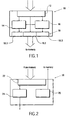
- Fig. 1 shows in a simplified block diagram a write controller 10.
- the write controller 10 has an input 12 and receives input data through input 12.
- Input 12 is connected with a checking bit generator 14 and with an address generator 16.
- Checking bit generator 14 has two outputs, one of which is connected with an address generator 16.
- the second output of checking bit generator 14 is connected to output 18 connecting write controller 10 to a memory (not shown).
- Output 18 comprises three output registers 18.1, 18.2 and 18.3.
- Output register 18.1 is connected with checking bit generator 14.
- Output register 18.2 is connected with input 12.
- Output register 18.3 is connected with address generator 16.
- the division of output 18 into three registers is not a necessary structural feature and only used here for purposes of explanation.
- the input data received represent a binary identifier of an integrated circuit to be stored in an MRAM memory provided with the integrated circuit.
- the identifier is classified as "read only”.
- Input bits received through input 12 are fed to checking bit generator 14.
- Checking bit generator 14 generates a checking bit for each input bit provided. The checking bit is generated using an inverter gate (not shown) comprised by checking bit generator 14.
- Checking bit generator 14 further provides a control signal to address generator 16. The control signal triggers address generator 16 to generate address information that allocates two adjoining memory cells to the input bit and the checking bit. As described above, alternative embodiments have different allocation algorithms that do not use a neighboring storage cell. The allocation algorithm used is implemented in address generator 16.
- the address information takes the form of a binary address code.
- the address code will be translated into corresponding electrical signals applied to a word line and a bit line, as known in the art, by a driver stage (not shown) arranged between the write controller and the memory in order to select the memory cell allocated to the address code.
- the driver stage may also be a part of the write controller. If the MRAM has only one line of memory cells, it is obvious to chose a simpler way of addressing the individual cells.
- the content of output registers 18.1 and 18.2 is fed to the memory along with the respective address information contained in output register 18.3.
- the output 18 may in an alternative embodiment collect a number of input bits and checking bits in order to feed a sequence of input and checking bits in parallel to the memory. For this, the output register space is larger.
- the write controller described can be used for setting the identifier for instance before, during or after chip die testing. This can for instance be done using pads that are not connected in the packaging. this results in a packaged chip whose identifier cannot be changed. This method can be used to create chips with all unique identifiers, or a batch of chips with the same identifier.
- An alternative way to prevent tampering with the identifier after manufacture of a chip is to set the identifier once using the packaged chip and to subsequently block further writing by using logic or a trapdoor, e.g., in the form of a write-once register or some kind of fuse.
- a further alternative way to prevent violation of the identifier is to use a password protection when writing the identifier and to use a hard coded password.
- the password cannot be read, but is checked by chip when trying to write the unique identifier.
- Fig. 2 shows in a simplified block diagram a read controller 20.
- Read controller 20 comprises an input 22 through which it is connected to a memory (not shown). Input 22 is connected with an integrity control unit 24.
- Read controller 20 further comprises an address generator 26 that has an output connected to the memory.
- address generator 26 provides address information of allocated memory cells comprising an input bit and an allocated checking bit.
- the particular address allocation algorithm is implemented in address generator 26.
- the allocation algorithm is again the use of adjoining memory cells, such as the next neighbor with an incremented column address in the same row of memory cells.
- Integrity control unit comprises a comparator (not shown) that creates an output signal indicating whether or not input and checking bit are complementary.
- the output signal of the integrity control unit can be processed as desired by stages connected to the read controller.
- a combined write/read controller integrates the structural features of the write controller of Fig. 1 and the read controller of Fig. 2 in one single device. It has a first interface to memory clients comprising the functionalities of input 12 and of the output of integrity control unit 24. It has a second interface to the memory comprising the functionalities of output 18 of write controller 10, input 22 of read controller 20, and of the output of address generator 26. It is noted that in a combined write/read controller only one address generator is necessary.
- Fig. 3 shows in a simplified block diagram a programmer 30. Only features that are important for the present invention are shown.
- the programmer may comprise an automatic wafer handler, test pins and control units for testing the individual dies of a wafer, as is known in the art.
- Programmer 30 comprises a write controller according to the present invention.
- write controller 10 is implemented in programmer 30.
- Write controller 10 is connected to a code generator 32.
- Code generator 32 generates a unique address to be fed to input 12 of write controller 10.
- Write controller 10 is further connected to output 34 of programmer 30.
- the programmer will generate a unique identifier to be stored in a memory of a chip that is being tested and programmed.
- Write controller 10 extends identifier by checking bits and provides the appropriate address information to output 34, which writes the ID to the memory arranged on the chip.
- the identifier is programmed using pads of an unpackaged chip in the die testing stage. As an alternative, the programming can be done on the packaged chip.
- Fig. 5 shows, as an embodiment of the solid state device of the invention, a simplified block diagram of a chip 40.
- the chip 40 comprises an integrated circuit 42, an MRAM 44, and a read controller, which for reasons of simplicity is assumed to be read controller 20.
- the particular structure and function of the integrated circuit 42 is not important in the present context. It may be connected to external units.
- MRAM 44 is shown by way of example as a two dimensional array of memory cells. We further assume that a unique identifier with checking bits was stored in MRAM 44 using programmer 30.
- read controller 20 will check the integrity of the stored identifier as described with reference to Fig. 2 . It will provide its output signal to the integrated circuit 42. As an example of a way to process the information of read controller 20, integrated circuit will stop operation when the signal provided by read controller 20 indicates that a checking bit is equal to an allocated code bit of the identifier.
- Fig. 6 shows two memory cells 50 and 52 with arrows 52 and 56, respectively.
- the arrows symbolize an orientation of a magnetic moment of a layer in the memory cell that aligns with an applied magnetic field used for writing the memory cell.
- Two possible orientations are imposed on the layer by the writing field and other magnetic layers comprised in the memory cell. Each orientation can therefore represent the two possible states of one bit, up and down, or 0 and 1.
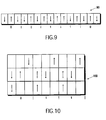
- Fig. 6 through 10 show block diagrams each representing a binary code stored in an MRAM using a different embodiments of the method of the present invention for writing data comprising at least one input bit to a memory having non-volatile storage cells.
- Fig. 6 shows an MRAM 60 with a stored code sequence "11101000". There is one checking bit provided in a memory cell 62 allocated to its neighboring memory cell 64. All other code bits are stored without checking bits.
- This example solves the problem raised by the vulnerability of an MRAM to high external magnetic fields. It such a field is applied all cells with have either the up or the down orientation. The presence of the antiparallel pair of cells 62 and 64 indicates the integrity of the code sequence.
- Fig. 7 shows an MRAM 70 with a stored code sequence "1001". Each code bit has an allocated checking bit in the neighboring memory cell to the left.
- the present example increases the reliability of the stored code sequence for localized tampering attempts.
- Fig. 8 shows an MRAM 80 with a stored code sequence " 100110".
- the allocated checking bit is stored in the neighboring cell to the right side of the code bit.
- the selected code bit and its allocated checking bit are stored in a cell having a larger size than his other cells. This increases the robustness of the integrity control bits.
- Fig. 9 shows an MRAM 90 with a stored code sequence " 00110".
- three memory cells are used to store one code bit.
- Each code bit has two neighboring checking bits. This example solves the problem raised by random bit flipping that it cannot be decided whether the code bit or the checking bit has flipped.
- By having the code bit in the middle between two anti-parallel checking bits it can be established which bit has flipped its orientation. Only if a code bit has changed its orientation, the integrity of the stored code is violated.
- Fig. 10 shows as a further example an MRAM 100 storing the code sequence " 011" in a two-dimensional array memory cells.
- a group of 9 memory cells in three rows and three columns is used for storing each bit.
- the code bit is stored in the central memory cell of each group and is surrounded by 8 memory cells, only three of which are used for checking bits. All other memory cells shown as empty may have an arbitrary orientation, either up or down.
- This example addresses the problem of a localized tampering attempt in which the person trying to change the code knows that checking bits are used.
- Using a two-dimensional pattern of checking bits that is hidden between arbitrarily oriented cells makes it hard to detect the checking bit pattern used. This way the integrity control method of the invention can be protected against manipulations on the code bits and the allocated checking bits at the same time.
- Fig. 11 shows a flow diagram of a preferred embodiment of the method for controlling the integrity of data stored in non-volatile storage cells of a memory.
- a step S10 input bits to be stored are received.
- a step S12 a checking bit value is ascertained for the input bit received in step S10.
- the checking bit has the complementary value of the input bit.
- a step S14 memory cells are allocated to the input and checking bits using one of the allocation algorithm as described above.
- step S16 input and checking bits are stored to the allocated memory cells. After step S16 there may be a waiting step (not shown) before the integrity control starts with step S18, in which the input and checking bits are read from the memory.
- step S20 input and checking bits are compared with each other.
- an output signal is provided indicating whether or not input and checking bit are equal. The integrity control between steps S18 and S22 is repeated after a waiting step S24.
Landscapes
- Engineering & Computer Science (AREA)
- Theoretical Computer Science (AREA)
- Computer Hardware Design (AREA)
- Quality & Reliability (AREA)
- Physics & Mathematics (AREA)
- General Engineering & Computer Science (AREA)
- General Physics & Mathematics (AREA)
- Read Only Memory (AREA)
- Storage Device Security (AREA)
- For Increasing The Reliability Of Semiconductor Memories (AREA)
- Techniques For Improving Reliability Of Storages (AREA)
Claims (20)
- Schreibsteuervorrichtung (10) für einen Speicher (60, 70, 80, 90, 100) mit einer Vielzahl nicht-flüchtiger Speicherzellen (50, 52, 62, 64, 82, 84), die einen Eingang (12) zum Empfangen von Eingangsdaten mit wenigstens einem Eingangsbit, die in den Speicher zu schreiben sind, umfasst und so ausgeführt ist, dass sie aus den Eingangsdaten Ausgangsdaten und zugeordnete Adressinformationen erzeugt,
wobei die Ausgangsdaten die Eingangsdaten und mehrere Prüfbits umfassen, die dem Eingangsbit zugeordnet sind, wobei die mehreren Prüfbits einen Wert komplementär zu demjenigen des Eingangsbits aufweisen, und
wobei die Adressinformationen die mehreren Prüfbits einer Speicherzelle (62) zuordnen, die der Speicherzelle (64) zugeordnet ist, die das entsprechende Eingansbit speichert. - Schreibsteuervorrichtung nach Anspruch 1, die so ausgeführt ist, dass sie Adressinformationen erzeugt, die die mehreren Prüfbits einer Speicherzelle (62) zuordnen, die zu der Speicherzelle (64) benachbart ist, die das entsprechende Eingangsbit speichert.
- Schreibsteuervorrichtung nach Anspruch 2, wobei die Ausgangsdaten eine Anzahl Prüfbits umfassen, die dem Eingangsbit zugeordnet sind, wobei die Anzahl von 2 bis 8 reicht, und wobei die Adressinformationen jedes Prüfbit einer entsprechenden Speicherzelle in einer linearen (60, 70, 80, 90) oder matrixartigen (100) Anordnung von Speicherzellen zuordnen, so dass ein lineares oder zweidimensionales Muster gespeicherter Bitwerte für jeden Satz aus Eingangsbit und diesem zugeordneten Prüfbits erzeugt wird.
- Schreibsteuervorrichtung nach Anspruch 1, die einen Prüfbitgenerator (14) umfasst, der mit dem Eingang (12) verbunden ist und so ausgeführt ist, dass er den Bitwert des wenigstens einen Eingangsbits ermittelt und die mehreren Prüfbits erzeugt, wobei jedes Prüfbit einen Bitwert komplementär zu dem Bitwert des entsprechenden zugeordneten Eingangsbits aufweist.
- Schreibsteuervorrichtung nach Anspruch 1, die einen Adressinformationsgenerator (16) umfasst, der mit dem Eingang (12) und mit dem Prüfbitgenerator (14) verbunden ist und so ausgeführt ist, dass er dem wenigstens einen Eingangsbit und den zugeordneten mehreren Prüfbits jeweils Adressinformationen von zueinander benachbarten Speicherzellen (62, 64) zuordnet.
- Lesesteuervorrichtung (20) für einen Speicher (60, 70, 80, 90, 100) mit einer Vielzahl nicht-flüchtiger Speicherzellen (50, 52, 62, 64, 82, 84), die einen Eingang (22) zum Empfangen von ausgelesenen Daten vom Speicher mit wenigstens einem Eingangsbit und mehreren diesem zugeordneten Prüfbits,
sowie eine Integritätskontrolleinheit (24) umfasst, die so ausgeführt ist, dass sie das wenigstens eine Eingangsbit und die mehreren Prüfbitwerte vergleicht und ein Ausgangssignal bereitstellt, das anzeigt, ob das Codebit und die mehreren Prüfbitwerte komplementär sind. - Lesesteuervorrichtung nach Anspruch 6, die einen Adressgenerator (26) umfasst, der so ausgeführt ist, dass er eine Leseanfrage erzeugt, die an wenigstens eine ausgewählte Speicherzelle (64) und wenigstens eine benachbarte Speicherzelle (62), die die mehreren Prüfbits speichert, gerichtet ist.
- Lese/Schreib-Steuervorrichtung für einen Speicher mit einer Vielzahl nicht-flüchtiger Speicherzellen, die die Schreibsteuervorrichtung nach Anspruch 1 und die Lesesteuervorrichtung nach Anspruch 6 umfasst.
- Programmiervorrichtung (30) zum Schreiben eines Binärcodes in einen nicht-flüchtigen Speicher (60, 70, 80, 90, 100), die die Schreibsteuervorrichtung (10) nach Anspruch 1 umfasst, wobei die Schreibsteuervorrichtung so ausgeführt ist, dass sie den Binärcode als Eingabe empfängt.
- Programmiervorrichtung nach Anspruch 9, die einen Codegenerator (32) umfasst, der mit dem Eingang (12) der Schreibsteuervorrichtung verbunden ist und so ausgeführt ist, dass er einen eindeutigen Identifizierercode erzeugt und diesen am Eingang der Schreibsteuervorrichtung bereitstellt.
- Festkörpervorrichtung (40), die einen Speicher (44) mit einer Vielzahl nicht-flüchtiger Speicherzellen und, verbunden mit dem Speicher, die Schreibsteuervorrichtung (10) nach Anspruch 1 oder die Lesesteuervorrichtung (20) nach Anspruch 6 oder beides umfasst.
- Festkörpervorrichtung nach Anspruch 11, die magnetische Speicherzellen umfasst.
- Festkörpervorrichtung nach Anspruch 12, wobei wenigstens zwei benachbarte Hochfeld-Speicherzellen (82, 84) eine größere Abmessung aufweisen als alle anderen Speicherzellen im Speicher (80), und wobei die Schreibsteuervorrichtung so ausgeführt ist, dass sie Adressinformationen erzeugt, die das Eingangsbit und die zugeordneten mehreren Prüfbits den benachbarten Hochfeld-Speicherzellen (82, 84) zuordnen.
- Verfahren zum Schreiben von Daten, die wenigstens ein Eingansbit umfassen, in einen Speicher mit nicht-flüchtigen Speicherzellen, die Schritte umfassend:a) Ermitteln eines Bitwertes mehrerer Prüfbits, die dem Eingangsbit zugeordnet sind, als den Bitwert komplementär zu dem Bitwert des Eingangsbits (S12),b) Zuordnen nicht-flüchtiger Speicherzellen zu dem Eingangsbit und den mehreren Prüfbits gemäß einem vorgegebenen Zuordnungsalgorithmus (S14),c) und Schreiben der mehreren Prüfbits und des Eingangsbits in die nicht-flüchtigen Speicherzellen des Speichers, die gemäß dem Schritt b) zugeordnet worden sind (S16).
- Verfahren nach Anspruch 14, wobei die Daten einen Identifizierer umfassen, der dem Speicher zugeordnet ist.
- Verfahren nach Anspruch 14, wobei der Zuordnungsalgorithmus das Zuordnen des Eingangsbits und der mehreren Prüfbits zu benachbarten Speicherzellen umfasst.
- Verfahren nach Anspruch 14, dass vor, während oder nach einem Test eines den Speicher enthaltenden Rohchips ausgeführt wird.
- Verfahren nach Anspruch 14, wobei nach dem Schreibschritt ein weiteres Schreiben in den Speicher blockiert ist.
- Verfahren nach Anspruch 14, wobei der Schreibschritt nach einem Schritt des Bereitstellens eines Passwortes und des Überprüfens der Identität des bereitgestellten Passworts anhand eines Passworts, das auf einem den Speicher enthaltenden Chip gespeichert ist, durchgeführt wird.
- Verfahren zum Kontrollieren der Integrität von Daten, die wenigstens ein Eingangsbit umfassen und die in nicht-flüchtigen Speicherzellen eines Speichers gespeichert sind, die Schritte umfassend:a) Ermitteln eines Bitwertes mehrerer Prüfbits, die dem Eingangsbit zugeordnet sind, als den Bitwert komplementär zu dem Bitwert des Eingangsbits,b) Zuordnen nicht-flüchtiger Speicherzellen zu dem Eingangsbit und den mehreren Prüfbits gemäß einem vorgegebenen Zuordnungsalgorithmus,c) und Schreiben der mehreren Prüfbits und des Eingangsbits in die nicht-flüchtigen Speicherzellen des Speichers, die gemäß dem Schritt b) zugeordnet worden sind,d) Lesen des Eingangsbits und der mehreren Prüfbits aus den zugeordneten Speicherzellen (S18), unde) Vergleichen des Eingangsbits und der mehreren Prüfbits (S20) und Bereitstellen eines Signals, das anzeigt, ob das Eingangsbit und die mehreren Prüfbits komplementär sind, oder nicht (S22).
Priority Applications (1)
| Application Number | Priority Date | Filing Date | Title |
|---|---|---|---|
| EP04744341A EP1634299B1 (de) | 2003-06-05 | 2004-05-26 | Integritätssteuerung für in einem nichtflüchtigen speicher gespeicherte daten |
Applications Claiming Priority (3)
| Application Number | Priority Date | Filing Date | Title |
|---|---|---|---|
| EP03101645 | 2003-06-05 | ||
| EP04744341A EP1634299B1 (de) | 2003-06-05 | 2004-05-26 | Integritätssteuerung für in einem nichtflüchtigen speicher gespeicherte daten |
| PCT/IB2004/050774 WO2004109704A1 (en) | 2003-06-05 | 2004-05-26 | Integrity control for data stored in a non-volatile memory |
Publications (2)
| Publication Number | Publication Date |
|---|---|
| EP1634299A1 EP1634299A1 (de) | 2006-03-15 |
| EP1634299B1 true EP1634299B1 (de) | 2009-04-01 |
Family
ID=33495628
Family Applications (1)
| Application Number | Title | Priority Date | Filing Date |
|---|---|---|---|
| EP04744341A Expired - Lifetime EP1634299B1 (de) | 2003-06-05 | 2004-05-26 | Integritätssteuerung für in einem nichtflüchtigen speicher gespeicherte daten |
Country Status (7)
| Country | Link |
|---|---|
| US (1) | US7529987B2 (de) |
| EP (1) | EP1634299B1 (de) |
| JP (1) | JP2006526833A (de) |
| CN (1) | CN1799104B (de) |
| AT (1) | ATE427550T1 (de) |
| DE (1) | DE602004020339D1 (de) |
| WO (1) | WO2004109704A1 (de) |
Families Citing this family (24)
| Publication number | Priority date | Publication date | Assignee | Title |
|---|---|---|---|---|
| WO2004003838A1 (en) * | 2002-06-28 | 2004-01-08 | Koninklijke Philips Electronics N.V. | Data carrier with detection means for detecting a change made of information stored with storing means |
| FR2887050B1 (fr) * | 2005-06-14 | 2007-10-05 | Viaccess Sa | Procede et systeme de securisation d'une transaction dans un reseau de telecommunication |
| US8327192B2 (en) * | 2006-02-06 | 2012-12-04 | Intel Corporation | Method for memory integrity |
| US7529969B1 (en) * | 2006-08-24 | 2009-05-05 | Micron Technology, Inc. | Memory device internal parameter reliability |
| CN101201773B (zh) * | 2006-12-15 | 2011-06-15 | 英业达股份有限公司 | 储存装置的数据保护方法 |
| US8127203B2 (en) * | 2007-09-17 | 2012-02-28 | Infineon Technologies Ag | Method, data processing apparatus and wireless device |
| CN101856912B (zh) * | 2009-04-01 | 2013-05-22 | 精工爱普生株式会社 | 存储装置和包括能够与主机电路电连接的存储装置的系统 |
| EP2282296A1 (de) * | 2009-07-31 | 2011-02-09 | Robert Bosch GmbH | Signalerfassungsvorrichtung |
| GB2487530A (en) * | 2011-01-19 | 2012-08-01 | Nds Ltd | Detection of illegal memory readout by using permanently programmed cells |
| US8751906B2 (en) * | 2011-06-13 | 2014-06-10 | Marvell World Trade Ltd. | Systems and methods for operating on a storage device using a life-cycle dependent coding scheme |
| CN102608622B (zh) * | 2012-03-08 | 2013-07-10 | 东南大学 | 一种全球定位系统导航数据的完整性存储方法 |
| CN103116566A (zh) * | 2013-01-17 | 2013-05-22 | 东南大学 | 一种利用邮件收发箱实现双核之间通信的装置 |
| KR102168096B1 (ko) | 2013-03-15 | 2020-10-20 | 삼성전자주식회사 | 불휘발성 메모리 장치 및 그것의 데이터 쓰기 방법 |
| KR101489091B1 (ko) | 2013-09-30 | 2015-02-04 | (주) 아이씨티케이 | 반도체 공정을 이용한 식별키 생성 장치 및 방법 |
| GB2526261B (en) * | 2014-04-28 | 2017-08-02 | Gelliner Ltd | Encoded cells and cell arrays |
| CN107548183A (zh) * | 2016-06-23 | 2018-01-05 | 上海北京大学微电子研究院 | 基于无线通信的led驱动调光芯片 |
| US10559374B2 (en) * | 2017-02-20 | 2020-02-11 | Piecemakers Technology, Inc. | Circuit topology of memory chips with embedded function test pattern generation module connected to normal access port physical layer |
| US10243583B2 (en) | 2017-06-16 | 2019-03-26 | Western Digital Technologies, Inc. | CPU error remediation during erasure code encoding |
| US10431301B2 (en) | 2017-12-22 | 2019-10-01 | Micron Technology, Inc. | Auto-referenced memory cell read techniques |
| US10566052B2 (en) | 2017-12-22 | 2020-02-18 | Micron Technology, Inc. | Auto-referenced memory cell read techniques |
| CN109979519B (zh) | 2017-12-27 | 2021-03-16 | 华邦电子股份有限公司 | 存储器完整性的检验方法、非易失性存储器以及电子装置 |
| TWI650637B (zh) * | 2017-12-27 | 2019-02-11 | 華邦電子股份有限公司 | 記憶體完整性的檢驗方法、非揮發性記憶體以及電子裝置 |
| CN114203250B (zh) * | 2021-12-14 | 2022-06-24 | 北京得瑞领新科技有限公司 | 固态存储器的数据存储方法、数据读取方法及固态存储器 |
| CN117744075A (zh) * | 2023-12-25 | 2024-03-22 | 国创芯科技(江苏)有限公司 | 一种芯片测试模式防护电路及防护方法 |
Family Cites Families (17)
| Publication number | Priority date | Publication date | Assignee | Title |
|---|---|---|---|---|
| US5533034A (en) * | 1992-06-26 | 1996-07-02 | Matsushita Electric Industrial Co., Ltd. | High speed data transfer device having improved efficiency |
| US5606662A (en) * | 1995-03-24 | 1997-02-25 | Advanced Micro Devices, Inc. | Auto DRAM parity enable/disable mechanism |
| EP0862762B1 (de) * | 1996-08-16 | 2002-10-09 | Tokyo Electron Device Limited | Halbleiterspeicheranordnung mit fehlerdetektion und -korrektur |
| JP3268732B2 (ja) * | 1996-10-21 | 2002-03-25 | 株式会社東芝 | 不揮発性半導体メモリ |
| JPH10198608A (ja) * | 1997-01-08 | 1998-07-31 | Mitsubishi Electric Corp | メモリカード |
| US6185718B1 (en) * | 1998-02-27 | 2001-02-06 | International Business Machines Corporation | Memory card design with parity and ECC for non-parity and non-ECC systems |
| US20020029365A1 (en) * | 1998-12-17 | 2002-03-07 | Yoshimichi Sato | Information processing apparatus |
| US6872993B1 (en) | 1999-05-25 | 2005-03-29 | Micron Technology, Inc. | Thin film memory device having local and external magnetic shielding |
| DE60135551D1 (de) * | 2000-06-23 | 2008-10-09 | Nxp Bv | Magnetischer speicher |
| JP4726290B2 (ja) * | 2000-10-17 | 2011-07-20 | ルネサスエレクトロニクス株式会社 | 半導体集積回路 |
| US6611455B2 (en) * | 2001-04-20 | 2003-08-26 | Canon Kabushiki Kaisha | Magnetic memory |
| JP4059473B2 (ja) * | 2001-08-09 | 2008-03-12 | 株式会社ルネサステクノロジ | メモリカード及びメモリコントローラ |
| JP3866567B2 (ja) * | 2001-12-13 | 2007-01-10 | 株式会社東芝 | 半導体記憶装置及びその製造方法 |
| US20030131277A1 (en) * | 2002-01-09 | 2003-07-10 | Taylor Richard D. | Soft error recovery in microprocessor cache memories |
| JP3821066B2 (ja) * | 2002-07-04 | 2006-09-13 | 日本電気株式会社 | 磁気ランダムアクセスメモリ |
| US20040059985A1 (en) * | 2002-09-25 | 2004-03-25 | Sharp Guy Bl | Method and apparatus for tracking address of memory errors |
| US7206891B2 (en) * | 2002-09-26 | 2007-04-17 | Lsi Logic Corporation | Multi-port memory controller having independent ECC encoders |
-
2004
- 2004-05-26 DE DE602004020339T patent/DE602004020339D1/de not_active Expired - Lifetime
- 2004-05-26 AT AT04744341T patent/ATE427550T1/de not_active IP Right Cessation
- 2004-05-26 CN CN2004800153711A patent/CN1799104B/zh not_active Expired - Fee Related
- 2004-05-26 WO PCT/IB2004/050774 patent/WO2004109704A1/en not_active Ceased
- 2004-05-26 JP JP2006508454A patent/JP2006526833A/ja not_active Withdrawn
- 2004-05-26 US US10/559,174 patent/US7529987B2/en not_active Expired - Lifetime
- 2004-05-26 EP EP04744341A patent/EP1634299B1/de not_active Expired - Lifetime
Also Published As
| Publication number | Publication date |
|---|---|
| US7529987B2 (en) | 2009-05-05 |
| US20060155882A1 (en) | 2006-07-13 |
| JP2006526833A (ja) | 2006-11-24 |
| EP1634299A1 (de) | 2006-03-15 |
| WO2004109704A1 (en) | 2004-12-16 |
| ATE427550T1 (de) | 2009-04-15 |
| DE602004020339D1 (de) | 2009-05-14 |
| CN1799104A (zh) | 2006-07-05 |
| CN1799104B (zh) | 2011-07-13 |
Similar Documents
| Publication | Publication Date | Title |
|---|---|---|
| EP1634299B1 (de) | Integritätssteuerung für in einem nichtflüchtigen speicher gespeicherte daten | |
| CA1288492C (en) | Method of controlling the operation of security modules | |
| US9836415B2 (en) | Buffer device, method and apparatus for controlling access to internal memory | |
| US10580512B2 (en) | Storage device with debug namespace | |
| US7814396B2 (en) | Apparatus and method for checking an error recognition functionality of a memory circuit | |
| CN117574453A (zh) | 具有puf及随机数产生器的电路及其操作方法 | |
| US20060095975A1 (en) | Semiconductor device | |
| KR20170130384A (ko) | 에러 타입에 기초하는 ecc의 동적 적용 | |
| US20090172251A1 (en) | Memory Sanitization | |
| CN101243450A (zh) | 具有非易失性存储模块的电路布置和用于在所述非易失性存储模块上登记攻击的方法 | |
| TW201734879A (zh) | 以sram為基礎的認證電路 | |
| EP3203477B1 (de) | Semiconductor-vorrichtung und identifikationsmethode eines halbleiter-chips | |
| JP6518798B2 (ja) | 安全な集積回路状態を管理する装置およびその方法 | |
| CN115668196A (zh) | 基于熔丝阵列的装置识别的设备、系统和方法 | |
| CN108959976A (zh) | 操作具非易失性存储单元电路的方法及使用所述方法的电路 | |
| CN112446059A (zh) | 使用保险丝防止行激活 | |
| US12038808B2 (en) | Memory integrity check | |
| US20230367912A1 (en) | Semiconductor chip apparatus and method for checking the integrity of a memory | |
| EP3136286B1 (de) | Datenverarbeitungssystem mit generierung sicherer schlüssel | |
| CN109686389B (zh) | 存储器装置和用于验证存储器访问的方法 | |
| US9652232B2 (en) | Data processing arrangement and method for data processing | |
| CN118749118A (zh) | 主机控制的电子装置测试 | |
| CN109285576B (zh) | 存储器装置 | |
| CN102216938B (zh) | 用于在便携式数据载体的存储器内可靠地存储数据的方法 | |
| US11379580B1 (en) | Mixed storage of data fields |
Legal Events
| Date | Code | Title | Description |
|---|---|---|---|
| PUAI | Public reference made under article 153(3) epc to a published international application that has entered the european phase |
Free format text: ORIGINAL CODE: 0009012 |
|
| 17P | Request for examination filed |
Effective date: 20060105 |
|
| AK | Designated contracting states |
Kind code of ref document: A1 Designated state(s): AT BE BG CH CY CZ DE DK EE ES FI FR GB GR HU IE IT LI LU MC NL PL PT RO SE SI SK TR |
|
| DAX | Request for extension of the european patent (deleted) | ||
| RAP1 | Party data changed (applicant data changed or rights of an application transferred) |
Owner name: NXP B.V. |
|
| 17Q | First examination report despatched |
Effective date: 20070705 |
|
| GRAP | Despatch of communication of intention to grant a patent |
Free format text: ORIGINAL CODE: EPIDOSNIGR1 |
|
| GRAS | Grant fee paid |
Free format text: ORIGINAL CODE: EPIDOSNIGR3 |
|
| GRAA | (expected) grant |
Free format text: ORIGINAL CODE: 0009210 |
|
| AK | Designated contracting states |
Kind code of ref document: B1 Designated state(s): AT BE BG CH CY CZ DE DK EE ES FI FR GB GR HU IE IT LI LU MC NL PL PT RO SE SI SK TR |
|
| REG | Reference to a national code |
Ref country code: GB Ref legal event code: FG4D |
|
| REG | Reference to a national code |
Ref country code: CH Ref legal event code: EP |
|
| REG | Reference to a national code |
Ref country code: IE Ref legal event code: FG4D |
|
| REF | Corresponds to: |
Ref document number: 602004020339 Country of ref document: DE Date of ref document: 20090514 Kind code of ref document: P |
|
| PG25 | Lapsed in a contracting state [announced via postgrant information from national office to epo] |
Ref country code: SI Free format text: LAPSE BECAUSE OF FAILURE TO SUBMIT A TRANSLATION OF THE DESCRIPTION OR TO PAY THE FEE WITHIN THE PRESCRIBED TIME-LIMIT Effective date: 20090401 |
|
| NLV1 | Nl: lapsed or annulled due to failure to fulfill the requirements of art. 29p and 29m of the patents act | ||
| PG25 | Lapsed in a contracting state [announced via postgrant information from national office to epo] |
Ref country code: EE Free format text: LAPSE BECAUSE OF FAILURE TO SUBMIT A TRANSLATION OF THE DESCRIPTION OR TO PAY THE FEE WITHIN THE PRESCRIBED TIME-LIMIT Effective date: 20090401 Ref country code: AT Free format text: LAPSE BECAUSE OF FAILURE TO SUBMIT A TRANSLATION OF THE DESCRIPTION OR TO PAY THE FEE WITHIN THE PRESCRIBED TIME-LIMIT Effective date: 20090401 Ref country code: FI Free format text: LAPSE BECAUSE OF FAILURE TO SUBMIT A TRANSLATION OF THE DESCRIPTION OR TO PAY THE FEE WITHIN THE PRESCRIBED TIME-LIMIT Effective date: 20090401 Ref country code: PT Free format text: LAPSE BECAUSE OF FAILURE TO SUBMIT A TRANSLATION OF THE DESCRIPTION OR TO PAY THE FEE WITHIN THE PRESCRIBED TIME-LIMIT Effective date: 20090902 Ref country code: ES Free format text: LAPSE BECAUSE OF FAILURE TO SUBMIT A TRANSLATION OF THE DESCRIPTION OR TO PAY THE FEE WITHIN THE PRESCRIBED TIME-LIMIT Effective date: 20090712 |
|
| PG25 | Lapsed in a contracting state [announced via postgrant information from national office to epo] |
Ref country code: PL Free format text: LAPSE BECAUSE OF FAILURE TO SUBMIT A TRANSLATION OF THE DESCRIPTION OR TO PAY THE FEE WITHIN THE PRESCRIBED TIME-LIMIT Effective date: 20090401 Ref country code: SE Free format text: LAPSE BECAUSE OF FAILURE TO SUBMIT A TRANSLATION OF THE DESCRIPTION OR TO PAY THE FEE WITHIN THE PRESCRIBED TIME-LIMIT Effective date: 20090701 Ref country code: NL Free format text: LAPSE BECAUSE OF FAILURE TO SUBMIT A TRANSLATION OF THE DESCRIPTION OR TO PAY THE FEE WITHIN THE PRESCRIBED TIME-LIMIT Effective date: 20090401 |
|
| PG25 | Lapsed in a contracting state [announced via postgrant information from national office to epo] |
Ref country code: MC Free format text: LAPSE BECAUSE OF NON-PAYMENT OF DUE FEES Effective date: 20090531 |
|
| REG | Reference to a national code |
Ref country code: CH Ref legal event code: PL |
|
| PG25 | Lapsed in a contracting state [announced via postgrant information from national office to epo] |
Ref country code: CH Free format text: LAPSE BECAUSE OF NON-PAYMENT OF DUE FEES Effective date: 20090531 Ref country code: RO Free format text: LAPSE BECAUSE OF FAILURE TO SUBMIT A TRANSLATION OF THE DESCRIPTION OR TO PAY THE FEE WITHIN THE PRESCRIBED TIME-LIMIT Effective date: 20090401 Ref country code: LI Free format text: LAPSE BECAUSE OF NON-PAYMENT OF DUE FEES Effective date: 20090531 Ref country code: DK Free format text: LAPSE BECAUSE OF FAILURE TO SUBMIT A TRANSLATION OF THE DESCRIPTION OR TO PAY THE FEE WITHIN THE PRESCRIBED TIME-LIMIT Effective date: 20090401 Ref country code: CZ Free format text: LAPSE BECAUSE OF FAILURE TO SUBMIT A TRANSLATION OF THE DESCRIPTION OR TO PAY THE FEE WITHIN THE PRESCRIBED TIME-LIMIT Effective date: 20090401 |
|
| PLBE | No opposition filed within time limit |
Free format text: ORIGINAL CODE: 0009261 |
|
| STAA | Information on the status of an ep patent application or granted ep patent |
Free format text: STATUS: NO OPPOSITION FILED WITHIN TIME LIMIT |
|
| PG25 | Lapsed in a contracting state [announced via postgrant information from national office to epo] |
Ref country code: SK Free format text: LAPSE BECAUSE OF FAILURE TO SUBMIT A TRANSLATION OF THE DESCRIPTION OR TO PAY THE FEE WITHIN THE PRESCRIBED TIME-LIMIT Effective date: 20090401 Ref country code: BE Free format text: LAPSE BECAUSE OF FAILURE TO SUBMIT A TRANSLATION OF THE DESCRIPTION OR TO PAY THE FEE WITHIN THE PRESCRIBED TIME-LIMIT Effective date: 20090401 |
|
| 26N | No opposition filed |
Effective date: 20100105 |
|
| REG | Reference to a national code |
Ref country code: IE Ref legal event code: MM4A |
|
| PG25 | Lapsed in a contracting state [announced via postgrant information from national office to epo] |
Ref country code: BG Free format text: LAPSE BECAUSE OF FAILURE TO SUBMIT A TRANSLATION OF THE DESCRIPTION OR TO PAY THE FEE WITHIN THE PRESCRIBED TIME-LIMIT Effective date: 20090701 |
|
| PG25 | Lapsed in a contracting state [announced via postgrant information from national office to epo] |
Ref country code: IE Free format text: LAPSE BECAUSE OF NON-PAYMENT OF DUE FEES Effective date: 20090526 |
|
| PG25 | Lapsed in a contracting state [announced via postgrant information from national office to epo] |
Ref country code: GR Free format text: LAPSE BECAUSE OF FAILURE TO SUBMIT A TRANSLATION OF THE DESCRIPTION OR TO PAY THE FEE WITHIN THE PRESCRIBED TIME-LIMIT Effective date: 20090702 |
|
| PG25 | Lapsed in a contracting state [announced via postgrant information from national office to epo] |
Ref country code: IT Free format text: LAPSE BECAUSE OF FAILURE TO SUBMIT A TRANSLATION OF THE DESCRIPTION OR TO PAY THE FEE WITHIN THE PRESCRIBED TIME-LIMIT Effective date: 20090401 |
|
| PG25 | Lapsed in a contracting state [announced via postgrant information from national office to epo] |
Ref country code: LU Free format text: LAPSE BECAUSE OF NON-PAYMENT OF DUE FEES Effective date: 20090526 |
|
| PG25 | Lapsed in a contracting state [announced via postgrant information from national office to epo] |
Ref country code: HU Free format text: LAPSE BECAUSE OF FAILURE TO SUBMIT A TRANSLATION OF THE DESCRIPTION OR TO PAY THE FEE WITHIN THE PRESCRIBED TIME-LIMIT Effective date: 20091002 |
|
| PG25 | Lapsed in a contracting state [announced via postgrant information from national office to epo] |
Ref country code: TR Free format text: LAPSE BECAUSE OF FAILURE TO SUBMIT A TRANSLATION OF THE DESCRIPTION OR TO PAY THE FEE WITHIN THE PRESCRIBED TIME-LIMIT Effective date: 20090401 |
|
| PG25 | Lapsed in a contracting state [announced via postgrant information from national office to epo] |
Ref country code: CY Free format text: LAPSE BECAUSE OF FAILURE TO SUBMIT A TRANSLATION OF THE DESCRIPTION OR TO PAY THE FEE WITHIN THE PRESCRIBED TIME-LIMIT Effective date: 20090401 |
|
| REG | Reference to a national code |
Ref country code: FR Ref legal event code: TP Owner name: CROCUS TECHNOLOGY, INC, US Effective date: 20120330 |
|
| REG | Reference to a national code |
Ref country code: GB Ref legal event code: 732E Free format text: REGISTERED BETWEEN 20120510 AND 20120516 |
|
| REG | Reference to a national code |
Ref country code: DE Ref legal event code: R082 Ref document number: 602004020339 Country of ref document: DE Representative=s name: EISENFUEHR SPEISER PATENTANWAELTE RECHTSANWAEL, DE Effective date: 20120419 Ref country code: DE Ref legal event code: R081 Ref document number: 602004020339 Country of ref document: DE Owner name: CROCUS TECHNOLOGY,INC.(N.D.GES.D.STAATES DELAW, US Free format text: FORMER OWNER: NXP B.V., EINDHOVEN, NL Effective date: 20120419 |
|
| REG | Reference to a national code |
Ref country code: FR Ref legal event code: PLFP Year of fee payment: 12 |
|
| REG | Reference to a national code |
Ref country code: FR Ref legal event code: PLFP Year of fee payment: 13 |
|
| REG | Reference to a national code |
Ref country code: FR Ref legal event code: PLFP Year of fee payment: 14 |
|
| REG | Reference to a national code |
Ref country code: FR Ref legal event code: PLFP Year of fee payment: 15 |
|
| PGFP | Annual fee paid to national office [announced via postgrant information from national office to epo] |
Ref country code: FR Payment date: 20230420 Year of fee payment: 20 Ref country code: DE Payment date: 20230419 Year of fee payment: 20 |
|
| P01 | Opt-out of the competence of the unified patent court (upc) registered |
Effective date: 20230626 |
|
| PGFP | Annual fee paid to national office [announced via postgrant information from national office to epo] |
Ref country code: GB Payment date: 20230420 Year of fee payment: 20 |
|
| REG | Reference to a national code |
Ref country code: DE Ref legal event code: R071 Ref document number: 602004020339 Country of ref document: DE |
|
| REG | Reference to a national code |
Ref country code: DE Ref legal event code: R081 Ref document number: 602004020339 Country of ref document: DE Owner name: CROCUS TECHNOLOGY, FR Free format text: FORMER OWNER: CROCUS TECHNOLOGY,INC.(N.D.GES.D.STAATES DELAWARE), SUNNYVALE, CALIF., US |
|
| REG | Reference to a national code |
Ref country code: GB Ref legal event code: PE20 Expiry date: 20240525 |
|
| REG | Reference to a national code |
Ref country code: GB Ref legal event code: 732E Free format text: REGISTERED BETWEEN 20240530 AND 20240605 |
|
| PG25 | Lapsed in a contracting state [announced via postgrant information from national office to epo] |
Ref country code: GB Free format text: LAPSE BECAUSE OF EXPIRATION OF PROTECTION Effective date: 20240525 |
|
| PG25 | Lapsed in a contracting state [announced via postgrant information from national office to epo] |
Ref country code: GB Free format text: LAPSE BECAUSE OF EXPIRATION OF PROTECTION Effective date: 20240525 |