EP1632149B1 - Applicateur pour l'application d'un produit sur les cils et les sourcils - Google Patents
Applicateur pour l'application d'un produit sur les cils et les sourcils Download PDFInfo
- Publication number
- EP1632149B1 EP1632149B1 EP05300710A EP05300710A EP1632149B1 EP 1632149 B1 EP1632149 B1 EP 1632149B1 EP 05300710 A EP05300710 A EP 05300710A EP 05300710 A EP05300710 A EP 05300710A EP 1632149 B1 EP1632149 B1 EP 1632149B1
- Authority
- EP
- European Patent Office
- Prior art keywords
- fact
- applicator
- support
- rows
- notches
- Prior art date
- Legal status (The legal status is an assumption and is not a legal conclusion. Google has not performed a legal analysis and makes no representation as to the accuracy of the status listed.)
- Expired - Lifetime
Links
Images

Classifications
-
- A—HUMAN NECESSITIES
- A45—HAND OR TRAVELLING ARTICLES
- A45D—HAIRDRESSING OR SHAVING EQUIPMENT; EQUIPMENT FOR COSMETICS OR COSMETIC TREATMENTS, e.g. FOR MANICURING OR PEDICURING
- A45D40/00—Casings or accessories specially adapted for storing or handling solid or pasty toiletry or cosmetic substances, e.g. shaving soaps or lipsticks
- A45D40/26—Appliances specially adapted for applying pasty paint, e.g. using roller, using a ball
- A45D40/262—Appliances specially adapted for applying pasty paint, e.g. using roller, using a ball using a brush or the like
- A45D40/265—Appliances specially adapted for applying pasty paint, e.g. using roller, using a ball using a brush or the like connected to the cap of the container
-
- A—HUMAN NECESSITIES
- A46—BRUSHWARE
- A46B—BRUSHES
- A46B9/00—Arrangements of the bristles in the brush body
- A46B9/02—Position or arrangement of bristles in relation to surface of the brush body, e.g. inclined, in rows, in groups
- A46B9/021—Position or arrangement of bristles in relation to surface of the brush body, e.g. inclined, in rows, in groups arranged like in cosmetics brushes, e.g. mascara, nail polish, eye shadow
-
- A—HUMAN NECESSITIES
- A46—BRUSHWARE
- A46B—BRUSHES
- A46B2200/00—Brushes characterized by their functions, uses or applications
- A46B2200/10—For human or animal care
- A46B2200/1046—Brush used for applying cosmetics
- A46B2200/1053—Cosmetics applicator specifically for mascara
-
- A—HUMAN NECESSITIES
- A46—BRUSHWARE
- A46B—BRUSHES
- A46B2200/00—Brushes characterized by their functions, uses or applications
- A46B2200/10—For human or animal care
- A46B2200/1046—Brush used for applying cosmetics
- A46B2200/1053—Cosmetics applicator specifically for mascara
- A46B2200/106—Cosmetics applicator specifically for mascara including comb like element
Definitions
- the present invention relates to applicators intended for applying a product to the eyelashes and / or the eyebrows, in particular a cosmetic, makeup or care product.
- Applicators are known having projecting elements made in one piece with the support, sometimes called "combs", such applicators may include several rows of projecting elements.
- the US Patent 6,343,607 thus describes applicators having applicator members having a carrier having a polygonal cross-section and a plurality of faces, and protruding members disposed on the carrier, at least two protruding members extending out of the carrier substantially in the continuation from two different sides of it.
- the request for FR-A1-2,715,038 relates to twisted mascara brushes having a face of variable width, passing through an extremum.
- European patent EP 1 306 029 describes an applicator with double row of projecting elements, the rows being connected on either side of a support whose longitudinal axis is curvilinear. Such an applicator may for example make it possible to make up the eyelashes of the eyelid with one of the rows of projecting elements and eyelashes of the eyebrows with the other row.
- the US Patent 6,681,777 discloses an applicator having a plurality of rows of bristles carried by fasteners hingably connected to a support.
- Packaging and application devices comprising a wiper member whose characteristics can be modified by the user according to the quantity of product that he wants on the applicator member.
- Such devices have a relatively complicated structure.
- the invention aims to meet all or part of these needs.
- the rows of projecting elements may be salient with respect to the rest of the application member.
- the rows may be disjoint.
- the applicator may comprise at least one longitudinal groove between two adjacent rows.
- the projecting elements or groups of elements projecting from at least one of the rows, especially the first row, can be homogeneously distributed along this row.
- the protruding elements may be bristles or teeth.
- Groups of projecting elements may for example be groups of teeth or tufts of hair.
- the support may comprise a twisted core.
- the projecting elements are teeth
- they can be made by molding in one piece with at least a part of the support, or even with all of it, or by machining or stamping.
- the angular spacing between the rows should be understood as the angle measured around the longitudinal axis of the support, in a cross section thereof, between the median planes of each row.
- a regular spacing of the teeth at their base along the entire length of the row is an example of a homogeneous distribution of teeth within the row.
- the spacing of the protruding elements or groups of elements protruding from the other row may be different, for example higher, so as to accumulate more product.
- the homogeneous distribution of the teeth within the first row can still correspond to groups of teeth arranged with a regular spacing.
- the teeth may for example extend in different directions and / or the bases of the teeth may be superimposed at least partially when the applicator member is viewed from the side.
- Each group of teeth may comprise, for example, at most two teeth, or three teeth.
- the homogeneous distribution of the bristles of the first row may correspond to an absence of notch in the first row.
- a row having a more homogeneous distribution of the projecting elements may be able to better separate the eyelashes or eyebrows.
- the second row may be able to load more product.
- the user can easily select the row he wishes to bring into contact with the eyelashes by a movement of the wrist.
- the user can, for example, first bring the eyelashes into contact with the row that is the most heavily loaded with product and then in contact with the other row, to separate the eyelashes.
- the user can still bring the eyelashes only in contact with one of the rows only, depending on the makeup loaded or not he wants.
- the angular spacing may be less than 130 °, or even less than 125 °, or even less than 120 °, or 110 °.
- the device may comprise a wiper member.
- the wiper member When spinning, the product may not be squeezed to the bottom of the notches, thus allowing sufficient product loading of the applicator.
- the wiper member may be configured to allow a small spin so that the notches remain, after spinning, filled with product.
- the wiper member may for example comprise a lip wiper sufficiently flexible, and / or having a passage opening of the applicator sufficiently large relative to the maximum diameter of the applicator member.
- the bristles of the applicator member may for example be sufficiently rigid so that the product present in the notches is little or not wrung.
- the wiper member may for example comprise a corrugated lip.
- the applicator member preferably comprises a twisted support on the left.
- the applicator member may for example comprise a square-shaped cross-sectional envelope surface in which the notches are formed.
- the notches may for example be formed by truncating the square section of the envelope surface.
- the applicator member in front of a wheel driven in rotation, the grinding wheel having teeth determining the width of the notches, the teeth being for example of width between 1 and 4 mm, better to 1.5 to 3.5 mm, more preferably 2 to 3 mm, for example about 2.5 mm.
- the teeth of the grinding wheel may for example be of the same width as the width of the teeth.
- a second step it is possible for example to rotate the applicator member 180 ° to make notches on the opposite side of the applicator member.
- the grinding wheel can cut the bristles up to the twisted support.
- the profile of the applicator member, when observed perpendicularly to the longitudinal axis of the twisted support, may for example be in the form of a slot.
- at least half of the hair length can be cut.
- the outer diameter of the applicator member may for example be between 3.5 and 9 mm.
- the bristles of the applicator member may for example be of diameter between 15 and 35 hundredths of a millimeter. They can for example be full or hollow.
- the applicator member may for example comprise from 25 to 50 bristles per turn, that is to say from 25 to 50 bristle ends counted over 180 °.
- the envelope surface of the applicator member may for example be of cylindroconic shape.
- a succession of notches may for example comprise at least 5 notches, better at least 6, 7, 8, 9 or even 10 notches.
- the applicator member comprises between 5 and 10 notches in a succession of notches.
- the succession of notches may be regular, that is to say that the notches are arranged periodically with a constant pitch.
- the second region may have no notch.
- the application member may not have a significant turn effect. It has a significant turn effect when the free ends of the bristles are arranged on a helical line.
- At least one notch has a substantially flat bottom.
- the notches may extend over a length, measured along the axis of the support, less than 3 mm, or even 2.5 mm, or even 2 mm.
- the other row of bristles may have a smaller number of notches or even no notch.
- the row of hairs with the largest number of notches can be loaded with a larger amount of product than the other row.
- the rows can be arranged so that according to the row that the user brings into contact with the eyelashes, the user can load the eyelashes or remove the product.
- the row least loaded product can also be used to separate the eyelashes.
- the angular spacing between the rows is preferably less than 140 °, better 135 °, even less than or equal to 120 °, or even of the order of 90 ° or less, depending on the number of rows, the brush may comprise more two rows, for example three or four or more.
- the support having a portion carrying the bristles also called “empoilée portion"
- the rows may extend over more than half the length of this portion empoilée.
- the maximum lengths of the bristles of at least two of the aforementioned rows may be substantially equal or not.
- the rows may have unequal dimensions.
- the row comprising the plurality of notches may have notches having a substantially V-shaped or U-shaped profile when the brush is viewed from the side, in a direction substantially perpendicular to the longitudinal axis of the support.
- the depth of the notches is for example substantially equal to the length of the bristles disposed on either side of the notch within the corresponding row.
- the spacing between two successive notches of a row is for example different from the pitch of the twisted support of the applicator member, or even an integer multiple of this step.
- a notch may have at least one portion having a constant cross-sectional shape when moving along the brush and the notch may in particular have a whole, constant cross section when moving along the brush.
- a notch may be delimited circumferentially, for example, by at least one substantially radial face, and in particular by two substantially radial faces.
- a notch may have an angular extent, in a cutting plane transverse to the core, less than 360 °, or even less than 180 °, or even less than 120 °.
- the notch may extend over an angular extent, around the axis of the brush, between 20 ° and 180 °, in particular over an angular extent included in one of the ranges of values of angles: 40 to 50 °, 110 to 130 °.
- the notch may extend over a circumferential dimension greater than its axial dimension.
- a notch may extend along the brush over a length of between 1.5 and 6.5 mm.
- a notch may have, for example, a maximum depth of between 2.5 and 4 mm.
- a notch may extend less than 4/10 of the length of the portion of the brush carrying the bristles, or even less than 3/10 of said length.
- the applicator may have a first row of bristles without a notch, adjacent a second row of bristles having a plurality of notches, the two rows being disjointed being separated by a groove extending longitudinally over the entire empoiled portion of the brush.
- the applicator may comprise an alternation of rows devoid of notches and rows comprising a plurality of notches.
- At least one of the rows may present on at least a portion of its length a substantially constant width when the applicator is observed along the longitudinal axis of the support.
- the width may vary as one moves along the support.
- Two adjacent rows may have unequal widths.
- At least one of the rows may have, on at least a portion of its length, a width that increases or decreases radially outwardly when the applicator is observed along the longitudinal axis of the support.
- the longitudinal axis of the support may be rectilinear or curvilinear.
- the envelope surface of the applicator member may have a generally tapered shape towards its distal end.
- the envelope surface of the applicator member may pass, in cross section, by at least one extremum, in particular a minimum, when moving from one end to the other of the support.
- the envelope surface may be of circular or polygonal cross section, in particular square.
- the applicator member may have a star-shaped cross section, with at least three branches inscribed in the envelope surface, for example a transverse cross-section. At least one of the rows corresponding to one of the branches may have notches, and at least one other row corresponding to another of the branches may be devoid of notch.
- the brush may not have a turn effect, for example by using beaten hairs or hollow bristles.
- the two rows may be separated by a longitudinal groove which extends over the entire length of the empoilated portion.
- This second region is notably devoid of notch.
- the first and second regions may be formed by rows of disjointed hairs or not.
- the first and second regions may not be separated by a groove extending longitudinally between them.
- each notch of a region may occupy substantially the same position axially as the notches of the other regions provided with notches.
- the brush comprises two regions extending longitudinally over more than half the length of the empoilated portion of the support, devoid of notch, and two regions provided with notches, located angularly between the regions devoid of notches. notch.
- the angular width of a portion devoid of notch, measured around the longitudinal axis of the support is for example greater than or equal to 30 °, 40 ° or 50 °.
- the number of notches succeeding each other, within a region provided with notches is for example greater than or equal to 5.
- the brush may not have a significant turn effect, the bristles having been beaten and / or the bristles used being bristles of different cross section of a solid circular section.
- Each region provided with notches may for example comprise more than five.
- the notches of a row may for example have a bottom that is parallel to that of the notches of the other row.
- a notch may have a depth that can be substantially up to twisted support, for example.
- Such a brush has little or no spire effect and the presence of the notches provides a region that can be used to load the eyelashes with more product.
- the longitudinal region provided with the notches may be formed or not by a row located between two longitudinal grooves.
- the protruding elements or groups of projecting elements spaced apart with the largest spacing make it possible to apply a relatively large amount of product to the eyelashes and to obtain a loaded makeup.
- the projecting elements or groups of projecting elements spaced apart with the smallest spacing are advantageously used to separate and comb the eyelashes or to obtain a less loaded make-up.
- protruding elements or groups of projecting elements having different spacings on the same applicator member makes it possible to obtain a balanced makeup, with eyelashes or eyebrows loaded in product but not glued.
- the second gap may be an integer multiple of the first gauge, including double or triple.
- the second gap may be for example between 1.5 and 5 times the first gap, between 1.7 and 4 times, or even between 2 and 3 times the first gap, these intervals being given limits inclusive.
- the first and second rows may be close enough to allow at least a portion of their projecting elements to come into contact with the eyelashes during a single makeup gesture.
- At least one projecting element of the first row can extend in a first direction
- at least one projecting element of the second row can extend in a second direction
- the first and second directions can make an angle between them. strictly less than 180 °, or even 140 ° or 135 °, better an angle less than or equal to 120 °, even less than or equal to 110 °, or even of the order of 90 ° or less.
- Most or all of the projecting elements in the first row may extend in the first direction.
- the majority, if not all, of the projecting elements in the second row may extend in the second direction.
- the applicator may comprise at least four rows of projecting elements, in particular between four and eight rows. These rows may be arranged around the longitudinal axis of the support.
- the first and second rows may extend substantially parallel to the longitudinal axis of the support.
- the support may have a substantially oval cross-section, elliptical, circular or polygonal, in particular triangular, square, pentagonal, hexagonal, heptagonal or octagonal, or other.
- At least one of the rows of projecting elements may extend substantially in the extension of at least one of the faces of the support.
- At least one of the rows of projecting elements can be connected to the support substantially in a median region of one of the faces thereof.
- the first and second rows of projecting elements may in particular be connected to the same face of the support or to two respective adjacent faces.
- At least one of the rows of projecting elements can be connected at least partially substantially tangentially to the support. At least one of the rows of projecting elements may be connected substantially perpendicular to the support, for example in a median region of one of the faces thereof.
- the applicator may comprise a single row of elements projecting from the corresponding face of the support.
- the applicator may comprise an alternation on the one hand of rows comprising at least three projecting elements or groups of consecutive protruding elements regularly spaced with a first spacing and d on the other hand rows comprising at least three projecting elements or groups of consecutive protruding elements spaced regularly with a second spacing, different from the first.
- the support and the projecting elements may be made by molding, for example by injection molding of plastic material, thermoplastic or thermoplastic elastomer, for example in a material chosen from: polyolefins, in particular polyethylene or polypropylene, polyamide, polyethylene terephthalate, polyoxymethylene, polystyrene, polycarbonate, Pebax®, styrene-ethylene / butylene-styrene (SEBS), polyurethane, nitrile, EPDM, ethylene vinyl acetate (EVA), polyester, Hytrel®.
- plastic material thermoplastic or thermoplastic elastomer
- polyamide polyethylene terephthalate
- polyoxymethylene polystyrene
- SEBS styrene-ethylene / butylene-styrene
- SEBS styrene-ethylene / butylene-styrene
- EVA ethylene vinyl acetate
- the support and / or the projecting elements may be magnetic. They may for example comprise magnetic particles dispersed, permanent magnetism or magnetizable.
- At least one row of projecting elements may comprise more than twenty projecting elements, for example twenty-five protruding elements, or even for example thirty protruding elements.
- Another row of elements projecting from the applicator may for example comprise fewer than twenty-five projecting elements, for example less than twenty projecting elements, for example about fifteen projecting elements.
- the height of the protruding elements, measured from the support, may be between 0.5 and 10 mm, in particular between 1 and 4 mm.
- the projecting elements of the first row may have substantially the same height as the projecting elements of the second row. At least one projecting element of the first row may have a different height of a projecting element of the second row.
- At least one projecting element of at least one row may have a substantially pyramidal shape.
- At least two projecting elements of at least one row can form, when the support is observed in a direction substantially perpendicular to its longitudinal axis, at least one V-shaped groove.
- the projecting elements of at least one row may comprise substantially aligned bases.
- the projecting elements of at least one row may be arranged at least partially on either side of a geometric separation surface extending along the longitudinal axis of the support.
- the projecting elements of the first row may comprise bases whose centers occupy the same axial position, along the longitudinal axis of the support, as the centers of the bases of the projecting elements of the second row.
- the centers of the bases of the projecting elements of the first row may lie axially between the centers of the bases of the projecting elements of the second row.
- At least two consecutive protruding elements of the first row may be joined.
- At least two consecutive protruding elements of the second row may be joined.
- at least two consecutive protruding elements of the first row may be non-contiguous and / or at least two consecutive protruding elements of the second row may be non-contiguous.
- the longitudinal axis of the support may be rectilinear or curvilinear.
- no projecting element is hollowed out internally.
- the application member may be free of bristles attached to the support and include only teeth, for example.
- the projecting elements of the first and second rows may not have the same spacing.
- the applicator may comprise a rod extending along a longitudinal axis and having a first end connected to the applicator member.
- the longitudinal axes of the rod and the support may be coaxial.
- the longitudinal axes of the rod and of the support may form between them a non-zero angle, for example between 0 ° and 30 °, in particular between 1 ° and 20 °, or even between 2 ° and 10 °.
- the rod may comprise a second end opposite to the first and connect by this second end to a gripping member, which may constitute a closing cap of a container.
- the closure cap may be configured to cooperate by screwing with the container.
- the device may comprise a wiper member.
- the latter may be made of a non-cellular material, for example. It may comprise at least one slot.
- the wiper member may for example comprise a slot whose edges are substantially contiguous at rest in the absence of an applicator member, as described in FIG. EP-B1-1,046,358 .
- the wiper member may for example comprise a longitudinally split annular portion having a wall having at least one slot extending to a free end of the wiper member, the slot passing through said wall on its entire thickness, this slotted portion having in a plane where its inner cross section is minimal an outer cross section larger than the largest cross section of the applicator member, the slotted portion deforming radially outwardly in the passage of the application body, as described in the application FR 2,855,380 .
- the wiper member may also comprise at least one wiping wringing lip having a radially inner free edge defining the orifice for the applicator.
- the product may be a makeup product, for example mascara, or a care product for eyelashes and / or eyebrows.
- Regions or rows may be as defined above.
- the rotation can be less than 140 ° or 135 °, even less than or equal to 130 °, 125 ° or 120 °.
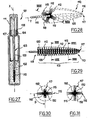
- FIG. 27 a packaging and application device 101 comprising a container 102, an applicator 103 and a wiper 104 having a flange 105 which is applied on a neck 107 of the container 102.
- the applicator 103 comprises a rod 109 of longitudinal axis X, provided at one end with an applicator member 110 and at a second end with a gripping member 111 also constituting a closure cap of the container 102.
- the application member 110 illustrated in greater detail in Figures 28 to 31 , comprises a support 115 having a longitudinal axis Y, rectilinear in the example described, constituted for example by a twisted U-shaped wire.
- the support 115 is for example inserted by force into the rod 109.
- the applicator member 110 comprises bristles 112 extending from the support 115, these bristles 112 being for example held tight in turns formed by the support 115.
- the bristles 112 extend in four rows 116, 117, 118 and 119, which are disjoint and have an angular distance ⁇ of the order of 90 ° for example, with a longitudinal groove 150 between two adjacent rows.
- the rows 116 and 118 are identical, arranged opposite each other, and it is the same rows 117 and 119.
- the rows 116 and 117 have different shapes.
- the rows extend for example over more than half the length of the emptied portion 113 of the support 115.
- At least one of the rows in this case the rows 117 and 119, comprises at least one notch 120 when the applicator is observed in a direction substantially perpendicular to the longitudinal axis Y.
- the rows 117 and 119 each comprise a plurality of notches 120, for example more than 5 notches, in particular between 5 and 20 notches. These notches 120 may be substantially equidistant, and the row may have a crenellated appearance when observed in profile.
- the rows 116 and 118 are devoid of notches, so that the application member 110 comprises, as illustrated in FIG. figure 28 an alternation of rows devoid of notches and rows with notches.
- the notches may have different profiles.
- the profile of the notches may be the same or not.
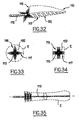
- Each notch 120 may for example have a substantially V profile when the row is observed in a direction substantially perpendicular to the longitudinal axis Y, or substantially U, as shown in FIG. figure 32 .
- the depth of a notch is substantially equal to the length of the bristles disposed on either side of this notch, within the corresponding row.
- the bottom of the notches may be delimited by the ends of shorter hairs.
- At least one of the rows has on at least a portion of its length a substantially constant width ⁇ when the applicator is observed along the longitudinal axis of the support.
- the cross section of the brush forms a cross, the alternation of rows and grooves separating them forming crenellations.
- the width of the rows comprising the notches is sufficient to give them a certain rigidity in the spin, so that the product remains present in the notches.
- an applicator member 110 having triangular-shaped rows 116, 117 in cross-section, as more specifically illustrated in FIG. figure 33 .
- At least one of the rows has, on at least a portion of its length, a width that decreases radially outwards when the applicator is observed along the longitudinal axis Y of the support 115.
- the envelope surface E of the applicator member has a generally tapered shape towards the distal end of the applicator member 110.
- the envelope surface E can be of circular cross-section, as can be seen on the figure 33 .
- the envelope surface E has a polygonal cross-section, in particular a square cross-section, as can be seen on FIG. figure 34 .
- the brush When the brush has a polygonal cross sectional envelope surface, the brush may be made from a cylindrical blank which is cut to a polygonal cross section.
- the brush may be cut to have a star cross section with rows of bristles.
- the notches can be formed by machining the brush after forming the rows, for example.
- the rows are made by forming longitudinal grooves in the brush.
- the rows may be disjointed to the soul of the brush or join before the soul.
- the envelope surface E of the applicator member can pass, in cross section, by at least one extremum, in particular a minimum, when moving from one end to the other of the support, as can be seen on the figure 35 .
- a brush made according to the invention such as for example that described above with reference to Figures 27 to 31 can be used by bringing into contact with the eyelashes a row with notches, so as to load the eyelashes product.
- a non-notch row can be used to separate the eyelashes.
- This row can be brought into contact with the eyelashes for example by a rotation of the brush on itself, for example a rotation of less than 140 ° or 135 °.
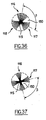
- the brush of the figure 36 has three rows of teeth whose angular spacing ⁇ is about 120.
- Only row 117 in this example may have notches. Alternatively, only the row 116 may be devoid of notch.
- the brush of this figure has four rows. Two diametrically opposite rows may have notches while the other two rows have none.
- the brush of the figure 38 presents four rows that have been machined into a square cross-section blank. Each row forms a notch with an adjacent face 152 of the brush, when the brush is observed in section, as on the figure 38 .
- the spiral effect associated with the twisted core can be attenuated or even eliminated by choosing bristles having a non-circular cross section for example, with articulations for example, or hollow bristles, or by subjecting the bristles to mechanical treatment after the manufacture of the brush.
- the treatment may consist of beating the hair, as described in EP-A-1,459,647 .
- the bristles may have material removal or stretching or crushing at least one point of their length and extend non-radially outwardly therefrom.
- the invention is not limited to the examples which have just been described.
- the characteristics of the different embodiments, concerning the combs or the brushes, can be combined with each other.
Landscapes
- Brushes (AREA)
- Cosmetics (AREA)
- Coating Apparatus (AREA)
- Packages (AREA)
- Closures For Containers (AREA)
Priority Applications (1)
| Application Number | Priority Date | Filing Date | Title |
|---|---|---|---|
| EP08165967A EP2005858A3 (fr) | 2004-09-03 | 2005-09-01 | Applicateur pour l'application d'un produit sur les cils |
Applications Claiming Priority (1)
| Application Number | Priority Date | Filing Date | Title |
|---|---|---|---|
| FR0409374A FR2874798B1 (fr) | 2004-09-03 | 2004-09-03 | Applicateur pour l'application d'un produit sur les cils ou les sourcils |
Related Child Applications (1)
| Application Number | Title | Priority Date | Filing Date |
|---|---|---|---|
| EP08165967A Division EP2005858A3 (fr) | 2004-09-03 | 2005-09-01 | Applicateur pour l'application d'un produit sur les cils |
Publications (3)
| Publication Number | Publication Date |
|---|---|
| EP1632149A2 EP1632149A2 (fr) | 2006-03-08 |
| EP1632149A3 EP1632149A3 (fr) | 2006-05-03 |
| EP1632149B1 true EP1632149B1 (fr) | 2008-12-17 |
Family
ID=34949622
Family Applications (2)
| Application Number | Title | Priority Date | Filing Date |
|---|---|---|---|
| EP05300710A Expired - Lifetime EP1632149B1 (fr) | 2004-09-03 | 2005-09-01 | Applicateur pour l'application d'un produit sur les cils et les sourcils |
| EP08165967A Withdrawn EP2005858A3 (fr) | 2004-09-03 | 2005-09-01 | Applicateur pour l'application d'un produit sur les cils |
Family Applications After (1)
| Application Number | Title | Priority Date | Filing Date |
|---|---|---|---|
| EP08165967A Withdrawn EP2005858A3 (fr) | 2004-09-03 | 2005-09-01 | Applicateur pour l'application d'un produit sur les cils |
Country Status (7)
| Country | Link |
|---|---|
| EP (2) | EP1632149B1 (enExample) |
| JP (2) | JP4446953B2 (enExample) |
| CN (2) | CN100459901C (enExample) |
| AT (1) | ATE417527T1 (enExample) |
| DE (1) | DE602005011718D1 (enExample) |
| ES (1) | ES2319208T3 (enExample) |
| FR (1) | FR2874798B1 (enExample) |
Cited By (4)
| Publication number | Priority date | Publication date | Assignee | Title |
|---|---|---|---|---|
| US8066015B2 (en) | 2005-05-19 | 2011-11-29 | The Procter & Gamble Company | Mascara system with thickening benefits |
| US8777503B2 (en) | 2007-10-23 | 2014-07-15 | L'oreal | Applicator for combing the eyelashes or the eyebrows or for applying a composition thereto |
| US8944714B2 (en) | 2007-10-23 | 2015-02-03 | L'oreal | Applicator for combing the eyelashes and/or eyebrows or for applying a composition thereto |
| US9427075B2 (en) | 2007-10-23 | 2016-08-30 | L'oreal S.A. | Applicator for combing the eyelashes or the eyebrows or for applying a composition thereto |
Families Citing this family (22)
| Publication number | Priority date | Publication date | Assignee | Title |
|---|---|---|---|---|
| FR2882506B1 (fr) | 2005-02-25 | 2007-05-18 | Oreal | Procede de maquillage au moyen d'un applicateur vibrant |
| FR2902984B1 (fr) | 2006-06-28 | 2009-03-20 | Oreal | Dispositif pour l'application d'un produit sur les cils ou les sourcils. |
| US8096306B2 (en) * | 2006-07-12 | 2012-01-17 | Albea Services | Molded plastic mascara brush |
| US8272140B2 (en) * | 2006-10-27 | 2012-09-25 | Group One Limited | Fluid reservoir assembly |
| FR2917585B1 (fr) | 2007-06-22 | 2010-10-15 | Oreal | Applicateur pour appliquer un produit sur les cils et/ou les sourcils. |
| DE102007055269A1 (de) * | 2007-11-20 | 2009-05-28 | Friedrich Sanner Gmbh & Co. Kg | Bürste zum Übertrag von flüssigen oder pastösen Medien |
| DE102007055270A1 (de) * | 2007-11-20 | 2009-05-28 | Beiersdorf Ag | Bürste zum Übertrag von flüssigen oder pastösen Medien |
| DE102007055273A1 (de) * | 2007-11-20 | 2009-05-28 | Beiersdorf Ag | Bürste zum Übertrag von flüssigen oder pastösen Medien |
| WO2009123064A1 (ja) * | 2008-03-31 | 2009-10-08 | 三菱瓦斯化学株式会社 | ポリアセタール含有ブラシ |
| FR2939618B1 (fr) * | 2008-12-11 | 2011-05-20 | Oreal | Applicateur pour appliquer un produit cosmetique, de maquillage ou de soin, sur les matieres keratiniques |
| FR2945417B1 (fr) | 2009-05-15 | 2011-08-26 | Oreal | Dispositif de conditionnement d'application pour appliquer un produit sur les cils et/ou sourcils. |
| FR2945418B1 (fr) * | 2009-05-15 | 2012-09-21 | Oreal | Dispositif de conditionnement et d'application. |
| FR2946847B1 (fr) * | 2009-06-23 | 2011-08-19 | Oreal | Applicateur a ame torsadee chauffante |
| FR2951359B1 (fr) | 2009-10-15 | 2019-12-27 | L'oreal | Dispositif pour appliquer un produit sur les cils ou les sourcils. |
| FR2960750B1 (fr) * | 2010-06-02 | 2013-03-29 | Oreal | Applicateur pour appliquer un produit sur les cils et/ou les sourcils |
| JP5595818B2 (ja) * | 2010-07-22 | 2014-09-24 | 株式会社レーベン販売 | ブラシチップ、ブラシチップを用いた歯ブラシ、及びブラシチップの製造方法 |
| FR2968519B1 (fr) | 2010-12-14 | 2014-10-24 | Oreal | Applicateur pour l'application d'un produit sur les cils et/ou les sourcils et procede de maquillage. |
| DE202011002272U1 (de) * | 2011-02-02 | 2012-05-16 | Geka Gmbh | Dosierpinsel für gezielte Lokalapplikation |
| FR2973991B1 (fr) * | 2011-04-12 | 2013-05-03 | Oreal | Brosse a mascara |
| FR3040128B1 (fr) * | 2015-08-18 | 2017-09-01 | Albea Services | Applicateur pour produit cosmetique et ensemble applicateur associe |
| FR3060274B1 (fr) | 2016-12-20 | 2021-06-11 | Oreal | Brosse a mascara |
| WO2019039842A1 (ko) * | 2017-08-21 | 2019-02-28 | 주식회사 코스나인 | 마그네틱 마스카라 |
Family Cites Families (20)
| Publication number | Priority date | Publication date | Assignee | Title |
|---|---|---|---|---|
| US4804004A (en) * | 1983-03-18 | 1989-02-14 | Taylor Charles H | Molded mascara applicator |
| US4632136A (en) * | 1983-11-02 | 1986-12-30 | Plough, Inc. | Mascara application system |
| JPS61130106U (enExample) * | 1985-01-31 | 1986-08-14 | ||
| FR2605505B1 (fr) * | 1986-10-24 | 1989-06-02 | Oreal | Brosse pour l'application de produits cosmetiques |
| FR2715038B1 (fr) * | 1994-01-14 | 1996-03-15 | Oreal | Brosse pour appliquer un produit cosmétique, notamment du mascara. |
| FR2745481B1 (fr) * | 1996-02-29 | 1998-04-30 | Oreal | Brosse progressive pour appliquer un produit cosmetique, notamment du mascara |
| FR2754685B1 (fr) * | 1996-10-18 | 1999-01-08 | Lvmh Rech | Dispositif applicateur de mascara |
| FR2792618B1 (fr) | 1999-04-23 | 2001-06-08 | Oreal | Dispositif de conditionnement et d'application d'un produit ayant un organe d'essorage comprenant une fente |
| FR2796528B1 (fr) * | 1999-07-21 | 2001-09-21 | Oreal | Dispositif de conditionnement et d'application d'un produit sur les cils ou les sourcils |
| AU5226100A (en) * | 1999-07-21 | 2001-02-05 | L'oreal | Device for applying a product on keratinous fibres, in particular eyelashes or eyebrows |
| FR2796530B1 (fr) | 1999-07-21 | 2001-09-21 | Oreal | Dispositif pour le peignage des cils ou des sourcils et dispositif de conditionnement et d'application ainsi equipe |
| FR2809938B1 (fr) | 2000-06-09 | 2002-09-06 | Oreal | Dispositif d'application d'un produit sur les fibres keratiniques, notamment sur les cils ou les sourcils |
| FR2810860B1 (fr) * | 2000-06-28 | 2003-02-21 | Oreal | Dispositif pour l'application d'un produit sur les cils ou les sourcils |
| ES2272479T3 (es) * | 2000-07-20 | 2007-05-01 | Esro Ag | Pieza de tratamiento para un aparato para la limpieza interdental, procedimiento y dispositivo para su fabricacion. |
| FR2831032B1 (fr) * | 2001-10-19 | 2004-02-20 | Coty Sa | Systeme profile d'application de produit cosmetique, procede de realisation d'un tel systeme, ainsi qu'ensemble applicateur et procede d'assemblage d'un tel ensemble |
| FR2831033B1 (fr) | 2001-10-23 | 2004-03-12 | Oreal | Dispositif pour le conditionnement et/ou l'application d'un produit sur les cils et/ou les sourcils et procede de maquillage |
| BR0300549A (pt) * | 2002-03-05 | 2003-11-11 | Oreal | Dispositivos para pentear os cìlios e/ou as sobrancelhas e/ou aplicar um produto sobre os mesmos, para aplicar um produto sobre os cìlios e/ou as sobrancelhas e para acondicionar e aplicar um produto sobre os cìlios e/ou as sobrancelhas, processos de maquiagem dos cìlios e/ou das sobrancelhas, de fabricação de uma escova e de aplicação de um produto sobre os cìlios e/ou as sobrancelhas e escova para a aplicação de um produto sobre os cìlios e/ou as sobrancelhas |
| FR2847436B1 (fr) * | 2002-11-27 | 2006-05-19 | Oreal | Applicateur pour appliquer un produit sur les fibres keratiniques |
| FR2852500B1 (fr) | 2003-03-20 | 2007-02-23 | Oreal | Brosse et dispositif de conditionnement et d'application comportant une telle brosse |
| FR2855380B1 (fr) | 2003-05-27 | 2006-09-15 | Oreal | Dispositif de conditionnement et d'application d'un produit, comportant un organe d'essorage |
-
2004
- 2004-09-03 FR FR0409374A patent/FR2874798B1/fr not_active Expired - Fee Related
-
2005
- 2005-08-25 CN CNB2005100930603A patent/CN100459901C/zh not_active Expired - Fee Related
- 2005-08-25 CN CN2008101841009A patent/CN101507551B/zh not_active Expired - Fee Related
- 2005-09-01 AT AT05300710T patent/ATE417527T1/de not_active IP Right Cessation
- 2005-09-01 ES ES05300710T patent/ES2319208T3/es not_active Expired - Lifetime
- 2005-09-01 DE DE602005011718T patent/DE602005011718D1/de not_active Expired - Lifetime
- 2005-09-01 EP EP05300710A patent/EP1632149B1/fr not_active Expired - Lifetime
- 2005-09-01 EP EP08165967A patent/EP2005858A3/fr not_active Withdrawn
- 2005-09-05 JP JP2005292962A patent/JP4446953B2/ja not_active Expired - Fee Related
-
2009
- 2009-08-06 JP JP2009183456A patent/JP5371616B2/ja not_active Expired - Fee Related
Cited By (7)
| Publication number | Priority date | Publication date | Assignee | Title |
|---|---|---|---|---|
| US8066015B2 (en) | 2005-05-19 | 2011-11-29 | The Procter & Gamble Company | Mascara system with thickening benefits |
| US8631806B2 (en) | 2005-05-19 | 2014-01-21 | The Procter & Gamble Company | Mascara system with thickening benefits |
| US9016288B2 (en) | 2005-05-19 | 2015-04-28 | The Procter & Gamble Company | Mascara system with thickening benefits |
| US9254247B2 (en) | 2005-05-19 | 2016-02-09 | The Procter & Gamble Company | Mascara system with thickening benefits |
| US8777503B2 (en) | 2007-10-23 | 2014-07-15 | L'oreal | Applicator for combing the eyelashes or the eyebrows or for applying a composition thereto |
| US8944714B2 (en) | 2007-10-23 | 2015-02-03 | L'oreal | Applicator for combing the eyelashes and/or eyebrows or for applying a composition thereto |
| US9427075B2 (en) | 2007-10-23 | 2016-08-30 | L'oreal S.A. | Applicator for combing the eyelashes or the eyebrows or for applying a composition thereto |
Also Published As
| Publication number | Publication date |
|---|---|
| EP1632149A3 (fr) | 2006-05-03 |
| FR2874798A1 (fr) | 2006-03-10 |
| CN101507551B (zh) | 2012-02-08 |
| ATE417527T1 (de) | 2009-01-15 |
| CN100459901C (zh) | 2009-02-11 |
| CN1742644A (zh) | 2006-03-08 |
| CN101507551A (zh) | 2009-08-19 |
| EP1632149A2 (fr) | 2006-03-08 |
| EP2005858A2 (fr) | 2008-12-24 |
| EP2005858A3 (fr) | 2010-11-17 |
| JP4446953B2 (ja) | 2010-04-07 |
| JP2006068543A (ja) | 2006-03-16 |
| JP2009254872A (ja) | 2009-11-05 |
| JP5371616B2 (ja) | 2013-12-18 |
| ES2319208T3 (es) | 2009-05-05 |
| FR2874798B1 (fr) | 2007-01-19 |
| DE602005011718D1 (de) | 2009-01-29 |
Similar Documents
| Publication | Publication Date | Title |
|---|---|---|
| EP1632149B1 (fr) | Applicateur pour l'application d'un produit sur les cils et les sourcils | |
| EP2016864B1 (fr) | Dispositif de conditionnement et d'application d'un produit sur les cils ou les sourcils, notamment du mascara | |
| EP1872682B1 (fr) | Dispositif pour l'application d'un produit sur les cils ou les sourcils | |
| EP2332441B1 (fr) | Dispositif pour peigner et/ou brosser les cils et/ou les sourcils et/ou appliquer un produit sur ceux-ci | |
| EP1070468B1 (fr) | Dispositif pour l'application d'un produit sur les cils ou les sourcils | |
| EP2229840B1 (fr) | Applicateur pour appliquer un produit cosmétique, de maquillage ou de soin, et procédé de fabrication | |
| CA2409269C (fr) | Dispositif pour le conditionnement et/ou l'application d'un produit sur les cils et/ou les sourcils et procede de maquillage | |
| EP1977662B1 (fr) | Applicateur pour appliquer une composition sur les cils | |
| FR2961384B1 (fr) | Applicateur d'un produit cosmetique, de maquillage ou de soin, sur les cils ou les sourcils | |
| EP1917883A2 (fr) | Applicateur pour appliquer un produit sur les cils ou les sourcils | |
| FR2983690A1 (fr) | Applicateur pour peigner ou appliquer un produit sur les cils et/ou les sourcils | |
| FR2934478A1 (fr) | Applicateur pour peigner et/ou appliquer un produit sur les cils et/ou les sourcils | |
| FR2922420A1 (fr) | Applicateur pour l'application d'un produit sur les cils ou les sourcils | |
| FR2922421A1 (fr) | Applicateur pour peigner ou appliquer un produit sur les cils ou les sourcils | |
| FR2916328A1 (fr) | Brosse pour l'application d'un produit sur les cils et/ou les sourcils | |
| FR2933854A1 (fr) | Applicateur pour peigner ou appliquer un produit sur les cils ou les sourcils. | |
| FR2796531A1 (fr) | Applicateur de produit liquide, pateux ou pulverulent comportant des fibres torsadees, et ensemble d'application ainsi equipe | |
| FR2917585A1 (fr) | Applicateur pour appliquer un produit sur les cils et/ou les sourcils. | |
| FR2943227A1 (fr) | Applicateur pour appliquer un produit cosmetique sur les cils ou les sourcils | |
| FR2939618A1 (fr) | Applicateur pour appliquer un produit cosmetique, de maquillage ou de soin, sur les matieres keratiniques | |
| FR3072008A1 (fr) | Applicateur pour appliquer un produit cosmetique | |
| FR2962888A1 (fr) | Applicateur et dispositif de conditionnement et d'application comportant un tel applicateur. | |
| FR2987243A1 (fr) | Applicateur pour l'application d 'un produit cosmetique sur les cils et/ou les sourcils. | |
| FR3045295A1 (fr) | Applicateur d'un produit cosmetique, de maquillage ou de soin, sur les cils et/ou les sourcils | |
| FR3077969A1 (fr) | Applicateur de produit cosmetique |
Legal Events
| Date | Code | Title | Description |
|---|---|---|---|
| PUAI | Public reference made under article 153(3) epc to a published international application that has entered the european phase |
Free format text: ORIGINAL CODE: 0009012 |
|
| 17P | Request for examination filed |
Effective date: 20050903 |
|
| AK | Designated contracting states |
Kind code of ref document: A2 Designated state(s): AT BE BG CH CY CZ DE DK EE ES FI FR GB GR HU IE IS IT LI LT LU LV MC NL PL PT RO SE SI SK TR |
|
| AX | Request for extension of the european patent |
Extension state: AL BA HR MK YU |
|
| PUAL | Search report despatched |
Free format text: ORIGINAL CODE: 0009013 |
|
| AK | Designated contracting states |
Kind code of ref document: A3 Designated state(s): AT BE BG CH CY CZ DE DK EE ES FI FR GB GR HU IE IS IT LI LT LU LV MC NL PL PT RO SE SI SK TR |
|
| AX | Request for extension of the european patent |
Extension state: AL BA HR MK YU |
|
| 17Q | First examination report despatched |
Effective date: 20060714 |
|
| AKX | Designation fees paid |
Designated state(s): AT BE BG CH CY CZ DE DK EE ES FI FR GB GR HU IE IS IT LI LT LU LV MC NL PL PT RO SE SI SK TR |
|
| GRAP | Despatch of communication of intention to grant a patent |
Free format text: ORIGINAL CODE: EPIDOSNIGR1 |
|
| GRAS | Grant fee paid |
Free format text: ORIGINAL CODE: EPIDOSNIGR3 |
|
| GRAA | (expected) grant |
Free format text: ORIGINAL CODE: 0009210 |
|
| AK | Designated contracting states |
Kind code of ref document: B1 Designated state(s): AT BE BG CH CY CZ DE DK EE ES FI FR GB GR HU IE IS IT LI LT LU LV MC NL PL PT RO SE SI SK TR |
|
| REG | Reference to a national code |
Ref country code: GB Ref legal event code: FG4D Free format text: NOT ENGLISH |
|
| REG | Reference to a national code |
Ref country code: CH Ref legal event code: EP |
|
| REG | Reference to a national code |
Ref country code: IE Ref legal event code: FG4D Free format text: LANGUAGE OF EP DOCUMENT: FRENCH |
|
| REF | Corresponds to: |
Ref document number: 602005011718 Country of ref document: DE Date of ref document: 20090129 Kind code of ref document: P |
|
| PG25 | Lapsed in a contracting state [announced via postgrant information from national office to epo] |
Ref country code: LT Free format text: LAPSE BECAUSE OF FAILURE TO SUBMIT A TRANSLATION OF THE DESCRIPTION OR TO PAY THE FEE WITHIN THE PRESCRIBED TIME-LIMIT Effective date: 20081217 |
|
| REG | Reference to a national code |
Ref country code: ES Ref legal event code: FG2A Ref document number: 2319208 Country of ref document: ES Kind code of ref document: T3 |
|
| PG25 | Lapsed in a contracting state [announced via postgrant information from national office to epo] |
Ref country code: PL Free format text: LAPSE BECAUSE OF FAILURE TO SUBMIT A TRANSLATION OF THE DESCRIPTION OR TO PAY THE FEE WITHIN THE PRESCRIBED TIME-LIMIT Effective date: 20081217 Ref country code: FI Free format text: LAPSE BECAUSE OF FAILURE TO SUBMIT A TRANSLATION OF THE DESCRIPTION OR TO PAY THE FEE WITHIN THE PRESCRIBED TIME-LIMIT Effective date: 20081217 Ref country code: NL Free format text: LAPSE BECAUSE OF FAILURE TO SUBMIT A TRANSLATION OF THE DESCRIPTION OR TO PAY THE FEE WITHIN THE PRESCRIBED TIME-LIMIT Effective date: 20081217 Ref country code: LV Free format text: LAPSE BECAUSE OF FAILURE TO SUBMIT A TRANSLATION OF THE DESCRIPTION OR TO PAY THE FEE WITHIN THE PRESCRIBED TIME-LIMIT Effective date: 20081217 Ref country code: SI Free format text: LAPSE BECAUSE OF FAILURE TO SUBMIT A TRANSLATION OF THE DESCRIPTION OR TO PAY THE FEE WITHIN THE PRESCRIBED TIME-LIMIT Effective date: 20081217 |
|
| NLV1 | Nl: lapsed or annulled due to failure to fulfill the requirements of art. 29p and 29m of the patents act | ||
| REG | Reference to a national code |
Ref country code: IE Ref legal event code: FD4D |
|
| PG25 | Lapsed in a contracting state [announced via postgrant information from national office to epo] |
Ref country code: BG Free format text: LAPSE BECAUSE OF FAILURE TO SUBMIT A TRANSLATION OF THE DESCRIPTION OR TO PAY THE FEE WITHIN THE PRESCRIBED TIME-LIMIT Effective date: 20090317 Ref country code: IE Free format text: LAPSE BECAUSE OF FAILURE TO SUBMIT A TRANSLATION OF THE DESCRIPTION OR TO PAY THE FEE WITHIN THE PRESCRIBED TIME-LIMIT Effective date: 20081217 Ref country code: RO Free format text: LAPSE BECAUSE OF FAILURE TO SUBMIT A TRANSLATION OF THE DESCRIPTION OR TO PAY THE FEE WITHIN THE PRESCRIBED TIME-LIMIT Effective date: 20081217 Ref country code: EE Free format text: LAPSE BECAUSE OF FAILURE TO SUBMIT A TRANSLATION OF THE DESCRIPTION OR TO PAY THE FEE WITHIN THE PRESCRIBED TIME-LIMIT Effective date: 20081217 |
|
| PG25 | Lapsed in a contracting state [announced via postgrant information from national office to epo] |
Ref country code: PT Free format text: LAPSE BECAUSE OF FAILURE TO SUBMIT A TRANSLATION OF THE DESCRIPTION OR TO PAY THE FEE WITHIN THE PRESCRIBED TIME-LIMIT Effective date: 20090518 Ref country code: CZ Free format text: LAPSE BECAUSE OF FAILURE TO SUBMIT A TRANSLATION OF THE DESCRIPTION OR TO PAY THE FEE WITHIN THE PRESCRIBED TIME-LIMIT Effective date: 20081217 Ref country code: IS Free format text: LAPSE BECAUSE OF FAILURE TO SUBMIT A TRANSLATION OF THE DESCRIPTION OR TO PAY THE FEE WITHIN THE PRESCRIBED TIME-LIMIT Effective date: 20090417 Ref country code: SE Free format text: LAPSE BECAUSE OF FAILURE TO SUBMIT A TRANSLATION OF THE DESCRIPTION OR TO PAY THE FEE WITHIN THE PRESCRIBED TIME-LIMIT Effective date: 20090317 Ref country code: AT Free format text: LAPSE BECAUSE OF FAILURE TO SUBMIT A TRANSLATION OF THE DESCRIPTION OR TO PAY THE FEE WITHIN THE PRESCRIBED TIME-LIMIT Effective date: 20081217 |
|
| PG25 | Lapsed in a contracting state [announced via postgrant information from national office to epo] |
Ref country code: SK Free format text: LAPSE BECAUSE OF FAILURE TO SUBMIT A TRANSLATION OF THE DESCRIPTION OR TO PAY THE FEE WITHIN THE PRESCRIBED TIME-LIMIT Effective date: 20081217 |
|
| PLBE | No opposition filed within time limit |
Free format text: ORIGINAL CODE: 0009261 |
|
| STAA | Information on the status of an ep patent application or granted ep patent |
Free format text: STATUS: NO OPPOSITION FILED WITHIN TIME LIMIT |
|
| PG25 | Lapsed in a contracting state [announced via postgrant information from national office to epo] |
Ref country code: DK Free format text: LAPSE BECAUSE OF FAILURE TO SUBMIT A TRANSLATION OF THE DESCRIPTION OR TO PAY THE FEE WITHIN THE PRESCRIBED TIME-LIMIT Effective date: 20081217 |
|
| 26N | No opposition filed |
Effective date: 20090918 |
|
| BERE | Be: lapsed |
Owner name: L'OREAL Effective date: 20090930 |
|
| PG25 | Lapsed in a contracting state [announced via postgrant information from national office to epo] |
Ref country code: MC Free format text: LAPSE BECAUSE OF NON-PAYMENT OF DUE FEES Effective date: 20090930 |
|
| REG | Reference to a national code |
Ref country code: CH Ref legal event code: PL |
|
| PG25 | Lapsed in a contracting state [announced via postgrant information from national office to epo] |
Ref country code: BE Free format text: LAPSE BECAUSE OF NON-PAYMENT OF DUE FEES Effective date: 20090930 |
|
| PG25 | Lapsed in a contracting state [announced via postgrant information from national office to epo] |
Ref country code: CH Free format text: LAPSE BECAUSE OF NON-PAYMENT OF DUE FEES Effective date: 20090930 Ref country code: GR Free format text: LAPSE BECAUSE OF FAILURE TO SUBMIT A TRANSLATION OF THE DESCRIPTION OR TO PAY THE FEE WITHIN THE PRESCRIBED TIME-LIMIT Effective date: 20090318 Ref country code: LI Free format text: LAPSE BECAUSE OF NON-PAYMENT OF DUE FEES Effective date: 20090930 |
|
| PG25 | Lapsed in a contracting state [announced via postgrant information from national office to epo] |
Ref country code: LU Free format text: LAPSE BECAUSE OF NON-PAYMENT OF DUE FEES Effective date: 20090901 |
|
| PG25 | Lapsed in a contracting state [announced via postgrant information from national office to epo] |
Ref country code: HU Free format text: LAPSE BECAUSE OF FAILURE TO SUBMIT A TRANSLATION OF THE DESCRIPTION OR TO PAY THE FEE WITHIN THE PRESCRIBED TIME-LIMIT Effective date: 20090618 |
|
| PG25 | Lapsed in a contracting state [announced via postgrant information from national office to epo] |
Ref country code: TR Free format text: LAPSE BECAUSE OF FAILURE TO SUBMIT A TRANSLATION OF THE DESCRIPTION OR TO PAY THE FEE WITHIN THE PRESCRIBED TIME-LIMIT Effective date: 20081217 |
|
| PG25 | Lapsed in a contracting state [announced via postgrant information from national office to epo] |
Ref country code: CY Free format text: LAPSE BECAUSE OF FAILURE TO SUBMIT A TRANSLATION OF THE DESCRIPTION OR TO PAY THE FEE WITHIN THE PRESCRIBED TIME-LIMIT Effective date: 20081217 |
|
| PGFP | Annual fee paid to national office [announced via postgrant information from national office to epo] |
Ref country code: DE Payment date: 20140827 Year of fee payment: 10 |
|
| PGFP | Annual fee paid to national office [announced via postgrant information from national office to epo] |
Ref country code: ES Payment date: 20140812 Year of fee payment: 10 Ref country code: GB Payment date: 20140827 Year of fee payment: 10 |
|
| PGFP | Annual fee paid to national office [announced via postgrant information from national office to epo] |
Ref country code: IT Payment date: 20140911 Year of fee payment: 10 |
|
| PGFP | Annual fee paid to national office [announced via postgrant information from national office to epo] |
Ref country code: FR Payment date: 20140906 Year of fee payment: 10 |
|
| REG | Reference to a national code |
Ref country code: DE Ref legal event code: R119 Ref document number: 602005011718 Country of ref document: DE |
|
| PG25 | Lapsed in a contracting state [announced via postgrant information from national office to epo] |
Ref country code: IT Free format text: LAPSE BECAUSE OF NON-PAYMENT OF DUE FEES Effective date: 20150901 |
|
| GBPC | Gb: european patent ceased through non-payment of renewal fee |
Effective date: 20150901 |
|
| REG | Reference to a national code |
Ref country code: FR Ref legal event code: ST Effective date: 20160531 |
|
| PG25 | Lapsed in a contracting state [announced via postgrant information from national office to epo] |
Ref country code: DE Free format text: LAPSE BECAUSE OF NON-PAYMENT OF DUE FEES Effective date: 20160401 Ref country code: GB Free format text: LAPSE BECAUSE OF NON-PAYMENT OF DUE FEES Effective date: 20150901 |
|
| PG25 | Lapsed in a contracting state [announced via postgrant information from national office to epo] |
Ref country code: FR Free format text: LAPSE BECAUSE OF NON-PAYMENT OF DUE FEES Effective date: 20150930 |
|
| REG | Reference to a national code |
Ref country code: ES Ref legal event code: FD2A Effective date: 20161027 |
|
| PG25 | Lapsed in a contracting state [announced via postgrant information from national office to epo] |
Ref country code: ES Free format text: LAPSE BECAUSE OF NON-PAYMENT OF DUE FEES Effective date: 20150902 |