EP1630148A2 - Sauerstofftransportierende Oxidkeramiken - Google Patents
Sauerstofftransportierende Oxidkeramiken Download PDFInfo
- Publication number
- EP1630148A2 EP1630148A2 EP05102708A EP05102708A EP1630148A2 EP 1630148 A2 EP1630148 A2 EP 1630148A2 EP 05102708 A EP05102708 A EP 05102708A EP 05102708 A EP05102708 A EP 05102708A EP 1630148 A2 EP1630148 A2 EP 1630148A2
- Authority
- EP
- European Patent Office
- Prior art keywords
- oxygen
- membrane
- oxide ceramic
- oxide
- perovskite
- Prior art date
- Legal status (The legal status is an assumption and is not a legal conclusion. Google has not performed a legal analysis and makes no representation as to the accuracy of the status listed.)
- Withdrawn
Links
Images




Classifications
-
- C—CHEMISTRY; METALLURGY
- C04—CEMENTS; CONCRETE; ARTIFICIAL STONE; CERAMICS; REFRACTORIES
- C04B—LIME, MAGNESIA; SLAG; CEMENTS; COMPOSITIONS THEREOF, e.g. MORTARS, CONCRETE OR LIKE BUILDING MATERIALS; ARTIFICIAL STONE; CERAMICS; REFRACTORIES; TREATMENT OF NATURAL STONE
- C04B35/00—Shaped ceramic products characterised by their composition; Ceramics compositions; Processing powders of inorganic compounds preparatory to the manufacturing of ceramic products
- C04B35/01—Shaped ceramic products characterised by their composition; Ceramics compositions; Processing powders of inorganic compounds preparatory to the manufacturing of ceramic products based on oxide ceramics
- C04B35/26—Shaped ceramic products characterised by their composition; Ceramics compositions; Processing powders of inorganic compounds preparatory to the manufacturing of ceramic products based on oxide ceramics based on ferrites
- C04B35/2608—Compositions containing one or more ferrites of the group comprising manganese, zinc, nickel, copper or cobalt and one or more ferrites of the group comprising rare earth metals, alkali metals, alkaline earth metals or lead
- C04B35/2633—Compositions containing one or more ferrites of the group comprising manganese, zinc, nickel, copper or cobalt and one or more ferrites of the group comprising rare earth metals, alkali metals, alkaline earth metals or lead containing barium, strontium or calcium
-
- B—PERFORMING OPERATIONS; TRANSPORTING
- B01—PHYSICAL OR CHEMICAL PROCESSES OR APPARATUS IN GENERAL
- B01D—SEPARATION
- B01D67/00—Processes specially adapted for manufacturing semi-permeable membranes for separation processes or apparatus
- B01D67/0039—Inorganic membrane manufacture
- B01D67/0041—Inorganic membrane manufacture by agglomeration of particles in the dry state
- B01D67/00411—Inorganic membrane manufacture by agglomeration of particles in the dry state by sintering
-
- B—PERFORMING OPERATIONS; TRANSPORTING
- B01—PHYSICAL OR CHEMICAL PROCESSES OR APPARATUS IN GENERAL
- B01D—SEPARATION
- B01D71/00—Semi-permeable membranes for separation processes or apparatus characterised by the material; Manufacturing processes specially adapted therefor
- B01D71/02—Inorganic material
- B01D71/024—Oxides
- B01D71/0271—Perovskites
-
- C—CHEMISTRY; METALLURGY
- C01—INORGANIC CHEMISTRY
- C01B—NON-METALLIC ELEMENTS; COMPOUNDS THEREOF; METALLOIDS OR COMPOUNDS THEREOF NOT COVERED BY SUBCLASS C01C
- C01B13/00—Oxygen; Ozone; Oxides or hydroxides in general
- C01B13/02—Preparation of oxygen
- C01B13/0229—Purification or separation processes
- C01B13/0248—Physical processing only
- C01B13/0251—Physical processing only by making use of membranes
- C01B13/0255—Physical processing only by making use of membranes characterised by the type of membrane
-
- C—CHEMISTRY; METALLURGY
- C01—INORGANIC CHEMISTRY
- C01B—NON-METALLIC ELEMENTS; COMPOUNDS THEREOF; METALLOIDS OR COMPOUNDS THEREOF NOT COVERED BY SUBCLASS C01C
- C01B3/00—Hydrogen; Gaseous mixtures containing hydrogen; Separation of hydrogen from mixtures containing it; Purification of hydrogen; Reversible storage of hydrogen
- C01B3/02—Production of hydrogen; Production of gaseous mixtures containing hydrogen
- C01B3/32—Production of hydrogen; Production of gaseous mixtures containing hydrogen by reaction of gaseous or liquid organic compounds with gasifying agents, e.g. water, carbon dioxide or air
- C01B3/34—Production of hydrogen; Production of gaseous mixtures containing hydrogen by reaction of gaseous or liquid organic compounds with gasifying agents, e.g. water, carbon dioxide or air by reaction of hydrocarbons with gasifying agents
- C01B3/38—Production of hydrogen; Production of gaseous mixtures containing hydrogen by reaction of gaseous or liquid organic compounds with gasifying agents, e.g. water, carbon dioxide or air by reaction of hydrocarbons with gasifying agents using catalysts
- C01B3/386—Catalytic partial combustion
-
- H—ELECTRICITY
- H01—ELECTRIC ELEMENTS
- H01M—PROCESSES OR MEANS, e.g. BATTERIES, FOR THE DIRECT CONVERSION OF CHEMICAL ENERGY INTO ELECTRICAL ENERGY
- H01M8/00—Fuel cells; Manufacture thereof
- H01M8/10—Fuel cells with solid electrolytes
- H01M8/12—Fuel cells with solid electrolytes operating at high temperature, e.g. with stabilised ZrO2 electrolyte
- H01M8/124—Fuel cells with solid electrolytes operating at high temperature, e.g. with stabilised ZrO2 electrolyte characterised by the process of manufacturing or by the material of the electrolyte
- H01M8/1246—Fuel cells with solid electrolytes operating at high temperature, e.g. with stabilised ZrO2 electrolyte characterised by the process of manufacturing or by the material of the electrolyte the electrolyte consisting of oxides
-
- B—PERFORMING OPERATIONS; TRANSPORTING
- B01—PHYSICAL OR CHEMICAL PROCESSES OR APPARATUS IN GENERAL
- B01D—SEPARATION
- B01D2323/00—Details relating to membrane preparation
- B01D2323/08—Specific temperatures applied
- B01D2323/081—Heating
-
- B—PERFORMING OPERATIONS; TRANSPORTING
- B01—PHYSICAL OR CHEMICAL PROCESSES OR APPARATUS IN GENERAL
- B01D—SEPARATION
- B01D2325/00—Details relating to properties of membranes
- B01D2325/22—Thermal or heat-resistance properties
-
- B—PERFORMING OPERATIONS; TRANSPORTING
- B01—PHYSICAL OR CHEMICAL PROCESSES OR APPARATUS IN GENERAL
- B01D—SEPARATION
- B01D2325/00—Details relating to properties of membranes
- B01D2325/26—Electrical properties
-
- C—CHEMISTRY; METALLURGY
- C01—INORGANIC CHEMISTRY
- C01B—NON-METALLIC ELEMENTS; COMPOUNDS THEREOF; METALLOIDS OR COMPOUNDS THEREOF NOT COVERED BY SUBCLASS C01C
- C01B2203/00—Integrated processes for the production of hydrogen or synthesis gas
- C01B2203/02—Processes for making hydrogen or synthesis gas
- C01B2203/0205—Processes for making hydrogen or synthesis gas containing a reforming step
- C01B2203/0227—Processes for making hydrogen or synthesis gas containing a reforming step containing a catalytic reforming step
- C01B2203/0233—Processes for making hydrogen or synthesis gas containing a reforming step containing a catalytic reforming step the reforming step being a steam reforming step
-
- C—CHEMISTRY; METALLURGY
- C01—INORGANIC CHEMISTRY
- C01B—NON-METALLIC ELEMENTS; COMPOUNDS THEREOF; METALLOIDS OR COMPOUNDS THEREOF NOT COVERED BY SUBCLASS C01C
- C01B2203/00—Integrated processes for the production of hydrogen or synthesis gas
- C01B2203/02—Processes for making hydrogen or synthesis gas
- C01B2203/025—Processes for making hydrogen or synthesis gas containing a partial oxidation step
- C01B2203/0261—Processes for making hydrogen or synthesis gas containing a partial oxidation step containing a catalytic partial oxidation step [CPO]
-
- C—CHEMISTRY; METALLURGY
- C01—INORGANIC CHEMISTRY
- C01B—NON-METALLIC ELEMENTS; COMPOUNDS THEREOF; METALLOIDS OR COMPOUNDS THEREOF NOT COVERED BY SUBCLASS C01C
- C01B2203/00—Integrated processes for the production of hydrogen or synthesis gas
- C01B2203/10—Catalysts for performing the hydrogen forming reactions
- C01B2203/1041—Composition of the catalyst
- C01B2203/1047—Group VIII metal catalysts
- C01B2203/1052—Nickel or cobalt catalysts
- C01B2203/1058—Nickel catalysts
-
- C—CHEMISTRY; METALLURGY
- C01—INORGANIC CHEMISTRY
- C01B—NON-METALLIC ELEMENTS; COMPOUNDS THEREOF; METALLOIDS OR COMPOUNDS THEREOF NOT COVERED BY SUBCLASS C01C
- C01B2203/00—Integrated processes for the production of hydrogen or synthesis gas
- C01B2203/12—Feeding the process for making hydrogen or synthesis gas
- C01B2203/1205—Composition of the feed
- C01B2203/1211—Organic compounds or organic mixtures used in the process for making hydrogen or synthesis gas
- C01B2203/1235—Hydrocarbons
- C01B2203/1241—Natural gas or methane
-
- C—CHEMISTRY; METALLURGY
- C01—INORGANIC CHEMISTRY
- C01B—NON-METALLIC ELEMENTS; COMPOUNDS THEREOF; METALLOIDS OR COMPOUNDS THEREOF NOT COVERED BY SUBCLASS C01C
- C01B2210/00—Purification or separation of specific gases
- C01B2210/0043—Impurity removed
- C01B2210/0046—Nitrogen
-
- C—CHEMISTRY; METALLURGY
- C04—CEMENTS; CONCRETE; ARTIFICIAL STONE; CERAMICS; REFRACTORIES
- C04B—LIME, MAGNESIA; SLAG; CEMENTS; COMPOSITIONS THEREOF, e.g. MORTARS, CONCRETE OR LIKE BUILDING MATERIALS; ARTIFICIAL STONE; CERAMICS; REFRACTORIES; TREATMENT OF NATURAL STONE
- C04B2235/00—Aspects relating to ceramic starting mixtures or sintered ceramic products
- C04B2235/02—Composition of constituents of the starting material or of secondary phases of the final product
- C04B2235/30—Constituents and secondary phases not being of a fibrous nature
- C04B2235/32—Metal oxides, mixed metal oxides, or oxide-forming salts thereof, e.g. carbonates, nitrates, (oxy)hydroxides, chlorides
- C04B2235/3205—Alkaline earth oxides or oxide forming salts thereof, e.g. beryllium oxide
- C04B2235/3213—Strontium oxides or oxide-forming salts thereof
-
- C—CHEMISTRY; METALLURGY
- C04—CEMENTS; CONCRETE; ARTIFICIAL STONE; CERAMICS; REFRACTORIES
- C04B—LIME, MAGNESIA; SLAG; CEMENTS; COMPOSITIONS THEREOF, e.g. MORTARS, CONCRETE OR LIKE BUILDING MATERIALS; ARTIFICIAL STONE; CERAMICS; REFRACTORIES; TREATMENT OF NATURAL STONE
- C04B2235/00—Aspects relating to ceramic starting mixtures or sintered ceramic products
- C04B2235/02—Composition of constituents of the starting material or of secondary phases of the final product
- C04B2235/30—Constituents and secondary phases not being of a fibrous nature
- C04B2235/32—Metal oxides, mixed metal oxides, or oxide-forming salts thereof, e.g. carbonates, nitrates, (oxy)hydroxides, chlorides
- C04B2235/3205—Alkaline earth oxides or oxide forming salts thereof, e.g. beryllium oxide
- C04B2235/3215—Barium oxides or oxide-forming salts thereof
-
- C—CHEMISTRY; METALLURGY
- C04—CEMENTS; CONCRETE; ARTIFICIAL STONE; CERAMICS; REFRACTORIES
- C04B—LIME, MAGNESIA; SLAG; CEMENTS; COMPOSITIONS THEREOF, e.g. MORTARS, CONCRETE OR LIKE BUILDING MATERIALS; ARTIFICIAL STONE; CERAMICS; REFRACTORIES; TREATMENT OF NATURAL STONE
- C04B2235/00—Aspects relating to ceramic starting mixtures or sintered ceramic products
- C04B2235/02—Composition of constituents of the starting material or of secondary phases of the final product
- C04B2235/30—Constituents and secondary phases not being of a fibrous nature
- C04B2235/32—Metal oxides, mixed metal oxides, or oxide-forming salts thereof, e.g. carbonates, nitrates, (oxy)hydroxides, chlorides
- C04B2235/3284—Zinc oxides, zincates, cadmium oxides, cadmiates, mercury oxides, mercurates or oxide forming salts thereof
-
- C—CHEMISTRY; METALLURGY
- C04—CEMENTS; CONCRETE; ARTIFICIAL STONE; CERAMICS; REFRACTORIES
- C04B—LIME, MAGNESIA; SLAG; CEMENTS; COMPOSITIONS THEREOF, e.g. MORTARS, CONCRETE OR LIKE BUILDING MATERIALS; ARTIFICIAL STONE; CERAMICS; REFRACTORIES; TREATMENT OF NATURAL STONE
- C04B2235/00—Aspects relating to ceramic starting mixtures or sintered ceramic products
- C04B2235/02—Composition of constituents of the starting material or of secondary phases of the final product
- C04B2235/30—Constituents and secondary phases not being of a fibrous nature
- C04B2235/44—Metal salt constituents or additives chosen for the nature of the anions, e.g. hydrides or acetylacetonate
- C04B2235/449—Organic acids, e.g. EDTA, citrate, acetate, oxalate
-
- C—CHEMISTRY; METALLURGY
- C04—CEMENTS; CONCRETE; ARTIFICIAL STONE; CERAMICS; REFRACTORIES
- C04B—LIME, MAGNESIA; SLAG; CEMENTS; COMPOSITIONS THEREOF, e.g. MORTARS, CONCRETE OR LIKE BUILDING MATERIALS; ARTIFICIAL STONE; CERAMICS; REFRACTORIES; TREATMENT OF NATURAL STONE
- C04B2235/00—Aspects relating to ceramic starting mixtures or sintered ceramic products
- C04B2235/70—Aspects relating to sintered or melt-casted ceramic products
- C04B2235/74—Physical characteristics
- C04B2235/76—Crystal structural characteristics, e.g. symmetry
- C04B2235/761—Unit-cell parameters, e.g. lattice constants
-
- C—CHEMISTRY; METALLURGY
- C04—CEMENTS; CONCRETE; ARTIFICIAL STONE; CERAMICS; REFRACTORIES
- C04B—LIME, MAGNESIA; SLAG; CEMENTS; COMPOSITIONS THEREOF, e.g. MORTARS, CONCRETE OR LIKE BUILDING MATERIALS; ARTIFICIAL STONE; CERAMICS; REFRACTORIES; TREATMENT OF NATURAL STONE
- C04B2235/00—Aspects relating to ceramic starting mixtures or sintered ceramic products
- C04B2235/70—Aspects relating to sintered or melt-casted ceramic products
- C04B2235/74—Physical characteristics
- C04B2235/76—Crystal structural characteristics, e.g. symmetry
- C04B2235/762—Cubic symmetry, e.g. beta-SiC
-
- C—CHEMISTRY; METALLURGY
- C04—CEMENTS; CONCRETE; ARTIFICIAL STONE; CERAMICS; REFRACTORIES
- C04B—LIME, MAGNESIA; SLAG; CEMENTS; COMPOSITIONS THEREOF, e.g. MORTARS, CONCRETE OR LIKE BUILDING MATERIALS; ARTIFICIAL STONE; CERAMICS; REFRACTORIES; TREATMENT OF NATURAL STONE
- C04B2235/00—Aspects relating to ceramic starting mixtures or sintered ceramic products
- C04B2235/70—Aspects relating to sintered or melt-casted ceramic products
- C04B2235/74—Physical characteristics
- C04B2235/76—Crystal structural characteristics, e.g. symmetry
- C04B2235/768—Perovskite structure ABO3
-
- H—ELECTRICITY
- H01—ELECTRIC ELEMENTS
- H01M—PROCESSES OR MEANS, e.g. BATTERIES, FOR THE DIRECT CONVERSION OF CHEMICAL ENERGY INTO ELECTRICAL ENERGY
- H01M8/00—Fuel cells; Manufacture thereof
- H01M8/10—Fuel cells with solid electrolytes
- H01M8/12—Fuel cells with solid electrolytes operating at high temperature, e.g. with stabilised ZrO2 electrolyte
- H01M2008/1293—Fuel cells with solid oxide electrolytes
-
- H—ELECTRICITY
- H01—ELECTRIC ELEMENTS
- H01M—PROCESSES OR MEANS, e.g. BATTERIES, FOR THE DIRECT CONVERSION OF CHEMICAL ENERGY INTO ELECTRICAL ENERGY
- H01M8/00—Fuel cells; Manufacture thereof
- H01M8/10—Fuel cells with solid electrolytes
- H01M8/12—Fuel cells with solid electrolytes operating at high temperature, e.g. with stabilised ZrO2 electrolyte
- H01M8/124—Fuel cells with solid electrolytes operating at high temperature, e.g. with stabilised ZrO2 electrolyte characterised by the process of manufacturing or by the material of the electrolyte
- H01M8/1246—Fuel cells with solid electrolytes operating at high temperature, e.g. with stabilised ZrO2 electrolyte characterised by the process of manufacturing or by the material of the electrolyte the electrolyte consisting of oxides
- H01M8/1253—Fuel cells with solid electrolytes operating at high temperature, e.g. with stabilised ZrO2 electrolyte characterised by the process of manufacturing or by the material of the electrolyte the electrolyte consisting of oxides the electrolyte containing zirconium oxide
-
- Y—GENERAL TAGGING OF NEW TECHNOLOGICAL DEVELOPMENTS; GENERAL TAGGING OF CROSS-SECTIONAL TECHNOLOGIES SPANNING OVER SEVERAL SECTIONS OF THE IPC; TECHNICAL SUBJECTS COVERED BY FORMER USPC CROSS-REFERENCE ART COLLECTIONS [XRACs] AND DIGESTS
- Y02—TECHNOLOGIES OR APPLICATIONS FOR MITIGATION OR ADAPTATION AGAINST CLIMATE CHANGE
- Y02E—REDUCTION OF GREENHOUSE GAS [GHG] EMISSIONS, RELATED TO ENERGY GENERATION, TRANSMISSION OR DISTRIBUTION
- Y02E60/00—Enabling technologies; Technologies with a potential or indirect contribution to GHG emissions mitigation
- Y02E60/30—Hydrogen technology
- Y02E60/50—Fuel cells
-
- Y—GENERAL TAGGING OF NEW TECHNOLOGICAL DEVELOPMENTS; GENERAL TAGGING OF CROSS-SECTIONAL TECHNOLOGIES SPANNING OVER SEVERAL SECTIONS OF THE IPC; TECHNICAL SUBJECTS COVERED BY FORMER USPC CROSS-REFERENCE ART COLLECTIONS [XRACs] AND DIGESTS
- Y02—TECHNOLOGIES OR APPLICATIONS FOR MITIGATION OR ADAPTATION AGAINST CLIMATE CHANGE
- Y02P—CLIMATE CHANGE MITIGATION TECHNOLOGIES IN THE PRODUCTION OR PROCESSING OF GOODS
- Y02P70/00—Climate change mitigation technologies in the production process for final industrial or consumer products
- Y02P70/50—Manufacturing or production processes characterised by the final manufactured product
Definitions
- the present invention relates to oxygen-transporting oxide ceramics, to processes for producing such oxide ceramics and to their use.
- the invention relates to oxygen-transporting oxygen-controlled oxide ceramics which are also conductive to electrons.
- Ceramics according to the invention have a cubic perovskite structure derived from the mineral perovskite Ca II Ti IV O 3 .
- the perovskite structure generally refers to crystalline oxides of the formula ABO 3 in which the ionic radius of A is greater than that of B.
- Such oxide ceramics are known to be capable, in the form of membranes in catalytic membrane reactors, of selectively conducting oxygen ions and electrons and separating oxygen from oxygen-containing gases, for example, air.
- the transport of oxygen ions through membranes having perovskite structure is made possible by vacancies of the perovskite, for example
- metal ions are replaced by ions of lower valence.
- Oxygen anions can pass through these ceramic gaps through the ceramic membrane.
- the electron conduction through a membrane containing oxide ceramics according to the invention may be interrupted by an additional layer which is impermeable to electrons but permeable to oxygen anions and passed outside of such a membrane.
- a perovskite having the structure ABO 3 which may be part of a biphasic oxide ceramic
- ABO 3 which may be part of a biphasic oxide ceramic
- US Pat. No. 6,214,757 discloses perovskite monophase doped oxide ceramics which conduct both oxygen ions and electrons.
- mixed metal oxide ceramics with oxygen and electron conducting properties can have perovskite structure and metals with atomic numbers of 4 (Be), 12 (Mg), 20 to 31 (Ca, Sc, Ti, V, Cr, Mn, Fe, Co, Ni, Cu, Zn, Ga), 38 to 41 (Sr, Y, Zr, Nb) and 56 to 71 (Ba, La, Ce, Pr, Nd, Pm, Sm, Eu, Gd, Tb, Dy, Ho, Er, Tm, Yb, Lu).
- the empirical formulas cited as examples each have cobalt and iron as constituents.
- membrane materials are preferred which have high conductivity for oxygen ions, i. have a high permeance for oxygen.
- the development of membrane ceramics in recent decades is based on finding the highest oxygen permeants for perovskite oxide ceramics when the element cobalt is in the B position of the perovskite structure.
- the content of cobalt in the form of cobalt (II) oxide as the B-ion of the perovskite enables a high oxygen permeance, it has the disadvantage that the cobalt (II) oxide reduces in a reducing atmosphere relatively easily to metallic cobalt is, whereby the membrane is at least partially destroyed.
- both cobalt oxide and the metallic cobalt are comparatively volatile at an operating temperature of the membranes between 800 and 900 ° C.
- the present invention has the object to provide an oxide ceramic with perovskite structure, which avoids the disadvantages of the prior art.
- the stability at high temperatures is to be shown, on the one hand, in the stability of the structure and nature of the membrane material and, on the other hand, in the property of the oxide ceramic to exhibit only slight or negligible changes in the oxygen permeance as a function of the temperature.
- the present invention provides perovskite oxide ceramics suitable for making membranes which accomplish the foregoing objects of the invention.
- the present invention provides oxide ceramics with perovskite structure which, in the form of membranes, even at temperatures above 900 ° C, for example in a range of 950 ° C to 1175 ° C, no significant structural changes and no significant changes in their composition.
- the oxide ceramic according to the invention with perovskite structure, or a membrane with a proportion thereof or completely thereof allows oxygen permeances which are sufficiently high for industrial use in membrane reactors.
- the rate of oxygen permeation as a function of the temperature in membranes is completely constant or substantially constant with a content of perovskite structure oxide ceramics according to the invention, ie. even when the temperature rises, the oxygen permeance does not increase significantly.
- the oxide ceramic according to the invention does not contain cobalt and has the general structure ⁇ B (B ') O 3 , where the ion B' is a divalent cation with stable and low oxidation state, B is an electron-conducting material, for example selected from Fe 3+ and Fe 4+ , Ti 3+ , Ti 4+ , Ce 3+ , Ce 4+ Mn 3+ , Mn 4+ , Nd 3+ , Nd 4+ , Gd 3+ , Gd 4+ , Sm 3+ , Sm 4+ , Dy 3+ and / or Dy 4+ , preferably iron, wherein their proportion as the sum of B and B 'is 0.9 to 1.1, preferably 1.
- the proportion of B 'in the sum of B and B' is 0.05 to 0.95, preferably 0.1 to 0.9, more preferably 0.15 to 0.85, particularly preferably 0.8.
- Metal ions for B ' are selected from Sn 2+ , Ni 2+ , Cu 2+ , Cd 2+ and / or Pd 2+ , preferably Zn 2+ and mixtures of these.
- Metals for A include the lanthanides (La, Ce, Pr, Nd, Pm, Sm, Eo, Gd, Tb, Dy, Ho, Er, Tm, Yb, Lu, yttrium) and alkaline earth metals, especially magnesium, calcium, strontium and barium , each individually or in combination.
- the perovskite structure of the oxide ceramic according to the invention preferably contains at the A position a mixture of barium and strontium, the proportion of which as a sum being 0.9 to 1.1, preferably 1.
- the preferred embodiment of the oxide ceramic according to the invention is Ba x Sr 1-x Fe y Zn 1-y O 3 - ⁇ , where x is between 0.1 and 0.9, preferably 0.5, y is between 0.01 and 0, 99, preferably between 0.1 and 0.9, more preferably between 0.75 and 0.85, and ⁇ denotes the oxygen non-stoichiometry. More preferably, the oxide ceramic according to the invention has the empirical formula Ba 0.4-0.6 Sr 0.4-0.6 Fe 0.7-0.9 Zn 0.1-0.3 O 3- ⁇ . Most preferably, the perovskite oxide oxide ceramic of the present invention has the formula Ba x Sr 1-x Fe 0.8 Zn 0.2 O 3 - ⁇ . Preferably, the oxygen non-stoichiometry ⁇ is independent of temperature.
- oxide ceramics according to the invention with perovskite structure can also be demonstrated on the basis of analysis by transmission electron microscopy, scanning electron microscopy and differential thermal analysis.
- the preparation of the oxide ceramics according to the invention can be achieved on the basis of known processes, for example by preparation from oxides, which form the steps of producing a perovskite powder with the composition according to the invention the mixture to a desired shape and heating the shaped mixture to a temperature sufficient to obtain a dense solid membrane having oxygen ions and electron conducting properties.
- the heating is usually carried out at a temperature above 500 ° C, preferably above 900 to 1000 ° C.
- the oxide ceramic according to the invention can be prepared by thermal decomposition of nitrate and / or acetate salts of the constituents of the perovskite structure according to the invention.
- This process comprises the steps of dissolving the nitrate and / or acetate salts of the desired elements in a solvent, for example, water, removing the solvent by heating, heating the resulting solid to the decomposition temperature of the nitrate and / or acetate salts, forming the resulting mixture, and Heating to obtain a dense solid membrane with electron and oxygen ion conducting properties.
- a solvent for example, water
- the temperature for forming the solid membrane is above 900 ° C, preferably above 1000 ° C.
- the oxide ceramic with perovskite structure according to the invention can be prepared by the citric acid process which comprises the steps of mixing the nitrate and / or acetate salts of the constituents of the perovskite structure according to the invention in a polar solvent containing citric acid, for example in aqueous citric acid solution, heating the mixture to form a solid, form the solid into a desired shape and heat the formed mixture to a temperature sufficient to obtain a dense solid membrane having oxygen ions and electron conducting properties.
- the temperatures for the individual steps correspond to those of the aforementioned decomposition method.
- binders may be added, for example, waxes or paraffins dispersed or dissolved in a suitable solvent.
- the molding can be done by applying high pressure, extruding or spinning.
- Membranes of oxide ceramics with perovskite structure according to the invention are applicable in processes involving the selective conduction of oxygen ions through the perovskite structure deploy.
- This concerns for example, the separation of air or the separation of oxygen from air at high temperature, in which one side of the membrane is in contact with air or another oxygen-containing gas, while on the opposite (permeate) side of the membrane is a very low Partial pressure for oxygen prevails, for example generated by pumping off oxygen or purging with inert gas, for example carbon dioxide.
- the oxide ceramic according to the invention in membrane form can serve for the reduction of oxygen-containing gases by separating off their oxygen, for example from gaseous water, nitrogen oxides (NO x ) and / or sulfur dioxide.
- the surface of the membrane that comes into contact with one of the aforementioned or another oxygen-containing gas is referred to in the context of this disclosure as the air side, the opposite side, on which the oxygen separated from the oxygen-containing gas escapes oxygen, as the permeate side.
- the oxygen is removed from the oxygen-containing gas by means of permeation through the membrane to the permeate side.
- the oxide ceramic according to the invention can also be used in oxidation reactions which use the selective passage of oxygen ions through the membrane material, for example in the oxidative coupling of alkanes or for the production of synthesis gas from methane or in the partial oxidation of alkanes to unsaturated compounds.
- the oxide ceramic with perovskite structure according to the invention may be part of a membrane which no longer has conductivity for electrons, but is conductive for oxygen ions.
- a membrane has, for example, a three-layer structure in which the outer layers have or contain a content of oxide ceramics according to the invention, and the intermediate layer does not permit electron conduction.
- Such, for electron-insulating membrane intermediate layer may for example consist of yttrium-stabilized zirconia (YSZ), on both sides of the inventive oxide ceramic as a thin film, for example, with a layer thickness between 1 .mu.m and 1 mm applied.
- YSZ yttrium-stabilized zirconia
- this membrane construction in three layers allows the flow of oxygen ions through the two oxide ceramic layers according to the invention and the intermediate electrical insulation layer from the air side, which is in contact with an oxygen-containing gas, to the permeate side, on which a reaction, such as complete or partial Oxidation of a hydrocarbon can take place.
- a reaction such as complete or partial Oxidation of a hydrocarbon can take place.
- a partial oxidation is, for example, the oxidation of methane to synthesis gas and / or the oxidation of hydrogen gas or another gaseous reducing agent.
- oxide ceramics according to the invention having a perovskite structure and their shaping is described below on the basis of a preferred perovskite (Ba 0.5 Sr 0.5 Fe 0.8 Zn 0.2 O 3 - ⁇ ), but likewise apply to the other materials according to the invention.
- an iron-based perovskite of the composition ⁇ FeO 3 - ⁇ can be used to produce the perovskite material according to the invention.
- the Fe 4+ ions at the B position of the perovskite structure are at least partially replaced by a divalent cation having a stable oxidation state, preferably by zinc 2+ according to the invention.
- the incorporation of zinc can be achieved by starting from the base material Sr II Fe IV O 3- ⁇ having the structure ABO 3 , in which at the same time barium 2+ cations are brought to the A sites and there the Sr 2 + replace at least partially and zinc 2+ ions are brought by a combined citrate-EDTA based on metal nitrates on the B-position and there replace the Fe 4+ at least partially.
- FIG. 1 shows the HR-TEM image in different resolutions, seen from (a) in plan view and (b) in a side view from 021-direction. The periodic lattice planes of the crystal structure are visible.
- SAED fine range diffraction pattern
- the result of the energy dispersive X-ray spectroscopy (ED-XS) of a crystal of powdery perovskite along [021] shown in FIG. 3 shows the presence of the elements barium, strontium, iron, zinc and oxygen; the copper signal comes from the TEM sample holder.
- the quantitative analysis by the Cliff-Lorimer evaluation technique gave the cation ratio of Ba: Sr: Zn: Fe of 5: 5: 2: 8, which was the stoichiometry of the perovskite to Ba 0.5 Sr 0.5 Fe 0.8 Zn 0 , 2 O 3 - ⁇ exactly confirmed.
- a membrane of inventive perovskite was prepared by sintering at 1175 ° C for 10 hours. With 96%, this sintered perovskite membrane has a comparatively high value of the theoretically possible density, which results mathematically from the size of the unit cell.
- the SEM images are reproduced in FIG. 4 and show that the perovskite grains are densely fused and have clear grain boundaries.
- SAED fine range diffraction patterns
- the X-ray diffraction pattern shown in Figure 7 shows for Ba 0.5 Sr 0.8 Fe 0.8 Zn 0.2 O 3 - ⁇ the perovskite structure for both the powder annealed at 950 ° C and that at 1175 ° C Sintered tablet with the cubic structure type ABO 3 .
- the pressed and sintered tablet produced in Example 1 is clamped in a high-temperature permeation apparatus.
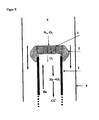
- This permeation apparatus is shown schematically in FIG. 8 and shows the membrane 1, which seals the inner volume of a quartz tube 3 in a gastight manner by means of a seal 2.
- the inner volume of the quartz tube 3 adjoins the surface of the membrane 1, through which oxygen ions selectively pass from the opposite so-called air side 5.
- the inner volume of the quartz tube 3 is purged with helium and / or neon gas, alternatively carbon dioxide, to keep the partial pressure of oxygen passed therethrough low.
- the jacket 4 surrounds the air side 5, on which an oxygen-containing gas, in this case air, comes into contact with the membrane 1.
- an oxygen-containing gas in this case air
- the purge gas is conducted from the inner volume of the quartz tube 3 to the gas chromatography.
- the gas chromatograph (Agilent 6890) was also used to analyze the oxygen-containing gas on the air side. The separation of the oxygen was carried out at temperatures of 700 to 1000 ° C.
- the particular advantage of the membrane materials according to the invention becomes clear in that the oxygen permeance remains substantially constant above a certain temperature. From a temperature of about 925 ° C, therefore, the oxygen flux no longer increases significantly, which makes this oxide ceramic particularly suitable for use as a membrane ceramic for exothermic reactions on the permeate side, for example oxidation reactions.
- the increase in oxygen flux above 925 ° C is preferably below 5%, more preferably below 2%. Therefore, the oxide ceramic according to the invention reduces or avoids the unwanted runaway in the reactor discussed in connection with cobalt-containing perovskite materials in the event of temperature fluctuations, for example in the case of oxidation reactions on the permeate side.
- the stability of the oxide ceramic with perovskite structure according to the invention was investigated on the example of Ba 0.5 Sr 0.5 Fe 0.8 Zn 0.2 O 3 - ⁇ in a high-temperature flow cell by means of X-ray diffractometry.
- the holding times at the respectively indicated temperature amounted to 70 min, the heating rate and cooling rate were in each case 5 K / min.
- the results are shown in Figure 5 and show that the perovskite structure is maintained at least up to a temperature of 1000 ° C in the presence of air.
- a degradation of the perovskite structure of the oxide ceramic according to the invention does not occur, so that a change, for example a decrease in the transport of oxygen ions through a membrane made therefrom, is not to be expected.
- Perovskite composed according to the invention can be produced by one of the described production processes with a particle size of about 1 ⁇ m. Tablets, monoliths, capillaries or fibers can be shaped, for example by Making pressing or spinning. For spinning, perovskite is formulated in an amount of 65% by weight with an organic processing agent, such as Carbowax, to a plastically deformable mass which can be spun. Fibers having an outer diameter of 0.8 mm, an inner diameter of 0.6 mm and a wall thickness of 100 ⁇ m were produced.
- an organic processing agent such as Carbowax
- perovskite according to the invention is formulated to a mass fraction of 75% with an organic processing agent to form a plastically deformable mass.
- the outer diameter was 3 mm
- the inner diameter 2.2 mm with a wall thickness of 0.4 mm.
- the fibers and capillaries thus produced were sintered by annealing in air at about 1210 ° C to a dense solid which is permeable to oxygen ions.
- the foreign gas flux determined for nitrogen is less than 10 -3 mL / cm 2 membrane area and minute.
- an oxygen flux of 4.5 mL / min and cm 2 fiber surface was determined for a wall thickness of 120 ⁇ m at 920 ° C.
- the preparation of Synthesis gas from methane shown in which the oxygen is separated from the oxidation of air and passes through the oxide ceramic according to the invention in membrane form on the permeate side at which the oxidation of the hydrocarbon proceeds.
- the membrane according to the invention can be introduced into a membrane reactor in the form of capillaries, fibers, plates or monoliths.
- the corresponding conversion of natural gas to so-called synthesis gas proceeds according to the equation CH 4 + 1 ⁇ 2 O 2 ⁇ CO + 2H 2 .
- the mechanical stability of the membrane in the reducing methane atmosphere with low oxygen partial pressure (10 -17 bar) with simultaneous high oxygen flux through the membrane is an important property.
- a membrane of inventive perovskite material, obtainable according to Example 1 in the form of a membrane in a membrane reactor for the partial oxidation of methane was used.
- the membrane had a thickness of 1.25 mm.
- the partial oxidation of methane was carried out, with a nickel-based catalyst present on the permeate side.
- the reaction conditions were a purge gas flow of 5 mL / min methane, 4.5 mL / min helium, 0.5 mL / min neon, on the air side an air flow of 150 mL / min at 900 ° C.
- the membrane according to the invention in combination with the nickel-based catalyst showed a CO selectivity of 98.3%.
- the methane conversion reached 60%
- the H 2 / CO ratio was 1.75
- the oxygen flux through the membrane was 2.55 mL / min / cm 2 .
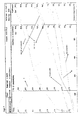
- the measured values are shown in Figure 6, in which the right ordinate indicates the oxygen flux, the left ordinate, the CO selectivity, the methane conversion and CO 2 selectivity.
- a saturated hydrocarbon may also be converted to an unsaturated by oxidative dehydrogenation, for example, ethane to ethylene according to the equation C 2 H 6 + 1 ⁇ 2O 2 ⁇ C 2 H 4 + H 2 O.
- oxidative dehydrogenation for example, ethane to ethylene
- the reaction was carried out at 650 ° C selectivities for ethylene of 90%, found at 800 ° C of 85%. At a temperature of 800 ° C, the yield of ethylene was 68%.
- natural gas can be converted by oxidative coupling according to the equation 2CH 4 + 1 ⁇ 2O 2 ⁇ C 2 H 4 + H 2 O to higher hydrocarbons.
- oxidative coupling of methane at a reaction temperature of 800 ° C a selectivity for C 2+ of about 70%, at 900 ° C, a selectivity for C 2+ of about 50% could be determined.
- the highest specific yields of C 2+ were about 30%.
- catalysts based on Li and La doped nickel on alumina are used, with which a methane conversion of 97% with a selectivity for CO of 98% can be achieved.
- catalysts based on noble metals may be used, e.g. Pt and / or Ru on alumina or titania supports.
- Example 7 Oxidation of hydrocarbon gas with oxygen from water.
- oxygen-containing gaseous compounds are at the operating temperatures of this oxide ceramic in addition to air and water and / or sulfur dioxide and / or nitrogen oxides.
- the oxygen-containing compound is represented here by water, which is present on the one (air) side of the oxide ceramic membrane according to the invention.
- a noticeable decomposition of the water takes place according to the equation H 2 O ⁇ H 2 + 1 ⁇ 2 O 2 , whereby the partial pressure of the hydrogen is approx. 2 x 10 -3 bar, that of the oxygen approx . 3 bar.
- the opposite side of the membrane is the permeate side where hydrocarbon is present, for example, methane. Methane is converted to synthesis gas, thereby reducing the partial pressure of the oxygen on the permeate side of the membrane adjacent to the reaction space of this oxidation reaction to about 10 -18 bar.
- This way will a gradient of the oxygen partial pressure between the air side contacting the oxygen-containing gas and the permeate side of the membrane of about 10 -15 bar, which is sufficient to accelerate the decomposition of the water as a source of the oxygen for the oxidation reaction of the hydrocarbon such that the resulting oxygen permeates continuously through the membrane and oxidizes the methane to synthesis gas on the reaction and permeate side.
- On the air side of the membrane, which is contacted by the oxygen-containing gas remains in mixture with gaseous water hydrogen gas, which may have a sufficiently high quality for operating fuel cells.
- Example 8 Oxidation of Hydrocarbon While Obtaining Electrical Energy
- oxide ceramics according to the invention are applied as a thin layer (50 ⁇ m) to yttrium-stabilized zirconium oxide with a layer thickness of 300 ⁇ m on both sides.
- the yttrium-stabilized zirconia is conductive to oxygen anions but not to electrons.
- the two applied on opposite surfaces of the YSZ layer layers of inventive oxide ceramic are contacted electrically.
- This three-layered membrane is impinged by air as an oxygen-containing gas, the opposite permeate side of the three-layer membrane by a hydrocarbon, for example methane.
- a hydrocarbon for example methane.
- This methane is oxidized to synthesis gas.
- the oxygen required for this oxidation is separated from the air, migrates in the form of oxygen anions through the three-layer membrane and forms an electrical potential.
- Example 9 Production of liquid hydrocarbons using the oxide ceramic of the invention.
- Synthesis gas produced according to Example 6 by partial oxidation of methane with oxygen separated from the air is catalytically using the inventive Oxide ceramics, for example, by oxidative coupling, converted to liquid fuels, such as methanol or sulfur-free liquid hydrocarbons such as gasoline or diesel.
- liquid fuels such as methanol or sulfur-free liquid hydrocarbons such as gasoline or diesel.
- Such diesel fuel is very high quality, since it has cetane numbers greater than 70, consists of 99% paraffins, is poor in aromatics and can be considered sulfur-free with sulfur below 1 ppm.
- the synthesis gas produced in the examples can be ideally implemented as a fuel in fuel cells, which operate in a temperature range of 650 ° C to 950 ° C or more with oxide ceramics according to the invention in the three-layer structure with electrically insulating intermediate layer according to Example 8.
- the synthesis gas has the advantage that deposits of carbon are avoided at the anode of such a fuel cell, which occur for example when using methane or longer-chain hydrocarbons.
Landscapes
- Chemical & Material Sciences (AREA)
- Engineering & Computer Science (AREA)
- Chemical Kinetics & Catalysis (AREA)
- Inorganic Chemistry (AREA)
- Organic Chemistry (AREA)
- Manufacturing & Machinery (AREA)
- Materials Engineering (AREA)
- Combustion & Propulsion (AREA)
- Ceramic Engineering (AREA)
- Structural Engineering (AREA)
- Sustainable Energy (AREA)
- Electrochemistry (AREA)
- General Chemical & Material Sciences (AREA)
- Sustainable Development (AREA)
- Life Sciences & Earth Sciences (AREA)
- Analytical Chemistry (AREA)
- Health & Medical Sciences (AREA)
- General Health & Medical Sciences (AREA)
- Separation Using Semi-Permeable Membranes (AREA)
- Compositions Of Oxide Ceramics (AREA)
- Inorganic Compounds Of Heavy Metals (AREA)
Abstract
Description
- Die vorliegende Erfindung bezieht sich auf Sauerstoff transportierende Oxidkeramiken, Verfahren zur Herstellung solcher Oxidkeramiken sowie deren Anwendung.
- Insbesondere bezieht sich die Erfindung auf Sauerstoff transportierende Oxidkeramiken mit kontrolliertem Sauerstofffluß, die auch für Elektronen leitend sind. Erfindungsgemäße Keramiken haben eine kubische Perowskitstruktur, die von dem Mineral Perowskit CaIITiIVO3 abgeleitet ist. Die Perowskitstruktur bezeichnet allgemein kristalline Oxide der Formel ABO3, bei denen der Ionenradius von A größer als der von B ist.
- Von solchen Oxidkeramiken ist bekannt, dass sie in der Form von Membranen in katalytischen Membranreaktoren dazu geeignet sind, selektiv Sauerstoffionen und Elektronen zu leiten und Sauerstoff aus sauerstoffhaltigen Gasen, beispielsweise Luft abzutrennen.
- Es wird allgemein angenommen, dass der Transport von Sauerstoffionen durch Membranen mit Perowskitstruktur durch Gitterlücken des Perowskits ermöglicht wird, die zum Beispiel dadurch entstehen, dass Metallionen durch Ionen mit niedrigerer Valenz ersetzt werden. Sauerstoffanionen können durch diese Gitterlücken durch die keramische Membran hindurchtreten. Zur Wahrung der Elektroneutralität ist es erforderlich, dass für den Durchtritt eines Sauerstoffanions zwei Elektronen in Gegenrichtung durch die Membran wandern. Bei den erfindungsgemäßen Oxidkeramiken ist dies aufgrund der Elektronenleitfähigkeit gewährleistet. In besonderen Ausführungsformen kann die Elektronenleitung durch eine Membran mit einem Gehalt an erfindungsgemäßer Oxidkeramik jedoch durch eine zusätzliche Schicht, die für Elektronen undurchlässig ist, jedoch für Sauerstoffanionen permeabel ist, unterbrochen und außerhalb einer solchen Membran geführt werden.
- Aus der US 5 591 315 ist bekannt, Oxidkeramiken zu Sauerstoff leitenden Membranen zu verarbeiten. Die Leitung von Sauerstoffionen wird dabei auf die Perowskitstruktur der Mischmetalloxide zurückgeführt. Für die Eigenschaften der gleichzeitigen Elektronenleitung offenbart die US 5 591 315 ein einphasiges Material, bei dem die zusätzliche Eigenschaft der Elektronenleitfähigkeit durch Dotierung mit einem leitfähigen Metall oder Metalloxid erreicht wird, beispielsweise Kobalt. Alternativ dazu werden mehrphasige Membranen offenbart, bei denen die Leitung der Sauerstoffionen in einem Bestandteil der Membran ablaufen kann, während die Elektronenleitfähigkeit von einem anderen Bestandteil bereitgestellt wird. Als mögliche Bestandteile für die B-Position eines Perowskits mit der Struktur ABO3, der Teil einer zweiphasigen Oxidkeramik sein kann, wird allgemein auf die erste Reihe von Übergangsmetallen verwiesen, nämlich Sc, Ti, V, Cr, Mn, Fe, Co, Ni, Cu, Zn. Die näher charakterisierten Perowskite enthalten von diesen Übergangsmetallen immer Kobalt und/oder Eisen.
- Die US 6 214 757 offenbart einphasige dotierte Oxidkeramiken mit Perowskitstruktur, die sowohl Sauerstoffionen als auch Elektronen leiten. Darin wird die US 5 356 728 damit zitiert, dass Mischmetalloxid-Keramiken mit Sauerstoff und Elektronen leitenden Eigenschaften Perowskitstruktur haben können und Metalle mit Atomzahlen von 4 (Be), 12 (Mg), 20 bis 31 (Ca, Sc, Ti, V, Cr, Mn, Fe, Co, Ni, Cu, Zn, Ga), 38 bis 41 (Sr, Y, Zr, Nb) und 56 bis 71 (Ba, La, Ce, Pr, Nd, Pm, Sm, Eu, Gd, Tb, Dy, Ho, Er, Tm, Yb, Lu) enthalten können. Die als Beispiele zitierten Summenformeln weisen jeweils Kobalt und Eisen als Bestandteile aus.
- Für die technische Anwendung werden Membranmaterialien bevorzugt, die eine hohe Leitfähigkeit für Sauerstoffionen, d.h. eine hohe Permeanz für Sauerstoff aufweisen. Die Entwicklung von Membrankeramiken der letzten Jahrzehnte basiert darauf, dass die höchsten Sauerstoffpermeanzen für Oxidkeramiken mit Perowskitstruktur gefunden wurden, wenn das Element Kobalt in der B-Position der Perowskitstruktur vorliegt. Zwar ermöglicht der Gehalt an Kobalt in der Form von Kobalt(II)-oxid als B-Ion des Perowskits eine hohe Sauerstoffpermeanz, bringt jedoch den Nachteil mit sich, dass das Kobalt(II)-oxid in reduzierender Atmosphäre relativ leicht zu metallischem Kobalt reduziert wird, wodurch die Membran zumindest teilweise zerstört wird. Diese Reduktion des Kobalt(II)-oxids zu metallischem Kobalt tritt insbesondere bei erhöhten Prozesstemperaturen auf und hat zur Folge, dass sich die Sauerstoffpermeanz erhöht. Diese Steigerung der Sauerstoflpermeanz führt bei exothermen Reaktionen auf der Permeatseite der Membran zu einer erhöhten Reaktionsrate und dadurch wiederum zur verstärken Freisetzung von Wärme, d.h. wiederum zu einer Temperaturerhöhung. Dies kann dazu führen, dass ein Reaktor durchgeht bzw. durchbrennt, wobei die Membraneigenschaft der selektiven Sauerstoffpermeanz zerstört wird.
- Überdies sind sowohl Kobaltoxid als auch das metallische Kobalt bei einer Betriebstemperatur der Membranen zwischen 800 und 900 °C vergleichsweise flüchtig.
- Zur Vermeidung dieser Nachteile von Kobalt (II) oder metallischem Kobalt in den Membranen mit Perowskitstruktur wurde versucht, kobaltfreie Perowskitmaterialien zu entwickeln. So offenbart die US 6 214 757 B1 La1-xSrxGaYFe1-yO3-δ. Dieses Material ist jedoch aufgrund seiner geringen Sauerstoffpermeanz für den technischen Einsatz nachteilig, überdies führt der Einsatz von Gallium zu hohen Materialkosten. Zhu et al., Chem. Commun., 1130 (2004) offenbaren ein weiteres kobaltfreies, Sauerstoffionen leitendes Material als BaCexFe1-xO3-δ. Dieses Material ist jedoch zweiphasig, so dass nur die eisenreiche Phase Sauerstoffionen transportieren kann und in der Folge der Sauerstoffstrom insgesamt gering ist. Die US 2002/0 173 422 A1 beschreibt eine kobaltfreie Perowskitstruktur ABO3 mit der Zusammensetzung Sr0,5Ca0,5MnO3-δ, bei der das Ion in der A-Position variiert werden kann. Dieses Material zeigt jedoch nur geringe Sauerstoffpermeanzen.
- Angesichts der vorgenannten Nachteile bekannter Membranen aus Oxidkeramiken mit Perowskitstruktur stellt sich der vorliegenden Erfindung die Aufgabe, eine Oxidkeramik mit Perowskitstruktur bereitzustellen, die die Nachteile des Standes der Technik vermeidet. Hier stellt sich insbesondere die Aufgabe, für Membranen geeignete Oxidkeramiken bereitzustellen, die eine hohe Sauerstoffpermeanz aufweisen, vorzugsweise auch bei hohen Temperaturen, beispielsweise von oberhalb von 900 °C. Die Stabilität bei hohen Temperaturen soll sich vorzugsweise einerseits in der Beständigkeit der Struktur und Beschaffenheit des Membranmaterials zeigen, andererseits in der Eigenschaft der Oxidkeramik, nur geringe oder unwesentliche Veränderungen der Sauerstoffpermeanz in Abhängigkeit von der Temperatur aufzuweisen.
- Die vorliegende Erfindung stellt Oxidkeramiken mit Perowskitstruktur bereit, die zur Herstellung von Membranen geeignet sind, die die vorgenannten Aufgaben der Erfindung erfüllen.
- Insbesondere stellt die vorliegende Erfindung Oxidkeramiken mit Perowskitstruktur bereit, die in Form von Membranen auch bei Temperaturen oberhalb von 900 °C, beispielsweise in einem Bereich von 950 °C bis 1175 °C, keine wesentlichen Strukturveränderungen und keine wesentlichen Änderungen ihrer Zusammensetzung aufweist. Die erfindungsgemäße Oxidkeramik mit Perowskitstruktur, bzw. eine Membran mit einem Anteil davon oder vollständig daraus, ermöglicht Sauerstoffpermeanzen, die für die technische Anwendung in Membranreaktoren ausreichend hoch sind. Weiterhin ist die Rate der Sauerstoffpermeation in Abhängigkeit von der Temperatur bei Membranen vollständig aus oder mit einem Gehalt an erfindungsgemäßer Oxidkeramik mit Perowskitstruktur im wesentlichen konstant, d.h. auch bei einem Temperaturanstieg steigt die Sauerstoffpermeanz nicht wesentlich an.
- Die erfindungsgemäße Oxidkeramik enthält kein Kobalt und hat die allgemeine Struktur ΛB(B')O3, wobei das Ion B' ein zweiwertiges Kation mit stabiler und niedriger Oxidationsstufe ist, B ein Elektronen leitendes Material ist, beispielsweise ausgewählt unter Fe3+ und Fe4+, Ti3+, Ti4+, Ce3+, Ce4+ Mn3+, Mn4+, Nd3+, Nd4+, Gd3+, Gd4+, Sm3+, Sm4+, Dy3+ und/oder Dy4+, vorzugsweise Eisen, wobei deren Anteil als Summe von B und B' 0,9 bis 1,1, vorzugsweise 1 beträgt. Der Anteil von B' an der Summe von B und B' beträgt 0,05 bis 0,95, vorzugsweise 0,1 bis 0,9, bevorzugter 0,15 bis 0,85, besonders bevorzugt 0,8. Metallionen für B' sind ausgewählt unter Sn2+, Ni2+, Cu2+, Cd2+ und/oder Pd2+, vorzugsweise Zn2+ und Mischungen dieser.
- Metalle für A schließen die Lanthaniden (La, Ce, Pr, Nd, Pm, Sm, Eo, Gd, Tb, Dy, Ho, Er, Tm, Yb, Lu, Yttrium) und Erdalkalimetalle, insbesondere Magnesium, Calcium, Strontium und Barium, jeweils einzeln oder in Kombination ein. Vorzugsweise enthält die Perowskitstruktur der erfindungsgemäßen Oxidkeramik an der A-Position eine Mischung aus Barium und Strontium, wobei deren Anteil als Summe 0,9 bis 1,1, vorzugsweise 1 beträgt. Die bevorzugte Ausführungsform der erfindungsgemäßen Oxidkeramik ist BaxSr1-xFeyZn1-yO3-δ, wobei x zwischen 0,1 und 0,9 liegt, vorzugsweise 0,5 ist, y zwischen 0,01 und 0,99 liegt, vorzugsweise zwischen 0,1 und 0,9, besonders bevorzugt zwischen 0,75 und 0,85, und δ die Sauerstoff-Nichtstöchiometrie bezeichnet. Bevorzugter hat die erfindungsgemäße Oxidkeramik die Summenformel Ba0,4-0,6Sr0,4-0,6Fe0,7-0,9Zn0,1-0,3O3-δ. Am bevorzugtesten hat die erfindungsgemäße Oxidkeramik mit Perowskitstruktur die Formel BaxSr1-xFe0,8Zn0,2O3-δ. Bevorzugterweise ist die Sauerstoff-Nichtstöchiometrie δ temperaturunabhängig.
- Es wird angenommen, dass insbesondere die Verwendung von Zink2+ als B'- Kation der erfindungsgemäßen Oxidkeramik eine hohe Stabilität verleiht. Denn durch die niedrige und stabile Oxidationsstufe wird eine nur geringe und konstante Sauerstoff-Nichtstöchiometrie erzeugt, die wiederum als Ursache für die hohe Materialstabilität der erfindungsgemäßen Oxidkeramik angesehen wird.
- Die besonderen Eigenschaften der erfindungsgemäßen Oxidkeramiken mit Perowskitstruktur lassen sich auch anhand der Analyse durch Transmissionselektronenmikroskopie, Rasterelektronenmikroskopie und Differential-Thermoanalyse nachweisen.
- Die Herstellung der erfindungsgemäßen Oxidkeramiken kann in Anlehnung an bekannte Verfahren, beispielsweise durch Herstellung aus Oxiden erreicht werden, die die Schritte der Herstellung eines Perowskitpulvers mit der erfindungsgemäßen Zusammensetzung, Formen der Mischung zu einer gewünschten Form und Erwärmung der geformten Mischung auf eine ausreichende Temperatur enthält, um eine dichte Feststoffmembran mit Sauerstoffionen und Elektronen leitenden Eigenschaften zu erhalten. Die Erwärmung erfolgt üblicherweise auf eine Temperatur oberhalb von 500 °C, vorzugsweise oberhalb von 900 bis 1000 °C.
- Alternativ kann die erfindungsgemäße Oxidkeramik durch thermische Zersetzung von Nitrat-und/oder Acetatsalzen der Bestandteile der erfindungsgemäßen Perowskitstruktur hergestellt werden. Dieses Verfahren enthält die Schritte des Lösens der Nitrat- und/oder Acetatsalze der erwünschten Elemente in einem Lösungsmittel, beispielsweise Wasser, Entfernung des Lösungsmittels durch Erwärmen, Erhitzen des erhaltenen Feststoffs auf die Zersetzungstemperatur der Nitrat- und/oder Acetatsalze, Formung der erhaltenen Mischung und Erwärmung, um eine dichte Feststoffmembran mit Elektronen und Sauerstoffionen leitenden Eigenschaften zu erhalten. Für das Entfernen von Lösungsmittel und das Erreichen der Zersetzungstemperatur sind allgemein etwa 500 °C ausreichend, die Temperatur zur Bildung der Feststoffmembran beträgt oberhalb 900 °C, vorzugsweise oberhalb 1000 °C.
- Weiter alternativ kann die erfindungsgemäße Oxidkeramik mit Perowskitstruktur nach dem Citronensäure-Verfahren hergestellt werden, das die Schritte der Mischung der Nitrat-und/oder Acetatsalze der Bestandteile der erfindungsgemäßen Perowskitstruktur in einem polaren Lösungsmittel, das Citronensäure enthält, beispielsweise in wässriger Citronensäurelösung, Erwärmung der Mischung zur Bildung eines Feststoffs, Formung des Feststoffs in eine erwünschte Form und Erhitzen der geformten Mischung auf eine ausreichende Temperatur enthält, um eine dichte Feststoffmembran mit Sauerstoffionen und Elektronen leitenden Eigenschaften zu erhalten. Die Temperaturen für die einzelnen Schritte entsprechen denen des vorgenannten Zersetzungsverfahrens.
- Für das Formen der Mischung in eine gewünschte Form können Bindemittel zugegeben werden, beispielsweise Wachse oder Paraffine, die in einem geeigneten Lösungsmittel dispergiert oder gelöst sind.
- Das Formen kann durch Aufbringen von hohem Druck, Extrudieren oder Spinnen erfolgen.
- Membranen aus erfindungsgemäßer Oxidkeramik mit Perowskitstruktur sind in Verfahren anwendbar, die die selektive Leitung von Sauerstoffionen durch die Perowskitstruktur einsetzen. Dies betrifft z.B. die Zerlegung von Luft bzw. die Abtrennung von Sauerstoff aus Luft bei hoher Temperatur, bei der eine Seite der Membran in Kontakt mit Luft oder einem anderen sauerstoffhaltigen Gas steht, während auf der gegenüberliegenden (Permeat-) Seite der Membran ein sehr niedriger Partialdruck für Sauerstoff herrscht, beispielsweise erzeugt durch Abpumpen von Sauerstoff oder Spülen mit Inertgas, beispielsweise Kohlendioxid.
- In einer weiteren Anwendung kann die erfindungsgemäße Oxidkeramik in Membranform zur Reduktion sauerstoffhaltiger Gase durch Abtrennung von deren Sauerstoff dienen, beispielsweise aus gasförmigem Wasser, Stickstoffoxiden (NOx) und/oder Schwefeldioxid. Die Oberfläche der Membran, die mit einem der vorgenannten oder einem anderen sauerstoffhaltigen Gas in Kontakt kommt, wird im Rahmen dieser Offenbarung als Luftseite bezeichnet, die gegenüberliegende Seite, auf der der aus dem sauerstoffhaltigen Gas abgetrennte Sauerstoff austritt, als Permeatseite. Dabei wird der Sauerstoff aus dem sauerstoffhaltigen Gas mittels der Permeation durch die Membran auf die Permeatseite entfernt.
- Die erfindungsgemäße Oxidkeramik kann auch in Oxidationsreaktionen eingesetzt werden, die den selektiven Durchtritt von Sauerstoffionen durch das Membranmaterial einsetzen, beispielsweise bei der oxidativen Kopplung von Alkanen oder zur Erzeugung von Synthesegas aus Methan oder bei der partiellen Oxidation von Alkanen zu ungesättigten Verbindungen.
- In einer weiteren Ausführungsform der Erfindung kann die erfindungsgemäße Oxidkeramik mit Perowskitstruktur Bestandteil einer Membran sein, die keine Leitfähigkeit mehr für Elektronen besitzt, jedoch für Sauerstoffionen leitend ist. Eine solche Membran hat beispielsweise einen dreischichtigen Aufbau, bei dem die außen liegenden Schichten einen Gehalt an erfindungsgemäßer Oxidkeramik aufweisen oder daraus bestehen, und die Zwischenschicht keine Elektronenleitung zuläßt. Eine solche, für Elektronen isolierende Membran-Zwischenschicht kann beispielsweise aus Yttrium-stabilisiertem Zirkoniumoxid (YSZ) bestehen, auf das beidseitig die erfindungsgemäße Oxidkeramik als Dünnschicht, beispielsweise mit einer Schichtdicke zwischen 1 µm und 1 mm, aufgebracht ist.
- Durch elektrisches Kontaktieren der beiden Oxidkeramik-Schichten, die durch die Zwischenschicht elektrisch voneinander isoliert sind, läßt sich der Elektronenfluß nach Art einer Brennstoffzelle außerhalb der Membran führen und nutzen. Hingegen läßt dieser Membranaufbau in drei Schichten den Fluß der Sauerstoffionen durch die beiden erfindungsgemäßen Oxidkeramikschichten und die dazwischen liegende elektrische Isolationsschicht von der Luftseite, die mit einem sauerstoffhaltigen Gas in Kontakt steht, zur Permeatseite zu, auf der eine Reaktion, wie beispielsweise die vollständige oder partielle Oxidation eines Kohlenwasserstoffs stattfinden kann. Eine solche Partialoxidation ist beispielsweise die Oxidation von Methan zu Synthesegas und/oder die Oxidation von Wasserstoffgas oder einem anderen gasförmigen Reduktionsmittel.
- Die Herstellung und Charakterisierung erfindungsgemäßer Oxidkeramiken mit Perowskitstruktur und deren Formung wird nachfolgend anhand eines bevorzugten Perowskits (Ba0,5Sr0,5Fe0,8Zn0,2O3-δ) beschrieben, gelten jedoch ebenfalls für die anderen erfindungsgemäßen Materialien.
- Zur Herstellung des erfindungsgemäßen Perowskitmaterials kann beispielsweise von einem Eisen-basierten Perowskit der Zusammensetzung ΛFeO3-δ ausgegangen werden. Dabei werden die Fe4+-Ionen auf der B-Position der Perowskitstruktur zumindest teilweise durch ein zweiwertiges Kation mit stabiler Oxidationsstufe ersetzt, erfindungsgemäß bevorzugt durch Zink2+. Verfahrenstechnisch kann der Einbau von Zink dadurch erreicht werden, dass von dem Grundmaterial SrIIFeIVO3-δ mit der Struktur ABO3 ausgegangen wird, bei diesem gleichzeitig Barium2+-Kationen auf die A-Plätze gebracht werden und dort das Sr2+ zumindest teilweise ersetzen und Zink2+-Ionen durch ein kombiniertes Citrat-EDTA-Verfahren auf der Basis von Metallnitraten auf die B-Position gebracht werden und dort das Fe4+ zumindest teilweise ersetzen.
- Es wird von den Erfindern vermutet, dass die Barium2+-Kationen auf den A-Plätzen dazu führen, dass die Sauerstoffpermeanz erhöht wird.
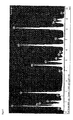
- Ein bevorzugtes erfindungsgemäßes Perowskitmaterial mit der Summenformel Ba0,5Sr0,5Fe0,8Zn0,2O3-δ, herstellbar nach Beispiel 1, wurde in der hoch auflösenden Transmissionselektronenmikroskopie (HR-TEM) untersucht. Figur 1 zeigt die HR-TEM-Aufnahme in verschiedenen Auflösungen, unter (a) in Draufsicht und (b) in Seitenansicht aus 021-Richtung gesehen. Die periodischen Netzebenen der Kristallstruktur sind sichtbar. Das entsprechende Feinbereichsbeugungsdiagramm (SAED), in Figur 2 als Aufnahme entlang der 021-Zonenachse dargestellt, indiziert eine kubische Elementarzelle mit den folgenden Netzebenen-Abständen: d(200) = 0,206 nm, d(01-2) = 0,176 nm und d(21-2) = 0,135. Diese Daten entsprechen einer kubischen Elementarzelle mit einer Gitterkonstanten von 0,412 nm.
- Das in Figur 3 dargestellte Ergebnis der energiedispersiven Röntgenspektroskopie (ED-XS) eines Kristalles des pulverförmigen Perowskits entlang [021] zeigt die Anwesenheit der Elemente Barium, Strontium, Eisen, Zink und Sauerstoff; das Kupfer-Signal stammt von dem TEM-Probenhalter. Die quantitative Analyse mittels der Cliff-Lorimer-Auswertetechnik ergab das Kationenverhältnis von Ba : Sr : Zn : Fe von 5 : 5 : 2 : 8, was die Stöchiometrie des Perowskits zu Ba0,5Sr0,5Fe0,8Zn0,2O3-δ exakt bestätigt.
- Für die Analyse mittels Feldemissions-REM (JEOL LSM-6700F) wurde eine Membran aus erfindungsgemäßem Perowskit durch Sintern bei 1175 °C über 10 Stunden hergestellt. Diese gesinterte Perowskitmembran besitzt mit 96% einen vergleichsweise hohen Wert der theoretisch möglichen Dichte, die sich rechnerisch aus der Größe der Elementarzelle ergibt. Die REM-Aufnahmen sind in Figur 4 wiedergegeben und zeigen, dass die Perowskitkörner dicht verwachsen sind und klare Korngrenzen aufweisen.
- In Kombination mit den Feinbereichsbeugungsdiagrammen (SAED) an verschiedenen Stellen der Körner folgt, dass diese Körner Einkristalle darstellen und daher die Korngrenzen Kristallgrenzen sind.
- Bei einer Bestimmung der Dichtheit der derselben Membran, wie sie für die REM-Aufnahmen eingesetzt wurde, zeigt sich bei einem Differenzdruck von 5 bar über die Membran kein messbarer Stickstofffluß, d.h. der Stickstofffluß war kleiner als 10-5 mL/ cm2/min.
- Bei der Charakterisierung erfindungsgemäßen Perowskitmaterials mittels Thermogravimetrie (TG) wurde gefunden, dass im Bereich zwischen Raumtemperatur bis 320 °C ein Gewichtsverlust von etwa 0,5% auftritt. Dieser Gewichtsverlust auf die Desorption von Wasser und Kohlendioxid von der Materialoberfläche zurückgehen. Im Temperaturbereich zwischen 440 °C und 800 °C wird der beobachtete Gewichtsverlust von etwa 2% dem Ausbau von Sauerstoff und der Schaffung von Sauerstofffehlstellen im Perowskitmaterial zugeschrieben. Oberhalb von 800 °C tritt kein weiterer Gewichtsverlust auf. Zur Messung wurde pulverförmiges Perowskitmaterial in einer Heliumatmosphäre bei einer Aufheizrate von 5 °C/min eingesetzt. Die Messwerte sind in Figur 5 dargestellt.
- Bei der Differentialscanningkalorimetrie (DSK), deren Ergebnis ebenfalls in Figur 5 dargestellt ist, wurden im Bereich zwischen Raumtemperatur und 1150 °C keine endothermen oder exothermen Spitzenwerte beobachtet. Dies zeigt, dass sowohl beim Aufheizen als auch beim Abkühlen keine Phasentransformationen erfolgen, was den Schluss zulässt, dass die kubische Struktur des Perowskitmaterials erhalten bleibt. Dieselbe Beobachtung wurde bei der in situ Röntgendiffraktrometrie gemacht.
-
- Figur 1 zeigt unter (a) und (b) HR-TEM-Aufnahmen eines Kristalles des pulverförmigen Perowskitmaterials aus 021-Richtung bei unterschiedlicher Vergrößerung.
- Figur 2 zeigt ein Feinbereichsbeugungsdiagramm einer Fläche von 100 nm x 100 nm eines Kristalls des pulverförmigen Perowskitmaterials entlang 021.
- Figur 3 die Aufnahme der EDXS eines Kristalles des pulverförmigen Perowskitmaterials.
- Figur 4 zeigt unter a) in Draufsicht und b) in Seitenansicht REM-Aufnahmen der erfindungsgemäßen Perowskitmembran im Feldemmissions-Rasterelektronenmikroskop.
- Figur 5 zeigt den Verlauf der Messung der Thermogravimetrie und der Differentialscanningkalorimetrie pulverförmigen Perowskitmaterials unter Helium
- Figur 6 zeigt die Messergebnisse der partiellen Methanoxidation.
- Figur 7 zeigt ein Röntgendiffraktogramm eines erfindungsgemäßen Perowskitmaterials (Ba0,5Sr0,5Fe0,8Zn0,2O3-δ) unter a) als Pulver, das bei 950 °C geglüht wurde und unter b) als Membran-Tablette, bei 1175 °C geglüht.
- Figur 8 zeigt eine schematische Darstellung eines Membranreaktors zur Abtrennung von Sauerstoff aus Luft bei hohen Temperaturen.
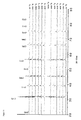
- Figur 9 zeigt Gaschromatogramme von a) dem Eingangsgas Luft und b) des an Sauerstoff reichen Permeats als Ergebnis der Abtrennung von Sauerstoff aus Luft.
- Figur 10 zeigt die Sauerstoffpermeanz eines erfindungsgemäßen Perowskitmaterials in Abhängigkeit von der Temperatur.
- Figur 11 zeigt Röntgendiffraktogramme eines erfindungsgemäßen Perowskitmaterials bei unterschiedlichen Temperaturen.
- Die Erfindung wird nun anhand von Beispielen mit Bezug auf die Figuren genauer erläutert.
- Unter Rühren werden 5,23 g festes Ba(NO3)2, 63,43 mL 0,473 M Sr(N03)2, 34,47 mL 1,1605 M Fc(N03)2 als wässrige Lösungen in ein Becherglas gegeben, bis sich das feste Bariumnitrat auflöst. Dieser Lösung werden 29,77 mL einer 0,03359 M Zn(N03)2 wässrigen Lösung, 29,2 g EDTA (fest) und 31,52 g Citronensäure (fest) sowie 180 mL 25% NH4OH zugegeben. Die Lösung wird unter Rühren auf 150 °C erhitzt. Es fällt ein gemischtes Metallhydroxid /Metalloxid-Gel aus. Überschüssige Flüssigkeit wird bei 350 °C über 8 Stunden abgedampft, das feste Produkt, bestehend aus einem Gemisch der Metallhydroxide und Metalloxide, wird anschließend bei 950 °C über 10 Stunden geglüht. Das anfallende Pulver wird anschließend bei Raumtemperatur isostatisch bei einem Preßdruck von 120 bar in einer hydraulischen Presse zu einer Tablette von 1,5 mm Dicke gepresst, anschließend über 10 Stunden bei 1175 °C in Luft gesintert, wobei die Aufheizrate 3 °C / Minute und die Abkühlrate 5 °C / Minute beträgt.
- Das Röntgendiffraktogramm, in Figur 7 dargestellt, zeigt für Ba0,5Sr0,8Fe0,8Zn0,2O3-δ die Perowskitstruktur sowohl für das bei 950 °C geglühte Pulver, als auch für die bei 1175 °C gesinterte Tablette mit dem kubischem Strukturtyp ABO3. Die Gitterkonstante beträgt a = 0,412 nm. Dieser Wert konnte durch Elektronenbeugung am Elektronenmikroskop bestätigt werden.
- Als Beispiel für das erfindungsgemäße Membranmaterial wird die in Beispiel 1 hergestellte gepreßte und gesinterte Tablette in eine Hochtemperatur-Permeationsapparatur eingeklemmt. Diese Permeationsapparatur ist in Figur 8 schematisch dargestellt und zeigt die Membran 1, die mittels einer Dichtung 2 gasdicht das Innenvolumen eines Quarzrohrs 3 abschließt. Das Innenvolumen des Quarzrohrs 3 grenzt an die Oberfläche der Membran 1 an, durch die Sauerstoffionen selektiv von der gegenüberliegenden sogenannten Luftseite 5 hindurchtreten.
- Das Innenvolumen des Quarzrohrs 3 wird mit Helium und/oder Neongas, alternativ Kohlendioxid gespült, um den Partialdruck des hindurchgetretenen Sauerstoffs niedrig zu halten. Der Mantel 4 umschließt die Luftseite 5, auf der ein sauerstofthaltiges Gas, hier Luft, mit der Membran 1 in Kontakt kommt. Für die Messung der Sauerstoffpermeation durch die Membran 1 wird das Spülgas vom Innenvolumen des Quarzrohrs 3 zur Gaschromatographie geführt. Als Material für den Mantel 4 kann ebenfalls Quarzrohr verwendet werden. Der Gaschromatograph (Agilent 6890) wurde ebenfalls zur Analyse des sauerstoffhaltigen Gases auf der Luftseite eingesetzt. Die Abtrennung des Sauerstoffs erfolgte bei Temperaturen von 700 bis 1000 °C.
- In Figur 3 ist ein typisches Gaschromatogramm der eingesetzten Luft auf der Luftseite bei (a) und bei (b)der Gasmischung auf der Permeatseite der Membran, d.h. im Innenvolumen des Quarzrohrs 3, bei einer Reaktionstemperatur von 925 °C gezeigt. Auf der Luftseite wird etwa 78% Stickstoff gefunden, auf der Permeatseite nahezu reiner Sauerstoff.
- Anhand der Abtrennung von Sauerstoff aus Luft gemäß Beispiel 2 wurde experimentell geprüft, wie sich die Sauerstoffpermeanz des erfindungsgemäßen Membranmaterials Ba0,5Sr0,5Fe0,8Zn0,2O3-δ in Abhängigkeit von der Reaktionstemperatur verhält. Die Fließrate von Luft betrug 150 mL/min, der des Spülgases He/ Ne 30 mL/min, die Membrandicke 1,5 mm. Die Ergebnisse sind in Figur 4 gezeigt und belegen die hohen Raten der Sauerstoffpermeanz für das erfindungsgemäße Perowskitmaterial. Im Vergleich zu Materialien nach dem Stand der Technik, nämlich La0,15Sr0,85Ga0,3Fe0,7O3-δ (0,09 mL/(min x cm2)) und La0,6Sr0,4Co0,2Fe0,8O3-δ (0,25 mL/(min x cm2))(Zhu et al., Chem. Commun., 1130 (2004) zeigt das erfindungsgemäße Membranmaterial bei 925 °C mit 0,38 mL/(min x cm2) einen deutlich höheren Sauerstofffluß.
- Ebenfalls wird hier der besondere Vorteil der erfindungsgemäßen Membranmaterialien darin deutlich, dass die Sauerstoffpermeanz ab einer bestimmten Temperatur im wesentlichen konstant bleibt. Ab einer Temperatur von ca. 925 °C nimmt der Sauerstofffluß daher nicht mehr wesentlich zu, was diese Oxidkeramik insbesondere für eine Anwendung als Membrankeramik für exotherme Reaktionen auf der Permeatseite, beispielsweise Oxidationsreaktionen, geeignet macht. Die Zunahme des Sauerstoffflusses oberhalb 925 °C liegt vorzugsweise unter 5%, bevorzugter unter 2%. Daher reduziert bzw. vermeidet die erfindungsgemäße Oxidkeramik das im Zusammenhang mit kobalthaltigen Perowskitmaterialien diskutierte unerwünschte Durchgehen im Reaktor bei Temperaturschwankungen, beispielsweise bei Oxidationsreaktionen auf der Permeatseite.
- Die Stabilität der erfindungsgemäßen Oxidkeramik mit Perowskitstruktur wurde am Beispiel von Ba0,5Sr0,5Fe0,8Zn0,2O3-δ in einer Hochtemperatur-Durchflußzelle mittels Röntgendiffraktrometrie untersucht. Die Haltezeiten bei der jeweils angegebenen Temperatur betrugen 70 min, die Aufheizrate und Kühlrate betrug jeweils 5 K/min. Die Ergebnisse sind in Figur 5 dargestellt und zeigen, dass die Perowskitstruktur mindestens bis zu einer Temperatur von 1000 °C bei Anwesenheit von Luft erhalten bleibt. Hier wird deutlich, dass eine Degradation der Perowskitstruktur der erfindungsgemäßen Oxidkeramik nicht auftritt, sodass eine Veränderung, beispielsweise eine Abnahme des Transports von Sauerstoffionen durch eine daraus hergestellte Membran nicht zu erwarten ist.
- Erfindungsgemäß zusammengesetztes Perowskit kann durch eines der beschriebenen Herstellungsverfahren mit einer Partikelgröße von etwa 1 µm hergestellt werden. Tabletten, Monolithen, Kapillaren oder Fasern lassen sich durch Formgebung, beispielsweise durch Pressen oder Spinnen herstellen. Zum Verspinnen wird Perowskit in einem Masseanteil von 65% mit einem organischen Verarbeitungsmittel, beispielsweise Carbowax, zu einer plastisch verformbaren Masse formuliert, die versponnen werden kann. Es wurden Fasern mit einem Außendurchmesser von 0,8 mm, einem Innendurchmesser von 0,6 mm bei einer Wanddicke von 100 µm hergestellt.
- Für den Fall der Herstellung bestimmter Membranformen durch Extrusion wird erfindungsgemäßes Perowskit zu einem Masseanteil von 75% mit einem organischen Verarbeitungsmittel zu einer plastisch verformbaren Masse formuliert. Bei der Herstellung einer Kapillare durch Extrusion betrug der Außendurchmesser 3 mm, der Innendurchmesser 2,2 mm mit einer Wanddicke von 0,4 mm.
- Die so hergestellten Fasern und Kapillaren wurden durch Glühen in Luft bei ca. 1210 °C zu einem dichten Feststoff gesintert, der für Sauerstoffionen permeabel ist. Der Fremdgasfluß, der für Stickstoff bestimmt wurde, beträgt weniger als 10-3 mL /cm2 Membranfläche und Minute.
- Für Fasern, die durch das Spinnverfahren hergestellt wurden, wurde für eine Wandstärke von 120 µm bei 920 °C ein Sauerstofffluß von 4,5 mL / min und cm2 Faseroberfläche bestimmt.
- Durch Extrusion hergestellte Kapillaren mit einer Wandstärke von 300 µm zeigten einen Sauerstofffluß bei 920 °C von ca. 2,0 mL /(min cm2). Der Anteil von Stickstoff im Permeat lag unterhalb von 0,001 (1 Promille). Für diese Messung wurde Sauerstoff auf der Permeatseite mit Kohlendioxid als Kreislaufgas aus dem Permeatraum entfernt, sodass der Sauerstoff-Partialdruck im Permeatraum sehr niedrig halten werden konnte. Zur Abtrennung des Sauerstoffs aus dem Kohlendioxid wurde das Gemisch unter gleichzeitiger Kompression auf 50 bar auf 0 °C gekühlt. Bei diesen Bedingungen verflüssigt sich das Kohlendioxid und läßt sich vom gasförmigen Sauerstoff abtrennen. Kohlendioxid läßt sich in den Kreislauf zurückführen. Alternativ dazu kann der Sauerstoff auch durch Pumpen aus dem Permeatraum entfernt werden.
- Als Beispiel für die Partialoxidation eines Kohlenwasserstoffs wird die Herstellung von Synthesegas aus Methan gezeigt, bei der der Sauerstoff zur Oxidation aus Luft abgetrennt wird und durch die erfindungsgemäße Oxidkeramik in Membranform hindurch auf die Permeatseite tritt, an welcher die Oxidation des Kohlenwasserstoffs abläuft. Die erfindungsgemäße Membran kann in Form von Kapillaren, Fasern, Platten oder Monolithen in einen Membranreaktor eingebracht werden. Die entsprechende Umsetzung von Erdgas zu sogenanntem Synthesegas verläuft nach der Gleichung CH4 + ½ O2→ CO + 2H2.
- Für die technische Durchführung der Partialoxidation von Erdgas zu Synthesegas ist die mechanische Stabilität der Membran in der reduzierenden Methan-Atmosphäre mit geringem Sauerstoff-Partialdruck (10-17 bar) bei gleichzeitig hohem Sauerstofffluß durch die Membran eine wichtige Eigenschaft. Zur Bestimmung der anwendungstechnischen Eigenschaften wurde eine Membran aus erfindungsgemäßem Perowskitmaterial, erhältlich nach Beispiel 1, in Form einer Membran in einem Membranreaktor für die Partialoxidation von Methan eingesetzt. Die Membran hatte eine Dicke von 1,25 mm. Im Anschluss an eine Konditionierungsphase von etwa 2 Stunden in Luft wurde die Partialoxidation von Methan durchgeführt, wobei auf der Permeatseite ein Nickel-basierter Katalysator vorhanden war. Die Reaktionsbedingungen waren ein Spülgasfluß von 5 mL/min Methan, 4,5 mL/min Helium, 0,5 mL/min Neon, auf der Luftseite ein Luftfluß von 150 mL/min bei 900 °C.
- Nach der Konditionierungsphase zeigte die erfindungsgemäße Membran in Verbindung mit dem Nickel-basierten Katalysator eine CO-Selektivität von 98,3%. Nach einer Reaktionszeit von 48 h erreichte der Methanumsatz 60%, das H2/CO-Verhältnis betrug 1,75 und der Sauerstofffluß durch die Membran betrug 2,55 mL/min/cm2. Die Messwerte sind in Figur 6 dargestellt, in der die rechte Ordinate den Sauerstofffluß angibt, die linke Ordinate die CO-Selektivität, den Methanumsatz und die CO2-Selektivität.
- Diese Ergebnisse belegen, dass das erfindungsgemäße Perowskitmaterial auch unter den stark reduzierenden Bedingungen der Partialoxidation von Methan in Verbindung mit einem hohen Sauerstofffluß eine sehr gute mechanische Stabilität zeigt.
- In gleicher Weise können höhere Kohlenwasserstoffe, beispielsweise Flüssiggasmischungen mit C2 bis C4, die häufig als Abfall abgefackelt werden, in Synthesegas überführt werden.
- Alternativ kann auch ein gesättigter Kohlenwasserstoff durch oxidative Dehydrierung in einen ungesättigten überführt werden, beispielsweise Ethan zu Ethylen nach der Gleichung C2H6 + ½O2→ C2H4 + H2O. Für die oxidative Dehydrierung von Ethan zu Ethylen wurden bei 650 °C Selektivitäten für Ethylen von 90%, bei 800 °C von 85% gefunden. Bei einer Temperatur von 800 °C betrug die Ausbeute von Ethylen 68%.
- Weiterhin kann Erdgas durch oxidative Kopplung nach der Gleichung 2CH4 + ½O2→C2H4 + H2O zu höheren Kohlenwasserstoffen umgesetzt werden. Für die oxidative Kopplung von Methan konnte bei einer Reaktionstemperatur von 800 °C eine Selektivität für C2+ von ca. 70%, bei 900 °C eine Selektivität für C2+ von ca. 50% bestimmt werden. Die höchsten bestimmten Ausbeuten an C2+ betrugen ca. 30%.
- Für die Umsetzung von Methan zu Synthesegas werden vorzugsweise steam-reforming-Katalysatoren auf der Basis von Li- und La- dotierten Nickel auf Aluminiumoxid eingesetzt, mit denen ein Methanumsatz von 97% bei einer Selektivität für CO von 98 % zu erreichen ist. Alternativ können Katalysatoren auf Basis von Edelmetallen eingesetzt werden, z.B. Pt und/oder Ru auf Aluminiumoxid- oder Titandioxidträgern.
- Zur Oxidation von Kohlenwasserstoff kann Sauerstoff aus sauerstoffhaltigen gasförmigen Verbindungen mit Hilfe der erfindungsgemäßen Keramikmembran abgetrennt werden. Als sauerstoffhaltige gasförmige Verbindungen eignen sich bei den Betriebstemperaturen dieser Oxidkeramik neben Luft auch Wasser und/oder Schwefeldioxid und/oder Stickstoffoxide. Die sauerstoffhaltige Verbindung wird hier durch Wasser dargestellt, das auf der einen (Luft-) Seite der erfindungsgemäßen Oxidkeramikmembran vorliegt. Bei Betriebstemperaturen von oberhalb 900 °C findet eine merkliche Zersetzung des Wassers nach der Gleichung H2O → H2 + ½ O2 statt, dabei beträgt der Partialdruck des Wasserstoffs ca. 2 x 10⁻³ bar, der des Sauerstoffs ca. 10-3 bar.
- Die gegenüberliegende Seite der Membran ist die Permeatseite, an der Kohlenwasserstoff vorliegt, beispielsweise Methan. Methan wird zu Synthesegas umgesetzt und reduziert dabei den Partialdruck des Sauerstoffs auf der Permeatseite der Membran, die an den Reaktionsraum dieser Oxidationsreaktion angrenzt, auf etwa 10-18 bar. Auf diese Weise wird ein Gradient des Sauerstoff-Partialdrucks zwischen der Luftseite, die das sauerstoffhaltige Gas kontaktiert, und der Permeatseite der Membran von etwa 10-15 bar erzielt, was ausreicht, um die Zersetzung des Wassers als Lieferant des Sauerstoffs für die Oxidationsreaktion des Kohlenwasserstoffs derart zu beschleunigen, dass der entstehende Sauerstoff kontinuierlich durch die Membran permeiert und auf der Reaktions- und Permeatseite das Methan zu Synthesegas oxidiert. Auf der Luftseite der Membran, die vom sauerstoffhaltigen Gas kontaktiert wird, bleibt in Mischung mit gasförmigem Wasser Wasserstoffgas zurück, das eine ausreichend hohe Qualität zum Betreiben von Brennstoffzellen aufweisen kann.
- Zur Trennung der Leitung von Elektronen von der Leitung von Sauerstoffanionen innerhalb des erfindungsgemäßen Membranmaterials wird erfindungsgemäße Oxidkeramik als Dünnschicht (50 µm) auf Yttrium-stabilisiertes Zirkoniumoxid mit einer Schichtdicke von 300 µm beidseitig aufgetragen. Das Yttrium-stabilisierte Zirkoniumoxid ist für Sauerstoffanionen leitfähig, jedoch nicht für Elektronen. Die beiden auf gegenüberliegenden Oberflächen der YSZ-Schicht aufgebrachten Schichten aus erfindungsgemäßer Oxidkeramik werden elektrisch kontaktiert.
- Die eine Seite dieser dreischichtigen Membran wird von Luft als sauerstoffhaltigem Gas angeströmt, die gegenüberliegende Permeatseite der dreischichtigen Membran von einem Kohlenwasserstoff, beispielsweise Methan. Dabei wird Methan zu Synthesegas oxidiert. Der für diese Oxidation erforderliche Sauerstoff wird aus der Luft abgetrennt, wandert in Form von Sauerstoffanionen durch die dreischichtige Membran und bildet ein elektrisches Potential. Durch die Kontaktierung der beiden gegenüberliegenden Schichten aus erfindungsgemäßem Perowskitmaterial findet ein Ladungsausgleich statt, wobei die entstehende Elektroenergie genutzt werden kann.
- Gemäß Beispiel 6 durch Partialoxidation von Methan mit aus der Luft abgetrenntem Sauerstoff erzeugtes Synthesegas wird katalytisch unter Verwendung der erfindungsgemäßen Oxidkeramik, zum Beispiel durch oxidative Kopplung, zu flüssigen Energieträgern, beispielsweise Methanol oder schwefelfreien flüssigen Kohlenwasserstoffen wie Benzin oder Diesel umgesetzt. Solcher Dieselkraftstoff ist sehr hochwertig, da er Cetanzahlen größer 70 aufweist, zu 99% aus Paraffinen besteht, an Aromaten arm ist und mit Schwefel unter 1 ppm als schwefelfrei gelten kann.
- In einem weiteren Verfahren kann das in den Beispielen hergestellte Synthesegas ideal als Brennstoff in Brennstoffzellen umgesetzt werden, die in einem Temperaturbereich von 650 °C bis 950 °C oder darüber mit erfindungsgemäßer Oxidkeramik im dreischichtigen Aufbau mit elektrisch isolierenden Zwischenschicht gemäß Beispiel 8 arbeiten. Dabei bietet das Synthesegas den Vorteil, dass Abscheidungen von Kohlenstoff an der Anode einer solchen Brennstoffzelle vermieden werden, die beispielsweise bei Verwendung von Methan oder längerkettigen Kohlenwasserstoffen auftreten.
Claims (16)
- Oxidkeramik mit der Eigenschaft der Leitung von Sauerstoffionen und Elektronen und mit Perowskitstruktur ABO3, dadurch gekennzeichnet, dass die B-Position teilweise durch zweiwertige Kationen mit konstanter Oxidationsstufe ersetzt sind und dadurch, dass kein Kobalt enthalten ist.
- Oxidkeramik nach Anspruch 1, dadurch gekennzeichnet, dass das zweiwertige Kation ausgewählt ist unter Sn2+, Ni2+, Cu2+, Cd2+ , Pd2+, Zn2+ und Mischungen dieser.
- Oxidkeramik nach einem der vorangehenden Ansprüche, dadurch gekennzeichnet, dass das zweiwertige Kation in einem Anteil von 10 bis 90% die B-Positionen besetzt.
- Oxidkeramik nach einem der vorangehenden Ansprüche, dadurch gekennzeichnet, dass der verbleibende Teil der B-Positionen durch Fe3+ , Fe4+, Ti3+, Ti4+, Ce3+, Ce4+, Mn3+, Mn4+, Nd3+, Nd4+, Gd3+, Gd4+, Sm3+, Sm4+, Dy3+, Dy4+ und/oder Mischungen dieser besetzt ist.
- Oxidkeramik nach einem der vorangehenden Ansprüche, dadurch gekennzeichnet, dass die A-Plätze durch Kationen der zweiten Hauptgruppe und/oder der Lanthaniden-Gruppe oder Mischungen dieser besetzt sind.
- Oxidkeramik nach einem der vorangehenden Ansprüche, mit der Zusammensetzung Ba0,4-0,6Sr0,4-0,6Fe0,7-0,9Zn0,1-0,3O3-δ.
- Oxidkeramik nach einem der vorangehenden Ansprüche, mit der Zusammensetzung Ba0,5Sr0,5Fe0,8Zn0,2O3-δ.
- Membran zur Verwendung bei hoher Temperatur, gekennzeichnet durch einen Gehalt an Oxidkeramik nach einem der vorangehenden Ansprüche.
- Membran zur Erzeugung einer elektrischen Spannung, gekennzeichnet durch zwei Schichten aus Oxidkeramik nach einem der Ansprüche 1 bis 8, mit einer dazwischen liegenden Schicht zur elektrischen Isolation und zur Leitung von Sauerstoffionen.
- Membran nach Anspruch 9, dadurch gekennzeichnet, dass die dazwischen liegende Schicht zur elektrischen Isolation und zur Leitung von Sauerstoffionen Yttriumstabiliertes Zirkoniumoxid aufweist.
- Verfahren zur Herstellung einer Oxidkeramik, dadurch gekennzeichnet, dass die Oxidkeramik durch einen der Ansprüche 1 bis 7 definiert ist.
- Verfahren zur Oxidation von Kohlenwasserstoffen, gekennzeichnet durch die Verwendung einer Membran nach einem der Ansprüche 8 bis 10.
- Verfahren zur Abtrennung von Sauerstoff aus sauerstoffhaltigen Gasen bei hoher Temperatur, gekennzeichnet durch Verwendung einer Oxidkeramik nach einem der Ansprüche 1 bis 7 oder einer Membran nach einem der Ansprüche 8 bis 10.
- Verfahren zur Erzeugung einer elektrischen Spannung, gekennzeichnet durch Verwendung einer Membran nach einem der Ansprüche 8 bis 9.
- Chemischer Reaktor, gekennzeichnet durch Verwendung einer Oxidkeramik nach einem Ansprüche 1 bis 7 oder einer Membran nach einem der Ansprüche 8 bis 10.
- Brennstoffzelle zur Erzeugung elektrischen Stroms, gekennzeichnet durch eine Membran nach einem der Ansprüche 9 oder 10.
Priority Applications (1)
| Application Number | Priority Date | Filing Date | Title |
|---|---|---|---|
| EP05102708A EP1630148A3 (de) | 2004-08-28 | 2005-04-06 | Sauerstofftransportierende Oxidkeramiken |
Applications Claiming Priority (2)
| Application Number | Priority Date | Filing Date | Title |
|---|---|---|---|
| EP04020506 | 2004-08-28 | ||
| EP05102708A EP1630148A3 (de) | 2004-08-28 | 2005-04-06 | Sauerstofftransportierende Oxidkeramiken |
Publications (2)
| Publication Number | Publication Date |
|---|---|
| EP1630148A2 true EP1630148A2 (de) | 2006-03-01 |
| EP1630148A3 EP1630148A3 (de) | 2006-05-24 |
Family
ID=34939165
Family Applications (1)
| Application Number | Title | Priority Date | Filing Date |
|---|---|---|---|
| EP05102708A Withdrawn EP1630148A3 (de) | 2004-08-28 | 2005-04-06 | Sauerstofftransportierende Oxidkeramiken |
Country Status (1)
| Country | Link |
|---|---|
| EP (1) | EP1630148A3 (de) |
Cited By (3)
| Publication number | Priority date | Publication date | Assignee | Title |
|---|---|---|---|---|
| EP1847311A1 (de) * | 2006-04-19 | 2007-10-24 | Universität Hannover | Kompositmembran |
| CN103304228A (zh) * | 2012-03-16 | 2013-09-18 | 西北师范大学 | 自蔓延燃烧合成钯铜铁氧体纳米粉体的方法 |
| CN111389242A (zh) * | 2020-03-19 | 2020-07-10 | 上海大学 | 无钴抗co2毒化的高透氧量双相透氧膜材料、其制备方法和应用 |
Family Cites Families (3)
| Publication number | Priority date | Publication date | Assignee | Title |
|---|---|---|---|---|
| JPH0644991A (ja) * | 1992-07-27 | 1994-02-18 | Ngk Insulators Ltd | 固体電解質型燃料電池用インターコネクターの製造方法 |
| US6605316B1 (en) * | 1999-07-31 | 2003-08-12 | The Regents Of The University Of California | Structures and fabrication techniques for solid state electrochemical devices |
| US20040214070A1 (en) * | 2003-04-28 | 2004-10-28 | Simner Steven P. | Low sintering lanthanum ferrite materials for use as solid oxide fuel cell cathodes and oxygen reduction electrodes and other electrochemical devices |
-
2005
- 2005-04-06 EP EP05102708A patent/EP1630148A3/de not_active Withdrawn
Cited By (5)
| Publication number | Priority date | Publication date | Assignee | Title |
|---|---|---|---|---|
| EP1847311A1 (de) * | 2006-04-19 | 2007-10-24 | Universität Hannover | Kompositmembran |
| WO2007118902A3 (en) * | 2006-04-19 | 2008-04-10 | Leibniz Uni Hannover | Composite membrane |
| CN103304228A (zh) * | 2012-03-16 | 2013-09-18 | 西北师范大学 | 自蔓延燃烧合成钯铜铁氧体纳米粉体的方法 |
| CN111389242A (zh) * | 2020-03-19 | 2020-07-10 | 上海大学 | 无钴抗co2毒化的高透氧量双相透氧膜材料、其制备方法和应用 |
| CN111389242B (zh) * | 2020-03-19 | 2022-08-05 | 上海大学 | 无钴抗co2毒化的高透氧量双相透氧膜材料、其制备方法和应用 |
Also Published As
| Publication number | Publication date |
|---|---|
| EP1630148A3 (de) | 2006-05-24 |
Similar Documents
| Publication | Publication Date | Title |
|---|---|---|
| DE69033969T2 (de) | Komponenten für elektrochemische Zellen und ihre Verwendung in Sauerstofftrennung | |
| DE60024856T2 (de) | Keramische membranen für katalytische membranreaktoren mit hohen ionischen leitfähigkeiten und niedrigen ausdehnungseigenschaften | |
| DE69801053T3 (de) | Autothermer reaktor mit einer sauerstoffionen leitenden dichten keramischen membran und dessen verwendung in einem verfahren zur erzeugung von synthesegas | |
| DE69026752T2 (de) | Feste Mehrkomponenten-Membranen, elektrochemischer Reaktor und Anwendung dieser Membranen und dieses Reaktors für Oxidationsreaktionen | |
| DE60023084T2 (de) | Verbundmaterialien für membranreaktoren | |
| EP1246696B1 (de) | Oxidationsreaktionen unter verwendung von gemischtleitenden, sauerstoffselektiven membranen | |
| DE69511787T2 (de) | Hohe Temperatur beständiger Oxydationskatalysator seine Herstellung und Anwendung für Verbrennungsverfahren | |
| DE69824620T2 (de) | Katalytischer membranreaktor mit einem drei-dimensionalen katalysator in der oxidationszone | |
| DE60103911T2 (de) | Zusammengesetzte leitende membranen für die synthesegas produktion | |
| DE60017780T2 (de) | Membrane und deren verwendung | |
| EP2049249B1 (de) | Katalysator für die tieftemperaturkonvertierung und verfahren zur tieftemperaturkonvertierung von kohlenmonoxid und wasser zu kohlendioxid und wasserstoff | |
| EP3201126B1 (de) | Membran-elektroden-anordnung, reaktor umfassend die membran-elektroden-anordnung und verfahren zur abtrenung von wasserstoff | |
| DE60020772T2 (de) | Wasserstoffdurchlässigkeit durch protonen- und elektronenleitende Mischwerkstoffe | |
| EP1968738B1 (de) | Oxidationsreaktor und oxidationsverfahren | |
| EP2417084B1 (de) | Verfahren zur umsetzung von erdgas zu aromaten mit elektrochemischer abtrennung von wasserstoff unter erzeugung von elektrischem strom und wasserstoff | |
| DE10107331A1 (de) | Katalysatorzusammensetzung | |
| DE102009039149A1 (de) | Katalytische Membranmaterial-Beschichtung | |
| WO2010115765A1 (de) | Verfahren zur umsetzung von erdgas zu aromaten mit elektrochemischer abtrennung von wasserstoff | |
| DE69311832T2 (de) | Verfahren zur Reduktion von Stickoxiden | |
| DE69819210T2 (de) | Membrane und ihre anwendung | |
| DE102010027645A1 (de) | CO2 tolerantes, gemischt leitendes Oxid und dessen Anwendung für die Wasserstoffabtrennung | |
| DE69600851T3 (de) | Neue Zusammensetzungen mit der Fähigkeit zu funktionieren unter hohem Kohlendioxidpartialdrucken zur Verwendung in Feststoffvorrichtungen zur Herstellung von Sauerstoff | |
| EP1630148A2 (de) | Sauerstofftransportierende Oxidkeramiken | |
| EP4051637B1 (de) | Elektrodenmaterial, verfahren zu dessen herstellung und dessen verwendung | |
| DE10392987T5 (de) | Chemisches Reaktionssystem des galvanischen Zellentyps, Verfahren zur Aktivierung dieses und Verfahren zur Reaktion |
Legal Events
| Date | Code | Title | Description |
|---|---|---|---|
| PUAI | Public reference made under article 153(3) epc to a published international application that has entered the european phase |
Free format text: ORIGINAL CODE: 0009012 |
|
| AK | Designated contracting states |
Kind code of ref document: A2 Designated state(s): AT BE BG CH CY CZ DE DK EE ES FI FR GB GR HU IE IS IT LI LT LU MC NL PL PT RO SE SI SK TR |
|
| AX | Request for extension of the european patent |
Extension state: AL BA HR LV MK YU |
|
| PUAL | Search report despatched |
Free format text: ORIGINAL CODE: 0009013 |
|
| AK | Designated contracting states |
Kind code of ref document: A3 Designated state(s): AT BE BG CH CY CZ DE DK EE ES FI FR GB GR HU IE IS IT LI LT LU MC NL PL PT RO SE SI SK TR |
|
| AX | Request for extension of the european patent |
Extension state: AL BA HR LV MK YU |
|
| RIC1 | Information provided on ipc code assigned before grant |
Ipc: H01M 8/12 20060101ALI20060401BHEP Ipc: B01D 71/02 20060101ALI20060401BHEP Ipc: C04B 35/26 20060101AFI20050429BHEP |
|
| 17P | Request for examination filed |
Effective date: 20061113 |
|
| AKX | Designation fees paid |
Designated state(s): AT BE BG CH CY CZ DE DK EE ES FI FR GB GR HU IE IS IT LI LT LU MC NL PL PT RO SE SI SK TR |
|
| 17Q | First examination report despatched |
Effective date: 20071128 |
|
| GRAP | Despatch of communication of intention to grant a patent |
Free format text: ORIGINAL CODE: EPIDOSNIGR1 |
|
| STAA | Information on the status of an ep patent application or granted ep patent |
Free format text: STATUS: THE APPLICATION IS DEEMED TO BE WITHDRAWN |
|
| 18D | Application deemed to be withdrawn |
Effective date: 20110812 |