EP1630102A1 - Entdrahtungsmaschine für Ballen - Google Patents
Entdrahtungsmaschine für Ballen Download PDFInfo
- Publication number
- EP1630102A1 EP1630102A1 EP05013762A EP05013762A EP1630102A1 EP 1630102 A1 EP1630102 A1 EP 1630102A1 EP 05013762 A EP05013762 A EP 05013762A EP 05013762 A EP05013762 A EP 05013762A EP 1630102 A1 EP1630102 A1 EP 1630102A1
- Authority
- EP
- European Patent Office
- Prior art keywords
- bale
- wire
- winding
- dewiring
- sleeve
- Prior art date
- Legal status (The legal status is an assumption and is not a legal conclusion. Google has not performed a legal analysis and makes no representation as to the accuracy of the status listed.)
- Granted
Links
Images






Classifications
-
- B—PERFORMING OPERATIONS; TRANSPORTING
- B65—CONVEYING; PACKING; STORING; HANDLING THIN OR FILAMENTARY MATERIAL
- B65B—MACHINES, APPARATUS OR DEVICES FOR, OR METHODS OF, PACKAGING ARTICLES OR MATERIALS; UNPACKING
- B65B69/00—Unpacking of articles or materials, not otherwise provided for
- B65B69/0025—Removing or cutting binding material, e.g. straps or bands
-
- Y—GENERAL TAGGING OF NEW TECHNOLOGICAL DEVELOPMENTS; GENERAL TAGGING OF CROSS-SECTIONAL TECHNOLOGIES SPANNING OVER SEVERAL SECTIONS OF THE IPC; TECHNICAL SUBJECTS COVERED BY FORMER USPC CROSS-REFERENCE ART COLLECTIONS [XRACs] AND DIGESTS
- Y10—TECHNICAL SUBJECTS COVERED BY FORMER USPC
- Y10S—TECHNICAL SUBJECTS COVERED BY FORMER USPC CROSS-REFERENCE ART COLLECTIONS [XRACs] AND DIGESTS
- Y10S83/00—Cutting
- Y10S83/909—Cutting strand extending from or lying on strand or package support
-
- Y—GENERAL TAGGING OF NEW TECHNOLOGICAL DEVELOPMENTS; GENERAL TAGGING OF CROSS-SECTIONAL TECHNOLOGIES SPANNING OVER SEVERAL SECTIONS OF THE IPC; TECHNICAL SUBJECTS COVERED BY FORMER USPC CROSS-REFERENCE ART COLLECTIONS [XRACs] AND DIGESTS
- Y10—TECHNICAL SUBJECTS COVERED BY FORMER USPC
- Y10T—TECHNICAL SUBJECTS COVERED BY FORMER US CLASSIFICATION
- Y10T29/00—Metal working
- Y10T29/49—Method of mechanical manufacture
- Y10T29/49815—Disassembling
- Y10T29/49821—Disassembling by altering or destroying work part or connector
-
- Y—GENERAL TAGGING OF NEW TECHNOLOGICAL DEVELOPMENTS; GENERAL TAGGING OF CROSS-SECTIONAL TECHNOLOGIES SPANNING OVER SEVERAL SECTIONS OF THE IPC; TECHNICAL SUBJECTS COVERED BY FORMER USPC CROSS-REFERENCE ART COLLECTIONS [XRACs] AND DIGESTS
- Y10—TECHNICAL SUBJECTS COVERED BY FORMER USPC
- Y10T—TECHNICAL SUBJECTS COVERED BY FORMER US CLASSIFICATION
- Y10T29/00—Metal working
- Y10T29/51—Plural diverse manufacturing apparatus including means for metal shaping or assembling
- Y10T29/5136—Separate tool stations for selective or successive operation on work
- Y10T29/5137—Separate tool stations for selective or successive operation on work including assembling or disassembling station
- Y10T29/5139—Separate tool stations for selective or successive operation on work including assembling or disassembling station and means to sever work prior to disassembling
Definitions
- the present invention relates to a system for handling and dewiring bales. More particularly, the present invention is directed to a system for removing wire from bales, controlling decompression of the bale and collecting the removed wire.
- dewiring or more generally depackaging operations were carried out manually. In such an operation, an operator would manually cut the wire or strapping. Moreover, such manual operations can be time consuming and can possibly cause injury.
- One known automated dewiring system is configured such that as the wires are cut and the bale expands, the material expands into a confined space. As such, the space into which the material can expand is limited. In the event that the material expands to a volume greater than anticipated, the material can be come lodged in the system and disrupt operations.
- the wires are cut by a saw that traverses along the entire length of the bale. While this functions well to sever the wire, it tends to burn the recycling materials due to the friction generated by the blade rotating through the material.
- a bale dewiring system is configured for removing one or more wires wrapped around a bale from the bale.
- the system includes a frame, a receiving region for receiving the bale, an upper compression platen mounted to the frame, side compression plates, a cutting assembly and a wire winding assembly.
- the upper compression platen moves vertically into contact with the bale to compress the bale.
- the cutting assembly is mounted to a rail that is mounted to the upper platen for vertical movement with the platen.
- the rail is mounted transverse to the longitudinal direction of the dewiring system.
- the side compression plates are movable in the longitudinal direction into contact with the bale to compress the bale, and out of contact with the bale.
- the bale is compressed prior to cutting the wires to control the rate of decompression of the bale.
- the side compression plates move in a direction transverse to the movement of the cutting assembly.
- the cutting element is movable into contact with the bale and wire to cut the wire and out of contact with the bale following cutting the wire. Movement into and out of contact with the bale is controlled by a sensor that senses when the cutting element is near a wire and moves the cutting element into contact with the wire. Movement of the cutting element is independent of the cutting assembly movement along the rail.
- the winding element is configured having a rotating shaft.
- a longitudinal slot is formed in the shaft for receiving the wire such that wire winds around the shaft as the shaft rotates.
- the winding assembly can include a sleeve and a retaining cap operably connected to the sleeve.
- the sleeve and cap are spaced from one another.
- the sleeve is disposed about the shaft and the retaining cap is disposed above the sleeve and movable longitudinally along the shaft between a loading/unloading position and a winding position.
- the cap When in the loading/unloading position, the cap is raised and is spaced from an end of the shaft and the sleeve is disposed at the shaft wire winding region.
- the cap When in the winding position, the cap is at the top of the shaft and the sleeve is disposed longitudinally downward away from and exposing the shaft wire winding region.
- the sleeve includes a longitudinal slot and the sleeve slot and shaft slot align with one another when the sleeve and cap are in the loading/unloading position.
- a present system includes a plurality of winding assemblies and a common drive is operably connected to each of the assemblies for driving the rotating elements together.
- the system includes a conveyor for moving the bales along the longitudinal direction.
- An operator station is positioned adjacent the winding assemblies at the longitudinal end of the system.
- a gate disposed between the operator station and the winding assemblies. The gate is configured to move between an open position and a closed position when the winding elements are rotating.
- a wire guide is associated with each of the winding assemblies. The wire guides are disposed between the winding assemblies and the receiving region to guide the wires between the bale and the winding assemblies.
- FIG. 1 is a front view of a bale dewiring system embodying the principles of the present invention, the system being shown with a bale in the receiving region;
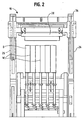
- FIG. 2 is a side view of the bale dewiring system
- FIG. 3 is a top view of the bale dewiring system
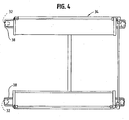
- FIG. 4 is a top view of the upper carriage
- FIG. 5 is a front view of the carriage
- FIG. 6 is a top view of the upper platen
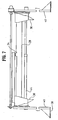
- FIG. 7 is a front view of the upper platen
- FIG. 8 is a side view of the saw assembly mounted to the saw rail
- FIG. 9 is a side view of the saw assembly
- FIG. 10 is a front view of the saw assembly mounted to the rail
- FIG. 11 is a front view of the saw assembly
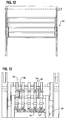
- FIG. 12 is a front view of the receiving region gate
- FIG. 13 is a side view of a winding assembly
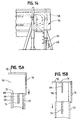
- FIG. 14 is a front view of the winding assembly
- FIGS. 15A and 15B are illustrations of the winding assembly, showing the post, sleeve, cap and connecting arm, in the loading/unloading position and the winding position, respectively.
- the direction of expansion or decompression of the bale B is in the direction of travel 22 of the bale B, i.e., along the conveyor path 24.
- expansion of the bale B is not limited by the sides 26 of the apparatus that define the conveyor path. Rather, the bale B is allowed to expand in the direction of travel 22, along the conveyor, without undue restriction by the side walls 26 of the apparatus 10.
- the upper platen 28 is moved or driven by a plurality of hydraulic cylinders 32 that "pull" the upper platen 28 downward.
- a carriage 34 carries the upper platen 28 and the four cylinders 32 drive the carriage 34 to move the upper platen 28.
- Cylinders 32 are positioned at about respective corners of the carriage 34.
- the 32 cylinder is mounted, at an upper end, to a fixed portion of the frame 36.
- a lower end of the cylinder 32 is mounted to a foot 38, to which a leg 40 of the upper platen carriage 34 is also mounted.
- the cylinder 32 retracts, it "pulls” the foot 38, raising the carriage 34, which in turn raises the upper platen 28.
- extension of the cylinder 32 "pushes” the foot 38 down, which, in turn lowers the carriage 34 and the platen 28 (which compresses the bale).
- Longitudinal side compression is accomplished by the side plates 30 that, like the upper platen 28, move toward and away from the bale B to effect the desired compression.
- the side compression plates 30 are suspended from the carriage 34 and move toward and away from one another by actuation of a drive 44.
- side plate 30 drive is effectuated by a plurality of (lateral) hydraulic cylinders 44 that move the compression plates 30 toward and away from one another.
- the lateral cylinders 44 are positioned at about the top of the carriage 34, out of the way of the bale B (i.e., out of the receiving area 14).
- the side (plate) compression is provided so that decompression of the bale B, following cutting of the wires W, occurs in a controlled manner.
- the bale B is compressed by inward movement of the side plates 30.
- the wires W are then cut and the bale B expands (decompresses) up against the side plates 30.
- the side plates 30 are subsequently reversed and moved outward in a controlled manner to allow controlled decompression (or expansion) of the bale B.
- the cutting assembly 42 is operably mounted to the upper platen 28 for (up and down) movement with the platen 28.
- the cutting assembly 42 is mounted to a bridge or rail 46 that is mounted to the upper platen 28 for traversing across the top of the dewiring apparatus 10.
- a cutting device 48 such as the illustrated saw, moves along the rail 46 transverse to the bale B, in such a manner as to traverse the bale B transverse (substantially perpendicular) to the wires W. That is, the saw 48 moves transverse to the direction of movement of the bale B in the apparatus 10 to cut the wires W that hold the bale B compressed.
- the dewiring apparatus 10 includes a sensor 50 that senses the presence of the wire W and is operably connected to a controller 86 that actuates a drive 52 to move the saw 48 downward into contact with the wire W (and the bale B) to cut the wire W.
- the saw 48 reciprocates up (out of contact with the bale B) when it is in a position other than for wire W cutting. This prevents generating unnecessary friction by maintaining the rotating saw blade 54 out of contact with the bale B when the blade 54 is not cutting wire W. This saves wear on the saw blade 54, reduces heat generation in the material and can reduce contamination and destruction of the material due to overheating and/or burning.
- the wire sensor 50 moves along the rail 46 with the saw assembly 42.
- the sensor 50 is positioned low (relative to the saw assembly 42) so that it contacts or is in close proximity to the bale B. In this manner, the sensor 50 remains close to (or on) the bale B, while the saw 48 moves up and down into and out of contact with the bale B as the blade 54 nears the wire W. Close proximity of the sensor 50 to the bale B, and eliminating the up-and-down movement of the sensor 50 permits the sensor 50 to more accurately sense the location of the baling wires W.
- the apparatus 10 includes a wire winding station 20 having a plurality of wire winding assemblies 56.
- the wire winding assemblies 56 are configured to collect the wires, into a readily handled winding (e.g., a "ball" of wire), for easy, safe handling.
- the assembly 56 also includes a retaining cap 70 and sleeve 72 that move (as a single unit) up and down on the post 58, such that the cap 70 moves into and out of engagement with the top 71 of the post 58.
- the cap 70 and sleeve 72 are connected to one another by a connecting arm 76.
- the retaining cap 70 and sleeve 72 move down so that the cap 70 is engaged with (e.g., disposed at the top 71 of) the post 58 as the wire W is wound on the post 58. This prevents the wire W from inadvertently exiting the top of (slot 66 in) the post 58.
- the retaining sleeve 72 is disposed around the post 58 and, like the post 58, includes a longitudinal slot 74.
- the sleeve 72 does not rotate with the post 58. Rather, when the wire W is being loaded onto the winding assembly 56, the retaining cap 70 and sleeve 72 are in the up or loading/unloading position (FIG. 15A). In this position, the cap 70 is raised and is spaced (upwardly) from the top 71 of the post 58. Also while in this position the sleeve 72 is up, and is longitudinally at about the same height as the post 58 (thus surrounding the post 58). In the loading/unloading position the post slot 66 and the sleeve slot 74 are aligned with one another.
- the cap 70 and sleeve 72 then move downward (FIG. 15B). This positions the cap 70 at the top of the post 58 to prevent the wire W from coming off of the post 58. This also drops the sleeve 72 from about the post 58, thus exposing the post 58. Although the sleeve 72 drops down, the wire W remains threaded through the post slot 66.
- the drive 60 is then actuated and the wire W is wound onto the post 58.
- the cap 70 and sleeve 72 move up. This raises the cap 70 from the post 58 and, at the same time, moves the sleeve 72 up about the outside of post 58, thus pushing the wound wire W up on the top or lip 88 of the sleeve 72 and off of the post 58.
- the wire W is thus set up on top of the post 58 and sleeve 72 and is readily removed. Because the wire W winds around the post 58, it forms a "ball" of wire that is safe and easy to handle and ready for disposal.
- the caps 70 and sleeves 72 from each of the assemblies 56 mounted to a common bracket 78 to move the caps 70 and sleeves 72 between the loading/unloading and winding positions together.
- the bracket 78 can be moved up and down (i.e., driven) by, for example, the exemplary cylinder 80, or like drive device.
- the entrance gate 82 is up and an operator loads the bale B into the dewiring apparatus 10. It is anticipated that the bale B will be loaded into the apparatus 10 using a forklift.
- the bale B is placed on the conveyor 12, with the wires W oriented in the direction of movement 22 of the conveyor 12.
- the winding assembly 56 is then actuated which raises the (winding assembly) guard 92, while lowering the cap 70 and sleeve 72. This positions the cap 70 on the top of the post 58 (to prevent the wire W from jumping from the post 58) and exposes the post 58.
- the drive 60 rotates to rotate the post 58 which winds the wire W onto the post 58.
- the coiled or balled wire W is then readily removed and discarded.
- the operator can then start the conveyor 12 to move the (unbaled and) loosened material from the dewiring apparatus 10 to a downstream process.
Landscapes
- Engineering & Computer Science (AREA)
- Mechanical Engineering (AREA)
- Control And Other Processes For Unpacking Of Materials (AREA)
- Basic Packing Technique (AREA)
Applications Claiming Priority (1)
| Application Number | Priority Date | Filing Date | Title |
|---|---|---|---|
| US10/930,266 US6986233B1 (en) | 2004-08-31 | 2004-08-31 | Bale dewiring system |
Publications (2)
| Publication Number | Publication Date |
|---|---|
| EP1630102A1 true EP1630102A1 (de) | 2006-03-01 |
| EP1630102B1 EP1630102B1 (de) | 2012-10-24 |
Family
ID=35311896
Family Applications (1)
| Application Number | Title | Priority Date | Filing Date |
|---|---|---|---|
| EP05013762A Expired - Lifetime EP1630102B1 (de) | 2004-08-31 | 2005-06-25 | Entdrahtungsmaschine für Ballen |
Country Status (2)
| Country | Link |
|---|---|
| US (1) | US6986233B1 (de) |
| EP (1) | EP1630102B1 (de) |
Families Citing this family (15)
| Publication number | Priority date | Publication date | Assignee | Title |
|---|---|---|---|---|
| MX2009004421A (es) * | 2006-10-27 | 2009-05-11 | Busse Sji Corp | Sistema para la remocion de tiras. |
| CN102060119A (zh) * | 2010-12-17 | 2011-05-18 | 长沙长泰机械股份有限公司 | 自动剪抽铁丝机 |
| CA2870260A1 (en) * | 2012-04-10 | 2013-10-17 | Poet Research, Inc. | Wrapping material removal method |
| FI125241B (en) * | 2013-12-23 | 2015-07-31 | Cross Wrap Oy | Device for opening a bale |
| US11066201B2 (en) * | 2014-03-29 | 2021-07-20 | C & M Baling Systems, Inc. | Baling press for cotton gin trash and other biomass feedstock and methods of using the same |
| CN104960718B (zh) * | 2015-07-03 | 2017-07-21 | 福建农林大学 | 一种化肥袋自动拆包出料装置及其使用方法 |
| US9675009B1 (en) * | 2016-03-29 | 2017-06-13 | Daniel Stirewalt | Convertible, dual mode hay feeder |
| CN108146755B (zh) * | 2018-02-13 | 2024-03-12 | 江门市博道工业自动化设备有限公司 | 一种针对捆包线缆的自动化拆捆设备 |
| DE102018211637A1 (de) * | 2018-07-12 | 2020-01-16 | Audi Ag | Vorrichtung und Verfahren zum Öffnen einer prismatischen Batteriezelle |
| EP3795483A1 (de) * | 2019-09-19 | 2021-03-24 | Primetals Technologies Germany GmbH | Automatisierte entfernung von bindebändern von einem coil |
| CN110949806A (zh) * | 2020-01-11 | 2020-04-03 | 山东矿机迈科建材机械有限公司 | 一种草捆割绳收绳机 |
| US11304372B2 (en) | 2020-02-07 | 2022-04-19 | C & M Baling Systems, Inc. | Automatic bale strapping mechanism |
| CN111169756B (zh) * | 2020-02-27 | 2024-11-01 | 内蒙古农业大学 | 一种方草捆割绳机 |
| FR3122311B1 (fr) * | 2021-04-28 | 2023-08-25 | Kuhn Audureau Sas | Procédé de préhension et d’extraction du moyen de liaison d’une botte et machine destinée à charger, défaire, distribuer et/ou transformer une telle botte et munie d’un dispositif de préhension et d’extraction |
| CN113844735B (zh) * | 2021-09-28 | 2023-06-27 | 苏州盈科电子有限公司 | 一种pe膜自动拆分割机 |
Citations (5)
| Publication number | Priority date | Publication date | Assignee | Title |
|---|---|---|---|---|
| US2820282A (en) * | 1954-08-06 | 1958-01-21 | Jack B Tropp | Apparatus for removing ties from packages |
| US3513522A (en) | 1967-04-03 | 1970-05-26 | Victor J Thomson | Unbaling machine |
| US4850087A (en) | 1987-03-12 | 1989-07-25 | B&G-Fordertechnik Gmbh | Wire-removing machine |
| US5052098A (en) * | 1989-04-18 | 1991-10-01 | J. M. Voith Gmbh | Means for removing wires from bales in particular waste paper bales |
| US6393688B1 (en) * | 1997-10-03 | 2002-05-28 | Valmet Fibertech Ab | De-wiring apparatus |
Family Cites Families (10)
| Publication number | Priority date | Publication date | Assignee | Title |
|---|---|---|---|---|
| DE2821336C2 (de) * | 1978-05-16 | 1980-07-31 | B+G-Foerdertechnik Gmbh, 5350 Euskirchen | Wickelkopf |
| DE3545659A1 (de) * | 1985-12-21 | 1987-06-25 | Voith Gmbh J M | Vorrichtung zur entfernung von bindedraehten an ballen, insbesondere rombischen altpapier- oder zellstoffballen |
| US4841619A (en) * | 1987-11-18 | 1989-06-27 | Mario Theriault | Dewiring tool |
| EP0378539A1 (de) * | 1988-07-05 | 1990-07-25 | J.M. Voith GmbH | Vorrichtung zum entfernen der durchtrennten windungen einer umreifung eines pressballens |
| DE3919222A1 (de) * | 1989-06-13 | 1990-12-20 | B & G Foerdertechnik Gmbh | Entdrahtungsmaschine |
| US5216797A (en) * | 1991-07-17 | 1993-06-08 | R. Hall Manufacturing Inc. | Method and apparatus for debanding a bale |
| US5406690A (en) * | 1992-10-26 | 1995-04-18 | Neilsen & Hiebert Systems, Inc. | Dewiring apparatus for bales |
| IL110355A (en) * | 1994-07-18 | 1999-06-20 | Ima Engineering Ltd | Apparatus for removing tie wires from bales |
| DE19520248A1 (de) * | 1995-06-02 | 1996-12-05 | Truetzschler Gmbh & Co Kg | Verfahren und Vorrichtung zur Trennung von Umreifungen, z. B. Drähte, Bänder, Bandagen und/oder Verpackung (Emballage) von Textilfaserballen |
| EP0745537B1 (de) * | 1995-06-02 | 1998-07-15 | Lamb-Grays Harbor Co. | Verfahren und Vorrichtung zum Entfernen von Drähten von Ballen aus kompressiblem Material |
-
2004
- 2004-08-31 US US10/930,266 patent/US6986233B1/en not_active Expired - Fee Related
-
2005
- 2005-06-25 EP EP05013762A patent/EP1630102B1/de not_active Expired - Lifetime
Patent Citations (5)
| Publication number | Priority date | Publication date | Assignee | Title |
|---|---|---|---|---|
| US2820282A (en) * | 1954-08-06 | 1958-01-21 | Jack B Tropp | Apparatus for removing ties from packages |
| US3513522A (en) | 1967-04-03 | 1970-05-26 | Victor J Thomson | Unbaling machine |
| US4850087A (en) | 1987-03-12 | 1989-07-25 | B&G-Fordertechnik Gmbh | Wire-removing machine |
| US5052098A (en) * | 1989-04-18 | 1991-10-01 | J. M. Voith Gmbh | Means for removing wires from bales in particular waste paper bales |
| US6393688B1 (en) * | 1997-10-03 | 2002-05-28 | Valmet Fibertech Ab | De-wiring apparatus |
Also Published As
| Publication number | Publication date |
|---|---|
| EP1630102B1 (de) | 2012-10-24 |
| US6986233B1 (en) | 2006-01-17 |
Similar Documents
| Publication | Publication Date | Title |
|---|---|---|
| US6986233B1 (en) | Bale dewiring system | |
| US2820282A (en) | Apparatus for removing ties from packages | |
| US6185900B1 (en) | Method and apparatus for stretch wrapping a load | |
| CA1327519C (en) | Batt packaging machine | |
| EP0745537B1 (de) | Verfahren und Vorrichtung zum Entfernen von Drähten von Ballen aus kompressiblem Material | |
| US6766630B2 (en) | Method and apparatus for unwrapping stretch film from a stretch wrapped palletized load | |
| EP0285607A1 (de) | Anordnung zum entfernen von bindedraht von ballen | |
| US5406690A (en) | Dewiring apparatus for bales | |
| US5163216A (en) | Wire cutting and removal method | |
| US5303460A (en) | Dewiring apparatus for bales | |
| US5421535A (en) | Method and apparatus for automatically winding scrap metallic strip material | |
| CN211391812U (zh) | 一种设有铁丝捆扎机构的全自动卧式打包机 | |
| US5079826A (en) | Wire cutting and removal apparatus | |
| CN210162305U (zh) | 一种自动编带机裁切模具 | |
| CN215205802U (zh) | 一种新型畜牧养殖用喂料装置 | |
| US6851354B2 (en) | Device for compacting matter such as packaging waste | |
| JPH07110662B2 (ja) | ベール古紙の解梱装置 | |
| WO2002001939A1 (en) | Method of harvesting energy wood, and harvesting apparatus | |
| WO1999033644A1 (en) | Apparatus for materials compaction | |
| CN217229760U (zh) | 纱筒废纱去除装置 | |
| JP4445050B2 (ja) | ベール古紙の番線巻取除去装置 | |
| CN217706393U (zh) | 一种适合野外作业的包装膜缠绕属具 | |
| CN220502270U (zh) | 一种浆粕包的抽剪钢丝装置 | |
| AU2010200096B2 (en) | Method and apparatus for stretch wrapping a load | |
| KR20250100628A (ko) | 단일 챔버 베일러 장치 및 그 장치를 사용하여 베일을 형성 및 포장하는 방법 |
Legal Events
| Date | Code | Title | Description |
|---|---|---|---|
| PUAI | Public reference made under article 153(3) epc to a published international application that has entered the european phase |
Free format text: ORIGINAL CODE: 0009012 |
|
| 17P | Request for examination filed |
Effective date: 20051219 |
|
| AK | Designated contracting states |
Kind code of ref document: A1 Designated state(s): AT BE BG CH CY CZ DE DK EE ES FI FR GB GR HU IE IS IT LI LT LU MC NL PL PT RO SE SI SK TR |
|
| AX | Request for extension of the european patent |
Extension state: AL BA HR LV MK YU |
|
| AKX | Designation fees paid |
Designated state(s): BE DE FR IT PT TR |
|
| 17Q | First examination report despatched |
Effective date: 20110630 |
|
| GRAP | Despatch of communication of intention to grant a patent |
Free format text: ORIGINAL CODE: EPIDOSNIGR1 |
|
| GRAS | Grant fee paid |
Free format text: ORIGINAL CODE: EPIDOSNIGR3 |
|
| GRAA | (expected) grant |
Free format text: ORIGINAL CODE: 0009210 |
|
| AK | Designated contracting states |
Kind code of ref document: B1 Designated state(s): BE DE FR IT PT TR |
|
| REG | Reference to a national code |
Ref country code: DE Ref legal event code: R096 Ref document number: 602005036636 Country of ref document: DE Effective date: 20121220 |
|
| PG25 | Lapsed in a contracting state [announced via postgrant information from national office to epo] |
Ref country code: BE Free format text: LAPSE BECAUSE OF FAILURE TO SUBMIT A TRANSLATION OF THE DESCRIPTION OR TO PAY THE FEE WITHIN THE PRESCRIBED TIME-LIMIT Effective date: 20121024 Ref country code: PT Free format text: LAPSE BECAUSE OF FAILURE TO SUBMIT A TRANSLATION OF THE DESCRIPTION OR TO PAY THE FEE WITHIN THE PRESCRIBED TIME-LIMIT Effective date: 20130225 |
|
| PG25 | Lapsed in a contracting state [announced via postgrant information from national office to epo] |
Ref country code: IT Free format text: LAPSE BECAUSE OF FAILURE TO SUBMIT A TRANSLATION OF THE DESCRIPTION OR TO PAY THE FEE WITHIN THE PRESCRIBED TIME-LIMIT Effective date: 20121024 |
|
| PLBE | No opposition filed within time limit |
Free format text: ORIGINAL CODE: 0009261 |
|
| STAA | Information on the status of an ep patent application or granted ep patent |
Free format text: STATUS: NO OPPOSITION FILED WITHIN TIME LIMIT |
|
| 26N | No opposition filed |
Effective date: 20130725 |
|
| REG | Reference to a national code |
Ref country code: DE Ref legal event code: R097 Ref document number: 602005036636 Country of ref document: DE Effective date: 20130725 |
|
| REG | Reference to a national code |
Ref country code: DE Ref legal event code: R119 Ref document number: 602005036636 Country of ref document: DE Effective date: 20140101 |
|
| REG | Reference to a national code |
Ref country code: FR Ref legal event code: ST Effective date: 20140228 |
|
| PG25 | Lapsed in a contracting state [announced via postgrant information from national office to epo] |
Ref country code: DE Free format text: LAPSE BECAUSE OF NON-PAYMENT OF DUE FEES Effective date: 20140101 |
|
| PG25 | Lapsed in a contracting state [announced via postgrant information from national office to epo] |
Ref country code: FR Free format text: LAPSE BECAUSE OF NON-PAYMENT OF DUE FEES Effective date: 20130701 |
|
| PG25 | Lapsed in a contracting state [announced via postgrant information from national office to epo] |
Ref country code: TR Free format text: LAPSE BECAUSE OF FAILURE TO SUBMIT A TRANSLATION OF THE DESCRIPTION OR TO PAY THE FEE WITHIN THE PRESCRIBED TIME-LIMIT Effective date: 20121024 |