EP1623196B1 - Kompensation der menschlichen wahrnemung von farben - Google Patents
Kompensation der menschlichen wahrnemung von farben Download PDFInfo
- Publication number
- EP1623196B1 EP1623196B1 EP04730257.5A EP04730257A EP1623196B1 EP 1623196 B1 EP1623196 B1 EP 1623196B1 EP 04730257 A EP04730257 A EP 04730257A EP 1623196 B1 EP1623196 B1 EP 1623196B1
- Authority
- EP
- European Patent Office
- Prior art keywords
- colour
- sample
- small
- colours
- values
- Prior art date
- Legal status (The legal status is an assumption and is not a legal conclusion. Google has not performed a legal analysis and makes no representation as to the accuracy of the status listed.)
- Revoked
Links
Images






Classifications
-
- G—PHYSICS
- G01—MEASURING; TESTING
- G01J—MEASUREMENT OF INTENSITY, VELOCITY, SPECTRAL CONTENT, POLARISATION, PHASE OR PULSE CHARACTERISTICS OF INFRARED, VISIBLE OR ULTRAVIOLET LIGHT; COLORIMETRY; RADIATION PYROMETRY
- G01J3/00—Spectrometry; Spectrophotometry; Monochromators; Measuring colours
- G01J3/46—Measurement of colour; Colour measuring devices, e.g. colorimeters
- G01J3/52—Measurement of colour; Colour measuring devices, e.g. colorimeters using colour charts
- G01J3/526—Measurement of colour; Colour measuring devices, e.g. colorimeters using colour charts for choosing a combination of different colours, e.g. to produce a pleasing effect for an observer
-
- G—PHYSICS
- G01—MEASURING; TESTING
- G01J—MEASUREMENT OF INTENSITY, VELOCITY, SPECTRAL CONTENT, POLARISATION, PHASE OR PULSE CHARACTERISTICS OF INFRARED, VISIBLE OR ULTRAVIOLET LIGHT; COLORIMETRY; RADIATION PYROMETRY
- G01J3/00—Spectrometry; Spectrophotometry; Monochromators; Measuring colours
- G01J3/46—Measurement of colour; Colour measuring devices, e.g. colorimeters
-
- G—PHYSICS
- G01—MEASURING; TESTING
- G01J—MEASUREMENT OF INTENSITY, VELOCITY, SPECTRAL CONTENT, POLARISATION, PHASE OR PULSE CHARACTERISTICS OF INFRARED, VISIBLE OR ULTRAVIOLET LIGHT; COLORIMETRY; RADIATION PYROMETRY
- G01J3/00—Spectrometry; Spectrophotometry; Monochromators; Measuring colours
- G01J3/46—Measurement of colour; Colour measuring devices, e.g. colorimeters
- G01J3/465—Measurement of colour; Colour measuring devices, e.g. colorimeters taking into account the colour perception of the eye; using tristimulus detection
Definitions
- This invention relates to a means for compensating for shifts in human perception of colour which occur when a colour initially perceived as a small colour sample (ie. a sample of only a small area, say 80mm by 80mm or smaller) is then perceived extending over a large surface area (say an area of 4m by 3m or larger) such as the surface of the wall or ceiling of a room or a large expanse of ceramics, plastics or textile material.
- a colour initially perceived as a small colour sample ie. a sample of only a small area, say 80mm by 80mm or smaller
- a large surface area say an area of 4m by 3m or larger
- the human mind perceives a small area of a coloured surface such as a small colour sample, it regards the perceived colour as being the "true" colour of the surface and such a human perception corresponds quite closely with the colour of the surface as determined by scientific instruments.
- This invention also relates to a means for compensating for shifts in human perception of colour which occur when a colour imparted to a large surface area is then perceived as a small colour sample.
- a sample 12mm by 18mm at 300mm from the eye will subtend a solid angle of about 2°. Shifts in human perception become noticeable when the solid angle increases to above 10° and the shifts become very significant when the solid angles increase beyond 20°.
- the maximum field of comfortable vision is reached at solid angles of around 90° so outer areas requiring a larger solid angle of vision will not be comfortably seen in full and such outer areas will not significantly affect the physiological perception of the colour though they can have a psychological affect.
- the second cause of the colour shift problem occurs because a colour sample of small area will be fully visible within a solid angle of vision of 2° and so will be seen using only the sensitive fovea of the human eye. If colour extending over a much larger area is to be fully observed, it will often require a solid angle of vision of over 20 and up to the maximum of about 90°. In this range of greater solid angles, peripheral vision using other portions of the retina will become important to the eye's vision of the colour. These other portions of the retina have different sensitivities and so their involvement in the vision will lead to a further shift in the physiological perception of the colour.
- the method has been found to offer a consistent way to take account of these shifts in the human perception of colour. It is also an object of this invention to provide a method for predicting such shifts in the human perception of colour. A further object is to provide apparatus for facilitating the performance of the above methods. Yet another object, is to provide an assembly of different small colour samples from which a choice of colour can be made wherein for each of the colours in the assembly, the assembly either indicates how to compensate for the shift in the human perception of the or it predicts the amount of shift to be expected or it does both.
- Colour is often defined in terms of its CIELAB lightness value, L*, its CIELAB chroma value, C* and its CIELAB hue value, h.
- CIE stands for the Commission Internationale de l'Eclairage and its CIELAB L*, C* and h values are well known and widely used.
- Lightness L*
- chroma C*
- Hue Hue
- h is a measure of how reddish, , yellowish, greenish or bluish a colour is.
- a first aspect of this invention provides an illustration means for illustrating to choosers of colour how their perception of a colour presented as a small sample of colour will shift when the colour is imparted to a large surface area
- the illustration means comprises
- the illustration means of the present invention is derived from a method which includes
- the invention has been described primarily in terms of operations performed using the lightness, chroma and hue values L*, C* and h because these values offer definitions of colour which are both precise and more easy to understand intuitively than definitions which employ other possible parameters such as the CIE tristimulus values, X Y Z, the CIE L* a* b* values, the L* u* v* values or the RGB values.
- the invention can be adapted for use with these other parameters because essentially what is needed is any precise definition of lightness and chroma. Nevertheless, the adaptation will create more complex mathematics and will require corresponding adaptations to Figures 2 , 3 and 4 .
- step b is refined by replacing step b by the following steps b(i) to b(v):
- L u * and C u * lie from 30 to 70% of the distance between the pairs of extreme values mentioned above and where possible L u * and C u * should be about equidistant between the two extremes, that is to say from 45 to 55% of the distance between the extremes. Inclusion of the above preferences results in the imparted second colour being perceived as being much closer to the true colour of the initially perceived small sample.
- the most preferred values for L u * and C u * lie respectively on curve 23 in Figure 2 and on line 33 in Figure 3 .
- the shaded areas in Figures 2 and 3 can be mapped out using a technique employing the human judgements of several observers (preferably from 5 to 15) all of whom have normal colour vision preferably to the extent that they can each pass the Ishihara colour vision test.
- a suitable mapping technique begins with imparting in turn to a large surface area a plurality (preferably 7 to 15) of different colours.
- the true (ie unshifted) CIELAB lightness and chroma values of each imparted colour will be called L u * and C u * and they should be already known or subsequently determined as explained later.
- CIELAB lightness (L s *) and chroma (C s *) values are determined by requiring each observer in turn to use his/her judgement to match their perceptions of its lightness and chroma values to the lightness and chroma values of one of a large range of possibly matching small colour samples displayed as alternatives using either a cathode ray tube monitor or a viewing cabinet.
- a suitable viewing cabinet or " colour reference box" is described by Monica Billger on pages 214 to 225 of Volume 25 No.3 of "Colour Research and Application” of June 2000 ,).
- the small colour samples displayed on the monitor should preferably extend small colour samples displayed on the monitor should preferably extend over an area of 80mm square and subtend a solid angle of not more than about 2° to the observer's eye whilst slightly larger (but still small) colour samples displayed in the viewing cabinet should preferably extend over a rectangular area 12mm by 18mm and should subtend a solid angle of not more than about 10°.
- the true lightness and chroma values for each matching small colour sample should be already known or subsequently determined.
- each observer selects from the monitor or the viewing cabinet, the small colour sample which he/she regards as the best match for his/her perception of each colour imparted to the large surface area.
- the observers make two matches for each imparted colour, one using the monitor and one using the viewing cabinet so in fact they will select two matching colours which will be very similar but seldom, if ever, exactly the same.
- the employment of human observers instead of solely scientific instruments to perform the matching enables account to be taken of the physiological and psychological factors which shift the human perception of colour.
- L s * and C s * The true lightness and chroma values of the matching small colour samples will be denoted L s * and C s * because they have been found to be extremely good approximations for the shifted lightness and chroma values of their matching imparted colours as perceived by a particular human observer.
- the arithmetic mean of all the results obtained from all the observers is determined.
- an enhanced allowance for the effects of mixed illumination should be made by repeating the above matching procedure for perceptions of the colour on more than one zone (say 3 to 7 zones) of the large surface area.
- CIELAB lightness values (L*), chroma values (C*) and hue angles (h) may be easily calculated from the measurements in cd/m 2 (candela/m 2 ) of their X, Y, Z tristimulus values made using a tele-spectroradiometer such as a Minolta CS1000 and the equations quoted earlier.
- CIELAB values are very likely to be known already because the chosen colours and/or the matching colours will often belong to one of the many established collections of small colour samples which either quote CIELAB lightness, chroma and hue values directly or give related parameters from which the CIELAB lightness and chroma values can be easily calculated.
- a further adjustment for the effects of mixed illumination can be made by reference to the shift in colour undergone by a white surface when the surface is placed in the mixed illumination.
- the white surface is assumed to have a true lightness value of essentially 100 and a true chroma value of essentially 0 and the illuminant is a reference source having tristimulus values denoted by X w , Y w and Z w .
- the tristimulus values of such a white surface will shift and, for the purposes of this description, the shifted values will be denoted as X x , Y y and Z z .
- the constant "f” is a parameter determined by mathematical optimisation during a modelling process in which numerous colours having known X, Y and Z values were selected and their X x , Y y and Z z values under two different sets of mixed illuminations were measured empirically and then the results were used to create models for the Equations 1 from which an optimum value for "f" was deduced.
- the X x , Y y and Z z values calculated according to Equations 1 can then be used instead of the X n , Y n and Z n thereby adjusting the CIELAB a* and b* values related to the shifted values L s * and C s * making possible an adjustment of L s * and C s * to take account of mixed illumination.
- the first factor is the absence of a shift in hue angle.
- the second is the high degree of agreement between different human observers in their perception of lightness and chroma.
- the third is the way in which the human eye and mind have been found to cope with variations in the intensity of illumination and the fourth is the lack of any affect on the perception small colour samples attributable to mixed illumination.
- Equation 2 can be used to predict the shifted CIELAB lightness value for that colour when imparted to a large suface area.
- Equation 2a can be used to predict and identify the small colour sample whose the lightness L ut * will be perceived as L s * when the colour of the sample is imparted to the large surface area.
- Equation 2 Substitution of preferred pairs of upper and lower values for ⁇ L and ⁇ L into Equation 2 produces upper and lower quadratic curves respectively as shown in Figure 2 which bound areas of shifted lightness values useful in the performance of this invention.
- Suitable carrier means include paper pages, cards or electronic means such as cathode ray screens.
- the carrier means also carries a sample of the small area colour adjacent the second colour.
- the first colours may be provided as displays on cathode ray screens but usually they are embodied as small area samples of colour printed on card or paper. Generally, each sample will be associated with an identification of its true colour and preferably the identification is printed on or near to the sample. For example, collections of small area samples of colours are commercially available and many have an identification of their true lightness and chroma values printed on them. The identification could be in the form of actual CIELAB lightness and chroma values as determined under standard CIE conditions, but commercially available samples will usually carry a precise translation of the colours into some more user-friendly colour-defining notation such as an NCS cypher or a Colour/Master Palette cypher or an analogous cypher.
- the carrier means may likewise be a cathode ray tube when the coloured material will be the energy sensitive coating on the screen.
- the carrier means may also be card or paper with the colour material printed on it.
- the coloured material may conveniently be associated with an identification of its shifted colour.
- the carrier means and coloured material should be adjacent the small colour sample so that an unskilled chooser can see the whole combination easily.
- the identification of the shifted colour can then be printed on the small sample colour alongside the definition of its true colour to produce a bi-notated sample. In this way, someone referring to the bi-notated sample for assistance in the choice of colour will be able to see immediately a definition of which shifted colour will be needed to offset the shift in perceived colour.
- the carrier means may carry a plurality of small colour samples each accompanied by its corresponding second colour so allowing a whole commercial range of colours to be displayed each with its corresponding second or shifted colour in for example stripe cards, a fan decks, a brochures, assemblies of ceramics or plastics plaques or books of textile samples or side by side on a cathode ray screen.
- This allows a user to see an actual small area display of the colour as it will appear on a large area and it is especially effective in alerting unskilled colour choosers to the phenomenon of the shift.
- Factory made coloured coating compositions are usually supplied in cans big enough to contain enough of the coating composition to enable a large surface area to be coated.
- Cans containing coating compositions of different colours are often formed into collections and displayed together (eg side by side) in shops or trade stores so as to offer a range of alternative selectable colours.
- This invention enables each can in such a collection to serve as a component of a carrier means carrying an illustration of the shifted colour of the paint in the can. In this way, the unskilled chooser can make a choice from shifted colours displayed on the can so never needing to be concerned with true colours.
- each can also to be marked with the true colour (when dry) of the coating composition which it contains so that the person selecting a chosen colour can be aware of the true colour if needed.
- Representations of the true and shifted colours may be carried on the cans or alternatively, a can or a portion of it may be transparent or translucent so that the colour of its contents (albeit in an undried state) is visible through the can.
- a collection may be used in combination with a collection of small area samples of the shifted colours in which the colours are identified by reference to their true lightness and chroma values.
- a modification of the arrangements described above comprises a display of a series of either small area sample colours or wholly or partially transparent cans filled with coloured materials where the second and subsequent samples in the series serve both as samples of a true colour and also as illustrations of the shifted colour for either the preceding or the following adjacent member of a series.
- a modified aid may comprise a ladder of colours where the top colour is a sample colour and the colour below it is its shifted colour. The colour below also serves as a second sample colour with the next colour down being its shifted colour and so on down the ladder.
- the bottom colour may be the lead reference colour with shifted colours being met as the ladder is ascended.
- a vertical ladder of colours is thought to be more easily understood intuitively, but the ladder could be displayed horizontally.
- the shifted colours are displayed in a schematic diagram of a room usually created on a cathode ray tube.
- Display on a cathode ray tube allows the colour to be incorporated into a computer- manipulateable digital image of a room so that a true colour can be displayed on simulated walls or ceilings and then the image can be manipulated to display the appropriate shifted colour.
- the screen should subtend a solid angle of vision of at least 20° to an observer 300 mm away.
- a second aspect of this invention provides an illustration means for illustrating to choosers of colour how their perception of a colour imparted to a large surface area will shift when the colour is presented as a small sample of colour wherein the illustration means comprises
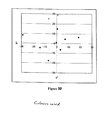
- the preferred technique for mapping the shaded areas 20 and 30 shown in Figures 2 and 3 employed a simulated room 1 as shown in Figure 1 and twelve different colours whose CIELAB a* and b* definitions are shown in Figure 6 .
- Simulated room 1 comprised an assembly of vertical planar large surface areas or "walls" 2, 3 and 4 surmounted by a horizontal planar surface or “ceiling” 5 above a horizontal planar floor 6 covered by a mid-grey carpet, not shown.
- Walls 2 and 3 were 4m long by 3m high whilst walls 4 were 3m long by 3m high. Therefore walls 2, 3 and 4 all provided surfaces of large area and in particular wall 2 subtended a solid angle of vision of greater than 50° to an observer 7.
- Simulated room 1 and especially wall 2 was illuminated by a D65 white lamp 9 positioned centrally on ceiling 5. Lamp 9 had a colour temperature of 6427K.
- Walls 2, 3 and 4 and ceiling 5 were newly painted matt white using a solvent-based alkyd paint of the type used as undercoating which therefore had a high covering power.
- the paint was allowed to dry for at least 16 hours and then each of the twelve alternative paints of different chosen chromatic or achromatic colours was painted in turn onto the white walls 2, 3 and 4.
- Ceiling 5 was left white.
- the true (ie unshifted) lightness and chroma values, L u * and C u *, of the twelve colours are given in Figures 2 and 3 respectively.
- the true (ie. unshifted) lightness and chroma values of the chosen colours and their hue angles were already known and so did not need to be determined.
- Wall 2 when painted in turn with each of the paints of a chosen colour, was notionally divided into 48 equal areas 10 which extended six high and eight lengthwise.
- the X, Y, Z tristimulus values for the colour of each area were measured using the Minolta CS1000. It was found that the areas 10 could be grouped into either 3 or 4 zones of essentially uniform colour.
- the first of the ten observers 7 (all of whom were capable of passing the Ishihara vision test for normal human colour vision) was asked to observe each of the three or four zones of wall 2 in turn and then to match his/her perception of the colour of a zone with a colour displayed on a cathode ray tube 11.
- Cathode ray tube 11 was fitted with controls 12 which permit alternative colours of different lightness, chroma and/or hue to be displayed.
- the white point of cathode ray tube 11 had been set to match the white point of lamp 9.
- Observer 7 compared the colour of the zone with alternative colours displayed on tube 11 until in his/her judgement, a matching colour was found which, was the best available match for the colour of the zone being viewed.
- the tristimulus values of the matching colour were then measured using the Minolta CS1000. These values equate with those for the colours imparted onto the walls and so they were used to calculate shifted lightness and chroma values and shifted hue angles for the imparted colours.
- the viewing cabinet displayed in turn NCS small area colour samples of A6 size whose tristimulus values were already known and which subtended a solid angle of 2° to observer 7.
- Each observer 7 viewed a zone of wall 2 and compared it with an A6 NCS colour sample on display in the box. If the colour was not already, by chance, the best available match for the perceived colour of the zone, the A6 sample was replaced by a sample whose colour was judged by the observer to be closer to the perceived colour of the zone and so on until a satisfactory available match had been found. If no NCS sample colour was found which was a satisfactory match, the two NCS sample colours judged to be nearest to the perceived colour were selected and then measured by the Minolta CS1000 to determine their tristimulus values.
- a weighted average value was calculated for each pair of tristimulus values and the weighted averages were deemed to be the tristimulus values for the perceived colour.
- weighted average is meant that if the perceived colour was judged to lie say nearer to the first colour and to lie say 25% of the distance in colour space from the first colour to the second, then the deemed values would comprise the sum of 75% of the tristimulus values of the first colour plus 25 % of the tristimulus values of the second.
- the tristimulus values of the matching colours were used to calculate shifted lightness and chroma values and shifted hue angles for the imparted colours.
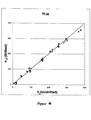
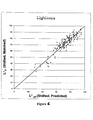
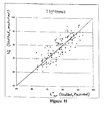
- Figure 8 shows an earlier version of Figure 2 which was obtained in exactly the same way as was Figure 2 except that only the ten colours specified in Figure 10 were used and all had a lightness values above 40. The curves obtained were less precise but Figure 11 shows a good agreement between predicted and measured shifted lightness values.
- Figure 9 likewise shows an earlier version of Figure 3 which was obtained in exactly the same way as was Figure 3 except that only the ten colours specified in Figure 10 were used and all had a chroma values above 10. Curves obtained instead of lines but Figure 12 still shows a good agreement between predicted and measured shifted lightness values.
Landscapes
- Physics & Mathematics (AREA)
- Spectroscopy & Molecular Physics (AREA)
- General Physics & Mathematics (AREA)
- Spectrometry And Color Measurement (AREA)
Claims (8)
- Veranschaulichungsmittel, um Farben auswählenden Personen zu veranschaulichen, wie sich ihre Wahrnehmung von einer Farbe, die als kleines Farbmuster präsentiert wird, verlagert, wenn die Farbe auf eine große Oberfläche übertragen wird, wobei das Veranschaulichungsmittel folgendes umfasst:a) Trägerelement,b) eine Vielzahl von Farbenpaaren, die von dem Trägerelement aufgenommen werden, und wobei jedes Paar eine erste Farbe umfasst, die als kleines Farbmuster auf dem Trägerelement vorhanden ist, und eine zweite Farbe, die als kleines Farbmuster auf dem Trägerelement vorhanden ist, wobei das zweite Farbmuster an das erste Farbmuster angrenzt, und wobeiwobei die zweite Farbe die Farbe veranschaulicht, zu der sich die erste Farbe gemäß der Wahrnehmung verlagert hat, wenn die erste Farbe auf eine große Oberfläche übertragen wurde.i) die erste und zweite Farbe in einem Paar einen ähnlichen Farbton haben,ii) das erste kleine Farbmuster einen CIELAB-Helligkeitswert von Lu* und einen CIELAB-Chromawert von Cu* hat,iii) das zweite kleine Farbmuster einen CIELAB-Helligkeitswert von Ls* und einen CIELAB-Chromawert von Cs* hat, wobei Ls* und Cs*durch die folgenden Gleichungen gegeben sind:

 wobei αL von -0,007 bis -0,0001 istβL von 0,8 bis 1,5 istαc von 1,05 bis 2,3 ist
 - Veranschaulichungsmittel, um Farben auswählenden Personen zu veranschaulichen, wie sich ihre Wahrnehmung von einer Farbe, die auf eine große Oberfläche übertragen wurde, verlagert, wenn die Farbe als kleines Farbmuster präsentiert wird, wobei das Veranschaulichungsmittel folgendes umfasst:a) Trägerelement,b) eine Vielzahl von Farbenpaaren, die von dem Trägerelement aufgenommen werden, und wobei jedes Paar eine erste Farbe umfasst, die als kleines Farbmuster auf dem Trägerelement vorhanden ist, und eine zweite Farbe, die als kleines Farbmuster auf dem Trägerelement vorhanden ist, wobei das zweite Farbmuster an das erste Farbmuster angrenzt, und wobeiwobei die Farbe des ersten kleinen Musters die Farbe simuliert, die das zweite kleine Muster gemäß der Wahrnehmung hat, wenn die zweite Farbe als kleines Muster präsentiert wird.i) die erste und zweite Farbe in einem Paar einen ähnlichen Farbton haben,ii) die zweite Farbe in dem Paar einen CIELAB-Helligkeitswert von Ls* und einen CIELAB-Chromawert von Cs* hat, die beide für die zweite Farbe bestimmt wurden, wenn sie auf eine große Oberfläche übertragen wurde,iii) die erste Farbe in dem Paar einen CIELABHelligkeitswert von Lu* und einen CIELABChromawert von Cu* hat, die beide an einem kleinen Farbmuster bestimmt wurden, und wobei Lu* und Cu* durch die folgenden Gleichungen gegeben sind:

 wobei αL von -0,007 bis -0,0001 istβL von 0,8 bis 1,5 istαc von 1,05 bis 2,3 ist
 - Veranschaulichungsmittel nach Anspruch 1 oder 2, wobei der Träger Papier oder Pappe ist, auf die Farbmuster gedruckt sind.
- Veranschaulichungsmittel nach Anspruch 1 oder 2, wobei der Träger elektronische Mittel umfasst.
- Veranschaulichungsmittel nach Anspruch 4, wobei die Farben in einer elektronischen schematischen Darstellung eines Raumes gezeigt sind.
- Veranschaulichungsmittel nach Anspruch 1 oder 2, wobei sich jede Musterfarbe an einer mit farbigem Material gefüllten Dose befindet, wobei die Dose eine Komponente einer Sammlung ist, die als das Trägerelement dient.
- Veranschaulichungsmittel nach Anspruch 6, wobei jede Dose einen transparenten oder lichtdurchlässigen Teil umfasst, durch den die Farbe des farbigen Materials sichtbar ist.
- Veranschaulichungsmittel nach Anspruch 7, wobei das farbige Material eine Beschichtungszusammensetzung ist.
Applications Claiming Priority (3)
| Application Number | Priority Date | Filing Date | Title |
|---|---|---|---|
| GB0309775 | 2003-04-30 | ||
| GBGB0326207.8A GB0326207D0 (en) | 2003-04-30 | 2003-11-11 | A method for imparting expected colour to a surface of large area |
| PCT/EP2004/004676 WO2004097353A1 (en) | 2003-04-30 | 2004-04-29 | Compensating for human perception of colour |
Publications (2)
| Publication Number | Publication Date |
|---|---|
| EP1623196A1 EP1623196A1 (de) | 2006-02-08 |
| EP1623196B1 true EP1623196B1 (de) | 2016-09-07 |
Family
ID=33420886
Family Applications (1)
| Application Number | Title | Priority Date | Filing Date |
|---|---|---|---|
| EP04730257.5A Revoked EP1623196B1 (de) | 2003-04-30 | 2004-04-29 | Kompensation der menschlichen wahrnemung von farben |
Country Status (7)
| Country | Link |
|---|---|
| US (1) | US7555160B2 (de) |
| EP (1) | EP1623196B1 (de) |
| CN (1) | CN1813173B (de) |
| BR (1) | BRPI0409835B1 (de) |
| CA (1) | CA2523275C (de) |
| GB (1) | GB0326207D0 (de) |
| WO (1) | WO2004097353A1 (de) |
Families Citing this family (11)
| Publication number | Priority date | Publication date | Assignee | Title |
|---|---|---|---|---|
| US8405868B2 (en) * | 2006-09-27 | 2013-03-26 | Andrew Jackson | Method, apparatus and technique for enabling individuals to create and use color |
| KR101213205B1 (ko) * | 2006-11-23 | 2012-12-17 | 삼성전자주식회사 | 컬러 재현 시스템 및 방법 |
| JP5029187B2 (ja) * | 2007-07-20 | 2012-09-19 | 株式会社ニコン | 色座標変換装置、撮像装置、色座標変換プログラム、色座標変換方法 |
| GB2451430A (en) * | 2007-07-27 | 2009-02-04 | Ici Plc | Colour display |
| GB201000835D0 (en) | 2010-01-19 | 2010-03-03 | Akzo Nobel Coatings Int Bv | Method and system for determining colour from an image |
| WO2012065037A1 (en) * | 2010-11-12 | 2012-05-18 | Colormodules Inc. | Method and system for color matching and color recommendation |
| CN103344338B (zh) * | 2013-07-04 | 2014-11-19 | 北京印刷学院 | 不同色差等级彩色样品的色差评价及计算方法 |
| US9204018B2 (en) * | 2014-01-21 | 2015-12-01 | Carbon Objects, Inc. | System and method of adjusting the color of image objects based on chained reference points, gradient characterization, and pre-stored indicators of environmental lighting conditions |
| JP6402480B2 (ja) * | 2014-04-30 | 2018-10-10 | 株式会社リコー | 色見本、該色見本の作成装置および作成方法、並びに、該色見本を用いる画像処理システム |
| WO2018045040A1 (en) | 2016-08-30 | 2018-03-08 | The Kalidas Corporation | Optical device for enhancing human color vision |
| CN111324986A (zh) * | 2020-02-17 | 2020-06-23 | 北京印刷学院 | 优化色样集获取方法及装置,色域指数获取方法及装置 |
Citations (2)
| Publication number | Priority date | Publication date | Assignee | Title |
|---|---|---|---|---|
| WO1999039982A2 (de) | 1998-02-09 | 1999-08-12 | Jokey Plastik Wipperfürth GmbH | Farbdose |
| EP1371572A2 (de) | 2002-05-09 | 2003-12-17 | Imperial Chemical Industries PLC | Farbbehälter |
Family Cites Families (12)
| Publication number | Priority date | Publication date | Assignee | Title |
|---|---|---|---|---|
| JP2000514548A (ja) * | 1996-05-10 | 2000-10-31 | アプライド、サイエンス、フィクション、インコーポレーテッド | 輝度優先色センサ |
| US6023525A (en) * | 1997-10-23 | 2000-02-08 | Xerox Corporation | Determining an optimal color space direction for selecting color modulations |
| JP4234281B2 (ja) * | 1998-10-22 | 2009-03-04 | ゼロックス コーポレイション | プリントシステム |
| US6894806B1 (en) * | 2000-03-31 | 2005-05-17 | Eastman Kodak Company | Color transform method for the mapping of colors in images |
| CN2458609Y (zh) * | 2000-12-28 | 2001-11-07 | 黄黎敏 | 色觉定量检测仪 |
| DE50112268D1 (de) * | 2001-02-09 | 2007-05-10 | Imaging Solutions Ag | Digitale lokale Bildeigenschaftssteuerung mittels Masken |
| JP3876650B2 (ja) * | 2001-06-06 | 2007-02-07 | 日本電気株式会社 | 色補正パラメータ算出装置、画像色補正装置及びそれに用いる色補正パラメータ算出方法並びにそのプログラム |
| JP2004005566A (ja) * | 2002-04-23 | 2004-01-08 | Matsushita Electric Ind Co Ltd | 色編集装置および色編集方法 |
| GB0413956D0 (en) * | 2004-06-22 | 2004-07-28 | Ici Plc | A colour display system |
| US7388656B2 (en) * | 2005-12-30 | 2008-06-17 | Yan Liu | Method and system for color grading of gemstones |
| WO2008001290A1 (en) * | 2006-06-27 | 2008-01-03 | Koninklijke Philips Electronics N.V. | Color navigation system |
| US8906154B2 (en) * | 2006-11-09 | 2014-12-09 | Sun Chemical Corporation | Coating, ink, or article comprising multi-colored lustrous pearlescent pigments |
-
2003
- 2003-11-11 GB GBGB0326207.8A patent/GB0326207D0/en not_active Ceased
-
2004
- 2004-04-29 EP EP04730257.5A patent/EP1623196B1/de not_active Revoked
- 2004-04-29 WO PCT/EP2004/004676 patent/WO2004097353A1/en not_active Ceased
- 2004-04-29 BR BRPI0409835-8A patent/BRPI0409835B1/pt active IP Right Grant
- 2004-04-29 CA CA2523275A patent/CA2523275C/en not_active Expired - Fee Related
- 2004-04-29 CN CN2004800182343A patent/CN1813173B/zh not_active Expired - Lifetime
-
2005
- 2005-10-28 US US11/261,034 patent/US7555160B2/en not_active Expired - Lifetime
Patent Citations (2)
| Publication number | Priority date | Publication date | Assignee | Title |
|---|---|---|---|---|
| WO1999039982A2 (de) | 1998-02-09 | 1999-08-12 | Jokey Plastik Wipperfürth GmbH | Farbdose |
| EP1371572A2 (de) | 2002-05-09 | 2003-12-17 | Imperial Chemical Industries PLC | Farbbehälter |
Non-Patent Citations (23)
| Title |
|---|
| "Bei Traurigkeit sehen wir Farben anders", XP055496354, Retrieved from the Internet <URL:www.scinex.de/wissen-aktuell-19270-2015-09-03.tml> |
| "Blau ist die beliebteste Farbe der Menschen", 22 August 2007 (2007-08-22), XP055496319, Retrieved from the Internet <URL:https://www.delt.de/wissenschaft/article1125637/Blau-ist-die-beliebteste-Farbe-derMenschen.html> |
| "Colour is in the eye of the beholder", Retrieved from the Internet <URL:https://vimeo.com/120808489> |
| "Die Grosse Schwarz-Blau-Gold-Verwirrung", 27 February 2015 (2015-02-27), pages 1 - 6, XP055496316, Retrieved from the Internet <URL:http://www.spiegel.de/wissenschaft/mensch/erklaerung-fuer-unterschiedliche-farben-auf-kleid-a-1020891.html> |
| "Farbwahrnehmung Gehirn färbt Bananen blau", SPIEGEL ONLINE, 16 October 2006 (2006-10-16), XP055496331, Retrieved from the Internet <URL:http://www.spiegel.de/wissenschaft/mensch/farbwahrnehmung-gehirn-faerbt-bananen-bau-2-442800.html> |
| "Lab-Farbraum", WIKIPEDIA, 12 May 2017 (2017-05-12), XP055388242, Retrieved from the Internet <URL:https://de.wikipedia.org/wiki/Lab-Farbraum> |
| "Wahrnehmungsphysiologie", 19 July 2016 (2016-07-19), XP055496321, Retrieved from the Internet <URL:https://de.wikipedia.org/w/index.php?title=Wahrnehmungsphysiologie&oldid=156298660> |
| "Wahrnehmungspsychologie", 13 December 2017 (2017-12-13), XP055496320, Retrieved from the Internet <URL:https://de.wikipedia.org/w/index.php?title=Wahrnehmungsphysiologie&oldid=156298660> |
| ANONYM: "Ein Kleid spaltet die Welt Die grosse Schwarz-Blau-Gold-Verwirrung", 27 February 2015 (2015-02-27), XP055496316, Retrieved from the Internet <URL:http://www.spiegel.de/wissenschaft/mensch/erklaerung-fuer-unterschiedliche-farben-auf-kleid-a-1020891.html> |
| ANONYM: "Falunrot", 16 April 2018 (2018-04-16), XP055496339, Retrieved from the Internet <URL:https://www.wikipedia.org/wiki/Falunrot> [retrieved on 20180517] |
| ANONYM: "Farbharmonien, Farbkontraste, Farbklänge", 17 April 2001 (2001-04-17), pages 1 - 6, XP055496241, Retrieved from the Internet <URL:https://web.archive.org/web/20010417225728/htp://www.darmstadt.gmd.de:80/~crueger/farbe/farb-harm.html#kontrast> |
| ANONYMOUS: "Pantone Colour Swatches #100 - #1615", 20 November 2002 (2002-11-20), pages 1 - 8, XP055496228 |
| ANONYMOUS: "PANTONE DS-C", 18 November 1999 (1999-11-18) |
| BERND GRAHL: "How do Namibian Himbas see colour?", 2 September 2016 (2016-09-02), XP055496349, Retrieved from the Internet <URL:https://www.gondwana-collection.com/blog/how-do-namibian-himbas-see-colour/> |
| DATABASE Pubmed JAINT ET AL.: "Gender based alteration in color perception", XP055496323, Database accession no. 21675035 |
| GERHARZ: "WIE WIR FARBEN WAHRNEHMEN", XP055496375, Retrieved from the Internet <URL:http://ueberzeuoend-praesentieren.de/blog/wie_wir_farben_wahmehmen.html> [retrieved on 20180530] |
| HARALD KÜPPERS: "Harmonielehre der Farben", 1989, ISBN: 978-3-7701-2192-2, pages: 138 - 144, XP055496230 |
| INGRID CRÜGER: "Farbentheorie und Farbgestaltung", 2002, pages 1 - 54, XP055496232 |
| K.XIAO ET AL.: "Specifying the Colour Appearance of a Real Room", 11TH COLOR IMAGING CONFERENCE, COLOR SCIENCE & ENG.SYSTEMS, TECHNOLOGIES AND APPLICATIONS, 3 November 2003 (2003-11-03), pages 308 - 312, XP002293731 |
| KARIN FRIDELL ANTER: "What colour is the red house?", PERCEIVED COLOUR OF PAINTED FACADES, 2000, Stockholm, Schweden, XP055388260 |
| M. RONNIER LUO ET AL.: "Quantifying Colour Appearance", LUTCHI RESEARCH CENTER, 1991, pages 166, XP055388245 |
| MATT LIBERMAN: "Du Glaubst, diese Erdbeeren sind rot? Falsch", 27 February 2017 (2017-02-27), XP055496335, Retrieved from the Internet <URL:http://www.bento.de/haha/optische-taeuschung-diese-roten-erdbeeren-sind-gar-nicht-rot-1215719 > |
| MONICA BILLGER: "Evaluation of Colour Reference Box as an Aid for Identification of Colour Appearance in Rooms", COLOR RESEARCH AND APPLICATION, vol. 25, no. 3, 1999, pages 214 - 225, XP008020106 |
Also Published As
| Publication number | Publication date |
|---|---|
| BRPI0409835B1 (pt) | 2017-12-19 |
| BRPI0409835A (pt) | 2006-04-25 |
| CA2523275C (en) | 2013-07-02 |
| US20060164663A1 (en) | 2006-07-27 |
| WO2004097353A1 (en) | 2004-11-11 |
| CN1813173B (zh) | 2012-05-09 |
| GB0326207D0 (en) | 2003-12-17 |
| CN1813173A (zh) | 2006-08-02 |
| EP1623196A1 (de) | 2006-02-08 |
| CA2523275A1 (en) | 2004-11-11 |
| US7555160B2 (en) | 2009-06-30 |
Similar Documents
| Publication | Publication Date | Title |
|---|---|---|
| Gulrajani | Colour measurement: principles, advances and industrial applications | |
| Luo et al. | The structure of the CIE 1997 colour appearance model (CIECAM97s) | |
| Fairchild et al. | Time course of chromatic adaptation for color-appearance judgments | |
| Arend Jr et al. | Simultaneous color constancy: papers with diverse Munsell values | |
| CA2754188C (en) | Method for managing metamerism of color merchandise | |
| US7555160B2 (en) | Compensating for human perception of colour | |
| JP2003202267A (ja) | 合成着色料の色を電子ディスプレー上に再現する方法及び装置 | |
| EP1761748B1 (de) | Farbanzeigesystem zur hilfe bei der auswahl und kombination von farben | |
| Setchell Jr | Colour description and communication | |
| Kim | The influence of parametric effects on the appearance of small colour differences | |
| JP2834437B2 (ja) | 表色系変換方法 | |
| Ayama et al. | Whiteness perception under different types of fluorescent lamps | |
| Green-Armytage | Seven kinds of colour | |
| Perales et al. | Analysis of the colorimetric properties of goniochromatic colors using the MacAdam limits under different light sources | |
| Shaw | Evaluating the 1931 CIE color matching functions | |
| Albertazzi et al. | How much blue is turquoise? How much red is purple? Interaction of colors and backgrounds. | |
| Robertson | Recent CIE work on color difference evaluation | |
| Xu et al. | Effect of Printed Color Sample Separation and Color-Difference Magnitude on Perceived Color Difference | |
| Imai | Color reproduction of facial pattern and endoscopic image based on color appearance models | |
| Hirschler | Visual and instrumental evaluation of whiteness and yellowness | |
| Wandell et al. | Color appearance in images measurements and musings | |
| Taylor | Color spaces: Language and framework for color | |
| Alfvin | A Computational analysis of observer metamerism in cross-media color matching | |
| Design et al. | Farginstitutet• | |
| McDonald | Color Communication in the 90s. |
Legal Events
| Date | Code | Title | Description |
|---|---|---|---|
| PUAI | Public reference made under article 153(3) epc to a published international application that has entered the european phase |
Free format text: ORIGINAL CODE: 0009012 |
|
| 17P | Request for examination filed |
Effective date: 20051130 |
|
| AK | Designated contracting states |
Kind code of ref document: A1 Designated state(s): AT BE BG CH CY CZ DE DK EE ES FI FR GB GR HU IE IT LI LU MC NL PL PT RO SE SI SK TR |
|
| DAX | Request for extension of the european patent (deleted) | ||
| 17Q | First examination report despatched |
Effective date: 20060927 |
|
| RAP1 | Party data changed (applicant data changed or rights of an application transferred) |
Owner name: IMPERIAL CHEMICAL INDUSTRIES LIMITED |
|
| RAP1 | Party data changed (applicant data changed or rights of an application transferred) |
Owner name: AKZO NOBEL COATINGS INTERNATIONAL B.V. |
|
| GRAP | Despatch of communication of intention to grant a patent |
Free format text: ORIGINAL CODE: EPIDOSNIGR1 |
|
| INTG | Intention to grant announced |
Effective date: 20160404 |
|
| GRAS | Grant fee paid |
Free format text: ORIGINAL CODE: EPIDOSNIGR3 |
|
| GRAA | (expected) grant |
Free format text: ORIGINAL CODE: 0009210 |
|
| AK | Designated contracting states |
Kind code of ref document: B1 Designated state(s): AT BE BG CH CY CZ DE DK EE ES FI FR GB GR HU IE IT LI LU MC NL PL PT RO SE SI SK TR |
|
| REG | Reference to a national code |
Ref country code: GB Ref legal event code: FG4D |
|
| REG | Reference to a national code |
Ref country code: CH Ref legal event code: EP |
|
| REG | Reference to a national code |
Ref country code: IE Ref legal event code: FG4D |
|
| REG | Reference to a national code |
Ref country code: AT Ref legal event code: REF Ref document number: 827291 Country of ref document: AT Kind code of ref document: T Effective date: 20161015 |
|
| REG | Reference to a national code |
Ref country code: DE Ref legal event code: R096 Ref document number: 602004049909 Country of ref document: DE |
|
| REG | Reference to a national code |
Ref country code: NL Ref legal event code: FP |
|
| PG25 | Lapsed in a contracting state [announced via postgrant information from national office to epo] |
Ref country code: FI Free format text: LAPSE BECAUSE OF FAILURE TO SUBMIT A TRANSLATION OF THE DESCRIPTION OR TO PAY THE FEE WITHIN THE PRESCRIBED TIME-LIMIT Effective date: 20160907 |
|
| REG | Reference to a national code |
Ref country code: AT Ref legal event code: MK05 Ref document number: 827291 Country of ref document: AT Kind code of ref document: T Effective date: 20160907 |
|
| PG25 | Lapsed in a contracting state [announced via postgrant information from national office to epo] |
Ref country code: GR Free format text: LAPSE BECAUSE OF FAILURE TO SUBMIT A TRANSLATION OF THE DESCRIPTION OR TO PAY THE FEE WITHIN THE PRESCRIBED TIME-LIMIT Effective date: 20161208 Ref country code: ES Free format text: LAPSE BECAUSE OF FAILURE TO SUBMIT A TRANSLATION OF THE DESCRIPTION OR TO PAY THE FEE WITHIN THE PRESCRIBED TIME-LIMIT Effective date: 20160907 Ref country code: SE Free format text: LAPSE BECAUSE OF FAILURE TO SUBMIT A TRANSLATION OF THE DESCRIPTION OR TO PAY THE FEE WITHIN THE PRESCRIBED TIME-LIMIT Effective date: 20160907 |
|
| REG | Reference to a national code |
Ref country code: FR Ref legal event code: PLFP Year of fee payment: 14 |
|
| PG25 | Lapsed in a contracting state [announced via postgrant information from national office to epo] |
Ref country code: RO Free format text: LAPSE BECAUSE OF FAILURE TO SUBMIT A TRANSLATION OF THE DESCRIPTION OR TO PAY THE FEE WITHIN THE PRESCRIBED TIME-LIMIT Effective date: 20160907 Ref country code: EE Free format text: LAPSE BECAUSE OF FAILURE TO SUBMIT A TRANSLATION OF THE DESCRIPTION OR TO PAY THE FEE WITHIN THE PRESCRIBED TIME-LIMIT Effective date: 20160907 |
|
| REG | Reference to a national code |
Ref country code: DE Ref legal event code: R026 Ref document number: 602004049909 Country of ref document: DE |
|
| PG25 | Lapsed in a contracting state [announced via postgrant information from national office to epo] |
Ref country code: CZ Free format text: LAPSE BECAUSE OF FAILURE TO SUBMIT A TRANSLATION OF THE DESCRIPTION OR TO PAY THE FEE WITHIN THE PRESCRIBED TIME-LIMIT Effective date: 20160907 Ref country code: BG Free format text: LAPSE BECAUSE OF FAILURE TO SUBMIT A TRANSLATION OF THE DESCRIPTION OR TO PAY THE FEE WITHIN THE PRESCRIBED TIME-LIMIT Effective date: 20161207 Ref country code: PT Free format text: LAPSE BECAUSE OF FAILURE TO SUBMIT A TRANSLATION OF THE DESCRIPTION OR TO PAY THE FEE WITHIN THE PRESCRIBED TIME-LIMIT Effective date: 20170109 Ref country code: PL Free format text: LAPSE BECAUSE OF FAILURE TO SUBMIT A TRANSLATION OF THE DESCRIPTION OR TO PAY THE FEE WITHIN THE PRESCRIBED TIME-LIMIT Effective date: 20160907 Ref country code: SK Free format text: LAPSE BECAUSE OF FAILURE TO SUBMIT A TRANSLATION OF THE DESCRIPTION OR TO PAY THE FEE WITHIN THE PRESCRIBED TIME-LIMIT Effective date: 20160907 Ref country code: AT Free format text: LAPSE BECAUSE OF FAILURE TO SUBMIT A TRANSLATION OF THE DESCRIPTION OR TO PAY THE FEE WITHIN THE PRESCRIBED TIME-LIMIT Effective date: 20160907 |
|
| PLBI | Opposition filed |
Free format text: ORIGINAL CODE: 0009260 |
|
| PG25 | Lapsed in a contracting state [announced via postgrant information from national office to epo] |
Ref country code: IT Free format text: LAPSE BECAUSE OF FAILURE TO SUBMIT A TRANSLATION OF THE DESCRIPTION OR TO PAY THE FEE WITHIN THE PRESCRIBED TIME-LIMIT Effective date: 20160907 |
|
| 26 | Opposition filed |
Opponent name: DAW SE Effective date: 20170529 |
|
| PLAX | Notice of opposition and request to file observation + time limit sent |
Free format text: ORIGINAL CODE: EPIDOSNOBS2 |
|
| PG25 | Lapsed in a contracting state [announced via postgrant information from national office to epo] |
Ref country code: DK Free format text: LAPSE BECAUSE OF FAILURE TO SUBMIT A TRANSLATION OF THE DESCRIPTION OR TO PAY THE FEE WITHIN THE PRESCRIBED TIME-LIMIT Effective date: 20160907 |
|
| PG25 | Lapsed in a contracting state [announced via postgrant information from national office to epo] |
Ref country code: SI Free format text: LAPSE BECAUSE OF FAILURE TO SUBMIT A TRANSLATION OF THE DESCRIPTION OR TO PAY THE FEE WITHIN THE PRESCRIBED TIME-LIMIT Effective date: 20160907 |
|
| PLBB | Reply of patent proprietor to notice(s) of opposition received |
Free format text: ORIGINAL CODE: EPIDOSNOBS3 |
|
| REG | Reference to a national code |
Ref country code: CH Ref legal event code: PL |
|
| REG | Reference to a national code |
Ref country code: IE Ref legal event code: MM4A |
|
| PG25 | Lapsed in a contracting state [announced via postgrant information from national office to epo] |
Ref country code: MC Free format text: LAPSE BECAUSE OF FAILURE TO SUBMIT A TRANSLATION OF THE DESCRIPTION OR TO PAY THE FEE WITHIN THE PRESCRIBED TIME-LIMIT Effective date: 20160907 |
|
| PG25 | Lapsed in a contracting state [announced via postgrant information from national office to epo] |
Ref country code: CH Free format text: LAPSE BECAUSE OF NON-PAYMENT OF DUE FEES Effective date: 20170430 Ref country code: LI Free format text: LAPSE BECAUSE OF NON-PAYMENT OF DUE FEES Effective date: 20170430 Ref country code: LU Free format text: LAPSE BECAUSE OF NON-PAYMENT OF DUE FEES Effective date: 20170429 |
|
| REG | Reference to a national code |
Ref country code: FR Ref legal event code: PLFP Year of fee payment: 15 |
|
| PG25 | Lapsed in a contracting state [announced via postgrant information from national office to epo] |
Ref country code: IE Free format text: LAPSE BECAUSE OF NON-PAYMENT OF DUE FEES Effective date: 20170429 |
|
| REG | Reference to a national code |
Ref country code: DE Ref legal event code: R064 Ref document number: 602004049909 Country of ref document: DE Ref country code: DE Ref legal event code: R103 Ref document number: 602004049909 Country of ref document: DE |
|
| RDAF | Communication despatched that patent is revoked |
Free format text: ORIGINAL CODE: EPIDOSNREV1 |
|
| STAA | Information on the status of an ep patent application or granted ep patent |
Free format text: STATUS: THE PATENT HAS BEEN GRANTED |
|
| PG25 | Lapsed in a contracting state [announced via postgrant information from national office to epo] |
Ref country code: HU Free format text: LAPSE BECAUSE OF FAILURE TO SUBMIT A TRANSLATION OF THE DESCRIPTION OR TO PAY THE FEE WITHIN THE PRESCRIBED TIME-LIMIT; INVALID AB INITIO Effective date: 20040429 |
|
| PGFP | Annual fee paid to national office [announced via postgrant information from national office to epo] |
Ref country code: NL Payment date: 20190426 Year of fee payment: 16 |
|
| PGFP | Annual fee paid to national office [announced via postgrant information from national office to epo] |
Ref country code: DE Payment date: 20190429 Year of fee payment: 16 |
|
| RDAG | Patent revoked |
Free format text: ORIGINAL CODE: 0009271 |
|
| STAA | Information on the status of an ep patent application or granted ep patent |
Free format text: STATUS: PATENT REVOKED |
|
| PGFP | Annual fee paid to national office [announced via postgrant information from national office to epo] |
Ref country code: FR Payment date: 20190425 Year of fee payment: 16 Ref country code: BE Payment date: 20190429 Year of fee payment: 16 |
|
| 27W | Patent revoked |
Effective date: 20190312 |
|
| GBPR | Gb: patent revoked under art. 102 of the ep convention designating the uk as contracting state |
Effective date: 20190312 |
|
| PGFP | Annual fee paid to national office [announced via postgrant information from national office to epo] |
Ref country code: GB Payment date: 20190429 Year of fee payment: 16 |
|
| PG25 | Lapsed in a contracting state [announced via postgrant information from national office to epo] |
Ref country code: CY Free format text: LAPSE BECAUSE OF FAILURE TO SUBMIT A TRANSLATION OF THE DESCRIPTION OR TO PAY THE FEE WITHIN THE PRESCRIBED TIME-LIMIT Effective date: 20160907 |
|
| PG25 | Lapsed in a contracting state [announced via postgrant information from national office to epo] |
Ref country code: TR Free format text: LAPSE BECAUSE OF FAILURE TO SUBMIT A TRANSLATION OF THE DESCRIPTION OR TO PAY THE FEE WITHIN THE PRESCRIBED TIME-LIMIT Effective date: 20160907 |