EP1761748B1 - Farbanzeigesystem zur hilfe bei der auswahl und kombination von farben - Google Patents
Farbanzeigesystem zur hilfe bei der auswahl und kombination von farben Download PDFInfo
- Publication number
- EP1761748B1 EP1761748B1 EP05747166A EP05747166A EP1761748B1 EP 1761748 B1 EP1761748 B1 EP 1761748B1 EP 05747166 A EP05747166 A EP 05747166A EP 05747166 A EP05747166 A EP 05747166A EP 1761748 B1 EP1761748 B1 EP 1761748B1
- Authority
- EP
- European Patent Office
- Prior art keywords
- hue
- colour
- blocks
- colours
- block
- Prior art date
- Legal status (The legal status is an assumption and is not a legal conclusion. Google has not performed a legal analysis and makes no representation as to the accuracy of the status listed.)
- Expired - Lifetime
Links
Images


Classifications
-
- G—PHYSICS
- G01—MEASURING; TESTING
- G01J—MEASUREMENT OF INTENSITY, VELOCITY, SPECTRAL CONTENT, POLARISATION, PHASE OR PULSE CHARACTERISTICS OF INFRARED, VISIBLE OR ULTRAVIOLET LIGHT; COLORIMETRY; RADIATION PYROMETRY
- G01J3/00—Spectrometry; Spectrophotometry; Monochromators; Measuring colours
- G01J3/46—Measurement of colour; Colour measuring devices, e.g. colorimeters
- G01J3/52—Measurement of colour; Colour measuring devices, e.g. colorimeters using colour charts
-
- G—PHYSICS
- G02—OPTICS
- G02B—OPTICAL ELEMENTS, SYSTEMS OR APPARATUS
- G02B26/00—Optical devices or arrangements for the control of light using movable or deformable optical elements
- G02B26/007—Optical devices or arrangements for the control of light using movable or deformable optical elements the movable or deformable optical element controlling the colour, i.e. a spectral characteristic, of the light
- G02B26/008—Optical devices or arrangements for the control of light using movable or deformable optical elements the movable or deformable optical element controlling the colour, i.e. a spectral characteristic, of the light in the form of devices for effecting sequential colour changes, e.g. colour wheels
-
- G—PHYSICS
- G02—OPTICS
- G02B—OPTICAL ELEMENTS, SYSTEMS OR APPARATUS
- G02B26/00—Optical devices or arrangements for the control of light using movable or deformable optical elements
- G02B26/02—Optical devices or arrangements for the control of light using movable or deformable optical elements for controlling the intensity of light
- G02B26/023—Optical devices or arrangements for the control of light using movable or deformable optical elements for controlling the intensity of light comprising movable attenuating elements, e.g. neutral density filters
Definitions
- This invention relates to a colour display system for aiding the selection and combination of colours in colour scheming.
- the ICI Paints Colour and Contrast guide recommends colours schemes based on the principles of the Colour wheel combined with maintaining similar tonal purity for the proposed choices.
- the ICI Eye for Colour system also measures a colour and then recommends a single contrasting hue and two harmonising hues, each at a number of lightness values.
- Colour wheels are a 2-dimensional representation of colours that have a fixed relationship to colours with which they co-ordinate. Colours are represented in a progression of hues around a circle. Usually only the most saturated colour available is shown, but these very bright colours are only used infrequently for interior decorating. Some wheels show other less saturated colours of the same hue in progressively smaller segments towards the centre. However, these are generally show only a few colours, typically 60, or use very small colour representations.
- Such a system comprises a two-dimensional array of colour sample elements in the form of areas of colour coating on strips of card.
- the cards are arranged in blocks which are, in turn, arranged in a grid of horizontal rows and vertical columns.
- the colours of the colour elements, their arrangements on the strips, the arrangement of the strips and blocks are such that, typically, there is a progression of hue in one direction in the array and a progression of tonal purity in an orthogonal direction.
- Such a system offers advantages over colour wheels since colour wheels make ineffective use of their coated surface area.
- the system also offers advantages over a computerised system in that a multiplicity of users can use the system simultaneously and colour reproduction can be controlled tightly.
- Such a system allows a large number of colour sample elements to be viewed simultaneously and in an ordered arrangement.
- unskilled users find the systems to be of limited use in selecting combinations of colours that appeal to the eye of the average person.
- US2004046802 describes a colour display system having colour samples arranged in parallel lines according to their associated hue and chromacity properties and in a series of hue increments in the direction of rows, and in a series of lightness increments in the orthogonal direction.
- a colour display system for aiding the selection and combination of colours in colour scheming, wherein: the system comprises an array of colour sample elements each of a respective colour, the elements being grouped in discrete blocks according to hue, chromaticity and lightness; the colour sample elements of each block all have colours which are within a hue range respective to that block and which have predetermined chromaticity and lightness properties associated with that block; the blocks are arranged in at least 3 parallel lines according to their associated chromaticity and lightness properties such that all of the blocks in each line have similar or the same respective associated chromaticity and lightness properties; each line contains M blocks, where 6 ⁇ M ⁇ 12, which are arranged in a hue range sequence along the line; within each block the colour sample elements are arranged in a series of hue increments in the direction of the said lines and corresponding to the sequence of the hues of the elements in the visible spectrum, and in a series of lightness increments such that lightness increases in the orthogonal direction; and
- the hue range sequence along each line corresponds to the sequence of the hue ranges in the visible spectrum such that the array contains M parallel non-overlapping hue range segments in a direction orthogonal to the lines.
- the lines are horizontally oriented rows and the hue range segments comprise vertically oriented columns in the array.
- any first block in any one of the rows there is another, second, block which has a conformity of at least 75%, based on a reference colour wheel having n sectors of equal angle which map onto the CIELAB colour space as mapped sectors of unequal angles which, between a first angular range of 140 and 230 degrees Hue in the CIELAB colour space, have an average subtended angle per sector of (2 ⁇ 0.2)360/ n degrees in the CIELAB colour space.
- the maximum angle subtended by any of the mapped sector of the CIELAB colour space is that of a sector lying between 150 and 220 degrees Hue.
- conformity means a parameter quantifying the degree to which elements of a first block of elements in an array of colour elements combine with elements of a second block of elements in the array, the parameter being as calculated in (a) and (b) below.
- the third angular range includes steps 29 to 44 (corresponding to about five degrees to 70 degrees Hue CIELAB, with the maximum occurring in steps 31, 32 or 33 (i.e. between about 13 degrees and 27 degrees Hue CIELAB).
- the remaining steps subtend angles having an average which is such that the total of all subtended angles of the mapped sectors sum to 360 degrees in the CIELAB colour space.
- hue angles subtended by the mapped sectors vary progressively rather than in a series of discontinuities around the CIELAB colour space.
- n is advantageously an integer divisible by six and/or eight, and is at least six.
- One preferred value is 48.
- the number of blocks in each line is preferably seven or eight, with no more than two blocks encompassing a hue angle range of at least 140 degrees Hue in the CIELAB colour space, this range including the 255 degree and 313 degree CIELAB hues.
- the hue ranges of the individual blocks in each line are of equal angular extent on the reference colour wheel.
- the hue ranges of the individual blocks in each line are of unequal angular extent on the reference colour wheel with, e.g., the angular extent of the hue range of one of the blocks of the line being at least 1.5 times the angular extent of the hue range of at least one of the other blocks of the line.
- the average person's perception of colour is such that they are particularly sensitive to and aware of differences in hue in the yellow region of the visible spectrum, especially when compared to, for instance, the green and blue regions when hues are measured against one of the established colour definition standards such as the CIELAB colour space.
- the observation that the average person tends to prefer contrasting colour combinations from opposing sectors of a colour wheel is, in itself, of uncertain and, therefore, limited use in devising an improved aid to colour scheming because there are a number of different colour wheels.
- the system set out above takes account of these factors and other observations relating to how people react to different colour combinations in providing a particular arrangement of colour sample elements in an array is defined in terms of an established colour measurement standard. The result is a reduction in the need for skill in achieving successful combinations over a wide range of colours. This is done while still providing the user with latitude in the selection process.
- the blocks are arranged in at least 3 parallel lines, and the lightness and chromaticity properties of the colours of the colour sample elements in the at least 3 lines conform to the following conditions (i), (ii) and (iii) respectively:
- the zone of colours meeting condition (iii) may be divided into, e.g., two groups of different chromaticities such that, in one group, the colours have a higher chromaticity than the colours of the same hue and lightness in the other group.
- the blocks are arranged in at least 4 parallel lines in the array.
- the colours falling under condition (i) may be termed “Vibrant”, and those falling under condition (ii) may be termed “Fresh”.
- those with higher chromaticity may be termed “Warm” and those with lower chromaticity “Calm”.
- the colours within each block may be arranged such that lightness increases consistently in one direction, and that hue increases consistently in an orthogonal direction. It is not essential that every available hue increment or slice is represented in each block, nor that all the hue increments represented in a block are equally represented. However, it is desirable that the hue differences between hue slices within a block are less than 15 degrees. It is also preferred that within each hue increment at least two lightness levels are available and preferably four or more as this enables more choice of monochromatic schemes within a block.
- Coloured items here include, for example, coving, wall coverings, paving slabs, tiles, floor coverings (including carpets), fabrics (particularly furnishing fabrics and curtains), furniture, soft furnishings and blinds.
- paint and to “painting”.
- the term here is used broadly to include coatings, in particular paints, varnishes and lacquers, and their application. These coatings can be ready-made or produced from tinting systems in-store. A collection of tinters produced according to the principles of this invention is also included within its scope.
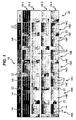
- a colour display system in accordance with the invention for aiding the selection and combination of colours in colour scheming comprises a two dimensional array 10 of colour sample elements 12 which are each of a respective colour.
- colour sample elements 12 which are grouped in 28 discrete blocks according to hue, chromaticity and lightness.
- the colour sample elements 12 of each block 14 all have colours which are within a hue range respective to that block and which have predetermined chromaticity and lightness properties associated with that block 14.
- the blocks 14 are arranged in 4 parallel rows 16 according to their associated chromaticity and lightness properties such that all the blocks 14 in each row 16 have similar or the same respective associated chromaticity and lightness properties.
- each row 16 contains seven blocks 14 which are arranged in a hue range sequence along the row 16, extending from a first block 14A at one end of the row containing elements based on red hues through to a seventh block 14G at the other end of the row, containing elements based on violet hues.
- the blocks 14B to 14F between the two end blocks 14A, 14G have elements based respectively on orange, gold, yellow, green and blue hues, arranged in the order in which these hues appear in the visible spectrum.
- the array 10 of colour sample elements contains seven parallel non-overlapping hue range segments 18A to 18G, each running in a direction orthogonal to the four rows 16, and appearing as vertical columns in the array 10.
- the display system shown in Figure 1 does not consist solely of the array 10 of 28 blocks 14 arranged as described above.
- the system also includes an auxiliary array 20 of four blocks containing colour sample elements of neutral colours, arranged as a group of blocks extending in the vertical direction. Accordingly, references to the colour sample elements and blocks above are references to elements and blocks of the first-mentioned array 10 alone, and do not include the elements and blocks of the auxiliary array 20.
- the colour sample elements 12 are arranged in a series of hue increments in the direction of the rows 16, the increments being arranged in a hue sequence corresponding to the hue sequence of the hues in the visible spectrum, and in a series of lightness increments (i.e. lightness) such that lightness increases in a downward vertical direction within each block.
- the colour sample elements 12 produce a progressive change of hue in accordance with the visible spectrum in the horizontal direction.
- the juxtaposition of the lightest elements along the bottom line of each of the three uppermost rows with the darkest elements, respectively, of the blocks below serves to emphasise the divisions of the array into rows.
- the boundaries between the blocks 14A to 14G in each row are emphasized by guide cards 22 placed between the blocks, each illustrating an example of colour scheming using colours from the adjacent block.
- the array comprises a number of colour elements 12 in which each colour appears only once in the array and the range of colours used is spread throughout the colour space, e.g. the colour space defined by the known CIELAB colour space in which hues are defined as angles in a cylindrical co-ordinate system.
- different numbers of colour elements may be used, typically between 600 and 2000.
- the sample elements are divided into blocks 14 and, as will be seen from Figure 1 , the blocks 14 are arranged in a grid pattern. Within each block, the elements themselves are arranged in a grid pattern. As will be explained below, the position of the blocks, and the boundaries of the blocks in colour space produce certain properties in the arrangement of colour sample elements that allow the system to be used as a colour guide to assist colour scheming choices.
- the system allows users to focus on a selection of colours that co-ordinate well with an initial selected colour.
- This choice may be performed in a series of steps from an initial grouping of between 150 and 500 colours, down to a group of 50 to 100 colours. This is achieved by dividing the colour space into subsets of colour space of colours or zones, as exemplified by the rows 16. Colours are assigned to particular zones according to the relationship between chromaticity as a function of Y value, compared to the chromaticity and Y value of the most chromatic colour of that hue which can be typically reproduced.
- zones of colours are further subdivided into smaller subsets, which are the blocks 14A to 14G.
- Colours are assigned to a particular block within a zone, dependent on their hue.
- the blocks 14A to 14G are then arranged in a two dimensional array such that the allocation of each block is determined by the zone, and by the hue range of the block.
- each block can be related to another block in a simple way to allow selection of colours which co-ordinate attractively. This selection can be particularly successfully achieved by choosing the angular ranges of the hues in each block in a manner described below and by arranging for the blocks to meet particular statistical criteria (hereinafter referred to as "conformity") based on a predetermined reference colour wheel.
- Colour scheming may therefore be based on interrelated blocks within the array 10 based on principles that involve a geometrical relationship between an ideal combination and actual position (even for cases where the number of blocks 14 per zone to row 16 is odd). If the number of blocks per zone is odd, as in the case of the embodiment described above with reference to Figure 1 , the array is particularly easy and intuitive to use, because an uneven distribution of hue increments from one block 14 to another allows simple and familiar terms to be used in instructing the user. The specific version described above with reference to Figure 1 allows an optimum number of colours per block 14 to facilitate colour scheming.
- the blocks 14 are separated from other blocks 14 by a space or a line within the array 10, allowing guidance as to the use of the system to be located between the blocks, as described above, in the form of, for instance, colour scheming guide cards 22.
- the colour sample elements are on strips of card oriented vertically alongside each other in the block.
- the cards may be removed for comparison against articles and other colour sample elements.
- Each strip preferably contains colour sample elements 12 of only one hue increment.
- the two dimensional array 10 may be presented to the observer horizontally for use on a desk top, or as a vertical arrangement to be viewed from a standing position. The latter is preferred because it offers scope for larger colour representations.
- the blocks 14 of colour sample elements 12 correspond to irregular polygons in colour space defined in mathematical form as boundaries made up of curves defined in terms of lightness, and chromaticity for a small angular range of Hue angle, and a Hue Segment bounded by a maximum and minimum hue.
- the manner in which the boundaries are set determines the usefulness of the array as a guide to colour coordination.
- Two factors are used to determine the boundaries.
- One factor relates to hue, and the way that hues may be combined to form the most attractive combinations in interior decoration.
- the other factor relates to lightness, chromaticity and the relationship between them, and how colours of similar tonal purity combine to form colour schemes. Applying both of these factors simultaneously to form an arrangement of colours in blocks allows users to focus their attention on a manageable group of colours while also enabling them explore a large number of potential colour combinations.
- Hue is the quality of a colour that we describe as the colour of the rainbow or visible spectrum, that is, the property of the colour that is independent of lightness or chromaticity.
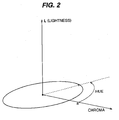
- the Hue Angle defines the hue component as the angular coordinate in a polar co-ordinate system around an achromatic lightness or reflectance axis Y or L, where zero degrees Hue is the a axis.
- zero degrees Hue in the CIELAB colour space corresponds approximately to the colour magenta.
- the hues pass through red, orange, yellow (at 90 degrees Hue also the b axis), green, turquoise, blue and violet, the violet region extending to 360 degrees Hue which corresponds to zero degrees Hue, forming the complete hue circle.
- a hue slice in colour space is a sector of colour space, containing colours of various undefined lightness and chromaticity, but within narrow angular ranges of hue.
- the slice subtends a hue angle of between 5 and 15 degrees.
- any colour within the array 10 can be defined against the international standard represented by the CIELAB colour space.
- a technique by which colours can be measured and, therefore, defined in the CIELAB colour space is set out in Appendix A hereto.
- Each block 14 in the array 10 is made up of a series of equivalent colour zones corresponding to the rows 16 which form annular spaces around the Y axis of colour space, through consecutive hue slices.
- colour space within a hue slice, can be divided into a number of zones, such that the differences between these zones within the same hue slice relate to the depth and greyness of the colours contained within the zones. It has been found that if colour space is divided into hue slices, and that all of the hue slices are then divided into zones using the method described, colours from a single zone or equivalent zones, of whatever hue, look attractive together. This has been demonstrated in colour displays that group a wide selection of colours within a zone, in horizontal bands, where hue progresses from one end of the display to another.
- the hues are grouped into the blocks 14 within each zone, and hue blocks are separated from neighbouring hue blocks within the same zone by a clearly visible space containing instructions on the use of the guide.
- the purpose of the space or line is to make it clear that the blocks are separate from each other.
- Blocks containing colours within similar hue ranges but in different zones are distinguishably different because either they are separated by a space or line or because of a sharp contrast in lightness, in an arrangement where lightness increases or decreases in a direction orthogonal to the hue progression.
- Colours within each zone are separated into the hue blocks 14 in a similar manner, so that once a hue block 14 has been identified in one zone as having a specific hue range, blocks 14 consisting of the same hue range can be identified in each of the other zones.
- the blocks 14 are arranged in a grid such that in one moving from block to block in one direction allows the user to find similar colours that are contained within the same zone but are different in hue, while moving from block to block in an orthogonal direction allows to user to find colours within that hue range but having different lightness and/or chromaticity characteristics.
- Colour scheming may be performed, firstly, within a block 14.
- hue slices are also grouped using the manner described, into recommended hue bands, blocks of colours are formed such that any two or more colours selected from within that block co-ordinate well together in either a monochromatic or harmonious colour scheme.
- the colours within a block contain a range of lightness and chromaticity values, consistent with its zone.
- the majority of the blocks 14 have 54 colour sample elements 12. In one row, there are 36 elements 12.
- the blocks of arrays used in systems in accordance with the invention contain between 20 and 100 colour sample elements, and preferably more than 48 elements.
- Colour scheming between the blocks is based on a property of the described system which is that for each block 14, there will be a corresponding opposing block 14 in the same zone or row 16 such that the vast majority of colours from the first block form very good combinations based on contrasting and split colour schemes when used with the vast majority of colours from the opposing block. For example, if a colour is selected from one of the yellow blocks 14D, the vast majority of colours in the violet block 14G in the same row 16 form a good combination with the yellow colour. The same will be true of any colour selected from the yellow block in question. Similar pairings are achieved between other blocks in each row, based on the fact that the distribution of hues horizontally in the array 10 is a transformation of the distribution of hues around a predetermined reference colour wheel. Thus, given that research has shown that good contrasting and split colour schemes arise by choosing colours from opposing sectors of the predetermined reference colour wheel, corresponding pairings of blocks can be used in the manner just described to produce successful combinations.
- Step1 Identify by visual inspection the column 18A - 18G blocks 14A - 14G having the same broadly general hue as a key colour. This narrows the number of colours from 1386 down to about 200. (In general terms, other embodiments of the invention result in a reduction from between 50 to 200 down to 80 to 200.)
- Step 2 From the group of blocks identified in Step 1,identify by visual inspection the block that has similar tonal purity to the key colour. This block will contains 36 or 54 elements 24-100) in the general case.
- Step 3 By visual inspection, scanning horizontally along the row of the more chromatic colours within the block selected in step 2, identify the colours of similar hue to the key colour. Typically this subset of the colours within the block contains a group of 4-18 colours.
- Step 4 By visual inspection scanning vertically the subset of colours identified in Step 3,identify from colour or group of colours of the nearest lightness. Typically this identifies 1-3 colours.
- Step 5 By visual inspection identify the colour of nearest chromaticity, lightness and hue to the original colours from the small group identified in step 4.
- Step 6 Examine the row of blocks indicated as containing elements of the same tonal zone as the block selected in step 2. This group of typically 150 to 500 elements will go well with the key control elements.
- Step 7 Examine the elements within the block identified in Step 2. This group of typically 24 to 100 colours will co-ordinate particularly well with the original colour forming either monochromatic or harmonising colour schemes.
- Step 8 Identify and locate the opposing block using guidance given in a guide text grouping blocks in pairs.
- the colours within this block will co-ordinate particularly well with the original colour in the block identified in Step 2 in contrasting or split colour schemes. Typically this represents 24-100 colours
- Step 1 Identify the block of elements most representing the area of colours envisaged as forming a basis for a particular colour scheme.
- Step 2 Examine the elements within the block identified in the previous step. This group of typically 24 to 100 colours will co-ordinate particularly well with any other colour in the group forming either a monochromatic or harmonising colour schemes.
- Step 3 Identify and locate the opposing block using the guidance given in the guide text.
- the rows 16 each represent a particular zone in colour space, with respective chromaticity and lightness characteristics. These are explained in more detail below with reference to Figure 1 .
- this zone contains strong colours, including colours of maximum saturation for that hue, colours close to that colour, and colours that are mixtures of the maximum saturation colours for that hue, and black (i.e., "shades"). Colours that are virtually achromatic with very little white are generally rated Vibrant (Black is Vibrant); however, the boundary varies with hue. Colours falling into this zone according to its associated criteria are classed as Vibrant and are excluded from the other zones even if they meet the criteria associated with those other zones. Accordingly, the Vibrant criteria override those of the other zones.
- This zone contains colours that are close to the maximum saturation available at that lightness level, but that are lighter than the most saturated colour available at that hue. Such colours are sometimes referred to as "tints". Accordingly, if the chromaticity is above a maximum value calculated for the lightness and hue in question, the colour lies in this zone unless it meets the overriding criteria of zone 16-1.
- This zone contains colours that are not contained within the other zones 16-1, 16-2, 16-4. They are intermediate in chromaticity at a given lightness. It follows that if the chromaticity is above a minimum value for zone 16-4, and below the maximum chromaticity value referred to above in connection with zone 16-2, the colour will lie in the Warm zone unless its parameters fall within the overriding criteria for zone 16-1 (Vibrant).
- colours have low chromaticity for their lightness level but are not necessarily achromatic, but does not contain the very deepest low saturation colours that have very little or no white content.
- the chromaticity of a colour is below a minimum value calculated for its lightness and hue, the colour will lie in this calm zone unless its rated Vibrant according to the overriding criteria (lacking white) referred to above.
- the colours in the Warm and Calm zones may be referred to as "tones”.
- the hue boundaries of the blocks 14 are defined in terms of Hue Steps on a reference colour wheel using the following method. Although it is not essential that the hue boundaries are the same across all the lightness and chromaticity zones, it is preferred that they are because it allows the user of the guide to locate any given colour more quickly within the array. (A transformation from Hue angles in CIELAB space to the Hue Steps referred to above is performed because the CIELAB hue circle does not represent an appropriate basis for reliable colour combination.)
- the hue increments of the array may map onto the hue steps of the reference colour wheel linearly or non-linearly.
- hue increments In the array of Figure 1 there are 63 hue increments and 22 colour sample elements per increment. (In the general case there may be 12 to 150 elements per increment.) They are grouped into blocks of the array so as to meet "conformity" criteria, as will be explained in more detail below. Within each block the hue increments may be distributed evenly or unevenly in terms of their distribution on the reference colour wheel.
- the reference colour wheel is divided into an even number n of sectors such that when the most saturated colours available of each hue are arranged in order of hue equidistantly around the circumference of a circle (the reference colour wheel), colours lying opposite each other form the best contrasting colour combination and the difference in hue angle between any two adjacent colours on the circumference is no more than 1.5* 360/ n degrees Hue, n may be divisible by 6 or 8, preferably both, giving a preferred value of 48.
- the Hues chosen include pure yellow, that is the most saturated colour having a CIELAB Hue angle between 88 degrees and 92 degrees.
- the ranges of hues included in the ith Hue Step (on the reference colour wheel) corresponding to the ith colour around the wheel are determined as follows, H i being the ith hue of the wheel expressed in degrees, where 1 ⁇ i ⁇ n .
- N is the number of Hue steps in the colour wheel and M is the number of blocks per zone.
- M is the number of blocks per zone.
- I represents the number of any given hue step around the reference colour wheel
- j is the number of any given block 14 along the array 10.
- d(j) the number of hue steps in each block.
- M is an even number
- d(j) n /M.
- n and M are chosen such that n /M is an integer, but this is not essential.
- D is chosen so that hue step 1 does not appear at the edge of a block, and is ideally situated close to the centre of a block. It is also preferred that D is chosen such that it does not appear in Block 1 or Block M. It is also preferred that the block opposing the block containing pure yellow does not form block 1 or block M. This is because colours in the block containing yellow are generally frequently specified
- the opposing block is fully aligned, and easily identified where J ⁇ M/2, the opposing block is simply J+ M/2, where J> M/2, the opposing block is simply j-M/2.
- the reference colour wheel is selected to reflect the average person's impressions as to which colour combinations represent successful colour schemes, based on research and observation using hues from the complete visible spectrum.
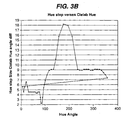
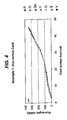
- the mapping of the hue steps of the reference colour wheel into CIELAB hue angles is shown in Figures 3A and 3B . Generalisations of the transformation represented by these curves are contained hereinabove and in the claims.
- colours having a hue with a given hue angle may, according to research and observation, be successfully matched in a contrasting or split colour scheme with colours whose hues lie within a sector of the reference colour wheel located generally oppositely (i.e. centred on a 180 degree opposite location) on the wheel.
- the preferred angular deviation is ⁇ 30 degrees on the reference colour wheel.
- Alternative deviations are possible, e.g. ⁇ 20 degrees or ⁇ 45 degrees, depending on the closeness of the match required.
- a value of 12 allows a very high degree of conformity, since all colours within a block or sector fall within one zone, and are within n /12 hue steps. Also, all colours in a sector or block J will fall within 5n /12 - 7n /12 hue steps of the initially selected hue step, ensuring contrasting and split colour schemes.
- Too many colours in the array 10 prevent the system being a practical size or having colour representations of adequate size.
- An array containing 4 zone types and 12 blocks per zone type provides a total of 48 blocks. If the colour range reproduced contains 480 colours, this will only permit 10 colours per block. Even if 1200 colours are displayed, there will be only 25 colours per block. It is therefore beneficial to have fewer blocks, as the vast majority of colours still meet the criteria of combinations shown in the 12 hue block per row array.
- having fewer blocks allows the user to identify immediately colour groupings with simple colour terms such as red, orange, green, and so on.
- the array may have an odd number of blocks per row/zone.
- the hue step ranges for each block can be calculated as before, but using the variable value of (j). It is, therefore, possible to use an odd number of blocks while still achieving a high level of conformity. Conversely, using such a degree of variation with an even number of blocks was found to produce lower levels of conformity, than using equal blocks.
- Unequal blocks are of special interest where the colour popularity in one hue area is very different from that in another, or where one hue area exhibits a very rapid transition in terminology, owing to the average persons' greater sensitivity to and awareness of hue differences in the corresponding part of the reference colour wheel. For example, hues that are relatively close to yellow are termed green or orange, whereas hues close to pure blue are still termed as blue.
- an array based on an odd number of colour blocks where the colour block containing pure yellow has a hue step range approximately half of the hue step range of the block most nearly opposing it, tends to be more easily understood and more useful, even though arrays based on even numbers of blocks are easier to form.
- Hue step Y-3 can be orange, hue step Y-2 red toned yellow, hue step Y-1 Yellow, hue Step Y Yellow, hue Step Y+1 Yellow, hue step Y+2 green toned yellow, and hue step Y+3 lime green.
- the colours recognised as green extend over 9 or 10 hue steps, partly because blue/greens are generally described in terms of green or blue rather than as a separate universally recognised colour area. Even though the allocation of the hue steps to hue angles can partly rectify this issue, attempting to allocate too many hue steps in the yellow area distorts the relationships of the colour wheel in other areas.
- Example 1 In the arrangement of Example 1 to be described first, an array is provided having rows (referred to interchangeably below as “rows” or “zones") of stripe cards arranged in blocks (referred to interchangeably below as “sectors” or “blocks”) as previously described, but where the numbers of stripe cards in each sector is not equal to the split of the colour wheel steps.
- the number of colour wheel steps on the reference colour wheel is 48 as previously described, but the total number of stripe cards is 45.
- the reference colour wheel used in this and the following examples is the reference colour wheel described previously.
- the table above sets out the number of stripe cards in the array of Example 1 to be described, and in which blocks they are disposed.
- blocks of stripe cards having the following colours: reds (R), oranges (O), golds (Go), yellows (Y), greens (G), blues (B), and violets (V), in that order from the left of the array.
- the second column of the table indicates the number of cards in each block (e.g. the gold block has 6 cards), and the third column the number of steps on the reference colour wheel over which the colours in that block are spread (e.g. the colours in the violet block are spread over 10 steps of the reference colour wheel).
- the fourth column gives the hue angle with reference to the CIELAB colour wheel (note, not the reference colour wheel) of the starting angle of the sector of the CIELAB wheel covered by the block (here, the "starting angle” is the most anti-clockwise boundary of the sector), and the fifth column gives the starting step on the reference colour wheel of the sector of the reference colour wheel covered by the block. Finally, the last column gives the finishing step of the reference colour wheel for each sector. Note that the reference wheel colour sectors for each block are inclusive of the starting and finishing steps shown in the fifth and sixth columns, as well as all steps in between.
- the above table relates to each row in the array of Example 1, for the reason that in example 1 a block in the same column but a different row (or zone) contains colours of the same hue range as another block in the same column, but with different luminance and chrominance values.
- luminance and chrominance changes can produce different zones of colours with different tonal properties but the same hue.
- the tables below set out the hue, chrominance, and luminance values of the colours on the left most stripe card and the right most stripe card in each block, for each zone. It should be understood that the colours present on other stripe cards in a block would possess hue, luminance and chrominance values within the ranges established by the shown values.
- the hue values given are hue angles on the CIELAB colour wheel
- the light reflectance values are based on the CIELAB TriStimulus Y value with a scale of 0 - 100 (with 0 being black, and 100 being white)
- the chromaticity values are CIELAB chromaticity values, again with a scale of 0 -100 (with 0 being least, and 100 being the most).
- Hue is an attribute of visual sensation according to which an area appears to be similar to one of or to proportions of two of the perceived colours red, green yellow and blue.
- the quantitative measure of this attribute is hue angle, H .
- Chroma is the sparkleness of an area judged in proportion to the brightness of a similarly illuminated area that appears to be white.
- each block of six represents the colours on one stripe card, and the position of the blocks of values in the table corresponds to the row of the array to which the values relate.
- the above table represents the red blocks.
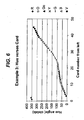
- the colours of the other stripe cards in any particular block fall within the ranges represented in the tables above. This is shown in the table below, which gives the CIELAB hue angle for each card, counted in each row from the left (the count is irrespective of the block to which a card belongs). Note that in this example, as apparent from the tables above, the colours on any particular stripe card all have the same hue, and vary in luminance and chromaticity.
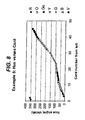
- the next table below shows the relationship between card number (again counted along a row from the left) and the step on the reference colour wheel to which a card relates. It will be seen that although there are only 45 cards and 48 steps on the preferred reference colour wheel, by missing some steps out it is possible to cover the whole wheel. Moreover, in some instances the same step is also used for more than one card. Even with such design choices, however, the conformance characteristics can still be met, as will be shown later.
- conformance is a measure of the degree to which the hue angles of colours in a block are within a predetermined range of the 180 degree opposite colour on the colour reference wheel, and is preferably calculated as described previously.
- conformance is also possible to find the ratio of the number of card combinations which fall within the predetermined angle range to the number of possible card combinations. This is shown in the matrix below, for a comparison of the red and green blocks noted above (here, the red and green sectors on the reference colour wheel are almost opposite).
- the upper matrix shows the difference in reference colour wheel steps between the hue steps on the reference colour wheel of the red block colour cards (steps 28 to 33 as shown), and the hue steps on the reference colour wheel of the green block colour cards (steps 3 to 9). Note that step 3 is repeated twice, as it is the hue of two colour cards in the green block. Given that the reference colour wheel is preferably divided into 48 steps, a 24 step difference between two steps indicates that those steps are substantially opposite on the reference colour wheel.
- the lower matrix is a representation of the difference matrix obtained by applying the acceptable range value for conformity to the difference value.
- two cards are considered to be in conformity if their hue values are within 24 +/_ 4 steps of each other i.e. between 20 to 28 steps of each other. Therefore, the lower matrix represents the difference matrix with a windowing function applied thereto, the windowing function being that if the difference value lies in the range then 20 to 28, then conformity is achieved and the value is replaced by a one. If outside this range the difference value is replaced by a 0.
- the number of 1's in the lower matrix is added up, and the ratio taken of the obtained sum against the total number of entries in the matrix.
- the ratio is 42/48, or 0.875, to give a conformity value of 87.5%. Note that this is the conformity value just between the red and green blocks.
- the violet block is the block with the highest conformity with the yellow block, and hence guidance should be given on the array that when selecting a yellow as a first colour then a violet gives contrasting colours, when selecting the contrasting colour to a violet colour, the block with the highest conformity value should be chosen as the recommendation i.e. in this case the gold block.
- the recommendation i.e. in this case the gold block.
- the number of stripe cards in each row 48 ie the same as the number of steps on the reference colour wheel.
- the lightness and chroma values which define the different zones are arranged differently from example 1: in particular, compared to example 1, this example shows that it is not the number of cards in each sector but the divisions of the sectors that affects the resulting conformity value.
- the above table sets out the number of cards in each block, reference colour wheel steps, hue angle, and lowest and highest reference wheel step for the second example, in the same manner as described previously for Example 1.
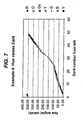
- the next table below shows the relationship between card number (again counted along a row from the left) and the step on the reference colour wheel to which a card relates. It will be seen that because there are 48 cards, no steps on the colour wheel need be missed, and there is a one to one correspondence between cards and steps.
- Example 2 Table of Colour Wheel Step verses Card Number from Left Card R O Go Y G B V 1 27 2 28 3 29 4 30 5 31 6 32 7 33 8 34 9 35 10 36 11 37 12 38 13 39 14 40 15 41 16 42 17 43 18 44 19 45 20 46 21 47 22 48 23 1 24 2 25 3 26 4 27 5 28 6 29 7 30 8 31 9 32 10 33 11 34 12 35 13 36 14 37 15 38 16 39 17 40 18 41 19 42 20 43 21 44 22 45 23 46 24 47 25 48 26
- the violet block has been matched against the gold and yellow blocks, but instead the yellow block has the higher conformity (35/40 for yellow, versus 35/50 for gold).
- the yellow block should be recommended for matching against the violet block, Generally, where there is a choice of two or more blocks to match against a block, the block with the highest conformity should be chosen.
- the above table sets out the number of cards in each block, reference colour wheel steps, hue angle, and lowest and highest reference wheel step for the third example, in the same manner as described previously for Example 1.
- the above table sets out the number of cards in each block, reference colour wheel steps, hue angle, and lowest and highest reference wheel step for the fourth example, in the same manner as described previously for Example 1.
- data for three rows are given.
- the first row of data is the same as the same as the second row in Example 5
- the second row is the same as the second row in Example 3
- the third row is the same as the fourth row in Example 1.
- Conformity values can be calculated from the data given in the previous examples from which the above data is taken, as shown in the table below:- Conformity Example 5 Zone 1 0.805 Example 3 Zone2 0.813 Example 1 Zone3 0.816 0.811333
- any colour display array within the scope of the invention regardless of the particular reference colour wheel used.
- any particular reference wheel used which depicts acceptable contrasting colours in approximate 180 degree opposition to each other is by definition a product of prevailing fashion and artistic appreciation which specify that particular contrasting colours look good together.
- To select colours for any particular block in an array can be performed by generally dividing up the steps of the reference colour wheel into the number of blocks in a row, and allocating hues to each block accordingly.
- the number of stripe cards in a block can differ dependent upon the general colour to be displayed in a block, to take into account factors such as popularity of a colour and human sensitivity to colours, as discussed previously. This leads to different blocks in a row accounting for more or less steps on the reference colour wheel then other blocks in the same row.
- artistic and marketing reasons may mean that some colours are placed within blocks that detract from achieving optimal conformity.
- conformity calculations as described above can be performed to calculate the conformity of the selection, with changes then being made on an iterative basis to obtain a desired conformity value.
- Such changes can take into account the scientific bases for achieving an optimal conformity as described herein, as well as artistic and marketing reasons for choosing a particular colour.
- the lower the level of conformity value desired and the angle range over which substantially opposing hues are said to conform dictates the degree of freedom with which colours can be chosen, with a higher conformity value and smaller angle reducing the degree of freedom, for any particular reference colour wheel.
- Colour standards can be measured using a DataColor Spectraflash instrument such as the Spectraflash 500 or Spectraflash 600 models. The measurement is made with Specular component included.
- the tristimulus (XYZ) values are calculated for illuminant D65 using 10 degree Observer data.
- Visual Basic functions may be used to calculate CIELab LABCH values from XYZ values, as follows:
Landscapes
- Physics & Mathematics (AREA)
- Spectroscopy & Molecular Physics (AREA)
- General Physics & Mathematics (AREA)
- Optics & Photonics (AREA)
- Astronomy & Astrophysics (AREA)
- Spectrometry And Color Measurement (AREA)
- Liquid Crystal (AREA)
- Illuminated Signs And Luminous Advertising (AREA)
- Optical Filters (AREA)
- Indication In Cameras, And Counting Of Exposures (AREA)
- Color Electrophotography (AREA)
- User Interface Of Digital Computer (AREA)
- Processing Of Color Television Signals (AREA)
- Processing Or Creating Images (AREA)
- Train Traffic Observation, Control, And Security (AREA)
- Devices For Indicating Variable Information By Combining Individual Elements (AREA)
Claims (29)
- System zur Farbdarstellung für die Unterstützung der Auswahl und Kombination von Farben bei der Farbabstimmung, dadurch gekennzeichnet, dass:das System einen Array (10) von Farbprobenelementen (12) von jeweils einer Farbe umfasst, wobei die Elemente nach ihrem Buntton, ihrer Chromatizität und ihrer Helligkeit in separaten Blöcken (14) gruppiert sind,die Farbprobenelemente eines jeden Blocks alle Farben haben, die innerhalb eines Bunttonbereichs des betreffenden Blocks liegen und die mit diesem Block assoziierte, vorher festgelegte Chromatizitäts- und Helligkeitseigenschaften haben,die Blöcke gemäß ihren assoziierten Chromatizitäts- und Helligkeitseigenschaften in wenigstens 3 parallelen Reihen (16) so angeordnet sind, dass alle der Blöcke in jeder Reihe jeweils ähnliche oder gleiche assoziierte Chromatizitäts- und Helligkeitseigenschaften haben,jede Reihe M Blöcke enthält, wobei 6 ≤ M ≤ 12 ist, die in einer Abfolge von Bunttonbereichen entlang der Reihe angeordnet sind,innerhalb eines jeden Blocks die Farbprobenelemente in einer Reihe von Bunttoninkrementen in der Richtung der genannten Reihen und entsprechend der Abfolge ihrer Bunttonwinkel im CIELAB-Farbraum und in einer Reihe von Helligkeitsinkrementen so angeordnet sind, dass die Helligkeit in orthogonaler Richtung zunimmt, undder Winkelbereich der Bunttöne in jedem Block, wie er vom CIELAB-Farbraum definiert wird, bezüglich der Größe zwischen den Blöcken so variiert, dass die Blöcke, die den 90-Grad-CIELAB-Buntton enthalten, einen Bunttonwinkelbereich von der Hälfte oder weniger als der Hälfte der Größe des Bunttonwinkelbereichs der Blöcke haben, die den 270-Grad-CIELAB-Buntton enthalten.
- System gemäß Anspruch 1, wobei die Abfolge der Bunttonbereiche entlang jeder Reihe der Abfolge der Bunttonbereiche im sichtbaren Spektrum entspricht, sodass der Array M parallele, nicht überlappende Bunttonbereichsegmente enthält, die alle in einer Richtung orthogonal zu den Reihen verlaufen.
- System gemäß Anspruch 2, wobei die Reihen horizontal ausgerichtete Reihen sind und die Bunttonbereichsegmente vertikal ausgerichtete Reihen umfassen.
- System gemäß Anspruch 3, wobei es für jeden ersten Block in jeder der Reihen einen weiteren, zweiten Block gibt, der eine Konformität, wie sie hier zuvor definiert wurde, von wenigstens 75 % hat, basierend auf einem Referenzfarbrad mit n Sektoren von gleichem Winkel, die auf dem CIELAB-Farbraum als abgebildete Sektoren mit ungleichen Winkeln abgebildet sind, die, in einem ersten Winkelbereich zwischen dem 140- und dem 230-Grad-Buntton im CIELAB-Farbraum, einen durchschnittlichen gegenüberliegenden Winkel pro Sektor von (2 ± 0,2)360/n Grad im CIELAB-Farbraum haben.
- System gemäß Anspruch 4, wobei der Maximalwinkel, dem irgendeiner der abgebildeten Sektoren im CIELAB-Farbraum gegenüber liegt, derjenige eines Sektors ist, der zwischen dem 150- und dem 220-Grad-Buntton liegt.
- System gemäß Anspruch 4 oder Anspruch 5, wobei in einem zweiten Winkelbereich zwischen 78 und 98 Grad im CIELAB-Farbraum die abgebildeten Sektoren einen durchschnittlichen gegenüberliegenden Winkel pro Sektor von (0,4 ± 0,04)360/n Grad haben.
- System gemäß einem beliebigen der Ansprüche 4 bis 6, wobei in einem dritten Winkelbereich zwischen dem 1- und dem 79-Grad-Buntton im CIELAB-Farbraum die abgebildeten Sektoren einen durchschnittlichen gegenüberliegenden Winkel pro Sektor von (0,65 ± 0,06)360/n Grad haben.
- System gemäß Anspruch 7, wobei die abgebildeten Sektoren im dritten Winkelbereich einen maximalen gegenüberliegenden Winkel von oder in der Gegend von 20 Grad an Bunttönen im CIELAB-Farbraum aufweisen.
- System gemäß einem beliebigen der Ansprüche 4 bis 8, wobei n eine durch 6 und/oder 8 teilbare ganze Zahl ist und wenigstens 36 ist.
- System gemäß einem beliebigen der Ansprüche 4 bis 9, wobei die Konformität bei wenigstens 80 % liegt.
- System gemäß einem beliebigen der Ansprüche 4 bis 10, wobei die bevorzugte Winkelabweichung für die Berechnung der Konformität bei ± 30 Grad auf dem Referenzfarbrad liegt.
- System gemäß einem beliebigen der vorhergehenden Ansprüche, wobei M 7, 8 oder 9 ist, wobei die Blöcke einer jeden Reihe 2 Blöcke einschließen, die zusammen einen Bunttonwinkelbereich von wenigstens 140 Grad im CIELAB-Farbraum umspannen, wobei dieser Bereich Bunttöne mit CIELAB-Farbraumwinkeln des 255-Grad-Bunttons und des 315-Grad-Bunttons einschließt.
- System gemäß Anspruch 12, wobei die besagten Bunttonbereiche der einzelnen Blöcke in jeder Reihe die gleiche Winkelgröße auf einem Referenzfarbrad mit n Sektoren von gleichem Winkel haben, die auf dem CIELAB-Farbraum als abgebildete Sektoren von ungleichen Winkeln gemäß wenigstens einer der folgenden Bedingungen abgebildet sind:a) In einem Winkelbereich zwischen Bunttönen von 140 und von 230 Grad im CIELAB-Farbraum haben die abgebildeten Sektoren einen durchschnittlichen gegenüberliegenden Winkel pro Sektor von (2 ± 0,2)360/n Grad,b) in einem Winkelbereich zwischen 78 und 98 Grad im CIELAB-Farbraum haben die abgebildeten Sektoren einen durchschnittlichen gegenüberliegenden Winkel pro Sektor von (0,4 ± 0,04)360/n Grad, undc) in einem Winkelbereich zwischen 1 und 79 Grad im CIELAB-Farbraum haben die abgebildeten Sektoren einen durchschnittlichen gegenüberliegenden Winkel pro Sektor von (0,65 ± 0,06)360/n Grad.
- System gemäß einem beliebigen der Ansprüche 4 bis 11, wobei M eine ungerade Zahl ist und die besagten Bunttonbereiche der einzelnen Blöcke in jeder Reihe unterschiedliche Winkelgrößen auf dem besagten Referenzfarbrad besitzen.
- System gemäß Anspruch 14, wobei die Winkelgröße des Bunttonbereichs eines der Blöcke der Reihe auf dem besagten Referenzfarbrad beim wenigstens 1,5-Fachen der Winkelgröße des Bunttonbereichs von wenigstens einem der anderen Blöcke der Reihe liegt.
- System gemäß Anspruch 14, wobei die Winkelgröße des Bunttonbereichs eines der Blöcke der Reihe auf dem besagten Referenzfarbrad im Wesentlichen beim Doppelten der Winkelgröße eines jeden der Bunttonbereiche von zwei Blöcken liegt, die Bunttöne enthalten, die denen des genannten einen Blocks im Referenzfarbrad am genauesten entgegengesetzt sind, wobei die anderen Blöcke Bunttonbereiche der gleichen Winkelgröße auf dem besagten Referenzfarbrad aufweisen.
- System gemäß einem beliebigen der vorhergehenden Ansprüche, wobei die Helligkeits- und Chromatizitätseigenschaften der Farben der Farbprobenelemente in den wenigstens 3 Reihen die folgenden Bedingungen i), ii) bzw. iii) erfüllen:i) Die Farbe ist im Wesentlichen vollständig gesättigt oder eine Mischung der vollständig gesättigten Farbe und von Schwarz,ii) die Farbe erfüllt nicht die Bedingung i) und ist eine Mischung einer gesättigten Farbe und einer sichtbar signifikanten Menge an Weiß, hat aber keine sichtbar signifikante Menge an Schwarz, für jeden gegebenen Buntton, wobei die Helligkeit größer als diejenige einer beliebigen Farbe in i) ist, undiii) die Farbe erfüllt weder die Bedingung i) noch die Bedingung ii), liegt aber in der Gruppe von Farben, die von Grau dominierte Mischungen sind, aber eine sichtbar signifikante Menge einer gesättigten Farbe enthalten und für jeden Buntton und jede Helligkeit eine niedrigere Chromatizität haben als diejenigen Farben mit dem gleichen Buntton und der gleichen Helligkeit, die die Bedingungen i) und ii) erfüllen.
- System gemäß Anspruch 17, wobei die Blöcke in wenigstens 4 parallelen Reihen angeordnet sind, wobei wenigstens zwei Reihen die Bedingung iii) erfüllen, wobei die Farben in einer der zwei Reihen bei jedem gegebenen Buntton und jeder gegebenen Helligkeit eine höhere Chromatizität haben als die Farben der anderen der beiden Reihen.
- System gemäß einem beliebigen der vorhergehenden Ansprüche, wobei die Zahl der Farbprobenelemente im Array im Bereich von 700 bis 2400 liegt.
- Designprozess für Innen oder Außen, der das Auswählen und Kombinieren von Farben aus einem Array (10) von Farbprobenelementen (12) mit jeweils einer Farbe umfasst, dadurch gekennzeichnet, dass:die Farben in dem Array gemäß ihrem Buntton, ihrer Chromatizität und ihrer Helligkeit in separaten Blöcken (14) gruppiert sind,die Farbprobenelemente eines jeden Blocks alle Farben haben, die innerhalb eines Bunttonbereichs des betreffenden Blocks liegen und die mit dieser Gruppe assoziierte, vorher festgelegte Chromatizitäts- und Helligkeitseigenschaften haben,die Blöcke in wenigstens 3 parallelen Reihen (16) gemäß ihren assoziierten Chromatizitäts- und Helligkeitseigenschaften so angeordnet sind, dass alle der Blöcke in jeder Zone ähnliche oder die gleichen jeweiligen assoziierten Chromatizitäts- und Helligkeitseigenschaften haben,jede Reihe M Blöcke enthält, wobei 6 ≤ M ≤ 12 ist, die in einer Abfolge von Bunttonbereichen angeordnet sind,innerhalb eines jeden Blocks die Farbprobenelemente in einer Reihe von Bunttoninkrementen in der Richtung der besagten Reihen und entsprechend der Abfolge ihrer Bunttonwinkel im CIELAB-Farbraum und in einer Reihe von Helligkeitsinkrementen so angeordnet sind, dass die Helligkeit in orthogonaler Richtung zunimmt, undder Winkelbereich der Bunttöne in jedem Block, wie er vom CIELAB-Farbraum definiert wird, bezüglich der Größe zwischen den Blöcken so variiert, dass die Blöcke, die den 90-Grad-CIELAB-Buntton enthalten, einen Bunttonwinkelbereich von der Hälfte oder weniger als der Hälfte der Größe des Bunttonwinkelbereichs der Blöcke haben, die den 270-Grad-CIELAB-Buntton enthalten.
- Prozess gemäß Anspruch 20, der das Auswählen einer ersten Farbe aus einer ersten besagten Gruppe, das Identifizieren einer zweiten besagten Gruppe in der gleichen Zone mittels einer Hilfsvorrichtung, die Gruppen auf zuvor festgelegte Weise paart, und das Identifizieren wenigstens einer zweiten Farbe aus der zweiten Gruppe zur Bildung eines Farbschemas aus kontrastierenden Farben einschließt.
- Prozess gemäß Anspruch 20 oder Anspruch 21, wobei die Bunttonbereiche der einzelnen besagten Gruppen des Array von der Art sind, dass es für jede erste besagte Gruppe in jeder der Zonen eine andere, zweite Gruppe gibt, die eine Konformität von wenigstens 75 % hat, basierend auf einem Referenzfarbrad mit n Sektoren von gleichem Winkel, die auf dem CIELAB-Farbraum als abgebildete Sektoren von ungleichen Winkeln abgebildet sind, die in einem ersten Winkelbereich zwischen den Bunttönen von 140 und 230 Grad im CIELAB-Farbraum einen durchschnittlichen gegenüberliegenden Winkel pro Sektor von (2 ± 0,2)360/n Grad im CIELAB-Farbraum haben, und die in einem zweiten Winkelbereich zwischen 78 und 98 Grad im CIELAB-Farbraum einen durchschnittlichen gegenüberliegenden Winkel pro Sektor von (0,4 ± 0,04)360/n Grad haben, wobei der Begriff "Konformität" einen Parameter bedeutet, der das Ausmaß quantifiziert, in dem Elemente einer besagten Gruppe von Farbprobenelementen im Array mit Elementen einer anderen Gruppe von Elementen im Array zusammengehen, wobei der Parameter berechnet wird a) durch das Zählen, für jedes Element i der einen Gruppe, der Elemente der anderen Gruppe, die einen Buntton innerhalb einer vorher festgelegten Winkelabweichung vom Buntton direkt gegenüber demjenigen des Elements i auf einem Referenzfarbrad haben, und b) durch das Summieren der Zählergebnisse aller Elemente i der einen Gruppe und das Ausdrücken der Summe als prozentualer Anteil der Gesamtzahl möglicher Paarungen der Elemente i und der Elemente der anderen Gruppe.
- Verfahren zur Dekoration innerer oder äußerer Oberflächen eines Gebäudes, wobei das Verfahren das Auswählen und Kombinieren von Farben gemäß dem Prozess nach einem beliebigen der Ansprüche 20 bis 22 und das Aufbringen eines Anstrichs mit den ausgewählten und kombinierten Farben auf jeweils nebeneinander liegende Bereiche der inneren oder äußeren Oberflächen umfasst.
- Verfahren zur Farbabstimmung, das das Auswählen und Kombinieren von Farben gemäß dem Prozess nach einem beliebigen der Ansprüche 20 bis 22 umfasst.
- Kollektion von farbigen Artikeln für das Dekorieren eines Bauraums, wobei die Farben der Artikel gemäß dem Prozess nach einem beliebigen der Ansprüche 20 bis 22 ausgewählt sind.
- Kollektion gemäß Anspruch 25, wobei die Artikel eine für einen bestimmten Bauraum ausgewählte Kollektion von Anstrichen umfassen.
- Handelsfläche für das Vertreiben farbiger Artikel, die eine Kollektion derartiger Artikel umfasst, die nebeneinander angeordnet ausgestellt sind, wobei die Farben der Artikel gemäß dem Prozess nach einem beliebigen der Ansprüche 20 bis 22 ausgewählt sind.
- Kollektion gemäß Anspruch 25 oder Anspruch 26, wobei die Artikel beliebige angestrichene Oberflächen, Stoffe, Fliesen, Bodenbeläge, Tapeten und gefärbte Oberflächen einschließen.
- System gemäß einem beliebigen der Ansprüche 1 bis 19, das ferner wenigstens eine Hilfsvorrichtung umfasst, die die Paarung vorher festgelegter Blöcke in jeder Reihe angibt.
Applications Claiming Priority (2)
| Application Number | Priority Date | Filing Date | Title |
|---|---|---|---|
| GBGB0413956.4A GB0413956D0 (en) | 2004-06-22 | 2004-06-22 | A colour display system |
| PCT/GB2005/002171 WO2005124301A2 (en) | 2004-06-22 | 2005-06-02 | Colour display system for aiding the selection and combination of colours |
Publications (2)
| Publication Number | Publication Date |
|---|---|
| EP1761748A2 EP1761748A2 (de) | 2007-03-14 |
| EP1761748B1 true EP1761748B1 (de) | 2009-01-07 |
Family
ID=32799949
Family Applications (1)
| Application Number | Title | Priority Date | Filing Date |
|---|---|---|---|
| EP05747166A Expired - Lifetime EP1761748B1 (de) | 2004-06-22 | 2005-06-02 | Farbanzeigesystem zur hilfe bei der auswahl und kombination von farben |
Country Status (14)
| Country | Link |
|---|---|
| US (1) | US20080299521A1 (de) |
| EP (1) | EP1761748B1 (de) |
| CN (1) | CN1973191B (de) |
| AT (1) | ATE420342T1 (de) |
| BR (1) | BRPI0512356B1 (de) |
| CA (1) | CA2571664C (de) |
| DE (1) | DE602005012264D1 (de) |
| GB (1) | GB0413956D0 (de) |
| MX (1) | MXPA06015198A (de) |
| MY (1) | MY140304A (de) |
| PT (1) | PT1761748E (de) |
| RU (1) | RU2366908C2 (de) |
| WO (1) | WO2005124301A2 (de) |
| ZA (1) | ZA200610425B (de) |
Families Citing this family (22)
| Publication number | Priority date | Publication date | Assignee | Title |
|---|---|---|---|---|
| GB0326207D0 (en) * | 2003-04-30 | 2003-12-17 | Ici Plc | A method for imparting expected colour to a surface of large area |
| US8111004B2 (en) | 2006-06-27 | 2012-02-07 | Koninklijke Philips Electronics N.V. | Color navigation system |
| JP4791900B2 (ja) * | 2006-07-10 | 2011-10-12 | 北海道公立大学法人 札幌医科大学 | 画像処理装置および画像処理プログラム |
| US8405868B2 (en) * | 2006-09-27 | 2013-03-26 | Andrew Jackson | Method, apparatus and technique for enabling individuals to create and use color |
| US8427498B2 (en) | 2007-07-11 | 2013-04-23 | Benjamin Moore & Co. | Color selection system based on color emotion and color harmony |
| WO2009009745A1 (en) | 2007-07-11 | 2009-01-15 | Benjamin Moore & Co. | Color selection system |
| JP5471306B2 (ja) * | 2009-10-28 | 2014-04-16 | ソニー株式会社 | 色むら検査装置および色むら検査方法 |
| US8564647B2 (en) * | 2010-04-21 | 2013-10-22 | Canon Kabushiki Kaisha | Color management of autostereoscopic 3D displays |
| BR112013017254A2 (en) * | 2011-01-04 | 2018-06-05 | Ppg Industries Ohio, Inc. | computer-implemented equipment and method |
| US8434250B2 (en) | 2011-03-16 | 2013-05-07 | Loreen Epp | System and method for selecting color and design combinations |
| US9123174B2 (en) | 2012-04-03 | 2015-09-01 | Ppg Industries Ohio, Inc. | Method and apparatus for displaying a simulated application of at least one coating to a digital image |
| JP6402480B2 (ja) * | 2014-04-30 | 2018-10-10 | 株式会社リコー | 色見本、該色見本の作成装置および作成方法、並びに、該色見本を用いる画像処理システム |
| MX391032B (es) | 2015-05-22 | 2025-03-21 | Ppg Ind Ohio Inc | Igualacion de color de decoracion de hogar. |
| WO2016191212A1 (en) | 2015-05-22 | 2016-12-01 | Ppg Industries Ohio, Inc. | Analyzing user behavior at kiosks to identify recommended products |
| US10885575B2 (en) | 2015-12-04 | 2021-01-05 | Behr Process Corporation | Interactive paint product selection and ordering system, apparatus, and non-transitory computer readable medium |
| US9818205B2 (en) | 2016-02-19 | 2017-11-14 | Ppg Industries Ohio, Inc. | Simplified texture comparison engine |
| US10613727B2 (en) | 2016-02-19 | 2020-04-07 | Ppg Industries Ohio, Inc. | Color and texture match ratings for optimal match selection |
| JP6373324B2 (ja) * | 2016-09-30 | 2018-08-15 | 株式会社中川ケミカル | カラーチャート、コンピュータ、サーバ、プログラム |
| JP6346975B2 (ja) * | 2017-05-16 | 2018-06-20 | 株式会社中川ケミカル | 色関連情報探索支援プログラムおよび色関連情報探索支援装置 |
| CN109543983A (zh) * | 2018-11-15 | 2019-03-29 | 阳光保险集团股份有限公司 | 一种对报表指标进行彩色评价的方法和装置 |
| CN115623209B (zh) | 2019-05-28 | 2025-08-08 | 杜比实验室特许公司 | 用信号发送量化参数 |
| CN116576967A (zh) * | 2023-04-07 | 2023-08-11 | 清华大学 | 配色色卡的排列颜色显示方法 |
Family Cites Families (15)
| Publication number | Priority date | Publication date | Assignee | Title |
|---|---|---|---|---|
| US1703449A (en) * | 1923-07-13 | 1929-02-26 | William C Huebner | Method of and appliance for color identification, analysis, and reproduction |
| US1598899A (en) * | 1925-03-18 | 1926-09-07 | Carl S Plaut | Color meter |
| US2007264A (en) * | 1933-05-03 | 1935-07-09 | Arthur S Allen | Color chart |
| US2137477A (en) * | 1936-02-15 | 1938-11-22 | Haven Hugh De | Educational palette or value control palette |
| US5174758A (en) * | 1990-12-11 | 1992-12-29 | Abramson Steven J | Color selector for four-color offset printing, and method of creating it |
| US6270123B1 (en) * | 1998-05-06 | 2001-08-07 | Creanova Inc. | Color selection and identification guides for architectural surface coatings |
| US6310969B1 (en) * | 1998-05-28 | 2001-10-30 | Lg Electronics Inc. | Color coordinate space structure and color quantizing and variable gray area designating method therein |
| JP2003511662A (ja) * | 1999-10-05 | 2003-03-25 | アクゾ ノーベル ナムローゼ フェンノートシャップ | 電子撮像装置によるカラーマッチングの方法 |
| US6234801B1 (en) * | 2000-01-21 | 2001-05-22 | Zenith Color-Tech Corporation | Color comparison list for displaying of the color system |
| US6632093B1 (en) * | 2000-03-30 | 2003-10-14 | Behr Process Corporation | Display system facilitating paint color selection and coordination |
| GB2361158B (en) * | 2000-04-04 | 2004-03-17 | Coats Viyella Plc | Colour specification |
| GB2367731B (en) * | 2000-10-03 | 2005-05-11 | Colour Comm Ltd | Colour system |
| JP2002142125A (ja) * | 2000-10-31 | 2002-05-17 | Fuji Photo Film Co Ltd | カラーチャート、チャート画像データ記録媒体、プロファイル作成装置、プロファイル作成方法、およびプロファイル作成プログラム記憶媒体 |
| US7180524B1 (en) * | 2002-09-30 | 2007-02-20 | Dale Axelrod | Artists' color display system |
| US7641474B2 (en) * | 2003-12-30 | 2010-01-05 | Behr Process Corporation | Method and system for arranging a paint color display |
-
2004
- 2004-06-22 GB GBGB0413956.4A patent/GB0413956D0/en not_active Ceased
-
2005
- 2005-06-02 CA CA2571664A patent/CA2571664C/en not_active Expired - Fee Related
- 2005-06-02 CN CN2005800208526A patent/CN1973191B/zh not_active Expired - Fee Related
- 2005-06-02 PT PT05747166T patent/PT1761748E/pt unknown
- 2005-06-02 RU RU2007102050/28A patent/RU2366908C2/ru not_active IP Right Cessation
- 2005-06-02 MX MXPA06015198A patent/MXPA06015198A/es not_active Application Discontinuation
- 2005-06-02 DE DE602005012264T patent/DE602005012264D1/de not_active Expired - Lifetime
- 2005-06-02 AT AT05747166T patent/ATE420342T1/de not_active IP Right Cessation
- 2005-06-02 BR BRPI0512356-9A patent/BRPI0512356B1/pt active IP Right Grant
- 2005-06-02 WO PCT/GB2005/002171 patent/WO2005124301A2/en not_active Ceased
- 2005-06-02 EP EP05747166A patent/EP1761748B1/de not_active Expired - Lifetime
- 2005-06-02 US US11/630,188 patent/US20080299521A1/en not_active Abandoned
- 2005-06-20 MY MYPI20052802A patent/MY140304A/en unknown
-
2006
- 2006-12-12 ZA ZA200610425A patent/ZA200610425B/xx unknown
Also Published As
| Publication number | Publication date |
|---|---|
| US20080299521A1 (en) | 2008-12-04 |
| CA2571664C (en) | 2014-03-11 |
| DE602005012264D1 (de) | 2009-02-26 |
| RU2007102050A (ru) | 2008-07-27 |
| BRPI0512356B1 (pt) | 2017-10-10 |
| CN1973191A (zh) | 2007-05-30 |
| ATE420342T1 (de) | 2009-01-15 |
| WO2005124301A3 (en) | 2006-08-24 |
| PT1761748E (pt) | 2009-04-14 |
| EP1761748A2 (de) | 2007-03-14 |
| MXPA06015198A (es) | 2007-03-21 |
| RU2366908C2 (ru) | 2009-09-10 |
| ZA200610425B (en) | 2008-09-25 |
| CA2571664A1 (en) | 2005-12-29 |
| GB0413956D0 (en) | 2004-07-28 |
| MY140304A (en) | 2009-12-31 |
| WO2005124301A2 (en) | 2005-12-29 |
| BRPI0512356A (pt) | 2008-03-04 |
| CN1973191B (zh) | 2011-10-19 |
Similar Documents
| Publication | Publication Date | Title |
|---|---|---|
| EP1761748B1 (de) | Farbanzeigesystem zur hilfe bei der auswahl und kombination von farben | |
| MXPA06015188A (es) | Analisis dimensional de conjugados sacaridos con cromatrografia de permeacion en gel y cromatografia de exclusion de tamano con deteccion mediante fotometria de dispersion de luz de angulos multiples. | |
| US6632093B1 (en) | Display system facilitating paint color selection and coordination | |
| Mokrzycki et al. | Colour difference∆ EA survey | |
| EP1430385B1 (de) | Selektionssystem und -verfahren zur farbharmonisierung | |
| EP1695293B1 (de) | Computerimplementiertes verfahren zum vergleichen von farbe | |
| EP2176854B1 (de) | Farbauswahlsystem | |
| Chuang et al. | Influence of a holistic color interval on color harmony | |
| CA2549464A1 (en) | Method and system for arranging a paint color display | |
| NZ247247A (en) | Image digitiser calculates colour chart values for display | |
| Ihaka | Colour for presentation graphics | |
| Olkkonen et al. | Categorical color constancy for simulated surfaces | |
| US7555160B2 (en) | Compensating for human perception of colour | |
| US6139325A (en) | Device for determining color combinations | |
| Kalvin et al. | Building perceptual color maps for visualizing interval data | |
| CN107532942A (zh) | 颜色分类系统 | |
| EP3049777B1 (de) | Verfahren zur herstellung einer farbtafel | |
| Lyons et al. | Color group selection for computer interfaces | |
| WO2011098502A1 (en) | Colour calibration of electronic display screens | |
| JP4152786B2 (ja) | メタリック塗膜の有するメタリック感の評価方法 | |
| Katz | Perception of Munshell chromas for computer-assisted map design | |
| MacAdam | Color-order systems | |
| Hornik et al. | Color for Presentation Graphics | |
| de Grafics de Girona | Computational Color Harmony based on Coloroid System | |
| Wuerger | The Linearity of Colour Appearance Mechanisms |
Legal Events
| Date | Code | Title | Description |
|---|---|---|---|
| PUAI | Public reference made under article 153(3) epc to a published international application that has entered the european phase |
Free format text: ORIGINAL CODE: 0009012 |
|
| AK | Designated contracting states |
Kind code of ref document: A2 Designated state(s): AT BE BG CH CY CZ DE DK EE ES FI FR GB GR HU IE IS IT LI LT LU MC NL PL PT RO SE SI SK TR |
|
| AX | Request for extension of the european patent |
Extension state: AL BA HR LV MK YU |
|
| 17P | Request for examination filed |
Effective date: 20070226 |
|
| RBV | Designated contracting states (corrected) |
Designated state(s): AT BE BG CH CY CZ DE DK EE ES FI FR GB GR HU IE IS IT LI LT LU MC NL PL PT RO SE SI SK TR |
|
| 17Q | First examination report despatched |
Effective date: 20070412 |
|
| DAX | Request for extension of the european patent (deleted) | ||
| GRAP | Despatch of communication of intention to grant a patent |
Free format text: ORIGINAL CODE: EPIDOSNIGR1 |
|
| RAP1 | Party data changed (applicant data changed or rights of an application transferred) |
Owner name: IMPERIAL CHEMICAL INDUSTRIES LIMITED |
|
| GRAS | Grant fee paid |
Free format text: ORIGINAL CODE: EPIDOSNIGR3 |
|
| GRAA | (expected) grant |
Free format text: ORIGINAL CODE: 0009210 |
|
| AK | Designated contracting states |
Kind code of ref document: B1 Designated state(s): AT BE BG CH CY CZ DE DK EE ES FI FR GB GR HU IE IS IT LI LT LU MC NL PL PT RO SE SI SK TR |
|
| REG | Reference to a national code |
Ref country code: GB Ref legal event code: FG4D |
|
| REG | Reference to a national code |
Ref country code: CH Ref legal event code: EP |
|
| BECA | Be: change of holder's address |
Owner name: AKZO NOBEL COATINGS INTERNATIONAL B.V.VELPERWEG 76 Effective date: 20090107 |
|
| BECH | Be: change of holder |
Owner name: AKZO NOBEL COATINGS INTERNATIONAL B.V. Effective date: 20090107 |
|
| REG | Reference to a national code |
Ref country code: IE Ref legal event code: FG4D |
|
| REF | Corresponds to: |
Ref document number: 602005012264 Country of ref document: DE Date of ref document: 20090226 Kind code of ref document: P |
|
| RAP2 | Party data changed (patent owner data changed or rights of a patent transferred) |
Owner name: AKZO NOBEL COATINGS INTERNATIONAL B.V. |
|
| REG | Reference to a national code |
Ref country code: PT Ref legal event code: SC4A Free format text: AVAILABILITY OF NATIONAL TRANSLATION Effective date: 20090406 |
|
| REG | Reference to a national code |
Ref country code: GB Ref legal event code: 732E Free format text: REGISTERED BETWEEN 20090319 AND 20090325 |
|
| REG | Reference to a national code |
Ref country code: PT Ref legal event code: PC4A Owner name: AKZO NOBEL COATINGS INTERNATIONAL B.V., NL Effective date: 20090414 |
|
| PG25 | Lapsed in a contracting state [announced via postgrant information from national office to epo] |
Ref country code: SI Free format text: LAPSE BECAUSE OF FAILURE TO SUBMIT A TRANSLATION OF THE DESCRIPTION OR TO PAY THE FEE WITHIN THE PRESCRIBED TIME-LIMIT Effective date: 20090107 |
|
| NLT2 | Nl: modifications (of names), taken from the european patent patent bulletin |
Owner name: AKZO NOBEL COATINGS INTERNATIONAL B.V. Effective date: 20090408 |
|
| PG25 | Lapsed in a contracting state [announced via postgrant information from national office to epo] |
Ref country code: FI Free format text: LAPSE BECAUSE OF FAILURE TO SUBMIT A TRANSLATION OF THE DESCRIPTION OR TO PAY THE FEE WITHIN THE PRESCRIBED TIME-LIMIT Effective date: 20090107 Ref country code: ES Free format text: LAPSE BECAUSE OF FAILURE TO SUBMIT A TRANSLATION OF THE DESCRIPTION OR TO PAY THE FEE WITHIN THE PRESCRIBED TIME-LIMIT Effective date: 20090418 Ref country code: LT Free format text: LAPSE BECAUSE OF FAILURE TO SUBMIT A TRANSLATION OF THE DESCRIPTION OR TO PAY THE FEE WITHIN THE PRESCRIBED TIME-LIMIT Effective date: 20090107 |
|
| PG25 | Lapsed in a contracting state [announced via postgrant information from national office to epo] |
Ref country code: IS Free format text: LAPSE BECAUSE OF FAILURE TO SUBMIT A TRANSLATION OF THE DESCRIPTION OR TO PAY THE FEE WITHIN THE PRESCRIBED TIME-LIMIT Effective date: 20090507 Ref country code: SE Free format text: LAPSE BECAUSE OF FAILURE TO SUBMIT A TRANSLATION OF THE DESCRIPTION OR TO PAY THE FEE WITHIN THE PRESCRIBED TIME-LIMIT Effective date: 20090407 Ref country code: PL Free format text: LAPSE BECAUSE OF FAILURE TO SUBMIT A TRANSLATION OF THE DESCRIPTION OR TO PAY THE FEE WITHIN THE PRESCRIBED TIME-LIMIT Effective date: 20090107 |
|
| PGFP | Annual fee paid to national office [announced via postgrant information from national office to epo] |
Ref country code: AT Payment date: 20090520 Year of fee payment: 5 Ref country code: PT Payment date: 20090520 Year of fee payment: 5 |
|
| PG25 | Lapsed in a contracting state [announced via postgrant information from national office to epo] |
Ref country code: EE Free format text: LAPSE BECAUSE OF FAILURE TO SUBMIT A TRANSLATION OF THE DESCRIPTION OR TO PAY THE FEE WITHIN THE PRESCRIBED TIME-LIMIT Effective date: 20090107 Ref country code: DK Free format text: LAPSE BECAUSE OF FAILURE TO SUBMIT A TRANSLATION OF THE DESCRIPTION OR TO PAY THE FEE WITHIN THE PRESCRIBED TIME-LIMIT Effective date: 20090107 Ref country code: CZ Free format text: LAPSE BECAUSE OF FAILURE TO SUBMIT A TRANSLATION OF THE DESCRIPTION OR TO PAY THE FEE WITHIN THE PRESCRIBED TIME-LIMIT Effective date: 20090107 |
|
| PLBE | No opposition filed within time limit |
Free format text: ORIGINAL CODE: 0009261 |
|
| STAA | Information on the status of an ep patent application or granted ep patent |
Free format text: STATUS: NO OPPOSITION FILED WITHIN TIME LIMIT |
|
| PG25 | Lapsed in a contracting state [announced via postgrant information from national office to epo] |
Ref country code: SK Free format text: LAPSE BECAUSE OF FAILURE TO SUBMIT A TRANSLATION OF THE DESCRIPTION OR TO PAY THE FEE WITHIN THE PRESCRIBED TIME-LIMIT Effective date: 20090107 Ref country code: RO Free format text: LAPSE BECAUSE OF FAILURE TO SUBMIT A TRANSLATION OF THE DESCRIPTION OR TO PAY THE FEE WITHIN THE PRESCRIBED TIME-LIMIT Effective date: 20090107 |
|
| 26N | No opposition filed |
Effective date: 20091008 |
|
| PG25 | Lapsed in a contracting state [announced via postgrant information from national office to epo] |
Ref country code: MC Free format text: LAPSE BECAUSE OF NON-PAYMENT OF DUE FEES Effective date: 20090630 Ref country code: BG Free format text: LAPSE BECAUSE OF FAILURE TO SUBMIT A TRANSLATION OF THE DESCRIPTION OR TO PAY THE FEE WITHIN THE PRESCRIBED TIME-LIMIT Effective date: 20090407 |
|
| REG | Reference to a national code |
Ref country code: CH Ref legal event code: PL |
|
| REG | Reference to a national code |
Ref country code: IE Ref legal event code: MM4A |
|
| PG25 | Lapsed in a contracting state [announced via postgrant information from national office to epo] |
Ref country code: IE Free format text: LAPSE BECAUSE OF NON-PAYMENT OF DUE FEES Effective date: 20090602 Ref country code: CH Free format text: LAPSE BECAUSE OF NON-PAYMENT OF DUE FEES Effective date: 20090630 Ref country code: LI Free format text: LAPSE BECAUSE OF NON-PAYMENT OF DUE FEES Effective date: 20090630 |
|
| PG25 | Lapsed in a contracting state [announced via postgrant information from national office to epo] |
Ref country code: GR Free format text: LAPSE BECAUSE OF FAILURE TO SUBMIT A TRANSLATION OF THE DESCRIPTION OR TO PAY THE FEE WITHIN THE PRESCRIBED TIME-LIMIT Effective date: 20090408 |
|
| REG | Reference to a national code |
Ref country code: PT Ref legal event code: MM4A Free format text: LAPSE DUE TO NON-PAYMENT OF FEES Effective date: 20101202 |
|
| PG25 | Lapsed in a contracting state [announced via postgrant information from national office to epo] |
Ref country code: PT Free format text: LAPSE BECAUSE OF NON-PAYMENT OF DUE FEES Effective date: 20101202 |
|
| PG25 | Lapsed in a contracting state [announced via postgrant information from national office to epo] |
Ref country code: IT Free format text: LAPSE BECAUSE OF FAILURE TO SUBMIT A TRANSLATION OF THE DESCRIPTION OR TO PAY THE FEE WITHIN THE PRESCRIBED TIME-LIMIT Effective date: 20090107 |
|
| PG25 | Lapsed in a contracting state [announced via postgrant information from national office to epo] |
Ref country code: LU Free format text: LAPSE BECAUSE OF NON-PAYMENT OF DUE FEES Effective date: 20090602 |
|
| PG25 | Lapsed in a contracting state [announced via postgrant information from national office to epo] |
Ref country code: AT Free format text: LAPSE BECAUSE OF NON-PAYMENT OF DUE FEES Effective date: 20100602 |
|
| PG25 | Lapsed in a contracting state [announced via postgrant information from national office to epo] |
Ref country code: HU Free format text: LAPSE BECAUSE OF FAILURE TO SUBMIT A TRANSLATION OF THE DESCRIPTION OR TO PAY THE FEE WITHIN THE PRESCRIBED TIME-LIMIT Effective date: 20090708 |
|
| PG25 | Lapsed in a contracting state [announced via postgrant information from national office to epo] |
Ref country code: TR Free format text: LAPSE BECAUSE OF FAILURE TO SUBMIT A TRANSLATION OF THE DESCRIPTION OR TO PAY THE FEE WITHIN THE PRESCRIBED TIME-LIMIT Effective date: 20090107 |
|
| PG25 | Lapsed in a contracting state [announced via postgrant information from national office to epo] |
Ref country code: CY Free format text: LAPSE BECAUSE OF FAILURE TO SUBMIT A TRANSLATION OF THE DESCRIPTION OR TO PAY THE FEE WITHIN THE PRESCRIBED TIME-LIMIT Effective date: 20090107 |
|
| REG | Reference to a national code |
Ref country code: FR Ref legal event code: PLFP Year of fee payment: 12 |
|
| REG | Reference to a national code |
Ref country code: FR Ref legal event code: PLFP Year of fee payment: 13 |
|
| REG | Reference to a national code |
Ref country code: NL Ref legal event code: PD Owner name: AKZO NOBEL COATINGS INTERNATIONAL B.V.; NL Free format text: DETAILS ASSIGNMENT: CHANGE OF OWNER(S), ASSIGNMENT; FORMER OWNER NAME: IMPERIAL CHEMICAL INDUSTRIES LIMITED Effective date: 20171204 |
|
| REG | Reference to a national code |
Ref country code: FR Ref legal event code: PLFP Year of fee payment: 14 |
|
| PGFP | Annual fee paid to national office [announced via postgrant information from national office to epo] |
Ref country code: NL Payment date: 20190626 Year of fee payment: 15 |
|
| PGFP | Annual fee paid to national office [announced via postgrant information from national office to epo] |
Ref country code: BE Payment date: 20190627 Year of fee payment: 15 Ref country code: FR Payment date: 20190625 Year of fee payment: 15 |
|
| PGFP | Annual fee paid to national office [announced via postgrant information from national office to epo] |
Ref country code: DE Payment date: 20190628 Year of fee payment: 15 |
|
| REG | Reference to a national code |
Ref country code: DE Ref legal event code: R119 Ref document number: 602005012264 Country of ref document: DE |
|
| REG | Reference to a national code |
Ref country code: NL Ref legal event code: MM Effective date: 20200701 |
|
| REG | Reference to a national code |
Ref country code: BE Ref legal event code: MM Effective date: 20200630 |
|
| PG25 | Lapsed in a contracting state [announced via postgrant information from national office to epo] |
Ref country code: FR Free format text: LAPSE BECAUSE OF NON-PAYMENT OF DUE FEES Effective date: 20200630 Ref country code: NL Free format text: LAPSE BECAUSE OF NON-PAYMENT OF DUE FEES Effective date: 20200701 |
|
| PG25 | Lapsed in a contracting state [announced via postgrant information from national office to epo] |
Ref country code: BE Free format text: LAPSE BECAUSE OF NON-PAYMENT OF DUE FEES Effective date: 20200630 Ref country code: DE Free format text: LAPSE BECAUSE OF NON-PAYMENT OF DUE FEES Effective date: 20210101 |
|
| PGFP | Annual fee paid to national office [announced via postgrant information from national office to epo] |
Ref country code: GB Payment date: 20240521 Year of fee payment: 20 |
|
| REG | Reference to a national code |
Ref country code: GB Ref legal event code: PE20 Expiry date: 20250601 |
|
| PG25 | Lapsed in a contracting state [announced via postgrant information from national office to epo] |
Ref country code: GB Free format text: LAPSE BECAUSE OF EXPIRATION OF PROTECTION Effective date: 20250601 |