EP1621802B1 - Stufenlos verstellbares V-Riemengetriebe - Google Patents
Stufenlos verstellbares V-Riemengetriebe Download PDFInfo
- Publication number
- EP1621802B1 EP1621802B1 EP05016319A EP05016319A EP1621802B1 EP 1621802 B1 EP1621802 B1 EP 1621802B1 EP 05016319 A EP05016319 A EP 05016319A EP 05016319 A EP05016319 A EP 05016319A EP 1621802 B1 EP1621802 B1 EP 1621802B1
- Authority
- EP
- European Patent Office
- Prior art keywords
- sheave
- primary
- belt
- movable
- continuously variable
- Prior art date
- Legal status (The legal status is an assumption and is not a legal conclusion. Google has not performed a legal analysis and makes no representation as to the accuracy of the status listed.)
- Expired - Lifetime
Links
Images





Classifications
-
- F—MECHANICAL ENGINEERING; LIGHTING; HEATING; WEAPONS; BLASTING
- F16—ENGINEERING ELEMENTS AND UNITS; GENERAL MEASURES FOR PRODUCING AND MAINTAINING EFFECTIVE FUNCTIONING OF MACHINES OR INSTALLATIONS; THERMAL INSULATION IN GENERAL
- F16H—GEARING
- F16H59/00—Control inputs to control units of change-speed- or reversing-gearings for conveying rotary motion
- F16H59/68—Inputs being a function of gearing status
-
- F—MECHANICAL ENGINEERING; LIGHTING; HEATING; WEAPONS; BLASTING
- F16—ENGINEERING ELEMENTS AND UNITS; GENERAL MEASURES FOR PRODUCING AND MAINTAINING EFFECTIVE FUNCTIONING OF MACHINES OR INSTALLATIONS; THERMAL INSULATION IN GENERAL
- F16H—GEARING
- F16H57/00—General details of gearing
- F16H57/04—Features relating to lubrication or cooling or heating
- F16H57/0412—Cooling or heating; Control of temperature
- F16H57/0415—Air cooling or ventilation; Heat exchangers; Thermal insulations
-
- F—MECHANICAL ENGINEERING; LIGHTING; HEATING; WEAPONS; BLASTING
- F16—ENGINEERING ELEMENTS AND UNITS; GENERAL MEASURES FOR PRODUCING AND MAINTAINING EFFECTIVE FUNCTIONING OF MACHINES OR INSTALLATIONS; THERMAL INSULATION IN GENERAL
- F16H—GEARING
- F16H57/00—General details of gearing
- F16H57/04—Features relating to lubrication or cooling or heating
- F16H57/048—Type of gearings to be lubricated, cooled or heated
- F16H57/0487—Friction gearings
- F16H57/0489—Friction gearings with endless flexible members, e.g. belt CVTs
-
- B—PERFORMING OPERATIONS; TRANSPORTING
- B62—LAND VEHICLES FOR TRAVELLING OTHERWISE THAN ON RAILS
- B62K—CYCLES; CYCLE FRAMES; CYCLE STEERING DEVICES; RIDER-OPERATED TERMINAL CONTROLS SPECIALLY ADAPTED FOR CYCLES; CYCLE AXLE SUSPENSIONS; CYCLE SIDECARS, FORECARS, OR THE LIKE
- B62K2202/00—Motorised scooters
-
- F—MECHANICAL ENGINEERING; LIGHTING; HEATING; WEAPONS; BLASTING
- F16—ENGINEERING ELEMENTS AND UNITS; GENERAL MEASURES FOR PRODUCING AND MAINTAINING EFFECTIVE FUNCTIONING OF MACHINES OR INSTALLATIONS; THERMAL INSULATION IN GENERAL
- F16H—GEARING
- F16H57/00—General details of gearing
- F16H57/02—Gearboxes; Mounting gearing therein
- F16H2057/0203—Gearboxes; Mounting gearing therein the gearbox is associated or combined with a crank case of an engine
-
- F—MECHANICAL ENGINEERING; LIGHTING; HEATING; WEAPONS; BLASTING
- F16—ENGINEERING ELEMENTS AND UNITS; GENERAL MEASURES FOR PRODUCING AND MAINTAINING EFFECTIVE FUNCTIONING OF MACHINES OR INSTALLATIONS; THERMAL INSULATION IN GENERAL
- F16H—GEARING
- F16H63/00—Control outputs from the control unit to change-speed- or reversing-gearings for conveying rotary motion or to other devices than the final output mechanism
- F16H63/02—Final output mechanisms therefor; Actuating means for the final output mechanisms
- F16H63/04—Final output mechanisms therefor; Actuating means for the final output mechanisms a single final output mechanism being moved by a single final actuating mechanism
- F16H63/06—Final output mechanisms therefor; Actuating means for the final output mechanisms a single final output mechanism being moved by a single final actuating mechanism the final output mechanism having an indefinite number of positions
-
- F—MECHANICAL ENGINEERING; LIGHTING; HEATING; WEAPONS; BLASTING
- F16—ENGINEERING ELEMENTS AND UNITS; GENERAL MEASURES FOR PRODUCING AND MAINTAINING EFFECTIVE FUNCTIONING OF MACHINES OR INSTALLATIONS; THERMAL INSULATION IN GENERAL
- F16H—GEARING
- F16H9/00—Gearings for conveying rotary motion with variable gear ratio, or for reversing rotary motion, by endless flexible members
- F16H9/02—Gearings for conveying rotary motion with variable gear ratio, or for reversing rotary motion, by endless flexible members without members having orbital motion
- F16H9/04—Gearings for conveying rotary motion with variable gear ratio, or for reversing rotary motion, by endless flexible members without members having orbital motion using belts, V-belts, or ropes
- F16H9/12—Gearings for conveying rotary motion with variable gear ratio, or for reversing rotary motion, by endless flexible members without members having orbital motion using belts, V-belts, or ropes engaging a pulley built-up out of relatively axially-adjustable parts in which the belt engages the opposite flanges of the pulley directly without interposed belt-supporting members
- F16H9/16—Gearings for conveying rotary motion with variable gear ratio, or for reversing rotary motion, by endless flexible members without members having orbital motion using belts, V-belts, or ropes engaging a pulley built-up out of relatively axially-adjustable parts in which the belt engages the opposite flanges of the pulley directly without interposed belt-supporting members using two pulleys, both built-up out of adjustable conical parts
- F16H9/18—Gearings for conveying rotary motion with variable gear ratio, or for reversing rotary motion, by endless flexible members without members having orbital motion using belts, V-belts, or ropes engaging a pulley built-up out of relatively axially-adjustable parts in which the belt engages the opposite flanges of the pulley directly without interposed belt-supporting members using two pulleys, both built-up out of adjustable conical parts only one flange of each pulley being adjustable
Definitions
- the present invention relates to a V-belt type continuously variable transmission according to the preamble part of claim 1.
- the present invention relates to a V-belt type continuously variable transmission in which a V-belt is extended between a primary sheave and a secondary sheave.
- V-belt type continuously variable transmissions have been broadly used in small-sized vehicles such as scooter type motorbikes.
- a V-belt type continuously variable transmission a V-belt is wound around a pair of a primary sheave and a secondary sheave disposed on a primary shaft into which a driving power of a power source such as an engine is input and a secondary shaft which extracts a driving power for a driving wheel, respectively, and the sheaves change groove widths.
- the groove width of each sheave is changed by a groove width adjustment mechanism to thereby adjust a wound diameter of the V-belt with respect to each sheave, and accordingly a transmission gear ratio between the sheaves is adjusted in a non-step manner.
- each of the primary sheave and the secondary sheave comprises a fixed sheave and a movable sheave between which a V-groove is formed.
- Each movable sheave is movably disposed in an axial direction of the primary shaft or the secondary shaft.
- the transmission gear ratio can be adjusted in the non-step manner.
- a mechanism provided with: a sheave moving mechanism which gives an axial displacement to the movable sheave of the primary sheave in accordance with a rotation input into a sliding gear (reciprocating gear) rotatably attached to the primary shaft; and an electric motor which gives a desired rotation to the sliding gear via a row of gears.
- a sheave moving mechanism which gives an axial displacement to the movable sheave of the primary sheave in accordance with a rotation input into a sliding gear (reciprocating gear) rotatably attached to the primary shaft
- an electric motor which gives a desired rotation to the sliding gear via a row of gears.
- V-belt type continuously variable transmission in which a sheave position detection sensor for detecting a position of the movable sheave is disposed in an outer periphery of the sliding gear disposed in an innermost portion from the primary sheave in a transmission casing.
- JP 2001-048081 discloses a V-belt continuously variable transmission which is readable on the preamble part of claim 1.
- a sheave position detection sensor whose detector is movable in the axial direction is disposed apart from an outer surface of the movable sheave of the primary sheave in the axial direction.
- an air introducing port is disposed in a portion which covers an outer part of the primary sheave
- an air exhaust port for discharging air from the casing is disposed in a portion which covers an outer part of the secondary sheave.
- an outside air current introduced into the casing is a wear powder conveying current which conveys toward the air exhaust port wear powders of the V-belt generated by friction with each sheave.
- FR 2 518 684 is related to a belt transmission having an air cooling function for a scooter type motorcycle.
- the air introduced through an inlet open end is guided to vanes arranged on the outer periphery of a fixed sheave of a drive pulley. Said air flows through the transmission casing towards the driven pulley.
- the air is discharged from the transmission casing via a communication hole, a fresh air discharge passage and a fresh air of said port at the rear end of the transmission casing.
- a V-belt type continuously variable transmission comprising primary and secondary sheaves defining V-grooves for winding a belt there between, the sheaves being movable in an axial direction to change a groove width of the V-grooves by a groove width adjustment mechanism, and being housed in a casing having an air introducing port for introducing outside air into the casing and an air exhaust port for discharging air from the casing, and a sheave position detection sensor detecting a sheave position of a movable sheave, wherein the sheave position detection sensor is disposed in the casing in the vicinity of the air introducing port in an air current path from the air introducing port to the air exhaust port.
- the sheave position detection sensor comprises a sensor main body being disposed outside the primary sheave or the secondary sheave and in a range of a width occupied by the corresponding sheave and comprising a detector extending out of the sensor main body, and being movable in accordance with the sheave position of the movable sheave.
- the sheave position detection sensor is installed in a region of the belt wound around at a time when a wound diameter of the V-belt wound around the primary sheave or the secondary sheave is maximum as viewed in the axial directions of the primary and secondary shafts.
- the sheave position detection sensor comprises a rotary encoder for detecting a rotation of an arm for detection, which rotates in accordance with the sheave position of the movable sheave.
- a primary shaft into which a driving power of a power source is input; a secondary shaft, which is disposed in parallel with the primary shaft; the primary sheave and the secondary sheave being disposed on the primary shaft and the secondary shaft, respectively, the primary sheave and the secondary sheave having sheaves which define a V-groove for winding the belt there between, the sheaves being movable in an axial direction to change a groove width of the V-groove; the V-belt being wound around the V-grooves of the primary and secondary sheaves and transmitting a rotary driving power between the sheaves; the groove width adjustment mechanism, which adjusts the groove widths of the primary sheave and the secondary sheave; and the casing housing and holding the primary sheave and the secondary sheave.
- V-belt type continuously variable transmission A preferable embodiment of a V-belt type continuously variable transmission will be described hereinafter in more detail with reference to the drawings.
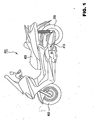
- FIG. 1 is a side view showing a scooter type motorbike provided with a power unit whose engine is combined with the V-belt type continuously variable transmission according to a first embodiment
- FIG. 2 is a side view of the power unit shown in FIG. 1 from which a casing for covering the outside of the V-belt type continuously variable transmission is removed
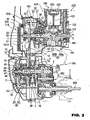
- FIG. 3 is a sectional view along a line B-B of the V-belt type continuously variable transmission shown in FIG. 2
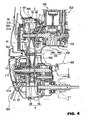
- FIG. 4 is an explanatory view showing a current of air in the casing in the V-belt type continuously variable transmission shown in FIG. 3
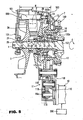
- FIG. 5 is a sectional view along a line C-C of the V-belt type continuously variable transmission shown in FIG. 2 .
- a power unit 410 is disposed in a position under a seat 405 between a front wheel 403 and a rear wheel 305 which is a driving wheel. A greater part of a front surface and opposite side surfaces of the vehicle is covered with a cowl.
- the power unit 410 described herein comprises: an engine 105; transmission casings 100, 101 extending backwards from a crank case 106 of the engine 105; and a V-belt type continuously variable transmission 110 which is housed in a space (belt chamber 103) formed by these transmission casings 100, 101 and the crank case 106 and which varies a speed of an output of the engine 105.
- the output of the continuously variable transmission 110 is transmitted to an axle 300 of the rear wheel 305 disposed as the driving wheel behind the engine 105 via an automatic centrifugal clutch 70, and a reducer 302 comprising a row of gears.
- a crank chamber 102 is defined by a right-side part 100a of the transmission casing 100 and the crank case 106, and the belt chamber 103 is defined by a left-side part 100b of the transmission casing 100 and the transmission casing 101.
- the V-belt type continuously variable transmission 110 is housed in the belt chamber 103.
- the transmission casing and the crank case may be independently constituted, the crank case only may define the crank chamber, and the transmission casing only may define the belt chamber.
- the engine 105 comprises: the right-side part 100a of the transmission casing 100 and the crank case 106 which correspond to a casing for rotatably supporting a crank shaft 107; a piston 423 connected to the crank shaft 107 via a connecting rod 421; a cylinder block 426 which is bonded to an upper part of the crank case 106 to provide a cylinder section (combustion chamber) 425 where the piston 423 slides; and a cylinder head 431 provided with air suction and exhaust ports with respect to each cylinder section 425 and an ignition plug, and bonded to an upper part of the cylinder block 426.
- crank shaft 107 is disposed whose axial line is directed in a width direction of a vehicle body.
- a flywheel 441 is attached to a right end of the crank shaft 107, and this flywheel 441 is provided with a generator (not shown). This generator generates a power by rotation of the crank shaft 107, and supplies the power to electric components mounted on the vehicle, or charges a battery mounted on the vehicle.
- a primary shaft 1 is integrally provided on a left end of the crank shaft 107, and is an input shaft of the V-belt type continuously variable transmission 110.
- the transmission casings 100, 101 are attached as the casings which define the belt chamber 103 as a space for housing the V-belt type continuously variable transmission 110.
- a rotation support section 452 is disposed which is pivotably connected to a vehicle body frame via an inserted pivot shaft 450.
- the V-belt type continuously variable transmission 110 comprises: the primary shaft 1 formed integrally with the crank shaft 107 which is an output shaft of the engine 105 as a power source; a secondary shaft 2 which is disposed in parallel with the primary shaft 1 and which extracts a driving power for the driving wheel 305; a primary sheave 3 and a secondary sheave 4 which are disposed on the primary shaft 1 and the secondary shaft 2, respectively, the primary sheave and the secondary sheave having fixed sheaves 3A, 4A and movable sheaves 3B, 4B which define V-grooves for winding a belt therebetween, the movable sheaves 3B, 4B being movable in an axial direction (in opposite directions in FIG.
- V-belt 5 which is wound around the V-grooves of the primary and secondary sheaves 3 and 4 and which transmits a rotary driving power between the sheaves 3 and 4; a groove width adjustment mechanism 7 which moves the movable sheave 3B by an electric motor 10 to thereby adjust the groove widths of the primary and secondary sheaves 3 and 4; and a sheave position detection sensor 550 which detects a position of the movable sheave 3B in order to control an operation of the electric motor 10.
- an air introducing port 101A for introducing outside air is formed in a wall part which covers a side part of the primary sheave 3.
- an air exhaust port 101B for discharging air from the casing is formed in a wall part which covers a side part of the secondary sheave 4.
- an air cleaner 570 is disposed which filters the outside air introduced from the air introducing port 101A into the belt chamber 103.
- a plurality of vanes 3C are disposed which suck the outside air by a rotating operation of the primary sheave 3.
- the outside air is introduced from the air introducing port 101A into the belt chamber 103 between the transmission casings 100, 101 by sucking functions by the vanes 3C of the fixed sheave 3A.
- the outside air flows from a primary sheave 3 side toward the secondary sheave 4 as shown by arrows 581, 582, 583 in FIG. 4 , and cools the respective sheaves 3, 4, the V-belt 5 and the like.
- the air is discharged from the air exhaust port 101B as shown by an arrow 584.
- the groove width adjustment mechanism 7 comprises: the electric motor 10 (see FIG. 2 ) which is means for applying an arbitrary moving thrust to the movable sheave 3B of the primary sheave 3; a primary-side operation mechanism (so-called torque cam) 30 which is disposed between the movable sheave 3B and the primary shaft 1 and which applies a moving thrust to the movable sheave 3B in a direction where a torque difference is eliminated, when the torque difference is made between rotary torques of the primary shaft 1 and the movable sheave 3B; a compression coil spring 40 which is means for applying a thrust to the movable sheave 4B of the secondary sheave 4 in a direction where the groove width is reduced; and a secondary-side operation mechanism (so-called torque cam) 60 which is disposed between the movable sheave 4B and the secondary shaft 2 and which applies a moving thrust to the movable sheave 4B in a direction where
- the electric motor 10 of the groove width adjustment mechanism 7 is disposed behind the rotation support section 452 which is connected to the vehicle body frame in the outer periphery of the upper part of the left-side part 100b of the transmission casing 100.
- arrows C, E indicate rotating directions of the primary shaft 1 and the secondary shaft 2, respectively.
- An arrow D indicates the direction of the thrust generated in the movable sheave 3B by the primary-side operation mechanism 30, and an arrow F indicates the direction of the thrust generated in the movable sheave 4B by the secondary-side operation mechanism 60.
- variable transmission 110 is housed in the belt chamber 103 disposed adjacent to the crank case 106 of the engine 105 and defined by the left-side part 100b of the transmission casing 100 and the casing 101, and the primary shaft 1 is constituted integrally with the crank shaft 107 of the engine 105.
- the secondary shaft 2 is connected to the axle 300 via the reducer 302, and the driving wheel 305 is attached to the axle 300.
- the primary sheave 3 is disposed in the outer periphery of the primary shaft 1, and the secondary sheave 4 is attached to the outer periphery of the secondary shaft 2 via the centrifugal clutch 70.
- the primary sheave 3 comprises: the fixed sheave 3A fixed to one end of the primary shaft 1; and the movable sheave 3B which is movable in the axial direction (arrow A direction in the figure) of the primary shaft 1.
- the V-groove around which the V-belt 5 is wound is formed between facing conical surfaces of the fixed sheave 3A and the movable sheave 3B.
- One end of the primary shaft 1 is supported by the casing 101 via a bearing 25, a sleeve 24 into which the bearing 25 is fitted, and a sleeve 21 described later are fixed by a lock nut 26, and a boss section of the fixed sheave 3A is accordingly fixed in such a manner that the section does not move in the axial direction.
- the movable sheave 3B has a cylindrical boss section through which the primary shaft 1 extends, and a cylindrical slider 22 is fixed to one end of the boss section.
- the sleeve 21 is disposed between the slider 22 and the primary shaft 1, and is fitted into the outer periphery of the primary shaft 1 via a spline 20.
- the sleeve 21 rotates integrally with the primary shaft 1.
- the slider 22 is disposed movably in the axial direction in the outer periphery of the sleeve 21.
- a cam groove 31 is formed in such a manner as to extend obliquely with respect to the axial direction, and a guide pin 32 protruding to the outer periphery of the sleeve 21 is slidably inserted into the cam groove 31. Accordingly, the movable sheave 3B integrated with the slider 22 is movable in the axial direction of the primary shaft 1 while rotating integrally with the primary shaft 1.
- a direction of tilt of the cam groove 31 is set to a direction (e.g., a direction in which the moving thrust having a direction (arrow D direction) to reduce the groove width of the primary sheave 3 is applied to the movable sheave 3B, when the rotary torque of the primary shaft 1 is greater than that of the movable sheave 3B) in which the moving thrust having a direction to eliminate the torque difference is applied to the movable sheave 3B of the primary sheave 3, when the torque difference is made between the rotary torques of the primary shaft 1 and the movable sheave 3B.
- a path of the cam groove 31 including a tilt angle may be set to an arbitrary form such as a linear or curved form in accordance with an imparted performance, and is easily worked.
- a cylindrical feed guide 16 is screwed and fixed in such a manner as to protrude toward the movable sheave 3B.
- the feed guide 16 is disposed coaxially with respect to the primary shaft 1, and a female screw 17 is formed in an inner peripheral surface of the feed guide 16.
- a reciprocating gear 12 is fitted into an outer periphery of the feed guide 16 slidably in an axial direction and a peripheral direction.
- This reciprocating gear 12 is connected to one end of an outer peripheral wall of an annular rotary ring 13 which is bent into a U-sectional-shape from an inner peripheral wall toward the outer peripheral wall, and a male screw 18 formed in the outer peripheral surface of the inner peripheral wall interlocks with the female screw 17 of the feed guide 16.
- the inner peripheral wall of the rotary ring 13 is connected to the slider 22 integrated with the movable sheave 3B via a bearing 23.
- a motor output shaft 10a is connected to the reciprocating gear 12 via a gear transmission mechanism 11 constituted by a combination multi-staged spur gears 11A to 11E.
- a sheave moving mechanism is constituted in such a manner that the mechanism can move the movable sheave 3B in the axial direction via the reciprocating gear 12, when the rotation of the electric motor 10 is controlled by a control unit 200 (see FIG. 5 ).
- the control unit 200 detects a position of the movable sheave 3B by the sheave position detection sensor 550, and is utilized in controlling an operation of the electric motor 10.
- the sheave position detection sensor 550 is a sensor (e.g., position sensor of a variable resistance system, a magnetostrictive system, a magnetic system or the like) comprising: a sensor main body 551; and a detector 553 disposed on the sensor main body 551 linearly movably along a central axial line 552 of the sensor main body 551.
- a sensor e.g., position sensor of a variable resistance system, a magnetostrictive system, a magnetic system or the like
- a detector 553 disposed on the sensor main body 551 linearly movably along a central axial line 552 of the sensor main body 551.
- the detector 553 comprises: a shaft portion 553a held on the sensor main body 551 movably along the central axial line 552; a tip extending portion 553b extending from the tip of the detector 553 in a direction crossing the central axial line 552 at right angles; and a contact portion 553c which protrudes from the tip extending portion 553b and which abuts on a member to be detected.
- the detector 553 is urged in a direction protruding from the sensor main body 551 by a compression coil spring (urging means) 555 disposed in a compressed state between the sensor main body 551 and the tip extending portion 553b.
- the sheave position detection sensor 550 is disposed in the vicinity of the air introducing port 101A in an air current path from the air introducing port 101 A to the air exhaust port 101 B.
- the sheave position detection sensor 550 is disposed outside the primary sheave 3 in the vicinity of the air introducing port 101 A and in a range of a sheave occupied width W occupied by the corresponding sheave and the reciprocating gear 12 of the groove width adjustment mechanism 7.
- the sensor is fixed to the casing 101 in a state in which the axial direction of the sensor main body 551 is aligned with an axis line direction of the primary shaft 1, and the contact portion 553c abuts on the side surface of the reciprocating gear 12. It is to be noted that the contact portion 553c is maintained in a state in which the portion abuts on the reciprocating gear 12 by an urging force of the compression coil spring 555.
- the detector 553 of the sheave position detection sensor 550 is displaced integrally with the reciprocating gear 12 accompanying the movement of the reciprocating gear 12 in the axial direction, and detects a change of a sheave position of the movable sheave 3B via the displacement of the reciprocating gear 12 in the axial direction.
- the secondary sheave 4 comprises: the fixed sheave 4A connected to the secondary shaft 2 via the centrifugal clutch 70; and the movable sheave 4B which is movable in the axial direction (arrow B direction in the figure) of the secondary shaft 2.
- the V-groove around which the V-belt 5 is wound is formed between facing conical surfaces of the fixed sheave 4A and the movable sheave 4B.
- the fixed sheave 4A is provided with a cylindrical guide 51, and this guide 51 is rotatably supported on the outer periphery of the secondary shaft 2 via a bearing.
- the centrifugal clutch 70 disposed between the fixed sheave 4A and the secondary shaft 2 is provided with: a centrifugal plate 71 which rotates integrally with the guide 51 of the fixed sheave 4A; a centrifugal weight 72 supported by the centrifugal plate 71; and a clutch housing 73 detachably attached to the centrifugal weight 72.
- the centrifugal plate 71 is integrally rotatably connected to the guide 51 of the fixed sheave 4A by spline fitting.
- the clutch housing 73 is fixed to one end of the secondary shaft 2 via a spline-fitted boss member 47. It is to be noted that one end of the secondary shaft 2 is supported by the transmission casing 101 via a bearing 50, and a sleeve 48 into which the bearing 50 is fitted is fixed via a lock screw 49, and the clutch housing 73 and the boss member 47 are fixed in such a manner as to be prevented from being moved in the axial direction.
- the movable sheave 4B is integrated with a cylindrical slider 52 which is supported movably in the axial direction on the outer periphery of the guide 51 of the fixed sheave 4A, and the sheave is urged by the compression coil spring 40 in a direction in which the groove width of the V-groove is reduced.
- the compression coil spring 40 is disposed in a compressed state in which one end of the spring abuts on a protruding portion of the outer periphery of the slider 52 and the other end thereof abuts on a spring bearing of the centrifugal plate 71.
- a cam groove 61 is formed in the slider 52 integrated with this movable sheave 4B, and is tilted with respect to an axial line.
- a guide pin 62 is slidably inserted which protrudes from the outer periphery of the guide 51 integrated with the fixed sheave 4A. Accordingly, the movable sheave 4B integrated with the slider 52 is movable in the axial direction of the secondary shaft 2 while rotating integrally with the secondary shaft 2.
- a direction of tilt of the cam groove 61 is set to a direction (e.g., a direction in which the moving thrust having a direction (arrow F) to reduce the groove width of the secondary sheave 4 is applied to the movable sheave 4B, when the rotary torque of the secondary shaft 2 is smaller than that of the movable sheave 4B) in which the moving thrust having a direction to eliminate the torque difference is applied to the movable sheave 4B, when the torque difference is made between the rotary torques of the secondary shaft 2 and the movable sheave 4B.
- a path of the cam groove 61 including a tilt angle may be set to an arbitrary form such as a linear or curved form in accordance with an imparted performance, and is easily worked.
- the secondary-side operation mechanism 60 is disposed in this manner. For example, when a motorbike starts going up a slope, a rotation speed of the fixed sheave 4A connected to the secondary shaft 2 decreases, and a speed difference is made from the movable sheave 4B which is going to continue its rotation by the V-belt 5.
- the guide pin 62 apparently pushes the cam groove 61 in an arrow F direction, the movable sheave 4B is pushed toward the fixed sheave 4A via the slider 52, and the groove width of the V-groove is forcibly reduced.
- the groove width of the primary sheave 3 decreases, the wound diameter of the V-belt 5 increases, and the transmission gear ratio shifts to a top side.
- the groove width of the primary sheave 3 increases, the wound diameter of the V-belt 5 decreases, and the transmission gear ratio shifts to a low side.
- the groove width of the secondary sheave 4 changes accompanying the change of the groove width of the primary sheave 3, and changes in reverse with respect to the primary sheave 3.
- the transmission gear ratio between the primary sheave 3 and the secondary sheave 4 increases, and the torque transmitted to the driving wheel 305 increases.
- the wound diameter of the V-belt 5 with respect to the primary sheave 3 increases (shifts to the top side)
- the V-belt 5 bites into the V-groove on the secondary sheave 4 side
- the movable sheave 4B moves apart from the fixed sheave 4A against the urging force of the compression coil spring 40. Therefore, since the groove width of the secondary sheave 4 increases, and the wound diameter of the V-belt 5 increases, the transmission gear ratio between the primary sheave 3 and the secondary sheave 4 decreases.
- the secondary sheave 4 When the number of rotations of the secondary sheave 4 is not less than a predetermined value, the secondary sheave 4 is connected to the secondary shaft 2 via the centrifugal clutch 70, and the rotation of the secondary shaft 2 is transmitted to the axle 300 via the gear row of the reducer 302.
- the sheave position detection sensor 550 provided in the transmission casings 100, 101 is disposed in the vicinity of the air introducing port 101A in the air current path of the outside air introduced into the belt chamber 103 which is defined by the left-side part 100b of the transmission casing 100 and the casing 101.
- the sheave position detection sensor 550 is not brought into contact with the air current including the wear powders, and therefore the sensor is not polluted with the attached wear powders.
- a dust-proof measure for preventing the sticking of the wear powders can be omitted from the sheave position detection sensor 550, and miniaturization of the sheave position detection sensor 550 can be realized by the omission of the dust-proof measure.
- the sheave position detection sensor 550 is miniaturized, the current of the air in the transmission casings 100, 101 is prevented from being interrupted by the sheave position detection sensor 550.
- the current of the outside air in the transmission casings 100, 101 is kept to be satisfactory, and a stable cooling performance by the outside air can be secured.
- the sensor main body 551 is disposed outside the primary sheave 3, and a space required for disposing the sensor main body 551 is preferably secured above or in front of the primary sheave 3. It is to be noted that the teachings of the present invention is not limited to the embodiment.
- the sensor main body 551 of the sheave position detection sensor 550 may be disposed outside the secondary sheave 4 and in the range of the width occupied by the corresponding sheave.
- the transmission can be constituted to be compact in the width direction, and this is advantageous for mounting the sensor on a vehicle such as a motorbike.
- the sheave position detection sensor 550 is not disposed in a space between the movable sheave 3B of the primary sheave 3 and the reciprocating gear 12 for moving the movable sheave 3B in the axial direction. Therefore, the sheave moving mechanism including the reciprocating gear 12 and the like can be disposed in the vicinity of the movable sheave 3B of the primary sheave 3, and the width-direction dimension of the V-belt type continuously variable transmission 110 can be set to be compact more thoroughly.
- the detector 553 of the sheave position detection sensor 550 is allowed to abut on the inner surface of the reciprocating gear 12, so that the position of the reciprocating gear 12 is detected.
- the width-direction dimension can be set to be compact.
- a structure of the sheave position detection sensor 550 is simplified, and manufacturing costs can be reduced.
- V-belt type continuously variable transmission of the present embodiment is not limited to this.
- a sheave position detection sensor 650 is constituted as shown in FIG. 7 in which a tip of a detector 653 formed substantially into a U-shape is allowed to abut on an outer surface of the reciprocating gear 12, and a position of the reciprocating gear 12 is detected.
- a sheave position detection sensor 750 may be constituted as shown in FIG. 8 in which an outer peripheral portion of a reciprocating gear 12 is held relatively rotatably in an axial direction by a pair of detectors 753, 753, and a position of the reciprocating gear 12 is detected.
- the detector 553 of the sheave position detection sensor 550 is engaged with the reciprocating gear 12, and a position of the movable sheave 3B is indirectly detected via the position of the reciprocating gear 12.
- the detector 553 may be brought into direct contact with a back surface of the movable sheave 3B, and the position of the movable sheave 3B may be directly detected. That is, the sheave position detection sensor 550 can detect a position of either of the reciprocating gear 12 and the movable sheave 3B to thereby detect an axial position of the movable sheave 3B in the primary sheave 3.
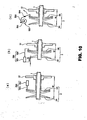
- a shape formed by the shaft portion 553a linearly movably supported with respect to the sensor main body 551 and the tip extending portion 553b bonded to the tip of the shaft portion 553a is not limited to a substantial L-shape shown in FIG. 6 .
- the detector 553 may be formed into such a substantial U-shape that the tip of the detector abuts on the back surface of the movable sheave 3B as shown in FIG. 9(a) , or into such a crank shape that the tip of the detector abuts on the back surface of the movable sheave 3B as shown in FIG. 9(b) .
- the detector 553 is disposed rotatably around a central axis of the sensor main body 551, and the position of the movable sheave 3B may be detected in accordance with a rotation of the detector 553 whose tip is allowed to abut on the back surface of the movable sheave 3B.
- the sheave position detection sensor may be disposed anywhere in the range of the sheave occupied width W occupied by the corresponding primary sheave 3 and the reciprocating gear 12 in a primary-shaft direction and in the outside of the outer periphery of the primary sheave 3.
- a central axis of the sensor main body 551 may be disposed in a direction crossing the primary shaft 1 at right angles.
- the sensor does not satisfy the requirement that the sensor be disposed within the sheave occupied width W of the corresponding primary sheave 3 and the reciprocating gear 12 in the primary-shaft direction.
- the base end portion of the sensor main body 551 protrudes by a dimension W1 from the sheave occupied width W, and this causes enlargement in the width direction.
- the detector 553 has a large installation space in the outer periphery of the primary sheave 3. Therefore, there is a possibility that the enlargement is unfavorably caused in a diametric direction of the periphery of the primary sheave 3.
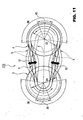
- FIG. 11 is a schematic side view of a V-belt type continuously variable transmission 210 showing a favorable installation range of the sheave position detection sensor disposed outside the primary sheave 3 or the secondary sheave 4 and in the range of the corresponding sheave occupied width.
- the sheave position detection sensor disposed outside the primary sheave 3 or the secondary sheave 4 is preferably disposed in a region of a belt wound range 3W at a time when the wound diameter of the V-belt 5 wound around the primary sheave 3 is maximum (D1) as viewed in the primary-shaft direction, or a region of a belt wound range 4W at a time when the wound diameter of the V-belt 5 wound around the primary sheave 4 is maximum (D2) as viewed in a secondary-shaft direction.
- the sensor is more preferably disposed in a region of a belt wound range 3S or 4S substantially of 45 degrees centering on a sheave center line X passing through the axis lines of the primary sheave 3 and the secondary sheave 4.
- the V-belt 5 of the V-belt type continuously variable transmission 210 vibrates both on belt upper and lower sides because of an increase of an applied vibrating force by the rotation of the engine 105 accompanying a rapidly varying speed at an acceleration/deceleration time, and a missing tensile force on a loosened side.
- another factor of the vibration is a speed variation by acceleration/deceleration, a belt pressing force variation or the like.
- the speed of the V-belt 5 varies from the top side (shown by a two-dot chain line in FIG. 11 ) to the low side (shown by a solid line in FIG. 11 ) or from the low side to the top side, the belt vibration increases.
- vibration of the V-belt 5 is generated from idling until a clutch is completely engaged, and at a deceleration time from the clutch is disengaged until the transmission is stopped.
- vibration V2 increases on the lower side of the belt.
- the V-belt 5 is rapidly vibrated and is brought into contact with the sensor by the increased vibrations V1, V2 of the upper and lower sides of the worn belt. Therefore, sensors which are vulnerable to shock, including the sheave position detection sensor and the like, are prevented from being disposed outside (region other than the belt wound ranges 3W and 4W) the vibrating direction (V1, V2) of the belt 5 between the primary sheave 3 and the secondary sheave 4.
- the sensors are preferably installed in the region of the belt wound range 3W or 4W where the belt 5 is wound around the sheave as shown in FIG. 11 .
- FIG. 12 is a major part sectional view of the V-belt type continuously variable transmission according to a second embodiment
- FIG. 13 is an enlarged front view of the sheave position detection sensor shown in FIG. 12 .
- a V-belt type continuously variable transmission 310 of the second embodiment has a constitution substantially similar to that of the V-belt type continuously variable transmission 110 of the first embodiment except that a sheave position detection sensor 350 comprising a rotary encoder is used instead of the sheave position detection sensor 550. Therefore, constituting members having the same functions are denoted with the same reference numerals, and detailed description is omitted.
- the sheave position detection sensor 350 is the rotary encoder comprising: a sensor main body 351; and an arm 352 for detection disposed rotatably around a central axis of this sensor main body 351.
- a contact portion 353 of a pivoting tip of the arm is rotated and urged in a direction in which the portion is brought into press contact with a member to be detected by a helical torsion spring (not shown) which is disposed between a base end portion of the arm and the sensor main body 351.
- the above-described sheave position detection sensor 350 is disposed outside the corresponding groove width adjustment mechanism 7, and a central axis direction of the sensor main body 351 is allowed to cross an axis line direction of a primary shaft 1.
- the contact portion 353 of the arm 352 for detection is fixed to a transmission casing 100 in a state in which the portion abuts on a side surface of a reciprocating gear 12. It is to be noted that the contact portion 353 whose contact surface is formed into a substantially spherical surface is maintained in a state in which the portion abuts on the reciprocating gear 12 by a rotary urging force of the helical torsion coil.
- the arm 352 for detection of the sheave position detection sensor 350 is rotated and displaced in accordance with movement of the reciprocating gear 12 in an axial direction, and the sensor detects a change of a sheave position of the movable sheave 3B via the displacement of the reciprocating gear 12 in the axial direction.
- the contact portion 353 disposed on the pivoting tip of the arm 352 for detection is allowed to abut on the side surface of the reciprocating gear 12, and a rotation of the arm 352 for detection is detected by the rotary encoder in the sensor main body 351.
- the sensor main body 351 can be constituted to be compact in the axis line direction of the primary shaft 1.
- the V-belt type continuously variable transmission 310 which has high reliability and which is inexpensive.
- the power unit 410 for the motorbike has been described above in the embodiment, but the power unit 410 of the present embodiment is not limited to that for the motorbike, and, needless to say, the unit is applicable to a three or four-wheeled buggy which is a comparatively light-weight small-sized vehicle.
- V-belt type continuously variable transmission comprising: a primary shaft into which a driving power of a power source is input; a secondary shaft which is disposed in parallel with the primary shaft; a primary sheave and a secondary sheave which are disposed on the primary shaft and the secondary shaft, respectively, the primary sheave and the secondary sheave having sheaves which define a V-groove for winding a belt therebetween, the sheaves being movable in an axial direction to change a groove width of the V-groove; a V-belt which is wound around the V-grooves of the primary and secondary sheaves and which transmits a rotary driving power between the sheaves; a groove width adjustment mechanism which adjusts the groove widths of the primary sheave and the secondary sheave; a casing which houses and holds the primary sheave and the secondary sheave; and a sheave position detection sensor which detects a sheave position of the movable
- a V-belt type continuously variable transmission comprising: a primary shaft into which a driving power of a power source is input; a secondary shaft which is disposed in parallel with the primary shaft; a primary sheave and a secondary sheave which are disposed on the primary shaft and the secondary shaft, respectively, the primary sheave and the secondary sheave each having a fixed sheave and a movable sheave which define a V-groove for winding a belt therebetween, the movable sheave being movable in an axial direction to change a groove width of the V-groove; a V-belt which is wound around the V-grooves of the primary and secondary sheaves and which transmits a rotary driving power between the sheaves; a groove width adjustment mechanism which adjusts the groove widths of the primary sheave and the secondary sheave; a casing which houses and holds the primary sheave and the secondary sheave; and a sheave position detection sensor which detects
- the sheave position detection sensor is preferably installed in a region of a belt wound range at a time when a wound diameter of the V-belt wound around the primary sheave or the secondary sheave is maximum as viewed in the axial directions of the primary shaft and the secondary shaft.
- V-belt type continuously variable transmission comprising: a primary shaft into which a driving power of a power source is input; a secondary shaft which is disposed in parallel with the primary shaft; a primary sheave and a secondary sheave which are disposed on the primary shaft and the secondary shaft, respectively, the primary sheave and the secondary sheave having sheaves which define a V-groove for winding a belt therebetween, the sheaves being movable in an axial direction to change a groove width of the V-groove; a V-belt which is wound around the V-grooves of the primary and secondary sheaves and which transmits a rotary driving power between the sheaves; a groove width adjustment mechanism which adjusts the groove widths of the primary sheave and the secondary sheave; a casing which houses and holds the primary sheave and the secondary sheave; and a sheave position detection sensor which detects a sheave position of the movable sheave, wherein the sheave
- a vehicle is preferable on which the V-belt type continuously variable transmission constituted as described above is mounted.
- the sheave position detection sensor housed in the casing is provided in the vicinity of the air introducing port in an air current path. Therefore, even when the current of the air in the casing is a wear powder conveying current for conveying toward the air exhaust port wear powders of the V-belt generated by friction with the primary sheave, the sheave position detection sensor is not brought into contact with the air current including the wear powders, and therefore the sensor is not polluted with the attached wear powders.
- a dust-proof measure for preventing the sticking of the wear powders can be omitted from the sheave position detection sensor, and miniaturization of the sheave position detection sensor can be realized by the omission of the dust-proof measure.
- the sensor main body of the sheave position detection sensor housed in the casing is disposed outside the primary sheave or the secondary sheave and in the range of the width occupied by the corresponding sheave. Therefore, a space required for installing the sensor main body may be secured, for example, above or in front of the primary sheave or the secondary sheave.
- a width-direction dimension of the V-belt type continuously variable transmission does not increase by the installation of the sheave position detection sensor.
- the transmission can be constituted to be compact in a width direction, and this is advantageous in mounting the transmission on a motorbike or the like.
- the sheave position detection sensor housed in the casing comprises the rotary encoder for detecting the rotation of the arm for detection which rotates in accordance with the sheave position of the movable sheave, and therefore the sensor itself can be constituted to be compact in a primary shaft direction.
- the rotary encoder which has highly dust-preventive properties and which is inexpensive as the sheave position detection sensor, there can be provided the V-belt type continuously variable transmission which has high reliability and which is inexpensive.
- a sheave position detection sensor disposed in a casing is miniaturized, so that a width-direction dimension can be prevented from being increased, wherein in a V-belt type continuously variable transmission 110 for a motorbike in which a belt 5 is wound between a primary sheave 3 and a secondary sheave 4 having variable groove widths, a sheave position detection sensor 550 for detecting an axial position of a movable sheave 3B in a primary sheave 3 is disposed in the vicinity of an air introducing port 101A in an air current path from the air introducing port 101 A to an air exhaust port 101B in a transmission casing 101.
Landscapes
- Engineering & Computer Science (AREA)
- General Engineering & Computer Science (AREA)
- Mechanical Engineering (AREA)
- Transmissions By Endless Flexible Members (AREA)
- General Details Of Gearings (AREA)
Claims (6)
- Stufenlos veränderbares Getriebe (110) vom Keilriemen- Typ, aufweisend Primär-und Sekundärscheiben (3, 4), die Keilnuten zum Umschlingengen eines Riemens (5) dort dazwischen bilden, wobei die Scheiben (3, 4) in einer axialen Richtung bewegbar sind, um eine Nutbreite der Keilnuten durch eine Nutbreiten- Einstellvorrichtung (7) zu verändern, und das aufgenommen ist in einem Gehäuse (100, 101), das eine Lufteinleitungsöffnung (101A) zum Einleiten von Außenluft in das Gehäuse (100, 101) und einer Luftausströmöffnung (101 B) zum Abgeben von Luft aus dem Gehäuse (100, 101) aufweist, und mit einem Scheibenpositions- Erfassungssensor (350, 550, 650, 750), der eine Scheibenposition einer bewegbaren Scheibe (3A, 4A) erfasst,
dadurch gekennzeichnet, dass
der Scheibenpositions- Erfassungssensor (350, 550, 650, 750) in dem Gehäuse (100, 101) in der Nähe der Lufteinleitungsöffnung (101A) in einem Luftstrompfad von der Lufteinleitungsöffnung (101A) zu der Luftausströmöffnung (101 B) angeordnet ist. - Stufenlos veränderbares Getriebe vom Keilriemen- Typ nach Anspruch 1, dadurch gekennzeichnet, dass der Scheibenpositions- Erfassungssensor (350, 550, 650, 750) einen Sensorhauptkörper (551) aufweist, der außerhalb der Primärscheibe (3) oder der Sekundärscheibe (4) und in einem Bereich einer Breite (W), eingenommen durch die entsprechende Scheibe (3, 4), angeordnet ist und der einen Detektor (553) aufweist, der sich aus dem Sensorhauptkörper (551) heraus erstreckt und der in Übereinstimmung mit der Scheibenposition der bewegbaren Scheibe (3A) bewegbar ist.
- Stufenlos veränderbares Getriebe vom Keilriemen- Typ nach Anspruch 2, dadurch gekennzeichnet, dass der Scheibenpositions- Erfassungssensor (350, 550, 650, 750) in einem Bereich des Riemens (5) angeordnet ist, der zu einem Zeitpunkt umschlungen wird, wenn ein Umschlingungsdurchmesser des Keilriemens, geschlungen um die Primärriemenscheibe (3) oder die Sekundärriemenscheibe (4), maximal ist, wenn gesehen in den axialen Richtungen der Primär-oder Sekundärscheiben (3, 4).
- Stufenlos veränderbares Getriebe vom Keilriemen- Typ nach einem der Ansprüche 1 bis 3, dadurch gekennzeichnet, dass der Scheibenpositions- Erfassungssensor (350) einen Dreh- Enkoder zum Erfassen einer Rotation eines Armes (352) zur Erfassung aufweist, der in Übereinstimmung mit der Scheibenposition der bewegbaren Scheibe (3A) rotiert.
- Stufenlos veränderbares Getriebe vom Keilriemen- Typ nach einem der Ansprüche 1 bis 4,
gekennzeichnet durch
eine Primärwelle (1), in die eine Antriebskraft einer Antriebsquelle eingebracht wird;
eine Sekundärwelle (2), die zu der Primärwelle (1) parallel angeordnet ist;
die Primärriemenscheibe (3) und die Sekundärscheibe (4), die jeweils auf der Primärwelle (1) und der Sekundärwelle (2) angeordnet sind, wobei die Primärriemenscheibe (3) und die Sekundärscheibe (4) Scheiben haben, die eine Keilnut zum Umschlingen des Riemens (5) dazwischen bilden, wobei die Scheiben in einer axialen Richtung bewegbar sind, um die Nutbreite der Keilnut zu verändern;
den Keilriemen, der um die Keilnuten der Primär- und Sekundärscheiben (3, 4) geschlungen ist und eine Rotationsantriebskraft zwischen den Scheiben (3, 4) überträgt;
die Nutbreiten- Einstellvorrichtung (7), die die Nutbreiten der Primärriemenscheibe (3) und die Sekundärscheibe (4) einstellt; und
das Gehäuse (100, 101), das die Primärriemenscheibe (3) und die Sekundärscheibe (4) aufnimmt und hält. - Fahrzeug, an dem ein stufenlos veränderbares Getriebe vom Keilriemen- Typ nach einem der Ansprüche 1 bis 5 montiert ist.
Applications Claiming Priority (2)
| Application Number | Priority Date | Filing Date | Title |
|---|---|---|---|
| JP2004219289 | 2004-07-27 | ||
| JP2005172611A JP2006064172A (ja) | 2004-07-27 | 2005-06-13 | Vベルト式無段変速機 |
Publications (3)
| Publication Number | Publication Date |
|---|---|
| EP1621802A2 EP1621802A2 (de) | 2006-02-01 |
| EP1621802A3 EP1621802A3 (de) | 2007-12-19 |
| EP1621802B1 true EP1621802B1 (de) | 2009-07-08 |
Family
ID=35134411
Family Applications (1)
| Application Number | Title | Priority Date | Filing Date |
|---|---|---|---|
| EP05016319A Expired - Lifetime EP1621802B1 (de) | 2004-07-27 | 2005-07-27 | Stufenlos verstellbares V-Riemengetriebe |
Country Status (5)
| Country | Link |
|---|---|
| EP (1) | EP1621802B1 (de) |
| JP (1) | JP2006064172A (de) |
| AT (1) | ATE435987T1 (de) |
| DE (1) | DE602005015278D1 (de) |
| TW (1) | TWI268250B (de) |
Cited By (1)
| Publication number | Priority date | Publication date | Assignee | Title |
|---|---|---|---|---|
| EP4146956A1 (de) * | 2020-05-07 | 2023-03-15 | Valeo Embrayages | Kraftübertragungssystem für einen antriebsstrang eines kraftfahrzeugs |
Families Citing this family (5)
| Publication number | Priority date | Publication date | Assignee | Title |
|---|---|---|---|---|
| JP4910784B2 (ja) * | 2007-03-02 | 2012-04-04 | スズキ株式会社 | ベルト式無段変速装置 |
| JP4891183B2 (ja) * | 2007-09-07 | 2012-03-07 | 本田技研工業株式会社 | パワーユニット |
| JP5724337B2 (ja) * | 2010-12-03 | 2015-05-27 | 日本精工株式会社 | エンジンルーム用直動アクチュエータ、並びにこれを備えた無段変速機および自動車 |
| TWI567317B (zh) * | 2015-03-31 | 2017-01-21 | 三陽工業股份有限公司 | 多模式無段變速機構 |
| TWI637118B (zh) * | 2017-07-04 | 2018-10-01 | 摩特動力工業股份有限公司 | 滾動車輛之無段變速控制系統 |
Family Cites Families (4)
| Publication number | Priority date | Publication date | Assignee | Title |
|---|---|---|---|---|
| US4531928A (en) * | 1981-12-23 | 1985-07-30 | Honda Giken Kogyo Kabushiki Kaisha | Belt transmission having air cooling function |
| JPH03128789A (ja) * | 1989-07-13 | 1991-05-31 | Honda Motor Co Ltd | 電動式車両 |
| JP3788119B2 (ja) * | 1999-08-04 | 2006-06-21 | スズキ株式会社 | スクータ型自動二輪車 |
| JP4293796B2 (ja) * | 2003-01-31 | 2009-07-08 | ヤマハ発動機株式会社 | Vベルト式無段変速機の冷却構造 |
-
2005
- 2005-06-13 JP JP2005172611A patent/JP2006064172A/ja not_active Withdrawn
- 2005-07-21 TW TW094124716A patent/TWI268250B/zh not_active IP Right Cessation
- 2005-07-27 EP EP05016319A patent/EP1621802B1/de not_active Expired - Lifetime
- 2005-07-27 AT AT05016319T patent/ATE435987T1/de not_active IP Right Cessation
- 2005-07-27 DE DE602005015278T patent/DE602005015278D1/de not_active Expired - Lifetime
Cited By (1)
| Publication number | Priority date | Publication date | Assignee | Title |
|---|---|---|---|---|
| EP4146956A1 (de) * | 2020-05-07 | 2023-03-15 | Valeo Embrayages | Kraftübertragungssystem für einen antriebsstrang eines kraftfahrzeugs |
Also Published As
| Publication number | Publication date |
|---|---|
| DE602005015278D1 (de) | 2009-08-20 |
| TW200616837A (en) | 2006-06-01 |
| JP2006064172A (ja) | 2006-03-09 |
| EP1621802A3 (de) | 2007-12-19 |
| ATE435987T1 (de) | 2009-07-15 |
| TWI268250B (en) | 2006-12-11 |
| EP1621802A2 (de) | 2006-02-01 |
Similar Documents
| Publication | Publication Date | Title |
|---|---|---|
| US8016094B2 (en) | Centrifugal clutch and straddle type vehicle including the centrifugal clutch | |
| US6520878B1 (en) | Driving pulley for scooters and other vehicles | |
| US20080312013A1 (en) | Belt Continuously Variable Transmission for Straddle Type Vehicle, and Straddle Type Vehicle | |
| EP2108865B1 (de) | Antrieb und Grätschsitz-Fahrzeug, das mit dem Antrieb versehen ist | |
| EP0714801B1 (de) | Stufenloses Riemengetriebe | |
| CN1144959C (zh) | 无级变速器用润滑油供给装置 | |
| EP1621802B1 (de) | Stufenlos verstellbares V-Riemengetriebe | |
| CN1977120B (zh) | 用于小型车辆的v型带式无级变速器和跨乘式车辆 | |
| JP4660286B2 (ja) | パワーユニット | |
| CN1519142B (zh) | 小型车辆的动力传递装置 | |
| CN100465477C (zh) | V型带式无级变速器和安装有v型带式无级变速器的车辆 | |
| US7104765B2 (en) | Hybrid compressor system | |
| EP1420195B1 (de) | Stufenlos verstellbare Getriebeeinrichtung | |
| JP5654389B2 (ja) | 無断変速機構造 | |
| US8167108B2 (en) | Clutch, continuously variable transmission, engine unit including them, and straddle-type vehicle including them | |
| CN100443773C (zh) | V带式无级变速装置 | |
| EP1171729B1 (de) | Treibscheibe für ein stufenloses regelbares getriebe | |
| JP3162328B2 (ja) | 車載用vベルト式自動変速機 | |
| CA2441891C (en) | Power transmission mechanism for an engine for a vehicle | |
| JPH05203005A (ja) | Vベルト自動変速装置 | |
| EP4628754A1 (de) | Stufenloses getriebe und grätschsitzfahrzeug mit stufenlosem getriebe | |
| JP2025142765A (ja) | プーリ装置、無段変速機および車両 | |
| CN120288173A (zh) | 无级变速器及摩托车 | |
| JPH0575444U (ja) | ベルト式無段変速機 | |
| JPH11148541A (ja) | ベルトテンショナ機構及び無段変速装置 |
Legal Events
| Date | Code | Title | Description |
|---|---|---|---|
| PUAI | Public reference made under article 153(3) epc to a published international application that has entered the european phase |
Free format text: ORIGINAL CODE: 0009012 |
|
| AK | Designated contracting states |
Kind code of ref document: A2 Designated state(s): AT BE BG CH CY CZ DE DK EE ES FI FR GB GR HU IE IS IT LI LT LU LV MC NL PL PT RO SE SI SK TR |
|
| AX | Request for extension of the european patent |
Extension state: AL BA HR MK YU |
|
| PUAL | Search report despatched |
Free format text: ORIGINAL CODE: 0009013 |
|
| AK | Designated contracting states |
Kind code of ref document: A3 Designated state(s): AT BE BG CH CY CZ DE DK EE ES FI FR GB GR HU IE IS IT LI LT LU LV MC NL PL PT RO SE SI SK TR |
|
| AX | Request for extension of the european patent |
Extension state: AL BA HR MK YU |
|
| RIC1 | Information provided on ipc code assigned before grant |
Ipc: F16H 9/18 20060101ALI20071115BHEP Ipc: F16H 57/04 20060101ALI20071115BHEP Ipc: F16H 61/00 20060101AFI20051101BHEP Ipc: F16H 7/02 20060101ALI20071115BHEP Ipc: F16H 57/02 20060101ALI20071115BHEP Ipc: B62M 7/12 20060101ALI20071115BHEP |
|
| 17P | Request for examination filed |
Effective date: 20071212 |
|
| 17Q | First examination report despatched |
Effective date: 20080125 |
|
| AKX | Designation fees paid |
Designated state(s): AT BE BG CH CY CZ DE DK EE ES FI FR GB GR HU IE IS IT LI LT LU LV MC NL PL PT RO SE SI SK TR |
|
| GRAP | Despatch of communication of intention to grant a patent |
Free format text: ORIGINAL CODE: EPIDOSNIGR1 |
|
| GRAS | Grant fee paid |
Free format text: ORIGINAL CODE: EPIDOSNIGR3 |
|
| GRAA | (expected) grant |
Free format text: ORIGINAL CODE: 0009210 |
|
| AK | Designated contracting states |
Kind code of ref document: B1 Designated state(s): AT BE BG CH CY CZ DE DK EE ES FI FR GB GR HU IE IS IT LI LT LU LV MC NL PL PT RO SE SI SK TR |
|
| REG | Reference to a national code |
Ref country code: GB Ref legal event code: FG4D |
|
| REG | Reference to a national code |
Ref country code: CH Ref legal event code: EP |
|
| REG | Reference to a national code |
Ref country code: IE Ref legal event code: FG4D |
|
| REF | Corresponds to: |
Ref document number: 602005015278 Country of ref document: DE Date of ref document: 20090820 Kind code of ref document: P |
|
| PG25 | Lapsed in a contracting state [announced via postgrant information from national office to epo] |
Ref country code: SI Free format text: LAPSE BECAUSE OF FAILURE TO SUBMIT A TRANSLATION OF THE DESCRIPTION OR TO PAY THE FEE WITHIN THE PRESCRIBED TIME-LIMIT Effective date: 20090708 |
|
| NLV1 | Nl: lapsed or annulled due to failure to fulfill the requirements of art. 29p and 29m of the patents act | ||
| PG25 | Lapsed in a contracting state [announced via postgrant information from national office to epo] |
Ref country code: AT Free format text: LAPSE BECAUSE OF FAILURE TO SUBMIT A TRANSLATION OF THE DESCRIPTION OR TO PAY THE FEE WITHIN THE PRESCRIBED TIME-LIMIT Effective date: 20090708 Ref country code: LT Free format text: LAPSE BECAUSE OF FAILURE TO SUBMIT A TRANSLATION OF THE DESCRIPTION OR TO PAY THE FEE WITHIN THE PRESCRIBED TIME-LIMIT Effective date: 20090708 Ref country code: FI Free format text: LAPSE BECAUSE OF FAILURE TO SUBMIT A TRANSLATION OF THE DESCRIPTION OR TO PAY THE FEE WITHIN THE PRESCRIBED TIME-LIMIT Effective date: 20090708 Ref country code: IS Free format text: LAPSE BECAUSE OF FAILURE TO SUBMIT A TRANSLATION OF THE DESCRIPTION OR TO PAY THE FEE WITHIN THE PRESCRIBED TIME-LIMIT Effective date: 20091108 Ref country code: ES Free format text: LAPSE BECAUSE OF FAILURE TO SUBMIT A TRANSLATION OF THE DESCRIPTION OR TO PAY THE FEE WITHIN THE PRESCRIBED TIME-LIMIT Effective date: 20091019 |
|
| PG25 | Lapsed in a contracting state [announced via postgrant information from national office to epo] |
Ref country code: LV Free format text: LAPSE BECAUSE OF FAILURE TO SUBMIT A TRANSLATION OF THE DESCRIPTION OR TO PAY THE FEE WITHIN THE PRESCRIBED TIME-LIMIT Effective date: 20090708 Ref country code: MC Free format text: LAPSE BECAUSE OF NON-PAYMENT OF DUE FEES Effective date: 20090731 Ref country code: PL Free format text: LAPSE BECAUSE OF FAILURE TO SUBMIT A TRANSLATION OF THE DESCRIPTION OR TO PAY THE FEE WITHIN THE PRESCRIBED TIME-LIMIT Effective date: 20090708 Ref country code: NL Free format text: LAPSE BECAUSE OF FAILURE TO SUBMIT A TRANSLATION OF THE DESCRIPTION OR TO PAY THE FEE WITHIN THE PRESCRIBED TIME-LIMIT Effective date: 20090708 |
|
| REG | Reference to a national code |
Ref country code: CH Ref legal event code: PL |
|
| PG25 | Lapsed in a contracting state [announced via postgrant information from national office to epo] |
Ref country code: PT Free format text: LAPSE BECAUSE OF FAILURE TO SUBMIT A TRANSLATION OF THE DESCRIPTION OR TO PAY THE FEE WITHIN THE PRESCRIBED TIME-LIMIT Effective date: 20091109 Ref country code: BG Free format text: LAPSE BECAUSE OF FAILURE TO SUBMIT A TRANSLATION OF THE DESCRIPTION OR TO PAY THE FEE WITHIN THE PRESCRIBED TIME-LIMIT Effective date: 20091008 |
|
| PG25 | Lapsed in a contracting state [announced via postgrant information from national office to epo] |
Ref country code: CH Free format text: LAPSE BECAUSE OF NON-PAYMENT OF DUE FEES Effective date: 20090731 Ref country code: CZ Free format text: LAPSE BECAUSE OF FAILURE TO SUBMIT A TRANSLATION OF THE DESCRIPTION OR TO PAY THE FEE WITHIN THE PRESCRIBED TIME-LIMIT Effective date: 20090708 Ref country code: LI Free format text: LAPSE BECAUSE OF NON-PAYMENT OF DUE FEES Effective date: 20090731 Ref country code: RO Free format text: LAPSE BECAUSE OF FAILURE TO SUBMIT A TRANSLATION OF THE DESCRIPTION OR TO PAY THE FEE WITHIN THE PRESCRIBED TIME-LIMIT Effective date: 20090708 Ref country code: DK Free format text: LAPSE BECAUSE OF FAILURE TO SUBMIT A TRANSLATION OF THE DESCRIPTION OR TO PAY THE FEE WITHIN THE PRESCRIBED TIME-LIMIT Effective date: 20090708 Ref country code: EE Free format text: LAPSE BECAUSE OF FAILURE TO SUBMIT A TRANSLATION OF THE DESCRIPTION OR TO PAY THE FEE WITHIN THE PRESCRIBED TIME-LIMIT Effective date: 20090708 |
|
| PLBE | No opposition filed within time limit |
Free format text: ORIGINAL CODE: 0009261 |
|
| STAA | Information on the status of an ep patent application or granted ep patent |
Free format text: STATUS: NO OPPOSITION FILED WITHIN TIME LIMIT |
|
| PG25 | Lapsed in a contracting state [announced via postgrant information from national office to epo] |
Ref country code: BE Free format text: LAPSE BECAUSE OF FAILURE TO SUBMIT A TRANSLATION OF THE DESCRIPTION OR TO PAY THE FEE WITHIN THE PRESCRIBED TIME-LIMIT Effective date: 20090708 Ref country code: SK Free format text: LAPSE BECAUSE OF FAILURE TO SUBMIT A TRANSLATION OF THE DESCRIPTION OR TO PAY THE FEE WITHIN THE PRESCRIBED TIME-LIMIT Effective date: 20090708 |
|
| 26N | No opposition filed |
Effective date: 20100409 |
|
| PG25 | Lapsed in a contracting state [announced via postgrant information from national office to epo] |
Ref country code: IE Free format text: LAPSE BECAUSE OF NON-PAYMENT OF DUE FEES Effective date: 20090727 |
|
| PG25 | Lapsed in a contracting state [announced via postgrant information from national office to epo] |
Ref country code: GR Free format text: LAPSE BECAUSE OF FAILURE TO SUBMIT A TRANSLATION OF THE DESCRIPTION OR TO PAY THE FEE WITHIN THE PRESCRIBED TIME-LIMIT Effective date: 20091009 |
|
| PG25 | Lapsed in a contracting state [announced via postgrant information from national office to epo] |
Ref country code: IT Free format text: LAPSE BECAUSE OF FAILURE TO SUBMIT A TRANSLATION OF THE DESCRIPTION OR TO PAY THE FEE WITHIN THE PRESCRIBED TIME-LIMIT Effective date: 20090708 |
|
| PG25 | Lapsed in a contracting state [announced via postgrant information from national office to epo] |
Ref country code: LU Free format text: LAPSE BECAUSE OF NON-PAYMENT OF DUE FEES Effective date: 20090727 |
|
| PG25 | Lapsed in a contracting state [announced via postgrant information from national office to epo] |
Ref country code: HU Free format text: LAPSE BECAUSE OF FAILURE TO SUBMIT A TRANSLATION OF THE DESCRIPTION OR TO PAY THE FEE WITHIN THE PRESCRIBED TIME-LIMIT Effective date: 20100109 |
|
| PG25 | Lapsed in a contracting state [announced via postgrant information from national office to epo] |
Ref country code: TR Free format text: LAPSE BECAUSE OF FAILURE TO SUBMIT A TRANSLATION OF THE DESCRIPTION OR TO PAY THE FEE WITHIN THE PRESCRIBED TIME-LIMIT Effective date: 20090708 |
|
| PG25 | Lapsed in a contracting state [announced via postgrant information from national office to epo] |
Ref country code: CY Free format text: LAPSE BECAUSE OF FAILURE TO SUBMIT A TRANSLATION OF THE DESCRIPTION OR TO PAY THE FEE WITHIN THE PRESCRIBED TIME-LIMIT Effective date: 20090708 |
|
| PG25 | Lapsed in a contracting state [announced via postgrant information from national office to epo] |
Ref country code: SE Free format text: LAPSE BECAUSE OF FAILURE TO SUBMIT A TRANSLATION OF THE DESCRIPTION OR TO PAY THE FEE WITHIN THE PRESCRIBED TIME-LIMIT Effective date: 20090708 |
|
| REG | Reference to a national code |
Ref country code: FR Ref legal event code: PLFP Year of fee payment: 12 |
|
| REG | Reference to a national code |
Ref country code: FR Ref legal event code: PLFP Year of fee payment: 13 |
|
| REG | Reference to a national code |
Ref country code: FR Ref legal event code: PLFP Year of fee payment: 14 |
|
| P01 | Opt-out of the competence of the unified patent court (upc) registered |
Effective date: 20230527 |
|
| PGFP | Annual fee paid to national office [announced via postgrant information from national office to epo] |
Ref country code: DE Payment date: 20240719 Year of fee payment: 20 |
|
| PGFP | Annual fee paid to national office [announced via postgrant information from national office to epo] |
Ref country code: GB Payment date: 20240722 Year of fee payment: 20 |
|
| PGFP | Annual fee paid to national office [announced via postgrant information from national office to epo] |
Ref country code: FR Payment date: 20240729 Year of fee payment: 20 |
|
| REG | Reference to a national code |
Ref country code: DE Ref legal event code: R071 Ref document number: 602005015278 Country of ref document: DE |
|
| REG | Reference to a national code |
Ref country code: GB Ref legal event code: PE20 Expiry date: 20250726 |