EP1619007A1 - Verfahren zur Herstellung eines gekrümmten Versteifungskörpers - Google Patents
Verfahren zur Herstellung eines gekrümmten Versteifungskörpers Download PDFInfo
- Publication number
- EP1619007A1 EP1619007A1 EP04405471A EP04405471A EP1619007A1 EP 1619007 A1 EP1619007 A1 EP 1619007A1 EP 04405471 A EP04405471 A EP 04405471A EP 04405471 A EP04405471 A EP 04405471A EP 1619007 A1 EP1619007 A1 EP 1619007A1
- Authority
- EP
- European Patent Office
- Prior art keywords
- grooves
- stiffening
- stiffening body
- cover layer
- roof
- Prior art date
- Legal status (The legal status is an assumption and is not a legal conclusion. Google has not performed a legal analysis and makes no representation as to the accuracy of the status listed.)
- Granted
Links
- 238000000034 method Methods 0.000 title claims description 13
- 238000004519 manufacturing process Methods 0.000 claims abstract description 5
- 238000004904 shortening Methods 0.000 claims abstract description 4
- 238000004080 punching Methods 0.000 claims description 13
- 239000003351 stiffener Substances 0.000 claims description 12
- 229920003023 plastic Polymers 0.000 claims description 11
- 239000004033 plastic Substances 0.000 claims description 11
- 229910052751 metal Inorganic materials 0.000 claims description 7
- 239000002184 metal Substances 0.000 claims description 7
- 238000000926 separation method Methods 0.000 claims description 6
- 230000003014 reinforcing effect Effects 0.000 claims description 4
- 238000000465 moulding Methods 0.000 claims description 3
- 238000007373 indentation Methods 0.000 claims 1
- 239000010410 layer Substances 0.000 description 39
- 239000000463 material Substances 0.000 description 14
- 239000011888 foil Substances 0.000 description 7
- 239000006260 foam Substances 0.000 description 6
- -1 polyethylene Polymers 0.000 description 6
- 239000002985 plastic film Substances 0.000 description 5
- 229920006255 plastic film Polymers 0.000 description 5
- 229920005830 Polyurethane Foam Polymers 0.000 description 4
- 239000011496 polyurethane foam Substances 0.000 description 4
- 230000002787 reinforcement Effects 0.000 description 4
- 239000000853 adhesive Substances 0.000 description 3
- 230000001070 adhesive effect Effects 0.000 description 3
- 239000004698 Polyethylene Substances 0.000 description 2
- 239000004743 Polypropylene Substances 0.000 description 2
- 229910052782 aluminium Inorganic materials 0.000 description 2
- XAGFODPZIPBFFR-UHFFFAOYSA-N aluminium Chemical compound [Al] XAGFODPZIPBFFR-UHFFFAOYSA-N 0.000 description 2
- 230000015572 biosynthetic process Effects 0.000 description 2
- 238000004049 embossing Methods 0.000 description 2
- 238000009413 insulation Methods 0.000 description 2
- 229920000573 polyethylene Polymers 0.000 description 2
- 229920000139 polyethylene terephthalate Polymers 0.000 description 2
- 239000005020 polyethylene terephthalate Substances 0.000 description 2
- 229920001155 polypropylene Polymers 0.000 description 2
- RNFJDJUURJAICM-UHFFFAOYSA-N 2,2,4,4,6,6-hexaphenoxy-1,3,5-triaza-2$l^{5},4$l^{5},6$l^{5}-triphosphacyclohexa-1,3,5-triene Chemical compound N=1P(OC=2C=CC=CC=2)(OC=2C=CC=CC=2)=NP(OC=2C=CC=CC=2)(OC=2C=CC=CC=2)=NP=1(OC=1C=CC=CC=1)OC1=CC=CC=C1 RNFJDJUURJAICM-UHFFFAOYSA-N 0.000 description 1
- 239000004952 Polyamide Substances 0.000 description 1
- 239000012790 adhesive layer Substances 0.000 description 1
- 230000004888 barrier function Effects 0.000 description 1
- 239000011324 bead Substances 0.000 description 1
- 238000005253 cladding Methods 0.000 description 1
- 239000011248 coating agent Substances 0.000 description 1
- 238000000576 coating method Methods 0.000 description 1
- 230000008030 elimination Effects 0.000 description 1
- 238000003379 elimination reaction Methods 0.000 description 1
- 238000005516 engineering process Methods 0.000 description 1
- 238000002474 experimental method Methods 0.000 description 1
- 239000003063 flame retardant Substances 0.000 description 1
- 238000005187 foaming Methods 0.000 description 1
- 230000035515 penetration Effects 0.000 description 1
- 229920002647 polyamide Polymers 0.000 description 1
- 229920000915 polyvinyl chloride Polymers 0.000 description 1
- 239000004800 polyvinyl chloride Substances 0.000 description 1
- 238000002360 preparation method Methods 0.000 description 1
- 239000005871 repellent Substances 0.000 description 1
- 210000003660 reticulum Anatomy 0.000 description 1
- 239000007858 starting material Substances 0.000 description 1
- 239000000126 substance Substances 0.000 description 1
- XLYOFNOQVPJJNP-UHFFFAOYSA-N water Chemical compound O XLYOFNOQVPJJNP-UHFFFAOYSA-N 0.000 description 1
Images
Classifications
-
- B—PERFORMING OPERATIONS; TRANSPORTING
- B29—WORKING OF PLASTICS; WORKING OF SUBSTANCES IN A PLASTIC STATE IN GENERAL
- B29C—SHAPING OR JOINING OF PLASTICS; SHAPING OF MATERIAL IN A PLASTIC STATE, NOT OTHERWISE PROVIDED FOR; AFTER-TREATMENT OF THE SHAPED PRODUCTS, e.g. REPAIRING
- B29C53/00—Shaping by bending, folding, twisting, straightening or flattening; Apparatus therefor
- B29C53/02—Bending or folding
- B29C53/04—Bending or folding of plates or sheets
-
- B—PERFORMING OPERATIONS; TRANSPORTING
- B60—VEHICLES IN GENERAL
- B60R—VEHICLES, VEHICLE FITTINGS, OR VEHICLE PARTS, NOT OTHERWISE PROVIDED FOR
- B60R13/00—Elements for body-finishing, identifying, or decorating; Arrangements or adaptations for advertising purposes
- B60R13/02—Internal Trim mouldings ; Internal Ledges; Wall liners for passenger compartments; Roof liners
- B60R13/0212—Roof or head liners
- B60R13/0225—Roof or head liners self supporting head liners
-
- B—PERFORMING OPERATIONS; TRANSPORTING
- B60—VEHICLES IN GENERAL
- B60R—VEHICLES, VEHICLE FITTINGS, OR VEHICLE PARTS, NOT OTHERWISE PROVIDED FOR
- B60R13/00—Elements for body-finishing, identifying, or decorating; Arrangements or adaptations for advertising purposes
- B60R13/08—Insulating elements, e.g. for sound insulation
- B60R13/0815—Acoustic or thermal insulation of passenger compartments
-
- B—PERFORMING OPERATIONS; TRANSPORTING
- B29—WORKING OF PLASTICS; WORKING OF SUBSTANCES IN A PLASTIC STATE IN GENERAL
- B29C—SHAPING OR JOINING OF PLASTICS; SHAPING OF MATERIAL IN A PLASTIC STATE, NOT OTHERWISE PROVIDED FOR; AFTER-TREATMENT OF THE SHAPED PRODUCTS, e.g. REPAIRING
- B29C59/00—Surface shaping of articles, e.g. embossing; Apparatus therefor
- B29C59/007—Forming single grooves or ribs, e.g. tear lines, weak spots
-
- B—PERFORMING OPERATIONS; TRANSPORTING
- B29—WORKING OF PLASTICS; WORKING OF SUBSTANCES IN A PLASTIC STATE IN GENERAL
- B29L—INDEXING SCHEME ASSOCIATED WITH SUBCLASS B29C, RELATING TO PARTICULAR ARTICLES
- B29L2009/00—Layered products
Definitions
- the invention relates to a method for producing a stiffening body having at least one curved region from a flat, flexible lightweight plate with cover layers firmly bonded to the surface of the plate on both sides.
- the roof outer skin is stiffened from the vehicle interior ago.
- sound insulation and thermal insulation are achieved with the roof reinforcement glued over adhesive beads or an adhesive applied over the entire surface with the roof cladding.
- roof stiffening for vehicles consists of a one-sided connected to a cover layer plate made of foamed plastic.
- a sheet of foamed plastic connected on both sides to a cover layer is first produced.
- the foamed plate is split in the middle in two unilaterally provided with a top layer plates and cut to size on the dimensions of the roof skin.
- a single cover layer is also tailored to the dimension of the roof skin with excess and formed and glued together with an adhesive layer between the foam plate and the individual cover layer in a shape corresponding to the curvature and contour of the roof skin on the final shape and glued.
- the molding is punched out for matching roof stiffening.
- the foamed plastic is a polyurethane foam, the outer layers are made of kraftliner. The expensive molds required to produce the roof reinforcement result in correspondingly high final costs.
- a plate made of foamed plastic with both sides arranged cover layers is first prepared and this then cut by means of central splitting into two foam sheets provided on one side with a cover layer.
- the final shape of the plate for roof stiffening is done here by direct bonding of the uncoated side of the plate with the roof skin.
- the invention has for its object to provide a method of the type mentioned, with which stiffening body can be manufactured with a given curvature without expensive molds in a simple way directly from a plate-shaped, manufactured in a single process step, starting material.
- the stiffening body is cut out with its final dimensions from the flat plate with the cover layers arranged on both sides and the top layer / s in the / to be bent area / s targeted locally pressed and by the incoming shortening of the cover layer / s the curvature (s) is (are) formed.
- the separation of the reinforcing body is preferably carried out by punching in a punching tool.
- the targeted local impressions of the cover layer / s is expediently carried out in the form of defined grooves or grooves, which is carried out with correspondingly shaped grooves or grooves.
- the separation of the stiffening body and the targeted local impressions of the outer layer / s are preferably carried out simultaneously in a single step.
- the separation of the stiffening body and the targeted local impressions of the cover layer / s carried out by punching in a punching tool with the punching tool according to the provided on the stiffening body layer of grooves or grooves arranged rills or Nutern performed.
- the complex molding tools and punches can be replaced by an additional equipped with rakers or Nutern flatbed punching tool.
- the application of the flatbed technology leads to the elimination of several process steps and results in an additional savings potential.
- the flexible lightweight panel preferably consists of foamed plastic, in particular of a polyurethane foam, preferably of a closed-cell polyurethane foam having a density of about 30 to 55 g / m 3 .
- the cover layers may consist of the materials known for use of this type and comprise one or more layers of material.
- the material layer is for example a paper layer, a plastic or metal foil or a multilayer film with individual layers of one or more paper layers, plastic films and / or metal foils.
- metal foil in particular, an aluminum foil is suitable.
- a preferred material layer consists of a paper layer, which may be uncoated or coated on one or both sides with a plastic film of, for example, polyethylene, polypropylene or polyethylene terephthalate as a water vapor barrier.
- a plastic film of, for example, polyethylene, polypropylene or polyethylene terephthalate as a water vapor barrier.
- the paper layer may also be impregnated with water-repellent, flame-retardant and / or mold and rot-preventing substances.
- the plastic film or the plastic film of a film or a film of polyamide, polyvinyl chloride, polyethylene, polypropylene, polyethylene terephthalate and the metal foil of an aluminum foil are particularly preferred materials layers.
- reinforcing elements With forming methods known per se, such as, for example, Embossing by means of embossing rolls or depths by means of punch and die are formed out of the material layer. Due to the increase in the thickness of the deformed material that occurs at right angles to the undeformed layer of material layer, the stiffening elements increase the transverse rigidity of the base material and thus lead to a better flexural strength of the stiffening body.
- stiffening bodies according to the invention can advantageously be used wherever the outer skin of a component is to be protected from denting which occurs due to external forces.
- a preferred area of application are roof stiffeners for vehicles, with headliners, if appropriate combined with the roof skin reinforcement, being able to be equipped with the reinforcing bodies.
- Further applications of the plate-shaped stiffening body according to the invention are the stiffening of flat planks and shaped bodies of sheet metal or plastic of all kinds, such as e.g. Bonnets, refrigerator doors and other components to be reinforced against being pressed in.
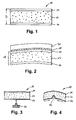
- a roof stiffener 10 according to Fig. 1 consists of a plate 12 made of foamed plastic, e.g. Polyurethane foam, with cover layers 14, 16 arranged on both sides, for example of a creped material layer, e.g. made of crepe paper.
- the total thickness D of the roof stiffener 10 is for example about 5 to 10 mm.
- This sandwich material is conventionally carried out in the form of strip material in a double belt press, in which, simultaneously with the foaming of the plastic to the foamed strip material, a firm connection with the strip layers supplied in strip form, e.g. Kraftliner, is generated.
- the individual roof stiffeners are cut to length from the strip material and punched into a shaped part adapted to the roof skin.
- the roof stiffener 10 is bonded by means of a crawler or full surface applied adhesive 18 with a roof 20 of a vehicle not shown in the drawing.
- Fig. 3 shows the roof stiffener 10 with the foam plate 12 and the both sides of the plate 12 fixedly connected cover layers 14, 16 in the region of an intended curvature.
- grooves or grooves are selectively pressed locally in the cover layers 14, 16 and in the underlying foam plate 12 at predetermined locations of the roof stiffener.
- the tools used for the formation of grooves or grooves correspond to the negative shape of the grooves or grooves to be formed and are referred to here as Riller or Nuter.
- FIG 4 shows the roof stiffener 10 after a rill 24 has been impressed into the cover layer 16 and the foam plate 12 underneath.
- the groove 22 formed in this way results in a shortening of the cover layer 16 in the direction indicated by arrows in the drawing, which in total leads to a curved area in the roof stiffener 10.
- the strength and the shape of a curvature can be determined by targeted arrangement of grooves or grooves and their depth of penetration within wide limits based on easy to perform experiments.
Landscapes
- Engineering & Computer Science (AREA)
- Mechanical Engineering (AREA)
- Physics & Mathematics (AREA)
- Acoustics & Sound (AREA)
- Laminated Bodies (AREA)
- Forging (AREA)
- Vehicle Interior And Exterior Ornaments, Soundproofing, And Insulation (AREA)
- Shaping Of Tube Ends By Bending Or Straightening (AREA)
- Yarns And Mechanical Finishing Of Yarns Or Ropes (AREA)
Abstract
Description
- Die Erfindung betrifft ein Verfahren zur Herstellung eines wenigstens einen gekrümmten Bereich aufweisenden Versteifungskörpers aus einer ebenen biegsamen Leichtstoffplatte mit beidseitig fest mit der Oberfläche der Platte verbundenen Deckschichten.
- Zur Erhöhung der Belastbarkeit der Dachfläche eines Fahrzeugs wird die Dachaussenhaut vom Fahrzeuginnern her versteift. Mit der über Klebstoffraupen oder einen vollflächig aufgetragenen Klebstoff mit der Dachhaut verklebten Dachversteifung wird gleichzeitig eine Schalldämmung und Wärmeisolierung erreicht.
- Eine aus der EP-B-0 825 066 bekannte Dachversteifung für Fahrzeuge besteht aus einer einseitig mit einer Deckschicht verbundenen Platte aus geschäumtem Kunststoff. Zur Herstellung dieser Dachversteifung wird zunächst eine beidseitig mit einer Deckschicht verbundene Platte aus geschäumtem Kunststoff hergestellt. Anschliessend wird die geschäumte Platte mittig in zwei einseitig mit einer Deckschicht versehene Platten gespalten und mit Übermass auf die Abmessungen der Dachhaut zugeschnitten. Eine einzelne Deckschicht wird ebenfalls mit Übermass auf die Abmessung der Dachhaut zugeschnitten und zusammen mit einer Klebstoffschicht zwischen der Schaumplatte und der einzelnen Deckschicht in einem der Wölbung und Kontur der Dachhaut entsprechenden Formwerkzeug auf die endgültige Form umgeformt und verklebt. Kurz vor Öffnung des Formwerkzeugs wird das Formteil zur passenden Dachversteifung ausgestanzt. Der geschäumte Kunststoff ist ein Polyurethanschaum, die Deckschichten bestehen aus Kraftlinern. Die zur Fertigung der Dachversteifung erforderlichen teuren Formwerkzeuge führen zu entsprechend hohen Endkosten.
- Auch bei dem aus der WO-A-01/26 878 bekannten Verfahren zur Herstellung einer Dachversteifung für Fahrzeuge wird zunächst eine Platte aus geschäumtem Kunststoff mit beidseitig angeordneten Deckschichten hergestellt und diese anschliessend durch mittiges Spalten in zwei einseitig mit einer Deckschicht versehene Schaumplatten geschnitten. Die endgültige Formgebung der Platte zur Dachversteifung erfolgt hier durch direktes Verkleben der unbeschichteten Seite der Platte mit der Dachhaut. Bei diesem Fertigungsverfahren entfallen die teuren Formwerkzeuge. Die nur einseitige Belegung der Schaumplatte mit einer Deckschicht aus einem Kraftliner oder einem Vlies hat jedoch eine Verminderung der Steifigkeit zur Folge.
- Der Erfindung liegt die Aufgabe zugrunde, ein Verfahren der eingangs genannten Art zu schaffen, mit welchem Versteifungskörper mit vorgegebener Krümmung ohne teure Formwerkzeuge auf einfache Weise direkt aus einem plattenförmigen, in einem einzigen Verfahrensschritt hergestellten Vormaterial gefertigt werden können.
- Zur erfindungsgemässen Lösung der Aufgabe führt, dass der Versteifungskörper mit seinen Endabmessungen aus der ebenen Platte mit den beidseitig angeordneten Deckschichten herausgetrennt wird und die Deckschicht/en in dem/den zu krümmenden Bereich/en gezielt lokal eingedrückt und durch die eintretende Verkürzung der Deckschicht/en die Krümmung/en gebildet wird/werden.
- Bevorzugt erfolgt das Heraustrennen des Verstärkungskörpers durch Stanzen in einem Stanzwerkzeug durchgeführt.
- Das gezielte lokale Eindrücken der Deckschicht/en erfolgt zweckmässigerweise in der Form definierter Rillen oder Nuten, die mit entsprechend geformten Rillern oder Nutern durchgeführt wird.
- Das Heraustrennen des Versteifungskörpers und das gezielte lokale Eindrücken der Deckschicht/en werden bevorzugt gleichzeitig in einem einzigen Arbeitsschritt durchgeführt.
- Bei einer besonders bevorzugten Ausführungsform des erfindungsgemässen Verfahrens erfolgt das Heraustrennen des Versteifungskörpers und das gezielte lokale Eindrücken der Deckschicht/en durch Stanzen in einem Stanzwerkzeug mit am Stanzwerkzeug entsprechend der am Versteifungskörper vorgesehenen Lage der Rillen oder Nuten angeordneten Rillern oder Nutern durchgeführt.
- Mit der erfindungsgemässen Vorgehensweise können die aufwendigen Formteilwerkzeuge und -stanzen durch ein zusätzlich mit Rillern oder Nutern ausgestattetes Flachbett-Stanzwerkzeug ersetzt werden. Die Anwendung der Flachbetttechnik führt zum Wegfall mehrerer Verfahrensschritte und ergibt ein zusätzliches Einsparpotential.
- Die biegsame Leichtstoffplatte besteht bevorzugt aus geschäumtem Kunststoff, insbesondere aus einem Polyurethanschaum, vorzugsweise aus einem geschlossenzelligen Polyurethanschaum mit einem Raumgewicht von etwa 30 bis 55 g/m3.
- Die Deckschichten können aus den für Anwendung dieser Art bekannten Materialien bestehen und eine oder mehrere Materialschichten umfassen.
- Die Materialschicht ist beispielsweise eine Papierschicht, eine Kunststoff- oder Metallfolie oder eine mehrschichtige Folie mit einzelnen Schichten aus einer oder mehreren Papierschichten, Kunststofffolien und/oder Metallfolien. Als Metallfolie eignet sich insbesondere eine Aluminiumfolie.
- Eine bevorzugte Materialschicht besteht aus einer Papierschicht, die unbeschichtet oder auch ein- oder beidseitig mit einem Kunststofffilm aus beispielsweise Polyethylen, Polypropylen oder Polyethylenterephthalat als Wasserdampfsperre beschichtet sein kann. Anstelle einer Beschichtung mit einem Kunststofffilm kann die Papierschicht auch mit wasserabweisenden, flammhemmenden und/oder Schimmel und Fäulnis verhindernden Stoffen imprägniert sein.
- Bei einer weiter bevorzugten Materialschicht bestehen die Kunststofffolie oder der Kunststofffilm aus einer Folie oder einem Film aus Polyamid, Polyvinylchlorid, Polyethylen, Polypropylen, Polyethylenterephthalat und die Metallfolie aus einer Aluminiumfolie.
- Aus Deckschichten mit den vorstehend genannten Papierschichten, Kunststoff- und/oder Metallfolien können auch Versteifungselemente mit an sich bekannten Umformverfahren wie z.B. Prägen mittels Prägewalzen oder Tiefen mittels Stempel und Matrize aus der Materialschicht herausgeformt werden. Die Versteifungselemente erhöhen infolge der rechtwinklig zur unverformten Materialschichtebene auftretenden Zunahme der Dicke des verformten Werkstoffes die Quersteifigkeit des Grundmaterials und führen damit zu einer besseren Biegefestigkeit des Versteifungskörpers.
- Die erfindungsgemässen Versteifungskörper können mit Vorteil überall dort eingesetzt werden, wo die Aussenhaut eines Bauteils vor Einbeulungen, die durch äussere Krafteinwirkungen auftreten, geschützt werden soll. Ein bevorzugter Einsatzbereich sind Dachversteifungen für Fahrzeuge, wobei auch Dachhimmel (Headliner), gegebenenfalls mit der Dachhautverstärkung kombiniert, mit den Verstärkungskörpern ausgestattet werden können. Weitere Anwendungen des erfindungsgemässen plattenförmigen Versteifungskörpers sind die Aussteifung flächiger Beplankungen und Formkörper aus Blech oder Kunststoff aller Art, wie z.B. Motorhauben, Kühlschranktüren und weiterer gegen Eindrücken zu verstärkender Bauteile.
- Weitere Vorteile, Merkmale und Einzelheiten der Erfindung ergeben sich aus der nachfolgenden Beschreibung bevorzugter Ausführungsbeispiele sowie anhand der Zeichnung; diese zeigt schematisch in
- - Fig. 1
- einen Querschnitt durch eine erste Ausführungsform einer Dachversteifung;
- - Fig. 2
- einen Querschnitt durch die mit einer Dachhaut eines Fahrzeuges verklebten Dachversteifung von Fig. 1;
- - Fig. 3 und 4
- die Bildung einer Krümmung bei einer Dachversteifung im Querschnitt.
- Eine Dachversteifung 10 besteht gemäss Fig. 1 aus einer Platte 12 aus geschäumtem Kunststoff, z.B. Polyurethanschaum, mit beidseitig angeordneten Deckschichten 14, 16, beispielsweise aus einer gekreppten Materialschicht, z.B. aus Krepppapier. Die Gesamtdicke D der Dachversteifung 10 beträgt beispielsweise etwa 5 bis 10 mm.
- Die Herstellung dieses Sandwichmaterials erfolgt auf herkömmliche Weise in der Form von Bandmaterial in einer Doppelbandpresse, in der gleichzeitig mit dem Aufschäumen des Kunststoffes zum geschäumten Bandmaterial eine feste Verbindung mit den in Bandform zugeführten Deckschichten, z.B. Kraftliner, erzeugt wird. Die einzelnen Dachversteifungen werden vom Bandmaterial abgelängt und zu einem an die Dachhaut angepassten Formteil gestanzt.
- Wie in Fig. 2 gezeigt, wird die Dachversteifung 10 mittels eines in Raupenform oder vollflächig aufgetragenen Klebstoffs 18 mit einer Dachhaut 20 eines in der Zeichnung nicht wiedergegebenen Fahrzeugs verklebt.
- Fig. 3 zeigt die Dachversteifung 10 mit der Schaumplatte 12 und den beidseitig mit der Platte 12 fest verbundenen Deckschichten 14, 16 im Bereich einer vorgesehenen Krümmung.
- Zur Bildung von Krümmungen werden an vorbestimmten Stellen der Dachversteifung 10 Vertiefungen in der Form von Rillen oder Nuten gezielt lokal in die Deckschichten 14, 16 und in die darunter liegende Schaumplatte 12 eingedrückt. Die zur Einformung von Rillen oder Nuten eingesetzten Werkzeuge entsprechen der Negativform der zu bildenden Rillen oder Nuten und werden hier als Riller bzw. Nuter bezeichnet.
- Fig. 4 zeigt die Dachversteifung 10 nach erfolgtem Eindrücken eines Rillers 24 in die Deckschicht 16 und die darunter liegende Schaumplatte 12. Die auf diese Weise gebildete Rille 22 führt zu einer Verkürzung der Deckschicht 16 in der in der Zeichnung durch Pfeile angegebenen Richtung, was insgesamt zu einem gekrümmten Bereich in der Dachversteifung 10 führt.
- Die Stärke und die Form einer Krümmung können durch gezielte Anordnung von Rillern oder Nutern und deren Eindringtiefe in weiten Grenzen anhand von einfach durchzuführenden Versuchen bestimmt werden.
Claims (8)
- Verfahren zur Herstellung eines Versteifungskörpers (10) mit wenigstens einem gekrümmten Bereich aus einer ebenen biegsamen Leichtstoffplatte (12) mit beidseitig fest mit der Platte (12) verbundenen Deckschichten (14,16),
dadurch gekennzeichnet, dass
der Versteifungskörper (10) aus der ebenen Platte (12) mit den beidseitig angeordneten Deckschichten (14,16) auf seine Endabmessungen geschnitten wird und die Deckschicht/en (14,16) in dem/den zu krümmenden Bereich/en gezielt lokal eingedrückt und durch die eintretende Verkürzung der Deckschicht/en (14,16) die Krümmung/en gebildet wird/werden. - Verfahren nach Anspruch 1, dadurch gekennzeichnet, dass das Heraustrennen des Verstärkungskörpers (10) durch Stanzen einem Stanzwerkzeug durchgeführt wird.
- Verfahren nach Anspruch 1, dadurch gekennzeichnet, dass das gezielte lokale Eindrücken der Deckschicht/en (14, 16) als Rillen oder Nuten (22) mit einem Riller oder Nuter (24) durchgeführt wird.
- Verfahren nach einem der Ansprüche 1 bis 3, dadurch gekennzeichnet, dass das Heraustrennen des Versteifungskörpers (10) und das gezielte lokale Eindrücken der Deckschicht/en (14,16) gleichzeitig in einem einzigen Arbeitsschritt durchgeführt werden.
- Verfahren nach den Ansprüchen 2, 3 und 4, dadurch gekennzeichnet, dass das Heraustrennen des Versteifungskörpers (10) und das gezielte lokale Eindrücken der Deckschicht/en (14,16) durch Stanzen in einem Stanzwerkzeug mit am Stanzwerkzeug entsprechend der am Versteifungskörper (10) vorgesehenen Lage der Rillen oder Nuten (22) angeordneten Rillern oder Nutern (24) durchgeführt wird.
- Verfahren nach Anspruch 5, dadurch gekennzeichnet, dass das Stanzwerkzeug ein Flachbett-Stanzwerkzeug ist.
- Verwendung des nach dem Verfahren nach einem der vorangehenden Ansprüche hergestellten Versteifungskörpers (10) zur Versteifung von flächigen Beplankungen, Formkörpern und Bauteilen mit einer gegen Eindrücken zu verstärkenden Haut aus Blech oder Kunststoff.
- Verwendung nach Anspruch 7 als Dachversteifung für Fahrzeuge.
Priority Applications (8)
| Application Number | Priority Date | Filing Date | Title |
|---|---|---|---|
| EP04405471A EP1619007B1 (de) | 2004-07-22 | 2004-07-22 | Verfahren zur Herstellung eines gekrümmten Versteifungskörpers |
| DE502004006319T DE502004006319D1 (de) | 2004-07-22 | 2004-07-22 | Verfahren zur Herstellung eines gekrümmten Versteifungskörpers |
| AT04405471T ATE387303T1 (de) | 2004-07-22 | 2004-07-22 | Verfahren zur herstellung eines gekrümmten versteifungskörpers |
| SI200430696T SI1619007T1 (sl) | 2004-07-22 | 2004-07-22 | Postopek za izdelavo ukrivljenega ojačilnega telesa |
| PL04405471T PL1619007T3 (pl) | 2004-07-22 | 2004-07-22 | Sposób wytwarzania zakrzywionego elementu usztywniającego |
| DK04405471T DK1619007T3 (da) | 2004-07-22 | 2004-07-22 | Fremgangsmåde til fremstilling af et krumt afstivningslegeme |
| PT04405471T PT1619007E (pt) | 2004-07-22 | 2004-07-22 | Processo para a produção de um elemento de reforço curvo |
| ES04405471T ES2298709T3 (es) | 2004-07-22 | 2004-07-22 | Procedimiento para fabricar un cuerpo de rigidizacion curvado. |
Applications Claiming Priority (1)
| Application Number | Priority Date | Filing Date | Title |
|---|---|---|---|
| EP04405471A EP1619007B1 (de) | 2004-07-22 | 2004-07-22 | Verfahren zur Herstellung eines gekrümmten Versteifungskörpers |
Publications (2)
| Publication Number | Publication Date |
|---|---|
| EP1619007A1 true EP1619007A1 (de) | 2006-01-25 |
| EP1619007B1 EP1619007B1 (de) | 2008-02-27 |
Family
ID=34932217
Family Applications (1)
| Application Number | Title | Priority Date | Filing Date |
|---|---|---|---|
| EP04405471A Expired - Lifetime EP1619007B1 (de) | 2004-07-22 | 2004-07-22 | Verfahren zur Herstellung eines gekrümmten Versteifungskörpers |
Country Status (8)
| Country | Link |
|---|---|
| EP (1) | EP1619007B1 (de) |
| AT (1) | ATE387303T1 (de) |
| DE (1) | DE502004006319D1 (de) |
| DK (1) | DK1619007T3 (de) |
| ES (1) | ES2298709T3 (de) |
| PL (1) | PL1619007T3 (de) |
| PT (1) | PT1619007E (de) |
| SI (1) | SI1619007T1 (de) |
Cited By (1)
| Publication number | Priority date | Publication date | Assignee | Title |
|---|---|---|---|---|
| EP2712790A1 (de) * | 2012-09-26 | 2014-04-02 | 3A Composites GmbH | Gewölbtes Fahrzeugdach mit Verstärkungs- und Dämpfungselement |
Citations (7)
| Publication number | Priority date | Publication date | Assignee | Title |
|---|---|---|---|---|
| DE496291C (de) * | 1928-06-30 | 1930-04-17 | Cartonnagenindustrie Ag F | Riller fuer Pappen und Wellpappen |
| DE914002C (de) * | 1951-06-27 | 1954-06-24 | Hermann Zerzog | Verfahren zum Einwalzen von Laengsrillen und von Zonen geringerer Blechstaerke in Blechbaender |
| EP0424312A1 (de) * | 1989-10-13 | 1991-04-24 | Alusuisse-Lonza Services Ag | Biegbare Verbundplatte |
| DE19632055C1 (de) * | 1996-08-09 | 1997-11-13 | Benecke Kaliko Ag | Verfahren zur Herstellung einer Dachversteifung für Fahrzeuge |
| FR2770448A1 (fr) * | 1997-11-06 | 1999-05-07 | Euramax Coated Products Sa | Plaque composite directement formable a froid, procede de fabrication et utilisation pour enseignes |
| DE19949643A1 (de) * | 1999-10-14 | 2001-04-26 | Johnson Controls Headliner | Verfahren zur Herstellung einer Dachversteifung für Fahrzeuge und Dachversteifung |
| EP1302370A2 (de) * | 2001-10-16 | 2003-04-16 | ArvinMeritor GmbH | Formhimmel für ein Kraftfahrzeug |
-
2004
- 2004-07-22 DE DE502004006319T patent/DE502004006319D1/de not_active Expired - Lifetime
- 2004-07-22 SI SI200430696T patent/SI1619007T1/sl unknown
- 2004-07-22 PL PL04405471T patent/PL1619007T3/pl unknown
- 2004-07-22 PT PT04405471T patent/PT1619007E/pt unknown
- 2004-07-22 DK DK04405471T patent/DK1619007T3/da active
- 2004-07-22 AT AT04405471T patent/ATE387303T1/de active
- 2004-07-22 ES ES04405471T patent/ES2298709T3/es not_active Expired - Lifetime
- 2004-07-22 EP EP04405471A patent/EP1619007B1/de not_active Expired - Lifetime
Patent Citations (7)
| Publication number | Priority date | Publication date | Assignee | Title |
|---|---|---|---|---|
| DE496291C (de) * | 1928-06-30 | 1930-04-17 | Cartonnagenindustrie Ag F | Riller fuer Pappen und Wellpappen |
| DE914002C (de) * | 1951-06-27 | 1954-06-24 | Hermann Zerzog | Verfahren zum Einwalzen von Laengsrillen und von Zonen geringerer Blechstaerke in Blechbaender |
| EP0424312A1 (de) * | 1989-10-13 | 1991-04-24 | Alusuisse-Lonza Services Ag | Biegbare Verbundplatte |
| DE19632055C1 (de) * | 1996-08-09 | 1997-11-13 | Benecke Kaliko Ag | Verfahren zur Herstellung einer Dachversteifung für Fahrzeuge |
| FR2770448A1 (fr) * | 1997-11-06 | 1999-05-07 | Euramax Coated Products Sa | Plaque composite directement formable a froid, procede de fabrication et utilisation pour enseignes |
| DE19949643A1 (de) * | 1999-10-14 | 2001-04-26 | Johnson Controls Headliner | Verfahren zur Herstellung einer Dachversteifung für Fahrzeuge und Dachversteifung |
| EP1302370A2 (de) * | 2001-10-16 | 2003-04-16 | ArvinMeritor GmbH | Formhimmel für ein Kraftfahrzeug |
Cited By (1)
| Publication number | Priority date | Publication date | Assignee | Title |
|---|---|---|---|---|
| EP2712790A1 (de) * | 2012-09-26 | 2014-04-02 | 3A Composites GmbH | Gewölbtes Fahrzeugdach mit Verstärkungs- und Dämpfungselement |
Also Published As
| Publication number | Publication date |
|---|---|
| DK1619007T3 (da) | 2008-06-16 |
| DE502004006319D1 (de) | 2008-04-10 |
| SI1619007T1 (sl) | 2008-08-31 |
| PT1619007E (pt) | 2008-05-15 |
| ATE387303T1 (de) | 2008-03-15 |
| ES2298709T3 (es) | 2008-05-16 |
| PL1619007T3 (pl) | 2008-06-30 |
| EP1619007B1 (de) | 2008-02-27 |
Similar Documents
| Publication | Publication Date | Title |
|---|---|---|
| EP0825066B1 (de) | Verfahren zur Herstellung einer Dachversteifung Für Fahrzeuge und Dachversteifung | |
| EP1113946B1 (de) | Geklebte mehrschichtverbundplatten und verfahren zur herstellung von mehrschichtverbundplatten | |
| DE102013206086A1 (de) | Mehrschichtiges Strukturbauteil | |
| DE60318169T2 (de) | Bahnförmiges Verbundmaterial | |
| EP3800028A1 (de) | Mehrschichtiger formkörper für fahrzeuginnenausstattungen sowie verfahren zur herstellung solcher formkörper | |
| DE102010036218A1 (de) | Schichtelement aus strukturierten wabenförmigen Schichten | |
| DE19702581B4 (de) | Innenverkleidungselement für die Karosserie eines Kraftfahrzeugs und Verfahren zur Herstellung | |
| DE19942922A1 (de) | Verfahren zur Herstellung eines Sandwich-Paneels sowie durch dieses Verfahren hergestelltes Sandwichpaneel | |
| WO2005061280A1 (de) | Schallabsorbierendes hitzeschild | |
| EP3532280B1 (de) | Mehrschichtiges strukturbauteil, verfahren zu dessen herstellung und verwendungen dafür | |
| DE102013007700A1 (de) | Verbundplatte | |
| EP2712790B1 (de) | Gewölbtes Fahrzeugdach mit Verstärkungs- und Dämpfungselement | |
| DE10124210A1 (de) | Hohlkammer-Verbundplatte | |
| DE102011055010B4 (de) | Hybridbauteil für den Fahrzeugbereich | |
| EP1619007B1 (de) | Verfahren zur Herstellung eines gekrümmten Versteifungskörpers | |
| EP1861241A1 (de) | Verfahren und werkzeug zur herstellung eines verbund-karosserieteils für ein fahrzeug | |
| DE102006056612B4 (de) | Verfahren zur Herstellung eines sandwichartig aufgebauten Verbundmaterials und Verbundmaterial | |
| DE29712684U1 (de) | Mehrlagige Verbundplatte | |
| EP1619020A1 (de) | Versteifungskörper | |
| WO2001055524A1 (de) | Bauelement sowie verfahren zu dessen herstellung | |
| WO2001026878A1 (de) | Verfahren zur herstellung einer dachversteifung für fahrzeuge und dachversteifung | |
| WO1994007708A1 (de) | Dachauskleidung | |
| DE3029058A1 (de) | Verfahren zum herstellen von tiefziehteilen, insbesondere fuer karosserien von kraftwagen | |
| EP1619019B1 (de) | Versteifungskörper | |
| EP1693190A1 (de) | Beschichtung zum Entdröhnen von schwingfähigen Bauteilen sowie Verfahren zur Herstellung einer solchen Beschichtung |
Legal Events
| Date | Code | Title | Description |
|---|---|---|---|
| PUAI | Public reference made under article 153(3) epc to a published international application that has entered the european phase |
Free format text: ORIGINAL CODE: 0009012 |
|
| AK | Designated contracting states |
Kind code of ref document: A1 Designated state(s): AT BE BG CH CY CZ DE DK EE ES FI FR GB GR HU IE IT LI LU MC NL PL PT RO SE SI SK TR |
|
| AX | Request for extension of the european patent |
Extension state: AL HR LT LV MK |
|
| 17P | Request for examination filed |
Effective date: 20060725 |
|
| AKX | Designation fees paid |
Designated state(s): AT BE BG CH CY CZ DE DK EE ES FI FR GB GR HU IE IT LI LU MC NL PL PT RO SE SI SK TR |
|
| 17Q | First examination report despatched |
Effective date: 20061122 |
|
| GRAP | Despatch of communication of intention to grant a patent |
Free format text: ORIGINAL CODE: EPIDOSNIGR1 |
|
| RBV | Designated contracting states (corrected) |
Designated state(s): AT BE CH CZ DE DK EE ES FI FR GB HU IE IT LI NL PL PT RO SE SI SK TR |
|
| GRAS | Grant fee paid |
Free format text: ORIGINAL CODE: EPIDOSNIGR3 |
|
| GRAA | (expected) grant |
Free format text: ORIGINAL CODE: 0009210 |
|
| AK | Designated contracting states |
Kind code of ref document: B1 Designated state(s): AT BE CH CZ DE DK EE ES FI FR GB HU IE IT LI NL PL PT RO SE SI SK TR |
|
| REG | Reference to a national code |
Ref country code: GB Ref legal event code: FG4D Free format text: NOT ENGLISH |
|
| REG | Reference to a national code |
Ref country code: CH Ref legal event code: EP |
|
| GBT | Gb: translation of ep patent filed (gb section 77(6)(a)/1977) |
Effective date: 20080312 |
|
| REG | Reference to a national code |
Ref country code: IE Ref legal event code: FG4D Free format text: LANGUAGE OF EP DOCUMENT: GERMAN |
|
| REF | Corresponds to: |
Ref document number: 502004006319 Country of ref document: DE Date of ref document: 20080410 Kind code of ref document: P |
|
| REG | Reference to a national code |
Ref country code: RO Ref legal event code: EPE |
|
| REG | Reference to a national code |
Ref country code: PT Ref legal event code: SC4A Free format text: AVAILABILITY OF NATIONAL TRANSLATION Effective date: 20080506 |
|
| REG | Reference to a national code |
Ref country code: ES Ref legal event code: FG2A Ref document number: 2298709 Country of ref document: ES Kind code of ref document: T3 |
|
| REG | Reference to a national code |
Ref country code: DK Ref legal event code: T3 Ref country code: EE Ref legal event code: FG4A Ref document number: E001957 Country of ref document: EE Effective date: 20080505 |
|
| REG | Reference to a national code |
Ref country code: SE Ref legal event code: TRGR |
|
| REG | Reference to a national code |
Ref country code: PL Ref legal event code: T3 |
|
| REG | Reference to a national code |
Ref country code: HU Ref legal event code: AG4A Ref document number: E003469 Country of ref document: HU |
|
| PGFP | Annual fee paid to national office [announced via postgrant information from national office to epo] |
Ref country code: DK Payment date: 20080729 Year of fee payment: 5 Ref country code: EE Payment date: 20080709 Year of fee payment: 5 |
|
| ET | Fr: translation filed | ||
| PGFP | Annual fee paid to national office [announced via postgrant information from national office to epo] |
Ref country code: IE Payment date: 20080725 Year of fee payment: 5 Ref country code: FI Payment date: 20080730 Year of fee payment: 5 |
|
| PLBE | No opposition filed within time limit |
Free format text: ORIGINAL CODE: 0009261 |
|
| STAA | Information on the status of an ep patent application or granted ep patent |
Free format text: STATUS: NO OPPOSITION FILED WITHIN TIME LIMIT |
|
| 26N | No opposition filed |
Effective date: 20081128 |
|
| PGFP | Annual fee paid to national office [announced via postgrant information from national office to epo] |
Ref country code: SE Payment date: 20080729 Year of fee payment: 5 |
|
| REG | Reference to a national code |
Ref country code: DK Ref legal event code: EBP |
|
| EUG | Se: european patent has lapsed | ||
| REG | Reference to a national code |
Ref country code: EE Ref legal event code: MM4A Ref document number: E001957 Country of ref document: EE Effective date: 20090731 |
|
| PG25 | Lapsed in a contracting state [announced via postgrant information from national office to epo] |
Ref country code: EE Free format text: LAPSE BECAUSE OF NON-PAYMENT OF DUE FEES Effective date: 20090731 Ref country code: FI Free format text: LAPSE BECAUSE OF NON-PAYMENT OF DUE FEES Effective date: 20090722 |
|
| REG | Reference to a national code |
Ref country code: NL Ref legal event code: TD Effective date: 20100521 |
|
| PG25 | Lapsed in a contracting state [announced via postgrant information from national office to epo] |
Ref country code: DK Free format text: LAPSE BECAUSE OF NON-PAYMENT OF DUE FEES Effective date: 20090731 Ref country code: IE Free format text: LAPSE BECAUSE OF NON-PAYMENT OF DUE FEES Effective date: 20090722 |
|
| REG | Reference to a national code |
Ref country code: HU Ref legal event code: HC9C Owner name: 3A TECHNOLOGY & MANAGEMENT LTD., CH Free format text: FORMER OWNER(S): ALCAN TECHNOLOGY & MANAGEMENT LTD., CH |
|
| REG | Reference to a national code |
Ref country code: SI Ref legal event code: SP73 Owner name: 3A TECHNOLOGY & MANAGEMENT LTD.; CH Effective date: 20100628 |
|
| REG | Reference to a national code |
Ref country code: FR Ref legal event code: CD |
|
| REG | Reference to a national code |
Ref country code: SK Ref legal event code: TC4A Ref document number: E 3587 Country of ref document: SK Owner name: 3A TECHNOLOGY & MANAGEMENT LTD., NEUHAUSEN AM , CH Effective date: 20100804 |
|
| PGFP | Annual fee paid to national office [announced via postgrant information from national office to epo] |
Ref country code: TR Payment date: 20100707 Year of fee payment: 7 |
|
| PG25 | Lapsed in a contracting state [announced via postgrant information from national office to epo] |
Ref country code: SE Free format text: LAPSE BECAUSE OF NON-PAYMENT OF DUE FEES Effective date: 20090723 |
|
| REG | Reference to a national code |
Ref country code: CH Ref legal event code: PL |
|
| PG25 | Lapsed in a contracting state [announced via postgrant information from national office to epo] |
Ref country code: LI Free format text: LAPSE BECAUSE OF NON-PAYMENT OF DUE FEES Effective date: 20110731 Ref country code: CH Free format text: LAPSE BECAUSE OF NON-PAYMENT OF DUE FEES Effective date: 20110731 |
|
| REG | Reference to a national code |
Ref country code: AT Ref legal event code: PC Ref document number: 387303 Country of ref document: AT Kind code of ref document: T Owner name: CONSTELLIUM SWITZERLAND AG, CH Effective date: 20120420 |
|
| PGFP | Annual fee paid to national office [announced via postgrant information from national office to epo] |
Ref country code: PT Payment date: 20120123 Year of fee payment: 9 |
|
| PG25 | Lapsed in a contracting state [announced via postgrant information from national office to epo] |
Ref country code: TR Free format text: LAPSE BECAUSE OF NON-PAYMENT OF DUE FEES Effective date: 20110722 |
|
| REG | Reference to a national code |
Ref country code: PT Ref legal event code: MM4A Free format text: LAPSE DUE TO NON-PAYMENT OF FEES Effective date: 20140122 |
|
| PG25 | Lapsed in a contracting state [announced via postgrant information from national office to epo] |
Ref country code: PT Free format text: LAPSE BECAUSE OF NON-PAYMENT OF DUE FEES Effective date: 20140122 |
|
| PGFP | Annual fee paid to national office [announced via postgrant information from national office to epo] |
Ref country code: SI Payment date: 20150702 Year of fee payment: 12 Ref country code: HU Payment date: 20150715 Year of fee payment: 12 Ref country code: BE Payment date: 20150727 Year of fee payment: 12 |
|
| REG | Reference to a national code |
Ref country code: FR Ref legal event code: PLFP Year of fee payment: 13 |
|
| PGFP | Annual fee paid to national office [announced via postgrant information from national office to epo] |
Ref country code: NL Payment date: 20160726 Year of fee payment: 13 |
|
| PG25 | Lapsed in a contracting state [announced via postgrant information from national office to epo] |
Ref country code: BE Free format text: LAPSE BECAUSE OF NON-PAYMENT OF DUE FEES Effective date: 20160731 |
|
| PG25 | Lapsed in a contracting state [announced via postgrant information from national office to epo] |
Ref country code: HU Free format text: LAPSE BECAUSE OF NON-PAYMENT OF DUE FEES Effective date: 20160723 |
|
| PG25 | Lapsed in a contracting state [announced via postgrant information from national office to epo] |
Ref country code: SI Free format text: LAPSE BECAUSE OF NON-PAYMENT OF DUE FEES Effective date: 20160723 |
|
| REG | Reference to a national code |
Ref country code: SI Ref legal event code: KO00 Effective date: 20170405 |
|
| REG | Reference to a national code |
Ref country code: FR Ref legal event code: PLFP Year of fee payment: 14 |
|
| PGFP | Annual fee paid to national office [announced via postgrant information from national office to epo] |
Ref country code: CH Payment date: 20170613 Year of fee payment: 14 |
|
| REG | Reference to a national code |
Ref country code: NL Ref legal event code: MM Effective date: 20170801 |
|
| PG25 | Lapsed in a contracting state [announced via postgrant information from national office to epo] |
Ref country code: NL Free format text: LAPSE BECAUSE OF NON-PAYMENT OF DUE FEES Effective date: 20170801 |
|
| REG | Reference to a national code |
Ref country code: FR Ref legal event code: PLFP Year of fee payment: 15 |
|
| PG25 | Lapsed in a contracting state [announced via postgrant information from national office to epo] |
Ref country code: IT Free format text: LAPSE BECAUSE OF NON-PAYMENT OF DUE FEES Effective date: 20180722 |
|
| PGFP | Annual fee paid to national office [announced via postgrant information from national office to epo] |
Ref country code: RO Payment date: 20190704 Year of fee payment: 16 |
|
| GBPC | Gb: european patent ceased through non-payment of renewal fee |
Effective date: 20190722 |
|
| PG25 | Lapsed in a contracting state [announced via postgrant information from national office to epo] |
Ref country code: GB Free format text: LAPSE BECAUSE OF NON-PAYMENT OF DUE FEES Effective date: 20190722 |
|
| PGFP | Annual fee paid to national office [announced via postgrant information from national office to epo] |
Ref country code: CZ Payment date: 20200709 Year of fee payment: 17 Ref country code: SK Payment date: 20200701 Year of fee payment: 17 Ref country code: FR Payment date: 20200727 Year of fee payment: 17 Ref country code: ES Payment date: 20200803 Year of fee payment: 17 |
|
| PGFP | Annual fee paid to national office [announced via postgrant information from national office to epo] |
Ref country code: AT Payment date: 20200702 Year of fee payment: 17 |
|
| PG25 | Lapsed in a contracting state [announced via postgrant information from national office to epo] |
Ref country code: RO Free format text: LAPSE BECAUSE OF NON-PAYMENT OF DUE FEES Effective date: 20200722 |
|
| PGFP | Annual fee paid to national office [announced via postgrant information from national office to epo] |
Ref country code: DE Payment date: 20210728 Year of fee payment: 18 |
|
| REG | Reference to a national code |
Ref country code: AT Ref legal event code: MM01 Ref document number: 387303 Country of ref document: AT Kind code of ref document: T Effective date: 20210722 |
|
| REG | Reference to a national code |
Ref country code: SK Ref legal event code: MM4A Ref document number: E 3587 Country of ref document: SK Effective date: 20210722 |
|
| PG25 | Lapsed in a contracting state [announced via postgrant information from national office to epo] |
Ref country code: AT Free format text: LAPSE BECAUSE OF NON-PAYMENT OF DUE FEES Effective date: 20210722 |
|
| PG25 | Lapsed in a contracting state [announced via postgrant information from national office to epo] |
Ref country code: SK Free format text: LAPSE BECAUSE OF NON-PAYMENT OF DUE FEES Effective date: 20210722 Ref country code: FR Free format text: LAPSE BECAUSE OF NON-PAYMENT OF DUE FEES Effective date: 20210731 Ref country code: CZ Free format text: LAPSE BECAUSE OF NON-PAYMENT OF DUE FEES Effective date: 20210722 |
|
| REG | Reference to a national code |
Ref country code: ES Ref legal event code: FD2A Effective date: 20220829 |
|
| PGFP | Annual fee paid to national office [announced via postgrant information from national office to epo] |
Ref country code: PL Payment date: 20220622 Year of fee payment: 19 |
|
| PG25 | Lapsed in a contracting state [announced via postgrant information from national office to epo] |
Ref country code: ES Free format text: LAPSE BECAUSE OF NON-PAYMENT OF DUE FEES Effective date: 20210723 |
|
| REG | Reference to a national code |
Ref country code: DE Ref legal event code: R119 Ref document number: 502004006319 Country of ref document: DE |
|
| PG25 | Lapsed in a contracting state [announced via postgrant information from national office to epo] |
Ref country code: DE Free format text: LAPSE BECAUSE OF NON-PAYMENT OF DUE FEES Effective date: 20230201 |
|
| PG25 | Lapsed in a contracting state [announced via postgrant information from national office to epo] |
Ref country code: PL Free format text: LAPSE BECAUSE OF NON-PAYMENT OF DUE FEES Effective date: 20230722 |