EP1602699A1 - Verwendung eines einseitig selbstklebend ausgerüsteten Klebebands als Entlüftungsband mit einer Luftdurchlässigkeit von grösser 30 cm3/(cm2 * s) - Google Patents
Verwendung eines einseitig selbstklebend ausgerüsteten Klebebands als Entlüftungsband mit einer Luftdurchlässigkeit von grösser 30 cm3/(cm2 * s) Download PDFInfo
- Publication number
- EP1602699A1 EP1602699A1 EP05103612A EP05103612A EP1602699A1 EP 1602699 A1 EP1602699 A1 EP 1602699A1 EP 05103612 A EP05103612 A EP 05103612A EP 05103612 A EP05103612 A EP 05103612A EP 1602699 A1 EP1602699 A1 EP 1602699A1
- Authority
- EP
- European Patent Office
- Prior art keywords
- adhesive tape
- adhesive
- tape
- air permeability
- sided self
- Prior art date
- Legal status (The legal status is an assumption and is not a legal conclusion. Google has not performed a legal analysis and makes no representation as to the accuracy of the status listed.)
- Ceased
Links
- 230000035699 permeability Effects 0.000 title claims abstract description 18
- 239000004820 Pressure-sensitive adhesive Substances 0.000 title abstract description 6
- 238000013022 venting Methods 0.000 title description 4
- 239000002390 adhesive tape Substances 0.000 claims abstract description 43
- 239000004831 Hot glue Substances 0.000 claims abstract description 9
- 239000012876 carrier material Substances 0.000 claims description 9
- 238000005187 foaming Methods 0.000 claims description 6
- 239000000853 adhesive Substances 0.000 description 21
- 239000000835 fiber Substances 0.000 description 21
- 230000001070 adhesive effect Effects 0.000 description 15
- 239000004745 nonwoven fabric Substances 0.000 description 13
- 239000004744 fabric Substances 0.000 description 12
- 239000011248 coating agent Substances 0.000 description 8
- 238000000576 coating method Methods 0.000 description 8
- 239000000203 mixture Substances 0.000 description 8
- 238000012360 testing method Methods 0.000 description 8
- 239000000463 material Substances 0.000 description 6
- 244000043261 Hevea brasiliensis Species 0.000 description 5
- 229920003052 natural elastomer Polymers 0.000 description 5
- 229920001194 natural rubber Polymers 0.000 description 5
- 239000004814 polyurethane Substances 0.000 description 5
- 229920003051 synthetic elastomer Polymers 0.000 description 5
- 239000004753 textile Substances 0.000 description 5
- 238000005259 measurement Methods 0.000 description 4
- 238000000034 method Methods 0.000 description 4
- 239000002245 particle Substances 0.000 description 4
- 229920002635 polyurethane Polymers 0.000 description 4
- 238000009958 sewing Methods 0.000 description 4
- 239000005061 synthetic rubber Substances 0.000 description 4
- NIXOWILDQLNWCW-UHFFFAOYSA-M Acrylate Chemical compound [O-]C(=O)C=C NIXOWILDQLNWCW-UHFFFAOYSA-M 0.000 description 3
- 229920001971 elastomer Polymers 0.000 description 3
- 150000002148 esters Chemical class 0.000 description 3
- -1 for example Substances 0.000 description 3
- 239000012943 hotmelt Substances 0.000 description 3
- 239000002904 solvent Substances 0.000 description 3
- 125000006850 spacer group Chemical group 0.000 description 3
- NIXOWILDQLNWCW-UHFFFAOYSA-N 2-Propenoic acid Natural products OC(=O)C=C NIXOWILDQLNWCW-UHFFFAOYSA-N 0.000 description 2
- VSKJLJHPAFKHBX-UHFFFAOYSA-N 2-methylbuta-1,3-diene;styrene Chemical compound CC(=C)C=C.C=CC1=CC=CC=C1.C=CC1=CC=CC=C1 VSKJLJHPAFKHBX-UHFFFAOYSA-N 0.000 description 2
- 229920005789 ACRONAL® acrylic binder Polymers 0.000 description 2
- 239000004743 Polypropylene Substances 0.000 description 2
- 229910000831 Steel Inorganic materials 0.000 description 2
- ISAOCJYIOMOJEB-UHFFFAOYSA-N benzoin Chemical class C=1C=CC=CC=1C(O)C(=O)C1=CC=CC=C1 ISAOCJYIOMOJEB-UHFFFAOYSA-N 0.000 description 2
- 230000015572 biosynthetic process Effects 0.000 description 2
- FACXGONDLDSNOE-UHFFFAOYSA-N buta-1,3-diene;styrene Chemical compound C=CC=C.C=CC1=CC=CC=C1.C=CC1=CC=CC=C1 FACXGONDLDSNOE-UHFFFAOYSA-N 0.000 description 2
- 229920005549 butyl rubber Polymers 0.000 description 2
- 238000007872 degassing Methods 0.000 description 2
- 238000011161 development Methods 0.000 description 2
- 230000018109 developmental process Effects 0.000 description 2
- 238000009472 formulation Methods 0.000 description 2
- 239000000155 melt Substances 0.000 description 2
- 238000002844 melting Methods 0.000 description 2
- 230000008018 melting Effects 0.000 description 2
- 239000003973 paint Substances 0.000 description 2
- 229920003023 plastic Polymers 0.000 description 2
- 239000004033 plastic Substances 0.000 description 2
- 229920002857 polybutadiene Polymers 0.000 description 2
- 238000012545 processing Methods 0.000 description 2
- 239000013557 residual solvent Substances 0.000 description 2
- 239000005060 rubber Substances 0.000 description 2
- 239000000523 sample Substances 0.000 description 2
- 239000007787 solid Substances 0.000 description 2
- 238000007711 solidification Methods 0.000 description 2
- 230000008023 solidification Effects 0.000 description 2
- 239000010959 steel Substances 0.000 description 2
- 229920003048 styrene butadiene rubber Polymers 0.000 description 2
- 229920000468 styrene butadiene styrene block copolymer Polymers 0.000 description 2
- 238000009864 tensile test Methods 0.000 description 2
- VZCYOOQTPOCHFL-UHFFFAOYSA-N trans-butenedioic acid Natural products OC(=O)C=CC(O)=O VZCYOOQTPOCHFL-UHFFFAOYSA-N 0.000 description 2
- 125000000391 vinyl group Chemical group [H]C([*])=C([H])[H] 0.000 description 2
- MSMAPCFQRXQMRL-UHFFFAOYSA-N (2-oxo-1,2-diphenylethyl) prop-2-enoate Chemical compound C=1C=CC=CC=1C(OC(=O)C=C)C(=O)C1=CC=CC=C1 MSMAPCFQRXQMRL-UHFFFAOYSA-N 0.000 description 1
- SMZOUWXMTYCWNB-UHFFFAOYSA-N 2-(2-methoxy-5-methylphenyl)ethanamine Chemical compound COC1=CC=C(C)C=C1CCN SMZOUWXMTYCWNB-UHFFFAOYSA-N 0.000 description 1
- JAHNSTQSQJOJLO-UHFFFAOYSA-N 2-(3-fluorophenyl)-1h-imidazole Chemical compound FC1=CC=CC(C=2NC=CN=2)=C1 JAHNSTQSQJOJLO-UHFFFAOYSA-N 0.000 description 1
- NEFZIZUSNPOFFC-UHFFFAOYSA-N 2-hydroxy-1,2-diphenylethanone;2-methylprop-2-enoic acid Chemical compound CC(=C)C(O)=O.C=1C=CC=CC=1C(O)C(=O)C1=CC=CC=C1 NEFZIZUSNPOFFC-UHFFFAOYSA-N 0.000 description 1
- QISOBCMNUJQOJU-UHFFFAOYSA-N 4-bromo-1h-pyrazole-5-carboxylic acid Chemical compound OC(=O)C=1NN=CC=1Br QISOBCMNUJQOJU-UHFFFAOYSA-N 0.000 description 1
- 229920000742 Cotton Polymers 0.000 description 1
- VZCYOOQTPOCHFL-OWOJBTEDSA-N Fumaric acid Natural products OC(=O)\C=C\C(O)=O VZCYOOQTPOCHFL-OWOJBTEDSA-N 0.000 description 1
- CERQOIWHTDAKMF-UHFFFAOYSA-N Methacrylic acid Chemical group CC(=C)C(O)=O CERQOIWHTDAKMF-UHFFFAOYSA-N 0.000 description 1
- 229920005830 Polyurethane Foam Polymers 0.000 description 1
- OFOBLEOULBTSOW-UHFFFAOYSA-N Propanedioic acid Natural products OC(=O)CC(O)=O OFOBLEOULBTSOW-UHFFFAOYSA-N 0.000 description 1
- 229920000297 Rayon Polymers 0.000 description 1
- 239000002174 Styrene-butadiene Substances 0.000 description 1
- XTXRWKRVRITETP-UHFFFAOYSA-N Vinyl acetate Chemical compound CC(=O)OC=C XTXRWKRVRITETP-UHFFFAOYSA-N 0.000 description 1
- QYKIQEUNHZKYBP-UHFFFAOYSA-N Vinyl ether Chemical class C=COC=C QYKIQEUNHZKYBP-UHFFFAOYSA-N 0.000 description 1
- 229920005700 acResin® Polymers 0.000 description 1
- 150000003926 acrylamides Chemical class 0.000 description 1
- 150000001252 acrylic acid derivatives Chemical class 0.000 description 1
- 239000008186 active pharmaceutical agent Substances 0.000 description 1
- 150000001298 alcohols Chemical class 0.000 description 1
- 239000011230 binding agent Substances 0.000 description 1
- 238000009835 boiling Methods 0.000 description 1
- 125000004432 carbon atom Chemical group C* 0.000 description 1
- 239000000969 carrier Substances 0.000 description 1
- 238000001311 chemical methods and process Methods 0.000 description 1
- 238000007596 consolidation process Methods 0.000 description 1
- 239000000470 constituent Substances 0.000 description 1
- 238000001816 cooling Methods 0.000 description 1
- 229920001577 copolymer Polymers 0.000 description 1
- 238000004132 cross linking Methods 0.000 description 1
- 238000001035 drying Methods 0.000 description 1
- 230000000694 effects Effects 0.000 description 1
- 239000000806 elastomer Substances 0.000 description 1
- 238000004049 embossing Methods 0.000 description 1
- 239000006260 foam Substances 0.000 description 1
- 239000011888 foil Substances 0.000 description 1
- 229920005555 halobutyl Polymers 0.000 description 1
- 238000009998 heat setting Methods 0.000 description 1
- 229930195733 hydrocarbon Natural products 0.000 description 1
- 150000002430 hydrocarbons Chemical class 0.000 description 1
- 150000002576 ketones Chemical class 0.000 description 1
- 238000003475 lamination Methods 0.000 description 1
- 239000007788 liquid Substances 0.000 description 1
- 238000003754 machining Methods 0.000 description 1
- VZCYOOQTPOCHFL-UPHRSURJSA-N maleic acid Chemical compound OC(=O)\C=C/C(O)=O VZCYOOQTPOCHFL-UPHRSURJSA-N 0.000 description 1
- FPYJFEHAWHCUMM-UHFFFAOYSA-N maleic anhydride Chemical compound O=C1OC(=O)C=C1 FPYJFEHAWHCUMM-UHFFFAOYSA-N 0.000 description 1
- 238000004519 manufacturing process Methods 0.000 description 1
- 125000005397 methacrylic acid ester group Chemical group 0.000 description 1
- LVHBHZANLOWSRM-UHFFFAOYSA-N methylenebutanedioic acid Natural products OC(=O)CC(=C)C(O)=O LVHBHZANLOWSRM-UHFFFAOYSA-N 0.000 description 1
- 239000000178 monomer Substances 0.000 description 1
- 229920000728 polyester Polymers 0.000 description 1
- 229920001155 polypropylene Polymers 0.000 description 1
- 239000011496 polyurethane foam Substances 0.000 description 1
- 239000002243 precursor Substances 0.000 description 1
- 230000036316 preload Effects 0.000 description 1
- 230000005855 radiation Effects 0.000 description 1
- 239000011435 rock Substances 0.000 description 1
- 238000005096 rolling process Methods 0.000 description 1
- 239000004576 sand Substances 0.000 description 1
- 239000007858 starting material Substances 0.000 description 1
- 238000003860 storage Methods 0.000 description 1
- 239000000126 substance Substances 0.000 description 1
- 238000010998 test method Methods 0.000 description 1
- 229920002725 thermoplastic elastomer Polymers 0.000 description 1
- 238000009423 ventilation Methods 0.000 description 1
- 229920001567 vinyl ester resin Polymers 0.000 description 1
- 229920002554 vinyl polymer Polymers 0.000 description 1
- XLYOFNOQVPJJNP-UHFFFAOYSA-N water Substances O XLYOFNOQVPJJNP-UHFFFAOYSA-N 0.000 description 1
Images

Classifications
-
- B—PERFORMING OPERATIONS; TRANSPORTING
- B29—WORKING OF PLASTICS; WORKING OF SUBSTANCES IN A PLASTIC STATE IN GENERAL
- B29C—SHAPING OR JOINING OF PLASTICS; SHAPING OF MATERIAL IN A PLASTIC STATE, NOT OTHERWISE PROVIDED FOR; AFTER-TREATMENT OF THE SHAPED PRODUCTS, e.g. REPAIRING
- B29C44/00—Shaping by internal pressure generated in the material, e.g. swelling or foaming ; Producing porous or cellular expanded plastics articles
- B29C44/34—Auxiliary operations
- B29C44/58—Moulds
- B29C44/588—Moulds with means for venting, e.g. releasing foaming gas
-
- C—CHEMISTRY; METALLURGY
- C09—DYES; PAINTS; POLISHES; NATURAL RESINS; ADHESIVES; COMPOSITIONS NOT OTHERWISE PROVIDED FOR; APPLICATIONS OF MATERIALS NOT OTHERWISE PROVIDED FOR
- C09J—ADHESIVES; NON-MECHANICAL ASPECTS OF ADHESIVE PROCESSES IN GENERAL; ADHESIVE PROCESSES NOT PROVIDED FOR ELSEWHERE; USE OF MATERIALS AS ADHESIVES
- C09J7/00—Adhesives in the form of films or foils
- C09J7/20—Adhesives in the form of films or foils characterised by their carriers
- C09J7/21—Paper; Textile fabrics
-
- C—CHEMISTRY; METALLURGY
- C09—DYES; PAINTS; POLISHES; NATURAL RESINS; ADHESIVES; COMPOSITIONS NOT OTHERWISE PROVIDED FOR; APPLICATIONS OF MATERIALS NOT OTHERWISE PROVIDED FOR
- C09J—ADHESIVES; NON-MECHANICAL ASPECTS OF ADHESIVE PROCESSES IN GENERAL; ADHESIVE PROCESSES NOT PROVIDED FOR ELSEWHERE; USE OF MATERIALS AS ADHESIVES
- C09J2301/00—Additional features of adhesives in the form of films or foils
- C09J2301/10—Additional features of adhesives in the form of films or foils characterized by the structural features of the adhesive tape or sheet
- C09J2301/18—Additional features of adhesives in the form of films or foils characterized by the structural features of the adhesive tape or sheet characterized by perforations in the adhesive tape
-
- C—CHEMISTRY; METALLURGY
- C09—DYES; PAINTS; POLISHES; NATURAL RESINS; ADHESIVES; COMPOSITIONS NOT OTHERWISE PROVIDED FOR; APPLICATIONS OF MATERIALS NOT OTHERWISE PROVIDED FOR
- C09J—ADHESIVES; NON-MECHANICAL ASPECTS OF ADHESIVE PROCESSES IN GENERAL; ADHESIVE PROCESSES NOT PROVIDED FOR ELSEWHERE; USE OF MATERIALS AS ADHESIVES
- C09J2400/00—Presence of inorganic and organic materials
- C09J2400/20—Presence of organic materials
- C09J2400/26—Presence of textile or fabric
- C09J2400/263—Presence of textile or fabric in the substrate
-
- Y—GENERAL TAGGING OF NEW TECHNOLOGICAL DEVELOPMENTS; GENERAL TAGGING OF CROSS-SECTIONAL TECHNOLOGIES SPANNING OVER SEVERAL SECTIONS OF THE IPC; TECHNICAL SUBJECTS COVERED BY FORMER USPC CROSS-REFERENCE ART COLLECTIONS [XRACs] AND DIGESTS
- Y10—TECHNICAL SUBJECTS COVERED BY FORMER USPC
- Y10T—TECHNICAL SUBJECTS COVERED BY FORMER US CLASSIFICATION
- Y10T428/00—Stock material or miscellaneous articles
- Y10T428/24—Structurally defined web or sheet [e.g., overall dimension, etc.]
- Y10T428/24273—Structurally defined web or sheet [e.g., overall dimension, etc.] including aperture
- Y10T428/24322—Composite web or sheet
Definitions
- the present invention relates to the use of a single-sided self-adhesive tape as a venting tape with an air permeability of greater than 30 cm 3 / (cm 2 * s) and the use thereof as a vent tape by the adhesive tape is glued over an opening in a closed space, the one Higher air pressure than the surrounding space, especially in the foaming of the side walls of white appliances such as refrigerators.
- the foaming of the side walls of white devices is usually done by the liquid polyurethane is introduced through an opening in the cavity of the side wall.
- the polyurethane then foams up to fill the cavity.
- these openings are closed with an adhesive tape.
- Perforated adhesive tapes are known from DE 102 52 516 A1.
- a paint compatible self-adhesive article for the mechanical protection of painted plastic attachment parts of automobiles is described with a film-shaped carrier material, the outside of which is laminated with a textile layer of knitwear and the inside of which is pressure-sensitive adhesive by applying a self-adhesive.
- the support material when used on lacquered plastic parts with a high residual solvent content in the paint, for example due to low drying temperatures, the support material may be perforated for the purpose of better gas permeability.
- DE 197 55 436 A1 has disclosed a process for the at least partial direct coating of an elastic carrier material with a pressure-sensitive adhesive. Thereafter, the carrier material is guided by means of a transporting device in such a manner against a coating device that the PSA is applied to the carrier material by the coating device, wherein on the transporting device adhesive or holding devices are present. These devices apply the forces necessary for feeding to and separating from the coating unit in such a way that during coating the properties of the carrier are not changed.
- the holding device is a needle roller.
- Needle rollers for perforating, embossing, transporting and opening barrels or The like are widely used and commercially available, for example, from the company tambula in Bebra or at the company Burckhardt in Basel.
- Object of the present invention is a venting band, in particular in the Foaming the side walls of white appliances such as refrigerators, available too capable of providing a given air permeability on the carrier side and Guaranteed reproducible on the ground side.
- the adhesive tape is between 150 and 500 ⁇ m, in particular between 200 and 350 ⁇ m thick.
- the elongation at break of the adhesive tape is according to an advantageous development between 10% and 50%, the maximum tensile strength between 20 and 40 N / cm, the bond strength on Steel above 1 N / cm, especially greater than 2.0 N / cm.
- the adhesive tape has an air permeability on the carrier side of greater than 40 cm 3 / (cm 2 * s), in particular greater than 50 cm 3 / (cm 2 * s)
- the air permeability mass side should be greater than 50 cm 3 / (cm 2 * s), preferably greater than 60 cm 3 / (cm 2 * s), more preferably greater than 75 cm 3 / (cm 2 * s).
- the mass application is according to a preferred embodiment between 40 and 60 g / m 2 .
- carrier material for the adhesive tape it is possible to use all known textile carriers, such as tissue, Knitted fabrics or nonwovens can be used, wherein under “fleece” at least textile Fabrics according to EN 29092 (1988) as well as stitchbonded nonwovens and similar systems understand.
- spacer fabrics are disclosed in EP 0 071 212 B1.
- Spacer fabrics are mat-shaped laminates with a cover layer of a fibrous or filament nonwoven fabric, a backing layer and individual layers or tufts of retaining fibers present between these layers, which are needled through the particle layer distributed over the surface of the laminate body and interconnect the cover layer and the backing layer.
- particles of inert rock particles such as, for example, sand, gravel or the like, are present in the holding fibers. The holding fibers needled through the particle layer keep the cover layer and the underlayer spaced apart and are bonded to the cover layer and the underlayer.
- Nonwovens are particularly solid staple fiber webs, but also filament, Meltblown and spun nonwovens in question, which are usually additionally solidify.
- Solidification methods are for nonwovens the mechanical, the thermal and the chemical hardening known. Become the fibers in mechanical consolidation usually by turbulence of the individual fibers, by meshing of fiber bundles or by sewing additional threads held together purely mechanically, so leave Adhesive (with binder) by thermal as well as chemical processes or cohesive (binder-free) fiber-to-fiber bonds.
- Adhesive with binder
- suitable formulation and process management exclusively or at least predominantly confined to fiber nodes, so while preserving the loose, open structure in the nonwoven nevertheless a stable, three-dimensional network is formed.
- Nonwovens have proved to be particularly advantageous, in particular by over-stitching are solidified with separate threads or by a Vermanschen.
- Such solidified nonwovens are produced, for example, on stitchbonding machines of the "Malivlies" type from Karl Meyer, formerly Malimo, and can be obtained, inter alia, from the companies Naue Fasertechnik and Techtex GmbH.
- a Malivlies is characterized in that a cross-fiber fleece is solidified by the formation of stitches of fibers of the fleece.
- a nonwoven type Kunitvlies or Multiknitvlies can also be used as a carrier.
- a Kunitvlies is characterized in that it results from the processing of a longitudinally oriented nonwoven fabric to a fabric having on one side mesh and on the other mesh webs or Polfaser-folds, but has neither threads nor prefabricated fabrics.
- nonwoven fabric has been produced for example for some time on stitchbonding machines of the "Kunitvlies" type from Karl Mayer. Another characteristic feature of this nonwoven is that it can absorb high tensile forces in the longitudinal direction as longitudinal fiber fleece.
- a Multiknitvlies is compared to the Kunitvlies characterized in that the fleece by the piercing on both sides with needles on both the top and on the bottom undergoes a solidification.
- sewing nonwovens are suitable as a precursor to form a covering according to the invention and an inventive adhesive tape.
- a stitchbonded web is formed from a nonwoven material having a plurality of seams running parallel to one another. These seams are created by sewing or stitching of continuous textile threads. For this type of nonwoven stitching machines of the type "Maliwatt" the company Karl Mayer, formerly Malimo, known.
- a staple fiber fleece which is preconsolidated by mechanical processing in the first step or which is a wet fleece which has been hydrodynamically laid, wherein between 2% and 50% of the fibers of the fleece are melt fibers, in particular between 5% and 40% of the fibers of the fleece.
- a nonwoven fabric is characterized in that the fibers are wet-laid or, for example, a staple fiber fleece is preconsolidated by the formation of loops of fibers of the fleece or by needling, sewing or air and / or water jet machining.
- the heat-setting takes place, wherein the strength of the nonwoven fabric is further increased by the melting or melting of the melt fibers.
- the textile carrier are in particular polyester, polypropylene, Viscose or cotton fibers provided.
- the present invention is not limited to the materials mentioned, but it can, for the expert recognizable without having to be inventive, a variety of other fibers for Production of the web can be used.
- Suitable supports are also those made of paper, of a laminate or of a Foil (for example, PP, PE, PET, PA, PU) exist.
- a Foil for example, PP, PE, PET, PA, PU
- a nonwoven material is used as the carrier material used.
- the adhesive tapes of the invention may be based on a hot-melt adhesive of natural rubber or acrylates.
- an acrylate hotmelt base which has a K value of at least 20, in particular greater than 30, obtainable by concentrating a solution of such a composition into a system which can be processed as a hotmelt.
- the concentration can take place in suitably equipped boilers or extruders, in particular in the concomitant degassing a vented extruder is preferred.
- Such an adhesive is set forth in DE 43 13 008 A1, the content of which is hereby incorporated by reference and the content of which is part of this disclosure and invention.
- compositions described in the patent are the fact that they have a high K value and thus a high molecular weight. It is known to those skilled in the art that systems with higher molecular weights can be crosslinked more efficiently. This reduces the proportion of volatile components accordingly.
- the solution of the composition may contain from 5 to 80% by weight, in particular from 30 to 70% by weight, of solvent.
- solvents are preferably used, in particular low-boiling hydrocarbons, ketones, alcohols and / or esters.
- single-screw, twin-screw or multi-screw extruders with one or in particular two or more degassing units are used.
- benzoin derivatives may be copolymerized, such as benzoin acrylate or benzoin methacrylate, acrylic acid or methacrylic acid ester. Such benzoin derivatives are described in EP 0 578 151 A1.
- the adhesive on Acrylathotmelt-based but can also be chemically crosslinked.
- self-adhesive compositions of (meth) acrylic acid and esters thereof having 1 to 25 carbon atoms, maleic, fumaric and / or itaconic acid and / or their esters, substituted (meth) acrylamides, maleic anhydride and other vinyl compounds , used as vinyl esters, in particular vinyl acetate, vinyl alcohols and / or vinyl ethers.
- the residual solvent content should be below 1% by weight.
- An adhesive that is particularly suitable is a low molecular weight Acrylic hot melt pressure-sensitive adhesive, as described under the name acResin UV or Acronal ®, in particular Acronal DS 3458, by BASF.
- This adhesive with low K value receives its application-oriented properties by a final radiation-induced crosslinking.
- a hot-melt adhesive may be used which is selected from the group of Natural rubbers or synthetic rubbers or from any blend Natural rubbers and / or synthetic rubbers, wherein the natural rubber or the natural rubbers basically from all available qualities such as Example Crepe, RSS, ADS, TSR or CV types, depending on the required purity and Viscosity level, and the synthetic rubber or synthetic rubbers from the Group of random copolymerized styrene-butadiene rubbers (SBR), the Butadiene rubbers (BR), the synthetic polyisoprenes (IR), the butyl rubbers (IIR), the halogenated butyl rubbers (XIIR), the acrylate rubbers (ACM), the Etylene-vinyl acetate copolymers (EVA) and the polyurethanes and / or their blends can be chosen.
- SBR random copolymerized styrene-butadiene rubbers
- BR Butadiene rubbers
- IR synthetic polyisoprenes
- thermoplastic elastomers having a weight proportion of 10 to 50% by weight, based on the total elastomer content.
- SIS styrene-isoprene-styrene
- SBS styrene-butadiene-styrene
- the perforation of the adhesive tape is done with hot needles, which are preferably on a needle roller, with a density of at least 5 / cm 2 .
- the number of holes per cm 2 is greater than 10, more preferably greater than 15.
- the diameter of the needles and, as a result, the diameter of the holes is between 0.5 and 1.5 mm, in particular between 0.9 and 1.00 mm.
- the adhesive tape according to the invention which is self-adhesive on one side, is outstandingly suitable as a ventilation tape in that the adhesive tape is glued over an opening in a closed space which has a higher air pressure than the surrounding space, in particular in the foaming of the side walls of white appliances such as refrigerators.
- the adhesive tape consists of a carrier to which a hotmelt adhesive is applied on one side.
- Hot melt adhesive does not find at the usual (room) temperatures Change in the adhesive takes place. The diameter of the holes remains - depending on Diameter of the needles - constant, resulting in a constant air permeability of the Adhesive tapes results.
- the peel strength (bond strength) was tested on the basis of PSTC-1.
- a 2 cm wide strip of pressure-sensitive adhesive tape is on the test surface such as a ground steel plate or a PET plate by five times double rolling over glued by means of a 5 kg roll.
- the plate is clamped and the self-adhesive strip with its free end on a tensile testing machine under a peel angle of 180 ° with deducted a speed of 300 mm / min and the necessary force determined.
- the measurement results are given in N / cm and over three measurements averaged. All measurements were carried out at room temperature.
- the tensile elongation behavior of the wrapping film is measured on type 2 test specimens (rectangular 150 mm long and, if possible, 15 mm wide test strips) according to DIN EN ISO 527-3 / 2/300 with a test speed of 300 mm / min, a clamping length 100 mm and a pre-load of 0.3 N / cm determined. In the case of patterns with rough edges The edges should be trimmed with a sharp blade before the tensile test. For the Determination of the force or stress at 1% elongation is deviating from this a test speed of 10 mm / min and a precontrol setting of 0.5 N / cm a tensile tester model Z 010 (manufacturer Zwick) measured.
- the testing machine is because the 1% value affects something from the evaluator can be.
- the tensile elongation behavior is, unless otherwise stated, in Machine direction (MD, running direction) tested.
- the force is in N / stripe width and the Stress expressed in N / stripe cross-section, the elongation at break in%.
- the Test results, in particular the elongation at break (elongation at break) are by a ensure a sufficient number of measurements statistically.
- the air permeability is tested using GURLEY perforated plates.
- the air permeability is expressed in the volume of air passing through a certain area in a unit of time.
- a (big) 6.45 ( 1.0 sq.inch)
- B (small) 1.61 ( 0.25 sq.inch)
- C (very small) 0,645 ( 0.1 sq.inch)
- FIG. 1 shows a strip 1 of an adhesive tape according to the invention with a view of the carrier 11.
- the strip 1 has a nonwoven backing 11, which is provided on the underside with an adhesive coating 13.
- a plurality of holes 12 are needled, namely 14 per square meter.
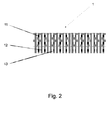
- FIG. 2 shows the strip 1 of the adhesive tape according to the invention according to FIG. 1 in a lateral section.
- an adhesive coating 13 is present on the underside of the carrier 11, an adhesive coating 13 is present. Due to the hot-melt adhesive 13, the holes 12 are permanently made consistently with the aid of hot needles.
Landscapes
- Chemical & Material Sciences (AREA)
- Organic Chemistry (AREA)
- Adhesive Tapes (AREA)
Abstract
Description
Um zu verhindern, dass das Polyurethan beziehungsweise der Polyurethanschaum durch die Einfüllöffnung beziehungsweise Montageöffnungen austritt, werden diese Öffnungen mit einem Klebeband verschlossen.
Aus diesem Grund werden als Klebeband solche Bänder genommen, die eine gewisse Luftdurchlässigkeit aufweisen.
Bisher war es aber nicht möglich, die seitens der Weißgerätehersteller geforderten Luftdurchlässigkeitswerte für die Klebebänder zu garantieren.
In einer bevorzugten Ausführungsform, und zwar bei Einsatz auf lackierten Kunststoffteilen mit einem hohen Restlösungsmittelgehalt im Lack, etwa bedingt durch niedrige Trockentemperaturen, kann das Trägermaterial zum Zweck einer besseren Gasdurchlässigkeit perforiert sein.
Danach wird das Trägermaterial mittels einer transportierenden Vorrichtung derartig gegen eine Beschichtungsvorrichtung geführt, dass durch die Beschichtungsvorrichtung die Haftklebemasse auf das Trägermaterial aufgetragen wird, wobei auf der transportierenden Vorrichtung Haft- oder Halteeinrichtungen vorhanden sind. Diese Einrichtungen bringen die zum Zuführen zur und zum Trennen von der Beschichtungseinheit notwendigen Kräfte in derartiger Weise auf, dass bei der Beschichtung die Eigenschaften des Trägers nicht verändert werden.
In einer als vorteilhaft beschriebenen Ausführungsform ist die Halteeinrichtung eine Nadelwalze.
- das einseitig selbstklebend ausgerüstete Klebeband einen Träger, auf den einseitig eine Heißschmelzklebemasse aufgebracht ist, sowie eine Luftdurchlässigkeit trägerseitig von größer 30 cm3/(cm2 * s) aufweist,
- das Klebeband mit heißen Nadeln, die sich bevorzugt auf einer Nadelwalze befinden, perforiert ist,
- die Anzahl der Löcher mindestens 5/cm2 beträgt.
Die Luftdurchlässigkeit masseseitig sollte größer 50 cm3/(cm2 * s) sein, bevorzugt größer 60 cm3/(cm2 * s), besonders bevorzugt größer 75 cm3/(cm2 * s).
Die durch die Partikelschicht hindurch genadelten Haltefasern halten die Deckschicht und die Unterlagsschicht in einem Abstand voneinander und sie sind mit der Deckschicht und der Unterlagsschicht verbunden.
Abstandsgewebe oder -gewirke sind u. a. in zwei Artikeln beschrieben, und zwar
einem Artikel aus der Fachzeitschrift "kettenwirk-praxis 3/93", 1993, Seiten 59 bis 63 "Raschelgewirkte Abstandsgewirke"
und
einem Artikel aus der Fachzeitschrift "kettenwirk-praxis 1/94", 1994, Seiten 73 bis 76 "Raschelgewirkte Abstandsgewirke"
auf deren Inhalt hiermit Bezug genommen wird und deren Inhalt Teil dieser Offenbarung und Erfindung wird.
Als Träger kann weiterhin ein Vlies vom Typ Kunitvlies oder Multiknitvlies verwendet werden. Ein Kunitvlies ist dadurch gekennzeichnet, dass es aus der Verarbeitung eines längsorientierten Faservlieses zu einem Flächengebilde hervorgeht, das auf einer Seite Maschen und auf der anderen Maschenstege oder Polfaser-Falten aufweist, aber weder Fäden noch vorgefertigte Flächengebilde besitzt. Auch ein derartiges Vlies wird beispielsweise auf Nähwirkmaschinen des Typs "Kunitvlies" der Firma Karl Mayer schon seit längerer Zeit hergestellt. Ein weiteres kennzeichnendes Merkmal dieses Vlieses besteht darin, dass es als Längsfaservlies in Längsrichtung hohe Zugkräfte aufnehmen kann. Ein Multiknitvlies ist gegenüber dem Kunitvlies dadurch gekennzeichnet, dass das Vlies durch das beidseitige Durchstechen mit Nadeln sowohl auf der Ober- als auch auf der Unterseite eine Verfestigung erfährt.
Schließlich sind auch Nähvliese als Vorprodukt geeignet, eine erfindungsgemäße Eindeckung und ein erfindungsgemäßes Klebeband zu bilden. Ein Nähvlies wird aus einem Vliesmaterial mit einer Vielzahl parallel zueinander verlaufender Nähte gebildet. Diese Nähte entstehen durch das Einnähen oder Nähwirken von durchgehenden textilen Fäden. Für diesen Typ Vlies sind Nähwirkmaschinen des Typs "Maliwatt" der Firma Karl Mayer, ehemals Malimo, bekannt.
Ein derartiges Vlies ist dadurch gekennzeichnet, dass die Fasern nass gelegt werden oder zum Beispiel ein Stapelfaservlies durch die Bildung von Maschen aus Fasern des Vlieses oder durch Nadelung, Vernähung beziehungsweise Luft- und/oder Wasserstrahlbearbeitung vorverfestigt wird.
In einem zweiten Schritt erfolgt die Thermofixierung, wobei die Festigkeit des Vlieses durch das Auf- oder Anschmelzen der Schmelzfasern nochmals erhöht wird.
Das Aufkonzentrieren kann in entsprechend ausgerüsteten Kesseln oder Extrudern stattfinden, insbesondere beim damit einhergehenden Entgasen ist ein Entgasungsextruder bevorzugt.
Eine derartige Klebemasse ist in der DE 43 13 008 A1 dargelegt, auf deren Inhalt hiermit Bezug genommen wird und deren Inhalt Teil dieser Offenbarung und Erfindung wird. Diesen auf diesem Wege hergestellten Acrylatmassen wird in einem Zwischenschritt das Lösungsmittel vollständig entzogen.
Zusätzlich werden dabei weitere leichtflüchtige Bestanteile entfernt. Nach der Beschichtung aus der Schmelze weisen diese Massen nur noch geringe Anteile an flüchtigen Bestandteilen auf. Somit können alle im oben angeführten Patent beanspruchten Monomere/Rezepturen übernommen werden. Ein weiterer Vorteil der im Patent beschriebenen Massen ist darin zu sehen, dass diese einen hohen K-Wert und damit ein hohes Molekulargewicht aufweisen. Dem Fachmann ist bekannt, dass sich Systeme mit höheren Molekulargewichten effizienter vernetzen lassen. Damit sinkt entsprechend der Anteil an flüchtigen Bestandteilen.
Die Lösung der Masse kann 5 bis 80 Gew.-%, insbesondere 30 bis 70 Gew.-% Lösungsmittel enthalten.
Vorzugsweise werden handelsübliche Lösungsmittel eingesetzt, insbesondere niedrig siedende Kohlenwasserstoffe, Ketone, Alkohole und/oder Ester.
Weiter vorzugsweise werden Einschnecken-, Zweischnecken- oder Mehrschneckenextruder mit einer oder insbesondere zwei oder mehreren Entgasungseinheiten eingesetzt. In der Klebemasse auf Acrylathotmelt-Basis können Benzoinderivate einpolymerisiert sein, so beispielsweise Benzoinacrylat oder Benzoinmethacrylat, Acrylsäure- oder Methacrylsäureester. Derartige Benzoinderivate sind in der EP 0 578 151 A1 beschrieben.
Die Klebemasse auf Acrylathotmelt-Basis kann aber auch chemisch vernetzt sein.
In einer besonders bevorzugten Ausführungsform werden als Selbstklebemassen Copolymerisate aus (Meth)acrylsäure und deren Estern mit 1 bis 25 C-Atomen, Malein-, Fumar- und/oder Itaconsäure und/oder deren Estern, substituierten (Meth)acrylamiden, Maleinsäureanhydrid und anderen Vinylverbindungen, wie Vinylestern, insbesondere Vinylacetat, Vinylalkoholen und/oder Vinylethern eingesetzt.
Der Restlösungsmittel-Gehalt sollte unter 1 Gew.-% betragen.
Stellvertretend genannt seien an dieser Stelle vor allem die besonders verträglichen Styrol-Isopren-Styrol (SIS)- und Styrol-Butadien-Styrol (SBS)-Typen.
Der Durchmesser der Nadeln und daraus resultierend der Durchmesser der Löcher liegt zwischen 0,5 und 1,5 mm, insbesondere zwischen 0,9 und 1,00 mm.
Das Klebeband besteht aus einem Träger, auf den einseitig eine Heißschmelzklebemasse aufgebracht ist.
Wenn dieses Klebeband von heißen Nadeln, sprich mit einer Temperatur von bevorzugt 100 °C und besonders bevorzugt mit einer Temperatur von 170 °C bis 400 °C, durchdrungen wird, schmelzen sowohl das Trägermaterial als auch die Klebemasse in der unmittelbaren Nähe der Nadeln auf. Beide Materialien werden durch die Nadeln gleichzeitig verdrängt, so dass sich durchgängige Löcher im Klebeband ergeben.
Auf diese Weise ergeben sich Löcher, die dauerhaft sind, sprich die sich nicht im Laufe der Zeit zusetzen, indem besonders die Klebemasse zurückfließt und das Loch verschließt.
Es ist zurzeit daher nicht möglich, eine bestimmte Luftdurchlässigkeit des Klebebands für einen längeren Zeitraum zu garantieren.
Die Luftdurchlässigkeit wird angegeben in dem Luftvolumen, welches in einer Zeiteinheit durch eine bestimmte Fläche hindurch tritt.
- Densometer (Firma W. & L.E. Gurley, Troy. N.Y.,USA)
- GURLEY-Lochplatte A (groß): Durchlassfläche = 1,0 sq.inch
- GURLEY-Lochplatte B (klein): Durchlassfläche = 0,25 sq.inch
- GURLEY-Lochplatte C (ganz klein): Durchlassfläche = 0,1 sq.inch
- Stoppuhr Der innere Zylinder des Densometers wird bis zur Halterungsfeder angehoben und dort festgeklemmt. Dann wird die zu untersuchende Probe ohne Spannung auf die passende Lochplatte geklebt, welche in das Densometer eingelegt und festgeschraubt wird. Jetzt wird der innere Zylinder aus der Halterungsfeder gelöst, langsam bis zur Startmarke gesenkt und dann losgelassen Mit der Stoppuhr wird die Fallzeit gemessen, und zwar
- für die Lochplatten A und B von der 100 cm3- bis zur 300 cm3-Marke (Luftmenge = 200 cm3),
- für die Lochplatte C von der 100 cm3- bis zur 150 cm3-Marke (Luftmenge = 50 cm3)
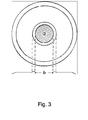
| GURLEY-Lochplatte | Durchlassfläche in cm2 | In Figur 3 als "a" gekennzeichnet |
| A (groß) | 6,45 | (= 1,0 sq.inch) |
| B (klein) | 1,61 | (= 0,25 sq.inch) |
| C (ganz klein) | 0,645 | (= 0,1 sq.inch) |
- Figur 1
- einen Streifen eines erfindungsgemäßen Klebebands mit Blick auf den Träger und
- Figur 2
- den Streifen des erfindungsgemäßen Klebebands nach Figur 1 im seitlichen Schnitt.
Durch den Träger 11 sind eine Vielzahl von Löchern 12 genadelt, und zwar 14 pro Quadratmeter.
Unterseitig ist auf dem Träger 11 eine klebende Beschichtung 13 vorhanden. Aufgrund der heißschmelzenden Klebemasse 13 sind die Löcher 12 dauerhaft durchgängig unter Zuhilfenahme heißer Nadeln gefertigt.
Claims (5)
- Verwendung eines einseitig selbstklebend ausgerüsteten Klebebands als Entlüftungsband, indem das Klebeband über eine Öffnung in einem abgeschlossenen Raum geklebt wird, der einen höheren Luftdruck aufweist als der umgebende Raum, insbesondere bei der Ausschäumung der Seitenwände von Weißgeräten wie Kühlschränke, wobei
das einseitig selbstklebend ausgerüstete Klebeband einen Träger, auf den einseitig eine Heißschmelzklebemasse aufgebracht ist, sowie eine Luftdurchlässigkeit trägerseitig von größer 30 cm3/(cm2 * s) aufweist,
das Klebeband mit heißen Nadeln, die sich bevorzugt auf einer Nadelwalze befinden, perforiert ist,
die Anzahl der Löcher mindestens 5/cm2 beträgt. - Verwendung eines einseitig selbstklebend ausgerüsteten Klebeband nach Anspruch 1, dadurch gekennzeichnet, dass das Klebeband zwischen 150 und 500 µm, insbesondere zwischen 200 und 350 µm dick ist.
- Verwendung eines einseitig selbstklebend ausgerüsteten Klebeband nach den Ansprüchen 1 oder 2, dadurch gekennzeichnet, dass das Klebeband eine Luftdurchlässigkeit trägerseitig von größer 40 cm3/(cm2 * s), insbesondere von größer 50 cm3/(cm2 * s) aufweist.
- Verwendung eines einseitig selbstklebend ausgerüsteten Klebeband nach zumindest einem der Ansprüche 1 bis 3, dadurch gekennzeichnet, dass die Reißdehnung des Klebebands zwischen 10 % und 50 % beträgt.
- Verwendung eines einseitig selbstklebend ausgerüsteten Klebeband nach zumindest einem der vorherigen Ansprüche, dadurch gekennzeichnet, dass als Trägermaterial ein Vlies verwendet wird.
Applications Claiming Priority (2)
| Application Number | Priority Date | Filing Date | Title |
|---|---|---|---|
| DE102004027557 | 2004-06-04 | ||
| DE102004027557A DE102004027557A1 (de) | 2004-06-04 | 2004-06-04 | Verwendung eines einseitig selbstklebend ausgerüsteten Klebebands als Entlüftungsband mit einer Luftdurchlässigkeit von größer 30 cm3/(cm2*s) |
Publications (1)
| Publication Number | Publication Date |
|---|---|
| EP1602699A1 true EP1602699A1 (de) | 2005-12-07 |
Family
ID=34979483
Family Applications (1)
| Application Number | Title | Priority Date | Filing Date |
|---|---|---|---|
| EP05103612A Ceased EP1602699A1 (de) | 2004-06-04 | 2005-05-02 | Verwendung eines einseitig selbstklebend ausgerüsteten Klebebands als Entlüftungsband mit einer Luftdurchlässigkeit von grösser 30 cm3/(cm2 * s) |
Country Status (5)
| Country | Link |
|---|---|
| US (1) | US20050271860A1 (de) |
| EP (1) | EP1602699A1 (de) |
| CN (1) | CN1706904A (de) |
| DE (1) | DE102004027557A1 (de) |
| MX (1) | MXPA05005756A (de) |
Cited By (2)
| Publication number | Priority date | Publication date | Assignee | Title |
|---|---|---|---|---|
| WO2009103774A1 (de) * | 2008-02-19 | 2009-08-27 | BSH Bosch und Siemens Hausgeräte GmbH | Kältegerät, verfahren sowie vorrichtung zu dessen herstellung |
| WO2016012617A1 (de) * | 2014-07-25 | 2016-01-28 | Certoplast Technische Klebebänder Gmbh | Verfahren zur herstellung eines klebebandes |
Families Citing this family (10)
| Publication number | Priority date | Publication date | Assignee | Title |
|---|---|---|---|---|
| CN103173158A (zh) * | 2013-04-18 | 2013-06-26 | 上海晶华粘胶制品发展有限公司 | 热熔美纹胶带的制作工艺 |
| JP6029177B2 (ja) * | 2013-04-19 | 2016-11-24 | 株式会社ヒガシ化学 | 非自己接着再剥離性両面粘着シート |
| DE102013214316A1 (de) | 2013-07-22 | 2015-01-22 | Tesa Se | Verwendung eines einseitig selbstklebend ausgerüsteten Klebebands als Entlüftungsband |
| CN110652396B (zh) * | 2013-10-30 | 2021-11-23 | 3M创新知识产权公司 | 具有不同大小的穿孔的敷件 |
| DE102014202890B4 (de) * | 2014-02-18 | 2019-01-03 | Bayerische Motoren Werke Aktiengesellschaft | Verfahren zum Ausschäumen eines Hohlraums und Entlüftungspad zur Verwendung für das Verfahren |
| CN118085744A (zh) * | 2016-11-09 | 2024-05-28 | 株式会社可乐丽 | 粘合片、橡皮膏及它们的制造方法 |
| CN108051938A (zh) * | 2017-12-25 | 2018-05-18 | 高锋科技(惠州)有限公司 | 一种显示屏模组自动化加工方法 |
| CA3122249A1 (en) * | 2018-12-27 | 2020-07-02 | Kuraray Co., Ltd. | Laminates having perforated structural body |
| EP4461780A1 (de) * | 2023-05-12 | 2024-11-13 | Guido Beckmann | Ein pad sowie ein verfahren zur behandlung von schimmel an oberflächen von bauwerken |
| DE102024120900A1 (de) * | 2024-07-23 | 2026-01-29 | Tesa Se | Verfahren zum Herstellen eines mehrlagigen Klebeelementes |
Citations (3)
| Publication number | Priority date | Publication date | Assignee | Title |
|---|---|---|---|---|
| US3085024A (en) * | 1959-05-19 | 1963-04-09 | Johnson & Johnson | Porous extensible pressure-sensitive adhesive tape in which perforations arearrangedto facilitate tearing |
| US3085572A (en) * | 1961-10-06 | 1963-04-16 | Johnson & Johnson | Tape |
| WO2000066355A1 (en) * | 1999-04-30 | 2000-11-09 | Flexipak Tape Products, L.L.C. | Venting tape |
Family Cites Families (12)
| Publication number | Priority date | Publication date | Assignee | Title |
|---|---|---|---|---|
| DE1079767B (de) * | 1955-09-02 | 1960-04-14 | Lohmann K G | Klebende Baender, insbesondere Wundpflaster, und Vorrichtung zu deren Herstellung |
| US3214502A (en) * | 1960-08-08 | 1965-10-26 | Kendall & Co | Method and apparatus for making adhesive tapes |
| US3088843A (en) * | 1960-11-23 | 1963-05-07 | Kendall & Co | Method of perforating |
| US4608145A (en) * | 1984-07-23 | 1986-08-26 | General Electric Company | Electroplating tape |
| CA2023097C (en) * | 1990-01-16 | 1999-07-06 | Kenji Tsubota | Method for producing an air-permeable adhesive tape |
| US5810756A (en) * | 1995-05-23 | 1998-09-22 | Lectec Corporation | Method of producing a perforated medical adhesive tape |
| DE19620109A1 (de) * | 1996-05-18 | 1997-11-20 | Beiersdorf Ag | Selbstklebend beschichtetes, luftdurchlässiges Trägermaterial, Verfahren zu dessen Herstellung und Verwendung |
| DE19819442A1 (de) * | 1998-04-30 | 1999-11-04 | Beiersdorf Ag | Trägermaterial für medizinische Zwecke |
| US6262330B1 (en) * | 1998-12-02 | 2001-07-17 | Nichiban Co., Ltd. | Pressure sensitive adhesive tape for skin and base material therefor |
| DE10129546A1 (de) * | 2001-06-19 | 2003-06-12 | Tesa Ag | Verwendung eines mindestens einseitig mit einer, kohäsiven Haftmasse beschichtetes Trägermaterial zum Ummanteln von langgestrecktem Gut, wie insbesondere Kabelsätzen |
| DE10247046A1 (de) * | 2002-10-09 | 2004-04-22 | Silu Verwaltung Ag | Selbstklebefolie mit rutschhemmender Abdeckschicht |
| DE10252516A1 (de) * | 2002-11-08 | 2004-05-27 | Tesa Ag | Selbstklebender Schutzartikel für mechanisch stark beanspruchte lackierte Automobilteile |
-
2004
- 2004-06-04 DE DE102004027557A patent/DE102004027557A1/de not_active Withdrawn
-
2005
- 2005-05-02 EP EP05103612A patent/EP1602699A1/de not_active Ceased
- 2005-05-03 US US11/120,545 patent/US20050271860A1/en not_active Abandoned
- 2005-05-30 MX MXPA05005756A patent/MXPA05005756A/es unknown
- 2005-06-06 CN CNA2005100755680A patent/CN1706904A/zh active Pending
Patent Citations (3)
| Publication number | Priority date | Publication date | Assignee | Title |
|---|---|---|---|---|
| US3085024A (en) * | 1959-05-19 | 1963-04-09 | Johnson & Johnson | Porous extensible pressure-sensitive adhesive tape in which perforations arearrangedto facilitate tearing |
| US3085572A (en) * | 1961-10-06 | 1963-04-16 | Johnson & Johnson | Tape |
| WO2000066355A1 (en) * | 1999-04-30 | 2000-11-09 | Flexipak Tape Products, L.L.C. | Venting tape |
Non-Patent Citations (3)
| Title |
|---|
| "Paper and board - Determination of air permeance and air resistance (medium range) - Part 5: Gurley method", ISO 5636-5, 2003, pages 1 - 8, XP009108822 * |
| "Technical Data Sheet 3M Vent Tape 394", March 2003 (2003-03-01), XP002347400, Retrieved from the Internet <URL:http://multimedia.mmm.com/mws/mediawebserver.dyn?CCCCCClJVORCXf1Cpf1CCC3J5nYHAb3r-> [retrieved on 20050930] * |
| "Technical Data Sheet 3M Venting Tape 3394", 1999, XP002347401, Retrieved from the Internet <URL:http://multimedia.mmm.com/mws/mediawebserver.dyn?UUUUUUC04ehUnx7UGx7UUU9dwE5Zs7he-> [retrieved on 20050930] * |
Cited By (3)
| Publication number | Priority date | Publication date | Assignee | Title |
|---|---|---|---|---|
| WO2009103774A1 (de) * | 2008-02-19 | 2009-08-27 | BSH Bosch und Siemens Hausgeräte GmbH | Kältegerät, verfahren sowie vorrichtung zu dessen herstellung |
| WO2009103639A1 (de) * | 2008-02-19 | 2009-08-27 | BSH Bosch und Siemens Hausgeräte GmbH | Kältegerät, verfahren sowie vorrichtung zu dessen herstellung |
| WO2016012617A1 (de) * | 2014-07-25 | 2016-01-28 | Certoplast Technische Klebebänder Gmbh | Verfahren zur herstellung eines klebebandes |
Also Published As
| Publication number | Publication date |
|---|---|
| DE102004027557A1 (de) | 2005-12-22 |
| MXPA05005756A (es) | 2005-12-07 |
| US20050271860A1 (en) | 2005-12-08 |
| CN1706904A (zh) | 2005-12-14 |
Similar Documents
| Publication | Publication Date | Title |
|---|---|---|
| EP1315781B1 (de) | Verfahren zur ummantelung von langgestrecktem gut, wie insbesondere kabelsätzen, mit einem klebeband | |
| EP2235098B1 (de) | Geschäumte, insbesondere druckempfindliche klebemasse, verfahren zur herstellung sowie die verwendung derselben | |
| EP2500389B1 (de) | Klebeband mit laminat-träger gebildet aus einem textilen träger und einer folie zum ummanteln von langgestrecktem gut wie insbesondere kabelsätzen und verfahren zur ummantelung | |
| EP0995782B1 (de) | Verwendung eines Klebebands auf Basis eines mit Schmelzfasern thermofixierten Vlieses | |
| EP1311640A1 (de) | Klebebänder mit textilem träger für die ummantelung von langgestrecktem gut, wie insbesondere kabelsätzen | |
| EP3540024A1 (de) | Klebeband zum ummanteln von langgestrecktem gut wie insbesondere kabelsätzen und verfahren zur ummantelung | |
| DE102016204898A1 (de) | Klebeband zum Ummanteln von langgestrecktem Gut wie insbesondere Kabelsätzen und Verfahren zur Ummantelung | |
| DE102007058460A1 (de) | Geräuschdämpfendes und hoch abriebfestes Band insbesondere für die Bandagierung von Kabelbäumen in Automobilen | |
| DE102008036926A1 (de) | Verfahren zum Beschichten von bahnförmigen Trägermaterialien mit hohem Masseauftrag | |
| EP3613819B1 (de) | Klebeband zum ummanteln von langgestrecktem gut wie insbesondere kabelsätzen und verfahren zur ummantelung | |
| DE102004027557A1 (de) | Verwendung eines einseitig selbstklebend ausgerüsteten Klebebands als Entlüftungsband mit einer Luftdurchlässigkeit von größer 30 cm3/(cm2*s) | |
| DE102004018047A1 (de) | Verfahren zum dauerhaften Verschließen von Löchern insbesondere in Blechen oder in Kunststoffteilen von Automobilkarosserien | |
| EP2010619B1 (de) | Blasenfrei verklebende klebeschicht | |
| EP2497807B1 (de) | Verwendung eines klebebandes für die kabelbandagierung | |
| EP1270695B1 (de) | Verwendung eines mindestens einseitig mit einer kohäsiven Haftmasse beschichteten Trägermaterials zum Ummanteln von Kabelsätzen | |
| DE102019211874A1 (de) | Klebeband zum Ummanteln von langgestrecktem Gut wie insbesondere Kabelsätzen und Verfahren zur Ummantelung | |
| DE19953095A1 (de) | Selbstklebendes Abdeckband | |
| DE102008038471A1 (de) | Verwendung eines Klebebands zum Umwickeln von langgestrecktem Gut wie insbesondere Leitungen oder Kabelsätze | |
| DE19953097A1 (de) | Selbstklebender Formkörper | |
| DE102013214316A1 (de) | Verwendung eines einseitig selbstklebend ausgerüsteten Klebebands als Entlüftungsband | |
| WO2021023810A1 (de) | Klebeband zum ummanteln von langgestrecktem gut wie insbesondere kabelsätzen und verfahren zur ummantelung | |
| DE102014110535A1 (de) | Verfahren zur Herstellung eines Klebebandes | |
| EP1477540A2 (de) | Haftklebeband | |
| DE19953096A1 (de) | Selbstklebende Flächengebilde | |
| DE102020208549A1 (de) | Verfahren zur Herstellung von Klebebandtellerrollen |
Legal Events
| Date | Code | Title | Description |
|---|---|---|---|
| PUAI | Public reference made under article 153(3) epc to a published international application that has entered the european phase |
Free format text: ORIGINAL CODE: 0009012 |
|
| AK | Designated contracting states |
Kind code of ref document: A1 Designated state(s): AT BE BG CH CY CZ DE DK EE ES FI FR GB GR HU IE IS IT LI LT LU MC NL PL PT RO SE SI SK TR |
|
| AX | Request for extension of the european patent |
Extension state: AL BA HR LV MK YU |
|
| 17P | Request for examination filed |
Effective date: 20060607 |
|
| AKX | Designation fees paid |
Designated state(s): AT BE BG CH CY CZ DE DK EE ES FI FR GB GR HU IE IS IT LI LT LU MC NL PL PT RO SE SI SK TR |
|
| 17Q | First examination report despatched |
Effective date: 20071115 |
|
| RAP1 | Party data changed (applicant data changed or rights of an application transferred) |
Owner name: TESA SE |
|
| STAA | Information on the status of an ep patent application or granted ep patent |
Free format text: STATUS: THE APPLICATION HAS BEEN REFUSED |
|
| 18R | Application refused |
Effective date: 20090302 |