EP1598644B2 - Herstellungsverfahren eines magnetisch-induktiven Durchflussmessers - Google Patents
Herstellungsverfahren eines magnetisch-induktiven Durchflussmessers Download PDFInfo
- Publication number
- EP1598644B2 EP1598644B2 EP05010775.4A EP05010775A EP1598644B2 EP 1598644 B2 EP1598644 B2 EP 1598644B2 EP 05010775 A EP05010775 A EP 05010775A EP 1598644 B2 EP1598644 B2 EP 1598644B2
- Authority
- EP
- European Patent Office
- Prior art keywords
- electrodes
- fluid
- measured
- electromagnetic flowmeter
- electropolishing
- Prior art date
- Legal status (The legal status is an assumption and is not a legal conclusion. Google has not performed a legal analysis and makes no representation as to the accuracy of the status listed.)
- Expired - Lifetime
Links
Images
Classifications
-
- G—PHYSICS
- G01—MEASURING; TESTING
- G01F—MEASURING VOLUME, VOLUME FLOW, MASS FLOW OR LIQUID LEVEL; METERING BY VOLUME
- G01F1/00—Measuring the volume flow or mass flow of fluid or fluent solid material wherein the fluid passes through a meter in a continuous flow
- G01F1/56—Measuring the volume flow or mass flow of fluid or fluent solid material wherein the fluid passes through a meter in a continuous flow by using electric or magnetic effects
- G01F1/58—Measuring the volume flow or mass flow of fluid or fluent solid material wherein the fluid passes through a meter in a continuous flow by using electric or magnetic effects by electromagnetic flowmeters
- G01F1/584—Measuring the volume flow or mass flow of fluid or fluent solid material wherein the fluid passes through a meter in a continuous flow by using electric or magnetic effects by electromagnetic flowmeters constructions of electrodes, accessories therefor
Definitions
- the present invention relates to a production method of an electromagnetic flowmeter which applies a magnetic field to a fluid to be measured and picks up an electromotive force generated according to a flow rate of the fluid to be measured.
- Document US 3 180 144 refers to electrodes for fitting into the walls of tubes to provide an electrical connection to liquids flowing through the tubes, and has for its object to provide an electrode suitable for use with a tube embodied in the detector head of an induction flowmeter, concentration meter or electrical conductivity measuring instrument.
- Such an electromagnetic flowmeter is arranged to allow the electrodes to pick up an electromotive force generated according to the flow rate of a fluid to be measured when a magnetic field is applied to the fluid (not shown).
- the electrodes of the electromagnetic flowmeter are adapted to pick up an electromotive force.
- An electromagnetic flowmeter generates a flow noise when electric charge moves between the surface of the electrodes and the fluid to be measured. It is also known that when the electrodes of an electromagnetic flowmeter are soaked in a fluid to be measured (e.g., water) for a long period of time, the flow noise reduces.
- a fluid to be measured e.g., water
- flow noise as used herein is meant to indicate a noise generated when the fluid to be measured rubs against the lined surface (electrode), i.e., noise generated by electric charge with the movement of a fluid to be measured, remarkably a fluid having a low electrical conductivity and a low viscosity such as alcohol and pure water.
- the flow noise falls when the dynamic viscosity or electrical conductivity of the fluid to be measured rises but rises when the flow rate of the fluid to be measured rises.
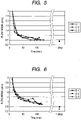
- Figs. 4 to 6 Specific flow noise characteristics will be described hereinafter in connection with Figs. 4 to 6 .
- the abscissa indicates the time during which the fluid to be measured flows through the measuring tube of the electromagnetic flowmeter (since the time at which the measuring tube comes in contact with the fluid) and the ordinate indicates the magnitude of flow noise.
- B-1 to B-9, C-1 to C-3 and D-1 to D-3 each indicate the measurements of the respective sample that are dispersed by the difference in properties between electrodes.
- Fig. 4 illustrates the flow noise characteristics of a related art electromagnetic flowmeter wherein there is provided a couple of electrodes which have been left as it is lathed.
- the flow noise maintains a high level after the contact with the fluid and, even after several hours, doesn't readily fall and is much dispersed.
- Fig. 5 illustrates the flow noise characteristics of a related art electromagnetic flowmeter wherein there is provided a couple of electrodes which have been lathed and buffed to smoothen the surface of the substrate.
- the flow noise is large after the contact with the fluid but falls after the lapse of time.
- Fig. 6 illustrates the flow noise characteristics of a related art electromagnetic flowmeter wherein there is provided a couple of electrodes which have been lathed and forcedly oxidized in the atmosphere.
- the flow noise is large after the contact with the fluid but falls after the lapse of time.
- the flow noise in the characteristics of Fig. 6 is larger than that of Fig. 5 .
- an electromagnetic flowmeter has a step of assembling a couple of electrodes in a measuring tube (product assembly), a step of soaking the electrodes in a fluid to be measured for a predetermined period of time, and a step of correcting the electromagnetic flowmeter.
- a step of soaking the electrodes again in the fluid to be measured is then executed. Subsequently, a step of correcting the electromagnetic flowmeter is executed.
- Some related art of electromagnetic flowmeters has a couple of oxidized electrodes (see, e.g., the following document (1).).
- the electromagnetic flowmeters as the related art generate much flow noise shortly after coming in contact with a fluid. Further, the generated flow noise doesn't readily fall even after the lapse of time from the contact with the fluid. Further, the generated flow noise is much dispersed by the difference in properties between electrodes.
- the step of soaking the electrodes of the electromagnetic flowmeter in the fluid to be measured and the step of correcting the electromagnetic flowmeter require much time, it takes long time to produce the electromagnetic flowmeter.
- An object of the invention is to provide a production method of the electromagnetic flowmeter.
- the invention is defined according to claim 1.
- the invention provides a production method of an electromagnetic flowmeter having a measuring tube through which a fluid to be measured flows, a magnetic field applying section which applies a magnetic field to the fluid to be measured, and a couple of electrodes which pick up an electromotive force generated according to a flow rate of the fluid to be measured, including the steps of: electropolishing the electrodes; and assembling the electrodes in the measuring tube.
- the production method of an electromagnetic flowmeter further includes the steps of: immersing the electrodes in the fluid to be measured between the step of electropolishing the electrodes and the step of assembling the electrodes in the measuring tube.
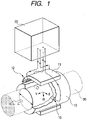
- Fig. 1 is a configurational diagram illustrating an example of implementation not being part of the present invention.
- the electromagnetic flowmeter has a couple of electrodes 10, a measuring tube 13, a converter 20, a core 11, and an exciting coil 12.
- Each of the electrodes 10 is assembling in the measuring tube 13.
- the electrodes 10 are electrically connected to the converter 20.
- the core 11 and the exciting coil 12 are formed adjacent to the measuring tube 13.
- the exciting coil 12 is electrically connected to the converter 20.
- a fluid to be measured 30 e.g., water flows through the measuring tube 13.
- the core 11 and the exciting coil 12 apply a magnetic field to the fluid to be measured 30.
- the electrodes 10 pick up an electromotive force generated according to the flow rate of the fluid to be measured 30.
- the converter 20 outputs a signal corresponding to the flow rate of the fluid to be measured 30.
- the flow rate of the fluid to be measured 30 is measured.
- the surfaces of the electrodes 10 have an interface processed by electropolishing. Further, the electrodes 10 are made of stainless steel.
- the electropolishing is a technique for forming an extremely smooth and glossy surface by making the use of anode dissolution phenomena, i.e., characteristic that when electric current flows through stainless steel or the like in an electrolytic solution, a raised portion dissolves earlier than an indented portion.
- the surfaces of the electrodes 10 are chemically dissolved to a thickness on the order of micrometer to form an interface thereon.
- the surfaces of the electrodes 10 are electropolished so that it is electrochemically dissolved to a thickness on the order of angstrom ( ⁇ ) to form an interface thereon.
- the electrolyte in the vicinity of the surfaces of the electrodes 10 have their metal ions concentrated, making it more difficult for metal to dissolve. And, when it is tried to force the metal to be dissolved by passing DC current through the electrodes 10, the raised portion is preferentially dissolved because electric current can easily flow through the raised portion but difficultly flow through the indented portion. Therefore, the interfaces of the electrodes 10 are smoothened by electropolishing.
- the interfaces of the electrodes 10 have their chromium concentration raised when electropolished. In other words, the interfaces of the electrodes 10 have chromium-rich layers processed thereon.
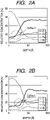
- Figs. 2A and 2B are configurational diagrams of the interfaces of the electrodes 10 according to the example of Fig. 1 .
- Fig. 2A illustrates the interfaces of the electrodes 10 before electropolishing.
- Fig. 2B illustrates the interfaces of the electrodes 10 after electropolishing.
- the abscissa indicates the depth from the interface, and the ordinate indicates the relative ratio of components.
- the density of chromium (Cr) is much lower than the density of iron (Fe) (Cr/Fe ⁇ 1) as shown in Fig. 2A .
- the density of chromium (Cr) is higher than the density of iron (Fe) (Cr/Fe > 1) at a depth of 50 angstrom [ ⁇ ] as shown in Fig. 2B .
- a dense interface adaptable to the fluid to be measured was processed. Once processed, the dense interface adaptable to the fluid to be measured maintained its adaptability to the fluid to be measured even when allowed to stand in the atmosphere.
- the surfaces of the electrodes 10 have a passivity film processed thereon to exhibit an enhanced corrosion resistance.
- the surfaces of the electrodes 10 are protected by a chromium oxide film or the like to have stabilized characteristics.
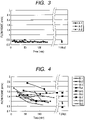
- FIG. 3 illustrates the flow noise characteristics of the exampl of Fig. 1 wherein the electromagnetic flowmeter has electrodes 10 obtained by lathing a metal, electropolishing the metal thus lathed, and then immediately immersing the material in a fluid to be measured (water) for a predetermined period of time (e.g., 4 days).
- the characteristics of Fig. 3 correspond to that of Figs. 4 to 6 .
- A-1 to A-3 each indicate the measurements of the respective sample that are dispersed by the difference in properties among electrodes.
- the flow noise had kept a small magnitude and dispersion since shortly after starting of flow of the fluid to be measured 30 through the measuring tube 13 of the electromagnetic flowmeter.
- the electrodes 10 which have been electropolished to form an interface thereon is allowed to stand in the atmosphere, the electrodes 10 are oxidized by the air to form an interface which can be difficultly adapted to the fluid to be measured.
- the interface (which can be difficultly adapted to the fluid to be measured) processed by allowing the electrodes 10 to stand in the atmosphere differs from the interface (which is adaptable to the fluid to be measured) processed by immersing the aforementioned electrodes 10 in the fluid to be measured.
- steps of lathing the surfaces of the electrodes 10 and then electropolishing the electrodes 10 are executed.
- An interface is processed on the surfaces of the electrodes 10 by electropolishing. At this time, the surfaces of the electrodes 10 are smoothened.
- a step of assembling the electrodes 10 in the measuring tube 13 is executed.
- a step of correcting the electromagnetic flowmeter is executed.
- steps of executing the surfaces of the electrodes 10 and then electropolishing the electrodes 10 are executed.
- An interface is processed on the surfaces of the electrodes 10 by electropolishing.
- a step of immersing the electrodes 10 in a fluid to be measured is executed.
- the electrodes 10 is immersed in a fluid to be measured (water) shortly after the formation of an interface by electropolishing.
- a dense interface adaptable to the fluid to be measured is processed on the surfaces of the electrodes 10.
- a step of assembling the electrodes 10 in the measuring tube 13 is executed.
- a step of correcting the electromagnetic flowmeter is executed.
- the aforementioned process for the production of an electromagnetic flowmeter can be previously prepared before the assembly of the electrodes 10 in the measuring tube 13. Therefore, the time required for production can be reduced. Further, the time required to execute the step of correcting the electromagnetic flowmeter can be reduced.
- a first step of lathing the surfaces of the electrodes 10 and then buffing the electrodes 10 is executed.
- a second step of electropolishing the surfaces of the electrodes 10 is then executed.
- a third step of assembling the electrodes 10 in the measuring tube 13 is then executed.
- a fourth step of correcting the electromagnetic flowmeter is then executed.
- the surface conditions of the electrodes 10 treated in these steps will be further described.
- the external appearance of the surfaces of the electrodes 10 which has been buffed is mirror-like but is observed to have overlapped portions processed thereon and an abrasive and other foreign matters attached thereto.
- the external appearance of the surfaces of the electrodes 10 which has been then electropolished is not mirror-like but is observed to be free of these overlapped portions, abrasive and foreign matters. Further, the surfaces of the electrodes 10 have chromium-rich layers processed thereon.
- electropolishing may involve the application of an AC voltage to the electrodes.
- a specific embodiment of the aforementioned process for the production of an electromagnetic flowmeter will be described hereinafter.
- a step of lathing the surfaces of the electrodes 10 and then electropolishing the electrodes 10 is executed. During this procedure, an AC voltage is applied to the electrodes 10.
- a step of immersing the electrodes 10 in a fluid to be measured shortly after electropolishing is executed.
- a step of assembling the electrodes 10 in the measuring tube 13 is executed.
- a step of correcting the electromagnetic flowmeter is executed.
- the passivity film on the surfaces of the electrodes 10 is destroyed. It was newly confirmed experimentally that the electrodes 10 can form thereon a dense interface adaptable to the fluid to be measured in a shorter period of time. In other words, the time required to execute the step of immersing the electrodes 10 in the fluid to be measured can be further reduced. The time required to produce the electromagnetic flowmeter can be further reduced.
- a dense corrosion-resistant interface adaptable to the fluid to be measured can be processed on the surfaces of the electrodes 10.
- the electromagnetic flowmeter according to this embodiment generates small flow noise and exhibits stabilized characteristics.
- the electrodes may be made of a material which forms a passivity film in the air such as tantalum and titanium to attain substantially the same constitution as mentioned above and hence the same effect and advantage as mentioned above.
Landscapes
- Physics & Mathematics (AREA)
- Electromagnetism (AREA)
- Fluid Mechanics (AREA)
- General Physics & Mathematics (AREA)
- Measuring Volume Flow (AREA)
Claims (1)
- Herstellungsverfahren eines elektromagnetischen Durchflussmessers umfassend eine Messröhre (13), durch die ein zu messendes Fluid (30) fließt, einen Magnetfeld-Anwendungsabschnitt (11,12) welcher ein Magnetfeld an das zu messende Fluid (30) anlegt, und ein Paar von Elektroden (10) welche eine elektromotorische Kraft aufnehmen, die entsprechend einer Durchflussrate des zu messenden Fluids (30) generiert wird, gekennzeichnet durch die Schritte:Elektropolieren der Elektroden (10); undMontieren der Elektroden (10) in der Messröhre (13); undferner umfassend die Schritte:
Eintauchen der Elektroden (10) in das zu messende Fluid (30) zwischen dem Schritt Elektropolieren der Elektroden (10) und dem Schritt Montieren der Elektroden (10) in der Messröhre (13).
Applications Claiming Priority (4)
| Application Number | Priority Date | Filing Date | Title |
|---|---|---|---|
| JP2004150330 | 2004-05-20 | ||
| JP2004150330 | 2004-05-20 | ||
| JP2004360820 | 2004-12-14 | ||
| JP2004360820A JP4665502B2 (ja) | 2004-05-20 | 2004-12-14 | 電磁流量計及び電磁流量計の製造方法 |
Publications (3)
| Publication Number | Publication Date |
|---|---|
| EP1598644A1 EP1598644A1 (de) | 2005-11-23 |
| EP1598644B1 EP1598644B1 (de) | 2016-12-28 |
| EP1598644B2 true EP1598644B2 (de) | 2022-09-14 |
Family
ID=34936648
Family Applications (1)
| Application Number | Title | Priority Date | Filing Date |
|---|---|---|---|
| EP05010775.4A Expired - Lifetime EP1598644B2 (de) | 2004-05-20 | 2005-05-18 | Herstellungsverfahren eines magnetisch-induktiven Durchflussmessers |
Country Status (3)
| Country | Link |
|---|---|
| US (1) | US7293469B2 (de) |
| EP (1) | EP1598644B2 (de) |
| JP (1) | JP4665502B2 (de) |
Families Citing this family (9)
| Publication number | Priority date | Publication date | Assignee | Title |
|---|---|---|---|---|
| JP4754932B2 (ja) * | 2005-10-17 | 2011-08-24 | 株式会社山武 | 電磁流量計 |
| FR2909764B1 (fr) * | 2006-12-12 | 2009-04-03 | Commissariat Energie Atomique | Procede et dispositif de detection et/ou de quantification de fuites d'eau. |
| WO2010108517A1 (en) * | 2009-03-26 | 2010-09-30 | Siemens Aktiengesellschaft | Electropolishing method and electromagnetic flowmeter having electropolished electrodes |
| GB201006409D0 (en) | 2010-04-17 | 2010-06-02 | Univ Huddersfield | Means and method for mearsuring the flow rate of fluid |
| US20120037729A1 (en) * | 2010-08-16 | 2012-02-16 | Lee Joseph C | Insertion Type Fluid Volume Meter and Control System |
| DE102012016408B4 (de) * | 2012-08-21 | 2022-06-09 | Krohne Ag | Magnetisch-induktives Durchflussmessgerät mit einer Mehrzahl von Funktionseinheiten, konstruktive Realisierung |
| WO2015114917A1 (ja) * | 2014-01-29 | 2015-08-06 | 株式会社島津製作所 | 金属電極、それを用いた電子銃、電子管並びにx線管 |
| CN104911686A (zh) * | 2015-06-04 | 2015-09-16 | 上海大学兴化特种不锈钢研究院 | 提高304l不锈钢耐点蚀性能的磁调控表面处理方法 |
| US10371550B2 (en) | 2016-10-24 | 2019-08-06 | Ademco Inc. | Compact magnetic field generator for magmeter |
Citations (1)
| Publication number | Priority date | Publication date | Assignee | Title |
|---|---|---|---|---|
| EP0337292A2 (de) † | 1988-04-13 | 1989-10-18 | Endress + Hauser Flowtec AG | Intermittierendes Anlegen einer Spannung an eine Elektrode |
Family Cites Families (11)
| Publication number | Priority date | Publication date | Assignee | Title |
|---|---|---|---|---|
| NL264866A (de) * | 1960-05-20 | |||
| GB1288912A (de) * | 1968-11-20 | 1972-09-13 | ||
| JPS5851230U (ja) * | 1981-10-01 | 1983-04-07 | 横河電機株式会社 | 電磁流量計の電極 |
| US4517846A (en) | 1983-06-13 | 1985-05-21 | Flowmetering Instruments Limited | Electromagnetic flowmeter |
| JPS60159200A (ja) * | 1984-01-27 | 1985-08-20 | Naganoken | 電流反転電解による電解研摩方法 |
| US4736634A (en) * | 1985-12-27 | 1988-04-12 | Aichi Tokei Denki Co., Ltd. | Magnetic field generating device for electromagnetic flowmeter of residual magnetization type |
| JPS6324098A (ja) * | 1986-02-28 | 1988-02-01 | Chem Yamamoto:Kk | 合金鋼の溶接に伴なうスケ−ルの除去方法 |
| JP2553538B2 (ja) * | 1987-01-22 | 1996-11-13 | 株式会社中央製作所 | 電解研摩装置 |
| JP2854720B2 (ja) * | 1991-04-18 | 1999-02-03 | 株式会社東芝 | 電磁流量計 |
| JPH0853773A (ja) * | 1994-08-10 | 1996-02-27 | Kobe Steel Ltd | 高耐食性表面処理金属材及びその製法 |
| AU2003230847A1 (en) * | 2002-04-09 | 2003-10-27 | Rensselaer Polytechnic Institute | Electrochemical planarization of metal feature surfaces |
-
2004
- 2004-12-14 JP JP2004360820A patent/JP4665502B2/ja not_active Expired - Fee Related
-
2005
- 2005-05-18 US US11/132,806 patent/US7293469B2/en not_active Expired - Lifetime
- 2005-05-18 EP EP05010775.4A patent/EP1598644B2/de not_active Expired - Lifetime
Patent Citations (1)
| Publication number | Priority date | Publication date | Assignee | Title |
|---|---|---|---|---|
| EP0337292A2 (de) † | 1988-04-13 | 1989-10-18 | Endress + Hauser Flowtec AG | Intermittierendes Anlegen einer Spannung an eine Elektrode |
Non-Patent Citations (15)
| Title |
|---|
| Delstar Metal Finishing, Inc.: "Electropolishing: A User’s Guide to Applications, Quality,Standards and Specifications", Ninth Edition, January 2003 † |
| E+H Flowtec AG, „Zeichnung 318108-000X D", 25.08.2003 † |
| E+H Flowtec AG, Zeichnung 318108-000X C, 23.04.1994 † |
| Eidesstattliche Versicherung, Graf, O. † |
| Endress+Hauser Flowtec AG, „Auftragsbestätigung 43167167", 28.11.2002 † |
| Endress+Hauser Flowtec AG, „Bestellung C03/20007298", 22.05.2003 † |
| Endress+Hauser Flowtec AG, „Liefervorschrift 50102723 (MID Elektroden) Index A", 08.08.2002 † |
| Endress+Hauser Flowtec AG, „Liefervorschrift 50102723 (MID Elektroden) Index B", 16.07.2003 † |
| Endress+Hauser Flowtec AG, „Ordre de Fabrication, page: 01", 23.12.2002 † |
| Endress+Hauser Flowtec AG, „Werksprüfzeugnis", 17.01.2003 † |
| Endress+Hauser Messtechnik GmbH + Co. KG „Lieferschein 26352168" † |
| Endress+Hauser Messtechnik GmbH + Co. KG „Rechnung 39991482" † |
| Endress+Hauser Messtechnik GmbH, „Liste de Preparation Materiell page: 01, page: 03", 23.12.2002 † |
| Katalog 2001 Industrielle Messtechnik (auszugsweise),Endress+Hauser Messtechnik GmbH + Co. KG † |
| S. Mohan et al.: "Electropolishing of Stainless Steel - a Review", Trans. IMF 79(4), 2001, pp. 140-142 † |
Also Published As
| Publication number | Publication date |
|---|---|
| JP4665502B2 (ja) | 2011-04-06 |
| EP1598644B1 (de) | 2016-12-28 |
| EP1598644A1 (de) | 2005-11-23 |
| US7293469B2 (en) | 2007-11-13 |
| JP2006003339A (ja) | 2006-01-05 |
| US20050268730A1 (en) | 2005-12-08 |
Similar Documents
| Publication | Publication Date | Title |
|---|---|---|
| US8524068B2 (en) | Low-rate electrochemical etch of thin film metals and alloys | |
| US5486283A (en) | Method for anodizing aluminum and product produced | |
| EP1598644B1 (de) | Magnetisch induktiver Durchflussmesser und ihre Herstellungsverfahren | |
| US20210138552A1 (en) | Fabricating metal or ceramic components using 3d printing with dissolvable supports of a different material | |
| Dražić et al. | Corrosion rates and negative difference effects for Al and some Al alloys | |
| Cho et al. | The effect of electrolyte properties on the mechanism of crevice corrosion in pure iron | |
| JP2015518925A (ja) | 金属コーティングを作製するための方法 | |
| US5062941A (en) | Electrolytic process for stripping a metal coating from a titanium based metal substrate | |
| UA86197C2 (uk) | Магнітний датчик потоку (варіанти) та витратомір, який його включає | |
| WO2016115494A1 (en) | Gold electroplating solution and method | |
| CN100383494C (zh) | 电磁流量计及其制造方法 | |
| Mogoda et al. | Formation and dissolution behaviour of ZrO2 film in H3PO4 acid solutions | |
| KR101907204B1 (ko) | 피처리물의 아노다이징 방법 | |
| WO2010108517A1 (en) | Electropolishing method and electromagnetic flowmeter having electropolished electrodes | |
| Hryniewicz | On discrepancies between theory and practice of electropolishing | |
| KR101840567B1 (ko) | 플라즈마 전해코팅 공정을 통한 군수용 고내식성 산화알루미늄 착색 코팅층 제조방법 | |
| US20150340714A1 (en) | Separator for fuel cells, fuel cell, fuel cell stack, and method of manufacturing separator for fuel cells | |
| JP2005142074A (ja) | 耐食性導電部材 | |
| EP0498080A2 (de) | Messvorrichtung und Verfahren zum Reinigen einer Messelektrode der genannten Vorrichtung | |
| Sundararajan et al. | Hydrogen entry in crevice region: Evaluation by hydrogen permeation technique | |
| JP6124443B2 (ja) | 金多孔質膜の製造方法 | |
| Salih et al. | Effect of silicon alloying addition on the corrosion behaviour of aluminium in some aqueous media | |
| US10119935B2 (en) | Method for the fabrication of corrosion resistant electrodes | |
| Tomlinson et al. | Electrochemical behaviour of electrodeposited tin in aqueous solutions of pH 1 to 3 and 10 to 13 and the effect of chloride | |
| KR20230020060A (ko) | 알루미늄 합금의 플라즈마 전해산화 피막처리를 통한 미래차용 경량화 부품(Brake-Disk)을 제조하는 방법 |
Legal Events
| Date | Code | Title | Description |
|---|---|---|---|
| PUAI | Public reference made under article 153(3) epc to a published international application that has entered the european phase |
Free format text: ORIGINAL CODE: 0009012 |
|
| AK | Designated contracting states |
Kind code of ref document: A1 Designated state(s): AT BE BG CH CY CZ DE DK EE ES FI FR GB GR HU IE IS IT LI LT LU MC NL PL PT RO SE SI SK TR |
|
| AX | Request for extension of the european patent |
Extension state: AL BA HR LV MK YU |
|
| 17P | Request for examination filed |
Effective date: 20060120 |
|
| AKX | Designation fees paid |
Designated state(s): DE FR GB |
|
| 17Q | First examination report despatched |
Effective date: 20121113 |
|
| GRAP | Despatch of communication of intention to grant a patent |
Free format text: ORIGINAL CODE: EPIDOSNIGR1 |
|
| INTG | Intention to grant announced |
Effective date: 20160719 |
|
| GRAS | Grant fee paid |
Free format text: ORIGINAL CODE: EPIDOSNIGR3 |
|
| STAA | Information on the status of an ep patent application or granted ep patent |
Free format text: STATUS: GRANT OF PATENT IS INTENDED |
|
| GRAA | (expected) grant |
Free format text: ORIGINAL CODE: 0009210 |
|
| STAA | Information on the status of an ep patent application or granted ep patent |
Free format text: STATUS: THE PATENT HAS BEEN GRANTED |
|
| AK | Designated contracting states |
Kind code of ref document: B1 Designated state(s): DE FR GB |
|
| REG | Reference to a national code |
Ref country code: GB Ref legal event code: FG4D |
|
| REG | Reference to a national code |
Ref country code: DE Ref legal event code: R096 Ref document number: 602005050989 Country of ref document: DE |
|
| REG | Reference to a national code |
Ref country code: FR Ref legal event code: PLFP Year of fee payment: 13 |
|
| REG | Reference to a national code |
Ref country code: DE Ref legal event code: R026 Ref document number: 602005050989 Country of ref document: DE |
|
| PLBI | Opposition filed |
Free format text: ORIGINAL CODE: 0009260 |
|
| PLAX | Notice of opposition and request to file observation + time limit sent |
Free format text: ORIGINAL CODE: EPIDOSNOBS2 |
|
| 26 | Opposition filed |
Opponent name: ENDRESS+HAUSER (DEUTSCHLAND) AG+CO.KG/ ENDRESS+HAU Effective date: 20170928 |
|
| PLBB | Reply of patent proprietor to notice(s) of opposition received |
Free format text: ORIGINAL CODE: EPIDOSNOBS3 |
|
| REG | Reference to a national code |
Ref country code: FR Ref legal event code: PLFP Year of fee payment: 14 |
|
| PUAH | Patent maintained in amended form |
Free format text: ORIGINAL CODE: 0009272 |
|
| STAA | Information on the status of an ep patent application or granted ep patent |
Free format text: STATUS: PATENT MAINTAINED AS AMENDED |
|
| 27A | Patent maintained in amended form |
Effective date: 20220914 |
|
| AK | Designated contracting states |
Kind code of ref document: B2 Designated state(s): DE FR GB |
|
| REG | Reference to a national code |
Ref country code: DE Ref legal event code: R102 Ref document number: 602005050989 Country of ref document: DE |
|
| REG | Reference to a national code |
Ref country code: FR Ref legal event code: PLFP Year of fee payment: 19 |
|
| P01 | Opt-out of the competence of the unified patent court (upc) registered |
Effective date: 20230603 |
|
| PGFP | Annual fee paid to national office [announced via postgrant information from national office to epo] |
Ref country code: GB Payment date: 20240418 Year of fee payment: 20 |
|
| PGFP | Annual fee paid to national office [announced via postgrant information from national office to epo] |
Ref country code: DE Payment date: 20240418 Year of fee payment: 20 |
|
| PGFP | Annual fee paid to national office [announced via postgrant information from national office to epo] |
Ref country code: FR Payment date: 20240418 Year of fee payment: 20 |
|
| REG | Reference to a national code |
Ref country code: DE Ref legal event code: R071 Ref document number: 602005050989 Country of ref document: DE |
|
| REG | Reference to a national code |
Ref country code: GB Ref legal event code: PE20 Expiry date: 20250517 |
|
| PG25 | Lapsed in a contracting state [announced via postgrant information from national office to epo] |
Ref country code: GB Free format text: LAPSE BECAUSE OF EXPIRATION OF PROTECTION Effective date: 20250517 |