EP1596320B1 - Funkkommunikationssystem, -vorrichtung und -verfahren - Google Patents
Funkkommunikationssystem, -vorrichtung und -verfahren Download PDFInfo
- Publication number
- EP1596320B1 EP1596320B1 EP05252825A EP05252825A EP1596320B1 EP 1596320 B1 EP1596320 B1 EP 1596320B1 EP 05252825 A EP05252825 A EP 05252825A EP 05252825 A EP05252825 A EP 05252825A EP 1596320 B1 EP1596320 B1 EP 1596320B1
- Authority
- EP
- European Patent Office
- Prior art keywords
- primary
- radio communication
- transmission data
- frequency
- modulation
- Prior art date
- Legal status (The legal status is an assumption and is not a legal conclusion. Google has not performed a legal analysis and makes no representation as to the accuracy of the status listed.)
- Expired - Lifetime
Links
Images


Classifications
-
- H—ELECTRICITY
- H04—ELECTRIC COMMUNICATION TECHNIQUE
- H04L—TRANSMISSION OF DIGITAL INFORMATION, e.g. TELEGRAPHIC COMMUNICATION
- H04L27/00—Modulated-carrier systems
- H04L27/32—Carrier systems characterised by combinations of two or more of the types covered by groups H04L27/02, H04L27/10, H04L27/18 or H04L27/26
- H04L27/34—Amplitude- and phase-modulated carrier systems, e.g. quadrature-amplitude modulated carrier systems
-
- G—PHYSICS
- G06—COMPUTING OR CALCULATING; COUNTING
- G06K—GRAPHICAL DATA READING; PRESENTATION OF DATA; RECORD CARRIERS; HANDLING RECORD CARRIERS
- G06K7/00—Methods or arrangements for sensing record carriers, e.g. for reading patterns
- G06K7/0008—General problems related to the reading of electronic memory record carriers, independent of its reading method, e.g. power transfer
-
- G—PHYSICS
- G01—MEASURING; TESTING
- G01S—RADIO DIRECTION-FINDING; RADIO NAVIGATION; DETERMINING DISTANCE OR VELOCITY BY USE OF RADIO WAVES; LOCATING OR PRESENCE-DETECTING BY USE OF THE REFLECTION OR RERADIATION OF RADIO WAVES; ANALOGOUS ARRANGEMENTS USING OTHER WAVES
- G01S13/00—Systems using the reflection or reradiation of radio waves, e.g. radar systems; Analogous systems using reflection or reradiation of waves whose nature or wavelength is irrelevant or unspecified
- G01S13/74—Systems using reradiation of radio waves, e.g. secondary radar systems; Analogous systems
- G01S13/75—Systems using reradiation of radio waves, e.g. secondary radar systems; Analogous systems using transponders powered from received waves, e.g. using passive transponders, or using passive reflectors
- G01S13/751—Systems using reradiation of radio waves, e.g. secondary radar systems; Analogous systems using transponders powered from received waves, e.g. using passive transponders, or using passive reflectors wherein the responder or reflector radiates a coded signal
- G01S13/758—Systems using reradiation of radio waves, e.g. secondary radar systems; Analogous systems using transponders powered from received waves, e.g. using passive transponders, or using passive reflectors wherein the responder or reflector radiates a coded signal using a signal generator powered by the interrogation signal
-
- G—PHYSICS
- G06—COMPUTING OR CALCULATING; COUNTING
- G06K—GRAPHICAL DATA READING; PRESENTATION OF DATA; RECORD CARRIERS; HANDLING RECORD CARRIERS
- G06K19/00—Record carriers for use with machines and with at least a part designed to carry digital markings
- G06K19/06—Record carriers for use with machines and with at least a part designed to carry digital markings characterised by the kind of the digital marking, e.g. shape, nature, code
- G06K19/067—Record carriers with conductive marks, printed circuits or semiconductor circuit elements, e.g. credit or identity cards also with resonating or responding marks without active components
- G06K19/07—Record carriers with conductive marks, printed circuits or semiconductor circuit elements, e.g. credit or identity cards also with resonating or responding marks without active components with integrated circuit chips
- G06K19/0723—Record carriers with conductive marks, printed circuits or semiconductor circuit elements, e.g. credit or identity cards also with resonating or responding marks without active components with integrated circuit chips the record carrier comprising an arrangement for non-contact communication, e.g. wireless communication circuits on transponder cards, non-contact smart cards or RFIDs
-
- G—PHYSICS
- G06—COMPUTING OR CALCULATING; COUNTING
- G06K—GRAPHICAL DATA READING; PRESENTATION OF DATA; RECORD CARRIERS; HANDLING RECORD CARRIERS
- G06K7/00—Methods or arrangements for sensing record carriers, e.g. for reading patterns
-
- H—ELECTRICITY
- H04—ELECTRIC COMMUNICATION TECHNIQUE
- H04B—TRANSMISSION
- H04B5/00—Near-field transmission systems, e.g. inductive or capacitive transmission systems
- H04B5/40—Near-field transmission systems, e.g. inductive or capacitive transmission systems characterised by components specially adapted for near-field transmission
- H04B5/48—Transceivers
-
- H—ELECTRICITY
- H04—ELECTRIC COMMUNICATION TECHNIQUE
- H04L—TRANSMISSION OF DIGITAL INFORMATION, e.g. TELEGRAPHIC COMMUNICATION
- H04L5/00—Arrangements affording multiple use of the transmission path
- H04L5/14—Two-way operation using the same type of signal, i.e. duplex
- H04L5/143—Two-way operation using the same type of signal, i.e. duplex for modulated signals
Definitions
- the present invention relates to a radio communication system, a radio communication device, and a radio communication method of a radio wave communication system using microwaves.
- Illustrative embodiments of the present invention relate to a radio communication system, a radio communication device, and a radio communication method for realizing communication operation with low power consumption between devices at a relatively short distance.
- illustrative embodiments of the present invention relate to a radio communication system, a radio communication device, and a radio communication method that perform data communication by a backscatter system using transmission of an unmodulated carrier from a reading device side, and absorption and reflection of the received radio wave on the basis of an operation of terminating an antenna on a transmitting device side, and particularly to a radio communication system, a radio communication device, and a radio communication method that eliminate or at least reduce effects of transmitter noise on the reading device side to improve reception sensitivity and increase a communication distance.
- RFID is a system including a tag and a reader, in which system the reader reads information stored in the tag in a non-contact manner. While the system is also referred to as an "ID system,” a “data carrier system” and the like, a universally common name for the system is an RFID system.
- the RFID system may be abbreviated to RFID.
- the RFID system is an "identification system using high frequencies (radio waves).”
- Methods of communication between a tag and a reader/writer include for example an electromagnetic coupling type, an electromagnetic induction type, and a radio frequency communication type (see for example, Klaus Finkenzeller (Translated from the 3rd German edition by Rachel Waddington, Swadlincote, UK) "Fundamentals and Applications in Contactless Smart Cards and Identification” (Wiley & Sons LTD ))
- An RFID tag is a device including unique identifying information, and has an operation characteristic of oscillating a radio wave at a modulation frequency corresponding to the identifying information in response to reception of a radio wave of a specific frequency. On the basis of the oscillation frequency of the RFID tag, a reading device side can identify the RFID tag. Hence, a system using RFID makes it possible to identify an article, an owner, and the like using a unique ID written in the RFID tag.
- the RFID system is now used in many systems including for example a system for monitoring the entering and leaving of a room, an article identifying system in distribution, a bill payment system in restaurants and the like, and a system for preventing takeout before payment in stores selling CDs, software and the like.
- a radio identification device of a small size can be produced by packaging an IC chip having a transmission and reception function and a memory function, a source for driving the chip, and an antenna (see for example, Japanese Patent Laid-Open No. Hei 6-123773 ). According to this radio identification device, it is possible to transmit various data on an article or the like to receiving means of the IC chip via the antenna and store the output in a memory, and also read the data in the memory and supply the data to the outside by radio via the antenna as required. Hence, the presence and position of the article or the like can be checked and traced quickly and easily.
- An RFID system includes an RFID tag and a tag reader.
- the tag receives an unmodulated wave f o transmitted from the tag reader, the unmodulated wave f o is rectified and converted into direct-current power, and the direct-current power can be used as operating power of the tag.
- the tag side performs an operation of terminating an antenna according to a bit image of transmission data, and thus uses absorption and reflection of the received radio wave to represent the data. Specifically, when data is 1, the tag terminates the antenna by an antenna impedance to absorb the radio wave from the tag reader. When data is 0, the tag reflects the radio wave from the tag reader by setting a terminal of the antenna in an open state.
- a signal of the same frequency as that of the signal transmitted from the tag reader is returned by the reflection of a backscatter system.
- a communication method of representing data by a pattern of absorption and reflection of the thus arrived radio wave is referred to as a "backscatter system.”
- the tag can transmit information therewithin to the reader side without a power supply.
- a radio communication system of the backscatter system is limited in communication range to a relatively short distance, and is thus often applied to identification and authentication of an article, a person and the like, as is typified by the RFID tag.
- the RFID tag generally has no power supply, and is supplied with power from the radio wave from the reader. This power is supplied from a battery within the device, whereby radio data transmission with low power consumption by the backscatter system can be realized. That is, when a communication distance is limited, radio communication of the backscatter system has a characteristic of being able to establish a radio transmission line with a very low power consumption.
- radio communication of the backscatter system has a characteristic of being able to establish a radio transmission line with a very low power consumption.
- the communication system based on the backscatter system performs data communication using absorption and reflection of the received radio wave on the basis of the operation of terminating the antenna as a fundamental operation.
- frequency of a carrier from the reader and center frequency of the reflected wave are the same, and the reader side performs transmission and reception at the same frequency.
- a receiving unit is affected by the transmission frequency that goes around into the receiving unit from a transmitting side, and needs to process the reflected wave having a weak power. That is, the receiving unit is easily affected by a DC offset and transmitter noise, thus making it difficult to increase a transmission distance.
- a modulation system in the backscatter system is generally an ASK modulation system or a PSK modulation system in most cases, thus making it difficult to increase speed.
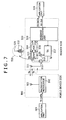
- FIG. 7 shows an example of configuration of a radio communication system of a previously proposed backscatter system.
- Reference numeral 500 denotes a radio transmission device on a mobile device side.
- Reference numeral 510 denotes a radio transmission and reception device on a reader side. Suppose that data transmission is performed by the backscatter system from the radio transmission device 500 to the radio transmission and reception device 510.
- the radio transmission device 500 is connected to an application unit 503 such as a digital camera or the like.
- the radio transmission and reception device 510 is connected to an application unit 519 such as a printer or the like.
- the radio transmission and reception device 510 includes an antenna 511, a circulator 512 for separating a transmitting wave and a received wave from each other, a receiving unit 514, a local oscillator 513 shared for transmission and reception by the receiving unit 514 and a transmitting unit 517, and a baseband processing unit 518.
- the receiving unit 514 and the transmitting unit 517 both use a direct conversion system.
- the receiving unit 514 includes a quadrature demodulation unit 515 and an AGC amplifier 516.
- An unmodulated carrier is transmitted to the radio transmission device 500 by turning on the transmitting unit 517 by the baseband processing unit 518 and thereby transmitting frequency f o of the local oscillator 513 from the antenna 511 via the circulator 512.
- the transmitted unmodulated carrier f o reaches the radio transmission device 500.
- the radio transmission device 500 includes an antenna 501 and a backscatter modulator 502.
- the backscatter modulator 502 performs backscatter ASK, PSK, or QPSK modulation according to transmission data of the application unit 503.
- the modulation can be easily performed by on/off operation of a diode, a GaAs switch or the like.
- a modulated wave eventually reflected from the antenna 501 is generated with the center frequency f o of the unmodulated carrier as a center.
- the backscattered modulated wave having the center frequency f o is received by the antenna 511, the circulator 512, and the receiving unit 514.
- the quadrature demodulation unit 515 is supplied with the frequency f o of the local oscillator 513, performs direct conversion reception, and generates an I' signal and a Q' signal of a baseband signal.
- the I' signal and the Q' signal of the baseband signal are amplified to a desired level by the AGC amplifier 516 in a succeeding stage. Thereby an I signal and a Q signal of the baseband signal are obtained.
- the I signal and the Q signal of the baseband signal are supplied to the baseband processing unit 518.
- the baseband processing unit 518 performs demodulation, and then supplies received data and a received clock to the application unit 519.
- the unmodulated carrier f o from the transmitting unit 517 is emitted from the antenna 511 via the circulator 512, and also goes around into the receiving unit 514 side.
- This component going around into the receiving unit 514 side can be reduced to a degree by the circulator 512.
- a value of the reduction is not infinite, and an isolation of about 20 dB is an actual value.
- FIG. 7 also shows a frequency spectrum on the reader side.
- Reference numeral 520 denotes a frequency spectrum at an input terminal of the quadrature demodulation unit 515.
- Reference numeral 522 denotes the modulated wave reflected by backscatter, for example a BPSK modulated wave.
- Reference numeral 521 denotes the unmodulated carrier. When the modulated signal 522 is small, the unmodulated carrier 521 has a larger value.
- This unmodulated carrier f o enters the quadrature demodulation unit 515 to be mixed with the local frequency f o of the local oscillator 513. Consequently a high direct-current voltage is generated. This forms a DC offset, which produces a great adverse effect on operation of the quadrature demodulation unit 515. Thus, the very small modulated signal becomes distorted to be difficult to demodulate, thereby constituting a major cause of an impediment to increasing a transmission distance.
- FIG. 5 shows an example of configuration of an RFID system in which a tag side shifts reception frequency f o by a predetermined center frequency f s in one of a positive direction and a negative direction, and returns a reflected wave.
- Reference numeral 100 denotes a radio transmission device on a mobile device side.
- Reference numeral 110 denotes a radio transmission and reception device on a reader side.
- the radio transmission device 100 is connected to an application unit 105 such as a digital camera or the like.
- the radio transmission and reception device 110 is connected to an application unit 119 such as a printer or the like.
- the radio transmission and reception device 110 includes an antenna 111, a circulator 112 for separating a transmitting wave and a received wave from each other, a receiving unit 114, a local oscillator 115 for the receiving unit 114, a transmitting unit 116, a local oscillator 117 for the transmitting unit 116, and a baseband processing unit 118.
- the receiving unit 114 and the transmitting unit 116 both use a direct conversion system.
- An unmodulated carrier is transmitted to the radio transmission device 100 by turning on the transmitting unit 116 by the baseband processing unit 118 and transmitting frequency f o of the local oscillator 117 from the antenna 111 via a band-pass filter 113 and the circulator 112.
- the transmitted unmodulated carrier f o reaches the radio transmission device 100.
- the band-pass filter 113 is provided to reduce effects of transmitter noise on the receiving unit 114.
- the radio transmission device 100 includes an antenna 101, a backscatter modulator 102, a subcarrier QPSK modulator 103, and a subcarrier oscillator 104.
- the subcarrier QPSK modulator 103 performs QPSK modulation at a subcarrier frequency f s .
- Data to be subjected to the QPSK modulation is received from the application unit 105 as transmission data (TXDATA) and a transmission clock (TXCLK).
- QPSK modulation requires a 90° phase shifter.
- the 90° phase shifter can be easily created from a clock of four times f s .
- an analog delay line may be used.
- a generated QPSK modulated wave having a center frequency f s is subjected to ASK modulation by the backscatter modulator 102.
- the backscatter modulation can be easily performed by using a diode, a GaAs switch or the like (known).
- the QPSK modulated wave eventually reflected from the antenna 101 is generated in both sidebands of the frequency f o of the unmodulated carrier, that is, two bands of center frequencies f o + f s and f o - f s .
- f o + f s of the modulated wave divided into both sidebands is used.
- the modulated wave of f o - f s can be removed by using a band-pass filter 106 inserted between the antenna 101 and the backscatter modulator 102, for example.
- a loss from insertion of the band-pass filter 106 occurs twice, causing a decrease in reflection efficiency.
- the insertion of the band-pass filter 106 increases device cost.
- the backscattered modulated wave of f o + f s is received by the antenna 111, the circulator 112, and the receiving unit 114.
- the receiving unit 114 performs direct conversion reception at the frequency f o + f s of the local oscillator 115.
- the QPSK modulated wave is converted into baseband signals I and Q.
- the baseband signals I and Q are sent to the baseband processing unit 118.
- the baseband processing unit 118 performs QPSK demodulation processing (carrier synchronization and symbol synchronization), thereby generates received data RXDATA and a received clock RXCLK, and then supplies the received data RXDATA and the received clock RXCLK to the application unit 119.
- QPSK demodulation processing carrier synchronization and symbol synchronization
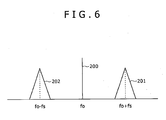
- FIG. 6 shows a spectrum of the reflected wave in the RFID system shown in FIG. 5 .
- the backscatter modulation system is ASK.
- Reference numeral 200 denotes a returned component of the unmodulated carrier of the frequency f o transmitted from the radio transmission and reception device 110.
- Reference numeral 201 denotes the QPSK modulated wave of the center frequency f o + f s .
- Reference numeral 202 denotes the QPSK modulated wave of the center frequency f o - f s .
- the unmodulated carrier transmitted from the radio transmission and reception device 110 is divided into the components 200, 201, and 202 and then reflected. Therefore the modulated signal on one side has a low level. That is, the level of the originally very weak reflected wave is further lowered, which is one cause of decrease in communication distance.
- EP 0 779 520 A2 describes a Frequency Division Multiple (FDMA) duplex radio communication system.
- FDMA Frequency Division Multiple
- US 2002/0142747 A1 describes a frequency conversion circuit.
- US 5,861,781 describes a single sideband double quadrature modulator.
- a radio communication system for performing data communication by a backscatter system, using absorption and reflection of a received radio wave according to claim 6.
- the system herein refers to a logical set of a plurality of apparatuses (or functional modules for realizing specific functions) regardless of whether each apparatus or functional module is present within the same casing.
- the radio communication system is applicable to an RFID system in which a tag can perform data communication without a power supply by the backscatter system.
- the data transmitting device corresponds to a tag
- the data reading device corresponds to a tag reader.
- frequency of a carrier from a reader and center frequency of a reflected wave are the same, and since the reader side performs transmission and reception at the same frequency, a receiving unit of the tag reader needs to process the reflected wave having a weak power while being affected by a DC offset and transmitter noise.
- the radio communication system eliminates or at least reduces effects of a DC offset and transmitter noise on the tag reader side by shifting the unmodulated carrier of the frequency f o from the tag reader side by f s on the tag side and then returning the reflected wave.
- the reflected modulated wave appears in a state of being divided into both sidebands shifted by the subcarrier frequency to a plus side and a minus side from a center of the unmodulated carrier.
- the data transmitting device subjects transmission data to primary modulation with a center frequency fs, and performs secondary modulation by multiplying a signal resulting from the primary modulation by the unmodulated carrier.
- the data transmitting device generates a modulated signal of a reflected wave in which one of frequencies fo + fs and fo - fs is suppressed, and then transmits the modulated signal of the reflected wave. It is therefore possible to improve reflection efficiency and prevent or at least reduce a power loss of the reflected wave, and thus improve reception sensitivity and increase transmission distance.
- a reflected wave on one side of two divided sidebands does not need to be removed by a filter, an increase in cost can be prevented.
- the data transmitting device subjects transmission data to primary modulation by one of a BPSK system and a QPSK system using a center frequency fs.
- the data transmitting device thereby generates primary modulated transmission data I.
- the data transmitting device generates primary modulated transmission data Q by giving a phase difference of 90 degrees to the primary modulated transmission data I.
- the data transmitting device generates a modulated signal of a reflected wave in which one of frequencies fo + fs and fo - fs is suppressed by multiplying the primary modulated transmission data by an I and a Q of the unmodulated carrier for quadrature modulation by the backscatter system.
- the reflected modulated wave of one of the frequencies fo + fs and fo - fs can be selectively generated by changing a combination in which the inputs I and Q of the unmodulated carrier for quadrature modulation and the primary modulated transmission data I and Q resulting from the primary modulation are multiplied together.
- a reflected wave of a frequency fo - fs can be returned to the data reading device.
- a reflected wave of a frequency fo + fs can be returned to the data reading device.
- the data transmitting device may change the center frequency fs for the primary modulation.
- a radio communication system it is possible to provide a radio communication system, a radio communication device, and a radio communication method that are excellent in making it possible to improve reception sensitivity and increase communication distance by separating transmission frequency on a reading device side from reception frequency returned as a reflected wave from a transmitting device side.
- a radio communication system a radio communication device, and a radio communication method that are excellent in eliminating or at least reducing effects of a DC offset and transmitter noise on the tag reader side to improve the reception sensitivity and increase the communication distance by shifting an unmodulated carrier of frequency f o from the tag reader side by f s on the tag side and returning a reflected wave.
- a radio communication system a radio communication device, and a radio communication method that are excellent in making it possible to improve the reception sensitivity and increase the communication distance by improving reflection efficiency and preventing or at least reducing a power loss of the reflected wave when shifting the unmodulated carrier of frequency f o from the tag reader side by f s on the tag side and returning the reflected wave.
- the tag reader side since the tag reader side does not need to remove a reflected wave on one side of two divided sidebands by a filter, an increase in cost can be prevented.
- Embodiments of the present invention relate to an RFID system in which a tag can perform data communication without a power supply by a backscatter system.
- frequency of a carrier from a reader and center frequency of a reflected wave are the same, and since the reader side performs transmission and reception at the same frequency, a receiving unit of the tag reader is affected by a DC offset and transmitter noise.
- a radio communication system eliminates or at least reduces effects of a DC offset and transmitter noise on a tag reader side by shifting an unmodulated carrier of a frequency f o from the tag reader side by f s on a tag side and then returning a reflected wave.
- FIG. 1 schematically shows a configuration of a radio communication device according to one embodiment of the present invention.
- the radio communication device shown in the figure corresponds to a tag in an RFID system.
- the radio communication device receives an unmodulated carrier of a frequency f o transmitted from a tag reader, and shifts the carrier by a frequency f s by a backscatter system.
- the radio communication device generates a modulated signal of a reflected wave in which one of both sidebands f o + f s and f o - f s is suppressed, and then transmits the modulated signal.
- the radio communication device includes a frequency generating unit 11, a primary modulating unit 12, and a secondary modulating unit 13.
- the frequency generating unit 11 generates a center frequency f s for primary modulation.
- the frequency generating unit 11 may change the center frequency f s for primary modulation.
- the primary modulating unit 12 subjects transmission data to primary modulation by a BPSK or a QPSK system using the center frequency f s .
- the primary modulating unit 12 thereby generates an I-axis signal of the transmission data.
- the primary modulating unit 12 generates a Q-axis signal of the transmission data by giving a phase difference of 90 degrees to the I-axis signal of the transmission data.
- the secondary modulating unit 13 subjects the primary modulated transmission data to secondary modulation.
- the secondary modulating unit in the present embodiment is formed by a quadrature modulator for quadrature modulation of the unmodulated carrier of the frequency f o transmitted from the tag reader by the backscatter system. That is, the secondary modulating unit 13 multiplies an I-axis signal and a Q-axis signal of the unmodulated carrier input thereto by the I-axis signal and the Q-axis signal of the above-described primary modulated transmission data, respectively.
- FIG. 2 shows a modification of the radio communication device as an RFID tag shown in FIG. 1 .
- the radio communication device shown in the figure further includes a switching unit 14.
- the switching unit 14 changes a combination in which an I-axis signal and a Q-axis signal of an unmodulated carrier and an I-axis signal and a Q-axis signal of primary modulated transmission data as described above are multiplied together.
- a reflected wave signal of a frequency f o - f s can be returned to the tag reader.
- a reflected wave signal of a frequency f o + f s can be returned to the tag reader.
- FIG. 3 shows a concrete configuration of a radio communication device according to an embodiment of the present invention.
- the radio communication device shown in the figure operates as a tag in an RFID system, and is capable of QPSK radio communication by the backscatter system with reflection efficiency improved and an unwanted spectrum suppressed.
- This radio communication device is characterized in that an image rejection type backscatter modulator is used to extract a frequency component on only one side of a modulated wave.
- Reference numeral 300 denotes an image rejection type backscatter modulator.
- This backscatter modulator 300 includes an antenna 301, a splitter/synthesizer 302, high-frequency switches 303 and 305, and a ⁇ /8 phase shifter 304.
- the high-frequency switches 303 and 305 are formed by a diode, a GaAs switch or the like
- the phase shifter 304 is formed by a strip line or the like.
- the parts indicated by reference numerals 301 to 305 form a quadrature modulation unit.
- a signal received by the antenna 301 is branched into two signals by the splitter/synthesizer 302.
- One high-frequency switch 303 is turned on to terminate the antenna 301 by an antenna impedance and thus absorb the radio wave from a tag reader, and the switch is turned off to reflect the radio wave from the tag reader. That is, the high-frequency switch 303 creates total reflection in an open state and a short state according to data, and thus operates as a BPSK modulator with a phase difference of 180 degrees.
- the other high-frequency switch 305 similarly absorbs or reflects the radio wave from the tag reader by being turned on/off. However, since the lambda ⁇ /8 phase shifter 304 is inserted at an intermediate point, the high-frequency switch 305 operates as a BPSK modulator advanced in phase in both ways by a total of lambda ⁇ /4, that is, 90°.
- the two high-frequency switches 303 and 305 and the phase shifter 304 can form a backscatter type quadrature modulator.
- a signal controlled by the high-frequency switch 303 is an I-axis signal and that a signal controlled by the high-frequency switch 305 is a Q-axis signal.
- Primary modulated transmission data is given to the I and the Q to thereby form a backscatter type QPSK modulator.
- a shift of frequency of the reflected wave cannot be realized. Therefore a function of shifting the frequency by f s is required.
- Reference numerals 306 to 311 in FIG. 3 generate an I-axis signal and a Q-axis signal of primary modulated transmission data for shifting the frequency by f s .
- a S/P converter unit 309 subjects transmission data (TX DATA) and a transmission clock (TX CLK) to a serial-to-parallel conversion including Gray coding.
- TX DATA transmission data
- TX CLK transmission clock
- the output is P1 and P2.
- a shift clock oscillator 310 is required to shift the frequency by f s . This oscillator oscillates at f s or four times f s . An output of the shift clock oscillator 310 is divided into two signals of 0° and 90° in a 90° phase shifter 308.
- the 90° phase shifter 308 can be easily created from a clock of four times f s when the 90° phase shifter 308 is formed by a digital circuit. Also, an analog delay line may be used without use of a clock of four times f s .
- the two signals different from each other in phase by 90° are input to a QPSK modulator 306.
- the QPSK modulator 306 generates for example four signals of f s different from each other in phase by 90° from the two signals from the phase shifter 308.
- the QPSK modulator 306 generates a digital QPSK signal by selecting the four signals according to the transmission data P1 and P2. Let this digital QPSK signal be an I-axis signal 312. Further, let a Q-axis signal 313 be a signal obtained by delaying the phase of the I-axis signal 312 by 90° by a 90° phase shifter 307.
- the modulation system of the QPSK modulator 306 is controlled by a modulation switching signal (MOD CONT) 314 so that switching can be performed between modulation systems QPSK and BPSK.
- MOD CONT modulation switching signal
- MOD CONT 0 at the time of BPSK modulation
- MOD CONT 1 at the time of QPSK modulation.
- the I-axis signal 312 and the Q-axis signal 313 described above are subjected to backscatter modulation by the above-described quadrature modulation unit. Thereby a spectrum in which one side of QPSK spectra occurring on both sides of a carrier frequency is attenuated can be obtained.
- the modulated wave occurs in both sidebands of f o - f s and f o + f s . It is also indicated that signal level is halved.
- Reference numeral 311 in FIG. 3 denotes a frequency divider.
- the frequency divider 311 divides frequency of the shift clock oscillator 310.
- 1, 2, 4 or the like as a frequency dividing ratio n and using an output signal of the frequency divider for the transmission clock, it is possible to generate an I-axis signal and a Q-axis signal in synchronism at an EXOR output of the 90° phase shifter 307 and the QPSK modulator 306.
- a hazard occurs because a data change point and a clock change point become the same. A measure against this is not directly related to the subject matter of the present invention, and therefore will not be described herein.
- FIG. 4 shows a spectrum of the thus generated reflected wave.
- Reference numeral 401 denotes the QPSK modulated wave at a center frequency f o - f s .
- Reference numeral 400 denotes a leakage component of the QPSK modulated wave at a center frequency f o
- reference numeral 402 denotes a leakage component of the QPSK modulated wave at a center frequency f o + f s . Both the components are caused by an imbalance of orthogonality at each of f o and f s , and are not caused ideally.
- the transmitting and receiving device 110 shown in FIG. 5 can be used as it is as the tag reader for receiving and demodulating the above-described f o + f s modulated wave, and therefore description thereof will not be made in order to avoid repetition of the description.
Landscapes
- Engineering & Computer Science (AREA)
- Computer Networks & Wireless Communication (AREA)
- Physics & Mathematics (AREA)
- General Physics & Mathematics (AREA)
- Signal Processing (AREA)
- Remote Sensing (AREA)
- Radar, Positioning & Navigation (AREA)
- Theoretical Computer Science (AREA)
- Computer Vision & Pattern Recognition (AREA)
- Artificial Intelligence (AREA)
- Microelectronics & Electronic Packaging (AREA)
- Computer Hardware Design (AREA)
- Near-Field Transmission Systems (AREA)
- Digital Transmission Methods That Use Modulated Carrier Waves (AREA)
Claims (15)
- Funkkommunikationseinrichtung (300) zum Durchführen von Datenkommunikation durch ein Rückstreusystem unter Verwendung von Absorption und Reflexion einer empfangenen Funkwelle, wobei die empfangene Funkwelle ein nicht modulierter Träger einer Frequenz f0 ist, wobei die Kommunikationseinrichtung umfasst:eine Primärmodulationseinrichtung (12, 306-311) zum Unterwerfen von Übertragungsdaten (TX DATA) einer Primärmodulation, mit einem Hilfsträgersignal, welches eine Mittenfrequenz fs hat, dadurch gekennzeichnet, dassdie Primärmodulationseinrichtung konfiguriert ist, primärmodulierte Übertragungsdaten I (312) und primärmodulierte Übertragungsdaten Q (313), welche bezüglich der Phase um 90° gegenüber den primärmodulierten Übertragungsdaten I verschieden sind, zu erzeugen; unddie Funkkommunikationseinrichtung eine Sekundärmodulationseinrichtung (13, 301-305) aufweist, welche einen Quadraturmodulator des Rückstreusystems umfasst, wobei die Sekundärmodulationseinrichtung zur Durchführung von Sekundärmodulation dient, um eine reflektierte modulierte Welle zu erzeugen, bei der eine von Frequenzen f0 + fs und f0 - fs unterdrückt ist, wobei die reflektierte modulierte Welle durch Multiplizieren von Eingangssignalen I und Q des nicht modulierten Trägers mit den primärmodulierten Übertragungsdaten I und Q erzeugt wird.
- Funkkommunikationseinrichtung nach Anspruch 1,
wobei die Primärmodulationseinrichtung konfiguriert ist, die Übertragungsdaten der Primärmodulation einem von einem BPSK-System und einem QPSK-System zu unterwerfen. - Funkkommunikationseinrichtung nach Anspruch 1, welche außerdem eine Änderungseinrichtung (14) umfasst, um eine Kombination zu ändern, bei der die Eingangssignale I und Q des nicht modulierten Trägers zur Quadraturmodulation und die primärmodulierten Übertragungsdaten I und Q, welche von der Primärmodulation resultieren, zusammen multipliziert werden.
- Funkkommunikationseinrichtung nach Anspruch 1, welche außerdem eine Frequenzsteuereinrichtung (11, 310) umfasst, um die Mittenfrequenz fs für die Primärmodulation zu ändern.
- Funkkommunikationseinrichtung nach Anspruch 1,
wobei die Primärmodulationseinrichtung konfiguriert ist, einen Takt (TX CLK) für die Übertragungsdaten zu verwenden, welcher eine Frequenz hat, welche durch Teilen der Mittenfrequenz fs durch eine ganze Zahl n erlangt wird. - Funkkommunikationssystem zum Durchführen von Datenkommunikation durch ein Rückstreusystem unter Verwendung von Absorption und Reflexion einer empfangenen Funkwelle, wobei das Funkkommunikationssystem umfasst:eine Datenleseeinrichtung (110), welche konfiguriert ist, einen nicht modulierten Träger einer Frequenz f0 zu übertragen; undeine Datenübertragungseinrichtung (300), welche die Funkkommunikationseinrichtung nach Anspruch 1 umfasst;wobei die Datenleseeinrichtung außerdem konfiguriert ist, die reflektierte modulierte Welle von einer von den Frequenzen f0 + fs und f0 - fs von der Datenübertragungseinrichtung zu empfangen.
- Funkkommunikationssystem nach Anspruch 6,
wobei das Datenübertragungssystem konfiguriert ist, die Übertragungsdaten der Primärmodulation einem von einem BPSK-System und einem QPSK-System zu unterwerfen. - Funkkommunikationssystem nach Anspruch 6,
wobei die Datenübertragungseinrichtung eine Änderungseinrichtung (14) zum Ändern einer Kombination umfasst, bei der die Eingangssignale I und Q des nicht modulierten Trägers für die Quadraturmodulation und die primärmodulierten Übertragungsdaten I und Q, welche von der Primärmodulation resultieren, miteinander multipliziert werden, und konfiguriert ist, selektiv das modulierte Signal der reflektierten Welle zu erzeugen, bei der eine von den Frequenzen f0 + fs und f0 - fs unterdrückt wird. - Funkkommunikationssystem nach Anspruch 6, welches außerdem eine Frequenzsteuereinrichtung (11,310) umfasst, um die Mittenfrequenz fs für die Primärmodulation zu ändern.
- Funkkommunikationssystem nach Anspruch 6,
wobei die Datenübertragungseinrichtung konfiguriert ist, einen Takt (TX CLK) für die Übertragungsdaten zu verwenden, welcher eine Frequenz hat, welche durch Teilen der Mittenfrequenz fs mit einer ganzen Zahl n erlangt wird. - Funkkommunikationsverfahren zum Durchführen von Datenkommunikation durch ein Rückstreusystem unter Verwendung von Absorption und Reflexion einer empfangenen Funkwelle, wobei die empfangene Funkwelle einen nicht modulierten Träger einer Frequenz f0 hat, wobei das Kommunikationsverfahren umfasst:einen Primärmodulationsschritt zum Unterwerfen der Übertragungsdaten (TX DATA) der Primärmodulation mit einem Hilfsträgersignal, welches eine Mittenfrequenz fs hat, gekennzeichnet durchden Primärmodulationsschritt, der primärmodulierte Übertragungsdaten 1 (312) und primärmodulierte Übertragungsdaten Q (313) erzeugt, welche bezüglich der Phase um 90° gegenüber den primärmodulierten Übertragungsdaten I verschieden sind; undein Sekundärmodulationsschritt, bei dem ein Quadraturmodulator des Rückstreusystems vorgesehen ist, zum Durchführen von Sekundärmodulation, um eine reflektierte modulierte Welle zu erzeugen, bei der eine von den Frequenzen f0 + fs und f0 - fs unterdrückt ist, wobei die reflektierte modulierte Welle durch Multiplizieren von Eingangssignalen I und Q des nicht modulierten Trägers mit den primärmodulierten Übertragungsdaten I bzw. Q erzeugt wird.
- Funkkommunikationsverfahren nach Anspruch 11,
wobei im Primärmodulationsschritt die Übertragungsdaten der Primärmodulation einem von einem BPSK-System und einem QPSK-System unterworfen sind. - Funkkommunikationsverfahren nach Anspruch 11, welches außerdem einen Änderungsschritt zum Ändern einer Kombination umfasst, bei dem die Eingangssignale I und Q des nicht modulierten Trägers für die Quadraturmodulation und die primärmodulierten Übertragungsdaten I und Q, welche von der Primärmodulation resultieren, miteinander multipliziert werden.
- Funkkommunikationsverfahren nach Anspruch 11, welches außerdem einen Frequenzsteuerschritt zum Ändern der Mittenfrequenz fs für die Primärmodulation umfasst.
- Funkkommunikationsverfahren nach Anspruch 11,
wobei der Primärmodulationsschritt einen Takt (TX CLK) für die Übertragungsdaten verwendet, welcher eine Frequenz hat, welche durch Teilen der Mittenfrequenz fs durch eine ganze Zahl n erlangt wird.
Applications Claiming Priority (2)
| Application Number | Priority Date | Filing Date | Title |
|---|---|---|---|
| JP2004140580A JP4020096B2 (ja) | 2004-05-11 | 2004-05-11 | 無線通信システム、無線通信装置及び無線通信方法 |
| JP2004140580 | 2004-05-11 |
Publications (3)
| Publication Number | Publication Date |
|---|---|
| EP1596320A2 EP1596320A2 (de) | 2005-11-16 |
| EP1596320A3 EP1596320A3 (de) | 2008-10-29 |
| EP1596320B1 true EP1596320B1 (de) | 2012-08-08 |
Family
ID=34941196
Family Applications (1)
| Application Number | Title | Priority Date | Filing Date |
|---|---|---|---|
| EP05252825A Expired - Lifetime EP1596320B1 (de) | 2004-05-11 | 2005-05-09 | Funkkommunikationssystem, -vorrichtung und -verfahren |
Country Status (6)
| Country | Link |
|---|---|
| US (1) | US7796016B2 (de) |
| EP (1) | EP1596320B1 (de) |
| JP (1) | JP4020096B2 (de) |
| KR (1) | KR101114066B1 (de) |
| CN (1) | CN100539563C (de) |
| TW (1) | TWI261979B (de) |
Families Citing this family (50)
| Publication number | Priority date | Publication date | Assignee | Title |
|---|---|---|---|---|
| US7667589B2 (en) | 2004-03-29 | 2010-02-23 | Impinj, Inc. | RFID tag uncoupling one of its antenna ports and methods |
| US7528728B2 (en) | 2004-03-29 | 2009-05-05 | Impinj Inc. | Circuits for RFID tags with multiple non-independently driven RF ports |
| USD587691S1 (en) | 2004-03-29 | 2009-03-03 | Impinj, Inc. | Radio frequency identification tag antenna assembly |
| US7423539B2 (en) | 2004-03-31 | 2008-09-09 | Impinj, Inc. | RFID tags combining signals received from multiple RF ports |
| US7510117B2 (en) * | 2004-06-04 | 2009-03-31 | Impinj Inc | Decoding with memory in RFID system |
| JP4389694B2 (ja) * | 2004-06-28 | 2009-12-24 | ソニー株式会社 | 無線通信システム、無線通信装置及び無線通信方法、並びにコンピュータ・プログラム |
| US20060125605A1 (en) * | 2004-12-13 | 2006-06-15 | Atmel Germany Gmbh | Method for locating a backscatter-based transponder |
| KR100737855B1 (ko) | 2005-11-29 | 2007-07-12 | 삼성전자주식회사 | 무선 식별 태그의 단측파 대역 응답 방법 |
| KR100737133B1 (ko) | 2006-01-13 | 2007-07-06 | 엘지이노텍 주식회사 | Rfid 송수신기 |
| JP2008048288A (ja) * | 2006-08-18 | 2008-02-28 | Sony Corp | 無線通信システム及び無線通信装置 |
| KR100768462B1 (ko) | 2007-01-24 | 2007-10-18 | 주식회사 유컴테크놀러지 | Rfid 태그 판독 방법 및 이를 이용한 rfid 태그리더 |
| JP2008228136A (ja) * | 2007-03-15 | 2008-09-25 | Sony Corp | データ伝送装置 |
| KR20080100581A (ko) * | 2007-05-14 | 2008-11-19 | 주식회사 유컴테크놀러지 | 무선인식(rfid) 리더 수신 장치 |
| KR100849695B1 (ko) * | 2007-12-17 | 2008-07-31 | (주)스마트애드인 | 액티브 태그, 리더, 및 이들을 이용한 페어링 방법 |
| JP2009145300A (ja) * | 2007-12-18 | 2009-07-02 | Omron Corp | 距離測定方法、距離測定装置、非接触ic媒体、距離測定システム、および距離測定プログラム |
| JP2009181332A (ja) | 2008-01-30 | 2009-08-13 | Sony Corp | 記憶媒体並びに競合制御方法 |
| KR101271578B1 (ko) * | 2008-01-31 | 2013-06-05 | 인텔렉추얼디스커버리 주식회사 | Rfid 시스템 및 그 통신 방법 |
| US20090221232A1 (en) * | 2008-02-29 | 2009-09-03 | Estevez Leonardo W | Portable Telephone With Unitary Transceiver Having Cellular and RFID Functionality |
| JP2009232372A (ja) * | 2008-03-25 | 2009-10-08 | Sony Corp | 通信システム並びに通信装置 |
| JP5515540B2 (ja) * | 2009-09-10 | 2014-06-11 | 富士通株式会社 | 表示装置 |
| US8823577B2 (en) * | 2009-12-23 | 2014-09-02 | Itrack, Llc | Distance separation tracking system |
| JP2011182340A (ja) * | 2010-03-03 | 2011-09-15 | Toshiba Tec Corp | 質問器 |
| GB2489416A (en) * | 2011-03-25 | 2012-10-03 | Mbda Uk Ltd | A transponder shifts a received interrogation signal in frequency and uses the shifted signal as a carrier signal for data transmissions to a reader |
| US8590790B1 (en) * | 2012-05-14 | 2013-11-26 | Tag-Comm Inc. | Method and apparatus for generating dedicated data channels in backscatter RFID systems |
| CN102693446B (zh) * | 2012-06-01 | 2016-01-20 | 昆腾微电子股份有限公司 | 非接触ic卡及其射频接口电路和调谐方法 |
| US9680520B2 (en) | 2013-03-22 | 2017-06-13 | University Of Washington Through Its Center For Commercialization | Ambient backscatter tranceivers, apparatuses, systems, and methods for communicating using backscatter of ambient RF signals |
| US11163050B2 (en) | 2013-08-09 | 2021-11-02 | The Board Of Trustees Of The Leland Stanford Junior University | Backscatter estimation using progressive self interference cancellation |
| WO2015123341A1 (en) | 2014-02-11 | 2015-08-20 | University Of Washington | Wireless networking communication methods, systems, and devices operable using harvested power |
| WO2015123306A1 (en) | 2014-02-11 | 2015-08-20 | University Of Washington | Apparatuses, systems, and methods for communicating using mimo and spread spectrum coding in backscatter of ambient signals |
| CN107111772B (zh) | 2014-09-22 | 2020-12-25 | Drnc控股公司 | 用于使用德尔塔-西格玛调制的无线设备的传输装置 |
| US10079616B2 (en) | 2014-12-19 | 2018-09-18 | University Of Washington | Devices and methods for backscatter communication using one or more wireless communication protocols including bluetooth low energy examples |
| WO2016100887A2 (en) * | 2014-12-19 | 2016-06-23 | University Of Washington | Devices and methods for backscatter communication using one or more wireless communication protocols |
| WO2017027847A1 (en) | 2015-08-12 | 2017-02-16 | University Of Washington | Backscatter devices and network systems incorporating backscatter devices |
| US10951446B2 (en) | 2016-01-26 | 2021-03-16 | University Of Washington | Backscatter devices including examples of single sideband operation |
| CN109073573A (zh) * | 2016-04-04 | 2018-12-21 | 华盛顿大学 | 提供包含ofdm包的经反向散射信号的反向散射装置及系统 |
| US10498569B2 (en) * | 2016-06-23 | 2019-12-03 | University Of Massachusetts | Systems and methods for backscatter communication |
| US10812130B2 (en) | 2016-10-18 | 2020-10-20 | University Of Washington | Backscatter systems, devices, and techniques utilizing CSS modulation and/or higher order harmonic cancellation |
| CN110100464A (zh) * | 2016-10-25 | 2019-08-06 | 小利兰·斯坦福大学托管委员会 | 反向散射环境ism频带信号 |
| US10461783B2 (en) | 2017-03-16 | 2019-10-29 | University Of Washington | Radio frequency communication devices having backscatter and non-backscatter communication modes and hardware re-use |
| CN110663020A (zh) | 2017-04-06 | 2020-01-07 | 华盛顿大学 | 使用反向散射装置的图像和/或视频发射 |
| WO2019158196A1 (en) * | 2018-02-14 | 2019-08-22 | Telefonaktiebolaget Lm Ericsson (Publ) | Technique for backscattering transmission |
| US10852413B2 (en) * | 2018-04-13 | 2020-12-01 | Nec Corporation | Tagging objects in indoor spaces using ambient, distributed backscatter |
| CN109495412B (zh) * | 2019-01-14 | 2019-11-15 | 电子科技大学 | 基于mpsk载波的反向散射通信系统接收机设计方法 |
| CN112532342B (zh) * | 2019-09-17 | 2023-05-16 | 华为技术有限公司 | 一种背反射通信中的数据传输方法和装置 |
| US12362774B2 (en) | 2020-05-18 | 2025-07-15 | Telefonaktiebolaget Lm Ericsson (Publ) | Communication node and method for generating modulated signals by backscattering |
| JP7587228B2 (ja) | 2020-09-29 | 2024-11-20 | 国立大学法人東京科学大学 | 伝送回路 |
| JP7622935B2 (ja) | 2020-09-29 | 2025-01-28 | 国立大学法人東京科学大学 | 合成回路 |
| JP7587229B2 (ja) | 2020-09-30 | 2024-11-20 | 国立大学法人東京科学大学 | 伝送回路 |
| JP2022112832A (ja) * | 2021-01-22 | 2022-08-03 | 東芝テック株式会社 | 通信装置及び通信方法 |
| JP7671454B2 (ja) | 2022-02-25 | 2025-05-02 | 国立大学法人東京科学大学 | 伝送回路および複合伝送回路 |
Family Cites Families (8)
| Publication number | Priority date | Publication date | Assignee | Title |
|---|---|---|---|---|
| SE442348B (sv) * | 1984-07-04 | 1985-12-16 | Stiftelsen Inst Mikrovags | Forfarande och anordning for bestemning av inbordes lege mellan tva objekt |
| JPS63121773A (ja) | 1986-11-11 | 1988-05-25 | Sharp Corp | 移動体識別装置 |
| JPS63279621A (ja) | 1987-05-11 | 1988-11-16 | Sharp Corp | マイクロ波デ−タ伝送装置における応答器 |
| DE4319878A1 (de) | 1992-06-17 | 1993-12-23 | Micron Technology Inc | Hochfrequenz-Identifikationseinrichtung (HFID) und Verfahren zu ihrer Herstellung |
| US5940006A (en) | 1995-12-12 | 1999-08-17 | Lucent Technologies Inc. | Enhanced uplink modulated backscatter system |
| US6456668B1 (en) * | 1996-12-31 | 2002-09-24 | Lucent Technologies Inc. | QPSK modulated backscatter system |
| US5861781A (en) | 1997-09-16 | 1999-01-19 | Lucent Technologies Inc. | Single sideband double quadrature modulator |
| US6782247B2 (en) | 2001-04-02 | 2004-08-24 | Zeevo, Inc. | CMOS frequency conversion using dual mixers for sideband suppression |
-
2004
- 2004-05-11 JP JP2004140580A patent/JP4020096B2/ja not_active Expired - Fee Related
-
2005
- 2005-04-27 KR KR1020050034897A patent/KR101114066B1/ko not_active Expired - Fee Related
- 2005-04-28 US US11/116,517 patent/US7796016B2/en not_active Expired - Fee Related
- 2005-05-03 TW TW094114270A patent/TWI261979B/zh not_active IP Right Cessation
- 2005-05-09 EP EP05252825A patent/EP1596320B1/de not_active Expired - Lifetime
- 2005-05-10 CN CNB2005100690900A patent/CN100539563C/zh not_active Expired - Fee Related
Also Published As
| Publication number | Publication date |
|---|---|
| US20050253688A1 (en) | 2005-11-17 |
| KR101114066B1 (ko) | 2012-03-13 |
| TW200610288A (en) | 2006-03-16 |
| US7796016B2 (en) | 2010-09-14 |
| KR20060047502A (ko) | 2006-05-18 |
| CN100539563C (zh) | 2009-09-09 |
| TWI261979B (en) | 2006-09-11 |
| JP4020096B2 (ja) | 2007-12-12 |
| JP2005323223A (ja) | 2005-11-17 |
| CN1697435A (zh) | 2005-11-16 |
| EP1596320A2 (de) | 2005-11-16 |
| EP1596320A3 (de) | 2008-10-29 |
Similar Documents
| Publication | Publication Date | Title |
|---|---|---|
| US7796016B2 (en) | Radio communication system, radio communication device, and radio communication method | |
| US6324211B1 (en) | Interrogators communication systems communication methods and methods of processing a communication signal | |
| JP3764958B2 (ja) | 後方散乱システム呼びかけ機の通信方法、および後方散乱通信システム | |
| CN101546370B (zh) | 通信系统和通信装置 | |
| US20080030336A1 (en) | Semiconductor integrated circuit device and receiving device | |
| EP1936534A2 (de) | Verfahren und Vorrichtung zur Einseitenbandmodulation unter Verwendung einer Frequenzverschiebung | |
| EP1672804B1 (de) | Funkkommunikationsvorrichtung | |
| KR20080097115A (ko) | 무선 주파수 식별 장치 | |
| JPH10222632A (ja) | 携帯データ・キャリアに用いるクロック信号の再現装置および方法 | |
| EP0915573A2 (de) | Direktsequenz-spreizspektrummodulationsaufwärtsverbindung für moduliertes Rückstrahlungssystem | |
| Li et al. | Analysis and simulation of UHF RFID system | |
| CN101159024A (zh) | 半导体集成电路装置以及接收装置 | |
| JP4537248B2 (ja) | キャリアセンス方法及び送受信装置 | |
| CA2219268A1 (en) | Subcarrier frequency division multiplexing of modulated backscatter signals | |
| KR100605100B1 (ko) | 데이터 전송 속도가 향상된 아이씨 카드, 아이씨 카드프로세서 및 아이씨 카드 시스템 | |
| JP2008048288A (ja) | 無線通信システム及び無線通信装置 | |
| JP4352985B2 (ja) | 無線通信装置 | |
| AU2002339053B2 (en) | Modulator for electromagnetic signals transmitted by a contactless transmission/reception system | |
| JP2008187227A (ja) | Rfidリーダ | |
| CN100542061C (zh) | 无线通信设备 | |
| WO2008084351A2 (en) | Method of transmitting data, electronic device and transponder | |
| JPH1093640A (ja) | 非接触icカードシステムのリードライト装置および非接触icカード | |
| JP2000048138A (ja) | 非接触通信システム | |
| KR20100060954A (ko) | 전력효율을 높일 수 있는 통신 시스템 및 상기 통신 시스템에 대한 무선신호 처리방법 |
Legal Events
| Date | Code | Title | Description |
|---|---|---|---|
| PUAI | Public reference made under article 153(3) epc to a published international application that has entered the european phase |
Free format text: ORIGINAL CODE: 0009012 |
|
| AK | Designated contracting states |
Kind code of ref document: A2 Designated state(s): AT BE BG CH CY CZ DE DK EE ES FI FR GB GR HU IE IS IT LI LT LU MC NL PL PT RO SE SI SK TR |
|
| AX | Request for extension of the european patent |
Extension state: AL BA HR LV MK YU |
|
| PUAL | Search report despatched |
Free format text: ORIGINAL CODE: 0009013 |
|
| AK | Designated contracting states |
Kind code of ref document: A3 Designated state(s): AT BE BG CH CY CZ DE DK EE ES FI FR GB GR HU IE IS IT LI LT LU MC NL PL PT RO SE SI SK TR |
|
| AX | Request for extension of the european patent |
Extension state: AL BA HR LV MK YU |
|
| 17P | Request for examination filed |
Effective date: 20081030 |
|
| 17Q | First examination report despatched |
Effective date: 20081205 |
|
| AKX | Designation fees paid |
Designated state(s): DE FR GB |
|
| GRAP | Despatch of communication of intention to grant a patent |
Free format text: ORIGINAL CODE: EPIDOSNIGR1 |
|
| RIC1 | Information provided on ipc code assigned before grant |
Ipc: G06K 7/00 20060101AFI20120208BHEP Ipc: H03D 1/00 20060101ALI20120208BHEP Ipc: G06K 19/07 20060101ALI20120208BHEP Ipc: H04L 5/14 20060101ALI20120208BHEP Ipc: G08C 17/02 20060101ALI20120208BHEP Ipc: G01S 13/75 20060101ALI20120208BHEP Ipc: H04L 27/20 20060101ALI20120208BHEP Ipc: H04B 1/68 20060101ALI20120208BHEP |
|
| GRAS | Grant fee paid |
Free format text: ORIGINAL CODE: EPIDOSNIGR3 |
|
| GRAA | (expected) grant |
Free format text: ORIGINAL CODE: 0009210 |
|
| AK | Designated contracting states |
Kind code of ref document: B1 Designated state(s): DE FR GB |
|
| REG | Reference to a national code |
Ref country code: GB Ref legal event code: FG4D |
|
| REG | Reference to a national code |
Ref country code: DE Ref legal event code: R096 Ref document number: 602005035496 Country of ref document: DE Effective date: 20121011 |
|
| PLBE | No opposition filed within time limit |
Free format text: ORIGINAL CODE: 0009261 |
|
| STAA | Information on the status of an ep patent application or granted ep patent |
Free format text: STATUS: NO OPPOSITION FILED WITHIN TIME LIMIT |
|
| 26N | No opposition filed |
Effective date: 20130510 |
|
| REG | Reference to a national code |
Ref country code: DE Ref legal event code: R097 Ref document number: 602005035496 Country of ref document: DE Effective date: 20130510 |
|
| PGFP | Annual fee paid to national office [announced via postgrant information from national office to epo] |
Ref country code: GB Payment date: 20140521 Year of fee payment: 10 |
|
| PGFP | Annual fee paid to national office [announced via postgrant information from national office to epo] |
Ref country code: FR Payment date: 20140527 Year of fee payment: 10 Ref country code: DE Payment date: 20140521 Year of fee payment: 10 |
|
| REG | Reference to a national code |
Ref country code: DE Ref legal event code: R119 Ref document number: 602005035496 Country of ref document: DE |
|
| GBPC | Gb: european patent ceased through non-payment of renewal fee |
Effective date: 20150509 |
|
| REG | Reference to a national code |
Ref country code: FR Ref legal event code: ST Effective date: 20160129 |
|
| PG25 | Lapsed in a contracting state [announced via postgrant information from national office to epo] |
Ref country code: GB Free format text: LAPSE BECAUSE OF NON-PAYMENT OF DUE FEES Effective date: 20150509 Ref country code: DE Free format text: LAPSE BECAUSE OF NON-PAYMENT OF DUE FEES Effective date: 20151201 |
|
| PG25 | Lapsed in a contracting state [announced via postgrant information from national office to epo] |
Ref country code: FR Free format text: LAPSE BECAUSE OF NON-PAYMENT OF DUE FEES Effective date: 20150601 |