EP1595965A1 - High strength thin steel sheet excellent in hole expansibility, ductility and chemical treatment characteristics, and method for production thereof - Google Patents
High strength thin steel sheet excellent in hole expansibility, ductility and chemical treatment characteristics, and method for production thereof Download PDFInfo
- Publication number
- EP1595965A1 EP1595965A1 EP03786277A EP03786277A EP1595965A1 EP 1595965 A1 EP1595965 A1 EP 1595965A1 EP 03786277 A EP03786277 A EP 03786277A EP 03786277 A EP03786277 A EP 03786277A EP 1595965 A1 EP1595965 A1 EP 1595965A1
- Authority
- EP
- European Patent Office
- Prior art keywords
- steel sheet
- elongation
- ferrite
- burring
- hot rolled
- Prior art date
- Legal status (The legal status is an assumption and is not a legal conclusion. Google has not performed a legal analysis and makes no representation as to the accuracy of the status listed.)
- Granted
Links
Images


Classifications
-
- C—CHEMISTRY; METALLURGY
- C22—METALLURGY; FERROUS OR NON-FERROUS ALLOYS; TREATMENT OF ALLOYS OR NON-FERROUS METALS
- C22C—ALLOYS
- C22C38/00—Ferrous alloys, e.g. steel alloys
- C22C38/14—Ferrous alloys, e.g. steel alloys containing titanium or zirconium
-
- C—CHEMISTRY; METALLURGY
- C22—METALLURGY; FERROUS OR NON-FERROUS ALLOYS; TREATMENT OF ALLOYS OR NON-FERROUS METALS
- C22C—ALLOYS
- C22C38/00—Ferrous alloys, e.g. steel alloys
- C22C38/002—Ferrous alloys, e.g. steel alloys containing In, Mg, or other elements not provided for in one single group C22C38/001 - C22C38/60
-
- C—CHEMISTRY; METALLURGY
- C22—METALLURGY; FERROUS OR NON-FERROUS ALLOYS; TREATMENT OF ALLOYS OR NON-FERROUS METALS
- C22C—ALLOYS
- C22C38/00—Ferrous alloys, e.g. steel alloys
- C22C38/005—Ferrous alloys, e.g. steel alloys containing rare earths, i.e. Sc, Y, Lanthanides
-
- C—CHEMISTRY; METALLURGY
- C22—METALLURGY; FERROUS OR NON-FERROUS ALLOYS; TREATMENT OF ALLOYS OR NON-FERROUS METALS
- C22C—ALLOYS
- C22C38/00—Ferrous alloys, e.g. steel alloys
- C22C38/02—Ferrous alloys, e.g. steel alloys containing silicon
-
- C—CHEMISTRY; METALLURGY
- C22—METALLURGY; FERROUS OR NON-FERROUS ALLOYS; TREATMENT OF ALLOYS OR NON-FERROUS METALS
- C22C—ALLOYS
- C22C38/00—Ferrous alloys, e.g. steel alloys
- C22C38/04—Ferrous alloys, e.g. steel alloys containing manganese
-
- C—CHEMISTRY; METALLURGY
- C22—METALLURGY; FERROUS OR NON-FERROUS ALLOYS; TREATMENT OF ALLOYS OR NON-FERROUS METALS
- C22C—ALLOYS
- C22C38/00—Ferrous alloys, e.g. steel alloys
- C22C38/06—Ferrous alloys, e.g. steel alloys containing aluminium
-
- C—CHEMISTRY; METALLURGY
- C22—METALLURGY; FERROUS OR NON-FERROUS ALLOYS; TREATMENT OF ALLOYS OR NON-FERROUS METALS
- C22C—ALLOYS
- C22C38/00—Ferrous alloys, e.g. steel alloys
- C22C38/12—Ferrous alloys, e.g. steel alloys containing tungsten, tantalum, molybdenum, vanadium, or niobium
-
- C—CHEMISTRY; METALLURGY
- C21—METALLURGY OF IRON
- C21D—MODIFYING THE PHYSICAL STRUCTURE OF FERROUS METALS; GENERAL DEVICES FOR HEAT TREATMENT OF FERROUS OR NON-FERROUS METALS OR ALLOYS; MAKING METAL MALLEABLE, e.g. BY DECARBURISATION OR TEMPERING
- C21D2211/00—Microstructure comprising significant phases
- C21D2211/002—Bainite
-
- C—CHEMISTRY; METALLURGY
- C21—METALLURGY OF IRON
- C21D—MODIFYING THE PHYSICAL STRUCTURE OF FERROUS METALS; GENERAL DEVICES FOR HEAT TREATMENT OF FERROUS OR NON-FERROUS METALS OR ALLOYS; MAKING METAL MALLEABLE, e.g. BY DECARBURISATION OR TEMPERING
- C21D2211/00—Microstructure comprising significant phases
- C21D2211/005—Ferrite
Definitions
- the present invention high strength hot rolled steel sheet excellent in burring, elongation, and ability of phosphate coating used mainly for press worked automotive chassis parts, having a thickness of 0.6 to 6.0 mm or so, and having a strength of 590 N/mm 2 or more and a method of production of the same.
- steel of a ferrite and martensite structure has the characteristics of a high ductility and excellent fatigue characteristics, so is being used for automobile wheels etc.
- Japanese Unexamined Patent Publication (Kokai) No. 6-33140 discloses steel of a ferrite and martensite structure where the amounts of addition of Al and N in the ferrite and martensite structure are adjusted so as to leave solid solution N and obtain a high ageing hardening and thereby obtain a high fatigue strength, but in a ferrite and martensite structure, microvoids form around the martensite from the beginning of deformation and lead to cracking, so there is the problem of poor burring. This made the steel unsuitable for applications such as chassis parts demanding a high burring.
- Japanese Unexamined Patent Publication (Kokai) No. 4-88125 and Japanese Unexamined Patent Publication (Kokai) No. 3-180426 disclose steel sheet having a structure mainly comprised of bainite, but since the structure is mainly comprised of bainite, while the burring is excellent, there is little of the soft ferrite phase, so the ductility is poor. Further, Japanese Unexamined Patent Publication (Kokai) No. 6-172924 and Japanese Unexamined Patent Publication (Kokai) No. 7-11382 disclose steel sheet having a structure mainly comprised of ferrite, but similarly while the burring is excellent, hard carbides are made to precipitate in order to secure strength, so the ductility is poor.
- Japanese Unexamined Patent Publication (Kokai) No. 6-206351 discloses steel sheet excellent in burring and ductility having a ferrite and bainite structure
- Japanese Unexamined Patent Publication (Kokai) No. 6-293910 discloses a method of production of steel sheet achieving both burring and ductility by use of two-stage cooling to control the ratio of ferrite.
- Japanese Unexamined Patent Publication (Kokai) No. 6-293910 discloses a method of production of steel sheet achieving both burring and ductility by use of two-stage cooling to control the ratio of ferrite.
- Due to the further reduction in weight, complexity of parts, etc. of automobiles further higher burring and ductility are sought.
- Recent high strength, hot rolled steel sheets are being pressed to provide an advance level of workability not able to be handled by the above technology.
- Japanese Unexamined Patent Publication (Kokai) No. 2002-180190 discloses an invention relating to high strength hot rolled steel sheet excellent in burring and ductility. While high strength hot rolled steel sheet excellent in the contradictory characteristics of burring and ductility has been obtained, in the hot rolling process, surface defects known as Si scale sometimes occurred resulting in damage to the appearance of the product. Further, high strength hot rolled steel sheet for chassis parts etc. usually is chemically converted and painted after press working. However, problems sometimes arose such as cases of poor formation of the chemical conversion coating (poor chemical conversion) or cases of poor adhesion of the paint after application. These problems are believed to be due to the large amount of Si contained in the steel. In this way, Si is often used for high strength hot rolled steel sheet, but various types of trouble arise.
- Japanese Unexamined Patent Publication (Kokai) No. 6-128688 discloses technology for adjusting the hardness of the ferrite phase in a ferrite and martensite structure so as to improve the durability and achieve both ductility and fatigue strength.
- Japanese Unexamined Patent Publication (Kokai) No. 2000-319756 discloses technology for adding Cu to a ferrite and martensite structure so as to strikingly improve the fatigue characteristics while maintaining the ductility.
- the amount of Si added becomes high, so in the hot rolling process, surface defects known as Si scale are formed in some cases and the appearance of the product is damaged in some cases.
- high strength hot rolled steel sheet for chassis parts etc. normally is chemically converted and painted after press working.
- problems sometimes arose such as cases of poor formation of the chemical conversion coating (poor chemical conversion) or cases of poor adhesion of the paint after application.
- the present invention was made so as to solve the above conventional problems and provides high strength hot rolled steel sheet excellent in elongation and remarkably improved in ability of phosphate coating by preventing the drop in elongation accompanying an increase of strength to a tensile strength of 590 N/mm 2 or more and further by preventing the formation of Si scale. That is, the present invention has as its object to provide high strength hot rolled steel sheet excellent in burring, elongation, and ability of phosphate coating and a method of production of that steel sheet. Its gist is as follows:
- the inventors completed the present invention. That is, the inventors newly discovered that by making the specific microstructure of the steel sheet a low C-low Si-high A1 system with Mn and Al and Si in a specific relationship, high strength hot rolled steel sheet achieving high burring, elongation, and ability of phosphate coating can be obtained. Further, the inventors discovered an industrially advantageous method of production for this.
- the present invention takes note of steel with a substantially two-phase structure of ferrite and bainite where the ferrite improves the elongation and precipitates comprised of TiC, NbC, and VC secure the strength and causes sufficient growth of the ferrite grains to improve the elongation without lowering the burring, then causes the formation of precipitates to secure the strength so as to thereby solve the above problems. That is, the inventors newly discovered that by obtaining a specific microstructure of the present invention steel sheet comprising a low C-low Si-high Al-(Ti, Nb, V) system and having Mn and Al in a specific relationship, high strength hot rolled steel sheet simultaneously satisfying the three characteristics of burring, elongation, and ability of phosphate coating is obtained. Further, they discovered an industrially advantageous method of production for the same. Note that (Ti, Nb, V) means inclusion of a specific amount of one or more of Ti, Nb, and V.
- C is included in an amount of 0.02% to 0.08%.
- C is an element necessary for strengthening the martensite phase and securing strength. If less than 0.02%, the desired strength is hard to secure. On the other hand, if over 0.08%, the drop in the elongation becomes great, so the amount is made 0.02% to 0.08%.
- Si is an important element for suppressing the formation of harmful carbides and obtaining a complex structure of mainly a ferrite structure plus residual martensite, but causes a deterioration of the ability of phosphate coating and also forms Si scale, so 0.5% is made the upper limit. If over 0.25%, at the time of production of hot rolled steel sheet, the temperature control for obtaining the above microstructure sometimes is severe, so the Si content is more preferably 0.25% or less.
- Mn is an element necessary for securing strength. Therefore, 0.50% or more must be added. However, if added in a large amount over 3.5%, micro segregation and macro segregation easily occur, the burring is deteriorated, and a deterioration in the ability of phosphate coating is also seen, to secure ability of phosphate coating without causing deterioration of the elongation, the range of Mn must be 0.50% to 3.50%.
- P dissolves in the ferrite and causes the elongation to drop, so its content is made 0.03% or less. Further, S forms MnS which acts as a starting point for breakage and remarkably lowers the burring and elongation, so the content is made 0.01% or less.
- A1 is one of the important elements in the present invention and is necessary for achieving both elongation and ability of phosphate coating. Therefore, 0.15% or more must be added.
- A1 was an element conventionally considered necessary for deoxidation in hot rolled steel sheet and normally was added in an amount of 0.01 to 0.07% or so.
- the inventors ran various experiments on high strength hot rolled steel sheets based on steel compositions of low C-low Si systems including remarkably large amounts of Al and different in metal structure and thereby reached the present invention. That is, they discovered that by including Al in an amount of 0.15% or more and forming the above microstructure, it is possible to greatly improve the elongation without damaging the ability of phosphate coating.
- Hot rolled steel sheet has to finish being controlled in microstructure in the extremely short time of ROT cooling.
- the microstructure was controlled during cooling by increasing the amount of addition of Si, but if the amount of addition of Si increases, there is the problem that deterioration of the ability of phosphate coating is induced.
- Deterioration of the elongation of types of steel requiring ability of phosphate coating was unavoidable. Therefore, the inventors engaged in intensive studies on techniques for improving the ability of phosphate coating without causing the elongation to deteriorate and newly discovered Al as an element which, like Si, forms ferrite and yet does not induce deterioration of the ability of phosphate coating and further does not cause deterioration of other aspects of quality.
- the inventors engaged in repeated studies on the control of the microstructure in a short time in addition of low Si-high A1, which was not clear up to now, and discovered that particularly in the low Si-high A1 region in the region of addition of a high amount of A1 of 0.15% or more, control of the microstructure in a short time is difficult unless considering the addition of Si, Al, and Mn.
- the inventors arrived at the right side of formula (2). When this value is -4 or more, even with short treatment such as hot rolling ROT, a sufficient ferrite phase can be secured and a high elongation can be obtained.
- Ti, Nb, and V cause the precipitation of fine carbides such as TiC, NbC, and VC and enable higher strength.
- an amount of Ti, Nb, or V of less than 0.003% it is difficult to obtain a rise in strength through precipitation strengthening, while if Ti exceeds 0.20%, Nb exceeds 0.04%, or V exceeds 0.20%, too large an amount of precipitate is formed and the elongation deteriorates.
- Ti is preferably contained in an amount of 0.020% or more, Nb in an amount of 0.010% or more, and V in an amount of 0.030% or more.
- Ca, Zr, and REMs are elements effective for controlling the morphology of sulfide-based inclusions and improving the burring. To make their effects of control of the morphology more effective, it is preferable to add one or more of Ca, Zr, and a REM in an amount of at least 0.0005%. On the other hand, addition of large amounts induces coarsening of the sulfide-based inclusions and causes deterioration of the cleanliness. Even in low C-low Si-high A1 ingredient system of the present invention, not only is the elongation lowered, but also a rise in the cost is induced, so the upper limit of Ca and Zr is made 0.01% and the upper limit of a REM is made 0.05%. Further, as a REM, for example, there are the elements of the Element Nos. 21, 39, and 57 to 71.
- the size of the ferrite grains is one of the most important indicators in the present invention.
- the inventors engaged in intensive research and as a result discovered that if the area ratio of ferrite having a grain size of 2 ⁇ m or more is 40% or more, the result is steel sheet excellent in elongation.
- FIG. 2 shows the relationship between the ratio of ferrite having a grain size of 2 ⁇ m or more and the elongation. This shows that if the ratio of ferrite having a grain size of 2 ⁇ m or more is 40% or more, the steel sheet exhibits a high elongation.
- the grain size is less than 2 ⁇ m, the individual crystal grains will not sufficiently recover and grow and will therefore cause a drop in the elongation. Therefore, to achieve both good burring and elongation, it is necessary to make the ratio of ferrite having a grain size of 2 ⁇ m or more 40% or more. Note that to obtain a more remarkable effect, the ratio of ferrite having a grain size of 3 ⁇ m or more being 40% or more is preferable. Further, the grain size can be found by converting the area of the individual grains to circle equivalent diameters.
- the microstructure of the high strength hot rolled steel sheet is to be comprised of ferrite and martensite.
- the microstructure contains ferrite with a grain size of 2 ⁇ m or more in an amount of 40% or more, the microstructure becomes a ferrite and martensite two-phase structure with ferrite in an amount of 40% or more.
- the microstructure of the present invention one comprised of 40% or more of ferrite of a grain size of 2 ⁇ m or more and the balance of ferrite with a grain size of less than 2 ⁇ m and martensite or one comprised of 40% or more of ferrite of a grain size of 2 ⁇ m or more and the balance of only martensite may be used.
- the martensite is made 60% or less in this way because if the amount of martensite becomes greater than that, the drop in elongation becomes remarkably large. However, even if residual austenite is contained in an amount of about 1% as measured by usual X-ray diffraction intensity, the ferrite and martensite two-phase structure of the present invention is not exceeded.
- the region near the surface of the hot rolled steel sheet has a partial region of extremely thin (for example, about 0.1 to 0.3 mm or so) carbon or another steel ingredient somewhat low, while the microstructure may differ somewhat, so long as the majority of the hot rolled steel sheet in the thickness direction is comprised of a microstructure of said ferrite and martensite two-phase structure with ferrite of a grain size of 2 ⁇ m contained in an amount of 40% or more, the action and effect of the present invention will remain.
- the present invention provides high strength hot rolled steel sheet having said steel composition and microstructure and further an industrially advantageous method of production of high strength hot rolled steel sheet for producing that steel sheet .
- the finish rolling end temperature preferably is made the Ar 3 point or more so as to suppress the drop in elongation due to the rolling of the ferrite region.
- the finish rolling end temperature is preferably 1050°C or less.
- the cooling rate is preferably 20°C/sec or more. This is because if less than 20°C/sec, pearlite, which causes a drop in strength and a drop in elongation, is formed. Further, at 250°C/sec, the effect of suppression of pearlite becomes saturated, but even over 250°C/sec, the ferrite crystal grains grow and ferrite with a grain size of 2 ⁇ m or more can be secured in an amount of 40% or more of the microstructure. If over 600°C/sec, the effect of growth of the ferrite crystal grains also becomes saturated and conversely maintenance of the shape of the hot rolled steel sheet becomes no longer easy under the present circumstances, so 600°C/sec or less is preferable.
- the air cooling start temperature is preferably 650 to 750°C.
- the air cooling time is made 15 seconds or less. Note that with an air cooling time of less than 2 seconds, the ferrite cannot be made to sufficiently precipitate, so this is not preferable.
- the air cooling of the present invention includes, to an extent not having an effect on the formation of the subsequent microstructure, blowing a small amount of a mist-like coolant for the purpose of changing the scale near the surface of the hot rolled steel sheet.
- the hot rolled steel sheet is again rapidly cooled.
- the cooling rate again has to be at least 20°C/sec. If less than 20°C/sec, harmful pearlite is easily formed, so this is not preferable.
- the effect of formation of bainite substantially becomes saturated at 200°C/sec. Further, over 600°C, sometimes the steel sheet is partially overcooled and local fluctuations in hardness occur, so this is not preferable.
- the stopping temperature of this rapid cooling is made 300 to 600°C. If the coiling temperature is less than 350°C, hard martensite detrimental to the burring is formed. On the other hand, if over 600°C, pearlite detrimental to the burring is easily formed.
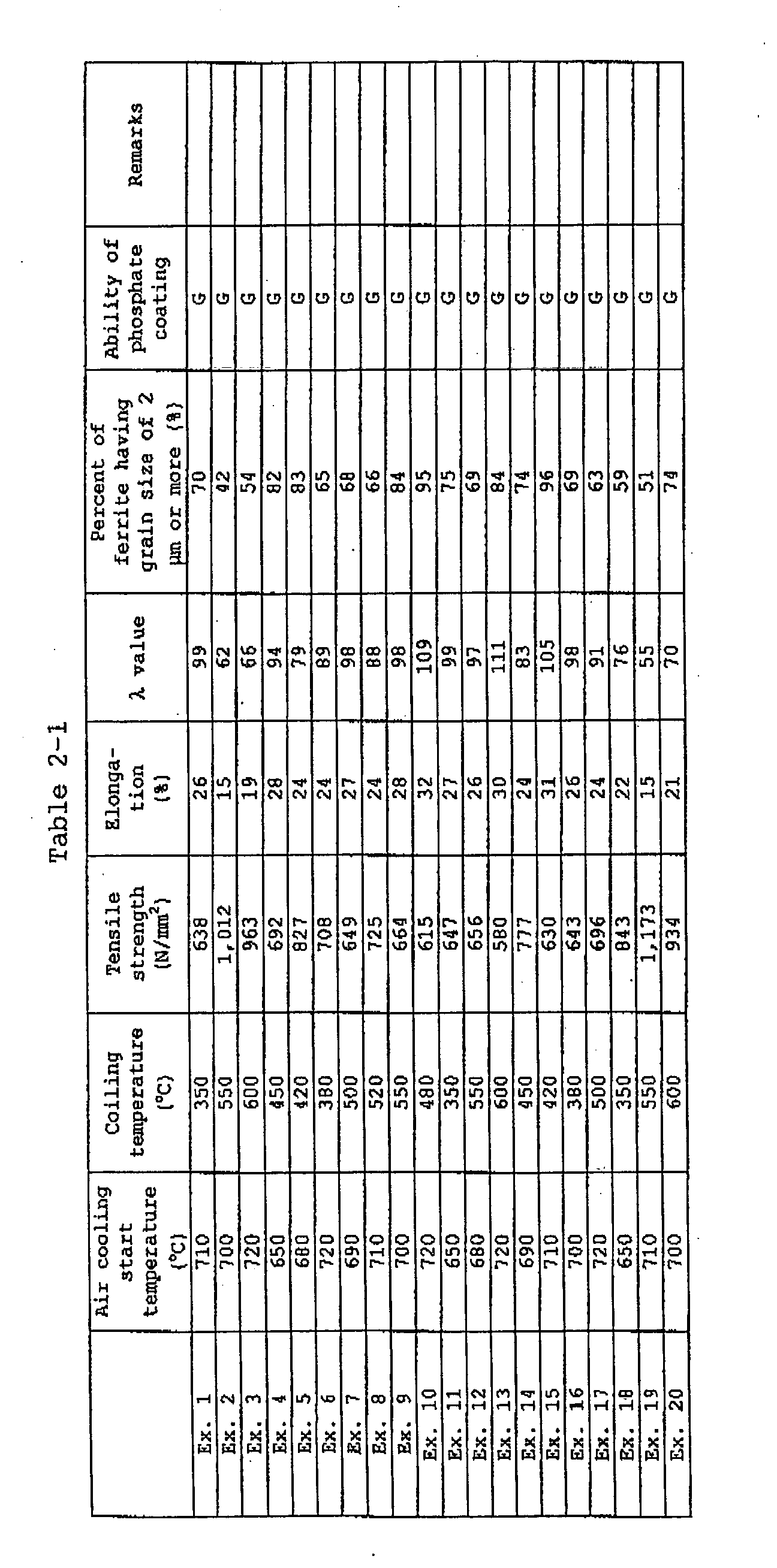
- the rate of rapid cooling was made 40°C/sec (Examples 1 to 15 and Comparative Examples 1 to 4), 120°C/sec (Examples 16 to 30 and Comparative Example 5), and 300°C/sec (Examples 31 and 32 and Comparative Example 6), and the air cooling time was made 10 seconds (Examples 1 to 32 and Comparative Examples 1 to 6).
- the finish rolling end temperature of the hot rolling was 900°C (Examples 1 to 32 and Comparative Examples 4 to 9) and 930°C (Comparative Examples 1 to 3).
- test pieces were subjected to tensile tests using JIS No. 5 pieces based on JIS Z 2201.
- the results are shown in Table 2.
- the sheet was corroded by Nytal, then a scan type electron microscope was used to identify the ferrite and bainite.
- the area ratio of ferrite of a grain size of 2 ⁇ m or more was measured by image analysis.
- phosphate coating solution SD5000 made by Nippon Paint
- the phosphate coating was judged by SEM (scanning electron microscopy) with uniformly formed coatings judged as "G (good)” and partially formed coatings as "P (poor)".
- Examples 1 to 32 are examples of the present invention having all of the chemical ingredients, finish rolling end temperature, air cooling start temperature, and coiling temperature in the scope of the present invention, having microstructures comprised of the two phases of ferrite and bainite, and having percents of ferrite having a grain size of 2 ⁇ m or more of 40% or more, i.e., are high strength hot rolled steel sheet excellent in burring, elongation, and ability of phosphate coating having high ⁇ values and elongation.
- the sheets of the comparative examples of Comparative Examples 1 to 9 deviated from the conditions of the present invention are inferior in the balance of strength, burring, and elongation and in the ability of phosphate coating.
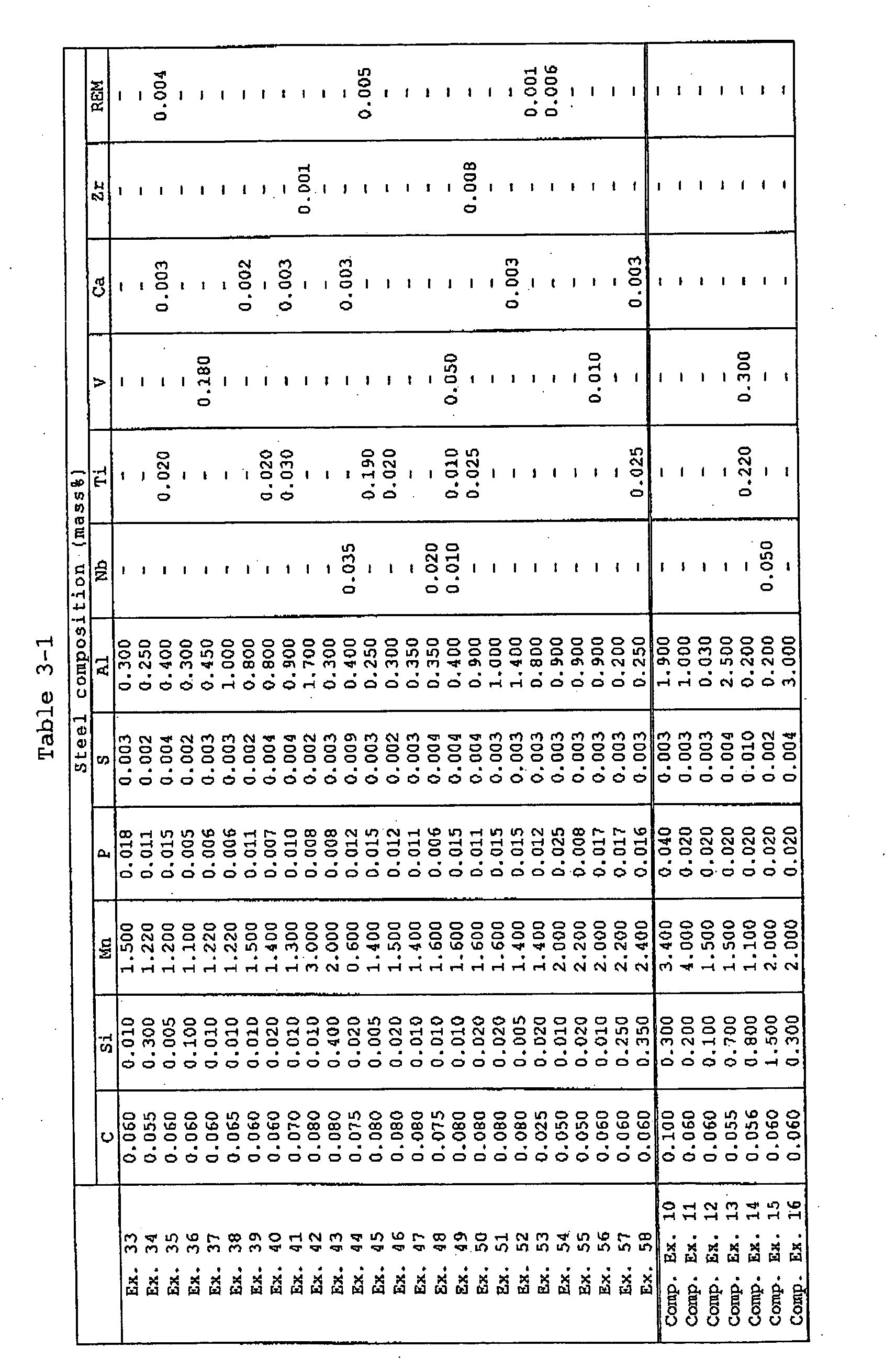
- Examples 33 to 58 show steels of ingredients in accordance with the present invention
- Comparative Example 10 shows steel with amounts of addition of C and P outside the scope of the present invention
- Comparative Example 11 shows steel with an amount of addition of Mn outside the scope
- Comparative Example 12 shows steel with an amount of addition of A1 outside the scope
- Comparative Example 13 shows steel with amounts of addition of Si and Al outside the scope
- Comparative Example 14 shows steel with amounts of addition of Si and Ti and V outside the scope
- Comparative Example 15 shows steel with amounts of addition of Si and Nb outside the scope
- Comparative Example 16 shows steel with an amount of addition of A1 outside the scope.
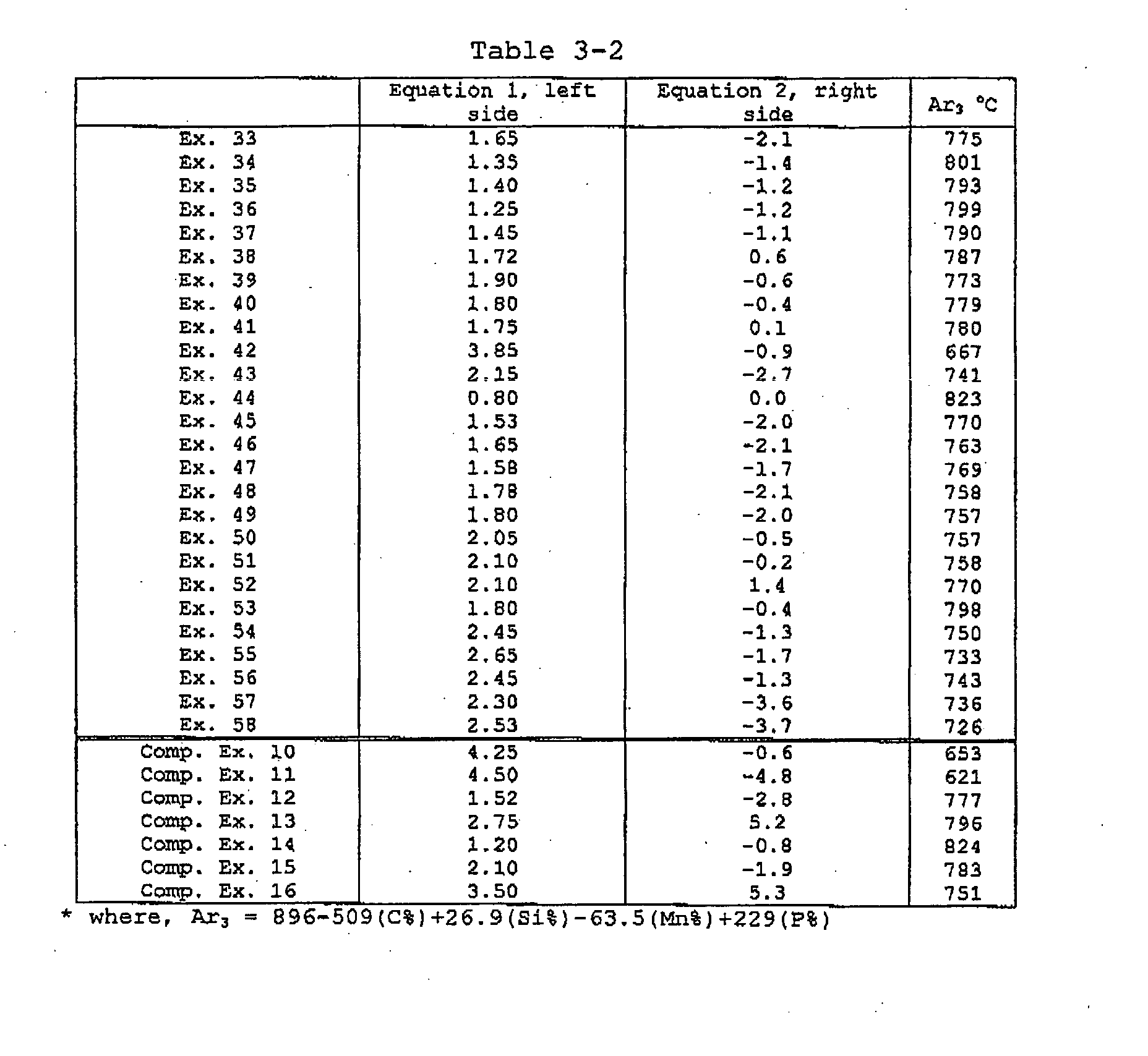
- Comparative Example 10 shows steel with a formula (1) outside the scope of the present invention
- Comparative Example 11 shows steel with formulas (1) and (2) outside the scope.
- 33-4 shows an example where the cooling rate is low and outside the scope of the present invention
- 34-3 and 38-3 show air cooling start temperatures outside the scope of the present invention
- 37-3 and 39-3 show coiling temperatures outside the scope of the present invention.
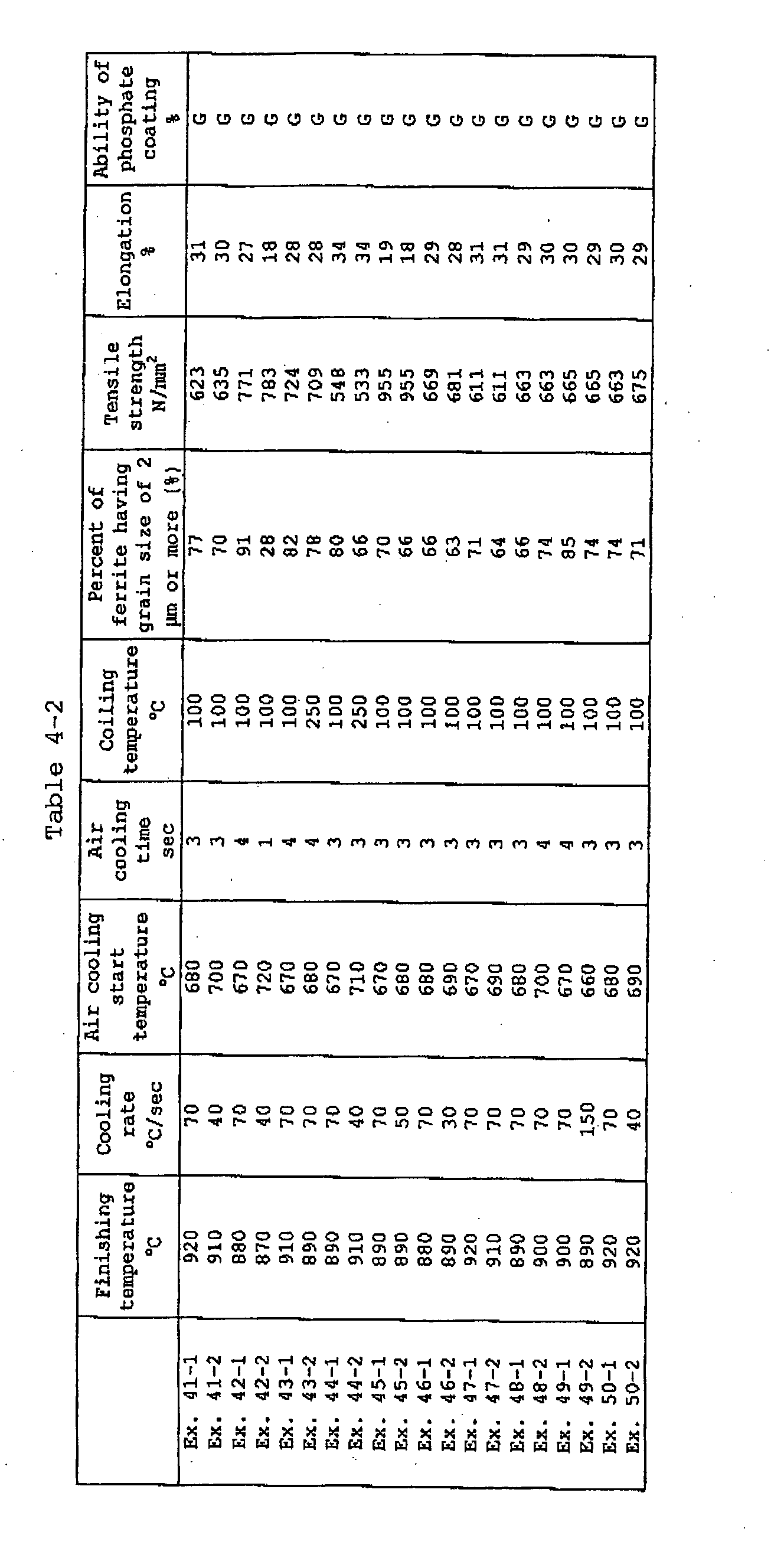
- 42-2 of Table 4-2 shows a shorter air cooling time.
- the thus obtained hot rolled steel sheets were tested for tensile strength and ability of phosphate coating.
- the TS, El, and phosphate coating of the test pieces are shown in Table 4-1, Table 4-2, and Table 4-3.
- FIG. 3 shows the relationship between strength and elongation. It is learned that the invention steels are higher in elongation compared with the comparative steels and therefore superior.
- test methods of tensile strength and elongation the method of measurement of the microstructure of the steel sheets, and the method of judgment of ability of phosphate coating are the same in conditions as Example 1.
- high strength hot rolled steel sheet having a high strength of a tensile strength of 590 N/mm 2 or more and excellent in burring, elongation, and ability of phosphate coating can be economically provided, so the present invention is suitable as high strength hot rolled steel sheet having a high workability. Further, the high strength hot rolled steel sheet of the present invention enables reduction of the weight of car bodies, integral formation of parts, and streamlining of the working processes and therefore can contribute to the improvement of the fuel efficiency and reduction of production costs so is great in industrial value.
Landscapes
- Chemical & Material Sciences (AREA)
- Engineering & Computer Science (AREA)
- Materials Engineering (AREA)
- Mechanical Engineering (AREA)
- Metallurgy (AREA)
- Organic Chemistry (AREA)
- Heat Treatment Of Sheet Steel (AREA)
Abstract
Description





Claims (6)
- High strength hot rolled steel sheet excellent in burring, elongation, and ability of phosphate coating characterized by being a steel composition containing, by mass%, C: 0.02 to 0.08%, Si: 0.50% or less, Mn: 0.50 to 3.50%, P: 0.03% or less, S: 0.01% or less, Al: 0.15 to 2.0%, and the balance of iron and unavoidable impurities, satisfying the following formula, having a microstructure of said steel sheet having a ratio of ferrite of a grain size of 2 µm or more of at least 40%, and having a tensile strength of at least 590 N/mm2:
- High strength hot rolled steel sheet excellent in burring, elongation, and ability of phosphate coating characterized by having a tensile strength of at least 590 N/mm2 as set forth in claim 1, further containing, by mass%, one or two or more of Ti: 0.003% to 0.20%, Nb: 0.003% to 0.04%, V: 0.003%to 0.20%, Ca: 0.0005 to 0.01%, Zr: 0.0005 to 0.01%, a REM: 0.0005 to 0.05%, and Mg: 0.0005 to 0.01%.
- High strength hot rolled steel sheet excellent in burring, elongation, and ability of phosphate coating characterized by having a tensile strength of at least 590 N/mm2 as set forth in claim 1 or 2, characterized by satisfying 0.3xAl,+Si-2xMn≥-4 ... (2) and having a microstructure of a grain size 2 µm or more ferrite and martensite two-phase structure.
- High strength, hot rolled steel sheet excellent in burring, elongation and ability of phosphate coating characterized by having a tensile strength of at least 590 N/mm2 as set forth in claim 1 or 2, characterized by having a microstructure of a grain size 2 µm or more ferrite and bainite two-phase structure.
- A method of production of high strength hot rolled steel sheet excellent in burring, elongation, and ability of phosphate coating characterized by having a tensile strength of 590 N/mm2 or more characterized by ending hot rolling of a slab comprised of a steel composition as set forth in any one of claims 1 to 3 at a rolling end temperature of the Ar3 point or more, then cooling it by a cooling rate of 20°C/sec or more until 650°C to 750°C, then air cooling it for 2 to 15 seconds, further cooling it, then coiling it at a temperature of less than 300°C.
- A method of production of high strength hot rolled steel sheet excellent in burring, elongation, and ability of phosphate coating characterized by having a tensile strength of 590 N/mm2 or more, characterized by ending hot rolling of a slab comprised of a steel composition as set forth in any one of claims 1, 2, and 4 at a rolling end temperature of the Ar3 point or more, then cooling it by a cooling rate of 20°C/sec or more to 650 to 800°C, then air cooling it for 2 to 15 seconds, then further cooling it by a cooling rate of 20°C/sec or more to 350 to 600°C and coiling it.
Applications Claiming Priority (5)
| Application Number | Priority Date | Filing Date | Title |
|---|---|---|---|
| JP2002377097 | 2002-12-26 | ||
| JP2002377097A JP4180909B2 (en) | 2002-12-26 | 2002-12-26 | High-strength hot-rolled steel sheet excellent in hole expansibility, ductility and chemical conversion treatment, and method for producing the same |
| JP2003357281A JP4203396B2 (en) | 2003-10-17 | 2003-10-17 | High-strength hot-rolled steel sheet excellent in ductility and chemical conversion property and method for producing the same |
| JP2003357281 | 2003-10-17 | ||
| PCT/JP2003/016614 WO2004059024A1 (en) | 2002-12-26 | 2003-12-24 | High strength thin steel sheet excellent in hole expansibility, ductility and chemical treatment characteristics, and method for production thereof |
Publications (3)
| Publication Number | Publication Date |
|---|---|
| EP1595965A1 true EP1595965A1 (en) | 2005-11-16 |
| EP1595965A4 EP1595965A4 (en) | 2006-06-07 |
| EP1595965B1 EP1595965B1 (en) | 2008-10-22 |
Family
ID=32684256
Family Applications (1)
| Application Number | Title | Priority Date | Filing Date |
|---|---|---|---|
| EP03786277A Expired - Lifetime EP1595965B1 (en) | 2002-12-26 | 2003-12-24 | High strength thin steel sheet excellent in hole expansibility, ductility and chemical treatment characteristics, and method for production thereof |
Country Status (7)
| Country | Link |
|---|---|
| US (1) | US7780797B2 (en) |
| EP (1) | EP1595965B1 (en) |
| KR (2) | KR100756114B1 (en) |
| AU (1) | AU2003296089A1 (en) |
| CA (1) | CA2511666C (en) |
| DE (1) | DE60324333D1 (en) |
| WO (1) | WO2004059024A1 (en) |
Families Citing this family (8)
| Publication number | Priority date | Publication date | Assignee | Title |
|---|---|---|---|---|
| US7846275B2 (en) | 2006-05-24 | 2010-12-07 | Kobe Steel, Ltd. | High strength hot rolled steel sheet having excellent stretch flangeability and its production method |
| CN102791896B (en) * | 2010-03-10 | 2014-06-11 | 新日铁住金株式会社 | High-strength hot-rolled steel plate and manufacturing method thereof |
| BR112013023571B1 (en) * | 2011-03-18 | 2019-05-21 | Nippon Steel & Sumitomo Metal Corporation | HOT LAMINATED STEEL SHEET AND SAME PRODUCTION METHOD |
| IN2014DN06757A (en) | 2012-02-17 | 2015-05-22 | Nippon Steel & Sumitomo Metal Corp | |
| IN2015DN02550A (en) | 2012-09-27 | 2015-09-11 | Nippon Steel & Sumitomo Metal Corp | |
| JP6191769B2 (en) * | 2014-05-28 | 2017-09-06 | 新日鐵住金株式会社 | Hot rolled steel sheet and manufacturing method thereof |
| MX392414B (en) * | 2015-05-29 | 2025-03-24 | Jfe Steel Corp | HIGH STRENGTH STEEL SHEET AND METHOD FOR MANUFACTURING SAME. |
| US11634587B2 (en) * | 2017-03-24 | 2023-04-25 | Magna International Inc. | Wax coating over phosphate coating for vehicle components |
Family Cites Families (31)
| Publication number | Priority date | Publication date | Assignee | Title |
|---|---|---|---|---|
| JPH0774378B2 (en) | 1989-12-09 | 1995-08-09 | 新日本製鐵株式会社 | Method for producing high strength hot rolled steel sheet with excellent hole expandability |
| JPH0762178B2 (en) | 1990-07-30 | 1995-07-05 | 新日本製鐵株式会社 | Method for producing high strength hot rolled steel sheet with excellent stretch flangeability and ductility |
| JP2952624B2 (en) | 1991-05-30 | 1999-09-27 | 新日本製鐵株式会社 | High yield ratio type hot rolled high strength steel sheet excellent in formability and spot weldability and its manufacturing method and high yield ratio type hot rolled high strength steel sheet excellent in formability and its manufacturing method |
| JP2734842B2 (en) * | 1991-10-18 | 1998-04-02 | 住友金属工業株式会社 | High workability hot-rolled high-strength steel sheet and its manufacturing method |
| JP3180426B2 (en) | 1992-03-13 | 2001-06-25 | 富士ゼロックス株式会社 | Image reading method and apparatus |
| JP3297082B2 (en) | 1992-07-14 | 2002-07-02 | 川崎製鉄株式会社 | Method for producing hot-rolled high-tensile steel sheet with excellent fatigue properties |
| JPH06128688A (en) | 1992-10-20 | 1994-05-10 | Sumitomo Metal Ind Ltd | Hot-rolled steel sheet having excellent fatigue properties and method for producing the same |
| JP3219510B2 (en) | 1992-12-02 | 2001-10-15 | 株式会社神戸製鋼所 | High strength hot rolled steel sheet with excellent stretch flangeability |
| JPH0826433B2 (en) | 1992-12-28 | 1996-03-13 | 株式会社神戸製鋼所 | High strength hot rolled steel sheet with excellent stretch flangeability |
| JP3188787B2 (en) | 1993-04-07 | 2001-07-16 | 新日本製鐵株式会社 | Method for producing high-strength hot-rolled steel sheet with excellent hole expandability and ductility |
| JP3233743B2 (en) | 1993-06-28 | 2001-11-26 | 株式会社神戸製鋼所 | High strength hot rolled steel sheet with excellent stretch flangeability |
| US5470529A (en) * | 1994-03-08 | 1995-11-28 | Sumitomo Metal Industries, Ltd. | High tensile strength steel sheet having improved formability |
| JPH07252592A (en) * | 1994-03-15 | 1995-10-03 | Nippon Steel Corp | Hot rolled high strength steel sheet with excellent formability, low temperature toughness and fatigue characteristics |
| EP0974677B2 (en) * | 1997-01-29 | 2015-09-23 | Nippon Steel & Sumitomo Metal Corporation | A method for producing high strength steels having excellent formability and high impact energy absorption properties |
| CA2283924C (en) | 1997-03-17 | 2006-11-28 | Nippon Steel Corporation | Dual-phase type high-strength steel sheets having high impact energy absorption properties and a method of producing the same |
| JP4179486B2 (en) | 1998-05-13 | 2008-11-12 | 住友金属工業株式会社 | Steel sheet having fine grain structure and method for producing the same |
| JP3716629B2 (en) | 1998-08-12 | 2005-11-16 | Jfeスチール株式会社 | Manufacturing method of thin two-phase structure hot rolled steel strip |
| JP2000144261A (en) * | 1998-11-06 | 2000-05-26 | Nkk Corp | Method for producing hot-rolled hot-dip galvanized and alloyed hot-dip galvanized high-strength steel sheets with excellent ductility |
| JP3039862B1 (en) | 1998-11-10 | 2000-05-08 | 川崎製鉄株式会社 | Hot-rolled steel sheet for processing with ultra-fine grains |
| JP3769143B2 (en) | 1999-05-06 | 2006-04-19 | 新日本製鐵株式会社 | Hot-rolled steel sheet for machining excellent in fatigue characteristics and method for producing the same |
| US6596414B1 (en) | 1999-05-27 | 2003-07-22 | Nippon Steel Corporation | Phosphate-treated galvanized steel sheet excellent in corrosion resistance and paintability |
| JP3546266B2 (en) * | 1999-07-26 | 2004-07-21 | Jfeスチール株式会社 | High strength hot rolled steel sheet excellent in workability and method for producing the same |
| ATE490349T1 (en) * | 1999-09-29 | 2010-12-15 | Jfe Steel Corp | STEEL SHEET AND METHOD FOR THE PRODUCTION THEREOF |
| KR100441414B1 (en) | 2000-04-21 | 2004-07-23 | 신닛뽄세이테쯔 카부시키카이샤 | High fatigue strength steel sheet excellent in burring workability and method for producing the same |
| JP4445095B2 (en) | 2000-04-21 | 2010-04-07 | 新日本製鐵株式会社 | Composite structure steel plate excellent in burring workability and manufacturing method thereof |
| NL1015184C2 (en) * | 2000-05-12 | 2001-11-13 | Corus Staal Bv | Multi-phase steel and method for its manufacture. |
| JP2002129285A (en) * | 2000-10-30 | 2002-05-09 | Nippon Steel Corp | Work-induced transformation type composite structure steel sheet excellent in burring workability and method for producing the same |
| JP3947354B2 (en) | 2000-12-07 | 2007-07-18 | 新日本製鐵株式会社 | High-strength hot-rolled steel sheet excellent in hole expansibility and ductility and manufacturing method thereof |
| TW567231B (en) | 2001-07-25 | 2003-12-21 | Nippon Steel Corp | Multi-phase steel sheet excellent in hole expandability and method of producing the same |
| JP4205893B2 (en) | 2002-05-23 | 2009-01-07 | 新日本製鐵株式会社 | High-strength hot-rolled steel sheet excellent in press formability and punching workability and manufacturing method thereof |
| JP3858770B2 (en) * | 2002-06-21 | 2006-12-20 | 住友金属工業株式会社 | High-tensile hot-rolled steel sheet and manufacturing method thereof |
-
2003
- 2003-12-24 KR KR1020057011928A patent/KR100756114B1/en not_active Expired - Lifetime
- 2003-12-24 CA CA2511666A patent/CA2511666C/en not_active Expired - Lifetime
- 2003-12-24 KR KR1020077009825A patent/KR20070050108A/en not_active Ceased
- 2003-12-24 US US10/540,418 patent/US7780797B2/en not_active Expired - Lifetime
- 2003-12-24 EP EP03786277A patent/EP1595965B1/en not_active Expired - Lifetime
- 2003-12-24 WO PCT/JP2003/016614 patent/WO2004059024A1/en not_active Ceased
- 2003-12-24 AU AU2003296089A patent/AU2003296089A1/en not_active Abandoned
- 2003-12-24 DE DE60324333T patent/DE60324333D1/en not_active Expired - Lifetime
Also Published As
| Publication number | Publication date |
|---|---|
| CA2511666A1 (en) | 2004-07-15 |
| KR20070050108A (en) | 2007-05-14 |
| AU2003296089A1 (en) | 2004-07-22 |
| CA2511666C (en) | 2010-04-06 |
| EP1595965B1 (en) | 2008-10-22 |
| US20060113012A1 (en) | 2006-06-01 |
| DE60324333D1 (en) | 2008-12-04 |
| US7780797B2 (en) | 2010-08-24 |
| KR100756114B1 (en) | 2007-09-05 |
| EP1595965A4 (en) | 2006-06-07 |
| KR20050085892A (en) | 2005-08-29 |
| WO2004059024A1 (en) | 2004-07-15 |
Similar Documents
| Publication | Publication Date | Title |
|---|---|---|
| US11505844B2 (en) | Cold-rolled high-strength steel plate having excellent phosphating performance and formability and manufacturing method therefor | |
| JP6008039B2 (en) | High-strength hot-rolled steel sheet with a maximum tensile strength of 980 MPa or more with excellent bake hardenability and low-temperature toughness | |
| CN102918174B (en) | High-strength hot-dip galvanized steel sheet excellent in bendability and weldability and manufacturing method thereof | |
| KR102130233B1 (en) | Thin steel plate and plated steel sheet, and hot rolled steel sheet manufacturing method, cold rolled full hard steel sheet manufacturing method, heat treatment plate manufacturing method, thin steel sheet manufacturing method and plated steel sheet manufacturing method | |
| UA126200C2 (en) | High-strength cold rolled steel sheet having high formability and a method of manufacturing thereof | |
| KR20160096611A (en) | High-strength steel and method for producing same | |
| CN100345993C (en) | High-strength steel sheet excellent in hole expandability, ductility, and chemical conversion film-forming performance, and manufacturing method thereof | |
| WO2014171062A1 (en) | High-strength hot-rolled steel sheet and method for manufacturing same | |
| KR20090014391A (en) | Hot rolled steel sheet excellent in workability and excellent in toughness after heat treatment and its manufacturing method | |
| US20210040592A1 (en) | Hot stamped article | |
| CA2840724A1 (en) | High-strength steel sheet for warm press forming and method for manufacturing thereof | |
| US11136642B2 (en) | Steel sheet, plated steel sheet, method of production of hot-rolled steel sheet, method of production of cold-rolled full hard steel sheet, method of production of steel sheet, and method of production of plated steel sheet | |
| JP4650006B2 (en) | High carbon hot-rolled steel sheet excellent in ductility and stretch flangeability and method for producing the same | |
| KR20210047334A (en) | Hot rolled steel sheet and its manufacturing method | |
| CN116018416A (en) | Steel plate and manufacturing method thereof | |
| KR20230016218A (en) | Heat-treated cold-rolled steel sheet and its manufacturing method | |
| CN115210398A (en) | Steel sheet, member, and method for producing same | |
| WO2015198582A1 (en) | High-strength steel sheet | |
| JP2004027249A (en) | High-strength hot-rolled steel sheet and manufacturing method thereof | |
| JP4696853B2 (en) | Method for producing high-carbon cold-rolled steel sheet with excellent workability and high-carbon cold-rolled steel sheet | |
| EP1595965B1 (en) | High strength thin steel sheet excellent in hole expansibility, ductility and chemical treatment characteristics, and method for production thereof | |
| JP5988000B1 (en) | High strength steel plate and manufacturing method thereof | |
| KR101639914B1 (en) | High strength cold steel sheet with good phosphating property and method for manufacturing the same | |
| JP4205892B2 (en) | High-strength hot-rolled steel sheet excellent in press formability and punching workability and manufacturing method thereof | |
| CN101151391A (en) | Hot-rolled steel sheet, manufacturing method thereof, and hot-rolled steel sheet formed body |
Legal Events
| Date | Code | Title | Description |
|---|---|---|---|
| PUAI | Public reference made under article 153(3) epc to a published international application that has entered the european phase |
Free format text: ORIGINAL CODE: 0009012 |
|
| 17P | Request for examination filed |
Effective date: 20050624 |
|
| AK | Designated contracting states |
Kind code of ref document: A1 Designated state(s): AT BE BG CH CY CZ DE DK EE ES FI FR GB GR HU IE IT LI LU MC NL PT RO SE SI SK TR |
|
| AX | Request for extension of the european patent |
Extension state: AL LT LV MK |
|
| RIC1 | Information provided on ipc code assigned before grant |
Ipc: C22C 38/00 20060101AFI20040719BHEP |
|
| DAX | Request for extension of the european patent (deleted) | ||
| RBV | Designated contracting states (corrected) |
Designated state(s): BE DE FR GB |
|
| A4 | Supplementary search report drawn up and despatched |
Effective date: 20060508 |
|
| 17Q | First examination report despatched |
Effective date: 20060914 |
|
| 17Q | First examination report despatched |
Effective date: 20060914 |
|
| GRAP | Despatch of communication of intention to grant a patent |
Free format text: ORIGINAL CODE: EPIDOSNIGR1 |
|
| GRAS | Grant fee paid |
Free format text: ORIGINAL CODE: EPIDOSNIGR3 |
|
| GRAA | (expected) grant |
Free format text: ORIGINAL CODE: 0009210 |
|
| AK | Designated contracting states |
Kind code of ref document: B1 Designated state(s): BE DE FR GB |
|
| REG | Reference to a national code |
Ref country code: GB Ref legal event code: FG4D |
|
| REF | Corresponds to: |
Ref document number: 60324333 Country of ref document: DE Date of ref document: 20081204 Kind code of ref document: P |
|
| PLBE | No opposition filed within time limit |
Free format text: ORIGINAL CODE: 0009261 |
|
| STAA | Information on the status of an ep patent application or granted ep patent |
Free format text: STATUS: NO OPPOSITION FILED WITHIN TIME LIMIT |
|
| 26N | No opposition filed |
Effective date: 20090723 |
|
| REG | Reference to a national code |
Ref country code: DE Ref legal event code: R081 Ref document number: 60324333 Country of ref document: DE Owner name: NIPPON STEEL & SUMITOMO METAL CORPORATION, JP Free format text: FORMER OWNER: NIPPON STEEL CORP., TOKIO/TOKYO, JP Effective date: 20130227 Ref country code: DE Ref legal event code: R082 Ref document number: 60324333 Country of ref document: DE Representative=s name: VOSSIUS & PARTNER, DE Effective date: 20130227 Ref country code: DE Ref legal event code: R082 Ref document number: 60324333 Country of ref document: DE Representative=s name: VOSSIUS & PARTNER PATENTANWAELTE RECHTSANWAELT, DE Effective date: 20130227 |
|
| REG | Reference to a national code |
Ref country code: FR Ref legal event code: CD Owner name: NIPPON STEEL & SUMITOMO METAL CORPORATION, JP Effective date: 20130913 Ref country code: FR Ref legal event code: CA Effective date: 20130913 |
|
| REG | Reference to a national code |
Ref country code: FR Ref legal event code: PLFP Year of fee payment: 13 |
|
| REG | Reference to a national code |
Ref country code: FR Ref legal event code: PLFP Year of fee payment: 14 |
|
| REG | Reference to a national code |
Ref country code: FR Ref legal event code: PLFP Year of fee payment: 15 |
|
| REG | Reference to a national code |
Ref country code: DE Ref legal event code: R082 Ref document number: 60324333 Country of ref document: DE Representative=s name: VOSSIUS & PARTNER PATENTANWAELTE RECHTSANWAELT, DE Ref country code: DE Ref legal event code: R081 Ref document number: 60324333 Country of ref document: DE Owner name: NIPPON STEEL CORPORATION, JP Free format text: FORMER OWNER: NIPPON STEEL & SUMITOMO METAL CORPORATION, TOKYO, JP |
|
| PGFP | Annual fee paid to national office [announced via postgrant information from national office to epo] |
Ref country code: GB Payment date: 20221103 Year of fee payment: 20 Ref country code: FR Payment date: 20221110 Year of fee payment: 20 Ref country code: DE Payment date: 20221102 Year of fee payment: 20 |
|
| PGFP | Annual fee paid to national office [announced via postgrant information from national office to epo] |
Ref country code: BE Payment date: 20221118 Year of fee payment: 20 |
|
| REG | Reference to a national code |
Ref country code: DE Ref legal event code: R071 Ref document number: 60324333 Country of ref document: DE |
|
| REG | Reference to a national code |
Ref country code: GB Ref legal event code: PE20 Expiry date: 20231223 |
|
| PG25 | Lapsed in a contracting state [announced via postgrant information from national office to epo] |
Ref country code: GB Free format text: LAPSE BECAUSE OF EXPIRATION OF PROTECTION Effective date: 20231223 |
|
| REG | Reference to a national code |
Ref country code: BE Ref legal event code: MK Effective date: 20231224 |
|
| PG25 | Lapsed in a contracting state [announced via postgrant information from national office to epo] |
Ref country code: GB Free format text: LAPSE BECAUSE OF EXPIRATION OF PROTECTION Effective date: 20231223 |