EP1590286B1 - Gerät und verfahren zum falten eines folienblattes - Google Patents
Gerät und verfahren zum falten eines folienblattes Download PDFInfo
- Publication number
- EP1590286B1 EP1590286B1 EP04708398A EP04708398A EP1590286B1 EP 1590286 B1 EP1590286 B1 EP 1590286B1 EP 04708398 A EP04708398 A EP 04708398A EP 04708398 A EP04708398 A EP 04708398A EP 1590286 B1 EP1590286 B1 EP 1590286B1
- Authority
- EP
- European Patent Office
- Prior art keywords
- foil
- sheet
- foldable
- folding
- axis
- Prior art date
- Legal status (The legal status is an assumption and is not a legal conclusion. Google has not performed a legal analysis and makes no representation as to the accuracy of the status listed.)
- Expired - Lifetime
Links
Images



Classifications
-
- B—PERFORMING OPERATIONS; TRANSPORTING
- B65—CONVEYING; PACKING; STORING; HANDLING THIN OR FILAMENTARY MATERIAL
- B65H—HANDLING THIN OR FILAMENTARY MATERIAL, e.g. SHEETS, WEBS, CABLES
- B65H35/00—Delivering articles from cutting or line-perforating machines; Article or web delivery apparatus incorporating cutting or line-perforating devices, e.g. adhesive tape dispensers
- B65H35/0006—Article or web delivery apparatus incorporating cutting or line-perforating devices
-
- B—PERFORMING OPERATIONS; TRANSPORTING
- B65—CONVEYING; PACKING; STORING; HANDLING THIN OR FILAMENTARY MATERIAL
- B65H—HANDLING THIN OR FILAMENTARY MATERIAL, e.g. SHEETS, WEBS, CABLES
- B65H45/00—Folding thin material
-
- A—HUMAN NECESSITIES
- A45—HAND OR TRAVELLING ARTICLES
- A45D—HAIRDRESSING OR SHAVING EQUIPMENT; EQUIPMENT FOR COSMETICS OR COSMETIC TREATMENTS, e.g. FOR MANICURING OR PEDICURING
- A45D19/00—Devices for washing the hair or the scalp; Similar devices for colouring the hair
-
- B—PERFORMING OPERATIONS; TRANSPORTING
- B65—CONVEYING; PACKING; STORING; HANDLING THIN OR FILAMENTARY MATERIAL
- B65H—HANDLING THIN OR FILAMENTARY MATERIAL, e.g. SHEETS, WEBS, CABLES
- B65H45/00—Folding thin material
- B65H45/02—Folding limp material without application of pressure to define or form crease lines
- B65H45/04—Folding sheets
-
- B—PERFORMING OPERATIONS; TRANSPORTING
- B65—CONVEYING; PACKING; STORING; HANDLING THIN OR FILAMENTARY MATERIAL
- B65H—HANDLING THIN OR FILAMENTARY MATERIAL, e.g. SHEETS, WEBS, CABLES
- B65H45/00—Folding thin material
- B65H45/12—Folding articles or webs with application of pressure to define or form crease lines
- B65H45/16—Rotary folders
-
- A—HUMAN NECESSITIES
- A45—HAND OR TRAVELLING ARTICLES
- A45D—HAIRDRESSING OR SHAVING EQUIPMENT; EQUIPMENT FOR COSMETICS OR COSMETIC TREATMENTS, e.g. FOR MANICURING OR PEDICURING
- A45D19/00—Devices for washing the hair or the scalp; Similar devices for colouring the hair
- A45D19/012—Devices for colouring or bleaching separated strands of hair, e.g. highlighting
- A45D19/016—Devices for colouring or bleaching separated strands of hair, e.g. highlighting comprising an open, flat support for strands of hair or for wrapping foils during the application of the dyeing product
-
- Y—GENERAL TAGGING OF NEW TECHNOLOGICAL DEVELOPMENTS; GENERAL TAGGING OF CROSS-SECTIONAL TECHNOLOGIES SPANNING OVER SEVERAL SECTIONS OF THE IPC; TECHNICAL SUBJECTS COVERED BY FORMER USPC CROSS-REFERENCE ART COLLECTIONS [XRACs] AND DIGESTS
- Y10—TECHNICAL SUBJECTS COVERED BY FORMER USPC
- Y10T—TECHNICAL SUBJECTS COVERED BY FORMER US CLASSIFICATION
- Y10T225/00—Severing by tearing or breaking
- Y10T225/10—Methods
-
- Y—GENERAL TAGGING OF NEW TECHNOLOGICAL DEVELOPMENTS; GENERAL TAGGING OF CROSS-SECTIONAL TECHNOLOGIES SPANNING OVER SEVERAL SECTIONS OF THE IPC; TECHNICAL SUBJECTS COVERED BY FORMER USPC CROSS-REFERENCE ART COLLECTIONS [XRACs] AND DIGESTS
- Y10—TECHNICAL SUBJECTS COVERED BY FORMER USPC
- Y10T—TECHNICAL SUBJECTS COVERED BY FORMER US CLASSIFICATION
- Y10T225/00—Severing by tearing or breaking
- Y10T225/30—Breaking or tearing apparatus
Definitions
- the present invention relates to an apparatus and method for folding a sheet of foil to create individual portions of foil having one or more folds. These portions are suitable for use, though not exclusively, in the hairdressing industry when colouring or highlighting hair.
- aluminium foil is used to separate strands of hair so the stylist can 'paint' on the colour to a specific section of the hair.
- the foil is cut into different lengths which is determined by the length of hair to be treated, this may be between 10cm and 40cm.
- One end of the foil is then folded over one or two times. This fold may be in the region of 1cm.
- the colourist selects strands of hair and places them on the cut foil, with the folded side towards the head. They then use a colour brush to cover the hair with a hair lightener or colour, depending on the desired effect.
- the bottom of the foil is then folded up to the top to sandwich the hair. Both the sides are then folded inwards to create a little parcel, enclosing the hair and colour.
- the foil not only separates the hair to allow the colour to be applied accurately to a specific area, but also retains heat to aid the speed of the colouring process.
- the foils are usually supplied in a number of thicknesses 14, 18 and 20 microns and a number of widths, 10cm, 12cm and 44cm.
- the foil can either be bought on a roll or in pre-cut lengths.
- the rolls are usually in lengths of 100m, 150m, 225m, 500m and 1000m or pre-cut into lengths of 10cm and 12 cm.
- Pending US patent application published under number US2002-0003157A1, discloses an apparatus for producing folds in aluminium foil.
- the machine feeds aluminium foil to a knife mechanism which cuts the trailing edge of the sheet to produce cut sheets.
- the knife mechanism creates a folded part on the trailing edge which can interact with a knockdown roller provided with indentations. The interaction between the roller and the folded part causes the folded part to fold over on itself as the cut sheet advances.
- This apparatus offers little control over the creation of the fold.
- an apparatus for folding a sheet of foil comprising:
- the first and second surfaces can be rotated to create multiple folds at or near to the leading edge of the sheet of foil.
- the first and second surfaces can be disposed at the same point along the length of the foil, at or near to the leading edge of the foil; and in which, in use, the first and second surfaces can be rotated, in the same sense about the foldable axis to create one or more folds in the foil.
- the first and second surfaces prior to the folding, can be disposed on either side of the sheet such that the surfaces are non co-planar with the plane of the sheet. This enables the first and second surfaces to approach the sheet of foil from virtually any angle.
- the first and second surfaces may be rotated through substantially 180 degrees. In other embodiments, the first and second surfaces can be rotated through a further 180 degrees or more. Rotating the first and second surfaces through around 180 degrees provides a single fold in the foil. Further rotation to around 360 degrees creates a double fold in the foil.
- the first and second surfaces are withdrawable from the sheet.
- the first and second surfaces are connected to each other in a common plane.
- the first and second surfaces may be connected to each other so as to form a generally u-shaped member.
- a u-shaped member can easily be positioned such that each of its limbs can bear opposite faces of the sheet of foil. The foil can then simply be twisted around the u-shaped member to create a suitable fold or folds.
- the limbs of the u-shaped member may be substantially 10 cm to 50 cm in length. Most preferably, the limbs are between substantially 10 cm and 20 cm in length.
- the separation between the limbs may be substantially 1 to 5 mm. Most preferably, the separation is around 2 to 3 mm.
- the first surface rotates, in use, about the foldable axis and the second surface is stationary in use.
- the second surface has a first edge, the first surface being rotatable in use relative to the second surface about the axis of the foldable portion, from a first position in which the first and second surfaces are parallel and staggered relative to each other, to a second position in which the first and second surfaces capture the foldable portion to create a first fold along the foldable axis, the first surface being rotatable back to the first position.
- the apparatus may comprise a guide member which prevents lateral movement of the foil during the folding.
- the guide member is integral with the first and/or second surfaces. Use of a guide member prevents the foil from diverging from its path during the folding operation.
- the apparatus comprises cutting means for cutting a trailing edge of the portion of foil.
- the cutting means may comprise a knife or guillotine.
- the portion of foil is cut after completion of the folding operation.
- the apparatus further comprises receiving means for receiving the portion of foil after the folding.
- the receiving means may take the form of a substantially flat surface on to which the cut portion can be advanced.
- the apparatus further comprises flattening means which in use can be brought into engagement with the folded end of the foil to flatten the fold or folds.
- the flattening means comprises a pair of rollers between which the folded portion of the foil can pass.
- the flattening means may comprise a pair of opposed surfaces which can be brought together to receive the folded portion of the foil. Use of flattening means presses or smoothes the folded portion to prevent the fold or folds from springing apart.
- the apparatus further comprises scoring means which, in use, can be used for scoring the first and/or second face of the sheet of foil between the folded portion and the trailing edge.
- the score is substantially parallel to the trailing edge and / or folded portion. Providing a score on the surface of the foil sheet between the trailing edge and the folded portion provides a guide for a hairstylist when folding the foil up to create a folded package when colouring hair.
- the score is substantially midway between the trailing edge and folded portion.
- the apparatus further comprises removal means for removing the portion of the foil sheet from the folding means.
- the removal means may comprise a pair of roller.
- the scoring means may form part of the flattening means, the receiving means, or the removal means.
- the apparatus comprises marking means for marking one or both of the opposing faces of the portion of foil with one or more identification marks.
- the identification marks may include one or more colours, preferably stripes of colours. The stripes may be between 10 mm and 50 mm in length.
- Identification marks can be used to identify individual sheets of foil which are to be used in a designated way. For example, if a particular colour is marked on the foil this can be used to indicate which colour(s) of dye is to be used in conjunction with that piece of foil.
- information may be stamped or imprinted on to the surface(s) of the foil, such as the length of time which a piece of foil has to be held in contact with the hair to effectively dye the hair.
- the marking means may comprise an inkjet printer or a stamp.
- the scoring means may be used to imprint identification marks on the surface(s) of the sheet of foil.
- the first and second surfaces are rigid. Use of rigid surfaces helps to produce a sharp, well-defined, and secure fold.
- the first and second surfaces are substantially planar. Use of substantially planar surfaces creates flat folded surfaces.
- the length of the individual sheets may be varied.
- the length of the individual sheets may be varied by varying the length of the second surface and/or by varying the distance between the first edge and the cutting means.
- the width of the folded portion from the leading edge in a direction towards the trailing edge may be varied by varying the separation between the first edge and the receiving means.
- the apparatus may be contained within a housing.
- an method for folding a sheet of foil comprising:
- the method comprises:
- the method comprises:
- the method comprises:
- the method comprises:
- the method further comprises:
- the method may comprise:
- the method further comprises scoring the foil sheet between the folded portion and the trailing edge.
- the method further comprises marking one or both of the opposing faces of the portion of foil with one or more identification marks.
- the marking takes place after the folding operation.
- the sheet of foil is marked after the cutting operation.
- the apparatus would be conveniently located in the hair salon and would consist of a means of holding the roll of foil allowing it to rotate as required.
- the aluminium foil is cut into predetermined lengths and one end folded over according to requirements .
- the aluminium foil may be in different widths and thickness.
- the aluminium foil is cut into predetermined lengths and one end folded over according to requirements in a fully automatic mode.
- the aluminium foil is cut into predetermined lengths and one end folded over according to requirements by mechanical means.
- the aluminium foil is cut into predetermined lengths and one end folded over according to requirements by mechanical means electronically driven.
- the aluminium foil is cut into predetermined lengths and one end folded over according to requirements to a predetermined number.
- the foil would be placed onto a rotating spindle and the loose end threaded between a pair of rollers.
- a length of foil extends beyond the rollers and is gripped by a folding device. This may be tapered with the narrowest part at the end farthest from the mounting. This would be capable of rotating. Having been rotated one or more times it is drawn away from the first set of rollers to the preset position at which the flattening device is located. It then moves horizontally away, leaving the foil in an open folded configuration. This is flattened with the flattening positioned above the preset position. The section members then return starting position close to the rollers. The foil is then parted by a scissor or other cutting means. The process is then repeated.
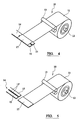
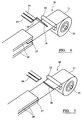
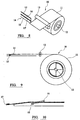
- FIG. 1 An apparatus (10) according to a first embodiment of the present invention is shown in Figures 1 to 11. Aluminium foil (11) which is rolled up into a roll located on a rotating spindle (12) is fed to a feeding means (13). The leading edge (11') of the foil is fed through the feeding means which in the embodiment shown takes the form of a pair of rollers (13) which feed the edge (11') of the foil towards a folding means (14).
- the folding means (14) takes the form of a generally u-shaped member having a pair of limbs (15) connected at a first end and separated over a part of their length by a gap (16).
- the folding means (14) can be introduced to a portion of the foil at or near to the leading edge (11') such that edges (15') of the limbs (15) are positioned above and below the sheet of foil (11), as shown in Figures 1 and 2.
- the folding means (14) can then be rotated by around 180° to produce a first fold at or near to the leading edge (11') of the foil. Rotation of the folding means (14) by a further 180° creates a second fold at or near to the leading edge (11') of the foil. Effectively the leading edge (11') is folded back to create a double fold. After this double folding procedure has been completed, the foil can be advanced as shown in Figure 4. The folding means (14) can then be withdrawn from the folded end (17) of the foil. This is illustrated in Figure 5.
- the folded end (17) can be fed into a flattening means (18) and a cutting means (19) introduced to the sheet of foil.
- the cutting means (19) can impinge upon the sheet to cut the sheet and create an individual sheet having a trailing edge (20).
- the folded end (17) of the sheet can be received by the flattening means (18) which smooths or flattens the folded edge (17)
- the flattening means (18) takes the form of two opposing surfaces which can be brought into engagement with the folded end (17).
- the flattening means may comprise a pair of rollers through which the individual sheet can pass.
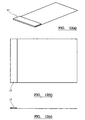
- Figure 11a) shows the folding means limbs (15) of the folding means (14) engaging the leading edge (11') of the sheet (11) at a relatively acute angle. As the folding means (14) is rotated, a portion of the foil at or near to the leading edge (11') is captured and folded back towards the upper surface of the sheet (11).
- Figure 11c) shows the leading edge (11') having been folded through approximately 180° to produce a single fold. The leading edge (11') of the sheet may be folded through approximately a further 180° to create a second fold at or near to the leading edge (11') as shown in Figure 11c). After this double folding procedure has been completed, the folding means (14) can be withdrawn and the sheet cut as described above.
- the apparatus (20) of a second embodiment of the present invention includes a feeding means (23) which can feed a sheet of foil (11) towards a folding means (24). As the leading edge(11') of the sheet leaves the folding means (23) it passes over a pair of lower support surfaces (25, 25') and under an upper guide surface (26).
- the folding means (24) consists of first and second surfaces (27, 28) between which foil can be captured to create a fold.
- the first surface (27) forms part of a semi-cylindrical body (29).
- the second surface (28) has a first edge (30) around which the foil is folded to create one or more folds in the foil.
- the semi-cylindrical body (29) is connected to a generally cylindrical body which has a flat surface (29') which acts as a guide member to prevent lateral movement of the foil during the folding operation.
- the guide member may take the form of side walls located at one or both sides of the upper guide surface (26) or the second surface (28).
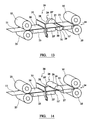
- a portion (31) of the sheet of foil at or near to the leading edge (11') of the sheet of foil (11) projects beyond the first edge (30) of the second surface (28) in to a folding region or area. This is best illustrated in Figure 13. In this non-folding position, the portion (30) of the foil is located between the first and second surfaces (27, 28) which are parallel to each other and in a staggered configuration.
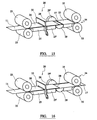
- the first surface (27) is rotated relative to the second surface (28) about an axis of the foldable portion (31) from a first position in which the first and second surfaces (27, 28) are parallel and staggered relative to each other (as shown in Figure 13) to a second position in which the first and second surfaces (27,28) capture the foldable portion (31) to create a first fold along the foldable axis (as shown in Figure 14).
- the first surface (27) is rotated back to the first position.
- the leading edge (11') of the sheet of foil is then advanced to provide a further foldable portion at or near to the leading edge.
- the first surface (27) is rotated again relative to the second surface (28) about an axis of the further foldable portion from the first position to the second position.
- the first and second surfaces (27,28) capture the foldable portion in the second position and create a second fold along the foldable axis.
- the first surface (27) is returned back to the first position.
- Figure 15 shows the situation where the leading edge of the foil has been folded twice to create a folded edge (17).
- a cutting means (32) can then be brought into engagement with the sheet of foil to create a trailing edge (as described above) and an individual portion or cut section of sheet having the folded edge (17).
- the individual sheets may be received by a receiving means (33).
- the receiving means takes the form of a substantially flat surface.
- the portion may then be fed into a flattening means (34) which smooths and flattens the folded edge (17).
- the flattening means (34) comprises a pair of rollers (35).
- a scoring means can be used to score the upper surface of the individual sheets.
- the scoring means may include a blade element similar to the cutting means which is arranged to impinge upon the surface of the foil sheet, but not to cut through the sheet.
- the scoring means may comprise a blade or other sharp element which is drawn across the foil sheet in a direction perpendicular to the direction of travel of the foil sheet. In practice, the score is parallel to the trailing edge and folded portion, and is arranged midway between these two points. Providing a score on the surface of the foil sheet acts as a guide for the colourist when folding the individual foil sheets into folded packages when colouring hair.
- Figures 17 a) to f) show the various steps involved in the folding procedure used by the second embodiment of the present invention.
- Figure 17a) shows the first and second surfaces (27, 28) prior to a folding procedure.
- a foldable portion (31) of foil at or near to the leading edge of the foil extends beyond the first edge (30) of the second surface (28).
- the first surface (27) is then rotated relative to the second surface (28) to create a first fold and is then rotated back to its original position ( Figures 17b) and c)).
- the procedure is then repeated (Figures 17d) to f) to produce a double fold.
- a marking means may be used to place identification marks on to one or both of the surfaces of the sheet of foil.
- the marking means can be a printer, for example an inkjet printer, which can be used to place identification marks on the surface(s) of the foil.
- the marks may simply be imprinted on to the surfaces of the foil by means of a stamp or press.
- the marking means can form part of one or more of the flattening means (34), the receiving means (33), or the removal means. Referring to Figures 13 to 16, the marking means may be located above flat plate of the receiving means (33). Alternatively, the marking means may be integral with the receiving means (33).
- the marking means ca be used to mark the underside of the individual sheets of foil (11) as they pass from the folding area after the cutting procedure. The marking can take place before, during or after, the flattening procedure.
Landscapes
- Folding Of Thin Sheet-Like Materials, Special Discharging Devices, And Others (AREA)
- Shaping Of Tube Ends By Bending Or Straightening (AREA)
- Extrusion Moulding Of Plastics Or The Like (AREA)
- Lining Or Joining Of Plastics Or The Like (AREA)
Claims (28)
- Gerät (10; 20) zum Falten eines Folienblattes (11), wobei das Gerät Folgendes umfasst:einen Beschicker (13; 23) zum Zuführen des Folienblattes (11) zu einem Faltmittel (14; 24), wobei das Faltmittel eine erste Fläche (27) und eine zweite Fläche (28) umfasst, die so angeordnet sind, dass sie jeweils an einer ersten und einer zweiten gegenüberliegenden Fläche eines Abschnitts des Folienblattes (31) an oder in der Nähe der Vorderkante (11') des Folienblattes anliegen, wobei eine oder beide erste und zweite Flächen (27; 28) um eine faltbare Achse zwischen der ersten und der zweiten gegenüberliegenden Fläche drehbar ist/sind, um eine erste Falte entlang der faltbaren Achse zu erzeugen.
- Gerät nach Anspruch 2, wobei die erste und die zweite Fläche drehbar sind, um mehrere Falten an oder in der Nähe der Vorderkante des Folienblattes zu erzeugen.
- Gerät nach Anspruch 1 oder 2, wobei die erste und die zweite Fläche an derselben Stelle über die Länge der Folie an oder in der Nähe der Vorderkante der Folie angeordnet werden können;
und in dem im Gebrauch die erste und die zweite Fläche in derselben Richtung um die faltbare Achse gedreht werden können, um eine oder mehr Falten in der Folie zu erzeugen. - Gerät nach Anspruch 3, wobei die erste und die zweite Fläche vor dem Falten so auf beiden Seiten des Blattes angeordnet werden können, dass die erste und die zweite Fläche nicht koplanar zu der Ebene des Blattes ausgerichtet sind.
- Gerät nach Anspruch 3 oder 4, wobei die erste und die zweite Fläche im Wesentlichen um 180 Grad gedreht werden.
- Gerät nach Anspruch 5, wobei die erste und die zweite Fläche um weitere 180 Grad oder mehr gedreht werden können.
- Gerät nach einem der vorhergehenden Ansprüche, wobei die erste und die zweite Fläche von dem Blatt entfernbar sind.
- Gerät nach einem der Ansprüche 3 bis 7, wobei die erste und die zweite Fläche in einer gemeinsamen Ebene miteinander verbunden sind.
- Gerät nach Anspruch 1, wobei sich die erste Fläche im Gebrauch um die faltbare Achse dreht und die zweite Fläche im Gebrauch feststehend ist.
- Gerät nach Anspruch 9, wobei die zweite Fläche eine erste Kante aufweist, die erste Fläche im Gebrauch gegenüber der zweiten Fläche um die faltbare Achse eines faltbaren Abschnitts drehbar ist, und zwar aus einer ersten Stellung, in der die erste und die zweite Fläche parallel und versetzt zueinander liegen, in eine zweite Stellung, in der die erste und die zweite Fläche den faltbaren Abschnitt fassen, um eine erste Falte entlang der faltbaren Achse zu erzeugen, wobei die erste Fläche in die erste Stellung zurück drehbar ist.
- Gerät nach einem der vorhergehenden Ansprüche, das ferner ein Führungselement umfasst, das eine seitliche Bewegung der Folie während des Faltens verhindert.
- Gerät nach einem der vorhergehenden Ansprüche, das ferner ein Schneidemittel umfasst, um die hintere Kante des Abschnitts der Folie zu schneiden.
- Gerät nach einem der vorhergehenden Ansprüche, das ferner Aufnahmemittel zum Aufnehmen des Abschnitts der Folie nach dem Falten umfasst.
- Gerät nach einem der vorhergehenden Ansprüche, das ferner Entnahmemittel zum Entnehmen des Abschnitts des Folienblattes von dem Faltmittel umfasst.
- Gerät nach einem der vorhergehenden Ansprüche, das ferner ein Plättungsmittel umfasst, das im Gebrauch mit dem gefalteten Ende der Folie in Eingriff gebracht werden kann, um die Falte oder die Falten zu plätten.
- Gerät nach einem der vorhergehenden Ansprüche, das ferner ein Ritzmittel umfasst, das im Gebrauch dazu dient, die erste und/oder die zweite Fläche des Folienblattes zwischen dem gefalteten Ende und der hinteren Kante zu ritzen.
- Gerät nach einem der vorhergehenden Ansprüche, das ferner Markierungsmittel zum Markieren einer oder beider gegenüberliegender Flächen des Abschnitts der Folie mit einer oder mehreren Kennmarken umfasst.
- Gerät nach einem der vorhergehenden Ansprüche, wobei die erste und die zweite Fläche starr sind.
- Gerät nach einem der vorhergehenden Ansprüche, wobei die erste und die zweite Fläche im Wesentlichen eben sind.
- Verfahren zum Falten eines Folienblattes (11), das die folgenden Schritte enthält:Zuführen des Folienblattes (11) zu einem Faltmittel (14; 34);Anlegen einer ersten und einer zweiten Fläche (27; 28) des Faltmittels jeweils an die erste und die zweite, gegenüberliegende Fläche des Abschnitts des Folienblattes (11) an oder in der Nähe der Vorderkante (11') des Folienblattes; undDrehen einer oder beider ersten und zweiten Flächen (27; 28) um die faltbare Achse zwischen der ersten und der zweiten gegenüberliegenden Fläche, wobei dadurch eine erste Falte entlang der faltbaren Achse erzeugt wird.
- Verfahren nach Anspruch 20, das Folgendes umfasst:Anordnen der ersten und der zweiten Fläche an demselben Punkt entlang der Folienlänge an oder in der Nähe der Vorderkante der Folie; undDrehen der ersten und der zweiten Fläche in derselben Richtung um die faltbare Achse, wodurch ein oder mehrere Falten in der Folie erzeugt werden.
- Verfahren nach einem der Ansprüche 20 oder 21, das Folgendes umfasst:Drehen der ersten und der zweiten Fläche im Wesentlichen um 180 Grad.
- Verfahren nach einem der Ansprüche 20 bis 22, das Folgendes umfasst:Drehen der ersten und der zweiten Fläche um weitere 180 Grad oder mehr.
- Verfahren nach Anspruch 20, das Folgendes umfasst:Drehen der ersten Fläche gegenüber der zweiten Fläche um die faltbare Achse des faltbaren Abschnitts aus einer ersten Stellung, in der die erste und die zweite Fläche parallel und versetzt zueinander sind, in eine zweite Stellung;Fassen des faltbaren Abschnitts mit Hilfe der ersten und der zweiten Fläche in der zweiten Stellung, um dadurch eine erste Falte entlang der faltbaren Achse zu erzeugen; undDrehen der ersten Fläche zurück in die erste Stellung.
- Verfahren nach Anspruch 24, das ferner Folgendes umfasst:Vorschieben des Folienblattes, um einen weiteren faltbaren Abschnitt an oder in der Nähe der Vorderkante bereitzustellen;Drehen der ersten Fläche gegenüber der zweiten Fläche um die Achse des Weiteren faltbaren Abschnitts aus der ersten Stellung in die zweite Stellung;Fassen des weiteren faltbaren Abschnitts mit Hilfe der ersten und der zweiten Fläche in der zweiten Stellung, wodurch eine zweite Falte entlang der faltbaren Achse erzeugt wird; undDrehen der ersten Fläche zurück in die erste Stellung.
- Verfahren nach einem der Ansprüche 20 bis 25, das ferner Folgendes umfasst:Schneiden einer hinteren Kante des Abschnitts der Folie nach dem Fertigstellen der Faltung.
- Verfahren nach einem der Ansprüche 20 bis 26, das ferner Folgendes umfasst:Ritzen der ersten und/oder der zweiten Fläche des Abschnitts der Folie zwischen dem gefalteten Ende und der hinteren Kante.
- Verfahren nach einem der Ansprüche 20 bis 27, das ferner Folgendes umfasst:Markieren einer oder beider gegenüberliegender Flächen des Abschnitts der Folie mit einer oder mehreren Kennmarken.
Priority Applications (1)
| Application Number | Priority Date | Filing Date | Title |
|---|---|---|---|
| SI200430393T SI1590286T1 (sl) | 2003-02-07 | 2004-02-05 | Naprava in postopek za zgibanje listov folije |
Applications Claiming Priority (7)
| Application Number | Priority Date | Filing Date | Title |
|---|---|---|---|
| GB0302810 | 2003-02-07 | ||
| GB0302810A GB0302810D0 (en) | 2003-02-07 | 2003-02-07 | Improvements in or relating to apparatus for making hairdressing foils for the purpose of colouring or highlighting hair |
| GB0322916A GB0322916D0 (en) | 2003-02-07 | 2003-10-01 | Improvements in or relating to apparatus for making hairdressing foils for the purpose of colouring or highlighting hair |
| GB0322916 | 2003-10-01 | ||
| GB0324852A GB0324852D0 (en) | 2003-10-24 | 2003-10-24 | Apparatus for folding |
| GB0324852 | 2003-10-24 | ||
| PCT/GB2004/000446 WO2004069711A1 (en) | 2003-02-07 | 2004-02-05 | Apparatus and method for folding a sheet of foil |
Publications (2)
| Publication Number | Publication Date |
|---|---|
| EP1590286A1 EP1590286A1 (de) | 2005-11-02 |
| EP1590286B1 true EP1590286B1 (de) | 2007-05-02 |
Family
ID=32854010
Family Applications (1)
| Application Number | Title | Priority Date | Filing Date |
|---|---|---|---|
| EP04708398A Expired - Lifetime EP1590286B1 (de) | 2003-02-07 | 2004-02-05 | Gerät und verfahren zum falten eines folienblattes |
Country Status (14)
| Country | Link |
|---|---|
| US (1) | US7789381B2 (de) |
| EP (1) | EP1590286B1 (de) |
| JP (1) | JP2006516942A (de) |
| KR (1) | KR20050103918A (de) |
| AT (1) | ATE361256T1 (de) |
| CA (1) | CA2515101C (de) |
| CY (1) | CY1106787T1 (de) |
| DE (1) | DE602004006230T2 (de) |
| DK (1) | DK1590286T3 (de) |
| ES (1) | ES2287696T3 (de) |
| NO (1) | NO20052361L (de) |
| NZ (1) | NZ542146A (de) |
| PL (1) | PL378029A1 (de) |
| WO (1) | WO2004069711A1 (de) |
Families Citing this family (7)
| Publication number | Priority date | Publication date | Assignee | Title |
|---|---|---|---|---|
| GB2436831B (en) * | 2006-04-06 | 2008-07-02 | Procare Uk Ltd | Method and apparatus for dispensing sheets of foil |
| US8943936B2 (en) * | 2007-03-13 | 2015-02-03 | Moran BORENSTEIN | Method and apparatus for forming a sheet of foil |
| ITMC20080212A1 (it) * | 2008-12-02 | 2010-06-03 | Hair Gallery Di Fabio E Jonni Cappe Lla S N C | Macchina automatica per il taglio e la piegatura di striscioline di carta stagnola. |
| TWI463375B (zh) | 2011-10-19 | 2014-12-01 | Pixart Imaging Inc | 光學觸控系統、光學感測模組及其運作方法 |
| US9549601B2 (en) * | 2014-12-16 | 2017-01-24 | Mary E. Callicutt | Mini brake for hair color placement foils and its method of use |
| DE102018118937A1 (de) * | 2018-08-03 | 2020-02-06 | Schmale-Holding Gmbh & Co. | Verfahren und Vorrichtung zum Bilden einer Schlaufe |
| CN117732943A (zh) * | 2023-10-26 | 2024-03-22 | 北京工业大学 | 一种基于齿轮啮合的长条金属箔片折叠装置 |
Family Cites Families (9)
| Publication number | Priority date | Publication date | Assignee | Title |
|---|---|---|---|---|
| US2360846A (en) * | 1941-10-15 | 1944-10-24 | Wilhelm B Bronander | Machine for making and filling packages |
| US3425606A (en) * | 1966-09-21 | 1969-02-04 | Roll O Sheets | Integral plastic roll dispenser |
| JP2684509B2 (ja) * | 1993-08-04 | 1997-12-03 | 有限会社山貴製作所 | パーマネントウエーブ施術方法およびその施術器具 |
| US6237608B1 (en) | 1997-09-11 | 2001-05-29 | Ollie Kari | Foil dispenser apparatus and method |
| GB9822491D0 (en) | 1998-10-16 | 1998-12-09 | Fils Fine Foileeze Limited | Hairdressing device and method of use |
| DE20008406U1 (de) | 2000-05-10 | 2001-08-30 | Schwan, Roland, 47441 Moers | Automatischer Folienfaltabroller |
| CA2351264C (en) * | 2000-06-28 | 2009-11-03 | Grant Muir | Machine for repeatedly folding a sheet of foil to create a layered edge |
| GB0118567D0 (en) * | 2001-07-31 | 2001-09-19 | Autoglym | Improvements in or relating to organic material |
| WO2003062110A1 (en) | 2002-01-24 | 2003-07-31 | James Douglas Farfor | Cutting and folding machine |
-
2004
- 2004-02-05 EP EP04708398A patent/EP1590286B1/de not_active Expired - Lifetime
- 2004-02-05 DK DK04708398T patent/DK1590286T3/da active
- 2004-02-05 ES ES04708398T patent/ES2287696T3/es not_active Expired - Lifetime
- 2004-02-05 US US10/543,443 patent/US7789381B2/en not_active Expired - Fee Related
- 2004-02-05 NZ NZ542146A patent/NZ542146A/en unknown
- 2004-02-05 PL PL37802904A patent/PL378029A1/pl unknown
- 2004-02-05 JP JP2006502238A patent/JP2006516942A/ja not_active Ceased
- 2004-02-05 DE DE200460006230 patent/DE602004006230T2/de not_active Expired - Lifetime
- 2004-02-05 WO PCT/GB2004/000446 patent/WO2004069711A1/en not_active Ceased
- 2004-02-05 AT AT04708398T patent/ATE361256T1/de not_active IP Right Cessation
- 2004-02-05 CA CA 2515101 patent/CA2515101C/en not_active Expired - Fee Related
- 2004-02-05 KR KR1020057014475A patent/KR20050103918A/ko not_active Ceased
-
2005
- 2005-05-12 NO NO20052361A patent/NO20052361L/no unknown
-
2007
- 2007-08-02 CY CY20071101038T patent/CY1106787T1/el unknown
Also Published As
| Publication number | Publication date |
|---|---|
| US20070181628A1 (en) | 2007-08-09 |
| AU2004208912A1 (en) | 2004-08-19 |
| NZ542146A (en) | 2007-05-31 |
| DK1590286T3 (da) | 2007-09-10 |
| US7789381B2 (en) | 2010-09-07 |
| NO20052361D0 (no) | 2005-05-12 |
| NO20052361L (no) | 2005-08-29 |
| CY1106787T1 (el) | 2012-05-23 |
| EP1590286A1 (de) | 2005-11-02 |
| CA2515101C (en) | 2009-12-15 |
| CA2515101A1 (en) | 2004-08-19 |
| ATE361256T1 (de) | 2007-05-15 |
| DE602004006230D1 (de) | 2007-06-14 |
| JP2006516942A (ja) | 2006-07-13 |
| WO2004069711A1 (en) | 2004-08-19 |
| DE602004006230T2 (de) | 2008-01-10 |
| ES2287696T3 (es) | 2007-12-16 |
| KR20050103918A (ko) | 2005-11-01 |
| PL378029A1 (pl) | 2006-02-20 |
Similar Documents
| Publication | Publication Date | Title |
|---|---|---|
| US8387432B2 (en) | Method and apparatus for dispensing sheets of foil | |
| EP1135255B1 (de) | Vorrichtung zum laminieren und überbringen eines klebefilms, mit einem ausgabeteil | |
| CA2515101C (en) | Apparatus and method for folding a sheet of foil | |
| US4073485A (en) | Apparatus for making multiple page printed booklets | |
| US9027917B2 (en) | Machine and method for printing products and making cut-outs at the edges of the sheets | |
| DE1611283B2 (de) | Schneid- und flazapparat an rollenrotationsmaschinen | |
| EP4032670B1 (de) | Digitaler flachbettschneider mit bandapplikatorkopf | |
| EP3515827B1 (de) | Vorrichtung und verfahren zur herstellung von gebinden mit tragegriffen | |
| DE19519584A1 (de) | Verfahren und Vorrichtung zum Herstellen von vorgeschnittenen, noch weiter bearbeitbaren Einzelabschnitten sowie Bögen mit vorgeschnittenen Einzelabschnitten | |
| AU2004208912B2 (en) | Apparatus and method for folding a sheet of foil | |
| DE60214800T2 (de) | Klebevorrichtung für die Buchbinderei | |
| US3228709A (en) | Book cover | |
| ZA200506153B (en) | Apparatus and method for folding a sheet of foil | |
| ITTO930866A1 (it) | Procedimento e macchina per la fabbricazione di copertine per libri e simili, e copertine cosi' realizzate. | |
| US3237934A (en) | Method and apparatus for making books | |
| DE2242576C2 (de) | Verfahren und Vorrichtung zum Falten mehrerer übereinanderliegender, klammergehefteter Papierbogen | |
| DE1761880B1 (de) | Verfahren und Vorrichtung zum Aufbringen von Papier- oder Kunststofftraggriffen auf eine Werkstoffbahn | |
| US4279370A (en) | Dispenser for rolled sheet material | |
| FI72687B (fi) | Roterande bindmaskin foer att faesta ett limband pao en kontinuerlig tryckt blankett i tablerande skrivningsmaskiner. | |
| US20160278499A1 (en) | Foiling Board | |
| US6868764B1 (en) | Material cutting and feeding machine | |
| PT1590286E (pt) | ''equipamento e método para dobrar uma folha de película metalizada'' | |
| JPH0548744B2 (de) | ||
| DE627664C (de) | Maschine zur Herstellung von Krepprollen mit abreissbaren Streifen, die mit Klebstellen versehen sind | |
| CA2465412A1 (en) | Apparatus for producing folded aluminum foil sheets |
Legal Events
| Date | Code | Title | Description |
|---|---|---|---|
| PUAI | Public reference made under article 153(3) epc to a published international application that has entered the european phase |
Free format text: ORIGINAL CODE: 0009012 |
|
| 17P | Request for examination filed |
Effective date: 20050405 |
|
| AK | Designated contracting states |
Kind code of ref document: A1 Designated state(s): AT BE BG CH CY CZ DE DK EE ES FI FR GB GR HU IE IT LI LU MC NL PT RO SE SI SK TR |
|
| AX | Request for extension of the european patent |
Extension state: AL LT LV MK |
|
| GRAP | Despatch of communication of intention to grant a patent |
Free format text: ORIGINAL CODE: EPIDOSNIGR1 |
|
| RAX | Requested extension states of the european patent have changed |
Extension state: LT Payment date: 20050726 Extension state: LV Payment date: 20050726 |
|
| GRAS | Grant fee paid |
Free format text: ORIGINAL CODE: EPIDOSNIGR3 |
|
| GRAA | (expected) grant |
Free format text: ORIGINAL CODE: 0009210 |
|
| AK | Designated contracting states |
Kind code of ref document: B1 Designated state(s): AT BE BG CH CY CZ DE DK EE ES FI FR GB GR HU IE IT LI LU MC NL PT RO SE SI SK TR |
|
| AX | Request for extension of the european patent |
Extension state: LT LV |
|
| REG | Reference to a national code |
Ref country code: GB Ref legal event code: FG4D |
|
| REG | Reference to a national code |
Ref country code: CH Ref legal event code: EP |
|
| REG | Reference to a national code |
Ref country code: IE Ref legal event code: FG4D |
|
| REF | Corresponds to: |
Ref document number: 602004006230 Country of ref document: DE Date of ref document: 20070614 Kind code of ref document: P |
|
| REG | Reference to a national code |
Ref country code: PT Ref legal event code: SC4A Free format text: AVAILABILITY OF NATIONAL TRANSLATION Effective date: 20070801 |
|
| REG | Reference to a national code |
Ref country code: SE Ref legal event code: TRGR |
|
| REG | Reference to a national code |
Ref country code: CH Ref legal event code: NV Representative=s name: RIEDERER HASLER & PARTNER PATENTANWAELTE AG Ref country code: CH Ref legal event code: PUEA Owner name: DUNN, BRIAN PETER Free format text: DUNN, RICHARD BRIAN#VALLEY HOUSE, FIFTH AVENUE#HORNBEAM PARK, HARROGATE HG2 8QT (GB) $ DUNN, BRIAN PETER#VALLEY HOUSE, FIFTH AVENUE#HORNBEAM PARK, HARROGATE HG2 8QT (GB) -TRANSFER TO- DUNN, BRIAN PETER#VALLEY HOUSE, FIFTH AVENUE#HORNBEAM PARK, HARROGATE HG2 8QT (GB) |
|
| REG | Reference to a national code |
Ref country code: DK Ref legal event code: T3 |
|
| REG | Reference to a national code |
Ref country code: HU Ref legal event code: AG4A Ref document number: E001945 Country of ref document: HU |
|
| REG | Reference to a national code |
Ref country code: GR Ref legal event code: EP Ref document number: 20070402521 Country of ref document: GR |
|
| REG | Reference to a national code |
Ref country code: RO Ref legal event code: EPE |
|
| ET | Fr: translation filed | ||
| REG | Reference to a national code |
Ref country code: ES Ref legal event code: FG2A Ref document number: 2287696 Country of ref document: ES Kind code of ref document: T3 |
|
| REG | Reference to a national code |
Ref country code: EE Ref legal event code: FG4A Ref document number: E001497 Country of ref document: EE Effective date: 20071002 |
|
| PLBE | No opposition filed within time limit |
Free format text: ORIGINAL CODE: 0009261 |
|
| STAA | Information on the status of an ep patent application or granted ep patent |
Free format text: STATUS: NO OPPOSITION FILED WITHIN TIME LIMIT |
|
| 26N | No opposition filed |
Effective date: 20080205 |
|
| PGFP | Annual fee paid to national office [announced via postgrant information from national office to epo] |
Ref country code: HU Payment date: 20080425 Year of fee payment: 5 Ref country code: LU Payment date: 20080612 Year of fee payment: 5 |
|
| PGFP | Annual fee paid to national office [announced via postgrant information from national office to epo] |
Ref country code: SK Payment date: 20080505 Year of fee payment: 5 Ref country code: AT Payment date: 20080410 Year of fee payment: 5 |
|
| PGFP | Annual fee paid to national office [announced via postgrant information from national office to epo] |
Ref country code: SI Payment date: 20080424 Year of fee payment: 5 Ref country code: MC Payment date: 20080411 Year of fee payment: 5 Ref country code: BE Payment date: 20080506 Year of fee payment: 5 Ref country code: EE Payment date: 20080507 Year of fee payment: 5 Ref country code: BG Payment date: 20080513 Year of fee payment: 5 Ref country code: FI Payment date: 20080416 Year of fee payment: 5 |
|
| PGFP | Annual fee paid to national office [announced via postgrant information from national office to epo] |
Ref country code: RO Payment date: 20080804 Year of fee payment: 5 |
|
| REG | Reference to a national code |
Ref country code: EE Ref legal event code: HC1A Ref document number: E001497 Country of ref document: EE |
|
| PGFP | Annual fee paid to national office [announced via postgrant information from national office to epo] |
Ref country code: DK Payment date: 20090313 Year of fee payment: 6 Ref country code: IE Payment date: 20090302 Year of fee payment: 6 |
|
| PGFP | Annual fee paid to national office [announced via postgrant information from national office to epo] |
Ref country code: NL Payment date: 20090228 Year of fee payment: 6 |
|
| PGFP | Annual fee paid to national office [announced via postgrant information from national office to epo] |
Ref country code: CH Payment date: 20090316 Year of fee payment: 6 Ref country code: GR Payment date: 20090303 Year of fee payment: 6 |
|
| BERE | Be: lapsed |
Owner name: DUNN, BRIAN PETER Effective date: 20090228 Owner name: DUNN, RICHARD BRIAN Effective date: 20090228 |
|
| LTLA | Lt: lapse of european patent or patent extension |
Effective date: 20090205 |
|
| PG25 | Lapsed in a contracting state [announced via postgrant information from national office to epo] |
Ref country code: MC Free format text: LAPSE BECAUSE OF NON-PAYMENT OF DUE FEES Effective date: 20090228 |
|
| REG | Reference to a national code |
Ref country code: EE Ref legal event code: MM4A Ref document number: E001497 Country of ref document: EE Effective date: 20090228 |
|
| PG25 | Lapsed in a contracting state [announced via postgrant information from national office to epo] |
Ref country code: EE Free format text: LAPSE BECAUSE OF NON-PAYMENT OF DUE FEES Effective date: 20090228 Ref country code: FI Free format text: LAPSE BECAUSE OF NON-PAYMENT OF DUE FEES Effective date: 20090205 Ref country code: AT Free format text: LAPSE BECAUSE OF NON-PAYMENT OF DUE FEES Effective date: 20090205 |
|
| PG25 | Lapsed in a contracting state [announced via postgrant information from national office to epo] |
Ref country code: HU Free format text: LAPSE BECAUSE OF NON-PAYMENT OF DUE FEES Effective date: 20090206 Ref country code: SK Free format text: LAPSE BECAUSE OF NON-PAYMENT OF DUE FEES Effective date: 20090205 Ref country code: SI Free format text: LAPSE BECAUSE OF NON-PAYMENT OF DUE FEES Effective date: 20090206 |
|
| PGFP | Annual fee paid to national office [announced via postgrant information from national office to epo] |
Ref country code: CZ Payment date: 20090804 Year of fee payment: 6 Ref country code: PT Payment date: 20090804 Year of fee payment: 6 |
|
| PGFP | Annual fee paid to national office [announced via postgrant information from national office to epo] |
Ref country code: CY Payment date: 20090806 Year of fee payment: 6 |
|
| REG | Reference to a national code |
Ref country code: SI Ref legal event code: KO00 Effective date: 20090910 |
|
| PG25 | Lapsed in a contracting state [announced via postgrant information from national office to epo] |
Ref country code: RO Free format text: LAPSE BECAUSE OF NON-PAYMENT OF DUE FEES Effective date: 20090205 |
|
| PG25 | Lapsed in a contracting state [announced via postgrant information from national office to epo] |
Ref country code: BE Free format text: LAPSE BECAUSE OF NON-PAYMENT OF DUE FEES Effective date: 20090228 |
|
| PGFP | Annual fee paid to national office [announced via postgrant information from national office to epo] |
Ref country code: ES Payment date: 20100426 Year of fee payment: 7 Ref country code: FR Payment date: 20100506 Year of fee payment: 7 |
|
| REG | Reference to a national code |
Ref country code: PT Ref legal event code: MM4A Free format text: LAPSE DUE TO NON-PAYMENT OF FEES Effective date: 20100805 |
|
| PGFP | Annual fee paid to national office [announced via postgrant information from national office to epo] |
Ref country code: DE Payment date: 20100423 Year of fee payment: 7 Ref country code: IT Payment date: 20100427 Year of fee payment: 7 |
|
| REG | Reference to a national code |
Ref country code: NL Ref legal event code: V1 Effective date: 20100901 |
|
| REG | Reference to a national code |
Ref country code: CH Ref legal event code: PL |
|
| REG | Reference to a national code |
Ref country code: DK Ref legal event code: EBP |
|
| PG25 | Lapsed in a contracting state [announced via postgrant information from national office to epo] |
Ref country code: CH Free format text: LAPSE BECAUSE OF NON-PAYMENT OF DUE FEES Effective date: 20100228 Ref country code: LI Free format text: LAPSE BECAUSE OF NON-PAYMENT OF DUE FEES Effective date: 20100228 |
|
| PG25 | Lapsed in a contracting state [announced via postgrant information from national office to epo] |
Ref country code: CZ Free format text: LAPSE BECAUSE OF NON-PAYMENT OF DUE FEES Effective date: 20100205 |
|
| PGFP | Annual fee paid to national office [announced via postgrant information from national office to epo] |
Ref country code: SE Payment date: 20100422 Year of fee payment: 7 |
|
| PG25 | Lapsed in a contracting state [announced via postgrant information from national office to epo] |
Ref country code: CY Free format text: LAPSE BECAUSE OF FAILURE TO SUBMIT A TRANSLATION OF THE DESCRIPTION OR TO PAY THE FEE WITHIN THE PRESCRIBED TIME-LIMIT Effective date: 20100421 |
|
| PG25 | Lapsed in a contracting state [announced via postgrant information from national office to epo] |
Ref country code: PT Free format text: LAPSE BECAUSE OF NON-PAYMENT OF DUE FEES Effective date: 20100805 Ref country code: NL Free format text: LAPSE BECAUSE OF NON-PAYMENT OF DUE FEES Effective date: 20100901 Ref country code: IE Free format text: LAPSE BECAUSE OF NON-PAYMENT OF DUE FEES Effective date: 20100205 Ref country code: DK Free format text: LAPSE BECAUSE OF NON-PAYMENT OF DUE FEES Effective date: 20100228 |
|
| PG25 | Lapsed in a contracting state [announced via postgrant information from national office to epo] |
Ref country code: BG Free format text: LAPSE BECAUSE OF FAILURE TO SUBMIT A TRANSLATION OF THE DESCRIPTION OR TO PAY THE FEE WITHIN THE PRESCRIBED TIME-LIMIT Effective date: 20090228 |
|
| PG25 | Lapsed in a contracting state [announced via postgrant information from national office to epo] |
Ref country code: LU Free format text: LAPSE BECAUSE OF NON-PAYMENT OF DUE FEES Effective date: 20090205 |
|
| REG | Reference to a national code |
Ref country code: SE Ref legal event code: EUG |
|
| GBPC | Gb: european patent ceased through non-payment of renewal fee |
Effective date: 20110205 |
|
| PGFP | Annual fee paid to national office [announced via postgrant information from national office to epo] |
Ref country code: TR Payment date: 20090205 Year of fee payment: 6 |
|
| REG | Reference to a national code |
Ref country code: FR Ref legal event code: ST Effective date: 20111102 |
|
| PG25 | Lapsed in a contracting state [announced via postgrant information from national office to epo] |
Ref country code: IT Free format text: LAPSE BECAUSE OF NON-PAYMENT OF DUE FEES Effective date: 20110205 |
|
| REG | Reference to a national code |
Ref country code: DE Ref legal event code: R119 Ref document number: 602004006230 Country of ref document: DE Effective date: 20110901 |
|
| PG25 | Lapsed in a contracting state [announced via postgrant information from national office to epo] |
Ref country code: FR Free format text: LAPSE BECAUSE OF NON-PAYMENT OF DUE FEES Effective date: 20110228 |
|
| PG25 | Lapsed in a contracting state [announced via postgrant information from national office to epo] |
Ref country code: GB Free format text: LAPSE BECAUSE OF NON-PAYMENT OF DUE FEES Effective date: 20110205 |
|
| REG | Reference to a national code |
Ref country code: ES Ref legal event code: FD2A Effective date: 20120411 |
|
| PG25 | Lapsed in a contracting state [announced via postgrant information from national office to epo] |
Ref country code: ES Free format text: LAPSE BECAUSE OF NON-PAYMENT OF DUE FEES Effective date: 20110206 |
|
| REG | Reference to a national code |
Ref country code: GB Ref legal event code: S28 Free format text: APPLICATION FILED |
|
| PG25 | Lapsed in a contracting state [announced via postgrant information from national office to epo] |
Ref country code: TR Free format text: LAPSE BECAUSE OF NON-PAYMENT OF DUE FEES Effective date: 20100205 |
|
| REG | Reference to a national code |
Ref country code: GB Ref legal event code: S28 Free format text: RESTORATION ALLOWED Effective date: 20130214 |
|
| PG25 | Lapsed in a contracting state [announced via postgrant information from national office to epo] |
Ref country code: SE Free format text: LAPSE BECAUSE OF NON-PAYMENT OF DUE FEES Effective date: 20110206 |
|
| PG25 | Lapsed in a contracting state [announced via postgrant information from national office to epo] |
Ref country code: DE Free format text: LAPSE BECAUSE OF NON-PAYMENT OF DUE FEES Effective date: 20110901 |
|
| PGFP | Annual fee paid to national office [announced via postgrant information from national office to epo] |
Ref country code: GB Payment date: 20140321 Year of fee payment: 11 |
|
| GBPC | Gb: european patent ceased through non-payment of renewal fee |
Effective date: 20150205 |
|
| PG25 | Lapsed in a contracting state [announced via postgrant information from national office to epo] |
Ref country code: GB Free format text: LAPSE BECAUSE OF NON-PAYMENT OF DUE FEES Effective date: 20150205 |