EP1587277A2 - Dispositif, système et procédé pour la définition d'un temps d'attente de réponse avant une libération sur temporisation - Google Patents
Dispositif, système et procédé pour la définition d'un temps d'attente de réponse avant une libération sur temporisation Download PDFInfo
- Publication number
- EP1587277A2 EP1587277A2 EP05252365A EP05252365A EP1587277A2 EP 1587277 A2 EP1587277 A2 EP 1587277A2 EP 05252365 A EP05252365 A EP 05252365A EP 05252365 A EP05252365 A EP 05252365A EP 1587277 A2 EP1587277 A2 EP 1587277A2
- Authority
- EP
- European Patent Office
- Prior art keywords
- communication
- providing apparatus
- information providing
- waiting time
- response waiting
- Prior art date
- Legal status (The legal status is an assumption and is not a legal conclusion. Google has not performed a legal analysis and makes no representation as to the accuracy of the status listed.)
- Ceased
Links
Images


Classifications
-
- H—ELECTRICITY
- H04—ELECTRIC COMMUNICATION TECHNIQUE
- H04L—TRANSMISSION OF DIGITAL INFORMATION, e.g. TELEGRAPHIC COMMUNICATION
- H04L43/00—Arrangements for monitoring or testing data switching networks
- H04L43/08—Monitoring or testing based on specific metrics, e.g. QoS, energy consumption or environmental parameters
- H04L43/0805—Monitoring or testing based on specific metrics, e.g. QoS, energy consumption or environmental parameters by checking availability
- H04L43/0811—Monitoring or testing based on specific metrics, e.g. QoS, energy consumption or environmental parameters by checking availability by checking connectivity
-
- H—ELECTRICITY
- H04—ELECTRIC COMMUNICATION TECHNIQUE
- H04L—TRANSMISSION OF DIGITAL INFORMATION, e.g. TELEGRAPHIC COMMUNICATION
- H04L67/00—Network arrangements or protocols for supporting network services or applications
- H04L67/01—Protocols
- H04L67/02—Protocols based on web technology, e.g. hypertext transfer protocol [HTTP]
-
- H—ELECTRICITY
- H04—ELECTRIC COMMUNICATION TECHNIQUE
- H04L—TRANSMISSION OF DIGITAL INFORMATION, e.g. TELEGRAPHIC COMMUNICATION
- H04L67/00—Network arrangements or protocols for supporting network services or applications
- H04L67/14—Session management
-
- H—ELECTRICITY
- H04—ELECTRIC COMMUNICATION TECHNIQUE
- H04L—TRANSMISSION OF DIGITAL INFORMATION, e.g. TELEGRAPHIC COMMUNICATION
- H04L67/00—Network arrangements or protocols for supporting network services or applications
- H04L67/2866—Architectures; Arrangements
- H04L67/30—Profiles
- H04L67/303—Terminal profiles
-
- H—ELECTRICITY
- H04—ELECTRIC COMMUNICATION TECHNIQUE
- H04L—TRANSMISSION OF DIGITAL INFORMATION, e.g. TELEGRAPHIC COMMUNICATION
- H04L67/00—Network arrangements or protocols for supporting network services or applications
- H04L67/50—Network services
- H04L67/54—Presence management, e.g. monitoring or registration for receipt of user log-on information, or the connection status of the users
-
- H—ELECTRICITY
- H04—ELECTRIC COMMUNICATION TECHNIQUE
- H04L—TRANSMISSION OF DIGITAL INFORMATION, e.g. TELEGRAPHIC COMMUNICATION
- H04L67/00—Network arrangements or protocols for supporting network services or applications
- H04L67/50—Network services
- H04L67/60—Scheduling or organising the servicing of application requests, e.g. requests for application data transmissions using the analysis and optimisation of the required network resources
- H04L67/62—Establishing a time schedule for servicing the requests
-
- H—ELECTRICITY
- H04—ELECTRIC COMMUNICATION TECHNIQUE
- H04L—TRANSMISSION OF DIGITAL INFORMATION, e.g. TELEGRAPHIC COMMUNICATION
- H04L69/00—Network arrangements, protocols or services independent of the application payload and not provided for in the other groups of this subclass
- H04L69/30—Definitions, standards or architectural aspects of layered protocol stacks
- H04L69/32—Architecture of open systems interconnection [OSI] 7-layer type protocol stacks, e.g. the interfaces between the data link level and the physical level
- H04L69/322—Intralayer communication protocols among peer entities or protocol data unit [PDU] definitions
- H04L69/329—Intralayer communication protocols among peer entities or protocol data unit [PDU] definitions in the application layer [OSI layer 7]
Definitions
- This invention relates to a communication system that operates as a client server system, an information processing terminal device that operates as client in such a system and a communication method. More particularly, the present invention relates to a communication system, an information processing terminal device and a communication method having a connection timeout feature.
- data base servers cooperate with WWW servers.
- a client specifies a URL on a web browser and accesses a WWW server
- a descriptive image using the HTML (hypertext markup language) is transmitted from the WWW server to the client.
- a predetermined period of time e.g., 5 minutes
- the access becomes an error and the session is terminated.
- a "timeout feature" is provided so that the WWW server terminates the session when the timeout that is predefined by the WWW server comes.
- a reaction of some sort or another such as error display, data retransmission or line disconnection may take place. Then, all the preceding operations such as retrieving operations become ineffective and end up with waste of time.
- Patent Document 1 Jpn. Pat. Appln. Laid-Open Publication No. 2003-141074.
- the environment for acquiring and managing a vast quantity of information has been improved as a result of the advancement of networks such as the Internet and the increased availability of large capacity recording mediums in recent years. Additionally, it has been made possible to store various contents such as video contents and audio contents in a recording medium such as a hard disc contained in a personal computer (PC) or some other information processing apparatus as a result of the advancement of digitizing technologies that has also been witnessed in recent years. Furthermore, a PC can be connected to a remote electronic appliance by way of a network.
- an electronic appliance can communicate with a plurality of servers as a client.
- UPF universal plug and play
- timeout is defmed by the client in a manner as described above as criterion for deciding if communication is possible or not. If the client requests a server to start communication and there is no response from the server before the defined timeout, the client determines it is not possible to be connected to the server.
- an information processing terminal device comprising: a communication means for transmitting data to and receiving data from an information providing apparatus using a predetermined transmission format; a timing means for timing the duration from the time of transmitting data from the communication means to the time of receiving a response from the information providing apparatus made to the transmitted data ; and a communication control means for defining a response waiting time for the information providing apparatus as a function of the duration timed by the timing means and deciding whether a communication is available between the communication means and the information providing apparatus by referring to the defined response waiting time.
- the communication means is adapted to transmit data to and receive data from each of a plurality of information providing apparatus and the communication control means is adapted to define a response waiting time for each of the information providing apparatus according to the duration timed by the timing means and decide whether a communication is available for each of the information providing apparatus by referring to the defmed response waiting time.
- the information processing terminal device further comprises a memory means for storing the response waiting time defined by the communication control means; the communication control means being adapted to store identifying information for identifying the information providing apparatus held in communication with itself once in the past with the corresponding response waiting time in the memory means so as to decide whether a communication is available by referring to the response waiting time stored in the memory means.
- the information for identifying the information providing apparatus includes the address thereof in the network, the port number for specifying an application in the communication system and the media access control (MAC) address.
- MAC media access control
- a communication system connecting an information providing apparatus and an information processing terminal device
- the information processing terminal device comprises: a communication means for transmitting data to and receiving data from the information providing apparatus; a timing means for timing the duration from the time of transmitting data from the communication means to the time of receiving a response from the information providing apparatus made to the transmitted data; and a communication control means for defining a response waiting time for the information providing apparatus as a function of the duration timed by the timing means and deciding whether a communication is available between the communication means and the information providing apparatus by referring to the defined response waiting time.
- a communication method to be used for an information providing apparatus and an information processing apparatus for mutual communications comprising: a transmitting step of transmitting data from the information processing terminal device; a timing step of timing the duration from the time of transmitting data in the transmitting step to the time of receiving a response from the information providing apparatus made to the transmitted data; and a communication control step of defining a response waiting time for the information providing apparatus as a function of the duration timed in the timing step and deciding whether a communication is available with the information providing apparatus by referring to the defined response waiting time.
- a communication system is a client/server system in which electronic appliances that operate as so many servers and an electronic appliance that operates as a client are interconnected. Note that there are a number of electronic appliances that operate as servers for a single electronic appliance that operates as a client.
- Such a client/server system may be a home network system in which one or more than one hard disc recorders that can store music contents and video contents and one or more than one PCs operate as servers or an intra-office network comprising one or more than one WWW servers, one or more than one mail servers and one or more than one data base servers.
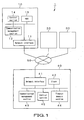
- the communication system 1 illustrated in FIGS. 1 and 2 comprises an electronic appliance that operates as a single client and a number of electronic appliances that operate as servers, although the present invention is by no means limited thereto particularly in terms of system configuration.
- the communication system 1 comprises electronic appliances 10, 20 and 30 that operate as so many servers and a terminal 40 that operates as a single client, which are interconnected by way of a network 50.
- the network 50 is adapted to operate according to the TCP (Transmission Control Protocol)/IP (Internet Protocol). It may be a UPnP network that is adapted to operate on the basis of the UPnP (Universal Plug and Play), which is the protocol for home networks. Ethernet (tradename), a communication method conforming to IEEE1394, Bluetooth (trandename) or some other appropriate method may be used for the connections among the electronic appliances 10 through 30, the terminal 40 and the network 50. Note that the connections do not depend on any physical connection method.
- the electronic appliance 10 may typically be a storage apparatus that stores music contents and video contents and includes a network interface 11 for connecting itself to the network, a communication management section 12 that manages communications with external appliances, an HDD (hard disc drive) 13 that actually stores music contents and video contents and a control section 14 having a CPU, a ROM and a RAM.
- a network interface 11 for connecting itself to the network
- a communication management section 12 that manages communications with external appliances
- an HDD (hard disc drive) 13 that actually stores music contents and video contents
- a control section 14 having a CPU, a ROM and a RAM.
- the terminal 40 comprises a network interface 41 for connecting itself to the network, a clock 42, or a timing section, for timing the duration before receiving a response from an electronic appliance to the data transmitted from the network interface 41, which is equal to the response time of the electronic appliance (server), a communication management section 43 for defming the response waiting time for the server as a function of the duration timed by the clock 42 and deciding whether a communication is available between itself and the server by referring to the defined response waiting time and a timeout memory section 44 for storing the defined response waiting time for each of the electronic appliances.
- the above-described components are collectively managed by a control section 45 having a CPU, a ROM and a RAM.
- the terminal 40 may additionally comprise a speaker, a liquid crystal display section and so on as means for presenting sounds and images to the user.
- Electronic appliances that can operate as servers in the above-described communication system 1 include personal computers (to be referred to as PCs hereinafter) that can be connected to an external network such as the Internet, DVD (digital versatile disc) players and home electronic appliances comprising a large capacity memory device such as a hard disc recorder.
- the terminal 40 may be a communication apparatus such as a mobile telephone set, a PC peripheral apparatus such as a printer or a scanner, a television receiving set, an STB (Set Top Box) for digital terrestrial television broadcasting or an STB for satellite digital broadcasting.
- FIG. 2 is a schematic block diagram of the embodiment of communication system of FIG 1, showing the functional configuration thereof that allows the electronic appliance 10 and the terminal 40 to be connected to each other by way of the network. Since the same functional configuration can be used for connecting the terminal 40 to the electronic appliance 20 and the electronic appliance 30 by way of the network, it will not be described any further for the electronic appliances 20 and 30.
- the electronic appliance 10 is equipped with a function of operating as DHCP (Dynamic Host Configuration Protocol) server 15 in the communication system 1, which is a client/server system.
- the communication management section 12 of the electronic appliance 10 is controlled by an OS (Operating System) 16.
- the electronic appliance 10 also has a contents management server 17 that manages the contents stored in the HDD.
- the terminal 40 that is the destination of delivery of contents has a DHCP (Dynamic Host Configuration Protocol) client 46 that is equipped with a function of operating in the communication system 1, which is a client/server system, an OS 47 that controls the communication management section 43, a contents receiving client 48 that receives contents and an output section 49 that includes a display and/or one or more than one speakers.
- DHCP Dynamic Host Configuration Protocol
- the contents management server 17 of the electronic appliance 10 is adapted to output various contents stored in the HDD 13 to the OS 16 after carrying out a compression process and other processes on the contents.
- the communication management section 12 that operates for a function of the OS 16 generates IP packets from the input data and outputs the generated IP packets to the network interface 11.
- the network interface 11 by turn outputs the input IP packets to the network 50.
- the communication management section 43 of the OS 47 of the terminal 40 takes out the part of the data from the IP packets received by way of the network interface 41 and outputs them to the contents receiving client 48.
- the contents receiving client 48 sequentially converts the IP packets delivered from the contents management server 17 into reproduction signals.
- the output section 49 converts the reproduction signals into sounds and/or images and outputs them.
- the DHCP client 46 requests the DHCP server 15 to assign an IP address.
- the headers of the IP packets that are transmitted and received according to the TCP/IP describe the IP address of the electronic appliance 10 that is the delivering party and the IP address of the terminal 40 that is the receiving party.
- timeout is defmed among communication terminals that are connected to each other by way of a network so that, when one of the terminals cannot get any response from a destination terminal for a predetermined period of time, it produces a reaction such as error display, data retransmission or line disconnection and moves to the next process.
- reaction such as error display, data retransmission or line disconnection and moves to the next process.
- the terminal 40 is adapted to define the waiting time before timeout for each of the number of electronic appliances of the servers connected to the network.
- the electronic appliance 10 that operates as server is referred to as server A and the electronic appliance 20 that operates as server is referred to as server B, whereas the electronic appliance 30 that also operates as server is referred to as server C.
- FIG 3 the horizontal axis represents time and the responses of the servers are schematically illustrated on the horizontal axis.
- the terminal 40 transmits a request for connection acknowledgment to the network 50 on a multicast basis. If there is a server who is assigned to the selected port on the network 50, the server transmits an acknowledgement (Ack). If there are a number of servers, they transmit respective responses but their response times may differ from each other. Considering those servers who may show a long response time, a relatively long waiting time is defined before timeout for the first connection acknowledgement (to be referred to as timeout value, if necessary). The timeout value needs to be sufficiently long so as to make it possible to receive a response from a server whose response time is extremely long.
- FIG 3 shows that the terminal 40 receives a response from the server A 0.1 seconds after the transmission of a request for connection acknowledgement on a multicast basis, a response from the server B 0.5 seconds after the transmission and a response from the server C3 seconds after the transmission.
- the terminal 40 stores the names of the servers with whom it has communicated once for the first connection acknowledgement and their respective response times in the timeout memory section 45 with server ID information that can discriminate the servers.
- the server ID information may be UUIDs for the UPnP, IP addresses, port numbers and/or MAC addresses for the TCP/IP
- the terminal 40 may store a table of the relationship of the servers and the respective waiting times before timeout as shown in FIG 4 in the timeout memory section 45.
- server numbers, ID information and timeout values are correlated for storage.
- ID information XXXXXX and a timeout value of 0.1 (sec) are described for the appliance with server number A.
- the terminal 40 waits for a response from each of the servers listed in the table of FIG 4 for the period of time stored in the table for the server.
- the waiting time before timeout may be defined by calculating the average of several response times in the past as timeout value or by selecting the shortest response time of several response times in the past and updating it constantly as timeout value for each server.
- the process of defining the response waiting time may be carried out each time the power source of the terminal 40 is turned on or a test mode may be provided to observe the response time of each server periodically.
- FIGS. 5A and 5B schematically illustrate two methods that can be used for defining timeout value in the communication system 1 of the embodiment.
- One of the two methods is illustrated in FIG 5A.
- the communication management section 43 computes the average values of T avA , T avB , T avC from response times T a1 , T a2 , T a3 , ..., T an for the respective servers and defines them as timeout values of the servers.
- the average value T avA for the server A is computed in the following manner.
- average value T avA (T a1 + T a2 + T a3 + ••• + T an ) / n
- FIG 5B The other method is illustrated by FIG 5B.
- the communication management section 43 updates the timeout value by selecting the shortest response time out of the detected response times for each server (Taf, Tbf, Tcf in FIG 5B).
- arrows with dotted lines indicate timeout values in the past and arrows with solid lines indicate the updated timeout values.
- timeout value by selecting the longest response time out of the detected response times.
- a technique may involve a process of discarding the detected longest response time if it is remarkably longer than the remaining response times.
- an alternative method may be determining the standard deviation of the detected response times and adopting the time obtained by adding the standard deviation to the average value for the timeout value.
- the value obtained by adding a value (e.g., 1 second) to the determined value as margin may be used as timeout value.
- the determined value may be multiplied by a predetermined multiplier (e.g., 1.2) and the product may be used as timeout value.
- the terminal 40 defines a timeout value that matches the response times of each server for the server so that the inconveniences of the known techniques are eliminated.
- the inconvenience of the known techniques includes that it is impossible to detect servers with a long response time when a small timeout value is selected by taking servers with a short response time into consideration and that the defined waiting time may be too long for servers with a short response time when a large timeout value is selected by taking servers with a long response time into consideration.
- this embodiment improves the reliability of the judgment of whether a communication is available in the communication system 1 and it is now possible to discriminate a state where the terminal 40 is waiting for responses from servers and a state where the terminal 40 is standing by because of a timeout error.
- a communication system can find applications in so-called client/server systems for defining connection timeout of each appliance if such a client/server system is formed by using a plurality of servers or communication appliances regardless if the system employs wired connection or wireless connection and if the system adopts Ethernet (tradename), a communication method conforming to IEEE1394, Bluetooth (tradename) or some other communication method.
Landscapes
- Engineering & Computer Science (AREA)
- Computer Networks & Wireless Communication (AREA)
- Signal Processing (AREA)
- Environmental & Geological Engineering (AREA)
- Computer Security & Cryptography (AREA)
- Computer And Data Communications (AREA)
- Communication Control (AREA)
Applications Claiming Priority (2)
| Application Number | Priority Date | Filing Date | Title |
|---|---|---|---|
| JP2004120750A JP2005301913A (ja) | 2004-04-15 | 2004-04-15 | 通信システム及び情報処理端末、並びに通信方法 |
| JP2004120750 | 2004-04-15 |
Publications (2)
| Publication Number | Publication Date |
|---|---|
| EP1587277A2 true EP1587277A2 (fr) | 2005-10-19 |
| EP1587277A3 EP1587277A3 (fr) | 2006-03-01 |
Family
ID=34940855
Family Applications (1)
| Application Number | Title | Priority Date | Filing Date |
|---|---|---|---|
| EP05252365A Ceased EP1587277A3 (fr) | 2004-04-15 | 2005-04-15 | Dispositif, système et procédé pour la définition d'un temps d'attente de réponse avant une libération sur temporisation |
Country Status (3)
| Country | Link |
|---|---|
| US (1) | US20050240673A1 (fr) |
| EP (1) | EP1587277A3 (fr) |
| JP (1) | JP2005301913A (fr) |
Cited By (2)
| Publication number | Priority date | Publication date | Assignee | Title |
|---|---|---|---|---|
| EP2320601A1 (fr) * | 2009-11-05 | 2011-05-11 | Amadeus S.A.S. | Procédé et système pour adapter une période d'expiration de session |
| CN103428037A (zh) * | 2012-05-16 | 2013-12-04 | 华为技术有限公司 | 一种探测用户在线的方法、设备及系统 |
Families Citing this family (12)
| Publication number | Priority date | Publication date | Assignee | Title |
|---|---|---|---|---|
| EP1988457A4 (fr) * | 2006-02-22 | 2010-12-01 | Fujitsu Ltd | Unite centrale |
| JP5030063B2 (ja) * | 2007-10-05 | 2012-09-19 | 本田技研工業株式会社 | ナビゲーション装置およびナビゲーションシステム |
| JP4660604B2 (ja) | 2009-05-28 | 2011-03-30 | 株式会社東芝 | 情報処理装置および環境設定方法 |
| JP5532755B2 (ja) * | 2009-08-28 | 2014-06-25 | カシオ計算機株式会社 | データ処理装置、ネットワークシステム及びプログラム |
| JP5544903B2 (ja) * | 2010-01-28 | 2014-07-09 | カシオ計算機株式会社 | サーバ装置およびその制御プログラム |
| JP5900966B2 (ja) * | 2010-08-24 | 2016-04-06 | 日本電気株式会社 | 状態制御システム及び方法 |
| US8649268B2 (en) * | 2011-02-04 | 2014-02-11 | Twilio, Inc. | Method for processing telephony sessions of a network |
| JP5956729B2 (ja) * | 2011-07-22 | 2016-07-27 | キヤノン株式会社 | リレーサーバ、リレーサーバの制御方法、情報処理システム、およびプログラム |
| JP6668960B2 (ja) * | 2016-06-08 | 2020-03-18 | 富士ゼロックス株式会社 | 情報処理装置及びプログラム |
| JP2018122531A (ja) * | 2017-02-01 | 2018-08-09 | コニカミノルタ株式会社 | 画像処理装置、画像形成装置、画像処理システム、画像処理装置の制御方法、及び画像処理装置の制御プログラム |
| US11929889B2 (en) * | 2018-09-28 | 2024-03-12 | International Business Machines Corporation | Connection management based on server feedback using recent connection request service times |
| JP7611529B2 (ja) * | 2021-03-16 | 2025-01-10 | パナソニックIpマネジメント株式会社 | 情報端末、インターホンシステム、表示方法、プログラム |
Citations (1)
| Publication number | Priority date | Publication date | Assignee | Title |
|---|---|---|---|---|
| JPH04253439A (ja) * | 1991-01-30 | 1992-09-09 | Nec Corp | ポーリングシステム |
Family Cites Families (5)
| Publication number | Priority date | Publication date | Assignee | Title |
|---|---|---|---|---|
| JPH0918545A (ja) * | 1995-06-30 | 1997-01-17 | Nec Corp | 応答待ち時間設定装置 |
| US5699511A (en) * | 1995-10-10 | 1997-12-16 | International Business Machines Corporation | System and method for dynamically varying low level file system operation timeout parameters in network systems of variable bandwidth |
| US6526433B1 (en) * | 1999-12-15 | 2003-02-25 | International Business Machines Corporation | Adaptive timeout value setting for distributed computing environment (DCE) applications |
| US6782496B2 (en) * | 2001-04-13 | 2004-08-24 | Hewlett-Packard Development Company, L.P. | Adaptive heartbeats |
| US6782489B2 (en) * | 2001-04-13 | 2004-08-24 | Hewlett-Packard Development Company, L.P. | System and method for detecting process and network failures in a distributed system having multiple independent networks |
-
2004
- 2004-04-15 JP JP2004120750A patent/JP2005301913A/ja not_active Abandoned
-
2005
- 2005-04-13 US US11/105,168 patent/US20050240673A1/en not_active Abandoned
- 2005-04-15 EP EP05252365A patent/EP1587277A3/fr not_active Ceased
Patent Citations (1)
| Publication number | Priority date | Publication date | Assignee | Title |
|---|---|---|---|---|
| JPH04253439A (ja) * | 1991-01-30 | 1992-09-09 | Nec Corp | ポーリングシステム |
Non-Patent Citations (1)
| Title |
|---|
| EUROPEAN PATENT OFFICE: "Polling system (English translation of JP 04 253439)", -, 9 September 1992 (1992-09-09), pages 1 - 9, XP002441141 * |
Cited By (4)
| Publication number | Priority date | Publication date | Assignee | Title |
|---|---|---|---|---|
| EP2320601A1 (fr) * | 2009-11-05 | 2011-05-11 | Amadeus S.A.S. | Procédé et système pour adapter une période d'expiration de session |
| WO2011054625A1 (fr) * | 2009-11-05 | 2011-05-12 | Amadeus S.A.S. | Procede et systeme pour adapter une periode de temporisation de session |
| US8214492B2 (en) | 2009-11-05 | 2012-07-03 | Amadeus S.A.S. | Method and system for adapting a session timeout period |
| CN103428037A (zh) * | 2012-05-16 | 2013-12-04 | 华为技术有限公司 | 一种探测用户在线的方法、设备及系统 |
Also Published As
| Publication number | Publication date |
|---|---|
| EP1587277A3 (fr) | 2006-03-01 |
| US20050240673A1 (en) | 2005-10-27 |
| JP2005301913A (ja) | 2005-10-27 |
Similar Documents
| Publication | Publication Date | Title |
|---|---|---|
| EP1587277A2 (fr) | Dispositif, système et procédé pour la définition d'un temps d'attente de réponse avant une libération sur temporisation | |
| US20040139180A1 (en) | Automobile media synchronization | |
| US20150181285A1 (en) | Media Playback Method, Control Point, and Terminal | |
| US8583732B2 (en) | Method and apparatus for providing multimedia messaging service | |
| US9065666B2 (en) | System and method of multi-media conferencing between universal plug and play (UPnP) enabled telephony devices and wireless area network (WAN) devices | |
| CN101277238B (zh) | 家庭间共享设备和使用家庭网络装置的方法 | |
| US9100447B2 (en) | Content delivery system | |
| JPWO2004097655A1 (ja) | マルチメディア情報共有システム | |
| JP2006520039A (ja) | メディアデータストリームを処理するための方法、データ構造、及びシステム | |
| US20120303769A1 (en) | Method for mounting network attached storage nas device, and digital media player dmp | |
| US8327010B2 (en) | Information processing apparatus and method for controlling the same | |
| CN103404135A (zh) | 用于传输实时图像的系统和方法 | |
| EP2107723B1 (fr) | Commande d'un dispositif a distance par un terminal | |
| KR100674085B1 (ko) | 홈네트워크에서의 미디어포맷/전송프로토콜 변환 장치 및 그 방법 | |
| EP3160101B1 (fr) | Procédé de gestion de ressources multimédias, serveur d'informatique en nuage et dispositif électronique | |
| JP2013514035A (ja) | ライブメディアストリームの時間シフト | |
| WO2012041032A1 (fr) | Procédé pour examiner une cote d'écoute, terminal et système correspondants | |
| JP2005202968A (ja) | 発見プロトコルを設定するシステム及び方法 | |
| US8095651B2 (en) | Delayable events in home network | |
| JPWO2007091480A1 (ja) | Avサーバ機器及びコネクション管理方法 | |
| EP3461135A1 (fr) | Procédé de gestion du droit d'accès à un contenu numérique | |
| CN101262390A (zh) | 处理动作方法、控制受控装置方法及受控装置和控制点 | |
| CN1953385B (zh) | 音频/视频任务计算方法、提供摘要消息的方法及其设备 | |
| JP4900169B2 (ja) | ネットワークシステム、中継デバイス及び中継プログラム | |
| US20040104995A1 (en) | Information processing system, information processing method, information processing apparatus, and program |
Legal Events
| Date | Code | Title | Description |
|---|---|---|---|
| PUAI | Public reference made under article 153(3) epc to a published international application that has entered the european phase |
Free format text: ORIGINAL CODE: 0009012 |
|
| AK | Designated contracting states |
Kind code of ref document: A2 Designated state(s): AT BE BG CH CY CZ DE DK EE ES FI FR GB GR HU IE IS IT LI LT LU MC NL PL PT RO SE SI SK TR |
|
| AX | Request for extension of the european patent |
Extension state: AL BA HR LV MK YU |
|
| PUAL | Search report despatched |
Free format text: ORIGINAL CODE: 0009013 |
|
| AK | Designated contracting states |
Kind code of ref document: A3 Designated state(s): AT BE BG CH CY CZ DE DK EE ES FI FR GB GR HU IE IS IT LI LT LU MC NL PL PT RO SE SI SK TR |
|
| AX | Request for extension of the european patent |
Extension state: AL BA HR LV MK YU |
|
| RIC1 | Information provided on ipc code assigned before grant |
Ipc: G06F 17/30 20060101ALI20060112BHEP Ipc: H04L 12/26 20060101ALI20060112BHEP Ipc: H04L 12/24 20060101ALI20060112BHEP Ipc: H04L 29/06 20060101AFI20050722BHEP |
|
| 17P | Request for examination filed |
Effective date: 20060424 |
|
| AKX | Designation fees paid |
Designated state(s): DE FR GB |
|
| 17Q | First examination report despatched |
Effective date: 20060518 |
|
| STAA | Information on the status of an ep patent application or granted ep patent |
Free format text: STATUS: THE APPLICATION HAS BEEN REFUSED |
|
| 18R | Application refused |
Effective date: 20080406 |