EP1586250A1 - Aus fasern hergestellter klettverschluss mit vermindertem unangenehmem abziehgeräusch und sein befestigungsprodukt - Google Patents
Aus fasern hergestellter klettverschluss mit vermindertem unangenehmem abziehgeräusch und sein befestigungsprodukt Download PDFInfo
- Publication number
- EP1586250A1 EP1586250A1 EP03772748A EP03772748A EP1586250A1 EP 1586250 A1 EP1586250 A1 EP 1586250A1 EP 03772748 A EP03772748 A EP 03772748A EP 03772748 A EP03772748 A EP 03772748A EP 1586250 A1 EP1586250 A1 EP 1586250A1
- Authority
- EP
- European Patent Office
- Prior art keywords
- surface fastener
- sound
- fiber
- peeling
- base fabric
- Prior art date
- Legal status (The legal status is an assumption and is not a legal conclusion. Google has not performed a legal analysis and makes no representation as to the accuracy of the status listed.)
- Withdrawn
Links
Images



Classifications
-
- A—HUMAN NECESSITIES
- A44—HABERDASHERY; JEWELLERY
- A44B—BUTTONS, PINS, BUCKLES, SLIDE FASTENERS, OR THE LIKE
- A44B18/00—Fasteners of the touch-and-close type; Making such fasteners
-
- A—HUMAN NECESSITIES
- A44—HABERDASHERY; JEWELLERY
- A44B—BUTTONS, PINS, BUCKLES, SLIDE FASTENERS, OR THE LIKE
- A44B18/00—Fasteners of the touch-and-close type; Making such fasteners
- A44B18/0069—Details
-
- A—HUMAN NECESSITIES
- A44—HABERDASHERY; JEWELLERY
- A44B—BUTTONS, PINS, BUCKLES, SLIDE FASTENERS, OR THE LIKE
- A44B18/00—Fasteners of the touch-and-close type; Making such fasteners
- A44B18/0003—Fastener constructions
-
- Y—GENERAL TAGGING OF NEW TECHNOLOGICAL DEVELOPMENTS; GENERAL TAGGING OF CROSS-SECTIONAL TECHNOLOGIES SPANNING OVER SEVERAL SECTIONS OF THE IPC; TECHNICAL SUBJECTS COVERED BY FORMER USPC CROSS-REFERENCE ART COLLECTIONS [XRACs] AND DIGESTS
- Y10—TECHNICAL SUBJECTS COVERED BY FORMER USPC
- Y10T—TECHNICAL SUBJECTS COVERED BY FORMER US CLASSIFICATION
- Y10T24/00—Buckles, buttons, clasps, etc.
- Y10T24/27—Buckles, buttons, clasps, etc. including readily dissociable fastener having numerous, protruding, unitary filaments randomly interlocking with, and simultaneously moving towards, mating structure [e.g., hook-loop type fastener]
Definitions
- the present invention relates to a fiber-made surface fastener and a surface fastener attached product provided with the surface fastener and more particularly to a fiber-made surface fastener for reducing a peeling-off sound and a product provided with the surface fastener.
- Japanese Patent Application Laid-Open No. 6-103 has disclosed a surface fastener having vibration absorptive material on a rear surface of its base fabric. To secure a sufficient effect according to this method, a weight of the vibration absorptive material needs to be sufficient and thus, there is a disadvantage that the surface fastener becomes thick. Further, these technologies intend to reduce a loudness of the peeling-off sound. However, there are uncomfortable sound and not uncomfortable sound for a hearing of a human being. It cannot be said to be sufficient if the sound is simply reduced and it is important not to make a human being feel uncomfortable in his hearing.
- This abnormal sound is a sound generated by vibration of the base fabric.
- the sound is always generated and it is difficult to completely eliminate the generation of this sound.
- the generated sound is reduced with the methods for reducing a ratio of the propagation of the vibrations of the base fabric to the air.
- these methods do not take into account a tone of the sound and when the tone makes human being feel uncomfortable even if the generated sound is reduced, it cannot be said that the product is satisfactory.
- the tone changes.
- An object of the present invention is to provide a fiber-made surface fastener in which the tone of the peeling-off sound generated from the surface fastener itself is shifted to a low tone side to reduce a feeling of discomfort while the peeling-off sound generated by a product on which the surface fastener is attached is shifted to a low tone side in order to suppress a feeling of discomfort, and a product provided with the surface fastener.
- the tone of a sound generated when the surface fastener is peeled off and it is intended to reduce a component which provides a feeling of discomfort by comparing with sound spectrum obtained by Fourier transformation while, at a same time, reducing the generated sound itself so as to eliminate the feeling of discomfort. Additionally, means for suppressing a frequency of the peeling-off sound is developed.
- the base fabric of the surface fastener is constructed of a lattice structure so as to reduce efficiency of the vibration being transmitted to the air and additionally, material having a mass is attached to the rear face to secure silence.
- a mounting system is provided on the rear face and the base cloth on which the surface fastener is mounted and the base fabric of the surface fastener are separated to prevent the vibration from being transmitted from the base fabric to the base cloth.
- the sound spectrum is expressed with a frequency and intensity placed on a horizontal axis and a vertical axis respectively.
- the sound spectrum is obtained by Fourier transformation.
- FFT fast Fourier transformation
- the FFT needs data of a factorial number of 2 and its resolution depends on a quantity of data. A lowest frequency which can be analyzed is determined depending on a sampling time. A highest frequency is determined depending on a sampling cycle. Therefore, when discussing the sound spectrum, it is important to indicate an analysis range.
- its abscissa axis and ordinate axis are expressed with logarithm.
- a first basic structure of the present invention exists in a surface fastener including joining faces each in which a plurality of fiber-made engaging elements are provided on one surface of each flat base fabric comprising fiber structural material, wherein a ratio (A/B) of an area A of a range in which sound spectrum of a peeling-off sound Fourier-transformed in a range of 100 Hz to 15000 Hz is 100 Hz to 3000 Hz to an area B of a range in which sound spectrum of a peeling-off sound Fourier-transformed in a range of 100 Hz to 15000 Hz is 3000 Hz to 15000 Hz is 0.4 or more.
- the peeling-off sound is never felt to be uncomfortable.
- the present invention has been accomplished based on a finding that a hardness of the surface fastener base fabric affects the tone of a generated sound.
- the base fabric of the surface fastener is composed of a more flexible base fabric and further, it is provided with gaps, the tone of a sound generated at a time of peeling-off can be shifted to low frequency side so that the uncomfortable sound at the time of peeling-off can be converted to a mellow sound.
- the base fabric of the surface fastener is reduced, the base fabric is softened, an elasticity of the base fabric is reduced and transmission of the vibration of the high frequency component is reduced, the generated sound is shifted to the low frequency side.
- a method for reducing the transmission of the vibration of a high tone sound in the base fabric it is effective to adopt a fabric as largely curved as possible without placing yarns constituting the base fabric linearly. It is further effective if the density of the base fabric, particularly an apparent density is reduced to 0.5 g/cm 3 or less at a same time.
- each of male/female surface fastener members When the base fabric of each of male/female surface fastener members is bent at 180° in a radius of 4.0 mm, a sum of bending strength of both base fabrics is 36 gf ⁇ cm/2.5 cm or less and a joining face of at least one surface fastener member comprises a plurality of fiber-made engaging elements distributed uniformly on an entire surface, the generated sound can be shifted to the low frequency side by reducing the transmission of the vibration of the high frequency component.
- the elasticity When the elasticity is high, a characteristic vibration exists on a high tone side and if the elasticity is low, the characteristic vibration is shifted to the low frequency side.
- the base fabric of the surface fastener if the base fabric is hard, a high tone is generated and if the base fabric is soft, a low tone is generated.
- the aforementioned methods for bending yarns or reducing the density is effective for softening the base fabric of the surface fastener to shift the generated sound to a low tone side.
- the vibration can be classified into a transverse wave and a longitudinal wave.
- the transverse wave is a vibration at right angle with respect to a longitudinal direction of a yarn. This vibration is attenuated easily by friction with an adjoining yarn or back coating material. If a vibration attenuating material or the like is provided, it is attenuated further effectively.
- the longitudinal wave is a wave vibrating in the longitudinal direction of the yarn. A propagation velocity of this wave is determined by storage elastic modulus and attenuating is determined by loss elastic modulus. A ratio of the storage elastic modulus to the loss elastic modulus is usually 10:1 at room temperature and the attenuating is not so large at the room temperature.
- a method of bending the yarn is effective for attenuating the longitudinal wave. Part of energy of the longitudinal wave is converted to the transverse wave by bending and the longitudinal wave is attenuated quickly at each time of the bending.
- a bending angle of the yarn is preferably 90° or more.
- the vibration is not attenuated but distributed in a wide area.
- the vibration is attenuated by the bending of the yarn and the vibration is confined to a small area. It is particularly effective when the yarn is bulky. Also, when the apparent density of the weaving/knitting structure is 0.5 g/cm 3 or less, the knitting yarn is bent largely and flexible and its attenuating effect is great at a same time.
- a method of roughening the weaving/knitting structure is effective.
- a repetitive number (wale density) in a transverse direction is N1 (number of times/cm) and the repetitive number (course density) in a longitudinal direction is N2 (time/cm)
- N1+N2 is assumed to be 5.9 or more and 29.0 or less, the above-described condition is satisfied and the peeling-off sound can be reduced.
- a weft yarn density is 18 times/cm or less
- a warp yarn density is 37.5 pieces/cm or less
- a size of the weft yarn is 140-300 denier
- a size of the warp yarn is 140-300 denier
- a size of a loop yarn is 450 denier
- a crimped yarn As a method for adjusting a bulkiness of the yarn to reduce the density, it is permissible to use a crimped yarn.
- the crimped yarn itself has a bulkiness and thus the bulkiness of a woven/knitted fabric is increased, thereby decreasing the apparent density.
- the apparent density In the weaving/knitting structure, if part of composition yarns is woven or knitted in a form of a loop at a time of weaving or knitting, the apparent density is further reduced. Therefore, a sound of high frequency generated when the surface fastener is peeled off is shifted to the low frequency side effectively and uncomfortable sound is converted into the mellow sound.
- a ratio of the storage elastic modulus to the loss elastic modulus of the yarn can be improved by a mix spinning. Particularly if a yarn of material having a Tan Delta peak around the room temperature like a urethane fiber is mixed when spun, the loss elastic modulus of the yarn is raised remarkably. Further, material whose glass transition point is at low temperature and crystallinity index is small like LDPE (low-density polyethylene) is also effective. If the loss elastic modulus is raised as described above, the high tone sound is absorbed effectively and the sound generated at the time of peeling-off is shifted to the low tone side. If the base fabric is formed in a lace-like structure, yarns transmitting the vibration are bent in multiple layers and a number of yarns for transmitting the vibration is decreased, so that the apparent density drops, which is further effective.
- LDPE low-density polyethylene
- the sound generated when the surface fastener is peeled off is not generated from only the surface fastener, but the vibration is transmitted to a product to which it is attached and the sound is also generated from the product. Thus, it is insufficient even if the sound from the surface fastener is reduced, and it is necessary to consider the characteristic of the product. Even if a same type of the surface fastener is used, the generated sound differs depending on a mating cloth on which it is sewed. To eliminate such a difference, it is effective to interpose a spacer having gap forming means between the base fabric of the surface fastener and the mating cloth to be sewed so as to have a structure in which no vibration is transmitted to cloth.
- the spacer fabric whose apparent density is 0.5 g/cm 3 or less is suitable like the base fabric of the surface fastener and for the same reason as the base fabric of the surface fastener, it plays a role of shifting the vibration to the low frequency side.
- vibration attenuating means between the rear face of the base fabric from which the engaging elements of the surface fastener are raised and the attachment object is also effective.
- this vibration attenuating means various kinds of fabrics whose bending strength is 0.7 gf ⁇ cm/2.5 cm or less when it is bent at 180° in the radius of 4 mm are preferred or various kinds of fabric whose apparent density is 0.5 g/cm 3 or less may be adopted.
- the surface fastener in which such uncomfortable sound is reduced When the surface fastener in which such uncomfortable sound is reduced is used on clothes, no feeling of discomfort is accompanied when the surface fastener is fastened or unfastened and thus, it is preferable.
- this As application for general clothing, this is available for handicapped person's simple fastening underwear, shoulder pad, underwear, uniform, working clothes, ski wear, jumper, trousers, pants, skirt, dress, slacks, belt and the like.
- fastening/unfastening is carried out frequently such as gloves and pocket cover, the generation of no unpleasant sound is important from a viewpoint of comfortable use.
- the surface fastener of the present invention can be used preferably for such applications.
- the surface fastener of the present invention enables various kinds of bags, business bags, purses and the like to be opened/closed without a care about an opening/closing at a silent place. Particularly, for a duffel bag, bag, vest, jacket, clothing, gun holder, sleeping bag or the like for military use or hunting use in which the generation of sound is problematic, the surface fastener of the present invention is preferred. If it is applied to underwear, combination underwear, diaper, diaper cover, wrapper, coverall for a newborn baby or an infant, changing of clothing or a diaper can be carried out without a care of generated sound at sleeping time.
- a stationery case and the like need to be opened or closed at a silent place like a classroom and a library and the sound is an important factor. This is suitable for various kinds of a document holder, pen case, binding band, system notebook and the like used at such a place.
- the surface fastener is often used in various kinds of medical products.
- the surface fastener is used in an arm band for blood pressure measurement, supporter, connection of artificial limb or artificial leg, belt of nightclothes, fixing of joint portion of nightclothes, pillow cover, sheet and the like and a product in which unpleasant noise is generated when it is peeled off is not liked.
- the surface fastener is used in shoes such as athletic shoes and for such applications, the surface fastener accompanying no uncomfortable sound can be used.
- the surface fastener is used for various kinds of electronic devices. For this case, video camera, CD player, camera, camera lens and the like can be mentioned.
- the surface fastener of the present invention can be used preferably for these kinds of products. It can be also used for a headrest cover, sheet cover, curtain belt for an automobile and the like. Further, the surface fastener of the present invention is preferably used for preventing a slip of a carpet, and for fixing the curtain belt and wallpaper.
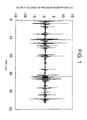
- a sound generated when the surface fastener is peeled off is a sound whose waveform is as shown in FIG. 1.
- the sound generated at this time is a discrete, sharp, quickly attenuated sound.
- FIG. 2 shows a sound of that kind in enlargement.
- a single peeling-off sound is a sound having a high frequency, which is attenuated instantaneously in as short a time as 0.1 second.
- such kind of sound is an uncomfortable sound. If a high frequency component is removed form this sound, a tone of the sound changes to a soft sound.
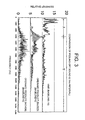
- FIG. 3 shows a result of measurement of the peeling-off sound of a sample in Table 1.
- a microphone was placed far by 65 mm from a fiber-made surface fastener and a sound generated when it was peeled off was measured.
- An ordinary product (woven) among base fabric structures shown in the same Table is a woven fabric having a structure similar to plain weaving.
- An ordinary product (raised) in the same Table is a raised woven fabric.
- a knit is composed of a warp knitting structure and its apparent density is low and its composition yarns are bent largely due to a knitting structure. If the knitting structure is adopted, effects of apparent density and yarn bending reflect synthetically so that the generated sound is shifted largely to a low tone side.
- a value of a ratio A/B is called as a high frequency component ratio. If this high frequency component ratio is 0.4 or more, the sound is not felt as uncomfortable.
- the high frequency component ratio of each sample shown in FIG. 3 was 0.164 for an ordinary woven product, 0.204 for raised fabric (raised), and 1.075 for a knit product.
- a maximum component of sound spectrum was 5330 Hz for an ordinary product (woven), 3070 Hz for an ordinary product (raised) and 420 Hz for a knit product.
- the generated sound is shifted to a low frequency side securely. More specifically, as a method for lowering the propagation of the vibration of a high note sound in the base fabric, it is effective to adopt a structure bent as largely as possible without placing yarns constituting the base fabric linearly. Further, if the density of the base fabric is reduced so that its apparent density is set to 0.5 g/cm 3 or less, it is further effective.
- the vibration is classified into a transverse wave and a longitudinal wave.
- it is effective to bend yarns.
- Part of energy of the longitudinal wave is transformed into the transverse wave by a bending so that the longitudinal wave is attenuated quickly at each time of the bending.
- the bending angle of the yarns is 90° or more.
- the vibration is distributed in a wide area without being attenuated.
- the vibration is attenuated due to bending of the yarns and the vibration is confined within a small area.
- the effect is great. Also, if the apparent density of the weaving/knitting structure is 0.5 g/cm 3 or less, its attenuating effect is great. If the elasticity is high, a characteristic vibration is located on a high tone side and if the elasticity is low, the characteristic vibration is shifted to a low frequency side.
- the base fabric of the surface fastener if the base fabric is hard, a high tone is generated and if the base fabric is flexible, a low tone is generated. As described above, a method for bending the yarns, reducing the density or the like is effective for softening the base fabric of the surface fastener and the generated sound is shifted effectively to the low tone side.
- Hardness of the base fabric of the surface fastener can be obtained as a force necessary for the bending with a forward bending machine (KES-F2, manufactured by KATO TECH CO., LTD.).
- the KES-F2 operates as shown in FIG. 4.
- a fixed chuck 1 and a movable chuck 2 are disposed with a predetermined interval and a sample whose two ends are sandwiched by the fixed chuck 1 and the movable chuck 2 is bent as the movable chuck 2 moves on a trajectory having a specific curvature. That is, the movable chuck 2 moves with its neck swinging so as to maintain the specific curvature.
- a minimum curvature of a measurable sample is 4 mm.
- a moment applied to the fixed chuck 1 when the curvature is 4.0 mm is measured according to such a method and flexibility of the base fabric is evaluated. With a bending angle set to 180°, bending strength of the sample was measured. Data was converted in terms that a width was 25 mm and then, the bending strength per 25 mm was compared.
- male/female surface fastener members their engaging elements are cut out and the bending strength of only the base fabrics were measured according to the above-described method.
- As the bending strength a sum of measured values of the base fabrics of the male/female surface fastener members was adopted. A generated sound was measured with a sound-level meter placed at a distance of 65 mm from a sample. As for a result, as the bending strength increased, the generated sound increased as shown in FIG. 5.
- the sum of its bending strength was 46 gf ⁇ cm/2.5 cm and the generated sound when it was peeled off was 95 dB.
- FIG. 6 indicates that the high frequency component ratio (A/B) is 0.29 in case of 46 gf ⁇ cm/2.5 cm while it is 0.67 in case of 19 gf ⁇ cm/2.5 cm. Further, it can be considered that a relation between the bending strength and the high frequency component ratio is linear.
- the bending strength is 36 gf ⁇ cm/2.5 cm. It is evident that no uncomfortable sound is generated when the surface fastener is peeled off if the high frequency component ratio specified by the present invention is 0.4 or more, that is, the bending strength is 36 gf ⁇ cm/2.5 cm or less. Further, as understood from FIG. 5, if the bending strength is 36 gf ⁇ cm/2.5 cm or less, loudness of the peeling-off sound drops by 10dB or more with respect to an ordinary product so that it can be felt that the loudness is reduced.
- the weaving structure by setting a warp yarn density to 37.5 (pieces/cm) or less, a weft yarn density to 18.0 (pieces/cm) or less, a size of a weft yarn to 140-300 denier, a size of warp yarn to 140-300 denier, and a loop yarn to 450 denier, the structure becomes rough thereby making it possible to reduce the peeling-off sound.
- a crimped yarn As a method for adjusting bulkiness to reduce the density, it is permissible to use a crimped yarn.
- the crimped yarn itself has the bulkiness and the woven/knit fabric becomes bulky so that the density drops and the bending strength also drops.
- a ratio of storage elastic modulus to loss elastic modulus of a yarn can be improved by mix spinning. Particularly if a yarn of a material having Tan Delta peak near a room temperature such as a urethane fiber is spun mixedly, the loss elastic modulus of the yarn increases remarkably. Further, material whose glass transition point is located at a low temperature and whose crystallinity index is small, like LDPE, is effective. If the loss elastic modulus is raised as described above, the high tone sound can be absorbed effectively so that the sound generated at the time of peeling-off is shifted to the low tone side. Further, if the base fabric is formed of a lace-like organization, yarns for transmitting the vibration are bent in multiple folds and a number of yarns for transmitting the vibration decreases, so that the apparent density drops, which provides a further effective result.
- the sound when the surface fastener is peeled off is not originated from only the surface fastener but the vibration is transmitted to a product on which the surface fastener is mounted and the sound is also generated from that product.
- the generated sound differs depending on a mating cloth on which it is sewed. To eliminate such a difference, it is effective to provide a gap between the surface fastener base fabric and cloth so as to provide a structure preventing the vibration from being transmitted to the cloth. Further, it is also effective to place fabric having a feature for softening the sound between them as a spacer.
- the spacer As a spacer, it can be evaluated based on the bending strength like the surface fastener and fabric whose bending strength is 0.7 gf ⁇ cm/2.5 cm or less is suitable so that it can plays a role of shifting the vibration to the low frequency side for the same reason as the base fabric of the surface fastener.
- FIG. 7 shows a difference between peeling-off sounds when the surface fastener is attached to fabric via a spacer and when it is attached directly to the base fabric.
- a test piece P 1 is a surface fastener whose base fabric is a knit as shown in Table 1 which is attached directly to taffeta fabric and a test piece P 2 is the same surface fastener which is attached to taffeta fabric via a spacer.
- peeling-off sounds were measured according to the above-described method and results are shown as sound spectrum by FFT in FIG. 7.
- Pile woven fabric whose bending strength was 0.38 gf ⁇ cm/2.5 cm was used as a spacer.
- the peeling-off sound of the test piece sewed via the spacer is shifted to the low frequency side. Therefore, the generation of uncomfortable sound at the time of peeling-off is suppressed.
- the loudness of the sound was 88 dB for the test piece P 1 sewed directly to the taffeta fabric (whose bending strength is 0.90 gf ⁇ cm/2.5 cm) and that of the test piece P 2 sewed to the taffeta fabric via the spacer was 75 dB.
- the maximum component of the sound spectrum was 3340 Hz for the test piece P 1 sewed directly to the taffeta fabric and that was 2200 Hz for the test piece P 2 sewed to the taffeta fabric via the spacer.
- the test piece P 2 sewed to the taffeta fabric via the spacer had a low peeling-off sound, which did not provide a feeling of discomfort.
- a peeling-off sound was measured with a combination of a loop made of knitting-structured base fabric whose bending strength was 12.3 gf ⁇ cm/2.5 cm and apparent density was 0.45 g/cm 3 and a hook made of weaving-structured base fabric whose bending strength was 6.3 gf ⁇ cm/2.5 cm and apparent density was 0.40 g/cm 3 .
- the frequency of the maximum component of the peeling-off sound was 700 Hz and the high frequency component ratio was 1.05. This peeling-off sound was low in tone and not unpleasant.
- the surface fastener made of knit base fabric whose bending strength was 12.3 gf ⁇ cm/2.5 cm and apparent density was 0.45 g/cm 3 was used and knit fabric whose bending strength was 0.5 gf ⁇ cm/2.5 cm and apparent density was 0.42 g/cm 3 was placed between the surface fastener and the artificial leather and sewed.
- the frequency of the maximum component of a sound generated when the bag lid was opened was about 900 Hz and the high frequency component ratio was 1.3. This sound was extremely lower in tone as compared with a sound generated when the bag lid provided with an ordinary surface fastener was opened and was not unpleasant.
- a female surface fastener member having a loop made of knitting-structured base fabric whose bending strength was 12.3 gf ⁇ cm/2.5 cm and apparent density was 0.42 g/cm 3 and a male surface fastener member having a hook made of a weaving structure whose bending strength was 6.3 gf ⁇ cm/2.5 cm and apparent density was 0.40 g/cm 3 were used.
- a knit fabric whose bending strength was 0.5 gf ⁇ cm/2.5 cm and apparent density was 0.35 g/cm 3 was placed between each surface fastener and a glove base fabric and sewed together with a sewing machine.
- the frequency of the maximum component of a peeling-off sound from the surface fastener was 700 Hz.
- the high frequency component ratio was 0.91 and the peeling-off sound was low in tone and not unpleasant.
- the present invention is not limited to these examples, and as evident from the above description, the present invention may be modified in various ways, and for example, the base fabric of the surface fastener, the material and structure of the spacer, the size of the composition fiber and the like can be selected arbitrarily depending on an application within a scope of claims of the present invention.
Landscapes
- Slide Fasteners, Snap Fasteners, And Hook Fasteners (AREA)
- Curtains And Furnishings For Windows Or Doors (AREA)
Applications Claiming Priority (3)
| Application Number | Priority Date | Filing Date | Title |
|---|---|---|---|
| JP2002341930 | 2002-11-26 | ||
| JP2002341930A JP2004173819A (ja) | 2002-11-26 | 2002-11-26 | 剥離時の不快音を低減した繊維製面ファスナーとその取付製品 |
| PCT/JP2003/014470 WO2004047581A1 (ja) | 2002-11-26 | 2003-11-13 | 剥離時の不快音を低減した繊維製面ファスナーとその取付製品 |
Publications (2)
| Publication Number | Publication Date |
|---|---|
| EP1586250A1 true EP1586250A1 (de) | 2005-10-19 |
| EP1586250A4 EP1586250A4 (de) | 2006-11-29 |
Family
ID=32375869
Family Applications (1)
| Application Number | Title | Priority Date | Filing Date |
|---|---|---|---|
| EP03772748A Withdrawn EP1586250A4 (de) | 2002-11-26 | 2003-11-13 | Aus fasern hergestellter klettverschluss mit vermindertem unangenehmem abziehgeräusch und sein befestigungsprodukt |
Country Status (8)
| Country | Link |
|---|---|
| US (1) | US7475455B2 (de) |
| EP (1) | EP1586250A4 (de) |
| JP (1) | JP2004173819A (de) |
| KR (1) | KR20050085161A (de) |
| CN (1) | CN100456982C (de) |
| AU (1) | AU2003280777A1 (de) |
| TW (1) | TWI241895B (de) |
| WO (1) | WO2004047581A1 (de) |
Families Citing this family (5)
| Publication number | Priority date | Publication date | Assignee | Title |
|---|---|---|---|---|
| JP5336132B2 (ja) * | 2008-09-05 | 2013-11-06 | 帝人株式会社 | 面ファスナー用立毛布帛および面ファスナーおよび繊維製品 |
| US9615614B2 (en) | 2012-10-16 | 2017-04-11 | Velcro BVBA | Fastening pouch or pocket flaps |
| AU2016370986A1 (en) | 2015-12-14 | 2018-06-21 | Teijin Frontier Co., Ltd. | Hook and loop fastener and textile products |
| US10421414B2 (en) * | 2016-12-01 | 2019-09-24 | Lear Corporation | Contour connect |
| CN107314971A (zh) * | 2017-05-05 | 2017-11-03 | 信利半导体有限公司 | 一种双面胶带粘性差异的判断方法 |
Family Cites Families (13)
| Publication number | Priority date | Publication date | Assignee | Title |
|---|---|---|---|---|
| US4776068A (en) * | 1986-10-20 | 1988-10-11 | Velcro Industries B. V. | Quiet touch fastener material |
| US4884323A (en) * | 1988-01-14 | 1989-12-05 | Velcro Industries B. V. | Quiet touch fastener attachment system |
| JPH0690075B2 (ja) * | 1989-02-27 | 1994-11-14 | 株式会社東芝 | 騒音の能動制御に用いられる伝達関数の測定方法 |
| JP3083524B2 (ja) * | 1989-03-10 | 2000-09-04 | 株式会社東芝 | 回転機音消音装置 |
| JP3099079B2 (ja) * | 1992-06-19 | 2000-10-16 | 株式会社ジェルテック | 防振構造を具えた係着構造 |
| JPH0739407A (ja) * | 1993-07-28 | 1995-02-10 | Minnesota Mining & Mfg Co <3M> | 対面係合ファスナー部材とそのファスナー部材を備えたファスナー |
| DE69514917T2 (de) * | 1994-04-12 | 2000-10-05 | Minnesota Mining And Mfg. Co., Saint Paul | Verschluss mit einer schalldämpfenden eigenschaft |
| EP0897675B1 (de) * | 1996-05-10 | 2007-09-05 | Shishiai-Kabushikigaisha | Energieumwandlungszusammensetzung |
| JP4008136B2 (ja) * | 1998-02-23 | 2007-11-14 | 日本バイリーン株式会社 | 面ファスナー雌材及びその製造方法 |
| JP3505089B2 (ja) * | 1998-08-31 | 2004-03-08 | Ykk株式会社 | 繊維製面ファスナー |
| JP2000175711A (ja) * | 1998-12-17 | 2000-06-27 | Ykk Corp | 微小な寸法形態の雄の係合素子を持つ成形面ファスナーとの係脱が可能なトリコット地 |
| JP4615140B2 (ja) * | 2001-03-03 | 2011-01-19 | 大王製紙株式会社 | 止着用フロントシートを有する紙おむつ |
| US20030221298A1 (en) * | 2002-05-31 | 2003-12-04 | Teiichi Murayama | Noiseless surface fastener member, noiseless surface fastener combined with the noiseless surface fastener member and product attached with the same noiseless surface fastener member or the same noiseless surface fastener |
-
2002
- 2002-11-26 JP JP2002341930A patent/JP2004173819A/ja active Pending
-
2003
- 2003-11-13 WO PCT/JP2003/014470 patent/WO2004047581A1/ja not_active Ceased
- 2003-11-13 CN CNB2003801040947A patent/CN100456982C/zh not_active Expired - Lifetime
- 2003-11-13 AU AU2003280777A patent/AU2003280777A1/en not_active Abandoned
- 2003-11-13 US US10/536,474 patent/US7475455B2/en not_active Expired - Fee Related
- 2003-11-13 KR KR1020057009497A patent/KR20050085161A/ko not_active Ceased
- 2003-11-13 EP EP03772748A patent/EP1586250A4/de not_active Withdrawn
- 2003-11-25 TW TW092133088A patent/TWI241895B/zh not_active IP Right Cessation
Non-Patent Citations (2)
| Title |
|---|
| No further relevant documents disclosed * |
| See also references of WO2004047581A1 * |
Also Published As
| Publication number | Publication date |
|---|---|
| CN100456982C (zh) | 2009-02-04 |
| WO2004047581A1 (ja) | 2004-06-10 |
| US20060130293A1 (en) | 2006-06-22 |
| TWI241895B (en) | 2005-10-21 |
| TW200412871A (en) | 2004-08-01 |
| KR20050085161A (ko) | 2005-08-29 |
| EP1586250A4 (de) | 2006-11-29 |
| CN1717187A (zh) | 2006-01-04 |
| JP2004173819A (ja) | 2004-06-24 |
| AU2003280777A1 (en) | 2004-06-18 |
| US7475455B2 (en) | 2009-01-13 |
Similar Documents
| Publication | Publication Date | Title |
|---|---|---|
| US11363861B2 (en) | Watchbands with hook and loop fasteners | |
| TWI244904B (en) | Silent flat fastener | |
| US4884323A (en) | Quiet touch fastener attachment system | |
| TWI516253B (zh) | Support | |
| US12402731B1 (en) | Reflux-preventing cushion for combined use as baby bed having fixing band that is angle-adjustable and made of soft material | |
| JP2000136405A (ja) | 衣服のアジャスト構造 | |
| US7475455B2 (en) | Fiber-made surface fastener for reducing unpleasant noise at peeling-off and product provided therewith | |
| US7404241B2 (en) | Silent surface fastener | |
| TWI232087B (en) | Noiseless surface fastener member, noiseless surface fastener combined with the noiseless surface fastener member and product attached with the same noiseless surface fastener member of the same noiseless surface fastener | |
| JP4003951B2 (ja) | 静音面ファスナーと、同面ファスナーの装着製品 | |
| US3191603A (en) | Adjustable garment | |
| JP2005040231A (ja) | フック材及びメカニカルファスナー | |
| JP4615140B2 (ja) | 止着用フロントシートを有する紙おむつ | |
| SE521371C2 (sv) | Absorberande alster med midjebälte | |
| JP3423266B2 (ja) | 伸縮性たて編地 | |
| KR100810828B1 (ko) | 정음 면파스너 | |
| JP2003339413A (ja) | 繊維製の静音面ファスナーと同面ファスナーが取着された製品 | |
| TWI741717B (zh) | 手部護具 | |
| HK1081085B (en) | Noiseless surface fastener member, noiseless surface fastener combined with the noiseless surface fastener member and product attached with the same noiseless surface fastener member or the same noiseless surface fastenre | |
| JP2000175711A (ja) | 微小な寸法形態の雄の係合素子を持つ成形面ファスナーとの係脱が可能なトリコット地 | |
| JPWO2019087329A1 (ja) | シート材 | |
| JP2005344251A (ja) | ベルト | |
| JPH09273057A (ja) | 横ずれ防止用細幅テープ |
Legal Events
| Date | Code | Title | Description |
|---|---|---|---|
| PUAI | Public reference made under article 153(3) epc to a published international application that has entered the european phase |
Free format text: ORIGINAL CODE: 0009012 |
|
| 17P | Request for examination filed |
Effective date: 20050622 |
|
| AK | Designated contracting states |
Kind code of ref document: A1 Designated state(s): AT BE BG CH CY CZ DE DK EE ES FI FR GB GR HU IE IT LI LU MC NL PT RO SE SI SK TR |
|
| AX | Request for extension of the european patent |
Extension state: AL LT LV MK |
|
| DAX | Request for extension of the european patent (deleted) | ||
| RBV | Designated contracting states (corrected) |
Designated state(s): DE ES FR |
|
| A4 | Supplementary search report drawn up and despatched |
Effective date: 20061030 |
|
| 17Q | First examination report despatched |
Effective date: 20070221 |
|
| STAA | Information on the status of an ep patent application or granted ep patent |
Free format text: STATUS: THE APPLICATION IS DEEMED TO BE WITHDRAWN |
|
| 18D | Application deemed to be withdrawn |
Effective date: 20070704 |