EP1584809B1 - Procédé pour la régénération d'un équipement de post traitement des gaz d'échappement - Google Patents
Procédé pour la régénération d'un équipement de post traitement des gaz d'échappement Download PDFInfo
- Publication number
- EP1584809B1 EP1584809B1 EP05104883.3A EP05104883A EP1584809B1 EP 1584809 B1 EP1584809 B1 EP 1584809B1 EP 05104883 A EP05104883 A EP 05104883A EP 1584809 B1 EP1584809 B1 EP 1584809B1
- Authority
- EP
- European Patent Office
- Prior art keywords
- post
- injection
- signal
- temperature
- transient
- Prior art date
- Legal status (The legal status is an assumption and is not a legal conclusion. Google has not performed a legal analysis and makes no representation as to the accuracy of the status listed.)
- Expired - Lifetime
Links
- 230000008929 regeneration Effects 0.000 title claims description 22
- 238000011069 regeneration method Methods 0.000 title claims description 22
- 238000000034 method Methods 0.000 title claims description 10
- 238000002347 injection Methods 0.000 claims description 125
- 239000007924 injection Substances 0.000 claims description 125
- 238000012937 correction Methods 0.000 claims description 51
- 239000007789 gas Substances 0.000 claims description 48
- 230000001052 transient effect Effects 0.000 claims description 39
- 238000002485 combustion reaction Methods 0.000 claims description 28
- 239000000446 fuel Substances 0.000 claims description 28
- 229930195733 hydrocarbon Natural products 0.000 claims description 16
- 150000002430 hydrocarbons Chemical class 0.000 claims description 16
- 238000009529 body temperature measurement Methods 0.000 claims description 7
- 239000002245 particle Substances 0.000 claims description 7
- 239000004215 Carbon black (E152) Substances 0.000 claims description 4
- 230000001419 dependent effect Effects 0.000 claims 3
- 230000001172 regenerating effect Effects 0.000 claims 1
- 239000003054 catalyst Substances 0.000 description 15
- 239000003570 air Substances 0.000 description 10
- 229910052760 oxygen Inorganic materials 0.000 description 10
- 239000001301 oxygen Substances 0.000 description 10
- 239000002816 fuel additive Substances 0.000 description 8
- QVGXLLKOCUKJST-UHFFFAOYSA-N atomic oxygen Chemical compound [O] QVGXLLKOCUKJST-UHFFFAOYSA-N 0.000 description 7
- 238000010586 diagram Methods 0.000 description 6
- 206010053615 Thermal burn Diseases 0.000 description 5
- 238000006243 chemical reaction Methods 0.000 description 4
- 230000007613 environmental effect Effects 0.000 description 4
- 238000010438 heat treatment Methods 0.000 description 4
- 230000001105 regulatory effect Effects 0.000 description 4
- MYMOFIZGZYHOMD-UHFFFAOYSA-N Dioxygen Chemical compound O=O MYMOFIZGZYHOMD-UHFFFAOYSA-N 0.000 description 3
- 238000005259 measurement Methods 0.000 description 3
- 230000003647 oxidation Effects 0.000 description 3
- 238000007254 oxidation reaction Methods 0.000 description 3
- 239000004071 soot Substances 0.000 description 3
- OKTJSMMVPCPJKN-UHFFFAOYSA-N Carbon Chemical compound [C] OKTJSMMVPCPJKN-UHFFFAOYSA-N 0.000 description 2
- 239000012080 ambient air Substances 0.000 description 2
- 229910052799 carbon Inorganic materials 0.000 description 2
- 230000003197 catalytic effect Effects 0.000 description 2
- 239000002826 coolant Substances 0.000 description 2
- 230000007935 neutral effect Effects 0.000 description 2
- 230000000638 stimulation Effects 0.000 description 2
- 238000011144 upstream manufacturing Methods 0.000 description 2
- XLYOFNOQVPJJNP-UHFFFAOYSA-N water Substances O XLYOFNOQVPJJNP-UHFFFAOYSA-N 0.000 description 2
- 238000013459 approach Methods 0.000 description 1
- 230000015572 biosynthetic process Effects 0.000 description 1
- 230000008859 change Effects 0.000 description 1
- 239000000498 cooling water Substances 0.000 description 1
- 238000006477 desulfuration reaction Methods 0.000 description 1
- 230000023556 desulfurization Effects 0.000 description 1
- 238000010790 dilution Methods 0.000 description 1
- 239000012895 dilution Substances 0.000 description 1
- 239000000295 fuel oil Substances 0.000 description 1
- 238000004519 manufacturing process Methods 0.000 description 1
- 239000000203 mixture Substances 0.000 description 1
- 238000012544 monitoring process Methods 0.000 description 1
- 238000002360 preparation method Methods 0.000 description 1
- 230000008569 process Effects 0.000 description 1
- 230000004044 response Effects 0.000 description 1
- 230000035945 sensitivity Effects 0.000 description 1
- 238000003860 storage Methods 0.000 description 1
- 230000007704 transition Effects 0.000 description 1
Images

Classifications
-
- F—MECHANICAL ENGINEERING; LIGHTING; HEATING; WEAPONS; BLASTING
- F02—COMBUSTION ENGINES; HOT-GAS OR COMBUSTION-PRODUCT ENGINE PLANTS
- F02D—CONTROLLING COMBUSTION ENGINES
- F02D41/00—Electrical control of supply of combustible mixture or its constituents
- F02D41/30—Controlling fuel injection
- F02D41/38—Controlling fuel injection of the high pressure type
- F02D41/40—Controlling fuel injection of the high pressure type with means for controlling injection timing or duration
- F02D41/402—Multiple injections
- F02D41/405—Multiple injections with post injections
-
- F—MECHANICAL ENGINEERING; LIGHTING; HEATING; WEAPONS; BLASTING
- F02—COMBUSTION ENGINES; HOT-GAS OR COMBUSTION-PRODUCT ENGINE PLANTS
- F02D—CONTROLLING COMBUSTION ENGINES
- F02D41/00—Electrical control of supply of combustible mixture or its constituents
- F02D41/02—Circuit arrangements for generating control signals
- F02D41/021—Introducing corrections for particular conditions exterior to the engine
- F02D41/0235—Introducing corrections for particular conditions exterior to the engine in relation with the state of the exhaust gas treating apparatus
- F02D41/027—Introducing corrections for particular conditions exterior to the engine in relation with the state of the exhaust gas treating apparatus to purge or regenerate the exhaust gas treating apparatus
- F02D41/029—Introducing corrections for particular conditions exterior to the engine in relation with the state of the exhaust gas treating apparatus to purge or regenerate the exhaust gas treating apparatus the exhaust gas treating apparatus being a particulate filter
-
- F—MECHANICAL ENGINEERING; LIGHTING; HEATING; WEAPONS; BLASTING
- F02—COMBUSTION ENGINES; HOT-GAS OR COMBUSTION-PRODUCT ENGINE PLANTS
- F02D—CONTROLLING COMBUSTION ENGINES
- F02D41/00—Electrical control of supply of combustible mixture or its constituents
- F02D41/30—Controlling fuel injection
- F02D41/38—Controlling fuel injection of the high pressure type
- F02D2041/389—Controlling fuel injection of the high pressure type for injecting directly into the cylinder
-
- F—MECHANICAL ENGINEERING; LIGHTING; HEATING; WEAPONS; BLASTING
- F02—COMBUSTION ENGINES; HOT-GAS OR COMBUSTION-PRODUCT ENGINE PLANTS
- F02D—CONTROLLING COMBUSTION ENGINES
- F02D2200/00—Input parameters for engine control
- F02D2200/02—Input parameters for engine control the parameters being related to the engine
- F02D2200/04—Engine intake system parameters
- F02D2200/0406—Intake manifold pressure
-
- F—MECHANICAL ENGINEERING; LIGHTING; HEATING; WEAPONS; BLASTING
- F02—COMBUSTION ENGINES; HOT-GAS OR COMBUSTION-PRODUCT ENGINE PLANTS
- F02D—CONTROLLING COMBUSTION ENGINES
- F02D2200/00—Input parameters for engine control
- F02D2200/02—Input parameters for engine control the parameters being related to the engine
- F02D2200/04—Engine intake system parameters
- F02D2200/0414—Air temperature
-
- F—MECHANICAL ENGINEERING; LIGHTING; HEATING; WEAPONS; BLASTING
- F02—COMBUSTION ENGINES; HOT-GAS OR COMBUSTION-PRODUCT ENGINE PLANTS
- F02D—CONTROLLING COMBUSTION ENGINES
- F02D2200/00—Input parameters for engine control
- F02D2200/70—Input parameters for engine control said parameters being related to the vehicle exterior
- F02D2200/703—Atmospheric pressure
-
- F—MECHANICAL ENGINEERING; LIGHTING; HEATING; WEAPONS; BLASTING
- F02—COMBUSTION ENGINES; HOT-GAS OR COMBUSTION-PRODUCT ENGINE PLANTS
- F02D—CONTROLLING COMBUSTION ENGINES
- F02D41/00—Electrical control of supply of combustible mixture or its constituents
- F02D41/02—Circuit arrangements for generating control signals
- F02D41/021—Introducing corrections for particular conditions exterior to the engine
- F02D41/0235—Introducing corrections for particular conditions exterior to the engine in relation with the state of the exhaust gas treating apparatus
- F02D41/024—Introducing corrections for particular conditions exterior to the engine in relation with the state of the exhaust gas treating apparatus to increase temperature of the exhaust gas treating apparatus
- F02D41/0245—Introducing corrections for particular conditions exterior to the engine in relation with the state of the exhaust gas treating apparatus to increase temperature of the exhaust gas treating apparatus by increasing temperature of the exhaust gas leaving the engine
-
- F—MECHANICAL ENGINEERING; LIGHTING; HEATING; WEAPONS; BLASTING
- F02—COMBUSTION ENGINES; HOT-GAS OR COMBUSTION-PRODUCT ENGINE PLANTS
- F02D—CONTROLLING COMBUSTION ENGINES
- F02D41/00—Electrical control of supply of combustible mixture or its constituents
- F02D41/02—Circuit arrangements for generating control signals
- F02D41/021—Introducing corrections for particular conditions exterior to the engine
- F02D41/0235—Introducing corrections for particular conditions exterior to the engine in relation with the state of the exhaust gas treating apparatus
- F02D41/024—Introducing corrections for particular conditions exterior to the engine in relation with the state of the exhaust gas treating apparatus to increase temperature of the exhaust gas treating apparatus
- F02D41/025—Introducing corrections for particular conditions exterior to the engine in relation with the state of the exhaust gas treating apparatus to increase temperature of the exhaust gas treating apparatus by changing the composition of the exhaust gas, e.g. for exothermic reaction on exhaust gas treating apparatus
-
- F—MECHANICAL ENGINEERING; LIGHTING; HEATING; WEAPONS; BLASTING
- F02—COMBUSTION ENGINES; HOT-GAS OR COMBUSTION-PRODUCT ENGINE PLANTS
- F02D—CONTROLLING COMBUSTION ENGINES
- F02D41/00—Electrical control of supply of combustible mixture or its constituents
- F02D41/02—Circuit arrangements for generating control signals
- F02D41/04—Introducing corrections for particular operating conditions
- F02D41/10—Introducing corrections for particular operating conditions for acceleration
- F02D41/107—Introducing corrections for particular operating conditions for acceleration and deceleration
-
- F—MECHANICAL ENGINEERING; LIGHTING; HEATING; WEAPONS; BLASTING
- F02—COMBUSTION ENGINES; HOT-GAS OR COMBUSTION-PRODUCT ENGINE PLANTS
- F02D—CONTROLLING COMBUSTION ENGINES
- F02D41/00—Electrical control of supply of combustible mixture or its constituents
- F02D41/02—Circuit arrangements for generating control signals
- F02D41/14—Introducing closed-loop corrections
- F02D41/1438—Introducing closed-loop corrections using means for determining characteristics of the combustion gases; Sensors therefor
- F02D41/1444—Introducing closed-loop corrections using means for determining characteristics of the combustion gases; Sensors therefor characterised by the characteristics of the combustion gases
- F02D41/1446—Introducing closed-loop corrections using means for determining characteristics of the combustion gases; Sensors therefor characterised by the characteristics of the combustion gases the characteristics being exhaust temperatures
-
- F—MECHANICAL ENGINEERING; LIGHTING; HEATING; WEAPONS; BLASTING
- F02—COMBUSTION ENGINES; HOT-GAS OR COMBUSTION-PRODUCT ENGINE PLANTS
- F02D—CONTROLLING COMBUSTION ENGINES
- F02D41/00—Electrical control of supply of combustible mixture or its constituents
- F02D41/02—Circuit arrangements for generating control signals
- F02D41/18—Circuit arrangements for generating control signals by measuring intake air flow
- F02D41/187—Circuit arrangements for generating control signals by measuring intake air flow using a hot wire flow sensor
-
- Y—GENERAL TAGGING OF NEW TECHNOLOGICAL DEVELOPMENTS; GENERAL TAGGING OF CROSS-SECTIONAL TECHNOLOGIES SPANNING OVER SEVERAL SECTIONS OF THE IPC; TECHNICAL SUBJECTS COVERED BY FORMER USPC CROSS-REFERENCE ART COLLECTIONS [XRACs] AND DIGESTS
- Y02—TECHNOLOGIES OR APPLICATIONS FOR MITIGATION OR ADAPTATION AGAINST CLIMATE CHANGE
- Y02T—CLIMATE CHANGE MITIGATION TECHNOLOGIES RELATED TO TRANSPORTATION
- Y02T10/00—Road transport of goods or passengers
- Y02T10/10—Internal combustion engine [ICE] based vehicles
- Y02T10/40—Engine management systems
Definitions
- the invention relates to a method for the regeneration of an exhaust aftertreatment device according to the preamble of claim 1.
- DPF diesel particulate filter
- short particle filters which collect the soot that is emitted from a diesel engine.
- carbon builds up in a particulate filter over time, which adds the filter and thereby reduces filter flow. This in turn increases the back pressure on the diesel engine, which increases fuel consumption. Therefore, the filter must be regenerated from time to time to minimize the cost of fuel consumption associated with increased backpressure. During regeneration, the mass consisting of particles in the particle filter is oxidized.
- Accumulated carbon ignites at relatively high temperatures of about 550 ° C, if there is no catalytic support. Such temperatures are achieved in the particulate filter only at high load and engine speed. Therefore, to increase the exhaust gas temperature to sufficiently high levels in all engine operating conditions, special means must be provided for safe particulate filter operation. There are various approaches to achieve these high exhaust gas temperatures. For example, the engine load can be increased by switching on electrical consumers such as glow plugs of the diesel engine or the rear window heating.
- a post-injection of fuel during the power stroke proven, as for example from the EP 1296050 A1 is known.
- the post-injection that is, the injection of additional fuel into all or some cylinders after the corresponding main injection, but still during the power stroke, is an efficient method for increasing the exhaust gas temperature.
- a part of it may burn in the cylinder and increase both the engine torque and the exhaust gas temperature, whereas another part may leave the engine in the form of unburned hydrocarbons (HC).
- the sensitivity of post injection combustion to injection timing is critical especially at low engine loads.
- the energy released by the combustion of the main injection is quite low. If the post-injection takes place too late, only unburned hydrocarbons are produced. On the other hand, if the post-injection takes place too early, it is completely burned and increases the engine torque without significantly increasing the exhaust gas temperature. Although this increase in torque can be compensated for by reducing the quantity of the main injection, there is a lower limit for injection quantities below which the fuel injection system does not operate with sufficient accuracy. This lower limit is close to the fuel amount of the main injection at low engine load, which is about 4 to 6 mg / stroke in a typical passenger car diesel engine.
- Fig. 2 is a diagram showing the typical temperature profile at the inlet of the DPF during a city trip 50 (transient driving) and during a drive at almost constant speed 52 (stationary driving). At about constant speed, a stationary state is present and a much higher, typically about 50-100 ° C higher temperature can be achieved in contrast to urban driving, occur in the frequent temperature drops due to the transient driving operation by thrust and idle.
- Fig. 3 is a diagram of the temperature profile over the regeneration time for a system with fuel additive 54 and a catalytic coated system 56 shown.
- a drop in the exhaust gas temperature leads to an extension of the required regeneration time, due to the exponential dependence of the regeneration rate on the temperature.
- the EP 1 281 852 relates to a method for regeneration of a particulate filter wherein after a main injection two post-injections are performed.
- the first post-injection in combination with the main injection, causes stable late combustion to achieve a higher temperature of the exhaust gas.
- the second post-injection is carried out after the combustion process, so that unburned hydrocarbons are added to the exhaust gases, which activate a catalyst and improve its effectiveness.
- the DE 100 33 159 A1 relates to an internal combustion engine, in particular for a motor vehicle, with an exhaust gas line, in which a regenerable particle filter is arranged.
- the internal combustion engine comprises a controller which, depending on requirements, enables the regeneration of the particulate filter to be carried out.
- a catalytically active element such as an oxidation catalyst and a temperature sensor is arranged upstream of the particulate filter.
- the temperature sensor is connected to the controller and determines a temperature actual value.
- a fuel injection device is provided, which allows the implementation of Nachspritzvor réellen.
- the controller for performing the regeneration of the particulate filter actuates the fuel injection device for performing the Nachspritzvor réelle.
- the controller performs a comparison of the actual temperature value with a predetermined temperature setpoint and regulates the fuel injection device in dependence of this comparison.
- a timing and fuel amount of each of the at least two post-injections may be set depending on engine operating conditions such as engine temperature, engine speed, torque, cooling water temperature, and / or cylinder head temperature. Further, the timing and amount of fuel of each of the at least two post-injections may be adjusted depending on ambient conditions of the engine such as ambient temperature and / or ambient air pressure. In addition, the timing and the fuel amount of each of the at least two post-injections can be corrected depending on transient operating conditions of the internal combustion engine. The timing and fuel amount of each of the at least two post-injections may also be corrected depending on a deviation in the air path of the internal combustion engine. According to the invention, it is possible to regulate the time and the fuel quantity of each of the at least two post-injections as a function of a temperature difference between a setpoint and a measurement temperature of the exhaust gases of the internal combustion engine.
- a correction of injection start and fuel quantity of each of the at least two post-injections is limited depending on the temperature difference between the target and the measurement temperature of the exhaust gases of the internal combustion engine such that no critical exhaust gas temperatures are exceeded.
- control structure includes a post-injection map configured to adjust the timing and fuel quantity of each of the at least two post-injections in steady-state operation depending on engine operating conditions such as engine temperature, engine speed, torque, coolant water temperature, and / or cylinder head temperature.
- the post-injection signals of the stationary calibrated maps are also used in transient operation.
- control control structure comprises a correction map, which is designed to adjust the time and the fuel quantity of each of the at least two post-injections in steady-state operation depending on environmental conditions of the internal combustion engine such as ambient temperature and / or ambient air pressure.
- the control structure also includes a transient correction map configured to correct the timing and fuel quantity of each of the at least two post-injections in transient operation depending on transient engine operating conditions.
- Transient operation will generally be the transition from one to the next Engine operating point (engine speed / engine torque) understood, but also For example, an operation with frequently and rapidly changing engine speed and a changing engine torque, such as occurs in a transient driving operation of a motor vehicle in city traffic.
- the control structure also includes an air path correction map configured to correct the timing and fuel amount of each of the at least two post injections depending on a deviation in the air path of the internal combustion engine.
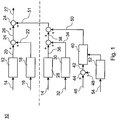
- a control and regulating structure 10 for a diesel engine is in Fig. 1 shown.
- the control and regulating structure 10 may be implemented, for example, in the form of software or electronic circuitry as part of an engine management system.
- the illustrated block diagram of the control structure 10 is repeated according to the number of post-injections used; Further, it is applicable to the timing, ie, the start of injection and the duration of injection, as well as the amount of post-injections.
- the illustrated control structure 10 comprises three main elements: In its simplest form, a post-injection map 12 is used depending on engine operating signals 14 (engine speed / engine torque).
- the post-injection signal is calibrated to the required regeneration temperature in steady-state operation.
- the steady state calibration for the time or amount of post injection is corrected via a correction map 18 based on environmental conditions such as engine temperature (coolant water temperature, cylinder head temperature) and ambient temperature and air pressure.
- the correction map 18 receives an ambient signal 16.
- the post-injection map 12 generates a post-injection signal 20 and the correction map 18 a correction signal 22. Both signals 20 and 22 are summed by an adder 24 to a Nacheinspritzêtsignal 26 which determines the timing and the amount of post-injection.
- the post-injection control signal 26 is controlled (by elements 12, 18 and 24 above the dashed line). The structure explained above is applicable for any number of separate post-injections.
- the simple post-injection strategy explained above comprises further additional correction elements for a transient driving operation.
- a correction signal 51 is generated, which in turn is formed from a transient and Lucaspfadkorrektursignal 38 and a regulator signal 50.
- the correction signal 51 is added to the post-injection control signal 26 by means of an adder 24 to a corrected Nacheinspritzêtsignal 27.
- the generation of the correction signal 51 will now be explained below.
- a transient correction map 28 is active during transient driving conditions and as in FIG Fig. 1 1 illustrates a function of the engine operating condition provided in the form of engine operating signals 14. During transient driving conditions, it has been found that the temperature objectives of stationary driving are often not achieved.
- the exhaust gas temperature remains at a lower level, often 50 to 100 ° C lower than required.
- An airpath correction map 30 processes deviations 32 in the airpath parameters and generates an airpath correction signal 34 for intake manifold pressure, mass airflow, and / or intake manifold temperature.
- the injection maps for stationary driving are usually for a certain target pressure optimized. During transient driving, deviations from the required target pressure occur, so that the original post-injection parameter is no longer optimal. Instead, a different post-injection timing and / or amount must be used to maintain the optimum exhaust gas temperature.
- a temperature correction control unit 40 constitutes a control term which regulates the transient correction by means of a control signal 50 in response to a temperature difference signal 42 between a setpoint temperature in the form of a corresponding desired temperature signal 46 and a measurement temperature in the form of a temperature measurement signal 48.
- the temperature difference signal 42 is determined by means of a subtractor 44 from the desired temperature signal 46 and the temperature measurement signal 48. No additional heating or transient corrections are necessary if the target temperature has already been reached, and the controller signal 50 would assume the value zero.
- a control limiter 52 is provided to ensure that the critical thermal limits of the various components are not exceeded. Therefore, a permissible maximum value for the control correction factor is calculated as a function of the measured exhaust gas temperature in the form of an exhaust gas temperature measurement signal 54 over the critical limits (turbine inlet temperature, catalyst temperature, exothermic reaction in the catalyst, etc.).
- the maximum limit of the controller signal 50 is set to zero when the measured temperatures reach their steady driving limits (maximum catalyst outlet temperature typically around 650 ° C and maximum turbine inlet temperature typically around 750-800 ° C).
Landscapes
- Engineering & Computer Science (AREA)
- Chemical & Material Sciences (AREA)
- Combustion & Propulsion (AREA)
- Mechanical Engineering (AREA)
- General Engineering & Computer Science (AREA)
- Exhaust Gas After Treatment (AREA)
- Electrical Control Of Air Or Fuel Supplied To Internal-Combustion Engine (AREA)
Claims (1)
- Procédé de régénération d'un dispositif de post-traitement des gaz d'échappement dans le système d'échappement d'un moteur à combustion interne, notamment d'un filtre à particules dans le système d'échappement d'un moteur diesel, la température et/ou la concentration d'hydrocarbures des gaz d'échappement étant augmentée(s) par au moins deux post-injections de carburant dans le temps moteur du moteur à combustion interne, un instant et la quantité de carburant de chacune des au moins deux post-injections étant régulés en fonction d'une différence de température entre une température de consigne et une température mesurée des gaz d'échappement du moteur à combustion interne, un diagramme caractéristique de post-injection (12) étant utilisé en fonction de signaux de fonctionnement du moteur (14), lequel étalonne un signal de post-injection (20) à la température de régénération exigée en régime stationnaire, cet étalonnage en régime stationnaire pour l'instant et la quantité de la post-injection étant corrigé par le biais d'un diagramme caractéristique de correction (18), un signal de commande de post-injection (26) étant généré avec le signal de post-injection (20) et un signal de correction (22) généré avec le diagramme caractéristique de correction (18) en additionnant le signal de post-injection (20) et le signal de correction (22) dans un additionneur (24), le signal de commande de post-injection (26) déterminant l'instant, c'est-à-dire le début de l'injection ainsi que la durée de l'injection et la quantité des post-injections, caractérisé en ce que
un diagramme caractéristique de correction de transitoire (28) est actif pendant des conditions de régime de déplacement transitoire, lequel génère un signal de correction de transitoire (36) et corrige l'instant et la quantité de carburant de chacune des au moins deux post-injections en régime transitoire en fonction de conditions de fonctionnement transitoires, un diagramme caractéristique de correction de trajet d'air (30) générant un signal de correction de trajet d'air (34), le signal de correction de transitoire (36) et le signal de correction de trajet d'air (34) étant regroupés dans un additionneur en un signal de correction de transitoire et de trajet d'air (38), et un signal de différence de température (42) étant déterminé au moyen d'un soustracteur (44) à partir d'un signal de température de consigne (46) et d'un signal de mesure de température (48) des gaz d'échappement, puis acheminé à une unité de régulation de température (40) qui est en liaison avec un limiteur de régulation (52), lequel calcule un facteur de correction de régulation à partir d'un signal de mesure de température des gaz d'échappement (54) et l'achemine à l'unité de régulation de température (40), laquelle détermine un signal de régulation (50) qui est regroupé avec le signal de correction de transitoire et de trajet d'air (38) en un signal de correction (51), le signal de correction (51) étant généré pour un régime de déplacement transitoire et le signal de correction (51) étant additionné conjointement avec le signal de commande de post-injection (26), au moyen d'un additionneur (24), en un signal de commande de post-injection corrigé (27).
Priority Applications (1)
| Application Number | Priority Date | Filing Date | Title |
|---|---|---|---|
| EP05104883.3A EP1584809B1 (fr) | 2003-11-19 | 2003-11-19 | Procédé pour la régénération d'un équipement de post traitement des gaz d'échappement |
Applications Claiming Priority (2)
| Application Number | Priority Date | Filing Date | Title |
|---|---|---|---|
| EP05104883.3A EP1584809B1 (fr) | 2003-11-19 | 2003-11-19 | Procédé pour la régénération d'un équipement de post traitement des gaz d'échappement |
| EP03104278A EP1533500B1 (fr) | 2003-11-19 | 2003-11-19 | Procédé et dispositif pour régénération d'un équipement de post traitement des gaz d'échappement |
Related Parent Applications (2)
| Application Number | Title | Priority Date | Filing Date |
|---|---|---|---|
| EP03104278.1 Division | 2003-11-19 | ||
| EP03104278A Division EP1533500B1 (fr) | 2003-11-19 | 2003-11-19 | Procédé et dispositif pour régénération d'un équipement de post traitement des gaz d'échappement |
Publications (2)
| Publication Number | Publication Date |
|---|---|
| EP1584809A1 EP1584809A1 (fr) | 2005-10-12 |
| EP1584809B1 true EP1584809B1 (fr) | 2018-10-17 |
Family
ID=34429510
Family Applications (2)
| Application Number | Title | Priority Date | Filing Date |
|---|---|---|---|
| EP03104278A Expired - Lifetime EP1533500B1 (fr) | 2003-11-19 | 2003-11-19 | Procédé et dispositif pour régénération d'un équipement de post traitement des gaz d'échappement |
| EP05104883.3A Expired - Lifetime EP1584809B1 (fr) | 2003-11-19 | 2003-11-19 | Procédé pour la régénération d'un équipement de post traitement des gaz d'échappement |
Family Applications Before (1)
| Application Number | Title | Priority Date | Filing Date |
|---|---|---|---|
| EP03104278A Expired - Lifetime EP1533500B1 (fr) | 2003-11-19 | 2003-11-19 | Procédé et dispositif pour régénération d'un équipement de post traitement des gaz d'échappement |
Country Status (2)
| Country | Link |
|---|---|
| EP (2) | EP1533500B1 (fr) |
| DE (1) | DE50309107D1 (fr) |
Families Citing this family (11)
| Publication number | Priority date | Publication date | Assignee | Title |
|---|---|---|---|---|
| JP4301070B2 (ja) * | 2004-04-30 | 2009-07-22 | 株式会社デンソー | 内燃機関の排気浄化装置 |
| US8261535B2 (en) | 2005-06-30 | 2012-09-11 | GM Global Technology Operations LLC | Enhanced post injection control system for diesel particulate filters |
| JP3933172B2 (ja) * | 2005-07-15 | 2007-06-20 | いすゞ自動車株式会社 | 排気ガス浄化システムの制御方法及び排気ガス浄化システム |
| JP4776566B2 (ja) * | 2007-02-28 | 2011-09-21 | 本田技研工業株式会社 | 内燃機関の燃料制御装置 |
| US8479495B2 (en) | 2009-03-03 | 2013-07-09 | GM Global Technology Operations LLC | Environmental factor based particulate filter regeneration |
| US9574483B2 (en) | 2010-01-14 | 2017-02-21 | GM Global Technology Operations LLC | System and method for controlling exhaust gas temperature during particulate matter filter regeneration |
| DE102014202050A1 (de) * | 2014-02-05 | 2015-08-06 | Volkswagen Aktiengesellschaft | Verfahren zur Regeneration eines Partikelfilters eines Verbrennungsmotors sowie entsprechend ausgestaltete Steuermittel und Fahrzeug |
| JP6129097B2 (ja) * | 2014-02-26 | 2017-05-17 | ヤンマー株式会社 | ディーゼルエンジン |
| DE102018214856A1 (de) * | 2018-08-31 | 2020-03-05 | Robert Bosch Gmbh | Verfahren und Computerprogrammprodukt zum Betrieb einer Brennkraftmaschine mit unterschiedlichen Kraftstoffen |
| WO2020187415A1 (fr) * | 2019-03-20 | 2020-09-24 | Volvo Penta Corporation | Procédé et système de commande d'un moteur à combustion interne |
| CN115045774B (zh) * | 2021-11-19 | 2025-02-18 | 长城汽车股份有限公司 | 一种lnt的脱硫的方法、系统、电子设备和介质 |
Family Cites Families (10)
| Publication number | Priority date | Publication date | Assignee | Title |
|---|---|---|---|---|
| EP0621400B1 (fr) * | 1993-04-23 | 1999-03-31 | Daimler-Benz Aktiengesellschaft | Moteur à combustion interne à injection et à compression d'air avec un dispositif pout traiter les gaz d'échappement à fin de réduire les oxides azoté |
| CN1077212C (zh) * | 1996-07-02 | 2002-01-02 | 三菱自动车工业株式会社 | 缸内喷射内燃机用废气加热系统 |
| US6546721B2 (en) * | 2000-04-18 | 2003-04-15 | Toyota Jidosha Kabushiki Kaisha | Exhaust gas purification device |
| DE10033158C1 (de) * | 2000-07-07 | 2001-12-20 | Daimler Chrysler Ag | Brennkraftmaschine, insbesondere für Kraftfahrzeuge |
| DE10066237B4 (de) * | 2000-07-07 | 2011-06-22 | Daimler AG, 70327 | Verfahren zur Regeneration eines Partikelfilters einer Kraftfahrzeug-Brennkraftmaschine |
| JP4505702B2 (ja) * | 2000-12-01 | 2010-07-21 | マツダ株式会社 | ディーゼルエンジンの燃料噴射制御装置 |
| DE60212079T2 (de) * | 2001-02-20 | 2006-12-07 | Isuzu Motors Ltd. | Verfahren zur Steuerung der Kraftstoffeinspritzung für Dieselmotoren und Regenerationssteuerungsverfahren für Abgasnachbehandlungsvorrichtung |
| US6536209B2 (en) * | 2001-06-26 | 2003-03-25 | Caterpillar Inc | Post injections during cold operation |
| ITTO20010786A1 (it) * | 2001-08-03 | 2003-02-03 | Fiat Ricerche | Metodo di autoinnesco della rigenerazione di un filtro particolato per un motore diesel ad iniezione diretta provvisto di un impianto di ini |
| DE50110758D1 (de) * | 2001-09-25 | 2006-09-28 | Ford Global Tech Llc | Vorrichtung und Verfahren zur Regeneration einer Abgasbehandlungseinrichtung |
-
2003
- 2003-11-19 DE DE50309107T patent/DE50309107D1/de not_active Expired - Lifetime
- 2003-11-19 EP EP03104278A patent/EP1533500B1/fr not_active Expired - Lifetime
- 2003-11-19 EP EP05104883.3A patent/EP1584809B1/fr not_active Expired - Lifetime
Non-Patent Citations (1)
| Title |
|---|
| None * |
Also Published As
| Publication number | Publication date |
|---|---|
| DE50309107D1 (de) | 2008-03-20 |
| EP1533500B1 (fr) | 2008-01-30 |
| EP1533500A1 (fr) | 2005-05-25 |
| EP1584809A1 (fr) | 2005-10-12 |
Similar Documents
| Publication | Publication Date | Title |
|---|---|---|
| EP1121513B1 (fr) | Procede de reduction des oxydes d'azote dans les gaz d'echappement d'un moteur a combustion interne fonctionnant avec un melange pauvre | |
| EP4095364B1 (fr) | Procédé permettant de faire fonctionner un moteur à combustion interne | |
| DE60221913T2 (de) | Kraftstoffinjektionssteuerverfahren für einen Dieselmotor und regeneratives Steuerverfahren für Abgasnach behandlungseinrichtung | |
| EP1161618B1 (fr) | Procede de desulfatage d'un catalyseur accumulateur de nox | |
| DE102012022153B4 (de) | Verfahren zur Regeneration mindestens eines Partikelfilters, Steuereinrichtung und Kraftfahrzeug mit einer solchen | |
| DE60021447T2 (de) | Brennkraftmaschine mit Direkteinspritzung | |
| DE102016207667B4 (de) | Verfahren und Vorrichtung zur Regeneration eines Partikelfilters bei einem Kraftfahrzeug mit Hybridantrieb | |
| DE102010017575B4 (de) | Verfahren zum Betreiben einer fremdgezündeten Brennkraftmaschine und Brennkraftmaschine zur Durchführung eines derartigen Verfahrens | |
| WO2000023702A1 (fr) | PROCEDE ET DISPOSITIF DE DESULFURATION D'UN CATALYSEUR A ACCUMULATION DE NO¿x? | |
| DE102010009682A1 (de) | Steuerung der Nacheinspritz-Kraftstoffrate zur Partikelfilterregeneration | |
| DE102021203678A1 (de) | Verfahren und Recheneinheit zum Betreiben eines Abgasbrenners | |
| EP1533500B1 (fr) | Procédé et dispositif pour régénération d'un équipement de post traitement des gaz d'échappement | |
| EP4430289B1 (fr) | Procédé pour faire fonctionner un moteur à combustion interne, système pour la mise en oeuvre dudit procédé et moteur à combustion interne | |
| DE102011105601B4 (de) | Steuersystem zur Regeneration eines Partikelmaterialfilters unter Verwendung eines katalytischen Wandlers als einer Verbrennungseinrichtung | |
| DE102006007122A1 (de) | Verfahren zum Betreiben eines Verbrennungsmotors und einer daran angeschlossenen Abgasnachbehandlungseinrichtung | |
| DE10339005A1 (de) | Abgasreinigungsverfahren für Verbrennungsmtoor | |
| DE112013004543T5 (de) | Regelung einer Temperatur in einem Abgasnachbehandlungssystem | |
| DE102015209979B4 (de) | Verfahren zum Bestimmen eines Hybridantrieb-Drehmomentschwellwertes, zum Betrieb einer Hybridantriebsvorrichtung und Hybridfahrzeug | |
| DE10158740B4 (de) | Verfahren und Anordnung zur Erzeugung zusätzlicher Motorlasten beim Start | |
| DE202015000385U1 (de) | Kraftfahrzeug | |
| DE10222769A1 (de) | Verfahren und Vorrichtung zur Steuerung eines Motorstartvorgangs | |
| WO2006072499A2 (fr) | Procede pour reduire les emissions d'un vehicule automobile en influant sur la puissance de l'alternateur | |
| DE102022121068A1 (de) | Abgasregelung für Motoren mit magerer Verbrennung | |
| EP1108875B1 (fr) | Procédé de chauffage d'un catalyseur pour un moteur a combustion interne fonctionnant avec un mélange pauvre en particulier au ralenti | |
| DE102009045088B4 (de) | Verfahren zur Steuerung eines Verbrennungsmotors in Verbindung mit einer exothermen Regeneration einer Abgasnachbehandlungkomponente |
Legal Events
| Date | Code | Title | Description |
|---|---|---|---|
| PUAI | Public reference made under article 153(3) epc to a published international application that has entered the european phase |
Free format text: ORIGINAL CODE: 0009012 |
|
| AC | Divisional application: reference to earlier application |
Ref document number: 1533500 Country of ref document: EP Kind code of ref document: P |
|
| AK | Designated contracting states |
Kind code of ref document: A1 Designated state(s): AT BE BG CH CY CZ DE DK EE ES FI FR GB GR HU IE IT LI LU MC NL PT RO SE SI SK TR |
|
| AX | Request for extension of the european patent |
Extension state: AL LT LV MK |
|
| RIN1 | Information on inventor provided before grant (corrected) |
Inventor name: YACOUB, YASSER MOHAMMED SAYED Inventor name: KUENSTLER, JOHANNES Inventor name: MORAAL, PAUL EDUARD |
|
| RAP1 | Party data changed (applicant data changed or rights of an application transferred) |
Owner name: FORD GLOBAL TECHNOLOGIES, LLC. |
|
| 17P | Request for examination filed |
Effective date: 20060412 |
|
| AKX | Designation fees paid |
Designated state(s): DE FR GB |
|
| 17Q | First examination report despatched |
Effective date: 20070724 |
|
| RIC1 | Information provided on ipc code assigned before grant |
Ipc: F02D 41/40 19850101ALI20180525BHEP Ipc: F02D 41/10 19850101ALN20180525BHEP Ipc: F02D 41/18 19850101ALN20180525BHEP Ipc: F02D 41/02 19850101AFI20180525BHEP Ipc: F02D 41/14 19850101ALN20180525BHEP |
|
| GRAP | Despatch of communication of intention to grant a patent |
Free format text: ORIGINAL CODE: EPIDOSNIGR1 |
|
| INTG | Intention to grant announced |
Effective date: 20180719 |
|
| GRAS | Grant fee paid |
Free format text: ORIGINAL CODE: EPIDOSNIGR3 |
|
| GRAA | (expected) grant |
Free format text: ORIGINAL CODE: 0009210 |
|
| AC | Divisional application: reference to earlier application |
Ref document number: 1533500 Country of ref document: EP Kind code of ref document: P |
|
| AK | Designated contracting states |
Kind code of ref document: B1 Designated state(s): DE FR GB |
|
| REG | Reference to a national code |
Ref country code: GB Ref legal event code: FG4D Free format text: NOT ENGLISH |
|
| REG | Reference to a national code |
Ref country code: DE Ref legal event code: R096 Ref document number: 50315794 Country of ref document: DE |
|
| REG | Reference to a national code |
Ref country code: DE Ref legal event code: R097 Ref document number: 50315794 Country of ref document: DE |
|
| PLBE | No opposition filed within time limit |
Free format text: ORIGINAL CODE: 0009261 |
|
| STAA | Information on the status of an ep patent application or granted ep patent |
Free format text: STATUS: NO OPPOSITION FILED WITHIN TIME LIMIT |
|
| 26N | No opposition filed |
Effective date: 20190718 |
|
| PGFP | Annual fee paid to national office [announced via postgrant information from national office to epo] |
Ref country code: FR Payment date: 20191029 Year of fee payment: 17 |
|
| PGFP | Annual fee paid to national office [announced via postgrant information from national office to epo] |
Ref country code: GB Payment date: 20191029 Year of fee payment: 17 |
|
| GBPC | Gb: european patent ceased through non-payment of renewal fee |
Effective date: 20201119 |
|
| PG25 | Lapsed in a contracting state [announced via postgrant information from national office to epo] |
Ref country code: FR Free format text: LAPSE BECAUSE OF NON-PAYMENT OF DUE FEES Effective date: 20201130 |
|
| PG25 | Lapsed in a contracting state [announced via postgrant information from national office to epo] |
Ref country code: GB Free format text: LAPSE BECAUSE OF NON-PAYMENT OF DUE FEES Effective date: 20201119 |
|
| PGFP | Annual fee paid to national office [announced via postgrant information from national office to epo] |
Ref country code: DE Payment date: 20220615 Year of fee payment: 20 |
|
| P01 | Opt-out of the competence of the unified patent court (upc) registered |
Effective date: 20230620 |
|
| REG | Reference to a national code |
Ref country code: DE Ref legal event code: R071 Ref document number: 50315794 Country of ref document: DE |