EP1584809B1 - Method for regeneration of an exhaust gas aftertreatment device - Google Patents
Method for regeneration of an exhaust gas aftertreatment device Download PDFInfo
- Publication number
- EP1584809B1 EP1584809B1 EP05104883.3A EP05104883A EP1584809B1 EP 1584809 B1 EP1584809 B1 EP 1584809B1 EP 05104883 A EP05104883 A EP 05104883A EP 1584809 B1 EP1584809 B1 EP 1584809B1
- Authority
- EP
- European Patent Office
- Prior art keywords
- post
- injection
- signal
- temperature
- transient
- Prior art date
- Legal status (The legal status is an assumption and is not a legal conclusion. Google has not performed a legal analysis and makes no representation as to the accuracy of the status listed.)
- Expired - Lifetime
Links
- 230000008929 regeneration Effects 0.000 title claims description 22
- 238000011069 regeneration method Methods 0.000 title claims description 22
- 238000000034 method Methods 0.000 title claims description 10
- 238000002347 injection Methods 0.000 claims description 125
- 239000007924 injection Substances 0.000 claims description 125
- 238000012937 correction Methods 0.000 claims description 51
- 239000007789 gas Substances 0.000 claims description 48
- 230000001052 transient effect Effects 0.000 claims description 39
- 238000002485 combustion reaction Methods 0.000 claims description 28
- 239000000446 fuel Substances 0.000 claims description 28
- 229930195733 hydrocarbon Natural products 0.000 claims description 16
- 150000002430 hydrocarbons Chemical class 0.000 claims description 16
- 238000009529 body temperature measurement Methods 0.000 claims description 7
- 239000002245 particle Substances 0.000 claims description 7
- 239000004215 Carbon black (E152) Substances 0.000 claims description 4
- 230000001419 dependent effect Effects 0.000 claims 3
- 230000001172 regenerating effect Effects 0.000 claims 1
- 239000003054 catalyst Substances 0.000 description 15
- 239000003570 air Substances 0.000 description 10
- 229910052760 oxygen Inorganic materials 0.000 description 10
- 239000001301 oxygen Substances 0.000 description 10
- 239000002816 fuel additive Substances 0.000 description 8
- QVGXLLKOCUKJST-UHFFFAOYSA-N atomic oxygen Chemical compound [O] QVGXLLKOCUKJST-UHFFFAOYSA-N 0.000 description 7
- 238000010586 diagram Methods 0.000 description 6
- 206010053615 Thermal burn Diseases 0.000 description 5
- 238000006243 chemical reaction Methods 0.000 description 4
- 230000007613 environmental effect Effects 0.000 description 4
- 238000010438 heat treatment Methods 0.000 description 4
- 230000001105 regulatory effect Effects 0.000 description 4
- MYMOFIZGZYHOMD-UHFFFAOYSA-N Dioxygen Chemical compound O=O MYMOFIZGZYHOMD-UHFFFAOYSA-N 0.000 description 3
- 238000005259 measurement Methods 0.000 description 3
- 230000003647 oxidation Effects 0.000 description 3
- 238000007254 oxidation reaction Methods 0.000 description 3
- 239000004071 soot Substances 0.000 description 3
- OKTJSMMVPCPJKN-UHFFFAOYSA-N Carbon Chemical compound [C] OKTJSMMVPCPJKN-UHFFFAOYSA-N 0.000 description 2
- 239000012080 ambient air Substances 0.000 description 2
- 229910052799 carbon Inorganic materials 0.000 description 2
- 230000003197 catalytic effect Effects 0.000 description 2
- 239000002826 coolant Substances 0.000 description 2
- 230000007935 neutral effect Effects 0.000 description 2
- 230000000638 stimulation Effects 0.000 description 2
- 238000011144 upstream manufacturing Methods 0.000 description 2
- XLYOFNOQVPJJNP-UHFFFAOYSA-N water Substances O XLYOFNOQVPJJNP-UHFFFAOYSA-N 0.000 description 2
- 238000013459 approach Methods 0.000 description 1
- 230000015572 biosynthetic process Effects 0.000 description 1
- 230000008859 change Effects 0.000 description 1
- 239000000498 cooling water Substances 0.000 description 1
- 238000006477 desulfuration reaction Methods 0.000 description 1
- 230000023556 desulfurization Effects 0.000 description 1
- 238000010790 dilution Methods 0.000 description 1
- 239000012895 dilution Substances 0.000 description 1
- 239000000295 fuel oil Substances 0.000 description 1
- 238000004519 manufacturing process Methods 0.000 description 1
- 239000000203 mixture Substances 0.000 description 1
- 238000012544 monitoring process Methods 0.000 description 1
- 238000002360 preparation method Methods 0.000 description 1
- 230000008569 process Effects 0.000 description 1
- 230000004044 response Effects 0.000 description 1
- 230000035945 sensitivity Effects 0.000 description 1
- 238000003860 storage Methods 0.000 description 1
- 230000007704 transition Effects 0.000 description 1
Images

Classifications
-
- F—MECHANICAL ENGINEERING; LIGHTING; HEATING; WEAPONS; BLASTING
- F02—COMBUSTION ENGINES; HOT-GAS OR COMBUSTION-PRODUCT ENGINE PLANTS
- F02D—CONTROLLING COMBUSTION ENGINES
- F02D41/00—Electrical control of supply of combustible mixture or its constituents
- F02D41/30—Controlling fuel injection
- F02D41/38—Controlling fuel injection of the high pressure type
- F02D41/40—Controlling fuel injection of the high pressure type with means for controlling injection timing or duration
- F02D41/402—Multiple injections
- F02D41/405—Multiple injections with post injections
-
- F—MECHANICAL ENGINEERING; LIGHTING; HEATING; WEAPONS; BLASTING
- F02—COMBUSTION ENGINES; HOT-GAS OR COMBUSTION-PRODUCT ENGINE PLANTS
- F02D—CONTROLLING COMBUSTION ENGINES
- F02D41/00—Electrical control of supply of combustible mixture or its constituents
- F02D41/02—Circuit arrangements for generating control signals
- F02D41/021—Introducing corrections for particular conditions exterior to the engine
- F02D41/0235—Introducing corrections for particular conditions exterior to the engine in relation with the state of the exhaust gas treating apparatus
- F02D41/027—Introducing corrections for particular conditions exterior to the engine in relation with the state of the exhaust gas treating apparatus to purge or regenerate the exhaust gas treating apparatus
- F02D41/029—Introducing corrections for particular conditions exterior to the engine in relation with the state of the exhaust gas treating apparatus to purge or regenerate the exhaust gas treating apparatus the exhaust gas treating apparatus being a particulate filter
-
- F—MECHANICAL ENGINEERING; LIGHTING; HEATING; WEAPONS; BLASTING
- F02—COMBUSTION ENGINES; HOT-GAS OR COMBUSTION-PRODUCT ENGINE PLANTS
- F02D—CONTROLLING COMBUSTION ENGINES
- F02D41/00—Electrical control of supply of combustible mixture or its constituents
- F02D41/30—Controlling fuel injection
- F02D41/38—Controlling fuel injection of the high pressure type
- F02D2041/389—Controlling fuel injection of the high pressure type for injecting directly into the cylinder
-
- F—MECHANICAL ENGINEERING; LIGHTING; HEATING; WEAPONS; BLASTING
- F02—COMBUSTION ENGINES; HOT-GAS OR COMBUSTION-PRODUCT ENGINE PLANTS
- F02D—CONTROLLING COMBUSTION ENGINES
- F02D2200/00—Input parameters for engine control
- F02D2200/02—Input parameters for engine control the parameters being related to the engine
- F02D2200/04—Engine intake system parameters
- F02D2200/0406—Intake manifold pressure
-
- F—MECHANICAL ENGINEERING; LIGHTING; HEATING; WEAPONS; BLASTING
- F02—COMBUSTION ENGINES; HOT-GAS OR COMBUSTION-PRODUCT ENGINE PLANTS
- F02D—CONTROLLING COMBUSTION ENGINES
- F02D2200/00—Input parameters for engine control
- F02D2200/02—Input parameters for engine control the parameters being related to the engine
- F02D2200/04—Engine intake system parameters
- F02D2200/0414—Air temperature
-
- F—MECHANICAL ENGINEERING; LIGHTING; HEATING; WEAPONS; BLASTING
- F02—COMBUSTION ENGINES; HOT-GAS OR COMBUSTION-PRODUCT ENGINE PLANTS
- F02D—CONTROLLING COMBUSTION ENGINES
- F02D2200/00—Input parameters for engine control
- F02D2200/70—Input parameters for engine control said parameters being related to the vehicle exterior
- F02D2200/703—Atmospheric pressure
-
- F—MECHANICAL ENGINEERING; LIGHTING; HEATING; WEAPONS; BLASTING
- F02—COMBUSTION ENGINES; HOT-GAS OR COMBUSTION-PRODUCT ENGINE PLANTS
- F02D—CONTROLLING COMBUSTION ENGINES
- F02D41/00—Electrical control of supply of combustible mixture or its constituents
- F02D41/02—Circuit arrangements for generating control signals
- F02D41/021—Introducing corrections for particular conditions exterior to the engine
- F02D41/0235—Introducing corrections for particular conditions exterior to the engine in relation with the state of the exhaust gas treating apparatus
- F02D41/024—Introducing corrections for particular conditions exterior to the engine in relation with the state of the exhaust gas treating apparatus to increase temperature of the exhaust gas treating apparatus
- F02D41/0245—Introducing corrections for particular conditions exterior to the engine in relation with the state of the exhaust gas treating apparatus to increase temperature of the exhaust gas treating apparatus by increasing temperature of the exhaust gas leaving the engine
-
- F—MECHANICAL ENGINEERING; LIGHTING; HEATING; WEAPONS; BLASTING
- F02—COMBUSTION ENGINES; HOT-GAS OR COMBUSTION-PRODUCT ENGINE PLANTS
- F02D—CONTROLLING COMBUSTION ENGINES
- F02D41/00—Electrical control of supply of combustible mixture or its constituents
- F02D41/02—Circuit arrangements for generating control signals
- F02D41/021—Introducing corrections for particular conditions exterior to the engine
- F02D41/0235—Introducing corrections for particular conditions exterior to the engine in relation with the state of the exhaust gas treating apparatus
- F02D41/024—Introducing corrections for particular conditions exterior to the engine in relation with the state of the exhaust gas treating apparatus to increase temperature of the exhaust gas treating apparatus
- F02D41/025—Introducing corrections for particular conditions exterior to the engine in relation with the state of the exhaust gas treating apparatus to increase temperature of the exhaust gas treating apparatus by changing the composition of the exhaust gas, e.g. for exothermic reaction on exhaust gas treating apparatus
-
- F—MECHANICAL ENGINEERING; LIGHTING; HEATING; WEAPONS; BLASTING
- F02—COMBUSTION ENGINES; HOT-GAS OR COMBUSTION-PRODUCT ENGINE PLANTS
- F02D—CONTROLLING COMBUSTION ENGINES
- F02D41/00—Electrical control of supply of combustible mixture or its constituents
- F02D41/02—Circuit arrangements for generating control signals
- F02D41/04—Introducing corrections for particular operating conditions
- F02D41/10—Introducing corrections for particular operating conditions for acceleration
- F02D41/107—Introducing corrections for particular operating conditions for acceleration and deceleration
-
- F—MECHANICAL ENGINEERING; LIGHTING; HEATING; WEAPONS; BLASTING
- F02—COMBUSTION ENGINES; HOT-GAS OR COMBUSTION-PRODUCT ENGINE PLANTS
- F02D—CONTROLLING COMBUSTION ENGINES
- F02D41/00—Electrical control of supply of combustible mixture or its constituents
- F02D41/02—Circuit arrangements for generating control signals
- F02D41/14—Introducing closed-loop corrections
- F02D41/1438—Introducing closed-loop corrections using means for determining characteristics of the combustion gases; Sensors therefor
- F02D41/1444—Introducing closed-loop corrections using means for determining characteristics of the combustion gases; Sensors therefor characterised by the characteristics of the combustion gases
- F02D41/1446—Introducing closed-loop corrections using means for determining characteristics of the combustion gases; Sensors therefor characterised by the characteristics of the combustion gases the characteristics being exhaust temperatures
-
- F—MECHANICAL ENGINEERING; LIGHTING; HEATING; WEAPONS; BLASTING
- F02—COMBUSTION ENGINES; HOT-GAS OR COMBUSTION-PRODUCT ENGINE PLANTS
- F02D—CONTROLLING COMBUSTION ENGINES
- F02D41/00—Electrical control of supply of combustible mixture or its constituents
- F02D41/02—Circuit arrangements for generating control signals
- F02D41/18—Circuit arrangements for generating control signals by measuring intake air flow
- F02D41/187—Circuit arrangements for generating control signals by measuring intake air flow using a hot wire flow sensor
-
- Y—GENERAL TAGGING OF NEW TECHNOLOGICAL DEVELOPMENTS; GENERAL TAGGING OF CROSS-SECTIONAL TECHNOLOGIES SPANNING OVER SEVERAL SECTIONS OF THE IPC; TECHNICAL SUBJECTS COVERED BY FORMER USPC CROSS-REFERENCE ART COLLECTIONS [XRACs] AND DIGESTS
- Y02—TECHNOLOGIES OR APPLICATIONS FOR MITIGATION OR ADAPTATION AGAINST CLIMATE CHANGE
- Y02T—CLIMATE CHANGE MITIGATION TECHNOLOGIES RELATED TO TRANSPORTATION
- Y02T10/00—Road transport of goods or passengers
- Y02T10/10—Internal combustion engine [ICE] based vehicles
- Y02T10/40—Engine management systems
Definitions
- the invention relates to a method for the regeneration of an exhaust aftertreatment device according to the preamble of claim 1.
- DPF diesel particulate filter
- short particle filters which collect the soot that is emitted from a diesel engine.
- carbon builds up in a particulate filter over time, which adds the filter and thereby reduces filter flow. This in turn increases the back pressure on the diesel engine, which increases fuel consumption. Therefore, the filter must be regenerated from time to time to minimize the cost of fuel consumption associated with increased backpressure. During regeneration, the mass consisting of particles in the particle filter is oxidized.
- Accumulated carbon ignites at relatively high temperatures of about 550 ° C, if there is no catalytic support. Such temperatures are achieved in the particulate filter only at high load and engine speed. Therefore, to increase the exhaust gas temperature to sufficiently high levels in all engine operating conditions, special means must be provided for safe particulate filter operation. There are various approaches to achieve these high exhaust gas temperatures. For example, the engine load can be increased by switching on electrical consumers such as glow plugs of the diesel engine or the rear window heating.
- a post-injection of fuel during the power stroke proven, as for example from the EP 1296050 A1 is known.
- the post-injection that is, the injection of additional fuel into all or some cylinders after the corresponding main injection, but still during the power stroke, is an efficient method for increasing the exhaust gas temperature.
- a part of it may burn in the cylinder and increase both the engine torque and the exhaust gas temperature, whereas another part may leave the engine in the form of unburned hydrocarbons (HC).
- the sensitivity of post injection combustion to injection timing is critical especially at low engine loads.
- the energy released by the combustion of the main injection is quite low. If the post-injection takes place too late, only unburned hydrocarbons are produced. On the other hand, if the post-injection takes place too early, it is completely burned and increases the engine torque without significantly increasing the exhaust gas temperature. Although this increase in torque can be compensated for by reducing the quantity of the main injection, there is a lower limit for injection quantities below which the fuel injection system does not operate with sufficient accuracy. This lower limit is close to the fuel amount of the main injection at low engine load, which is about 4 to 6 mg / stroke in a typical passenger car diesel engine.
- Fig. 2 is a diagram showing the typical temperature profile at the inlet of the DPF during a city trip 50 (transient driving) and during a drive at almost constant speed 52 (stationary driving). At about constant speed, a stationary state is present and a much higher, typically about 50-100 ° C higher temperature can be achieved in contrast to urban driving, occur in the frequent temperature drops due to the transient driving operation by thrust and idle.
- Fig. 3 is a diagram of the temperature profile over the regeneration time for a system with fuel additive 54 and a catalytic coated system 56 shown.
- a drop in the exhaust gas temperature leads to an extension of the required regeneration time, due to the exponential dependence of the regeneration rate on the temperature.
- the EP 1 281 852 relates to a method for regeneration of a particulate filter wherein after a main injection two post-injections are performed.
- the first post-injection in combination with the main injection, causes stable late combustion to achieve a higher temperature of the exhaust gas.
- the second post-injection is carried out after the combustion process, so that unburned hydrocarbons are added to the exhaust gases, which activate a catalyst and improve its effectiveness.
- the DE 100 33 159 A1 relates to an internal combustion engine, in particular for a motor vehicle, with an exhaust gas line, in which a regenerable particle filter is arranged.
- the internal combustion engine comprises a controller which, depending on requirements, enables the regeneration of the particulate filter to be carried out.
- a catalytically active element such as an oxidation catalyst and a temperature sensor is arranged upstream of the particulate filter.
- the temperature sensor is connected to the controller and determines a temperature actual value.
- a fuel injection device is provided, which allows the implementation of Nachspritzvor réellen.
- the controller for performing the regeneration of the particulate filter actuates the fuel injection device for performing the Nachspritzvor réelle.
- the controller performs a comparison of the actual temperature value with a predetermined temperature setpoint and regulates the fuel injection device in dependence of this comparison.
- a timing and fuel amount of each of the at least two post-injections may be set depending on engine operating conditions such as engine temperature, engine speed, torque, cooling water temperature, and / or cylinder head temperature. Further, the timing and amount of fuel of each of the at least two post-injections may be adjusted depending on ambient conditions of the engine such as ambient temperature and / or ambient air pressure. In addition, the timing and the fuel amount of each of the at least two post-injections can be corrected depending on transient operating conditions of the internal combustion engine. The timing and fuel amount of each of the at least two post-injections may also be corrected depending on a deviation in the air path of the internal combustion engine. According to the invention, it is possible to regulate the time and the fuel quantity of each of the at least two post-injections as a function of a temperature difference between a setpoint and a measurement temperature of the exhaust gases of the internal combustion engine.
- a correction of injection start and fuel quantity of each of the at least two post-injections is limited depending on the temperature difference between the target and the measurement temperature of the exhaust gases of the internal combustion engine such that no critical exhaust gas temperatures are exceeded.
- control structure includes a post-injection map configured to adjust the timing and fuel quantity of each of the at least two post-injections in steady-state operation depending on engine operating conditions such as engine temperature, engine speed, torque, coolant water temperature, and / or cylinder head temperature.
- the post-injection signals of the stationary calibrated maps are also used in transient operation.
- control control structure comprises a correction map, which is designed to adjust the time and the fuel quantity of each of the at least two post-injections in steady-state operation depending on environmental conditions of the internal combustion engine such as ambient temperature and / or ambient air pressure.
- the control structure also includes a transient correction map configured to correct the timing and fuel quantity of each of the at least two post-injections in transient operation depending on transient engine operating conditions.
- Transient operation will generally be the transition from one to the next Engine operating point (engine speed / engine torque) understood, but also For example, an operation with frequently and rapidly changing engine speed and a changing engine torque, such as occurs in a transient driving operation of a motor vehicle in city traffic.
- the control structure also includes an air path correction map configured to correct the timing and fuel amount of each of the at least two post injections depending on a deviation in the air path of the internal combustion engine.
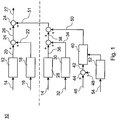
- a control and regulating structure 10 for a diesel engine is in Fig. 1 shown.
- the control and regulating structure 10 may be implemented, for example, in the form of software or electronic circuitry as part of an engine management system.
- the illustrated block diagram of the control structure 10 is repeated according to the number of post-injections used; Further, it is applicable to the timing, ie, the start of injection and the duration of injection, as well as the amount of post-injections.
- the illustrated control structure 10 comprises three main elements: In its simplest form, a post-injection map 12 is used depending on engine operating signals 14 (engine speed / engine torque).
- the post-injection signal is calibrated to the required regeneration temperature in steady-state operation.
- the steady state calibration for the time or amount of post injection is corrected via a correction map 18 based on environmental conditions such as engine temperature (coolant water temperature, cylinder head temperature) and ambient temperature and air pressure.
- the correction map 18 receives an ambient signal 16.
- the post-injection map 12 generates a post-injection signal 20 and the correction map 18 a correction signal 22. Both signals 20 and 22 are summed by an adder 24 to a Nacheinspritzêtsignal 26 which determines the timing and the amount of post-injection.
- the post-injection control signal 26 is controlled (by elements 12, 18 and 24 above the dashed line). The structure explained above is applicable for any number of separate post-injections.
- the simple post-injection strategy explained above comprises further additional correction elements for a transient driving operation.
- a correction signal 51 is generated, which in turn is formed from a transient and Lucaspfadkorrektursignal 38 and a regulator signal 50.
- the correction signal 51 is added to the post-injection control signal 26 by means of an adder 24 to a corrected Nacheinspritzêtsignal 27.
- the generation of the correction signal 51 will now be explained below.
- a transient correction map 28 is active during transient driving conditions and as in FIG Fig. 1 1 illustrates a function of the engine operating condition provided in the form of engine operating signals 14. During transient driving conditions, it has been found that the temperature objectives of stationary driving are often not achieved.
- the exhaust gas temperature remains at a lower level, often 50 to 100 ° C lower than required.
- An airpath correction map 30 processes deviations 32 in the airpath parameters and generates an airpath correction signal 34 for intake manifold pressure, mass airflow, and / or intake manifold temperature.
- the injection maps for stationary driving are usually for a certain target pressure optimized. During transient driving, deviations from the required target pressure occur, so that the original post-injection parameter is no longer optimal. Instead, a different post-injection timing and / or amount must be used to maintain the optimum exhaust gas temperature.
- a temperature correction control unit 40 constitutes a control term which regulates the transient correction by means of a control signal 50 in response to a temperature difference signal 42 between a setpoint temperature in the form of a corresponding desired temperature signal 46 and a measurement temperature in the form of a temperature measurement signal 48.
- the temperature difference signal 42 is determined by means of a subtractor 44 from the desired temperature signal 46 and the temperature measurement signal 48. No additional heating or transient corrections are necessary if the target temperature has already been reached, and the controller signal 50 would assume the value zero.
- a control limiter 52 is provided to ensure that the critical thermal limits of the various components are not exceeded. Therefore, a permissible maximum value for the control correction factor is calculated as a function of the measured exhaust gas temperature in the form of an exhaust gas temperature measurement signal 54 over the critical limits (turbine inlet temperature, catalyst temperature, exothermic reaction in the catalyst, etc.).
- the maximum limit of the controller signal 50 is set to zero when the measured temperatures reach their steady driving limits (maximum catalyst outlet temperature typically around 650 ° C and maximum turbine inlet temperature typically around 750-800 ° C).
Landscapes
- Engineering & Computer Science (AREA)
- Chemical & Material Sciences (AREA)
- Combustion & Propulsion (AREA)
- Mechanical Engineering (AREA)
- General Engineering & Computer Science (AREA)
- Exhaust Gas After Treatment (AREA)
- Electrical Control Of Air Or Fuel Supplied To Internal-Combustion Engine (AREA)
Description
Die Erfindung betrifft ein Verfahren zur Regeneration einer Abgasnachbehandlungseinrichtung nach dem Oberbegriff von Anspruch 1.The invention relates to a method for the regeneration of an exhaust aftertreatment device according to the preamble of claim 1.
Zur Verringerung von schädlichen Emissionen von Brennkraftmaschinen werden in der Regel Abgasnachbehandlungseinrichtungen eingesetzt. Bei Dieselmotoren ist es vor allem aufgrund gesetzlicher Bestimmungen erforderlich, den Ausstoß von Rußpartikeln auf vorgegebene Grenzwerte zu begrenzen. Hierzu sind Diesel-Partikelfilter (DPF) oder kurz Teilchenfilter vorgesehen, welche den Ruß sammeln, der von einem Dieselmotor ausgestoßen wird.
Allerdings wird in einem Teilchenfilter mit der Zeit Kohlenstoff aufgebaut, der den Filter zusetzt und dadurch den Filterdurchfluß verringert. Dies erhöht wiederum den Gegendruck auf den Dieselmotor, wodurch der Kraftstoffverbrauch steigt. Daher muß der Filter von Zeit zu Zeit regeneriert werden, um die Kosten des Kraftstoffverbrauchs zu minimieren, die mit dem erhöhten Gegendruck zusammenhängen.
Bei einer Regeneration wird die aus Teilchen bestehende Masse im Teilchenfilter oxidiert. Angehäufter Kohlenstoff zündet bei relativ hohen Temperaturen von etwa 550°C, falls keine katalytische Unterstützung vorliegt. Derartige Temperaturen werden im Teilchenfilter nur bei hoher Last und Motordrehzahl erreicht. Um die Abgastemperatur auf ausreichend hohe Pegel bei allen Motorbetriebsbedingungen zu erhöhen, müssen daher für einen sicheren Teilchenfilterbetrieb spezielle Mittel vorgesehen sein.
Es existieren verschiedene Ansätze, um diese hohen Abgastemperaturen zu erzielen. Beispielsweise kann die Motorlast durch das Einschalten elektrischer Verbraucher wie beispielsweise von Glühkerzen des Dieselmotors oder der Heckscheibenheizung erhöht werden.In order to reduce harmful emissions from internal combustion engines exhaust aftertreatment devices are used as a rule. For diesel engines, it is mainly due to legal regulations necessary to limit the emission of soot particles to specified limits. For this purpose, diesel particulate filter (DPF) or short particle filters are provided, which collect the soot that is emitted from a diesel engine.
However, carbon builds up in a particulate filter over time, which adds the filter and thereby reduces filter flow. This in turn increases the back pressure on the diesel engine, which increases fuel consumption. Therefore, the filter must be regenerated from time to time to minimize the cost of fuel consumption associated with increased backpressure.
During regeneration, the mass consisting of particles in the particle filter is oxidized. Accumulated carbon ignites at relatively high temperatures of about 550 ° C, if there is no catalytic support. Such temperatures are achieved in the particulate filter only at high load and engine speed. Therefore, to increase the exhaust gas temperature to sufficiently high levels in all engine operating conditions, special means must be provided for safe particulate filter operation.
There are various approaches to achieve these high exhaust gas temperatures. For example, the engine load can be increased by switching on electrical consumers such as glow plugs of the diesel engine or the rear window heating.
Als besonders effizientes Verfahren zur Erhöhung der Abgastemperatur hat sich eine Nacheinspritzung von Kraftstoff noch während des Arbeitstaktes erwiesen, wie sie beispielsweise aus der
Die Quantität und insbesondere der Zeitpunkt der Nacheinspritzung müssen sehr sorgfältig kalibriert sein, um sicherzustellen, daß die folgenden Grenzbedingungen eingehalten werden:
- Die maximalen Temperaturgrenzen für den Motor und das Abgassystem dürfen nicht überschritten werden.
- Eine maximal zulässige exotherme Reaktion über den Katalysator darf nicht überschritten werden.
- Die Abgas-Emissionen von unterbranntem HC müssen unterhalb einer bestimmten Grenze liegen.
- Das durch die Nacheinspritzung erzeugte zusätzliche Drehmoment muß innerhalb vorgegebener Grenzen liegen.
- Der minimale Grenzwert an Sauerstoff, der für eine effiziente Verbrennung von Ruß erforderlich ist, muß eingehalten werden.
- The maximum temperature limits for the engine and the exhaust system must not be exceeded.
- A maximum permissible exothermic reaction over the catalyst must not be exceeded.
- The exhaust emissions of combusted HC must be below a certain limit.
- The additional torque generated by the post-injection must be within predetermined limits.
- The minimum limit of oxygen required for efficient combustion of soot must be maintained.
Die Empfindlichkeit der Verbrennung der Nacheinspritzung gegenüber dem Einspritzzeitpunkt ist insbesondere bei niedrigen Motorlasten kritisch. Hier ist die Energie ziemlich niedrig, die durch die Verbrennung der Haupteinspritzung freigesetzt wird. Wenn die Nacheinspritzung zu spät stattfindet, werden lediglich unverbrannte Kohlenwasserstoffe erzeugt. Wenn dagegen die Nacheinspritzung zu früh stattfindet, wird sie vollständig verbrannt und erhöht das Drehmoment des Motors, ohne die Abgastemperatur wesentlich zu erhöhen. Diese Drehmomenterhöhung kann zwar durch Verringern der Quantität der Haupteinspritzung kompensiert werden, allerdings besteht eine untere Grenze für Einspritzmengen, unter der das Kraftstoffeinspritzsystem nicht ausreichend genau arbeitet. Diese untere Grenze liegt nahe bei der Kraftstoffmenge der Haupteinspritzung bei niedriger Motorlast, die bei einem typischen PKW-Dieselmotor etwa 4 bis 6 mg/Arbeitstakt beträgt.The sensitivity of post injection combustion to injection timing is critical especially at low engine loads. Here the energy released by the combustion of the main injection is quite low. If the post-injection takes place too late, only unburned hydrocarbons are produced. On the other hand, if the post-injection takes place too early, it is completely burned and increases the engine torque without significantly increasing the exhaust gas temperature. Although this increase in torque can be compensated for by reducing the quantity of the main injection, there is a lower limit for injection quantities below which the fuel injection system does not operate with sufficient accuracy. This lower limit is close to the fuel amount of the main injection at low engine load, which is about 4 to 6 mg / stroke in a typical passenger car diesel engine.
Daher kann es also bei sehr geringen Motorlasten möglich sein, daß keine ausreichend hohen Abgastemperaturen erzielt werden können, aufgrund der Tatsache, daß die erforderliche Menge von nacheingespritztem Kraftstoff zum Erzielen ausreichend hoher Temperaturen nicht eingespritzt werden kann, ohne entweder die Grenzbedingungen für die HC-Konzentration im Abgas oder die Grenzbedingungen für die Drehmomenterhöhung wie oben erwähnt zu verletzen.Thus, with very low engine loads, it may be possible that sufficiently high exhaust gas temperatures can not be achieved due to the fact that the required amount of post-injected fuel can not be injected to achieve sufficiently high temperatures without either the HC concentration limit conditions in the exhaust gas or the limit conditions for the torque increase as mentioned above to violate.
Die oben erwähnten Grenzbedingungen müssen zu jeder Zeit eingehalten werden. Daher ist es in den aus dem Stand der Technik bekannten Steuerungssystemen für die Abgastemperatur Standard, die Einspritzkennfelder für die Nacheinspritzung mit einer erheblichen Sicherheitsspanne zu versehen, so daß die Abgastemperaturen typischerweise etwa 50 bis etwa 100°C unterhalb der kritischen Grenzen bleiben. Dies ist aufgrund einer erwarteten Variabilität von verschiedenen Komponenten des Einspritzsystems, des Motors und des Abgassystems erforderlich. Allerdings kann mit einer solch großen Sicherheitsspanne ein Steuerungssystem nicht optimal betrieben werden.The above-mentioned boundary conditions must be adhered to at all times. Therefore, in the exhaust gas temperature control systems known in the art, it is standard practice to provide the post-injection injection maps with a substantial margin of safety so that exhaust gas temperatures typically remain about 50 to about 100 ° C below the critical limits. This is required due to expected variability of various components of the injection system, the engine and the exhaust system. However, with such a large margin of safety, a control system can not be optimally operated.
Ein weiteres Problem tritt während eines transienten Fahrbetriebs bei geringen Fahrzeuggeschwindigkeiten mit häufigen Schub- und Leerlaufphasen auf (Fahrzyklen, wie sie bei einer Stadtfahrt auftreten). Während eines Schubvorgangs ist die Haupteinspritzungsmenge null, was die anwendbare Nacheinspritzungsmenge stark begrenzt. Dies führt in Kombination mit den Schwierigkeiten beim Erreichen einer ausreichend hohen Temperatur während einer Leerlaufphase dazu, daß bei Fahrzyklen mit geringer Geschwindigkeit und/oder Schubphasen die durchschnittliche Abgastemperatur am DPF Einlaß etwa 50 bis etwa 100°C niedriger ist als die Temperatur, die im stationären Fahrbetrieb bei konstanter Geschwindigkeit erreicht werden kann.Another problem occurs during transient driving at low vehicle speeds with frequent overrun and idle phases (driving cycles such as those encountered in city driving). During a pushing operation, the main injection amount is zero, which greatly limits the applicable post-injection amount. This, in combination with the difficulty of achieving a sufficiently high temperature during an idling phase, results in the average exhaust gas temperature at the DPF inlet being about 50 to about 100 ° C lower than the steady state temperature for low speed and / or deceleration driving cycles Driving at constant speed can be achieved.
In
Bisher wurden die oben erwähnten Einschränkungen nicht als Problem betrachtet, da die Temperaturpegel, die zur Regeneration eines DPF Systems mit Kraftstoffadditiv erforderlich sind, ausreichend weit unter den kritischen thermischen Grenzbedingungen liegen. Allerdings sollte ihre Bedeutung nicht unterschätzt werden, insbesondere wenn man die Regenerationseigenschaften eines katalytisch beschichteten Teilchenfilters oder eines Teilchenfiltersystems ohne Kraftstoffadditiv betrachtet, die wesentlich höhere Temperaturen zur Regeneration benötigen.So far, the above-mentioned limitations have not been considered a problem because the temperature levels required to regenerate a fuel additive DPF system are well below the critical thermal boundary conditions. However, their importance should not be underestimated, especially considering the regeneration properties of a catalytically coated particulate filter or particulate filter system without fuel additive that require significantly higher temperatures for regeneration.
In
Insbesondere wird vermutet, daß ein Unterschied von ca. 50°C in der Abgastemperatur für die Fähigkeit ausschlaggebend ist, DPF Systeme mit oder ohne Kraftstoffadditiv anzuwenden. Insbesondere für Anwendungen auf dem US-Markt, wo Kraftstoffadditive unerwünscht und überhaupt nicht erlaubt sind, ist die Steuerung der optimalen Abgastemperatur daher besonders wichtig.In particular, it is believed that a difference of about 50 ° C in exhaust gas temperature is crucial to the ability to use DPF systems with or without fuel additive. Especially for applications in the US market where fuel additives undesirable and not allowed at all, the control of the optimum exhaust gas temperature is therefore particularly important.
Zusammenfassend ermöglicht es die derzeit verfügbare Technologie, Diesel-Teilchenfilter mit Kraftstoffadditiven in einem großen Bereich von Betriebsbedingungen zu regenerieren. Allerdings ist es noch nicht möglich, infolge von Problemen bei der Abgastemperatursteuerung bei sehr geringen Motorlasten, höhere Abgastemperaturen für einen robusten Betrieb von katalytisch beschichteten DPFs (oder DPFs ohne Kraftstoffadditiv) durchgehend zu erreichen.In summary, the currently available technology makes it possible to regenerate diesel particulate filters with fuel additives in a wide range of operating conditions. However, due to problems with exhaust temperature control at very low engine loads, it is not yet possible to consistently achieve higher exhaust temperatures for robust operation of catalytically coated DPFs (or DPFs without fuel additive).
Die
Die
Aufgabe der vorliegenden Erfindung ist es daher, eine Vorrichtung und ein Verfahren zur Regeneration einer Abgasnachbehandlungseinrichtung vorzuschlagen, welche auch bei geringen Motorlasten höhere Abgastemperaturen bewirken können.
Diese Aufgabe wird durch ein Verfahren zur Regeneration einer Abgasnachbehandlungseinrichtung mit den Merkmalen nach Anspruch 1 gelöst.
Ein wesentlicher Gedanke der Erfindung besteht darin, die Temperatur und/oder Kohlenwasserstoffkonzentration der Abgase durch mindestens zwei Nacheinspritzungen von Kraftstoff im Arbeitstakt der Brennkraftmaschine zu erhöhen. Dadurch eignet sich die Erfindung besonders für ein dieselangetriebenes Kraftfahrzeug, das mit einer Abgasnachbehandlungseinrichtung ausgestattet ist, die periodisch das Erreichen eines erhöhten thermischen Pegels für eine DPF Regeneration und/oder Entschwefelung eines NOx-Speicherkatalysators erfordert.
Ein Motormanagementsystem eines Kraftfahrzeugs soll die Fähigkeit für mehrere Kraftstoffeinspritzungen besitzen, nämlich Einspritzungen während des Expansionsarbeitstaktes und nach der Haupteinspritzung (Nacheinspritzung). Erfindungsgemäß werden nun im Arbeits- oder Expansionsarbeitstakt mehrere (wenigstens zwei) getrennte Nacheinspritzungen nach der Haupteinspritzung vorgenommen. Durch die Erfindung können hohe Abgastemperaturen insbesondere auch im transienten Fahrbetrieb, d.h. bei häufigem Schub und Leerlauf des Kraftfahrzeugs aufrechterhalten werden. Die Einführung von mehreren Nacheinspritzungen (zwei oder mehr) führt zu folgenden Merkmalen:
- eine Vorkonditionierung des Zustandes eines Gases im Zylinder durch Teilverbrennung der aktuellen Einspritzung in Vorbereitung für die folgende Einspritzung;
- eine Stimulation der Vervollständigung der Verbrennung im Zylinder der vorhergehenden Einspritzung durch Verbesserung der Gemischbildung resultierend aus höheren Turbulenzen, der durch die hohe kinetische Energie der aktuellen Einspritzung verursacht wird;
- Aufteilen der gesamten Einspritzmenge auf unterschiedliche Einspritzzeitpunkte;
- eine Entkopplungsfunktionalität von Drehmoment und Kohlenwasserstoffproduktion. In diesem Sinne wird der Zeitpunkt einer Einspritzung für die späten Nacheinspritzungen (d. h. ein Einspritzzeitpunkt von wenigstens 50 bis 60° Kurbelwinkel nach der vorhergehenden Einspritzung) spät genug plaziert, um sicherzustellen, daß innerhalb eines bestimmten Kalibrierbereiches der Einspritzmenge Drehmomentneutralität aufrechterhalten wird; der untere Bereich einer Einspritzmengenänderung ist durch das Drehmomentneutralitätskriterium und die obere Grenze ist durch die Konzentration von HC im Abgas bestimmt.
This object is achieved by a method for the regeneration of an exhaust aftertreatment device having the features of claim 1.
An essential idea of the invention is to increase the temperature and / or hydrocarbon concentration of the exhaust gases by at least two post-injections of fuel in the working cycle of the internal combustion engine. Thus, the invention is particularly suitable for a diesel powered motor vehicle equipped with an exhaust aftertreatment device that periodically requires achieving an increased thermal level for DPF regeneration and / or desulfurization of a NO x storage catalyst.
An engine management system of an automotive vehicle should have the capability of multiple fuel injections, namely, injections during the expansion stroke and after the main injection (post injection). According to the invention, a plurality of (at least two) separate post-injections are now carried out after the main injection in the working or expansion stroke. By the invention, high exhaust gas temperatures can be maintained especially in transient driving, ie with frequent thrust and idle of the motor vehicle. The introduction of multiple post-injections (two or more) leads to the following features:
- preconditioning the state of a gas in the cylinder by partial combustion of the current injection in preparation for the next injection;
- stimulation of completion of combustion in the cylinder of the previous injection by improving mixture formation from higher turbulence caused by the high kinetic energy of the current injection;
- Dividing the total injection quantity into different injection times;
- a decoupling functionality of torque and hydrocarbon production. In this sense, the time of late injection injection (ie, injection timing of at least 50 to 60 ° crank angle after the previous injection) is placed late enough to ensure that torque neutrality is maintained within a particular calibration range of the injection amount; the lower portion of an injection amount change is determined by the torque neutrality criterion, and the upper limit is determined by the concentration of HC in the exhaust gas.
Die Erfindung ermöglicht:
- eine verbesserte Fähigkeit, hohe Temperaturen im Abgas zu erzielen; das Aufteilen der erforderlichen Nacheinspritzungsmenge auf mehrere Einspritzungen ermöglicht eine Kalibrierung von Menge und Zeitpunkt jeder Einspritzung, während die Grenzbedingungen für ein neutrales Motordrehmoment (dieselbe Drehmomentübersetzung für eine vorgegebene Fahreranforderung), Verbrennungsstabilität und eine HC-Begrenzung beachtet werden; dasselbe Ergebnis ist mit einer einzelnen Nacheinspritzung sehr viel schwieriger zu erreichen (zeitintensiv), wenn nicht gar unmöglich, da es nahezu unmöglich ist, eine stabile Verbrennung im Zylinder einer einzelnen großen Nacheinspritzungsmenge zu erreichen;
- eine robuste Verbrennung der Mehrfacheinspritzung im Zylinder für große Abweichungen im Luftpfad und in der Motortemperatur beispielsweise beim Kaltstart, für Umweltabweichungen wie eine Umgebungstemperatur von unter 0°C und einem geringen Umgebungsdruck bei großen Höhen;
- eine Begrenzung der Kraftstoffölverdünnung durch Aufteilen einer einzelnen großen Menge einer Nacheinspritzung auf zwei oder mehr Nacheinspritzungen; und
- ein verbessertes Abgastemperaturniveau bei einem realen transienten Fahrbetrieb als Ergebnis der späten Verbrennung im Expansionsarbeitstakt ohne bemerkbare Drehmomentstörungen.
- an improved ability to achieve high temperatures in the exhaust gas; splitting the required post-injection amount into multiple injections allows calibration of the amount and time of each injection while respecting the limit conditions for a neutral engine torque (same torque ratio for a given driver request), combustion stability, and HC limitation; the same result is much more difficult to achieve (time-consuming) with a single post-injection, if not impossible, since it is nearly impossible to achieve stable combustion in the cylinder of a single large post-injection amount;
- a robust multi-injection in-cylinder combustion for large deviations in the air path and in the engine temperature, for example during cold start, for environmental deviations such as an ambient temperature of below 0 ° C and a low ambient pressure at high altitudes;
- limiting fuel oil dilution by splitting a single large amount of post-injection into two or more post-injections; and
- an improved exhaust gas temperature level in a real transient driving operation as a result of the late combustion in the expansion stroke without noticeable torque disturbances.
Ein Zeitpunkt und die Kraftstoffmenge jeder der mindestens zwei Nacheinspritzungen kann abhängig von Betriebsbedingungen der Brennkraftmaschine wie Motortemperatur, Motordrehzahl, Drehmoment, Kühlwassertemperatur und/oder Zylinderkopftemperatur eingestellt werden. Ferner können der Zeitpunkt und die Kraftstoffmenge jeder der mindestens zwei Nacheinspritzungen abhängig von Umgebungsbedingungen der Brennkraftmaschine wie Umgebungstemperatur und/oder Umgebungsluftdruck eingestellt werden. Zudem können der Zeitpunkt und die Kraftstoffmenge jeder der mindestens zwei Nacheinspritzungen abhängig von transienten Betriebsbedingungen der Brennkraftmaschine korrigiert werden.
Der Zeitpunkt und die Kraftstoffmenge jeder der mindestens zwei Nacheinspritzungen können auch abhängig von einer Abweichung im Luftpfad der Brennkraftmaschine korrigiert werden.
Erfindungsgemäß ist es möglich, den Zeitpunkt und die Kraftstoffmenge jeder der mindestens zwei Nacheinspritzungen abhängig von einer Temperaturdifferenz zwischen einer Soll- und einer Meßtemperatur der Abgase der Brennkraftmaschine zu regeln.A timing and fuel amount of each of the at least two post-injections may be set depending on engine operating conditions such as engine temperature, engine speed, torque, cooling water temperature, and / or cylinder head temperature. Further, the timing and amount of fuel of each of the at least two post-injections may be adjusted depending on ambient conditions of the engine such as ambient temperature and / or ambient air pressure. In addition, the timing and the fuel amount of each of the at least two post-injections can be corrected depending on transient operating conditions of the internal combustion engine.
The timing and fuel amount of each of the at least two post-injections may also be corrected depending on a deviation in the air path of the internal combustion engine.
According to the invention, it is possible to regulate the time and the fuel quantity of each of the at least two post-injections as a function of a temperature difference between a setpoint and a measurement temperature of the exhaust gases of the internal combustion engine.
Insbesondere wird eine Korrektur von Einspritzbeginn und Kraftstoffmenge jeder der mindestens zwei Nacheinspritzungen abhängig von der Temperaturdifferenz zwischen der Soll- und der Meßtemperatur der Abgase der Brennkraftmaschine derart begrenzt, daß keine kritischen Abgastemperaturen überschritten werden.In particular, a correction of injection start and fuel quantity of each of the at least two post-injections is limited depending on the temperature difference between the target and the measurement temperature of the exhaust gases of the internal combustion engine such that no critical exhaust gas temperatures are exceeded.
In einfacher Form umfaßt die Steuerungs- und Regelstruktur ein Nacheinspritzkennfeld, das ausgebildet ist, um abhängig von Betriebsbedingungen der Brennkraftmaschine wie Motortemperatur, Motordrehzahl, Drehmoment, Kühlwassertemperatur und/oder Zylinderkopftemperatur den Zeitpunkt und die Kraftstoffmenge jeder der mindestens zwei Nacheinspritzungen im stationären Betrieb einzustellen. Die Nacheinspritzsignale der stationär kalibrierten Kennfelder werden auch im transienten Betrieb genutzt.In a simple form, the control structure includes a post-injection map configured to adjust the timing and fuel quantity of each of the at least two post-injections in steady-state operation depending on engine operating conditions such as engine temperature, engine speed, torque, coolant water temperature, and / or cylinder head temperature. The post-injection signals of the stationary calibrated maps are also used in transient operation.
Weiterhin umfasst die Steuerungs- Regelstruktur ein Korrekturkennfeld, das ausgebildet ist, um abhängig von Umgebungsbedingungen der Brennkraftmaschine wie Umgebungstemperatur und/oder Umgebungsluftdruck den Zeitpunkt und die Kraftstoffmenge jeder der mindestens zwei Nacheinspritzungen im stationären Betrieb einzustellen.Furthermore, the control control structure comprises a correction map, which is designed to adjust the time and the fuel quantity of each of the at least two post-injections in steady-state operation depending on environmental conditions of the internal combustion engine such as ambient temperature and / or ambient air pressure.
Die Steuerungs- und Regelstruktur umfasst auch ein Transientenkorrekturkennfeld, das ausgebildet ist, um abhängig von transienten Betriebsbedingungen der Brennkraftmaschine den Zeitpunkt und die Kraftstoffmenge jeder der mindestens zwei Nacheinspritzungen im transienten Betrieb zu korrigieren. Unter transientem Betrieb wird im Allgemeinen der Übergang von einem zum nächsten Motorbetriebspunkt (Motordrehzahl/Motordrehmoment) verstanden, aber auch beispielsweise ein Betrieb mit sich häufig und schnell ändernder Motordrehzahl und einem sich änderndem Motordrehmoment, wie er beispielsweise bei einem transienten Fahrbetrieb eines Kraftfahrzeugs im Stadtverkehr auftritt.The control structure also includes a transient correction map configured to correct the timing and fuel quantity of each of the at least two post-injections in transient operation depending on transient engine operating conditions. Transient operation will generally be the transition from one to the next Engine operating point (engine speed / engine torque) understood, but also For example, an operation with frequently and rapidly changing engine speed and a changing engine torque, such as occurs in a transient driving operation of a motor vehicle in city traffic.
Die Steuerungs- und Regelstruktur umfasst zudem ein Luftpfadkorrekturkennfeld, das ausgebildet ist, um abhängig von einer Abweichung im Luftpfad der Brennkraftmaschine den Zeitpunkt und die Kraftstoffmenge jeder der mindestens zwei Nacheinspritzungen zu korrigieren.The control structure also includes an air path correction map configured to correct the timing and fuel amount of each of the at least two post injections depending on a deviation in the air path of the internal combustion engine.
Erfindungsgemäß umfaßt die Steuerungs- und Regelstruktur eine Reglereinheit, die ausgebildet ist, um abhängig von einer Temperaturdifferenz zwischen einer Soll- und einer Meßtemperatur der Abgase der Brennkraftmaschine den Zeitpunkt und die Kraftstoffmenge jeder der mindestens zwei Nacheinspritzungen zu regeln. Insbesondere umfaßt die Steuerungs- und Regelstruktur einen Regelungsbegrenzer, der ausgebildet ist, um die Korrektur von Zeitpunkt und Kraftstoffmenge jeder der mindestens zwei Nacheinspritzungen abhängig von der Temperaturdifferenz zwischen der Soll- und der Meßtemperatur der Abgase der Brennkraftmaschine derart zu begrenzen, daß keine kritischen Abgastemperaturen überschritten werden.
Weitere Vorteile und Anwendungsmöglichkeiten der vorliegenden Erfindung ergeben sich aus der nachfolgenden Beschreibung in Verbindung mit den in den Zeichnungen dargestellten Ausführungsbeispielen.
In der Beschreibung, in den Ansprüchen, in der Zusammenfassung und in den Zeichnungen werden die in der hinten angeführten Liste der Bezugszeichen verwendeten Begriffe und zugeordneten Bezugszeichen verwendet.
Die Zeichnungen zeigen in:
- Fig. 1
- ein Blockschaltbild eines Ausführungsbeispiels einer erfindungsgemäßen Steuerungs- und Regelstruktur eines Motormanagementsystems;
- Fig. 2
- ein Diagramm mit dem typischen Temperaturverlauf am Einlaß eines DPF während einer Stadtfahrt (transienter Fahrbetrieb) und während einer Fahrt mit nahezu konstanter Geschwindigkeit (stationärer Fahrbetrieb); und
- Fig. 3
- ein Diagramm mit dem Temperaturverlauf über die Regenerationszeit für ein System mit Kraftstoffadditiv und einem katalytisch beschichteten System.
Further advantages and possible applications of the present invention will become apparent from the following description in conjunction with the embodiments illustrated in the drawings.
In the description, in the claims, in the abstract and in the drawings, the terms and associated reference numerals used in the list of reference numerals recited below are used.
The drawings show in:
- Fig. 1
- a block diagram of an embodiment of an inventive control and regulation structure of an engine management system;
- Fig. 2
- a diagram with the typical temperature profile at the inlet of a DPF during a city trip (transient driving) and during a journey at almost constant speed (stationary driving); and
- Fig. 3
- a diagram with the temperature profile over the regeneration time for a system with fuel additive and a catalytically coated system.
Im Folgenden können gleiche und/oder funktional gleiche Elemente mit den gleichen Bezugszeichen versehen sein. Eine Implementierung der erfindungsgemäßen Mehrfach-Nacheinspritzungsstrategie in Form einer Steuerungs- und Regelstruktur 10 für einen Dieselmotor ist in
In ihrer einfachsten Form wird ein Nacheinspritzkennfeld 12 abhängig von den Motorbetriebssignalen 14 (Motordrehzahl/Motordrehmoment) verwendet. Das Nacheinspritzsignal wird auf die geforderte Regenerationstemperatur im Stationärbetrieb kalibriert. Die Stationärbetriebskalibrierung für den Zeitpunkt oder die Menge der Nacheinspritzung wird aufgrund von Umgebungsbedingungen wie Motortemperatur (Kühlwassertemperatur, Zylinderkopftemperatur) und Umgebungstemperatur und -luftdruck über ein Korrekturkennfeld 18 korrigiert. Hierzu empfängt das Korrekturkennfeld 18 ein Umgebungssignal 16. Das Nacheinspritzkennfeld 12 erzeugt ein Nacheinspritzsignal 20 und das Korrekturkennfeld 18 ein Korrektursignal 22. Beide Signale 20 und 22 werden durch einen Addierer 24 zu einem Nacheinspritzsteuersignal 26 summiert, das den Zeitpunkt und die Menge der Nacheinspritzungen bestimmt. In dieser Implementierung wird das Nacheinspritzsteuersignal 26 gesteuert (durch die Elemente 12, 18 und 24 über der gestrichelten Linie). Die oben erläuterte Struktur ist für jede beliebige Anzahl von getrennten Nacheinspritzungen anwendbar.In the following, identical and / or functionally identical elements can be provided with the same reference numerals. An implementation of the multiple post-injection strategy according to the invention in the form of a control and regulating
In its simplest form, a
Erfindungsgemäß umfaßt die oben erläuterte einfache Nacheinspritzungsstrategie weitere zusätzliche Korrekturelemente für einen transienten Fahrbetrieb. Durch diese Korrekturelemente wird ein Korrektursignal 51 erzeugt, das wiederum aus einem Transienten- und Luftpfadkorrektursignal 38 und einem Reglersignal 50 gebildet wird. Das Korrektursignal 51 wird mit dem Nacheinspritzsteuersignal 26 mittels eines Addierers 24 zu einem korrigierten Nacheinspritzsteuersignal 27 addiert. Die Erzeugung des Korrektursignals 51 wird nun im Folgenden erläutert.
Ein Transientenkorrekturkennfeld 28 ist während transienten Fahrbetriebsbedingungen aktiv und wie in
Ein Luftpfadkorrekturkennfeld 30 verarbeitet Abweichungen 32 in den Parametern des Luftpfads und erzeugt ein Luftpfadkorrektursignal 34 für den Ansaugkrümmerdruck, Massenluftstrom und/oder die Ansaugkrümmertemperatur. Die Einspritzkennfelder für den stationären Fahrbetrieb sind in der Regel für einen bestimmten Solldruck optimiert. Während eines transienten Fahrbetriebs treten Abweichungen vom erforderlichen Solldruck auf, so daß der ursprüngliche Nacheinspritzparameter nicht weiter optimal ist. Statt dessen muß ein(e) unterschiedliche(r) Nacheinspritzzeitpunkt und/oder -menge benutzt werden, um die optimale Abgastemperatur aufrecht zu erhalten.According to the invention, the simple post-injection strategy explained above comprises further additional correction elements for a transient driving operation. By these correction elements, a
A
An
Schließlich ist eine Reglerstruktur vorgesehen, welche die Nacheinspritzung (insbesondere im oben erwähnten Aufheizmodus) korrigiert, so daß zulässige Temperaturgrenzen nicht für längere Zeitperioden überschritten werden. Diese Reglerstruktur umfaßt zwei Elemente:
Eine Temperaturkorrekturregeleinheit 40 stellt einen Regelungsterm dar, der die Transientenkorrektur mittels eines Reglersignals 50 in Antwort auf ein Temperaturdifferenzsignal 42 zwischen einer Soll-Temperatur in Form eines entsprechenden Temperatur-Sollsignals 46 und einer Meß-Temperatur in Form eines Temperatur-Meßsignals 48 reguliert. Das Temperaturdifferenzsignal 42 wird mittels eines Subtrahierers 44 aus dem Temperatur-Sollsignal 46 und dem Temperatur-Meßsignal 48 ermittelt. Es sind keine zusätzlichen Heizungs- oder Transientenkorrekturen notwendig, falls die Zieltemperatur bereits erreicht ist, und das Reglersignal 50 würde den Wert null annehmen.Finally, a regulator structure is provided which corrects the post-injection (particularly in the above-mentioned heating mode) so that allowable temperature limits are not exceeded for longer periods of time. This controller structure comprises two elements:
A temperature
Ein Regelungsbegrenzer 52 ist vorgesehen, um sicherzustellen, daß die kritischen thermischen Grenzen der verschiedenen Komponenten nicht überschritten werden. Daher wird ein zulässiger maximaler Wert für den Regelungskorrekturfaktor als eine Funktion von der gemessenen Abgastemperatur in Form eines Abgastemperatur-Meßsignals 54 über die kritischen Grenzen (Turbineneinlaßtemperatur, Katalysatortemperatur, exothermische Reaktion im Katalysator, etc.) berechnet. Die maximale Grenze des Reglersignals 50 wird auf null gesetzt, wenn die gemessenen Temperaturen ihre stationären Fahrbetriebsgrenzen erreichen (maximale Katalysatorauslaßtemperatur typischerweise um 650°C und eine maximale Turbineneinlaßtemperatur typischerweise um 750 bis 800°C).A
Mit der oben erläuterten Steuerungs- und Regelstruktur 10 kann sichergestellt werden, daß die Abgastemperatursteuerung auf einem optimalen Wert insbesondere während eines transienten Fahrbetriebs betrieben wird, während zur selben Zeit die kritischen thermischen Grenzbedingungen immer überwacht werden, um die Integrität des gesamten Abgassystems zu erhalten.With the above-explained
Eine typische Implementierung der obigen Struktur für den Fall der Regenerierung eines Diesel-Partikelfilters (DPF) unter Benutzung eines Einspritzsystems, das zwei oder mehr Nacheinspritzungen ausführen kann, folgt unter der Annahme, daß die kritischen Temperaturgrenzen eine Temperatur von ca. 800°C am Turbineneinlaß und von ca. 760°C innerhalb des Katalysators sind:
Das Nacheinspritzkennfeld 12 zielt auf eine Abgastemperatur von 650°C stromaufwärts zum DPF ab, während Grenzbedingungen von wenigstens 5 % Sauerstoff, 750°C vor Turbine und 700°C innerhalb des Katalysators eingehalten werden. Die erste und zweite Nacheinspritzungsmenge und der Zeitpunkt, d. h. Einspritzbeginn und -dauer, werden mit diesem Ziel und den Grenzbedingungswerten kalibriert.Das Transientenkorrekturkennfeld 28 zielt auf eine Temperatur von 780°C Turbine, 3 % Sauerstoff und 750°C Temperatur innerhalb des Katalysators ab, und wird nur für die zweite Nacheinspritzungsmenge und deren Zeitpunkt angewandt.Das Luftpfadkorrekturkennfeld 30 wird auf 100 bis 200 mbar Abweichung vom Sollwert des Ansaugkrümmerdrucks kalibriert. Entweder wird die Haupteinspritzung oder die erste Nacheinspritzung modifiziert, um ein Referenzdrehmoment einzuhalten. Die zweite Nacheinspritzungsmenge wird für ein Ziel von 750°C vor Turbine kalibriert.
- The
post-injection map 12 targets an exhaust gas temperature of 650 ° C upstream of the DPF while maintaining boundary conditions of at least 5% oxygen, 750 ° C before turbine, and 700 ° C within the catalyst. The first and second post-injection amount and the timing, ie, injection start and duration, are calibrated with this target and the limit condition values. - The
transient correction map 28 targets a temperature of 780 ° C turbine, 3% oxygen, and 750 ° C temperature within the catalyst, and is applied only to the second post injection amount and its time. - The air
path correction map 30 is calibrated to 100 to 200 mbar deviation from the intake manifold pressure target value. Either the main injection or the first post-injection is modified to maintain a reference torque. The second post-injection amount is calibrated for a target of 750 ° C before turbine.
Zwei wichtige Aspekte in der oben erwähnten Implementierung erfordern besondere Aufmerksamkeit:
- Zwei Level einer Stationärbetriebskalibrierung werden eingestellt: einer für 5 % Sauerstoffgehalt und eher eingeschränkte Temperaturgrenzen. Der andere für einen Sauerstoffgehalt von 3 %, der als eine Aufheizmodus-Kalibrierung dient, und deaktiviert wird, wenn einmal die Zieltemperatur erreicht ist. In diesem Sinne kann die zweite Nacheinspritzungsmenge bei einem höheren Wert kalibriert werden, in Kenntnis, daß im transienten Fahrbetrieb die erreichbaren Abgastemperaturen typischerweise niedriger sind als die während eines stationären Fahrbetriebs. Das Ergebnis besagt dann, daß im transienten Fahrbetrieb eine höhere Abgastemperatur erzielt werden kann, während im stationären Fahrbetrieb die Regelung sicherstellt, daß die zulässigen Temperaturgrenzen nicht überschritten werden. Die Turbineneinlaßtemperatur, die üblicherweise nicht gemessen wird, kann ungefähr aus der Turbinenauslaß- oder Katalysatoreinlaßtemperatur bestimmt werden, die typischerweise gemessen werden.
- Das Erfordernis für eine Benutzung von mehreren Nacheinspritzungen ist die Implementierung einer Strategie wie oben vorgeschlagen. Es sollte möglich sein, eine dynamische Korrektur der Menge von einer Nacheinspritzung zu erhalten, ohne sich auf das Motordrehmoment auszuwirken. Schließlich soll das Fahrverhalten nicht extra angepaßt werden müssen, während eine Filterregeneration läuft. Von der beanspruchten Erfindung abweichend könnte daher die erste Nacheinspritzung, die üblicherweise nahe an der Haupteinspritzung liegt, und einen bestimmten Drehmomentpegel erzeugt, nicht durch die Regelung oder Transientenkorrektur modifiziert werden. Andererseits kann die zweite (und jede weitere) Einspritzung spät genug erfolgen, um nicht irgendein Drehmoment zu erzeugen, und demzufolge können diese auch dann dynamisch korrigiert werden. Eine einzelne Nacheinspritzung könnte zwar theoretisch spät genug erfolgen, um kein Drehmoment zu erzeugen. Dies gilt jedoch nur, wenn eine große exotherme Reaktion über das Katalysatorsystem erlaubt ist, was normalerweise nicht der Fall ist.
- Two levels of steady state calibration are set: one for 5% oxygen content and more limited temperature limits. The other for an oxygen content of 3%, which serves as a heating mode calibration, and deactivated once the target temperature is reached. In this sense, the second post-injection amount can be calibrated at a higher value, knowing that in transient driving, the achievable exhaust gas temperatures are typically lower than those during stationary driving. The result then says that in transient driving a higher exhaust gas temperature can be achieved, while in stationary driving the scheme ensures that the allowable temperature limits are not exceeded. The turbine inlet temperature, which is typically not measured, can be determined approximately from the turbine outlet or catalyst inlet temperature, which is typically measured.
- The requirement for using multiple post-injections is the implementation of a strategy as suggested above. It should be possible to obtain a dynamic correction of the amount of post-injection without affecting the engine torque. Finally, the driving behavior should not be extra adapted while a filter regeneration is running. Deviating from the claimed invention, therefore, the first post-injection, which is usually close to the main injection, and generates a certain torque level, could not be modified by the control or transient correction. On the other hand, the second (and any further) injection may be late enough not to produce any torque, and consequently, these may be dynamically corrected even then. Although a single post-injection could theoretically occur late enough to produce no torque. However, this only applies if a large exothermic reaction over the catalyst system is allowed, which is not normally the case.
- 1010
- Steuerungs- und RegelstrukturControl structure
- 1212
- NacheinspritzkennfeldNacheinspritzkennfeld
- 1414
- MotorbetriebssignaleMotor operating signals
- 1616
- Umgebungssignaleenvironmental signals
- 1818
- KorrekturkennfeldCorrection map
- 2020
- NacheinspritzsignalNacheinspritzsignal
- 2222
- Korrektursignalcorrection signal
- 2424
- Addiereradder
- 2626
- NacheinspritzsteuersignalNacheinspritzsteuersignal
- 2727
- korrigiertes Nacheinspritzsteuersignalcorrected post-injection control signal
- 2828
- TransientenkorrekturkennfeldTransientenkorrekturkennfeld
- 3030
- LuftpfadkorrekturkennfeldAir path correction map
- 3232
- LuftpfadabweichungssignalAir path deviation signal
- 3434
- LuftpfadkorrektursignalAir path correction signal
- 3636
- TransientenkorrektursignalTransientenkorrektursignal
- 3838
- Transienten- und LuftpfadkorrektursignalTransient and air path correction signal
- 4040
- TemperaturkorrekturregeleinheitTemperature correction control unit
- 4242
- TemperaturdifferenzsignalTemperature difference signal
- 4444
- Subtrahierersubtractor
- 4646
- Temperatur-SollsignalTemperature setpoint signal
- 4848
- Temperatur-MeßsignalTemperature measurement signal
- 5050
- Reglersignalcontroller signal
- 5151
- Korrektursignalcorrection signal
- 5252
- RegelungsbegrenzerRegelungsbegrenzer
- 5454
- Abgastemperatur-MeßsignalExhaust gas temperature measurement signal
Claims (1)
- Method for regenerating an exhaust-gas aftertreatment device in the exhaust system of an internal combustion engine, in particular a particle filter in the exhaust system of a diesel engine, wherein the temperature and/or hydrocarbon concentration of the exhaust gases are/is increased by means of at least two post-injections of fuel in the working stroke of the internal combustion engine, wherein a point in time and the fuel quantity of each of the at least two post-injections are controlled in a manner dependent on a temperature difference between a setpoint and a measured temperature of the exhaust gases of the internal combustion engine, wherein a post-injection characteristic map (12) dependent on engine operation signals (14) is used which calibrates a post-injection signal (20) with respect to the demanded regeneration temperature in steady-state operation, wherein said steady-state operation calibration is corrected for the point in time and the quantity of the post-injection by means of a correction characteristic map (18), wherein, with the post-injection signal (20) and with a correction signal (22) generated by means of the correction characteristic map (18), a post-injection control signal (26) is generated by virtue of the post-injection signal (20) and the correction signal (22) being added together at a summing junction (24), wherein the post-injection control signal (26) determines the point in time, that is to say the start of injection, and the injection duration and the quantity of the post-injections, characterized in that
a transient correction characteristic map (28) is active during transient driving operation conditions, which transient correction characteristic map generates a transient correction signal (36), and which transient correction characteristic map corrects the point in time and the fuel quantity of each of the at least two post-injections in transient operation in a manner dependent on transient operation conditions, wherein an air path correction characteristic map (30) generates an air path correction signal (34), wherein the transient correction signal (36) and the air path correction signal (34) are combined in a summing junction to form a transient and air path correction signal (38), and wherein, by means of a subtraction junction (44), a temperature difference signal (42) is determined from a temperature setpoint signal (46) and a temperature measurement signal (48) of the exhaust gases and is transmitted to a temperature controller unit (40) which is connected to a control limiter (52) which calculates a control correction factor from an exhaust-gas temperature measurement signal (54) and transmits this to the temperature control unit (40), which determines a controller signal (50) which is combined with the transient and air path correction signal (38) to form a correction signal (51), wherein the correction signal (51) is generated for transient driving operation, and wherein the correction signal (51) is, by means of a summing junction (24), added together with the post-injection control signal (26) to form a corrected post-injection control signal (27).
Priority Applications (1)
| Application Number | Priority Date | Filing Date | Title |
|---|---|---|---|
| EP05104883.3A EP1584809B1 (en) | 2003-11-19 | 2003-11-19 | Method for regeneration of an exhaust gas aftertreatment device |
Applications Claiming Priority (2)
| Application Number | Priority Date | Filing Date | Title |
|---|---|---|---|
| EP05104883.3A EP1584809B1 (en) | 2003-11-19 | 2003-11-19 | Method for regeneration of an exhaust gas aftertreatment device |
| EP03104278A EP1533500B1 (en) | 2003-11-19 | 2003-11-19 | Method and apparatus for regeneration of an exhaust gas after-treatment device |
Related Parent Applications (2)
| Application Number | Title | Priority Date | Filing Date |
|---|---|---|---|
| EP03104278.1 Division | 2003-11-19 | ||
| EP03104278A Division EP1533500B1 (en) | 2003-11-19 | 2003-11-19 | Method and apparatus for regeneration of an exhaust gas after-treatment device |
Publications (2)
| Publication Number | Publication Date |
|---|---|
| EP1584809A1 EP1584809A1 (en) | 2005-10-12 |
| EP1584809B1 true EP1584809B1 (en) | 2018-10-17 |
Family
ID=34429510
Family Applications (2)
| Application Number | Title | Priority Date | Filing Date |
|---|---|---|---|
| EP03104278A Expired - Lifetime EP1533500B1 (en) | 2003-11-19 | 2003-11-19 | Method and apparatus for regeneration of an exhaust gas after-treatment device |
| EP05104883.3A Expired - Lifetime EP1584809B1 (en) | 2003-11-19 | 2003-11-19 | Method for regeneration of an exhaust gas aftertreatment device |
Family Applications Before (1)
| Application Number | Title | Priority Date | Filing Date |
|---|---|---|---|
| EP03104278A Expired - Lifetime EP1533500B1 (en) | 2003-11-19 | 2003-11-19 | Method and apparatus for regeneration of an exhaust gas after-treatment device |
Country Status (2)
| Country | Link |
|---|---|
| EP (2) | EP1533500B1 (en) |
| DE (1) | DE50309107D1 (en) |
Families Citing this family (11)
| Publication number | Priority date | Publication date | Assignee | Title |
|---|---|---|---|---|
| JP4301070B2 (en) * | 2004-04-30 | 2009-07-22 | 株式会社デンソー | Exhaust gas purification device for internal combustion engine |
| US8261535B2 (en) | 2005-06-30 | 2012-09-11 | GM Global Technology Operations LLC | Enhanced post injection control system for diesel particulate filters |
| JP3933172B2 (en) * | 2005-07-15 | 2007-06-20 | いすゞ自動車株式会社 | Exhaust gas purification system control method and exhaust gas purification system |
| JP4776566B2 (en) * | 2007-02-28 | 2011-09-21 | 本田技研工業株式会社 | Fuel control device for internal combustion engine |
| US8479495B2 (en) | 2009-03-03 | 2013-07-09 | GM Global Technology Operations LLC | Environmental factor based particulate filter regeneration |
| US9574483B2 (en) | 2010-01-14 | 2017-02-21 | GM Global Technology Operations LLC | System and method for controlling exhaust gas temperature during particulate matter filter regeneration |
| DE102014202050A1 (en) * | 2014-02-05 | 2015-08-06 | Volkswagen Aktiengesellschaft | Process for the regeneration of a particulate filter of an internal combustion engine and appropriately designed control means and vehicle |
| JP6129097B2 (en) * | 2014-02-26 | 2017-05-17 | ヤンマー株式会社 | diesel engine |
| DE102018214856A1 (en) * | 2018-08-31 | 2020-03-05 | Robert Bosch Gmbh | Method and computer program product for operating an internal combustion engine with different fuels |
| WO2020187415A1 (en) * | 2019-03-20 | 2020-09-24 | Volvo Penta Corporation | A method and a control system for controlling an internal combustion engine |
| CN115045774B (en) * | 2021-11-19 | 2025-02-18 | 长城汽车股份有限公司 | A method, system, electronic device and medium for desulfurization of LNT |
Family Cites Families (10)
| Publication number | Priority date | Publication date | Assignee | Title |
|---|---|---|---|---|
| EP0621400B1 (en) * | 1993-04-23 | 1999-03-31 | Daimler-Benz Aktiengesellschaft | Air compressing injection internal combustion engine with an exhaust gas treating device for reducing nitrous oxides |
| CN1077212C (en) * | 1996-07-02 | 2002-01-02 | 三菱自动车工业株式会社 | Exhaust gas heating system for in-cylinder injection internal combustion engine |
| US6546721B2 (en) * | 2000-04-18 | 2003-04-15 | Toyota Jidosha Kabushiki Kaisha | Exhaust gas purification device |
| DE10033158C1 (en) * | 2000-07-07 | 2001-12-20 | Daimler Chrysler Ag | Automobile IC engine has controlled regneration of particle filter inserted in exhaust gas line controlled by monitored engine operating parameter or detected operating point |
| DE10066237B4 (en) * | 2000-07-07 | 2011-06-22 | Daimler AG, 70327 | Method for the regeneration of a particle filter of a motor vehicle internal combustion engine |
| JP4505702B2 (en) * | 2000-12-01 | 2010-07-21 | マツダ株式会社 | Fuel injection control device for diesel engine |
| DE60212079T2 (en) * | 2001-02-20 | 2006-12-07 | Isuzu Motors Ltd. | Method for controlling fuel injection for diesel engines and regeneration control method for exhaust aftertreatment device |
| US6536209B2 (en) * | 2001-06-26 | 2003-03-25 | Caterpillar Inc | Post injections during cold operation |
| ITTO20010786A1 (en) * | 2001-08-03 | 2003-02-03 | Fiat Ricerche | SELF-PRIMING METHOD OF THE REGENERATION OF A PARTICULATE FILTER FOR A DIRECT INJECTION DIESEL ENGINE PROVIDED WITH AN INI PLANT |
| DE50110758D1 (en) * | 2001-09-25 | 2006-09-28 | Ford Global Tech Llc | Device and method for the regeneration of an exhaust gas treatment device |
-
2003
- 2003-11-19 DE DE50309107T patent/DE50309107D1/en not_active Expired - Lifetime
- 2003-11-19 EP EP03104278A patent/EP1533500B1/en not_active Expired - Lifetime
- 2003-11-19 EP EP05104883.3A patent/EP1584809B1/en not_active Expired - Lifetime
Non-Patent Citations (1)
| Title |
|---|
| None * |
Also Published As
| Publication number | Publication date |
|---|---|
| DE50309107D1 (en) | 2008-03-20 |
| EP1533500B1 (en) | 2008-01-30 |
| EP1533500A1 (en) | 2005-05-25 |
| EP1584809A1 (en) | 2005-10-12 |
Similar Documents
| Publication | Publication Date | Title |
|---|---|---|
| EP1121513B1 (en) | Method for reducing nitrogen oxide in the exhaust gases of an internal combustion engine operated with a lean mixture | |
| EP4095364B1 (en) | Method for operating a combustion engine | |
| DE60221913T2 (en) | A fuel injection control method for a diesel engine and a regenerative control method for an exhaust after-treatment device | |
| EP1161618B1 (en) | Method of desulfating an nox storage catalyst | |
| DE102012022153B4 (en) | Method for regeneration of at least one particle filter, control device and motor vehicle with such a | |
| DE60021447T2 (en) | Internal combustion engine with direct injection | |
| DE102016207667B4 (en) | Method and device for regenerating a particle filter in a motor vehicle with hybrid drive | |
| DE102010017575B4 (en) | Method for operating a spark-ignited internal combustion engine and internal combustion engine for carrying out such a method | |
| WO2000023702A1 (en) | METHOD AND DEVICE FOR DESULFURIZING A NOx ACCUMULATING CATALYST SYSTEM | |
| DE102010009682A1 (en) | Control of post-injection fuel rate for particulate filter regeneration | |
| DE102021203678A1 (en) | Method and computing unit for operating an exhaust gas burner | |
| EP1533500B1 (en) | Method and apparatus for regeneration of an exhaust gas after-treatment device | |
| EP4430289B1 (en) | Method for operating an internal combustion engine, a system for carrying out the method and an internal combustion engine | |
| DE102011105601B4 (en) | A control system for regenerating a particulate matter filter using a catalytic converter as a combustor | |
| DE102006007122A1 (en) | Method for operating an internal combustion engine and an exhaust aftertreatment device connected thereto | |
| DE10339005A1 (en) | Exhaust gas purification process for combustion engines | |
| DE112013004543T5 (en) | Control of a temperature in an exhaust aftertreatment system | |
| DE102015209979B4 (en) | Method for determining a hybrid drive torque threshold, for operating a hybrid drive device and hybrid vehicle | |
| DE10158740B4 (en) | Method and arrangement for generating additional engine loads at take-off | |
| DE202015000385U1 (en) | motor vehicle | |
| DE10222769A1 (en) | Start-up process control method for an internal combustion engine with two or more cylinders controls fuel injection by selecting cylinders and individual operating cycles. | |
| WO2006072499A2 (en) | Method for reducing emissions of a motor vehicle by influencing a generator power | |
| DE102022121068A1 (en) | Emission control for lean burn engines | |
| EP1108875B1 (en) | Method for heating a catalyst of a lean burn internal combustion engine especially at idle | |
| DE102009045088B4 (en) | Method for controlling an internal combustion engine in connection with an exothermic regeneration of an exhaust aftertreatment component |
Legal Events
| Date | Code | Title | Description |
|---|---|---|---|
| PUAI | Public reference made under article 153(3) epc to a published international application that has entered the european phase |
Free format text: ORIGINAL CODE: 0009012 |
|
| AC | Divisional application: reference to earlier application |
Ref document number: 1533500 Country of ref document: EP Kind code of ref document: P |
|
| AK | Designated contracting states |
Kind code of ref document: A1 Designated state(s): AT BE BG CH CY CZ DE DK EE ES FI FR GB GR HU IE IT LI LU MC NL PT RO SE SI SK TR |
|
| AX | Request for extension of the european patent |
Extension state: AL LT LV MK |
|
| RIN1 | Information on inventor provided before grant (corrected) |
Inventor name: YACOUB, YASSER MOHAMMED SAYED Inventor name: KUENSTLER, JOHANNES Inventor name: MORAAL, PAUL EDUARD |
|
| RAP1 | Party data changed (applicant data changed or rights of an application transferred) |
Owner name: FORD GLOBAL TECHNOLOGIES, LLC. |
|
| 17P | Request for examination filed |
Effective date: 20060412 |
|
| AKX | Designation fees paid |
Designated state(s): DE FR GB |
|
| 17Q | First examination report despatched |
Effective date: 20070724 |
|
| RIC1 | Information provided on ipc code assigned before grant |
Ipc: F02D 41/40 19850101ALI20180525BHEP Ipc: F02D 41/10 19850101ALN20180525BHEP Ipc: F02D 41/18 19850101ALN20180525BHEP Ipc: F02D 41/02 19850101AFI20180525BHEP Ipc: F02D 41/14 19850101ALN20180525BHEP |
|
| GRAP | Despatch of communication of intention to grant a patent |
Free format text: ORIGINAL CODE: EPIDOSNIGR1 |
|
| INTG | Intention to grant announced |
Effective date: 20180719 |
|
| GRAS | Grant fee paid |
Free format text: ORIGINAL CODE: EPIDOSNIGR3 |
|
| GRAA | (expected) grant |
Free format text: ORIGINAL CODE: 0009210 |
|
| AC | Divisional application: reference to earlier application |
Ref document number: 1533500 Country of ref document: EP Kind code of ref document: P |
|
| AK | Designated contracting states |
Kind code of ref document: B1 Designated state(s): DE FR GB |
|
| REG | Reference to a national code |
Ref country code: GB Ref legal event code: FG4D Free format text: NOT ENGLISH |
|
| REG | Reference to a national code |
Ref country code: DE Ref legal event code: R096 Ref document number: 50315794 Country of ref document: DE |
|
| REG | Reference to a national code |
Ref country code: DE Ref legal event code: R097 Ref document number: 50315794 Country of ref document: DE |
|
| PLBE | No opposition filed within time limit |
Free format text: ORIGINAL CODE: 0009261 |
|
| STAA | Information on the status of an ep patent application or granted ep patent |
Free format text: STATUS: NO OPPOSITION FILED WITHIN TIME LIMIT |
|
| 26N | No opposition filed |
Effective date: 20190718 |
|
| PGFP | Annual fee paid to national office [announced via postgrant information from national office to epo] |
Ref country code: FR Payment date: 20191029 Year of fee payment: 17 |
|
| PGFP | Annual fee paid to national office [announced via postgrant information from national office to epo] |
Ref country code: GB Payment date: 20191029 Year of fee payment: 17 |
|
| GBPC | Gb: european patent ceased through non-payment of renewal fee |
Effective date: 20201119 |
|
| PG25 | Lapsed in a contracting state [announced via postgrant information from national office to epo] |
Ref country code: FR Free format text: LAPSE BECAUSE OF NON-PAYMENT OF DUE FEES Effective date: 20201130 |
|
| PG25 | Lapsed in a contracting state [announced via postgrant information from national office to epo] |
Ref country code: GB Free format text: LAPSE BECAUSE OF NON-PAYMENT OF DUE FEES Effective date: 20201119 |
|
| PGFP | Annual fee paid to national office [announced via postgrant information from national office to epo] |
Ref country code: DE Payment date: 20220615 Year of fee payment: 20 |
|
| P01 | Opt-out of the competence of the unified patent court (upc) registered |
Effective date: 20230620 |
|
| REG | Reference to a national code |
Ref country code: DE Ref legal event code: R071 Ref document number: 50315794 Country of ref document: DE |