EP1580778A1 - Elektrischer Doppelschichtkondensator und Elektrolyt-Batterie - Google Patents
Elektrischer Doppelschichtkondensator und Elektrolyt-Batterie Download PDFInfo
- Publication number
- EP1580778A1 EP1580778A1 EP05006259A EP05006259A EP1580778A1 EP 1580778 A1 EP1580778 A1 EP 1580778A1 EP 05006259 A EP05006259 A EP 05006259A EP 05006259 A EP05006259 A EP 05006259A EP 1580778 A1 EP1580778 A1 EP 1580778A1
- Authority
- EP
- European Patent Office
- Prior art keywords
- sealing member
- electric double
- collector electrodes
- double layer
- layer capacitor
- Prior art date
- Legal status (The legal status is an assumption and is not a legal conclusion. Google has not performed a legal analysis and makes no representation as to the accuracy of the status listed.)
- Withdrawn
Links
- 239000003990 capacitor Substances 0.000 title claims abstract description 35
- 239000003792 electrolyte Substances 0.000 title claims abstract description 33
- 238000007789 sealing Methods 0.000 claims abstract description 32
- 229910052751 metal Inorganic materials 0.000 claims abstract description 28
- 239000002184 metal Substances 0.000 claims abstract description 28
- 239000013078 crystal Substances 0.000 claims abstract description 13
- 229910045601 alloy Inorganic materials 0.000 claims abstract description 9
- 239000000956 alloy Substances 0.000 claims abstract description 9
- 229920003002 synthetic resin Polymers 0.000 claims abstract description 8
- 239000000057 synthetic resin Substances 0.000 claims abstract description 8
- 230000002093 peripheral effect Effects 0.000 claims abstract description 7
- PXHVJJICTQNCMI-UHFFFAOYSA-N Nickel Chemical compound [Ni] PXHVJJICTQNCMI-UHFFFAOYSA-N 0.000 claims description 23
- XEEYBQQBJWHFJM-UHFFFAOYSA-N Iron Chemical compound [Fe] XEEYBQQBJWHFJM-UHFFFAOYSA-N 0.000 claims description 20
- 229910052759 nickel Inorganic materials 0.000 claims description 10
- 229910052742 iron Inorganic materials 0.000 claims description 9
- NINIDFKCEFEMDL-UHFFFAOYSA-N Sulfur Chemical compound [S] NINIDFKCEFEMDL-UHFFFAOYSA-N 0.000 claims description 3
- 238000007788 roughening Methods 0.000 claims description 3
- 229910052717 sulfur Inorganic materials 0.000 claims description 3
- 239000011593 sulfur Substances 0.000 claims description 3
- 238000000034 method Methods 0.000 claims description 2
- 239000011149 active material Substances 0.000 claims 2
- -1 triethylmethyl ammonium tetrafluoroborate Chemical compound 0.000 description 8
- 239000004734 Polyphenylene sulfide Substances 0.000 description 6
- QAOWNCQODCNURD-UHFFFAOYSA-N Sulfuric acid Chemical compound OS(O)(=O)=O QAOWNCQODCNURD-UHFFFAOYSA-N 0.000 description 6
- 229920000069 polyphenylene sulfide Polymers 0.000 description 6
- 239000000463 material Substances 0.000 description 5
- 239000011255 nonaqueous electrolyte Substances 0.000 description 5
- 239000000843 powder Substances 0.000 description 5
- 229920005989 resin Polymers 0.000 description 5
- 239000011347 resin Substances 0.000 description 5
- KWYUFKZDYYNOTN-UHFFFAOYSA-M Potassium hydroxide Chemical compound [OH-].[K+] KWYUFKZDYYNOTN-UHFFFAOYSA-M 0.000 description 4
- 239000003960 organic solvent Substances 0.000 description 4
- 239000007774 positive electrode material Substances 0.000 description 4
- 238000005245 sintering Methods 0.000 description 4
- 238000004519 manufacturing process Methods 0.000 description 3
- 239000007773 negative electrode material Substances 0.000 description 3
- 229910001220 stainless steel Inorganic materials 0.000 description 3
- 239000010935 stainless steel Substances 0.000 description 3
- YEJRWHAVMIAJKC-UHFFFAOYSA-N 4-Butyrolactone Chemical compound O=C1CCCO1 YEJRWHAVMIAJKC-UHFFFAOYSA-N 0.000 description 2
- OKTJSMMVPCPJKN-UHFFFAOYSA-N Carbon Chemical compound [C] OKTJSMMVPCPJKN-UHFFFAOYSA-N 0.000 description 2
- VYZAMTAEIAYCRO-UHFFFAOYSA-N Chromium Chemical compound [Cr] VYZAMTAEIAYCRO-UHFFFAOYSA-N 0.000 description 2
- 229910001030 Iron–nickel alloy Inorganic materials 0.000 description 2
- WHXSMMKQMYFTQS-UHFFFAOYSA-N Lithium Chemical compound [Li] WHXSMMKQMYFTQS-UHFFFAOYSA-N 0.000 description 2
- 239000004743 Polypropylene Substances 0.000 description 2
- QVGXLLKOCUKJST-UHFFFAOYSA-N atomic oxygen Chemical compound [O] QVGXLLKOCUKJST-UHFFFAOYSA-N 0.000 description 2
- 238000005452 bending Methods 0.000 description 2
- 239000003575 carbonaceous material Substances 0.000 description 2
- 150000005678 chain carbonates Chemical class 0.000 description 2
- 238000000748 compression moulding Methods 0.000 description 2
- IEJIGPNLZYLLBP-UHFFFAOYSA-N dimethyl carbonate Chemical compound COC(=O)OC IEJIGPNLZYLLBP-UHFFFAOYSA-N 0.000 description 2
- JBTWLSYIZRCDFO-UHFFFAOYSA-N ethyl methyl carbonate Chemical compound CCOC(=O)OC JBTWLSYIZRCDFO-UHFFFAOYSA-N 0.000 description 2
- 150000002500 ions Chemical class 0.000 description 2
- 229910052744 lithium Inorganic materials 0.000 description 2
- 229910003002 lithium salt Inorganic materials 0.000 description 2
- 159000000002 lithium salts Chemical class 0.000 description 2
- 239000000203 mixture Substances 0.000 description 2
- 238000000465 moulding Methods 0.000 description 2
- 230000003647 oxidation Effects 0.000 description 2
- 238000007254 oxidation reaction Methods 0.000 description 2
- 239000001301 oxygen Substances 0.000 description 2
- 229910052760 oxygen Inorganic materials 0.000 description 2
- 239000008188 pellet Substances 0.000 description 2
- 238000007747 plating Methods 0.000 description 2
- 229920006254 polymer film Polymers 0.000 description 2
- 229920001155 polypropylene Polymers 0.000 description 2
- 229920001343 polytetrafluoroethylene Polymers 0.000 description 2
- 239000004810 polytetrafluoroethylene Substances 0.000 description 2
- 230000003746 surface roughness Effects 0.000 description 2
- BVKZGUZCCUSVTD-UHFFFAOYSA-L Carbonate Chemical compound [O-]C([O-])=O BVKZGUZCCUSVTD-UHFFFAOYSA-L 0.000 description 1
- RYGMFSIKBFXOCR-UHFFFAOYSA-N Copper Chemical compound [Cu] RYGMFSIKBFXOCR-UHFFFAOYSA-N 0.000 description 1
- 229910000640 Fe alloy Inorganic materials 0.000 description 1
- UFHFLCQGNIYNRP-UHFFFAOYSA-N Hydrogen Chemical compound [H][H] UFHFLCQGNIYNRP-UHFFFAOYSA-N 0.000 description 1
- 229910001559 LiC4F9SO3 Inorganic materials 0.000 description 1
- 229910001290 LiPF6 Inorganic materials 0.000 description 1
- HBBGRARXTFLTSG-UHFFFAOYSA-N Lithium ion Chemical compound [Li+] HBBGRARXTFLTSG-UHFFFAOYSA-N 0.000 description 1
- 229910018657 Mn—Al Inorganic materials 0.000 description 1
- 229910000990 Ni alloy Inorganic materials 0.000 description 1
- 229910019142 PO4 Inorganic materials 0.000 description 1
- 239000004698 Polyethylene Substances 0.000 description 1
- 229920001131 Pulp (paper) Polymers 0.000 description 1
- 229910000831 Steel Inorganic materials 0.000 description 1
- 150000001408 amides Chemical class 0.000 description 1
- 230000001588 bifunctional effect Effects 0.000 description 1
- 229910052799 carbon Inorganic materials 0.000 description 1
- 229910052804 chromium Inorganic materials 0.000 description 1
- 239000011651 chromium Substances 0.000 description 1
- 239000000571 coke Substances 0.000 description 1
- 229920001940 conductive polymer Polymers 0.000 description 1
- 229910052802 copper Inorganic materials 0.000 description 1
- 239000010949 copper Substances 0.000 description 1
- 238000005336 cracking Methods 0.000 description 1
- 230000007812 deficiency Effects 0.000 description 1
- QHGJSLXSVXVKHZ-UHFFFAOYSA-N dilithium;dioxido(dioxo)manganese Chemical compound [Li+].[Li+].[O-][Mn]([O-])(=O)=O QHGJSLXSVXVKHZ-UHFFFAOYSA-N 0.000 description 1
- 238000007599 discharging Methods 0.000 description 1
- 238000005868 electrolysis reaction Methods 0.000 description 1
- 239000008151 electrolyte solution Substances 0.000 description 1
- 238000005530 etching Methods 0.000 description 1
- RTZKZFJDLAIYFH-UHFFFAOYSA-N ether Substances CCOCC RTZKZFJDLAIYFH-UHFFFAOYSA-N 0.000 description 1
- 239000004744 fabric Substances 0.000 description 1
- 239000000835 fiber Substances 0.000 description 1
- 239000003365 glass fiber Substances 0.000 description 1
- 239000010439 graphite Substances 0.000 description 1
- 229910002804 graphite Inorganic materials 0.000 description 1
- 239000000017 hydrogel Substances 0.000 description 1
- 229910052739 hydrogen Inorganic materials 0.000 description 1
- 239000001257 hydrogen Substances 0.000 description 1
- 150000002596 lactones Chemical class 0.000 description 1
- 229910001540 lithium hexafluoroarsenate(V) Inorganic materials 0.000 description 1
- 229910001416 lithium ion Inorganic materials 0.000 description 1
- MHCFAGZWMAWTNR-UHFFFAOYSA-M lithium perchlorate Chemical compound [Li+].[O-]Cl(=O)(=O)=O MHCFAGZWMAWTNR-UHFFFAOYSA-M 0.000 description 1
- 229910001486 lithium perchlorate Inorganic materials 0.000 description 1
- 229910001496 lithium tetrafluoroborate Inorganic materials 0.000 description 1
- 238000003754 machining Methods 0.000 description 1
- 150000002739 metals Chemical class 0.000 description 1
- 229910000480 nickel oxide Inorganic materials 0.000 description 1
- 150000002825 nitriles Chemical class 0.000 description 1
- 125000004971 nitroalkyl group Chemical group 0.000 description 1
- GNRSAWUEBMWBQH-UHFFFAOYSA-N oxonickel Chemical compound [Ni]=O GNRSAWUEBMWBQH-UHFFFAOYSA-N 0.000 description 1
- 239000010452 phosphate Substances 0.000 description 1
- NBIIXXVUZAFLBC-UHFFFAOYSA-K phosphate Chemical compound [O-]P([O-])([O-])=O NBIIXXVUZAFLBC-UHFFFAOYSA-K 0.000 description 1
- 230000010287 polarization Effects 0.000 description 1
- 229920000573 polyethylene Polymers 0.000 description 1
- 229920000642 polymer Polymers 0.000 description 1
- 229920000128 polypyrrole Polymers 0.000 description 1
- RUOJZAUFBMNUDX-UHFFFAOYSA-N propylene carbonate Chemical compound CC1COC(=O)O1 RUOJZAUFBMNUDX-UHFFFAOYSA-N 0.000 description 1
- 229910052761 rare earth metal Inorganic materials 0.000 description 1
- 238000005488 sandblasting Methods 0.000 description 1
- 239000007787 solid Substances 0.000 description 1
- 239000000243 solution Substances 0.000 description 1
- 239000002904 solvent Substances 0.000 description 1
- 230000000087 stabilizing effect Effects 0.000 description 1
- 229910001256 stainless steel alloy Inorganic materials 0.000 description 1
- 239000010959 steel Substances 0.000 description 1
- 239000000126 substance Substances 0.000 description 1
- 150000003457 sulfones Chemical class 0.000 description 1
- 150000003462 sulfoxides Chemical class 0.000 description 1
- 238000010301 surface-oxidation reaction Methods 0.000 description 1
- KYADNZCLQTUTNT-UHFFFAOYSA-N trifluoro($l^{1}-oxidanyloxy)methane Chemical compound [O]OC(F)(F)F KYADNZCLQTUTNT-UHFFFAOYSA-N 0.000 description 1
- 238000003466 welding Methods 0.000 description 1
Images


Classifications
-
- H—ELECTRICITY
- H01—ELECTRIC ELEMENTS
- H01M—PROCESSES OR MEANS, e.g. BATTERIES, FOR THE DIRECT CONVERSION OF CHEMICAL ENERGY INTO ELECTRICAL ENERGY
- H01M10/00—Secondary cells; Manufacture thereof
- H01M10/34—Gastight accumulators
- H01M10/345—Gastight metal hydride accumulators
-
- H—ELECTRICITY
- H01—ELECTRIC ELEMENTS
- H01G—CAPACITORS; CAPACITORS, RECTIFIERS, DETECTORS, SWITCHING DEVICES, LIGHT-SENSITIVE OR TEMPERATURE-SENSITIVE DEVICES OF THE ELECTROLYTIC TYPE
- H01G11/00—Hybrid capacitors, i.e. capacitors having different positive and negative electrodes; Electric double-layer [EDL] capacitors; Processes for the manufacture thereof or of parts thereof
- H01G11/66—Current collectors
- H01G11/68—Current collectors characterised by their material
-
- H—ELECTRICITY
- H01—ELECTRIC ELEMENTS
- H01G—CAPACITORS; CAPACITORS, RECTIFIERS, DETECTORS, SWITCHING DEVICES, LIGHT-SENSITIVE OR TEMPERATURE-SENSITIVE DEVICES OF THE ELECTROLYTIC TYPE
- H01G11/00—Hybrid capacitors, i.e. capacitors having different positive and negative electrodes; Electric double-layer [EDL] capacitors; Processes for the manufacture thereof or of parts thereof
- H01G11/66—Current collectors
- H01G11/70—Current collectors characterised by their structure
-
- H—ELECTRICITY
- H01—ELECTRIC ELEMENTS
- H01G—CAPACITORS; CAPACITORS, RECTIFIERS, DETECTORS, SWITCHING DEVICES, LIGHT-SENSITIVE OR TEMPERATURE-SENSITIVE DEVICES OF THE ELECTROLYTIC TYPE
- H01G11/00—Hybrid capacitors, i.e. capacitors having different positive and negative electrodes; Electric double-layer [EDL] capacitors; Processes for the manufacture thereof or of parts thereof
- H01G11/74—Terminals, e.g. extensions of current collectors
-
- H—ELECTRICITY
- H01—ELECTRIC ELEMENTS
- H01G—CAPACITORS; CAPACITORS, RECTIFIERS, DETECTORS, SWITCHING DEVICES, LIGHT-SENSITIVE OR TEMPERATURE-SENSITIVE DEVICES OF THE ELECTROLYTIC TYPE
- H01G11/00—Hybrid capacitors, i.e. capacitors having different positive and negative electrodes; Electric double-layer [EDL] capacitors; Processes for the manufacture thereof or of parts thereof
- H01G11/78—Cases; Housings; Encapsulations; Mountings
- H01G11/80—Gaskets; Sealings
-
- H—ELECTRICITY
- H01—ELECTRIC ELEMENTS
- H01G—CAPACITORS; CAPACITORS, RECTIFIERS, DETECTORS, SWITCHING DEVICES, LIGHT-SENSITIVE OR TEMPERATURE-SENSITIVE DEVICES OF THE ELECTROLYTIC TYPE
- H01G9/00—Electrolytic capacitors, rectifiers, detectors, switching devices, light-sensitive or temperature-sensitive devices; Processes of their manufacture
- H01G9/004—Details
- H01G9/08—Housing; Encapsulation
- H01G9/10—Sealing, e.g. of lead-in wires
-
- H—ELECTRICITY
- H01—ELECTRIC ELEMENTS
- H01M—PROCESSES OR MEANS, e.g. BATTERIES, FOR THE DIRECT CONVERSION OF CHEMICAL ENERGY INTO ELECTRICAL ENERGY
- H01M10/00—Secondary cells; Manufacture thereof
- H01M10/36—Accumulators not provided for in groups H01M10/05-H01M10/34
- H01M10/38—Construction or manufacture
-
- Y—GENERAL TAGGING OF NEW TECHNOLOGICAL DEVELOPMENTS; GENERAL TAGGING OF CROSS-SECTIONAL TECHNOLOGIES SPANNING OVER SEVERAL SECTIONS OF THE IPC; TECHNICAL SUBJECTS COVERED BY FORMER USPC CROSS-REFERENCE ART COLLECTIONS [XRACs] AND DIGESTS
- Y02—TECHNOLOGIES OR APPLICATIONS FOR MITIGATION OR ADAPTATION AGAINST CLIMATE CHANGE
- Y02E—REDUCTION OF GREENHOUSE GAS [GHG] EMISSIONS, RELATED TO ENERGY GENERATION, TRANSMISSION OR DISTRIBUTION
- Y02E60/00—Enabling technologies; Technologies with a potential or indirect contribution to GHG emissions mitigation
- Y02E60/10—Energy storage using batteries
-
- Y—GENERAL TAGGING OF NEW TECHNOLOGICAL DEVELOPMENTS; GENERAL TAGGING OF CROSS-SECTIONAL TECHNOLOGIES SPANNING OVER SEVERAL SECTIONS OF THE IPC; TECHNICAL SUBJECTS COVERED BY FORMER USPC CROSS-REFERENCE ART COLLECTIONS [XRACs] AND DIGESTS
- Y02—TECHNOLOGIES OR APPLICATIONS FOR MITIGATION OR ADAPTATION AGAINST CLIMATE CHANGE
- Y02E—REDUCTION OF GREENHOUSE GAS [GHG] EMISSIONS, RELATED TO ENERGY GENERATION, TRANSMISSION OR DISTRIBUTION
- Y02E60/00—Enabling technologies; Technologies with a potential or indirect contribution to GHG emissions mitigation
- Y02E60/13—Energy storage using capacitors
-
- Y—GENERAL TAGGING OF NEW TECHNOLOGICAL DEVELOPMENTS; GENERAL TAGGING OF CROSS-SECTIONAL TECHNOLOGIES SPANNING OVER SEVERAL SECTIONS OF THE IPC; TECHNICAL SUBJECTS COVERED BY FORMER USPC CROSS-REFERENCE ART COLLECTIONS [XRACs] AND DIGESTS
- Y02—TECHNOLOGIES OR APPLICATIONS FOR MITIGATION OR ADAPTATION AGAINST CLIMATE CHANGE
- Y02P—CLIMATE CHANGE MITIGATION TECHNOLOGIES IN THE PRODUCTION OR PROCESSING OF GOODS
- Y02P70/00—Climate change mitigation technologies in the production process for final industrial or consumer products
- Y02P70/50—Manufacturing or production processes characterised by the final manufactured product
Definitions
- the present invention relates to an electric double layer capacitor and an electrolyte battery.
- Electric double layer capacitors are devices with excellent charge-discharge behavior.
- FIG. 6 is a cross-sectional view showing a cell (2) constituting a conventional electric double layer capacitor (1), as disclosed in JP 2001-351833A, for example.
- a pair of polarizable electrodes (20) and (21) are stacked, sandwiching a separator (6), with metal collector electrodes (3) and (30) attached to outer sides of the polarizable electrodes (20) and (21).
- the polarizable electrodes (20) and (21) are composed by adding a conductive polymer, such as polypyrrole, to an active carbon that is in powder or fiber form, hardening this with a bonding material, and pressure forming.
- the polarizable electrodes (20) and (21) are impregnated with an electrolyte such as sulfuric acid. It is also possible to use a non-aqueous electrolyte as described below instead of an aqueous electrolyte such as sulfuric acid.
- the cell (2) comprises two or more horizontally arrayed electric double layer capacitors (1).
- one collector electrode (3) When charging, one collector electrode (3) is connected to a positive side of a power source, the other collector electrode (30) is connected to a negative side of a power source, and a dc voltage is applied. Negative ions are attracted to the polarizable electrode (20) connected to the positive-side collector electrode (3), while positive ions are attracted to the polarizable electrode (21) connected to the negative-side collector electrode (3), thereby forming an electric double layer between the polarizable electrodes (3) (30).
- the collector electrodes (3) and (30) are electrically connected.
- the electric charge accumulated in the polarizable electrodes (20) and (21) is discharged.
- the present invention has as an object to provide an electric double layer capacitor and an electrolyte battery which prevent leaking of the electrolyte and entry of moisture from outside.
- An electric double layer capacitor includes:
- a natural oxide film with a uniform thickness is formed on a surface of a metal plated layer (5) by forming the metal plated layer (5), which is composed of crystal grains of a single component, on collector electrodes (3) and (30). This stabilizes the adhering strength and effectively prevents leaking of electrolyte and entry of moisture from outside.
- Forming a metal plated layer (5) on the collector electrodes (3) and (30) causes many metal grains to attach to the collector electrodes (3) and (30).
- the surface roughness of the collector electrodes (3) and (30) thereby becomes rougher, and the area of contact with the sealing member (4) increases.
- the adhesiveness between the sealing member (4) and the collector electrodes (3) and (30) can thereby be increased.
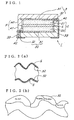
- FIG. 1 is a cross-sectional view of an electric double layer capacitor (1) according to the present embodiment.
- a cell (2) is composed, in the conventional manner, of a pair of stacked polarizable electrodes (20) and (21), which sandwich a separator (6), with collector electrodes (3) and (30) made of a stainless steel alloy containing iron, chrome, and nickel, attached to outer sides of the polarizable electrodes (20) and (21).
- collector electrodes (3) and (30) made of a stainless steel alloy containing iron, chrome, and nickel, attached to outer sides of the polarizable electrodes (20) and (21).
- the upper polarizable electrode (21) has a negative polarity
- the lower polarizable electrode (20) has a positive polarity. Needless to say, the negative and positive poles may be reversed.
- a sealing member (4) is composed by arranging a first case half (40) and a second case half (41) whose central portions are provided with recesses (42), vertically on top of one another so that openings of the recesses (42) abut.
- the polarizable electrodes (20) and (21) and the separator (6) are arranged inside the recesses (42).
- the first case half (40) and the second case half (41) are formed from insulating synthetic resin.
- the insulating resin includes sulfur in a component such as polyphenylene sulfide (PPS, C 5 H 5 S), for reasons described below.
- non-aqueous electrolytes such as sulfuric acid and potassium hydroxide solutions
- electrolytes such as triethylmethyl ammonium tetrafluoroborate (Et 3 MeNBF 4 ) or tetraethyl ammonium tetrafluoroborate (Et 4 NBF 4 ) are dissolved in an aprotic organic solvent
- Et 3 MeNBF 4 triethylmethyl ammonium tetrafluoroborate
- Et 4 NBF 4 tetraethyl ammonium tetrafluoroborate
- Bifunctional solvents such as carbonate, lactone, nitrile, amide, nitroalkane, sulfone, sulfoxide, phosphate, dinitrile, or ether nitrile may be used as the aprotic organic solvent.
- nonwoven glass fiber fabric paper pulp, polytetrafluoroethylene (PTFE), or other films formed from insulating resin may be used.
- PTFE polytetrafluoroethylene
- the negative collector electrode (3) is provided with a horizontal portion (31) which is in contact with the polarizable electrode (20) or (21), a rough surface portion (32) which connects to the horizontal portion (31) and passes through the first case half (40), and an exposed portion (33) which curves from the rough surface portion (32) along the first case half (40) and the second case half (41).
- the rough surface portion (32) is in intimate contact with the first case half (40).
- the positive collector electrode (30) is provided with a horizontal portion (31), a rough surface portion (32), which is connected to the horizontal portion (31) and passes through the first case half (40), and an exposed portion (33).
- the rough surface portion (32) is treated with a surface roughening process and has a center line average roughness of at least 0.3 ⁇ m.
- the surface roughening may be formed by etching, sand-blasting, knurling, or with sandpaper, etc.
- FIG. 2(a) is an enlarged view of the rough surface portion (32) on the negative collector electrode (3).
- a metal plated layer (5) of nickel made from crystal grains of a single component, is formed on the rough surface portion (32). Forming the metal plated layer (5) on the rough surface portion (32) creates even finer irregularities than the rough surface portion (32), because the metal grain is small. The surface roughness thereby increases in roughness, increasing the contact area with the first case half (40). This increases the adhesiveness between the first case half (40) and the collector electrode (3), effectively preventing leaking of electrolyte and entry of moisture from outside.
- a similar metal plated layer (5) is also formed on the rough surface portion (32) of the positive collector electrode (30).
- a natural oxide film with a uniform thickness is formed on the metal plated layer (5) by forming the metal plated layer (5), which is made of crystal grains of a single component.
- the metal plated layer (5) which is made of crystal grains of a single component.
- iron-nickel alloys with high iron content (“Fe-rich”) and iron-nickel alloys with low iron content (“Fe-poor”) are both present in alloys of iron and nickel.
- Fe-rich portions and Fe-poor portions differ in the ease with which each oxidizes. There therefore arise areas with low adherence strength in contact surfaces between the resin and junctions between Fe-rich and Fe-poor portions. Accordingly, forming the metal plated layer (5) composed of crystal grains of a single component makes it possible for a natural oxide film with a uniform thickness to be formed, thereby stabilizing adherence strength.
- the oxide layer of iron contained in the stainless steel is extremely weak, and can cause cracking and deficiencies, leading to leaking.
- Providing a metal plated layer (5) therefore prevents oxidation of the iron, effectively preventing leaking of electrolyte and entry of moisture from outside.
- first case half (40) and the second case half (41) After forming the first case half (40) and the second case half (41) from various synthetic resins, the applicant has found that the first case half (40) and the second case half (41) which use PPS have the highest adhesiveness with the collector electrodes (3) and (30). A possible reason for this is that the sulfur contained in the PPS reacts with traces of oxygen present in the metal plated layer (5) due to natural oxidation of the metal plated layer (5), thereby increasing the adhesiveness between the first and second case halves (40) and (41) and the collector electrodes (3) and (30). This, too, prevents leaking of electrolyte and entry of moisture from outside. Heat-resistance is also improved by forming the first case half (40) and second case half (41) from PPS.
- the metal plated layer (5) from a metal other than nickel, but nickel oxidizes less readily than other metals, such as copper, and is effective in preventing the resistance of the collector electrodes (3) and (30) from growing.
- the cell (2) of the electric double layer capacitor (1) is configured as shown in FIG. 3.
- a first case half (40) is formed through insert molding into a negative collector electrode (3).
- the opening of the recess (not shown) in the first case half (40) is oriented facing down.
- a second case half (41) is formed through insert molding into a positive collector electrode (30), with the opening of the recess (42) in the second case half (41) oriented facing up.
- a pair of polarizable electrodes (20) and (21) is arranged, sandwiching a separator (6), inside the recesses (42) in the case halves (40) and (41).
- the separator (6) and the polarizable electrodes (20) and (21) are impregnated in advance with an electrolyte through vacuum filling.
- peripheral portions of the case halves (40) and (41) are joined using ultrasonic welding, etc.
- the exposed portions (33) of the collector electrodes (3) and (30) are bent downwards along the peripheral surface of the case halves (40) and (41), completing the electric double layer capacitor (1) shown in FIG. 1.
- the applicant made 10 units of the electric double layer capacitor (1) using the collector electrodes (3) and (30) on which a metal plated layer (5) made of nickel was formed.
- the applicant further made 10 units of the electric double layer capacitor (1) using collector electrodes (3) and (30) on which no metal plated layer (5) was formed.
- the first and second case halves (40) and (41) were made of PPS.
- These electric double layer capacitors (1) were left at room temperature and checked to see how many of the electric double layer capacitors (1) leaked electrolyte after 24 and 72 hours. The findings are shown in Table 1 below. With Ni plating Without Ni plating No. of units leaking electrolyte after 24 hours 0/10 units 3/10 units No. of units leaking electrolyte after 72 hours 0/10 units 4/10 units
- the configuration shown in FIG. 4 is also possible in order to effectively prevent leaking of electrolyte and entry of moisture from outside a cell (2). Namely, rough surface portions (32) in a first case half (40) and a second case half (41) are bent into two steps.
- Bending the rough surface portions (32) into two steps makes them longer than if the rough surface portions are straight, as shown in FIG. 1.
- the route for moisture to reach the inside of the cell (2) from outside the sealing member (4) is therefore longer, further stopping leaking of electrolyte and entry of moisture from outside.
- Subjecting the rough surface portions (32) to a bending machining process further prevents the collector electrodes (3) and (30) from moving inside the first case half (40) and the second case half (41), when the collector electrodes (3) and (30) are bent along an external surface of the sealing member (4). This stabilizes the performance of the electric double layer capacitor (1) and makes it possible to boost yield.
- the electric double layer capacitor (1) has excellent charge-discharge behavior, and can be applied to aqueous or non-aqueous electrolyte batteries.
- An electrolyte battery differs from the electric double layer capacitor only in that some of the component materials are different, while the design and manufacturing method are substantively the same.
- the polarizable electrodes of the electric double layer capacitor are replaced with a positive active material body and a negative active material body.
- the positive active material body there are lithium cobaltate, lithium manganate, lithium nickelate, and other materials achieved through pressure forming or sintering of a powder
- the negative active material body there are graphite based carbon materials, coke-based carbon materials, and other materials achieved through pressure forming or sintering of a powder.
- Organic solvents in which a lithium salt has been dissolved are used for the electrolyte.
- lithium salts include LiBF 4 , LiClO 4 , LiPF 6 , LiAsF 6 , Li(CF 3 O 2 ) 2 N, and LiC 4 F 9 SO 3
- organic solvents include propylene carbonate and gamma butyrolactone or a mixture of either of these and a chain carbonate.
- chain carbonates include dimethyl carbonate (DMC, DEC) and ethyl methyl carbonate (EMC).
- a porous polymer film of polyophyllene, polyethylene, polypropylene, or the like may be used.
- aqueous electrolyte batteries such as a lithium ion batteries
- materials achieved by sintering or compression molding of nickel oxide powder or pellets for the positive active material and materials achieved by sintering or compression molding of powder or pellets of Mm-Ni-Co-Mn-Al-based hydrogen storing alloys (Mm being a mixture of rare earth elements) for the negative active material.
- a potassium hydroxide solution or a polymer hydrogel electrolyte solution can be used for the electrolyte.
- a porous polymer film of sulfonated polypropylene or the like can be used for the separator.
- Electric double layer capacitors and electrolyte batteries are generally rectangular parallelipipeds or columnar in shape. However, as shown in FIG. 5, in the case of a columnar shape, dead space (70) is created when mounting on a circuit board (7), so a rectangular solid is preferable in order to make effective use of the surface area on the circuit board (7).
Landscapes
- Engineering & Computer Science (AREA)
- Power Engineering (AREA)
- Microelectronics & Electronic Packaging (AREA)
- Manufacturing & Machinery (AREA)
- Chemical & Material Sciences (AREA)
- Chemical Kinetics & Catalysis (AREA)
- Electrochemistry (AREA)
- General Chemical & Material Sciences (AREA)
- Materials Engineering (AREA)
- Electric Double-Layer Capacitors Or The Like (AREA)
- Secondary Cells (AREA)
- Sealing Battery Cases Or Jackets (AREA)
- Connection Of Batteries Or Terminals (AREA)
Applications Claiming Priority (2)
| Application Number | Priority Date | Filing Date | Title |
|---|---|---|---|
| JP2004083789A JP2005276872A (ja) | 2004-03-23 | 2004-03-23 | 電気二重層キャパシタ及び電解質電池 |
| JP2004083789 | 2004-03-23 |
Publications (1)
| Publication Number | Publication Date |
|---|---|
| EP1580778A1 true EP1580778A1 (de) | 2005-09-28 |
Family
ID=34858387
Family Applications (1)
| Application Number | Title | Priority Date | Filing Date |
|---|---|---|---|
| EP05006259A Withdrawn EP1580778A1 (de) | 2004-03-23 | 2005-03-22 | Elektrischer Doppelschichtkondensator und Elektrolyt-Batterie |
Country Status (3)
| Country | Link |
|---|---|
| US (1) | US7054138B2 (de) |
| EP (1) | EP1580778A1 (de) |
| JP (1) | JP2005276872A (de) |
Families Citing this family (6)
| Publication number | Priority date | Publication date | Assignee | Title |
|---|---|---|---|---|
| JP5435638B2 (ja) * | 2009-01-21 | 2014-03-05 | セイコーインスツル株式会社 | 電気化学セルおよび電気化学セルの製造方法 |
| DE102009010148A1 (de) * | 2009-02-23 | 2010-08-26 | Li-Tec Battery Gmbh | Galvanische Zelle und Kontaktelement zu ihrer Kontaktierung |
| KR101118862B1 (ko) * | 2010-06-28 | 2012-03-06 | 삼성전기주식회사 | 전해액 조성물 및 이를 구비하는 에너지 저장장치 |
| JP6682417B2 (ja) * | 2016-10-14 | 2020-04-15 | 株式会社トーキン | 電気二重層コンデンサ |
| JP6806103B2 (ja) * | 2018-02-15 | 2021-01-06 | Tdk株式会社 | 電気化学デバイス |
| JP7070052B2 (ja) * | 2018-04-27 | 2022-05-18 | トヨタ自動車株式会社 | 全固体電池 |
Citations (7)
| Publication number | Priority date | Publication date | Assignee | Title |
|---|---|---|---|---|
| JPS55105959A (en) * | 1979-02-07 | 1980-08-14 | Matsushita Electric Ind Co Ltd | Container for alkali cell and its manufacturing method |
| JPS56152160A (en) * | 1980-04-26 | 1981-11-25 | Yuasa Battery Co Ltd | Lithium-iodine battery |
| JPH03122964A (ja) * | 1989-10-03 | 1991-05-24 | Sanyo Electric Co Ltd | 密閉形電池 |
| JPH07130577A (ja) * | 1993-11-05 | 1995-05-19 | Elna Co Ltd | 電解コンデンサおよびそのタブ端子 |
| US5953204A (en) * | 1994-12-27 | 1999-09-14 | Asahi Glass Company Ltd. | Electric double layer capacitor |
| JP2001155972A (ja) * | 1999-11-24 | 2001-06-08 | Ngk Insulators Ltd | 電気化学キャパシタ |
| US20030124421A1 (en) * | 2001-12-14 | 2003-07-03 | Issaev Nikolai N. | Non-aqueous electrochemical cells |
Family Cites Families (6)
| Publication number | Priority date | Publication date | Assignee | Title |
|---|---|---|---|---|
| US6426863B1 (en) * | 1999-11-25 | 2002-07-30 | Lithium Power Technologies, Inc. | Electrochemical capacitor |
| JP3781339B2 (ja) | 1999-11-26 | 2006-05-31 | 株式会社タクマ | 廃棄物の乾留熱分解反応器及び乾留熱分解方法 |
| JP2001351833A (ja) | 2000-06-07 | 2001-12-21 | Toyobo Co Ltd | 電気二重層キャパシタ |
| JP3497448B2 (ja) * | 2000-06-09 | 2004-02-16 | Necトーキン株式会社 | 電気二重層コンデンサおよび電池 |
| JP2002128514A (ja) * | 2000-10-16 | 2002-05-09 | Nisshinbo Ind Inc | 炭素質材料、電気二重層キャパシタ用分極性電極及び電気二重層キャパシタ |
| JP2002280264A (ja) * | 2001-03-19 | 2002-09-27 | Nec Tokin Corp | 電気二重層コンデンサおよびその製造方法 |
-
2004
- 2004-03-23 JP JP2004083789A patent/JP2005276872A/ja not_active Withdrawn
-
2005
- 2005-03-21 US US11/084,101 patent/US7054138B2/en not_active Expired - Fee Related
- 2005-03-22 EP EP05006259A patent/EP1580778A1/de not_active Withdrawn
Patent Citations (7)
| Publication number | Priority date | Publication date | Assignee | Title |
|---|---|---|---|---|
| JPS55105959A (en) * | 1979-02-07 | 1980-08-14 | Matsushita Electric Ind Co Ltd | Container for alkali cell and its manufacturing method |
| JPS56152160A (en) * | 1980-04-26 | 1981-11-25 | Yuasa Battery Co Ltd | Lithium-iodine battery |
| JPH03122964A (ja) * | 1989-10-03 | 1991-05-24 | Sanyo Electric Co Ltd | 密閉形電池 |
| JPH07130577A (ja) * | 1993-11-05 | 1995-05-19 | Elna Co Ltd | 電解コンデンサおよびそのタブ端子 |
| US5953204A (en) * | 1994-12-27 | 1999-09-14 | Asahi Glass Company Ltd. | Electric double layer capacitor |
| JP2001155972A (ja) * | 1999-11-24 | 2001-06-08 | Ngk Insulators Ltd | 電気化学キャパシタ |
| US20030124421A1 (en) * | 2001-12-14 | 2003-07-03 | Issaev Nikolai N. | Non-aqueous electrochemical cells |
Non-Patent Citations (5)
| Title |
|---|
| PATENT ABSTRACTS OF JAPAN vol. 004, no. 157 (E - 032) 4 November 1980 (1980-11-04) * |
| PATENT ABSTRACTS OF JAPAN vol. 006, no. 032 (E - 096) 26 February 1982 (1982-02-26) * |
| PATENT ABSTRACTS OF JAPAN vol. 015, no. 326 (E - 1102) 20 August 1991 (1991-08-20) * |
| PATENT ABSTRACTS OF JAPAN vol. 1995, no. 08 29 September 1995 (1995-09-29) * |
| PATENT ABSTRACTS OF JAPAN vol. 2000, no. 23 10 February 2001 (2001-02-10) * |
Also Published As
| Publication number | Publication date |
|---|---|
| JP2005276872A (ja) | 2005-10-06 |
| US20050213285A1 (en) | 2005-09-29 |
| US7054138B2 (en) | 2006-05-30 |
Similar Documents
| Publication | Publication Date | Title |
|---|---|---|
| US7248460B2 (en) | Electric double layer capacitor and electrolytic cell | |
| EP1977464B1 (de) | Mit trennglied mit abgedichtetem oberteil verwendete batteriebaugruppe und sekundärbatterie damit | |
| US6692866B2 (en) | Lamination type secondary battery | |
| EP4224581A1 (de) | Verbundstromkollektor, herstellungsverfahren und lithium-ionen-batterie | |
| EP2610954A2 (de) | Elektrodenwicklung von verbesserter struktur und batterie damit | |
| JP2006054266A (ja) | 電気化学セルおよびその製造方法 | |
| US20030180605A1 (en) | Non-aqueous electrolytic battery and its manufacturing method | |
| JP5268489B2 (ja) | 端子付電気化学セル | |
| JP2014041996A (ja) | 電気化学セル及びその製造方法 | |
| US7414825B2 (en) | Electrochemical device | |
| US7054138B2 (en) | Electric double layer capacitor and electrolyte battery | |
| JP2004356461A (ja) | チップ型電気二重層コンデンサ及びチップ型電解質電池 | |
| JP5679271B2 (ja) | 電極端子付き電池蓋、電極端子付き電池蓋の製造方法および密閉型電池 | |
| KR102137846B1 (ko) | 비수 전해질 이차 전지 | |
| JP2005032938A (ja) | 電気二重層コンデンサ及び電池 | |
| JP2004356462A (ja) | チップ型電気二重層コンデンサ及びチップ型電解質電池 | |
| US7079376B2 (en) | Electric double layer capacitor, electrolyte battery and method for manufacturing the same | |
| JP3196223B2 (ja) | 組電池 | |
| JP2007036026A (ja) | 電気二重層キャパシタ及び電解質電池 | |
| US20240413350A1 (en) | Battery | |
| US20250149755A1 (en) | Battery | |
| JP2008010780A (ja) | 電気化学素子 | |
| JP3491089B2 (ja) | 電気化学電池 | |
| EP4503163A1 (de) | Elektrodenkörper und energiespeicherelement | |
| JP2559559Y2 (ja) | 薄型非水電解液電池 |
Legal Events
| Date | Code | Title | Description |
|---|---|---|---|
| PUAI | Public reference made under article 153(3) epc to a published international application that has entered the european phase |
Free format text: ORIGINAL CODE: 0009012 |
|
| AK | Designated contracting states |
Kind code of ref document: A1 Designated state(s): AT BE BG CH CY CZ DE DK EE ES FI FR GB GR HU IE IS IT LI LT LU MC NL PL PT RO SE SI SK TR |
|
| AX | Request for extension of the european patent |
Extension state: AL BA HR LV MK YU |
|
| 17P | Request for examination filed |
Effective date: 20051118 |
|
| AKX | Designation fees paid |
Designated state(s): DE FI FR GB SE |
|
| GRAP | Despatch of communication of intention to grant a patent |
Free format text: ORIGINAL CODE: EPIDOSNIGR1 |
|
| STAA | Information on the status of an ep patent application or granted ep patent |
Free format text: STATUS: THE APPLICATION HAS BEEN WITHDRAWN |
|
| 18W | Application withdrawn |
Effective date: 20060808 |