EP1580688B1 - Berechnung eines Bewegtbild-Korrekturkoeffizienten - Google Patents
Berechnung eines Bewegtbild-Korrekturkoeffizienten Download PDFInfo
- Publication number
- EP1580688B1 EP1580688B1 EP04025570.5A EP04025570A EP1580688B1 EP 1580688 B1 EP1580688 B1 EP 1580688B1 EP 04025570 A EP04025570 A EP 04025570A EP 1580688 B1 EP1580688 B1 EP 1580688B1
- Authority
- EP
- European Patent Office
- Prior art keywords
- correction
- coefficient
- image
- temporary
- coefficients
- Prior art date
- Legal status (The legal status is an assumption and is not a legal conclusion. Google has not performed a legal analysis and makes no representation as to the accuracy of the status listed.)
- Expired - Lifetime
Links
Images



Classifications
-
- G—PHYSICS
- G06—COMPUTING OR CALCULATING; COUNTING
- G06T—IMAGE DATA PROCESSING OR GENERATION, IN GENERAL
- G06T5/00—Image enhancement or restoration
-
- G—PHYSICS
- G06—COMPUTING OR CALCULATING; COUNTING
- G06T—IMAGE DATA PROCESSING OR GENERATION, IN GENERAL
- G06T5/00—Image enhancement or restoration
- G06T5/90—Dynamic range modification of images or parts thereof
- G06T5/92—Dynamic range modification of images or parts thereof based on global image properties
-
- H—ELECTRICITY
- H04—ELECTRIC COMMUNICATION TECHNIQUE
- H04N—PICTORIAL COMMUNICATION, e.g. TELEVISION
- H04N23/00—Cameras or camera modules comprising electronic image sensors; Control thereof
- H04N23/80—Camera processing pipelines; Components thereof
- H04N23/82—Camera processing pipelines; Components thereof for controlling camera response irrespective of the scene brightness, e.g. gamma correction
-
- G—PHYSICS
- G06—COMPUTING OR CALCULATING; COUNTING
- G06T—IMAGE DATA PROCESSING OR GENERATION, IN GENERAL
- G06T2207/00—Indexing scheme for image analysis or image enhancement
- G06T2207/10—Image acquisition modality
- G06T2207/10016—Video; Image sequence
Definitions
- the present invention relates to a technology for calculating a moving-image correction coefficient that is applied to a frame of a moving-image, and for correcting the moving-image by applying the moving-image correction coefficient calculated.
- Japanese Patent Application Laid-Open No. 2002-77723 discloses a moving-image processing apparatus that calculates correction-coefficients only when a scene change such that an image greatly changes is detected, and uses the correction-coefficients until a next scene change is detected so as to reduce a calculation amount.
- Japanese Patent Application Laid-Open No. 2002-262303 discloses an image processing apparatus that calculates correction-coefficients when a scene is changed or when the number of the frames in a moving-image is counted, and the counted value exceeds a predetermined threshold.
- EP 1 351 493 A discloses an image processing apparatus which performs correction processing on a dynamic image including a plurality of frame images for determining the correction value suitable for each of the frame images of the dynamic image including: a detector detecting change of scenes of the dynamic image; a correction value determination unit determining the correction value for image processing of each of the plurality of frame images based on the change of the scenes detected by the detector; and a correction unit correcting each of the frame images of the dynamic image based on the correction value determined by the correction value determination unit.
- correction-coefficients of gamma correction (gamma value) is exemplified, but the present invention is not limited to this, and the similar process can be used for the other correction-coefficients such as correction-coefficients of color balance correction and correction-coefficients of chroma saturation correction.
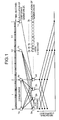
- Fig. 1 is an explanatory diagram of the concept of the moving-image correction-coefficient calculating process according to a first embodiment of the present invention.
- Fig. 1 is an example of a moving-image in which 25 frames are reproduced every 1 second (one frame at 0.04 second).
- temporary gamma value calculating frames are extracted at a predetermined interval.
- the temporary gamma value calculating frames 1a to 1d are extracted every 2 seconds.
- Gamma values for the extracted temporary gamma value calculating frames 1a to 1d are calculated, so that the calculated gamma values are the temporary gamma values.
- gamma values are calculated by an example disclosed in " Image Dependent Gamma Selection Based on Color Palette Equalization and a Simple Lightness Model” by Juha Ktajamaki (last "a” is an umlaut of an alphabet a ) and Pekka Laihanen, Proc. of 7th CIC, 301-306 (1999 ).
- Differences in the temporary gamma values are calculated between adjacent temporary gamma value calculating frames (for example, between the temporary gamma value calculating frames 1a and 1b, between the temporary gamma value calculating frames 1b and 1c, and the like).
- a frame interval for calculating the gamma values is set according to the differences in the temporary gamma values, and gamma value calculating frames 2a to 2d and 3a to 3k for calculating the gamma values are extracted.
- a first threshold for example, 0.1
- the differences in the temporary gamma values between the temporary gamma value calculating frames 1a and 1b, and between the temporary gamma value calculating frames 1b and 1c are less than 0.1. Therefore, the intervals between the gamma value calculating frames 2a and 2b, between the gamma value calculating frames 2b and 2c, and between the gamma value calculating frames 2c and 2d are set to 0.67 second.
- the intervals between the gamma value calculating frames 3a and 3b, and between the gamma value calculating frames 3b and 3c are set to 0.2 second.
- the temporary gamma values are weighted, and an interpolating operation and weighted averaging are performed, so that the gamma values for the gamma value calculating frames are calculated.
- a gamma value for the frame that is not calculated is set to a value of the gamma value calculating frame just prior to that frame.
- Weighting coefficients allocated to the temporary gamma values timewise closer to the gamma value calculating frame where the gamma value is to be calculated are set to be larger.
- weighting coefficients other than zero are set for the temporary gamma values for the temporary gamma value calculating frames that are 4 seconds before and after reproduced time of the gamma value calculating frame where the gamma value is calculated.
- the weighting coefficients for the temporary gamma values are determined by a straight line that connects zero and a peak, as shown in Fig. 1 , when the weighting coefficient of the temporary gamma value calculating frame corresponding to the reproduced time of the gamma value calculating frame is the peak value, and the weighting coefficient of the temporary gamma value calculating frame at 4th second before and after the reproduced time of the gamma value calculating frame is zero.
- the gamma values for the gamma value calculating frames are calculated by performing the interpolating operation using the temporary gamma values weighted by the weighting coefficients.
- the interpolating operation is performed so that the gamma values are calculated, but the gamma values may be calculated by performing a weighted averaging operation on the temporary gamma values using the weighting coefficients.
- the frames are extracted at a predetermined interval so that the temporary gamma values are calculated and not all the gamma values for the frames are calculated. Since the gamma values to be used for the gamma correction are calculated based on the calculated temporary gamma values, image quality can be improved and a calculation amount can be reduced in a balanced manner.
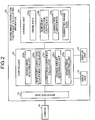
- FIG. 2 is a functional block diagram of the configuration of a moving-image correction-coefficient calculating apparatus 20 according to the first embodiment.
- the moving-image correction-coefficient calculating apparatus 20 acquires a moving-image from a camera 10, and executes the gamma correcting process on the acquired moving-image.
- the moving-image correction-coefficient calculating apparatus 20 has an interface unit 21, an input unit 22, a display unit 23, a storage unit 24, and a controller 25.
- the interface unit 21 acquires frame data of a moving-image from the camera 10.
- a keyboard and a mouse are examples of the input unit 22, and a display is an example of the display unit 23.
- the storage unit 24 such as a hard disc device stores frame data 24a, temporary correction-coefficients 24b, correction-coefficients 24c, and correction frame data 24d.
- the frame data 24a are of a moving-image acquired from the camera 10.
- the temporary correction-coefficients 24b are temporary gamma values calculated for temporary gamma value calculating frames
- the correction-coefficients 24c are gamma values for the gamma value calculating frames calculated based on the temporary gamma values.
- the correction frame data 24d are frame data corrected by using the gamma values.
- the controller 25 controls the entire moving-image correction-coefficient calculating apparatus 20, and has a moving-image acquiring unit 25a, a temporary correction-coefficient calculator 25b, a correction-coefficient calculator 25c, a change amount determining unit 25d, and a moving-image correcting unit 25e.
- the moving-image acquiring unit 25a acquires frame data of a moving-image from the camera 10, and stores them as the frame data 24a in the storage unit 24.
- the temporary correction-coefficient calculator 25b extracts temporary correction-coefficient calculating frames from the frame data 24a at a set time interval, calculates temporary gamma values for the extracted temporary correction-coefficient calculating frames, and stores the calculated temporary gamma values as the temporary correction-coefficients 24b in the storage unit 24.
- the correction-coefficient calculator 25c extracts correction-coefficient calculating frames from the frame data 24a at a set time interval, calculates the gamma values for the correction-coefficient calculating frames based on the temporary gamma values calculated by the temporary correction-coefficient calculator 25b, and stores the calculated gamma values as the correction-coefficients 24c in the storage unit 24.
- the correction-coefficient calculator 25c compares the temporary gamma values between the adjacent temporary correction-coefficient calculating frames. When an absolute value of differences in the temporary gamma values is equal to or more than the first threshold, it is determined that a change in the image is large, and the intervals of the correction-coefficient calculating frames for calculating the gamma values are set to be narrow.
- the correction-coefficient calculator 25c determines that the change in the image is small, and the intervals of the correction-coefficient calculating frames are set to be wide.
- the correction-coefficient calculator 25c performs the interpolating operation or the weighted averaging operation using the weighted temporary gamma values, so as to calculate the gamma values for the correction-coefficient calculating frames.
- the change amount determining unit 25d checks whether the differences in the temporary gamma values between the adjacent temporary correction-coefficient calculating frames are equal to or more than a predetermined threshold. When the differences are equal to or more than the predetermined threshold, it is determined that a scene change that causes large change in the image occurs.
- the predetermined threshold is set to be larger than the first threshold.
- the change amount determining unit 25d requests the temporary correction-coefficient calculator 25b and the correction-coefficient calculator 25c to execute the correction-coefficient calculating process for the scene change.
- Fig. 3 is an explanatory diagram of a scene change detecting process to be executed by the change amount determining unit 25d.
- the change amount determining unit 25d calculates the differences (absolute value) in the temporary gamma values between the adjacent temporary correction-coefficient calculating frames, and sets the weighting coefficient to the differences so as to perform the weighted averaging operation.
- the change amount determining unit 25d calculates a weighted average value of the temporary gamma values.
- 0.2, 0.6, and 0.2 are allocated to the temporary gamma value just prior to the target temporary gamma value, the target temporary gamma value, and the temporary gamma value just after the target temporary gamma value, respectively.
- the change amount determining unit 25d checks whether the weighted average value of the differences in the temporary gamma values is larger than a second threshold, or larger than a third threshold (here, the third threshold is set to be larger than the second threshold). When the weighted average value of the differences is less than the second threshold, the change amount determining unit 25d determines that the scene change does not occur.
- the change amount determining unit 25d extracts the correction-coefficient calculating frames at a narrower interval, and requests the correction-coefficient calculator 25c to calculate the gamma values at a narrower interval.
- the change amount determining unit 25d extracts the temporary correction-coefficient calculating frames at a narrower interval, and requests the temporary correction-coefficient calculator 25b to calculate the temporary gamma values at a narrower interval.
- the change amount determining unit 25d may request the correction-coefficient calculator 25c to calculate the gamma values for the correction-coefficient calculating frames based on the calculated temporary gamma values.
- the change amount determining unit 25d changes the weighting coefficient allocating method applied to the temporary gamma values at the time of performing the interpolating operation or the weighted averaging operation.
- the weighting coefficient of the temporary gamma value calculating frame at 4th second before and after the reproduced time of the gamma value calculating frame is zero.
- the correction-coefficient calculator 25c sets the weighting coefficient of the temporary gamma value around 2nd second from the reproduced time of the gamma value calculating frame, for example, to zero, and increases the weighting coefficient of the peak value accordingly.
- the correction-coefficient calculator 25c determines the weighting coefficients according to the straight line that connects zero and the peak value, so as to emphasize the temporary gamma values of the temporary gamma value calculating frames timewise closer to the gamma value calculating frames.
- the correction-coefficient calculator 25c determines the weighting coefficients according to a straight line that connects zero and a peak value when the weighting coefficients of the temporary gamma value around 1st second from the reproduced time of the gamma value calculating frame is zero and the weighting coefficient of the peak value is increased.
- the temporary gamma values for the temporary gamma value calculating frames timewise closer to the gamma value calculating frames are further emphasized.
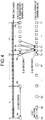
- Fig. 4 is an explanatory diagram of the correction-coefficient calculating process when the scene change is detected.
- the correction-coefficient calculator 25c extracts gamma value calculating frames 7a to 7i at a narrower interval than that for no scene change.
- the correction-coefficient calculator 25c calculates gamma values for the respective gamma value calculating frames 7a to 7i.
- the gamma value calculating frames 6a to 6f are extracted at an interval of 0.67 second, but when the scene change occurs, the gamma value calculating frames 7a to 7i are extracted at an interval of 0.25 second.
- the temporary correction-coefficient calculator 25b extracts temporary gamma value calculating frames 5a to 5h at a narrower interval, and calculates temporary gamma values at a narrower interval.
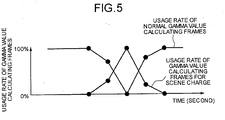
- Fig. 5 depicts a situation of a usage rate of the gamma value calculating frames for the scene change at the time when the scene change is detected. As shown in Fig. 5 , when the scene change is detected, the ratio of the gamma value calculating frames extracted at a narrower time interval gradually increases than that for no scene change.
- the moving-image correcting unit 25e uses the gamma values calculated by the correction-coefficient calculator 25c and stored as the correction-coefficients 24c in the storage unit 24 so as to perform the gamma correction for the frame data 24a.
- the moving-image correcting unit 25e stores the gamma-corrected frame data as the correction frame data 24d.
- Fig. 6 is a flowchart of the procedure of the moving-image correction-coefficient calculating process according to the first embodiment.
- the temporary correction-coefficient calculator 25b of the moving-image correction-coefficient calculating apparatus 20 extracts temporary gamma value calculating frames for calculating temporary gamma values from the frame data 24a stored in the storage unit 24 at a predetermined time interval (step S101).
- the temporary correction-coefficient calculator 25b calculates the temporary gamma values for the extracted temporary gamma value calculating frames (step S102), and calculates differences in the temporary gamma values between the adjacent temporary gamma value calculating frames (step S103).
- the change amount determining unit 25d checks whether the differences in the temporary gamma values are less than the second threshold explained with reference to Fig. 3 (step S104). When the differences are not less than the second threshold (No at step S104), the change amount determining unit 25d determines that a scene change where a change in an image is large occurs, and executes the gamma value calculating process at the time when the scene change is detected (step S110). The gamma value calculating process at the time when the scene change is detected is explained in detail with reference to Fig. 7 .
- the correction-coefficient calculator 25c checks whether the differences in the temporary gamma values are less than the first threshold explained with reference to Fig. 1 (step S105).
- the first threshold is set to a smaller value than the second threshold.
- the correction-coefficient calculator 25c sets a calculating interval for calculating the gamma values to a first interval (step S106).
- the correction-coefficient calculator 25c sets the calculating interval for calculating the gamma values to a second interval (step S109), in which case, since it is determined that the change in the moving-image is large, the second interval is set to be shorter than the first interval.
- the correction-coefficient calculator 25c calculates weighting coefficients applied to the temporary gamma values according to the method explained with reference to Fig. 1 (step S107).
- the correction-coefficient calculator 25c uses the weighted temporary gamma values to which the weighting coefficients are applied, so as to perform the interpolating operation or the weighted averaging operation.
- the correction-coefficient calculator 25c calculates the gamma values at the time interval set at step S106 or step S109 (step S108), and ends this moving-image correction-coefficient calculating process.
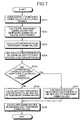
- Fig. 7 is a flowchart of such the procedure at the time when the scene change is detected shown in Fig. 6 .
- the temporary correction-coefficient calculator 25b of the moving-image correction-coefficient calculating apparatus 20 again extracts the temporary gamma value calculating frames at a shorter interval than the interval of the extraction at step S101 in Fig. 6 (step S201).
- the temporary correction-coefficient calculator 25b calculates the temporary gamma values for the extracted temporary gamma value calculating frames (step S202), and further calculates differences in the temporary gamma values (step S203). The differences in the temporary gamma values are calculated according to the method explained with reference to Fig. 3 .
- the correction-coefficient calculator 25c sets the gamma value calculating interval to the third interval (step S204).
- the third interval is set to be shorter than the second interval explained with reference to Fig. 6 .
- the correction-coefficient calculator 25c checks whether the differences in the temporary gamma values calculated at step S203 are equal to or more than the third threshold (step S205). When the differences in the temporary gamma values are not equal to or more than the third threshold (No at step S205), the correction-coefficient calculator 25c calculates first weighting coefficients to be applied to the temporary gamma values (step S206).
- the weighting coefficient of the temporary gamma value calculating frame around the 4th second from the reproduced time of the gamma value calculating frame is zero.
- the correction-coefficient calculator 25c sets the weighting coefficient of the temporary gamma value around the 2nd second from the reproduced time of the gamma value calculating frame, for example to zero, and increases the weighting coefficient of the peak value accordingly.
- the correction-coefficient calculator 25c determines the weighting coefficients according to the straight line that connects zero and the peak value, so as to emphasize the temporary gamma values for the temporary gamma value calculating frames timewise closer to the gamma value calculating frames.
- the correction-coefficient calculator 25c calculates second weighting coefficients to be applied to the temporary gamma values (step S207).
- the correction-coefficient calculator 25c sets the weighting coefficient of the temporary gamma value around the 1st second from the reproduced time of the gamma value calculating frame, for example to zero.
- the correction-coefficient calculator 25c increases the weighting coefficient of the peak value, and determines the weighting coefficients according to the straight line that connects zero and the peak value, so as to emphasize the temporary gamma values for the temporary gamma value calculating frames timewise closer to the gamma value calculating frames.
- the correction-coefficient calculator 25c uses the weighted temporary gamma values to which the weighting coefficients are applied so as to perform the interpolating operation or the weighted averaging operation.
- the correction-coefficient calculator 25c calculates the gamma values at the time interval set at step S204 (step S208), and ends the gamma value calculating process at the time when the scene change is detected.
- the time interval for calculating the temporary gamma values, the time interval for calculating the gamma values, the weighting coefficients, the threshold, and the like are previously set, and some of them are updated by the moving-image correction-coefficient calculating apparatus 20 during the gamma value calculating process.
- the temporary correction-coefficient calculator 25b, the correction-coefficient calculator 25c, or the change amount determining unit 25d may accept inputs for setting these values from a user during the gamma value calculating process, and the accepted settings may be reflected on the gamma value calculating process.
- the temporary correction-coefficient calculator 25b calculates the temporary gamma values to be applied to the extracted frames from the moving-image frames at the predetermined time interval.
- the storage unit 24 stores the calculated temporary gamma values, and the correction-coefficient calculator 25c calculates the gamma values to be applied to the frames of the moving-image based on the stored temporary gamma values. Therefore, image quality can be improved and a calculation amount can be reduced in a balanced manner.
- the correction-coefficient calculator 25c calculates the gamma values to be applied to the frames of the moving-image extracted at the predetermined time interval. Therefore, a calculation amount for calculating the gamma values can be further reduced.
- the correction-coefficient calculator 25c changes the time interval for calculating the gamma values based on the change amount of the calculated temporary gamma values. Therefore, the gamma values can be calculated according to a fluctuation in the temporary gamma values at a suitable interval.
- the correction-coefficient calculator 25c performs the weighted averaging on the calculated temporary gamma values, so as to calculate the gamma values to be applied to the frames of the moving-image. Therefore, a calculation amount for the gamma values can be reduced and the image quality can be improved in a balanced manner.
- the correction-coefficient calculator 25c when the correction-coefficient calculator 25c performs the weighted averaging, larger weighting coefficients are applied to the temporary gamma values for the frames with smaller time difference from the frames to which the gamma values are applied. Therefore, the temporary gamma values for the frames timewise closer to the frames to which the gamma values are applied are emphasized, so that the image quality can be improved.
- the correction-coefficient calculator 25c performs the interpolating operation on the calculated temporary gamma values, so as to calculate the gamma values to be applied to the frames of the moving-image. Therefore, a calculation amount for calculating the gamma values can be reduced and the image quality can be improved in a balanced manner.
- the correction-coefficient calculator 25c when the correction-coefficient calculator 25c performs the interpolating operation, larger weighting coefficients are applied to the temporary gamma values for the frames with smaller time difference from the frames to which the gamma values are applied. Therefore, the temporary gamma values for the frames timewise closer to the frames to which the gamma values are applied are emphasized, so that the image quality can be improved.
- the change amount determining unit 25d determines an image change amount of the frames, and when the image change amount is determined as large, the correction-coefficient calculator 25c changes timing at which the gamma values are calculated. Therefore, the timing at which the gamma values are calculated is changed, so that the image quality can be improved.
- the change amount determining unit 25d determines the image change amount of the frames based on a change in the temporary gamma values. Therefore the image change amount of the frames can be determined efficiently.
- the temporary correction-coefficient calculator 25d changes the timing at which the temporary gamma values are calculated. Therefore, when the scene change whose image change amount is large occurs, the gamma values are calculated more suitably, so that the image quality can be improved.
- the correction-coefficient calculator 25c sets the weighting coefficients that are applied to the temporary gamma values at the time of calculating the gamma values based on the image change amount. Therefore, the gamma values are calculated more suitably, so that the image quality can be improved.
- the temporary correction-coefficient calculator 25b, the correction-coefficient calculator 25c, or the change amount determining unit 25d accepts inputs of the setting relating to the calculation of the temporary gamma values or the setting relating to the calculation of the gamma values. Since the temporary gamma values or the gamma values are calculated based on the accepted settings, the setting specified by the user can be reflected on the calculation of the temporary gamma values or the gamma values.
- the moving-image correction-coefficient calculating apparatus performs the gamma correction on the frames of a moving-image using the gamma values calculated by the apparatus.
- a client may, however, select and acquire information about the gamma values suitable for the client from a server (moving-image correction-coefficient calculating apparatus) that calculates and provides the gamma values, so as to perform the gamma correction.
- Fig. 8 is an explanatory diagram of the concept of the moving-image correcting process in the moving-image correcting system according to a second embodiment of the present invention.
- the moving-image correcting system is constituted so that a server 30 calculates gamma values, a client 40 acquires the gamma values calculated by the server 30, and the gamma correction is performed on the frames of the moving-image.
- the server 30 stores frame data 31 that are targets for calculating the gamma values, correction-coefficients 32 that are gamma values calculated for the frame data 31, and apparatus dependent correction-coefficients 33 that are the gamma values calculated adaptably to display characteristics of the moving-image in the client 40.
- the client 40 acquires frame data 44 of the moving-image to be reproduced from the frame data 31 stored in the server, and acquires gamma values 41 for the frame data 44 from the correction-coefficients 32. Further, the client 40 acquires apparatus dependent gamma values 42 calculated adaptably to the display characteristics of the moving-image in the client 40 from the apparatus dependent correction-coefficients 33.
- the client 40 synthesizes the gamma values 41 with the apparatus dependent gamma values 42 acquired from the server 30, so as to calculate combined gamma values 43 to be used for the gamma correction.
- the client 40 performs the gamma correction for the frame data 44 using the combined gamma values 44, so as to acquire corrected frame data 45 on which the gamma correction is performed.
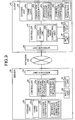
- FIG. 9 is a functional block diagram of the configuration of the moving-image correcting system according to the second embodiment.
- the moving-image correcting system is constituted so that the server 30 is connected to the client 40 via a network 60 such as the Internet.
- the server 30 calculates gamma values, and has an interface unit 35, an input unit 36, a display unit 37, a storage unit 35, and a controller 39.
- the interface unit 35 is a network interface that transmits/receives data to/from the client 40.
- a keyboard and a mouse are example of the input unit 36.
- a display is an example of the display unit 37.
- the storage unit 38 such as a hard disc device stores frame data 38a, correction-coefficients 38b, and apparatus dependent correction-coefficients 38c therein.
- the frame data 38a are of a moving-image.
- the correction-coefficients 38b are gamma values calculated as explained in the first embodiment.
- the apparatus dependent correction-coefficients 38c are apparatus dependent gamma values calculated according to the display characteristics of a moving-image in each client.
- the controller 39 entirely controls the server 30, and has a correction-coefficient calculating processor 39a and a data transmitter 39b.
- the correction-coefficient calculating processor 39a calculates gamma values of the frame data 38a, and has the same functions as those of the moving-image acquiring unit 25a, the temporary correction-coefficient calculator 25b, the correction-coefficient calculator 25c, and the change amount determining unit 25d in the moving-image correction-coefficient calculating apparatus 20 shown in Fig. 2 .
- the data transmitter 39b acquires the frame data 44, gamma values 41, and the apparatus dependent gamma values 42, whose transmission requests are received from the client 40, from the frame data 38a, the correction-coefficients 38b, and the apparatus dependent correction-coefficients 38c, and transmits them to the client 40.
- the client 40 acquires the gamma values calculated by the server 30, and performs the gamma correction on the frames of a moving-image.
- the client 40 has an interface unit 46, an input unit 47, a display unit 48, a storage unit 49, and a controller 50.
- the interface unit 46 is a network interface that transmits/receives data to/from the server 30.
- a keyboard and a mouse are examples of the input unit 47.
- a display is an example of the display unit 48.
- the storage unit 49 such as a hard disc device stores frame data 49a, correction-coefficients 49b, apparatus dependent correction-coefficients 49c, combined correction-coefficients 49d, and corrected frame data 49e therein.
- the frame data 49a, the correction-coefficients 49b, and the apparatus dependent correction-coefficients 49c are data of the frame data 44, the gamma values 41, and the apparatus dependent gamma values 42 acquired from the server 30.
- the combined correction-coefficients 49d are, as explained with reference to Fig. 8 , the combined gamma values 43 obtained by combining the gamma values 41 with the apparatus dependent gamma values 42.
- the correction frame data 49e are frame data on which the gamma correction is performed.
- the controller 50 controls the entire client 40, and has a data receiver 50a and a moving-image correcting unit 50b.
- the data receiver 50a requests the server 30 to transmit the frame data 44, the gamma values 41, or the apparatus dependent gamma values 42. When these data are transmitted from the server 30, the data receiver 50a receives the data.
- the moving-image correcting unit 50b uses the gamma values that are stored as the correction-coefficients 49b, the apparatus dependent correction-coefficients 49c, or the combined correction-coefficients 49d in the storage unit 49 so as to perform the gamma correction on the frame data 49a.
- the moving-image correcting unit 50b stores the gamma-corrected frame data as the corrected frame data 49e.
- the data transmitter 39b of the server 30 transmits the calculated gamma values to the client 40, the gamma values created by the server 30 can be used by another apparatus.
- the data receiver 50a of the client 40 receives the transmitted gamma values, and corrects the frames of a moving-image by applying the received gamma values to the frames of the moving-image. Therefore, when the gamma values calculated by the server 30 are utilized so that the frames are corrected, it is not necessary that the client 40 calculates the gamma values, and thus a load on the client 40 can be reduced.
- the moving-image correction-coefficient calculating apparatus, the server, and the client explained in the first and the second embodiments can be realized by executing prepared programs by a computer system such as a personal computer or a work station.
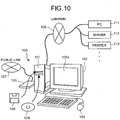
- Fig. 10 is a configurational diagram of the computer system according to a third embodiment of the present invention
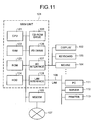
- Fig. 11 is a block diagram of a configuration of a main unit in the computer system shown in Fig. 10 .
- a computer system 100 has a main unit 101, a display 102 that displays information such as images on a display screen 102a according to an instruction from the main unit 101, a keyboard 103 that inputs various information into the computer system 100, and a mouse 104 that specifies an arbitrary position on the display screen 102a of the display 102.
- the main unit 101 in the computer system 100 has, as shown in Fig. 11 , a central processing unit (CPU) 121, a random access memory (RAM) 122, a read only memory (ROM) 123, a hard disk drive (HDD) 124, a compact disc-read only memory (CD-ROM) drive 125 into which a CD-ROM 109 is inserted, a flexible disk (FD) drive 126 into which an FD 108 is inserted, an input/output (I/O) interface 127 that connects the display 102, the keyboard 103, and the mouse 104, and a local area network (LAN) interface 128 that is connected to a local area network or a wide area network (LAN/WAN) 106.
- CPU central processing unit
- RAM random access memory
- ROM read only memory
- HDD hard disk drive
- CD-ROM compact disc-read only memory
- CD-ROM compact disc-read only memory
- FD flexible disk
- I/O input/output
- LAN local area network
- the computer system 100 is connected to a modem 105 that connects the system to a public line 107 such as the Internet, and is connected to another computer system (i.e., a personal computer (PC)) 111, a server 112, a printer 113, and the like via the LAN interface 128 and the LAN/WAN 106.
- a modem 105 that connects the system to a public line 107 such as the Internet
- another computer system i.e., a personal computer (PC)
- PC personal computer
- server 112 a printer 113
- the computer system 100 reads and executes the programs recorded in a predetermined recording medium so as to realize the similar functions to those of the moving-image correction-coefficient calculating apparatus, the server, and the client.
- the predetermined recording medium includes various recording media that record programs readable by the computer system 100 therein.
- the recording media include "portable physical media” such as the FD 108, the CD-ROM 109, a magneto-optical (MO) disc, a digital versatile disc (DVD), an integrated-circuit (IC) card, and "fixed physical media” such as the HDD 124, the RAM 122, and ROM 123 that are mounted on the inside/outside of the computer system 100.
- the recording media further include "communication media” such as the public line 107 that is connected via the modem 105 and the LAN/WAN 106 that is connected with another computer system 111 and the server 112, for holding programs for a short period at the time of transmission of the programs.
- the programs are recorded in the recording media such as the "portable physical media”, the “fixed physical media”, and the “communication media” so as to be readable by the computer.
- the computer system 100 reads the programs from the recording media and executes them so as to realize the similar functions to those of the moving-image correction-coefficient calculating apparatus, the server, and the client.
- the programs are not limited to the execution by the computer system 100, and the present invention can be applied even when another computer system 111 or server 112 executes the programs or when the system and the server cooperate with each other so as to execute the programs.
- all or a part of the processing explained as being performed automatically may be performed manually, or all or a part of the processing explained as being performed manually may be performed automatically in a known method.
- the respective constituents of the illustrated apparatus are functionally conceptual, and the physically same configuration is not always necessary.
- the specific mode of dispersion and integration of the apparatus is not limited to the illustrated one, and all or a part thereof may be functionally or physically dispersed or integrated in an optional unit, according to the various kinds of load and the status of use.
- All or an optional part of the various processing functions performed by the apparatus can be realized by the CPU or a program analyzed and executed by the CPU, or can be realized as hardware by the wired logic.
- image quality can be improved and calculation amount for calculating correction-coefficients can be reduced in a balanced manner.
- the calculation amount for calculating the correction-coefficients can be further reduced.
- the correction-coefficients can be calculated at a suitable interval according to a fluctuation in temporary correction-coefficients.
- the temporary correction-coefficients for the frames timewise closer to the frames to which the correction-coefficients are applied are emphasized, so that the image quality can be improved.
- the image change amount of the frames can be determined efficiently.
- the timing at which the temporary correction-coefficients are calculated is changed, so that the correction-coefficients are calculated more suitably, and the image quality can be improved.
- the correction-coefficients are calculated more suitably, and the image quality can be improved.
- the setting specified by a user can be reflected on the calculation of the temporary correction-coefficients or the correction-coefficients.
- the correction-coefficients created by the apparatus itself can be used by another apparatus.
- the correction-coefficients calculated by another apparatus are utilized to correct the frames, and as a result, it is not necessary for the apparatus itself to calculate the correction-coefficients, and thus a load on the apparatus can be reduced.
Landscapes
- Engineering & Computer Science (AREA)
- Physics & Mathematics (AREA)
- General Physics & Mathematics (AREA)
- Theoretical Computer Science (AREA)
- Multimedia (AREA)
- Signal Processing (AREA)
- Picture Signal Circuits (AREA)
- Facsimile Image Signal Circuits (AREA)
- Image Processing (AREA)
- Testing, Inspecting, Measuring Of Stereoscopic Televisions And Televisions (AREA)
Claims (14)
- Vorrichtung (20) zur Berechnung eines auf Frames eines Bewegtbildes anzuwendenden Bewegtbild-Korrekturkoeffizienten, wobei die Vorrichtung umfasst:eine temporäre Korrekturkoeffizienten-Berechnungseinheit (25b) zum Berechnen eines temporären Korrekturkoeffizienten für jeden von mehreren bei einem ersten Zeitintervall extrahierten Frames;eine temporäre Speichereinheit (24b) zum Speichern der von der temporären Korrekturkoeffizienten-Berechnungseinheit berechneten temporären Korrekturkoeffizienten;eine Korrekturkoeffizienten-Berechnungseinheit (25c) zum Berechnen des Bewegtbild-Korrekturkoeffizienten für jeden von mehreren bei einem zweiten Zeitintervall zwischen zwei benachbarten Frames, die bei dem ersten Zeitintervall extrahiert wurden, extrahierten Frames, wobei die Berechnung auf die temporären Korrekturkoeffizienten der benachbarten Frames basiert; undgekennzeichnet durcheine Änderungsbetrag-Bestimmungseinheit (25d) zum Bestimmen einer Größe einer Bildänderung zwischen benachbarten Frames basierend auf einer Änderung ihrer jeweiligen temporären Korrekturkoeffizienten, wobeidie Korrekturkoeffizienten-Berechnungseinheit (25c) dazu ausgelegt ist, das zweite Zeitintervall zu verengen, wenn ein absoluter Differenzwert der temporären Korrekturkoeffizienten der aus dem ersten Zeitintervall extrahierten benachbarten Framen gleich oder größer als ein Schwellenwert ist.
- Vorrichtung (20) nach Anspruch 1, wobei die Korrekturkoeffizienten-Berechnungseinheit ferner dazu eingerichtet ist, das zweite Zeitintervall basierend auf einer Größe einer Änderung der berechneten temporären Korrekturkoeffizienten zu ändern.
- Vorrichtung (20) nach Anspruch 1, wobei die Korrekturkoeffizienten-Berechnungseinheit ferner dazu eingerichtet ist, die Bewegtbild-Korrekturkoeffizienten durch Durchführen einer gewichteten Mittelung über berechnete temporäre Korrekturkoeffizienten zu berechnen.
- Vorrichtung (20) nach Anspruch 3, wobei die Korrekturkoeffizienten-Berechnungseinheit ferner dazu eingerichtet ist, einen größeren Gewichtungskoeffizienten anzuwenden auf einen temporären Korrekturkoeffizienten, der einem Frame mit einer geringeren Zeitdifferenz zu einem Frame, auf den ein Bewegtbild-Korrekturkoeffizient angewendet wird, entspricht, bei Durchführung der gewichteten Mittelung.
- Vorrichtung (20) nach Anspruch 1, wobei die Korrekturkoeffizienten-Berechnungseinheit ferner dazu eingerichtet ist, die Bewegtbild-Korrekturkoeffizienten durch Durchführen einer Interpolationsoperation an berechneten temporären Korrekturkoeffizienten durchzuführen.
- Vorrichtung (20) nach Anspruch 5, wobei die Korrekturkoeffizienten-Berechnungseinheit ferner dazu eingerichtet ist, einen größeren Gewichtungskoeffizienten anzuwenden auf einen temporären Korrekturkoeffizienten, der einem Frame mit einer geringeren Zeitdifferenz zu einem Frame, auf den ein Bewegtbild-Korrekturkoeffizient angewendet wird, entspricht, bei Durchführung der Interpolationsoperation.
- Vorrichtung (20) nach Anspruch 1, wobei, wenn die Änderungsbetrag-Bestimmungseinheit bestimmt, dass die Größe der Bildänderung groß ist, die Korrekturkoeffizienten-Berechnungseinheit das erste Zeitintervall ändert.
- Vorrichtung (20) nach Anspruch 7, wobei, wenn die Änderungsbetrag-Bestimmungseinheit bestimmt, dass die Größe der Bildänderung groß ist, die Korrekturkoeffizienten-Berechnungseinheit einen auf die temporären Korrekturkoeffizienten anzuwendenden Gewichtungskoeffizienten basierend auf der Größe der Bildänderung einstellt, bei Berechnung der Bewegtbild-Korrekturkoeffizienten.
- Vorrichtung (20) nach einem der vorhergehenden Ansprüche, ferner umfassend:
eine Eingabeannahmeeinheit (22) zum Annehmen einer Eingabe bezüglich einer ersten Einstellung zum Berechnen der temporären Korrekturkoeffizienten und einer zweiten Einstellung zum Berechnen der Bewegtbild-Korrekturkoeffizienten, wobei die temporäre Korrekturkoeffizienten-Berechnungseinheit oder die Korrekturkoeffizienten-Berechnungseinheit dazu ausgelegt ist, die temporären Korrekturkoeffizienten oder die Bewegtbild-Korrekturkoeffizienten basierend auf der ersten und der zweiten von der Eingabeannahmeeinheit angenommenen Einstellung zu berechnen. - Vorrichtung (20) nach einem vorhergehenden Anspruch, ferner umfassend eine Korrekturkoeffizienten-Übertragungseinheit (39b) zum Übertragen der berechneten Bewegtbild-Korrekturkoeffizienten.
- Vorrichtung (20) nach einem der vorhergehenden Ansprüche, ferner umfassend eine Bewegtbild-Korrektureinheit (25e) zum Korrigieren der Frames des Bewegtbildes durch Anwenden des Bewegtbild-Korrekturkoeffizienten auf Frames des Bewegtbildes.
- Verfahren zur Berechnung eines auf Frames eines Bewegtbildes anzuwendenden Bewegtbild-Korrekturkoeffizienten, wobei das Verfahren umfasst:Berechnen eines temporären Korrekturkoeffizienten für jeden von mehreren bei einem ersten Zeitintervall extrahierten Frames;Speichern der berechneten temporären Korrekturkoeffizienten;Berechnen des Bewegtbild-Korrekturkoeffizienten für jeden von mehreren bei einem zweiten Zeitintervall zwischen zwei benachbarten Frames, die bei dem ersten Zeitintervall extrahiert wurden, extrahierten Frames, wobei die Berechnung auf den temporären Korrekturkoeffizienten der benachbarten Frames basiert;und gekennzeichnet durchBestimmen einer Größe einer Bildänderung zwischen benachbarten Frames basierend auf einer Änderung ihrer jeweiligen temporären Korrekturkoeffizienten; undEinstellen des zweiten Zeitintervalls, enger zu sein, wenn ein absoluter Differenzwert der temporären Korrekturkoeffizienten der aus dem ersten Zeitintervall extrahierten benachbarten Frames gleich oder größer als ein Schwellenwert ist.
- Computerprogramm zur Berechnung eines auf Frames eines Bewegtbildes anzuwendenden Bewegtbild-Korrekturkoeffizienten, wobei das Computerprogramm einen Computer ausführen lässt:Berechnen eines temporären Korrekturkoeffizienten für jeden von mehreren bei einem ersten Zeitintervall extrahierten Frames;Speichern der berechneten temporären Korrekturkoeffizienten;Berechnen des Bewegtbild-Korrekturkoeffizienten für jeden von mehreren bei einem zweiten Zeitintervall zwischen zwei benachbarten Frames, die bei dem ersten Zeitintervall extrahiert wurden, extrahierten Frames, wobei die Berechnung auf den temporären Korrekturkoeffizienten der benachbarten Frames basiert; und gekennzeichnet durch Bestimmen einer Größe einer Bildänderung zwischen benachbarten Frames basierend auf einer Änderung ihrer jeweiligen temporären Korrekturkoeffizienten; undEinstellen des zweiten Zeitintervalls, enger zu sein, wenn ein absoluter Differenzwert der temporären Korrekturkoeffizienten der bei dem ersten Zeitintervall extrahierten benachbarten Frames gleich oder größer als ein Schwellenwert ist.
- Computerlesbares Aufzeichnungsmedium, das ein Computerprogramm zur Berechnung eines auf Frames eines Bewegtbildes anzuwendenden Bewegtbild-Korrekturkoeffizienten speichert, wobei das Computerprogramm einen Computer ausführen lässt:Berechnen eines temporären Korrekturkoeffizienten für jeden von mehreren bei einem ersten Zeitintervall extrahierten Frames;Speichern der berechneten temporären Korrekturkoeffizienten;Berechnen des Bewegtbild-Korrekturkoeffizienten für jeden von mehreren bei einem zweiten Zeitintervall zwischen zwei benachbarten Frames, die bei dem ersten Zeitintervall extrahiert wurden, extrahierten Frames, wobei die Berechnung auf den temporären Korrekturkoeffizienten der benachbarten Frames basiert; und gekennzeichnet durch Bestimmen einer Größe einer Bildänderung zwischen benachbarten Frames basierend auf einer Änderung ihrer jeweiligen temporären Korrekturkoeffizienten; undEinstellen des zweiten Zeitintervalls, enger zu sein, wenn ein absoluter Differenzwert der temporären Korrekturkoeffizienten der bei dem ersten Zeitintervall extrahierten benachbarten Frames gleich oder größer als ein Schwellenwert ist.
Applications Claiming Priority (2)
| Application Number | Priority Date | Filing Date | Title |
|---|---|---|---|
| JP2004092082 | 2004-03-26 | ||
| JP2004092082A JP4444709B2 (ja) | 2004-03-26 | 2004-03-26 | 動画像補正係数算出装置、動画像補正装置、動画像補正係数算出方法および動画像補正係数算出プログラム |
Publications (3)
| Publication Number | Publication Date |
|---|---|
| EP1580688A2 EP1580688A2 (de) | 2005-09-28 |
| EP1580688A3 EP1580688A3 (de) | 2008-06-18 |
| EP1580688B1 true EP1580688B1 (de) | 2020-04-01 |
Family
ID=34858499
Family Applications (1)
| Application Number | Title | Priority Date | Filing Date |
|---|---|---|---|
| EP04025570.5A Expired - Lifetime EP1580688B1 (de) | 2004-03-26 | 2004-10-27 | Berechnung eines Bewegtbild-Korrekturkoeffizienten |
Country Status (4)
| Country | Link |
|---|---|
| US (1) | US7907668B2 (de) |
| EP (1) | EP1580688B1 (de) |
| JP (1) | JP4444709B2 (de) |
| KR (1) | KR100674557B1 (de) |
Families Citing this family (13)
| Publication number | Priority date | Publication date | Assignee | Title |
|---|---|---|---|---|
| US7372507B2 (en) * | 2005-02-08 | 2008-05-13 | Texas Instruments Incorporated | Real-time content based gamma adjustment for digital video display |
| CN100546335C (zh) * | 2005-12-21 | 2009-09-30 | 比亚迪股份有限公司 | 一种实现异常点数值校正的色彩插值方法 |
| TWI338514B (en) * | 2006-01-20 | 2011-03-01 | Au Optronics Corp | Image processing method for enhancing contrast |
| JP4618166B2 (ja) * | 2006-03-07 | 2011-01-26 | ソニー株式会社 | 画像処理装置、画像処理方法、およびプログラム |
| JP5041876B2 (ja) * | 2007-05-22 | 2012-10-03 | 株式会社日立製作所 | デジタル放送受信装置 |
| JP5343785B2 (ja) * | 2009-09-17 | 2013-11-13 | ソニー株式会社 | 画像信号処理装置、送信装置、画像信号処理方法、プログラム、および画像信号処理システム |
| JP5981769B2 (ja) * | 2012-05-18 | 2016-08-31 | キヤノン株式会社 | 撮像装置及び露出制御方法 |
| JP2013118002A (ja) * | 2013-03-06 | 2013-06-13 | Canon Inc | 画像処理装置、画像処理方法及びプログラム |
| CN104376537B (zh) * | 2014-11-25 | 2018-01-30 | 中国兵器工业集团第二一四研究所苏州研发中心 | 一种去除emccd图像亮点的方法 |
| JP6547349B2 (ja) * | 2015-03-18 | 2019-07-24 | 株式会社リコー | データ伝送システム、端末装置、プログラムおよび方法 |
| US10147370B2 (en) * | 2015-10-29 | 2018-12-04 | Nvidia Corporation | Variable refresh rate gamma correction |
| CN105635524A (zh) * | 2015-12-18 | 2016-06-01 | 成都国翼电子技术有限公司 | 一种基于历史帧图像暗区直方图面积统计的智能增强方法 |
| CN105530406B (zh) * | 2015-12-18 | 2018-06-12 | 成都国翼电子技术有限公司 | 一种基于历史帧图像统计值的智能增强方法 |
Family Cites Families (17)
| Publication number | Priority date | Publication date | Assignee | Title |
|---|---|---|---|---|
| JP3119888B2 (ja) | 1991-04-18 | 2000-12-25 | 松下電器産業株式会社 | 信号処理方法及び記録再生装置 |
| JPH04373283A (ja) | 1991-06-21 | 1992-12-25 | Canon Inc | 再生装置 |
| JP3173257B2 (ja) | 1993-11-09 | 2001-06-04 | 松下電器産業株式会社 | 符号化方法と符号化装置 |
| JP3265818B2 (ja) | 1994-04-14 | 2002-03-18 | 松下電器産業株式会社 | 動画符号化方法 |
| JP3148751B2 (ja) | 1996-08-21 | 2001-03-26 | シャープ株式会社 | 動画像符号化装置および動画像復号装置 |
| JP3224514B2 (ja) | 1996-08-21 | 2001-10-29 | シャープ株式会社 | 動画像符号化装置および動画像復号装置 |
| JP4318791B2 (ja) | 1998-05-21 | 2009-08-26 | 株式会社リコー | 画像形成方法及び電子写真用乾式トナー |
| JP2000165821A (ja) | 1998-11-30 | 2000-06-16 | Fujitsu Ltd | 画像フォーマット変換装置及び画像フォーマット変換方法 |
| JP4339446B2 (ja) | 1999-06-14 | 2009-10-07 | オリンパス株式会社 | 画像表示装置 |
| JP2002077723A (ja) | 2000-09-01 | 2002-03-15 | Minolta Co Ltd | 動画像処理装置、動画像処理方法および記録媒体 |
| JP4189565B2 (ja) | 2001-03-29 | 2008-12-03 | コニカミノルタビジネステクノロジーズ株式会社 | 画像に対する判定を行うプログラム、記録媒体、画像処理方法および画像処理装置 |
| US7136508B2 (en) | 2000-11-09 | 2006-11-14 | Minolta Co., Ltd. | Image processing apparatus, method, and program for processing a moving image |
| JP4013024B2 (ja) | 2000-11-09 | 2007-11-28 | コニカミノルタビジネステクノロジーズ株式会社 | 動画処理装置、動画処理方法、および記録媒体 |
| JP4783985B2 (ja) * | 2001-02-28 | 2011-09-28 | 日本電気株式会社 | 映像処理装置、映像表示装置及びそれに用いる映像処理方法並びにそのプログラム |
| JP3731741B2 (ja) | 2002-03-07 | 2006-01-05 | 学校法人慶應義塾 | カラー動画像処理方法および処理装置 |
| JP4253158B2 (ja) * | 2002-03-29 | 2009-04-08 | 富士フイルム株式会社 | 画像処理装置、プログラム、画像処理方法、及び動画像の生産方法 |
| JP4373283B2 (ja) | 2004-06-07 | 2009-11-25 | 日本電信電話株式会社 | 映像音声復号方法、映像音声復号装置、映像音声復号プログラム及びそのプログラムを記録したコンピュータ読み取り可能な記録媒体 |
-
2004
- 2004-03-26 JP JP2004092082A patent/JP4444709B2/ja not_active Expired - Lifetime
- 2004-10-27 US US10/973,443 patent/US7907668B2/en active Active
- 2004-10-27 EP EP04025570.5A patent/EP1580688B1/de not_active Expired - Lifetime
- 2004-11-10 KR KR1020040091264A patent/KR100674557B1/ko not_active Expired - Lifetime
Non-Patent Citations (1)
| Title |
|---|
| None * |
Also Published As
| Publication number | Publication date |
|---|---|
| EP1580688A2 (de) | 2005-09-28 |
| EP1580688A3 (de) | 2008-06-18 |
| JP4444709B2 (ja) | 2010-03-31 |
| KR100674557B1 (ko) | 2007-01-26 |
| US7907668B2 (en) | 2011-03-15 |
| US20050213843A1 (en) | 2005-09-29 |
| JP2005278075A (ja) | 2005-10-06 |
| KR20050095531A (ko) | 2005-09-29 |
Similar Documents
| Publication | Publication Date | Title |
|---|---|---|
| EP1580688A2 (de) | Berechnung eines Bewegtbild-Korrekturkoeffizienten | |
| EP0505073B1 (de) | Videosignalgradationskorrekturvorrichtung | |
| US7623704B2 (en) | Color processing method, color processing apparatus, and storage medium | |
| US20030126604A1 (en) | Apparatus for automatically generating video highlights and method thereof | |
| US7421120B2 (en) | Apparatus correcting image by luminance histogram | |
| US8654260B2 (en) | Image processing apparatus and image processing method for performing correction processing on input video | |
| US8351698B2 (en) | Image processing apparatus and control method thereof | |
| JP2006197630A (ja) | 適応的映像輝度制御装置、適応的映像輝度制御方法及びコンピュータ読み取り可能な記録媒体 | |
| JP2005353069A (ja) | 彩度適応的な映像向上装置およびその方法 | |
| US7680326B2 (en) | Method, system, and program for correcting the image quality of a moving image | |
| US7006252B2 (en) | Image processing system and method that maintains black level | |
| US20090002562A1 (en) | Image Processing Device, Image Processing Method, Program for Image Processing Method, and Recording Medium Having Program for Image Processing Method Recorded Thereon | |
| US7136508B2 (en) | Image processing apparatus, method, and program for processing a moving image | |
| JPH05176263A (ja) | 階調補正装置 | |
| US20030231856A1 (en) | Image processor, host unit for image processing, image processing method, and computer products | |
| WO2005057910A1 (ja) | カラーバランス補正プログラム、カラーバランス補正装置およびカラーバランス補正方法 | |
| JP2005252869A (ja) | 映像信号処理装置及び映像信号処理方法 | |
| JP5067218B2 (ja) | 映像信号処理装置、表示装置、及び映像信号処理方法 | |
| WO2003079670A1 (en) | Reducing halos in spatially dependent gamut mapping | |
| JP4791570B2 (ja) | 動画像補正係数算出装置 | |
| JP2000092337A (ja) | 画像処理方法および装置並びに記録媒体 | |
| JP4059389B2 (ja) | 画像処理装置、画像処理プログラムおよび記憶媒体 | |
| JP2005269542A (ja) | 画像処理方法および装置並びにプログラム | |
| US7312895B2 (en) | Image processing apparatus and method | |
| JP2002209105A (ja) | 画像処理装置および方法ならびに画像処理プログラムを記録した記録媒体 |
Legal Events
| Date | Code | Title | Description |
|---|---|---|---|
| PUAI | Public reference made under article 153(3) epc to a published international application that has entered the european phase |
Free format text: ORIGINAL CODE: 0009012 |
|
| AK | Designated contracting states |
Kind code of ref document: A2 Designated state(s): AT BE BG CH CY CZ DE DK EE ES FI FR GB GR HU IE IT LI LU MC NL PL PT RO SE SI SK TR |
|
| AX | Request for extension of the european patent |
Extension state: AL HR LT LV MK |
|
| PUAL | Search report despatched |
Free format text: ORIGINAL CODE: 0009013 |
|
| AK | Designated contracting states |
Kind code of ref document: A3 Designated state(s): AT BE BG CH CY CZ DE DK EE ES FI FR GB GR HU IE IT LI LU MC NL PL PT RO SE SI SK TR |
|
| AX | Request for extension of the european patent |
Extension state: AL HR LT LV MK |
|
| 17P | Request for examination filed |
Effective date: 20081215 |
|
| AKX | Designation fees paid |
Designated state(s): DE FR GB |
|
| 17Q | First examination report despatched |
Effective date: 20110513 |
|
| STAA | Information on the status of an ep patent application or granted ep patent |
Free format text: STATUS: EXAMINATION IS IN PROGRESS |
|
| GRAP | Despatch of communication of intention to grant a patent |
Free format text: ORIGINAL CODE: EPIDOSNIGR1 |
|
| STAA | Information on the status of an ep patent application or granted ep patent |
Free format text: STATUS: GRANT OF PATENT IS INTENDED |
|
| INTG | Intention to grant announced |
Effective date: 20191107 |
|
| GRAS | Grant fee paid |
Free format text: ORIGINAL CODE: EPIDOSNIGR3 |
|
| GRAA | (expected) grant |
Free format text: ORIGINAL CODE: 0009210 |
|
| STAA | Information on the status of an ep patent application or granted ep patent |
Free format text: STATUS: THE PATENT HAS BEEN GRANTED |
|
| REG | Reference to a national code |
Ref country code: DE Ref legal event code: R081 Ref document number: 602004054580 Country of ref document: DE Owner name: FUJITSU LIMITED, KAWASAKI-SHI, JP Free format text: FORMER OWNER: FUJITSU LIMITED, KAWASAKI-SHI, KANAGAWA, JP |
|
| AK | Designated contracting states |
Kind code of ref document: B1 Designated state(s): DE FR GB |
|
| REG | Reference to a national code |
Ref country code: GB Ref legal event code: FG4D |
|
| REG | Reference to a national code |
Ref country code: DE Ref legal event code: R096 Ref document number: 602004054580 Country of ref document: DE |
|
| REG | Reference to a national code |
Ref country code: DE Ref legal event code: R097 Ref document number: 602004054580 Country of ref document: DE Ref country code: DE Ref legal event code: R082 Ref document number: 602004054580 Country of ref document: DE Representative=s name: HL KEMPNER PATENTANWALT, RECHTSANWALT, SOLICIT, DE Ref country code: DE Ref legal event code: R082 Ref document number: 602004054580 Country of ref document: DE Representative=s name: HL KEMPNER PATENTANWAELTE, SOLICITORS (ENGLAND, DE |
|
| PLBE | No opposition filed within time limit |
Free format text: ORIGINAL CODE: 0009261 |
|
| STAA | Information on the status of an ep patent application or granted ep patent |
Free format text: STATUS: NO OPPOSITION FILED WITHIN TIME LIMIT |
|
| 26N | No opposition filed |
Effective date: 20210112 |
|
| PGFP | Annual fee paid to national office [announced via postgrant information from national office to epo] |
Ref country code: GB Payment date: 20230907 Year of fee payment: 20 |
|
| PGFP | Annual fee paid to national office [announced via postgrant information from national office to epo] |
Ref country code: FR Payment date: 20230911 Year of fee payment: 20 |
|
| PGFP | Annual fee paid to national office [announced via postgrant information from national office to epo] |
Ref country code: DE Payment date: 20230830 Year of fee payment: 20 |
|
| REG | Reference to a national code |
Ref country code: DE Ref legal event code: R071 Ref document number: 602004054580 Country of ref document: DE |
|
| REG | Reference to a national code |
Ref country code: GB Ref legal event code: PE20 Expiry date: 20241026 |
|
| PG25 | Lapsed in a contracting state [announced via postgrant information from national office to epo] |
Ref country code: GB Free format text: LAPSE BECAUSE OF EXPIRATION OF PROTECTION Effective date: 20241026 |
|
| PG25 | Lapsed in a contracting state [announced via postgrant information from national office to epo] |
Ref country code: GB Free format text: LAPSE BECAUSE OF EXPIRATION OF PROTECTION Effective date: 20241026 |