EP1578888B1 - Herstellung und verwendung von in-situ-modifizierten nanopartikeln - Google Patents
Herstellung und verwendung von in-situ-modifizierten nanopartikeln Download PDFInfo
- Publication number
- EP1578888B1 EP1578888B1 EP03767759A EP03767759A EP1578888B1 EP 1578888 B1 EP1578888 B1 EP 1578888B1 EP 03767759 A EP03767759 A EP 03767759A EP 03767759 A EP03767759 A EP 03767759A EP 1578888 B1 EP1578888 B1 EP 1578888B1
- Authority
- EP
- European Patent Office
- Prior art keywords
- nanoparticles
- yvo
- gdvo
- sio
- synthesis
- Prior art date
- Legal status (The legal status is an assumption and is not a legal conclusion. Google has not performed a legal analysis and makes no representation as to the accuracy of the status listed.)
- Expired - Lifetime
Links
Images
Classifications
-
- C—CHEMISTRY; METALLURGY
- C09—DYES; PAINTS; POLISHES; NATURAL RESINS; ADHESIVES; COMPOSITIONS NOT OTHERWISE PROVIDED FOR; APPLICATIONS OF MATERIALS NOT OTHERWISE PROVIDED FOR
- C09K—MATERIALS FOR MISCELLANEOUS APPLICATIONS, NOT PROVIDED FOR ELSEWHERE
- C09K11/00—Luminescent materials, e.g. electroluminescent or chemiluminescent
- C09K11/08—Luminescent materials, e.g. electroluminescent or chemiluminescent containing inorganic luminescent materials
- C09K11/77—Luminescent materials, e.g. electroluminescent or chemiluminescent containing inorganic luminescent materials containing rare earth metals
- C09K11/7783—Luminescent materials, e.g. electroluminescent or chemiluminescent containing inorganic luminescent materials containing rare earth metals containing two or more rare earth metals one of which being europium
- C09K11/7797—Borates
-
- C—CHEMISTRY; METALLURGY
- C07—ORGANIC CHEMISTRY
- C07F—ACYCLIC, CARBOCYCLIC OR HETEROCYCLIC COMPOUNDS CONTAINING ELEMENTS OTHER THAN CARBON, HYDROGEN, HALOGEN, OXYGEN, NITROGEN, SULFUR, SELENIUM OR TELLURIUM
- C07F9/00—Compounds containing elements of Groups 5 or 15 of the Periodic Table
- C07F9/02—Phosphorus compounds
- C07F9/28—Phosphorus compounds with one or more P—C bonds
- C07F9/38—Phosphonic acids [RP(=O)(OH)2]; Thiophosphonic acids ; [RP(=X1)(X2H)2(X1, X2 are each independently O, S or Se)]
- C07F9/40—Esters thereof
- C07F9/4003—Esters thereof the acid moiety containing a substituent or a structure which is considered as characteristic
- C07F9/4006—Esters of acyclic acids which can have further substituents on alkyl
- C07F9/4009—Esters containing the structure (RX)2P(=X)-alk-N...P (X = O, S, Se)
-
- C—CHEMISTRY; METALLURGY
- C09—DYES; PAINTS; POLISHES; NATURAL RESINS; ADHESIVES; COMPOSITIONS NOT OTHERWISE PROVIDED FOR; APPLICATIONS OF MATERIALS NOT OTHERWISE PROVIDED FOR
- C09K—MATERIALS FOR MISCELLANEOUS APPLICATIONS, NOT PROVIDED FOR ELSEWHERE
- C09K11/00—Luminescent materials, e.g. electroluminescent or chemiluminescent
- C09K11/08—Luminescent materials, e.g. electroluminescent or chemiluminescent containing inorganic luminescent materials
- C09K11/77—Luminescent materials, e.g. electroluminescent or chemiluminescent containing inorganic luminescent materials containing rare earth metals
- C09K11/7708—Vanadates; Chromates; Molybdates; Tungstates
-
- C—CHEMISTRY; METALLURGY
- C09—DYES; PAINTS; POLISHES; NATURAL RESINS; ADHESIVES; COMPOSITIONS NOT OTHERWISE PROVIDED FOR; APPLICATIONS OF MATERIALS NOT OTHERWISE PROVIDED FOR
- C09K—MATERIALS FOR MISCELLANEOUS APPLICATIONS, NOT PROVIDED FOR ELSEWHERE
- C09K11/00—Luminescent materials, e.g. electroluminescent or chemiluminescent
- C09K11/08—Luminescent materials, e.g. electroluminescent or chemiluminescent containing inorganic luminescent materials
- C09K11/77—Luminescent materials, e.g. electroluminescent or chemiluminescent containing inorganic luminescent materials containing rare earth metals
- C09K11/7712—Borates
-
- C—CHEMISTRY; METALLURGY
- C09—DYES; PAINTS; POLISHES; NATURAL RESINS; ADHESIVES; COMPOSITIONS NOT OTHERWISE PROVIDED FOR; APPLICATIONS OF MATERIALS NOT OTHERWISE PROVIDED FOR
- C09K—MATERIALS FOR MISCELLANEOUS APPLICATIONS, NOT PROVIDED FOR ELSEWHERE
- C09K11/00—Luminescent materials, e.g. electroluminescent or chemiluminescent
- C09K11/08—Luminescent materials, e.g. electroluminescent or chemiluminescent containing inorganic luminescent materials
- C09K11/77—Luminescent materials, e.g. electroluminescent or chemiluminescent containing inorganic luminescent materials containing rare earth metals
- C09K11/7715—Luminescent materials, e.g. electroluminescent or chemiluminescent containing inorganic luminescent materials containing rare earth metals containing cerium
- C09K11/7723—Phosphates
-
- C—CHEMISTRY; METALLURGY
- C09—DYES; PAINTS; POLISHES; NATURAL RESINS; ADHESIVES; COMPOSITIONS NOT OTHERWISE PROVIDED FOR; APPLICATIONS OF MATERIALS NOT OTHERWISE PROVIDED FOR
- C09K—MATERIALS FOR MISCELLANEOUS APPLICATIONS, NOT PROVIDED FOR ELSEWHERE
- C09K11/00—Luminescent materials, e.g. electroluminescent or chemiluminescent
- C09K11/08—Luminescent materials, e.g. electroluminescent or chemiluminescent containing inorganic luminescent materials
- C09K11/77—Luminescent materials, e.g. electroluminescent or chemiluminescent containing inorganic luminescent materials containing rare earth metals
- C09K11/7715—Luminescent materials, e.g. electroluminescent or chemiluminescent containing inorganic luminescent materials containing rare earth metals containing cerium
- C09K11/7723—Phosphates
- C09K11/7724—Phosphates with alkaline earth metals
- C09K11/7725—Phosphates with alkaline earth metals with halogens
-
- C—CHEMISTRY; METALLURGY
- C09—DYES; PAINTS; POLISHES; NATURAL RESINS; ADHESIVES; COMPOSITIONS NOT OTHERWISE PROVIDED FOR; APPLICATIONS OF MATERIALS NOT OTHERWISE PROVIDED FOR
- C09K—MATERIALS FOR MISCELLANEOUS APPLICATIONS, NOT PROVIDED FOR ELSEWHERE
- C09K11/00—Luminescent materials, e.g. electroluminescent or chemiluminescent
- C09K11/08—Luminescent materials, e.g. electroluminescent or chemiluminescent containing inorganic luminescent materials
- C09K11/77—Luminescent materials, e.g. electroluminescent or chemiluminescent containing inorganic luminescent materials containing rare earth metals
- C09K11/7728—Luminescent materials, e.g. electroluminescent or chemiluminescent containing inorganic luminescent materials containing rare earth metals containing europium
- C09K11/7732—Halogenides
- C09K11/7733—Halogenides with alkali or alkaline earth metals
-
- C—CHEMISTRY; METALLURGY
- C09—DYES; PAINTS; POLISHES; NATURAL RESINS; ADHESIVES; COMPOSITIONS NOT OTHERWISE PROVIDED FOR; APPLICATIONS OF MATERIALS NOT OTHERWISE PROVIDED FOR
- C09K—MATERIALS FOR MISCELLANEOUS APPLICATIONS, NOT PROVIDED FOR ELSEWHERE
- C09K11/00—Luminescent materials, e.g. electroluminescent or chemiluminescent
- C09K11/08—Luminescent materials, e.g. electroluminescent or chemiluminescent containing inorganic luminescent materials
- C09K11/77—Luminescent materials, e.g. electroluminescent or chemiluminescent containing inorganic luminescent materials containing rare earth metals
- C09K11/7728—Luminescent materials, e.g. electroluminescent or chemiluminescent containing inorganic luminescent materials containing rare earth metals containing europium
- C09K11/7736—Vanadates; Chromates; Molybdates; Tungstates
-
- C—CHEMISTRY; METALLURGY
- C09—DYES; PAINTS; POLISHES; NATURAL RESINS; ADHESIVES; COMPOSITIONS NOT OTHERWISE PROVIDED FOR; APPLICATIONS OF MATERIALS NOT OTHERWISE PROVIDED FOR
- C09K—MATERIALS FOR MISCELLANEOUS APPLICATIONS, NOT PROVIDED FOR ELSEWHERE
- C09K11/00—Luminescent materials, e.g. electroluminescent or chemiluminescent
- C09K11/08—Luminescent materials, e.g. electroluminescent or chemiluminescent containing inorganic luminescent materials
- C09K11/77—Luminescent materials, e.g. electroluminescent or chemiluminescent containing inorganic luminescent materials containing rare earth metals
- C09K11/7728—Luminescent materials, e.g. electroluminescent or chemiluminescent containing inorganic luminescent materials containing rare earth metals containing europium
- C09K11/7737—Phosphates
-
- C—CHEMISTRY; METALLURGY
- C09—DYES; PAINTS; POLISHES; NATURAL RESINS; ADHESIVES; COMPOSITIONS NOT OTHERWISE PROVIDED FOR; APPLICATIONS OF MATERIALS NOT OTHERWISE PROVIDED FOR
- C09K—MATERIALS FOR MISCELLANEOUS APPLICATIONS, NOT PROVIDED FOR ELSEWHERE
- C09K11/00—Luminescent materials, e.g. electroluminescent or chemiluminescent
- C09K11/08—Luminescent materials, e.g. electroluminescent or chemiluminescent containing inorganic luminescent materials
- C09K11/77—Luminescent materials, e.g. electroluminescent or chemiluminescent containing inorganic luminescent materials containing rare earth metals
- C09K11/7728—Luminescent materials, e.g. electroluminescent or chemiluminescent containing inorganic luminescent materials containing rare earth metals containing europium
- C09K11/7737—Phosphates
- C09K11/7738—Phosphates with alkaline earth metals
- C09K11/7739—Phosphates with alkaline earth metals with halogens
-
- C—CHEMISTRY; METALLURGY
- C09—DYES; PAINTS; POLISHES; NATURAL RESINS; ADHESIVES; COMPOSITIONS NOT OTHERWISE PROVIDED FOR; APPLICATIONS OF MATERIALS NOT OTHERWISE PROVIDED FOR
- C09K—MATERIALS FOR MISCELLANEOUS APPLICATIONS, NOT PROVIDED FOR ELSEWHERE
- C09K11/00—Luminescent materials, e.g. electroluminescent or chemiluminescent
- C09K11/08—Luminescent materials, e.g. electroluminescent or chemiluminescent containing inorganic luminescent materials
- C09K11/77—Luminescent materials, e.g. electroluminescent or chemiluminescent containing inorganic luminescent materials containing rare earth metals
- C09K11/7728—Luminescent materials, e.g. electroluminescent or chemiluminescent containing inorganic luminescent materials containing rare earth metals containing europium
- C09K11/774—Borates
-
- C—CHEMISTRY; METALLURGY
- C09—DYES; PAINTS; POLISHES; NATURAL RESINS; ADHESIVES; COMPOSITIONS NOT OTHERWISE PROVIDED FOR; APPLICATIONS OF MATERIALS NOT OTHERWISE PROVIDED FOR
- C09K—MATERIALS FOR MISCELLANEOUS APPLICATIONS, NOT PROVIDED FOR ELSEWHERE
- C09K11/00—Luminescent materials, e.g. electroluminescent or chemiluminescent
- C09K11/08—Luminescent materials, e.g. electroluminescent or chemiluminescent containing inorganic luminescent materials
- C09K11/77—Luminescent materials, e.g. electroluminescent or chemiluminescent containing inorganic luminescent materials containing rare earth metals
- C09K11/7728—Luminescent materials, e.g. electroluminescent or chemiluminescent containing inorganic luminescent materials containing rare earth metals containing europium
- C09K11/7741—Sulfates
-
- C—CHEMISTRY; METALLURGY
- C09—DYES; PAINTS; POLISHES; NATURAL RESINS; ADHESIVES; COMPOSITIONS NOT OTHERWISE PROVIDED FOR; APPLICATIONS OF MATERIALS NOT OTHERWISE PROVIDED FOR
- C09K—MATERIALS FOR MISCELLANEOUS APPLICATIONS, NOT PROVIDED FOR ELSEWHERE
- C09K11/00—Luminescent materials, e.g. electroluminescent or chemiluminescent
- C09K11/08—Luminescent materials, e.g. electroluminescent or chemiluminescent containing inorganic luminescent materials
- C09K11/77—Luminescent materials, e.g. electroluminescent or chemiluminescent containing inorganic luminescent materials containing rare earth metals
- C09K11/7766—Luminescent materials, e.g. electroluminescent or chemiluminescent containing inorganic luminescent materials containing rare earth metals containing two or more rare earth metals
- C09K11/7776—Vanadates; Chromates; Molybdates; Tungstates
-
- C—CHEMISTRY; METALLURGY
- C09—DYES; PAINTS; POLISHES; NATURAL RESINS; ADHESIVES; COMPOSITIONS NOT OTHERWISE PROVIDED FOR; APPLICATIONS OF MATERIALS NOT OTHERWISE PROVIDED FOR
- C09K—MATERIALS FOR MISCELLANEOUS APPLICATIONS, NOT PROVIDED FOR ELSEWHERE
- C09K11/00—Luminescent materials, e.g. electroluminescent or chemiluminescent
- C09K11/08—Luminescent materials, e.g. electroluminescent or chemiluminescent containing inorganic luminescent materials
- C09K11/77—Luminescent materials, e.g. electroluminescent or chemiluminescent containing inorganic luminescent materials containing rare earth metals
- C09K11/7766—Luminescent materials, e.g. electroluminescent or chemiluminescent containing inorganic luminescent materials containing rare earth metals containing two or more rare earth metals
- C09K11/778—Borates
-
- C—CHEMISTRY; METALLURGY
- C09—DYES; PAINTS; POLISHES; NATURAL RESINS; ADHESIVES; COMPOSITIONS NOT OTHERWISE PROVIDED FOR; APPLICATIONS OF MATERIALS NOT OTHERWISE PROVIDED FOR
- C09K—MATERIALS FOR MISCELLANEOUS APPLICATIONS, NOT PROVIDED FOR ELSEWHERE
- C09K11/00—Luminescent materials, e.g. electroluminescent or chemiluminescent
- C09K11/08—Luminescent materials, e.g. electroluminescent or chemiluminescent containing inorganic luminescent materials
- C09K11/77—Luminescent materials, e.g. electroluminescent or chemiluminescent containing inorganic luminescent materials containing rare earth metals
- C09K11/7783—Luminescent materials, e.g. electroluminescent or chemiluminescent containing inorganic luminescent materials containing rare earth metals containing two or more rare earth metals one of which being europium
- C09K11/7794—Vanadates; Chromates; Molybdates; Tungstates
-
- Y—GENERAL TAGGING OF NEW TECHNOLOGICAL DEVELOPMENTS; GENERAL TAGGING OF CROSS-SECTIONAL TECHNOLOGIES SPANNING OVER SEVERAL SECTIONS OF THE IPC; TECHNICAL SUBJECTS COVERED BY FORMER USPC CROSS-REFERENCE ART COLLECTIONS [XRACs] AND DIGESTS
- Y10—TECHNICAL SUBJECTS COVERED BY FORMER USPC
- Y10S—TECHNICAL SUBJECTS COVERED BY FORMER USPC CROSS-REFERENCE ART COLLECTIONS [XRACs] AND DIGESTS
- Y10S977/00—Nanotechnology
- Y10S977/70—Nanostructure
- Y10S977/81—Of specified metal or metal alloy composition
-
- Y—GENERAL TAGGING OF NEW TECHNOLOGICAL DEVELOPMENTS; GENERAL TAGGING OF CROSS-SECTIONAL TECHNOLOGIES SPANNING OVER SEVERAL SECTIONS OF THE IPC; TECHNICAL SUBJECTS COVERED BY FORMER USPC CROSS-REFERENCE ART COLLECTIONS [XRACs] AND DIGESTS
- Y10—TECHNICAL SUBJECTS COVERED BY FORMER USPC
- Y10S—TECHNICAL SUBJECTS COVERED BY FORMER USPC CROSS-REFERENCE ART COLLECTIONS [XRACs] AND DIGESTS
- Y10S977/00—Nanotechnology
- Y10S977/70—Nanostructure
- Y10S977/811—Of specified metal oxide composition, e.g. conducting or semiconducting compositions such as ITO, ZnOx
-
- Y—GENERAL TAGGING OF NEW TECHNOLOGICAL DEVELOPMENTS; GENERAL TAGGING OF CROSS-SECTIONAL TECHNOLOGIES SPANNING OVER SEVERAL SECTIONS OF THE IPC; TECHNICAL SUBJECTS COVERED BY FORMER USPC CROSS-REFERENCE ART COLLECTIONS [XRACs] AND DIGESTS
- Y10—TECHNICAL SUBJECTS COVERED BY FORMER USPC
- Y10T—TECHNICAL SUBJECTS COVERED BY FORMER US CLASSIFICATION
- Y10T436/00—Chemistry: analytical and immunological testing
- Y10T436/13—Tracers or tags
Definitions
- the present invention relates to iminobis (methylenephosphono) -carboxylic acid pentaalkyl ester as a modifying reagent in the synthesis of metal salt nanoparticles, to processes for the synthesis of metal salt nanoparticles using an iminobis (methylenephosphono) -carboxylic acid pentaalkyl ester, the metal salt nanoparticles synthesized by the process according to the invention and their use for coupling to biologically relevant molecules for the purpose their labeling.
- Metal salt nanoparticles in the context of the present invention have a crystal lattice or, in the case of a doping, a host lattice whose cation is a metal, in particular a metal of the third transition group of the Periodic Table, for example lanthanum or a metal of the 2nd main group, or a rare earth metal and its anion, about PO 4 3- , SO 4 2- or VO 4 3- , is obtained from a suitable anion source, for example a free acid of the salts of the respective nanoparticles to be prepared, such as lanthanum phosphate, barium sulfate or sodium vanadate nanoparticles.
- a suitable anion source for example a free acid of the salts of the respective nanoparticles to be prepared, such as lanthanum phosphate, barium sulfate or sodium vanadate nanoparticles.
- nanoparticles obtained from the above-mentioned synthetic methods are intended in many cases for particular applications or uses, such as coupling to biologically relevant molecules for medical diagnostics, production of specialty inks, for example, security inks with specially selected properties, production of paints, varnishes, embedding in Glass fibers and plastics for communication technology, use as a catalyst, embedding in liquids for the further coating of objects for the purpose of corrosion protection, surface finishing or specially selected surface functionalization, can be further used.
- a disadvantage of the synthesis process from the o.g. The state of the art for such further use of the nanoparticles is the often highly hydrophobic character of the particles thus synthesized, which may be e.g. is caused by alkyl chains protruding outward from the particle surface.
- the lack of suitable reactive groups gives these particles a relatively inert character.
- coordinating molecules e.g. Trisethylhexylphosphat, tributyl phosphate or trioctylphosphine, from which the solvent is either directly assembled or added as an additive to a suitable solvent.
- These coordinating molecules form an organic shell around the nanoparticles and also act as a stabilizer against agglomeration. Due to the lack of reactive groups on the outside of this organic shell of the nanoparticles, the possibilities of directly coupling additional molecules to the particle surface or to this shell are largely limited.
- Nanoparticles can be coupled, for example, for biological assays with a wide variety of relevant biomolecules and used, for example, for the qualitative or quantitative detection of a biological target molecule in a homogeneous, heterogeneous or competitive assay.
- both the coupled biomolecules and the target molecules to be detected for example, monoclonal or polyclonal antibodies, proteins, peptides, oligonucleotides, nucleic acids, nucleic acid-like molecules such as P eptide N ucleic A cids (PNAs), or morpholinos, oligosaccharides or polysaccharides, haptens or low molecular weight synthetic or natural antigens be.
- the particles must be treated accordingly. This may include at least partial removal of the coordinating molecules from the particle surface and the coupling of specific, predetermined reactive groups to be carried out in a subsequent work step. These further process steps disadvantageously require additional labor and reduce the yield of nanoparticles that can be effectively used for later use. As a result, the customization of nanoparticles to their respective later uses is relatively expensive and inefficient.
- the WO 02/20 696 discloses as growth control component in the liquid phase synthesis various organophosphorus compounds, which, however, can carry specific functional groups only with regard to the targeted growth control of the nanoparticles to be synthesized. These substances are therefore chosen so that they can attach well to the nanoparticles and on the other hand prevent further lattice growth. Examples which may be mentioned are phosphinic esters, phosphonic diesters, trialkylphosphines and others. Although the synthesis of the nanoparticles with a narrow size distribution succeeds, no contribution is made to simplifying the above-mentioned functionalization of the nanoparticles with regard to the subsequent, subsequent synthetic use of the nanoparticles.
- a modifying reagent to the synthesis mixture which attaches to the nanoparticle surface with a first functional group and carries a second functional group for binding to molecules which are specifically selected depending on the subsequent use of the nanoparticles.
- the iminobis (methylenephosphono) carboxylic acid pentaalkyl esters are particularly suitable for this purpose.
- these modifying reagents allow targeted control of the growth of nanoparticles while simultaneously modifying the surface of the growing nanoparticles during synthesis (in situ) so that the particles dissolve very well in a variety of solvents , whereby the particles after their synthesis equal some all-round utility for dispersion in various solvents, such as chloroform, toluene, hexane, alcohols, especially isopropanol and water.
- solvents such as chloroform, toluene, hexane, alcohols, especially isopropanol and water.
- the modifying reagent of the present invention has two different types of functional groups, one specific for coupling to the nanoparticle and the other specifically for coupling specifically for later use of the nanoparticles, the reagent already being used during the Synthesis of nanoparticles is used.
- the present invention is thus based on the principle that the nanoparticles during their synthesis at their surfaces come into contact with the modifying reagents, which have a surface-modifying "external effect".
- the effect is that molecules which are typical for the subsequent synthetic use of the nanoparticles can easily be deposited or coupled.
- coupling sites are created for later use, for example to provide easy dispersibility in a particular medium, such as a particular solvent, or to couple biomolecules thereto. The strength of the resulting bond can be selected depending on the later use.
- the modifying reagents advantageously additionally have a further function at the same time: they act as growth control components as a result of their "internal action" directed toward the nanoparticle, as described in the prior art.
- suitable reactive groups are incorporated into the particle surface already during the synthesis of the particles by addition of the modifying reagents.
- These reactive groups can then serve for the production of a stable bond, in each case between the nanoparticles and organic matrices (eg polymers, lacquers, etc.), or biologically relevant molecules such as proteins, peptides, oligonucleotides or other nucleic acid molecules or nucleic acid-like molecules such as PNAs or morpholinos, oligo- or polysaccharides, haptens such as biotin or digoxin or low molecular weight synthetic or natural antigens or epitopes.
- organic matrices eg polymers, lacquers, etc.
- biologically relevant molecules such as proteins, peptides, oligonucleotides or other nucleic acid molecules or nucleic acid-like molecules such as PNAs or morpholinos, oligo- or polysaccharides, haptens such as biotin
- the said modifying reagents are preferably used in the synthesis of nanoparticles whose host material is doped with foreign ions and are referred to below as luminescent inorganic doped nanoparticles (lad nanoparticles).
- the doping may be stoichiometric or not stoichiometric.
- materials and classes of materials which are used as so-called phosphors in fluorescent screens or fluorescent lamps, as they are used for Example in Ullmann's Encyclopedia of Industrial Chemistry, WILEY-VCH, 6th edition, 2002 Electronic Release, chapter "Luminescent Materials: 1. Inorganic Phosphors In these materials, the foreign ions serve as activators for the emission of fluorescent light upon excitation by UV, visible or IR light, X-rays or gamma rays or electron beams.
- the host material of the ladder nanoparticles preferably consists of compounds of the type XY.
- X is a cation of elements of the main groups 1a, 2a, 3a, 4a, the subgroups 2b, 3b, 4b, 5b, 6b, 7b or the lanthanides of the Periodic Table. In some cases, X may also be a combination or mixture of the named elements.
- Y may be a polyatomic anion containing one or more element (s) of main groups 3a, 4a, 5a, subgroups 3b, 4b, 5b, 6b, 7b and / or 8b and elements of main groups 6a and / or 7a.
- Y can also be a monatomic anion from main group 5a, 6a or 7a of the periodic table.
- the host material of the lad nanoparticles can also consist of one element of the main group 4a of the periodic table.
- elements of the main groups 1a, 2a or from the group comprising Al, Cr, T1, Mn, Ag, Cu, As, Nb, Nd, Ni, Ti, In, Sb, Ga, Si, Pb, Bi, Zn, Co and / or elements of the lanthanides serve. Also, combinations of two or more of these elements may serve as doping material in different relative concentrations to each other.
- the concentration of the doping material in the host lattice is between 10 -5 mol% and 50 mol%, preferably between 0.01 mol% and 30 mol%, particularly preferably between 0.1 mol% and 20 mol. -%.
- the present invention can also be used for the synthesis of oxide nanoparticles which are produced via the precipitation reaction, such as CeO 2 , Y 2 O 3 , ZnO, SnO 2 , TiO 2 , etc.
- the present invention may preferably serve for the synthesis of crystalline host lattices of the compounds described so far, but it does not exclude the synthesis of amorphous or partially crystalline forms of the particles.
- Nanoparticles according to the present invention have a size of 1 nm to 1 .mu.m, which can be adjusted in a targeted manner using the modifying reagents provided according to the invention, and can be produced up to the size of a few nanometers (about 2 nanometers) in a narrow size distribution.
- the modification of the surface according to the invention takes place during the formation of the nanoparticles - in situ modification - in contrast to the post-synthetic modification.
- the resulting nanoparticles can therefore be synthesized directly with a desired chemical surface in one step.
- the crystal growth rates and the resulting particle diameters vary depending on the type and chemical composition of the host lattice and synthesis conditions such as solvent and temperature.
- the size of the particles can be specifically influenced.
- Lattices that have a fast crystal formation and rather form large nanoparticles can be limited by a direct addition of the modifying reagent to the reaction solution before heating in the growth, while for particle types that tend to small diameters, a time-delayed First let the crystal growth proceed.
- the modification of the surface ie the targeted attachment of chemical groups, allows a change in the properties of the nanoparticles with regard to their solubility in organic and inorganic solvents of various polarity.
- the introduction into plastics, paints, inks and polymers and the homogeneous distribution in these matrices can be achieved by a corresponding modification.
- by attaching functional groups couplings with other molecules, e.g. Biomolecules take place.
- the fluorescent or magnetic properties of the nanoparticles can be used as markers for biological applications.
- the phosphate groups couple to the surface, are inwardly directed in the above sense, and the carboxylic acid or ester function are directed outwards.
- Compounds of formula II are accessible by reaction of amino acids with respect to the amino group 2-3 moles of formaldehyde and 2-3 moles of phosphorous acid.
- amino acids can be used in this reaction: Glycine, alanine, leucine, glutamic acid, aspartic acid, lysine, valine, phenylalanine, beta-alanine, 4-aminobutyric acid, 6-aminocaproic acid, 11-aminoundecanoic acid, 7-aminoheptanoic acid, 8-aminooctanoic acid, 12-aminododecanoic acid and 4-aminomethylbenzoic acid, preferably 11 -Aminoundecanoic acid and 6-aminocaproic acid.
- the reaction takes place at 60 ° C to 200 ° C.
- trialkyl orthoformate is used at its boiling point.
- the reaction takes place in the presence or absence, preferably in the absence of solvents. At least for each phosphoryl group in the educt two moles and for each carboxyl group one mole of orthoester are used. After the reaction, unreacted starting materials are filtered off and the excess of orthoester is distilled off.
- the iminobis (methylenephosphono) carboxylic acid pentaalkyl esters according to the invention can usually not be purified by vacuum distillation, but are obtained in sufficient purity for the intended use. Purification can be done by chromatographic methods.
- the iminobis (methylenephosphono) -carboxylic acid penta-alkyl esters of the present invention can be advantageously used as a modifying solvent for the preparation of nanoparticulate metal salts, e.g. a metal halide with an acid, e.g. Phosphoric acid or boric acid is reacted.
- nanoparticles are characterized by a small particle size and by a targeted surface functionalization by ester groups. The average diameters of the nanoparticles are 1 to 100 nm.
- the compounds of formula V are accessible by reaction of the amines H 2 N-alk with phosphorous acid and formaldehyde.
- the modifying reagent When iminobis (methylenephosphono) carboxylic acid pentaalkyl ester is selected as the modifying reagent, there is the further advantage that the nanoparticles have particularly good dissolving properties, and the particle size growth can be controlled particularly reliably.
- the above-mentioned further, third functional group is available, for example, as an ester group for further coupling depending on the intended use.
- Another advantage is that a carbonyl group contained in the modifying reagent can be detected reliably by IR spectroscopy, whereby a simple detection is possible that the desired surface modification of the nanoparticles has actually taken place.
- iminobis methylenephosphono
- iminobis methylenephosphono
- iminobis methylenephosphono caproic acid pentaethyl ester
- the two substances couple well to the surfaces of the nanoparticles and are soluble in the solvents used, as described below. Homologues with similar chain lengths exhibit similarly good properties.
- nanoparticles can be synthesized specifically for a later intended use by means of the inventive teaching, whereby both the range of nanoparticles is very diverse and the range of application-specific molecules to which can couple the nanoparticles.
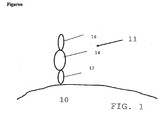
- Fig. 1 In the lower area, the surface of a nanoparticle 10 is shown schematically as a line, without showing individual molecules.
- the modifying reagent 11 used according to the invention is shown schematically here using the example of a single molecule. It contains three essential components: a spacer or support 14 bearing two functional groups 12 and 16.
- the functional group 12 couples to the nanoparticle surface and the functional group 16 protrudes away from the surface of the nanoparticle. It is available for application-specific coupling to other molecules, as already mentioned above.
- the spacer 14 is generally necessary so that the functional groups do not interfere with each other or completely neutralize each other.
- the two functional groups can be linked together by at least one CH 2 group (or another bridging atom).
- the phosphate group can be incorporated into the nanoparticle surface.
- the free carboxylic acid ester function is available for further reactions.
- Example 1 100 g of the product from Example 1 are heated to reflux with 1000 g of triethyl orthoformate for 14 h. The unreacted starting material is filtered off and distilled off all up to 140 ° C at 5 Torr volatile components. 65 g of product are obtained (characterization by 1 H-NMR spectroscopy).
- Example 3 The procedure of Example 3 is repeated using 1000 g of triisopropyl orthoformate as the orthoester. 163 g of product are obtained (characterization by 1 N-NMR spectroscopy).
- the phosphonic acid 11-phosphonoundecanoic acid (1.2 mmol) is dissolved in TEHP (3-4 ml), which can be heated if necessary.
- the salt solution is diluted at 50 ° C under nitrogen atmosphere with TEHP (4 ml) and treated with trioctylamine (8.0 ml, 18.0 mmol), the phosphoric and the phosphonic acid solution. Then we heated to 200 ° C for 15-18 h. After cooling, the reaction mixture is poured onto methanol (150 ml) to precipitate the nanoparticles. The settled precipitate is decanted and then centrifuged. After washing with methanol, it is dried in vacuo.
- the PhosphonTalkreester 11-PhosphonoundecanTalkretriethylester (1.35 ml) as a 5% solution in TEHP (v / v) is set.
- the salt solution is diluted at 50 ° C under nitrogen atmosphere with TEHP (8 ml) and trioctylamine (8.0 ml, 18.0 mmol), the phosphoric acid solution and the phosphonic acid solution are added. Then we heated to 200 ° C for 15-18 h. After cooling the reaction mixture is poured to precipitate the nanoparticles on methanol (150 ml). The settled precipitate is decanted and then centrifuged. After washing with methanol, it is dried in vacuo.
- the salt solution at 50 ° C under nitrogen atmosphere with trioctylamine (13.5 mmol) and H 3 BO 3 (4.5 mmol) and heated to 200 ° C.
- the iminobis (methylenephosphono) caproic acid pentaethyl ester (0.275 g, 0.6 mmol) is added to the synthesis mixture, and the reaction is continued for a further 15 h.
- the reaction mixture is poured onto methanol (120 ml) to precipitate the nanoparticles. The settled precipitate is decanted and then centrifuged. After washing with methanol, it is dried in vacuo.
- the nanoparticles (17.5 mg, 50 nmol) shown in 2. are heated to 150 ° C. with 1,4-bis (3-aminopropoxy) butane (1.02 g, 5 mmol). At about 140 ° C is an optically clear, slightly yellowish dispersion. This is stirred for a further 3 h at 150 ° C and remains clear even after cooling to RT. Overnight is dialysed against 2x2 L 10 mM Na-carbonate buffer pH 8.5 (dialysis tube Spectra / Por, 5-6,000 MWCO, Spektrum, Netherlands). The dialysate is cloudy.
- the nanoparticles (3 mg, 8.4 nmol) shown in Example 4 above are dissolved in TSE buffer pH 8.5 (0.04 M NaCl, 0.05 M triethanolamine-HCl, 0.04 M NaOH, 0.5 g mM EDTA; 0.1% Tween 20; pH 8.5).
- TSE buffer pH 8.5 0.04 M NaCl, 0.05 M triethanolamine-HCl, 0.04 M NaOH, 0.5 g mM EDTA; 0.1% Tween 20; pH 8.5.
- the particles are centrifuged 3 x 15 min. At 3000 g and the precipitate after decanting the supernatant each received in 700 ul TSE buffer pH 8.5.
- sulfoSIAB sulfosuccinimidyl (4-iodoacetyl) aminobenzoate, Perbio Science Germany GmbH, Bonn
- Monoclonal antibody 35J23 (TSD, Newark, DE) directed against PIIINP (aminoterminal procollagen type III) is activated with a 30-fold molar excess of 2-iminothiolane (2-IT, Traut's reagent, Perbio Science GmbH, Bonn) : 10 mg of antibody 35J23 are transferred to TSE8 Buffer with Centricon ultrafiltration tubes (cutoff size 50 kD, Millipore, Schwalbach, Germany) (exchange factor 1000, TSE8: (100 mmol triethanolamine, 50 mmol sodium chloride, 1 mmol EDTA in water, pH 8.5) Protein concentration is adjusted to 7-8 mg / mL Add 150 ⁇ L of a 10 mM solution of 2-imminothiolane in TSE8 buffer to the antibody solution and allow the mixture to react for 15 minutes to allow the thiol-activated antibody to react at 4 ° C as described above B buffered with TSE8 buffer to remove unreacted activator molecules and concentrated to 2
- the assay for the determination of procollagen III in serum samples for diagnosis is a sandwich immunoassay with biotinylated monoclonal capture antibodies and nanoparticle-coupled monoclonal antibodies for detection.
- Biotinylation of monoclonal antibody MAK P3P 296/3/27 (Dade Behring, Marburg) directed against aminoterminal procollagen type III The antibody is dissolved in 0.1 M carbonate buffer pH 8.5 in a concentration of 1 mg / ml and with a 20-fold molar excess of dissolved in water biotin-X-NHS (sulfo-biotin-aminocaproic acid N-hydroxy-succinimide ester, Calbiochem, Schwalbach) for 4 hrs. Rotating at RT.
- the mixture is then dialyzed against PBS buffer (8 mM K 2 HPO 4 , 150 mM NaCl, 2 mM Na 2 HPO 4 , pH 7.4) (dialysis tube Spectra / Por, 5-6000 MWCO, Spektrum, The Netherlands).
- Immunoassay 1 ⁇ g of the nanoparticle conjugate described in 5. above is mixed with 0.65 ⁇ g of the biotinylated antibody MAK P3P 296/3/27 in the presence of PIIINP calibrators (from fetal bovine serum, concentrations: 0, 5.2, 9, 6, 21, 57 and 151 ng / ml) in a volume of 100 .mu.l in PBS buffer with 0.1% BSA at 37 ° C for 1 h, then in streptavidin-coated microtiter plates (BD BioCoat Streptavidin Assay Plates, BD GmbH Heidelberg) and incubated for a further 15 min at 37 ° C.
- PIIINP calibrators from fetal bovine serum, concentrations: 0, 5.2, 9, 6, 21, 57 and 151 ng / ml
- the microtiter plate is read in a Tecan SAFIRE monochromator plate reader (Tecan GmbH, Crailsheim, Germany) with the following settings: excitation wavelength: 280 nm (10 nm slit width); Emission wavelength scan of 450 - 650 nm (10nm slit width); Time delay: 40 ⁇ s and time window: 2000 ⁇ s. For each value, a double determination is made. The measured values are plotted against the calibrator concentrations used and give a calibration curve, with which concentrations of PIIINP, which are measured in an analogous manner in human serum samples, can be determined.
Landscapes
- Chemical & Material Sciences (AREA)
- Organic Chemistry (AREA)
- Inorganic Chemistry (AREA)
- Engineering & Computer Science (AREA)
- Materials Engineering (AREA)
- Health & Medical Sciences (AREA)
- Crystallography & Structural Chemistry (AREA)
- Life Sciences & Earth Sciences (AREA)
- Biochemistry (AREA)
- General Health & Medical Sciences (AREA)
- Molecular Biology (AREA)
- Luminescent Compositions (AREA)
- Physical Or Chemical Processes And Apparatus (AREA)
- Compounds Of Alkaline-Earth Elements, Aluminum Or Rare-Earth Metals (AREA)
Description
- Die vorliegende Erfindung betrifft Iminobis(methylenphosphono)-carbonsäurepentaalkylester als Modifizierungsreagenz bei der Synthese von Metallsalznanopartikeln, Verfahren zur Synthese von Metallsalznanopartikeln unter Verwendung eines Iminobis(methylenphosphono)carbonsäurepentaalkylesters, die nach dem erfindungsgemäßen Verfahren synthetisierten Metallsalznanopartikel und ihre Verwendung zur Ankopplung an biologisch relevante Moleküle zum Zwecke deren Kennzeichnung.
- Metallsalznanopartikel im Sinne der vorliegenden Erfindung weisen ein Kristallgitter oder im Falle einer Dotierung ein Wirtsgitter auf, dessen Kation ein Metall, insbesondere ein Metall der dritten Nebengruppe des Periodensystems, beispielsweise Lanthan oder ein Metall der 2. Hauptgruppe ist, oder ein Seltenerdmetall und dessen Anion, etwa PO4 3-, SO4 2- oder VO4 3-, aus einer geeigneten Anionquelle gewonnen wird, beispielsweise einer freien Säure der Salze der jeweils herzustellenden Nanopartikel, etwa Lanthanphosphat-, Bariumsulfat- oder Natriumvanadat-Nanopartikel.
- Die Herstellung solcher Nanopartikel oder Nanoteilchen erfolgt meist durch Bildung von Nukleationskeimen und anschließendem kristallinen Wachstum der Teilchen meist unter Anwesenheit von koordinierenden Molekülen bzw. Liganden. Diese begrenzen das Wachstum der Teilchen auf eine Größe von unter 10 oder einigen 10 nm und wirken stabilisierend auf die Teilchen. Die Synthese erfolgt oft in hochsiedenden, organischen Lösemitteln, wie es beispielsweise in der internationalen Patentanmeldung
WO 02/20 696 - Halbleiter-Quantum-Dots unter Verwendung von Trioktylphosphin bzw. Trioktylphosphinoxid (TOP/TOPO) (veröffentlicht in: C.B. Murray, D.J. Norris, M.G. Bawendi, J. Am. Chem. Soc. 115, 1993, 8706 ff.)
- Metallkolloiden unter Verwendung von Phosphin- und Chlorid-Liganden (z.B. Au55(PPh3)12C16) oder von Thiol-Liganden (z.B. Au64(SR)34) (beispielsweise veröffentlicht in: G. Schmid, R. Pfeil, R. Boese, F. Bandermann, S. Meyer, G. H. M. Calis, J. W. A. van der Velden, Chem. Ber., 114, 1981, 3634 ff.)
- dotierten oder undotierten anorganischen Nanoteilchen, die auch fluoreszierende und/oder magnetische (para-, ferro-, antiferro-, ferrimagnetische) Eigenschaften aufweisen. (veröffentlicht in: K. Riwotzki, H. Meyssamy, A. Kornowski, M. Haase; J. Phys. Chem. B 104, 2000, 2824 ff.;
WO 02/20695 DE 10111321 ) - Die aus den oben genannten Syntheseverfahren gewonnenen Nanopartikel sollen allerdings in vielen Fällen für bestimmte Anwendungszwecke oder Verwendungen, wie etwa Ankopplung an biologisch relevante Moleküle für die medizinische Diagnostik, Herstellung von Spezialtinten, beispielsweise Sicherheitstinten mit speziell gewählten Eigenschaften, Herstellung von Farben, Lacken, Einbettung in Glasfasern und Kunststoffen für die Kommunikationstechnologie, Verwendung als Katalysator, Einbettung in Flüssigkeiten für die weitere Beschichtung von Gegenständen zum Zwecke von Korrosionsschutz, Oberflächenveredelung oder speziell gewählter Oberflächenfunktionalisierung, weiter verwendet werden können.
- Dabei ist es meist notwendig, die fertig synthetisierten Nanopartikel in einer neuen Umgebung zu dispergieren, die dann für diese Anwendung typisch ist, beispielsweise eine spezielle organische Matrix, oder ein perfluoriertes Lösungsmittel, oder sie sollen zur direkten Ankopplung an biologisch relevante Moleküle verwendet werden, wenn sie etwa als Biolabel eingesetzt werden sollen.
- Nachteilig an den Syntheseverfahren aus dem o.g. Stand der Technik ist für eine solche Weiterverwendung der Nanopartikel der oft stark hydrophobe Charakter der so synthetisierten Teilchen, der z.B. durch Alkylketten verursacht wird, die von der Teilchenoberfläche nach außen ragen. Das Fehlen von geeigneten reaktiven Gruppen gibt diesen Teilchen einen relativ inerten Charakter. Diese Eigenschaften werden hervorgerufen durch die Verwendung koordinierender Moleküle, wie z.B. Trisethylhexylphosphat, Tributylphosphat oder Trioktylphosphin, aus denen das Lösemittel entweder direkt zusammengesetzt ist, oder die als Zusatz zu einem geeigneten Lösemittel zugegeben wurden.
- Diese koordinierenden Moleküle bilden eine organische Hülle um die Nanoteilchen und wirken auch als Stabilisator gegen Agglomeration. Durch den Mangel an reaktiven Gruppen an der Außenseite dieser organischen Hülle der Nanoteilchen sind die Möglichkeiten, weitere Moleküle an die Teilchenoberfläche oder an diese Hülle direkt anzukoppeln, weitgehend eingeschränkt.
- Eine solche Ankopplung funktioneller Moleküle an die Teilchen ist jedoch meist notwendig, um die Nanoteilchen in organische Matrizen wie z.B. Polymere bzw. Lacke oder andere Trägerflüssigkeiten für die oben genannten weiteren Verwendungen einzuarbeiten. Für die oben genannte Verwendung dieser Teilchen als biologische Marker ist eine Ankopplung der Nanopartikel an spezielle Biomoleküle, wie z.B. Antikörper, Proteine, Haptene, Nukleinsäuren, etc. notwendig. Der Einsatz von Markern in biologischen Systemen zur Kennzeichnung oder Verfolgung spezifischer Substanzen ist seit Jahrzehnten ein etabliertes Instrument in der medizinischen Diagnostik und biotechnologischen Forschung.
- Nanopartikel können beispielsweise für biologische Assays mit unterschiedlichsten relevanten Biomolekülen gekoppelt werden und z.B. zum qualitativen oder quantitativen Nachweis eines biologischen Zielmoleküls in einem homogenen, heterogenen oder kompetetiven Assay eingesetzt werden. Dabei können sowohl die angekoppelten Biomoleküle als auch die nachzuweisenden Zielmoleküle z.B. monoklonale oder polyklonale Antikörper, Proteine, Peptide, Oligonukleotide, Nukleinsäuren, nukleinsäureähnliche Moleküle wie Peptide Nucleic Acids (PNAs) oder Morpholinos, Oligo- oder Polysaccharide, Haptene oder niedermolekulare synthetische oder natürliche Antigene sein.
- Um diese Einarbeitung oder Ankopplung durchzuführen, müssen die Teilchen entsprechend behandelt werden. Hierzu gehört gegebenenfalls die zumindest teilweise Entfernung der koordinierenden Moleküle von der Teilchenoberfläche und die in einem dann nachfolgenden Arbeitsschritt durchzuführende Ankopplung von je nach Verwendung spezifischen, vorgegebenen reaktiven Gruppen. Diese weiteren Verfahrensschritte erfordern in nachteilhafter Weise zusätzlichen Arbeitsaufwand und vermindern die Ausbeute an Nanopartikeln, die für die spätere Verwendung effektive gebraucht werden können. Dadurch ist die speziell angepasste Bereitstellung von Nanopartikeln an die jeweilige spätere Verwendung relativ teuer und uneffizient.
- Die
WO 02/20 696 - Es ist daher die Aufgabe der vorliegenden Erfindung, die Flüssigsyntheseverfahren für Nanopartikel im Hinblick auf ihre spätere Verwendung zu vereinfachen.
- Die Gegenstände mit den Merkmalen der unabhängigen Ansprüche lösen diese Auf gabe. In den jeweiligen Unteransprüchen finden sich vorteilhafte Weiterbildungen und Verbesserungen des jeweiligen Gegenstandes der Erfindung.
- Erfindungsgemäß wird die Zugabe eines Modifizierungsreagenz zur Synthesemischung vorgeschlagen, das sich mit einer ersten funktionalen Gruppe an die Nanopartikeloberfläche anlagert und eine zweite funktionale Gruppe zur Bindung an je nach späterer Verwendung der Nanopartikel spezifisch ausgewählte Moleküle trägt. Somit entfällt ein postsynthetischer, separater anwendungsspezifischer Modifikationsschritt. Dabei steht ein Spacermolekül 14 (
Fig. 1 ) zur Verfügung, das die beiden funktionalen Gruppen weit genug voneinander beabstandet trägt. Eine neue Substanzklasse, die Iminobis(methylenphosphono)carbonsäurepentaalkylester sind dafür besonders geeignet. Die besondere Leistung dieser Modifizierungsreagenzien besteht vor allem darin, dass sie das Wachstum der Nanopartikel gezielt gesteuert zulassen und gleichzeitig während der Synthese (in-situ) die Oberfläche der wachsenden Nanopartikel so modifizieren, dass die Teilchen sich sehr gut in einer Vielzahl von Lösungsmitteln lösen lassen, wodurch die Teilchen nach ihrer Synthese gleich eine gewisse Allround-Brauchbarkeit für Dispergierung in diversen Lösungsmitteln besitzen, etwa für Chloroform, Toluol, Hexan, Alkohole, besonders Isopropanol und Wasser. Dieser Vorteil kommt besonders für solche Nanopartikel zum Tragen, deren Oberfläche nach der Synthese relativ arm mit Molekülen versehen ist, die von sich aus geeignet sind, eine brauchbare Lösbarkeit in entsprechenden Lösungsmitteln zu gewährleisten. - Ein erfinderisches Kernmerkmal besteht darin, dass das erfindungsgemäße Modifizierungsreagenz zwei verschiedene Typen von funktionalen Gruppen hat, wobei einer spezifisch für die Kopplung zum Nanopartikel, und der andere spezifisch für eine Kopplung speziell für die spätere Verwendung der Nanopartikel ausgewählt ist, wobei das Reagenz bereits während der Synthese der Nanopartikel zum Einsatz kommt.
- Die vorliegende Erfindung beruht damit auf dem Prinzip, dass die Nanopartikel gleich während ihrer Synthese an ihren Oberflächen mit den Modifizierungsreagenzien in Verbindung kommen, die eine oberflächenmodifizierende "Außenwirkung" besitzen. Durch diese erfindungsgemäß vorgesehene, vom Nanopartikel weg gerichtete Außenwirkung wird bewirkt, dass sich Moleküle, die typisch sind für die nachsynthetische Verwendung der Nanopartikel, leicht anlagern oder ankoppeln können. Es werden also bereits während der Synthese Kopplungsstellen für die spätere Verwendung geschaffen, um beispielsweise eine leichte Dispergierbarkeit in einem bestimmten Medium zu schaffen, etwa einem speziellen Lösungsmittel, oder um Biomoleküle daran anzukoppeln. Dabei kann die Stärke der entstehenden Bindung je nach späterer Verwendung gezielt ausgewählt werden.
- In vorteilhafter Weise haben die Modifizierungsreagenzien darüber hinaus zum Teil gleichzeitig noch eine weitere Funktion: Sie wirken durch ihre zum Nanopartikel gerichtete "Innenwirkung", wie im Stand der Technik beschrieben, als Wachstumssteuerkomponente.
- Erfindungsgemäß werden also bereits bei der Synthese der Teilchen durch Zugabe der Modifizierungsreagenzien geeignete reaktive Gruppen (Estergruppen) in die Teilchenoberfläche eingearbeitet. Diese reaktiven Gruppen können dann für die Herstellung einer stabilen Bindung dienen, jeweils zwischen den Nanoteilchen und organischen Matrizen (z. B. Polymere, Lacke etc.), bzw. biologisch relevanten Molekülen wie z.B. Proteinen, Peptiden, Oligonukleotiden oder anderen Nukleinsäuremolekülen oder nukleinsäureähnliche Moleküle, wie PNAs oder Morpholinos, Oligo- oder Polysacchariden, Haptenen, wie Biotin oder Digoxin oder niedermolekularen synthetischen oder natürlichen Antigenen oder Epitopen.
- Bevorzugt werden die genannten Modifizierungsreagenzien bei der Synthese von Nanopartikeln eingesetzt, deren Wirtsmaterial mit Fremdionen dotiert ist und nachfolgend als lumineszierende anorganische dotierte Nanoteilchen (lad-Nanoteilchen) bezeichnet werden.
- Die Dotierung kann dabei stöchiometrisch oder nicht stöchiometrisch sein. Hierunter zählen insbesondere Materialien und Materialklassen, die als sogenannte Phosphore in Leuchtschirmen oder Fluoreszenzlampen Verwendung finden, wie sie zum Beispiel in Ullmann's Encyclopedia of Industrial Chemistry, WILEY-VCH, 6th edition, 2002 Electronic Release, Kapitel "Luminescent Materials: 1. Inorganic Phosphors" genannt sind. In diesen Materialien dienen die Fremdionen als Aktivatoren für die Emission von Fluoreszenzlicht nach Anregung durch UV-, sichtbares oder IR-Licht, Röntgen- oder Gammastrahlen oder Elektronenstrahlen. Bei einigen Materialien werden auch mehrere Sorten von Fremdionen in das Wirtsmaterial eingebaut, um einerseits Aktivatoren für die Emission zu erzeugen und um andererseits die Anregung des Teilchensystems effizienter zu gestalten oder um die Absorptionswellenlänge durch Verschiebung an die Wellenlänge einer gegebenen Anregungslichtquelle anzupassen (sogenannte Sensitizer). Der Einbau mehrerer Sorten von Fremdionen kann auch dazu dienen, gezielt eine bestimmte Kombination von Fluoreszenzbanden, die von einem Teilchen emittiert werden sollen, einzustellen.
- Das Wirtsmaterial der lad-Nanoteilchen besteht vorzugsweise aus Verbindungen des Typs XY. Dabei ist X ein Kation aus Elementen der Hauptgruppen 1a, 2a, 3a, 4a, der Nebengruppen 2b, 3b, 4b, 5b, 6b, 7b oder der Lanthaniden des Periodensystems. In einigen Fällen kann X auch eine Kombination bzw. Mischung aus den genannten Elementen sein. Y kann ein mehratomiges Anion, enthaltend ein oder mehrere Element(e) der Hauptgruppen 3a, 4a, 5a, der Nebengruppen 3b, 4b, 5b, 6b, 7b und/oder 8b sowie Elemente der Hauptgruppen 6a und/oder 7a, sein. Y kann aber auch ein einatomiges Anion aus der Hauptgruppe 5a, 6a oder 7a des Periodensystems sein. Das Wirtsmaterial der lad-Nanoteilchen kann auch aus einem Element der Hauptgruppe 4a des Periodensystems bestehen. Als Dotierung können Elemente der Hauptgruppen 1a, 2a oder aus der Gruppe enthaltend Al, Cr, Tl, Mn, Ag, Cu, As, Nb, Nd, Ni, Ti, In, Sb, Ga, Si, Pb, Bi, Zn, Co und/oder Elemente der Lanthaniden dienen. Auch Kombinationen von zwei oder mehreren dieser Elemente können in unterschiedlichen relativen Konzentrationen zueinander als Dotierungsmaterial dienen. Die Konzentration des Dotierungsmaterials im Wirtsgitter beträgt zwischen 10-5 mol.-% und 50 mol.-%, bevorzugt zwischen 0,01 mol.-% und 30 mol.%, besonders bevorzugt zwischen 0,1 mol.% und 20 mol.-%.
- Bevorzugt werden Sulfide, Selenide, Sulfoselenide, Oxysulfide, Borate, Aluminate, Gallate, Silikate, Germanate, Phosphate, Halophosphate, Oxide, Arsenate, Vanadate, Niobate, Tantalate, Sulfate, Phosphide, Wolframate, Molybdate, Alkalihalogenide sowie andere Halogenide oder Nitride als Wirtsmaterialien für die lad-Nanoteilchen verwendet. Beispiele für diese Materialklassen sind zusammen mit den entsprechenden Dotierungen in der folgenden Liste angegeben (Materialien des Typs B:A mit B = Wirtsmaterial und A = Dotierungsmaterial):
- LiI:Eu; NaI:T1; CsI:T1; CsI:Na; LiF:Mg; LiF:Mg,Ti; LiF:Mg,Na; KMgF3:Mn; Al2O3:Eu; BaFCI:Eu; BaFCl:Sm; BaFBr:Eu; BaFCl0,5Br0,5:Sm; BaY2F8:A (A = Pr, Tm, Er, Ce); BaSi2O5:Pb; BaMg2Al16O27:Eu; BaMgAl14O23:Eu; BaMgAl10O17:Eu; BaMgAl2O3:Eu; Ba2P2O7:Ti; (Ba,Zn,Mg)3Si2O7:Pb; Ce(Mg,Ba)Al11O19; Ce0,65Tb0,35MgAl11O19:Ce,Tb; MgAl11O19:Ce,Tb; MgF2:Mn; MgS:Eu; MgS:Ce; MgS:Sm; MgS:(Sm,Ce); (Mg,Ca)S:Eu; MgSiO3:Mn; 3,5MgO·0,5MgF2·GeO2:Mn; MgWO4:Sm; MgWO4:Pb; 6MgO·As2O5:Mn; (Zn,Mg)F2:Mn; (Zn4Be)SO4:Mn; Zn2SiO4:Mn; Zn2SiO4:Mn,As; ZnO:Zn; ZnO:Zn,Si,Ga; Zn3(PO4)2:Mn; ZnS:A (A = Ag, Al, Cu); (Zn,Cd)S:A (A = Cu, Al, Ag, Ni); CdBO4:Mn; CaF2:Mn; CaF2:Dy; CaS:A A = Lanthanide, Bi); (Ca,Sr)S:Bi; CaWO4:Pb; CaWO4:Sm; CaSO4:A (A = Mn, Lanthanide); 3Ca3(PO4)2-Ca(F,Cl)2:Sb,Mn; CaSiO3:Mn,Pb; Ca2Al2Si2O7:Ce; (Ca,Mg)SiO3:Ce; (Ca,Mg)SiO3:Ti; 2SrO·6(B2O3)·SrF2:Eu; 3Sr3(PO4)2·CaCl2:Eu; A3(PO4)2·ACl2:Eu (A = Sr, Ca, Ba); (Sr,Mg)2P2O7:Eu; (Sr,Mg)3(PO4)2:Sn; SrS:Ce; SrS:Sm,Ce; SrS:Sm; SrS:Eu; SrS:Eu,Sm; SrS:Cu,Ag; Sr2P2O7:Sn; Sr2P2O7:Eu; Sr4Al14O25:Eu; SrGa2S4:A (A = Lanthanide, Pb); SrGa2S4:Pb; Sr3Gd2Si6O18:Pb,Mn; YF3:Yb,Er; YF3:Ln (Ln = Lanthanide); YLiF4:Ln (Ln = Lanthanide); Y3Al5O12:Ln (Ln = Lanthanide); YAl3(BO4)3:Nd,Yb; (Y,Ga)BO3:Eu; (Y,Gd)BO3:Eu; Y2Al3Ga2O12:Tb; Y2SiO5:Ln (Ln = Lanthanide); Y2O3:Ln (Ln = Lanthanide); Y2O2S:Ln (Ln = Lanthanide); YVO4:A (A = Lanthanide, In); Y(P,V)O4:Eu; YTaO4:Nb; YAlO3:A (A = Pr, Tm, Er, Ce); YOCl:Yb,Er; LnPO4:Ce,Tb (Ln = Lanthanide oder Mischungen von Lanthaniden) ; LuVO4:Eu; GdVO4:Eu; Gd2O2S:Tb; GdMgB5O10:Ce,Tb; LaOBr:Tb; La2O2S:Tb; LaF3:Nd,Ce; BaYb2F8:Eu; NaYF4:Yb,Er; NaGdF4:Yb,Er; NaLaF4:Yb,Er; LaF3:Yb,Er,Tm; BaYF5:Yb,Er; Ga2O3:Dy; GaN:A (A = Pr, Eu, Er, Tm); Bi4Ge3O12; LiNbO3:Nd,Yb; LiNbO3:Er; LiCaAlF6:Ce; LiSrAlF6:Ce; LiLuF4:A (A = Pr, Tm, Er, Ce); Li2B4O7:Mn, SiOx:Er,Al (0 ≤ x ≤ 2).
- Besonders bevorzugt werden folgende Materialien verwendet: YVO4:Eu, YVO4:Sm, YVO4:Dy, LaPO4:Eu, LaPO4:Ce, LaPO4:Ce,Tb, CePO4:Tb; ZnS:Tb, ZnS:TbF3, ZnS:Eu, ZnS:EuF3, Y2O3:Eu, Y2O2S:Eu, Y2SiO5:Eu, SiO2:Dy, SiO2:Al, Y2O3:Tb, CdS:Mn, ZnS:Tb, ZnS:Ag, ZnS:Cu. Unter den besonders bevorzugten Materialien werden insbesondere diejenigen ausgewählt, die eine kubische Gitterstruktur des Wirtsgitters besitzen, da bei diesen Materialien die Zahl der einzelnen Fluoreszenzbanden minimal wird. Beispiele hierfür sind: MgF2:Mn; ZnS:Mn, ZnS:Ag, ZnS:Cu, CaSiO3:Ln, CaS:Ln, CaO:Ln, ZnS:Ln, Y2O3:Ln, oder MgF2:Ln (Ln = Lanthaniden). Die vorliegende Erfindung kann ebenso für Nanopartikel aus folgenden Substanzen bevorzugt eingesetzt werden, die alle auch zusätzlich noch mit einem oder mehreren Elementen der Lanthaniden und/oder Mn, Ag, Cu, Bi, Cr, Sn, Sb dotiert sein können.
- 1. Aus der Gruppe der Halogenide: zum Beispiel XY2 (X = Mg, Ca, Sr, Ba; Y = F, Cl, I), CaF2:Eu (II), BaF2:Eu; BaMgF4:Eu; LiBaF3:Eu; SrF2:Eu; SrBaF2Eu; CaBr2:Eu-SiO2; CaCl2:Eu; CaCl2:Eu-SiO2; CaCl2:Eu,Mn-SiO2; Cal21Eu; Cal2Eu,Mn; KMgF3:Eu; SrF2 :Eu (II), BaF2:Eu (II), YF3, NaYF4,
- 2. Aus der Gruppe der Erdalkalisulfate: zum Beispiel XSO4 (X = Mg, Ca, Sr, Ba), SrSO4:Eu, SrS04:Eu,Mn, BaSO4:Eu, BaSO4:Eu,Mn, CaSO4, CaSO4:Eu, CaSO4:Eu,Mn, sowie jeweils gemischte Erdalkalisulfate, auch in Kombination mit Magnesium, z.B. Ca,MgSO4:Eu,Mn,
- 3. Aus der Gruppe der Phosphate und Halophosphate: zum Beispiel caPO4:Ce,Mn, Ca5(PO4)3Cl:Ce,Mn, Ca5(PO4)3F:Ce,Mn, SrPO4:Ce,Mn, Sr5(PO4)3Cl:Ce,Mn, Srs(PO4)3F:Ce,Mn, dieses auch mit Eu (II) und Eu,Mn codotiert, α-Ca3(PO4)2:Eu; β-Ca3(PO4)2:Eu, Mn; Ca5(PO4)3Cl:Eu; Sr5(PO4)3Cl:Eu; Ba10(PO4)6Cl:Eu; Ba10(PO4)6Cl:Eu,Mn, Ca2Ba3(POa)3Cl:Eu; Ca5(PO4)3F:Eu2+X3+; Sr5(PO4)3F:Eu2+X3+(X=Nd, Er, Ho, Tb); Ba5(PO4)3Cl:Eu; β-Ca3(PO2)2:Eu; CaB2P2O9:Eu; CaB2P2O9:Eu; Ca2P2O7:Eu; Ca2P2O7:Eu, Mn; Sr10(PO4)6Cl2:Eu; (Sr, Ca, Ba, Mg)10(PO4)6Cl2:Eu; LaPO4:Ce; CePO4
- 4. Aus der Gruppe der Borate: zum Beispiel LaBO3; LaBO3:Ce; ScBO3:Ce YAlBO3:Ce; YBO3:Ce; Ca2B5O9Cl:Eu; xEuO·yNa2O·zB2O3
- 5. Aus der Gruppe der Vanadate: zum Beispiel YVO4, YVO4:Eu, YVO4:Dy, YVO4:Sm YVO4:Bi; YVO4:Bi,Eu, YVO4:Bi,Dy, YVO4:Bi,Sm, YVO4:Tm, YVO4:Bi,Tm GdVO4, GdVO4:Eu, GdVO4:Dy, GdVO4:Sm GdVO4:Bi; GdVO4:Bi,Eu, GdVO4:Bi,Dy, GdVO4:Bi,Sm
- 6. Aus der Gruppe der Aluminate: zum Beispiel MgAl2O4:Eu; CaAl2O4:Eu; SrAl2O4:Eu; BaAl2O4:Eu; LaMgAl11O19:Eu; BaMgAl10O17:Eu; BaMgAl10O17:Eu, Mn; CaAl12O19:Eu; SrAl12O19:Eu; SrMgAl10O17:Eu; Ba(Al2O3)6:Eu; (Ba, Sr)MgAl10O17:Eu, Mn; CaAl2O4:Eu, Nd; SrAl2O4:Eu, Dy; Sr4Al14O25:Eu, Dy.
- 7. Aus der Gruppe der Silikate: zum Beispiel BaSrMgSi2O7:Eu; Ba2MgSiO7:Eu; BaMg2SiO7:Eu; CaMgSi2O6:Eu; SrBaSiO4:Eu; Sr2Si3O8.SrCl2:Eu; Ba5SiO4Br6:Eu; Ba5SiO4Cl6:Eu; Ca2MgSi2O7:Eu; CaAl2Si2O8:Eu; Ca1.5Sr0.5MgSi2O7:Eu; (Ca, Sr)2MgSiO7:Eu, Sr2LiSiO4F:Eu.
- 8. Aus der Gruppe der Wolframate und Molybdate: zum Beispiel X3WO6 (X = Mg, Ca, Sr, Ba),, X2WO4 (X = Li, Na, K, Rb, Cs), XMoO4 (X = Mg, Ca, Sr, Ba) sowie Polymolybdate oder Polywolframate bzw. die Salze der entsprechenden Hetero- oder Isopolysäuren.
- 9. Aus der Gruppe der Germanate: zum Beispiel Zn2GeO4
- 10. Aus folgender Gruppe: ALnO2:Yb, Er (A = Li, Na; Ln = Gd, Y, Lu); Ln2O3:Yb, Er (Ln = La, Gd, Y, Lu); LnAO4:Yb, Er (Ln = La, Y; A=P, V, As, Nb); Ca3Al2Ge3O12:Er; Gd2O2S:Yb, Er; La2S:Yb, Er.
- Die vorliegende Erfindung kann auch zur Synthese von oxidischen Nanopartikeln dienen, die via Fällungsreaktion hergestellt werden, wie z.B. CeO2, Y2O3, ZnO, SnO2, TiO2, etc..
- Die vorliegende Erfindung kann bevorzugt zur Synthese kristalliner Wirtsgitter der bisher beschriebenen Verbindungen dienen, sie schließt aber die Synthese amorpher oder teilkristalliner Formen der Teilchen nicht aus.
- Nanoteilchen gemäß der vorliegenden Erfindung weisen eine Größe von 1 nm bis 1 µm, auf, die gezielt unter Verwendung der erfindungsgemäß vorgesehenen Modifizierungsreagenzien einstellbar ist, und lassen sich bis zur Größe von wenigen Nanometern (etwa 2 Nanometern) in enger Größenverteilung herstellen.
- Die erfindungsgemäße Modifizierung der Oberfläche erfolgt während der Bildung der Nanopartikel - in situ Modifikation - im Gegensatz zu der nachsynthetischen Modifikation. Die erhaltenen Nanopartikel können daher direkt mit einer gewünschten chemischen Oberfläche in einem Schritt synthetisiert werden.
- Die Kristallwachstumsgeschwindigkeiten und die resultierenden Partikeldurchmesser sind je nach Typ und chemischer Zusammensetzung des Wirtsgitters und Synthesebedingungen wie Lösungsmittel und Temperatur unterschiedlich groß. Durch den Zeitpunkt der Zugabe des Modifizierungsreagenzes zur Reaktionslösung kann die Größe der Partikel gezielt beeinflusst werden. Der Zeitpunkt der Zugabe des Modifizierungsreagenz während der Synthesezeitspanne ist umso später, je größer die geplante, durchschnittliche Größe der Nanopartikel ist.
- Gitter, die eine schnelle Kristallbildung aufweisen und eher große Nanopartikel bilden (z.B. 20-30 nm), können durch eine direkte Zugabe des Modifizierungsreagenzes zur Reaktionslösung noch vor dem Aufheizen im Wachstum begrenzt werden, während bei Partikeltypen, die zu kleinen Durchmessern neigen, eine zeitverzögerte Zugabe zunächst das Kristallwachstum fortschreiten lässt.
- Somit ist es durch die Wahl des Zeitpunktes, an dem das Modifizierungsreagenz erfindungsgemäß zur Synthesemischung gegeben wird, möglich, das Partikelwachstum zu steuern und damit gewünschte Partikelgrößen zusätzlich zu einer chemisch modifizierten Oberfläche zu erhalten.
- Die Modifizierung der Oberfläche, also das gezielte Anbringen chemischer Gruppen, erlaubt eine Veränderung der Eigenschaften der Nanopartikel hinsichtlich ihrer Löslichkeit in organischen und anorganischen Lösungsmitteln unterschiedlichster Polarität. Auch das Einbringen in Kunststoffe, Lacke, Tinten und Polymere und die homogene Verteilung in diesen Matrices kann durch eine entsprechende Modifizierung erreicht werden. Zudem können durch die Anbringung funktioneller Gruppen Kopplungen mit weiteren Molekülen wie z.B. Biomolekülen erfolgen. Dadurch können die fluoreszierenden oder magnetischen Eigenschaften der Nanopartikel als Marker für biologische Anwendungen eingesetzt werden.
- Durch die Modifizierung mit chemischen Verbindungen, die zwei Typen von funktionellen Gruppen tragen, kann zudem die Möglichkeit eines analytischen Nachweises der Oberflächenmodifizierung eingeführt werden, beispielsweise durch die IR-spektroskopisch empfindlich detektierbare Carbonylschwingung einer Carbonylfunktion.
- Erfindungsgemäß wird als Modifizierungsreagenzien eine neue Substanzklasse verwendet, die Iminobis(methylenphosphono)carbonsäurepentaalkylester der Formel I

- R
- einen C1-C4-Alkylrest und
- Dabei koppeln die Phosphatgruppen an die Oberfläche, sind im obigen Sinne nach innen gerichtet, und die Carbonsäure- bzw. -esterfunktion sind nach außen gerichtet.
- Ein Weg, diese oben genannte neue Substanzklasse herzustellen, ist wie folgt gegeben:
- Ein Verfahren zur erfindungsgemäßen Herstellung der Iminobis(methylenphosphono)carbonsäurepentaalkylester, dadurch gekennzeichnet, dass man Verbindungen der Formel II

mit Orthoesters der Formel III
(RO)3C-X (III),
wobei - R
- die oben zu Formel (I) angegebene Bedeutung hat und
- X
- für ein Wasserstoffatom, einen C1-C4-Alkylrest oder für einen Phenylrest, vorzugsweise für Wasserstoff, steht,
- Verbindungen der Formel II sind zugänglich durch Reaktion von Aminosäuren mit bezogen auf die Aminogruppe 2-3 Molen Formaldehyd und 2-3 Molen Phosphoriger Säure.
- Als Aminosäuren können in diese Reaktion eingesetzt werden: Glycin, Alanin, Leucin, Glutaminsäure, Asparaginsäure, Lysin, Valin, Phenylalanin, beta-Alanin, 4-Aminobuttersäure, 6-Aminocapronsäure, 11-Aminoundecansäure, 7-Aminoheptansäure, 8-Aminooctansäure, 12-Aminododecansäure und 4-Aminomethylbenzoesäure, vorzugsweise 11-Aminoundecansäure und 6-Aminocapronsäure.
- Als Verbindungen der Formel III können eingesetzt werden die Trimethyl- Triethyl, Tripropyl-, Triisopropyl und Tributylester der Orthoameisensäure, Orthoessigsäure und der Orthobenzoesäure, vorzugsweise Orthoameisensäure.
- Die Reaktion findet bei 60°C bis 200°C statt. In einer bevorzugten Ausführungsform werden Orthoameisensäuretrialkylester bei ihrer Siedetemperatur eingesetzt. Die Reaktion findet in Gegenwart oder Abwesenheit, vorzugsweise in Abwesenheit von Lösungsmitteln statt. Es werden mindestens für jede Phosphorylgruppe im Edukt zwei Mol und für jede Carboxylgruppe ein Mol Orthoester eingesetzt. Nach der Reaktion werden nicht umgesetzte Edukte abfiltriert und der Überschuss an Orthoester abdestilliert. Die erfindungsgemäßen Iminobis(methylenphosphono)carbonsäurepentaalkylester können meist nicht durch Vakuumdestillation gereinigt werden, fallen aber in für die geplante Verwendung ausreichender Reinheit an. Eine Reinigung kann durch chromatographische Methoden erfolgen.
- Die erfindungsgemäßen Iminobis(methylenphosphono)carbonsäurepentaalkylester können vorteilhaft als modifizierendes Lösungsmittel für die Herstellung von nanoteiligen Metallsalzen eingesetzt werden, wobei z.B. ein Metallhalogenid mit einer Säure, z.B. Phosphorsäure oder Borsäure, umgesetzt wird. Die Nanoteilchen zeichnen sich durch eine geringe Teilchengröße und durch eine gezielte Oberflächenfunktionalisierung durch Estergruppen aus. Die durchschnittlichen Durchmesser der Nanoteilchen betragen 1 bis 100 nm.
- Ferner können einem speziellen, vorteilhaften Aspekt der vorliegenden Erfindung folgende Verbindungen der Formel IV als Lösungsmittel für die Herstellung von Metallsalznanopartikeln eingesetzt werden:

- R
- die oben zu Formel (I) angegebene Bedeutung hat und
- Alk
- für einen C4-C22-Alkylrest oder C7-C30 Aralkyl- oder Arylalkylrest steht.
- Diese an sich bekannten Verbindungen der Formel IV sind durch Erhitzen von Verbindungen der Formel V

- Alk
- die oben zu Formel (IV) angegebene Bedeutung hat, mit Verbindungen der Formel (III) zugänglich.
- Die Verbindungen der Formel V sind durch Reaktion von den Aminen H2N-Alk mit Phosphoriger Säure und Formaldehyd zugänglich.
- Wenn Iminobis(methylenphosphono)carbonsäurepentaalkylester als Modifizierungsreagenz gewählt wird, dann ergibt sich der weitere Vorteil, dass die Nanoteilchen besonders gute Lösungseigenschaften besitzen, und das Größenwachstum der Teilchen kann besonders zuverlässig kontrolliert werden. Außerdem steht die oben genannte weitere, dritte funktionelle Gruppe z.B. als Estergruppe zur weiteren Kopplung je nach Anwendungszweck zur Verfügung.
- Ein weiterer Vorteil besteht darin, dass eine im Modifizierungsreagenz enthaltene Carbonylgruppe zuverlässig mit IR- Spektroskopie nachgewiesen werden kann, wodurch ein einfacher Nachweis ermöglicht ist, dass die gewünschte Oberflächenmodifizierung der Nanopartikel auch tatsächlich stattgefunden hat.
- Besonders bevorzugt sind Iminobis(methylenphosphono)undecansäurepentaethylester und Iminobis(methylenphosphono)capronsäurepentaethylester.
- Die beiden Substanzen koppeln gut an die Oberflächen der Nanopartikel an und sind in den verwendeten Lösungsmitteln löslich, wie sie weiter unten beschrieben sind. Homologe mit ähnlichen Kettenlängen weisen ähnlich gute Eigenschaften aufweisen.
- Wie aus der vorangegangenen Zusammenfassung und aus den folgenden Herstellungs- und Anwendungsbeispielen ersichtlich wird, lassen sich mittels der erfinderischen Lehre diverse Nanopartikel gezielt für einen späteren Anwendungszweck synthetisiere, wobei sowohl die Palette an Nanopartikeln sehr divers ist als auch die Palette der anwendungsspezifischen Moleküle, an die die Nanopartikel ankoppeln können.
- Ausführungsbeispiele der Erfindung sind in den Zeichnungen dargestellt und in der nachfolgenden Beschreibung näher erläutert.
- Es zeigt:
- Fig. 1
- eine Schemazeichnung zur Darstellung eines erfindungsgemäß vorge- sehenen Modifizierungsreagenz mit zwei funktionalen Gruppen auf einer Nanopartikeloberfläche.
- In
Fig. 1 ist im unteren Bereich die Oberfläche eines Nanopartikels 10 schematisch als Linie dargestellt, ohne einzelne Moleküle zu zeigen. Das erfindungsgemäß eingesetzte Modifizierungsreagenz 11 ist hier schematisch am Beispiel eines einzigen Moleküls gezeigt. Es enthält drei wesentliche Bestandteile: Ein Spacer oder Träger 14, der zwei funktionale Gruppen 12 und 16 trägt. Die funktionale Gruppe 12 koppelt an die Nanopartikeloberfläche an, und die funktionale Gruppe 16 ragt weg von der Oberfläche des Nanopartikels. Sie steht für eine anwendungsspezifische Kopplung an weitere Moleküle zur Verfügung, wie es weiter oben bereits erwähnt wurde. Der Spacer 14 ist im Allgemeinen notwendig, damit sich die funktionalen Gruppen nicht gegenseitig in ihrer Wirkung einschränken oder ganz neutralisieren. Die beiden funktionellen Gruppen können durch mindestens eine CH2-Gruppe (oder ein anderes Brückenatom) miteinander verbunden sein. - In dem in
Fig. 1 gezeigten Beispiel können die erwähnten Bestandteile 10, 12, 14, 16 beispielsweise aus folgenden chemischen Substanzen bestehen: - 10:
- Nanopartikeloberfläche mit Phosphatgruppen -P(=O)(-OH)2
- 12:
- Phosphonosäurediethylester -P(=O)(-OCH2CH3)2
- 14:
- Alkylkette (CH2)x, X= I-?
- 16:
- Carbonsäureethylester -C(=O)O-CH2CH3
- Erfindungsgemäß wird damit eine Kopplung des Phosphonsäureesters an die Oberflächenphosphatgruppen unter Ausbildung einer Diphosphonatgruppierung -P(=O)(-OR)-O-P(=O)(-OR)- (Umesterung) erreicht. Alternativ hierzu kann die Phosphatgruppe in die Nanopartikeloberfläche eingebaut werden. Die freie Carbonsäureesterfunktion steht für weitere Reaktionen zur Verfügung.
- Im Folgenden werden zunächst Beispiele gegeben für die Herstellung einiger Iminobis(methylenphosphono)carbonsäurepentaalkylester:
- Man mischt 200 g 11-Aminoundecansäure, 170 g Phosphorige Säure, 200 ml Wasser und 200 ml konzentrierte Salzsäure, erhitzt auf 100°C und gibt innerhalb von 1 h 324 g Formalin (37 %) hinzu. Man rührt noch 1 h bei 100°C, lässt auf Raumtemperatur abkühlen und saugt das ausgefallene Produkt ab. Man erhält 460 g Produkt.
- Man mischt 131 g 6-Aminocapronsäure, 170 g Phosphorige Säure, 200 ml Wasser und 200 ml konzentrierte Salzsäure, erhitzt auf 100°C und gibt innerhalb von 1 h 324 g Formalin (37 %) hinzu. Man rührt noch 1 h bei 100°C und destilliert das Wasser im Vakuum ab. Man erhält 240 g Produkt.
- Man erhitzt 100 g des Produktes aus Beispiel 1 mit 1000 g Orthoameisensäuretriethylester 14 h auf Rückfluss. Man filtriert das nicht umgesetzte Edukt ab und destilliert alle bis 140°C bei 5 Torr flüchtigen Bestandteile ab. Man erhält 65 g Produkt (Charakterisierung durch 1H-NMR-Spektroskopie).
- Man erhitzt 200 g des Produktes aus Beispiel 2 mit 2000 g Orthoameisensäuretriethylester 13,5 h auf Rückfluss. Man filtriert das nicht umgesetzte Edukt ab und destilliert alle bis 140°C bei 5 Torr flüchtigen Bestandteile ab. Man erhält 148g Produkt (Charakterisierung durch 1N-NMR-Spektroskopie).
- Man verfährt wie in Beispiel 3 angegeben, wobei 1000 g Orthoameisensäuretriisopropylester als Orthoester eingesetzt wird. Man erhält 163 g Produkt (Charakterisierung durch 1N-NMR-Spektroskopie).
- Im Folgenden wird eine Beschreibung einer bevorzugten Ausführungsfbrm für ein erfindungsgemäßes Herstellungsverfahren für die beispielhafte Herstellung von LaPO4:Ce,Tb Nanopartikeln, modifiziert mit erfindungsgemäß vorgesehenen Phosphonsäuren gegeben:
- In einem 50 ml fassenden Hauptkolben mit Intensivkühler, Temperaturfühler und angeschlossenem Heizpilz werden die Salze LaCl3 7H2O (2,4 mmol), CeCl3 7H2O (2,7 mmol) und TbCl3 (0,9 mmol) in Methanol (ca. 2,5 ml) gelöst und die Lösung anschließend mit Tris-2-ethylhexylphosphat (TEHP) versetzt. Methanol und Kristallwasser werden zunächst bei Raumtemperatur (1-2 h) und anschließend bei 50°C im Vakuum mehrere Stunden entfernt.
- In einem zweiten Kolben wird trockene Orthophosphorsäure (6 mmol) in Tetraethylenglycoldimethylether (1,4 ml) gelöst.
- In einem dritten Kolben wird die Phosphonsäure 11-Phosphonoundecansäure (1,2 mmol) in TEHP (3-4 ml) gelöst, wobei gegebenenfalls erwärmt werden kann.
- Die Salzlösung wird bei 50°C unter Stickstoffatmosphäre mit TEHP (4 ml) verdünnt und mit Trioctylamin (8,0 ml, 18,0 mmol), der Phosphor- sowie der Phosphonsäurelösung versetzt. Anschließend wir 15-18 h auf 200°C erhitzt. Nach Abkühlen der Reaktionsmischung wird diese zur Fällung der Nanopartikel auf Methanol (150 ml) gegossen. Der abgesetzte Niederschlag wird dekantiert und anschließend zentrifugiert. Nach Waschen mit Methanol wird im Vakuum getrocknet.
- Im Folgenden wird eine Beschreibung einer bevorzugten Ausführungsform für ein erfindungsgemäßes Herstellungsverfahren für die beispielhafte Herstellung von LaPO4:Ce,Tb Nanopartikeln, modifiziert mit erfindungsgemäß vorgesehenen flüssigen Phosphonsäureestern gegeben:
- In einem 50 ml fassenden Hauptkolben mit Intensivkühler, Temperaturfühler und angeschlossenem Heizpilz werden die Salze LaCl3 7H2O (2,4 mmol), CeCl3 7H2O (2,7 mmol) und TbCl3 (0,9 mmol) in Methanol (ca. 2,5 ml) gelöst und die Lösung anschließend mit Tris-2-ethylhexylphosphat (TEHP) versetzt. Methanol und Kristallwasser wird zunächst bei Raumtemperatur (1-2 h) und anschließend bei 50°C im Vakuum mehrere Stunden entfernt.
- In einem zweiten Kolben wird trockene Orthophosphorsäure (6 mmol) in Tetraethylenglycoldimethylether (1,4 ml) gelöst.
- In einem dritten Gefäß wird der Phosphonsäureester 11-Phosphonoundecansäuretriethylester (1,35 ml) als 5 % Lösung in TEHP (v/v) angesetzt.
- Die Salzlösung wird bei 50°C unter Stickstoffatmosphäre mit TEHP (8 ml) verdünnt und mit Trioctylamin (8,0 ml, 18,0 mmol), der Phosphorsäurelösung und der Phosphonsäurelösung versetzt. Anschließend wir 15-18 h auf 200°C erhitzt. Nach Abkühlen der Reaktionsmischung wird zur Fällung der Nanopartikel auf Methanol (150 ml) gegossen. Der abgesetzte Niederschlag wird dekantiert und anschließend zentrifugiert. Nach Waschen mit Methanol wird im Vakuum getrocknet.
- Im Folgenden wird eine Beschreibung einer bevorzugten Ausführungsform für ein erfindungsgemäßes Herstellungsverfahren für die beispielhafte Herstellung von LaBO3:Ce,Th Nanopartikeln, modifiziert mit erfindungsgemäß vorgesehenen Iminobisphosphonsäureester gegeben.
- In einem 50 ml fassenden Hauptkolben mit Intensivkühler, Temperaturfühler und angeschlossenem Heizpilz werden die Salze LaCl3 7 H20 (1,2 mmol), CeCl3 7H20 (1,35 mmol) und TbCl3 (0,45 mmol) in Methanol (ca. 1,2 ml) gelöst und die Lösung anschließend mit Tributylphosphat (TBP) (27 ml) versetzt. Methanol und Kristallwasser werden zunächst bei Raumtemperatur (1-2 h) und anschließend bei 50°C im Vakuum mehrere Stunden entfernt.
- Anschließend wird die Salzlösung bei 50°C unter Stickstoffatmosphäre mit Trioctylamin (13,5 mmol) und H3BO3 (4,5 mmol) versetzt und auf 200°C erhitzt. Nach 4 h Reaktionszeit wird der Synthesemischung die Iminobis(methylenphosphono)capronsäurepentaethylester (0,275 g, 0,6 mmol) zugesetzt und die Reaktion für weitere 15 h fortgesetzt. Nach Abkühlen der Reaktionsmischung wird diese zur Fällung der Nanopartikel auf Methanol (120 ml) gegossen. Der abgesetzte Niederschlag wird dekantiert und anschließend zentrifugiert. Nach Waschen mit Methanol wird im Vakuum getrocknet.
- Im Folgenden wird eine Beschreibung einer bevorzugten Ausführungsform für ein erfindungsgemäßes Herstellungsverfahren für die beispielhafte Aminfunktionalisierung der in 2. beschriebenen LaPO4:Ce,Tb Nanopartikel modifiziert mit erfindungsgemäß vorgesehenen flüssigen Phosphonsäureestern gegeben:
- In einem Rundkolben werden die in 2. dargestellten Nanopartikel (17,5 mg, 50 nmol) mit 1,4-Bis(3-Aminopropoxy)-Butan (1,02 g, 5 mmol) auf 150°C erhitzt. Bei ca. 140°C liegt eine optisch klare, leicht gelbliche Dispersion vor. Diese wird für weitere 3 h bei 150°C gerührt und bleibt auch nach Abkühlung auf RT klar. Über Nacht wird gegen 2x2 L 10 mM Na-Carbonatpuffer pH 8,5 dialysiert (Dialyseschlauch Spectra/Por, 5-6.000 MWCO, Spektrum, Niederlande). Das Dialysat ist trübe.
- Im Folgenden wird eine Beschreibung einer bevorzugten Ausführungsform für ein erfindungsgemäßes Verfahren für die beispielhafte Ankopplung eines Antikörpers gegen aminoterminales Prokollagen Typ III (PIIINP) an in oben unter 4. beschriebene aminofunktionalisierte LaPO4:Ce,Tb Nanopartikel gegeben:
- Die im 4. Beispiel oben dargestellten Nanopartikel (3 mg, 8,4 nmol) werden in TSE-Puffer pH 8,5 (0,04 M NaCl; 0,05 M Triethanolamin-HCl; 0,04 M NaOH; 0,5 mM EDTA; 0,1 % Tween 20; pH 8,5) überführt. Dazu werden die Partikel 3 x 15 Min. bei 3000 g zentrifugiert und der Niederschlag nach Abdekantieren des Überstandes jeweils in 700 µl TSE-Puffer pH 8,5 aufgenommen. Zur Aktivierung der Partikel wird mit einem 40-fachem Überschuss (50 µl einer 20 mM Lösung in Wasser) sulfoSIAB (Sulfosuccinimidyl(4-iodoacetyl)aminobenzoat, Perbio Science Deutschland GmbH, Bonn) für 15 Min. bei 25°C inkubiert. Die Reaktion wird durch Zugabe von 12 µl 1 M Glycin (12-facher Überschuss) gestoppt und das freie sulfo-SIAB durch Zentrifugation (s.o.) abgetrennt.
- Der monoklonale Antikörper 35J23 (TSD, Newark, DE, USA) gerichtet gegen PIIINP (aminoterminales Prokollagen Typ III) wird mit einem 30-fachen molaren Überschuss von 2-Iminothiolan (2-IT, Traut's reagent, Perbio Science Deutschland GmbH, Bonn) aktiviert: 10 mg Antikörper 35J23 werden mit Centricon Ultrafiltrationsröhrchen (Ausschlussgröße 50 kD, Millipore, Schwalbach, Deutschland) in TSE8 Buffer überführt (Austauschfaktor 1000, TSE8: (100 mmol Triethanolamin, 50 mmol Natriumchlorid, 1 mmol EDTA in Wasser, pH 8.5). Die Proteinkonzentration wird auf 7-8 mg/mL eingestellt. Zu der Antikörperlösung gibt man 150 µL einer 10 mM Lösung von 2-Imminothiolan in TSE8 Puffer und lässt die Mischung 15 Minuten reagieren. Der so Thiol-aktivierte Antikörper wird wie oben beschrieben bei 4°C mit TSE8 Puffer umgepuffert, um nicht reagierte Aktivatormoleküle zu entfernen und auf 2 mL eingeengt. Die sulfoSIAB aktivierten Nanopartikel und den aktivierten Antikörper enthaltenden Lösungen werden vereinigt und bei Raumtemperatur über Nacht gerührt. Die so erhaltene Dispersion des erweiterten Nachweisteilchen wird von nicht umgesetztem Antikörper durch Zentrifugation wie oben beschrieben abgetrennt.
- Im Folgenden wird eine Beschreibung einer bevorzugten Ausführungsform für ein erfindungsgemäßes Nachweisverfahren für aminoterminales Prokollagen Typ III mittels der in oben unter 5. beschriebenen, antikörpergekoppelten LaPO4:Ce,Tb Nanopartikel gegeben:
- Der Assay zur Bestimmung von Prokollagen III in Serumproben zur Diagnose ist ein Sandwich Immunoassay mit biotinylierten monoklonalen Fängerantikörpem und nanopartikel-gekoppelten monoklonalen Antikörpern zur Detektion.
- Biotinylierung des monoklonalen Antikörpers MAK P3P 296/3/27 (Dade Behring, Marburg) gerichtet gegen aminoterminales Prokollagen Typ III: Der Antikörper wird in 0,1 M Carbonat-Puffer pH 8,5 in einer Konzentration von 1 mg/ml gelöst und mit einem 20-fach molaren Überschuss von in Wasser gelöstem Biotin-X-NHS (Sulfo-Biotin-Aminocapronsäure-N-Hydroxy-Succinimid-Ester, Calbiochem, Schwalbach) für 4 Std. bei RT rotierend inkubiert. Anschließend wird gegen PBS-Puffer (8 mM K2HPO4; 150 mM NaCl; 2 mM Na2HPO4; pH 7,4) dialysiert (Dialyseschlauch Spectra/Por, 5-6.000 MWCO, Spektrum, Niederlande).
- Immunoassay: 1 µg des in oben unter 5. beschriebenen Nanopartikel-Konjugates werden mit 0,65 µg des biotinylierten Antikörpers MAK P3P 296/3/27 in Anwesenheit von PIIINP Kalibratoren (aus fötalem Rinderserum, Konzentrationen: 0; 5,2; 9,6; 21; 57 und 151 ng/ml) in einem Volumen von 100 µl in PBS Puffer mit 0,1 % BSA bei 37°C für 1 h inkubiert, anschließend in Streptavidin-beschichteten Microtiterplatten (BD BioCoat Streptavidin Assay Plates, BD GmbH Heidelberg) gegeben und für weitere 15 min bei 37°C inkubiert. Nach 3-maligem Waschen mit jeweils 200 µl PBS / 0,1 % BSA wird die Microtiterplatte in einem Tecan SAFIRE Monochromator Plattenleser (Tecan GmbH, Crailsheim, Deutschland) mit folgenden Einstellungen ausgelesen: Anregungswellenlänge: 280 nm (10 nm Spaltbreite); Emissionswellenlängen-Scan von 450 - 650 nm (10nm Spaltbreite); Zeitverzögerung (time delay): 40 µs und Zeitfenster (time window): 2000 µs. Für jeden Wert wird eine Doppelbestimmung durchgeführt. Die gemessenen Werte werden gegen die eingesetzten Kalibrator-Konzentrationen in einem Diagramm aufgetragen und ergeben eine Eichkurve, anhand derer Konzentrationen von PIIINP, die in analoger Weise in humanen Serumproben gemessen werden, bestimmt werden können.
- Obwohl die vorliegende Erfindung anhand von bevorzugten Ausführungsbeispielen vorstehend beschrieben wurde, ist sie darauf nicht beschränkt, sondern auf vielfältige Weise modifizierbar.
- Schließlich können die Merkmale der Unteransprüche im wesentlichen frei miteinander und nicht durch die in den Ansprüchen vorliegende Reihenfolge miteinander kombiniert werden, sofern sie unabhängig voneinander sind.
Claims (10)
- Verfahren zur Herstellung von Metallsalznanopartikeln in einer Flüssigphasenreaktion, bei der die Nanopartikel in einer Synthesemischung synthetisiert werden und während einer Synthesezeitspanne wachsen, gekennzeichnet durch das Hinzugeben eines Modifizierungsreagenz zu der Synthesemischung innerhalb der Synthesezeitspanne, wobei als Modifizierungsreagenz ein Iminobis(methylenphosphono)carbonsäurepentaalkylester der Formel I verwendet wird:
 R einen C1-C4-Alkylrest undAlkylen einen C1-C22-Alkylenrest oder C7-C20-Alkylenarylenrest, vorzugsweise einen C5-C17-Alkylenrest, der linear oder verzweigt sein kann und zusätzlich als weitere Substituenten Halogenatome, COOR-Gruppen, Alkoxygruppen, Bis(dialkoxyphosphorylmethyl)aminogruppen oder Arylreste tragen kann, darstellt.
 - Verfahren nach Anspruch 1, wobei als Modifizierungsreagenz ein Iminobis(methylenphosphono)undecansäurepentaethylester oder -pentaisopropylester verwendet wird.
- Verfahren nach Anspruch 1, wobei als Modifizierungsreagenz ein Iminobis(methylenphosphono)capronsäurepentaethylester oder -pentaisopropylester verwendet wird.
- Verfahren nach den vorstehenden Ansprüchen 1 bis 3, wobei die Zugabe des Modifizierungsreagenz während der Synthesezeitspanne umso später erfolgt, je größer die geplante, durchschnittliche Größe der Nanopartikel ist.
- Verfahren nach Anspruch 1, wobei es sich bei den Metallsalznanopartikeln um Substanzen ausgewählt aus der Reihe der Halogenide, der Erdalkalisulfate, der Phosphate und Halophosphate, der Borate, der Vanadate, der Aluminate, der Silikate, der Wolframate, der Molybdate, der Germanate, handelt, die alle auch zusätzlich noch mit einem oder mehreren Elementen der Lanthaniden und/oder Mn, Ag, Cu, Pb, Bi, Cr, Sn, Sb dotiert sein können.
- Verfahren nach Anspruch 1, wobei es sich bei den Metallsalznanopartikeln um Substanzen ausgewählt aus der Reihea) XY2 (X = Mg, Ca, Sr, Ba; Y = F, Cl, I), CaF2:Eu (II), BaF2:Eu; BaMgF4:Eu; LiBaF3:Eu; SrF2:Eu; SrBaF2Eu; CaBr2:Eu-SiO2; CaCl2:Eu; CaCl2:Eu-SiO2; CaCl2:Eu,Mn-SiO2; Cal2:Eu; Cal2Eu,Mn; KMgF3:Eu; SrF2 :Eu (II), BaF2:Eu (II), YF3, NaYF4,b) XSO4 (X = Mg, Ca, Sr, Ba), SrSO4:Eu, SrS04:Eu,Mn, BaSO4:Eu, BaSO4:Eu,Mn, CaSO4, CaSO4:Eu, CaSO4:Eu,Mn, sowie jeweils gemischte Erdalkalisulfate, auch in Kombination mit Magnesium, z.B. Ca,MgSO4:Eu,Mn,c) CaPO4:Ce,Mn, Ca5(PO4)3Cl:Ce,Mn, Ca5(PO4)3F:Ce,Mn, SrPO4:Ce,Mn, Sr5(PO4)3Cl:Ce,Mn, Sr5(PO4)3F:Ce,Mn, dieses auch mit Eu (II) und Eu,Mn codotiert, α-Ca3(PO4)2:Eu; β-Ca3(PO4)2:Eu, Mn; Ca5(PO4)3Cl:Eu; Sr5(PO4)3Cl:Eu; Ba10(PO4)6Cl:Eu; Ba10(PO4)6Cl:Eu,Mn, Ca2Ba3(PO4)3Cl:Eu; Ca5(PO4)3F:Eu2+X3+; Sr5(POa)3F:Eu2+X3+(X=Nd, Er, Ho, Tb); Ba5(PO4)3Cl:Eu; β-Ca3(PO4)2:Eu; CaB2P2O9:Eu; CaB2P2O9:Eu; Ca2P2O7:Eu; Ca2P2O7:Eu, Mn; Sr10(PO4)6Cl2:Eu; (Sr, Ca, Ba, Mg)10(PO4)6Cl2:Eu; LaPO4:Ce; CePO4,d) LaBO3; LaBO3:Ce; ScBO3:Ce YAlBO3:Ce; YBO3:Ce; Ca2B5O9Cl:Eu; xEuOyNa2O·zB2O3e) YVO4, YVO4:Eu, YVO4:Dy, YVO4:Sm YVO4:Bi; YVO4:Bi,Eu, YVO4:Bi,Dy, YVO4:Bi,Sm, YVO4:Tm, YVO4:Bi,Tm GdVO4, GdVO4:Eu, GdVO4:Dy, GdVO4:Sm GdVO4:Bi; GdVO4:Bi,Eu, GdVO4:Bi,Dy, GdVO4:Bi,Sm.f) MgAl2O4:Eu; CaAl2O4:Eu; SrAl2O4:Eu; BaAl2O4:Eu; LaMgAl11O19:Eu; BaMgAl10O17:Eu; BaMgAl10O17:Eu, Mn; CaAl12O19:Eu; SrAl12O19:Eu; SrMgAl10O17:Eu; Ba(Al2O3)6:Eu; (Ba, Sr)MgAl10O17:Eu, Mn; CaAl2O4:Eu,Nd; SrAl2O4:Eu, Dy; Sr4Al14O25:Eu, Dy,g) BaSrMGSi2O7:Eu; Ba2MgSiO7:Eu; BaMg2Si2O7:Eu; CaMgSi2O6:Eu; SrBaSiO4:Eu; SrSi3O8.SrCl2:Eu; Ba5SiO4Br6:Eu; Ba5SiO4Cl6:Eu; Ca2MgSi2O7:Eu; CaAl2Si2O8:Eu; Ca1.5Sr0.5MgSi2O7:Eu; (Ca, Sr)2MgSi2O7:Eu, Sr2LiSiO4F:Eu,h) X3WO6 (X = Mg, Ca, Sr, Ba)" X2WO4 (X = Li, Na, K, Rb, Cs), XMoO4 (X = Mg, Ca, Sr, Ba) sowie Polymolybdate oder Polywolframate bzw. die Salze der entsprechenden Hetero- oder Isopolysäureni) Zn2GeO4j) folgenden Verbindungen: ALnO2:Yb, Er (A=Li, Na; Ln=Gd, Y, Lu); Ln2O3:Yb, Er (Ln=La, Gd, Y, Lu); LnAO4:Yb, Er (Ln=La, Y; A=P, V, As, Nb); Ca3Al2Ge3O12:Er; Gd2O2S:Yb, Er; La2S:Yb, Er.handelt, die alle auch zusätzlich noch mit einem oder mehreren Elementen der Lanthaniden und/oder Mn, Ag, Cu, Pb, Bi, Cr, Sn, Sb dotiert sein können.
- Verfahren nach Anspruch 5 oder 6, wobei die Konzentration der Dotierungselemente im Wirtsgitter zwischen 10-5 mol.-% und 50 mol.-%, bevorzugt zwischen 0,01 mol.-% und 30 mol.-%, besonders bevorzugt zwischen 0,1 mol.% und 20 mol.-% beträgt.
- Modifizierte Nanopartikel erhältlich nach einem der Ansprüche 1 bis 7.
- Verwendung der Nanopartikel nach Anspruch 8 zur Ankoppelung an biologisch relevante Moleküle zum Zwecke deren Kennzeichnung.
- Iminobis(methylenphosphono)carbonsäurepentaalkylester der Formel I:
 R einen C1-C4-Alkylrest undAlkylen einen C7-C20-Alkylenarylenrest oder einen C5-C17-Alkylenrest, der linear oder verzweigt sein kann und zusätzlich als weitere Substituenten Halogenatome, COOR-Gruppen, Alkoxygruppen, Bis(dialkoxyphosphorylmethyl)aminogruppen oder Arylreste tragen kann, darstellt.
Applications Claiming Priority (3)
| Application Number | Priority Date | Filing Date | Title |
|---|---|---|---|
| DE10259935A DE10259935A1 (de) | 2002-12-20 | 2002-12-20 | Herstellung und Verwendung von in-situ-modifizierten Nanopartikeln |
| DE10259935 | 2002-12-20 | ||
| PCT/EP2003/013816 WO2004058914A1 (de) | 2002-12-20 | 2003-12-06 | Herstellung und verwendung von in-situ-modifizierten nanopartikeln |
Publications (2)
| Publication Number | Publication Date |
|---|---|
| EP1578888A1 EP1578888A1 (de) | 2005-09-28 |
| EP1578888B1 true EP1578888B1 (de) | 2011-03-09 |
Family
ID=32404039
Family Applications (1)
| Application Number | Title | Priority Date | Filing Date |
|---|---|---|---|
| EP03767759A Expired - Lifetime EP1578888B1 (de) | 2002-12-20 | 2003-12-06 | Herstellung und verwendung von in-situ-modifizierten nanopartikeln |
Country Status (7)
| Country | Link |
|---|---|
| US (1) | US7344895B2 (de) |
| EP (1) | EP1578888B1 (de) |
| JP (1) | JP4652817B2 (de) |
| AT (1) | ATE501230T1 (de) |
| AU (1) | AU2003292201A1 (de) |
| DE (2) | DE10259935A1 (de) |
| WO (1) | WO2004058914A1 (de) |
Families Citing this family (23)
| Publication number | Priority date | Publication date | Assignee | Title |
|---|---|---|---|---|
| FR2873128B1 (fr) * | 2004-07-16 | 2008-09-26 | Rhodia Chimie Sa | Procede de marquage d'un materiau et materiau ainsi marque |
| JP2006117786A (ja) * | 2004-10-21 | 2006-05-11 | Nec Tokin Corp | 変色する塗料組成物又はインキ組成物及び変色する塗料又はインキの使用方法 |
| US7569254B2 (en) * | 2005-08-22 | 2009-08-04 | Eastman Kodak Company | Nanocomposite materials comprising high loadings of filler materials and an in-situ method of making such materials |
| FR2892113B1 (fr) * | 2005-10-13 | 2007-12-14 | Rhodia Recherches & Tech | Borate de terre rare submicronique, son procede de preparation et son utilisation comme luminophore |
| FR2908891B1 (fr) * | 2005-10-28 | 2017-04-21 | Centre Nat De La Rech Scient - Cnrs | Nanoparticules a luminescence persistante de type aluminate pour leur utilisation en tant qu'agent de diagnostic destine a l'imagerie optique in vivo |
| US20070145879A1 (en) * | 2005-12-22 | 2007-06-28 | Abramov Vladimir S | Light emitting halogen-silicate photophosphor compositions and systems |
| JP2009529085A (ja) * | 2006-03-06 | 2009-08-13 | コーニンクレッカ フィリップス エレクトロニクス エヌ ヴィ | (Y,Gd)含有ナノ粒子及び表面結合有機リガンドを用いたルミネッセント材料 |
| JP5157003B2 (ja) * | 2006-04-18 | 2013-03-06 | 学校法人近畿大学 | ユーロピウム付活リン酸イットリウムナノ粒子およびユーロピウム付活バナジウム酸イットリウムナノ粒子の製造方法 |
| CA2589575A1 (en) | 2007-05-22 | 2008-11-22 | Valorbec Societe En Commandite | Lanthanide-doped nayf4 nanocrystals, method of preparing and uses thereof |
| US20090095940A1 (en) * | 2007-07-05 | 2009-04-16 | Meltzer Richard S | High quantum yield infranred phosphors and methods of making phosphors |
| WO2010008595A1 (en) * | 2008-07-16 | 2010-01-21 | Materials And Electrochemical Research (Mer) Corporation | Ready-to-sinter spinel nanomixture |
| DE102009012698A1 (de) | 2009-03-11 | 2010-09-16 | Fraunhofer-Gesellschaft zur Förderung der angewandten Forschung e.V. | Partikel mit einer lumineszierenden anorganischen Schale, Verfahren zur Beschichtung von Partikeln sowie deren Verwendung |
| DE102009017607B4 (de) * | 2009-04-08 | 2011-11-17 | Namos Gmbh | Verfahren zur Funktionalisierung von Halbleiter-Nanopartikeln mit einem Detektionsmolekül, die dadurch hergestellten Halbleiter-Nanopartikel und deren Verwendung |
| US8932486B2 (en) | 2011-04-07 | 2015-01-13 | Performance Indicator, Llc | Persistent phosphors of alkaline earths modified by halides and 3d ions |
| US20140166932A1 (en) * | 2011-06-27 | 2014-06-19 | Ocean's King Lighting Science & Technology Co., Ltd., | Titanium doped ternary system silicate film, preparation method and application thereof |
| CN105062477B (zh) * | 2011-08-19 | 2017-06-16 | 日本结晶光学株式会社 | 闪烁体及其制造方法 |
| US8889657B2 (en) * | 2011-08-31 | 2014-11-18 | Mallinckrodt Llc | Nanoparticle PEG modification with H-phosphonates |
| US8690964B2 (en) * | 2011-10-11 | 2014-04-08 | The Sweet Living Group, LLC | Fabric having ultraviolet radiation protection |
| US8859098B2 (en) * | 2012-05-18 | 2014-10-14 | Lord Corporation | Acrylic adhesion promoters |
| WO2016164791A1 (en) * | 2015-04-10 | 2016-10-13 | Stc.Unm | Metal phosphide nanomaterials prepared from single source metal amides |
| US11004572B2 (en) * | 2016-07-29 | 2021-05-11 | National Institute Of Advanced Industrial Science And Technology | Charged particle detection material, and charged particle detection film and charged particle detection liquid using the same |
| EP3604478A1 (de) * | 2018-08-03 | 2020-02-05 | Consejo Superior de Investigaciones Científicas (CSIC) | Effiziente transparente weisslichtemittierende geschichtete phosphorstruktur mit abstimmbarem schatten, verfahren zu davon herstellung der besagten struktur und verwendungen |
| US20230323150A1 (en) * | 2020-09-08 | 2023-10-12 | Council Of Scientific & Industrial Research | Superhydrophobic composite and multifunctional applications thereof |
Family Cites Families (4)
| Publication number | Priority date | Publication date | Assignee | Title |
|---|---|---|---|---|
| DE4408729A1 (de) * | 1994-03-15 | 1995-09-21 | Hoechst Ag | Nichtcyclische Chelatbildner auf Basis von Aminodialkylphosphoroxiden zur Herstellung von Technetium- oder Rheniumkomplexen |
| ES2258527T3 (es) * | 2000-05-05 | 2006-09-01 | Bayer Technology Services Gmbh | Nanoparticulas impurificadas como biomarcadores. |
| WO2002020695A1 (de) | 2000-09-08 | 2002-03-14 | Nanosolutions Gmbh | Dotierte nanopartikel |
| US7241399B2 (en) * | 2000-09-08 | 2007-07-10 | Centrum Fuer Angewandte Nanotechnologie (Can) Gmbh | Synthesis of nanoparticles |
-
2002
- 2002-12-20 DE DE10259935A patent/DE10259935A1/de not_active Withdrawn
-
2003
- 2003-12-06 WO PCT/EP2003/013816 patent/WO2004058914A1/de not_active Ceased
- 2003-12-06 AU AU2003292201A patent/AU2003292201A1/en not_active Abandoned
- 2003-12-06 EP EP03767759A patent/EP1578888B1/de not_active Expired - Lifetime
- 2003-12-06 JP JP2004562696A patent/JP4652817B2/ja not_active Expired - Fee Related
- 2003-12-06 US US10/540,168 patent/US7344895B2/en not_active Expired - Fee Related
- 2003-12-06 DE DE50313534T patent/DE50313534D1/de not_active Expired - Lifetime
- 2003-12-06 AT AT03767759T patent/ATE501230T1/de active
Also Published As
| Publication number | Publication date |
|---|---|
| US20060063155A1 (en) | 2006-03-23 |
| US7344895B2 (en) | 2008-03-18 |
| AU2003292201A1 (en) | 2004-07-22 |
| JP4652817B2 (ja) | 2011-03-16 |
| WO2004058914A1 (de) | 2004-07-15 |
| ATE501230T1 (de) | 2011-03-15 |
| EP1578888A1 (de) | 2005-09-28 |
| DE50313534D1 (de) | 2011-04-21 |
| DE10259935A1 (de) | 2004-07-01 |
| JP2006514887A (ja) | 2006-05-18 |
Similar Documents
| Publication | Publication Date | Title |
|---|---|---|
| DE10259935A1 (de) | Herstellung und Verwendung von in-situ-modifizierten Nanopartikeln | |
| DE60310032T2 (de) | Kern-Mantel Nanoteilchen für (F) RET-Testverfahren | |
| EP1232226B1 (de) | Nanopartikelsynthese | |
| EP2406343B1 (de) | Partikel mit einer lumineszierenden anorganischen schale, verfahren zur beschichtung von partikeln sowie deren verwendung | |
| EP1282824B1 (de) | Dotierte nanoteilchen als biolabel | |
| EP1444517B1 (de) | Assay basierend auf dotierten nanoteilchen | |
| KR940002162A (ko) | 희토류 인산염의 제조방법 및 그로부터 제조한 생성물 | |
| WO2012034696A1 (de) | Photostimulierbare partikelsysteme, verfahren zu deren herstellung sowie verwendungszwecke | |
| US20100019204A1 (en) | Surface treatment method for nanoparticles | |
| EP2417216A2 (de) | Modifikation von schichtsilikaten für die lumineszenzaktivierung | |
| EP1893720A1 (de) | Hydrophile nanoteilchen mit funktionellen oberflächengruppen, deren herstellung und verwendung | |
| KR930002239A (ko) | 세륨 란타늄 테르븀 포스페이트 및 불용성 희토류염으로 부터의 그의 제조 방법 | |
| EP1366347B1 (de) | Hochempfindliche nicht-isotopische wasserlöslische nanokristalle | |
| DE69324888T2 (de) | Verfahren zum Nachweis von Phosphatase | |
| WO2010031471A1 (de) | Verfahren zur markierung und/oder identifizierung von biomolekülen | |
| DE102008048605B4 (de) | Verfahren zur Markierung und/oder Identifizierung von Biomolekülen | |
| DE102013022052A1 (de) | Magnetisch-nachleuchtende Nanopartikel, Verfahren zu deren Herstellung und Anwendung zur Detektion von Biomolekülen | |
| HK1091857B (en) | Core/shell nanoparticles suitable for (f)ret-assays |
Legal Events
| Date | Code | Title | Description |
|---|---|---|---|
| PUAI | Public reference made under article 153(3) epc to a published international application that has entered the european phase |
Free format text: ORIGINAL CODE: 0009012 |
|
| 17P | Request for examination filed |
Effective date: 20050720 |
|
| AK | Designated contracting states |
Kind code of ref document: A1 Designated state(s): AT BE BG CH CY CZ DE DK EE ES FI FR GB GR HU IE IT LI LU MC NL PT RO SE SI SK TR |
|
| AX | Request for extension of the european patent |
Extension state: AL LT LV MK |
|
| DAX | Request for extension of the european patent (deleted) | ||
| 17Q | First examination report despatched |
Effective date: 20050930 |
|
| RIN1 | Information on inventor provided before grant (corrected) |
Inventor name: HEIDELBERG, THORSTEN Inventor name: MEYER, CHRISTIANE Inventor name: HAUBOLD, STEPHAN C/O HANOSOLUTIONS GMBH Inventor name: HAASE, MARKUS Inventor name: HOHEISEL, WERNER Inventor name: BOHMANN, KERSTIN Inventor name: KOEHLER, BURKHARD |
|
| GRAP | Despatch of communication of intention to grant a patent |
Free format text: ORIGINAL CODE: EPIDOSNIGR1 |
|
| GRAS | Grant fee paid |
Free format text: ORIGINAL CODE: EPIDOSNIGR3 |
|
| GRAA | (expected) grant |
Free format text: ORIGINAL CODE: 0009210 |
|
| AK | Designated contracting states |
Kind code of ref document: B1 Designated state(s): AT BE BG CH CY CZ DE DK EE ES FI FR GB GR HU IE IT LI LU MC NL PT RO SE SI SK TR |
|
| REG | Reference to a national code |
Ref country code: GB Ref legal event code: FG4D Free format text: NOT ENGLISH |
|
| REG | Reference to a national code |
Ref country code: CH Ref legal event code: EP |
|
| REG | Reference to a national code |
Ref country code: IE Ref legal event code: FG4D Free format text: LANGUAGE OF EP DOCUMENT: GERMAN |
|
| REF | Corresponds to: |
Ref document number: 50313534 Country of ref document: DE Date of ref document: 20110421 Kind code of ref document: P |
|
| REG | Reference to a national code |
Ref country code: DE Ref legal event code: R096 Ref document number: 50313534 Country of ref document: DE Effective date: 20110421 |
|
| REG | Reference to a national code |
Ref country code: NL Ref legal event code: VDEP Effective date: 20110309 |
|
| PG25 | Lapsed in a contracting state [announced via postgrant information from national office to epo] |
Ref country code: SE Free format text: LAPSE BECAUSE OF FAILURE TO SUBMIT A TRANSLATION OF THE DESCRIPTION OR TO PAY THE FEE WITHIN THE PRESCRIBED TIME-LIMIT Effective date: 20110309 Ref country code: GR Free format text: LAPSE BECAUSE OF FAILURE TO SUBMIT A TRANSLATION OF THE DESCRIPTION OR TO PAY THE FEE WITHIN THE PRESCRIBED TIME-LIMIT Effective date: 20110610 Ref country code: ES Free format text: LAPSE BECAUSE OF FAILURE TO SUBMIT A TRANSLATION OF THE DESCRIPTION OR TO PAY THE FEE WITHIN THE PRESCRIBED TIME-LIMIT Effective date: 20110620 |
|
| PG25 | Lapsed in a contracting state [announced via postgrant information from national office to epo] |
Ref country code: CY Free format text: LAPSE BECAUSE OF FAILURE TO SUBMIT A TRANSLATION OF THE DESCRIPTION OR TO PAY THE FEE WITHIN THE PRESCRIBED TIME-LIMIT Effective date: 20110309 Ref country code: NL Free format text: LAPSE BECAUSE OF FAILURE TO SUBMIT A TRANSLATION OF THE DESCRIPTION OR TO PAY THE FEE WITHIN THE PRESCRIBED TIME-LIMIT Effective date: 20110309 Ref country code: BG Free format text: LAPSE BECAUSE OF FAILURE TO SUBMIT A TRANSLATION OF THE DESCRIPTION OR TO PAY THE FEE WITHIN THE PRESCRIBED TIME-LIMIT Effective date: 20110609 Ref country code: FI Free format text: LAPSE BECAUSE OF FAILURE TO SUBMIT A TRANSLATION OF THE DESCRIPTION OR TO PAY THE FEE WITHIN THE PRESCRIBED TIME-LIMIT Effective date: 20110309 Ref country code: SI Free format text: LAPSE BECAUSE OF FAILURE TO SUBMIT A TRANSLATION OF THE DESCRIPTION OR TO PAY THE FEE WITHIN THE PRESCRIBED TIME-LIMIT Effective date: 20110309 |
|
| REG | Reference to a national code |
Ref country code: IE Ref legal event code: FD4D |
|
| PG25 | Lapsed in a contracting state [announced via postgrant information from national office to epo] |
Ref country code: PT Free format text: LAPSE BECAUSE OF FAILURE TO SUBMIT A TRANSLATION OF THE DESCRIPTION OR TO PAY THE FEE WITHIN THE PRESCRIBED TIME-LIMIT Effective date: 20110711 Ref country code: EE Free format text: LAPSE BECAUSE OF FAILURE TO SUBMIT A TRANSLATION OF THE DESCRIPTION OR TO PAY THE FEE WITHIN THE PRESCRIBED TIME-LIMIT Effective date: 20110309 Ref country code: IE Free format text: LAPSE BECAUSE OF FAILURE TO SUBMIT A TRANSLATION OF THE DESCRIPTION OR TO PAY THE FEE WITHIN THE PRESCRIBED TIME-LIMIT Effective date: 20110309 |
|
| PG25 | Lapsed in a contracting state [announced via postgrant information from national office to epo] |
Ref country code: SK Free format text: LAPSE BECAUSE OF FAILURE TO SUBMIT A TRANSLATION OF THE DESCRIPTION OR TO PAY THE FEE WITHIN THE PRESCRIBED TIME-LIMIT Effective date: 20110309 Ref country code: CZ Free format text: LAPSE BECAUSE OF FAILURE TO SUBMIT A TRANSLATION OF THE DESCRIPTION OR TO PAY THE FEE WITHIN THE PRESCRIBED TIME-LIMIT Effective date: 20110309 Ref country code: RO Free format text: LAPSE BECAUSE OF FAILURE TO SUBMIT A TRANSLATION OF THE DESCRIPTION OR TO PAY THE FEE WITHIN THE PRESCRIBED TIME-LIMIT Effective date: 20110309 |
|
| PLBE | No opposition filed within time limit |
Free format text: ORIGINAL CODE: 0009261 |
|
| STAA | Information on the status of an ep patent application or granted ep patent |
Free format text: STATUS: NO OPPOSITION FILED WITHIN TIME LIMIT |
|
| PGFP | Annual fee paid to national office [announced via postgrant information from national office to epo] |
Ref country code: FR Payment date: 20111219 Year of fee payment: 9 Ref country code: CH Payment date: 20111213 Year of fee payment: 9 |
|
| 26N | No opposition filed |
Effective date: 20111212 |
|
| PG25 | Lapsed in a contracting state [announced via postgrant information from national office to epo] |
Ref country code: DK Free format text: LAPSE BECAUSE OF FAILURE TO SUBMIT A TRANSLATION OF THE DESCRIPTION OR TO PAY THE FEE WITHIN THE PRESCRIBED TIME-LIMIT Effective date: 20110309 |
|
| REG | Reference to a national code |
Ref country code: DE Ref legal event code: R097 Ref document number: 50313534 Country of ref document: DE Effective date: 20111212 |
|
| PG25 | Lapsed in a contracting state [announced via postgrant information from national office to epo] |
Ref country code: IT Free format text: LAPSE BECAUSE OF FAILURE TO SUBMIT A TRANSLATION OF THE DESCRIPTION OR TO PAY THE FEE WITHIN THE PRESCRIBED TIME-LIMIT Effective date: 20110309 |
|
| BERE | Be: lapsed |
Owner name: BAYER TECHNOLOGY SERVICES G.M.B.H. Effective date: 20111231 |
|
| PG25 | Lapsed in a contracting state [announced via postgrant information from national office to epo] |
Ref country code: MC Free format text: LAPSE BECAUSE OF NON-PAYMENT OF DUE FEES Effective date: 20111231 |
|
| PG25 | Lapsed in a contracting state [announced via postgrant information from national office to epo] |
Ref country code: BE Free format text: LAPSE BECAUSE OF NON-PAYMENT OF DUE FEES Effective date: 20111231 |
|
| REG | Reference to a national code |
Ref country code: AT Ref legal event code: MM01 Ref document number: 501230 Country of ref document: AT Kind code of ref document: T Effective date: 20111206 |
|
| PG25 | Lapsed in a contracting state [announced via postgrant information from national office to epo] |
Ref country code: LU Free format text: LAPSE BECAUSE OF NON-PAYMENT OF DUE FEES Effective date: 20111206 |
|
| PG25 | Lapsed in a contracting state [announced via postgrant information from national office to epo] |
Ref country code: AT Free format text: LAPSE BECAUSE OF NON-PAYMENT OF DUE FEES Effective date: 20111206 |
|
| REG | Reference to a national code |
Ref country code: CH Ref legal event code: PL |
|
| GBPC | Gb: european patent ceased through non-payment of renewal fee |
Effective date: 20121206 |
|
| REG | Reference to a national code |
Ref country code: FR Ref legal event code: ST Effective date: 20130830 |
|
| PG25 | Lapsed in a contracting state [announced via postgrant information from national office to epo] |
Ref country code: TR Free format text: LAPSE BECAUSE OF FAILURE TO SUBMIT A TRANSLATION OF THE DESCRIPTION OR TO PAY THE FEE WITHIN THE PRESCRIBED TIME-LIMIT Effective date: 20110309 |
|
| PG25 | Lapsed in a contracting state [announced via postgrant information from national office to epo] |
Ref country code: CH Free format text: LAPSE BECAUSE OF NON-PAYMENT OF DUE FEES Effective date: 20121231 Ref country code: LI Free format text: LAPSE BECAUSE OF NON-PAYMENT OF DUE FEES Effective date: 20121231 Ref country code: HU Free format text: LAPSE BECAUSE OF FAILURE TO SUBMIT A TRANSLATION OF THE DESCRIPTION OR TO PAY THE FEE WITHIN THE PRESCRIBED TIME-LIMIT Effective date: 20110309 Ref country code: DE Free format text: LAPSE BECAUSE OF NON-PAYMENT OF DUE FEES Effective date: 20130702 |
|
| REG | Reference to a national code |
Ref country code: DE Ref legal event code: R119 Ref document number: 50313534 Country of ref document: DE Effective date: 20130702 |
|
| PG25 | Lapsed in a contracting state [announced via postgrant information from national office to epo] |
Ref country code: GB Free format text: LAPSE BECAUSE OF NON-PAYMENT OF DUE FEES Effective date: 20121206 Ref country code: FR Free format text: LAPSE BECAUSE OF NON-PAYMENT OF DUE FEES Effective date: 20130102 |