EP1578845B1 - Verfahren zur hydrolyse/kondensation von halogensilanen zur synthese von hydroxylpolyorganosiloxanen und vorrichtung dafür - Google Patents
Verfahren zur hydrolyse/kondensation von halogensilanen zur synthese von hydroxylpolyorganosiloxanen und vorrichtung dafür Download PDFInfo
- Publication number
- EP1578845B1 EP1578845B1 EP03815085A EP03815085A EP1578845B1 EP 1578845 B1 EP1578845 B1 EP 1578845B1 EP 03815085 A EP03815085 A EP 03815085A EP 03815085 A EP03815085 A EP 03815085A EP 1578845 B1 EP1578845 B1 EP 1578845B1
- Authority
- EP
- European Patent Office
- Prior art keywords
- hydrolysis
- reactor
- aqueous phase
- phase
- condensation
- Prior art date
- Legal status (The legal status is an assumption and is not a legal conclusion. Google has not performed a legal analysis and makes no representation as to the accuracy of the status listed.)
- Expired - Lifetime
Links
Classifications
-
- C—CHEMISTRY; METALLURGY
- C08—ORGANIC MACROMOLECULAR COMPOUNDS; THEIR PREPARATION OR CHEMICAL WORKING-UP; COMPOSITIONS BASED THEREON
- C08G—MACROMOLECULAR COMPOUNDS OBTAINED OTHERWISE THAN BY REACTIONS ONLY INVOLVING UNSATURATED CARBON-TO-CARBON BONDS
- C08G77/00—Macromolecular compounds obtained by reactions forming a linkage containing silicon with or without sulfur, nitrogen, oxygen or carbon in the main chain of the macromolecule
- C08G77/04—Polysiloxanes
- C08G77/06—Preparatory processes
-
- B—PERFORMING OPERATIONS; TRANSPORTING
- B01—PHYSICAL OR CHEMICAL PROCESSES OR APPARATUS IN GENERAL
- B01J—CHEMICAL OR PHYSICAL PROCESSES, e.g. CATALYSIS OR COLLOID CHEMISTRY; THEIR RELEVANT APPARATUS
- B01J19/00—Chemical, physical or physico-chemical processes in general; Their relevant apparatus
- B01J19/0053—Details of the reactor
- B01J19/0066—Stirrers
-
- B—PERFORMING OPERATIONS; TRANSPORTING
- B01—PHYSICAL OR CHEMICAL PROCESSES OR APPARATUS IN GENERAL
- B01J—CHEMICAL OR PHYSICAL PROCESSES, e.g. CATALYSIS OR COLLOID CHEMISTRY; THEIR RELEVANT APPARATUS
- B01J19/00—Chemical, physical or physico-chemical processes in general; Their relevant apparatus
- B01J19/18—Stationary reactors having moving elements inside
- B01J19/1806—Stationary reactors having moving elements inside resulting in a turbulent flow of the reactants, such as in centrifugal-type reactors, or having a high Reynolds-number
-
- B—PERFORMING OPERATIONS; TRANSPORTING
- B01—PHYSICAL OR CHEMICAL PROCESSES OR APPARATUS IN GENERAL
- B01J—CHEMICAL OR PHYSICAL PROCESSES, e.g. CATALYSIS OR COLLOID CHEMISTRY; THEIR RELEVANT APPARATUS
- B01J19/00—Chemical, physical or physico-chemical processes in general; Their relevant apparatus
- B01J19/18—Stationary reactors having moving elements inside
- B01J19/1812—Tubular reactors
- B01J19/1837—Loop-type reactors
-
- C—CHEMISTRY; METALLURGY
- C08—ORGANIC MACROMOLECULAR COMPOUNDS; THEIR PREPARATION OR CHEMICAL WORKING-UP; COMPOSITIONS BASED THEREON
- C08G—MACROMOLECULAR COMPOUNDS OBTAINED OTHERWISE THAN BY REACTIONS ONLY INVOLVING UNSATURATED CARBON-TO-CARBON BONDS
- C08G77/00—Macromolecular compounds obtained by reactions forming a linkage containing silicon with or without sulfur, nitrogen, oxygen or carbon in the main chain of the macromolecule
- C08G77/04—Polysiloxanes
- C08G77/045—Polysiloxanes containing less than 25 silicon atoms
-
- C—CHEMISTRY; METALLURGY
- C08—ORGANIC MACROMOLECULAR COMPOUNDS; THEIR PREPARATION OR CHEMICAL WORKING-UP; COMPOSITIONS BASED THEREON
- C08G—MACROMOLECULAR COMPOUNDS OBTAINED OTHERWISE THAN BY REACTIONS ONLY INVOLVING UNSATURATED CARBON-TO-CARBON BONDS
- C08G77/00—Macromolecular compounds obtained by reactions forming a linkage containing silicon with or without sulfur, nitrogen, oxygen or carbon in the main chain of the macromolecule
- C08G77/04—Polysiloxanes
- C08G77/14—Polysiloxanes containing silicon bound to oxygen-containing groups
- C08G77/16—Polysiloxanes containing silicon bound to oxygen-containing groups to hydroxy groups
-
- B—PERFORMING OPERATIONS; TRANSPORTING
- B01—PHYSICAL OR CHEMICAL PROCESSES OR APPARATUS IN GENERAL
- B01J—CHEMICAL OR PHYSICAL PROCESSES, e.g. CATALYSIS OR COLLOID CHEMISTRY; THEIR RELEVANT APPARATUS
- B01J2219/00—Chemical, physical or physico-chemical processes in general; Their relevant apparatus
- B01J2219/00049—Controlling or regulating processes
- B01J2219/00051—Controlling the temperature
- B01J2219/00074—Controlling the temperature by indirect heating or cooling employing heat exchange fluids
- B01J2219/00087—Controlling the temperature by indirect heating or cooling employing heat exchange fluids with heat exchange elements outside the reactor
- B01J2219/00094—Jackets
-
- B—PERFORMING OPERATIONS; TRANSPORTING
- B01—PHYSICAL OR CHEMICAL PROCESSES OR APPARATUS IN GENERAL
- B01J—CHEMICAL OR PHYSICAL PROCESSES, e.g. CATALYSIS OR COLLOID CHEMISTRY; THEIR RELEVANT APPARATUS
- B01J2219/00—Chemical, physical or physico-chemical processes in general; Their relevant apparatus
- B01J2219/00049—Controlling or regulating processes
- B01J2219/00184—Controlling or regulating processes controlling the weight of reactants in the reactor vessel
Definitions
- the field of the invention is that of the synthesis of hydroxylated polyorganosiloxanes, in particular silanol-terminated linear polydiorganosiloxanes ( ⁇ SiOH) of low molar mass.
- These silicones eg polydimethylsiloxane ⁇ , ⁇ -diOH
- silicone elastomers such as are found in particular in crosslinked silicone coatings (eg anti-adhesion paper) or in silicone emulsions crosslinkable at room temperature (polycondensation) to form sealants or other sealing materials.
- the present invention thus relates to a process for the hydrolysis / condensation of halosilanes in a multiphase (preferably biphasic) reaction medium, this process being of the type consisting of placing the halosilanes in the presence of water and buffer, with stirring, and then separating the aqueous phase from the organic phase, which comprises the hydrolysis / condensation products, namely hydroxylated polyorganosiloxanes.
- the present invention also relates to a device for carrying out this hydrolysis / condensation process of halosilanes.
- long oil silanol ends (rate ⁇ SiOH (w / w) weak, ie ⁇ 1%) are produced industrially by redistributing short chains from cyclic polyorganosiloxanes D and 3 or D 4 .
- the present invention is more specifically in the hydrolysis / condensation technology of halosilanes, for example chlorosilanes.
- hydrolysis / condensation starting materials may be alkoxysilanes instead of halosilanes.
- the patent application EP-A-1,052,262 describes the hydrolysis / condensation of one mole of dimethoxydimethylsilane with two moles of water, the reaction medium being adjusted to pH 3.4 using hydrochloric acid. This stoichiometric two-phase system is stirred vigorously at room temperature. The agitation continues for a while. The reaction mixture becomes homogeneous and is then added a buffer system KH 2 PO 4 / Na 2 HPO 4 so as to adjust the pH to 6.8. After stirring for a few minutes, the reaction medium is subjected to a distillation operation under vacuum to remove water and volatile substances (methanol).
- one of the essential objectives of the present invention is to provide a process for the hydrolysis / condensation of alkoxylated or hydroxylated halogenated silanes, in which the reaction kinetics of hydrolysis and condensation are perfectly under control, so as to able to control the length of the silicone chain.
- Another essential objective of the present invention is to provide an economical and simple process for the hydrolysis / condensation of silanes and in particular of halosilanes, making it possible to produce hydroxylated polyorganosiloxanes with a short chain and therefore with OH levels greater than 2. %, while enjoying excellent storage stability.
- Another essential objective of the present invention is to provide a process for the hydrolysis / condensation of silanes and in particular of halosilanes, satisfying all the requirements of "industrial applicability", namely in particular availability, accessibility and low cost of the products. starting materials, ease of implementation, low cost, absence of danger and ecotoxicity (no organic solvents), speed, possibility of continuous operation, among others.
- Another essential objective of the present invention is to provide a process for the synthesis of hydroxylated polyorganosiloxanes, in particular at their ends, characterized by an OH content greater than or equal to 2%, preferably greater than or equal to 5%, and more preferentially still greater than or equal to 10%.
- Another essential objective of the present invention is to provide a process for the hydrolysis / condensation of silanes and in particular of halosilanes, in which the separation between the organic phase comprising the finished products (hydroxylated POS) and the aqueous phase comprising the reagents (acid catalyst / water / buffer) is easy to perform.
- Another essential objective of the present invention is to provide a simple, economical and efficient device for the implementation of the aforementioned method.
- POS PolyOrganoSiloxanes
- the method according to the invention involves a biphasic liquid / liquid reaction between an organic phase loaded with hydrolysable silanes and an aqueous phase (preferably basic) loaded with salt.
- the size of an emulsion is represented by a size distribution.
- the average diameter of the drops in a dispersion is generally given by the average Sauter diameter, d 32 .
- the value of the Sauter diameter results from the equilibrium between the phenomena of rupture, related to the local turbulence in the vicinity of the mobile agitation, and coalescence phenomena in the peripheral zones of turbulence and medium shear.
- the average Sauter diameter is often taken proportional to the maximum stable diameter [ Zhou and Kresta, 1998, Chemical Engineering Science, Vol.53, No. 11 ].
- the conduct of an agitation sufficient in terms of local dissipated power and in terms of shear determines the ad hoc conditions of micromixing and thus in fine the formation of the droplets of dispersed organic phase, which are small enough to allow control of the reaction.
- the sufficiently high dilution factor of the organic phase dispersed in the aqueous phase makes it possible to very significantly limit the risk of coalescence of the droplets and thus to control the OH content by the length of the siloxane chains.
- the neutralizer comprises at least one base, chosen preferably from those of formula: ROH with R representing an ionic species resulting from an element belonging to the alkaline family - column IA of the periodic classification, and more preferably still in the group comprising: NaOH, LiOH and CsOH.
- the buffer is based on carbonates and / or phosphates and / or borates and / or nitrates, among others.
- this buffer is formed in situ in the reaction medium after introduction into the latter of at least one carbonate and / or a phosphate and / or a borate and / or a nitrate, advantageously a carbonate and / or a phosphate and / or or a borate and / or an alkali metal nitrate -column IA of the periodic table, and more preferably a carbonate from the group comprising: Na 2 CO 3 , Li 2 CO 3 and Cs 2 CO 3 .
- the neutralizer consisting of an aqueous solution of the NaOH base and the buffer obtained in situ by introducing Na 2 CO 3 into the reaction medium, are preferred embodiments in practice.
- the neutralizer and the buffer make it possible to control the polycondensation, through the control of the acidity, which acts in this case as a catalyst.
- the pH of the reaction medium is stabilized between 7 and 12, preferably between 9 and 11.
- Alkyl denotes a saturated hydrocarbon chain, linear or branched, optionally substituted (eg by one or more alkyls), preferably from 1 to 10 carbon atoms, for example from 1 to 8 carbon atoms, more preferably from 1 to 7 carbon atoms.
- alkyl groups include methyl, ethyl, isopropyl, n-propyl, tert-butyl, isobutyl, n-butyl, n-pentyl, isoamyl and 1,1-dimethylpropyl.
- cycloalkyl is meant a mono- or polycyclic saturated hydrocarbon radical, preferably mono- or bicyclic, preferably having from 3 to 10 carbon atoms, more preferably from 3 to 8.
- polycyclic saturated hydrocarbon radical is meant a radical having two or more cyclic rings attached to each other by ⁇ or / and fused two by two. Examples of polycyclic cycloalkyl groups are adamantane and norbornane. Examples of monocyclic cycloalkyl groups are: cyclopropyl, cyclobutyl, cyclopentyl, cyclohexyl, cycloheptyl and cyclooctyl.
- aryl refers to an aromatic hydrocarbon group having 6 to 18 carbon atoms, monocyclic or polycyclic and preferably monocyclic or bicyclic. It should be understood that, in the context of the invention, a polycyclic aromatic radical is understood to mean a radical having two or more aromatic rings, fused (ortho-condensed or ortho and peri-condensed) to each other, that is to say presenting, two by two, at least two carbons in common.
- aryl is optionally substituted for example by one or more C 1 -C 3 alkyls, one or more halogenated hydrocarbon radicals (eg CF 3 ), one or more alkoxy (eg CH 3 O) or a or more hydrocarbon radicals comprising one or more ketone units (eg CH 3 CO-).
- aryl mention may be made of phenyl, naphthyl, anthryl and phenanthryl radicals.
- arylalkyl denotes an alkyl group as defined above, substituted with one or more aryl groups on its hydrocarbon chain, the aryl group being as defined above. Examples are benzyl and triphenylmethyl.
- acyl means a group R ° -CO- where R ° represents an alkyl as defined above; or a group Ar-CO- where Ar represents an aryl group as defined above, or an arylalkyl in which "aryl" and “alkyl” are as defined above and in which the aryl part is optionally substituted eg by an alkyl.
- alkenyl is meant a linear or branched unsaturated hydrocarbon chain, substituted or unsubstituted, having at least one olefinic double bond, and more preferably a single double bond.
- the alkenyl group has 2 to 8 carbon atoms, more preferably 2 to 6.
- This hydrocarbon chain optionally comprises at least one heteroatom such as O, N, S.
- Preferred examples of alkenyl groups are vinyl, allyl and homoallyl groups.
- alkynyl means an unsaturated, linear or branched, substituted or unsubstituted hydrocarbon-based chain having at least one acetylenic triple bond, and more preferably a single triple bond.
- the alkynyl group has 2 to 8 carbon atoms, more preferably 2 to 6 carbon atoms.
- acetylenyl group and the propargyl group optionally comprises at least one heteroatom such as O, N, S.
- X halogen, for example chlorine.
- the hydrolysis generates a halo acid, in this case HCl which catalyzes the condensation and which must be neutralized for the purpose of control of the latter.
- the molar ratio between the acid generated by the silane and the neutralizer constituted by the base is, in this preferred embodiment, equal to 1.
- the pressure conditions suitable for the process according to the invention are the conditions of normal atmospheric pressure.
- the POS ⁇ , ⁇ -OH obtained are stable over time.
- the process according to the invention is also definable in that it can be carried out continuously, semi-continuously or discontinuously.
- this continuous mode is a preferred embodiment of the method according to the invention, in which preferably intervenes a hydrolysis loop.
- the intensive stirring means advantageously comprise the circulating pump of the hydrolysis loop, which may be, for example, a centrifugal pump for example.
- the hydrolysis loop allows the continuous withdrawal of the biphasic mixture having taken care to ensure that the residence time of the aqueous organic phases supplying the reaction medium is always significantly greater than the reaction time.
- residence times of a few milliseconds to a few seconds have, for example, appeared. as sufficient.
- At least one of the outlets of the respective feed means in the organic phase and in the aqueous phase be disposed as close as possible to the intensive stirring means, and in particular at most of the zone of higher shear that it generates.
- the intensive stirring means used comprise at least one mixer or a rotor / stator type dispersion member with a variable speed of rotation.
- the variable speed makes it possible to modulate the shear - and therefore the size of the droplets - as a function of the target OH level in the polyorganosiloxane.
- This rotor / stator technology guarantees a high shear of the reaction medium. In practice, it may be an agitator of the type marketed by the company IKA under the brand ULTRA-TURRAX®.
- This type of stirrer comprises rotor / stator elements constituted by sets of cross-toothed cones.
- Rotor / stator stirrers such as ULTRA-TURRAX® make it possible to strongly shear the reaction medium to promote the formation of very fine droplets (of the order of a few tens of microns). This shear is characterized by the peripheral speed of the rotor (equivalent to the peripheral speed for a conventional agitator).
- the control of the quality of the mixture makes it possible to scan a wide spectrum of OH levels for the targeted hydroxylated POS (between 1 and 20% for example).
- One of the specific features of this discontinuous mode of the process according to the invention is the arrangement of the outlet of the respective supply means in the organic phase and in the aqueous phase, in the reaction chamber, in the immediate vicinity of intensive stirring means. (rotor / stator), in the zone where the turbulence is maximum during stirring.
- This arrangement of the reagent outlets at the peak of the shear is advantageously precise so that the organic phase / aqueous phase mixture is produced immediately after the entry of the said phases into the reaction medium and the organic phase is located in the reaction medium. put as quickly as possible in the dispersed state, in the form of droplets of very small size (micromix). In other words, it is preferable that the mixture of the two reactive phases is carried out closer to the rotor where the dissipated power is the strongest.
- the intensive stirring means could comprise one or more apparatuses known to those skilled in the art and suitable for the aforementioned shear treatments. These could be, for example, impact jet stirrers, micromixers, static mixers, grinders, ultrasonic stirrers or even pumps (eg centrifuges).
- the most suitable stirring means are, for example, pumps (eg centrifugal) and / or mixers of the rotor / stator type and / or static mixers.
- the biphasic aqueous phase / organic phase mixture having reacted and leaving the reaction chamber is separated, for example by decantation. All separation techniques within the reach of those skilled in the art are applicable to this possible step of the process according to the invention. It can be for example a centrifugation and preferably a separation by gravity.
- the present invention relates to a device for implementing the method as defined above.
- At least one of the outlets of at least one (preferably both) of the feed means 3 and / or 4 in the organic and / or aqueous phase are arranged in such a way that the organic phase and the aqueous phase are introduced and / or mix with each other in the stirring zone of the loop where the power dissipated is the strongest.
- the intensive stirring means comprise at least one rotor / stator assembly provided with cross-toothed cones.
- the water-phase reactor feedstock comprises, respectively, an outlet disposed in the vicinity of the rotor / stator of the stirring means so that the organic phase and the aqueous phase are discharged and / or mixed together. to one another in the area where the dissipated power is the strongest.
- the preferred device which comprises a hydrolysis / condensation reactor, reactor-loop type and designated by the reference 1, intensive stirring means constituted by the circulation pump 2 of the loop, means of supply 3 in the organic phase of the loop 1, feed means 4 in the aqueous phase of the loop 1, a loop outlet 5 assimilable by means of withdrawal of the biphasic reaction medium out of the loop 1 after hydrolysis / condensation, temperature keeping means 6 included in the loop 1, as well as a separation equipment 7 organic phase / aqueous phase.
- the reactor 1 thus consists of a loop pipe, provided with a thermal insulation (double-envelope).
- This pipe 1 is connected to the organic phase inlet pipes 3, 4 of the aqueous phase inlet and the outlet of the reaction medium at the end of the reaction.
- the circulation of the reaction medium in the loop 1 is provided by the circulation pump 2 which is for example a centrifugal pump.
- the heat exchanger 6 allows the regulation of the temperature in the loop reactor 1.
- the heat exchanger 6 may be for example a thermostated bath of a heat transfer fluid (eg water) flowing in the jacket of the pipe constituting the loop 1.
- a heat transfer fluid eg water
- the outlet 5 of the reaction medium opens into the settling tank 7, consisting of by any appropriate equipment known to those skilled in the art.
- the loop reactor 1 may be provided with another intensive stirring means constituted for example by an intensive static mixer, if the shear created by the pump 2 is not sufficient.
- the circulation pump determines the flow rate of circulation in the loop reactor 1. This flow rate may for example be between 20 and 60 m 3 / h, preferably between 35 m 3 / h and 45 m 3 / h.
- the organic phase and the aqueous phase are to be injected into the loop reactor 1 through the inlets 3 and 4 respectively. It should be noted that the organic phase inlet 3 is disposed as close as possible to the shear generated by the pump 2.
- the device used in the examples comprises a hydrolysis / condensation reactor designated by reference 1a, intensive stirring means designated by reference 2a and equipping the reactor 1a, feed means 3a of the reactor in phase organic, feed means 4a of the reactor 1a in the aqueous phase, withdrawal means 5a of the biphasic reaction medium outside the reactor 1a after hydrolysis / condensation, means 6a for maintaining the temperature of the reaction medium 8a contained in the reactor, and a separation equipment 7a organic phase / aqueous phase, these two phases being withdrawn by the means 5a.
- the reactor 1a comprises a double envelope 9a in which circulates the temperature maintaining fluid delivered by other elements 10a, 11a, 12a constituting the means 6a of temperature maintenance.
- the element 10a is a thermostated bath of a coolant (for example water) circulating in the jacket.
- the element 11a of the means 6a is a setting member for the set temperature. This member 11a is associated with a probe 12a for measuring the temperature of the reaction medium 8a, in order to be able to continuously regulate the temperature.
- the intensive stirring means 2a consist of an ULTRA-TURRAX® mixer manufactured and marketed by IKA and comprising a variable speed motor unit 13a.
- This engine block 13a is connected to a drive shaft 14a at the free end of which is a rotor / stator assembly comprising a set of cross-toothed cones.
- the ULTRA-TURRAX® stirrer 2a is arranged so that on the upper part of the reactor a portion of the shaft 14a and the rotor / stator assembly 15a dive into the reaction medium 8a.
- the reactor is also equipped in its lower part with a drain plug 16a.
- the organic phase feed means 3a comprise a container 17a filled with organic phase, which is in this case constituted by dimethyldichlorosilane (Me 2 SiCl 2 ), eg Said means 3a also comprise a feed duct 18a allowing the delivery of the organic phase (Me 2 SiCl 2 ) from the container 17a to the reaction medium 8a of the reactor 1a, thanks to the action of a pump 19a.
- the outlet 20a of the supply duct 19a in the organic phase and the outlet 26a of the supply duct 24a in the aqueous phase are arranged as close as possible to the rotor / stator 15a, so as to be introduced into the zone of greater turbulence designated by the reference 21 a.
- the ducts 19a and 24a designed so that the distances between the outlets 20a and 26a and the zone of greater turbulence 21a are fixed.
- the organic phase container 17a is based on a balance 22a for gauging the liquid level inside said container.
- the feed means 4a in the aqueous phase comprise a container 23a for the aqueous phase (water / NaOH / H 2 CO 3 ), a supply line 24a equipped a pump 25a which delivers the aqueous phase in the high turbulence zone 21a the reaction medium 8a, through the outlet mouth 26a.
- the aqueous phase container 23a rests on a balance 27a making it possible to gauge the residual level of aqueous phase.
- the withdrawal means 5a comprise a withdrawal rod 28a whose open upper end 29a is flush with the upper level of the reaction medium 8a in the reactor 1a.
- This withdrawal rod 28a is connected via a conduit equipped with a valve 30a to a device 7a, in this case a container for collecting and separating the biphasic mixture aqueous phase / organic phase reacted by hydrolysis / condensation.
- the example shows the impact of the amount of make-up water, and therefore of the mass fraction in the organic phase, on the quality of the oil obtained (in terms of OH levels).
- the aqueous phase comprises a buffer solution obtained from NaOH and Na 2 CO 3 dissolved in demineralized water.
- the quantities used and the operating conditions are given in Table 3 which follows.
- the organic phase consists of Me 2 SiCl 2 manufactured and marketed by RHODIA SILICONES.
- the thermostat temperature is set to 40 ° C or 45 ° C.
- the stirring conditions are given by the stirring speed of the ULTRA TURRAX® in rpm. This speed is variable according to the examples.
- the withdrawal period is determined according to the residence time. The separation takes place after withdrawal of the biphasic mixture having reacted, in the decanter 7.
- the decanter 7 contains a supernatant 31 consisting of the hydroxylated siloxane organic phase and a pellet 32 consisting of the aqueous phase loaded with the neutralization salt and NaHCO 3 / Na 2 CO 3 buffer.
- the oil obtained is then analyzed by IR-near and compared with a 10% (p) control in SiOH.
- the second parameter governing the quality of the oil is the rate of coalescence.
- a strong shear can generate droplets of the organic phase a few tens of microns: it is then necessary to carry out the chemical reaction before the coalescence of the droplets. It is possible to increase the coalescence time by working in more diluted medium.
- Table 4 shows the hydrolysis results performed with different dilutions of the silane phase.
- Table 4 shows the influence of the stirring speed N (and thus shear) on the quality of the oil obtained: ⁇ b> ⁇ u> Table 4 ⁇ / u> ⁇ /b> TESTS 10.1 10.2 10.3 10.4 Agitation rpm 24000 20500 13500 9500 Temperature 40 40 40 40 Me 2 SiCl 3 (g / min) 23 23 23 23 Buffer (g / min) 127 127 127 Total (g / min) 150 150 150 150 150 Residence time (min) 3.33 3.33 3.33 3.33 Mass fraction in silanes Xm 0.153 0.153 0.153 0.153 % OH 9 8.6 7.1 3.3
Landscapes
- Chemical & Material Sciences (AREA)
- Organic Chemistry (AREA)
- Chemical Kinetics & Catalysis (AREA)
- Health & Medical Sciences (AREA)
- Medicinal Chemistry (AREA)
- Polymers & Plastics (AREA)
- Silicon Polymers (AREA)
Claims (14)
- Verfahren zur Hydrolyse/Kondensation durch Säure-Katalyse von Silanen, die hydrolysierbare Gruppierungen tragen - vorzugsweise Halogensilane und noch stärker bevorzugt Chlorsilane - in einem mehrphasigen (vorzugsweise zweiphasigen) Reaktionsmedium, wobei dieses Verfahren vom Typ derjenigen Verfahren ist, die darin bestehen, die Silane, die hydrolysierbare Gruppierungen tragen, in Gegenwart von Wasser, Puffer und Neutralisationsmittel unter Rühren in Kontakt zu bringen, anschließend die wässrige Phase von der organischen Phase abzutrennen, die die Produkte der Hydrolyse/Kondensation einschließt, nämlich hydroxylierte Polyorganosiloxane;
dadurch gekennzeichnet dass:-a- Mittel zum intensiven Rühren eingesetzt werden, die dazu geeignet sind, in dem Reaktionsmedium eine Bewegung hervorzurufen, die mindenstens derjenigen entspricht, die durch eine Scherkraft induziert wird, die derjenigen entspricht, die von einem Rotor geliefert wird, dessen Umfangsgeschwindigkeit mindestens 8 m.s-1, vorzugsweise 10 m.s-1 und noch stärker bevorzugt 15 bis 30 m.s-1 beträgt, und die so die Bildung von Tröpfchen von organischer Phase eines mittleren Sauter-Durchmessers (d32) von kleiner als 500 µm ermöglichen;-b- so dass die Massefraktion Silane/wässrige Phase größer oder gleich 0,05 vorzugsweise größer oder gleich 0,10 und noch stärker bevorzugt 0,5 bis 2,0 ist. - Verfahren gemäß Anspruch 1, dadurch gekennzeichnet dass das Neutralisationsmittel mindestens eine Base einschließt, vorzugsweise aus denjenigen der folgenden Formel ausgewählt ist: ROH, wobei R eine ionische Spezies repräsentiert, die sich von einem Element ableitet, das der Familie der Alkalien angehört - Vertikalreihe 1A des Periodensystems - und noch stärker bevorzugt in der Gruppe, die folgendes einschließt: NaOH, LiOH, CsOH.
- Verfahren nach Anspruch 1 oder 2, dadurch gekennzeichnet dass der Puffer auf der Basis von Carbonaten und/oder Phosphaten und/oder Boraten und/oder Nitraten ist, wobei der Puffer sich, vorzugsweise, in situ in dem Reaktionsmedium nach dem Einbringen in letzteres von mindestens einem Carbonat und/oder einem Phosphat und/oder einem Borat und/oder einem Nitrat, zweckmäßigerweise von einem Carbonat und/oder einem Phosphat und/oder einem Borat und/oder einem Nitrat von Alkalimetall - Vertikalreihe 1 A des Periodensystems - und noch zweckmäßiger von einem Carbonat, das der Gruppe entstammt, die folgendes einschließt: Na2CO3, Li2CO3 und Cs2CO3, bildet.
- Verfahren nach Anspruch 1, dadurch gekennzeichnet dass die wässrige Phase eine solche Salz-Konzentration aufweist, dass ihre Dichte größer als 1 ist.
- Verfahren nach Anspruch 1, dadurch gekennzeichnet dass die Ausgangssilane aus den Spezies der folgenden Formeln ausgewählt sind:Monosilane:
(I) (X)a(R)4-aSi
Polysilane: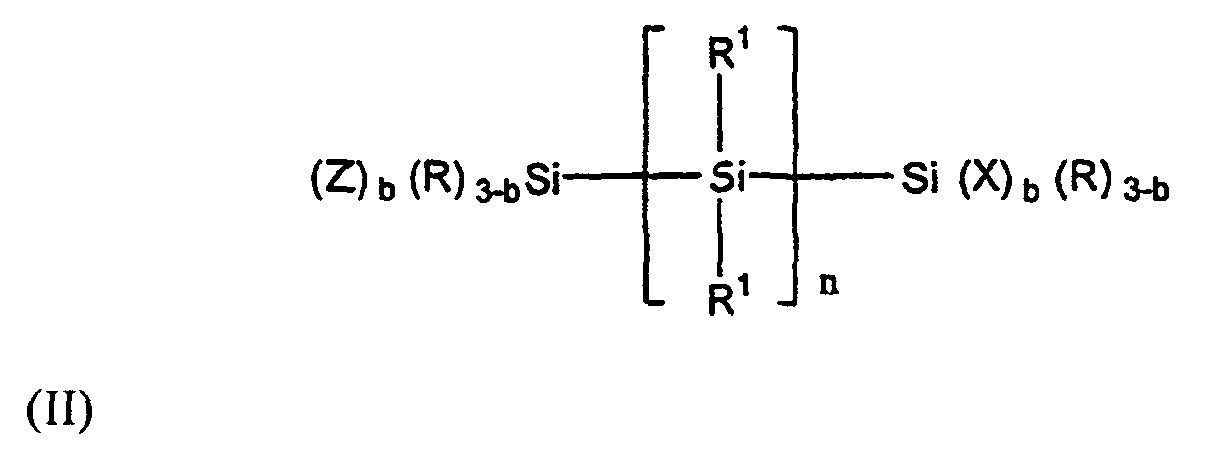 - Z unabhängig eine hydrolysierbare Gruppierung repräsentiert, die vorzugsweise aus der Gruppe ausgewählt ist, die folgendes einschließt: Halogene, Reste OR' und OH; wobei die Halogene ganz besonders privilegiert sind;- R, R1, R' unabhängig einen Alkylrest, einen Cycloalkylrest, einen Arylrest, einen Arylalkylrest, einen Acylrest, einen Alkenylrest, einen Alkinylrest repräsentieren;- a, b, n ganze positive Zahlen sind, a = 1-4, b = 1-3, n = 1-100.
 - Verfahren nach Anspruch 1, dadurch gekennzeichnet dass das Reaktionsmedium von Hydrolyse/Kondensation bei einer Temperatur T gehalten wird:- T ≤ 90 ° C- vorzugsweise T ≤ 80 ° C- und noch stärker bevorzugt 20 °C ≤ T ≤ 60 °C.
- Verfahren nach Anspruch 1, dadurch gekennzeichnet dass die erhaltenen hydroxylierten Polyorganosiloxane einen Massegehalt an OH tOH, wie nachstehend definiert, in % p/p bezüglich der Gesamtmasse der erhaltenen hydroxylierten Polyorganosiloxane, aufweisen:- 2 ≤ tOH ≤ 20- vorzugsweise 5 ≤ tOH ≤ 15.
- Verfahren nach Anspruch 1, dadurch gekennzeichnet dass es kontinuierlich, halbkontinuierlich oder diskontinuierlich realisiert wird.
- Verfahren nach Anspruch 8, dadurch gekennzeichnet dass:- es kontinuierlich realisiert wird,- die Mittel des intensiven Rührens von dem Typ derjenigen sind, die für die "Rotor/Stator"-Technik von Bedeutung sind,- eine Zufuhr an Halogensilanen (organische Phase) und eine Zufuhr an Wasser/System Pufferphase (wässrige Phase) vorgesehen ist, wobei diese beiden Zuführungen in die Zone maximaler Turbulenz einmünden, die durch die Mittel des intensiven Rührens erzeugt wird,- auch ein sequenzielles oder kontinuierliches Abzapfen des Zweiphasengemisches organische Phase/wässrige Phase vorgesehen ist, das durch die Mittel des intensiven Rührens erzeugt wird, derart, dass die Verweilzeit größer oder gleich der Reaktionszeit, vorzugsweise einige Sekunden bis einige Minuten, ist.
- Verfahren nach Anspruch 8 oder 9, dadurch gekennzeichnet dass es kontinuierlich in einen Hydrolysekreislauf realisiert wird.
- Vorrichtung zur Durchführung des Verfahrens nach einem der Ansprüche 1 bis 10, dadurch gekennzeichnet dass sie im Wesentlichen folgendes einschließt:1. mindestens einen Hydrolyse/Kondensationsreaktor2. Mittel zum intensiven Rühren, mit denen der Reaktor ausgerüstet ist,3. Zufuhrmittel des Reaktors zur organischen Phase,4. Zufuhrmittel des Reaktors zur wässrigen Phase5. Mittel zum Abzapfen des zweiphasigen Reaktionsmediums nach Hydrolyse/Kondensation6. Mittel zum Aufrechterhalten der Temperatur des Reaktionsmediums in dem Reaktor7. und eine Ausrüstung zum Trennen von organische Phase/wässrige Phase.
- Vorrichtung nach Anspruch 11, dadurch gekennzeichnet dass mindestens eines der Zufuhrmittel des Reaktors zur organischen Phase bzw. zur wässrigen Phase mindestens einen Ausgang beinhaltet, der so angeordnet ist, dass die organischen Phase und die wässrige Phase gekippt werden und/oder sich miteinander in der Rührzone vermischen, wo die Verlustleistung am größten ist.
- Vorrichtung nach Anspruch 11 oder 12, dadurch gekennzeichnet dass- sie vom kontinuierlichen Typ ist,- der Hydrolyse/Kondensationsreaktor ein Schleifenreaktor ist,- die Mittel des intensiven Rührens mindestens die Zirkulationspumpe des Schleifenreaktors und gegebenenfalls mindestens ein anderes Mittel für intensives Rühren des Typs von denjenigen mit Rotor/Stator oder des Typ eines statischen Mischers beinhalten,- und die Abzapfmittel durch den Ausgang des Kreislaufs aufgebaut werden.
- Vorrichtung nach einem der Ansprüche 11 bis 13, dadurch gekennzeichnet dass- sie vom diskontinuierlichen oder kontinuierlichen Typ ist,- und die Mittel des intensiven Rührens mindestens ein Ensemble von Rotor/Stator beinhalten, das mit Kegeln mit gekreuzten Verzahnungen versehen ist.
Applications Claiming Priority (3)
| Application Number | Priority Date | Filing Date | Title |
|---|---|---|---|
| FR0215944 | 2002-12-16 | ||
| FR0215944A FR2848561B1 (fr) | 2002-12-16 | 2002-12-16 | Procede d'hydrolyse/condensation d'halogenosilanes pour synthetiser des polyorganosiloxanes hydroxyles, dispositif pour la mise en oeuvre de ce procede |
| PCT/FR2003/003615 WO2004063251A1 (fr) | 2002-12-16 | 2003-12-08 | Procede d'hydrolyse/condensation d'halogenosilanes pour synthetiser des polyorganosiloxanes hydroxyles, dispositif pour la mise en oeuvre de ce procede. |
Publications (2)
| Publication Number | Publication Date |
|---|---|
| EP1578845A1 EP1578845A1 (de) | 2005-09-28 |
| EP1578845B1 true EP1578845B1 (de) | 2008-10-22 |
Family
ID=32338850
Family Applications (1)
| Application Number | Title | Priority Date | Filing Date |
|---|---|---|---|
| EP03815085A Expired - Lifetime EP1578845B1 (de) | 2002-12-16 | 2003-12-08 | Verfahren zur hydrolyse/kondensation von halogensilanen zur synthese von hydroxylpolyorganosiloxanen und vorrichtung dafür |
Country Status (8)
| Country | Link |
|---|---|
| US (1) | US8013059B2 (de) |
| EP (1) | EP1578845B1 (de) |
| CN (1) | CN100528936C (de) |
| AT (1) | ATE412024T1 (de) |
| AU (1) | AU2003296772A1 (de) |
| DE (1) | DE60324328D1 (de) |
| FR (1) | FR2848561B1 (de) |
| WO (1) | WO2004063251A1 (de) |
Families Citing this family (10)
| Publication number | Priority date | Publication date | Assignee | Title |
|---|---|---|---|---|
| CN101338034B (zh) * | 2008-06-06 | 2011-03-16 | 浙江新安化工集团股份有限公司 | 一种107硅橡胶的合成工艺 |
| WO2009152493A2 (en) * | 2008-06-13 | 2009-12-17 | The General Hospital Corporation | Use of apolipoproteins to decrease inflammation |
| CN101862634B (zh) * | 2010-06-29 | 2012-11-14 | 沈阳东方钛业有限公司 | 水解反应器 |
| CN102690898B (zh) * | 2012-06-15 | 2013-09-25 | 王建设 | 纤维素类秸秆物质连续水解装置及方法 |
| WO2016127180A1 (en) * | 2015-02-06 | 2016-08-11 | Elemental Scientific, Inc. | System and method for sampling halosilanes |
| DE102015214502A1 (de) | 2015-07-30 | 2017-02-02 | Wacker Chemie Ag | Verfahren zur Herstellung von Organopolysiloxanen |
| DE102015214503A1 (de) | 2015-07-30 | 2017-02-02 | Wacker Chemie Ag | Verfahren zur Herstellung von Organopolysiloxanen |
| CN107837771A (zh) * | 2017-10-30 | 2018-03-27 | 蔡素真 | 一种化工废弃物分解反应釜 |
| CN115364795A (zh) * | 2022-08-03 | 2022-11-22 | 刘长庆 | 一种低含氢硅油的生产设备 |
| CN116178722B (zh) * | 2022-09-08 | 2025-09-19 | 江西星火狮达科技有限公司 | 一种低分子量羟基硅油及其制备方法 |
Family Cites Families (7)
| Publication number | Priority date | Publication date | Assignee | Title |
|---|---|---|---|---|
| US2758124A (en) * | 1952-04-11 | 1956-08-07 | Gen Electric | Continuous hydrolysis of organohalogenosilanes |
| US3373138A (en) * | 1964-01-29 | 1968-03-12 | Dow Corning | Process for making siloxane polymers from silanes |
| DE3425067C1 (de) * | 1984-07-07 | 1986-01-23 | Th. Goldschmidt Ag, 4300 Essen | Verfahren und Vorrichtung zur kontinuierlichen Herstellung von Alkoxypolysiloxanen |
| FR2766492B1 (fr) * | 1997-07-24 | 1999-10-22 | Rhodia Chimie Sa | Procede de preparation de polyorganosiloxanes par hydrolyse d'organohalosilanes |
| US6180811B1 (en) * | 1998-12-22 | 2001-01-30 | Dow Corning Corporation | Reducing low molecular weight cyclic organosiloxanes in a recirculating process stream |
| US6281285B1 (en) * | 1999-06-09 | 2001-08-28 | Dow Corning Corporation | Silicone resins and process for synthesis |
| TWI240729B (en) * | 2000-11-24 | 2005-10-01 | Dow Corning | Process for making silicone emulsions |
-
2002
- 2002-12-16 FR FR0215944A patent/FR2848561B1/fr not_active Expired - Fee Related
-
2003
- 2003-12-08 AU AU2003296772A patent/AU2003296772A1/en not_active Abandoned
- 2003-12-08 DE DE60324328T patent/DE60324328D1/de not_active Expired - Lifetime
- 2003-12-08 EP EP03815085A patent/EP1578845B1/de not_active Expired - Lifetime
- 2003-12-08 AT AT03815085T patent/ATE412024T1/de not_active IP Right Cessation
- 2003-12-08 CN CNB2003801090382A patent/CN100528936C/zh not_active Expired - Fee Related
- 2003-12-08 WO PCT/FR2003/003615 patent/WO2004063251A1/fr not_active Ceased
-
2005
- 2005-06-16 US US11/153,618 patent/US8013059B2/en not_active Expired - Fee Related
Also Published As
| Publication number | Publication date |
|---|---|
| EP1578845A1 (de) | 2005-09-28 |
| FR2848561A1 (fr) | 2004-06-18 |
| DE60324328D1 (de) | 2008-12-04 |
| FR2848561B1 (fr) | 2005-03-04 |
| AU2003296772A1 (en) | 2004-08-10 |
| ATE412024T1 (de) | 2008-11-15 |
| CN100528936C (zh) | 2009-08-19 |
| US20050288473A1 (en) | 2005-12-29 |
| US8013059B2 (en) | 2011-09-06 |
| WO2004063251A1 (fr) | 2004-07-29 |
| CN1738849A (zh) | 2006-02-22 |
Similar Documents
| Publication | Publication Date | Title |
|---|---|---|
| CN1185237C (zh) | 制备改性的液态有机硅化合物的连续氢化硅烷化方法 | |
| WO2004063251A1 (fr) | Procede d'hydrolyse/condensation d'halogenosilanes pour synthetiser des polyorganosiloxanes hydroxyles, dispositif pour la mise en oeuvre de ce procede. | |
| EP0882753B1 (de) | Verdicken von Lösungsmitteln mit elastomeren Siliconpolyethern | |
| EP0065925B1 (de) | Verfahren zur Herstellung von hochmolekularen Polysiloxanen durch Polymerisation und Äquilibrierung in Gegenwart eines Katalysators, der aus einem mit einem Sulfonsäure- Phosphonsäuregruppen enthaltenden polymeren Film beschichteten porösen Träger besteht | |
| EP1546240B1 (de) | Kontinuierliche herstellung von silikoncopolymeren mit einem mehrstufigen schaufelmischungs-pfropfenströmungsrohrreaktor | |
| JP5603237B2 (ja) | 硬化性シリコーンラバー組成物および硬化したシリコーンラバー組成物ならびに官能性シリカを用いるそれらの調製方法 | |
| EP1976909B1 (de) | Verfahren zur herstellung eines silikonharzes | |
| EP0728793A1 (de) | Verfahren zur Herstellung von Polyorganosiloxanharz, evtl. alkoxyliert, durch nicht-hydrolytische Kondensation | |
| JPH08218035A (ja) | シリコーン樹脂含有の硬化性シリコーン塗料 | |
| FR2733988A1 (fr) | Procede de fabrication de cyclosiloxanes par depolymerisation de polysiloxanes | |
| WO2010074831A1 (en) | Preparation of siloxanes | |
| WO2004063265A1 (fr) | Procédé de préparation d'une suspension de silice dans une matiere silicone eventuellement réticulable | |
| FR2707654A1 (fr) | Procédé de préparation de fluides de polydiorganosiloxanes à terminaison triorganosiloxy à faible teneur en silanol. | |
| EP1250379A1 (de) | Verfahren zur herstellung von polyorganosiloxane durch polymerisation in anwesenheit von trifluormethansulfonsäure oder derivate davon | |
| JPH05202192A (ja) | 無水塩化水素を放出して一段でシロキサンを製造する方法 | |
| US6214928B1 (en) | Aqueous emulsions of amine-functionalized organopolysiloxanes and method | |
| EP0292407B1 (de) | Verfahren zur Herstellung von Silanolendgruppen enthaltenden Polysiloxanen | |
| CN114213660A (zh) | 有机硅油制备方法及催化剂 | |
| KR100977236B1 (ko) | 아미노알킬폴리실록산의 제조 방법 | |
| EP0644221B1 (de) | Herstellung und Verarbeitung von Polydiorganosiloxanen | |
| FR3133854A1 (fr) | Dépolymérisation d’organopolysiloxane | |
| JP2000281903A (ja) | エマルジョン、その製造方法、およびオイル組成物の製造方法 | |
| JPH04226135A (ja) | カルボキシ官能性シリコーンの製造方法 | |
| JPH0657000A (ja) | 有機官能シロキサンの製造方法 | |
| Jain et al. | Organosilanes as synthetic precursors for oligosiloxanes and phenylsilica spheres |
Legal Events
| Date | Code | Title | Description |
|---|---|---|---|
| PUAI | Public reference made under article 153(3) epc to a published international application that has entered the european phase |
Free format text: ORIGINAL CODE: 0009012 |
|
| 17P | Request for examination filed |
Effective date: 20050603 |
|
| AK | Designated contracting states |
Kind code of ref document: A1 Designated state(s): AT BE BG CH CY CZ DE DK EE ES FI FR GB GR HU IE IT LI LU MC NL PT RO SE SI SK TR |
|
| AX | Request for extension of the european patent |
Extension state: AL LT LV MK |
|
| RIN1 | Information on inventor provided before grant (corrected) |
Inventor name: DEFORTH, THOMAS Inventor name: M. RAMDANI, KAMEL |
|
| RIN1 | Information on inventor provided before grant (corrected) |
Inventor name: DEFORTH, THOMAS Inventor name: M. RAMDANI, KAMEL |
|
| DAX | Request for extension of the european patent (deleted) | ||
| GRAP | Despatch of communication of intention to grant a patent |
Free format text: ORIGINAL CODE: EPIDOSNIGR1 |
|
| GRAS | Grant fee paid |
Free format text: ORIGINAL CODE: EPIDOSNIGR3 |
|
| RAP1 | Party data changed (applicant data changed or rights of an application transferred) |
Owner name: BLUESTAR SILICONES FRANCE |
|
| GRAA | (expected) grant |
Free format text: ORIGINAL CODE: 0009210 |
|
| AK | Designated contracting states |
Kind code of ref document: B1 Designated state(s): AT BE BG CH CY CZ DE DK EE ES FI FR GB GR HU IE IT LI LU MC NL PT RO SE SI SK TR |
|
| REG | Reference to a national code |
Ref country code: GB Ref legal event code: FG4D Free format text: NOT ENGLISH |
|
| REG | Reference to a national code |
Ref country code: CH Ref legal event code: EP |
|
| REG | Reference to a national code |
Ref country code: IE Ref legal event code: FG4D Free format text: LANGUAGE OF EP DOCUMENT: FRENCH |
|
| REF | Corresponds to: |
Ref document number: 60324328 Country of ref document: DE Date of ref document: 20081204 Kind code of ref document: P |
|
| NLV1 | Nl: lapsed or annulled due to failure to fulfill the requirements of art. 29p and 29m of the patents act | ||
| PG25 | Lapsed in a contracting state [announced via postgrant information from national office to epo] |
Ref country code: ES Free format text: LAPSE BECAUSE OF FAILURE TO SUBMIT A TRANSLATION OF THE DESCRIPTION OR TO PAY THE FEE WITHIN THE PRESCRIBED TIME-LIMIT Effective date: 20090202 Ref country code: BG Free format text: LAPSE BECAUSE OF FAILURE TO SUBMIT A TRANSLATION OF THE DESCRIPTION OR TO PAY THE FEE WITHIN THE PRESCRIBED TIME-LIMIT Effective date: 20090122 Ref country code: AT Free format text: LAPSE BECAUSE OF FAILURE TO SUBMIT A TRANSLATION OF THE DESCRIPTION OR TO PAY THE FEE WITHIN THE PRESCRIBED TIME-LIMIT Effective date: 20081022 |
|
| PG25 | Lapsed in a contracting state [announced via postgrant information from national office to epo] |
Ref country code: NL Free format text: LAPSE BECAUSE OF FAILURE TO SUBMIT A TRANSLATION OF THE DESCRIPTION OR TO PAY THE FEE WITHIN THE PRESCRIBED TIME-LIMIT Effective date: 20081022 Ref country code: FI Free format text: LAPSE BECAUSE OF FAILURE TO SUBMIT A TRANSLATION OF THE DESCRIPTION OR TO PAY THE FEE WITHIN THE PRESCRIBED TIME-LIMIT Effective date: 20081022 Ref country code: PT Free format text: LAPSE BECAUSE OF FAILURE TO SUBMIT A TRANSLATION OF THE DESCRIPTION OR TO PAY THE FEE WITHIN THE PRESCRIBED TIME-LIMIT Effective date: 20090323 Ref country code: SI Free format text: LAPSE BECAUSE OF FAILURE TO SUBMIT A TRANSLATION OF THE DESCRIPTION OR TO PAY THE FEE WITHIN THE PRESCRIBED TIME-LIMIT Effective date: 20081022 |
|
| BERE | Be: lapsed |
Owner name: BLUESTAR SILICONES FRANCE Effective date: 20081231 |
|
| REG | Reference to a national code |
Ref country code: IE Ref legal event code: FD4D |
|
| PG25 | Lapsed in a contracting state [announced via postgrant information from national office to epo] |
Ref country code: DK Free format text: LAPSE BECAUSE OF FAILURE TO SUBMIT A TRANSLATION OF THE DESCRIPTION OR TO PAY THE FEE WITHIN THE PRESCRIBED TIME-LIMIT Effective date: 20081022 Ref country code: RO Free format text: LAPSE BECAUSE OF FAILURE TO SUBMIT A TRANSLATION OF THE DESCRIPTION OR TO PAY THE FEE WITHIN THE PRESCRIBED TIME-LIMIT Effective date: 20081022 Ref country code: IE Free format text: LAPSE BECAUSE OF FAILURE TO SUBMIT A TRANSLATION OF THE DESCRIPTION OR TO PAY THE FEE WITHIN THE PRESCRIBED TIME-LIMIT Effective date: 20081022 Ref country code: EE Free format text: LAPSE BECAUSE OF FAILURE TO SUBMIT A TRANSLATION OF THE DESCRIPTION OR TO PAY THE FEE WITHIN THE PRESCRIBED TIME-LIMIT Effective date: 20081022 Ref country code: MC Free format text: LAPSE BECAUSE OF NON-PAYMENT OF DUE FEES Effective date: 20081231 |
|
| REG | Reference to a national code |
Ref country code: CH Ref legal event code: PL |
|
| PLBE | No opposition filed within time limit |
Free format text: ORIGINAL CODE: 0009261 |
|
| STAA | Information on the status of an ep patent application or granted ep patent |
Free format text: STATUS: NO OPPOSITION FILED WITHIN TIME LIMIT |
|
| PG25 | Lapsed in a contracting state [announced via postgrant information from national office to epo] |
Ref country code: SE Free format text: LAPSE BECAUSE OF FAILURE TO SUBMIT A TRANSLATION OF THE DESCRIPTION OR TO PAY THE FEE WITHIN THE PRESCRIBED TIME-LIMIT Effective date: 20090122 Ref country code: IT Free format text: LAPSE BECAUSE OF FAILURE TO SUBMIT A TRANSLATION OF THE DESCRIPTION OR TO PAY THE FEE WITHIN THE PRESCRIBED TIME-LIMIT Effective date: 20081022 Ref country code: CZ Free format text: LAPSE BECAUSE OF FAILURE TO SUBMIT A TRANSLATION OF THE DESCRIPTION OR TO PAY THE FEE WITHIN THE PRESCRIBED TIME-LIMIT Effective date: 20081022 |
|
| 26N | No opposition filed |
Effective date: 20090723 |
|
| PG25 | Lapsed in a contracting state [announced via postgrant information from national office to epo] |
Ref country code: SK Free format text: LAPSE BECAUSE OF FAILURE TO SUBMIT A TRANSLATION OF THE DESCRIPTION OR TO PAY THE FEE WITHIN THE PRESCRIBED TIME-LIMIT Effective date: 20081022 Ref country code: BE Free format text: LAPSE BECAUSE OF NON-PAYMENT OF DUE FEES Effective date: 20081231 |
|
| PG25 | Lapsed in a contracting state [announced via postgrant information from national office to epo] |
Ref country code: CH Free format text: LAPSE BECAUSE OF NON-PAYMENT OF DUE FEES Effective date: 20081231 Ref country code: LI Free format text: LAPSE BECAUSE OF NON-PAYMENT OF DUE FEES Effective date: 20081231 |
|
| PG25 | Lapsed in a contracting state [announced via postgrant information from national office to epo] |
Ref country code: HU Free format text: LAPSE BECAUSE OF FAILURE TO SUBMIT A TRANSLATION OF THE DESCRIPTION OR TO PAY THE FEE WITHIN THE PRESCRIBED TIME-LIMIT Effective date: 20090423 Ref country code: CY Free format text: LAPSE BECAUSE OF FAILURE TO SUBMIT A TRANSLATION OF THE DESCRIPTION OR TO PAY THE FEE WITHIN THE PRESCRIBED TIME-LIMIT Effective date: 20081022 Ref country code: LU Free format text: LAPSE BECAUSE OF NON-PAYMENT OF DUE FEES Effective date: 20081208 |
|
| PG25 | Lapsed in a contracting state [announced via postgrant information from national office to epo] |
Ref country code: TR Free format text: LAPSE BECAUSE OF FAILURE TO SUBMIT A TRANSLATION OF THE DESCRIPTION OR TO PAY THE FEE WITHIN THE PRESCRIBED TIME-LIMIT Effective date: 20081022 |
|
| PG25 | Lapsed in a contracting state [announced via postgrant information from national office to epo] |
Ref country code: GR Free format text: LAPSE BECAUSE OF FAILURE TO SUBMIT A TRANSLATION OF THE DESCRIPTION OR TO PAY THE FEE WITHIN THE PRESCRIBED TIME-LIMIT Effective date: 20090123 |
|
| REG | Reference to a national code |
Ref country code: FR Ref legal event code: PLFP Year of fee payment: 13 |
|
| REG | Reference to a national code |
Ref country code: FR Ref legal event code: PLFP Year of fee payment: 14 |
|
| REG | Reference to a national code |
Ref country code: FR Ref legal event code: PLFP Year of fee payment: 15 |
|
| PGFP | Annual fee paid to national office [announced via postgrant information from national office to epo] |
Ref country code: DE Payment date: 20211012 Year of fee payment: 19 Ref country code: GB Payment date: 20211014 Year of fee payment: 19 Ref country code: FR Payment date: 20211109 Year of fee payment: 19 |
|
| REG | Reference to a national code |
Ref country code: DE Ref legal event code: R119 Ref document number: 60324328 Country of ref document: DE |
|
| GBPC | Gb: european patent ceased through non-payment of renewal fee |
Effective date: 20221208 |
|
| PG25 | Lapsed in a contracting state [announced via postgrant information from national office to epo] |
Ref country code: GB Free format text: LAPSE BECAUSE OF NON-PAYMENT OF DUE FEES Effective date: 20221208 Ref country code: DE Free format text: LAPSE BECAUSE OF NON-PAYMENT OF DUE FEES Effective date: 20230701 |
|
| PG25 | Lapsed in a contracting state [announced via postgrant information from national office to epo] |
Ref country code: FR Free format text: LAPSE BECAUSE OF NON-PAYMENT OF DUE FEES Effective date: 20221231 |