EP1578817B1 - Wässrige polymerdispersion - Google Patents
Wässrige polymerdispersion Download PDFInfo
- Publication number
- EP1578817B1 EP1578817B1 EP03789288A EP03789288A EP1578817B1 EP 1578817 B1 EP1578817 B1 EP 1578817B1 EP 03789288 A EP03789288 A EP 03789288A EP 03789288 A EP03789288 A EP 03789288A EP 1578817 B1 EP1578817 B1 EP 1578817B1
- Authority
- EP
- European Patent Office
- Prior art keywords
- phase
- alkyl
- dispersion according
- water
- weight
- Prior art date
- Legal status (The legal status is an assumption and is not a legal conclusion. Google has not performed a legal analysis and makes no representation as to the accuracy of the status listed.)
- Expired - Lifetime
Links
Classifications
-
- C—CHEMISTRY; METALLURGY
- C08—ORGANIC MACROMOLECULAR COMPOUNDS; THEIR PREPARATION OR CHEMICAL WORKING-UP; COMPOSITIONS BASED THEREON
- C08F—MACROMOLECULAR COMPOUNDS OBTAINED BY REACTIONS ONLY INVOLVING CARBON-TO-CARBON UNSATURATED BONDS
- C08F26/00—Homopolymers and copolymers of compounds having one or more unsaturated aliphatic radicals, each having only one carbon-to-carbon double bond, and at least one being terminated by a single or double bond to nitrogen or by a heterocyclic ring containing nitrogen
- C08F26/02—Homopolymers and copolymers of compounds having one or more unsaturated aliphatic radicals, each having only one carbon-to-carbon double bond, and at least one being terminated by a single or double bond to nitrogen or by a heterocyclic ring containing nitrogen by a single or double bond to nitrogen
-
- A—HUMAN NECESSITIES
- A61—MEDICAL OR VETERINARY SCIENCE; HYGIENE
- A61K—PREPARATIONS FOR MEDICAL, DENTAL OR TOILETRY PURPOSES
- A61K8/00—Cosmetics or similar toiletry preparations
- A61K8/02—Cosmetics or similar toiletry preparations characterised by special physical form
- A61K8/0212—Face masks
-
- A—HUMAN NECESSITIES
- A61—MEDICAL OR VETERINARY SCIENCE; HYGIENE
- A61K—PREPARATIONS FOR MEDICAL, DENTAL OR TOILETRY PURPOSES
- A61K8/00—Cosmetics or similar toiletry preparations
- A61K8/18—Cosmetics or similar toiletry preparations characterised by the composition
- A61K8/72—Cosmetics or similar toiletry preparations characterised by the composition containing organic macromolecular compounds
- A61K8/81—Cosmetics or similar toiletry preparations characterised by the composition containing organic macromolecular compounds obtained by reactions involving only carbon-to-carbon unsaturated bonds
- A61K8/8141—Compositions of homopolymers or copolymers of compounds having one or more unsaturated aliphatic radicals, each having only one carbon-to-carbon double bond, and at least one being terminated by only one carboxyl radical, or of salts, anhydrides, esters, amides, imides or nitriles thereof; Compositions of derivatives of such polymers
- A61K8/8158—Homopolymers or copolymers of amides or imides, e.g. (meth) acrylamide; Compositions of derivatives of such polymers
-
- A—HUMAN NECESSITIES
- A61—MEDICAL OR VETERINARY SCIENCE; HYGIENE
- A61Q—SPECIFIC USE OF COSMETICS OR SIMILAR TOILETRY PREPARATIONS
- A61Q19/00—Preparations for care of the skin
-
- A—HUMAN NECESSITIES
- A61—MEDICAL OR VETERINARY SCIENCE; HYGIENE
- A61Q—SPECIFIC USE OF COSMETICS OR SIMILAR TOILETRY PREPARATIONS
- A61Q5/00—Preparations for care of the hair
-
- C—CHEMISTRY; METALLURGY
- C08—ORGANIC MACROMOLECULAR COMPOUNDS; THEIR PREPARATION OR CHEMICAL WORKING-UP; COMPOSITIONS BASED THEREON
- C08F—MACROMOLECULAR COMPOUNDS OBTAINED BY REACTIONS ONLY INVOLVING CARBON-TO-CARBON UNSATURATED BONDS
- C08F20/00—Homopolymers and copolymers of compounds having one or more unsaturated aliphatic radicals, each having only one carbon-to-carbon double bond, and only one being terminated by only one carboxyl radical or a salt, anhydride, ester, amide, imide or nitrile thereof
- C08F20/02—Monocarboxylic acids having less than ten carbon atoms, Derivatives thereof
- C08F20/52—Amides or imides
- C08F20/54—Amides, e.g. N,N-dimethylacrylamide or N-isopropylacrylamide
-
- A—HUMAN NECESSITIES
- A61—MEDICAL OR VETERINARY SCIENCE; HYGIENE
- A61Q—SPECIFIC USE OF COSMETICS OR SIMILAR TOILETRY PREPARATIONS
- A61Q1/00—Make-up preparations; Body powders; Preparations for removing make-up
- A61Q1/02—Preparations containing skin colorants, e.g. pigments
-
- A—HUMAN NECESSITIES
- A61—MEDICAL OR VETERINARY SCIENCE; HYGIENE
- A61Q—SPECIFIC USE OF COSMETICS OR SIMILAR TOILETRY PREPARATIONS
- A61Q1/00—Make-up preparations; Body powders; Preparations for removing make-up
- A61Q1/02—Preparations containing skin colorants, e.g. pigments
- A61Q1/04—Preparations containing skin colorants, e.g. pigments for lips
- A61Q1/06—Lipsticks
-
- A—HUMAN NECESSITIES
- A61—MEDICAL OR VETERINARY SCIENCE; HYGIENE
- A61Q—SPECIFIC USE OF COSMETICS OR SIMILAR TOILETRY PREPARATIONS
- A61Q1/00—Make-up preparations; Body powders; Preparations for removing make-up
- A61Q1/02—Preparations containing skin colorants, e.g. pigments
- A61Q1/10—Preparations containing skin colorants, e.g. pigments for eyes, e.g. eyeliner, mascara
-
- A—HUMAN NECESSITIES
- A61—MEDICAL OR VETERINARY SCIENCE; HYGIENE
- A61Q—SPECIFIC USE OF COSMETICS OR SIMILAR TOILETRY PREPARATIONS
- A61Q11/00—Preparations for care of the teeth, of the oral cavity or of dentures; Dentifrices, e.g. toothpastes; Mouth rinses
-
- A—HUMAN NECESSITIES
- A61—MEDICAL OR VETERINARY SCIENCE; HYGIENE
- A61Q—SPECIFIC USE OF COSMETICS OR SIMILAR TOILETRY PREPARATIONS
- A61Q15/00—Anti-perspirants or body deodorants
-
- A—HUMAN NECESSITIES
- A61—MEDICAL OR VETERINARY SCIENCE; HYGIENE
- A61Q—SPECIFIC USE OF COSMETICS OR SIMILAR TOILETRY PREPARATIONS
- A61Q17/00—Barrier preparations; Preparations brought into direct contact with the skin for affording protection against external influences, e.g. sunlight, X-rays or other harmful rays, corrosive materials, bacteria or insect stings
- A61Q17/04—Topical preparations for affording protection against sunlight or other radiation; Topical sun tanning preparations
-
- A—HUMAN NECESSITIES
- A61—MEDICAL OR VETERINARY SCIENCE; HYGIENE
- A61Q—SPECIFIC USE OF COSMETICS OR SIMILAR TOILETRY PREPARATIONS
- A61Q19/00—Preparations for care of the skin
- A61Q19/001—Preparations for care of the lips
-
- A—HUMAN NECESSITIES
- A61—MEDICAL OR VETERINARY SCIENCE; HYGIENE
- A61Q—SPECIFIC USE OF COSMETICS OR SIMILAR TOILETRY PREPARATIONS
- A61Q19/00—Preparations for care of the skin
- A61Q19/002—Aftershave preparations
-
- A—HUMAN NECESSITIES
- A61—MEDICAL OR VETERINARY SCIENCE; HYGIENE
- A61Q—SPECIFIC USE OF COSMETICS OR SIMILAR TOILETRY PREPARATIONS
- A61Q19/00—Preparations for care of the skin
- A61Q19/005—Preparations for sensitive skin
-
- A—HUMAN NECESSITIES
- A61—MEDICAL OR VETERINARY SCIENCE; HYGIENE
- A61Q—SPECIFIC USE OF COSMETICS OR SIMILAR TOILETRY PREPARATIONS
- A61Q19/00—Preparations for care of the skin
- A61Q19/007—Preparations for dry skin
-
- A—HUMAN NECESSITIES
- A61—MEDICAL OR VETERINARY SCIENCE; HYGIENE
- A61Q—SPECIFIC USE OF COSMETICS OR SIMILAR TOILETRY PREPARATIONS
- A61Q19/00—Preparations for care of the skin
- A61Q19/10—Washing or bathing preparations
-
- A—HUMAN NECESSITIES
- A61—MEDICAL OR VETERINARY SCIENCE; HYGIENE
- A61Q—SPECIFIC USE OF COSMETICS OR SIMILAR TOILETRY PREPARATIONS
- A61Q5/00—Preparations for care of the hair
- A61Q5/006—Antidandruff preparations
-
- A—HUMAN NECESSITIES
- A61—MEDICAL OR VETERINARY SCIENCE; HYGIENE
- A61Q—SPECIFIC USE OF COSMETICS OR SIMILAR TOILETRY PREPARATIONS
- A61Q5/00—Preparations for care of the hair
- A61Q5/02—Preparations for cleaning the hair
-
- A—HUMAN NECESSITIES
- A61—MEDICAL OR VETERINARY SCIENCE; HYGIENE
- A61Q—SPECIFIC USE OF COSMETICS OR SIMILAR TOILETRY PREPARATIONS
- A61Q5/00—Preparations for care of the hair
- A61Q5/04—Preparations for permanent waving or straightening the hair
-
- A—HUMAN NECESSITIES
- A61—MEDICAL OR VETERINARY SCIENCE; HYGIENE
- A61Q—SPECIFIC USE OF COSMETICS OR SIMILAR TOILETRY PREPARATIONS
- A61Q5/00—Preparations for care of the hair
- A61Q5/06—Preparations for styling the hair, e.g. by temporary shaping or colouring
-
- A—HUMAN NECESSITIES
- A61—MEDICAL OR VETERINARY SCIENCE; HYGIENE
- A61Q—SPECIFIC USE OF COSMETICS OR SIMILAR TOILETRY PREPARATIONS
- A61Q5/00—Preparations for care of the hair
- A61Q5/06—Preparations for styling the hair, e.g. by temporary shaping or colouring
- A61Q5/065—Preparations for temporary colouring the hair, e.g. direct dyes
-
- A—HUMAN NECESSITIES
- A61—MEDICAL OR VETERINARY SCIENCE; HYGIENE
- A61Q—SPECIFIC USE OF COSMETICS OR SIMILAR TOILETRY PREPARATIONS
- A61Q5/00—Preparations for care of the hair
- A61Q5/10—Preparations for permanently dyeing the hair
-
- A—HUMAN NECESSITIES
- A61—MEDICAL OR VETERINARY SCIENCE; HYGIENE
- A61Q—SPECIFIC USE OF COSMETICS OR SIMILAR TOILETRY PREPARATIONS
- A61Q5/00—Preparations for care of the hair
- A61Q5/12—Preparations containing hair conditioners
-
- A—HUMAN NECESSITIES
- A61—MEDICAL OR VETERINARY SCIENCE; HYGIENE
- A61Q—SPECIFIC USE OF COSMETICS OR SIMILAR TOILETRY PREPARATIONS
- A61Q9/00—Preparations for removing hair or for aiding hair removal
- A61Q9/02—Shaving preparations
Definitions
- the present invention relates to aqueous dispersions of crosslinked water-soluble or water-swellable polymers based on monoethylenically unsaturated monomers which contain a quaternized or quaternizable nitrogen atom or (meth) acrylamide groups by free radical polymerization in an aqueous solution in the presence of one or more polymeric dispersants and one or more polymeric Precipitating agents, a process for their preparation and the use in cosmetic formulations, especially in hair cosmetic formulations.
- Cationic polymers are used as conditioning agents in cosmetic formulations. Requirements for hair conditioning agents are e.g. a strong reduction of the required combing power in wet as well as dry hair, good detangling during the first combing ("Detangling") and good compatibility with other formulation components. In addition, cationic polymers prevent the electrostatic charge of the hair.
- synthetic polymers are used in cosmetic formulations containing pigments or cosmetically active components as compatibilizers to achieve a homogeneous, stable formulation.
- copolymers of acrylamide and dimethyldiallylammonium chloride are used.
- these have the disadvantage of high residual monomer contents, since acrylamide and dimethyldiallylammonium chloride have unfavorable copolymerization parameters.
- polymers which are suitable as conditioners for cosmetic preparations and which can be produced with a high solids content.
- the object of the present invention was to find a conditioning agent for cosmetic preparations, in particular shampoos, which does not have the disadvantages mentioned.
- WO 02/15854 A1 describes the use of hydrophilic graft copolymers with N-vinylamine and / or open-chain N-vinylamide units in cosmetic formulations. None of the examples discloses polymers prepared in the presence of at least 2 dispersants and a crosslinker.
- EP 929 285 B1 describes the use of water-soluble copolymers as active ingredients in cosmetic formulations. These copolymers contain, as characteristic structural elements, vinylcarboxamide units (e.g., N-vinylformamide) as well as imidazole and imidazolimum monomers. The described copolymers can be prepared in the presence of a crosslinker. EP 929 285 B1 does not describe copolymers which are prepared in the presence of polymeric dispersing centers.
- WO 98/54234 A1 describes the preparation of water-soluble polymer dispersions from vinylamide monomers. The polymer dispersions described there are produced without crosslinker.
- WO 00/27893 A1 describes aqueous dispersions of uncrosslinked water-soluble polymers containing N-vinylformamide and / or N-vinylacetamide.
- WO 96/03969 A1 (EP 0 774 952) describes the preparation and use of uncrosslinked vinylformamide-containing polymers in hair cosmetic preparations. These polymers are prepared in water as a solution polymer and as a precipitation polymer in organic solvents.
- No. 4,713,236 describes polymers containing vinylamine groups as conditioners in hair cosmetics.
- the polymers are obtained by hydrolysis of the vinylacetamide or vinylformamide-containing polymers which have been prepared as a solution polymer or as a precipitation polymer.
- Crosslinked polymers are not described.
- WO 98/04596 A1 (EP 915 915) describes water-soluble polymers containing vinylamine units and their cosmetic use.
- WO 02/34796 A1 describes a process for preparing aqueous dispersions of water-soluble uncrosslinked polymers.
- WO 02/083085 A1 describes the use of dispersions of cationic, anionic or nonionic polymers in an aqueous salt solution in cosmetics. Crosslinked polymers are not described.
- DE 29 24 663 describes a process for the preparation of aqueous dispersions of water-soluble polymer compositions.
- the dispersions are obtained by polymerizing the monomers in an aqueous solution of a water-soluble polymer, care being taken to observe the equilibrium ratio between the amount of monomer and the amount of the water-soluble polymer.
- Crosslinked polymers are not described.
- (meth) acrylamide monomers refers to both acrylamide group and methacrylamide group-containing monomers.
- a buffer is present during the polymerization.
- suitable as component g) is at least one substance which is capable of buffering the pH during the polymerization, i. to maintain the pH during the polymerization at 5.0 to 10, especially 6.0 to 8.0, preferably 6.5 to 7.5.
- suitable as component g) is at least one substance which is capable of buffering the pH during the polymerization, i. to maintain the pH during the polymerization at 5.0 to 10, especially 6.0 to 8.0, preferably 6.5 to 7.5.
- by continuously measuring the pH and adding an acid or base in parallel maintain the pH in the preferred pH range.
- inorganic or organic bases can be used for pH adjustment, in particular those bases which are water-soluble.
- the buffer substance is a salt of an acid selected from the group consisting of carbonic acid, boric acid, acetic acid, citric acid and phosphoric acid, and / or a base selected from the group consisting of alkali and alkaline earth hydroxides, ammonia and primary , secondary and tertiary amines.
- Salts of the abovementioned weak acids are preferably alkali metal and alkaline earth metal salts, particularly preferably sodium, potassium or magnesium salts.
- Very particularly preferred buffer substances are sodium acetate, sodium citrate, sodium pyrophosphate, potassium pyrophosphate, sodium dihydrogen phosphate, disodium hydrogen phosphate, sodium bicarbonate and / or sodium borate.
- salts of unsaturated weak carboxylic acids such as e.g. Acrylic acid or methacrylic acid are used.
- alkali and alkaline earth hydroxides are i.a. Sodium hydroxide, potassium hydroxide, magnesium hydroxide, calcium hydroxide.
- Examples of primary, secondary and tertiary amines are i.a. Ethylamine, diethylamine, triethylamine, n-propylamine, di-n-propylamine, tri-n-propylamine, ethylenediamine, triethanolamine, aniline.
- the basic-acting reagents which are preferably used in addition to the abovementioned buffer substances are sodium hydroxide, potassium hydroxide, calcium hydroxide and / or ammonia, particular preference is given to sodium hydroxide.
- the buffer substances mentioned can be used both individually and in mixtures.
- the buffer substances can be added to adjust the pH together or individually.
- the dispersions obtainable according to the invention have an LD value of less than or equal to 30%, in particular less than or equal to 20%, preferably less than or equal to 10%, in particular less than or equal to 5%.
- the determination of the LD value (light permeability) in the case of aqueous polymer dispersions at a defined solids content serves to assess the clarity or color strength.
- the light transmission of the aqueous dispersions is measured at 600 nm compared to pure water at a cuvette length of 2.5 cm.
- the spectrophotometer (Hach: Spectrophotometer DR / 2000, "Transmission” type of measurement) is first set to 100% with pure water. Then rinse the cuvette several times with the dispersion, fill the dispersion in the cuvette and reads the light transmittance in%.
- components a) to d) are used in the following amounts.
- the details of the individual weight percent always relate to the total sum of components a) to d), which is set as 100%. If further possible components are present (for example components e) and f)), then the weights of these further components are calculated based on the sum of a) to d), which is set as 100%.
- Component a) is preferably used in an amount of 10 to 90% by weight, in particular 20 to 70% by weight, preferably 30 to 60% by weight.
- Component b) is preferably used in an amount of 1 to 50% by weight, in particular 2 to 30% by weight, preferably 3 to 20% by weight.
- Component c) is preferably used in an amount of 10 to 90% by weight, in particular 20 to 70% by weight, preferably 30 to 60% by weight.
- Component d) is preferably used in an amount of from 0.01 to 10% by weight, in particular from 0.05 to 5% by weight, preferably from 0.1 to 1.5% by weight.
- aqueous dispersions usually 400 to 25% water, in particular 150 to 50% water, based on the sum of all components (i.e., a) to d) and optionally e), f) and g) and other possible ingredients used.
- Suitable N-vinyl-containing monomer a) are, for example, N-vinylamides and / or N-vinyllactams.
- N-vinylamide compound a) of general formula (Ia) N-vinylformamide, N-vinyl-N-methylformamide, N-vinylacetamide, N-vinyl-N-methylacetamide, N Vinyl-N-ethylacetamide, N-vinyl-propionamide, N-vinyl-N-methyl-propionamide and N-vinyl-butyramide.
- Suitable N-vinyl-containing monomers a) are also N-vinylpiperidone, N-vinyl oxazolidone and N-vinyltriazole.
- the monomer a) used is an N-vinylamide, in particular N-vinylformamide.
- Also suitable as monomers a) are (meth) acrylamide monomers of the general formula X. where R 20 is hydrogen or methyl and R 21 is linear or branched C 1 to C 6 -alkyl, linear or branched C 1 to C 6 -alkyloxyalkyl, where the radicals are monosubstituted or polysubstituted by hydroxyl and / or carboxyl and / or or sulphonic acid groups.
- C 1 - to C 6 -alkyl mean methyl, ethyl, propyl, 1-methylethyl, butyl, 1-methylpropyl, 2-methylpropyl, 1,1-dimethylethyl, pentyl, 1-methylbutyl, 2-methylbutyl, 3-methylbutyl, 1,1-dimethylpropyl, 1,2-dimethylpropyl, 2,2-dimethylpropyl, 1-ethylpropyl, hexyl, 1-methylpentyl, 2-methylpentyl, 3-methylpentyl, 4-methylpentyl, 1,1-dimethylbutyl, 1,2- Dimethylbutyl, 1,3-dimethylbutyl, 2,2-dimethylbutyl, 2,3-dimethylbutyl, 3,3-dimethylbutyl, 1-ethylbutyl, 1,1,2-trimethylpropyl, 1,2,2-trimethylpropyl, 1-ethyl 1-methylpropyl, 1-ethyl
- Preferred (meth) acrylamide monomers of the formula X defined by the combinations of the radicals R 20 and R 21 are given in Table 1: Table 2 R 20 R 21 H H H CH (OH) COOH H C (CH 2 OH) 3 H CH 2 OH H CH 2 OCH (CH 3 ) (C 2 H 5 ) H CH (CH 3 ) 2 H CH 3 H C (CH 3 ) 2 CH 2 SO 3 H or C (CH 3 ) 2 CH 2 SO 3 H CH 2 CHOHCH 3 H CH 2 OCH 3 H C 2 H 5 CH 3 H CH 3 CH 2 OH CH 3 CH 3 CH 3 CH 2 CHOHCH 3 CH 3 CH 2 OCH 3 CH 3 C 2 H 5 CH 3 CH (OH) COOH CH 3 C (CH 2 OH) 3 CH 3 CH 2 OCH (CH 3 ) (C 2 H 5 ) CH 3 CH (CH 3 ) 2 CH 3 C (CH 3 ) 2 CH 2 SO 3 H or C (CH 3 ) 2 CH 2 SO 3 -
- Particularly preferred (meth) acrylamides as monomers a) are acrylamide, 2-acrylamidoglycolic acid, N- (tris (hydroxymethyl) methyl) acrylamide, N-hydroxymethylacrylamide, N-methylacrylamide, N-isopropylacrylamide, 2-acrylamido-2-methyl-1 -propanesulfonic acid methacrylamide, N-ethyl-methacrylamide, N-hydroxymethylmethacrylamide, N- (2-hydroxypropyl) -methacrylamide, N-methyl-methacrylamide, N-isobutoxy-methylacrylamide, N-methoxymethylmethacrylamide.
- the monomers used are acrylamide, methacrylamide, N-hydroxymethylacrylamide, N- (2-hydroxypropyl) methacrylamide, N-hydroxymethylmethacrylamide and N-isopropylacrylamide.
- mixtures of the respective monomers from the group a) such as mixtures of N-vinylformamide and N-vinylacetamide or mixtures of different (Meth) acrylamide monomers or mixtures of N-vinyl containing monomers and (meth) acrylamide monomers are copolymerized.
- the polymeric dispersants contained as component b) in the aqueous dispersions differ in composition from the water-soluble polymers obtainable by the free radical polymerization of the monomers.
- the polymeric dispersant b) serves as a dispersant of the resulting water-soluble polymer.
- polymeric dispersant b) are thus all compounds which are able to disperse the resulting water-soluble polymer.
- the average molecular weights of the polymeric dispersants are preferably in the range of 500 to 20,000,000, especially 1000 to 90,000, preferably 10,000 to 700,000.
- the polymeric dispersants contain at least one functional group selected from ether, hydroxyl, carboxyl, sulfone, sulfate ester, amino, imino, tertiary amino, and / or quaternary ammonium groups.
- polyvinyl acetate polyalkylene glycols, in particular polyethylene glycols, polyvinyl alcohol, polyvinylpyridine, polyethyleneimine, polyvinylimidazole, polyvinylsuccinimide and polydiallyldimethylammonium chloride, polyvinylpyrrolidone, polymers containing at least 5% by weight of vinylpyrrolidone units, polymers containing at least 50% by weight of Vinyl alcohol units, oligosaccharides, polysaccharides, oxidatively, hydrolytically or enzymatically degraded polysaccharides, chemically modified oligo- or polysaccharides such as carboxymethyl cellulose, water-soluble starch and starch derivatives, starch esters, starch xanthanogenates, starch acetates, dextran, and mixtures thereof.
- polyvinyl acetate polyalkylene glycols, in particular polyethylene glycols, polyvinyl alcohol, polyvinylpyridine, poly
- polyalkylene glycols in particular polyethylene glycols and polypropylene glycols, are used as polymeric dispersants, it has proved advantageous to use compounds having a molecular weight of more than 10,000.
- Suitable polymeric dispersants b) are polymers which contain at least 50% by weight of vinyl alcohol units. Preferably, these polymers contain at least 70 wt .-%, most preferably 80 wt .-% polyvinyl alcohol. Such polymers are customarily prepared by polymerization of a vinyl ester followed by at least partial alcoholysis, aminolysis or hydrolysis. Vinyl esters of linear and branched C 1 -C 12 -carboxylic acids are preferred, vinyl acetate is very particularly preferred. The vinyl esters can of course also be used in a mixture.
- Examples of comonomers of the vinyl ester are N-vinylcaprolactam, N-vinylpyrrolidone, N-vinylimidazole, N-vinyl-2-methylimidazole, N-vinyl-4-methylimidazole, 3-methyl-1-vinylimidazolium chloride, 3-methyl-1-vinylimidazolium methylsulfate, Diallylammonium chloride, styrene, alkylstyrenes in question.
- Suitable comonomers are, for example, monoethylenically unsaturated C 3 -C 6 -carboxylic acids such as acrylic acid, methacrylic acid, crotonic acid, fumaric acid and their esters, amides and nitriles such as methyl acrylate, ethyl acrylate, methyl methacrylate, ethyl methacrylate, methacrylic acid stearyl ester, hydroxyethyl acrylate, hydroxypropyl acrylate, hydroxybutyl acrylate, hydroxyethyl methacrylate , Hydroxypropyl methacrylate, hydroxyisobutyl acrylate, hydroxyisobutyl methacrylate, monomethyl maleate, dimethyl maleate, monoethyl maleate, diethyl maleate, 2-ethylhexyl acrylate, 2-ethylhexyl methacrylate, maleic anhydride and its monoesters, alky
- Preferred polymeric dispersants are polymers which are prepared by homopolymerization of vinyl acetate and subsequent at least partial hydrolysis, alcoholysis or aminolysis.
- polymeric dispersants are carried out by known methods, for example, solution, precipitation, suspension or emulsion polymerization using compounds which form radicals under the polymerization conditions.
- the polymerization temperatures are usually in the range of 30 to 200 ° C, preferably 40 to 110 ° C.
- Suitable initiators are, for example, azo and peroxy compounds and the customary redox initiator systems, such as combinations of hydrogen peroxide and reducing compounds, for example sodium sulfite, sodium bisulfite, sodium formaldehyde sulfoxilate and hydrazine. These systems may optionally additionally contain small amounts of a heavy metal salt.
- the ester groups of the original monomers and optionally further monomers are at least partially cleaved after the polymerization by hydrolysis, alcoholysis or aminolysis.
- this method step is generally referred to as saponification.
- the saponification takes place in a known per se Way by adding a base or acid, preferably by adding a sodium or potassium hydroxide solution in water and / or alcohol. Particular preference is given to using methanolic sodium or potassium hydroxide solutions.
- the saponification is carried out at temperatures in the range from 10 to 80.degree. C., preferably in the range from 20 to 60.degree.
- the degree of saponification depends on the amount of base or acid used, the saponification temperature, the saponification time and the water content of the solution.
- Particularly preferred polymeric dispersants are polymers which are prepared by homopolymerization of vinyl acetate and subsequent at least partial saponification.
- Such polymers containing polyvinyl alcohol units are available under the name Mowiol®.
- polymeric dispersants b) are polymers which contain at least 5% by weight of vinylpyrrolidone units.
- these polymers contain a vinylpyrrolidone content of at least 10 wt .-%, most preferably of at least 30 wt .-%, in particular at least 50 wt .-%.
- Comonomers of vinylpyrrolidone for the synthesis of these polymers are, for example, N-vinyl acetate, N-vinylcaprolactam, N-vinylimidazole, N-vinyl-2-methylimidazole, N-vinyl-4-methylimidazole, 3-methyl-1-vinylimidazolium chloride, 3-methyl 1-vinylimidazoliummethylsulfat, diallylammonium chloride, styrene, alkylstyrenes in question.
- Suitable comonomers are, for example, monoethylenically unsaturated C 3 -C 6 -carboxylic acids such as acrylic acid, methacrylic acid, crotonic acid, fumaric acid and their esters, amides and nitriles such as methyl acrylate, ethyl acrylate, methyl methacrylate, ethyl methacrylate, methacrylic acid stearyl ester, hydroxyethyl acrylate, hydroxypropyl acrylate, hydroxybutyl acrylate, hydroxyethyl methacrylate , Hydroxypropyl methacrylate, hydroxyisobutyl acrylate, hydroxyisobutyl methacrylate, monomethyl maleate, dimethyl maleate, monoethyl maleate, diethyl maleate, 2-ethylhexyl acrylate, 2-ethylhexyl methacrylate, maleic anhydride and its monoesters, alky
- vinylpyrrolidone Particularly preferred as comonomers of vinylpyrrolidone are vinyl acetate, N-vinylcaprolactam, N-vinylimidazole, 3-methyl-1-vinylimidazolium chloride, 3-methyl-1-vinylimidazoliummethylsulfat and / or styrene.
- polymeric dispersants are carried out by known methods, for example, solution, precipitation, suspension or emulsion polymerization using compounds which form radicals under the polymerization conditions.
- the polymerization temperatures are usually in the range of 30 to 200 ° C, preferably 40 to 110 ° C.
- Suitable initiators are, for example, azo and peroxy compounds and the customary redox initiator systems, such as combinations of hydrogen peroxide and reducing compounds, for example sodium sulfite, sodium bisulfite, sodium formaldehyde sulfoxilate and hydrazine. These systems may optionally additionally contain small amounts of a heavy metal salt.
- polymeric dispersant b) is polyvinylpyrrolidone.
- the polymeric dispersant b) used is polyvinylpyrrolidione having a molecular weight of from 1000 to 10 ⁇ 10 6 , in particular from 10 000 to 5 ⁇ 10 6 , preferably from 10 000 to 7 ⁇ 10 5 .
- polymeric dispersants mentioned can also be used in any desired mixtures with one another.
- Particularly preferred as the polymeric dispersant is a mixture of polymers containing at least 5 wt.% Of vinylpyrrolidone units and polyvinylpyrrolidone.
- natural substances containing saccharide structures can also be used.
- Such natural substances are, for example, saccharides of plant or animal origin or products which have arisen through metabolism by microorganisms, and their degradation products.
- Suitable compounds are, for example, oligosaccharides, polysaccharides, oxidatively, enzymatically or hydrolytically degraded polysaccharides, oxidatively hydrolytically degraded or oxidatively enzymatically degraded polysaccharides, chemically modified oligosaccharides or polysaccharides and mixtures thereof.
- Preferred products are the compounds mentioned in US 5,334,287 on column 4, line 20 to column 5, line 45.
- the precipitating agent present as component c) in the aqueous dispersions differs in composition from the water-soluble polymers obtainable by the radical polymerization of the monomers.
- the polymeric precipitating agent c) reduces the solvation properties the aqueous phase and there is a displacement of the resulting water-soluble polymers from the aqueous phase in the disperse phase.
- the polymeric precipitation agent c) is thus incompatible with the water-soluble polymer.
- Suitable polymeric precipitating agents c) are thus all compounds which reduce the solvation properties of the aqueous phase and lead to a displacement of the resulting water-soluble polymers from the aqueous phase into the disperse phase.
- Water-soluble compounds are to be understood as meaning those at 25 ° C. up to a concentration of 20% by weight in water, preferably up to a concentration of 50% by weight in water and more preferably up to a concentration of 70% by weight. % are clearly soluble in water.
- the polymeric precipitation agent c) is not significantly available as a reactant, i. it does not come in significant proportions to a covalent bond between the polymeric precipitating agent c) and the other monomers.
- the person skilled in the usual reaction conditions are known to achieve this.
- the temperature selection in the polymerization may be mentioned. This is preferably chosen below 100 ° C., in particular below 80 ° C., preferably below 70 ° C.
- Another possible reaction condition is the choice of water content in the polymerization reaction. Water contents of ⁇ 20% by weight, in particular ⁇ 30%, preferably ⁇ 40%, are advantageous.
- the water content is based on the sum of all constituents (ie on the sum of a) to d) and optionally e), f) and g) and other ingredients), which is set as 100.
- the average molecular weight of the polymeric precipitating agent is preferably in the range of 300 to 100,000, more preferably 1,000 to 30,000, preferably 1,000 to 10,000.
- Water-soluble polyether-containing compounds are in particular suitable as polymeric precipitation agent c).
- polymeric precipitation agent c both polyalkylene oxides based on ethylene oxide, propylene oxide, butylene oxide and other alkylene oxides and polyglycerol can be used.
- the structural units may be homopolymers as well as random copolymers and block copolymers.
- Alkyl radicals for R 6 and R 30 and R 31 are branched or unbranched C 1 -C 24 -alkyl chains, preferably methyl, ethyl, n-propyl, 1-methylethyl, n-butyl, 1-methylpropyl, 2-methylpropyl, 1 , 1-dimethylethyl, n-pentyl, 1-methylbutyl, 2-methylbutyl, 3-methylbutyl, 2,2-dimethylpropyl, 1-ethylpropyl, n-hexyl, 1,1-dimethylpropyl, 1,2-dimethylpropyl, 1-methylpentyl , 2-methylpentyl, 3-methylpentyl, 4-methylpentyl, 1,1-dimethylbutyl, 1,2-dimethylbutyl, 1,3-dimethylbutyl, 2,2-dimethylbutyl, 2,3-dimethylbutyl, 3,3-dimethylbutyl, 1 Ethyl
- Preferred representatives of the abovementioned alkyl radicals are branched or unbranched C 1 -C 12 -, more preferably C 1 -C 6 alkyl chains called.
- Preferred polymeric precipitating agents c) are polyalkylene glycols such as, for example, polyethylene glycols and polypropylene glycols. Particularly preferred are polyethylene glycols.
- silicone derivatives are the compounds known under the INCI name dimethicone copolyols or silicone surfactants, for example those known under the trade names Abil® (from T. Goldschmidt), Alkasil® (from Rhöne-Poulenc), Silicone Polyol Copolymer® (from the company) Genesee), Belsil® (from Wacker), Silwet® (from Witco, Greenwich, CT) or Dow Corning (from Dow Corning). These include compounds with CAS numbers 64365-23-7; 68937-54-2; 68938-54-5; 68937-55-3.
- R 11 may be identical or different, and are either from the group of aliphatic hydrocarbons having 1 to 20 carbon atoms, are cyclic aliphatic hydrocarbons having 3 to 20 C atoms, are aromatic in nature or are equal to R 16 , wherein: with the proviso that at least one of R 11 , R 12 or R 13 is a polyalkylene oxide-containing radical as defined above, and f is an integer from 1 to 6, a and b are integers such that the molecular weight of the polysiloxane block is between 300 and 30,000, c and d can be integers between 0 and 50, with the proviso that the sum of c and d is greater than 0,
- Preferred radicals R 12 and R 16 are those in which the sum of c + d is between 5 and 30.
- the groups R 11 are preferably selected from the following group: methyl, ethyl, propyl, butyl, isobutyl, pentyl, isopentyl, hexyl, octyl, decyl, dodecyl and octadecyl, cycloaliphatic radicals, especially cyclohexyl, aromatic groups, especially phenyl or naphthyl, mixed aromatic-aliphatic radicals such as benzyl or phenylethyl and tolyl and xylyl and R 16 .
- Particularly preferred polyether-containing silicone derivatives are those of the general structure:
- the weight ratio of the sum of the polymeric dispersants b) to the sum of the polymeric precipitating agents c) is in the range from 1:50 to 1: 0.02, in particular from 1:20 to 1: 0.05, particularly preferably in the range from 1:10 to 1 : 0.1, in particular 1:10 to 1: 0.5, preferably 1:10 to 1: 1.
- the polymer dispersants b) used are polymers which contain at least 5% by weight of vinylpyrrolidone units and / or polyvinylpyrrolidone and use as polymeric precipitation agent c) polyethylene glycols.
- the weight ratio of the amounts of polymeric dispersant b) and polymeric precipitation agent c) to the sum of the remaining monomers is chosen such that the ratio is in the range of 10: 1 to 1: 0.1, in particular in the range of 5 : 1 to 1: 0.5.
- the sum of the remaining monomers results from the sum of a) and d) and optionally e) and f). It corresponds to the sum of all other ingredients without added water.
- Monomers d) which have a crosslinking function are compounds having at least 2 ethylenically unsaturated, non-conjugated double bonds in the molecule.
- Suitable crosslinkers d) are, for example, acrylic esters, methacrylic esters, allyl ethers or vinyl ethers of at least dihydric alcohols.
- the OH groups of the underlying alcohols may be completely or partially etherified or esterified; however, the crosslinkers contain at least two ethylenically unsaturated groups.
- Examples of the underlying alcohols are dihydric alcohols such as 1,2-ethanediol, 1,2-propanediol, 1,3-propanediol, 1,2-butanediol, 1,3-butanediol, 2,3-butanediol, 1,4-butanediol , But-2-ene-1,4-diol, 1,2-pentanediol, 1,5-pentanediol, 1,2-hexanediol, 1,6-hexanediol, 1,10-decanediol, 1,2-dodecanediol, 1 , 12-dodecanediol, neopentyl glycol, 3-methylpentane-1,5-diol, 2,5-dimethyl-1,3-hexanediol, 2,2,4-trimethyl-1,3-pentanediol, 1,2-cyclohe
- Examples of underlying alcohols having more than two OH groups are trimethylolpropane, glycerol, pentaerythritol, 1,2,5-pentanetriol, 1,2,6-hexanetriol, triethoxycyanuric acid, sorbitan, sugars such as sucrose, glucose, mannose.
- the polyhydric alcohols can also be used after reaction with ethylene oxide or propylene oxide as the corresponding ethoxylates or propoxylates.
- the polyhydric alcohols can also be first converted by reaction with epichlorohydrin in the corresponding glycidyl ether.
- crosslinkers are the vinyl esters or the esters of monohydric, unsaturated alcohols with ethylenically unsaturated C 3 - to C 6 -carboxylic acids, for example acrylic acid, methacrylic acid, itaconic acid, maleic acid or fumaric acid.
- examples of such alcohols are allyl alcohol, 1-buten-3-ol, 5-hexen-1-ol, 1-octen-3-ol, 9-decen-1-ol, dicyclopentenyl alcohol, 10-undecen-1-ol, cinnamyl alcohol , Citronellol, crotyl alcohol or cis-9-octadecen-1-ol.
- esterify the monohydric, unsaturated alcohols with polybasic carboxylic acids for example malonic acid, tartaric acid, trimellitic acid, phthalic acid, terephthalic acid, citric acid or succinic acid.
- crosslinkers are esters of unsaturated carboxylic acids with the polyhydric alcohols described above, for example oleic acid, crotonic acid, cinnamic acid or 10-undecenoic acid.
- Also suitable as monomers d) are straight-chain or branched, linear or cyclic, aliphatic or aromatic hydrocarbons which have at least two double bonds which may not be conjugated to aliphatic hydrocarbons, eg, divinylbenzene, divinyltoluene, 1,7-octadiene, 1,9-decadiene, 4-vinyl-1-cyclohexene, trivinylcyclohexane, or polybutadienes having molecular weights of 200 to 20,000.
- divinylbenzene divinyltoluene
- 1,7-octadiene 1,9-decadiene
- 4-vinyl-1-cyclohexene trivinylcyclohexane
- polybutadienes having molecular weights of 200 to 20,000.
- crosslinking agents are the acrylic acid amides, methacrylic acid amides and N-allylamines of at least divalent amines.
- amines are, for example, 1,2-diaminomethane, 1,2-diaminoethane, 1,3-diaminopropane, 1,4-diaminobutane, 1,6-diaminohexane, 1,12-dodecanediamine, piperazine, diethylenetriamine or isophoronediamine.
- amides of allylamine and unsaturated carboxylic acids such as acrylic acid, methacrylic acid, itaconic acid, maleic acid, or at least dibasic carboxylic acids, as described above.
- triallylamine and triallylmonoalkylammonium salts e.g. Triallylmethylammonium chloride or methyl sulfate, suitable as a crosslinker.
- N-vinyl compounds of urea derivatives at least difunctional amides, cyanurates or urethanes, for example urea, ethyleneurea, propyleneurea or tartaramide, e.g. N, N'-divinylethyleneurea or N, N'-divinylpropyleneurea.
- crosslinkers are divinyldioxane, tetraallylsilane or tetravinylsilane.
- Crosslinkers used with particular preference are, for example, methylenebisacrylamide, triallylamine and triallylalkylammonium salts, divinylimidazole, pentaerythritol triallyl ether, N, N'-divinylethyleneurea, reaction products of polyhydric alcohols with acrylic acid or methacrylic acid, methacrylic acid esters and acrylic esters of polyalkylene oxides or polyhydric alcohols which react with ethylene oxide and / or propylene oxide and / or Epichlorohydrin have been implemented.
- Very particularly preferred crosslinkers are pentaerythritol triallyl ether, methylenebisacrylamide, N, N'-divinylethyleneurea, triallylamine and triallylmonoalkylammonium salts, and acrylic esters of glycol, butanediol, trimethylolpropane or glycerol or acrylic esters of glycol, butanediol, trimethylolpropane or glycerol reacted with ethylene oxide and / or epichlorohydrin.
- further monomers may be present in the free radical polymerization reaction.
- Suitable of a) various other monomers e) are N-vinyl lactams, e.g. N-vinylpiperidone, N-vinylpyrrolidone and N-vinylcaprolactam, N-vinylacetamide, N-methyl-N-vinylacetamide, N-vinylformamide, a) various (meth) acrylamide monomers such as acrylamide, methacrylamide, N, N-dimethylacrylamide, N-methylolmethacrylamide , N-vinyl oxazolidone, N-vinyl triazole, hydroxyalkyl (meth) acrylates, eg Hydroxyethyl (meth) acrylate and hydroxypropyl (meth) acrylates, or alkyl ethylene glycol (meth) acrylates having from 1 to 50 ethylene glycol units in the molecule.
- monomers e) N-vinyllactams Very particular preference is given to N-
- unsaturated carboxylic acids and unsaturated anhydrides e.g. Acrylic acid, methacrylic acid, crotonic acid, itaconic acid, maleic acid, fumaric acid or their corresponding anhydrides, as well as monomer (s) other than unsaturated sulfonic acids, e.g. Acrylamidomethylpropanesulfonic acid, as well as the salts of unsaturated acids, e.g. the alkali or ammonium salts.
- monomers e) may be mentioned C 1 -C 40 alkyl esters of (meth) acrylic acid, wherein the esters are derived from linear, branched or carbocyclic alcohols, for example methyl (meth) acrylate, ethyl (meth) acrylate, tert.
- alkoxylated fatty alcohols eg C 1 -C 40 fatty alcohols
- N-alkyl-substituted acrylamides having linear, branched or carbocyclic alkyl radicals such as N-tert-butylacrylamide, N-butylacrylamide, N-octylacrylamide, N-tert-octylacrylamide.
- styrene vinyl and allyl esters of C 1 -C 40 carboxylic acids which may be linear, branched or carbocyclic, for example vinyl acetate, vinyl propionate, vinyl neononanoate, vinylene neoanecanoic acid, vinyl t-butyl benzoate, alkyl vinyl ethers, for example methyl vinyl ether, ethyl vinyl ether, butyl vinyl ether , Stearyl vinyl ether.
- carboxylic acids which may be linear, branched or carbocyclic, for example vinyl acetate, vinyl propionate, vinyl neononanoate, vinylene neoanecanoic acid, vinyl t-butyl benzoate, alkyl vinyl ethers, for example methyl vinyl ether, ethyl vinyl ether, butyl vinyl ether , Stearyl vinyl ether.
- monomer a) are various (meth) acrylamides, such as N-tert-butyl (meth) acrylamide, N-butyl (meth) acrylamide, N-octyl (meth) acrylamide, N-tert-octyl (meth ) acrylamide and of monomer a) various N-alkyl-substituted acrylamides having linear, branched or carbocyclic alkyl radicals, where the alkyl radical may have the meanings given above for R 4 .
- Particularly suitable monomers (e) are C 1 to C 24 -, very particularly C 1 to C 10 -alkyl esters of (meth) acrylic acid, for example methyl (meth) acrylate, ethyl (meth) acrylate, tert-butyl (meth) acrylate, isobutyl (meth) acrylate, n-butyl (meth) acrylate and of monomer a) various (meth) acrylamides such as N-tert-butylacrylamide or N-tert-octylacrylamide.
- cationic and / or quaternizable monomers are used as further monomers e).
- Suitable further monomers are the N-vinylimidazole derivatives of the general formula (I) in which R 1 to R 3 are hydrogen, C 1 -C 4 -alkyl or phenyl.
- Examples of compounds of the general formula (II) are diallylamines in which R 4 is methyl, ethyl, iso- or n-propyl, iso-, n- or tert-butyl, pentyl, hexyl, heptyl, octyl, nonyl or decyl ,
- Examples of longer-chain radicals R 4 are undecyl, dodecyl, tridecyl, pentadecyl, octadecyl and icosayl.
- Examples of compounds of the general formula (IIIa) are N, N-dimethylaminomethyl (meth) acrylate; N, N-diethylaminomethyl acrylate (meth) acrylates; N, N-dimethylaminoethyl acrylate, (meth); N, N-diethylaminoethyl acrylate, (meth); N, N-dimethylaminobutyl acrylate, (meth); N, N-diethylaminobutyl (meth) acrylate, N, N-dimethylaminohexyl (meth) acrylate, N, N-dimethylaminooctyl (meth) acrylate, N, N-acrylate Dimethylaminododecyl (meth) acrylates; N- [3- (dimethylamino) propyl] methacrylamide, N- [3- (dimethylamino) propyl] acrylamide; N-
- Preferred examples of other monomers are 3-methyl-1-vinylimidazolium chloride and methosulfate, dimethyldiallyl ammonium chloride and N, N-dimethylaminoethyl methacrylate and N- [3- (dimethylamino) propyl] methacrylamide which have been quaternized by methyl chloride, dimethyl sulfate or diethyl sulfate.
- Particularly preferred monomers are 3-methyl-1-vinylimidazolium chloride and methosulfate and dimethyldiallylammonium chloride, most preferred are 3-methyl-1-vinylimidazolium chloride and methosulfate.
- the other monomers can be used either in quaternized form as monomers or polymerized non-quaternized, which in the latter case, the polymer obtained either quaternized or protonated.
- Quaternization of the compounds of the general formula (I) to (IIIa) are, for example, alkyl halides having 1 to 24 carbon atoms in the alkyl group, for example methyl chloride, methyl bromide, methyl iodide, ethyl chloride, ethyl bromide, propyl chloride, hexyl chloride, dodecyl chloride, lauryl chloride and benzyl halides, in particular benzyl chloride and benzyl bromide.
- Further suitable quaternizing agents are dialkyl sulfates, in particular dimethyl sulfate or diethyl sulfate.
- the quaternization of the basic monomers of the general formula (I) to (IIIa) can also be carried out with alkylene oxides such as ethylene oxide or propylene oxide in the presence of acids.
- the quaternization of the monomer or of a polymer with one of the quaternizing agents mentioned can be carried out by generally known methods.
- Preferred quaternizing agents are: methyl chloride, dimethyl sulfate or diethyl sulfate.
- the quaternization of the polymer can be complete or even partial.
- the proportion of quaternized monomers in the polymer can vary over a wide range and is e.g. at about 20 to 100 mol%.
- mineral acids such as HCl, H 2 SO 4 , H 3 PO 4
- monocarboxylic acids such as formic acid and acetic acid
- dicarboxylic acids and polyfunctional carboxylic acids such as oxalic acid, lactic acid and citric acid, as well as all other proton-donating compounds and substances that are are able to protonate the corresponding vinylimidazole or diallylamine.
- water-soluble acids are suitable for protonation.
- the protonation of the polymer can be carried out either after the polymerization or in the formulation of the cosmetic composition, in which a physiologically acceptable pH is generally set.
- protonation is meant that at least a portion of the protonatable groups of the polymer, preferably from 20 to 100 mole percent, is protonated to result in a total cationic charge of the polymer.
- the radical polymerization can be carried out in the presence of at least one regulator f).
- Regulators polymerization regulators
- Regulators are compounds with high transfer constants. Regulators accelerate chain transfer reactions and thus cause a reduction in the degree of polymerization of the resulting polymers without affecting the gross reaction rate.
- regulators it is possible to distinguish between monofunctional, bifunctional or polyfunctional regulators, depending on the number of functional groups in the molecule which can lead to one or more chain transfer reactions. Suitable regulators are described in detail, for example by KC Berger and G. Brandrup in J. Brandrup, EH Immergut, Polymer Handbook, 3rd ed., John Wiley & Sons, New York, 1989, p. II / 81 -II / 141.
- Suitable regulators are, for example, aldehydes, such as formaldehyde, acetaldehyde, propionaldehyde, n-butyraldehyde, isobutyraldehyde.
- regulators formic acid, its salts or esters, 2,5-diphenyl-1-hexene, ammonium formate, hydroxylammonium sulfate, and hydroxylammonium phosphate.
- halogen compounds such as alkyl halides such as carbon tetrachloride, chloroform, bromotrichloromethane, bromoform, allyl bromide, and benzyl compounds such as benzyl chloride or benzyl bromide.
- Suitable regulators are allyl compounds, e.g. Allyl alcohol, functional allyl ethers, such as allyl ethoxylates, alkyl allyl ethers, or glycerol monoallyl ethers.
- Compounds of this type are, for example, inorganic hydrogen sulfites, disulfites and dithionites or organic sulfides, disulfides, polysulfides, sulfoxides, sulfones.
- the following regulators are exemplified: di-n-butyl sulfide, di-n-octyl sulfide, diphenyl sulfide, thiodiglycol, ethylthioethanol, diisopropyl disulfide, di-n-butyl disulfide, di-n-hexyl disulfide, diacetyl disulfide, diethanol sulfide, di-t-butyl trisulfide, dimethyl sulfoxide, Dialkyl sulfide, dialkyl disulfide and / or diaryl sulfide.
- organic compounds containing sulfur in bonded form are particularly preferred.
- Preferred compounds used as polymerization regulators are thiols (compounds which contain sulfur in the form of SH groups, also referred to as mercaptans).
- Preferred regulators are mono-, bi- and polyfunctional mercaptans, mercaptoalcohols and / or mercaptocarboxylic acids.
- Examples of these compounds are allyl thioglycolates, ethyl thioglycolate, cysteine, 2-mercaptoethanol, 1,3-mercaptopropanol, 3-mercaptopropane-1,2-diol, 1,4-mercaptobutanol, mercaptoacetic acid, 3-mercaptopropionic acid, mercapto-succinic acid, thioglycerol, thioacetic acid, Thiourea and alkylmercaptans such as n-butylmercaptan, n-hexylmercaptan or n-dodecylmercaptan.
- Particularly preferred thiols are cysteine, 2-mercaptoethanol, 1,3-mercaptopropanol, 3-mercaptopropane-1,2-diol, thioglycerol, thiourea.
- bifunctional regulators containing two sulfur in bound form are bifunctional thiols such as e.g. Dimercaptopropanesulfonic acid (sodium salt), dimercaptosuccinic acid, dimercapto-1-propanol, dimercaptoethane, dimercaptopropane, dimercaptobutane, dimercaptopentane, dimercaptohexane, ethylene glycol bis-thioglycolates, and butanediol bis-thioglycolate.
- bifunctional thiols such as e.g. Dimercaptopropanesulfonic acid (sodium salt), dimercaptosuccinic acid, dimercapto-1-propanol, dimercaptoethane, dimercaptopropane, dimercaptobutane, dimercaptopentane, dimercaptohexane, ethylene glycol bis-thioglycolates, and butanediol bis-thi
- polyfunctional regulators are compounds containing more than two sulfur in bound form. Examples of these are trifunctional and / or tetrafunctional mercaptans.
- Preferred trifunctional regulators are trifunctional mercaptans, e.g. Trimethylolpropane tris (2-mercaptoethanoate, trimethylolpropane tris (3-mercaptopropionate), trimethylolpropane tris (4-mercaptobutanate), trimethylolpropane tris (5-mercaptopentanate), trimethylolpropane tris (6-mercaptohexanate), trimethylolpropane tris (2-mercaptoacetate).
- Trimethylolpropane tris (2-mercaptoethanoate, trimethylolpropane tris (3-mercaptopropionate), trimethylolpropane tris (4-mercaptobutanate), trimethylolpropane tris (5-mercaptopentanate), trimethylolpropane tris (6-mercaptohexanate), trimethylolpropane tris (2-mercaptoacetate).
- trifunctional regulators are glyceryl thioglycolate, trimethylolpropane tris (2-mercaptoacetate, 2-hydroxymethyl-2-methyl-1,3-propanediol tris (mercaptoacetate).
- Preferred tetrafunctional mercaptans are pentaerythritol tetraquis (2-mercaptoacetate), pentaerythritol tetraquis (2-mercaptoethanoate), pentaerythritol tetraquis (3-mercaptopropionate), pentaerythritol tetraquis (4-mercaptobutanate), pentaerythritol tetraquis (5-mercaptopentanate), pentaerythritol tetraquis (6- mercaptohexanat).
- polyfunctional regulators are Si compounds which are formed by reacting compounds of the formula (IVa). Further suitable as polyfunctional regulator Si compounds of formula (IVb). in the n is a value from 0 to 2, R 1 represents a C 1 -C 16 alkyl group or phenyl group R 2 is a C 1 -C 18 alkyl group which denotes cyclohexyl or phenyl group, Z is a C 1 -C 18 alkyl group, C 2 -C 18 alkylene group or C 2 -C 18 alkynyl group whose carbon atoms may be replaced by nonadjacent oxygen or halogen atoms, or one of the groups in which R 3 is a C 1 -C 12 alkyl group and R 4 denotes a C 1 -C 18 alkyl group.
- the compounds IVa including, in particular, mercaptopropyltrimethoxysilane and mercaptopropyltriethoxysilane.
- controllers can be used individually or in combination with each other.
- multifunctional regulators are used.
- Water-soluble and water-insoluble peroxo and / or azo compounds can be used as initiators for the free-radical polymerization, for example alkali metal or ammonium peroxidisulfates, hydrogen peroxide, dibenzoyl peroxide, tert-butyl perpivalate, 2,2'-azobis (2,4-dimethylvaleronitrile) tert-butyl peroxineodecanoate, tert-butyl per-2-ethylhexanoate, di-tert-butyl peroxide, tert-butyl hydroperoxide, azo-bis-isobutyronitrile, azo-bis (2-amidinopropane) dihydrochloride or 2,2 '.
- alkali metal or ammonium peroxidisulfates hydrogen peroxide
- dibenzoyl peroxide tert-butyl perpivalate
- initiator mixtures or redox initiator systems e.g. Ascorbic acid / ferrous sulfate / sodium peroxodisulfate, tertiary butyl hydroperoxide / sodium disulfite, tertiary butyl hydroperoxide / sodium hydroxymethanesulfanate, hydrogen peroxide / ascorbic acid.
- the initiators can be used in the usual amounts, for example 0.05 to 7 wt .-%, based on the amount of the monomers to be polymerized.
- redox coinitiators for example benzoin, dimethylaniline and organically soluble complexes and salts of heavy metals such as copper, cobalt, manganese, nickel and chromium or especially iron
- the half lives of said peroxides, especially the hydroperoxides can be reduced, so that, for example, tert-butyl hydroperoxide in the presence of 5 ppm of copper (II) acetylacetonate is effective even at 100.degree.
- water-soluble initiators such as hydroperoxides, peroxides and / or hydrochlorides.
- the process is carried out with the initiators selected from the group consisting of hydrogen peroxide, tertiary butyl hydroperoxide, azobis (2-amidinopropane) dihydrochloride, and / or hydrogen peroxide / ascorbic acid.
- the process is carried out in the presence of a buffer g).
- a pH control of the polymerization by a metered / automated Addition of acids or bases, whereby the preferred pH range can be maintained throughout the polymerization.
- the polymerization reaction is started by means of radical-decomposing polymerization initiators.
- All initiators known for the polymerization of the monomers can be used.
- initiators which decompose into free radicals and which have half-lives of less than 3 hours at the temperatures selected in each case are suitable.
- the polymerization is carried out at different temperatures by first polymerizing the monomers at a lower temperature and then polymerizing them out at a significantly higher temperature, it is expedient to use at least two different initiators which have a sufficient rate of decomposition in the temperature range selected in each case.
- the polymerization is usually carried out at temperatures between 20 and 200 ° C, preferably between 30 and 90 ° C, most preferably between 40 and 80 ° C carried out at atmospheric pressure or under autogenous pressure.
- processing aids such as complexing agents (for example ethylenediaminetetraacetic acid, EDTA), odorous substances may optionally be added.
- Viscosity modifiers such as glycerol, methanol, ethanol, t-butanol, glycol, etc. may also be added in the aqueous dispersion.
- the polymerization is carried out in a preferred embodiment as a batch procedure. It is preferred to submit the components (a-g) in the template.
- the process according to the invention is carried out as feed operation.
- some or all of the reactants are added in whole or in part, batchwise or continuously, together or in separate feeds to a reaction mixture.
- the initiator it is also possible to add the initiator to the heated polymerization temperature template containing the polymeric dispersants, polymeric precipitating agent (s), and monomeric components (a), (d) and optionally monomer (e) and modifier (f) and buffer (g ) to be dosed.
- the regulator (f) after reaching the polymerization temperature for a long time continuously to a template containing ( g) was added. It is also possible to use the template containing the polymeric precipitating agents (c) and polymeric dispersants b) and monomer (d) and optionally heat buffer (g) to polymerization temperature and add initiator solution and monomers (a) and optionally (e) in separate feeds.
- initiator, monomers d) and monomers a) and optionally monomers e) can be added to a heated at polymerization temperature template containing a mixture of polymeric precipitating agents c) and polymeric dispersant b) and buffer (g).
- the dispersions are usually milky white and generally have a viscosity of 100 to 50,000 mPas, preferably from 200 to 20,000 mPas, more preferably from 300 to 15,000 mPas.
- the dispersions formed during the polymerization can be subjected to a physical or chemical aftertreatment following the polymerization process.
- Such methods are, for example, the known methods for residual monomer reduction such as. the aftertreatment by addition of polymerization initiators or mixtures of several polymerization initiators at suitable temperatures or heating the polymerization solution to temperatures above the polymerization, aftertreatment of the polymer solution by means of steam or stripping with nitrogen or treating the reaction mixture with oxidizing or reducing reagents, adsorption processes such as the adsorption of impurity selected media such as Activated carbon or ultrafiltration.
- the known work-up steps may also be followed, for example suitable dry processes such as spray, freeze or drum drying or agglomeration processes subsequent to the drying.
- the low-residue dispersions obtained by the process according to the invention can also be marketed directly.
- the aqueous dispersions are subjected to a treatment with the aim of converting the component (a) contained in the polymer into the corresponding amine, so that the proportion of amines formed in the polymer is ⁇ 20 mol%, preferably ⁇ 15 mol% , in particular less than 10 mol%, more preferably less than 5 mol% based on the component (a).
- a suitable method is called the hydrolysis.
- the cleavage can be carried out partially or completely. If the hydrolysis is carried out in the presence of acids, the vinylamine units of the polymers are present as ammonium salts. However, the hydrolysis can also be carried out with the aid of bases, for example of metal hydroxides, in particular of alkali metal and alkaline earth metal hydroxides. Preferably, sodium hydroxide or potassium hydroxide is used. In special cases, the hydrolysis can also be carried out with the aid of ammonia or amines. In the hydrolysis in the presence of bases, the vinylamine units are in the form of the free bases.
- the dispersions according to the invention are preferably used in cosmetic preparations for the care and protection of the skin, in nail care agents and in preparations for decorative cosmetics.
- Particularly preferred is the use in skin care products, personal care products, foot care products, deodorants, light stabilizers, repellents, shaving agents, hair removal agents, anti-acne agents, makeup, mascara, lipsticks, eye shadows, kohl pencils, eyeliners, rouges, powders and eyebrow pencils.
- the skin care products are in particular as W / O or O / W skin creams, day and night creams, eye creams, face creams, anti-wrinkle creams, moisturizing creams, bleaching creams, vitamin creams, skin lotions, body lotions and moisturizing lotions.
- the dispersions according to the invention can exhibit particular effects.
- the dispersions can contribute to the moisturization and conditioning of the skin and to the improvement of the skin feel.
- the dispersions can also act as thickeners in the formulations. By adding the dispersions according to the invention, a considerable improvement in skin compatibility can be achieved in certain formulations.
- the dispersions according to the invention are present in the skin cosmetic preparations in a proportion of about 0.001 to 20% by weight, preferably 0.01 to 10% by weight, very particularly preferably 0.1 to 5% by weight, based on the total weight of the By means of, included.
- compositions according to the invention may be in a form suitable for skin care, such as e.g. as a cream, foam, gel, pen, powder, mousse, milk or lotion can be applied.
- the skin cosmetic preparations in addition to the dispersions of the invention and suitable solvents nor in cosmetics usual additives such as emulsifiers, preservatives, perfume oils, cosmetic agents such as phytantriol, vitamins A, E and C, retinol, bisabolol, panthenol, sunscreens, bleach, colorants, toning agents , Tanning agents (eg dihydroxyacetone), collagen, protein hydrolysates, stabilizers, pH regulators, dyes, salts, thickeners, gel formers, bodying agents, silicones, humectants, moisturizers and other conventional additives.
- emulsifiers emulsifiers
- perfume oils emulsifiers
- cosmetic agents such as phytantriol
- vitamins A, E and C retinol, bisabolol, panthenol
- sunscreens bleach, colorants
- toning agents eg dihydroxyacetone
- Tanning agents eg dihydroxyacetone
- collagen protein hydrolys
- Suitable solvents include in particular water and lower monoalcohols or polyols having 1 to 6 carbon atoms or mixtures thereof; preferred monoalcohols or polyols are ethanol, i-propanol, propylene glycol, glycerine and sorbitol.
- Other common additives may include fats, such as mineral and synthetic oils, such as paraffins, silicone oils and aliphatic hydrocarbons having more than 8 carbon atoms, animal and vegetable oils, such as sunflower oil, coconut oil, avocado oil, olive oil, lanolin, or waxes , Fatty acids, fatty acid esters such as triglycerides of C 6 -C 30 fatty acids, wax esters such as jojoba oil, fatty alcohols, petrolatum, hydrogenated lanolin and acetylated lanolin. Of course, mixtures thereof may also be used.
- fats such as mineral and synthetic oils, such as paraffins, silicone oils and aliphatic hydrocarbons having more than 8 carbon atoms, animal and vegetable oils, such as sunflower oil, coconut oil, avocado oil, olive oil, lanolin, or waxes , Fatty acids, fatty acid esters such as triglycerides of C 6 -C 30 fatty acids, wax esters such as jojoba oil, fatty alcohols,
- Typical thickeners in such formulations are crosslinked polyacrylic acids and their derivatives, polysaccharides such as xanthan gum, agar-agar, alginates or tyloses, carboxymethylcellulose or hydroxycarboxymethylcellulose, fatty alcohols, monoglycerides and fatty acids, polyvinyl alcohol and polyvinylpyrrolidone.
- Suitable conventional polymers are, for example, anionic, cationic, amphoteric and neutral polymers.
- anionic polymers are homo- and copolymers of acrylic acid and methacrylic acid or their salts, copolymers of acrylic acid and acrylamide and their salts; Sodium salts of polyhydroxycarboxylic acids, water-soluble or water-dispersible polyesters, polyurethanes and polyureas.
- Particularly suitable polymers are copolymers t-butyl acrylate, ethyl acrylate, methacrylic acid (eg Luvimer TM 100P), copolymers of ethyl acrylate and methacrylic acid (eg Luvimer TM MAE), copolymers of N-tert-butyl acrylamide, ethyl acrylate, acrylic acid (Ultrahold TM 8, strong), copolymers of Vinyl acetate, crotonic acid and optionally other vinyl esters (eg Luviset TM brands), maleic anhydride, optionally reacted with alcohols, anionic polysiloxanes, for example carboxy-functional, copolymers of vinylpyrrolidone, t-butyl acrylate, methacrylic acid (eg Luviskol TM VBM), copolymers of acrylic acid and methacrylic acid with hydrophobic monomers, such as C 4 -C 30 alkyl esters of meth (acrylic
- Suitable polymers include cationic polymers called INQUIN polyquaternium, eg copolymers of vinylpyrrolidone / N-vinylimidazolium salts (Luviquat TM FC, Luviquat TM HM, Luviquat TM MS, Luviquat TM Care, Luviquat TM Hold, INCl Polyquaternium-16, -44, -46), Copolymers of Acrylamide and Dimethyldiallylammonium Chloride (Polyquaternium-7), Cationic Cellulose Derivatives (Polyquaternium-4, -10), Cationic Starch Derivatives (INCl: Starch Hydroxypropytrimonium Chloride, Corn Starch Modified), Cationic Guar Derivatives (INCl: Hydroxypropyl Guar Hydroxypropylftrimonium Chloride) , cationic sunflower oil derivatives (INCl: Sunflowerseedamidopropyl Hydroxyethyldi
- neutral polymers such as polyvinylpyrrolidones, copolymers of N-vinylpyrrolidone and vinyl acetate and / or vinyl propionate, copolymers of N-vinylpyrrolidone / dimethylaminopropylacrylamide or methacrylamide, copolymers of N-vinylpyrrolidone and alkyl acrylate or methacrylate monomers having alkyl chains of C1 to C18, graft copolymers of polyvinyl alcohol on polyalkylene glycols such as Kollicoat IR (BASF), graft copolymers of other vinyl monomers on polyalkylene glycols, polysiloxanes, polyvinylcaprolactam and copolymers with N-vinylpyrrolidone, polyethyleneimines and their salts, polyvinylamines and their salts, cellulose derivatives, chitosan, polyaspartic acid salts and derivatives.
- neutral polymers such as
- the preparations may additionally contain conditioning substances based on silicone compounds.
- Suitable silicone compounds are, for example, polyalkylsiloxanes, polyarylsiloxanes, polyarylalkylsiloxanes, polyethersiloxanes, silicone resins, dimethicones, dimethicone derivatives or dimethicone copolyols (CTFA) and amino-functional silicone compounds such as amodimethicones (CTFA).
- the dispersions according to the invention are used in cosmetic preparations whose preparation is carried out according to the usual rules familiar to the person skilled in the art.
- Such formulations are advantageously present in the form of emulsions, preferably as water-in-oil (W / O) or oil-in-water (O / W) emulsions.
- W / O water-in-oil
- O / W oil-in-water
- the emulsions contain, in addition to the dispersion according to the invention, customary constituents, such as fatty alcohols, fatty acid esters and especially fatty acid triglycerides, fatty acids, lanolin and derivatives thereof, natural or synthetic oils or waxes and emulsifiers in the presence of water.
- customary constituents such as fatty alcohols, fatty acid esters and especially fatty acid triglycerides, fatty acids, lanolin and derivatives thereof, natural or synthetic oils or waxes and emulsifiers in the presence of water.
- a skin cream useful in the present invention may e.g. as W / O emulsion.
- Such an emulsion contains an aqueous phase which is emulsified by means of a suitable emulsifier system in an oil or fat phase.
- the concentration of the emulsifier system in this emulsion type is about 4 and 35% by weight, based on the total weight of the emulsion; the fatty phase constitutes about 20 and 60% by weight and the aqueous phases about 20 and 70% by weight, based in each case on the total weight of the emulsion.
- the emulsifiers are those which are commonly used in this type of emulsion.
- C 12 -C 18 sorbitan fatty acid esters are for example selected from: C 12 -C 18 sorbitan fatty acid esters; Esters of hydroxystearic acid and C 12 -C 30 fatty alcohols; Monoesters and diesters of C 12 -C 18 fatty acids and glycerine or polyglycerol; Condensates of ethylene oxide and propylene glycols; oxypropylenated / oxyethylenated C 12 -C 20 fatty alcohols; polycyclic alcohols, such as sterols; high molecular weight aliphatic alcohols such as lanolin; Mixtures of oxypropylenated / polyglycerinated alcohols and magnesium isostearate; Succinic esters of polyoxyethylenated or polyoxypropylenated fatty alcohols; and mixtures of magnesium, calcium, lithium, zinc or aluminum lanolate and hydrogenated lanolin or lanolin alcohol.
- Suitable fatty components which may be included in the fat phase of the emulsions include hydrocarbon oils such as paraffin oil, purcellin oil, perhydrosqualene and solutions of microcrystalline waxes in these oils; animal or vegetable oils, such as sweet almond oil, avocado oil, calophilum oil, lanolin and derivatives thereof, castor oil, sesame oil, olive oil, jojoba oil, shea butter, hoplostethus oil; mineral oils whose start of distillation is below atmospheric pressure at about 250 ° C and whose distillation end point is at 410 ° C, e.g. vaseline oil; Esters of saturated or unsaturated fatty acids, such as alkyl myristates, e.g.
- the fat phase may also contain other oil-soluble silicone oils such as dimethylpolysiloxane, methylphenylpolysiloxane and the silicone glycol copolymer, fatty acids and fatty alcohols.
- oil-soluble silicone oils such as dimethylpolysiloxane, methylphenylpolysiloxane and the silicone glycol copolymer, fatty acids and fatty alcohols.
- waxes e.g. Camauba wax, candellila wax, beeswax, microcrystalline wax, ozokerite wax and Ca, Mg and Al oleates, myristates, linoleates and stearates.
- these water-in-oil emulsions are prepared by adding the fat phase and the emulsifier to the batch tank. It is heated at a temperature of 70 to 75 ° C, then adding the oil-soluble ingredients and added with stirring to water, which was previously heated to the same temperature and wherein the water-soluble ingredients have been previously dissolved; The mixture is stirred until it has an emulsion of the desired fineness, then allowed to cool to room temperature, optionally less stirring.
- a care emulsion according to the invention may be present as an O / W emulsion.
- Such an emulsion usually contains an oil phase, emulsifiers that stabilize the oil phase in the water phase, and an aqueous phase that is usually thickened.
- aqueous phase of the O / W emulsion of the preparations according to the invention optionally contains
- Alcohols, diols or polyols and their ethers preferably ethanol, isopropanol, propylene glycol, glycerol, ethylene glycol monoethyl ether;
- thickeners or gel formers such as. crosslinked polyacrylic acids and their derivatives, polysaccharides such as xanthan gum or alginates, carboxymethylcellulose or hydroxycarboxymethylcellulose, fatty alcohols, polyvinyl alcohol and polyvinylpyrrolidone.
- Suitable emulsifiers are preferably O / W emulsifiers, such as polyglycerol esters, sorbitan esters or partially esterified glycerides.
- the preparation can be carried out by melting the oil phase at about 80 ° C; the water-soluble ingredients are dissolved in hot water, added slowly and with stirring to the oil phase; homogenized and cold-stirred.
- the dispersions of the invention are also suitable for use in washing and shower gel formulations and bath preparations.
- Such formulations usually contain, in addition to the dispersions according to the invention, anionic surfactants as base surfactants and amphoteric and nonionic surfactants as cosurfactants, and lipids, perfume oils, dyes, organic acids, preservatives and antioxidants, and thickeners / gelling agents, skin conditioners and moisturizers.
- anionic surfactants as base surfactants and amphoteric and nonionic surfactants as cosurfactants
- lipids perfume oils, dyes, organic acids, preservatives and antioxidants, and thickeners / gelling agents, skin conditioners and moisturizers.
- the formulations contain from 2 to 50% by weight of surfactants, preferably from 5 to 40% by weight, particularly preferably from 8 to 30% by weight.
- Suitable anionic surfactants include, for example, alkyl sulfates, alkyl ether sulfates, alkyl sulfonates, alkylaryl sulfonates, alkyl succinates, alkyl sulfosuccinates, N-alkoyl sarcosinates, alkyl glycol alkoxylates, acyl taurates, acyl isethionates, alkyl phosphates, alkyl ether phosphates, alkyl ether carboxylates, alpha olefin sulfonates, especially the alkali and alkaline earth metal salts, e.g.
- alkyl ether sulfates, alkyl ether phosphates and alkyl ether carboxylates can have between 1 to 10 ethylene oxide or propylene oxide units, preferably 1 to 3 ethylene oxide units in the molecule.
- sodium lauryl sulfate, ammonium lauryl sulfate, sodium lauryl ether sulfate, ammonium lauryl ether sulfate, sodium lauryl sarcosinate, sodium oleyl succinate, ammonium lauryl sulfosuccinate, sodium dodecylbenzenesulfonate, triethanolamine dodecylbenzenesulfonate are suitable.
- Suitable amphoteric surfactants are, for example, alkylbetaines, alkylamidopropylbetaines, alkylsulfobetaines, alkylglycinates, alkylcarboxyglycinates, alkylamphoacetates or -propionates, alkylamphodiacetates, or -dipropionates.
- cocodimethylsulfopropyl betaine cocodimethylsulfopropyl betaine, lauryl betaine, cocamidopropyl betaine or sodium cocamphopropionate can be used.
- Suitable nonionic surfactants are, for example, the reaction products of aliphatic alcohols or alkylphenols having 6 to 20 C atoms in the alkyl chain, which may be linear or branched, with ethylene oxide and / or propylene oxide.
- the amount of alkylene oxide is about 6 to 60 moles per mole of alcohol.
- alkylamine oxides, mono- or dialkylalkanolamides, fatty acid esters of polyethylene glycols, ethoxylated fatty acid amides, alkylpolyglycosides or sorbitan ether esters are also suitable.
- washing, showering and bathing preparations may contain conventional cationic surfactants, such as quaternary ammonium compounds, for example cetyltrimethylammonium chloride or bromide (INCI Cetrimonium Chlorides or Bromides), Hydroxyethyl Cetyl Dimonium Phosphate (INCI Quaternium-44), INCI Cocotrimonium Methosulfate, INCI Quaternium-52.
- quaternary ammonium compounds for example cetyltrimethylammonium chloride or bromide (INCI Cetrimonium Chlorides or Bromides), Hydroxyethyl Cetyl Dimonium Phosphate (INCI Quaternium-44), INCI Cocotrimonium Methosulfate, INCI Quaternium-52.
- cationic polymers can also be used, e.g. Copolymers of acrylamide and dimethyldiallylammonium chloride (Polyquaternium-7), cationic cellulose derivatives (Polyquaternium-4, -10), cationic starch derivatives (INCl: Starch hydroxypropyltrimonium chloride, Corn Starch Modified), cationic guar derivatives (INCl: hydroxypropyl guar hydroxypropyltrimonium chlorides), cationic sunflower oil Derivatives (INCl: Sunflowerseedamidopropyl Hydroxyethyldimony Chloride), copolymers of N-vinylpyrrolidone and quaternized N-vinylimidazole (Polyquaternium-16, -44, -46), copolymers of N-vinylpyrrolidone / dimethylaminoethyl methacrylate, quaternized with diethyl sulfate
- washing and shower gel formulations and bath preparations may contain thickeners, such as e.g. Saline, PEG-55, Propylene Glycol Oleate, PEG-120 Methyl Glucose Dioleate and others, as well as preservatives, other active ingredients and water.
- thickeners such as e.g. Saline, PEG-55, Propylene Glycol Oleate, PEG-120 Methyl Glucose Dioleate and others, as well as preservatives, other active ingredients and water.
- Hair cosmetic preparations comprise, in particular, styling agents and / or conditioners in hair cosmetic preparations, such as hair treatments, hair mousses, hair sprays or hair sprays, hair lotions, hair conditioners, hair shampoos, hair emulsions, top fluids, permanent wave leveling agents, hair dyeing and bleaching agents.
- Hot Oil Treatment "preparations, conditioners, setting lotions or hair sprays.
- the hair cosmetic preparations can be applied as (aerosol) spray, (aerosol) foam, gel, gel spray, cream, lotion or wax.
- alcohol By alcohol are meant all alcohols customary in cosmetics, e.g. Ethanol, isopropanol, n-propanol.
- Further constituents are understood to be the additives customary in cosmetics, for example blowing agents, defoamers, surface-active compounds, ie surfactants, emulsifiers, Foaming agents and solubilizers.
- the surface-active compounds used can be anionic, cationic, amphoteric or neutral.
- customary constituents may also be, for example, preservatives, perfume oils, plasticizers, effect substances, opacifiers, active ingredients, antioxidants, peroxide decomposers, UV filters, care substances such as panthenol, collagen, vitamins, protein hydrolysates, alpha- and beta-hydroxycarboxylic acids, protein hydrolysates, stabilizers, pH Value regulators, dyes, pigments, viscosity regulators, gelling agents, salts, humectants, greases, complexing agents and other conventional additives.
- preservatives perfume oils, plasticizers, effect substances, opacifiers, active ingredients, antioxidants, peroxide decomposers, UV filters, care substances such as panthenol, collagen, vitamins, protein hydrolysates, alpha- and beta-hydroxycarboxylic acids, protein hydrolysates, stabilizers, pH Value regulators, dyes, pigments, viscosity regulators, gelling agents, salts, humectants, greases, complex
- this includes all known in cosmetics styling and conditioner polymers, which can be used in combination with the polymers of the invention, if very special properties are to be set.
- anionic polymers are suitable as conventional hair cosmetic polymers.
- Such anionic polymers are homo- and copolymers of acrylic acid and methacrylic acid or their salts, copolymers of acrylic acid and acrylamide and their salts; Sodium salts of polyhydroxycarboxylic acids, water-soluble or water-dispersible polyesters, polyurethanes (Luviset TM PUR) and polyureas.
- Particularly suitable polymers are copolymers of t-butyl acrylate, ethyl acrylate, methacrylic acid (eg Luvimer TM 100P), copolymers of N-tert-butylacrylamide, ethyl acrylate, acrylic acid (eg Ultrahold TM 8, Strong), copolymers of vinyl acetate, crotonic acid and optionally further vinyl esters (eg Luviset TM brands, INCl: VA / crotonates copolymer), maleic anhydride copolymers, if appropriate with alcohols, anionic polysiloxanes, for example carboxy-functional, copolymers of vinylpyrrolidone, t-butyl acrylate, methacrylic acid (eg Luviskol TM VBM).
- the group of polymers suitable for combination with the polymers of the present invention includes, for example, Balance CR or 0/55 (National Starch, acrylate copolymer), Balance 47 (National Starch, Octylacrylamide / acrylate / butylaminoethyl methacrylate copolymer), Aquaflex TM FX 64 (ISP; Isobutyfen / Ethytmaleimid / Hydroxyethylmaleimid-Copolymer), Aquaflex TM SF-40 (ISP / National Starch, VPNinyl Caprolactam / DMAPA acrylate copolymer), Allianz TM LT-120 (ISP / Rohm &Haas; acrylate / C1-2 succinate / hydroxyacrylate copolymer), Aquarez TM HS (Eastman, polyester-1), Diaformer TM Z-400 (Clariant, methacryloyl ethyl betaine / methacrylate copolymer
- anionic polymers acrylates having an acid number greater than or equal to 120 and copolymers of t-butyl acrylate, ethyl acrylate, methacrylic acid are very particularly preferred.
- Suitable hair cosmetic polymers are cationic polymers called INQUINATION Polyquaternium, eg copolymers of vinylpyrrolidone / N-vinylimidazolium salts (Luviquat TM FC, Luviquat TM HM, Luviquat TM MS, Luviquat TM Care, INCl: Polyquaternium-16, Polyquaternium-44) , Copolymers of N-vinylpyrrolidone / dimethylaminoethyl methacrylate, quaternized with diethyl sulfate (Luviquat TM PQ 11, INCl: Polyquaternium-11), copolymers of N-vinylcaprolactam N-vinylpyrrolidone / N-vinylimidazolium salts (Luviquat TM Hold, INCL: Polyquaternium-46); Copolymers of acrylamide and dimethyldiallylammonium chloride (Polyquaternium-7), cati
- hair cosmetic polymers which are also suitable are neutral polymers, such as polyvinylpyrrolidones, copolymers of N-vinylpyrrolidone and vinyl acetate and / or vinyl propionate, copolymers of N-vinylpyrrolidone / dimethylaminopropylacrylamide or methacrylamide, copolymers of N-vinylpyrrolidone and alkyl acrylate or methacrylate monomers with alkyl chains of C1 to C18, graft copolymers of polyvinyl alcohol on polyalkylene glycols such as Kollicoat IR (BASF), graft copolymers of other vinyl monomers on polyalkylene glycols, polysiloxanes, polyvinylcaprolactam and copolymers with N-vinylpyrrolidone, polyethyleneimines and their salts, polyvinylamines and their salts, cellulose derivatives, chitosan, polyaspartic acid salts and
- the preparations may additionally contain conditioning substances based on silicone compounds.
- Suitable silicone compounds are, for example, polyalkylsiloxanes, polyarylsiloxanes, polyarylalkylsiloxanes, polyethersiloxanes, silicone resins, dimethicones, dimethicone derivatives or dimethicone copolyols (CTFA) and amino-functional silicone compounds such as amodimethicones (CTFA).
- the polymers according to the invention are suitable in particular as setting agents in hairstyling preparations, in particular hairsprays (aerosol sprays and pump sprays without propellant gas) and hair foams (aerosol foams and pump foams without propellant gas).
- emulsifiers all emulsifiers commonly used in hair foams can be used. Suitable emulsifiers may be nonionic, cationic or anionic or amphoteric.
- nonionic emulsifiers are Laurethe, e.g. Laureth-4; Cetethe, e.g. Cetheth-1, polyethylene glycol cetyl ether; Ceteareth, e.g. Cetheareth-25, polyglycol fatty acid glycerides, hydroxylated lecithin, lactyl esters of fatty acids, alkylpolyglycosides.
- cationic emulsifiers are cetyltrimethylammonium chloride or bromide (INCl cetrimonium chlorides or bromides), hydroxyethyicetyldimonium phosphate (INCl quaternium-44), INCl cocotrimonium methosulfate, INCl quaternium-52, quaternium-1 to x (INCl).
- Anionic emulsifiers can be selected, for example, from the group of alkyl sulfates, alkyl ether sulfates, alkyl sulfonates, alkylaryl sulfonates, alkyl succinates, alkyl sulfosuccinates, N-alkoyisarcosinates, alkyl glycol alkoxylates, acyl taurates, acyl isethionates, alkyl phosphates, alkyl ether phosphates, alkyl ether carboxylates, alpha-olefin sulfonates, especially the alkali and alkaline earth metal salts, For example, sodium, potassium, magnesium, calcium, and ammonium and triethanolamine salts.
- the alkyl ether sulfates, alkyl ether phosphates and alkyl ether carboxylates can have between 1 to 10 ethylene oxide or propylene oxide units, preferably 1 to 3
- hair foams see examples of cosmetic formulations from 38 to 43.
- the dispersions of the invention can be used in cosmetic preparations as conditioning agents.
- Examples of rinse-off and leave-on conditioners are numbers 53 to 55.
- the dispersions according to the invention can be used as thickeners in cosmetic preparations.
- Suitable anionic surfactants are, for example, alkyl sulfates, alkyl ether sulfates, alkyl sulfonates, alkylaryl sulfonates, alkyl succinates, alkyl sulfosuccinates, N-alkoyl sarcosinates, acyl taurates, acyl isethionates, alkyl glycol alkoxylates, alkyl phosphates, alkyl ether phosphates, alkyl ether carboxylates, alpha-olefin sulfonates, especially the alkali and alkaline earth metal salts, eg.
- alkyl ether sulfates, alkyl ether phosphates and alkyl ether carboxylates can have between 1 to 10 ethylene oxide or propylene oxide units, preferably 1 to 3 ethylene oxide units in the molecule.
- Suitable examples include sodium lauryl sulfate, ammonium lauryl sulfate, sodium lauryl ether sulfate, ammonium lauryl ether sulfate, sodium lauroyl sarcosinate, sodium oleyl succinate, ammonium lauryl sulfosuccinate, sodium dodecyl benzene sulfonate, triethanolamine dodecyl benzene sulfonate.
- Suitable amphoteric surfactants are, for example, alkylbetaines, alkylamidopropylbetaines, alkylsulfobetaines, alkylglycinates, alkylcarboxyglycinates, alkylamphoacetates or -propionates, alkylamphodiacetates or -dipropionates.
- cocodimethylsulfopropyl betaine cocodimethylsulfopropyl betaine, lauryl betaine, cocamidopropyl betaine or sodium cocamphopropionate can be used.
- Suitable nonionic surfactants are, for example, the reaction products of aliphatic alcohols or alkylphenols having 6 to 20 C atoms in the alkyl chain, which may be linear or branched, with ethylene oxide and / or propylene oxide.
- the amount of alkylene oxide is about 6 to 60 moles per mole of alcohol.
- alkylamine oxides, mono- or dialkylalkanolamides, fatty acid esters of polyethylene glycols, alkyl polyglycosides or sorbitan ether esters are also suitable.
- the shampoo formulations may contain conventional cationic surfactants, e.g. quaternary ammonium compounds, for example, cetyltrimethylammonium chloride or bromide (INCI cetrimonium chlorides or bromides), hydroxyethyl cetyldimonium phosphate (INCI Quaternium-44), INCI cocotrimonium methosulfates, INCI Quaternium-52.
- quaternary ammonium compounds for example, cetyltrimethylammonium chloride or bromide (INCI cetrimonium chlorides or bromides), hydroxyethyl cetyldimonium phosphate (INCI Quaternium-44), INCI cocotrimonium methosulfates, INCI Quaternium-52.
- customary conditioning agents can be used in combination with the polymers according to the invention to achieve certain effects.
- these include, for example, cationic polymers with the name Polyquaternium according to INCI, eg copolymers of vinylpyrrolidone / N-vinylimidazolium salts (Luviquat TM FC, Luviquat TM HM, Luviquat TM MS, Luviquat TM Care, INCI: Polyquaternium-16, Polyquaternium-44), copolymers N-vinylpyrrolidone / dimethylaminoethyl methacrylate, quaternized with diethyl sulfate (Luviquat TM PQ 11, INCI: Polyquaternium-11), copolymers of N-vinylcaprolactam N-vinylpyrrolidone / N-vinylimidazolium salts (Luviquat TM Hold, INCI: Polyquaternium-46); Copolymers with the
- cationic starch derivatives (INCI: Starch Hydroxypropyltrimonium Chloride, Corn Starch Modified), cationic guar derivatives (INCI: Hydroxypropyl Guar Hydroxypropyltrimonium Chloride), cationic sunflower oil derivatives (INCI: Sunflowerseedamidopropyl Hydroxyethyldimonium Chloride), copolymers of acrylic acid, acrylamide and methacrylamidopropyltrimonium chloride (INCI: Polyquaternium
- protein hydrolysates can be used, as well as conditioning substances based on silicone compounds, for example polyalkylsiloxanes, polyarylsiloxanes, polyarylalkylsiloxanes, polyethersiloxanes or silicone resins.
- Other suitable silicone compounds are dimethicones, dimethicone derivatives or dimethicone copolyols (CTFA) and amino-functional silicone compounds such as amodimethicones (CTFA).
- shampoo and shower gel formulations are given from number 59 to 68.
- the polymerization time was 4 hours. Thereafter, 0.24 g of 2,2-azobis-2- (aminopropane) dihydrochloride (WakoVA44) was added and polymerized at 65 ° C for a further 2 hours. A solution having a solids content of 20.1% was obtained. The solution had a viscosity of large 75,000 mPas and an LD value (measured at 20.1% solids content) of 95%.
- WakoVA44 2,2-azobis-2- (aminopropane) dihydrochloride
- Nitrogen was continuously passed through the reaction mixture and 1.0 g of 2,2'-azobis-2- (aminopropane) dihydrochloride (WakoV50) was added and the reaction mixture was heated to a temperature of 55 ° C. for polymerization. The polymerization time was 4 hours. Thereafter, 0.24 g of 2,2'-azobis-2- (aminopropane) dihydrochloride (WakoVA44) was added and polymerized at 65 ° C for a further 2 hours. An aqueous solution having a solids content of 20% was obtained. The aqueous solution had a viscosity of large 75,000 mPas and an LD value (measured at 20% solids content) of 93%.
- WakoV50 2,2'-azobis-2- (aminopropane) dihydrochloride
- N-vinylformamide 180 g of N-vinylformamide, 44.4 g of N-vinyl-2-methylimmidazolium methylsulfate (45% aqueous solution) were added and the pH of the solution was adjusted to 6.75 by addition of 25% aqueous sodium hydroxide solution , Nitrogen was continuously passed through the reaction mixture and 1.0 g of 2,2'-azobis-2- (aminopropane) dihydrochloride (WakoV50) was added and the reaction mixture was heated to a temperature of 55 ° C. for polymerization. The polymerization time was 4 hours.
- WakoV50 2,2'-azobis-2- (aminopropane) dihydrochloride
- N-vinylformamide 180 g of N-vinylformamide, 44.4 g of N-vinyl-2-methylimmidazolium methylsulfate (45% aqueous solution) and 0.6 g of triallylamine were added and the pH was then adjusted to pH by addition of 25% aqueous sodium hydroxide solution Solution to 6.75.
- Nitrogen was continuously passed through the reaction mixture and 0.4 g of 2,2'-azobis-2- (aminopropane) dihydrochloride (WakoV50) was added and the reaction mixture was heated to a temperature of 50 ° C. for polymerization. The polymerization time was 4 hours.
- N-vinylformamide 7.4 g of N-vinyl-2-methylimmidazolium methylsulfate (45% aqueous solution) and 0.6 g of triallylamine were added and the pH was then adjusted to pH by addition of 25% aqueous sodium hydroxide solution Solution to 6.75.
- Nitrogen was continuously passed through the reaction mixture and 1 g of 2,2'-azobis-2- (aminopropane) dihydrochloride (WakoV50) was added and the reaction mixture was heated to a temperature of 50 ° C. for polymerization. The polymerization time was 6 hours.
- Nitrogen was continuously passed through the reaction mixture and 1.0 g of 2,2'-azobis-2- (aminopropane) dihydrochloride (WakoV50) was added and the reaction mixture was heated to a temperature of 55 ° C. for polymerization. The polymerization time was 4 hours. Thereafter, 0.24 g of 2,2'-azobis-2- (aminopropane) dihydrochloride (WakoVA44) was added and polymerized at 65 ° C for a further 2 hours.
- WakoV50 2,2'-azobis-2- (aminopropane) dihydrochloride
- Brookfield viscosity measurement was measured at 25 ° C, with spindle 4 and 12 revolutions.
- Determination of measured value wet combability After determining the blank value, the hair was treated according to the desired application.
- the measurement of the combing force is analogous to blank value determination.
- the washed hair is dried overnight in a climate room.
- the tress is pre-combed until there are no more entanglements of the hair and therefore a constant application of force is required with repeated measuring combs.
- the wire is fixed to the holder and combed into the fine-toothed side of the test comb. Inserting the hair into the test comb must be carried out uniformly and stress-free with each measurement.
- the measurement is started and evaluated by software (mtt-win, DI-ASTRON). The single measurement is repeated 5-10 times. The calculated mean value is recorded together with the standard deviation.
- the hair is treated according to the desired application and dried overnight.
- the measurement of the combing force is analogous to blank value determination.
- the dispersions of the invention show excellent hair cosmetic properties. They can be produced with a high solids content at the desired low viscosity.
- the corresponding dispersions, prepared without crosslinker (Comparative Example V-3) show unsatisfactory hair cosmetic properties.
- the preparation in the presence of a crosslinker is imperative to achieve the performance properties.
- Polymers prepared without polymeric dispersant and polymeric precipitating agent (Comparative Example V-1) are industrially inaccessible because of their high solution viscosity.
- their hair cosmetic properties are unsatisfactory compared to those of the dispersions of the invention.
- the presence of a polymeric precipitating agent (in particular PEG) and of a suitable polymeric dispersant is therefore necessary for the preparation of polymers which are classified as excellent in terms of application technology.
- Coat phase A with butylene glycol add to phase B and mix well.
- Heat phase AB to 75 ° C.
- Pulverize phase C feedstocks add to phase AB and homogenize well.
- Mix the starting materials of phase D, heat to 80 ° C and add to phase ABC. Mix for a while until everything is homogenous. Transfer everything to a vessel with a propeller mixer.
- Mix phase E starting materials add to phase ABCD and mix well.
- Premix Phase B Mix phase B into phase A with a propeller mixer, allowing the thickener to swell.
- Wet Phase C with Phase D add everything in Phases AB and mix well.
- phase A Using a propeller mixer, mix the starting materials of phase A well in the order listed. Then enter phase B into phase A. Stir slowly until everything is homogeneous. Homogenise Phase C well until the pigments are well dispersed. Add phase C and phase D to phase AB and mix well.
- phase A Mix the components of phase A. Swell phase B and stir in phase A with homogenization. Neutralize with Phase C and homogenize again.
- Example 7 Sunscreen emulsion with TiO 2 and ZnO 2
- Phase A 57.10 least. water 6.00
- Polyvinyl alcohol 5.00
- Propylene glycol Phase B 20.00 Alcohol 4.00 PEG-32 q.s. perfume oil
- Phase C 5.00
- Polyquaternium-44 2.70 Dispersion according to the invention 0.20 allantoin
- Phase A 1.50 Ceteareth-25 1.50 Ceteareth-6 4.00 Cetearyl Alcohol 10.00 Cetearyl octanoate 1.00 Dimethicone Phase B 3.00 Dispersion according to the invention 2.00 panthenol 2.50 Propylene glycol q.s. preservative 74.50 least. water Phase C q.s. perfume oil
- Phase A 70,00 least. water 3.00 Dispersion according to the invention 1.50 Carbomer q.s. preservative Phase B q.s. perfume oil 7.00 Potassium Cocoyl Hydrolyzed Protein 4.00 Cocamidopropyl betaines Phase C 1.50 Triethanolamine Phase D 13,00 Polyethylenes (Luwax A TM from BASF)
- phase A swell. Clear phase B clearly. Stir phase B into phase A. Neutralize with Phase C. Then stir in phase D.
- Example 14 facial cleansing milk type O / W
- Phase A 1.50 Ceteareth-6 1.50 Ceteareth-25 2.00 Glyceryl stearate 2.00 Cetyl Alcohol 10.00 Mineral oil Phase B 5.00 Propylene glycol q.s. preservative 1.0 Dispersion according to the invention 66.30 least. water Phase C 0.20 Carbomer 10.00 Cetearyl octanoate Phase D 0.40 Tetrahydroxypropyl Ethylenediamine Phase E q.s. perfume oil 0.10 bisabolol
- Example 16 Peeling cream, type O / W
- Phase A 0.25 Acrylates / C10-30 Alkyl Acrylate Crosspolymer 1.50 Tocopheryl acetate 0.20 bisabolol 10.00 Caprylic / Capric Triglycerides q.s. perfume oil 1.00 PEG-40 Hydrogenated Castor Oil Phase B 1.00 panthenol 15.00 Alcohol 5.00 glycerin 0.05 Hydroxyethyl cellulose 1.92 Dispersion according to the invention 64,00 least. water Phase C 0.08 Sodium hydroxides
- phase A Mix the components of phase A. Stir phase B into phase A while homogenizing, after-homogenize shortly. Neutralize with Phase C and homogenize again.
- Phase A 34.79 least. water 3.00 Dispersion according to the invention 0.30 preservative 20.00 glycerin 0.76 Sodium Monofluorophosphate Phase B 1.20 Sodium carboxymethylcellulose Phase C 0.80 aromatic oil 0.06 saccharin 0.10 preservative 0.05 bisabolol 1.00 panthenol 0.50 Tocopheryl acetate 2.80 silica 1.00 Sodium Lauryl Sulfate 7.90 Dicalcium phosphate anhydrates 25.29 Dicalcium phosphate dihydrate 0.45 Titanium dioxides
- phase A Place phase B in phase A and dissolve. Add phase C and allow to stir under vacuum at RT for approx. 45 min.
- Phase A 0.20 bisabolol 1.00 Beta-Carotene q.s. aromatic oil 20.00 Cetearyl octanoate 5.00 silica 33,80 Mineral oil Phase B 5.00 Dispersion according to the invention 35,00 PVP (20% solution in water)
- Example 23 Skin Care Cream, Type O / W
- Example 24 Skin Care Cream, Type W / O
- phase A clearly. Add phase B and homogenize. Add Phase C and melt at 80 ° C. Heat Phase D to 80 ° C. Add phase D to phase ABC and homogenize. Cool to about 40 C, add phase E and phase F, homogenize again.
- Phase A 5.30 Candelilla (Euphorbia cerifera) Wax 1.10 Bees Wax 1.10 Microcrystalline wax 2.00 Cetyl palmitate 3.30 Mineral oil 2.40 Castor Oil, Glyceryl Ricinoleate, Octyldodecanol, Carnauba, Candelilla Wax, 0.40 bisabolol 16.00 Cetearyl octanoate 2.00 Hydrogenated Coco-Glycerides q.s. preservative 1.00 Dispersion according to the invention 60.10 Castor (Ricinus communis) Oil 0.50 Tocopheryl acetate Phase B 0.80 C.I. 14720: 1, Acid Red 14 Aluminum Lake Phase C 4.00 Mica, Titanium Dioxide
- phase A weigh in the components of phase A and melt. Work in phase B homogeneously. Add phase C and stir. Cool to room temperature while stirring.
- Example 27 shower gel 30.00 Sodium Laureth Sulfate 6.00 Sodium cocoamphodiacetate 6.00 Cocamidopropyl betaines 3.00 Sodium Laureth Sulfate, Glycol Distearate, Cocamide MEA, Laureth-10 7.70 Polyquaternium-44 1.50 Dispersion according to the invention 1.00 panthenol qs preservative qs perfume oil qs Citric Acid 0.50 Sodium Chloride 44,30 Aqua the.
- phase A Mix the components of phase A. Add the components of phase B one after the other and mix. Adjust the pH to 6-7.
- phase A swell.
- Solve phase B Stir phase B into phase A.
- phase A swell.
- Solve phase B and C separately. Stir phase A and B into phase C.
- phase A Heat phase A to 80 ° C. Clear phase A clearly. Incorporate phase B and homogenize. Add phase C, heat to 80 ° C., melt and homogenize. Cool with stirring to about 40 ° C, add phase D and briefly homogenize. 90% active ingredient solution: fill 10% propane / butane with 3,5bar (20 ° C).
- a 3.00 Vitis Vinifera (Grape) Seed Oil 1.00 Cyclopentasiloxanes, cyclohexasiloxanes 1.50 Cyclomethicone 2.00 Soybean (Glycine soy) Oil 2.00 Ethylhexyl methoxycinnamate 1.00 Uvinul A Plus (BASF) 1.00 Hydrogenated lecithin 1.00 cholesterol 2.00 PEG-40 Hydrogenated Castor Oil 5.00 Cetearyl octanoate 5.00 Caprylic / Capric Triglycerides B 3.00 Caprylic / Capric Triglyceride, Acrylates Copolymer C 3.00 Dispersion according to the invention 0.50 Cocotrimonium methosulfates 2.00 Panthenol, Propylene Glycol 3.00 glycerin 0.10 Disodium EDTA 60.30 Aqua the. D 0.30 Perfume 0.30 DMDM hydantoin 1.00 Tocopheryl acetate 2.00 tocopherol
- phase A Add the components of phase B one after the other and dissolve. Fill with phase C.
- copolymer q.s. perfume oil q.s. PEG-40 Hydrogenated Castor Oil 0.10 Diethyl phthalate 0.10 Cetearyl ethylhexanoate 0.10 PEG-7 glyceryl cocoate 0.10 preservative 87.70 Aqua the. 2.00 Caprylic / Capric triglycerate, Acrylates Copolymer
- phase A Mix the components of phase A. Solve phase B. Stir phase B into phase A while homogenizing.
- phase A Solubilize phase A. Add the components of phase B one after the other and dissolve clearly.
- Example 57 dark brown permanent hair color (oxidation hair color)
- phase A Solubilize phase A. Add the components of phase B one after the other and mix.
- Developer emulsion (pH: 3-4) 3.00 Hexadecylalcohol 2.00 Dispersion according to the invention 1.00 Ceteareth-20 1.00 Sodium C12-15 Pareth-15 sulfonates 6.00 Hydrogen peroxides 0.50 Phosphoric acid 0.01 acetanilide 86.49 Aqua the.
- Example 58 light brown semi-permanent hair color
- Example 59 Clear Conditioning Shampoo
- phase A components Adjust pH to 6-7. Add phase B and warm to 50 ° C. Allow to cool to room temperature with stirring.
- Example 62 Shampoo
- phase A components Adjust pH to 6-7. Add phase B and mix.
Landscapes
- Health & Medical Sciences (AREA)
- Life Sciences & Earth Sciences (AREA)
- Animal Behavior & Ethology (AREA)
- Chemical & Material Sciences (AREA)
- Veterinary Medicine (AREA)
- Public Health (AREA)
- General Health & Medical Sciences (AREA)
- Polymers & Plastics (AREA)
- Epidemiology (AREA)
- Birds (AREA)
- Organic Chemistry (AREA)
- Medicinal Chemistry (AREA)
- Chemical Kinetics & Catalysis (AREA)
- Dermatology (AREA)
- Compositions Of Macromolecular Compounds (AREA)
- Cosmetics (AREA)
- Addition Polymer Or Copolymer, Post-Treatments, Or Chemical Modifications (AREA)
- Polymerisation Methods In General (AREA)
- Emulsifying, Dispersing, Foam-Producing Or Wetting Agents (AREA)
Description
- Die vorliegende Erfindung betrifft wässrige Dispersionen vernetzter wasserlöslicher oder wasserquellbarer Polymerisate auf Basis vom monoethylenisch ungesättigten Monomeren, die ein quaterniertes oder quatemisierbares Stickstoffatom oder (Meth)acrylamidgruppen enthalten, durch radikalische Polymerisation in einer wässrigen Lösung in Gegenwart eines oder mehrere polymerer Dispergiermittel und eines oder mehrerer polymerer Fällungsagenzien, ein Verfahren zu ihrer Herstellung sowie die Verwendung in kosmetischen Formulierungen, insbesondere in haarkosmetischen Formulierungen.
- Kationische Polymere werden als Konditioniermittel in kosmetischen Formulierungen eingesetzt. Anforderungen an Haarkonditioniermittel sind z.B. eine starke Reduktion der erforderlichen Kämmkraft im nassen wie auch im trockenen Haar, gute Entwirrung beim ersten Durchkämmen (engl. "Detangling") und gute Verträglichkeit mit weiteren Formulierungskomponenten. Außerdem verhindern kationische Polymere die elektrostatische Aufladung des Haares.
- In Shampoos werden vor allem kationische Zellulose-Derivate (Polyquaternium-10) oder Guar-Gum Derivate eingesetzt. Allerdings beobachtet man bei diesen Verbindungen einen build-up Effekt, d.h. das Haar wird bei mehrfacher Anwendung mit dem Conditioner belegt und fühlt sich beschwert an.
- Für die Konditionierung und Festigung von keratinösen Substanzen wie Haar, Nägel und Haut werden seit Jahren auch synthetische Polymere eingesetzt. Zudem werden synthetische Polymere in kosmetischen Formulierungen, die Pigmente oder kosmetisch wirksame Aktivkomponenten enthalten, als Verträglichkeitsvermittler zur Erreichung einer homogenen, stabilen Formulierung eingesetzt.
- Zum Beispiel finden Copolymere aus Acrylamid und Dimethyldiallylammoniumchlorid (Polyquatemium 7) Verwendung. Diese haben allerdings den Nachteil hoher Restmonomerengehalte, da Acrylamid und Dimethyldiallylammoniumchlorid ungünstige Copolymerisationsparameter aufweisen.
- Trotz der umfangreichen Bemühungen besteht nach wie vor Verbesserungsbedarf bei Polymeren zur Erzeugung elastischer Frisuren bei gleichzeitig starker Festigung auch bei hoher Luftfeuchtigkeit, guter Auswaschbarkeit und gutem Griff des Haares. Der Verbesserungsbedarf besteht ebenso bei Polymeren zur Erzeugung von gut kämmbarem, entwirrbarem Haar und zur Konditionierung von Haut und Haar in ihren sensorisch erfassbaren Eigenschaften wie Griff, Volumen, Handhabbarkeit usw. Ferner sind klare wässrige Zubereitungen dieser Polymere wünschenswert, die sich demnach durch eine gute Verträglichkeit mit anderen Formulierungesbestandteilen auszeichnen.
- Weiterhin besteht Bedarf nach Polymeren, die als Konditioniermittel für kosmetische Zubereitungen geeignet sind und die mit einem hohen Feststoffgehalt hergestellt werden können. Von besonderem Interesse sind Polymere, die einen hohen Feststoffgehalt haben, eine geringe Viskosität aufweisen unter gleichzeitigem Erhalt der anwendungstechnischen Eigenschaften (wie beispielsweise Kämmbarkeit).
- Aufgabe der vorliegenden Erfindung war es, ein Konditioniermittel für kosmetische Zubereitungen, insbesondere Shampoos zu finden, welche die genannten Nachteile nicht aufweist.
- WO 02/15854 A1 beschreibt die Verwendung hydrophiler Pfropfcopolymere mit N-Vinylamind und/oder offenkettigen N-Vinylamideinheiten in kosmetischen Formulierungen. Keines der Beispiele offenbart Polymerisate, welche in Gegenwart von mindestens 2 Dispergiermitteln und einem Vernetzer hergestellt wurden.
- EP 929 285 B1 beschriebt die Verwendung wasserlöslicher Copolymere als Wirkstoffe in kosmetischen Formulierungen. Diese Copolymere enthalten als charakteristische Strukturelemente Vinylcarbonsäureamid-Einheiten (z.B. N-Vinylformamid) sowie Imidazol- und imidazolimum-Monomere. Die beschriebenen Copolymere können in Gegenwart eines Vernetzers hergestellt werden. EP 929 285 B1 beschreibt keine Copolymere, welche in Gegenwart von polymeren Dispergiermitten hergestellt werden.
- WO 98/54234 A1 beschreibt die Herstellung wasserlöslicher Polymerdispersionen aus Vinylamidmonomeren. Die dort beschriebenen Polymerdispersionen werden ohne Vernetzer herstellt.
- WO 00/27893 A1 beschreibt wässrige Dispersionen von unvernetzten wasserlöslichen Polymeren enthaltend N-Vinylformamid und/oder N-Vinylacetamid.
- WO 96/03969 A1 (EP 0 774 952) beschreibt die Herstellung und Verwendung von unvernetzten Vinylformamidhaltigen Polymerisate in haarkosmetische Zubereitungen. Die Herstellung diese Polymerisate erfolgt in Wasser als Lösungspolymerisat und als Fällungspolymerisat in organische Lösemittel.
- US 4,713,236 beschreibt Polymere enthaltend Vinylamingruppen als Konditioniermittel in der Haarkosmetik. Die Polymerisate werden erhalten durch Hydrolyse der Vinylacetamid oder Vinylformamid enthaltende Polymere die als Lösungspolymerisat oder als Fällungspolymerisat hergestellt wurden. Vernetzte Polymere werden nicht beschrieben.
- WO 98/04596 A1 (EP 915 915) beschreibt wasserlösliche Polymerisate enthaltend Vinylamin Einheiten und deren kosmetische Verwendung.
- WO 02/34796 A1 beschreibt ein Verfahren zur Herstellung wässrige Dispersionen von wasserlöslichen unvernetzten Polymeren.
- WO 02/083085 A1 beschreibt die Verwendung von Dispersionen von kationischen, anionischen oder nichtionischen Polymeren in einer wässrigen Salzlösung in der Kosmetik. Vernetzte Polymere werden nicht beschrieben.
- DE 29 24 663 beschreibt ein Verfahren zur Herstellung von wässrigen Dispersionen aus wasserlöslichen Polymermassen. Die Dispersionen werden durch Polymerisation der Monomere in einer wässrigen Lösung eines wasserlöslichen Polymers erhalten, wobei unbedingt auf die Beachtung des Gleichgewichtsverhältnisses zwischen der Monomermenge und der Menge des wasserlöslichen Polymeren geachtet werden muss. Vernetzte Polymere werden nicht beschrieben.
- Es wurde gefunden, dass die erfindungsgemäße Aufgabe gelöst wird durch wässrige Dispersionen, welche erhältlich sind durch radikalische Polymerisation von
- a) mindestens einem N-Vinylhaltigen Monomer und/oder mindestens einem (Meth)acrylamidmonomer
- b) mindestens einem polymeren Dispergiermittel
- c) mindestens einem polymeren Fällungsagens
- d) mindestens einem Vernetzer
- e) gegebenenfalls weiteren Monomeren
- f) gegebenenfalls mindestens einem Regler
- Der Begriff (Meth)acrylamidmonomere bezeichnet sowohl acrylamidgruppen- als auch methacrylamidgruppen-beinhaltende Monomere.
- In einer bevorzugten Ausführungsform der Erfindung ist als weitere Komponente g) ein Puffer während der Polymerisation vorhanden. Als Komponente g) geeignet ist hierbei mindestens eine Substanz, die in der Lage ist, den pH-Wert während der Polymerisation zu puffern, d.h. den pH-Wert während der Polymerisation bei 5,0 bis 10, insbesondere 6,0 bis 8,0, bevorzugt 6,5 bis 7,5 zu halten. Alternativ durch ständiges Messen des pH-Wertes und parallele Zugabe einer Säure oder Base der pH-Wert im bevorzugten pH Bereich gehalten werden.
- Solche Puffereigenschaften findet man beispielsweise bei Salzen schwacher Säuren (siehe CD Römpp Chemie Lexikon-Version 1,0, Stuttgart/New York: Georg Thieme Verlag 1995).
- Als Puffersubstanzen können zur pH-Wert Einstellung prinzipiell alle anorganischen oder organischen Basen verwendet werden, insbesondere solche Basen, die wasserlöslich sind.
- In einer bevorzugten Ausführungsform ist die Puffersubstanz ein Salz einer Säure, ausgewählt aus der Gruppe, bestehend aus Kohlensäure, Borsäure, Essigsäure, Zitronensäure und Phosphorsäure, und/oder eine Base, ausgewählt aus der Gruppe, bestehend aus Alkali- und Erdalkalihydroxide, Ammoniak sowie primäre, sekundäre und tertiäre Amine.
- Als Salze der oben genannten schwachen Säuren sind bevorzugt Alkali- und Erdalkalisalze zu nennen, besonders bevorzugt Natrium-, Kalium- oder Magnesiumsalze. Ganz besonders bevorzugte Puffersubstanzen sind Natriumacetat, Natriumcitrat, Natriumpyrophosphat, Kaliumpyrophosphat, Natriumdihydrogenphosphat, Dinatriumhyrogenphosphat, Natriumhydrogencarbonat und/oder Natriumborat. Zusätzlich können auch noch Salze von ungesättigten schwachen Carbonsäuren wie z.B. Acrylsäure oder Methacrylsäure mitverwendet werden.
- Beispiele für Alkali- und Erdalkalihydroxide sind u.a. Natriumhydroxid, Kaliumhydroxid, Magnesiumhydroxid, Calciumhydroxid.
- Beispiele für primäre, sekundäre und tertiäre Amine sind u.a. Ethylamin, Diethylamin, Triethylamin, n-Propylamin, Di-n-propylamin, Tri-n-propylamin, Ethylendiamin, Triethanolamin, Anilin.
- Die neben den oben genannten Puffersubstanzen bevorzugt verwendeten, basisch wirkenden Reagenzien sind Natriumhydroxid, Kaliumhydroxid, Calciumhydroxid und/oder Ammoniak, besonders bevorzugt ist Natriumhydroxid.
- Die genannten Puffersubstanzen können sowohl einzeln als auch in Mischungen eingesetzt werden. Die Puffersubstanzen können zur Einstellung des pH-Wertes gemeinsam oder auch jeweils einzeln zugegeben werden.
- Die erfindungsgemäß erhältlichen Dispersionen weisen in einer bevorzugten Ausführungsform einen LD-Wert kleiner gleich 30 %, insbesondere kleiner gleich 20 %, bevorzugt kleiner gleich 10 %, insbesondere kleiner gleich 5 %.
- Die Bestimmung des LD-Wertes (Lichtdurchlässigkeit) bei wässrigen Polymerdispersionen bei einem definierten Feststoffgehalt dient der Beurteilung der Klarheit oder Farbstärke. Die Lichtdurchlässigkeit der wässrigen Dispersionen wird im Vergleich zu reinem Wasser bei einer Küvettenlänge von 2,5 cm bei 600 nm gemessen. Das Spektrophotometer (Hach: Spektrophotometer DR/2000, Messart "Transmission") wird zuerst mit reinem Wasser auf 100% eingestellt werden. Danach spült man die Küvette mehrmals mit der Dispersion, füllt die Dispersion in die Küvette und liest die Lichtdurchlässigkeit in % ab.
- In einer bevorzugten Ausführungsform werden die Komponenten a) bis d) in folgenden Mengen eingesetzt. Die Angaben der einzelnen Gewichtsprozent beziehen sich dabei immer auf die Gesamtsumme der Komponenten a) bis d), die als 100 % gesetzt wird. Sind weitere mögliche Komponenten vorhanden (z.B. Komponenten e) und f)), so berechnen sich die Gewichtsangaben dieser weiteren Komponenten bezogen auf die Summe von a) bis d), die als 100% gesetzt wird.
- Komponente a) wird bevorzugt in einer Menge von 10 bis 90 Gew. %, insbesondere 20 bis 70 Gew. %, bevorzugt 30 bis 60 Gew. % eingesetzt.
- Komponente b) wird bevorzugt in einer Menge von 1 bis 50 Gew. %, insbesondere 2 bis 30 Gew. %, bevorzugt 3 bis 20 Gew. % eingesetzt.
- Komponente c) wird bevorzugt in einer Menge von 10 bis 90 Gew. %, insbesondere 20 bis 70 Gew. %, bevorzugt 30 bis 60 Gew. % eingesetzt.
- Komponente d) wird bevorzugt in einer Menge von 0,01 bis 10 Gew. %, insbesondere 0,05 bis 5 Gew. %, bevorzugt 0,1 bis 1,5 Gew. % eingesetzt.
- Besonders bevorzugt sind wässrige Dispersionen, die erhältlich sind durch radikalische Polymerisation von
- 10 bis 90 Gew. %, insbesondere 20 bis 70 Gew. %, bevorzugt 30 bis 60 Gew. % Komponente a)
- 1 bis 50 Gew. %, insbesondere 2 bis 30 Gew. %, bevorzugt 3 bis 20 Gew. % Komponente b)
- 10 bis 90 Gew. %, insbesondere 20 bis 70 Gew. %, bevorzugt 30 bis 60 Gew. % Komponente c)
- 0,01 bis 10 Gew. %, insbesondere 0,05 bis 5 Gew. %, bevorzugt 0,1 bis 1,5 Gew. % Komponente d)
- Sind weitere Komponenten vorhanden, sind diese bevorzugt in folgenden Mengen vorhanden (bezogen auf die 100 % der Summe von a) bis d)
- 0 - 40 Gew.-%, bevorzugt 0 - 25 Gew.-%, besonders bevorzugt 0 - 15 Gew.-%. Komponente d)
- 0 - 5 Gew.-%, bevorzugt 0 - 2,5 Gew.-%, besonders bevorzugt 0 -1,5 Gew.-% Komponente f)
- 0 - 5 Gew.-%, bevorzugt 0 - 3 Gew.-% Komponente g)
- Bei der Herstellung der wässrigen Dispersionen wird üblicherweise 400 bis 25 % Wasser, insbesondere 150 bis 50% Wasser, bezogen auf die Summe aller Komponenten (d.h. a) bis d) sowie gegebenenfalls e), f) und g) sowie weiterer möglicher Bestandteile eingesetzt.
- Ein weiterer Gegenstand der Erfindung betrifft ein Verfahren zur Herstellung von wässrigen Dispersionen wobei
- a) mindestens ein N-Vinylhaltiges Monomer und/oder mindestens ein (Meth)acrylamidmonomer
- b) mindestens ein polymeres Dispergiermittel
- c) mindestens ein polymeres Fällungsagens
- d) mindestens ein Vernetzer
- e) gegebenenfalls weitere Monomere
- g) gegebenfalls einer Puffersubstanz
- Als N-vinylhaltiges Monomer a) eignen sich beispielsweise N-Vinylamide und/oder N-Vinyllactame.
- Als N-vinylhaltiges Monomer a) eignen sich beispielsweise N-Vinylamide der allgemeinen Formel (la)
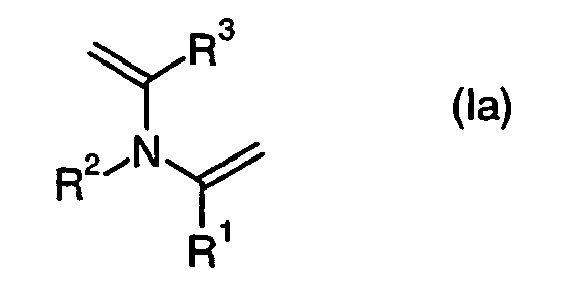
- Zur Herstellung der erfindungsgemäß verwendeten Polymerisate werden als offenkettige N-Vinylamidverbindung a) der allgemeinen Formel (Ia) beispielsweise folgende Monomere eingesetzt: N-Vinylformamid, N-Vinyl-N-methylformamid, N-Vinylacetamid, N-Vinyl-N-methylacetamid, N-Vinyl-N-ethylacetamid, N-Vinylpropionamid, N-Vinyl-N-methylpropionamid und N-Vinyl-butyramid.
- Als N-vinylhaltige Monomere a) eignen sich weiterhin N-Vinyllactame der allgemeinen Formel (IIa)

- Beispiele für Monomere der allgemeinen Formel (IIa) sind N-Vinylpyrrolidon (n=1) und N-Vinylcaprolactam (n=3).
- Als N-vinylhaltige Monomere a) eignen sich weiterhin N-Vinylpiperidon, N-Vinyloxazolidon und N-Vinyltriazol.
- In einer bevorzugten Ausführungsform der Erfindung wird als Monomer a) ein N-Vinylamid, insbesonderen N-Vinylformamid, eingesetzt.
- Als Monomere a) eignen sich auch (Meth)acrylamidmonomere der allgemeinen Formel X

- Bevorzugte (Meth)acrylamidmonomere der Formel X definiert durch die Kombinationen der Reste R20 und R21 sind in Tabelle 1 wiedergegeben:
Tabelle 2 R 20 R 21 H H H CH(OH)COOH H C(CH2OH)3 H CH2OH H CH2OCH(CH3)(C2H5) H CH(CH3)2 H CH3 H C(CH3)2CH2SO3H bzw. C(CH3)2CH2SO3 H CH2CHOHCH3 H CH2OCH3 H C2H5 CH3 H CH3 CH2OH CH3 CH3 CH3 CH2CHOHCH3 CH3 CH2OCH3 CH3 C2H5 CH3 CH(OH)COOH CH3 C(CH2OH)3 CH3 CH2OCH(CH3)(C2H5) CH3 CH(CH3)2 CH3 C(CH3)2CH2SO3H bzw. C(CH3)2CH2SO3 - - Besonders bevorzugte (Meth)acrylamide als Monomere a) sind Acrylamid, 2-Acrylamidoglykolsäure, N-(Tris(hydroxymethyl)-methyl)acrylamid, N-Hydroxymethylacrylamid, N-Methylacrylamid, N-Isopropylacrylamid, 2-Acrylamido-2-methyl-1-propansulfonsäure Methacrylamid, N-Ethyl-methacrylamid, N-Hydroxymethylmethacrylamid, N-(2-hydroxypropyl)-methacrylamid, N-Methyl-methacrylamid, N-Isobutoxy-methylacrylamid, N-Methoxymethylmethacrylamid.
In einer ganz besonders bevorzugten Ausführungsform werden als Monomere a) Acrylamid, Methacrylamid, N-Hydroxymethylacrylamid, N-(2-hydroxypropyl)-methacrylamid, N-Hydroxymethylmethacrylamid und N-Isopropylacrylamid eingesetzt. - Selbstverständlich können auch Mischungen der jeweiligen Monomeren aus der Gruppe a) wie z.B. Mischungen aus N-Vinylformamid und N-Vinylacetamid oder Mischungen aus unterschiedlichen (Meth)acrylamidmonomeren oder Mischungen aus N-Vinylhaltigen Monomeren und (Meth)acrylamidmonomeren copolymerisiert werden.
- Die als Komponente b) in den wässrigen Dispersionen enthaltenen polymeren Dispergiermittel unterscheiden sich in der Zusammensetzung von den durch die radikalische Polymerisation der Monomere erhältlichen, wasserlöslichen Polymerisate. Das polymere Dispergiermittel b) dient als Dispergiermittel des entstehenden wasserlöslichen Polymerisates. Als polymeres Dispergiermittel b) eignen sich somit alle Verbindungen, die in der Lage sind das entstehende wasserlösliche Polymerisat zu dispergieren.
- Die mittleren Molmassen der polymeren Dispergiermittel liegen vorzugsweise in dem Bereich von 500 bis 20000 000, insbesondere bei 1000 bis 90 0000, bevorzugt über 10 000 bis 700 000.
- Die polymeren Dispergiermittel enthalten wenigstens eine funktionelle Gruppe ausgewählt aus Ether-, Hydroxyl-, Carboxyl-, Sulfon-, Sulfatester-, Amino-, Imino-, tert.-Amino-, und/oder quaternären Ammoniumgruppen. Beispiele für solche Verbindungen sind: Polyvinylacetat, Polyalkylenglykole, insbesonderen Polyethylenglykole, Polyvinylalkohol, Polyvinylpyridin, Polyethylenimin, Polyvinylimidazol, Polyvinylsuccinimid und Polydiallyldimethylammoniumchlorid, Polyvinylpyrrolidon, Polymerisaten, die mindestens 5 Gew.% an Vinylpyrrolidon-Einheiten enthalten, Polymerisaten, die mindestens 50 Gew.% an Vinylalkohol-Einheiten enthalten, Oligosacchariden, Polysacchariden, oxidativ, hydrolytisch oder enzymatisch abgebauten Polysacchariden, chemisch modifizierten Oligo- oder Polysacchariden wie beispielsweise Carboxymethylcellulose, wasserlösliche Stärke und Stärkederivate, Stärkeester, Stärkexanthanogenate, Stärkeacetate, Dextran, und deren Mischungen.
- Werden als polymere Dispergiermittel Polyalkylenglykole, insbesondere Polyethylenglykole und Polypropylenglykole, eingesetzt, hat es sich als vorteilhaft erwiesen Verbindungen mit einem Molekulargewicht von über 10 000 einzusetzen.
- Geeignet als polymeres Dispergiermittel b) sind Polymerisate, die mindestens 50 Gew.-% an Vinylalkohol-Einheiten enthalten. Bevorzugt enthalten diese Polymerisate mindestens 70 Gew.-%, ganz besonders bevorzugt 80 Gew.-% Polyvinylalkoholeinheiten. Solche Polymerisate werden überlicherweise durch Polymerisation eines Vinylesters und anschließender zumindest teilweiser Alkoholyse, Aminolyse oder Hydrolyse hergestellt. Bevorzugt sind Vinylester linearer und verzweigter C1-C12-Carbonsäuren, ganz besonders bevorzugt ist Vinylacetat. Die Vinylester können selbstverständlich auch im Gemisch eingesetzt werden.
- Als Comonomere des Vinylesters kommen beispielsweise N-Vinylcaprolactam, N-Vinylpyrrolidon, N-Vinylimidazol, N-Vinyl-2-methylimidazol, N-Vinyl-4-methylimidazol, 3-Methyl-1-vinylimidazoliumchlorid, 3-Methyl-1-vinylimidazoliummethylsulfat, Diallylammoniumchlorid, Styrol, Alkylstyrole in Frage.
- Weitere geeignete Comonomere sind beispielsweise monoethylenisch ungesättigten C3-C6-Carbonsäuren wie z.B. Acrylsäure, Methacrylsäure, Crotonsäure, Fumarsäure, sowie deren Ester, Amide und Nitrile wie z.B. Acrylsäuremethylester, Acrylsäureethylester, Methacrylsäuremethylester, Methacrylsäureethylester, Methacrylsäurestearylester, Hydroxyethylacrylat, Hydroxypropylacrylat, Hydroxybutylacrylat, Hydroxyethylmethacrylat, Hydroxypropylmethacrylat, Hydroxyisobutylacrylat, Hydroxyisobutylmethacrylat, Maleinsäuremonomethylester, Maleinsäuredimethylester, Maleinsäuremonoethylester, Maleinsäurediethylester, 2-Ethylhexylacrylat, 2-Ethylhexylmethacrylat, Maleinsäureanhydrid sowie dessen Halbester, Alkylenglykol(meth)acrylate, Acrylamid, Methacrylamid, N-Dimethylacrylamid, N-tert.-butylacrylamid, Acrylnitril, Methacrylnitril, Vinylether wie z.B. Methyl-, Ethyl-, Butyl oder Dodecylvinylether, kationische Monomere wie Dialkylaminoalkyl(meth)acrylate und Dialkylaminoalkyl(meth)acrylamide wie Dimethylaminoethylacrylat, Diethylaminoethylacrylat, Diethylaminoethylmethacrylat, sowie die Salze der zuletzt genannten Monomeren mit Carbonsäuren oder Mineralsäuren sowie die quarternierten Produkte.
- Bevorzugte polymere Dispergiermittel sind Polymerisate, die durch Homopolymerisation von Vinylacetat und anschließender zumindest teilweiser Hydrolyse, Alkoholyse oder Aminolyse hergestellt werden.
- Die Herstellung dieser polymeren Dispergiermittel erfolgt nach bekannten Verfahren, zum Beispiel der Lösungs-, Fällungs-, Suspensions- oder Emulsionspolymerisation unter Verwendung von Verbindungen, die unter den Polymerisationsbedingungen Radikale bilden. Die Polymerisationstemperaturen liegen üblicherweise in dem Bereich von 30 bis 200°C, vorzugsweise 40 bis 110°C. Geeignete Initiatoren sind beispielsweise Azo- und Peroxyverbindungen sowie die üblichen Redoxinitiatorsysteme, wie Kombinationen aus Wasserstoffperoxid und reduzierend wirkenden Verbindungen, zum Beispiel Natriumsulfit, Natriumbisulfit, Natriumformaldehydsulfoxilat und Hydrazin. Diese Systeme können gegebenenfalls zusätzlich noch geringe Mengen eines Schwermetallsalzes enthalten.
- Zur Herstellung dieser polymeren Dispergiermittel werden die Estergruppen der ursprünglichen Monomere und gegebenenfalls weiterer Monomere nach der Polymerisation durch Hydrolyse, Alkoholyse oder Aminolyse zumindest teilweise gespalten. Im nachfolgenden wird dieser Verfahrensschritt allgemein als Verseifung bezeichnet. Die Verseifung erfolgt in an sich bekannter Weise durch Zugabe einer Base oder Säure, bevorzugt durch Zugabe einer Natrium- oder Kaliumhydroxidlösung in Wasser und/oder Alkohol. Besonders bevorzugt werden methanolische Natrium- oder Kaliumhydroxidlösungen eingesetzt, Die Verseifung wird bei Temperaturen im Bereich von 10 bis 80°C, bevorzugt im Bereich von 20 bis 60°C, durchgeführt. Der Verseifungsgrad hängt ab von der Menge der eingesetzten Base bzw. Säure, von der Verseifungstemperatur, der Verseifungszeit und dem Wassergehalt der Lösung.
- Besonders bevorzugte polymere Dispergiermittel sind Polymerisate, die durch Homopolymerisation von Vinylacetat und anschließender zumindest teilweiser Verseifung hergestellt werden. Solche Polyvinylalkoholeinheiten enthaltenden Polymere sind unter dem Namen Mowiol® erhältlich.
- Weitere besonders bevorzugte polymere Dispergiermittel b) sind Polymerisate, die mindestens 5 Gew.-% an Vinylpyrrolidon-Einheiten enthalten. Bevorzugt enthalten diese Polymerisate einen Vinylpyrrolidon-Anteil von mindestens 10 Gew.-%, ganz besonders bevorzugt von mindestens 30 Gew.-%, insbesondere mindestens 50 Gew.-%.
- Als Comonomere des Vinylpyrrolidons zur Synthese dieser Polymerisate kommen beispielsweise N-Vinylacetat, N-Vinylcaprolactam, N-Vinylimidazol, N-Vinyl-2-methylimidazol, N-Vinyl-4-methylimidazol, 3-Methyl-1-vinylimidazoliumchlorid, 3-Methyl-1-vinylimidazoliummethylsulfat, Diallylammoniumchlorid, Styrol, Alkylstyrole in Frage. Weitere geeignete Comonomere sind beispielsweise monoethylenisch ungesättigten C3-C6-Carbonsäuren wie z.B. Acrylsäure, Methacrylsäure, Crotonsäure, Fumarsäure, sowie deren Ester, Amide und Nitrile wie z.B. Acrylsäuremethylester, Acrylsäureethylester, Methacrylsäuremethylester, Methacrylsäureethylester, Methacrylsäurestearylester, Hydroxyethylacrylat, Hydroxypropylacrylat, Hydroxybutylacrylat, Hydroxyethylmethacrylat, Hydroxypropylmethacrylat, Hydroxyisobutylacrylat, Hydroxyisobutylmethacrylat, Maleinsäuremonomethylester, Maleinsäuredimethylester, Maleinsäuremonoethylester, Maleinsäurediethylester, 2-Ethylhexylacrylat, 2-Ethylhexylmethacrylat, Maleinsäureanhydrid sowie dessen Halbester, Alkylenglykol(meth)acrylate, Acrylamid, Methacrylamid, N-Dimethylacrylamid, N-tert.-butylacrylamid, Acrylnitril, Methacrylnitril, Vinylether wie z.B. Methyl-, Ethyl-, Butyl oder Dodecylvinylether, kationische Monomere wie Dialkylaminoalkyl(meth)acrylate und Dialkylaminoalkyl(meth)acrylamide wie Dimethylaminoethylacrylat, Diethylaminoethylacrylat, Diethylaminoethylmethacrylat, sowie die Salze der zuletzt genannten Monomeren mit Carbonsäuren oder Mineralsäuren sowie die quarternierten Produkte.
- Besonders bevorzugt als Comonomere des Vinylpyrrolidons sind Vinylacetat, N-Vinylcaprolactam, N-Vinylimidazol, 3-Methyl-1-vinylimidazoliumchlorid, 3-Methyl-1-vinylimidazoliummethylsulfat und/oder Styrol.
- Die Herstellung dieser polymeren Dispergiermittel erfolgt nach bekannten Verfahren, zum Beispiel der Lösungs-, Fällungs-, Suspensions- oder Emulsionspolymerisation unter Verwendung von Verbindungen, die unter den Polymerisationsbedingungen Radikale bilden. Die Polymerisationstemperaturen liegen üblicherweise in dem Bereich von 30 bis 200°C, vorzugsweise 40 bis 110°C. Geeignete Initiatoren sind beispielsweise Azo- und Peroxyverbindungen sowie die üblichen Redoxinitiatorsysteme, wie Kombinationen aus Wasserstoffperoxid und reduzierend wirkenden Verbindungen, zum Beispiel Natriumsulfit, Natriumbisulfit, Natriumformaldehydsulfoxilat und Hydrazin. Diese Systeme können gegebenenfalls zusätzlich noch geringe Mengen eines Schwermetallsalzes enthalten.
- Besonders bevorzugt als polymeres Dispergiermittel b) ist Polyvinylpyrrolidon.
- In einer bevorzugten Ausführungsform wird als polymeres Dispergiermittel b) Polyvinylpyrrolidion mit einem Molekulargewicht von 1 000 bis 10 x 106, inbesondere 10 000 bis 5 x 10⁶, bevorzugt 10 000 bis 7 x 10 5eingesetzt.
- Alle genannten polymeren Dispergiermittel können auch in beliebigen Mischungen untereinander eingesetzt werden. Besonders bevorzugt als polymeres Dispergiermittel ist eine Mischung aus Polymerisaten, die mindestens 5 Gew.% an Vinylpyrrolidon-Einheiten und Polyvinylpyrrolidon enthalten.
- Als polymere Dispergiermittel können auch natürliche Substanzen, die Saccharid-Strukturen enthalten, eingesetzt werden. Solche natürlichen Substanzen sind beispielsweise Saccharide pflanzlicher oder tierischer Herkunft oder Produkte, die durch Metabolisierung durch Mikroorganismen entstanden sind, sowie deren Abbauprodukte. Geeignete Verbindungen sind beispielsweise Oligosaccharide, Polysaccharide, oxidativ, enzymatisch oder hydrolytisch abgebaute Polysaccharide, oxidativ hydrolytisch abgebaute oder oxidativ enzymatisch abgebaute Polysaccharide, chemisch modifizierte Oligo- oder Polysaccharide und Mischungen davon.
- Bevorzugte Produkte sind die in US 5,334,287 auf Spalte 4, Zeile 20 bis Spalte 5, Zeile 45 genannten Verbindungen.
- Das als Komponente c) in den wässrigen Dispersionen enthaltene Fällungsagens unterscheidet sich in der Zusammensetzung von den durch die radikalische Polymerisation der Monomere erhältlichen, wasserlöslichen Polymerisate. Das polymere Fällungsagenz c) verringert die Solvatisierungseigenschaften der wässrigen Phase und es kommt zu einer Verdrängung der entstehenden wasserlöslichen Polymerisate aus der wässrigen Phase in die disperse Phase. Das polymere Fällungsagenz c) ist somit mit dem wasserlöslichen Polymerisat unverträglich.
- Als polymere Fällungsagenz c) eignen sich somit alle Verbindungen, welche die Solvatisierungseigenschaften der wässrigen Phase verringern und zu einer Verdrängung der entstehenden wasserlöslichen Polymerisate aus der wässrigen Phase in die disperse Phase führen.
- Unter wasserlöslich sind Verbindungen zu verstehen, die bei 25°C bis zu einer Konzentration von 20 Gew.-% in Wasser, bevorzugt bis zu einer Konzentration von 50 Gew.-% in Wasser und besonders bevorzugt bis zu einer Konzentration von 70 Gew.-% in Wasser klar löslich sind.
- Das polymere Fällungsagens c) steht nicht maßgeblich als Reaktionspartner zur Verfügung, d.h. es kommt nicht in maßgeblichen Anteilen zu einer kovalenten Bindung zwischen dem polymeren Fällungsagens c) und den übrigen Monomeren. Dem Fachmann sind übliche Reaktionsbedingungen bekannt, um dies zu erzielen. Beispielsweise seien genannt die Temperaturwahl bei der Polymerisation. Diese wird bevorzugt unter 100°C, insbesondere unter 80°C, bevorzugt unter 70°C gewählt. Eine weitere mögliche Reaktionsbedingung ist die Wahl des Wasseranteils in der Polymerisationsreaktion. Vorteilhaft sind Wassergehalte von ≥ 20 Gew.-%, insbesondere ≥ 30 %, bevorzugt ≥ 40 %, Die Angabe des Wassergehalt erfolgt bezogen auf die Summe aller Bestandteile (d.h. auf die Summe von a) bis d) sowie gegebenenfalls e), f) und g) sowie weiteren Bestandteilen), die als 100 gesetzt wird.
- Die mittlere Molmasse des polymeren Fällungsagens liegt vorzugsweise in dem Bereich von 300 bis 100 000, insbesondere bei 1000 bis 30 000, bevorzugt bei 1000 bis 10 000.
- Als polymeres Fällungsagenz c) eignen sich insbesondere wasserlösliche polyetherhaltige Verbindungen. Hierbei können sowohl Polyalkylenoxide auf Basis von Ethylenoxid, Propylenoxid, Butylenoxid und weiteren Alkylenoxiden als auch Polyglycerin verwendet werden. Dabei kann es sich bei den Struktureinheiten sowohl um Homopolymere als auch um statistische Copolymere und Blockcopolymere handeln.
- Bevorzugt werden als polymere Fällungsagentien Verbindungen der folgenden Formel (Ib) eingesetzt.

- R1 Wasserstoff, C1-C24-Alkyl, R6-C(=O)-, R6-NH-C(=O)-, Polyalkoholrest;
- R5 Wasserstoff, C1-C24-Alkyl, R6-C(=O)-, R6-NH-C(=O)-;
- R2 bis R4-(CH2)2-, -(CH2)3-, -(CH2)4-, -CH2-CH(R6)-, -CH2-CHOR7-CH2-;
- R6 C1-C24-Alkyl;
- R7 Wasserstoff, C1-C24-Alkyl, R6-C(=O)-, R6-NH-C(=O)-;
- A-C(=O)-O, -C(=O)-B-C(=O)-O, -CH2-CH(-OH)-B-CH(-OH)-CH2-O, -C(=O)-NH-B-NH-C(=O)-O;

- B-(CH2)f-, Arylen, ggf. substituiert;
- R30, R31 Wasserstoff, C1-C24-Alkyl, C1-C24-Hydroxyalkyl, Benzyl oder Phenyl;
- n 1 wenn R1 kein Polyakoholrest ist oder
- n 1 bis 1000 wenn R1 ein Polyakoholrest ist
- s = 0 bis 1000; t =1 bis 12; u =1 bis 5000;v = 0 bis 5000; w =0 bis 5000;x= 0 bis 5000;
- y= 0 bis 5000; z= 0 bis 5000.
- Als Alkylreste für R6 und R30 und R31 seien verzweigte oder unverzweigte C1-C24-Alkylketten, bevorzugt Methyl, Ethyl, n-Propyl, 1-Methylethyl, n-Butyl, 1-Methylpropyl-, 2-Methylpropyl, 1,1-Dimethylethyl, n-Pentyl, 1-Methylbutyl, 2-Methylbutyl, 3-Methylbutyl, 2,2-Dimethylpropyl, 1-Ethylpropyl, n-Hexyl, 1,1-Dimethylpropyl, 1,2-Dimethylpropyl, 1-Methylpentyl, 2-Methylpentyl, 3-Methylpentyl, 4-Methylpentyl, 1,1-Dimethylbutyl, 1,2-Dimethylbutyl, 1,3-Dimethylbutyl, 2,2-Dimethylbutyl, 2,3-Dimethylbutyl, 3,3-Dimethylbutyl, 1-Ethylbutyl, 2-Ethylbutyl, 1,1,2-Trimethylpropyl, 1,2,2-Trimethylpropyl, 1-Ethyl-1-methylpropyl, 1-Ethyl-2-methylpropyl, n-Heptyl, 2-Ethylhexyl, n-Octyl, n-Nonyl, n-Decyl, n-Undecyl, n-Dodecyl, n-Tridecyl, n-Tetradecyl, n-Pentadecyl, n-Hexadecyl, n-Heptadecyl, n-0ctadecyl, n-Nonadecyl oder n-Eicosyl genannt.
- Als bevorzugte Vertreter der oben genannten Alkylreste seien verzweigte oder unverzweigte C1-C12-, besonders bevorzugt C1-C6-Alkylketten genannt.
- Bevorzugt als polymere Fällungsagens c) sind Polyalkylenglykole, wie beispielsweise Polyethylenglykole und Polypropylenglykole. Besonders bevorzugt sind Polyethylenglykole.
- Als polymeres Fällungsagenz c) können auch Silikonderivate eingesetzt werden. Geeignete Silikonderivate sind die unter dem INCI Namen Dimethicone Copolyole oder Silikontenside bekannten Verbindungen wie zum Beispiel die unter den Markennamen Abil® (der Fa. T. Goldschmidt), Alkasil® (der Fa. Rhöne-Poulenc), Silicone Polyol Copolymer® (der Fa Genesee), Belsil® (der Fa. Wacker), Silwet® (der Fa. Witco, Greenwich, CT, USA) oder Dow Corning (der Fa. Dow Corning) erhältlich. Diese beinhalten Verbindungen mit den CAS-Nummern 64365-23-7; 68937-54-2; 68938-54-5; 68937-55-3.
- Bevorzugte Vertreter solcher polyetherhaltigen Silikonderivaten sind solche, die folgende Strukturelemente enthalten:


und wobei die Reste R11 identisch oder unterschiedlich sein können, und entweder aus der Gruppe der aliphatischen Kohlenwasserstoffe mit 1 bis 20 Kohlenstoffatomen stammen, cyclische aliphatische Kohlenwasserstoffe mit 3 bis 20 C-Atomen sind, aromatischer Natur oder gleich R16 sind, wobei:
und f eine ganze Zahl von 1 bis 6 ist,
a und b ganze Zahlen derart sind, daß das Molekulargewicht des Polysiloxan-Blocks zwischen 300 und 30000 liegt,
c und d ganze Zahlen zwischen 0 und 50 sein können mit der Maßgabe, daß die Summe aus c und d größer als 0 ist, und e 0 oder 1 ist. - Bevorzugte Reste R12 und R16 sind solche, bei denen die Summe aus c+d zwischen 5 und 30 beträgt.
- Bevorzugt werden die Gruppen R11 aus der folgenden Gruppe ausgewählt: Methyl, Ethyl, Propyl, Butyl, Isobutyl, Pentyl, Isopentyl, Hexyl, Octyl, Decyl, Dodecyl und Octadecyl, cycloaliphatische Reste, speziell Cyclohexyl, aromatische Gruppen, speziell Phenyl oder Naphthyl, gemischt aromatisch-aliphatische Reste wie Benzyl oder Phenylethyl sowie Tolyl und Xylyl und R16.
- Besonders geeignete Reste R14 sind solche, bei denen im Falle von R14 = -(CO)e-R15 R15 ein beliebiger Alkyl-, Cycloalkyl oder Arylrest bedeutet, der zwischen 1 und 40 C-Atomen besitzt und der weitere ionogene Gruppen wie NH2, COOH, SO3H tragen kann.
- Bevorzugte anorganische Reste R15 sind, für den Fall e=0, Phosphat und Sulfat.
- Besonders bevorzugte polyetherhaltige Silikonderivate sind solche der allgemeinen Struktur:

- Das Gewichtsverhältnis der Summe der polymeren Dispergiermittel b) zur Summe der polymeren Fällungsagentien c) liegt im Bereich von 1:50 bis 1:0.02, insbesondere von 1:20 bis 1: 0,05, besonders bevorzugt im Bereich von 1:10 bis 1: 0.1, insbesondere 1:10 bis 1:0.5, bevorzugt 1:10 bis 1:1.
- In einer bevorzugten Ausführungsform der Erfindung werden als polymere Dispergiermittel b) Polymerisate, die mindestens 5 Gew.% an Vinylpyrrolidon-Einheiten enthalten und/oder Polyvinylpyrrolidon eingesetzt und als polymeres Fällungsagens c) Polyethylenglykole eingesetzt.
- In einer bevorzugten Ausführungsform der Erfindung wird das Gewichtsverhältnis der Mengen an polymerem Dispergierungsmittel b) und polymeres Fällungsagens c) zur Summe der restlichen Monomeren so gewählt, das das Verhältnis im Bereich von 10 : 1 bis 1 : 0,1 , insbesondere im Bereich von 5 : 1 bis 1 : 0,5 liegt. Die Summe der restlichen Monomere ergibt sich aus der Summe von a) und d) sowie gegebenenfalls e) und f). Sie entspricht der Summe aller weiteren Bestandteile ohne zugefügtes Wasser.
- Monomere d), die eine vernetzende Funktion besitzen, sind Verbindungen mit mindestens 2 ethylenisch ungesättigten, nichtkonjugierten Doppelbindungen im Molekül.
- Geeignete Vernetzer d) sind zum Beispiel Acrylester, Methacrylester, Allylether oder Vinylether von mindestens zweiwertigen Alkoholen. Die OH-Gruppen der zugrundeliegenden Alkohole können dabei ganz oder teilweise verethert oder verestert sein; die Vernetzer enthalten aber mindestens zwei ethylenisch ungesättigte Gruppen.
- Beispiele für die zugrundeliegenden Alkohole sind zweiwertige Alkohole wie 1,2-Ethandiol, 1,2-Propandiol, 1,3-Propandiol, 1,2-Butandiol, 1,3-Butandiol, 2,3-Butandiol, 1,4-Butandiol, But-2-en-1,4-diol, 1,2-Pentandiol, 1,5-Pentandiol, 1,2-Hexandiol, 1,6-Hexandiol, 1,10-Decandiol, 1,2-Dodecandiol, 1,12-Dodecandiol, Neopentylglykol, 3-Methylpentan-1,5-diol, 2,5-Dimethyl-1,3-hexandiol, 2,2,4-Trimethyl--1,3-pentandiol, 1,2-Cyclohexandiol, 1,4-Cyclohexandiol, 1,4-Bis(hydroxymethyl)cyclohexan, Hydroxypivalinsäure-neopentylglykolmonoester, 2,2-Bis(4-hydroxyphenyl)-propan, 2,2-Bis[4-(2-hydroxypropyl)phenyl]propan, Diethylenglykol, Triethylenglykol, Tetraethylenglykol, Dipropylenglykol, Tripropylenglykol, Tetrapropylenglykol, 3-Thiopentan-1,5-diol, sowie Polyethylenglykole, Polypropylenglykole und Polytetrahydrofurane mit Molekulargewichten von jeweils 200 bis 10000. Außer den Homopolymerisaten des Ethylenoxids bzw. Propylenoxids können auch Blockcopolymerisate aus Ethylenoxid oder Propylenoxid oder Copolymerisate, die Ethylenoxid- und Propylenoxid-Gruppen eingebaut enthalten, eingesetzt werden. Beispiele für zugrundeliegende Alkohole mit mehr als zwei OH-Gruppen sind Trimethylolpropan, Glycerin, Pentaerythrit, 1,2,5-Pentantriol, 1,2,6-Hexantriol, Triethoxycyanursäure, Sorbitan, Zucker wie Saccharose, Glucose, Mannose. Selbstverständlich können die mehrwertigen Alkohole auch nach Umsetzung mit Ethylenoxid oder Propylenoxid als die entsprechenden Ethoxylate bzw. Propoxylate eingesetzt werden. Die mehrwertigen Alkohole können auch zunächst durch Umsetzung mit Epichlorhydrin in die entsprechenden Glycidylether überführt werden.
- Weitere geeignete Vernetzer sind die Vinylester oder die Ester einwertiger, ungesättigter Alkohole mit ethylenisch ungesättigten C3- bis C6-Carbonsäuren, beispielsweise Acrylsäure, Methacrylsäure, Itaconsäure, Maleinsäure oder Furnarsäure. Beispiele für solche Alkohole sind Allylalkohol, 1-Buten-3-ol, 5-Hexen-1-ol, 1-Octen-3-ol, 9-Decen-1-ol, Dicyclopentenylalkohol, 10-Undecen-1-ol, Zimtalkohol, Citronellol, Crotylalkohol oder cis-9-Octadecen-1-ol. Man kann aber auch die einwertigen, ungesättigten Alkohole mit mehrwertigen Carbonsäuren verestern, beispielsweise Malonsäure, Weinsäure, Trimellitsäure, Phthalsäure, Terephthalsäure, Citronensäure oder Bernsteinsäure.
- Weitere geeignete Vernetzer sind Ester ungesättigter Carbonsäuren mit den oben beschriebenen mehrwertigen Alkoholen, beispielsweise der Ölsäure, Crotonsäure, Zimtsäure oder 10-Undecensäure.
- Geeignet als Monomere d) sind außerdem geradkettige oder verzweigte, lineare oder cyclische, aliphatische oder aromatische Kohlenwasserstoffe, die über mindestens zwei Doppelbindungen verfügen, die bei aliphatischen Kohlenwasserstoffen nicht konjugiert sein dürfen, z.B. Divinylbenzol, Divinyltoluol, 1,7-Octadien, 1,9-Decadien, 4-Vinyl-1-cyclohexen, Trivinylcyclohexan oder Polybutadiene mit Molekulargewichten von 200 bis 20000.
- Als Vernetzer sind ferner geeignet die Acrylsäureamide, Methacrylsäureamide und N-Allylamine von mindestens zweiwertigen Aminen. Solche Amine sind zum Beispiel 1,2-Diaminomethan, 1,2-Diaminoethan, 1,3-Diaminopropan, 1,4-Diaminobutan, 1,6-Diaminohexan, 1,12-Dodecandiamin, Piperazin, Diethylentriamin oder Isophorondiamin. Ebenfalls geeignet sind die Amide aus Allylamin und ungesättigten Carbonsäuren wie Acrylsäure, Methacrylsäure, Itaconsäure, Maleinsäure, oder mindestens zweiwertigen Carbonsäuren, wie sie oben beschrieben wurden.
- Ferner sind Triallylamin und Triallylmonoalkylammoniumsalze, z.B. Triallylmethylammoniumchlorid oder -methylsulfat, als Vernetzer geeignet.
- Geeignet sind auch N-Vinyl-Verbindungen von Harnstoffderivaten, mindestens zweiwertigen Amiden, Cyanuraten oder Urethanen, beispielsweise von Harnstoff, Ethylenharnstoff, Propylenhamstoff oder Weinsäurediamid, z.B. N,N'-Divinylethylenharnstoff oder N,N'-Divinylpropylenharnstoff.
- Weitere geeignete Vernetzer sind Divinyldioxan, Tetraallylsilan oder Tetravinylsilan.
- Selbstverständlich können auch Mischungen der vorgenannten Verbindungen eingesetzt werden. Vorzugsweise werden solche Vernetzer eingesetzt, die in der Monomermischung löslich sind.
- Besonders bevorzugt eingesetzte Vernetzer sind beispielsweise Methylenbisacrylamid, Triallylamin und Triallylalkylammoniumsalze, Divinylimidazol, Pentaerythrittriallylether, N,N'-Divinylethylenharnstoff, Umsetzungsprodukte mehrwertiger Alkohole mit Acrylsäure oder Methacrylsäure, Methacrylsäureester und Acrylsäureester von Polyalkylenoxiden oder mehrwertigen Alkoholen, die mit Ethylenoxid und/oder Propylenoxid und/oder Epichlorhydrin umgesetzt worden sind.
- Ganz besonders bevorzugt als Vernetzer sind Pentaerythrittriallylether, Methylenbisacrylamid, N,N'-Divinylethylenharnstoff, Triallylamin und Triallylmonoalkylammoniumsalze, und Acrylsäureester von Glykol, Butandiol, Trimethylolpropan oder Glycerin oder Acrylsäureester von mit Ethylenoxid und/oder Epichlorhydrin umgesetzten Glykol, Butandiol, Trimethylolpropan oder Glycerin.
- In einer bevorzugten Ausführungsform der vorliegenden Erfindung können weitere Monomere bei der radikalischen Polymerisationsreaktion vorhanden sein.
- Geeignete von a) verschiedene weitere Monomere e) sind N-Vinyllactame, z.B. N-Vinylpiperidon, N-Vinylpyrrolidon und N-Vinylcaprolactam, N-Vinylacetamid, N-Methyl-N-vinylacetamid, N-Vinylformamid, von a) verschiedene (Meth)acrylamidmonomere wie Acrylamid, Methacrylamid, N,N-Dimethylacrylamid, N-Methylolmethacrylamid, N-Vinyloxazolidon, N-Vinyltriazol, Hydroxyalkyl(meth)acrylate, z.B. Hydroxyethyl(meth)acrylat und Hydroxypropyl(meth)-acrylate, oder Alkylethylenglykol(meth)-acrylate mit 1 bis 50 Ethylenglykoleinheiten im Molekül. Besonders bevorzugt werden als Monomere e) N-Vinyllactame eingesetzt. Ganz besonders bevorzugt ist N-Vinylpyrrolidon.
- Außerdem eignen sich von Monomer a) verschiedene N-Vinylimidazole der allgemeinen Formel (I)

- Ferner eignen sich ungesättigte Carbonsäuren und ungesättigte Anhydride, z.B. Acrylsäure, Methacrylsäure, Crotonsäure, Itaconsäure, Maleinsäure, Fumarsäure oder ihre entsprechenden Anhydride sowie von Monomer a) verschiedene ungesättigte Sulfonsäuren, wie z.B. Acrylamidomethylpropansulfonsäure, sowie die Salze der ungesättigten Säuren, wie z.B. die Alkali- oder Ammoniumsalze.
- Als weitere Monomere e) seien genannt C1-C40-Alkylester der (Meth)acrylsäure, wobei die Ester abgeleitet werden von linearen, verzweigtkettigen oder carbocyclischen Alkoholen, z.B. Methyl-(meth)acrylat, Ethyl(meth)-acrylat, tert.-Butyl(meth)acrylat, Isobutyl(meth)acrylat, n-Butyl(meth)-acrylat, Stearyl(meth)acrylat, oder Ester von alkoxylierten Fettalkoholen, z.B. C1-C40-Fettalkoholen, umgesetzt mit Ethylenoxid, Propylenoxid oder Butylenoxid, insbesondere C10-C18-Fettalkohole, umgesetzt mit 3 bis 150 Ethylenoxideinheiten. Weiterhin eignen sich von Monomer a) verschiedene N-Alkyl-substituierte Acrylamide mit linearen, verzweigtkettigen oder carbocyclischen Alkylresten wie N-tert.-Butylacrylamid, N-Butylacrylamid, N-Octylacrylamid, N-tert.-Octylacrylam id.
- Ferner eignen sich Styrol, Vinyl- und Allylester von C1-C40-Carbonsäuren, die linear, verzweigtkettig oder carbocyclisch sein können, z.B. Vinylacetat, Vinylpropionat, Vinylneononanoat, Vinylneoundekansäure, t-Butyl-benzoesäurevinylester, Alkylvinylether, beispielsweise Methylvinylether, Ethylvinylether, Butylvinylether, Stearylvinylether.
- Ferner eignen sich von Monomer a) verschiedene (Meth)Acrylamide, wie N-tert.-Butyl(meth)-acrylamid, N-Butyl(meth)acrylamid, N-Octyl(meth)acrylamid, N-tert.-Octyl(meth)acrylamid und von Monomer a) verschiedene N-Alkyl-substituierte Acrylamide mit linearen, verzweigtkettigen oder carbocyclischen Alkylresten, wobei der Alkylrest die oben für R4 angegebenen Bedeutungen besitzen kann.
- Als Monomere (e) eignen sich insbesondere C1 bis C24-, ganz besonders C1 bis C10-Alkylester der (Meth)acrylsäure, z.B. Methyl(meth)acrylat, Ethyl(meth)acrylat, tert.-Butyl(meth)-acrylat, Isobutyl(meth)acrylat, n-Butyl(meth)acrylat und von Monomer a) verschiedene (Meth)acrylamide wie N-tert.-Butylacrylamid oder N-tert.-Octylacrylamid.
- In einer bevorzugten Ausführungsform der Erfindung werden als weitere Monomere e) kationische und/oder quartemisierbare Monomere eingesetzt. Geeignete weitere Monomere sind die N-Vinylimidazol-Derivate der allgemeinen Formel (I), worin R1 bis R3 für Wasserstoff, C1-C4-Alkyl oder Phenyl steht.

- Weiterhin eignen sich Diallylamine der allgemeinen Formel (II), worin R4 für C1-C24-Alkyl steht

- Weiterhin eignen sich N,N-Dialkylaminoalkylacrylate und -methacrylate und N,N-Dialkylaminoalkylacrylamide und -methacrylamide der allgemeinen Formel (IIIa),

- Beispiele für Verbindungen der allgemeinen Formel (I) sind folgender Tabelle 2 zu entnehmen:
Tabelle 2 R1 R2 R3 H H H Me H H H Me H H H Me Me Me H H Me Me Me H Me Ph H H H Ph H H H Ph Ph Me H Ph H Me Me Ph H H Ph Me H Me Ph Me H Ph Me = Methyl; Ph = Phenyl - Weitere brauchbare Monomere der Formel (I) sind die Ethyl-, Propyl- oder Butyl-Analoga der in Tabelle 2 aufgelisteten Methyl-substituierten 1-Vinylimidazole.
- Beispiele für Verbindungen der allgemeinen Formel (II) sind Diallylamine, worin R4 für Methyl, Ethyl, iso- oder n-Propyl, iso-, n- oder tert.-Butyl, Pentyl, Hexyl, Heptyl, Octyl, Nonyl oder Decyl steht. Beispiele für längerkettige Reste R4 sind Undecyl, Dodecyl, Tridecyl, Pentadecyl, Octadecyl und Icosayl.
- Beispiele für Verbindungen der allgemeinen Formel (IIIa) sind N,N-Dimethylaminomethyl(meth)-acrylat; N,N-Diethylaminomethyl(meth)acrylat;
N,N-Dimethylaminoethyl(meth)acrylat; N,N-Diethylaminoethyl(meth)acrylat;
N,N-Dimethylaminobutyl(meth)acrylat; N,N-Diethylaminobutyl(meth)acrylat,
N,N-Dimethylaminohexyl(meth)acrylat;N,N-Dimethylaminooctyl(meth)acrylat,
N,N-Dimethylaminododecyl(meth)acrylat; N-[3-(dimethylamino)propyl]methacrylamid,
N-[3-(dimethylamino)propyl]acrylamid; N-[3-(dimethylamino)butyl]methacrylamid,
N-[8-(dimethylamino)octyl]methacrylamid; N-[12-(dimethylamino)dodecyl]methacrylamid,
N-[3-(diethylamino)propyl]methacrylamid; N-[3-(diethylamino)propyl]acrylamid. - Bevorzugte Beispiele für weitere Monomere sind 3-Methyl-1-vinylimidazoliumchlorid und -methosulfat, Dimethyldiallylammoniumchlorid sowie N,N-Dimethylaminoethylmethacrylat und N-[3-(dimethylamino)propyl]methacrylamid, die durch Methylchlorid, Dimethylsulfat oder Diethylsulfat quaternisiert wurden.
- Besonders bevorzugte Monomere sind 3-Methyl-1-vinylimidazoliumchlorid und -methosulfat und Dimethyldiallylammoniumchlorid, ganz besonders bevorzugt sind 3-Methyl-1-vinylimidazoliumchlorid und -methosulfat.
- Die weiteren Monomere können entweder in quaternisierter Form als Monomere eingesetzt werden oder nicht-quatemisiert polymerisiert werden, wobei man im letzteren Fall das erhaltene Polymer entweder quaternisiert oder protoniert.
- Zur Quaternisierung der Verbindungen der allgemeinen Formel (I) bis (IIIa) eignen sich beispielsweise Alkylhalogenide mit 1 bis 24 C-Atomen in der Alkylgruppe, z.B. Methylchlorid, Methylbromid, Methyliodid, Ethylchlorid, Ethylbromid, Propylchlorid, Hexylchlorid, Dodecylchlorid, Laurylchlorid und Benzylhalogenide, insbesondere Benzylchlorid und Benzylbromid. Weitere geeignete Quaternierungsmittel sind Dialkylsulfate, insbesondere Dimethylsulfat oder Diethylsulfat. Die Quaternisierung der basischen Monomere der allgemeinen Formel (I) bis (IIIa) kann auch mit Alkylenoxiden wie Ethylenoxid oder Propylenoxid in Gegenwart von Säuren durchgeführt werden.
- Die Quaternisierung des Monomeren oder eines Polymeren mit einem der genannten Quaternisierungsmittel kann nach allgemein bekannten Methoden erfolgen.
- Bevorzugte Quaternierungsmittel sind: Methylchlorid, Dimethylsulfat oder Diethylsulfat.
- Die Quaternisierung des Polymeren kann vollständig oder auch nur teilweise erfolgen. Der Anteil quaternisierter Monomere im Polymeren kann über einen weiten Bereich variieren und liegt z.B. bei etwa 20 bis 100 Mol.-%.
- Zur Protonierung eignen sich beispielsweise Mineralsäuren wie HCl, H2SO4, H3PO4, sowie Monocarbonsäuren, wie z.B. Ameisensäure und Essigsäure, Dicarbonsäuren und mehrfunktionelle Carbonsäuren, wie z.B. Oxalsäure, Milchsäure und Zitronensäure, sowie alle anderen protonenabgebenden Verbindungen und Substanzen, die in der Lage sind, das entsprechende Vinylimidazol oder Diallylamin zu protonieren. Insbesondere eignen sich wasserlösliche Säuren zur Protonierung.
- Die Protonierung des Polymers kann entweder im Anschluss an die Polymerisation erfolgen oder bei der Formulierung der kosmetischen Zusammenstellung, bei der in der Regel ein physiologisch verträglicher pH-Wert eingestellt wird.
- Unter Protonierung ist zu verstehen, dass mindestens ein Teil der protonierbaren Gruppen des Polymers, bevorzugt 20 bis 100 Mol-%, protoniert wird, so dass eine kationische Gesamtladung des Polymers resultiert.
- Die radikalische Polymerisation kann in Gegenwart mindestens eines Reglers f) erfolgen. Als Regler (Polymerisationsregler) werden Verbindungen mit hohen Übertragungskonstanten bezeichnet. Regler beschleunigen Kettenübertragungsreaktionen und bewirken damit eine Herabsetzung des Polymerisationsgrades der resultierenden Polymeren, ohne die Bruttoreaktions-Geschwindigkeit zu beeinflussen.
- Bei den Reglern kann man zwischen mono-, bi- oder polyfunktionalen Regler unterscheiden je nach Anzahl der funktionellen Gruppen im Molekül, die zu einen oder mehreren Kettenübertragungsreaktionen führen können. Geeignete Regler werden beispielsweise ausführlich beschrieben von K.C. Berger und G. Brandrup in J. Brandrup, E.H. Immergut, Polymer Handbook, 3. Aufl., John Wiley & Sons, New York, 1989, S. II/81 -II/141.
- Als Regler eignen sich beispielsweise Aldehyde wie Formaldehyd, Acetaldehyd, Propionaldehyd, n-Butyraldehyd, Isobutyraldehyd.
- Ferner können auch als Regler eingesetzt werden: Ameisensäure, ihre Salze oder Ester, 2,5-Diphenyl-1-hexen, Ammoniumformiat, Hydroxylammoniumsulfat, und Hydroxylammoniumphosphat.
- Weitere geeignete Regler sind Halogenverbindungen wie Alkylhalogenide, wie Tetrachlormethan, Chloroform, Bromtrichlormethan, Bromoform, Allylbromid, und Benzylverbindungen, wie Benzylchlorid oder Benzylbromid.
- Weitere geeignete Regler sind Allylverbindungen, wie z.B. Allylalkohol, funktionale Allylether, wie Allyl Ethoxylate, alkyl allyl ether, oder Glycerin Monoallylether.
- Bevorzugt werden als Regler Verbindungen eingesetzt, die Schwefel in gebundener Form enthalten.
- Verbindungen dieser Art sind beispielsweise anorganische Hydrogensulfite, Disulfite und Dithionite oder organische Sulfide, Disulfide, Polysulfide, Sulfoxide, Sulfone. Folgende Regler werden beispielhaft genannt: Di-n-butylsulfid, Di-n-octylsulfid, Diphenylsulfid, Thiodiglykol, Ethylthioethanol, Diisopropyldisulfid, Di-n-butyldisulfid, Di-n-hexyldisulfid, Diacetyldisulfid, Diethanolsulfid, Di-t-butyltrisulfid, Dimethylsulfoxid, Dialkylsulfid, Dialkyldisulfid und/oder Diarylsulfid.
- Besonders bevorzugt sind organische Verbindungen, die Schwefel in gebundener Form enthalten.
- Bevorzugt als Polymerisationsregler eingesetzte Verbindungen sind Thiole (Verbindungen, die Schwefel in Form von SH-Gruppen enthalten, auch als Mercaptane bezeichnet). Bevorzugt sind als Regler mono-, bi- und polyfunktionale Mercaptane, Mercaptoalkohole und/oder Mercaptocarbonsäuren.
- Beispiele für diese Verbindungen sind Allylthioglykolate, Ethylthioglykolat, Cystein, 2-Mercaptoethanol, 1,3-Mercaptopropanol, 3-Mercaptopropan-1,2-diol, 1,4-Mercaptobutanol, Mercaptoessigsäure, 3-Mercaptopropionsäure, Mercaptobemsteinsäure, Thioglycerin, Thioessigsäure, Thioharnstoff und Alkylmercaptane wie n-Butylmercaptan, n-Hexylmercaptan oder n-Dodecylmercaptan.
- Besonders bevorzugte Thiole sind Cystein, 2-Mercaptoethanol, 1,3-Mercaptopropanol, 3-Mercaptopropan-1,2-diol, Thioglycerin, Thioharnstoff.
- Beispiele für bifunktionale Regler, die zwei Schwefel in gebundener Form enthalten sind bifunktionale Thiole wie z.B. Dimercaptopropansulfonsäure (Natrium Salz), Dimercaptobemsteinsäure, Dimercapto-1-propanol, Dimercaptoethan, Dimercaptopropan, Dimercaptobutan, Dimercaptopentan, Dimercaptohexan, Ethylenglykol-bis-thioglykolate und Butandiol-bis-thioglykolat.
- Beispiele für polyfunktionale Regler sind Verbindungen, die mehr als zwei Schwefel in gebundener Form enthalten. Beispiele hierfür sind trifunktionale und/oder tetrafunktionale Mercaptane.
- Bevorzugte trifunktionale Regler sind trifunktionale Mercaptane, wie z.B. Trimethylolpropan tris(2-mercaptoethanat, Trimethylolpropan tris(3-mercaptopropionat), Trimethylolpropan tris(4-mercaptobutanat), Trimethylolpropan tris(5-mercaptopentanat), Trimethylolpropan tris(6-mercaptohexanat), Trimethylolpropan tris(2-mercaptoacetat).
- Glyceryl thioglycolat, glyceryl thiopropionat, glyceryl thioethylat, glycerylthiobutanat. 1,1,1-Propanetriyl tris-(Mercaptoacetat), 1,1,1-Propanetriyl tris-(Mercaptoethanat), 1,1,1-Propanetriyl tris-(Mercaptoproprionat), 1,1,1-Propanetriyl tris-(Mercaptobutanat) 2-hydroxymethyl-2-methyl-1,3-propandiol tris-(Mercaptoacetat), 2-hydroxymethyl-2-methyl-1,3-propandiol tris-(Mercaptoethanat), 2-hydroxymethyl-2-methyl-1,3-propandiol tris-(Mercaptopropionat), 2-hydroxymethyl-2-methyl-1,3-propandiol tris-(Mercaptobutanat).
- Besonders bevorzugte trifunktionale Regler sind Glyceryl thioglycolat, Trimethylolpropan tris(2-mercaptoacetat, 2-hydroxmethyl-2-methyl-1,3-propandiol tris-(Mercaptoacetat).
- Bevorzugte tetrafunktionale Mercaptane sind Pentaerythritol tetraquis (2-mercaptoacetat), Pentaeryhtritol tetraquis(2-mercaptoethanat), Pentaerythritol tetraquis(3-mercaptopropionat), Pentaerythritol tetraquis-(4-mercaptobutanat), Pentaerythritol tetraquis(5-mercaptopentanat), Pentaerythritol tetraquis(6-mercaptohexanat).
- Als weitere polyfunktionale Regler eignen sich Si-Verbindungen, die durch Umsetzung von Verbindungen der Formel (IVa) entstehen. Weiterhin eignen sich als polyfunktionale Regler Si-Verbindungen der Formel (IVb).


n ein Wert von 0 bis 2 ist,
R1 eine C1-C16-Alkylgruppe oder Phenylgruppe bedeutet
R2 eine C1-C18-Alkylgruppe, die Cyclohexyl-oder Phenylgruppe bezeichnet,
Z für eine C1-C18 Alkylgruppe, C2-C18-Alkylengruppe oder C2-C18-Alkinylgruppe steht, deren Kohlenstoffatome durch nichtbenachbarte Sauerstoff- oder Halogenatome ersetzt sein können, oder für eine der Gruppen
R3 eine C1-C12-Alkylgruppe bedeutet und
R4 eine C1-C18-Alkylgruppe bezeichnet. - Besonders bevorzugt sind die Verbindungen IVa, darunter vor allem Mercaptopropyltrimethoxysilan und Mercaptopropyltriethoxysilan.
- Alle genannten Regler können einzeln oder in Kombination miteinander eingesetzt werden.
- In einer bevorzugten Ausführungsform des Verfahrens werden multifunktionelle Regler eingesetzt.
- Ein weiterer Gegenstand der Erfindung betrifft ein Verfahren zur Herstellung von wässrigen Dispersionen wobei a) mindestens ein N-Vinylhaltiges Monomer und/oder mindestens ein
- a) (Meth)acrylamidmonomer
- b) mindestens ein polymeres Dispergiermittel
- c) mindestens ein polymeres Fällungsagens
- d) mindestens ein Vernetzer
- e) gegebenenfalls weitere Monomere
- g) gegebenenfalls in Gegenwart einer Puffersubstanz
- in Gegenwart mindestens eines Reglers umgesetzt werden und das Gewichtsverhältnis von b) zu c) im Bereich von 1:50 bis 1:0,02 liegt.
- Als Initiatoren für die radikalische Polymerisation können wasserlösliche und wasserunlösliche Peroxo- und/oder Azo-Verbindungen eingesetzt werden, beispielsweise Alkali- oder Ammoniumperoxidisulfate, Wasserstoffperoxid, Dibenzoylperoxid, tert.-Butylperpivalat, 2,2'-Azobis-(2,4-dimethylvaleronitril), tert.-Butylperoxineodecanoat, tert.-Butyl-per-2-ethylhexanoat, Di-tert.-butylperoxid, tert.-Butylhydroperoxid, Azo-bis-isobutyronitril, Azo-bis-(2-amidinopropan)dihydrochlorid oder 2,2'-Azo-bis-(2-methylbutyronitril). Geeignet sind auch Initiatormischungen oder Redox-Initiator Systeme, wie z.B. Ascorbinsäure/Eisen(II)sulfat/-Natriumperoxodisulfat, tert.-Butylhydroperoxid/Natriumdisulfit, tert.-Butylhydroperoxid/Natriumhydroxymethansulfanat, Wasserstoffperoxid/Ascorbinsäure. Die Initiatoren können in den üblichen Mengen eingesetzt werden, beispielsweise 0,05 bis 7 Gew.-%, bezogen auf die Menge der zu polymerisierenden Monomeren.
- Durch die Mitverwendung von Redox-Coinitiatoren, beispielsweise Benzoin, Dimethylanilin sowie organisch löslicher Komplexe und Salze von Schwermetallen, wie Kupfer, Kobalt, Mangan, Nickel und Chrom oder insbesondere Eisen, können die Halbwertzeiten der genannten Peroxide, besonders der Hydroperoxide, verringert werden, so daß beispielsweise tert.-Buthylhydroperoxid in Gegenwart von 5 ppm Kupfer-II-Acetylacetonat bereits bei 100°C wirksam ist.
- Bevorzugt werden wasserlösliche Initiatoren eingesetzt, wie Hydroperoxide, Peroxide und/oder Hydrochloride. Besonders bevorzugt wird das Verfahrenmit den Initiatoren durchgeführt, die ausgewählt sind aus der Gruppe, die gebildet wird von Wasserstoffperoxid, tert.-Butylhydroperoxid, Azo-bis-(2-amidinopropan)dihydrochlorid und/oder Wasserstoffperoxid/Ascorbinsäure.
- In einer Ausführungsform der Erfindung wird das Verfahren in Gegenwart eines Puffers g) durchgeführt. Bevorzugt ist auch eine pH-Regelung der Polymerisation durch eine dosierte/automatisierte Zugabe von Säuren oder Basen, wodurch der bevorzugte pH-Bereich während der gesamten Polymerisation eingehalten werden kann.
- Die Polymerisationsreaktion wird mit Hilfe von in Radikale zerfallende Polymerisationsinitiatoren gestartet. Es können sämtliche Initiatoren eingesetzt werden, die für die Polymerisation der Monomeren bekannt sind. Geeignet sind beispielsweise in Radikale zerfallende Initiatoren, die bei den jeweils gewählten Temperaturen Halbwertzeiten von weniger als 3 Stunden besitzen. Falls die Polymerisation bei unterschiedlichen Temperaturen durchgeführt wird, indem man die Monomeren zunächst bei einer niedrigeren Temperatur anpolymerisiert und anschließend bei einer deutlich höheren Temperatur auspolymerisiert, so verwendet man zweckmäßigerweise mindestens zwei unterschiedliche Initiatoren, die in dem jeweils gewählten Temperaturbereich eine ausreichende Zerfallsgeschwindigkeit haben.
- Die Polymerisation wird üblicherweise bei Temperaturen zwischen 20 und 200°C, bevorzugt zwischen 30 und 90°C, ganz bevorzugt zwischen 40 und 80°C durchgeführt bei Normaldruck oder unter Eigendruck. Bevorzugt ist die Polymerisation unter Stickstoff-Atmosphäre, insbesondere bei leicht erhöhtem Druck (z.B. 0,5 bis 1 bar Stickstoff-Überdruck vor Beginn der Polymerisation bei T = 25°C einstellen).
- Übliche Verfahrenshilfsmittel wie Komplexierer (beispielsweise Ethylendiamintetraessigsäure, EDTA), Geruchsstoffe können gegebenenfalls zugesetzt werden. Viskositätsveränderer wie Glycerol, Methanol, Ethanol, t-Butanol, Glycol, etc können ebenfalls in der wässrigen Dispersion zugegeben sein.
- Die Polymerisation wird in einer bevorzugten Ausführungsform als Batchfahrweise durchgeführt. Hierbei ist bevorzugt, die Komponenten (a-g) in der Vorlage vorzulegen.
- In einer weiteren bevorzugten Ausführungsform wird das erfindungsgemäße Verfahren als Zulauffahrweise durchgeführt. Dabei werden einzelne oder alle Reaktionsteilnehmer ganz oder teilweise, absatzweise oder kontinuierlich, gemeinsam oder in getrennten Zuläufen zu einer Reaktionsmischung gegeben. Es ist jedoch auch möglich, den Initiator zu der auf Polymerisationstemperatur erwärmten Vorlage enthaltend die polymere Dispergiermittel, polymeren Fällungsagenz(ien), und monomere Komponenten (a), (d) und gegebenenfalls Monomer (e) und Regler (f) und Puffer (g) zu zudosieren. In einer weiteren Variante werden zu einem Gemisch aus Monomeren (a) und (d) und gegebenenfalls Monomer (e) einem Lösemittel der Initiator und einem Lösemittel der Regler (f) nach Erreichen der Polymerisations-Temperatur über längere Zeit kontinuierlich zu einer Vorlage enthaltend (g) zugegeben. Man kann auch die Vorlage enthaltend die polymeren Fällungsagenzien (c) und polymeren Dispergiermittel b) und Monomer (d) und gegebenenfalls Puffer (g) auf Polymerisationstemperatur erwärmen und Initiator Lösung und Monomere (a) und gegebenenfalls (e) in getrennten Zuläufen zugeben.
- Selbstverständlich können auch Initiator, Monomere d) und Monomere a) und gegebenenfalls Monomere e) zu einer auf Polymerisationstemperatur erwärmten Vorlage enthaltend ein Gemisch polymere Fällungsagenzien c) und polymerer Dispergiermittel b) und Puffer (g) gegeben werden.
- Vorzugsweise verwendet man ein Gemisch aus polymeren Fällungsagenzien c) und polymeren Dispergiermitteln b) in Wasser und mindestens einem Teil der Monomeren a), d) und gegebenenfalls e) und gegebenenfalls Regler f) und gegebenenfalls Puffer (g) sowie gegebenenfalls weitere Komponenten als Vorlage.
- Die Dispersionen sind üblicherweise milchig weiss und haben in der Regel eine Viskosität von 100 bis 50,000 m Pas, bevorzugt von 200 bis 20,000 m Pas, besonders bevorzugt von 300 bis 15,000 m Pas.
- Die bei der Polymerisation entstandenen Dispersionen können im Anschluss an den Polymerisationsprozess einer physikalischen oder chemischen Nachbehandlung unterworfen werden. Solche Verfahren sind beispielsweise die bekannten Verfahren zur Restmonomerenreduzierung wie zB. die Nachbehandlung durch Zusatz von Polymerisationsinitiatoren oder Mischungen mehrerer Polymerisationsinitiatoren bei geeigneten Temperaturen oder Erhitzen der Polymerisationslösung auf Temperaturen oberhalb der Polymerisationstemperatur, eine Nachbehandlung der Polymerlösung mittels Wasserdampf oder Strippen mit Stickstoff oder Behandeln der Reaktionsmischung mit oxidierenden oder reduzierenden Reagenzien, Adsorptionsverfahren wie die Adsorption von Verunreinigung an ausgewählten Medien wie z.B. Aktivkohle oder eine Ultrafiltration. Es können sich auch die bekannten Aufarbeitungsschritte anschließen, beispielsweise geeignete Trockenverfahren wie Sprüh-, Gefrier- oder Walzentrocknung oder an die Trocknung anschließende Agglomerationsverfahren. Die nach dem erfindungsgemäßen Verfahren erhaltenen restmonomerenarmen Dispersionen können auch direkt in den Handel gebracht werden.
- In einer bevorzugten Ausführungsform werden die wässrigen Dispersionen einer Behandlung unterzogen mit dem Ziel, die im Polymer enthaltene Komponente (a) in das entsprechende Amin umzuwandeln, so dass der Anteil der entstehenden Amine im Polymer < 20 mol-%, bevorzugt < 15 mol-%, insbesondere unter 10 mol-%, besonders bevorzugt unter 5 mol-% bezogen auf die Komponente (a) liegt. Als geeignet Methode sei die Hydrolyse genannt.
- Durch Abspaltung von Formylgruppen aus N-Vinylformamideinheiten enthaltenden Polymerisaten und durch Abspaltung der Gruppe CH3-CO- aus N-Vinylacetamideinheiten enthaltenden Polymerisaten entstehen jeweils Vinylamin-Einheiten enthaltende Polymerisate. Die Abspaltung kann partiell oder vollständig durchgeführt werden. Sofern die Hydrolyse in Gegenwart von Säuren vorgenommen wird, liegen die Vinylamin-Einheiten der Polymeren als Ammoniumsalze vor. Die Hydrolyse kann jedoch auch mit Hilfe von Basen vorgenommen werden, z.B. von Metallhydroxiden, insbesondere von Alkalimetall- und Erdalkalimetallhydroxiden. Vorzugsweise verwendet man Natriumhydroxid oder Kaliumhydroxid. In besonderen Fällen kann die Hydrolyse auch mit Hilfe von Ammoniak oder Aminen durchgeführt werden. Bei der Hydrolyse in Gegenwart von Basen liegen die Vinylamin-Einheiten in Form der freien Basen vor.
- Als Hydrolysemittel eignen sich vorzugsweise Mineralsäuren, wie Halogenwasserstoffe, die gasförmig oder als wäßrige Lösung eingesetzt werden können. Vorzugsweise verwendet man konzentrierte Salzsäure, Schwefelsäure, Salpetersäure oder Phosphorsäure sowie organische Säuren, wie C1- bis C5-Carbonsäuren, sowie aliphatische oder aromatische Sulfonsäuren. Beispielsweise benötigt man pro Formylgruppenäquivalent in den N-Vinylformamideinheiten ein polymerisiert enthaltenden Polymeren 0,05 bis 2, insbesondere 1 bis 1,5 Moläquivalente einer Säure. Die Hydrolyse der N-Vinylformamind-Einheiten verläuft bedeutend schneller als die der N-Vinylacetamid-Einheiten aufweisenden Polymerisate. Sofern man Copolymerisate der in Betracht kommenden Vinylcarbonsäureamide mit anderen Comonomeren der Hydrolyse unterwirft, so können auch die im Copolymerisat enthaltenen Comonomer-Einheiten chemisch verändert werden. So entstehen beispielsweise aus Vinylacetat-Einheiten Vinylalkohol-Einheiten. Aus Acrylsäuremethylester-Einheiten entstehen bei der Hydrolyse Acrylsäure-Einheiten und aus Acrylnitril-Einheiten werden Acrylamid- bzw. Acrylsäure-Einheiten gebildet. Die Hydrolyse der N-Vinylformamid- und/oder Vinylacetamid-Einheiten der Polymerisate (A) kann zu 5 bis 100, vorzugsweise 10 bis 40 % durchgeführt werden. Obwohl die wäßrigen Dispersionen von wasserlöslichen N-Vinylcarbonsäureamiden beim Verdünnen mit Wasser in Lösung gehen, wird die Dispersion bei der Hydrolyse überraschenderweise nicht zerstört.
Für die im folgenden genannten erfindungsgemäßen Verwendungen können neben den erfindungsgemäßen Dispersionen auch solche wässrigen Dispersionen eingesetzt werden, die erhältlich sind durch radikalische Polymerisation von - a) mindestens einem (Meth)acrylamidmonomer und gegebenenfalls einem N-vinylhaltigen Monomer
- b) mindestens einem polymeren Dispergiermittel
- c) mindestens einem polymeren Fällungsagens
- e) gegebenenfalls weiteren Monomeren
- f) gegebenenfalls mindestens einem Regler
- g) gegebenenfalls in Gegenwart einer Puffersubstanz
- Bevorzugt werden die erfindungsgemäßen Dispersionen in kosmetischen Mitteln zur Pflege und zum Schutz der Haut, in Nagelpflegemitteln sowie in Zubereitungen für die dekorative Kosmetik angewendet.
- Besonders bevorzugt ist die Verwendung in Hautpflegemitteln, Intimpflegemitteln, Fußpflegemitteln, Deodorantien, Lichtschutzmitteln, Repellents, Rasiermitteln, Haarentfernungsmitteln, Antiaknemitteln, Make-up, Maskara, Lippenstifte, Lidschatten, Kajalstiften, Eyelinern, Rouges, Pudern und Augenbrauenstiften.
- Die Hautpflegemittel liegen insbesondere als W/O- oder O/W-Hautcremes, Tag- und Nachtcremes, Augencremes, Gesichtscremes, Antifaltencremes, Feuchthaltecremes, Bleichcremes, Vitamincremes, Hautlotionen, Pflegelotionen und Feuchthaltelotionen vor.
- In den kosmetischen Zubereitungen können die erfindungsgemäßen Dispersionen besondere Wirkungen entfalten. Die Dispersionen können unter anderem zur Feuchthaltung und Konditionierung der Haut und zur Verbesserung des Hautgefühls beitragen. Die Dispersionen können auch als Verdicker in den Formulierungen wirken. Durch Zusatz der erfindungsgemäßen Dispersioen kann in bestimmten Formulierungen eine erhebliche Verbesserung der Hautverträglichkeit erreicht werden.
- Die erfindungsgemäßen Dispersionen sind in den hautkosmetischen Zubereitungen in einem Anteil von etwa 0,001 bis 20 Gew.-%, vorzugsweise 0,01 bis 10 Gew.-%, ganz besonders bevorzugt 0,1 bis 5 Gew.-%, bezogen auf das Gesamtgewicht des Mittels, enthalten.
- Je nach Anwendungsgebiet können die erfindungsgemäßen Mittel in einer zur Hautpflege geeigneten Form, wie z.B. als Creme, Schaum, Gel, Stift, Pulver, Mousse, Milch oder Lotion appliziert werden.
- Die hautkosmetischen Zubereitungen können neben den erfindungsgemäßen Dispersionen und geeigneten Lösungsmitteln noch in der Kosmetik übliche Zusätze, wie Emulgatoren, Konservierungsmittel, Parfümöle, kosmetische Wirkstoffe wie Phytantriol, Vitamin A, E und C, Retinol, Bisabolol, Panthenol, Lichtschutzmittel, Bleichmittel, Färbemittel, Tönungsmittel, Bräunungsmittel (zB. Dihydroxyaceton), Collagen, Eiweißhydrolysate, Stabilisatoren, pH-Wert-Regulatoren, Farbstoffe, Salze, Verdicker, Gelbildner, Konsistenzgeber, Silikone, Feuchthaltemittel, Rückfetter und weitere übliche Additive enthalten.
- Als geeignete Lösungsmittel sind insbesondere zu nennen Wasser und niedrige Monoalkohole oder Polyole mit 1 bis 6 Kohlenstoffatomen oder Mischungen davon; bevorzugte Monoalkohole oder Polyole sind Ethanol, i-Propanol, Propylenglycol, Glycerin und Sorbit.
- Als weitere übliche Zusätze können enthalten sein Fettkörper, wie mineralische und synthetische Öle, wie z.B. Paraffine, Siliconöle und aliphatische Kohlenwasserstoffe mit mehr als 8 Kohlenstoff-atomen, tierische und pflanzliche Öle, wie z.B. Sonnenblumenöl, Kokosöl, Avocadoöl, Olivenöl, Lanolin, oder Wachse, Fettsäuren, Fettsäureester, wie z.B. Triglyceride von C6-C30-Fettsäuren, Wachsester, wie z.B. Jojobaöl, Fettalkohole, Vaseline, hydriertes Lanolin und azetyliertes Lanolin. Selbstverständlich können auch Mischungen derselben verwendet werden.
Übliche Verdickungsmittel in derartigen Formulierungen sind vernetzte Polyacrylsäuren und deren Derivate, Polysaccharide wie Xanthan-Gum, Agar-Agar, Alginate oder Tylosen, Carboxymethylcellulose oder Hydroxycarboxymethylcellulose, Fettalkohole, Monoglyceride und Fettsäuren, Polyvinylakolhol und Polyvinylpyrrolidon. - Man kann die erfindungsgemäßen Dispersionen auch mit herkömmlichen Polymeren abmischen, falls spezielle Eigenschaften eingestellt werden sollen.
- Als herkömmliche Polymere eignen sich beispielsweise anionische, kationische, amphotere und neutrale Polymere.
- Beispiele für anionische Polymere sind Homo- und Copolymerisate von Acrylsäure und Methacrylsäure oder deren Salze, Copolymere von Acrylsäure und Acrylamid und deren Salze; Natriumsalze von Polyhydroxycarbonsäuren, wasserlösliche oder wasserdispergierbare Polyester, Polyurethane und Polyharnstoffe. Besonders geeignete Polymere sind Copolymere aus t-Butylacrylat, Ethylacrylat, Methacrylsäure (z.B. Luvimer™ 100P), Copolymere aus Ethylacrylat und Methacrylsäure (z.B. Luvimer™ MAE), Copolymere aus N-tert.-Butyl-acrylamid, Ethylacrylat, Acrylsäure (Ultrahold™ 8, strong), Copolymere aus Vinylacetat, Crotonsäure und gegebenenfalls weitere Vinylester (z.B. Luviset™ Marken), Maleinsäureanhydridcopolymere, ggf. mit Alkoholen umgesetzt, anionische Polysiloxane, z.B. carboxyfunktionelle, Copolymere aus Vinylpyrrolidon, t-Butylacrylat, Methacrylsäure (z.B Luviskol™ VBM), Copolymere von Acrylsäure und Methacrylsäure mit hydrophoben Monomeren, wie z.B. C4-C30-Alkylester der Meth(acrylsäure), C4-C30-Alkylvinylester, C4-C30-Alkylvinylether und Hyaluronsäure. Luviset P.U.R., Luviflex Silk.
- Weitere geeignete Polymere sind kationische Polymere mit der Bezeichnung Polyquaternium nach INCl, z.B. Copolymere aus Vinylpyrrolidon/N-Vinylimidazoliumsalzen (Luviquat™ FC, Luviquat™ HM, Luviquat™ MS, Luviquat™ Care, Luviquat™ Hold, INCl Polyquaternium-16, -44, -46), Copolymere aus Acrylamid und Dimethyldiallylammoniumchlorid (Polyquaternium-7), kationische Cellulosederivate (Polyquaternium-4, -10), kationische Stärkederivate (INCl: Starch Hydroxypropytrimonium Chloride, Corn Starch Modified), kationische Guarderivate (INCl: Hydroxypropyl Guar Hydroxypropyftrimonium Chloride), kationische Sonnenblumenöl-Derivate (INCl: Sunflowerseedamidopropyl Hydroxyethyldimonium Chloride), Copolymere aus N-Vinylpyrrolidon/ Dimethylaminoethylmethacrylat, quaternisiert mit Diethylsulfat (Polyquaternium-11), Copolymere aus Acrylsäure, Acrylamid und Methacrylamidopropyltrimoniumchlorid (Polyquaternium-53), Polyquatemium-32, Polyquaternium-28 und andere.
- Als weitere Polymere sind auch neutrale Polymere geeignet wie Polyvinylpyrrolidone, Copolymere aus N-Vinylpyrrolidon und Vinylacetat und/oder Vinylpropionat, Copolymere aus N-Vinylpyrrolidon/Dimethylaminopropylacrylamid oder-methacrylamid, Copolymere aus N-Vinylpyrrolidon und Alkylacrylat- oder -methacrylatmonomeren mit Alkylketten von C1 bis C18, Pfropfcopolymere von Polyvinylalkohol auf Polyalkylenglykole wie z.B. Kollicoat IR (BASF), Pfropfcopolymere von anderen Vinylmonomeren auf Polyalkylenglykole, Polysiloxane, Polyvinylcaprolactam und Copolymere mit N-Vinylpyrrolidon, Polyethylenimine und deren Salze, Polyvinylamine und deren Salze, Cellulosederivate, Chitosan, Polyasparaginsäuresalze und Derivate.
- Zur Einstellung bestimmter Eigenschaften können die Zubereitungen zusätzlich auch konditionierende Substanzen auf Basis von Silikonverbindungen enthalten. Geeignete Silikonverbindungen sind beispielsweise Polyalkylsiloxane, Polyarylsiloxane, Polyarylalkylsiloxane, Polyethersiloxane, Silikonharze, Dimethicone, Dimethicone-Derivate oder Dimethicon Copolyole (CTFA) und aminofunktionelle Silikonverbindungen wie Amodimethicone (CTFA).
- Die erfindungsgemäßen Dispersionen werden in kosmetischen Zubereitungen eingesetzt, deren Herstellung nach den üblichen dem Fachmann geläufigen Regeln erfolgt.
- Solche Formulierungen liegen vorteilhafterweise in Form von Emulsionen bevorzugt als Wasser-in-Öl-(W/O)- oder ÖI-in-Wasser-(O/W)-Emulsionen vor. Es ist aber auch erfindungsgemäß möglich und gegebenenfalls vorteilhaft andere Formulierungsarten zu wählen, beispielsweise Hydrodispersionen, Gele, Öle, Oleogele, multiple Emulsionen, beispielsweise in Form von W/O/W-oder O/W/O-Emulsionen, wasserfreie Salben bzw. Salbengrundlagen usw.
- Die Herstellung erfindungsgemäß brauchbarer Emulsionen erfolgt nach bekannten Methoden.
- Die Emulsionen enthalten neben der erfindungsgemäßen Dispersion übliche Bestandteile, wie Fettalkohole, Fettsäureester und insbesondere Fettsäuretriglyceride, Fettsäuren, Lanolin und Derivate davon, natürliche oder synthetische Öle oder Wachse und Emulgatoren in Anwesenheit von Wasser.
- Die Auswahl der Emulsionstyp-spezifischen Zusätze und die Herstellung geeigneter Emulsionen ist beispielsweise beschrieben in Schrader, Grundlagen und Rezepturen der Kosmetika, Hüthig Buch Verlag, Heidelberg, 2. Auflage, 1989, Dritter Teil, worauf hiermit ausdrücklich Bezug genommen wird.
- So kann eine erfindungsgemäß brauchbare Hautcreme z.B. als W/O-Emulsion vorliegen. Eine derartige Emulsion enthält eine wässrige Phase, die mittels eines geeigneten Emulgatorsystems in einer Öl- oder Fettphase emulgiert ist.
- Die Konzentration des Emulgatorsystems beträgt in diesem Emulsions-Typ etwa 4 und 35 Gew.-%, bezogen auf das Gesamtgewicht der Emulsion; die Fettphase macht etwa 20 und 60 Gew.-% aus und die wässrige Phasen etwa 20 und 70 Gew.-%, jeweils bezogen auf das Gesamtgewicht der Emulsion. Bei den Emulgatoren handelt es sich um diejenigen, welche in diesem Emulsions-typ üblicherweise verwendet werden. Sie werden z.B. ausgewählt unter: C12-C18-SorbitanFettsäureestern; Estern von Hydroxystearinsäure und C12-C30-Fettalkoholen; Mono- und Diestern von C12-C18-Fettsäuren und Glyzerin oder Polyglyzerin; Kondensaten von Ethylenoxid und Propylenglycolen; oxypropylenierten/oxyethylenierten C12-C20-Fettalkoholen; polycyclischen Alkoholen, wie Sterolen; aliphatischen Alkoholen mit einem hohen Molekulargewicht, wie Lanolin; Mischungen von oxypropylenierten/polyglycerinierten Alkoholen und Magnesiumisostearat; Succinestern von polyoxyethylenierten oder polyoxypropylenierten Fettalkoholen; und Mischungen von Magnesium-, Calcium-, Lithium-, Zink- oder Aluminiumlanolat und hydriertem Lanolin oder Lanolin-alkohol.
- Zu geeigneten Fettkomponenten, welche in der Fettphase der Emulsionen enthalten sein können, zählen Kohlenwasserstofföle, wie Paraffinöl, Purcellinöl, Perhydrosqualen und Lösungen mikrokristalliner Wachse in diesen Ölen; tierische oder pflanzliche Öle, wie Süßmandelöl, Avocadoöl, Calophylumöl, Lanolin und Derivate davon, Ricinusöl, Sesamöl, Olivenöl, Jojobaöl, Karité-Öl, Hoplostethus-Öl; mineralische Öle, deren Destillationsbeginn unter Atmosphärendruck bei ca. 250°C und deren Destillationsendpunkt bei 410°C liegt, wie z.B. Vaselinöl; Ester gesättigter oder ungesättigter Fettsäuren, wie Alkylmyristate, z.B. i-Propyl-, Butyl- oder Cetylmyristat, Hexadecylstearat, Ethyl- oder i-Propylpalmitat, Octan- oder Decansäuretriglyceride und Cetylricinoleat.
- Die Fettphase kann auch in anderen Ölen lösliche Siliconöle, wie Dimethylpolysiloxan, Methylphenylpolysiloxan und das Silikonglycol-Copolymer, Fettsäuren und Fettalkohole enthalten.
- Um die Retention von Ölen zu begünstigen, kann man auch Wachse verwenden, wie z.B. Camauba-Wachs, Candellilawachs, Bienenwachs, mikrokristallines Wachs, Ozokeritwachs und Ca-, Mg- und Al-Oleate, -Myristate, -Linoleate und -Stearate.
- Im allgemeinen werden diese Wasser-in-Öl-Emulsionen so hergestellt, dass die Fettphase und der Emulgator in den Ansatzbehälter gegeben werden. Man erwärmt diesen bei einer Temperatur von 70 bis 75°C, gibt dann die in Öl löslichen Ingredienzen zu und fügt unter Rühren Wasser hinzu, welches vorher auf die gleiche Temperatur erwärmt wurde und worin man die wasserlöslichen Ingredienzen vorher gelöst hat; man rührt, bis man eine Emulsion der gewünschten Feinheit hat, lässt sie dann auf Raumtemperatur abkühlen, wobei gegebenenfalls weniger gerührt wird.
- Weiterhin kann eine erfindungsgemäße Pflegeemulsion als O/W-Emulsion vorliegen. Eine derartige Emulsion enthält üblicherweise eine Ölphase, Emulgatoren, die die Ölphase in der Wasserphase stabilisieren, und eine wässrige Phase, die üblicherweise verdickt vorliegt.
- Die wässrige Phase der O/W-Emulsion der erfindungsgemäßen Zubereitungen enthält gegebenenfalls
- - Alkohole, Diole oder Polyole sowie deren Ether, vorzugsweise Ethanol, Isopropanol, Propylenglycol, Glycerin, Ethylenglycolmonoethylether;
- - übliche Verdickungsmittel bzw. Gelbildner, wie zB. vernetzte Polyacrylsäuren und deren Derivate, Polysaccharide wie Xanthan Gum oder Alginate, Carboxymethylcellulose oder Hydroxycarboxymethylcellulose, Fettalkohole, Polyvinylalkohol und Polyvinylpyrrolidon.
- Die Ölphase enthält in der Kosmetik übliche Ölkomponenten, wie beispielsweise:
- Ester aus gesättigten und/oder ungesättigten, verzweigten und/oder unverzweigten C3-C30-Alkancarbonsäuren und gesättigten und/oder ungesättigten, verzweigten und/oder unverzweigten C3-C30-Alkoholen, aus aromatischen Carbonsäuren und gesättigten und/oder ungesättigten, verzweigten und/oder unverzweigten C3-C30-Alkoholen, beispielhaft Isopropylmyristat, Isopropylstearat, Hexyldecylstearat, Oleyloleat; außerdem synthetische, halbsynthetische und natürliche Gemische solcher Ester, wie Jojobaöl;
- verzweigte und/oder unverzweigte Kohlenwasserstoffe und -wachse;
- Silikonöle wie Cyclomethicon, Dimethylpolysiloxan, Diethylpolysiloxan, Octamethylcyclotetrasiloxan sowie Mischungen daraus;
- Dialkylether;
- Mineralöle und Mineralwachse;
- Triglyceride gesättigter und/oder ungesättigter, verzweigter und/oder unverzweigter C8-C24-Alkancarbonsäuren; sie können ausgewählt werden aus synthetischen, halbsynthetischen oder natürlichen Ölen, wie Olivenöl, Palmöl, Mandelöl oder Mischungen.
- Als Emulgatoren kommen vorzugsweise O/W-Emulgatoren, wie Polyglycerinester, Sorbitanester oder teilveresterte Glyceride, in Betracht.
- Die Herstellung kann durch Aufschmelzen der Ölphase bei ca. 80°C erfolgen; die wasserlöslichen Bestandteile werden in heißem Wasser gelöst, langsam und unter Rühren zur Ölphase zugegeben; homogenisiert und kaltgerührt.
- Die erfindungsgemäßen Dispersionen eignen sich auch zur Verwendung in Wasch- und Duschgel-Formulierungen sowie Badepräparaten.
- Solche Formulierungen enthalten neben den erfindungsgemäßen Dispersionen üblicherweise anionische Tenside als Basistenside und amphotere und nichtionische Tenside als Cotenside, sowie Lipide, Parfümöle, Farbstoffe, organische Säuren, Konservierungsstoffe und Antioxidantien sowie Verdicker/Gelbildner, Hautkonditioniermittel und Feuchthaltemittel.
- In den Wasch, Dusch- und Badepräparaten können alle in Körperreinigungsmitteln üblicherweise eingesetzte anionische, neutrale, amphotere oder kationische Tenside verwendet werden.
- Die Formulierungen enthalten 2 bis 50 Gew.-% Tenside, bevorzugt 5 bis 40 Gew.-%, besonders bevorzugt 8 bis 30 Gew.-%.
- Geeignete anionische Tenside sind beispielsweise Alkylsulfate, Alkylethersulfate, Alkylsulfonate, Alkylarylsulfonate, Alkylsuccinate, Alkylsulfosuccinate, N-Alkoylsarkosinate, Alkylglykolalkoxylate, Acyltaurate, Acylisethionate, Alkylphosphate, Alkyletherphosphate, Alkylethercarboxylate, Alpha-Olefinsulfonate, insbesondere die Alkali- und Erdalkalimetallsalze, z.B. Natrium, Kalium, Magnesium, Calcium, sowie Ammonium- und Triethanolamin-Salze. Die Alkylethersulfate, Alkyletherphosphate und Alkylethercarboxylate können zwischen 1 bis 10 Ethylenoxid oder Propylenoxid-Einheiten, bevorzugt 1 bis 3 Ethylenoxideinheiten im Molekül aufweisen.
- Geeignet sind zum Beispiel Natriumlaurylsulfat, Ammoniumlaurylsulfat, Natriumlaurylethersulfat, Ammoniumlaurylethersulfat, Natriumlaurylsarkosinat, Natriumoleylsuccinat, Ammoniumlaurylsulfosuccinat, Natriumdodecylbenzolsulfonat, Triethanolamindodecylbenzolsulfonat.
- Geeignete amphotere Tenside sind zum Beispiel Alkylbetaine, Alkylamidopropylbetaine, Alkylsulfobetaine, Alkylglycinate, Alkylcarboxyglycinate, Alkylamphoacetate- oder -propionate, Alkylamphodiacetate, oder -dipropionate.
- Beispielsweise können Cocodimethylsulfopropylbetain, Laurylbetain, Cocamidopropylbetain oder Natriumcocamphopropionat eingesetzt werden.
- Als nichtionische Tenside sind beispielsweise geeignet die Umsetzungsprodukte von aliphatischen Alkoholen oder Alkylphenolen mit 6 bis 20 C-Atomen in der Alkylkette, die linear oder verzweigt sein kann, mit Ethylenoxid und/oder Propylenoxid. Die Menge Alkylenoxid beträgt ca. 6 bis 60 Mole auf ein Mol Alkohol. Ferner sind Alkylaminoxide, Mono- oder Dialkylalkanolamide, Fettsäure-ester von Polyethylenglykolen, ethoxylierte Fettsäureamide, Alkylpolyglykoside oder Sorbitanetherester geeignet.
- Außerdem können die Wasch, Dusch- und Badepräparate übliche kationische Tenside enthalten, wie z.B. quaternäre Ammoniumverbindungen, beispielsweise Cetyltrimethylammoniumchlorid oder-bromid (INCI Cetrimoniumchloride oder -bromide), Hydroxyethylcetyldimoniumphosphat (INCI Quaternium-44), INCI Cocotrimoniummethosulfate, INCI Quaternium-52.
- Zusätzlich können auch weitere übliche kationische Polymere eingesetzt werden, so z.B. Copolymere aus Acrylamid und Dimethyldiallylammoniumchlorid (Polyquatemium-7), kationische Cellulosederivate (Polyquaternium-4, -10), kationische Stärkederivate (INCl: Starch Hydroxypropyltrimonium Chloride, Corn Starch Modified), kationische Guarderivate (INCl: Hydroxypropyl Guar Hydroxypropyltrimonium Chloride), kationische Sonnenblumenöl-Derivate (INCl: Sunflowerseedamidopropyl Hydroxyethyldimonium Chloride), Copolymere aus N-Vinylpyrrolidon und quaternisiertem N-Vinylimidazol (Polyquaternium-16, -44, -46), Copolymere aus N-Vinylpyrrolidon/Dimethylaminoethyl-methacrylat, quaternisiert mit Diethylsulfat (Polyquatemium-11), Copolymere aus Acrylsäure, Acrylamid und Methacrylamidopropyltrimoniumchlorid (Polyquaternium-53), Polyquatemium-32, Polyquaternium-28 und andere.
- Weiterhin können die Wasch- und Duschgel-Formulierungen und Badepräparate Verdicker, wie z.B. Kochsalz, PEG-55, Propylene Glycol Oleate, PEG-120 Methyl Glucose Dioleate und andere, sowie Konservierungsmittel, weitere Wirk- und Hilfsstoffe und Wasser enthalten.
- Haarkosmetische Zubereitungen umfassen insbesondere Stylingmittel und/oder Konditioniermittel in haarkosmetischen Zubereitungen wie Haarkuren, Haarschäume (engl. Mousses), (Haar)gelen oder Haarsprays, Haarlotionen, Haarspülungen, Haarshampoos, Haaremulsionen, Spitzenfluids, Egalisierungsmittel für Dauerwellen, Haarfärbe- und -bleichmittel, "Hot-Oil-Treatment"-Präparate, Conditioner, Festigerlotionen oder Haarsprays. Je nach Anwendungsgebiet können die haarkosmetischen Zubereitungen als (Aerosol-)Spray, (Aerosol-)Schaum, Gel, Gelspray, Creme, Lotion oder Wachs appliziert werden.
- Die erfindungsgemäßen haarkosmetischen Formulierungen enthalten in einer bevorzugten Ausführungsform
- a) 0,05 bis 20 Gew.-% der erfindungsgemäßen Dispersion
- b) 20 bis 99,95 Gew.-% Wasser und/oder Alkohol
- c) 0 bis 79,5 Gew.-% weitere Bestandteile
- Unter Alkohol sind alle in der Kosmetik üblichen Alkohole zu verstehen, z.B. Ethanol, Isopropanol, n-Propanol.
- Unter weiteren Bestandteilen sind die in der Kosmetik üblichen Zusätze zu verstehen, beispielsweise Treibmittel, Entschäumer, grenzflächenaktive Verbindungen, d.h. Tenside, Emulgatoren, Schaumbildner und Solubilisatoren. Die eingesetzten grenzflächenaktiven Verbindungen können anionisch, kationisch, amphoter oder neutral sein. Weitere übliche Bestandteile können ferner sein z.B. Konservierungsmittel, Parfümöle, Weichmacher, Effektstoffe, Trübungsmittel, Wirkstoffe, Antioxidantien, Peroxidzersetzer, UV-Filter, Pflegestoffe wie Panthenol, Collagen, Vitamine, Eiweißhydrolysate, Alpha- und Beta-Hydroxycarbonsäuren, Eiweißhydrolysate, Stabilisatoren, pH-Wert-Regulatoren, Farbstoffe, Pigmente, Viskositätsregulierer, Gelbildner, Salze, Feuchthaltemittel, Rückfetter, Komplexbildner und weitere übliche Additive.
- Weiterhin zählen hierzu alle in der Kosmetik bekannten Styling- und Conditionerpolymere, die in Kombination mit den erfindungsgemäßen Polymerisaten eingesetzt werden können, falls ganz spezielle Eigenschaften eingestellt werden sollen.
- Als herkömmliche Haarkosmetik-Polymere eignen sich beispielsweise anionische Polymere. Solche anionischen Polymere sind Homo- und Copolymerisate von Acrylsäure und Methacrylsäure oder deren Salze, Copolymere von Acrylsäure und Acrylamid und deren Salze; Natriumsalze von Polyhydroxycarbonsäuren, wasserlösliche oder wasserdispergierbare Polyester, Polyurethane (Luviset™ P.U.R.) und Polyharnstoffe. Besonders geeignete Polymere sind Copolymere aus t-Butylacrylat, Ethylacrylat, Methacrylsäure (z.B. Luvimer™ 100P), Copolymere aus N-tert.-Butylacrylamid, Ethylacrylat, Acrylsäure (z.B. Ultrahold™ 8, Strong), Copolymere aus Vinylacetat, Crotonsäure und gegebenenfalls weiteren Vinylestern (z.B. Luviset™ Marken, INCl: VA/Crotonates Copolymer), Maleinsäureanhydridcopolymere, ggf. mit Alkoholen umgesetzt, anionische Polysiloxane, z.B. carboxyfunktionelle, Copolymere aus Vinylpyrrolidon, t-Butylacrylat, Methacrylsäure (z.B Luviskol™ VBM).
- Weiterhin umfasst die Gruppe der zur Kombination mit den erfindungsgemäßen Polymerisaten geeigneten Polymere beispielhaft Balance CR oder 0/55 (National Starch; Acrylatcopolymer), Balance 47 (National Starch; Octylacrylamid/Acrylat/Butylaminoethylmethacrylate-Copolymer), Aquaflex™ FX 64 (ISP; Isobutyfen/Ethytmaleimid/Hydroxyethylmaleimid-Copolymer), Aquaflex™ SF-40 (ISP / National Starch; VPNinyl Caprolactam/DMAPA Acrylatcopolymer), Allianz™ LT-120 (ISP / Rohm & Haas; Acrylat/C1-2 Succinat/Hydroxyacrylat-Copolymer), Aquarez™ HS (Eastman; Polyester-1 ), Diaformer™ Z-400 (Clariant; Methacryloylethylbetain/Methacrylat-Copolymer), Diaformer™ Z-711 oder Z-712 (Clariant; Methacryloylethyl N-oxid/Methacrylat-Copolymer), , Omnirez™ 2000 (ISP; Monoethylester von Poly(Methylvinylether/Maleinsäure in Ethanol), Amphomer™ HC oder Resyn XP oder Resyn 28-4961 (National Starch; Acrylat/Octylacrylamide Copolymer), Amphomer™ 28-4910 (National Starch; Octylacrylamid/Acrylat/Butylaminoethylmethacrylat-Copolymer), Advantage™ HC 37 (ISP; Terpolymer aus Vinylcapro-IactamNinylpyrrolidon/Dimethylaminoethylmethacrylat), Advantage Marken (ISP), Acudyne 258 (Rohm & Haas; Acrylat/ Hydroxyesteracrylat-Copolymer), Luviset™ P.U.R. (BASF, Polyurethane-1), Luviflex™ Silk (BASF, PEG/PPG-25/25 Dimethicone/Acrylates Copolymer), East-Man™ AQ48 (Eastman), Styleze 2000 (ISP; VP/Acrylates/Lauryl Methacrylate Copolymer), Styleze CC-10 (ISP; VP/DMAPA Acrylates Copolymer), Styleze W-20 (ISP), Fixomer A-30 (Ondeo Nalco; Methacrylic Acid/Sodium Acrylamidomethyl Propane Sulfonate Copolymer), Fixate G-100 (Noveon; AMP-Acrylates/Allyl Methacrylate Copolymer).
- Ganz besonders bevorzugt werden als anionische Polymere Acrylate mit einer Säurezahl größer gleich 120 und Copolymere aus t-Butylacrylat, Ethylacrylat, Methacrylsäure.
- Weitere geeignete Haarkosmetik-Polymere sind kationische Polymere mit der Bezeichnung Polyquaternium nach INCl, z.B. Copolymere aus Vinylpyrrolidon/N-Vinylimidazoliumsalzen (Luviquat™ FC, Luviquat™ HM, Luviquat™ MS, Luviquat™ Care, INCl: Polyquatemium-16, Polyquaternium-44), Copolymere aus N-Vinylpyrrolidon/Dimethylaminoethylmethacrylat, quaternisiert mit Diethylsulfat (Luviquat™ PQ 11, INCl: Polyquatemium-11), Copolymere aus N-Vinylcaprolactam N-Vinylpyrrolidon/N-Vinylimidazoliumsalzen (Luviquat™ Hold, INCl: Polyquatemium-46); Copolymere aus Acrylamid und Dimethyldiallylammoniumchlorid (Polyquaternium-7), kationische Cellulosederivate (Polyquaternium-4, -10), kationische Stärkederivate (IN-Cl: Starch Hydraxypropytrimonium Chloride, Corn Starch Modified), kationische Guarderivate (INCl: Hydroxypropyl Guar Hydroxypropyltrimonium Chloride), kationische Sonnenblumenöl-Derivate (INCl: Sunflowerseedamidopropyl Hydroxyethyldimonium Chloride), Copolymere aus Acrylsäure, Acrylamid und Methacrylamidopropyltrimoniumchlorid (INCI: Polyquaternium-53), Polyquaternium-32, Polyquaternium-28 und andere.
- Als weitere Haarkosmetik-Polymere sind auch neutrale Polymere geeignet wie Polyvinylpyrrolidone, Copolymere aus N-Vinylpyrrolidon und Vinylacetat und/oder Vinylpropionat, Copolymere aus N-Vinypyrrolidon/Dimethylaminopropylacrylamid oder-methacrylamid, Copolymere aus N-Vinylpyrrolidon und Alkylacrylat- oder -methacrylatmonomeren mit Alkylketten von C1 bis C18, Pfropfcopolymere von Polyvinylalkohol auf Polyalkylenglykole wie z.B. Kollicoat IR (BASF), Pfropfcopolymere von anderen Vinylmonomeren auf Polyalkylenglykole, Polysiloxane, Polyvinylcaprolactam und Copolymere mit N-Vinylpyrrolidon, Polyethylenimine und deren Salze, Polyvinylamine und deren Salze, Cellulosederivate, Chitosan, Polyasparaginsäuresalze und Derivate.
- Zur Einstellung bestimmter Eigenschaften können die Zubereitungen zusätzlich auch konditionierende Substanzen auf Basis von Silikonverbindungen enthalten. Geeignete Silikonverbindungen sind beispielsweise Polyalkylsiloxane, Polyarylsiloxane, Polyarylalkylsiloxane, Polyethersiloxane, Silikonharze, Dimethicone, Dimethicone-Derivate oder Dimethicon Copolyole (CTFA) und aminofunktionelle Silikonverbindungen wie Amodimethicone (CTFA).
- Die erfindungsgemäßen Polymerisate eignen sich insbesondere als Festigungsmittel in Haarstyling-Zubereitungen, insbesondere Haarsprays (Aerosolsprays und Pumpsprays ohne Treibgas) und Haarschäume (Aerosolschäume und Pumpschäume ohne Treibgas).
- In einer bevorzugten Ausführungsform enthalten diese Zubereitungen
- a) 0,1 bis 10 Gew.-% der erfindungsgemäßen Dispersion
- b) 20 bis 99,9 Gew.-% Wasser und/oder Alkohol
- c) 0 bis 70 Gew.-% eines Treibmittel
- d) 0 bis 20 Gew.-% weitere Bestandteile
- Treibmittel sind die für Haarsprays oder Aerosolschäume üblich verwendeten Treibmittel. Bevorzugt sind Gemische aus Propan/Butan, Pentan, Dimethylether, 1,1-Difluorethan (HFC-152 a), Kohlendioxid, Stickstoff oder Druckluft.
Eine erfindungsgemäß bevorzugte Formulierung für Aerosolhaarschäume enthält - a) 0,1 bis 10 Gew.-% der erfindungsgemäßen Dispersion
- b) 55 bis 99,8 Gew.-% Wasser und/oder Alkohol
- c) 5 bis 20 Gew.-% eines Treibmittel
- d) 0,1 bis 5 Gew.-% eines Emulgators
- e) 0 bis 10 Gew.-% weitere Bestandteile
- Als Emulgatoren können alle in Haarschäumen üblicherweise eingesetzten Emulgatoren verwendet werden. Geeignete Emulgatoren können nichtionisch, kationisch bzw. anionisch oder amphoter sein.
- Beispiele für nichtionische Emulgatoren (INCl-Nomenklatur) sind Laurethe, z.B. Laureth-4; Cetethe, z.B. Cetheth-1, Polyethylenglycolcetylether; Cetearethe, z.B. Cetheareth-25, Polyglycolfettsäureglyceride, hydroxyliertes Lecithin, Lactylester von Fettsäuren, Alkylpolyglycoside.
- Beispiele für kationische Emulgatoren sind Cetyltrimethylammoniumchlorid oder -bromid (INCl Cetrimoniumchloride oder -bromide), Hydroxyethyicetyldimoniumphosphat (INCl Quatemium-44), INCl Cocotrimoniummethosulfate, INCl Quaternium-52, Quaternium-1 bis x (INCl).
- Anionische Emulgatoren können beispielsweise ausgewählt werden aus der Gruppe der Alkylsulfate, Alkylethersulfate, Alkylsulfonate, Alkylarylsulfonate, Alkylsuccinate, Alkylsulfosuccinate, N-Alkoyisarkosinate, Alkylglykolalkoxylate, Acyltaurate, Acylisethionate, Alkylphosphate, Alkyletherphosphate, Alkylethercarboxylate, Alpha-Olefinsulfonate, insbesondere die Alkali- und Erdalkalimetallsalze, z.B. Natrium, Kalium, Magnesium, Calcium, sowie Ammonium- und Triethanolamin-Salze. Die Alkylethersulfate, Alkyletherphosphate und Alkylethercarboxylate können zwischen 1 bis 10 Ethylenoxid oder Propylenoxid-Einheiten, bevorzugt 1 bis 3 Ethylenoxid-Einheiten im Molekül aufweisen.
- Beispiele für Haarschäume siehe Beispiele kosmetische Formulierungen von 38 bis 43.
- Eine erfindungsgemäß für Styling-Gele geeignete Zubereitung kann beispielsweise wie folgt zusammengesetzt sein:
- a) 0,1 bis 10 Gew.-% der erfindungsgemäßen Dispersion
- b) 60 bis 99,85 Gew.-% Wasser und/oder Alkohol
- c) 0,05 bis 10 Gew.-% eines Gelbildners
- d) 0 bis 20 Gew.-% weitere Bestandteile
- Beispiele für Styling-Gele sind bei den Beispielen für kosmetische Zubereitungen von 44 bis 52 genannt.
- Die erfindungsgemäßen Dispersionen können in kosmetischen Zubereitungen als Konditioniermittel eingesetzt werden. Beispiele für Rinse-off und Leave-on Conditioner sind die Nummern 53 bis 55.
- Die erfindungsgemäßen Dispersionen können in kosmetischen Zubereitungen als Verdicker eingesetzt werden.
- Die erfindungsgemäßen Dispersionen können auch in Shampooformulierungen als Festigungs- und/oder Konditioniermittel eingesetzt werden. Als Konditioniermittel eignen sich insbesondere Polymere mit kationischer Ladung. Bevorzugte Shampooformulierungen enthalten
- a) 0,05 bis 10 Gew.-% der erfindungsgemäßen Dispersion
- b) 25 bis 94,95 Gew.-% Wasser
- c) 5 - 50 Gew.-% Tenside
- c) 0 - 5 Gew.-% eines weiteren Konditioniermittels
- d) 0 - 10 Gew.-% weitere kosmetische Bestandteile
- In den Shampooformulierungen können alle in Shampoos üblicherweise eingesetzte anionische, neutrale, amphotere oder kationische Tenside verwendet werden.
- Geeignete anionische Tenside sind beispielsweise Alkylsulfate, Alkylethersulfate, Alkylsulfonate, Alkylarylsulfonate, Alkylsuccinate, Alkylsulfosuccinate, N-Alkoylsarkosinate, Acyltaurate, Acylisethionate, Alkylglykolalkoxylate, Alkylphosphate, Alkyletherphosphate, Alkylethercarboxylate, Alpha-Olefinsulfonate, insbesondere die Alkali- und Erdalkalimetallsalze, zB. Natrium, Kalium, Magnesium, Calcium, sowie Ammonium- und Triethanolamin-Salze. Die Alkylethersulfate, Alkyletherphosphate und Alkylethercarboxylate können zwischen 1 bis 10 Ethylenoxid oder Propylenoxid-Einheiten, bevorzugt 1 bis 3 Ethylenoxid-Einheiten im Molekül aufweisen.
- Geeignet sind zum Beispiel Natriumlaurylsulfat, Ammoniumlaurylsulfat, Natriumlaurylethersulfat, Ammoniumlaurylethersulfat, Natriumlauroylsarkosinat, Natriumoleylsuccinat, Ammoniumlaurylsulfosuccinat, Natriumdodecylbenzolsulfonat, Triethanolamindodecylbenzolsulfonat.
- Geeignete amphotere Tenside sind zum Beispiel Alkylbetaine, Alkylamidopropylbetaine, Alkylsulfobetaine, Alkylglycinate, Alkylcarboxyglycinate, Alkylamphoacetate oder -propionate, Alkylamphodiacetate oder -dipropionate.
- Beispielsweise können Cocodimethylsulfopropylbetain, Laurylbetain, Cocamidopropylbetain oder Natriumcocamphopropionat eingesetzt werden.
- Als nichtionische Tenside sind beispielsweise geeignet die Umsetzungsprodukte von aliphatischen Alkoholen oder Alkylphenolen mit 6 bis 20 C-Atomen in der Alkylkette, die linear oder verzweigt sein kann, mit Ethylenoxid und/oder Propylenoxid. Die Menge Alkylenoxid beträgt ca. 6 bis 60, Mole auf ein Mol Alkohol. Ferner sind Alkylaminoxide, Mono- oder Dialkylalkanolamide, Fettsäureester von Polyethylenglykolen, Alkylpolyglykoside oder Sorbitanetherester geeignet.
- Außerdem können die Shampooformulierungen übliche kationische Tenside enthalten, wie z.B. quaternäre Ammoniumverbindungen, beispielsweise Cetyltrimethylammoniumchlorid oder -bromid (INCI Cetrimoniumchloride oder-bromide), Hydroxyethylcetyldimoniumphosphat (INCI Quaternium-44), INCI Cocotrimoniummethosulfate, INCI Quaternium-52.
- In den Shampooformulierungen können zur Erzielung bestimmter Effekte übliche Konditioniermittel in Kombination mit den erfindungsgemäßen Polymerisaten eingesetzt werden. Hierzu zählen beispielsweise kationische Polymere mit der Bezeichnung Polyquaternium nach INCI, z.B. Copolymere aus Vinylpyrrolidon/N-Vinylimidazoliumsalzen (Luviquat™ FC, Luviquat™ HM, Luviquat™ MS, Luviquat™ Care, INCI: Polyquaternium-16, Polyquaternium-44), Copolymere aus N-Vinylpyrrolidon/Dimethylaminoethylmethacrylat, quaternisiert mit Diethylsulfat (Luviquat™ PQ 11, INCI: Polyquaternium-11), Copolymere aus N-Vinylcaprolactam N-Vinylpyrrolidon/N-Vinylimidazoliumsalzen (Luviquat™ Hold, INCI: Polyquaternium-46); Copolymere aus Acrylamid und Dimethyldiallylammoniumchlorid (Polyquatemium-7), kationische Cellulosederivate (Polyquaternium-4, -10). Ferner können kationische Stärkederivate (INCI: Starch Hydroxypropyltrimonium Chloride, Corn Starch Modified), kationische Guarderivate (INCI: Hydroxypropyl Guar Hydroxypropyltrimonium Chloride), kationische Sonnenblumenöl-Derivate (INCI: Sunflowerseedamidopropyl Hydroxyethyldimonium Chloride), Copolymere aus Acrylsäure, Acrylamid und Methacrylamidopropyltrimoniumchlorid (INCI: Polyquaternium-53), Polyquaternium-32, Polyquaternium-28 und andere eingesetzt werden.Ferner können Eiweißhydrolysate verwendet werden, sowie konditionierende Substanzen auf Basis von Silikonverbindungen, beispielsweise Polyalkylsiloxane, Polyarylsiloxane, Polyarylalkylsiloxane, Polyethersiloxane oder Silikonharze. Weitere geeignete Silikonverbindungen sind Dimethicone, Dimethicone-Derivate oder Dimethicon Copolyole (CTFA) und aminofunktionelle Silikonverbindungen wie Amodimethicone (CTFA).
- Beispiele für Shampoo- und Duschgelformulierungen sind von Nummer 59 bis 68 gegeben.
- Herstellungsbeispiele (die Angabe des Feststoffgehaltes erfolgt in allen Beispielen als Gew.-%)
- In ein mit Ankerrührer (200 Upm) und Stickstoffeinleitung ausgestattetes 2-I-Glasgefäß wurden 575,7 g Wasser, 2 g Natriumdihydrogenphosphat-Dihydrat, 6 g Polyvinylpyrrolidon (K-Wert 90, bestimmt mit 1%iger wässriger Lösung), 10 g Polyvinylpyrrolidon (K-Wert 17, bestimmt mit 1%iger wässriger Lösung) sowie 180 g Polyethylenglykol der Molmasse 1500 eingewogen und durch Rühren zu einer homogenen Lösung verarbeitet. Man gab 180 g N-Vinylformamid, 44,4 g N-Vinyl-2-methylimmidazolium Methylsulfat (45% wässrige Lösung), und 0,6 g Triallylamin zu und stellte danach durch Zusatz von 25%iger wässriger Natronlauge den pH-Wert der Lösung auf 6,75 ein. Man leitete permanent Stickstoff durch die Reaktionsmischung und gab 1,0 g 2,2'-Azobis-2-(Aminopropan)dihydrochlorid (WakoV50) zu und erhitzte das Reaktionsgemisch zur Polymerisation auf eine Temperatur von 55°C. Die Polymerisationszeit betrug 4 Stunden. Danach wurde 0,24 g 2,2'-Azobis-2-(Aminopropan)dihydrochlorid (WakoVA44) zugegeben und weitere 2 Stunden bei 65°C polymerisiert.
- Man erhielt eine wässrige Dispersion von einem Feststoffgehalt von 39,9 %, einer Viskosität von 650 mPas und einem LD-Wert (bei 39,9% Feststoffgehalt gemessen) von < 0,5%.
- In ein mit Ankerrührer (200 upm) und Stickstoffeinleitung ausgestattetes 2-1-Glasgefäß wurden 550,9 g Wasser, 2 g Natriumdihydrogenphosphat-Dihydrat, 6 g Polyvinylpyrrolidon (K-Wert 90, bestimmt mit 1%iger wässriger Lösung), 10 g Polyvinylpyrrolidon (K-Wert 17, bestimmt mit 1 %iger wässriger Lösung) sowie 180 g Polyethylenglykol der Molmasse 1500 eingewogen und durch Rühren zu einer homogenen Lösung verarbeitet. Man gab 160 g N-Vinylformamid, 88,9 g N-Vinyl-2-methylimmidazolium Methylsulfat (45% wässrige Lösung), und 1,0 g Triallylamin zu und stellte danach durch Zusatz von 25%iger wässriger Natronlauge den pH-Wert der Lösung auf 6,75 ein. Man leitete permanent Stickstoff durch die Reaktionsmischung und gab 1,0 g 2,2'-Azobis-2-(Aminopropan)dihydrochlorid (WakoV50) zu und erhitzte das Reaktionsgemisch zur Polymerisation auf eine Temperatur von 55°C. Die Polymerisationszeit betrug 4 Stunden. Danach wurde 0,24g 2,2'-Azobis-2-(Aminopropan)dihydrochlorid (WakoVA44) zugegeben und weitere 2 Stunden bei 65°C polymerisiert.
- Man erhielt eine wässrige Dispersion von einem Feststoffgehalt von 39,9%, einer Viskosität von 5900 mPas und einem LD-Wert (bei 39,9% Feststoffgehalt gemessen) von < 0,5%.
- In ein mit Ankerrührer (200 upm) und Stickstoffeinleitung ausgestattetes 21-Glasgefäß wurden 575,7 g Wasser, 2 g Natriumdihydrogenphosphat-Dihydrat, 12 g Polyvinylpyrrolidon (K-Wert 90, bestimmt mit 1%iger wässriger Lösung), 10 g Polyvinylpyrrolidon (K-Wert 17, bestimmt mit 1 %iger wässriger Lösung) sowie 180 g Polyethylenglykol der Molmasse 1500 eingewogen und durch Rühren zu einer homogenen Lösung verarbeitet. Man gab 180 g N-Vinylformamid, 44,4 g N-Vinyl-2-methylimmidazolium Methylsulfat (45% wässrige Lösung), und 0,4 g Triallylamin zu und stellte danach durch Zusatz von 25%iger wässriger Natronlauge den pH-Wert der Lösung auf 6,75 ein. Man leitete permanent Stickstoff durch die Reaktionsmischung und gab 1,0 g 2,2'-Azobis-2-(Aminopropan)dihydrochlorid (WakoV50) zu und erhitzte das Reaktionsgemisch zur Polymerisation auf eine Temperatur von 55°C. Die Polymerisationszeit betrug 4 Stunden. Danach wurde 0,24g 2,2'-Azobis-2-(Aminopropan)dihydrochlorid (WakoVA44) zugegeben und weitere 2 Stunden bei 65°C polymerisiert.
- Man erhielt eine wässrige Dispersion von einem Feststoffgehalt von 39,9%, einer Viskosität von 8600 mPas und einem LD-Wert (bei 39,9% Feststoffgehalt gemessen) von < 0,5%.
- In ein mit Ankerrührer (200 upm) und Stickstoffeinleitung ausgestattetes 2-1-Glasgefäß wurden 775,7 g Wasser, 2 g Natriumdihydrogenphosphat-Dihydrat gegeben. Man gab 180 g N-Vinylformamid, 44,4 g N-Vinyl-2-methylimmidazolium Methylsulfat (45 % wässrige Lösung), und 0,6 g Triallylamin zu und stellte danach durch Zusatz von 25%iger wässriger Natronlauge den pH-Wert der Lösung auf 6,75 ein. Man leitete permanent Stickstoff durch die Reaktionsmischung und gab 1,0 g 2,2'-Azobis-2-(Aminopropan)dihydrochlorid (WakoV50) zu und erhitzte das Reaktionsgemisch zur Polymerisation auf eine Temperatur von 55°C. Die Polymerisationszeit betrug 4 Stunden. Danach wurde 0,24g 2,2-Azobis-2-(Aminopropan)dihydrochlorid (WakoVA44) zugegeben und weitere 2 Stunden bei 65°C polymerisiert. Man erhielt eine Lösung mit einem Feststoffgehalt 20,1%. Die Lösung hatte eine Viskosität von großer 75000 mPas und einen LD-Wert (bei 20,1% Feststoffgehalt gemessen) von 95 %.
- Vergleichsbeispiel 2 (V2)
- In ein mit Ankerrührer (200 Upm) und Stickstoffeinleitung ausgestattetes 21-Glasgefäß wurden 746,9 g Wasser, 2 g Natriumdihydrogenphosphat-Dihydrat, zu einer homogenen Lösung verarbeitet. Man gab 160 g N-Vinylformamid, 88,9 g N-Vinyl-2-methylimmidazolium Methylsulfat (45 % wässrige Lösung), und 1,0 g Triallylamin zu und stellte danach durch Zusatz von 25%iger wässriger Natronlauge den pH-Wert der Lösung auf 6,75 ein. Man leitete permanent Stickstoff durch die Reaktionsmischung und gab 1,0 g 2,2'-Azobis-2-(Aminopropan)dihydrochlorid (WakoV50) zu und erhitzte das Reaktionsgemisch zur Polymerisation auf eine Temperatur von 55°C. Die Polymerisationszeit betrug 4 Stunden. Danach wurde 0,24g 2,2'-Azobis-2-(Aminopropan)dihydrochlorid (WakoVA44) zugegeben und weitere 2 Stunden bei 65°C polymerisiert. Man erhielt eine wässrige Lösung mit einem Feststoffgehalt von 20%. Die wässrige Lösung hatte eine Viskosität von großer 75000 mPas und einem LD-Wert (bei 20% Feststoffgehalt gemessen) von 93 %.
- In ein mit Ankerrührer (200 upm) und Stickstoffeinleitung ausgestattetes 2-1-Glasgefäß wurden 575,7 g Wasser, 2 g Natriumdihydrogenphosphat-Dihydrat, 12 g Polyvinylpyrrolidon (K-Wert 90, bestimmt mit 1%iger wässriger Lösung), 10 g Polyvinylpyrrolidon (K-Wert 17, bestimmt mit 1 %iger wässriger Lösung) sowie 180 g Polyethylenglykol der Molmasse 1500 eingewogen und durch Rühren zu einer homogenen Lösung verarbeitet. Man gab 180 g N-Vinylformamid, 44,4 g N-Vinyl-2-methylimmidazolium Methylsulfat (45% wässrige Lösung), zu und stellte danach durch Zusatz von 25%iger wässriger Natronlauge den pH-Wert der Lösung auf 6,75 ein. Man leitete permanent Stickstoff durch die Reaktionsmischung und gab 1,0 g 2,2'-Azobis-2-(Aminopropan)dihydrochlorid (WakoV50) zu und erhitzte das Reaktionsgemisch zur Polymerisation auf eine Temperatur von 55°C. Die Polymerisationszeit betrug 4 Stunden. Danach wurde 0,24 g 2,2'-Azobis-2-(Aminopropan)dihydrochlorid (WakoVA44) zugegeben und weitere 2 Stunden bei 65°C polymerisiert. Man erhielt eine wässrige Dispersion von einem Feststoffgehalt von 39,9 %, einer Viskosität von 2600 mPas und einem LD-Wert (bei 39,9 % Feststoffgehalt gemessen) von 90%.
- In ein mit Ankerrührer (200 Upm) und Stickstoffeinleitung ausgestattetes 2-1-Glasgefäß wurden 583 g Wasser, 2 g Natriumdihydrogenphosphat-Dihydrat, 6 g Polyvinylpyrrolidon (K-Wert 90, bestimmt mit 1%iger wässriger Lösung), 6 g Polyvinylpyrrolidon (K-Wert 17, bestimmt mit 1 %iger wässriger Lösung) sowie 180 g Polyethylenglykol der Molmasse 1500 eingewogen und durch Rühren zu einer homogenen Lösung verarbeitet. Man gab 160 g N-Vinylformamid, 61,5 g Diallyldimethylammoniumchlorid (65% wässrige Lösung), und 0,2 g Triallylamin zu und stellte danach durch Zusatz von 25%iger wässriger Natronlauge den pH-Wert der Lösung auf 6,75 ein. Man leitete permanent Stickstoff durch die Reaktionsmischung und gab 2,0 g 2,2'-Azobis-2-(Aminopropan)dihydrochlorid (WakoV50) zu und erhitzte das Reaktionsgemisch zur Polymerisation auf eine Temperatur von 55°C. Die Polymerisationszeit betrug 4 Stunden. Danach wurde 0,24g 2,2'-Azobis-2-(Aminopropan)dihydrochlorid (WakoVA44) zugegeben und weitere 4 Stunden bei 65°C polymerisiert. Man erhielt eine wässrige Dispersion von einem Feststoffgehalt von 39,5%, einer Viskosität von 950 mPas und einem LD-Wert (bei 39,5% Feststoffgehalt gemessen) von < 0,5.
- In ein mit Ankerrührer (200 upm) und Stickstoffeinleitung ausgestattetes 2I-Glasgefäß wurden 575,7 g Wasser, 2 g Natriumdihydrogenphosphat-Dihydrat, 6 g Polyvinylpyrrolidon (K-Wert 90, bestimmt mit 1%iger wässriger Lösung), 10 g Polyvinylpyrrolidon (K-Wert 17, bestimmt mit 1%iger wässriger Lösung) sowie 180 g Polyethylenglykol der Molmasse 1500 eingewogen und durch Rühren zu einer homogenen Lösung verarbeitet. Man gab 180 g N-Vinylformamid, 44,4 g N-Vinyl-2-methylimmidazolium Methylsulfat (45% wässrige Lösung), und 0,6 g Triallylamin zu und stellte danach durch Zusatz von 25%iger wässriger Natronlauge den pH-Wert der Lösung auf 6,75 ein. Man leitete permanent Stickstoff durch die Reaktionsmischung und gab 0,4 g 2,2'-Azobis-2-(Aminopropan)dihydrochlorid (WakoV50) zu und erhitzte das Reaktionsgemisch zur Polymerisation auf eine Temperatur von 50°C. Die Polymerisationszeit betrug 4 Stunden. Danach wurde 0,24 g 2,2'-Azobis-2-(Aminopropan)dihydrochlorid (WakoVA44) zugegeben und weitere 2 Stunden bei 65°C polymerisiert. Man erhielt eine wässrige Dispersion von einem Feststoffgehalt von 39,9 %, einer Viskosität von 1100 m Pas und einem LD-Wert (bei 39,9 % Feststoffgehalt gemessen) von < 0,5 %.
- In ein mit Ankerrührer (200 Upm) und Stickstoffeinleitung ausgestattetes 2-I-Glasgefäß wurden 579,9 g Wasser, 2 g Natriumdihydrogenphosphat-Dihydrat, 6 g Polyvinylpyrrolidon (K-Wert 90, bestimmt mit 1%iger wässriger Lösung), 6 g Polyvinylpyrrolidon (K-Wert 17, bestimmt mit 1%iger wässriger Lösung) sowie 180 g Polyethylenglykol der Molmasse 1500 eingewogen und durch Rühren zu einer homogenen Lösung verarbeitet. Man gab 140 g N-Vinylformamid, 40 g Vinylpyrrolidon, 44,4 g N-Vinyl-2-methylimmidazolium Methylsulfat (45 % wässrige Lösung), und 0,4 g Triallylamin zu und stellte danach durch Zusatz von 25%iger wässriger Natronlauge den pH-Wert der Lösung auf 6,75 ein. Man leitete permanent Stickstoff durch die Reaktionsmischung und gab 1,0 g 2,2'-Azobis-2-(Aminopropan)dihydrochlorid (WakoV50) zu und erhitzte das Reaktionsgemisch zur Polymerisation auf eine Temperatur von 55°C. Die Polymerisationszeit betrug 4 Stunden. Danach wurde 0,24g 2,2'-Azobis-2-(Aminopropan)dihydrochlorid (WakoVA44) zugegeben und weitere 2 Stunden bei 65°C polymerisiert.
- Man erhielt eine wässrige Dispersion von einem Feststoffgehalt von 39,9 %, einer Viskosität von 1100 mPas und einem LD-Wert (bei 39,9 % Feststoffgehalt gemessen) von < 0,5 %.
- In ein mit Ankerrührer (200 Upm) und Stickstoffeinleitung ausgestattetes 2-I-Glasgefäß wurden 583 g Wasser, 2 g Natriumdihydrogenphosphat-Dihydrat, 6 g Polyvinylpyrrolidon (K-Wert 90, bestimmt mit 1%iger wässriger Lösung), 6 g Polyvinylpyrrolidon (K-Wert 17, bestimmt mit 1 %iger wässriger Lösung) sowie 180 g Polyethylenglykol der Molmasse 1500 eingewogen und durch Rühren zu einer homogenen Lösung verarbeitet. Man gab 160 g N-Vinylformamid, 61,5 g Diallyldimethylammonium chlorid (65% wässrige Lösung), und 0,2 g Triallylamin zu und stellte danach durch Zusatz von 25%iger wässriger Natronlauge den pH-Wert der Lösung auf 6,75 ein. Man leitete permanent Stickstoff durch die Reaktionsmischung und gab 1,5g 2,2'-Azobis-2-(Aminopropan)dihydrochlorid (WakoV50) zu und erhitzte das Reaktionsgemisch zur Polymerisation auf eine Temperatur von 55°C. Die Polymerisationszeit betrug 4 Stunden. Danach wurde 0,24g 2,2'-Azobis-2-(Aminopropan)dihydrochlorid (WakoVA44) zugegeben und weitere 4 Stunden bei 65°C polymerisiert.
- Man erhielt eine wässrige Dispersion von einem Feststoffgehalt von 39,5 %, einer Viskosität von 2100 mPas und einem LD-Wert (bei 39,5 % Feststoffgehalt gemessen) von < 0,5 %.
- In ein mit Ankerrührer (200 Upm) und Stickstoffeinleitung ausgestattetes 2-I-Glasgefäß wurden 550,9 g Wasser, 2 g Natriumdihydrogenphosphat-Dihydrat, 6 g Polyvinylpyrrolidon (K-Wert 90, bestimmt mit 1%iger wässriger Lösung), 10 g Perfectamyl NR (kationische Stärke) sowie 180 g Polyethylenglykol der Molmasse 1500 eingewogen und durch Rühren zu einer homogenen Lösung verarbeitet. Man gab 180 g N-Vinylformamid, 44,4 g N-Vinyl-2-methylimmidazolium Methylsulfat (45% wässrige Lösung), und 0,6 g Triallylamin zu und stellte danach durch Zusatz von 25%iger wässriger Natronlauge den pH-Wert der Lösung auf 6,75 ein. Man leitete permanent Stickstoff durch die Reaktionsmischung und gab 1,0 g 2,2'-Azobis-2-(Aminopropan)dihydrochlorid (WakoV50) zu und erhitzte das Reaktionsgemisch zur Polymerisation auf eine Temperatur von 55°C. Die Polymerisationszeit betrug 4 Stunden. Danach wurde 0,24g 2,2'-Azobis-2-(Aminopropan)dihydrochlorid (WakoVA44) zugegeben und weitere 2 Stunden bei 65°C polymerisiert.
- Man erhielt eine wässrige Dispersion von einem Feststoffgehalt von 39,9 %, einer Viskosität von 1900 mPas und einem LD-Wert (bei 39,9 % Feststoffgehalt gemessen) von < 0,5.
- In ein mit Ankerrührer (200 Upm) und Stickstoffeinleitung ausgestattetes 2-1-Glasgefäß wurden 550,9 g Wasser, 2 g Natriumdihydrogenphosphat-Dihydrat, 6 g Polyvinylpyrrolidon (K-Wert 90, bestimmt mit 1%iger wässriger Lösung), 25 g einer 40%iger Luviquat FC 370 Lösung (Copolymer aus Vinylpyrrolidon und Vinyl-2-methylimmidazolium methylsulfat : 7:3, K-Wert ca. 40 bestimmt mit 1%iger wässriger Lösung) sowie 180 g Polyethylenglykol der Molmasse 1500 eingewogen und durch Rühren zu einer homogenen Lösung verarbeitet. Man gab 180 g N-Vinylformamid, 44,4 g N-Vinyl-2-methylimmidazolium Methylsulfat (45% wässrige Lösung), und 0,6 g Triallylamin zu und stellte danach durch Zusatz von 25%iger wässriger Natronlauge den pH-Wert der Lösung auf 6,75 ein. Man leitete permanent Stickstoff durch die Reaktionsmischung und gab 1,0 g 2,2'-Azobis-2-(Aminopropan)dihydrochlorid (WakoV50) zu und erhitzte das Reaktionsgemisch zur Polymerisation auf eine Temperatur von 55°C. Die Polymerisationszeit betrug 4 Stunden. Danach wurde 0,24 g 2,2'-Azobis-2-(Aminopropan)dihydrochlorid (WakoVA44) zugegeben und weitere 2 Stunden bei 65°C polymerisiert.
- Man erhielt eine wässrige Dispersion von einem Feststoffgehalt von 39,9 %, einer Viskosität von 1450 mPas und einem LD-Wert (bei 39,9 % Feststoffgehalt gemessen) von < 0,5.
- In ein mit Ankerrührer (200 Upm) und Stickstoffeinleitung ausgestattetes 2-1-Glasgefäß wurden 550,9 g Wasser, 2 g Natriumdihydrogenphosphat-Dihydrat, 6 g Polyvinylpyrrolidon (K-Wert 90, bestimmt mit 1%iger wässriger Lösung), 25 g einer 40%iger Luviquat FC 905 Lösung (Copolymer aus Vinylpyrrolidon und Vinyl-2-methylimmidazoliummethylsulfat : 5:95, K-Wert ca. 40 bestimmt mit 1%iger wässriger Lösung) sowie 180 g Polyethylenglykol der Molmasse 1500 eingewogen und durch Rühren zu einer homogenen Lösung verarbeitet. Man gab 180 g N-Vinylformamid, 44,4 g N-Vinyl-2-methylimmidazolium Methylsulfat (45% wässrige Lösung), und 0,6 g Triallylamin zu und stellte danach durch Zusatz von 25%iger wässriger Natronlauge den pH-Wert der Lösung auf 6,75 ein. Man leitete permanent Stickstoff durch die Reaktionsmischung und gab 1,0 g 2,2'-Azobis-2-(Aminopropan)dihydrochlorid (WakoV50) zu und erhitzte das Reaktionsgemisch zur Polymerisation auf eine Temperatur von 55°C. Die Polymerisationszeit betrug 4 Stunden. Danach wurde 0,24 g 2,2'-Azobis-2-(Aminopropan)-dihydrochlorid (WakoVA44) zugegeben und weitere 2 Stunden bei 65°C polymerisiert.
- Man erhielt eine wässrige Dispersion von einem Feststoffgehalt von 39,9 %, einer Viskosität von 1100 m Pas und einem LD-Wert (bei 39,9 % Feststoffgehalt gemessen) von < 0,5.
- In ein mit Ankerrührer (200 Upm) und Stickstoffeinleitung ausgestattetes 2-1-Glasgefäß wurden 417,9 g Wasser, 2 g Natriumdihydrogenphosphat-Dihydrat, 6 g Polyvinylpyrrolidon (K-Wert 90, bestimmt mit 1 %iger wässriger Lösung), 10 g Polyvinylpyrrolidon (K-Wert 17, bestimmt mit 1%iger wässriger Lösung) sowie 180 g Polyethylenglykol der Molmasse 1500 eingewogen und durch Rühren zu einer homogenen Lösung verarbeitet. Man gab 160 g N-Vinylformamid, 88,9 g N-Vinyl-2-methylimmidazolium Methylsulfat (45% wässrige Lösung), und 1,0 g Triallylamin zu und stellte danach durch Zusatz von 25%iger wässriger Natronlauge den pH-Wert der Lösung auf 6,75 ein. Man leitete permanent Stickstoff durch die Reaktionsmischung und erhitzte das Reaktionsgemisch zur Polymerisation auf eine Temperatur von 55°C. 1,0 g 2,2'-Azobis-2-(Aminopropan)dihydrochlorid (WakoV50) in 100 ml Wasser wurde innerhalb von 3 Stunden zugegeben. Danach wurde weiterhin 3 Stunden polymerisiert. Danach wurde noch 0,3 g 2,2'-Azobis-2-(Aminopropan)dihydrochlorid (WakoV50) in 33 ml Wasser in 15 Minuten zugegeben und weitere 2 Stunden bei 75°C polymerisiert. Man erhielt eine wässrige Dispersion von einem Feststoffgehalt von 39,9 %, einer Viskosität von 3400 mPas und einem LD-Wert (bei 39,9 % Feststoffgehalt gemessen) von < 0,5 %.
- In ein mit Ankerrührer (200 Upm) und Stickstoffeinleitung ausgestattetes 2-I-Glasgefäß wurden 583 g Wasser, 2 g Natriumdihydrogenphosphat-Dihydrat, 6 g Polyvinylpyrrolidon (K-Wert 90, bestimmt mit 1%iger wässriger Lösung), 6 g Polyvinylpyrrolidon (K-Wert 17, bestimmt mit 1%iger wässriger Lösung) sowie 130 g Polyethylenglykol der Molmasse 1500 und 50 g Polyethylenglykol der Molmasse 4000 eingewogen und durch Rühren zu einer homogenen Lösung verarbeitet. Man gab 160 g N-Vinylformamid, 61,5 g Diallyldimethylammonium chlorid (65% wässrige Lösung), und 0,2 g Triallylamin zu und stellte danach durch Zusatz von 25%iger wässriger Natronlauge den pH-Wert der Lösung auf 6,75 ein. Man leitete permanent Stickstoff durch die Reaktionsmischung und gab 1,5g 2,2'-Azobis-2-(Aminopropan)dihydrochlorid (WakoV50) zu und erhitzte das Reaktionsgemisch zur Polymerisation auf eine Temperatur von 55°C. Die Polymerisationszeit betrug 4 Stunden. Danach wurde 0,24 g 2,2'-Azobis-2-(Aminopropan)-dihydrochlorid (WakoVA44) zugegeben und weitere 4 Stunden bei 65°C polymerisiert.
- Man erhielt eine wässrige Dispersion von einem Feststoffgehalt von 39,5 %, einer Viskosität von 4600 mPas und einem LD-Wert (bei 39,5 % Feststoffgehalt gemessen) von < 0,5.
- In ein mit Ankerrührer (200 Upm) und Stickstoffeinleitung ausgestattetes 2-I-Glasgefäß wurden 433 g Wasser, 2 g Natriumdihydrogenphosphat-Dihydrat, 6 g Polyvinylpyrrolidon (K-Wert 90, bestimmt mit 1%iger wässriger Lösung), 6 g Polyvinylpyrrolidon (K-Wert 17, bestimmt mit 1 %iger wässriger Lösung) sowie 130 g Polyethylenglykol der Molmasse 1500 eingewogen und durch Rühren zu einer homogenen Lösung verarbeitet. Man gab 160 g N-Vinylformamid, 61,5 g Diallyldiemthylammonium chlorid (65% wässrige Lösung), und 0,2 g Triallylamin zu und stellte danach durch Zusatz von 25%iger wässriger Natronlauge den pH-Wert der Lösung auf 6,75 ein. Man leitete permanent Stickstoff durch die Reaktionsmischung und gab 1,5g 2,2'-Azobis-2-(Aminopropan)dihydrochlorid (WakoV50) zu und erhitzte das Reaktionsgemisch zur Polymerisation auf eine Temperatur von 55°C. Die Polymerisationszeit betrug 4 Stunden. Während die Polymerisation wurde nach 2 Stunden 50 g Polyethylenglykol der Molmasse 1500 in 150 g Wasser innerhalb 2 Stunden zugegeben. Danach wurde 0,24g 2,2'-Azobis-2-(Aminopropan)-dihydrochlorid (WakoVA44) zugegeben und weitere 4 Stunden bei 75°C polymerisiert. Man erhielt eine wässrige Dispersion von einem Feststoffgehalt von 39,5 %, einer Viskosität von 2600 mPas und einem LD-Wert (bei 39,5 % Feststoffgehalt gemessen) von < 0,5 %.
- In ein mit Ankerrührer (200 Upm) und Stickstoffeinleitung ausgestattetes 2-I-Glasgefäß wurden 575,7 g Wasser, 2 g Natriumdihydrogenphosphat-Dihydrat, 6 g Polyvinylpyrrolidon (K-Wert 90, bestimmt mit 1%iger wässriger Lösung), 10 g Polyvinylpyrrolidon (K-Wert 17, bestimmt mit 1 %iger wässriger Lösung) sowie 180 g Polyethylenglykol der Molmasse 1500 eingewogen und durch Rühren zu einer homogenen Lösung verarbeitet. Man gab 30 g N-Vinylformamid, 7,4 g N-Vinyl-2-methylimmidazolium Methylsulfat (45% wässrige Lösung), und 0,6 g Triallylamin zu und stellte danach durch Zusatz von 25%iger wässriger Natronlauge den pH-Wert der Lösung auf 6,75 ein. Man leitete permanent Stickstoff durch die Reaktionsmischung und gab 1 g 2,2'-Azobis-2-(Aminopropan)dihydrochlorid (WakoV50) zu und erhitzte das Reaktionsgemisch zur Polymerisation auf eine Temperatur von 50°C. Die Polymerisationszeit betrug 6 Stunden. Während der Polymerisation wurde weitere 150 g N-Vinylformamid, 37 g N-Vinyl-2-methylimmidazolium Methylsulfat (45% wässrige Lösung) in der erste 3 Stunden der Polymerisationszeit zugelaufen. Danach wurde 0,4 g 2,2'-Azobis-2-(Aminopropan)dihydrochlorid (WakoVA44) zugegeben und weitere 2 Stunden bei 65°C polymerisiert.
- Man erhielt eine wässrige Dispersion von einem Feststoffgehalt von 39,9 %, einer Viskosität von 6500 mPas und einem LD-Wert (bei 39,9 % Feststoffgehalt gemessen) von < 0,5.
- In ein mit Ankerrührer (200 upm) und Stickstoffeinleitung ausgestattetes 2-I-Glasgefäß wurden 550,9 g Wasser, 2 g Natriumdihydrogenphosphat-Dihydrat, 8 g Polyethylenglykol der Molmasse 35000, und 180 g Polyethylenglykol der Molmasse 1500 eingewogen und durch Rühren zu einer homogenen Lösung verarbeitet. Man gab 180 g N-Vinylformamid, 44,4 g N-Vinyl-2-methylimmidazolium Methylsulfat (45% wässrige Lösung), und 0,6 g Triallylamin zu und stellte danach durch Zusatz von 25%iger wässriger Natronlauge den pH-Wert der Lösung auf 6,75 ein. Man leitete permanent Stickstoff durch die Reaktionsmischung und gab 1,0 g 2,2'-Azobis-2-(Aminopropan)dihydrochlorid (WakoV50) zu und erhitzte das Reaktionsgemisch zur Polymerisation auf eine Temperatur von 55°C. Die Polymerisationszeit betrug 4 Stunden. Danach wurde 0,24 g 2,2'-Azobis-2-(Aminopropan)dihydrochlorid (WakoVA44) zugegeben und weitere 2 Stunden bei 65°C polymerisiert.
- Man erhielt eine wässrige Dispersion von einem Feststoffgehalt von 39,9 %, einer Viskosität von 1900 mPas und einem LD-Wert (bei 39,9 % Feststoffgehalt gemessen) von < 0,5.
- In ein mit Ankerrührer, Stickstoffeinleitung, Destillationsbrücke und Vakuumregulierung ausgestatteten 2-1-Glasgefäß wurden 800 g Wasser, 5 g Natriumdihydrogenphosphat-Dihydrat, 150 g Polyvinylpyrrolidon (K-Wert 30, bestimmt mit 1%iger wässriger Lösung) sowie 150 g Polyethylenglykol der Molmasse 1500 eingewogen und durch Rühren zu einer homogenen Lösung verarbeitet. Man gab 400 g N-Vinylformamid, 155 g Diallyldimethylammoniumchlorid (65 % wässrige Lösung) und 2,0 g Pentaerytrittriallylether zu und stellte danach durch Zusatz von 25%iger wässriger Natronlauge den pH-Wert der Lösung auf 6,5 ein. Man leitete permanent Stickstoff durch die Reaktionsmischung und gab eine Lösung von 2,5g 2,2'-Azobis-2-(Aminopropan)-dihydro-chlorid in 100 g Wasser zu und erhitzte das Reaktionsgemisch zur Polymerisation auf eine Temperatur von 50°C. Die Polymerisation wurde bei dieser Temperatur und einem Druck von 130 mbar durchgeführt, wobei die entstehende Polymerisationswärme durch Siedekühlung abgeführt wurde. Die Polymerisationszeit betrug 3 Stunden. Innerhalb dieser Zeit wurde so viel Wasser abdestilliert, dass man eine wässrige Dispersion mit einem Feststoffgehalt von 44 % erhielt. Sie hatte eine Viskosität von 4800 mPas und einen LD-Wert von < 0,5 % (gemessen bei 44 % Feststoffgehalt).
- Verwendete Abkürzungen
- VFA Vinylformamid
- QVI quarternisiertes Vinylimidazol
- Pluriol E INCI Polyethylenglykol
- Kollidon 90 F INCI PVP
- Kollidon 17 PF INCI PVP
- Herstellbeispiele von (Meth)Acrylamid-haltigen Dispersionen
- Abkürzungen
- PVP Polyvinylpyrrolidon (Luviskol K 30)
- EDTA Ethylendiamintetraessigsäure
- PEG Polyethylenglykol
- AM Acrylamid
- DADMAC Diallyldimethylammoniumchlorid
- AS Acrylsäure
- DMA3*MeCl mit CH3Cl quarternisiertes Dimethylaminoethylacrylat
- QVI mit Dimethylsulfat quaternisiertes Vinylimidazol
- V-50™ 2,2'-Azobis(2-methylpropionamid)dihydrochlorid
- V A-044™ 2,2'-Azobis[2-(2-imidazolin-2-yl)propan]dihydrochlorid
- 90 g einer 30 gew.-%igen wässrigen PVP-Lösung und 0.1 g einer 40 gew.-%igen wässrigen Lösung von EDTA wurden in 275 g Wasser gelöst und 120 g PEG (Pluriol™ E 1500) wurden hinzugefügt. Der pH-Wert wurde mit Triethanolamin auf 6.75 eingestellt und die Emulsion mit Stickstoffgas für 10 Minuten gespült.
Dann wurde eine Mischung aus 348 g einer 50 gew.-%igen wässrigen Lösung von AM, 133.1 g einer 45 gew.-%igen wässrigen Lösung von QVI während 10 Minuten hinzugegeben.
Danach wurden 0.23 g des Radikalstarters V-50™ hinzugegeben und die Reaktionsmischung unter Stickstoffatmosphäre auf 50°C erwärmt. Nachdem die Mischung bei dieser Temperatur für 4 Stunden gerührt worden war, wurden 0,25 g des Radikalstarters VA-044™ zugegeben und die Mischung für weitere 2 Stunden bei 60°C gerührt und dann auf Raumtemperatur abgekühlt.
Man erhielt eine weisse Dispersion mit einer Viskosität von 670 mPa*s. - 135 g einer 30 gew.-%igen wässrigen PVP-Lösung und 0.1 g einer 40 gew.-%igen wässrigen Lösung von EDTA wurden in 255 g Wasser gegeben und 105 g PEG (Pluriol™ E 1500) wurden hinzugefügt. Der pH-Wert wurde mit Triethanolamin auf 6.75 eingestellt und die Emulsion mit Stickstoffgas für 10 Minuten gespült.
Dann wurde eine Mischung aus 348 g einer 50 gew.-%igen wässrigen Lösung von AM und 72.5 g einer 60.7 gew.-%igen wässrigen Lösung von DADMAC während 10 Minuten hinzugegeben.
Danach wurden 0.1 g des Radikalstarters V-50™ in 50 g Wasser während 2 Stunden kontinuierlich hinzugegeben und die Reaktionsmischung unter Stickstoffatmosphäre auf 60°C erwärmt. Nachdem die Mischung bei dieser Temperatur für 2 Stunden gerührt worden war, wurden 0.1 g des Radikalstarters VA-044™ zugegeben und die Mischung für eine Stunde bei 70°C gerührt und dann auf Raumtemperatur abgekühlt.
Man erhielt eine weisse Dispersion mit einer Viskosität von 1520 mPa*s. - 90 g einer 30 gew.-%igen wässrigen PVP-Lösung und 0.1 g einer 40 gew.-%igen wässrigen Lösung von EDTA wurden in 275 g Wasser gegeben und 120 g PEG (Pluriol™ E 1500) wurden hinzugefügt. Der pH-Wert wurde mit Triethanolamin auf 6.75 eingestellt und die Emulsion mit Stickstoffgas für 10 Minuten gespült.
Dann wurde eine Mischung aus 348 g einer 50 gew.-%igen wässrigen Lösung von AM und 133.1 g einer 45 gew.-%igen wässrigen Lösung von QVI während 10 Minuten hinzugegeben. Danach wurden 0,1 g des Radikalstarters V-50™ hinzugegeben und die Reaktionsmischung unter Stickstoffatmosphäre auf 60°C erwärmt. Nachdem die Mischung bei dieser Temperatur für 4 Stunden gerührt worden war, wurden 0,1 g des Radikalstarters VA-044™ zugegeben und die Mischung für eine Stunde bei 60°C gerührt und dann auf Raumtemperatur abgekühlt.
Man erhielt eine weisse Dispersion mit einer Viskosität von 410 mPa*s. - 90 g einer 30 gew.%igen wässrigen PVP-Lösung und 0.1 g einer 40 gew.-%igen wässrigen Lösung von EDTA und 30 g NaCl wurden in 275 g Wasser gelöst und 120 g PEG (Pluriol™ E 1500) wurden hinzugefügt. Der pH-Wert wurde mit Triethanolamin auf 6.75 eingestellt und die Emulsion mit Stickstoffgas für 10 Minuten gespült.
- Dann wurde eine Mischung aus 313.5 g einer 50 gew.-%igen wässrigen Lösung von AM, 133.1 g einer 45 gew.-%igen wässrigen Lösung von QVI und 17.7 g AS während 10 Minuten hinzugegeben.
Danach wurden 0,1 g des Radikalstarters V-50™ hinzugegeben und die Reaktionsmischung unter Stickstoffatmosphäre auf 60°C erwärmt. Nachdem die Mischung bei dieser Temperatur für 4 Stunden gerührt worden war, wurden 0,1 g des Radikalstarters VA-044™ zugegeben und die Mischung für eine weitere Stunde bei 60°C gerührt und dann auf Raumtemperatur abgekühlt. Man erhielt eine weisse Dispersion mit einer Viskosität von 550 mPa*s. - 90 g einer 30 gew.-%igen wässrigen PVP-Lösung und 0.1 g einer 40 gew.-%igen wässrigen Lösung von EDTA wurden in 275 g Wasser gelöst und 120 g PEG (Pluriol™ E 1500) wurden hinzugefügt. Der pH-Wert wurde mit Triethanolamin auf 6.75 eingestellt und die Emulsion mit Stickstoffgas für 10 Minuten gespült.
Dann wurde eine Mischung aus 348 g einer 50 gew.-%igen wässrigen Lösung von AM, 133.1 g einer 45 gew.%igen wässrigen Lösung von QVI und 0.373 g Triallylamin während 10 Minuten hinzugegeben.
Danach wurden 0,1 g des Radikalstarters V-50™ hinzugegeben und die Reaktionsmischung unter Stickstoffatmosphäre auf 60°C erwärmt. Nachdem die Mischung bei dieser Temperatur für 4.25 Stunden gerührt worden war, wurden 0,1 g des Radikalstarters VA-044™ zugegeben und die Mischung für eine weitere Stunde bei 60°C gerührt und dann auf Raumtemperatur abgekühlt.
Man erhielt eine weisse Dispersion mit einer Viskosität von 650 mPa*s. - 135 g einer 30 gew.-%igen wässrigen PVP-Lösung und 0.1 g einer 40 gew.-%igen wässrigen Lösung von EDTA wurden in 167 g Wasser gelöst und 135 g PEG (Pluriol™ E 1500) wurden hinzugefügt. Der pH-Wert wurde mit Triethanolamin auf 6.75 eingestellt und die Emulsion mit Stickstoffgas für 10 Minuten gespült.
Dann wurde eine Mischung aus 348 g einer 50 gew.-%igen wässrigen Lösung von AM, 56.66 g einer 80 gew.-%igen wässrigen Lösung von DMA3*MeCl während 10 Minuten hinzugegeben. Danach wurden 0,1 g des Radikalstarters V-50™ hinzugegeben und die Reaktionsmischung unter Stickstoffatmosphäre auf 60°C erwärmt. Nachdem die Mischung bei dieser Temperatur für 3 Stunden gerührt worden war, wurden 0,1 g des Radikalstarters VA-044™ zugegeben und die Mischung für eine weitere Stunde bei 60°C gerührt und dann auf Raumtemperatur abgekühlt. Man erhielt eine weisse Dispersion mit einer Viskosität von 2260 mPa*s. - Die Brookfield-Viskositätsmessung wurde bei 25°C, mit Spindel 4 und 12 Umdrehungen gemessen.
- Die Bestimmung der Kämmkraftabnahme wurde wie folgt durchgeführt:
- Bestimmung Blindwert Nasskämmbarkeit: Die gewaschenen Haare wurden über Nacht im Klimaraum getrocknet. Vor der Messung wurden sie zweimal mit Texapon NSO insgesamt 1 Minute shampooniert und 1 Minute ausgespült, damit sie definiert nass, d.h. gequollen sind. Vor Beginn der Messung wurde die Tresse so vorgekämmt, bis keine Verhakungen der Haare mehr vorhanden sind und somit bei wiederholtem Messkämmen eine konstante Kraftaufwendung erforderlich ist. Anschließend wurde die Tresse an der Halterung fixiert und mit der feinzinkigen Seite des Kammes in die feinzinkige Seite des Prüfkammes eingekämmt. Das Einlegen der Haare in den Prüfkamm erfolgte bei jeder Meßung gleichmäßig und spannungsfrei. Die Messung wurde gestartet und mittels Software (EGRANUDO-Programm, Fa. Frank) ausgewertet. Die Einzelmessung wurde 5 bis 10 mal wiederholt. Der errechnete Mittelwert wurde notiert.
- Bestimmung Messwert Nasskämmbarkeit: Nach der Bestimmung des Blindwertes wurden die Haare je nach gewünschter Anwendung behandelt. Die Messung der Kämmkraft erfolgt analog der Blindwertbestimmung.
- Die gewaschenen Haare werden über Nacht im Klimaraum getrocknet. Vor Beginn der Messung wird die Tresse so vorgekämmt, bis keine Verhakungen der Haare mehr vorhanden sind und somit bei wiederholtem Messkämmen eine konstante Kraftaufwendung erforderlich ist. Anschließend wird die Tresse an der Halterung fixiert und in die feinzinkige Seite des Prüfkamms eingekämmt. Das Einlegen der Haare in den Prüfkamm hat bei jeder Messung gleichmäßig und spannungsfrei zu erfolgen. Die Messung wird gestartet und mittels Software (mtt-win, Fa. DI-ASTRON) ausgewertet. Die Einzelmessung wird 5-10 mal wiederholt. Der errechnete Mittelwert wird zusammen mit der Standardabweichung notiert.
- Nach der Bestimmung des Blindwertes werden die Haare je nach gewünschter Anwendung behandelt und über Nacht getrocknet. Die Messung der Kämmkraft erfolgt analog der Blindwertbestimmung.
- Die Ergebnisse der Beispiele 1 bis 3 sowie Vergleichsbeispiele V1 bis V3 sind in Tabelle 1 zusammengestellt:
Tabelle 1: Nr. VFA Monomer a) [Gew.-%] QVI Monomer e) [Gew.-%] Triallylamin Monomer d) [Gew.-%] Pluriol E 1500 Polymeres Fällungsagenz c) [Gew.%] Polymeres Dispergiermittel b) [Gew.-%] Dispersion Feststoffgehalt [Gew.-%]# Viskosität [mPas] Kämmkraftabnahme [Note] Kämmkraftabnahme [in %] Kollidon 90 Kollidon 17 Tel quel Naß Trocken Naß Trocken 1 18 2 0,06 18 3 5 46,06 650 1- 1 65 92 2 16 4 0,1 18 3 5 46,1 5900 1-2 1 59 95 3 18 2 0,04 18 6 5 49,04 8600 1- 1 71 95 V1 18 2 0,06 - - - 20,06 >75000 2-3 -* 24 - V2 16 4 0,1 - - - 20,1 >75000 2 -* 32 V3 18 2 - 18 5 5 49 2600 2- -* 28 - # Wasser wird zugefügt zur 100 Gew. % * nicht gemessen weil Naßkämmbarkeit zu niedrig. - Shampooformulierungen mit Polymeren aus Beispielen (M)A 1 bis 6
Rezeptur: 35.70g Texapon NSO 12.50g Tego Betain L7 0.50g Polymer 0.10g Euxyl K 100 ad 100g Wasser Dispersion [Bezeichnung laut Beispielen] Feststoff-gehalt Dispersion [Gew.-%] Monomere [Bezeichnung laut Beispielen] Monomer-Verhältnis [mol-%] Nasskämmbarkeit unbehandelt von Hand (Note 1-3) Nasskämmbarkeit behandelt von Hand (Note 1-3) Kämmkraftabnahme der Nasskämmbarkeit [%] (M)A 1 24,2 AM/QVI 90/10 2-3 1-2 37 (M)A 2 23,8 AM / DADMAC 90/10 2-3 1-2 35 (M)A 3 23,5 AM/QVI 90/10 2-3 1-2 39 (M)A 4 23,5 AM/AS/QVI 80/10/10 2-3 1-2 43 (M)A 5 23,5 AM/QVI 90/10 2-3 1-2 43 (M)A 6 26,6 AM / DMA3.CH3Cl 90/10 2-3 1-2 40 (M)A 5 23,5 AM / QVI 90/10 2-3 1-2 43 - Die erfindungsgemäßen Dispersionen (Beispiele 1 bis 3) zeigen exzellente haarskosmetische Eigenschaften. Sie sind mit hohem Feststoffgehalt bei erwünschter niedriger Viskosität herstellbar. Die entsprechenden Dispersionen, hergestellt ohne Vernetzer (Vergleichsbeispiel V-3) zeigen unbefriedigende haarkosmetische Eigenschaften. Die Herstellung in Gegenwart eines Vernetzer ist zwingend notwendig zum Erreichen der anwendungstechnischen Eigenschaften. Polymerisate, die ohne polymeres Dispergiermittel und polymeres Fällungsagens hergestellt werden (Vergleichsbeispiel V-1) sind aufgrund ihrer hohen Lösungsviskosität großtechnisch nicht zugänglich. Zudem sind deren haarkosmetischen Eigenschaften unbefriedigend im Vergleich zu denen der erfindungsgemäßen Dispersionen. Für die Herstellung von anwendungstechnisch als exzellent eingestuften Polymerisaten ist daher die Gegenwart von eines polymeren Fällungsagens (insbesondere PEG) und eines geeigneten polymeren Dispergiermittels erforderlich.
- In allen Formulierungen wurden die Dispersionen erhalten nach Beispielen 1,3, 4, 7 und 11 eingesetzt.
-
A 1,70 Glyceryl Stearate 1,70 Cetyl Alcohol 1,70 Ceteareth-6 1,70 Ceteareth-25 5,20 Caprylic/Capric Triglyceride 5,20 Mineral Oil B q.s. Konservierungsmittel 4,30 Propylene Glycol 2,50 erfindungsgemäße Dispersion 59,50 dest. Wasser C q.s. Parfumöl D 2,00 Iron Oxides 12,00 Titanium Dioxide - Phase A und Phase B getrennt voneinunder auf 80°C erwärmen. Dann Phase B in Phase A mit einem Rührer mischen. Alles auf 40°C abkühlen lassen und Phase C und Phase D zugeben. Wiederholt homogenisieren.
-
A 0,35 Veegum 5,00 Butylene Glykol 0,15 Xanthan Gum B 53,0 dest. Wasser q.s. Konservierungsmittel 0,2 Polysorbate-20 1,6 Tetrahydroxypropyl Ethylenediamine C 1,0 Silica 2,0 Nylone-12 4,15 Mica 6,0 Titanium Dioxide 1,85 Iron Oxides D 4,0 Stearic Acid 1,5 Glyceryl Stearate 7,0 Benzyl Laurate 5,0 Isoeicosane q.s. Konservierungsmittel E 1,0 dest. Wasser 0,5 Panthenol 0,1 Imidazolidinyl Urea 5,0 erfindungsgemäße Disperison - Phase A mit Butylene Glykol benetzen, in Phase B hineingeben und gut mischen. Phase AB auf 75°C erwärmen. Phase C Einsatzstoffe pulverisieren, in Phase AB hineingeben und gut homogenisieren. Einsatzstoffe von Phase D mischen, auf 80°C erwärmen und zu Phase ABC geben. Einige Zeit mischen, bis alles homogen ist. Alles in ein Gefäß mit Propellermischer übertragen. Einsatzstoffe von Phase E mischen, in Phase ABCD hineingeben und gut vermischen.
-
A 40,6 dest. Wasser 0,2 Disodium EDTA q.s. Konservierungsmittel B 0,6 Xanthan Gum 0,4 Veegum 3,0 Butylene Glycol 0,2 Polysorbate-20 C 15,0 Iron oxide / Al Powder / Silica (z.B. Sicopearl Fantastico Gold™ von BASF) D 10,0 Dest. Wasser 30,0 erfindungsgemäße Dispersion - Phase B vormischen. Mit einem Propellermischer Phase B in Phase A hineinmischen, wobei man den Verdicker quellen lässt. Phase C mit Phase D benetzen, alles in Phases AB zugeben und gut mischen.
-
A 32,6 Dest. Wasser 0,1 Disodium EDTA 25,0 Carbomer (2%ige wässrige Lösung) 0,3 Konservierungsmittel B 0,5 Dest. Wasser 0,5 Triethanolamine C 10,0 Dest. Wasser 9,0 erfindungsgemäße Dispersion 1,0 Polyquatemium-46 5,0 Iron Oxide D 15,0 Dest. Wasser 1,0 D-Panthenol 50 P (Panthenol und Propylene Glycol) - Mit einem Propellermischer die Einsatzstoffe von Phase A in der angegebenen Reihenfolge gut mischen. Dann Phase B in Phase A heineingeben. Langsam rühren bis alles homogen ist. Phase C gut homogenisieren, bis die Pigmente gut verteilt sind. Phase C und Phase D zu Phase AB geben und gut mischen.
-
A 46,7 Dest. Wasser 3,0 Lutrol E 400 (PEG-8) 0,5 Xanthan Gum q.s. Konservierungsmittel 0,1 lmidazolidinyl Urea 1,3 Tetrahydroxypropyl Ethylenediamine B 8,0 Carnauba Wax 4,0 Beeswax 4,0 Isoeicosane 4,0 Polyisobutene 5,0 Stearic Acid 1,0 Glyceryl Stearate q.s. Konservierungsmittel 2,0 Benzyl Laurate C 10,0 Iron oxide / Al Powder / Silica (z.B. Sicopearl Fantastico Gold™ von BASF) E 8,0 Polyurethane-1 2,0 erfindungsgemäße Dispersion - Phase A und Phase B getrennt voneinander auf 85ºC erwärmen. Temperatur halten und Phase C zu Phase A geben und homogenisieren, bis die Pigmente gleichmäßig verteilt sind. Phase B zu Phases AC geben und für 2-3 Minuten homogenisieren. Dann Phase E zugeben und langsam rühren. Alles auf Raumtemperatur abkühlen lassen.
-
Phase A 1,00 PEG-40 Hydrogenated Castor Oil 8,00 Octyl Methoxycinnamate (Uvinul MC 80™ von BASF) 5,00 Octocrylene (Uvinul N 539™ von BASF) 0,80 Octyl Triazone (Uvinul T 150™ von BASF) 2,00 Butyl Methoxydibenzoylmethane (Uvinul BMBM™ von BASF) 2,00 Tocopheryl Acetate q.s. Parfümöl Phase B 2,50 erfindungsgemäße Dispersion 0,30 Acrylates/C10-30 Alkyl Acrylate Crosspolymer 0,20 Carbomer 5,00 Glycerin 0,20 Disodium EDTA q.s. Konservierungsmittel 72,80 dest. Wasser Phase C 0,20 Sodium Hydroxide - Die Komponenten der Phase A mischen. Phase B quellen lassen und unter Homogenisieren in Phase A einrühren. Mit Phase C neutralisieren und erneut homogenisieren.
-
Phase A 6,00 PEG-7 Hydrogenated Castor Oil 2,00 PEG-45/Dodecyl Glycol Copolymer 3,00 Isopropyl Myristate 8,00 Jojoba (Buxus Chinensis) Oil 4,00 Octyl Methoxycinnamate (Uvinul MC 80) 2,00 4-Methylbenzylidene Camphor (Uvinul MBC 95) 3,00 Titanium Dioxide, Dimethicone 1,00 Dimethicone 5,00 Zinc Oxide, Dimethicone Phase B 2,00 erfindungsgemäße Dispersion 0,20 Disodium EDTA 5,00 Glycerin q.s. Konservierungsmittel 58,80 dest. Wasser Phase C q.s. Parfümöl - Die Phasen A und B getrennt auf ca. 85°C erwärmen. Phase B in Phase A einrühren und homogenisieren. Abkühlen auf ca. 40°C, Phase C hinzugeben und nochmals kurz homogenisieren.
-
Phase A 6,00 Octyl Methoxycinnamate (Uvinul MC 80™ von BASF) 2,50 4-Methylbenzylidene Camphor (Uvinul MBC 95™ von BASF) 1,00 Octyl Triazone (Uvinul T 150™ von BASF) 2,00 Butyl Methoxydibenzoylmethane (Uvinul BMBM™ von BASF) 2,00 PVP/Hexadecene Copolymer 5,00 PPG-3 Myristyl Ether 0,50 Dimethicone 0,10 BHT, Ascorbyl Palmitate, Citric Acid, Glyceryl Stearate, Propylene Glycol 2,00 Cetyl Alcohol 2,00 Potassium Cetyl Phosphate Phase B 2,50 erfindungsgemäße Dispersion 5,00 Propylene Glycol 0,20 Disodium EDTA q.s. Konservierungsmittel 63,92 dest. Wasser Phase C 5,00 Mineral Oil 0,20 Carbomer Phase D 0,08 Sodium Hydroxide Phase E q.s. Parfümöl - Die Phasen A und B getrennt auf ca. 80°C erwärmen. Phase B unter Homogenisieren in Phase A einrühren, kurz nachhomogenisieren. Phase C anschlämmen, in Phase AB einrühren, mit Phase D neutralisieren und nachhomogenisieren. Abkühlen auf ca. 40°C, Phase E zugeben, nochmals homogenisieren.
-
Phase A 57,10 dest. Wasser 6,00 Polyvinyl Alcohol 5,00 Propylene Glycol Phase B 20,00 Alcohol 4,00 PEG-32 q.s Parfümöl Phase C 5,00 Polyquaternium-44 2,70 erfindungsgemäße Dispersion 0,20 Allantoin - Phase A auf mind. 90°C erwärmen und rühren bis gelöst. Phase B bei 50°C lösen und in Phase A einrühren. Bei ca. 35°C den Ethanolverlust ausgleichen. Phase C zugeben und unterrühren.
-
Phase A 3,00 Ceteareth-6 1,50 Ceteareth-25 5,00 Cetearyl Alcohol 6,00 Cetearyl Octanoate 6,00 Mineral Oil 0,20 Bisabolol 3,00 Glyceryl Stearate Phase B 2,00 Propylene Glycol 5,00 Panthenol 2,80 erfindungsgemäße Dispersion q.s. Konservierungsmittel 65,00 dest. Wasser Phase C q.s. Parfümöl 0,50 Tocopheryl Acetate - Phase A und B getrennt auf ca. 80°C erwärmen. Phase B in Phase A unter Homogenisieren einrühren, kurz nachhomogenisieren. Abkühlen auf ca. 40°C, Phase C hinzugeben, nochmals homogenisieren.
-
Phase A 1,50 Ceteareth-25 1,50 Ceteareth-6 4,00 Cetearyl Alcohol 10,00 Cetearyl Octanoate 1,00 Dimethicone Phase B 3,00 erfindungsgemäße Dispersion 2,00 Panthenol 2,50 Propylene Glycol q.s. Konservierungsmittel 74,50 dest. Wasser Phase C q.s. Parfümöl - Die Phasen A und B getrennt auf ca. 80°C erwärmen. Phase B in Phase A einrühren und homogenisieren. Abkühlen auf ca. 40°C, Phase C hinzugeben und nochmals kurz homogenisieren. Abfüllung: 90% Wirkstoff und 10% Propan/Butan bei 3,5bar (20°C).
-
Phase A 2,50 PEG-40 Hydrogenated Castor Oil q.s. Parfümöl 0,40 Bisabolol Phase B 3,00 Glycerin 1,00 Hydroxyethyl Cetyldimonium Phosphate 5,00 Whitch Hazel (Hamamelis Virginiana) Distillate 0,50 Panthenol 0,50 erfindungsgemäße Dispersion q.s. Konservierungsmittel 87,60 dest. Wasser - Phase A klar lösen. Phase B in Phase A einrühren.
-
Phase A 70,00 dest. Wasser 3,00 erfindungsgemäße Dispersion 1,50 Carbomer q.s. Konservierungsmittel Phase B q.s. Parfümöl 7,00 Potassium Cocoyl Hydrolyzed Protein 4,00 Cocamidopropyl Betaine Phase C 1,50 Triethanolamine Phase D 13,00 Polyethylene (Luwax A™ von BASF) - Phase A quellen lassen. Phase B klar lösen. Phase B in Phase A einrühren. Mit Phase C neutralisieren. Danach Phase D einrühren.
-
Phase A Potassium Cocoate Disodium Cocoamphodiacetate 2.0 Lauramide DEA Glycol Stearate 2.0 erfindungsgemäße Dispersion 50.0 dest. Wasser q.s. Citric Acid Phase B q.s. Konservierungsmittel q.s. Parfumöl - Phase A unter Rühren auf 70°C erwärmen, bis alles homogen ist. pH-Wert auf 7.0 - 7.5 mit Citric Acid. Alles auf 50°C abkühlen lassen und Phase B zugeben.
-
Phase A 1,50 Ceteareth-6 1,50 Ceteareth-25 2,00 Glyceryl Stearate 2,00 Cetyl Alcohol 10,00 Mineral Oil Phase B 5,00 Propylene Glycol q.s. Konservierungsmittel 1,0 erfindungsgemäße Dispersion 66,30 dest. Wasser Phase C 0,20 Carbomer 10,00 Cetearyl Octanoate Phase D 0,40 Tetrahydroxypropyl Ethylenediamine Phase E q.s. Parfümöl 0,10 Bisabolol - Die Phasen A und B getrennt auf ca. 80°C erwärmen. Phase B unter Homogenisieren in Phase A einrühren, kurz nachhomogenisieren. Phase C anschlämmen, in Phase AB einrühren, mit Phase D neutralisieren und nachhomogenisieren. Abkühlen auf ca. 40°C, Phase E zugeben, nochmals homogenisieren.
-
4,20 Sodium Hydroxide 3,60 dest. Wasser 2,0 erfindungsgemäße Dispersion 22,60 Propylene Glycol 18,70 Glycerin 5,20 Cocoamide DEA 10,40 Cocamine Oxide 4,20 Sodium Lauryl Sulfate 7,30 Myristic Acid 16,60 Stearic Acid 5,20 Tocopherol - Alle Zutaten mischen. Die Mischung klar schmelzen bei 85°C. Sofort in die Form ausgiessen.
-
Phase A 3,00 Ceteareth-6 1,50 Ceteareth-25 3,00 Glyceryl Stearate 5,00 Cetearyl Alcohol, Sodium Cetearyl Sulfate 6,00 Cetearyl Octanoate 6,00 Mineral Oil 0,20 Bisabolol Phase B 2,00 Propylene Glycol 0,10 Disodium EDTA 3,00 erfindungsgemäße Dispersion q.s. Konservierungsmittel 59,70 dest. Wasser Phase C 0,50 Tocopheryl Acetate q.s. Parfümöl Phase D 10,00 Polyethylene - Die Phasen A und B getrennt auf ca. 80°C erwärmen. Phase B in Phase A einrühren und homogenisieren. Abkühlen auf ca. 40°C, Phase C hinzugeben und nochmals kurz homogenisieren. Anschließend Phase D unterrühren.
-
6,00 Ceteareth-25 5,00 Poloxamer 407 52,00 dest. Wasser 1,00 Triethanolamine 5,00 Propylene Glycol 1,00 PEG-75 Lanolin Oil 5,00 erfindungsgemäße Dispersion q.s. Konservierungsmittel q.s. Parfümöl 25,00 Sodium Laureth Sulfate - Alles zusammennwiegen, danach rühren bis gelöst. Abfüllung: 90 Teile Wirksubstanz und 10 Teile Propan/Butan-Mischung 25:75.
-
Phase A 0,25 Acrylates/C10-30 Alkyl Acrylate Crosspolymer 1,50 Tocopheryl Acetate 0,20 Bisabolol 10,00 Caprylic/Capric Triglyceride q.s. Parfümöl 1,00 PEG-40 Hydrogenated Castor Oil Phase B 1,00 Panthenol 15,00 Alcohol 5,00 Glycerin 0,05 Hydroxyethyl Cellulose 1,92 erfindungsgemäße Dispersion 64,00 dest. Wasser Phase C 0,08 Sodium Hydroxide - Die Komponenten der Phase A mischen. Phase B unter Homogenisieren in Phase A einrühren, kurz nachhomogenisieren. Mit Phase C neutralisieren und erneut homogenisieren.
-
Phase A 2,00 Ceteareth-6 2,00 Ceteareth-25 2,00 Cetearyl Alcohol 3,00 Glyceryl Stearate SE 5,00 Mineral Oil 4,00 Jojoba (Buxus Chinensis) Oil 3,00 Cetearyl Octanoate 1,00 Dimethicone 3,00 Mineral Oil, Lanolin Alcohol Phase B 5,00 Propylene Glycol 0,50 Veegum 1,00 Panthenol 1,70 erfindungsgemäße Dispersion 6,00 Polyquaternium-44 q.s. Konservierungsmittel 60,80 dest. Wasser Phase C q.s. Parfümöl - Die Phasen A und B getrennt auf ca. 80°C erwärmen. Phase B homogenisieren. Phase B unter Homogenisieren in Phase A einrühren, kurz nachhomogenisieren. Abkühlen auf ca. 40°C, Phase C hinzugeben und nochmals kurz homogenisieren.
-
Phase A 34,79 dest. Wasser 3,00 erfindungsgemäße Dispersion 0,30 Konservierungsmittel 20,00 Glycerin 0,76 Sodium Monofluorophosphate Phase B 1,20 Sodium Carboxymethylcellulose Phase C 0,80 Aromaöl 0,06 Saccharin 0,10 Konservierungsmittel 0,05 Bisabolol 1,00 Panthenol 0,50 Tocopheryl Acetate 2,80 Silica 1,00 Sodium Lauryl Sulfate 7,90 Dicalciumphosphate Anhydrate 25,29 Dicalciumphosphate Dihydrate 0,45 Titanium Dioxide - Phase A lösen. Phase B in Phase A einstreuen und lösen. Phase C zugeben und unter Vakuum bei RT ca. 45 Min. rühren lassen.
-
Phase A 2,00 Aromaöl 4,00 PEG-40 Hydrogenated Castor Oil 1,00 Bisabolol 30,00 Alcohol Phase B 0,20 Saccharin 5,00 Glycerin q.s. Konservierungsmittel 5,00 Poloxamer 407 0,5 erfindungsgemäße Dispersion 52,30 dest. Wasser - Phase A und Phase B getrennt klar lösen. Phase B in Phase A einrühren.
-
Phase A 0,20 Bisabolol 1,00 Beta-Carotene q.s. Aromaöl 20,00 Cetearyl Octanoate 5,00 Silica 33,80 Mineral Oil Phase B 5,00 erfindungsgemäße Dispersion 35,00 PVP (20%ige Lösung in Wasser) - Phase A gut mischen. Phase B in Phase A einrühren.
-
Phase A 8,00 Cetearyl Alcohol 2,00 Ceteareth-6 2,00 Ceteareth-25 10,00 Mineral Oil 5,00 CetearylOctanoate 5,00 Dimethicone Phase B 3,00 erfindungsgemäße Dispersion 2,00 Panthenol, Propylene Glycol q.s. Konservierungsmittel 63,00 dest. Wasser Phase C q.s. Parfümöl - Phase A und B getrennt auf ca. 80 C erwärmen. Phase B in Phase A unter Homogenisieren einrühren, kurz nachhomogenisieren. Abkühlen auf ca. 40 C, Phase C hinzugeben, nochmals homogenisieren.
-
Phase A 6,00 PEG-7 Hydrogenated Castor Oil 8,00 Cetearyl Octanoate 5,00 Isopropyl Myristate 15,00 MineralOil 2,00 PEG-45/Dodecyl Glycol Copolymer 0,50 Magnesium Stearate 0,50 Aluminum Stearate Phase B 3,00 Glycerin 3,30 erfindungsgemäße Dispersion 0,70 Magnesium Sulfate 2,00 Panthenol q.s. Konservierungsmittel 48,00 dest. Wasser Phase C 1,00 Tocopherol 5,00 Tocopheryl Acetate q.s. Parfümöl - Die Phasen A und B getrennt auf ca. 80°C erwärmen. Phase B in Phase A einrühren und homogenisieren. Abkühlen auf ca. 40°C, Phase C hinzugeben und nochmals kurz homogenisieren.
-
Phase A 10,00 Cetearyl Octanoate 5,00 Polybutene Phase B 0,10 Carbomer Phase C 2,00 Ceteareth-6 2,00 Ceteareth-25 2,00 Glyceryl Stearate 2,00 Cetyl Alcohol 1,00 Dimethicone 1,00 Benzophenone-3 0,20 Bisabolol 6,00 Mineral Oil Phase D 8,00 erfindungsgemäße Dispersion 3,00 Panthenol 3,00 Propylene Glycol q.s. Konservierungsmittel 54,00 dest. Wasser Phase E 0,10 Triethanolamine Phase F 0,50 Tocopheryl Acetate 0,10 Tocopherol q.s. Parfümöl - Phase A klar lösen. Phase B dazugeben und homogenisieren. Phase C addieren und schmelzen bei 80 C. Phase D auf 80 C erwärmen. Phase D zu Phase ABC geben und homogenisieren. Abkühlen auf ca. 40 C, Phase E und Phase F zugeben, nochmals homogenisieren.
-
Phase A 5,30 Candelilla (Euphorbia Cerifera) Wax 1,10 Bees Wax 1,10 Microcrystalline Wax 2,00 Cetyl Palmitate 3,30 Mineral Oil 2,40 Castor Oil, Glyceryl Ricinoleate, Octyldodecanol, Carnauba, Candelilla Wax, 0,40 Bisabolol 16,00 Cetearyl Octanoate 2,00 Hydrogenated Coco-Glycerides q.s. Konservierungsmittel 1,00 erfindungsgemäße Dispersion 60,10 Castor (Ricinus Communis) Oil 0,50 Tocopheryl Acetate Phase B 0,80 C. I. 14720:1, Acid Red 14 Aluminum Lake Phase C 4,00 Mica, Titanium Dioxide - Die Komponenten der Phase A einwiegen und aufschmelzen. Phase B homogen einarbeiten. Phase C zugeben und unterrühren. Unter Rühren auf Raumtemperatur abkühlen.
-
50,00 Sodium Laureth Sulfate, Magnesium Laureth Sulfate, Sodium Laureth-8 Sulfate, Magnesium Laureth-8 1,00 Cocoamide DEA 4,00 erfindungsgemäße Dispersion 2,00 Sodium Laureth Sulfate, Glycol Distearate, Cocamide MEA, Laureth-10 q.s. Konservierungsmittel q.s. Parfümöl 2,00 Sodium Chloride 41,00 Aqua dem. - Alles zusammenwiegen, rühren bis gelöst.
Beispiel 27: Duschgel 30,00 Sodium Laureth Sulfate 6,00 Sodium Cocoamphodiacetate 6,00 Cocamidopropyl Betaine 3,00 Sodium Laureth Sulfate, Glycol Distearate, Cocamide MEA, Laureth-10 7,70 Polyquaternium-44 1,50 erfindungsgemäße Dispersion 1,00 Panthenol q.s. Konservierungsmittel q.s. Parfümöl q.s. Citric Acid 0,50 Sodium Chloride 44,30 Aqua dem. - Die Komponenten der Phase A einwiegen und lösen. Den pH-Wert auf 6-7 einstellen.
-
40,00 Sodium Laureth Sulfate 5,00 Decyl Glucoside 5,00 Cocamidopropyl Betaine 0,50 Polyquaternium-10 2,20 erfindungsgemäße Dispersion 1,00 Panthenol q.s. Parfümöl q.s. Konservierungsmittel q.s. Citric Acid 2,00 Sodium Chloride 44,30 Aqua dem. - Die Komponenten der Phase A einwiegen und klar lösen.
-
A 40,00 Sodium Laureth Sulfate 5,00 Sodium C12-15 Pareth-15 Sulfonate 5,00 Decyl Glucoside q.s. Parfümöl 0,10 Phytantriol B 43,60 Aqua dem. 0,1 Guarhydroxypropyl Trimoniumchloride 2,20 erfindungsgemäße Dispersion 1,00 Panthenol q.s. Konservierungsmittel 1,00 Laureth-3 q.s. Citric Acid 2,00 Sodium Chloride - Die Komponenten der Phase A mischen. Die Komponenten der Phase B nacheinander zugeben und mischen. Den pH-Wert auf 6-7 einstellen.
-
A 44,06 Aqua dem. 0,34 Aminomethyl Propanol 3,40 Acrylates Copolymer B 40,00 Sodium Laureth Sulfate 10,00 Cocamidopropyl Betaine 0,20 erfindungsgemäße Dispersion q.s. Parfümöl q.s. Konservierungsmittel 2,00 Sodium Chloride - Die Komponenten der Phase A einwiegen und klar lösen. Die Komponenten der Phase B nacheinander zugeben und mischen.
-
A 1,00 Nonoxynol-14 0,10 Bisabolol 1,00 Pine (Pinus Sylvestris) Oil B 5,00 PEG-8 1,20 erfindungsgemäße Dispersion 0,50 Triclosan 30,00 Sodium Laureth Sulfate 3,00 Polyquaternium-16 58,20 Aqua dem. q.s. C. I. 19140 + C. I. 42 051 - Phase A solubilisieren. Phase B mischen.
-
A 0,60 Carbomer 45,40 Aqua dem. B 0,50 Bisabolol 0,50 Farnesol q.s. Parfümöl 5,00 PEG-40 Hydrogenated Castor Oil 0,50 erfindungsgemäße Dispersion 1,00 Tetrahydroxypropyl Ethylenediamine 1,50 Menthol 45,00 Alcohol q.s. C. 1. 74 180, Direct Blue 86 - Phase A quellen lassen. Phase B lösen. Phase B in Phase A einrühren.
-
A 0,40 Hydroxyethylcellulose 50,00 Aqua dem. B 25,00 Alcohol 0,10 Bisabolol 0,30 Farnesol 2,00 PEG-40 Hydrogenated Castor Oil q.s. Parfümöl C 5,00 Aluminum Chlorohydrate 3,00 Propylene Glycol 3,00 Dimethicone Copolyol 3,00 Polyquaternium-16 1,20 erfindungsgemäße Dispersion 7,00 Aqua dem. - Phase A quellen lassen. Phase B und C getrennt lösen. Phase A und B in Phase C einrühren.
-
5,00 Sodium Stearate 0,50 Triclosan 3,00 Ceteareth-25 20,00 Glycerin 0,50 erfindungsgemäße Dispersion q.s. Parfümöl 60,00 Propylene Glycol 0,20 Bisabolol 10,80 Aqua dem. - Phase A zusammenwiegen, schmelzen und homogenisieen. Anschließend in die Form gießen.
-
15,00 Cetearyl Octanoate 15,00 Caprylic/Capric Triglyceride 1,00 Panthenol, Propylene Glycol 0,10 Bisabolol 2,00 Tocopheryl Acetate 2,00 Retinyl Palmitate 0,10 Tocopherol 37,00 PEG-7-Glyceryl-Cocoate 0,40 erfindungsgemäße Dispersion 3,80 Aqua dem. q.s. Parfümöl 23,60 PEG-40 Hydrogenated Castor Oil - Mischen und rühren bis alles klar gelöst ist.
-
A 4,00 Ethylhexyl Methoxycinnamate 1,50 Octocrylene 9,00 Caprylic/Capric Triglyceride 5,00 Simmondsia Chinensis (Jojoba) Seed Oil 1,50 Cyclomethicone 3,00 Hydrogenated Coco-Glycerides 1,00 PVP/Hexadecene Copolymer 1,00 Ceteareth-6, Stearyl Alcohol B 5,00 Zinc Oxide C 2,00 Ceteareth-25 1,20 Panthenol 0,20 Sodium Ascorbyl Phosphate 0,30 Imidazolidinyl Urea 0,10 Disodium EDTA 1,50 erfindungsgemäße Dispersion 62,67 Aqua dem. D 0,50 Tocopheryl Acetate 0,20 Bisabolol 0,33 Caprylic/Capric Triglyceride, Retinol q.s. Parfümöl - Phase A auf 80°C erwärmen. Phase A klar lösen. Phase B einarbeiten und homogenisieren. Phase C zugeben, erhitzen auf 80°C, aufschmelzen und homogenisieren. Unter Rühren auf ca. 40°C abkühlen, Phase D hinzugeben und kurz homogenisieren. 90% Wirkstofflösung : 10% Propan/Butan mit 3,5bar (20°C) abfüllen.
-
A 3,00 Vitis Vinifera (Grape) Seed Oil 1,00 Cyclopentasiloxane, Cyclohexasiloxane 1,50 Cyclomethicone 2,00 Soybean (Glycine Soja) Oil 2,00 Ethylhexyl Methoxycinnamate 1,00 Uvinul A Plus (BASF) 1,00 Hydrogenated Lecithin 1,00 Cholesterol 2,00 PEG-40 Hydrogenated Castor Oil 5,00 Cetearyl Octanoate 5,00 Caprylic/Capric Triglyceride B 3,00 Caprylic/Capric Triglyceride, Acrylates Copolymer C 3,00 erfindungsgemäße Dispersion 0,50 Cocotrimonium Methosulfate 2,00 Panthenol, Propylene Glycol 3,00 Glycerin 0,10 Disodium EDTA 60,30 Aqua dem. D 0,30 Perfume 0,30 DMDM Hydantoin 1,00 Tocopheryl Acetate 2,00 Tocopherol - Phase A auf 80°C erwärmen. Phase B in Phase A einrühren. Phase C auf ca. 80°C erwärmen und unter Homogenisieren in Phase A+B einrühren. Unter Rühren auf ca. 40°C abkühlen, Phase D hinzugeben und kurz homogenisieren.
-
A 2,00 Cocotrimonium Methosulfate 0,20 Parfümöl B 63,90 Aqua dem. 6,70 erfindungsgemäße Dispersion 0,50 Acrylates Copolymer 0,10 Aminomethyl Propanol 0,20 Ceteareth-25 0,20 Trimethylsilylamodimethicone, Trideceth-10, Cetrimonium Chloride 0,10 PEG-25 PABA 0,20 Hydroxyethylcellulose 0,20 PEG-8 0,20 Panthenol 15,00 Alcohol C 10,00 Propan/Butan 3,5 bar (20°C) - Phasen A und B mischen und mit Treibgas abfüllen.
-
A 2,00 Cocotrimonium Methosulfate q.s. Parfümöl C 86,30 Aqua dem. 7,00 Polyquaternium-46 3,00 erfindungsgemäße Dispersion 0,50 PEG-8 1,00 Panthenol q.s. Konservierungsmittel 0,20 PEG-25 PABA - Die Komponenten der Phase A mischen. Die Komponenten der Phase B nacheinander zugeben und klar lösen.
-
15,00 erfindungsgemäße Dispersion 5,00 PVPNA Copolymer 0,50 Hydroxyethyl Cetyldimonium Phosphate 0,20 Ceteareth-25 0,40 Parfümöl PC 910.781/Cremophor 68,90 Aqua dem. q.s. Konservierungsmittel 10,00 Propan/Butan 3,5 bar (20°C) - Alles zusammen wiegen, rühren bis gelöst, dann abfüllen.
-
A 2,00 Cocotrimonium Methosulfate q.s. Parfümöl B 6,70 erfindungsgemäße Dispersion 0,50 Acrylates Copolymer 0,10 Aminomethyl Propanol 0,20 Ceteareth-25 0,20 Panthenol 0,20 Hydroxyethylcellulose 10,00 Alcohol 69,97 Aqua dem. 0,08 C.l. 12245, Basic Red 76 0,05 C.l. 42510, Basic Violet 14 C 10,00 Propan/Butan 3,5 bar (20°C) - Alles zusammen wiegen, rühren bis gelöst, dann abfüllen.
Nur für dunkelbondes und braunes Haar geeignet! -
A 0,20 Parfümöl 2,00 Cocotrimonium Methosulfate B 69,90 Aqua dem. 14,70 Polyurethane-1 2,00 erfindungsgemäße Dispersion 0,50 PEG-25 PABA 0,20 Amodimethicone, Tallowtrimonium Chloride, Nonoxynol-10 q.s. Konservierungsmittel 0,50 Ceteareth-25 C 10,00 Propan/Butan 3,5 bar (20°C) - Phase A mischen. Die Komponenten der Phase B nacheinander zugeben und lösen. Mit Phase C abfüllen.
-
A 1,50 Cocotrimonium Methosulfate q.s. Parfümöl B 2,00 erfindungsgemäße Dispersion 94,04 Aqua dem. C 0,46 Aminomethyl Propanol 4,00 PEG/PPG-25/25 Dimethicone/Acrylates Copolymer q.s. Konservierungsmittel - Phase A mischen. Phase B in Phase A einrühren. Phase C zugeben und rühren bis gelöst.
-
A 0,50 Carbomer 87,60 Aqua dem. B 0,70 Triethanolamine C 6,00 erfindungsgemäße Dispersion 5,00 PVP (Luviskol K30 oder Luviskol K90) q.s. Parfümöl q.s. PEG-40 Hydrogenated Castor Oil q.s. Konservierungsmittel 0,10 Tocopheryl Acetate - Phase A quellen lassen und mit Phase B neutralisieren. Phase C lösen und in Phase A+B einrühren.
-
A 0,50 Carbomer 87,60 Aqua dem. B 0,90 Tetrahydroxypropyl Ethylenediamine C 2,00 erfindungsgemäße Dispersion 9,00 VPNA Copolymer (Luviskol VA64W; BASF) q.s. Parfümöl q.s. PEG-40 Hydrogenated Castor Oil q.s. Konservierungsmittel 0,10 Propylene Glycol - Phase A quellen lassen und mit Phase B neutralisieren. Phase C lösen und in Phase A+B einrühren.
-
2,00 erfindungsgemäße Dispersion 6,00 Corn Starch Modified (Amaze, National Starch) 0,50 Chitosan q.s. Parfümöl q.s. PEG-40 Hydrogenated Castor Oil 0,10 PEG-14 Dimethicone 0,10 Konservierungsmittel 91,40 Aqua dem. - Alle Komponenten mischen bis sie homogen sind.
-
8,00 erfindungsgemäße Dispersion 5,00 VP/DMAPA Acrylates Copolymer (ISP: Styleze CC-10) 0,05 Aminomethyl Propanol 84,85 Aqua dem. q.s. Parfümöl q.s. PEG-40 Hydrogenated Castor Oil 0,10 Dimethicone Copolyol 0,10 Konservierungsmittel 2,00 Hydroxypropylcellulose - Alle Komponenten mischen bis sie homogen sind.
-
6,00 erfindungsgemäße Dispersion 1,00 VP/Acrylates/Lauryl Methacrylate Copolymer (ISP: Styleze 2000) 0,26 Aminomethyl Propanol 90,64 Aqua dem q.s. Parfümöl q.s. PEG-40 Hydrogenated Castor Oil 0,10 Sorbitol 0,10 Konservierungsmittel 2,00 Hydroxypropyl Guar (Rhodia Inc., N-Hance Hydroxypropylguar) - Alle Komponenten mischen bis sie homogen sind.
-
A 0,50 Carbomer 90,01 Aqua dem. B 0,70 Triethanolamine C 6,00 erfindungsgemäße Dispersion 2,00 Acrylates/C1-2 Succinates/Hydroxyacrylates Copolymer (Rohm&Haas, Allianz LT-120) 0,19 Aminomethyl Propanol q.s. Parfümöl q.s. PEG-40 Hydrogenated Castor Oil 0,10 PEG-8 0,10 Konservierungsmittel 0,50 Hydroxyethylcellulose - Phase A quellen lassen und mit Phase B neutralisieren. Phase C lösen und in Phase A+B einrühren.
-
7,00 erfindungsgemäße Dispersion 7,00 Methacrylic Acid/Sodium Acrylamidomethyl Propane Sulfonate Copolymer (Ondeo Nalco, Fixomer A30) 0,70 Triethanolamine q.s. Parfümöl q.s. PEG-40 Hydrogenated Castor Oil 0,10 Panthenol 0,10 Konservierungsmittel 84,90 Aqua dem. 1,00 Polyacrylamide / C13-14 Isoparaffin / Laureth-7 (Seppic, Sepigel 305) - Alle Komponenten mischen bis sie homogen sind.
-
A 0,50 Carbomer 90,50 Aqua dem. B 0,70 Triethanolamine C 7,00 erfindungsgemäße Dispersion 1,00 Polyvinylformamide q.s. Parfümöl q.s. PEG-40 Hydrogenated Castor Oil 0,10 Konservierungsmittel 0,10 Ethylhexyl Methoxycinnamate 0,10 PEG-14 Dimethicone - Phase A quellen lassen und mit Phase B neutralisieren. Phase C lösen und in Phase A+B einrühren.
-
10,00 erfindsungsgemäßes Copolymer q.s. Parfümöl q.s. PEG-40 Hydrogenated Castor Oil 0,10 Diethyl Phtalate 0,10 Cetearyl Ethylhexanoate 0,10 PEG-7 Glyceryl Cocoate 0,10 Konservierungsmittel 87,70 Aqua dem. 2,00 Caprylic/Capric Triglyceryde, Acrylates Copolymer - Alles mischen und homogenisieren. 15 Minuten nachrühren.
-
A 0,20 CetearylOctanoate 0,10 Phytantriol 2,00 PEG-40 Hydrogenated Castor Oil B q.s. Parfümöl 2,00 Cocotrimonium Methosulfate C 77,70 Aqua dem. D 2,00 Polyquaternium-16 5,00 erfindungsgemäße Dispersion 1,00 Dimethicone Copolyol q.s. Konservierungsmittel 10,00 Alcohol q.s. Citric Acid - Die Phasen A und B getrennt mischen. Phase C in Phase B einrühren.
-
A 2,00 Ceteareth-6, Stearyl Alcohol 1,00 Ceteareth-25 6,00 Cetearyl Alcohol 6,00 Cetearyl Octanoate 0,30 Phytantriol B 5,00 erfindungsgemäße Dispersion 0,70 Guar Hydroxylpropytrimonium Chloride 5,00 Propylene Glycol 2,00 Panthenol 0,30 Imidazolidinyl Urea 69,00 Aqua dem. C 2,00 Cosi Silk Soluble 0,20 Perfume 0,50 Phenoxyethanol - Die Phasen A und B getrennt auf ca. 80°C erwärmen. Phase B homogenisieren.
-
A 0,40 Acrylates/C10-30 Alkyl Acrylate Crosspolymer 2,00 Dimethicone 3,00 Cyclomethicone, Dimethiconol 2,00 Phenyl Trimethicone 2,00 Amodimethicone, Cetrimonium Chloride, Trideceth-10 0,50 Dimethicone Copolyol 1,00 Macadamia (Ternifolia) Nut Oil 0,50 Tocopheryl Acetate 1,00 PEG-40 Hydrogenated Castor Oil q.s. Parfümöl B 82,84 Aqua dem. 0,30 erfindungsgemäße Dispersion 0,46 Aminomethyl Propanol 4,00 PEG/PPG-25/25 Dimethicone/Acrylates Copolymer - Die Komponenten der Phase A mischen. Phase B lösen. Phase B unter Homogenisieren in Phase A einrühren.
- Well-Lösung
A 73,95 Aqua dem. 0,20 Cocamidopropyl Betaine 0,20 Polysorbate 20 1,25 erfindungsgemäße Dispersion 0,20 Disodium EDTA 0,20 Hydroxyethylcellulose B 8,00 Thioglycolic Acid C 11,00 Ammonium Hydroxide D 5,00 Ammonium Carbonate - Die Komponenten der Phase A einwiegen und klar lösen. Phase B in Phase A einrühren.
-
A 1,00 PEG-40 Hydrogenated Castor Oil 0,20 Parfümöl 93,60 Aqua dem. B 0,20 Cocamidopropyl Betaine 0,20 Ceteareth-25 2,50 erfindungsgemäße Dispersion q.s. Konservierungsmittel C 2,30 Hydrogen Peroxid D q.s. Phosphoric Acid - Phase A solubilisieren. Die Komponenten der Phase B nacheinander zugeben und klar lösen.
-
A 50,90 Aqua dem. 0,20 Sodium Sulfite 0,05 Disodium EDTA 0,20 p-Phenylenediamine 0,30 Resorcinol 0,20 4-Amino-2-hydroxytoluene 0,10 m-Aminophenol 1,50 Oleyl Alcohol 4,50 Propyleneglycol 2,30 Sodium C12-15 Pareth-15 Sulfonate 20,00 Oleic Acid B 1,00 erfindungsgemäße Dispersion 13,70 Ammonium Hydroxide 6,00 i-Propanol q.s. Perfume - Phase A solubilisieren. Die Komponenten der Phase B nacheinander zugeben und mischen.
Entwickleremulsion (pH: 3-4) 3,00 Hexadecylalcohol 2,00 erfindungsgemäße Dispersion 1,00 Ceteareth-20 1,00 Sodium C12-15 Pareth-15 Sulfonate 6,00 Hydrogen Peroxide 0,50 Phosphoric Acid 0,01 Acetanilid 86,49 Aqua dem. - Die Komponenten nacheinander zugeben und mischen.
-
10,00 Cocodiethanolamide 4,00 Natriumdodecyl-benzoylsulfonat, 50%ig 1,00 erfindungsgemäße Dispersion 6,00 C9-11 Pareth-3 2,50 Sodium Lauryl Sulfate 0,4 2-Nitro-p-Phenylendiamine 0,20 HC Red No.3 0,20 HC Yellow No.2 75,70 Aqua dem. - Die Komponenten nacheinander zugeben und mischen.
-
A 15,00 Cocamidopropyl Betaine 10,00 Disodium Cocoamphodiacetate 5,00 Polysorbate 20 5,00 Decyl Glucoside q.s. Perfume q.s. Preservative 0,1-1,0 erfindungsgemäße Dispersion 2,00 Laureth-3 add 100 Aqua dem. q.s. Citric Acid B 3,00 PEG-150 Distearate - Komponenten der Phase A einwiegen und lösen. pH-Wert auf 6-7 einstellen. Phase B zugeben und auf 50°C erwärmen. Auf Raumtemperatur abkühlen lassen unter Rühren.
-
30,00 Sodium Laureth Sulfate 6,00 Sodium Cocoamphoacetate 6,00 Cocamidopropyl Betaine 3,00 Sodium Laureth Sulfate, Glycol 0,1-1,0 erfindungsgemäße Dispersion 2,00 Dimethicone q.s. Perfume q.s. Preservative q.s. Citric Acid 1,00 Sodium Chloride add 100 Aqua dem. - Komponenten einwiegen und lösen. pH-Wert auf 6-7 einstellen.
-
30,00 Sodium Laureth Sulfate 6,00 Sodium Cocoamphoacetate 6,00 Cocamidopropyl Betaine 3,00 Sodium Laureth Sulfate, Glycol Distearate, Cocamide MEA, Laureth-10 0,1-1,0 erfindungsgemäße Dispersion 2,00 Amodimethicone q.s. Perfume q.s. Preservative q.s. Citric Acid 1,00 Sodium Chloride add 100 Aqua dem. - Komponenten einwiegen und lösen. pH-Wert auf 6-7 einstellen.
-
40,00 Sodium Laureth Sulfate 10,00 Cocamidopropyl Betaine 3,00 Sodium Laureth Sulfate, Glycol Distearate, Cocamide MEA, Laureth-10 0,1-1,0 erfindungsgemäße Dispersion 2,00 Dow Corning 3052 q.s. Perfume q.s. Preservative q.s. Citric Acid 2,00 Cocamido DEA add 100 Aqua dem. - Komponenten einwiegen und lösen. pH-Wert auf 6-7 einstellen.
-
40,00 Sodium Laureth Sulfate 10,00 Cocamidopropyl Betaine 10,00 Disodium Laureth Sulfosuccinate 2,50 Sodium Laureth Sulfate, Glycol Distearate,Cocamide MEA, Laureth-10 0,1-1,0 erfindungsgemäße Dispersion 0,50 Climbazole q.s. Perfume q.s. Preservative 0,50 Sodium Chloride add 100 Aqua dem. - Komponenten einwiegen und lösen. pH-Wert auf 6-7 einstellen.
-
25,00 Sodium Laureth Sulfate 5,00 Cocamidopropyl Betaine 2,50 Sodium Laureth Sulfate, Glycol Distearate,Cocamide MEA, Laureth-10 0,1-1,0 erfindungsgemäße Dispersion q.s. Perfume q.s. Preservative 2,00 Cocamido DEA add 100 Aqua dem. - Komponenten einwiegen und lösen. pH-Wert auf 6-7 einstellen.
-
20,00 Ammonium Laureth Sulfate 15,00 Ammonium Lauryl Sulfate 5,00 Cocamidopropyl Betaine 2,50 Sodium Laureth Sulfate, Glycol Distearate,Cocamide MEA, Laureth-10 0,1-1,0 erfindungsgemäße Dispersion q.s. Perfume q.s. Preservative 0,50 Sodium Chloride add 100 Aqua dem. - Komponenten einwiegen und lösen. pH-Wert auf 6-7 einstellen.
-
40,00 Sodium Laureth Sulfate 5,00 Decyl Glucoside 5,00 Cocamidopropyl Betaine 0,1-1,0 erfindungsgemäße Dispersion 1,00 Panthenol q.s. Perfume q.s. Preservative q.s. Citric Acid 2,00 Sodium Chloride add 100 Aqua dem. - Komponenten einwiegen und lösen. pH-Wert auf 6-7 einstellen.
-
12,00 Sodium Laureth Sulfate 1,50 Decyl Glucoside 2,50 Cocamidopropyl Betaine 5,00 Coco-Glucoside Glyceryl Oleate 2,00 Sodium Laureth Sulfate, Glycol Distearate,Cocamide MEA,Laureth-10 0,1-1,0 erfindungsgemäße Dispersion q.s. Preservative q.s. Sunset Yellow C. I. 15 985 q.s. Perfume 1,00 Sodium Chloride add 100 Aqua dem. - Komponenten einwiegen und lösen. pH-Wert auf 6-7 einstellen.
-
A 40,00 Sodium Laureth Sulfate 5,00 Sodium C12-15 Pareth-15 Sulfonate 5,00 Decyl Glucoside q.s. Perfume 0,10 Phytantriol B add 100 Aqua dem. 0,1-1,0 erfindungsgemäße Dispersion 1,00 Panthenol q.s. Preservative 1,00 Laureth-3 q.s. Citric Acid 2,00 Sodium Chloride - Komponenten der Phase A einwiegen und lösen. pH-Wert auf 6-7 einstellen. Phase B zugeben und mischen.
In diesen ebenfalls zur erfindungsgemäßen Verwendung geeigneten Dispersionen entsprechen die Monomere a) und e), die polymeren Dispergiermittel b), die polymeren Fällungsagentien c), die Regler f) und die Puffersubstanzen g) sowie die jeweiligen Mengenverhältnisse den wie vorstehend beschriebenen Definitionen.
Beispielsweise werden die erfindungsgemäßen Dispersionen in kosmetischen Mitteln zur Reinigung der Haut verwendet. Solche kosmetischen Reinigungsmittel sind ausgewählt aus Stückseifen, wie Toilettenseifen, Kemseifen, Transparentseifen, Luxusseifen, Deoseifen, Cremeseifen, Babyseifen, Hautschutzseifen, Abrasiveseifen und Syndets, flüssigen Seifen, wie pastöse Seifen, Schmierseifen und Waschpasten, und flüssigen Wasch-, Dusch- und Badepräparaten, wie Waschlotionen, Duschbädern und -gelen, Schaumbädern, Ölbädern und Scrub-Präparaten.
Claims (21)
- Wässrige Dispersion erhältlich durch radikalische Polymerisation vona) mindestens einem N-Vinylhaltigen Monomer und/oder mindestens einem (Meth)acrylamidmonomerb) mindestens einem polymeren Dispergiermittelc) mindestens einem polymeren Fällungsagensd) mindestens einem Vernetzere) gegebenenfalls weiteren Monomerenf) gegebenenfalls mindestens einem Reglerg) gegebenenfalls einer Puffersubstanzwobei das Gewichtsverhältnis von b) zu c) im Bereich von 1:50 bis 1:0,02 liegt.
- Dispersion nach Anspruch 1, dadurch gekennzeichnet, dass das Gewichtsverhältnis von b) zu c) im Bereich von 1:20 bis 1: 0,05 liegt.
- Dispersion nach den Ansprüchen 1 oder 2, dadurch gekennzeichnet, dass als Monomer a)N-Vinylamide und/oderN-Vinyllactame und/oder(Meth)acrylamidmonomere ausgewählt aus der Gruppe bestehend aus Acrylamid,2-Acrylamidoglykolsäure,N-(Tris(hydroxymethyl)-methyl)acrylamid,N-Hydroxymethylacrylamid,N-Methylacrylamid,N-Isopropylacrylamid,2-Acrylamido-2-methyl-1-propansulfonsäureMethacrylamid,N-Ethyl-methacrylamid,N-Hydroxymethyl-methacrylamid,N-(2-hydroxypropyl)-methacrylamid,N-Methyl-methacrylamid,N-Isobutoxy-methylacrylamid,N-Methoxymethylmethacrylamideingesetzt werden.
- Dispersion nach den Ansprüchen 1 bis 3, dadurch gekennzeichnet, dass Monomer a) ausgewählt ist aus der Gruppe bestehend aus Acrylamid, Methacrylamid, N-Hydroxymethylacrylamid, N-(2-hydroxypropyl)-methacrylamid, N-Hydroxymethylmethacrylamid, N-Isopropylacrylamid.
- Dispersion nach einem der Ansprüche 1 bis 4, dadurch gekennzeichnet, dass das polymere Dispergiermittel b) ausgewählt ist aus der Gruppe bestehend aus Polyvinylacetat, Polyalkylenglykolen, insbesondere Polyethylenglykole, Polyvinylalkohol, Polyvinylpyridin, Polyethylenimin, Polyvinylimidazol, Polyvinylsuccinimid und Polydiallyldimethylammoniumchlorid, Polyvinylpyrrolidon, Polymerisaten, die mindestens 5 Gew.% an Vinylpyrrolidon-Einheiten enthalten, Polymerisaten, die mindestens 50 Gew.% an Vinylalkohol-Einheiten enthalten, Oligosacchariden, Polysacchariden, oxidativ, hydrolytisch oder enzymatisch abgebauten Polysacchariden, chemisch modifizierten Oligo- oder Polysacchariden wie insbesondere Carboxymethylcellulose, wasserlösliche Stärke und Stärkederivate, Stärkeester, Stärkexanthanogenate, Stärkeacetate, Dextran, und deren Mischungen.
- Dispersion nach einem der Ansprüche 1 bis 5, dadurch gekennzeichnet, dass als polymeres Dispergiermittel b) Polymerisate, die mindestens 5 Gew.% an Vinylpyrrolidon-Einheiten enthalten und/oder Polyvinylpyrrolidon eingesetzt werden.
- Dispersion nach einem der Ansprüche 1 bis 6, dadurch gekennzeichnet, dass als polymeres Fällungsagens c) eine wasserlösliche polyetherhaltige Verbindung eingesetzt wird.
- Dispersion nach einem der Ansprüche 1 bis 7, dadurch gekennzeichnet, dass als polymeres Fällungsagens c) eine wasserlösliche polyetherhaltige Verbindung der folgenden Formel (Ib) eingesetzt wird:
 R1 Wasserstoff, C1-C24-Alkyl, R6-C(=O)-, R6-NH-C(=O)-, Polyalkoholrest;R5 Wasserstoff, C1-C24-Alkyl, R6-C(=O)-, R6-NH-C(=O)-;R2 bis R4 -(CH2)2-, -(CH2)3-, -(CH2)4-, -CH2-CH(R6)-, -CH2-CHOR7-CH2-;R6 C1-C24-Alkyl;R7 Wasserstoff, C1-C24-Alkyl, R6-C(=O)-, R6-NH-C(=O)-;A -C(=O)-O, -C(=O)-B-C(=O)-O, -CH2-CH(-OH)-B-CH(-OH)-CH2-O, -C(=O)-NH-B-NH-C(=O)-O;
 B -(CH2)t-, Arylen, ggf. substituiert;R30, R31 Wasserstoff, C1-C24-Alkyl, C1-C24-Hydroxyalkyl, Benzyl oder Phenyl;n 1 wenn R1 kein Polyakoholrest ist odern 1 bis 1000 wenn R1 ein Polyalkoholrest ists = 0 bis 1000; t = 1 bis 12; u =1 bis 5000;v = 0 bis 5000; w =0 bis 5000;x= 0 bis 5000;y= 0 bis 5000; z= 0 bis 5000.
 - Dispersion nach einem der Ansprüche 1 bis 8, dadurch gekennzeichnet, dass als polymeres Fällungsagens c) Polyalkylenglykole eingesetzt werden.
- Dispersion der Ansprüche 1 bis 9, dadurch gekennzeichnet, dass als polymeres Fällungsagens c) Polyethylenglykol (PEG) eingesetzt wird.
- Dispersion nach einem der Ansprüche 1 bis 10, dadurch gekennzeichnet, dass als polymeres Fällungsagens c) eine Verbindung mit einem Molekulargewicht von 300 bis 100 000, bevorzugt 1000 bis 30 000, insbesondere 1000 bis 10 000, eingesetzt wird.
- Dispersion nach einem der Ansprüche 1 bis 11, dadurch gekennzeichnet, dass das Gewichtsverhältnis der Summe von b) und c) zur Summe der restlichen Monomeren im Bereich von 1 : 10 bis 1 : 0,1 liegt.
- Dispersion nach einem der Ansprüche 1 bis 12, dadurch gekennzeichnet, dass als weiteres Monomer e) ein kationisches und/oder ein quaternisierbares Monomer eingesetzt wird.
- Dispersion nach Anspruch 13, dadurch gekennzeichnet, dass als weiteres Monomer e) ein Diallylamin der allgemeinen Formel (II) eingesetzt wird, worin R4 für C1-C24-Alkyl steht

- Dispersion nach Anspruch 13, dadurch gekennzeichnet, dass als weiteres Monomer e) ein N-Vinylimidazolderivat der allgemeinen Formel (I) eingesetzt wird, worin R1 bis R3 für Wasserstoff, C1-C4-Alkyl oder Phenyl steht.

- Dispersion nach einem der Ansprüche 1 bis 15, dadurch gekennzeichnet, dass als polymeres Dispergiermittel b) Polymerisate, die mindestens 5 Gew.% an Vinylpyrrolidon-Einheiten enthalten und/oder Polyvinylpyrrolidon eingesetzt werden und als Fällungsagens c) Polyethylenglykol eingesetzt wird.
- Wässrige Lösung, erhältlich durch Verdünnen der Dispersion nach einem der Ansprüche 1 bis 16 mit Wasser.
- Verfahren zur Herstellung von wässrigen Dispersionen, wobeia) mindestens ein N-Vinylhaltiges Monomer und/oder mindestens ein (Meth)acrylamidmonomerb) mindestens ein polymeres Dispergiermittelc) mindestens ein Fällungsagensd) mindestens ein Vernetzere) gegebenenfalls weitere Monomereg) gegebenenfalls einer Puffersubstanzin Gegenwart mindestens eines Reglers f) umgesetzt werden und das Gewichtsverhältnis von b) zu c) im Bereich von 1:50 bis 1:0,02 liegt.
- Verfahren nach Anspruch 18, dadurch gekennzeichnet, dass als Regler f) ein multifunktionaler Regler eingesetzt wird.
- Verfahren nach Anspruch 18, dadurch gekennzeichnet, dass man die erhaltene Dispersion einer Hydrolyse unterzieht.
- Verfahren nach Anspruch 20, dadurch gekennzeichnet, dass man die Hydrolyse bis zu einem Gehalt von Aminen im Polymerisat < 20 mol % bezogen auf die Komponente (a) durchführt.
Applications Claiming Priority (3)
| Application Number | Priority Date | Filing Date | Title |
|---|---|---|---|
| DE10261197A DE10261197A1 (de) | 2002-12-20 | 2002-12-20 | Wässrige Polymerdispersion |
| DE10261197 | 2002-12-20 | ||
| PCT/EP2003/014275 WO2004058831A1 (de) | 2002-12-20 | 2003-12-16 | Wässrige polymerdispersion |
Publications (2)
| Publication Number | Publication Date |
|---|---|
| EP1578817A1 EP1578817A1 (de) | 2005-09-28 |
| EP1578817B1 true EP1578817B1 (de) | 2006-09-06 |
Family
ID=32478021
Family Applications (1)
| Application Number | Title | Priority Date | Filing Date |
|---|---|---|---|
| EP03789288A Expired - Lifetime EP1578817B1 (de) | 2002-12-20 | 2003-12-16 | Wässrige polymerdispersion |
Country Status (10)
| Country | Link |
|---|---|
| US (1) | US20060122322A1 (de) |
| EP (1) | EP1578817B1 (de) |
| JP (1) | JP2006510789A (de) |
| CN (1) | CN100412095C (de) |
| AT (1) | ATE338775T1 (de) |
| AU (1) | AU2003293891A1 (de) |
| DE (2) | DE10261197A1 (de) |
| ES (1) | ES2273068T3 (de) |
| PT (1) | PT1578817E (de) |
| WO (1) | WO2004058831A1 (de) |
Families Citing this family (25)
| Publication number | Priority date | Publication date | Assignee | Title |
|---|---|---|---|---|
| DE10331870A1 (de) * | 2003-07-14 | 2005-02-10 | Basf Ag | Kosmetische und pharmazeutische Mittel auf Basis von Polyelektrolyt-Komplexen |
| DE10331865A1 (de) | 2003-07-14 | 2005-03-24 | Basf Ag | Wässrige Polymerdispersion und deren Verwendung in der Kosmetik |
| GB0320834D0 (en) * | 2003-09-05 | 2003-10-08 | Victrex Mfg Ltd | Dispersion and use thereof |
| EP1863437B1 (de) * | 2005-03-24 | 2014-02-26 | Beiersdorf Ag | Verwendung von zubereitungen zum schutz hauteigener enzyme |
| US20070048246A1 (en) * | 2005-09-01 | 2007-03-01 | Biophysica Research, Inc. | Novel skin care compositions |
| JP5115945B2 (ja) * | 2006-05-18 | 2013-01-09 | 株式会社 資生堂 | 固形洗浄剤組成物 |
| US20100189664A1 (en) * | 2007-07-09 | 2010-07-29 | Basf Se | Cosmetic agents based on vinylimidazole polymers |
| CN101778870B (zh) * | 2007-08-02 | 2012-11-07 | 巴斯夫欧洲公司 | 基于甲基丙烯酸n,n-二乙基氨基乙酯的聚合物水分散体,其制备及用途 |
| US20100192307A1 (en) * | 2007-09-03 | 2010-08-05 | Basf Se | Method for the production of aqueous formulations, aqueous formulations, and the use thereof |
| EP2600722B1 (de) * | 2010-08-06 | 2014-06-11 | Basf Se | Verwendung von einem heteropolymer von n-vinyllactam / vinylimidazol als tensid |
| EP2672998B1 (de) | 2011-01-31 | 2018-06-27 | Northwestern University | Injizierbare thermoresponsive polyelektrolyte |
| AR086570A1 (es) | 2011-05-27 | 2014-01-08 | Basf Se | Copolimeros de n-vinilcarboxamida y sal de dialildialquilamonio como dispersante para formulaciones agroquimicas |
| EP2809698B1 (de) * | 2012-01-31 | 2016-01-27 | Rhodia Operations | Polymerisation von halogenierten vinylmonomeren in der dispergierten phase in anwesenheit von lebenden reaktiven stabilisatoren |
| US9487598B2 (en) * | 2012-01-31 | 2016-11-08 | Rhodia Operations | Live poly(n-vinyl lactam) reactive stabilizers for dispersed phase polymerization |
| WO2014070689A1 (en) | 2012-10-29 | 2014-05-08 | The Procter & Gamble Company | Personal care compositions having a tan delta of 0.30 or more at 10°c |
| BR112015021509A2 (pt) * | 2013-03-08 | 2017-07-18 | Lubrizol Advanced Mat Inc | usos de pelo menos um tensoativo aniônico e de um polímero de dispersão não iônico anfifílico |
| CN105007884B (zh) * | 2013-03-08 | 2018-09-28 | 路博润先进材料公司 | 减轻角蛋白基质上的聚硅氧烷沉积损失的聚合物和方法 |
| JP5791216B1 (ja) * | 2013-12-03 | 2015-10-07 | 博 村上 | 液状化粧品 |
| WO2016141256A1 (en) * | 2015-03-05 | 2016-09-09 | Sekisui Specialty Chemicals America, Llc | Pvoh dispersant for vcm polymerization |
| WO2017081698A1 (en) * | 2015-11-14 | 2017-05-18 | Galaxy Surfactants Ltd. | Water-in-oil microemulsions for personal care |
| JP2019506464A (ja) * | 2015-12-08 | 2019-03-07 | ケミラ・オー・ウー・イィー | 液体状ポリマー組成物 |
| DE102018203044A1 (de) * | 2018-03-01 | 2019-09-05 | Henkel Ag & Co. Kgaa | Poly(Vinylamin-Vinylformamid)-copolymere als Antitranspirant-Wirkstoff |
| CN108709958A (zh) * | 2018-06-29 | 2018-10-26 | 珠海伊斯佳科技股份有限公司 | 一种发用产品柔顺度的评价方法 |
| FR3088645B1 (fr) * | 2018-11-16 | 2020-11-20 | Coatex Sas | Agent dispersant osidique |
| CN112778834A (zh) * | 2021-02-22 | 2021-05-11 | 昆明凌润科技有限公司 | 一种水性透明油墨用纳米级弱阳离子丙烯酸酯乳液及其制备方法 |
Family Cites Families (10)
| Publication number | Priority date | Publication date | Assignee | Title |
|---|---|---|---|---|
| JPS55721A (en) * | 1978-06-19 | 1980-01-07 | Showa Denko Kk | Aqueous dispersion of water-soluble high polymer complex |
| US4713236A (en) * | 1981-12-07 | 1987-12-15 | Morton Thiokol, Inc. | Polymeric amine conditioning additives for hair care products |
| DE19630977A1 (de) * | 1996-07-31 | 1998-02-05 | Basf Ag | Wasserlösliche Polymerisate und deren Verwendung in kosmetischen Formulierungen |
| DE19640363A1 (de) * | 1996-09-30 | 1998-04-02 | Basf Ag | Verwendung wasserlöslicher Copolymere als Wirkstoffe in kosmetischen Formulierungen |
| US6426383B1 (en) * | 1997-05-28 | 2002-07-30 | Nalco Chemical Company | Preparation of water soluble polymer dispersions from vinylamide monomers |
| EP0998254B1 (de) * | 1997-07-23 | 2008-12-24 | Basf Se | Verwendung von polysiloxanhaltigen polymeren für kosmetische formulierungen |
| DE19851024A1 (de) * | 1998-11-05 | 2000-05-11 | Basf Ag | Wäßrige Dispersionen von wasserlöslichen Polymerisaten von N-Vinylcarbonsäureamiden, Verfahren zu ihrer Herstellung und ihre Verwendung |
| DE19858851C5 (de) * | 1998-12-19 | 2006-09-28 | Celanese Emulsions Gmbh | Wässrige Copolymerisatdispersion auf Acrylatbasis, Verfahren zu ihrer Herstellung sowie ihre Verwendung in elastischen Beschichtungen |
| DE10012063A1 (de) * | 2000-03-14 | 2001-09-20 | Basf Ag | Weichkapseln enthaltend Polymerisate von Vinylestern und Polyethern, deren Verwendung und Herstellung |
| DE10041211A1 (de) * | 2000-08-22 | 2002-03-07 | Basf Ag | Verwendung hydrophiler Pfropfcopolymere mit N-Vinylamin-und /oder offenkettigen n-Vinylamdeinheiten in kosmetischen Formulierungen |
-
2002
- 2002-12-20 DE DE10261197A patent/DE10261197A1/de not_active Ceased
-
2003
- 2003-12-16 JP JP2004562760A patent/JP2006510789A/ja active Pending
- 2003-12-16 CN CNB2003801067884A patent/CN100412095C/zh not_active Expired - Fee Related
- 2003-12-16 EP EP03789288A patent/EP1578817B1/de not_active Expired - Lifetime
- 2003-12-16 DE DE50304991T patent/DE50304991D1/de not_active Expired - Fee Related
- 2003-12-16 AU AU2003293891A patent/AU2003293891A1/en not_active Abandoned
- 2003-12-16 US US10/540,097 patent/US20060122322A1/en not_active Abandoned
- 2003-12-16 AT AT03789288T patent/ATE338775T1/de not_active IP Right Cessation
- 2003-12-16 PT PT03789288T patent/PT1578817E/pt unknown
- 2003-12-16 ES ES03789288T patent/ES2273068T3/es not_active Expired - Lifetime
- 2003-12-16 WO PCT/EP2003/014275 patent/WO2004058831A1/de not_active Ceased
Also Published As
| Publication number | Publication date |
|---|---|
| JP2006510789A (ja) | 2006-03-30 |
| WO2004058831A1 (de) | 2004-07-15 |
| ES2273068T3 (es) | 2007-05-01 |
| AU2003293891A1 (en) | 2004-07-22 |
| EP1578817A1 (de) | 2005-09-28 |
| DE50304991D1 (de) | 2006-10-19 |
| PT1578817E (pt) | 2006-12-29 |
| ATE338775T1 (de) | 2006-09-15 |
| CN1729214A (zh) | 2006-02-01 |
| DE10261197A1 (de) | 2004-07-08 |
| US20060122322A1 (en) | 2006-06-08 |
| CN100412095C (zh) | 2008-08-20 |
Similar Documents
| Publication | Publication Date | Title |
|---|---|---|
| EP1313432B1 (de) | Verwendung hydrophiler pfropfcopolymere mit n-vinylamin- und/oder offenkettigen n-vinylamideinheiten in kosmetischen formulierungen | |
| EP1646663B1 (de) | Wässrige polymerdispersion und deren verwendung in der kosmetik | |
| EP2114365B1 (de) | Kationisches konditionierungsmittel | |
| EP1503722B1 (de) | Kosmetisches mittel enthaltend wenigstens ein wasserlösliches copolymer mit (meth)acrylsäureamideinheiten | |
| EP1578817A1 (de) | Wässrige polymerdispersion | |
| EP1313444B1 (de) | Hautkosmetische formulierungen mit copolymeren aus vinylcarboxylaten, polyetherhaltigen verbindungen und weiteren monomeren | |
| EP1064924B1 (de) | Verwendung von vernetzten kationischen Polymeren in hautkosmetischen und dermatologischen Zubereitungen | |
| EP2051780A1 (de) | Verwendung von kationischen copolymerisaten aus aminhaltigen acrylaten und n-vinylimidazoliumsalzen in haarkosmetischen zubereitungen | |
| EP1606328A1 (de) | Pfropfpolymerisate und ihre verwendung in kosmetischen formulierungen | |
| EP1545445A1 (de) | Verwendung von polymerisaten auf basis von n-vinylcaprolactam | |
| EP1722745A1 (de) | Verwendung von polymeren auf basis von n-vinylcaprolactam in haarkosmetika | |
| EP1476482B1 (de) | Pfropfcolpolymere in kosmetischen formulierungen | |
| DE10330396A1 (de) | Kosmetisches Mittel enthaltend wenigstens ein wasserlösliches Copolymer mit (Meth)acrylsäureamideinheiten | |
| DE10219889A1 (de) | Kosmetisches Mittel enthaltend wenigstens ein wasserlösliches Copolymer mit (Meth)acrylsäureamideinheiten | |
| DE102005039537A1 (de) | Vinylimidazol-Polymerisate als Verdicker für wässrige Zusammensetzungen | |
| DE10350359A1 (de) | Kosmetisches Mittel enthaltend ein Copolymer mit (Meth)acrylsäureamideinheiten und einen Ester der p-Aminobenzoesäure |
Legal Events
| Date | Code | Title | Description |
|---|---|---|---|
| PUAI | Public reference made under article 153(3) epc to a published international application that has entered the european phase |
Free format text: ORIGINAL CODE: 0009012 |
|
| 17P | Request for examination filed |
Effective date: 20050720 |
|
| AK | Designated contracting states |
Kind code of ref document: A1 Designated state(s): AT BE BG CH CY CZ DE DK EE ES FI FR GB GR HU IE IT LI LU MC NL PT RO SE SI SK TR |
|
| AX | Request for extension of the european patent |
Extension state: AL LT LV MK |
|
| GRAP | Despatch of communication of intention to grant a patent |
Free format text: ORIGINAL CODE: EPIDOSNIGR1 |
|
| DAX | Request for extension of the european patent (deleted) | ||
| RIC1 | Information provided on ipc code assigned before grant |
Ipc: C08F 20/54 20060101ALI20060316BHEP Ipc: A61Q 5/00 20060101ALI20060316BHEP Ipc: C08F 26/02 20060101AFI20060316BHEP |
|
| GRAS | Grant fee paid |
Free format text: ORIGINAL CODE: EPIDOSNIGR3 |
|
| GRAA | (expected) grant |
Free format text: ORIGINAL CODE: 0009210 |
|
| AK | Designated contracting states |
Kind code of ref document: B1 Designated state(s): AT BE BG CH CY CZ DE DK EE ES FI FR GB GR HU IE IT LI LU MC NL PT RO SE SI SK TR |
|
| PG25 | Lapsed in a contracting state [announced via postgrant information from national office to epo] |
Ref country code: RO Free format text: LAPSE BECAUSE OF FAILURE TO SUBMIT A TRANSLATION OF THE DESCRIPTION OR TO PAY THE FEE WITHIN THE PRESCRIBED TIME-LIMIT Effective date: 20060906 Ref country code: IE Free format text: LAPSE BECAUSE OF FAILURE TO SUBMIT A TRANSLATION OF THE DESCRIPTION OR TO PAY THE FEE WITHIN THE PRESCRIBED TIME-LIMIT Effective date: 20060906 Ref country code: CZ Free format text: LAPSE BECAUSE OF FAILURE TO SUBMIT A TRANSLATION OF THE DESCRIPTION OR TO PAY THE FEE WITHIN THE PRESCRIBED TIME-LIMIT Effective date: 20060906 Ref country code: SK Free format text: LAPSE BECAUSE OF FAILURE TO SUBMIT A TRANSLATION OF THE DESCRIPTION OR TO PAY THE FEE WITHIN THE PRESCRIBED TIME-LIMIT Effective date: 20060906 Ref country code: SI Free format text: LAPSE BECAUSE OF FAILURE TO SUBMIT A TRANSLATION OF THE DESCRIPTION OR TO PAY THE FEE WITHIN THE PRESCRIBED TIME-LIMIT Effective date: 20060906 |
|
| REG | Reference to a national code |
Ref country code: GB Ref legal event code: FG4D Free format text: NOT ENGLISH |
|
| REG | Reference to a national code |
Ref country code: CH Ref legal event code: NV Representative=s name: SCHMAUDER & PARTNER AG PATENTANWALTSBUERO Ref country code: CH Ref legal event code: EP |
|
| REG | Reference to a national code |
Ref country code: IE Ref legal event code: FG4D Free format text: LANGUAGE OF EP DOCUMENT: GERMAN |
|
| REF | Corresponds to: |
Ref document number: 50304991 Country of ref document: DE Date of ref document: 20061019 Kind code of ref document: P |
|
| PG25 | Lapsed in a contracting state [announced via postgrant information from national office to epo] |
Ref country code: BG Free format text: LAPSE BECAUSE OF FAILURE TO SUBMIT A TRANSLATION OF THE DESCRIPTION OR TO PAY THE FEE WITHIN THE PRESCRIBED TIME-LIMIT Effective date: 20061206 Ref country code: DK Free format text: LAPSE BECAUSE OF FAILURE TO SUBMIT A TRANSLATION OF THE DESCRIPTION OR TO PAY THE FEE WITHIN THE PRESCRIBED TIME-LIMIT Effective date: 20061206 |
|
| REG | Reference to a national code |
Ref country code: SE Ref legal event code: TRGR |
|
| REG | Reference to a national code |
Ref country code: PT Ref legal event code: SC4A Free format text: AVAILABILITY OF NATIONAL TRANSLATION Effective date: 20061108 |
|
| PG25 | Lapsed in a contracting state [announced via postgrant information from national office to epo] |
Ref country code: MC Free format text: LAPSE BECAUSE OF NON-PAYMENT OF DUE FEES Effective date: 20061231 |
|
| GBT | Gb: translation of ep patent filed (gb section 77(6)(a)/1977) |
Effective date: 20061218 |
|
| ET | Fr: translation filed | ||
| REG | Reference to a national code |
Ref country code: IE Ref legal event code: FD4D |
|
| REG | Reference to a national code |
Ref country code: ES Ref legal event code: FG2A Ref document number: 2273068 Country of ref document: ES Kind code of ref document: T3 |
|
| PLBE | No opposition filed within time limit |
Free format text: ORIGINAL CODE: 0009261 |
|
| STAA | Information on the status of an ep patent application or granted ep patent |
Free format text: STATUS: NO OPPOSITION FILED WITHIN TIME LIMIT |
|
| 26N | No opposition filed |
Effective date: 20070607 |
|
| PG25 | Lapsed in a contracting state [announced via postgrant information from national office to epo] |
Ref country code: GR Free format text: LAPSE BECAUSE OF FAILURE TO SUBMIT A TRANSLATION OF THE DESCRIPTION OR TO PAY THE FEE WITHIN THE PRESCRIBED TIME-LIMIT Effective date: 20061207 |
|
| PG25 | Lapsed in a contracting state [announced via postgrant information from national office to epo] |
Ref country code: EE Free format text: LAPSE BECAUSE OF FAILURE TO SUBMIT A TRANSLATION OF THE DESCRIPTION OR TO PAY THE FEE WITHIN THE PRESCRIBED TIME-LIMIT Effective date: 20060906 |
|
| PG25 | Lapsed in a contracting state [announced via postgrant information from national office to epo] |
Ref country code: HU Free format text: LAPSE BECAUSE OF FAILURE TO SUBMIT A TRANSLATION OF THE DESCRIPTION OR TO PAY THE FEE WITHIN THE PRESCRIBED TIME-LIMIT Effective date: 20070307 Ref country code: LU Free format text: LAPSE BECAUSE OF NON-PAYMENT OF DUE FEES Effective date: 20061216 Ref country code: TR Free format text: LAPSE BECAUSE OF FAILURE TO SUBMIT A TRANSLATION OF THE DESCRIPTION OR TO PAY THE FEE WITHIN THE PRESCRIBED TIME-LIMIT Effective date: 20060906 |
|
| PG25 | Lapsed in a contracting state [announced via postgrant information from national office to epo] |
Ref country code: CY Free format text: LAPSE BECAUSE OF FAILURE TO SUBMIT A TRANSLATION OF THE DESCRIPTION OR TO PAY THE FEE WITHIN THE PRESCRIBED TIME-LIMIT Effective date: 20060906 |
|
| PGFP | Annual fee paid to national office [announced via postgrant information from national office to epo] |
Ref country code: CH Payment date: 20081230 Year of fee payment: 6 Ref country code: NL Payment date: 20081203 Year of fee payment: 6 |
|
| PGFP | Annual fee paid to national office [announced via postgrant information from national office to epo] |
Ref country code: AT Payment date: 20081211 Year of fee payment: 6 Ref country code: FI Payment date: 20081212 Year of fee payment: 6 |
|
| PGFP | Annual fee paid to national office [announced via postgrant information from national office to epo] |
Ref country code: IT Payment date: 20081222 Year of fee payment: 6 Ref country code: SE Payment date: 20081205 Year of fee payment: 6 |
|
| PGFP | Annual fee paid to national office [announced via postgrant information from national office to epo] |
Ref country code: ES Payment date: 20090120 Year of fee payment: 6 Ref country code: FR Payment date: 20081212 Year of fee payment: 6 |
|
| PGFP | Annual fee paid to national office [announced via postgrant information from national office to epo] |
Ref country code: DE Payment date: 20081211 Year of fee payment: 6 |
|
| PGFP | Annual fee paid to national office [announced via postgrant information from national office to epo] |
Ref country code: GB Payment date: 20081210 Year of fee payment: 6 |
|
| PGFP | Annual fee paid to national office [announced via postgrant information from national office to epo] |
Ref country code: BE Payment date: 20090119 Year of fee payment: 6 |
|
| REG | Reference to a national code |
Ref country code: CH Ref legal event code: PCAR Free format text: SCHMAUDER & PARTNER AG PATENT- UND MARKENANWAELTE VSP;ZWAENGIWEG 7;8038 ZUERICH (CH) |
|
| PGFP | Annual fee paid to national office [announced via postgrant information from national office to epo] |
Ref country code: PT Payment date: 20091216 Year of fee payment: 7 |
|
| BERE | Be: lapsed |
Owner name: BASF A.G. Effective date: 20091231 |
|
| REG | Reference to a national code |
Ref country code: NL Ref legal event code: V1 Effective date: 20100701 |
|
| EUG | Se: european patent has lapsed | ||
| REG | Reference to a national code |
Ref country code: CH Ref legal event code: PL |
|
| GBPC | Gb: european patent ceased through non-payment of renewal fee |
Effective date: 20091216 |
|
| PG25 | Lapsed in a contracting state [announced via postgrant information from national office to epo] |
Ref country code: FI Free format text: LAPSE BECAUSE OF NON-PAYMENT OF DUE FEES Effective date: 20091216 Ref country code: AT Free format text: LAPSE BECAUSE OF NON-PAYMENT OF DUE FEES Effective date: 20091216 |
|
| REG | Reference to a national code |
Ref country code: FR Ref legal event code: ST Effective date: 20100831 |
|
| PG25 | Lapsed in a contracting state [announced via postgrant information from national office to epo] |
Ref country code: FR Free format text: LAPSE BECAUSE OF NON-PAYMENT OF DUE FEES Effective date: 20091231 Ref country code: BE Free format text: LAPSE BECAUSE OF NON-PAYMENT OF DUE FEES Effective date: 20091231 Ref country code: LI Free format text: LAPSE BECAUSE OF NON-PAYMENT OF DUE FEES Effective date: 20091231 Ref country code: CH Free format text: LAPSE BECAUSE OF NON-PAYMENT OF DUE FEES Effective date: 20091231 Ref country code: NL Free format text: LAPSE BECAUSE OF NON-PAYMENT OF DUE FEES Effective date: 20100701 |
|
| PG25 | Lapsed in a contracting state [announced via postgrant information from national office to epo] |
Ref country code: DE Free format text: LAPSE BECAUSE OF NON-PAYMENT OF DUE FEES Effective date: 20100701 |
|
| PG25 | Lapsed in a contracting state [announced via postgrant information from national office to epo] |
Ref country code: GB Free format text: LAPSE BECAUSE OF NON-PAYMENT OF DUE FEES Effective date: 20091216 |
|
| REG | Reference to a national code |
Ref country code: ES Ref legal event code: FD2A Effective date: 20110323 |
|
| PG25 | Lapsed in a contracting state [announced via postgrant information from national office to epo] |
Ref country code: IT Free format text: LAPSE BECAUSE OF NON-PAYMENT OF DUE FEES Effective date: 20091216 |
|
| PG25 | Lapsed in a contracting state [announced via postgrant information from national office to epo] |
Ref country code: SE Free format text: LAPSE BECAUSE OF NON-PAYMENT OF DUE FEES Effective date: 20091217 |
|
| REG | Reference to a national code |
Ref country code: PT Ref legal event code: MM4A Free format text: LAPSE DUE TO NON-PAYMENT OF FEES Effective date: 20110616 |
|
| PG25 | Lapsed in a contracting state [announced via postgrant information from national office to epo] |
Ref country code: PT Free format text: LAPSE BECAUSE OF NON-PAYMENT OF DUE FEES Effective date: 20110616 Ref country code: ES Free format text: LAPSE BECAUSE OF NON-PAYMENT OF DUE FEES Effective date: 20110310 |
|
| PG25 | Lapsed in a contracting state [announced via postgrant information from national office to epo] |
Ref country code: ES Free format text: LAPSE BECAUSE OF NON-PAYMENT OF DUE FEES Effective date: 20091217 |