EP1577405A1 - Method for producing grain oriented magnetic steel sheet and grain oriented magnetic steel sheet - Google Patents
Method for producing grain oriented magnetic steel sheet and grain oriented magnetic steel sheet Download PDFInfo
- Publication number
- EP1577405A1 EP1577405A1 EP03758927A EP03758927A EP1577405A1 EP 1577405 A1 EP1577405 A1 EP 1577405A1 EP 03758927 A EP03758927 A EP 03758927A EP 03758927 A EP03758927 A EP 03758927A EP 1577405 A1 EP1577405 A1 EP 1577405A1
- Authority
- EP
- European Patent Office
- Prior art keywords
- annealing
- steel sheet
- less
- grain
- cold
- Prior art date
- Legal status (The legal status is an assumption and is not a legal conclusion. Google has not performed a legal analysis and makes no representation as to the accuracy of the status listed.)
- Granted
Links
Images
Classifications
-
- C—CHEMISTRY; METALLURGY
- C22—METALLURGY; FERROUS OR NON-FERROUS ALLOYS; TREATMENT OF ALLOYS OR NON-FERROUS METALS
- C22C—ALLOYS
- C22C38/00—Ferrous alloys, e.g. steel alloys
- C22C38/02—Ferrous alloys, e.g. steel alloys containing silicon
-
- C—CHEMISTRY; METALLURGY
- C21—METALLURGY OF IRON
- C21D—MODIFYING THE PHYSICAL STRUCTURE OF FERROUS METALS; GENERAL DEVICES FOR HEAT TREATMENT OF FERROUS OR NON-FERROUS METALS OR ALLOYS; MAKING METAL MALLEABLE, e.g. BY DECARBURISATION OR TEMPERING
- C21D8/00—Modifying the physical properties of ferrous metals or ferrous alloys by deformation combined with, or followed by, heat treatment
- C21D8/12—Modifying the physical properties of ferrous metals or ferrous alloys by deformation combined with, or followed by, heat treatment during manufacturing of articles with special electromagnetic properties
-
- C—CHEMISTRY; METALLURGY
- C21—METALLURGY OF IRON
- C21D—MODIFYING THE PHYSICAL STRUCTURE OF FERROUS METALS; GENERAL DEVICES FOR HEAT TREATMENT OF FERROUS OR NON-FERROUS METALS OR ALLOYS; MAKING METAL MALLEABLE, e.g. BY DECARBURISATION OR TEMPERING
- C21D1/00—General methods or devices for heat treatment, e.g. annealing, hardening, quenching or tempering
- C21D1/74—Methods of treatment in inert gas, controlled atmosphere, vacuum or pulverulent material
- C21D1/76—Adjusting the composition of the atmosphere
-
- C—CHEMISTRY; METALLURGY
- C21—METALLURGY OF IRON
- C21D—MODIFYING THE PHYSICAL STRUCTURE OF FERROUS METALS; GENERAL DEVICES FOR HEAT TREATMENT OF FERROUS OR NON-FERROUS METALS OR ALLOYS; MAKING METAL MALLEABLE, e.g. BY DECARBURISATION OR TEMPERING
- C21D8/00—Modifying the physical properties of ferrous metals or ferrous alloys by deformation combined with, or followed by, heat treatment
- C21D8/12—Modifying the physical properties of ferrous metals or ferrous alloys by deformation combined with, or followed by, heat treatment during manufacturing of articles with special electromagnetic properties
- C21D8/1244—Modifying the physical properties of ferrous metals or ferrous alloys by deformation combined with, or followed by, heat treatment during manufacturing of articles with special electromagnetic properties characterised by the heat treatment
- C21D8/1272—Final recrystallisation annealing
-
- C—CHEMISTRY; METALLURGY
- C21—METALLURGY OF IRON
- C21D—MODIFYING THE PHYSICAL STRUCTURE OF FERROUS METALS; GENERAL DEVICES FOR HEAT TREATMENT OF FERROUS OR NON-FERROUS METALS OR ALLOYS; MAKING METAL MALLEABLE, e.g. BY DECARBURISATION OR TEMPERING
- C21D9/00—Heat treatment, e.g. annealing, hardening, quenching or tempering, adapted for particular articles; Furnaces therefor
- C21D9/46—Heat treatment, e.g. annealing, hardening, quenching or tempering, adapted for particular articles; Furnaces therefor for sheet metals
-
- C—CHEMISTRY; METALLURGY
- C22—METALLURGY; FERROUS OR NON-FERROUS ALLOYS; TREATMENT OF ALLOYS OR NON-FERROUS METALS
- C22C—ALLOYS
- C22C38/00—Ferrous alloys, e.g. steel alloys
- C22C38/04—Ferrous alloys, e.g. steel alloys containing manganese
-
- C—CHEMISTRY; METALLURGY
- C22—METALLURGY; FERROUS OR NON-FERROUS ALLOYS; TREATMENT OF ALLOYS OR NON-FERROUS METALS
- C22C—ALLOYS
- C22C38/00—Ferrous alloys, e.g. steel alloys
- C22C38/60—Ferrous alloys, e.g. steel alloys containing lead, selenium, tellurium, or antimony, or more than 0.04% by weight of sulfur
-
- H—ELECTRICITY
- H01—ELECTRIC ELEMENTS
- H01F—MAGNETS; INDUCTANCES; TRANSFORMERS; SELECTION OF MATERIALS FOR THEIR MAGNETIC PROPERTIES
- H01F1/00—Magnets or magnetic bodies characterised by the magnetic materials therefor; Selection of materials for their magnetic properties
- H01F1/01—Magnets or magnetic bodies characterised by the magnetic materials therefor; Selection of materials for their magnetic properties of inorganic materials
- H01F1/03—Magnets or magnetic bodies characterised by the magnetic materials therefor; Selection of materials for their magnetic properties of inorganic materials characterised by their coercivity
- H01F1/12—Magnets or magnetic bodies characterised by the magnetic materials therefor; Selection of materials for their magnetic properties of inorganic materials characterised by their coercivity of soft-magnetic materials
- H01F1/14—Magnets or magnetic bodies characterised by the magnetic materials therefor; Selection of materials for their magnetic properties of inorganic materials characterised by their coercivity of soft-magnetic materials metals or alloys
- H01F1/16—Magnets or magnetic bodies characterised by the magnetic materials therefor; Selection of materials for their magnetic properties of inorganic materials characterised by their coercivity of soft-magnetic materials metals or alloys in the form of sheets
Definitions
- the present invention relates to a grain-oriented electrical steel sheet with excellent magnetic and bend properties, and to a method for manufacturing the grain-oriented electrical steel sheet consistently.
- the present invention provides an advantageous effect when a steel sheet is, but not limited to, strip-shaped or a steel strip.
- a precipitate that is known as an inhibitor is generally used for preferential secondary-recrystallization of ⁇ 110 ⁇ ⁇ 001>-oriented grain, which is called Goss-oriented grain during finishing-annealing.
- Patent Document 1 methods in which MnS or MnSe (Patent Document 1) and AlN are used as inhibitors have already been put to practical use. Furthermore, BN and nitrides of Ti, Zr, and V are also known as inhibitors.
- finishing-annealing typically includes secondary-recrystallization annealing and subsequent purification annealing for the purpose of film formation and purification.
- the purification annealing is typically performed in hydrogen-based atmospheres, preferably in a hydrogen atmosphere to enhance the removal of impurities in the steel, such as an inhibitor.
- a nitrogen as a component of the atmosphere is not preferred, because a high nitrogen content results in insufficient removal of nitrogen in the steel, and therefore little improvement in the magnetic property of the steel sheet can be achieved.
- Patent Document 2 describes the adverse effect of a nitrogen atmosphere (about 0.1-0.4 atm) in the purification annealing.
- the purification annealing is preferably performed at 1180°C or more.
- the purification annealing below 1180°C results in insufficient removal of impurities in the steel, such as S and Se, and leads to inferior bend properties of the steel sheet.
- the bend properties are evaluated by a repeated bending test in accordance with JIS C 2550; a specimen 30 mm in width that is cut from a steel sheet is repeatedly bent at right angles under tension and the number of bendings is counted until a crack penetrates through the specimen in the thickness direction.
- heating the slab to such a high temperature disadvantageously (1) increases equipment cost, (2) reduces yields owing to an increased amount of scale during hot rolling, and (3) complicates maintenance of facilities.
- Patent Documents 3, 4, and 5 In contrast to these methods, methods for manufacturing a grain-oriented electrical steel sheet without using inhibitors are disclosed in Patent Documents 3, 4, and 5.
- Patent Documents 3, 4, and 5 preferentially develop a ⁇ 110 ⁇ surface by using surface energy as a driving force.
- impurities in the steel sheet are reduced in advance and then finishing-annealing at high temperature is performed in a controlled atmosphere to prevent the generation of surface oxides to enhance secondary-recrystallization.
- Patent Document 3 describes a technique for preparing an integrated recrystallized structure with ⁇ 110 ⁇ ⁇ 001> orientation, in which a silicon steel sheet prepared by melting highly purified raw materials, such as electrolytic iron, is rolled to a thickness of 0.2 mm or less, and is then heat-treated at 1180°C or more in vacuo or in an atmosphere of an inert gas, hydrogen, or a mixture of hydrogen and nitrogen.
- highly purified raw materials such as electrolytic iron
- Patent Document 4 describes a technique in which a commercial silicon steel strip is coated with an annealing separator to remove impurities, such as AlN and MnS, is purified at 1100-1200°C under a hydrogen atmosphere for 3 hours or more, is cold-rolled to a thickness of 0.15 mm or less, and is then subjected to secondary-recrystallization annealing at 950-1100°C in an atmosphere of an inert gas such as Ar, hydrogen, or a mixture of hydrogen and an inert gas, and preferably under reduced pressure.
- an inert gas such as Ar, hydrogen, or a mixture of hydrogen and an inert gas
- Patent Document 5 silicon steel in which S, an impurity having a particularly large adverse effect, is reduced to 10 ppm, is subjected to short-time finishing-annealing at 1000-1300°C in a nonoxidative atmosphere with an oxygen partial pressure of 0.5 Pa or less, or in vacuo for 10 minutes or less.
- the thickness of a steel sheet must be small to increase the contribution of the surface.
- the thicknesses of the steel sheets are limited to not more than 0.2 mm and 0.15 mm, respectively.
- an atmosphere of an inert gas or hydrogen, and preferably a vacuum is required for finishing-annealing for the secondary-recrystallization.
- a vacuum is very difficult to achieve and expensive in facilities.
- the use of the surface energy in principle, only allows for the selection of a ⁇ 110 ⁇ surface, and does not necessarily allow for the development of ⁇ 001>-oriented Goss grain along a rolling direction.
- the magnetic property of the grain-oriented electrical steel sheet can be improved only when the axis of easy magnetization ⁇ 001> is oriented toward the rolling direction, selection of only the ⁇ 110 ⁇ surface, in principle, does not provide a satisfactory magnetic property.
- the rolling and annealing conditions which can achieve excellent magnetic properties in methods utilizing the surface energy are limited and the resulting magnetic properties will most likely be unstable.
- the finishing-annealing must be performed while inhibiting the formation of a surface oxide layer, and thus cannot be performed when an annealing separator is applied to a steel sheet.
- an oxide film cannot be formed after the finishing-annealing.
- a forsterite film which is formed when a MgO-based annealing separator is applied to the steel sheet, for example, generates tension on the surface of the steel sheet to improve iron loss.
- phosphate-based insulating tension-coating on the forsterite film ensures adhesion of the coating and further improves iron loss. Therefore, the absence of a forsterite film on the steel sheet results in poor adhesion between the tension-coating and the steel sheet, and the iron loss increases significantly.
- Patent Documents 6 and 7 the present inventors proposed techniques for developing a Goss-oriented crystal grain during secondary-recrystallization of materials that do not contain an inhibitor by controlling the difference in the grain boundary mobility (details are shown below). Using these techniques, crystal grain can be brought into Goss orientation without using surface energy, thus overcoming the problems described above. For example, since these techniques are not limited by the surface condition of the steel sheet, an annealing separator can be applied to the steel sheet before finishing-annealing to form a film, such as a forsterite film, and thereby iron loss can be improved.
- the grain-oriented electrical steel sheet proposed in Patent Document 6 and the like is hereinafter referred to as inhibitor-free steel sheet.
- Patent Document 6 shows a finishing-annealing condition in which annealing is completed by heating the steel sheet to about 950-1050°C at a rate of about 15-20°C/h in a nitrogen atmosphere or nitrogen-containing atmosphere.
- Patent Document 7 discloses a technique in which the finishing-annealing is performed by heating the steel sheet to 1180°C in a mixed atmosphere of 50% hydrogen and 50% nitrogen, and then by keeping the steel sheet at 1180°C for 5 hours in a hydrogen atmosphere. Even if purification annealing is performed, the absence of inhibitors results in a reduced operating load. For example, purification annealing at a lower temperature can achieve a sufficient effect.
- Patent Document 7 discloses a technique in which the finishing-annealing is performed by increasing the temperature to about 1100°C at a rate of about 20°C/h in a mixed atmosphere of 50% hydrogen and 50% nitrogen, or by increasing the temperature to 1200°C at a rate of 15°C/h in a hydrogen atmosphere.
- Patent Document 8 describes a technique in which finishing-annealing is performed using steel that is free of inhibitors at about 1000-1150°C in an atmosphere of, for example, nitrogen, Ar, hydrogen, 50% hydrogen and 50% nitrogen, 50% nitrogen and 50% Ar.
- the present invention provides the following aspects:
- the present invention employs a method for promoting secondary-recrystallization without an inhibitor.
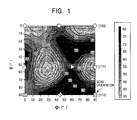
- Fig. 1 shows the results.
- Major orientations including Goss orientation are illustrated.
- Fig. 1 shows that the percentage of the grain boundary that has the disorientation angle of 20-45° is highest at the Goss orientation.
- Goss-oriented grain in a primary-recrystallized structure contains many high-energy grain boundaries, and the role of the inhibitor is to generate a difference in mobility between the high-energy grain boundary of Goss-oriented grain and other grain boundaries.
- the role of the inhibitor is to generate a difference in mobility between the high-energy grain boundary of Goss-oriented grain and other grain boundaries.
- the high-energy grain boundary has a larger mobility than other grain boundaries.
- impurities in steel tend to segregate at grain boundaries, particularly at the high-energy grain boundary, a large amount of impurities will reduce the difference in mobility between the high-energy grain boundary and other grain boundaries.
- the purification annealing is also sometimes performed to remove residual impurities or to prepare, for example, a forsterite film. As mentioned above, even in this case, it was found that the bend properties may be deteriorated.
- the inhibitor in the steel retards the formation of a film and thus nitrogen in the steel is easily purified.
- the inhibitor-free steel sheet which originally contains fewer impurities, a dense film is easily formed and therefore nitrogen in the steel is difficult to remove. Accordingly, a new method for preventing silicon nitrides from precipitating at the grain boundary is desired.
- end of the coil used herein means an area between an endmost position and an inner position about 100 mm from the endmost position in the coil.
- a material for the electrical steel sheet (typically, a steel slab) contains about 0.08 mass percent or less of carbon, about 2.0-8.0 mass percent of Si, and about 0.005-3.0 mass percent of Mn, and also contains reduced amount of following elements; about 100 ppm or less of Al, and about 50 ppm or less (mass ppm; the same shall apply hereinafter) each of N, S and Se.
- Carbon content about 0.08 mass percent or less
- the carbon content in the material exceeds about 0.08 mass percent, even if the material is subjected to decarburizing annealing, it becomes difficult to decrease the carbon to about 50 ppm or less, at which magnetic aging can be avoided. Accordingly, the carbon content must be about 0.08 mass percent or less. In terms of material properties, the carbon content has no lower limit and may be substantially 0 mass percent. However, about 1 ppm is regarded as an industrial limit for the carbon content.
- Si content about 2.0-8.0 mass percent
- Si increases the electrical resistance to improve iron loss effectively, such an effect cannot be sufficiently achieved with less than about 2.0 mass percent of Si.
- more than about 8.0 mass percent of Si reduces workability.
- the Si content should be about 2.0-8.0 mass percent.
- Mn is essential for improving hot-workability, such an effect cannot be sufficiently achieved with less than about 0.005 mass percent of Mn.
- Mn content should be about 0.005-3.0 mass percent.
- Al content less than about 100 ppm; N, S, and Se contents: about 50 ppm or less each
- the content of Al impurity should be less than about 100 ppm, and the content of S and Se impurities should be about 50 ppm or less each.
- the Al content is about 20-100 ppm. This lower limit is determined in consideration of cost of reducing Al.
- the contents of S and Se are about 45 ppm or less each.
- Nitrogen content should be about 50 ppm or less to prevent the formation of silicon nitrides during the purification annealing. Preferably, the nitrogen content is about 50 ppm or less.
- nitride-forming elements such as Ti, Nb, B, Ta, and V are each reduced to about 50 ppm or less to prevent the deterioration of iron loss and to ensure excellent workability.
- the Ti content is 20 ppm or less.
- the material may contain about 0.005-1.50 mass percent of Ni and/or about 0.01-1.50 mass percent of Cu to improve the hot-rolled sheet structure and the magnetic properties. Amounts of Ni and/or Cu below the respective lower limits will not improve the magnetic properties significantly, and amounts of Ni and/or Cu above the respective upper limits will result in unstable secondary-recrystallization and a deterioration in magnetic properties.
- the material may contain a total of 0.0050-0.50 mass percent of As, Te, Sb, Sn, P, Bi, Hg, Pb, Zn, and/or Cd to improve the iron loss.
- the material may contain a total of 0.0050-0.50 mass percent of at least one of Cr, As, Te, Sb, Sn, P, Bi, Hg, Pb, Zn, and Cd.
- the remainder of the material is iron and inevitable impurities.
- the inevitable impurities include the impurities described above and oxygen.
- the oxygen content is preferably about 40 ppm or less.
- molten steel that is adjusted to the optimum composition as described above is smelted in a converter, an electric furnace, or the like by conventional methods, is treated, for example, in vacuum if desired, and is processed by common ingot-making or continuous casting into a slab (a steel slab), or by direct casting into a thin slab with a thickness of about 100 mm or less.
- the slab may be heated by conventional methods and hot-rolled, or alternatively, it may be hot-rolled immediately after casting without heating.
- the thin slab may be hot-rolled or may be subjected to the subsequent steps without hot-rolling.
- the temperature of the slab before hot-rolling is about 1250°C or less to reduce scale during the hot-rolling.
- the slab is desirably heated to a lower temperature to eliminate harmful effects caused by the formation of a fine-grained crystal structure and by the contamination of inhibitor-forming components inevitably mixed into the slab, and to achieve a primary-recrystallization structure of uniform and sized grain.
- the slab in view of the load on a hot-rolling line, the slab is usually heated to at least about 1000°C.
- the slab is preferably heated to about 1100-1250°C.
- annealing of the hot-rolled sheet is performed if desired; for example, the annealing allows a Goss structure in the final sheet product to develop highly.
- the annealing temperature of the hot-rolled sheet is about 800-1100°C to achieve this effect.
- the annealing temperature is less than about 800°C, a band structure during the hot rolling remains and thus the uniform and sized grain level in the primary-recrystallized structure is reduced. This causes insufficient growth in secondary-recrystallization.
- the annealing temperature of the hot-rolled sheet exceeds about 1100°C, the grain size after the annealing will increase. This is not preferable in terms of achieving a uniform and sized grain in the primary recrystallization structure. More preferably, the temperature of the hot-rolled sheet is about 900-1100°C.
- Cold-rolling is performed after the hot-rolling or the annealing of the hot-rolled sheet.
- the cold-rolling may be performed one time, or at least two times if desired.
- intermediate annealing is typically performed between each cold-rolling.
- the conditions of the intermediate annealing may be in accordance with conventional methods. In a conventional process using a slab as a starting material, a cold-rolled steel sheet is strip-shaped.
- a rolling temperature of about 100-300°C and/or one or more aging treatments at about 100-300°C during the cold-rolling is advantageous to develop a Goss structure.
- decarburizing annealing is performed, if desired, to reduce the carbon content to about 50 ppm or less, preferably about 30 ppm or less, at which magnetic aging no longer occurs.
- the decarburizing annealing is performed at about 700-1000°C in a wet atmosphere.
- siliconization may be applied between the cold-rolling and secondary-recrystallization annealing to increase the Si content. Conveniently, siliconization is applied after decarburizing annealing.
- MgO-based annealing separator is applied to the sheet, and finishing-annealing including secondary-recrystallization annealing and purification annealing is performed to develop a secondary-recrystallization structure and a forsterite film.
- MgO is at least about 80 mass percent of the annealing separator.
- annealing separator based on an element other than MgO is used, if desired, to generate a non-forsterite film.
- examples of such an annealing separator include those based on Al 2 O 3 or SiO 2 . Annealing separators may be omitted if desired.
- secondary-recrystallization annealing is performed at about 800°C or more on set of secondary-recrystallization. Since the heating rate to 800°C does not significantly affect the magnetic properties, it may be determined arbitrarily.
- the secondary-recrystallization annealing is performed at about 1050°C or less. Particularly when soaking is performed, the temperature of the secondary-recrystallization annealing is preferably about 900°C or less.
- the secondary-recrystallization annealing is performed for 10 hours or more in the temperature range described above.
- a cold-rolled steel strip is wound in a coil and is subjected to batch annealing.
- the annealing temperature is preferably about 1050°C or more to generate a satisfactory forsterite film.
- An upper limit of the annealing temperature is about 1300°C in view of cost.
- the purification annealing is performed for 1-20 hours.
- controlling the annealing atmosphere is important in the purification annealing to prevent deterioration in bend properties as follows:
- the total pressure in an annealing furnace during purification annealing is preferably 1.0 atm or more.
- the gas used to adjust the hydrogen partial pressure is an inert gas, such as Ar, Ne, and He.
- Nitrogen may also be used, but is not preferred because it may interfere with nitrogen removal from the steel.
- nitrogen is preferably less than 50%, more preferably less than 30%, still more preferably 15% or less, and most preferably substantially 0% by volume.
- the steel may contain at least one of Cr, As, Te, Sb, Sn, P, Bi, Hg, Pb, Zn, and Cd to improve iron loss.
- high contents of these elements accelerate hydrogen attack.
- the conditions of the annealing atmosphere described above are preferably replaced with the following conditions:
- secondary-recrystallization annealing and purification annealing are typically performed sequentially and are together referred to as finishing-annealing.
- finishing-annealing may be performed sequentially and are together referred to as finishing-annealing.
- secondary-recrystallization annealing and purification annealing may be performed independently in this order.
- an annealing separator may be applied before either annealing process.
- flattening annealing is performed, if desired, for shape correction.
- an insulating coating that generates tension on the surface of the steel sheet is further applied to improve iron loss.
- the flattening annealing, the tension-coating step, and their associated steps are herein referred to as a flattening step as a whole.
- an electrical steel sheet according to the present invention exhibits excellent bend properties over the transverse direction of the coil.
- the bend properties after finishing-annealing are not deteriorated over the transverse ends.
- the bend properties of the ends are excellent after the finishing-annealing and the subsequent flattening step including flattening annealing.
- the stability of manufacturing line in the flattening step and the subsequent steps is also excellent.
- carbon is reduced to about 50 ppm or less, and S, Se, and A1 are each reduced to about 15 ppm or less by purification treatment.
- Nitrogen is also reduced to about 35 ppm or less by the purification treatment (a typical analytical limit is about 5 ppm).
- Other components are similar to those of the slab.
- the cold-rolled steel strip coil was degreased, was subjected to decarburizing annealing at 840°C for 120 seconds, was coated with an annealing separator containing 90 mass percent of MgO and 10 mass percent of TiO 2 , and was subjected to batch finishing-annealing to produce final sheet products.
- the sheets were subjected to secondary-recrystallization annealing at 850°C for about 50 hours, and were subjected to subsequent purification annealing including heating at 25°C/h to purification annealing temperatures shown in Table 1, and soaking at the temperature for 5 hours.
- the hydrogen partial pressure in the atmosphere was adjusted to values shown in Table 1 at temperatures above 1170°C for purification annealing temperatures above 1170°C, and at 1050°C or more for the purification annealing at 1170°C or less.
- the atmosphere had a total pressure of 1.0 atm and was balanced with Ar.
- Table 1 shows the magnetic properties (B 8 : magnetic flux densities at a magnetizing force of 800 A/m) and bend properties of the resulting final sheet products.
- the final sheet products contained less than 15 ppm of carbon, Al, S, or Se.
- the magnetic properties were measured at a position where the bend properties of the coils were evaluated.
- the bend properties were determined for a specimen 30 mm in width that was taken from a transverse end of the coil, specifically taken so that the center of the specimen being at a position 45 mm inside from an endmost portion, in accordance with a JIS C 2550 repeated bending test. A specimen that formed a crack within 5 times of bending was determined to be defective (The same applies to the following examples). Likewise, when the bend properties were also examined in the transverse center portions of the coils, the results were all excellent (not shown). No.
- Table 1 shows that the specimens that meet the conditions according to the present invention exhibit excellent bend properties even at the transverse ends of the coils.
- the steel strips were coated with an annealing separator containing 90 mass percent of MgO and 10 mass percent of TiO 2 (for No. 43 steel, an annealing separator consisting of Al 2 O 3 was applied), and were subjected to batch finishing-annealing to produce final sheet products.
- the strips were heated at 25°C/h from secondary-recrystallization annealing (850°C for about 50 hours) to temperatures shown in Tables 2-1 and 2-2, and were subjected to the subsequent purification annealing at the temperature for 5 hours.
- the hydrogen partial pressure in the atmosphere was adjusted to values shown in Tables 2-1 and 2-2 at temperatures above 1170°C for purification annealing temperatures above 1170°C, and at 1050°C or more for the purification annealing at 1170°C or less.
- the atmosphere had a total pressure of 1.0 atm and was balanced with Ar. However, the total pressure was 1.1 atm for No. 44 steel, and the balance gas was Ar and 10% by volume of nitrogen for No. 45 steel.
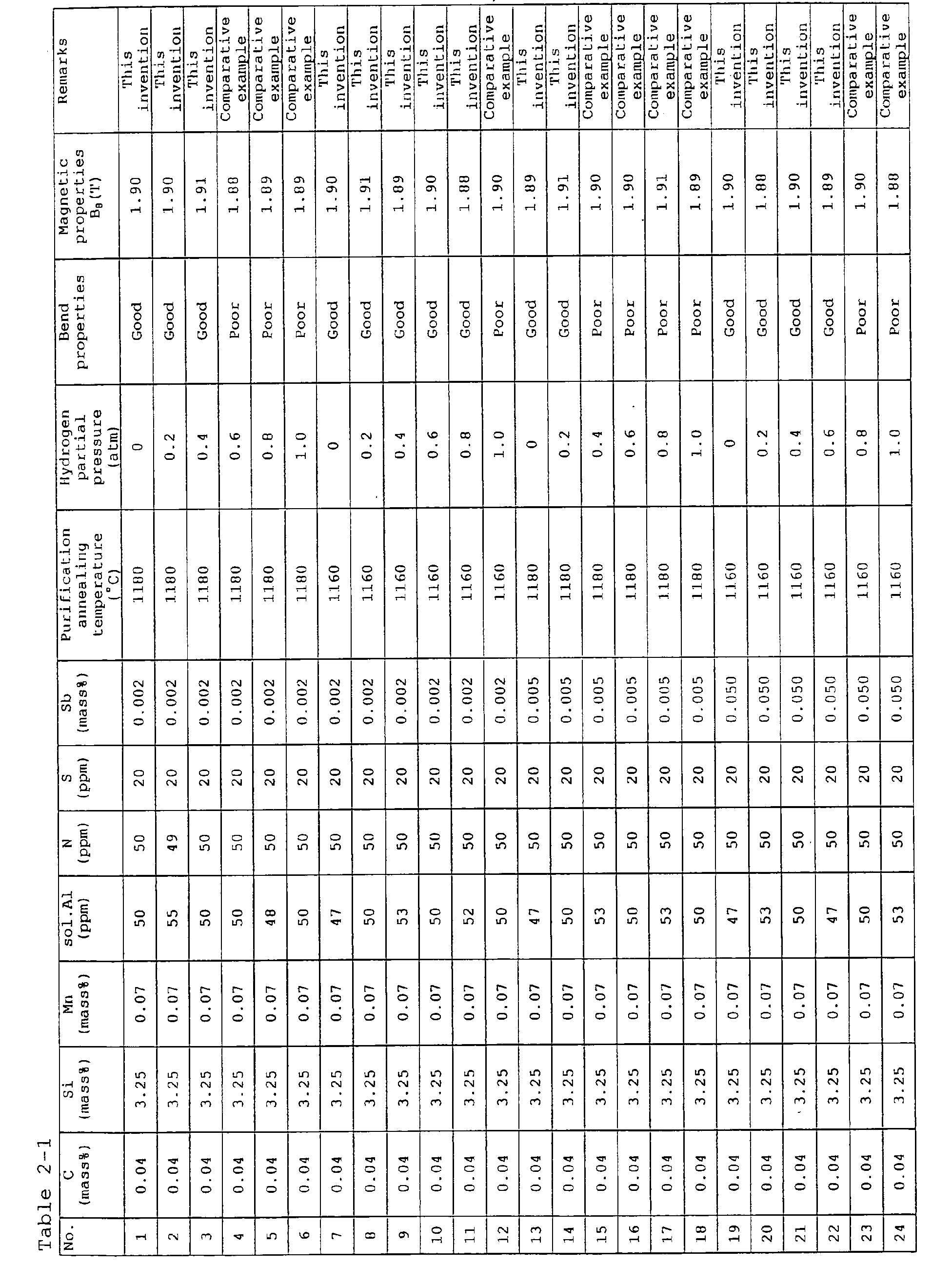
- Tables 2-1 and 2-2 show the magnetic properties and bend properties of the resulting final sheet products.
- the final sheet products contained less than 15 ppm of carbon (other than No. 42 steel), Al, S, Se, or N.
- Tables 2-1 and 2-2 show the bend properties of the coils at transverse ends. The bend properties at the transverse center portions of the coils were all excellent.
- Tables 2-1 and 2-2 show that the specimens that meet the conditions according to the present invention exhibit excellent bend properties even at the transverse ends of the coils.
- hydrogen in purification annealing is preferably limited to a lower level.
- the sheets were subjected to secondary-recrystallization annealing at 850°C for about 50 hours, and were subjected to the purification annealing including subsequent heating at 25°C/h to 1160°C, and subsequent soaking at 1160°C for 5 hours.
- the hydrogen partial pressure at 1050°C or more was changed from 0 to 0.1 atm (total pressure: 1.0 atm) as shown in Table 3.
- the balance gas was Ar.
- Table 3 shows the magnetic properties and bend properties of the resulting final sheet products.
- the final sheet products contained less than 15 ppm of carbon, Al, S, Se, or N.
- Table 3 shows the bend properties of the coils at transverse ends. The bend properties at the transverse center portions of the coils were all excellent.
- Table 3 shows that the specimens that meet the conditions according to the present invention exhibit excellent bend properties.
- a steel slab that had the same composition as that in EXAMPLE 1 was heated to 1200°C and was hot-rolled into a coiled sheet with a thickness of 2.4 mm. This hot-rolled sheet was not annealed and the scale on the surface was removed. The sheet was cold-rolled with a tandem mill to a final thickness of 0.28 mm.
- the cold-rolling was performed in two stages: the sheet was first rolled at 80°C to 1.6 mm thickness followed by intermediate annealing at 1000°C for 60 seconds, and was then rolled at 200°C.
- the sheet was degreased, was subjected to decarburizing annealing at 840°C for 120 seconds, was coated with a MgO-based annealing separator, and was subjected to finishing-annealing to produce a final sheet product.
- the sheet was heated at 12.5°C/h from at least 900°C to 1160°C and was held at 1160°C for 5 hours.
- the heat treatment i.e. heating
- between about 900°C and about 1050°C corresponds to secondary-recrystallization annealing
- the subsequent heat treatment i.e. heating and soaking
- a hydrogen partial pressure at 1050°C or more was 0.6 atm (total pressure: 1.0 atm).
- the final sheet product contained less than 15 ppm of carbon, Al, S, Se, or N.
- the bend properties of the resulting steel sheet at a transverse end and at a transverse center portion of the coil were both excellent.
- the magnetic flux density B 8 was 1.87 T.
- the bend properties of, in particular, a final sheet product of a grain-oriented electrical steel sheet manufactured without using an inhibitor are improved.
- a grain-oriented electrical steel sheet with excellent film properties can be consistently provided.
Landscapes
- Chemical & Material Sciences (AREA)
- Engineering & Computer Science (AREA)
- Mechanical Engineering (AREA)
- Organic Chemistry (AREA)
- Metallurgy (AREA)
- Materials Engineering (AREA)
- Physics & Mathematics (AREA)
- Crystallography & Structural Chemistry (AREA)
- Thermal Sciences (AREA)
- Manufacturing & Machinery (AREA)
- Electromagnetism (AREA)
- Dispersion Chemistry (AREA)
- Power Engineering (AREA)
- Manufacturing Of Steel Electrode Plates (AREA)
- Soft Magnetic Materials (AREA)
Abstract
Description
- for purification annealing temperatures of 1170°C or less, adjust the hydrogen partial pressure in the atmosphere to about 0.8 atm or less in a temperature range of 1050°C or more; and
- for purification annealing temperatures above 1170°C, adjust the hydrogen partial pressure in the atmosphere to about 0.4 atm or less in a temperature range above 1170°C.
- for purification annealing temperatures of 1170°C or less, adjust the hydrogen partial pressure in the atmosphere to about 0.6 atm or less in a temperature range of 1050°C or more; and
- for purification annealing temperatures above 1170°C, adjust the hydrogen partial pressure in the atmosphere to about 0.2 atm or less in a temperature range above 1170°C.
| No. | Purification annealing temperature (°C) | Hydrogen partial pressure (atm) | Residual nitrogen content (ppm) | Bend properties | Magnetic properties B8 (T) | Remarks |
| 1 | 1160 | 0 | 30 | Good | 1.89 | This invention |
| 2 | 1160 | 0.2 | 32 | Good | 1.90 | This invention |
| 3 | 1160 | 0.4 | 31 | Good | 1.90 | This |
| 4 | 1160 | 0.6 | 33 | Good | 1.89 | This invention |
| 5 | 1160 | 0.8 | 29 | Good | 1.91 | This invention |
| 6 | 1160 | 1.0 | 30 | Poor | 1.90 | Comparative example |
| 7 | 1170 | 0 | 28 | Good | 1.90 | This |
| 8 | 1170 | 0.2 | 25 | Good | 1.89 | This |
| 9 | 1170 | 0.4 | 29 | Good | 1.90 | This |
| 10 | 1170 | 0.6 | 33 | Good | 1.89 | This invention |
| 11 | 1170 | 0.8 | 30 | Good | 1.91 | This invention |
| 12 | 1170 | 1.0 | 32 | Poor | 1.90 | Comparative example |
| 13 | 1180 | 0 | 28 | Good | 1.90 | This invention |
| 14 | 1180 | 0.2 | 26 | Good | 1.89 | This invention |
| 15 | 1180 | 0.4 | 26 | Good | 1.90 | This invention |
| 16 | 1180 | 0.6 | 27 | Poor | 1.90 | Comparative example |
| 17 | 1180 | 0.8 | 29 | Poor | 1.89 | Comparative example |
| 18 | 1180 | 1.0 | 26 | Poor | 1.91 | Comparative example |


Claims (10)
- A method for manufacturing a grain-oriented electrical steel sheet, comprising the steps of:wherein the steel slab contains less than 100 ppm of Al and not more than 50 ppm each of N, S, and Se, the purification annealing is performed at 1050°C or more, and the partial pressure of hydrogen in the atmosphere is adjusted to 0.4 atm or less in a temperature range above 1170°C for a purification annealing conducted at a temperature above 1170°C, or 0.8 atm or less in a temperature range of 1050°C or more for a purification annealing conducted at a temperature of 1170°C or less.rolling a steel slab containing 0.08 mass percent or less of carbon, 2.0-8.0 mass percent of Si, and 0.005-3.0 mass percent of Mn into a cold-rolled steel sheet;subsequently performing decarburizing annealing of the cold-rolled steel sheet if desired;subsequently applying an annealing separator to the cold-rolled steel sheet if desired;performing secondary-recrystallization annealing of the cold-rolled steel sheet; andsubsequently performing purification annealing of the cold-rolled steel sheet,
- The method for manufacturing a grain-oriented electrical steel sheet according to Claim 1, wherein the steel slab further contains 0.005-1.50 mass percent of Ni and/or 0.01-1.50 mass percent of Cu.
- The method for manufacturing a grain-oriented electrical steel sheet according to Claim 1, wherein the steel slab further contains a total of 0.0050-0.50 mass percent of at least one of Cr, As, Te, Sb, Sn, P, Bi, Hg, Pb, Zn, and Cd, and the partial pressure of the hydrogen atmosphere is adjusted to 0.2 atm or less in a temperature range above 1170°C for a purification annealing conducted at a temperature above 1170°C, or 0.6 atm or less in a temperature range of 1050°C or more for a purification annealing conducted at a temperature of 1170°C or less.
- The method for manufacturing a grain-oriented electrical steel sheet according to Claim 1, wherein the steel slab further contains a total of 0.0050-0.50 mass percent of at least one of As, Te, Sb, Sn, P, Bi, Hg, Pb, Zn, and Cd, and the partial pressure of the hydrogen atmosphere is adjusted to 0.2 atm or less in a temperature range above 1170°C for a purification annealing conducted at a temperature above 1170°C, or 0.6 atm or less in a temperature range of 1050°C or more for a purification annealing conducted at a temperature of 1170°C or less.
- The method for manufacturing a grain-oriented electrical steel sheet according to Claim 1, wherein, as the annealing separator, a MgO-based annealing separator is applied to the cold-rolled steel sheet.
- The method for manufacturing a grain-oriented electrical steel sheet according to Claim 1, wherein the rolling step comprises the substeps of:hot-rolling the steel slab;annealing the hot-rolled steel sheet if desired; andperforming cold-rolling one time, or at least two times with intermediate annealing therebetween to produce the cold-rolled steel sheet.
- The method for manufacturing a grain-oriented electrical steel sheet according to Claim 1, wherein the nitrogen content in the atmosphere is less than 50% by volume in the purification annealing.
- The method for manufacturing a grain-oriented electrical steel sheet according to Claim 1, wherein the rolling comprises a cold-rolling substep of preparing a cold-rolled steel strip, and the cold-rolled steel strip is subjected to the secondary-recrystallization annealing and the purification annealing to produce a strip-shaped grain-oriented electrical steel sheet.
- A strip-shaped grain-oriented electrical steel sheet manufactured by the method according to Claim 8.
- A strip-shaped grain-oriented electrical steel sheet containing 2.0-8.0 mass percent of Si, 0.005-3.0 mass percent of Mn, and 35 ppm or less of N, prepared through a finishing-annealing and a flattening step, wherein the number of bendings in accordance with JIS C 2550 is at least 6 over the transverse direction.
Applications Claiming Priority (3)
| Application Number | Priority Date | Filing Date | Title |
|---|---|---|---|
| JP2002314055 | 2002-10-29 | ||
| JP2002314055 | 2002-10-29 | ||
| PCT/JP2003/013692 WO2004040024A1 (en) | 2002-10-29 | 2003-10-27 | Method for producing grain oriented magnetic steel sheet and grain oriented magnetic steel sheet |
Publications (3)
| Publication Number | Publication Date |
|---|---|
| EP1577405A1 true EP1577405A1 (en) | 2005-09-21 |
| EP1577405A4 EP1577405A4 (en) | 2006-06-28 |
| EP1577405B1 EP1577405B1 (en) | 2017-07-05 |
Family
ID=32211600
Family Applications (1)
| Application Number | Title | Priority Date | Filing Date |
|---|---|---|---|
| EP03758927.2A Expired - Lifetime EP1577405B1 (en) | 2002-10-29 | 2003-10-27 | Method for producing grain oriented magnetic steel sheet and grain oriented magnetic steel sheet |
Country Status (6)
| Country | Link |
|---|---|
| US (1) | US7465361B2 (en) |
| EP (1) | EP1577405B1 (en) |
| JP (1) | JP4258349B2 (en) |
| KR (1) | KR100655678B1 (en) |
| CN (2) | CN101311287B (en) |
| WO (1) | WO2004040024A1 (en) |
Cited By (9)
| Publication number | Priority date | Publication date | Assignee | Title |
|---|---|---|---|---|
| RU2497956C1 (en) * | 2010-03-17 | 2013-11-10 | Ниппон Стил Корпорейшн | Method for making plate from electrical steel with oriented grain structure |
| RU2502810C2 (en) * | 2009-03-23 | 2013-12-27 | Ниппон Стил Корпорейшн | Manufacturing method of textured electrical steel plate, textured electrical steel plate for strip core, and strip core |
| EP2657356A4 (en) * | 2010-12-23 | 2014-07-02 | Posco | ORIENTED GRAIN ELECTRIC STEEL SHEET HAVING SUPERIOR MAGNETIC PROPERTY AND METHOD OF MANUFACTURING THE SAME |
| EP2775007A1 (en) | 2013-03-08 | 2014-09-10 | Voestalpine Stahl GmbH | A process for the production of a grain-oriented electrical steel |
| RU2529326C1 (en) * | 2013-08-13 | 2014-09-27 | Открытое акционерное общество "Северсталь" (ОАО "Северсталь") | Production method of cold-rolled semi-finished alloy electric steel |
| RU2539274C2 (en) * | 2010-06-18 | 2015-01-20 | ДжФЕ СТИЛ КОРПОРЕЙШН | Method of sheet fabrication from textured electric steel |
| EP2940158A4 (en) * | 2012-12-28 | 2016-01-20 | Jfe Steel Corp | PRODUCTION METHOD FOR GRAIN ORIENTED ELECTRIC STEEL SHEET AND PRIMARY RECRISTALLIC STEEL SHEET FOR THE PRODUCTION OF GRAIN ORIENTED STEEL SHEET |
| RU2574613C1 (en) * | 2014-10-07 | 2016-02-10 | Открытое акционерное общество "Новолипецкий металлургический комбинат" | Method of producing of electric anisotropic steel with high magnetic properties |
| RU2665649C1 (en) * | 2014-11-27 | 2018-09-03 | ДжФЕ СТИЛ КОРПОРЕЙШН | Method of making plate of textured electrical steel |
Families Citing this family (21)
| Publication number | Priority date | Publication date | Assignee | Title |
|---|---|---|---|---|
| JP4747564B2 (en) * | 2004-11-30 | 2011-08-17 | Jfeスチール株式会社 | Oriented electrical steel sheet |
| JP4569353B2 (en) * | 2005-03-30 | 2010-10-27 | Jfeスチール株式会社 | Manufacturing method of unidirectional electrical steel sheet |
| JP4604827B2 (en) * | 2005-05-12 | 2011-01-05 | Jfeスチール株式会社 | Manufacturing method of unidirectional electrical steel sheet |
| JP5011712B2 (en) * | 2005-11-15 | 2012-08-29 | Jfeスチール株式会社 | Manufacturing method of unidirectional electrical steel sheet |
| JP5040131B2 (en) * | 2006-03-17 | 2012-10-03 | Jfeスチール株式会社 | Manufacturing method of unidirectional electrical steel sheet |
| JP5772410B2 (en) * | 2010-11-26 | 2015-09-02 | Jfeスチール株式会社 | Method for producing grain-oriented electrical steel sheet |
| JP5994981B2 (en) | 2011-08-12 | 2016-09-21 | Jfeスチール株式会社 | Method for producing grain-oriented electrical steel sheet |
| CN103827326B (en) * | 2011-09-28 | 2016-05-11 | 杰富意钢铁株式会社 | Orientation electromagnetic steel plate and manufacture method thereof |
| CN104884644B (en) * | 2012-12-28 | 2017-03-15 | 杰富意钢铁株式会社 | Manufacturing method of grain-oriented electrical steel sheet |
| JP6623795B2 (en) * | 2015-03-04 | 2019-12-25 | 日本製鉄株式会社 | Electrical steel sheet and method for manufacturing electrical steel sheet |
| JP6350398B2 (en) | 2015-06-09 | 2018-07-04 | Jfeスチール株式会社 | Oriented electrical steel sheet and manufacturing method thereof |
| KR102427606B1 (en) * | 2017-12-28 | 2022-07-29 | 제이에프이 스틸 가부시키가이샤 | Grain-oriented electrical steel sheet |
| EP3715479A1 (en) * | 2019-03-26 | 2020-09-30 | Thyssenkrupp Electrical Steel Gmbh | Lean method for secondary recrystallization of grain oriented electrical steel in a continuous processing line |
| CN112391512B (en) | 2019-08-13 | 2022-03-18 | 宝山钢铁股份有限公司 | A kind of high magnetic induction oriented silicon steel and its manufacturing method |
| JP7640827B2 (en) * | 2020-06-24 | 2025-03-06 | 日本製鉄株式会社 | Manufacturing method of grain-oriented electrical steel sheet and grain-oriented electrical steel sheet |
| BR112022024371A2 (en) * | 2020-06-24 | 2022-12-27 | Nippon Steel Corp | METHOD FOR THE PRODUCTION OF A GRAIN-ORIENTED ELECTRIC STEEL SHEET |
| JP7529978B2 (en) * | 2020-06-24 | 2024-08-07 | 日本製鉄株式会社 | Manufacturing method of grain-oriented electrical steel sheet |
| JP7568948B2 (en) * | 2020-06-24 | 2024-10-17 | 日本製鉄株式会社 | Manufacturing method of electrical steel sheet |
| WO2022045221A1 (en) * | 2020-08-28 | 2022-03-03 | Jfeスチール株式会社 | Powder for annealing separator, method for producing same, and method for producing grain-oriented electrical steel sheet |
| CN120683427B (en) * | 2025-07-11 | 2026-04-03 | 无锡晶龙华特电工有限公司 | A high magnetic induction oriented electrical steel and its annealing process |
| CN121295018A (en) * | 2025-10-20 | 2026-01-09 | 娄底职业技术学院 | A method for preparing low-loss, low-magnetostriction grain-oriented silicon steel material |
Family Cites Families (23)
| Publication number | Priority date | Publication date | Assignee | Title |
|---|---|---|---|---|
| JPS5933170B2 (en) | 1978-10-02 | 1984-08-14 | 新日本製鐵株式会社 | Method for manufacturing aluminum-containing unidirectional silicon steel sheet with extremely high magnetic flux density |
| JPS61117215A (en) * | 1984-10-31 | 1986-06-04 | Nippon Steel Corp | Manufacture of grain oriented magnetic steel sheet of low iron loss |
| US5318639A (en) | 1991-10-01 | 1994-06-07 | Kawasaki Steel Corporation | Method of manufacturing grain oriented silicon steel sheets |
| EP0607440B1 (en) | 1992-05-08 | 2000-05-31 | Nippon Steel Corporation | Process for producing a grain-orientated electical steel sheet having mirror surface |
| JPH06136553A (en) * | 1992-10-26 | 1994-05-17 | Nippon Steel Corp | Method for manufacturing mirror-oriented silicon steel sheet |
| JP3536306B2 (en) * | 1992-12-07 | 2004-06-07 | Jfeスチール株式会社 | Method for producing oriented silicon steel sheet excellent in magnetic properties with few steel sheet flaws |
| KR960007161B1 (en) | 1994-03-14 | 1996-05-29 | 한국중공업주식회사 | Explosive plugging for failure tubes of heat exchangers and the plug for it |
| JP3598590B2 (en) * | 1994-12-05 | 2004-12-08 | Jfeスチール株式会社 | Unidirectional electrical steel sheet with high magnetic flux density and low iron loss |
| JP3079354B2 (en) * | 1995-07-31 | 2000-08-21 | リンナイ株式会社 | Water governor for water heater |
| DE19628136C1 (en) | 1996-07-12 | 1997-04-24 | Thyssen Stahl Ag | Production of grain-orientated electrical sheets |
| IT1284268B1 (en) * | 1996-08-30 | 1998-05-14 | Acciai Speciali Terni Spa | PROCEDURE FOR THE PRODUCTION OF GRAIN ORIENTED MAGNETIC SHEETS, WITH HIGH MAGNETIC CHARACTERISTICS, STARTING FROM |
| KR100440994B1 (en) * | 1996-10-21 | 2004-10-21 | 제이에프이 스틸 가부시키가이샤 | Directional electromagnetic steel sheet and manufacturing method thereof |
| US6083326A (en) * | 1996-10-21 | 2000-07-04 | Kawasaki Steel Corporation | Grain-oriented electromagnetic steel sheet |
| IT1290171B1 (en) * | 1996-12-24 | 1998-10-19 | Acciai Speciali Terni Spa | PROCEDURE FOR THE TREATMENT OF SILICON, GRAIN ORIENTED STEEL. |
| JP3846064B2 (en) * | 1998-10-09 | 2006-11-15 | Jfeスチール株式会社 | Oriented electrical steel sheet |
| US6309473B1 (en) * | 1998-10-09 | 2001-10-30 | Kawasaki Steel Corporation | Method of making grain-oriented magnetic steel sheet having low iron loss |
| JP3707268B2 (en) * | 1998-10-28 | 2005-10-19 | Jfeスチール株式会社 | Method for producing grain-oriented electrical steel sheet |
| JP4123653B2 (en) * | 1999-10-12 | 2008-07-23 | Jfeスチール株式会社 | Method for producing grain-oriented electrical steel sheet |
| JP4032162B2 (en) * | 2000-04-25 | 2008-01-16 | Jfeスチール株式会社 | Oriented electrical steel sheet and manufacturing method thereof |
| JP2001342521A (en) * | 2000-06-02 | 2001-12-14 | Kawasaki Steel Corp | Manufacturing method of unidirectional electrical steel sheet |
| JP3492993B2 (en) * | 2000-10-19 | 2004-02-03 | 新日本製鐵株式会社 | Manufacturing method of high magnetic flux density thin unidirectional magnetic steel sheet |
| EP1279747B1 (en) * | 2001-07-24 | 2013-11-27 | JFE Steel Corporation | A method of manufacturing grain-oriented electrical steel sheets |
| JP4810777B2 (en) | 2001-08-06 | 2011-11-09 | Jfeスチール株式会社 | Oriented electrical steel sheet and manufacturing method thereof |
-
2003
- 2003-10-23 JP JP2003363773A patent/JP4258349B2/en not_active Expired - Lifetime
- 2003-10-27 EP EP03758927.2A patent/EP1577405B1/en not_active Expired - Lifetime
- 2003-10-27 WO PCT/JP2003/013692 patent/WO2004040024A1/en not_active Ceased
- 2003-10-27 US US10/530,839 patent/US7465361B2/en not_active Expired - Lifetime
- 2003-10-27 CN CN2008101094496A patent/CN101311287B/en not_active Expired - Fee Related
- 2003-10-27 KR KR1020057006727A patent/KR100655678B1/en not_active Expired - Fee Related
- 2003-10-27 CN CNB2003801021946A patent/CN100406585C/en not_active Expired - Fee Related
Cited By (12)
| Publication number | Priority date | Publication date | Assignee | Title |
|---|---|---|---|---|
| RU2502810C2 (en) * | 2009-03-23 | 2013-12-27 | Ниппон Стил Корпорейшн | Manufacturing method of textured electrical steel plate, textured electrical steel plate for strip core, and strip core |
| RU2497956C1 (en) * | 2010-03-17 | 2013-11-10 | Ниппон Стил Корпорейшн | Method for making plate from electrical steel with oriented grain structure |
| RU2539274C2 (en) * | 2010-06-18 | 2015-01-20 | ДжФЕ СТИЛ КОРПОРЕЙШН | Method of sheet fabrication from textured electric steel |
| EP2657356A4 (en) * | 2010-12-23 | 2014-07-02 | Posco | ORIENTED GRAIN ELECTRIC STEEL SHEET HAVING SUPERIOR MAGNETIC PROPERTY AND METHOD OF MANUFACTURING THE SAME |
| US9240265B2 (en) | 2010-12-23 | 2016-01-19 | Posco | Method for manufacturing grain-oriented electrical steel sheet having superior magnetic property |
| US9997283B2 (en) | 2010-12-23 | 2018-06-12 | Posco | Grain-oriented electric steel sheet having superior magnetic property |
| EP2940158A4 (en) * | 2012-12-28 | 2016-01-20 | Jfe Steel Corp | PRODUCTION METHOD FOR GRAIN ORIENTED ELECTRIC STEEL SHEET AND PRIMARY RECRISTALLIC STEEL SHEET FOR THE PRODUCTION OF GRAIN ORIENTED STEEL SHEET |
| US9905343B2 (en) | 2012-12-28 | 2018-02-27 | Jfe Steel Corporation | Production method for grain-oriented electrical steel sheet and primary recrystallized steel sheet for production of grain-oriented electrical steel sheet |
| EP2775007A1 (en) | 2013-03-08 | 2014-09-10 | Voestalpine Stahl GmbH | A process for the production of a grain-oriented electrical steel |
| RU2529326C1 (en) * | 2013-08-13 | 2014-09-27 | Открытое акционерное общество "Северсталь" (ОАО "Северсталь") | Production method of cold-rolled semi-finished alloy electric steel |
| RU2574613C1 (en) * | 2014-10-07 | 2016-02-10 | Открытое акционерное общество "Новолипецкий металлургический комбинат" | Method of producing of electric anisotropic steel with high magnetic properties |
| RU2665649C1 (en) * | 2014-11-27 | 2018-09-03 | ДжФЕ СТИЛ КОРПОРЕЙШН | Method of making plate of textured electrical steel |
Also Published As
| Publication number | Publication date |
|---|---|
| EP1577405A4 (en) | 2006-06-28 |
| KR20050065608A (en) | 2005-06-29 |
| US7465361B2 (en) | 2008-12-16 |
| WO2004040024A1 (en) | 2004-05-13 |
| CN101311287A (en) | 2008-11-26 |
| CN101311287B (en) | 2013-05-22 |
| KR100655678B1 (en) | 2006-12-11 |
| JP4258349B2 (en) | 2009-04-30 |
| CN1708594A (en) | 2005-12-14 |
| CN100406585C (en) | 2008-07-30 |
| US20060076086A1 (en) | 2006-04-13 |
| JP2004169179A (en) | 2004-06-17 |
| EP1577405B1 (en) | 2017-07-05 |
Similar Documents
| Publication | Publication Date | Title |
|---|---|---|
| US7465361B2 (en) | Method for producing grain oriented magnetic steel sheet and grain oriented magnetic steel sheet | |
| US9738949B2 (en) | Method for producing grain-oriented electrical steel sheet | |
| EP2957644B1 (en) | Method for producing grain-oriented electrical steel sheet | |
| EP0743370A2 (en) | Grain oriented electrical steel having high volume resistivity and method for producing same | |
| CN107109563A (en) | Orientation electromagnetic steel plate and its manufacture method | |
| CN111417737B (en) | Low iron loss grain-oriented electrical steel sheet and method for producing the same | |
| EP2940158B1 (en) | Production method for grain-oriented electrical steel sheet and primary recrystallized steel sheet for production of grain-oriented electrical steel sheet | |
| WO2016199423A1 (en) | Oriented electromagnetic steel sheet and method for producing same | |
| JP6436316B2 (en) | Method for producing grain-oriented electrical steel sheet | |
| JP4932544B2 (en) | Method for producing grain-oriented electrical steel sheet capable of stably obtaining magnetic properties in the plate width direction | |
| RU2686725C1 (en) | Method for production of electrical steel sheet with oriented grained structure | |
| EP4474493A1 (en) | Grain-oriented electromagnetic steel sheet and method for manufacturing same | |
| JP4211447B2 (en) | Method for producing grain-oriented electrical steel sheet | |
| JP2000038616A (en) | Method for producing oriented silicon steel sheet with low side strain | |
| JP2003027139A (en) | Manufacturing method of grain-oriented electrical steel sheet | |
| JP4238743B2 (en) | Method for producing grain-oriented electrical steel sheet | |
| EP4265767A1 (en) | Grain-oriented electrical steel sheet and manufacturing method therefor | |
| JP2019085632A (en) | Directional electromagnetic steel sheet and method of manufacturing the same | |
| JP4910539B2 (en) | Manufacturing method of unidirectional electrical steel sheet | |
| EP4621080A1 (en) | Method for producing grain-oriented electrical steel sheet | |
| JP6036587B2 (en) | Method for producing grain-oriented electrical steel sheet and primary recrystallized steel sheet for producing grain-oriented electrical steel sheet | |
| CN118632943A (en) | Improved method for producing chromium containing high permeability grain oriented electrical steel | |
| JP2007262436A (en) | Method for producing grain oriented silicon steel sheet | |
| JPH06207219A (en) | Method for producing grain-oriented silicon steel sheet with excellent magnetic properties | |
| JPH08253819A (en) | Ultra high magnetic flux density grain-oriented electrical steel sheet manufacturing method |
Legal Events
| Date | Code | Title | Description |
|---|---|---|---|
| PUAI | Public reference made under article 153(3) epc to a published international application that has entered the european phase |
Free format text: ORIGINAL CODE: 0009012 |
|
| 17P | Request for examination filed |
Effective date: 20050425 |
|
| AK | Designated contracting states |
Kind code of ref document: A1 Designated state(s): AT BE BG CH CY CZ DE DK EE ES FI FR GB GR HU IE IT LI LU MC NL PT RO SE SI SK TR |
|
| RBV | Designated contracting states (corrected) |
Designated state(s): DE GB IT |
|
| A4 | Supplementary search report drawn up and despatched |
Effective date: 20060531 |
|
| 17Q | First examination report despatched |
Effective date: 20121112 |
|
| GRAP | Despatch of communication of intention to grant a patent |
Free format text: ORIGINAL CODE: EPIDOSNIGR1 |
|
| INTG | Intention to grant announced |
Effective date: 20160920 |
|
| GRAJ | Information related to disapproval of communication of intention to grant by the applicant or resumption of examination proceedings by the epo deleted |
Free format text: ORIGINAL CODE: EPIDOSDIGR1 |
|
| STAA | Information on the status of an ep patent application or granted ep patent |
Free format text: STATUS: EXAMINATION IS IN PROGRESS |
|
| GRAP | Despatch of communication of intention to grant a patent |
Free format text: ORIGINAL CODE: EPIDOSNIGR1 |
|
| STAA | Information on the status of an ep patent application or granted ep patent |
Free format text: STATUS: GRANT OF PATENT IS INTENDED |
|
| INTC | Intention to grant announced (deleted) | ||
| INTG | Intention to grant announced |
Effective date: 20170201 |
|
| GRAC | Information related to communication of intention to grant a patent modified |
Free format text: ORIGINAL CODE: EPIDOSCIGR1 |
|
| INTG | Intention to grant announced |
Effective date: 20170215 |
|
| GRAS | Grant fee paid |
Free format text: ORIGINAL CODE: EPIDOSNIGR3 |
|
| GRAA | (expected) grant |
Free format text: ORIGINAL CODE: 0009210 |
|
| STAA | Information on the status of an ep patent application or granted ep patent |
Free format text: STATUS: THE PATENT HAS BEEN GRANTED |
|
| AK | Designated contracting states |
Kind code of ref document: B1 Designated state(s): DE GB IT |
|
| REG | Reference to a national code |
Ref country code: GB Ref legal event code: FG4D |
|
| REG | Reference to a national code |
Ref country code: DE Ref legal event code: R096 Ref document number: 60350385 Country of ref document: DE |
|
| REG | Reference to a national code |
Ref country code: DE Ref legal event code: R097 Ref document number: 60350385 Country of ref document: DE |
|
| PLBE | No opposition filed within time limit |
Free format text: ORIGINAL CODE: 0009261 |
|
| STAA | Information on the status of an ep patent application or granted ep patent |
Free format text: STATUS: NO OPPOSITION FILED WITHIN TIME LIMIT |
|
| 26N | No opposition filed |
Effective date: 20180406 |
|
| REG | Reference to a national code |
Ref country code: DE Ref legal event code: R082 Ref document number: 60350385 Country of ref document: DE Representative=s name: HL KEMPNER PATENTANWALT, RECHTSANWALT, SOLICIT, DE |
|
| PGFP | Annual fee paid to national office [announced via postgrant information from national office to epo] |
Ref country code: IT Payment date: 20210910 Year of fee payment: 19 |
|
| PGFP | Annual fee paid to national office [announced via postgrant information from national office to epo] |
Ref country code: GB Payment date: 20210915 Year of fee payment: 19 |
|
| PGFP | Annual fee paid to national office [announced via postgrant information from national office to epo] |
Ref country code: DE Payment date: 20210914 Year of fee payment: 19 |
|
| REG | Reference to a national code |
Ref country code: DE Ref legal event code: R119 Ref document number: 60350385 Country of ref document: DE |
|
| GBPC | Gb: european patent ceased through non-payment of renewal fee |
Effective date: 20221027 |
|
| PG25 | Lapsed in a contracting state [announced via postgrant information from national office to epo] |
Ref country code: DE Free format text: LAPSE BECAUSE OF NON-PAYMENT OF DUE FEES Effective date: 20230503 |
|
| PG25 | Lapsed in a contracting state [announced via postgrant information from national office to epo] |
Ref country code: IT Free format text: LAPSE BECAUSE OF NON-PAYMENT OF DUE FEES Effective date: 20221027 Ref country code: GB Free format text: LAPSE BECAUSE OF NON-PAYMENT OF DUE FEES Effective date: 20221027 |