EP1574835A2 - Verfahren und Steuergerät zum Bereinigen eines Drehzahlsignals - Google Patents
Verfahren und Steuergerät zum Bereinigen eines Drehzahlsignals Download PDFInfo
- Publication number
- EP1574835A2 EP1574835A2 EP05100115A EP05100115A EP1574835A2 EP 1574835 A2 EP1574835 A2 EP 1574835A2 EP 05100115 A EP05100115 A EP 05100115A EP 05100115 A EP05100115 A EP 05100115A EP 1574835 A2 EP1574835 A2 EP 1574835A2
- Authority
- EP
- European Patent Office
- Prior art keywords
- internal combustion
- combustion engine
- torsional vibration
- signal
- tks
- Prior art date
- Legal status (The legal status is an assumption and is not a legal conclusion. Google has not performed a legal analysis and makes no representation as to the accuracy of the status listed.)
- Granted
Links
Images

Classifications
-
- F—MECHANICAL ENGINEERING; LIGHTING; HEATING; WEAPONS; BLASTING
- F02—COMBUSTION ENGINES; HOT-GAS OR COMBUSTION-PRODUCT ENGINE PLANTS
- F02D—CONTROLLING COMBUSTION ENGINES
- F02D41/00—Electrical control of supply of combustible mixture or its constituents
- F02D41/0097—Electrical control of supply of combustible mixture or its constituents using means for generating speed signals
-
- G—PHYSICS
- G01—MEASURING; TESTING
- G01P—MEASURING LINEAR OR ANGULAR SPEED, ACCELERATION, DECELERATION, OR SHOCK; INDICATING PRESENCE, ABSENCE, OR DIRECTION, OF MOVEMENT
- G01P3/00—Measuring linear or angular speed; Measuring differences of linear or angular speeds
- G01P3/42—Devices characterised by the use of electric or magnetic means
- G01P3/44—Devices characterised by the use of electric or magnetic means for measuring angular speed
- G01P3/48—Devices characterised by the use of electric or magnetic means for measuring angular speed by measuring frequency of generated current or voltage
- G01P3/481—Devices characterised by the use of electric or magnetic means for measuring angular speed by measuring frequency of generated current or voltage of pulse signals
- G01P3/489—Digital circuits therefor
-
- F—MECHANICAL ENGINEERING; LIGHTING; HEATING; WEAPONS; BLASTING
- F02—COMBUSTION ENGINES; HOT-GAS OR COMBUSTION-PRODUCT ENGINE PLANTS
- F02D—CONTROLLING COMBUSTION ENGINES
- F02D41/00—Electrical control of supply of combustible mixture or its constituents
- F02D41/02—Circuit arrangements for generating control signals
- F02D41/14—Introducing closed-loop corrections
- F02D41/1401—Introducing closed-loop corrections characterised by the control or regulation method
- F02D2041/1433—Introducing closed-loop corrections characterised by the control or regulation method using a model or simulation of the system
- F02D2041/1437—Simulation
-
- F—MECHANICAL ENGINEERING; LIGHTING; HEATING; WEAPONS; BLASTING
- F02—COMBUSTION ENGINES; HOT-GAS OR COMBUSTION-PRODUCT ENGINE PLANTS
- F02D—CONTROLLING COMBUSTION ENGINES
- F02D41/00—Electrical control of supply of combustible mixture or its constituents
- F02D41/24—Electrical control of supply of combustible mixture or its constituents characterised by the use of digital means
- F02D41/26—Electrical control of supply of combustible mixture or its constituents characterised by the use of digital means using computer, e.g. microprocessor
- F02D41/28—Interface circuits
- F02D2041/286—Interface circuits comprising means for signal processing
- F02D2041/288—Interface circuits comprising means for signal processing for performing a transformation into the frequency domain, e.g. Fourier transformation
Definitions
- the invention relates to a method for cleaning a Speed signal, which is the current speed of the Crankshaft of an internal combustion engine represented by Subtract a compensation signal.
- the Compensation signal represents torsional vibrations of Crankshaft.
- the invention also relates to a Computer program and a controller for performing this Procedure and a chore rule for the Internal combustion engine as a preferred application for the adjusted speed signal.
- DE 196 22 448 A1 or DE 198 14 732 A1 is a method for high resolved detection of the speed of a multi-cylinder Internal combustion engine known.
- the method disclosed there is used in particular for the detection of Misfires.
- Torsional vibrations of the crankshaft can occur, the then superimpose their rotational movement and a falsify corresponding speed signal.
- adulterated State is the speed signal neither for detection of Dropouts still as a measure of the smoothness of the Internal combustion engine well suited. It will therefore proposed, the detected speed signal with the help to correct cylinder-specific correction values.
- These Correction values are in the fired operation of the Internal combustion engine individually for different Engine types empirically by the behavior of appropriate Experimental engines determined.
- Each individual spectral component represents, as in Executed claim, each an individual Frequency component of the torsional vibrations of the crankshaft Internal combustion engine. Because of this unique association of spectral portion of the to be generated Torsional vibration compensation signal and frequency component The torsional vibrations is already one very precise representation of the individual frequency components possible through the corresponding spectral components. This is the basis for that according to the invention advantageously also then the sum of the spectral components, speak the currently generated torsional vibration compensation signal all frequency components and thus the entire torsional vibration signal is very accurately represented. The precision of the torsional vibration compensation signal has in turn due to the subtraction of the Compensation signal from the speed signal immediate beneficial effects on that by the subtraction formed adjusted speed signal. Both the adjusted Speed signal as well as one based on the adjusted Speed signal performed Congress ist stressess- or Chest control becomes more accurate, the more precise Compensation signal, the torsional vibrations of the Crankshaft represents.
- each spectral component first its amplitude and phase determined by evaluating suitable stored maps with regard to current speed of the crankshaft and on the currently in the individual cylinders of the internal combustion engine injected fuel quantities. That's the way it is possible, a current operating mode of the internal combustion engine, such as overrun or normal operation, in the Generation of the torsional vibration compensation signal to distinguish or take into account and that Compensation signal to generate so that it is very precise the torsional vibrations also in the respective operating mode represents the internal combustion engine.
- a current operating mode of the internal combustion engine such as overrun or normal operation
- the generation of the Characteristic fields for the amplitudes and phases of the individual spectral components either by simulation or by experimental measurement of a pilot internal combustion engine. If the maps by surveying at Operation of the pilot internal combustion engine at different modes of operation are won it is important that the pilot engine for each Operating mode is moved to a reference state in which into the individual cylinders of the pilot internal combustion engine injected fuel quantity for all Cylinder is the same size. This reference state applies advantageously then achieved as all cylinders have an equal mean pressure. To this To be able to check the condition, it is necessary to have a Full indexing on the pilot internal combustion engine to make, that is pressure sensors for all cylinders provided.
- the present invention can be not just on a pure speed signal, but instead apply to a segment time signal as well it from a donor wheel associated with the crankshaft can be tapped. Particularly advantageous is the Application of the method according to the invention to a preferably low-pass filtered alternating component of this Segment time signal.
- the inventively adjusted speed or Segment time signal is preferably used to control the Smoothness of the internal combustion engine and the Amount compensation scheme for balancing the into the single cylinder of the internal combustion engine injected Used fuel quantities.
- This can be a Amount compensation regulation up to higher torques the internal combustion engine are activated, which without the present invention due to torsional vibrations would not be possible.
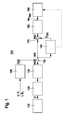
- FIG. 1 illustrates the structure of an inventive Control unit 100 for an internal combustion engine with several Cylinders (not shown here).
- the control unit 100 comprises a sensor device 110 for detecting a Speed signal, which is the current speed of the Crankshaft of the internal combustion engine represents.
- the sensor device 110 mounted as a sender wheel on the crankshaft and generated Therefore, a segment time signal S, which is also the current speed of the crankshaft - and thus one Speed signal within the meaning of the invention - represents.
- the Sensor device 110 is connected downstream of an anti-aliasing low-pass filter 120 for preventing frequency reflections due to the aliasing effect as well as another filter 130 for selecting the AC component WS from the low-pass filtered segment time signal S.
- the alternating component WS of the segment time signal is then according to the invention to the possibly still existing in it Torsional vibration parts of the crankshaft Internal combustion engine cleaned up. This is done with the help of a first subtraction device 150, which is a subtraction a torsional vibration compensation signal TKS, which represents the torsional vibrations of the crankshaft, from allows the AC component WS.
- the compensation signal TKS corresponds in its amplitude to the amplitudes of Torsional vibrations in the alternating component.
- the alternating component WS 'of the segment time signal S which is adjusted by the torsional oscillations, is indicated both on a second subtraction device 170 and on a transmitter wheel adaptation device 160.
- the encoder wheel adaptation device 160 is used to generate a sensor wheel error signal S GA , which represents vibration components in the alternating component WS 'due to possible asymmetries of the encoder wheel. With the help of the second subtraction device 170, these error components are then also eliminated from the alternating component.
- the twice-adjusted AC component WS "of the segment time signal S provided in this manner at the output of the second subtraction device 170 is then fed to a conversion device 180, which converts this alternating component of the segment time signal S into an AC component Wn via a rotational speed signal
- the speed signal then serves, for example, as an input variable for a chute control 190 of the internal combustion engine within the control unit 100.
- This chute control 190 is preferably initialized by the transmitter wheel adaptation device 160.
- FIG. 2 shows the structure of the above-mentioned compensation device 140 according to the invention for generating the torsional vibration compensation signal TKS.
- the number of paths for amplitude generation is identical to the number of processing paths for phase generation and this number is preferably equal to half the number of cylinders in multi-cylinder machines, rounded to an integer; For a four-cylinder internal combustion engine, therefore, two paths for amplitude generation and two paths for phase generation are required; For a six-cylinder internal combustion engine, therefore, there are three paths each.
- the number of amplitude paths or the number of phase paths corresponds to the number of spectral components S K , which are later summed up to the compensation signal TKS.
- Each of these spectral components represents the torsional vibration components of the crankshaft at a different multiple of the camshaft frequency of the internal combustion engine.
- the individual paths for determining the amplitudes and phases of the spectral components have essentially the same structure. Depending on whether it is a path for amplitude generation or a path for phase generation, these paths initially have an amplitude map 142-AI-1... 142-AN-1 or a phase map 142-PI-1 ... 142-PN-1.
- the maps are each frequency-selective, that is specified to that multiple of the camshaft frequency, for the spectral component of the respective path in each case the corresponding amplitude or phase is to be formed.
- Both the amplitude as well as the phase maps receive as input variables in each case the current rotational speed n of the internal combustion engine and the individual fuel quantities m injected in each individual cylinder of the internal combustion engine.
- a preliminary value for the amplitude of the respective spectral component S K is then generated within the compensation device 140 with the aid of the amplitude characteristic diagrams 142-AI-1... 142-AN-1. From this preliminary value, the amplitude A I , A N for the respective spectral component is then separately generated in each individual path in that the influence of the charge pressure l of the internal combustion engine on the amplitude calculation is taken into account or eliminated.
- This boost pressure correction is optional; however, it serves to further clarify the amplitudes of the spectral components.
- the calculation of the phases P I , P N of the individual spectral components S K takes place .
- the frequency-specific phase maps 142-PI-1, 142-PN-1 only rough preliminary values for the phases of the individual spectral components are initially available. These phase pre-values are then subsequently corrected for these influences by the boost pressure l of the internal combustion engine, and then at the output of the boost pressure correction blocks 142-PI-2, 142-PN-2 the desired phase values P I , P N for the individual spectral components To get S K.
- the thus generated amplitudes and phases for the individual spectral components of the compensation signal TKS to be generated are then supplied within the compensation device 140 to a signal processor 144 as input variables, which from these input variables the sought spectral components S K in the form of a time signal, for example in the form A I ⁇ sin ( ⁇ t - P I ) is calculated.
- the calculation is typically performed using the well-known mathematical method of the inverse Fast Fourier Transform FFT.
- these spectral components are then added together with the aid of the adder 146, as already mentioned above.
- the said amplitudes and phase characteristics 142-AI-1 ... 142-AN-1, 142-PI-1 ... 142-PN-1 are typically for any operating mode of the internal combustion engine, such as for overrun or normal operation, for Regeneration mode for exhaust aftertreatment or for Homogenous or partially homogeneous operation, each specific educated.
- any operating mode of the internal combustion engine such as for overrun or normal operation, for Regeneration mode for exhaust aftertreatment or for Homogenous or partially homogeneous operation, each specific educated.
- the application of the maps can either by Simulation or by measuring a pilot internal combustion engine respectively.
- More detailed maps than those determined by simulation can by the mentioned measurement of experimental internal combustion engines be determined.
- the Indexing technology allows the metrological detection of Press in the individual cylinders of the internal combustion engine.
- the reference state which is characterized by that injected into each cylinder Fuel quantities are the same for all cylinders, that is There are no cylinder-specific quantity errors.
- the Setting this reference state is done by hand Intervention in a quantity compensation control correction. Of the Reference state is considered reached when all cylinders have the same indicated mean pressure.
- the on this way for the pilot engines Determined maps can then be used to generate the Torsionsschwingungs compensation signal at Internal combustion engines of the same type are adopted.
- the inventive method or the According to the invention described procedure for generating of the torsional vibration compensation signal TKS becomes preferably in the form of a computer program for a Implemented control unit for an internal combustion engine.
- the Computer program may be together with others if necessary Computer programs on a computer readable medium be stored.
- the data may be a Floppy disk, a compact disc, a so-called flash memory or the like. That on the disk stored computer program can then as a product to be sold to a customer.
- a transfer to the Customer is also without the aid of the disk, to Example via an electronic communication network, especially the internet, possible.
Landscapes
- Engineering & Computer Science (AREA)
- Chemical & Material Sciences (AREA)
- Combustion & Propulsion (AREA)
- Mechanical Engineering (AREA)
- General Engineering & Computer Science (AREA)
- Physics & Mathematics (AREA)
- General Physics & Mathematics (AREA)
- Combined Controls Of Internal Combustion Engines (AREA)
- Control Of Vehicle Engines Or Engines For Specific Uses (AREA)
Abstract
Description
- Figur 1
- den Aufbau eines erfindungsgemäßen Steuergerätes; und
- Figur 2
- den Aufbau einer erfindungsgemäßen Kompensationseinrichtung innerhalb des Steuergerätes aus Figur 1
Claims (13)
- Verfahren zum Bereinigen eines Drehzahlsignals, welches die aktuelle Drehzahl der Kurbelwelle einer Brennkraftmaschine repräsentiert, durch Subtrahieren eines jeweils aktuell generierten Torsionsschwingungs-Kompensationssignals (TKS), welches Torsionsschwingungen der Kurbelwelle repräsentiert, von dem Drehzahlsignal; dadurch gekennzeichnet, dass die Generierung des Torsionsschwingungs-Kompensationssignals (TKS) folgende Schritte umfasst: Generieren von Spektralanteilen für das Torsionsschwingungs-Kompensationssignals (TKS), welche jeweils unterschiedliche Frequenzanteile der Torsionsschwingungen repräsentieren; und Aufsummieren der Spektralanteile zu dem Torsionsschwingungs-Kompensationssignal (TKS).
- Verfahren nach Anspruch 1, dadurch gekennzeichnet, dass die Generierung jedes einzelnen der Spektralanteile des Torsionsschwingungs-Kompensationssignals (TKS) folgende Schritte umfasst:Generieren einer Frequenzdarstellung in Form einer Amplitude (AI, ...AN) und einer Phase (PI...PN) für den Spektralanteil durch Auswerten von hinterlegten Amplituden-und Phasen-Kennfeldern (142-AI-1,..., 142-AN-1; 142-PI-1,..., 142-PN-1) im Ansprechen auf die aktuelle Drehzahl (n) der Kurbelwelle und auf die aktuell in die einzelnen Zylinder der Brennkraftmaschine eingespritzten Kraftstoffmengen (m); undUmwandeln der Frequenzdarstellung des Spektralanteils in ein aufsummierbares Zeitsignal.
- Verfahren nach Anspruch 2, dadurch gekennzeichnet, dass die Generierung der Amplitude und der Phase für die einzelnen Spektralanteile des Torsionsschwingungs-Kompensationssignals (TKS) jeweils unter Berücksichtigung des Einflusses des aktuellen Ladedrucks (1) der Brennkraftmaschine auf die Torsionsschwingungen erfolgt.
- Verfahren nach Anspruch 2 oder 3, dadurch gekennzeichnet, dass die Amplituden- und Phasenkennfelder (142-AI-1,..., 142-AN-1; 142-PI-1,..., 142-PN-1) durch Simulation gelernt werden, wobei in der Simulation nicht nur das Verhalten der Brennkraftmaschine und deren Kurbelwelle, sondern auch eine jeweils vorgesehene Anwendung für das bereinigte Drehzahlsignal (nber), beispielsweise eine Mengenausgleichsregelung oder eine Laufruheregelung (190) für die Brennkraftmaschine, modelliert wird.
- Verfahren nach Anspruch 4, dadurch gekennzeichnet, dass in der Simulation weiterhin eine Abhängigkeit der Torsionsschwingungen von dem jeweils aktuellen Ladedruck (l) mit berücksichtigt wird.
- Verfahren nach Anspruch 2 oder 3, dadurch gekennzeichnet, dass die Amplituden- und Phasenkennfelder (142-AI-1,..., 142-AN-1; 142-PI-1,..., 142-PN-1) durch Vermessen der Brennkraftmaschine bei Betrieb in mindestens einer Betriebsart (Bi), wie zum Beispiel Regenerationsbetrieb zur Abgasnachbehandlung, Homogen-/Teilhomogenbetrieb, Normalbetrieb, insbesondere unter Last auf einem Prüfstand gelernt werden, wobei die Brennkraftmaschine für jede Betriebsart in einen Referenzzustand gefahren wird, bei dem die in die einzelnen Zylinder der Brennkraftmaschine eingespritzte Kraftstoffmenge für alle Zylinder gleich groß ist.
- Verfahren nach Anspruch 6, dadurch gekennzeichnet, dass der Referenzzustand dann als erreicht gilt, wenn alle Zylinder einen gleichen indizierten Mitteldruck aufweisen.
- Verfahren nach einem der Ansprüche 2 bis 7, dadurch gekennzeichnet, dass die Spektralanteile (fI...fN) jeweils im Bereich ganzzahliger Vielfacher der Nockenwellenfrequenz der Brennkraftmaschine liegen und dass die Anzahl der zur Generierung des Torsionsschwingungs-Kompensationssignals (TKS) aufsummierten Spektralanteile vorzugsweise der halben Anzahl der Zylinder der mehrzylindrigen Brennkraftmaschine, abgerundet auf eine ganze Zahl, entspricht.
- Verfahren nach einem der vorangegangenen Ansprüche, dadurch gekennzeichnet, dass es sich bei dem Drehzahlsignal um ein Segmentzeit-Signal (S) handelt, wie es von einem der Kurbelwelle zugeordneten Geberrad abgegriffen wird, vorzugsweise um dessen tiefpassgefilterten Wechselanteil (WS).
- Computerprogramm für ein Steuergerät (100) einer Brennkraftmaschine, dadurch gekennzeichnet, dass das Computerprogramm ausgebildet ist zum Durchführen des Verfahrens nach einem der Ansprüche 1 bis 9.
- Verwendung eines nach einem der Ansprüche 1 bis 9 generierten bereinigten Drehzahlsignals (nber) zum Regeln der Laufruhe einer Brennkraftmaschine.
- Steuergerät (100) für eine Brennkraftmaschine mit mehreren Zylindern, umfassend:dadurch gekennzeichnet, dasseine Sensoreinrichtung (110) zum Erfassen eines Drehzahlsignals, welches die aktuelle Drehzahl der Kurbelwelle einer Brennkraftmaschine repräsentiert, wobei dieses Drehzahlsignal gegebenenfalls auch Torsionsschwingungsanteile umfasst, welche Torsionsschwingungen der Kurbelwelle der Brennkraftmaschine repräsentieren;eine Kompensationseinrichtung (140) zum Generieren eines Torsionsschwingungs-Kompensationssignals (TKS), welches die Torsionsschwingungen der Kurbelwelle repräsentiert; undSubtraktionseinrichtung (150) zum Bereinigen des Drehzahlsignals von den unerwünschten Torsionsschwingungsanteilen durch Subtrahieren des Torsionsschwingungs-Kompensationssignals (TKS) von dem Drehzahlsignal;
die Kompensationseinrichtung (140) ausgebildet ist, das Torsionsschwingungs-Kompensationssignal (TKS) dadurch zu generieren, dass sie zunächst Spektralanteile für das Torsionsschwingungs-Kompensationssignal (TKS) generiert, welche jeweils unterschiedliche Frequenzanteile der Torsionsschwingungen repräsentieren, und nachfolgend diese Spektralanteile zu dem Torsionsschwingungs-Kompensationssignal aufaddiert. - Steuergerät (100) nach Anspruch 12, gekennzeichnet durch eine Mengenausgleichsregelung zum Regeln der in die Zylinder der Brennkraftmaschine eingespritzten Kraftstoffmenge (m) auf ein gleiches Niveau und/oder eine Laufruhenregelung (190) zum Regeln der Laufruhe der Brennkraftmaschine im Ansprechen auf das bereinigte Drehzahlsignal (nber).
Applications Claiming Priority (2)
| Application Number | Priority Date | Filing Date | Title |
|---|---|---|---|
| DE102004010413 | 2004-03-01 | ||
| DE200410010413 DE102004010413A1 (de) | 2004-03-01 | 2004-03-01 | Verfahren und Steuergerät zum Bereinigen eines Drehzahlsignals |
Publications (3)
| Publication Number | Publication Date |
|---|---|
| EP1574835A2 true EP1574835A2 (de) | 2005-09-14 |
| EP1574835A3 EP1574835A3 (de) | 2006-02-15 |
| EP1574835B1 EP1574835B1 (de) | 2009-03-25 |
Family
ID=34813601
Family Applications (1)
| Application Number | Title | Priority Date | Filing Date |
|---|---|---|---|
| EP20050100115 Expired - Lifetime EP1574835B1 (de) | 2004-03-01 | 2005-01-11 | Verfahren und Steuergerät zum Bereinigen eines Drehzahlsignals |
Country Status (2)
| Country | Link |
|---|---|
| EP (1) | EP1574835B1 (de) |
| DE (2) | DE102004010413A1 (de) |
Cited By (3)
| Publication number | Priority date | Publication date | Assignee | Title |
|---|---|---|---|---|
| WO2008074779A3 (de) * | 2006-12-19 | 2008-08-21 | Bosch Gmbh Robert | Verfahren zur ermittlung einer physikalischen grösse |
| WO2011104248A1 (de) * | 2010-02-27 | 2011-09-01 | Robert Bosch Gmbh | Verfahren zur bestimmung einer drehzahl einer antriebswelle einer brennkraftmaschine |
| DE102010063383A1 (de) | 2010-12-17 | 2012-06-21 | Robert Bosch Gmbh | Verfahren zum Betreiben einer Brennkraftmaschine |
Families Citing this family (1)
| Publication number | Priority date | Publication date | Assignee | Title |
|---|---|---|---|---|
| DE102007024416B4 (de) * | 2007-05-25 | 2012-01-05 | Continental Automotive Gmbh | Verfahren und Einrichtung zum Ermitteln eines Drehparameters einer Kurbelwelle |
Family Cites Families (17)
| Publication number | Priority date | Publication date | Assignee | Title |
|---|---|---|---|---|
| US4843870A (en) * | 1988-07-25 | 1989-07-04 | Purdue Research Foundation | Cylinder-by-cylinder engine pressure and pressure torque waveform determination utilizing crankshaft speed fluctuations |
| US5487008A (en) * | 1990-04-20 | 1996-01-23 | The Regents Of The University Of Michigan | Method and system for detecting the misfire of a reciprocating internal combustion engine in frequency domain |
| US5499537A (en) * | 1993-12-24 | 1996-03-19 | Nippondenso Co., Ltd. | Apparatus for detecting misfire in internal combustion engine |
| JP3441812B2 (ja) * | 1994-09-08 | 2003-09-02 | 本田技研工業株式会社 | 内燃エンジンの燃焼状態検出装置 |
| DE4445684C2 (de) * | 1994-12-21 | 2000-06-21 | Fraunhofer Ges Forschung | Verfahren zur Ermittlung von Drehmomenten, Arbeiten und Leistungen an Verbrennungskraftmaschinen |
| JPH08338299A (ja) * | 1995-06-10 | 1996-12-24 | Robert Bosch Gmbh | ミスファイア検出方法 |
| US5633456A (en) * | 1995-08-04 | 1997-05-27 | Chrysler Corporation | Engine misfire detection with digital filtering |
| FR2739145B1 (fr) * | 1995-09-25 | 1998-12-18 | Bosch Gmbh Robert | Procede de detection des rates de combustion d'un moteur a combustion interne |
| DE19622042C2 (de) * | 1996-05-31 | 1999-05-20 | Siemens Ag | Verfahren zum Erkennen und Korrigieren von Fehlern bei der Zeitmessung an sich drehenden Wellen |
| DE19641916B4 (de) * | 1996-10-11 | 2008-03-06 | Robert Bosch Gmbh | Verfahren zur Verbrennungsaussetzererkennung durch Auswertung von Drehzahlschwankungen |
| DE19713182A1 (de) * | 1997-03-27 | 1998-10-01 | Siemens Ag | Verfahren und Vorrichtung zur Bestimmung der Motordrehzahl eines Kraftfahrzeuges |
| DE19814732B4 (de) * | 1998-04-02 | 2013-02-28 | Robert Bosch Gmbh | Drehzahlerfassungsverfahren, insbesondere zur Verbrennungsaussetzererkennung |
| KR100305832B1 (ko) * | 1999-07-21 | 2001-09-13 | 이계안 | 주파수 분석을 이용한 엔진 실화 검출 시스템과 검출방법 |
| US6314802B1 (en) * | 1999-07-27 | 2001-11-13 | Daimlerchrysler Corporation | Optimal engine speed compensation method used in misfire detection |
| DE19942144A1 (de) * | 1999-09-03 | 2001-06-07 | Schroeder Dierk | Verfahren zur adaptiven Schwingungsdämpfung mittels neuronaler Netze |
| JP3958636B2 (ja) * | 2002-02-28 | 2007-08-15 | 本田技研工業株式会社 | 車両用多気筒内燃機関の失火検出装置 |
| DE10214833A1 (de) * | 2002-04-04 | 2003-10-16 | Volkswagen Ag | Verfahren zum Bestimmen eines indizierten Ist-Motormomentes einer Brennkraftmaschine |
-
2004
- 2004-03-01 DE DE200410010413 patent/DE102004010413A1/de not_active Withdrawn
-
2005
- 2005-01-11 DE DE200550006918 patent/DE502005006918D1/de not_active Expired - Lifetime
- 2005-01-11 EP EP20050100115 patent/EP1574835B1/de not_active Expired - Lifetime
Cited By (6)
| Publication number | Priority date | Publication date | Assignee | Title |
|---|---|---|---|---|
| WO2008074779A3 (de) * | 2006-12-19 | 2008-08-21 | Bosch Gmbh Robert | Verfahren zur ermittlung einer physikalischen grösse |
| WO2011104248A1 (de) * | 2010-02-27 | 2011-09-01 | Robert Bosch Gmbh | Verfahren zur bestimmung einer drehzahl einer antriebswelle einer brennkraftmaschine |
| CN102782303A (zh) * | 2010-02-27 | 2012-11-14 | 罗伯特·博世有限公司 | 用于确定内燃机驱动轴转速的方法 |
| US9068905B2 (en) | 2010-02-27 | 2015-06-30 | Robert Bosch Gmbh | Method for determining a rotational speed of a driveshaft of an internal combustion engine |
| CN102782303B (zh) * | 2010-02-27 | 2016-05-18 | 罗伯特·博世有限公司 | 用于确定内燃机驱动轴转速的方法 |
| DE102010063383A1 (de) | 2010-12-17 | 2012-06-21 | Robert Bosch Gmbh | Verfahren zum Betreiben einer Brennkraftmaschine |
Also Published As
| Publication number | Publication date |
|---|---|
| EP1574835A3 (de) | 2006-02-15 |
| DE102004010413A1 (de) | 2005-09-15 |
| DE502005006918D1 (de) | 2009-05-07 |
| EP1574835B1 (de) | 2009-03-25 |
Similar Documents
| Publication | Publication Date | Title |
|---|---|---|
| DE112005003378B4 (de) | Einzelzylinder-Controller für Vierzylindermotor | |
| DE69617513T2 (de) | Nichtlineare dynamische Transformation zur Korrektur einer torsionsschwingungsbehafteten Kurbelwellenbeschleunigung | |
| DE10055192C2 (de) | Rundlaufregelung für Dieselmotoren | |
| AT514725B1 (de) | Verfahren und eine Vorrichtung zur Ermittlung des Vortriebsmoments | |
| DE112010000984B4 (de) | Drehmomentschätzungssystem für einen Verbrennungsmotor | |
| DE102011018552A1 (de) | Systeme und Verfahren zur Detektion von Motorfehlzündungen unter Verwendung einer diskreten Fouriertransformationsapproximation | |
| DE102005042794B4 (de) | Automatisches Kalibrierverfahren für ein Zündaussetzererfassungssystem eines Motors | |
| DE19859074A1 (de) | Verfahren zur Regelung der Laufruhe eines Verbrennungsmotors | |
| DE102005047829B3 (de) | Zylindergleichstellung bei Hubkolbenmotoren durch Ausregeln der harmonischen Anteile der Kurbelwellendrehzahl | |
| DE19745682B4 (de) | Verfahren und Vorrichtung zur Ermittlung von Kenngrößen | |
| WO2019122304A1 (de) | Verfahren zum betreiben eines prüfstands | |
| WO2007012555A1 (de) | VERFAHREN ZUR ERMITTLUNG ZYLINDERINDIVIDUELLER DREHKENNGRÖßEN EINER WELLE EINES VERBRENNUNGSMOTORS | |
| DE60037612T2 (de) | Verfahren und Vorrichtung zur Messung des Drehmomentes einer Brennkraftmaschine | |
| AT520537B1 (de) | Verfahren zum Betreiben eines Prüfstands | |
| WO2005083252A1 (de) | Verfahren und vorrichtung zur ermittlung eines winkellagesignals bei einer brennkraftmaschine | |
| DE102008052245A1 (de) | Verfahren zum Ermitteln einer kurbelwellentorsionsoptimalen Betriebsweise einer Brennkraftmaschine | |
| AT396842B (de) | Verfahren und einrichtung zur motorüberwachung | |
| EP1574835B1 (de) | Verfahren und Steuergerät zum Bereinigen eines Drehzahlsignals | |
| DE102017218656A1 (de) | Verfahren zur Überwachung des Betriebs eines Hybrid-Antriebsstrangs in einem Kraftfahrzeug und Kraftfahrzeug | |
| DE602004009400T2 (de) | Verfahren zur Bestimmung von Drehzahlschwankungen eines Motors | |
| DE69924331T2 (de) | Verfahren zur Bestimmung der Drehmomententwicklung einer Brennkraftmaschine | |
| DE102021102260A1 (de) | Bestimmung eines Klopfbetriebs in einem Zylinder eines Verbrennungsmotors | |
| EP1058108B1 (de) | Verfahren und Vorrichtung zur Diagnose bzw. Steuerung von Brennkraftmaschinen | |
| DE112007003032B4 (de) | Antriebsstrang | |
| DE102008044305A1 (de) | Verfahren, Steuergerät und Computerprogrammprodukt zur Erfassung der Laufunruhe eines mehrzylindrigen Verbrennungsmotors |
Legal Events
| Date | Code | Title | Description |
|---|---|---|---|
| PUAI | Public reference made under article 153(3) epc to a published international application that has entered the european phase |
Free format text: ORIGINAL CODE: 0009012 |
|
| AK | Designated contracting states |
Kind code of ref document: A2 Designated state(s): AT BE BG CH CY CZ DE DK EE ES FI FR GB GR HU IE IS IT LI LT LU MC NL PL PT RO SE SI SK TR |
|
| AX | Request for extension of the european patent |
Extension state: AL BA HR LV MK YU |
|
| PUAL | Search report despatched |
Free format text: ORIGINAL CODE: 0009013 |
|
| AK | Designated contracting states |
Kind code of ref document: A3 Designated state(s): AT BE BG CH CY CZ DE DK EE ES FI FR GB GR HU IE IS IT LI LT LU MC NL PL PT RO SE SI SK TR |
|
| AX | Request for extension of the european patent |
Extension state: AL BA HR LV MK YU |
|
| 17P | Request for examination filed |
Effective date: 20060816 |
|
| AKX | Designation fees paid |
Designated state(s): DE FR GB IT SE |
|
| 17Q | First examination report despatched |
Effective date: 20070104 |
|
| GRAP | Despatch of communication of intention to grant a patent |
Free format text: ORIGINAL CODE: EPIDOSNIGR1 |
|
| GRAS | Grant fee paid |
Free format text: ORIGINAL CODE: EPIDOSNIGR3 |
|
| GRAA | (expected) grant |
Free format text: ORIGINAL CODE: 0009210 |
|
| AK | Designated contracting states |
Kind code of ref document: B1 Designated state(s): DE FR GB IT SE |
|
| REG | Reference to a national code |
Ref country code: GB Ref legal event code: FG4D Free format text: NOT ENGLISH |
|
| REF | Corresponds to: |
Ref document number: 502005006918 Country of ref document: DE Date of ref document: 20090507 Kind code of ref document: P |
|
| PG25 | Lapsed in a contracting state [announced via postgrant information from national office to epo] |
Ref country code: SE Free format text: LAPSE BECAUSE OF FAILURE TO SUBMIT A TRANSLATION OF THE DESCRIPTION OR TO PAY THE FEE WITHIN THE PRESCRIBED TIME-LIMIT Effective date: 20090625 |
|
| PLBE | No opposition filed within time limit |
Free format text: ORIGINAL CODE: 0009261 |
|
| STAA | Information on the status of an ep patent application or granted ep patent |
Free format text: STATUS: NO OPPOSITION FILED WITHIN TIME LIMIT |
|
| 26N | No opposition filed |
Effective date: 20091229 |
|
| GBPC | Gb: european patent ceased through non-payment of renewal fee |
Effective date: 20100111 |
|
| REG | Reference to a national code |
Ref country code: FR Ref legal event code: ST Effective date: 20100930 |
|
| PG25 | Lapsed in a contracting state [announced via postgrant information from national office to epo] |
Ref country code: FR Free format text: LAPSE BECAUSE OF NON-PAYMENT OF DUE FEES Effective date: 20100201 |
|
| PG25 | Lapsed in a contracting state [announced via postgrant information from national office to epo] |
Ref country code: GB Free format text: LAPSE BECAUSE OF NON-PAYMENT OF DUE FEES Effective date: 20100111 |
|
| PG25 | Lapsed in a contracting state [announced via postgrant information from national office to epo] |
Ref country code: IT Free format text: LAPSE BECAUSE OF FAILURE TO SUBMIT A TRANSLATION OF THE DESCRIPTION OR TO PAY THE FEE WITHIN THE PRESCRIBED TIME-LIMIT Effective date: 20090325 |
|
| PGFP | Annual fee paid to national office [announced via postgrant information from national office to epo] |
Ref country code: DE Payment date: 20160322 Year of fee payment: 12 |
|
| REG | Reference to a national code |
Ref country code: DE Ref legal event code: R119 Ref document number: 502005006918 Country of ref document: DE |
|
| PG25 | Lapsed in a contracting state [announced via postgrant information from national office to epo] |
Ref country code: DE Free format text: LAPSE BECAUSE OF NON-PAYMENT OF DUE FEES Effective date: 20170801 |