EP1574560A1 - Verfahren zur lösungsmittelfreien Herstellung von Ethercarbonsäuren mit niedrigem Restsalzgehalt - Google Patents
Verfahren zur lösungsmittelfreien Herstellung von Ethercarbonsäuren mit niedrigem Restsalzgehalt Download PDFInfo
- Publication number
- EP1574560A1 EP1574560A1 EP05003714A EP05003714A EP1574560A1 EP 1574560 A1 EP1574560 A1 EP 1574560A1 EP 05003714 A EP05003714 A EP 05003714A EP 05003714 A EP05003714 A EP 05003714A EP 1574560 A1 EP1574560 A1 EP 1574560A1
- Authority
- EP
- European Patent Office
- Prior art keywords
- ether carboxylic
- acid
- carboxylic acid
- formula
- carboxylic acids
- Prior art date
- Legal status (The legal status is an assumption and is not a legal conclusion. Google has not performed a legal analysis and makes no representation as to the accuracy of the status listed.)
- Granted
Links
Classifications
-
- C—CHEMISTRY; METALLURGY
- C10—PETROLEUM, GAS OR COKE INDUSTRIES; TECHNICAL GASES CONTAINING CARBON MONOXIDE; FUELS; LUBRICANTS; PEAT
- C10M—LUBRICATING COMPOSITIONS; USE OF CHEMICAL SUBSTANCES EITHER ALONE OR AS LUBRICATING INGREDIENTS IN A LUBRICATING COMPOSITION
- C10M129/00—Lubricating compositions characterised by the additive being an organic non-macromolecular compound containing oxygen
- C10M129/02—Lubricating compositions characterised by the additive being an organic non-macromolecular compound containing oxygen having a carbon chain of less than 30 atoms
- C10M129/26—Carboxylic acids; Salts thereof
- C10M129/28—Carboxylic acids; Salts thereof having carboxyl groups bound to acyclic or cycloaliphatic carbon atoms
- C10M129/38—Carboxylic acids; Salts thereof having carboxyl groups bound to acyclic or cycloaliphatic carbon atoms having 8 or more carbon atoms
- C10M129/44—Carboxylic acids; Salts thereof having carboxyl groups bound to acyclic or cycloaliphatic carbon atoms having 8 or more carbon atoms containing hydroxy groups
-
- C—CHEMISTRY; METALLURGY
- C07—ORGANIC CHEMISTRY
- C07C—ACYCLIC OR CARBOCYCLIC COMPOUNDS
- C07C51/00—Preparation of carboxylic acids or their salts, halides or anhydrides
- C07C51/347—Preparation of carboxylic acids or their salts, halides or anhydrides by reactions not involving formation of carboxyl groups
- C07C51/367—Preparation of carboxylic acids or their salts, halides or anhydrides by reactions not involving formation of carboxyl groups by introduction of functional groups containing oxygen only in singly bound form
-
- C—CHEMISTRY; METALLURGY
- C08—ORGANIC MACROMOLECULAR COMPOUNDS; THEIR PREPARATION OR CHEMICAL WORKING-UP; COMPOSITIONS BASED THEREON
- C08G—MACROMOLECULAR COMPOUNDS OBTAINED OTHERWISE THAN BY REACTIONS ONLY INVOLVING UNSATURATED CARBON-TO-CARBON BONDS
- C08G65/00—Macromolecular compounds obtained by reactions forming an ether link in the main chain of the macromolecule
- C08G65/02—Macromolecular compounds obtained by reactions forming an ether link in the main chain of the macromolecule from cyclic ethers by opening of the heterocyclic ring
- C08G65/32—Polymers modified by chemical after-treatment
- C08G65/329—Polymers modified by chemical after-treatment with organic compounds
- C08G65/331—Polymers modified by chemical after-treatment with organic compounds containing oxygen
- C08G65/332—Polymers modified by chemical after-treatment with organic compounds containing oxygen containing carboxyl groups, or halides, or esters thereof
-
- C—CHEMISTRY; METALLURGY
- C10—PETROLEUM, GAS OR COKE INDUSTRIES; TECHNICAL GASES CONTAINING CARBON MONOXIDE; FUELS; LUBRICANTS; PEAT
- C10M—LUBRICATING COMPOSITIONS; USE OF CHEMICAL SUBSTANCES EITHER ALONE OR AS LUBRICATING INGREDIENTS IN A LUBRICATING COMPOSITION
- C10M129/00—Lubricating compositions characterised by the additive being an organic non-macromolecular compound containing oxygen
- C10M129/02—Lubricating compositions characterised by the additive being an organic non-macromolecular compound containing oxygen having a carbon chain of less than 30 atoms
- C10M129/26—Carboxylic acids; Salts thereof
- C10M129/28—Carboxylic acids; Salts thereof having carboxyl groups bound to acyclic or cycloaliphatic carbon atoms
- C10M129/38—Carboxylic acids; Salts thereof having carboxyl groups bound to acyclic or cycloaliphatic carbon atoms having 8 or more carbon atoms
- C10M129/40—Carboxylic acids; Salts thereof having carboxyl groups bound to acyclic or cycloaliphatic carbon atoms having 8 or more carbon atoms monocarboxylic
-
- C—CHEMISTRY; METALLURGY
- C10—PETROLEUM, GAS OR COKE INDUSTRIES; TECHNICAL GASES CONTAINING CARBON MONOXIDE; FUELS; LUBRICANTS; PEAT
- C10M—LUBRICATING COMPOSITIONS; USE OF CHEMICAL SUBSTANCES EITHER ALONE OR AS LUBRICATING INGREDIENTS IN A LUBRICATING COMPOSITION
- C10M129/00—Lubricating compositions characterised by the additive being an organic non-macromolecular compound containing oxygen
- C10M129/86—Lubricating compositions characterised by the additive being an organic non-macromolecular compound containing oxygen having a carbon chain of 30 or more atoms
- C10M129/92—Carboxylic acids
- C10M129/93—Carboxylic acids having carboxyl groups bound to acyclic or cycloaliphatic carbon atoms
-
- C—CHEMISTRY; METALLURGY
- C10—PETROLEUM, GAS OR COKE INDUSTRIES; TECHNICAL GASES CONTAINING CARBON MONOXIDE; FUELS; LUBRICANTS; PEAT
- C10M—LUBRICATING COMPOSITIONS; USE OF CHEMICAL SUBSTANCES EITHER ALONE OR AS LUBRICATING INGREDIENTS IN A LUBRICATING COMPOSITION
- C10M177/00—Special methods of preparation of lubricating compositions; Chemical modification by after-treatment of components or of the whole of a lubricating composition, not covered by other classes
-
- C—CHEMISTRY; METALLURGY
- C11—ANIMAL OR VEGETABLE OILS, FATS, FATTY SUBSTANCES OR WAXES; FATTY ACIDS THEREFROM; DETERGENTS; CANDLES
- C11D—DETERGENT COMPOSITIONS; USE OF SINGLE SUBSTANCES AS DETERGENTS; SOAP OR SOAP-MAKING; RESIN SOAPS; RECOVERY OF GLYCEROL
- C11D1/00—Detergent compositions based essentially on surface-active compounds; Use of these compounds as a detergent
- C11D1/02—Anionic compounds
- C11D1/04—Carboxylic acids or salts thereof
- C11D1/06—Ether- or thioether carboxylic acids
-
- C—CHEMISTRY; METALLURGY
- C11—ANIMAL OR VEGETABLE OILS, FATS, FATTY SUBSTANCES OR WAXES; FATTY ACIDS THEREFROM; DETERGENTS; CANDLES
- C11D—DETERGENT COMPOSITIONS; USE OF SINGLE SUBSTANCES AS DETERGENTS; SOAP OR SOAP-MAKING; RESIN SOAPS; RECOVERY OF GLYCEROL
- C11D3/00—Other compounding ingredients of detergent compositions covered in group C11D1/00
- C11D3/16—Organic compounds
- C11D3/20—Organic compounds containing oxygen
- C11D3/2075—Carboxylic acids-salts thereof
- C11D3/2089—Ether acids-salts thereof
-
- C—CHEMISTRY; METALLURGY
- C11—ANIMAL OR VEGETABLE OILS, FATS, FATTY SUBSTANCES OR WAXES; FATTY ACIDS THEREFROM; DETERGENTS; CANDLES
- C11D—DETERGENT COMPOSITIONS; USE OF SINGLE SUBSTANCES AS DETERGENTS; SOAP OR SOAP-MAKING; RESIN SOAPS; RECOVERY OF GLYCEROL
- C11D7/00—Compositions of detergents based essentially on non-surface-active compounds
- C11D7/22—Organic compounds
- C11D7/26—Organic compounds containing oxygen
- C11D7/265—Carboxylic acids or salts thereof
-
- C—CHEMISTRY; METALLURGY
- C23—COATING METALLIC MATERIAL; COATING MATERIAL WITH METALLIC MATERIAL; CHEMICAL SURFACE TREATMENT; DIFFUSION TREATMENT OF METALLIC MATERIAL; COATING BY VACUUM EVAPORATION, BY SPUTTERING, BY ION IMPLANTATION OR BY CHEMICAL VAPOUR DEPOSITION, IN GENERAL; INHIBITING CORROSION OF METALLIC MATERIAL OR INCRUSTATION IN GENERAL
- C23F—NON-MECHANICAL REMOVAL OF METALLIC MATERIAL FROM SURFACE; INHIBITING CORROSION OF METALLIC MATERIAL OR INCRUSTATION IN GENERAL; MULTI-STEP PROCESSES FOR SURFACE TREATMENT OF METALLIC MATERIAL INVOLVING AT LEAST ONE PROCESS PROVIDED FOR IN CLASS C23 AND AT LEAST ONE PROCESS COVERED BY SUBCLASS C21D OR C22F OR CLASS C25
- C23F11/00—Inhibiting corrosion of metallic material by applying inhibitors to the surface in danger of corrosion or adding them to the corrosive agent
- C23F11/08—Inhibiting corrosion of metallic material by applying inhibitors to the surface in danger of corrosion or adding them to the corrosive agent in other liquids
- C23F11/10—Inhibiting corrosion of metallic material by applying inhibitors to the surface in danger of corrosion or adding them to the corrosive agent in other liquids using organic inhibitors
- C23F11/12—Oxygen-containing compounds
- C23F11/128—Esters of carboxylic acids
-
- C—CHEMISTRY; METALLURGY
- C10—PETROLEUM, GAS OR COKE INDUSTRIES; TECHNICAL GASES CONTAINING CARBON MONOXIDE; FUELS; LUBRICANTS; PEAT
- C10M—LUBRICATING COMPOSITIONS; USE OF CHEMICAL SUBSTANCES EITHER ALONE OR AS LUBRICATING INGREDIENTS IN A LUBRICATING COMPOSITION
- C10M2207/00—Organic non-macromolecular hydrocarbon compounds containing hydrogen, carbon and oxygen as ingredients in lubricant compositions
- C10M2207/10—Carboxylix acids; Neutral salts thereof
- C10M2207/12—Carboxylix acids; Neutral salts thereof having carboxyl groups bound to acyclic or cycloaliphatic carbon atoms
- C10M2207/125—Carboxylix acids; Neutral salts thereof having carboxyl groups bound to acyclic or cycloaliphatic carbon atoms having hydrocarbon chains of eight up to twenty-nine carbon atoms, i.e. fatty acids
- C10M2207/128—Carboxylix acids; Neutral salts thereof having carboxyl groups bound to acyclic or cycloaliphatic carbon atoms having hydrocarbon chains of eight up to twenty-nine carbon atoms, i.e. fatty acids containing hydroxy groups; Ethers thereof
-
- C—CHEMISTRY; METALLURGY
- C10—PETROLEUM, GAS OR COKE INDUSTRIES; TECHNICAL GASES CONTAINING CARBON MONOXIDE; FUELS; LUBRICANTS; PEAT
- C10M—LUBRICATING COMPOSITIONS; USE OF CHEMICAL SUBSTANCES EITHER ALONE OR AS LUBRICATING INGREDIENTS IN A LUBRICATING COMPOSITION
- C10M2207/00—Organic non-macromolecular hydrocarbon compounds containing hydrogen, carbon and oxygen as ingredients in lubricant compositions
- C10M2207/10—Carboxylix acids; Neutral salts thereof
- C10M2207/12—Carboxylix acids; Neutral salts thereof having carboxyl groups bound to acyclic or cycloaliphatic carbon atoms
- C10M2207/129—Carboxylix acids; Neutral salts thereof having carboxyl groups bound to acyclic or cycloaliphatic carbon atoms having hydrocarbon chains of thirty or more carbon atoms
-
- C—CHEMISTRY; METALLURGY
- C10—PETROLEUM, GAS OR COKE INDUSTRIES; TECHNICAL GASES CONTAINING CARBON MONOXIDE; FUELS; LUBRICANTS; PEAT
- C10N—INDEXING SCHEME ASSOCIATED WITH SUBCLASS C10M RELATING TO LUBRICATING COMPOSITIONS
- C10N2030/00—Specified physical or chemical properties which is improved by the additive characterising the lubricating composition, e.g. multifunctional additives
- C10N2030/12—Inhibition of corrosion, e.g. anti-rust agents or anti-corrosives
-
- C—CHEMISTRY; METALLURGY
- C10—PETROLEUM, GAS OR COKE INDUSTRIES; TECHNICAL GASES CONTAINING CARBON MONOXIDE; FUELS; LUBRICANTS; PEAT
- C10N—INDEXING SCHEME ASSOCIATED WITH SUBCLASS C10M RELATING TO LUBRICATING COMPOSITIONS
- C10N2030/00—Specified physical or chemical properties which is improved by the additive characterising the lubricating composition, e.g. multifunctional additives
- C10N2030/40—Low content or no content compositions
- C10N2030/41—Chlorine free or low chlorine content compositions
-
- C—CHEMISTRY; METALLURGY
- C10—PETROLEUM, GAS OR COKE INDUSTRIES; TECHNICAL GASES CONTAINING CARBON MONOXIDE; FUELS; LUBRICANTS; PEAT
- C10N—INDEXING SCHEME ASSOCIATED WITH SUBCLASS C10M RELATING TO LUBRICATING COMPOSITIONS
- C10N2070/00—Specific manufacturing methods for lubricant compositions
Definitions
- the present invention relates to a process for solvent-free preparation of low residual ether carboxylic acids, and their use as Metalworking auxiliaries, in cosmetic formulations and as detergents in Detergents.
- Ether carboxylic acids i. organic carboxylic acids in addition to the carboxyl function carry one or more ether bridges, or their alkali or amine salts are as mild detergents with high lime soap dispersancy are known. you find both in detergent and cosmetic formulations, but also in technical Applications, e.g. Metalworking fluids and coolants, Use.
- Ethercarboxylic acids are according to the prior art either by Alkylation of alcohol or Fettalkoholoxethylaten or -oxpropylaten with Chloroacetic acid derivatives (Williamson ether synthesis / carboxyalkylation) or from the same starting materials by oxidation with different Reagents (atmospheric oxygen, hypochlorite, chlorite) under catalysis with different Catalysts produced.
- the Williamson ether synthesis mainly represents due to the cost-effect relationship, the most technically common method for the preparation of ECS, but have produced by this method Products still serious shortcomings in terms of manageability for the Users, such as solubility behavior, state of aggregation at low Temperatures and in particular the fairly high residual salt content, too strong Can cause corrosion.
- DE-A-199 28 128 discloses a process for the preparation of ether carboxylic acids with Low residual alcohol content, by first using fatty alcohols non-catalytic amounts of alkali catalyst (NaOH, KOH, alkoxides over 5 mol%) are reacted with alkylene oxides, and the resulting, strong alkaline reaction mixtures consisting of a mixture of ethoxylated Alcohols and alcoholates of various polyalkylene glycol ethers, then in a classic Williamson synthesis with sodium chloroacetate in the corresponding ether carboxylic acid are transferred. This procedure will Although the residual content of fatty alcohol in the ether carboxylic acid without special Catalysts reduced, but the high residual salt content of the product phase not reduced.
- alkali catalyst NaOH, KOH, alkoxides over 5 mol%
- EP-A-0 897 906 discloses a process for the preparation of Polyoxyalkylencarbonklaren described.
- the described Ethercarbonchuren prepared by the usual technical process.
- the carboxyalkylation step with the aid of a Solvent and on the other hand, for purification of the organic product phase Washing process performed with an aqueous solution of a metal salt.
- This is intended to obtain a high-purity ether carboxylic acid.
- Both the Use of a solvent as well as the washing process described is economically and ecologically disadvantageous.
- the described washing process merely to a substitution of that derived from the carboxyalkylation step Sodium chloride by another salt. Therefore, the crude organic product with Such a washing process can not be freed from metal salts.
- the Ethercarbonklaren described to be highly pure, but no Residual salt contents disclosed, are still decision criteria called to a low residual salt content.
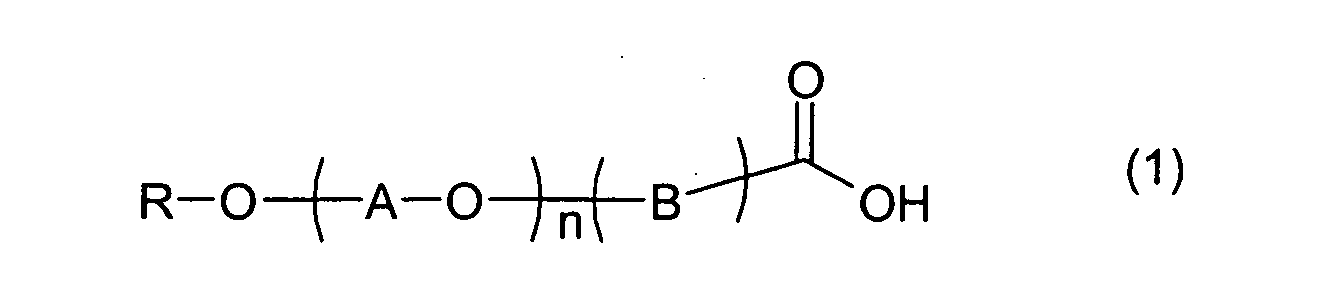
- Another object of the invention is the use of the compounds of formula 1 and / or their salts of formula 2 prepared by this process wherein A, n, B and R have the meaning given above, and X is a cation, as a metalworking agent, in cosmetic formulations and as detergents in detergents.
- the use is as a metalworking agent.
- Another object of the invention is a method for producing a Coolant emulsion, wherein an ether carboxylic acid after the according to the invention is prepared, and the product thus obtained a Cooling lubricant is added.
- A is preferably propylene or ethylene, in particular ethylene.
- the group - (AO) n - represents a mixed alkoxy group which may contain ethylene, propylene and butylene radicals.
- the ratio of ethylene oxide derived groups to propylene or butylene oxide derived groups is preferably between 10: 1 and 1: 1.
- n is preferably a number between 2 and 70, in particular 3 to 50.
- B is preferably a straight-chain alkylene group, in particular Methylene.
- B can also be a branched alkylene group with 3 or 4 Carbon atoms.
- R is a C 8 -C 24 , in particular a C 12 -C 18 -alkyl or alkenyl radical.
- R is an aromatic radical, a phenyl radical with alkyl substitution between 4 and 12 carbon atoms is preferred.
- X may be hydrogen ions.
- X is alkali metal or alkaline earth metal ions, in particular lithium, sodium, potassium, magnesium, or calcium.
- the cations used are ammonium ions of the formula NR 1 R 2 R 3 R 4 , where R 1 , R 2 , R 3 and R 4 independently of one another are H, C 1 - to C 22 -alkyl, C 6 - to C 18 -aryl, C 7 - to C 22 -alkylaryl and / or C 1 - to C 22 -alkenyl.
- the radicals R 1 , R 2 , R 3 and R 4 may contain heteroatoms such as N, P, O, S.
- the ammonium radicals may be monoalkylammonium, dialkylammonium, trialkylammonium or tetraalkylammonium radicals, it being possible for the alkyl substituents to be occupied independently of one another with up to 3 hydroxyl groups.
- X is ammonium radicals which carry one, two, three or four C 2 - to C 10 -alkyl radicals.
- one, two or three of the radicals R 1 to R 4 may be alkoxylated.
- Suitable amines for the preparation of ammonium cations X are monoamines with primary or secondary amino function such as methylamine, ethylamine, butylamine, Laurylamine, coconut fatty amine, stearylamine, dimethylamine, diethylamine, dibutylamine, but also di- and polyamines such. 3-dimethylaminopropylamine, 3-diethylaminopropylamine, 3-morpholinopropylamine, diethylenetriamine, Triethylenetetramine or tetraethylenepentamine.
- Suitable amino alcohols for the preparation of ammonium cations X are for example N, N-dimethylaminoethanol, N, N-diethylaminoethanol, N, N-dibutylaminoethanol, 3-dimethylaminopropanol, N-hydroxyethylmorpholine, Monoethanolamine, diethanolamine, triethanolamine, 3-aminopropanol, Isopropanolamine, 2- (2-aminoethoxy) ethanol and Cyctohexylamino-N, N-diethanol.
- Suitable base fatty alcohols for the process described here are linear or branched, saturated or unsaturated fatty alcohols having 1-30 carbon atoms and also alkylphenols having a C 1 -C 20 -alkyl radical, preference being given to C 6 -C 22 fatty alcohols.
- alkylene oxides e.g. ethylene oxide, Propylene oxide, butylene oxide or mixtures of various such alkylene oxides be reacted with ethylene oxide or mixtures of ethylene oxide and Propylene oxide are preferred.
- alkylene oxides e.g. ethylene oxide, Propylene oxide, butylene oxide or mixtures of various such alkylene oxides be reacted with ethylene oxide or mixtures of ethylene oxide and Propylene oxide are preferred.
- alkylene oxides e.g. ethylene oxide, Propylene oxide, butylene oxide or mixtures of various such alkylene oxides be reacted with ethylene oxide or mixtures of ethylene oxide and Propylene oxide are preferred.
- Based on fatty alcohol 1-100 mol of alkylene oxide applied, preferably 3-50 mol.
- the reaction temperatures are approx. 80-160 ° C.
- the alcoholate / mecanicoxethylat mixture with a chlorocarboxylic acid derivative and a base preferably dry Chloroacetic acid sodium salt and sodium hydroxide reacted.
- a chlorocarboxylic acid derivative and a base preferably dry Chloroacetic acid sodium salt and sodium hydroxide reacted.
- This can done by mixing the oxethylate / alcoholate mixture with 100-150 mol% Sodium chloroacetate at 30-100 ° C and reacted simultaneously or sequentially with solid sodium hydroxide or potassium hydroxide, so that the sum of the in the oxethylate / alkoxide mixture present base and the additional added amount of base corresponds to the amount of sodium chloroacetate.
- the ether carboxylic acid alkali salt may be replaced by Acidification to pH ⁇ 3 with any acid in the free ether carboxylic acid be transferred.
- the aqueous phase is separated and the organic phase directly, i. without using a washing process, by distillation under reduced pressure from the contained residual water (about 5-15%). hereby the residual salt is precipitated, which is subsequently in a Filtration step is removed.
- the low-salt ether carboxylic acid thus obtained can then again with an appropriate amount of deionized water be offset to comparable physical properties analogous to to achieve saline, aqueous crude ether carboxylic acid.
- the crude ether carboxylic acids which have a salt content of 0.60-1.50%, contain the only produced by the process described Ethercarbon Acid Metal salts of ⁇ 0.20%.
- Ethercarbon yarn with very low residual salt content of ⁇ 0.20% become.
- Such ether carboxylic acids generally have a conductivity of ⁇ 15 ⁇ S / cm.
- reaction mixture was then uniformly mixed, heated to about 100 ° C and heated Separating vessel with stirring and bottom valve transferred. Phase separation occurred without Stirring at a temperature of about 100-110 ° C. After separation of the aqueous Lower phase, 448 g of product were obtained as a light yellow liquid.
- reaction mixture was then heated to 90 ° C and then warm hydrochloric acid (35%) run until a pH ⁇ 3 is reached.
- the reaction mixture then became uniform mixed, heated to about 100 ° C and in a heated separation vessel with stirring and bottom valve transferred.
- the phase separation was carried out without stirring at a Temperature of about 100-110 ° C. After separation of the aqueous lower phase were 405 g product obtained as a light yellow liquid.
- reaction mixture was then heated to 90 ° C and then warm hydrochloric acid (8-32%) allowed to run until a pH ⁇ 3 is reached.
- the reaction mixture was then uniformly mixed, heated to about 100 ° C and transferred to a heated separation vessel with stirring and bottom valve. Phase separation was carried out without stirring at a temperature of about 100-110 ° C. After separating the aqueous lower phase, the crude product was washed twice with a saturated aqueous sodium chloride solution. After separation of the washing phase, 439 g of product were obtained as a light yellow liquid.
- the corrosion protection test was carried out on the basis of DIN standard 51360, part 2 (filter paper test) and serves to assess the corrosion of iron metal.
- the type and number of corrosion marks on a round filter which are produced by the action of a cooling lubricant mixed with water (KSS) on standardized gray castings (chip size: 3 to 6 mm 2 ), serve as a measure of the corrosion.
- the assessment is carried out by visual inspection and classification of the degree of corrosion (1 to 4) according to the comparison table.
Landscapes
- Chemical & Material Sciences (AREA)
- Organic Chemistry (AREA)
- Chemical Kinetics & Catalysis (AREA)
- Oil, Petroleum & Natural Gas (AREA)
- Engineering & Computer Science (AREA)
- General Chemical & Material Sciences (AREA)
- Health & Medical Sciences (AREA)
- Wood Science & Technology (AREA)
- Life Sciences & Earth Sciences (AREA)
- Emergency Medicine (AREA)
- Medicinal Chemistry (AREA)
- Polymers & Plastics (AREA)
- Metallurgy (AREA)
- Mechanical Engineering (AREA)
- Materials Engineering (AREA)
- Organic Low-Molecular-Weight Compounds And Preparation Thereof (AREA)
- Detergent Compositions (AREA)
Abstract
Description

- A
- C2- bis C4-Alkylen,
- B
- C1- bis C4-Alkylen
- n
- eine Zahl von 1 bis 100, und
- R
- C1- bis C30-Alkyl, C2- bis C30-Alkenyl, oder C6- bis C30-Aryl
- a) ein basisches Gemisch von oxalkylierten Alkoholen der Formel
und deren Alkoholaten mit einer C2- bis C5-Chlorcarbonsäure in Abwesenheit eines Lösungsmittels alkyliert

- b) das so erhaltene Ethercarbonsäuresalz durch Zugabe einer Säure, wobei der pH-Wert auf 3 oder weniger eingestellt wird, in die freie Ethercarbonsäure überführt,
- c) die so erhaltene Ethercarbonsäure ohne Waschen durch Destillation unter vermindertem Druck bis zu einem Restwassergehalt von <0,30 % vom enthaltenen Wasser befreit, und
- d) die ausfallenden Metallsalze durch Filtration entfernt, so dass das erhaltene Produkt einen Restsalzgehalt von <0,2 % aufweist.

| Kennzahlen der Ethercarbonsäuren | |||||
| Beispiel | Gehalt NaCl [%] | Leitfähigkeit [µS/cm] | Leitfähigkeit [µS/cm] (0,05 M in Wasser) | SZ [mg KOH/g] | VZ [mg KOH/g] |
| 1 (V) | 0,87 | 47,0 | 1182 | 72,2 | 73,6 |
| 2 | 0,09 | 4,93 | 726 | 71,9 | 73,8 |
| 3 (V) | 0,95 | 93,2 | 2480 | 105,2 | 107,5 |
| 4 | 0,12 | 11,4 | 1362 | 104,9 | 107,4 |
| 5 (V) | 0,78 | 46,8 | 1175 | 72,1 | 73,6 |
| (SZ = Säurezahl, VZ = Verseifungszahl) |
| Korrosionsschutzprüfung nach DIN (Filterpapiertest), Angabe in Korrosionsgraden 1 bis 4 nach Vergleichstabelle DIN-Norm 51360, Teil 2 (Filterpapiertest), Konzentrationen in Gew.-% | ||||
| ECS aus Beispiel | NaCl-Gehalt [%] | Konzentration der Ethercarbonsäure (ECS) | ||
| 3% | 4% | 5% | ||
| 1 (V) | 0,87 | 4 | 3-4 | 3 |
| 2 | 0,09 | 2 | 1-2 | 1 |
| 3(V) | 0,95 | 3-4 | 3-4 | 3 |
| 4 | 0,12 | 2-3 | 1-2 | 1 |
| 5(V) | 0,78 | 4 | 3-4 | 3 |
Claims (8)
- Verfahren zur Herstellung von Verbindungen der Formel (1)wobei
- A
- C2- bis C4-Alkylen,
- B
- C1- bis C4-Alkylen
- n
- eine Zahl von 1 bis 100, und
- R
- C1- bis C30-Alkyl, C2- bis C30-Alkenyl, oder C6- bis C30-Aryl
a) ein basisches Gemisch von oxalkylierten Alkoholen der Formelund deren Alkoholaten mit einer C2- bis C5-Chlorcarbonsäure in Abwesenheit eines Lösungsmittels alkyliert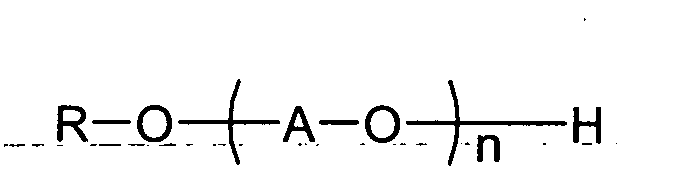 b) das so erhaltene Ethercarbonsäuresalz durch Zugabe einer Säure, wobei der pH-Wert auf 3 oder weniger eingestellt wird, in die freie Ethercarbonsäure überführt,c) die so erhaltene Ethercarbonsäure ohne Waschen durch Destillation unter vermindertem Druck bis zu einem Restwassergehalt von < 0,30 % vom enthaltenen Wasser befreit, undd) die ausfallenden Metallsalze durch Filtration entfernt, so dass das erhaltene Produkt einen Restsalzgehalt von < 0,2 % aufweist.
 - Verfahren gemäß Anspruch 1, wobei A für Propylen oder Ethylen steht.
- Verfahren gemäß Anspruch 1 und/oder 2, wobei n für eine Zahl zwischen 2 und 70 steht.
- Verfahren gemäß einem oder mehreren der Ansprüche 1 bis 3, wobei B für eine Methylengruppe steht.
- Verfahren gemäß einem oder mehreren der Ansprüche 1 bis 4, wobei R für einen C8- bis C24-Alkyl- oder Alkenylrest steht.
- Verfahren gemäß einem oder mehreren der Ansprüche 1 bis 5, wobei in Schritt b) Salzsäure oder Schwefelsäure zur Absäuerung verwendet wird.
- Verfahren zur Herstellung einer Kühlschmiermittelemulsion, wobei eine Ethercarbonsäure nach dem Verfahren gemäß einem oder mehreren der Ansprüche 1 bis 6 hergestellt wird, und das so erhaltene Produkt einem Kühlschmiermittel zugesetzt wird.
- Verwendung der nach dem Verfahren gemäß einem oder mehreren der Ansprüche 1 bis 6 hergestellten Verbindungen der Formel 1 und/oder deren Salze der Formel 2wobei A, n, B und R die in Anspruch 1 angegebene Bedeutung haben, und X ein Kation bedeutet, als Metallbearbeitungsmittel, in Kosmetikformulierungen sowie als Detergenzien in Waschmitteln.

Applications Claiming Priority (2)
| Application Number | Priority Date | Filing Date | Title |
|---|---|---|---|
| DE102004010505 | 2004-03-04 | ||
| DE102004010505A DE102004010505A1 (de) | 2004-03-04 | 2004-03-04 | Verfahren zur lösungsmittelfreien Herstellung von Ethercarbonsäuren mit niedrigem Restsalzgehalt |
Publications (2)
| Publication Number | Publication Date |
|---|---|
| EP1574560A1 true EP1574560A1 (de) | 2005-09-14 |
| EP1574560B1 EP1574560B1 (de) | 2011-01-12 |
Family
ID=34813602
Family Applications (1)
| Application Number | Title | Priority Date | Filing Date |
|---|---|---|---|
| EP05003714A Expired - Lifetime EP1574560B1 (de) | 2004-03-04 | 2005-02-22 | Verfahren zur lösungsmittelfreien Herstellung von Ethercarbonsäuren mit niedrigem Restsalzgehalt |
Country Status (5)
| Country | Link |
|---|---|
| US (1) | US7208118B2 (de) |
| EP (1) | EP1574560B1 (de) |
| JP (1) | JP4990501B2 (de) |
| DE (2) | DE102004010505A1 (de) |
| ES (1) | ES2355567T3 (de) |
Cited By (4)
| Publication number | Priority date | Publication date | Assignee | Title |
|---|---|---|---|---|
| EP2891701A1 (de) * | 2009-08-18 | 2015-07-08 | The Lubrizol Corporation | Schmiermittelzusammensetzung mit einem Korrosionsinhibotor |
| CN105213273A (zh) * | 2015-11-09 | 2016-01-06 | 上海仪玳化妆品有限公司 | 一种柠檬鲜活水及其制备方法与应用 |
| WO2017036578A1 (de) * | 2015-08-13 | 2017-03-09 | Fuchs Petrolub Se | Zusammensetzung zur minimalmengenschmierung und deren verwendung |
| EP3842407A1 (de) | 2019-12-27 | 2021-06-30 | KAO CHEMICALS GmbH | Ether-carbonsäure-zusammensetzung |
Families Citing this family (6)
| Publication number | Priority date | Publication date | Assignee | Title |
|---|---|---|---|---|
| US8802606B2 (en) | 2010-08-06 | 2014-08-12 | Basf Se | Lubricant composition having improved antiwear properties |
| CA2770497C (en) * | 2009-08-07 | 2018-03-06 | Basf Se | Lubricant composition comprising alkylethercarboxylic acid |
| US9605198B2 (en) | 2011-09-15 | 2017-03-28 | Chevron U.S.A. Inc. | Mixed carbon length synthesis of primary Guerbet alcohols |
| US10087155B2 (en) | 2012-12-03 | 2018-10-02 | Koei Chemical Company, Limited | Onium salt, liquid composition containing said onium salt and cellulose, and cellulose recovery method |
| EP3556344B1 (de) | 2018-04-16 | 2025-04-16 | Kao Corporation, S.A. | Kosmetische zusammensetzungen |
| EP4215518A1 (de) | 2022-01-24 | 2023-07-26 | KAO CHEMICALS GmbH | Verfahren zur herstellung von amidierten fettsäuren und derivaten davon |
Citations (2)
| Publication number | Priority date | Publication date | Assignee | Title |
|---|---|---|---|---|
| EP0897906A2 (de) | 1997-02-19 | 1999-02-24 | Nof Corporation | Verfahren zur Herstellung einer Polyoxyalkylencarbonsäure |
| DE19928128C1 (de) | 1999-06-19 | 2000-11-30 | Clariant Gmbh | Verfahren zur Herstellung von Ethercarbonsäuren mit niedrigem Restalkohol |
Family Cites Families (6)
| Publication number | Priority date | Publication date | Assignee | Title |
|---|---|---|---|---|
| DE3230677A1 (de) * | 1982-08-18 | 1984-02-23 | Chemische Werke Hüls AG, 4370 Marl | Verfahren zur herstellung von carboxymethylierten alkoholen, etheralkoholen, thioalkoholen oder alkylphenolen |
| DE3924201A1 (de) * | 1989-07-21 | 1991-01-24 | Henkel Kgaa | Oberflaechenaktive ethercarbonsaeure-polyolester |
| JPH08245499A (ja) * | 1995-03-13 | 1996-09-24 | Kao Corp | エーテルカルボン酸の製法 |
| DE19740954C1 (de) * | 1997-09-17 | 1998-12-24 | Henkel Kgaa | Verfahren zur Herstellung von hellfarbigen Ethercarbonsäuren |
| JP2004509159A (ja) * | 2000-09-22 | 2004-03-25 | グラクソ グループ リミテッド | 新規なアルカン酸誘導体 |
| DE10217208B4 (de) * | 2002-04-18 | 2004-09-16 | Clariant Gmbh | Verwendung von Ethercarbonsäuren mit niedrigem Stockpunkt |
-
2004
- 2004-03-04 DE DE102004010505A patent/DE102004010505A1/de not_active Ceased
-
2005
- 2005-02-22 DE DE502005010825T patent/DE502005010825D1/de not_active Expired - Lifetime
- 2005-02-22 EP EP05003714A patent/EP1574560B1/de not_active Expired - Lifetime
- 2005-02-22 ES ES05003714T patent/ES2355567T3/es not_active Expired - Lifetime
- 2005-03-04 US US11/072,033 patent/US7208118B2/en not_active Expired - Lifetime
- 2005-03-04 JP JP2005060214A patent/JP4990501B2/ja not_active Expired - Lifetime
Patent Citations (3)
| Publication number | Priority date | Publication date | Assignee | Title |
|---|---|---|---|---|
| EP0897906A2 (de) | 1997-02-19 | 1999-02-24 | Nof Corporation | Verfahren zur Herstellung einer Polyoxyalkylencarbonsäure |
| DE19928128C1 (de) | 1999-06-19 | 2000-11-30 | Clariant Gmbh | Verfahren zur Herstellung von Ethercarbonsäuren mit niedrigem Restalkohol |
| EP1061064A1 (de) * | 1999-06-19 | 2000-12-20 | Clariant GmbH | Verfahren zur Herstellung von Ethercarbonsäuren mit niedrigem Restalkoholgehalt |
Cited By (7)
| Publication number | Priority date | Publication date | Assignee | Title |
|---|---|---|---|---|
| EP2891701A1 (de) * | 2009-08-18 | 2015-07-08 | The Lubrizol Corporation | Schmiermittelzusammensetzung mit einem Korrosionsinhibotor |
| WO2017036578A1 (de) * | 2015-08-13 | 2017-03-09 | Fuchs Petrolub Se | Zusammensetzung zur minimalmengenschmierung und deren verwendung |
| CN105213273A (zh) * | 2015-11-09 | 2016-01-06 | 上海仪玳化妆品有限公司 | 一种柠檬鲜活水及其制备方法与应用 |
| CN105213273B (zh) * | 2015-11-09 | 2018-11-13 | 北京工商大学 | 一种柠檬鲜活水及其制备方法与应用 |
| EP3842407A1 (de) | 2019-12-27 | 2021-06-30 | KAO CHEMICALS GmbH | Ether-carbonsäure-zusammensetzung |
| WO2021130316A1 (en) | 2019-12-27 | 2021-07-01 | Kao Chemicals Gmbh | Ether carboxylic acid composition |
| CN114867709A (zh) * | 2019-12-27 | 2022-08-05 | 花王化学品有限责任公司 | 醚羧酸组合物 |
Also Published As
| Publication number | Publication date |
|---|---|
| JP2005247850A (ja) | 2005-09-15 |
| ES2355567T3 (es) | 2011-03-29 |
| JP4990501B2 (ja) | 2012-08-01 |
| DE102004010505A1 (de) | 2005-09-29 |
| EP1574560B1 (de) | 2011-01-12 |
| US7208118B2 (en) | 2007-04-24 |
| DE502005010825D1 (de) | 2011-02-24 |
| US20050197261A1 (en) | 2005-09-08 |
Similar Documents
| Publication | Publication Date | Title |
|---|---|---|
| EP0222311B1 (de) | Verwendung von Alkoxyhydroxyfettsäuren als Korrosionsinhibitoren in Ölen und Ölhaltigen Emulsionen | |
| EP1450004B1 (de) | Additive zur Inhibierung der Gashydratbildung | |
| DE3609401A1 (de) | Wasserloesliche mischungen von fettsaeure-ammonium-salzen und polyolfettsaeuren bzw. deren alkali- oder ammoniumsalzen, verfahren zu ihrer herstellung und ihre verwendung als korrosionsinhibitoren in waessrigen systemen | |
| EP1979508B1 (de) | Korrosionsinhibitoren mit erhöhter biologischer abbaubarkeit und verminderter toxizität | |
| DE2902380C2 (de) | Verwendung von wäßrigen Lösungen von Alkanolaminsalzen von Polyoxyalkylenverbindungen als Schmiermittel | |
| DE102007055265A1 (de) | Verfahren zur Herstellung von Acylglycinaten | |
| EP1574560B1 (de) | Verfahren zur lösungsmittelfreien Herstellung von Ethercarbonsäuren mit niedrigem Restsalzgehalt | |
| DE10217208B4 (de) | Verwendung von Ethercarbonsäuren mit niedrigem Stockpunkt | |
| EP1449940B1 (de) | Korrosions- und Gashydratinhibitoren mit verbesserter Wasserlöslichkeit und erhöhter biologischer Abbaubarkeit | |
| EP1538140B1 (de) | Ethercarbonsäuren auf Basis alkoxylierter Styrylphenole | |
| DD151185A5 (de) | Nicht auf erdoel basierende metallkorrosionsschutzzusammensetzung | |
| EP1452580A1 (de) | Korrosions- und Gashydratinhibitoren mit verbesserter Wasserlöslichkeit und erhöhter biologischer Abbaubarkeit | |
| EP1211238B1 (de) | Verfahren zur Herstellung von Ethanolaminen | |
| DE19930683B4 (de) | Korrosionsinhibitoren mit verbesserter Wasserlöslichkeit | |
| EP0247467A2 (de) | Verwendung von Salzen von Estern langkettiger Fettalkohole mit alpha-Sulfofettsäuren | |
| EP0035702B1 (de) | Schaumdämpfungsmittel, ihre Herstellung und Verwendung in wässrigen Systemen | |
| EP2828419B1 (de) | Wässrige oberflächenaktive und korrosionsschützende zubereitung sowie ölhaltiges, wassermischbares emulsionskonzentrat für die behandlung von metalloberflächen | |
| WO2006058570A1 (de) | Metallreiniger mit polyethylenimin | |
| WO2002092583A1 (de) | Ethercarbonsäuren auf basis von alkoxylierter mercaptobenzthiazole und ihre verwendung als korrosionsinhibutoren | |
| DE10043040A1 (de) | Verwendung von N-Alkyl-beta-alanin-Derivaten zur Herstellung von reinigenden Korrosionsschutzmitteln | |
| EP0231524B1 (de) | Verwendung von Alkylbenzoylacrylsäuren als Korrosionsinhibitoren | |
| EP2111440A1 (de) | Kühlschmierstoff für die wässrige zerspanung von leichtmetallen mit hohem dispergiervermögen | |
| EP2031094A2 (de) | Anionische Tenside enthaltende Korrosionsinhibitoren | |
| EP1027477A1 (de) | METALLBEHANDLUNGSFLÜSSIGKEIT FÜR DEN NEUTRALEN pH-BEREICH | |
| EP1319695A1 (de) | Wässriges alkalisches Entlackungsmittel |
Legal Events
| Date | Code | Title | Description |
|---|---|---|---|
| PUAI | Public reference made under article 153(3) epc to a published international application that has entered the european phase |
Free format text: ORIGINAL CODE: 0009012 |
|
| AK | Designated contracting states |
Kind code of ref document: A1 Designated state(s): AT BE BG CH CY CZ DE DK EE ES FI FR GB GR HU IE IS IT LI LT LU MC NL PL PT RO SE SI SK TR |
|
| AX | Request for extension of the european patent |
Extension state: AL BA HR LV MK YU |
|
| RAP1 | Party data changed (applicant data changed or rights of an application transferred) |
Owner name: CLARIANT PRODUKTE (DEUTSCHLAND) GMBH |
|
| 17P | Request for examination filed |
Effective date: 20060314 |
|
| AKX | Designation fees paid |
Designated state(s): AT BE BG CH CY CZ DE DK EE ES FI FR GB GR HU IE IS IT LI LT LU MC NL PL PT RO SE SI SK TR |
|
| 17Q | First examination report despatched |
Effective date: 20100526 |
|
| GRAP | Despatch of communication of intention to grant a patent |
Free format text: ORIGINAL CODE: EPIDOSNIGR1 |
|
| RIC1 | Information provided on ipc code assigned before grant |
Ipc: C07C 51/367 20060101ALI20100719BHEP Ipc: C07C 59/60 20060101AFI20100719BHEP Ipc: C07C 59/125 20060101ALI20100719BHEP |
|
| GRAS | Grant fee paid |
Free format text: ORIGINAL CODE: EPIDOSNIGR3 |
|
| RBV | Designated contracting states (corrected) |
Designated state(s): AT BE BG CH DE ES FR GB IT LI |
|
| RBV | Designated contracting states (corrected) |
Designated state(s): BE DE ES FR GB IT |
|
| GRAA | (expected) grant |
Free format text: ORIGINAL CODE: 0009210 |
|
| AK | Designated contracting states |
Kind code of ref document: B1 Designated state(s): BE DE ES FR GB IT |
|
| REG | Reference to a national code |
Ref country code: GB Ref legal event code: FG4D Free format text: NOT ENGLISH |
|
| REF | Corresponds to: |
Ref document number: 502005010825 Country of ref document: DE Date of ref document: 20110224 Kind code of ref document: P |
|
| REG | Reference to a national code |
Ref country code: DE Ref legal event code: R096 Ref document number: 502005010825 Country of ref document: DE Effective date: 20110224 |
|
| REG | Reference to a national code |
Ref country code: ES Ref legal event code: FG2A Ref document number: 2355567 Country of ref document: ES Kind code of ref document: T3 Effective date: 20110329 |
|
| PLBI | Opposition filed |
Free format text: ORIGINAL CODE: 0009260 |
|
| 26 | Opposition filed |
Opponent name: KAO CORPORATION S.A. Effective date: 20111012 |
|
| PLAX | Notice of opposition and request to file observation + time limit sent |
Free format text: ORIGINAL CODE: EPIDOSNOBS2 |
|
| REG | Reference to a national code |
Ref country code: DE Ref legal event code: R026 Ref document number: 502005010825 Country of ref document: DE Effective date: 20111012 |
|
| PLAF | Information modified related to communication of a notice of opposition and request to file observations + time limit |
Free format text: ORIGINAL CODE: EPIDOSCOBS2 |
|
| PLBB | Reply of patent proprietor to notice(s) of opposition received |
Free format text: ORIGINAL CODE: EPIDOSNOBS3 |
|
| PLAB | Opposition data, opponent's data or that of the opponent's representative modified |
Free format text: ORIGINAL CODE: 0009299OPPO |
|
| R26 | Opposition filed (corrected) |
Opponent name: KAO CORPORATION S.A. Effective date: 20111012 |
|
| RDAF | Communication despatched that patent is revoked |
Free format text: ORIGINAL CODE: EPIDOSNREV1 |
|
| APBM | Appeal reference recorded |
Free format text: ORIGINAL CODE: EPIDOSNREFNO |
|
| APBP | Date of receipt of notice of appeal recorded |
Free format text: ORIGINAL CODE: EPIDOSNNOA2O |
|
| APAH | Appeal reference modified |
Free format text: ORIGINAL CODE: EPIDOSCREFNO |
|
| APBQ | Date of receipt of statement of grounds of appeal recorded |
Free format text: ORIGINAL CODE: EPIDOSNNOA3O |
|
| REG | Reference to a national code |
Ref country code: FR Ref legal event code: PLFP Year of fee payment: 12 |
|
| REG | Reference to a national code |
Ref country code: FR Ref legal event code: PLFP Year of fee payment: 13 |
|
| REG | Reference to a national code |
Ref country code: FR Ref legal event code: PLFP Year of fee payment: 14 |
|
| REG | Reference to a national code |
Ref country code: DE Ref legal event code: R100 Ref document number: 502005010825 Country of ref document: DE |
|
| APBU | Appeal procedure closed |
Free format text: ORIGINAL CODE: EPIDOSNNOA9O |
|
| PLCK | Communication despatched that opposition was rejected |
Free format text: ORIGINAL CODE: EPIDOSNREJ1 |
|
| PLBN | Opposition rejected |
Free format text: ORIGINAL CODE: 0009273 |
|
| 27O | Opposition rejected |
Effective date: 20190212 |
|
| P01 | Opt-out of the competence of the unified patent court (upc) registered |
Effective date: 20230505 |
|
| PGFP | Annual fee paid to national office [announced via postgrant information from national office to epo] |
Ref country code: ES Payment date: 20240307 Year of fee payment: 20 |
|
| PGFP | Annual fee paid to national office [announced via postgrant information from national office to epo] |
Ref country code: DE Payment date: 20240228 Year of fee payment: 20 Ref country code: GB Payment date: 20240220 Year of fee payment: 20 |
|
| PGFP | Annual fee paid to national office [announced via postgrant information from national office to epo] |
Ref country code: IT Payment date: 20240222 Year of fee payment: 20 Ref country code: FR Payment date: 20240226 Year of fee payment: 20 Ref country code: BE Payment date: 20240226 Year of fee payment: 20 |
|
| REG | Reference to a national code |
Ref country code: DE Ref legal event code: R071 Ref document number: 502005010825 Country of ref document: DE |
|
| REG | Reference to a national code |
Ref country code: ES Ref legal event code: FD2A Effective date: 20250228 |
|
| REG | Reference to a national code |
Ref country code: GB Ref legal event code: PE20 Expiry date: 20250221 |
|
| PG25 | Lapsed in a contracting state [announced via postgrant information from national office to epo] |
Ref country code: ES Free format text: LAPSE BECAUSE OF EXPIRATION OF PROTECTION Effective date: 20250223 |
|
| PG25 | Lapsed in a contracting state [announced via postgrant information from national office to epo] |
Ref country code: GB Free format text: LAPSE BECAUSE OF EXPIRATION OF PROTECTION Effective date: 20250221 |
|
| REG | Reference to a national code |
Ref country code: BE Ref legal event code: MK Effective date: 20250222 |