EP1574423A1 - Vorderbau für ein Kraftfahrzeug - Google Patents
Vorderbau für ein Kraftfahrzeug Download PDFInfo
- Publication number
- EP1574423A1 EP1574423A1 EP05004096A EP05004096A EP1574423A1 EP 1574423 A1 EP1574423 A1 EP 1574423A1 EP 05004096 A EP05004096 A EP 05004096A EP 05004096 A EP05004096 A EP 05004096A EP 1574423 A1 EP1574423 A1 EP 1574423A1
- Authority
- EP
- European Patent Office
- Prior art keywords
- fender
- front structure
- filler
- body part
- deformation
- Prior art date
- Legal status (The legal status is an assumption and is not a legal conclusion. Google has not performed a legal analysis and makes no representation as to the accuracy of the status listed.)
- Granted
Links
- 239000000945 filler Substances 0.000 claims abstract description 64
- 239000002184 metal Substances 0.000 claims abstract description 8
- 239000004033 plastic Substances 0.000 claims abstract description 6
- 229920001971 elastomer Polymers 0.000 claims description 3
- 230000001747 exhibiting effect Effects 0.000 claims 1
- 238000010276 construction Methods 0.000 description 8
- 238000002485 combustion reaction Methods 0.000 description 3
- 239000000853 adhesive Substances 0.000 description 2
- 230000001070 adhesive effect Effects 0.000 description 2
- 239000007789 gas Substances 0.000 description 2
- 238000003466 welding Methods 0.000 description 2
- QNRATNLHPGXHMA-XZHTYLCXSA-N (r)-(6-ethoxyquinolin-4-yl)-[(2s,4s,5r)-5-ethyl-1-azabicyclo[2.2.2]octan-2-yl]methanol;hydrochloride Chemical compound Cl.C([C@H]([C@H](C1)CC)C2)CN1[C@@H]2[C@H](O)C1=CC=NC2=CC=C(OCC)C=C21 QNRATNLHPGXHMA-XZHTYLCXSA-N 0.000 description 1
- 239000011324 bead Substances 0.000 description 1
- 230000005540 biological transmission Effects 0.000 description 1
- 229920001821 foam rubber Polymers 0.000 description 1
- 238000009413 insulation Methods 0.000 description 1
- 238000004519 manufacturing process Methods 0.000 description 1
- 239000000463 material Substances 0.000 description 1
Images

Classifications
-
- B—PERFORMING OPERATIONS; TRANSPORTING
- B60—VEHICLES IN GENERAL
- B60R—VEHICLES, VEHICLE FITTINGS, OR VEHICLE PARTS, NOT OTHERWISE PROVIDED FOR
- B60R21/00—Arrangements or fittings on vehicles for protecting or preventing injuries to occupants or pedestrians in case of accidents or other traffic risks
- B60R21/34—Protecting non-occupants of a vehicle, e.g. pedestrians
-
- B—PERFORMING OPERATIONS; TRANSPORTING
- B62—LAND VEHICLES FOR TRAVELLING OTHERWISE THAN ON RAILS
- B62D—MOTOR VEHICLES; TRAILERS
- B62D25/00—Superstructure or monocoque structure sub-units; Parts or details thereof not otherwise provided for
- B62D25/08—Front or rear portions
- B62D25/16—Mud-guards or wings; Wheel cover panels
- B62D25/163—Mounting devices
-
- B—PERFORMING OPERATIONS; TRANSPORTING
- B60—VEHICLES IN GENERAL
- B60R—VEHICLES, VEHICLE FITTINGS, OR VEHICLE PARTS, NOT OTHERWISE PROVIDED FOR
- B60R21/00—Arrangements or fittings on vehicles for protecting or preventing injuries to occupants or pedestrians in case of accidents or other traffic risks
- B60R21/34—Protecting non-occupants of a vehicle, e.g. pedestrians
- B60R2021/343—Protecting non-occupants of a vehicle, e.g. pedestrians using deformable body panel, bodywork or components
Definitions
- the invention relates to a front construction for a Motor vehicle with seen in the intended direction of travel front fenders, with one at a distance below the fenders arranged body part and with a between the Body part and the fenders arranged deformation device.
- Such a front end is for example from the DE 29 34 060 A1 known.
- the deformation device of this front construction has a semi-circular curved in cross-section Sheet metal between the inner edge of the fender and the underneath lying body part. Beats in an accident the Head of a pedestrian vertical to the fender, takes the Deformation the impact energy, causing the Head impact should be soft.
- EP 1 129 928 B1 a front construction become known, in which the deformation device also a semicircular, the fender vertical supporting Sheet metal as well as a between the body part and a Side of the wing has arranged supporting part.
- EP 1 132 263 A1 a fender arrangement known for a motor vehicle, in which a plate connected to the fender several individual tabs has as deformation members. That's the deformation links having sheet metal is about an adhesive bead with connected to the fender and supports it from the side.
- a disadvantage of the fender arrangement is that a inaccurate adhesive application to a deformation of the fender can lead. Continue to penetrate in this fender arrangement between the flaps engine noise to the outside.
- the invention is based on the problem, a Front of the type mentioned above to be designed so that he designed sufficiently resilient in a pedestrian impact is, but has sufficient stability during operation.
- the deformation device is a resilient, made of plastic manufactured filler and that the filler a gap between the body part and the fender closes.
- This design allows the rigidity the deformation device at the individual points of the fender by a corresponding embodiment of the filler to adjust.
- the filler can support the fender flat and thus occurring during operation of the motor vehicle To absorb forces.
- An additional panel to be arranged to prevent leakage of engine noise between the fender and the body part is thanks to the invention not necessary, because the filler with appropriate choice of material soundproofing and can be designed by the Deformation members generated gap between the body part and fenders concealed.
- the deformation device only the filler on.
- the deformation device carries it according to an advantageous Further development of the invention, when the deformation device made of sheet metal deformation members and if the filler between the deformation members is arranged. Through this design can be in addition to the filler, the deformation members made of sheet metal order at designated locations where one exclusive support by the filler only inadequate is.
- the assembly of the front building according to the invention requires a particularly low cost when the filler is made in one piece.
- the filler can according to an advantageous development the invention a transmission of sound very strongly dam when the filler at its on the fender adjacent side has a layer of sponge rubber.
- Front construction contributes to it, if the filler with glued to the body part and / or the fender.
- An abutment of the fenders to one between the Fenders arranged hood by leaning or a Laundry of the motor vehicle can be according to another advantageous Simply avoid development of the invention when the filler laterally supports the fender.
- the filler In order to takes the filler introduced laterally into the fender Forces up.
- the filler is at least partially between the side area of the fenders and the body part to arrange.
- a leakage of engine compartment gases between the fender and the body part can be according to another simply avoid an advantageous development of the invention if the filler the space between the fender and the Closes body part gas-tight.
- Determining the stability of the filler at A head impact on the fender is designed according to a another advantageous embodiment of the invention particularly easy if the filler has deformation bars.
- the deformation bars can, for example, honeycomb or circular segment or formed as a vertical buckling bars be.
- the Deformationsstege can be according to another advantageous development of the invention with very large Dimensions provided and up in the side area of the fender lead, if a section having the deformation webs of the filler between bolting with the Fender and / or the body part is arranged.
- the filler has according to another advantageous Development of the invention in the horizontal direction a high stability and in the vertical direction a nearly arbitrary adjustable stability on when the deformation bars vertically inclined from the fender to the body part and guided horizontally up to the side area of the fender are.
- the filler can be according to another advantageous Development of the invention, at least in some areas provided with a high elasticity when the filler has a wavy structure, with corrugations of the Filler parallel to the edge adjacent to the fender edge are arranged.
- Front construction contributes, if the filler to Mounting of components to be laid in an engine compartment has provided retaining means.
- the Holding means formed as brackets. Leave in these brackets For example, harnesses and Bowden cables lock.
- Various components can be in the invention Easy to accommodate the front if the filler is a having a hood concealed chamber. Through this design can be, for example, the Bowden cables or wiring harnesses place in the filler.
- the fitting of the filler requires according to a another advantageous embodiment of the invention a particular little effort when the bezel over a film hinge connected to a lateral boundary of the chamber is.
- the stiffness of the deformation device leaves according to another advantageous embodiment of the invention just adjust when the deformation links a U-shaped bent section, with its base attached to the fender and with legs on the body part to assign.
- a plastic deformation of the deformation device can be according to another advantageous development
- the invention simply avoid when the s.den Base remote ends of the legs of the U-shaped section the deformation members parallel to the body part connect led sections and when connected to the parallel guided sections attributed to the body part Connect leg.
- the run parallel to the fender Sections allow a slight elastic Compliance of the deformation members.
- the deformation members can be according to another advantageous embodiment of the invention particularly cost, for example, by spot welding on the Mount mudguard when the deformation links are at one, arranged the hood facing the boundary of the fender Water channel are attached. Such a water channel is from the hood is concealed and is thus in the assembled state of Motor vehicle not to see.
- the front of the invention designed constructively especially simple when the deformation members as individual, attached to the fender and the body part Building parts are formed. Furthermore, the production allows the deformation members as individual components a particular easy determination of the stability of the deformation device.
- Figure 1 shows a right portion of a front structure 1 of a motor vehicle in cross-section and a on the front 1 subsequent windscreen 2.
- the front 1 has a pivotally mounted on a hinge 3 hood 4, which in its drawn position a schematic shown internal combustion engine 5 of the motor vehicle covered.
- a fender 6 limited.
- the fender 6 is also at a schematically illustrated body part 7 via a deformation device 8 attached.
- the fender 6 has a water channel 9. A lateral boundary the hood 4 protrudes into the water channel 9.
- the deformation device 8 has a made of sheet metal Deformation member 10 and a made of plastic Filler 11.
- the filler 11 supports the side area of the fender 6 on the body part 7 from.
- the deformation member 10 is attached to the underside of the water channel 9 and supports vertically acting on the fender 6 Forces on the body part 7 from.
- the filler 11 is in a space between the fender 6 and the body part. 7 glued and gives the fender 6 the necessary lateral Rigidity. At the same time, it seals the room of Internal combustion engine 5 against escaping gases and sound.
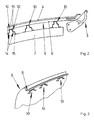
- FIG. 2 shows the front construction from FIG. 1 in one Sectional view along the line II - II recognize that several individual deformation members 10 between the fender 6 and the hood 4 are attached.
- the deformation members 10 are spaced from each other.
- the deformation members 10 each have a U-shaped section 12.
- the base of the U-shaped Section 12 is at the bottom of the water channel 9 of the Mudguard 6, for example, fixed by spot welding.
- opposite ends of the legs 13 of the U-shaped portion 12 are parallel to the body part 7 guided sections 14 arranged.
- At the parallel to the Body part guided sections 14 close up the body part 7 tapered legs 15 whose free Ends are connected to the body part 7.
- FIG. 3 shows a perspective sectional view a portion of the fender 6 of Figures 1 and 2 with the deformation members 10 attached thereto Simplification of the drawing is the filler 11 of Figure 1 not shown. It can be seen here that the deformation members 10 exclusively in the area of the water channel 9 of the fender 6 are arranged and thus vertically in the Mudguard dampen 6 initiated forces. Such forces can occur during a head impact of a pedestrian.
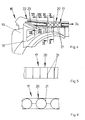
- FIG. 4 shows a perspective view of a further embodiment of the front structure 16, in which a deformation device 34 has a filler 17 made of plastic and a gap between a body part 18 and a Fender 19 seen from the engine compartment side closes.
- the filler 17 has a portion 20 with deformation webs 21 and a portion 22 with corrugations 23.
- the Deformation webs 21 are rhombic to each other and vertical arranged inclined and extend horizontally to near to the inside of the fender 19th
- FIG. 5 shows an alternative embodiment of the invention Filler 17 of Figure 4 with the deformation bars 21st having section 20.
- the deformation webs 21 are here arranged vertically and thus formed as buckling bars. at vertical load buckling the deformation webs 21 and therefore allow a yielding of the illustrated in Figure 4 Fender 19 in a head impact of a pedestrian.
- figure Fig. 6 shows a further embodiment of the deformation webs 21 having portion 20 of the filler 17 of FIG 4.
- the deformation webs 21 are arranged here in a circle segment shape.
- the trained as buckling rods or circular segment arranged deformation webs 21 may alternatively or in addition to those shown in Figure 4, diamond-shaped arranged deformation ribs 21 may be provided.
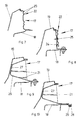
- Figure 7 shows an enlarged sectional view through the filler 17 of Figure 4 with adjacent areas the fender 19 and the body part 18 along the line VII - VII. It can be seen here that the corrugations 23 the wave-shaped portion 22 of the filler 17 in parallel arranged to the fender 19 facing the boundary are. These corrugations 23 allows folding of the filler 17 in a head impact of a pedestrian on the fender 19th
- Figure 8 shows an enlarged sectional view through the front 16 of Figure 4 along the line VIII - VIII in the region of attachment of the fender 19 at the Body part 18.
- the fender 19 is integral with a up to the body part 18 guided deformation member 24th manufactured.
- the deformation member 24 is connected to the body part 18 bolted.
- the filler 17 is above a clip 25th attached to the deformation member 24.
- Figure 9 shows an enlarged sectional view through the filler 17 of Figure 4 along the line IX - IX in the region of its attachment to the body part 18.
- the filler 17 is an arcuate Wall 26 has and the deformation webs 21 within the arcuate Wall 26 are arranged.
- the arched wall 26 is bolted to the body part 18 and is on his the fender 19 laterally supporting area with a Layer of sponge rubber 27 pasted.
- Figure 10 shows enlarged in a sectional view through the front 16 of Figure 4 along the line X - X, that a bracket-shaped holding means 28 integral with the Filler 17 is made.
- the holding means 28 holds one in the front 16 routed harness 29 or Bowden cable.
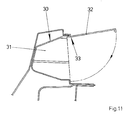
- FIG. 11 shows a cross section through a filling piece 30, which differs from that of FIG. 4 only in that that a chamber 31 for receiving any, not shown components of a panel 32 closed is.
- the diaphragm 32 is connected via a film hinge 33 at the Filler 30 hinged and can be locked on this.
Landscapes
- Engineering & Computer Science (AREA)
- Mechanical Engineering (AREA)
- Chemical & Material Sciences (AREA)
- Combustion & Propulsion (AREA)
- Transportation (AREA)
- Body Structure For Vehicles (AREA)
- Glass Compositions (AREA)
- Vehicle Body Suspensions (AREA)
- Fluid-Damping Devices (AREA)
Abstract
Description
- Fig. 1
- einen rechten Teilbereich eines erfindungsgemäßen Vorderbaus eines Kraftfahrzeuges im Querschnitt,
- Fig. 2
- eine Schnittdarstellung durch den erfindungsgemäßen Vorderbau aus Figur 1 entlang der Linie II - II,
- Fig. 3
- eine perspektivische Darstellung eines Kotflügels des erfindungsgemäßen Vorderbaus vor der Montage,
- Fig. 4
- eine perspektivische Darstellung einer weiteren Ausführungsform des erfindungsgemäßen Vorderbaus,
- Fig. 5
- eine alternative Ausführungsform eines Füllstücks aus Figur 4,
- Fig. 6
- eine alternative Ausführungsform des Füllstücks aus Figur 4,
- Fig. 7
- eine vergrößerte Schnittdarstellung durch den Vorderbau aus Figur 4 entlang der Linie VII - VII,
- Fig. 8
- eine vergrößerte Schnittdarstellung durch den Vorderbau aus Figur 4 entlang der Linie VIII - VIII,
- Fig. 9
- eine vergrößerte Schnittdarstellung durch den Vorderbau aus Figur 4 entlang der Linie IX - IX,
- Fig. 10
- eine vergrößerte Schnittdarstellung durch den Vorderbau aus Figur 4 entlang der Linie X - X,
- Fig. 11
- einen Querschnitt durch eine weitere Ausführungsform des Füllstücks aus Figur 4.
- 1
- Vorderbau
- 2
- Frontscheibe
- 3
- Scharnier
- 4
- Haube
- 5
- Brennkraftmaschine
- 6
- Kotflügel
- 7
- Krosserieteil
- 8
- Deformationseinrichtung
- 9
- Wasserkanal
- 10
- Deformationsglied
- 11
- Füllstück
- 12
- Abschnitt
- 13
- Schenkel
- 14
- Abschnitt
- 15
- Schenkel
- 16
- Vorderbau
- 17
- Füllstück
- 18
- Krosserieteil
- 19
- Kotflügel
- 20
- Abschnitt
- 21
- Deformationssteg
- 22
- Abschnitt
- 23
- Wellung
- 24
- Deformationsglied
- 25
- Klipp
- 26
- Wandung
- 27
- Moosgummi
- 28
- Haltemittel
- 29
- Kabelbaum
- 30
- Füllstück
- 31
- Kammer
- 32
- Blende
- 33
- Filmscharnier
- 34
- Deformationseinrichtung
Claims (21)
- Vorderbau (1, 16) für ein Kraftfahrzeug mit in der vorgesehenen Fahrtrichtung gesehen vorderen Kotflügeln (6, 19), mit einem auf Abstand unterhalb der Kotflügel (6, 19) angeordneten Karosserieteil (7, 18) und mit einer zwischen dem Karosserieteil (7, 18) und den Kotflügeln (6, 19) angeordneten Deformationseinrichtung (8, 34), dadurch gekennzeichnet, dass die Deformationseinrichtung (8, 34) ein nachgiebiges, aus Kunststoff gefertigtes Füllstück (11, 17, 30) aufweist und dass das Füllstück (11, 17, 30) einen Spalt zwischen dem Karosserieteil (7, 18) und dem Kotflügel (6, 19) verschließt.
- Vorderbau (1, 16) nach Anspruch 1, dadurch gekennzeichnet, dass die Deformationseinrichtung (8, 34) aus Blech gefertigte Deformationsglieder (10, 24) aufweist und dass das Füllstück (11, 17, 30) zwischen den Deformationsgliedern (10, 24) angeordnet ist.
- Vorderbau (1, 16) nach Anspruch 1 oder 2, dadurch gekennzeichnet, dass sich das Füllstück (11, 17, 30) in Fahrtrichtung gesehen über die gesamte Länge des Kotflügels (6, 19) erstreckt.
- Vorderbau (1, 16) nach zumindest einem der vorhergehenden Ansprüche, dadurch gekennzeichnet, dass das Füllstück (11, 17, 30) einstückig gefertigt ist.
- Vorderbau (16) nach zumindest einem der vorhergehenden Ansprüche, dadurch gekennzeichnet, dass das Füllstück (17) an seiner an dem Kotflügel (19) anliegenden Seite eine Schicht Moosgummi (27) aufweist.
- Vorderbau (1, 16) nach zumindest einem der vorhergehenden Ansprüche, dadurch gekennzeichnet, dass das Füllstück (11, 17, 30) mit dem Karosserieteil (7, 18) und/oder dem Kotflügel (6, 19) verklebt ist.
- Vorderbau (1, 16) nach zumindest einem der vorhergehenden Ansprüche, dadurch gekennzeichnet, dass das Füllstück (11, 17, 30) den Kotflügel (7, 19) seitlich abstützt.
- Vorderbau (1, 16) nach zumindest einem der vorhergehenden Ansprüche, dadurch gekennzeichnet, dass das Füllstück (11, 17, 30) den Raum zwischen dem Kotflügel (6, 19) und dem Karosserieteil (7, 18) gasdicht verschließt.
- Vorderbau (16) nach zumindest einem der vorhergehenden Ansprüche, dadurch gekennzeichnet, dass das Füllstück (17, 30) Deformationsstege (21) aufweist.
- Vorderbau (16) nach zumindest einem der vorhergehenden Ansprüche, dadurch gekennzeichnet, dass ein die Deformationsstege (21) aufweisender Abschnitt (20) des Füllstücks (17, 30) zwischen Verschraubungsstellen mit dem Kotflügel (19) und/oder dem Karosserieteil (18) angeordnet ist.
- Vorderbau (16) nach zumindest einem der vorhergehenden Ansprüche, dadurch gekennzeichnet, dass die Deformationsstege (21) vertikal geneigt von dem Kotflügel (19) zu dem Karosserieteil (18) und horizontal bis zu dem Seitenbereich des Kotflügels (19) geführt sind.
- Vorderbau (16) nach zumindest einem der vorhergehenden Ansprüche, dadurch gekennzeichnet, dass das Füllstück (17) eine wellenförmige Struktur hat, wobei Wellungen (23) des Füllstücks (17) parallel zu der an den Kotflügel (19) angrenzenden Kante angeordnet sind.
- Vorderbau (16) nach zumindest einem der vorhergehenden Ansprüche, dadurch gekennzeichnet, dass das Füllstück (17) mit dem Karosserieteil (18) und/oder dem Kotflügel (19) verschraubt ist.
- Vorderbau (16) nach zumindest einem der vorhergehenden Ansprüche, dadurch gekennzeichnet, dass das Füllstück (17) zur Halterung von in einem Motorraum zu verlegenden Bauteilen vorgesehene Haltemittel (28) hat.
- Vorderbau (16) nach zumindest einem der vorhergehenden Ansprüche, dadurch gekennzeichnet, dass das Füllstück (30) eine von einer Blende (32) verdeckte Kammer (31) aufweist.
- Vorderbau (16) nach zumindest einem der vorhergehenden Ansprüche, dadurch gekennzeichnet, dass die Blende (32) über ein Filmscharnier (33) mit einer seitlichen Begrenzung der Kammer (31) verbunden ist.
- Vorderbau (16) nach zumindest einem der vorhergehenden Ansprüche, dadurch gekennzeichnet, dass die Deformationsglieder (10) einen U-förmig gebogenen Abschnitt (12) aufweisen, mit ihrer Basis an dem Kotflügel (6) befestigt sind und mit Schenkeln (13) auf das Karosserieteil (7) zuweisen.
- Vorderbau (16) nach zumindest einem der vorhergehenden Ansprüche, dadurch gekennzeichnet, dass sich an den der Basis abgewandten Enden der Schenkel (13) des U-förmigen Abschnitts (12) der Deformationsglieder (10) parallel zu dem Karosserieteil (7) geführte Abschnitte (14) anschließen und dass sich an den parallel geführten Abschnitten (14) auf das Karosserieteil (7) zuweisende Schenkel (15) anschließen.
- Vorderbau (16) nach zumindest einem der vorhergehenden Ansprüche, dadurch gekennzeichnet, dass die Deformationsglieder (10) den Kotflügel (6) ausschließlich vertikal abstützen.
- Vorderbau (16) nach zumindest einem der vorhergehenden Ansprüche, dadurch gekennzeichnet, dass die Deformationsglieder (10) als einzelne, an dem Kotflügel (6) und dem Karosserieteil (7) befestigte Bauteile ausgebildet sind.
- Vorderbau (16) nach zumindest einem der vorhergehenden Ansprüche, dadurch gekennzeichnet, dass die Deformationsglieder (10) an einem, der Haube (4) zugewandten Begrenzung der Kotflügel (6) angeordneten Wasserkanal (9) befestigt sind.
Applications Claiming Priority (2)
| Application Number | Priority Date | Filing Date | Title |
|---|---|---|---|
| DE102004011333 | 2004-03-09 | ||
| DE102004011333A DE102004011333A1 (de) | 2004-03-09 | 2004-03-09 | Vorderbau für ein Kraftfahrzeug |
Publications (2)
| Publication Number | Publication Date |
|---|---|
| EP1574423A1 true EP1574423A1 (de) | 2005-09-14 |
| EP1574423B1 EP1574423B1 (de) | 2008-03-26 |
Family
ID=34813623
Family Applications (1)
| Application Number | Title | Priority Date | Filing Date |
|---|---|---|---|
| EP05004096A Expired - Lifetime EP1574423B1 (de) | 2004-03-09 | 2005-02-25 | Vorderbau für ein Kraftfahrzeug |
Country Status (3)
| Country | Link |
|---|---|
| EP (1) | EP1574423B1 (de) |
| AT (1) | ATE390342T1 (de) |
| DE (2) | DE102004011333A1 (de) |
Cited By (3)
| Publication number | Priority date | Publication date | Assignee | Title |
|---|---|---|---|---|
| WO2007003440A1 (de) * | 2005-07-06 | 2007-01-11 | Peguform Gmbh | Vorderwagenstruktur eines kraftfahrzeuges |
| FR2899554A1 (fr) * | 2006-04-11 | 2007-10-12 | Peugeot Citroen Automobiles Sa | Bloc avant d'un vehicule automobile et piece de support d'une aile laterale avant d'un tel vehicule |
| FR2911106A1 (fr) * | 2007-01-09 | 2008-07-11 | Renault Sas | Support destine a la fixation d'un element de carrosserie en matiere plastique sur la structure d'un vehicule, element de carrosserie correspondant et utilisation du support. |
Families Citing this family (1)
| Publication number | Priority date | Publication date | Assignee | Title |
|---|---|---|---|---|
| DE102010016213B4 (de) | 2010-03-30 | 2024-09-05 | Dr. Ing. H.C. F. Porsche Aktiengesellschaft | Kraftfahrzeug |
Citations (7)
| Publication number | Priority date | Publication date | Assignee | Title |
|---|---|---|---|---|
| EP1090818A2 (de) * | 1999-10-09 | 2001-04-11 | Volkswagen Aktiengesellschaft | Fussgängerfreundlich ausgelegtes Kraftfahrzeug-Frontend |
| EP1106448A2 (de) * | 1999-12-10 | 2001-06-13 | Volkswagen Aktiengesellschaft | Fahrzeugseitenblech mit aufprallweicher Aussenkante |
| JP2001199366A (ja) * | 2000-12-20 | 2001-07-24 | Toyota Motor Corp | 自動車のフェンダー構造 |
| GB2362615A (en) * | 2000-05-23 | 2001-11-28 | Corus Uk Ltd | A collapsible fixing for attaching a vehicle fender, wing or bonnet to a vehicle body |
| US20020063443A1 (en) * | 2000-11-30 | 2002-05-30 | Wan-Young Lee | Fender panel impact absorption structure of vehicle having walker protection function |
| DE10233474A1 (de) * | 2002-07-24 | 2004-02-26 | Volkswagen Ag | Kotflügel an Kraftfahrzeugen |
| DE10309958A1 (de) * | 2003-03-07 | 2004-09-23 | Dr.Ing.H.C. F. Porsche Ag | Kraftfahrzeug mit einer Fußgängerschutzeinrichtung sowie Verfahren zum Betreiben einer Fußgängerschutzeinrichtung an einem solchen Kraftfahrzeug |
Family Cites Families (8)
| Publication number | Priority date | Publication date | Assignee | Title |
|---|---|---|---|---|
| DE2934060A1 (de) * | 1979-08-23 | 1981-03-26 | Daimler-Benz Aktiengesellschaft, 70567 Stuttgart | Kraftfahrzeug, insbesondere personenkraftwagen, mit nachgiebigen karosseriefrontteilen |
| DE10009363A1 (de) * | 2000-02-29 | 2001-08-30 | Volkswagen Ag | Kotflügelanordnung für ein Kraftfahrzeug |
| DE10009364A1 (de) * | 2000-02-29 | 2001-08-30 | Volkswagen Ag | Kotflügelanordnung für ein Kraftfahrzeug |
| DE10102187A1 (de) * | 2001-01-16 | 2002-08-01 | Volkswagen Ag | Aufpralldämpfender Kotflügel für ein Fahrzeug |
| JP4762438B2 (ja) * | 2001-05-18 | 2011-08-31 | 富士重工業株式会社 | 車両の前部車体構造 |
| DE10206768B4 (de) * | 2002-02-19 | 2005-11-17 | Daimlerchrysler Ag | Kotflügelanordnung für ein Kraftfahrzeug |
| US6846026B2 (en) * | 2002-02-28 | 2005-01-25 | Honda Giken Kogyo Kabushiki Kaisha | Vehicle pedestrian safety bumper system |
| DE10244455A1 (de) * | 2002-09-24 | 2004-05-13 | Volkswagen Ag | Kotflügelaufbau an Kraftfahrzeugen |
-
2004
- 2004-03-09 DE DE102004011333A patent/DE102004011333A1/de not_active Withdrawn
-
2005
- 2005-02-25 DE DE502005003410T patent/DE502005003410D1/de not_active Expired - Lifetime
- 2005-02-25 EP EP05004096A patent/EP1574423B1/de not_active Expired - Lifetime
- 2005-02-25 AT AT05004096T patent/ATE390342T1/de not_active IP Right Cessation
Patent Citations (7)
| Publication number | Priority date | Publication date | Assignee | Title |
|---|---|---|---|---|
| EP1090818A2 (de) * | 1999-10-09 | 2001-04-11 | Volkswagen Aktiengesellschaft | Fussgängerfreundlich ausgelegtes Kraftfahrzeug-Frontend |
| EP1106448A2 (de) * | 1999-12-10 | 2001-06-13 | Volkswagen Aktiengesellschaft | Fahrzeugseitenblech mit aufprallweicher Aussenkante |
| GB2362615A (en) * | 2000-05-23 | 2001-11-28 | Corus Uk Ltd | A collapsible fixing for attaching a vehicle fender, wing or bonnet to a vehicle body |
| US20020063443A1 (en) * | 2000-11-30 | 2002-05-30 | Wan-Young Lee | Fender panel impact absorption structure of vehicle having walker protection function |
| JP2001199366A (ja) * | 2000-12-20 | 2001-07-24 | Toyota Motor Corp | 自動車のフェンダー構造 |
| DE10233474A1 (de) * | 2002-07-24 | 2004-02-26 | Volkswagen Ag | Kotflügel an Kraftfahrzeugen |
| DE10309958A1 (de) * | 2003-03-07 | 2004-09-23 | Dr.Ing.H.C. F. Porsche Ag | Kraftfahrzeug mit einer Fußgängerschutzeinrichtung sowie Verfahren zum Betreiben einer Fußgängerschutzeinrichtung an einem solchen Kraftfahrzeug |
Non-Patent Citations (1)
| Title |
|---|
| PATENT ABSTRACTS OF JAPAN vol. 2000, no. 24 11 May 2001 (2001-05-11) * |
Cited By (6)
| Publication number | Priority date | Publication date | Assignee | Title |
|---|---|---|---|---|
| WO2007003440A1 (de) * | 2005-07-06 | 2007-01-11 | Peguform Gmbh | Vorderwagenstruktur eines kraftfahrzeuges |
| DE102005031843C5 (de) * | 2005-07-06 | 2009-05-20 | Peguform Gmbh | Vorderwagenstruktur eines Kraftfahrzeuges |
| US7828374B2 (en) | 2005-07-06 | 2010-11-09 | Peguform Gmbh | Structure of the front part of a motor vehicle |
| FR2899554A1 (fr) * | 2006-04-11 | 2007-10-12 | Peugeot Citroen Automobiles Sa | Bloc avant d'un vehicule automobile et piece de support d'une aile laterale avant d'un tel vehicule |
| WO2007116145A1 (fr) | 2006-04-11 | 2007-10-18 | Peugeot Citroen Automobiles Sa | Bloc avant d'un vehicule automobile et piece de support d'une aile laterale avant d'un tel vehicule |
| FR2911106A1 (fr) * | 2007-01-09 | 2008-07-11 | Renault Sas | Support destine a la fixation d'un element de carrosserie en matiere plastique sur la structure d'un vehicule, element de carrosserie correspondant et utilisation du support. |
Also Published As
| Publication number | Publication date |
|---|---|
| DE102004011333A1 (de) | 2005-09-22 |
| ATE390342T1 (de) | 2008-04-15 |
| DE502005003410D1 (de) | 2008-05-08 |
| EP1574423B1 (de) | 2008-03-26 |
Similar Documents
| Publication | Publication Date | Title |
|---|---|---|
| DE69808340T2 (de) | Kraftfahrzeug und dafür vorgesehene Bodenplatte zum Schutz des Motorblocks | |
| DE102009057778B4 (de) | Fahrzeug-Auspuffendanordnung | |
| DE102007003535B4 (de) | Dachseitenverkleidungsumfangsstruktur eines Kraftfahrzeuges | |
| DE69925954T2 (de) | Stufenlos nachgiebiger, energieabsorbierender, gepfeilter Bogen für Innenverkleidung | |
| DE102008049762A1 (de) | Vorderbau für ein Kraftfahrzeug | |
| EP3873758B1 (de) | Anordnung eines luftführungselementes aus schaumstoff an einem kühlerelement sowie kühlerelement und luftführungselement aus schaumstoff | |
| DE102004007571A1 (de) | Vorderwagen für ein Fahrzeug, insbesondere für ein Kraftfahrzeug | |
| DE102016010366B4 (de) | Fahrzeug-vorderstruktur | |
| DE4401023C1 (de) | Kraftfahrzeugvorbau | |
| DE10329906B4 (de) | Fronthaubensystem | |
| DE4309100A1 (de) | Seitenverkleidung für Nutzfahrzeuge | |
| EP1300323B1 (de) | Grossflächiges Karrosserieelement eines Kraftfahrzeuges | |
| EP1574423B1 (de) | Vorderbau für ein Kraftfahrzeug | |
| DE102004049034A1 (de) | Wasserkasten für einen Personenkraftwagen | |
| DE2449574C3 (de) | Schalldämpfungseinrichtung für die Brennkraftmaschine von Kraftfahrzeugen | |
| DE10347830B4 (de) | Anordnung einer Frontklappe an einem Fahrzeug | |
| DE102009039805A1 (de) | Vorderbau zur Verbindung mit einer Karosserie eines Kraftfahrzeuges | |
| DE4330439C2 (de) | Formsteifes Verkleidungsteil für einen Fahrzeugaufbau | |
| EP1058632B1 (de) | Bodenplatte zum abschirmen von motorbereichen von kraftfahrzeugen nach unten | |
| DE602006000383T2 (de) | Verkleidungsteil für einen Kotflügel | |
| DE102020117209A1 (de) | Verfahren zum Fertigen einer Karosserie für einen Kraftwagen und Karosserie für einen Kraftwagen | |
| EP0875425A2 (de) | Umhüllung für Beifahrer-Airbag-Modul | |
| DE2432238C3 (de) | Trägeranordnung an einer Karosserie, insbesondere für Personenkraftwagen | |
| DE102010036985A1 (de) | Deformationselement | |
| DE10232321A1 (de) | Stoßfängerträger für ein Fahrzeug |
Legal Events
| Date | Code | Title | Description |
|---|---|---|---|
| PUAI | Public reference made under article 153(3) epc to a published international application that has entered the european phase |
Free format text: ORIGINAL CODE: 0009012 |
|
| AK | Designated contracting states |
Kind code of ref document: A1 Designated state(s): AT BE BG CH CY CZ DE DK EE ES FI FR GB GR HU IE IS IT LI LT LU MC NL PL PT RO SE SI SK TR |
|
| AX | Request for extension of the european patent |
Extension state: AL BA HR LV MK YU |
|
| 17P | Request for examination filed |
Effective date: 20051110 |
|
| AKX | Designation fees paid |
Designated state(s): AT BE BG CH CY CZ DE DK EE ES FI FR GB GR HU IE IS IT LI LT LU MC NL PL PT RO SE SI SK TR |
|
| 17Q | First examination report despatched |
Effective date: 20070208 |
|
| GRAP | Despatch of communication of intention to grant a patent |
Free format text: ORIGINAL CODE: EPIDOSNIGR1 |
|
| GRAS | Grant fee paid |
Free format text: ORIGINAL CODE: EPIDOSNIGR3 |
|
| GRAA | (expected) grant |
Free format text: ORIGINAL CODE: 0009210 |
|
| AK | Designated contracting states |
Kind code of ref document: B1 Designated state(s): AT BE BG CH CY CZ DE DK EE ES FI FR GB GR HU IE IS IT LI LT LU MC NL PL PT RO SE SI SK TR |
|
| REG | Reference to a national code |
Ref country code: GB Ref legal event code: FG4D Free format text: NOT ENGLISH |
|
| REG | Reference to a national code |
Ref country code: CH Ref legal event code: EP Ref country code: IE Ref legal event code: FG4D Free format text: LANGUAGE OF EP DOCUMENT: GERMAN |
|
| REF | Corresponds to: |
Ref document number: 502005003410 Country of ref document: DE Date of ref document: 20080508 Kind code of ref document: P |
|
| PG25 | Lapsed in a contracting state [announced via postgrant information from national office to epo] |
Ref country code: FI Free format text: LAPSE BECAUSE OF FAILURE TO SUBMIT A TRANSLATION OF THE DESCRIPTION OR TO PAY THE FEE WITHIN THE PRESCRIBED TIME-LIMIT Effective date: 20080326 |
|
| NLV1 | Nl: lapsed or annulled due to failure to fulfill the requirements of art. 29p and 29m of the patents act | ||
| PG25 | Lapsed in a contracting state [announced via postgrant information from national office to epo] |
Ref country code: SI Free format text: LAPSE BECAUSE OF FAILURE TO SUBMIT A TRANSLATION OF THE DESCRIPTION OR TO PAY THE FEE WITHIN THE PRESCRIBED TIME-LIMIT Effective date: 20080326 Ref country code: PL Free format text: LAPSE BECAUSE OF FAILURE TO SUBMIT A TRANSLATION OF THE DESCRIPTION OR TO PAY THE FEE WITHIN THE PRESCRIBED TIME-LIMIT Effective date: 20080326 |
|
| REG | Reference to a national code |
Ref country code: IE Ref legal event code: FD4D |
|
| PG25 | Lapsed in a contracting state [announced via postgrant information from national office to epo] |
Ref country code: SE Free format text: LAPSE BECAUSE OF FAILURE TO SUBMIT A TRANSLATION OF THE DESCRIPTION OR TO PAY THE FEE WITHIN THE PRESCRIBED TIME-LIMIT Effective date: 20080626 Ref country code: PT Free format text: LAPSE BECAUSE OF FAILURE TO SUBMIT A TRANSLATION OF THE DESCRIPTION OR TO PAY THE FEE WITHIN THE PRESCRIBED TIME-LIMIT Effective date: 20080901 Ref country code: CZ Free format text: LAPSE BECAUSE OF FAILURE TO SUBMIT A TRANSLATION OF THE DESCRIPTION OR TO PAY THE FEE WITHIN THE PRESCRIBED TIME-LIMIT Effective date: 20080326 Ref country code: ES Free format text: LAPSE BECAUSE OF FAILURE TO SUBMIT A TRANSLATION OF THE DESCRIPTION OR TO PAY THE FEE WITHIN THE PRESCRIBED TIME-LIMIT Effective date: 20080707 Ref country code: SK Free format text: LAPSE BECAUSE OF FAILURE TO SUBMIT A TRANSLATION OF THE DESCRIPTION OR TO PAY THE FEE WITHIN THE PRESCRIBED TIME-LIMIT Effective date: 20080326 |
|
| PG25 | Lapsed in a contracting state [announced via postgrant information from national office to epo] |
Ref country code: NL Free format text: LAPSE BECAUSE OF FAILURE TO SUBMIT A TRANSLATION OF THE DESCRIPTION OR TO PAY THE FEE WITHIN THE PRESCRIBED TIME-LIMIT Effective date: 20080326 Ref country code: RO Free format text: LAPSE BECAUSE OF FAILURE TO SUBMIT A TRANSLATION OF THE DESCRIPTION OR TO PAY THE FEE WITHIN THE PRESCRIBED TIME-LIMIT Effective date: 20080326 |
|
| ET | Fr: translation filed | ||
| PG25 | Lapsed in a contracting state [announced via postgrant information from national office to epo] |
Ref country code: IS Free format text: LAPSE BECAUSE OF FAILURE TO SUBMIT A TRANSLATION OF THE DESCRIPTION OR TO PAY THE FEE WITHIN THE PRESCRIBED TIME-LIMIT Effective date: 20080726 |
|
| PG25 | Lapsed in a contracting state [announced via postgrant information from national office to epo] |
Ref country code: LT Free format text: LAPSE BECAUSE OF FAILURE TO SUBMIT A TRANSLATION OF THE DESCRIPTION OR TO PAY THE FEE WITHIN THE PRESCRIBED TIME-LIMIT Effective date: 20080326 Ref country code: IE Free format text: LAPSE BECAUSE OF FAILURE TO SUBMIT A TRANSLATION OF THE DESCRIPTION OR TO PAY THE FEE WITHIN THE PRESCRIBED TIME-LIMIT Effective date: 20080326 Ref country code: DK Free format text: LAPSE BECAUSE OF FAILURE TO SUBMIT A TRANSLATION OF THE DESCRIPTION OR TO PAY THE FEE WITHIN THE PRESCRIBED TIME-LIMIT Effective date: 20080326 |
|
| PLBE | No opposition filed within time limit |
Free format text: ORIGINAL CODE: 0009261 |
|
| STAA | Information on the status of an ep patent application or granted ep patent |
Free format text: STATUS: NO OPPOSITION FILED WITHIN TIME LIMIT |
|
| 26N | No opposition filed |
Effective date: 20081230 |
|
| REG | Reference to a national code |
Ref country code: GB Ref legal event code: 732E Free format text: REGISTERED BETWEEN 20090305 AND 20090311 |
|
| PG25 | Lapsed in a contracting state [announced via postgrant information from national office to epo] |
Ref country code: BG Free format text: LAPSE BECAUSE OF FAILURE TO SUBMIT A TRANSLATION OF THE DESCRIPTION OR TO PAY THE FEE WITHIN THE PRESCRIBED TIME-LIMIT Effective date: 20080626 Ref country code: EE Free format text: LAPSE BECAUSE OF FAILURE TO SUBMIT A TRANSLATION OF THE DESCRIPTION OR TO PAY THE FEE WITHIN THE PRESCRIBED TIME-LIMIT Effective date: 20080326 |
|
| BERE | Be: lapsed |
Owner name: GM GLOBAL TECHNOLOGY OPERATIONS, INC. Effective date: 20090228 |
|
| PG25 | Lapsed in a contracting state [announced via postgrant information from national office to epo] |
Ref country code: IT Free format text: LAPSE BECAUSE OF FAILURE TO SUBMIT A TRANSLATION OF THE DESCRIPTION OR TO PAY THE FEE WITHIN THE PRESCRIBED TIME-LIMIT Effective date: 20080326 |
|
| PG25 | Lapsed in a contracting state [announced via postgrant information from national office to epo] |
Ref country code: MC Free format text: LAPSE BECAUSE OF NON-PAYMENT OF DUE FEES Effective date: 20090228 Ref country code: CY Free format text: LAPSE BECAUSE OF FAILURE TO SUBMIT A TRANSLATION OF THE DESCRIPTION OR TO PAY THE FEE WITHIN THE PRESCRIBED TIME-LIMIT Effective date: 20080326 |
|
| REG | Reference to a national code |
Ref country code: CH Ref legal event code: PL |
|
| PG25 | Lapsed in a contracting state [announced via postgrant information from national office to epo] |
Ref country code: LI Free format text: LAPSE BECAUSE OF NON-PAYMENT OF DUE FEES Effective date: 20090228 Ref country code: CH Free format text: LAPSE BECAUSE OF NON-PAYMENT OF DUE FEES Effective date: 20090228 |
|
| REG | Reference to a national code |
Ref country code: GB Ref legal event code: 732E Free format text: REGISTERED BETWEEN 20091029 AND 20091104 |
|
| REG | Reference to a national code |
Ref country code: GB Ref legal event code: 732E Free format text: REGISTERED BETWEEN 20091105 AND 20091111 |
|
| PG25 | Lapsed in a contracting state [announced via postgrant information from national office to epo] |
Ref country code: BE Free format text: LAPSE BECAUSE OF NON-PAYMENT OF DUE FEES Effective date: 20090228 |
|
| PG25 | Lapsed in a contracting state [announced via postgrant information from national office to epo] |
Ref country code: AT Free format text: LAPSE BECAUSE OF NON-PAYMENT OF DUE FEES Effective date: 20090225 |
|
| PG25 | Lapsed in a contracting state [announced via postgrant information from national office to epo] |
Ref country code: GR Free format text: LAPSE BECAUSE OF FAILURE TO SUBMIT A TRANSLATION OF THE DESCRIPTION OR TO PAY THE FEE WITHIN THE PRESCRIBED TIME-LIMIT Effective date: 20080627 |
|
| PG25 | Lapsed in a contracting state [announced via postgrant information from national office to epo] |
Ref country code: LU Free format text: LAPSE BECAUSE OF NON-PAYMENT OF DUE FEES Effective date: 20090225 |
|
| REG | Reference to a national code |
Ref country code: DE Ref legal event code: R081 Ref document number: 502005003410 Country of ref document: DE Owner name: GM GLOBAL TECHNOLOGY OPERATIONS LLC (N. D. GES, US Free format text: FORMER OWNER: GM GLOBAL TECHNOLOGY OPERATIONS, INC., DETROIT, MICH., US Effective date: 20110323 Ref country code: DE Ref legal event code: R081 Ref document number: 502005003410 Country of ref document: DE Owner name: GM GLOBAL TECHNOLOGY OPERATIONS LLC (N. D. GES, US Free format text: FORMER OWNER: GM GLOBAL TECHNOLOGY OPERATIONS, INC., DETROIT, US Effective date: 20110323 |
|
| PG25 | Lapsed in a contracting state [announced via postgrant information from national office to epo] |
Ref country code: HU Free format text: LAPSE BECAUSE OF FAILURE TO SUBMIT A TRANSLATION OF THE DESCRIPTION OR TO PAY THE FEE WITHIN THE PRESCRIBED TIME-LIMIT Effective date: 20080927 |
|
| PG25 | Lapsed in a contracting state [announced via postgrant information from national office to epo] |
Ref country code: TR Free format text: LAPSE BECAUSE OF FAILURE TO SUBMIT A TRANSLATION OF THE DESCRIPTION OR TO PAY THE FEE WITHIN THE PRESCRIBED TIME-LIMIT Effective date: 20080326 |
|
| PGFP | Annual fee paid to national office [announced via postgrant information from national office to epo] |
Ref country code: FR Payment date: 20140211 Year of fee payment: 10 |
|
| PGFP | Annual fee paid to national office [announced via postgrant information from national office to epo] |
Ref country code: GB Payment date: 20140219 Year of fee payment: 10 |
|
| PGFP | Annual fee paid to national office [announced via postgrant information from national office to epo] |
Ref country code: DE Payment date: 20140417 Year of fee payment: 10 |
|
| REG | Reference to a national code |
Ref country code: DE Ref legal event code: R119 Ref document number: 502005003410 Country of ref document: DE |
|
| GBPC | Gb: european patent ceased through non-payment of renewal fee |
Effective date: 20150225 |
|
| REG | Reference to a national code |
Ref country code: FR Ref legal event code: ST Effective date: 20151030 |
|
| PG25 | Lapsed in a contracting state [announced via postgrant information from national office to epo] |
Ref country code: GB Free format text: LAPSE BECAUSE OF NON-PAYMENT OF DUE FEES Effective date: 20150225 Ref country code: DE Free format text: LAPSE BECAUSE OF NON-PAYMENT OF DUE FEES Effective date: 20150901 |
|
| PG25 | Lapsed in a contracting state [announced via postgrant information from national office to epo] |
Ref country code: FR Free format text: LAPSE BECAUSE OF NON-PAYMENT OF DUE FEES Effective date: 20150302 |