EP1574129A1 - Tapis de sol et cage d'elevage pour petit animal - Google Patents
Tapis de sol et cage d'elevage pour petit animal Download PDFInfo
- Publication number
- EP1574129A1 EP1574129A1 EP03780946A EP03780946A EP1574129A1 EP 1574129 A1 EP1574129 A1 EP 1574129A1 EP 03780946 A EP03780946 A EP 03780946A EP 03780946 A EP03780946 A EP 03780946A EP 1574129 A1 EP1574129 A1 EP 1574129A1
- Authority
- EP
- European Patent Office
- Prior art keywords
- floor mat
- floor
- rearing
- mat
- small animals
- Prior art date
- Legal status (The legal status is an assumption and is not a legal conclusion. Google has not performed a legal analysis and makes no representation as to the accuracy of the status listed.)
- Granted
Links
Images


Classifications
-
- A—HUMAN NECESSITIES
- A01—AGRICULTURE; FORESTRY; ANIMAL HUSBANDRY; HUNTING; TRAPPING; FISHING
- A01K—ANIMAL HUSBANDRY; AVICULTURE; APICULTURE; PISCICULTURE; FISHING; REARING OR BREEDING ANIMALS, NOT OTHERWISE PROVIDED FOR; NEW BREEDS OF ANIMALS
- A01K1/00—Housing animals; Equipment therefor
- A01K1/02—Pigsties; Dog-kennels; Rabbit-hutches or the like
- A01K1/03—Housing for domestic or laboratory animals
- A01K1/031—Cages for laboratory animals; Cages for measuring metabolism of animals
-
- A—HUMAN NECESSITIES
- A01—AGRICULTURE; FORESTRY; ANIMAL HUSBANDRY; HUNTING; TRAPPING; FISHING
- A01K—ANIMAL HUSBANDRY; AVICULTURE; APICULTURE; PISCICULTURE; FISHING; REARING OR BREEDING ANIMALS, NOT OTHERWISE PROVIDED FOR; NEW BREEDS OF ANIMALS
- A01K1/00—Housing animals; Equipment therefor
- A01K1/015—Floor coverings, e.g. bedding-down sheets ; Stable floors
- A01K1/0157—Mats; Sheets
-
- A—HUMAN NECESSITIES
- A01—AGRICULTURE; FORESTRY; ANIMAL HUSBANDRY; HUNTING; TRAPPING; FISHING
- A01K—ANIMAL HUSBANDRY; AVICULTURE; APICULTURE; PISCICULTURE; FISHING; REARING OR BREEDING ANIMALS, NOT OTHERWISE PROVIDED FOR; NEW BREEDS OF ANIMALS
- A01K1/00—Housing animals; Equipment therefor
- A01K1/02—Pigsties; Dog-kennels; Rabbit-hutches or the like
- A01K1/035—Devices for use in keeping domestic animals, e.g. fittings in housings or dog beds
- A01K1/0353—Pet beds, e.g. dog beds
-
- A—HUMAN NECESSITIES
- A01—AGRICULTURE; FORESTRY; ANIMAL HUSBANDRY; HUNTING; TRAPPING; FISHING
- A01K—ANIMAL HUSBANDRY; AVICULTURE; APICULTURE; PISCICULTURE; FISHING; REARING OR BREEDING ANIMALS, NOT OTHERWISE PROVIDED FOR; NEW BREEDS OF ANIMALS
- A01K13/00—Devices for grooming or caring of animals, e.g. curry-combs; Fetlock rings; Tail-holders; Devices for preventing crib-biting; Washing devices; Protection against weather conditions or insects
- A01K13/006—Protective coverings
Definitions
- the present invention relates to a floor mat which is used for rearing small animals such as a mouse and a rat, and to a small animal rearing cage for rearing such small animals.
- Small animals including a squirrel, a hamster, a rat, a mouse, and a rabbit are conventionally housed and reared in a small animal rearing cage as a pet or for a laboratory use.
- the cage is provided with a food feeder and water feeder, and the animals eat and evacuate in the cage.
- the cage is also provided with a floor formed with a plastic or metallic plate or a net, and a floor mat is laid thereon.
- the floor mat functions either as an excretion disposal material to absorb and retain the excrement of small animals and as their bedding material.
- a floor mat comprising a cellulose material having a metal supported thereto has been proposed to control the generation of offensive odor.
- the floor mat is composed of metal supported cellulose that is obtained by having a metal that binds to offensive odor substances such as hydrogen sulfide or ammonia supported to the cellulose fiber.
- the offensive odor substance such as ammonia originally generating from excrement of small animals, binds to a metal that is supported by cellulose, and the generation of offensive odor is restrained In low level.
- the floor mat mentioned above is formed with a cotton-like substance or small pieces having a size of several centimeters in every direction, and are laid In large numbers in a small animal rearing cage. As a result, a large number of cotton-like substances laid in the cage give larger surface area as a whole and thus efficient absorption of urine can be obtained.
- a floor mat with a certain thickness is laid in the cage, small animals can use the mat as a material for their bedding or nesting. Small animals can thus be bred without having nests provided in the cage,
- the floor mat formed with many small substances having a size of only several centimeters in every direction are spread anywhere around the cage. This also spreads excrement to clean area of the mat and thus leads to deterioration of rearing environment.
- the mat is required to be added or other mats to be provided.
- an object of the present invention is to provide a floor mat or a small animal rearing cage in which small animals are reared under hygienic condition and the necessity to replenish the floor mat upon breeding is eliminated.
- the present invention found that, not an aggregation of a plurality of small objects but a sheet type soft floor mat having a size of at least no less than 10 cm in side length is appropriate for the small animal rearing, particularly for reproduction, and completed the invention as such.
- the present invention also found that it is preferable that such sheet type soft floor mat is provided with a function to deodorize excrement and urine, and further found that the manner to lay the sheet has great effects on the rearing environment of small animals and completed the invention as such.
- the present invention provides:
- the floor mat can cover entire surface of the floor in the small animal rearing cage so that it is easy for the animals to walk upon the mat and the surface of the mat is prevented from being soiled with their excrement.
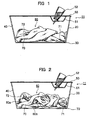
- Fig. 1 is an elevational view of a small animal rearing cage 11 upon which a floor mat 60 according to the present invention Is laid.
- the small animal rearing cage 11 is provided with a rearing box 20.
- the rearing box 20 is made of transparent polycarbonate and comprises a generally rectangle floor 30 and four walls 40 provided almost upright at a circumference of the floor 30.
- a sheet of floor mat 60 according to the present invention is folded and laid to form folds 70.
- the upper part of the rearing box 20 is covered with a removable cover 50 made of stainless wire.
- a recess 51 is formed and a bottle type water feeder 52 is inserted. Behind the water feeder 52, a pellet food (not shown) is provided and the recess 51 is functioned as a food feeder in the present embodiment.
- the rearing box 20 has an outer dimension of Width 22 cm (W) x Depth 32 cm (D) x Height 13 cm (H).
- the size of the rearing box 20 is, however, not limited to the above but appropriately selected in a way that small animals can secure a space to sleep and move around freely in accordance with the size and number of target small animals.
- the outer dimension required of the cage may be in a range of Width from 13 to 28 cm (W) x Depth from 20 to 45 cm (D) x Height from 11 to 18 cm (H).
- the rearing box 20 is not limited to the one shown in Fig. 1 as long as the floor mat 60 is laid thereupon and the box has a form and material that can house and raise small animals.
- a material of the rearing box 20 plastics, such as polycarbonate, polypropylene, and acrylonitrilebutadienestyrens, metals, woods, or glasses can be used.
- the shape of the rearing box 20 is not limited to a general rectangular parallelepiped shown in Fig. 1 but may be a shape of a net or stripe that is wholly constituted with metallic wire.
- the rearing box 20 particularly for the rearing box 20 shown in Fig. 1 that the floor 30 is flat and the walls 40 are transparent so that the box facilitates easy laying of the floor mat 60, easy observation of the small animals therein, and additionally the animals can move around the box easily.
- the rearing box 20 it is enough for the rearing box 20 to house small animals and the floor mat 60 but it requires no flat walls 40 surrounding the floor mat 30. Instead, a groove or any member that prevents the small animals from escaping from the rearing box 20 is equivalent to the wall 40,
- the floor mat 60 according to the present invention will be described hereinafter.
- the floor mat 60 have a temperature holding property to a degree that it can hold the body temperature of the small animals who are housed and reared In the rearing box 20, and also have a flexibility to a degree that it can wrap the body of the small animals.
- the temperature holding property mentioned here should be such a degree that an average skin temperature of 33 degrees C can be kept when a sheet of the floor mat 60 wraps the body of the small animals and keep them at an atmospheric temperature of 21 degrees C with humidity of 50 % and air flow 5 cm / sec at a resting state.
- the appropriate value of cio of the floor mat 60 is approximately no less than 0.1 cio.
- the required flexibility Is such a degree that the floor mat 60 flexibly curves along the shape of the body of the small animals when the mat is covered thereupon.
- "provided with flexibility” herein means that the sheet type floor mat 60 has such flexibility that the floor mat 60 is not broken at a point where the mat Is folded but keep the seamless state of a sheet. It also has a softness that the folded point is not automatically folded out by way of repulsion of the floor mat 60.
- the flexibility specified herein is different from the concept that the textile of the floor mat 60 is constituted with soft members in a direction of thickness.
- the floor mat 60 having the temperature holding property and flexibility described above includes a woven or non-woven fabric obtained from natural or synthetic fabric alone or in combination thereof, a soft paper such as a kitchen paper, a thin sponge fabric, or a surface treated vinyl sheet.
- fabrics are more preferred than papers because the fabric has more tearing resistance so that it can be prevented from being bitten by the small animals and torn into small pieces, lumps or dusts.
- the floor mat 60 according to the present invention has a size that can cover at least the entire abdomen of the small animals.
- the floor mat 60 is 8.5 times larger than the area of the floor 30 and is laid crumpled and randomly thrown in the rearing box 20.
- the floor mat 60 laid in such a way are folded randomly and overlapped with one another to form folds 70 with various shapes and sizes.
- the floor mat 60 is folded and overlapped with each other to form the folds 70 in which the recesses 71 or clearance 72 are formed with a size that can hide a part of the body of the animals.
- the folds 70 have a size sufficient to hide a part or a half of the body of the small animals. It is also preferable that a plurality of folds 70 is formed.
- Fig. 2 shows a plurality of male and female mice 80 reared in the small animal rearing cage 11 shown in Fig. 1,
- the mouse 80 crawls In the folds 70 or moves the floor mat 60 as appropriate to change the shapes of the folds 70 freely to make the recesses 71 or clearances 72 for their places to sleep (nest) or to evacuate.
- the floor mat 60 Since the floor mat 60 has a flexibility to a degree that it can wrap the body of the small animals and a temperature holding property to a degree that it can hold the body temperature of the small animals, the floor mat 60 of the present invention functions as a bedding material for small animals that can wrap their body and keep their temperature in the rearing box 20.
- Muridae such as mouse 80 evacuates at fixed place acting on their instinct, so that the place for excrement is determined as such. The excrements are trapped in the ridges and grooves formed on the folds 70.
- the floor mat 60 as a whole is hardly removed by a mouse moving around the rearing box 20.
- the present invention as being different from other mats that use small pieces such as chips for the floor mat, prevents excrements from being spread over the floor 30 as the mouse 80 moves around the cage along with small chips that are adhered with their excrements, thus deterioration of the rearing environment is avoided.
- folds 70 helps mouse 80 to hide themselves in the recesses 71 or clearances 72 in order to avoid exposure to light or external air.
- the present invention provides mouse 80 a secured living environment that releases the stress from the mouse, therefore increasing their chance of mating and improving fecundity.
- the fecundity of the mouse 80 can be curbed by controlling the flexibility of the floor mat 60, or the number and the area to be laid.
- the mouse 80 can also use the folds 70 to ensure a place for delivery and nursery of their baby animals and thus supplementary floor mat for breeding is not required.
- the sheet type floor mat 60 of the present invention hardly adheres to the body surface of the baby animals that have no hair.
- the baby animals can also crawl in the folds 70 to escape from being eaten by the mother animals, and thereby their survival rates are improved.
- the floor mat 60 is provided with a tearing resistance because the mat is hardly torn off by biting of the mouse 80, and even when torn off, the mat hardly generates small pieces or lumps that adhere easily to the body of the small animals.
- the floor mat may have at least a size that can cover the abdomen of the target animals, specifically, a size of approximately 10 cm in every direction In the case where the target animal is a mouse. It is preferable however that the floor mat has a size that is more than just enough to cover the small animals. It is preferable that the mat has a size of, for example, not less than 12 cm in every direction so that the mat can cover the entire body including the head and abdomen of the small animals when they fold their limbs and crouch. It is preferable that when the mat is a sheet having a size of 10 to 15 cm in every direction, a plurality of floor mat is laid in such a way that at least one or two of them are overlapped with one another to form folds.
- the mat has a size that is 1.2 times, more preferably 2 to 15 times, further preferably 3 to 10 times larger than the area of the floor 30 as shown in Fig. 1 and 2.
- a sheet of the floor mat 60 having such size can cover the entire area of the floor 30 and form folds 70 to prevent the floor 30 from being soiled and to make easy handling.
- a plurality of floor mats 60 may be laid upon each other as shown in Fig. 3. As the mouse 80 moves around, the floor mat 60 is moved to form folds 70.
- the plurality of floor mats 60 may be overlaid and a part or the entire circumference thereof may be sewn with a thread to unify as long as the formation of folds are secured.
- the use of a plurality of floor mats 60 can improve the deodorization capacity.
- the floor mat 60 is provided with water absorption property and deodorization property.
- the floor mat 60 absorbs the urine of the small animals and also removes the offensive odor substances such as ammonia and methyl mercaptan contained in excrement and urine, allowing the use of the floor mat 60 for a long period of time.
- the floor mat 60 can hold liquid of no less than 10 % by weight in relation to the weight of the mat; however, it is preferred for the floor mat 60 to hold a liquid of 100 to 300 % by weight in relation to the weight of the mat.
- the deodorization property it is preferable to remove offensive odor substance of no less than 1 mg, more preferably 10 mg, and further preferably of no less than 15 mg.
- the floor mat 60 provided with the temperature holding property, flexibility, and water absorption and deodorization properties includes: a deodorized fabric having such chemical fibers as acrylic and polyester coated with deodorants, a deodorized fabric having such cellulose fibers as cotton, rayon, hemp, and wooden pulp supported by a metal, a deodorized fabric obtained from an introduction of carboxyl group, a deodorized fabric having chitin or chitosan as a source material, or a deodorized water absorptive sheet holding a deodorant such as activated carbon and an absorbent such as advanced aqueous resins.
- the deodorized fabric that comprises natural fibers and that is free from chemical substances has fewer detrimental effects on the small animals even when they bite and ingest the fiber.
- the deodorized fabrics that comprise natural fibers include the deodorized fabrics that have chitin or chitosan as a source material, or the improved cellulose fabrics that are obtained from the introduction of carboxyl group into cellulose fibers.
- the improved cellulose fabric that has cellulose fiber supported by polymethacrylate acid is preferable to the chitin- or chitosan-contained deodorized fabric because they show higher deodorization capacity.
- the deodorization capacity of the improved cellulose fabric is such that 10 to 20 mg of the offensive odor substance per 1 g of improved cellulose can be removed, depending upon the method.
- cellulose fiber such as cotton fiber, hemp fiber, rayon fiber, and wooden pulp are used as a source material, and chemical reaction process is required for an introduction of the carboxyl group.
- such methods are employed; a draft polymerization method in which the carboxyl group-contained acrylic acid, methacrylic acid, or polymethacrylic acid are draft polymerized into cellulose; a transformation of the primary hydroxyl group into carboxyl group through catalytic oxidation of cellulose according to the TEMPO methods (leogai Akira, "Magazine for The Society of Fiber Science and Technology” Vol,57, No.6, P-163 (2001)), and a carboxymethylization method by using monochloroacetic acid,
- the carboxyl group-introduced cellulose fiber can be spine, or after the spinning of the cellulose fiber, the carboxyl group can be introduced.
- Carboxyl may further be Introduced into a non-woven fabric to provide a deodorization property.
- methacrylic acid Upon polymerization of methacrylic acid to a cellulose fiber, it is preferable to process in such a way that methacrylic acid is polymerized to have the improved cellulose fiber supported by polymethacrylic acid.
- 40 to 140 millimole, more preferably 60 to 120 millimole carboxyl group is contained per 100 g of dried fabric.
- the carboxyl group -contained within this range shows excellent water absorption and deodorization properties.
- the improved cellulose fabric having 40 to 140 millimole of carboxyl group per 100 g is theoretically provided with properties to remove and eliminate the offensive odor that can absorb and decompose 1 to 2 g of ammonia, This means that 1 g of improved cellulose fabric having 40 to 140 millimole of carboxyl group per 100 g has a deodorization property that can remove 10 to 20 mg of offensive odor substance, ammonia. Therefore when such improved cellulose fabrics are used as a floor mat, the mat can be continuously used for as long as 7 to 10 days without being changed and still keeps hygienically excellent rearing environment.
- the carboxyl introduction reaction requires longer time and increases the amount of use of reagent, and thus leads to higher manufacturing costs. And it further deteriorates functions inherent in cellulose fiber such as water absorption property.
- the contents of carboxyl group can be controlled by a reaction time or an amount of use of the reagent.
- the contents of the carboxyl group can also be controlled by a blending or mixture of fibers, in which one has much carboxyl group and the other has no carboxyl group.
- the improved cellulose fabric has carboxyl group that neutralizes and absorbs basic offensive odor substances, and is provided with water absorption and temperature holding properties and flexibility that are Inherent in cellulose fiber, and further provided with tearing resistance property to protect the fabric from being bitten by the mouse.
- the improved cellulose fabric that is soiled after the use as a floor mat can be washed, and by washing, the deodorization capacity can be recovered to a certain degree.
- Such improved cellulose fabric is manufactured by blending an improved cotton thread with non-treated cotton thread at a ratio of 1 to 1 by weight.
- polymethacrylic acid is introduced to the cellulose fiber by graft polymerization of 10 % by weight of methacrylic acid into cotton fiber, and supported.
- the improved cellulose fabric (having carboxyl group contents of 70 millimole per 100 g of the floor mat) can be washed as much as 50 times to be used repeatedly.
- the improved cellulose fabric obtained from an oxidation of cotton fiber (having carboxyl group contents of 62 millimole per 100 g of the floor mat) according to the TEMPO method can also be washed as much as 50 times to be used repeatedly.
- an alkaline detergent may also be preferably used to wash the improved cellulose fabric because alkaline detergents show higher detergency than neutral detergents.
- a sheet of the improved cellulose fabric was randomly crumpled to be rounded by hands and laid upon the rearing box of the small animals rearing cage (hereinafter referred to as a "cage") as shown in Fig. 1.
- the rearing box used was made of transparent polycarbonate resin having a size of 16 cm in floor width, 26 cm in floor length, and 14 cm in height.
- the improved cellulose fabric was a form of a towel that blends a 33 % of non-treated cotton thread with a 66 % of cotton thread that have methacrylic acid graft-polymered by 8 % by weight to have polymethacrylic acid supported by cellulose fiber.
- the size of the improved cellulose fabric was 45 cm in width, 10 cm in length and 120 g in weight.
- Five cages were prepared for example 1 and comparison 1 respectively and housed in a rearing room that was ventilated about 15 times per hour. A total of six mice with one male and five females were reared in each cage for two months.
- the top of the rearing cage was covered with a stainless wire cover with a recess provided on a part thereof, and a water feeder as well as pellet food was inserted on the recess.
- Two sheets of the improved cellulose fabrics were prepared for each of the cage and the sheet was changed once a week. The sheet that had soiled was washed with neutral detergent and used repeatedly. Floor mats were not added even as delivery approached.
- the chip type paper mat having a size of 5 mm in every direction was used but otherwise identical with example 1 and mice were slmilarly reared thereon. Approximately 120 g of chip type floor mat was used in the rearing box at a time and changed once a week. Tissue papers were further added upon delivery of mice.
- Concentration of ammonia in the cage was measured by using Kitagawa gas detector (gas detector tube; 105SD & 105SC).
- the value was 0.1 to 0.6 ppm on the third day after the laying (or changing) of the floor mat and was 2.5 to 6.0 ppm just before the changing of the mat on the seventh day.
- the value was 0.1 to 0.6 ppm on the third day just as same as Example 1, however the value was up to 12 to 30 ppm on the seventh day.
- Semiconductor laser particle counter (KANOMAX, Model 3886 and TF 500) was further employed to measure the number of dust with a size of no less than 0.5 micrometers on the fifth day of rearing in the cage, The value was 4.4 to 5.9 x 10 5 /m 3 in Example 1, and 3.1 to 3.3 x 10 7 /m 3 in Comparison 1. In addition, no accumulation of dust was visually observed around the rearing cage In Example 1 whereas several tens of dust was scattered and accumulation of dust was visually observed around the cage in Comparison 1.
- Example 1 delivery and nursing of the baby mice was carried out utilizing folds. In particular, the baby mice crawled in the valley of the folds were raised there. As a result, in spite of the fact that in Example 1 no floor mats were added further for delivery and nursery, the growth curb of the baby mice were as identical as the result of Comparison 1 in which floor mats were added for the purpose of delivery and nursery. Mother mice killed and ate their baby mice by 20 to 30 percentage less in Example 1 than in Comparison 1. The number of mating of male mice was observed from 8 am to 5 pm every day from the onset of the rearing for duration of 1 to 2 weeks. The number observed was higher in Example 1 with 2 to 4 whereas 0 to 2 in Comparison 1,
- Example 2 the improved cellulose fabric used in above Example 1; as for Comparison 2, the paper-made floor mat used in above Comparison 1; and as for Comparison 3, a cotton fabric were prepared to observe deodorization property by way of the measurement of the concentration of ammonia.
- Three mat having 3.5 g in dry weight were placed respectively into a tedlar bag having a size of 25 cm x 40 cm (made by Sun Plastics).
- Initial ammonia concentration was set to 200 ppm and the container was sealed.
- the ammonia concentration was measured 1,3,5,10 and 30 minutes after the sealing to observe the deodorization property.
- the amount of ammonia absorption was 21 mg per 1g in the improved cellulose fabric in Example 1, and 3 mg per 1g in the cotton fabric in Comparison 3.
- Fig. 4 illustrates a graph showing a test results of Example 2, Comparison 2 and Comparison 3 wherein the ordinate represents residual ammonia concentration (unit: ppm) whereas the abscissa represents elapsed time (unit: minute).
- the line P, A, B and C respectively shows a change of ammonia concentration in the tedlar bag in the container wherein the line P represents Example 2 wherein the improved cellulose fabric was laid, the line A represents Comparison 2 wherein the paper mat was laid, the line B represents Comparison 3 wherein a cotton fabric was laid, and the line C represents a blank in which no specimen were used.
- Example 3 and Example 4 deodorization capacity was examined by observing the condition of the improved cellulose fabric of Example 1 with one fabric unused and the other fabric used for 2 months.
- the specimen weighed 120 g in dry weight was laid in the cage of Example 1.
- Ammonia solution of 50 ml with 1 % concentration was poured in the cage and a change of ammonia concentration was observed,
- Fig. 5 illustrates the results wherein the ordinate represents residual ammonia concentration (unit: ppm) whereas the abscissa represents elapsed time (unit: minute).
- the line P1 shows a change of residual ammonia concentration in the cage in which unused improved cellulose fabric was laid as a specimen
- the line P2 shows a change of residual ammonia concentration in the cage in which the improved cellulose fabric was laid as a specimen and washed once a week for a period of two months.
- Comparison 4 (new) deodorized floor mat made of paper pulp was laid instead of the improved cellulose fabric of Comparison 2.
- the change of residual ammonia concentration in the cage was shown with the line D.
- the fabric used are: the improved cellulose fabric (having carboxyl group contents of 70 millimole per 100 g of floor mat) that was obtained from a blending of the improved fiber resulted from graft polymerization of 10 % by weight of acrylic acid into a cotton fiber, and non-treated cotton fiber at a ratio of 1 to 1 by weight; and the improved cellulose fabric (having carboxyl group contents of 62 millimole per 100 g of floor mat) that was obtained from the oxidation of a floor mat made of cotton according to the TEMPO method.
- a sheet type floor mat having a temperature holding property and flexibility is provided to be laid upon the floor of the small animal rearing cage in such a way that the mat forms folds to cover and hide the body of the animals, and therefore prevents the animals from being exposed to the light and wind and reduces their stress.
- the sheet type floor mat prevents dust generation, traps excrement at the folds and prevents the excrement to be spread over.
- the sheet type floor mat when provided with water absorption and deodorization properties can strongly remove the offensive odor substances such as ammonia that originally generates from excrement and urine of the small animals in a short period of time and therefore can maintain excellent hygienic conditions in the small animal rearing cage and rearing room. Curving the generation of the offensive odor decreases the number of ventilation time for air conditioning, and so an effect is expected of reducing the consumption of the electricity which is caused by exhaustion of heat.
- the mat can recover the water absorption property and a deodorization property by washing and drying of the mat.
- the improved cellulose fabric can thus be repeatedly used and reduces the total amount of waste disposal.
Landscapes
- Life Sciences & Earth Sciences (AREA)
- Environmental Sciences (AREA)
- Zoology (AREA)
- Animal Husbandry (AREA)
- Biodiversity & Conservation Biology (AREA)
- Animal Behavior & Ethology (AREA)
- Health & Medical Sciences (AREA)
- Clinical Laboratory Science (AREA)
- General Health & Medical Sciences (AREA)
- Housing For Livestock And Birds (AREA)
- Carpets (AREA)
Applications Claiming Priority (5)
| Application Number | Priority Date | Filing Date | Title |
|---|---|---|---|
| JP2002369202 | 2002-12-20 | ||
| JP2002369202A JP2004194602A (ja) | 2002-12-20 | 2002-12-20 | ネズミ科動物飼育ケージ用の床敷および箱型ケージ |
| JP2003148135A JP3902154B2 (ja) | 2003-05-26 | 2003-05-26 | 小動物飼育ケージ、小動物飼育ケージ用床敷および小動物飼育方法 |
| JP2003148135 | 2003-05-26 | ||
| PCT/JP2003/016372 WO2004056175A1 (fr) | 2002-12-20 | 2003-12-19 | Tapis de sol et cage d'elevage pour petit animal |
Publications (3)
| Publication Number | Publication Date |
|---|---|
| EP1574129A1 true EP1574129A1 (fr) | 2005-09-14 |
| EP1574129A4 EP1574129A4 (fr) | 2006-03-22 |
| EP1574129B1 EP1574129B1 (fr) | 2010-11-10 |
Family
ID=32684192
Family Applications (1)
| Application Number | Title | Priority Date | Filing Date |
|---|---|---|---|
| EP03780946A Expired - Lifetime EP1574129B1 (fr) | 2002-12-20 | 2003-12-19 | Tapis de sol et cage d'elevage pour petit animal |
Country Status (7)
| Country | Link |
|---|---|
| US (1) | US20060144342A1 (fr) |
| EP (1) | EP1574129B1 (fr) |
| KR (1) | KR20050084408A (fr) |
| AT (1) | ATE487375T1 (fr) |
| AU (1) | AU2003289459A1 (fr) |
| DE (1) | DE60334927D1 (fr) |
| WO (1) | WO2004056175A1 (fr) |
Cited By (1)
| Publication number | Priority date | Publication date | Assignee | Title |
|---|---|---|---|---|
| CN112752504A (zh) * | 2018-10-26 | 2021-05-04 | 泰尼百斯股份公司 | 用于实验动物的笼子 |
Families Citing this family (2)
| Publication number | Priority date | Publication date | Assignee | Title |
|---|---|---|---|---|
| US20050223636A1 (en) * | 2004-04-08 | 2005-10-13 | Schmitt Anthony L | Weaning mat |
| US8826861B2 (en) | 2013-01-14 | 2014-09-09 | Edstrom, Inc. | Absorbent pad for use with animal caging systems |
Family Cites Families (19)
| Publication number | Priority date | Publication date | Assignee | Title |
|---|---|---|---|---|
| CA1052157A (fr) * | 1975-05-05 | 1979-04-10 | Thomas J. Flautt (Jr.) | Papier tissu a deux pli |
| US4169428A (en) * | 1977-10-07 | 1979-10-02 | Waugh Dorothy C | Pet sleeping bag |
| US4250834A (en) * | 1979-06-20 | 1981-02-17 | Stephen Cheselka | Pet sanitary facility |
| US4541359A (en) * | 1983-10-19 | 1985-09-17 | Kieffer Paper Mills, Inc. | Degradable litter covering for use in the brooding area of poultry houses |
| US4690100A (en) * | 1985-10-22 | 1987-09-01 | Thoren Caging Systems, Inc. | Ventilated animal housing and service system with cage filter covers |
| PH23983A (en) * | 1986-12-23 | 1990-02-09 | Biopolymers Ltd | Biostatic and biocidal composition |
| JPH0438701Y2 (fr) * | 1988-03-24 | 1992-09-10 | ||
| JPH0779593B2 (ja) * | 1991-03-18 | 1995-08-30 | 悦子 須郷 | 動物飼育用材料およびその製造方法 |
| US5939088A (en) * | 1991-08-23 | 1999-08-17 | Daiki Co., Ltd. | Sheets for animals, sheet, bags, daily goods, ink and packaging materials |
| US5148768A (en) * | 1991-10-18 | 1992-09-22 | Hinton Michele D | Pet house apparatus |
| US5188062A (en) * | 1992-04-06 | 1993-02-23 | Joy Gerald T | Automatic litter box for small animals |
| US5482007A (en) * | 1994-03-31 | 1996-01-09 | Kumlin; Robert R. | Disposable pet toilet assembly |
| US5819688A (en) * | 1997-04-21 | 1998-10-13 | Walker; Robert T. | Pet animal odor adsorbing and liquid absorbing mat |
| US6386144B1 (en) * | 1998-10-30 | 2002-05-14 | Timothy D. Cathey | Method of manufacturing absorbent material for conversion to fertilizer |
| JP2000333546A (ja) * | 1999-05-24 | 2000-12-05 | Seatsuku Yoshitomi Kk | 動物用床敷材料 |
| JP3326415B2 (ja) * | 1999-10-21 | 2002-09-24 | ペパーレット株式会社 | 動物の排泄物処理材 |
| DE60112340T2 (de) * | 2000-01-14 | 2006-04-06 | Kao Corp. | Absorbierende Matte zur Behandlung von Ausscheidungen |
| US20040163603A1 (en) * | 2003-02-21 | 2004-08-26 | Gloria Newton | Multipurpose disposable pet mattress pad cover |
| US7159257B1 (en) * | 2005-04-08 | 2007-01-09 | Lilyn M Struthers | Disposable protective sheet for furniture |
-
2003
- 2003-12-19 EP EP03780946A patent/EP1574129B1/fr not_active Expired - Lifetime
- 2003-12-19 AU AU2003289459A patent/AU2003289459A1/en not_active Abandoned
- 2003-12-19 AT AT03780946T patent/ATE487375T1/de not_active IP Right Cessation
- 2003-12-19 US US10/539,870 patent/US20060144342A1/en not_active Abandoned
- 2003-12-19 DE DE60334927T patent/DE60334927D1/de not_active Expired - Lifetime
- 2003-12-19 WO PCT/JP2003/016372 patent/WO2004056175A1/fr not_active Ceased
- 2003-12-19 KR KR1020057011336A patent/KR20050084408A/ko not_active Withdrawn
Cited By (2)
| Publication number | Priority date | Publication date | Assignee | Title |
|---|---|---|---|---|
| CN112752504A (zh) * | 2018-10-26 | 2021-05-04 | 泰尼百斯股份公司 | 用于实验动物的笼子 |
| CN112752504B (zh) * | 2018-10-26 | 2023-09-26 | 泰尼百斯股份公司 | 用于实验动物的笼子 |
Also Published As
| Publication number | Publication date |
|---|---|
| KR20050084408A (ko) | 2005-08-26 |
| DE60334927D1 (de) | 2010-12-23 |
| AU2003289459A1 (en) | 2004-07-14 |
| EP1574129A4 (fr) | 2006-03-22 |
| WO2004056175A1 (fr) | 2004-07-08 |
| US20060144342A1 (en) | 2006-07-06 |
| EP1574129B1 (fr) | 2010-11-10 |
| ATE487375T1 (de) | 2010-11-15 |
Similar Documents
| Publication | Publication Date | Title |
|---|---|---|
| AU2020340241B2 (en) | Animal litter and litter box system | |
| US5482007A (en) | Disposable pet toilet assembly | |
| JP3939272B2 (ja) | 動物用トイレ | |
| CN100574613C (zh) | 用于动物排泄箱的液体吸收板 | |
| EP1125494B1 (fr) | Matelas absorbant pour le traitement des excréments | |
| US20170280671A1 (en) | Waste Pad | |
| EP1574129B1 (fr) | Tapis de sol et cage d'elevage pour petit animal | |
| JP6799457B2 (ja) | ペット用トイレシート及びそれを備えたペット用トイレ | |
| US20150047571A1 (en) | Absorbent Pad for Animal Waste | |
| JP3554979B2 (ja) | ペットの尿吸収シート | |
| US6135058A (en) | Sanitary cat litter box and method of use | |
| JP2002010718A (ja) | ペットシート | |
| JPH0739265A (ja) | ペット用トイレ材料 | |
| US20030070623A1 (en) | Bio-degradable pet litter made from coconut coir | |
| JP3902154B2 (ja) | 小動物飼育ケージ、小動物飼育ケージ用床敷および小動物飼育方法 | |
| JP4018126B2 (ja) | 小動物飼育ケージ、小動物飼育ケージ用床敷および小動物飼育方法 | |
| US9095121B1 (en) | Cage for animal pets employing Zeolite elements to eliminate pet odor | |
| CA2467758C (fr) | Vetements hygieniques jetables pour animaux familiaux | |
| JP2006101890A (ja) | 動物用トイレ | |
| JP2008295315A (ja) | 小動物飼育ケージ用床敷及び小動物飼育方法 | |
| JP2020536709A (ja) | の脱臭のための材料と方法 哺乳類の尿 | |
| JP3044091U (ja) | ペット用シーツ | |
| JP2007037553A (ja) | 吸水具 | |
| JPH06141723A (ja) | 動物檻 | |
| JP2502075Y2 (ja) | ペツト用シ―ツ |
Legal Events
| Date | Code | Title | Description |
|---|---|---|---|
| PUAI | Public reference made under article 153(3) epc to a published international application that has entered the european phase |
Free format text: ORIGINAL CODE: 0009012 |
|
| 17P | Request for examination filed |
Effective date: 20050617 |
|
| AK | Designated contracting states |
Kind code of ref document: A1 Designated state(s): AT BE BG CH CY CZ DE DK EE ES FI FR GB GR HU IE IT LI LU MC NL PT RO SE SI SK TR |
|
| AX | Request for extension of the european patent |
Extension state: AL LT LV MK |
|
| A4 | Supplementary search report drawn up and despatched |
Effective date: 20060206 |
|
| DAX | Request for extension of the european patent (deleted) | ||
| 17Q | First examination report despatched |
Effective date: 20060823 |
|
| RIN1 | Information on inventor provided before grant (corrected) |
Inventor name: NISHIMURA, T.B116, SHINMATSUDO MINAMI PARK HOUSE Inventor name: IWAKI, TAKAMASA |
|
| GRAP | Despatch of communication of intention to grant a patent |
Free format text: ORIGINAL CODE: EPIDOSNIGR1 |
|
| GRAS | Grant fee paid |
Free format text: ORIGINAL CODE: EPIDOSNIGR3 |
|
| GRAA | (expected) grant |
Free format text: ORIGINAL CODE: 0009210 |
|
| RIN1 | Information on inventor provided before grant (corrected) |
Inventor name: NISHIMURA, TAKAO Inventor name: IWAKI, TAKAMASA |
|
| AK | Designated contracting states |
Kind code of ref document: B1 Designated state(s): AT BE BG CH CY CZ DE DK EE ES FI FR GB GR HU IE IT LI LU MC NL PT RO SE SI SK TR |
|
| REG | Reference to a national code |
Ref country code: GB Ref legal event code: FG4D |
|
| REG | Reference to a national code |
Ref country code: CH Ref legal event code: EP |
|
| REG | Reference to a national code |
Ref country code: IE Ref legal event code: FG4D |
|
| REF | Corresponds to: |
Ref document number: 60334927 Country of ref document: DE Date of ref document: 20101223 Kind code of ref document: P |
|
| REG | Reference to a national code |
Ref country code: NL Ref legal event code: VDEP Effective date: 20101110 |
|
| PG25 | Lapsed in a contracting state [announced via postgrant information from national office to epo] |
Ref country code: SE Free format text: LAPSE BECAUSE OF FAILURE TO SUBMIT A TRANSLATION OF THE DESCRIPTION OR TO PAY THE FEE WITHIN THE PRESCRIBED TIME-LIMIT Effective date: 20101110 Ref country code: AT Free format text: LAPSE BECAUSE OF FAILURE TO SUBMIT A TRANSLATION OF THE DESCRIPTION OR TO PAY THE FEE WITHIN THE PRESCRIBED TIME-LIMIT Effective date: 20101110 Ref country code: FI Free format text: LAPSE BECAUSE OF FAILURE TO SUBMIT A TRANSLATION OF THE DESCRIPTION OR TO PAY THE FEE WITHIN THE PRESCRIBED TIME-LIMIT Effective date: 20101110 Ref country code: BG Free format text: LAPSE BECAUSE OF FAILURE TO SUBMIT A TRANSLATION OF THE DESCRIPTION OR TO PAY THE FEE WITHIN THE PRESCRIBED TIME-LIMIT Effective date: 20110210 Ref country code: CY Free format text: LAPSE BECAUSE OF FAILURE TO SUBMIT A TRANSLATION OF THE DESCRIPTION OR TO PAY THE FEE WITHIN THE PRESCRIBED TIME-LIMIT Effective date: 20101110 Ref country code: NL Free format text: LAPSE BECAUSE OF FAILURE TO SUBMIT A TRANSLATION OF THE DESCRIPTION OR TO PAY THE FEE WITHIN THE PRESCRIBED TIME-LIMIT Effective date: 20101110 Ref country code: SI Free format text: LAPSE BECAUSE OF FAILURE TO SUBMIT A TRANSLATION OF THE DESCRIPTION OR TO PAY THE FEE WITHIN THE PRESCRIBED TIME-LIMIT Effective date: 20101110 Ref country code: PT Free format text: LAPSE BECAUSE OF FAILURE TO SUBMIT A TRANSLATION OF THE DESCRIPTION OR TO PAY THE FEE WITHIN THE PRESCRIBED TIME-LIMIT Effective date: 20110310 |
|
| PG25 | Lapsed in a contracting state [announced via postgrant information from national office to epo] |
Ref country code: GR Free format text: LAPSE BECAUSE OF FAILURE TO SUBMIT A TRANSLATION OF THE DESCRIPTION OR TO PAY THE FEE WITHIN THE PRESCRIBED TIME-LIMIT Effective date: 20110211 |
|
| PG25 | Lapsed in a contracting state [announced via postgrant information from national office to epo] |
Ref country code: EE Free format text: LAPSE BECAUSE OF FAILURE TO SUBMIT A TRANSLATION OF THE DESCRIPTION OR TO PAY THE FEE WITHIN THE PRESCRIBED TIME-LIMIT Effective date: 20101110 Ref country code: ES Free format text: LAPSE BECAUSE OF FAILURE TO SUBMIT A TRANSLATION OF THE DESCRIPTION OR TO PAY THE FEE WITHIN THE PRESCRIBED TIME-LIMIT Effective date: 20110221 Ref country code: BE Free format text: LAPSE BECAUSE OF FAILURE TO SUBMIT A TRANSLATION OF THE DESCRIPTION OR TO PAY THE FEE WITHIN THE PRESCRIBED TIME-LIMIT Effective date: 20101110 Ref country code: CZ Free format text: LAPSE BECAUSE OF FAILURE TO SUBMIT A TRANSLATION OF THE DESCRIPTION OR TO PAY THE FEE WITHIN THE PRESCRIBED TIME-LIMIT Effective date: 20101110 Ref country code: MC Free format text: LAPSE BECAUSE OF NON-PAYMENT OF DUE FEES Effective date: 20101231 |
|
| REG | Reference to a national code |
Ref country code: CH Ref legal event code: PL |
|
| PG25 | Lapsed in a contracting state [announced via postgrant information from national office to epo] |
Ref country code: RO Free format text: LAPSE BECAUSE OF FAILURE TO SUBMIT A TRANSLATION OF THE DESCRIPTION OR TO PAY THE FEE WITHIN THE PRESCRIBED TIME-LIMIT Effective date: 20101110 Ref country code: DK Free format text: LAPSE BECAUSE OF FAILURE TO SUBMIT A TRANSLATION OF THE DESCRIPTION OR TO PAY THE FEE WITHIN THE PRESCRIBED TIME-LIMIT Effective date: 20101110 Ref country code: SK Free format text: LAPSE BECAUSE OF FAILURE TO SUBMIT A TRANSLATION OF THE DESCRIPTION OR TO PAY THE FEE WITHIN THE PRESCRIBED TIME-LIMIT Effective date: 20101110 |
|
| PLBE | No opposition filed within time limit |
Free format text: ORIGINAL CODE: 0009261 |
|
| STAA | Information on the status of an ep patent application or granted ep patent |
Free format text: STATUS: NO OPPOSITION FILED WITHIN TIME LIMIT |
|
| 26N | No opposition filed |
Effective date: 20110811 |
|
| GBPC | Gb: european patent ceased through non-payment of renewal fee |
Effective date: 20110210 |
|
| PG25 | Lapsed in a contracting state [announced via postgrant information from national office to epo] |
Ref country code: LI Free format text: LAPSE BECAUSE OF NON-PAYMENT OF DUE FEES Effective date: 20101231 Ref country code: IE Free format text: LAPSE BECAUSE OF NON-PAYMENT OF DUE FEES Effective date: 20101219 Ref country code: CH Free format text: LAPSE BECAUSE OF NON-PAYMENT OF DUE FEES Effective date: 20101231 |
|
| PG25 | Lapsed in a contracting state [announced via postgrant information from national office to epo] |
Ref country code: DE Free format text: LAPSE BECAUSE OF NON-PAYMENT OF DUE FEES Effective date: 20110701 |
|
| REG | Reference to a national code |
Ref country code: DE Ref legal event code: R119 Ref document number: 60334927 Country of ref document: DE Effective date: 20110701 |
|
| PG25 | Lapsed in a contracting state [announced via postgrant information from national office to epo] |
Ref country code: IT Free format text: LAPSE BECAUSE OF FAILURE TO SUBMIT A TRANSLATION OF THE DESCRIPTION OR TO PAY THE FEE WITHIN THE PRESCRIBED TIME-LIMIT Effective date: 20101110 |
|
| REG | Reference to a national code |
Ref country code: FR Ref legal event code: ST Effective date: 20111125 |
|
| PG25 | Lapsed in a contracting state [announced via postgrant information from national office to epo] |
Ref country code: FR Free format text: LAPSE BECAUSE OF NON-PAYMENT OF DUE FEES Effective date: 20110110 |
|
| PG25 | Lapsed in a contracting state [announced via postgrant information from national office to epo] |
Ref country code: GB Free format text: LAPSE BECAUSE OF NON-PAYMENT OF DUE FEES Effective date: 20110210 |
|
| PG25 | Lapsed in a contracting state [announced via postgrant information from national office to epo] |
Ref country code: HU Free format text: LAPSE BECAUSE OF FAILURE TO SUBMIT A TRANSLATION OF THE DESCRIPTION OR TO PAY THE FEE WITHIN THE PRESCRIBED TIME-LIMIT Effective date: 20110511 Ref country code: LU Free format text: LAPSE BECAUSE OF NON-PAYMENT OF DUE FEES Effective date: 20101219 |
|
| PG25 | Lapsed in a contracting state [announced via postgrant information from national office to epo] |
Ref country code: TR Free format text: LAPSE BECAUSE OF FAILURE TO SUBMIT A TRANSLATION OF THE DESCRIPTION OR TO PAY THE FEE WITHIN THE PRESCRIBED TIME-LIMIT Effective date: 20101110 |