EP1570835B1 - Zusammensetzung zur dauerhaften Verformung der Haare enthaltend mindestens ein Carboxydithiol - Google Patents
Zusammensetzung zur dauerhaften Verformung der Haare enthaltend mindestens ein Carboxydithiol Download PDFInfo
- Publication number
- EP1570835B1 EP1570835B1 EP05300162A EP05300162A EP1570835B1 EP 1570835 B1 EP1570835 B1 EP 1570835B1 EP 05300162 A EP05300162 A EP 05300162A EP 05300162 A EP05300162 A EP 05300162A EP 1570835 B1 EP1570835 B1 EP 1570835B1
- Authority
- EP
- European Patent Office
- Prior art keywords
- mercapto
- mercaptomethyl
- methyl
- butanamide
- propanamide
- Prior art date
- Legal status (The legal status is an assumption and is not a legal conclusion. Google has not performed a legal analysis and makes no representation as to the accuracy of the status listed.)
- Expired - Lifetime
Links
- 0 CN1C(**)CCC1 Chemical compound CN1C(**)CCC1 0.000 description 2
Classifications
-
- C—CHEMISTRY; METALLURGY
- C07—ORGANIC CHEMISTRY
- C07C—ACYCLIC OR CARBOCYCLIC COMPOUNDS
- C07C323/00—Thiols, sulfides, hydropolysulfides or polysulfides substituted by halogen, oxygen or nitrogen atoms, or by sulfur atoms not being part of thio groups
- C07C323/50—Thiols, sulfides, hydropolysulfides or polysulfides substituted by halogen, oxygen or nitrogen atoms, or by sulfur atoms not being part of thio groups containing thio groups and carboxyl groups bound to the same carbon skeleton
- C07C323/51—Thiols, sulfides, hydropolysulfides or polysulfides substituted by halogen, oxygen or nitrogen atoms, or by sulfur atoms not being part of thio groups containing thio groups and carboxyl groups bound to the same carbon skeleton having the sulfur atoms of the thio groups bound to acyclic carbon atoms of the carbon skeleton
- C07C323/52—Thiols, sulfides, hydropolysulfides or polysulfides substituted by halogen, oxygen or nitrogen atoms, or by sulfur atoms not being part of thio groups containing thio groups and carboxyl groups bound to the same carbon skeleton having the sulfur atoms of the thio groups bound to acyclic carbon atoms of the carbon skeleton the carbon skeleton being acyclic and saturated
-
- A—HUMAN NECESSITIES
- A47—FURNITURE; DOMESTIC ARTICLES OR APPLIANCES; COFFEE MILLS; SPICE MILLS; SUCTION CLEANERS IN GENERAL
- A47J—KITCHEN EQUIPMENT; COFFEE MILLS; SPICE MILLS; APPARATUS FOR MAKING BEVERAGES
- A47J27/00—Cooking-vessels
- A47J27/12—Multiple-unit cooking vessels
- A47J27/122—Multiple-unit cooking vessels with adaptation of shape to that of adjacent vessels for forming a unit, e.g. sector-shaped
-
- C—CHEMISTRY; METALLURGY
- C07—ORGANIC CHEMISTRY
- C07C—ACYCLIC OR CARBOCYCLIC COMPOUNDS
- C07C323/00—Thiols, sulfides, hydropolysulfides or polysulfides substituted by halogen, oxygen or nitrogen atoms, or by sulfur atoms not being part of thio groups
- C07C323/50—Thiols, sulfides, hydropolysulfides or polysulfides substituted by halogen, oxygen or nitrogen atoms, or by sulfur atoms not being part of thio groups containing thio groups and carboxyl groups bound to the same carbon skeleton
- C07C323/51—Thiols, sulfides, hydropolysulfides or polysulfides substituted by halogen, oxygen or nitrogen atoms, or by sulfur atoms not being part of thio groups containing thio groups and carboxyl groups bound to the same carbon skeleton having the sulfur atoms of the thio groups bound to acyclic carbon atoms of the carbon skeleton
- C07C323/60—Thiols, sulfides, hydropolysulfides or polysulfides substituted by halogen, oxygen or nitrogen atoms, or by sulfur atoms not being part of thio groups containing thio groups and carboxyl groups bound to the same carbon skeleton having the sulfur atoms of the thio groups bound to acyclic carbon atoms of the carbon skeleton with the carbon atom of at least one of the carboxyl groups bound to nitrogen atoms
-
- A—HUMAN NECESSITIES
- A47—FURNITURE; DOMESTIC ARTICLES OR APPLIANCES; COFFEE MILLS; SPICE MILLS; SUCTION CLEANERS IN GENERAL
- A47J—KITCHEN EQUIPMENT; COFFEE MILLS; SPICE MILLS; APPARATUS FOR MAKING BEVERAGES
- A47J36/00—Parts, details or accessories of cooking-vessels
- A47J36/02—Selection of specific materials, e.g. heavy bottoms with copper inlay or with insulating inlay
-
- Y—GENERAL TAGGING OF NEW TECHNOLOGICAL DEVELOPMENTS; GENERAL TAGGING OF CROSS-SECTIONAL TECHNOLOGIES SPANNING OVER SEVERAL SECTIONS OF THE IPC; TECHNICAL SUBJECTS COVERED BY FORMER USPC CROSS-REFERENCE ART COLLECTIONS [XRACs] AND DIGESTS
- Y10—TECHNICAL SUBJECTS COVERED BY FORMER USPC
- Y10S—TECHNICAL SUBJECTS COVERED BY FORMER USPC CROSS-REFERENCE ART COLLECTIONS [XRACs] AND DIGESTS
- Y10S220/00—Receptacles
- Y10S220/912—Cookware, i.e. pots and pans
Definitions
- the present invention relates to a reducing cosmetic composition, for the first time of a permanent hair deformation operation, containing, as reducing agent, at least one carboxydithiol. It also relates to a permanent hair deformation process using these carboxydithiols.
- the most usual technique for obtaining a permanent deformation of the hair consists, firstly, in opening the disulfide bonds of keratin (cystine) using a composition containing a reducing agent and then preferably rinsed the hair, to reconstitute in a second time said disulfide bonds by applying to the hair, previously tensioned by curlers or the like, or shaped or smoothed by other means, an oxidizing composition also called fixer so as to give the hair the desired shape.
- This technique allows indifferently to achieve either the waving of the hair, or their straightening or curing or smoothing.
- Reducing compositions generally used for the first step of a permanent operation contain sulphites, bisulphites or, preferably, thiols as the reducing agent.
- those commonly used are thioglycolic acid, cysteamine, thiolactic acid, cysteine and glycerol monothioglycolate.
- Thioglycolic acid is particularly effective in reducing the disulfide bonds of keratin at alkaline pH, especially in the form of ammonium thioglycolate, and is the most widely used permanent product.
- thioglycolic acid should be used in a sufficiently basic medium (in practice at a pH greater than or equal to 8.5) in order to obtain a satisfactory crimp in intensity.
- the thioglycolic acid - alkaline pH combination leads to degradation of the hair fiber.
- Sulphites or bisulphites have been used before thiols in general and thioglycolic acid in particular. Unlike thiols, they are used at an acid pH generally between 4 and 6. However, the degree of crimp obtained is much lower and far from satisfactory.
- Cysteine produces a much lower odor than thioglycolic acid but the degree of crimp obtained is also much lower and far from satisfactory.
- cysteine requires the use of a very alkaline pH.
- Glycerol monothioglycolate is also very smelly. It is, on the other hand, used at a pH close to neutrality, but its performances are notably lower than those of thioglycolic acid.
- Cysteamine can be used over a wider pH range. Its effectiveness is close to that of thioglycolic acid but it also leads to significant degradation of the hair fiber.
- the document JP 02 145 508 discloses cosmetic compositions for the prevention of dandruff including, inter alia, asparagusic acid derivatives of the formula in which R is a hydrogen atom, an alkyl radical for example methyl and ethyl, a potassium atom or a sodium atom.
- Permanent deformation means permanent (permanent) curling, hair straightening or hair straightening.
- the reducing agent (s) of general formula (I) are generally present in a content of between 0.05 and 30%, preferably between 1 and 20%, by weight relative to the total weight. of the reducing composition.
- the pH of the composition according to the invention is preferably between 4 and 11, and more particularly between 6 and 10.
- the pH is generally obtained with the aid of an alkaline agent such as, for example, ammonia, monoethanolamine, diethanolamine, triethanolamine, 1,3-propanediamine, an alkaline or ammonium carbonate or bicarbonate, an organic carbonate such as guanidine carbonate, an alkaline hydroxide, or with the aid of an acidifying agent such as, for example, hydrochloric acid, acetic acid, lactic acid, oxalic acid or boric acid, or else using conventional buffers, such as, for example, borate, phosphate or TRIS buffer (based on tris (hydroxymethyl) amino methane).
- an alkaline agent such as, for example, ammonia, monoethanolamine, diethanolamine, triethanolamine, 1,3-propanediamine, an alkaline or ammonium carbonate or bicarbonate, an organic carbonate such as guanidine carbonate, an alkaline hydroxide
- an acidifying agent such as, for example, hydrochloric acid, acetic acid,
- the reducing composition according to the invention may also contain one or more other known reducing agents, such as, for example, thioglycolic acid or thiolactic acid and their ester and amide derivatives, in particular glycerol monothioglycolate, cysteamine and its derivatives ( C 1 -C 4 ) acyls such as N-acetyl-cysteamine or N-propionyl-cysteamine, cysteine, N-acetyl-cysteine, thiomalic acid, panthetein, 2,3-dimercaptosuccinic acid, sulphites or bisulfites of an alkali or alkaline earth metal, N- (mercaptoalkyl) - ⁇ -hydroxyalkylamides such as those described in the patent application EP-A-354 835 , N-mono or N, N-dialkylmercapto-4-butyramides such as those described in the patent application EP-A-368,763 aminomercaptoalky
- the reducing composition according to the invention also contains at least one surfactant of nonionic, anionic, cationic or amphoteric type.
- surfactant of nonionic, anionic, cationic or amphoteric type.
- the reducing composition according to the invention contains one or more surface-active agents, this one or these generally represent at most 30% by weight, and preferably between 0.5 and 10% by weight, relative to the total weight of the reducing composition.
- the reducing composition may also contain a treating agent of cationic, anionic, nonionic or amphoteric nature.
- polydimethylsiloxane-polyoxyalkyl copolymer of the dimethicone copolyol type a polydimethylsiloxane containing stearoxy end groups (stearoxydimethicone), a polydimethylsiloxane-dialkylammonium acetate copolymer or a polydimethylsiloxane polyalkylbetaine copolymer described in the British patent.
- the reducing composition according to the invention may also contain one or more other treating ingredients such as cationic polymers such as those used in the compositions of French Pat. 79.32078 ( FR 2,472,382 ) and 80.26421 ( FR 2,495,931 ), or cationic polymers of the ionene type such as those used in the compositions of the Luxembourg patent no.
- cationic polymers such as those used in the compositions of French Pat. 79.32078 ( FR 2,472,382 ) and 80.26421 ( FR 2,495,931 ), or cationic polymers of the ionene type such as those used in the compositions of the Luxembourg patent no.
- 83703 basic amino acids such as lysine or arginine, amino acids, acids such as glutamic acid or aspartic acid, peptides and derivatives thereof, protein hydrolysates, waxes, swelling and penetration agents , or agents which make it possible to enhance the effectiveness of the reducing agent, such as the SiO 2 / PDMS (polydimethylsiloxane) mixture, dimethylisosorbitol, urea and its derivatives, pyrrolidone, N-alkyl-pyrrolidones, thiamorpholinone, alkyl ethers and the like.
- SiO 2 / PDMS polydimethylsiloxane
- alkylene glycol or dialkylene glycol such as, for example, propylene glycol monomethyl ether, dipropylene glycol monomethyl ether, ethylene glycol monoethyl ether and diethylene glycol monoethyl ether, C 3 -C 6 alkanediols such as for example 1,2-propanediol, 1,3-propanediol and 1,2-butanediol, imidazolidinone-2 and other compounds such as fatty alcohols, lanolin derivatives, active ingredients such as such as pantothenic acid, anti-hair loss agents, anti-dandruff agents, thickeners, suspending agents, sequestering agents, opacifying agents, dyes, sunscreens as well as perfumes and preservatives.
- C 3 -C 6 alkanediols such as for example 1,2-propanediol, 1,3-propanediol and 1,2-butanediol
- the carboxydithiol (s) of formula (I) must be placed in a cosmetically acceptable medium.
- the vehicle of the composition according to the invention is preferably water or a hydroalcoholic solution of a lower alcohol C 1 -C 6 , such as ethanol, propanol, isopropanol, butanol or glycerol, the lower C 1 -C 6 alcohol generally representing at most 20% by weight of the total weight of the composition.
- a lower alcohol C 1 -C 6 such as ethanol, propanol, isopropanol, butanol or glycerol
- the reducing composition according to the invention is essentially in aqueous form, for example in the form of a thickened lotion or not, a thick cream or not, or a gel.
- the reducing composition is preferably in the form of a thickened cream so as to keep the hair as stiff as possible.
- These creams are made in the form of heavy emulsions, for example based on glyceryl stearate, glycol stearate, self-emulsifiable waxes or fatty alcohols.
- liquids or gels containing thickeners such as polymers or carboxyvinyl copolymers which stick the hair and keep it in the smooth position during the exposure time.
- the reducing composition according to the invention may also be of the exothermic type, that is to say causing a certain heating during application to the hair, which gives an approval to the person who undergoes the first stage of the permanent or straightening.
- the invention also relates to a permanent hair deformation process using a reducing composition comprising at least one compound of formula (I).
- the hair is shaped using mechanical means well known to those skilled in the art.
- curlers are preferably used, the reducing composition being applied before or after the hair forming means, and the oxidizing fixing composition being applied after the reducing composition, with or without a step intermediate or subsequent rinsing or application of intermediate composition.
- a reducing composition according to the invention is applied to wet hair previously wound on rolls having from 2 to 30 mm in diameter.
- the composition can also be applied as the hair is rolled up.
- the reducing composition is then allowed to act for a period of 5 to 60 minutes, preferably 15 to 45 minutes, followed by thorough rinsing.
- the oxidizing composition for reforming the disulfide bonds of the keratin is then applied to the coiled hair during a laying time of 2 to 10 minutes. After removing the rollers, the hair is thoroughly rinsed.
- the hair after application of the reducing composition, to subject the hair to heat treatment by heating at a temperature between 30 and 60 ° C during all or part of the exposure time.
- this operation can be carried out by means of a hairdressing helmet, a hair dryer, an infrared dispenser and other conventional heating devices.
- a heating iron at a temperature between 60 and 220 ° C and preferably between 120 and 200 ° C, the use of the heating iron being between the step of applying the reducing composition and the fixing step.
- the hair is applied to a reducing composition according to the invention, and then the hair is subjected to a mechanical deformation allowing them to be fixed in their new shape by an operation. smoothing the hair with a comb with large teeth, with the back of a comb or by hand. After generally a laying time of 5 to 60 minutes, preferably 15 to 45 minutes, a new smoothing is carried out, then rinsed thoroughly and the oxidizing composition as defined above is applied, which is left to act during about 2 to 10 minutes, then rinse the hair thoroughly.
- the hair after application of the reducing composition, to subject the hair to heat treatment by heating at a temperature between 30 and 60 ° C during all or part of the exposure time.
- this operation can be carried out by means of a hairdressing helmet, a hair dryer, an infrared dispenser and other conventional heating devices.
- the oxidizing composition may be any oxidizing composition commonly used for the permanent deformation of the hair and contains an oxidizing agent chosen from hydrogen peroxide, alkaline bromates, persalts, polythionates and a mixture of alkaline bromate and persalt.
- the concentration of hydrogen peroxide can vary from 1 to 20 volumes and preferably from 1 to 10, the alkali bromate concentration from 2 to 12% and that persalt from 0.1 to 15%, by weight relative to the total weight of the oxidizing composition.
- the pH of the oxidizing composition is generally between 2 and 10.
- the application of the oxidizing composition can be carried out immediately or be delayed.
- the smoothing of the hair can also be carried out, in any case or part, using a heating iron between 60 and 220 ° C, and preferably between 120 and 200 ° C.
- the invention also relates to a kit, in particular for the permanent deformation of the hair comprising, in a first compartment, as a reducing composition, a reducing composition comprising one or more compounds of formula (I) as defined above, and in a second compartment, an oxidizing composition.
- the oxidizing composition comprises at least one oxidizing agent chosen from oxygenated water, alkaline bromates, persalts, polythionates and a mixture of alkaline bromate and persalt.
- the dibromo derivatives 1, 2 and 3 are reacted with the potassium salt of thiolacetic acid and then hydrolyzed in a basic medium to give compounds 4, 5 and 6 according to the invention.
- the dibromo derivatives of formula 1 are either commercially available or are prepared in the usual way from the corresponding hydroxylated derivatives.
- the dibromo derivatives of formula 2 are prepared by esterification with a primary alcohol of formula R ' 1 -OH in a conventional manner, for example in the presence of catalytic amounts of a strong acid such as sulfuric acid.
- the dibromo derivatives of formula 3 are prepared by reacting the dibromo derivatives of formula 1 with an amine of formula HNR ' 2 R' 3 under the usual conditions for the conversion of carboxylic acids to amides, for example in the presence of carbonyldiimidazole.
- the dibromo derivatives of formula 3 may be prepared from the dibromo derivatives of formula 2 under the usual conditions of the ester conversion to amides.
- the NMR and mass spectra are in accordance with the expected structure.
- the medium was then refluxed for 5 hours.
- reaction medium was then extracted with ethyl acetate (3 ⁇ 200 cm 3) , and the organic phase was then washed with saturated aqueous ammonium chloride solution (200 cm 3) .
- the dosage of SH by iodometry indicates a titre of 98%.
- This composition was applied to wet hair previously wound on styling rollers.
- the composition was allowed to act for about 15 minutes, then the whole was dried with a hair dryer for 5 minutes, and rinsed thoroughly with water.
- the oxidizing composition was allowed to react for 5 minutes and then rinsed thoroughly with water, the hair curlers were removed and dried under a helmet. We have obtained a beautiful curl sustained and nervous.
Landscapes
- Chemical & Material Sciences (AREA)
- Organic Chemistry (AREA)
- Engineering & Computer Science (AREA)
- Food Science & Technology (AREA)
- Cosmetics (AREA)
- Organic Low-Molecular-Weight Compounds And Preparation Thereof (AREA)
Claims (29)
- Wässrige reduzierende Zusammensetzung für den ersten Zeitabschnitt eines Vorgangs der dauerhaften Verformung der Haare, die in einem kosmetisch verträglichen Medium als Reduktionsmittel ein oder mehrere Carboxydithiol(e) der allgemeinen Formel (I) enthält:
 A und B unabhängig voneinander einen (CH2)n-Rest, worin n eine ganze Zahl zwischen 1 und 4 ist, oder einen CH(CH3)-Rest darstellen;R darstellt:oder odera) einen Rest OR1, worin R1 ein Wasserstoffatom oder einen linearen oder verzweigten C1-C5-Alkylrest, der gegebenenfalls mit einem oder zwei Hydroxylresten substituiert ist, darstellt, oderb) einen Rest NR2R3, worin R2 und R3, die gleich oder unterschiedlich sind, ein Wasserstoffatom oder einen linearen oder verzweigten C1-C5-Alkylrest, der gegebenenfalls mit einem oder zwei Resten, ausgewählt aus Hydroxyl-, Methylamino-, Ethylamino- und Dimethylaminoresten, substituiert ist, darstellen, oderc) einen Rest NH-E-COR4, in dem:E darstellt:- den divalenten Rest -(CH2)p-, worin p eine ganze Zahl zwischen 1 und 3 ist, oder- den Rest -CH(R5)-, worin R5 einen linearen oder verzweigten C1-C5-Niederalkylrest, gegebenenfalls substituiert mit einem Rest, ausgewählt aus Hydroxyl-, Amino-, Guanidino-, Methylthio- und CONH2-Resten, darstellt,R4 darstellt:- einen Hydroxylrest oder einen OR6-Rest, worin R6 ein Wasserstoffatom oder einen linearen oder verzweigten C1-C5-Alkylrest, gegebenenfalls substituiert mit einem oder zwei Hydroxylrest(en), darstellt, oder- einen Rest NR7R8, worin R7 und R8, die gleich oder unterschiedlich sind, ein Wasserstoffatom oder einen linearen oder verzweigten C1-C5-Alkylrest, gegebenenfalls substituiert mit einem oder zwei Rest(en), ausgewählt aus Hydroxyl-, Methylamino-, Ethylamino- und Dimethylamino-Resten, darstellen, oderd) einen Rest

worin R9 dieselben Bedeutungen wie der Rest R4 hat;R' ein Wasserstoffatom, einen Methylrest oder einen Ethylrest darstellt;A und B zusammen einen Cyclopentanrest bilden können, wenn R' ein Wasserstoffatom darstellt;und/oder ihrer organischen und Mineralsalze,unter der Maßgabe, dass die Zusammensetzung keine Verbindungen der Formel in der R ein Wasserstoffatom, einen Methylrest, einen Ethylrest, ein Kaliumatom oder ein Natriumatom darstellt, umfasst.
 - Zusammensetzung nach Anspruch 1, dadurch gekennzeichnet, dass das Carboxydithiol oder die Carboxydithiole der allgemeinen Formel (I) ausgewählt ist/sind aus:- 4-Mercapto-2-(2-mercaptoethyl)-butansäure,- 4-Mercapto-2-(2-mercaptoethyl)-butansäuremethylester,- 4-Mercapto-2-(2-mercaptoethyl)-butansäureethylester,- 4-Mercapto-2-(2-mercaptoethyl)-butansäureester von 1,2-Propandiol,- 4-Mercapto-2-(2-mercaptoethyl)-butansäureester von Glycerin,- 4-Mercapto-2-(2-mercaptoethyl)-N-methyl-butanamid,- 4-Mercapto-2-(2-mercaptoethyl)-N-ethyl-butanamid,- 4-Mercapto-2-(2-mercaptoethyl)-N-(2-hydroxyethyl)-butanamid,- 4-Mercapto-2-(2-mercaptoethyl)-N-(2-hydroxypropyl)-butanamid,- 4-Mercapto-2-(2-mercaptoethyl)-N-(2-dimethylaminoethyl)-butanamid,- 4-Mercapto-2-(2-mercaptoethyl)-N-(2-dimethylaminopropyl)-butanamid,- 4-Mercapto-2-(2-mercaptoethyl)-N,N-dimethyl-butanamid,- 5-Mercapto-2-(mercaptomethyl)-pentansäure,- 5-Mercapto-2-(mercaptomethyl)-pentansäuremethylester,- 5-Mercapto-2-(mercaptomethyl)-pentansäureethylester,- 5-Mercapto-2-(mercaptomethyl)-pentansäureester von 1,2 Propandiol,- 5-Mercapto-2-(mercaptomethyl)-pentansäureester von Glycerin,- 5-Mercapto-2-(mercaptomethyl)-N-methyl-pentanamid,- 5-Mercapto-2-(mercaptomethyl)-N-ethyl-pentanamid,- 5-Mercapto-2-(mercaptomethyl)-N-(2-hydroxyethyl)-pentanamid,- 5-Mercapto-2-(mercaptomethyl)-N-(2-hydroxypropyl)-pentanamid,- 5-Mercapto-2-(mercaptomethyl)-N-(2-dimethylaminoethyl)-pentanamid,- 5-Mercapto-2-(mercaptomethyl)-N-(2-dimethylaminopropyl)-pentanamid- 5-Mercapto-2-(mercaptomethyl)-N,N-dimethyl-pentanamid,- 4-Mercapto-2-(mercaptomethyl)-butansäure,- 4-Mercapto-2-(mercaptomethyl)-butansäuremethylester,- 4-Mercapto-2-(mercaptomethyl)-butansäureethylester,- 4-Mercapto-2-(mercaptomethyl)-butansäureester von 1,2-Propandiol,- 4-Mercapto-2-(mercaptomethyl)-butansäureester von Glycerin,- 4-Mercapto-2-(mercaptomethyl)-N-methyl-butanamid,- 4-Mercapto-2-(mercaptomethyl)-N-ethyl-butanamid,- 4-Mercapto-2-(mercaptomethyl)-N-(2-hydroxyethyl)-butanamid,- 4-Mercapto-2-(mercaptomethyl)-N-(2-hydroxypropyl)-butanamid,- 4-Mercapto-2-(mercaptomethyl)-N-(2-dimethylaminoethyl)-butanamid,- 4-Mercapto-2-(mercaptomethyl)-N-(2-dimethylaminopropyl)-butanamid,- 4-Mercapto-2-(mercaptomethyl)-N,N-dimethyl-butanamid,- 3-Mercapto-2-(mercaptomethyl)-propansäureester von 1,2-Propandiol,- 3-Mercapto-2-(mercaptomethyl)-propansäureester von Glycerin,- 3-Mercapto-2-(mercaptomethyl)-N-methyl-propanamid,- 3-Mercapto-2-(mercaptomethyl)-N-ethyl-propanamid,- 3-Mercapto-2-(mercaptomethyl)-N-(2-hydroxyethyl)-propanamid,- 3-Mercapto-2-(mercaptomethyl)-N-(2-hydroxypropyl)-propanamid,- 3-Mercapto-2-(mercaptomethyl)-N-(2-dimethylaminoethyl)-propanamid,- 3-Mercapto-2-(mercaptomethyl)-N-(2-dimethylaminopropyl)-propanamid,- 3-Mercapto-2-(mercaptomethyl)-N,N-dimethyl-propanamid,- 3-Mercapto-2-(mercaptomethyl)-2-methyl-propansäure,- 3-Mercapto-2-(mercaptomethyl)-2-methylpropansäuremethylester,- 3-Mercapto-2-(mercaptomethyl)-2-methylpropansäureethylester,- 3-Mercapto-2-(mercaptomethyl)-2-methyl-propansäureester von 1,2-Propandiol,- 3-Mercapto-2-(mercaptomethyl)-2-methyl-propansäureester von Glycerin,- 3-Mercapto-2-(mercaptomethyl)-2-methyl-N-methyl-propanamid,- 3-Mercapto-2-(mercaptomethyl)-2-methyl-N-ethyl-propanamid,- 3-Mercapto-2-(mercaptomethyl)-2-methyl-N-(2-hydroxyethyl)-propanamid,- 3-Mercapto-2-(mercaptomethyl)-2-methyl-N-(2-hydroxypropyl)-propanamid,- 3-Mercapto-2-(mercaptomethyl)-2-methyl-N-(2-dimethylaminoethyl)-propanamid,- 3-Mercapto-2-(mercaptomethyl)-2-methyl-N-(2-dimethylaminopropyl)-propanamid,- 3-Mercapto-2-(mercaptomethyl)-2-methyl-N,N-dimethylpropanamid,- 2,2-Bis(mercaptomethyl)-butansäure,- 2,2-Bis(mercaptomethyl)-butansäuremethylester,- 2,2-Bis(mercaptomethyl)-butansäureethylester,- 2,2-Bis(mercaptomethyl)-butansäureester von 1,2-Propandiol,- 2,2-Bis(mercaptomethyl)-butansäureester von Glycerin,- 2,2-Bis(mercaptomethyl)-N-methyl-butanamid,- 2,2-Bis(mercaptomethyl)-N-ethyl-butanamid,- 2,2-Bis(mercaptomethyl)-N-(2-hydroxyethyl)-butanamid,- 2,2-Bis(mercaptomethyl)-N-(2-hydroxypropyl)-butanamid,- 2,2-Bis(mercaptomethyl)-N-(2-dimethylaminoethyl)-propanamid,- 2,2-Bis(mercaptomethyl)-N-(2-dimethylaminopropyl)-propanamid,- 2,2-Bis(mercaptomethyl)-N,N-dimethyl-propanamid,- 3-Mercapto-2-(1-mercaptoethyl)-butansäure,- 3-Mercapto-2-(1-mercaptoethyl)-butansäuremethylester,- 3-Mercapto-2-(1-mercaptoethyl)-butansäureethylester,- 3-Mercapto-2-(1-mercaptoethyl)-butansäureester von 1,2 Propandiol,- 3-Mercapto-2-(1-mercaptoethyl)-butansäureester von Glycerin,- 3-Mercapto-2-(1-mercaptoethyl)-N-methyl-butanamid,- 3-Mercapto-2-(1-mercaptoethyl)-N-ethyl-butanamid,- 3-Mercapto-2-(1-mercaptoethyl)-N-(2-hydroxyethyl)-butanamid,- 3-Mercapto-2-(1-mercaptoethyl)-N-(2-hydroxypropyl)-butanamid,- 3-Mercapto-2-(1-mercaptoethyl)-N-(2-dimethylaminoethyl)-propanamid,- 3-Mercapto-2-(1-mercaptoethyl)-N-(2-dimethylaminopropyl)-propanamid,- 3-Mercapto-2-(1-mercaptoethyl)-N,N-dimethyl-propanamid,- 6-Mercapto-2-(mercaptomethyl)-hexansäure,- 6-Mercapto-2-(mercaptomethyl)-hexansäuremethylester,- 6-Mercapto-2-(mercaptomethyl)-hexansäureethylester,- 6-Mercapto-2-(mercaptomethyl)-hexansäureester von 1,2-Propandiol,- 6-Mercapto-2-(mercaptomethyl)-hexansäureester von Glycerin,- 6-Mercapto-2-(mercaptomethyl)-N-methyl-hexanamid,- 6-Mercapto-2-(mercaptomethyl)-N-ethyl-hexanamid,- 6-Mercapto-2-(mercaptomethyl)-N-(2-hydroxyethyl)-hexanamid,- 6-Mercapto-2-(mercaptomethyl)-N-(2-hydroxypropyl)-hexanamid,- 6-Mercapto-2-(mercaptomethyl)-N-(2-dimethylaminoethyl)-hexanamid,- 6-Mercapto-2-(mercaptomethyl)-N-(2-dimethylaminopropyl)-hexanamid,- 6-Mercapto-2-(mercaptomethyl)-N,N-dimethyl-hexanamid,- 1-[(2-Mercaptomethyl)-3-mercaptopropanoyl)]-L-prolin,- 1-[(2-Mercaptomethyl)-3-mercaptopropanoyl)]-pipecolinsäure,- N-[2-(Mercaptomethyl)-3-mercaptopropanoyl]-L-leucin,- N-[2-(Mercaptomethyl)-3-mercaptopropanoyl]-L-arginin,- N-[2-(Mercaptomethyl)-3-mercaptopropanoyl]-L-lysin,- N-[2-(Mercaptomethyl)-3-mercaptopropanoyl]-glycin,- N-[2-(Mercaptomethyl)-3-mercaptopropanoyl]-L-glutamin,- N-[2-(Mercaptomethyl)-3-mercaptopropanoyl]-L-threonin,- N-[2-(Mercaptomethyl)-3-mercaptopropanoyl]-L-4-hydroxyprolin,- N-[2-(Mercaptomethyl)-3-mercaptopropanoyl]-L-methionin.
- Zusammensetzung nach Anspruch 2, dadurch gekennzeichnet, dass das Carboxydithiol oder die Carboxydithiole der allgemeinen Formel (I) ausgewählt ist/sind aus:- 4-Mercapto-2-(2-mercaptoethyl)-butansäure,- 4-Mercapto-2-(2-mercaptoethyl)-N-methyl-butanamid,- 4-Mercapto-2-(2-mercaptoethyl)-N-(2-hydroxypropyl)-butanamid,- 4-Mercapto-2-(2-mercaptoethyl)-N-(2-dimethylaminoethyl)-butanamid,- 5-Mercapto-2-(mercaptomethyl)-pentansäure,- 5-Mercapto-2-(mercaptomethyl)-N-methyl-pentanamid,- 5-Mercapto-2-(mercaptomethyl)-N-(2-hydroxypropyl)-pentanamid,- 4-Mercapto-2-(mercaptomethyl)-butansäure,- 4-Mercapto-2-(mercaptomethyl)-N-methyl-butanamid,- 4-Mercapto-2-(mercaptomethyl)-N-ethyl-butanamid,- 4-Mercapto-2-(mercaptomethyl)-N-(2-hydroxyethyl)-butanamid,- 4-Mercapto-2-(mercaptomethyl)-N-(2-hydroxypropyl)-butanamid,- 4-Mercapto-2-(mercaptomethyl)-N-(2-dimethylaminoethyl)-butanamid,- 4-Mercapto-2-(mercaptomethyl)-N-(2-dimethylaminopropyl)-butanamid,- 4-Mercapto-2-(mercaptomethyl)-N,N-dimethyl-butanamid,- 3-Mercapto-2-(mercaptomethyl)-propansäureester von 1,2-Propandiol,- 3-Mercapto-2-(mercaptomethyl)-propansäureester von Glycerin,- 3-Mercapto-2-(mercaptomethyl)-N-methyl-propanamid,- 3-Mercapto-2-(mercaptomethyl)-N-ethyl-propanamid,- 3-Mercapto-2-(mercaptomethyl)-N-(2-hydroxyethyl)-propanamid,- 3-Mercapto-2-(mercaptomethyl)-N-(2-hydroxypropyl)-propanamid,- 3-Mercapto-2-(mercaptomethyl)-N-(2-dimethylaminoethyl)-propanamid,- 3-Mercapto-2-(mercaptomethyl)-N-(2-dimethylaminopropyl)-propanamid,- 3-Mercapto-2-(mercaptomethyl)-N,N-dimethyl-propanamid,- 3-Mercapto-2-(mercaptomethyl)-2-methyl-propansäure,- 3-Mercapto-2-(mercaptomethyl)-2-methylpropansäuremethylester,- 3-Mercapto-2-(mercaptomethyl)-2-methylpropansäureethylester,- 3-Mercapto-2-(mercaptomethyl)-2-methyl-propansäureester von 1,2-Propandiol,- 3-Mercapto-2-(mercaptomethyl)-2-methyl-propansäureester von Glycerin,- 3-Mercapto-2-(mercaptomethyl)-2-methyl-N-methyl-propanamid,- 3-Mercapto-2-(mercaptomethyl)-2-methyl-N-ethyl-propanamid,- 3-Mercapto-2-(mercaptomethyl)-2-methyl-N-(2-hydroxyethyl)-propanamid,- 3-Mercapto-2-(mercaptomethyl)-2-methyl-N-(2-hydroxypropyl)-propanamid,- 3-Mercapto-2-(mercaptomethyl)-2-methyl-N-(2-dimethylaminoethyl)-propanamid,- 3-Mercapto-2-(mercaptomethyl)-2-methyl-N-(2-dimethylaminopropyl)-propanamid,- 3-Mercapto-2-(mercaptomethyl)-2-methyl-N,N-dimethylpropanamid,- 2,2-Bis(mercaptomethyl)-butansäure,- 2,2-Bis(mercaptomethyl)-butansäuremethylester,- 2,2-Bis(mercaptomethyl)-butansäureethylester,- 2,2-Bis(mercaptomethyl)-butansäureester von 1,2-Propandiol,- 2,2-Bis(mercaptomethyl)-butansäureester von Glycerin,- 2,2-Bis(mercaptomethyl)-N-methyl-butanamid,- 2,2-Bis(mercaptomethyl)-N-ethyl-butanamid,- 2,2-Bis(mercaptomethyl)-N-(2-hydroxyethyl)-butanamid,- 2,2-Bis(mercaptomethyl)-N-(2-hydroxypropyl)-butanamid,- 2,2-Bis(mercaptomethyl)-N-(2-dimethylaminoethyl)-propanamid,- 2,2-Bis(mercaptomethyl)-N-(2-dimethylaminopropyl)-propanamid,- 2,2-Bis(mercaptomethyl)-N,N-dimethyl-propanamid,- 3-Mercapto-2-(1-mercaptoethyl)-butansäure,- 3-Mercapto-2-(1-mercaptoethyl)-butansäureester von 1,2-Propandiol,- 3-Mercapto-2-(1-mercaptoethyl)-butansäureester von Glycerin,- 3-Mercapto-2-(1-mercaptoethyl)-N-methyl-butanamid,- 3-Mercapto-2-(1-mercaptoethyl)-N-ethyl-butanamid,- 3-Mercapto-2-(1-mercaptoethyl)-N-(2-hydroxypropyl)-butanamid,- 6-Mercapto-2-(mercaptomethyl)-hexansäure,- 6-Mercapto-2-(mercaptomethyl)-N-(2-hydroxypropyl)-hexanamid.
- Zusammensetzung nach einem der vorangehenden Ansprüche, dadurch gekennzeichnet, dass das Carboxydithiol oder die Carboxydithiole der allgemeinen Formel (I) mit einem Gehalt zwischen 0,05 und 30 Gewichtsprozent, vorzugsweise zwischen 1 und 20 Gewichtsprozent, bezogen auf das Gesamtgewicht der Zusammensetzung, vorliegen.
- Zusammensetzung nach einem der vorangehenden Ansprüche, dadurch gekennzeichnet, dass der pH zwischen 4 und 11, vorzugsweise zwischen 6 und 10, ist.
- Zusammensetzung nach Anspruch 5, dadurch gekennzeichnet, dass der pH mit Hilfe eines basischen Mittels, ausgewählt unter Ammoniak, Monoethanolamin, Diethanolamin, 1,3-Propandiamin, einem Alkali- oder Ammoniumcarbonat oder - bicarbonat, einem organischen Carbonat, vorzugsweise Guanidincarbonat, und einem Alkalihydroxid, oder mit Hilfe eines azidifizierenden Mittels, ausgewählt aus Chlorwasserstoffsäure, Essigsäure, Milchsäure, Oxalsäure und Borsäure, oder auch mit Hilfe eines Borat-, Phosphat-, oder TRIS-Puffer erhalten wird.
- Zusammensetzung nach einem der vorangehenden Ansprüche, dadurch gekennzeichnet, dass sie außerdem ein oder mehrere andere Reduktionsmittel, ausgewählt aus Thioglycolsäure, Thiomilchsäure, Glycerinmonothioglycolat, Cysteamin, N-Acetylcysteamin, N-Propionylcysteamin, Cystein, N-Acetylcystein, Thioäpfelsäure, Panthetein, 2,3-Dimercaptobernsteinsäure, Alkali- oder Erdalkalimetallsulfiten oder -bisulfiten, N-(Mercaptoalkyl)--hydroxyalkylamiden, N-Mono- oder N,N-Dialkylmercapto-4-butyramiden, Aminomercaptoalkylamiden, Derivaten von N-(Mercaptoalkyl)succinamidsäuren und N-(Mercaptoalkyl)succinimiden, Alkylaminomercaptoalkylamiden, dem azeotropen Gemisch von 2-Hydroxypropylthioglyconat und (2-Hydroxy-1-methyl)ethylthioglycolat, Mercaptoalkylaminoamiden, N-Mercaptoalkylalkandiamiden und Derivaten von Formamidinsulfinsäure, umfasst.
- Zusammensetzung nach einem der vorangehenden Ansprüche, dadurch gekennzeichnet, dass sie wenigstens ein Surfactant, ausgewählt aus (C1-C10)-Alkylsufaten, (C1-C10)-Alkylbenzolsulfaten, (C1-C10)Alkyl-ethersulfaten, (C1-C10)Alklysulfonaten, quaternären Ammoniumsalzen, (C1-C10)Alkyl-betainen, oxyethylenierten (C1-C10)Alkylphenolen, Alkanolamiden von Fettsäuren, oxyethylenierten Fettsäureestern, Hydroxypropylethern, umfasst.
- Zusammensetzung nach Anspruch 8, dadurch gekennzeichnet, dass das Surfactant oder die Surfactants höchstens 30 Gewichtsprozent, vorzugsweise zwischen 0,5 und 10 Gewichtsprozent, des Gesamtgewichts der Zusammensetzung darstellen.
- Zusammensetzung nach einem der vorangehenden Ansprüche, dadurch gekennzeichnet, dass sie ein Vehikel umfasst, das aus Wasser und einer wässrig-alkoholischen Lösung eines niederen C1-C6-Alkohols, vorzugsweise Ethanol, Propanol, Isopropanol, Butanol oder Glycerin, ausgewählt ist.
- Zusammensetzung nach einem der vorangehenden Ansprüche, dadurch gekennzeichnet, dass sie sich in wässriger Form, vorzugsweise in der Form einer Lotion, verdickt oder nicht, einer Creme, verdickt oder nicht, oder eines Gels präsentiert.
- Verfahren zur dauerhaften Verformung der Haare, umfassend:- eine Stufe der Auftragung einer wässrigen reduzierenden Zusammensetzung auf die Haare, um die Disulfidbindungen des Keratins zu reduzieren,- eine Stufe der Fixierung durch Oxidation, um die Bindungen wieder herzustellen, durch Auftragung einer oxidierenden Zusammensetzung auf die Haare oder durch Inkontaktbringen der Haare mit dem Sauerstoff der Luft,und/oder ihrer organischen und Mineralsalze.
wobei die wässrige reduzierende Zusammensetzung in einem kosmetisch verträglichen Medium als Reduktionsmittel ein Carboxydithiol oder mehrere Carboxydithiole der allgemeinen Formel (I) enthält: A und B unabhängig voneinander einen (CH2)n-Rest, worin n eine ganze Zahl zwischen 1 und 4 ist, oder einen CH(CH3)-Rest darstellen;R darstellt:a) einen Rest OR1, worin R1 ein Wasserstoffatom oder einen linearen oder verzweigten C1-C5-Alkylrest, der gegebenenfalls mit einem oder zwei Hydroxylresten substituiert ist, darstellt, oderb) einen Rest NR2R3, worin R2 und R3, die gleich oder unterschiedlich sind, ein Wasserstoffatom oder einen linearen oder verzweigten C1-C5-Alkylrest, der gegebenenfalls mit einem oder zwei Resten, ausgewählt aus Hydroxyl-, Methylamino-, Ethylamino- und Dimethylaminoresten, substituiert ist, darstellen oderc) einen Rest NH-E-COR4, in dem:E darstellt:- den divalenten Rest -(CH2)p-, worin p eine ganze Zahl zwischen 1 und 3 ist, oder- den Rest -CH(R5)-, worin R5 einen linearen oder verweigten C1-C5-Niederalkylrest, gegebenenfalls substituiert, mit einem Rest, ausgewählt aus Hydroxyl-, Amino-, Guanidino-, Methylthio- und CONH2-Resten, darstellt,R4 darstellt:- einen Hydroxylrest oder einen OR6-Rest, worin R6 ein Wasserstoffatom oder einen linearen oder verzweigten C1-C5-Alkylrest, gegebenenfalls substituiert mit ein oder zwei Hydroxylrest(en), darstellt, oder- einen Rest NR7R8. worin R7 und R8, die gleich oder unterschiedlich sind, ein Wasserstoffatom oder einen linearen oder verzweigten C1-C5-Alkylrest, gegebenenfalls substituiert mit ein oder zwei Rest(en), ausgewählt aus Hydroxyl-, Methylamino-, Ethylamino- und Dimethylamino-Resten, darstellen, oderd) einen Restoder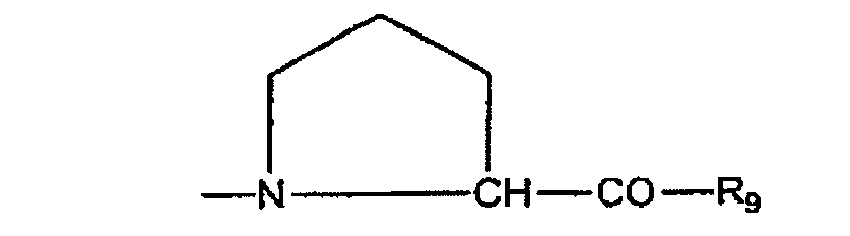
 R' ein Wasserstoffatom, einen Methylrest oder einen Ethylrest darstellt;A und B zusammen einen Cyclopentanrest bilden können, wenn R' ein Wasserstoffatom darstellt;
 - Verfahren nach Anspruch 12, dadurch gekennzeichnet, dass das Carboxydithiol oder die Carboxydithiole der allgemeinen Formel (I) ausgewählt werden aus:- 4-Mercapto-2-(2-mercaptoethyl)-butansäure,- 4-Mercapto-2-(2-mercaptoethyl)-butansäuremethylester,- 4-Mercapto-2-(2-mercaptoethyl)-butansäureethylester,- 4-Mercapto-2-(2-mercaptoethyl)-butansäure von 1,2-Propandiol,- 4-Mercapto-2-(2-mercaptoethyl)-butansäureester von Glycerin,- 4-Mercapto-2-(2-mercaptoethyl)-N-methyl-butanamid,- 4-Mercapto-2-(2-mercaptoethyl)-N-ethyl-butanamid,- 4-Mercapto-2-(2-mercaptoethyl)-N-(2-hydroxyethyl)-butanamid,- 4-Mercapto-2-(2-mercaptoethyl)-N-(2-hydroxypropyl)-butanamid,- 4-Mercapto-2-(2-mercaptoethyl)-N-(2-dimethylaminoethyl)-butanamid,- 4-Mercapto-2-(2-mercaptoethyl)-N-(2-dimethylaminopropyl)-butanamid,- 4-Mercapto-2-(2-mercaptoethyl)-N,N-dimethyl-butanamid,- 5-Mercapto-2-(mercaptomethyl)-pentansäure,- 5-Mercapto-2-(mercaptomethyl)-pentansäuremethylester,- 5-Mercapto-2-(mercaptomethyl)-pentansäureethylester,- 5-Mercapto-2-(mercaptomethyl)-pentansäureester von 1,2 Propandiol,- 5-Mercapto-2-(mercaptomethyl)-pentansäureester von Glycerin,- 5-Mercapto-2-(mercaptomethyl)-N-methyl-pentanamid,- 5-Mercapto-2-(mercaptomethyl)-N-ethyl-pentanamid,- 5-Mercapto-2-(mercaptomethyl)-N-(2-hydroxyethyl)-pentanamid,- 5-Mercapto-2-(mercaptomethyl)-N-(2-hydroxypropyl)-pentanamid,- 5-Mercapto-2-(mercaptomethyl)-N-(2-dimethylaminoethyl)-pentanamid,- 5-Mercapto-2-(mercaptomethyl)-N-(2-dimethylaminopropyl)-pentanamid- 5-Mercapto-2-(mercaptomethyl)-N,N-dimethyl-pentanamid,- 4-Mercapto-2-(mercaptomethyl)-butansäure,- 4-Mercapto-2-(mercaptomethyl)-butansäuremethylester,- 4-Mercapto-2-(mercaptomethyl)-butansäureethylester,- 4-Mercapto-2-(mercaptomethyl)-butansäureester von 1,2-Propandiol,- 4-Mercapto-2-(mercaptomethyl)-butansäureester von Glycerin,- 4-Mercapto-2-(mercaptomethyl)-N-methyl-butanamid,- 4-Mercapto-2-(mercaptomethyl)-N-ethyl-butanamid,- 4-Mercapto-2-(mercaptomethyl)-N-(2-hydroxyethyl)-butanamid,- 4-Mercapto-2-(mercaptomethyl)-N-(2-hydroxypropyl)-butanamid,- 4-Mercapto-2-(mercaptomethyl)-N-(2-dimethylaminoethyl)-butanamid,- 4-Mercapto-2-(mercaptomethyl)-N-(2-dimethylaminopropyl)-butanamid,- 4-Mercapto-2-(mercaptomethyl)-N,N-dimethyl-butanamid,- 3-Mercapto-2-(mercaptomethyl)-propansäure,- 3-Mercapto-2-(mercaptomethyl)-propansäuremethylester,- 3-Mercapto-2-(mercaptomethyl)-propansäureethylester,- 3-Mercapto-2-(mercaptomethyl)-propansäureester von 1,2-Propandiol,- 3-Mercapto-2-(mercaptomethyl)-propansäureester von Glycerin,- 3-Mercapto-2-(mercaptomethyl)-N-methyl-propanamid,- 3-Mercapto-2-(mercaptomethyl)-N-ethyl-propanamid,- 3-Mercapto-2-(mercaptomethyl)-N-(2-hydroxyethyl)-propanamid,- 3-Mercapto-2-(mercaptomethyl)-N-(2-hydroxypropyl)-propanamid,- 3-Mercapto-2-(mercaptomethyl)-N-(2-dimethylaminoethyl)-propanamid,- 3-Mercapto-2-(mercaptomethyl)-N-(2-dimethylaminopropyl)-propanamid,- 3-Mercapto-2-(mercaptomethyl)-N,N-dimethyl-propanamid,- 3-Mercapto-2-(mercaptomethyl)-2-methyl-propansäure,- 3-Mercapto-2-(mercaptomethyl)-2-methylpropansäuremethylester,- 3-Mercapto-2-(mercaptomethyl)-2-methylpropansäureethylester,- 3-Mercapto-2-(mercaptomethyl)-2-methyl-propansäureester von 1,2-Propandiol,- 3-Mercapto-2-(mercaptomethyl)-2-methyl-propansäureester von Glycerin,- 3-Mercapto-2-(mercaptomethyl)-2-methyl-N-methyl-propanamid,- 3-Mercapto-2-(mercaptomethyl)-2-methyl-N-ethyl-propanamid,- 3-Mercapto-2-(mercaptomethyl)-2-methyl-N-(2-hydroxyethyl)-propanamid,- 3-Mercapto-2-(mercaptomethyl)-2-methyl-N-(2-hydroxypropyl)-propanamid,- 3-Mercapto-2-(mercaptomethyl)-2-methyl-N-(2-dimethylaminoethyl)-propanamid,- 3-Mercapto-2-(mercaptomethyl)-2-methyl-N-(2-dimethylaminopropyl)-propanamid,- 3-Mercapto-2-(mercaptomethyl)-2-methyl-N,N-dimethylpropanamid,- 2,2-Bis(mercaptomethyl)-butansäure,- 2,2-Bis(mercaptomethyl)-butansäuremethylester,- 2,2-Bis(mercaptomethyl)-butansäureethylester,- 2,2-Bis(mercaptomethyl)-butansäureester von 1,2-Propandiol,- 2,2-Bis(mercaptomethyl)-butansäureester von Glycerin,- 2,2-Bis(mercaptomethyl)-N-methyl-butanamid,- 2,2-Bis(mercaptomethyl)-N-ethyl-butanamid,- 2,2-Bis(mercaptomethyl)-N-(2-hydroxyethyl)-butanamid,- 2,2-Bis(mercaptomethyl)-N-(2-hydroxypropyl)-butanamid,- 2,2-Bis(mercaptomethyl)-N-(2-dimethylaminoethyl)-propanamid,- 2,2-Bis(mercaptomethyl)-N-(2-dimethylaminopropyl)-propanamid,- 2,2-Bis(mercaptomethyl)-N,N-dimethyl-propanamid,- 3-Mercapto-2-(1-mercaptoethyl)-butansäure,- 3-Mercapto-2-(1-mercaptoethyl)-butansäuremethylester,- 3-Mercapto-2-(1-mercaptoethyl)-butansäureethylester,- 3-Mercapto-2-(1-mercaptoethyl)-butansäureester von 1,2 Propandiol,- 3-Mercapto-2-(1-mercaptoethyl)-butansäureester von Glycerin,- 3-Mercapto-2-(1-mercaptoethyl)-N-methyl-butanamid,- 3-Mercapto-2-(1-mercaptoethyl)-N-ethyl-butanamid,- 3-Mercapto-2-(1-mercaptoethyl)-N-(2-hydroxyethyl)-butanamid,- 3-Mercapto-2-(1-mercaptoethyl)-N-(2-hydroxypropyl)-butanamid,- 3-Mercapto-2-(1-mercaptoethyl)-N-(2-dimethylaminoethyl)-propanamid,- 3-Mercapto-2-(1-mercaptoethyl)-N-(2-dimethylaminopropyl)-propanamid,- 3-Mercapto-2-(1-mercaptoethyl)-N,N-dimethyl-propanamid,- 6-Mercapto-2-(mercaptomethyl)-hexansäure,- 6-Mercapto-2-(mercaptomethyl)-hexansäuremethylester,- 6-Mercapto-2-(mercaptomethyl)-hexansäureethylester,- 6-Mercapto-2-(mercaptomethyl)-hexansäureester von 1,2-Propandiol,- 6-Mercapto-2-(mercaptomethyl)-hexansäureester von Glycerin,- 6-Mercapto-2-(mercaptomethyl)-N-methyl-hexanamid,- 6-Mercapto-2-(mercaptomethyl)-N-ethyl-hexanamid,- 6-Mercapto-2-(mercaptomethyl)-N-(2-hydroxyethyl)-hexanamid,- 6-Mercapto-2-(mercaptomethyl)-N-(2-hydroxypropyl)-hexanamid,- 6-Mercapto-2-(mercaptomethyl)-N-(2-dimethylaminoethyl)-hexanamid,- 6-Mercapto-2-(mercaptomethyl)-N-(2-dimethylaminopropyl)-hexanamid,- 6-Mercapto-2-(mercaptomethyl)-N,N-dimethyl-hexanamid,- 1-[(2-Mercaptomethyl)-3-mercaptopropanoyl)]-L-prolin,- 1-[(2-Mercaptomethyl)-3-mercaptopropanoyl)]-pipecolinsäure,- N-[2-(Mercaptomethyl)-3-mercaptopropanoyl]-L-leucin,- N-[2-(Mercaptomethyl)-3-mercaptopropanoyl]-L-arginin,- N-[2-(Mercaptomethyl)-3-mercaptopropanoyl]-L-lysin,- N-[2-(Mercaptomethyl)-3-mercaptopropanoyl]-glycin,- N-[2-(Mercaptomethyl)-3-mercaptopropanoyl]-L-glutamin,- N-[2-(Mercaptomethyl)-3-mercaptopropanoyl]-L-threonin,- N-[2-(Mercaptomethyl)-3-mercaptopropanoyl]-L-4-hydroxyprolin,- N-[2-(Mercaptomethyl)-3-mercaptopropanoyl]-L-methionin.
- Zusammensetzung nach Anspruch 13, dadurch gekennzeichnet, dass das Carboxydithiol oder die Carboxydithiole der allgemeinen Formel (I) ausgewählt ist/sind aus:- 4-Mercapto-2-(2-mercaptoethyl)-butansäure,- 4-Mercapto-2-(2-mercaptoethyl)-N-methyl-butanamid,- 4-Mercapto-2-(2-mercaptoethyl)-N-(2-hydroxypropyl)-butanamid,- 4-Mercapto-2-(2-mercaptoethyl)-N-(2-dimethylaminoethyl)-butanamid,- 5-Mercapto-2-(mercaptomethyl)-pentansäure,- 5-Mercapto-2-(mercaptomethyl)-N-methyl-pentanamid,- 5-Mercapto-2-(mercaptomethyl)-N-(2-hydroxypropyl)-pentanamid,- 4-Mercapto-2-(mercaptomethyl)-butansäure,- 4-Mercapto-2-(mercaptomethyl)-N-methyl-butanamid,- 4-Mercapto-2-(mercaptomethyl)-N-ethyl-butanamid,- 4-Mercapto-2-(mercaptomethyl)-N-(2-hydroxyethyl)-butanamid,- 4-Mercapto-2-(mercaptomethyl)-N-(2-hydroxypropyl)-butanamid,- 4-Mercapto-2-(mercaptomethyl)-N-(2-dimethylaminoethyl)-butanamid,- 4-Mercapto-2-(mercaptomethyl)-N-(2-dimethylaminopropyl)-butanamid,- 4-Mercapto-2-(mercaptomethyl)-N,N-dimethyl-butanamid,- 3-Mercapto-2-(mercaptomethyl)-propansäure,- 3-Mercapto-2-(mercaptomethyl)-propansäuremethylester,- 3-Mercapto-2-(mercaptomethyl)-propansäureethylester,- 3-Mercapto-2-(mercaptomethyl)-propansäureester von 1,2-Propandiol,- 3-Mercapto-2-(mercaptomethyl)-propansäureester von Glycerin,- 3-Mercapto-2-(mercaptomethyl)-N-methyl-propanamid,- 3-Mercapto-2-(mercaptomethyl)-N-ethyl-propanamid,- 3-Mercapto-2-(mercaptomethyl)-N-(2-hydroxyethyl)-propanamid,- 3-Mercapto-2-(mercaptomethyl)-N-(2-hydroxypropyl)-propanamid,- 3-Mercapto-2-(mercaptomethyl)-N-(2-dimethylaminoethyl)-propanamid,- 3-Mercapto-2-(mercaptomethyl)-N-(2-dimethylaminopropyl)-propanamid,- 3-Mercapto-2-(mercaptomethyl)-N,N-dimethyl-propanamid,- 3-Mercapto-2-(mercaptomethyl)-2-methyl-propansäure,- 3-Mercapto-2-(mercaptomethyl)-2-methylpropansäuremethylester,- 3-Mercapto-2-(mercaptomethyl)-2-methylpropansäureethylester,- 3-Mercapto-2-(mercaptomethyl)-2-methyl-propansäureester von 1,2-Propandiol,- 3-Mercapto-2-(mercaptomethyl)-2-methyl-propansäureester von Glycerin,- 3-Mercapto-2-(mercaptomethyl)-2-methyl-N-methyl-propanamid,- 3-Mercapto-2-(mercaptomethyl)-2-methyl-N-ethyl-propanamid,- 3-Mercapto-2-(mercaptomethyl)-2-methyl-N-(2-hydroxyethyl)-propanamid,- 3-Mercapto-2-(mercaptomethyl)-2-methyl-N-(2-hydroxypropyl)-propanamid,- 3-Mercapto-2-(mercaptomethyl)-2-methyl-N-(2-dimethylaminoethyl)-propanamid,- 3-Mercapto-2-(mercaptomethyl)-2-methyl-N-(2-dimethylaminopropyl)-propanamid,- 3-Mercapto-2-(mercaptomethyl)-2-methyl-N,N-dimethylpropanamid,- 2,2-Bis(mercaptomethyl)-butansäure,- 2,2-Bis(mercaptomethyl)-butansäuremethylester,- 2,2-Bis(mercaptomethyl)-butansäureethylester,- 2,2-Bis(mercaptomethyl)-butansäureester von 1,2-Propandiol,- 2,2-Bis(mercaptomethyl)-butansäureester von Glycerin,- 2,2-Bis(mercaptomethyl)-N-methyl-butanamid,- 2,2-Bis(mercaptomethyl)-N-ethyl-butanamid,- 2,2-Bis(mercaptomethyl)-N-(2-hydroxyethyl)-butanamid,- 2,2-Bis(mercaptomethyl)-N-(2-hydroxypropyl)-butanamid,- 2,2-Bis(mercaptomethyl)-N-(2-dimethylaminoethyl)-propanamid,- 2,2-Bis(mercaptomethyl)-N-(2-dimethylaminopropyl)-propanamid,- 2,2-Bis(mercaptomethyl)-N,N-dimethyl-propanamid,- 3-Mercapto-2-(1-mercaptoethyl)-butansäure,- 3-Mercapto-2-(1-mercaptoethyl)-butansäureester von 1,2 Propandiol,- 3-Mercapto-2-(1-mercaptoethyl)-butansäureester von Glycerin,- 3-Mercapto-2-(1-mercaptoethyl)-N-methyl-butanamid,- 3-Mercapto-2-(1-mercaptoethyl)-N-ethyl-butanamid,- 3-Mercapto-2-(1-mercaptoethyl)-N-(2-hydroxypropyl)-butanamid,- 6-Mercapto-2-(mercaptomethyl)-hexansäure,- 6-Mercapto-2-(mercaptomethyl)-N-(2-hydroxypropyl)-hexanamid.
- Verfahren nach einem der Ansprüche 12 bis 14, dadurch gekennzeichnet, dass das Carboxydithiol oder die Carboxydithiole der allgemeinen Formel (I) mit einem Gehalt zwischen 0,05 und 30 Gewichtsprozent, vorzugsweise zwischen 1 und 20 Gewichtsprozent, bezogen auf das Gesamtgewicht der Zusammensetzung, vorliegen.
- Verfahren nach einem der Ansprüche 12 bis 15, dadurch gekennzeichnet, dass der pH der reduzierenden Zusammensetzung zwischen 4 und 11, vorzugsweise zwischen 6 und 10, ist.
- Verfahren nach Anspruch 16, dadurch gekennzeichnet, dass der pH der reduzierenden Zusammensetzung mit Hilfe eines basischen Mittels, ausgewählt unter Ammoniak, Monoethanolamin, Diethanolamin, 1,3-Propandiamin, einem Alkali- oder Ammoniumcarbonat oder -bicarbonat, einem organischen Carbonat, vorzugsweise Guanidincarbonat, und einem Alkalihydroxid, oder mit Hilfe eines azidifizierenden Mittels, ausgewählt aus Chlorwasserstoffsäure, Essigsäure, Milchsäure, Oxalsäure und Borsäure, oder auch mit Hilfe eines Borat-, Phosphat-, oder TRIS-Puffer erhalten wird.
- Verfahren nach einem der Ansprüche 12 bis 17, dadurch gekennzeichnet, dass die reduzierende Zusammensetzung außerdem ein oder mehrere andere Reduktionsmittel, ausgewählt aus Thioglycolsäure, Thiomilchsäure, Glycerinmonothioglycolat, Cysteamin, N-Acetylcysteamin, N-Propionylcysteamin, Cystein, N-Acetylcystein, Thioäpfelsäure, Panthetein, 2,3-Dimercaptobernsteinsäure, Alkali- oder Erdalkalimetallsulfiten oder -bisulfiten, N-(Mercaptoalkyl)-ω-hydroxyalkylamiden, N-mono- oder N,N-Dialkylmercapto-4-butyramiden, Aminomercaptoalkylamiden, Derivaten von N-(Mercaptoalkyl)succinamidsäuren und N-(Mercaptoalkyl)succinimiden, Alkylaminomercaptoalkylamiden, dem azeotropen Gemisch von 2-Hydroxypropylthioglyconat und (2-Hydroxy-1-methyl)ethylthioglycolat, Mercaptoalkylaminoamiden, N-Mercaptoalkylalkandiamiden und Derivaten von Formamidinsulfinsäure, umfasst.
- Verfahren nach einem der Ansprüche 12 bis 18, dadurch gekennzeichnet, dass die reduzierende Zusammensetzung wenigstens ein Surfactant, ausgewählt aus (C1-C10)-Alkylsufaten, (C1-C10)-Alkylbenzolsulfaten, (C1-C10)Alkyl-ethersulfaten, (C1-C10)Alklysulfonaten, quaternären Ammoniumsalzen, (C1-C10)Alkyl-betainen, oxyethylenierten (C1-C10)Alkylphenolen, Alkanolamiden von Fettsäuren, oxyethylenierten Fettsäureestern, Hydroxypropylethern, umfasst.
- Verfahren nach Anspruch 19, dadurch gekennzeichnet, dass das Surfactant oder die Surfactants höchstens 30 Gewichtsprozent, vorzugsweise zwischen 0,5 und 10 Gewichtsprozent, des Gesamtgewichts der Zusammensetzung darstellen.
- Verfahren nach einem der Ansprüche 12 bis 20, dadurch gekennzeichnet, dass die reduzierende Zusammensetzung ein Vehikel umfasst, das aus Wasser und einer wässrig-alkoholischen Lösung eines niederen C1-C6-Alkohols, vorzugsweise Ethanol, Propanol, Isopropanol, Butanol oder Glycerin, ausgewählt ist.
- Verfahren nach einem der Ansprüche 12 bis 21, dadurch gekennzeichnet, dass die reduzierende Zusammensetzung sich in wässriger Form, vorzugsweise in der Form einer Lotion, verdickt oder nicht, einer Creme, verdickt oder nicht, oder eines Gels präsentiert.
- Verfahren nach einem der Ansprüche 12 bis 22, dadurch gekennzeichnet, dass man die reduzierende Zusammensetzung während 5 bis 60 Minuten, vorzugsweise 15 bis 45 Minuten, einwirken lässt.
- Verfahren nach einem der Ansprüche 12 bis 23, dadurch gekennzeichnet, dass die oxidierende Zusammensetzung wenigstens ein Oxidationsmittel umfasst, das aus Wasserstoffperoxid, Alkalibromaten, Persalzen, Polythionaten und einem Gemisch aus Alkalibromat und Persalz ausgewählt ist.
- Verfahren nach einem der Ansprüche 12 bis 24, dadurch gekennzeichnet, dass es außerdem zwischen der Stufe der Auftragung der reduzierenden Zusammensetzung auf die Haare und der Fixierungsstufe eine Stufe der Erwärmung der Haare mit einem Heizstylingeisen auf eine Temperatur zwischen 60 und 220°C, vorzugsweise zwischen 120 und 200°C umfasst.
- Kit für die dauerhafte Verformung der Haare, umfassend in einem ersten Kompartiment eine reduzierende Zusammensetzung, wie sie in einem der Ansprüche 12 bis 22 definiert ist, und in einem zweiten Kompartiment eine oxidierende Zusammensetzung.
- Carboxydithiol, dadurch gekennzeichnet, dass es der allgemeinen Formel (II) entspricht:
 A' und B' unabhängig voneinander einen (CH2)n-Rest, worin n eine ganze Zahl zwischen 1 und 4 ist, oder einen CH(CH3)-Rest darstellen;R"' ein Wasserstoffatom, einen Methylrest oder einen Ethylrest darstellt;R" darstellt:oder ein organisches oder Mineralsalz der Verbindung der Formel (II).a) einen Rest OR'1, worin R'1 einen linearen oder verzweigten C1-C5-Alkylrest, der gegebenenfalls mit einem oder zwei Hydroxylresten substituiert ist, darstellt, mit Ausnahme der Verbindungen, in denen: A' und B' CH2 darstellen und R'1 einen Methylrest oder Ethylrest darstellt; oderb) einen Rest NR'2R'3, worin R'2 und R'3, die gleich oder unterschiedlich sind, ein Wasserstoffatom oder einen linearen oder verzweigten C1-C5-Alkylrest, der gegebenenfalls mit einem oder zwei Resten, ausgewählt aus Hydroxyl-, Methylamino-, Ethylamino- und Dimethylaminoresten, darstellen, mit Ausnahme der Verbindungen, in denen: A' und B' CH2 darstellen, R'2 und R'3 einen Methylrest darstellen und R"' von einem Methylrest verschieden ist; oderc) einen Rest OH mit der Maßgabe, dass A' und B' CH2 darstellen und dass R"' ein Ethylrest ist;
 - Carboxydithiol nach Anspruch 27, dadurch gekennzeichnet, dass es unter den folgenden Verbindungen ausgewählt ist:- 4-Mercapto-2-(2-mercaptoethyl)-butansäuremethylester,- 4-Mercapto-2-(2-mercaptoethyl)-butansäureethylester,- 4-Mercapto-2-(2-mercaptoethyl)-butansäureester von 1,2-Propandiol,- 4-Mercapto-2-(2-mercaptoethyl)-butansäureester von Glycerin,- 4-Mercapto-2-(2-mercaptoethyl)-N-methyl-butanamid,- 4-Mercapto-2-(2-mercaptoethyl)-N-ethyl-butanamid,- 4-Mercapto-2-(2-mercaptoethyl)-N-(2-hydroxyethyl)-butanamid,- 4-Mercapto-2-(2-mercaptoethyl)-N-(2-hydroxypropyl)-butanamid,- 4-Mercapto-2-(2-mercaptoethyl)-N-(2-dimethylaminoethyl)-butanamid,- 4-Mercapto-2-(2-mercaptoethyl)-N-(2-dimethylaminopropyl)-butanamid,- 4-Mercapto-2-(2-mercaptoethyl)-N,N-dimethyl-butanamid,- 5-Mercapto-2-(mercaptomethyl)-pentansäuremethylester,- 5-Mercapto-2-(mercaptomethyl)-pentansäureethylester,- 5-Mercapto-2-(mercaptomethyl)-pentansäureester von 1,2-Propandiol,- 5-Mercapto-2-(mercaptomethyl)-pentansäureester von Glycerin,- 5-Mercapto-2-(mercaptomethyl)-N-methyl-pentanamid,- 5-Mercapto-2-(mercaptomethyl)-N-ethyl-pentanamid,- 5-Mercapto-2-(mercaptomethyl)-N-(2-hydroxyethyl)-pentanamid,- 5-Mercapto-2-(mercaptomethyl)-N-(2-hydroxypropyl)-pentanamid,- 5-Mercapto-2-(mercaptomethyl)-N-(2-dimethylaminoethyl)-pentanamid,- 5-Mercapto-2-(mercaptomethyl)-N-(2-dimethylaminopropyl)-pentanamid- 5-Mercapto-2-(mercaptomethyl)-N,N-dimethyl-pentanamid,- 4-Mercapto-2-(mercaptomethyl)-butansäuremethylester,- 4-Mercapto-2-(mercaptomethyl)-butansäureethylester,- 4-Mercapto-2-(mercaptomethyl)-butansäureester von 1,2-Propandiol,- 4-Mercapto-2-(mercaptomethyl)-butansäureester von Glycerin,- 4-Mercapto-2-(mercaptomethyl)-N-methyl-butanamid,- 4-Mercapto-2-(mercaptomethyl)-N-ethyl-butanamid,- 4-Mercapto-2-(mercaptomethyl)-N-(2-hydroxyethyl)-butanamid,- 4-Mercapto-2-(mercaptomethyl)-N-(2-hydroxypropyl)-butanamid,- 4-Mercapto-2-(mercaptomethyl)-N-(2-dimethylaminoethyl)-butanamid,- 4-Mercapto-2-(mercaptomethyl)-N-(2-dimethylaminopropyl)-butanamid,- 4-Mercapto-2-(mercaptomethyl)-N,N-dimethyl-butanamid,- 3-Mercapto-2-(mercaptomethyl)-propansäureester von 1,2-Propandiol,- 3-Mercapto-2-(mercaptomethyl)-propansäureester von Glycerin,- 3-Mercapto-2-(mercaptomethyl)-N-methyl-propanamid,- 3-Mercapto-2-(mercaptomethyl)-N-ethyl-propanamid,- 3-Mercapto-2-(mercaptomethyl)-N-(2-hydroxyethyl)-propanamid,- 3-Mercapto-2-(mercaptomethyl)-N-(2-hydroxypropyl)-propanamid,- 3-Mercapto-2-(mercaptomethyl)-N-(2-dimethylaminoethyl)-propanamid,- 3-Mercapto-2-(mercaptomethyl)-N-(2-dimethylaminopropyl)-propanamid,- 3-Mercapto-2-(mercaptomethyl)-2-methylpropansäuremethylester,- 3-Mercapto-2-(mercaptomethyl)-2-methylpropansäureethylester,- 3-Mercapto-2-(mercaptomethyl)-2-methyl-propansäureester von 1,2-Propandiol,- 3-Mercapto-2-(mercaptomethyl)-2-methyl-propansäureester von Glycerin,- 3-Mercapto-2-(mercaptomethyl)-2-methyl-N-methyl-propanamid,- 3-Mercapto-2-(mercaptomethyl)-2-methyl-N-ethyl-propanamid,- 3-Mercapto-2-(mercaptomethyl)-2-methyl-N-(2-hydroxyethyl)-propanamid,- 3-Mercapto-2-(mercaptomethyl)-2-methyl-N-(2-hydroxypropyl)-propanamid,- 3-Mercapto-2-(mercaptomethyl)-2-methyl-N-(2-dimethylaminoethyl)-propanamid,- 3-Mercapto-2-(mercaptomethyl)-2-methyl-N-(2-dimethylaminopropyl)-propanamid,- 3-Mercapto-2-(mercaptomethyl)-2-methyl-N,N-dimethylpropanamid,- 2,2-Bis(mercaptomethyl)-butansäure,- 2,2-Bis(mercaptomethyl)-butansäuremethylester,- 2,2-Bis(mercaptomethyl)-butansäureethylester,- 2,2-Bis(mercaptomethyl)-butansäureester von 1,2-Propandiol,- 2,2-Bis(mercaptomethyl)-butansäureester von Glycerin,- 2,2-Bis(mercaptomethyl)-N-methyl-butanamid,- 2,2-Bis(mercaptomethyl)-N-ethyl-butanamid,- 2,2-Bis(mercaptomethyl)-N-(2-hydroxyethyl)-butanamid,- 2,2-Bis(mercaptomethyl)-N-(2-hydroxypropyl)-butanamid,- 2,2-Bis(mercaptomethyl)-N-(2-dimethylaminoethyl)-propanamid,- 2,2-Bis(mercaptomethyl)-N-(2-dimethylaminopropyl)-propanamid,- 2,2-Bis(mercaptomethyl)-N,N-dimethyl-propanamid,- 3-Mercapto-2-(1-mercaptoethyl)-butansäuremethylester,- 3-Mercapto-2-(1-mercaptoethyl)-butansäureethylester,- 3-Mercapto-2-(1-mercaptoethyl)-butansäureester von 1,2-Propandiol,- 3-Mercapto-2-(1-mercaptoethyl)-butansäureester von Glycerin,- 3-Mercapto-2-(1-mercaptoethyl)-N-methyl-butanamid,- 3-Mercapto-2-(1-mercaptoethyl)-N-ethyl-butanamid,- 3-Mercapto-2-(1-mercaptoethyl)-N-(2-hydroxyethyl)-butanamid,- 3-Mercapto-2-(1-mercaptoethyl)-N-(2-hydroxypropyl)-butanamid,- 3-Mercapto-2-(1-mercaptoethyl)-N-(2-dimethylaminoethyl)-propanamid,- 3-Mercapto-2-(1-mercaptoethyl)-N-(2-dimethylaminopropyl)-propanamid,- 3-Mercapto-2-(1-mercaptoethyl)-N,N-dimethyl-propanamid,- 6-Mercapto-2-(mercaptomethyl)-hexansäuremethylester,- 6-Mercapto-2-(mercaptomethyl)-hexansäureethylester,- 6-Mercapto-2-(mercaptomethyl)-hexansäureester von 1,2-Propandiol,- 6-Mercapto-2-(mercaptomethyl)-hexansäureester von Glycerin,- 6-Mercapto-2-(mercaptomethyl)-N-methyl-hexanamid,- 6-Mercapto-2-(mercaptomethyl)-N-ethyl-hexanamid,- 6-Mercapto-2-(mercaptomethyl)-N-(2-hydroxyethyl)-hexanamid,- 6-Mercapto-2-(mercaptomethyl)-N-(2-hydroxypropyl)-hexanamid,- 6-Mercapto-2-(mercaptomethyl)-N-(2-dimethylaminoethyl)-hexanamid,- 6-Mercapto-2-(mercaptomethyl)-N-(2-dimethylaminopropyl)-hexanamid,- 6-Mercapto-2-(mercaptomethyl)-N,N-dimethyl-hexanamid,
- Carboxydithiol nach Anspruch 28, dadurch gekennzeichnet, dass es aus den folgenden Verbindungen ausgewählt ist:- 4-Mercapto-2-(2-mercaptoethyl)-N-methyl-butanamid,- 4-Mercapto-2-(2-mercaptoethyl)-N-(2-hydroxypropyl)-butanamid,- 4-Mercapto-2-(2-mercaptoethyl)-N-(2-dimethylaminoethyl)-butanamid,- 5-Mercapto-2-(mercaptomethyl)-N-methyl-pentanamid,- 5-Mercapto-2-(mercaptomethyl)-N-(2-hydroxypropyl)-pentanamid,- 4-Mercapto-2-(mercaptomethyl)-N-methyl-butanamid,- 4-Mercapto-2-(mercaptomethyl)-N-ethyl-butanamid,- 4-Mercapto-2-(mercaptomethyl)-N-(2-hydroxyethyl)-butanamid,- 4-Mercapto-2-(mercaptomethyl)-N-(2-hydroxypropyl)-butanamid,- 4-Mercapto-2-(mercaptomethyl)-N-(2-dimethylaminoethyl)-butanamid,- 4-Mercapto-2-(mercaptomethyl)-N-(2-dimethylaminopropyl)-butanamid,- 4-Mercapto-2-(mercaptomethyl)-N,N-dimethyl-butanamid,- 3-Mercapto-2-(mercaptomethyl)-propansäureester von 1,2-Propandiol,- 3-Mercapto-2-(mercaptomethyl)-propansäureester von Glycerin,- 3-Mercapto-2-(mercaptomethyl)-N-methyl-propanamid,- 3-Mercapto-2-(mercaptomethyl)-N-ethyl-propanamid,- 3-Mercapto-2-(mercaptomethyl)-N-(2-hydroxyethyl)-propanamid,- 3-Mercapto-2-(mercaptomethyl)-N-(2-hydroxypropyl)-propanamid,- 3-Mercapto-2-(mercaptomethyl)-N-(2-dimethylaminoethyl)-propanamid,- 3-Mercapto-2-(mercaptomethyl)-N-(2-dimethylaminopropyl)-propanamid,- 3-Mercapto-2-(mercaptomethyl)-2-methylpropansäuremethylester,- 3-Mercapto-2-(mercaptomethyl)-2-methylpropansäureethylester,- 3-Mercapto-2-(mercaptomethyl)-2-methyl-propansäureester von 1,2-Propandiol,- 3-Mercapto-2-(mercaptomethyl)-2-methyl-propansäureester von Glycerin,- 3-Mercapto-2-(mercaptomethyl)-2-methyl-N-methyl-propanamid,- 3-Mercapto-2-(mercaptomethyl)-2-methyl-N-(2-hydroxyethyl)-propanamid,- 3-Mercapto-2-(mercaptomethyl)-2-methyl-N-(2-hydroxypropyl)-propanamid,- 3-Mercapto-2-(mercaptomethyl)-2-methyl-N-(2-dimethylaminoethyl)-propanamid,- 3-Mercapto-2-(mercaptomethyl)-2-methyl-N-(2-dimethylaminopropyl)-propanamid,- 3-Mercapto-2-(mercaptomethyl)-2-methyl-N,N-dimethylpropanamid,- 2,2-Bis(mercaptomethyl)-butansäure,- 2,2-Bis(mercaptomethyl)-butansäuremethylester,- 2,2-Bis(mercaptomethyl)-butansäureethylester,- 2,2-Bis(mercaptomethyl)-butansäureester von 1,2-Propandiol,- 2,2-Bis(mercaptomethyl)-N-methyl-butanamid,- 2,2-Bis(mercaptomethyl)-N-(2-hydroxyethyl)-butanamid,- 2,2-Bis(mercaptomethyl)-N-(2-hydroxypropyl)-butanamid,- 2,2-Bis(mercaptomethyl)-N,N-dimethyl-propanamid,- 3-Mercapto-2-(1-mercaptoethyl)-N-(2-hydroxypropyl)-butanamid,- 6-Mercapto-2-(mercaptomethyl)-N-(2-hydroxypropyl)-hexanamid.
Applications Claiming Priority (2)
| Application Number | Priority Date | Filing Date | Title |
|---|---|---|---|
| FR0450418A FR2867069B1 (fr) | 2004-03-02 | 2004-03-02 | Composition de deformation permanente des cheveux contenant au moins un carboxydithiol. |
| FR0450418 | 2004-03-02 |
Publications (2)
| Publication Number | Publication Date |
|---|---|
| EP1570835A1 EP1570835A1 (de) | 2005-09-07 |
| EP1570835B1 true EP1570835B1 (de) | 2010-10-20 |
Family
ID=34746563
Family Applications (1)
| Application Number | Title | Priority Date | Filing Date |
|---|---|---|---|
| EP05300162A Expired - Lifetime EP1570835B1 (de) | 2004-03-02 | 2005-03-02 | Zusammensetzung zur dauerhaften Verformung der Haare enthaltend mindestens ein Carboxydithiol |
Country Status (6)
| Country | Link |
|---|---|
| EP (1) | EP1570835B1 (de) |
| JP (2) | JP4174482B2 (de) |
| KR (1) | KR100697035B1 (de) |
| AT (1) | ATE485079T1 (de) |
| DE (1) | DE602005024198D1 (de) |
| FR (1) | FR2867069B1 (de) |
Families Citing this family (4)
| Publication number | Priority date | Publication date | Assignee | Title |
|---|---|---|---|---|
| FR2868420B1 (fr) * | 2004-04-06 | 2006-06-16 | Oreal | Utilisation de dimercaptoamides pour la deformation permanente des fibres keratiniques |
| FR2910274B1 (fr) * | 2006-12-22 | 2009-04-03 | Oreal | Procede de deformation permanente des fibres keratiniques comprenant une etape d'application d'une composition reductrice faiblement concentree et une etape intermediaire de sechage |
| FR2910247B1 (fr) * | 2006-12-22 | 2009-02-27 | Oreal | Procede de deformation permanente des fibres keratiniques comprenant une etape d'application d'une composition reductrice faiblement concentree et une etape intermediaire de sechage |
| US20180273503A1 (en) * | 2015-01-06 | 2018-09-27 | Riken | Novel angiotensin converting enzyme inhibitor |
Family Cites Families (3)
| Publication number | Priority date | Publication date | Assignee | Title |
|---|---|---|---|---|
| JPH02145508A (ja) * | 1988-11-28 | 1990-06-05 | Shiseido Co Ltd | ふけ防止用化粧料 |
| JP2926168B2 (ja) * | 1992-04-23 | 1999-07-28 | 参天製薬株式会社 | 含硫黄化合物 |
| FR2760359B1 (fr) * | 1997-03-04 | 2000-01-07 | Oreal | Procede de traitement d'un substrat keratinique |
-
2004
- 2004-03-02 FR FR0450418A patent/FR2867069B1/fr not_active Expired - Fee Related
-
2005
- 2005-03-02 DE DE602005024198T patent/DE602005024198D1/de not_active Expired - Lifetime
- 2005-03-02 EP EP05300162A patent/EP1570835B1/de not_active Expired - Lifetime
- 2005-03-02 AT AT05300162T patent/ATE485079T1/de not_active IP Right Cessation
- 2005-03-02 JP JP2005058247A patent/JP4174482B2/ja not_active Expired - Fee Related
- 2005-03-02 KR KR1020050017478A patent/KR100697035B1/ko not_active Expired - Fee Related
-
2007
- 2007-08-27 JP JP2007219678A patent/JP2008094830A/ja not_active Withdrawn
Also Published As
| Publication number | Publication date |
|---|---|
| ATE485079T1 (de) | 2010-11-15 |
| JP2008094830A (ja) | 2008-04-24 |
| KR100697035B1 (ko) | 2007-03-20 |
| JP2005281303A (ja) | 2005-10-13 |
| KR20060043349A (ko) | 2006-05-15 |
| DE602005024198D1 (de) | 2010-12-02 |
| FR2867069B1 (fr) | 2006-07-07 |
| FR2867069A1 (fr) | 2005-09-09 |
| EP1570835A1 (de) | 2005-09-07 |
| JP4174482B2 (ja) | 2008-10-29 |
Similar Documents
| Publication | Publication Date | Title |
|---|---|---|
| EP0653202B1 (de) | Kosmetische Zusammensetzung, enthaltend als Reduktionsmittel ein N-Mercaptoalkylalkandiamid oder eines seiner kosmetisch verträglichen Salze | |
| EP0368763B1 (de) | 4-Mercapto-Butyramide-N-mono- oder N,N-disubstituiert durch ein Mono- oder Polyhydroxyalkyl-Radikal und ihre Verwendung als Reduktionsmittel zur dauernden Verformung von Haaren | |
| EP0432000B1 (de) | Reduzierende Zusammensetzung zur dauerhaften Haarverformung, die als reduzierendes Agens ein Aminomercaptoalkylamid oder eines seiner Salze enthält sowie ihre Verwendung in einem Verfahren zur dauerhaften Haarverformung | |
| EP0514282B1 (de) | Alkylaminomerkaptoalkylamide, für Kosmetika akzeptabele Salze davon, ihre Verwendung als Reduktionsmittel sowie Verfahren zur dauerhaften Verformung von Haaren | |
| EP0465342B1 (de) | Reduzierendes Kosmetikum für die Dauerwelle, das ein Derivat der N-Mercapto-alkyl-succinamsäure oder eines N-Mercapto-alkyl-succinimids enthält sowie dessen Verwendung in einem Haardauerwellverfahren | |
| FR2679448A1 (fr) | Melange azetrope de thioglycolate d'hydroxy-2 propyle et de thioglycolate d'hydroxy-2 methyl-1 ethyle, son procede d'obtention et son utilisation dans un procede de deformation permanente des cheveux. | |
| EP0626166B1 (de) | Neues Verfahren zur dauerhaften Haarverformung und Mittel zur Durchführung dieses Verfahrens, die eine Kombination aus einem Amino oder Amidothiol und mindestens einem mineralischen Bromid enthalten | |
| EP0577473B1 (de) | Reduzierende kosmetische Zusammensetzung zur Haardauerwellung auf Basis eines Mercaptoalkylamino-Amids und Haardauerwellverfahren | |
| FR2880888A1 (fr) | Utilisation d'aminodithiol en tant qu'agent reducteur pour la deformation permanente des cheveux | |
| EP1570835B1 (de) | Zusammensetzung zur dauerhaften Verformung der Haare enthaltend mindestens ein Carboxydithiol | |
| EP1584615B1 (de) | Anwendung von Dimercaptoamiden zur dauerhaften Verformung von Keratinfasern | |
| EP0568695B1 (de) | Kosmetische Zusammensetzung zur Haarbehandlung | |
| EP1570834A1 (de) | Zusammensetzung zur dauerhaften Verformung der Haare enthaltend mindestens ein dicarboxydithiol | |
| US20070009462A9 (en) | Composition to permanently reshape the hair containing at least one dicarboxydithiol | |
| US20050208007A1 (en) | Composition to permanently reshape the hair containing at least one carboxydithiol | |
| FR2668929A1 (fr) | Composition cosmetique reductrice pour la deformation permanente des cheveux a base d'un amino-mercaptoalkylamide et procede de deformation permanente des cheveux. | |
| FR2845903A1 (fr) | Composition de deformation permanente des cheveux contenant au moins une combinaison bisulfitique de cetone | |
| FR2669329A1 (fr) | Amino-mercapto-alkylamides, leur procede de preparation et leur utilisation dans une composition cosmetique reductrice dans la deformation permanente des cheveux. | |
| FR2845904A1 (fr) | Composition de deformation permanente des cheveux contenant au moins une combinaison bisulfitique d'aldehyde | |
| FR2669332A1 (fr) | Nouveaux thioesters, leur procede de preparation et leur utilisation dans la synthese d'amino-mercapto-alkylamides. | |
| FR2845990A1 (fr) | Combinaisons bisulfitiques de cetones et leur utilisation pour la deformation permanente des cheveux | |
| FR2845905A1 (fr) | Combinaisons bisulfitiques d'aldehydes et leur utilisation pour la deformation permanente des cheveux |
Legal Events
| Date | Code | Title | Description |
|---|---|---|---|
| PUAI | Public reference made under article 153(3) epc to a published international application that has entered the european phase |
Free format text: ORIGINAL CODE: 0009012 |
|
| AK | Designated contracting states |
Kind code of ref document: A1 Designated state(s): AT BE BG CH CY CZ DE DK EE ES FI FR GB GR HU IE IS IT LI LT LU MC NL PL PT RO SE SI SK TR |
|
| AX | Request for extension of the european patent |
Extension state: AL BA HR LV MK YU |
|
| 17P | Request for examination filed |
Effective date: 20050906 |
|
| AKX | Designation fees paid |
Designated state(s): AT BE BG CH CY CZ DE DK EE ES FI FR GB GR HU IE IS IT LI LT LU MC NL PL PT RO SE SI SK TR |
|
| RIC1 | Information provided on ipc code assigned before grant |
Ipc: A61K 8/46 20060101ALI20061031BHEP Ipc: C07C 323/52 20060101ALI20061031BHEP Ipc: C07C 323/60 20060101ALI20061031BHEP Ipc: A61Q 5/04 20060101AFI20061031BHEP |
|
| RTI1 | Title (correction) |
Free format text: COMPOSITION FOR THE PERMANENT DEFORMATION OF THE HAIR COMPRISING AT LEAST ONE CARBOXYDITHIOL |
|
| 17Q | First examination report despatched |
Effective date: 20060310 |
|
| GRAP | Despatch of communication of intention to grant a patent |
Free format text: ORIGINAL CODE: EPIDOSNIGR1 |
|
| GRAS | Grant fee paid |
Free format text: ORIGINAL CODE: EPIDOSNIGR3 |
|
| GRAA | (expected) grant |
Free format text: ORIGINAL CODE: 0009210 |
|
| AK | Designated contracting states |
Kind code of ref document: B1 Designated state(s): AT BE BG CH CY CZ DE DK EE ES FI FR GB GR HU IE IS IT LI LT LU MC NL PL PT RO SE SI SK TR |
|
| REG | Reference to a national code |
Ref country code: GB Ref legal event code: FG4D Free format text: NOT ENGLISH |
|
| REG | Reference to a national code |
Ref country code: CH Ref legal event code: EP |
|
| REG | Reference to a national code |
Ref country code: IE Ref legal event code: FG4D Free format text: LANGUAGE OF EP DOCUMENT: FRENCH |
|
| REF | Corresponds to: |
Ref document number: 602005024198 Country of ref document: DE Date of ref document: 20101202 Kind code of ref document: P |
|
| REG | Reference to a national code |
Ref country code: NL Ref legal event code: VDEP Effective date: 20101020 |
|
| LTIE | Lt: invalidation of european patent or patent extension |
Effective date: 20101020 |
|
| PG25 | Lapsed in a contracting state [announced via postgrant information from national office to epo] |
Ref country code: LT Free format text: LAPSE BECAUSE OF FAILURE TO SUBMIT A TRANSLATION OF THE DESCRIPTION OR TO PAY THE FEE WITHIN THE PRESCRIBED TIME-LIMIT Effective date: 20101020 |
|
| REG | Reference to a national code |
Ref country code: IE Ref legal event code: FD4D |
|
| PG25 | Lapsed in a contracting state [announced via postgrant information from national office to epo] |
Ref country code: FI Free format text: LAPSE BECAUSE OF FAILURE TO SUBMIT A TRANSLATION OF THE DESCRIPTION OR TO PAY THE FEE WITHIN THE PRESCRIBED TIME-LIMIT Effective date: 20101020 Ref country code: IS Free format text: LAPSE BECAUSE OF FAILURE TO SUBMIT A TRANSLATION OF THE DESCRIPTION OR TO PAY THE FEE WITHIN THE PRESCRIBED TIME-LIMIT Effective date: 20110220 Ref country code: SI Free format text: LAPSE BECAUSE OF FAILURE TO SUBMIT A TRANSLATION OF THE DESCRIPTION OR TO PAY THE FEE WITHIN THE PRESCRIBED TIME-LIMIT Effective date: 20101020 Ref country code: PT Free format text: LAPSE BECAUSE OF FAILURE TO SUBMIT A TRANSLATION OF THE DESCRIPTION OR TO PAY THE FEE WITHIN THE PRESCRIBED TIME-LIMIT Effective date: 20110221 Ref country code: AT Free format text: LAPSE BECAUSE OF FAILURE TO SUBMIT A TRANSLATION OF THE DESCRIPTION OR TO PAY THE FEE WITHIN THE PRESCRIBED TIME-LIMIT Effective date: 20101020 Ref country code: BG Free format text: LAPSE BECAUSE OF FAILURE TO SUBMIT A TRANSLATION OF THE DESCRIPTION OR TO PAY THE FEE WITHIN THE PRESCRIBED TIME-LIMIT Effective date: 20110120 Ref country code: NL Free format text: LAPSE BECAUSE OF FAILURE TO SUBMIT A TRANSLATION OF THE DESCRIPTION OR TO PAY THE FEE WITHIN THE PRESCRIBED TIME-LIMIT Effective date: 20101020 Ref country code: SE Free format text: LAPSE BECAUSE OF FAILURE TO SUBMIT A TRANSLATION OF THE DESCRIPTION OR TO PAY THE FEE WITHIN THE PRESCRIBED TIME-LIMIT Effective date: 20101020 |
|
| PGFP | Annual fee paid to national office [announced via postgrant information from national office to epo] |
Ref country code: FR Payment date: 20110317 Year of fee payment: 7 |
|
| PG25 | Lapsed in a contracting state [announced via postgrant information from national office to epo] |
Ref country code: GR Free format text: LAPSE BECAUSE OF FAILURE TO SUBMIT A TRANSLATION OF THE DESCRIPTION OR TO PAY THE FEE WITHIN THE PRESCRIBED TIME-LIMIT Effective date: 20110121 |
|
| PG25 | Lapsed in a contracting state [announced via postgrant information from national office to epo] |
Ref country code: CZ Free format text: LAPSE BECAUSE OF FAILURE TO SUBMIT A TRANSLATION OF THE DESCRIPTION OR TO PAY THE FEE WITHIN THE PRESCRIBED TIME-LIMIT Effective date: 20101020 Ref country code: IE Free format text: LAPSE BECAUSE OF FAILURE TO SUBMIT A TRANSLATION OF THE DESCRIPTION OR TO PAY THE FEE WITHIN THE PRESCRIBED TIME-LIMIT Effective date: 20101020 Ref country code: ES Free format text: LAPSE BECAUSE OF FAILURE TO SUBMIT A TRANSLATION OF THE DESCRIPTION OR TO PAY THE FEE WITHIN THE PRESCRIBED TIME-LIMIT Effective date: 20110131 Ref country code: EE Free format text: LAPSE BECAUSE OF FAILURE TO SUBMIT A TRANSLATION OF THE DESCRIPTION OR TO PAY THE FEE WITHIN THE PRESCRIBED TIME-LIMIT Effective date: 20101020 |
|
| PGFP | Annual fee paid to national office [announced via postgrant information from national office to epo] |
Ref country code: DE Payment date: 20110223 Year of fee payment: 7 Ref country code: GB Payment date: 20110302 Year of fee payment: 7 |
|
| PLBE | No opposition filed within time limit |
Free format text: ORIGINAL CODE: 0009261 |
|
| STAA | Information on the status of an ep patent application or granted ep patent |
Free format text: STATUS: NO OPPOSITION FILED WITHIN TIME LIMIT |
|
| PG25 | Lapsed in a contracting state [announced via postgrant information from national office to epo] |
Ref country code: RO Free format text: LAPSE BECAUSE OF FAILURE TO SUBMIT A TRANSLATION OF THE DESCRIPTION OR TO PAY THE FEE WITHIN THE PRESCRIBED TIME-LIMIT Effective date: 20101020 Ref country code: SK Free format text: LAPSE BECAUSE OF FAILURE TO SUBMIT A TRANSLATION OF THE DESCRIPTION OR TO PAY THE FEE WITHIN THE PRESCRIBED TIME-LIMIT Effective date: 20101020 Ref country code: PL Free format text: LAPSE BECAUSE OF FAILURE TO SUBMIT A TRANSLATION OF THE DESCRIPTION OR TO PAY THE FEE WITHIN THE PRESCRIBED TIME-LIMIT Effective date: 20101020 Ref country code: DK Free format text: LAPSE BECAUSE OF FAILURE TO SUBMIT A TRANSLATION OF THE DESCRIPTION OR TO PAY THE FEE WITHIN THE PRESCRIBED TIME-LIMIT Effective date: 20101020 |
|
| 26N | No opposition filed |
Effective date: 20110721 |
|
| BERE | Be: lapsed |
Owner name: L'OREAL Effective date: 20110331 |
|
| PG25 | Lapsed in a contracting state [announced via postgrant information from national office to epo] |
Ref country code: MC Free format text: LAPSE BECAUSE OF NON-PAYMENT OF DUE FEES Effective date: 20110331 |
|
| REG | Reference to a national code |
Ref country code: CH Ref legal event code: PL |
|
| REG | Reference to a national code |
Ref country code: DE Ref legal event code: R097 Ref document number: 602005024198 Country of ref document: DE Effective date: 20110721 |
|
| PG25 | Lapsed in a contracting state [announced via postgrant information from national office to epo] |
Ref country code: IT Free format text: LAPSE BECAUSE OF FAILURE TO SUBMIT A TRANSLATION OF THE DESCRIPTION OR TO PAY THE FEE WITHIN THE PRESCRIBED TIME-LIMIT Effective date: 20101020 Ref country code: BE Free format text: LAPSE BECAUSE OF NON-PAYMENT OF DUE FEES Effective date: 20110331 |
|
| PG25 | Lapsed in a contracting state [announced via postgrant information from national office to epo] |
Ref country code: LI Free format text: LAPSE BECAUSE OF NON-PAYMENT OF DUE FEES Effective date: 20110331 Ref country code: CH Free format text: LAPSE BECAUSE OF NON-PAYMENT OF DUE FEES Effective date: 20110331 |
|
| GBPC | Gb: european patent ceased through non-payment of renewal fee |
Effective date: 20120302 |
|
| REG | Reference to a national code |
Ref country code: FR Ref legal event code: ST Effective date: 20121130 |
|
| REG | Reference to a national code |
Ref country code: DE Ref legal event code: R119 Ref document number: 602005024198 Country of ref document: DE Effective date: 20121002 |
|
| PG25 | Lapsed in a contracting state [announced via postgrant information from national office to epo] |
Ref country code: FR Free format text: LAPSE BECAUSE OF NON-PAYMENT OF DUE FEES Effective date: 20120402 Ref country code: GB Free format text: LAPSE BECAUSE OF NON-PAYMENT OF DUE FEES Effective date: 20120302 |
|
| PG25 | Lapsed in a contracting state [announced via postgrant information from national office to epo] |
Ref country code: CY Free format text: LAPSE BECAUSE OF FAILURE TO SUBMIT A TRANSLATION OF THE DESCRIPTION OR TO PAY THE FEE WITHIN THE PRESCRIBED TIME-LIMIT Effective date: 20101020 Ref country code: LU Free format text: LAPSE BECAUSE OF NON-PAYMENT OF DUE FEES Effective date: 20110302 |
|
| PG25 | Lapsed in a contracting state [announced via postgrant information from national office to epo] |
Ref country code: TR Free format text: LAPSE BECAUSE OF FAILURE TO SUBMIT A TRANSLATION OF THE DESCRIPTION OR TO PAY THE FEE WITHIN THE PRESCRIBED TIME-LIMIT Effective date: 20101020 |
|
| PG25 | Lapsed in a contracting state [announced via postgrant information from national office to epo] |
Ref country code: HU Free format text: LAPSE BECAUSE OF FAILURE TO SUBMIT A TRANSLATION OF THE DESCRIPTION OR TO PAY THE FEE WITHIN THE PRESCRIBED TIME-LIMIT Effective date: 20101020 |
|
| PG25 | Lapsed in a contracting state [announced via postgrant information from national office to epo] |
Ref country code: DE Free format text: LAPSE BECAUSE OF NON-PAYMENT OF DUE FEES Effective date: 20121002 |