EP1569455A2 - Datentransfervorrichtung mit Authentisierungsprozessfunktion - Google Patents
Datentransfervorrichtung mit Authentisierungsprozessfunktion Download PDFInfo
- Publication number
- EP1569455A2 EP1569455A2 EP05002705A EP05002705A EP1569455A2 EP 1569455 A2 EP1569455 A2 EP 1569455A2 EP 05002705 A EP05002705 A EP 05002705A EP 05002705 A EP05002705 A EP 05002705A EP 1569455 A2 EP1569455 A2 EP 1569455A2
- Authority
- EP
- European Patent Office
- Prior art keywords
- devices
- sending
- key information
- data
- authentication
- Prior art date
- Legal status (The legal status is an assumption and is not a legal conclusion. Google has not performed a legal analysis and makes no representation as to the accuracy of the status listed.)
- Granted
Links
Images



Classifications
-
- H—ELECTRICITY
- H04—ELECTRIC COMMUNICATION TECHNIQUE
- H04N—PICTORIAL COMMUNICATION, e.g. TELEVISION
- H04N21/00—Selective content distribution, e.g. interactive television or video on demand [VOD]
- H04N21/40—Client devices specifically adapted for the reception of or interaction with content, e.g. set-top-box [STB]; Operations thereof
- H04N21/43—Processing of content or additional data, e.g. demultiplexing additional data from a digital video stream; Elementary client operations, e.g. monitoring of home network or synchronising decoder's clock; Client middleware
- H04N21/442—Monitoring of processes or resources, e.g. detecting the failure of a recording device, monitoring the downstream bandwidth, the number of times a movie has been viewed, the storage space available from the internal hard disk
-
- H—ELECTRICITY
- H04—ELECTRIC COMMUNICATION TECHNIQUE
- H04N—PICTORIAL COMMUNICATION, e.g. TELEVISION
- H04N21/00—Selective content distribution, e.g. interactive television or video on demand [VOD]
- H04N21/40—Client devices specifically adapted for the reception of or interaction with content, e.g. set-top-box [STB]; Operations thereof
- H04N21/43—Processing of content or additional data, e.g. demultiplexing additional data from a digital video stream; Elementary client operations, e.g. monitoring of home network or synchronising decoder's clock; Client middleware
- H04N21/436—Interfacing a local distribution network, e.g. communicating with another STB or one or more peripheral devices inside the home
- H04N21/4367—Establishing a secure communication between the client and a peripheral device or smart card
-
- H—ELECTRICITY
- H04—ELECTRIC COMMUNICATION TECHNIQUE
- H04N—PICTORIAL COMMUNICATION, e.g. TELEVISION
- H04N21/00—Selective content distribution, e.g. interactive television or video on demand [VOD]
- H04N21/60—Network structure or processes for video distribution between server and client or between remote clients; Control signalling between clients, server and network components; Transmission of management data between server and client, e.g. sending from server to client commands for recording incoming content stream; Communication details between server and client
- H04N21/63—Control signaling related to video distribution between client, server and network components; Network processes for video distribution between server and clients or between remote clients, e.g. transmitting basic layer and enhancement layers over different transmission paths, setting up a peer-to-peer communication via Internet between remote STB's; Communication protocols; Addressing
- H04N21/633—Control signals issued by server directed to the network components or client
- H04N21/6332—Control signals issued by server directed to the network components or client directed to client
- H04N21/6334—Control signals issued by server directed to the network components or client directed to client for authorisation, e.g. by transmitting a key
- H04N21/63345—Control signals issued by server directed to the network components or client directed to client for authorisation, e.g. by transmitting a key by transmitting keys
Definitions
- the present invention relates to data transfer devices that perform authentication processing with a plurality of devices and that transfer data to the plurality of devices.
- Some content recorded on DVDs or some content distributed using digital broadcasting may include copy control information for copy restriction in terms of copyright protection.
- copy control information for copy restriction in terms of copyright protection.
- a DVD player transfers picture data encrypted using copy control information recorded on the DVD, and a monitor that receives the encrypted picture data decrypts the details of the picture data and displays the decrypted picture data.
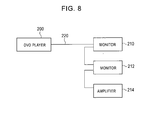
- Fig. 8 illustrates a specific connection example of a plurality of devices.
- a DVD player 200 is connected to monitors 210 and 212 and an amplifier 214 via IEEE 1394 buses 220.
- the details of music data of the content authentication and key exchange must be performed between the DVD player 200 and the monitor 210, between the DVD player 200 and the monitor 212, and between the DVD player 200 and the amplifier 214 before the monitors 210 and 212 and the amplifier 214 perform processing.
- a certain amount of time for example, about one second
- a certain amount of time for example, about one second
- a certain amount of time for example, about one second
- a certain amount of time for example, about one second
- the monitor 210 displays the details of the content, about two seconds are required for outputting music corresponding to the details. During this time, only a picture is displayed without sound. Thus, a user feels dissatisfied since the user implicitly expects that pictures and music are output at the same time.
- the time required for outputting music corresponding to the details of content after a picture is displayed increases in accordance with an increase in the number of connected devices for which authentication is required.
- an object of the present invention is to provide a data transfer device capable of preventing user dissatisfaction due to a difference in decryption timings between connected devices.
- a data transfer device includes a data sending unit for sending data of encrypted content to a plurality of devices; an authentication control unit for performing authentication processing with each of the plurality of devices; and a key information sending unit for sending key information for decrypting the encrypted content to the plurality of devices after the authentication processing by the authentication control unit for each of the plurality of devices is completed.
- the sending of the key information is started by sending a key exchange command to each of the plurality of devices.
- the key information sending unit stops sending the key exchange command until the authentication processing by the authentication control unit for all the plurality of devices for which the authentication processing is to be performed is completed.
- key information can be sent to the devices at the same timings.
- a data transfer device includes a data sending unit for sending data of encrypted content to a plurality of devices whose priority is determined in advance in order of descending priority; an authentication control unit for performing authentication processing with each of the plurality of devices; and a key information sending unit for sending key information for decrypting the encrypted content to the plurality of devices for which the authentication processing by the authentication control unit is completed.
- the key information sending unit sends the key information to one of the plurality of devices
- the data sending unit performs data transmission to the next device from among the plurality of devices.
- the order of data transmission can be set. Therefore, even if the decryption timings are different between a plurality of devices, user dissatisfaction due to the difference in the decryption timings can be prevented.
- the data transfer device may further includes a control unit for determining whether or not the key information has been sent to each of the plurality of devices and for sending to the data sending unit an instruction to send data to the next device to which the key information has not been sent from among the plurality of devices.
- a control unit for determining whether or not the key information has been sent to each of the plurality of devices and for sending to the data sending unit an instruction to send data to the next device to which the key information has not been sent from among the plurality of devices.
- a data transfer device includes a data sending unit for sending data of encrypted content to a plurality of devices; an authentication control unit for performing authentication processing with each of the plurality of devices; a key information sending unit for sending key information for decrypting the encrypted content to the plurality of devices for which the authentication processing by the authentication control unit is completed; and an output stop instruction unit for giving an instruction to stop an output operation of outputting a result obtained by decrypting the content to each of the plurality of devices until the key information has been sent to all the plurality of devices for which the authentication processing is performed.
- the output stop instruction unit gives the instruction to stop the output operation by sending a mute instruction to each of the plurality of devices.
- a mute instruction easily stops an output operation of each device.
- the stopping of the output operation includes stopping to output a result obtained by decrypting the content as sound and stopping to display a result obtained by decrypting the content as a picture.
- outputting of sound and displaying of a picture can be preformed at the same timing.
- the plurality of devices includes a device for outputting a result obtained by decrypting the content as sound and a device for displaying a result obtained by decrypting the content as a picture.
- a device for outputting a result obtained by decrypting the content as sound and a device for displaying a result obtained by decrypting the content as a picture.
- the plurality of devices includes a plurality of devices for outputting a result obtained by decrypting the content as sound.
- sound is output at the approximately same timing between the plurality of devices. Therefore, user dissatisfaction due to a difference in outputting of combined sounds can be prevented.
- the data transfer device may further include a content playback unit for generating the data of the content by playing back data recorded on a storage medium. Also, preferably, the content playback unit stops a playback operation until the authentication processing is completed. Thus, even if the timing of starting to decrypt content is delayed due to a long time required for authentication processing and the like, an unwanted lack in the head of the content by delayed decryption can be prevented.
- the plurality of devices is connected to each other via a digital bus.
- data of encrypted content can be sent to a plurality of devices. Therefore, user dissatisfaction due to a difference in decryption timings when the foregoing arrangement is used can be effectively prevented.
- the authentication processing starts after an authentication start request is sent from each of the plurality of devices that receives the data of the content.
- the order of authentication processing performed for the plurality of devices cannot be specified.
- key information can be sent at the same timing even in this case, decryption can be performed at the same timing between the devices.
- the plurality of devices does not record the content.
- the authentication control unit performs authentication processing corresponding to full authentication.
- user dissatisfaction due to a difference in the decryption timings between devices requiring an output operation can be prevented.
- Fig. 1 shows the arrangement of an in-vehicle system according to a first embodiment of the present invention.
- the in-vehicle system shown in Fig. 1 includes a DVD player 100, a monitor 110, amplifiers 120 and 130, and a head unit 150. These devices are connected to each other via IEEE 1394 buses 160.
- the DVD player 100 reads and plays back content (including pictures and music) recorded on a DVD functioning as a disk-type recording medium.
- the DVD player 100 includes an authentication control unit 101 and a content playback unit 102.
- the authentication control unit 101 performs authentication control operations, such as authentication processing and key exchange necessary for decrypting content of a copy-protected DVD.
- the content playback unit 102 plays back the details of the content read from the DVD, and sends the details of the content to each device.
- the content recorded on the DVD includes copy control information, and key exchange is performed based on the copy control information.
- the monitor 110 is installed at the center of a dashboard of a vehicle and displays the details of picture data output from the DVD player 100.
- the monitor 110 includes an authentication control unit 111 for performing authentication control operations and a decryption unit 112 for decrypting encrypted picture data. After performing authentication processing with the authentication control unit 101 of the DVD player 100, which is a sender of the picture data, the authentication control unit 111 receives key information necessary for decryption. The decryption unit 112 decrypts, using the key information, the picture data sent from the DVD player 100. Accordingly, the monitor 110 displays the details of the transferred picture data.
- the amplifier 120 is installed below the dashboard of the vehicle or below a passenger seat. After converting music data output from the DVD player 100 into an audio signal, the amplifier 120 amplifies the audio signal and outputs the amplified audio signal into a vehicle cabin from front speakers 123 and 124 provided at left and right of driver and passenger seats.
- the amplifier 120 includes an authentication control unit 121 for performing authentication control operations and a decryption unit 122 for decrypting encrypted music data. After performing authentication processing with the authentication control unit 101 of the DVD player 100, which is a sender of the music data, the authentication control unit 121 receives key information necessary for decryption. The decryption unit 122 decrypts, using the key information, the music data sent from the DVD player 100. Accordingly, the amplifier 120 plays back the transferred music data to be converted into an audio signal, and outputs the audio signal from the front speakers 123 and 124.
- the amplifier 130 is installed below the dashboard of the vehicle or below the passenger seat. After converting music data output from the DVD player 100 into an audio signal, the amplifier 130 amplifies the audio signal and outputs the amplified audio signal into the vehicle cabin from rear speakers 133 and 134 provided at left and right behind backseats.
- the amplifier 130 includes an authentication control unit 131 for performing authentication control operations and a decryption unit 132 for decrypting encrypted music data. After performing authentication processing with the authentication control unit 101 of the DVD player 100, which is a sender of the music data, the authentication control unit 131 receives key information necessary for decryption. The decryption unit 132 decrypts, using the key information, the music data sent from the DVD player 100. Accordingly, the amplifier 130 plays back the transferred music data to be converted into an audio signal, and outputs the audio signal from the rear speakers 133 and 134.
- the head unit 150 is installed at the center of the dashboard of the vehicle.
- the head unit 150 includes a control unit 151 for controlling the entire in-vehicle system and an operation unit 152 for receiving various operation inputs by a user.
- a touch panel may be installed near a screen of the monitor 110 so that the operation unit 152 implements operations using the touch panel.
- the content playback unit 102 corresponds to a data sending unit and a content playback unit
- the authentication control unit 101 corresponds to an authentication control unit and a key information sending unit.
- the in-vehicle system according to the first embodiment has the foregoing arrangement. Operations from authentication processing to key exchange are described next.
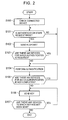
- Fig. 2 is a flowchart showing a process related to authentication processing performed by the authentication control unit 101 of the DVD player 100.
- the authentication control unit 101 determines whether or not an authentication start request is made by any device (step S101). If an authentication start request is not made by any device, a negative determination is made in step S101, and the processing in step S101 is repeated.
- step S101 If an authentication start request is made by any device, an affirmative determination is made in step S101. Then, the authentication control unit 101 sends a "start permission" response, which represents that authentication can be started, to the device that sent the authentication start request (step S102). Then, the authentication control unit 101 determines whether or not there are any devices for which authentication processing is required (step S103). Since authentication processing must be performed with each of three devices (the monitor 110 and the amplifiers 120 and 130) in the arrangement shown in Fig. 1, if there are any devices, from among the three devices, for which an authentication start request has not been made, an affirmative determination is made in step S103. The process returns to step S101 to repeat the determination of whether or not an authentication start request is made.
- step S103 If transmission and reception of an authentication start request and a response between the DVD player 100 and each of the three devices is completed, a negative determination is made in step S103. Then, the authentication control unit 101 performs authentication processing with one of the devices (step S104). Then, the authentication control unit 101 determines whether or not there are any devices for which authentication processing is not completed (step S105). If there are any devices, from among the three devices for which authentication processing is required, for which authentication processing is not completed, an affirmative determination is made in step S105. Then, the process returns to step S104 to perform authentication processing with the device for which authentication processing is not completed.
- step S105 If authentication processing with each of the three devices is completed, a negative determination is made in step S105. Then, the authentication control unit 101 sends key information to one of the devices for which authentication processing is completed (step S106). Then, the authentication control unit 101 determines whether or not there are any devices to which key information has not been sent (step S107). If there are any devices to which key information has not been sent, an affirmative determination is made in step S107. The process returns to step S106 to repeat the processing of sending key information and the subsequent processing. If key information has been sent to all the three devices, a negative determination is made in step S107, and the process related to authentication ends.
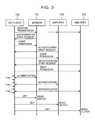
- Fig. 3 illustrates the timings of a series of processing events related to authentication performed between the devices shown in Fig. 1.
- the DVD player 100 starts to send content to the monitor 110 and the amplifiers 120 and 130, and the series of processing events related to authentication start in parallel to transmission of the content.
- the authentication control unit 101 of the DVD player 100 sends a "start permission" response corresponding to the request to each of the monitor 110 and the amplifiers 120 and 130. Transmission and reception of the request and the response is completed in a short time.
- the order of transmission of authentication start requests is determined in accordance with a time required for starting a normal operation after a device is powered up and in accordance with a connection form of the device. However, in the explanations below, authentication processing and the like are performed for the monitor 110, the amplifier 120, and the amplifier 130 in that order, as shown in Fig. 3.
- the authentication control unit 101 performs authentication processing with the monitor 110. Then, similarly, the authentication control unit 101 performs authentication processing with each of the amplifiers 120 and 130. A certain amount of time is required for the authentication processing. For example, if about one second is required for each authentication processing operation, about three seconds are required in total.
- the authentication control unit 101 sends key information to each of the monitor 110 and the amplifiers 120 and 130. Transmission of the key information is completed in a short time.
- Fig. 4 is a detailed illustration showing the timings of authentication processing and key information transmission.
- the details of authentication processing performed between the DVD player 100 and the monitor 110 are shown in Fig. 4.
- Authentication processing performed between the DVD player 100 and each of the amplifiers 120 and 130 is similar to the authentication processing performed between the DVD player 100 and the monitor 110.
- a processing timing for "full authentication" performed between the DVD player 100 and the monitor 110 is shown in Fig. 4.
- authentication processing starts when the monitor 110 sends a "challenge” command to the DVD player 100.
- the DVD player 100 sends a "challenge” reply to the monitor 110.
- the DVD player 100 sends a "challenge” command to the monitor 110, and receives a "challenge” reply sent from the monitor 110.
- the DVD player 100 sends a "response” command to the monitor 110, and receives a “response” reply sent from the monitor 110. Then, the DVD player 100 receives a "response” command sent from the monitor 110, and sends a "response” reply to the monitor 110.
- the DVD player 100 As described above, authentication processing is performed between the DVD player 100 and the monitor 110. Then, the DVD player 100 sends a "key exchange” command as key information to the monitor 110, and receives a "key exchange” reply sent from the monitor 110. Accordingly, transmission processing of key information to the monitor 110 ends.
- the authentication control unit 101 of the DVD player 100 After processing immediately before transmission of a "key exchange" command is performed for each of the monitor 110 and the amplifiers 120 and 130, the authentication control unit 101 of the DVD player 100 sends the "key exchange” command to each of the devices.
- authentication processing may start by a "challenge" command sent from the monitor 110 or the amplifier 120 before the amplifier 130 sends an authentication start request to the DVD player 100.
- the authentication control unit 101 of the DVD player 100 may wait at timing A or timing B shown in Fig. 4 and stop the authentication processing by stopping transmission of a "challenge” command or a "response” command.
- the authentication control unit 101 of the DVD player 100 may wait at timing C shown in Fig. 4 and wait in a state in which the authentication processing ends.
- the devices to which content is sent can obtain key information at approximately the same timing.
- user dissatisfaction due to a difference in the decryption timings between the devices is prevented.
- key information can be sent to all the devices at the same timing.
- the order of devices for which authentication processing is performed may be set in advance so as to reduce user dissatisfaction while a series of authentication processing events to key exchange is performed for each device, as in known technologies.
- the arrangement shown in Fig. 1 can be applied to the basic arrangement of an in-vehicle system according to a second embodiment.
- the content playback unit 102 of the DVD player 100 does not start to output the details (picture data and music data) of content to all the devices when the devices are powered up.
- the content playback unit 102 of the DVD player 100 starts to output the details of the content to each of the devices after receiving an output start instruction sent from the head unit 150.
- the priority corresponding to the arrangement shown in Fig. 1 is set to (1) the amplifier 120, (2) the monitor 110, and (3) the amplifier 130, in that order.
- decryption by the amplifier 120 starts, and music is output from the front speakers 123 and 124.
- decryption by the monitor 110 starts, and a picture is displayed.
- decryption by the amplifier 130 starts, and music is output from the rear speakers 133 and 134.
- Fig. 5 is a flowchart showing a process related to authentication processing performed by the control unit 151 of the head unit 150 and the authentication control unit 101 and the content playback unit 102 of the DVD player 100.
- the control unit 151 functioning as a control unit sends to the content playback unit 102 an instruction to send content to a high priority device (for example, the amplifier 120).
- the content is sent only to the amplifier 120 (step S201).
- authentication processing step S202
- key information transmission step S203
- the control unit 151 determines whether or not there are any devices to which key information has not been sent (step S204). If key information is sent only to the amplifier 120, since the monitor 110 and the amplifier 130, to which key information has not been sent, exists, an affirmative determination is made in step S204. The process returns to step S201 to perform processing of sending content to a next highest priority device to which key information has not been sent and the subsequent processing. As described above, authentication processing and key information transmission for the monitor 110 and the amplifier 130 are performed in order.
- step S204 If processing to key information transmission for all the three devices including the monitor 110 is completed, a negative determination is made in step S204, and the process related to authentication ends.
- the order of data transmission can be set.
- decryption timings are different between a plurality of devices, user dissatisfaction due to the difference in the decryption timings can be reduced.
- the decryption order can be set easily and accurately.
- a mute instruction to stop output of pictures and music by devices until key exchange for all the devices is completed may be given while a series of authentication processing events are performed as in the known technology.
- Fig. 6 is a flowchart showing a process for giving a mute instruction to each device until authentication processing and the like for all the devices connected to the DVD player 100 is completed.
- the control unit 151 corresponds to an output stop instruction unit.
- the control unit 151 gives an instruction to mute to all the devices for which authentication processing is required (step S301).
- a "mute" state includes a case where the brightness and the level of color information of a picture are 0 (a state in which the whole screen is black and no picture is displayed) as well as a case where the output level of music is 0.
- step S302 a series of processing events related to authentication from authentication start request to key information transmission is performed between the DVD player 100 and the monitor 110 or the like.
- the control unit 151 determines whether or not there are any devices to which key information has not been sent (step S303). If there is a device to which key information has not been sent, an affirmative determination is made in step S303. The process returns to step S302 to repeat authentication processing.
- step S303 if processing to key information transmission to all the three devices including the monitor 110 is completed, a negative determination is made in step S303. Then, the control unit 151 cancels the mute instruction to the monitor 110 and the amplifiers 120 and 130 (step S304), and the series of processing events related to authentication ends.
- decrypted results can be output at the same timing even if the decryption timings are different between a plurality of devices. Thus, user dissatisfaction can be prevented.
- a content playback operation (playback operation of a movie or the like) is preferably stopped until authentication processing for all the devices including the monitor 110 is completed. Accordingly, even if the timing of starting to decrypt content is delayed due to a long time required for authentication processing and the like, an unwanted lack in the head of the content by delayed decryption can be prevented.
- processing timing shown in Fig. 4 corresponds to full authentication performed for a device not requiring a recording operation
- the present invention can also be applied to a device (for example, a hard disk recording device) requiring a recording operation by adopting a processing timing for restricted authentication shown in Fig. 7.
Landscapes
- Engineering & Computer Science (AREA)
- Multimedia (AREA)
- Signal Processing (AREA)
- Computer Networks & Wireless Communication (AREA)
- Computer Security & Cryptography (AREA)
- Databases & Information Systems (AREA)
- Signal Processing For Digital Recording And Reproducing (AREA)
- Storage Device Security (AREA)
Applications Claiming Priority (2)
| Application Number | Priority Date | Filing Date | Title |
|---|---|---|---|
| JP2004050783A JP4485223B2 (ja) | 2004-02-26 | 2004-02-26 | データ転送装置 |
| JP2004050783 | 2004-02-26 |
Publications (3)
| Publication Number | Publication Date |
|---|---|
| EP1569455A2 true EP1569455A2 (de) | 2005-08-31 |
| EP1569455A3 EP1569455A3 (de) | 2008-10-08 |
| EP1569455B1 EP1569455B1 (de) | 2020-06-10 |
Family
ID=34747488
Family Applications (1)
| Application Number | Title | Priority Date | Filing Date |
|---|---|---|---|
| EP05002705.1A Ceased EP1569455B1 (de) | 2004-02-26 | 2005-02-09 | Datentransfervorrichtung mit Authentisierungsprozessfunktion |
Country Status (3)
| Country | Link |
|---|---|
| US (1) | US7539865B2 (de) |
| EP (1) | EP1569455B1 (de) |
| JP (1) | JP4485223B2 (de) |
Families Citing this family (3)
| Publication number | Priority date | Publication date | Assignee | Title |
|---|---|---|---|---|
| JP4558447B2 (ja) * | 2004-10-28 | 2010-10-06 | アルパイン株式会社 | ディジタル信号切り替え装置及びディジタル信号切り替え方法 |
| US8285988B2 (en) * | 2006-05-09 | 2012-10-09 | Broadcom Corporation | Method and system for command authentication to achieve a secure interface |
| KR101508703B1 (ko) | 2006-11-24 | 2015-04-08 | 삼성전자주식회사 | 디지털 컨텐츠 인증 시스템 그리고 그에 적용되는영상표시장치 및 그의 디지털 컨텐츠 인증 제어 방법 |
Family Cites Families (11)
| Publication number | Priority date | Publication date | Assignee | Title |
|---|---|---|---|---|
| JP3397935B2 (ja) * | 1995-05-15 | 2003-04-21 | 三洋電機株式会社 | 立体映像装置 |
| JP2000285027A (ja) * | 1999-03-29 | 2000-10-13 | Matsushita Electric Ind Co Ltd | キャッシュ装置、送信装置及びプログラム記録媒体 |
| JP3684986B2 (ja) * | 2000-03-07 | 2005-08-17 | 松下電器産業株式会社 | オーディオ受信装置 |
| DE10023705A1 (de) * | 2000-05-16 | 2001-11-22 | Bosch Gmbh Robert | Verfahren zur Zugriffssteuerung auf Geräte in einem Fahrzeugkommunikationsnetz |
| JP4362964B2 (ja) * | 2000-10-13 | 2009-11-11 | ソニー株式会社 | 情報処理装置および方法、並びに記録媒体 |
| US6826699B1 (en) * | 2000-10-19 | 2004-11-30 | Sony Corporation | Method and apparatus for performing authentication and key exchange protocols with multiple sink devices |
| JP4752113B2 (ja) * | 2001-01-16 | 2011-08-17 | ソニー株式会社 | 電子機器及び信号伝送方法 |
| JP2003030054A (ja) * | 2001-07-18 | 2003-01-31 | Sharp Corp | 記録装置およびプログラム記録媒体 |
| JP4690600B2 (ja) * | 2001-08-23 | 2011-06-01 | 富士通株式会社 | データ保護方法 |
| JP3719180B2 (ja) * | 2001-09-27 | 2005-11-24 | ソニー株式会社 | 通信方法、通信システム及び出力機器 |
| JP2003289304A (ja) * | 2002-03-28 | 2003-10-10 | Sony Corp | 信号処理装置、信号処理方法 |
-
2004
- 2004-02-26 JP JP2004050783A patent/JP4485223B2/ja not_active Expired - Lifetime
-
2005
- 2005-02-09 EP EP05002705.1A patent/EP1569455B1/de not_active Ceased
- 2005-02-18 US US11/061,846 patent/US7539865B2/en not_active Expired - Fee Related
Also Published As
| Publication number | Publication date |
|---|---|
| US7539865B2 (en) | 2009-05-26 |
| JP2005242605A (ja) | 2005-09-08 |
| US20050193215A1 (en) | 2005-09-01 |
| JP4485223B2 (ja) | 2010-06-16 |
| EP1569455B1 (de) | 2020-06-10 |
| EP1569455A3 (de) | 2008-10-08 |
Similar Documents
| Publication | Publication Date | Title |
|---|---|---|
| JP3176030B2 (ja) | 複製制御方法及び複製制御装置 | |
| US6526510B1 (en) | Signal reproducing method and apparatus, signal recording method and apparatus and signal recording system | |
| US7889863B2 (en) | Recording device, recording medium, and content protection system | |
| JP2007179707A (ja) | 映像音声再生システムの制御方法および映像音声再生システム | |
| US8320742B2 (en) | Method and apparatus for playing data between external device and TV set | |
| JP2005317177A (ja) | 記録再生装置及び方法 | |
| US7539865B2 (en) | Data transfer device | |
| JP2001114027A (ja) | 車載用オーディオビジュアル再生装置 | |
| JP4289175B2 (ja) | 可搬機器 | |
| JP4792965B2 (ja) | 記録再生装置および記録再生方法 | |
| JP2005285287A (ja) | 記録再生装置及び方法 | |
| US20060020794A1 (en) | System and method for displaying a warning message | |
| JP4316468B2 (ja) | デジタルネットワークを用いたデータ再生システムおよびデータ再生方法、レジューム再生制御装置 | |
| JP2005063068A (ja) | データ記録制御装置及び方法、並びに記憶媒体及びプログラム | |
| KR100950177B1 (ko) | 외부입력에 대한 카 오디오/비디오 시스템의 제어방법 | |
| JP2009026401A (ja) | 車載装置 | |
| US7146508B2 (en) | Image processing apparatus and system and method of same | |
| JP4263129B2 (ja) | 記録再生装置及び方法 | |
| JP5129548B2 (ja) | 車載用再生装置、制御方法及び制御プログラム | |
| JP2006140625A (ja) | 情報処理装置 | |
| JP4090682B2 (ja) | 車載用音響システム | |
| JP2011211580A (ja) | 分配機器 | |
| JP2006024320A (ja) | 情報記録装置及び方法、情報再生装置及び方法、情報記録再生装置及び方法、並びにコンピュータプログラム | |
| JP4385289B2 (ja) | 音声処理装置および方法、並びにプログラム | |
| JP4579190B2 (ja) | オーディオ/ビデオシステム |
Legal Events
| Date | Code | Title | Description |
|---|---|---|---|
| PUAI | Public reference made under article 153(3) epc to a published international application that has entered the european phase |
Free format text: ORIGINAL CODE: 0009012 |
|
| AK | Designated contracting states |
Kind code of ref document: A2 Designated state(s): AT BE BG CH CY CZ DE DK EE ES FI FR GB GR HU IE IS IT LI LT LU MC NL PL PT RO SE SI SK TR |
|
| AX | Request for extension of the european patent |
Extension state: AL BA HR LV MK YU |
|
| PUAL | Search report despatched |
Free format text: ORIGINAL CODE: 0009013 |
|
| AK | Designated contracting states |
Kind code of ref document: A3 Designated state(s): AT BE BG CH CY CZ DE DK EE ES FI FR GB GR HU IE IS IT LI LT LU MC NL PL PT RO SE SI SK TR |
|
| AX | Request for extension of the european patent |
Extension state: AL BA HR LV MK YU |
|
| 17P | Request for examination filed |
Effective date: 20090401 |
|
| AKX | Designation fees paid |
Designated state(s): DE FR GB |
|
| 17Q | First examination report despatched |
Effective date: 20151028 |
|
| STAA | Information on the status of an ep patent application or granted ep patent |
Free format text: STATUS: EXAMINATION IS IN PROGRESS |
|
| REG | Reference to a national code |
Ref country code: DE Ref legal event code: R079 Ref document number: 602005056866 Country of ref document: DE Free format text: PREVIOUS MAIN CLASS: H04N0007240000 Ipc: H04N0021436700 |
|
| GRAP | Despatch of communication of intention to grant a patent |
Free format text: ORIGINAL CODE: EPIDOSNIGR1 |
|
| STAA | Information on the status of an ep patent application or granted ep patent |
Free format text: STATUS: GRANT OF PATENT IS INTENDED |
|
| RIC1 | Information provided on ipc code assigned before grant |
Ipc: H04N 21/4367 20110101AFI20191213BHEP Ipc: H04N 21/6334 20110101ALI20191213BHEP Ipc: H04N 21/442 20110101ALI20191213BHEP |
|
| INTG | Intention to grant announced |
Effective date: 20200110 |
|
| GRAS | Grant fee paid |
Free format text: ORIGINAL CODE: EPIDOSNIGR3 |
|
| GRAA | (expected) grant |
Free format text: ORIGINAL CODE: 0009210 |
|
| STAA | Information on the status of an ep patent application or granted ep patent |
Free format text: STATUS: THE PATENT HAS BEEN GRANTED |
|
| AK | Designated contracting states |
Kind code of ref document: B1 Designated state(s): DE FR GB |
|
| REG | Reference to a national code |
Ref country code: GB Ref legal event code: FG4D |
|
| REG | Reference to a national code |
Ref country code: DE Ref legal event code: R096 Ref document number: 602005056866 Country of ref document: DE |
|
| REG | Reference to a national code |
Ref country code: DE Ref legal event code: R097 Ref document number: 602005056866 Country of ref document: DE |
|
| PLBE | No opposition filed within time limit |
Free format text: ORIGINAL CODE: 0009261 |
|
| STAA | Information on the status of an ep patent application or granted ep patent |
Free format text: STATUS: NO OPPOSITION FILED WITHIN TIME LIMIT |
|
| PGFP | Annual fee paid to national office [announced via postgrant information from national office to epo] |
Ref country code: FR Payment date: 20210224 Year of fee payment: 17 |
|
| 26N | No opposition filed |
Effective date: 20210311 |
|
| PGFP | Annual fee paid to national office [announced via postgrant information from national office to epo] |
Ref country code: GB Payment date: 20210219 Year of fee payment: 17 Ref country code: DE Payment date: 20210217 Year of fee payment: 17 |
|
| REG | Reference to a national code |
Ref country code: DE Ref legal event code: R119 Ref document number: 602005056866 Country of ref document: DE |
|
| GBPC | Gb: european patent ceased through non-payment of renewal fee |
Effective date: 20220209 |
|
| PG25 | Lapsed in a contracting state [announced via postgrant information from national office to epo] |
Ref country code: FR Free format text: LAPSE BECAUSE OF NON-PAYMENT OF DUE FEES Effective date: 20220228 |
|
| PG25 | Lapsed in a contracting state [announced via postgrant information from national office to epo] |
Ref country code: GB Free format text: LAPSE BECAUSE OF NON-PAYMENT OF DUE FEES Effective date: 20220209 Ref country code: DE Free format text: LAPSE BECAUSE OF NON-PAYMENT OF DUE FEES Effective date: 20220901 |