EP1569201A1 - Sprachsegmentierung - Google Patents
Sprachsegmentierung Download PDFInfo
- Publication number
- EP1569201A1 EP1569201A1 EP05250981A EP05250981A EP1569201A1 EP 1569201 A1 EP1569201 A1 EP 1569201A1 EP 05250981 A EP05250981 A EP 05250981A EP 05250981 A EP05250981 A EP 05250981A EP 1569201 A1 EP1569201 A1 EP 1569201A1
- Authority
- EP
- European Patent Office
- Prior art keywords
- change
- voice signal
- degree
- time
- frequency component
- Prior art date
- Legal status (The legal status is an assumption and is not a legal conclusion. Google has not performed a legal analysis and makes no representation as to the accuracy of the status listed.)
- Granted
Links
- 230000011218 segmentation Effects 0.000 title 1
- 230000008859 change Effects 0.000 claims abstract description 131
- 238000004458 analytical method Methods 0.000 claims abstract description 56
- 238000000034 method Methods 0.000 claims abstract description 31
- 238000004364 calculation method Methods 0.000 claims description 14
- 238000000354 decomposition reaction Methods 0.000 claims description 13
- 230000009466 transformation Effects 0.000 claims description 13
- 238000000605 extraction Methods 0.000 claims description 12
- 238000005192 partition Methods 0.000 claims description 8
- 238000000638 solvent extraction Methods 0.000 abstract description 2
- 238000006243 chemical reaction Methods 0.000 description 8
- 238000010586 diagram Methods 0.000 description 4
- 238000012935 Averaging Methods 0.000 description 2
- 238000005516 engineering process Methods 0.000 description 2
- 239000000284 extract Substances 0.000 description 2
- 238000009434 installation Methods 0.000 description 2
- 230000008901 benefit Effects 0.000 description 1
- 239000002131 composite material Substances 0.000 description 1
- 230000000694 effects Effects 0.000 description 1
- 230000006870 function Effects 0.000 description 1
- 230000008569 process Effects 0.000 description 1
- 238000005070 sampling Methods 0.000 description 1
- 230000003595 spectral effect Effects 0.000 description 1
Images




Classifications
-
- G—PHYSICS
- G10—MUSICAL INSTRUMENTS; ACOUSTICS
- G10L—SPEECH ANALYSIS TECHNIQUES OR SPEECH SYNTHESIS; SPEECH RECOGNITION; SPEECH OR VOICE PROCESSING TECHNIQUES; SPEECH OR AUDIO CODING OR DECODING
- G10L15/00—Speech recognition
- G10L15/04—Segmentation; Word boundary detection
-
- G—PHYSICS
- G10—MUSICAL INSTRUMENTS; ACOUSTICS
- G10L—SPEECH ANALYSIS TECHNIQUES OR SPEECH SYNTHESIS; SPEECH RECOGNITION; SPEECH OR VOICE PROCESSING TECHNIQUES; SPEECH OR AUDIO CODING OR DECODING
- G10L15/00—Speech recognition
- G10L15/02—Feature extraction for speech recognition; Selection of recognition unit
- G10L2015/025—Phonemes, fenemes or fenones being the recognition units
Definitions
- the present invention relates to a voice analysis device, voice analysis program and voice analysis method.
- it relates to an image-generating device employing a voice analysis method according to the present invention and, in particular, to a lip synch animation image generating device that creates animation (lip synch animation) whereby the shape of the mouth is changed in accordance with voice.
- Voice analysis technology is currently employed in various fields. Examples are identifying a speaker by voice, converting voice into text, or generating lip synch animation whereby the shape of the mouth is varied in accordance with voice.
- the processing that is performed in these cases respectively involves: in the case of voice analysis technology, extractionofphonemes, i. e. the units that are employed to a distinguish meaning of words, from voice; in the case of speaker identification, identification of a speaker using the degree of similarity between extracted phonemes and reference patterns registered beforehand; in the case of text conversion, displaying letters corresponding to the extracted phonemes on a display or the like; and, in the case of creation of lip synch animation, displaying an image corresponding to the extracted phoneme on a display or the like.
- the prior art includes the following methods of extracting phonemes from voice. For example, in the speaker identification system disclosed in Published Japanese Patent No. H6-32007, phonemes are extracted by determining, for each vowel, intervals such that the distance between a previously input reference pattern and the voice of the speaker is less than a prescribed value and establishing a correspondence between these intervals and the vowels.
- Such intervals for extracting phonemes are called segments.
- a formant analysis using for example a Composite Sinusoidal Modeling (CSM) is conducted and phonemes are extracted based on formant information to characterize vowels.
- CSM Composite Sinusoidal Modeling
- the present situation is that in fact extraction of phonemes using formant information is difficult to apply to situations where real-time processing is required, due to the time required for such processing.
- a phoneme extraction method is known utilizing for example LPC (Linear Predictive Coding) cepstrum analysis. It is found that the accuracy of phoneme extraction using this method increases as the number of times of repetition increases i.e. there is a learning effect. Conversely, in order to raise the accuracy of the extraction, it is necessary to prepare analysis results for a large number of learning signals beforehand; it is therefore difficult to apply this method to an indefinitely large number of speakers.
- LPC Linear Predictive Coding
- An object of the present invention is therefore to provide a voice analysis device and voice analysis method whereby real-time voice analysis processing can be performed and that is capable of application to an indefinitely large number of speakers, without needing to prepare reference patterns for each speaker.
- a further object is to provide an animation image-generating device capable of real-time processing by applying this voice analysis method.
- a computer-executable method of voice analysis which detects boundaries of phonemes from input voice, includes: a first step specifying a time-point in said input voice signal; a second step extracting the voice signal contained in a time range prescribed length from said time-point; and a third step of decomposing said extracted voice signal into frequency component data, wherein n frequency component data extracted from the voice signal contained in n time ranges of said prescribed length are found by repeating said first, second and third steps n times (where n is a natural number of at least 6) for each prescribed time; (n-1) correlations are found from n said frequency component data by obtaining i-th correlation (where i is a natural number of at least 1 and no more than (n-1)) based on the i-th item of said frequency component data and the (i+1)-th item of said frequency component data corresponding to said voice signal contained in mutually adjacent time ranges of said prescribed length; (n-2) said degrees of
- the above objects are achieved by providing a method of voice analysis according to the first aspect, further has: calculating characteristic quantities for each section of said partitioned voice signals and specifying said phonemes of said sections by comparing said characteristic quantities with reference data for each said phoneme.
- the above objects are achieved by providing a method of voice analysis according to the first aspect wherein the prescribed time is shifted for the time range of said prescribed length to form mutual overlapping portions.
- the above objects are achieved by providing a method of voice analysis according to the first aspect wherein said correlation is a value obtained by summing the products of amplitudes corresponding to the same frequency components.
- the above objects are achieved by providing a method of voice analysis according to the first aspect wherein said frequency component data is found by Fourier transformation of frequency components of said extracted voice signal.
- the above objects are achieved by providing a method of voice analysis according to the second aspect wherein said characteristic quantities are determined in accordance with an amplitude of each frequency component obtained by Fourier transformation of said voice signal contained in the section of said partitioned voice signal obtained by said partitioning.
- a seventh aspect of the present invention the above objects are achieved by providing computer-executable method of animation image generation which displays an image corresponding to partitions of phonemes from an input voice signal, comprising: a first step specifying a time-point in said input voice signal; a second step extracting the voice signal contained in a time range of prescribed length from said time-point; and a third step decomposing said extracted voice signal into frequency component data, wherein n frequency component data extracted from the voice signal contained in n time ranges of said prescribed length are found by repeating said first, second and third steps n times (where n is a natural number of at least 6) for each prescribed time; (n-1) correlations are found from n said frequency component data by obtaining i-th correlation (where i is a natural number of at least 1 and no more than (n-1)) based on the i-th item of said frequency component data and the (i+1) -th item of said frequency component data corresponding to said voice signal contained in mutually adjacent time ranges of said prescribed length
- the above obj ects are achieved by providing a voice analysis program which is executable by a computer comprising a CPU and detects boundaries of phonemes from input voice, the program causes the CPU to execute: a first step specifying a time-point in said input voice signal; a second step extracting the voice signal contained in a time range of prescribed length from said time-point; and a third step decomposing said extracted voice signal into frequency component data, wherein n frequency component data extracted from the voice signal contained in n time ranges of said prescribed length are found by repeating said first, second and third steps by said CPU n times (where n is a natural number of at least 6) for each prescribed time; (n-1) correlations are found from n said frequency component data by obtaining i-th correlation (where i is a natural number of at least 1 and no more than (n-1)) based on the i-th item of said frequency component data and the (i+1)-th item of said frequency component data corresponding to
- a voice analysis program further causes the CPU to execute: calculating characteristic quantities for each section of the partitioned voice signals and specifying said phonemes of said sections by comparing said characteristic quantities with reference data for each said phoneme.
- the above obj ects are achieved by providing a voice analysis program according to the ninth aspect wherein the prescribed time is shifted for the time range of said prescribed length to formmutual overlapping portions; said correlation is a value obtained by summing the products of amplitudes corresponding to the same frequency components; said frequency component data is found by Fourier transformation of said extracted frequency components of the voice signal; and said characteristic quantities are determined in accordance with an amplitude of each frequency component obtained by Fourier transformation of said voice signal contained in the section of said partitioned voice signal.
- an animation image generating program which is executable by a computer comprising a CPU and displays an image corresponding to partitions of phonemes from an input voice signal, said program causes the CPU to execute: a first step specifying a time-point in said input voice signal; a second step extracting the voice signal contained in a time range of prescribed length from said time-point; and a third step decomposing said extracted voice signal into frequency component data, wherein n frequency component data extracted from the voice signal contained in n time ranges of said prescribed length are found by repeating said first, second and third steps n times (where n is a natural number of at least 6) for each prescribed time; (n-1) correlations are found from n said frequency component data by obtaining i-th correlation (where i is a natural number of at least 1 and no more than (n-1)) based on the i-th item of said frequency component data and the (i+1)-th item of said frequency component data corresponding to said voice
- the above obj ects are achieved by providing a storage medium that stores a program according to any of the eighth aspect to the twelfth aspect.
- a voice analysis device includes: a frequency decomposition unit that finds n frequency component data extracted from a voice signal contained in n time ranges of prescribed length by repeating n times (where n is a natural number of at least 6), at prescribed intervals, to specify a time-point in an input voice signal, to extract a voice signal contained in a time range of the prescribed length from said time-point and to decompose of said extracted voice signal into frequency component data; a degree of change calculation unit that finds (n-1) correlations from n said frequency component data by obtaining i-th correlation (where i is a natural number of at least 1 and no more than (n-1)) based on the i-th item of said frequency component data and the (i+1)-th item of said frequency component data corresponding to said voice signal contained in mutually adjacent time ranges of said prescribed length, and that finds (n-2) said degrees of change from the (n-1) said correlations by finding the k
- an animation image generating device includes: a frequency decomposition unit that finds n frequency component data extracted from a voice signal contained in n time ranges of prescribed length by repeating n times (where n is a natural number of at least 6), at prescribed intervals, to specify a time-point in an input voice signal, to extract a voice signal contained in a time range of the prescribed length from said time-point and to decompose of said extracted voice signal into frequency component data; a degree of change calculation unit that finds (n-1) correlations from n said frequency component data by obtaining i-th correlation (where i is a natural number of at least 1 and no more than (n-1)) based on the i-th item of said frequency component data and the (i+1) -th item of said frequency component data corresponding to said voice signal contained in mutually adjacent time ranges of said prescribed length, and that finds (n-2) said degrees of change from the (n-1) said correlations by finding the
- nimble voice analysis processing can be achieved in real time simply by preparing the results of analysis of input voice of a plurality of subjects beforehand as reference data, without needing to prepare reference patterns for each speaker. Also, since an operation of registering reference patterns for each speaker is not required and the reference pattern need only be prepared once, an indefinitely large number of speakers can be coped with. Furthermore, since a database for storing the reference patterns of each speaker is not required, installation even on an appliance of small storage capacity is possible.
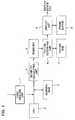
- Fig.1 is a layout block diagram of an image-generating device according to an embodiment of the present invention.
- This is a lip synch animation generating device that generates an animation corresponding to input voice.
- An image generating device includes as a voice analysis unit 1 a voice analysis device according to the present invention and, in addition, having a CPU 2, working RAM 3, a geometry calculating unit 4, renderer 5, texture generating unit 6, texture RAM 7, display unit 8, and frame buffer 9.
- These functional units are implemented by means of a program that is executed by the CPU (central processing unit) 2 that is provided in the image generating device, but they could also be implemented using hardware.
- the CPU 2 controls a program that generates an image.
- the programs or data used by the CPU 2 are stored in the working RAM 3.
- the voice analysis unit 1 analyses input voice to extract phonemes included in the input voice and outputs timing information for determining the time of display of an image corresponding to each phoneme.
- the geometry calculation unit 4 reads and inputs polygon data composing three-dimensional object datain a world co-ordinate system from the working RAM 3. Next, it performs co-ordinate transformation to data of a viewpoint co-ordinate system whose origin is the point of view.
- the polygon data that is processed by the geometry calculation unit 4 is input to the renderer 5, where the data in polygon units is converted to pixel unit data.
- the pixel unit data is input to the texture-generating unit 6, where texture color is generated in pixel units, based on the texture data stored in the texture RAM 7.
- the display unit 8 performs hidden face removal processing and/or shading as required on the image data from the texture generating unit 6 and then writes the data to the frame buffer 9 while converting to two-dimensional co-ordinates.
- the data that is written to the frame buffer 9 is repeatedly read and converted to a video signal that is output. In this way, images corresponding to respective phonemes are changed over and displayed on a display, for example, not shown, in accordance with timing information.
- the functional block other than the voice analysis unit 1 in Fig.1 is an animation display unit for displaying animation.
- Fig.2 is a layout block diagram of a voice analysis unit (voice analysis device) according to the present invention.
- the voice analysis unit 1 has an input unit 11, AD conversion unit 12, frequency decomposition unit 13, degree of change calculation unit 14, segment determining unit 15, phoneme extraction unit 16 and storage unit 17. These functional units are implemented by means of a program that is executed by the CPU (central processing unit) but they could also be implemented using hardware. Also, regarding the CPU, if a CPU is included in the voice analysis unit 1, the CPU, not shown, included in this voice analysis unit 1 may be employed, or an external CPU (for example CPU 2 of Fig.1) may also be employed.
- CPU central processing unit
- the input unit 11 is an interface to which voice is input.
- Voice input to the voice analysis unit 1 is effected for example by means of an input signal from a microphone or the output signal from an audio appliance connected by an audio cable.
- the input unit 11 has respective input terminals for a microphone or audio cable connection.
- Voice may also be input by means of digital data such as a wave file or mp3 (MPEG-1 Audio Layer 3) file.
- the input unit 11 is provided with a connection interface for data transfer (for example a USB (Universal Serial Bus) interface, parallel interface, IEEE (Institute of Electrical and Electronic Engineers) 1394 interface, or internal bus).
- the input voice data is an analog signal, this is converted to digital data by means of an analog/digital (AD) conversion unit 12.
- the voice data obtained by this digital conversion process is time series data associated with an amplitude at a given time, and is input to a frequency decomposition unit 13.
- the frequency decomposition unit 13 cuts out successively offset time ranges (called pages) of prescribed length, divides the voice data into a plurality of pages and analyzes the frequency components of each of the pages (using for example discrete Fourier trarisformation).
- the pages may also be called frames or voice frames.
- the frequency component data for each page is input to the degree of change calculation unit 14, where the degree of change is calculated, based on the correlation (the method of calculation thereof will be described later) between adjacent pages.
- the calculated degree of change is input to the segment-determining unit 15, where segments, forming intervals for extracting phonemes, are specified in terms of their correlation. These are specified as groups of pages whose segment boundaries (more specifically, their starting positions) are adjacent.
- the phoneme extraction unit 16 then extracts phonemes, for each segment that has thus been determined, by matching with reference data stored in the storage unit 17.
- the reference data stored in the storage unit 17 is reference data obtained by averaging the results obtained by analyzing beforehand the voices of a plurality of subjects in accordance with the procedure in which input voice is analyzed.
- the voice analysis unit 1 extracts phonemes contained in the input voice and outputs timing information for determining the times at which images corresponding to the phonemes are to be displayed.
- Fig. 3 is a flow chart given in explanation of processing in an image-generating device according to an embodiment of the present invention. Also, Fig.4 to Fig.10 are views given in explanation of steps in the flow chart of Fig.3. Fig.3 will be described referring to these as appropriate.
- AD conversion of the input voice is performed (S1). This is performed by inputting the voice that was input through the input unit 11 to the AD conversion unit 12, where the analog signal that was input from for example a microphone is converted to digital data. If the input voice is digital data, the step S1 is omitted.
- the frequency decomposition unit 13 divides the voice data into a plurality of pages by cutting out successively offset time ranges (called pages) of prescribed length and analyzes the frequency components of each of the pages (S2).
- the prescribed length is shorter than the shortest phoneme (about 1/10 sec). It has been found by experience that sufficient accuracy is obtained if this prescribed length is one-tenth of the shortest phoneme (i.e. about 1/100 sec). Making the prescribed length shorter than this merely increases the amount of processing, with no benefit.
- the prescribed length is therefore preferably set to about 1/10 to 1/100 sec.
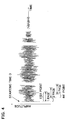
- Fig. 4 is a view given in explanation of the page division of step S2 of Fig.3.
- the waveform of the input voice is shown by a graph in which time is taken along the horizontal axis and amplitude is taken along the vertical axis.
- This waveform is divided into a plurality of pages, taking one page as being a time range of prescribed length (in this case, 1024 points, where one point is (1/44100) sec) starting from the starting time-point D (time-point of starting voice input), successively offsetting these pages by 441 points in each case.
- the prescribed length was set to 1024 points, this could be suitably altered to take into account for example the sampling frequency of the voice signal or the speed of speaking by the speaker. Also, although, in this case, overlapping portions exist in the time ranges, since the offsetting time is shorter than the time range of prescribed length, a time range of prescribed length could be taken such that there are no overlapping portions.
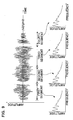
- Fig.5 is a view showing the relationship of frequency and amplitude when analysis of the frequency components of step S2 of Fig.3 is conducted. This is a view obtained by conducting N-point discrete Fourier transformation on the waveform contained in each page of Fig. 4. Specifically, if the amplitude at a point N in page m is represented by ⁇ x(m,k)
- Fig.6 is a view showing the results of frequency decomposition in respect of a plurality of pages.
- frequency component graphs of the same shape are arranged side by side, but, in fact, the frequency component graphs will change for each page, since the input voice waveform differs depending on lapsed time.
- the degree of change calculation unit 14 then first of all calculates, using the following equation (B), the correlation between adjacent pages (S3).
- Fig.7 is a view showing how a calculation of the correlation between adjacent pages is performed.
- the correlation is found by taking the sum for N points of the values obtained by multiplying the amplitudes corresponding to the same frequency component in each of the pages.
- the amplitude A (m, k) of page m and the amplitude A (m+1, k) of page (m+1) corresponding to the same frequency component k are multiplied.
- the correlation of page m and page (m+1) is calculated by taking the sum while changing k from 0 to N-1.
- the degree of change calculation unit 14 then averages the correlation found by equation (B) using the following equation (C) in order to remove noise (S4).
- step S5 the segment determining unit 15 specifies adjacent pages that satisfy the condition given above, from the difference function of the correlations.
- the correlation Q(x) from which noise has been removed is employed for this purpose.
- Fig.8 is a view showing the relationship between a page-linked parameter y and difference S (y) of correlation.
- S(1) is a value obtained by subtracting the correlations (Q(1)) of the adjacent first page and second page from the correlation (Q(2)) of the adjacent second page and third page.
- Groups of adjacent pages corresponding to natural numbers y for which this degree of change S(y) satisfies S(y-1) ⁇ S (y) and S(y+1) ⁇ S (y) are then specified as the starting positions of phonemes.
- the waveform of an input voice changes considerably at locations of phoneme changeover, so locations which show marked changes indicate the starting positions of new phonemes.
- there are four locations where the natural number y satisfies S (y-1) ⁇ S(y) and S(y+1) ⁇ S(y) (these will be designated respectively as the page-linked parameters y 1 , y 2 , y 3 and y 4 ), so four phonemes are extracted from the first segment to the fourth segment.
- the page-linked parameter y 1 indicates the segment starting page to the page y 1 or the page y 1 +1. It does not matter which of these is used. However, in the voice signal being analyzed, these are treated as being the same. The same applies to other page-linked parameters specifying the starting positions of the segments.
- the phoneme extraction unit 16 calculates a characteristic quantity for each segment determined in step S5 (S6).
- a characteristic quantity for each segment determined in step S5 S6
- one typical method of calculating ordinary characteristic quantities is the technique of decomposing the input voice into frequency components in each segment, performing inverse Fourier transformation and then performing a cepstrum analysis. An example thereof is to decompose the input voice into frequency components for each segment and to use the amplitude of these frequency components as characteristic quantities. If segment and page coincide, the results of the frequency decomposition for each page found in step S2 may be employed.
- Fig.9 is a view given in explanation of frequency decomposition for each segment. This illustrates how frequency components are calculated by an N-point discrete Fourier transformation for each segment.
- frequency component graphs of the same shape are arranged side by side, but, in fact, the frequency component graphs will change for each page, since the input voice waveform differs depending on lapsed time.
- phonemes are extracted by matching with reference data (S7).
- reference data data are employed obtained by averaging the results of executing the procedure from the above step S1 to S6 in respect of a plurality of subjects beforehand. Once such reference data has been created and stored in the storage unit 17, stable phoneme extraction can be achieved irrespective of subsequent changes of user: in particular, application to an indefinitely large number of users is possible.
- well-known techniques such as DP matching can be applied.
- segments and phonemes and the pages of segment boundaries contained in the input voice can be specified. Also, if the pages of segment boundaries are specified, in the present embodiment, extraction of timing information is also completed, since conversion to a time-point can be achieved using ⁇ starting time-point D + product of 441 points and (page of segment boundary-1) ⁇ . Animation is then displayed corresponding to the phoneme, in accordance with the layout described in Fig.1, using the phoneme and timing information that is output from the voice analysis unit 1 (S8).
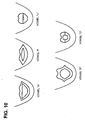
- Fig.10 is a view given in explanation of animation corresponding to phonemes. Assuming that, for example, files are selected as the extracted phonemes and reference data for each vowel is stored in the storage unit 17, if data corresponding to animation for each vowel shown in Fig.10 is stored in the working RAM 3, animation can be displayed corresponding to each vowel contained in the input voice by using the image generating device of Fig.1. For example, animation images corresponding to each vowel can be displayed by associating the image "a” in Fig.10 with the vowel "a” and associating the image "i” in Fig.10 with the vowel "i".
- nimble voice analysis processing can be achieved in real time simply by preparing the results of analysis of input voice of a plurality of subjects beforehand as reference data, without needing to prepare reference patterns for each speaker. Also, since an operation of registering reference patterns for each speaker is not required and the reference pattern need only be prepared once, an indefinitely large number of speakers can be coped with. Furthermore, since a database for storing the reference patterns of each speaker is not required, installation even on an appliance of small storage capacity is possible.
- Examples of possible applications include animation for online chat rooms, animation in video games (in particular video games that are played in conversational mode, or role-playing games) or unmanned reception systems employed in hospitals or financial institutions etc.
- step S8 of the flow chart shown in Fig.3 is dispensed with and the phoneme or timing information that is output from the voice analysis device is made use of by processing on a separate device that is connected thereto.
Landscapes
- Engineering & Computer Science (AREA)
- Computational Linguistics (AREA)
- Health & Medical Sciences (AREA)
- Audiology, Speech & Language Pathology (AREA)
- Human Computer Interaction (AREA)
- Physics & Mathematics (AREA)
- Acoustics & Sound (AREA)
- Multimedia (AREA)
- Processing Or Creating Images (AREA)
Applications Claiming Priority (2)
| Application Number | Priority Date | Filing Date | Title |
|---|---|---|---|
| JP2004051998 | 2004-02-26 | ||
| JP2004051998A JP4792703B2 (ja) | 2004-02-26 | 2004-02-26 | 音声解析装置、音声解析方法及び音声解析プログラム |
Publications (2)
| Publication Number | Publication Date |
|---|---|
| EP1569201A1 true EP1569201A1 (de) | 2005-08-31 |
| EP1569201B1 EP1569201B1 (de) | 2007-04-18 |
Family
ID=34747518
Family Applications (1)
| Application Number | Title | Priority Date | Filing Date |
|---|---|---|---|
| EP05250981A Expired - Lifetime EP1569201B1 (de) | 2004-02-26 | 2005-02-22 | Sprachsegmentierung |
Country Status (6)
| Country | Link |
|---|---|
| US (1) | US7680660B2 (de) |
| EP (1) | EP1569201B1 (de) |
| JP (1) | JP4792703B2 (de) |
| CN (1) | CN1319042C (de) |
| DE (1) | DE602005000896T2 (de) |
| ES (1) | ES2284133T3 (de) |
Families Citing this family (19)
| Publication number | Priority date | Publication date | Assignee | Title |
|---|---|---|---|---|
| JP5119700B2 (ja) * | 2007-03-20 | 2013-01-16 | 富士通株式会社 | 韻律修正装置、韻律修正方法、および、韻律修正プログラム |
| ES2391603T3 (es) * | 2009-06-02 | 2012-11-28 | Vodafone Holding Gmbh | Registro de un dispositivo móvil en una red de comunicaciones móviles |
| US20110143768A1 (en) * | 2009-12-14 | 2011-06-16 | Lane Sean L | Methods and apparatus related to region-specific mobile device and infrastructure detection, analysis and display |
| RU2445718C1 (ru) * | 2010-08-31 | 2012-03-20 | Государственное образовательное учреждение высшего профессионального образования Академия Федеральной службы охраны Российской Федерации (Академия ФСО России) | Способ выделения сегментов обработки речи на основе анализа корреляционных зависимостей в речевом сигнале |
| US20120089392A1 (en) * | 2010-10-07 | 2012-04-12 | Microsoft Corporation | Speech recognition user interface |
| US10264990B2 (en) * | 2012-10-26 | 2019-04-23 | The Regents Of The University Of California | Methods of decoding speech from brain activity data and devices for practicing the same |
| US9302393B1 (en) * | 2014-04-15 | 2016-04-05 | Alan Rosen | Intelligent auditory humanoid robot and computerized verbalization system programmed to perform auditory and verbal artificial intelligence processes |
| US10002543B2 (en) * | 2014-11-04 | 2018-06-19 | Knotbird LLC | System and methods for transforming language into interactive elements |
| US10057681B2 (en) | 2016-08-01 | 2018-08-21 | Bose Corporation | Entertainment audio processing |
| TWI606390B (zh) * | 2016-09-23 | 2017-11-21 | 元鼎音訊股份有限公司 | 可自動調整聲音輸出之方法及電子裝置 |
| JP6337362B1 (ja) * | 2017-11-02 | 2018-06-06 | パナソニックIpマネジメント株式会社 | 認知機能評価装置、及び、認知機能評価システム |
| CN108170710A (zh) * | 2017-11-28 | 2018-06-15 | 苏州市东皓计算机系统工程有限公司 | 一种计算机声音识别系统 |
| CN108538308B (zh) * | 2018-01-09 | 2020-09-29 | 网易(杭州)网络有限公司 | 基于语音的口型和/或表情模拟方法及装置 |
| US11276390B2 (en) * | 2018-03-22 | 2022-03-15 | Casio Computer Co., Ltd. | Audio interval detection apparatus, method, and recording medium to eliminate a specified interval that does not represent speech based on a divided phoneme |
| JP6672380B2 (ja) * | 2018-05-29 | 2020-03-25 | 株式会社コロプラ | ゲームプログラム、キャラクタ制御プログラム、方法、および情報処理装置 |
| CN109087629A (zh) * | 2018-08-24 | 2018-12-25 | 苏州玩友时代科技股份有限公司 | 一种基于语音识别的口型动画实现方法及装置 |
| CN113112993B (zh) * | 2020-01-10 | 2024-04-02 | 阿里巴巴集团控股有限公司 | 一种音频信息处理方法、装置、电子设备以及存储介质 |
| CN111540344B (zh) * | 2020-04-21 | 2022-01-21 | 北京字节跳动网络技术有限公司 | 声学网络模型训练方法、装置及电子设备 |
| CN116129926B (zh) * | 2023-04-19 | 2023-06-09 | 北京北信源软件股份有限公司 | 智能设备自然语言交互信息处理方法 |
Citations (1)
| Publication number | Priority date | Publication date | Assignee | Title |
|---|---|---|---|---|
| US5109418A (en) * | 1985-02-12 | 1992-04-28 | U.S. Philips Corporation | Method and an arrangement for the segmentation of speech |
Family Cites Families (18)
| Publication number | Priority date | Publication date | Assignee | Title |
|---|---|---|---|---|
| JPS58148443A (ja) | 1982-03-01 | 1983-09-03 | Seiko Epson Corp | 半導体集積回路装置 |
| JPS6136798A (ja) * | 1984-07-30 | 1986-02-21 | 松下電器産業株式会社 | 音声セグメンテ−シヨン法 |
| JPS61100956A (ja) | 1984-10-22 | 1986-05-19 | Nec Corp | モノブリツド集積回路 |
| JP2664136B2 (ja) * | 1985-08-30 | 1997-10-15 | 株式会社日立製作所 | 音声認識装置 |
| JP2863818B2 (ja) * | 1990-08-31 | 1999-03-03 | 工業技術院長 | 動画像の変化点検出方法 |
| JPH04263298A (ja) * | 1991-02-16 | 1992-09-18 | Nippon Sheet Glass Co Ltd | 音声認識装置 |
| US5613056A (en) * | 1991-02-19 | 1997-03-18 | Bright Star Technology, Inc. | Advanced tools for speech synchronized animation |
| JP3269162B2 (ja) | 1992-03-23 | 2002-03-25 | 日本電気株式会社 | エレクトロルミネッセンス表示パネル駆動回路 |
| JPH0632007A (ja) | 1992-07-15 | 1994-02-08 | Sony Corp | リボンカートリッジ |
| US5878396A (en) * | 1993-01-21 | 1999-03-02 | Apple Computer, Inc. | Method and apparatus for synthetic speech in facial animation |
| US5657426A (en) * | 1994-06-10 | 1997-08-12 | Digital Equipment Corporation | Method and apparatus for producing audio-visual synthetic speech |
| JP3081108B2 (ja) | 1994-08-11 | 2000-08-28 | 株式会社トレンディ | 話者分類処理装置及び方法 |
| CA2281746A1 (en) * | 1997-03-25 | 1998-10-01 | Robert William Series | Speech analysis system |
| JP2000100072A (ja) * | 1998-09-24 | 2000-04-07 | Sony Corp | 情報信号処理方法及び装置 |
| JP2000324499A (ja) * | 1999-05-14 | 2000-11-24 | Fujitsu Ltd | 画像処理装置及びシーンチェンジ検出方法 |
| JP2002108382A (ja) * | 2000-09-27 | 2002-04-10 | Sony Corp | リップシンクを行うアニメーション方法および装置 |
| JP2002215180A (ja) | 2001-01-17 | 2002-07-31 | Digital Media Lab Inc | 通信装置 |
| JP2003233389A (ja) | 2002-02-12 | 2003-08-22 | Yamaha Corp | アニメーション画像生成装置、及び同装置を内蔵した携帯電話、並びにアニメーション画像生成方法 |
-
2004
- 2004-02-26 JP JP2004051998A patent/JP4792703B2/ja not_active Expired - Lifetime
-
2005
- 2005-02-18 US US11/060,754 patent/US7680660B2/en not_active Expired - Fee Related
- 2005-02-22 EP EP05250981A patent/EP1569201B1/de not_active Expired - Lifetime
- 2005-02-22 DE DE602005000896T patent/DE602005000896T2/de not_active Expired - Lifetime
- 2005-02-22 ES ES05250981T patent/ES2284133T3/es not_active Expired - Lifetime
- 2005-02-25 CN CNB2005100510306A patent/CN1319042C/zh not_active Expired - Fee Related
Patent Citations (1)
| Publication number | Priority date | Publication date | Assignee | Title |
|---|---|---|---|---|
| US5109418A (en) * | 1985-02-12 | 1992-04-28 | U.S. Philips Corporation | Method and an arrangement for the segmentation of speech |
Non-Patent Citations (2)
| Title |
|---|
| BRUGNARA F ET AL: "AUTOMATIC SEGMENTATION AND LABELING OF SPEECH BASED ON HIDDEN MARKOV MODELS", SPEECH COMMUNICATION, ELSEVIER SCIENCE PUBLISHERS, AMSTERDAM, NL, vol. 12, no. 4, 1 August 1993 (1993-08-01), pages 357 - 370, XP000393652, ISSN: 0167-6393 * |
| COHEN J R: "SEGMENTING SPEECH USING DYNAMIC PROGRAMMING", JOURNAL OF THE ACOUSTICAL SOCIETY OF AMERICA, AMERICAN INSTITUTE OF PHYSICS. NEW YORK, US, vol. 69, no. 5, May 1981 (1981-05-01), pages 1430 - 1438, XP000891595, ISSN: 0001-4966 * |
Also Published As
| Publication number | Publication date |
|---|---|
| JP4792703B2 (ja) | 2011-10-12 |
| DE602005000896D1 (de) | 2007-05-31 |
| DE602005000896T2 (de) | 2008-01-17 |
| EP1569201B1 (de) | 2007-04-18 |
| US20050192805A1 (en) | 2005-09-01 |
| JP2005241997A (ja) | 2005-09-08 |
| US7680660B2 (en) | 2010-03-16 |
| ES2284133T3 (es) | 2007-11-01 |
| CN1661675A (zh) | 2005-08-31 |
| CN1319042C (zh) | 2007-05-30 |
Similar Documents
| Publication | Publication Date | Title |
|---|---|---|
| US7680660B2 (en) | Voice analysis device, voice analysis method and voice analysis program | |
| US10553201B2 (en) | Method and apparatus for speech synthesis | |
| CN109377539B (zh) | 用于生成动画的方法和装置 | |
| CN111694940B (zh) | 一种用户报告的生成方法及终端设备 | |
| CN113539240B (zh) | 动画生成方法、装置、电子设备和存储介质 | |
| Cao et al. | Expressive speech-driven facial animation | |
| CN112466314A (zh) | 情感语音数据转换方法、装置、计算机设备及存储介质 | |
| WO2005031654A1 (en) | System and method for audio-visual content synthesis | |
| CN108538308B (zh) | 基于语音的口型和/或表情模拟方法及装置 | |
| WO2020248388A1 (zh) | 歌声合成模型的训练方法、装置、计算机设备以及存储介质 | |
| CN113763992B (zh) | 语音测评方法、装置、计算机设备和存储介质 | |
| CN113314150A (zh) | 基于语音数据的情绪识别方法、装置及存储介质 | |
| CN111914822B (zh) | 文本图像标注方法、装置、计算机可读存储介质及设备 | |
| CN114283828A (zh) | 语音降噪模型的训练方法、语音评分方法、装置及介质 | |
| CN114267375B (zh) | 音素检测方法及装置、训练方法及装置、设备和介质 | |
| CN114895817A (zh) | 交互信息处理方法、网络模型的训练方法及装置 | |
| CN116528015A (zh) | 数字人视频的生成方法、装置、电子设备和存储介质 | |
| CN113889073A (zh) | 语音处理方法、装置、电子设备和存储介质 | |
| CN111508530A (zh) | 语音情感识别方法、装置及存储介质 | |
| EP4629232A1 (de) | Interaktionsverfahren und -vorrichtung, vorrichtung und speichermedium | |
| CN112381926B (zh) | 用于生成视频的方法和装置 | |
| CN114048757A (zh) | 一种手语合成方法、装置、计算机设备及存储介质 | |
| CN114972589B (zh) | 虚拟数字形象的驱动方法及其装置 | |
| CN114898018A (zh) | 数字对象的动画生成方法、装置、电子设备及存储介质 | |
| CN113177457B (zh) | 用户服务方法、装置、设备及计算机可读存储介质 |
Legal Events
| Date | Code | Title | Description |
|---|---|---|---|
| PUAI | Public reference made under article 153(3) epc to a published international application that has entered the european phase |
Free format text: ORIGINAL CODE: 0009012 |
|
| AK | Designated contracting states |
Kind code of ref document: A1 Designated state(s): AT BE BG CH CY CZ DE DK EE ES FI FR GB GR HU IE IS IT LI LT LU MC NL PL PT RO SE SI SK TR |
|
| AX | Request for extension of the european patent |
Extension state: AL BA HR LV MK YU |
|
| 17P | Request for examination filed |
Effective date: 20060222 |
|
| AKX | Designation fees paid |
Designated state(s): DE ES FR GB IT |
|
| GRAP | Despatch of communication of intention to grant a patent |
Free format text: ORIGINAL CODE: EPIDOSNIGR1 |
|
| GRAS | Grant fee paid |
Free format text: ORIGINAL CODE: EPIDOSNIGR3 |
|
| GRAA | (expected) grant |
Free format text: ORIGINAL CODE: 0009210 |
|
| AK | Designated contracting states |
Kind code of ref document: B1 Designated state(s): DE ES FR GB IT |
|
| REF | Corresponds to: |
Ref document number: 602005000896 Country of ref document: DE Date of ref document: 20070531 Kind code of ref document: P |
|
| ET | Fr: translation filed | ||
| REG | Reference to a national code |
Ref country code: ES Ref legal event code: FG2A Ref document number: 2284133 Country of ref document: ES Kind code of ref document: T3 |
|
| PLBE | No opposition filed within time limit |
Free format text: ORIGINAL CODE: 0009261 |
|
| STAA | Information on the status of an ep patent application or granted ep patent |
Free format text: STATUS: NO OPPOSITION FILED WITHIN TIME LIMIT |
|
| 26N | No opposition filed |
Effective date: 20080121 |
|
| PGFP | Annual fee paid to national office [announced via postgrant information from national office to epo] |
Ref country code: DE Payment date: 20140219 Year of fee payment: 10 |
|
| PGFP | Annual fee paid to national office [announced via postgrant information from national office to epo] |
Ref country code: IT Payment date: 20140228 Year of fee payment: 10 Ref country code: FR Payment date: 20140219 Year of fee payment: 10 Ref country code: ES Payment date: 20140226 Year of fee payment: 10 |
|
| PGFP | Annual fee paid to national office [announced via postgrant information from national office to epo] |
Ref country code: GB Payment date: 20140218 Year of fee payment: 10 |
|
| REG | Reference to a national code |
Ref country code: DE Ref legal event code: R119 Ref document number: 602005000896 Country of ref document: DE |
|
| GBPC | Gb: european patent ceased through non-payment of renewal fee |
Effective date: 20150222 |
|
| REG | Reference to a national code |
Ref country code: FR Ref legal event code: ST Effective date: 20151030 |
|
| PG25 | Lapsed in a contracting state [announced via postgrant information from national office to epo] |
Ref country code: IT Free format text: LAPSE BECAUSE OF NON-PAYMENT OF DUE FEES Effective date: 20150222 |
|
| PG25 | Lapsed in a contracting state [announced via postgrant information from national office to epo] |
Ref country code: DE Free format text: LAPSE BECAUSE OF NON-PAYMENT OF DUE FEES Effective date: 20150901 Ref country code: GB Free format text: LAPSE BECAUSE OF NON-PAYMENT OF DUE FEES Effective date: 20150222 |
|
| PG25 | Lapsed in a contracting state [announced via postgrant information from national office to epo] |
Ref country code: FR Free format text: LAPSE BECAUSE OF NON-PAYMENT OF DUE FEES Effective date: 20150302 |
|
| REG | Reference to a national code |
Ref country code: ES Ref legal event code: FD2A Effective date: 20160527 |
|
| PG25 | Lapsed in a contracting state [announced via postgrant information from national office to epo] |
Ref country code: ES Free format text: LAPSE BECAUSE OF NON-PAYMENT OF DUE FEES Effective date: 20150223 |