EP1568985A2 - Vorrichtung zur Untersuchung von Oberflächen und Verfahren und Vorrichtung zur Untersuchung von Substraten. - Google Patents
Vorrichtung zur Untersuchung von Oberflächen und Verfahren und Vorrichtung zur Untersuchung von Substraten. Download PDFInfo
- Publication number
- EP1568985A2 EP1568985A2 EP05003164A EP05003164A EP1568985A2 EP 1568985 A2 EP1568985 A2 EP 1568985A2 EP 05003164 A EP05003164 A EP 05003164A EP 05003164 A EP05003164 A EP 05003164A EP 1568985 A2 EP1568985 A2 EP 1568985A2
- Authority
- EP
- European Patent Office
- Prior art keywords
- inspection
- color
- extracted
- color phase
- image
- Prior art date
- Legal status (The legal status is an assumption and is not a legal conclusion. Google has not performed a legal analysis and makes no representation as to the accuracy of the status listed.)
- Withdrawn
Links
Images



Classifications
-
- G—PHYSICS
- G01—MEASURING; TESTING
- G01R—MEASURING ELECTRIC VARIABLES; MEASURING MAGNETIC VARIABLES
- G01R31/00—Arrangements for testing electric properties; Arrangements for locating electric faults; Arrangements for electrical testing characterised by what is being tested not provided for elsewhere
- G01R31/28—Testing of electronic circuits, e.g. by signal tracer
- G01R31/302—Contactless testing
- G01R31/308—Contactless testing using non-ionising electromagnetic radiation, e.g. optical radiation
- G01R31/309—Contactless testing using non-ionising electromagnetic radiation, e.g. optical radiation of printed or hybrid circuits or circuit substrates
-
- G—PHYSICS
- G01—MEASURING; TESTING
- G01N—INVESTIGATING OR ANALYSING MATERIALS BY DETERMINING THEIR CHEMICAL OR PHYSICAL PROPERTIES
- G01N21/00—Investigating or analysing materials by the use of optical means, i.e. using sub-millimetre waves, infrared, visible or ultraviolet light
- G01N21/84—Systems specially adapted for particular applications
- G01N21/88—Investigating the presence of flaws or contamination
- G01N21/95—Investigating the presence of flaws or contamination characterised by the material or shape of the object to be examined
- G01N21/956—Inspecting patterns on the surface of objects
- G01N21/95684—Patterns showing highly reflecting parts, e.g. metallic elements
-
- G—PHYSICS
- G06—COMPUTING OR CALCULATING; COUNTING
- G06T—IMAGE DATA PROCESSING OR GENERATION, IN GENERAL
- G06T7/00—Image analysis
- G06T7/0002—Inspection of images, e.g. flaw detection
- G06T7/0004—Industrial image inspection
-
- G—PHYSICS
- G06—COMPUTING OR CALCULATING; COUNTING
- G06T—IMAGE DATA PROCESSING OR GENERATION, IN GENERAL
- G06T7/00—Image analysis
- G06T7/90—Determination of colour characteristics
-
- G—PHYSICS
- G06—COMPUTING OR CALCULATING; COUNTING
- G06T—IMAGE DATA PROCESSING OR GENERATION, IN GENERAL
- G06T2207/00—Indexing scheme for image analysis or image enhancement
- G06T2207/10—Image acquisition modality
- G06T2207/10024—Color image
-
- G—PHYSICS
- G06—COMPUTING OR CALCULATING; COUNTING
- G06T—IMAGE DATA PROCESSING OR GENERATION, IN GENERAL
- G06T2207/00—Indexing scheme for image analysis or image enhancement
- G06T2207/30—Subject of image; Context of image processing
- G06T2207/30108—Industrial image inspection
- G06T2207/30152—Solder
Definitions
- This invention relates to a method of inspecting the surface condition of an object having a sloped surface with a high specular characteristic by using an image taken thereof, as well as to an apparatus using such a method and particularly to an apparatus for inspecting the surface conditions of a substrate having a plurality of soldered portions.
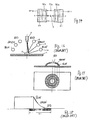
- Fig. 16 shows the structure of such a substrate inspection apparatus and the principle of inspection thereby as disclosed in aforementioned Patent Publication, having three light sources 8, 9 and 10 for emitting red, green and blue light beams, respectively, and an image taking device 3 for obtaining an image of the object of inspection.
- numeral 1 indicates a substrate and numeral 2 indicates a solder piece to be inspected, above which the light sources 8, 9 and 10 are arranged at different angles of elevation with respect to the substrate 1 and the solder piece 2 while the image taking device 3 is set such that the image of the solder piece 2 will be taken directly from above.
- the colored beams of light from these individual light sources 8, 9 and 10 are projected onto the surface of the solder piece 2 from mutually different directions. If a beam of light is projected onto the sloped surface of solder piece 2 from such a direction that is symmetric with the direction to the image taking device 3 with respect to the line perpendicular to the slope at the point where the light is projected, the mirror-reflection of this projected beam will be directed toward the image taking device 3. In other words, the color of the mirror-reflected light made incident into the image taking device 3 will be different, depending upon the slope of the solder surface.
- the elevation angle as seen from the solder piece 2 is the largest for the red light source 8 and that for the blue light source 10 is the smallest, the green light source 9 being positioned in between.
- the solder piece 2 is spherical, as shown in Fig. 17, a color-partitioned image is obtained with the flat surface portion at the center appearing as a red image area, the steeply sloped surface portions close to the substrate surface appearing as a blue image area, and the intermediate gently sloped surface portions appearing as a green image area.
- a color-partitioned image is obtained with the steeply sloped upper portion appearing as a blue image area, the gently sloped intermediate portion appearing as a green image area and the nearly horizontal lower portion near the substrate surface appearing as a red image area.
- symbol S1 indicates the range for a land.
- an image partitioned into red, green and blue areas is obtained from a solder piece, depending on the change in the slope of its surface.
- the quality of the solder surface condition can be determined if a color image pattern of an ideally shaped solder piece is preliminarily registered and a comparison is made with such a registered pattern.
- each of the red, green and blue color areas is extracted by preliminarily defining a binarization threshold value for each of red, green and blue gradation data comprising a digital color image and binarizing the image obtained from the image taking device 3 by using these binarization threshold values.
- Data such as position, shape and size of extracted areas from an image of an ideally shaped solder piece may be preliminarily registered such that the quality of a solder surface may be determined by comparing the colored areas of its image with the registered data.
- the brightness and the color on the image may be thought to vary as the brightness and the color of the illuminating light changes according to temperature and the time of use, and such variations in the brightness and the color may be considered to affect the result of extraction of the color areas.
- the characteristic quantity of each color area changes due to a change in the color, it may become impossible to clear the standard set for a "good" product although the surface condition may be normal, and such a product may be judged defective.
- a pattern matching process may be carried out by using the image of an ideally mounted substrate as a model image. According to this method, since normalized correlation calculations are carried out between the image to be inspected and the model image, the threshold values for the judgment need not be changed although there may be a change in illumination. On the other hand, the correlation value drops even by a small change in the shape of the solder piece being inspected and the probability of obtaining a correct judgment result also deteriorates.
- the modem tendency is that substrates become smaller and more parts are mounted to them.
- the land area corresponding to each component part must be adjusted according to the density of mounting in the surrounding areas.
- the land size changes even for a same component, depending on the number of components mounted in the surrounding areas. Since the slope of a solder fillet comes to vary accordingly, depending on the mounting position of the component and hence the size and shape of each color area of a fillet image also become different. If there are relatively few components mounted near by, for example, the land may be made relatively big for the soldering stability and hence the slope of the fillet becomes gentler and the red, green and blue areas appear properly.
- the present invention was accomplished in view of the problem described above and its primary object is to make it possible to inspect a sloped surface even if there are changes in the brightness and color of the image.
- Another object of this invention is to make it possible to accurately inspect even a surface with steep or gentle slopes such that color areas corresponding to all of the light sources may not be easily produced.
- a plurality of light sources for emitting light of different colors are set, each arranged so as to have a different elevation angle with respect to the target object at an inspection position and light is projected from these light sources.
- An image of the target object taken by a camera unit positioned above the inspection position of the target object is used for the inspection.
- the method of inspection comprises the steps of setting an inspection area including the target object on the image, extracting in the inspection area a direction in which a change in color phase appears corresponding to arrangement of each of the light sources, making a comparison between the extracted direction and a preliminarily registered standard direction, and judging the surface condition from the result of this comparison.
- the target object is irradiated by thus setting such light sources, colors appear on the portions of the image taken by the camera unit corresponding to a sloped surface according to the angle of the slope. If the slope of the surface changes gradually, the color of the corresponding portion of the image changes in an order corresponding to the order in which the light sources are arranged, that is, the order of their elevation angles.
- change in color phase corresponding to arrangement of each of the light sources means the order in which the colors emitted from these light sources will appear as seen from the target object. In the case of an optical system arranged as shown in Fig. 16, this may be understood as the change from red to green to blue or from blue to green to red.
- the direction in which colors appear in this order may be regarded as corresponding to the direction in which the slope of the light-reflecting surface is changing.
- the brightness and color phase on the image may change, the direction of change in color phase on the image according to the arrangement of the light sources is believed not to change.
- directions extracted from an image of a target object being inspected may be compared with these standard directions to determine whether the target object has a correct surface shape.
- the light sources are arranged with respect to the target object such that their colors are aligned in the direction of change of their color phase on the hue circle. If the colors of the light sources are red, green and blue, for example, these light sources are arranged such that their elevation angles will increase in the order of red-green-blue of blue-green-red.
- a direction is extracted by obtaining for each of pixels in the inspection area one-dimensional color phase data with values changing along the hue circle and extracting the direction such that the color phase data change to larger values or smaller values along the direction.
- the corresponding change in the color phase on the image also corresponds to the change in the hue circle. Since one-dimensional color phase data with values changing along the hue circle are used, the direction in which the color phase is changing corresponding to the arrangement of the light sources can be represented as the direction in which the color phase increases or decreases. Thus, the direction in which the change appears in the color phase may be easily extracted as the vector based on the change in the color phase.
- the direction is extracted by obtaining for each of pixels in the inspection area one-dimensional color phase data that reflect strength of a color component corresponding to any one of the different colors of the light sources and extracting the direction such that the color phase data change to larger values or smaller values along the direction.
- gradation data B may be considered to increase as the slope becomes steeper and smaller as the slope becomes gentler.
- its magnitude with respect to other color components such as ratio B/R or B/(R+G) or its ratio with respect to brightness B/(R+G+B) may be obtained and used as color phase data.
- the direction in which a change in the color phase corresponding to the arrangement of the light sources appears may be represented as the direction in which the color phase data becomes larger or smaller.
- the direction in which the color phase is changing may be easily extracted as the direction of the vector based on the change in the color phase.
- the direction in which the aforementioned change in the color phase along the hue circle appears may be extracted by extracting changes in the color phase data for each of directions passing through a plurality of selected pixels in the inspection area, setting a plurality of vectors by averaging the extracted changes for each of the directions and obtaining a synthesized vector out of these plurality of vectors.
- the synthesized vector may be required to be of a sufficient length. If only a vector shorter than a threshold length can be obtained, it may be concluded that there is no sloped surface of a good quality.
- the light-emitting part may include three concentrically disposed ring-shaped light sources each adapted to emit light of a different color and having a different diameter.
- a plurality of light emitting elements such as LEDs for emitting light of a same color may be arranged in a circular manner as a single light source.
- the light source need not necessarily be ring-shaped.
- a linear light source may be used for the purpose of this invention.
- the camera unit may comprise a CCD camera adapted to create an image signal for each color. If the light-emitting part is formed with ring-shaped light sources, it is preferable to set the camera unit so as to have its optical axis aligned vertically along the center axis of the light sources.
- the image input unit, the extracting means, the registering means, the judging means and the outputting means may all be set within a same housing structure.
- the extracting means, the registering means and the judging means may be realized as a computer having programs installed for carrying out the processes by these means.
- a computer may be provided separately for each of these means or a single computer may be provided for all these means.
- the image input unit may be comprised of an amplifier circuit for amplifying the image signal from the camera unit and an A/D converter circuit for converting this image signal into a digital signal. If a digital camera is used in the camera unit, however, the image input unit may be formed as an input port for taking in digital color image data.
- the extracting means and the judging means are for carrying out the aforementioned extracting, comparing and judging steps.
- the registering means serves to register in the memory of a computer the standard direction extracted from a model image of a good target object created by the light projecting unit and the camera unit. As for the registering means, it may be defined as the means for having image data processed by the extracting means when an inspection area is set on a model image and storing the extracted direction as the standard direction in the memory.
- the outputting means may comprise a display interface for displaying the judgment result by the judging means or an output interface for outputting the judgment result to an external apparatus.
- the outputting means may be formed as recording means for recording on a memory medium such as a flexible disk, a CD-R or a photomagnetic disk.
- the light sources are arranged such that the different colors are arranged in the direction of change of color phase on the hue circle and the extracting means is set so as to obtain for each of pixels in the inspection area one-dimensional color phase data with values changing along the hue circle and to extract the direction such that the color phase data change to larger values or smaller values along the direction.
- the light projecting unit is preferably comprised of three light sources for emitting red, green and blue light, respectively, arranged such that their elevation angles will increase in the order of red-green-blue or blue-green-red.
- the extracting means is set so as to obtain for each of pixels in the inspection area one-dimensional color phase data that reflect strength of a color component corresponding to any one of the different colors of the light sources and to extract the direction such that the color phase data change to larger values or smaller values along the direction.
- the light projecting unit be comprised of three light sources for emitting red, green and blue light, respectively, arranged such that their elevation angles will increase in the order of red-green-blue or blue-green-red. If the light projection unit is thus structured, it is preferable to use gradation data R or B as the color component to be used for the color phase data.
- the aforementioned color phase data may be obtained as ratio with respect to another color or the other colors B/R or B/(R+G) or as its ratio with respect to brightness B/(R+G+B).
- the extracting means may include means for extracting changes in the color phase data for each of directions passing through a plurality of selected pixels in the inspection area, setting a plurality of vectors by averaging the extracted changes for each of the directions and obtaining a synthesized vector out of these vectors.
- This invention may be applied to an apparatus for inspecting a substrate having a plurality of components soldered thereonto.
- Such an apparatus according to this invention may be characterized as comprising a light-emitting part having a plurality of light sources each for emitting light of a different color and each arranged to have a different elevation angle with respect to the substrate, a camera unit disposed above the substrate, an image input unit that inputs an image created by the camera unit under a condition where each of the light sources is lit, extracting means for setting an inspection area including each of soldered portions on the image and extracting in the inspection area a direction in which a change in color phase appears corresponding to arrangement of each of the light sources, registering means for registering a standard direction extracted by the extracting means under a good solder surface condition, judging means for judging condition of each of the soldered portions by comparing the direction extracted by the extracting means from the target object, and outputting means for outputting the result of judgment by the judging means.
- the registering means may be adapted to apply the standard direction obtained for one of the components in the inspection of the others of the components. This function makes it unnecessary to repeat the registration step for each of the components and hence the inspection efficiency can be improved.
- the standard direction to be registered it may be set in response to the user's operation or by extracting a direction after the extraction means processes the image of a model target substrate known to be good.
- the extraction means processes the image of a model target substrate known to be good.
- sloped conditions of soldered positions can be accurately inspected by checking whether the change in the sloped surface of a soldered position is correctly oriented or not. It is also possible to determine whether a sloped solder surface has been formed or not by examining the magnitude of change in the color phase corresponding to the arrangement of the light sources and the positions of change in the color phase.
- an inspection can be carried out easily since the standard direction does not vary although the slope of solder may change, depending on how densely components are mounted.
- Fig. 1 shows the structure of a substrate inspection apparatus embodying this invention, being adapted to process an image taken of a target substrate to be inspected and to thereby judge whether or not soldering positions and the mounting of components thereon are proper, and comprising an image taking unit (or a camera unit) 3, a light projecting part 4, a control processing part 5, an X-axis table part 6 and a Y-axis table part 7.
- the target substrate to be inspected is indicated by symbol 1T.
- Symbol 1S indicates a standard substrate with soldering parts properly formed and components properly mounted, to be used prior to an inspection process for the purpose of "teaching".
- the Y-axis table part 7 is provided with a conveyor 7A for supporting the substrates 1S and 1T, serving to move them in the Y-direction (perpendicular to the plane of the figure) by means of a motor (not shown).
- the X-axis table part 6 serves to support the camera unit 3 and the light projecting part 4 and move them in the X-direction (to the left and right in the figure) above the Y-axis table part 7.
- the light projecting part 4 includes three ring-shaped light sources 8, 9 and 10 with different diameters, respectively adapted to emit red light, green light and blue light. Their centers are directly above the observation position such that each of them has a different elevation angle as seen from the substrate 1S or 1T.
- the camera unit 3 is a CCD camera for producing a color image with its optical axis oriented vertically and passing through the centers of the three light sources 8, 9 and 10 such that the reflected light from the substrate 1S or 1T will be made incidence to the camera unit 3 and converted into three color signals R, G and B corresponding to the three primary colors to be inputted to the control processing part 5.
- the control processing part 5 has a computer with a CPU as its control unit 11 and also includes an image input unit 12, a memory 13, an image taking controller (or a camera controller) 14, an image processor 15, a lighting controller 16, an XY table controller 17, an inspection unit 18, a teaching table 19, a library data memory 20, a data managing unit 21, an input unit 22, a CRT display unit 23, a printer 25, a transceiver unit 25 and an external memory 26.
- the image input unit 12 is provided with an amplifier circuit for amplifying each of image signals of the three primary colors from the camera unit 3 and an A/D conversion circuit for converting these image signals into digital signals.
- the memory 13 serves to store not only digital gradation data for the three colors (hereinafter referred to as gradation data R, G and B) but also binary image data and color phase data which are obtained by processing these gradation data R, G and B.
- the camera controller 14 is provided with an interface for connecting the camera unit 3 to the control unit 11 and serves to drive the camera unit 3 according to a command from the control unit 11 and to adjust the output level of each of the color light beams.
- the lighting controller 16 is for adjusting the quantity of light from each of the light sources of the light projecting part 4. According to the present example, the quantity of light of each of the three light sources 8, 9 and 10 is adjusted such that light of white color is produced for illumination.
- the XY table controller 17 includes an interface for connecting the X-axis table part 6 and the Y-axis table part 7 to the control unit 11 and serves to control the motions of the X-axis table part 6 and the Y-axis table part 7 according to commands from the control unit 11.
- the teaching table 19 is a memory device for storing inspection data of the substrate.
- These inspection data include not only the conditions for setting the inspection windows (to be explained below) but also binary threshold values (not only binary threshold values corresponding to R, G and B but also those related to brightness) for extracting the color of each target object such as components, land and solder and judgment standard values (to be set individually for each kind of characteristic quantity such as position and size) for judging characteristic quantities of patterns extracted by these binary threshold values to be good or bad.
- standard data for color change vector are also registered as inspection data for a solder fillet.
- the library data memory 20 is a memory device for registering standard inspection data for each kind of component (hereinafter referred to as the library data). According to the present example, set data regarding the inspection windows (to be explained below) and the kind of inspection program to be carried out by each inspection window are registered as the library data.
- the data managing unit 21 is a memory device for storing link data that correlate between the kinds of substrate and the judgment files.
- the control unit 11 reads out the judgment file corresponding to this target substrate 1T and sets it to the memory 13 on the basis of the link data of the data managing unit 21.
- the image processor 15 and the inspection unit 18 carry out processes on the basis of the inspection data in the judgment file which has been read out.
- the image processor 15 serves to process each of the gradation data R, G and B stored in the memory 13 and to extract parameters of various kinds for judging good and bad.
- the inspection unit 18 serves to compare the extracted parameters with corresponding inspection data and to thereby determine absence and erroneous positioning as well as the quality of soldering, etc. for each of the mounted components.
- the control unit 11 gathers the results of these judgments and concludes whether the target substrate 1T is good or bad. This final judgment result is outputted to the CRT display unit 23, the printer 25 or the transceiver unit 25.
- the input unit 22 is for inputting the various conditions for inspection and inspection data and is provided with a keyboard and a mouse.
- the CRT display unit 23 (hereinafter referred to simply as the display unit 23) is adapted to receive image data and inspection results from the control unit 11 and to display them on its display screen.
- the printer 25 is for receiving image data and inspection results from the control unit 11 and printing them out in a predetermined format.
- the transceiver unit 25 is for exchanging data with other apparatus. For example, the identification of a target substrate judged to be bad as well as the reason for such a judgment may be transmitted to a repair apparatus on a later stage such that the defect can be quickly repaired.
- the external memory 26 is a device for writing data in a memory medium such as a flexible disk, a CD-R or a photomagnetic disk and is used for saving the inspection results and taking in from outside programs and set data necessary for inspection.
- the image processor 15 and the inspection unit 18 may be formed by a dedicated processor having programs installed for carrying out the described processes but it is not a requirement.
- the control unit 11 may be provided with the functions of the image processor 15 and the inspection unit 18.
- FIG. 2 shows another light projecting part 4A which may be used for the purpose of this invention, comprising a housing structure 41 having a cylindrical opening 42 at the center and its interior partitioned into three radially arranged cylindrical chambers 43R, 43G and 43B in the radial direction by means of two cylindrical partition walls 45 and 46.
- the innermost chamber 43R contains red LEDs 44R
- the middle chamber 43G contains green LEDs 44G
- the outermost chamber 43B contains blue LEDs 44B each in a plurality of rows.
- the camera unit 3 is set above the opening 42 at the center such that its optical axis is oriented vertically.
- the red light, the green light and the blue light that are generated respectively inside the chambers 43R, 43G and 43B are passed through a diffusing plate 47 onto the substrate 1T or 1S.
- a diffusing plate 47 onto the substrate 1T or 1S.
- Fig. 3 shows an example of windows set for the inspection of chip components, including land windows W11 and W12 which are for the inspection of solder and set so as to include the land on the substrate, a component window W2 for inspecting the absence and positional displacement of the component and a standard window W3 which includes the land windows W11 and W12 and the component window W2.
- the data which define the conditions for setting these inspection windows W11, W12, W2 and W3 are automatically created by the processing of the control unit 11 for linking the design data of the substrate (CAD data) and the aforementioned library data.
- the CAD data include the mounting positions of the components as well as their identification data (such as their component names and type numbers) and the library data are in the form of correlating the identification data such as component names with various kinds of inspection data.
- the control unit 11 applies the library data on the mounted components to the mounting positions of the components shown by the CAD data on the basis of the aforementioned identification data, thereby determining the sizes of and the positions for setting the inspection windows W11, W12, W2 and W3.
- the sizes and positions of the windows W11, W12 and W2 thus determined are registered in the teaching table 19 as the aforementioned setting conditions.
- each of the inspection windows W11, W12, W2 and W3 is set according to the aforementioned registered setting conditions and a land is extracted by means of the standard window W3. Fine adjustments of the setting positions of the land windows W11 and W12 and the component window W2 are effected on the basis of this extraction result.
- the extraction of the land may be effected by carrying out the binarization process for extracting the color of the land and then projecting this binary image in the directions of the x-axis and the y-axis. It may also be effected by extracting the edges by converting the image in the standard window W3 into a monochromatic image and then extracting the edges corresponding to the land from the result of this extraction.
- inspections are carried out for each of them based on the registered inspection data.
- the aforementioned threshold values for binarization are used in a conventional manner to extract a color pattern of the component and an inspection is carried out by using characteristic quantities related to this color pattern such as its area or center of gravity.
- the portions of the areas of the image inside the land windows W11 and W12 between the end edges of a component electrode 52a to the outer edges of the land windows W11 and W12 become the objects of inspection.
- these portions 31 and 32 will be referred to as the inspection areas 31 and 32.
- the image of the main body of a chip component is indicated by symbol 51a and the image of each of its electrodes is indicated by symbol 52a.
- Figs. 5A and 5B each show a color distribution appearing on the image for the inspection of a solder fillet 53 on a chip component (with component main body 51 and its electrodes 52) and its side view.
- Fig. 5A shows a situation when the fillet 53 has a good shape, having a steep slope near the component main body 51, a flat portion near the substrate 1 and a gentle slope in between such that the color on the image changes from red to green to blue in the direction P A from the lower edge of the fillet 53a to its upper edge.
- Fig. 5A shows a situation when the fillet 53 has a good shape, having a steep slope near the component main body 51, a flat portion near the substrate 1 and a gentle slope in between such that the color on the image changes from red to green to blue in the direction P A from the lower edge of the fillet 53a to its upper edge.
- FIG. 5B shows a bad situation where no fillet is formed because of insufficient affinity or due to an excess of the solder material resulting in a swelling solder body 54 having a flat portion near the component main body 51, a steeply sloped portion near the substrate 1 and a gently sloped portion in between.
- the color of the swelling solder body 54 changes oppositely to the situation with a good product, changing from red to green to blue in the direction P B from the upper edge to the lower edge.
- the distribution of colors on the image changes, depending on the condition of the slope of the solder surface except that the color always changes from red to green to blue from where the slope of the inclined surface is small to where it is large.
- This change is the same as the change along the hue circle. Accordingly, if one-dimensional color phase data are obtained for each of the pixels in each of the inspection areas 31 and 32 such that data value decreases as the red color becomes stronger and increases as the blue color becomes stronger and if the change in the color phase data is calculated in each direction, the quantity of this change becomes greater than a specified value in the direction such as directions P A and P B shown in Fig. 5 in which the color changes from red to green to blue.
- the quantity of this change in color phase is smaller than this specified value.
- the quantity of this change in color phase becomes a negative quantity.
- a "color change vector” is defined in the direction in which the color phase changes from red to blue and color change vectors according to this definition are extracted in this example from the aforementioned one-dimensional color phase data.
- the magnitudes and directions of the color change vectors thus extracted are used to evaluate the quality (whether good or bad) of a fillet.
- the image processor 15, referred to above, serves to extract these color change vectors by converting three-dimensional image data for each of the pixels in the inspection areas 31 and 32 each comprising gradation data R, G and B into one-dimensional color phase data H.
- This conversion process is carried out by mutually comparing the values of R, G and B, determining which of them has a maximum value V max and selecting one of the formulas (1), (2) and (3) given below accordingly:
- rr (V max - R)/(V max - V min )
- gg (V max - G)/(V max - V min )
- bb (V max - B)/(V max - V min ) where V min is the smallest of R, G and B.
- Fig. 6 is a flowchart of a routine for extracting a color change vector based on the principle described above.
- Figs. 7-13 are referenced next as an example to explain this routine in detail.
- the direction from the left to the right is defined as the positive x-direction and the upward direction is defines as the positive y-direction.
- the target component being inspected is assumed to have its width in the x direction.
- Fig. 7 shows an example of calculated color phase data H1 in the inspection area 31 set inside the right-hand land window W11 for the chip component 21.
- the pixels inside this inspection area 31 are arranged in 5 columns and 7 rows.
- a mask M corresponding to 3 pixels by 3 pixels as shown in Fig. 8 is initially set at the left-hand top position of the inspection area (Step ST101).
- Step ST102 differences (g ij -g 22 ) in color phase are calculated inside the mask M between each of its pixels and the pixel at the center. These differences represent the changes in color phase in all eight directions as seen from the center pixel and their values are stored in the memory 13 in correlation with the coordinates of that pixel in that mask M.
- Step ST102 is repeated thereafter by moving the mask M each time to the position of the next pixel until the mask M reaches its final position at the right-hand bottom position of the inspection area (Steps ST102-ST104).
- Fig. 9 shows the structure of the color phase data extracted from the mask M at each of its positions as it is moved to scan the inspection area 31.
- the mask M is moved downward firstly along the left-hand edge of the inspection area 31 and it will be referred to as the scan along the first column.
- the mask M is moved to the right to the position of the next pixel and moved again downward along the y-axis, and this will be referred to as the scan along the second column.
- the movement of the mask M along the right-hand edge of the inspection area 31 will be referred to as the scan along the third column.
- Fig. 10 shows the results of the process of Step ST102 as it is done to the color phase data extracted by the mask M at each of its positions in its scan along the first column.
- Figs. 11 and 12 show similar results obtained from the scan along the second column and the third column, respectively.
- Step ST105 Average values I ij are calculated from these 15 sets of data arrangement for each set of the sets of pixels at the same coordinates.
- average value I 11 is obtained as +1.8 from the change values of g 11 at all of the scan positions, that is, -1, +1, +1, +2 and +2 from the first column, -1, +1, +2, +4 and +5 from the second column and +1, +2, +1, +3 and +4 from the third column.
- Average values I 12 -I 33 are similarly obtained for the other pixels g 12 -g 33 , as shown in Fig. 13.
- the average values I 11 , I 21 and I 31 corresponding to pixels g 11 , g 21 and g 31 on the left-hand side of the center pixel g 22 are positive and that the average values I 13 , I 23 and I 33 corresponding to pixels g 11 , g 21 and g 31 on the left-hand side of the center pixel g 22 are negative. It can thus be concluded at least qualitatively that the color change vector is pointing generally in the direction of the negative x-axis.
- Step ST105 the average values I ij calculated in Step ST105 are used to calculate the changes C x and C y in the color phase respectively in the x-direction and the y-direction (Step ST106).
- the changes C x and C y thus calculated may be regarded respectively as the x-component and the y-component of the color change vector indicating the direction in which the color phase data increase.
- the length (modulus) and the direction of the color change vector can be obtained from C x and C y (Step ST107).
- the desirable direction of the color change vector in this area is the one shown by arrow P A in Fig. 5A, or the negative x-direction.
- the fillet is in a good condition in the inspection area 31.
- the direction of the extracted vector is compared with a preliminarily registered standard direction. If the length of the extracted vector is shorter than a preliminarily specified threshold length, however, it is concluded that there is no change in color phase from red to blue within the inspection area. In other words, it is concluded that there is no sloped surface representative of a fillet.
- Fig. 14 shows an example of inputted standard direction for the color change vector.
- the user moves a cursor from an edge portion of the land towards the center C of the component while visually observing the direction of the color change from red to green to blue on the image, thereby indicating the standard direction by the motion of the cursor (indicated by arrows f and k in the figure).
- Each of the indicated directions f and k is converted into an angle made with the positive x-direction and registered in the teaching table 19.
- Fig. 15 shows the procedure for inspection by using the apparatus described above for the inspection of a substrate. Prior to the execution of this procedure, however, it is assumed that the operator has already inputted the name of the target substrate 1T through the input unit 22 and the judgment file corresponding to this target substrate 1T has already been read out and set in the memory 13. It is to be understood that the procedure shown in Fig. 15 is only for this target substrate 1T and hence is to be repeated any number of times according to the number of substrates there are to be inspected.
- the routine starts as the target substrate 1T is introduced to the Y-axis table part 7 and the image taking step is started by the camera unit 3 (Step ST1).
- the control unit 11 positions the camera unit 3 and the light projecting part 4 to the target substrate 1T according to the positioning data in the aforementioned judgment file, produces an image of the target substrate 1T and sets the inspection windows W11, W12, W2 and W3 to each of the components on the created image (Step ST2).
- Step ST3 lands on both sides of the standard window W3 are extracted regarding a first of the components to be inspected and the positions of the land windows W11 and W12 are adjusted according to the result of this extraction.
- Step ST4 it is checked regarding this component whether or not an inspection for a fillet should be carried out. If it is decided that this inspection is to be carried out (YES in Step ST4), Steps ST5-ST9 are subsequently carried out sequentially.
- Steps ST5-ST9 are carried out individually for both of the land windows W11 and W12. For the convenience of description, however, only the process steps at the land window W 11 will be explained. It is also assumed that the component being inspected has its width aligned in the x-direction.
- Step ST5 the boundary position between the electrode and the fillet inside the land window W11 is extracted.
- binarization threshold values (each for R, G and B) for extracting the color of the image of the electrode (usually reddish) and the numbers of pixels corresponding to the length and the width of the electrode are preliminarily registered in the judgment file, although these data may be transferred from the library data.
- These binarization threshold values are used to binarize the image inside the land window W11 and a line along which the color of the electrode appears over a length corresponding to the number of pixels representing the length or the width of the electrode is extracted by sequentially observing lines that are perpendicular to the search direction defined from the interior of the land window W11 to the outside.
- the x-coordinate of the search position where the condition of extracting lines showing the color of the electrode changes is determined as the boundary between the electrode and the fillet.
- the inspection area 31 is set between the position of the extracted boundary and the outer edge of the land window W11 (Step ST6).
- the color phase data H1 are obtained for each of the pixels in this inspection area 31 by using Formulas (1)-(7) (Step ST7).
- these color phase data H1 are used for each pixel to extract a color change vector for the inspection area 31 (Step ST8).
- the series of processes shown in Fig. 6 is carried out and the length D and the angle ⁇ of the color change vector are calculated.
- the color change vector thus extracted is used to determine whether a fillet is formed or not and the quality of its sloped surface (Step ST9).
- the length D of this vector is compared to a specified threshold value (say, about 10). If the length D is found to be longer than this threshold value, its angle ⁇ is compared with a preliminarily registered standard angle. If the difference between them is found to be less than a specified threshold value (such as 10°), the fillet is judged to be well formed. If this difference is found to be greater than the threshold value, it is judged that the slope condition of the fillet is improper. If the length D of the vector is found to be less than its threshold value, it is concluded that the inspection area 31 does not include any sloped surface corresponding to a fillet.
- a specified threshold value say, about 10
- Step ST10 If the inspection of a fillet is thus concluded, other inspection processes are carried out (Step ST10) such as the presence or absence of a component and its displacement. Since the invention does not relate to such other inspection processes, no description will be presented.
- Step ST12 When all components have been inspected (YES in Step ST11), it is determined on the basis of the judgment results stored in the memory 13 whether or not there has been any portion which was found to be “bad” (Step ST12). If there was any portion that has been found to be “bad” (YES in Step ST12), this target substrate 1T is judged to be “bad” (Step ST13). If none of its components has been found to be “bad” (NO in Step ST12), the target substrate 1T is determined to be "good” (Step ST14). This judgment result is outputted (Step ST15) and the procedure is completed.
- the standard direction of the color change vector need not be registered by the operator's operation at the time of teaching. It may be arranged such that the color change vectors inside the land windows W11 and W 12 are extracted and registered by a process similar to that of the inspection. In this manner of operation, the color change vector extracted at the time of inspection can be compared with the registered vector. It may also be arranged such that the position of extraction of the color change vector is also registered at the time of teaching. In this manner, the displacement of a fillet may be detected by comparing the position of extracting the color change vector at the time of inspection with the registered position of extraction.
- the standard direction of the color change vector registered for one of them may be used for the others.
- fillets on components of the same kind may have different slopes, depending on how densely components are mounted in the environment, the direction of the color change vector is invariable.
- common inspection data may be usable although there may be fluctuations among the slopes of the fillets on components of the same kind, and this improves the teaching efficiency.
- Even in the case of a small land that causes the fillet to slope steeply such that only a blue area can be extracted by the binarization process the direction of change of its slope can be extracted by using a color change vector.
- the accuracy of inspection on fillets can be significantly improved according to this invention. It now goes without saying that the standard direction of a color change vector may be stored as library data.
- color phase data H1 are for indicating the position of the color of a pixel in a hue circle
- a color change vector may be set in a similar manner on the basis of the color phase data b and the direction of the slope of a fillet can be determined from the direction of such a vector.
- the three light sources 8, 9 and 10 referenced above may be structured as white light sources such that an image is taken each time they are sequentially switched on.
- the three density-varying image data obtained correspondingly may be treated as R, G and B gradation data and since a color change vector can be extracted, a fillet can be inspected by a similar algorithm.
Landscapes
- Engineering & Computer Science (AREA)
- Physics & Mathematics (AREA)
- General Physics & Mathematics (AREA)
- Computer Vision & Pattern Recognition (AREA)
- Health & Medical Sciences (AREA)
- Theoretical Computer Science (AREA)
- Life Sciences & Earth Sciences (AREA)
- General Engineering & Computer Science (AREA)
- Toxicology (AREA)
- Chemical & Material Sciences (AREA)
- Analytical Chemistry (AREA)
- Biochemistry (AREA)
- General Health & Medical Sciences (AREA)
- Immunology (AREA)
- Pathology (AREA)
- Quality & Reliability (AREA)
- Electromagnetism (AREA)
- Investigating Materials By The Use Of Optical Means Adapted For Particular Applications (AREA)
- Length Measuring Devices By Optical Means (AREA)
Applications Claiming Priority (4)
| Application Number | Priority Date | Filing Date | Title |
|---|---|---|---|
| JP2004052800 | 2004-02-27 | ||
| JP2004052800 | 2004-02-27 | ||
| JP2005032845 | 2005-02-09 | ||
| JP2005032845A JP3867724B2 (ja) | 2004-02-27 | 2005-02-09 | 表面状態検査方法およびその方法を用いた表面状態検査装置ならびに基板検査装置 |
Publications (2)
| Publication Number | Publication Date |
|---|---|
| EP1568985A2 true EP1568985A2 (de) | 2005-08-31 |
| EP1568985A3 EP1568985A3 (de) | 2010-12-29 |
Family
ID=34752167
Family Applications (1)
| Application Number | Title | Priority Date | Filing Date |
|---|---|---|---|
| EP05003164A Withdrawn EP1568985A3 (de) | 2004-02-27 | 2005-02-15 | Vorrichtung zur Untersuchung von Oberflächen und Verfahren und Vorrichtung zur Untersuchung von Substraten. |
Country Status (4)
| Country | Link |
|---|---|
| US (1) | US7505149B2 (de) |
| EP (1) | EP1568985A3 (de) |
| JP (1) | JP3867724B2 (de) |
| CN (1) | CN1322307C (de) |
Cited By (5)
| Publication number | Priority date | Publication date | Assignee | Title |
|---|---|---|---|---|
| US8077307B2 (en) | 2008-04-09 | 2011-12-13 | Orbotech Ltd. | Illumination system for optical inspection |
| WO2013074222A1 (en) * | 2011-11-14 | 2013-05-23 | Microscan Systems, Inc. | Part inspection system |
| EP2618135A1 (de) * | 2012-01-17 | 2013-07-24 | Omron Corporation | Verfahren zur Registrierung des Prüfstandards für Lötprüfungen und Plattenprüfvorrichtung damit |
| US8717578B2 (en) | 2009-04-10 | 2014-05-06 | Omron Corporation | Profilometer, measuring apparatus, and observing apparatus |
| DE112010001574B4 (de) * | 2009-04-10 | 2017-02-02 | Omron Corp. | Messgerät und Beobachtungsgerät |
Families Citing this family (41)
| Publication number | Priority date | Publication date | Assignee | Title |
|---|---|---|---|---|
| JP4713279B2 (ja) * | 2005-08-31 | 2011-06-29 | 第一実業ビスウィル株式会社 | 照明装置及びこれを備えた外観検査装置 |
| CN100453965C (zh) * | 2005-11-08 | 2009-01-21 | 致茂电子股份有限公司 | 整合型干涉扫描方法 |
| JP5181321B2 (ja) * | 2006-10-20 | 2013-04-10 | シーシーエス株式会社 | 光照射装置 |
| JP2009065146A (ja) * | 2007-08-15 | 2009-03-26 | Sony Corp | 半導体薄膜の形成方法および半導体薄膜の検査装置 |
| JP5470708B2 (ja) * | 2008-01-21 | 2014-04-16 | オムロン株式会社 | 照明装置およびこの装置を用いた欠陥検査装置 |
| JP2010002216A (ja) * | 2008-06-18 | 2010-01-07 | Kobelco Kaken:Kk | 端面観察装置 |
| JP4719284B2 (ja) * | 2008-10-10 | 2011-07-06 | トヨタ自動車株式会社 | 表面検査装置 |
| WO2010134232A1 (ja) * | 2009-05-21 | 2010-11-25 | 本田技研工業株式会社 | 表面検査装置 |
| JP2011232279A (ja) * | 2010-04-30 | 2011-11-17 | Sony Corp | 傾き検査装置及び傾き検査方法 |
| KR101033855B1 (ko) * | 2010-09-02 | 2011-05-16 | 노바테크 (주) | 유리기판의 두께 측정 및 이차원 코드 검출 시스템과 그 방법 |
| JP5777570B2 (ja) * | 2011-06-24 | 2015-09-09 | 東京エレクトロン株式会社 | 画像処理方法、画像表示方法、画像処理装置、プログラム及びコンピュータ記憶媒体 |
| TW201504615A (zh) * | 2013-07-31 | 2015-02-01 | Genesis Photonics Inc | 檢測裝置 |
| KR101501129B1 (ko) * | 2013-08-23 | 2015-03-12 | 주식회사 고영테크놀러지 | 기판 검사 장치 |
| EP3070431B1 (de) * | 2014-01-08 | 2023-12-06 | Yamaha Hatsudoki Kabushiki Kaisha | Visuelle inspektionsvorrichtung und visuelles inspektionsverfahren |
| CN103728306A (zh) * | 2014-01-15 | 2014-04-16 | 唐山英莱科技有限公司 | 一种基于双路会聚可调光路的无坡口对接焊缝检测系统 |
| JP6427332B2 (ja) * | 2014-04-08 | 2018-11-21 | 株式会社ミツトヨ | 画像測定機 |
| US10533952B2 (en) * | 2014-12-08 | 2020-01-14 | Koh Young Technology Inc. | Method of inspecting a terminal of a component mounted on a substrate and substrate inspection apparatus |
| JP6791631B2 (ja) * | 2016-01-06 | 2020-11-25 | 株式会社サキコーポレーション | 画像生成方法及び検査装置 |
| CN106017322A (zh) * | 2016-06-20 | 2016-10-12 | 无锡兴彦影像科技有限公司 | 用于电路板锡膏或贴片检测的色彩三维成像装置及方法 |
| KR101739696B1 (ko) * | 2016-07-13 | 2017-05-25 | 서장일 | 재질인식 조명 시스템 및 이를 이용한 재질인식 방법 |
| JP6759812B2 (ja) * | 2016-07-29 | 2020-09-23 | オムロン株式会社 | 欠陥検査装置、および欠陥検査方法 |
| CN106645161B (zh) * | 2016-09-27 | 2020-02-04 | 凌云光技术集团有限责任公司 | 一种表面缺陷检测系统及方法 |
| US9835679B1 (en) * | 2016-09-30 | 2017-12-05 | Intel Corporation | Systems, methods, and apparatuses for implementing fast throughput die handling for synchronous multi-die testing |
| US10942257B2 (en) | 2016-12-31 | 2021-03-09 | Innovusion Ireland Limited | 2D scanning high precision LiDAR using combination of rotating concave mirror and beam steering devices |
| CN110383001B (zh) * | 2017-03-07 | 2020-12-25 | 雅马哈发动机株式会社 | 外观检查装置、外观检查方法 |
| JP6857079B2 (ja) * | 2017-05-09 | 2021-04-14 | 株式会社キーエンス | 画像検査装置 |
| US11493601B2 (en) | 2017-12-22 | 2022-11-08 | Innovusion, Inc. | High density LIDAR scanning |
| WO2020013890A2 (en) | 2018-02-23 | 2020-01-16 | Innovusion Ireland Limited | Multi-wavelength pulse steering in lidar systems |
| US11988773B2 (en) | 2018-02-23 | 2024-05-21 | Innovusion, Inc. | 2-dimensional steering system for lidar systems |
| JP6969439B2 (ja) * | 2018-02-23 | 2021-11-24 | オムロン株式会社 | 外観検査装置、及び外観検査装置の照明条件設定方法 |
| JP7017949B2 (ja) * | 2018-03-02 | 2022-02-09 | 株式会社ディスコ | 加工装置 |
| JP7087533B2 (ja) * | 2018-03-26 | 2022-06-21 | 住友電気工業株式会社 | 表面状態検査装置及び表面状態検査方法 |
| CN108956462A (zh) * | 2018-05-15 | 2018-12-07 | 武汉科技大学 | 一种彩色相机rgb图像融合视觉检测系统及检测方法 |
| KR102112053B1 (ko) * | 2018-08-01 | 2020-05-18 | 주식회사 뷰온 | 이미지 센서를 이용한 표면결함 검사장치 및 검사방법 |
| US10545096B1 (en) | 2018-10-11 | 2020-01-28 | Nanotronics Imaging, Inc. | Marco inspection systems, apparatus and methods |
| US11593919B2 (en) | 2019-08-07 | 2023-02-28 | Nanotronics Imaging, Inc. | System, method and apparatus for macroscopic inspection of reflective specimens |
| US10915992B1 (en) | 2019-08-07 | 2021-02-09 | Nanotronics Imaging, Inc. | System, method and apparatus for macroscopic inspection of reflective specimens |
| US11282187B2 (en) * | 2019-08-19 | 2022-03-22 | Ricoh Company, Ltd. | Inspection system, inspection apparatus, and method using multiple angle illumination |
| JP7452188B2 (ja) * | 2020-03-30 | 2024-03-19 | オムロン株式会社 | 検査装置 |
| CN114486929B (zh) * | 2022-01-20 | 2024-02-02 | 深圳佳视德智能科技有限公司 | 一种汽车门饰条外观检测方法及其装置 |
| WO2026009019A1 (en) * | 2024-07-04 | 2026-01-08 | Applied Materials, Inc. | Method of testing a packaging substrate, method of operating an apparatus for testing of a packaging substrate, and apparatus for testing a packaging substrate |
Family Cites Families (18)
| Publication number | Priority date | Publication date | Assignee | Title |
|---|---|---|---|---|
| JPS61293657A (ja) * | 1985-06-21 | 1986-12-24 | Matsushita Electric Works Ltd | 半田付け外観検査方法 |
| JPS62127617A (ja) * | 1985-11-29 | 1987-06-09 | Fujitsu Ltd | 線状物体検査装置 |
| ATE135110T1 (de) * | 1988-05-09 | 1996-03-15 | Omron Tateisi Electronics Co | Substrat-prüfungsvorrichtung |
| US5039868A (en) * | 1988-11-24 | 1991-08-13 | Omron Corporation | Method of and apparatus for inspecting printed circuit boards and the like |
| JPH02190750A (ja) | 1989-01-20 | 1990-07-26 | Nec Corp | はんだ付け検査装置 |
| JPH02231510A (ja) * | 1989-03-02 | 1990-09-13 | Omron Tateisi Electron Co | 基板検査装置 |
| JPH03142303A (ja) | 1989-10-30 | 1991-06-18 | Hitachi Ltd | 形状抽出方法および装置 |
| US5064291A (en) * | 1990-04-03 | 1991-11-12 | Hughes Aircraft Company | Method and apparatus for inspection of solder joints utilizing shape determination from shading |
| JP3072998B2 (ja) * | 1990-04-18 | 2000-08-07 | 株式会社日立製作所 | はんだ付け状態検査方法及びその装置 |
| EP0526080B1 (de) * | 1991-07-22 | 1996-10-02 | Omron Corporation | Lehrmethode und System zur Kontrolle der angeschlossenen Bauteile |
| GB2299164A (en) * | 1995-03-22 | 1996-09-25 | Protos Desarrollo S A | Imaging quality comparison apparatus |
| KR100200215B1 (ko) * | 1996-04-08 | 1999-06-15 | 윤종용 | 상관 신경 회로망을 이용한 납땜 검사 장치 및방법 |
| US6040895A (en) * | 1997-10-08 | 2000-03-21 | Siemens Aktiengesellschaft | Method and device for controlled illumination of an object for improving identification of an object feature in an image of the object |
| JP4097834B2 (ja) * | 1999-02-03 | 2008-06-11 | タカノ株式会社 | リブ付カラーフィルター基板のリブ欠落の検査方法 |
| US6507036B1 (en) * | 1999-06-01 | 2003-01-14 | National Research Council Of Canada | Three dimensional optical scanning |
| US7062080B2 (en) * | 2001-11-26 | 2006-06-13 | Omron Corporation | Method of inspecting curved surface and device for inspecting printed circuit board |
| DE60202831T2 (de) * | 2001-11-26 | 2006-01-12 | Omron Corp. | Methode zur Prüfung einer gekrümmten Oberfläche und Vorrichtung zur Prüfung einer Leiterplatte |
| JP3551188B2 (ja) * | 2002-01-10 | 2004-08-04 | オムロン株式会社 | 表面状態検査方法および基板検査装置 |
-
2005
- 2005-02-09 JP JP2005032845A patent/JP3867724B2/ja not_active Expired - Fee Related
- 2005-02-11 US US11/056,739 patent/US7505149B2/en not_active Expired - Fee Related
- 2005-02-15 EP EP05003164A patent/EP1568985A3/de not_active Withdrawn
- 2005-02-28 CN CNB2005100525392A patent/CN1322307C/zh not_active Expired - Fee Related
Cited By (5)
| Publication number | Priority date | Publication date | Assignee | Title |
|---|---|---|---|---|
| US8077307B2 (en) | 2008-04-09 | 2011-12-13 | Orbotech Ltd. | Illumination system for optical inspection |
| US8717578B2 (en) | 2009-04-10 | 2014-05-06 | Omron Corporation | Profilometer, measuring apparatus, and observing apparatus |
| DE112010001574B4 (de) * | 2009-04-10 | 2017-02-02 | Omron Corp. | Messgerät und Beobachtungsgerät |
| WO2013074222A1 (en) * | 2011-11-14 | 2013-05-23 | Microscan Systems, Inc. | Part inspection system |
| EP2618135A1 (de) * | 2012-01-17 | 2013-07-24 | Omron Corporation | Verfahren zur Registrierung des Prüfstandards für Lötprüfungen und Plattenprüfvorrichtung damit |
Also Published As
| Publication number | Publication date |
|---|---|
| CN1322307C (zh) | 2007-06-20 |
| JP2005274558A (ja) | 2005-10-06 |
| US7505149B2 (en) | 2009-03-17 |
| CN1661323A (zh) | 2005-08-31 |
| JP3867724B2 (ja) | 2007-01-10 |
| US20050190361A1 (en) | 2005-09-01 |
| EP1568985A3 (de) | 2010-12-29 |
Similar Documents
| Publication | Publication Date | Title |
|---|---|---|
| US7505149B2 (en) | Apparatus for surface inspection and method and apparatus for inspecting substrate | |
| EP1333275B1 (de) | Verfahren und Vorrichtung zum Prüfen der Oberfläche von Substraten | |
| CN101887033B (zh) | 对测量目标进行测量的方法 | |
| JP5421763B2 (ja) | 検査装置および検査方法 | |
| US7822261B2 (en) | Board inspecting apparatus, its parameter setting method and parameter setting apparatus | |
| JP2014526706A (ja) | 非接触式部品検査装置及び部品検査方法 | |
| JP2001255281A (ja) | 検査装置 | |
| JP3311135B2 (ja) | 検査範囲認識方法 | |
| KR100281881B1 (ko) | 인쇄회로기판의크림솔더검사장치및검사방법 | |
| JP3594026B2 (ja) | 曲面体の表面状態検査方法および基板検査装置 | |
| JP2009080004A (ja) | 検査装置 | |
| JP4506395B2 (ja) | 基板検査装置並びにそのパラメータ設定方法およびパラメータ設定装置 | |
| JP3599023B2 (ja) | はんだ検査方法およびこの方法を用いた基板検査装置 | |
| EP1595138B1 (de) | Bilderkennungsvorrichtung und bilderkennungsverfahren | |
| JP3197443B2 (ja) | 半田付け検査方法と穴空き並びにリード抜け検査方法 | |
| JP2003227801A (ja) | 曲面性状検査方法およびこの方法を用いた基板検査装置 | |
| CN100582755C (zh) | 基板检查装置及其检查逻辑设定方法和检查逻辑设定装置 | |
| JP2007033126A (ja) | 基板検査装置並びにそのパラメータ調整方法およびパラメータ調整装置 | |
| JP4100376B2 (ja) | 表面状態検査方法およびその装置、ならびに検査用画像の生成装置 | |
| EP1174709A2 (de) | Kontrolle von Weichlot | |
| JP2002250700A (ja) | パターン検査方法およびその装置 | |
| JP2006322951A (ja) | 表面状態検査方法およびその方法を用いた表面状態検査装置ならびに基板検査装置 | |
| JP4419778B2 (ja) | 基板検査装置並びにそのパラメータ設定方法およびパラメータ設定装置 | |
| KR200336984Y1 (ko) | 표면 및 형상 검사장치 | |
| JPH06174444A (ja) | ディスクリート型電子部品のはんだ形態検査方法 |
Legal Events
| Date | Code | Title | Description |
|---|---|---|---|
| PUAI | Public reference made under article 153(3) epc to a published international application that has entered the european phase |
Free format text: ORIGINAL CODE: 0009012 |
|
| AK | Designated contracting states |
Kind code of ref document: A2 Designated state(s): AT BE BG CH CY CZ DE DK EE ES FI FR GB GR HU IE IS IT LI LT LU MC NL PL PT RO SE SI SK TR |
|
| AX | Request for extension of the european patent |
Extension state: AL BA HR LV MK YU |
|
| RAP1 | Party data changed (applicant data changed or rights of an application transferred) |
Owner name: OMRON CORPORATION |
|
| PUAL | Search report despatched |
Free format text: ORIGINAL CODE: 0009013 |
|
| AK | Designated contracting states |
Kind code of ref document: A3 Designated state(s): AT BE BG CH CY CZ DE DK EE ES FI FR GB GR HU IE IS IT LI LT LU MC NL PL PT RO SE SI SK TR |
|
| AX | Request for extension of the european patent |
Extension state: AL BA HR LV MK YU |
|
| RIC1 | Information provided on ipc code assigned before grant |
Ipc: G01R 31/308 20060101ALI20101125BHEP Ipc: G01R 31/309 20060101ALI20101125BHEP Ipc: G01N 21/00 20060101AFI20050624BHEP |
|
| 17P | Request for examination filed |
Effective date: 20110620 |
|
| AKX | Designation fees paid |
Designated state(s): AT BE BG CH CY CZ DE DK EE ES FI FR GB GR HU IE IS IT LI LT LU MC NL PL PT RO SE SI SK TR |
|
| GRAJ | Information related to disapproval of communication of intention to grant by the applicant or resumption of examination proceedings by the epo deleted |
Free format text: ORIGINAL CODE: EPIDOSDIGR1 |
|
| GRAP | Despatch of communication of intention to grant a patent |
Free format text: ORIGINAL CODE: EPIDOSNIGR1 |
|
| RIC1 | Information provided on ipc code assigned before grant |
Ipc: G01R 31/308 20060101ALI20121210BHEP Ipc: G06T 7/40 20060101ALI20121210BHEP Ipc: G06T 7/00 20060101ALI20121210BHEP Ipc: G01N 21/00 20060101ALI20121210BHEP Ipc: G01R 31/309 20060101ALI20121210BHEP Ipc: G01N 21/956 20060101AFI20121210BHEP |
|
| RIN1 | Information on inventor provided before grant (corrected) |
Inventor name: KURIYAMA, JUN C/O OMRON CORPORATION Inventor name: ISHIBA, MASATO C/O OMRON CORPORATION Inventor name: YOTSUYA, TERUHISA C/O OMRON CORPORATION Inventor name: MURAKAMI, KIYOSHI C/O OMRON CORPORATION |
|
| STAA | Information on the status of an ep patent application or granted ep patent |
Free format text: STATUS: THE APPLICATION IS DEEMED TO BE WITHDRAWN |
|
| 18D | Application deemed to be withdrawn |
Effective date: 20130515 |