EP1565606B1 - Controlling method of washing machine - Google Patents
Controlling method of washing machine Download PDFInfo
- Publication number
- EP1565606B1 EP1565606B1 EP03774303A EP03774303A EP1565606B1 EP 1565606 B1 EP1565606 B1 EP 1565606B1 EP 03774303 A EP03774303 A EP 03774303A EP 03774303 A EP03774303 A EP 03774303A EP 1565606 B1 EP1565606 B1 EP 1565606B1
- Authority
- EP
- European Patent Office
- Prior art keywords
- laundry amount
- washing
- sensing
- laundry
- sensed
- Prior art date
- Legal status (The legal status is an assumption and is not a legal conclusion. Google has not performed a legal analysis and makes no representation as to the accuracy of the status listed.)
- Expired - Lifetime
Links
- 238000005406 washing Methods 0.000 title claims abstract description 152
- 238000000034 method Methods 0.000 title claims abstract description 113
- XLYOFNOQVPJJNP-UHFFFAOYSA-N water Substances O XLYOFNOQVPJJNP-UHFFFAOYSA-N 0.000 claims description 30
- 230000002250 progressing effect Effects 0.000 description 10
- 230000015556 catabolic process Effects 0.000 description 4
- 238000006731 degradation reaction Methods 0.000 description 4
- 238000012546 transfer Methods 0.000 description 4
- 238000004891 communication Methods 0.000 description 3
- 230000001133 acceleration Effects 0.000 description 2
- 238000010276 construction Methods 0.000 description 2
- 238000010586 diagram Methods 0.000 description 2
- 230000002035 prolonged effect Effects 0.000 description 2
- 238000012360 testing method Methods 0.000 description 2
- 101001139126 Homo sapiens Krueppel-like factor 6 Proteins 0.000 description 1
- 230000005540 biological transmission Effects 0.000 description 1
- 238000007796 conventional method Methods 0.000 description 1
- 230000003111 delayed effect Effects 0.000 description 1
- 239000003599 detergent Substances 0.000 description 1
- 230000000750 progressive effect Effects 0.000 description 1
- 230000002441 reversible effect Effects 0.000 description 1
- 230000001131 transforming effect Effects 0.000 description 1
Images


Classifications
-
- D—TEXTILES; PAPER
- D06—TREATMENT OF TEXTILES OR THE LIKE; LAUNDERING; FLEXIBLE MATERIALS NOT OTHERWISE PROVIDED FOR
- D06F—LAUNDERING, DRYING, IRONING, PRESSING OR FOLDING TEXTILE ARTICLES
- D06F35/00—Washing machines, apparatus, or methods not otherwise provided for
- D06F35/005—Methods for washing, rinsing or spin-drying
-
- D—TEXTILES; PAPER
- D06—TREATMENT OF TEXTILES OR THE LIKE; LAUNDERING; FLEXIBLE MATERIALS NOT OTHERWISE PROVIDED FOR
- D06F—LAUNDERING, DRYING, IRONING, PRESSING OR FOLDING TEXTILE ARTICLES
- D06F33/00—Control of operations performed in washing machines or washer-dryers
- D06F33/30—Control of washing machines characterised by the purpose or target of the control
- D06F33/32—Control of operational steps, e.g. optimisation or improvement of operational steps depending on the condition of the laundry
-
- D—TEXTILES; PAPER
- D06—TREATMENT OF TEXTILES OR THE LIKE; LAUNDERING; FLEXIBLE MATERIALS NOT OTHERWISE PROVIDED FOR
- D06F—LAUNDERING, DRYING, IRONING, PRESSING OR FOLDING TEXTILE ARTICLES
- D06F34/00—Details of control systems for washing machines, washer-dryers or laundry dryers
- D06F34/14—Arrangements for detecting or measuring specific parameters
- D06F34/18—Condition of the laundry, e.g. nature or weight
-
- D—TEXTILES; PAPER
- D06—TREATMENT OF TEXTILES OR THE LIKE; LAUNDERING; FLEXIBLE MATERIALS NOT OTHERWISE PROVIDED FOR
- D06F—LAUNDERING, DRYING, IRONING, PRESSING OR FOLDING TEXTILE ARTICLES
- D06F2103/00—Parameters monitored or detected for the control of domestic laundry washing machines, washer-dryers or laundry dryers
- D06F2103/02—Characteristics of laundry or load
- D06F2103/04—Quantity, e.g. weight or variation of weight
-
- D—TEXTILES; PAPER
- D06—TREATMENT OF TEXTILES OR THE LIKE; LAUNDERING; FLEXIBLE MATERIALS NOT OTHERWISE PROVIDED FOR
- D06F—LAUNDERING, DRYING, IRONING, PRESSING OR FOLDING TEXTILE ARTICLES
- D06F2105/00—Systems or parameters controlled or affected by the control systems of washing machines, washer-dryers or laundry dryers
- D06F2105/52—Changing sequence of operational steps; Carrying out additional operational steps; Modifying operational steps, e.g. by extending duration of steps
Definitions
- the present invention relates to a method for controlling a washing machine comprising the combined steps of claim 1.
- fully automatic washing machines are products that remove a variety of dirt adhered to clothes, bedclothes and the like by using sulphurization of a detergent, frictional action of a water current, impact action applied to the laundry by a pulsator, and the like.
- an amount and kind of laundry is sensed by means of a sensor and a washing mode is set automatically.
- a washing water is supplied up to an appropriate level according to an amount and kind of laundry and a washing operation is then performed under the control of a micro computer.
- Such a washing machine is known for example from JP-2000-279,686 .
- a torque of a driving motor is transferred through a power transmission belt and a pulley to a washing shaft or a dewatering shaft, thereby rotating a pulsator or a dewatering tub.
- a laundry amount is sensed in an initial operation of the washing machine and washing water is supplied according to the sensed laundry amount. Then, a series of washing, rinsing and dewatering cycles are performed according to the sensed laundry amount. Meanwhile, a method using an applied power of the motor and the number of revolutions of the motor has been proposed for sensing the laundry amount in the initial operation of the washing machine.
- the user opens the door of the washing machine and loads the laundry additionally during the washing operation.
- the related art has a disadvantage in that the user manipulates all washing cycles all over again in order to perform the washing cycles all over again. Further, in case the washing operations are performed successively and there is no additional water supply, the washing water is supplied less than an appropriate quantity. Therefore, there occurs a problem that degrades the washing performance or increases the washing load. Further, in case many loads are applied to the driving unit of the washing machine, parts may be degraded more seriously.
- the present invention is directed to a method for controlling a washing machine that substantially obviates the problems caused by limitations and disadvantage of the conventional one.
- One object of the present invention is to provide a method for controlling a washing machine, in which a laundry amount received in the tub is sensed more accurately.
- Another object of the present invention is to provide a method for controlling a washing machine, in which a laundry amount is again sensed even during a washing operation, thereby improving a user convenience much more.
- Another object of the present invention is to provide a method for controlling a washing machine, which is capable of prevent degradations of the parts and the washing performance in any cycle when using the washing machine.
- a method for controlling a washing machine includes the steps of claim 1.
- the methods according to the present invention can sense the laundry amount more accurately and improve the user convenience. Further, the method according to the present invention can improve the stability of parts and the security in use.
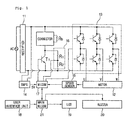
- FIG. 1 is a block diagram illustrating a construction of a washing machine according to an embodiment of the present invention.
- the washing machine of the present invention includes: a rectifier 11 for rectifying a common AC power source; a motor 12 for supplying a torque to a tub or a pulsator of the washing machine; a driver 13 including inverters provided with a plurality of insulating gate bipolar transistors (IGBTs) and operating in a first mode for supplying three-phase (U/V/W) voltages to the motor 12 or in a second mode for regenerate a voltage generated due to a rotation of the motor through a reverse control of the motor 12 toward a circuit block; a switching mode power supply (SMPS) 14 for transforming an output of the rectifier 11 into a predetermined voltage (5V); a speed sensor 15 for sensing a rotation speed of the motor 12; a braking resistor Rb for dissipating a generation voltage of the motor 12, which is regenerated by the driver 13, into heat to thereby prevent a damage of circuit block; a transistor T1 for driving the braking resistor Rb;
- a rectifier 11 for
- the main micom 21 performs a variety of data communications with the micom 17 in order to drive various loads, including the motor 12, according to the commands inputted through the user interface unit 18, in which the data communication includes a control signal. Additionally, an operation of driving the LCD 19 and the buzzer 20 is performed to output a preset warning message or alerting sound when a voltage higher than a power supply voltage is sensed through the communication with the micom 17.
- the main micom 21 recognizes it and transfers a predetermined control signal to the micom 17 to thereby allow the loads to be driven according to a preset washing algorithm including a laundry amount sensing process.
- the micom 17 controls the driver 13 to drive the pulsator or tub of the washing machine and senses the laundry amount. If the laundry amount is sensed, the micom 17 operates the driver 13 to rotate the motor 12 according to the output of the speed sensor 15 on the basis of the preset washing algorithm.
- the washing, rinsing and dewatering operations can be performed by driving the loads, such as a water supply valve, a drain valve, and the like.
- the main micom 21 controls the LCD 19 according to a current operation state to display an operation state, and it controls the buzzer 20 to generate an alerting sound according to the operation state.
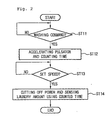
- FIG. 2 is a flowchart illustrating a method for controlling a washing machine according to a first embodiment of the present invention.
- the main micom 21 judges whether or not the washing command is inputted (ST11). At this time, the washing command is inputted through the user interface unit 18 by the user.
- the pulsator or tub of the washing machine is accelerated and an elapse time is measured by counting a time (ST12).
- the main micom 21 transfers a pulsator or tub acceleration command signal to the micom 17. If a rotation of the pulsator or tub is sensed using the output of the speed sensor 15, the main micom 21 begins to count a time. Additionally, the micom 17 controls the driver 13 according to the instruction of the main micom 21 to accelerate the pulsator or tub.
- the rotation speed of the pulsator or tub reaches a set speed (for example, 150 rpm) (ST13). If the rotation speed reaches the set speed, the power is cut off and the laundry amount is sensed using the time counted till that time (ST14). For example, because a load is large if the laundry amount is much, the counted time may be longer.
- a set speed for example, 150 rpm
- the pulsator or tub is directly connected to a driving end portion of the motor and a belt or pulley is not directly intervened between the motor and the pulsator or tub. Therefore, this embodiment can be preferably applied to an inverter motor direct driving washing machine which can transfer the rotation of the pulsator or tub to the motor as it is. In other words, this embodiment can be preferably applied to the case the number of revolutions of the motor is identical to that of the pulsator or-tub.
- a brushless DC motor (BLDC motor) can be applied as the motor and can be driven by the inverter circuit of the driver 13.
- this embodiment is characterized in that the driving time of the motor is measured according to the loads of the laundry amount, this embodiment will be referred to as a "driving time measuring method".
- FIG. 3 is a flowchart illustrating a method for controlling a washing machine according to a second embodiment of the present invention.
- the main micom 21 judges whether or not the washing command is inputted (ST21). At this time, the washing command is inputted through the user interface unit 18 by the user. If it is judged at the step ST21 that the washing command is inputted, the pulsator or tub of the washing machine is accelerated (ST22) and it is judges whether or not the rotation speed of the pulsator or tub reaches a set speed (for example, 150 rpm) (ST23).
- a set speed for example, 150 rpm
- the power is cut off and the pulsator or tub inertia-rotates.
- the number of pulses due to the inertia rotation that is, the output of the speed sensor, is counted (ST24).
- the main micom 21 transfers a pulsator or tub acceleration command signal to the micom 17.
- the micom 17 controls the driver 13 according to the instruction of the main micom 21 to thereby accelerate the pulsator or tub of the washing machine.
- the pulsator or tub is stopped (ST25). If the pulsator or tub is stopped, the laundry amount is sensed using the counted number of the pulses (ST26). For example, because an inertia force is great if the laundry amount is much, the counted number of the pulses may be large since the pulsator or tub rotates for a long time. Of course, it can be different according to kinds, shapes and specifications of the washing machine.
- the number of the pulses i.e., the number of the output pulses of the speed sensor
- the number of the pulses is stored in the main micom 21 and/or the micom 17 in a table form.
- the corresponding laundry amount is sensed at the step ST26 by comparing the counted number of the pulses and the previously stored table.
- the second embodiment can be applied to an inverter motor direct driving washing machine.
- a brushless DC motor BLDC motor
- BLDC motor brushless DC motor
- this embodiment is characterized in that in case the rotation speed reaches the set speed, the number of revolutions of the motor (that is, the number of the pulses) is measured when the pulsator or tub inertia-rotates after the power is cut off. Therefore, this embodiment will be referred to as a "pulse number measuring method (or a revolution number measuring method".
- a method for controlling a washing machine combines the driving time measuring method according to the first embodiment of the present invention and the pulse number measuring method according to the second embodiment of the present invention.
- the laundry amount sensing method according to the first embodiment of the present invention is preferably applied because it has a good reliability when an amount of laundry is much.
- the laundry amount sensing method according to the second embodiment of the present invention is preferably applied because it has a good reliability when an amount of laundry is less. Accordingly, the laundry amount sensing method is applied appropriately according to the laundry amount received in the tub of the washing machine.
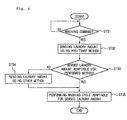
- FIG. 4 is a flowchart illustrating the method for controlling the washing machine according to the third embodiment of the present invention.
- the main micom 21 judges, whether or not the washing command is inputted (ST31). At this time, the washing command is inputted through the user interface unit 18 by the user.
- a first laundry amount sensing process is performed using one of the driving time measuring method and the pulse number measuring method (ST32). Then, it is judged whether or not the laundry amount sensed by the first laundry amount sensing process is in a range in which the first laundry amount sensing process can sense the laundry amount (ST33).
- the driving time measuring method is applied properly since the sensed laundry amount is more than a predetermined level, it is judged that the driving time measuring method is applied preferably. However, in case the sensed laundry amount is less than the predetermined level, it is judged that the driving time measuring method is not preferable.
- the pulse number measuring method in case the first laundry amount sensing process is the pulse number measuring method and the pulse number measuring method is not applied appropriately since the sensed laundry amount is more than the predetermined level, it is judged that the pulse number measuring method is not preferable. However, in case the sensed laundry amount is less than the predetermined level, it is judged that the pulse number measuring method is applied correctly.
- step ST33 If it is judged at the step ST33 that the first laundry amount sensing process is suitable, all washing cycles adaptable for the sensed laundry amount are performed (ST35). However, if it is judged at the step ST33 that the first laundry amount sensing process is not suitable, a second laundry amount sensing process adaptable for the sensed laundry amount is performed (ST34). At this time, even when the second laundry amount sensing process is judged to be suitable, the first laundry amount sensing process may be performed once again in order to acquire more accurate information on the laundry amount.
- All washing cycles are performed according to the laundry amount sensed by using the second laundry amount sensing process (ST35). In this manner, the laundry amount can be sensed more accurately.
- laundry amount sensing method is explained in two periods according to the laundry amount, methods for sensing more laundry amount and/or more periods can be applied.
- this embodiment of the present invention can use three laundry amount tables, which are stored in a storage device.
- the laundry amount tables described in the first and second embodiments and the table storing threshold values of the laundry amount, which is judged to be adaptable can be stored and used.
- the number of the tables may also be increased as many.
- one threshold value may be additionally inserted into the above tables.
- various methods such as a method for counting the number of re-supplying water by supplying water to the tub and a method for calculating a slope of the rotation speed by rotating the tub, can be applied together with the above-described laundry amount sensing method.
- the first and second laundry amount sensing processes according to the third embodiment of the present invention can be applied to the inverter motor direct driving washing machine. Further, this embodiment of the present invention can also be applied to other type washing machines.
- a method for controlling a washing machine according to a fourth embodiment is proposed for improving the utilization of the first to third embodiments.
- the laundry may be loaded much more or unloaded. In this case, the laundry amount is sensed again, thereby correctly performing the washing cycles.
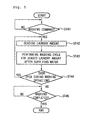
- FIG. 5 is a flowchart illustrating the method for controlling the washing machine according to the fourth embodiment.
- the main micom 21 judges whether or not the washing command is inputted (ST41). At this time, the washing command is inputted through the user interface unit 18 by the user.
- the main micom 21 If it is judged at the step ST41 that the washing command is inputted, the main micom 21 outputs a control signal to the micom 17 and performs the operation of sensing the laundry amount by properly driving the various loads (ST42). Any laundry amount sensing method can be used and one of the above-described methods can also be used.
- a washing water is supplied according to the laundry amount sensed at the step ST42 and a washing operation is then performed (ST43). It is judged whether or not the opening of the door is sensed through the door switch during the washing operation (ST44).
- step ST44 If it is judged at the step ST44 that the door is opened, an operation of, for example, stopping the washing machine is performed. Additionally, in case the door is opened, there is a strong possibility that the user additionally loads a laundry. Therefore, the steps ST42 and ST43 are performed again. That is, an operation of sensing the laundry amount and re-supplying the washing water according to the sensed laundry amount and an operation of performing the washing operation are performed. At this time, if the laundry is loaded additionally, the washing water is re-supplied according to the added laundry amount and the washing operation is then performed. Of course, if no additional laundry is loaded, the original amount of the washing water can be used to perform the remaining washing cycles. Further, in case the laundry is unloaded, a predetermined amount of the washing water may be drained out.
- the washing operation continues to be performed and it is judged whether or not the washing operation is completed (ST45). If the washing operation is completed, the cycle may be ended.
- this embodiment even when the user loads the laundry again, it is sensed and the washing operation is performed by supplying the washing water according to the sensed laundry amount. Therefore, it is possible to prevent the degradation of the washing performance and the damage of parts due to the increase of the loads. As a result, this embodiment has advantages in that the washing performance is improved and the lifetime of product is prolonged.
- a method for controlling a washing machine according to a fifth embodiment is mostly similar to the method described in the fourth embodiment.
- the door in case the door is opened, it is judged at which cycle the washing machine operates. Therefore, even when the door is opened during the washing operation, all washing cycles can be performed rapidly.
- FIG. 6 is a flowchart illustrating the method for controlling the washing machine according to the fifth embodiment.
- the main micom 21 judges whether or not the washing command is inputted (ST51). At this time, the washing command is inputted through the user interface unit 18 by the user.
- the main micom 21 If it is judged at the step ST51 that the washing command is inputted, the main micom 21 outputs a control signal to the micom 17 and performs the operation of sensing the laundry amount by properly driving the various loads (ST52). Various methods including the above-described methods can be used for sensing the laundry amount. Then, the washing water is supplied according to the laundry amount sensed at the step ST52 and a washing operation is then performed (ST53).
- the current progressing mode can be divided into a pulsator mode and a tub mode.
- the pulsator mode is a mode in which only the pulsator is driven during the washing and rinsing operations
- the tub mode is a mode in which the tub and the pulsator are simultaneously driven during the dewatering operation.
- the current progressing mode can be judged as other modes divided in a different manner. For example, one of them is a mode in which the water supply is progressed or a mode in which the washing water is drained out after a series of washing operations are ended.
- the current progressing mode is checked and the laundry amount is sensed in the check mode.
- the reason is because a predetermined time is taken to switch from the current progressing mode to the preset mode and thus all cycles are delayed, if the mode for sensing the laundry amount is previously set up as a preset mode and the current progressive mode is not the preset mode.
- the time necessary for all cycles can be reduced by checking the current progressing mode of the washing machine and sensing the laundry amount in the checked mode. Specifically, there is no problem in the washing operation even when the user himself or herself washes the laundry according to the progressing state of the washing machine or puts the laundry into the washing machine after rinsing the laundry.
- the washing water is supplied, as well as the dried laundry. Therefore, at the step ST56 of sensing the laundry amount again, a method for counting the number of water re-supply by supplying the washing water to the tub and a method for sensing the laundry amount using data related to an amount of washing water can be performed. In addition, in a state that the laundry amount sensed at the previous laundry amount sensing step and the data relating to the amount of the supplied washing water are stored, a method for sensing an amount of the newly added laundry is applied. Alternatively, the added laundry amount can be measured according to a new table relating to both the laundry amount and the washing water.
- the process returns to the step S53 of supplying the washing water according to the sensed laundry amount and performing the washing operation.
- the sensed laundry amount is not increased, the remaining washing operation is performed without supplying the washing water.
- the washing water may be reduced through the drain operation.
- the washing operation continues to be performed and it is judged whether or not the washing operation is completed (ST57). If the washing operation is completed, the process is ended.
- step ST57 determines whether the washing operation is not completed. If it is judged at the step ST57 that the washing operation is not completed, the process proceeds to the step ST54 and performs the remaining steps ST55 to ST57.
- the current progressing mode for example, the pulsator mode or the tub mode
- the laundry amount is sensed in the current progressing mode and the washing operation is performed by supplying the washing water according to the final laundry amount. Accordingly, it is possible to prevent the degradation of the washing performance and the damage of parts due to the increase of loads. As a result, the cycle delay due to the sensing of the laundry amount during the washing operation can be minimized, thereby improving the washing performance. Further, the reliability of the product is improved and the lifetime of the product is prolonged.
- the present invention it is possible to sense more accurately the laundry amount loaded into the tub. Further, the present invention provides the method for controlling the washing machine, which can improve the user convenience much more by re-sensing the laundry amount during the washing operation.
- the method according to the present invention makes it possible to again sense the quantity of laundry in any of all washing cycles, thereby preventing the degradations of parts and washing performance.
Landscapes
- Engineering & Computer Science (AREA)
- Textile Engineering (AREA)
- Control Of Washing Machine And Dryer (AREA)
Abstract
Description
- The present invention relates to a method for controlling a washing machine comprising the combined steps of claim 1.
- Generally, fully automatic washing machines are products that remove a variety of dirt adhered to clothes, bedclothes and the like by using sulphurization of a detergent, frictional action of a water current, impact action applied to the laundry by a pulsator, and the like. According to the fully automatic washing machines, an amount and kind of laundry is sensed by means of a sensor and a washing mode is set automatically. A washing water is supplied up to an appropriate level according to an amount and kind of laundry and a washing operation is then performed under the control of a micro computer. Such a washing machine is known for example from
JP-2000-279,686 - In addition, according to a conventional method for driving a fully automatic washing machine, a torque of a driving motor is transferred through a power transmission belt and a pulley to a washing shaft or a dewatering shaft, thereby rotating a pulsator or a dewatering tub.
- Hereinafter, an operation of controlling a conventional washing machine will be described in brief.
- First, if the user inputs a washing command, a laundry amount is sensed in an initial operation of the washing machine and washing water is supplied according to the sensed laundry amount. Then, a series of washing, rinsing and dewatering cycles are performed according to the sensed laundry amount. Meanwhile, a method using an applied power of the motor and the number of revolutions of the motor has been proposed for sensing the laundry amount in the initial operation of the washing machine.
- However, in order to sense the number of revolutions of the motor, the belt and the pulley are intervened between the driving motor and the tub that receives the laundry, thereby causing a problem that an amount of rotation is not fully transferred to the motor. Therefore, there occurs an error in the laundry amount sensed by the number of revolutions of the motor. Further, there occurs a great error in the sensed laundry amount since an extension of the belt and a tension applied to the belt are different according to a temperature of the washing machine or a season.
- Meanwhile, if necessary, the user opens the door of the washing machine and loads the laundry additionally during the washing operation. At this time, the related art has a disadvantage in that the user manipulates all washing cycles all over again in order to perform the washing cycles all over again. Further, in case the washing operations are performed successively and there is no additional water supply, the washing water is supplied less than an appropriate quantity. Therefore, there occurs a problem that degrades the washing performance or increases the washing load. Further, in case many loads are applied to the driving unit of the washing machine, parts may be degraded more seriously.
- Accordingly, the present invention is directed to a method for controlling a washing machine that substantially obviates the problems caused by limitations and disadvantage of the conventional one.
- One object of the present invention is to provide a method for controlling a washing machine, in which a laundry amount received in the tub is sensed more accurately.
- Another object of the present invention is to provide a method for controlling a washing machine, in which a laundry amount is again sensed even during a washing operation, thereby improving a user convenience much more.
- Further another object of the present invention is to provide a method for controlling a washing machine, which is capable of prevent degradations of the parts and the washing performance in any cycle when using the washing machine.
- According to one aspect of the present invention, a method for controlling a washing machine includes the steps of claim 1.
- The methods according to the present invention can sense the laundry amount more accurately and improve the user convenience. Further, the method according to the present invention can improve the stability of parts and the security in use.
- The above objects, other features and advantages of the present invention will become more apparent by describing the preferred embodiments thereof with reference to the accompanying drawings, in which:
-
FIG. 1 is a block diagram illustrating a construction of a washing machine according to an embodiment of the present invention; -
FIG. 2 is a flowchart illustrating a method for controlling a washing machine according to a first embodiment of the present invention; -
FIG. 3 is a flowchart illustrating a method for controlling a washing machine according to a second embodiment of the present invention; -
FIG. 4 is a flowchart illustrating a method for controlling a washing machine according to a third embodiment of the present invention; -
FIG. 5 is a flowchart illustrating a method for controlling a washing machine according to a fourth embodiment; and -
FIG. 6 is a flowchart illustrating a method for controlling a washing machine according to fifth embodiment . - Hereinafter, preferred embodiments of the present invention will be described in detail with reference to the attached drawings. The present invention is not limited to the embodiments and it is apparent to those skilled in the art that the present invention can be easily applied to other embodiments within the spirit and scope of the present invention.
-
FIG. 1 is a block diagram illustrating a construction of a washing machine according to an embodiment of the present invention. - Referring to
FIG. 1 , the washing machine of the present invention includes: arectifier 11 for rectifying a common AC power source; amotor 12 for supplying a torque to a tub or a pulsator of the washing machine; adriver 13 including inverters provided with a plurality of insulating gate bipolar transistors (IGBTs) and operating in a first mode for supplying three-phase (U/V/W) voltages to themotor 12 or in a second mode for regenerate a voltage generated due to a rotation of the motor through a reverse control of themotor 12 toward a circuit block; a switching mode power supply (SMPS) 14 for transforming an output of therectifier 11 into a predetermined voltage (5V); aspeed sensor 15 for sensing a rotation speed of themotor 12; a braking resistor Rb for dissipating a generation voltage of themotor 12, which is regenerated by thedriver 13, into heat to thereby prevent a damage of circuit block; a transistor T1 for driving the braking resistor Rb; avoltage sensing unit 16 for sensing an output voltage level of therectifier 11 across the braking resistor Rb; amicom 17 for controlling thedriver 13 and the transistor T1 according to the outputs of thespeed sensor 15 and thevoltage sensing unit 16; a door switch (not shown) installed in a door to sense a user's opening of the door and inform it of themicom 17; auser interface unit 18 including a touch panel or a key input device, for inputting a variety of user commands; anLCD 19 for displaying an operation state of a washing machine, and the like; abuzzer 20; and amain micom 21 for controlling an overall operation of the washing machine. - Specifically, the
main micom 21 performs a variety of data communications with themicom 17 in order to drive various loads, including themotor 12, according to the commands inputted through theuser interface unit 18, in which the data communication includes a control signal. Additionally, an operation of driving theLCD 19 and thebuzzer 20 is performed to output a preset warning message or alerting sound when a voltage higher than a power supply voltage is sensed through the communication with themicom 17. - Hereinafter, an operation of the washing machine constructed above will be described in brief.
- First, if the user inputs a washing command through the
user interface unit 18, themain micom 21 recognizes it and transfers a predetermined control signal to themicom 17 to thereby allow the loads to be driven according to a preset washing algorithm including a laundry amount sensing process. - The
micom 17 controls thedriver 13 to drive the pulsator or tub of the washing machine and senses the laundry amount. If the laundry amount is sensed, themicom 17 operates thedriver 13 to rotate themotor 12 according to the output of thespeed sensor 15 on the basis of the preset washing algorithm. Of course, the washing, rinsing and dewatering operations can be performed by driving the loads, such as a water supply valve, a drain valve, and the like. - Further, the
main micom 21 controls theLCD 19 according to a current operation state to display an operation state, and it controls thebuzzer 20 to generate an alerting sound according to the operation state. - Hereinafter, methods for controlling a washing machine according to embodiments of the present invention will be described in detail.
-
FIG. 2 is a flowchart illustrating a method for controlling a washing machine according to a first embodiment of the present invention. - The
main micom 21 judges whether or not the washing command is inputted (ST11). At this time, the washing command is inputted through theuser interface unit 18 by the user. - If it is judged at the step ST11 that the washing command is inputted, the pulsator or tub of the washing machine is accelerated and an elapse time is measured by counting a time (ST12). At this time, the
main micom 21 transfers a pulsator or tub acceleration command signal to themicom 17. If a rotation of the pulsator or tub is sensed using the output of thespeed sensor 15, themain micom 21 begins to count a time. Additionally, themicom 17 controls thedriver 13 according to the instruction of themain micom 21 to accelerate the pulsator or tub. - Then, it is judged whether or not the rotation speed of the pulsator or tub reaches a set speed (for example, 150 rpm) (ST13). If the rotation speed reaches the set speed, the power is cut off and the laundry amount is sensed using the time counted till that time (ST14). For example, because a load is large if the laundry amount is much, the counted time may be longer.
- At this time, it is almost impossible to standardize the sensing of the laundry amount since the washing machines are different from each other in their structures and models, parts (especially, motor), and the like. Since their characteristics are different according to the products, tests are previously performed according to an actual laundry amount, and then, the laundry amount with respect to the rotation time until the set speed is stored in the
main micom 21 and/or themicom 17 in a table form. Since the rotation time until the motor reaches the preset rotation speed according to the laundry amount is in advance stored in the table form, the corresponding laundry amount can be sensed by comparing the counted time and the table at the step ST14. - In this embodiment, the pulsator or tub is directly connected to a driving end portion of the motor and a belt or pulley is not directly intervened between the motor and the pulsator or tub. Therefore, this embodiment can be preferably applied to an inverter motor direct driving washing machine which can transfer the rotation of the pulsator or tub to the motor as it is. In other words, this embodiment can be preferably applied to the case the number of revolutions of the motor is identical to that of the pulsator or-tub.
- For this, a brushless DC motor (BLDC motor) can be applied as the motor and can be driven by the inverter circuit of the
driver 13. - Meanwhile, since this embodiment is characterized in that the driving time of the motor is measured according to the loads of the laundry amount, this embodiment will be referred to as a "driving time measuring method".
-
FIG. 3 is a flowchart illustrating a method for controlling a washing machine according to a second embodiment of the present invention. - The
main micom 21 judges whether or not the washing command is inputted (ST21). At this time, the washing command is inputted through theuser interface unit 18 by the user. If it is judged at the step ST21 that the washing command is inputted, the pulsator or tub of the washing machine is accelerated (ST22) and it is judges whether or not the rotation speed of the pulsator or tub reaches a set speed (for example, 150 rpm) (ST23). - If it is judged at the step ST23 that the rotation speed reaches the set speed, the power is cut off and the pulsator or tub inertia-rotates. The number of pulses due to the inertia rotation, that is, the output of the speed sensor, is counted (ST24). At this time, the
main micom 21 transfers a pulsator or tub acceleration command signal to themicom 17. Then, if the rotation speed of the pulsator or tub reaches the set speed according to the output of thespeed sensor 15, the power is cut off and the number of the output pulses of thespeed sensor 15 is counted. Meanwhile, themicom 17 controls thedriver 13 according to the instruction of themain micom 21 to thereby accelerate the pulsator or tub of the washing machine. - Then, it is judged whether or not the pulsator or tub is stopped (ST25). If the pulsator or tub is stopped, the laundry amount is sensed using the counted number of the pulses (ST26). For example, because an inertia force is great if the laundry amount is much, the counted number of the pulses may be large since the pulsator or tub rotates for a long time. Of course, it can be different according to kinds, shapes and specifications of the washing machine.
- Meanwhile, it is almost impossible to standardize the sensing of the laundry amount since the washing machines are different from each other in their structures and models, parts (especially, motor), and the like. Since their characteristics are different according to the products, tests are previously performed according to an actual quantity of laundry. The number of the pulses (i.e., the number of the output pulses of the speed sensor) while the inertia rotation is carried out after the arrival of the set speed is stored in the
main micom 21 and/or themicom 17 in a table form. - Since the number of the pulses according to the laundry amount is stored in the table form, the corresponding laundry amount is sensed at the step ST26 by comparing the counted number of the pulses and the previously stored table.
- Like the first embodiment, the second embodiment can be applied to an inverter motor direct driving washing machine. For this, a brushless DC motor (BLDC motor) can be applied as the motor and can be driven by the inverter circuit of the
driver 13. - Meanwhile, this embodiment is characterized in that in case the rotation speed reaches the set speed, the number of revolutions of the motor (that is, the number of the pulses) is measured when the pulsator or tub inertia-rotates after the power is cut off. Therefore, this embodiment will be referred to as a "pulse number measuring method (or a revolution number measuring method".
- A method for controlling a washing machine according to a third embodiment of the present invention combines the driving time measuring method according to the first embodiment of the present invention and the pulse number measuring method according to the second embodiment of the present invention. Specifically, in case the laundry amount is much, the laundry amount sensing method according to the first embodiment of the present invention is preferably applied because it has a good reliability when an amount of laundry is much. Meanwhile, in case the laundry amount is less, the laundry amount sensing method according to the second embodiment of the present invention is preferably applied because it has a good reliability when an amount of laundry is less. Accordingly, the laundry amount sensing method is applied appropriately according to the laundry amount received in the tub of the washing machine.
-
FIG. 4 is a flowchart illustrating the method for controlling the washing machine according to the third embodiment of the present invention. - Referring to
FIG. 4 , themain micom 21 judges, whether or not the washing command is inputted (ST31). At this time, the washing command is inputted through theuser interface unit 18 by the user. - If the washing command is inputted, a first laundry amount sensing process is performed using one of the driving time measuring method and the pulse number measuring method (ST32). Then, it is judged whether or not the laundry amount sensed by the first laundry amount sensing process is in a range in which the first laundry amount sensing process can sense the laundry amount (ST33).
- For example, in case the first laundry amount sensing process is the driving time measuring method and the driving time measuring method can be applied properly since the sensed laundry amount is more than a predetermined level, it is judged that the driving time measuring method is applied preferably. However, in case the sensed laundry amount is less than the predetermined level, it is judged that the driving time measuring method is not preferable.
- In the similar manner, in case the first laundry amount sensing process is the pulse number measuring method and the pulse number measuring method is not applied appropriately since the sensed laundry amount is more than the predetermined level, it is judged that the pulse number measuring method is not preferable. However, in case the sensed laundry amount is less than the predetermined level, it is judged that the pulse number measuring method is applied correctly.
- If it is judged at the step ST33 that the first laundry amount sensing process is suitable, all washing cycles adaptable for the sensed laundry amount are performed (ST35). However, if it is judged at the step ST33 that the first laundry amount sensing process is not suitable, a second laundry amount sensing process adaptable for the sensed laundry amount is performed (ST34). At this time, even when the second laundry amount sensing process is judged to be suitable, the first laundry amount sensing process may be performed once again in order to acquire more accurate information on the laundry amount.
- All washing cycles are performed according to the laundry amount sensed by using the second laundry amount sensing process (ST35). In this manner, the laundry amount can be sensed more accurately.
- Although the laundry amount sensing method is explained in two periods according to the laundry amount, methods for sensing more laundry amount and/or more periods can be applied.
- Meanwhile, this embodiment of the present invention can use three laundry amount tables, which are stored in a storage device. Specifically, the laundry amount tables described in the first and second embodiments and the table storing threshold values of the laundry amount, which is judged to be adaptable, can be stored and used. Of course, if the possible cases of the laundry amount sensing methods are increased, the number of the tables may also be increased as many. Additionally, one threshold value may be additionally inserted into the above tables. Further, various methods, such as a method for counting the number of re-supplying water by supplying water to the tub and a method for calculating a slope of the rotation speed by rotating the tub, can be applied together with the above-described laundry amount sensing method.
- Meanwhile, as described in the first and second embodiments, the first and second laundry amount sensing processes according to the third embodiment of the present invention can be applied to the inverter motor direct driving washing machine. Further, this embodiment of the present invention can also be applied to other type washing machines.
- A method for controlling a washing machine according to a fourth embodiment is proposed for improving the utilization of the first to third embodiments. In more detail, when the door of the washing machine is opened and the user performs other operations during any one of the washing cycles, the laundry may be loaded much more or unloaded. In this case, the laundry amount is sensed again, thereby correctly performing the washing cycles.
-
FIG. 5 is a flowchart illustrating the method for controlling the washing machine according to the fourth embodiment. - Referring to
FIG. 5 , themain micom 21 judges whether or not the washing command is inputted (ST41). At this time, the washing command is inputted through theuser interface unit 18 by the user. - If it is judged at the step ST41 that the washing command is inputted, the
main micom 21 outputs a control signal to themicom 17 and performs the operation of sensing the laundry amount by properly driving the various loads (ST42). Any laundry amount sensing method can be used and one of the above-described methods can also be used. - A washing water is supplied according to the laundry amount sensed at the step ST42 and a washing operation is then performed (ST43). It is judged whether or not the opening of the door is sensed through the door switch during the washing operation (ST44).
- If it is judged at the step ST44 that the door is opened, an operation of, for example, stopping the washing machine is performed. Additionally, in case the door is opened, there is a strong possibility that the user additionally loads a laundry. Therefore, the steps ST42 and ST43 are performed again. That is, an operation of sensing the laundry amount and re-supplying the washing water according to the sensed laundry amount and an operation of performing the washing operation are performed. At this time, if the laundry is loaded additionally, the washing water is re-supplied according to the added laundry amount and the washing operation is then performed. Of course, if no additional laundry is loaded, the original amount of the washing water can be used to perform the remaining washing cycles. Further, in case the laundry is unloaded, a predetermined amount of the washing water may be drained out.
- At this time, in case the door is opened while any washing cycle is performed, the progressing operation is stopped. Then, the process returns to the cycle when the laundry is loaded initially, and the laundry amount is sensed again. Even at this time, since the laundry may be soaked in the washing water, a table different from the table for measuring the dried laundry amount may be applied.
- Of course, in case no opening of the door is sensed at the step ST44, the washing operation continues to be performed and it is judged whether or not the washing operation is completed (ST45). If the washing operation is completed, the cycle may be ended.
- According to this embodiment, even when the user loads the laundry again, it is sensed and the washing operation is performed by supplying the washing water according to the sensed laundry amount. Therefore, it is possible to prevent the degradation of the washing performance and the damage of parts due to the increase of the loads. As a result, this embodiment has advantages in that the washing performance is improved and the lifetime of product is prolonged.
- A method for controlling a washing machine according to a fifth embodiment is mostly similar to the method described in the fourth embodiment. In this embodiment, in case the door is opened, it is judged at which cycle the washing machine operates. Therefore, even when the door is opened during the washing operation, all washing cycles can be performed rapidly.
-
FIG. 6 is a flowchart illustrating the method for controlling the washing machine according to the fifth embodiment. - Referring to
FIG. 6 , themain micom 21 judges whether or not the washing command is inputted (ST51). At this time, the washing command is inputted through theuser interface unit 18 by the user. - If it is judged at the step ST51 that the washing command is inputted, the
main micom 21 outputs a control signal to themicom 17 and performs the operation of sensing the laundry amount by properly driving the various loads (ST52). Various methods including the above-described methods can be used for sensing the laundry amount. Then, the washing water is supplied according to the laundry amount sensed at the step ST52 and a washing operation is then performed (ST53). - Then, it is judged whether or not the opening of the door is sensed through the door switch during the washing operation (ST54). If it is judged at the step ST54 that the door is opened, there is a strong possibility that the user additionally loads a laundry. Therefore, a current progressing mode is checked (ST55). The current progressing mode can be divided into a pulsator mode and a tub mode. Here, the pulsator mode is a mode in which only the pulsator is driven during the washing and rinsing operations, and the tub mode is a mode in which the tub and the pulsator are simultaneously driven during the dewatering operation. Of course, the current progressing mode can be judged as other modes divided in a different manner. For example, one of them is a mode in which the water supply is progressed or a mode in which the washing water is drained out after a series of washing operations are ended.
- Then, the laundry amount is sensed in the mode checked at the step ST55 (ST56).
- In more detail, when the door is opened during the washing operation, the current progressing mode is checked and the laundry amount is sensed in the check mode. The reason is because a predetermined time is taken to switch from the current progressing mode to the preset mode and thus all cycles are delayed, if the mode for sensing the laundry amount is previously set up as a preset mode and the current progressive mode is not the preset mode.
- Accordingly, the time necessary for all cycles can be reduced by checking the current progressing mode of the washing machine and sensing the laundry amount in the checked mode. Specifically, there is no problem in the washing operation even when the user himself or herself washes the laundry according to the progressing state of the washing machine or puts the laundry into the washing machine after rinsing the laundry.
- Meanwhile, in case the door is opened and the laundry amount is sensed again, there are many cases that the washing water is supplied, as well as the dried laundry. Therefore, at the step ST56 of sensing the laundry amount again, a method for counting the number of water re-supply by supplying the washing water to the tub and a method for sensing the laundry amount using data related to an amount of washing water can be performed. In addition, in a state that the laundry amount sensed at the previous laundry amount sensing step and the data relating to the amount of the supplied washing water are stored, a method for sensing an amount of the newly added laundry is applied. Alternatively, the added laundry amount can be measured according to a new table relating to both the laundry amount and the washing water.
- Then, the process returns to the step S53 of supplying the washing water according to the sensed laundry amount and performing the washing operation. Of course, if the sensed laundry amount is not increased, the remaining washing operation is performed without supplying the washing water. In case the laundry is unloaded, the washing water may be reduced through the drain operation.
- If the opening of the door is not sensed at the step ST54, the washing operation continues to be performed and it is judged whether or not the washing operation is completed (ST57). If the washing operation is completed, the process is ended.
- Meanwhile, if it is judged at the step ST57 that the washing operation is not completed, the process proceeds to the step ST54 and performs the remaining steps ST55 to ST57.
- Even when the user loads the laundry again in any mode during the washing operation, it is sensed and the current progressing mode (for example, the pulsator mode or the tub mode) is checked. Then, the laundry amount is sensed in the current progressing mode and the washing operation is performed by supplying the washing water according to the final laundry amount. Accordingly, it is possible to prevent the degradation of the washing performance and the damage of parts due to the increase of loads. As a result, the cycle delay due to the sensing of the laundry amount during the washing operation can be minimized, thereby improving the washing performance. Further, the reliability of the product is improved and the lifetime of the product is prolonged.
- According to the present invention, it is possible to sense more accurately the laundry amount loaded into the tub. Further, the present invention provides the method for controlling the washing machine, which can improve the user convenience much more by re-sensing the laundry amount during the washing operation.
- Furthermore, the method according to the present invention makes it possible to again sense the quantity of laundry in any of all washing cycles, thereby preventing the degradations of parts and washing performance.
Claims (6)
- A method for controlling a washing machine, comprising the steps of:sensing a laundry amount through a first laundry amount sensing process (ST32);judging whether or not the sensed laundry amount is in a substantial sensing range (ST33) of the first laundry amount sensing process; andif the sensed laundry amount is in the substantial sensing range of the first laundry amount sensing process, performing the remaining cycles, and if the sensed laundry amount is out of the substantial sensing range of the first laundry amount sensing process, sensing again the laundry amount through a second laundry amount sensing process (ST34),whereby said first (ST32) and second (ST34) laundry amount sensing processes are selected from the following: a driving time measuring method, a pulse number measuring method, a method of supplying a washing water to a tub and counting the number of water re-supply, and a method of rotating the tub and calculating a slope of a rotation speed, andwherein the method selected for the first laundry amount sensing process (ST32) is a different method from the method selected for the second laundry amount sensing process (ST34).
- The method according to claim 1, wherein the sensing range is read out from a table storing threshold values, the threshold values being previously determined suitably according to the laundry amount sensing processes.
- The method according to claim 1, wherein the remaining cycles are controlled according to laundry amount information, the laundry amount information being read out from a table storing information classified within the substantial sensing range.
- The method according to claim 1, wherein in case the first laundry amount sensing process is a driving time measuring method and the second laundry amount sensing process is a pulse number measuring method, the first laundry amount sensing process having the sensing range substantially higher than the second laundry amount sensing process.
- The method according to claim 1, wherein the first laundry amount sensing process is a driving time measuring method and the second laundry amount sensing process is a pulse number measuring method.
- The method according to claim 1, further comprising the step of performing again the first laundry amount sensing process before the remaining cycles in order to acquire more accurate information.
Applications Claiming Priority (7)
| Application Number | Priority Date | Filing Date | Title |
|---|---|---|---|
| KR2002074073 | 2002-11-26 | ||
| KR2002074072 | 2002-11-26 | ||
| KR1020020074072A KR20040046231A (en) | 2002-11-26 | 2002-11-26 | method for sensing laundry weight of washing machine |
| KR1020020074074A KR20040046233A (en) | 2002-11-26 | 2002-11-26 | method for controlling cycle of washing machine |
| KR1020020074073A KR20040046232A (en) | 2002-11-26 | 2002-11-26 | method for controlling cycle of washing machine |
| KR2002074074 | 2002-11-26 | ||
| PCT/KR2003/002544 WO2004048674A1 (en) | 2002-11-26 | 2003-11-25 | Controlling method of washing machine |
Publications (3)
| Publication Number | Publication Date |
|---|---|
| EP1565606A1 EP1565606A1 (en) | 2005-08-24 |
| EP1565606A4 EP1565606A4 (en) | 2007-10-10 |
| EP1565606B1 true EP1565606B1 (en) | 2011-10-05 |
Family
ID=36113856
Family Applications (1)
| Application Number | Title | Priority Date | Filing Date |
|---|---|---|---|
| EP03774303A Expired - Lifetime EP1565606B1 (en) | 2002-11-26 | 2003-11-25 | Controlling method of washing machine |
Country Status (7)
| Country | Link |
|---|---|
| US (3) | US7475571B2 (en) |
| EP (1) | EP1565606B1 (en) |
| JP (1) | JP4664681B2 (en) |
| CN (1) | CN100487182C (en) |
| AU (1) | AU2003284752B2 (en) |
| ES (1) | ES2372383T3 (en) |
| WO (1) | WO2004048674A1 (en) |
Families Citing this family (14)
| Publication number | Priority date | Publication date | Assignee | Title |
|---|---|---|---|---|
| KR100519293B1 (en) * | 2002-11-26 | 2005-10-07 | 엘지전자 주식회사 | Method for sensing laundry weight of washing machine |
| US20110167879A1 (en) * | 2008-05-02 | 2011-07-14 | Arcelik Anonim Sirketi | Washing Machine |
| KR20100064655A (en) | 2008-12-05 | 2010-06-15 | 삼성전자주식회사 | Control method of washing machine |
| JP5326842B2 (en) * | 2009-06-11 | 2013-10-30 | パナソニック株式会社 | Washing machine |
| CN102439212B (en) | 2009-07-01 | 2015-04-08 | Lg电子株式会社 | Washing machine and control method thereof |
| US8910335B2 (en) | 2010-09-14 | 2014-12-16 | Lg Electronics Inc. | Washing machine and method of controlling washing machine |
| CN103485131B (en) * | 2013-06-26 | 2016-12-07 | 无锡小天鹅股份有限公司 | The method for measuring weight of washing machine, control method of washing and system thereof |
| KR102244263B1 (en) | 2014-03-07 | 2021-04-27 | 삼성전자주식회사 | Washing machine and control method thereof |
| KR102149952B1 (en) * | 2014-04-17 | 2020-08-31 | 엘지전자 주식회사 | Appliance and operation method thereof |
| WO2017146472A1 (en) * | 2016-02-25 | 2017-08-31 | Samsung Electronics Co., Ltd. | Washing machine and controlling method thereof |
| CN111850944B (en) * | 2019-04-19 | 2022-08-26 | 青岛海尔洗涤电器有限公司 | Control method of washing machine |
| CN112663274A (en) * | 2019-09-29 | 2021-04-16 | 青岛海尔滚筒洗衣机有限公司 | Door opening control method for laundry treatment apparatus |
| JP7469964B2 (en) * | 2020-06-17 | 2024-04-17 | 東芝ライフスタイル株式会社 | washing machine |
| KR20220048531A (en) * | 2020-10-12 | 2022-04-20 | 삼성전자주식회사 | Sensor device and electronic device obtaining information therefrom |
Family Cites Families (36)
| Publication number | Priority date | Publication date | Assignee | Title |
|---|---|---|---|---|
| JPH0790077B2 (en) | 1986-11-17 | 1995-10-04 | 松下電器産業株式会社 | Fully automatic washing machine |
| JPS63181792A (en) | 1987-01-21 | 1988-07-26 | 松下電器産業株式会社 | Washing machine cloth amount detection device |
| JPH02286197A (en) | 1989-04-27 | 1990-11-26 | Nippon Kentetsu Co Ltd | Operation controlling method for washing machine |
| JPH03280995A (en) | 1990-03-30 | 1991-12-11 | Toshiba Corp | Clothes amount detecting device |
| JPH0444799A (en) | 1990-06-08 | 1992-02-14 | Matsushita Electric Ind Co Ltd | Washing machine cloth amount detection device |
| JPH04276296A (en) | 1991-02-28 | 1992-10-01 | Toshiba Corp | Washing machine |
| JPH04347197A (en) | 1991-05-27 | 1992-12-02 | Toshiba Corp | Washing machine |
| US5161393A (en) | 1991-06-28 | 1992-11-10 | General Electric Company | Electronic washer control including automatic load size determination, fabric blend determination and adjustable washer means |
| JP2599849B2 (en) | 1991-10-01 | 1997-04-16 | 日本建鐵株式会社 | Washing machine load judgment method |
| JPH05277282A (en) | 1992-03-31 | 1993-10-26 | Toshiba Corp | Washing machine |
| JPH05345091A (en) * | 1992-06-17 | 1993-12-27 | Toshiba Corp | Washing machine |
| KR950007056B1 (en) * | 1992-11-06 | 1995-06-30 | 엘지전자주식회사 | Quantity detection method and apparatus for brushless direct current (BLDC) motor washing machine |
| KR950007072B1 (en) * | 1992-12-24 | 1995-06-30 | 엘지전자주식회사 | Method of dehydration control and noise protection |
| KR950000976A (en) * | 1993-06-03 | 1995-01-03 | 이헌조 | Quantity detection control method of washing machine |
| KR960015475B1 (en) * | 1993-11-18 | 1996-11-14 | 엘지전자 주식회사 | Wash quantity detecting method of a washing machine |
| KR950025151A (en) * | 1994-02-24 | 1995-09-15 | 이헌조 | How to detect the amount of drum washing machine |
| KR0147743B1 (en) * | 1994-07-07 | 1998-10-01 | 이헌조 | Water level control method of washing machine |
| KR960010963A (en) * | 1994-09-17 | 1996-04-20 | 이헌조 | How to detect the quantity of washing machine |
| KR960023421A (en) * | 1994-12-26 | 1996-07-20 | 배순훈 | How to detect load of washing machine |
| KR0171288B1 (en) * | 1995-07-04 | 1999-05-01 | 구자홍 | Washing control method by adding quantity |
| JP3796779B2 (en) * | 1995-10-25 | 2006-07-12 | 松下電器産業株式会社 | Fully automatic washing machine |
| KR970075043A (en) * | 1996-05-13 | 1997-12-10 | 구자홍 | How to control dehydration of washing machine |
| JP3499374B2 (en) * | 1996-06-14 | 2004-02-23 | 株式会社東芝 | Drum type washing machine |
| JPH10201989A (en) | 1997-01-23 | 1998-08-04 | Sharp Corp | How to detect the amount of cloth in an electric washing machine |
| CN1070556C (en) * | 1997-04-10 | 2001-09-05 | 无锡小天鹅股份有限公司 | Cloths quantity detecting and correcting method for washing machine |
| JPH10328483A (en) | 1997-06-04 | 1998-12-15 | Hitachi Ltd | Fully automatic washing machine |
| US6038724A (en) * | 1998-11-27 | 2000-03-21 | General Electric Company | Clothes load estimation method and washing machine |
| JP3756008B2 (en) | 1999-02-15 | 2006-03-15 | シャープ株式会社 | Drum washing machine |
| JP3691282B2 (en) | 1999-03-31 | 2005-09-07 | 三洋電機株式会社 | Washing machine |
| WO2001018514A1 (en) * | 1999-09-02 | 2001-03-15 | Sanyo Electric Co., Ltd. | Load cell and washing machine with load cell |
| JP2002095888A (en) | 2000-09-26 | 2002-04-02 | Sanyo Electric Co Ltd | Washing machine |
| KR100381191B1 (en) * | 2000-10-02 | 2003-04-26 | 엘지전자 주식회사 | A decision apparatus for washing pattern |
| JP3625791B2 (en) * | 2001-09-13 | 2005-03-02 | 三洋電機株式会社 | Drum washing machine |
| US6609264B2 (en) * | 2001-09-21 | 2003-08-26 | Maytag Corporation | Pump cycling control system for a washing machine |
| JP3609789B2 (en) * | 2002-03-06 | 2005-01-12 | 三洋電機株式会社 | Drum washing machine |
| CN1231626C (en) | 2002-05-08 | 2005-12-14 | 江苏海狮机械集团有限公司 | Detecting method for cloth quality and quantity of fuzzily controlled industrial washing machine |
-
2003
- 2003-11-25 EP EP03774303A patent/EP1565606B1/en not_active Expired - Lifetime
- 2003-11-25 CN CNB2003801000579A patent/CN100487182C/en not_active Expired - Fee Related
- 2003-11-25 ES ES03774303T patent/ES2372383T3/en not_active Expired - Lifetime
- 2003-11-25 AU AU2003284752A patent/AU2003284752B2/en not_active Ceased
- 2003-11-25 US US10/499,343 patent/US7475571B2/en not_active Expired - Fee Related
- 2003-11-25 JP JP2004555109A patent/JP4664681B2/en not_active Expired - Fee Related
- 2003-11-25 WO PCT/KR2003/002544 patent/WO2004048674A1/en not_active Ceased
-
2008
- 2008-12-09 US US12/314,390 patent/US7827639B2/en not_active Expired - Fee Related
-
2010
- 2010-09-30 US US12/895,211 patent/US20110016641A1/en not_active Abandoned
Also Published As
| Publication number | Publication date |
|---|---|
| AU2003284752B2 (en) | 2006-11-23 |
| ES2372383T3 (en) | 2012-01-19 |
| JP2006507074A (en) | 2006-03-02 |
| CN100487182C (en) | 2009-05-13 |
| US20110016641A1 (en) | 2011-01-27 |
| WO2004048674A1 (en) | 2004-06-10 |
| EP1565606A1 (en) | 2005-08-24 |
| CN1685102A (en) | 2005-10-19 |
| US7475571B2 (en) | 2009-01-13 |
| EP1565606A4 (en) | 2007-10-10 |
| AU2003284752A1 (en) | 2004-06-18 |
| US20050015891A1 (en) | 2005-01-27 |
| US7827639B2 (en) | 2010-11-09 |
| JP4664681B2 (en) | 2011-04-06 |
| US20090094759A1 (en) | 2009-04-16 |
Similar Documents
| Publication | Publication Date | Title |
|---|---|---|
| US7827639B2 (en) | Controlling method of washing machine | |
| US7904984B2 (en) | Method of controlling motor-driven washing machine and control system for the same | |
| US7475444B2 (en) | Washing machine and method of controlling the same | |
| US6760942B2 (en) | Washing pattern determination method | |
| KR100469274B1 (en) | method for controlling motor of washing machine | |
| JP2723884B1 (en) | Washing machine dewatering control method | |
| KR100315806B1 (en) | Driving method for washing machine | |
| KR100480708B1 (en) | method for controlling dehydration cycle of washing machine | |
| KR100487376B1 (en) | method for controlling motor of washing machine | |
| KR100286821B1 (en) | Washing machine control method | |
| JP2006068053A (en) | Washing machine | |
| KR100480707B1 (en) | method for controlling dehydration cycle of washing machine | |
| KR20040046233A (en) | method for controlling cycle of washing machine | |
| KR20040046231A (en) | method for sensing laundry weight of washing machine | |
| KR20040046212A (en) | method for braking motor in dehydration cycle of washing machine | |
| JPH04338492A (en) | Washing-machine controller | |
| KR20000059490A (en) | Method for clean controlling of washing machine | |
| JP2000024372A (en) | Washing machine | |
| KR20000043410A (en) | Circuit for controlling a driving motor of a washing machine | |
| KR20000045036A (en) | Water level setting method of a washing machine |
Legal Events
| Date | Code | Title | Description |
|---|---|---|---|
| PUAI | Public reference made under article 153(3) epc to a published international application that has entered the european phase |
Free format text: ORIGINAL CODE: 0009012 |
|
| 17P | Request for examination filed |
Effective date: 20040713 |
|
| AK | Designated contracting states |
Kind code of ref document: A1 Designated state(s): AT BE BG CH CY CZ DE DK EE ES FI FR GB GR HU IE IT LI LU MC NL PT RO SE SI SK TR |
|
| AX | Request for extension of the european patent |
Extension state: AL LT LV MK |
|
| DAX | Request for extension of the european patent (deleted) | ||
| RBV | Designated contracting states (corrected) |
Designated state(s): DE ES FR GB TR |
|
| A4 | Supplementary search report drawn up and despatched |
Effective date: 20070906 |
|
| 17Q | First examination report despatched |
Effective date: 20101207 |
|
| GRAC | Information related to communication of intention to grant a patent modified |
Free format text: ORIGINAL CODE: EPIDOSCIGR1 |
|
| GRAP | Despatch of communication of intention to grant a patent |
Free format text: ORIGINAL CODE: EPIDOSNIGR1 |
|
| GRAS | Grant fee paid |
Free format text: ORIGINAL CODE: EPIDOSNIGR3 |
|
| GRAA | (expected) grant |
Free format text: ORIGINAL CODE: 0009210 |
|
| AK | Designated contracting states |
Kind code of ref document: B1 Designated state(s): DE ES FR GB TR |
|
| REG | Reference to a national code |
Ref country code: GB Ref legal event code: FG4D |
|
| REG | Reference to a national code |
Ref country code: DE Ref legal event code: R096 Ref document number: 60338655 Country of ref document: DE Effective date: 20111201 |
|
| REG | Reference to a national code |
Ref country code: ES Ref legal event code: FG2A Ref document number: 2372383 Country of ref document: ES Kind code of ref document: T3 Effective date: 20120119 |
|
| PLBE | No opposition filed within time limit |
Free format text: ORIGINAL CODE: 0009261 |
|
| STAA | Information on the status of an ep patent application or granted ep patent |
Free format text: STATUS: NO OPPOSITION FILED WITHIN TIME LIMIT |
|
| 26N | No opposition filed |
Effective date: 20120706 |
|
| REG | Reference to a national code |
Ref country code: DE Ref legal event code: R097 Ref document number: 60338655 Country of ref document: DE Effective date: 20120706 |
|
| REG | Reference to a national code |
Ref country code: FR Ref legal event code: PLFP Year of fee payment: 13 |
|
| REG | Reference to a national code |
Ref country code: FR Ref legal event code: PLFP Year of fee payment: 14 |
|
| PGFP | Annual fee paid to national office [announced via postgrant information from national office to epo] |
Ref country code: FR Payment date: 20161011 Year of fee payment: 14 Ref country code: GB Payment date: 20161006 Year of fee payment: 14 Ref country code: DE Payment date: 20161006 Year of fee payment: 14 |
|
| PGFP | Annual fee paid to national office [announced via postgrant information from national office to epo] |
Ref country code: ES Payment date: 20161014 Year of fee payment: 14 |
|
| PGFP | Annual fee paid to national office [announced via postgrant information from national office to epo] |
Ref country code: TR Payment date: 20161114 Year of fee payment: 14 |
|
| REG | Reference to a national code |
Ref country code: DE Ref legal event code: R119 Ref document number: 60338655 Country of ref document: DE |
|
| GBPC | Gb: european patent ceased through non-payment of renewal fee |
Effective date: 20171125 |
|
| REG | Reference to a national code |
Ref country code: FR Ref legal event code: ST Effective date: 20180731 |
|
| PG25 | Lapsed in a contracting state [announced via postgrant information from national office to epo] |
Ref country code: FR Free format text: LAPSE BECAUSE OF NON-PAYMENT OF DUE FEES Effective date: 20171130 Ref country code: DE Free format text: LAPSE BECAUSE OF NON-PAYMENT OF DUE FEES Effective date: 20180602 |
|
| PG25 | Lapsed in a contracting state [announced via postgrant information from national office to epo] |
Ref country code: GB Free format text: LAPSE BECAUSE OF NON-PAYMENT OF DUE FEES Effective date: 20171125 |
|
| PG25 | Lapsed in a contracting state [announced via postgrant information from national office to epo] |
Ref country code: ES Free format text: LAPSE BECAUSE OF NON-PAYMENT OF DUE FEES Effective date: 20171126 |
|
| PG25 | Lapsed in a contracting state [announced via postgrant information from national office to epo] |
Ref country code: TR Free format text: LAPSE BECAUSE OF NON-PAYMENT OF DUE FEES Effective date: 20171125 |