EP1562651B1 - Keramische endoprothesenkomponenten und verfahren zu ihrer herstellung - Google Patents
Keramische endoprothesenkomponenten und verfahren zu ihrer herstellung Download PDFInfo
- Publication number
- EP1562651B1 EP1562651B1 EP03807762A EP03807762A EP1562651B1 EP 1562651 B1 EP1562651 B1 EP 1562651B1 EP 03807762 A EP03807762 A EP 03807762A EP 03807762 A EP03807762 A EP 03807762A EP 1562651 B1 EP1562651 B1 EP 1562651B1
- Authority
- EP
- European Patent Office
- Prior art keywords
- oxide
- zirconium
- component according
- endoprosthetic component
- aluminium oxide
- Prior art date
- Legal status (The legal status is an assumption and is not a legal conclusion. Google has not performed a legal analysis and makes no representation as to the accuracy of the status listed.)
- Expired - Lifetime
Links
- 239000000919 ceramic Substances 0.000 title claims abstract description 34
- 238000000034 method Methods 0.000 title claims abstract description 30
- 238000004519 manufacturing process Methods 0.000 title claims description 18
- QCWXUUIWCKQGHC-UHFFFAOYSA-N Zirconium Chemical compound [Zr] QCWXUUIWCKQGHC-UHFFFAOYSA-N 0.000 claims abstract description 162
- PNEYBMLMFCGWSK-UHFFFAOYSA-N Alumina Chemical compound [O-2].[O-2].[O-2].[Al+3].[Al+3] PNEYBMLMFCGWSK-UHFFFAOYSA-N 0.000 claims abstract description 103
- 229910052726 zirconium Inorganic materials 0.000 claims abstract description 96
- 239000000463 material Substances 0.000 claims abstract description 47
- 239000011159 matrix material Substances 0.000 claims abstract description 27
- 239000011148 porous material Substances 0.000 claims abstract description 17
- 239000000203 mixture Substances 0.000 claims abstract description 12
- 239000007788 liquid Substances 0.000 claims abstract description 11
- 239000012266 salt solution Substances 0.000 claims abstract description 8
- 239000000243 solution Substances 0.000 claims abstract description 8
- 239000000843 powder Substances 0.000 claims abstract description 7
- 150000003754 zirconium Chemical class 0.000 claims abstract description 7
- 238000011049 filling Methods 0.000 claims abstract description 5
- 238000001764 infiltration Methods 0.000 claims description 21
- 230000008595 infiltration Effects 0.000 claims description 21
- 230000008569 process Effects 0.000 claims description 20
- 239000002245 particle Substances 0.000 claims description 13
- CPLXHLVBOLITMK-UHFFFAOYSA-N magnesium oxide Inorganic materials [Mg]=O CPLXHLVBOLITMK-UHFFFAOYSA-N 0.000 claims description 12
- 239000002131 composite material Substances 0.000 claims description 11
- 238000001035 drying Methods 0.000 claims description 11
- 239000000395 magnesium oxide Substances 0.000 claims description 11
- AXZKOIWUVFPNLO-UHFFFAOYSA-N magnesium;oxygen(2-) Chemical compound [O-2].[Mg+2] AXZKOIWUVFPNLO-UHFFFAOYSA-N 0.000 claims description 10
- 238000010943 off-gassing Methods 0.000 claims description 10
- 238000001513 hot isostatic pressing Methods 0.000 claims description 9
- 238000005245 sintering Methods 0.000 claims description 9
- 238000000465 moulding Methods 0.000 claims description 7
- GWEVSGVZZGPLCZ-UHFFFAOYSA-N Titan oxide Chemical compound O=[Ti]=O GWEVSGVZZGPLCZ-UHFFFAOYSA-N 0.000 claims description 6
- 238000002156 mixing Methods 0.000 claims description 6
- 229910001404 rare earth metal oxide Inorganic materials 0.000 claims description 6
- 229910000287 alkaline earth metal oxide Inorganic materials 0.000 claims description 5
- 238000003825 pressing Methods 0.000 claims description 5
- WGLPBDUCMAPZCE-UHFFFAOYSA-N Trioxochromium Chemical compound O=[Cr](=O)=O WGLPBDUCMAPZCE-UHFFFAOYSA-N 0.000 claims description 4
- 239000000654 additive Substances 0.000 claims description 4
- 229910000423 chromium oxide Inorganic materials 0.000 claims description 4
- 229910000449 hafnium oxide Inorganic materials 0.000 claims description 4
- WIHZLLGSGQNAGK-UHFFFAOYSA-N hafnium(4+);oxygen(2-) Chemical compound [O-2].[O-2].[Hf+4] WIHZLLGSGQNAGK-UHFFFAOYSA-N 0.000 claims description 4
- 230000006641 stabilisation Effects 0.000 claims description 4
- 238000011105 stabilization Methods 0.000 claims description 4
- OGIDPMRJRNCKJF-UHFFFAOYSA-N titanium oxide Inorganic materials [Ti]=O OGIDPMRJRNCKJF-UHFFFAOYSA-N 0.000 claims description 4
- 229910010293 ceramic material Inorganic materials 0.000 claims description 3
- 238000005507 spraying Methods 0.000 claims description 2
- 238000000280 densification Methods 0.000 claims 1
- 238000007598 dipping method Methods 0.000 claims 1
- 238000005452 bending Methods 0.000 abstract 1
- 239000000725 suspension Substances 0.000 abstract 1
- TWNQGVIAIRXVLR-UHFFFAOYSA-N oxo(oxoalumanyloxy)alumane Chemical compound O=[Al]O[Al]=O TWNQGVIAIRXVLR-UHFFFAOYSA-N 0.000 description 21
- MCMNRKCIXSYSNV-UHFFFAOYSA-N Zirconium dioxide Chemical compound O=[Zr]=O MCMNRKCIXSYSNV-UHFFFAOYSA-N 0.000 description 14
- RVTZCBVAJQQJTK-UHFFFAOYSA-N oxygen(2-);zirconium(4+) Chemical compound [O-2].[O-2].[Zr+4] RVTZCBVAJQQJTK-UHFFFAOYSA-N 0.000 description 12
- 229910001928 zirconium oxide Inorganic materials 0.000 description 9
- 239000003381 stabilizer Substances 0.000 description 8
- RKTYLMNFRDHKIL-UHFFFAOYSA-N copper;5,10,15,20-tetraphenylporphyrin-22,24-diide Chemical compound [Cu+2].C1=CC(C(=C2C=CC([N-]2)=C(C=2C=CC=CC=2)C=2C=CC(N=2)=C(C=2C=CC=CC=2)C2=CC=C3[N-]2)C=2C=CC=CC=2)=NC1=C3C1=CC=CC=C1 RKTYLMNFRDHKIL-UHFFFAOYSA-N 0.000 description 7
- 239000007787 solid Substances 0.000 description 6
- 230000007423 decrease Effects 0.000 description 4
- 239000007943 implant Substances 0.000 description 4
- 238000007792 addition Methods 0.000 description 3
- 230000006835 compression Effects 0.000 description 3
- 238000007906 compression Methods 0.000 description 3
- 210000004394 hip joint Anatomy 0.000 description 3
- 239000006259 organic additive Substances 0.000 description 3
- 239000002002 slurry Substances 0.000 description 3
- RUDFQVOCFDJEEF-UHFFFAOYSA-N yttrium(III) oxide Inorganic materials [O-2].[O-2].[O-2].[Y+3].[Y+3] RUDFQVOCFDJEEF-UHFFFAOYSA-N 0.000 description 3
- 230000008030 elimination Effects 0.000 description 2
- 238000003379 elimination reaction Methods 0.000 description 2
- 230000002401 inhibitory effect Effects 0.000 description 2
- 210000000629 knee joint Anatomy 0.000 description 2
- 230000004048 modification Effects 0.000 description 2
- 238000012986 modification Methods 0.000 description 2
- 238000002360 preparation method Methods 0.000 description 2
- 238000007493 shaping process Methods 0.000 description 2
- 238000007669 thermal treatment Methods 0.000 description 2
- 230000009466 transformation Effects 0.000 description 2
- 241000309551 Arthraxon hispidus Species 0.000 description 1
- 241000588731 Hafnia Species 0.000 description 1
- 206010023204 Joint dislocation Diseases 0.000 description 1
- FAPWRFPIFSIZLT-UHFFFAOYSA-M Sodium chloride Chemical compound [Na+].[Cl-] FAPWRFPIFSIZLT-UHFFFAOYSA-M 0.000 description 1
- 229910001069 Ti alloy Inorganic materials 0.000 description 1
- 229910010413 TiO 2 Inorganic materials 0.000 description 1
- RTAQQCXQSZGOHL-UHFFFAOYSA-N Titanium Chemical compound [Ti] RTAQQCXQSZGOHL-UHFFFAOYSA-N 0.000 description 1
- 239000011230 binding agent Substances 0.000 description 1
- 230000000975 bioactive effect Effects 0.000 description 1
- 238000005266 casting Methods 0.000 description 1
- 230000015556 catabolic process Effects 0.000 description 1
- 239000004568 cement Substances 0.000 description 1
- 230000008859 change Effects 0.000 description 1
- 238000006243 chemical reaction Methods 0.000 description 1
- 239000004020 conductor Substances 0.000 description 1
- 230000007547 defect Effects 0.000 description 1
- 238000007872 degassing Methods 0.000 description 1
- 238000006731 degradation reaction Methods 0.000 description 1
- QDOXWKRWXJOMAK-UHFFFAOYSA-N dichromium trioxide Chemical compound O=[Cr]O[Cr]=O QDOXWKRWXJOMAK-UHFFFAOYSA-N 0.000 description 1
- 238000009826 distribution Methods 0.000 description 1
- 238000005868 electrolysis reaction Methods 0.000 description 1
- 239000003792 electrolyte Substances 0.000 description 1
- 238000005516 engineering process Methods 0.000 description 1
- CJNBYAVZURUTKZ-UHFFFAOYSA-N hafnium(IV) oxide Inorganic materials O=[Hf]=O CJNBYAVZURUTKZ-UHFFFAOYSA-N 0.000 description 1
- 210000001503 joint Anatomy 0.000 description 1
- 230000007246 mechanism Effects 0.000 description 1
- 239000012528 membrane Substances 0.000 description 1
- 229910001092 metal group alloy Inorganic materials 0.000 description 1
- 238000001728 nano-filtration Methods 0.000 description 1
- 239000005416 organic matter Substances 0.000 description 1
- 230000035939 shock Effects 0.000 description 1
- 239000008279 sol Substances 0.000 description 1
- 229910052719 titanium Inorganic materials 0.000 description 1
- 239000010936 titanium Substances 0.000 description 1
Images


Classifications
-
- C—CHEMISTRY; METALLURGY
- C04—CEMENTS; CONCRETE; ARTIFICIAL STONE; CERAMICS; REFRACTORIES
- C04B—LIME, MAGNESIA; SLAG; CEMENTS; COMPOSITIONS THEREOF, e.g. MORTARS, CONCRETE OR LIKE BUILDING MATERIALS; ARTIFICIAL STONE; CERAMICS; REFRACTORIES; TREATMENT OF NATURAL STONE
- C04B35/00—Shaped ceramic products characterised by their composition; Ceramics compositions; Processing powders of inorganic compounds preparatory to the manufacturing of ceramic products
- C04B35/01—Shaped ceramic products characterised by their composition; Ceramics compositions; Processing powders of inorganic compounds preparatory to the manufacturing of ceramic products based on oxide ceramics
- C04B35/48—Shaped ceramic products characterised by their composition; Ceramics compositions; Processing powders of inorganic compounds preparatory to the manufacturing of ceramic products based on oxide ceramics based on zirconium or hafnium oxides, zirconates, zircon or hafnates
- C04B35/486—Fine ceramics
- C04B35/488—Composites
- C04B35/4885—Composites with aluminium oxide
-
- A—HUMAN NECESSITIES
- A61—MEDICAL OR VETERINARY SCIENCE; HYGIENE
- A61F—FILTERS IMPLANTABLE INTO BLOOD VESSELS; PROSTHESES; DEVICES PROVIDING PATENCY TO, OR PREVENTING COLLAPSING OF, TUBULAR STRUCTURES OF THE BODY, e.g. STENTS; ORTHOPAEDIC, NURSING OR CONTRACEPTIVE DEVICES; FOMENTATION; TREATMENT OR PROTECTION OF EYES OR EARS; BANDAGES, DRESSINGS OR ABSORBENT PADS; FIRST-AID KITS
- A61F2/00—Filters implantable into blood vessels; Prostheses, i.e. artificial substitutes or replacements for parts of the body; Appliances for connecting them with the body; Devices providing patency to, or preventing collapsing of, tubular structures of the body, e.g. stents
- A61F2/02—Prostheses implantable into the body
- A61F2/30—Joints
- A61F2/32—Joints for the hip
- A61F2/34—Acetabular cups
-
- A—HUMAN NECESSITIES
- A61—MEDICAL OR VETERINARY SCIENCE; HYGIENE
- A61F—FILTERS IMPLANTABLE INTO BLOOD VESSELS; PROSTHESES; DEVICES PROVIDING PATENCY TO, OR PREVENTING COLLAPSING OF, TUBULAR STRUCTURES OF THE BODY, e.g. STENTS; ORTHOPAEDIC, NURSING OR CONTRACEPTIVE DEVICES; FOMENTATION; TREATMENT OR PROTECTION OF EYES OR EARS; BANDAGES, DRESSINGS OR ABSORBENT PADS; FIRST-AID KITS
- A61F2/00—Filters implantable into blood vessels; Prostheses, i.e. artificial substitutes or replacements for parts of the body; Appliances for connecting them with the body; Devices providing patency to, or preventing collapsing of, tubular structures of the body, e.g. stents
- A61F2/02—Prostheses implantable into the body
- A61F2/30—Joints
- A61F2/32—Joints for the hip
- A61F2/36—Femoral heads ; Femoral endoprostheses
- A61F2/3609—Femoral heads or necks; Connections of endoprosthetic heads or necks to endoprosthetic femoral shafts
-
- A—HUMAN NECESSITIES
- A61—MEDICAL OR VETERINARY SCIENCE; HYGIENE
- A61L—METHODS OR APPARATUS FOR STERILISING MATERIALS OR OBJECTS IN GENERAL; DISINFECTION, STERILISATION OR DEODORISATION OF AIR; CHEMICAL ASPECTS OF BANDAGES, DRESSINGS, ABSORBENT PADS OR SURGICAL ARTICLES; MATERIALS FOR BANDAGES, DRESSINGS, ABSORBENT PADS OR SURGICAL ARTICLES
- A61L27/00—Materials for grafts or prostheses or for coating grafts or prostheses
- A61L27/02—Inorganic materials
- A61L27/10—Ceramics or glasses
- A61L27/105—Ceramics or glasses containing Al2O3
-
- C—CHEMISTRY; METALLURGY
- C04—CEMENTS; CONCRETE; ARTIFICIAL STONE; CERAMICS; REFRACTORIES
- C04B—LIME, MAGNESIA; SLAG; CEMENTS; COMPOSITIONS THEREOF, e.g. MORTARS, CONCRETE OR LIKE BUILDING MATERIALS; ARTIFICIAL STONE; CERAMICS; REFRACTORIES; TREATMENT OF NATURAL STONE
- C04B35/00—Shaped ceramic products characterised by their composition; Ceramics compositions; Processing powders of inorganic compounds preparatory to the manufacturing of ceramic products
- C04B35/01—Shaped ceramic products characterised by their composition; Ceramics compositions; Processing powders of inorganic compounds preparatory to the manufacturing of ceramic products based on oxide ceramics
- C04B35/10—Shaped ceramic products characterised by their composition; Ceramics compositions; Processing powders of inorganic compounds preparatory to the manufacturing of ceramic products based on oxide ceramics based on aluminium oxide
- C04B35/111—Fine ceramics
- C04B35/117—Composites
- C04B35/119—Composites with zirconium oxide
-
- C—CHEMISTRY; METALLURGY
- C04—CEMENTS; CONCRETE; ARTIFICIAL STONE; CERAMICS; REFRACTORIES
- C04B—LIME, MAGNESIA; SLAG; CEMENTS; COMPOSITIONS THEREOF, e.g. MORTARS, CONCRETE OR LIKE BUILDING MATERIALS; ARTIFICIAL STONE; CERAMICS; REFRACTORIES; TREATMENT OF NATURAL STONE
- C04B35/00—Shaped ceramic products characterised by their composition; Ceramics compositions; Processing powders of inorganic compounds preparatory to the manufacturing of ceramic products
- C04B35/622—Forming processes; Processing powders of inorganic compounds preparatory to the manufacturing of ceramic products
- C04B35/64—Burning or sintering processes
-
- C—CHEMISTRY; METALLURGY
- C04—CEMENTS; CONCRETE; ARTIFICIAL STONE; CERAMICS; REFRACTORIES
- C04B—LIME, MAGNESIA; SLAG; CEMENTS; COMPOSITIONS THEREOF, e.g. MORTARS, CONCRETE OR LIKE BUILDING MATERIALS; ARTIFICIAL STONE; CERAMICS; REFRACTORIES; TREATMENT OF NATURAL STONE
- C04B35/00—Shaped ceramic products characterised by their composition; Ceramics compositions; Processing powders of inorganic compounds preparatory to the manufacturing of ceramic products
- C04B35/622—Forming processes; Processing powders of inorganic compounds preparatory to the manufacturing of ceramic products
- C04B35/64—Burning or sintering processes
- C04B35/645—Pressure sintering
- C04B35/6455—Hot isostatic pressing
-
- C—CHEMISTRY; METALLURGY
- C04—CEMENTS; CONCRETE; ARTIFICIAL STONE; CERAMICS; REFRACTORIES
- C04B—LIME, MAGNESIA; SLAG; CEMENTS; COMPOSITIONS THEREOF, e.g. MORTARS, CONCRETE OR LIKE BUILDING MATERIALS; ARTIFICIAL STONE; CERAMICS; REFRACTORIES; TREATMENT OF NATURAL STONE
- C04B41/00—After-treatment of mortars, concrete, artificial stone or ceramics; Treatment of natural stone
- C04B41/009—After-treatment of mortars, concrete, artificial stone or ceramics; Treatment of natural stone characterised by the material treated
-
- C—CHEMISTRY; METALLURGY
- C04—CEMENTS; CONCRETE; ARTIFICIAL STONE; CERAMICS; REFRACTORIES
- C04B—LIME, MAGNESIA; SLAG; CEMENTS; COMPOSITIONS THEREOF, e.g. MORTARS, CONCRETE OR LIKE BUILDING MATERIALS; ARTIFICIAL STONE; CERAMICS; REFRACTORIES; TREATMENT OF NATURAL STONE
- C04B41/00—After-treatment of mortars, concrete, artificial stone or ceramics; Treatment of natural stone
- C04B41/45—Coating or impregnating, e.g. injection in masonry, partial coating of green or fired ceramics, organic coating compositions for adhering together two concrete elements
- C04B41/50—Coating or impregnating, e.g. injection in masonry, partial coating of green or fired ceramics, organic coating compositions for adhering together two concrete elements with inorganic materials
- C04B41/5025—Coating or impregnating, e.g. injection in masonry, partial coating of green or fired ceramics, organic coating compositions for adhering together two concrete elements with inorganic materials with ceramic materials
- C04B41/5031—Alumina
-
- C—CHEMISTRY; METALLURGY
- C04—CEMENTS; CONCRETE; ARTIFICIAL STONE; CERAMICS; REFRACTORIES
- C04B—LIME, MAGNESIA; SLAG; CEMENTS; COMPOSITIONS THEREOF, e.g. MORTARS, CONCRETE OR LIKE BUILDING MATERIALS; ARTIFICIAL STONE; CERAMICS; REFRACTORIES; TREATMENT OF NATURAL STONE
- C04B41/00—After-treatment of mortars, concrete, artificial stone or ceramics; Treatment of natural stone
- C04B41/45—Coating or impregnating, e.g. injection in masonry, partial coating of green or fired ceramics, organic coating compositions for adhering together two concrete elements
- C04B41/50—Coating or impregnating, e.g. injection in masonry, partial coating of green or fired ceramics, organic coating compositions for adhering together two concrete elements with inorganic materials
- C04B41/5025—Coating or impregnating, e.g. injection in masonry, partial coating of green or fired ceramics, organic coating compositions for adhering together two concrete elements with inorganic materials with ceramic materials
- C04B41/5042—Zirconium oxides or zirconates; Hafnium oxides or hafnates
-
- C—CHEMISTRY; METALLURGY
- C04—CEMENTS; CONCRETE; ARTIFICIAL STONE; CERAMICS; REFRACTORIES
- C04B—LIME, MAGNESIA; SLAG; CEMENTS; COMPOSITIONS THEREOF, e.g. MORTARS, CONCRETE OR LIKE BUILDING MATERIALS; ARTIFICIAL STONE; CERAMICS; REFRACTORIES; TREATMENT OF NATURAL STONE
- C04B41/00—After-treatment of mortars, concrete, artificial stone or ceramics; Treatment of natural stone
- C04B41/80—After-treatment of mortars, concrete, artificial stone or ceramics; Treatment of natural stone of only ceramics
- C04B41/81—Coating or impregnation
- C04B41/85—Coating or impregnation with inorganic materials
- C04B41/87—Ceramics
-
- A—HUMAN NECESSITIES
- A61—MEDICAL OR VETERINARY SCIENCE; HYGIENE
- A61F—FILTERS IMPLANTABLE INTO BLOOD VESSELS; PROSTHESES; DEVICES PROVIDING PATENCY TO, OR PREVENTING COLLAPSING OF, TUBULAR STRUCTURES OF THE BODY, e.g. STENTS; ORTHOPAEDIC, NURSING OR CONTRACEPTIVE DEVICES; FOMENTATION; TREATMENT OR PROTECTION OF EYES OR EARS; BANDAGES, DRESSINGS OR ABSORBENT PADS; FIRST-AID KITS
- A61F2/00—Filters implantable into blood vessels; Prostheses, i.e. artificial substitutes or replacements for parts of the body; Appliances for connecting them with the body; Devices providing patency to, or preventing collapsing of, tubular structures of the body, e.g. stents
- A61F2/02—Prostheses implantable into the body
- A61F2/30—Joints
- A61F2/3094—Designing or manufacturing processes
-
- A—HUMAN NECESSITIES
- A61—MEDICAL OR VETERINARY SCIENCE; HYGIENE
- A61F—FILTERS IMPLANTABLE INTO BLOOD VESSELS; PROSTHESES; DEVICES PROVIDING PATENCY TO, OR PREVENTING COLLAPSING OF, TUBULAR STRUCTURES OF THE BODY, e.g. STENTS; ORTHOPAEDIC, NURSING OR CONTRACEPTIVE DEVICES; FOMENTATION; TREATMENT OR PROTECTION OF EYES OR EARS; BANDAGES, DRESSINGS OR ABSORBENT PADS; FIRST-AID KITS
- A61F2/00—Filters implantable into blood vessels; Prostheses, i.e. artificial substitutes or replacements for parts of the body; Appliances for connecting them with the body; Devices providing patency to, or preventing collapsing of, tubular structures of the body, e.g. stents
- A61F2/02—Prostheses implantable into the body
- A61F2/30—Joints
- A61F2/32—Joints for the hip
-
- A—HUMAN NECESSITIES
- A61—MEDICAL OR VETERINARY SCIENCE; HYGIENE
- A61F—FILTERS IMPLANTABLE INTO BLOOD VESSELS; PROSTHESES; DEVICES PROVIDING PATENCY TO, OR PREVENTING COLLAPSING OF, TUBULAR STRUCTURES OF THE BODY, e.g. STENTS; ORTHOPAEDIC, NURSING OR CONTRACEPTIVE DEVICES; FOMENTATION; TREATMENT OR PROTECTION OF EYES OR EARS; BANDAGES, DRESSINGS OR ABSORBENT PADS; FIRST-AID KITS
- A61F2/00—Filters implantable into blood vessels; Prostheses, i.e. artificial substitutes or replacements for parts of the body; Appliances for connecting them with the body; Devices providing patency to, or preventing collapsing of, tubular structures of the body, e.g. stents
- A61F2/02—Prostheses implantable into the body
- A61F2/30—Joints
- A61F2/38—Joints for elbows or knees
- A61F2/3859—Femoral components
-
- A—HUMAN NECESSITIES
- A61—MEDICAL OR VETERINARY SCIENCE; HYGIENE
- A61F—FILTERS IMPLANTABLE INTO BLOOD VESSELS; PROSTHESES; DEVICES PROVIDING PATENCY TO, OR PREVENTING COLLAPSING OF, TUBULAR STRUCTURES OF THE BODY, e.g. STENTS; ORTHOPAEDIC, NURSING OR CONTRACEPTIVE DEVICES; FOMENTATION; TREATMENT OR PROTECTION OF EYES OR EARS; BANDAGES, DRESSINGS OR ABSORBENT PADS; FIRST-AID KITS
- A61F2/00—Filters implantable into blood vessels; Prostheses, i.e. artificial substitutes or replacements for parts of the body; Appliances for connecting them with the body; Devices providing patency to, or preventing collapsing of, tubular structures of the body, e.g. stents
- A61F2/02—Prostheses implantable into the body
- A61F2/30—Joints
- A61F2002/30001—Additional features of subject-matter classified in A61F2/28, A61F2/30 and subgroups thereof
- A61F2002/30003—Material related properties of the prosthesis or of a coating on the prosthesis
- A61F2002/30004—Material related properties of the prosthesis or of a coating on the prosthesis the prosthesis being made from materials having different values of a given property at different locations within the same prosthesis
-
- A—HUMAN NECESSITIES
- A61—MEDICAL OR VETERINARY SCIENCE; HYGIENE
- A61F—FILTERS IMPLANTABLE INTO BLOOD VESSELS; PROSTHESES; DEVICES PROVIDING PATENCY TO, OR PREVENTING COLLAPSING OF, TUBULAR STRUCTURES OF THE BODY, e.g. STENTS; ORTHOPAEDIC, NURSING OR CONTRACEPTIVE DEVICES; FOMENTATION; TREATMENT OR PROTECTION OF EYES OR EARS; BANDAGES, DRESSINGS OR ABSORBENT PADS; FIRST-AID KITS
- A61F2/00—Filters implantable into blood vessels; Prostheses, i.e. artificial substitutes or replacements for parts of the body; Appliances for connecting them with the body; Devices providing patency to, or preventing collapsing of, tubular structures of the body, e.g. stents
- A61F2/02—Prostheses implantable into the body
- A61F2/30—Joints
- A61F2002/30001—Additional features of subject-matter classified in A61F2/28, A61F2/30 and subgroups thereof
- A61F2002/30003—Material related properties of the prosthesis or of a coating on the prosthesis
- A61F2002/30004—Material related properties of the prosthesis or of a coating on the prosthesis the prosthesis being made from materials having different values of a given property at different locations within the same prosthesis
- A61F2002/30021—Material related properties of the prosthesis or of a coating on the prosthesis the prosthesis being made from materials having different values of a given property at different locations within the same prosthesis differing in brittleness
-
- A—HUMAN NECESSITIES
- A61—MEDICAL OR VETERINARY SCIENCE; HYGIENE
- A61F—FILTERS IMPLANTABLE INTO BLOOD VESSELS; PROSTHESES; DEVICES PROVIDING PATENCY TO, OR PREVENTING COLLAPSING OF, TUBULAR STRUCTURES OF THE BODY, e.g. STENTS; ORTHOPAEDIC, NURSING OR CONTRACEPTIVE DEVICES; FOMENTATION; TREATMENT OR PROTECTION OF EYES OR EARS; BANDAGES, DRESSINGS OR ABSORBENT PADS; FIRST-AID KITS
- A61F2/00—Filters implantable into blood vessels; Prostheses, i.e. artificial substitutes or replacements for parts of the body; Appliances for connecting them with the body; Devices providing patency to, or preventing collapsing of, tubular structures of the body, e.g. stents
- A61F2/02—Prostheses implantable into the body
- A61F2/30—Joints
- A61F2002/30001—Additional features of subject-matter classified in A61F2/28, A61F2/30 and subgroups thereof
- A61F2002/30003—Material related properties of the prosthesis or of a coating on the prosthesis
- A61F2002/30004—Material related properties of the prosthesis or of a coating on the prosthesis the prosthesis being made from materials having different values of a given property at different locations within the same prosthesis
- A61F2002/30024—Material related properties of the prosthesis or of a coating on the prosthesis the prosthesis being made from materials having different values of a given property at different locations within the same prosthesis differing in coefficient of friction
-
- A—HUMAN NECESSITIES
- A61—MEDICAL OR VETERINARY SCIENCE; HYGIENE
- A61F—FILTERS IMPLANTABLE INTO BLOOD VESSELS; PROSTHESES; DEVICES PROVIDING PATENCY TO, OR PREVENTING COLLAPSING OF, TUBULAR STRUCTURES OF THE BODY, e.g. STENTS; ORTHOPAEDIC, NURSING OR CONTRACEPTIVE DEVICES; FOMENTATION; TREATMENT OR PROTECTION OF EYES OR EARS; BANDAGES, DRESSINGS OR ABSORBENT PADS; FIRST-AID KITS
- A61F2/00—Filters implantable into blood vessels; Prostheses, i.e. artificial substitutes or replacements for parts of the body; Appliances for connecting them with the body; Devices providing patency to, or preventing collapsing of, tubular structures of the body, e.g. stents
- A61F2/02—Prostheses implantable into the body
- A61F2/30—Joints
- A61F2002/30001—Additional features of subject-matter classified in A61F2/28, A61F2/30 and subgroups thereof
- A61F2002/30003—Material related properties of the prosthesis or of a coating on the prosthesis
- A61F2002/30004—Material related properties of the prosthesis or of a coating on the prosthesis the prosthesis being made from materials having different values of a given property at different locations within the same prosthesis
- A61F2002/30026—Material related properties of the prosthesis or of a coating on the prosthesis the prosthesis being made from materials having different values of a given property at different locations within the same prosthesis differing in wear resistance
-
- A—HUMAN NECESSITIES
- A61—MEDICAL OR VETERINARY SCIENCE; HYGIENE
- A61F—FILTERS IMPLANTABLE INTO BLOOD VESSELS; PROSTHESES; DEVICES PROVIDING PATENCY TO, OR PREVENTING COLLAPSING OF, TUBULAR STRUCTURES OF THE BODY, e.g. STENTS; ORTHOPAEDIC, NURSING OR CONTRACEPTIVE DEVICES; FOMENTATION; TREATMENT OR PROTECTION OF EYES OR EARS; BANDAGES, DRESSINGS OR ABSORBENT PADS; FIRST-AID KITS
- A61F2/00—Filters implantable into blood vessels; Prostheses, i.e. artificial substitutes or replacements for parts of the body; Appliances for connecting them with the body; Devices providing patency to, or preventing collapsing of, tubular structures of the body, e.g. stents
- A61F2/02—Prostheses implantable into the body
- A61F2/30—Joints
- A61F2002/30001—Additional features of subject-matter classified in A61F2/28, A61F2/30 and subgroups thereof
- A61F2002/30316—The prosthesis having different structural features at different locations within the same prosthesis; Connections between prosthetic parts; Special structural features of bone or joint prostheses not otherwise provided for
- A61F2002/30329—Connections or couplings between prosthetic parts, e.g. between modular parts; Connecting elements
- A61F2002/30331—Connections or couplings between prosthetic parts, e.g. between modular parts; Connecting elements made by longitudinally pushing a protrusion into a complementarily-shaped recess, e.g. held by friction fit
- A61F2002/30332—Conically- or frustoconically-shaped protrusion and recess
-
- A—HUMAN NECESSITIES
- A61—MEDICAL OR VETERINARY SCIENCE; HYGIENE
- A61F—FILTERS IMPLANTABLE INTO BLOOD VESSELS; PROSTHESES; DEVICES PROVIDING PATENCY TO, OR PREVENTING COLLAPSING OF, TUBULAR STRUCTURES OF THE BODY, e.g. STENTS; ORTHOPAEDIC, NURSING OR CONTRACEPTIVE DEVICES; FOMENTATION; TREATMENT OR PROTECTION OF EYES OR EARS; BANDAGES, DRESSINGS OR ABSORBENT PADS; FIRST-AID KITS
- A61F2/00—Filters implantable into blood vessels; Prostheses, i.e. artificial substitutes or replacements for parts of the body; Appliances for connecting them with the body; Devices providing patency to, or preventing collapsing of, tubular structures of the body, e.g. stents
- A61F2/02—Prostheses implantable into the body
- A61F2/30—Joints
- A61F2/30767—Special external or bone-contacting surface, e.g. coating for improving bone ingrowth
- A61F2/30771—Special external or bone-contacting surface, e.g. coating for improving bone ingrowth applied in original prostheses, e.g. holes or grooves
- A61F2002/3085—Special external or bone-contacting surface, e.g. coating for improving bone ingrowth applied in original prostheses, e.g. holes or grooves with a threaded, e.g. self-tapping, bone-engaging surface, e.g. external surface
-
- A—HUMAN NECESSITIES
- A61—MEDICAL OR VETERINARY SCIENCE; HYGIENE
- A61F—FILTERS IMPLANTABLE INTO BLOOD VESSELS; PROSTHESES; DEVICES PROVIDING PATENCY TO, OR PREVENTING COLLAPSING OF, TUBULAR STRUCTURES OF THE BODY, e.g. STENTS; ORTHOPAEDIC, NURSING OR CONTRACEPTIVE DEVICES; FOMENTATION; TREATMENT OR PROTECTION OF EYES OR EARS; BANDAGES, DRESSINGS OR ABSORBENT PADS; FIRST-AID KITS
- A61F2/00—Filters implantable into blood vessels; Prostheses, i.e. artificial substitutes or replacements for parts of the body; Appliances for connecting them with the body; Devices providing patency to, or preventing collapsing of, tubular structures of the body, e.g. stents
- A61F2/02—Prostheses implantable into the body
- A61F2/30—Joints
- A61F2/3094—Designing or manufacturing processes
- A61F2/30942—Designing or manufacturing processes for designing or making customized prostheses, e.g. using templates, CT or NMR scans, finite-element analysis or CAD-CAM techniques
- A61F2002/30957—Designing or manufacturing processes for designing or making customized prostheses, e.g. using templates, CT or NMR scans, finite-element analysis or CAD-CAM techniques using a positive or a negative model, e.g. moulds
-
- A—HUMAN NECESSITIES
- A61—MEDICAL OR VETERINARY SCIENCE; HYGIENE
- A61F—FILTERS IMPLANTABLE INTO BLOOD VESSELS; PROSTHESES; DEVICES PROVIDING PATENCY TO, OR PREVENTING COLLAPSING OF, TUBULAR STRUCTURES OF THE BODY, e.g. STENTS; ORTHOPAEDIC, NURSING OR CONTRACEPTIVE DEVICES; FOMENTATION; TREATMENT OR PROTECTION OF EYES OR EARS; BANDAGES, DRESSINGS OR ABSORBENT PADS; FIRST-AID KITS
- A61F2/00—Filters implantable into blood vessels; Prostheses, i.e. artificial substitutes or replacements for parts of the body; Appliances for connecting them with the body; Devices providing patency to, or preventing collapsing of, tubular structures of the body, e.g. stents
- A61F2/02—Prostheses implantable into the body
- A61F2/30—Joints
- A61F2/3094—Designing or manufacturing processes
- A61F2002/30968—Sintering
-
- A—HUMAN NECESSITIES
- A61—MEDICAL OR VETERINARY SCIENCE; HYGIENE
- A61F—FILTERS IMPLANTABLE INTO BLOOD VESSELS; PROSTHESES; DEVICES PROVIDING PATENCY TO, OR PREVENTING COLLAPSING OF, TUBULAR STRUCTURES OF THE BODY, e.g. STENTS; ORTHOPAEDIC, NURSING OR CONTRACEPTIVE DEVICES; FOMENTATION; TREATMENT OR PROTECTION OF EYES OR EARS; BANDAGES, DRESSINGS OR ABSORBENT PADS; FIRST-AID KITS
- A61F2/00—Filters implantable into blood vessels; Prostheses, i.e. artificial substitutes or replacements for parts of the body; Appliances for connecting them with the body; Devices providing patency to, or preventing collapsing of, tubular structures of the body, e.g. stents
- A61F2/02—Prostheses implantable into the body
- A61F2/30—Joints
- A61F2/32—Joints for the hip
- A61F2/34—Acetabular cups
- A61F2002/3453—Acetabular cups having a non-hemispherical convex outer surface, e.g. quadric-shaped
- A61F2002/3462—Acetabular cups having a non-hemispherical convex outer surface, e.g. quadric-shaped having a frustoconical external shape, e.g. entirely frustoconical
-
- A—HUMAN NECESSITIES
- A61—MEDICAL OR VETERINARY SCIENCE; HYGIENE
- A61F—FILTERS IMPLANTABLE INTO BLOOD VESSELS; PROSTHESES; DEVICES PROVIDING PATENCY TO, OR PREVENTING COLLAPSING OF, TUBULAR STRUCTURES OF THE BODY, e.g. STENTS; ORTHOPAEDIC, NURSING OR CONTRACEPTIVE DEVICES; FOMENTATION; TREATMENT OR PROTECTION OF EYES OR EARS; BANDAGES, DRESSINGS OR ABSORBENT PADS; FIRST-AID KITS
- A61F2/00—Filters implantable into blood vessels; Prostheses, i.e. artificial substitutes or replacements for parts of the body; Appliances for connecting them with the body; Devices providing patency to, or preventing collapsing of, tubular structures of the body, e.g. stents
- A61F2/02—Prostheses implantable into the body
- A61F2/30—Joints
- A61F2/32—Joints for the hip
- A61F2/36—Femoral heads ; Femoral endoprostheses
- A61F2/3609—Femoral heads or necks; Connections of endoprosthetic heads or necks to endoprosthetic femoral shafts
- A61F2002/3611—Heads or epiphyseal parts of femur
-
- A—HUMAN NECESSITIES
- A61—MEDICAL OR VETERINARY SCIENCE; HYGIENE
- A61F—FILTERS IMPLANTABLE INTO BLOOD VESSELS; PROSTHESES; DEVICES PROVIDING PATENCY TO, OR PREVENTING COLLAPSING OF, TUBULAR STRUCTURES OF THE BODY, e.g. STENTS; ORTHOPAEDIC, NURSING OR CONTRACEPTIVE DEVICES; FOMENTATION; TREATMENT OR PROTECTION OF EYES OR EARS; BANDAGES, DRESSINGS OR ABSORBENT PADS; FIRST-AID KITS
- A61F2/00—Filters implantable into blood vessels; Prostheses, i.e. artificial substitutes or replacements for parts of the body; Appliances for connecting them with the body; Devices providing patency to, or preventing collapsing of, tubular structures of the body, e.g. stents
- A61F2/02—Prostheses implantable into the body
- A61F2/30—Joints
- A61F2/32—Joints for the hip
- A61F2/36—Femoral heads ; Femoral endoprostheses
- A61F2/3609—Femoral heads or necks; Connections of endoprosthetic heads or necks to endoprosthetic femoral shafts
- A61F2002/365—Connections of heads to necks
-
- A—HUMAN NECESSITIES
- A61—MEDICAL OR VETERINARY SCIENCE; HYGIENE
- A61F—FILTERS IMPLANTABLE INTO BLOOD VESSELS; PROSTHESES; DEVICES PROVIDING PATENCY TO, OR PREVENTING COLLAPSING OF, TUBULAR STRUCTURES OF THE BODY, e.g. STENTS; ORTHOPAEDIC, NURSING OR CONTRACEPTIVE DEVICES; FOMENTATION; TREATMENT OR PROTECTION OF EYES OR EARS; BANDAGES, DRESSINGS OR ABSORBENT PADS; FIRST-AID KITS
- A61F2220/00—Fixations or connections for prostheses classified in groups A61F2/00 - A61F2/26 or A61F2/82 or A61F9/00 or A61F11/00 or subgroups thereof
- A61F2220/0025—Connections or couplings between prosthetic parts, e.g. between modular parts; Connecting elements
- A61F2220/0033—Connections or couplings between prosthetic parts, e.g. between modular parts; Connecting elements made by longitudinally pushing a protrusion into a complementary-shaped recess, e.g. held by friction fit
-
- A—HUMAN NECESSITIES
- A61—MEDICAL OR VETERINARY SCIENCE; HYGIENE
- A61F—FILTERS IMPLANTABLE INTO BLOOD VESSELS; PROSTHESES; DEVICES PROVIDING PATENCY TO, OR PREVENTING COLLAPSING OF, TUBULAR STRUCTURES OF THE BODY, e.g. STENTS; ORTHOPAEDIC, NURSING OR CONTRACEPTIVE DEVICES; FOMENTATION; TREATMENT OR PROTECTION OF EYES OR EARS; BANDAGES, DRESSINGS OR ABSORBENT PADS; FIRST-AID KITS
- A61F2250/00—Special features of prostheses classified in groups A61F2/00 - A61F2/26 or A61F2/82 or A61F9/00 or A61F11/00 or subgroups thereof
- A61F2250/0014—Special features of prostheses classified in groups A61F2/00 - A61F2/26 or A61F2/82 or A61F9/00 or A61F11/00 or subgroups thereof having different values of a given property or geometrical feature, e.g. mechanical property or material property, at different locations within the same prosthesis
-
- A—HUMAN NECESSITIES
- A61—MEDICAL OR VETERINARY SCIENCE; HYGIENE
- A61F—FILTERS IMPLANTABLE INTO BLOOD VESSELS; PROSTHESES; DEVICES PROVIDING PATENCY TO, OR PREVENTING COLLAPSING OF, TUBULAR STRUCTURES OF THE BODY, e.g. STENTS; ORTHOPAEDIC, NURSING OR CONTRACEPTIVE DEVICES; FOMENTATION; TREATMENT OR PROTECTION OF EYES OR EARS; BANDAGES, DRESSINGS OR ABSORBENT PADS; FIRST-AID KITS
- A61F2250/00—Special features of prostheses classified in groups A61F2/00 - A61F2/26 or A61F2/82 or A61F9/00 or A61F11/00 or subgroups thereof
- A61F2250/0014—Special features of prostheses classified in groups A61F2/00 - A61F2/26 or A61F2/82 or A61F9/00 or A61F11/00 or subgroups thereof having different values of a given property or geometrical feature, e.g. mechanical property or material property, at different locations within the same prosthesis
- A61F2250/0021—Special features of prostheses classified in groups A61F2/00 - A61F2/26 or A61F2/82 or A61F9/00 or A61F11/00 or subgroups thereof having different values of a given property or geometrical feature, e.g. mechanical property or material property, at different locations within the same prosthesis differing in coefficient of friction
-
- A—HUMAN NECESSITIES
- A61—MEDICAL OR VETERINARY SCIENCE; HYGIENE
- A61F—FILTERS IMPLANTABLE INTO BLOOD VESSELS; PROSTHESES; DEVICES PROVIDING PATENCY TO, OR PREVENTING COLLAPSING OF, TUBULAR STRUCTURES OF THE BODY, e.g. STENTS; ORTHOPAEDIC, NURSING OR CONTRACEPTIVE DEVICES; FOMENTATION; TREATMENT OR PROTECTION OF EYES OR EARS; BANDAGES, DRESSINGS OR ABSORBENT PADS; FIRST-AID KITS
- A61F2310/00—Prostheses classified in A61F2/28 or A61F2/30 - A61F2/44 being constructed from or coated with a particular material
- A61F2310/00005—The prosthesis being constructed from a particular material
- A61F2310/00179—Ceramics or ceramic-like structures
- A61F2310/00185—Ceramics or ceramic-like structures based on metal oxides
- A61F2310/00203—Ceramics or ceramic-like structures based on metal oxides containing alumina or aluminium oxide
-
- A—HUMAN NECESSITIES
- A61—MEDICAL OR VETERINARY SCIENCE; HYGIENE
- A61F—FILTERS IMPLANTABLE INTO BLOOD VESSELS; PROSTHESES; DEVICES PROVIDING PATENCY TO, OR PREVENTING COLLAPSING OF, TUBULAR STRUCTURES OF THE BODY, e.g. STENTS; ORTHOPAEDIC, NURSING OR CONTRACEPTIVE DEVICES; FOMENTATION; TREATMENT OR PROTECTION OF EYES OR EARS; BANDAGES, DRESSINGS OR ABSORBENT PADS; FIRST-AID KITS
- A61F2310/00—Prostheses classified in A61F2/28 or A61F2/30 - A61F2/44 being constructed from or coated with a particular material
- A61F2310/00005—The prosthesis being constructed from a particular material
- A61F2310/00179—Ceramics or ceramic-like structures
- A61F2310/00185—Ceramics or ceramic-like structures based on metal oxides
- A61F2310/00239—Ceramics or ceramic-like structures based on metal oxides containing zirconia or zirconium oxide ZrO2
-
- C—CHEMISTRY; METALLURGY
- C04—CEMENTS; CONCRETE; ARTIFICIAL STONE; CERAMICS; REFRACTORIES
- C04B—LIME, MAGNESIA; SLAG; CEMENTS; COMPOSITIONS THEREOF, e.g. MORTARS, CONCRETE OR LIKE BUILDING MATERIALS; ARTIFICIAL STONE; CERAMICS; REFRACTORIES; TREATMENT OF NATURAL STONE
- C04B2111/00—Mortars, concrete or artificial stone or mixtures to prepare them, characterised by specific function, property or use
- C04B2111/00241—Physical properties of the materials not provided for elsewhere in C04B2111/00
- C04B2111/00405—Materials with a gradually increasing or decreasing concentration of ingredients or property from one layer to another
-
- C—CHEMISTRY; METALLURGY
- C04—CEMENTS; CONCRETE; ARTIFICIAL STONE; CERAMICS; REFRACTORIES
- C04B—LIME, MAGNESIA; SLAG; CEMENTS; COMPOSITIONS THEREOF, e.g. MORTARS, CONCRETE OR LIKE BUILDING MATERIALS; ARTIFICIAL STONE; CERAMICS; REFRACTORIES; TREATMENT OF NATURAL STONE
- C04B2111/00—Mortars, concrete or artificial stone or mixtures to prepare them, characterised by specific function, property or use
- C04B2111/00474—Uses not provided for elsewhere in C04B2111/00
- C04B2111/00836—Uses not provided for elsewhere in C04B2111/00 for medical or dental applications
-
- C—CHEMISTRY; METALLURGY
- C04—CEMENTS; CONCRETE; ARTIFICIAL STONE; CERAMICS; REFRACTORIES
- C04B—LIME, MAGNESIA; SLAG; CEMENTS; COMPOSITIONS THEREOF, e.g. MORTARS, CONCRETE OR LIKE BUILDING MATERIALS; ARTIFICIAL STONE; CERAMICS; REFRACTORIES; TREATMENT OF NATURAL STONE
- C04B2235/00—Aspects relating to ceramic starting mixtures or sintered ceramic products
- C04B2235/02—Composition of constituents of the starting material or of secondary phases of the final product
- C04B2235/30—Constituents and secondary phases not being of a fibrous nature
- C04B2235/32—Metal oxides, mixed metal oxides, or oxide-forming salts thereof, e.g. carbonates, nitrates, (oxy)hydroxides, chlorides
- C04B2235/3205—Alkaline earth oxides or oxide forming salts thereof, e.g. beryllium oxide
- C04B2235/3206—Magnesium oxides or oxide-forming salts thereof
-
- C—CHEMISTRY; METALLURGY
- C04—CEMENTS; CONCRETE; ARTIFICIAL STONE; CERAMICS; REFRACTORIES
- C04B—LIME, MAGNESIA; SLAG; CEMENTS; COMPOSITIONS THEREOF, e.g. MORTARS, CONCRETE OR LIKE BUILDING MATERIALS; ARTIFICIAL STONE; CERAMICS; REFRACTORIES; TREATMENT OF NATURAL STONE
- C04B2235/00—Aspects relating to ceramic starting mixtures or sintered ceramic products
- C04B2235/02—Composition of constituents of the starting material or of secondary phases of the final product
- C04B2235/30—Constituents and secondary phases not being of a fibrous nature
- C04B2235/32—Metal oxides, mixed metal oxides, or oxide-forming salts thereof, e.g. carbonates, nitrates, (oxy)hydroxides, chlorides
- C04B2235/3231—Refractory metal oxides, their mixed metal oxides, or oxide-forming salts thereof
- C04B2235/3232—Titanium oxides or titanates, e.g. rutile or anatase
-
- C—CHEMISTRY; METALLURGY
- C04—CEMENTS; CONCRETE; ARTIFICIAL STONE; CERAMICS; REFRACTORIES
- C04B—LIME, MAGNESIA; SLAG; CEMENTS; COMPOSITIONS THEREOF, e.g. MORTARS, CONCRETE OR LIKE BUILDING MATERIALS; ARTIFICIAL STONE; CERAMICS; REFRACTORIES; TREATMENT OF NATURAL STONE
- C04B2235/00—Aspects relating to ceramic starting mixtures or sintered ceramic products
- C04B2235/02—Composition of constituents of the starting material or of secondary phases of the final product
- C04B2235/30—Constituents and secondary phases not being of a fibrous nature
- C04B2235/32—Metal oxides, mixed metal oxides, or oxide-forming salts thereof, e.g. carbonates, nitrates, (oxy)hydroxides, chlorides
- C04B2235/3231—Refractory metal oxides, their mixed metal oxides, or oxide-forming salts thereof
- C04B2235/3241—Chromium oxides, chromates, or oxide-forming salts thereof
-
- C—CHEMISTRY; METALLURGY
- C04—CEMENTS; CONCRETE; ARTIFICIAL STONE; CERAMICS; REFRACTORIES
- C04B—LIME, MAGNESIA; SLAG; CEMENTS; COMPOSITIONS THEREOF, e.g. MORTARS, CONCRETE OR LIKE BUILDING MATERIALS; ARTIFICIAL STONE; CERAMICS; REFRACTORIES; TREATMENT OF NATURAL STONE
- C04B2235/00—Aspects relating to ceramic starting mixtures or sintered ceramic products
- C04B2235/02—Composition of constituents of the starting material or of secondary phases of the final product
- C04B2235/30—Constituents and secondary phases not being of a fibrous nature
- C04B2235/32—Metal oxides, mixed metal oxides, or oxide-forming salts thereof, e.g. carbonates, nitrates, (oxy)hydroxides, chlorides
- C04B2235/3231—Refractory metal oxides, their mixed metal oxides, or oxide-forming salts thereof
- C04B2235/3244—Zirconium oxides, zirconates, hafnium oxides, hafnates, or oxide-forming salts thereof
- C04B2235/3246—Stabilised zirconias, e.g. YSZ or cerium stabilised zirconia
-
- C—CHEMISTRY; METALLURGY
- C04—CEMENTS; CONCRETE; ARTIFICIAL STONE; CERAMICS; REFRACTORIES
- C04B—LIME, MAGNESIA; SLAG; CEMENTS; COMPOSITIONS THEREOF, e.g. MORTARS, CONCRETE OR LIKE BUILDING MATERIALS; ARTIFICIAL STONE; CERAMICS; REFRACTORIES; TREATMENT OF NATURAL STONE
- C04B2235/00—Aspects relating to ceramic starting mixtures or sintered ceramic products
- C04B2235/65—Aspects relating to heat treatments of ceramic bodies such as green ceramics or pre-sintered ceramics, e.g. burning, sintering or melting processes
- C04B2235/66—Specific sintering techniques, e.g. centrifugal sintering
- C04B2235/661—Multi-step sintering
-
- C—CHEMISTRY; METALLURGY
- C04—CEMENTS; CONCRETE; ARTIFICIAL STONE; CERAMICS; REFRACTORIES
- C04B—LIME, MAGNESIA; SLAG; CEMENTS; COMPOSITIONS THEREOF, e.g. MORTARS, CONCRETE OR LIKE BUILDING MATERIALS; ARTIFICIAL STONE; CERAMICS; REFRACTORIES; TREATMENT OF NATURAL STONE
- C04B2235/00—Aspects relating to ceramic starting mixtures or sintered ceramic products
- C04B2235/70—Aspects relating to sintered or melt-casted ceramic products
- C04B2235/74—Physical characteristics
- C04B2235/75—Products with a concentration gradient
-
- C—CHEMISTRY; METALLURGY
- C04—CEMENTS; CONCRETE; ARTIFICIAL STONE; CERAMICS; REFRACTORIES
- C04B—LIME, MAGNESIA; SLAG; CEMENTS; COMPOSITIONS THEREOF, e.g. MORTARS, CONCRETE OR LIKE BUILDING MATERIALS; ARTIFICIAL STONE; CERAMICS; REFRACTORIES; TREATMENT OF NATURAL STONE
- C04B2235/00—Aspects relating to ceramic starting mixtures or sintered ceramic products
- C04B2235/70—Aspects relating to sintered or melt-casted ceramic products
- C04B2235/96—Properties of ceramic products, e.g. mechanical properties such as strength, toughness, wear resistance
Definitions
- the invention relates to a Endoprothesenkomponente of a ceramic material which is composed essentially of alumina and zirconium (di) oxide, and to processes for their preparation.
- Aluminum oxide and zirconium (di) oxide have been known for years as proven ceramic implant materials.
- Aluminum oxide is very hard and wear-resistant.
- Zirconium (di) oxide is a very fracture resistant and damage tolerant material. It is known that Endoprothesenkomponenten, each consisting of one of the two materials in artificial joints due to the friction forces occurring are not combined with each other. Pairings of aluminum oxide partners have proven to be successful, however, material combinations of aluminum oxide with zirconium oxide and zirconium oxide with zirconium oxide are controversial in the literature, since it can lead to very severe signs of wear.
- EP 1 035 878 B1 introduces possible material combinations for joint partners made of ceramic materials, which are intended to enable new structural designs with optimum wear behavior.
- the joint partners consist of sintered materials which are essentially alumina and zirconium oxide, wherein at least one of the joint partners consists of zirconium oxide with an addition of 0.1 to 40% by weight of aluminum oxide.
- a joint partner made of zirconium oxide with an aluminum oxide content of more than 5% by weight is assigned a joint partner of aluminum oxide and the material of the ball of a joint has a higher zirconium oxide content than the material of the ceramic socket insert.
- US 2002/0031675 A1 discloses a biomedical component consisting of 90 mol% zirconia, the zirconia being partially stabilized by at least 2.1 mol% yttria and containing between 0.05 and 1 wt% alumina.
- US 2002/0010070 A1 describes a biomedical component consisting of zirconia-reinforced alumina containing from 1 to 69 weight percent zirconia and the zirconia being stabilized by at least 2.1 mole percent yttria or rare earth oxides.
- US 6 312 473 B1 describes implant components which are covered with a layer of titanium or a titanium alloy.
- the open pores of this layer are impregnated with a biocompatible cement reinforced by selected oxides containing alumina, magnesia, zirconia or a combination of these oxides.
- US 4,950,294 describes an implant component having a matrix of alumina, zirconium (di) oxide and yttria.
- the surface of the matrix is not monocrystalline and a bioactive layer covers the matrix surface.
- Endoprosthesis components made of a composite of aluminum oxide and zirconium (di) oxide are also known from EP 1 228 774 A1, EP 0 908 425 A1, JP 09268055 A and JP 11228221 A.
- WO 02/102275 hip joint implants are known in which the condyle consists of a metal alloy and the socket made of zirconium oxide and optionally with additions of aluminum oxide.
- a method for producing a gradient of porosity gradient materials in which a porous body is immersed in an electrolyte of an electrolytic cell of an electrically conductive material and anodic removal of the material of the body is effected by application of an electrolysis current, wherein the removal along the connecting line between anode and cathode is variable.
- the invention has for its object to provide ceramic Endoprothesenkomponenten that are both hard and resistant to wear and breakage and damage tolerant.
- this object is achieved in that the material has a gradient of the proportions of aluminum oxide and zirconium (di) oxide.
- the fact that the material has a gradient of the proportions of aluminum oxide and zirconium (di) oxide means that fractions of these ceramic systems change along the gradient.
- the endoprosthesis component according to the invention therefore does not have a uniform material composition, but the alumina and zirconium (di) oxide contents vary within the endoprosthesis component.
- zirconia and alumina composite materials known from the above references have a homogeneous distribution of the components in the material.
- the outstanding wear properties of the alumina are to be used, above all, in the areas of the endoprosthesis component in which ceramic sliding partners articulate against each other and the material is subjected to friction. In these areas, therefore, the alumina content is higher and can be up to 100%. In the areas of the endoprosthesis component, where stress maxima and surface pressures are to be expected, the properties of the zirconium (di) oxide are to be introduced in particular. In these areas is therefore, the zirconium (di) oxide content is higher and can be up to 100%.
- magnesium oxide may be added to the alumina as a sintering aid, thereby inhibiting grain growth.
- the zirconium (di) oxide may be unstabilized or stabilized (with the known additives for phase stabilization of the rare earth oxides, alkaline earth oxides, titanium oxide, chromium oxide or hafnium oxide).
- the material is able to break down crack energy. If a crack strikes a zirconium (di) oxide particle, the crack branching occurs and, if the cubic or tetragonal modification of the zirconium (di) oxide is present, a phase transformation into monoclinic zirconium (di) oxide occurs, whereby the energy degradation takes place.
- the tetragonal / cubic phase transformation in monoclinic is associated with an increase in volume, compressing the crack tip and inhibiting crack growth. This mechanism is known from previously available conversion-enhanced ceramics.
- the endoprosthesis components according to the invention are a material with material and grain size gradient, which can be produced by two different methods.
- a pre-sintered alumina endoprosthesis component (alumina matrix), which may contain 0 to 0.3 wt% of magnesium oxide and has a high open porosity, is prepared by infiltration of zirconium (di) oxide particles (particle size: ⁇ 100 nm), in the case of the stabilized zirconium (di) oxide including the stabilizers introduced.
- the pre-sintering of the endoprosthesis component takes place at 800 to 1200 ° C, whereby a shrinkage of the material must be avoided, so that the porosity for infiltration is maintained.
- the generation of the gradient in the Material takes place with the help of a Schlickerguss related process.
- the zirconium-containing sol (on a colloidal basis or polymeric basis, H. Richter, Production of Ceramic Nanofiltration Membranes from ZrO 2 and TiO 2 , Dissertation, TU Bergakademie Freiberg, Faculty of Materials Science and Technology, 1999), the zirconium salt solution, the zirconium alcoholate or the zirconium (di) oxide slip or else a mixture of two or more of the abovementioned solutions / liquids is applied (by casting or spraying, for example) onto the presintered, porous aluminum oxide matrix, which may contain up to 0.3% by weight of magnesium oxide infiltrated.
- the zirconium-containing sol, the zirconium (di) oxide slurry, the zirconium salt solution, the zirconium alcoholate or a mixture of two or more of the aforementioned solutions / liquids may contain the stabilizers already mentioned.
- the porous material is infiltrated to a certain depth. The solid particles settle on the inner surface of the pores. After infiltration, the drying of the endoprosthesis component, which must be done gently, so that no cracks in the material. This drying is followed by an outgassing process for the elimination of any existing organic additives.
- any desired zirconium (di) oxide content in the alumina matrix is adjustable.
- a solid, graded and dense (pore-free) material composite of alumina and zirconium (di) oxide (cubic, tetragonal and monoclinic phase) is formed.
- zirconium (di) oxide On the side from which the infiltration takes place, up to 100% of zirconium (di) oxide may be present.
- concentration of zirconium (di) oxide decreases continuously from the surface into the interior of the alumina matrix. Subsequently, a further compression by HIP (hot isostatic pressing) take place.
- the first described method can also be used such that in an unstabilized or stabilized (with the known for the phase stabilization additives of rare earth oxides, alkaline earth oxides, titanium oxide, chromium oxide or hafnium oxide) zirconium (di) oxide matrix alumina particles with an addition of 0 to 0.3 wt.% Magnesium oxide are stored.
- the particles to be stored are in the form of sols, slip, salt solutions, alcoholates or mixtures of two or more of the aforementioned solutions / liquids.
- the matrix that is infiltrated may also be a homogeneous porous composite.
- the matrix can therefore be aluminum oxide, zirconium (di) oxide or a composite.
- the composite can be between 0-100% alumina and, correspondingly, between 100-0% zirconium (di) oxide.
- the zirconium di-oxide may be an unstabilized zirconium di-oxide stabilized with the usual stabilizers (rare earth oxides, alkaline earth oxides, titania, chromia or hafnia - known as phase stabilizers).
- the gradient in the material is produced by uniaxial or isostatic dry pressing.
- the die is continuously filled with zirconium (di) oxide and alumina powder, with the mixing ratio of zirconium (di) oxide and alumina with up to 0.3% by weight of magnesium oxide being continuously varied as required by the endoprosthesis component design.
- a shaped body is produced. All mixing ratios of the main components zirconium (di) oxide (stabilized and unstabilized) and aluminum oxide (between 100% zirconium (di) oxide and 0% aluminum oxide and 100% aluminum oxide and 0% zirconium (di) oxide) can be realized.
- Areas of the ceramic component can also be made only of alumina, only zirconium (di) oxide or a composite Alumina and zirconium (di) oxide consist of homogeneous composition, in which case other areas consist of a graded material.
- the zirconium di-oxide may again be unstabilized or stabilized material.
- a thermal treatment takes place in two steps.
- the first step the still present in the moldings organics outgassed and in the second step, the sintering of the moldings at 1300 to 1600 ° C to achieve a solid, graded and dense composite material of alumina and zirconium (di) oxide (monoclinic, tetragonal, cubic Phase).
- the molding can be further compressed by HIP.
- both phases alumina and zirconium (di) oxide
- the zirconium (di) oxide is present in tetragonal, cubic or monoclinic modification.
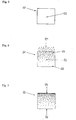
- Fig. 1 shows a femoral shaft clip-on femoral head 10 made of ceramic intended to articulate against an acetabular cup or inlay in an artificial acetabular cup.
- the condyle 10 is made of alumina and zirconium (di) oxide, the material having a concentration gradient and changing the proportions of alumina and zirconium (di) oxide along the gradient.
- the surface 12 of the condyle 10 is stressed by friction and therefore contains an increased alumina content.
- the surface 12 is made of 100% alumina.
- the femoral head 10 has an inner cone 14, with which it is attached to the femoral shaft.
- the inner cone 14 of the condyle 10 are after plugging the femoral head 10 on the shaft cone high surface pressures and stresses in the circumferential direction. There may be shock and jerky stresses.
- a high proportion of zirconium (di) oxide leads here to an increased breaking strength, fracture toughness and damage tolerance, as is the case with pure aluminum oxide.
- the surface of the inner cone 14 consists of almost 100% zirconium (di) oxide.
- the production of the condyle 10 with a gradient in the material is carried out according to the first method described above: First, an alumina condyle 10 is prepared and pre-sintered at 800 to 1300 ° C, so that shrinkage of the material is avoided, so that the porosity for infiltration preserved.
- the alumina matrix contains 0.3% by weight of magnesium oxide and has a high open porosity.
- the zirconium (di) oxide slurry, zirconium-containing sol, zirconium salt solution, zirconium alcoholate, or mixtures of two or more of the aforementioned solutions / liquids are poured into the inner cone regions 14. By infiltration zirconium containing material is included the stabilizers introduced into the porous regions of the alumina matrix.
- the porous condyle 10 is infiltrated to the desired depth of 5 mm.
- the solid particles with the stabilizers settled on the inner surface of the pores.
- This drying is followed by an outgassing process for the elimination of any existing organic additives.
- the infiltration, drying and outgassing can be repeated several times, so that a zirconium (di) oxide content of almost 100% results on the inner surface of the cone 14.
- FIG. 2 shows a ceramic socket 20 and FIG. 3 shows a ceramic inlay 30, which is provided for articulating against the inner sides 21, 31 a condyle, for example the hip joint 10 described in FIG.
- Ceramic pan 20 and ceramic inlay 30 each have an end face and dome edge 22, 32 and a bottom 24, 34.
- the upper portion 26 for realizing a high damage tolerance in the case of impingement (impact of the neck during movement), subluxation and Edge runners of the ceramic head to a zirconium (di) oxide content of nearly 100%.
- the aluminum oxide content is 100% in order to ensure high wear resistance.
- the ceramic inlay 30 is stressed in the upper region 36 like the ceramic pan 20 and therefore has a zirconium (di) oxide content of almost 100% in this region 36.
- the underside 34 of the inlay 30 is subject to tensile stresses the inlay 30 is secured in a metallic screw by conical clamping. Therefore, a zirconium (di) oxide content of almost 100% is realized in the lower region 39.
- the zirconium (di) oxide content continuously decreases towards the pole 37 of the calotte and towards the articulation region 38, since particularly good wear properties are required here, which are ensured by an aluminum oxide content of 100%.
- a required for producing a ceramic pan 20 mold is continuously filled with alumina and zirconium (di) oxide powder, wherein the mixing ratio of zirconium (di) oxide and alumina with 0.3 wt.% Magnesium oxide is varied continuously.
- the filling of the mold begins in the areas that later form the underside 24 of the pan and continues in the direction of the end face and dome edge 22. Up to the height of the later Hauptartikulations Kunststoffes 28 of the dome, the mold is filled with alumina powder.
- a powder mixture of aluminum oxide and zirconium (di) oxide is then used, wherein the proportion of the zirconium (di) oxide powder continuously increases and then in the upper region 26 of the ceramic pan 20 is almost 100%.
- the ceramic pan 20 is prepared by adding organic binder. After shaping, a thermal treatment of the ceramic pan 20 takes place in two steps.
- the remaining organic matter is outgassed and in the second step, the sintering at 1300 to 1600 ° C to achieve a solid, graded and dense composite materials of alumina and zirconium (di) oxide (monoclinic, tetragonal, cubic phase), which then can be further compressed by HIP.
- alumina and zirconium (di) oxide monoclinic, tetragonal, cubic phase
- the production of the ceramic inlay 30 and of the gradient in the material takes place according to the first method described above: First, a pre-sintered inlay made of alumina is prepared according to the same principle as in the condyle in Fig. 1. Thereafter, a gradient is generated by infiltration with zirconium (di) oxide including the known stabilizers in the material. For this purpose, the inlay 30 is immersed in a zirconium-containing sol, a zirconium salt solution, a zirconium alcoholate, a zirconium oxide slip or a mixture of the aforementioned solutions / liquids, so that the entire outer surface except for the inner side regions 31, which are provided for articulation with a joint head, is covered.
- the pre-sintered, porous alumina matrix can be infiltrated to a depth of about 5 mm. After infiltration, the drying and outgassing takes place. The infiltration, drying and outgassing can be repeated as often as desired so that a zirconium (di) oxide content of almost 100% results over the entire outer surface. Subsequently, the sintering takes place at 1300 to 1600 ° C. Further compression by HIP is possible.
- Fig. 4 shows a ceramic condylar clevis 40 of an artificial knee joint consisting of alumina and zirconium (di) oxide and their proportions changing along a gradient.
- the introduction of zirconium (di) oxide increases the fracture toughness and damage tolerance of the entire blade 40.
- the articulation surface (outer side) 42 which is subject to friction and wear, is made of 100% alumina, while the inner side 44 of the blade is used to reduce rigidity and increase fracture toughness and damage tolerance from nearly 100% zirconium (di) oxide.
- a Kondylenkufe 40 is made of alumina and pre-sintered at 800 to 1300 ° C. Thereafter, a zirconium (di) oxide slip, a zirconium alcoholate, a zirconium-containing sol or a zirconium salt solution or a mixture of two or three is applied to the inside 44 of the runner 40 several of the aforementioned solutions / liquids applied and the presintered, porous alumina matrix is infiltrated from this side. After infiltration, drying and degassing occur.
- the Kondylenkufe 40 On the entire inner side 44 results in a zirconium (di) oxide content of nearly 100%, which decreases continuously in the direction of articulation surface (outer side) 42.
- the Kondylenkufe 40 On the outside 42 the Kondylenkufe 40 consists of 100% alumina.
- the Kondylenkufe 40 is sintered at 1300 to 1600 ° C and can then be compressed by HIP.
- FIGS. 5 to 7 schematically show the infiltration of an aluminum oxide matrix with zirconium-containing material to produce a gradient in the material.
- a presintered alumina endoprosthesis component 50 is comprised of a high open porosity alumina matrix 52 which may contain 0 to 0.3 wt% magnesium oxide (FIG. 5).
- infiltration zirconium-containing material 60 particle size: ⁇ 100 nm
- di stabilized zirconium oxide including the stabilizers
- the porous material is infiltrated to a certain depth.
- zirconium-containing particles settle on the inner surface of the pores and the concentration of zirconium (di) oxide continuously decreases from the surface 64 into the interior 66 of the alumina matrix. Up to 100% zirconium (di) oxide may be present on side 74 from which infiltration occurs and up to 100% alumina on the opposite side ( Figure 7).
Landscapes
- Chemical & Material Sciences (AREA)
- Engineering & Computer Science (AREA)
- Ceramic Engineering (AREA)
- Health & Medical Sciences (AREA)
- Materials Engineering (AREA)
- Structural Engineering (AREA)
- Organic Chemistry (AREA)
- Inorganic Chemistry (AREA)
- Manufacturing & Machinery (AREA)
- Orthopedic Medicine & Surgery (AREA)
- Composite Materials (AREA)
- General Health & Medical Sciences (AREA)
- Transplantation (AREA)
- Veterinary Medicine (AREA)
- Public Health (AREA)
- Oral & Maxillofacial Surgery (AREA)
- Life Sciences & Earth Sciences (AREA)
- Animal Behavior & Ethology (AREA)
- Vascular Medicine (AREA)
- Heart & Thoracic Surgery (AREA)
- Biomedical Technology (AREA)
- Cardiology (AREA)
- Dermatology (AREA)
- Medicinal Chemistry (AREA)
- Epidemiology (AREA)
- Prostheses (AREA)
- Materials For Medical Uses (AREA)
- Compositions Of Oxide Ceramics (AREA)
Abstract
Description
- Die Erfindung betrifft eine Endoprothesenkomponente aus einem keramischen Werkstoff, der im wesentlichen aus Aluminiumoxid und Zirkonium(di)oxid zusammengesetzt ist, sowie Verfahren zu ihrer Herstellung.
- Aluminiumoxid und Zirkonium(di)oxid sind seit Jahren als bewährte keramische Implantatwerkstoffe bekannt. Aluminiumoxid ist sehr hart und verschleißfest. Zirkonium(di)oxid ist ein sehr bruchzähes und schadenstolerantes Material. Es ist bekannt, dass Endoprothesenkomponenten, die jeweils aus einem der beiden Materialien bestehen, in künstlichen Gelenken aufgrund der auftretenden Reibungskräfte nicht beliebig miteinander kombinierbar sind. Bewährt haben sich Paarungen von Gelenkpartnern aus Aluminiumoxid, dagegen sind Werkstoffpaarungen von Aluminiumoxid mit Zirkoniumoxid und Zirkoniumoxid mit Zirkoniumoxid in der Literatur umstritten, da es hier zu sehr starken Verschleißerscheinungen kommen kann.
- EP 1 035 878 B1 stellt mögliche Werkstoffpaarungen für Gelenkpartner aus keramischen Werkstoffen vor, durch die neue konstruktive Gestaltungen mit optimalem Verschleißverhalten ermöglicht werden sollen. Die Gelenkpartner bestehen aus Sinterwerkstoffen die im wesentlichen Aluminiumoxid und Zirkoniumoxid sind, wobei mindestens einer der Gelenkpartner aus Zirkoniumoxid mit einem Zusatz von 0,1 bis 40 Gew.% Aluminiumoxid besteht. In einem Beispiel wird einem Gelenkpartner aus Zirkoniumoxid mit einem Aluminiumoxidanteil von über 5 Gew.% ein Gelenkpartner aus Aluminiumoxid zugeordnet und der Werkstoff der Kugel eines Gelenkes hat einen höheren Zirkoniumoxidanteil als der Werkstoff des keramischen Pfanneneinsatzes.
- Aus WO 97/31592 ist es bekannt, bei einem künstlichen Hüftgelenk die Pfanne aus Aluminiumoxid und den Gelenkkopf aus Zirkoniumoxid herzustellen.
- Aus US 2002/0031675 A1 ist eine biomedizinische Komponente bekannt, die aus 90 mol% Zirkoniumdioxid besteht, wobei das Zirkoniumdioxid durch wenigstens 2,1 mol% Yttriumoxid teilweise stabilisiert ist, und zwischen 0,05 und 1 Gew.% Aluminiumoxid enthält.
- US 2002/0010070 A1 beschreibt eine biomedizinische Komponente, die aus mit Zirkoniumdioxid verstärktem Aluminiumoxid besteht, wobei 1 bis 69 Gew.% Zirkoniumoxid enthalten sind und das Zirkoniumdioxid durch mindestens 2,1 mol% Yttriumoxid oder Seltene-Erd-Oxide stabilisiert ist.
- US 6 312 473 B1 beschreibt Implantatkomponenten die mit einer Schicht aus Titanium oder einer Titaniumlegierung bedeckt sind. Die offenen Poren dieser Schicht sind mit einem biokompatiblen Zement imprägniert, der durch ausgewählte Oxide, die Aluminiumoxid, Magnesiumoxid, Zirkoniumoxid oder eine Kombination dieser Oxide enthalten, verstärkt ist.
- US 4 950 294 beschreibt eine Implantatkomponente mit einer Matrix aus Aluminiumoxid, Zirkonium(di)oxid und Yttriumoxid. Die Oberfläche der Matrix ist nicht monokristallin und eine bioaktive Schicht bedeckt die Matrixoberfläche.
- Endoprothesenkomponenten aus einem Komposit von Aluminiumoxid und Zirkonium(di)oxid sind ferner aus EP 1 228 774 A1, EP 0 908 425 A1, JP 09268055 A und JP 11228221 A bekannt.
- Aus WO 02/102275 sind Hüftgelenk-Implantate bekannt, bei denen der Gelenkkopf aus einer Metalllegierung und die Gelenkpfanne aus Zirkoniumoxid und gegebenenfalls mit Zusätzen von Aluminiumoxid besteht.
- Aus DE 44 35 146 C2 ist ein Verfahren zur Herstellung eines Porositätsgradienten für Gradientenwerkstoffe bekannt, bei dem ein poröser Körper aus einem elektrisch leitenden Material in einen Elektrolyten einer Elektrolysezelle getaucht wird und durch Anwendung eines Elektrolysestroms ein anodischer Abtrag des Materials des Körpers bewirkt wird, wobei der Abtrag entlang der Verbindungslinie zwischen Anode und Kathode veränderlich ist.
- Der Erfindung liegt die Aufgabe zugrunde, keramische Endoprothesenkomponenten zu schaffen, die sowohl hart und verschleißfest als auch bruchzäh und schadenstolerant sind.
- Erfindungsgemäß wird diese Aufgabe dadurch gelöst, dass der Werkstoff einen Gradienten der Anteile von Aluminiumoxid und Zirkonium(di)oxid aufweist.
- Dass der Werkstoff einen Gradienten der Anteile von Aluminiumoxid und Zirkonium(di)oxid aufweist bedeutet, dass sich Anteile dieser keramischen Systeme entlang des Gradienten ändern. Die erfindungsgemäße Endoprothesenkomponente hat daher keine gleichförmige Materialzusammensetzung, sondern die Aluminiumoxid- und Zirkonium(di)oxidanteile variieren innerhalb der Endoprothesenkomponente. Im Gegensatz dazu haben die Werkstoffkomposite aus Zirkoniumoxid und Aluminiumoxid, die aus den oben genannten Druckschriften bekannt sind, eine homogene Verteilung der Komponenten im Material.
- Die hervorragenden Verschleißeigenschaften des Aluminiumoxids sollen vor allem in den Bereichen der Endoprothesenkomponente zum Tragen kommen, in denen keramische Gleitpartner gegeneinander artikulieren und der Werkstoff auf Reibung beansprucht wird. In diesen Bereichen ist daher der Aluminiumoxidanteil höher und kann bis zu 100% betragen. In den Bereichen der Endoprothesenkomponente, wo Spannungsmaxima und Flächenpressungen zu erwarten sind, sollen vor allem die Eigenschaften des Zirkonium(di)oxids eingebracht werden. In diesen Bereichen ist daher der Zirkonium(di)oxidanteil höher und kann bis zu 100% betragen.
- Dem Aluminiumoxid können 0 bis 0,3 Gew.% Magnesiumoxid als Sinterhilfsmittel zugesetzt werden, wodurch das Kornwachstum gehemmt wird. Das Zirkonium(di)oxid kann unstabilisiert oder stabilisiert (mit den zur Phasenstabilisierung bekannten Zusätzen der Seltenen-Erd-Oxide, Erdalkalioxide, Titanoxid, Chromoxid oder Hafniumoxid) vorliegen.
- Dadurch kann die Bruchfestigkeit und Bruchzähigkeit und die Schadenstoleranz der keramischen Endoprothesenkomponenten deutlich gesteigert werden. Der Werkstoff ist in der Lage Rissenergie abzubauen. Trifft ein Riss auf ein Zirkonium(di)-oxidpartikel kommt es zur Rissverzweigung und bei Vorliegen der kubischen bzw. tetragonalen Modifikation des Zirkonium-(di)oxids zu einer Phasenumwandlung in monoklines Zirkonium(di)oxid, wobei der Energieabbau erfolgt. Die Phasenumwandlung tetragonal/kubisch in monoklin ist mit einer Volumenzunahme verbunden, so dass die Rissspitze zusammengedrückt und das Risswachstum gehemmt wird. Dieser Mechanismus ist von den bisher verfügbaren umwandlungsverstärkten Keramiken bekannt.
- Bei den erfindungsgemäßen Endoprothesenkomponenten handelt es sich um einen Werkstoff mit Material- und Korngrößengradient, der durch zwei verschiedene Verfahren hergestellt werden kann.
- Bei dem ersten Verfahren werden in eine vorgesinterte Aluminiumoxid-Endoprothesenkomponente (Aluminiumoxidmatrix), die 0 bis 0,3 Gew.% Magnesiumoxid enthalten kann und eine hohe offene Porosität besitzt, durch Infiltration Zirkonium(di)-oxidpartikel (Partikelgröße: < 100 nm), im Falle des stabilisierten Zirkonium(di)oxids einschließlich der Stabilisatoren, eingebracht. Die Vorsinterung der Endoprothesenkomponente erfolgt bei 800 bis 1200 °C, wobei ein Schrumpfen des Werkstoffes vermieden werden muss, damit die Porosität für die Infiltration erhalten bleibt. Die Erzeugung des Gradienten im Werkstoff erfolgt mit Hilfe eines dem Schlickerguss verwandten Verfahrens. Das zirkoniumhaltige Sol (auf kolloidaler Basis bzw. polymerer Basis; H. Richter, Herstellung keramischer Nanofiltrationsmembranen aus ZrO2 und TiO2, Dissertation, TU Bergakademie Freiberg, Fakultät für Werkstoffwissenschaft und Werkstofftechnologie, 1999), die Zirkoniumsalzlösung, das Zirkoniumalkoholat bzw. der Zirkonium(di)oxidschlicker oder auch eine Mischung aus zwei oder mehreren der vorgenannten Lösungen/Flüssigkeiten wird (durch z.B. Gießen oder Sprühen) auf die vorgesinterte, poröse Aluminiumoxidmatrix, die bis zu 0,3 Gew.% Magnesiumoxid enthalten kann, aufgetragen bzw. sie wird infiltriert. Das zirkoniumhaltige Sol, der Zirkonium-(di)oxidschlicker, die Zirkoniumsalzlösung, das Zirkoniumalkoholat oder eine Mischung aus zwei oder mehreren der vorgenannten Lösungen/Flüssigkeiten kann die bereits erwähnten Stabilisatoren enthalten. In Abhängigkeit vom Porenvolumen, der Porengröße, der Zeit und der Konzentration des flüssigen Systems wird der porige Werkstoff bis zu einer bestimmten Tiefe infiltriert. Die Feststoffpartikel setzen sich an der inneren Oberfläche der Poren ab. Nach der Infiltration erfolgt die Trocknung der Endoprothesenkomponente, die schonend vorgenommen werden muss, damit keine Risse im Material entstehen. An diese Trocknung schließt sich ein Ausgasprozess zur Eliminierung der eventuell vorhandenen organischen Additive an. Diese organischen Additive, die im Sol, Schlicker, der Salzlösung bzw. dem Alkoholat enthalten sein können, müssen vor einer nachfolgenden Sinterung durch thermisches Ausgasen entfernt werden, da sonst Risse und Defekte im Material entstehen. Solange in der Aluminiumoxidmatrix noch genügend offene Porosität vorliegt, kann der Infiltrations-, Trocknungs- und Ausgasprozess beliebig oft wiederholt werden. Damit ist jeder gewünschte Zirkonium(di)oxidanteil in der Aluminiumoxidmatrix einstellbar. Während der anschließenden Sinterung bei 1300 bis 1600 °C entsteht ein fester, gradierter und dichter (porenfreier) Werkstoffverbund von Aluminiumoxid und Zirkonium(di)-oxid (kubische, tetragonale und monokline Phase). Auf der Seite, von der die Infiltration erfolgt, können bis zu 100 % Zirkonium(di)oxid vorliegen. Die Konzentration des Zirkonium(di)oxid nimmt von der Oberfläche in das Innere der Aluminiumoxidmatrix kontinuierlich ab. Anschließend kann eine weitere Verdichtung durch HIP (heißisostatisches Pressen) erfolgen.
- Das erste beschriebene Verfahren lässt sich auch so anwenden, dass in eine unstabilisierte oder stabilisierte (mit den zur Phasenstabilisierung bekannten Zusätzen der Seltenen-Erd-Oxide, Erdalkalioxide, Titanoxid, Chromoxid oder Hafniumoxid) Zirkonium(di)oxidmatrix Aluminiumoxidpartikel mit einem Zusatz von 0 bis 0,3 Gew.% Magnesiumoxid eingelagert werden. Die einzulagernden Partikel liegen in Form von Solen, Schlicker, Salzlösungen, Alkoholaten oder Mischungen aus zwei oder mehreren der vorgenannten Lösungen/Flüssigkeiten vor.
- Die Matrix, die infiltriert wird, kann auch ein homogener poröser Komposit sein. Die Matrix kann also Aluminiumoxid, Zirkon(di)oxid oder ein Komposit sein. Der Komposit kann zwischen 0-100% aus Aluminiumoxid und entsprechend dazu zwischen 100-0% Zirkon(di)oxid bestehen. Bei dem Zirkon(di)-oxid kann es sich um ein unstabilisiertes oder ein mit den üblichen Stabilisatoren (seltene Erdoxide, Erdalkalioxide, Titanoxid, Chromoxid oder Hafniumoxid - die als Phasenstabilisatoren bekannt sind) stabilisiertes Zirkon(di)oxid handeln.
- Bei dem zweiten Herstellungsverfahren wird der Gradient im Werkstoff über uniaxiales oder isostatisches Trockenpressen hergestellt. Die Pressform wird kontinuierlich mit Zirkonium-(di)oxid- und Aluminiumoxidpulver gefüllt, wobei das Mischverhältnis von Zirkonium(di)oxid und Aluminiumoxid mit bis zu 0,3 Gew.% Magnesiumoxid je nach Erfordernis bzw. Design der Endoprothesenkomponente kontinuierlich variiert wird. Durch anschließendes Pressen wird ein Formkörper hergestellt. Alle Mischungsverhältnisse der Hauptkomponenten Zirkonium(di)oxid (stabilisiert und unstabilisiert) und Aluminiumoxid (zwischen 100 % Zirkonium(di)oxid und 0 % Aluminiumoxid und 100 % Aluminiumoxid und 0 % Zirkonium(di)oxid) sind realisierbar. Bereiche der Keramikkomponente können auch nur aus Aluminiumoxid, nur aus Zirkonium(di)oxid oder aus einem Komposit aus Aluminiumoxid und Zirkon(di)oxid homogener Zusammensetzung bestehen, wobei dann andere Bereiche aus einem gradierten Material bestehen. Bei dem Zirkon(di)oxid kann es sich wiederum um unstabilisiertes oder stabilisiertes Material handeln.
- Nach der Formgebung erfolgt eine thermische Behandlung in zwei Schritten. Im ersten Schritt wird die noch in den Formkörpern vorhandene Organik ausgegast und im zweiten Schritt erfolgt die Sinterung der Formkörper bei 1300 bis 1600 °C zur Erzielung eines festen, gradierten und dichten Werkstoffverbundes von Aluminiumoxid und Zirkonium(di)oxid (monokline, tetragonale, kubische Phase). Auch hier kann der Formkörper durch HIP weiter verdichtet werden.
- Es besteht auch die Mögliahkeit, dass der hergestellte Formkörper nach dem Ausgasen vor oder nach einem eventuellen Vorsintern einem Infiltrationsverfahren, entsprechend dem oben beschriebenen ersten Verfahren, unterzogen wird.
- Bei beiden Herstellungsverfahren gehen beide Phasen (Aluminiumoxid und Zirkonium(di)oxid) jeweils homogen ineinander über. Das Zirkonium(di)oxid liegt in tetragonaler, kubischer oder monokliner Modifikation vor.
- Ausführungsbeispiele der erfindungsgemäßen keramischen Endoprothesenkomponenten und das Prinzip der Gradientenerzeugung im Werkstoff sind in den Zeichnungen dargestellt und werden im folgenden näher beschrieben. Es zeigen:
- Fig. 1
- einen Hüftgelenkkopf aus Keramik im Schnitt,
- Fig. 2
- eine Keramikpfanne eines künstlichen Gelenkes im Schnitt,
- Fig. 3
- ein Keramikinlay eines künstlichen Gelenkes im Schnitt,
- Fig. 4
- eine keramische Kondylenkufe eines künstlichen Kniegelenkes und
- Fig. 5 bis 7
- das Prinzip der Gradientenerzeugung im Werkstoff.
- Fig. 1 zeigt einen auf einen Femurschaft aufsteckbaren Hüftgelenkkopf 10 aus Keramik, der dafür vorgesehen ist, gegen eine Hüftgelenkpfanne oder ein Inlay in einer künstlichen Hüftgelenkpfanne zu artikulieren. Der Gelenkkopf 10 besteht aus Aluminiumoxid und Zirkonium(di)oxid, wobei der Werkstoff einen Konzentrationsgradienten aufweist und sich die Anteile von Aluminiumoxid und Zirkonium(di)oxid entlang des Gradienten ändern. Die Oberfläche 12 des Gelenkkopfes 10 ist durch Reibung beansprucht und enthält daher einen erhöhten Aluminiumoxidanteil. Die Oberfläche 12 besteht aus 100 % Aluminiumoxid. Der Hüftgelenkkopf 10 hat einen Innenkonus 14, mit dem er auf den Femurschaft aufgesteckt wird. Im Innenkonus 14 des Gelenkkopfes 10 liegen nach dem Aufstecken des Hüftkopfes 10 auf den Schaftkegel hohe Flächenpressungen und Spannungen in Umfangsrichtung vor. Es können schlag- und stoßartige Beanspruchungen auftreten. Ein hoher Anteil an Zirkonium(di)oxid führt hier zu einer erhöhten Bruchfestigkeit, Bruchzähigkeit und Schadenstoleranz, als es beim reinen Aluminiumoxid der Fall ist. Die Oberfläche des Innenkonus 14 besteht aus nahezu 100 % Zirkonium (di) oxid.
- Die Herstellung des Gelenkkopfes 10 mit einem Gradienten im Werkstoff erfolgt gemäß dem oben beschriebenen ersten Verfahren: Zunächst wird ein Aluminiumoxid-Gelenkkopf 10 hergestellt und bei 800 bis 1300 °C vorgesintert, so dass ein Schrumpfen des Werkstoffes vermieden wird, damit die Porosität für die Infiltration erhalten bleibt. Die Aluminiumoxidmatrix enthält 0,3 Gew.% Magnesiumoxid und besitzt eine hohe offene Porosität. Der Zirkonium(di)oxidschlicker, das zirkoniumhaltige Sol, die Zirkoniumsalzlösung, das Zirkoniumalkoholat oder Mischungen aus zwei oder mehreren der vorgenannten Lösungen/Flüssigkeiten werden in den Innenkonusbereiche 14 gegossen. Durch Infiltration wird zirkoniumhaltiges Material einschließlich der Stabilisatoren in die porösen Bereiche der Aluminiumoxidmatrix eingebracht. In Abhängigkeit vom Porenvolumen, der Porengröße, der Zeit und der Konzentration des flüssigen Systems wird der porige Gelenkkopf 10 bis zur gewünschten Tiefe von 5 mm infiltriert. Die Feststoffpartikel mit den Stabilisatoren setzten sich an der inneren Oberfläche der Poren ab. Nach der Infiltration erfolgt die Trocknung des Gelenkkopfes 10, die schonend vorgenommen werden muss, damit keine Risse im Material entstehen. An diese Trocknung schließt sich ein Ausgasprozess zur Eliminierung der eventuell vorhandenen organischen Additive an. Die Infiltration, Trocknung und Ausgasung kann mehrmals wiederholt werden, so dass sich auf der Innenfläche des Konus 14 ein Zirkonium(di)oxidanteil von nahezu 100 % ergibt. Während der anschließenden Sinterung bei 1300 bis 1600 °C entsteht ein fester, gradierter und dichter Werkstoffverbund von Aluminiumoxid und Zirkonium(di)oxid (kubische, tetragonale und monokline Phase). Anschließend erfolgt eine weitere Verdichtung des Gelenkkopfes 10 durch HIP (heißisostatisches Pressen).
- Fig. 2 zeigt eine Keramikpfanne 20 und Fig. 3 zeigt ein Keramikinlay 30, die dafür vorgesehen sind, dass gegen die Innenseiten 21, 31 ein Gelenkkopf, z.B. der in Fig. 1 beschriebene Hüftgelenkkopf 10, artikuliert. Keramikpfanne 20 und Keramikinlay 30 besitzen jeweils eine Stirnfläche und Kalottenrand 22, 32 und eine Unterseite 24, 34. Bei der Keramikpfanne 20 weist der obere Bereich 26 zur Realisierung einer hohen Schadenstoleranz im Falle von Impingement (Anschlagen des Schafthalses während der Bewegung), Subluxation und Randläufern des Keramikkopfes einen Zirkonium(di)oxid-anteil von nahezu 100 % auf. Im Bereich des Pols 27 der Kalotte und im Bereich der Hauptartikulation 28 zwischen Keramikkopf und Kalotte beträgt der Aluminiumoxidanteil 100 %, um eine hohe Verschleißfestigkeit zu gewährleisten. Das Keramikinlay 30 wird im oberen Bereich 36 wie die Keramikpfanne 20 beansprucht und weist daher in diesem Bereich 36 einen Zirkonium(di)oxidanteil von nahezu 100 % auf. Zusätzlich unterliegt die Unterseite 34 des Inlays 30 Zugspannungen, da das Inlay 30 in einer metallischen Schraubpfanne durch konische Klemmung befestigt wird. Daher ist im unteren Bereich 39 ein Zirkonium(di)oxidanteil von nahezu 100 % realisiert. Der Zirkonium(di)oxidanteil nimmt zum Pol 37 der Kalotte und zum Artikulationsbereich 38 hin kontinuierlich ab, da hier besonders gute Verschleißeigenschaften erforderlich sind, die durch einen Aluminiumoxidanteil von 100 % gewährleistet werden.
- Die Herstellung der Keramikpfanne 20 und des Gradienten im Werkstoff erfolgt gemäß dem oben beschriebenen zweiten Verfahren: Eine zur Herstellung einer Keramikpfanne 20 erforderliche Pressform wird kontinuierlich mit Aluminiumoxid- und Zirkonium(di)oxidpulver gefüllt, wobei das Mischungsverhältnis von Zirkonium(di)oxid und Aluminiumoxid mit 0,3 Gew.% Magnesiumoxid kontinuierlich variiert wird. Das Befüllen der Pressform beginnt in den Bereichen, die später die Unterseite 24 der Pfanne bilden und setzt sich in Richtung Stirnfläche und Kalottenrand 22 fort. Bis auf die Höhe des späteren Hauptartikulationsbereiches 28 der Kalotte wird die Pressform mit Aluminiumoxidpulver gefüllt. Beim weiteren Befüllen in Richtung Stirnfläche und Kalottenrand 22 wird dann ein Pulvergemisch aus Aluminiumoxid und Zirkonium(di)oxid verwendet, wobei der Anteil des Zirkonium(di)oxidpulvers kontinuierlich zunimmt und im oberen Bereich 26 der Keramikpfanne 20 dann nahezu 100 % beträgt. Durch uniaxiales Trockenpressen und nachfolgende Grünbearbeitung wird unter Zugabe organischer Binder die Keramikpfanne 20 hergestellt. Nach der Formgebung erfolgt eine thermische Behandlung der Keramikpfanne 20 in zwei Schritten. Im ersten Schritt wird die noch vorhandene Organik ausgegast und im zweiten Schritt erfolgt die Sinterung bei 1300 bis 1600 °C zur Erzielung eines festen, gradierten und dichten Werkstoffverbundes von Aluminiumoxid und Zirkonium(di)oxid (monokline, tetragonale, kubische Phase), der anschließend durch HIP weiter verdichtet werden kann.
- Die Herstellung des Keramikinlays 30 und des Gradienten im Werkstoff erfolgt gemäß dem oben beschriebenen ersten Verfahren: Zunächst wird nach dem gleichen Prinzip wie beim Gelenkkopf in Fig. 1 ein vorgesintertes Inlay aus Aluminiumoxid hergestellt. Danach wird durch Infiltration mit Zirkonium(di)oxid einschließlich der bekannten Stabilisatoren im Werkstoff ein Gradient erzeugt. Dazu wird das Inlay 30 in ein zirkoniumhaltiges Sol, eine Zirkoniumoxidsalzlösung, ein Zirkoniumalkoholat, einen Zirkonoxidschlicker oder eine Mischung der vorgenannten Lösungen/Flüssigkeiten eingetaucht, so dass die gesamte äußere Oberfläche mit Ausnahme der Innenseitenbereiche 31, die für die Artikulation mit einem Gelenkkopf vorgesehen sind, bedeckt ist. Die vorgesinterte, poröse Aluminiumoxidmatrix kann bis zu einer Tiefe von etwa 5 mm infiltriert werden. Nach der Infiltration erfolgt die Trocknung und Ausgasung. Die Infiltration, Trocknung und Ausgasung kann beliebig oft wiederholt werden, so dass sich auf der gesamten äußeren Oberfläche ein Zirkonium(di)oxidanteil von nahezu 100 % ergibt. Anschließend erfolgt die Sinterung bei 1300 bis 1600 °C. Eine weitere Verdichtung durch HIP ist möglich.
- Fig. 4 zeigt eine keramische Kondylenkufe 40 eines künstlichen Kniegelenkes, die aus Aluminiumoxid und Zirkonium(di)oxid besteht und deren Anteile sich entlang eines Gradienten ändern. Durch das Einbringen von Zirkonium(di)oxid wird die Bruchzähigkeit und Schadenstoleranz der gesamten Kufe 40 erhöht. Die auf Reibung und Verschleiß beanspruchte Artikulationsfläche (Außenseite) 42 besteht aus 100% Aluminiumoxid während die Innenseite 44 der Kufe zum Abbau der Steifigkeit und zur Erhöhung der Bruchzähigkeit und Schadenstoleranz aus nahezu 100 % Zirkonium(di)oxid besteht.
- Die Herstellung der Kondylenkufe 40 und des Gradienten im Werkstoff erfolgt gemäß dem oben beschriebenen ersten Verfahren: Zuerst wird eine Kondylenkufe 40 aus Aluminiumoxid hergestellt und bei 800 bis 1300 °C vorgesintert. Danach wird auf die Innenseite 44 der Kufe 40 ein Zirkonium(di)oxidschlicker, ein Zirkoniumalkoholat, ein zirkoniumhaltiges Sol bzw. eine Zirkoniumsalzlösung oder eine Mischung aus zwei oder mehreren der vorgenannten Lösungen/Flüssigkeiten aufgebracht und die vorgesinterte, poröse Aluminiumoxidmatrix wird von dieser Seite aus infiltriert. Nach der Infiltration erfolgt eine Trocknung und Ausgasung. Auf der gesamten Innenseite 44 ergibt sich ein Zirkonium(di)oxidanteil von nahezu 100 %, der in Richtung Artikulationsfläche (Außenseite) 42 kontinuierlich abnimmt. Auf der Außenseite 42 besteht die Kondylenkufe 40 aus 100 % Aluminiumoxid. Die Kondylenkufe 40 wird bei 1300 bis 1600 °C gesintert und kann anschließend durch HIP verdichtet werden.
- Die Figuren 5 bis 7 zeigen schematisch die Infiltration einer Aluminiumoxidmatrix mit zirkoniumhaltigem Material zur Erzeugung eines Gradienten im Werkstoff. Eine vorgesinterte Aluminiumoxid-Endoprothesenkomponente 50 besteht aus einer Aluminiumoxidmatrix 52 mit hoher offener Porosität, die 0 bis 0,3 Gew.% Magnesiumoxid enthalten kann (Fig. 5). Durch Infiltration wird zirkoniumhaltiges Material 60 (Partikelgröße: < 100 nm), im Falle des stabilisierten Zirkonium(di)oxid einschließlich der Stabilisatoren; in die Matrix 52 eingebracht (Fig. 6). In Abhängigkeit vom Porenvolumen, der Porengröße, der Zeit und der Konzentration des flüssigen Systems wird der porige Werkstoff bis zu einer bestimmten Tiefe infiltriert. Die zirkoniumhaltigen Partikel setzten sich an der inneren Oberfläche der Poren ab und die Konzentration des Zirkonium(di)oxid nimmt von der Oberfläche 64 in das Innere 66 der Aluminiumoxidmatrix kontinuierlich ab. Auf der Seite 74, von der die Infiltration erfolgt, können bis zu 100 % Zirkonium(di) oxid und auf der gegenüberliegenden Seite 76 bis zu 100 % Aluminiumoxid vorliegen (Fig. 7).
Claims (17)
- Endoprothesenkomponente aus einem keramischen Werkstoff, der Aluminiumoxid und Zirkonium(di)oxid enthält, wobei das Zirkonium(di)oxid unstabilisiert oder stabilisiert (mit den zur Phasenstabilisierung bekannten Zusätzen der Seltenen-Erd-Oxide, Erdalkalioxide, Titanoxid, Chromoxid oder Hafniumoxid) vorliegt,
dadurch gekennzeichnet, dass der Werkstoff einen Gradienten der Anteile von Aluminiumoxid und Zirkonium(di)oxid aufweist. - Endoprothesenkomponente nach Anspruch 1, die Teil eines künstlichen Gelenkes ist, einen Artikulationsbereich hat und einen Bereich hat, der im Einsatzfall erhöhten Zug-, Biege- und Torsionsspannungen unterliegt, dadurch gekennzeichnet, dass der Bereich erhöhter Zug-, Biege- und Torsionsspannungen einen im Vergleich zum Artikulationsbereich erhöhten Anteil an Zirkonium(di)oxid und der Artikulationsbereich vorrangig Aluminiumoxid enthält.
- Endoprothesenkomponente nach Anspruch 1 oder 2, dadurch gekennzeichnet, dass zwei Bereiche vorliegen und in einem Bereich der Werkstoff ein Mischungsverhältnis zwischen nahezu 100 % Aluminiumoxid und 0 % Zirkonium(di)oxid und im anderen Bereich ein Mischungsverhältnis von 0 % Aluminiumoxid und nahezu 100 % Zirkonium(di)oxid hat.
- Endoprothesenkomponente nach einem der Ansprüche 1 bis 3, dadurch gekennzeichnet, dass im Werkstoff ein Konzentrationsgradient von Aluminiumoxid und Zirkonium(di)oxid vorliegt.
- Endoprothesenkomponente nach einem der Ansprüche 1 bis 4, dadurch gekennzeichnet, dass im Werkstoff ein Korngrößengradient vorliegt, der an den Konzentrationsgradienten gekoppelt ist.
- Endoprothesenkomponente nach einem der Ansprüche 1 bis 5, dadurch gekennzeichnet, dass das Aluminiumoxid einen Anteil von 0 bis 0,3 Gew.% Magnesiumoxid aufweist.
- Verfahren zur Herstellung einer Endoprothesenkomponente nach einem der Ansprüche 1 bis 6, dadurch gekennzeichnet, dass die Endoprothesenkomponente aus einer offenporigen vorgesinterten Aluminiumoxidmatrix mit einem Zirkonium(di)oxidschlicker, einer Zirkoniumsalzlösung, einem zirkoniumhaltigen Sol oder Alkoholat oder einer Mischung aus zwei oder mehr der vorgenannten Lösungen/Flüssigkeiten infiltriert wird, wobei Teilchen im Größenbereich von < 100 nm in die offenporige Aluminiumoxidmatrix eingebracht werden.
- Verfahren zur Herstellung einer Endoprothesenkomponente nach einem der Ansprüche 1 bis 6, dadurch gekennzeichnet, dass die Endoprothesenkomponente aus einer offenporigen vorgesinterten Zirkonium(di)oxidmatrix (stabilisiert mit den zur Phasenstabilisierung bekannten Zusätzen der Seltenen-Erd-Oxide, Erdalkalioxide, Titanoxid, Chromoxid oder Hafniumoxid oder unstabilisiert) mit Aluminiumoxidpartikeln mit 0 bis 0,3 Gew.% Magnesiumoxid infiltriert wird, wobei Teilchen im Größenbereich von < 100 nm in die offenporige Zirkonium(di)oxidmatrix eingebracht werden
- Verfahren nach Anspruch 7 oder 8, wobei die Endoprothesenkomponente eine Matrix in Form eines homogenen, porösen Komposits aus Zirkon(di)oxid und Aluminiumoxid aufweist.
- Verfahren zur Herstellung einer Endoprothesenkomponente nach Anspruch 7 oder 9, dadurch gekennzeichnet, dass die Infiltration durch z.B. Sprühen, Tauchen oder Gießen erfolgt.
- Verfahren zur Herstellung einer Endoprothesenkomponente nach einem der Ansprüche 7 bis 10, dadurch gekennzeichnet, dass die infiltrierte Matrix der Endoprothesenkomponente nach der Infiltration einem Trocknungs-, Ausgas- und Sinterungsprozess unterzogen wird.
- Verfahren zur Herstellung einer Endoprothesenkomponente nach einem der Ansprüche 7 bis 11, dadurch gekennzeichnet, dass der Infiltrations-, Trocknungs- und Ausgasprozess zur Erhöhung des Zirkonium(di)oxidanteils in der Matrix mehrfach wiederholt wird.
- Verfahren zur Herstellung einer Endoprothesenkomponente nach einem der Ansprüche 1 bis 6, dadurch gekennzeichnet, dass eine Pressform zumindest teilweise kontinuierlich mit einer Mischung aus Aluminiumoxid- und Zirkonium(di)oxid-pulver gefüllt wird, wobei während des Befüllens der Pressform das Mischverhältnis von Aluminiumoxid und Zirkonium (di) oxid variiert wird, und dass durch Pressen ein Formkörper hergestellt wird.
- Verfahren zur Herstellung einer keramischen Endoprothesenkomponente nach Anspruch 13, dadurch gekennzeichnet, dass das Pressen uniaxial oder isostatisch durchgeführt wird.
- Verfahren zur Herstellung einer Endoprothesenkomponente nach Anspruch 13 oder 14, dadurch gekennzeichnet, dass der gepresste Formkörper ausgegast und gesintert wird.
- Verfahren zur Herstellung einer Endoprothesenkomponente nach Anspruch 13 oder 14 dadurch gekennzeichnet, dass der hergestellte Formkörper ausgegast wird und anschließend einem Infiltrationsverfahren - wie in den Ansprüchen 7 bis 11 beschrieben - unterzogen wird.
- Verfahren zur Herstellung einer Endoprothesenkomponente nach einem der Ansprüche 7 bis 16, dadurch gekennzeichnet, dass eine weitere Verdichtung des gesinterten Formkörpers durch heißisostatisches Pressen erfolgt.
Applications Claiming Priority (3)
| Application Number | Priority Date | Filing Date | Title |
|---|---|---|---|
| DE10244439A DE10244439A1 (de) | 2002-09-24 | 2002-09-24 | Keramische Endoprothesenkomponenten und Verfahren zu ihrer Herstellung |
| DE10244439 | 2002-09-24 | ||
| PCT/EP2003/008286 WO2004032986A1 (de) | 2002-09-24 | 2003-07-28 | Keramische endoprothesenkomponenten und verfahren zu ihrer herstellung |
Publications (2)
| Publication Number | Publication Date |
|---|---|
| EP1562651A1 EP1562651A1 (de) | 2005-08-17 |
| EP1562651B1 true EP1562651B1 (de) | 2006-03-01 |
Family
ID=31896339
Family Applications (1)
| Application Number | Title | Priority Date | Filing Date |
|---|---|---|---|
| EP03807762A Expired - Lifetime EP1562651B1 (de) | 2002-09-24 | 2003-07-28 | Keramische endoprothesenkomponenten und verfahren zu ihrer herstellung |
Country Status (7)
| Country | Link |
|---|---|
| US (1) | US20050187638A1 (de) |
| EP (1) | EP1562651B1 (de) |
| JP (1) | JP2006500183A (de) |
| CN (1) | CN1684720A (de) |
| AU (1) | AU2003253340A1 (de) |
| DE (2) | DE10244439A1 (de) |
| WO (1) | WO2004032986A1 (de) |
Cited By (1)
| Publication number | Priority date | Publication date | Assignee | Title |
|---|---|---|---|---|
| WO2012154241A1 (en) * | 2011-03-04 | 2012-11-15 | Raytheon Company | Method of fabricating optical ceramics containing compositionally tailored regions in three dimension |
Families Citing this family (26)
| Publication number | Priority date | Publication date | Assignee | Title |
|---|---|---|---|---|
| US20050164045A1 (en) | 2004-01-27 | 2005-07-28 | Ivoclar Vivadent Ag | Method for the production of an oxide ceramic shaped part and a part produced by such method |
| US9078754B1 (en) * | 2005-04-29 | 2015-07-14 | Signal Medical Corporation | Harder-softer hard substance articulation for arthroplasty |
| US20060276875A1 (en) * | 2005-05-27 | 2006-12-07 | Stinson Jonathan S | Medical devices |
| WO2008011948A1 (de) * | 2006-07-25 | 2008-01-31 | Holger Zipprich | Oberfläche eines keramikkörpers sowie keramikkörper |
| AU2007337794B2 (en) * | 2006-12-21 | 2012-12-20 | Corticalis As | Metal oxide scaffolds |
| US20090164012A1 (en) * | 2007-12-21 | 2009-06-25 | Howmedica Osteonics Corp. | Medical implant component and method for fabricating same |
| GB0809721D0 (en) * | 2008-05-28 | 2008-07-02 | Univ Bath | Improvements in or relating to joints and/or implants |
| EP2263991A1 (de) * | 2009-06-19 | 2010-12-22 | Nobel Biocare Services AG | Zahnmedizinische Anwendungsbeschichtung |
| CN101934096B (zh) * | 2009-06-25 | 2013-08-21 | 四川大学 | Ca-P生物微晶玻璃复合的纳米生物陶瓷及其制备方法 |
| WO2011083022A1 (de) * | 2009-12-16 | 2011-07-14 | Ceramtec Gmbh | Keramischer verbundwerkstoff, bestehend aus den hauptbestandteilen aluminiumoxid und zirkonoxid |
| IT1398443B1 (it) * | 2010-02-26 | 2013-02-22 | Lima Lto S P A Ora Limacorporate Spa | Elemento protesico integrato |
| EP2371344A1 (de) * | 2010-03-31 | 2011-10-05 | Straumann Holding AG | Körper aus Keramikmaterial |
| US9034048B2 (en) * | 2011-01-26 | 2015-05-19 | John A. Choren | Orthopaedic implants and methods of forming implant structures |
| DE102011009867B4 (de) * | 2011-01-31 | 2013-09-05 | Heraeus Precious Metals Gmbh & Co. Kg | Keramikdurchführung für eine medizinisch implantierbare Vorrichtung |
| CN105263447A (zh) | 2012-09-27 | 2016-01-20 | 马萨诸塞总医院运营总医院公司 | 用于整形外科植入物的股骨头、移动插件、髋臼部件和模块式接合部以及使用用于整形外科植入物的股骨头、移动插件、髋臼部件和模块式接合部的方法 |
| EP2759280A1 (de) | 2013-01-25 | 2014-07-30 | McMinn, Derek James Wallace | Prothese mit großem Femurkopf |
| KR101553577B1 (ko) | 2013-08-28 | 2015-09-17 | 주식회사 시너스 | 인체 조직 대체물 제작용 탭핑 장치 |
| JP6630722B2 (ja) | 2014-08-28 | 2020-01-15 | ビーワイディー カンパニー リミテッド | セラミック基板およびその製造方法、パワーモジュール |
| EP3111892B1 (de) * | 2015-06-30 | 2018-09-12 | Jossi Holding AG | Implantat und verfahren zum beschichten eines implantatgrundkörpers |
| AU2016300118B2 (en) | 2015-07-28 | 2020-07-30 | Ceramtec Gmbh | Metallic and/or ceramic components with at least one osseointegrative and osteoinductive surface (multi)layer structure |
| CN108793979B (zh) * | 2018-07-12 | 2021-06-29 | 深圳安捷菱科技有限公司 | 一种医疗器械用陶瓷的制备方法 |
| GB2585397B (en) * | 2019-11-28 | 2021-09-01 | Matortho Ltd | Ceramic monobloc femoral component, kit and system comprising the same, and method of manufacture and use thereof |
| JP7094521B2 (ja) * | 2020-11-12 | 2022-07-04 | 株式会社トクヤマデンタル | ジルコニア歯科用ミルブランク、前記ミルブランクの製造方法、歯科用ジルコニアセラミックス補綴物の製造方法、およびジルコニアセラミックス物品の製造方法 |
| CN116768607B (zh) * | 2023-06-01 | 2024-09-27 | 广东佛山市陶瓷研究所控股集团股份有限公司 | 梯度结构的耐磨锆铝复合陶瓷球及其制备方法 |
| CN118791301B (zh) * | 2024-09-14 | 2024-12-13 | 西安交通大学 | 一种高锆耐火材料及其制备方法和应用 |
| CN120788789B (zh) * | 2025-06-05 | 2026-03-03 | 中国人民解放军总医院第四医学中心 | 一种用于人工髋关节置换手术的梯度陶瓷股骨头及使用方法 |
Family Cites Families (24)
| Publication number | Priority date | Publication date | Assignee | Title |
|---|---|---|---|---|
| US3771974A (en) * | 1969-09-18 | 1973-11-13 | Nippon Sheet Glass Co Ltd | Surface-coated metal material having resistance to molten tin |
| JPS5839533B2 (ja) * | 1975-12-30 | 1983-08-30 | 住友化学工業株式会社 | インプラントノセイゾウホウホウ |
| DE3212069A1 (de) * | 1982-04-01 | 1983-10-06 | Bayer Ag | Verfahren zur herstellung von o-nitrobenzaldehyd |
| JPS61201683A (ja) * | 1985-03-06 | 1986-09-06 | オリンパス光学工業株式会社 | 人工骨用複合材料 |
| US4713300A (en) * | 1985-12-13 | 1987-12-15 | Minnesota Mining And Manufacturing Company | Graded refractory cermet article |
| US4960733A (en) * | 1987-02-28 | 1990-10-02 | Hoya Corporation | Inorganic biomaterial and process for producing the same |
| US5232878A (en) * | 1989-06-30 | 1993-08-03 | Hoya Corporation | Process for producing inorganic biomaterial |
| US7077867B1 (en) * | 1994-08-12 | 2006-07-18 | Diamicron, Inc. | Prosthetic knee joint having at least one diamond articulation surface |
| DE4435146C2 (de) * | 1994-09-30 | 2001-07-05 | Juergen Roedel | Verfahren zur Herstellung eines Porositätsgradienten für Gradientenwerkstoffe sowie Verwendung der Gradientenwerkstoffe |
| US5871547A (en) * | 1996-03-01 | 1999-02-16 | Saint-Gobain/Norton Industrial Ceramics Corp. | Hip joint prosthesis having a zirconia head and a ceramic cup |
| JPH09268055A (ja) * | 1996-03-29 | 1997-10-14 | Kyocera Corp | 生体用セラミックスとその製造方法 |
| HU224208B1 (hu) * | 1996-10-01 | 2005-06-28 | Magotteaux International S.A. | Összetett anyagú kopásálló alkatrész |
| US6087285A (en) * | 1997-10-13 | 2000-07-11 | Tosoh Corporation | Zirconia sintered body, process for production thereof, and application thereof |
| DE19752674B4 (de) * | 1997-11-28 | 2006-12-14 | Ceramtec Ag Innovative Ceramic Engineering | Künstliches Gelenk einer Prothese |
| JP3648968B2 (ja) * | 1998-02-09 | 2005-05-18 | 松下電工株式会社 | 生体用ジルコニア系複合セラミック焼結体 |
| US6071628A (en) * | 1999-03-31 | 2000-06-06 | Lockheed Martin Energy Systems, Inc. | Thermal barrier coating for alloy systems |
| UA56228C2 (uk) * | 1999-11-01 | 2003-05-15 | Міжнародний Центр Електронно-Променевих Технологій Інституту Електрозварювання Ім. Е.О.Патона Нану | Композиційний зливок для одержання шляхом випаровування функціонально градієнтного покриття із зовнішнім керамічним шаром на металевій підкладці (варіанти) |
| US6709463B1 (en) * | 2000-01-30 | 2004-03-23 | Diamicron, Inc. | Prosthetic joint component having at least one solid polycrystalline diamond component |
| US6858772B2 (en) * | 2000-03-22 | 2005-02-22 | Deltagen, Inc. | Transgenic mice containing magnesium-dependent protein phosphatase gene disruptions |
| FR2807315B1 (fr) * | 2000-04-06 | 2003-01-17 | Rech S Et De Fabrication S E R | Insert cotyloidien pour prothese totale de la hanche |
| US20020010070A1 (en) * | 2000-04-25 | 2002-01-24 | Bernard Cales | Zirconia-toughened alumina biocomponent having high resistance to low temperature degradation and method for preparing same |
| US20020031675A1 (en) * | 2000-04-27 | 2002-03-14 | Bernard Cales | Partially stabilized zirconia biocomponent having high resistance to low temperature degradation and a method of preparing same |
| CN1226053C (zh) * | 2000-08-07 | 2005-11-09 | 松下电工株式会社 | 用氧化锆-氧化铝复合陶瓷制成的人工关节 |
| EP1408874B1 (de) * | 2001-06-14 | 2012-08-08 | Amedica Corporation | Metall-keramik-verbundgelenk |
-
2002
- 2002-09-24 DE DE10244439A patent/DE10244439A1/de not_active Withdrawn
-
2003
- 2003-07-28 JP JP2004542279A patent/JP2006500183A/ja active Pending
- 2003-07-28 AU AU2003253340A patent/AU2003253340A1/en not_active Abandoned
- 2003-07-28 US US11/090,345 patent/US20050187638A1/en not_active Abandoned
- 2003-07-28 CN CNA038227533A patent/CN1684720A/zh active Pending
- 2003-07-28 DE DE50302557T patent/DE50302557D1/de not_active Expired - Lifetime
- 2003-07-28 WO PCT/EP2003/008286 patent/WO2004032986A1/de not_active Ceased
- 2003-07-28 EP EP03807762A patent/EP1562651B1/de not_active Expired - Lifetime
Cited By (1)
| Publication number | Priority date | Publication date | Assignee | Title |
|---|---|---|---|---|
| WO2012154241A1 (en) * | 2011-03-04 | 2012-11-15 | Raytheon Company | Method of fabricating optical ceramics containing compositionally tailored regions in three dimension |
Also Published As
| Publication number | Publication date |
|---|---|
| US20050187638A1 (en) | 2005-08-25 |
| WO2004032986A1 (de) | 2004-04-22 |
| DE10244439A1 (de) | 2004-03-25 |
| CN1684720A (zh) | 2005-10-19 |
| AU2003253340A1 (en) | 2004-05-04 |
| DE50302557D1 (de) | 2006-04-27 |
| EP1562651A1 (de) | 2005-08-17 |
| JP2006500183A (ja) | 2006-01-05 |
Similar Documents
| Publication | Publication Date | Title |
|---|---|---|
| WO2004032986A1 (de) | Keramische endoprothesenkomponenten und verfahren zu ihrer herstellung | |
| Eqtesadi et al. | Influence of sintering temperature on the mechanical properties of ϵ-PCL-impregnated 45S5 bioglass-derived scaffolds fabricated by robocasting | |
| DE60110197T2 (de) | Künstliches gelenk aus einer zirkonium-aluminiumverbundkeramik | |
| US20110003083A1 (en) | Method for making functional ceramic films on ceramic materials | |
| EP1435346B1 (de) | Fräskeramiken aus Metalloxid-Pulvern mit bimodaler Korngrössenverteilung | |
| Roleček et al. | Bioceramic scaffolds fabrication: Indirect 3D printing combined with ice-templating vs. robocasting | |
| DE2242867A1 (de) | Verfahren zur herstellung implantierbarer, poroeser, keramischer knochenersatz-, knochenverbund- oder prothesenverankerungs-werkstoffe | |
| DE102015213846A1 (de) | Bauteile zur Fusionierung von Wirbelkörpern | |
| EP2991695B1 (de) | Keramisches knochenersatz-material und verfahren zu seiner herstellung | |
| Miao et al. | Hydroxyapatite-316L fibre composites prepared by vibration assisted slip casting | |
| EP2222886B1 (de) | Implantat und verfahren zu dessen herstellung insbesondere dessen oberflächenmodifikation | |
| JP4398840B2 (ja) | ジルコニア複合焼結体およびそれを用いた生体材料 | |
| DE102015208632A1 (de) | Formkörper, Verfahren zu ihrer Herstellung und Verwendung | |
| DE102012211390B4 (de) | Synthetisches knochenersatzmaterial und verfahren zu seiner herstellung | |
| DE102009054605B3 (de) | Offenzellige Titan-Metallschäume | |
| EP3230233A1 (de) | Alpha/beta-sialon mit verbesserter sinteraktivität und hoher kantenbeständigkeit | |
| Oberbach et al. | Investigations of an alumina ceramic with zirconia gradient for the application as load bearing implant for joint prostheses | |
| Lee et al. | Novel bamboo-like fibrous, micro-channeled and functional gradient microstructure control of ceramics | |
| DE102010032174B4 (de) | Verfahren zur Herstellung von stäbchenverstärkten Keramiken, Keramikwerkstoff und seine Verwendung, Pulverwerkstoff, Granulat, sowie vorgesinterter Körper | |
| Albakri et al. | The Effect of Manganese and Bismuth on the Properties and Behavior of Calcium Phosphate | |
| DE102006036663B3 (de) | Verfahren zur Herstellung eines keramischen Formkörpers mittels Elektrophorese und anschließender Sinterung und dessen Verwendung | |
| Nawa et al. | Ceramic based nanocomposites | |
| EP3790510A1 (de) | Implantat für die gleitpaarung mit einem kugelförmigen gleitpartner | |
| Oberbach et al. | Development of an alumina ceramic with a gradient of concentration and microstructure for the application of load bearing implants | |
| Arabaci et al. | Microstuctural and Mechanical Properties of Zirconia-Silica-Hydroxyapatite Composite for Biomedical Applications |
Legal Events
| Date | Code | Title | Description |
|---|---|---|---|
| PUAI | Public reference made under article 153(3) epc to a published international application that has entered the european phase |
Free format text: ORIGINAL CODE: 0009012 |
|
| 17P | Request for examination filed |
Effective date: 20050422 |
|
| AK | Designated contracting states |
Kind code of ref document: A1 Designated state(s): AT BE BG CH CY CZ DE DK EE ES FI FR GB GR HU IE IT LI LU MC NL PT RO SE SI SK TR |
|
| AX | Request for extension of the european patent |
Extension state: AL LT LV MK |
|
| GRAP | Despatch of communication of intention to grant a patent |
Free format text: ORIGINAL CODE: EPIDOSNIGR1 |
|
| DAX | Request for extension of the european patent (deleted) | ||
| RBV | Designated contracting states (corrected) |
Designated state(s): CH DE FR GB IT LI |
|
| GRAS | Grant fee paid |
Free format text: ORIGINAL CODE: EPIDOSNIGR3 |
|
| GRAA | (expected) grant |
Free format text: ORIGINAL CODE: 0009210 |
|
| AK | Designated contracting states |
Kind code of ref document: B1 Designated state(s): CH DE FR GB IT LI |
|
| PG25 | Lapsed in a contracting state [announced via postgrant information from national office to epo] |
Ref country code: IT Free format text: LAPSE BECAUSE OF FAILURE TO SUBMIT A TRANSLATION OF THE DESCRIPTION OR TO PAY THE FEE WITHIN THE PRESCRIBED TIME-LIMIT;WARNING: LAPSES OF ITALIAN PATENTS WITH EFFECTIVE DATE BEFORE 2007 MAY HAVE OCCURRED AT ANY TIME BEFORE 2007. THE CORRECT EFFECTIVE DATE MAY BE DIFFERENT FROM THE ONE RECORDED. Effective date: 20060301 |
|
| REG | Reference to a national code |
Ref country code: GB Ref legal event code: FG4D Free format text: NOT ENGLISH |
|
| REG | Reference to a national code |
Ref country code: CH Ref legal event code: NV Representative=s name: SPIERENBURG & PARTNER AG, PATENT- UND MARKENANWAEL Ref country code: CH Ref legal event code: EP |
|
| GBT | Gb: translation of ep patent filed (gb section 77(6)(a)/1977) |
Effective date: 20060301 |
|
| REF | Corresponds to: |
Ref document number: 50302557 Country of ref document: DE Date of ref document: 20060427 Kind code of ref document: P |
|
| ET | Fr: translation filed | ||
| PLBE | No opposition filed within time limit |
Free format text: ORIGINAL CODE: 0009261 |
|
| STAA | Information on the status of an ep patent application or granted ep patent |
Free format text: STATUS: NO OPPOSITION FILED WITHIN TIME LIMIT |
|
| 26N | No opposition filed |
Effective date: 20061204 |
|
| PGFP | Annual fee paid to national office [announced via postgrant information from national office to epo] |
Ref country code: CH Payment date: 20080724 Year of fee payment: 6 |
|
| PGFP | Annual fee paid to national office [announced via postgrant information from national office to epo] |
Ref country code: FR Payment date: 20080718 Year of fee payment: 6 |
|
| PGFP | Annual fee paid to national office [announced via postgrant information from national office to epo] |
Ref country code: GB Payment date: 20080723 Year of fee payment: 6 |
|
| REG | Reference to a national code |
Ref country code: CH Ref legal event code: PL |
|
| GBPC | Gb: european patent ceased through non-payment of renewal fee |
Effective date: 20090728 |
|
| REG | Reference to a national code |
Ref country code: FR Ref legal event code: ST Effective date: 20100331 |
|
| PG25 | Lapsed in a contracting state [announced via postgrant information from national office to epo] |
Ref country code: FR Free format text: LAPSE BECAUSE OF NON-PAYMENT OF DUE FEES Effective date: 20090731 Ref country code: CH Free format text: LAPSE BECAUSE OF NON-PAYMENT OF DUE FEES Effective date: 20090731 Ref country code: LI Free format text: LAPSE BECAUSE OF NON-PAYMENT OF DUE FEES Effective date: 20090731 |
|
| PG25 | Lapsed in a contracting state [announced via postgrant information from national office to epo] |
Ref country code: GB Free format text: LAPSE BECAUSE OF NON-PAYMENT OF DUE FEES Effective date: 20090728 |
|
| PGFP | Annual fee paid to national office [announced via postgrant information from national office to epo] |
Ref country code: DE Payment date: 20100929 Year of fee payment: 8 |
|
| PG25 | Lapsed in a contracting state [announced via postgrant information from national office to epo] |
Ref country code: DE Free format text: LAPSE BECAUSE OF NON-PAYMENT OF DUE FEES Effective date: 20130201 |
|
| REG | Reference to a national code |
Ref country code: DE Ref legal event code: R119 Ref document number: 50302557 Country of ref document: DE Effective date: 20130201 |