EP1562298B1 - Verfahren und Vorrichtung zur Kanalschätzung und Zellsuche in einem zellularen Nachrichtentechniksystem und entsprechendes Software Produkt. - Google Patents
Verfahren und Vorrichtung zur Kanalschätzung und Zellsuche in einem zellularen Nachrichtentechniksystem und entsprechendes Software Produkt. Download PDFInfo
- Publication number
- EP1562298B1 EP1562298B1 EP04425077A EP04425077A EP1562298B1 EP 1562298 B1 EP1562298 B1 EP 1562298B1 EP 04425077 A EP04425077 A EP 04425077A EP 04425077 A EP04425077 A EP 04425077A EP 1562298 B1 EP1562298 B1 EP 1562298B1
- Authority
- EP
- European Patent Office
- Prior art keywords
- midamble
- received signal
- correlator
- codes
- correlation
- Prior art date
- Legal status (The legal status is an assumption and is not a legal conclusion. Google has not performed a legal analysis and makes no representation as to the accuracy of the status listed.)
- Expired - Lifetime
Links
Images



Classifications
-
- H—ELECTRICITY
- H04—ELECTRIC COMMUNICATION TECHNIQUE
- H04B—TRANSMISSION
- H04B1/00—Details of transmission systems, not covered by a single one of groups H04B3/00 - H04B13/00; Details of transmission systems not characterised by the medium used for transmission
- H04B1/69—Spread spectrum techniques
- H04B1/707—Spread spectrum techniques using direct sequence modulation
- H04B1/7073—Synchronisation aspects
- H04B1/7083—Cell search, e.g. using a three-step approach
-
- H—ELECTRICITY
- H04—ELECTRIC COMMUNICATION TECHNIQUE
- H04B—TRANSMISSION
- H04B1/00—Details of transmission systems, not covered by a single one of groups H04B3/00 - H04B13/00; Details of transmission systems not characterised by the medium used for transmission
- H04B1/69—Spread spectrum techniques
- H04B1/707—Spread spectrum techniques using direct sequence modulation
- H04B1/7073—Synchronisation aspects
- H04B1/70735—Code identification
-
- H—ELECTRICITY
- H04—ELECTRIC COMMUNICATION TECHNIQUE
- H04B—TRANSMISSION
- H04B2201/00—Indexing scheme relating to details of transmission systems not covered by a single group of H04B3/00 - H04B13/00
- H04B2201/69—Orthogonal indexing scheme relating to spread spectrum techniques in general
- H04B2201/707—Orthogonal indexing scheme relating to spread spectrum techniques in general relating to direct sequence modulation
- H04B2201/70707—Efficiency-related aspects
- H04B2201/7071—Efficiency-related aspects with dynamic control of receiver resources
Definitions
- the present invention relates to telecommunication techniques and has been developed with particular attention paid to its possible application to telecommunication systems based upon the CDMA/3GPP TDD standard (where said acronyms stand for Code-Division Multiple Access/Third-Generation Partnership Project Time Division Duplex), in particular in its High-Chip-Rate option (operating at 3.84 Mcps).
- the corresponding receiver requires means capable of carrying out the function of frame synchronization and identification of the so-called codegroup.
- the possibility of performing the said functions is essential for execution of the subsequent steps in the context of the cell-search system.
- the 3GPP standard proposes an initial cell-search procedure for acquiring the cell signal and synchronizing therewith.
- Said procedure basically comprises three steps, which in the TDD version are indicated as follows:
- SSCH Secondary Synchronization CHannel
- each slot containing the secondary channel SCH there are three secondary synchronization codes SSC.
- the standard defines four possible sets of three codes; the combination of the set of three codes SSC and their phases defines the codegroup.
- Each codegroup identifies: one slot offset between the start of the slot and the start of the code on the secondary channel SCH; four possible basic midambles; and one scrambling code, associated to each of said midambles.
- P-CCPCH Primary Common Control Physical CHannel
- the portion of slot of the primary channel P-CCPCH where the midamble falls is considered, and on said portion there is performed a correlation with each of the four possible midambles known to the receiver and there is defined which midamble has been transmitted according to the correlation results. Normally, the midamble which has the highest correlation energy is chosen.
- the detection of the midamble is moreover necessary for executing a channel-estimation procedure.
- the sequence present in the midamble can be used (i.e., a numeric sequence of values ⁇ 1, ⁇ j), which is known to the receiver and is sent in the generic data slot DPCH (Dedicated Physical CHannel) between two data blocks referred to as Data1 and Data2.
- DPCH Dedicated Physical CHannel
- each user midamble of length L midamble can be constructed by carrying out an operation of shift of the basic midamble sequence itself by the known amount W.
- the receiver can reconstruct, from the received signal, the channel impulse response h ( t ), i.e., its coefficients.
- the signals of the generic K users are transmitted simultaneously by the base station.
- the channel estimation to be performed in the user terminal can be made using just one midamble sequence, i.e., the j-th one.
- the results of these cross-correlations are the elements or channel coefficients sought and make up the so-called channel profile (which can be reduced to just W values).
- the steps corresponding to the cell-search procedure and to the channel-estimation procedure are implemented using different subsystems based upon separate sections of correlation, which obtain, in a cascaded way, the parameters of interest.
- the first subsystem performs the second step of the cell search, extracting all the parameters required by the synchronization procedure of the standard along with the information useful for execution of the subsequent third step of the cell-search procedure, in particular, the codegroup.
- Said third step according to the information already obtained, carries out appropriate processing on the received signal.
- Said processing normally consists of a correlation between the received signal of an appropriate section of the synchronization slot representing the midamble of the primary channel P-CCPCH and the four possible midamble codes, according to the parameters estimated in the second step.
- the channel-estimation procedure or, more precisely, the procedure of estimation channel of the coefficients to be used then in the procedure of demodulation of the data portion, is carried out normally on the midamble of the generic received slot.
- Said procedure has many points in common with the third step of the cell-search procedure. The differences lie in the fact that the generic data channels can make use of two types of midambles of different lengths, a first, long, midamble MPL of 512 chips, which is equal to the one used in the primary channel P-CCPCH, and a second, short, midamble MPS of 256 chips.
- the type of midamble used in the generic data burst is determined during the cell-search procedure in the second and third steps via appropriate tables defined by the 3GPP standard TDD mode.
- the channel P-CCPCH always uses a long midamble (512 chips).
- Figure 1 shows a parallel-architecture device for implementing the second step of the cell-search procedure in the TDD mode, known from the Italian patent application TO2002A001082 , filed in the name of the present applicant.
- the received signal r goes at input to a block designated by 110, which executes a first operation of correlation on a first sequence of 16 chips.
- the received signal r at output from block 110 is sent to a bank of correlators 111, which constitutes the correlation section.
- the samples of the received signal r are moreover stored in a storage unit 112.
- the bank of correlators 111 comprises just four correlator circuits, one for each code set.
- the bank 111 receives, in fact, from a code-generating system designated by 113, four "first" codes SSC, each belonging to and identifying one of the four possible code sets in the context of the set of codes SSC.
- Such codes SSC are in number of twelve, and each code set comprises a "first" code, which identifies the set, and a subset of remaining codes, which comprises the other two codes of the set.
- the operation of correlation carried out in block 111 is hence able to supply at output an estimate of the received code set.
- a unit for search of the maximum value receives from the bank of correlators 111 the energies corresponding to the four first codes SSC supplied by the system and supplies at output a first code SSC provided with the best correlation energy, along with the corresponding phase offset. In this way, there is hence identified a code set CS, to which said first code SSC belongs.
- the first code SSC and its phase offset are designed to be sent on to a comparison block 115, whilst the information on the code set is sent to a controller designated by 116.
- the controller 116 supervises operation of the circuit and, in particular, is designed to supply, to the code-generating system 113, the information on the four "first" codes SSC to be generated for identifying the four code sets.
- the controller 116 On the basis of the first code and of the corresponding code set CS identified via the search for the maximum carried out in unit 114, the controller 116 sends, to the code-generating system 113, the information on which other codes SSC are to be generated for the operation of correlation with the received signal r, stored in the storage unit 112.
- Said other codes are simply the two remaining codes SSC comprised in the subset that completes the code set corresponding to the first code selected via the search performed in the unit 114.
- a multiplexer 120 Provided upstream of the bank 111 is a multiplexer 120, which, driven by the controller 116, selects the output of the block 110 or else the output of the storage unit 112, in order to send it to the bank 111.
- the received signal r is sent directly to the block 111, where it is correlated with the four "first" codes that identify the four code sets coming from block 113.
- the samples of the received signal r stored in the unit 112 can be sent to the block 111 for being correlated with the two remaining codes of the aforesaid code set.
- the bank of correlators 111 is provided with a correlator memory 121, in which the first code SSC of the detected code set is stored.
- the controller 116 commands the code-generating system 113 to generate the two codes corresponding to the two codes that are missing to compose the set of three codes of the code set CS, in order to perform a correlation with the samples of the received signal r stored in the storage unit 112.
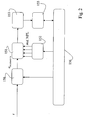
- Figure 2 shows a parallel-architecture device of a known type for implementing the third step of the cell-search procedure in TDD mode, which envisages sending the received signal r to the input of a block for extraction of the midamble 150, which extracts the part of slot in the received signal r that contains the received midamble e midamble .
- a block of correlators 151 Placed downstream of said block for extraction of the midamble 150 is a block of correlators 151, comprising four correlators.
- the part of received signal r is correlated by the block of correlators 151, within the appropriate time window, which is selected via the block for extraction of the midamble 150, with the local replicas of the four possible expected midamble codes MPL, which belong to the codegroup identified previously.
- Said four possible midamble codes MPL are supplied in parallel by an appropriate midamble-code generator 152.
- the resulting correlation energies are supplied to a unit for detection of the maximum value 153, which identifies the code provided with the highest correlation energy and sends it to a comparison block 155, in which, through a search in an appropriate look-up table, scrambling codes SCR corresponding to the cell are obtained.
- the reference number 156 designates a controller for handling the operations of the midamble-extraction block 150, of the midamble-code generator 152, and of the comparison block 155.
- the sequence or burst associated to the primary channel P-CCPCH on which the third step of the cell-search procedure is to be performed is transmitted in concomitance with the first secondary channel SSCH of each frame.
- the solutions according to the known art require allocating a certain amount of memory and, consequently, area of chip, with a consequent power consumption for implementing the sections of correlation necessary for the cell-search procedure and for the channel-estimation procedure.
- the correlator processor takes in samples from an analog front end and passes data for symbol rate processing.
- the CCP coprocessor is a processor that performs basic functions (finger, DPE, energy estimation) and generates PN and Walsh codes.
- the purpose of the present invention is to provide a solution capable of performing the functions described previously in a more compact way, so as to enable the cell-search procedure and the channel-estimation procedure to be carried out by means of a simplified hardware, reducing the computational complexity and obtaining a corresponding reduction of the memory required and of the power consumption.
- the invention also regards the corresponding apparatus, as well as the computer program product directly loadable into the memory of a computer, the said computer product comprising software code portions that perform the method according to the invention when the product is run on a computer.
- the solution according to the invention envisages simplification of the processing circuits and of the size of the memory required, moreover reducing the computational complexity.
- the solution proposed herein which is based upon a technique of recycling of the data acquired, is simpler, occupies less area, and consumes less power.
- Figure 3 illustrates a serial-architecture device for implementing the third step of the cell-search procedure according to the invention.
- the received signal r is sent at input to a multiplexer 201 and to a storage unit 202.
- a controller 206 for controlling operation of the various modules that make up said device.
- the multiplexer 201 driven by the controller 206, selects, for input to a correlator 203, the received signal r or else the output from the storage unit 202.
- the received signal r is sent directly to the correlator 203, where it is correlated with a first midamble code, which belongs to the codegroup obtained from the second step of cell search and is generated by a midamble-code generator 204 driven by the controller 206.
- the replica of the received signal r stored in the storage unit 202 is sent to the correlator 203, where it is correlated with a second midamble code, which belongs to the codegroup obtained from the second step of the cell search and is generated by the midamble-code generator 204 driven by the controller 206.
- the operation is repeated for all four midamble codes, and, in particular, for the long midamble code MPL, to obtain the corresponding energies, which enable identification, via a unit for detection of the maximum value 205 set downstream of the correlator 203 and a search in an appropriate look-up table performed in a comparison block 207, of the scrambling codes SCR corresponding to the cell.
- Figure 4 shows a device for implementing the channel-estimation procedure.
- a demultiplexer 250 divides, in the received signal r, the received midamble e midamble from the data D, under the control of appropriate control signals SC.
- the received midamble e midamble is sent at input to a multiplexer 251 and to a storage unit 252.
- the multiplexer 251 driven by the channel-estimation controller 256 selects, for input to a correlator 253, the received midamble e midamble or else the output from the storage unit 252.
- the channel-estimation controller 256 also suitably generates the control signals SC for the demultiplexer 250.
- the received midamble e midamble is sent directly to the correlator 253, where it is correlated with an expected midamble code mid generated by a midamble-code generator 254 driven by the channel-estimation controller 256.
- the correlation energy thus calculated is used to obtain the vector of channel estimates h w from a buffer of channel coefficients 255.
- the correlations of the received midamble e midamble with the delayed replicas of the expected midamble mid can be executed.
- the midamble-code generator 254 contains both the generator of short midamble MPS (256 chips) and the generator of long midamble MPL (512 chips). For use in the channel estimator, there is also introduced a small delay line from which the signal to be sent to the correlator can be appropriately tapped.
- Subsequent correlations can be carried out by sending the content of the storage unit 252 to the correlator 253.
- the received signal r is sent to a FIR filter 320 operating on the first sequence SSC for filtering a first subsequence composing the sequence SSC.
- said sequence SSC which is 256 chips long, is constructed starting from two sequences of length 16, the first one of which is common to all the sequences SSC.
- the received signal r is moreover sent to a demultiplexer 300, similar to the demultiplexer 250 of Figure 4 , which thus produces the received midamble e midamble under the control of the control signals SC.
- Said received midamble e midamble is sent at input to a multiplexer 301 and to a storage unit 302.
- a general controller 306 is moreover provided for controlling the operation of the circuit.
- the multiplexer 301 driven by the general controller 306 selects, for input to a correlator 303, the received midamble e midamble , or else the output from the storage unit 252, or else the received signal r taken downstream of the FIR filter 320.
- the received signal r is also stored in the storage unit 302.
- the multiplexer 301 Placed downstream of the multiplexer 301 is then the aforementioned correlator 303, the correlation energy of which at output is sent for a correspondence search to a buffer of the channel coefficients 305 or else to a block designated by the reference number 309 comprising a unit for detection of the maximum value, such as the unit 205 of Figure 2 for the third step or the unit 114 of Figure 1 for the second step. Also placed downstream of the multiplexer 301 is a corresponding comparison block for performing the searches in the look-up tables.
- the general controller 306 supervises, in a way similar to what has been described previously, the operation of said units and moreover drives a midamble-code generator 304 and a generator of synchronization codes 307, the outputs of which are selected via an appropriate multiplexer 308, the output of which is supplied to the correlator 303.
- Operation of the architecture represented in Figure 5 follows substantially that of the architectures of Figures 3 and 4 , appropriately sharing access to the shared hardware resources, in particular access to the correlator 303, according to different time intervals.
- the multiplexer 301 driven by the general controller 306, selects the received signal r, for its input to the correlator 303, and, subsequently, its copy stored in the storage unit 302, whilst the multiplexer 308 selects the output of the synchronization-code generator 307.
- the multiplexer 301 driven by the general controller 306, selects, for its input to the correlator 303, the received midamble e midamble coming from the demultiplexer 300 and, subsequently, its copies stored in the storage unit 302.
- the multiplexer 308 selects the output of the midamble-code generator 304.
- the multiplexer 301 driven by the general controller 306, selects, for its input to the correlator 303, the received midamble e midamble , coming from the demultiplexer 300 and, subsequently, its copies stored in the storage unit 302 for correlation with the delayed replicas of the expected midamble mid sent to the correlator 303 by the midamble-code generator 304 appropriately selected by the multiplexer 308 driven by general controller 306.
- the correspondence searches for the correlation energies, obtained from the correlator 303 in the channel-coefficients buffer 305 or in the block 309 corresponding to the steps of cell search, are likewise controlled by the general controller 306 according to an appropriate timing.
- the generated circuit proves to be, in fact, considerably smaller than known architectures.
- the solution proposed requires, instead, just one correlator and one FIR filter matched on the first sequence SSC, as well as two multiplexers, one unit for detection of the maximum value and one midamble-code generator. In terms of memory occupation, it is necessary to allocate only 6 Kb for the buffer of the channel estimator.
Landscapes
- Engineering & Computer Science (AREA)
- Computer Networks & Wireless Communication (AREA)
- Signal Processing (AREA)
- Mobile Radio Communication Systems (AREA)
- Synchronisation In Digital Transmission Systems (AREA)
Claims (15)
- Verfahren zum Ausführen einer Kanalschätzungsprozedur und einer Zellsuchprozedur gemäß einem empfangenen Signal (r) in Zellularkommunikationssystemen, wobei die Zellsuchprozedur einen ersten Schritt des Erlangens eines primären Synchronisationscodes, einen zweiten Schritt für Slotsynchronisation und Identifizierung eines Gruppencodes und einen dritten Schritt für die Identifikation von Verschlüsselungscodes aufweist, wobei die Zellsuchprozedur in dem zweiten Schritt mindestens eine erste Operation der Korrelation des empfangenen Signals (r) mit sekundären Synchronisationscodes (SSC) und in dem dritten Schritt eine zweite Operation der Korrelation des empfangenem Signals (r) mit bekannten Midamble-Codes (mid, MPL, MPS) aufweist, wobei die Kanalschätzungsprozedur eine dritte Operation der Korrelation mindestens eines Teils (emidamble ) des empfangenem Signals (r) mit bekannten Midamble-Codes (mid, MPL, MPS) aufweist, wobei die erste, zweite und dritte Korrelationsoperation durch Schicken des empfangenen Signals (r) oder mindestens eines Teils (emidamble ) des empfangenen Signals (r) an einen Eingang einer Korrelationsbank (111, 151; 203, 253; 303) ausgeführt werden, dadurch gekennzeichnet, dass die Korrelationsbank (303) nur einen Korrelator aufweist, wobei das Verfahren folgende Operationen aufweist:- Speichern (302) des empfangenen Signals (r) oder eines Teils (emidamble ) des empfangenen Signals (r) in einer gleichen Speichereinheit,- Schicken des empfangenen Signals (r) in einem ersten Zeitintervall, das dem zweiten Schritt der Zellsuchprozedur entspricht, an den nur einen Korrelator (303), um die erste Operation der Korrelation des empfangenen Signals (r) mit sekundären Synchronisationscodes (SSC) auszuführen;- Schicken mindestens eines Teils (emidamble ) des empfangenen Signals (r) in einem zweiten Zeitintervall, das dem dritten Schritt der Zellsuchprozedur entspricht, an den nur einen Korrelator (303), um die zweite Operation der Korrelation des empfangenen Signals (r) mit bekannten Midamble-Codes (mid, MPL, MPS) auszuführen;- Schicken mindestens eines Teils (emidamble ) des empfangenen Signals (r) an den nur einen Korrelator (303) in einem dritten Zeitintervall, um die dritte Operation der Korrelation mindestens eines Teils (emidemble ) des empfangenen Signals (r) mit bekannten Midamble-Codes (mid, MPL, MPS) auszuführen und um Kanalkoeffizienten (hw ) zu erlangen (305).
- Verfahren nach Anspruch 1, dadurch gekennzeichnet, dass die Operationen des Schickens eine Auswahloperation (301) zum Auswählen der Eingabe in die Korrelationsbank (303) aufweisen.
- Verfahren nach Anspruch 2, dadurch gekennzeichnet, dass es die Operation des Extrahierens (300) mindestens eines der empfangenen Midamble (emidamble ) zugeordneten Teils aus dem empfangenen Signal (r) aufweist.
- Verfahren nach mindestens einem der vorhergehenden Ansprüche, dadurch gekennzeichnet, dass es folgende Operationen vorsieht: Liefern (307) der Synchronisationscodes (SSC) an einen weiteren Eingang der Bank von Korrelatoren in dem erstem Zeitintervall; und Liefern (304) der bekannten Midamble-Codes (mid, MPL, MPS) an die Bank von Korrelatoren in dem zweiten Zeitintervall und dem dritten Zeitintervall, um die erste bzw. zweite bzw. dritte Korrelationsoperation auszuführen.
- Verfahren nach mindestens einem der vorhergehenden Ansprüche, dadurch gekennzeichnet, dass die Lieferoperationen (304, 307) eine Operation der Auswahl (308) der Eingabe (SSC, mid, MPL, MPS) in die Karrelations-bank (303) aufweisen.
- Vorrichtung zum Ausführen der Zellsuchprozedur und der Kanalschätzungsprozedur gemäß einem empfangenen Signal (r) in einem Zellularkommunikationssystem, die eine Mehrzahl von Synchronisationscodes (SSC) verwendet und darüber hinaus mindestens einen ersten Korrelator (111; 303) aufweist, der das empfangene Signal (r) und eine Mehrzahl von Synchronisationscodes (SSC) empfängt, um den zweiten Schritt der Zellsuchprozedur auszuführen, wobei die Vorrichtung ferner mindestens einen zweiten Korrelator (151; 203; 303) aufweist, der mindestens einen Teil (emidamble ) des empfangenem Signals (r) und bekannte Midamble-Codes (mid, MPL, MPS) empfängt, um den dritten Schritt der Zellsuchprozedur auszuführen, wobei die Vorrichtung ferner mindestens einen dritten Korrelator (253; 303) aufweist, der mindestens einen Teil (emidamble ) des empfangenem Signals (r) und bekannte Midamble-Codes (mid, MPL, MPS) empfängt, um die Kanalschätzungsprozedur auszuführen, um entsprechende Energiewerte zu empfangen,
dadurch gekennzeichnet, dass der erste Korrelator (111; 303), der zweite Korrelator (151; 303) und der dritte Korrelator (303) durch eine gleiche Korrelationsbank (303) erlangt werden, die nur einen Korrelator aufweist, und dadurch, dass die Vorrichtung eine Speichereinheit (302) aufweist, die dafür ausgelegt ist, das empfangene Signal (r) und die empfangene Midamble (emidamble ) zu speichern und sie unter dem Befehl eines Steuermoduls (306) als Eingabe an den mindestens einen Selektor (301) zu liefern. - Vorrichtung nach Anspruch 6, dadurch gekennzeichnet, dass sie mindestens einen Selektor (301) aufweist, der in der Lage ist, die Schaltung einer Eingabe in den einzelnen Korrelator (303) so zu steuern, dass dieser selektiv auf Basis des empfangenem Signals (r) oder mindestens eines Teils (emidamble) des empfangenen Signals (r) arbeitet.
- Vorrichtung nach Anspruch 7, dadurch gekennzeichnet, dass dem mindestens einen Selektor (301) ein Extraktionsmodul (300) zum Extrahieren mindestens eines einer empfangenen Midamble (emidamble ) zugeordneten Teils aus dem empfangenen Signal (r) vorgeschaltet ist.
- Vorrichtung nach Anspruch 7, dadurch gekennzeichnet, dass dem einzelnen Korrelator (303) Einheiten zur Bestimmung von Energiewerte (305; 309) zum Suchen von mindestens einem Maximalwert zwischen den Energiewerten und zum Identifizieren einer gegebenen Anzahl der Midamble-Codes (mid, MPL, MPS) oder Synchronisations-Codes (SSC) gemäß dem mindestens einen Maximalwert nachgeschaltet sind.
- Vorrichtung nach Anspruch 9, dadurch gekennzeichnet, dass sie einen Midamble-Code-Generator (304) und einen Synchronisationscode-Generator (307) aufweist, die über mindestens einen entsprechenden Selektor (308) parallel zu dem einzelnen Korrelator geschaltet sind.
- Vorrichtung nach Anspruch 10, dadurch gekennzeichnet, dass das empfangene Signal (r) parallel an das mindestens eine Extraktionsmodul (300) zum Extrahieren mindestens eines einer empfangenen Midamble (emidamble ) zugeordneten Teils aus dem empfangenen Signal (r) und an einen FIR-Filter (320), das dafür ausgelegt ist, den primären Synchronisationscode zu erlangen, geschickt wird, und dadurch, dass die Ausgabe des FIR-Filters (320) als Eingabe an den mindestens einen Selektor (301) geschickt wird.
- Vorrichtung nach einem der Ansprüche 6 bis 11, dadurch gekennzeichnet, dass das Steuermodul (306) dafür ausgelegt ist, auch den mindestens einen Selektor (301), den mindestens einen entsprechenden Selektor (302), den Midamble-Code-Generator (304) und den Synchronisationscode-Generator (307) und die Einheiten zur Bestimmung von Energiewerten (305; 309) zu steuern, um die Zellsuchprozedur und die Kanalschätzungsprozedur gemäß einer eindeutigen Zeitsteuerung auszuführen.
- Vorrichtung nach einem der vorhergehenden Ansprüche 6 bis 12, die zum Empfangen eines Signals in Übereinstimmung mit dem 3GPP-Standard im TDD-Modus konfiguriert ist.
- Vorrichtung nach einem der Ansprüche 6 bis 13, die in einem Empfänger für eine Telekommunikationsvorrichtung enthalten ist, die auf einem Standard aus der Gruppe, die aus 3 GPP TDD UMTS, CDMA2000, IS95, WBCDMA besteht, basiert.
- Computerprogrammprodukt, das direkt in den Speicher eines Computers ladbar ist und Softwarecodeteile aufweist, die dafür ausgebildet sind, das Verfahren nach einem der Ansprüche 1 bis 5 auszuführen, wenn das Produkt auf einem Computer läuft.
Priority Applications (4)
| Application Number | Priority Date | Filing Date | Title |
|---|---|---|---|
| DE602004018260T DE602004018260D1 (de) | 2004-02-06 | 2004-02-06 | Verfahren und Vorrichtung zur Kanalschätzung und Zellsuche in einem zellularen Nachrichtentechniksystem und entsprechendes Software Produkt. |
| EP04425077A EP1562298B1 (de) | 2004-02-06 | 2004-02-06 | Verfahren und Vorrichtung zur Kanalschätzung und Zellsuche in einem zellularen Nachrichtentechniksystem und entsprechendes Software Produkt. |
| PCT/IB2005/000121 WO2005083896A1 (en) | 2004-02-06 | 2005-01-14 | Method and apparatus for channel estimation and cell search in cellular communication systems, and corresponding computer program product |
| US11/051,561 US7480354B2 (en) | 2004-02-06 | 2005-02-04 | Method and apparatus for channel estimation and cell search in cellular communication systems, and corresponding computer program product |
Applications Claiming Priority (1)
| Application Number | Priority Date | Filing Date | Title |
|---|---|---|---|
| EP04425077A EP1562298B1 (de) | 2004-02-06 | 2004-02-06 | Verfahren und Vorrichtung zur Kanalschätzung und Zellsuche in einem zellularen Nachrichtentechniksystem und entsprechendes Software Produkt. |
Publications (3)
| Publication Number | Publication Date |
|---|---|
| EP1562298A1 EP1562298A1 (de) | 2005-08-10 |
| EP1562298A8 EP1562298A8 (de) | 2005-11-09 |
| EP1562298B1 true EP1562298B1 (de) | 2008-12-10 |
Family
ID=34673769
Family Applications (1)
| Application Number | Title | Priority Date | Filing Date |
|---|---|---|---|
| EP04425077A Expired - Lifetime EP1562298B1 (de) | 2004-02-06 | 2004-02-06 | Verfahren und Vorrichtung zur Kanalschätzung und Zellsuche in einem zellularen Nachrichtentechniksystem und entsprechendes Software Produkt. |
Country Status (4)
| Country | Link |
|---|---|
| US (1) | US7480354B2 (de) |
| EP (1) | EP1562298B1 (de) |
| DE (1) | DE602004018260D1 (de) |
| WO (1) | WO2005083896A1 (de) |
Families Citing this family (4)
| Publication number | Priority date | Publication date | Assignee | Title |
|---|---|---|---|---|
| JP4388943B2 (ja) * | 2006-10-23 | 2009-12-24 | Okiセミコンダクタ株式会社 | 相関器 |
| CN101562822B (zh) * | 2008-04-16 | 2011-08-03 | 大唐移动通信设备有限公司 | 基站间不同步的检测方法及装置 |
| KR101447651B1 (ko) * | 2008-07-07 | 2014-10-13 | 삼성전자주식회사 | 이동통신 시스템의 유효 비트 연산 장치 및 방법 |
| US20100278167A1 (en) * | 2009-05-04 | 2010-11-04 | Qualcomm Incorporated | Method and system for data-aided channel estimation |
Family Cites Families (3)
| Publication number | Priority date | Publication date | Assignee | Title |
|---|---|---|---|---|
| US6765894B1 (en) * | 1999-07-05 | 2004-07-20 | Matsushita Electric Industrial Co, Ltd. | Communication terminal apparatus and base station apparatus |
| JP3394530B2 (ja) * | 2001-08-07 | 2003-04-07 | 松下電器産業株式会社 | セルサーチ装置およびセルサーチ方法 |
| KR100421585B1 (ko) * | 2001-10-25 | 2004-03-09 | 한국전자통신연구원 | 시간분할 듀플렉스 시스템에서 이동국의 셀 탐색 시스템및 그 방법 |
-
2004
- 2004-02-06 EP EP04425077A patent/EP1562298B1/de not_active Expired - Lifetime
- 2004-02-06 DE DE602004018260T patent/DE602004018260D1/de not_active Expired - Lifetime
-
2005
- 2005-01-14 WO PCT/IB2005/000121 patent/WO2005083896A1/en not_active Ceased
- 2005-02-04 US US11/051,561 patent/US7480354B2/en active Active
Also Published As
| Publication number | Publication date |
|---|---|
| US20050227725A1 (en) | 2005-10-13 |
| WO2005083896A1 (en) | 2005-09-09 |
| EP1562298A1 (de) | 2005-08-10 |
| EP1562298A8 (de) | 2005-11-09 |
| US7480354B2 (en) | 2009-01-20 |
| DE602004018260D1 (de) | 2009-01-22 |
Similar Documents
| Publication | Publication Date | Title |
|---|---|---|
| JP3860134B2 (ja) | 移動通信システムでマルチ探索を提供するセル探索装置および方法 | |
| EP1065796B1 (de) | Basisstationssystem mit parallelem Interferenzunterdrückungsprozessor | |
| JP3473575B2 (ja) | Cdma移動通信装置及びそれに用いる基地局検出方法 | |
| KR100584337B1 (ko) | 이동통신 시스템에서 셀 탐색 및 다중경로 탐색 장치 및방법 | |
| US8761081B2 (en) | Method and apparatus for cell searching in asynchronous CDMA systems | |
| JP4664286B2 (ja) | Cdma受信機、受信信号の相関をとるための装置及び方法 | |
| JP2007531330A (ja) | 周波数オフセットのあるパイロット信号をマルチステージ相関器を用いて検出する方法および装置 | |
| US7386006B2 (en) | Process and device for synchronization and codegroup identification in cellular communication systems and computer program therefor | |
| US7480354B2 (en) | Method and apparatus for channel estimation and cell search in cellular communication systems, and corresponding computer program product | |
| KR100652373B1 (ko) | Psc 및 ssc에 대한 공통적인 부분 상관을 이용하는광대역 cdma 셀 탐색기 및 그 방법 | |
| JP2004229305A (ja) | Wcdmaシステムでのセル探索の方法および装置 | |
| KR101157108B1 (ko) | 메모리 아키텍처를 사용하여 1차 셀을 검색하기 위한 상관기 | |
| EP1422832B1 (de) | Verfahren und Vorrichtung zur Synchronisierung und Identifizierung der Kodengruppe in zellularen CDMA-Übertragungssystemen | |
| EP1429467B1 (de) | Verfahren und Vorrichtung zur Synchronisation und Kodegruppenidentifizierung in einem zellularen Kommunikationssystem, sowie Computerprogramm dafür | |
| EP1555763A1 (de) | Anordnung und Verfahren zur drahtlosen Kommunikation | |
| EP1117189B1 (de) | Verfahren und Vorrichtung zur Entspreizung von CDMA-Signalen | |
| KR100618331B1 (ko) | 이동통신시스템에서 초기 탐색 장치 및 방법 | |
| JP2861987B2 (ja) | マルチユーザ−シリアル干渉キャンセラ装置およびその方法 | |
| Mishra | Performance Enhancements to the WCDMA Cell Search Algorithms | |
| KR100311528B1 (ko) | 기지국 탐색 방법 및 그를 위한 수신 장치 | |
| JP2002158614A (ja) | Cdma受信装置 | |
| Mishra | Performance Analysis of 3-stage Cell search Process in a WCDMA System | |
| HK1115012A (en) | Correlator for primary cell search using memory architecture | |
| KR20010028884A (ko) | 고속 다중 경로 획득 방법 및 그를 위한 수신 장치 |
Legal Events
| Date | Code | Title | Description |
|---|---|---|---|
| PUAI | Public reference made under article 153(3) epc to a published international application that has entered the european phase |
Free format text: ORIGINAL CODE: 0009012 |
|
| AK | Designated contracting states |
Kind code of ref document: A1 Designated state(s): AT BE BG CH CY CZ DE DK EE ES FI FR GB GR HU IE IT LI LU MC NL PT RO SE SI SK TR |
|
| AX | Request for extension of the european patent |
Extension state: AL LT LV MK |
|
| RTI1 | Title (correction) |
Free format text: METHOD FOR CHANNEL ESTIMATION AND CELL SEARCH IN CELLULAR COMMUNICATION SYSTEMS AND APPARATUS THEREFOR |
|
| 17P | Request for examination filed |
Effective date: 20060103 |
|
| AKX | Designation fees paid |
Designated state(s): DE FR GB IT |
|
| 17Q | First examination report despatched |
Effective date: 20070125 |
|
| GRAP | Despatch of communication of intention to grant a patent |
Free format text: ORIGINAL CODE: EPIDOSNIGR1 |
|
| GRAS | Grant fee paid |
Free format text: ORIGINAL CODE: EPIDOSNIGR3 |
|
| GRAS | Grant fee paid |
Free format text: ORIGINAL CODE: EPIDOSNIGR3 |
|
| GRAA | (expected) grant |
Free format text: ORIGINAL CODE: 0009210 |
|
| AK | Designated contracting states |
Kind code of ref document: B1 Designated state(s): DE FR GB IT |
|
| REG | Reference to a national code |
Ref country code: GB Ref legal event code: FG4D |
|
| REF | Corresponds to: |
Ref document number: 602004018260 Country of ref document: DE Date of ref document: 20090122 Kind code of ref document: P |
|
| PLBE | No opposition filed within time limit |
Free format text: ORIGINAL CODE: 0009261 |
|
| STAA | Information on the status of an ep patent application or granted ep patent |
Free format text: STATUS: NO OPPOSITION FILED WITHIN TIME LIMIT |
|
| 26N | No opposition filed |
Effective date: 20090911 |
|
| REG | Reference to a national code |
Ref country code: FR Ref legal event code: ST Effective date: 20091030 |
|
| PG25 | Lapsed in a contracting state [announced via postgrant information from national office to epo] |
Ref country code: FR Free format text: LAPSE BECAUSE OF NON-PAYMENT OF DUE FEES Effective date: 20090302 |
|
| PG25 | Lapsed in a contracting state [announced via postgrant information from national office to epo] |
Ref country code: IT Free format text: LAPSE BECAUSE OF FAILURE TO SUBMIT A TRANSLATION OF THE DESCRIPTION OR TO PAY THE FEE WITHIN THE PRESCRIBED TIME-LIMIT Effective date: 20081210 |
|
| PGFP | Annual fee paid to national office [announced via postgrant information from national office to epo] |
Ref country code: DE Payment date: 20110207 Year of fee payment: 8 |
|
| PGFP | Annual fee paid to national office [announced via postgrant information from national office to epo] |
Ref country code: GB Payment date: 20110128 Year of fee payment: 8 |
|
| GBPC | Gb: european patent ceased through non-payment of renewal fee |
Effective date: 20120206 |
|
| REG | Reference to a national code |
Ref country code: DE Ref legal event code: R119 Ref document number: 602004018260 Country of ref document: DE Effective date: 20120901 |
|
| PG25 | Lapsed in a contracting state [announced via postgrant information from national office to epo] |
Ref country code: GB Free format text: LAPSE BECAUSE OF NON-PAYMENT OF DUE FEES Effective date: 20120206 |
|
| PG25 | Lapsed in a contracting state [announced via postgrant information from national office to epo] |
Ref country code: DE Free format text: LAPSE BECAUSE OF NON-PAYMENT OF DUE FEES Effective date: 20120901 |