EP1561727A1 - Fällungskieselsäure für Entschäumerformulierungen - Google Patents
Fällungskieselsäure für Entschäumerformulierungen Download PDFInfo
- Publication number
- EP1561727A1 EP1561727A1 EP04107016A EP04107016A EP1561727A1 EP 1561727 A1 EP1561727 A1 EP 1561727A1 EP 04107016 A EP04107016 A EP 04107016A EP 04107016 A EP04107016 A EP 04107016A EP 1561727 A1 EP1561727 A1 EP 1561727A1
- Authority
- EP
- European Patent Office
- Prior art keywords
- precipitated silica
- suspension
- silica
- precipitated
- der
- Prior art date
- Legal status (The legal status is an assumption and is not a legal conclusion. Google has not performed a legal analysis and makes no representation as to the accuracy of the status listed.)
- Granted
Links
Images


Classifications
-
- E—FIXED CONSTRUCTIONS
- E01—CONSTRUCTION OF ROADS, RAILWAYS, OR BRIDGES
- E01B—PERMANENT WAY; PERMANENT-WAY TOOLS; MACHINES FOR MAKING RAILWAYS OF ALL KINDS
- E01B23/00—Easily dismountable or movable tracks, e.g. temporary railways; Details specially adapted therefor
- E01B23/02—Tracks for light railways, e.g. for field, colliery, or mine use
- E01B23/06—Switches; Portable switches; Turnouts
-
- C—CHEMISTRY; METALLURGY
- C09—DYES; PAINTS; POLISHES; NATURAL RESINS; ADHESIVES; COMPOSITIONS NOT OTHERWISE PROVIDED FOR; APPLICATIONS OF MATERIALS NOT OTHERWISE PROVIDED FOR
- C09C—TREATMENT OF INORGANIC MATERIALS, OTHER THAN FIBROUS FILLERS, TO ENHANCE THEIR PIGMENTING OR FILLING PROPERTIES ; PREPARATION OF CARBON BLACK ; PREPARATION OF INORGANIC MATERIALS WHICH ARE NO SINGLE CHEMICAL COMPOUNDS AND WHICH ARE MAINLY USED AS PIGMENTS OR FILLERS
- C09C1/00—Treatment of specific inorganic materials other than fibrous fillers; Preparation of carbon black
- C09C1/28—Compounds of silicon
- C09C1/30—Silicic acid
-
- B—PERFORMING OPERATIONS; TRANSPORTING
- B01—PHYSICAL OR CHEMICAL PROCESSES OR APPARATUS IN GENERAL
- B01D—SEPARATION
- B01D19/00—Degasification of liquids
- B01D19/02—Foam dispersion or prevention
- B01D19/04—Foam dispersion or prevention by addition of chemical substances
- B01D19/0404—Foam dispersion or prevention by addition of chemical substances characterised by the nature of the chemical substance
- B01D19/0409—Foam dispersion or prevention by addition of chemical substances characterised by the nature of the chemical substance compounds containing Si-atoms
-
- C—CHEMISTRY; METALLURGY
- C01—INORGANIC CHEMISTRY
- C01B—NON-METALLIC ELEMENTS; COMPOUNDS THEREOF; METALLOIDS OR COMPOUNDS THEREOF NOT COVERED BY SUBCLASS C01C
- C01B33/00—Silicon; Compounds thereof
- C01B33/113—Silicon oxides; Hydrates thereof
- C01B33/12—Silica; Hydrates thereof, e.g. lepidoic silicic acid
- C01B33/18—Preparation of finely divided silica neither in sol nor in gel form; After-treatment thereof
- C01B33/187—Preparation of finely divided silica neither in sol nor in gel form; After-treatment thereof by acidic treatment of silicates
- C01B33/193—Preparation of finely divided silica neither in sol nor in gel form; After-treatment thereof by acidic treatment of silicates of aqueous solutions of silicates
-
- C—CHEMISTRY; METALLURGY
- C09—DYES; PAINTS; POLISHES; NATURAL RESINS; ADHESIVES; COMPOSITIONS NOT OTHERWISE PROVIDED FOR; APPLICATIONS OF MATERIALS NOT OTHERWISE PROVIDED FOR
- C09C—TREATMENT OF INORGANIC MATERIALS, OTHER THAN FIBROUS FILLERS, TO ENHANCE THEIR PIGMENTING OR FILLING PROPERTIES ; PREPARATION OF CARBON BLACK ; PREPARATION OF INORGANIC MATERIALS WHICH ARE NO SINGLE CHEMICAL COMPOUNDS AND WHICH ARE MAINLY USED AS PIGMENTS OR FILLERS
- C09C1/00—Treatment of specific inorganic materials other than fibrous fillers; Preparation of carbon black
- C09C1/28—Compounds of silicon
- C09C1/30—Silicic acid
- C09C1/3009—Physical treatment, e.g. grinding; treatment with ultrasonic vibrations
- C09C1/3018—Grinding
-
- C—CHEMISTRY; METALLURGY
- C01—INORGANIC CHEMISTRY
- C01P—INDEXING SCHEME RELATING TO STRUCTURAL AND PHYSICAL ASPECTS OF SOLID INORGANIC COMPOUNDS
- C01P2004/00—Particle morphology
- C01P2004/60—Particles characterised by their size
- C01P2004/61—Micrometer sized, i.e. from 1-100 micrometer
-
- C—CHEMISTRY; METALLURGY
- C01—INORGANIC CHEMISTRY
- C01P—INDEXING SCHEME RELATING TO STRUCTURAL AND PHYSICAL ASPECTS OF SOLID INORGANIC COMPOUNDS
- C01P2006/00—Physical properties of inorganic compounds
- C01P2006/10—Solid density
-
- C—CHEMISTRY; METALLURGY
- C01—INORGANIC CHEMISTRY
- C01P—INDEXING SCHEME RELATING TO STRUCTURAL AND PHYSICAL ASPECTS OF SOLID INORGANIC COMPOUNDS
- C01P2006/00—Physical properties of inorganic compounds
- C01P2006/11—Powder tap density
-
- C—CHEMISTRY; METALLURGY
- C01—INORGANIC CHEMISTRY
- C01P—INDEXING SCHEME RELATING TO STRUCTURAL AND PHYSICAL ASPECTS OF SOLID INORGANIC COMPOUNDS
- C01P2006/00—Physical properties of inorganic compounds
- C01P2006/12—Surface area
-
- C—CHEMISTRY; METALLURGY
- C01—INORGANIC CHEMISTRY
- C01P—INDEXING SCHEME RELATING TO STRUCTURAL AND PHYSICAL ASPECTS OF SOLID INORGANIC COMPOUNDS
- C01P2006/00—Physical properties of inorganic compounds
- C01P2006/19—Oil-absorption capacity, e.g. DBP values
-
- E—FIXED CONSTRUCTIONS
- E01—CONSTRUCTION OF ROADS, RAILWAYS, OR BRIDGES
- E01B—PERMANENT WAY; PERMANENT-WAY TOOLS; MACHINES FOR MAKING RAILWAYS OF ALL KINDS
- E01B2201/00—Fastening or restraining methods
- E01B2201/04—Fastening or restraining methods by bolting, nailing or the like
-
- E—FIXED CONSTRUCTIONS
- E01—CONSTRUCTION OF ROADS, RAILWAYS, OR BRIDGES
- E01B—PERMANENT WAY; PERMANENT-WAY TOOLS; MACHINES FOR MAKING RAILWAYS OF ALL KINDS
- E01B2202/00—Characteristics of moving parts of rail systems, e.g. switches, special frogs, tongues
- E01B2202/02—Nature of the movement
- E01B2202/021—Turning or tilting or elastically bending
- E01B2202/022—Turning or tilting or elastically bending about horizontal axis
-
- E—FIXED CONSTRUCTIONS
- E01—CONSTRUCTION OF ROADS, RAILWAYS, OR BRIDGES
- E01B—PERMANENT WAY; PERMANENT-WAY TOOLS; MACHINES FOR MAKING RAILWAYS OF ALL KINDS
- E01B2202/00—Characteristics of moving parts of rail systems, e.g. switches, special frogs, tongues
- E01B2202/08—Locking devices or mechanisms for inhibiting movement
Definitions
- the present invention relates to high pH hydrophilic precipitated silicas and low silanol group density, a process for their preparation, and their use.
- Hydrophilic precipitated silicas and processes for their preparation are known.
- the precipitation of the silica takes place by simultaneous addition of a Alkali metal or alkaline earth metal silicate and an acidulant in a template from water or silicate solution.
- the pH of the obtained Suspension for the purpose of preventing the progress of the reaction by adding Acidity adjusted to values between 2 and 4, then filtered, dried and the dried silica optionally ground.
- the resulting precipitated silicic acids then indicate at the end of Production process a roughly neutral pH, d. H. pH values between 6 and 8 on. Examples of such precipitations can be found in EP 0 647 591 and EP 0 901 986.
- WO 2003014020 are precipitated silicas having a pH of at least 9.5 proposed as support materials.
- WO 2003014020 teaches that the hydrophilic precipitated silicas with a pH of at least 9.5 have to be rendered hydrophobic before being used as a component in Defoamer formulations can be used.
- hydrophilic and hydrophobic precipitated silicas in Defoamer formulations are also known (Series Pigments, No. 42, DEGUSSA, 06/1986).
- the use in defoamer formulations starts the precipitated silicas used have high requirements. So they should be easy and be well dispersible in the defoamer formulation, at a rapid knock-down time (Response time), complete knock-down (immediate effect) and long hold-down (Lifetime) lead.
- the parameter "knock-down” describes the ability of the Defoamer, the foam height immediately after addition to a certain To reduce foam height. The hold-down characterizes the service life of the Defoamer, d. H. the duration of effectiveness.
- the time is measured until a certain level of foam is recovered.
- the characterizes the Knock-down time the time taken to reach the knock-down the foam maximum passes.
- Precipitated silicas of the prior art indicate for the mentioned parameters or at least some of the mentioned parameters unsatisfactory values.
- the object of the present invention was therefore novel precipitated silicas to provide the very good performance properties, in particular in defoamer formulations. Furthermore, a method is provided be prepared with which the precipitated silicas according to the invention can.
- the present invention relates to hydrophilic, low-silanol group density alkaline precipitated silicas characterized by the following physicochemical parameters: BET 100-190 m 2 / g Modified Sears number 8 - 20 ml / (5g) Sears number / BET ratio ⁇ 0.12 ml / (5m 2 ) PH value > 8
- the invention also provides hydrophilic precipitated silicas which, in addition to the parameters mentioned, independently of one another, have one or more of the following physico-chemical parameters: CTAB 100-190 m 2 / g BET / CTAB ratio 0.8 - 1.2 DBP ⁇ 300g / (100g) Average particle size d 50 ⁇ 14 ⁇ m tapped density ⁇ 150 g / l loss on ignition 2 - 6% loss on drying 1 - 6%
- the invention further relates to the use of the invention Precipitated silicas, in particular in defoamer formulations.
- the precipitated silicas according to the invention have the following physico-chemical parameters: BET 100-190 m 2 / g Modified Sears number 8 - 20 ml / (5g) Sears number / BET ratio ⁇ 0.12 ml / (5m 2 ) PH value > 8 on. You can also optionally have one or more of the following physico-chemical parameters independently of one another: CTAB 100-190 m 2 / g BET / CTAB ratio 0.8 - 1.2 DBP ⁇ 300g / (100g) Average particle size d 50 ⁇ 14 ⁇ m tapped density ⁇ 150 g / l loss on ignition 2 - 6% loss on drying 1 - 6%
- the precipitated silicas according to the invention preferably have a BET surface area of 120-190 m 2 / g, particularly preferably 125-175 m 2 / g, very particularly preferably 135-175 m 2 / g and in particular 140-175 m 2 / g.
- the precipitated silicas according to the invention may have CTAB surface areas which are preferably 120-190 m 2 / g and very particularly preferably 125-175 m 2 / g.
- the BET / CTAB ratio of the precipitated silicas according to the invention can be in the preferred range from 0.9 to 1.2 and particularly preferably 0.9 to 1.15, furthermore they can have a preferred oil yield DBP of 180-260 g / (100 g).
- the pH of the silica according to the invention is preferably between 8 and 10, particularly preferably from 8.5 to 10 and in particular from greater than or equal to 8.5 to less than 9.5.
- the modified Sears number of the precipitated silicas according to the invention is preferably 8-16 ml / (5 g), particularly preferably 8-15 ml / (5 g), very particularly preferably 9-14 ml / (5 g) and in particular 10-14 ml / (5g).
- Hydrophilic centers can only be formed on the silica surface where silanol groups were present prior to treatment with the basic component. In order not to over-emphasize the hydrophilic character of the silica, it is important that the precipitated silica according to the invention has a low silanol group density. This silanol group density can be expressed by the Sears number / BET ratio.
- the precipitated silicas of the invention preferably have a Sears number / BET ratio of ⁇ 0.11 ml / (5m 2 ), more preferably ⁇ 0.1 ml / (5m 2 ), most preferably 0.07 to 0.11 ml / (5m 2 ) and 0.07 to 0.1 ml / (5m 2 ).
- the average particle size d 50 which is the prerequisite for a good and homogeneous incorporation into the antifoam formulation, is preferably ⁇ 10 .mu.m, particularly preferably ⁇ 7.5 .mu.m, very particularly preferably ⁇ 6 .mu.m and in particular ⁇ 5 .mu.m.
- the precipitated silicas of the invention may have a preferred tamped density of ⁇ 100 g / l, more preferably ⁇ 80 g / l and ⁇ 70 g / l and a preferred loss on ignition of 2-4%.
- the alkalized precipitated silica is finally ground in step f).
- step b) the precipitation suspension is filtered and the filter cake is washed.
- the Filtration of the precipitate suspension previously prepared and washing the filter cake be with known methods such. B. by filtration with a Membrane filter press (Ullmann's Encyclopedia of industrial chemistry, 1992, 5th edition, vol. B1, page 10-1 - 10-59).
- To wash the filter cake is preferably used deionized water.
- the resulting filter cake has a Solid content of 13 to 25%, preferably 15 to 17%.
- the filter cake is liquefied.
- the filter cake is added by adding Water, preferably deionized water and with stirring, liquefied.
- step c) is performed together with step e) carried out.
- the liquefaction of the filter cake takes place with the addition of Water, preferably deionized water, and with stirring.
- Steps: c) + e)) or subsequent addition steps: c) -> e)
- one or more basic components the pH of the suspension to values between 7 and 11, desirably greater than 8, preferably between 8 - 10.5, 8 and 10 and more preferably adjusted to values of 8 to less than 9.5.
- the suspension obtained has a solids content of 6 to 20%, preferably from 6 to 17%, particularly preferably from 6 to 11%.
- the suspension obtained from the previous process stages is dried in step d).
- many methods of drying are known to those skilled in the art (Ullmann's Encyclopedia of Industrial Chemistry, 1992, 5th edition, vol. B1, page 7-21-7-25). Drying by means of a stream dryer, spray dryer, staged dryer, belt dryer, rotary tube dryer, flash dryer, spin-flash dryer or nozzle tower have proved to be advantageous. Particularly preferably, the drying takes place by means of spray dryer or nozzle tower.
- the basic component is after drying in a mixing unit, e.g. low-shear plowshare mixers like z. B. Lödige mixer sprayed onto the precipitated silica.
- a mixing unit e.g. low-shear plowshare mixers like z. B. Lödige mixer sprayed onto the precipitated silica.
- the pH of the precipitated silica is in this Fall to a value between 7 and 11, favorably greater than 8, preferably between 8 and 10, more preferably between 8.5 and 10, in particular larger set equal to 8.5 and less than 9.5.
- step e alkali hydroxides or carbonates, Alkaline earth hydroxides or carbonates, alkali oxides, alkaline earth oxides, alkali silicates, Alkaline earth silicates, ammonia and alkali aluminates or aqueous solutions or Mixtures of said bases are used. Preference is given to sodium hydroxide solution and Used potassium hydroxide.
- step e) If the alkalization is carried out in step e) after step d), then follows preferably a further drying step.
- the milling and screening of precipitated silicas is carried out by known methods (Ullmann's Encyclopedia of Industrial Chemistry, 1992, 5th edition, vol. B1, page 5-20 - 5-39).
- the precipitated silica according to the invention can be ground to the desired final fineness on various mills, such as, for example, impact mill, air jet mill or counterjet mill.
- the sighting can be done during or after the grinding.
- the hydrophobic precipitated silicas according to the invention are ground to an average particle size d 50 of ⁇ 14 ⁇ m, preferably ⁇ 10 ⁇ m, more preferably ⁇ 7.5 ⁇ m, very preferably ⁇ 6 ⁇ m and in particular ⁇ 5 ⁇ m.
- the precipitated silicas according to the invention are preferably used in Defoamer formulations used to avoid heavy foaming.
- the silicas according to the invention can be used in all fields of application are used, in which usually silicas are used, such as. B. as a reinforcing filler in silicone rubber formulations, in HTV silicone rubber as a whitening additive in peroxide crosslinking systems, as Flow aids, in battery separators, as an anti-blocking agent, as a matting agent in Colors and paints, as a carrier z.
- silicas are used in all fields of application are used, in which usually silicas are used, such as. B. as a reinforcing filler in silicone rubber formulations, in HTV silicone rubber as a whitening additive in peroxide crosslinking systems, as Flow aids, in battery separators, as an anti-blocking agent, as a matting agent in Colors and paints, as a carrier z.
- silicas are used, such as. B. as a reinforcing filler in silicone rubber formulations, in HTV silicone rubber as a whitening additive in peroxid
- the physical / chemical data of the precipitated silicas according to the invention are determined by the following methods:
- BET surface area The specific nitrogen surface area (hereinafter called BET surface area) of powdered, spherical or granular silica is in accordance with ISO 5794-1 / Annex D determined with an Areameter (Ströhlein, JUWE).
- CTAB specific surface area
- CTAB N-hexadecyl-N, N, N-trimethylammonium bromide
- ASTM 3765 or NFT 45-007 Chapter 5.12.1.3
- the adsorption of CTAB takes place in aqueous solution with stirring and ultrasound treatment.
- Excess unadsorbed CTAB is determined by back-titration with NDSS (dioctyl sodium sulphosuccinate solution, "Aerosol OT" solution) with a Titroprocessor, the endpoint being given by the maximum turbidity of the solution and being determined with a phototrode.
- NDSS dioctyl sodium sulphosuccinate solution, "Aerosol OT" solution
- Titroprocessor Titroprocessor
- NDSS 0.00423 mol / l in deionized water
- the consumption of NDSS solution for the titration of 5 ml of CTAB solution should be checked once a day before each series of measurements.
- the phototrode is set to 1000 ⁇ 20 mV before the beginning of the titration (corresponding to a transparency of 100%).
- Exactly 5.00 ml of CTAB solution are pipetted into a titration beaker and 50.0 ml of deionized water are added.
- the titration with NDSS solution is carried out according to the well-known measurement method with the Titroprozessor DL 55 to the max. Turbidity of the solution.
- the consumption V A of NDSS solution in ml is determined.
- Each titration is to be carried out in triplicate.
- the titration vessel is closed with a lid and stirred with an Ultra Turrax T 25 stirrer (stirring shaft KV-18G, 18 mm diameter) at 18,000 rpm for a maximum of 1 minute until completely wetted.
- CTAB (not humidity corrected ) V A - V B V A * C CTAB * T 1 * P e
- CTAB CTAB ( not humidity corrected ) in m 2 / G * 100 100 - Humidity in %
- the moisture of the silica is determined according to the method described below "Determination of moisture or dry loss" determined.
- the method based on DIN EN ISO 787-9 is used to determine the pH of an aqueous suspension of silicas at 20 ° C.
- the pH meter Kernick, type: 766 pH meter Calimatic with temperature sensor
- the pH electrode combination electrode from Schott, type N7680
- the calibration function should be selected such that the two buffer solutions used include the expected pH of the sample (buffer solutions with pH 4.00 and 7.00, pH 7.00 and pH 9.00 and possibly pH 7.00 and 12.00).
- the electrode is first rinsed with deionized water, subsequently with a part of the suspension and then immersed in the suspension. After addition of a magnetic fish in the suspension, the pH measurement is carried out at a constant stirring speed with slight trom the suspension. After exactly 5 minutes, the pH is read on the display.
- the DBP uptake is defined for anhydrous, dried silica. If moist precipitated silicas are used, the correction value K must be taken into account for calculating the DBP absorption. This value can be determined from the following correction table, eg. For example, a water content of the silica of 5.8% would mean a 33 g / (100 g) addition for DBP uptake.
- the moisture content of the silica is determined according to the following method "Determination of moisture or dry loss".
- the modified Sears number (hereinafter called Sears number V 2 ) can be determined as a measure of the number of free hydroxyl groups.
- the determination method is based on the following chemical reactions, where "Si" -OH is intended to symbolize a silanol group of the silica: 10.00 g of a powdery, spherical or granular silica with 5 ⁇ 1% moisture are comminuted for 60 seconds with an IKA universal mill M 20 (550 W, 20 000 U / min).
- the moisture content of the starting material must be set by drying at 105 ° C in a drying oven or even moistening and the crushing be repeated.
- the pH meter (Knick, type: 766 Calimatic pH meter with temperature sensor) and the pH electrode (Schott type combination electrode, type N7680) are calibrated using buffer solutions (pH 7.00 and 9.00) at room temperature.
- the initial pH of the suspension is first measured at 25 ° C, then depending on the result with potassium hydroxide solution (0.1 mol / l) or hydrochloric acid solution (0.1 mol / l) of the pH on Set to 6.00.
- the consumption of KOH or HCI solution in ml to pH 6.00 corresponds to V 1 '.
- Hydrophobic silicas and silicates can be made by adding methanol make water wettable. This is done by methanol - water - mixtures different concentration. It can be so statements about the Hydrophob istsgrad of silicas or silicates meet.
- the individual measuring points give a curve (x-axis: percentage of methanol in the methanol / water mixtures, y-axis: height of the sediment), whose position and steepness characterize the degree of hydrophobicity of the precipitated silica.
- the x-axis value (in%) is given at the inflection point of the curve.
- the application of laser diffraction to determine particle sizes is based on the appearance that particles monochromatic light with different Scatter intensity patterns in all directions. This scattering is dependent on the Particle size. The smaller the particles, the larger the scattering angles.
- the laser diffraction apparatus LS 230 (COULTER Co.) and the liquid module (Small Volume Module Plus, 120 ml, COULTER Co.) are allowed to warm up for 2 h and the module is rinsed three times with ethanol. Offset measurement and adjustment are automatically performed by the device every hour.
- the pump speed is set to 50%. In principle, a background measurement is automatically performed before each measurement.
- a disposable pipette is rinsed three times before each sampling with the suspension. About 2 ml of the suspension are removed with the pipette and 1 - 3 drops are immediately metered into the liquid module of the device. The rest in the disposable pipette is returned to the beaker. After the addition, the system waits until the laser diffraction device indicates a constant concentration. It is added suspension until a light absorption of 8 to 12% is reached and the device reports "OK". The measurement takes place at room temperature with the evaluation model of the above defined .rfd file. First, a particle measurement is performed without ultrasound.
- the software calculates the particle size distribution from the raw data curve taking into account the Mie theory and the optical model parameters (.rfd file).
- the solids content of the precipitation suspension is gravimetrically after filtration of the sample certainly.
- the moisture or dry loss (TV) of silicic acids is determined in accordance with ISO 787-2 after 2 hours of drying at 105 ° C. This drying loss consists predominantly of water moisture.
- a dry weighing glass with ground cover (diameter 8 cm, height 3 cm) 10 g of powdery, spherical or granular silica are weighed to exactly 0.1 mg (weight E). The sample is dried with the lid open for 2 h at 105 ⁇ 2 ° C in a drying oven. The weighing glass is then closed and cooled to room temperature in a desiccator cabinet with silica gel as drying agent.
- the weighing glass is weighed to the nearest 0.1 mg to determine the weight A on the precision balance.
- the weight loss of silica is determined based on DIN EN ISO 3262-1 at 1000 ° C. At this temperature escapes physically and chemically bound water and other volatile components.
- the moisture content (TV) of the tested sample is determined according to the previously described method "Determination of moisture or dry loss" based on DIN EN ISO 787-2.
- 0.5 g of the powdery, spherical or granular silica are weighed to 0.1 mg exactly in a pre-annealed, tared porcelain crucible (weight E). The sample is heated for 2 h at 1000 ⁇ 50 ° C in a muffle furnace. The porcelain crucible is then cooled to room temperature in a desiccator cabinet with silica gel as drying agent.
- the weight A is determined gravimetrically.
- the determination of the tamped density is based on DIN EN ISO 787-11.
- a defined amount of a previously unsorted sample is filled into a graduated glass cylinder and subjected to a fixed number of stacks by means of a tamping volumeter. During the stamping, the sample condenses. As a result of the examination, the tamped density is obtained.
- the measurements are carried out on a tamping volumeter with counter from Engelsmann, Ludwigshafen, type STAV 2003.
- the suspension is filtered and washed sufficiently with deionized water.
- the resulting solids content of the filter cake is 15-17%.
- the filter cake is liquefied with the introduction of deionized water and gentle stirring so that a silicic acid suspension of 6 - 11% solids content results.
- this suspension is adjusted to a pH of 9 with NaOH solution (50% by weight).
- the spray drying of the suspension dryer outlet temperature 130 ° C).
- the dried precipitated silica is ground by means of an opposed jet mill (50 AFG, HOSOKAWA ALPINE).
- the product obtained has the following physical-chemical parameters: BET 152 m 2 / g CTAB 158 m 2 / g BET / CTAB ratio 0.96 DBP (anhydrous) 246g / (100g) PH value 8.5 Mod. Sears number 11.5 ml / (5g) Sears / BET ratio 0.076 ml / (5m 2 ) loss on drying 1.0% loss on ignition 3.4% tapped density 41 g / l mean particle size d 50 2.6 ⁇ m
- the suspension is filtered and washed sufficiently with deionized water.
- the resulting solids content of the filter cake is 15-17%.
- the filter cake is prepared with deionized water and gentle Stirring liquefied so that a silicic acid suspension of 6 - 11% Solid content results. Then this suspension is mixed with NaOH solution (50% by weight) adjusted to a pH of 9.5. Immediately thereafter, the spray-drying takes place (Dryer outlet temperature 90 ° C) of the suspension. The dried ones Precipitated silica is removed by means of an opposed jet mill (50 AFG, HOSOKAWA-ALPINE) ground.
- the product obtained has the following physical-chemical parameters: BET 145 m 2 / g CTAB 156 m 2 / g BET / CTAB ratio 0.93 DBP (anhydrous) 218g / (100g) PH value 9.4 Mod. Sears number 15.3 ml / (5g) Sears / BET ratio 0.106 ml / (5m 2 ) loss on drying 1.96% loss on ignition 2.88% tapped density 80 g / l mean particle size d 50 3.4 ⁇ m
- Example 3 and 4 and Comparative Example 1 are precipitated silicas tested for their suitability in defoamer formulations.
- the properties of Precipitated silicas are thereby investigated on model formulations that have a wide range of industrially used formulations and applications cover.
- a basic requirement for a powerful formulation is an effective one Dispersion step of highly dispersed precipitated silica in selected oils. It depends on the precipitated silica as homogeneously as possible in the To distribute oil phase, without the precipitated silica due to excessive shear forces too to destroy.
- This defoamer test is particularly suitable for moving foaming systems map.
- Example 3 Comparative Example 1 BET m 2 / g 152 145 113 CTAB m 2 / g 158 156 121 BET / CTAB ratio - 0.96 0.93 0.93 PH value - 8.5 9.4 8.5 DBP g / 100g 246 218 267 Mod.
Landscapes
- Chemical & Material Sciences (AREA)
- Organic Chemistry (AREA)
- Health & Medical Sciences (AREA)
- Inorganic Chemistry (AREA)
- Engineering & Computer Science (AREA)
- Chemical Kinetics & Catalysis (AREA)
- Dispersion Chemistry (AREA)
- Toxicology (AREA)
- Mechanical Engineering (AREA)
- Structural Engineering (AREA)
- Civil Engineering (AREA)
- Architecture (AREA)
- Silicon Compounds (AREA)
- Compositions Of Macromolecular Compounds (AREA)
- Degasification And Air Bubble Elimination (AREA)
- Silicates, Zeolites, And Molecular Sieves (AREA)
- Solid-Sorbent Or Filter-Aiding Compositions (AREA)
Abstract
Description
| BET | 100 - 190 m2/g |
| Modifizierte Sears-Zahl | 8 - 20 ml/(5g) |
| Sears-Zahl/BET-Verhältnis | < 0.12 ml/(5m2) |
| pH-Wert | > 8 |
| CTAB | 100 - 190 m2/g |
| BET/CTAB-Verhältnis | 0.8 - 1.2 |
| DBP | < 300 g/(100g) |
| Mittlere Partikelgröße d50 | < 14 µm |
| Stampfdichte | < 150 g/l |
| Glühverlust | 2 - 6 % |
| Trockenverlust | 1 - 6 % |
dadurch gekennzeichnet, dass ein Schritt
Die erfindungsgemäßen hydrophilen Fällungskieselsäuren zeichnen sich neben dem hohen pH-Wert und der optimierten Silanolgruppendichte durch:
- eine niedrige Stampfdichte
- einen optimierten Glühverlust
- eine optimierte Partikelgröße
- eine optimierte Sears-Zahl
| BET | 100 - 190 m2/g |
| Modifizierte Sears-Zahl | 8 - 20 ml/(5g) |
| Sears-Zahl/BET-Verhältnis | < 0.12 ml/(5m2) |
| pH-Wert | > 8 |
| CTAB | 100 - 190 m2/g |
| BET/CTAB-Verhältnis | 0.8 - 1.2 |
| DBP | < 300 g/(100g) |
| Mittlere Partikelgröße d50 | < 14 µm |
| Stampfdichte | < 150 g/l |
| Glühverlust | 2 - 6 % |
| Trockenverlust | 1 - 6 % |
Durch Zugabe einer basischem Komponente während der Herstellung der Fällungskieselsäuren wird der pH-Wert der trockenen Kieselsäure eingestellt. Je höher der pH-Wert im Endprodukt ist, um so ausgeprägter sind die für die Entschäumeranwendung notwendige hydrophilen Zentren an der Kieselsäureoberfläche. Daher liegt der pH-Wert der erfindungsgemäßen Kieselsäure vorzugsweise zwischen 8 und 10, besonders bevorzugt von 8.5 bis 10 und insbesondere von größer gleich 8.5 bis kleiner als 9.5.
Die modifizierte Sears-Zahl der erfindungsgemäßen Fällungskieselsäuren liegt bevorzugt bei 8 - 16 ml/(5g), besonders bevorzugt bei 8 - 15 ml/(5g), ganz besonders bevorzugt bei 9 - 14 ml/(5g) und insbesondere bei 10 - 14 ml/(5g).
Die mittlere Partikelgröße d50 , die die Voraussetzung für eine gute und homogene Einarbeitung in die Entschäumerformulierung ist, liegt bevorzugt bei < 10 µm, besonders bevorzugt bei < 7.5 µm, ganz besonders bevorzugt bei < 6 µm und insbesondere bei < 5 µm.
Schließlich können die erfindungsgemäßen Fällungskieselsäuren eine bevorzugte Stampfdichte von < 100 g/l, besonders bevorzugt ≤ 80 g/l und ≤ 70 g/l sowie einem bevorzugten Glühverlust von 2 - 4 % aufweisen.
das dadurch gekennzeichnet ist, dass ein Schritt
Die Suspension aus den vorherigen Verfahrensstufen erhaltene Suspension wird in Schritt d) getrocknet. Hierzu sind dem Fachmann vielerlei Trocknungsmethoden bekannt (Ullmann's Encyclopedia of industrial chemistry, 1992, 5th edition, vol. B1, page 7-21 - 7-25). Als vorteilhaft haben sich Trocknungen mittels Stromtrockner, Sprühtrockner, Etagentrockner, Bandtrockner, Drehrohrtrockner, Flash-Trockner, Spin-Flash-Trockner oder Düsenturm erwiesen. Besonders bevorzugt erfolgt die Trocknung mittels Sprühtrockner oder Düsenturm.
- Druckfarben zur Verdickung oder zum Verhindern von Spritzen und Abliegen,
- Papier als Füllstoff, Streichpigment, Lichtpauspapier, Thermopapier, bei der Thermosublimation zur Verhinderung des Durchschlagens von Druckfarben, zur Verbesserung der Bildgrundruhe und Kontrast, zur Verbesserung der Punktschärfe und der Farbbrillianz zu verstehen.
- Unter Verwendung im Bereich personal care ist die Verwendung der erfindungsgemäßen Kieselsäuren als Füllstoff oder Verdickungsmittel z. B. im Bereich der Pharmazie oder Körperpflege zu verstehen.
Die Adsorption von CTAB erfolgt in wässriger Lösung unter Rühren und Ultraschallbehandlung. Überschüssiges, nicht adsorbiertes CTAB wird durch Rücktitration mit NDSS (Dioctylnatriumsulfosuccinat-Lösung, "Aerosol OT"-Lösung) mit einem Titroprozessor ermittelt, wobei der Endpunkt durch das Maximum der Trübung der Lösung gegeben ist und mit einer Phototrode bestimmt wird. Die Temperatur während aller durchgeführten Operationen beträgt 23 - 25 °C um das Auskristallisieren von CTAB zu verhindern. Der Rücktitration liegt die folgende Reaktionsgleichung zu Grunde:

- Titroprozessor METTLER Toledo Typ DL 55 und Titroprozessor METTLER Toledo Typ DL 70, jeweils ausgerüstet mit: pH-Elektrode, Fabrikat Mettler, Typ DG 111 und Phototrode, Fabrikat Mettler, Typ DP 550
- Titrierbecher 100 ml aus Polypropylen
- Titrierglasgefäß, 150 ml mit Deckel
- Druckfiltrationsgerät, 100 ml Inhalt
- Membranfilter aus Cellulosenitrat, Porengröße 0.1 µm, 47 mm , z. B. Whatman (Best. Nr. 7181-004)
Es werden genau 5.00 ml CTAB-Lösung in einen Titrierbecher pipettiert und man fügt 50.0 ml entionisiertes Wasser hinzu. Unter Rühren erfolgt die Titration mit NDSS-Lösung nach der dem Fachmann geläufigen Meßmethode mit dem Titroprozessor DL 55 bis zur max. Trübung der Lösung. Man bestimmt den Verbrauch VA an NDSS-Lösung in ml. Jede Titration ist als Dreifachbestimmung auszuführen.
Es erfolgt eine 4-minütige Beschallung der Suspension in dem Titriergefäß in einem Ultraschallbad (Fa. Bandelin, Sonorex RK 106 S, 35 kHz) bei 25 °C. Anschließend erfolgt eine umgehende Druckfiltration durch einen Membranfilter bei einem Stickstoffdruck von 1.2 bar. Der Vorlauf von 5 ml wird verworfen.
- VA =
- Verbrauch an NDSS-Lösung in ml bei der Titration der Blindprobe
- VB =
- Verbrauch an NDSS-Lösung in ml bei Verwendung des Filtrats
- CCTAB =
- Konzentration der CTAB-Lösung in g/l
- T1 =
- Zugegebene Menge an CTAB-Lösung
- P =
- Platzbedarf für 1 g CTAB = 578,435 * 10-3 m2
- E =
- Einwaage an Kieselsäure
Vor der Durchführung der pH-Messung ist das pH-Messgerät (Fa. Knick, Typ: 766 pH-Meter Calimatic mit Temperaturfühler) und die pH-Elektrode (Einstabmesskette der Fa. Schott, Typ N7680) unter Verwendung der Pufferlösungen bei 20 °C zu kalibrieren. Die Kalibrierungsfunktion ist so zu wählen, dass die zwei verwendeten Pufferlösungen den erwarteten pH-Wert der Probe einschließen (Pufferlösungen mit pH 4.00 und 7.00, pH 7.00 und pH 9.00 und ggf. pH 7.00 und 12.00).
5.00 g pulverförmige oder kugelförmige, hydrophobe Kieselsäure mit 5 ± 1 % Feuchtegehalt (gegebenenfalls wird der Feuchtegehalt durch Trocknen bei 105 °C im Trockenschrank oder gleichmäßiges Befeuchten vor der evtl. Zerkleinerung eingestellt werden auf einer Präzisionswaage auf 0.01 g genau in eine zuvor tarierte Glas-Weithalsflasche eingewogen. Es wird bis zur 100 ml-Markierung mit 50.0 ml Methanol p.A. und 50.0 ml entionisiertes Wasser aufgefüllt.
Anschließend wird die Suspension im verschlossenen Gefäß für die Dauer von 5 Minuten mittels einer Schüttelmaschine (Fa. Gerhardt, Modell LS10, 55 W, Stufe 7) bei 20 °C geschüttelt. Die Messung des pH-Wertes erfolgt direkt im Anschluss. Dazu wird die Elektrode zunächst mit entionisierten Wasser, nachfolgend mit einem Teil der Suspension abgespült und anschließend in die Suspension eingetaucht. Nach Zugabe eines Magnetfisches in die Suspension wird bei einer konstanten Rührgeschwindigkeit mit leichter Trombenbildung der Suspension die pH-Messung durchgeführt. Nach exakt 5 min wird der pH-Wert an der Anzeige abgelesen.
Die DBP-Aufnahme wird in g/100g angegeben und anhand der folgenden Formel berechnet:
- DBP =
- DBP-Aufnahme in g/100g
- V =
- Verbrauch an DBP in ml
- D =
- Dichte von DBP in g/ml (1,047 g/ml bei 20 °C)
- E =
- Einwaage an Kieselsäure in g
- K =
- Korrekturwert gemäß Feuchtekorrekturtabelle in g/100g
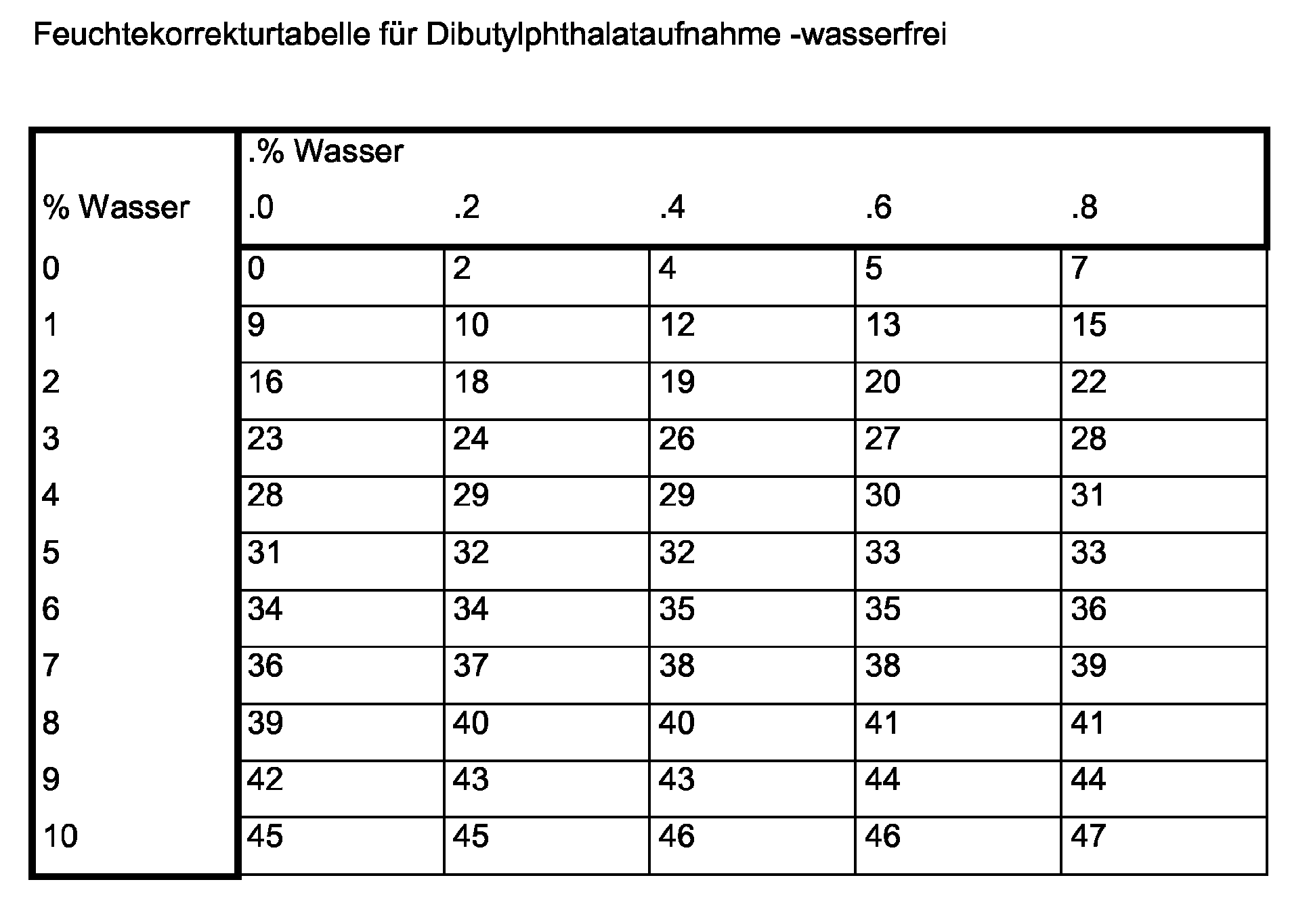
Der Bestimmungsmethode liegen die folgenden chemischen Reaktionen zu Grunde, wobei "Si"-OH eine Silanolgruppe der Kieselsäure symbolisieren soll:


Das pH-Messgerät (Fa. Knick, Typ: 766 pH-Meter Calimatic mit Temperaturfühler) und die pH-Elektrode (Einstabmesskette der Fa. Schott, Typ N7680) werden unter Verwendung von Pufferlösungen (pH 7.00 und 9.00) bei Raumtemperatur kalibriert. Mit dem pH-Meter wird zunächst der Ausgangs-pH-Wert der Suspension bei 25 °C gemessen, danach wird je nach Ergebnis mit Kaliumhydroxid-Lösung (0.1 mol/l) bzw. Salzsäurelösung (0.1 mol/l) der pH-Wert auf 6.00 eingestellt. Der Verbrauch an KOH- bzw. HCI-Lösung in ml bis pH 6.00 entspricht V1'.
Danach werden 20.0 ml Natriumchlorid-Lösung (250.00 g NaCl p. A. mit entionisiertem Wasser auf 1 l aufgefüllt) zudosiert. Mit 0.1 mol/l KOH wird dann die Titration bis zum pH-Wert 9.00 fortgesetzt. Der Verbrauch an KOH-Lösung in ml bis pH 9.00 entspricht V2'.
Anschließend werden die Volumina V1', bzw. V2' zunächst auf die theoretische Einwaage von 1 g normiert und mit 5 erweitert, woraus sich V1 und die Searszahl V2 in den Einheiten ml/(5 g) ergeben.
Die Methanolkonzentration der Gemische richtet sich nach der zu erwartenden Methanolbenetzbarkeit. Die Zentrifugengläser werden dicht verschlossen und dann kräftig geschüttelt (10 Auf- und Abwärtsbewegungen). Zur Abtrennung der benetzten Kieselsäure-Silikatanteile werden die Gläser dann 5 Minuten bei 2500 UpM zentrifugiert. Die benetzten Anteile bilden einen Bodensatz, dessen Volumina an der Skala der Zentrifugengläser abgelesen werden. Die Sediment-Volumina werden in einer Graphik gegen die Methanol/Wasser-Gemisch-Konzentration aufgetragen.
Die einzelnen Meßpunkte ergeben eine Kurve (x-Achse: prozentualer Anteil an Methanol der Methanol/Wasser-Gemische, y-Achse: Höhe des Sediments), deren Lage und Steilheit den Hydrophobierungsgrad der Fällungskieselsäure charakterisiert. Als Maß für die Hydrophobierung wird der x-Achsen-Wert (in %) am Wendepunkt der Kurve angegeben.
Grundsätzlich wird vor jeder Messung automatisch eine Hintergrundmessung durchgeführt. Eine Einwegpipette wird vor jeder Probennahme mit der Suspension dreimal gespült. Etwa 2 ml der Suspension werden mit der Pipette entnommen und 1 - 3 Tropfen sofort in das Flüssigkeitsmodul des Gerätes eindosiert. Der Rest in der Einwegpipette wird in das Becherglas zurückgegeben. Nach der Zugabe wird gewartet, bis das Laserbeugungsgerät eine konstante Konzentration anzeigt. Es wird solange Suspension zugefügt, bis eine Lichtabsorption von 8 bis 12 % erreicht ist und das Gerät "OK" meldet. Die Messung erfolgt bei Raumtemperatur mit dem Auswertemodell der oben festgelegten .rfd-Datei.
Zunächst wird eine Partikelmessung ohne Ultraschall durchgeführt. Danach erfolgt eine zweite, dritte und vierte Messung der gleichen Probe, bei der für 1,2, und 3 min das Ultraschallgerät (SONICS VIBRACELL) bei einer Leistung von 20 W eingeschaltet wird. Weichen die Messungen wesentlich voneinander ab, so müssen die Messungen wiederholt werden. Bleiben die Unterschiede auch nach der Wiederholung bestehen, dann wird die Messung angegeben, die einer monomodalen gaußschen Teilchengrößenverteilung am nächsten kommt. So zeigen z.B. typischerweise sprühgetrocknete, hydrophobierte, unvermahlene Proben reproduzierbare, im wesentlichen monomodale Teilchengrößenverteilungen, wenn Sie ohne Ultraschallbehandlung gemessen werden. Bei hydrophobierten, feinvermahlenen Proben zeigen sich reproduzierbare, näherungsweise monomodale Teilchengrößenverteilungen oft erst nach einer 2 bis 3 Minuten Ultraschall. Bei sehr feinteiligen Proben kann es bei längerer Ultraschallbehandlung in gewissem Umfang zu Agglomerationserscheiniungen kommen.
Im Zweifelsfall werden entweder alle Werte angegeben oder die Meßwerte entsprechend gekennzeichnet. Dabei steht für 0, 1, 2, 3 Minuten Ultraschall die Kürzel: 0 min.US, 1 min.US, 2 min.US und 3 min.US.
Aus der Rohdatenkurve berechnet die Software auf Basis der Volumenverteilung unter Berücksichtigung der Mie-Theorie und den optischen Modellparametern (.rfd Datei) die Teilchengrößenverteilung.
- FG
- = A / E * 100,
- mit FG =
- Feststoffgehalt in %
- A =
- Auswaage in g
- E =
- Einwaage in g
Der Feststoffgehalt in g/l bestimmt sich gemäß:
In ein trockenes Wägeglas mit Schliffdeckel (Durchmesser 8 cm, Höhe 3 cm) werden 10 g der pulverförmigen, kugelförmigen oder granulären Kieselsäure auf 0.1 mg genau eingewogen (Einwaage E). Die Probe wird bei geöffnetem Deckel 2 h bei 105 ± 2 °C in einem Trockenschrank getrocknet. Anschließend wird das Wägeglas verschlossen und in einem Exsikkatorschrank mit Kieselgel als Trocknungsmittel auf Raumtemperatur abgekühlt.
0.5 g der pulverförmigen, kugelförmigen oder granulären Kieselsäure werden auf 0.1 mg genau in einen vorgeglühten, tarierten Porzellantiegel eingewogen (Einwaage E). Die Probe wird 2 h bei 1000 ± 50 °C in einem Muffelofen erhitzt. Anschließend wird der Porzellantiegel in einem Exsikkatorschrank mit Kieselgel als Trocknungsmittel auf Raumtemperatur abgekühlt. Die Auswaage A wird gravimetrisch bestimmt.
Man erhält den Glühverlust (DIN) GV in % gemäß
Eine definierte Menge einer zuvor nicht gesiebten Probe wird in einen graduierten Glaszylinder eingefüllt und mittels eines Stampfvolumeters einer festgelegten Anzahl von Stampfungen unterzogen. Während der Stampfung verdichtet sich die Probe. Als Ergebnis der durchgeführten Untersuchung erhält man die Stampfdichte.
Die Messungen werden auf einem Stampfvolumeter mit Zählwerk der Fa. Engelsmann, Ludwigshafen, Typ STAV 2003, durchgeführt.
Die Stampfdichte D(t) berechnet sich wie folgt:
- D(t):
- Stampfdichte in g/l
- V:
- Volumen der Kieselsäure nach dem Stampfen in ml
- m:
- Masse der Kieselsäure in g
Die Suspension wird filtriert und mit deionisiertem Wasser ausreichend gewaschen. Der erhaltene Feststoffgehalt des Filterkuchens liegt bei 15 - 17 %.
Der Filterkuchen wird unter Vorlage von deionisiertem Wasser und schonendem Rühren so verflüssigt, dass sich eine Kieselsäuresuspension von 6 - 11 % Feststoffgehalt ergibt. Dann wird diese Suspension mit NaOH-Lösung (50 Gew.-%) auf einen pH-Wert von 9 eingestellt. Unmittelbar danach erfolgt die Sprühtrocknung der Suspension (Trocknerausgangstemperatur 130 °C). Die getrocknete Fällungskieselsäure wird mittels einer Gegenstrahlmühle (50 AFG, Fa. HOSOKAWA-ALPINE) vermahlen.
| BET | 152 m2/g |
| CTAB | 158 m2/g |
| BET/CTAB-Verhältnis | 0.96 |
| DBP (wasserfrei) | 246 g/(100g) |
| pH-Wert | 8.5 |
| Mod. Sears-Zahl | 11.5 ml/(5g) |
| Sears/BET-Verhältnis | 0.076 ml/(5m2) |
| Trocknungsverlust | 1.0 % |
| Glühverlust | 3.4 % |
| Stampfdichte | 41 g/l |
| mittlere Partikelgröße d50 | 2.6 µm |
Die Suspension wird filtriert und mit deionisiertem Wasser ausreichend gewaschen. Der erhaltene Feststoffgehalt des Filterkuchens liegt bei 15 - 17 %.
| BET | 145 m2/g |
| CTAB | 156 m2/g |
| BET/CTAB-Verhältnis | 0.93 |
| DBP ( wasserfrei) | 218 g/(100g) |
| pH-Wert | 9.4 |
| Mod. Sears-Zahl | 15.3 ml/(5g) |
| Sears/BET-Verhältnis | 0.106 ml/(5m2) |
| Trocknungsverlust | 1.96 % |
| Glühverlust | 2.88 % |
| Stampfdichte | 80 g/l |
| mittlere Partikelgröße d50 | 3.4 µm |
- Siliconöl "DC 200/100 cs" (Polydimetylsiloxan, Fa. Dow Corning, Datenblatt vom 31.03.1998)
- Hydrophobe Fällungskieselsäure
- Analysenwaage
- Becherglas 250 ml, Höhe: 120 mm; Durchmesser: 60 mm
- Ultra Turrax T50 (Fa. Janke & Kunkel)
Nachdem die Dispersion auf Raumtemperatur abgekühlt ist, kann sie für die anwendungstechnischen Prüfungen eingesetzt werden.
- Mineralöl "SHELL RISELLA Oil G 18" (Fa. Deutsche Shell, Datenblatt VSV-T(F) 7 v. August 1996)
- Hydrophobe Fällungskieselsäure
- Analysenwaage
- Becherglas 250 ml, Höhe: 120 mm; Durchmesser: 60 mm
- Ultra Turrax T50 (Fa. Janke & Kunkel)
- Testwaschmittel, bestehend aus:
- Natriumdodecylbenzosulfonat (Maranil® Paste A 55, Fa. Cognis Dtl. GmbH & Co. KG, Datenblatt Revision-No. 9-01.2000) 11.67 %
- Fettalkohol C16-C18 mit ca. 5 mol EO (Dehydol® TA 5, Fa. Cognis Dtl. GmbH & Co. KG,Datenblatt Revision-No. 3-01.1998) 1.21 %
- Fettalkohol C12-C18 mit ca. 7 mol EO (Dehydol® LT 7, Fa. Cognis Dtl. GmbH & Co. KG,Datenblatt Revision-No. 6-08.1999) 7.24 %
- 1-Hydroxyethyliden-1,1-diphosphonsäure (Dequest 2010, Fa. Brenntag N.V, Belgien) 0.28 %
- Natriumsalz eines Maleinsäure/Acrylsäure-Copolymers (Sokolan CP5, Fa. BASF AG, Datenblatt TI/ES 1081 d v. Mai 1990) 6.52 %
- Zeolith A Compound (Wessalith 4020, Fa. Henkel KGaA) 36.58 %
- Natriumdisilikat (Portil N, Fa. Cognis Dtl. GmbH & Co. KG) 3.26 %
- Natriumcarbonat 18.11 %
- Natriumsulfat 15.13 %
Silikonöl- oder Mineralöldispersion der Fällungskieselsäure
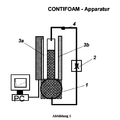
- CONTIFOAM - Apparatur
- Zahnradpumpe mit Düse
- Thermostat
- Heizplatte
- Magnetrührer
- Mikroliterpipette
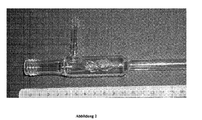
Zur Testdurchführung werden 500 ml dieser Waschlauge vorsichtig in das Glasgefäß (1) eingefüllt. Die Waschlauge im Glasgefäß wird auf 60 °C erwärmt und durch Einschalten einer Zahnradpumpe (2) mit einer Förderleistung von 1200 ml/min durch eine Düse (Abbildung 2) gefördert, wobei die Waschlauge aufgeschäumt wird. Bei der verwendeten Düse handelt sich um eine Wasserstrahlpumpe nach Friedrichs-Antlinger (Bestell-Nr. 181-9401; Katalog "VWR" von 2003). Gleichzeitig mit Einschalten der Zahnradpumpe wird die Messung gestartet. Nach Erreichen der maximalen Schaumhöhe wird die zu prüfende Entschäumerdispersion (0.07 ml bei Mineralöldispersionen und 0.01 ml bei Siliconöldispersionen) mit einer Mikroliterpipette über ein Septum (4) auf ein Mal injiziert und die zeitliche Entwicklung der Schaumhöhe als Funktion der Zeit aufgezeichnet.
Der schematische Kurvenverlauf ist in Abbildung 3 dargestellt. Nach Einschalten der Zahnradpumpe steigt der Schaum an (5). Ist eine definierte Schaumhöhe erreicht wird, wird die Entschäumerformulierung eingespritzt (6). Der Schaum fällt in sich zusammen. Je nach Qualität der Entschäumerformulierung ergibt sich die verbleibende Schaumhöhe. Die Fähigkeit des Entschäumers, die Schaumhöhe sofort nach Zugabe bis zu einer bestimmten Schaumhöhe zu verringern, wird durch die Kenngröße "Knock-Down" ( 7) beschrieben. Er definiert sich als Differenz zwischen der Schaumhöhe zum Zeitpunkt der Zugabe der Entschäumerformulierung und der minimalen verbleibenden Schaumhöhe. Die Zeit, die zwischen Zugabe der Entschäumerformulierung und Erreichen der niedrigsten Schaumhöhe vergeht, wird als Knock-Down-Zeit (8) bezeichnet. Im weiteren Verlauf des Test auf Entschäumungswirkung lässt die Wirkung der Entschäumerformulierung je nach deren Qualität unterschiedlich schnell wieder nach. Die Schaumhöhe steigt wieder an (9). Die Zeit, die zwischen dem Zeitpunkt des Erreichens der minimalen Schaumhöhe nach Zugabe der Entschäumerformulierung und dem Zeitpunkt vergeht, zu dem eine Schaumhöhe von 200 mm wieder erreicht wird, wird durch die Kenngröße Hold-Down (10) charakterisiert. Der Hold-Down ist damit ein Maß für die Standzeit des Entschäumers, d. h. die Dauer der Wirksamkeit. Entschäumerformulierungen, bei denen die Schaumhöhe nicht auf unter 200 mm reduziert wird, wird kein Hold-Down zugeordnet.
Das Ausmaß der Schaumbildung / Menge an Schaum wird u.a. mit der Durchflussmenge, Düsenform bzw. weitere reguliert. Vorteil dieser Prüfmethode ist, dass als Prüflösung verschiedene wässrige, temperierte Schaumlösungen unter dynamischen, praxisnahen Bedingungen getestet werden können. Des weiteren findet eine Kontrolle des Entschäumers über einen bestimmten Zeitraum statt. Es ist nicht nur die Aussage möglich, ob der Entschäumer und somit die darin befindliche Kieselsäure eine Wirkung aufweist, sondern auch wie schnell die Wirkung einsetzt, wie stark sie ist und wie lange sie anhält. Das Nachlassen der Wirkung von Entschäumern ist ein bekanntes Phänomen, das durch extreme Bedingungen (hohe Temperatur, hohe Alkalinität, hohe Scherkräfte) noch beschleunigt wird. Da diese Bedingungen sämtlich nachgestellt werden können, ist eine Aussage, welche Kieselsäure in Kombination mit einem Öl unter praxisnahen Bedingungen die besten Entschäumungseigenschaften aufweist, möglich.
| Beispiel 3 | Beispiel 4 | Vergleichsbeispiel 1 | ||
| BET | m2/g | 152 | 145 | 113 |
| CTAB | m2/g | 158 | 156 | 121 |
| BET/CTAB-Verhältnis | - | 0.96 | 0.93 | 0.93 |
| pH-Wert | - | 8.5 | 9.4 | 8.5 |
| DBP | g/100g | 246 | 218 | 267 |
| Mod. Sears-Zahl | ml/(5g) | 11.5 | 15.3 | 21.3 |
| Sears/BET-Verhältnis | ml/(5m2) | 0.076 | 0.106 | 0.188 |
| Trocknungsverlust | % | 1.02 | 1.96 | 5.1 |
| Glühverlust | % | 3.4 | 2.88 | 3.7 |
| Stampfdichte | g/l | 41 | 80 | 93 |
| Mittlere Partikelgröße d50 (1 min US / 20 W) | µm | 2.6 | 3.4 | 3.8 |
| Knock-Down | mm | 335.1 | 344.4 | 355.4 |
| Knock-Down-Zeit | min | 0.67 | 0.42 | 1.33 |
| Hold-Down | min | 15.85 | 14.51 | 11.29 |
| Knock-Down | mm | 378.3 | 380.0 | 365.6 |
| Knock-Down-Zeit | min | 0.16 | 0.17 | 0.17 |
| Hold-Down | min | 2.52 | 2.61 | 2.13 |
Claims (28)
- Fällungskieselsäure, gekennzeichnet durch
BET 100 - 190 m2/g Modifizierte Sears-Zahl 8 - 20 ml/(5g) Sears-Zahl/BET-Verhältnis < 0.12 ml/(5m2) pH-Wert > 8. - Fällungskieselsäure nach Anspruch 1,
dadurch gekennzeichnet, dass sie eine BET von 120 - 190 m2/g aufweist. - Fällungskieselsäure nach einem der Ansprüche 1 oder 2,
dadurch gekennzeichnet, dass sie eine CTAB von 100 - 190 m2/g aufweist. - Fällungskieselsäure nach einem der Ansprüche 1 bis 3,
dadurch gekennzeichnet, dass sie ein Verhältnis BET/CTAB von 0.8 - 1.2 aufweist. - Fällungskieselsäure nach einem der Ansprüche 1 bis 4,
dadurch gekennzeichnet, dass sie eine DBP < 300 g/(100g) aufweist. - Fällungskieselsäure gemäß einem der Ansprüche 1 bis 5,
dadurch gekennzeichnet, dass sie eine mittlere Partikelgröße d50 kleiner 14 µm aufweist. - Fällungskieselsäure gemäß einem der Ansprüche 1 bis 6,
dadurch gekennzeichnet, dass sie eine mittlere Stampfdichte kleiner als 150 g/l aufweist. - Fällungskieselsäure gemäß einem der Ansprüche 1 bis 7,
dadurch gekennzeichnet, dass sie einen Glühverlust von 2 - 6 %, bevorzugt 2 - 4 %, aufweist. - Verfahren zur Herstellung einer Fällungskieselsäuren, umfassend die Schrittedurchgeführt wird.a) Fällung einer Fällungskieselsäure,b) Filtration,c) Verflüssigung des Filterkuchens durch Zugabe von Wasser,d) Trocknung der Suspension,f) Vermahlung der Fällungskieselsäure,
dadurch gekennzeichnet, dass ein Schritte) Alkalisierung der Fällungskieselsäure durch Zugabe von zumindest einem basischen Mittel - Verfahren nach Anspruch 9,
dadurch gekennzeichnet, dass Schritt a) in folgenden Unterschritten durchgeführt wird:aa) Aufheizen einer Vorlage aus Wasser oder Wasser mit Wasserglas vermischt auf eine Temperatur zwischen 60 und 100 °C, bevorzugt zwischen 70 bis 90 °Cab) Simultane Zugabe von Wasserglas und Säure in die Vorlageac) Erniedrigung des pH-Wertes durch Zugabe eines Säurungsmittels. - Verfahren nach Anspruch 10,
dadurch gekennzeichnet, dass nach Schritt ac) der Schritt
ad) Reifung der Fällsuspension bei 10 bis 95 °C, bevorzugt 40 bis 60 °C, für 0 bis 72 Stunden, bevorzugt 0 bis 12 Stunden,
durchgeführt wird. - Verfahren nach einem der Ansprüche 10 oder 11,
dadurch gekennzeichnet, dass der pH-Wert in Schritt ab) auf einen Wert zwischen 7 und 11 gehalten wird. - Verfahren nach einem der Ansprüche 10 bis 12,
dadurch gekennzeichnet, dass die Temperatur der Reaktionslösung in Schritt ab) auf einen Wert zwischen 60 und 100°C gehalten wird. - Verfahren nach einem der Ansprüche 10 - 13,
dadurch gekennzeichnet, dass die simultane Zugabe von Wasserglas und Säurungsmittel bis zu einem Feststoffgehalt von 40 bis 70 g/l fortgeführt und dann gestoppt wird. - Verfahren nach einem der Ansprüche 10 - 14,
dadurch gekennzeichnet, dass der pH-Wert in Schritt ac) durch Zugabe eines Säurungsmittels auf 2 bis 8 eingestellt wird. - Verfahren nach einem der Ansprüche 9 - 15,
dadurch gekennzeichnet, dass Schritt e) gleichzeitig mit Schritt c) durchgeführt wird. - Verfahren nach einem der Ansprüche 9 - 15,
dadurch gekennzeichnet, dass Schritt e) nach Schritt c) jedoch vor Schritt d) durchgeführt wird. - Verfahren nach einem der Ansprüche 9 - 15,
dadurch gekennzeichnet, dass Schritt e) nach Schritt d) durchgeführt wird. - Verfahren nach einem der Ansprüche 9 - 15,
dadurch gekennzeichnet, dass Schritt e) vor und nach Schritt d) durchgeführt wird. - Verfahren nach einem der Ansprüche 9 - 19,
dadurch gekennzeichnet, dass der pH-Wert der Fällungskieselsäure oder der Suspension in Schritt e), durch Zugabe der basischen Komponente auf 7 bis 11 eingestellt wird. - Verfahren nach einem der Ansprüche 9 - 20,
dadurch gekennzeichnet, dass das basische Mittel ausgewählt wird aus der Gruppe der Alkalihydroxide, Alkalicarbonate, Erdalkalihydroxide, Erdalkalicarbonate, Alkalioxide, Erdalkalioxide, Alkalisilicate, Erdalkalisilicate, Ammoniak und Alkalialuminate oder wässrige Lösungen oder Gemische besagter Basen - Fällungskieselsäure hergestellt gemäß einem der Ansprüche 9 bis 21.
- Verwendung der Fällungskieselsäure gemäß einem der Ansprüche 1 - 8 oder 22 in Entschäumerformulierungen.
- Verwendung der Fällungskieselsäure gemäß einem der Ansprüche 1 - 8 oder 22 in Silikonkautschuk als verstärkender Füllstoff.
- Verwendung der Fällungskieselsäure gemäß einem der Ansprüche 1 - 8 oder 22 in Im HTV-Silikonkautschuk als aufhellendes Additiv in peroxidisch vernetzenden Systemen.
- Verwendung der Fällungskieselsäure gemäß einem der Ansprüche 1 - 8 oder 22 als Fließhilfsmittel.
- Verwendung der Fällungskieselsäure gemäß einem der Ansprüche 1 - 8 oder 22 als Träger.
- Verwendung der Fällungskieselsäure gemäß einem der Ansprüche 1 - 8 oder 22 in Antiblocking.
Applications Claiming Priority (2)
| Application Number | Priority Date | Filing Date | Title |
|---|---|---|---|
| DE102004005409A DE102004005409A1 (de) | 2004-02-03 | 2004-02-03 | Hydrophile Fällungskieselsäure für Entschäumerformulierungen |
| DE102004005409 | 2004-02-03 |
Publications (2)
| Publication Number | Publication Date |
|---|---|
| EP1561727A1 true EP1561727A1 (de) | 2005-08-10 |
| EP1561727B1 EP1561727B1 (de) | 2007-03-07 |
Family
ID=34673141
Family Applications (1)
| Application Number | Title | Priority Date | Filing Date |
|---|---|---|---|
| EP04107016A Expired - Lifetime EP1561727B1 (de) | 2004-02-03 | 2004-12-28 | Fällungskieselsäure für Entschäumerformulierungen |
Country Status (12)
| Country | Link |
|---|---|
| US (1) | US8007751B2 (de) |
| EP (1) | EP1561727B1 (de) |
| JP (1) | JP4646205B2 (de) |
| KR (1) | KR20060041651A (de) |
| AT (1) | ATE356082T1 (de) |
| CA (1) | CA2495736A1 (de) |
| DE (2) | DE102004005409A1 (de) |
| DK (1) | DK1561727T3 (de) |
| ES (1) | ES2283942T3 (de) |
| IL (1) | IL166629A0 (de) |
| NO (1) | NO20050610L (de) |
| TW (1) | TWI359790B (de) |
Cited By (5)
| Publication number | Priority date | Publication date | Assignee | Title |
|---|---|---|---|---|
| EP1860066A3 (de) * | 2006-05-26 | 2007-12-26 | Evonik Degussa GmbH | Hydrophile Kieselsäure für Dichtungsmassen |
| WO2009056530A2 (de) | 2007-11-02 | 2009-05-07 | Evonik Degussa Gmbh | Fällungskieselsäuren für lagerstabile rtv-1 siliconkautschukformulierungen ohne stabilisator |
| WO2009068379A1 (de) | 2007-11-26 | 2009-06-04 | Evonik Degussa Gmbh | Neue fällungskieselsäure zur verdickung und erzeugung von thixotropem verhalten in flüssigen systemen |
| WO2011076716A1 (fr) * | 2009-12-23 | 2011-06-30 | Bluestar Silicones France | Silice de précipitation |
| WO2012113655A1 (de) * | 2011-02-22 | 2012-08-30 | Evonik Degussa Gmbh | Hochreines siliciumdioxidgranulat für quarzglasanwendungen sowie dessen herstellungsverfahren |
Families Citing this family (16)
| Publication number | Priority date | Publication date | Assignee | Title |
|---|---|---|---|---|
| DE102004005411A1 (de) * | 2004-02-03 | 2005-08-18 | Degussa Ag | Hydrophobe Fällungskieselsäure für Entschäumerformulierungen |
| DE102004029069A1 (de) | 2004-06-16 | 2005-12-29 | Degussa Ag | Oberflächenmodifizierte Silicagele |
| US7276156B2 (en) * | 2005-05-26 | 2007-10-02 | Tony Mason Lockerman | Storm drain filter |
| DE102006048850A1 (de) * | 2006-10-16 | 2008-04-17 | Evonik Degussa Gmbh | Amorphe submicron Partikel |
| DE102007004757A1 (de) * | 2006-05-26 | 2007-11-29 | Degussa Gmbh | Fällungskieselsäuren mit speziellen Oberflächeneigenschaften |
| ZA200704237B (en) * | 2006-05-26 | 2010-01-27 | Evonic Degussa Gmbh | Precipitated silicas having special surface properties |
| US7767180B2 (en) | 2006-05-26 | 2010-08-03 | Degussa Gmbh | Precipitated silicas having special surface properties |
| US8529694B2 (en) * | 2006-10-26 | 2013-09-10 | Air Products And Chemicals, Inc. | Powdered acetylenic surfactants and compositions containing them |
| DE102008035867A1 (de) * | 2008-08-01 | 2010-02-04 | Evonik Degussa Gmbh | Neuartige Fällungskieselsäuren für Trägeranwendungen |
| DE102009045104A1 (de) | 2009-09-29 | 2011-03-31 | Evonik Degussa Gmbh | Neuartige Mattierungsmittel für UV-Lacke |
| JP6441827B2 (ja) | 2013-03-07 | 2018-12-19 | スイッチ マテリアルズ インコーポレイテッドSwitch Materials Inc. | 封止されたスイッチング可能なフィルム、およびスイッチング可能なフィルムを封止するための方法 |
| EP3084519A4 (de) | 2013-12-19 | 2017-08-16 | Switch Materials, Inc. | Schaltbare objekten und verfahren zur herstellung |
| WO2017201308A1 (en) * | 2016-05-18 | 2017-11-23 | Ecopro Polymers, Inc. | Carbohydrate-based formaldehyde-free binder for engineered wood products |
| US12427444B2 (en) | 2018-06-15 | 2025-09-30 | W.R. Grace & Co.-Conn. | Defoamer active, manufacturing thereof, and deforming formulation |
| EP3954743A1 (de) | 2020-08-12 | 2022-02-16 | Evonik Operations GmbH | Verwendung von siliziumdioxid zur verbesserung der leitfähigkeit von beschichtungen |
| JP7573565B2 (ja) | 2021-05-18 | 2024-10-25 | 沢井製薬株式会社 | 表示を有するフィルムコーティング錠及びその製造方法 |
Citations (1)
| Publication number | Priority date | Publication date | Assignee | Title |
|---|---|---|---|---|
| WO2003014020A1 (en) * | 2001-08-07 | 2003-02-20 | Ppg Industries Ohio, Inc. | Silica-based particulates |
Family Cites Families (19)
| Publication number | Priority date | Publication date | Assignee | Title |
|---|---|---|---|---|
| US4127641A (en) * | 1975-12-10 | 1978-11-28 | Joseph Crosfield And Sons Limited | Process for the preparation of precipitated silicas having morphology similar to pyrogenic silicas |
| US4463108A (en) * | 1981-07-01 | 1984-07-31 | Ppg Industries, Inc. | Precipitated silica pigment for silicone rubber |
| DE3144299A1 (de) * | 1981-11-07 | 1983-05-19 | Degussa Ag, 6000 Frankfurt | Faellungskieselsaeuren mit hoher struktur und verfahren zu ihrer herstellung |
| US5094829A (en) * | 1990-06-21 | 1992-03-10 | Ppg Industries, Inc. | Reinforced precipitated silica |
| JP3444670B2 (ja) * | 1993-12-28 | 2003-09-08 | 水澤化学工業株式会社 | 粒状非晶質シリカの製造方法 |
| US5846506A (en) * | 1994-10-07 | 1998-12-08 | Degussa Aktiengesellschaft | Precipitated silicas |
| US5911963A (en) * | 1995-05-12 | 1999-06-15 | Ppg Industries Ohio, Inc. | Amorphous precipitated silica having a low proportion of small pores |
| US6191122B1 (en) * | 1996-03-29 | 2001-02-20 | DEGUSSA HüLS AKTIENGESELLSCHAFT | Partially hydrophobic precipitated silicas |
| US5908660A (en) * | 1997-09-03 | 1999-06-01 | Dow Corning Corporation | Method of preparing hydrophobic precipitated silica |
| DE19828364A1 (de) * | 1998-06-25 | 1999-12-30 | Degussa | Hydrophobe Fällungskieselsäure |
| US6184408B1 (en) * | 1999-04-28 | 2001-02-06 | Dow Corning Corporation | Method for preparation of hydrophobic precipitated silica |
| DE10058616A1 (de) * | 2000-11-25 | 2002-05-29 | Degussa | Fällungskieselsäuren mit hoher Struktur |
| DE10112441A1 (de) * | 2001-03-15 | 2002-09-19 | Degussa | Kieselsäure durch Fällung mit konstanter Alkalizahl und deren Verwendung |
| DE10138490A1 (de) * | 2001-08-04 | 2003-02-13 | Degussa | Hydrophobe Fällungskieselsäure mit hohem Weißgrad und extrem niedriger Feuchtigkeitsaufnahme |
| DE10138492A1 (de) * | 2001-08-04 | 2003-02-13 | Degussa | Hydrophobe, nicht getemperte Fällungskieselsäure mit hohem Weißgrad |
| DE10138491A1 (de) * | 2001-08-04 | 2003-02-13 | Degussa | Verfahren zur Herstellung einer hydrophoben Fällungskieselsäure mit hohem Weißgrad und extrem niedriger Feuchtigkeitsaufnahme |
| DE10146325A1 (de) * | 2001-09-20 | 2003-04-10 | Degussa | Fällungskieselsäure mit hohem BET/CTAB-Verhältnis |
| EP1295906A1 (de) * | 2001-09-20 | 2003-03-26 | Degussa AG | Silikonkautschukformulierungen mit hydrophoben Kieselsäuren |
| DE10203500A1 (de) * | 2002-01-30 | 2003-08-07 | Degussa | Raumtemperaturvernetzende Einkomponenten-Silikonkautschukformulierungen mit hydrophoben Kieselsäuren |
-
2004
- 2004-02-03 DE DE102004005409A patent/DE102004005409A1/de not_active Withdrawn
- 2004-12-28 DE DE502004003125T patent/DE502004003125D1/de not_active Expired - Lifetime
- 2004-12-28 AT AT04107016T patent/ATE356082T1/de active
- 2004-12-28 ES ES04107016T patent/ES2283942T3/es not_active Expired - Lifetime
- 2004-12-28 EP EP04107016A patent/EP1561727B1/de not_active Expired - Lifetime
- 2004-12-28 DK DK04107016T patent/DK1561727T3/da active
-
2005
- 2005-01-19 US US11/036,987 patent/US8007751B2/en active Active
- 2005-01-27 TW TW094102506A patent/TWI359790B/zh not_active IP Right Cessation
- 2005-02-01 CA CA002495736A patent/CA2495736A1/en not_active Abandoned
- 2005-02-01 IL IL16662905A patent/IL166629A0/xx not_active IP Right Cessation
- 2005-02-03 KR KR1020050010011A patent/KR20060041651A/ko not_active Withdrawn
- 2005-02-03 NO NO20050610A patent/NO20050610L/no not_active Application Discontinuation
- 2005-02-03 JP JP2005028111A patent/JP4646205B2/ja not_active Expired - Fee Related
Patent Citations (1)
| Publication number | Priority date | Publication date | Assignee | Title |
|---|---|---|---|---|
| WO2003014020A1 (en) * | 2001-08-07 | 2003-02-20 | Ppg Industries Ohio, Inc. | Silica-based particulates |
Cited By (11)
| Publication number | Priority date | Publication date | Assignee | Title |
|---|---|---|---|---|
| EP1860066A3 (de) * | 2006-05-26 | 2007-12-26 | Evonik Degussa GmbH | Hydrophile Kieselsäure für Dichtungsmassen |
| US8617504B2 (en) | 2006-05-26 | 2013-12-31 | Evonik Degussa Gmbh | Hydrophilic silica for sealants |
| WO2009056530A2 (de) | 2007-11-02 | 2009-05-07 | Evonik Degussa Gmbh | Fällungskieselsäuren für lagerstabile rtv-1 siliconkautschukformulierungen ohne stabilisator |
| WO2009056530A3 (de) * | 2007-11-02 | 2009-07-09 | Evonik Degussa Gmbh | Fällungskieselsäuren für lagerstabile rtv-1 siliconkautschukformulierungen ohne stabilisator |
| CN101918313B (zh) * | 2007-11-02 | 2013-06-26 | 赢创德固赛有限公司 | 用于不含稳定剂而可稳定储存的rtv-1硅橡胶配制物的沉淀二氧化硅 |
| US9738535B2 (en) | 2007-11-02 | 2017-08-22 | Evonik Degussa Gmbh | Precipitated silicas for storage-stable RTV-1 silicone rubber formulations without stabilizer |
| WO2009068379A1 (de) | 2007-11-26 | 2009-06-04 | Evonik Degussa Gmbh | Neue fällungskieselsäure zur verdickung und erzeugung von thixotropem verhalten in flüssigen systemen |
| KR101498752B1 (ko) * | 2007-11-26 | 2015-03-09 | 에보니크 데구사 게엠베하 | 액체 시스템에서의 증점 및 요변성 거동 생성을 위한 신규 침전 실리카 |
| WO2011076716A1 (fr) * | 2009-12-23 | 2011-06-30 | Bluestar Silicones France | Silice de précipitation |
| CN102753479A (zh) * | 2009-12-23 | 2012-10-24 | 蓝星有机硅法国公司 | 沉淀二氧化硅 |
| WO2012113655A1 (de) * | 2011-02-22 | 2012-08-30 | Evonik Degussa Gmbh | Hochreines siliciumdioxidgranulat für quarzglasanwendungen sowie dessen herstellungsverfahren |
Also Published As
| Publication number | Publication date |
|---|---|
| US20050191228A1 (en) | 2005-09-01 |
| ATE356082T1 (de) | 2007-03-15 |
| DE102004005409A1 (de) | 2005-08-18 |
| CA2495736A1 (en) | 2005-08-03 |
| DE502004003125D1 (de) | 2007-04-19 |
| NO20050610D0 (no) | 2005-02-03 |
| TWI359790B (en) | 2012-03-11 |
| IL166629A0 (en) | 2006-01-15 |
| JP2005220014A (ja) | 2005-08-18 |
| JP4646205B2 (ja) | 2011-03-09 |
| US8007751B2 (en) | 2011-08-30 |
| TW200530128A (en) | 2005-09-16 |
| EP1561727B1 (de) | 2007-03-07 |
| DK1561727T3 (da) | 2007-06-18 |
| ES2283942T3 (es) | 2007-11-01 |
| KR20060041651A (ko) | 2006-05-12 |
| NO20050610L (no) | 2005-08-04 |
Similar Documents
| Publication | Publication Date | Title |
|---|---|---|
| EP1561727B1 (de) | Fällungskieselsäure für Entschäumerformulierungen | |
| EP1561728B1 (de) | Hydrophobe Fällungskieselsäure für Entschäumerformulierungen | |
| EP1241136B1 (de) | Kieselsäure durch Fällung mit konstanter Alkalizahl und deren Verwendung | |
| EP1477457B1 (de) | Oberflächenmodifizierte Fällungskieselsäuren | |
| DE69816233T2 (de) | Fällungskieselsäure verwendbar als verstärkender füllstoff in elastomeren | |
| DE102004029069A1 (de) | Oberflächenmodifizierte Silicagele | |
| EP0798348B1 (de) | Teilhydrophobe Fällungskieselsäuren | |
| EP1860066B1 (de) | Hydrophile Kieselsäure für Dichtungsmassen | |
| DE602004010671T2 (de) | Amorphe kieselsäurepartikel mit hoher absorptionskapazität und ausgeprägten strukturellen eigenschaften | |
| EP0062749A1 (de) | Verfahren zur Herstellung von Fällungskieselsäuren | |
| EP1513768B1 (de) | Aluminium-haltige fällungskieselsäure mit einstellbarem bet/ctab-verhältnis | |
| DE102008017747A1 (de) | Gefällte Kieselsäuren als Verstärkerfüllstoff für Elastomermischungen | |
| DE69825149T2 (de) | Zusammenstellung bestehend aus einer absorbierden flüssigkeit auf einem träger auf basis von fällungskieselsaüre | |
| EP2209739B1 (de) | Fällungskieselsäuren für lagerstabile rtv-1 siliconkautschukformulierungen ohne stabilisator | |
| EP1860067B1 (de) | Fällungskieselsäuren mit speziellen Oberflächeneigenschaften | |
| DE102008017731A1 (de) | Kautschukmischung | |
| EP2483357B1 (de) | Oberflächenmodifizierte kieselsäure semi-gele | |
| EP0798266B2 (de) | Fällungskieselsäure | |
| DE10124298A1 (de) | Verfahren zur Herstellung von Kieselsäuren und Silikaten durch saure Fällung von Silikaten mit konstantem Kationenüberschuß | |
| DE102004012090A1 (de) | Oberflächenmodifizierte Fällungskieselsäuren | |
| DE19829649C2 (de) | Slurry, enthaltend ein agglomeriertes carbonathaltiges Pigment | |
| DE10322214A1 (de) | Aluminium-haltige Fällungskieselsäure mit einstellbarem BET/CTAB-Verhältnis | |
| KR100260328B1 (ko) | 침강 실리카의 새로운 제조 방법, 아연-함유의 새로운 침강 실리카, 및 엘라스토머의 보강에 사용되는 그것의 용도 |
Legal Events
| Date | Code | Title | Description |
|---|---|---|---|
| PUAI | Public reference made under article 153(3) epc to a published international application that has entered the european phase |
Free format text: ORIGINAL CODE: 0009012 |
|
| 17P | Request for examination filed |
Effective date: 20041228 |
|
| AK | Designated contracting states |
Kind code of ref document: A1 Designated state(s): AT BE BG CH CY CZ DE DK EE ES FI FR GB GR HU IE IS IT LI LT LU MC NL PL PT RO SE SI SK TR |
|
| AX | Request for extension of the european patent |
Extension state: AL BA HR LV MK YU |
|
| AKX | Designation fees paid |
Designated state(s): AT BE BG CH CY CZ DE DK EE ES FI FR GB GR HU IE IS IT LI LT LU MC NL PL PT RO SE SI SK TR |
|
| GRAP | Despatch of communication of intention to grant a patent |
Free format text: ORIGINAL CODE: EPIDOSNIGR1 |
|
| GRAS | Grant fee paid |
Free format text: ORIGINAL CODE: EPIDOSNIGR3 |
|
| GRAA | (expected) grant |
Free format text: ORIGINAL CODE: 0009210 |
|
| RAP1 | Party data changed (applicant data changed or rights of an application transferred) |
Owner name: DEGUSSA GMBH |
|
| AK | Designated contracting states |
Kind code of ref document: B1 Designated state(s): AT BE BG CH CY CZ DE DK EE ES FI FR GB GR HU IE IS IT LI LT LU MC NL PL PT RO SE SI SK TR |
|
| PG25 | Lapsed in a contracting state [announced via postgrant information from national office to epo] |
Ref country code: IE Free format text: LAPSE BECAUSE OF FAILURE TO SUBMIT A TRANSLATION OF THE DESCRIPTION OR TO PAY THE FEE WITHIN THE PRESCRIBED TIME-LIMIT Effective date: 20070307 Ref country code: PL Free format text: LAPSE BECAUSE OF FAILURE TO SUBMIT A TRANSLATION OF THE DESCRIPTION OR TO PAY THE FEE WITHIN THE PRESCRIBED TIME-LIMIT Effective date: 20070307 Ref country code: SI Free format text: LAPSE BECAUSE OF FAILURE TO SUBMIT A TRANSLATION OF THE DESCRIPTION OR TO PAY THE FEE WITHIN THE PRESCRIBED TIME-LIMIT Effective date: 20070307 |
|
| REG | Reference to a national code |
Ref country code: GB Ref legal event code: FG4D Free format text: NOT ENGLISH |
|
| REG | Reference to a national code |
Ref country code: CH Ref legal event code: EP |
|
| REF | Corresponds to: |
Ref document number: 502004003125 Country of ref document: DE Date of ref document: 20070419 Kind code of ref document: P |
|
| REG | Reference to a national code |
Ref country code: IE Ref legal event code: FG4D Free format text: LANGUAGE OF EP DOCUMENT: GERMAN |
|
| PG25 | Lapsed in a contracting state [announced via postgrant information from national office to epo] |
Ref country code: BG Free format text: LAPSE BECAUSE OF FAILURE TO SUBMIT A TRANSLATION OF THE DESCRIPTION OR TO PAY THE FEE WITHIN THE PRESCRIBED TIME-LIMIT Effective date: 20070608 |
|
| REG | Reference to a national code |
Ref country code: SE Ref legal event code: TRGR |
|
| REG | Reference to a national code |
Ref country code: DK Ref legal event code: T3 |
|
| GBT | Gb: translation of ep patent filed (gb section 77(6)(a)/1977) |
Effective date: 20070605 |
|
| PG25 | Lapsed in a contracting state [announced via postgrant information from national office to epo] |
Ref country code: IS Free format text: LAPSE BECAUSE OF FAILURE TO SUBMIT A TRANSLATION OF THE DESCRIPTION OR TO PAY THE FEE WITHIN THE PRESCRIBED TIME-LIMIT Effective date: 20070707 |
|
| PG25 | Lapsed in a contracting state [announced via postgrant information from national office to epo] |
Ref country code: PT Free format text: LAPSE BECAUSE OF FAILURE TO SUBMIT A TRANSLATION OF THE DESCRIPTION OR TO PAY THE FEE WITHIN THE PRESCRIBED TIME-LIMIT Effective date: 20070807 |
|
| ET | Fr: translation filed | ||
| REG | Reference to a national code |
Ref country code: IE Ref legal event code: FD4D |
|
| REG | Reference to a national code |
Ref country code: ES Ref legal event code: FG2A Ref document number: 2283942 Country of ref document: ES Kind code of ref document: T3 |
|
| RAP2 | Party data changed (patent owner data changed or rights of a patent transferred) |
Owner name: EVONIK DEGUSSA GMBH |
|
| PG25 | Lapsed in a contracting state [announced via postgrant information from national office to epo] |
Ref country code: SK Free format text: LAPSE BECAUSE OF FAILURE TO SUBMIT A TRANSLATION OF THE DESCRIPTION OR TO PAY THE FEE WITHIN THE PRESCRIBED TIME-LIMIT Effective date: 20070307 |
|
| NLT2 | Nl: modifications (of names), taken from the european patent patent bulletin |
Owner name: EVONIK DEGUSSA GMBH Effective date: 20071107 |
|
| PG25 | Lapsed in a contracting state [announced via postgrant information from national office to epo] |
Ref country code: CZ Free format text: LAPSE BECAUSE OF FAILURE TO SUBMIT A TRANSLATION OF THE DESCRIPTION OR TO PAY THE FEE WITHIN THE PRESCRIBED TIME-LIMIT Effective date: 20070307 Ref country code: RO Free format text: LAPSE BECAUSE OF FAILURE TO SUBMIT A TRANSLATION OF THE DESCRIPTION OR TO PAY THE FEE WITHIN THE PRESCRIBED TIME-LIMIT Effective date: 20070307 |
|
| PLBE | No opposition filed within time limit |
Free format text: ORIGINAL CODE: 0009261 |
|
| STAA | Information on the status of an ep patent application or granted ep patent |
Free format text: STATUS: NO OPPOSITION FILED WITHIN TIME LIMIT |
|
| 26N | No opposition filed |
Effective date: 20071210 |
|
| PG25 | Lapsed in a contracting state [announced via postgrant information from national office to epo] |
Ref country code: LT Free format text: LAPSE BECAUSE OF FAILURE TO SUBMIT A TRANSLATION OF THE DESCRIPTION OR TO PAY THE FEE WITHIN THE PRESCRIBED TIME-LIMIT Effective date: 20070307 |
|
| PG25 | Lapsed in a contracting state [announced via postgrant information from national office to epo] |
Ref country code: GR Free format text: LAPSE BECAUSE OF FAILURE TO SUBMIT A TRANSLATION OF THE DESCRIPTION OR TO PAY THE FEE WITHIN THE PRESCRIBED TIME-LIMIT Effective date: 20070608 |
|
| PG25 | Lapsed in a contracting state [announced via postgrant information from national office to epo] |
Ref country code: MC Free format text: LAPSE BECAUSE OF NON-PAYMENT OF DUE FEES Effective date: 20071231 |
|
| PG25 | Lapsed in a contracting state [announced via postgrant information from national office to epo] |
Ref country code: EE Free format text: LAPSE BECAUSE OF FAILURE TO SUBMIT A TRANSLATION OF THE DESCRIPTION OR TO PAY THE FEE WITHIN THE PRESCRIBED TIME-LIMIT Effective date: 20070307 |
|
| PG25 | Lapsed in a contracting state [announced via postgrant information from national office to epo] |
Ref country code: CY Free format text: LAPSE BECAUSE OF FAILURE TO SUBMIT A TRANSLATION OF THE DESCRIPTION OR TO PAY THE FEE WITHIN THE PRESCRIBED TIME-LIMIT Effective date: 20070307 |
|
| PG25 | Lapsed in a contracting state [announced via postgrant information from national office to epo] |
Ref country code: LU Free format text: LAPSE BECAUSE OF NON-PAYMENT OF DUE FEES Effective date: 20071228 |
|
| PG25 | Lapsed in a contracting state [announced via postgrant information from national office to epo] |
Ref country code: HU Free format text: LAPSE BECAUSE OF FAILURE TO SUBMIT A TRANSLATION OF THE DESCRIPTION OR TO PAY THE FEE WITHIN THE PRESCRIBED TIME-LIMIT Effective date: 20070908 |
|
| REG | Reference to a national code |
Ref country code: CH Ref legal event code: PFA Owner name: EVONIK DEGUSSA GMBH Free format text: DEGUSSA GMBH#BENNIGSENPLATZ 1#40474 DUESSELDORF (DE) -TRANSFER TO- EVONIK DEGUSSA GMBH#RELLINGHAUSER STRASSE 1-11#45128 ESSEN (DE) |
|
| NLT1 | Nl: modifications of names registered in virtue of documents presented to the patent office pursuant to art. 16 a, paragraph 1 |
Owner name: EVONIK DEGUSSA GMBH |
|
| REG | Reference to a national code |
Ref country code: FR Ref legal event code: CD Ref country code: FR Ref legal event code: CA |
|
| PGFP | Annual fee paid to national office [announced via postgrant information from national office to epo] |
Ref country code: DK Payment date: 20121219 Year of fee payment: 9 Ref country code: CH Payment date: 20121221 Year of fee payment: 9 |
|
| PGFP | Annual fee paid to national office [announced via postgrant information from national office to epo] |
Ref country code: SE Payment date: 20121220 Year of fee payment: 9 |
|
| PGFP | Annual fee paid to national office [announced via postgrant information from national office to epo] |
Ref country code: AT Payment date: 20121212 Year of fee payment: 9 |
|
| PGFP | Annual fee paid to national office [announced via postgrant information from national office to epo] |
Ref country code: NL Payment date: 20121220 Year of fee payment: 9 |
|
| REG | Reference to a national code |
Ref country code: DK Ref legal event code: EBP Effective date: 20131231 |
|
| REG | Reference to a national code |
Ref country code: NL Ref legal event code: V1 Effective date: 20140701 |
|
| REG | Reference to a national code |
Ref country code: SE Ref legal event code: EUG |
|
| REG | Reference to a national code |
Ref country code: CH Ref legal event code: PL |
|
| REG | Reference to a national code |
Ref country code: AT Ref legal event code: MM01 Ref document number: 356082 Country of ref document: AT Kind code of ref document: T Effective date: 20131228 |
|
| PG25 | Lapsed in a contracting state [announced via postgrant information from national office to epo] |
Ref country code: SE Free format text: LAPSE BECAUSE OF NON-PAYMENT OF DUE FEES Effective date: 20131229 |
|
| PG25 | Lapsed in a contracting state [announced via postgrant information from national office to epo] |
Ref country code: CH Free format text: LAPSE BECAUSE OF NON-PAYMENT OF DUE FEES Effective date: 20131231 Ref country code: LI Free format text: LAPSE BECAUSE OF NON-PAYMENT OF DUE FEES Effective date: 20131231 Ref country code: NL Free format text: LAPSE BECAUSE OF NON-PAYMENT OF DUE FEES Effective date: 20140701 |
|
| PG25 | Lapsed in a contracting state [announced via postgrant information from national office to epo] |
Ref country code: AT Free format text: LAPSE BECAUSE OF NON-PAYMENT OF DUE FEES Effective date: 20131228 |
|
| PG25 | Lapsed in a contracting state [announced via postgrant information from national office to epo] |
Ref country code: DK Free format text: LAPSE BECAUSE OF NON-PAYMENT OF DUE FEES Effective date: 20131231 |
|
| REG | Reference to a national code |
Ref country code: FR Ref legal event code: PLFP Year of fee payment: 12 |
|
| REG | Reference to a national code |
Ref country code: FR Ref legal event code: PLFP Year of fee payment: 13 |
|
| REG | Reference to a national code |
Ref country code: FR Ref legal event code: PLFP Year of fee payment: 14 |
|
| REG | Reference to a national code |
Ref country code: DE Ref legal event code: R081 Ref document number: 502004003125 Country of ref document: DE Owner name: EVONIK OPERATIONS GMBH, DE Free format text: FORMER OWNER: EVONIK DEGUSSA GMBH, 40474 DUESSELDORF, DE |
|
| REG | Reference to a national code |
Ref country code: ES Ref legal event code: PC2A Owner name: EVONIK OPERATIONS GMBH Effective date: 20200622 |
|
| REG | Reference to a national code |
Ref country code: BE Ref legal event code: HC Owner name: EVONIK OPERATIONS GMBH; DE Free format text: DETAILS ASSIGNMENT: CHANGE OF OWNER(S), CHANGEMENT DE NOM DU PROPRIETAIRE Effective date: 20200403 |
|
| REG | Reference to a national code |
Ref country code: FI Ref legal event code: PCE Owner name: EVONIK OPERATIONS GMBH |
|
| PGFP | Annual fee paid to national office [announced via postgrant information from national office to epo] |
Ref country code: GB Payment date: 20221222 Year of fee payment: 19 Ref country code: FR Payment date: 20221222 Year of fee payment: 19 Ref country code: FI Payment date: 20221222 Year of fee payment: 19 Ref country code: DE Payment date: 20221213 Year of fee payment: 19 |
|
| PGFP | Annual fee paid to national office [announced via postgrant information from national office to epo] |
Ref country code: BE Payment date: 20221221 Year of fee payment: 19 |
|
| PGFP | Annual fee paid to national office [announced via postgrant information from national office to epo] |
Ref country code: TR Payment date: 20221223 Year of fee payment: 19 Ref country code: ES Payment date: 20230224 Year of fee payment: 19 |
|
| PGFP | Annual fee paid to national office [announced via postgrant information from national office to epo] |
Ref country code: IT Payment date: 20221228 Year of fee payment: 19 |
|
| P01 | Opt-out of the competence of the unified patent court (upc) registered |
Effective date: 20230526 |
|
| REG | Reference to a national code |
Ref country code: DE Ref legal event code: R119 Ref document number: 502004003125 Country of ref document: DE |
|
| PG25 | Lapsed in a contracting state [announced via postgrant information from national office to epo] |
Ref country code: FI Free format text: LAPSE BECAUSE OF NON-PAYMENT OF DUE FEES Effective date: 20231228 |
|
| GBPC | Gb: european patent ceased through non-payment of renewal fee |
Effective date: 20231228 |
|
| REG | Reference to a national code |
Ref country code: BE Ref legal event code: MM Effective date: 20231231 |
|
| PG25 | Lapsed in a contracting state [announced via postgrant information from national office to epo] |
Ref country code: DE Free format text: LAPSE BECAUSE OF NON-PAYMENT OF DUE FEES Effective date: 20240702 |
|
| PG25 | Lapsed in a contracting state [announced via postgrant information from national office to epo] |
Ref country code: GB Free format text: LAPSE BECAUSE OF NON-PAYMENT OF DUE FEES Effective date: 20231228 |
|
| PG25 | Lapsed in a contracting state [announced via postgrant information from national office to epo] |
Ref country code: BE Free format text: LAPSE BECAUSE OF NON-PAYMENT OF DUE FEES Effective date: 20231231 |
|
| PG25 | Lapsed in a contracting state [announced via postgrant information from national office to epo] |
Ref country code: FR Free format text: LAPSE BECAUSE OF NON-PAYMENT OF DUE FEES Effective date: 20231231 |
|
| PG25 | Lapsed in a contracting state [announced via postgrant information from national office to epo] |
Ref country code: GB Free format text: LAPSE BECAUSE OF NON-PAYMENT OF DUE FEES Effective date: 20231228 Ref country code: FR Free format text: LAPSE BECAUSE OF NON-PAYMENT OF DUE FEES Effective date: 20231231 Ref country code: DE Free format text: LAPSE BECAUSE OF NON-PAYMENT OF DUE FEES Effective date: 20240702 Ref country code: BE Free format text: LAPSE BECAUSE OF NON-PAYMENT OF DUE FEES Effective date: 20231231 |
|
| REG | Reference to a national code |
Ref country code: ES Ref legal event code: FD2A Effective date: 20250203 |
|
| PG25 | Lapsed in a contracting state [announced via postgrant information from national office to epo] |
Ref country code: ES Free format text: LAPSE BECAUSE OF NON-PAYMENT OF DUE FEES Effective date: 20231229 |
|
| PG25 | Lapsed in a contracting state [announced via postgrant information from national office to epo] |
Ref country code: IT Free format text: LAPSE BECAUSE OF NON-PAYMENT OF DUE FEES Effective date: 20231228 |